Mechanical Behaviour and Flow Characteristics of Reservoir Sandstone Under Deep Triaxial Stress Conditions


Abstract
1. Introduction
2. Study on the Flow Characteristics of Reservoir Sandstone Under Deep High Triaxial Stress
2.1. Experimental Protocol
2.1.1. Rock Sample Preparation and Testing of Basic Physical Properties
2.1.2. Test Equipment and Loading Protocol
2.2. Permeability Model
2.2.1. Permeability Models for the Elastic Zone of Rock
2.2.2. Permeability Model for Damaged Rock Sections
3. Results
3.1. Mechanical and Hydraulic Properties of Sandstone Under Deep Triaxial Stress
3.2. Model Validation
4. Analysis and Discussion
4.1. The Controlling Influence of Deep High Triaxial Stress Conditions on the Mechanical Behaviour of Reservoir Sandstone
4.2. Comparative Analysis of Permeability Evolution Mechanisms in the Elastic–Plastic Stages
4.3. Sensitivity of Permeability to Porosity
4.4. Influence of Stress Path on Seepage Characteristics
5. Limitations of the Study and Scope of the Model
6. Conclusions
- (1)
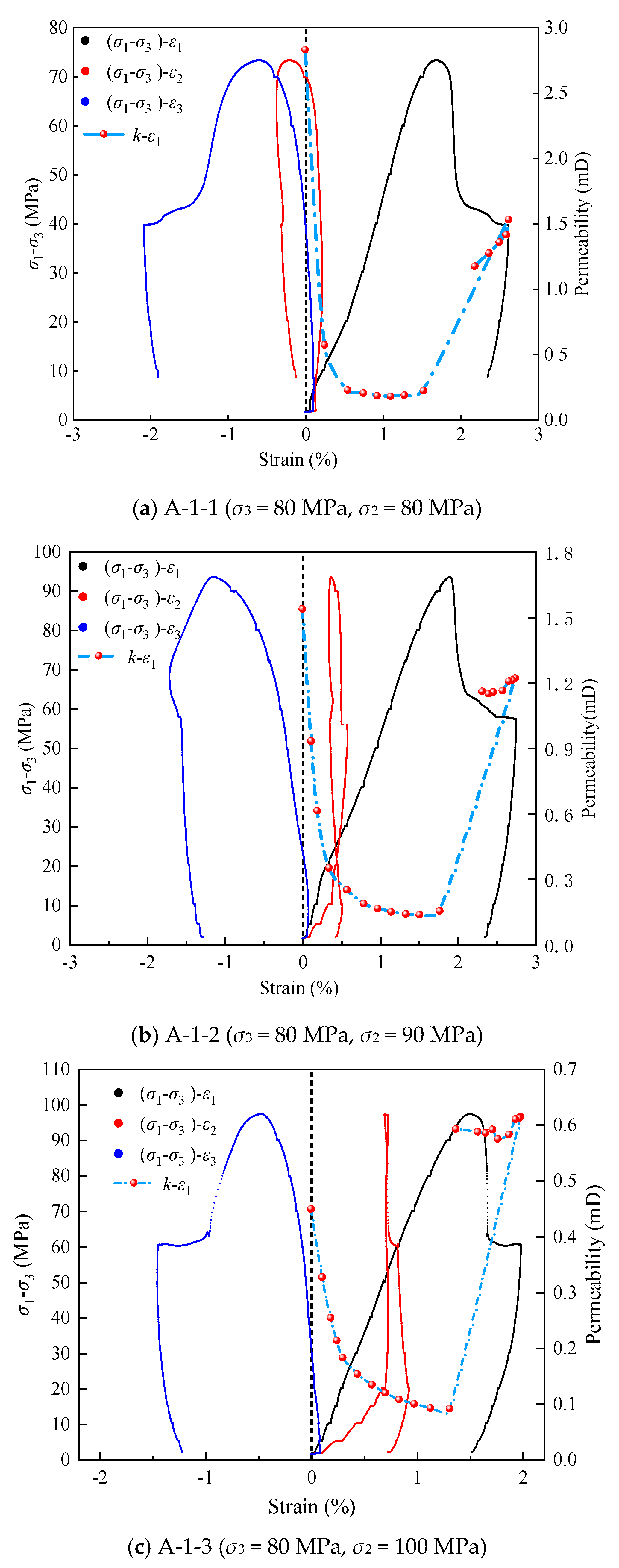
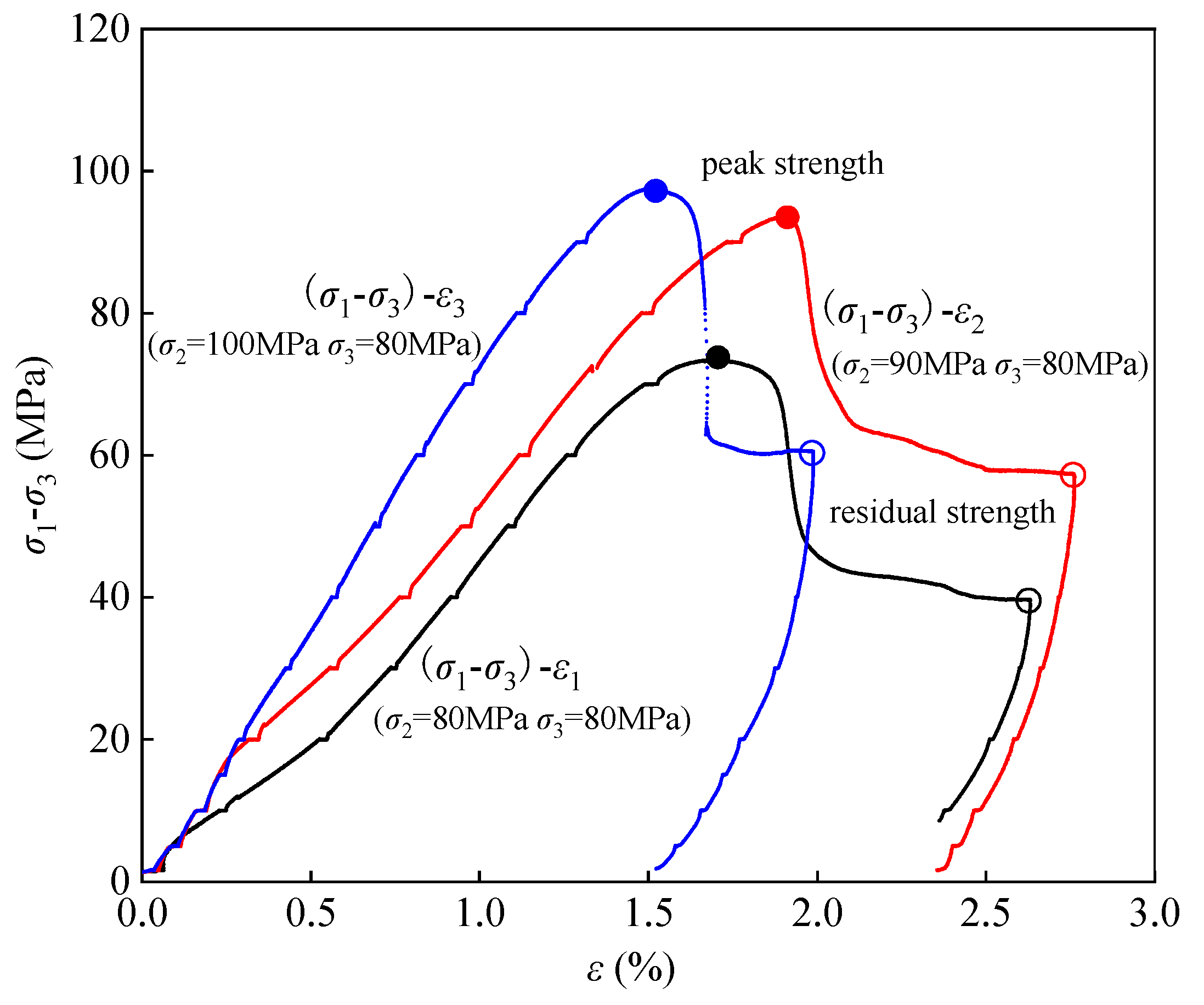
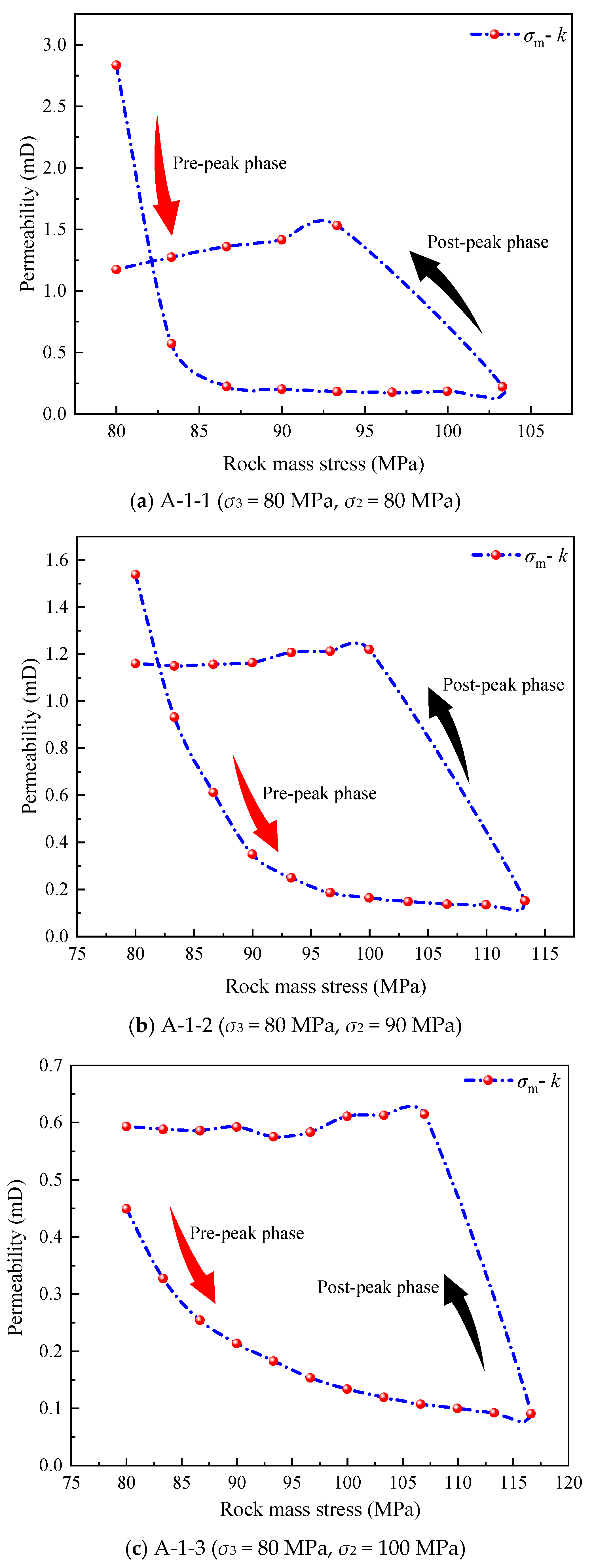
- The total stress–strain process of reservoir sandstone under deep, high triaxial stress can be divided into the stages of compaction, elastic deformation, yield, and post-failure. Throughout this process, the mechanical behaviour exhibits a three-stage pattern of ‘compression–unloading and expansion–failure’, whilst the corresponding permeability exhibits a U-shaped evolution pattern characterised by ‘exponential decline–sudden increase–stabilisation’. Furthermore, the irreversible deformation of the rock’s pore structure caused by stress ensures that permeability remains at a relatively high level even after unloading, indicating that the impact of damage on sandstone permeability is irreversible.
- (2)
- The intermediate principal stress exerts a significant strengthening effect on the mechanical properties of sandstone. As the intermediate principal stress increases from 80 MPa to 100 MPa, both the peak strength and residual strength of the sandstone show an increasing trend; post-peak brittleness is enhanced, and ductility is reduced. Under high-intermediate principal stress conditions, the sandstone exhibits a brittle–ductile transition failure; under moderate intermediate principal stress, it exhibits ductile shear failure. By constraining lateral deformation and delaying the initiation and propagation of microcracks, the intermediate principal stress effectively increases the rock’s load-bearing limit.
- (3)
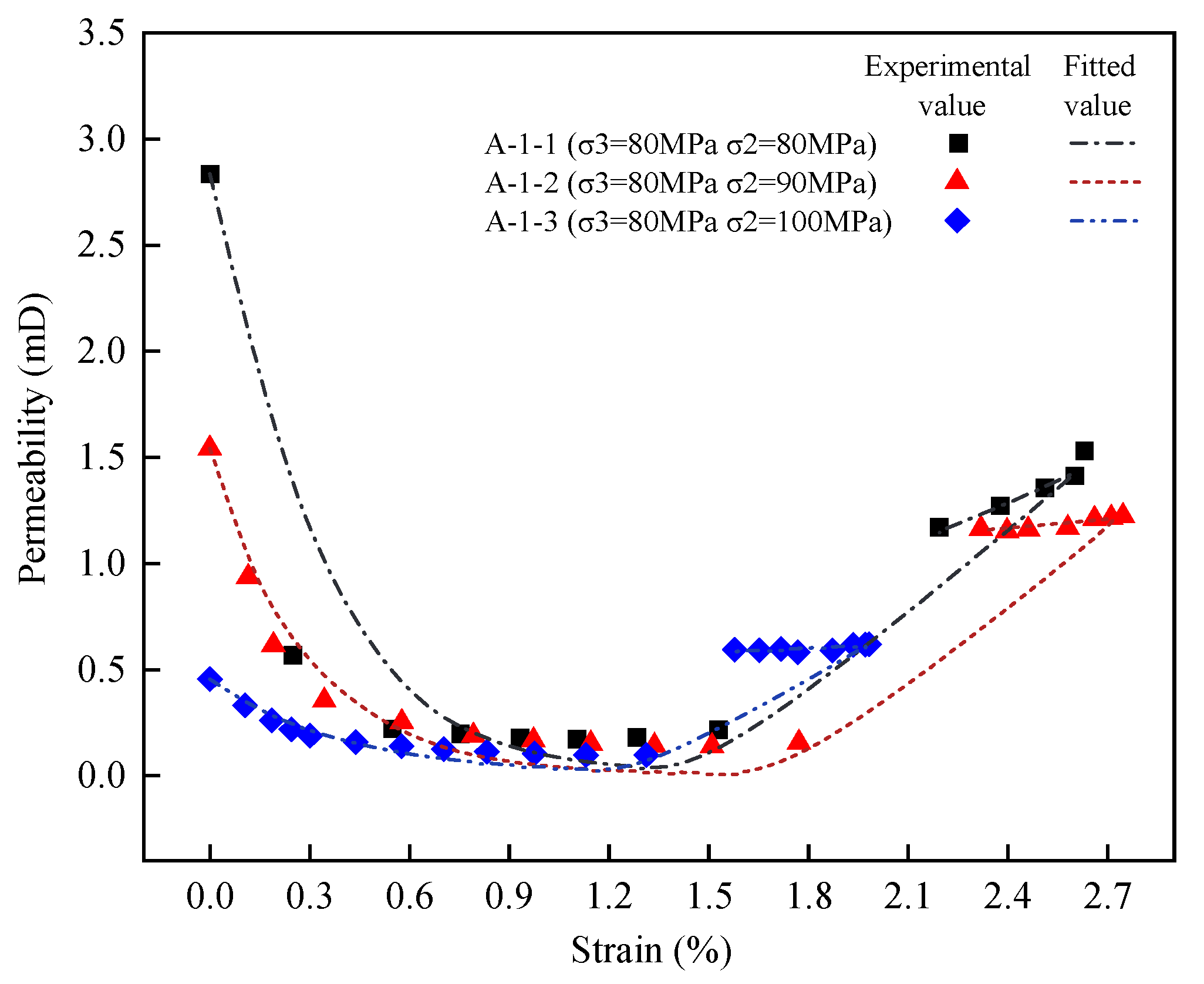
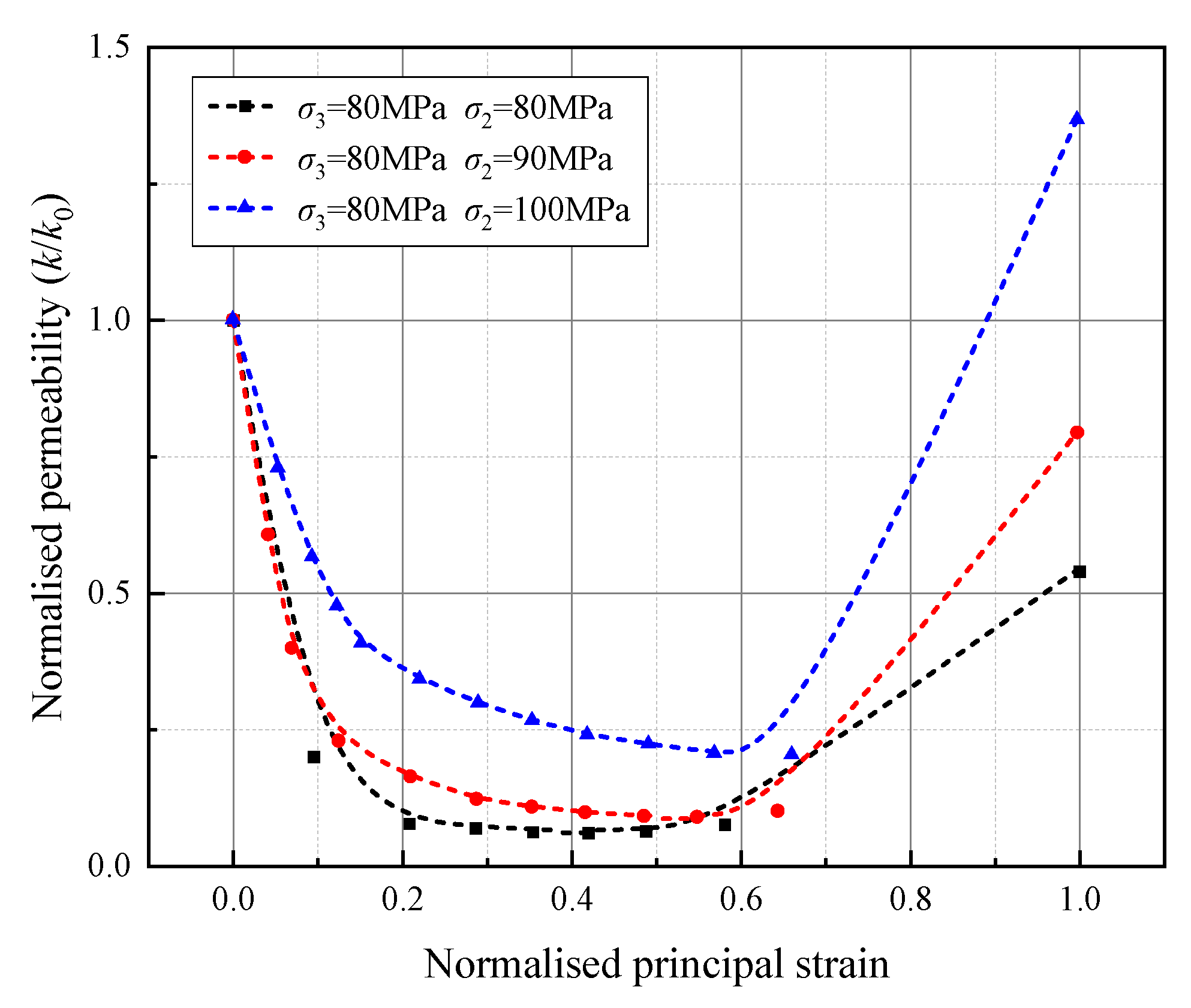
- The intermediate principal stress is a key factor in regulating the evolution of sandstone permeability. During the elastic stage, the initial permeability of the sandstone decreases as the intermediate principal stress increases, and the permeability decays exponentially with strain; the higher the intermediate principal stress, the faster the decay rate. In the damage stage, post-peak permeability follows the following order: specimens with low intermediate principal stress > specimens with medium intermediate principal stress > specimens with high intermediate principal stress. High intermediate principal stress suppresses the increase in permeability during the failure stage, restricts the development of crack flow pathways, and causes extensive pore closure due to true triaxial stress, making it difficult for post-peak permeability to recover to its initial value.
- (4)
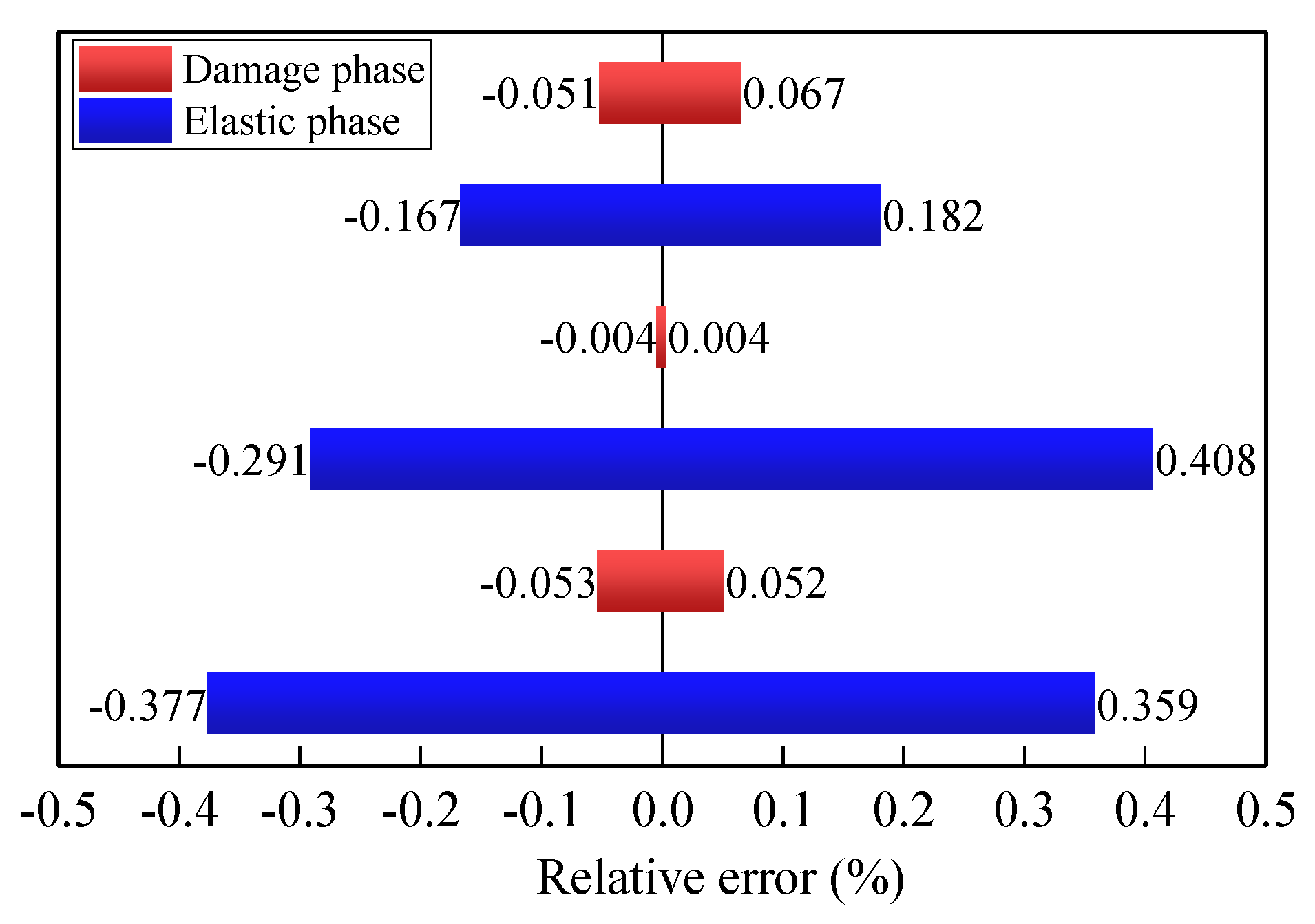
- Based on fundamental assumptions, such as horizontal isotropy, and incorporating the Betti–Maxwell reciprocity theorem, Kachanov’s definition of damage, the Drucker–Prager criterion and Lemaitre’s principle of strain equivalence, the staged permeability model for the elastic and damage stages of sandstone has been developed. This model is capable of characterising the quantitative relationship between permeability and strain under different stress states with high accuracy. The model’s goodness of fit for the elastic stage is consistently above 0.9, whilst for the damage stage, it ranges from 0.76 to 0.85. The experimental permeability–strain data points show excellent agreement with the model’s fitted curves, thereby validating the model’s reliability and applicability within the stress range under investigation.
- (5)
- There is a clear correlation between the permeability of deep reservoir sandstone and volumetric stress. During the stress concentration phase, the compression and closure of pores and microfractures lead to a sharp decline in permeability; during the stress release phase, the reopening and expansion of microfractures cause permeability to gradually recover. At equivalent levels of volumetric stress, sandstone permeability can increase by a factor of several dozen, and the relationship between volumetric stress and permeability effectively reflects the stress concentration and release processes in deep reservoir sandstone; simultaneously, stress paths exert a significant influence on flow characteristics; the ‘shear-enhanced compaction’ effect triggered by increased confining pressure reinforces the post-peak permeability enhancement.
Author Contributions
Funding
Institutional Review Board Statement
Informed Consent Statement
Data Availability Statement
Conflicts of Interest
References
- Lu, J.; Yin, G.; Zhang, D.; Gao, H.; Li, C.; Li, M. True triaxial strength and failure characteristics of cubic coal and sandstone under different loading paths. Int. J. Rock Mech. Min. Sci. 2020, 135, 104439. [Google Scholar] [CrossRef] [Scilit]
- Chen, T.; Feng, X.T.; Cui, G.; Tan, Y.; Pan, Z. Experimental study of permeability change of organic-rich gas shales under high effective stress. J. Nat. Gas Sci. Eng. 2019, 64, 1–14. [Google Scholar] [CrossRef] [Scilit]
- Xiao, Y.X.; Feng, X.T.; Hudson, J.A.; Chen, B.R.; Feng, G.L.; Liu, J.P. ISRM Suggested Method for In Situ Microseismic Monitoring of the Fracturing Process in Rock Masses. Rock Mech. Rock Eng. 2016, 49, 343–369. [Google Scholar] [CrossRef] [Scilit]
- Lu, J.; Zhang, D.; Huang, G.; Li, X.; Gao, H.; Yin, G. Effects of loading rate on the compound dynamic disaster in deep underground coal mine under true triaxial stress. Int. J. Rock Mech. Min. Sci. 2020, 134, 104453. [Google Scholar] [CrossRef] [Scilit]
- Connell, L.D.; Lu, M.; Pan, Z. An analytical coal permeability model for tri-axial strain and stress conditions. Int. J. Coal Geol. 2010, 84, 103–114. [Google Scholar] [CrossRef] [Scilit]
- Gao, H.; Zhang, D.; Lu, J.; Guangzhi, Y.; Wu, M. Experimental Study on Influence of Intermediate Principal Stress on the Permeability of Sandstone. Transp. Porous Media 2020, 135, 753–778. [Google Scholar] [CrossRef] [Scilit]
- Liu, Q.; Chen, T.; Zhang, H.; Xu, K.; Zheng, X.; Wang, Z.; Hui, C.; Pan, Z. Experimental investigation of permeability evolution in deep reservoirs under true triaxial stress: A review. Gas Sci. Eng. 2025, 144, 205739. [Google Scholar] [CrossRef] [Scilit]
- Feng, X.; Kong, R.; Yang, C.; Zhang, X.; Wang, Z.; Han, Q.; Wang, G. A Three-Dimensional Failure Criterion for Hard Rocks Under True Triaxial Compression. Rock Mech. Rock Eng. 2019, 53, 103–111. [Google Scholar] [CrossRef] [Scilit]
- Zoback, M.D.; Byerlee, J.D. Effect of high-pressure deformation on permeability of Ottawa Sand. AAPG Bull. 1976, 60, 1531–1542. [Google Scholar] [CrossRef] [Scilit]
- Mitchell, T.M.; Faulkner, D.R. Experimental measurements of permeability evolution during triaxial compression of initially intact crystalline rocks and implications for fluid flow in fault zones. J. Geophys. Res. Solid Earth 2008, 113, B11412. [Google Scholar] [CrossRef] [Scilit]
- Chen, L.; Liu, J.F.; Wang, C.P.; Liu, J.; Su, R.; Wang, J. Characterization of damage evolution in granite under compressive stress condition and its effect on permeability. Int. J. Rock Mech. Min. Sci. 2014, 71, 340–349. [Google Scholar] [CrossRef] [Scilit]
- Ranjith, P.G.; Perera, M.S.A. A new triaxial apparatus to study the mechanical and fluid flow aspects of carbon dioxide sequestration in geological formations. Fuel 2011, 90, 2751–2759. [Google Scholar] [CrossRef] [Scilit]
- Liu, Q.; Cheng, Y.; Haifeng, W.; Hongxing, Z.; Liang, W.; Wei, L.; Hongyong, L. Numerical assessment of the effect of equilibration time on coal permeability evolution characteristics. Fuel 2015, 140, 81–89. [Google Scholar] [CrossRef] [Scilit]
- Wang, Z.; Yi, Y.; Feng, X.T.; Yang, J.; Qiao, L. Unraveling the dependency of anisotropic permeability of sandstone on total stress and pore pressure with coupled true triaxial compression-flow tests. Rock Mech. Rock Eng. 2025, 58, 3765–3778. [Google Scholar] [CrossRef] [Scilit]
- Liu, Y.; Zhang, T.; Wu, J.; Song, Z.; Wang, F. Experimental Study on Deformation Behavior and Permeability Evolution of Sandstone Responding to Mining Stress. Energies 2022, 15, 7030. [Google Scholar] [CrossRef] [Scilit]
- Xie, H.; Lu, J.; Li, C.; Li, M.; Gao, M. Experimental study on the mechanical and failure behaviors of deep rock subjected to true triaxial stress: A review. Int. J. Min. Sci. Technol. 2022, 32, 915–950. [Google Scholar] [CrossRef] [Scilit]
- Wang, H.L.; Xu, W.Y.; Cai, M.; Xiang, Z.P.; Kong, Q. Gas Permeability and Porosity Evolution of a Porous Sandstone Under Repeated Loading and Unloading Conditions. Rock Mech. Rock Eng. 2017, 50, 2071–2083. [Google Scholar] [CrossRef] [Scilit]
- Mogi, K. Effect of the Intermediate Principal Stress on Rock Failure. J. Geophys. Res. 1967, 72, 1896–1977. [Google Scholar] [CrossRef] [Scilit]
- Sato, M.; Takemura, T.; Takahashi, M. Development of the permeability anisotropy of submarine sedimentary rocks under true triaxial stresses. Int. J. Rock Mech. Min. Sci. 2018, 108, 118–127. [Google Scholar] [CrossRef] [Scilit]
- Li, M.; Yin, G.; Xu, J.; Li, W.; Song, Z.; Jiang, C. A Novel True Triaxial Apparatus to Study the Geomechanical and Fluid Flow Aspects of Energy Exploitations in Geological Formations. Rock Mech. Rock Eng. 2016, 49, 4647–4659. [Google Scholar] [CrossRef] [Scilit]
- Feng, X.T.; Xu, H.; Yang, C.; Zhang, X.; Gao, Y. Influence of loading and unloading stress paths on the deformation and failure features of Jinping marble under true triaxial compression. Rock Mech. Rock Eng. 2020, 53, 3287–3301. [Google Scholar] [CrossRef] [Scilit]
- Ren, F.; Zhu, C.; He, M.; Shang, J.; Feng, G.; Bai, J. Characteristics and precursor of static and dynamic triggered rockburst: Insight from multifractal. Rock Mech. Rock Eng. 2023, 56, 1945–1967. [Google Scholar] [CrossRef] [Scilit]
- Zhou, X.P.; Yang, D. Micromechanics-based three-dimensional nonlinear strength criterion of rocks subjected to true triaxial compression. Rock Mech. Rock Eng. 2025, 58, 13027–13040. [Google Scholar] [CrossRef] [Scilit]
- Zhao, J.; Guo, Y.; Chen, P.; Hu, L.; Wang, J. True Triaxial Shear Strength and Failure Mechanism of Sandstone Under Real-Time High-Temperature Conditions. Rock Mech. Rock Eng. 2025, 58, 6211–6231. [Google Scholar] [CrossRef] [Scilit]
- Ghanizadeh, A.; Amann-Hildenbrand, A.; Gasparik, M.; Gensterblum, Y.; Krooss, B.M.; Littke, R. Experimental study of fluid transport processes in the matrix system of the European organic-rich shales: II. Posidonia Shale (Lower Toarcian, northern Germany). Int. J. Coal Geol. 2014, 123, 20–33. [Google Scholar] [CrossRef] [Scilit]
- Burnwal, R.K.; Singh, A. True-triaxial characterisation of the cement-based grout for application in underground space construction. Constr. Build. Mater. 2025, 487, 141887. [Google Scholar] [CrossRef] [Scilit]
- Niu, Z.; Zhu, Z.; Que, X.; He, Y.; Xie, X. Hydromechanical behaviour of columnar jointed rock masses under true triaxial conditions: An experimental and theoretical investigation. Geoenergy Sci. Eng. 2023, 224, 211623. [Google Scholar] [CrossRef] [Scilit]
- David, C.; Wong, T.F.; Zhu, W.; Zhang, J. Laboratory measurement of compaction-induced permeability change in porous rocks: Implications for the generation and maintenance of pore pressure excess in the crust. Pure Appl. Geophys. PAGEOPH 1994, 143, 425–456. [Google Scholar] [CrossRef] [Scilit]
- King, M.S. Elastic wave propagation in and permeability for rocks with multiple parallel fractures. Int. J. Rock Mech. Min. Sci. 2002, 39, 1033–1043. [Google Scholar] [CrossRef] [Scilit]
- Lu, S.; Cheng, Y.; Li, W. Model development and analysis of the evolution of coal permeability under different boundary conditions. J. Nat. Gas Sci. Eng. 2016, 31, 129–138. [Google Scholar] [CrossRef] [Scilit]
- Schwartzkopff, A.K.; Sainoki, A.; Bruning, T.; Karakus, M. A conceptual three-dimensional frictional model to predict the effect of the intermediate principal stress based on the Mohr-Coulomb and Hoek-Brown failure criteria. Int. J. Rock Mech. Min. Sci. 2023, 172, 105605. [Google Scholar] [CrossRef] [Scilit]
- Jiang, L.; Zhang, S.; Wu, S. From Distributed Damage to Strain Localization in Rocks during Brittle Creep. Phys. Rev. Lett. 2025, 135, 204101. [Google Scholar] [CrossRef] [Scilit] [PubMed]
- Cao, Y.; Wulff, S.S.; Robinson, T.J. DP-Optimality in Terms of Multiple Criteria and Its Application to the Split-Plot Design. J. Qual. Technol. 2017, 49, 27–45. [Google Scholar] [CrossRef] [Scilit]
- Panaghi, K.; Golshani, A.; Sato, M.; Takemura, T.; Takahashi, M. Crack tensor-based evaluation of inada granite behavior due to damage under true-triaxial testing condition. Int. J. Rock Mech. Min. Sci. 2018, 106, 30–40. [Google Scholar] [CrossRef] [Scilit]
- Alam, A.B.; Niioka, M.; Fujii, Y.; Fukuda, D.; Kodama, J.I. Effects of confining pressure on the permeability of three rock types under compression. Int. J. Rock Mech. Min. Sci. 2014, 65, 49–61. [Google Scholar] [CrossRef] [Scilit]
- Zhang, X.; Li, B.; Li, J.; Ding, Y.; Song, H.; Tang, C. Development and application of coal rock permeability test system. Phys. Fluids 2025, 37, 046610. [Google Scholar] [CrossRef] [Scilit]
- Li, F.; Chen, T.; Shan, G.; Ma, L.; Yu, X.; Zheng, X.; Zhang, S.; Chai, X. Experimental investigation on the failure mechanism of water-bearing sedimentary rocks under true-triaxial stress. Eng. Fail. Anal. 2025, 175, 109605. [Google Scholar] [CrossRef] [Scilit]
- Feng, X.T.; Kong, R.; Zhang, X.; Yang, C. Experimental Study of Failure Differences in Hard Rock Under True Triaxial Compression. Rock Mech. Rock Eng. 2019, 52, 2109–2122. [Google Scholar] [CrossRef] [Scilit]



| Initial Permeability (mD) | P-Wave Velocity (m/s) | S-Wave Velocity (m/s) | Bulk Density (g/cm3) | Dynamic Young’s Modulus (GPa) | Dynamic Poisson’s Ratio (Dimensionless) | |
|---|---|---|---|---|---|---|
| A-1-1 | 2.83397 | 1355.67 | 869.67 | 2.45 | 4.27 | 0.15 |
| A-1-2 | 1.5385 | 1430 | 914.33 | 2.46 | 4.761 | 0.15 |
| A-1-3 | 0.4491 | 1387 | 899.67 | 2.46 | 4.53 | 0.14 |
| σ3 (MPa) | σ2 (MPa) | σ1 (MPa) | |
|---|---|---|---|
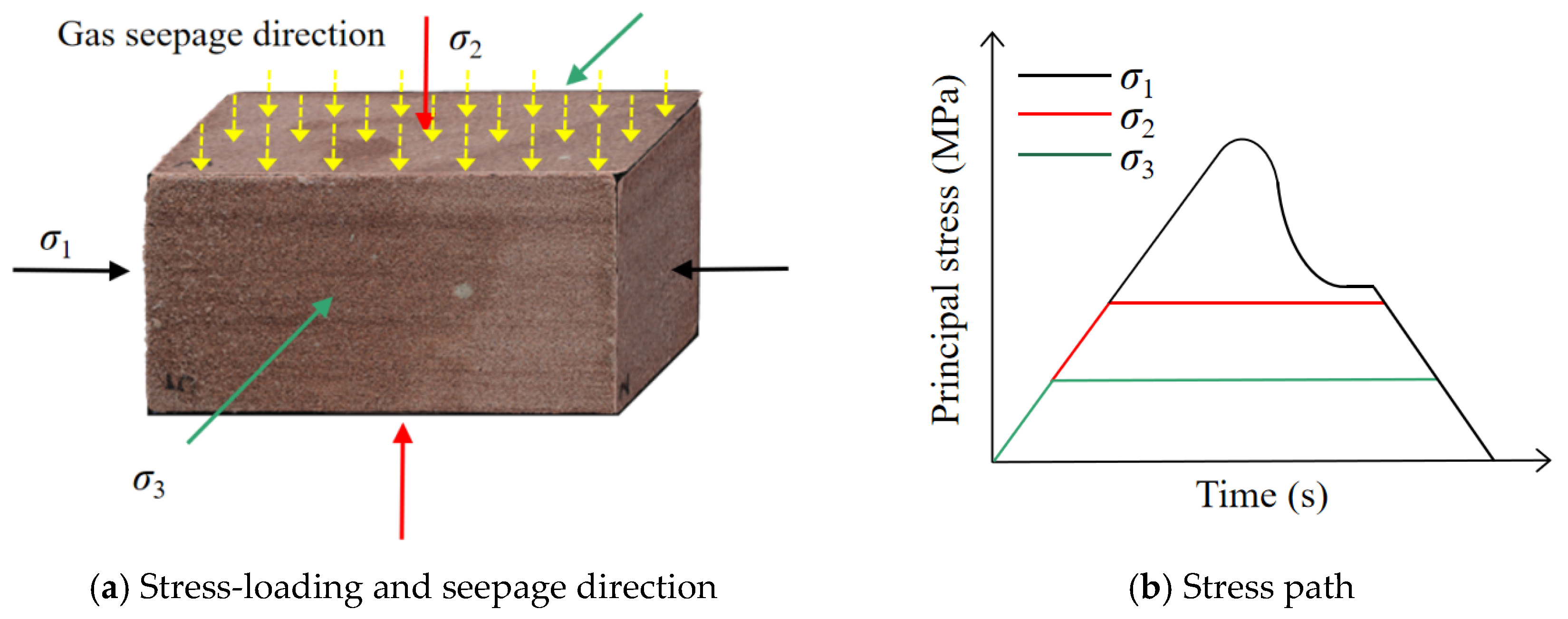
| Condition 1 | 80 | 80, 90, 100 | 80, 90, 100, 110, 120, 130, 140… |
| Elastic Stage | Damaged Stage | ||||||||
|---|---|---|---|---|---|---|---|---|---|
| Number | Poisson’s Ratio | Biot’s Coefficient | Porosity | Goodness of Fit | Poisson’s Ratio | Biot’s Coefficient | Porosity | Goodness of Fit | C |
| A-1-1 | 0.2 | 0.35 | 0.12 | 0.92 | 0.25 | 0.63 | 0.2 | 0.85 | 0.67 |
| A-1-2 | 0.22 | 0.35 | 0.11 | 0.95 | 0.23 | 0.6 | 0.2 | 0.78 | 0.79 |
| A-1-3 | 0.22 | 0.33 | 0.13 | 0.90 | 0.3 | 0.71 | 0.22 | 0.76 | 1.06 |
Disclaimer/Publisher’s Note: The statements, opinions and data contained in all publications are solely those of the individual author(s) and contributor(s) and not of MDPI and/or the editor(s). MDPI and/or the editor(s) disclaim responsibility for any injury to people or property resulting from any ideas, methods, instructions or products referred to in the content. |
© 2026 by the authors. Licensee MDPI, Basel, Switzerland. This article is an open access article distributed under the terms and conditions of the Creative Commons Attribution (CC BY) license.
Share and Cite
Zhang, S.; Lu, J.; Jiang, X.; Zheng, X.; Wang, Z.; Wang, Y.; Wang, G.; Tang, Q.; Chen, T.; Zhang, X. Mechanical Behaviour and Flow Characteristics of Reservoir Sandstone Under Deep Triaxial Stress Conditions. Appl. Sci. 2026, 16, 7357. https://doi.org/10.3390/app16147357
Zhang S, Lu J, Jiang X, Zheng X, Wang Z, Wang Y, Wang G, Tang Q, Chen T, Zhang X. Mechanical Behaviour and Flow Characteristics of Reservoir Sandstone Under Deep Triaxial Stress Conditions. Applied Sciences. 2026; 16(14):7357. https://doi.org/10.3390/app16147357
Chicago/Turabian StyleZhang, Shujuan, Jiyuan Lu, Xueyan Jiang, Xianbao Zheng, Zhiguo Wang, Youchun Wang, Guolong Wang, Qingjin Tang, Tianyu Chen, and Xiaoyu Zhang. 2026. "Mechanical Behaviour and Flow Characteristics of Reservoir Sandstone Under Deep Triaxial Stress Conditions" Applied Sciences 16, no. 14: 7357. https://doi.org/10.3390/app16147357
APA StyleZhang, S., Lu, J., Jiang, X., Zheng, X., Wang, Z., Wang, Y., Wang, G., Tang, Q., Chen, T., & Zhang, X. (2026). Mechanical Behaviour and Flow Characteristics of Reservoir Sandstone Under Deep Triaxial Stress Conditions. Applied Sciences, 16(14), 7357. https://doi.org/10.3390/app16147357