Review

Multidimensional Determinants of Performance in Women’s Football: A Narrative Review

1
Department of Experimental and Clinical Medicine, University of Florence, 50134 Florence, Italy
2
Department of Experimental and Clinical Biomedical Sciences, University of Florence, 50134 Florence, Italy
*
Author to whom correspondence should be addressed.
Appl. Sci. 2026, 16(14), 7293; https://doi.org/10.3390/app16147293
Submission received: 22 June 2026 / Revised: 13 July 2026 / Accepted: 17 July 2026 / Published: 21 July 2026
(This article belongs to the Section Applied Biosciences and Bioengineering)

Abstract

Women’s football represents the convergence of the history of sport, the history of women, and the history of women’s participation in ball games. From Classical antiquity, literary and archeological evidence highlights a long-standing association between spherical objects and the female sphere. While ancient physical cultures primarily celebrated male athleticism, records from various Classical civilizations indicate that women occasionally engaged in ball games and recreational exercises. In ancient Greece and Rome, these activities were often socially framed around themes of youth, grace, and courtship rituals, rather than structured competitive sport. Over the centuries, women continuously negotiated their access to physical play, transitioning from these early symbolic associations to more organized activities by the late Middle Ages. It was only at the end of the nineteenth century, alongside broader movements for female emancipation, that women’s football began to emerge in Great Britain, marking the entry of women into an exclusively male sporting domain. In recent decades, women’s football has undergone substantial professionalization and global expansion, accompanied by growing scientific interest in understanding the determinants of performance. This narrative review synthesizes current evidence on the multidimensional factors influencing performance in women’s football, integrating physical and match demands, physiological and anthropometric characteristics, psychological and emotional components, menstrual cycle-related influences, and contextual variables. The literature published between 2008 and 2024 was examined across major scientific databases. Findings indicate that while total match distance has remained relatively stable (averaging 9500–10,500 m), high-speed running distances, sprint frequencies, and peak intensity demands have escalated by 15–30% over the tracked decade. Psychological resilience and team dynamics contribute meaningfully to performance outcomes, whereas menstrual cycle phases appear to exert limited and inconsistent effects on objective physical performance. Overall, performance in women’s football emerges from the dynamic interaction of multiple domains, underscoring the need for integrated and individualized performance management strategies.

1. Introduction

“Men and women are not just themselves: they are also the region where they were born, the home, the farmyard where they learned to walk, the games they enjoyed as children, the old wives’ tales they overheard, the foods they ate, the schools they attended, the sports they were interested in, the poets they read, the god they believed in”.
[1]

1.1. Historic Background

Three different approaches converge in the history of women’s football: the history of sport, the history of women, and the history of women in sport and in football in particular.
A special point of view is the role of women in sports that involve the use of a ball, which has its roots in the Classical age [2].
One of the most common playful scenes in Attic and Southern Italian vase painting depicts a girl performing magic tricks with round objects resembling apples, balls, or balls of wool [3].
Juggling takes on an erotic dimension as soon as a young man enters the scene. The game thus becomes a means of nonverbal communication between the young people, and the balls become a means of interaction between girls and boys [4].
In a passage in the Odyssey (Od. 6.110-142), Nausicaa, daughter of the king of Phaeacia, and Odysseus, guided by Athena, met over a ball and fell in love.
The characteristics of the ball are also attributed to other spherical elements, such as apples, which were already charged with erotic meanings [3].
Both archeological findings and literary texts establish a clear link between spherical objects and seduction. For many Classical authors, round and fleshy elements symbolized the female body and marital readiness. Rather than representing simple recreation, games involving balls, yarn, or apples served as visual and textual metaphors for a young woman’s seductive power. The Latin world knew various types of ball, from the follis, a large sphere filled with air, to the pila trigonalis, used for a three-player game, and to the harpastum, a small ball filled with feathers or wool, typical of an originally Greek team game.
In the mosaic of Piazza Armerina, young women are depicted playing ball: the girls are in the gymnasium, wearing “subligar,” a kind of tight cloth wrapped between the legs, with the subligaris or mammillary fascia, which served as a bra.
The Latin poet Juvenal, in Satire VII, complains that so many Roman women go to the gymnasium, wearing rich purple robes, and eagerly learn to fencing, using greaves and other body armor, as if they were gladiators.
In Rome, women could therefore perform exercises that today we would call sports, and indirect evidence confirms that some could also participate in team games.
Between the Middle Ages and the Renaissance, various types of competitions became widespread, but women were excluded, relegated to honorary roles [5]: the sectors in which women could emerge as competitors were the intellectual ones, such as chess and poetry. However, with the passing of time, through jeu de paume (palm game), a precursor to modern tennis, women earned the chance to engage in physical exercise [6].
Until the modern era, women were allowed to engage in recreational activities rather than competitive ones and were discouraged from engaging in them because they would have to conserve their energy for their social duties. Physical activity was considered dangerous for women because they were “periodically weakened” during menstruation.
When Edward Clarke published “Sex in Education; or, A Fair Chance for Girls”, a heated debate arose about women’s ability to engage in physical activity. These were the years when women were beginning to demand their rights, but the instrumental use of these beliefs served to reinforce existing dogmas [7].
Between the late 1800s and early 1900s, informal sports clubs formed, and at the 1900 Olympics, 22 women competed alongside men in some disciplines.
In 1922, the first women’s Olympic Games were held in Paris.
The 1940s and World War II saw the establishment of the first women’s professional sports league, the All American Girls Professional Baseball League.
Although the 1950s and 1960s saw some progress for women in sports, particularly at the Olympic level, where the United States sought to respond to the powerful, athletic women the Soviet Union had fielded to compete, it was not until the passage of Title IX of the Education Act in 1972 that women were granted equal opportunities in education and sports.
The origins of women’s football are deeply rooted in Great Britain, the traditional homeland of the sport, where the Second Industrial Revolution played a pivotal role: early English women’s football teams emerged primarily as recreational clubs for female factory workers. The oldest among these was Dick, Kerr’s Ladies Football Club, founded in 1917 by workers at the Dick, Kerr and Co. wagon, locomotive, and later munitions factory in Preston, Lancashire. The club’s first recorded match took place the following year. On 26 December 1920, Dick, Kerr’s Ladies played against St Helen’s Ladies F.C. in Liverpool, drawing a historic crowd of over 50,000 spectators. These British female pioneers wore shorts similar to those of their male counterparts and effectively inaugurated the “transfer market” in the women’s game; notably, Dick, Kerr’s Ladies successfully signed star player Lily Parr from St Helen’s by offering her employment, a stable salary, and additional professional benefits. Concurrently, women’s teams began forming in Scotland and France, the latter being where Dick, Kerr’s Ladies traveled to play four international matches. However, this rapid growth was abruptly halted in December 1921, when the Football Association (FA) banned women from playing on its affiliated pitches—a institutional boycott that lasted until the 1970s. Despite these restrictions, Dick, Kerr’s Ladies continued to compete independently, re-branding themselves as Preston Ladies F.C. from 1926 onward. In Italy, the development of the sport followed a similar trajectory of early enthusiasm met by political repression. In 1933, a group of young women in Milan founded the country’s first female team: the Gruppo Femminile Calcio. Although they initially obtained permission from the Italian Football Federation (FIGC) to play strictly behind closed doors, their progress was short-lived. In October of the same year, authorities blocked their first away match against a newly established women’s team in Alessandria. The fascist regime actively diverted female football players toward non-contact sports like athletics or basketball, enforcing a strict patriarchal ideology that prohibited women—viewed fundamentally as prolific wives and mothers—from participating in a sport deemed quintessentially masculine.
Women’s soccer began to be discussed again in Italy in 1946, in Trieste, where two teams were formed (Triestina and San Giusto), and in Naples, later followed by other cities.
The first national championship was played in 1968 (Genoa won), but it was not until 1986 that Italian women’s soccer players were admitted (under “amateur tournaments”) to the Italian Football Federation (FIGC).
The World Cup debuted in 1991, in China, with the USA defeating Norway [8].
This historical trajectory of institutional bans, social marginalization, and delayed professionalization has directly shaped the current landscape of contemporary sports science. Because women were historically excluded from competitive frameworks or restricted by archaic medical dogmas—such as the belief that physical exertion would deplete their reproductive energy—scientific research on athletic performance was built almost entirely upon male cohorts. Consequently, the lack of historical investment and the late onset of structured leagues have resulted in significant scientific underrepresentation. Modern training methodologies and performance monitoring models are still heavily reliant on data extrapolated from men’s football. Understanding this historical neglect is essential: it clarifies why comprehensive, integrated models for the female game are only recently emerging and underscores the urgent necessity to investigate sex-specific match demands, physiological profiles, and individualized recovery strategies that match the modern reality of professional women’s football.

1.2. Women’s Football Evolution

Women’s football has experienced unprecedented growth over the past two decades, both in participation rates and in the professionalization of leagues worldwide. The expansion of elite competitions such as the FIFA Women’s World Cup and the UEFA Women’s Champions League has fueled the need for a stronger scientific foundation to optimize training, performance, and player welfare. Despite this progress, research on women’s football remains less extensive than that on men’s football, especially concerning integrated models of performance that consider physiological, psychological, and contextual factors together [9,10,11,12,13,14].
Performance in football is inherently multifactorial, shaped by the interaction between physical capacity, tactical understanding, technical proficiency, and psychological readiness. In female players, these elements are influenced by sex-specific physiological characteristics—such as hormonal variations, anthropometric differences, and metabolic profiles—as well as by sociocultural and environmental factors unique to the women’s game [15,16]. Therefore, understanding performance in women’s football requires a holistic framework that transcends isolated metrics and instead captures the complexity of player adaptation and match demands.
However, several aspects remain underexplored, particularly the interaction between physiological factors (e.g., menstrual cycle); emotional regulation; and contextual influences such as match location, surface type, and opposition strength. These gaps highlight the need for a comprehensive, multidisciplinary understanding of performance determinants in women’s football.
Therefore, this narrative review synthesizes current evidence from 2008 to 2025 to identify and discuss the primary contributors to performance among female football players. The goal is not only to summarize research findings but also to translate them into practical insights for coaches, sport scientists, and performance staff.

1.3. Aim of the Review

This narrative review aims to summarize and discuss the main multidimensional determinants of performance in women’s football, focusing on the practical implications for training design and player development. By anchoring this analysis in an initial historical overview, the manuscript contextualizes how past socio-cultural constraints have shaped contemporary research, ultimately presenting a comprehensive and integrative performance framework.
Accordingly, the present narrative review adopts an integrative framework to examine performance in women’s football across multiple interacting domains, including physical and match performance, physiological and anthropometric characteristics, psychological and emotional factors, menstrual cycle-related influences, and contextual variables. Rather than acting in isolation, these components dynamically interact to shape match performance, as conceptualized in Figure 1.

2. Materials and Methods

A comprehensive narrative review approach was adopted to synthesize multidimensional performance determinants in women’s football. Literature searches were conducted in January 2026 across three major electronic databases: PubMed, Scopus, and Web of Science. The search strategy was restricted to articles published between January 2008 and December 2025 to capture the modern era of professionalization and sport science advancement in the women’s game. The exact search string utilized across the databases was structured as follows: (“women’s football” OR “women’s soccer” OR “female soccer players”) AND (“match demands” OR “high-speed running” OR “sprinting” OR “menstrual cycle” OR “hormonal fluctuations” OR “psychological factors” OR “team cohesion” OR “body composition” OR “contextual variables” OR “playing surface”). To ensure methodological rigor, clear selection criteria were established. Studies were included if they met the following criteria: (1) peer-reviewed original research (observational, cohort, or experimental designs) or systematic reviews; (2) focus on competitive, elite, sub-elite, or high-level academy female football players; and (3) analysis of objective or subjective performance-related outcomes. Exclusion criteria comprised (1) studies solely focused on male cohorts without female comparison or specific application; (2) abstracts, conference proceedings, dissertations, or non-peer-reviewed reports; and (3) articles written in languages other than English or Italian. The screening process was conducted in two sequential phases: an initial title and abstract screening, followed by a full-text eligibility assessment. Data extraction was performed systematically to capture key themes, including geographical origin, cohort characteristics, competitive level, technological tools utilized (e.g., GPS Global Positioning System, heart rate telemetry), and primary findings. A detailed summary of the comprehensive search strategy, alongside specific inclusion and exclusion parameters, is provided in Appendix CTable A4, while the definitive key studies informing the narrative synthesis are overviewed in Appendix CTable A3.

3. Results

3.1. Physical and Match-Play Performance

Physical performance is a primary determinant of success in women’s football, reflecting the ability of players to sustain high-intensity activities across repeated bouts throughout a match. The demands of the game are position-specific and influenced by competitive level, age, and tactical system [9,12,13,14].

3.1.1. Match Demands and Positional Differences

Early match analyses reported approximately 10 km per match with limited sprint exposure [12]; while early analyses reported absolute volumes of approximately 10 km—a metric that has remained relatively stable into modern tracking—this macroscopic stability obscures a profound internal shift. The overall volume is now characterized by a substantially higher density of intense actions; in essence, the total distance has not grown, but the metabolic and mechanical intensity within that identical distance has radically evolved.
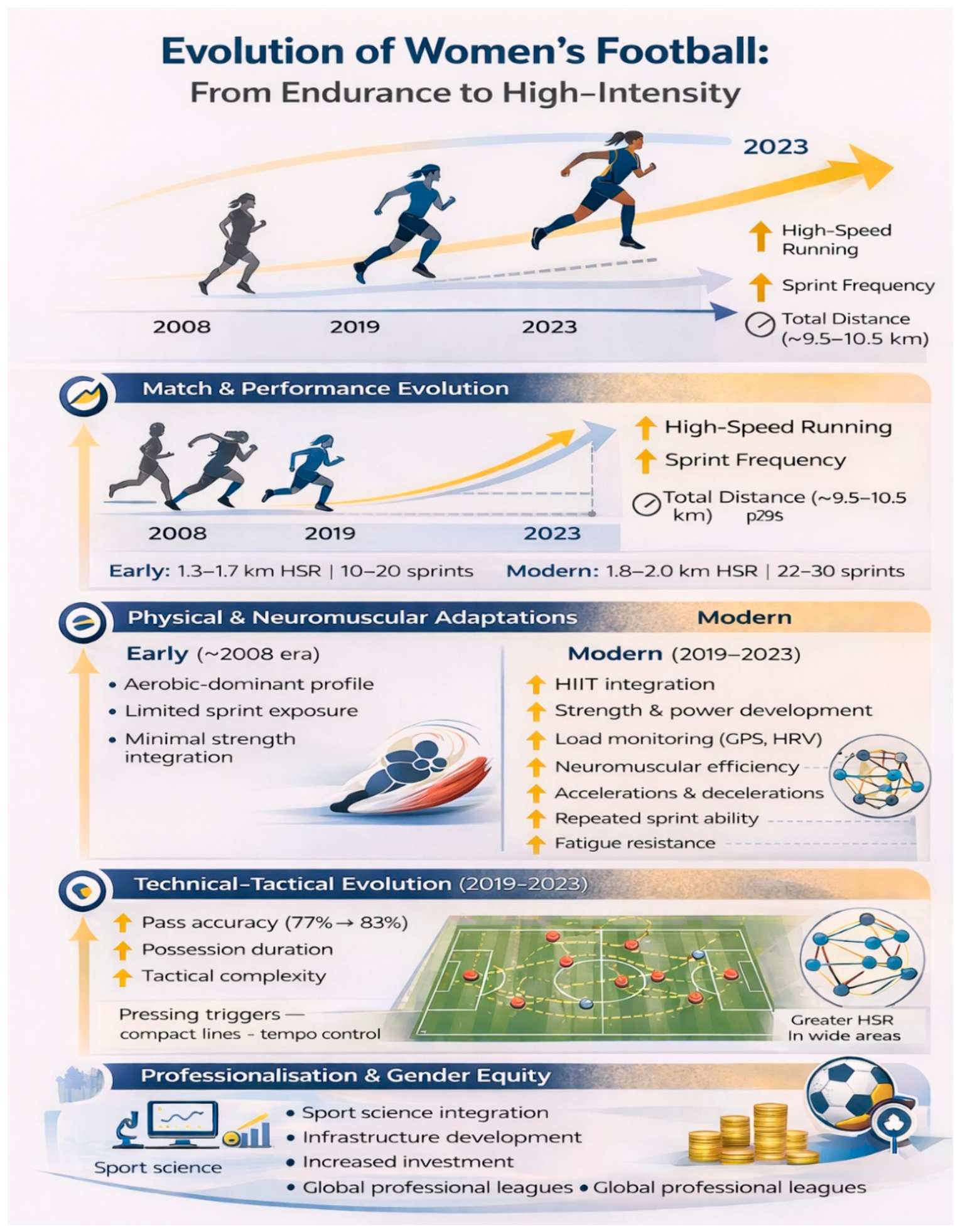
Modern datasets (2019–2023) show a stable total distance but substantially higher volumes of high-speed running and sprint frequency, consistent with tactical trends such as heavy pressing and longer possession phases. In fact, across two decades, total match distance has remained stable (~9.5–10.5 km), while high-speed running and sprint frequency have increased significantly [9,13,17,18,19,20].
Earlier studies reported ~1.3–1.7 km of high-speed running and 10–20 sprints [12,18]; recent data show 1.8–2.0 km of high-speed running and 22–30 sprints per match [13,14,17,18,19,20,21,22,23].
Strength and conditioning advances have improved players’ acceleration, recovery, and technical precision under fatigue [11]; in fact, recent studies have highlighted the importance of accelerations, decelerations, and peak running demands under fatigue conditions [14,21,23,24,25,26].
For example, data about elite women’s football, reported by Harkness-Armstrong et al. [9] and Winther et al. [11] reveal that players typically cover between 5480 and 11,160 m per match, depending on playing position and competition intensity. Wide midfielders and forwards generally demonstrate greater high-speed running (>18 km·h−1) and sprint frequency compared to central defenders or central midfielders [9]. This reflects the dynamic tactical role of wide players, who are more frequently involved in transitional play and offensive movements.
Olaizola et al. [27] compared running performance between the two main Spanish women’s football leagues and found only minor differences in total distance covered, though top-tier players exhibited more accelerations and decelerations, highlighting superior neuromuscular readiness. Similarly, Abselam et al. [28] reported that positional role and body characteristics significantly influence physical performance, with forwards demonstrating higher sprint ability and wide players showing greater aerobic capacity.
Neuromuscular studies confirm better fatigue resistance and recovery management during congested tournaments [11]. Technical analysis of FIFA World Cups (2019–2023) shows rising pass accuracy (from 77% to 83%) and longer possession phases [9]. Modern tactical profiles feature dynamic pressing, fluid positional play, and better tempo control [9,27].
Importantly, this modern surge in technical proficiency is not isolated from physical performance; rather, it acts as a primary driver of contemporary match demands. As female players achieve higher passing accuracy and sustain longer possession phases, the tactical tempo of the game accelerates. Enhanced technical skill allows teams to execute rapid transitions, which directly necessitates a higher frequency of high-speed runs and explosive supporting movements to exploit open spaces. Furthermore, superior retention of the ball forces defending units to engage in aggressive, high-intensity tactical pressing and immediate counter-pressing. Consequently, the evolving technical prowess of the modern female player directly dictates the structural density and physical intensity of contemporary elite match-play.
A detailed overview of the evolution of high-speed running and sprint demands across different time periods is provided in Appendix Table A1.
Position-specific match demands reported in the literature are summarized in Table 1, highlighting differences in total distance, high-speed running, sprint frequency, and key physical–tactical characteristics across playing positions.
While Table 1 provides a structured overview of position-specific match demands, these findings reflect only part of a broader transformation that has characterized the evolution of women’s football in recent years. This progressive shift from an endurance-oriented model toward a high-intensity, multidimensional performance paradigm is conceptually illustrated in Figure 2.

3.1.2. Age, Competitive Level, and Training Load

Performance metrics also increase with age and competitive experience, suggesting progressive adaptations to training and match exposure. Harkness-Armstrong et al. [9] observed that senior professional players outperform youth athletes in both total distance and high-speed running, likely due to superior aerobic and anaerobic conditioning. However, it is noteworthy that most training sessions do not replicate the full physical demands of competition, indicating a gap between training stimuli and match requirements [11,29,30].

3.1.3. Summary of Physical Performance Insights

Physical and match-play performance in women’s football is highly position- and context-dependent. Wide players and forwards demonstrate greater exposure to high-speed running and sprinting, whereas central positions rely more on aerobic endurance and tactical regulation.
While total match distance remains relatively constant (~10–11 km), the volume and density of high-intensity actions have increased, reflecting the game’s tactical and physical evolution. These trends are supported by advances in strength and conditioning practices, recovery strategies, and neuromuscular preparedness [9,11].
Performance generally improves with age and competitive experience, yet training stimuli often fall short of match demands, underscoring the need for position-specific, ecologically valid conditioning approaches [9].

3.2. Psychological and Emotional Factors

Performance in women’s football is not solely determined by physical capacity; it is profoundly shaped by psychological and emotional dimensions such as motivation, resilience, self-confidence, and team cohesion [15,31]. Understanding these factors is essential for designing effective coaching interventions and promoting athlete well-being across competitive levels.

3.2.1. Motivation and Mental Toughness

Motivation is a central driver of effort, persistence, and performance quality in football. Pettersen et al. [15] found that intrinsic motivation—characterized by enjoyment and perceived mastery—was positively associated with improved performance outcomes and lower anxiety levels in elite female players. Conversely, external pressure or negative motivational climates correlated with stress and performance decrements.
Mental toughness, defined as the ability to maintain performance under pressure, has been identified as a key psychological determinant of success in competitive women’s football [31]. Athletes who exhibit greater emotional regulation, confidence, and focus are more capable of sustaining high levels of performance despite fatigue, setbacks, or competitive tension.

3.2.2. Team Cohesion and Communication

Effective teamwork and social camaraderie represent additional pillars of performance.
Ventaja-Cruz et al. [31] reported that both task cohesion (shared goals and tactical understanding) and social camaraderie (interpersonal trust and support) enhance coordination, decision-making, and resilience during matches. Teams that cultivate positive interpersonal dynamics and open communication show higher collective efficacy and lower stress reactivity.
Psychological safety—where players feel secure to express ideas and make mistakes without fear of criticism—has also been recognized as a facilitator of learning and adaptability within team environments. Coaches play a vital role in shaping such climates through supportive feedback and autonomy-promoting leadership.

3.2.3. Emotional Regulation and Anxiety

Pre-competitive anxiety and emotional regulation affect decision-making, motor performance, and concentration. Players experiencing high cognitive anxiety (worry and doubt) or somatic anxiety (tension and elevated heart rate) tend to exhibit lower technical execution accuracy and slower reaction times. Training mental resilience through mindfulness, imagery, and self-talk strategies can mitigate these effects and enhance game readiness [15].
Although mood fluctuations are common during congested fixture periods, current evidence suggests that mood state is not directly correlated with match performance; rather, it influences perception of effort and recovery processes [15].
Thus, monitoring psychological well-being may provide early indicators of overtraining or burnout.

3.2.4. Summary of Psychological Performance Insights

Psychological components are essential to elite performance in women’s football. Intrinsic motivation and perceived mastery enhance performance and emotional stability, while external pressure increases stress and performance variability [15].
Mental toughness, characterized by confidence and emotional control, supports resilience under fatigue and competitive stress [31].
Team cohesion and communication foster coordination and collective efficacy, particularly within supportive environments that promote psychological safety and autonomy [31]. Effective emotional regulation through strategies such as mindfulness and self-talk mitigates anxiety and optimizes readiness [15].
Continuous monitoring of psychological well-being aids in preventing overtraining and burnout during congested schedules.

3.3. Physiological and Anthropometric Considerations

The physiological and anthropometric profile of female football players represents a cornerstone of performance analysis and training optimization. Attributes such as aerobic capacity, anaerobic power, body composition, and muscle distribution are directly associated with the ability to sustain high-intensity activity and recover efficiently during match-play [10,32].

3.3.1. Aerobic and Anaerobic Capacities

Women’s football is characterized by an intermittent activity pattern that requires both aerobic endurance and anaerobic power. Aerobic fitness enables players to sustain effort throughout the match, while anaerobic power supports repeated sprinting, acceleration, and recovery between high-intensity bouts.
Milanović et al. [16] reported that elite female football players exhibit mean maximal oxygen uptake (VO2max) values between 49 and 55 mL·kg−1·min−1, which are generally lower than those observed in male counterparts but adequate for the physiological demands of the women’s game.
Higher VO2max values are associated with increased total distance covered and improved recovery kinetics. Conversely, players with superior anaerobic profiles demonstrate enhanced acceleration and sprinting ability, particularly important for offensive and defensive transitions.

3.3.2. Body Composition and Morphological Factors

Body composition—specifically the balance between lean muscle mass and fat mass—is a crucial determinant of physical performance. Ramírez-Munera et al. [32] and Randell et al. [10] found that higher muscle mass positively correlates with explosive strength and aerobic performance, whereas elevated fat mass is negatively associated with both endurance and anaerobic power.
While there is no universal “ideal” body composition for female players, individualized assessment is strongly recommended. Morphological profiles vary by position: defenders often have higher body mass for physical duels, whereas midfielders and forwards benefit from lower fat percentages to optimize speed and agility. Periodic body composition evaluations can help guide nutrition and conditioning strategies across the season.

3.3.3. Hormonal and Metabolic Aspects

Sex-specific hormonal variations influence metabolism, recovery, and muscle function. Estrogen, for instance, enhances lipid oxidation and may provide a protective effect on muscle tissue, whereas progesterone fluctuations can affect thermoregulation and substrate utilization. Despite these theoretical influences, practical implications remain ambiguous due to inter-individual variability.
Nutritional and conditioning programs must therefore account for hormonal dynamics, ensuring adequate energy availability and recovery, especially in players exposed to high training loads or menstrual irregularities. Monitoring markers such as resting heart rate, perceived fatigue, and menstrual regularity may provide useful insights into physiological adaptation.

3.3.4. Injury Risk and Physical Profiling

Physiological profiling also contributes to injury prevention. Imbalances in strength, neuromuscular control, and fatigue resistance are known risk factors for common injuries such as anterior cruciate ligament (ACL) tears, which occur more frequently in female players. Integrating strength diagnostics, functional movement screening, and neuromuscular training can enhance resilience and support long-term performance [10].

3.3.5. Summary of Physiological Insights

In summary, optimal performance in women’s football depends on the integration of aerobic and anaerobic conditioning, tailored body composition management, and hormonal awareness. Individualized monitoring should guide both training and recovery processes, ensuring performance sustainability across different competitive phases.

3.4. Menstrual Cycle and Athletic Performance

The menstrual cycle constitutes a distinctive physiological factor influencing women’s football performance, encompassing metabolic, thermoregulatory, neuromuscular, and perceptual domains.
The presence of the menstrual cycle in women was one of the reasons why women were prohibited from practicing sports. Until the modern era, in fact, women were allowed to engage in recreational activities rather than competitive ones and were discouraged from engaging in them because they would have to conserve their energy for their social duties. Physical activity was considered dangerous for women because it was “periodically weakened” during menstruation.
Although numerous studies have explored the association between menstrual phases and athletic outcomes, the evidence remains heterogeneous and inconclusive, largely due to methodological variability and individual hormonal sensitivity [10,33,34,35].

3.4.1. Physiological Background

A typical menstrual cycle lasts approximately 28 days and is classically divided into three main phases: (1) the follicular phase, characterized by low estrogen and progesterone concentrations; (2) the ovulatory phase, marked by a transient estrogen peak; and (3) the luteal phase, during which progesterone predominates alongside moderate estrogen levels.
These hormonal oscillations can influence substrate utilization, thermoregulation, and neuromuscular coordination. Estrogen has been associated with enhanced lipid oxidation, glycogen sparing, and improved muscle repair, whereas progesterone tends to elevate core temperature and ventilatory drive, potentially impairing endurance performance [10].

3.4.2. Effects on Physical Performance

Empirical findings regarding the influence of the menstrual cycle on physical performance are inconsistent. Some authors [33] have reported slight reductions in endurance and sprint capacity during the mid-luteal phase, possibly attributable to elevated progesterone and core temperature. Conversely, other studies [34,35] found no significant differences across menstrual phases in elite athletes, suggesting that training adaptation, individual variability, and psychological coping strategies may mitigate hormonal effects.
A recent systematic review by Juillard et al. [35] concluded that while hormonal fluctuations may modulate perceived fatigue and muscle soreness, their impact on objective performance metrics—such as sprint time, jump height, or maximal oxygen uptake—is minimal. Collectively, these results indicate that elite players may develop adaptive mechanisms that buffer cyclical physiological variations through consistent training and recovery optimization.

3.4.3. Menstrual Cycle and Strength

The relationship between menstrual cycle phases and strength-related performance in women’s soccer remains controversial. Most available evidence indicates that hormonal fluctuations exert negligible or non-significant effects on muscle strength and power output in trained female athletes.
Studies involving elite soccer players and other team-sport athletes have consistently shown no substantial differences in maximal strength, explosive power, or sprint performance across menstrual phases [34,36,37,38,39].
Meta-analyses and systematic reviews corroborate these findings, concluding that any phase-related differences are small and lack clinical relevance [36,40,41,42,43].
Some phase-specific nuances have been reported: for instance, the elasticity index (countermovement jump to squat jump ratio) may be slightly higher during ovulation, possibly due to estrogen-mediated connective tissue compliance [44].
Minor asymmetries in hamstring-to-quadriceps ratios have been observed between the follicular and luteal phases [45], though such differences are often limb-specific and statistically weak. Soccer-specific tests—including sprints, change-of-direction drills, jumps, and aerobic endurance—generally reveal no meaningful variation across menstrual phases [33,34,35,39,46].
Overall, it is established that the menstrual cycle has minimal impact on strength and physical performance in female soccer players. However, due to substantial interindividual variability, a personalized monitoring approach—considering subjective symptoms and cycle tracking—is recommended. Continued research using larger, well-controlled cohorts is warranted to refine these conclusions.

3.4.4. Menstrual Cycle and Psychological and Perceptual Dimensions

Beyond physiological fluctuations, the menstrual cycle can modulate psychological states, including mood, motivation, and perceived exertion. Some athletes report increased irritability or reduced focus during the luteal phase, while others experience negligible disruption. Hence, psychological readiness and supportive coaching strategies play a pivotal role in managing these cyclical variations [10,47].
Encouraging open communication and normalizing discussion of menstrual health can enhance athlete confidence and team cohesion. Integrating menstrual tracking into athlete monitoring systems—combining subjective reports with physiological data—can facilitate informed workload adjustments and individualized recovery planning.
A detailed synthesis of studies examining menstrual cycle-related effects on physical performance and neuromuscular outcomes is reported in Appendix Table A2.
Overall, current evidence indicates that menstrual cycle-related hormonal fluctuations exert limited and inconsistent effects on objective physical performance outcomes in women’s football. In contrast, subjective responses—such as perceived fatigue, soreness, and psychological readiness—appear to vary substantially between individuals. To integrate these findings and clarify their practical relevance, Table 2 summarizes the main performance domains investigated, the consistency of the available evidence, and their implications for training and athlete monitoring.
Taken together, these findings reinforce the importance of avoiding generalized assumptions regarding menstrual cycle effects on performance. Instead, a personalized, athlete-centered approach—based on open communication, symptom monitoring, and flexible recovery strategies—appears most appropriate for supporting both performance and well-being in female football players.
In summary, the current literature suggests that the effects of menstrual cycle phases on objective, group-level physical performance metrics are limited, trivial, or highly inconsistent. Consequently, the evidence does not support the implementation of rigid, systematic phase-based training modifications for all players. However, a clear distinction must be made between group-level physical performance and individual subjective experiences. While hormonal fluctuations may not predictably impair sprint times or distance covered, they often cause highly individualized symptoms (e.g., dysmenorrhea, fatigue, and sleep disturbances) that directly influence athlete comfort and perceived readiness. Therefore, rather than aiming to directly optimize objective performance, monitoring models should focus on identifying highly symptomatic individuals to tailor recovery and support overall well-being.

3.4.5. Summary and Practical Implications

Current evidence suggests that while hormonal variations across the menstrual cycle may influence subjective well-being and certain physiological markers, their direct effects on performance outcomes remain inconsistent and generally minor. Individualized monitoring, athlete education, and coach awareness are essential to optimize readiness, comfort, and long-term performance in female football players.
Given the inconsistent evidence regarding the direct impact of hormonal phases on objective physical performance, practitioners should avoid prescribing generalized, phase-based training programs. Instead, menstrual cycle monitoring should be integrated as a holistic tool for individual symptom tracking. This approach helps identify players who experience severe symptoms, enabling staff to implement personalized recovery protocols, improve player–coach communication, and support subjective readiness and comfort, rather than assuming a mandatory baseline adjustment for physical loads.

3.5. Contextual and Match-Related Variables in Women’s Football

Performance in women’s football is influenced not only by players’ intrinsic physical and psychological attributes but also by contextual and situational factors inherent to the competitive environment. These variables—including match location, opponent strength, surface type, match outcome, and tournament phase—can substantially modulate players’ physical and physiological responses [48,49,50].
The type of playing surface (natural grass vs. artificial turf) exerts a significant influence on external load and locomotor activity. Marcelli et al. [48] observed that players covered greater total distance and performed more accelerations and decelerations on artificial turf, possibly due to its higher surface uniformity and faster ball dynamics. However, this surface may increase mechanical stress on joints and muscles, elevating the risk of overuse injuries if workload and footwear are not properly managed. Regular exposure to both surface types can enhance motor adaptability, while neuromuscular load monitoring and appropriate recovery planning remain essential.
Opponent strength and match outcome are additional contextual determinants.
Matches against lower-ranked opponents generally involve higher ball possession and offensive activity, leading to greater total running distances and high-intensity efforts. Conversely, games against top-ranked teams demand greater defensive organization and reactive sprinting [48,49]. Trewin et al. [49] also reported that match outcomes affect physiological responses, with higher heart rates and locomotor intensity observed during winning matches—likely reflecting increased offensive engagement and psychological momentum.
Across different tournament phases, performance indicators tend to decline as competition progresses, reflecting the accumulation of fatigue and reduced recovery windows.
Oliva-Lozano et al. [50] analyzed data from the FIFA 2023 Women’s World Cup and found that high-speed running and acceleration frequencies were higher in early rounds and decreased during the knockout stages. These findings emphasize the importance of structured recovery strategies—such as cryotherapy, nutritional periodization, and load monitoring—and the strategic rotation of players to sustain performance throughout multi-match tournaments.
Environmental and situational conditions (e.g., temperature, humidity, altitude, and travel fatigue) further modulate match performance. Heat stress, in particular, increases cardiovascular strain and perceived exertion while diminishing sprint frequency. Implementing individualized acclimation protocols, hydration strategies, and travel recovery routines can mitigate these environmental challenges.
Finally, integrative contextual monitoring using GPS (Global Positioning System) tracking, heart rate telemetry, and subjective wellness questionnaires provides a comprehensive understanding of how tactical, environmental, and psychological factors interact to shape performance outcomes [48,49,50].

Summary of Contextual and Match-Related Variables Insights

In conclusion, contextual variables—such as playing surface, opponent quality, tournament phase, and environmental conditions—exert a meaningful influence on the physical and physiological demands of women’s football. Integrating these situational determinants into training design, recovery planning, and tactical preparation is essential for maintaining peak performance throughout the competitive season.
Beyond contextual influences, the evidence reviewed across the preceding sections underscores the multifactorial nature of performance in women’s football. To integrate findings from physical, physiological, psychological, hormonal, and contextual domains, Table 3 provides a concise overview of the main performance determinants and representative supporting evidence discussed throughout this review.

4. Discussion

4.1. Integration of Performance Determinants

The present review highlights that performance in women’s football cannot be attributed to a single physiological or tactical variable but rather emerges from the dynamic interaction of multiple domains. Over the past two decades, the women’s game has evolved from an endurance-dominant model toward a high-intensity, multidimensional performance paradigm. Although total match distance has remained relatively stable, the progressive increase in high-speed running, sprint frequency, and peak match demands reflect a substantial shift in the physical profile required at competitive levels.
Importantly, physical performance indicators do not operate in isolation. Psychological resilience, motivation, confidence, and team cohesion appear to play a decisive role in modulating competitive outcomes, particularly under high-pressure conditions. Similarly, physiological characteristics such as aerobic capacity, strength, and body composition contribute to inter-individual variability in match performance. The integration of these domains underscores the importance of considering women’s football performance within a systems-based framework, rather than through reductionist interpretations.
Furthermore, contextual factors—including opponent quality, match phase, environmental conditions, and competition level—modulate both external load and internal responses. These elements interact with individual characteristics, reinforcing the concept that match performance is context-dependent and dynamically regulated.

4.2. Practical Implications

From a practical perspective, the increasing intensity of match-play suggests that training programs in women’s football should emphasize high-speed exposure, repeated sprint ability, and neuromuscular robustness, while maintaining adequate aerobic conditioning. Given the variability observed across positions, individualized and position-specific training prescriptions are recommended.
The evidence regarding menstrual cycle-related influences indicate limited and inconsistent effects on objective performance variables. Therefore, systematic phase-based training restrictions are not supported by current data. Instead, an individualized monitoring approach—based on symptom tracking, athlete communication, and flexible load management—appears more appropriate.
Coaches and performance staff should also integrate psychological support strategies and contextual awareness into training and match preparation. An interdisciplinary approach involving strength and conditioning specialists, sport scientists, medical staff, and psychologists is likely to optimize athlete development and performance sustainability.

4.3. Limitations and Future Directions

As a narrative review, the present study did not employ systematic selection procedures or meta-analytic methods, which may limit reproducibility and quantitative generalization. Although the literature was comprehensively explored, selection bias cannot be entirely excluded.
Future research should aim to
  • Conduct longitudinal analyses of elite female players across competitive seasons;
  • Explore interactions between contextual variables and peak match demands;
  • Investigate inter-individual variability in physiological and psychological responses;
  • Expand high-quality research on menstrual cycle influences using standardized methodologies.
A deeper understanding of these aspects will further refine individualized performance models in women’s football.

5. Conclusions

The present narrative review underscores that performance in women’s football is a multidimensional construct, emerging from the complex interplay of physical, physiological, psychological, and contextual factors. Historically, systematic exclusion and social prejudices restricted the development of sport and limited dedicated scientific research. However, the modern professional era has triggered an exponential growth in performance science, moving the discipline past historical data gaps.
The integrated evidence reveals that while total match distances have stabilized, the modern female game has seen a substantial escalation in high-intensity tracking metrics, including sprint frequencies and peak velocity demands. This evolution is underpinned by distinct physiological and anthropometric profiles that require tailored, population-specific conditioning rather than adaptations of male training models. Mechanistically, while group-level physical performance appears largely unaffected by menstrual cycle phases, tracking remains a vital tool for individualized symptom management and subjective readiness. Furthermore, performance outcomes are heavily modulated by psychological factors, such as resilience and squad cohesion, alongside contextual variables including match status, opponent quality, and playing surfaces.
Ultimately, optimizing professional women’s football demands a definitive shift away from generalized methodologies. Practitioners must implement integrated, interdisciplinary frameworks that prioritize individualized performance and recovery management, ensuring that training designs directly reflect the specific physical, physiological, and psychological realities of the contemporary female athlete.

Author Contributions

Conceptualization A.M., A.T. and D.L.; methodology A.T. and D.L.; software A.T., D.L. and A.M.; validation A.M., D.L. and A.T.; formal analysis A.T., D.L. and A.M.; investigation D.L. and A.T.; resources A.T. and D.L.; data curation D.L., A.M. and A.T.; writing—original draft preparation A.T. and D.L.; writing—review and editing A.T. and D.L.; visualization, A.T., D.L. and A.M.; supervision A.M.; project administration A.M. All authors have read and agreed to the published version of the manuscript.

Funding

This research received no external funding.

Institutional Review Board Statement

Not applicable.

Informed Consent Statement

Not applicable.

Data Availability Statement

No new data were created or analyzed in this study. Data sharing is not applicable to this article.

Acknowledgments

During the preparation of this manuscript, the authors used ChatGPT Plus (version GPT-5.5) or the purposes of generating graphics.

Conflicts of Interest

The authors declare no conflicts of interest.

Appendix A

Table A1. Evolution of high-speed running and sprint demands in women’s football across different time periods. Purpose 3. 1. Data represent typical ranges and trends reported in the literature rather than fixed thresholds.
Time
Period
Key FindingsRepresentative References
2008–2012Moderate total distance with relatively low high-speed running and sprint frequency[12,51]
2013–2017Progressive increase in high-speed actions with positional differences emerging more clearly[13,22]
2018–2020Further increase in sprint frequency and peak intensity demands, especially for wide players and forwards[11,52]
2021–2024High-intensity actions and peak demands substantially exceed average match values; large inter-match and positional variability reported[9,17,27,30]

Appendix B

Table A2. Summary of evidence on menstrual cycle-related effects on physical performance in women’s football. Purpose of the table: This table summarizes detailed evidence on menstrual cycle-related effects on neuromuscular, strength, and football-specific performance outcomes.
Performance DomainReported EffectKey References
Maximum strengthNo significant differences[34,36,37,38,39]
Explosive strength/jumpsNo significant differences[33,35,39,44,46]
Muscle elasticityHigher in the ovulatory phase[44]
Muscle imbalancesSlight reduction in the follicular phase (not significant)[45]
Performance football specificationsNo significant differences[33,34,35,39,46]
EndurancePossible slight reduction in luteal phase[33]

Appendix C

Table A3. Overview of key studies included in the narrative synthesis. Purpose of the table: This table provides an overview of representative studies informing the narrative synthesis, supporting transparency and methodological rigor.
ThemeKey ReferenceMain Contribution
Variability of the training-race loads and gapsBaptista I, Winther AK,
Johansen D, Randers M, Pedersen S, Pettersen SA.
“The variability of physical
match demands in elite
women’s football.” Science and Medicine in Football. 2022.
This study analyses the variability between match roles and 1 min peaks; it concludes that the peaks are much higher than the average values and that the prescription should consider this variability, suggesting that many sessions do not reproduce match peaks [30].
Positional requests and trends during the match (national level)Mäkiniemi JK, Savolainen EH, Finni T, Ihalainen J. “Position specific physical demands in different phases of competitive matches in national level women’s football.” Biology of Sports. 2022.This study shows that fullbacks and forwards perform more high-speed/sprint running and that the load decreases towards the end of the race [29].
Revision match–systematic play (age, level, role)Harkness-Armstrong A et al.
“A systematic review of
match-play characteristics in women’s soccer.” PLoS ONE, 2022.
It synthesizes 69 studies and shows that physical performance increases with age and competitive level, and differs by role [9].
Progression with age and competitive levelBishops JD et al. “Physical Demands of Women’s Soccer Matches: A Perspective Across the Developmental Spectrum.” Frontiers in Sports and Active Living. 2021.It describes trends from U15–U17 to college, and professional and international, with increased total distance and high intensity [53].
Level of comparison: international vs. domesticScott D, Haigh J, Lovell R.
“Physical characteristics and match performances in women’s international versus domestic-level football players.” Science and Medicine in Football. 2020
It analyzes differences between players in the NWSL International and Domestic [52].
Positional requests and peaksWinther AK et al. “Position specific physical performance and running intensity fluctuations in elite women’s football.” Scand J Med Sci Sports. 2022.It details distance, high speeds, sprints by role, and 1 min and 5 min peaks, showing periods much more intense than average [11].
Global summary on physical characteristics and requirements
of the match
Martínez-Lagunas V, Niessen M, Hartmann U. “Women’s football: Player characteristics and demands of the game.” J Sport Health Sci. 2014.General performance review of physical and race loads in the different categories [51].
Table A4. Overview of the literature search strategy, database source strings, and inclusion/exclusion selection criteria.
ComponentDetails
Databases CoveredPubMed, Scopus, Web of Science
Search DateJanuary 2026
Publication Timeline2008–2025
Language RestrictionEnglish, Italian
Search Terms(“women’s football” OR “women’s soccer” OR “female soccer players”) AND (“match demands” OR “high-speed running” OR “sprinting” OR “menstrual cycle” OR “hormonal fluctuations” OR “psychological factors” OR “team cohesion” OR “body composition” OR “contextual variables”)
Inclusion Criteria1. Peer-reviewed original articles or systematic reviews.
2. Elite, sub-elite, or competitive academy female football players.
3. Clear metrics on physical, physiological, psychological, or contextual demands.
Exclusion Criteria1. Cohorts composed exclusively of male players.
2. Non-peer-reviewed literature (conference abstracts, theses, book reviews).
3. Studies lacking a specific focus on football/soccer performance.

References

  1. Maugham, S. The Razor’s Edge; Doubleday, Doran & Co., Inc.: Garden City, NY, USA, 1944. [Google Scholar]
  2. Cilione, M.; Gazzaniga, V. Giochi Da Ragazze. Alcune Riflessioni Storico-Mediche Sull’altalena e Sull’esercizio Con La Palla Nel Mondo Greco Romano. In Bambine. Percezione Del Femminile Ed Elaborazione Di Modelli Tra Antichità e Medioevo; Sapienza University Press: Rome, Italy, 2025. [Google Scholar]
  3. Dasen, V. Play as Metaphor, Ludic Images from Ancoent Greece; Presses Univ. De Liège: Liège, Belgium, 2025. [Google Scholar]
  4. Sutton, R.F. The Interaction Between Men and Women Portrayed on Attic Red; University of North Carolina at Chapel Hill: Chapel Hill, NC, USA, 1981; Volume 276–346, pp. 308–326. [Google Scholar]
  5. Howell, R.; Howell, M.L. Women in the Medieval and Renaissance Period: Spectators Only. Sport Hist. Rewiew 1986, 17, 11–37. [Google Scholar] [CrossRef]
  6. Hebbelinck, M.; Venerando, A.; Karger, A.G.S. Woman and Sport: A Historical, Biological and Sportsmedical Approach; Borms, J., Ed.; S. Karger AG: Basel, Switzerland, 1982. [Google Scholar]
  7. Clarke, E.H. Sex in Education, or, a Fair Chance for the Girls; James R. Osgood and Company: Boston, MA, USA, 1873. [Google Scholar]
  8. Giuntini, S. Donne e Sport in Italia Nella Seconda Metà Del Novecento. Novecento 2021, 16. [Google Scholar] [CrossRef]
  9. Harkness-Armstrong, A.; Till, K.; Datson, N.; Myhill, N.; Emmonds, S. A Systematic Review of Match-Play Characteristics in Women’s Soccer. PLoS ONE 2022, 17, e0268334. [Google Scholar] [CrossRef] [PubMed]
  10. Randell, R.K.; Clifford, T.; Drust, B.; Moss, S.L.; Unnithan, V.B.; De Ste Croix, M.B.A.; Datson, N.; Martin, D.; Mayho, H.; Carter, J.M.; et al. Physiological Characteristics of Female Soccer Players and Health and Performance Considerations: A Narrative Review. Sports Med. 2021, 51, 1377–1399. [Google Scholar] [CrossRef] [PubMed]
  11. Winther, A.K.; Baptista, I.; Pedersen, S.; Randers, M.B.; Johansen, D.; Krustrup, P.; Pettersen, S.A. Position Specific Physical Performance and Running Intensity Fluctuations in Elite Women’s Football. Scand. J. Med. Sci. Sports 2022, 32, 105–114. [Google Scholar] [CrossRef] [PubMed]
  12. Mohr, M.; Krustrup, P.; Andersson, H.; Kirkendal, D.; Bangsbo, J. Match Activities of Elite Women Soccer Players at Different Performance Levels. J. Strength Cond. Res. 2008, 22, 341–349. [Google Scholar] [CrossRef] [PubMed]
  13. Mara, J.K.; Thompson, K.G.; Pumpa, K.L.; Morgan, S. Quantifying the High-Speed Running and Sprinting Profiles of Elite Female Soccer Players During Competitive Matches Using an Optical Player Tracking System. J. Strength Cond. Res. 2017, 31, 1500–1508. [Google Scholar] [CrossRef] [PubMed]
  14. Griffin, J.; Newans, T.; Horan, S.; Keogh, J.; Andreatta, M.; Minahan, C. Acceleration and High-Speed Running Profiles of Women’s International and Domestic Football Matches. Front. Sports Act. Living 2021, 3, 604605. [Google Scholar] [CrossRef] [PubMed]
  15. Pettersen, S.D.; Adolfsen, F.; Martinussen, M. Psychological Factors and Performance in Women’s Football: A Systematic Review. Scand. J. Med. Sci. Sports 2022, 32, 161–175. [Google Scholar] [CrossRef] [PubMed]
  16. Milanović, Z.; Sporiš, G.; James, N.; Trajković, N.; Ignjatović, A.; Sarmento, H.; Trecroci, A.; Mendes, B.M.B. Physiological Demands, Morphological Characteristics, Physical Abilities and Injuries of Female Soccer Players. J. Hum. Kinet. 2017, 60, 77–83. [Google Scholar] [CrossRef] [PubMed]
  17. Pérez Armendáriz, M.L.; Spyrou, K.; Alcaraz, P.E. Match Demands of Female Team Sports: A Scoping Review. Biol. Sport 2024, 41, 175–199. [Google Scholar] [CrossRef] [PubMed]
  18. Olaizola, A.; Errekagorri, I.; Lopez-de-Ipina, K.; Calvo, P.M.; Castellano, J. Very High-Speed Running (VHSR) Profile in Elite Female Football: An Update. PLoS ONE 2024, 19, e0308618. [Google Scholar] [CrossRef] [PubMed]
  19. Gonçalves, L.; Clemente, F.M.; Barrera, J.I.; Sarmento, H.; González-Fernández, F.T.; Palucci Vieira, L.H.; Figueiredo, A.J.; Clark, C.C.T.; Carral, J.M.C. Relationships between Fitness Status and Match Running Performance in Adult Women Soccer Players: A Cohort Study. Medicina 2021, 57, 617. [Google Scholar] [CrossRef] [PubMed]
  20. Junior, M.N.S.d.O.; Veneroso, C.E.; Passos Ramos, G.; Johnson, K.E.; Guilkey, J.P.; Sena, A.F.d.C.; Torres Cabido, C.E.; Cholewa, J.M. Distance and Intensity Profiles in Division I Women’s Soccer Matches across a Competitive Season. Sports 2021, 9, 63. [Google Scholar] [CrossRef] [PubMed]
  21. Gualtieri, A.; Rampinini, E.; Dello Iacono, A.; Beato, M. High-Speed Running and Sprinting in Professional Adult Soccer: Current Thresholds Definition, Match Demands and Training Strategies. A Systematic Review. Front. Sports Act. Living 2023, 5, 1116293. [Google Scholar] [CrossRef] [PubMed]
  22. Datson, N.; Hulton, A.; Andersson, H.; Lewis, T.; Weston, M.; Drust, B.; Gregson, W. Applied Physiology of Female Soccer: An Update. Sports Med. 2014, 44, 1225–1240. [Google Scholar] [CrossRef] [PubMed]
  23. Bal, S.P.; Martínez-Aranda, L.M.; Krustrup, P.; Raya-González, J. Impact of a 10-Week Strength Training Program on Physical Performance and Match External Load in Young Elite Female Soccer Players. J. Funct. Morphol. Kinesiol. 2025, 10, 289. [Google Scholar] [CrossRef] [PubMed]
  24. Casamichana, D.; Barba, E.; Gantois, P.; Nakamura, F.; Erkizia, B.; Castellano, J. Match-Play Running Demands in a Female Soccer Professional Club: From Academy to Professional Team. Int. J. Sports Sci. Coach. 2024, 19, 2045–2055. [Google Scholar] [CrossRef]
  25. Riboli, A.; Francini, L.; Rossi, E.; Caronti, A.; Boldrini, L.; Mazzoni, S. Top-Class Women’s Soccer Performance: Peak Demands and Distribution of the Match Activities Relative to Maximal Intensities during Official Matches. Biol. Sport 2024, 41, 207–215. [Google Scholar] [CrossRef] [PubMed]
  26. Baptista, I.; Winther, A.K.; Johansen, D.; Pettersen, S.A. Analysis of Peak Locomotor Demands in Women’s Football—The Influence of Different Epoch Lengths. PLoS ONE 2024, 19, e0303759. [Google Scholar] [CrossRef] [PubMed]
  27. Olaizola, A.; Errekagorri, I.; Lopez-de-Ipina, K.; Calvo, P.M.; Castellano, J. Analysis of Running Performance in the Two Main Spanish Women’s Football Leagues: A Case Study. Int. J. Sports Sci. Coach. 2025, 20, 1250–1258. [Google Scholar] [CrossRef]
  28. Sánchez-Abselam, O.; González-Fernández, F.T.; Figueiredo, A.; Castillo-Rodríguez, A.; Onetti-Onetti, W. Effect of the Role, Playing Position and the Body Characteristics on Physical Performance in Female Soccer Players. Heliyon 2024, 10, e29240. [Google Scholar] [CrossRef] [PubMed]
  29. Mäkiniemi, J.K.; Savolainen, E.H.J.; Finni, T.; Ihalainen, J. Position Specific Physical Demands in Different Phases of Competitive Matches in National Level Women’s Football. Biol. Sport 2023, 40, 629–637. [Google Scholar] [CrossRef] [PubMed]
  30. Baptista, I.; Winther, A.K.; Johansen, D.; Randers, M.B.; Pedersen, S.; Pettersen, S.A. The Variability of Physical Match Demands in Elite Women’s Football. Sci. Med. Footb. 2022, 6, 559–565. [Google Scholar] [CrossRef] [PubMed]
  31. Ventaja-Cruz, J.; Cuevas Rincón, J.M.; Tejada-Medina, V.; Martín-Moya, R. Psychological Determinants of Performance in Women’s Football: A Systematic Review on Resilience, Anxiety, Motivation and Cohesion. Retos 2025, 64, 242–253. [Google Scholar] [CrossRef]
  32. Ramírez-Munera, M.; Arcusa, R.; López-Román, F.J.; Ávila-Gandía, V.; Pérez-Piñero, S.; Muñoz-Carrillo, J.C.; Luque-Rubia, A.J.; Marhuenda, J. Relationship Between Anthropometric Profile, Body Composition, and Physical Performance in Spanish Professional Female Soccer Players at Pre-Season Onset: A Cross-Sectional Study. J. Funct. Morphol. Kinesiol. 2025, 10, 79. [Google Scholar] [CrossRef] [PubMed]
  33. Julian, R.; Hecksteden, A.; Fullagar, H.H.K.; Meyer, T. The Effects of Menstrual Cycle Phase on Physical Performance in Female Soccer Players. PLoS ONE 2017, 12, e0173951. [Google Scholar] [CrossRef] [PubMed]
  34. Julian, R.; Skorski, S.; Hecksteden, A.; Pfeifer, C.; Bradley, P.S.; Schulze, E.; Meyer, T. Menstrual Cycle Phase and Elite Female Soccer Match-Play: Influence on Various Physical Performance Outputs. Sci. Med. Footb. 2021, 5, 97–104. [Google Scholar] [CrossRef] [PubMed]
  35. Juillard, E.; Douchet, T.; Paizis, C.; Babault, N. Impact of the Menstrual Cycle on Physical Performance and Subjective Ratings in Elite Academy Women Soccer Players. Sports 2024, 12, 16. [Google Scholar] [CrossRef] [PubMed]
  36. Blagrove, R.C.; Bruinvels, G.; Pedlar, C.R. Variations in Strength-Related Measures during the Menstrual Cycle in Eumenorrheic Women: A Systematic Review and Meta-Analysis. J. Sci. Med. Sport 2020, 23, 1220–1227. [Google Scholar] [CrossRef] [PubMed]
  37. Dasa, M.S.; Kristoffersen, M.; Ersvær, E.; Bovim, L.P.; Bjørkhaug, L.; Moe-Nilssen, R.; Sagen, J.V.; Haukenes, I. The Female Menstrual Cycles Effect on Strength and Power Parameters in High-Level Female Team Athletes. Front. Physiol. 2021, 12, 600668. [Google Scholar] [CrossRef] [PubMed]
  38. Romero-Moraleda, B.; Del Coso, J.; Gutiérrez-Hellín, J.; Ruiz-Moreno, C.; Grgic, J.; Lara, B. The Influence of the Menstrual Cycle on Muscle Strength and Power Performance. J. Hum. Kinet. 2019, 68, 123–133. [Google Scholar] [CrossRef] [PubMed]
  39. Tounsi, M.; Jaafar, H.; Aloui, A.; Souissi, N. Soccer-Related Performance in Eumenorrheic Tunisian High-Level Soccer Players: Effects of Menstrual Cycle Phase and Moment of Day. J. Sports Med. Phys. Fit. 2018, 58, 497–502. [Google Scholar] [CrossRef] [PubMed]
  40. Cabre, H.E.; Gould, L.M.; Redman, L.M.; Smith-Ryan, A.E. Effects of the Menstrual Cycle and Hormonal Contraceptive Use on Metabolic Outcomes, Strength Performance, and Recovery: A Narrative Review. Metabolites 2024, 14, 347. [Google Scholar] [CrossRef] [PubMed]
  41. Colenso-Semple, L.M.; D’Souza, A.C.; Elliott-Sale, K.J.; Phillips, S.M. Current Evidence Shows No Influence of Women’s Menstrual Cycle Phase on Acute Strength Performance or Adaptations to Resistance Exercise Training. Front. Sports Act. Living 2023, 5, 1054542. [Google Scholar] [CrossRef] [PubMed]
  42. McNulty, K.L.; Elliott-Sale, K.J.; Dolan, E.; Swinton, P.A.; Ansdell, P.; Goodall, S.; Thomas, K.; Hicks, K.M. The Effects of Menstrual Cycle Phase on Exercise Performance in Eumenorrheic Women: A Systematic Review and Meta-Analysis. Sports Med. 2020, 50, 1813–1827. [Google Scholar] [CrossRef] [PubMed]
  43. Niering, M.; Wolf-Belala, N.; Seifert, J.; Tovar, O.; Coldewey, J.; Kuranda, J.; Muehlbauer, T. The Influence of Menstrual Cycle Phases on Maximal Strength Performance in Healthy Female Adults: A Systematic Review with Meta-Analysis. Sports 2024, 12, 31. [Google Scholar] [CrossRef] [PubMed]
  44. Muñoz Aloy, À.; Sanchis Sanz, C.; García Fernández, Á.F.; Monleón, C. Effects of Menstrual Cycle Phases on Elasticity Index in Female Soccer Players. J. Hum. Sport Exerc. 2024, 19, 83–91. [Google Scholar] [CrossRef]
  45. dos Santos Andrade, M.; Mascarin, N.C.; Foster, R.; de Jármy di Bella, Z.I.; Vancini, R.L.; Barbosa de Lira, C.A. Is Muscular Strength Balance Influenced by Menstrual Cycle in Female Soccer Players? J. Sports Med. Phys. Fit. 2017, 57, 1557–1563. [Google Scholar] [CrossRef] [PubMed]
  46. Igonin, P.H.; Cognasse, F.; Gonzalo, P.; Philippot, P.; Rogowski, I.; Sabot, T.; Boisseau, N.; Martin, C. Monitoring of Sprint and Change of Direction Velocity, Vertical Jump Height, and Repeated Sprint Ability in Sub-Elite Female Football Players throughout Their Menstrual Cycle. Sci. Med. Footb. 2024, 8, 418–426. [Google Scholar] [CrossRef] [PubMed]
  47. Donnelly, J.; Valentin, S.; Easton, C.; White, A.; Forrest, L.J. Perceptions and Experiences of the Menstrual Cycle amongst Elite Adult and Adolescent Football Players. Sci. Med. Footb. 2025, 10, 21–30. [Google Scholar] [CrossRef] [PubMed]
  48. Marcelli, L.; Silvestri, F.; Di Pinto, G.; Gallotta, M.C.; Curzi, D. How Match-Related Variables Influence the Physical Demands of Professional Female Soccer Players during the Regular Season. J. Funct. Morphol. Kinesiol. 2024, 9, 149. [Google Scholar] [CrossRef] [PubMed]
  49. Trewin, J.; Meylan, C.; Varley, M.C.; Cronin, J.; Ling, D. Effect of Match Factors on the Running Performance of Elite Female Soccer Players. J. Strength Cond. Res. 2018, 32, 2002–2009. [Google Scholar] [CrossRef] [PubMed]
  50. Oliva-Lozano, J.M.; Yousefian, F.; Chmura, P.; Gabbett, T.J.; Cost, R. Analysis of FIFA 2023 Women’s World Cup Match Performance According to Match Outcome and Phase of the Tournament. Biol. Sport 2025, 42, 71–84. [Google Scholar] [CrossRef] [PubMed]
  51. Martínez-Lagunas, V.; Niessen, M.; Hartmann, U. Women’s Football: Player Characteristics and Demands of the Game. J. Sport Health Sci. 2014, 3, 258–272. [Google Scholar] [CrossRef]
  52. Scott, D.; Haigh, J.; Lovell, R. Physical Characteristics and Match Performances in Women’s International versus Domestic-Level Football Players: A 2-Year, League-Wide Study. Sci. Med. Footb. 2020, 4, 211–215. [Google Scholar] [CrossRef]
  53. Vescovi, J.D.; Fernandes, E.; Klas, A. Physical Demands of Women’s Soccer Matches: A Perspective Across the Developmental Spectrum. Front. Sports Act. Living 2021, 3, 634696. [Google Scholar] [CrossRef] [PubMed]
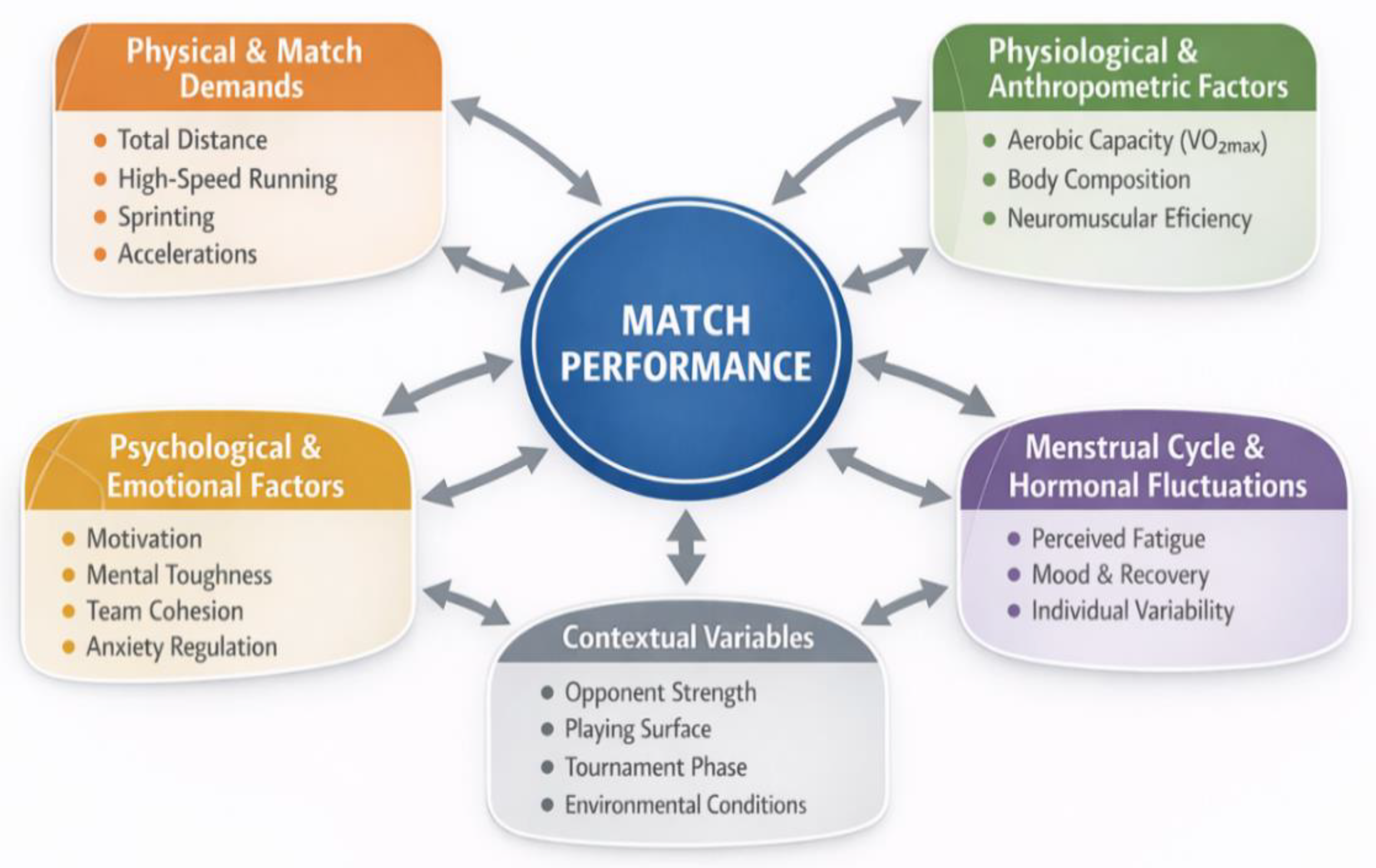
Figure 1. Conceptual model of performance determinants in women’s football. Match performance emerges from the dynamic interaction between physical and match demands, physiological and anthropometric characteristics, psychological and emotional factors, menstrual cycle-related influences, and contextual variables. Arrows indicate bidirectional relationships and feedback mechanisms influencing performance and adaptation.
Applsci 16 07293 g001
Figure 2. Conceptual representation of the evolution of women’s football performance from 2008 to 2023. The figure illustrates the progressive shift from an endurance-dominant model toward a high-intensity performance profile, characterized by increased high-speed running and sprint frequency, enhanced neuromuscular preparation, greater technical–tactical complexity, and advancing professionalization of the women’s game. The illustration is intended to summarize key trends reported in the literature rather than depicting quantitative data. HSR = high-speed-running; GPS = Global Positioning System; HRV = heart rate variability.
Applsci 16 07293 g002
Table 1. Position-specific physical and physiological profiles, aerobic capacity ranges, high-intensity acceleration/deceleration counts, and key tactical characteristics in elite female football players.
Playing
Position
Total
Distance (km)
High-Speed Running (m)Sprint
Frequency (n)
VO2 Max (mL·kg−1·min−1)HI Acc/Dec
Counts
(per Match)
Key Physical–Tactical
Characteristics
Representative Studies
Central
Defenders (CDs)
8.5–9.5400–6005–1046–5230–50High demands for defensive aerial duels, positional coverage, and short explosive accelerations.[11,12]
External Defenders/
Fullbacks
(FBs)
9.5–10.5800–110015–2250–5660–85High box-to-box volume, frequent overlapping runs, and high-intensity linear sprinting along the flanks.[9,14]
Central
Midfielders (CMs)
10.0–11.5600–8008–1254–6070–95Highest aerobic capacity requirements; characterized by continuous transitional running and dense multidirectional agility actions.[13,29]
Wide Midfielders/
Wingers (WMs)
9.8–10.8900–120018–2552–5880–110Peak demands for high-speed running, maximal sprinting velocity, and repeated explosive cutting movements in the final third.[9,22]
Forwards/Attackers (FWs)9.0–10.2700–95014–2048–5465–90High requirements for repeated sprint ability, explosive deceleration to create space, and anaerobic power under mechanical fatigue.[14,27]
Table 2. Overview of current evidence on the influence of the menstrual cycle on physical, psychological, and perceptual performance domains in women’s football, including consistency of findings and practical implications.
Performance DomainMain Findings from
Literature
Consistency of EvidencePractical Implications
Aerobic enduranceSmall or negligible differences across cycle phasesLow–moderateNo systematic workload adjustments required; monitor individual responses
Sprint and high-intensity actionsNo meaningful phase-related differences in trained playersHighSprint and speed training can be maintained across the cycle
Maximal strength and powerGenerally unaffected by menstrual phaseHighStrength training does not require cycle-based modification
Perceived fatigue and sorenessMay increase in some phases (e.g., luteal phase)ModerateIndividualized recovery strategies recommended
Mood and psychological readinessHigh inter-individual variabilityModerate–highOpen communication and psychological monitoring advised
Injury risk indicatorsInconclusive evidenceLowFocus on neuromuscular training rather than cycle-based restrictions
Table 3. Integrated summary of the main performance determinants in women’s football. The table synthesizes key findings across physical, physiological, psychological, hormonal, and contextual domains, highlighting representative evidence discussed throughout the review.
FactorKey FindingsReferences
Physical DemandsVary by position, age, and competition level; wide players have higher demands[9,11,16,27,28]
Psychological FactorsMental toughness, motivation, and cohesion enhance performance[15,31]
Body CompositionMuscle mass aids power; fat mass hinders strength and endurance[10,32]
Menstrual CycleMixed evidence on performance impact; more research needed[10,33,35]
Contextual Match VariablesSurface, opponent, and match outcome affect running and heart rate metrics[48,49,50]
Disclaimer/Publisher’s Note: The statements, opinions and data contained in all publications are solely those of the individual author(s) and contributor(s) and not of MDPI and/or the editor(s). MDPI and/or the editor(s) disclaim responsibility for any injury to people or property resulting from any ideas, methods, instructions or products referred to in the content.