Article

Detection of Methane at ppm Level Using Monolayer Graphene Oxide Film on Surface Acoustic Wave Device


1
State Grid Jiangsu Electric Power Co., Ltd. Research Institute, Nanjing 211103, China
2
Institute of Acoustics, Chinese Academy of Sciences, Beijing 100190, China
*
Authors to whom correspondence should be addressed.
Appl. Sci. 2026, 16(14), 7001; https://doi.org/10.3390/app16147001
Submission received: 21 May 2026 / Revised: 8 July 2026 / Accepted: 9 July 2026 / Published: 13 July 2026
(This article belongs to the Section Surface Sciences and Technology)

Abstract

Traditional methane sensors based on metal oxide semiconductors typically require high operating temperatures (200–400 °C), which not only leads to high power consumption but also often results in detection limits that struggle to fall below 5 ppm. To achieve room-temperature operation with lower detection limit, this work proposed a surface acoustic wave (SAW) methane sensor using monolayer graphene oxide (GO) film. The GO material was prepared by a modified Hummers method combined with liquid-phase exfoliation and characterized by transmission electron microscopy (TEM) and atomic force microscopy (AFM). The sensor was constructed by drop-casting the GO dispersion onto the delay line region of a Y-cut quartz SAW device. Results showed that the GO sensor exhibited a low detection limit of 1 ppm and a sensitivity of 0.046 mV/ppm in the range of 100–1000 ppm, which was 2.2 times higher than that of multilayer graphite (0.021 mV/ppm). The response and recovery times for 500 ppm methane were 16.7 s and 66.4 s, respectively. Good repeatability and selectivity were also demonstrated. This work presents a simple and effective approach for room-temperature methane detection using monolayer GO on SAW devices.

1. Introduction

Methane is the main component of natural gas and plays a crucial role in coal mine safety, industrial process control, environmental monitoring and other fields. Methane in air poses an explosion risk when its concentration ranges from 5% to 15%. As a greenhouse gas, its global warming potential is more than 28 times that of carbon dioxide [1,2]. The achievement of rapid detection of methane at the parts per million level is of practical significance for ensuring production safety and reducing greenhouse gas emissions [3,4,5].
To meet the demand for methane detection, researchers have developed a variety of technical approaches. Methods represented by catalytic combustion sensors realize detection by virtue of the temperature change caused by methane combustion on the surface of catalytic elements [6,7]. Such sensors feature a simple structure and low cost, yet they exhibit limited sensitivity at low concentrations and are susceptible to irreversible poisoning by silicone, sulfur and lead vapors [8]. Optical methods typified by non-dispersive infrared absorption spectroscopy achieve detection based on the absorption characteristics of methane molecules for infrared light at specific wavelengths [9,10]. These sensors possess high precision and good selectivity, but their complex optical modules and high equipment cost limit large-scale distributed field deployment [11,12]. Methods represented by metal oxide semiconductor sensors realize detection by means of the resistance change caused by the reaction between gas-sensitive materials and methane [13,14]. Such sensors have relatively high sensitivity but usually require operation at high temperatures ranging from 100 °C to 350 °C [15,16]. For instance, the ZnO/g-C3N4 sensor reported by Zhang et al. can operate at room temperature with a limit of detection of 500 ppm [17]; the ZnO nanorod sensor developed by Kumar et al. has a limit of detection of 100 ppm [18]; the V2O5 nanoflower sensor prepared by Mounasamy et al. needs to work at 100 °C, with response and recovery times of 206 s and 247 s, respectively [19]; and the In2O3-CuO heterojunction sensor studied by Nie et al. operates at a high temperature up to 350 °C and has a limit of detection of 120 ppm [20]. Power consumption issues caused by high-temperature operation and limited detection capabilities make such sensors face challenges in long-term monitoring and early warning scenarios [13]. Although metal oxide semiconductor (MOS) sensors offer high sensitivity, they typically require high operating temperatures (100–350 °C) [13,14,15,16], leading to high power consumption and limiting their use in long-term monitoring. For room-temperature methane detection, two-dimensional (2D) materials such as graphene derivatives have recently attracted considerable attention [21,22].
Another approach adopts surface acoustic wave (SAW) technology to achieve detection through the frequency shift induced by the adsorption of gas molecules by sensitive thin films [23,24]. Surface acoustic wave sensors have attracted attention due to their potential for passive and wireless operation and the possibility of room-temperature operation [25,26]. For example, Liu et al. reported a surface acoustic wave methane sensor based on Cryptophane-A composite thin film, which can work at room temperature, yet its limit of detection is 100 ppm, with response and recovery times of 41.2 s and 57 s, respectively [27]. Although surface acoustic wave technology provides a platform for room-temperature detection, the performance of sensitive materials still restricts the detection limit and response speed of the sensors [28]. Improving the detection capability of surface acoustic wave sensors for low-concentration methane at room temperature requires a search for sensitive materials with stronger gas adsorption capacity.
In recent years, graphene and its derivatives such as graphene oxide have received extensive attention in the field of gas sensing [29]. Such materials have a high specific surface area, excellent electrical properties and potential for room-temperature operation, providing possibilities for the development of novel gas sensors [30]. However, pristine graphene has limited adsorption capacity for non-polar gases such as methane, which mainly relies on weak van der Waals interactions [31]. In addition, the graphene nanosheets tend to agglomerate and restack, leading to a reduction in the effective specific surface area and thus restricting their gas adsorption performance [32]. To address these limitations, researchers have developed a variety of modification strategies. Graphene oxide enhances the interaction with gas molecules by introducing oxygen-containing functional groups [33]. Heteroatom doping can introduce defect states into the graphene lattice, regulate its electronic structure and enhance the affinity for target gases [34]. Composite with metal oxides can form heterojunctions and improve the sensing performance through synergistic effects. Among the above modification strategies, monolayer graphene is regarded as an ideal platform for high-performance gas sensing due to its fully exposed atomic surface, ultra-high specific surface area and excellent charge transport properties [35]. The monolayer structure can provide the maximum density of active sites, and the adsorption and desorption processes of gas molecules on its surface are more rapid, which is conducive to the realization of fast response and recovery.
An analysis of the above studies reveals that the core problem faced by existing work is that sensors operating at high temperatures consume excessive power, while those operating at room temperature often suffer from insufficient detection limits or slow response speeds [36]. This problem stems from the limited adsorption capacity of sensitive materials for methane at room temperature and the insufficient specific surface area of traditional materials to provide enough active sites. Based on this, we infer that the simultaneous realization of a low limit of detection and fast response is expected if two-dimensional materials with an ultra-large specific surface area and abundant adsorption sites are introduced while maintaining the advantage of surface acoustic wave technology for room-temperature operation [37]. As a two-dimensional nanomaterial, monolayer graphene oxide can provide a fully exposed atomic surface with its monolayer structure, and its oxygen-containing functional groups can interact with methane molecules, thus becoming a candidate material for methane detection at ppm level.
In this paper, a surface acoustic wave methane sensor based on a monolayer graphene oxide thin film is proposed and fabricated, aiming to realize methane detection at ppm level at room temperature. Firstly, monolayer graphene oxide was prepared by an improved Hummers method combined with liquid-phase exfoliation technology, and its morphology and thickness were characterized by transmission electron microscopy and atomic force microscopy. Subsequently, the graphene oxide dispersion was loaded onto the delay line region of a Y-cut quartz surface acoustic wave device by drop coating to construct a complete sensing unit. Finally, the methane sensing performance of the sensor was systematically tested at room temperature, including concentration gradient response, response and recovery time, repeatability and selectivity. The experimental results show that the sensor has a low limit of detection for methane down to 1 ppm and a sensitivity of 0.06 mV/ppm, with response and recovery times of 16.7 s and 66.4 s, respectively. It also exhibits good repeatability and selectivity.

2. Materials and Methods

2.1. Fabrication of SAW Methane Sensor Device

Y-cut quartz was selected as the piezoelectric substrate material in this work. The choice of Y-cut quartz is motivated by its relatively high electromechanical coupling coefficient (≈0.23%) for Rayleigh waves, low bulk acoustic wave interference, and good temperature stability around room temperature. Compared to ST-cut quartz (which has zero temperature coefficient but lower coupling), Y-cut offers a better trade-off for gas sensing applications where sensitivity is prioritized over temperature stability [38]. Delay-line-type SAW sensor chips were fabricated on Y-cut quartz wafers using photolithography. First, two sets of aluminum (Al) interdigital transducers (IDTs) with a thickness of 120 nm were patterned with a spacing of 2 mm. The input IDT employed a single-phase unidirectional transducer (SPUDT) structure to reduce insertion loss. Periodic dummy electrodes are embedded inside the IDT to form comb structure for uniform SAW velocity and stable bandwidth [39]. The device operated at a frequency of 200 MHz (corresponding to a wavelength λ ≈ 15.7 μm). The SPUDT electrode widths were designed as 4 μm (λ/4) and 2 μm (λ/8), and the whole SPUDT owns a total of 50 finger pairs. The IDT dimensions (finger width, gap, and aperture) were determined based on the SAW velocity on Y-cut quartz to achieve a resonant frequency of 200 MHz. The number of finger pairs (50) was chosen to provide sufficient signal-to-noise ratio while keeping the insertion loss within acceptable limits. These design parameters directly affect the sensor’s sensitivity because the mass loading effect induced by gas adsorption produces a frequency shift proportional to the square of the operating frequency [40]. Finally, a sensitive film of monolayer graphene oxide (GO) was deposited on the acoustic propagation path by drop-casting. Prior to drop-casting, the device was treated in an ultraviolet ozone cleaner for 10 min to enhance the hydrophilicity of the substrate surface and promote uniform spreading of the GO film.

2.2. Preparation of GO Materials

Firstly, a graphite precursor was prepared using a modified Hummers’ method. Subsequently, monolayer graphene oxide was obtained via liquid-phase exfoliation. The multilayer graphene oxide powder was dispersed in deionized water at a concentration of 0.5 mg/mL and ultrasonicated for 2 h (power 300 W, frequency 40 kHz) to fully exfoliate the graphene oxide sheets. During ultrasonication, the water bath temperature was controlled below 25 °C to prevent material damage from overheating. The ultrasonicated dispersion was then centrifuged at 3000 rpm for 30 min, and the upper brown supernatant was collected.
The collected supernatant (0.5 mg/mL) was then mixed with hydroiodic acid (HI) at a volume ratio of 1:3. The mixture was refluxed in an oil bath at 95 °C for 1 h. The precipitate was collected by centrifugation (3000 rpm, 15 min), washed three times with an ethanol/water mixture (1:1), and vacuum-dried (60 °C, 6 h) to obtain few-layer graphene oxide (GO). To eliminate nanomaterial agglomeration, the solution was treated in an ultrasonic cleaning machine for over 30 s before use. Subsequently, 2 μL of the nanomaterial dispersion was precisely drop-coated onto the SAW delay line region (the acoustic propagation path located between the input IDTs and output IDTs). The device was placed in a vacuum drying oven at 60 °C for 2 h to finally obtain the monolayer graphene oxide nanofilm. For comparison, a multilayer graphite film sensor was prepared using the same method by drop-casting 2 μL of a non-exfoliated multilayer graphene oxide dispersion (0.5 mg/mL).

2.3. Characterization Methods for GO Material Morphology and Structure

Transmission electron microscopy (TEM, JEOL JEM-2100F, Tokyo, Japan) was employed to observe the surface morphology of both multilayer graphite and monolayer graphene oxide. Atomic force microscopy (AFM, Bruker Dimension Icon, Karlsruhe, Germany) was used to precisely measure the thickness of the monolayer graphene oxide.

2.4. Setup of Methane Sensing Test Platform

The frequency shift of the sensing chip upon gas exposure was acquired as the sensing signal. To achieve this, the prepared SAW sensing chip was connected to a specific phase discrimination circuit to construct a complete sensor system. A signal generator produced a 200 MHz RF signal, which was split into two equal paths by a signal divider: one path was transmitted to the SAW sensing chip, and the other was sent to one input of a phase discriminator. The output signal from the SAW sensing chip served as the other input to the phase discriminator. The output signal from the phase discriminator was then converted to a digital signal by a high-precision analog-to-digital (AD) converter. This digital signal was transmitted to computer software via serial communication, enabling real-time acquisition and monitoring of CH4 information.
The sensing chip was placed inside a stainless-steel gas chamber with a volume of 50 mL. The chamber top was equipped with gas inlet and outlet ports to form a sealed gas flow path. During the test, the total gas flow rate was precisely controlled at 460 mL/min using a mass flow controller (MFC). Initially, high-purity N2 (99.999%) was introduced into the chamber for at least 30 min until the fluctuation of the sensor output signal was less than ±0.1 mV/min, establishing this as the baseline. Subsequently, by switching a three-way valve, methane standard gas (CH4/N2 mixture, concentration range 1–1000 ppm) at a set concentration was introduced, and the sensor signal variation over time was recorded until the signal reached a new steady state. Finally, the gas flow was switched back to N2 for purging for 5–10 min to allow complete desorption of gas molecules adsorbed on the sensor surface, enabling the signal to return to the initial baseline level, thus completing one test cycle.

3. Results

3.1. Characterization of Graphene Oxide Materials

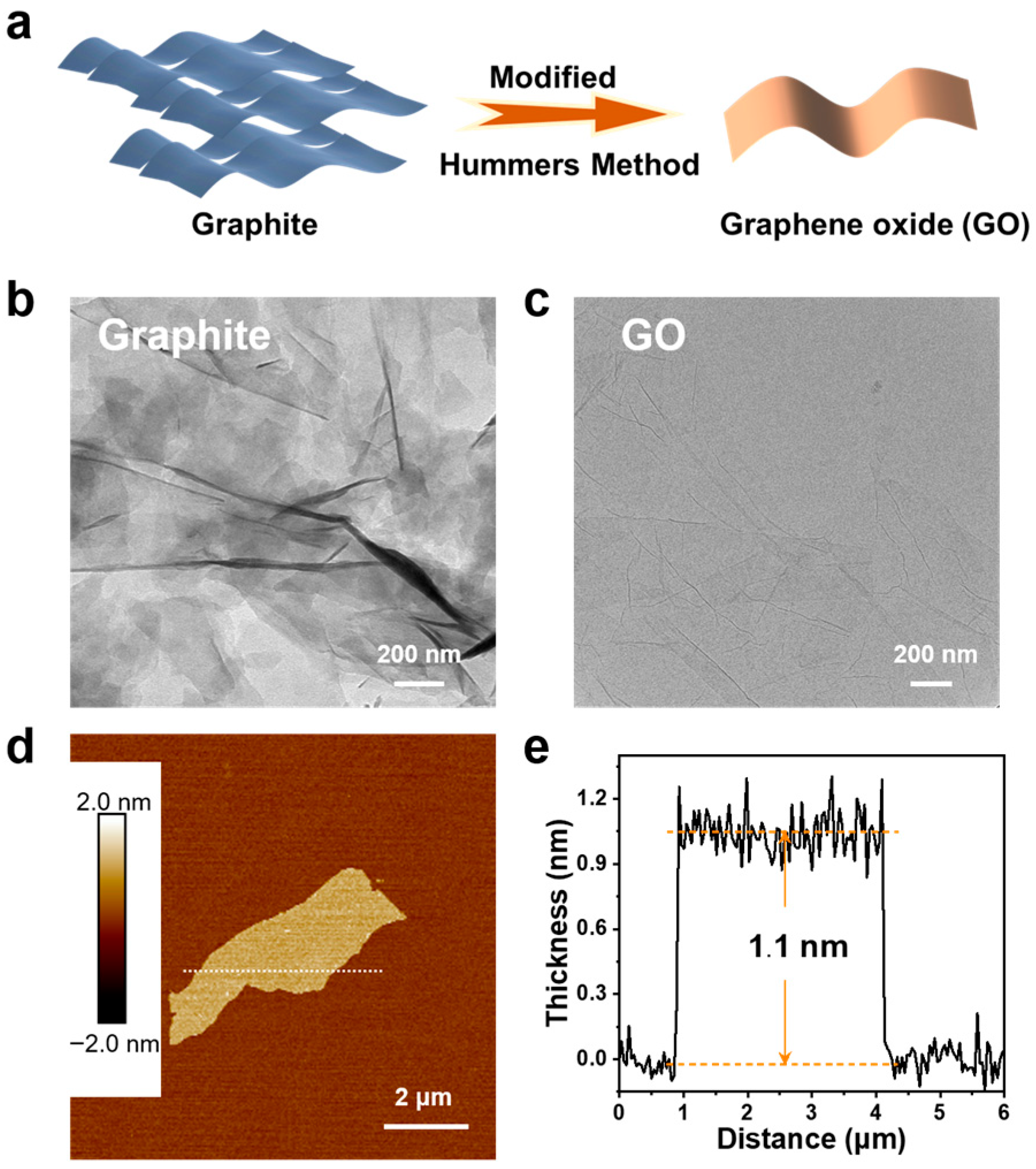
The morphology and structural properties of the gas-sensitive materials employed in this study formed the basis for their sensing performance. Single-layer graphene oxide was prepared using a combination of the Hummers method and liquid-phase exfoliation. The preparation process and morphological characterization are shown in Figure 1. Figure 1a schematically illustrated the preparation route from multilayer graphite to single-layer GO. Multilayer graphite sheets were first obtained via the Hummers method, which were then subjected to a mild liquid-phase exfoliation process to yield single-layer GO nanosheets. The TEM image in Figure 1b showed that the pristine graphite exhibited a typical stacked structure with wrinkled morphology, which resulted from the natural stacking induced by interlayer van der Waals forces. After exfoliation, as shown in Figure 1c, the GO presented an ultrathin and transparent morphology. Its ultrathin nature allowed the underlying substrate to be visible, and no layer overlap was observed on the surface, indicating the successful preparation of high-quality single-layer structures.
To further confirm the thickness of the prepared GO, AFM characterization was performed. Figure 1d displayed the AFM topography of the exfoliated GO, where the GO sheets were uniformly spread on the substrate surface. Height profile analysis in Figure 1e revealed that the thickness of the obtained GO was approximately 1.1 nm. This value was in good agreement with the theoretical thickness of single-layer graphene reported in the literature (approximately 0.8–1.2 nm), further confirming the successful preparation of high-quality single-layer GO. This ultrathin nature and large specific surface area laid the material foundation for the subsequent excellent gas sensing performance.

3.2. Fabrication of the SAW Sensor

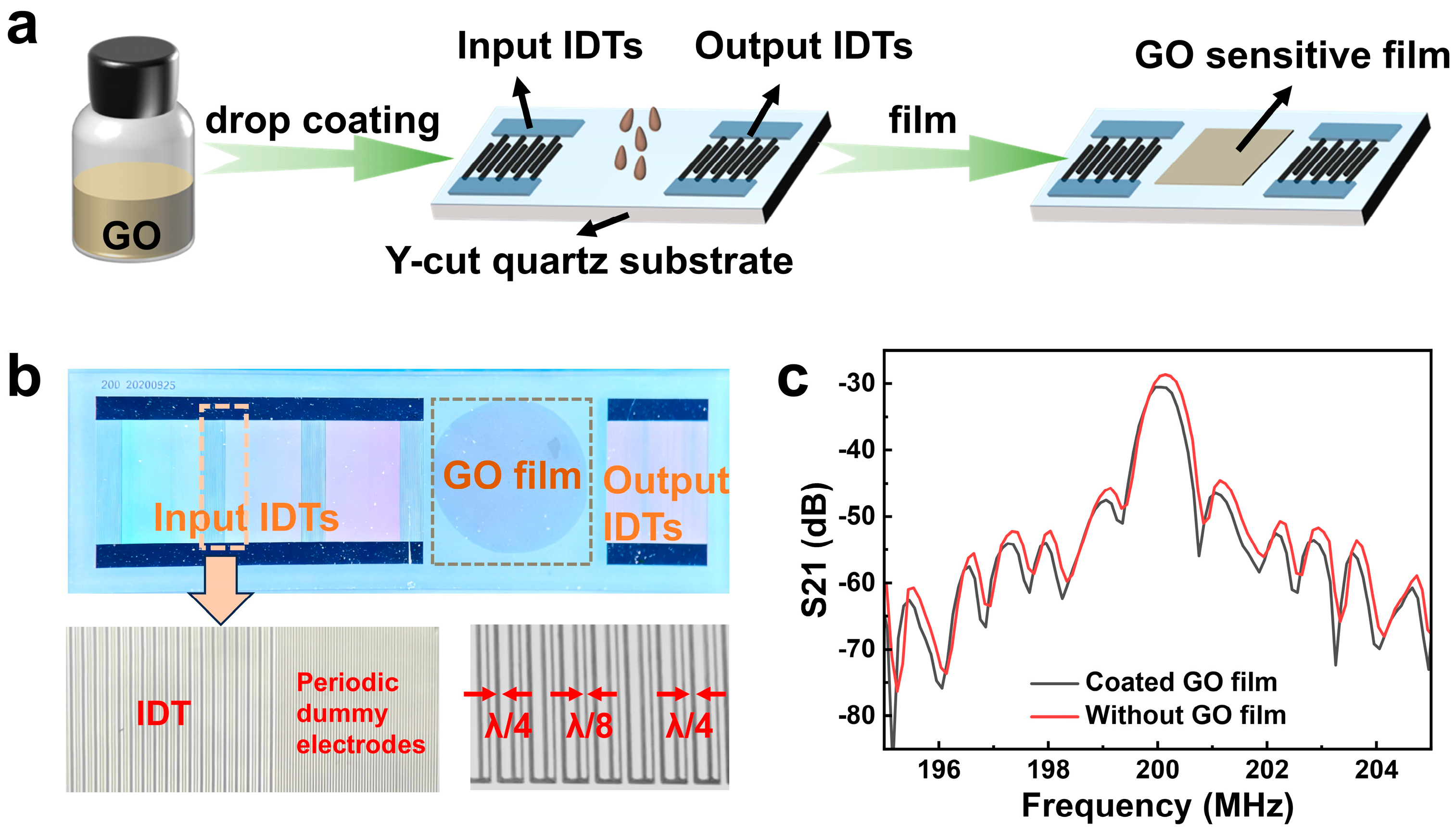
Following the acquisition of high-quality single-layer graphene oxide (GO), it was integrated onto a surface acoustic wave device to construct a complete sensing unit. Figure 2a schematically illustrated the fabrication process: the GO dispersion was deposited onto the sensitive film region of the Y-cut quartz-based SAW device via a drop-casting method. After natural evaporation at room temperature, the GO nanosheets uniformly adhered to the acoustic propagation path, forming the gas-sensitive thin film. Figure 2b presented a schematic diagram of the SAW delay line device used in this study. The device consisted of input interdigital transducers (IDTs), output IDTs, and a sensitive film region located between them. The design employed a single-phase unidirectional transducer (SPUDT) configuration, which utilized internal reflection structures to direct the acoustic wave energy predominantly in a single propagation direction, thereby effectively reducing the insertion loss of the device. The operating frequency of the device was set to 200 MHz, corresponding to a surface acoustic wavelength (λ) of approximately 15.7 μm. The electrode widths of the SPUDT were designed to be 4 μm (λ/4) and 2 μm (λ/8) to satisfy the conditions for unidirectional radiation. The physical dimensions (length × width) of the entire SAW device were set to 514λ × 169λ.
To evaluate the effect of the drop-casting process on the fundamental performance of the device, the insertion loss of the device was measured before and after GO loading; the results were shown in Figure 2c. It was observed that after loading the GO film, the insertion loss of the device remained almost unchanged, and the frequency response curve retained a good shape. This result indicated that the amount of GO deposited during the experiment was well-controlled, ensuring a sufficient loading of the gas-sensitive material without causing excessive damping of the acoustic wave propagation or introducing additional noise. This provided a reliable device foundation for subsequent precise and stable gas sensing tests.

4. Discussion

4.1. Evaluation of Methane Sensing Performance

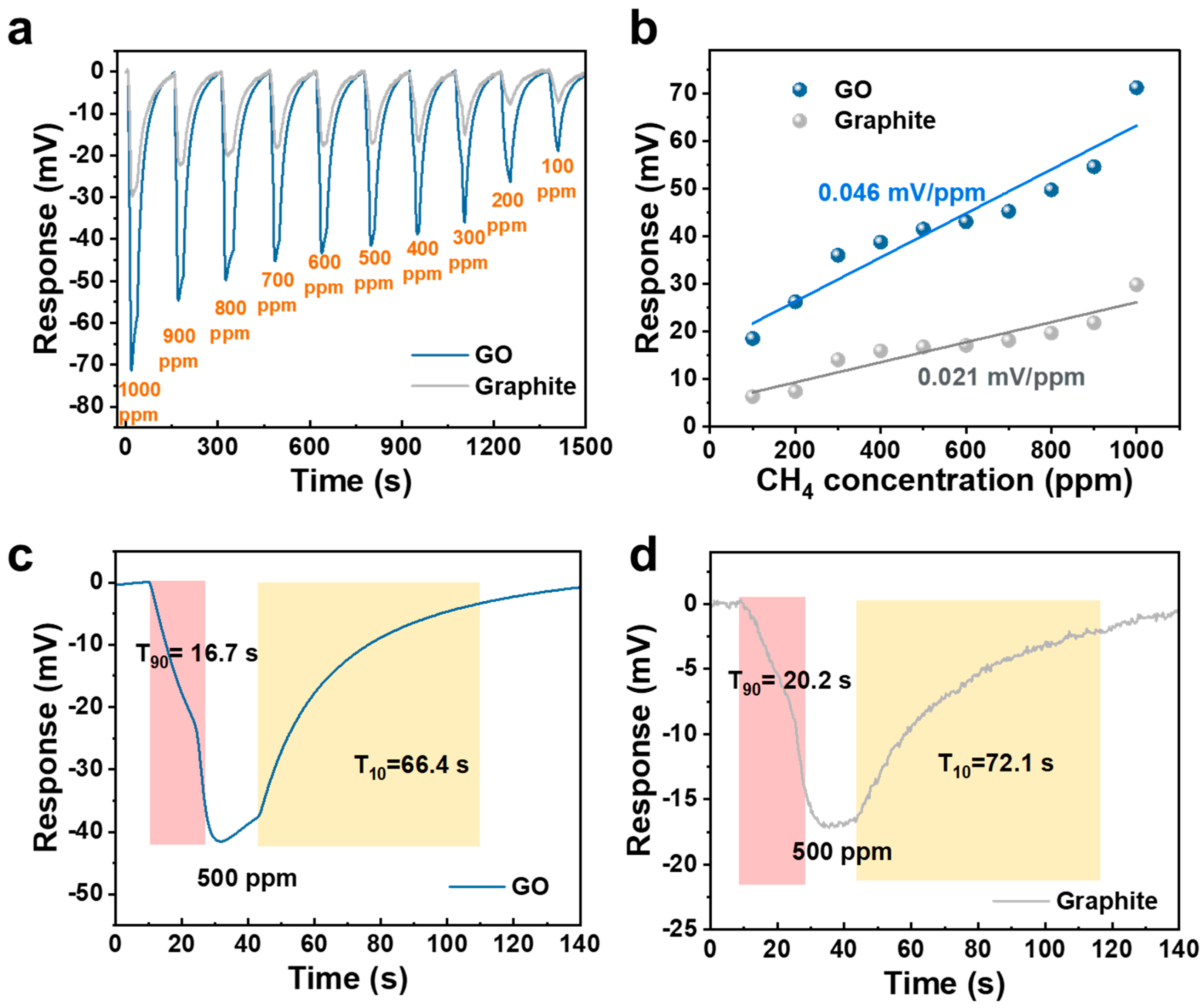
The specific surface area, the number of gas adsorption sites, and the mass loading effect, which directly depended on the number of graphene layers, were critical factors determining the gas sensing performance of the sensor. Therefore, the response characteristics of SAW sensors based on single-layer graphene oxide (GO) and multilayer graphite (Graphite) to various concentrations of methane were investigated and compared. Figure 3a illustrated the dynamic response–recovery real-time curves of the two sensors to methane in the concentration range of 100–1000 ppm at room temperature. It was evident that the response amplitudes of both devices increased with rising methane concentration, exhibiting a typical concentration-dependent behavior. However, the response amplitude of the GO sensor was significantly higher than that of the Graphite sensor at each concentration. This intuitively reflected the advantage of single-layer GO in gas adsorption, as its fully exposed atomic surface provided a greater number of active adsorption sites.
The sensitivity of the two sensors was further quantified in Figure 3b. Through linear fitting of the response values at different concentrations, the sensitivity of GO to methane was calculated to be approximately 0.046 mV/ppm, while that of Graphite was only 0.021 mV/ppm. The sensitivity of the single-layer GO was therefore 2.2 times higher than that of the multilayer Graphite. This significant difference was attributed to the ultra-high specific surface area of GO. In multilayer Graphite, only the outermost layers could effectively contact and adsorb gas molecules, while the inner graphene layers were encapsulated and unable to participate in the gas sensing reaction, resulting in a waste of active sites. Response and recovery speeds are important indicators for evaluating the practicality of a sensor, directly impacting its capability for real-time monitoring. Methane at a concentration of 500 ppm was selected to compare and analyze the dynamic response processes of the two sensors. Figure 3c recorded the response and recovery curve of the GO sensor upon exposure to 500 ppm methane. Based on the definitions of 90% response time (T90) and 10% recovery time (T10), its response time was calculated as 16.7 s, and its recovery time was 66.4 s. In comparison, as shown in Figure 3d, the response time of the Graphite sensor under the same concentration was 20.2 s, and its recovery time was as long as 72.1 s. The comparison indicated that GO outperformed Graphite in both response and recovery speeds. Its faster response was attributed to the single-layer structure facilitating rapid diffusion and surface adsorption of methane molecules. The shorter recovery time suggested a lower energy barrier for gas molecule desorption from the single-layer surface, which was beneficial for sensor reuse and baseline recovery. This excellent kinetic characteristic endowed the single-layer GO SAW sensor with greater advantages for rapid and continuous monitoring applications.
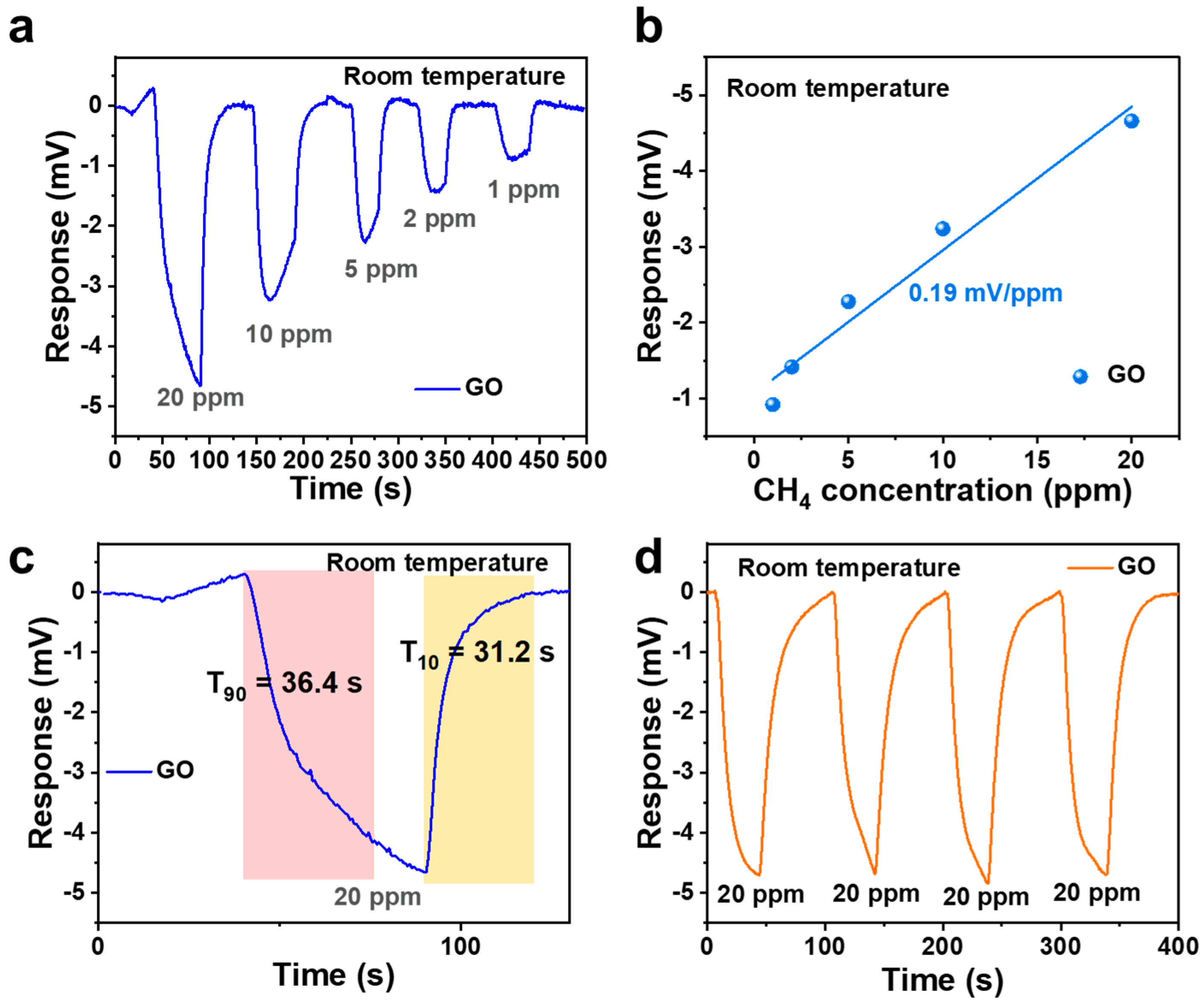
Early warning of methane leakage often requires sensors with low concentration detection capabilities. Consequently, the response characteristics of the GO sensor to low concentrations of methane (≤20 ppm) were further investigated, with results presented in Figure 4. Figure 4a displayed the dynamic response curves of the sensor to methane concentrations ranging from 1 to 20 ppm. Notably, even when the methane concentration was as low as 1 ppm, the sensor still generated a clear response signal of approximately 0.9 mV. This result indicated that the theoretical detection limit of the GO sensor could reach the sub-ppm level, fully demonstrating its potential for trace gas detection. Figure 4b showed that within the low concentration range of 1–20 ppm, the response value exhibited a good linear relationship with concentration. The linearly fitted sensitivity was approximately 0.19 mV/ppm, which was slightly higher than that in the high concentration range, possibly due to the abundance of adsorption sites and higher adsorption efficiency at low concentrations. Figure 4c analyzed the dynamic response process of the sensor to 20 ppm methane. The response time T90 was 36.4 s, and the recovery time T10 was 31.2 s. Compared to the response speed at a high concentration of 500 ppm (16.7 s), the response was slightly slower at low concentrations. This was because achieving adsorption equilibrium on the surface required longer diffusion and collision times for low-concentration gas molecules. Nevertheless, this speed still met the requirements of most environmental monitoring scenarios. Four consecutive cycles of exposure to 20 ppm methane were performed on the GO sensor, with the results depicted in Figure 4d. Throughout the four cycles, the response amplitudes of the sensor were nearly identical. This fully demonstrated the excellent reversibility and short-term repeatability of the GO SAW sensor. This good repeatability was attributed to the dominant physical adsorption interaction between GO and methane molecules. This interaction was sufficiently strong to enable room-temperature detection, yet weak enough to ensure rapid and complete desorption of gas molecules during N2 purging without causing irreversible changes to the film structure. The CH4 sensing performance of the GO SAW sensor in this work was compared with previously reported methane sensors, as summarized in Table 1. The comparison indicated that the proposed sensor exhibited a lower limit of detection (1 ppm) and competitive response/recovery times at room temperature compared to most literature values.

4.2. Sensing Mechanism and Selectivity Analysis

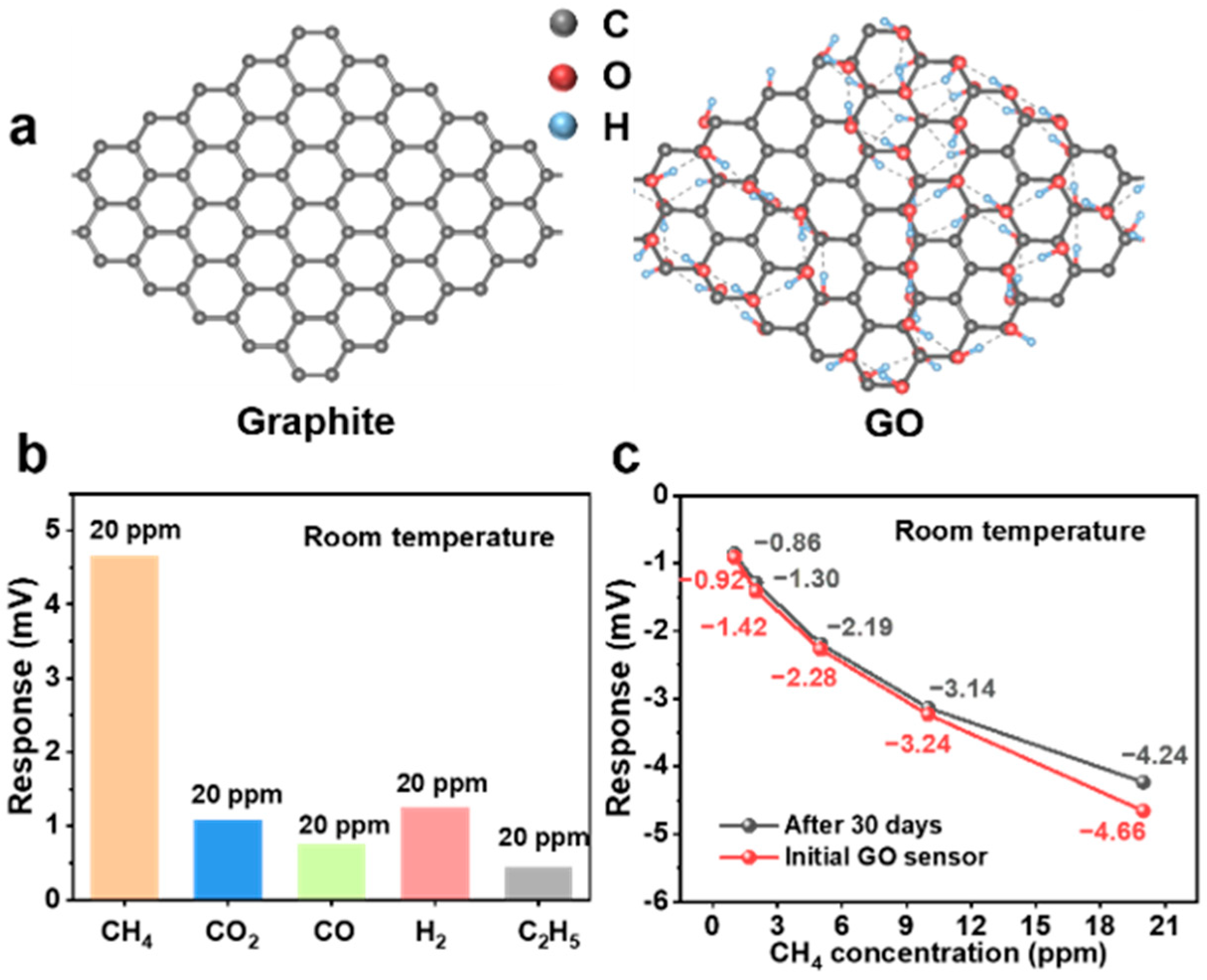
To deeply understand the intrinsic mechanism underlying the above differences in sensing performance, the influence of the chemical modification state of graphene on gas adsorption behavior was analyzed. As illustrated in Figure 5a, the surface of pristine monolayer graphene consisted of a hexagonal ring structure of carbon atoms and lacked specific active functional groups. Therefore, its adsorption of methane molecules primarily relied on weak van der Waals forces, resulting in limited adsorption capacity. In contrast, the surface of the monolayer graphene oxide (GO) actually employed in this study was enriched with oxygen-containing functional groups such as hydroxyl (–OH) and carboxyl (–COOH). These polar functional groups interacted with methane molecules (which possess a certain polarizability) through dipole–dipole interactions and enhanced van der Waals forces, significantly improving the gas capture capability. In addition to the chemical interactions discussed above, the SAW propagation process is also influenced by methane adsorption through two coupled physical mechanisms. On one hand, adsorbed methane molecules increase the surface mass loading of GO and reduce SAW resonant frequency via the mass loading effect. On the other hand, methane adsorption changes the dielectric constant and conductivity of GO, altering the electrical boundary conditions on the quartz surface and generating an electro-acoustic coupling effect. The observed signal variation in this work is the superposition of these two effects.
Finally, the responses of the GO SAW sensor to several common gases were evaluated to assess its selectivity. Figure 5b compared the response amplitudes of the sensor to methane (CH4), carbon dioxide (CO2), carbon monoxide (CO), hydrogen (H2), and ethane (C2H6) at a concentration of 20 ppm. The results showed that the response value for methane was approximately 4.8 mV, whereas the response for carbon dioxide was only 1.2 mV. The responses to the other interfering gases were even lower. This indicated that the sensor exhibited good selective recognition capability for methane. The origin of this selectivity was attributed to the quadrupole moment characteristics of the methane molecule and its specific interactions with the oxygen-containing functional groups on the graphene oxide surface. To further evaluate the practical reliability of the sensor, a long-term stability test was carried out by continuously cycling methane exposure for 30 days. Figure 5c compared the CH4 response of the sensor at the initial state and after 30 days aging within 1–20 ppm. After one month of testing, the device maintained approximately 91% of its initial response value, and the minor performance decay was attributed to irreversible adsorption of trace impurities on the GO surface. Although cross-interference in complex gas mixtures remains a concern, selectivity can be further enhanced via multi-sensor differential arrays and machine learning pattern recognition to decouple mixed signals.

5. Conclusions

In summary, the GO-based SAW methane sensor operating at room temperature was successfully developed in this study. Monolayer GO with a thickness of approximately 1.1 nm was obtained through liquid-phase exfoliation and deposited on the SAW device by drop-casting. The sensor exhibited a detection limit of 1 ppm and a sensitivity of 0.06 mV/ppm (1–20 ppm), which was 2.86 times higher than that of multilayer graphite. Its response and recovery times to 500 ppm methane were 16.7 s and 66.4 s, respectively. Good repeatability and selectivity were also demonstrated. These results suggest that the GO SAW sensor is a promising candidate for low-concentration methane monitoring applications. Further work may focus on improving its long-term stability and selectivity in complex environments.

Author Contributions

D.G.: conceptualization, methodology, data curation, formal analysis, writing—original draft. J.J. (Jing Jin): conceptualization, methodology, data curation, formal analysis, writing—original draft. Q.Y.: data curation, methodology. L.S.: project administration. J.J. (Jun Jia): conceptualization, methodology. W.W.: funding acquisition, writing—review & editing. All authors have read and agreed to the published version of the manuscript.

Funding

This work was supported by the Science and Technology Project of State Grid Jiangsu Electric Power Co., Ltd. (Grant No. J2024224).

Institutional Review Board Statement

Not applicable.

Informed Consent Statement

Not applicable.

Data Availability Statement

Data presented in this study are available on request from the corresponding author.

Conflicts of Interest

Author Dongliang Guo, Lei Sun and Jun Jia were employed by the company State Grid Jiangsu Electric Power Co., Ltd. The remaining authors declare that the research was conducted in the absence of any commercial or financial relationships that could be construed as a potential conflict of interest. The authors declare no conflicts of interest.

References

  1. Zampolli, S.; Elmi, I.; Bruschi, P.; Ria, A.; Magliocca, F.; Vitelli, M.; Piotto, M. An ASIC-based system-in-package MEMS gas sensor with impedance spectroscopy readout and AI-enabled identification capabilities. Sens. Actuators B Chem. 2025, 424, 136924. [Google Scholar] [CrossRef]
  2. Yuxin, W.; Gui, F.; Qian, L.; Xiao, L.; Yiran, C.; Yali, W.; Xuecai, X. Modelling and analysis of unsafe acts in coal mine gas explosion accidents based on network theory. Process Saf. Environ. Prot. 2023, 170, 28–44. [Google Scholar] [CrossRef]
  3. Li, L.; Guo, H.; Cheng, L.; Li, S.; Lin, H. Research on causes of coal mine gas explosion accidents based on association rule. J. Loss Prev. Process Ind. 2022, 80, 104879. [Google Scholar] [CrossRef]
  4. Duan, W.; Yan, F.; Wang, Y.; Zhang, H.; Ma, L.; Wen, D.; Wang, W.; Sheng, G.; Wang, Q. A Laser-Based Multipass Absorption Sensor for Sub-ppm Detection of Methane, Acetylene and Ammonia. Sensors 2022, 22, 556. [Google Scholar] [CrossRef] [PubMed]
  5. Kong, R.; Huang, J.; Liu, P.; Zhou, X. Real-time breath gas analysis of methane using a multipass cell-based near-infrared gas sensor. Biomed. Opt. Express 2024, 15, 4207–4219. [Google Scholar] [CrossRef] [PubMed]
  6. Gupta, S.; Knoepfel, A.; Zou, H.; Ding, Y. Investigations of methane gas sensor based on biasing operation of n-ZnO nanorods/p-Si assembled diode and Pd functionalized Schottky junctions. Sens. Actuators B Chem. 2023, 392, 134030. [Google Scholar] [CrossRef]
  7. Jiao, M.; Dong, H.; Qiao, Y.; Guo, R.; Manh Hung, C.; Van Duy, N.; Hoa, N.D.; Wen, C. Accurate Methane Detection in Combustible Gas Mixtures by Using SnO2-Ag-ZnO Gas Sensors with Rapid Responses. ACS Sens. 2026, 11, 290–298. [Google Scholar] [PubMed]
  8. Chilton, J.E.; Barn, J.; Thomas, W.E.; Hofer, L.J.E.; Snyder, J.L. Silicone Vapor Poisoning of Catalytic Methane Sensors. In Proceedings of the Fourth WVU Conference on Coal Mine Electrotechnology, Morgantown, WV, USA, 2–4 August 1978. [Google Scholar]
  9. Xiong, H.; Shao, L.; Cao, Y.; Wang, G.; Wang, R.; Mei, J.; Liu, K.; Gao, X. Neural Network Based Aliasing Spectral Decoupling Algorithm for Precise Mid-Infrared Multicomponent Gases Sensing. ACS Sens. 2024, 9, 4906–4914. [Google Scholar] [CrossRef] [PubMed]
  10. Pi, M.; Huang, Y.; Zhao, H.; Peng, Z.; Lang, J.; Ji, J.; Teng, L.; Song, F.; Liang, L.; Zhang, Y.; et al. Theoretical and experimental investigation of on-chip mid-infrared chalcogenide waveguide CH4 sensor based on wavelength modulation spectroscopy. Sens. Actuators B Chem. 2022, 362, 131782. [Google Scholar] [CrossRef]
  11. Yan, Y.; Mijiddorj, L.; Beringer, T.; Mijiddorj, B.; Ho, A.; Weng, B. Machine Learning-Enhanced NDIR Methane Sensing Solution for Robust Outdoor Continuous Monitoring Applications. Sensors 2025, 25, 7691. [Google Scholar] [CrossRef] [PubMed]
  12. Yang, Y.; Jiang, J.; Zeng, J.; Chen, Z.; Zhu, X.; Shi, Y. CH4, C2H6, and CO2 Multi-Gas Sensing Based on Portable Mid-Infrared Spectroscopy and PCA-BP Algorithm. Sensors 2023, 23, 1413. [Google Scholar] [CrossRef] [PubMed]
  13. Dey, A. Semiconductor metal oxide gas sensors: A review. Mater. Sci. Eng. B 2018, 229, 206–217. [Google Scholar] [CrossRef]
  14. Fine, G.F.; Cavanagh, L.M.; Afonja, A.; Binions, R. Metal Oxide Semi-Conductor Gas Sensors in Environmental Monitoring. Sensors 2010, 10, 5469–5502. [Google Scholar] [CrossRef] [PubMed]
  15. Bârsan, N.; Weimar, U. Understanding the fundamental principles of metal oxide based gas sensors; the example of CO sensing with SnO2 sensors in the presence of humidity. J. Phys. Condens. Matter 2003, 15, R813. [Google Scholar]
  16. Wang, C.; Yin, L.; Zhang, L.; Xiang, D.; Gao, R. Metal Oxide Gas Sensors: Sensitivity and Influencing Factors. Sensors 2010, 10, 2088–2106. [Google Scholar] [CrossRef] [PubMed]
  17. Zhang, H.; Wang, Y.; Sun, X.; Wang, Y.; Li, M.; Cao, J.; Qin, C. Enhanced CH4 sensing performances of g-C3N4 modified ZnO nanospheres sensors under visible-light irradiation. Mater. Res. Bull. 2023, 165, 112290. [Google Scholar] [CrossRef]
  18. Kumar, P.; Chiu, Y.H.; Deng, Z.I.; Kumar, U.; Chen, K.L.; Huang, W.M.; Wu, C.H. Surface modification of ZnO nanopillars to enhance the sensitivity towards methane: The studies of experimental and first-principle simulation. Appl. Surf. Sci. 2021, 568, 150817. [Google Scholar] [CrossRef]
  19. Mounasamy, V.; Mani, G.K.; Ponnusamy, D.; Tsuchiya, K.; Reshma, P.R.; Prasad, A.K.; Madanagurusamy, S. Investigation on CH4 sensing characteristics of hierarchical V2O5 nanoflowers operated at relatively low temperature using chemiresistive approach. Anal. Chim. Acta 2020, 1106, 148–160. [Google Scholar] [CrossRef] [PubMed]
  20. Nie, S.; Li, J.; He, Y.; Yin, X. Insights into Selective Sensitivity of In2O3-CuO Heterojunction Nanocrystals to CH4 over CO and H2: Experiments and First-Principles Calculations. ACS Sens. 2024, 9, 6390–6399. [Google Scholar] [CrossRef] [PubMed]
  21. Dariyal, P.; Sharma, S.; Chauhan, G.S.; Singh, B.P.; Dhakate, S.R. Recent trends in gas sensing via carbon nanomaterials: Outlook and challenges. Nanoscale Adv. 2021, 3, 6514–6544. [Google Scholar] [CrossRef] [PubMed]
  22. Dosi, M.; Lau, I.; Zhuang, Y.; Simakov, D.S.A.; Fowler, M.W.; Pope, M.A. Ultrasensitive Electrochemical Methane Sensors Based on Solid Polymer Electrolyte-Infused Laser-Induced Graphene. ACS Appl. Mater. Interfaces 2019, 11, 6166–6173. [Google Scholar] [CrossRef] [PubMed]
  23. Yang, Q.; Cui, B.; Jin, J.; Cheng, L.; Xue, X.; Yin, Y.; Wang, W. Review of surface acoustic wave-based gas sensors. Sens. Int. 2026, 7, 100348. [Google Scholar] [CrossRef]
  24. Cui, B.; Cheng, L.; Xue, X.; Jin, J.; Huang, L.; Liang, Y.; Wang, W. High sensitivity SAW hydrogen gas sensor based on thermal conductivity effect. Microsyst. Nanoeng. 2026, 12, 68. [Google Scholar] [CrossRef] [PubMed]
  25. Cui, B.; Gao, X.; Zhao, Z.; Xue, X.; Yang, Q.; Jin, J.; Wang, W.; Liang, Y.; Guo, D. Contactless and passive humidity measurement by using ultra-thin GO nanosheet coated SAW sensor. Sens. Actuators A Phys. 2025, 393, 116827. [Google Scholar] [CrossRef]
  26. Jin, J.; Yang, Q.; Hu, A.; Cui, B.; Xue, X.; Liang, Y.; Shi, F.; Lee, K.; Wang, W. Heterojunction interface-engineered SnO2-CuO SAW sensor for room-temperature CO2 detection with fast response and high selectivity. Microsyst. Nanoeng. 2025, 11, 226. [Google Scholar] [CrossRef] [PubMed]
  27. Liu, X.; Shen, B.; Jiang, L.; Yang, H.; Jin, C.; Zhou, T. Study on SAW Methane Sensor Based on Cryptophane-A Composite Film. Micromachines 2023, 14, 266. [Google Scholar] [CrossRef] [PubMed]
  28. Liu, J.; Wang, W.; Li, S.; Liu, M.; He, S. Advances in SAW Gas Sensors Based on the Condensate-Adsorption Effect. Sensors 2011, 11, 11871–11884. [Google Scholar] [CrossRef] [PubMed]
  29. Ahmad, K.; Raza, W.; Oh, T.H. Progress in graphene quantum dots, graphene oxide and reduced graphene oxide based materials for chemoresistive gas sensors. J. Environ. Chem. Eng. 2025, 13, 118157. [Google Scholar] [CrossRef]
  30. Teli, A.M.; Mane, S.M.; Beknalkar, S.A.; Mishra, R.K.; Jeon, W.; Shin, J.C. Graphene-Based Gas Sensors: State-of-the-Art Developments for Gas Sensing Applications. Micromachines 2025, 16, 916. [Google Scholar] [CrossRef] [PubMed]
  31. Thierfelder, C.; Witte, M.; Blankenburg, S.; Rauls, E.; Schmidt, W.G. Methane adsorption on graphene from first principles including dispersion interaction. Surf. Sci. 2011, 605, 746–749. [Google Scholar] [CrossRef]
  32. Novoselov, K.S.; Fal, V.I.; Colombo, L.; Gellert, P.R.; Schwab, M.G.; Kim, K. A roadmap for graphene. Nature 2012, 490, 192–200. [Google Scholar] [CrossRef] [PubMed]
  33. Duan, L.; Bo, Z.; Chen, X.; Qi, H.; Yan, J.; Cen, K. Ab initio characterization and experimental validation on the roles of oxygen-containing groups in graphene based formaldehyde sensors. Analyst 2017, 143, 106–115. [Google Scholar] [CrossRef] [PubMed]
  34. Wang, X.; Sun, G.; Routh, P.; Kim, D.-H.; Huang, W.; Chen, P. Heteroatom-doped graphene materials: Syntheses, properties and applications. Chem. Soc. Rev. 2014, 43, 7067–7098. [Google Scholar] [CrossRef] [PubMed]
  35. Dikin, D.A.; Stankovich, S.; Zimney, E.J.; Piner, R.D.; Dommett, G.H.; Evmenenko, G.; Nguyen, S.T.; Ruoff, R.S. Preparation and characterization of graphene oxide paper. Nature 2007, 448, 457–460. [Google Scholar] [CrossRef] [PubMed]
  36. Vizireanu, S.; Constantinoiu, I.; Satulu, V.; Stoica, S.-D.; Viespe, C. High-Sensitivity H2 and CH4 SAW Sensors with Carbon Nanowalls and Improvement in Their Performance after Plasma Treatment. Chemosensors 2023, 11, 566. [Google Scholar] [CrossRef]
  37. Bhardwaj, R.; Pumera, M. Surface-Engineered 2D Nanomaterials in Gas Sensors: Advancement and Challenges. Small 2025, 21, 2410360. [Google Scholar] [CrossRef] [PubMed]
  38. Rajput, P.; Kumar, J.; Mittal, U.; Nimal, A.T.; Arsenin, A.V.; Volkov, V.S.; Mishra, P. Thermal sensitivity study of thin film over-layered SAW devices for sensor applications. Inorg. Chem. Commun. 2022, 146, 110116. [Google Scholar] [CrossRef]
  39. Wen, W.; Shitang, H.; Shunzhou, L.; Minghua, L.; Yong, P. Enhanced sensitivity of SAW gas sensor coated molecularly imprinted polymer incorporating high frequency stability oscillator. Sens. Actuators B Chem. 2007, 125, 422–427. [Google Scholar] [CrossRef]
  40. Chen, Z.; Zhou, J.; Tang, H.; Liu, Y.; Shen, Y.; Yin, X.; Zheng, J.; Zhang, H.; Wu, J.; Shi, X.; et al. Ultrahigh-Frequency Surface Acoustic Wave Sensors with Giant Mass-Loading Effects on Electrodes. ACS Sens. 2020, 5, 1657–1664. [Google Scholar] [CrossRef] [PubMed]
  41. Maji, B.; Dash, P. Investigation into the enhanced gas sensing performance for CH4: Comparative study of MOF-derived and traditionally synthesized ZnCo2O4 flower based composite. Sens. Actuators B Chem. 2024, 403, 135182. [Google Scholar] [CrossRef]
Figure 1. Characterization of graphene oxide materials. (a) Schematic illustration of the preparation process from multilayer graphite to monolayer GO. (b) TEM image of multilayer graphite. (c) TEM image of monolayer GO. (d) AFM image of exfoliated monolayer GO with the dotted line indicating the position of the height profile. (e) Height profile of monolayer GO along the orange dotted line in (d).
Applsci 16 07001 g001
Figure 2. Fabrication and characterization of the SAW sensor. (a) Schematic of the drop-casting process for GO deposition onto the SAW device. (b) Schematic of SPUDT-based SAW delay line. (c) Insertion loss of the SAW device before and after GO deposition.
Applsci 16 07001 g002
Figure 3. Comparison of CH4 sensing performance. (a) Dynamic response curves of GO and graphite sensors to CH4 concentrations of 100–1000 ppm. (b) Sensitivity in the range of 100–1000 ppm CH4 for both sensors. (c) Response and recovery times of the GO sensor to 500 ppm CH4. (d) Response and recovery times of the graphite sensor to 500 ppm CH4.
Applsci 16 07001 g003
Figure 4. Low-concentration CH4 sensing performance of the GO sensor. (a) Dynamic response curves to CH4 concentrations of 1–20 ppm. (b) Linear fit of response amplitude versus CH4 concentration from 1 to 20 ppm. (c) Response and recovery times to 20 ppm CH4. (d) Four consecutive cycles of exposure to 20 ppm CH4.
Applsci 16 07001 g004
Figure 5. Sensing mechanism and selectivity analysis. (a) Schematic of methane adsorption on pristine graphite and GO. (b) Response of the GO sensor to various gases (CH4, CO2, CO, H2, C2H6) at 20 ppm. Grey spheres represent C atoms, red spheres represent O atoms, and blue spheres represent H atoms. (c) Comparison of CH4 response value of the GO SAW sensor at initial state and after 30 days of continuous aging test under room temperature.
Applsci 16 07001 g005
Table 1. Comparison of methane sensing performance with previously reported sensors.
MaterialsTemperature
(°C)
Sensing MechanismLimit of
Detection
Response/Recovery
Time (s)
Ref.
ZnO/g-C3N4RTMOS500 ppm-[17]
ZnO nanorodsRTMOS100 ppm132/13[18]
V2O5 nanoflower100MOS50 ppm206/247[19]
In2O3-CuO350MOS120 ppm-[20]
GO-ZnCo2O4RTMOS50 ppm14/20[41]
Cryptophane-ARTSAW100 ppm41.2/57[27]
Single-layer GORTSAW1 ppm16.7/66.4This work
Disclaimer/Publisher’s Note: The statements, opinions and data contained in all publications are solely those of the individual author(s) and contributor(s) and not of MDPI and/or the editor(s). MDPI and/or the editor(s) disclaim responsibility for any injury to people or property resulting from any ideas, methods, instructions or products referred to in the content.