1. Introduction
Basketball match orientation is the most specific skill-based conditioning for basketball players, involving the most realistic mental, physical, and physiological requirements [
1]. Knowing the physical and physiological demands of basketball competition is the key to better prescribe match-specific exercise during training sessions [
2,
3]. In turn, one of the most common practice cues utilized by coaching staff during training routines is to design game-based scenarios focused on “competition intensities” trying to expose players to real game demands [
4]. In team sports such as basketball, players often experience different levels of external physical load during practices and competitions. While practices are designed to help athletes improve their skills and fitness, competitions are high-pressure situations that require athletes to perform at their best. Understanding the differences in physical load between practices and competitions is important for coaches and athletes, as it can help them develop effective training strategies.
One of the main objectives during practice sessions is to stimulate specific adaptations [
5] to elicit the desired physiological response [
6]. The psycho-physiological response during exercise (e.g., heart rate (HR)) is defined as internal load (IL) [
6]. HR monitors have two key components: a transmitter, typically worn at the base of the sternum below the pectoralis major musculature, and a receiver usually constructed as a watch worn by the user, a nearby computer, or another electronic device. In all instances, HR monitors indicate the frequency of electrical heart activity [
7]. The previous literature supports HR as a measure of exercise intensity, with acceptable validity and reliability [
8,
9].
In this context, it is essential to differentiate between external load (EL) and internal load (IL) when analyzing training and competition demands. External load refers to the physical work performed by the athlete (e.g., distance covered, accelerations), whereas internal load reflects the individual physiological and psychological response to that work. Therefore, IL provides a more individualized perspective of the stress imposed on players and may offer additional insights beyond those obtained from EL alone, particularly in complex and intermittent sports such as basketball.
Currently, there are few studies that compare the average demands [
10,
11,
12] and most demanding scenarios (MDSs) [
13] between training and competition. In addition, most of these studies are based on simulated scenarios, far from the reality of a team context as in [
10,
11] or with a small sample size [
10,
12,
13]. Regarding the differences in average demands between matches and training, the results show contradictory conclusions. While some studies showed greater load during training than competition [
11,
12], others reported the same external load [
10]. Additionally, recent research has highlighted the importance of distinguishing between average demands and peak demands when analyzing sport performance. While average values provide an overall representation of the physiological load, peak demands reflect the most demanding passages of play, which are critical for optimizing training prescription and preparing athletes for worst-case scenarios [
4]. However, the majority of existing studies have focused primarily on external peak demands, with limited evidence regarding internal physiological peak responses [
4,
13]. Importantly, average and peak physiological responses provide complementary information and should not be considered interchangeable [
13,
14]. While average values describe the overall physiological stress experienced during a session, peak responses reflect the MDS of activity and may therefore be more relevant for preparing players to cope with the peak intensities encountered during competition. Consequently, relying exclusively on average values may underestimate the most challenging physiological demands of match-play [
13,
14]. Despite this practical relevance, little is known about whether average and peak internal responses lead to similar conclusions when comparing training and competition in professional basketball players.
Regarding MDS, to date, there is only one study [
13] that compares these peak demands of external load (EL) between competition and training. In this research, it was observed that the peak demands (PDs) of EL in a one-minute window were higher during competition than in training for all variables analyzed [distance covered, number of accelerations (>2 mss), number of decelerations (>2 mss)], except for high-intensity distance (>18 km·h) [
13]. That is, the PD of training throughout the analyzed microcycle did not equal or exceed the maximum values during official matches [
13]. A strong limitation of studies that attempt to compare training and competition demands is that the results are highly dependent on each environment and methodology applied. Additionally, such results will only be applicable to the specific context or very similar ones to the one in which the study was conducted. This occurs due to factors such as a coach change [
15], inter-player differences [
4], club and coaching staff culture, team objectives or level, and competition [
16] simply determine how each team trains and competes.
Despite the limited existing literature, it is well established that replicating the demands of competition during training, both in terms of IL and EL, remains a challenging task. This is because there are factors such as the presence of spectators [
17], the presence of referees, or the motivation that competition involves, which cannot be replicated during training sessions. However, in those contexts with low competitive density (i.e., one game per week), strategies should be sought to expose players, at least twice a week, to technical–tactical–physical scenarios with a specificity similar to that of competition [
14].
Despite the growing interest in peak demands, there is still a lack of studies examining internal load responses using both average and peak metrics within real elite basketball contexts. Most previous investigations have focused on external load variables or have analyzed average and peak demands separately. Consequently, it remains unclear whether average and peak internal physiological responses provide similar or different interpretations when comparing training and competition environments. Addressing this issue could help coaches better understand the representativeness of training tasks and improve the prescription of practice sessions aimed at replicating competitive demands.
This limited understanding of internal demands prevents coaches from developing strategic training plans to optimize player and ultimately team performance. Based on this limited understanding of internal demands, the main aim of this study was to compare the internal average and peak responses of professional basketball players between training and competition. It was hypothesized that both peak and average values would be higher during match-play compared to training.
2. Material and Methods
2.1. Participants
Professional basketball players (
n = 9, mean age 25.4 ± 4.59 years, height 195.5 ± 8.8 cm, body mass 97.88 ± 13.4 kg) from one team of the Spanish professional basketball league (ACB) volunteered and were monitored during 5 pre-season games and 20 training sessions, where progressive overload was the selected strategy for the team’s preparation. Data from each player were collected from all games with players and their data retained in the final analysis if they completed a minimum of 5 min of box-score time, in at least three games. The box-score time was based on the playing time (minutes) derived from the official game records and excluded any passages where the game clock was stopped (e.g., inter-quarter breaks, time-outs, fouls, out-of-bounds). Subsequently, data from one player originally recruited (i.e.,
n = 10) was excluded from the final analysis, resulting in 9 players being retained in the study. Overall, 39 game records and 162 training session for the 9 players were included in the final analyses. The study protocol was approved by the institutional ethics committee (UID/04045), and all participants provided informed consent prior to participation [
18].
All players were free from injury at the time of data collection and were regularly participating in all training sessions and matches.
2.2. Procedures
This descriptive study was carried out during the 2021–2022 ACB pre-seasons where gameplay was conducted in line with official FIBA rules (i.e., 4 × 10 min quarters) and officiated by experienced and qualified referees. During games, each player wore a Firstbeat SPORTS TeamBelt (Firstbeat Technologies Ltd., Jyväskylä, Finland). This 9-axis motion sensor (10 g including battery) collected data at 50 Hz with all players familiar with the monitoring technology during training and games. The Firstbeat system was reported to be valid and reliable for the assessment of heart rate, respiratory rate, heart rate variability and oxygen consumption (VO2) [
19]. Devices were turned on immediately prior to each game and players wore the same device throughout the study to avoid inter-unit variation in outputs [
20,
21,
22]. After each game, the peak and average value for each variable during consecutive 1 min windows were extracted from the Firstbeat Sports software (version 1.23.0) and exported into a Microsoft Excel (version 16.0, Microsoft Corporation, Redmond, WA, USA) spreadsheet for further analysis. Peak values were calculated using a rolling average across consecutive 1 min epochs, with the highest value recorded as the peak demand for each variable. This approach allowed the identification of the most demanding physiological passages during both training and competition.
Training sessions typically included a combination of technical–tactical drills, small-sided games (e.g., 2v2, 3v3, and 4v4 formats), transition drills, and full-court scrimmages (5v5). Conditioning-based drills were integrated within basketball-specific activities rather than performed as isolated running exercises. Due to the team-based nature of the training process, all players were generally exposed to similar training contents, although individual playing time, positional roles, and coach-driven tactical requirements may have resulted in some variability in exposure between players. The duration of training sessions ranged approximately between 75 and 120 min depending on the day within the weekly microcycle. Training intensity varied across sessions, with higher intensity sessions typically including game-based scenarios designed to replicate competitive demands. However, official competition factors such as crowd presence, refereeing pressure, and competitive stress were not replicated during training sessions.
2.3. Variables
The following internal workload variables were recorded as averages (i.e., value per minute considering the entire game) and peak values (i.e., greatest 1 min window): average HR, peak HR, average VO2, peak VO2, average Respiratory rate (RR) and Peak RR [
9,
19].
All variables were expressed in absolute values and normalized per minute when appropriate to allow comparisons between training and competition contexts.
2.4. Statistical Analysis
The mean, standard deviation (SD) and coefficient of variation (CV) were calculated for each variable. The Kolmogorov–Smirnov test was used to know the data distribution.
For the variables with normal distribution T-Test was performed. Also, a nonparametric Wilcoxon test was performed for the variables with no normal distribution. For all the variables, the statistical significance was set at an alpha level of <0.05.
To determine the practical meaningfulness of any differences, mean differences and Cohen’s effect sizes (ESs) with 95% confidence intervals were determined for all pairwise comparisons. ESs were interpreted as: trivial: ≤0.20; small: 0.21–0.60; moderate: 0.61–1.20; large: 1.21–2.00; very large: 2.01–4.00; and extremely large: >4.00. All analyses were conducted using IBM SPSS for Windows (version 23.0, IBM Corporation, Armonk, NY, USA) except for ES, which were calculated using a customized Microsoft Excel spreadsheet (version 16.0, Microsoft Corporation, Redmond, WA, USA).
The magnitude of differences was interpreted using standardized thresholds to provide practical relevance beyond statistical significance. All data are presented as mean ± standard deviation unless otherwise stated.
4. Discussion
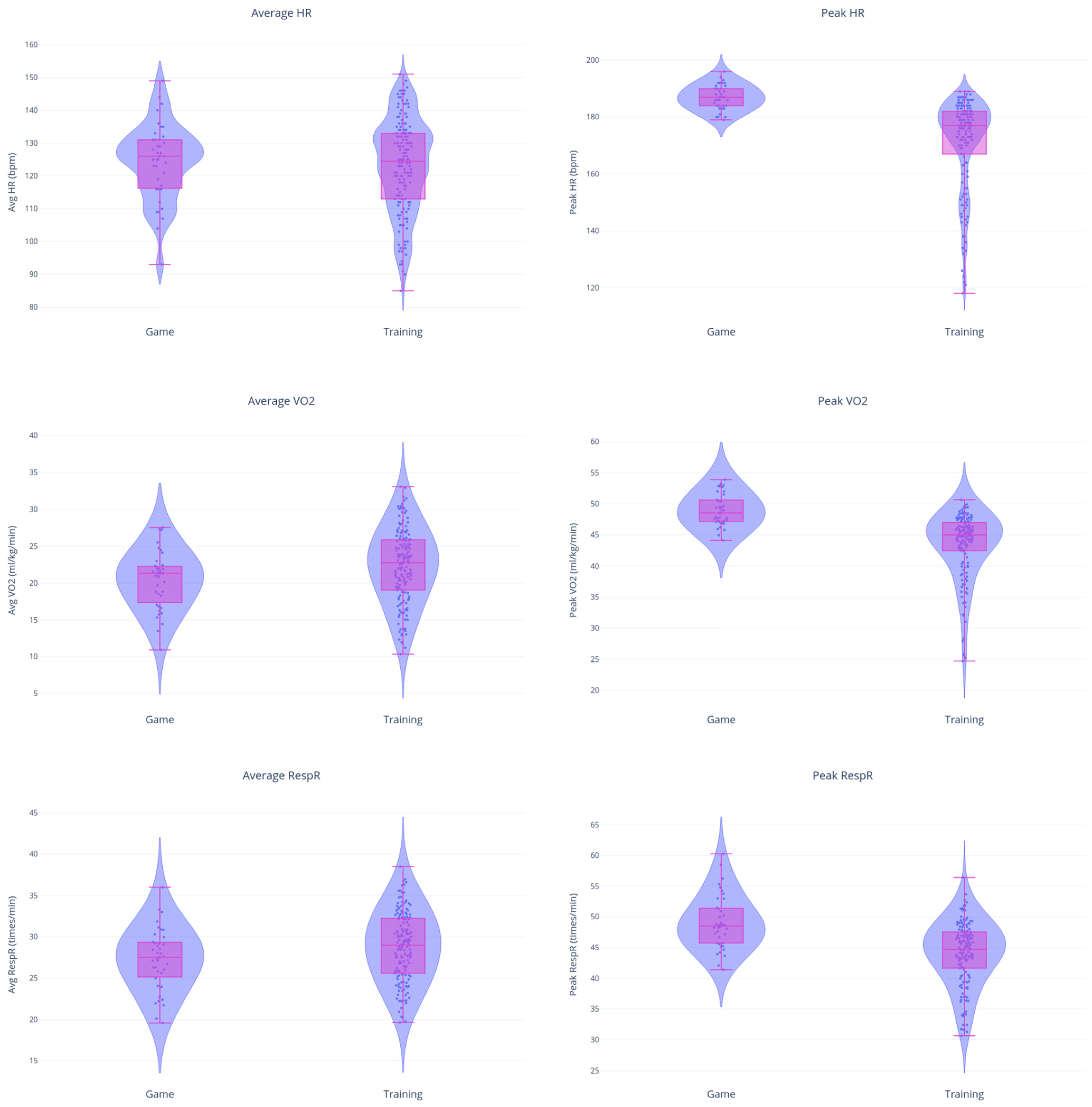
The aim of this study was to compare the internal average and peak physiological responses of professional basketball players between practices and competition. It was hypothesized that both average and peak values would be higher during match-play compared with practices. The main finding of the present study was that average and peak physiological responses provided different insights when comparing training and competition demands. While only average VO2 differed between contexts, all peak physiological variables (HR, VO2, and RR) were substantially higher during competition than training. These findings extend the current literature by demonstrating that conclusions regarding the representativeness of training may differ depending on whether average or peak internal responses are considered. Therefore, the simultaneous assessment of average and peak physiological responses appears necessary to fully characterize the internal demands experienced by basketball players.
Greater match average values were reached for average VO2 (F = 4.20, ES =−0.40, Trivial) during practice. These results differ with previous research. While some studies showed greater load during training than competition [
11,
12], others reported the same external load [
10]. The lower average VO
2 observed during competition may be related to the intermittent nature of basketball, characterized by frequent stoppages, substitutions, and variations in game pace. In contrast, training sessions are often designed to impose more continuous or repeated high-intensity efforts, resulting in higher accumulated oxygen consumption throughout the session [
23]. Additionally, coaches may deliberately structure practice tasks to target aerobic adaptations, potentially increasing the overall physiological stimulus accumulated during training. Therefore, differences in session structure may partially explain the higher average VO
2 values observed during training compared to competition.
Considering peak demands, all values were greater during matches when comparing to practices for all variables: Peak HR (ES = 1.07, Moderate), Peak VO2 (ES = 1.14, Moderate), Peak RR (ES = 1.02, Moderate). These findings highlight the importance of analyzing peak demands in addition to average values, as traditional mean-based approaches may underestimate the most demanding passages of play. From a training perspective, exposure to these peak physiological demands is essential to adequately prepare players for the worst-case scenarios encountered during competition.
These results are similar to previous research carried out with professional players competing in the same league. Findings revealed higher internal PD (small-moderate effects) for all peak values monitored (HR, RR and ventilations) during games compared to practices. In this regard, despite being friendly games, these findings revealed that the game is the scenario where higher internal PD are reached [
24].
The higher peak values observed during competition may be related to the greater intensity and unpredictability of official match-play compared with training sessions [
24]. Similar findings have previously been reported in professional basketball players competing in the same league, where games elicited greater internal peak demands than training sessions [
13,
24]. Collectively, these findings suggest that competition remains the context in which players experience the highest physiological demands, reinforcing the importance of exposing athletes to high-intensity scenarios during training whenever possible [
17,
23,
24]. Therefore, these findings support the notion that competitive environments inherently elicit higher physiological responses due to the combined effect of physical, psychological, and contextual stressors, which are difficult to replicate in training settings.
Our findings offer potential practical applications in many ways for basketball practitioners. First, while VO2 max may be lower during games compared to practices, it is important to note that games still provide valuable opportunities for athletes to improve their aerobic fitness and overall performance. Coaches and trainers can structure training programs to incorporate both practices and games, balancing the different demands of each to optimize athletic performance. Thus, basketball and fitness coaches may need to adjust their training programs to better prepare athletes for the physical and psychological demands of games. This could include incorporating more high-intensity drills, increasing the frequency of competitive simulations in practice, and focusing on mental preparation and stress management techniques [
4]. In practical terms, coaches should incorporate short-duration, high-intensity drills that replicate peak match scenarios, ensuring that players are regularly exposed to the highest physiological demands of competition.
Secondly, understanding the differences in peak and averages values between games and practices can also help coaches and trainers identify potential areas of weakness or risk for injury. For instance, if an athlete consistently experiences a very high heart rate during games, this may indicate that they are not properly conditioned for the demands of competition and could be at risk for fatigue. Then, players who do not undertake minutes during games, should be exposed to peak values during practices [
4,
24].
Finally, recognizing the higher peak values during games can also help athletes mentally prepare for competition. By understanding that the emotional and psychological demands of games can be more intense than those of practices, athletes can better manage their stress and anxiety, and perform at their best when it matters most. Overall, knowing that peak values are higher during games than practices can inform athlete training and preparation, and help athletes and coaches optimize performance and reduce the risk of injury. Thus, it is important to note that while games may be the best scenario to reach peak demands, they may also pose a higher risk of injury compared to practices. Therefore, basketball and fitness coaches should carefully manage the intensity and frequency of games to ensure that athletes are properly conditioned and prepared to cope with the demands of competition, while also minimizing the risk of injury.
Future research should explore internal load responses across different phases of the competitive season, including in-season and congested fixture periods. Additionally, combining internal and external load metrics may provide a more comprehensive understanding of performance demands. Further studies including larger samples, female athletes, and different competitive levels are warranted to improve the generalizability of these findings.
The current study employed a considerable sample of professional basketball players at a time of high player preparation for competition (i.e., pre-season). However, several limitations encountered should be considered when interpreting our results. Firstly, the peak values identified were the highest values experienced by players against their pre-season opposition with these potentially being lower than their factual maximal values. Additionally, these findings may not be applicable to non-professional basketball teams or other phases of the competition season, with future studies recommended to extend these results to other contexts. Another limitation of the present study is the relatively small sample size and the inclusion of players from a single professional team. Although this is common in elite sport research, caution should be exercised when generalizing these findings to other teams, competitive levels, or playing contexts. Furthermore, only internal load variables were analyzed. Since internal responses are influenced by the external work performed, the absence of external load measures limits the ability to fully explain the physiological responses observed. Future studies should combine both internal and external load metrics to provide a more comprehensive understanding of training and competition demands.




 ,
,