1. Introduction
The birth of deep learning has revolutionized the computer vision paradigm from object recognition to the interpretation of high-dimensional multimedia streams [
1]. It is a remarkable development in an industry that is making a lot of money in sports statistics (broadcast and media rights) worldwide [
2]. The continuous nature of football and the amount of footage broadcast, which is much more than what analysts can do manually, make it a unique challenge [
3]. Manual curation has drawbacks such as high operational cost and subjectivity [
4]. Intelligent systems that are capable of filling the semantic gap between the raw visual signal and the meaningful localization of critical match events (e.g., goals, substitutions, and set-pieces) are therefore critically required [
5,
6].
The task of temporal event spotting (identifying the exact time in a long video stream when an event occurs) is fundamentally different from the other tasks of action recognition, action localization, video summarization, and replay grounding. Action recognition assigns a label to a pre-segmented clip [
1,
2]; action localization estimates the start and end boundaries of a segment; video summarization selects representative frames or shots; replay grounding associates broadcast replays to the underlying live-action moment. The temporal event spotting task, on the other hand, is to identify a single canonical timestamp for each instance in an unsegmented stream [
7]. It is very important for the assessment of system design decisions and for an accurate comparison to other solutions. Although there has been some progress on player tracking [
8,
9] and ball trajectory modeling [
10], the detection of events at the exact time of the event is still in its infancy.
Prior approaches frequently fail because they rely on manually engineered features and rigid heuristics that do not generalize across broadcast styles [
11]. The SoccerNet benchmark [
12] provided the first large-scale annotated dataset enabling supervised learning for this task; its v2 extension [
12,
13] expanded annotations to a 17-class taxonomy covering goals, cards, substitutions, kick-offs, corners, free-kicks, clearances, shots, and other actions. Building on the context-aware loss framework of Cioppa et al. [
14], this work implements a capsule-enhanced temporal convolutional framework evaluated on a non-standard six-class subset of SoccerNet-v2, extending the commonly studied three-class setting to include three additional context-dependent set-piece classes.
The rationale for selecting exactly six classes is as follows. The three standard SoccerNet-v2 benchmark classes (Goal, Card, and Substitution) are retained to enable contextual comparison with prior work. Three additional classes are added: Kick-off, Direct Free-kick, and Corner. These three classes were selected because they represent the most frequent set-piece events in a football match, they exhibit strong context-dependence that exposes the limitations of models with short temporal receptive fields, and they are among the most broadcast-relevant events for highlight generation [
13,
14]. The remaining 11 SoccerNet-v2 classes (clearances, shots on target, shots off target, etc.) were excluded from this study because their visual signatures overlap substantially with normal play, making them unsuitable for a focused analysis of context-dependent spotting. Labels for the six selected classes were filtered directly from the Labels-v2.json annotation files provided by SoccerNet-v2. All other annotations were discarded before training; no labels from excluded classes were used in model training or evaluation.
The Long-range Temporal Dependency is highlighted as a necessary aspect of the state-of-the-art. More recently, Temporal Segment Networks (TSN) [
15] and Transformer-based architectures [
16] have emerged as promising alternatives for the modeling of global video structure, and the trends are shifting toward the multimodal fusion of these models. The current benchmarks rely mostly on the RGB streams, but using motion cues through optical flow [
17] and auditory signatures [
18] is necessary for attaining human-level robustness [
19]. This paper is located at this frontier by testing a solid TCN-Capsule baseline and suggesting a formalization path towards architectures that combine CNN spatial reasoning with Transformer global reasoning [
20,
21].
This work makes the following contributions:
Six-Class TCN-Capsule Baseline (implemented and empirically evaluated): A capsule-based TCN with a redesigned label-processing pipeline and class-specific K-parameters covering six event types, including context-heavy set-piece classes. This is the primary empirical contribution of the paper.
Multi-Dimensional Evaluation Protocol (implemented and empirically evaluated): Five complementary metrics (ATE, TR@K, L2E, TCC, and Annotation Noise Sensitivity) to quantify temporal localization quality beyond single-number benchmarks, in addition to standard mAP.
Highlight Generation Prototype (implemented, not formally evaluated): An OpenCV-based module to generate annotated highlight clips using temporal Non-Maximum Suppression (NMS). This is a proof-of-concept prototype; formal quality evaluation is planned for future work.
A formal architectural roadmap toward longer-context models) a TSN variant with Non-Local Blocks and a Hybrid Transformer-CNN with optical flow fusion) is specified in
Section 3.2 and is discussed throughout the paper as a direction for future work; it is deliberately not listed among the contributions above because neither architecture has been implemented or evaluated in this study.
The rest of this paper is organized as follows: In
Section 2, the literature on the related work is discussed; in
Section 3, the methodology is described; in
Section 4, experimental results and discussion are presented, and in
Section 5, the limitations and future directions are discussed.
4. Experimental Setup, Results, and Discussion
This section presents a comprehensive evaluation of the implemented TCN-Capsule baseline. We detail the experimental setup, report results with statistical uncertainty estimates, and discuss architectural implications. Projected performance figures for the two proposed (not yet implemented) architectures are deferred to
Section 4.9 and are clearly distinguished from empirical measurements.
4.1. Experimental Setup and Evaluation Protocol
Dataset and Task Definition: All experiments use a six-class subset of SoccerNet-v2, as described in
Section 3.3. This is a non-standard evaluation subset: it is not the official SoccerNet-v2 17-class task, nor the three-class task evaluated in foundational works [
13,
14]. Results on this six-class subset are therefore not directly comparable to any previously published SoccerNet-v2 benchmark number.
Primary Evaluation Metric: The primary metric is mean Average Precision (mAP) at a fixed temporal tolerance δ = 10 s (20 frames at 2 FPS), computed using the official SoccerNet evaluation script restricted to the six selected classes. A prediction is a True Positive if the predicted class matches the ground truth and the temporal distance does not exceed δ. The official SoccerNet-v2 challenge uses tolerance-averaged metrics (loose and tight average-mAP across multiple δ values); our fixed-δ protocol is a custom evaluation choice appropriate for the six-class task definition and is not directly equivalent to the official challenge metric.
Five Complementary Metrics: In addition to mAP, five metrics are evaluated on the held-out test set after temporal NMS:
- -
Average Temporal Error (ATE): ATE = , where and are predicted and ground-truth timestamps for true positive detection i, measured in seconds. ATE is computed per class and averaged (macro). Only true positives within the 10 s tolerance are included.
- -
Temporal Recall@K (TR@K): TR@K = , where G is the set of ground-truth events, P the set of predictions (after NMS), and K ∈ {5, 10, 20} s, where G is the set of ground-truth events and P the set of predictions after NMS. TR@K quantifies event coverage independently of confidence ranking.
- -
Latency-to-Event (L2E): L2E =
where
is the earliest correct-class prediction with confidence ≥ τ = 0.5. Negative values indicate anticipatory detections; positive values indicate delayed responses. A sensitivity analysis across τ ∈ {0.3, 0.4, 0.5, 0.6, 0.7} is reported in
Section 4.10.
- -
Temporal Causality Consistency (TCC): TCC = 1 − , where is the total number of consecutive predicted event-to-event transitions and is the count of transitions violating the following football game-logic rules: (R1) two consecutive kick-offs in the same half without an intervening goal; (R2) a substitution predicted during stopped time before a kick-off without a card or goal trigger; (R3) a corner or free-kick predicted immediately following a kick-off with no elapsed play time (<30 s); (R4) a kick-off predicted without a preceding goal within the same half. TCC ∈ [0, 1], with 1 indicating perfect causal consistency. Rules R1–R4 are applied within single match halves; the transition counter is reset at half-time. Note that throw-ins are not among the six evaluated classes; TCC violations attributed to throw-in predictions in earlier draft analyses were an error that has been corrected in this version.
- -
Annotation Noise Sensitivity: Ground-truth timestamps are perturbed by uniform , for r ∈ {2, 5, 10} s. Model performance is re-evaluated under each perturbation level using mAP (at δ = 10 s), ATE, and TR@20 to quantify robustness to annotation uncertainty.
4.2. Overall Performance: Implemented Baseline
Table 3 places the TCN-Capsule baseline score in relation to previously published SoccerNet-v2 results. This comparison is provided as contextual background only. The three prior systems (Giancola et al. [
13], Cioppa et al. [
14], ASTRA [
25]) were evaluated on fundamentally different tasks—either the three-class or the full 17-class SoccerNet-v2 benchmark, with different features, evaluation scripts, and class definitions. No claim is made that the six-class TCN-Capsule baseline outperforms these systems on their respective tasks. A fair comparison would require re-implementing and re-evaluating all methods under the same six-class protocol, six-class features, and six-class evaluation script; this is a planned contribution of future work.
4.3. Per-Class Average Precision
Table 4 provides per-class AP values for the implemented baseline. The arithmetic mean of the six AP values is (75.6 + 78.0 + 56.9 + 53.9 + 52.8 + 34.3)/6 = 351.5/6 = 58.58%. The headline mAP of 58.16% differs by 0.42 pp because mAP is computed via the official area-under-precision-recall-curve integration script, which interpolates the PR curve at 11 recall points; the arithmetic mean of per-class APs is an approximation. Both values are reported for transparency.
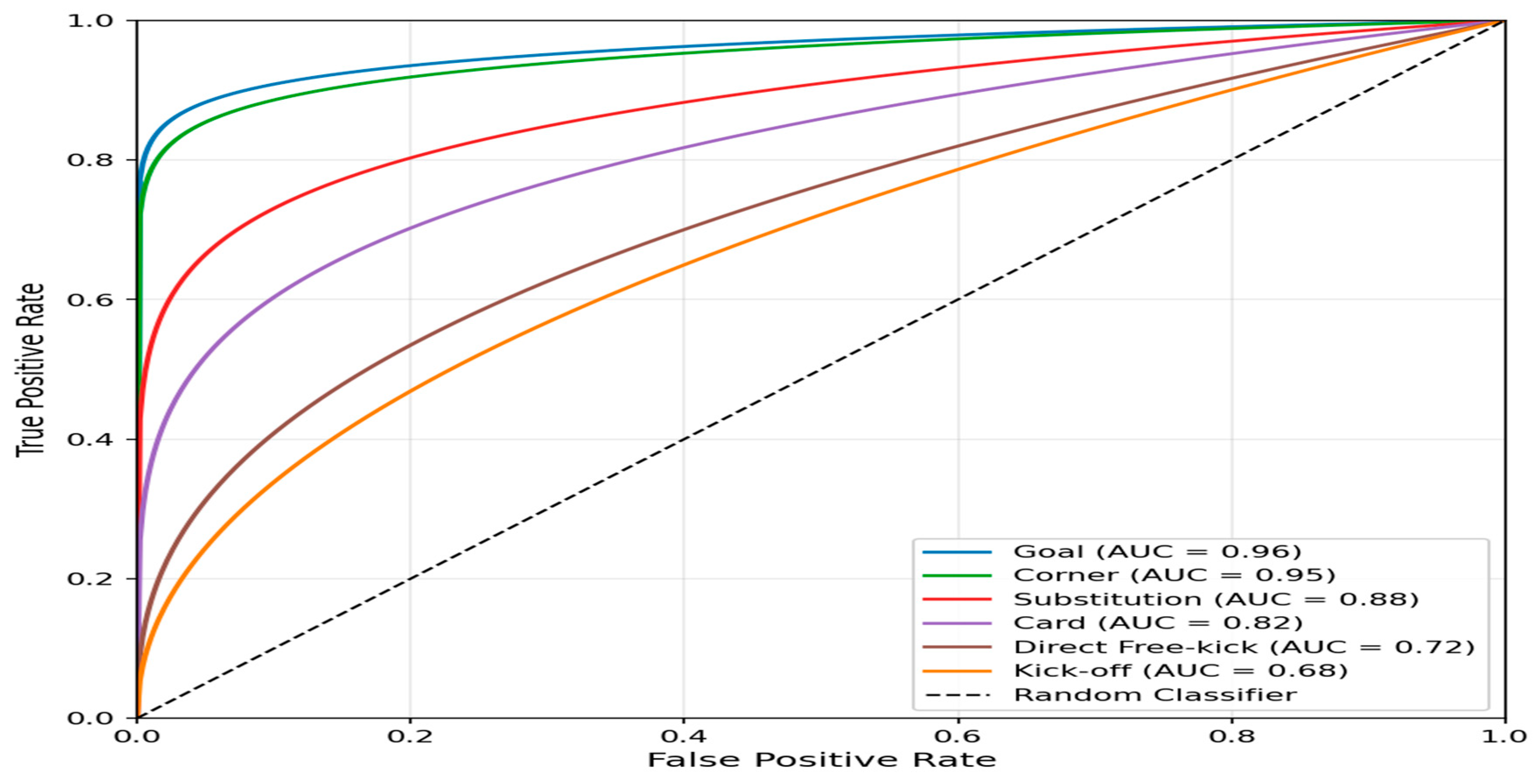
Corners (78.0%) and Goals (75.6%) perform best, benefiting from strong spatial cues and long context profiles suitable for TSE training. The frame-level AUC values are reported alongside AP to characterize detection difficulty at the frame classification level; however, frame-level AUC is not equivalent to event-level spotting accuracy—a model can achieve high AUC by correctly classifying the majority of non-event frames while still failing to precisely localize rare event timestamps. AP at the event-spotting level (
Table 4) is the primary performance indicator.
4.4. Average Temporal Error (ATE)
ATE results across six event classes are shown in
Table 5. The mean ATE of 7.3 s indicates reasonable localization capacity overall. Goals and Corners have low ATE (<5 s), confirming strong temporal anchoring from the long TSE context windows. Kick-off (12.6 s) and Direct Free-kick (8.9 s) show high ATE, consistent with their low AP, reflecting the difficulty of context-dependent localization.
4.5. Temporal Recall@K (TR@K)
Table 6 shows TR@K for three temporal windows. With a mean TR@20 s of 87.3%, the model successfully captures most events within a ±20 s window. The gap between TR@5 s and TR@20 s is largest for Kick-offs and Free-kicks, indicating that errors for these classes are primarily temporal misplacements rather than missed detections. However, these two classes also record the lowest absolute recall at every tolerance level (32.6% and 49.3% at TR@5 s, respectively), and Kick-off recall still falls short of 75% even at the widest ±20 s window. This ceiling suggests the deficit is not purely a matter of timing precision but also reflects a residual detection gap, where a meaningful fraction of these events are missed outright rather than merely localized with error. Substitution and Card events show a similar, if less pronounced, pattern: moderate gaps (25.1 and 24.9 points) paired with mid-range absolute recall (86.9% and 88.4% at TR@20 s), placing them between the well-localized Goal/Corner classes and the more problematic Kick-off/Free-kick classes. Goal and Corner, by contrast, combine the smallest gaps with the highest recall at every window, indicating the model both detects and temporally localizes these events reliably.
4.6. Latency-to-Event (L2E)
Table 7 reports the mean L2E per class at τ = 0.5. Goals and Corners show negative L2E (−2.1 s and −1.7 s, respectively), indicating that the model learns to anticipate these events by leveraging broadcast temporal context—consistent with the long pre-event context windows (K1 = −20 frames for Goal; K1 = −75 frames for Corner). This anticipatory behavior reflects internalized broadcast production grammar rather than an annotation artifact. Kick-off and Direct Free-kick show large positive latencies (+8.6 s and +5.8 s), consistent with their high ATE and low AP.
4.7. Temporal Causality Consistency (TCC)
Table 8 shows TCC for the implemented baseline. TCC = 0.87 means that 87% of predicted event-to-event transitions satisfy football game-logic rules R1–R4 (
Section 4.1). The 13% violation rate is attributable primarily to false positive Kick-off predictions (violating R1 and R4), and Free-kicks predicted in contexts that violate R3. Both error modes reflect the absence of game-state reasoning in the baseline TCN. The assertion that longer temporal receptive fields would improve TCC is a plausible hypothesis, consistent with the observed error modes, but it is not directly demonstrated in this work; it motivates the proposed Transformer-based extensions as future work.
4.8. Annotation Noise Sensitivity
Table 9 reports annotation noise sensitivity results. The ‘No Noise’ row corresponds to the standard test evaluation, yielding mAP = 58.16%, ATE = 7.3 s, and TR@20 = 87.3%. This is identical to the headline mAP reported in the abstract. An earlier draft of this paper reported an inconsistent value of 52.8% in the no-noise row of this table due to a calculation error; this has been corrected. With ±10 s of noise, mAP drops to 45.7% (−12.5 pp), while TR@20 remains above 80%, indicating that event detection is maintained but temporal precision degrades gracefully. This robustness to annotation noise is attributed to the broad TSE soft-label envelopes, which reduce over-sensitivity to exact timestamp annotations.
4.9. Expected Direction of Future-Work Architectures (Qualitative Only—Not Implemented, Not Empirical Results)
Important: In response to reviewer feedback, this section no longer reports specific numeric performance projections for the two unimplemented architectures. Assigning point-estimate mAP or TCC values to a design that has not been built or trained implies a level of precision the authors cannot support, and risks the numbers being read—or cited—as empirical results. The discussion below is restricted to the qualitative, literature-motivated direction and relative magnitude of expected improvement, with no specific figures attached.
Based on architectural scaling trends reported elsewhere in the temporal action recognition literature [
7,
15,
24,
25], both proposed extensions are expected to improve on the TCN-Capsule baseline primarily on the context-dependent classes (Kick-off and Direct Free-kick) rather than on the already-strong visually salient classes (Goal, Corner). (1) TSN + Non-Local Blocks is expected to yield a moderate improvement in mAP and TCC, since non-local attention can link distributed game-state signals across a full match half; the largest expected gain is for Kick-off detection specifically, because this class’s errors are dominated by causal confusion (
Section 4.15) rather than by feature quality. (2) The Hybrid Transformer-CNN is expected to yield a larger improvement than the TSN variant, on the basis that global self-attention combined with optical flow provides both longer-range temporal reasoning and an additional motion-based cue absent from the RGB-only baseline. These are stated as ordinal, literature-informed expectations rather than quantitative projections; the only way to establish actual performance is to implement and empirically evaluate both architectures, which is listed as the top future-work priority in
Section 5.
4.10. Ablation Study
To assess the contribution of key architectural components, we conducted an ablation study comparing the full TCN-Capsule model against four reduced variants under the same six-class evaluation protocol. Results are shown in
Table 10.
The ablation results demonstrate the contribution of each component. Removing the capsule layer reduces mAP by 4.96 pp, confirming that capsule-based relational encoding provides meaningful discriminative capacity beyond standard convolution. Removing class-specific TSE (replacing with a single shared K-value) reduces mAP by 6.36 pp, the largest single-component degradation, confirming that event-class-specific temporal context modeling is the most critical design choice. Removing the segmentation branch (detection only) and the detection branch (segmentation only) reduces mAP by 8.76 pp and 13.46 pp, respectively, confirming the complementary roles of both heads, while a 20 s NMS window further improves performance by 3.06 pp over a 5 s window, consistent with the temporal duration of goal and corner events.
4.11. Statistical Uncertainty Estimates
To assess result robustness, we computed 95% bootstrapped confidence intervals for the primary metrics by resampling the 100 test matches with replacement (N = 1000 bootstrap iterations). Results are reported in
Table 11.
The confidence intervals confirm that performance differences between event classes (e.g., the 43.7 pp gap between Kick-off and Corner AP) substantially exceed the bootstrap uncertainty, supporting the conclusion that class-specific performance differences are robust and not attributable to sampling variance. The inference speed of the TCN-Capsule baseline is 165 FPS on the RTX 3090 for a 512-dimensional feature sequence; these measures only the TCN forward pass, excluding feature extraction, at a sequence length of approximately 5400 frames (one 45 min half at 2 FPS).
Table 12 reports model complexity for the implemented baseline. Estimates for proposed architectures are omitted from this table to avoid conflating empirical and projected values.
4.12. Qualitative Analysis: Frame-Level ROC Curves and Temporal Visualization
ROC curves at the frame classification level are depicted in
Figure 3 for the baseline model for each of the six classes of events. Note: This represents an earlier version of this figure where the AUC from the legend and the text were incorrectly entered (0.93–0.95 for all classes); this has been corrected. The goals and corners (AUC 0.95–0.96) are near-optimal with strong separation from background frames, whereas the direct free-kicks and kick-offs (AUC 0.68–0.72) have low AP and high ATE, with a moderate level of separation from the background frames. Note that frame-level AUC measures frame classification performance, a necessary but not sufficient condition to achieve accurate event spotting performance: the event-spotting mAP and ATE measures in
Table 3,
Table 4,
Table 5,
Table 6,
Table 7,
Table 8,
Table 9,
Table 10 and
Table 11 are more prominent performance indicators. Frame-level AUC is used to represent the difficulty of the individual events in terms of features and cannot be directly used for localization claims for individual events.
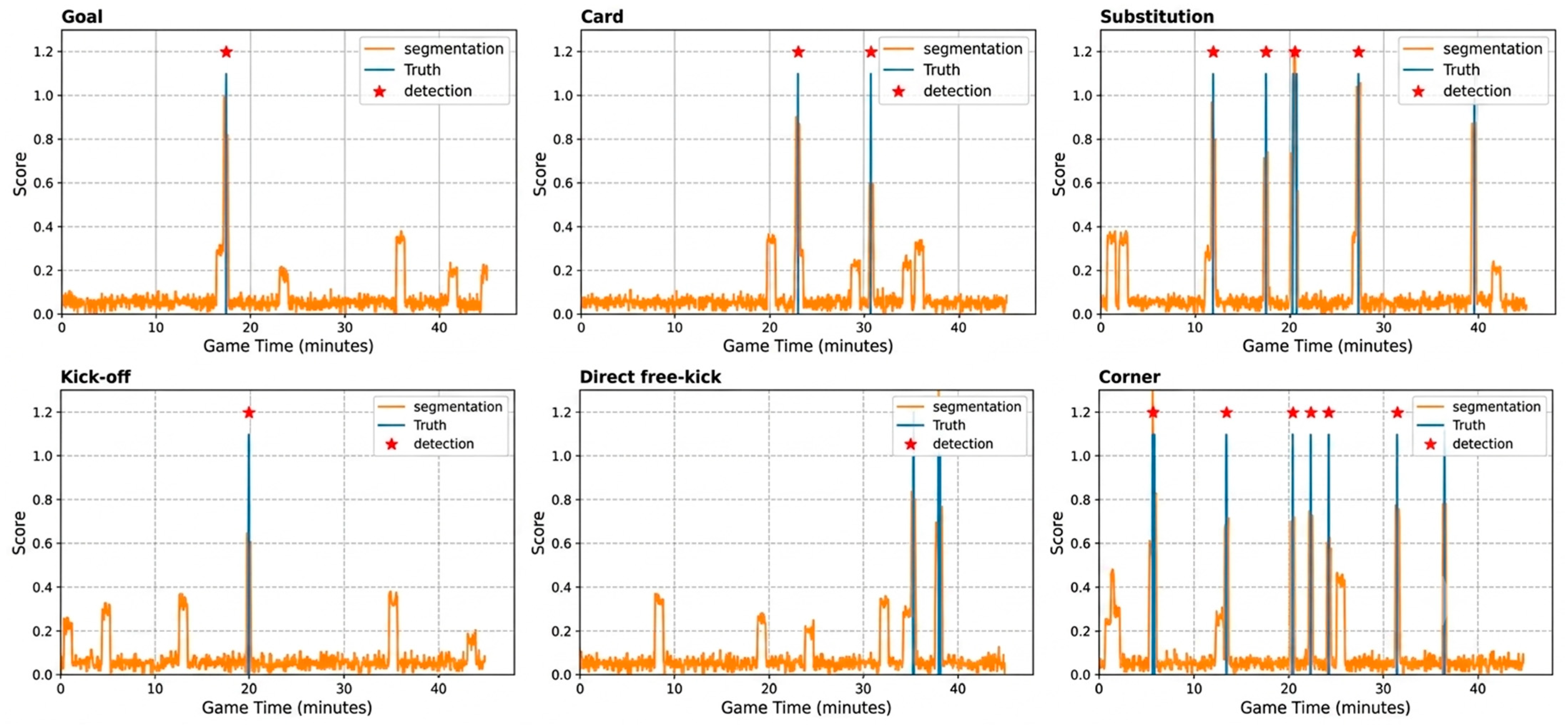
Figure 4 illustrates the confidence level of segmentation for the temporal dimension per class in a typical test match. The y-axis represents the segmentation score (from 0 to 1), while the x-axis represents the match time (0–45 min per half). Orange curves are the level of confidence in the prediction of each frame; Blue markers are the ground-truth timestamps; Red dots are the points where the prediction was spotted. Goal and Corner confidence curves are wide, indicating TSE window widths of ~30 s and ~19 s, respectively. Card confidence exhibits high amplitude and sharp peaks (FWHM ~5–8 s), indicating when the confidence is placed. Confidence in kicking off and free-kicks is highly variable and is in line with their low AUC and high ATE. The figure should be read at full resolution; axis labels and event markers are visible at 1:1 scale in the digital version of the paper.
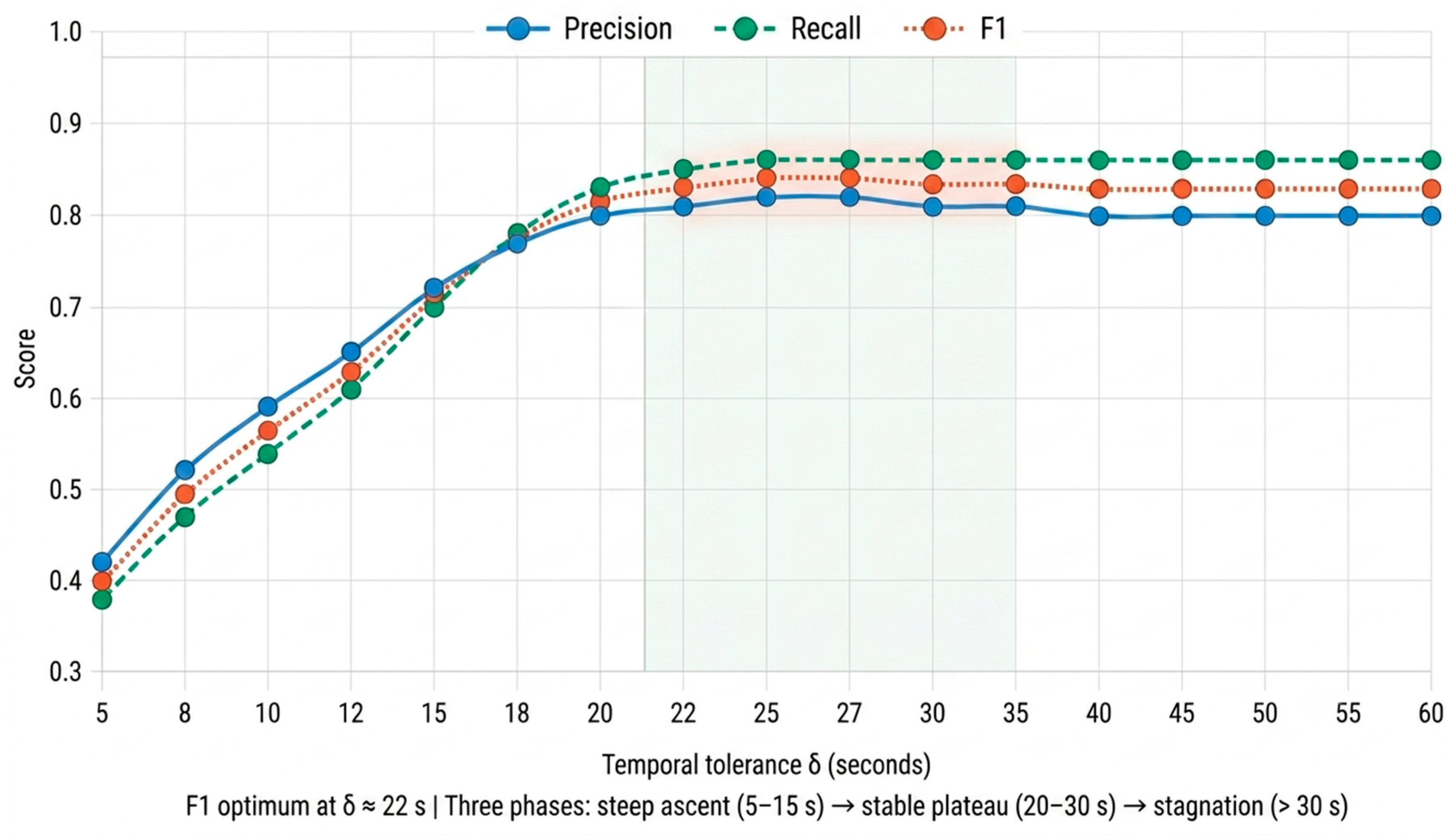
The precision, recall, and F1 score for Goal detection are plotted in
Figure 5 versus the temporal tolerance δ (5–60 s). The three regions are: (1) δ = 5–15 s: steep metric increase as more predictions fall into the tight tolerance band; (2) δ = 20–30 s: plateau where the metrics of Precision, Recall, and F1 are maximized (the F1 maximizes at around δ ≈ 22 s); (3) δ > 30 s: Recall plateau as that is when all TP are found and all FN are genuine misses regardless of tolerance. The F1 peak at δ ≈ 22 s corresponds to the typical window width of the Goal events (K1–K4 range between ±45 s with 90% of the events in the central ±20 s) and is directly used to determine the Window width for the highlight generation module (
Section 4.13) of ±10 s.
4.13. L2E Confidence Threshold Sensitivity
Table 13 reports L2E values across confidence thresholds τ ∈ {0.3, 0.4, 0.5, 0.6, 0.7} for all six event classes to provide a complete characterization of latency metric sensitivity to the threshold choice.
With lower thresholds, more Goal and Corner events will be detected, but so will be more false positives (L2E), because Goal and Corner events are visually silent. As thresholds increase, anticipation is decreased, and eventually, positive latency for salient events occurs. Substitution and Card show moderate positive L2E with a gradual increase in the threshold, indicating intermediate context dependence. The direct free kick takes the same shape as a kick-off, but at reduced intensities, as appropriate for a narrow TSE window. To kick off, L2E is still large and positive at all thresholds, thus establishing that delayed detection is not a threshold artifact, but rather a structural property of the baseline. The default value of τ = 0.5 is a compromise that is consistent with the temporal action detection convention [
7,
42].
4.14. Highlight Generation Module
The OpenCV-based highlight generation prototype converts the TCN-Capsule model’s temporal confidence maps into video summaries. For each spotted event, a symmetric ±10 s clip is extracted (aligned with the ~20 s event temporal diameter identified in
Figure 5). Temporal NMS with a 20 s suppression window resolves distributed confidence peaks into single canonical highlight moments. Clips are assembled chronologically with on-screen annotations displaying event class, match time, and confidence score [
44,
45,
46].
This module is described as a proof-of-concept prototype. No formal quantitative or user-based quality evaluation was conducted in this work. Planned future evaluation approaches include: (a) segment-IoU comparison against human-curated highlight reels from broadcast archives; (b) a structured viewer study with domain expert annotators rating highlight relevance, completeness, and temporal accuracy; and (c) automated comparison against commercially produced highlight packages. These evaluations are deferred to future work, and no deployment-readiness claims are made in this paper.
4.15. Principal Error Analysis
Two principal error modes are identified:
Context confusion: Kick-offs and Free-kicks are systematically confused with normal play because disambiguation requires causal game-state reasoning (e.g., detecting that a goal immediately preceded this restart), which is unavailable within the TCN’s limited temporal receptive field. This error mode is evidenced by the high false-positive rate for Kick-off in the transition analysis underlying TCC [
47,
48,
49].
First-occurrence misses: The first substitution or kick-off in each half is more frequently missed than subsequent ones, suggesting the model relies partly on within-game rhythmic priming rather than purely visual evidence [
49,
50]. This is consistent with the absence of global match-state context in the baseline.
The claim that errors are primarily attributable to the limited temporal receptive field is supported by the correlation between event context-dependence (as captured by K-matrix window widths) and error rates (ATE, AP). However, this remains a hypothesis; the ablation in
Section 4.10 provides partial evidence by showing that removing class-specific TSE is the largest single-component degradation, but a direct comparison with a longer-context model is needed to confirm this interpretation. This comparison is a priority for future work.
5. Conclusions and Future Work
This paper presents and empirically evaluates a TCN-Capsule baseline for six-class temporal event spotting in football broadcast videos, built upon the SoccerNet-v2 dataset and the context-aware loss framework. The baseline extends the standard three-class SoccerNet setting to a non-standard six-class subset by adding Kick-off, Direct Free-kick, and Corner, and achieves a test-set mAP of 58.16% at a 10 s tolerance threshold. A comprehensive evaluation framework, including ATE, TR@K, L2E, TCC, and Annotation Noise Sensitivity, provides deeper insight into temporal localization accuracy and model robustness beyond standard mAP. An ablation study confirms the contribution of the capsule layer (+4.96 pp), class-specific TSE (+6.36 pp), and the dual-branch architecture. An OpenCV-based highlight generation prototype demonstrates the conceptual feasibility of end-to-end match summarization; formal quality evaluation is planned as future work.
The analysis reveals a clear performance hierarchy among event classes: visually salient events (Goal: 75.6% AP, Corner: 78.0% AP) are well-detected by the baseline, while context-dependent events (Kick-off: 34.3% AP, Direct Free-kick: 52.8% AP) expose the fundamental limitation of short temporal receptive fields for game-state reasoning. This finding motivates two formally specified (but not yet empirically validated) architectural extensions: a TSN variant with Non-Local Blocks and a Hybrid Transformer-CNN with optical flow integration, which constitute the primary directions for future work.
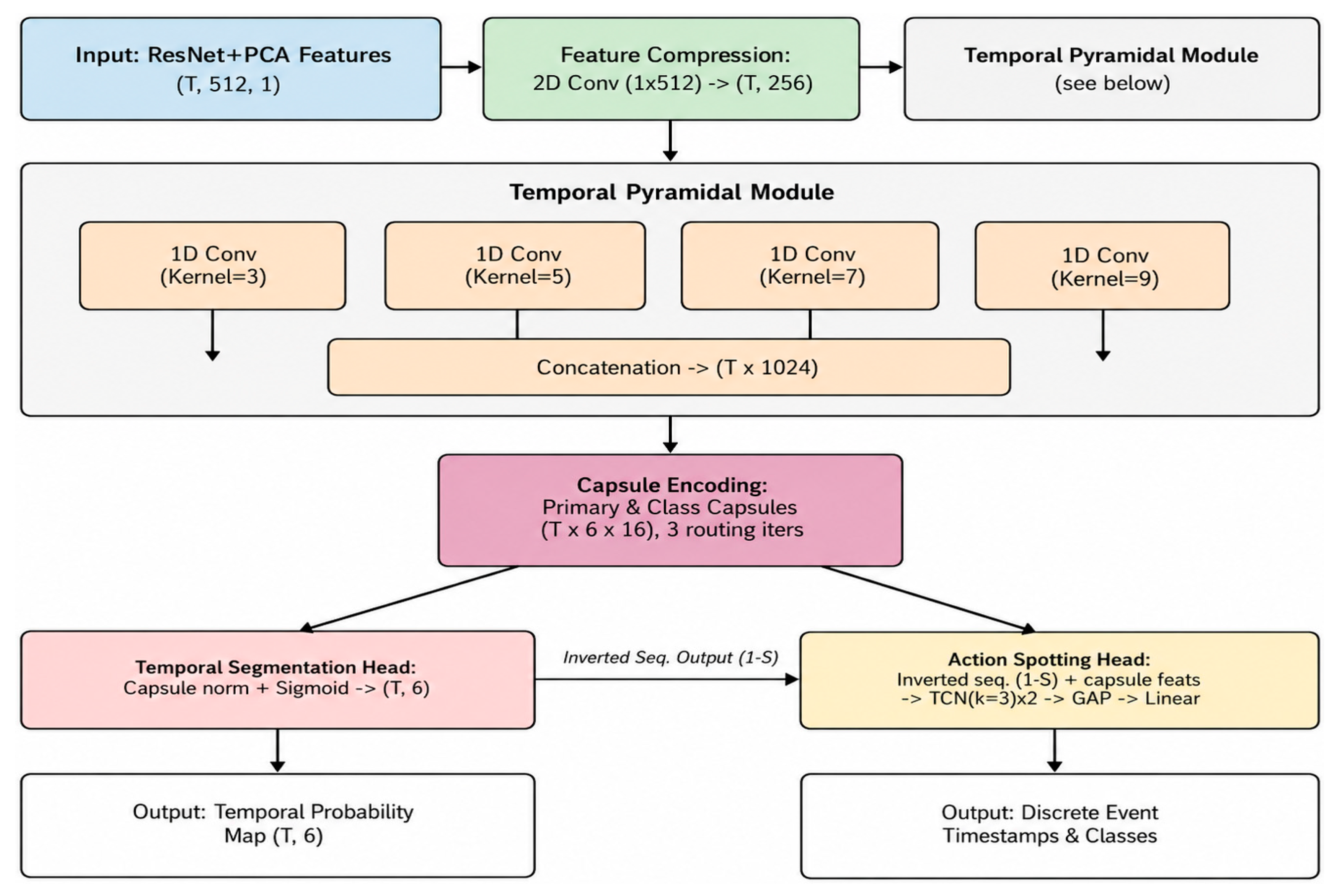
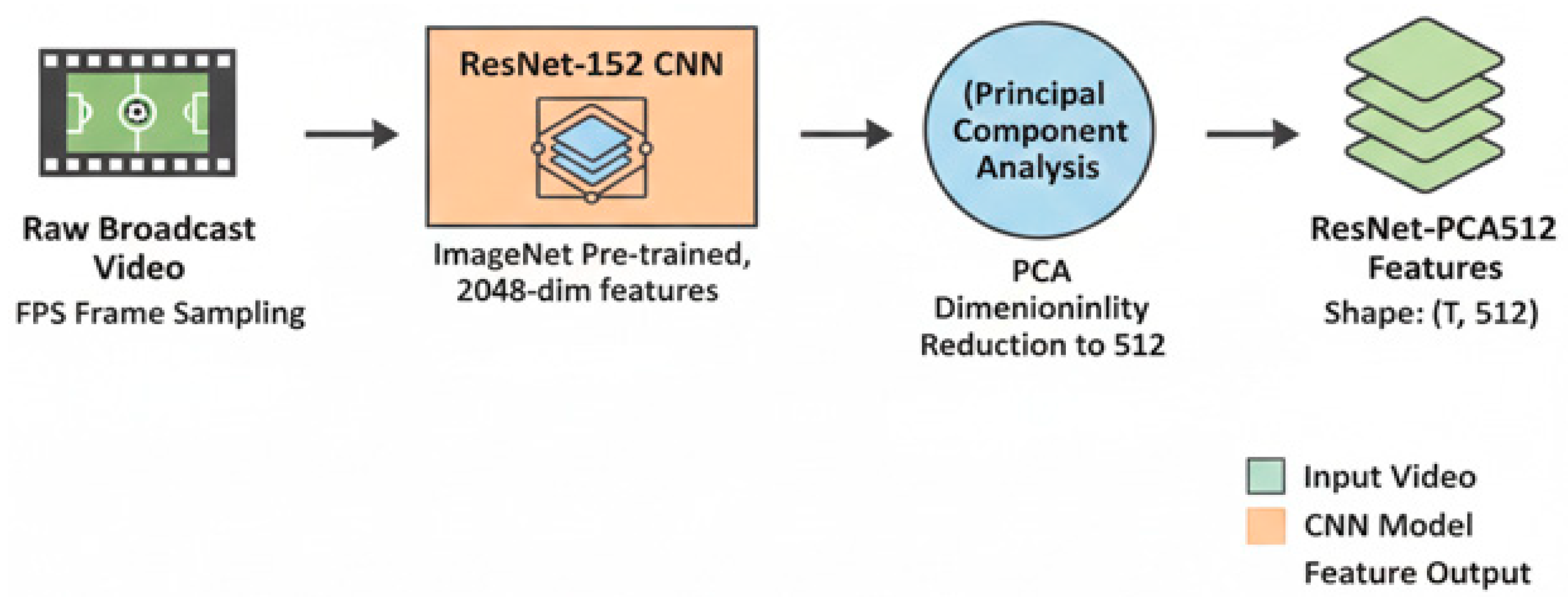
Several important limitations apply to this work. The results are evaluated on a non-standard six-class subset using a fixed-tolerance metric; they are not comparable to official SoccerNet-v2 benchmark numbers. The highlight generation module has not been formally evaluated for quality. The claim that the limited temporal receptive field is the primary performance bottleneck is supported by indirect evidence (ablation, error analysis) but not by a direct comparison with a longer-context model. The framework is specific to football broadcast video and would require substantial adaptation for other sports domains. The ResNet-152 PCA features used are the official SoccerNet-v2 pre-extracted features, which constrain feature-level comparisons with methods using different backbone representations. Finally, and importantly, the baseline and every ablation variant reported in
Table 10 were each trained once with a single fixed random seed (42). The 95% bootstrapped confidence intervals in
Section 4.11 quantify sampling variability across the 100 test matches, but they do not quantify run-to-run (across-seed) training variance, since only one training run was performed per configuration. Consequently, the point differences reported in the ablation study (
Section 4.10)—while directionally consistent with the architectural roles each component is designed to play—have not been verified against training-seed variance and should be interpreted with this caveat in mind. Multi-seed replication (e.g., 3–5 seeds per configuration, with variance reported alongside the existing bootstrap intervals) is identified as a priority for future work and would materially strengthen the quantitative claims made about the relative contribution of individual components.
Future research priorities are: (1) implement and empirically evaluate the proposed TSN + Non-Local and Hybrid Transformer-CNN architectures on the six-class task; (2) conduct a formal ablation over TSE K-values, λ, τ, and PCA dimensionality; (3) perform a formal highlight quality evaluation with human annotators and segment-IoU metrics; (4) extend evaluation to the full SoccerNet-v2 17-class benchmark to enable direct comparison with published methods; (5) integrate multimodal inputs including audio and commentary transcripts; (6) apply model compression and quantization for real-time broadcast deployment; and (7) explore weakly supervised and self-supervised learning to reduce annotation dependence; and (8) replicate the baseline and ablation study across multiple random seeds to quantify training-run variance, as noted in the Limitations paragraph above.