Technological Strategies for Efficient Medical Data Retrieval in Interconnected Healthcare Systems: A Review

 , ,
, ,  , , and
Abstract
1. Introduction
2. Materials and Methods
2.1. Research Questions
- RQ1. Which databases are most commonly employed to store medical information?
- RQ2. What technologies are used to view or store images in DICOM format?
- RQ3. What strategies are used to improve the performance of medical databases?
- RQ4. What data sets are most commonly used to evaluate approaches dedicated to medical data management?
- RQ5. How is medical information transmitted from sensors included in wearables and imaging machines to a central data repository?
- RQ6. What strategies are used for storing and viewing images in DICOM format in heterogeneous repositories, such as electronic medical records?
- RQ7. What are the main challenges and areas of opportunity in the current medical database landscape for future developments?
2.2. Inclusion and Exclusion Criteria
- ‘DICOM’ AND ‘database’ AND ‘sensor’ AND ‘fragmentation’
- ‘DICOM’ AND ‘database’ AND ‘sensor’
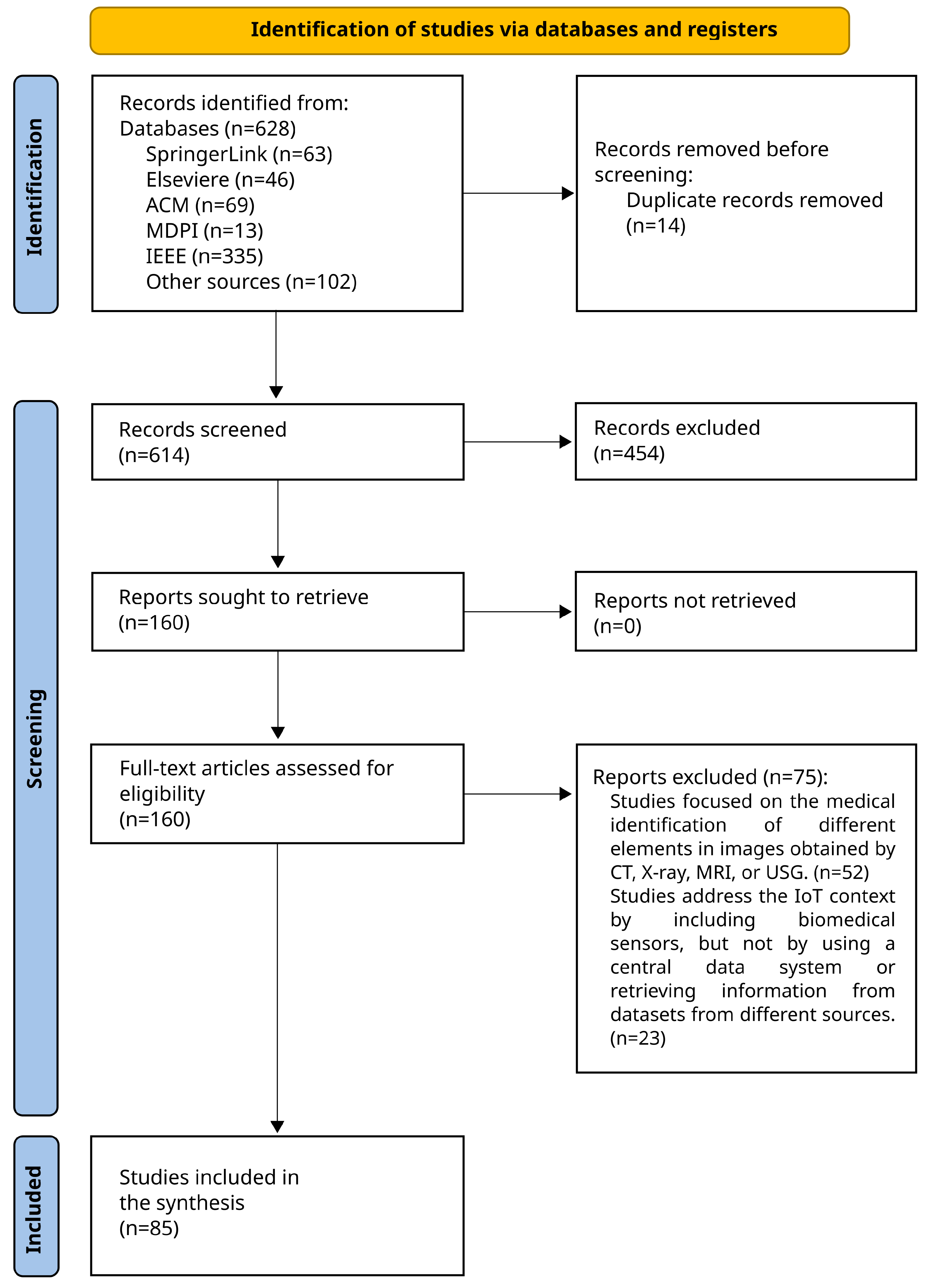
2.3. Relevant Studies and Application of Selection Criteria
2.4. Collating, Summarizing, and Reporting
3. Results
- Technologies used by each approach to store medical information, to view images in DICOM format, or to manage these same types of images. The technologies identified in each study are reported in the corresponding column. It should be noted, however, that PACS systems and database management systems are not included in this field, as both are addressed separately in dedicated tables within the discussion section, where a more detailed and comprehensive analysis of each is presented.
- The different strategies (if mentioned) to improve the performance of medical databases. The strategies documented in the reviewed studies that seek to optimize the performance of medical databases were analyzed.
- Benchmarks or data sets used to evaluate each approach. The review identified benchmarks or data sets used in the studies to evaluate the effectiveness and performance of the different technological strategies.
- Strategies used to transmit information from sensors to a central data repository. We reviewed the different documented communication strategies for the efficient and secure transmission of data obtained by medical sensors to central clinical information repositories.
- The challenges presented in each study or projects for future research were documented and analyzed, primarily related to technical, operational, and economic aspects.
- Strategies used for storing DICOM images in heterogeneous repositories that include alphanumeric medical information. These approaches stand out for their ability to efficiently manage diverse data in a single environment, addressing interoperability and comprehensive management of medical information in complex clinical systems.
4. Discussion
4.1. RQ1. Which Databases Are Most Commonly Used to Store Medical Information?
4.2. RQ2. What Technologies Are Used to View or Store Images in DICOM Format?
4.3. RQ3. What Strategies Are Used to Improve the Performance of Medical Databases?
4.4. RQ4. What Data Sets Are Most Commonly Used to Evaluate Approaches Dedicated to Medical Data Management?
4.5. RQ5. How Is Medical Information Transmitted from Sensors Included in Wearables and Imaging Machines to a Central Data Repository?
4.6. RQ6. What Strategies Are Used for Storing and Viewing Images in DICOM Format in Heterogeneous Repositories, Such as Electronic Medical Records?
4.7. RQ7. What Are the Main Challenges and Areas of Opportunity in the Current Medical Database Landscape for Future Developments?
5. Conclusions
Author Contributions
Funding
Institutional Review Board Statement
Informed Consent Statement
Data Availability Statement
Acknowledgments
Conflicts of Interest
Abbreviations
| AAL | Ambient Assisted Living |
| ACM | Association for Computing Machinery |
| AI | Artificial Intelligence |
| API | Application Programming Interface |
| AWS | Amazon Web Services |
| BCDB | Blockchain Database |
| BFT | Byzantine fault tolerance |
| BIDS | Brain Imaging Data Structure |
| BP | Blood Pressure |
| BSN | Body sensor network |
| CBCT | Cone-Beam Computed Tomography |
| CDA | Clinical Document Architecture |
| C-CDA | Consolidated Clinical Document Architecture |
| CDM | Common Data Model |
| CDR | Clinical Data Repository |
| CNN | Convolutional Neural Networks |
| CPS | Cyber-Physical Systems |
| CPU | Central Processing Unit |
| CR | Cognitive Radio |
| CT | Computed Tomography |
| CXR | Chest X-Ray |
| DAG | Directed Acyclic Graph |
| DB | Database |
| DGT | Discrete Gould Transform |
| DHIS | District Health Information System |
| DICOM | Digital Imaging and Communications in Medicine |
| DLT | Distributed Ledger Technology |
| DR | Digital Radiography |
| DTLZ | Deb–Thiele–Laumanns–Zitzler |
| ECG | Electrocardiogram |
| EDF | European Data Format |
| EEG | Electroencephalogram |
| EHR | Electronic Health Records |
| EMG | Electromyography |
| ERP | Enterprise Resource Planning |
| FAIR | Findable, Accessible, Interoperable, and Reusable |
| FCS | Flow Cytometry Standard |
| FHIR | Fast Healthcare Interoperability Resource |
| FTP | File Transfer Protocol |
| GDPR | General Data Protection Regulation |
| GNU | GNU’s Not Unix |
| GPS | Global Positioning System |
| GSR | Galvanic Skin Response |
| HDFS | Hadoop Distributed File System |
| HDMP | Hospital Data Management Platform |
| HEVC | High Efficiency Video Coding |
| HIPAA | Health Insurance Portability and Accountability Act |
| HIS | Hospital Information System |
| HL7 | Health Level Seven |
| HTTP | Hypertext Transfer Protocol |
| HTTPS | Hypertext Transfer Protocol Secure |
| ICD-10 | International Classification of Diseases, 10th Revision |
| ICT | Information and Communications Technology |
| ICU | Intensive Care Unit |
| IEEE | Institute of Electrical and Electronics Engineers |
| IHE | Integrating the Healthcare Enterprise |
| IMU | Inertial Measurement Unit |
| IoHT | Internet of Healthcare Thing |
| IoMT | Internet of Medical Things |
| IoT | Internet of Things |
| IP | Internet Protocol |
| IPFS | InterPlanetary File System |
| IR | Infrared |
| IRCCS | Istituto di Ricovero e Cura a Carattere Scientifico |
| IS | Information System |
| ISO | International Organization for Standardization |
| IT | Information Technology |
| ITK | Insight Segmentation and Registration Toolkit |
| JADE | Java Agent Development Environment |
| JSON | JavaScript Object Notation |
| JSON-LD | JSON for Linked Data |
| KL | Kellgren and Lawrence |
| LE | Low Energy |
| LSIC | Latin Square Image Ciphe |
| MAM | Masked Authenticated Messaging |
| MDPI | Multidisciplinary Digital Publishing Institute |
| MIDAS | Medical Imaging and Information Datasets |
| MIMIC | Medical Information Mart for Intensive Care |
| ML | Machine Learning |
| MQTT | Message Queuing Telemetry Transport |
| MPI | Message Passing Interface |
| MR | Magnetic Resonance |
| MRI | Magnetic Resonance Imaging |
| NFC | Near Field Communication |
| NLP | Natural Language Processing |
| NoSQL | Not Only Structured Query Language |
| NSE | National Stock Exchange |
| NSGA | Non-dominated Sorting Genetic Algorithm |
| OHIF | Open Health Imaging Foundation |
| OMOP | Observational Medical Outcomes Partnership |
| PACS | Picture Archiving and Communication Systems |
| PBFT | Practical Byzantine Fault Tolerance |
| Portable Document Format | |
| PET | Positron Emission Tomography |
| PHR | Personal Health Record |
| PNT | Personal and Non-Transferable record |
| PRISMA | Preferred Reporting Items for Systematic reviews and Meta-Analyses |
| PSG | Polysomnography |
| PSNR | Peak Signal-to-Noise Ratio |
| PSP | Phosphor Storage Plate |
| PTB | Pulmonary Tuberculosis |
| P2P | Peer-to-Peer |
| QoS | Quality of Service |
| QA | Quality Assurance |
| QAM | Quadrature Amplitude Modulation |
| RDF | Resource Description Framework |
| REST | REpresentational State Transfer |
| RFID | Radio Frequency Identification |
| RIS | Radiology Information System |
| SAREF | Smart Appliances REFerence |
| SHA | Secure Hash Algorithm |
| SMS | Short Message Service |
| SPARQL | SPARQL Protocol and RDF Query Language |
| SSH | Secure Shell |
| SSIM | Structural Similarity Index Measure |
| S2S | Server to Server |
| TCIA | The Cancer Imaging Achieve |
| TCP | Transmission Control Protocol |
| TLS | Transport Layer Security |
| UHPr | Ubiquitous Health Profile |
| UI | User Interface |
| USG | Ultrasound Sonography |
| VTK | Visualization Toolkit |
| WADO-RS | Web Access to DICOM Objects–RESTful Services |
| WfMS | Workflow Management System |
| WPA2 | Wi-Fi Protected Access II |
| WSN | Wireless Sensor Networking |
| XSD | XML Schema Definition |
| XML | Extensible Markup Language |
References
- Moreira, J.; Ferreira Pires, L.; van Sinderen, M.; Daniele, L. SAREF4health: IoT Standard-Based Ontology-Driven Healthcare Systems. Appl. Ontol. 2020, 15, 385–410. [Google Scholar]
- Pezoulas, V.C.; Exarchos, T.P.; Fotiadis, D.I. Types and sources of medical and other related data. In Medical Data Sharing, Harmonization and Analytics; Elsevier: Amsterdam, The Netherlands, 2020; pp. 19–65. [Google Scholar]
- Varma, N.; Han, J.K.; Passman, R.; Rosman, L.A.; Ghanbari, H.; Noseworthy, P.; Avari, J.N.; Deshmukh, A.; Sanders, P.; Hindricks, G.; et al. Promises and Perils of Consumer Mobile Technologies in Cardiovascular Care. J. Am. Coll. Cardiol. 2024, 83, 611–631. [Google Scholar] [CrossRef] [PubMed]
- Huang, C.; Wang, J.; Wang, S.; Zhang, Y. Internet of medical things: A systematic review. Neurocomputing 2023, 565, 126719. [Google Scholar]
- Leif, R.C.; Leif, S.H. Cytometry Metadata in XML. In Proceedings of the SPIE BiOS: Imaging, Manipulation, and Analysis of Biomolecules, Cells, and Tissues IX, San Francisco, CA, USA, 13–18 February 2016; pp. 1–7. [Google Scholar]
- Adewole, K.S.; Alozie, E.; Olagunju, H.; Faruk, N.; Aliyu, R.Y.; Imoize, A.L.; Abdulkarim, A.; Imam-Fulani, Y.O.; Garba, S.; Baba, B.A.; et al. A systematic review and meta-data analysis of clinical data repositories in Africa and beyond: Recent development, challenges, and future directions. Discov. Data 2024, 2, 8. [Google Scholar] [CrossRef]
- Edayan, J.M.; Gallemit, A.J.; Sacala, N.E.; Palmer, X.-L.; Potter, L.; Rarugal, J.; Velasco, L.C. Integration technologies in laboratory information systems: A systematic review. Inform. Med. Unlocked 2024, 50, 101566. [Google Scholar] [CrossRef]
- Tummers, J.; Tekinerdogan, B.; Tobi, H.; Catal, C.; Schalk, B. Obstacles and features of health information systems: A systematic literature review. Comput. Biol. Med. 2021, 137, 104785. [Google Scholar] [CrossRef] [PubMed]
- Page, M.J.; McKenzie, J.E.; Bossuyt, P.M.; Boutron, I.; Hoffmann, T.C.; Mulrow, C.D.; Shamseer, L.; Tetzlaff, J.M.; Akl, E.A.; Brennan, S.E.; et al. The PRISMA 2020 Statement: An Updated Guideline for Reporting Systematic Reviews. BMJ 2021, 372, n71. [Google Scholar] [CrossRef] [PubMed]
- Arksey, H.; O’Malley, L. Scoping Studies: Towards a Methodological Framework. Int. J. Soc. Res. Methodol. 2005, 8, 19–32. [Google Scholar] [CrossRef]
- Levac, D.; Colquhoun, H.; O’Brien, K. Scoping studies: Advancing the methodology. Implement. Sci. 2010, 5, 69. [Google Scholar] [CrossRef] [PubMed]
- Saweros, E.; Song, Y.T. Connecting Personal Health Records Together with EHR Using Tangle. In Proceedings of the ACIS International Conference on Software Engineering, Artificial Intelligence, Networking, and Parallel/Distributed Computing (SNPD), Toyama, Japan, 8–11 July 2019. [Google Scholar]
- Pole, A.; Shriram, R. 3D Medical Image Compression By Using HEVC. In Proceedings of the 2018 Fourth International Conference on Computing Communication Control and Automation (ICCUBEA), Pune, India, 16–18 August 2018; pp. 1–5. [Google Scholar]
- Sreepathy, H.V.; Rao, B.D.; Jaysubramanian, M.K.; Rao, B.D. Data Ingestions as a Service (DIaaS): A Unified Interface for Heterogeneous Data Ingestion, Transformation, and Metadata Management for Data Lake. IEEE Access 2024, 12, 156131–156145. [Google Scholar] [CrossRef]
- Ismail, L.; Materwala, H.; Sharaf, Y. BlockHR: A Blockchain-based Healthcare Records Management Framework: Performance Evaluation and Comparison with Client/Server Architecture. In Proceedings of the 2020 International Symposium on Networks, Computers and Communications (ISNCC), Montreal, QC, Canada, 20–22 October 2020; pp. 1–8. [Google Scholar]
- Latif, S.; Rana, R.; Qadir, J.; Ali, A.; Imran, M.A.; Younis, M.S. Mobile Health in the Developing World: Review of Literature and Lessons from a Case Study. IEEE Access 2017, 5, 11540–11556. [Google Scholar] [CrossRef]
- Pedrosa, M.; Lebre, R.; Costa, C. A Performant Protocol for Distributed Health Records Databases. IEEE Access 2021, 9, 125930–125940. [Google Scholar] [CrossRef]
- Almeida, A.; Oliveira, F.; Lebre, R.; Costa, C. NoSQL Distributed Database for DICOM Objects. In Proceedings of the IEEE International Conference on Bioinformatics and Biomedicine (BIBM), Seoul, Republic of Korea, 16–19 December 2020; pp. 1882–1885. [Google Scholar]
- Sondur, S.; Kant, K.; Vucetic, S.; Byers, B. Storage on the Edge: Evaluating Cloud Backed Edge Storage in Cyberphysical Systems. In Proceedings of the IEEE International Conference on Mobile Adhoc and Sensor Systems (MASS), Monterey, CA, USA, 4–7 November 2019; pp. 362–370. [Google Scholar]
- Dhayne, H.; Haque, R.; Kilany, R.; Taher, Y. In Search of Big Medical Data Integration Solutions—A Comprehensive Survey. IEEE Access 2019, 7, 91265–91290. [Google Scholar]
- Conte, R.; Sansone, F.; Grande, A.; Tonacci, A.; Napoli, F.; Pala, A.P.; Raciti, M.; Landi, P. Development of an Integrated ICT System for Data Production, Standardization and Elaboration in Health & Care. In Proceedings of the IEEE E-Health and Bioengineering Conference (EHB), Sinaia, Romania, 22–24 June 2017; pp. 321–324. [Google Scholar]
- Ourahmoune, A.; Larabi, S.; Hamitouche-Djabou, C.; Idri, S.; Benallegue, M. Kinect-based Ultrasound Probe Pose Estimation to Build an Affordable Knee Ultrasound Learning Database. In Proceedings of the International Conference on BioMedical Engineering and Informatics, Shenyang, China, 14–16 October 2015; pp. 489–494. [Google Scholar]
- Nguyen, T.; Nguyen, N.; Pham, B.; Tran, L.; Pham, L.; Le, T. Design of Web based DICOM Processing Software System for Telemedicine with Mobile and Smart Television. In Proceedings of the International Conference on Advanced Computing and Application, Ho Chi Minh City, Vietnam, 27–29 November 2018; pp. 42–49. [Google Scholar]
- Ullah, K.; Shah, M.A.; Zhang, S. Effective Ways to Use Internet of Things in the Field of Medical and Smart Health Care. In Proceedings of the International Conference on Intelligent Systems Engineering (ICISE), Islamabad, Pakistan, 15–17 January 2016; pp. 372–379. [Google Scholar]
- Spinsante, S.; Gambi, E.; Montanini, L.; Raffaeli, L. Data Management in Ambient Assisted Living Platforms Approaching IoT: A Case Study. In Proceedings of the IEEE Globecom Workshops (GC Wkshps), San Diego, CA, USA, 6–10 December 2015; pp. 1–7. [Google Scholar]
- Godinho, T.M.; Almeida, E.; Silva, L.A.; Costa, C. Integrating Multiple Data Sources in a Cardiology Imaging Laboratory. In Proceedings of the International Conference on e-Health Networking, Applications and Services, Munich, Germany, 14–16 September 2016; pp. 1–6. [Google Scholar]
- Syed, L.; Jabeen, S.; Manimala, S.; Elsayed, H.A. Data Science Algorithms and Techniques for Smart Healthcare Using IoT and Big Data Analytics. In Smart Techniques for a Smarter Planet; Mishra, M., Mishra, B., Patel, Y., Misra, R., Eds.; Springer: Cham, Switzerland, 2019; pp. 211–241. [Google Scholar]
- Samson, M.; Swetha, L. Remote Health Care System. In Proceedings of the ICICCT 2019—System Reliability, Quality Control, Safety, Maintenance and Management, Hyderabad, India, 9–11 January 2019. [Google Scholar]
- Praveenkumar, P.; Priya, P.C.; Avila, J.; Thenmozhi, K.; Rayappan, J.B.B.; Amirtharajan, R. Tamper Proofing Identification and Authenticated DICOM Image Transmission Using Wireless Channels and CR Network. Wirel. Pers. Commun. 2017, 97, 5573–5595. [Google Scholar] [CrossRef]
- Ndlovu, K.; Scott, R.E.; Mars, M. Interoperability Opportunities and Challenges in Linking mHealth Applications and eRecord Systems: Botswana as an Exemplar. BMC Med. Inform. Decis. Mak. 2021, 21, 246. [Google Scholar] [CrossRef] [PubMed]
- Estrela, L.R.A.; Bueno, M.R.; Azevedo, B.C.; Sousa, V.C.; Guedes, O.A.; Estrela, C. A Novel Methodology for Detecting Separated Endodontic Instruments Using a Combination of Algorithms in Post-Processing CBCT Software. Sci. Rep. 2025, 15, 6088. [Google Scholar] [CrossRef] [PubMed]
- Napravnik, M.; Hržić, F.; Tschauner, S.; Štajduhar, I. Building RadiologyNET: An Unsupervised Approach to Annotating a Large-Scale Multimodal Medical Database. BioData Min. 2024, 17, 22. [Google Scholar] [PubMed]
- Safaei, A.A.; HabibiAsl, S. Diamond: Multi-dimensional Indexing Technique for Medical Images Retrieval Using Vertical Fragmentation Approach. J. Supercomput. 2021, 77, 7089–7148. [Google Scholar] [CrossRef]
- Safaei, A.A. Hybrid Fragmentation of Medical Images’ Attributes for Multidimensional Indexing. Clust. Comput. 2022, 25, 215–230. [Google Scholar]
- Pagella Aguero, H. Review of the Current Technologies and Applications of Digital Image Processing. J. Biomed. Sustain. Healthc. App. 2022, 2, 148–158. [Google Scholar] [CrossRef]
- Elloumi, N.; Seddik, H.; Ben Chaabane, S.; Nadra, T. A 3D Processing Technique to Detect Lung Tumor. Int. J. Adv. Comput. Sci. Appl. 2023, 14, 21–35. [Google Scholar] [CrossRef]
- Blazek, P.; Kuca, K.; Krenek, J.; Krejcar, O. Increasing of Data Security and Workflow Optimization in Information and Management System for Laboratory. In Proceedings of the International Work-Conference on Bioinformatics and Biomedical Engineering, Granada, Spain, 20–22 April 2016; pp. 602–613. [Google Scholar]
- Rinty, M.R.; Prodhan, U.K.; Rahman, M.M. A prospective interoperable distributed e-Health system with loose coupling in improving healthcare services for developing countries. Array 2022, 15, 100218. [Google Scholar]
- Akhtar, M.N.; Haleem, A.; Javaid, M. Exploring the advent of Medical 4.0: A bibliometric analysis systematic review and technology adoption insights. Inform. Health 2024, 1, 16–28. [Google Scholar] [CrossRef]
- González Bermúdez, A.; Carramiñana, D.; Bernardos, A.M.; Bergesio, L.; Besada, J.A. A fusion architecture to deliver multipurpose mobile health services. Comput. Biol. Med. 2024, 168, 107756. [Google Scholar]
- Wang, G.; Nurcahyo, A. Designing Personalized Integrated Healthcare Monitoring System through Blockchain and IoT. Procedia Comput. Sci. 2023, 216, 223–232. [Google Scholar] [CrossRef]
- Vesselkov, A.; Hämmäinen, H.; Töyli, J. Technology and value network evolution in telehealth. Technol. Forecast. Soc. Change 2018, 134, 207–222. [Google Scholar] [CrossRef]
- Loomis, P.W.; Reid, J.S.; Tabor, M.P.; Weems, R.A. Dental Identification & Radiographic Pitfalls. In Forensic Odontology; Elsevier: Amsterdam, The Netherlands, 2018; pp. 25–46. [Google Scholar]
- Beier, M.; Jansen, C.; Mayer, G.; Penzel, T.; Rodenbeck, A.; Siewert, R.; Wu, J.; Krefting, D. Multicenter Data Sharing for Collaboration in Sleep Medicine. Future Gener. Comput. Syst. 2017, 67, 466–480. [Google Scholar] [CrossRef]
- Yang, C.T.; Shih, W.C.; Chen, L.T.; Kuo, C.T.; Jiang, F.C.; Leu, F.Y. Accessing Medical Image File with Co-allocation HDFS in Cloud. Future Gener. Comput. Syst. 2015, 43, 61–73. [Google Scholar] [CrossRef]
- Chahal, P.; Pandey, S. An Efficient Hybrid Approach for Brain Tumor Detection in MR Images using Hadoop-MapReduce. In Proceedings of the IEEE/ACM International Conference on Cyber, Physical and Social Computing and Green Computing and Communications (CPSCom/GreenCom), Rhodes, Greece, 2–6 November 2020; pp. 926–931. [Google Scholar]
- Enzmann, D.R.; Arnold, C.W.; Zaragoza, E.; Siegel, E.; Pfeffer, M.A. Radiology’s Information Architecture Could Migrate to One Emulating That of Smartphones. J. Am. Coll. Radiol. 2020, 17, 1299–1306. [Google Scholar] [CrossRef] [PubMed]
- Zheng, W. Current Technologies and Applications of Digital Image Processing. J. Biomed. Sustain. Healthc. Appl. 2022, 3, 13–23. [Google Scholar]
- Vázquez-Ingelmo, A.; Sampedro-Gómez, J.; Sánchez-Puente, A.; Vicente-Palacios, V.; Dorado-Díaz, P.I.; Sánchez, P.L.; García-Peñalvo, F.J. A platform for management and visualization of medical data and medical imaging. In Proceedings of the TEEM’20: Eighth International Conference on Technological Ecosystems for Enhancing Multiculturality, Salamanca, Spain, 21–23 October 2020; pp. 518–522. [Google Scholar]
- Song, Y.T.; Pak, J.; Kalabins, A.; Fouché, S. Standard-based Patient-centered Personal Health Record System. In Proceedings of the 11th International Conference on Ubiquitous Information Management and Communication (IMCOM ’17), Beppu, Japan, 5–7 January 2017. [Google Scholar]
- Galletta, A.; Celesti, A.; Tusa, F.; Fazio, M.; Bramanti, P.; Villari, M. Big MRI Data Dissemination and Retrieval in a Multi-Cloud Hospital Storage System. In Proceedings of the 2017 International Conference on Digital Health (DH ’17), London, UK, 2–5 July 2017; pp. 162–166. [Google Scholar]
- Singh, A.K.; Anand, A.; Lv, Z.; Ko, H.; Mohan, A. A Survey on Healthcare Data: A Security Perspective. ACM Trans. Multimed. Comput. Comm. App. 2021, 17, 1–26. [Google Scholar] [CrossRef]
- Gleiss, A.; Lewandowski, S. Removing Barriers for Digital Health Through Organizing Ambidexterity in Hospitals. J. Public Health 2022, 30, 21–35. [Google Scholar]
- Ait Abdelouahid, R.; Debauche, O.; Mahmoudi, S.; Marzak, A. Literature Review: Clinical Data Interoperability Models. Information 2023, 14, 364. [Google Scholar] [CrossRef]
- Cernian, A.; Tiganoaia, B.; Sacala, I.S.; Pavel, A.; Iftemi, A. PatientDataChain: A Blockchain-Based Approach to Integrate Personal Health Records. Sensors 2020, 20, 6538. [Google Scholar] [PubMed]
- Nowakowski, A.Z.; Kaczmarek, M. Artificial Intelligence in IR Thermal Imaging and Sensing for Medical Applications. Sensors 2025, 25, 891. [Google Scholar] [CrossRef] [PubMed]
- Koutras, D.; Stergiopoulos, G.; Dasaklis, T.; Kotzanikolaou, P.; Glynos, D.; Douligeris, C. Security in IoMT Communications: A Survey. Sensors 2020, 20, 4828. [Google Scholar] [CrossRef] [PubMed]
- Huda, S.; Islam, M.R.; Abawajy, J.; Kottala, V.N.V.; Ahmad, S. A Cyber Risk Assessment Approach to Federated Identity Management Framework-Based Digital Healthcare System. Sensors 2024, 24, 5282. [Google Scholar] [CrossRef] [PubMed]
- Althenayan, A.S.; AlSalamah, S.A.; Aly, S.; Nouh, T.; Mahboub, B.; Salameh, L.; Alkubeyyer, M.; Mirza, A. COVID-19 Hierarchical Classification Using a Deep Learning Multi-Modal. Sensors 2024, 24, 2641. [Google Scholar] [CrossRef] [PubMed]
- Shakor, M.Y.; Khaleel, M.I. Recent Advances in Big Medical Image Data Analysis Through Deep Learning and Cloud Computing. Electronics 2024, 13, 4860. [Google Scholar] [CrossRef]
- Mohsan, S.A.H.; Razzaq, A.; Ghayyur, S.A.K.; Alkahtani, H.K.; Al-Kahtani, N.; Mostafa, S.M. Decentralized Patient-Centric Report and Medical Image Management System Based on Blockchain Technology and the Inter-Planetary File System. Int. J. Environ. Res. Public Health 2022, 10, 14641. [Google Scholar]
- Khan, M.A.; Khan, J.; Sehito, N.; Mahmood, K.; Ali, H.; Bari, I.; Arif, M.; Ghoniem, R.M. An Adaptive Enhanced Technique for Locked Target Detection and Data Transmission over Internet of Healthcare Things. Electronics 2022, 11, 2726. [Google Scholar] [CrossRef]
- Le, T.; Kantere, V.; D’Orazio, L. Optimizing DICOM data management with NSGA-G. In Proceedings of the International Workshop on Design, Optimization, Languages and Analytical Processing of Big Data (DOLAP), Lisbon, Portugal, 26 March 2019. [Google Scholar]
- Lee, S.; Kim, J.; Kwon, Y.; Kim, T.; Cho, S. Privacy Preservation in Patient Information Exchange (PIE) Systems based on Blockchain: System Design. J. Med. Internet Res. 2022, 24, e29108. [Google Scholar] [PubMed]
- Czelusniak, D.J.; Fuscolim, E.B.; Canciglieri, O., Jr. DICOM Image Management Through Agents Based Systems. In Proceedings of the ICIST 2015—5th International Conference on Information Society and Technology, Belgrade, Serbia, 8–11 March 2015; pp. 468–472. [Google Scholar]
- Udhay, P.; Bhattacharjee, K.; Ananthnarayanan, P.; Sundar, G. Computer-Assisted Navigation in Orbitofacial Surgery. Indian J. Ophthalmol. 2019, 67, 995–1003. [Google Scholar] [CrossRef] [PubMed]
- Gyrard, A.; Abedian, S.; Gribbon, P.; Manias, G.; van Nul, R.; Zatloukal, K.; Nicolae, I.E.; Danciu, G.; Nechifor, S.; Marti-Bonmati, L.; et al. Lessons Learned from European Health Data Projects with Cancer Use Cases: Implementation of Health Standards and Internet of Things Semantic Interoperability. J. Med. Internet Res. 2025, 27, e66273. [Google Scholar] [CrossRef] [PubMed]
- Schreiweis, B.; Kinast, B.; Ulrich, H.; Pazmino Pinto, S.; Bergh, B. Open Health Knowledge Management Platform: A Comprehensive Evaluation of a Data-centric Approach for Patient Care and Research. Res. Sq. 2024; submitted for publication.
- Vega, F.; Pérez, W.; Tello, A.; Saquicela, V.; Espinoza, M.; Solano-Quinde, L.; Vidal, M.E.; La Cruz, A. WebMedSA: A Web-based Framework for Segmenting and Annotating Medical Images Using Biomedical Ontologies. In Proceedings of the 11th International Symposium on Medical Information Processing and Analysis (SIPAIM), Cuenca, Ecuador, 17–19 November 2015; p. 968110. [Google Scholar]
- Tura, O.; Shabunina, V.; Tur, A. Modern Medical Information Technologies: Implementation Issues and Development Vectors. In Proceedings of the ITTAP 2022: 2nd International Workshop on Information Technologies: Theoretical and Applied Problems, Ternopil, Ukraine, 22–24 November 2022; pp. 1–13. [Google Scholar]
- Pedrosa, M.; Zúquete, A.; Costa, C. A Pseudonymisation Protocol with Implicit and Explicit Consent Routes for Health Records in Federated Ledgers. IEEE J. Biomed. Health Inform. 2021, 6, 2172–2183. [Google Scholar] [CrossRef]
- Alyami, M.A.; Almotairi, M.; Yataco, A.R.; Song, Y.T. Improving Patient Outcomes Through Untethered Patient-Centered Health Records. Adv. Sci. Technol. Eng. Syst. 2018, 3, 164–173. [Google Scholar] [CrossRef]
- Munagandla, V.B.; Pochu, S.; Nersu, S.R.K.; Kathram, S.R. Real-Time Data Integration for Emergency Response in Healthcare Systems. J. AI-Powered Med. Innov. 2024, 3, 25–38. [Google Scholar] [CrossRef]
- Mitrano, G.; Caforio, A.; Calogiuri, T.; Colucci, C.; Mainetti, L.; Paiano, R.; Pascarelli, C. A Cloud Telemedicine Platform Based on Workflow Management System: A Review of an Italian Case Study. Adv. Sci. Technol. Eng. Syst. J. 2022, 7, 87–102. [Google Scholar] [CrossRef]
- Gornale, S.S.; Patravali, P.U.; Hiremath, P.S. A Comprehensive Digital Knee X-Ray Image Dataset for the Assessment of Osteoarthritis. JSM Biomed. Imaging Data Pap. 2020, 6, 1012. [Google Scholar]
- Deniz, Y.; Kaya, S. Determination and Classification of Intraoral Phosphor Storage Plate Artifacts and Errors. Imaging Sci. Dent. 2019, 49, 219–228. [Google Scholar] [CrossRef] [PubMed]
- Khoroshun, E.M.; Smelyakov, K.S.; Chupryna, A.S.; Makarov, V.V.; Nehoduiko, V.V.; Vakulik, Y.V. Improving of Computed Tomography Images for Effective Diagnosis of Gunshot Wounds. Emerg. Med. 2024, 20, 577–583. [Google Scholar] [CrossRef]
- Borovska, P.; Ivanova, D.; Draganov, I. Internet of Medical Imaging Things and Analytics in Support of Precision Medicine for Early Diagnostics of Thyroid Cancer. Serdica J. Comput. 2018, 12, 47–64. [Google Scholar] [CrossRef]
- Zimmerer, R.M.; Gellrich, N.-C. Intraoperative Imaging and Postoperative Quality Control. In Facial Trauma Surgery; Dorafshar, A.H., Rodriguez, E.D., Manson, P.N., Eds.; Elsevier: Amsterdam, The Netherlands, 2020; pp. 32–43. [Google Scholar]
- Satti, F.A.; Ali, T.; Hussain, J.; Khan, W.A.; Khattak, A.M.; Lee, S. Ubiquitous Health Profile (UHPr): A Big Data Curation Platform for Supporting Health Data Interoperability. Computing 2020, 102, 2409–2444. [Google Scholar] [CrossRef]
- Podchashynskyi, Y.O.; Stupak, A.G.; Chepiuk, L.O. Analysis of Video Image Compression Methods with Partial Information Loss for Medical Information and Measurement Systems. Tech. Eng. 2024, 2, 199–207. [Google Scholar]
- Molaei, S.; Ghorbani, N.; Dashtiahangar, F.; Peivandi, M.; Pourasad, Y.; Esmaeili, M. FDCNet: Presentation of the Fuzzy CNN and Fractal Feature Extraction for Detection and Classification of Tumors. Comput. Intell. Neurosci. 2022, 2022, 7543429. [Google Scholar] [CrossRef]
- Rasheed, S.; Iqbal, M.S.; Khalid, M.; Sajid, A.; Saeed, M.; Mehmood, A. Revolutionizing Health Care: Upfront Challenges in Implementation of Distributed Healthcare Management Systems. Spectr. Eng. Sci. 2024, 2, 301–332. [Google Scholar]
- Kotzias, K.; Bukhsh, F.A.; Arachchige, J.J.; Daneva, M.; Abhishta, A. Industry 4.0 and Healthcare: Context, Applications, Benefits and Challenges. IET Softw. 2023, 17, 195–248. [Google Scholar]
- Rönnau, R.F.; Rigo, S.J.; Bez, M.; Barbosa, J.L.V. Exploring Heterogeneous Data Processing to Improve Clinical Applications. In Proceedings of the Brazilian Symposium on Computing Applied to Health (SBCAS), Porto Alegre, Brazil, 15–18 September 2020; pp. 108–119. [Google Scholar]
- Bracciale, L.; Loreti, P.; Raso, E.; Bianchi, G. In Plain Sight: A Pragmatic Exploration of the Italian Medical Landscape (In)security. In Proceedings of the Italian Conference on CyberSecurity (ITASEC), Salerno, Italy, 8–11 April 2024; pp. 1–14. [Google Scholar]
- Roehrs, A.; da Costa, C.A.; da Rosa Righi, R.; Silva Farias de Oliveira, K. Personal Health Records: A Systematic Literature Review. J. Med. Internet Res. 2017, 19, e13. [Google Scholar] [CrossRef] [PubMed]
- Tiriteu, S.; Cosma, A.; Pacuraru, M.; Zamfir, A.; Chirvase, S. Improved Healthcare Quality Through Integrated Hospital Management and Digitalization. J. E-Health Manag. 2024, 2024, 614161. [Google Scholar]
- Ranschaert, E.R. The Impact of Information Technology on Radiology Services: An Overview. J. Belg. Soc. Radiol. 2016, 100, 93. [Google Scholar] [CrossRef] [PubMed]
- Huang, B.E.; Mulyasasmita, W.; Rajagopal, G. The Path from Big Data to Precision Medicine. Expert Rev. Precis. Med. Drug Dev. 2016, 1, 129–143. [Google Scholar] [CrossRef]
- Pendyala, S.K. Cloud-Driven Data Engineering: Multi-Layered Architecture for Semantic Interoperability in Healthcare. J. Bus. Intell. Data Anal. 2023, 1, 1–14. [Google Scholar] [CrossRef]
- Soltanmohammadi, E.; Hikmet, N.; Akgun, D. Tailored Partitioning for Healthcare Big Data: A Novel Technique for Efficient Data Management and Hash Retrieval in RDBMS Relational Architectures. J. Data Anal. Inf. Process. 2025, 13, 46–65. [Google Scholar]
- Dubey, S.A.; Saxena, A. Leveraging MongoDB for Efficient Storage of MIMIC-IV CXR X-ray Images: A Research Perspective. J. Inf. Syst. Eng. Manag. 2025, 10, 613–621. [Google Scholar]
- Pérez-Sanpablo, A.; Quinzaños-Fresnedo, J.; Gutiérrez-Martínez, J.; Lozano-Rodríguez, I.; Roldan-Valadez, E. Transforming Medical Imaging: The Role of Artificial Intelligence Integration in PACS for Enhanced Diagnostic Accuracy and Workflow Efficiency. Curr. Med. Imaging 2025, 21, e18157340. [Google Scholar] [CrossRef]




| Area | Keywords | Related Concepts |
|---|---|---|
| Medical databases | DICOM database sensor fragmentation | DICOM Standard Medical wearable sensors Sensors in medical imaging Biosignal sensors Data interoperability Database fragmentation Database partitioning Database sharding Horizontal, vertical, and hybrid fragmentation |
| Study Reference | Technologies | Strategies to Improve the Performance | Benchmark | Data Transmission Technique | Future Research | Strategies for Heterogeneous Data |
|---|---|---|---|---|---|---|
| Saweros & Song [12] | Tangle (IOTA), PHR, EHR systems. | Uses DAG-based ledger to reduce latency and improve data integrity. | Evaluated through prototype implementation. | Focuses on document exchange; does not handle imaging sensors. | Smart contracts, IoT integration, and scalability across institutions. | System links structured health documents via secure channels. |
| Pole & Shriram [13] | 3D CT images, YUV conversion, segmentation. | Compression optimized. | Tested with real CT image sequences. | Uses CT data sets; no direct sensor connectivity is described. | Improve the balance between compression ratio and diagnostic quality. | DICOM CT scans converted to YUV and compressed; metadata managed separately. |
| Sreepathy et al. [14] | Apache NiFi, Kafka, HDFS, Avro, JSON. | Improves scalability and flexibility with pipeline orchestration. | Evaluated with synthetic data and various ingestion scenarios. | Supports ingestion from diverse sources. | Domain-specific adapters and real-time ingestion capabilities. | The focus is on metadata and processing. |
| Ismail et al. [15] | Blockchain, smart contracts, PBFT, healthcare records. | Outperforms client-server in integrity and traceability. | Simulated health records. | Focuses on administrative and clinical records. | Real-time integration and broader data type compatibility. | Records managed via blockchain with smart contract control. |
| Latif et al. [16] | Mobile apps, SMS, cloud storage, Android platforms. | Simplifies communication through low-cost mobile solutions. | No performance benchmarks included. | Handles basic health data via mobile input. | Infrastructure expansion and interoperability standards. | Data is handled through text-based mobile health systems. |
| Pedrosa et al. [17] | Distributed DBs, blockchain, EHR. | Combines private blockchain and consensus layers. | Prototype tested on simulated patient records. | Handles structured EHR data. | Real-world deployment and higher fault tolerance. | Focus is on fast, secure sharing of text-based records. |
| Almeida et al. [18] | NoSQL, distributed storage. | Improves scalability and fault tolerance via NoSQL partitioning and replication. | Benchmarks include load time and query speed. | DICOM files ingested from PACS. | Indexing optimization and hybrid cloud deployment. | DICOM stored in Cassandra nodes; access managed via distributed queries. |
| Sondur et al. [19] | Edge devices, cloud storage, cache layers, IoT gateways, metadata synchronization. | Latency is reduced using local write-back caches. | Tested on synthetic workloads. | Applies to general CPS and IoT systems. | Medical-grade implementations and data reliability testing. | Architecture supports generic file and stream data storage. |
| Dhayne et al. [20] | EHR, HL7, FHIR, data lakes, ontologies, semantic integration. | Reviews integration architectures and semantic frameworks for big health data. | Survey-based; no experimental data sets or benchmarks analyzed. | Standard MRI and X-Ray communication. | Unified standards, data quality, and smart analytics. | Integration centered on textual and structured medical data. |
| Conte et al. [21] | ICT platform, data harmonization, semantic services. | The system integrates diverse inputs into standardized records. | Validated through pilot implementations across health and care institutions. | Focus on structured clinical data. | National-level integration and patient-centered services. | System processes structured records with semantic mapping. |
| Ourahmoune et al. [22] | Kinect, ultrasound, pose estimation, 3D tracking, knee imaging. | Combines Kinect depth data with ultrasound frames. | Tested with healthy volunteers; data set built for teaching and analysis. | Uses ultrasound sensors with Kinect for spatial reference. | Improving tracking accuracy and data set expansion. | Ultrasound data linked with Kinect pose data; stored for educational use. |
| Nguyen et al. [23] | Telemedicine, web viewer, smart TV, mobile interface. | Provides remote DICOM access and visualization across multiple platforms. | Prototype validated on test cases; qualitative feedback reported. | Uses existing DICOM studies. | Performance optimization and user customization. | DICOM files are viewed via web-based tools on smart TVs and mobile devices. |
| Ullah et al. [24] | IoT, wearable sensors, cloud storage, patient monitoring, alert systems. | Enables real-time monitoring and alerts through connected health devices. | Descriptive study based on literature and practical implementation cases. | Wearable sensors. | Expanding remote care and intelligent health alerts. | Emphasis on physiological monitoring via IoT. |
| Spinsante et al. [25] | IoT, AAL, sensor networks, cloud storage. | Implements modular data architecture for heterogeneous sensor data collection. | Case study with real AAL deployment; no formal benchmarks used. | Handles ambient sensors (motion, temperature). | Integration with clinical systems and AI support. | System processes contextual sensor streams for elder care. |
| Godinho et al. [26] | HL7, ECG, imaging modalities. | Streamlines data flow by linking imaging and clinical systems into unified reports. | Implemented in a cardiology lab (case-based). | Uses DICOM images, ECG signals, and clinical data. | Enhancing automation and expanding data standardization. | DICOM and clinical data are integrated in the warehouse. |
| Study Reference | Technologies | Strategies to Improve the Performance | Benchmark | Data Transmission Technique | Future Research | Strategies for Heterogeneous Data |
|---|---|---|---|---|---|---|
| Moreira et al. [1] | IoT, SAREF, ontologies, semantic web, FHIR, wearable sensors. | An ontology-based model maps sensor data. | Validated via use cases and semantic reasoning tests. | Supports wearable health sensors. | Expanding domain coverage and integration with EHRs. | IoT measurements are semantically mapped using healthcare ontologies. |
| Syed et al. [27] | HDFS, Apache Mahout, Hadoop MapReduce. | Use of Big Data Analytics. | Physical Activity Monitoring Dataset. | WiFi to cloud servers, using an IoT-based infrastructure. | Apply to other health monitoring contexts. | Data integration in cloud environments and HDFS. |
| Samson & Swetha [28] | AAL, MATLAB R2018b, Raspberry Pi. | Include servers capable of signal processing. | CARDIODAT of PTB and PhysioNet. | Raspberry Pi that controls and transmits data via WiFi. | Improve the algorithm and adapt it for distributed environments. | DICOM data is stored alongside electronic medical records. |
| Praveenkumar et al. [29] | CR network, LSIC, DGT. | Applies hashing to detect tampering during wireless transfer. | Simulated DICOM images and wireless transmission scenarios. | Focus on DICOM image transfer; does not include direct sensor data acquisition. | Future directions involve real-time deployment and energy efficiency. | DICOM images are watermarked and transmitted securely. |
| Ndlovu et al. [30] | OpenMRS, DHIS2, HL7, FHIR, SMS gateways. | Proposes middleware to bridge eRecord systems and mobile apps with HL7. | Based on stakeholder interviews and implementation insights. | Focuses on text-based mobile health data; no imaging modalities or sensor integration. | National health data exchange and broader adoption of mHealth standards. | Work centered on structured alphanumeric health records. |
| Estrela et al. [31] | CBCT, 3D imaging, segmentation algorithms. | Enhances detection through layered filtering. | Evaluated with anonymized CBCT data sets. | Data acquisition comes from dental imaging devices. | Real-time analysis integration. | Metadata and segmentation are used for detection. |
| Napravnik et al. [32] | NLP, multimodal database, unsupervised learning, CNN, PACS. | Uses image-text embedding and weak supervision to auto-label large data sets. | Developed using 18M images from PACS and 12M associated radiology reports. | Includes CT, MRI, and X-Ray images. | Refining embeddings and cross-center generalization. | DICOM images linked to reports via NLP; annotations built through embeddings. |
| Safaei & HabibiAsl [33] | Vertical fragmentation, indexing engine, query optimizer. | Reduces search time using fragmented indexing and parallel query processing. | Validated with hospital PACS image data sets; retrieval time benchmarks reported. | DICOM images from hospital systems; analysis occurs post-acquisition. | Cloud integration and dynamic indexing strategies. | DICOM metadata indexed by attributes; retrieval guided by feature similarity. |
| Safaei [34] | Hybrid fragmentation, metadata indexing, feature clustering, Apache Lucene. | Combines vertical and horizontal fragmentation. | Tested on PACS data sets; retrieval speed and accuracy compared to baseline. | Uses DICOM images; assumes acquisition from hospital imaging systems. | Scaling fragmentation to big data and cloud platforms. | DICOM attributes split by access patterns; clustered features aid retrieval. |
| Pagella Aguero [35] | AI models, CT/MRI/X-Ray. | Enhanced preprocessing and segmentation. | Does not include evaluation on specific data sets. | Covers CT, MRI, and X-Ray images. | AI integration, real-time analysis, and smart imaging. | DICOM is used for clinical input. |
| Elloumi et al. [36] | CT, 3D segmentation, thresholding, tumor volume estimation. | Uses voxel analysis and 3D surface generation to identify tumor regions. | Tested on CT scan data sets; evaluated using segmentation accuracy. | CT images used as input; data processed post-acquisition. | Future work includes refinement of 3D modeling and clinical integration. | DICOM CT data segmented into 3D volumes. |
| Blazek et al. [37] | Laboratory IS, workflow engine, encryption, access control, backup systems. | Security is reinforced through encryption layers and workflow control policies. | No standard benchmarks used. | Includes a module for connecting to external data sources. | AI integration and broader interoperability across the hospital system. | The system manages structured lab records with secure access. |
| Study Reference | Technologies | Strategies to Improve the Performance | Benchmark | Data Transmission Technique | Future Research | Strategies for Heterogeneous Data |
|---|---|---|---|---|---|---|
| Pezoulas et al. [2] | IoT devices, wearable sensors, EHR systems, mobile apps. | Performance depend on integration of heterogeneous data sources. | No test or benchmark data set is mentioned. | Focuses on data classification, not transmission workflows. | Standardization of formats. | Data integration across structured and unstructured repositories. |
| Rinty et al. [38] | GNU Health, Tryton, CDA. | Distributed databases by sites, loose coupling between servers. | A test data set with 100 patients, 20 healthcare professionals, and 5 care centers was used. | Transmission occurs via Tryton, which acts as an interface. | Expanding to a real-time system with IoT and machine learning integration. | DICOM images are integrated into the CDA documents. |
| Akhtar et al. [39] | AI, ICT, CPS, IoT, and blockchain. | Optimization of compression algorithms. | No test or benchmark data set is mentioned. | QoS-aware middleware, Fiber optic sensor. | Creating scalable and affordable models for developing countries. | DICOM-optimized compression techniques. |
| González et al. [40] | Distributed data lake, mobile health services, IoT. | Microservices organized by layers and use of distributed databases. | No test or benchmark data set is mentioned. | Sensors connected to smartphones. | A methodology for deployment in real-life clinical settings. | It stores both types of information separately. |
| Wang and Nurcahyo [41] | BigchainDB, IPFS, Blockchain. | Using BigchainDB instead of traditional databases. | No test or benchmark data set is mentioned. | IoT devices and wearables transmitting data to mobile apps. | Integration with proprietary devices and hospital EHRs. | Medical images and alphanumeric information are separated. |
| Vesselkov et al. [42] | Cloud infrastructure, EHR systems, data analytics tools. | Performance enhanced via service modularity. | No specific data sets used. | Focus on teleconsultation systems. | Data governance and platform interoperability. | No DICOM-specific storage discussed. |
| Loomis et al. [43] | Dental radiographs, panoramic X-Ray, postmortem imaging, forensic software. | Performance linked to radiograph quality and anatomical variations. | No benchmarks used. | No real-time sensor transmission involved. | Suggests the need for standardized acquisition protocols. | DICOM used with annotated forensic dental data. |
| Beier et al. [44] | EDF, XML, OpenStack Cloud, MATLAB, secure FTP. | Uses federated access control and standardized formats. | Includes real data sets from multiple labs across Europe. | Sleep data from EEG, ECG, oximetry, etc. | Scaling to more centers, adding AI tools, and enhancing data harmonization. | Physiological signals stored in EDF and metadata in PostgreSQL. |
| Yang et al. [45] | HDFS, MapReduce, cloud infrastructure. | Improves image access time. | Simulated DICOM workloads in cloud HDFS clusters. | It is assumed that DICOM files are obtained from various sources | Hybrid cloud integration and dynamic replica adjustment. | DICOM images stored in HDFS. |
| Chahal et al. [46] | MRI, CNN, fuzzy logic, segmentation. | Combines CNN and fuzzy logic for improved tumor detection accuracy. | Tested on MRI data sets. | MRI images used as input; processing applied post-acquisition. | Real-time deployment and clinical validation. | Annotations stored separately. |
| Enzmann et al. [47] | PACS, app-based architecture, modular platforms. | Advocates modular, API-driven systems for flexible and scalable imaging workflows. | Descriptive proposal based on comparison with smartphone ecosystems. | Applies to radiology imaging. | Future vision includes app ecosystems, plug-and-play tools, and unified UIs. | DICOM is central to the proposed framework and is accessed via modular app-based layers. |
| Zheng [48] | Digital radiography, enhancement filters, image fusion. | Highlights image-clarity improvements through preprocessing and hybrid techniques. | Review of current applications; no benchmark data sets evaluated. | Covers X-Ray, CT, and MRI images; focuses on post-acquisition processing. | Automation, AI-assisted diagnostics and fusion techniques. | DICOM enhanced with preprocessing and segmentation tools. |
| Study Reference | Technologies | Strategies to Improve the Performance | Benchmark | Data Transmission Technique | Future Research | Strategies for Heterogeneous Data |
|---|---|---|---|---|---|---|
| Vázquez-Ingelmo et al. [49] | Django, OpenCV, TensorFlow, 3D Slicer, Cornerstone.js. | Optimized image retrieval and metadata indexing improve platform performance. | Tested on anonymized CT/MRI data sets from collaborating medical institutions. | Supports the upload and processing of MRI and CT scans. | Plans include integration with clinical systems. | DICOM images and patient data are stored in PostgreSQL. |
| Song et al. [50] | CDA, XML, Dropbox. | Uses standardized document formats. | Evaluation conducted with test cases using a sample of PHR and imaging documents. | Supports upload of DICOM files. | Mobile integration and patient engagement tools. | DICOM data linked to health records via HL7 CDA. |
| Galletta et al. [51] | Cloud storage, XML, multi-cloud storage, HIS. | Improved performance by allocating fragments across different servers | Tested with real MRI data sets from a hospital’s radiology department. | MRI data collected and distributed across cloud sites; assumes PACS for acquisition. | Improved query latency and larger-scale deployment. | DICOM MRI files stored in Cloud providers. |
| Singh et al. [52] | Blockchain, access control, encryption, cloud storage. | Highlights secure architecture models with layered access and integrity checks. | Survey-based; no experimental benchmarks or data sets evaluated. | Discusses general data sources. | Dynamic access models, encryption improvements, and policy frameworks. | Focuses on general secure storage and access practices. |
| Gleiss & Lewandowski [53] | EHR, workflow tools, digital platforms, HDMP, interoperability. | Highlights organizational duality to achieve balance between innovation and routine IT use. | Based on case studies in hospitals, no benchmarks or data sets were used. | Focuses on administrative systems. | Adaptive IT strategies and policy co-design. | Emphasis on digital governance and IT culture in health. |
| Study Reference | Technologies | Strategies to Improve the Performance | Benchmark | Data Transmission Technique | Future Research | Strategies for Heterogeneous Data |
|---|---|---|---|---|---|---|
| Ait Abdelouahid et al. [54] | HL7 FHIR, CDA, openEHR. | Interoperability improved through standard mapping and semantic models. | No benchmark data sets. | Focuses on data structures and exchange standards. | Harmonization of standards, governance models, and tooling support. | DICOM was considered an external format. |
| Cernian et al. [55] | Blockchain (Ethereum), PHR. | Integrates PHR with wearable sensors using access controls with tokens. | Bucharest clinic database. | Does not include direct acquisition from imaging sensors. | Full EHR integration, real-time monitoring, and access transparency. | Access and integrity are managed through Ethereum. |
| Nowakowski & Kaczmarek [56] | Thermal cameras, AI models, CNNs, IR sensors. | AI improves classification accuracy. | Performance evaluated on thermal image data sets. | Thermal sensors are used to collect physiological data. | Multi-modal fusion, standardization, and broader clinical trials. | Thermal data is analyzed via AI pipelines for diagnostic purposes. |
| Koutras et al. [57] | IoMT devices, encryption, blockchain. | Layered architectures combining cryptography. | No experimental benchmarks or data sets used. | Discusses sensors in medical wearables. | Lightweight encryption. | Focus on network-level security in IoMT ecosystems. |
| Huda et al. [58] | Federated identity, digital healthcare, risk scoring. | Evaluates threats via probabilistic models and risk scores on identity systems. | Risk assessment applied to simulated healthcare network configurations. | Focus on authentication and access. | Broader clinical validation and dynamic risk adaptation. | The framework centers on identity and access security. |
| Althenayan et al. [59] | Chest X-Ray, CT, deep learning, multimodal fusion, CNN. | Combines CT and X-Ray features using a hierarchical CNN-based classifier. | Trained and tested on publicly available COVID-19 DICOM data sets. | Uses CT and X-Ray images in DICOM format. | Model generalization and clinical deployment. | DICOM images from two modalities were fused in a CNN pipeline for COVID detection. |
| Shakor & Khaleel [60] | Deep learning, cloud platforms, CT/MRI, federated learning. | Explores scalable AI pipelines for image analysis using cloud infrastructure. | No benchmark data sets. | Covers CT/MRI image processing; assumes acquisition from clinical systems. | Privacy-preserving AI and cross-institution learning. | DICOM images processed in cloud AI systems. |
| Mohsan et al. [61] | Blockchain, IPFS, patient-centric storage. | Uses smart contracts and IPFS hashes to secure and retrieve medical images. | Prototype tested on DICOM images and PDF reports. | Handles DICOM images and clinical reports; assumes external acquisition. | Fine-grained access policies and large-scale deployment. | DICOM files stored in IPFS; blockchain ensures secure access and traceability. |
| Khan et al. [62] | IoHT, edge devices, MATLAB, RFID, WSN. | Combines detection accuracy with secure communication protocols. | Tested with simulated sensor data and performance metrics (latency, accuracy). | Focuses on wearable and ambient sensors. | Real-time deployment and integration with medical clouds. | Targets lightweight, secure IoHT data transmission. |
| Study Reference | Technologies | Strategies to Improve the Performance | Benchmark | Data Transmission Technique | Future Research | Strategies for Heterogeneous Data |
|---|---|---|---|---|---|---|
| Leif & Leif [5] | Flow cytometry, XML, gating metadata, MIFlowCyt. | Uses XML schemas to standardize and validate cytometry experiment metadata. | Demonstrated via metadata annotation in cytometry files; no benchmarks used. | Focuses on flow cytometry data. | Broader adoption of MIFlowCyt and schema refinement. | Metadata standardized via XML for cytometry workflows. |
| Le et al. [63] | Cloud computing, DTLZ, NSGA. | Vertical partitioning, Grid Partitioning. | Real DICOM data set. | Not addressed, but PACS or RIS is assumed by the use of DICOM. | Extend the application of NSGA-G to other hybrid benchmarks. | Fields extracted from DICOM files are stored in either row or column formats. |
| Lee et al. [64] | Blockchain, IPFS, Hyperledger Fabric. | Load reduction through modular REST services. | Synthetic data used for evaluation. | Medical files are uploaded via a web interface. | Challenges include system scalability and interoperability. | Medical images stored in IPFS. |
| Czelusniak et al. [65] | Agent-based systems, JADE framework. | Agents handle distributed tasks like retrieval and routing. | Prototype tested with sample DICOM images and a simulated hospital network. | Sensors like MRI/CT are assumed as sources. | Semantic enrichment, scalability, and integration with HIS systems. | DICOM images are routed via agents and annotated semantically. |
| Udhay et al. [66] | CT, MRI, 3D navigation system, optical tracking, planning software. | Accuracy enhanced by preoperative planning, real-time tracking, and imaging fusion. | Case-based evaluation with surgical CT and MRI data sets; no standard benchmarks. | Imaging from CT/MRI is used for navigation. | Improving precision, workflow integration, and wider clinical use. | DICOM images aligned with navigation coordinates. |
| Gyrard et al. [67] | FHIR, OMOP CDM, federated learning. | Uses federated queries and common data models to enable cross-border analytics. | BigPicture. | Focus on structured clinical and genomic data. | Standard alignment, legal interoperability, and AI integration. | Work focuses on structured cancer-related clinical data sets. |
| Schreiweis et al. [68] | FHIR, openEHR, HL7, data lake, IHE, linked data. | Combines semantic models with flexible data integration for advanced querying. | Evaluated through case studies and platform deployments. | Focuses on clinical records and metadata. | Expanding ontologies and supporting multi-center collaboration. | Structured data is handled via semantic web technologies. |
| Vega et al. [69] | SPARQL, biomedical ontologies, RDF, VTK. | Ontology-based annotation enhances semantic interoperability. | Prototype tested with sample DICOM images annotated. | Assumes external imaging sources. | Multi-user support and integration with clinical workflows. | Metadata structured using ontologies. |
| Tura et al. [70] | EHR systems, cloud platforms, PACS, HL7. | Highlights interoperability frameworks. | Analysis based on Russian healthcare. | Mentions general diagnostic devices. | National health cloud platforms and legislative alignment. | No technical integration described. |
| Pedrosa et al. [71] | Federated ledger, Rust, pseudonymization. | Blockchain-based identity and auditability. | Use case modeling; no data sets used. | Focuses on structured records; no use of direct sensor input. | Real-world testing and integration with EHR infrastructures. | System handles identity-protected access to clinical records. |
| Alyami et al. [72] | PHR systems, HL7, secure messaging, Dropbox access token. | Proposes flexible data access and communication. | No performance benchmarks used. | Focus on textual records and scheduling. | Adoption incentives, usability, and regulatory compliance. | System prioritizes patient-driven access to structured records. |
| Munagandla et al. [73] | Stream processing, Kafka, EHR, real-time dashboards. | Improves emergency decisions through event-driven data aggregation. | Prototype validated with simulated emergency scenarios. | Uses location and clinical status data. | Sensor data fusion and national emergency platform links. | The system integrates real-time alphanumeric health streams. |
| Mitrano et al. [74] | Cloud computing, WfMS, EHR, telemedicine modules, web services. | Workflow engine streamlines task coordination and medical data access. | Based on implementation insights from Italian telemedicine projects. | Focus on clinical workflows. | Improving scalability and EHR interoperability. | Platform centers on document workflows and patient data. |
| Gornale et al. [75] | X-Ray, image annotation, grading labels. | Structured metadata and expert labeling enhance data set usability. | Includes 8892 DICOM knee X-Rays with severity grades and metadata. | Images collected via X-Ray devices. | Clinical validation and integration with ML pipelines. | DICOM images with KL grades; structured for ML training. |
| Deniz & Kaya [76] | PSP sensors, PACS, artifact classification, image quality analysis. | Error types were identified via visual inspection and categorized for clinical relevance. | The data set includes 1200 intraoral PSP images. | Uses PSP-based digital radiographs. | AI-based artifact detection and imaging protocol updates. | DICOM format used; images labeled by error type for quality assurance. |
| Khoroshun et al. [77] | CT, RadiAnt, metal artifact reduction. | Enhances CT clarity by correcting beam hardening and metal-induced noise. | Evaluated with real CT images of gunshot cases. | CT scans are used as input. | Real-time filtering and integration with diagnostic tools. | DICOM CT data processed with correction filters. |
| Borovska et al. [78] | IoMT, ultrasound, Tensor Flow, AI analytics, BSN. | Combines IoMT and AI to enable remote diagnostics with low-power data links. | Evaluated with ultrasound image streams and diagnostic analytics. | Uses USG imaging via IoMT devices; real-time data sent to the cloud. | Energy efficiency, broader cancer screening, and IoMT scaling. | Ultrasound DICOM images streamed to the cloud; processed with AI diagnostic tools. |
| Zimmerer & Gellrich [79] | CT, MRI, CoDiagnostiX, PACS, Visage. | Combines real-time imaging and QA metrics to improve surgical outcomes. | Evaluation based on clinical implementation. | Uses CT and MRI intraoperatively. | Use of 3D fluoroscopy. | DICOM images linked to navigation and QA systems. |
| Satti et al. [80] | UHPr, big data, HL7, FHIR, data curation, interoperability services. | Applies rule-based pipelines and semantic mapping for unified data exchange. | Platform tested on health records from regional pilot systems. | Focuses on structured health data. | Scaling data harmonization and ontology alignment. | Platform handles curated structured data via HL7/FHIR. |
| Podchashynskyi et al. [81] | Compression algorithms, partial loss. | Assesses compression methods balancing file size and diagnostic fidelity. | Comparison made using video data sets. | Applies to medical video streams; DICOM format used for some evaluations. | Adaptive compression tuned to clinical requirements. | DICOM and video frames are compressed. |
| Molaei et al. [82] | CNN, fuzzy logic, fractal features, chest X-Ray. | Combines fuzzy CNN and fractal descriptors to enhance classification accuracy. | Tested on DICOM chest X-Ray data sets; performance measured with standard metrics. | Uses DICOM chest X-Rays. | Generalizing the model to other lung pathologies and modalities. | DICOM images are input into a hybrid AI model; features are extracted for diagnosis. |
| Rasheed et al. [83] | Distributed systems, EHR, blockchain, cloud storage, access control. | Outlines architectural and policy hurdles in decentralizing health systems. | No data sets used. | Focus on record-level decentralization. | Governance models, scalability, and patient access. | Study centered on distributed EHR management. |
| Kotzias et al. [84] | IoT, cloud computing, AI, big data, robotics, 3D printing. | Explores the integration of I4.0 technology. | No benchmark data sets. | Describes general applications, emphasizing the use of sensors. | Aligning digital innovation with clinical workflows. | Emphasis on broad digital health transformation. |
| Rönnau et al. [85] | openEHR, HL7, relational DBs, big data platforms. | Takes advantage of distributed engines. | Prototype validated using synthetic EHR and DICOM image data. | Handles DICOM images and HL7 messages; assumes external acquisition. | Real-time analytics and adaptive data pipelines. | DICOM data integrated with structured records via big data frameworks. |
| Bracciale et al. [86] | IoT, PACS, access control, cybersecurity audit. | Reveals widespread misconfigurations and weak access policies in PACS servers. | Field study of 3000+ DICOM nodes; tested for vulnerabilities and open ports. | DICOM servers scanned across hospitals. | Enforcing authentication and segmenting medical networks. | DICOM servers lacked encryption, highlighting the need for stricter controls. |
| Roehrs et al. [87] | PHR, EHR integration, IoT, mobile apps, patient portals. | Synthesizes models for usability, access control, and patient data sharing. | Review of 90+ studies; no benchmarks or data sets tested. | Focus on textual and structured records; imaging is rarely addressed. | Recommends design for usability, privacy, and semantic compatibility. | Review centers on structured PHR interoperability. |
| Tiriteu et al. [88] | ERP, HIS, digital dashboards, cloud services, data integration. | Links hospital departments via unified digital interfaces. | Case study of hospital ERP implementation; no benchmark data sets used. | Focuses on administrative and clinical data. | Predictive analytics and workflow automation. | Emphasis on hospital-wide digital infrastructure. |
| Ranschaert [89] | PACS, RIS, teleradiology, cloud storage, AI tools. | Describes efficiency gains from IT in image access, sharing, and reporting. | Narrative overview; no performance benchmarks or data sets evaluated. | Focuses on the post-acquisition management of radiological images. | Suggests enhancing interoperability and AI-assisted reporting systems. | DICOM is central to the workflow; integrated with PACS and reporting systems. |
| Huang et al. [90] | Genomics, EHR, imaging data, AI, integrative analytics. | Highlights the convergence of heterogeneous data sources. | No benchmarks or empirical data sets evaluated. | No specific data transmission technique is described. | Interoperability, data governance, and actionable insights. | DICOM referenced among modalities; integration methods not detailed. |
| Pendyala [91] | Cloud platform, HL7 FHIR, RDF, semantic layer, microservices, data mapping. | Applies layered architecture to enable semantic interoperability. | Validated in hospital IT context; no benchmark data sets disclosed. | Focus on structured clinical records; imaging systems are not explicitly addressed. | Integration of AI tools and wider standard adoption. | Focus is on structured data using FHIR and RDF models. |
| Soltanmohammadi [92] | PostgreSQL 12.3, Python 3.8, hashlib (MD5/SHA-256/SHA-3), psycopg2. | Two-layer schema: (1) MD5 hashing of the patient identifier for anonymization; (2) modulo mapping to native PostgreSQL partitions (10 test partitions) | Synthetic/dummy datasets of 1, 5, 10, and 15 million records. | Not applicable–dummy data generated directly, without sensor acquisition. | Validation with larger-scale real datasets; batch insertion, two-phase commit for updates, soft delete; dynamic partition rebalancing | Not addressed. |
| Dubey & Saxena [93] | MongoDB (GridFS/ BSON Binary), PyMongo, Python; DenseNet121, ResNet, MobileNet, Xception. | Document-oriented storage: binary image and metadata in a single document; metadata indexing for fast retrieval; MongoDB’s native horizontal scalability. | MIMIC-IV CXR subset: 230 normal images and 234 with pneumonia, 80/20 split; classification with DenseNet121. | No real-time transmission from sensors. | Integrate additional deep learning architectures; validate generalization across diverse conditions for real-world clinical deployment | Combines image binary and clinical metadata in a single MongoDB document. |
| DBMS | DBMS Type | Study Reference |
|---|---|---|
| MongoDB | Document store | [14,18,20,21,30,40,55,93] |
| MySQL | Relational | [14,20,30,40,50] |
| CouchDB | Document store | [14,18,20,64] |
| PostgreSQL | Object-Relational | [14,20,38,40,92] |
| Cassandra | Wide-column store | [14,18,20,55] |
| Oracle | Relational | [14,55,63] |
| GraphQL | Graph/query language | [38,55,91] |
| SQL Server | Relational | [30,33,55] |
| Redis | Key-value store | [20,40] |
| HBase | Wide-column store | [14,20] |
| SAP HANA | In-memory columnar | [20,63] |
| MariaDB | Relational | [18] |
| Hypertable | Wide-column store | [20] |
| Neo4J | Graph (property graph) | [20] |
| Teradata | Relational/data warehouse | [20] |
| AllegroGraph | Graph (RDF/triple store) | [20] |
| Openlink Virtuoso | Graph (RDF/SPARQL) | [20] |
| Zope Object Oriented database | Object-oriented | [30] |
| Modex BCDB | Document/blockchain | [55] |
| HYRISE | In-memory columnar | [63] |
| AWS Neptune | Graph (managed) | [91] |
| AWS QLDB | Ledger/immutable | [91] |
| Technology | Study Reference | Data Storage | Visualization Capability | PACS or Viewer |
|---|---|---|---|---|
| Dicoogle | [18,26,71] | x | x | PACS |
| Own implementation | [23,45,61] | x | x | PACS |
| Orthanc | [14] | x | x | PACS |
| e-Vol DX 2.0 | [31] | x | Viewer | |
| SyngoVia | [36] | x | x | PACS |
| MedDApp | [41] | x | PACS | |
| XNAT | [44] | x | x | PACS |
| Cornerstone.js | [49] | x | x | PACS |
| MicroDicom | [59] | x | Viewer | |
| WebMedSA 3D-Visualizer | [69] | x | Viewer | |
| Ak Dental Ltd | [76] | x | PACS | |
| RadiAnt | [77] | x | Viewer | |
| Medimsight | [78] | x | PACS | |
| C-arms | [79] | x | PACS | |
| Ziehm Vision RFD | [79] | x | Viewer | |
| Siemens Arcadis Orbic 3D | [79] | x | Viewer | |
| Philips Veradius Neo | [79] | x | Viewer | |
| Brainlab Curve/Kolibri | [79] | x | Viewer | |
| PixelMed Java DICOM Toolkit | [85] | x | Viewer |
| Strategy | Study Reference | Benefit/Result |
|---|---|---|
| Use REST, modularization, and architecture distribution | [21] | A modular web/mobile platform enabling flexible management of cardiology records in a hospital pilot. |
| Microservices for component reuse | [40] | Data fusion architecture conceptually validated across 4 real-world cases (mental health, COVID-19, kidney disease, peritoneal dialysis). |
| Intelligent Software Agent Systems | [65] | Preliminary tests showed that multiple agents can simultaneously analyze the same set of DICOM images without interfering with each other. |
| Strategy | Study Reference | Benefit/Result |
|---|---|---|
| Fragmentation | [33,34,63,92,93] | In [33], diamond index achieved 97.6% retrieval precision. In [34], hybrid fragmentation achieved 98.2% precision. In [63], the NSGA-G algorithm achieved the best execution time compared to other NSGA algorithms. Ref. [92] achieved 43–47% lower fetch times vs. non-partitioned tables. |
| Data Ingestion as a Service for Data Lakes | [14] | DIaaS achieved ingestion latencies of 148.1 µs/record (structured) and 234.2 µs/record (semi-structured), unifying heterogeneous ingestion. |
| Sharding and load balancing | [18] | Single-node MongoDB indexed each DICOM object in 18.9 ms versus 23.3 ms for Apache Lucene; the distributed scenario added 13.3 ms of network overhead. |
| Mix local and cloud storage transparently | [19] | The edge storage evaluation revealed QoS failure rates of up to 81–100% under heterogeneous workloads, identifying unresolved design deficiencies. |
| Using Cloud Aging and Machine Learning for Efficient Analytics | [24] | Proposed a conceptual 4-layer k-Healthcare model for e-Health/m-Health using smartphone sensors, without experimental validation. |
| Distributed memory usage | [38] | The loosely-coupled distributed EHR system achieves interoperability between healthcare centers and data retrieval via MPI backup, with no numerical metrics. |
| Cloud computing for data storage and processing | [42] | Prospective analysis of technology trends (publications, patents, press) on wearables in telehealth, with no original quantitative results. |
| Annotation storage as JSON instead of duplicating DICOM images | [49] | Functional collaborative platform for management and visualization of medical data/images with AI integration, with no quantitative metrics reported. |
| Using standards and cloud storage | [50] | Patient-centered PHR with a Raspberry Pi module and HL7 CDA/SNOMED CT standards for interoperability, with no quantitative performance evaluation. |
| Fragmentation of medical files | [51] | Multi-cloud system achieves scalable execution times as the number of providers increases from 6 to 12 (only 9000 ms difference), validating its feasibility. |
| Data integration with Apache NIFI | [68] | The platform demonstrated effectiveness in real-world cardiology, neurology, and radiology scenarios, improving data quality and interoperability. |
| Cloud storage for separation between application and data | [72] | Patient-centered record system with cloud-based metadata facilitates rapid retrieval of clinical data in emergencies (qualitative proposal). |
| Real-time integration of data from multiple sources using the cloud | [73] | Real-time data integration achieved a 20% reduction in average emergency response time in hospitals. |
| Document-oriented storage with binary embedding and metadata indexing | [93] | Unified storage of CXR image binaries with indexed metadata in a single MongoDB document. |
| Strategy | Study Reference | Benefit/Result |
|---|---|---|
| Hadoop for parallel processing | [27] | The IoT and big-data remote monitoring framework achieved 99.96% accuracy in predicting patient physical activity |
| Distributed Medical Image Allocation Using Hadoop | [45] | The HDFS/Hadoop-based MIFAS system achieves high distributed storage reliability and better transmission performance than PACS for small files. |
| Fuzzy C-means and k-means hybrid clustering using Hadoop MapReduce | [46] | The Hybrid fuzzy k-means approach on Hadoop MapReduce achieves 96% accuracy in brain tumor detection and reduces execution time by 30%. |
| Using Big Data in Hadoop and Applying Parallelism in MapReduce | [80] | UHPr retrieves a patient’s complete medical profile error-free among more than 116.5 million medical fragments from 390,101 patients. |
| Strategy | Study Reference | Benefit/Result |
|---|---|---|
| Message size reduction in the IoT context | [1] | The SAREF4health ontology achieved a message size comparable to FHIR for ECG series, compared with standard SAREF (5 MB vs. 100 KB). |
| Using Kinect for localization with the ultrasound probe | [22] | The Kinect-based system achieved tracking accuracy of ±5 mm/±2°, comparable to the NDI Polaris locator (3.5 mm) at lower cost. |
| Local processing to reduce network and cloud load, event-driven instead of continuous streaming | [25] | Local-remote processing architecture in IoT/AAL that reduces transmission load and improves processing speed, with no quantitative figures. |
| Microcontrollers to optimize the use of blocks | [28] | Telemedicine prototype using Raspberry Pi that detects Tachycardia and Hyperkalemia via ECG R-peak analysis, with no quantitative metrics reported. |
| IoT to optimize data acquisition | [41] | Conceptual design proposal (MedDApp) for health monitoring using blockchain and IoT, without experimental validation or performance figures. |
| Hierarchical smartphone-like architecture improving the flow of information | [47] | Perspective article proposing migration of radiology IT architecture to a smartphone-like hierarchical model, with no quantitative data. |
| Strategy | Study Reference | Benefit/Result |
|---|---|---|
| Load balancing and the use of WADO to improve response times | [23] | The web system achieved DICOM loading times of 0.90 s (50 CT slices) to 5.10 s (558 MRI slices) using WADO instead of C-MOVE. |
| Standardization with DICOM Structured Reports | [26] | Integrated 66,348 DICOM SR reports with PACS images; automatic reconciliation reduced inconsistent quality categories from 8 to 6 valid groups. |
| Interoperability between mHealth and eRecords applications | [30] | Qualitative study (surveys/interviews) identifying the need, opportunities, and the challenges of interoperability between mHealth apps and eRecord systems in Botswana, without quantitative metrics. |
| Workflow optimization through DICOM and PACS standardization | [37] | Qualitative system that improves data security and optimizes laboratory workflow through centralized authentication, with no quantitative figures |
| Use of heterogeneous standards and data integration | [85] | 91.7% of healthcare professionals and 97.1% of IT professionals positively rated the proposed model as improving and simplifying clinical systems. |
| Hospital Systems Integration and Digitalization | [88] | Conceptual article that qualitatively discusses how hospital integration and digitalization improves efficiency, quality, and satisfaction. |
| Strategy | Study Reference | Benefit/Result |
|---|---|---|
| Interoperability with Tangle | [12] | Achieved full interoperability and integration between PHR and EHR via a distributed IOTA-Tangle architecture with an HL7 FHIR API, without intermediaries. |
| Using blockchain for medical data management | [15] | BlockHR achieved data retrieval 20 times faster than client/server, although data write was 2.6 times slower. |
| BFT-PNT consensus protocols for distributing databases | [17] | The BFT-PNT protocol achieved a throughput gain of 1.4× (4 nodes) and 1.7× (8 nodes) versus traditional BFT schemes (Tendermint). |
| Decentralized architecture using blockchain | [55] | Proof of concept with 100 patients and over 1000 transactions demonstrated the feasibility of integrating heterogeneous PHRs into a decentralized, scalable blockchain. |
| Using Smart Contracts and Distributed Storage through Blockchain | [61] | The blockchain/IPFS system proved efficient and viable, with gas costs quantified for each smart contract operation. |
| Using IPFS to Solve Blockchain Block Capacity Limit | [64] | Blockchain-based PIE system achieved downloading 1 MB of medical history in an average of 10.1 ms, ensuring high security. |
| Strategy | Study Reference | Benefit/Result |
|---|---|---|
| The use of an architecture for U-NET convolutional networks and deep learning | [36] | 3D lung tumor segmentation with U-NET achieved 98.9% accuracy, 97.99% sensitivity, and a 97% Dice index. |
| Federated learning | [39] | Bibliometric review of 1548 articles (2010–2023) identifying trends and adoption gaps in Medical 4.0 technologies. |
| Deep learning algorithms to accelerate analytics | [56] | AI-based thermography system achieved 82.5% sensitivity and 80.5% specificity, outperforming mammography in women with dense breasts. |
| Using deep learning for hierarchical classification of images and tables | [59] | Multimodal deep learning model achieved a macro-average F1-score of 95.9% (87.5% specific) for identifying COVID-19. |
| Inclusion of cloud-based deep learning | [60] | Integration of deep AI and cloud computing improved diagnostic accuracy by 15–20% and reduced processing time by 60%. |
| Deep Learning and Massively Parallelization Using Multiple CPUs | [78] | Proposes a conceptual IoMIT and analytics architecture for early thyroid cancer diagnosis, with no quantitative validation results. |
| Using Fuzzy and Fractal Convolutional Neural Networks for Image Classification | [82] | The FDCNet model, evaluated on the BraTS dataset, achieves 98.68% accuracy in brain tumor detection and classification. |
| Cloud-driven data engineering and federated learning | [91] | The proposed architecture achieves 91% accuracy in semantic data mapping and reduces inter-institutional data retrieval time by 84%. |
| DenseNet121 for CXR pneumonia classification from MongoDB-stored images | [93] | Reported accuracy/precision/recall = 1.0 on MIMIC-IV CXR subset (230 normal/234 pneumonia, 80–20 split). |
| Strategy | Study Reference | Benefit/Result |
|---|---|---|
| Compression of DICOM videos with HEVC | [13] | HEVC compression achieved ratios of 10–15× for brain MRI and 25–27× for angiography, maintaining an SSIM of 0.8–0.9. |
| Artifact suppression algorithms, color maps, dynamic navigation | [31] | Combined artifact-suppression algorithms and color mapping in CBCT detected 100% of separated instruments, versus only 32.3% with periapical radiography. |
| Automatic adaptation of density scals in CT | [77] | Automatic grading correction improves CT/X-ray image contrast by up to 5 times and processes each image in under 1 s. |
| Apply Partial Loss Compression and Color Exclusion for Video Recovery | [81] | Automatic grading correction improves CT/X-ray image contrast by up to 5 times and processes each image in under 1 s. |
| Strategy | Study Reference | Benefit/Result |
|---|---|---|
| Microcontrollers to optimize block usage | [28] | Telemedicine prototype using Raspberry Pi that detects Tachycardia and Hyperkalemia via ECG R-peak analysis, with no quantitative metrics reported. |
| Microservices for component reuse | [40] | Data fusion architecture conceptually validated across 4 real-world cases (mental health, COVID-19, kidney disease, peritoneal dialysis), with no quantitative metrics. |
| Hybrid clustering (Fuzzy C-means, k-means) with Hadoop MapReduce | [46] | Hybrid fuzzy k-means approach on Hadoop MapReduce achieves 96% accuracy in brain tumor detection and reduces execution time by 30%. |
| Automatic adaptation of density scales in CT | [77] | Automatic grading correction improves CT/X-ray image contrast by up to 5 times and processes each image in under 1 s. |
| Benchmark or Data Set | Study Reference | Classification |
|---|---|---|
| TCIA | [14,33,36,46,78] | Unstructured (DICOM images with structured metadata) |
| Indian Stock Market Dataset | [14] | Structured |
| NSE Stocks Data | [14] | Structured |
| Climatic Information by Openweather | [14] | Semi-structured (API/JSON data) |
| Tuberculosis dataset from https://tbportals.niaid.nih.gov/ (accessed on 11 May 2026) | [18] | Structured |
| Knee Ultrasound Learning Database | [22] | Unstructured (ultrasound images/video) |
| Vietnam Medic Medical Diagnostic Center Dataset | [23] | Unstructured (DICOM images) |
| Dataset from a hospital affiliated with the University of Aveiro in Portugal | [26] | Unstructured (DICOM images and ECG signals) |
| Physical Activity Monitoring benchmarked database | [27] | Semi-structured (sensor/wearable time series) |
| CARDIODAT of PTB | [28] | Unstructured (ECG signals) |
| PhysioNet | [28] | Unstructured (physiological signals) |
| CBCT images of mandibular molars, source not mentioned | [31] | Unstructured (CBCT images) |
| RadiologyNET dataset from the Clinical Hospital Center Rijeka | [32] | Semi-structured (images + DICOM tags + narrative diagnoses) |
| Images of Tabriz Behbood Hospital | [33] | Unstructured (DICOM images) |
| PACS of the Salah Azaiez Institute (Tunisia) | [36] | Unstructured (PACS DICOM images) |
| GNU Health | [38] | Structured (clinical records in a relational database) |
| Multicenter PSG registries of the German Sleep Society | [44] | Unstructured (polysomnography signals) |
| DICOM data from the IRCCS case study ‘Bonino Pulejo’ | [51] | Unstructured (DICOM files) |
| Bucharest clinic database | [55] | Structured (tabular clinical records) |
| King Khalid University Hospital Dataset | [59] | Unstructured (radiographic images) |
| Rashid Hospital Dataset, Dubai | [59] | Unstructured (radiographic images) |
| CTColonography | [63] | Unstructured (DICOM images) |
| Dclunie | [63] | Unstructured (DICOM images/files) |
| Idoimaging | [63] | Unstructured (DICOM image repository) |
| LungCancer | [63] | Unstructured (DICOM images) |
| MIDAS | [63] | Unstructured (DICOM images) |
| CIAD | [63] | Unstructured (DICOM images) |
| Simulations in Hyperledger Fabric | [64] | Semi-structured (blockchain transactions/blocks) |
| BigPicture | [67] | Semi-structured (histopathology images + clinical metadata) |
| MAGIX | [69] | Semi-structured (CT/DICOM study with RDF annotations) |
| Digital Knee X-ray images (generated) | [75] | Unstructured (radiographic images) |
| Samsun Dental Hospital Radiographic Database | [76] | Unstructured (intraoral radiographic images) |
| Images of pig organs with metal fragments | [77] | Unstructured (experimental CT images) |
| Thyroid Digital Images Database | [78] | Unstructured (medical images) |
| Garavan Institute Database | [78] | Unstructured (medical images) |
| MIMIC-IV CXR (subset) | [93] | Semi-structured |
| Simulated/synthetic patient records | [92] | Structured |
| Study Reference | Device/Sensor Type | Medium | Protocol | Standard/Data Model |
|---|---|---|---|---|
| Syed et al. [27] | IMU sensors for athletes, heart rate, temperature, heartbeat monitors, blood pressure sensor | Wi-Fi | Not specified | Not specified |
| Le et al. [63] | Medical imaging modalities (CT, MRI, Ultrasound, etc.) | Cloud computing environment | Not specified | DICOM |
| Rinty et al. [38] | Remote-Local healthcare node | Wi-Fi | MPI, SSH, HL7 communication | HL7 CDA |
| González Bermúdez et al. [40] | Smartphone (embedded sensors, user input) | Wi-Fi | HTTP (RESTful communication) | HL7 FHIR |
| González Bermúdez et al. [40] | IoT health devices | Bluetooth/NFC/Wi-Fi | MQTT/REST API | HL7 FHIR |
| Wang & Nurcahyo [41] | Wearable sensors (IoT devices) | Mobile network/ Cloud/Blockchain | Smart contracts over Ethereum | FHIR, ICD-10, EDIFACTS, DICOM |
| Wang & Nurcahyo [41] | Blockchain nodes (BigchainDB + IPFS) | Internet/P2P decentralized network | Ethereum protocol | NoSQL blockchain |
| Lee et al. [64] | Medical imaging devices (MRI, CT, X-ray, endoscopy) | IPFS peer-to-peer network | IPFS protocol for distributed file transfer | DICOM |
| Vázquez-Ingelmo et al. [49] | Echocardiographic, MRI, CT imaging devices | Internet (web-based platform, client–server) | HTTP (web API calls), Django ORM over TCP/IP | DICOM |
| Song et al. [50] | Raspberry Pi 3 + e-Health Sensor Shield V2.0 (biosensors: pulse rate, SpO2, respiration, temperature, glucose, ECG, GSR, blood pressure, accelerometer, EMG) | Local connection between sensor board and microcontroller | Not specified | HL7 CDA |
| Galletta et al. [51] | MRI scanner | Internet (multi-cloud storage network) | HTTP over TCP/IP | DICOM |
| Beier et al. [44] | Polysomnography | Internet (HTTP-based connection over TLS encryption) | REST API (HTTP/HTTPS) | EDF/EDF+ |
| Praveenkumar et al. [29] | CT and MRI scanners | Wireless spectrum (Cognitive Radio) | QAM | DICOM |
| Saweros & Song [12] | IoT sensors (SPO2, ECG, BP, body temperature) | Internet/Wireless (via smartphone connection) | Not specified | HL7 FHIR, C-CDA |
| Czelusniak et al. [65] | Tomography and MRI scanners | Local computer network | FIPA-compliant agent communication | DICOM |
| Cernian et al. [55] | Wearable sensors (Fitbit fitness tracker) | Internet/Cloud (Fitbit web API) | HTTP/REST | HL7 |
| Pole & Shriram [13] | MRI scanner | Not specified | Not specified | DICOM |
| Estrela et al. [31] | Cone-beam computed tomography (CBCT) scanner | Local workstation (desktop computer) | Not specified | DICOM |
| Schreiweis et al. [68] | EEG devices (“Dreem 2”, “V-Amp”) | S3 object storage (via internal network) | Not specified | BIDS |
| Vega et al. [69] | CT, MR scanners | Web (Internet) | WebSocket | DICOM, RDF/XML |
| Ismail et al. [15] | Health sensors and medical devices | Internet/local network | PBFT | Blockchain ledger |
| Pedrosa et al. [71] | MRI scanner | Distributed ledger network/Distributed file systems (DLT + IPFS) | DICOM transfer | DICOM |
| Yang et al. [45] | MRI, CT, Ultrasound, PET, Endoscopy, Mammogram, DR, CR | Ethernet/TANET (100 Mbps academic network) | HTTP, HDFS block protocol | DICOM |
| Alyami et al. [72] | Wearable body sensors and Imaging machines | Internet/Cloud | HTTP | HL7 CDA y DICOM |
| Munagandla et al. [73] | Wearable health devices | Bluetooth/Wi-Fi | MQTT/HTTPS (implied for real-time IoT data) | HL7 |
| Gornale et al. [75] | X-ray machine (PROTEC PRS 500E) | Not specified | Not specified | DICOM |
| Pedrosa et al. [17] | X-Ray, MRI, CT imaging devices | Local network | BFT-PNT | DICOM |
| Chahal & Pandey [46] | MRI scanner | HDFS over local network | MapReduce | DICOM |
| Napravnik et al. [32] | Medical imaging modalities (CT, MRI, Ultrasound, etc.) | PACS | TCP/IP | DICOM |
| Safaei & HabibiAsl [33] | Medical imaging devices (MRI, CT, X-ray, PET/CT, Mammography) | Local hospital network | Not specified | DICOM |
| Safaei [34] | MRI, CT, X-ray, PET, fMRI, Radiography | Not specified | Not specified | DICOM |
| Almeida et al. [18] | CT scanner | Local network | TCP/IP | DICOM |
| Deniz & Kaya [76] | Intraoral phosphor storage plate system | PACS | Not specified | DICOM |
| Sondur et al. [19] | IoT/edge devices | Wireless | Not specified | DICOM |
| Khoroshun et al. [77] | CT scanner | Local computer | Not specified | DICOM |
| Huda et al. [58] | Wearable and patient monitoring devices | Wi-Fi | TCP/IP, WPA2 | HL7 |
| Borovska et al. [78] | Ultrasound/MRI/CT scanner | Internet | HTTP (implied via cloud services) | DICOM |
| Enzmann et al. [47] | Imaging modalities (CT, MRI, Ultrasound) | PACS | Not specified | DICOM |
| Zimmerer & Gellrich [79] | 3D C-arm | Local wired connection | Not specified | DICOM |
| Satti et al. [80] | Medical IoT sensors | Wi-Fi | TCP/IP | HL7, FHIR, DICOM |
| Podchashynskyi et al. [81] | Video camera | Not specified | Not specified | DICOM, JPEG |
| Elloumi et al. [36] | CT scanner (Computed Tomography) | PACS | DICOM transfer | DICOM |
| Gleiss & Lewandowski [53] | Bed sensor system | Local hospital network | REST API (HTTP/HTTPS) | HL7, DICOM, IHE |
| Molaei et al. [82] | MRI scanner | Not specified | Not specified | DICOM |
| Moreira et al. [1] | ECG wearable (Shimmer3 ECG unit) | Bluetooth, Wi-Fi | JSON-LD over HTTP | SAREF4health ontology |
| Rönnau et al. [85] | CT, physiological sensors (body temperature, blood pressure, heart rate) | Not specified | DICOM file access via PixelMed Java DICOM Toolkit | DICOM |
| Leif & Leif [5] | Flow cytometer | Not specified | XML Schema Definition | CytometryML |
| Conte et al. [21] | ECG, ultrasound imaging | Local network | RESTful API | DICOM |
| Bracciale et al. [86] | Medical imaging modalities (MRI, CT, X-ray, ultrasound) | Local network to PACS | TCP/IP | DICOM |
| Tiriteu et al. [88] | IoMT devices and sensors | Wi-Fi/Bluetooth | HTTP | DICOM |
| Althenayan et al. [59] | CXR (Chest X-ray) imaging system (Optima XR240amx) | PACS | DICOM transfer | DICOM |
| Shakor & Khaleel [60] | Wearable sensors, MRI, CT, X-ray scanners | Cloud infrastructure | TCP/IP | DICOM |
| Mohsan et al. [61] | MRI scanner | Internet | IPFS protocol | Blockchain ledger |
| Pendyala [91] | IoT-enabled medical devices | Cloud (AWS) | Event-driven (Kafka) | HL7 FHIR, DICOM |
| Khan et al. [62] | Medical IoT devices | Wireless network | Not specified | DICOM |
| Ourahmoune et al. [22] | Kinect sensor, FlexiForce force sensors | USB | TCP/IP | Not specified |
| Nguyen et al. [23] | CT, MRI, Ultrasound, X-ray | Internet | DICOM protocols | DICOM |
| Ullah et al. [24] | Smartphone | 3G/4G/Wi-Fi | TCP/IP | IEEE 802.11/b/g/n |
| Spinsante et al. [25] | Home automation sensors | CAN bus | HTTP | JSON |
| Godinho et al. [26] | Echocardiography | Local network | DICOM Storage Service | DICOM SR, HL7 |
Disclaimer/Publisher’s Note: The statements, opinions and data contained in all publications are solely those of the individual author(s) and contributor(s) and not of MDPI and/or the editor(s). MDPI and/or the editor(s) disclaim responsibility for any injury to people or property resulting from any ideas, methods, instructions or products referred to in the content. |
© 2026 by the authors. Licensee MDPI, Basel, Switzerland. This article is an open access article distributed under the terms and conditions of the Creative Commons Attribution (CC BY) license.
Share and Cite
Castro-Medina, F.; Rodríguez-Mazahua, L.; Alor-Hernández, G.; Palet-Guzmán, J.A.; Cervantes, J.; Sánchez-Cervantes, J.L. Technological Strategies for Efficient Medical Data Retrieval in Interconnected Healthcare Systems: A Review. Appl. Sci. 2026, 16, 6764. https://doi.org/10.3390/app16136764
Castro-Medina F, Rodríguez-Mazahua L, Alor-Hernández G, Palet-Guzmán JA, Cervantes J, Sánchez-Cervantes JL. Technological Strategies for Efficient Medical Data Retrieval in Interconnected Healthcare Systems: A Review. Applied Sciences. 2026; 16(13):6764. https://doi.org/10.3390/app16136764
Chicago/Turabian StyleCastro-Medina, Felipe, Lisbeth Rodríguez-Mazahua, Giner Alor-Hernández, José Antonio Palet-Guzmán, Jair Cervantes, and José Luis Sánchez-Cervantes. 2026. "Technological Strategies for Efficient Medical Data Retrieval in Interconnected Healthcare Systems: A Review" Applied Sciences 16, no. 13: 6764. https://doi.org/10.3390/app16136764
APA StyleCastro-Medina, F., Rodríguez-Mazahua, L., Alor-Hernández, G., Palet-Guzmán, J. A., Cervantes, J., & Sánchez-Cervantes, J. L. (2026). Technological Strategies for Efficient Medical Data Retrieval in Interconnected Healthcare Systems: A Review. Applied Sciences, 16(13), 6764. https://doi.org/10.3390/app16136764