1. Introduction
Particle-laden flow in rough confined fractures is controlled by the coupled evolution of fluid pathways, particle packing, load-bearing contacts, and wall-surface morphology. In hydraulic fracturing, fracture conductivity is commonly used to quantify the ability of a propped fracture to sustain flow under closure stress. However, the physical origin of conductivity retention cannot be attributed to proppant size alone. Once normal stress is applied, the initially open fracture space evolves through particle rearrangement, contact-force redistribution, proppant embedment, asperity deformation, and local wall damage. Therefore, a propped rough fracture should be treated as a particle-supported, rough-wall flow channel rather than an idealized parallel-plate conduit.
Flow through rough fractures has long been recognized as sensitive to aperture heterogeneity and surface morphology. Recent studies in Physics of Fluids have shown that shear displacement, confining pressure, roughness, and aperture distribution strongly affect nonlinear flow behavior in rough fractures [
1,
2,
3]. Dissolution and surface-reaction studies further demonstrate that fracture-surface evolution can modify local aperture fields and feed back into flow localization and pressure-drop behavior [
4]. Solid-particle migration in rough fractures has also been shown to depend on wall roughness and flow-path tortuosity, indicating that particles do not simply translate with the carrier fluid but interact strongly with rough boundaries and local constrictions [
5]. These findings provide an important fluid-mechanics basis for analyzing proppant-supported fractures, where particle distribution and rough-wall geometry jointly determine the effective conductive channels.
Theoretical and experimental work has further confirmed that rough fractures cannot generally be represented by smooth parallel plates. Rough-wall flow models and seepage experiments show that fracture roughness, aperture variation, and local wall elements can induce additional flow resistance and non-Darcy effects [
6,
7,
8]. In confined particle suspensions, particle–wall and particle–particle interactions can modify velocity distribution, stress transmission, and particle migration [
9]. Sedimentation and inertial pressure-driven transport further redistribute suspended particles and alter the local solid concentration within the flow domain [
10]. For proppant-laden fractures, these effects are directly related to the formation or disruption of conductive flow paths.
In petroleum-fracturing applications, closure-induced conductivity loss has traditionally been associated with proppant crushing, embedment, fines generation, diagenetic alteration, and deformation of the proppant-supported aperture [
11]. Channel-fracturing and alternate-slug placement studies have shown that nonuniform proppant placement may preserve conductive pathways when a mechanically stable support framework is formed [
12,
13]. Other studies on carbonate and soft-rock fracture conductivity have emphasized that fracture-wall stability, mineral alteration, and surface consolidation can influence the long-term retention of conductivity under stress [
14,
15,
16,
17]. Classical acid-fracture models also indicate that surface asperity deformation is a key mechanism controlling residual fracture conductivity after closure [
18,
19]. Diagnostic-fracture-injection analysis further supports the view that fracture compliance and unpropped or weakly propped fracture conductivity are strongly stress dependent [
20].
From a broader fluid-physics perspective, self-affine rough fractures exhibit preferential flow, anomalous dispersion, and permeability behavior that differs substantially from smooth-wall predictions [
21,
22,
23]. Lattice Boltzmann simulations of fracture networks with rough self-affine surfaces have demonstrated that fracture-network flow is controlled by roughness-induced heterogeneity and local aperture connectivity [
24]. Simulations of chemical erosion in rough fractures further show that wall morphology may evolve with flow and reaction, thereby altering the permeability field [
25]. The permeability of self-affine aperture fields is also governed by the spatial organization of aperture variations rather than by mean aperture alone [
26]. These studies collectively indicate that conductivity in rough fractures should be understood as an evolving flow-channel problem.
Particle-scale studies provide additional insight into the role of rough boundaries and particle properties. Roughness, inertia, and diffusion can generate anomalous transport in rough channel flows [
27]. Particle motion near rough surfaces is affected by hydrodynamic wall interactions, which can change near-wall trajectories and residence behavior [
28]. Particle roughness can also influence shear-induced diffusion and particle rearrangement in suspensions [
29]. Hydrodynamic interactions between rough surfaces further suggest that local wall approach, asperity contact, and near-wall flow resistance may be important when fracture walls are compressed under closure stress [
30]. These mechanisms are directly relevant to proppant-supported fractures, where load-bearing particles and rough fracture walls interact mechanically and hydrodynamically.
Several studies have directly addressed proppant mixtures, placement sequence, and fracture-surface morphology in relation to propped-fracture conductivity. He et al. investigated the influence of fracture-surface morphology on propped fracture conductivity in tight sandstone reservoirs and demonstrated that roughness-controlled contact and aperture heterogeneity can significantly affect conductivity retention under closure stress [
31]. Sun et al. experimentally examined the conductivity behavior of quartz sand and ceramic mixed proppants and showed that mixed-proppant conductivity is controlled by the combined effects of closure stress, proppant type, and mixing proportion [
32]. These studies provide important evidence that both proppant composition and fracture-surface morphology influence conductivity. However, direct coupling among mixed-size proppant architecture, placement sequence, equivalent placement level, and before-and-after rough-wall morphology evolution in downhole split-core fractures remains insufficiently quantified.
Despite these advances, several gaps remain. First, although previous studies have examined proppant mixtures, sequential placement, and morphology-controlled conductivity separately, the coupled evolution of particle architecture, rough-wall morphology, and conductivity in the same split-core fracture system has not been fully resolved. Second, many conductivity studies focus on bulk fracture conductivity but do not directly quantify how particle arrangement modifies rough-wall flow channels. Third, the effects of mixed-size proppant systems remain conditional: coarse particles may form a primary load-bearing skeleton, whereas fine particles may either stabilize the packing structure or occupy conductive pores and reduce flow capacity. Fourth, staged placement and uniformly mixed placement can generate different particle architectures, yet direct comparisons under controlled rough split-core fracture conditions remain limited. Fifth, fracture-surface morphology is often characterized separately from conductivity testing, making it difficult to determine how closure-induced roughening, smoothing, embedment, or asperity damage feeds back into conductivity evolution.
This study investigates conductivity and surface morphology evolution in rough split-core fractures prepared from downhole tight-sandstone cores. Rather than providing a complete field-scale upscaling model, the present work establishes a morphology-aware experimental workflow that combines fracture-conductivity measurements with before-and-after 3D laser scanning. The workflow is used to determine how proppant size mixing, placement sequence, and equivalent placement level influence conductivity retention and closure-induced rough-wall reconstruction. The methodology can be transferred to other core samples and fracture systems, but quantitative upscaling to field-scale fracture networks requires additional calibration and validation. Single-size 40/70 and 70/140 proppants and mixed-size systems with different size ratios are tested under staged and uniformly mixed placement schemes. Two equivalent proppant placement levels, denoted as 1 mm and 2 mm, are considered to represent different loading and support conditions. Conductivity measurements under increasing closure pressure are combined with three-dimensional laser scanning before and after testing to quantify changes in rough-wall morphology. The objectives are to determine how proppant size mixing controls conductivity evolution, compare staged and uniformly mixed placement in preserving flow channels, evaluate the effect of placement level on load-bearing framework formation, and link conductivity retention to closure-induced rough-wall morphology evolution.
3. Roughness Evolution Analysis
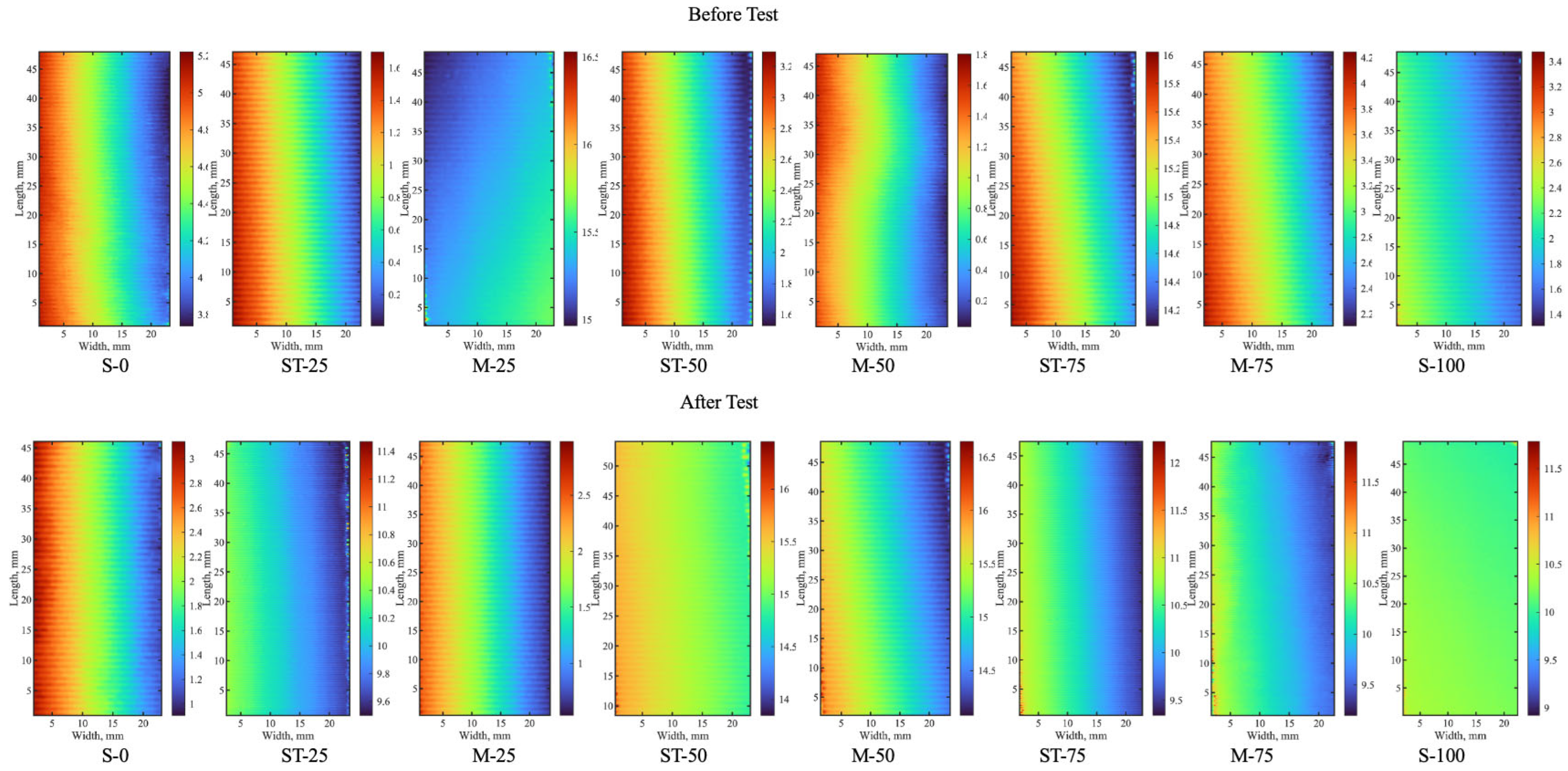
Figure 5 and
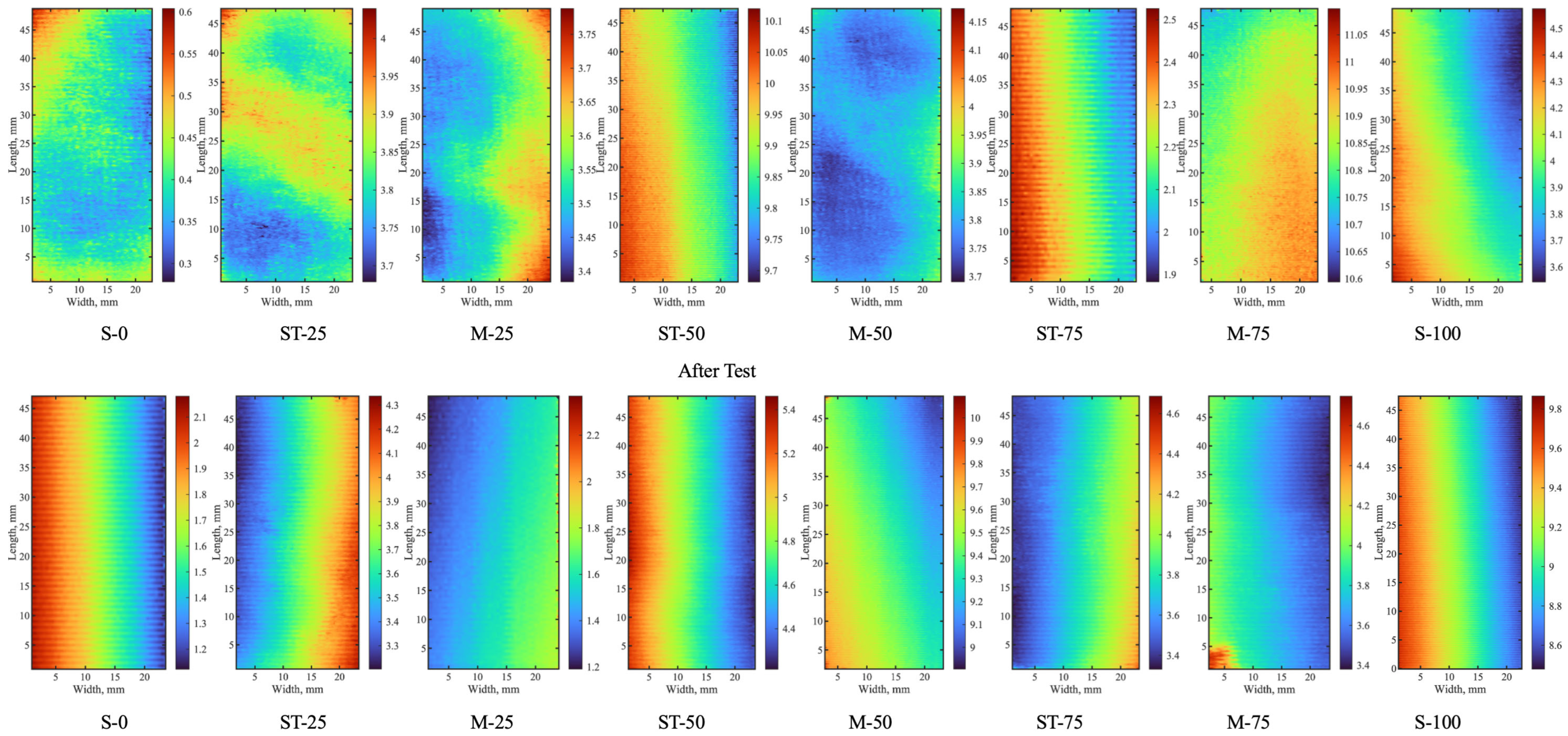
Figure 6 show the laser-scanned fracture-surface morphologies before and after conductivity testing at the 1 mm and 2 mm equivalent placement levels, respectively. The roughness evolution was quantified using
,
, and
, which represent the mean amplitude, root-mean-square amplitude, and peak-to-valley height of the scanned surface. Because rough-wall flow is sensitive to both average aperture variation and localized constrictions, these parameters provide complementary measures of closure-induced surface reconstruction in the proppant-supported fractures. Previous studies have shown that roughness and aperture heterogeneity can strongly affect flow resistance, nonlinear flow behavior, and particle migration in rough fractures.
3.1. Roughness Change at the 1 mm Equivalent Placement Level
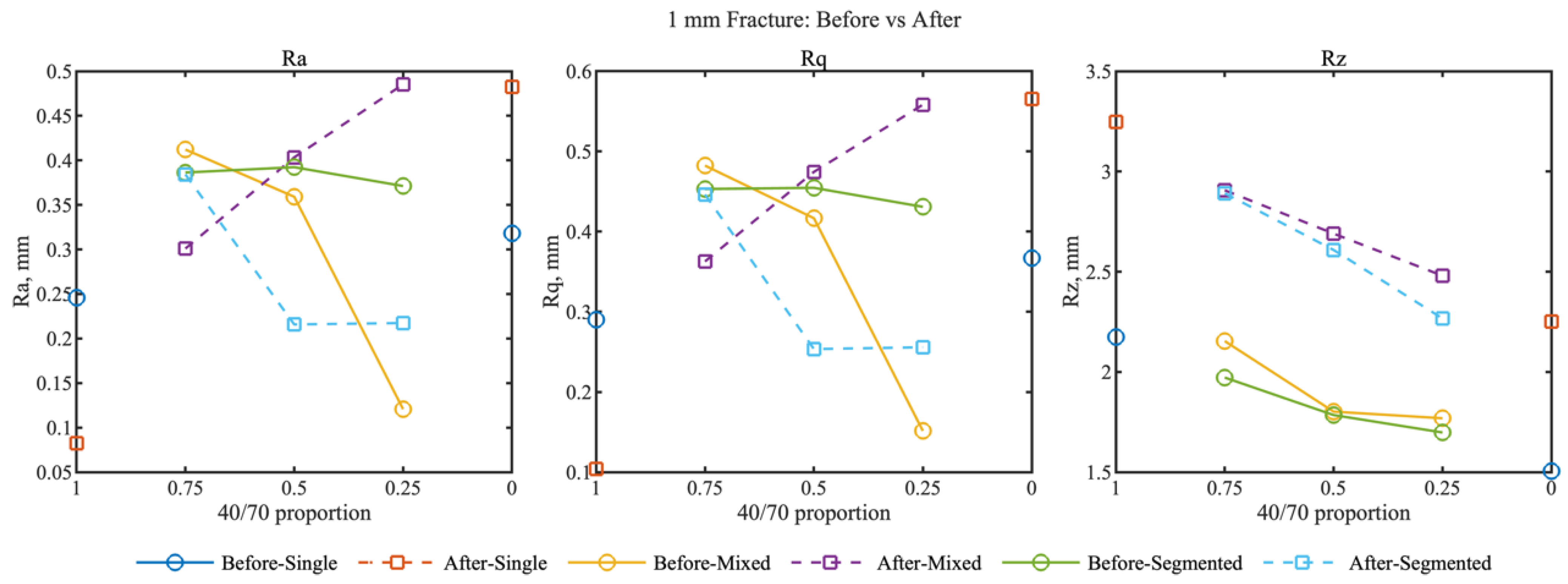
At the 1 mm equivalent placement level, the surface response was strongly dependent on the proppant fraction and placement scheme. The trends of , and were not always consistent with those of , indicating that the average roughness amplitude and the extreme peak-to-valley relief evolved through different mechanisms.
For the single-size cases (
Figure 7 and
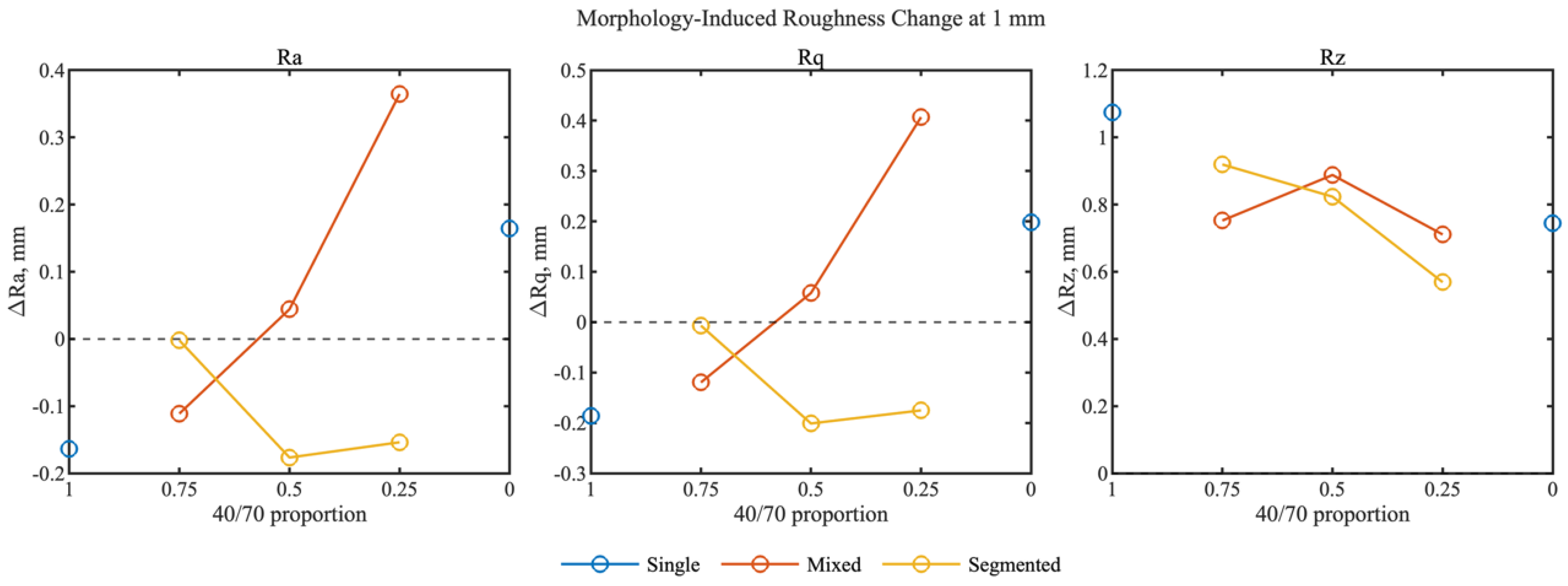
Figure 8), the 40/70 specimen showed a pronounced reduction in
, and
, after conductivity testing. The value of
decreased from approximately 0.245 to 0.083 mm, and
decreased from 0.291 to 0.101 mm, corresponding to reductions of 66.1% and 65.3%, respectively. This response indicates smoothing of the small- to medium-scale surface relief. In contrast, the single-size 70/140 specimen exhibited roughening, with
increasing from 0.318 to 0.482 mm and
increasing from 0.368 to 0.563 mm, corresponding to increases of 51.6% and 53.0%, respectively. Despite these opposite trends in
, and
, both single-size cases showed an increase in
. The value of
increased from 2.18 to 3.25 mm for 40/70 and from 1.50 to 2.24 mm for 70/140. This suggests that localized peak-to-valley contrast was enhanced even when the average roughness amplitude decreased. Note that
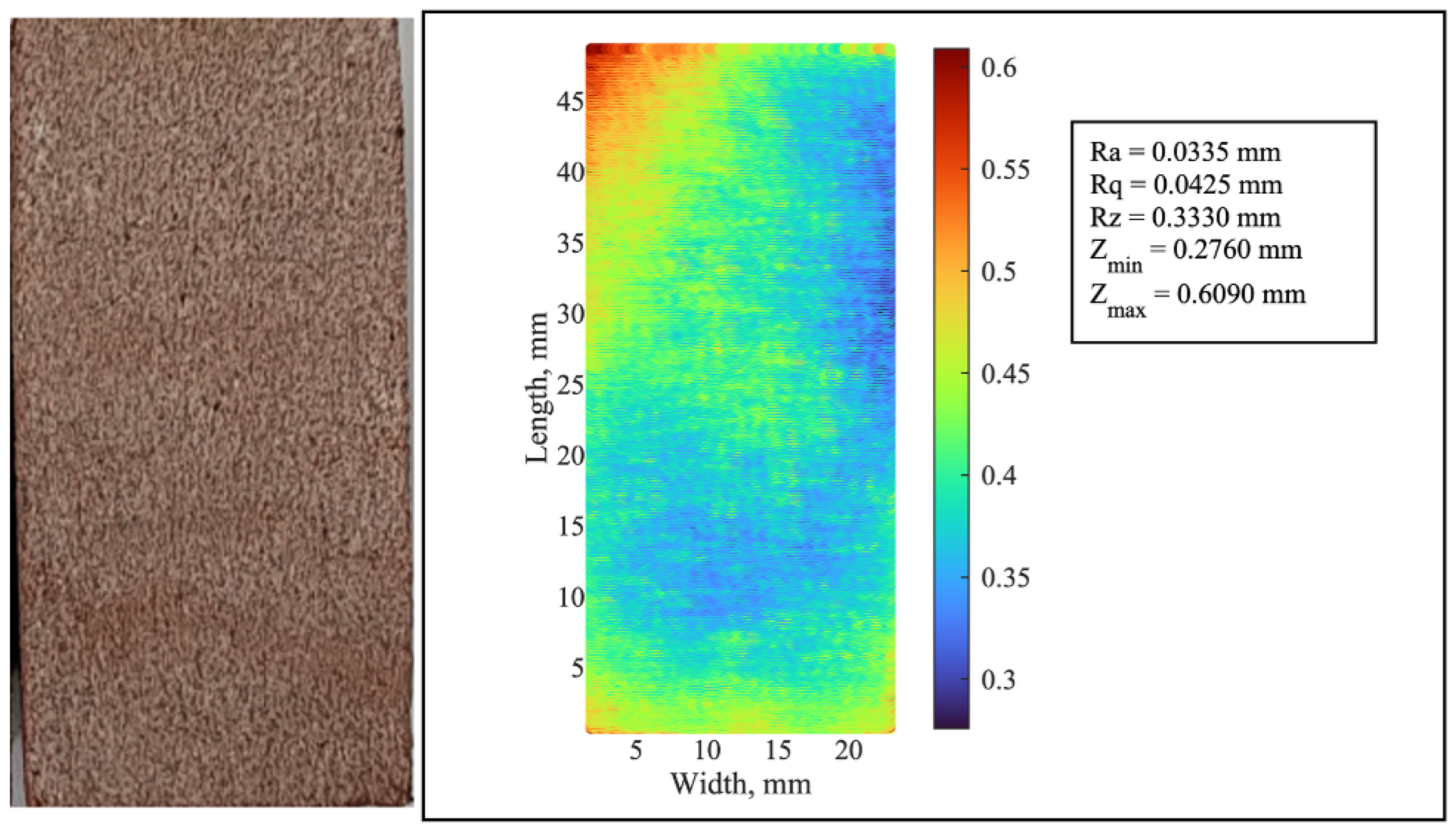
Figure 4 provides a representative visualization of the fracture surface; the Ra and Rq values in the boxed area are smaller than the overall core-average values reported for the 1 mm and 2 mm equivalent placement levels, which range from 0.2 to 0.5 mm.
These results indicate that, at the lower equivalent placement level, staged placement tended to reduce the average roughness amplitude while maintaining or increasing the large-scale peak-to-valley relief. This behavior can be interpreted as a combined effect of partial asperity smoothing and localized indentation or damage around load-bearing contacts. In contrast, uniformly mixed placement became increasingly roughening-dominated as the fraction of fine 70/140 particles increased. This difference suggests that, under sparse loading, particle arrangement controls how contact forces are transferred to the rough fracture surface. Such particle–wall interaction is consistent with the broader understanding that confined particle systems are sensitive to particle–wall and particle–particle contacts. A possible mechanism for this contrasting response is discussed in
Section 5.1.
3.2. Roughness Change at the 2 mm Equivalent Placement Level
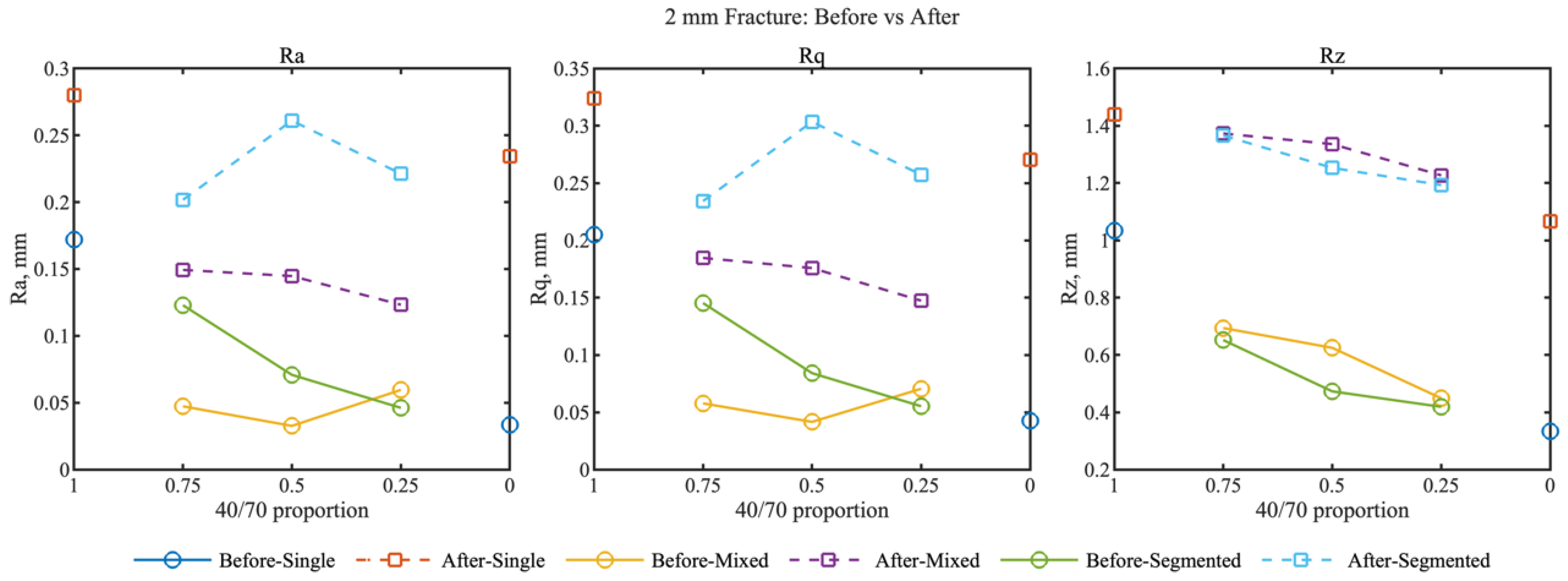
The 2 mm equivalent placement level produced a markedly different morphology response. In contrast to the mixed smoothing and roughening behavior observed at 1 mm, all cases at 2 mm showed positive changes in , , and after conductivity testing. This indicates systematic post-test roughening of the fracture surfaces under the higher proppant loading condition.
For the single-size cases (
Figure 9 and
Figure 10), the 40/70 specimen showed
increasing from 0.172 to 0.280 mm and
increasing from 0.205 to 0.324 mm. The corresponding increases were 62.8% and 58.0%, respectively. The single-size 70/140 specimen showed a larger relative increase because of its lower initial roughness. The value of
increased from 0.034 to 0.234 mm, and
increased from 0.043 to 0.271 mm. In absolute terms, the increments were approximately 0.200 mm for
and 0.228 mm for
. The corresponding
values increased from 1.04 to 1.44 mm for 40/70 and from 0.334 to 1.07 mm for 70/140, indicating that the peak-to-valley relief also became more pronounced.
For the uniformly mixed-placement cases, all three roughness descriptors increased over the full range of 40/70 fractions. The increments in were approximately 0.101, 0.112, and 0.063 mm at 40/70 fractions of 0.75, 0.50, and 0.25, respectively. The corresponding increments in were approximately 0.127, 0.134, and 0.077 mm. The increments in were approximately 0.678, 0.716, and 0.772 mm. These results show that uniformly mixed placement at 2 mm consistently enhanced both the mean roughness amplitude and the peak-to-valley relief.
The staged-placement cases at 2 mm produced even stronger increases in and among the mixed-size systems. The value of increased from 0.123 to 0.201 mm, from 0.071 to 0.261 mm, and from 0.046 to 0.222 mm at 40/70 fractions of 0.75, 0.50, and 0.25, respectively. The corresponding values increased from 0.145 to 0.235 mm, from 0.084 to 0.303 mm, and from 0.056 to 0.257 mm. In absolute terms, the largest increases occurred at the 0.50 fraction, where and increased by 0.190 and 0.219 mm, respectively. At the 0.25 fraction, the increments remained high, exceeding 0.17 mm for and 0.20 mm for . The corresponding increments were approximately 0.709, 0.775, and 0.771 mm.
Unlike the 1 mm condition, staged placement at 2 mm did not smooth the fracture surface. Instead, it amplified the roughness across all descriptors. This indicates that the higher proppant loading promoted more extensive particle–wall contact and stronger surface reconstruction during closure. The systematic increase in roughness at 2 mm suggests that a denser particle framework caused more distributed contact, indentation, and local surface modification. Because rough-wall flow and non-Darcy response are sensitive to local constrictions and rough elements [
2,
8], these morphology changes are expected to affect the subsequent conductivity behavior.
3.3. Comparison Between the 1 mm and 2 mm Conditions
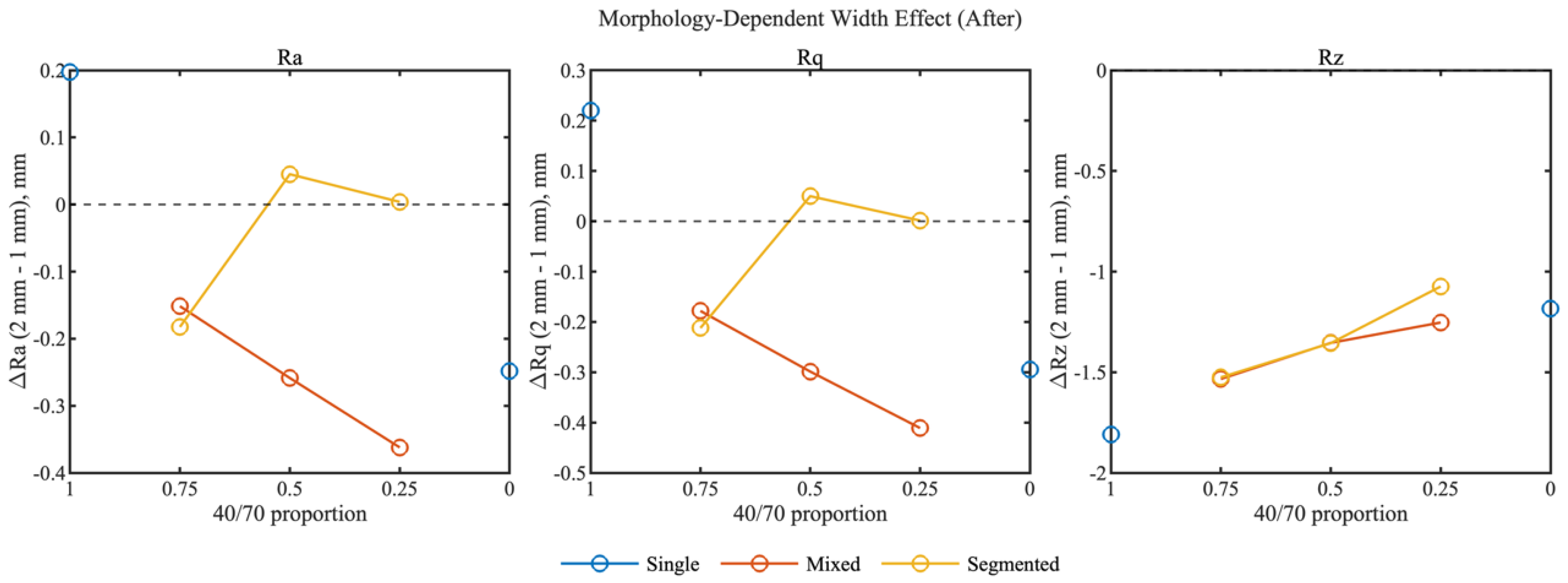
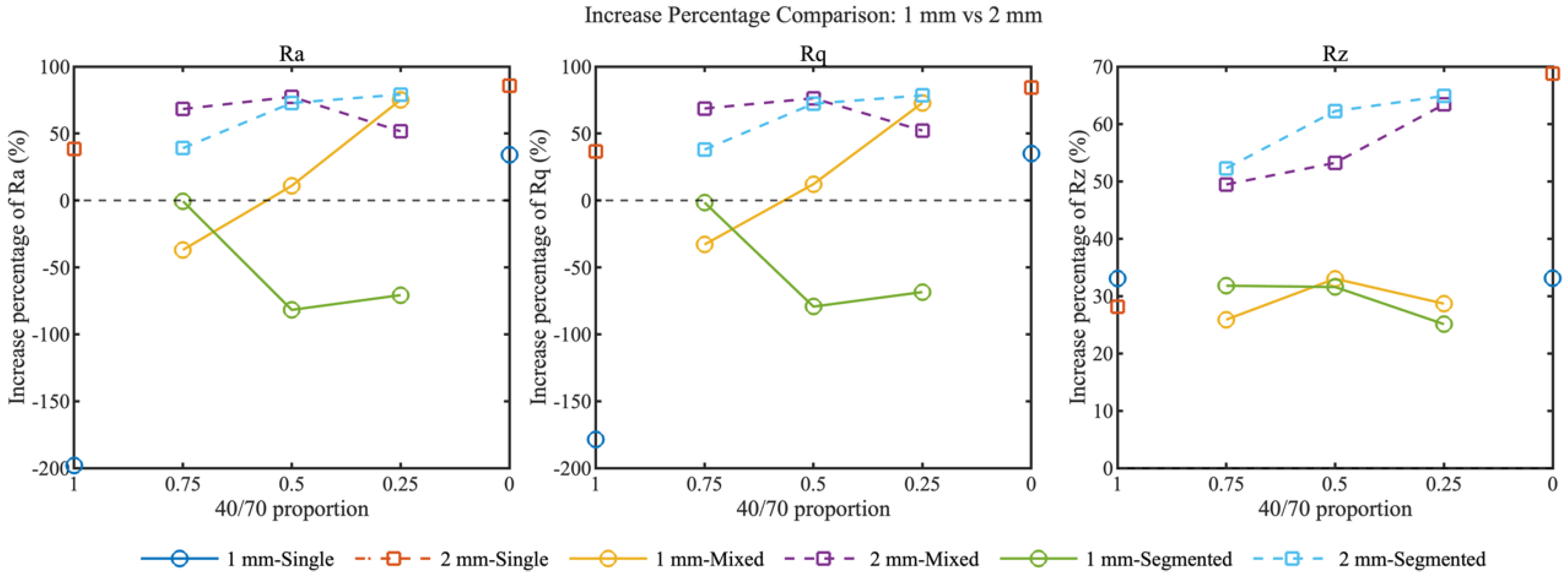
The comparison between the two equivalent placement levels shows that the roughness response was governed primarily by loading level and secondarily by proppant fraction and placement scheme. As shown in
Figure 11,
increased after testing for all proppant systems and placement schemes. Most
changes fell within a relatively narrow positive range, indicating that the extreme peak-to-valley relief was consistently enhanced after closure. By contrast, the changes in
and
were much more dispersed, ranging from strongly negative values in several 1 mm staged-placement cases to consistently positive values under the 2 mm condition.
The difference between the 1 mm and 2 mm conditions is most evident in and . At 1 mm, the uniformly mixed cases shifted from smoothing to strong roughening as the 40/70 fraction decreased, whereas the staged-placement cases showed clear reductions in and at 40/70 fractions of 0.50 and 0.25. At 2 mm, however, both uniformly mixed and staged placement produced positive increases in and for all proppant fractions. This contrast indicates that sparse loading allowed the surface response to be controlled by local particle arrangement, whereas higher loading generated a more distributed contact network and a more systematic roughening response.
The behavior of was less sensitive to placement level than that of and . Although the 2 mm cases generally showed more clustered positive increases, the 1 mm cases also remained positive for all tested configurations. This suggests that large-scale peak-to-valley relief was enhanced regardless of equivalent placement level, while the smaller- and intermediate-scale surface components represented by and were more sensitive to particle configuration. In rough fractures, such multiscale surface modification is important because both average aperture variation and localized constrictions can influence flow-channel continuity and pressure-drop behavior.
Overall, the 1 mm condition produced a mixed morphology response, including both smoothing and roughening, depending on particle-size fraction and placement scheme. In contrast, the 2 mm condition produced uniformly positive roughness increments for all three descriptors. This indicates that increasing the equivalent placement level changed the dominant surface-alteration mode from configuration-dependent local smoothing or roughening to systematic rough-wall reconstruction. The result provides a morphological basis for interpreting the corresponding conductivity behavior: under lower loading, conductivity is expected to be controlled by the local continuity of particle support, whereas under higher loading, conductivity is more closely related to the formation of a distributed load-bearing framework and its associated modification of rough-wall flow channels.
4. Conductivity Evolution Analysis
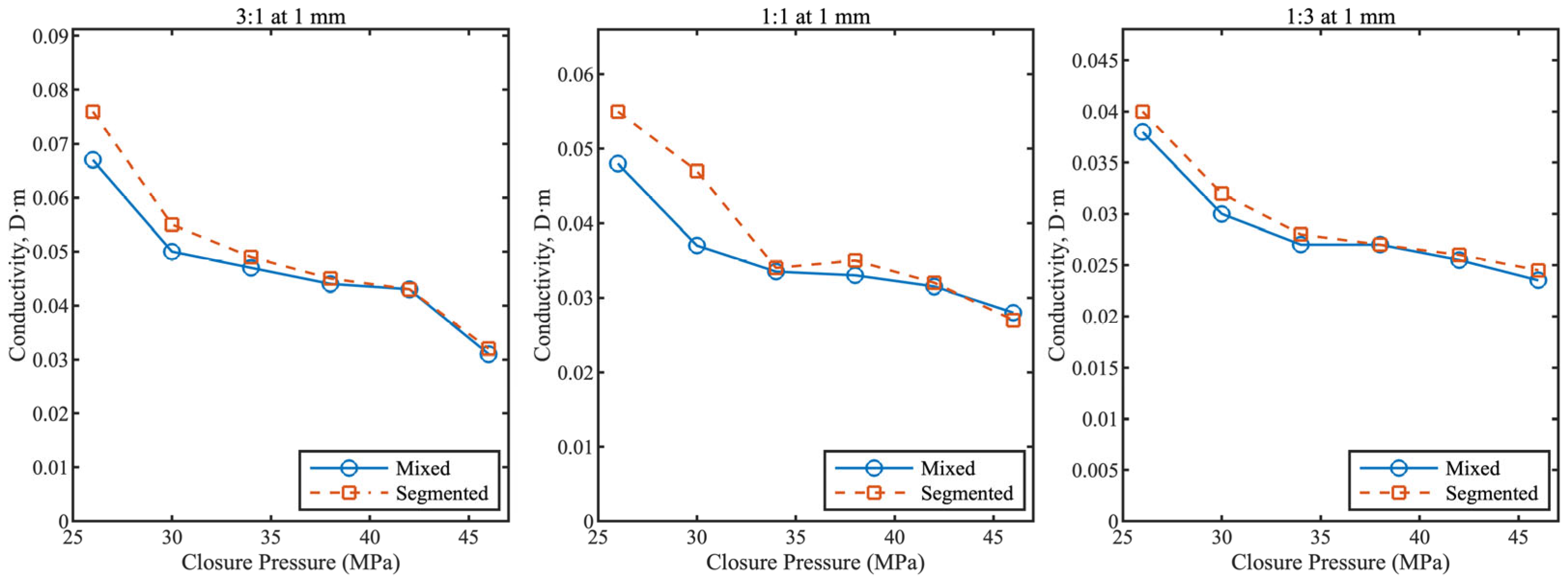
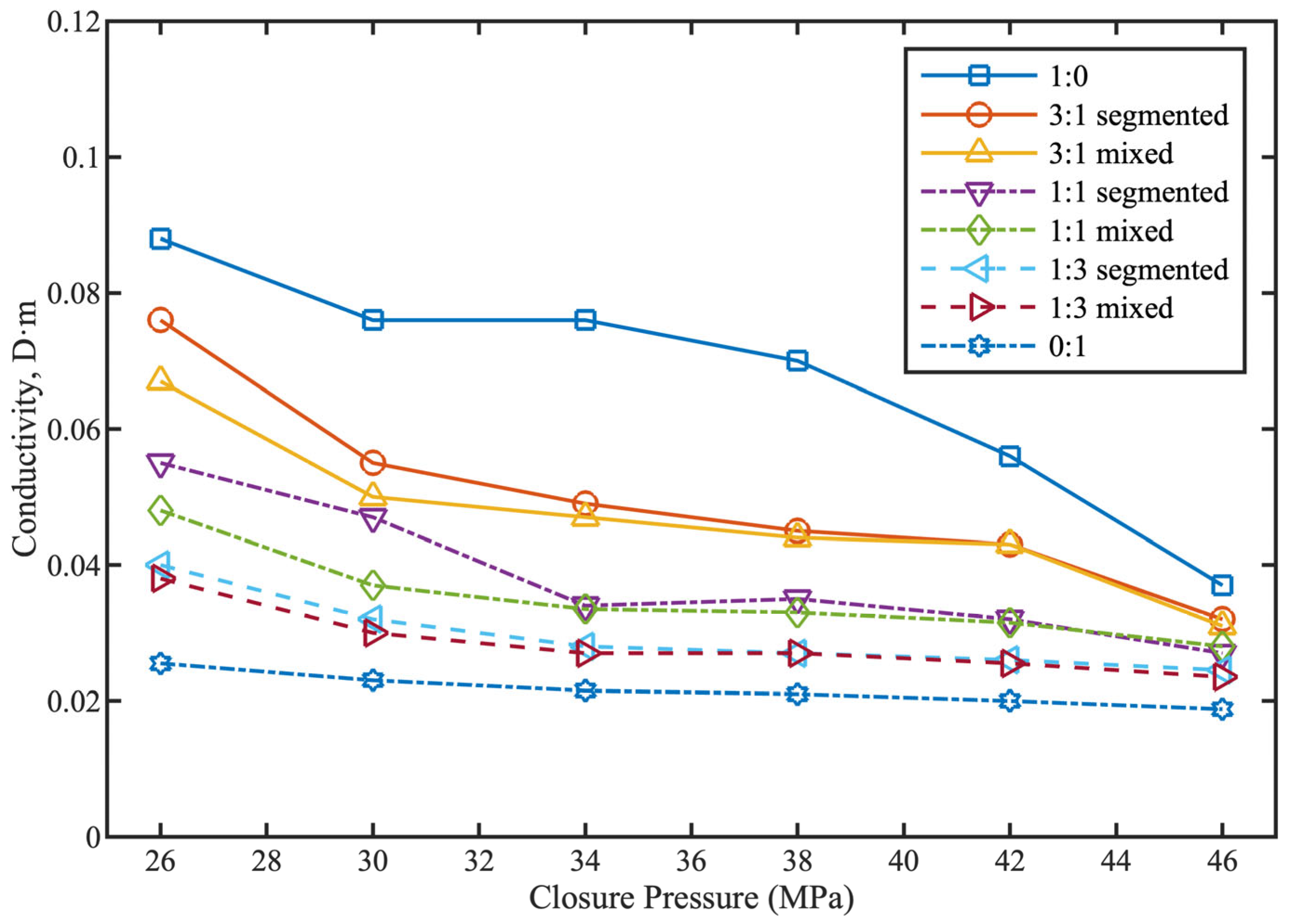
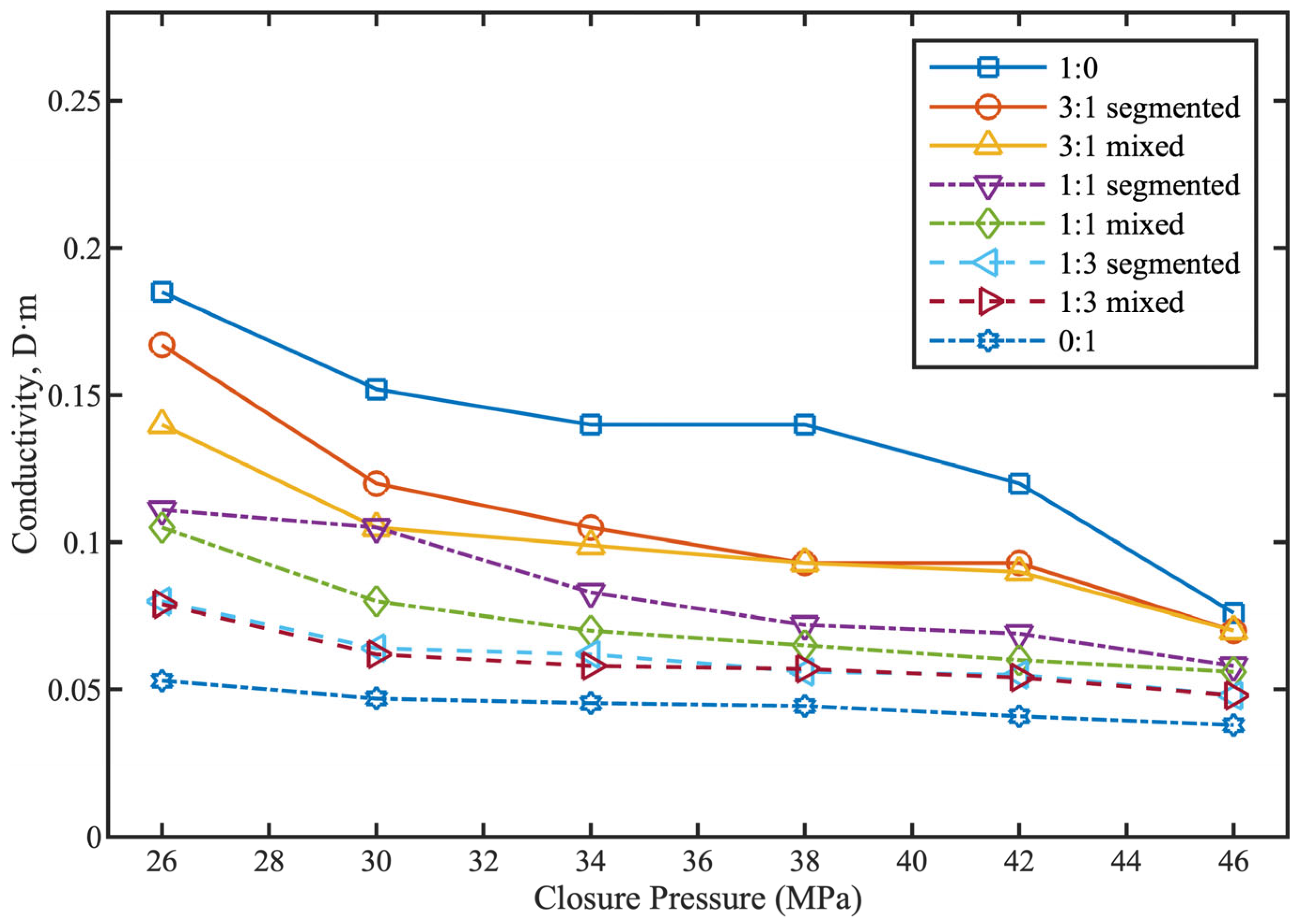
Figure 12 and
Figure 13 show the conductivity evolution of the tested proppant systems at the 1 mm and 2 mm equivalent placement levels, respectively. For all cases, conductivity decreased with increasing closure pressure, indicating progressive compression of the proppant-supported flow space. However, the magnitude of conductivity loss and the relative difference among proppant systems depended strongly on the equivalent placement level, coarse-particle fraction, and placement scheme. This behavior is consistent with the general understanding that conductivity in propped fractures is governed by the coupled effects of particle packing, contact-force redistribution, embedment, and rough-wall flow-channel evolution.
4.1. Conductivity Behavior at the 1 mm Equivalent Placement Level
At the 1 mm equivalent placement level, the single-size 40/70 system consistently showed the highest conductivity over the full closure-pressure range. Its conductivity decreased from approximately 0.089 D·m at 26 MPa to about 0.036 D·m at 46 MPa, corresponding to a reduction of nearly 60%. In contrast, the single-size 70/140 system exhibited the lowest conductivity, decreasing from approximately 0.027 to 0.018 D·m over the same pressure interval, with an overall reduction of about 33%. These results indicate that, under relatively sparse proppant loading, the coarse proppant preserved a larger effective flow space than the fine proppant. The higher conductivity of the 40/70 system can therefore be attributed to its ability to maintain wider interparticle flow channels and a more effective load-bearing framework during closure.
For the mixed-size systems, the conductivity values were bounded by the two single-size end members. At a 40/70:70/140 ratio of 3:1, the staged-placement case decreased from approximately 0.076 D·m at 26 MPa to 0.032 D·m at 46 MPa, whereas the corresponding uniformly mixed case decreased from about 0.067 to 0.031 D·m. Thus, staged placement maintained a conductivity advantage of approximately 0.009–0.004 D·m over most of the pressure range, although the difference narrowed at higher closure pressures. At the 1:1 ratio, the staged case also remained higher than the uniformly mixed case over most pressure levels, with a difference of approximately 0.006 D·m at 26 MPa and 0.001–0.003 D·m from 30 to 42 MPa. At 46 MPa, the uniformly mixed case became slightly higher, but the difference was marginal. At the 1:3 ratio, the two placement schemes were nearly indistinguishable, with conductivity differences generally within 0.000–0.002 D·m.
These results show that (
Figure 14), at the 1 mm level, staged placement provided a modest conductivity benefit when the coarse-particle fraction was sufficiently high. The benefit was most evident for the 3:1 and 1:1 systems, but it diminished as closure pressure increased and became negligible for the fine-particle-dominated 1:3 system. This suggests that staged placement can improve early-stage support continuity by allowing coarse particles to form a more effective primary skeleton. However, under sparse loading, the resulting skeleton is not sufficiently robust to maintain a large advantage at high closure pressure.
4.2. Conductivity Behavior at the 2 mm Equivalent Placement Level
At the 2 mm equivalent placement level, all proppant systems showed higher conductivity than their 1 mm counterparts. This indicates that increasing the equivalent proppant loading improved the continuity of the supporting framework and preserved larger conductive pathways during closure. The single-size 40/70 system again showed the highest conductivity, decreasing from approximately 0.182 D·m at 26 MPa to about 0.068 D·m at 46 MPa. Compared with the 1 mm case, this corresponds to an increase of approximately 106% at 26 MPa and 89% at 46 MPa. The single-size 70/140 system remained the lowest-conductivity case, but its conductivity still decreased from about 0.055 D·m at 26 MPa to 0.028 D·m at 46 MPa, exceeding the corresponding 1 mm values over the entire pressure range.
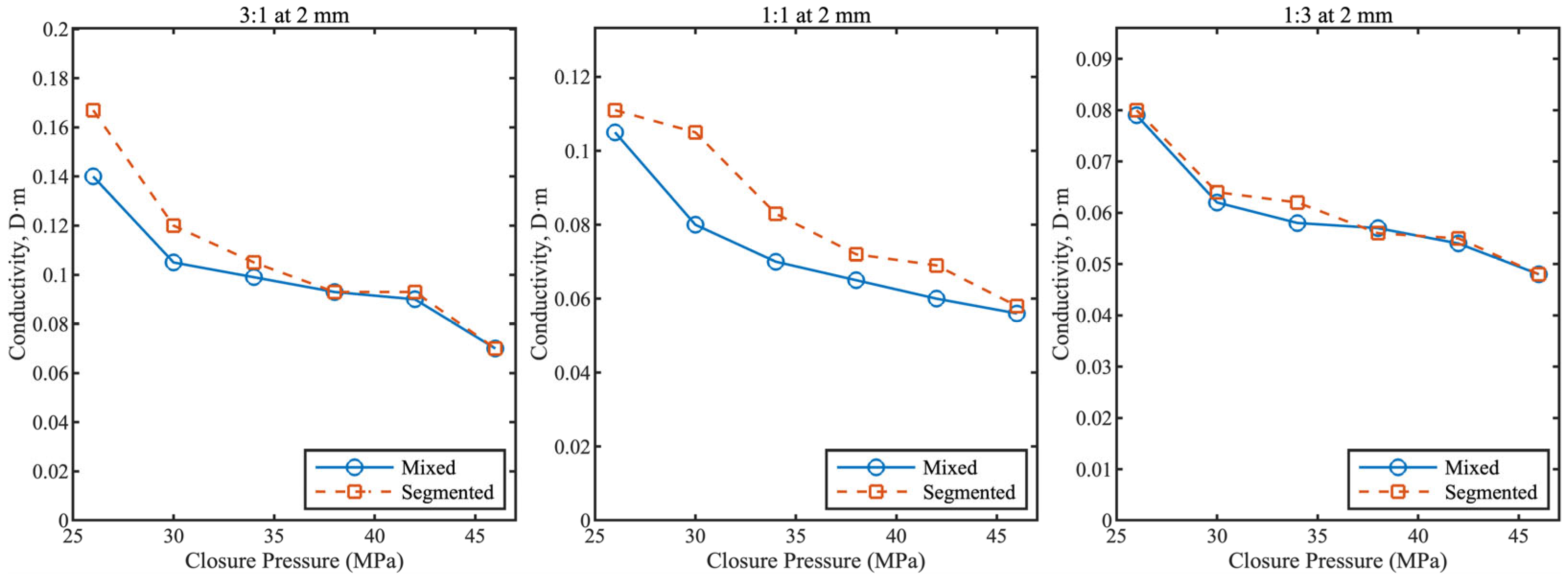
The placement-scheme effect became more pronounced at the 2 mm level. At the 3:1 ratio, staged placement showed a clear conductivity advantage over uniformly mixed placement from 26 to 34 MPa. The differences were approximately 0.027 D·m at 26 MPa, 0.015 D·m at 30 MPa, and 0.006 D·m at 34 MPa. The two curves became nearly identical at 38 MPa and converged again at 46 MPa. At the 1:1 ratio, staged placement exceeded uniformly mixed placement throughout the full pressure range. The absolute difference ranged from approximately 0.006 D·m at 26 MPa to 0.025 D·m at 30 MPa, and then remained within approximately 0.002–0.009 D·m from 34 to 46 MPa. This ratio showed the most persistent benefit from staged placement. At the 1:3 ratio, however, the two placement schemes again produced very similar conductivities, with differences generally within ±0.004 D·m and nearly overlapping curves above 38 MPa.
The 2 mm results demonstrate that staged placement was more effective when the proppant system contained a sufficient fraction of coarse particles (
Figure 15). The advantage was strongest at low-to-intermediate closure pressures and gradually weakened as closure pressure increased. This indicates that the staged coarse–fine arrangement initially promoted a more continuous load-bearing skeleton and better-preserved flow channels, but the difference between placement schemes became less pronounced as stress-induced compaction, particle rearrangement, and local embedment progressed. Similar stress-dependent loss of proppant-supported conductivity has been reported in previous conductivity studies, where closure stress progressively reduces flow capacity through particle and wall deformation.
4.3. Direct Comparison Between Mixed and Segmented Placement
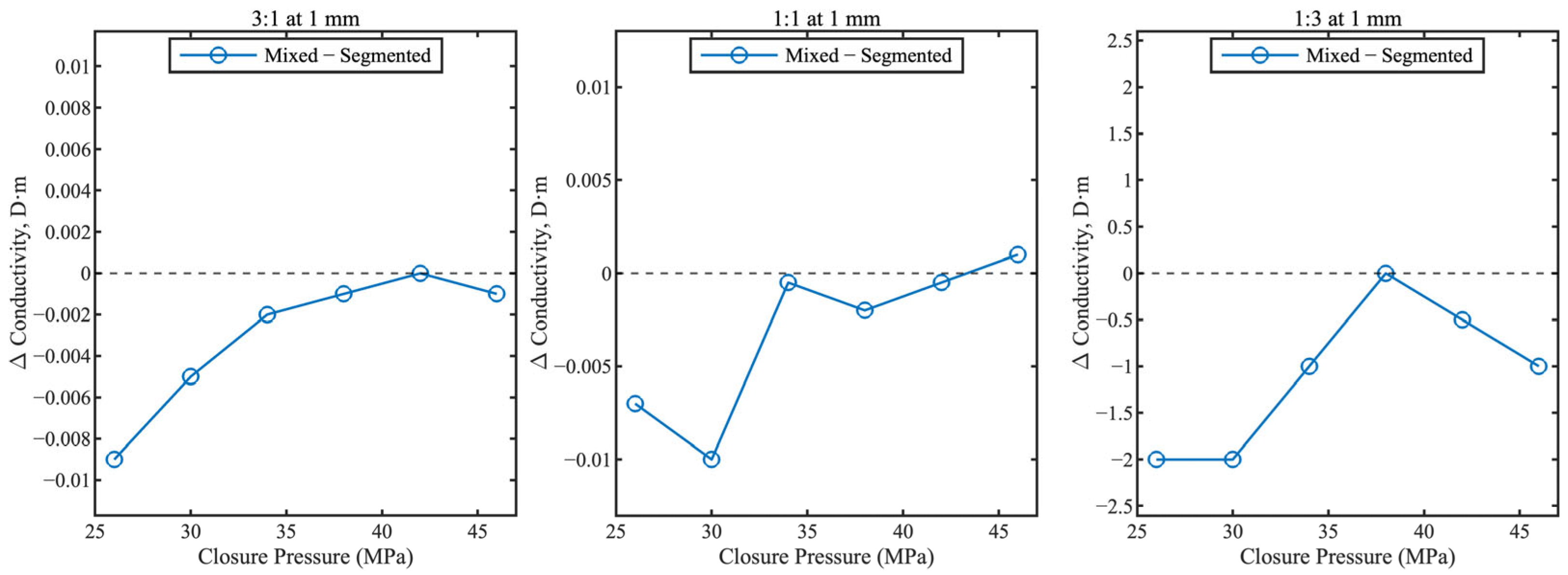
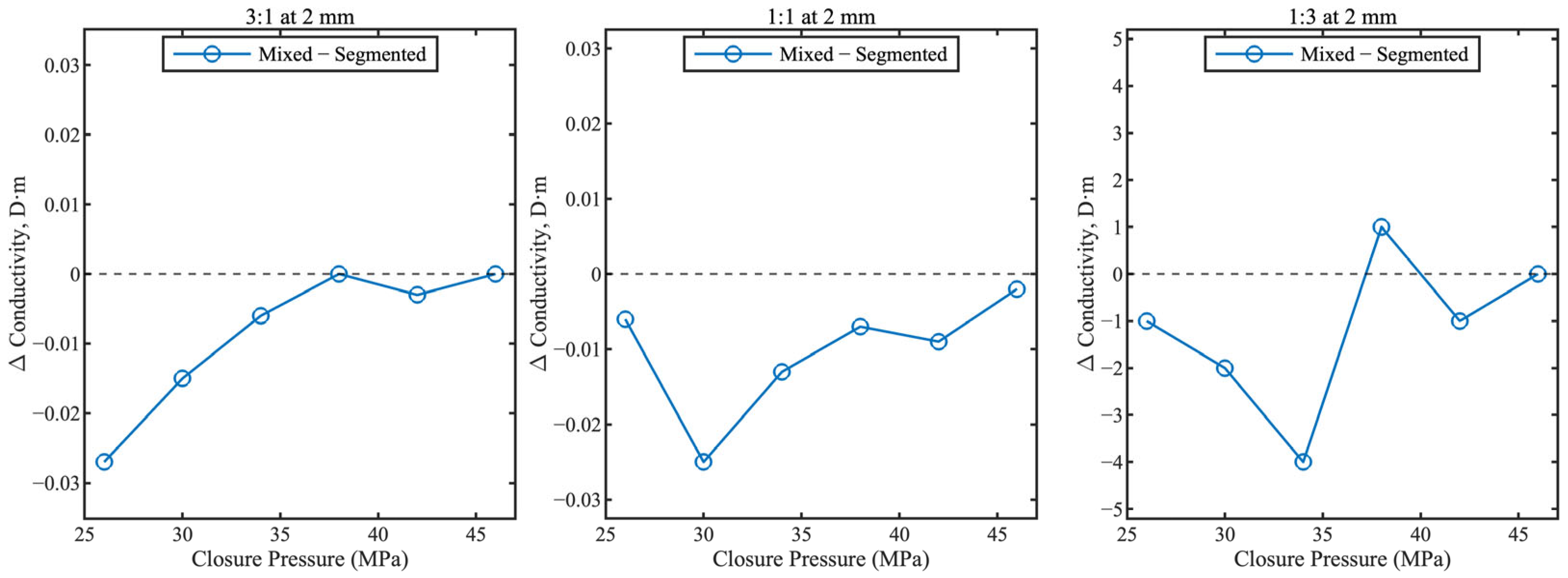
Figure 16 and
Figure 17 further quantify the conductivity difference between uniformly mixed and staged placement at fixed proppant ratios. The conductivity difference is defined as
where negative values indicate that staged placement provides higher conductivity than uniformly mixed placement.
At the 1 mm level (
Figure 16),
was negative for most tested cases. For the 3:1 ratio,
ranged from approximately −0.009 D·m at 26 MPa to nearly zero at 42 MPa, and then remained slightly negative at 46 MPa. For the 1:1 ratio,
varied between approximately −0.010 and +0.001 D·m, indicating that staged placement was generally favorable except at the highest pressure, where the uniformly mixed case became marginally higher. For the 1:3 ratio,
remained close to zero, ranging only from approximately −0.002 to 0 D·m. This confirms that placement sequence had little effect when the system was dominated by fine particles.
At the 2 mm level (
Figure 17), the same trend persisted but with larger absolute differences. For the 3:1 ratio,
reached approximately −0.027 D·m at 26 MPa and approached zero at 38 and 46 MPa. For the 1:1 ratio,
remained negative throughout the test and reached its largest magnitude at 30 MPa, where the uniformly mixed case was lower than the staged case by approximately 0.025 D·m. Even at 46 MPa, the difference remained slightly negative. In contrast, at the 1:3 ratio,
fluctuated within a narrow range of approximately −0.004 to +0.001 D·m and returned to nearly zero at 46 MPa.
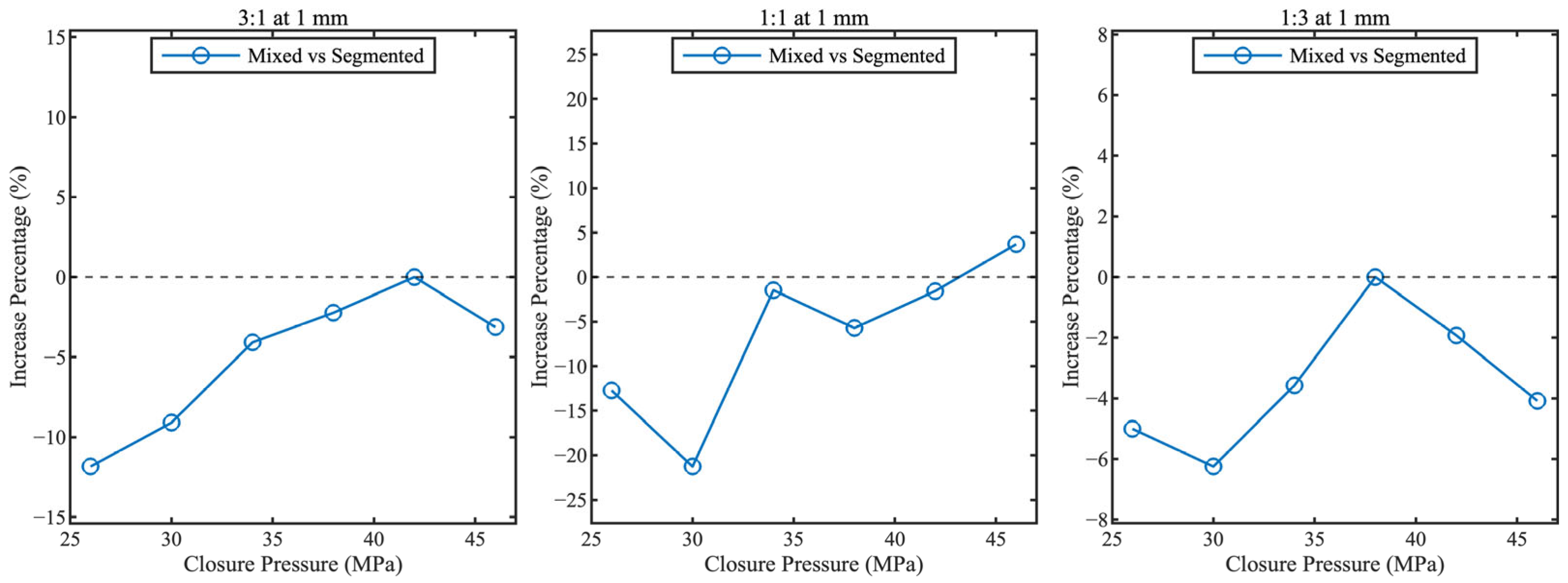
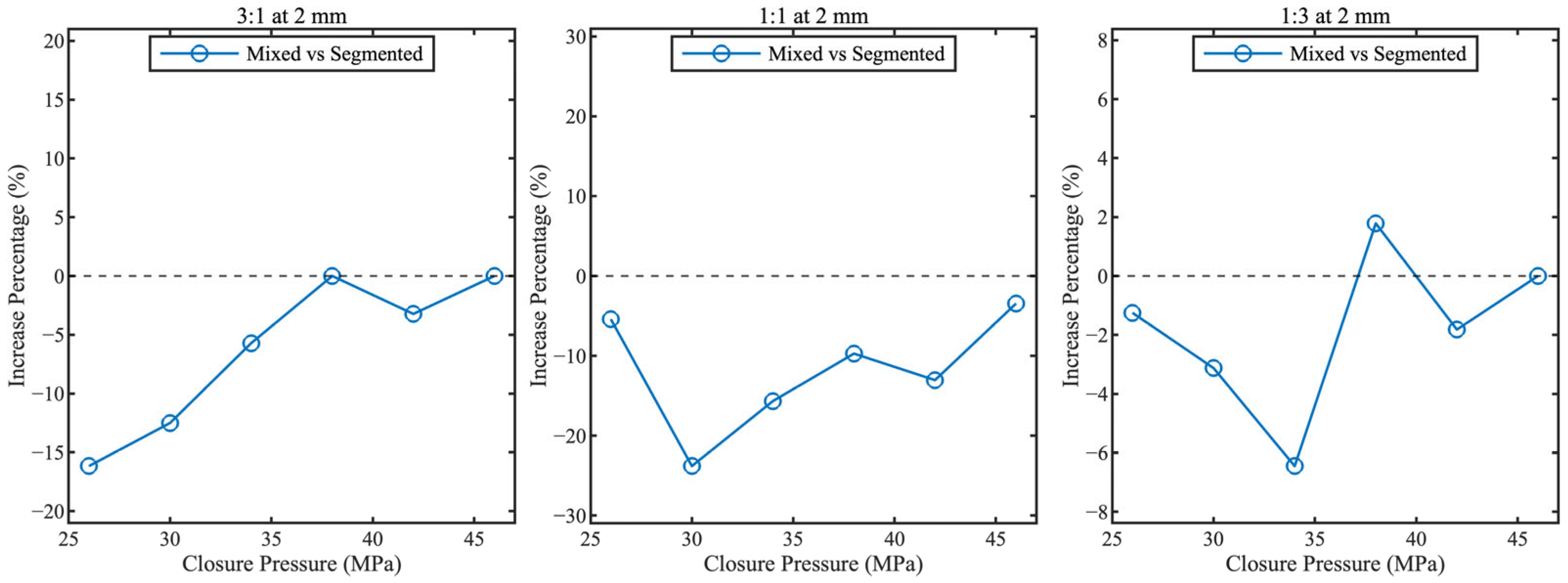
Expressed in percentage terms (
Figure 18 and
Figure 19), the advantage of staged placement was most significant at low closure pressure and high coarse-particle fraction. At the 2 mm level, the uniformly mixed case was lower than the staged case by approximately 16% at the 3:1 ratio and 26 MPa, and by nearly 24% at the 1:1 ratio and 30 MPa. At the 1 mm level, the corresponding deficits were smaller, approximately 12% for the 3:1 ratio at 26 MPa and 21% for the 1:1 ratio at 30 MPa. For the 1:3 ratio, the percentage difference generally remained within approximately ±6%, further indicating that the placement scheme became secondary once the coarse-particle skeleton was insufficiently developed.
4.4. Effect of Equivalent Placement Level and Coarse-Particle Fraction
A direct comparison between the 1 mm and 2 mm conditions shows that increasing the equivalent placement level systematically enhanced conductivity for all proppant systems. However, the overall ranking remained unchanged. At both placement levels, the conductivity generally followed the order , with minor local overlap between the 3:1 and 1:1 systems at high closure pressure. This ranking indicates that conductivity was primarily governed by the coarse-particle fraction, while placement sequence acted as a secondary modifier.
The conductivity gain associated with increasing the equivalent placement level was especially large for systems containing a substantial fraction of 40/70 proppant. For example, at 26 MPa, the conductivity of the 3:1 staged case increased from approximately 0.076 D·m at 1 mm to 0.167 D·m at 2 mm, corresponding to an increase of about 120%. The 1:1 staged case increased from approximately 0.054 to 0.111 D·m, or by about 106%. Even the 1:3 staged case increased from approximately 0.040 to 0.072 D·m, corresponding to an increase of about 80%. These results indicate that a higher equivalent placement level improved support continuity and preserved larger conductive pathways, particularly when the system contained enough coarse particles to form a continuous load-bearing skeleton.
Taken together, the conductivity data reveal three key features. First, conductivity decreased monotonically with increasing closure pressure for all proppant systems, reflecting progressive compaction and narrowing of the proppant-supported flow space. Second, increasing the equivalent placement level from 1 mm to 2 mm substantially improved conductivity across the full pressure range, with the largest benefit observed in coarse-particle-rich systems. Third, staged placement generally outperformed uniformly mixed placement, especially for the 3:1 and 1:1 systems under the 2 mm condition, whereas the difference became negligible for the fine-particle-dominated 1:3 system.
These observations indicate that conductivity retention in rough split-core fractures is controlled by the combined effects of coarse-particle framework formation, placement-induced particle architecture, and stress-dependent flow-channel preservation. The results also provide a direct link to the roughness evolution discussed in
Section 3: higher proppant loading promoted both improved conductivity and systematic surface reconstruction, whereas sparse loading produced more configuration-dependent roughness changes and weaker conductivity differentiation between placement schemes.
5. Discussion
5.1. Coupling Between Conductivity Loss and Rough-Wall Reconstruction
The present results show that conductivity evolution in rough split-core fractures cannot be interpreted only from proppant size or areal loading. The post-test laser-scanning results indicate that the fracture surfaces experienced measurable morphological reconstruction during closure. Therefore, the measured conductivity reflects the coupled response of three interacting components: the particle framework, the rough fracture walls, and the evolving flow channels between them. However, the roughness parameters used in this study should not be interpreted as direct indicators of hydraulic connectivity. and describe the average and root-mean-square height variations of the fracture surface, whereas describes the extreme peak-to-valley relief. These parameters do not explicitly quantify the spatial continuity of apertures, preferential-flow paths, tortuosity, or local pore-throat constrictions within the proppant pack. Therefore, the conductivity response was interpreted by combining roughness evolution with proppant architecture and closure-stress effects, rather than by using , , and as independent predictors of flow capacity.
For rough fractures, conductivity is not controlled only by the nominal equivalent proppant placement levels. Local aperture heterogeneity, asperity contacts, and roughness-induced constrictions can strongly modify the pressure-drop response and flow regime. This is consistent with previous studies showing that roughness, aperture variation, and local wall elements can induce nonlinear flow behavior and additional flow resistance in rough fractures [
1,
2,
3,
4,
5,
6,
7,
8]. In the present experiments, the proppant pack acted not only as a mechanical spacer but also as an agent that redistributed contact forces onto the rough fracture surface. As closure pressure increased, local particle–wall contacts could induce asperity smoothing, indentation, grain rearrangement, or localized roughening. These changes modified the conductive pathways preserved within the propped fracture.
The different responses of , , and provide important insight into this process. The parameters and reflect the average and root-mean-square amplitude of the roughness field, and therefore are sensitive to small- and intermediate-scale surface reconstruction. In contrast, reflects the extreme peak-to-valley height and is more strongly influenced by isolated high or low points. The results show that increased for all tested cases, whereas and showed both positive and negative changes under the 1 mm condition. This divergence suggests that the large-scale height contrast of the fracture surface was preserved or enhanced after testing, but the average roughness field could either smooth or roughen depending on particle arrangement.
This distinction is important for conductivity interpretation. A few isolated high-relief features do not necessarily guarantee high conductivity if the surrounding aperture field becomes compressed or disconnected. Conductivity depends on the spatial continuity of flow channels rather than on the maximum peak-to-valley height alone. Thus, the more variable response of and indicates that the local conductive network was strongly affected by particle support configuration. At the 1 mm equivalent placement level, several staged-placement cases showed reductions in and while remained positive. This suggests that small- and medium-scale asperities were compressed, worn, or redistributed, while a limited number of larger relief features still controlled the peak-to-valley range. Under these conditions, the conductivity remained relatively low and the benefit of staged placement was modest. The increase in and observed for the 70/140 proppant system can be attributed to the ability of finer particles to enter micro-cavities and local surface depressions, causing local embedment and creating additional texture. In contrast, coarser 40/70 particles tend to shear off asperity peaks, leading to a net smoothing effect. This mechanism explains the contrasting roughness evolution between fine and coarse particle systems. At higher equivalent placement levels, inter-particle interactions and rearrangement further contribute to increased surface roughness for all systems.
At the 2 mm equivalent placement level, all cases showed positive changes in , , and . This systematic roughening was accompanied by substantially higher conductivity than at 1 mm. The correspondence indicates that increasing the equivalent placement level did more than increase the amount of proppant in the fracture. It changed the mode of particle–wall interaction during closure. A higher proppant loading produced a more distributed contact network and a more continuous particle-supported framework. This framework maintained greater separation between the opposing fracture faces while also causing more extensive surface reconstruction. As a result, the aperture field was more favorable for preserving flow-channel continuity under increasing stress.
Therefore, the conductivity and roughness results suggest two coupled mechanisms. The first is the formation of a mechanically stable particle-supported framework, which determines whether a conductive pathway can be established. The second is closure-induced wall reconstruction, which determines whether this pathway remains hydraulically continuous. Conductivity retention in rough propped fractures is governed by both mechanisms.
5.2. Particle-Size Mixing and Load-Bearing Framework Formation
The conductivity ranking observed in this study, , shows that coarse-particle-dominated systems consistently outperformed fine-particle-dominated systems. This trend was observed at both equivalent placement levels and over the full closure-pressure range. The result indicates that the coarse 40/70 particles played the dominant role in preserving conductive aperture.
The physical explanation is straightforward. Coarse particles provide a larger characteristic support size and can maintain wider interparticle flow channels under closure. Fine 70/140 particles, although more adaptable to local surface irregularities, generate smaller characteristic pores and narrower flow channels. Therefore, the fine-particle system showed lower conductivity even when its relative conductivity decline with stress was smaller. In other words, the fine system may be mechanically more compliant or more uniformly distributed, but its hydraulic aperture is inherently limited. The mixed-size systems occupied an intermediate position between the two single-size end members. Their behavior indicates that the effect of size mixing was not simply additive. Instead, mixed-size conductivity was controlled by competition between two effects. Coarse particles promoted a primary load-bearing skeleton and preserved larger flow channels. Fine particles could either improve local packing stability by filling residual voids or reduce conductivity by occupying potentially conductive pore space. This dual role is a central feature of mixed-size proppant systems.
The 3:1 and 1:1 systems retained relatively favorable conductivity because they contained enough coarse particles to form a load-bearing framework. In these cases, fine particles may have contributed secondary support without fully destroying the main coarse-particle-controlled flow channels. By contrast, the 1:3 systems approached the behavior of the 70/140 end member. Once the coarse-particle fraction was reduced to 25%, the coarse skeleton was no longer sufficiently continuous to dominate the aperture field. The hydraulic response became controlled mainly by the smaller characteristic channel size associated with the fine particles. This interpretation is also supported by the roughness data. At higher coarse-particle fractions, the difference between staged and uniformly mixed placement was more visible in both conductivity and surface response. This means that the particle assembly retained enough structural hierarchy for placement architecture to matter. At the 1:3 ratio, the conductivity curves nearly converged, indicating that the proppant pack behaved as a fine-particle-controlled system regardless of placement sequence.
5.3. Why Staged Placement Improves Conductivity
A key finding of this study is that staged placement generally yielded higher conductivity than uniformly mixed placement, especially for the 3:1 and 1:1 systems and most clearly at the 2 mm equivalent placement level. This result indicates that the placement sequence modified the internal architecture of the proppant pack.
In the staged scheme, coarse 40/70 particles were placed first. This likely allowed them to occupy the dominant load-bearing positions and establish the primary support skeleton before the finer 70/140 particles were introduced. The subsequent fine particles could then occupy part of the residual pore space or secondary voids without completely disrupting the coarse-particle framework. This configuration is favorable for maintaining large connected flow channels while improving local support continuity. In uniformly mixed placement, coarse and fine particles entered the fracture simultaneously. This likely produced a more dispersed particle arrangement. Fine particles could migrate into local constrictions or occupy voids that would otherwise remain as conductive channels. They may also interfere with coarse-particle contacts, producing a less hydraulically favorable packing structure. The issue is not that uniformly mixed placement necessarily forms a weaker mechanical pack, but that it may form a less favorable flow architecture.
The placement effect was strongest at low-to-intermediate closure pressures and weakened at high closure pressures. This trend suggests that staged placement mainly controlled the initial organization of the proppant-supported framework. As closure pressure increased, particle rearrangement, embedment, asperity deformation, and possible local crushing progressively reduced the initial architectural advantage. Similar stress-dependent conductivity loss has been reported in proppant-conductivity studies, where closure stress reduces flow capacity through deformation and particle–wall damage. The stronger staged-placement benefit at the 2 mm level is also meaningful. At the lower equivalent placement level, the proppant pack was relatively sparse. Local unsupported regions and discontinuous contacts limited the ability of the placement sequence to produce a continuous conductive framework. At the higher placement level, the particle pack became more continuous, so the coarse-particle skeleton formed during staged placement could be better preserved and translated into measurable conductivity retention. This explains why the staged-placement advantage was more distinct under the 2 mm condition.
5.4. Transition from Placement-Controlled to Fine-Particle-Controlled Behavior
The near convergence between staged and uniformly mixed placement at the 1:3 ratio provides a useful boundary condition. When the coarse-particle fraction was reduced to 25%, the conductivity difference between the two schemes became small at both equivalent placement levels. This indicates that the placement-sequence effect requires a sufficiently developed coarse-particle skeleton. At the 1:3 ratio, the fine particles dominated the packing structure. The characteristic pore size and flow-channel width were therefore controlled primarily by the 70/140 particles. Under this condition, whether the fine particles were introduced after the coarse particles or premixed with them had limited influence on the final hydraulic architecture. The coarse particles were too sparse to form a continuous load-bearing framework. As a result, the system behaved as a fine-particle-controlled pack.
This transition explains why placement strategy should not be treated as an independent design factor. Its effect depends on the particle-size ratio. Staged placement is beneficial only when the coarse fraction is high enough to establish a skeleton that can guide the subsequent distribution of finer particles. When the coarse fraction is too low, the proppant pack loses this structural hierarchy, and placement sequence becomes secondary.
5.5. Link Between Roughness Evolution and Conductivity Ranking
The roughness and conductivity results together suggest that high conductivity requires both sufficient support and favorable flow-channel continuity. The 2 mm condition produced consistently higher conductivity and systematic increases in , and . This does not mean that larger roughness alone caused higher conductivity. Rather, the simultaneous increase in conductivity and roughness indicates that the higher proppant loading maintained separation between the fracture faces while inducing distributed surface reconstruction. At the 1 mm level, the morphology response was more variable. Some cases showed smoothing in and , but the corresponding conductivity remained relatively low. This suggests that average smoothing may reflect asperity compression and local channel collapse rather than hydraulic improvement. Conversely, roughening under the 2 mm condition was associated with a more continuous particle framework and larger effective flow channels. Thus, the hydraulic meaning of roughness change depends on the contact state of the proppant pack.
This point is important for interpreting roughness metrics. An increase in roughness is not universally beneficial, and a decrease in roughness is not necessarily unfavorable. What matters is whether the roughness evolution occurs together with sustained fracture-face separation and connected flow pathways. In the present experiments, the 2 mm condition satisfied this requirement more effectively than the 1 mm condition. Therefore, roughness parameters should be interpreted together with conductivity, rather than being used as standalone indicators.
5.6. Implications for Particle-Laden Flow in Rough Fractures
The results have implications beyond proppant selection. They show that particle-laden flow in rough fractures is strongly path dependent. The final conductive structure depends not only on the amount and size of particles but also on the order in which particles enter the fracture and the contact network formed during closure. This behavior is consistent with the general physics of confined particle suspensions, where particle–wall and particle–particle interactions control migration, stress transmission, and local structure [
9,
10]. In rough fractures, these interactions are further complicated by aperture heterogeneity and wall roughness. Particles can preferentially lodge in constrictions, bridge across asperities, or rearrange under stress. These processes modify the local aperture field and the hydraulic resistance of the fracture. The present experiments show that staged placement can exploit this path dependence by allowing coarse particles to establish a favorable skeleton before finer particles are introduced.
The findings also reinforce the importance of considering rough-wall morphology as an evolving boundary condition. Previous rough-fracture studies have shown that flow behavior is sensitive to surface geometry and aperture distribution [
1,
2,
3,
4,
5,
6,
7,
8,
21,
22,
23,
24,
25,
26]. The present results extend this idea to proppant-supported fractures by showing that the wall geometry itself changes during conductivity testing and that this change is coupled with particle arrangement.
5.7. Practical Implications
Although the experiments were performed under controlled laboratory conditions, the results provide useful guidance for proppant placement in rough-walled fractures. First, maintaining a dominant coarse-particle skeleton is critical for preserving conductivity. Mixed-size systems can be beneficial, but only when the coarse fraction remains high enough to control the primary support structure. Second, staged placement is more favorable than uniformly mixed placement when the proppant system contains sufficient coarse particles, especially at moderate to high equivalent placement levels. Third, increasing proppant loading improves conductivity only when the additional particles help preserve connected channels rather than simply filling pore space. These points suggest that particle-size ratio, placement sequence, and effective proppant loading should be optimized as a coupled system. A design based only on the overall mixed-size ratio may overlook the importance of particle architecture. Similarly, increasing the proppant amount without controlling the placement sequence may not produce the most favorable flow-channel structure.
5.8. Limitations and Scope of Interpretation
Several limitations should be noted for the present study. First, all experiments were conducted on split-core specimens under controlled laboratory conductivity conditions. These laboratory-scale tests cannot capture the full geometric complexity, stress heterogeneity, fluid leakoff, or multiphase flow behavior of field-scale fracture networks. Second, the 1 mm and 2 mm conditions correspond to equivalent proppant placement levels rather than independently evolving field apertures. Third, the laser-scanning analysis recorded the cumulative surface morphology before and after testing, but did not capture time-resolved contact development during closure. Fourth, the measured fracture conductivity reflects the apparent flow capacity of a rough, proppant-supported fracture, while the local velocity field inside the proppant pack was not directly measured. Despite these limitations, the combined conductivity and morphology data provide a physically consistent picture of how proppant architecture interacts with rough fracture walls. The results demonstrate that conductivity retention is primarily governed by the formation of a coarse-particle-supported framework, the placement sequence that organizes this framework, and the closure-induced reconstruction of rough-wall flow channels. This coupled interpretation explains why proppant systems with similar nominal compositions can exhibit different conductivity retention when their placement histories differ.
In addition, the present roughness analysis was based on height-amplitude parameters, including , , and . These parameters provide useful information on surface morphology evolution but do not fully describe hydraulic connectivity. The present study did not directly quantify the complete aperture field between the two fracture surfaces, flow tortuosity, connected-channel topology, proppant embedment depth, proppant crushing, or fines generation. These factors may also influence the measured conductivity, especially under high closure stress. Future studies should combine 3D aperture-field reconstruction, micro-CT imaging, particle-scale damage observation, and flow simulation to establish a more direct relationship between rough-wall morphology and hydraulic connectivity.
Another limitation is that full replicate tests could not be conducted for every proppant ratio and placement scheme because the available downhole split-core specimens were limited. As a result, the observed differences should not be interpreted as statistically averaged values across multiple specimens. Instead, they provide controlled comparative evidence for how proppant size mixing, placement sequence, and equivalent placement level influence conductivity and rough-wall morphology under the tested laboratory conditions. Future work should include additional cores, repeated tests, and uncertainty quantification to further evaluate sample-to-sample variability.
It should be emphasized that the term “morphology-aware” in this study refers to the integration of conductivity testing with direct 3D surface characterization before and after closure, rather than to a complete mathematical upscaling model. The current experiments were conducted at a fixed laboratory core scale, and no universal predictive correlation is proposed between , , and field-scale fracture conductivity. Therefore, the results should be interpreted as laboratory-scale evidence for the coupling among proppant architecture, rough-wall morphology evolution, and conductivity retention. Future work should include additional lithologies, repeated core samples, larger fracture geometries, aperture-field reconstruction, and numerical modeling to develop calibrated scaling relationships.