Article

Early Postoperative Inflammatory Response After Total Hip Arthroplasty: Standard Cement, Pre-Chilled Cement, and Cementless Fixation


by
Gergo Tamas Szoradi
1,2,3,
Andrei Marian Feier
2,3,*,
Sandor Gyorgy Zuh
2,3,
Octav Marius Russu
2,3 and
Tudor Sorin Pop
2,3
1
Doctoral School, George Emil Palade University of Medicine, Pharmacy, Science and Technology of Targu Mures, 540142 Targu Mures, Romania
2
Department M4 Clinical and Surgical Sciences, Orthopedics and Traumatology I, George Emil Palade University of Medicine, Pharmacy, Science and Technology of Targu Mures, 540142 Targu Mures, Romania
3
Department of Orthopaedics and Traumatology, Clinical County Hospital of Mureș, 540139 Targu Mures, Romania
*
Author to whom correspondence should be addressed.
Appl. Sci. 2026, 16(13), 6303; https://doi.org/10.3390/app16136303
Submission received: 25 May 2026 / Revised: 18 June 2026 / Accepted: 22 June 2026 / Published: 23 June 2026
(This article belongs to the Section Applied Biosciences and Bioengineering)

Abstract

Background: This non-randomized, observational study compared early postoperative inflammation in total hip arthroplasty using standard polymethyl methacrylate cement, pre-chilled polymethyl methacrylate cement, and cementless fixation. Methods: 72 patients (mean age 66.9 ± 8.8) undergoing total hip arthroplasty were divided into three groups (n = 24 each): standard antibiotic-loaded polymethyl methacrylate cement, pre-chilled polymethyl methacrylate cement, and cementless fixation. Serum interleukin-6, tumor necrosis factor-alpha, C-reactive protein, and erythrocyte sedimentation rate were measured preoperatively and 24 h postoperatively. Results: All biomarkers increased significantly after surgery (p < 0.001). Postoperative levels were significantly higher in both cemented groups versus the cementless group (p < 0.001). No significant differences were observed between the standard and pre-chilled groups for most markers. Conclusions: Cemented arthroplasty was associated with higher early systemic inflammation than cementless fixation, although these differences were heavily confounded by baseline characteristics, including older age, poorer bone quality, and greater comorbidity burden. Addressing limited comparative data on pre-chilled PMMA cement, this prospective observational pilot study found no significant reduction in systemic inflammatory markers with pre-chilling, although local thermal protection cannot be excluded. Only biochemical markers were evaluated; no clinical endpoints were assessed. Consequently, no clinical conclusions can be drawn, and the findings are hypothesis-generating with limited current translational impact.

1. Introduction

Polymethyl methacrylate (PMMA) bone cement has long been a widely used fixation method in orthopedic practice, particularly during total hip arthroplasty (THA) [1]. Although cementless techniques have become increasingly prevalent, especially among younger and more active patients, cemented fixation continues to play a significant role by providing immediate implant stability and favorable long-term outcomes [1,2].
The various fixation techniques differ not only in their biomechanical characteristics but also in their perioperative physiological effects. According to previous studies, cementless techniques are associated with lower intraoperative blood loss, whereas cemented fixation offers superior primary stability [3].
Previous studies have primarily compared cemented versus cementless techniques in terms of inflammatory biomarkers, often reporting higher systemic responses with cement use [3,4]. However, data specifically addressing the potential mitigating effects of pre-chilled PMMA cement on early postoperative inflammation remain scarce. Most existing literature focuses on biomechanical properties, long-term outcomes, or intraoperative temperature measurements in controlled settings, with limited prospective clinical data integrating pre-chilling into a three-arm comparison (standard cement, pre-chilled cement, and cementless) using a standardized panel of systemic biomarkers (IL-6, TNF-α, CRP, and ESR) at the clinically relevant 24 h peak. The incremental contribution of this study lies in providing real-world, hypothesis-generating observational data on this under-explored preparation technique within a comparative cohort, while explicitly acknowledging selection biases inherent to non-randomized allocation based on bone quality. This work does not claim causality but serves as a pilot investigation to better define the knowledge gap and guide the design of adequately powered RCTs with direct local measurements (e.g., intraoperative thermography and tissue-level assessments).
Major orthopedic procedures, including THA, induce a pronounced early inflammatory response characterized by elevated levels of interleukin-6 (IL-6), tumor necrosis factor-alpha (TNF-α), C-reactive protein (CRP), and erythrocyte sedimentation rate (ESR) [5,6,7].
Previous studies have examined the biological differences between cemented and cementless arthroplasty; however, only limited data are available regarding the early inflammatory effects of pre-chilled PMMA cement application [2,5]. The aim of the present prospective observational study is to descriptively compare early postoperative inflammatory biomarkers in patients undergoing total hip arthroplasty with standard PMMA cement, pre-chilled PMMA cement, and cementless fixation. The present study aimed to descriptively compare early postoperative inflammatory biomarkers and was designed as a hypothesis-generating investigation without causal, diagnostic, or prognostic claims.

2. Materials and Methods

This study was conducted as an exploratory pilot investigation. Consequently, patient enrollment was not based on a formal a priori sample size calculation. The chosen sample size of 24 patients per group (total n = 72) was determined pragmatically based on the expected number of eligible cases at our center during the study period. Post hoc power analysis, performed after data collection, confirmed high statistical power (>95%) for the primary between-group comparisons based on the observed effect sizes. Prior to participation, all patients provided written informed consent, in accordance with the approval of the Ethics Committee of the Mureș County Clinical Hospital (registration number: 21212/13.12.2023, approval date: 13 December 2023).
The choice of fixation technique was not based on a predefined allocation scheme; therefore, the study results have been influenced by potential selection bias.
Importantly, because cemented fixation was preferentially selected for patients with poorer bone quality, older age, and higher surgical complexity, any observed differences in inflammatory biomarkers between the cemented and cementless groups are likely attributable to these baseline imbalances rather than to the cement itself. No multivariable adjustment or propensity score analysis was performed due to the limited sample size and exploratory design. Therefore, all intergroup comparisons presented are purely descriptive and should not be interpreted as analytically adjusted or causally valid.
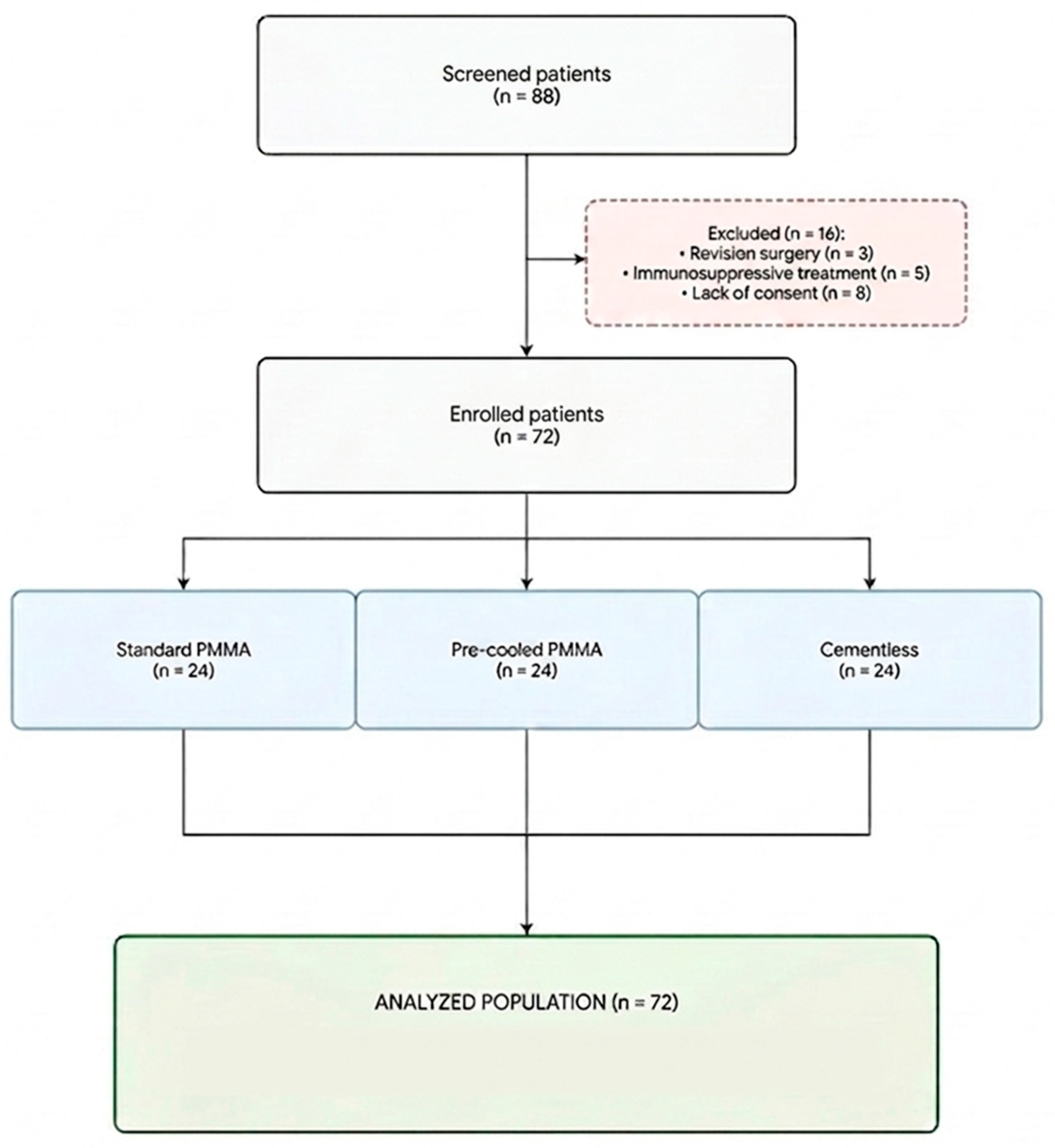
A total of 72 patients older than 55 years (mean age: 66.9 ± 8.8 years) were enrolled. The study consisted of 37 female and 35 male patients. Among the included patients, PMMA bone cement was used in 48 cases, while a cementless technique was applied in 24 patients. Within the cemented group, 24 patients received standard antibiotic-loaded PMMA cement, and another 24 patients received pre-chilled antibiotic-loaded PMMA cement. The bone cement used was Stryker Antibiotic Simplex (Stryker, Kalamazoo, MI, USA). Complete preoperative and 24 h postoperative laboratory data were available for all enrolled patients; consequently, no dropouts or exclusions occurred during follow-up. The final statistical analysis was therefore based on the data of all 72 patients (Figure 1).
The inclusion criteria comprised all adult patients for whom total hip arthroplasty was indicated by an orthopedic specialist and who provided informed consent to participate in the study. Exclusion criteria included the need for revision surgery and patients receiving immunosuppressive or cytostatic therapy. Comorbidities and lifestyle factors (e.g., smoking, alcohol consumption, chronic obstructive pulmonary disease) were recorded using standardized data collection forms.

Data Collection and Biochemical Analyses

Patient data were recorded by an orthopedic specialist upon admission, followed by a preoperative anesthesiology evaluation. Eligibility and surgical suitability were determined jointly by specialists from both disciplines.
Clinical outcomes, pain scores (e.g., Visual Analog Scale), functional outcomes (e.g., Harris Hip Score), or implant survival were not collected as part of this study. The analysis is limited to biochemical biomarkers at two time points (preoperative and 24 h postoperative).
Laboratory investigations were performed at two time points: preoperatively (at least 12 h before surgery) and on the first postoperative day (24 h after surgery). The 24 h time point was selected based on research indicating that it often captures the peak of the systemic inflammatory response for several key mediators such as IL-6. However, because cytokines exhibit different temporal profiles (e.g., TNF-α typically peaks earlier), a single postoperative measurement may not represent true peak levels for all biomarkers and precludes assessment of the full inflammatory trajectory or resolution over time. Later time points were not investigated, as the primary aim of the study was to compare the early inflammatory effects of standard versus pre-chilled cement implantation, with a cementless group serving as control. Blood sampling was performed according to a standardized protocol from the antecubital vein.
For the determination of CRP, IL-6, and TNF-α levels, venous blood samples were collected and centrifuged at 2000 g for 10 min, and the serum was stored at −20 °C until further processing. Analyses were performed using an Abbott Architect i1000SR analyzer (Abbott Laboratories, Chicago, IL, USA).
CRP levels were measured on an ABX Pentra C400 Clinical Chemistry Analyzer (HORIBA, Kyoto, Japan) using ABX Pentra CRP CP reagent with a latex-enhanced immunoturbidimetric method, in accordance with the manufacturer’s instructions.
IL-6 and TNF-α concentrations were quantified using a chemiluminescent microparticle immunoassay on an automated analyzer with validated reagents, following the manufacturer’s protocol. Serum samples were used after centrifugation and storage at −20 °C until analysis.
Since the study focused on circulating cytokine levels, protein-based immunological assays were employed for biomarker measurement rather than gene expression analyses.
ESR was determined in mm/h using a Sysmex CA-620 automated analyzer (Sysmex Corporation, Kobe, Japan) according to the Westergren method, in compliance with the manufacturer’s recommendations.
In order to improve characterization of the study population and facilitate assessment of potential confounding factors, additional baseline demographic and clinical variables were collected and summarized, including osteoporosis status, body mass index (BMI), smoking history, major comorbidities, and chronic medication use. These parameters were descriptively analyzed to provide a more comprehensive overview of intergroup differences and their potential influence on postoperative inflammatory biomarker levels (Table 1).
Following adjustment for multiple comparisons, the isolated TNF-α difference observed between the standard and pre-chilled PMMA groups demonstrated reduced statistical robustness, supporting cautious interpretation of this finding. In addition, confidence interval analysis demonstrated relatively broad interval ranges for several biomarker comparisons, reflecting the limited sample size and statistical uncertainty associated with exploratory subgroup analysis.
Additional subgroup analyses stratified by biological sex were performed in order to evaluate potential sex-related differences in postoperative inflammatory biomarker responses between fixation technique groups.
Surgical approach, duration of surgery (minutes), intraoperative blood loss (mL), and type of anesthesia were recorded from operative notes. All procedures were performed via a lateral approach under rachianesthesia. Perioperative medication use (e.g., NSAIDs, additional corticosteroids) was not systematically documented beyond standard institutional protocols.
All data used in this study originated from real patients undergoing total hip arthroplasty at the Department of Orthopaedics and Traumatology, Clinical County Hospital of Mureș. After completion of routine clinical care, patient records were anonymized by removing all direct and indirect personal identifiers before statistical analysis.

3. Results

Patients in the cemented groups were systematically older and had poorer bone quality than those receiving cementless fixation. These baseline differences preclude causal attribution and likely explain the higher postoperative inflammatory markers observed in the cemented cohorts.
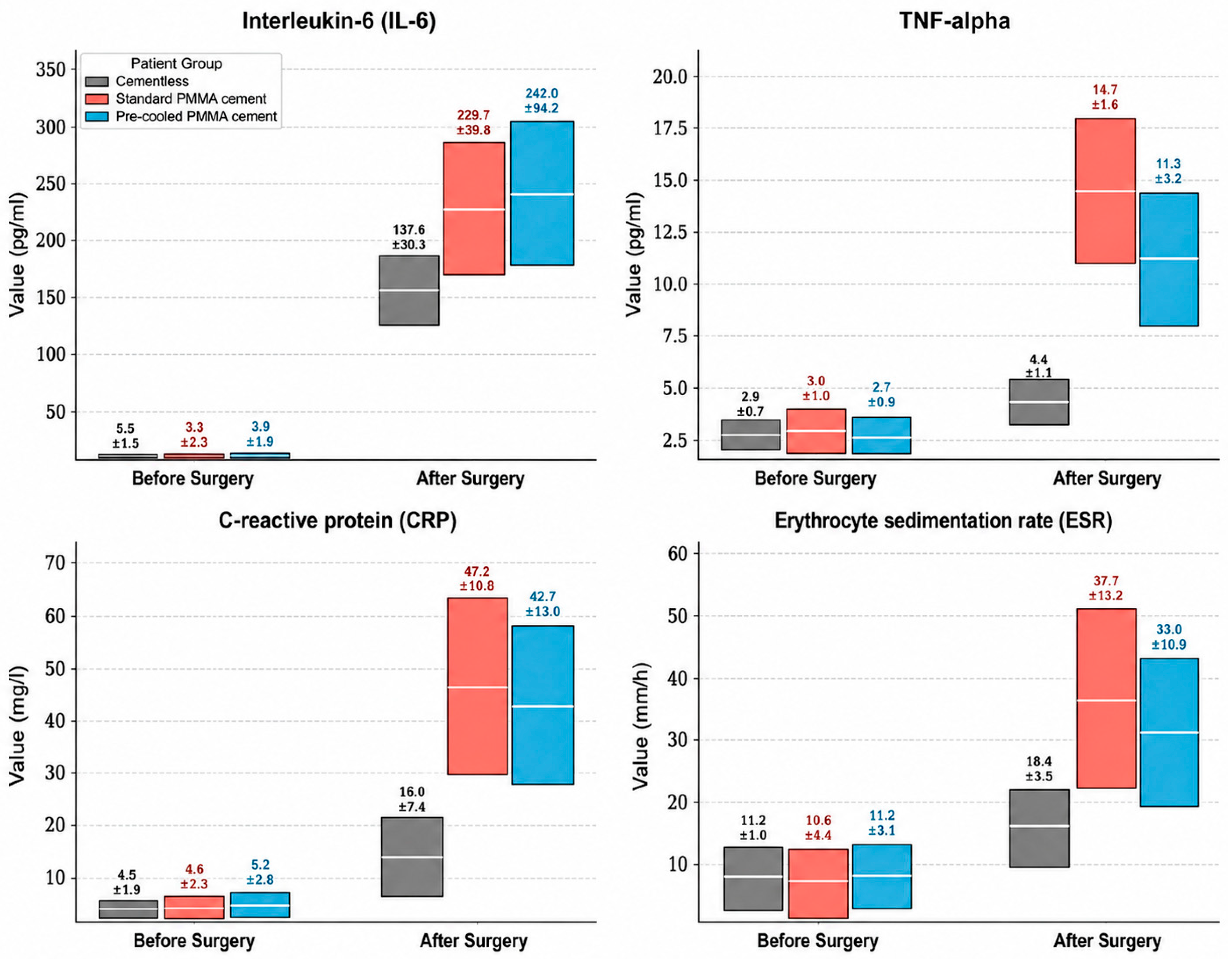
All results are descriptive in nature. One-way ANOVA revealed statistically significant differences between groups for all examined biomarkers (unadjusted p < 0.001). Both cemented groups exhibited higher postoperative levels compared to the cementless group. No significant differences were found between standard and pre-chilled PMMA groups for most markers (except for an isolated TNF-α finding interpreted as a Type I error). Due to confounding by indication and lack of adjustment for baseline covariates, these findings represent unadjusted associations only.
All results presented here are biochemical only. No clinical outcomes (fever, length of stay, readmission, infection, pain, function, or survival) were measured or analyzed.
In the entire study population, a statistically significant increase was observed in all examined parameters following the surgical procedure (p < 0.001) (Table 2). Table 1 presents the postoperative values of IL-6, TNF-α, ESR, and CRP across the three groups: standard cemented (n = 24), pre-chilled cemented (n = 24), and cementless (n = 24) cohorts.
A post hoc sex-based subgroup analysis was performed on the patients included in the study cohort (37 females, 35 males). Female patients demonstrated a higher prevalence of osteoporosis compared with male patients (51.4% vs. 2.9%, p < 0.001). In contrast, smoking was significantly more common among male patients (34.3% vs. 8.1%, p = 0.015). No statistically significant sex-based differences were identified regarding age (68.97 ± 7.49 vs. 65.71 ± 7.64 years, p = 0.072), BMI (26.21 ± 3.62 vs. 27.69 ± 2.65 kg/m2, p = 0.052), diabetes mellitus (21.6% vs. 22.9%, p = 1.000), cardiovascular disease (27.0% vs. 34.3%, p = 0.680), chronic inflammatory disease (13.5% vs. 2.9%, p = 0.227), or corticosteroid use (13.5% vs. 2.9%, p = 0.227).
Female patients exhibited significantly higher postoperative CRP concentrations than male patients (43.59 ± 18.63 mg/L vs. 28.21 ± 16.65 mg/L, p < 0.001). Postoperative IL-6 levels also tended to be higher among females (227.70 ± 63.34 pg/mL vs. 199.14 ± 64.31 pg/mL), although this difference did not reach statistical significance (p = 0.062). No significant sex-related differences were observed for preoperative IL-6, TNF-α, CRP, ESR values, or postoperative TNF-α and ESR measurements (all p > 0.05).
The correlation between pre- and postoperative parameter values is illustrated in Table 2. All investigated biomarkers showed significant differences between the two time points (p < 0.001), with demonstrable correlations in every case. A weak correlation was observed for IL-6 levels, whereas moderate correlations were found for TNF-α, ESR, and CRP (r = 0.40–0.59).
Prior to statistical analysis, the distribution of continuous variables was assessed using the Shapiro–Wilk test, and homogeneity of variances was examined using Levene’s test, which indicated heterogeneous variances for several biomarkers. Given the heterogeneity of variances, we performed both standard one-way ANOVA and the non-parametric Kruskal–Wallis test. All primary findings remained highly consistent across both parametric and non-parametric approaches.
The Kruskal–Wallis test confirmed statistically significant differences between groups for all examined postoperative biomarkers (p < 0.001 for all). Post hoc pairwise comparisons using Mann–Whitney U tests (with appropriate caution for multiple comparisons) showed that both cemented groups had significantly higher levels than the cementless group (all p < 0.001), while no significant differences were observed between standard and pre-chilled PMMA groups for IL-6, CRP, and ESR (p > 0.34). The isolated difference in TNF-α remained statistically detectable (p = 0.010) but continues to be interpreted as a likely Type I error in the context of multiple testing. When interpreting the lack of significant differences between standard and pre-chilled PMMA groups for IL-6, CRP, and ESR, it is important to note that systemic inflammatory markers are insensitive to localized reductions in thermal injury at the cement–bone interface. The surgical procedure itself induces a substantial systemic response that could overwhelm any modest local signal from reduced polymerization temperature.
Post hoc power analysis confirmed high statistical power (>95%) for all primary comparisons based on the observed effect sizes.
The ANOVA analysis revealed statistically significant differences between groups for all examined biomarkers. Both cemented groups exhibited higher postoperative IL-6, TNF-α, CRP, and ESR levels compared to the cementless group (p < 0.001 for all comparisons). No significant differences were found between the standard and pre-chilled PMMA groups for IL-6, CRP, and ESR, while TNF-α was slightly higher in the pre-chilled group (p = 0.005):
  • IL-6: F = 18.46; p < 0.001; η2 = 0.35;
  • TNF-α: F = 72.97; p < 0.001; η2 = 0.68;
  • CRP: F = 35.28; p < 0.001; η2 = 0.51;
  • ESR: F = 29.96; p < 0.001; η2 = 0.46.
The effect size values indicated medium-to-large and large effects, particularly in the case of TNF-α.
According to Tukey’s post hoc analysis, both the standard PMMA and pre-chilled PMMA groups exhibited significantly higher postoperative IL-6, TNF-α, CRP, and ESR levels compared to the cementless group (p < 0.001 for all comparisons).
Between the standard and pre-chilled PMMA groups, no significant difference was observed in IL-6 (p = 0.711), CRP (p = 0.617), or ESR (p = 0.437), whereas a small but significant difference was found for TNF-α (p = 0.005) (Table 3).
TNF-α levels were modestly higher in the pre-chilled group (p = 0.005). However, this difference was not accompanied by corresponding changes in IL-6, CRP, or ESR. Given the absence of a plausible biological mechanism and the multiple comparisons performed, we interpret this as a Type I error.
Shapiro–Wilk normality test (postoperative values per group):
All postoperative biomarker distributions were consistent with normality within each group (p > 0.05 for IL-6, TNF-α, CRP, and ESR in all three groups).
Kruskal–Wallis test (non-parametric one-way ANOVA):
The test confirmed highly significant differences between the three groups for all postoperative biomarkers:
  • IL-6 Post: H = 25.85, p < 0.0001;
  • TNF-α Post: H = 49.62, p < 0.0001;
  • CRP Post: H = 39.88, p < 0.0001;
  • ESR Post: H = 39.93, p < 0.0001.
Post hoc pairwise Mann–Whitney U tests (with caution for multiple comparisons) showed the same pattern as the original ANOVA: both cemented groups significantly higher than the cementless group (all p < 0.001), with no meaningful differences between standard and pre-chilled PMMA groups (except the isolated TNF-α finding).
The cemented and cementless arthroplasty groups have differed in baseline clinical and demographic characteristics, particularly with regard to age, bone quality, presence of osteoporosis, comorbidities, and surgical complexity. Key clinical parameters and comorbidities of the enrolled patients were recorded at the group level and analyzed using descriptive statistical methods. Given the exploratory nature of the study and the limited sample size, no multivariate regression adjustment was performed. Therefore, the potential influence of confounding factors should be considered when interpreting the results.
In this non-randomized observational study, patients undergoing cemented total hip arthroplasty with PMMA bone cement showed higher early postoperative inflammatory biomarker levels compared to those with cementless fixation. Pre-chilled PMMA did not result in significant differences compared to standard PMMA for most of the examined biomarkers, suggesting that the effect of pre-chilling on the inflammatory response is limited (Figure 2). However, due to the non-randomized allocation of fixation technique based on bone quality, patient age, and surgical judgment, these differences can be partly or largely attributable to selection bias and confounding factors.
We performed Mann–Whitney U tests (consistent with the non-parametric approach) for the pairwise comparison between standard and pre-chilled PMMA groups across the four postoperative biomarkers. Raw and adjusted p-values are reported below:
  • TNF-α Post: raw p = 0.0103;
  • Bonferroni-adjusted (4 comparisons): p = 0.041;
  • FDR-adjusted (Benjamini–Hochberg): p = 0.0103.
The difference remains statistically significant after both corrections (though borderline after a conservative Bonferroni adjustment). We have therefore revised our interpretation accordingly.
Between the standard and pre-chilled PMMA groups, no significant differences were observed for postoperative IL-6 (p = 0.711), CRP (p = 0.617), or ESR (p = 0.437). For TNF-α, a statistically significant difference was detected (raw p = 0.010). After correction for multiple comparisons across the four biomarkers, the difference remained significant using FDR (p = 0.010) and was borderline significant using Bonferroni adjustment (p = 0.041). This isolated finding should be interpreted with caution, as it was not accompanied by corresponding changes in other inflammatory markers and lacks a clear biological rationale in the context of pre-chilling.
All biomarkers increased significantly from preoperative to 24 h postoperative values (p < 0.001). It should be noted that the 24 h measurement may not coincide with the individual peak for every marker (particularly TNF-α), and therefore, the full temporal dynamics of the inflammatory response could not be evaluated.
Perioperative characteristics were largely comparable across groups. All patients underwent surgery via the same lateral approach under rachianesthesia. Mean operative duration and blood loss showed only minor, non-significant differences between groups (Table 4). These variables are therefore unlikely to fully account for the observed differences in postoperative inflammatory biomarkers.

4. Discussion

The aim of the present study was to analyze the inflammatory response following THA, with particular emphasis on the effect of PMMA bone cement used for femoral component fixation. The results demonstrated a significant postoperative increase in all examined parameters: IL-6, TNF-α, ESR, and CRP. Notably, patients undergoing cemented arthroplasty exhibited higher postoperative inflammatory biomarker levels compared to those in the cementless group. This study was limited to the early postoperative period (24 h after surgery). Therefore, no conclusions can be drawn regarding the duration of the observed differences or their evolution beyond this time point; thus, the present findings primarily reflect early systemic immune activation [7,8,9,10].
Female patients demonstrated consistently higher postoperative inflammatory marker values compared with male patients; however, statistically significant differences were identified only for postoperative CRP levels. These findings suggest that female patients may exhibit a more pronounced postoperative systemic inflammatory response following arthroplasty, particularly with respect to CRP elevation. The observed tendency toward higher postoperative IL-6 levels in females further supports this interpretation, although larger cohorts would be required to confirm this association statistically. The significantly higher prevalence of osteoporosis among female patients may also contribute to differences in postoperative inflammatory and bone remodeling responses [11,12].
Our findings are generally consistent with previous investigations demonstrating increased postoperative inflammatory biomarker expression following cemented arthroplasty procedures. Several studies have reported elevated postoperative IL-6 and CRP levels in association with PMMA cement use, potentially related to the exothermic polymerization reaction, monomer-related cytotoxicity, and increased intramedullary pressure during cement insertion. In contrast, cementless fixation techniques may induce a comparatively reduced systemic inflammatory response because they avoid PMMA-associated thermal and chemical effects, although press-fit implantation itself may still generate substantial local bone and soft tissue trauma [13,14,15]. The significantly higher IL-6 and TNF-α levels observed in the cemented groups of the present study may therefore reflect a multifactorial inflammatory process involving thermal stress, cytokine activation secondary to bone marrow embolization, endothelial activation, and tissue injury caused by cement polymerization. Furthermore, the potential reduction in inflammatory marker expression observed with pre-chilled PMMA cement may be explained by attenuation of peak polymerization temperatures and slower polymerization kinetics, thereby reducing local thermal injury and secondary cytokine release [16]. Nevertheless, because of the non-randomized design and the presence of baseline intergroup differences, these proposed mechanisms remain hypothetical and require confirmation through dedicated mechanistic studies.
Interpretation of the present findings requires several important caveats. No clinical outcomes were collected in this study. The analysis was restricted to biochemical markers at two time points and did not include fever, length of hospital stay, infection rates, pain, function, or implant survival. Because of this, the results have no direct clinical implications and should be regarded as hypothesis-generating.
Given the limited number of studies on this topic, previous reviews suggest that both cemented and cementless prostheses can elicit foreign body reactions through adaptive or reactive mechanisms. Our results are consistent with observations that, despite its favorable mechanical properties, PMMA can induce immune activation and local tissue irritation via polymerization by-products, particularly heat generation and residual monomers [17].
The postoperative rise in inflammatory markers observed across all groups highlights the substantial systemic inflammatory response elicited by the surgical procedure itself. The elevation of IL-6 and TNF-α levels, in particular, reflects activation of the innate immune response, with these cytokines playing a central role in acute inflammatory processes. Although previous studies have suggested a potential role for these biomarkers in the context of implant-related complications [18,19], the present investigation did not evaluate clinical endpoints, infectious events, follow-up data, or long-term outcomes. No prognostic or diagnostic conclusions can be drawn from the current results. The observed correlations between pre- and postoperative values, especially for TNF-α, ESR, and CRP, reflect the magnitude of the early systemic response but do not allow inferences regarding their utility for postoperative monitoring or complication detection. The marked rise in CRP and ESR is a well-documented phenomenon observed across various types of arthroplasty [20,21,22,23,24].
The present study found a significant postoperative increase in all inflammatory biomarkers (IL-6, TNF-α, CRP, and ESR) across all groups at 24 h, with higher levels in both cemented groups compared to the cementless group. These findings are consistent with previous reports demonstrating elevated systemic inflammation following cemented total hip arthroplasty [3,4]. For instance, Ukaj and colleagues reported higher postoperative IL-6, TNF-α, CRP, and ESR in cemented versus uncemented procedures, aligning with the unadjusted differences observed here. Similarly, earlier work by Szypuła et al. [4] noted increased proinflammatory cytokine levels in cemented arthroplasty.
Regarding pre-chilled PMMA cement, our data showed no meaningful differences in systemic biomarkers compared to standard PMMA for IL-6, CRP, and ESR. This observation does not support a substantial systemic anti-inflammatory effect of pre-chilling under the conditions studied. While pre-chilling is known to reduce peak polymerization temperatures in laboratory and ex vivo settings [2,21,22,23], the present study did not measure intraoperative temperatures or local tissue responses. Therefore, any potential local benefit at the cement–bone interface remains hypothetical and requires direct assessment in future studies. Importantly, this technique does not cause a clinically relevant deterioration in the mechanical properties of the cement, thereby preserving implant stability and long-term fixation [2,25].
Data-supported conclusions are limited to the descriptive observation of higher biomarker levels in cemented versus cementless groups and the lack of difference between standard and pre-chilled cement in systemic markers. Mechanistic interpretations linking these differences primarily to cement polymerization (thermal or chemical effects) or to pre-chilling remain speculative, as the non-randomized design and baseline imbalances preclude causal attribution. Future research should integrate direct measurements (e.g., intraoperative thermography, local cytokines, or histology) to test these hypotheses.

4.1. Antibiotic-Loaded PMMA Bone Cement

Antibiotic-loaded bone cement influences inflammatory responses through both direct effects on cytokine production and indirect effects related to infection control, with the nature and magnitude of the response depending on the specific antibiotic used and clinical context.
PMMA bone cement itself provokes a systemic inflammatory response. A prospective study of 58 patients undergoing total hip arthroplasty found that cemented procedures (with PMMA) resulted in significantly higher postoperative levels of histamine, TNF-α, IL-6, CRP, and ESR compared to uncemented procedures at 24 h, with more pronounced increases in female patients [3]. This demonstrates that the cement material itself is pro-inflammatory, independent of antibiotic content.
The addition of antibiotics to bone cement can modulate inflammatory responses in different ways:
Anti-inflammatory effects: In a rat femur critical-size defect model, antibiotic-supplemented cement (gentamicin, teicoplanin, and fusidic acid) significantly decreased serum TNF-α levels compared to control cement without antibiotics. This suggests certain antibiotics may dampen the inflammatory response to the cement itself [26].
Pro-inflammatory cytokine induction: In vitro studies of peripheral blood mononuclear cells exposed to bone cement extracts showed that leachable components can induce the release of pro-inflammatory cytokines (IL-1β, TNF-α, IL-6, and GM-CSF) that are implicated in bone resorption and aseptic loosening. The magnitude varied by cement formulation [27].
Modified bone cement formulations: Novel composite bone cements (such as enoxaparin sodium–PMMA) have demonstrated anti-inflammatory properties in co-culture models, reducing IL-6, TNF-α, and ICAM expression while promoting anti-inflammatory IL-10, facilitating M2 macrophage polarization, and reducing endothelial cell apoptosis [28].
In the setting of established infection, antibiotic-impregnated bone cement effectively controls inflammation. A retrospective study of 40 patients with postoperative infections after femoral shaft fracture treatment found that vancomycin-impregnated cement rods led to significant decreases in inflammatory markers (WBC, ESR, CRP, and procalcitonin) with 100% infection control and complete bone healing [29].
Beyond direct inflammatory modulation, antibiotic-loaded cement can enhance tissue responses. In the Masquelet technique for critical-size bone defects, antibiotic-supplemented cement increased the expression of TGF-β and VEGF in induced membranes, supporting osteogenesis and membrane progression while reducing systemic TNF-α [26].
Regarding infection prevention in primary arthroplasty, evidence is mixed. The American Academy of Orthopaedic Surgeons guidelines note that observational studies show variable results, with some demonstrating decreased infection risk with antibiotic cement while others show no difference [30]. A large randomized trial (WHiTE 8) found no significant difference in deep surgical site infections at 90 days between high-dose dual-antibiotic-loaded cement versus standard single-antibiotic-loaded cement in hip hemiarthroplasty [25].
Antibiotic-loaded cement achieves only low serum antibiotic concentrations with minimal systemic toxicity in patients without hepatic or renal disease [31]. The inflammatory response appears primarily local rather than systemic in terms of antibiotic effects, though the cement material itself does provoke measurable systemic inflammation [32].
Some clinical studies have also indicated that certain postoperative complications after THA occur more frequently in women, although the relationship between sex and the inflammatory response requires further investigation [33,34,35,36].
Elevated serum levels of IL-6, TNF-α, CRP, and ESR represent an expected physiological response following major surgery such as total hip arthroplasty (THA) and constitute part of the normal acute-phase reaction to surgical tissue trauma [37,38,39]. Although prior literature has associated these inflammatory biomarkers with various postoperative processes, including infection surveillance and potential aseptic loosening, the present study does not demonstrate that the observed intergroup differences in biomarker concentrations translate into clinically meaningful differences in patient outcomes [40,41,42] The investigation was deliberately limited to biochemical parameters at a single postoperative time point and did not include any clinical endpoints such as pain, functional recovery, complication rates, infection incidence, length of hospital stay, or implant survival. Consequently, the manuscript refrains from drawing direct connections between the measured biomarker elevations and broader clinical implications, positioning the findings firmly within an exploratory, hypothesis-generating framework.
The results confirm a more pronounced early systemic inflammatory response in patients undergoing cemented THA; however, this observation is heavily confounded by baseline differences in patient frailty, age, and bone quality rather than representing a direct causal effect of the cement itself [43,44]. These biochemical findings therefore do not provide a reliable basis for guiding surgical decision-making between cemented and cementless fixation, predicting complications, or endorsing the routine use of pre-chilled PMMA cement to mitigate clinically relevant inflammation. Larger-scale, randomized controlled trials incorporating serial biomarker assessments, robust adjustment for confounders, and standardized clinical outcome measures will be essential to determine the true translational and prognostic significance of these observations. As such, the present article serves primarily as a foundation for future research rather than as guidance for current clinical practice [45,46].

4.2. Limitations

The present study has several limitations that should be considered when interpreting the findings. First, the non-randomized observational design introduces substantial risk of confounding. Cemented fixation was preferentially used in older patients with poorer bone quality and a higher burden of comorbidities. Because no multivariable regression or propensity-score adjustment was performed, the observed differences between cemented and cementless groups should be interpreted as descriptive associations rather than causal effects of the fixation technique.
Second, this investigation was designed as an exploratory pilot study and included a relatively small sample from a single institution. Although statistically significant differences were detected for several biomarkers, the limited sample size restricts generalizability, contributes to wider confidence intervals, and limits the feasibility of adjusted analyses.
Third, inflammatory biomarkers were assessed only at two time points (preoperatively and 24 h postoperatively). Consequently, the temporal evolution of the inflammatory response could not be evaluated, and the 24 h measurement may not have captured the peak concentration of all biomarkers, particularly TNF-α.
Fourth, the study was restricted to systemic biochemical markers and did not include clinical outcomes such as pain, functional recovery, complications, infection rates, implant survival, or patient-reported outcome measures. Therefore, the clinical significance of the observed biomarker differences remains uncertain.
Finally, no direct assessment of local biological effects was performed. Intraoperative temperature measurements, histological evaluation, local cytokine analyses, and markers of thermal tissue injury were not collected. Consequently, although pre-chilled PMMA cement did not reduce systemic inflammatory markers, a potential protective effect at the cement–bone interface cannot be excluded. Furthermore, perioperative factors such as medication use and surgical complexity were not comprehensively analyzed and may have contributed to residual confounding.
The present study did not include a formal a priori sample size justification because it was conceived as a pilot exploratory cohort. Consequently, the possibility of Type II error for smaller effects cannot be excluded, and the findings should be interpreted as hypothesis-generating rather than definitive. The sample size was therefore based on the number of eligible consecutive patients available during the study period.
The present study focused exclusively on systemic inflammatory biomarkers and did not include assessment of postoperative pain, functional recovery, patient-reported outcome measures, complications, infection, implant survival, or radiographic outcomes. Consequently, the clinical significance of the observed biomarker differences cannot be determined, and the findings should be interpreted as biological observations rather than evidence of clinically meaningful differences between fixation techniques.
Future multicenter studies with larger cohorts, serial biomarker measurements, direct local assessments, and clinically relevant outcome measures are required to validate these findings and clarify their biological and clinical significance.

5. Conclusions

In this non-randomized prospective observational pilot study, patients undergoing cemented total hip arthroplasty exhibited higher early postoperative inflammatory biomarker levels than those receiving cementless fixation. However, because cemented fixation was preferentially used in older patients with poorer bone quality, these differences represent confounded associations rather than a causal effect of PMMA cement. The findings are descriptive and hypothesis-generating only and should not guide clinical decision-making.
No consistent differences were observed between standard and pre-chilled PMMA cement. The isolated TNF-α elevation in the pre-chilled group remained significant after FDR correction but was borderline after Bonferroni adjustment and of uncertain clinical relevance. Although pre-chilling did not reduce systemic inflammatory markers, intraoperative temperatures and local tissue injury were not assessed; therefore, a potential effect on thermal necrosis at the cement–bone interface cannot be excluded.
The study was limited to biochemical markers measured at a single 24 h postoperative time point and did not include clinical, functional, radiological, patient-reported, or long-term outcomes. Consequently, no conclusions can be drawn regarding pain, function, complications, infection risk, implant integration, aseptic loosening, or implant performance. Larger, adequately powered prospective studies—ideally multicenter randomized trials incorporating robust confounder control, predefined multiple-comparison adjustment strategies, serial biomarker measurements, and extended follow-up—are required to validate these exploratory findings, clarify the longitudinal inflammatory response to different fixation techniques, and determine the clinical significance of postoperative biomarker changes, including the observed TNF-α differences.

Author Contributions

Conceptualization, G.T.S. and A.M.F.; methodology, G.T.S. and A.M.F.; formal analysis, S.G.Z.; investigation, G.T.S., A.M.F. and O.M.R.; data curation, S.G.Z. and T.S.P.; writing—original draft preparation, G.T.S. and A.M.F.; writing—review and editing, all authors; supervision, O.M.R. and T.S.P.; project administration, T.S.P. All authors have read and agreed to the published version of the manuscript.

Funding

This research received no external funding.

Institutional Review Board Statement

The study was conducted in accordance with the Declaration of Helsinki and approved by the Ethics Committee of the Mureș County Clinical Hospital (registration number: 21212/13.12.2023, approval date: 13 December 2023).

Informed Consent Statement

Informed consent was obtained from all subjects involved in the study.

Data Availability Statement

The anonymized dataset generated and analyzed during the current study is available from the corresponding author upon reasonable request and after approval by the Institutional Ethics Committee. The data are not publicly available due to privacy and ethical restrictions; they originate from real patient records and are not synthetic.

Conflicts of Interest

The authors declare no conflicts of interest.

Abbreviations

The following abbreviations are used in this manuscript:
CRPC-reactive protein
ESRErythrocyte sedimentation rate
IL-6Interleukin-6
PMMAPolymethyl methacrylate
THATotal hip arthroplasty
TNF-αTumor necrosis factor-alpha

References

  1. Szoradi, G.T.; Feier, A.M.; Zuh, S.G.; Russu, O.M.; Pop, T.S. Polymethyl methacrylate bone cement polymerization induced thermal necrosis at the cement–bone interface: A narrative review. Appl. Sci. 2024, 14, 11651. [Google Scholar] [CrossRef]
  2. Szoradi, G.T.; Feier, A.M.; Russu, O.M.; Zuh, S.G.; Pop, T.S. The impact of mixing techniques on PMMA bone cement subjected to two different cooling techniques: A pilot study of thermal management strategies in orthopedic applications. Biomedicines 2025, 13, 3071. [Google Scholar] [CrossRef] [PubMed]
  3. Ukaj, S.; Ukaj, D.; Dervishaj, F.; Dyla, D.; Krasniqi, E.; Elezi, G.; Obërtinca, R.; Boshnjaku, A. Systemic inflammatory response to cemented and uncemented total hip arthroplasty with PMMA bone cement. Sci. Rep. 2025, 15, 40957. [Google Scholar] [CrossRef] [PubMed]
  4. Szypuła, J.; Cabak, A.; Kiljański, M.; Boguszewski, D.; Tomaszewski, W. Comparison of biocompatibility of cemented vs. cementless hip joint endoprostheses based on postoperative evaluation of proinflammatory cytokine levels. Med. Sci. Monit. 2016, 22, 4830–4835. [Google Scholar] [CrossRef] [PubMed]
  5. Aggarwal, A.; Sinha, V.; Chan, E.; Parapuram, A. An elevated C-reactive protein level in an inpatient rehabilitation setting after joint replacement: To act or not to act?—That is the question. Medicine 2021, 100, e24584. [Google Scholar] [PubMed]
  6. Thordardottir, S.; Vikingsdottir, T.; Bjarnadottir, H.; Jonsson, H.; Gudbjornsson, B. Activation of complement following total hip replacement. Scand. J. Immunol. 2016, 83, 219–224. [Google Scholar] [CrossRef] [PubMed]
  7. Srivastava, A.K.; Surgical Management of Osteoarthritis of the Knee Work Group, Staff of the American Academy of Orthopaedic Surgeons. American Academy of Orthopaedic Surgeons Clinical Practice Guideline Summary of Surgical Management of Osteoarthritis of the Knee. J. Am. Acad. Orthop. Surg. 2023, 31, 1211–1220. [Google Scholar] [CrossRef] [PubMed]
  8. Scarano, A. Peri-implant disease caused by residual cement around implant-supported restorations: A clinical report. J. Biol. Regul. Homeost. Agents. 2021, 83, 219–224. [Google Scholar] [CrossRef] [PubMed]
  9. Jiranek, W.A.; Machado, M.; Jasty, M.; Jevsevar, D.; Wolfe, H.J.; Goldring, S.R.; Goldberg, M.J.; Harris, W.H. Production of cytokines around loosened cemented acetabular components. Analysis with immunohistochemical techniques and in situ hybridization. J. Bone Jt. Surg. 1993, 75, 863–879. [Google Scholar] [CrossRef] [PubMed]
  10. Wawrzynski, J.; Gil, J.A.; Goodman, A.D.; Waryasz, G.R. Hypersensitivity to orthopedic implants: A review of the literature. Rheumatol. Ther. 2017, 4, 45–56. [Google Scholar] [CrossRef] [PubMed]
  11. Mitsuhata, H.; Saitoh, J.; Saitoh, K.; Fukuda, H.; Hirabayasi, Y.; Shimizu, R.; Hasegawa, J.; Matsumoto, S.; Enzan, K. Methylmethacrylate bone cement does not release histamine in patients undergoing prosthetic replacement of the femoral head. Br. J. Anaesth. 1994, 73, 779–781. [Google Scholar] [CrossRef] [PubMed]
  12. Gautschi, O.P.; Schlett, C.L.; Fournier, J.-Y.; Cadosch, D. Laboratory confirmed polymethyl-methacrylate (Palacos®)-hypersensitivity after cranioplasty. Clin. Neurol. Neurosurg. 2010, 112, 915–916. [Google Scholar] [CrossRef] [PubMed]
  13. Megaloikonomos, P.D.; Mitsiokapa, E.; Flevas, D.A.; Kakouratos, G.; Kyrou, G.; Koulouvaris, P.; Mavrogenis, A.F. PMMA cement allergy misleading total knee arthroplasty infection. J. Long Term Eff. Med. Implant. 2017, 27, 13–20. [Google Scholar] [CrossRef] [PubMed]
  14. Pahlavan, S.; Hegde, V.; Bracey, D.N.; Jennings, J.M.; Dennis, D.A. Bone cement hypersensitivity in patients with a painful total knee arthroplasty: A case series of revision using custom cementless implants. Arthroplast. Today 2021, 11, 20–24. [Google Scholar] [CrossRef] [PubMed]
  15. Dietz, M.J.M.; McGowan, B.M.; Thomas, D.D.B.; Hunt, E.R.; Stewart, E.; Squire, M.W. Does cement viscosity impact antibiotic elution and in vitro efficacy against common prosthetic joint infection pathogens? Clin. Orthop. Relat. Res. 2025, 483, 488–497. [Google Scholar] [PubMed]
  16. Meeker, D.G.; Cooper, K.B.; Renard, R.L.; Mears, S.C.; Smeltzer, M.S.; Barnes, C.L. Comparative study of antibiotic elution profiles from alternative formulations of polymethylmethacrylate bone cement. J. Arthroplast. 2019, 34, 1458–1461. [Google Scholar] [CrossRef]
  17. Linde, K.N.; Rytter, S.; Søballe, K.; Madsen, F.; Langdahl, B.; Stilling, M. Component migration, bone mineral density changes, and bone turnover markers in cementless and cemented total knee arthroplasty: A prospective randomized RSA study in 53 patients with 2-year follow-up. Knee Surg. Sports Traumatol. Arthrosc. 2022, 30, 3100–3113. [Google Scholar] [PubMed]
  18. He, T.; Wu, W.; Huang, Y.; Zhang, X.; Tang, T.; Dai, K. Multiple biomarkers analysis for the early detection of prosthetic aseptic loosening of hip arthroplasty. Int. Orthop. 2013, 37, 1025–1031. [Google Scholar] [CrossRef] [PubMed]
  19. Cassuto, J.; Folestad, A.; Göthlin, J.; Malchau, H.; Kärrholm, J. The key role of proinflammatory cytokines, matrix proteins, RANKL/OPG and Wnt/β-catenin in bone healing of hip arthroplasty patients. Bone 2018, 107, 66–77. [Google Scholar] [CrossRef] [PubMed]
  20. Qureshi, A.A.; Virdi, A.S.; Didonna, M.L.; Jacobs, J.J.; Masuda, K.; Paprosky, W.P.; Thonar, E.J.; Sumner, D.R. Implant design affects markers of bone resorption and formation in total hip replacement. J. Bone Miner. Res. 2002, 17, 800–807. [Google Scholar] [CrossRef] [PubMed]
  21. Rassir, R.; Schuiling, M.; Sierevelt, I.N.; van der Hoeven, C.W.P.; Nolte, P.A. What Are the Frequency, Related Mortality, and Factors Associated with Bone Cement Implantation Syndrome in Arthroplasty Surgery? Clin. Orthop. Relat. Res. 2021, 479, 755–763. [Google Scholar] [CrossRef] [PubMed] [PubMed Central]
  22. Schober, P.; Boer, C.; Schwarte, L.A. Correlation coefficients: Appropriate use and interpretation. Anesth. Analg. 2018, 126, 1763–1768. [Google Scholar] [CrossRef] [PubMed]
  23. Grant, S.; Pincus, D.; Ruangsomboon, P.; Lex, J.; Sheth, U.; Ravi, B. Sex differences in complications following total hip arthroplasty: A Population-Based study. J. Arthroplast. 2024, 39, 3004–3008. [Google Scholar] [CrossRef] [PubMed]
  24. Patel, A.P.; Gronbeck, C.; Chambers, M.; Harrington, M.A.; Halawi, M.J. Gender and total joint arthroplasty: Variable outcomes by procedure type. Arthroplast. Today 2020, 6, 517–520. [Google Scholar] [CrossRef] [PubMed]
  25. Agni, N.R.; Costa, M.L.; Achten, J.; Peckham, N.; Dutton, S.J.; Png, M.E.; Reed, M.R. High-dose dual-antibiotic loaded cement for hip hemiarthroplasty in the UK (WHiTE 8): A randomised controlled trial. Lancet 2023, 402, 196–202. [Google Scholar] [PubMed]
  26. Ziroglu, N.; Koluman, A.; Kaleci, B.; Tanriverdi, B.; Tanriverdi, G.; Kural, A.; Bilgili, M.G. The antibiotics supplemented bone cement improved the Masquelet’s induced membrane in a rat femur critical size defect model. Injury 2023, 54, 329–338. [Google Scholar] [CrossRef] [PubMed]
  27. Granchi, D.; Ciapetti, G.; Filippini, F.; Stea, S.; Cenni, E.; Pizzoferrato, A.; Toni, A. In vitro cytokine production by mononuclear cells exposed to bone cement extracts. Biomaterials 2000, 21, 1789–1795. [Google Scholar] [CrossRef] [PubMed]
  28. Hao, K.; Hu, J.; Wang, J.; Li, F. Novel composite bone cement modulates inflammatory response in vitro. Sci. Rep. 2025, 15, 8897. [Google Scholar] [CrossRef] [PubMed]
  29. Gao, L.C.; Chen, J.N.; Li, M.G.; Li, F.B. Effectiveness of antibiotic-impregnated bone cement in treating postoperative infections after femoral shaft fracture treatment with intramedullary nailing. Sci. Rep. 2025, 15, 16992. [Google Scholar] [CrossRef] [PubMed]
  30. Chen, A.F.; Riedel, S. A Case Illustrating the Practical Application of the AAOS Clinical Practice Guideline: Diagnosis and Prevention of Periprosthetic Joint Infection. J. Am. Acad. Orthop. Surg. 2020, 28, e1081–e1085. [Google Scholar] [CrossRef] [PubMed]
  31. Wasko, M.K.; Kaminski, R. Custom-made antibiotic cement nails in orthopaedic trauma: Review of outcomes, new approaches, and perspectives. Biomed. Res. Int. 2015, 2015, 387186. [Google Scholar] [CrossRef] [PubMed]
  32. Mercurio, M.; Gasparini, G.; Sanzo, V.; Familiari, F.; Castioni, D.; Galasso, O. Cemented Total Knee Arthroplasty Shows Less Blood Loss but a Higher Rate of Aseptic Loosening Compared with Cementless Fixation: An Updated Meta-Analysis of Comparative Studies. J. Arthroplast. 2022, 37, 1879–1887.e4. [Google Scholar] [CrossRef] [PubMed]
  33. Alagha, M.A.; Cobb, J.; Liddle, A.; Malchau, H.; Rolfson, O.; Mohaddes, M. Adverse Outcomes after Cemented and Cementless Primary Elective Total Hip Arthroplasty in 60,064 Matched Patients: A Study of Data from the Swedish Arthroplasty Register. J. Arthroplast. 2025, 40, 1738–1744.e2. [Google Scholar] [CrossRef]
  34. Lindberg-Larsen, M.; Petersen, P.B.; Jørgensen, C.C.; Overgaard, S.; Kehlet, H.; Lundbeck Foundation Center for Fast-track Hip and Knee Arthroplasty Collaborating Group. Postoperative 30-day complications after cemented/hybrid versus cementless total hip arthroplasty in osteoarthritis patients > 70 years. Acta Orthop. 2020, 91, 286–292. [Google Scholar] [CrossRef] [PubMed]
  35. Okike, K.; Chan, P.H.; Prentice, H.A.; Paxton, E.W.; Burri, R.A. Association Between Uncemented vs Cemented Hemiarthroplasty and Revision Surgery Among Patients with Hip Fracture. JAMA 2020, 323, 1077–1084. [Google Scholar] [CrossRef] [PubMed]
  36. Leta, T.H.; Lie, S.A.; Fenstad, A.M.; Lygre, S.H.L.; Lindberg-Larsen, M.; Pedersen, A.B.; W-Dahl, A.; Rolfson, O.; Bülow, E.; van Steenbergen, L.N.; et al. Periprosthetic joint infection after total knee arthroplasty with or without antibiotic bone cement. JAMA Netw. Open 2024, 7, e2412898. [Google Scholar] [CrossRef] [PubMed]
  37. Brokke, K.E.; Graman, M.; Servaas, S.; Sierevelt, I.N.; Steegers, M.A.H.; Nolte, P.A. Bone cement implantation syndrome: A scoping review. Br. J. Anaesth. 2025, 135, 1038–1050. [Google Scholar] [CrossRef] [PubMed]
  38. Moore, M.C.; Dubin, J.A.; Monárrez, R.; Bains, S.S.; Hameed, D.; Nace, J.; Mont, M.A.; Delanois, R.E. Cemented Versus Cementless Femoral Fixation for Total Hip Arthroplasty Following Osteoarthritis. J. Arthroplast. 2024, 39, 1545–1549. [Google Scholar] [CrossRef] [PubMed]
  39. Sumner, D.R.; Ross, R.; Purdue, E. Are there biological markers for wear or corrosion? A systematic review. Clin. Orthop. Relat. Res. 2014, 472, 3728–3739. [Google Scholar] [CrossRef] [PubMed] [PubMed Central]
  40. Santavirta, S.; Gristina, A.; Konttinen, Y.T. Cemented versus cementless hip arthroplasty: A review of prosthetic biocompatibility. Acta Orthop. Scand. 1992, 63, 225–232. [Google Scholar] [CrossRef] [PubMed]
  41. Klingebiel, S.; Theil, J.C.; Gosheger, G.; Schneider, K.N.; Timme, M.; Schorn, D.; Liem, D.; Rickert, C. Postoperative trends of serum C-Reactive protein levels after primary shoulder Arthroplasty—Normal trajectory and influencing factors. J. Clin. Med. 2020, 9, 3893. [Google Scholar] [CrossRef] [PubMed]
  42. Szadvári, I.; Ostatníková, D.; Babková Durdiaková, J. Sex differences matter: Males and females are equal but not the same. Physiol. Behav. 2023, 259, 114038. [Google Scholar] [CrossRef] [PubMed]
  43. Boshnjaku, A.; Bahtiri, A.; Feka, K.; Krasniqi, E.; Tschan, H.; Wessner, B. Impact of using population-specific cut-points, self-reported health, and socio-economic parameters to predict sarcopenia: A cross-sectional study in community-dwelling Kosovans aged 60 years and older. J. Clin. Med. 2022, 11, 5579. [Google Scholar] [CrossRef] [PubMed]
  44. Shi, F.; Zhang, W.; Yang, Y.; Yang, Y.; Zhao, J.; Xie, M.; Sheng, C.; Wang, S.; Wang, Q. Sex disparities of genomic determinants in response to immune checkpoint inhibitors in melanoma. Front. Immunol. 2021, 12, 721409. [Google Scholar] [CrossRef] [PubMed]
  45. Solarino, G.; Bizzoca, D.; Moretti, A.M.; D’apolito, R.; Moretti, B.; Zagra, L. Sex and Gender-Related differences in the outcome of total hip arthroplasty: A current concepts review. Medicina 2022, 58, 1702. [Google Scholar] [CrossRef] [PubMed]
  46. Allen, J.; Zumwalt, M. Biological sex differences in pain response and functional outcomes after orthopedic surgery procedures: A scoping review. Curr. Orthop. Pract. 2024, 35, 189–196. [Google Scholar] [CrossRef]
Figure 1. Patient inclusion/exclusion diagram.
Applsci 16 06303 g001
Figure 2. Mean values and standard deviation of each examined marker at least 12 h before surgery vs. 24 h following the surgery.
Applsci 16 06303 g002
Table 1. Baseline demographic and clinical variables across patient groups.
VariableNon-Cemented (n = 24)Standard PMMA (n = 24)Pre-Cooled PMMA (n = 24)
Age (years)59.3 ± 2.574.2 ± 3.169.4 ± 6.7
Female, sex, n (%)9 (37.5%)14 (58.3%)13 (54.2%)
BMI (kg/m2) 28.2 ± 3.525.4 ± 3.227.1 ± 3.1
Osteoporosis (n)1 (4.2%)10 (41.7%)7 (29.2%)
Smokers (n)9 (37.5%)3 (12.5%)5 (20.8%)
Diabetes (n)6 (25.0%)4 (16.7%)5 (20.8%)
Cardiovascular disease (n)1 (4.2%)11 (45.8%)6 (25.0%)
Chronic inflammatory disease (n)04 (16.7%)1 (4.2%)
Corticosteroid use, (n)04 (16.7%)1 (4.2%)
PMMA—polymethyl methacrylate; BMI—body mass index.
Table 2. Mean marker values preoperatively (≥12 h before surgery) vs. 24 h postoperatively.
GroupIL-6 pre (pg/mL)IL-6 Post (pg/mL)TNF-α Pre (pg/mL)TNF-α Post (pg/mL)CRP Pre (mg/L)CRP Post (mg/L)ESR Pre (mm/h)ESR Post (mm/h)
Avg. (95% CI)SDAvg. (95% CI)SDAvg. (95% CI)SDAvg. (95% CI)SDAvg. (95% CI)SDAvg. (95% CI)SDAvg. (95% CI)SDAvg. (95% CI)SD
Non-cemented5.68
(5.07–6.29)
1.45160.41 (147.62–173.19) 30.272.99 (2.70–3.28)0.684.45 (3.99–4.91)1.14.63 (3.83–5.44)1.9117.06 (13.92–20.20)7.4410.77 (9.08–12.47)417.87 (15.56–20.18)5.48
Standard PMMA5.29
(4.33–6.25)
2.28234.47 (209.64–259.29)58.783.08 (2.65–3.51)1.0114.05 (12.53–15.58)3.614.93 (3.86–6.00)2.5347.50 (40.42–54.58)16.7711.42 (9.55–13.29)4.4339.56 (33.99–45.14)13.21
Pre-cooled PMMA6 (5.18–6.82)1.94246.58 (219.48–273.67)64.162.80 (2.41–3.20)0.9311.39 (10.05–12.72)3.175.52 (4.32–6.71)2.8343.78 (37.43–50.13)15.0412.04 (9.91–14.17)5.0535.86 (31.25–40.47)10.91
PMMA—polymethyl methacrylate; IL-6—interleukin-6; TNF-α—tumor necrosis factor-alpha; CRP—C-reactive protein; ESR—erythrocyte sedimentation rate; SD—standard deviation; Avg.—average; CI—confidence interval.
Table 3. Statistical comparison (p-values) of inflammatory and clinical markers between three different fixation methods.
MarkerCementless vs. Standard PMMACementless vs. Pre-Cooled PMMAStandard vs. Pre-Cooled PMMA
IL-6p < 0.001p < 0.001p = 0.711
TNF-αp < 0.001p < 0.001p = 0.005
CRPp < 0.001p < 0.001p = 0.617
ESRp < 0.001p < 0.001p = 0.437
PMMA—polymethyl methacrylate; IL-6—interleukin-6; TNF-α—tumor necrosis factor-alpha; CRP—C-reactive protein; ESR—erythrocyte sedimentation rate.
Table 4. Statistical comparison (p-values) of perioperative characteristics between three different fixation methods.
VariableNon-Cemented (n = 24)Standard PMMA (n = 24)Pre-Cooled PMMA (n = 24)
Duration (mins), mean ± SD88.3 ± 23.777.7 ± 20.685.0 ± 29.6
Blood Loss (mL), mean ± SD483 ± 167413 ± 116402 ± 137
ApproachLateral (100%)Lateral (100%)Lateral (100%)
AnesthesiaRachianesthesia (100%)Rachianesthesia (100%)Rachianesthesia (100%)
PMMA—polymethyl methacrylate.
Disclaimer/Publisher’s Note: The statements, opinions and data contained in all publications are solely those of the individual author(s) and contributor(s) and not of MDPI and/or the editor(s). MDPI and/or the editor(s) disclaim responsibility for any injury to people or property resulting from any ideas, methods, instructions or products referred to in the content.