1. Introduction
Path planning is a fundamental technology for autonomous motion in intelligent systems such as mobile robots, autonomous vehicles, unmanned aerial vehicles (UAVs), and robotic manipulators. Its main objective is to generate a feasible and safe path from a given start point to a target point while avoiding obstacles and satisfying requirements related to path length, computational efficiency, motion smoothness, and operational safety [
1,
2,
3]. With the increasing application of intelligent equipment in logistics, service robots, agriculture, inspection, and transportation scenarios, path-planning algorithms are required to operate reliably in environments that are not only large-scale but also dense, cluttered, and geometrically constrained [
4,
5]. In such scenarios, the planning algorithm must balance global exploration capability, local obstacle-avoidance accuracy, real-time performance, and path quality.
Existing path-planning methods can generally be divided into graph-search-based methods, artificial-potential-field-based methods, intelligent optimization methods, and sampling-based methods. Classical graph-search algorithms such as Dijkstra and A* can obtain feasible paths in structured environments, but they usually require map discretization and may suffer from high computational costs when the search space becomes large or high-dimensional [
6]. The artificial potential field method has a simple structure and strong real-time performance, but it is prone to local minima in complex obstacle environments [
7]. Intelligent optimization and learning-based methods can improve global search capability and adaptability, but their performance often depends on parameter tuning, training data, or computational resources [
8,
9]. Compared with these methods, sampling-based algorithms do not require explicit discretization of the entire configuration space and have shown strong adaptability to complex and high-dimensional path-planning problems [
10].
Among sampling-based methods, the rapidly exploring random tree (RRT) algorithm has been widely used because of its simple implementation, probabilistic completeness, and strong exploration ability in unknown or complex spaces [
10,
11]. RRT incrementally builds a random search tree from the start point by sampling random points in the configuration space and extending the tree toward them until the target region is reached. This mechanism enables the algorithm to explore the free space efficiently without constructing a complete global map in advance. Therefore, RRT and its variants have been widely applied to mobile robot navigation, robotic manipulator motion planning, UAV path planning, and autonomous driving scenarios [
4,
5,
12].
However, the traditional RRT algorithm still has several limitations that restrict its practical application. First, the use of a fixed expansion step size makes it difficult to adapt to different environmental conditions. A large step size can improve exploration efficiency in open areas but may cause collisions or miss feasible passages in dense obstacle regions, whereas a small step size improves local accuracy but generates excessive redundant nodes and increases planning time. Second, the random sampling mechanism may lead to blind exploration, especially in narrow passages, where the probability of generating useful samples is low. Third, the path generated by the traditional RRT algorithm is usually composed of multiple polyline segments with redundant nodes and sharp turning angles, resulting in poor geometric smoothness and difficulty in subsequent trajectory tracking. Finally, nearest-neighbor search and collision detection are commonly implemented through global traversal, resulting in increasing computational costs as the number of tree nodes and obstacles grows [
13,
14].
To overcome these limitations, many improved RRT-based algorithms have been proposed. Kuffner and LaValle proposed RRT-Connect, which constructs two rapidly exploring random trees from the start and goal configurations to improve single-query planning efficiency [
15]. Karaman and Frazzoli proposed RRT*, which introduces rewiring and cost optimization mechanisms to achieve asymptotic optimality, but this improvement usually increases computational cost and convergence time [
16]. Islam et al. proposed RRT*-Smart to accelerate the convergence of RRT* by combining path optimization and biased sampling strategies [
17]. In addition, some studies have focused on directional guidance, path smoothing, optimized sampling, nearest-neighbor acceleration, and post-processing optimization to improve search efficiency and path quality [
4,
8,
12,
18,
19]. For example, Fast-RRT improves planning speed and path optimality, highlighting the weaknesses of traditional RRT in search-time stability, narrow-channel performance, and path optimality [
14].
In addition to algorithmic improvements, recent studies have emphasized that path planning should also be considered together with robot maneuverability and motion characteristics. Dolgov et al. investigated path planning for autonomous vehicles in unknown semi-structured environments and highlighted the importance of planning robustness, smoothness, and environmental uncertainty in practical autonomous driving scenarios [
20]. Cosenza et al. analyzed the maneuverability of a skid-steering six-wheeled robot using multibody modeling, showing that the planned trajectory may be affected by the motion characteristics and dynamic behavior of the robotic platform [
21]. These studies indicate that geometric path planning should not only focus on path length and planning time, but should also consider path smoothness and the feasibility of subsequent trajectory tracking.
More recent RRT-based studies have further focused on adaptive sampling, guided expansion, safety-aware planning, and path post-processing. Li and Tong proposed an improved RRT method with adjustable sampling probability and sampling area to enhance mobile robot path-planning efficiency [
22]. Oh et al. developed TA-RRT*, which uses terrain analysis to guide adaptive sampling and step-size adjustment, demonstrating the importance of environment-aware sampling in complex terrains [
23]. Faroni et al. proposed an adaptive hybrid local–global sampling strategy for informed sampling-based optimal planning, showing that dynamically balancing exploration and exploitation can improve convergence performance [
24]. Huang et al. proposed a UAV path-planning algorithm based on an improved artificial potential field and bidirectional RRT*, integrating adaptive sampling and dynamic step-size adjustment in complex three-dimensional environments [
25]. Fan et al. introduced BI-RRT*, which combines bidirectional search, obstacle expansion, informed sampling, and path refinement to improve path safety and planning performance [
26]. Lei et al. proposed a multi-strategy fusion RRT algorithm that integrates target bias, adaptive expansion, path optimization, and smoothing strategies [
27]. These studies show that recent RRT improvements are increasingly moving from single-module optimization toward integrated frameworks that jointly consider search efficiency, obstacle clearance, path compactness, and geometric smoothness.
Although the above studies have improved RRT-based planning from different perspectives, several issues remain unresolved. First, many methods mainly focus on a single aspect, such as sampling efficiency, path shortening, or path smoothing, while the coordination among adaptive exploration, collision safety, tree compactness, and path smoothness remains insufficient. Second, some algorithms improve path quality but introduce additional computational cost, limiting their suitability for lightweight real-time applications. Third, only limited studies provide module-wise ablation analysis and parameter sensitivity analysis to explain how each strategy contributes to the overall performance. Therefore, it is necessary to develop and evaluate an integrated RRT improvement framework that balances search efficiency, obstacle clearance, path compactness, and geometric smoothness.
To address the above problems, this paper proposes an integrated multi-strategy improved RRT framework for robot path planning. Rather than proposing a single isolated modification, this study combines several complementary modules within a unified implementation, including KD-Tree acceleration, adaptive step-size adjustment, safety-boundary collision checking, direct goal-connection, shortcut pruning, and spline-based path smoothing. The main contributions of this study are summarized as follows:
- (1)
A lightweight integrated RRT improvement framework is developed by combining KD-Tree acceleration, adaptive step-size adjustment, safety-boundary collision checking, direct goal-connection, shortcut pruning, and spline-based path smoothing.
- (2)
A direct goal-connection attempt and safety-validated shortcut pruning strategy are incorporated to reduce redundant tree expansion and remove unnecessary intermediate path nodes while maintaining collision-free feasibility.
- (3)
Comparative experiments are conducted against traditional RRT, RRT*, and RRT-Connect in four different scenarios, including simple sparse, complex dense, narrow-passage, and highly cluttered environments.
- (4)
A module-wise ablation study is performed to evaluate the individual contributions of KD-Tree acceleration, adaptive step-size adjustment, safety-boundary checking, pruning, and smoothing.
- (5)
A parameter sensitivity analysis is conducted for the balancing factor, safety margin, and spline sampling number. In addition, path smoothness is evaluated using turning-angle-based metrics to avoid overstating kinematic feasibility in a purely geometric planning framework.
The remainder of this paper is organized as follows.
Section 2 introduces the principle and limitations of the traditional RRT algorithm.
Section 3 presents the proposed multi-strategy improved RRT framework, including adaptive step-size adjustment, enhanced collision detection, KD-Tree acceleration, goal-connection, path pruning, smoothing, and computational complexity analysis.
Section 4 describes the simulation experiments and analyzes the comparative results, ablation study, and parameter sensitivity analysis under different scenarios.
Section 5 summarizes the main conclusions and discusses future research directions.
2. Principle of the Traditional RRT Algorithm
Before introducing the proposed improved RRT framework, this section first describes the basic principle and implementation process of the traditional RRT algorithm. The traditional RRT algorithm expands a random search tree from the start point by repeatedly performing random sampling, nearest-neighbor search, node extension, collision detection, and goal-region checking. By analyzing these core procedures, the limitations of the traditional algorithm can be clarified, providing a theoretical basis for the subsequent improvements in adaptive step-size adjustment, KD-Tree acceleration, enhanced collision detection, and path smoothing.
- (1)
Determining the core parameters and initial state
The path-planning environment is defined as a two-dimensional map with boundary . The start point and goal point are denoted as and , respectively. The obstacle space is represented by , and the free space is denoted as . The random tree is defined as , where is the node set and is the edge set. At initialization, the start point is added to as the root node, and the edge set is empty. The main algorithmic parameters include the maximum number of iterations , the fixed expansion step size , the goal-region threshold , and the goal-biased sampling probability .
- (2)
Generating candidate nodes for tree expansion
At each iteration, a candidate sampling point
is generated to guide the expansion of the random tree. To improve convergence toward the goal, the traditional RRT algorithm may adopt a goal-biased sampling strategy. With a probability of
, the goal point
is selected as the sampling point; otherwise, a random point is uniformly sampled from the free space. This process can be expressed as
- (3)
Determining the base point for tree expansion
After obtaining
, the algorithm searches the existing node set
to find the node closest to
. For any two nodes
and
, the Euclidean distance is defined as
Based on this distance metric, the nearest node
is selected as
In the traditional RRT algorithm, this nearest-neighbor search is usually implemented by linear traversal of all existing tree nodes, which leads to a time complexity of , where is the number of nodes in the tree.
- (4)
Constructing a new branch of the tree
Starting from
, a new node
is generated by extending toward
with a fixed step size
. If the distance between
and
is smaller than
,
is directly taken as
. Otherwise,
is calculated as
This fixed-step expansion mechanism is simple to implement, but it lacks adaptability in different environmental conditions. A large step size may cause collisions or miss narrow passages, whereas a small step size may generate excessive redundant nodes and increase planning time.
- (5)
Verifying node and path safety
After is generated, collision detection is performed to determine whether the new node and the connecting edge are located in the free space. The collision detection process includes point collision checking and line-segment collision checking. First, the algorithm checks whether lies inside any obstacle. For a circular obstacle with center and radius , a point collision occurs if the distance between and is less than or equal to . Second, the line segment is checked to determine whether it intersects any obstacle. If either the point collision check or the line-segment collision check fails, is discarded. Otherwise, is added to the node set , the edge is added to , and is recorded as the parent node of .
- (6)
Detecting whether the goal region has been reached
After the new node is added to the random tree, the algorithm checks whether it has reached the goal region. If the distance between and is smaller than the goal threshold , and the line segment from to is collision-free, the path is considered successfully found. The final path is then obtained by backtracking from the goal node to the root node through the parent-node chain. If no feasible path is found after iterations, the planning process is considered unsuccessful.
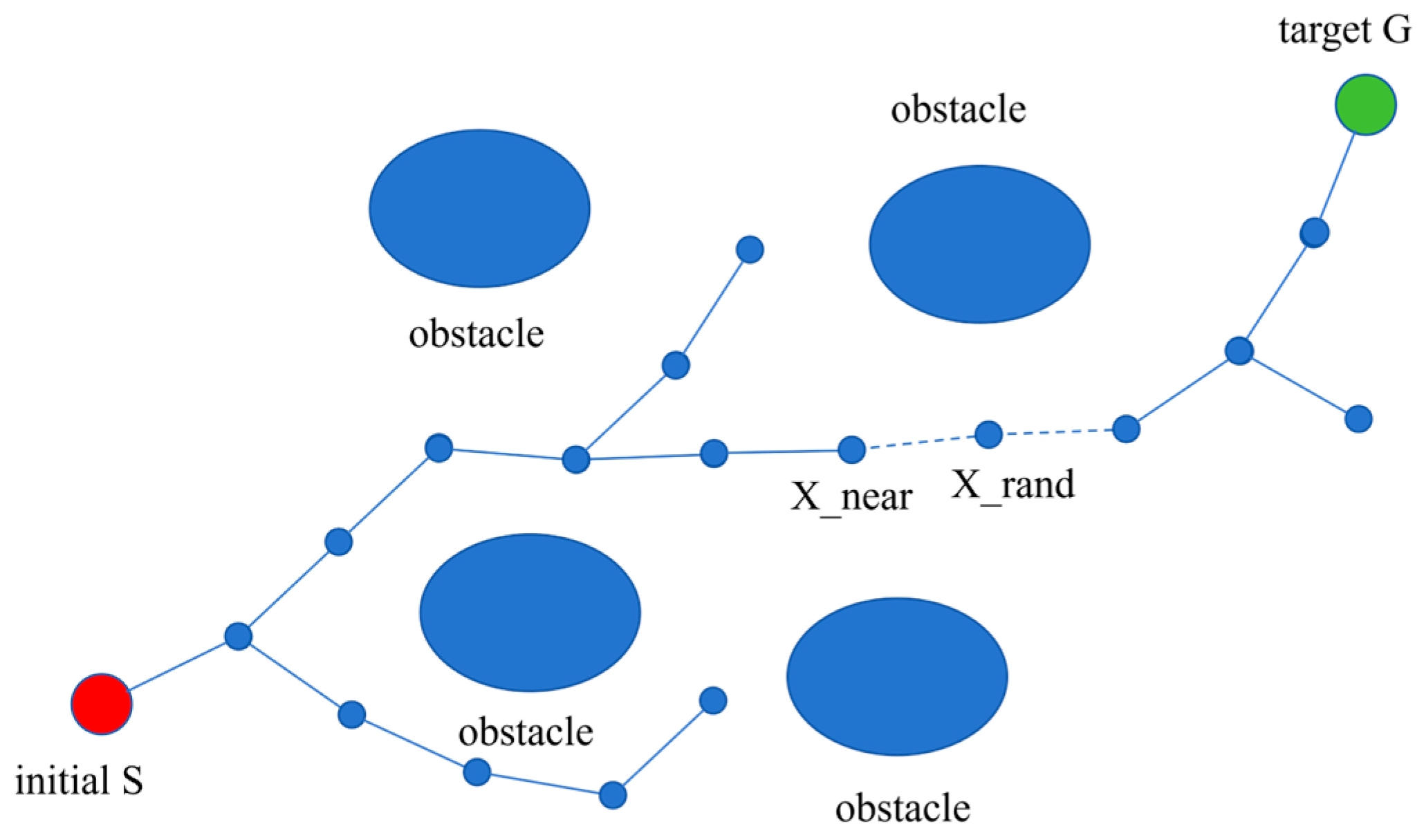
The principle of the traditional RRT algorithm is illustrated in
Figure 1. Through continuous sampling and tree expansion, the algorithm gradually explores the free space and attempts to construct a feasible path from
to
.
3. Improved RRT Algorithm Design
3.1. Adaptive Step-Size Adjustment Strategy Design
The traditional RRT algorithm uses a fixed step size to expand the search tree, which limits its adaptability in complex environments. In open areas with sparse obstacles, a fixed step size may restrict the exploration range in each iteration, prolonging the time required for the search tree to cover the free space and generating redundant nodes. In contrast, in regions close to the target or in narrow passages with dense obstacles, the same fixed step size may lack sufficient precision, causing the expansion to miss feasible connections or collide with obstacles. Consequently, the algorithm may fail to find a feasible path or may generate a non-optimal path.
To address this issue, this paper proposes an adaptive step-size strategy that integrates environmental perception and goal orientation. The step size is dynamically adjusted according to the local environmental complexity around the current expansion node and its proximity to the target. This strategy allows the algorithm to use larger steps for efficient exploration in open areas, smaller steps for precise obstacle avoidance in complex regions, and goal-oriented adjustment for faster convergence near the target region. In this way, the method improves exploration efficiency while maintaining obstacle-avoidance safety.
To support stable and interpretable step-size adjustment, the proposed strategy first defines distance-related parameters that describe the local obstacle distribution and the relative position of the target. These parameters provide quantitative inputs for step-size decision-making and reduce the uncertainty caused by purely empirical adjustments. Two normalized weighting factors are then constructed to represent obstacle-safety constraints and target-convergence requirements. Finally, these factors are combined through a balancing factor and bounded by upper and lower step-size limits to generate a step size suitable for the current expansion state.
First, let the current expansion node be
. Using KD-Tree, the neighboring obstacle set
within a range of
(where
denotes the obstacle radius) is rapidly screened. The minimum Euclidean distance
from the node to this obstacle set is calculated. This parameter directly reflects the safety margin between the node and surrounding obstacles. The smaller
is, the more likely the node is located in an obstacle-dense region with higher environmental complexity, and thus the step size should be reduced to decrease collision risk and ensure safe node expansion. Conversely, the larger
is, the more likely the node lies in an open region, allowing the step size to be increased to improve exploration efficiency. The mathematical expression is as follows:
Second, let the starting point be and the goal point be . The straight-line distance from the current node to the goal point is defined as using the Euclidean distance formula. The initial distance between the start and goal points is . Using this reference distance, is converted into a relative value, so that the calculation of the goal-oriented factor is not affected by the map size, thereby improving the adaptability of the step-size strategy.
Based on these distance parameters, two normalized weighting factors are constructed.
The first is the goal bias factor
, which characterizes the degree to which a node approaches the goal. The larger the factor is, the stronger the adaptability of the step size toward convergence to the goal. The factor is constrained within the interval
, where
near the goal and
near the starting point. Its mathematical expression is as follows:
The second is the obstacle-safety factor
, which represents the safety margin between the node and obstacles. The larger the factor is, the wider the adjustable range of the step size. Meanwhile, a minimum threshold is set to prevent the step size from becoming too small, which may lead to exploration stagnation. Its mathematical expression is as follows:
where
is an empirical safety threshold verified through repeated experiments. When
, the node is located in a completely safe open region, and obstacles impose no constraint on the step size, thus the factor is set to 1. When
, the factor decreases as
decreases, and the step size correspondingly becomes smaller. Meanwhile, the
function sets the lower bound of the factor to 0.3, ensuring that even in extremely complex obstacle regions, the step size will not be so excessively small as to cause exploration stagnation, thereby maintaining basic exploration efficiency.
Based on the above two normalized factors, a dynamic step-size calculation model is constructed. The model is expressed as follows:
where
and
0 represent the lower and upper bounds of the step size, respectively, and
is the balancing factor used to balance obstacle-avoidance safety and convergence speed toward the goal.
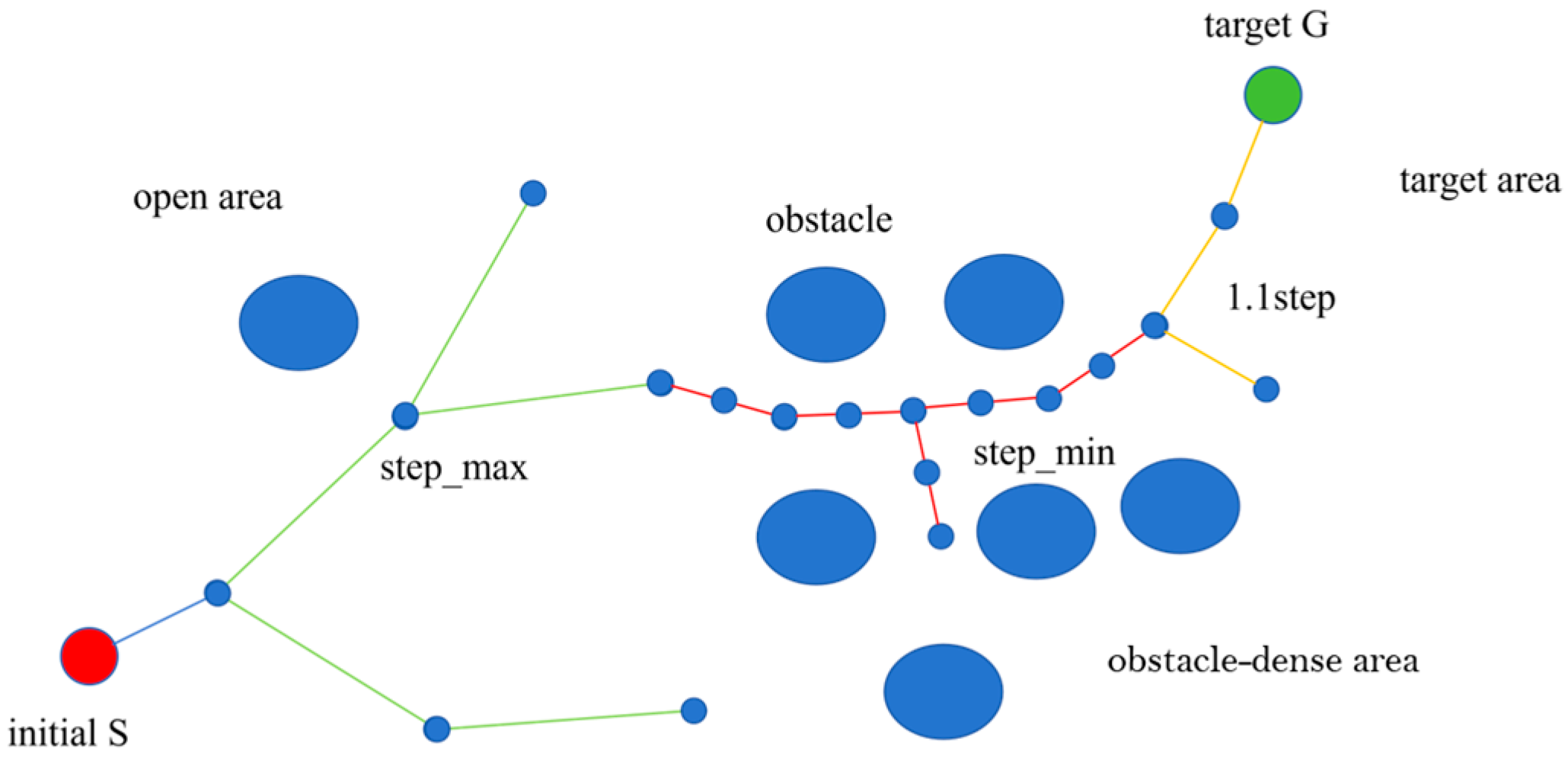
To accelerate convergence near the goal region, a step-size amplification rule is introduced. When the current node is close to the goal, the step size is multiplied by 1.1. The resulting value is then clipped to the predefined range to avoid excessively small steps that may cause stagnation or excessively large steps that may increase collision risk.
The adaptive step size is illustrated in
Figure 2, where the step size is larger in open regions and smaller in dense regions.
3.2. Enhanced Collision Detection and Safety-Boundary Design
Collision detection is the core guarantee of path-planning safety. Traditional detection methods suffer from insufficient accuracy and low efficiency. In this study, a triple detection mechanism of “node collision + line segment collision + safety boundary” is designed. Combined with KD-Tree acceleration, the proposed method improves detection accuracy while ensuring the real-time performance of the algorithm.
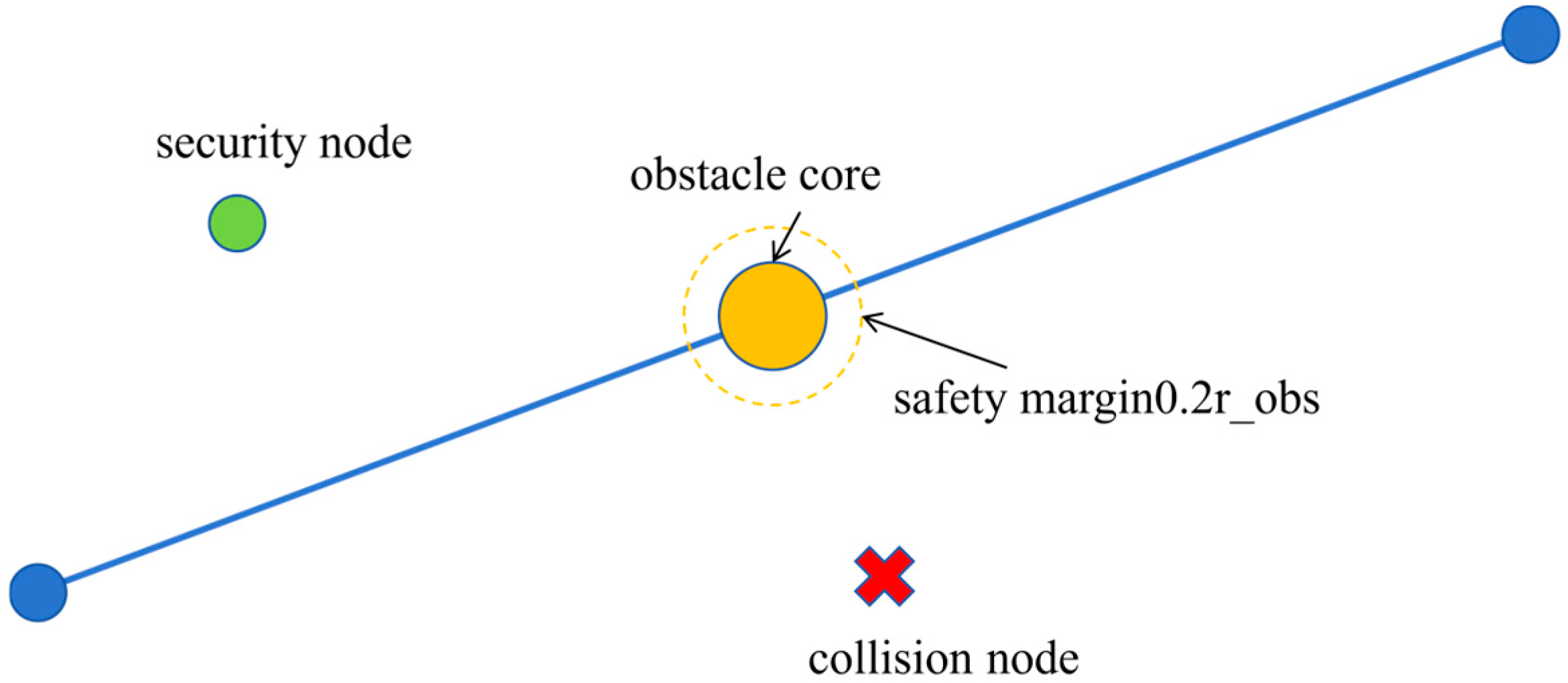
Based on the original obstacle radius , a safety margin of 0.2 is added to form a safety radius . In the proposed method, the safety radius is used as the reference for enhanced collision checking to reduce the risk of paths passing too close to obstacles.
To determine whether a node lies within the safety boundary, let the node to be tested be . Using KD-Tree, the obstacle set within a radius of is rapidly queried. The Euclidean distance between the node and the center of each obstacle is calculated. If there exists an obstacle such that , the node is determined to be in collision and is directly discarded.
To verify whether the line segment intersects with the obstacle-safety boundary, a lightweight detection strategy of “midpoint pre-check + dynamic sampling detection” is adopted. First, the midpoint of the line segment is calculated as If the midpoint collides with an obstacle, the line segment is directly judged to be in collision without performing subsequent sampling. Otherwise, the sampling density is adaptively adjusted according to the length of the line segment. The longer the segment, the greater the number of sampling points (with a minimum sampling number of 5). All sampling points are traversed to perform collision verification, ensuring that the line segment has no collision risk.
KD-Tree reduces the cost of local obstacle querying from linear traversal to approximately logarithmic search, thereby decreasing the number of unnecessary distance calculations during collision detection.
As shown in
Figure 3, the collision detection efficiency is enhanced by introducing the safety margin.
3.3. Path Simplification and Smoothing Design
The original path generated by the RRT algorithm usually consists of a series of polyline segments and presents two main shortcomings. First, it may contain a large number of redundant intermediate nodes, which increases the path length and reduces execution efficiency. Second, the path often contains sharp turning angles, resulting in poor geometric smoothness and making subsequent trajectory tracking more difficult. To address these problems, this study designs a post-processing framework that combines greedy path simplification, safety-validated shortcut pruning, and spline-based smoothing. The purpose of this framework is to reduce redundant nodes, improve path compactness, and generate a smoother geometric reference path.
The first stage is greedy path simplification. Let the original path node sequence be , where and . Starting from the current node , the algorithm searches forward along the path and selects the farthest node that can be directly connected to without collision. All intermediate nodes between and are removed. This process is repeated until the goal node is reached. Compared with iterative simplification methods, this greedy strategy is lightweight and suitable for real-time path planning. To ensure safety, each shortcut segment must pass the line-segment collision detection before intermediate nodes are removed.
In addition to greedy simplification, a safety-validated shortcut pruning step is further applied. Two non-adjacent nodes in the path are selected, and the intermediate nodes are removed only when the direct connection between them is collision-free. This additional pruning step further reduces unnecessary intermediate nodes while preserving path feasibility. If a shortcut connection fails the safety verification, the original path segment is retained. Therefore, the pruning process improves path compactness without sacrificing collision-free safety.
During tree expansion, a direct goal-connection attempt is also introduced. After a valid new node is generated, the algorithm attempts to directly connect this node to . If the line segment between the new node and the goal point is collision-free, the search process terminates early, and the final path is generated through parent-node backtracking. This strategy helps reduce unnecessary exploration when a feasible connection to the goal already exists, thereby improving search efficiency and reducing the scale of the random tree.
After path simplification and shortcut pruning, the resulting path may still contain polyline segments with abrupt turning angles. Therefore, spline-based smoothing is applied to improve geometric smoothness. To avoid path distortion caused by uneven spacing between adjacent path nodes, cumulative arc length is used as the spline parameter. Let the simplified path be
. The cumulative arc length is defined as
The normalized arc-length parameter is then calculated as
Based on the normalized parameter
, spline interpolation functions are constructed for the
- and
-coordinates:
In this study, 60 points are uniformly sampled over the normalized arc-length parameter to generate the smoothed path. This value is selected according to the parameter sensitivity analysis, which shows that 60 samples provide a better balance between geometric smoothness and computational cost compared with smaller sampling numbers.
To ensure that smoothing does not introduce unsafe path segments, a safety verification mechanism is applied after interpolation. All sampled points and adjacent line segments of the smoothed path are checked against the obstacle-safety boundary. If the smoothed path is collision-free and remains within the map boundary, it is accepted as the final path. Otherwise, the algorithm adopts a safety rollback strategy and returns to the pruned path. In this way, the final output path maintains collision-free feasibility while improving geometric smoothness.
It should be noted that the proposed planner is evaluated in a two-dimensional geometric environment and does not explicitly model nonholonomic constraints, steering limits, or vehicle dynamics. Therefore, the smoothing process is used to improve geometric smoothness and provide a smoother reference path for subsequent trajectory tracking, rather than to guarantee full kinematic feasibility.
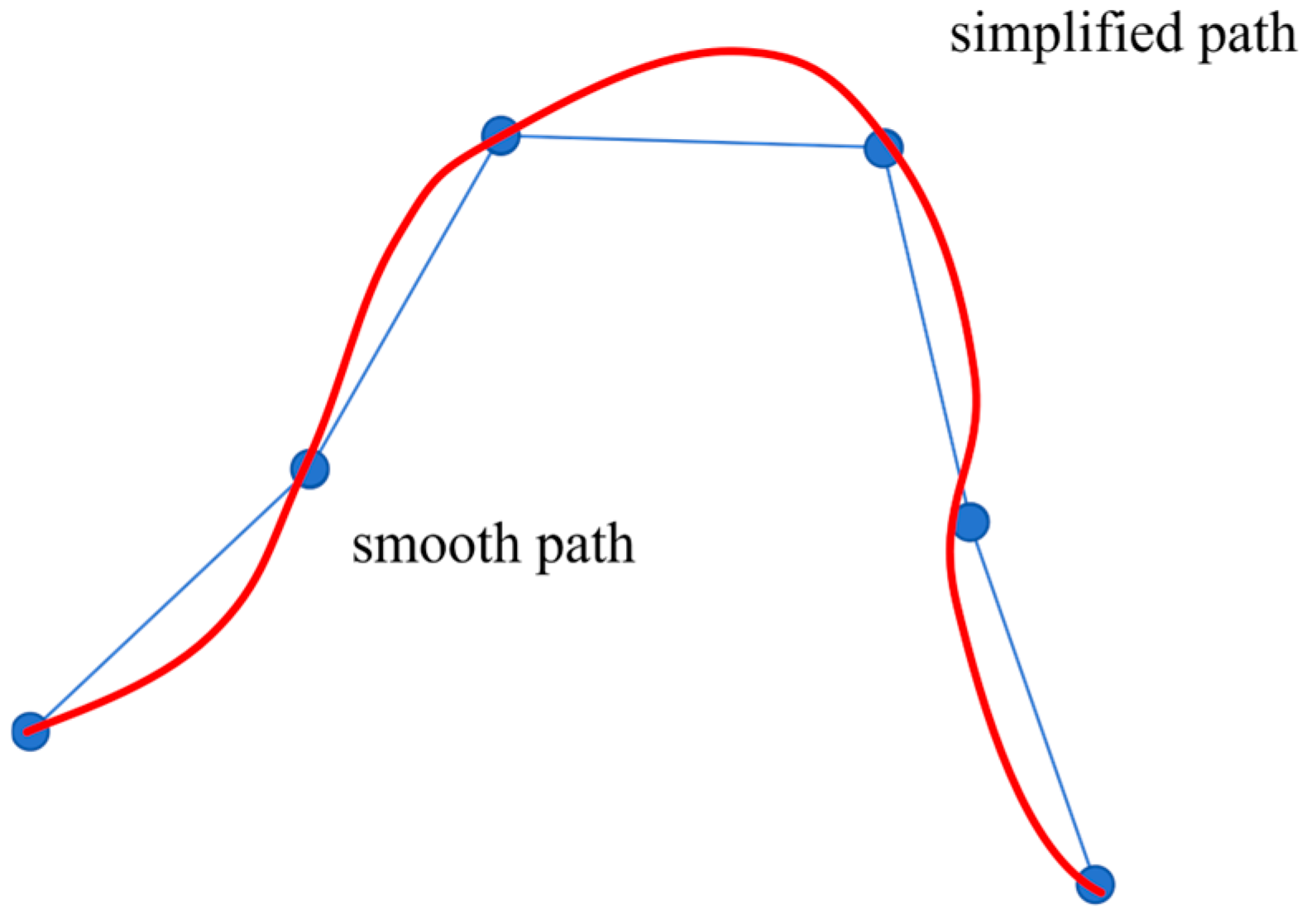
As shown in
Figure 4, the red path represents the smoothed path. Blue dots indicate tree nodes.
3.4. KD-Tree Accelerated Nearest-Neighbor Search Design
Nearest-neighbor search is a core component of the RRT algorithm. It is used to find the node in the search tree that is closest to the randomly sampled point, which then serves as the base node for the expansion of a new node. Traditional RRT algorithms adopt a global traversal method to find the nearest neighbor, with a time complexity of . As the number of nodes in the search tree increases, the traversal time grows linearly. In large-scale search scenarios, this approach becomes extremely inefficient and constitutes a major bottleneck for the real-time performance of the algorithm.
To address this issue, this paper introduces the KD-Tree data structure to construct an index for the random tree nodes. This reduces the complexity of nearest-neighbor search from to , significantly improving the exploration efficiency of the algorithm. Furthermore, it works collaboratively with other modules to further enhance the overall system performance.
KD-Tree is not only used for nearest-neighbor search but also cooperates with the previously designed adaptive step-size strategy and enhanced collision detection mechanism, forming a globally optimized framework that further improves the overall operational efficiency of the algorithm.
First, in cooperation with the adaptive step-size strategy, during step-size calculation it is necessary to obtain the set of neighboring obstacles around the current node to compute the parameter . By using KD-Tree, the local obstacle set can be quickly filtered without globally traversing all obstacles. This greatly improves the computational efficiency of , providing rapid data support for dynamic step-size adjustment.
Second, in cooperation with the collision detection mechanism, both node collision detection and line-segment collision detection require screening obstacles near the object to be tested. By utilizing the nearest-neighbor query capability of KD-Tree, local obstacles can be quickly located, thereby reducing unnecessary distance calculations. This further decreases the computational cost of collision detection and improves the overall real-time performance of the algorithm.
3.5. Computational Complexity Analysis
To further analyze the computational efficiency of the proposed framework, the computational complexity of each main module is discussed in this section. Let n denote the number of random tree nodes, m denote the number of obstacles, k denote the number of local obstacles returned by the KD-Tree query, s denote the number of sampled points used for line-segment collision checking, p denote the number of path nodes before post-processing, and h denote the number of spline sampling points.
In the traditional RRT algorithm, nearest-neighbor search is usually implemented by linear traversal over all existing tree nodes, resulting in a time complexity of O(n) for each iteration. In the proposed framework, KD-Tree is used to accelerate nearest-neighbor search, reducing the query complexity to approximately O(log n). Similarly, local obstacle querying is accelerated by KD-Tree, reducing the obstacle search complexity from O(m) to approximately O(log m + k), where k is the number of local obstacles returned by the query.
The adaptive step-size calculation depends on the local obstacle distribution around the current expansion node. Since the local obstacle set is obtained through KD-Tree query, the complexity of this module is approximately O(log m + k). For line-segment collision checking, the traditional global traversal strategy requires checking all obstacles for each sampled point, resulting in a complexity of O(s·m). In contrast, the proposed method first queries local obstacles and then performs collision checking only within the local obstacle set, reducing the complexity to approximately O(s·k).
For path post-processing, greedy simplification and shortcut pruning remove redundant intermediate nodes through collision-free connection tests. In the worst case, the complexity of the pruning process is O(p2), where p is the number of path nodes. However, the actual computational cost is usually lower because early termination and safety pre-checking are used to avoid unnecessary collision checks. The spline smoothing module generates h sampled points along the normalized arc-length parameter, and its complexity is approximately O(h).
The computational complexity of the main modules is summarized in
Table 1.
Overall, the proposed method introduces additional operations for adaptive step-size adjustment, safety-boundary checking, shortcut pruning, and spline smoothing. However, KD-Tree acceleration, direct goal-connection, and pruning strategies reduce redundant tree expansion and local search costs. Therefore, the proposed framework improves overall planning efficiency by reducing unnecessary node expansion and limiting collision checking to local obstacle regions.
3.6. Complete Procedure of the Improved RRT Algorithm
The improved RRT algorithm is built upon the core framework of the traditional RRT algorithm, namely “random sampling—tree expansion—path backtracking.” By integrating four key technologies—adaptive step-size adjustment, enhanced collision detection with safety boundaries, path simplification and smoothing, and KD-Tree accelerated nearest-neighbor search—a complete closed-loop framework of “intelligent exploration—path backtracking—post-processing optimization” is formed.
This approach not only addresses the problems of low efficiency, poor path quality, and insufficient safety in traditional algorithms but also ensures real-time performance and general applicability. The detailed procedure is as follows:
Input core parameters: starting point , goal point , map boundary, obstacle set , and obstacle radius .
Construct auxiliary structures: build KD-Tree structures for both obstacles and random tree nodes, which are globally reused to improve query efficiency.
Initialize the random tree: add the starting point as the root node of the tree and set its parent node as None.
Configure hyperparameters: maximum iteration number , goal distance threshold , and goal-biased sampling probability .
Random sampling: sample the goal point with a probability of 20%, and sample randomly within the map range with a probability of 80%, ensuring that the sampled point lies in free space.
Nearest-neighbor search: use KD-Tree to rapidly locate the node in the random tree that is closest to the sampled point.
Adaptive step-size calculation: compute the step size using the dynamic model based on the local environment around and its proximity to the goal.
New node generation: generate a new node along the direction from to the sampled point and clip its coordinates within the map boundary.
Enhanced collision detection: verify the safety of the new node and the connecting segment using the triple detection mechanism of node collision + line segment collision + safety boundary.
Goal check: if the distance between the new node and the goal is smaller than the threshold and the connecting segment is collision-free, the goal is considered reachable.
Path backtracking: traverse the parent nodes backward from the goal node to obtain the original path and reverse its order.
Path simplification: remove redundant nodes using the greedy strategy to obtain a simplified path.
Path smoothing: apply cubic spline interpolation to optimize the path, and output the final path after collision verification.
Termination condition: if a feasible path is found, output the result; if the iteration number reaches the maximum limit without finding a path, the problem is considered infeasible.
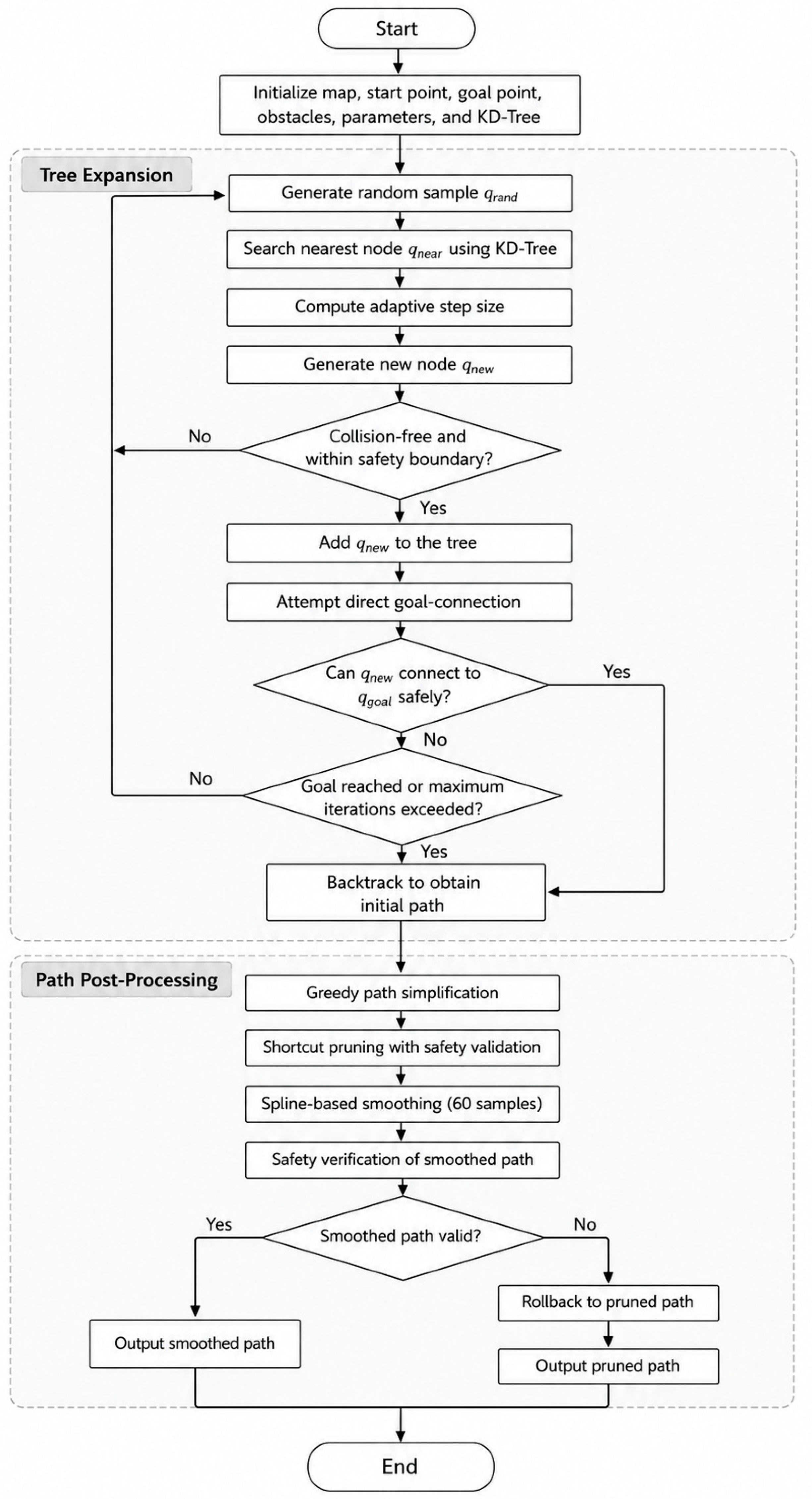
The improved RRT algorithm flowchart is shown in
Figure 5.
4. Simulation Experiments and Result Analysis
To evaluate the effectiveness of the proposed multi-strategy improved RRT framework, simulation experiments were conducted under different obstacle distributions and compared with existing RRT-based algorithms. The experimental design was revised to address the randomness of RRT-based planners and to provide a more comprehensive validation. Specifically, traditional RRT, RRT*, RRT-Connect, and the proposed method were compared under four scenarios, and each algorithm was independently executed 30 times using different random seeds. In addition to the main comparison, ablation experiments and parameter sensitivity analysis were conducted to evaluate the contribution of each module and the influence of key parameters.
4.1. Experimental Software and Hardware Environment
The simulation experiments were implemented in a Python environment. Python 3.8 or above was adopted, with core libraries including NumPy 1.21.0, Matplotlib 3.4.0, SciPy 1.7.0, and Pandas 1.3.0. NumPy was used for numerical computation, SciPy was used for KD-Tree construction and spline interpolation, Matplotlib was used for visualization, and Pandas was used for data recording and statistical analysis.
The experiments were conducted on a computer equipped with an Intel Core i5-10400F CPU and 16 GB RAM, running the Windows 10 64-bit operating system. GPU acceleration was not used. Therefore, all algorithms were evaluated under the same computational resource conditions, which ensured a fair comparison of planning time and computational efficiency.
4.2. Parameter Configuration
To ensure fairness, all algorithms were tested under the same map range, start and goal coordinates, obstacle settings, and maximum iteration number. Algorithm-specific parameters were configured according to the corresponding algorithmic mechanisms. For example, traditional RRT uses a fixed step length, while the proposed method uses adaptive step-size adjustment, safety-boundary checking, KD-Tree acceleration, goal-connection, shortcut pruning, and spline-based smoothing. The core parameter settings are shown in
Table 2.
4.3. Experimental Scenarios and Evaluation Metrics
Four representative two-dimensional static scenarios were designed to evaluate planning performance under different obstacle distributions. The simple sparse scenario contains sparsely distributed obstacles and is used to evaluate basic exploration efficiency. The complex dense scenario contains more densely distributed obstacles and is used to test local obstacle-avoidance ability. The narrow-passage scenario contains constrained passages and is used to evaluate performance in geometrically restricted environments. The highly cluttered scenario contains a larger number of obstacles and is used to further examine the effect of redundant exploration and safety-aware planning in more complex obstacle distributions.
The compared algorithms include traditional RRT, RRT*, RRT-Connect, and the proposed method. Traditional RRT refers to a fixed-step RRT algorithm with linear nearest-neighbor search and basic collision checking. RRT* and RRT-Connect were included as stronger RRT-based baselines to provide a more rigorous comparison. The proposed method refers to the integrated framework combining KD-Tree acceleration, adaptive step-size adjustment, safety-boundary checking, goal-connection, shortcut pruning, and spline-based smoothing.
To account for the inherent randomness of RRT-based algorithms, each algorithm was independently executed 30 times in each scenario using different random seeds. The planning success rate was calculated over all trials, while path length, planning time, tree nodes, minimum obstacle clearance, maximum turning angle, mean turning angle, and turning-angle standard deviation were reported as mean ± standard deviation over successful runs. The minimum obstacle clearance was used to evaluate how close the planned path was to obstacles. Turning-angle-based metrics were used to evaluate geometric smoothness. Since the current planner is evaluated in a two-dimensional geometric environment, these metrics are used to describe geometric smoothness rather than full dynamic or kinematic feasibility.
4.4. Comparison with Existing RRT-Based Algorithms
Table 3 presents the main comparison results. All four algorithms achieved a 100% success rate in the tested scenarios. Therefore, the performance differences are mainly reflected in tree compactness, obstacle clearance, geometric smoothness, and computational efficiency rather than in planning success rate.
Table 3 shows that RRT* generated near-optimal paths in most scenarios, but this improvement was achieved at the cost of substantially longer planning time and a much larger search tree. For example, the average planning time of RRT* was approximately 24 s, and the number of tree nodes exceeded 4500 in all tested scenarios. RRT-Connect achieved the shortest planning time because of its bidirectional expansion mechanism; however, its minimum obstacle clearance was relatively small, especially in the complex dense and narrow-passage scenarios.
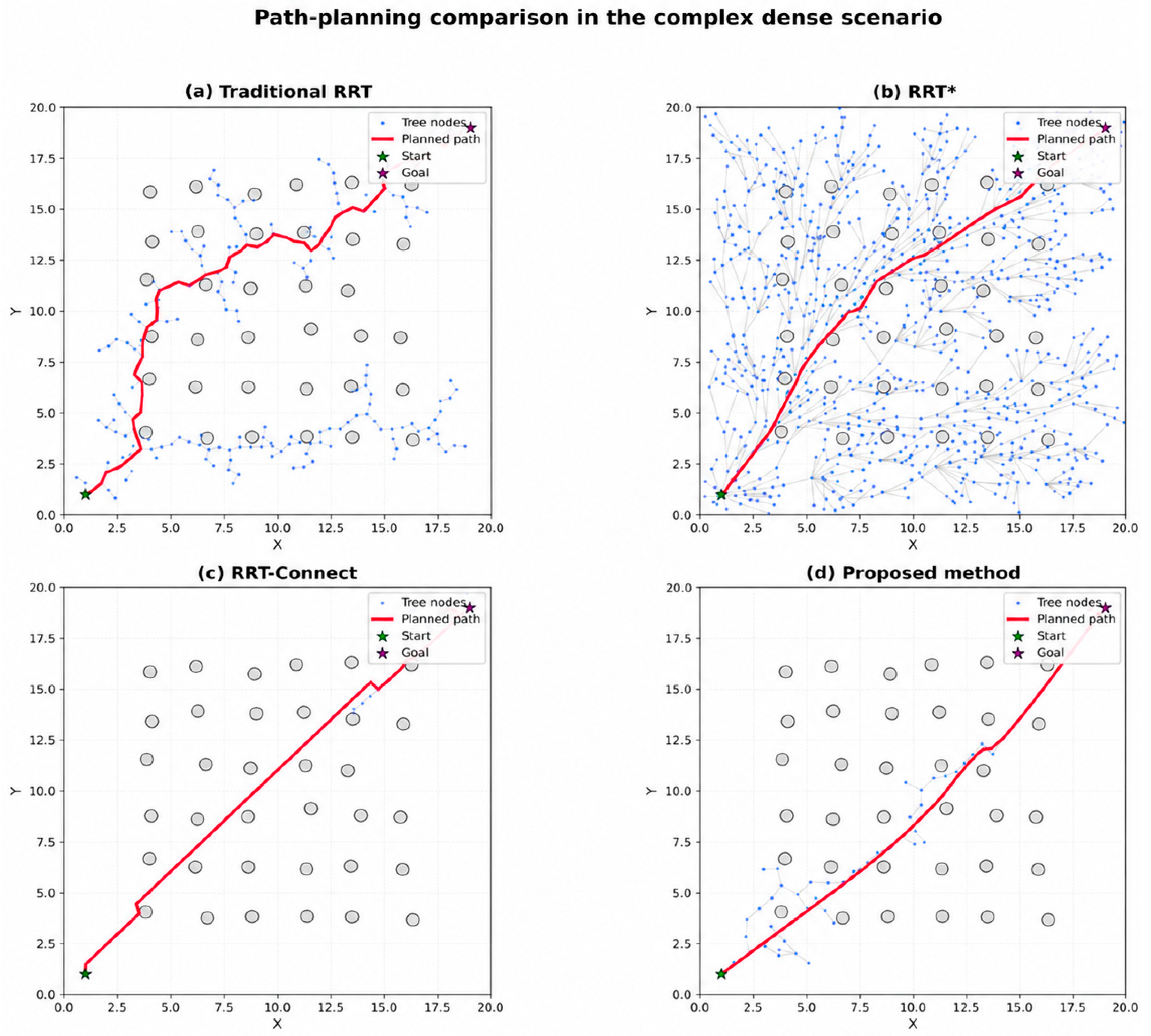
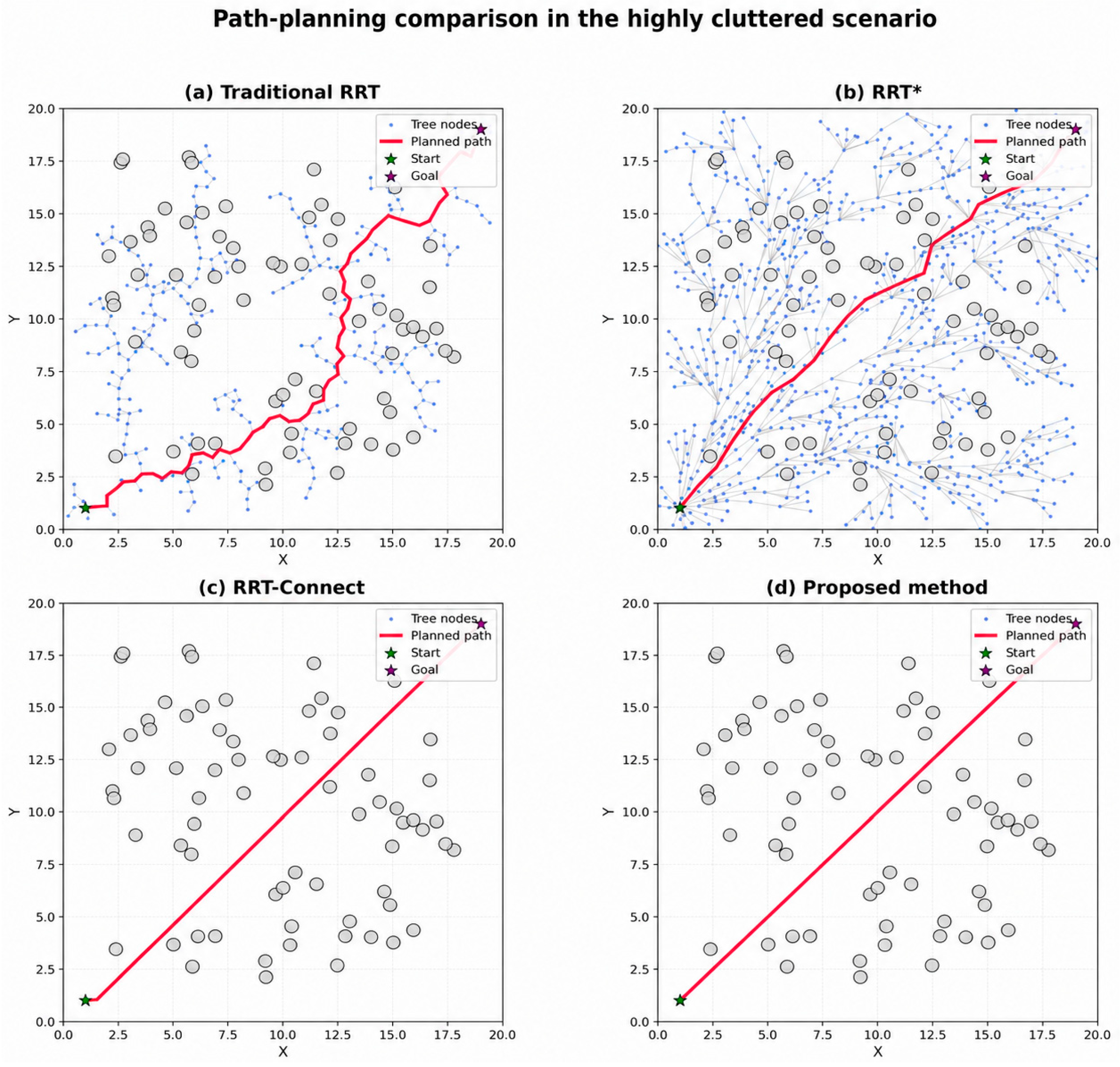
Compared with traditional RRT, the proposed method substantially reduced redundant tree expansion. The average tree-node number decreased from 257.93 to 19.47 in the simple sparse scenario, from 268.50 to 42.10 in the complex dense scenario, from 266.83 to 85.63 in the narrow-passage scenario, and from 284.00 to 4.43 in the highly cluttered scenario. In addition, the proposed method achieved the largest minimum obstacle clearance in all tested scenarios, indicating that the safety-boundary checking mechanism enhanced path safety.
It should be noted that some metrics exhibit very low variance in the highly cluttered scenario, especially for the proposed method. As shown in
Table 3, the proposed method obtained a path length of 25.46 ± 0.00 and a mean turning angle of 180.00 ± 0.00 in this scenario. This low variance is mainly related to the geometric structure of the tested map and the post-processing mechanism of the proposed framework. In the highly cluttered environment, once the tree expansion reaches a feasible connection region, the direct goal-connection, safety-validated shortcut pruning, and spline-based smoothing steps tend to transform different initial random trees into a similar final geometric path. Therefore, the final path length and mean turning angle may become nearly identical across repeated runs. However, the planning time, tree-node number, and minimum obstacle clearance still show variability, with values of 0.022 ± 0.005 s, 4.43 ± 3.90, and 2.834 ± 0.596, respectively. This indicates that the stochastic exploration process is still present before the feasible connection region is reached. Therefore, the low variance in some final path-quality metrics does not mean that the algorithm is deterministic; rather, it reflects the stabilizing effect of the path post-processing mechanism under this specific map configuration.
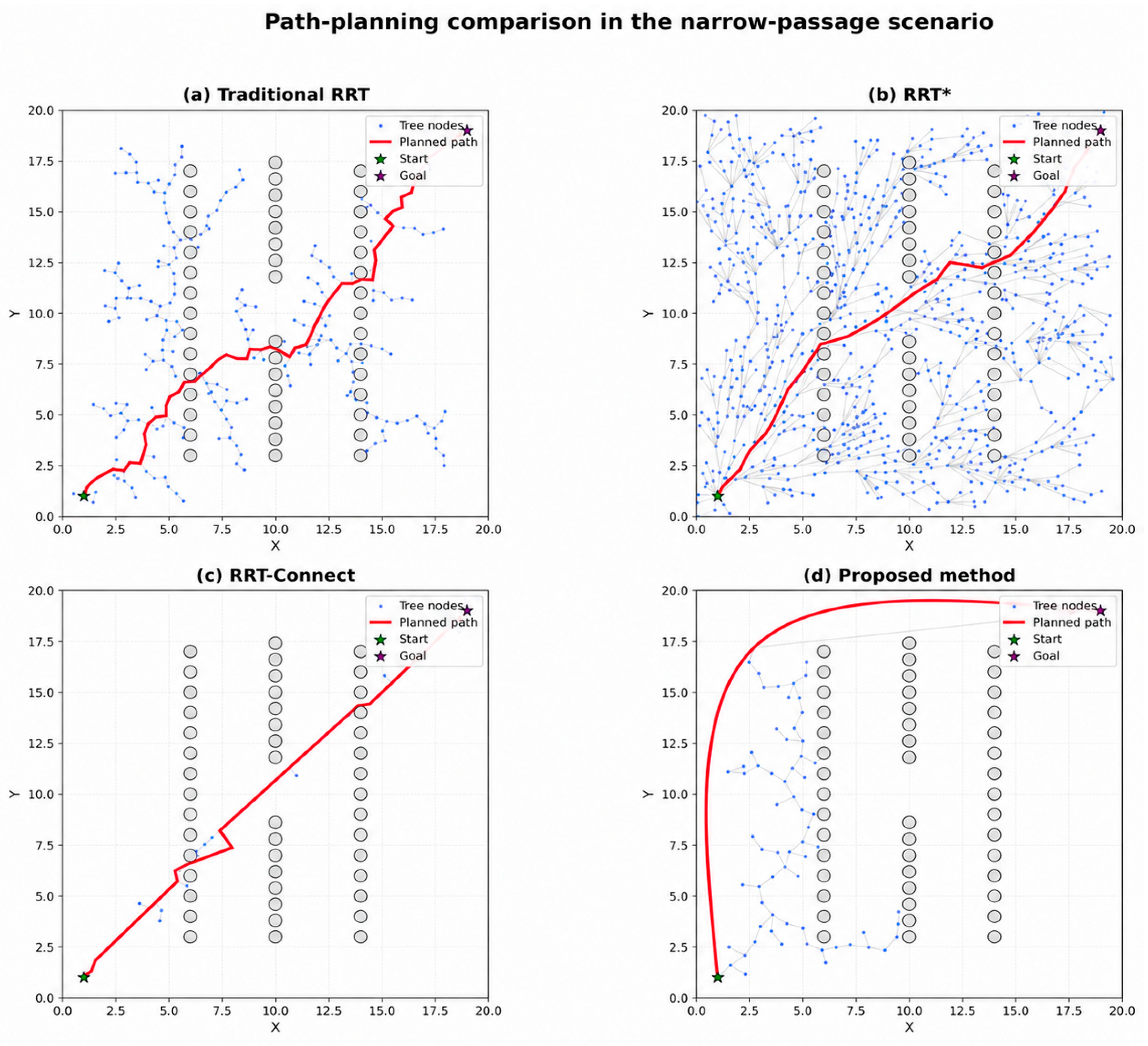
The proposed method did not always achieve the shortest path or the shortest planning time. In the narrow-passage scenario, it produced a longer path than the other baselines because the safety-boundary mechanism encouraged a more conservative path with larger obstacle clearance. Nevertheless, the method achieved better geometric smoothness and much larger minimum obstacle clearance in this scenario. Overall, these results show that the proposed method provides balanced performance in terms of path length, planning time, tree compactness, obstacle clearance, and geometric smoothness.
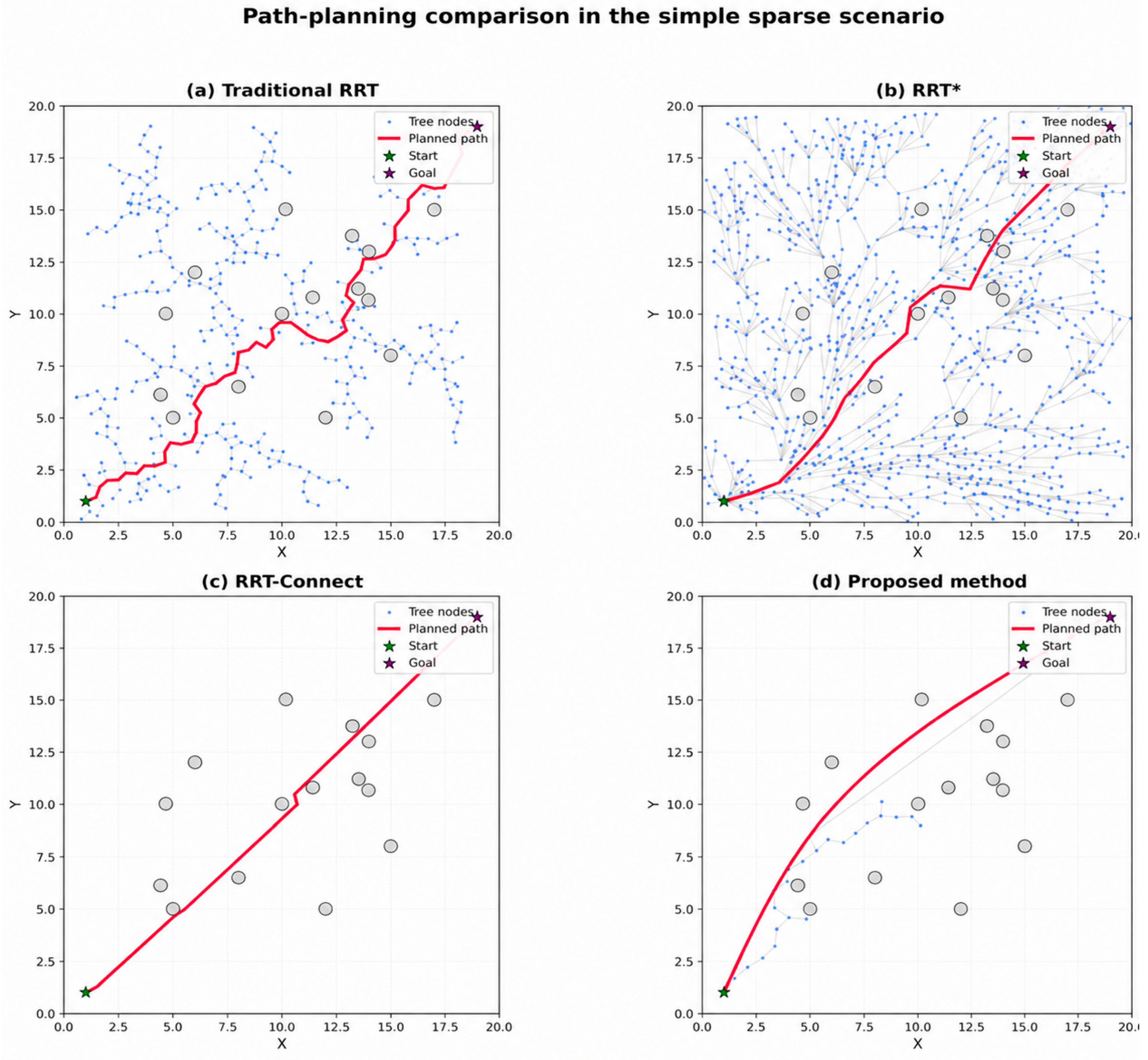
Path-planning comparison in the simple sparse scenario, complex dense scenario, narrow-passage scenario and highly cluttered scenario is shown in
Figure 6,
Figure 7,
Figure 8 and
Figure 9.
4.5. Ablation Study
To evaluate the contribution of each module in the proposed framework, a module-wise ablation study was conducted. Six algorithm variants were designed: A0 Traditional RRT, A1 + KD-Tree, A2 + Adaptive Step, A3 + Safety Boundary, A4 + Pruning, and A5 Full Method. The ablation results are shown in
Table 4.
The ablation results show that KD-Tree acceleration and adaptive step-size adjustment reduced redundant tree expansion and improved search efficiency. For example, in the complex dense scenario, the number of tree nodes decreased from 254.30 in A0 to 141.13 in A1 and 112.03 in A2. The safety-boundary module significantly improved obstacle clearance. In the narrow-passage scenario, the minimum clearance increased from 0.0437 in A2 to 0.2601 in A3 after introducing the safety boundary.
The pruning module substantially shortened the path and increased obstacle clearance in several scenarios. For example, in the complex dense scenario, the path length decreased from 29.79 in A3 to 26.05 in A4. However, pruning alone may reduce geometric smoothness in narrow passages, as indicated by the decrease in mean turning angle in A4. After adding spline-based smoothing in A5, the mean turning angle in the narrow-passage scenario increased to 178.35°, and the turning-angle fluctuation was reduced. These results indicate that smoothing mainly improves geometric smoothness rather than strictly minimizing path length.
The full method achieved the clearest improvement in tree compactness, obstacle clearance, and geometric smoothness. Nevertheless, in the narrow-passage scenario, the full method produced a slightly longer path and required more planning time than some variants because the safety-boundary constraint led to a more conservative path. This result is consistent with the design purpose of the proposed framework, which aims to balance path safety, smoothness, and computational efficiency rather than optimize a single metric.
4.6. Parameter Sensitivity Analysis
A parameter sensitivity analysis was conducted to justify the selection of key parameters, including the balancing factor α, the safety margin, and the spline sampling number. The sensitivity experiments were performed in the complex dense and narrow-passage scenarios, and each parameter setting was independently tested 30 times. The results are shown in
Table 5,
Table 6 and
Table 7.
The sensitivity results indicate that the optimal value of α varies across scenarios. Therefore, α = 0.6 is selected as a balanced configuration rather than a universally optimal value. This value provides a practical balance between path length, obstacle clearance, and tree scale in the tested scenarios.
A smaller safety margin tends to generate shorter paths but lower obstacle clearance, while a larger safety margin improves safety at the cost of longer and more conservative paths. Therefore, a safety margin of 0.20 was selected as a compromise between path length and obstacle clearance.
Increasing the number of spline samples improves geometric smoothness. Compared with 30 samples, 60 samples substantially reduce turning-angle fluctuation in the narrow-passage scenario, while the improvement from 60 to 120 samples becomes relatively limited. Therefore, 60 samples were adopted to balance smoothness and computational cost.
4.7. Limitations and Discussion
Although the proposed method improves tree compactness, obstacle clearance, and geometric smoothness, several limitations remain. First, the current experiments are conducted in two-dimensional static environments with circular obstacles, and dynamic obstacles are not considered. Second, the proposed planner is a geometric path-planning method and does not explicitly model nonholonomic constraints, steering limits, curvature bounds, or vehicle dynamics. Therefore, the generated paths should be regarded as smooth geometric reference paths rather than dynamically feasible trajectories.
Third, in extremely narrow or highly constrained environments, the safety-boundary mechanism may generate more conservative paths, resulting in longer path length and increased planning time. This phenomenon is observed in the narrow-passage scenario, where the method prioritizes larger obstacle clearance and geometric smoothness over strict path-length minimization. Finally, the current experiments are conducted in low-dimensional environments, and further validation is still required for high-dimensional robotic systems and real-world applications. Future work will extend the proposed framework to dynamic environments, high-dimensional configuration spaces, and robot-specific kinematic models.
5. Conclusions
This paper proposed an integrated multi-strategy improved RRT framework for robot path planning. The framework combines KD-Tree acceleration, adaptive step-size adjustment, safety-boundary collision checking, direct goal-connection, safety-validated shortcut pruning, and spline-based path smoothing. To evaluate its effectiveness, comparative experiments were conducted against traditional RRT, RRT*, and RRT-Connect in four representative scenarios, including simple sparse, complex dense, narrow-passage, and highly cluttered environments. Each algorithm was independently tested 30 times, and the results were reported using mean and standard deviation.
The experimental results show that all algorithms achieved a 100% success rate in the tested scenarios. RRT* generated near-optimal paths but required substantially longer planning time and a much larger search tree, while RRT-Connect achieved the shortest planning time but provided relatively small obstacle clearance. In contrast, the proposed method achieved a better balance among path length, tree compactness, obstacle clearance, geometric smoothness, and computational efficiency. Compared with traditional RRT, it substantially reduced redundant tree expansion in most scenarios and achieved the largest minimum obstacle clearance among the tested algorithms. The turning-angle-based smoothness metrics also indicate that the resulting paths contain fewer sharp turns and provide smoother geometric reference paths.
The ablation study further verified the contribution of each module in the proposed framework. KD-Tree acceleration and adaptive step-size adjustment help reduce redundant exploration, safety-boundary checking improves obstacle clearance, and pruning and spline smoothing contribute to path compactness and geometric smoothness. The parameter sensitivity analysis shows that the balancing factor, safety margin, and spline sampling number affect the trade-off among path length, safety, smoothness, and computational cost. Therefore, the selected parameters are not claimed to be universally optimal, but are adopted as balanced settings under the tested scenarios.
Despite these improvements, several limitations remain. The current experiments were conducted in two-dimensional static environments with circular obstacles, and dynamic obstacles were not considered. In addition, the planner is a geometric path-planning method and does not explicitly model nonholonomic constraints, steering limits, curvature bounds, or vehicle dynamics. Therefore, the generated paths should be regarded as smooth geometric reference paths rather than dynamically feasible trajectories. Future work will extend the proposed framework to dynamic environments, high-dimensional configuration spaces, and robot-specific kinematic models, and will further validate its performance in real robotic systems.