1. Introduction
The construction of modern power systems, characterized by high penetration of renewable energy and extensive power electronic interfacing, has posed an increasing challenge for accurately identifying the winding condition of power transformers. Some non-traditional stressors, such as higher-order harmonic [
1], broadband oscillation [
2] and DC bias, are significantly accelerating the insulation aging and mechanical fatigue of transformer winding. And unexpected failures of transformers would cause disturbance in power grid and may give rise to huge economic losses, as well as a risk to the personnel. Hence, it is essential to identify the winding condition timely and correctly to ensure grid resilience, early-fault warning capability, and optimized asset management in modern power networks.
The existing diagnostic techniques for winding deformation in power transformers include the following three categories, namely:
Short-circuit Impedance (SCI);
Frequency Response Analysis (FRA);
Vibration-based Analysis.
Generally, both SCI and FRA can identify the winding deformation of power transformer through variations in electrical parameters, such as SCI at the power frequency (typical 50 Hz or 60 Hz) and the distributed R-L-C parameters of winding. Specifically, any geometric alteration of the winding—such as radial deformation, axial displacement, or turn-to-turn short circuits—changes its leakage magnetic field, leading to a measurable variation in SCI. Governed by international standards (e.g., IEC 60076-5 [
3]), the SCI method has demonstrated the advantages of simplicity, quantitative results, and well-defined pass/fail criteria [
4,
5,
6]. In comparison, FRA has been recognized as the most sensitive diagnostic tool for evaluating the mechanical integrity of transformer windings, since the internal capacitive and inductive couplings alter with the mechanical deformation [
4,
7,
8,
9,
10,
11,
12,
13]. Consequently, the detectable shifts and resonances in the FRA trace provide a highly detailed “fingerprint” of the winding’s mechanical integrity. However, it is sometimes difficult to interpret the variations in frequency response curves. This results in a heavy reliance on the operators’ expertise, which eventually leads to insufficient consistency and repeatability. To address this problem, some machine-based algorithms, such as the random forest [
9] and support vector machines [
12], were applied to automatically classify the FRA curves. And a “FRA6σ” framework was constructed in [
13] to interpret the FRA curve for quantifying the fault severity of transformer winding, where the deviations of those curves were monitored by six sigma statistical tools like the X-bar charts and R charts. Additionally, to harness the advantages of both techniques, sweep frequency impedance method has been proposed as a hybrid diagnostic approach that measures impedance magnitude and phase over a typical range of 10 Hz to 1 MHz [
5,
6]. Nevertheless, a systematic comparison across different transformer types and deformation modes is lacking, which severely limits the application of the SFI method.
Vibration-based analysis technique identifies the winding condition of a transformer by analyzing the vibration signals, obtained from the transformer tank. These vibrations are mainly originated from winding vibration and core vibration, and transmitted to transformer tank through the insulation oil and solid structural parts. Influenced by the complicated mechanical structures of power transformer and the fluctuated load current, vibration signals are inherently non-stationary, non-linear, and time-varying; various methods, including Fast Fourier transform (FFT) [
14,
15,
16,
17], empirical wavelet transform (EWT) [
18] and improved symplectic geometry mode decomposition (ISGMD) algorithm [
19], have been employed to obtain the indicators for describing the winding condition. This paper reviews recent typical signal processing methods in this field. As illustrated in
Table 1, FFT has drawn primary interest to analyze the nonlinear and nonstationary vibration signals of transformers. Time-frequency analysis methods, such as wavelet transform and ISGMD, offer superior capacity in capturing the time-varying features in vibration signals. However, they often suffer from higher computational complexity compared to FFT. Meanwhile, several diagnostic models based on the data-driven classifiers like the extreme learning machine [
18], random forest [
20], a contrastive adversarial sparse model [
21], convolutional neural network [
22], and atrous deep residual network [
23] have been proposed, demonstrating some interesting results. Among these methods, vibration signals are collected from the accelerometers adhered to an operated or energized transformer tank, which is excited by a sinusoidal current at 50 Hz or 60 Hz. These signals originate from more than one strong-coupling vibration source, including the winding, core and cooling system. It is difficult to isolate the specific vibration signals from the mixed vibration signals that characterizes the faint features of winding failures. Meanwhile, those vibration signals are always sensitive to the load currents, temperature of insulating oil and tank structure. Establishing a deterministic and quantitative mapping between unique vibration patterns and winding deformation remains challenging. Last but not least, the inherent dynamic properties of transformer windings have been seldom investigated in online vibration-based analysis technique, even though they are more closely associated with winding structure alterations than the features that are commonly examined in existing studies.
Winding vibration of a power transformer is excited by electrodynamic forces resulting from the interaction between winding currents and the leakage flux density. Those forces are proportional to the square of the current magnitude. Consequently, the vibration signals, resulted from winding vibration, can be acquired from the short-circuit test of transformer. The frequency spectrum of vibration signals consists of a 100 Hz fundamental component and higher harmonics of lower magnitudes. Among these, the 100 Hz component is consistent with the frequency component of the electrodynamic force. And the higher harmonics always attribute to the nonlinear stress–strain characteristics of the insulated spacer, as well as to winding deformation. Specifically, a given transformer winding mainly consists of coils, insulating blocks, an axial clamping system and radial supporting structures. When excited by the sinusoidal excitation power supply with variable frequency and current, the response of the transformer winding is closely related to its mechanical structure and inherent dynamic features, with the response at twice the power frequency constituting the dominant component. That is to say, the variations in winding condition, like the looseness and deformation, can be directly reflected in the vibration response. Inspired by this, this paper presents a novel method of vibration response analysis (VRA) to identify the winding condition of transformers with high efficiency. With the developed vibration frequency response (VFR) testing system, transformer winding is excited and several VFR curves are measured and comprehensively analyzed to explore the evaluation criteria for winding condition. Specifically, the VRA technique depends closely on the winding structure and the tank structure, both of which affect the measured vibration signals. In contrast to online vibration-based analysis, this technique facilitates the establishment of universally applicable winding condition criteria, as illustrated by the schematic diagram presented in
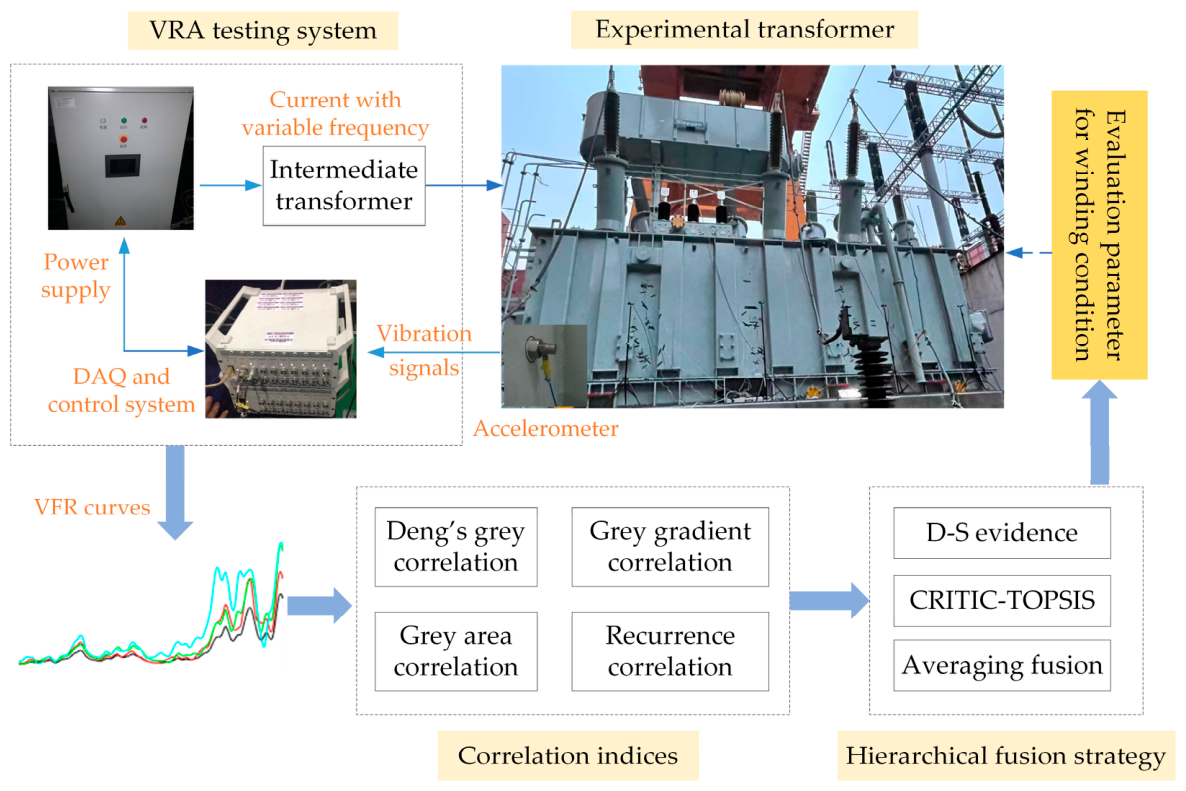
Figure 1, which outlines the proposed methodology for the condition monitoring of transformer windings. In the figure, DAQ denotes the data acquisition system. The white, green and red indicator lights on the panel of power supply indicate power, operation and fault, respectively The framework is constructed into five sequential stages: (1) acquisition of vibration signals from the experimental transformer tank through the VRA testing system; (2) signal processing to derive the VFR curves; (3) calculation and integration of correlation indices of VFR curves; (4) implementation of a hierarchical fusion strategy and determination of evaluation parameters; and (5) winding condition identification and performance evaluation. Each stage is elaborated in
Section 3 and
Section 4 accordingly.
In summary, this work presents the following main contributions:
An off-line VRA technique is proposed for the condition monitoring of transformer windings. Based on the developed VFR testing system, the evaluation criterion is derived from the measured VFA curves of transformer winding and computed by the multi-correlation indices fusion algorithm, demonstrating promising accuracy and efficiency.
Multi-perspective correlation indices derived from VFR curves, including the shape, gradient, area and structural features, are calculated to comprehensively analyze the vibration response of transformer winding excited by the frequency-variable current, enabling a fine-grained description of the information embedded within the curves.
A novel hierarchical fusion strategy is presented to comprehensively integrate the multi- correlation indices derived from VFR curves, facilitating to establish the criterion for condition monitoring of transformer winding while suppressing conflicts arising from spatially varied vibration response.
The proposed method is validated on two separate transformers rated at 220 kV and 110 kV, respectively, providing experimental evidence under realistic fault conditions of transformer winding.
This paper is structured in the following sections.
Section 2 describes the theoretical foundation of the proposed VRA-based technique.
Section 3 establishes the methodology, including the experimental setup to obtain the VFR curves of transformer winding under normal condition and winding fault, signal treatment and hierarchical integration strategy.
Section 4 presents the results of the proposed method, defines the evaluation criterion for identifying the winding condition and verifies its effectiveness.
Section 5 provides a discussion. Finally, the conclusions of this work are presented in
Section 6.
2. Theoretical Analysis of VFR-Based Method
Transformer vibration primarily originates from winding vibration and core vibration. Among these, the frequency spectrum of vibration signals, acquired by accelerometers adhered to the transformer tank, consist of a 100 Hz fundamental component and higher harmonics of lower magnitudes. The 100 Hz component is twice the power frequency excitation. The higher harmonics in vibration signals, caused by winding vibration, always attribute to the nonlinear stress–strain characteristics of the insulated spacer, as well as to winding deformation. Core vibrations are primarily attributed to nonlinear magnetostrictive forces. Apart from the 100 Hz component, higher harmonics such as 300 Hz, 400 Hz, and 500 Hz are also consistently present. Moreover, in many cases, the amplitudes of these higher harmonics exceed that of the 100 Hz component. This phenomenon is even more evident in the case of older transformers. For an operating transformer, the vibration intensity and frequency spectrum are highly dependent on the load current and the positions of the accelerometers mounted on the transformer tank. In some cases, the amplitude of these higher harmonics can exceed that of the 100 Hz component, as core vibration becomes the dominant contribution. Nevertheless, both the 100 Hz component and its higher harmonics of the vibration signals contain important information regarding the operating condition of the transformer.
With specific regard to transformer windings, their assembly can be characterized as a typical multi-degree-of-freedom system based on its mechanical structure, satisfying the following relation [
24],
where
is the mass matrix,
is the stiffness matrix,
is the damping matrix,
,
and
represent the displacement, velocity and acceleration, respectively, and
is the exciting force.
Applied the Fourier transform to Equation (1), then we have
where
represents the frequency.
Rearranging Equation (2), the displacement frequency response function can be obtained and expressed as
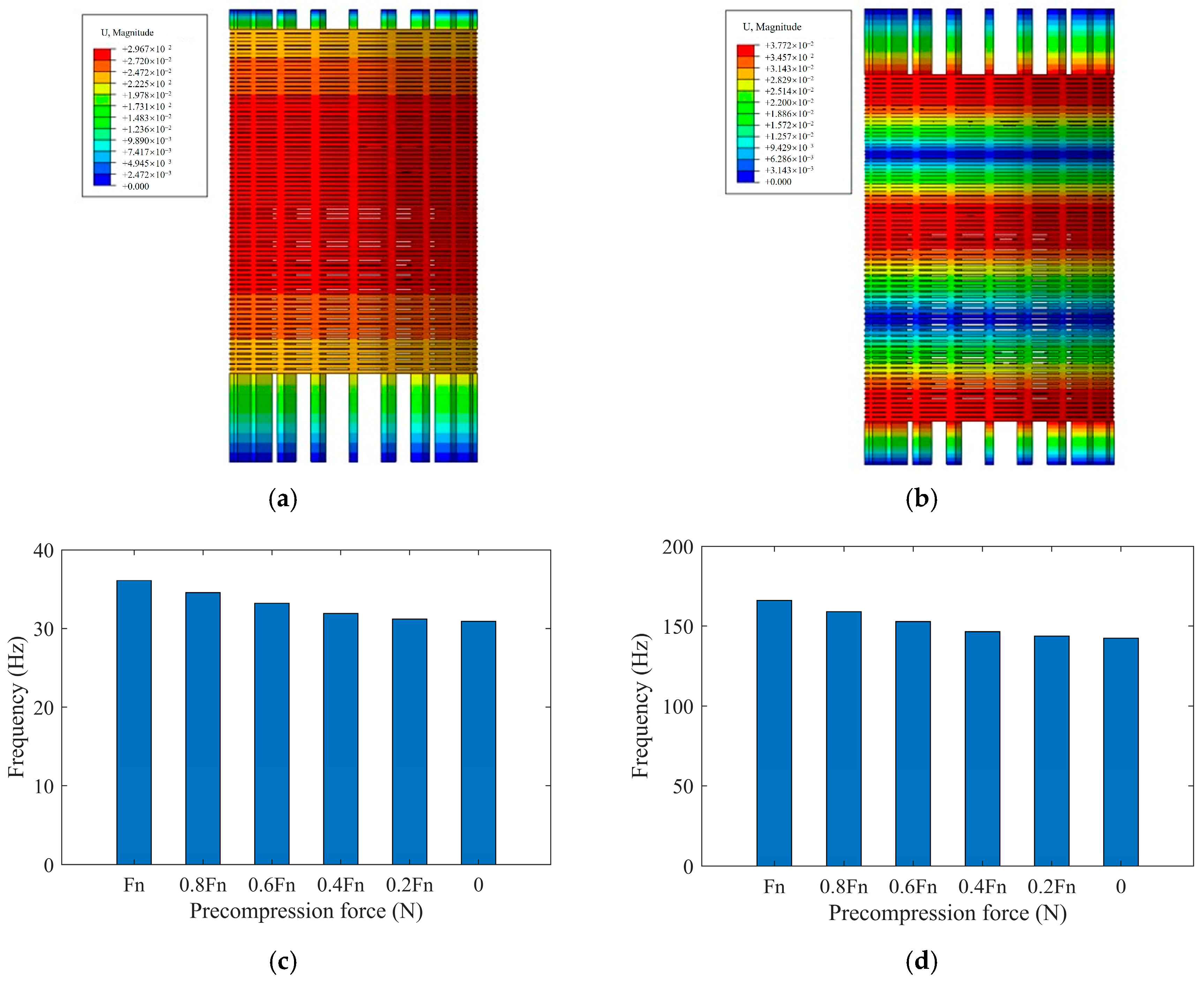
It is evident that the displacement frequency response function of transformer winding reflects the dynamic features of transformer winding under the known excitation, described by its inherent mechanical properties of mass, damp, or stiffness. Any alterations in these parameters, such as winding looseness, a change in mass resulting from insulation degradation, or block displacement, will ultimately manifest as a measurable shift and a perceptible variation in the response. For clarity, taking the high-voltage winding of a 220 kV-rated transformer as an example, its vibration features, including modal and overall natural frequency, vibration acceleration, were calculated based on finite element analysis method. Among these, modal parameters of transformer winding were illustrated in
Figure 2. In the figure,
Fn represents the designed value of precompression force of transformer winding. As can be seen from the figure, the first natural frequencies are both distant from the 100 Hz electro-magnetic force, making it difficult to trigger structural resonance under practically sinusoidal (50 Hz in China or in Europe) excitation. The first two axial vibration modes exhibit good symmetry. Specifically, the first mode represents compression toward the center from both ends of the winding, while the second mode depicts overall vertical vibration of the winding. When the precompression force of transformer winding decreases, implying the looseness of transformer winding, both the first-order natural frequency and the second-order natural frequency decrease accordingly. Consequently, vibration response on the transformer tank will inevitably change.
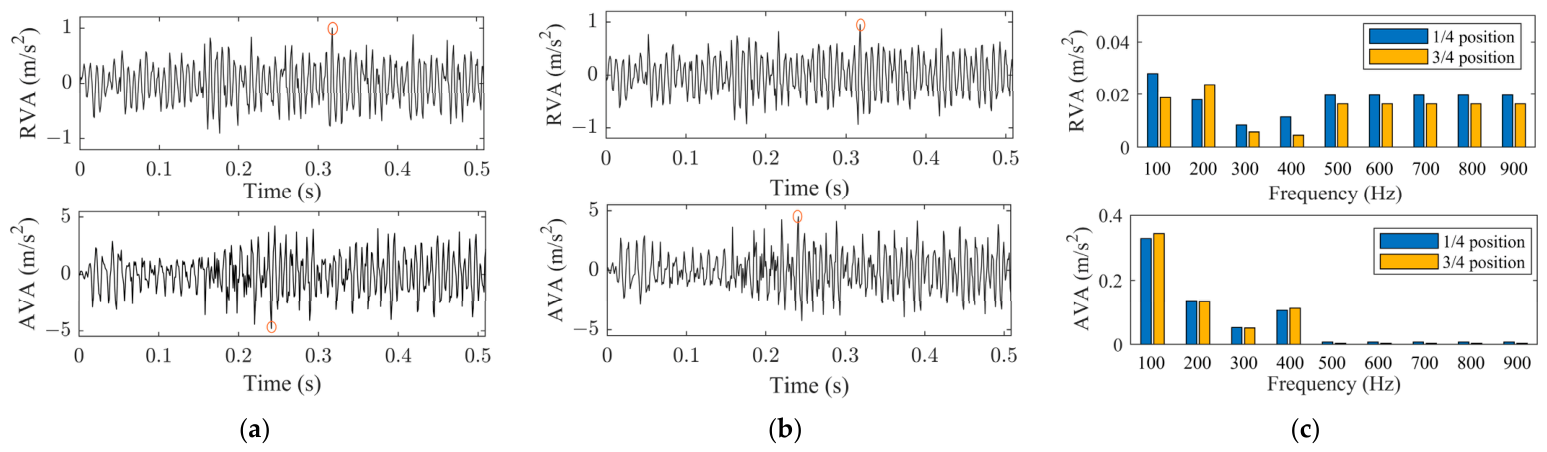
Vibration acceleration at different positions of transformer winding were calculated and the results, including time-domain waveforms at typical positions and the corresponding frequency spectra, are illustrated in
Figure 3. In the figure, AVA denotes the vibration acceleration in the axial direction of transformer winding, and RVA denotes the vibration acceleration in the radial direction of transformer winding. Meanwhile, the peaks of vibration acceleration are marked with red circles. The 1/4 position and 3/4 position represent the locations at 1/4 and 3/4 of winding height, respectively, measured from the top of winding. At these positions, the axial electrodynamic force of transformer winding reaches its maximum. As can be seen from the figure, the axial vibration intensity of transformer winding is considerably higher than its radial vibration intensity. The vibration acceleration at 3/4 position is slightly greater than that at the 1/4 position, caused by the effect of winding gravity. Hence, it is recommended to place the vibration accelerometers around these positions, which also facilitate the on-site deployment. The peaks of vibration acceleration at the 3/4 position corresponding to RVA and AVA are 0.954 m/s
2 and 4.513 m/s
2, respectively. The frequency spectra of both radial and axial vibration signals are dominated by a 100 Hz component and its higher harmonic components with relatively small proportions. This indicates that the fundamental vibration response of the transformer winding is primarily at twice the power frequency (100 Hz), consistent with previously reported results.
In addition, vibration signals of transformer winding under current excitation at each given frequency are analyzed by the zoom fast Fourier transform (zoom-FFT) to extract the amplitude at the double-frequency component as the vibration response. Specifically, zoom-FFT employs the digital heterodyning, selective filtering, and rational decimation to isolate and translate a narrow band of interest to baseband [
25]. Based on the new band-limited signal of length
(where
), a standard FFT is then applied. Consequently, a significantly magnified spectral resolution is achieved within the targeted frequency band, thereby eliminating the need for proportionally longer data acquisition times that a standard FFT would require for equivalent resolution. Generally, a standard FFT requires processing all
N samples with
complexity. The overall complexity of Zoom-FFT is approximately
, plus a minor overhead for filtering. Assuming a decimation factor of
, the computational reduction factor approaches
. Apparently, this reduction not only decreases computational load but also lowers the memory and data transmission requirements, making it highly suitable for obtaining the continuous VFR of transformer winding.
By comprehensively analyzing the patterns of all VFR curves of transformer winding, the winding condition can be effectively evaluated. In this paper, grey relational analysis, D-S Evidence theory, and CRIITC-TOPSIS method are jointly employed to investigate the reasonable evaluation criterion from the VFR curves for identifying the winding condition.
3. Methodology
3.1. Experimental Setup
The type of the experimental transformer is SFP7-120000/220 with rated capacity of 120 MVA and rated voltage of 220 kV. This transformer, which was decommissioned from the State Grid Shanghai Municipal Electric Power Company, Shanghai, China, was refurbished and subsequently used in the experiments.
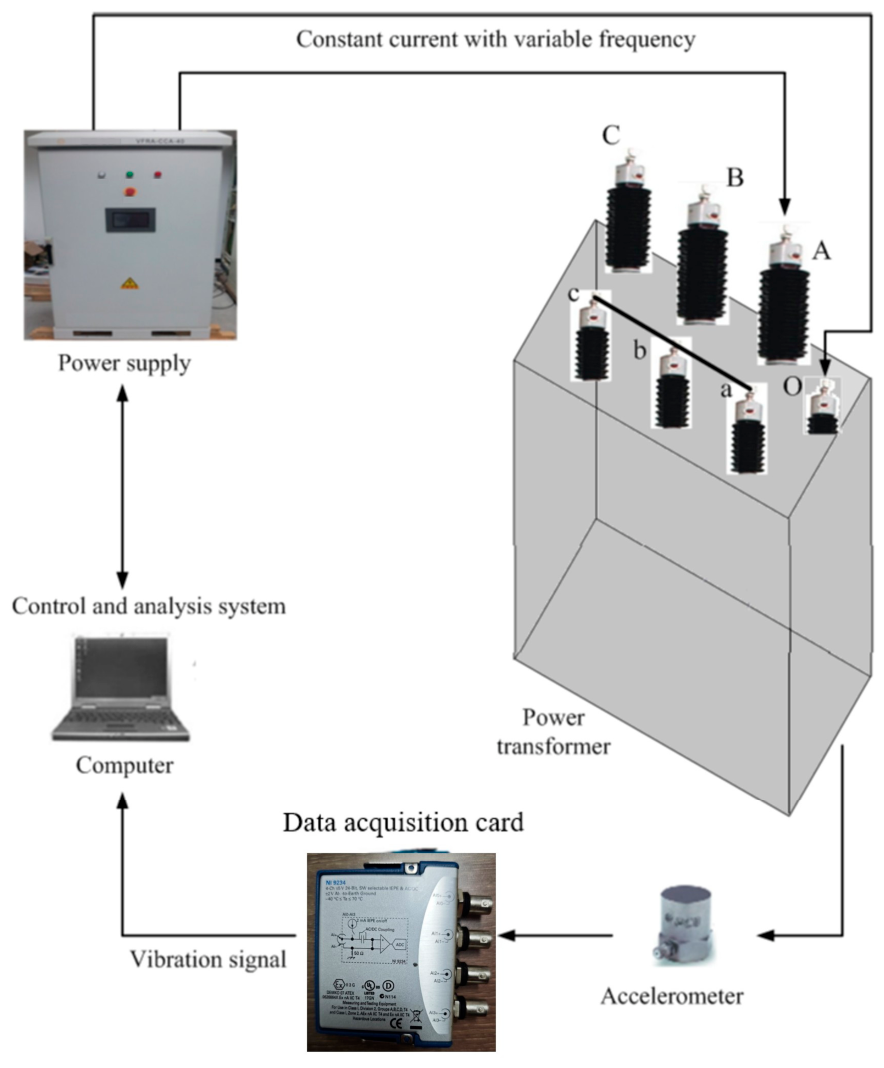
Figure 4 is the schematic diagram of VRA testing system. For clarity, the phase A winding of the experimental transformer is taken as an example. As can be seen from the figure, the excitation signal, characterized by constant current and variable frequency, was generated by the developed power supply, whose parameters are listed in
Table 2. This signal was injected into the high-voltage side of transformer winding through an intermediate transformer, and the low-voltage side of the experimental transformer was shorted. Specifically, the intermediate transformer serves as a step-up transformer, which is a dry-type transformer with an input voltage of 400 V and an output voltage of 10.5 kV, respectively. The output voltage of the intermediate transformer was determined by the experimental transformer’s impedance range (≤100 Ω), a frequency of 350 Hz, and a current of 15 A.
When the transformer winding is excited by the injected current, the corresponding vibration response can be captured by the vibration accelerometers adhered to the transformer tank. In this work, the employed accelerometers were PCB 352C33 with a sensitivity of 100 mV/g, a measurement range of ±50 g and frequency range from 0.5 Hz to 10 kHz. All accelerometers were connected to the multi-channel DAQ system for the purposes of parameter configuration, sweep frequency control, signal acquisition and data processing. This system features the following technical characteristics: 12 synchronous analog input channels, 24-bit resolution, and variable input range from −5 V to 5 V. For a given current, vibration signals were collected for each setting frequency, recorded for 2 s at a sampling rate of 10 kHz. Here, the sampling rate was selected based on the Nyquist criterion. Given that the frequency spectrum of vibration signals of transformer are always located below 2 kHz, this rate is sufficient to avoid aliasing. Meanwhile, the selection of a 2 s duration for each frequency was chosen as a trade-off between the accuracy of the spectral calculation of vibration signal and the overall testing efficiency. That is to say, a 2 s duration provides stable spectral estimates with a frequency resolution of 0.5 Hz. A further extension of the 2 s duration would proportionally increase both the total duration of the vibration frequency response test and the data burden, while offering only negligible improvement in the analysis results. The control and analysis system was performed on a computer featuring an intel Core i5-11400F CPU @ 2.6 GHz, 16 GB of RAM and the 64-bit Windows 10 operating system. The system was programmed using LabVIEW 2020 (National Instruments, Austin, TX, USA).
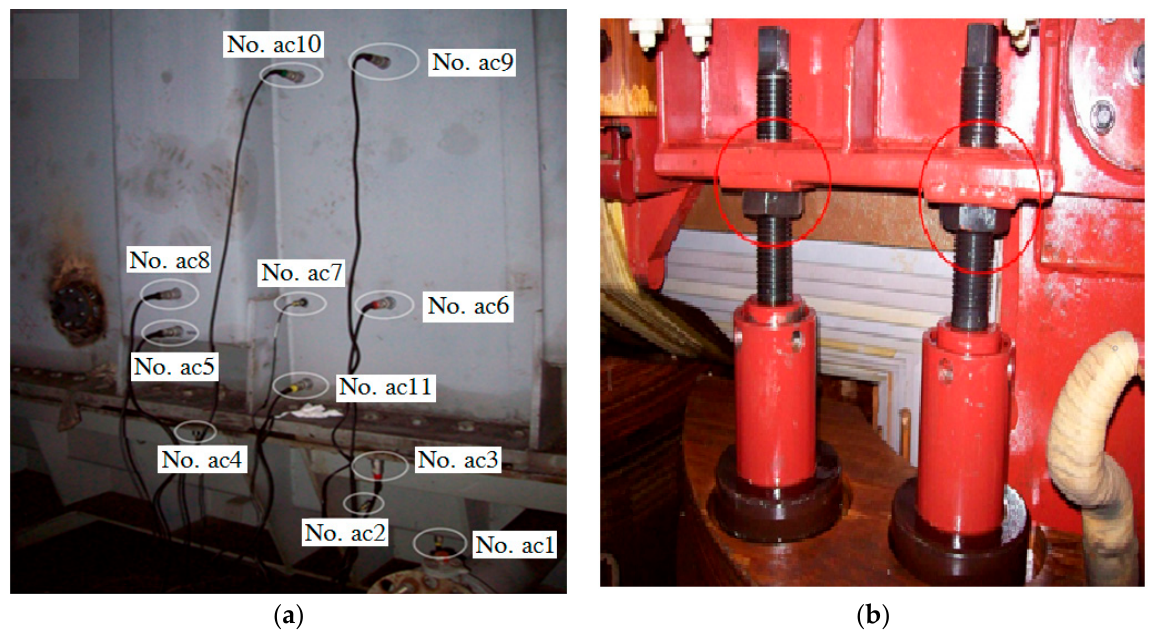
Figure 5 illustrates the real pictures of several piezoelectric accelerometers adhered to the transformer tank and the axial clamping system of experimental transformer. Here, the locations of vibration accelerometers on the transformer tank were strategically selected when considering the mechanical structure of the transformer and our previous testing experience, aiming to ensure optimal sensitivity to acquire the vibration signals of transformer winding. The common winding faults include winding looseness, winding deformation and hybrid fault involving both looseness and deformation. Among them, winding looseness is always characterized by a reduction in both axial and radial precompression forces to levels below the design threshold, leading to the excessive permissible gaps and relative displacements between conductors, insulating spacers, and supporting structures. Limited by the slightly variations in the path of magnetic flux or imperceptible variations in leakage inductance at the early-stage of winding looseness, the SCI method struggles to yield satisfactory results. Hence, three degrees of winding looseness were simulated in this paper to verify the effectiveness of the proposed VRA method, where the compression bolt of the axial clamping system was adjusted, as illustrated in
Figure 5b. Here, the axial clamping system is designed to apply a continuous and uniform pre-compression force to the transformer winding, preventing loosening and axial instability under the electromagnetic forces. The compression bolts of the high-voltage winding of phase A have been loosened to different degrees. Specifically, these compression bolts were first loosened by two threads, marked as Loosen1. Subsequently, two compression bolts were loosened completely, marked as Loosen2. Finally, all the compression bolts were loosened completely, marked as Loosen3. Overall, five sweep frequency processes were conducted on the experimental transformer. The initial two sweep frequency processes, corresponding to the winding’s healthy condition, marked as Normal1 and Normal 2, respectively, were performed to verify the repeatability and consistency of the obtained VFR curves. It should be noted that the whole sweep frequency process to obtain the VFR curves is time-consuming and costly since the transformer windings are located inside the transformer tank filled with the insulated oil. That is to say, to perform fault simulation on the windings, the transformer must first undergo oil drainage and body suspension. Following the fault simulation on the transformer winding, the body is repositioned into the transformer tank and the insulation oil is replenished. In addition, the SCI of the phase A winding of the experimental transformer was tested under normal condition and winding looseness, serving as a comparison with the proposed VRA method.
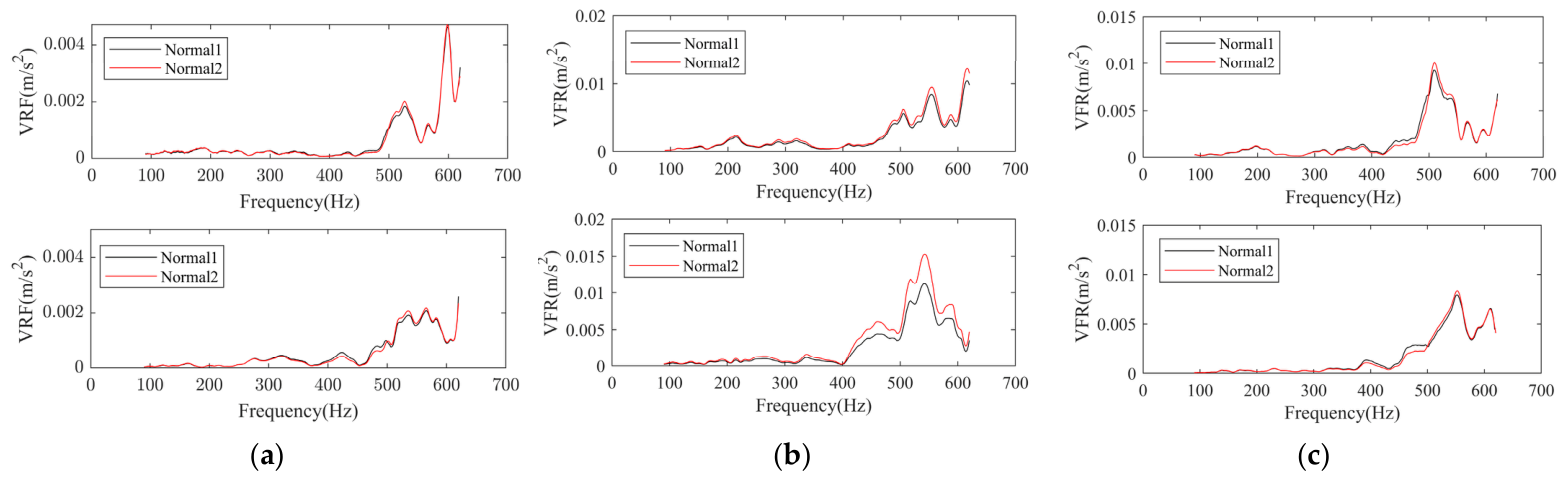
Figure 6 depicts the VFR curves of the phase A winding for a healthy condition, measured by accelerometers mounted at positions No. ac1, No. ac2, No. ac6, No. ac7, No. ac9 and No. ac11. The red circles indicate the compression bolts. As can be seen from the figure, VFR curves from each accelerometer exhibit good consistency during each sweep frequency process of transformer winding, implying superior repeatability of the proposed VRA technique. Moreover, vibration amplitude and the numbers of peak in each VFR curve are somewhat different. Among them, vibration amplitudes at No. ac6 and No. ac7 are relatively high. These differences can be attributed to the distinct vibration response features at various positions on the transformer tank. And this phenomenon agrees well with both the vibration mechanism of transformer winding and the influence of the tank structure on the resulting vibration response. More precisely, the winding exhibits its peak vibration intensity at a location approximately one-quarter of the tank height above the bottom. This conclusion is also consistent with our prior vibration measurements acquired from the tank of multiple in-service transformers, thereby providing strong evidence supporting the reliability of the measured results.
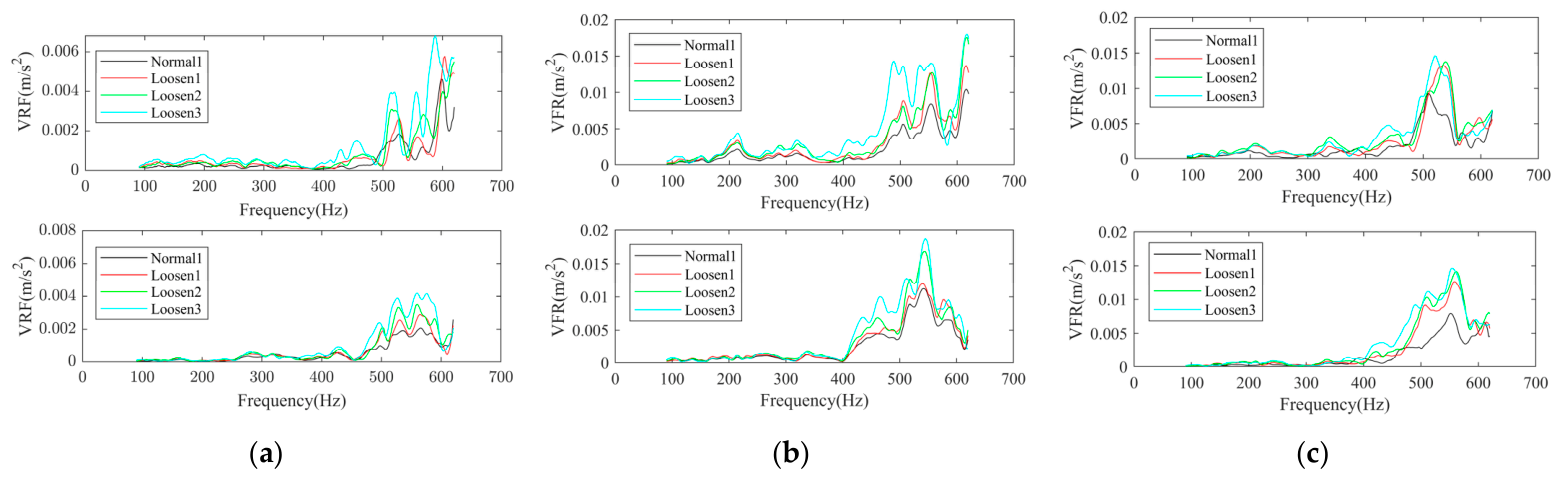
Additionally, VFR curves of phase A winding under various looseness conditions are shown in
Figure 7. As can be seen from the figure, the pattern of each VFR curve changes with the variations in winding condition, and the extent of variation differs across different positions on the transformer tank. To comprehensively capture and quantify the patterns and trends of VFR curves, and then isolate the critical shape distortions for identifying the winding condition, a correlation analysis was employed. It analyzes each VFR curve in terms of the geometric similarity, gradient, area and structure features. Meanwhile, since the information of winding condition contained in each VFR curve is inherently influenced by the transmission path and the structure of transformer tank, hierarchical fusion strategy is proposed in this paper to integrate the obtained correlation indices, enabling conflict resolution and robust final decision-making for winding condition.
3.2. Signal Treatment
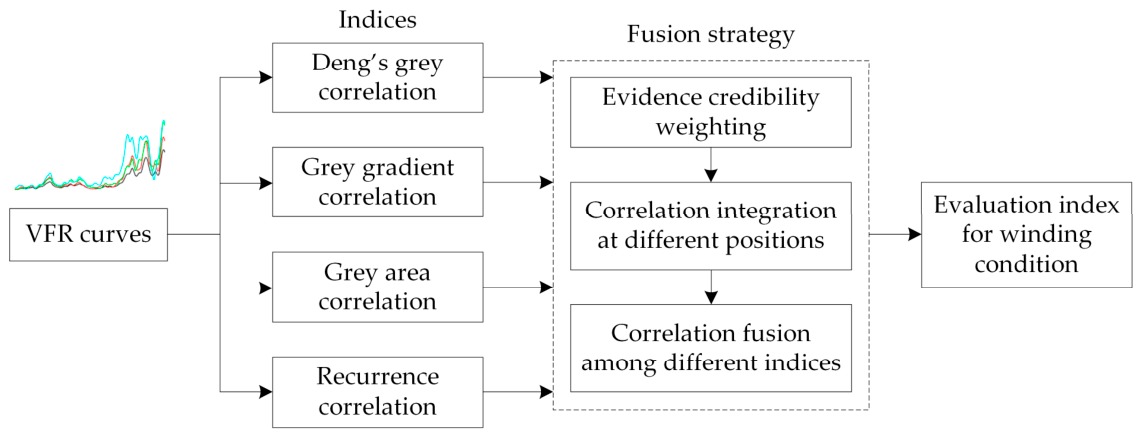
VFR curves are subjected to the treatment process shown in
Figure 8. This process includes the following steps.
Step 1: Derive the VFR curves from the vibration signals. To this end, the vibration signals from each accelerometer were analyzed through the Zoom-FFT technique. This technique was adopted over the standard FFT due to its finer frequency resolution without additional sampling points, thereby enabling accurate extraction of the desired frequency spectrum.
Step 2: Compute the correlation indices for the VFR curves. In this study, four kinds of correlation indices, namely Deng’s grey correlation, grey gradient correlation, grey area correlation, and recurrence similarity, are computed. As can be seen from the measured VFR curves and the vibration response mechanism of transformer winding, the relationship between VRF features and winding condition is inherently nonlinear. During each sweep frequency testing of a given transformer winding, only a limited number of VRF curves are available. Hence, it is critical to quantify the similarity between the measured VFR curves of the transformer winding under test and the reference curves. Conventional correlation metrics, such as Pearson or Spearman coefficients, rely on assumptions of linearity, normality, and large-sample sufficiency. However, these conditions are seldom satisfied in monitoring the winding condition based on the VRA technique. Under such small-sample and potentially nonlinear scenarios, grey relational analysis offers a more robust alternative. Unlike statistical correlation measures, these correlation indices evaluate VRF curves from multiple perspectives, a feature that aligns naturally with the subsequent decision-making framework.
Step 3: Integrate the correlation indices. Based on the results of aforementioned correlation indices, a hierarchical fusion strategy is proposed. This strategy includes dynamic weight for all evidences based on a defined credibility metric, and correlation fusion among different indices with the averaging fusion strategy. Here, the CRITIC-TOPSIS method was adopted for correlation integration at different positions. By evaluating geometric proximity to ideal solutions without imposing compensatory assumptions among heterogeneous indicators, it preserves the distinct contribution of each evidence source while avoiding subjective weight tuning. This strategy thus enables efficient dynamic aggregation of this evidence for monitoring the winding condition of a transformer.
Step 4: Evaluate the winding condition. An evaluation criterion for identifying the winding condition was proposed based on the variation rate of the fusion index.
3.2.1. Deng’s Grey Correlation
Deng’s grey relation is one of the classical relation models in grey theory, primarily assessing the geometric similarity between two data sequences. Let the reference sequence and the target sequency be denoted as
and
, respectively, where
N is the length of the sequence. The Deng’s grey correlation is defined as follows [
26].
where
is the Deng’s grey correlation;
is the distinguishing coefficient, which controls the contrast level between data sequences.
Deng’s grey correlation measures the similarity through the relative distance between corresponding points of the curves. It evaluates how closely the sequences follow the same geometric pattern, assigning a higher grade when deviations at each corresponding position are consistently small relative to the global variation.
3.2.2. Grey Gradient Correlation
Grey gradient relation defines a gradient field for each curve and evaluates the similarity by comparing these fields. Since this method depends solely on the shape, it can identify two curves as highly similar if their shapes are congruent. For two data sequences of
and
, grey gradient correlation is defined as follows [
26].
where
is the grey gradient correlation,
and
refer to the gradient of the reference sequence and target sequency, respectively.
3.2.3. Grey Area Correlation
Grey area correlation, which quantifies the curve similarity based on the enclosed area between them, is defined as being inversely proportional to the size of this area. The area itself, reflecting the global closeness and shape congruence of the curves, is computed as the definite integral of the absolute difference between the two sequences, expressed as follows [
26].
Then grey area correlation is defined as
where
is the grey area correlation.
3.2.4. Recurrence Correlation
Packard and Takens have pointed out that multidimensional phase-space trajectories reconstructed from scalar time series preserve the essential topological invariants and dynamical properties of the underlying system, thereby effectively revealing hidden information that is difficult to capture in the original time series [
27]. Meanwhile, the grey representation of recurrence plots further converts intricate dynamic similarity comparisons into structured pattern matching challenges, enabling a detailed depiction of the condition evolution of the system. Hence, grey recurrent similarity is presented here to describe the similarity between two recurrence plots.
For the time series
of length
N, the phase space representation
can be reconstructed according to coordinate delay method, represented as
where
and
m are the delay time and embedding dimension, respectively, determined through mutual information method [
28] and G-P algorithm [
29], and
is the number of phase points in the reconstructed phase space.
The recurrence matrix is then defined as follows [
30]:
where
represents the Euclidean norm, and
is the adjustment factor.
The recurrence similarity is then computed as the weighted element-wise similarity, where the weights are obtained by considering the Euclidean distance along the center diagonal of the recurrence matrix, expressed by
where
is the recurrence similarity,
denotes the Kronecker delta function,
represents the weight assigned to element at position (p, q) in the recurrence matrix,
and
refers to the element at position (p, q) in the recurrence matrix
and recurrence matrix
, respectively, and
is the parameter, controlling the decay rate.
3.2.5. Hierarchical Fusion Strategy
Vibration responses of transformer winding at the different positions on the tank are always different. Since each kind of correlation captures only a partial perspective of the whole winding condition, the recognition of winding condition from any individual VFR curve is prone to misdiagnosis. Hence, it is essential to strategically integrate all the correlation indices derived from all VFR curves.
Unlike classical probabilistic methods (e.g., Bayesian inference), which assign belief only to individual hypotheses, D-S evidence theory generalizes the probabilistic framework by assigning belief to sets of hypotheses. This allows it to explicitly represent incomplete information and handle conflicting. To this end, D-S evidence theory was first employed to manage the uncertainty and conflict in four kinds of correlation indices of VRF curves, which often provide inconsistent or incomplete indications regarding the winding condition. In D-S evidence theory, the key concepts are as follows [
30].
Frame of discernment (): a finite set of mutually exclusive hypotheses. In this paper, includes various conditions of transformer winding.
Mass function (m): a measure of belief assigned to any subset , with , , and , where and .
Belief function in : , where Z is a subset of A.
Plausibility function: .
Given that all pieces of evidence (here referring to all the correlation indices derived from all VFR curves) are assigned weights determined by the credibility of each piece of evidence, the Jousselme distance between them is calculated to measure their differences and construct a confidence matrix, as expressed by the following formulas [
31]
where
represents the confidence matrix,
refers to the Jousselme distance,
refers to the i
th evidence, and
denotes the number of evidence bodies.
Given the similarity measure between evidence
and evidence
as
, a measure matrix
is then constructed for all the evidences, expressed as follows:
The element in measure matrix represents the degree of similarity between evidences. A higher value of
indicates greater similarity between evidence
and evidence
, implying much mutual support. Hence, the credibility of evidence
is defined as follows:
where
represents the credibility of evidence
.
Use
as weight, the refined evidence can be given as follows:
It can be observed from (17) that if a piece of evidence contains an apparent error, it will significantly deviate from the others. Consequently, the corresponding weight assigned to this evidence is reduced, thereby restraining its influence and mitigating evidence conflict.
Second, TOPSIS method combined with Criteria importance through intercriteria correlation (CRITIC) is applied to integrate the refined evidence corresponding to the VFR curves derived from different locations, inherently containing the vibration response of varying importance [
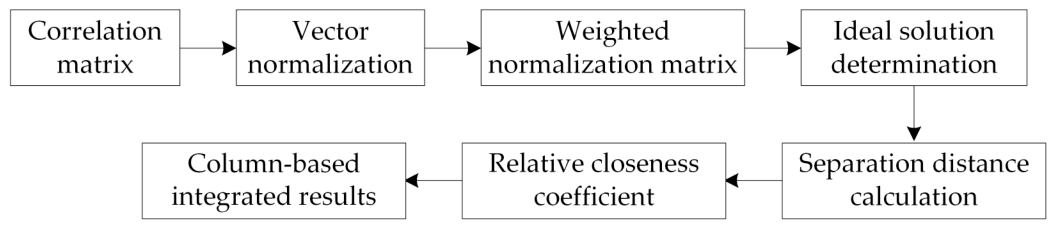
32]. In CRITIC method, attribute weights are derived from two inherent characteristics of the data: standard deviation and Pearson correlation. The standard deviation reflects the strength of contrast presented by each attribute, while the Pearson correlation coefficient measures the extent of redundancy or mutual conflict existing between different attributes. Since CRITIC retains the inherent conflict structure of sensor data without artificially suppression, this method naturally complements the conflict-handling mechanism of D-S evidence theory, making the two approaches compatible in uncertain information fusion tasks. As a widely adopted technique for multi-criteria decision-making under uncertainty, TOPSIS determines the optimal alternative by calculating its geometric distances from both the positive ideal solution (PIS) and the negative ideal solution (NIS). The former represents the best possible performance across all criteria, while the latter represents the worst possible performance. In the proposed framework, after the computation of adaptive weightings via CRITIC, a set of candidate hypotheses is generated as potential outputs. TOPSIS then evaluates each hypothesis against the weighted criteria. The hypothesis that achieves the highest relative closeness coefficient—indicating that it is simultaneously closest to the PIS and farthest from the NIS—is ultimately selected to guide the feature fusion process. Detailed procedures are illustrated in
Figure 9. In the figure, vector normalization is employed to eliminate dimensional heterogeneity and obtain the normalized matrix. Then the weight is determined through CRITIC method to construct the weighted normalized matrix incorporating relative criterion importance.
Apparently, this hybrid approach simultaneously considers both variability within each criterion and inter-criteria correlations, making it particularly suitable for parameters exhibiting information redundancy or complementarity.
Third, an average fusion strategy is employed to integrate four kinds of correlations to obtain the final unified feature representation of VFR curves, expressed as
where
refers to the correlations obtained from the TOPSIS method,
stands for the weight, and
represents the final fused index.
5. Discussions
5.1. Appliaction of the Evaluation Criterion
In this paper, the off-line VFR technique was proposed to accurately assess the winding condition of transformer. Generally, this technique evaluates the winding condition by analyzing the vibration response generated by electrodynamic forces on the winding. Under a constant-amplitude excited current of varying frequency, the vibration response depends closely on the inherent mechanical structure of the transformer winding. Especially, winding looseness leads to a reduction in the overall stiffness of the winding, which manifests as a decrease in natural frequencies and a change in the corresponding mode shapes. Hence, it is effective to evaluate the winding condition by the proposed evaluation criterion which is computed by comprehensively capturing the patterns embedded in VFR curves.
Although the proposed method has been validated on a 220 kV-rated oil-immersed three-phase transformer, the applicability of the proposed evaluation criterion to other transformer types requires further discussion. Generally, the proposed evaluation criterion is proposed based on the relative variations in correlation indices for VFR curves. Since the theoretical basis is universal regardless of the transformer rating, the evaluation criterion is theoretically applicable to transformers of different voltage classes and power ratings.
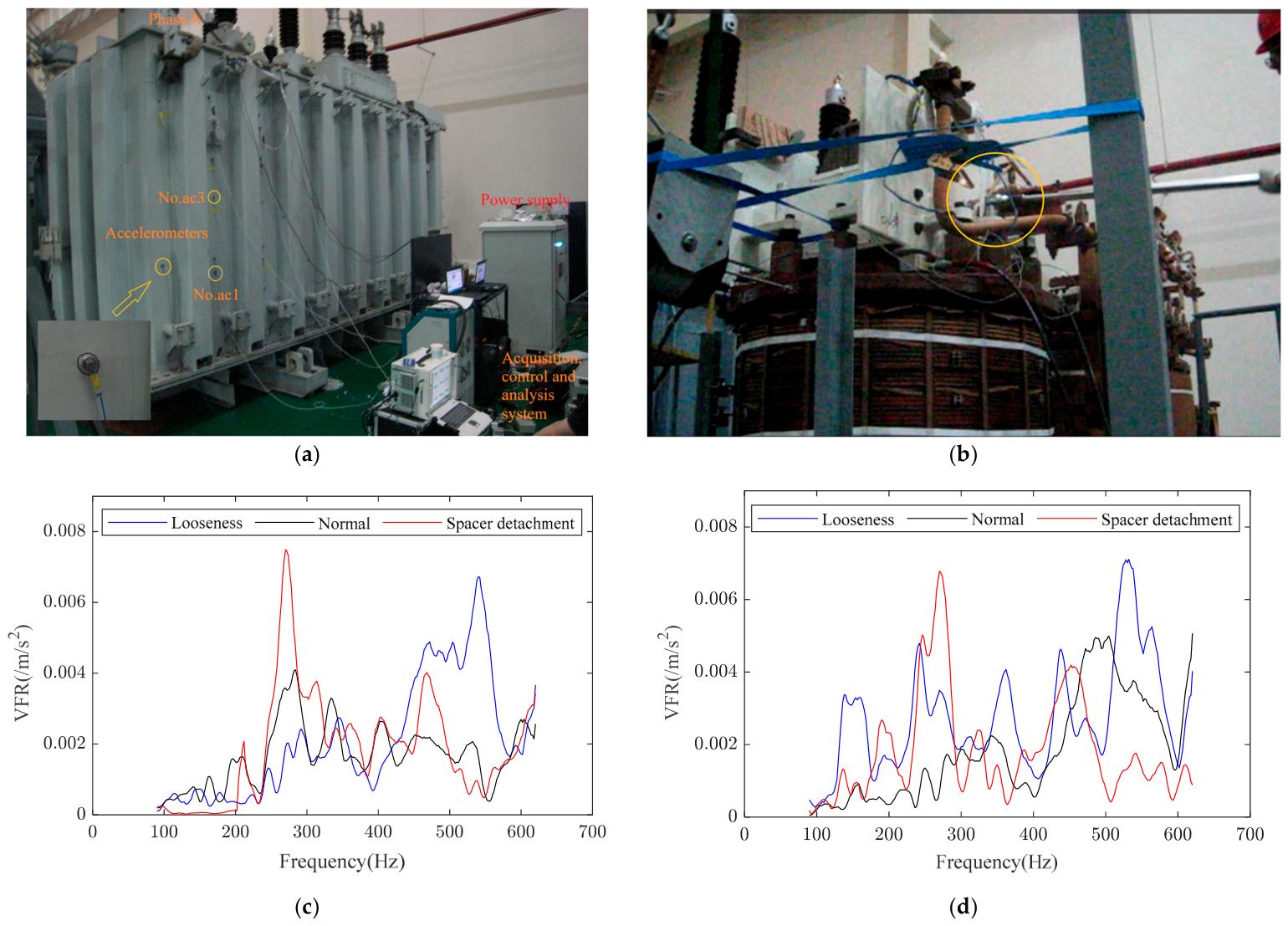
Further validation was performed on another newly 110 kV-rated oil-immersed three-phase transformer, yielding results consistent with those reported above, as illustrated in
Figure 10. During the experiment, the low-voltage side of the experimental transformer was short-circuited. A 10 A current was injected into the high-voltage side of the transformer winding through an intermediate transformer, and the frequency was swept from 45 Hz to 310 Hz at 1 Hz intervals. The vibration frequency response of the phase A winding was measured under three conditions: normal, loose, and spacer detachment. Among them, winding looseness was simulated by reducing the designed compression force from its rated value to 50%, as illustrated in
Figure 10b. Spacer detachment was simulated by removing four spacers in the vertical direction from the high-voltage winding of phase A. Meanwhile, several accelerometers were adhered to the transformer tank to acquire the vibration signals of experimental transformer, as illustrated in
Figure 10a. Limited by paper length, VFR curves of phase A winding, measured by accelerometers mounted at positions No. ac1 and No. ac3, are illustrated in
Figure 10c and
Figure 10d, respectively. As can be seen from the figure, the patterns of VRF curves, including the vibration amplitude and the numbers of peaks, exhibit clear variation depending on the measurement position on the transformer tank and the condition of the winding.
Based on the proposed metrology, the evaluation parameters and variation rates of the phase A winding were calculated and shown in
Table 15. As can be seen from the table, the evaluation parameters of phase A winding decreased by 13.29% and 17.22%, respectively, under the two preset fault conditions. These results are consistent with the preset winding faults, which further confirms the validity of the proposed method.
5.2. Recommended Strategy
However, transformer structures, such as the winding and tank, as well as the operational environment, are always different, which would ultimately result in a degree of variation in the vibration response of transformer. Accordingly, the following strategy is recommended to ensure the accurate evaluation of the winding condition.
The measured VRF curves and the evaluation criterion should be compared with the historical data acquired from the same transformer under identical excitation conditions and accelerometer placement on the transformer tank. Generally, the most reliable assessment is achieved by comparing the vibration response evaluation indicators of transformers within the same phase. In a three-phase transformer, the vibration response intensities under identical testing conditions are expected to be comparable across the three phases. A deviation in which the evaluation indicator of one phase exceeds that of the other phases should be considered an indication of potential anomaly.
In the absence of such baseline data, a comparison with transformers of the same voltage rating, power class, service time, and comparable structural design is recommended.
When such data are likewise unavailable, a comparison with other transformers under analogous operational conditions may be considered as a practical alternative.
In addition, locations with stiffeners on the transformer tank should be avoided when placing accelerometers, as such local structural features may compromise the evaluation accuracy of winding condition.
5.3. Effect of Higher Harmonics
This paper presents the VRA technique to identify the winding condition when the transformer under study is excited by the constant current with variable frequency. The vibration signals acquired from the transformer tank originated primarily from winding vibrations. Although influenced by the propagation path from the winding to the transformer tank and the tank’s mechanical structure, the frequency spectrum of vibration signals is dominated by the 100 Hz component, with higher harmonics appearing at relatively lower amplitudes. This phenomenon has been observed in vibration signals measured from transformers of varying voltage ratings, capacities, and winding structures. For clarity,
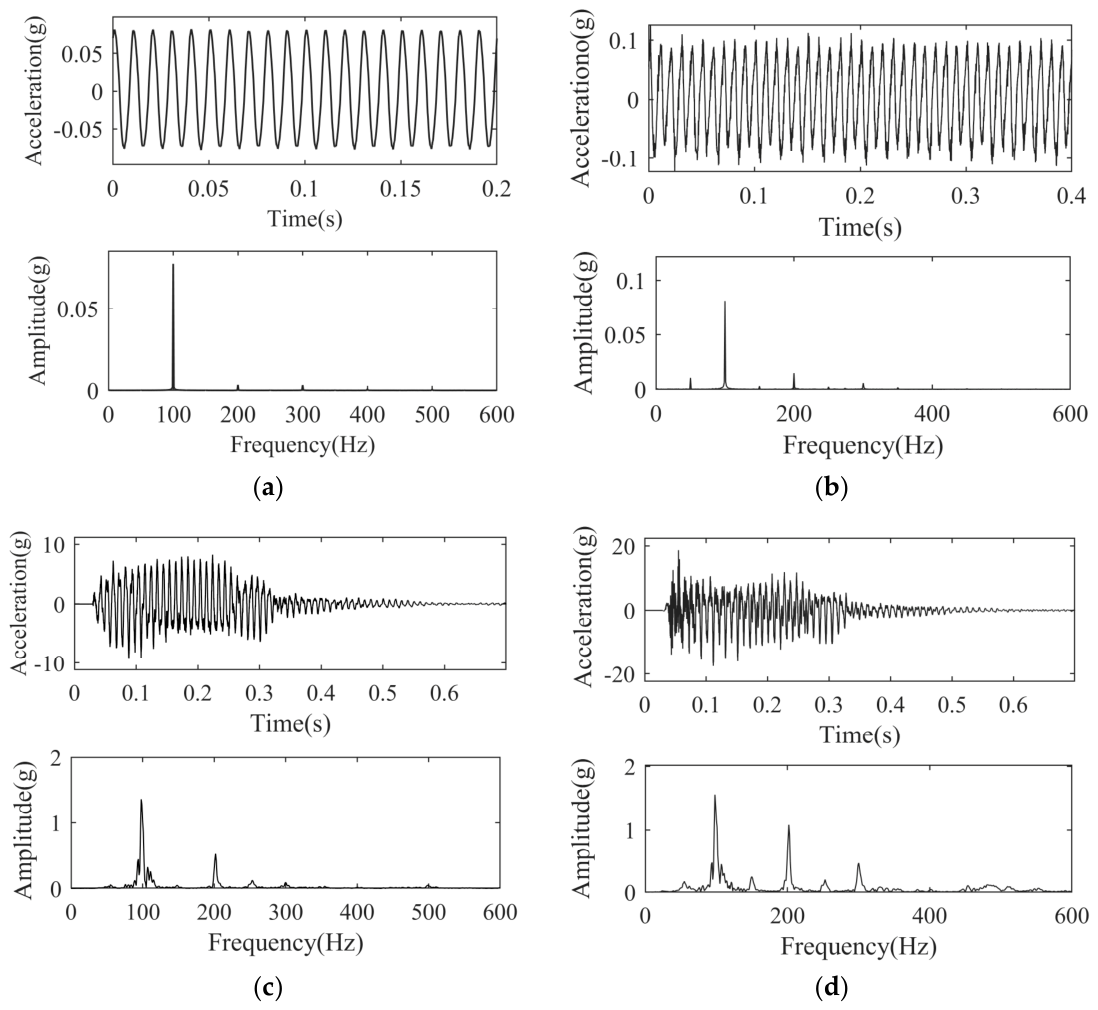
Figure 1 presents the vibration signals and their frequency spectrum for different oil-immersed three-phase transformers. In this figure, vibration signals were collected through the short-circuit test, primarily originating from winding vibrations.
Isc denotes the maximum short-circuit current that the experimental transformer can withstand. The transformer windings in (a), (b) and (c) are in normal condition, while the winding in (d) is deformed, since its SCI exceeded the criterion [
3] and further verified by the core-out inspection. Meanwhile, the acceleration was placed on the transformer tank corresponding to the low-voltage phase C winding, at an elevation of about one-quarter of the winding height measured from the bottom edge of the tank. As can be seen from the figure, the predominant spectral component of the vibration signals is 100 Hz under both normal and deformed winding conditions. Under short-circuit impulse test, the harmonic content in the vibration signal is higher than that observed during short-circuit test, which is mainly attributed to the enhanced influence of the nonlinear stress–strain behavior of the pressboard spacers at high current levels. In the presence of transformer deformation, significant changes are observed not only in the 100 Hz component but also in higher harmonics such as 200 Hz and 300 Hz.
In this paper, the VFR curves of the proposed VRA technique are derived primarily from the amplitude at the double-frequency component of the excited frequency-varied current. This choice is based on the fact that, given the current capacity of the existing VRA testing system, the double-frequency component constitutes the dominant component of the vibration signal, whereas the higher-order harmonic components occupy a relatively small proportion. This phenomenon is also illustrated in
Figure 11. Higher harmonics also objectively exists and may become non-negligible under certain conditions, such as increased excitation current or transformer deformation. Future work will further investigate the potential influence of higher-order harmonics on the diagnostic performance of the proposed method.
It is worth noting that the vibration response of transformer windings is primarily influenced winding structure and the mechanical configuration of the tank. And the former varies with the operating environment, the degradation behavior of insulating materials such as spacers and supporting components and the extent of winding deformation. Given this complexity, the accumulation of extensive VFR testing data is advisable for the purpose of developing a generalizable diagnostic criterion for transformer windings and subsequently constructing an intelligent diagnostic model.
6. Conclusions
This paper presented an off-line VRA technique to identify the winding condition. Following the research framework outlined in
Figure 1, vibration signals were reliably collected through the VRA testing system, and then carefully processed to calculated the VFR curves. Four kinds of correlation indices were calculated and fused through a novel hierarchical strategy, yielding the evaluation criterion for winding condition. Specifically, the hierarchical strategy consisted of dynamic evidence fusion to resolve conflicts existing in each correlation index, followed by the CRITIC-TOPSIS method to integrate the refined evidences, and finally the averaging fusion. Experiments were conducted on two separate transformers, rated 220 kV and 110 kV respectively, under both normal and winding faults have made to verify the effectiveness of proposed method. It was found that a decrease of approximately 10% in the proposed evaluation criterion serves as a preliminary indicator of minor loosening in the transformer winding. Furthermore, a decrease reaching 25% or more triggered the recommendation to initiate effective maintenance measures for further investigation and confirmation of the winding condition.
Influenced by the combined effects of continuous vibration of winding and core, extern short-circuit impact, and degradation of insulating materials, the looseness of transformer winding is inevitable, especially for the aged transformers. Hence, the proposed method could be an important supplement for the routine test of transformer in field. Despite the promising results, challenges remain for practical application. These include determining the appropriate accelerometer placement on the transformer tank, revising and refining the evaluation criterion for power transformer with different mechanical structure and different voltage and power classes, and constructing the intelligent diagnostic model for accurately and efficiently identifying the degrees of winding looseness of transformer. In addition, higher harmonics in vibration signals are very helpful for the condition monitoring of transformer winding. It is critical to systematically investigate the variation patterns of higher harmonics with changing winding conditions. This is our next work.