1. Introduction
Corrosion is one of the leading causes of durability loss in reinforced and prestressed concrete structures, significantly reducing their service life and increasing maintenance, repair and replacement costs [
1,
2,
3,
4]. The degradation process compromises both serviceability and structural safety through reinforcement section loss, cracking and spalling of the concrete cover, reduction in bond capacity and, in advanced stages, loss of load-bearing capacity. Modern design codes and durability-oriented standards increasingly recognise the need to move from purely prescriptive approaches towards performance-based maintenance strategies capable of anticipating deterioration before unacceptable damage levels are reached [
5,
6]. In this context, the concept of a durability limit state has become particularly relevant, as it provides a rational framework to define threshold conditions associated with corrosion-induced damage, such as reinforcement section loss or surface cracking of the concrete cover [
7,
8]. In the present study, the durability limit state is addressed from a serviceability-oriented perspective and is defined through measurable corrosion-related indicators, namely reinforcement section loss and corrosion-induced crack-width evolution. These indicators are not intended to represent an ultimate structural safety condition, but rather to provide quantitative thresholds for condition assessment, maintenance prioritisation and durability-based decision-making in a water-retaining reinforced-concrete structure.
One of the greatest challenges in assessing existing reinforced concrete structures is determining their actual corrosion condition under real exposure conditions. From the initial design stage, where exposure class, cover depth and material requirements are specified, to construction and long-term operation, significant deviations may occur due to workmanship, environmental variability, local defects, cracking, moisture gradients and changes in service conditions [
2,
9,
10]. These factors make the corrosion process highly heterogeneous, both spatially and temporally, and may lead to localised deterioration that cannot be adequately captured by periodic visual inspections alone. Moreover, corrosion initiation and propagation in reinforced concrete are intrinsically uncertain because they depend on a wide range of coupled variables, including concrete resistivity, oxygen availability, moisture content, carbonation depth, chloride concentration, temperature, cover depth and the local condition of the steel–concrete interface. This stochastic nature of corrosion makes continuous or repeated measurements especially valuable for reducing uncertainty in service-life assessment and maintenance planning [
11,
12,
13]. However, monitoring data must be interpreted together with complementary information on the material condition and exposure history.
The relevance of corrosion monitoring is further reinforced by the expected effects of climate change on reinforced concrete durability. Increasing temperature trends, variations in relative humidity and changes in atmospheric CO2 concentration may accelerate carbonation-induced depassivation and modify corrosion propagation rates. Recent studies have shown that conventional service-life models may underestimate deterioration when future climate scenarios are considered, particularly in ageing infrastructure exposed to variable environmental conditions. Therefore, the continuous monitoring of existing reinforced concrete assets is becoming increasingly important not only for diagnosing their current condition, but also for updating degradation forecasts as environmental exposure evolves. This is particularly relevant for critical water infrastructure, where service interruptions, restricted accessibility and large exposed surfaces make conventional inspection-based maintenance insufficient as the sole decision-making strategy.
In recent years, Structural Health Monitoring (SHM) has emerged as a key tool for the management of civil infrastructure. SHM can be defined as the systematic acquisition, transmission, processing and interpretation of data obtained from sensors installed in or on a structure, with the aim of evaluating its condition, detecting damage and supporting maintenance decisions [
12,
14,
15]. In reinforced concrete infrastructure, SHM may involve mechanical sensors, such as strain gauges, displacement transducers, accelerometers, fibre-optic sensors and acoustic emission systems [
16,
17,
18,
19,
20,
21], as well as durability-oriented sensors, including reference electrodes, resistivity probes, corrosion-rate sensors, temperature and humidity sensors, chloride sensors and pH sensors. For corrosion-affected structures, durability-oriented SHM is particularly valuable because it enables the temporal evolution of electrochemical and environmental parameters to be followed under real service conditions, providing information that cannot be obtained from isolated inspections. Recent advances in corrosion monitoring and service-life prediction have further emphasised the need to integrate sensor data with degradation models, probabilistic assessment and maintenance decision frameworks. Accordingly, full-scale field studies are necessary to demonstrate how monitored electrochemical variables can be transformed into engineering indicators that are directly useful for infrastructure owners and operators [
22,
23,
24,
25,
26,
27].
Several monitoring approaches have been proposed for corrosion assessment in reinforced concrete, including half-cell potential mapping, concrete resistivity measurements, linear polarisation resistance, galvanostatic pulse techniques, embedded reference electrodes, embedded corrosion probes, fibre-optic systems, piezoelectric sensors and multi-parameter sensor networks [
28,
29,
30,
31,
32,
33]. These techniques differ in their level of invasiveness, durability, spatial representativeness, sensitivity to environmental variables and suitability for long-term deployment. However, despite substantial progress in sensor development, there remains a need for full-scale case studies in real infrastructure where electrochemical monitoring data are not only recorded, but also translated into engineering indicators directly relevant to durability assessment, such as reinforcement section loss, crack-width evolution and maintenance decision thresholds. This gap is especially important because the practical implementation of predictive maintenance requires not only reliable measurements, but also a clear interpretation framework linking measured corrosion activity to observable damage indicators and durability limit-state criteria [
34].
Water-retaining structures represent a particularly relevant application for corrosion monitoring. Potable water tanks are critical infrastructure assets that must remain operational over long service lives, often under conditions of limited accessibility and variable water levels. Their internal environment may generate complex exposure regimes: some elements remain permanently or seasonally submerged, others are exposed to humid air, and upper components may be affected by external climatic variations. These exposure gradients can produce markedly different corrosion responses within the same structure. In addition, water-level fluctuations may generate wetting–drying or partially immersed zones, where oxygen availability, concrete saturation and ionic transport conditions vary with time, increasing the difficulty of defining a representative exposure class using conventional inspection criteria alone. As a result, the corrosion risk in these structures cannot be assumed to be spatially uniform, and monitoring points should be understood as representative or sentinel locations selected to capture the most relevant exposure conditions rather than as a complete description of the entire asset [
33,
35,
36].
This paper presents a full-scale case study of real-time corrosion monitoring in the El Goloso potable water tank, an underground reinforced concrete structure located in Madrid and built in 1968. The scientific contribution of the study lies in the integration of continuous electrochemical monitoring, environmental measurements and predictive durability modelling in a real water-retaining structure subjected to different exposure regimes. A monitoring system was installed in selected beams, columns and domes to measure corrosion potential, concrete resistivity, corrosion current density and temperature. The monitored elements were chosen to represent different structural components and degrees of contact with water, allowing the influence of exposure conditions on corrosion activity to be assessed. The study therefore provides field evidence on how local exposure, particularly the duration of water contact and the associated changes in moisture, resistivity and temperature, may influence corrosion-related durability indicators in a large existing potable-water tank.
Unlike conventional inspection-based approaches, the methodology adopted in this work links measured corrosion current density with reinforcement section loss using Faraday’s law and subsequently relates section loss to predicted crack-width evolution. This provides a direct connection between electrochemical monitoring data and durability limit-state assessment. The approach therefore supports a transition from reactive maintenance, based mainly on visual evidence of damage, towards predictive maintenance based on measured degradation rates and forecasted serviceability indicators. Nevertheless, the calculated section losses and crack-width forecasts are interpreted as monitoring-based durability indicators rather than direct measurements of historical deterioration or deterministic predictions of future damage. Their main value lies in supporting risk-informed maintenance decisions and in providing a quantitative baseline that can be updated as additional monitoring data become available.
The specific objectives of this study are: (i) to evaluate the corrosion condition of beams, columns and domes in a full-scale potable water tank using continuous electrochemical monitoring; (ii) to analyse the influence of water contact, submerged time, resistivity and temperature on corrosion kinetics; (iii) to estimate reinforcement section loss from measured corrosion current density; and (iv) to forecast crack-width evolution as an engineering indicator for durability-based maintenance planning. Through this framework, the study demonstrates how real-time corrosion monitoring can be used to reduce uncertainty, identify vulnerable elements and support performance-based asset management in critical water infrastructure.
2. Methodology
The methodology adopted in this study was designed to provide a comprehensive assessment of the corrosion condition of a large-scale reinforced concrete potable water tank under real service conditions. The approach combines the structural description of the tank, the installation of a multi-parameter corrosion monitoring system and the processing of electrochemical and environmental data for durability assessment. Unlike conventional condition surveys based on isolated inspections, the proposed methodology relies on continuous measurements to evaluate both the current corrosion state and the time-dependent evolution of degradation indicators. This framework establishes the basis for predictive maintenance by linking measured corrosion activity with reinforcement section loss and crack-width forecasting. However, the methodology should be understood as a monitoring-based durability assessment framework rather than as a complete forensic characterisation of all deterioration mechanisms acting in the structure. Accordingly, the electrochemical data were interpreted together with exposure conditions, structural typology and water-contact history, while acknowledging the need for complementary material characterisation to identify the governing depassivation mechanisms with greater certainty.
2.1. Description of the Structure
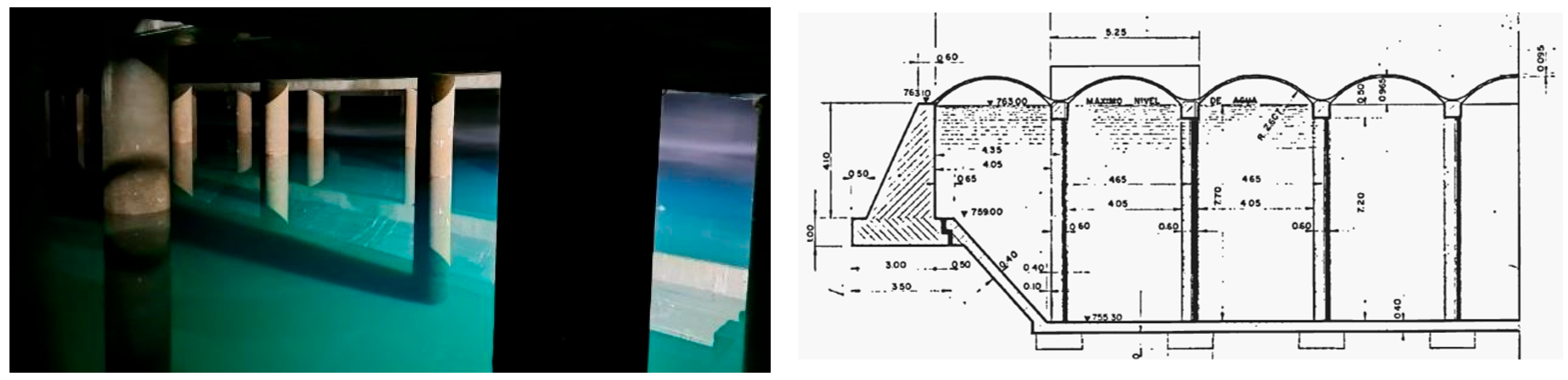
The potable water tank at El Goloso, operated by Canal de Isabel II, is located in Madrid near exit 17 of the M-607 highway. Built in 1968, the tank has a rectangular geometry with approximate dimensions of 400.45 m in length, 181.35 m in width, and 8.66 m in height, providing a total storage capacity of 534,355 m
3. It is an underground reinforced concrete structure composed of rigid frames cast in situ (see
Figure 1).
Expansion joints are placed every 18.60 m, dividing the tank into 20 standard modules of 18.60 m × 181.35 m, plus two additional modules of reduced width to complete the total span of 400.45 m. The main structural components include:
Foundation: Square footings for columns, 1.60 × 1.60 m with a depth of 0.60 m.
Slab: Reinforced concrete slab, 0.40 m thick.
Columns: Reinforced concrete columns, 0.60 m in diameter and 7.20 m high (from footing top to beam bottom).
Beams: Reinforced concrete beams connecting column heads, aligned with the tank’s longitudinal axis. Square section of 0.60 × 0.60 m. Expansion joints resolved with half-joint supports.
Domes: Reinforced concrete domes, 0.095 m thick, spanning 4.05 m with a 2.61 m radius arc. Stiffeners are placed every nine domes.
End Walls (Tympanums): Reinforced concrete stiffeners every nine domes, 5.25 m long and 0.60 m thick.
Perimeter Wall: Gravity-type reinforced concrete wall with trapezoidal section, vertical inner face and inclined outer face. Head width: 0.60 m; base width: 2.50 m; height: 4.10 m.
This structural configuration generates markedly different exposure conditions within the same asset. Columns may be subjected to frequent or seasonal immersion depending on water level, beams are generally located above the usual water level, and domes are not directly submerged but may be affected by high relative humidity and external thermal variations. Therefore, the tank cannot be treated as a homogeneous exposure environment for corrosion assessment purposes.
There are no available data regarding the concrete mix design used in this specific structure. Given that it was built in the 1960s and based on the regulations in force at that time (Instruction HA-61), it can be assumed that a concrete with a compressive strength of 20–25 MPa was used, with a minimum cement content of 300 kg/m3 and a water/cement ratio close to 0.5. The steel used during that period was plain carbon steel with a yield strength of approximately 235 MPa. These values should be regarded as historical design-based assumptions rather than experimentally verified material properties for the monitored locations. No original mix-design records or systematic material test results were available for the specific areas where the sensors were installed. Consequently, the mechanical and durability-related parameters used later in the analysis should be interpreted with this limitation in mind.
2.2. Monitoring System and Parameters
A total of 14 monitoring points were installed across two zones:
The monitored components include 4 columns, 6 beams, and 4 domes. These elements were selected to represent different exposure conditions within the same structure. Columns are frequently or seasonally in contact with stored water, beams are rarely exposed to direct water contact, and domes are not directly submerged but may be affected by humidity and external environmental variations. The 14 monitoring points were not intended to provide a complete spatial mapping of the entire tank. Instead, they were selected as representative sentinel locations covering the main structural typologies and exposure regimes identified in the structure. This strategy allows the temporal evolution of corrosion-related variables to be followed at critical or representative locations, but it does not eliminate the possibility of local deterioration in non-instrumented areas. Therefore, the conclusions derived from the monitoring data should be interpreted as evidence for the monitored locations and comparable exposure conditions, rather than as a full diagnosis of the whole tank.
The selection of monitoring points was intended to capture the influence of structural typology, elevation and water contact on corrosion activity. In particular, columns were instrumented at different heights to assess the effect of submerged time on corrosion propagation, whereas beams and domes were included as reference elements with lower direct exposure to water. This distribution allows comparison between elements subjected to different moisture regimes and provides a basis for identifying the most vulnerable zones of the tank.
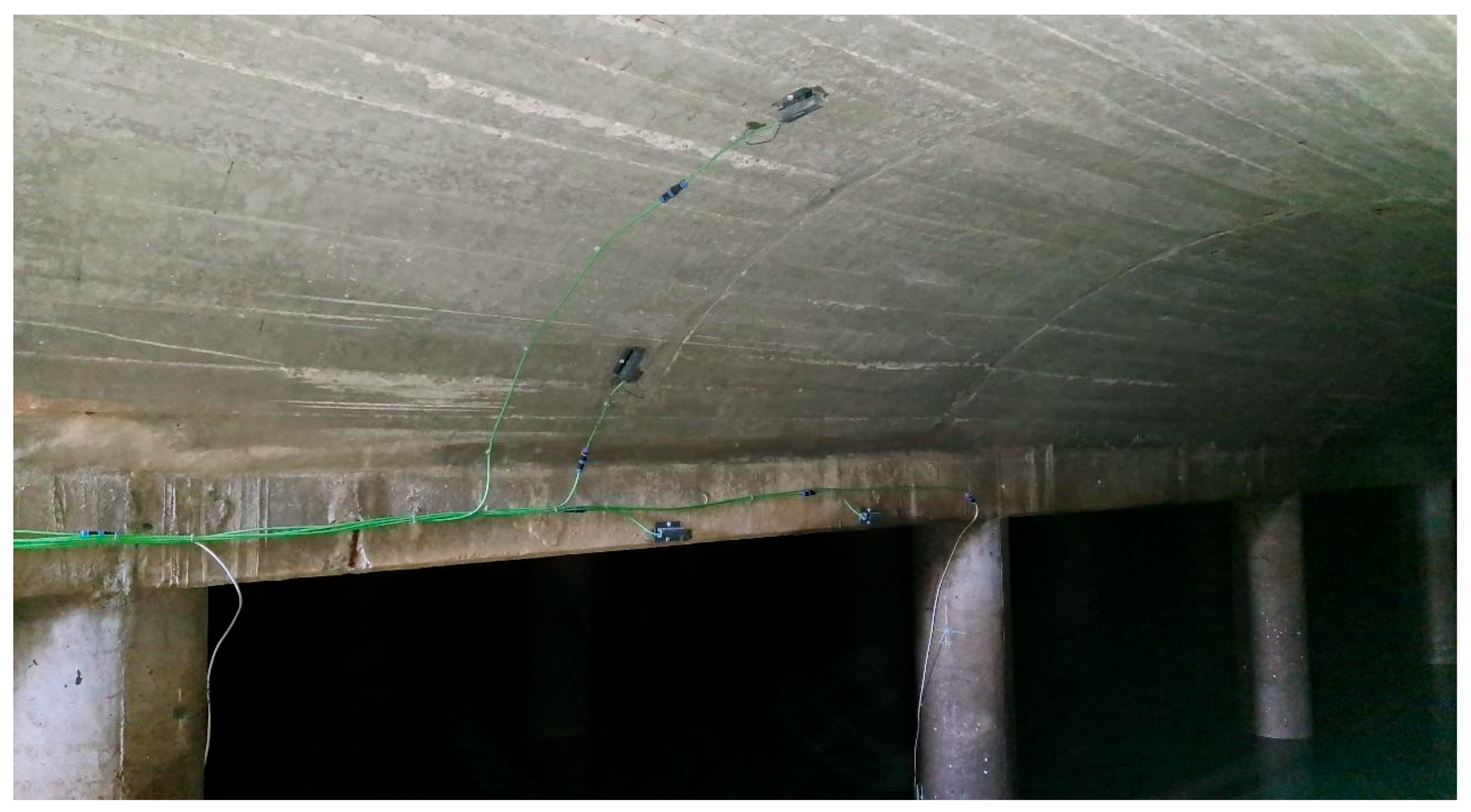
Sensors were mounted on the surface of the existing structural components at the level of the reinforcement bars. Electrical contact with the reinforcement was achieved by drilling a small hole down to the rebar, establishing the electrical connection and subsequently sealing the hole to prevent the creation of a preferential pathway for localised degradation. The installation procedure was designed to minimise disturbance to the existing concrete cover while ensuring reliable electrical continuity with the reinforcement (see
Figure 2). After installation, electrical continuity between the sensor system and the reinforcement was verified at each monitoring point. The drilled connection points were sealed to restore surface protection and to reduce the risk of creating artificial moisture or oxygen pathways. Although the installation was minimally invasive, the possible local influence of drilling and sealing on the immediate sensor environment was considered when interpreting the early monitoring records.
Each sensor was configured to measure the following parameters:
Corrosion potential (Ecorr) of the reinforcement was measured against a manganese dioxide (MnO
2) reference electrode, which was previously calibrated with respect to a silver/silver chloride (Ag/AgCl, sat. KCl) electrode. Interpretation of the measured values was based on the criteria defined in UNE 112083 [
37] and ASTM C876 [
38], considering the following thresholds: Ecorr > –157 mV
Ag/AgCl: low probability of active corrosion (>90% probability of passive steel); –157 mV
Ag/AgCl ≥ Ecorr ≥ –307 mV
Ag/AgCl: uncertain corrosion activity; the corrosion state cannot be determined with confidence. Ecorr < –307 mV
Ag/AgCl: high probability of active corrosion (>90% probability of ongoing corrosion). These thresholds provide a qualitative assessment of the corrosion risk of embedded reinforcement based on its electrochemical potential, offering a non-destructive diagnostic tool for evaluating the durability of reinforced concrete structures. Because corrosion potential is a thermodynamic indicator, it was used only to assess the probability of active corrosion and not to quantify corrosion rate. Its interpretation was therefore combined with corrosion current density, resistivity and temperature measurements.
Concrete resistivity (ρ), measured according to ASTM C1876 [
39], EN 12390-19 [
40] or RILEM TC 154-EMC [
41], was used to evaluate the ionic transport capacity of the concrete matrix, which governs both charge transfer and ohmic drop. The resistivity values were interpreted in accordance with established ranges: values > 1000–2000 Ω·m indicate low corrosion risk regardless of chloride or carbonation presence; 500–1000 Ω·m suggest low corrosion activity; 100–500 Ω·m correspond to moderate or high corrosion risk; and values < 100 Ω·m imply that resistivity is no longer the controlling parameter, with corrosion likely governed by other factors. The resistivity values reported in this study correspond to field measurements obtained at the actual temperature of each monitoring point. No temperature normalisation was applied at this stage. Consequently, the measured resistivity includes both moisture-related and thermally induced variations. This limitation is relevant for the interpretation of seasonal trends and is addressed in the discussion by considering temperature together with resistivity and corrosion current density.
Corrosion current density (icorr) was determined using the Stern–Geary equation, with a polarisation amplitude of ±10 mV and compensation for ohmic drop via high-frequency impedance measurements. The readings were obtained directly on the embedded reinforcement bars. The zero-resistance ammeter (ZRA) method was deliberately avoided to prevent interference from macrocell currents, particularly in submerged zones. This methodology aligns with the recommendations of RILEM TC 154-EMC for embedded probe systems and was adapted to the specific configuration of the monitoring system: <0.1 μA/cm2 (negligible), 0.1–0.5 μA/cm2 (low), 0.5–1.0 μA/cm2 (moderate), and >1.0 μA/cm2 (high), corresponding to estimated penetration rates of <0.001, 0.001–0.005, 0.005–0.01, and >0.01 mm/year, respectively. Corrosion current density was considered the main quantitative indicator of active corrosion propagation. Nevertheless, the conversion from icorr to corrosion penetration involves assumptions regarding the electrochemically active area, the Stern–Geary constant and the morphology of the corrosion process. For this reason, the calculated section losses are interpreted as indirect electrochemical estimates rather than as direct measurements of steel loss.
Temperature (T) was measured at each monitoring point in the concrete surface. Temperature was included because it affects both corrosion kinetics and concrete resistivity. In general, higher temperature accelerates electrochemical reactions, while also reducing concrete resistivity due to increased ionic mobility. For this reason, temperature was treated not only as an environmental variable, but also as a key parameter for interpreting seasonal changes in corrosion current density and resistivity. The simultaneous acquisition of temperature, resistivity and corrosion current density was used to reduce the risk of attributing changes in electrochemical response to a single variable. In particular, temperature was considered essential for distinguishing, at least qualitatively, between seasonal thermal effects and changes associated with moisture or water-contact conditions.
Table 1 lists all 14 monitoring points with structural element, zone, height, contact with water and rebar diameter.
The measurement method is patented by CSIC [
19]. Corrosion measurements are done directly on the rebar. icorr was derived from the Stern–Geary relation by small-signal polarisation around Ecorr with ohmic-drop compensation. No ZRA was used to quantify corrosion current density, avoiding the risk of collecting macrocell currents of the submerged cage. All sensors were connected to a data acquisition and transmission unit. Measurements were automatically recorded every 3 h and transmitted for processing and interpretation. The acquisition frequency was selected to capture daily and seasonal variations in electrochemical and environmental parameters while limiting data redundancy and ensuring stable long-term operation of the monitoring system.
The monitoring system provided continuous records of corrosion potential, concrete resistivity, corrosion current density and temperature for each monitored point. Data were grouped by structural component—beams, columns and domes—and by exposure condition, allowing comparative analysis between elements with different degrees of water contact. For data analysis, the records were grouped according to structural component, zone, elevation and degree of water contact. This grouping was intended to identify relative differences in corrosion behaviour between exposure regimes rather than to define a single average corrosion state for the whole tank. Descriptive statistics, time-series trends and comparative plots were used to evaluate the evolution of each parameter. The subsequent estimation of reinforcement section loss was based on the time integration of corrosion current density, whereas crack-width forecasts were treated as serviceability-oriented indicators for maintenance planning.
The raw monitoring data were processed to obtain time-dependent durability indicators suitable for maintenance decision-making. Corrosion potential was used as a qualitative indicator of the probability of active corrosion, concrete resistivity as an exposure-sensitive indicator of ionic transport, corrosion current density as the main quantitative indicator of corrosion propagation, and temperature as an environmental variable affecting both electrochemical kinetics and resistivity.
Reinforcement section loss was estimated from the cumulative corrosion current density using Faraday’s law. The calculated values represent incremental corrosion penetration during the monitoring period and should not be interpreted as the total historical section loss accumulated since construction of the tank in 1968. This distinction is essential because any pre-existing deterioration before sensor installation forms part of the initial condition of the structure and requires independent assessment through inspection or material characterisation.
A corrosion morphology factor was adopted to account for the relationship between average electrochemical corrosion penetration and local steel loss. In the absence of direct evidence of severe pitting at the monitored locations, the adopted value was considered representative of generalised or moderately localised corrosion. However, if future inspections identify pitting corrosion, the local penetration may be significantly higher than the average value inferred from icorr, and the morphology factor should be revised accordingly.
The estimated section losses were subsequently used to calculate corrosion-induced crack-width evolution through empirical relationships available in the literature. These crack-width estimates were used as serviceability-related durability indicators, not as deterministic predictions of structural performance. The forecasts should therefore be updated as additional monitoring data become available and should be interpreted within the range of validity of the empirical models and the monitored exposure conditions.
3. Results
The monitoring campaign provided continuous records of four key parameters: corrosion potential, concrete resistivity, corrosion current density and temperature. Data were grouped according to the monitored structural component—beams, columns and domes—because each group is associated with a different exposure condition within the potable water tank. Beams are located above the usual water level and are rarely exposed to direct water contact; columns are frequently or seasonally submerged depending on their elevation; and domes are not in direct contact with stored water but may be affected by humidity and external environmental variations. This classification allows the electrochemical response of the reinforcement to be analysed as a function of structural typology, elevation and exposure to water, rather than treating the tank as a homogeneous environment.
The results are presented as monitoring-based evidence for the instrumented locations and their associated exposure conditions. Therefore, the observed trends should not be interpreted as a complete spatial diagnosis of the entire tank, but as representative information obtained from selected sentinel points. This distinction is important because corrosion in large reinforced-concrete water-retaining structures may exhibit significant spatial variability due to differences in cover depth, concrete quality, cracking, moisture gradients and water-contact history.
The results presented in this section correspond to the monitoring period after sensor installation. Therefore, they describe the current and time-dependent corrosion response recorded by the monitoring system, but they do not represent the total historical degradation accumulated since the construction of the tank in 1968. This distinction is particularly important for the interpretation of section loss and long-term durability forecasts.
Time is expressed in month-year format in the following figures. For clarity, the results are discussed separately for each monitored parameter, and the interpretation focuses on the relative behaviour of beams, columns and domes. A multi-parameter interpretation is adopted throughout this section. Corrosion potential is used as a qualitative indicator of the probability of active corrosion, concrete resistivity as an exposure-sensitive indicator of ionic transport, corrosion current density as the main quantitative indicator of corrosion propagation, and temperature as an environmental variable affecting both resistivity and electrochemical kinetics. This combined interpretation reduces the risk of assigning corrosion activity on the basis of a single parameter.
3.1. Corrosion Potential
The corrosion potential was measured against a MnO
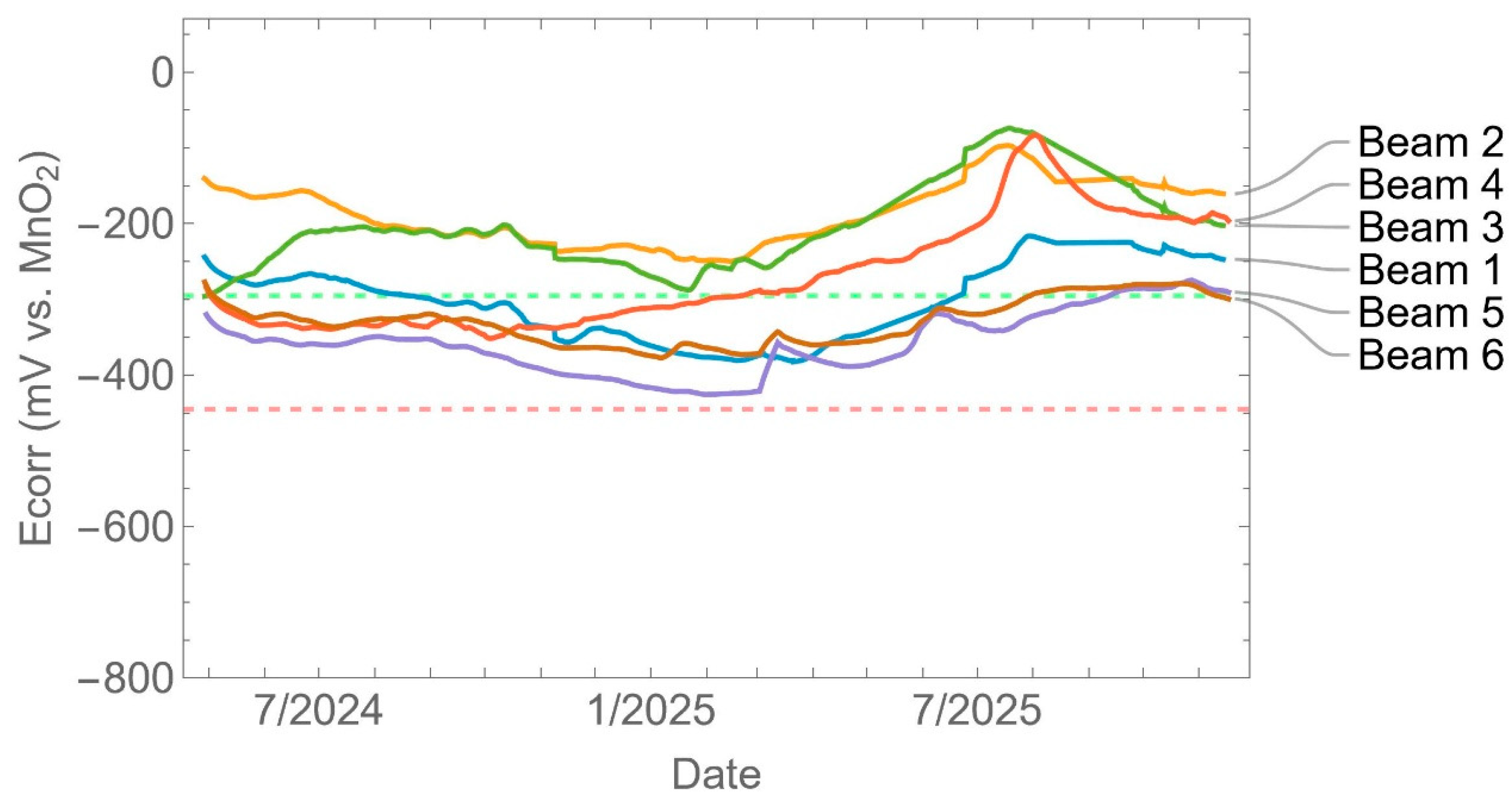
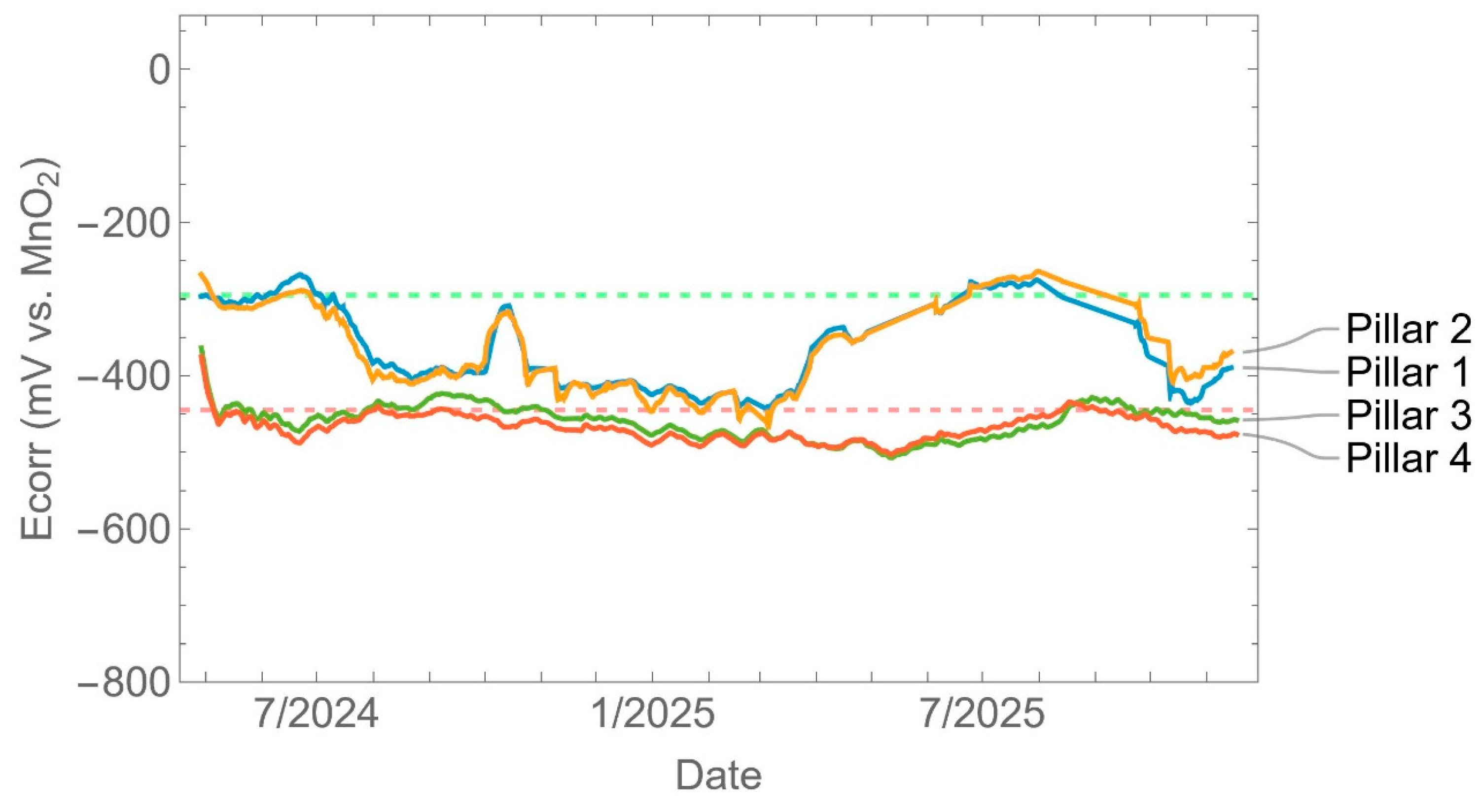
2 reference electrode, and the interpretation was based on two thresholds: a green dashed line indicating low probability of corrosion and a red dashed line marking high probability [
19,
29,
42]. Because corrosion potential reflects the thermodynamic tendency of the reinforcement to corrode, it was interpreted as a probability-based indicator rather than as a direct measurement of corrosion rate. Therefore, the potential results were evaluated together with corrosion current density and concrete resistivity.
Figure 3 shows the corrosion potential values recorded in the beams. Nearly all readings remained within the passive range throughout the monitoring period. This behaviour indicates a low probability of active corrosion in the monitored beams and suggests that these elements are currently not subjected to electrochemical conditions favourable to sustained reinforcement corrosion. The limited dispersion of the potential values also indicates relatively stable exposure conditions in these elements. The stable potential response observed in the beams is consistent with their limited direct exposure to water and supports the interpretation that the reinforcement remained predominantly passive at the monitored locations.
Figure 4 presents the corrosion potential values recorded in the columns. In contrast to the beams, the columns exhibited more variable values, with several measurements falling in the intermediate range. This response suggests a more uncertain corrosion condition in the columns, consistent with their variable degree of contact with water and with the presence of moisture gradients along the height of the elements. Although potential values alone cannot quantify the corrosion rate, the observed trend identifies the columns as the group requiring closer attention.
The greater variability in the column potentials indicates that local exposure conditions, particularly elevation-dependent water contact, have a significant influence on the electrochemical state of the reinforcement. The presence of values within the uncertain range does not necessarily imply sustained active corrosion at all column locations, but it identifies these elements as more susceptible to temporal changes in corrosion risk.
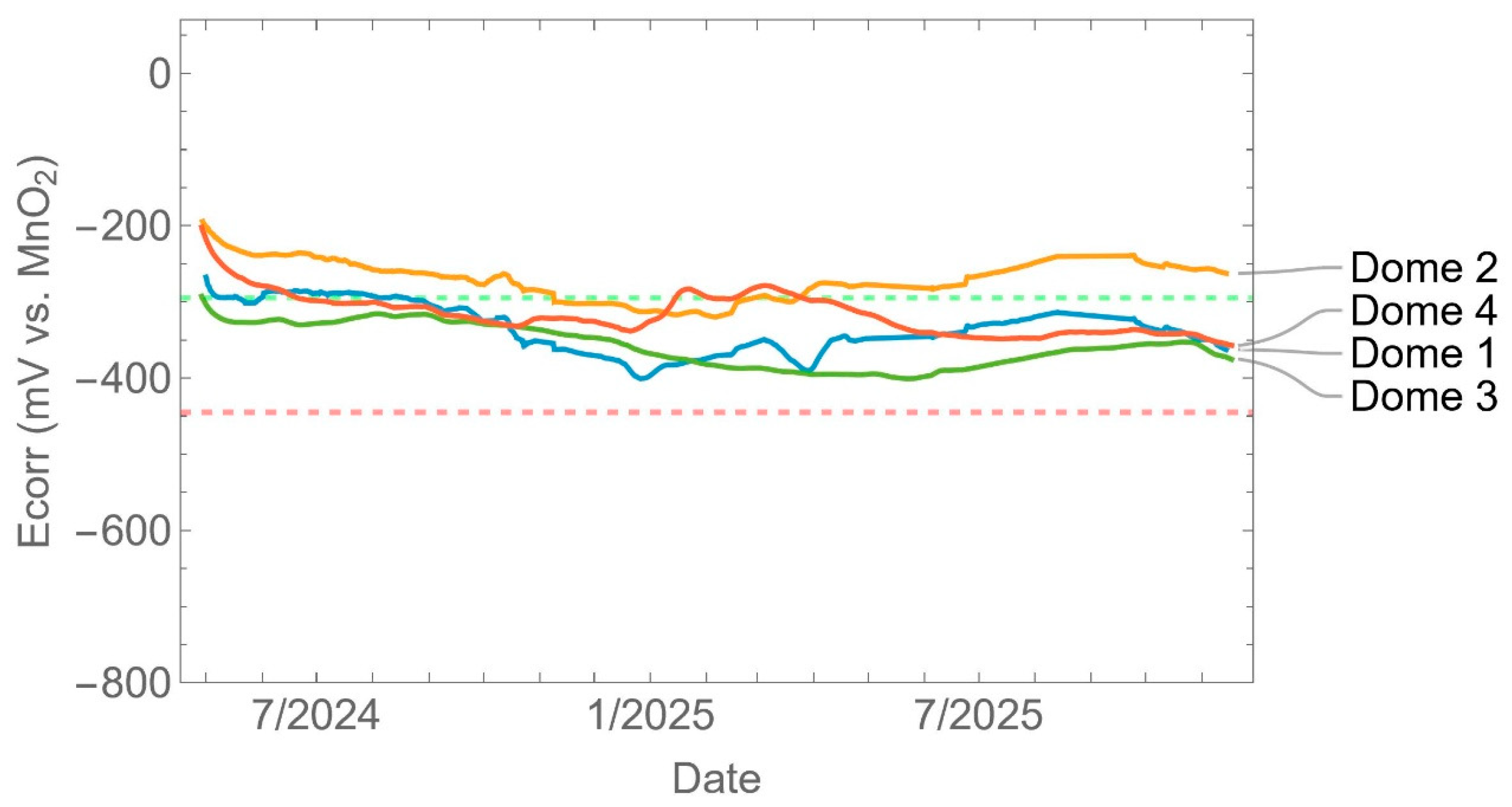
Figure 5 shows the corrosion potential values measured in the domes. The values remained predominantly within the passive range, similar to the beams. However, occasional shifts towards more negative potentials were observed, indicating that the domes may experience transient changes in electrochemical conditions, probably associated with variations in humidity and temperature rather than with permanent immersion. These occasional potential shifts should be interpreted as evidence of transient electrochemical perturbations rather than as conclusive proof of sustained corrosion propagation. Since the domes are not directly submerged, their response is more likely associated with environmental fluctuations affecting moisture and temperature conditions at the concrete surface.
Overall, the corrosion potential results show a clear differentiation between the monitored structural components. Beams and domes generally exhibited passive electrochemical conditions, whereas columns showed more variable potentials and a greater tendency towards uncertain corrosion activity. This confirms the relevance of exposure conditions, particularly water contact, in controlling the corrosion risk within the tank.
Taken alone, the potential measurements provide a useful screening of corrosion probability, but they do not allow corrosion rate, section loss or depassivation mechanism to be determined. For this reason, the following sections integrate resistivity, corrosion current density and temperature to obtain a more robust diagnosis of the monitored elements.
3.2. Concrete Resistivity
Concrete resistivity, strongly influenced by moisture content, was analysed with two reference limits: the green dashed line representing values high enough to prevent corrosion and the red dashed line indicating conditions where corrosion may occur. In this study, resistivity was interpreted as an indicator of the concrete’s ability to sustain ionic transport, not as a direct measurement of corrosion activity. Low resistivity may indicate favourable electrolyte availability, but active corrosion also requires reinforcement depassivation, sufficient electrochemical driving force and appropriate oxygen availability.
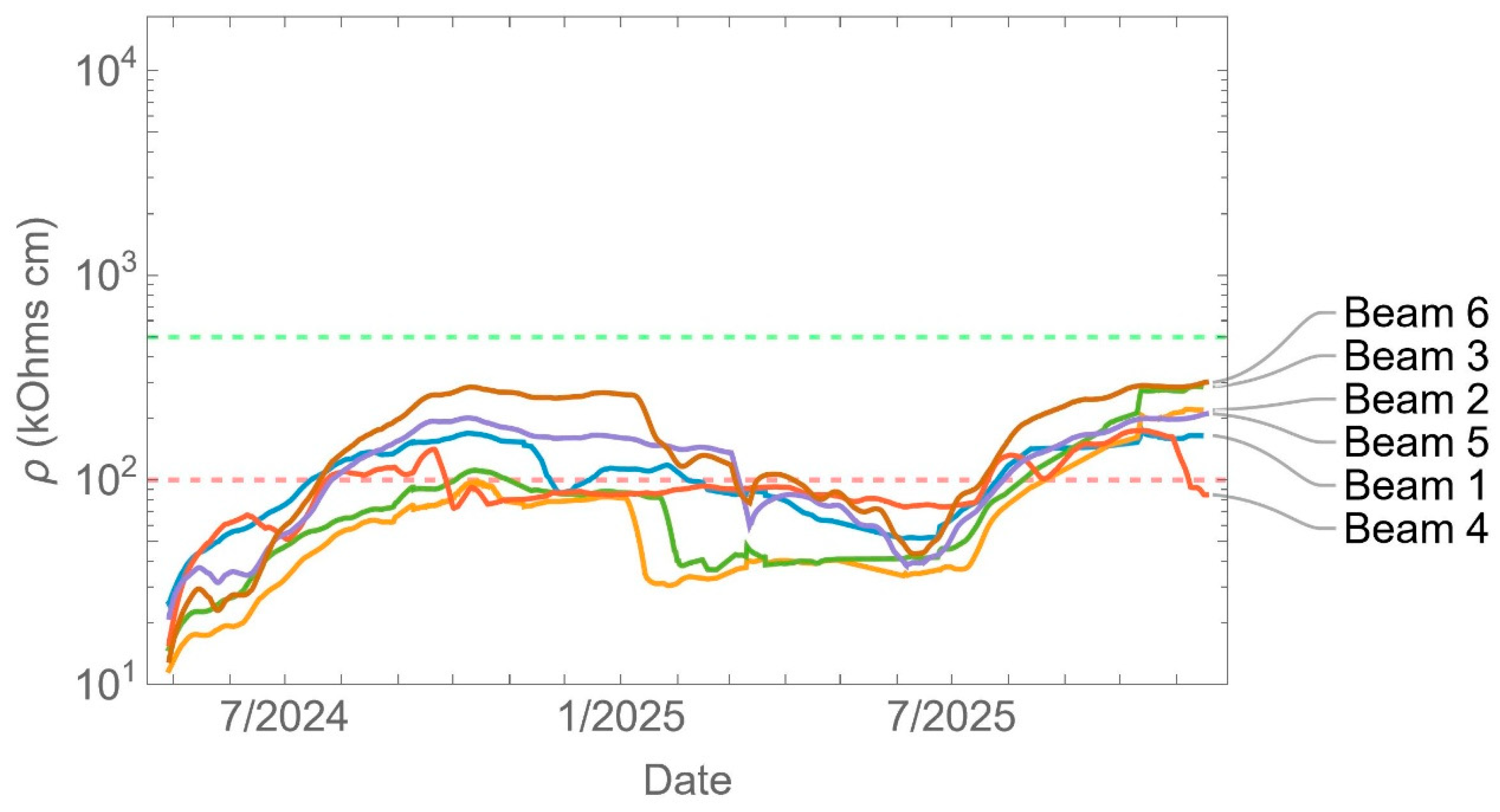
Figure 6 shows the resistivity values recorded in the beams. The values generally remained within low-to-medium resistivity ranges. Although these values do not indicate highly resistive concrete, the absence of significant corrosion current density in the beams, discussed later, suggests that resistivity alone is not sufficient to define the corrosion state of these elements. This result highlights the need to combine resistivity measurements with corrosion potential and corrosion current density. The beam results are particularly relevant because they show that relatively conductive concrete does not necessarily imply active corrosion when the reinforcement remains passive. In these elements, low-to-medium resistivity should be interpreted as a condition that may facilitate corrosion propagation if depassivation occurs, but not as evidence that corrosion is already progressing.
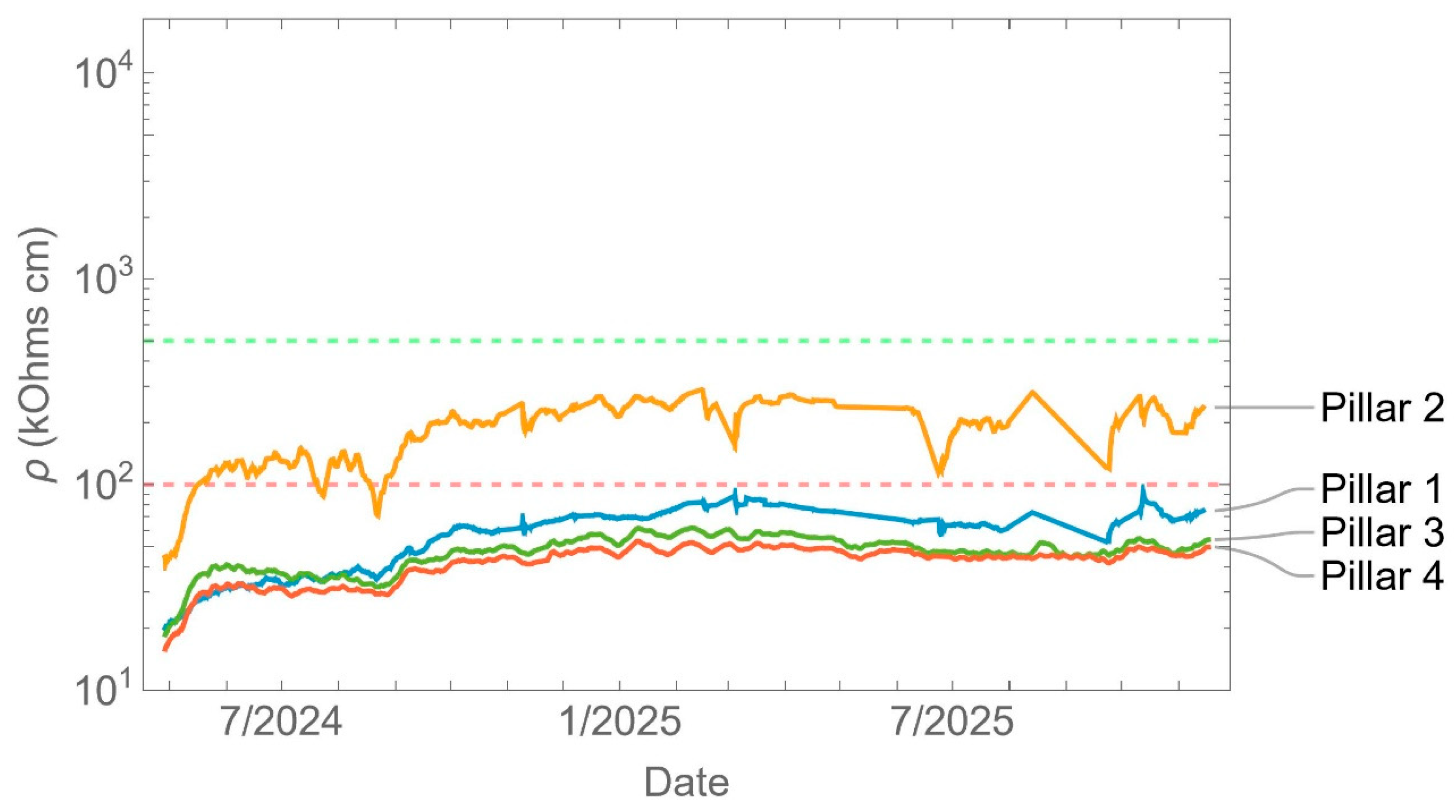
Figure 7 presents the resistivity values recorded in the columns. The columns consistently exhibited the lowest resistivity values among the monitored components. This behaviour is consistent with their frequent or seasonal contact with water, which increases the degree of saturation of the concrete and enhances ionic conductivity. The low resistivity measured in the columns indicates that, from the point of view of electrolyte availability, these elements are more favourable to corrosion propagation than beams and domes. The low resistivity of the columns should therefore be understood as an exposure-related vulnerability factor. It indicates that the concrete environment is more conductive and that ionic transport is less restricted, particularly at locations subjected to longer water contact.
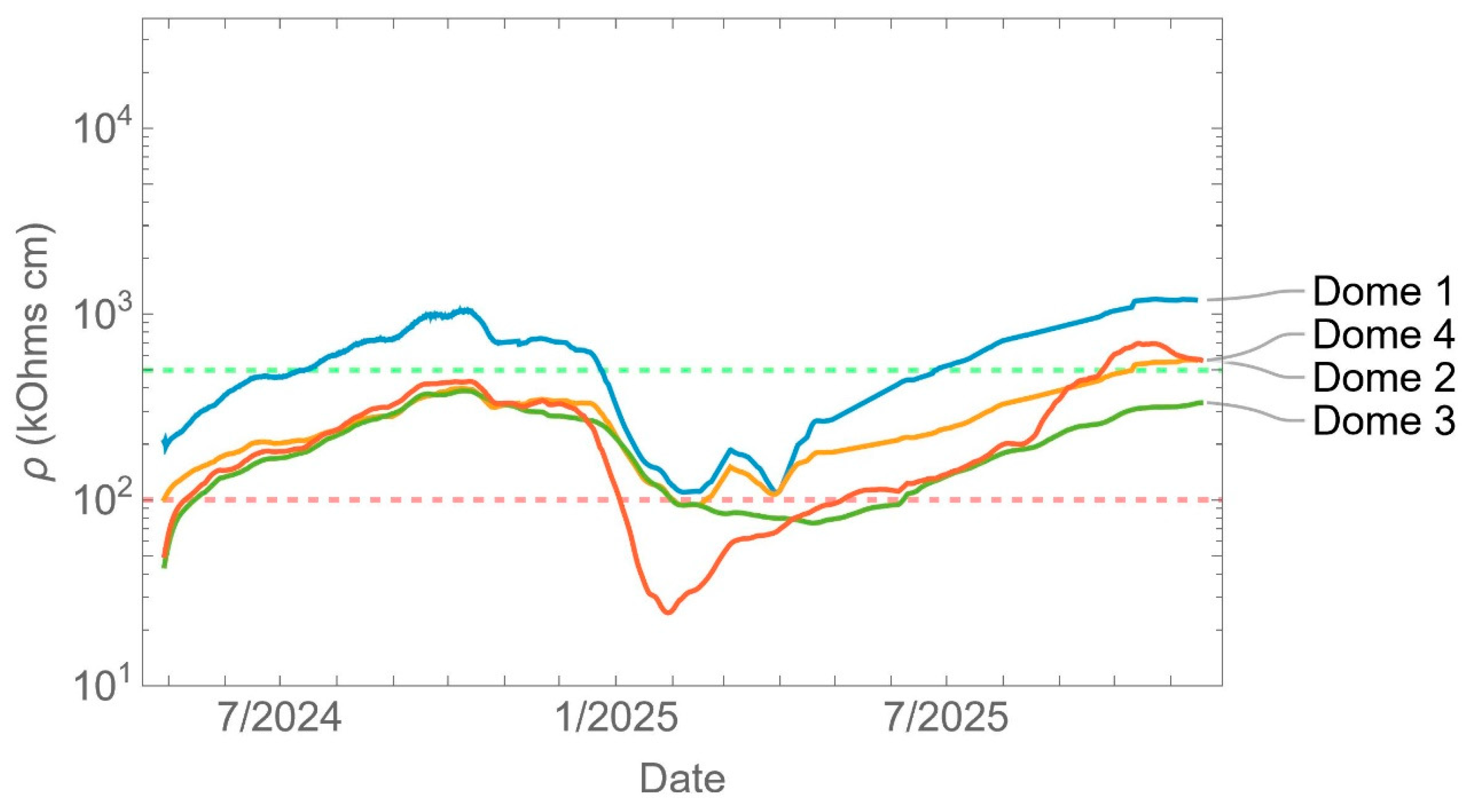
Figure 8 shows the resistivity values measured in the domes. The domes exhibited higher resistivity values during certain periods, with more marked temporal variations than the columns. This response is consistent with a lower degree of saturation and a stronger influence of environmental fluctuations, including humidity and temperature changes. The observed resistivity increase during drier periods supports the interpretation that moisture availability plays a decisive role in the electrochemical behaviour of these elements. The larger temporal variability observed in the domes suggests that their resistivity response is governed by environmental fluctuations rather than by direct immersion. Consequently, seasonal changes in dome resistivity should be interpreted with caution, particularly because the measured values were not normalised to a reference temperature.
The resistivity results confirm that the columns constitute the most conductive and therefore potentially most vulnerable environment for corrosion propagation. However, the data also show that resistivity must be interpreted as an exposure and transport indicator, not as a direct measurement of corrosion rate. In particular, field resistivity values are affected by temperature, and unless temperature normalisation is applied, seasonal variations may reflect both moisture changes and thermal effects. This limitation is important for the interpretation of the results. The resistivity values reported here correspond to field conditions at the actual sensor temperature. Therefore, part of the observed temporal variation may be thermally induced. The combined analysis with temperature and corrosion current density is necessary to avoid attributing all resistivity changes exclusively to moisture variations.
3.3. Corrosion Current Density
The corrosion current density, expressed in µA/cm
2, is the most direct indicator of active corrosion and allows quantification of the degradation process [
2,
19,
42,
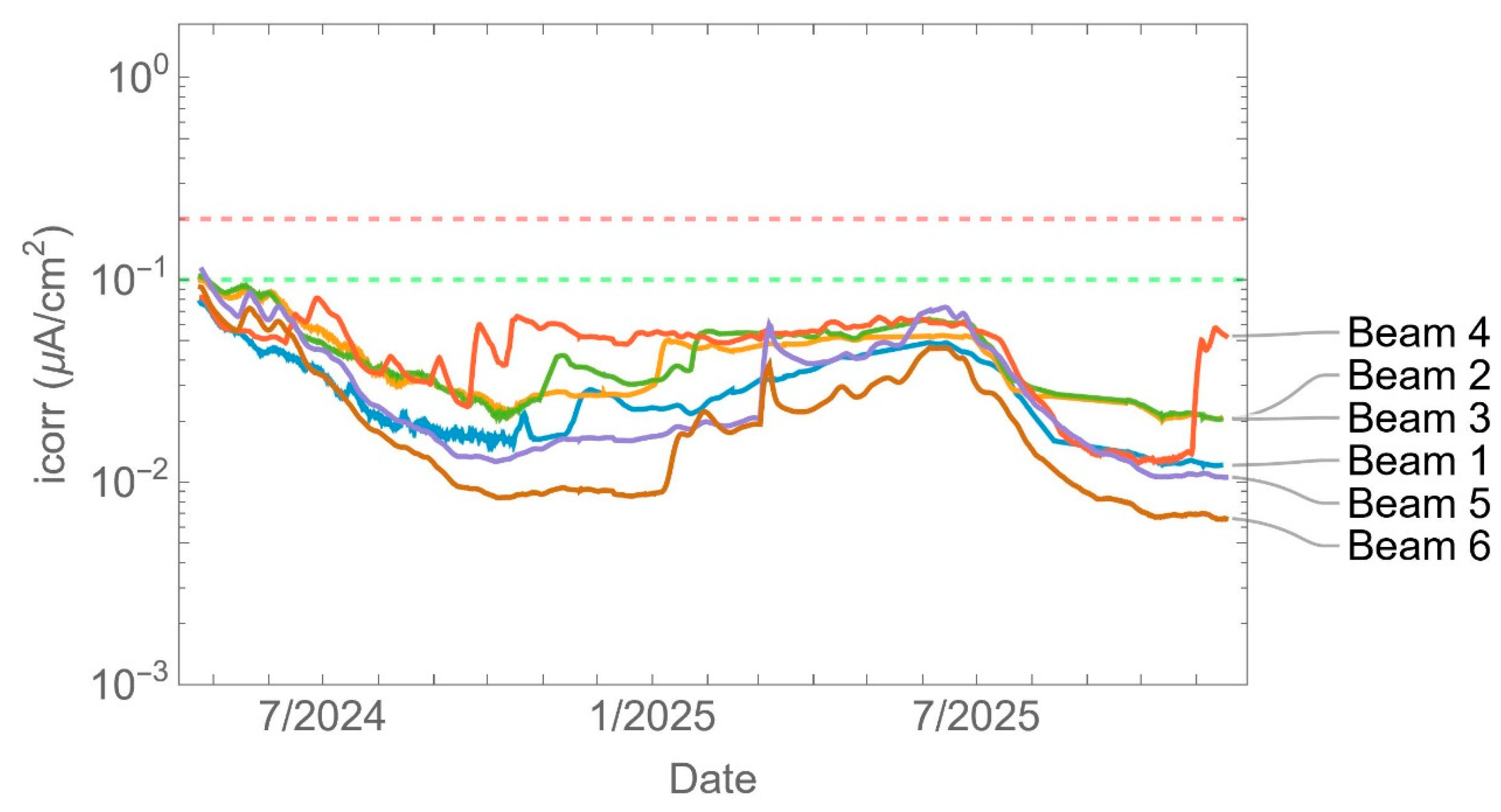
43]. Throughout the monitoring period, beams exhibited consistently passive behaviour, as shown in
Figure 9, where all recorded values remain well below the threshold of 0.1 µA/cm
2. According to the adopted classification, these values correspond to negligible corrosion activity. This confirms that the reinforcement in the monitored beams remained in a passive or near-passive condition, despite the low-to-medium resistivity values observed in some periods. The agreement between low icorr values and passive corrosion potentials supports the conclusion that beams are not currently undergoing significant corrosion propagation.
The coexistence of low-to-medium resistivity and negligible corrosion current density in the beams requires specific electrochemical interpretation. Resistivity reflects the capacity of the concrete pore network to conduct ionic current, whereas icorr reflects the actual anodic dissolution rate of steel. Therefore, a relatively low resistivity value may indicate that the concrete is sufficiently conductive to support corrosion if the steel is depassivated, but it does not imply that corrosion is occurring. In the monitored beams, the simultaneous presence of passive potentials and icorr values below 0.1 µA/cm2 indicates that the reinforcement remained passivated or that electrochemical conditions were not favourable to sustained corrosion propagation. This result confirms the need for a multi-parameter diagnosis rather than a classification based on resistivity alone.
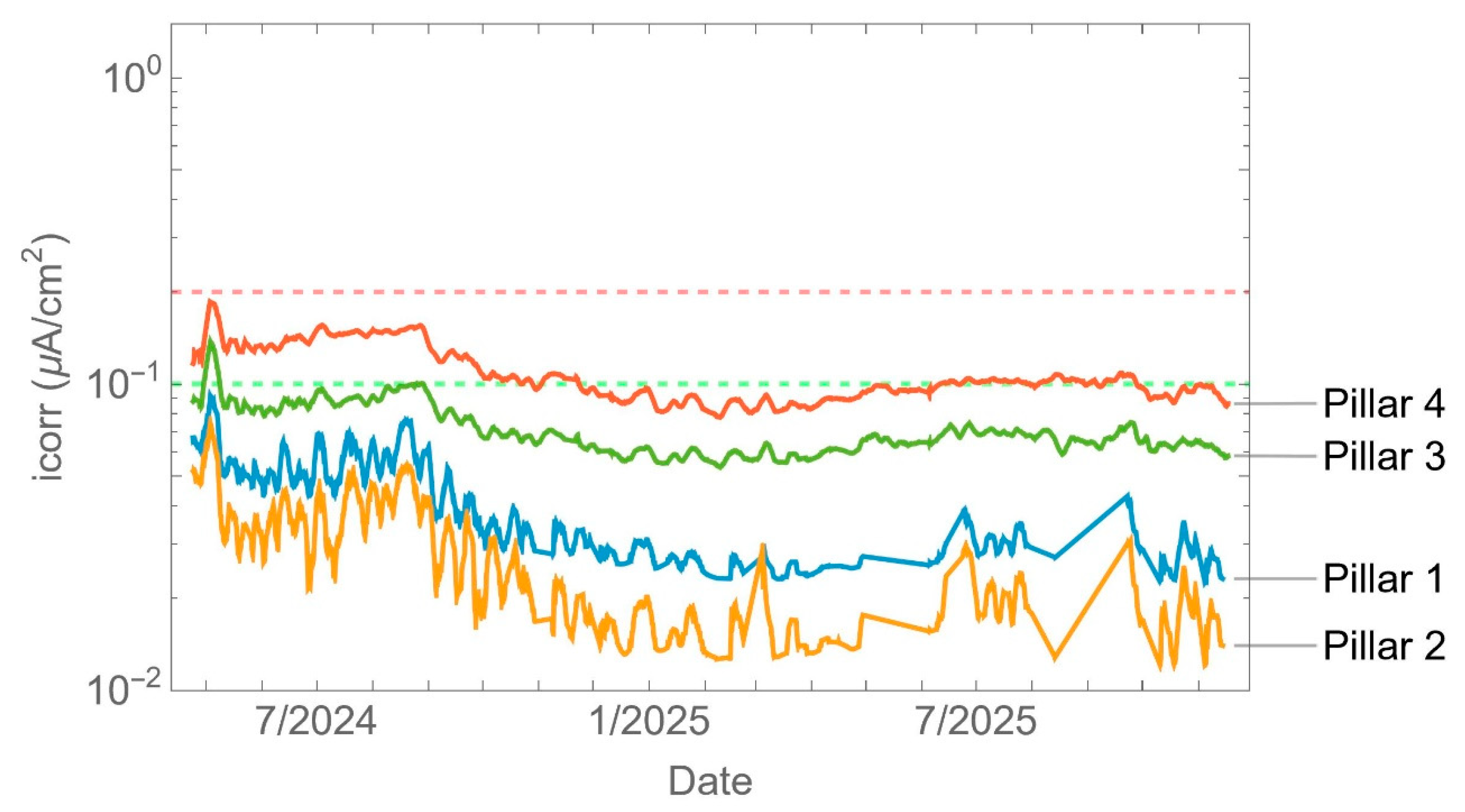
Figure 10 presents the corrosion current density recorded in the columns. The columns displayed the highest dispersion among all monitored components. Most values remained within the negligible or low corrosion range; however, one sensor showed a persistent tendency towards higher icorr values. This sensor corresponds to the column location with greater exposure to water, indicating that prolonged immersion or frequent contact with water is a key factor controlling corrosion activity in the tank. The response of the columns demonstrates that corrosion risk cannot be assigned solely on the basis of structural typology; instead, elevation, local exposure and duration of water contact must be considered. The column results indicate that corrosion activity is localised in the most exposed monitored locations rather than generalised across all instrumented columns. This distinction is important because it shows that the same structural component may contain zones with different electrochemical behaviour depending on elevation and water-contact history. The higher icorr values observed in the most exposed column sensor are consistent with the lower resistivity values measured in columns.
The corrosion current density values recorded in the columns indicate localised activation rather than generalised corrosion of all monitored column reinforcement. This distinction is important because it shows that the monitoring system can identify vulnerable points within a group of elements that would otherwise be considered to have the same exposure class. From an asset-management perspective, this result is particularly relevant because it supports differentiated inspection and maintenance strategies. Rather than assigning a uniform corrosion condition to all columns, the monitoring data allow the most vulnerable locations to be identified and prioritised for complementary inspection or future material characterisation.
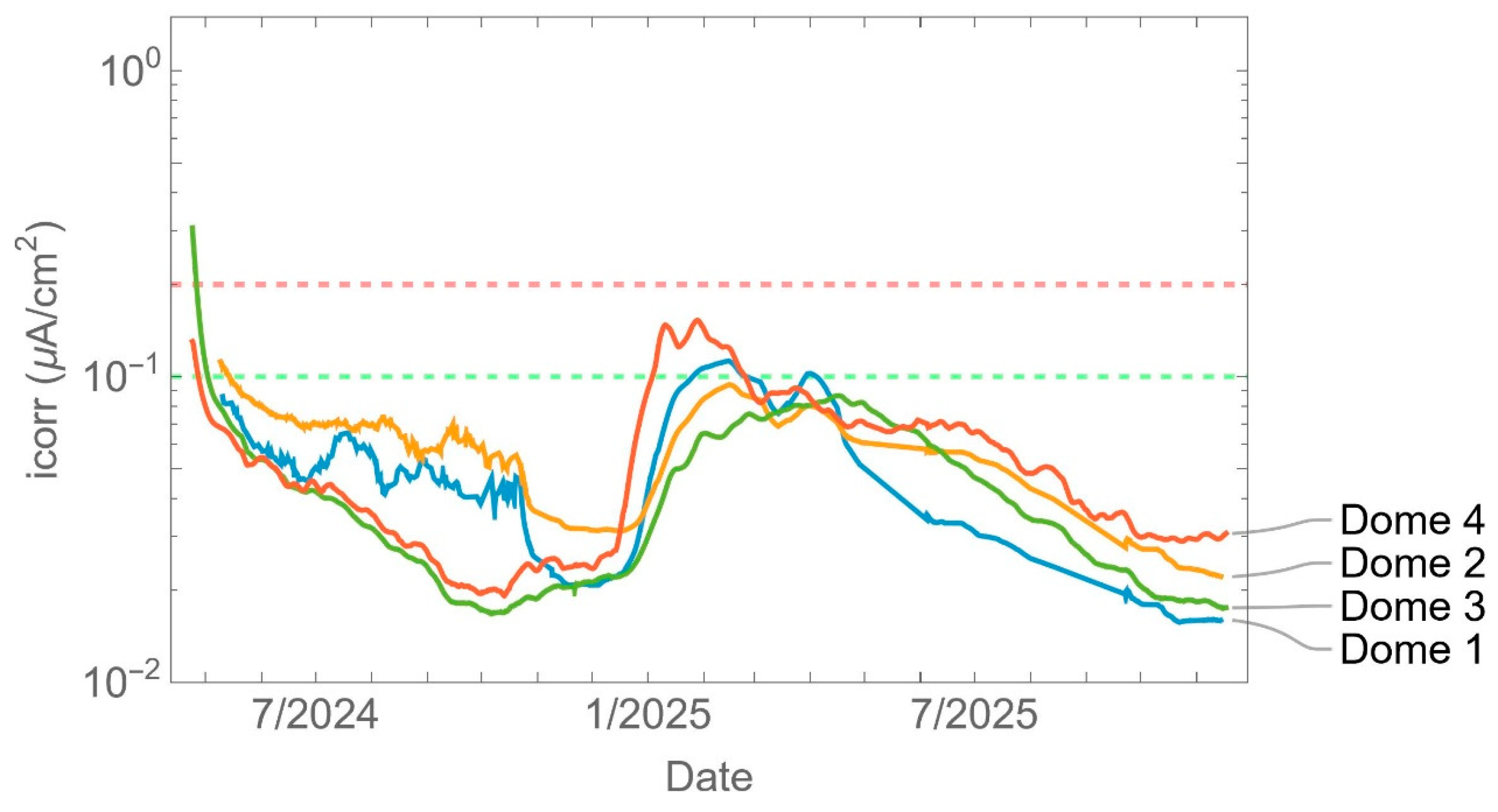
Figure 11 shows the corrosion current density recorded in the domes. These elements remained mostly within the negligible corrosion range, although occasional activation events were detected. These transient increases may be associated with environmental changes affecting the moisture state and temperature of the concrete. However, the data do not indicate sustained corrosion propagation comparable to that observed in the most exposed column sensor. The domes therefore show an intermediate behaviour between beams and columns. The dome response should therefore be described as predominantly passive with occasional short-term electrochemical activation. Because direct water contact is absent in these elements, the observed transients are more plausibly related to environmental variations affecting humidity and temperature.
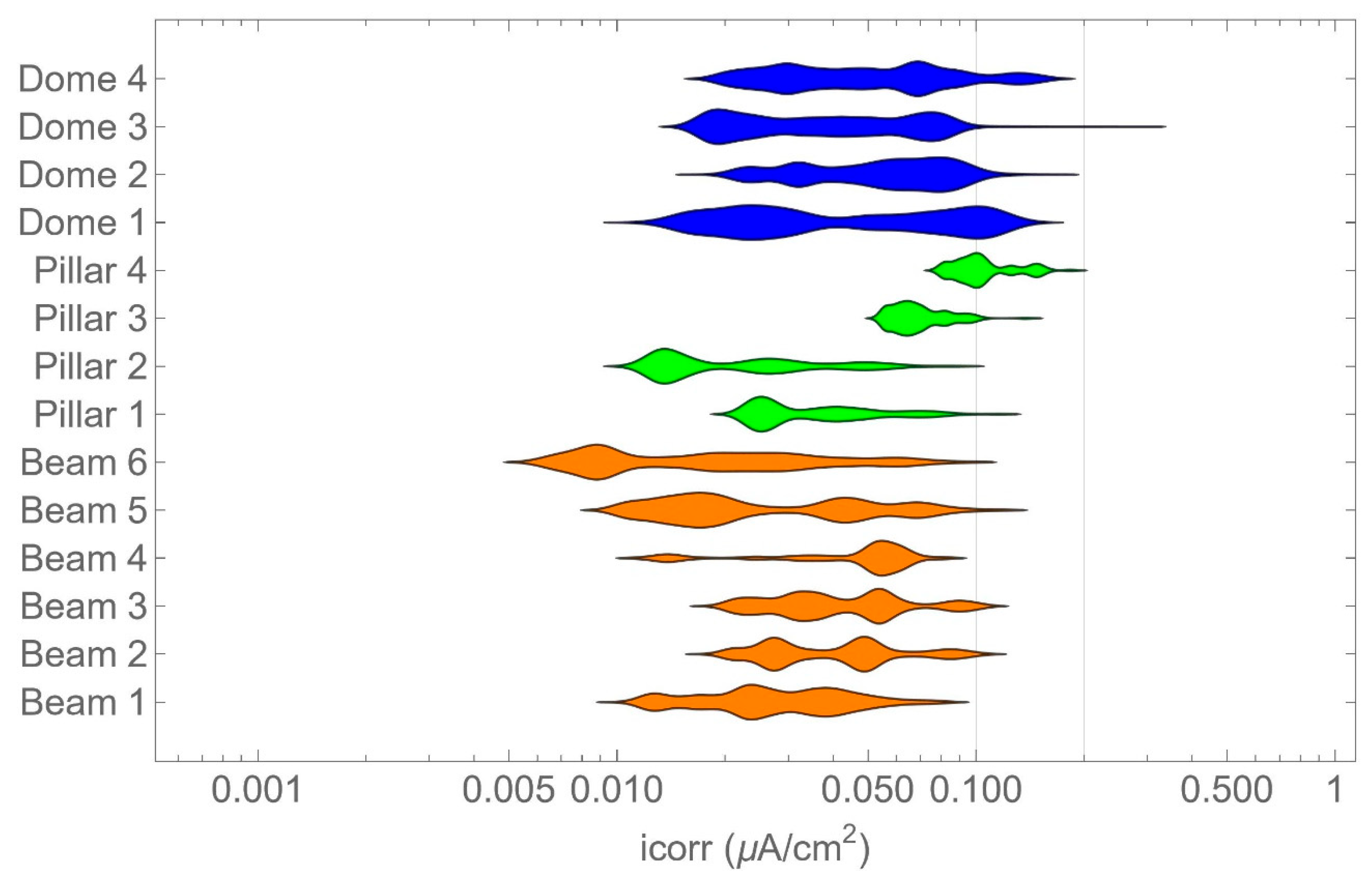
Figure 12 presents the histogram of corrosion current density values grouped by structural component. The distribution clearly confirms the passive behaviour of beams, the higher vulnerability and greater dispersion of columns, and the generally low but occasionally variable corrosion activity of domes. This global representation reinforces the conclusion that corrosion activity in the tank is mainly governed by local exposure conditions, particularly the degree and duration of water contact. The histogram should be interpreted as a comparative representation of the monitored points rather than as a statistical distribution of the entire tank. Its main value is to show the relative differences between the selected exposure conditions: stable passive behaviour in beams, localised vulnerability in columns and intermediate transient behaviour in domes.
3.4. Temperature
Temperature was monitored at each sensor location because it influences both corrosion kinetics and concrete resistivity.
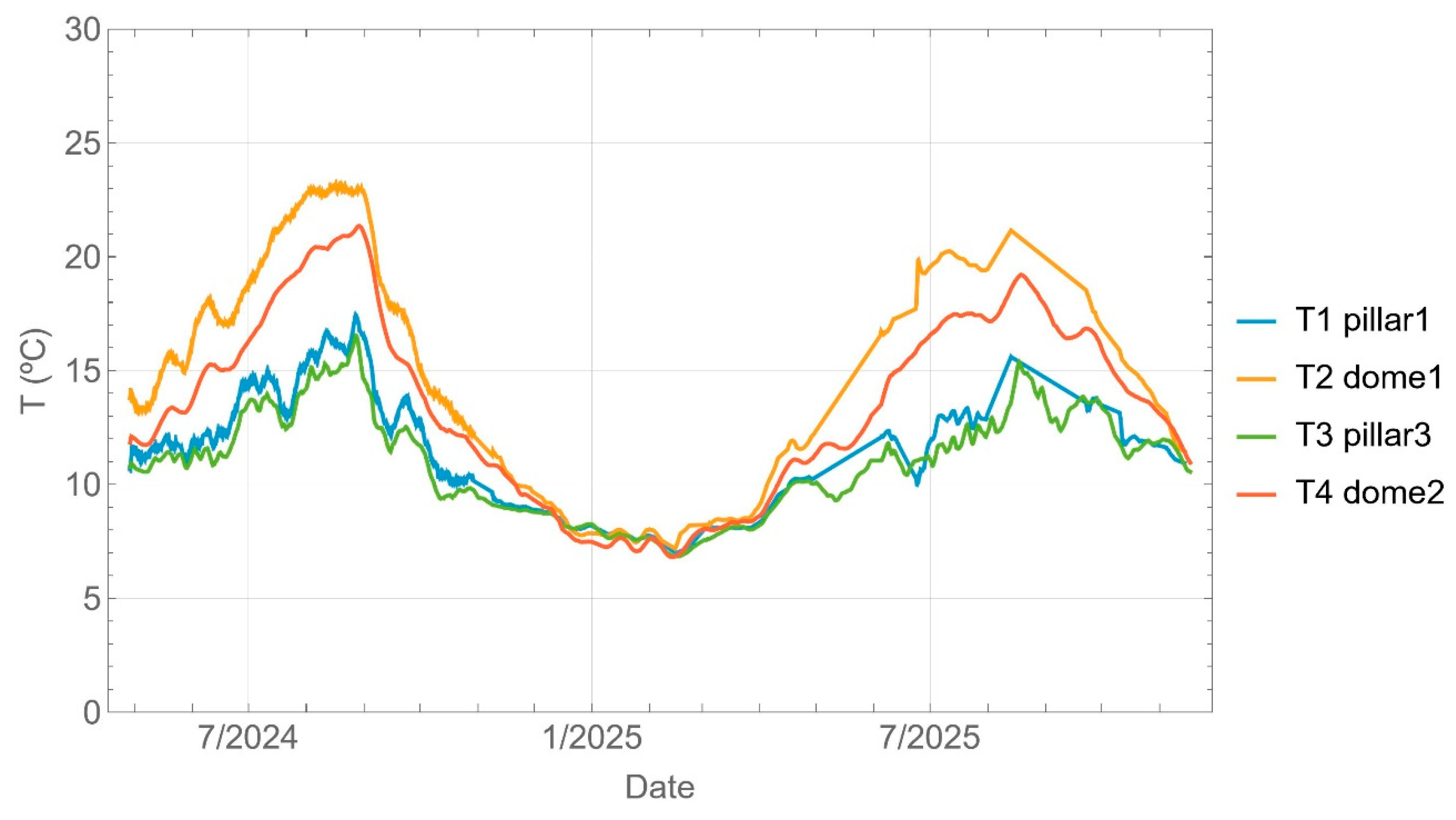
Figure 13 shows the temperature evolution recorded in the tank. The temperature records reveal seasonal variations and differences between structural components. Columns in contact with water showed more stable temperatures, whereas domes exhibited larger fluctuations. This difference reflects the thermal buffering effect of stored water in submerged or partially submerged elements, in contrast with the greater sensitivity of domes to external environmental variations. The observed thermal response confirms that the monitored components are exposed to different environmental regimes. Water contact tends to attenuate temperature fluctuations in columns, whereas domes are more sensitive to external and seasonal variations. This difference is relevant because temperature affects the interpretation of both corrosion current density and concrete resistivity.
The observed temperature variations are relevant for the interpretation of the corrosion data because an increase in temperature can accelerate electrochemical reactions and simultaneously reduce concrete resistivity by increasing ionic mobility. Therefore, changes in icorr and resistivity cannot be attributed exclusively to variations in moisture content without considering temperature effects. This point is especially important for the interpretation of the temperature–resistivity–corrosion relationship discussed later.
Since resistivity was measured under field temperature conditions, seasonal thermal effects may be embedded in the resistivity trends. Consequently, increases or decreases in resistivity should not be attributed solely to moisture variations unless temperature-normalised values are available. The simultaneous analysis of temperature, resistivity and icorr is therefore essential for avoiding overinterpretation of single-parameter trends.
Overall, the temperature records confirm that the monitored components are subjected to different environmental regimes. Columns are mainly controlled by the relatively stable thermal conditions associated with water contact, whereas domes are more affected by seasonal and external climatic variations. This difference contributes to the distinct electrochemical responses observed in the monitored elements.
4. Discussion
The monitoring results provide a detailed insight into the corrosion behaviour of the potable water tank under real service conditions. The combined analysis of corrosion potential, concrete resistivity, corrosion current density and temperature shows that the monitored elements do not behave as a single homogeneous exposure class. Instead, the electrochemical response depends strongly on structural typology, elevation, moisture condition and degree of contact with stored water. This finding is particularly relevant for large water-retaining structures, where exposure conditions may vary significantly within the same asset and where visual inspection alone may not capture early electrochemical changes preceding visible deterioration.
The main scientific value of the monitoring strategy lies in its ability to transform electrochemical measurements into engineering indicators directly related to durability performance. In particular, corrosion current density can be converted into reinforcement section loss, while section loss can subsequently be related to corrosion-induced cracking. This provides a direct link between real-time monitoring data and durability limit-state assessment, supporting a transition from inspection-based maintenance to predictive maintenance. Nevertheless, these derived indicators must be interpreted within the assumptions of the adopted electrochemical and empirical models. They should be regarded as quantitative support for maintenance decision-making rather than as direct measurements of the historical deterioration state of the reinforcement.
It is important to emphasise that the degradation indicators discussed in this section represent the evolution recorded after installation of the monitoring system. Therefore, the calculated section losses correspond to incremental corrosion penetration during the monitoring period and should not be interpreted as the total historical loss accumulated since the construction of the tank in 1968. Previous degradation, if present, forms part of the initial condition of the structure and must be assessed through complementary inspection and material characterisation. This distinction is essential because the monitoring system quantifies current and future trends from the time of installation onwards, but it cannot reconstruct past corrosion propagation without independent evidence from inspection openings, extracted samples or material characterisation.
4.1. Section Loss and Structural Safety
One of the most relevant outcomes of continuous corrosion monitoring is the possibility of estimating reinforcement section loss from measured corrosion current density [
19,
42]. This estimation is based on Faraday’s law, which relates the cumulative electrical charge associated with the anodic dissolution of iron to the corresponding steel loss. By integrating the corrosion current density over time, it is possible to estimate the reduction in reinforcement radius and, consequently, the loss of steel cross-sectional area. In the present study, this procedure was used to obtain incremental corrosion penetration during the monitored period, not to determine the total steel loss accumulated over the full service life of the structure.
In this study, the calculated section loss is used as a durability indicator rather than as a direct structural safety index. The measured values are very small in comparison with the original reinforcement diameters; however, their relevance lies in the possibility of detecting changes in corrosion kinetics before visible damage occurs. This is particularly important in water-retaining structures, where direct inspection may be difficult and early corrosion propagation may remain undetected by visual surveys. Accordingly, the calculated section losses should be interpreted as early-warning indicators for durability management and not as evidence of a current reduction in load-bearing capacity.
The corrosion penetration was calculated according to Equation (1):
where
Pcorr is the sectional loss,
is the pitting factor,
MFe is the atomic mass of iron,
n is the number of electrons for anodic reactions,
d is the mass density of steel, and
F is the Faraday’s constant.
The equation assumes that the measured corrosion current density is representative of the active anodic dissolution process over the considered steel surface. Therefore, uncertainties related to the electrochemically active area, current distribution, Stern–Geary parameter and corrosion morphology must be considered when interpreting the calculated penetration values. A corrosion morphology factor α = 2 was adopted, corresponding to generalised corrosion. This value is consistent with the inspection observations available for the monitored areas, where generalised or locally distributed corrosion features were identified, and no clear evidence of pitting corrosion was reported. Nevertheless, this assumption should be considered conservative only for uniform or moderately localised corrosion. If future inspections identify pitting attack, the morphology factor should be revised because local penetration may be significantly higher than the average value inferred from icorr. At this stage, no direct destructive validation of the calculated section losses by extracted reinforcement samples or drilled cores was available. Therefore, the values reported in
Figure 14,
Figure 15 and
Figure 16 should be understood as Faraday-based electrochemical estimates. Future inspection campaigns should include localised openings or core sampling at selected monitoring points, particularly in the most exposed columns, to compare the calculated penetration with the actual reinforcement condition and to verify whether the adopted morphology factor remains appropriate.
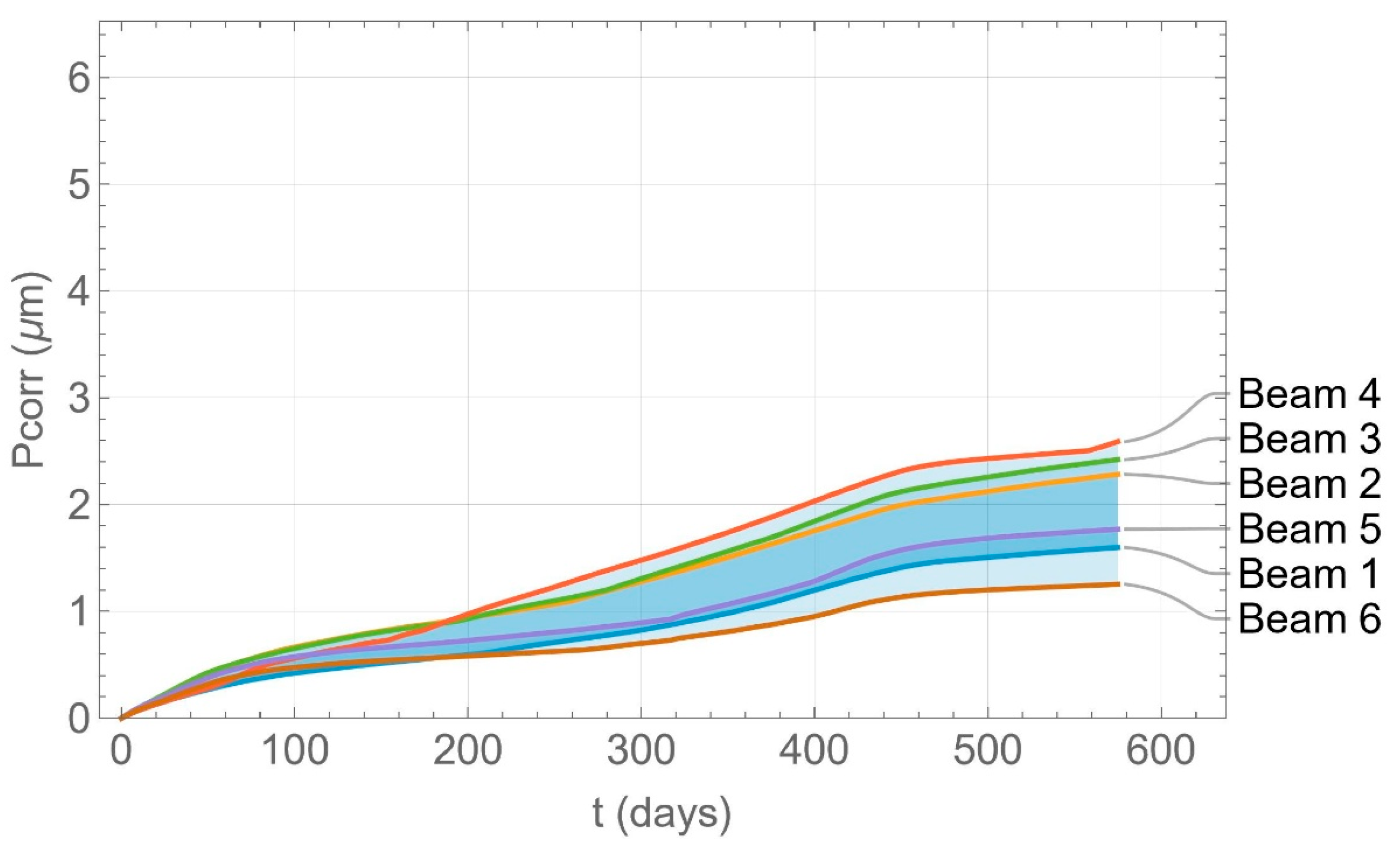
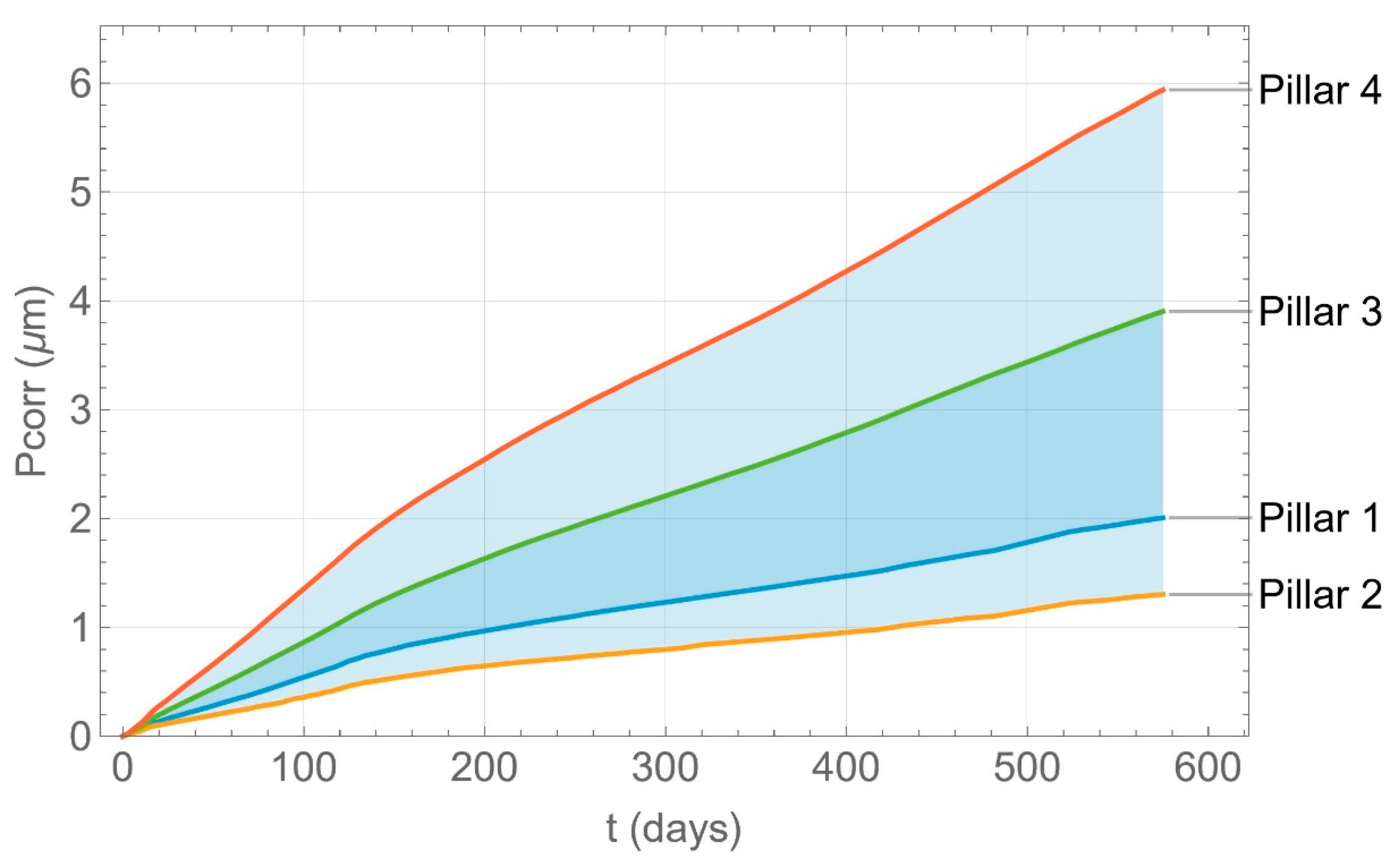
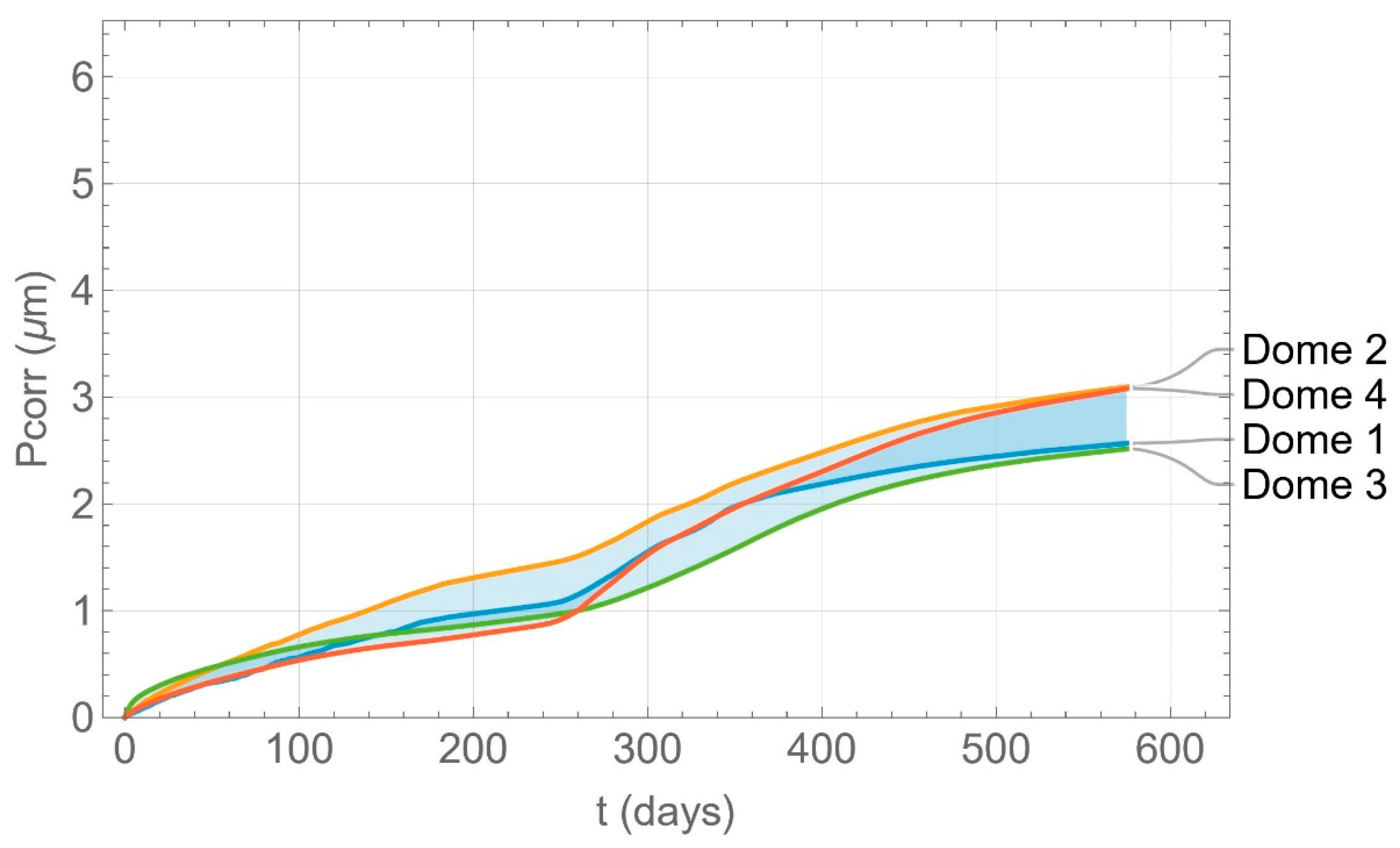
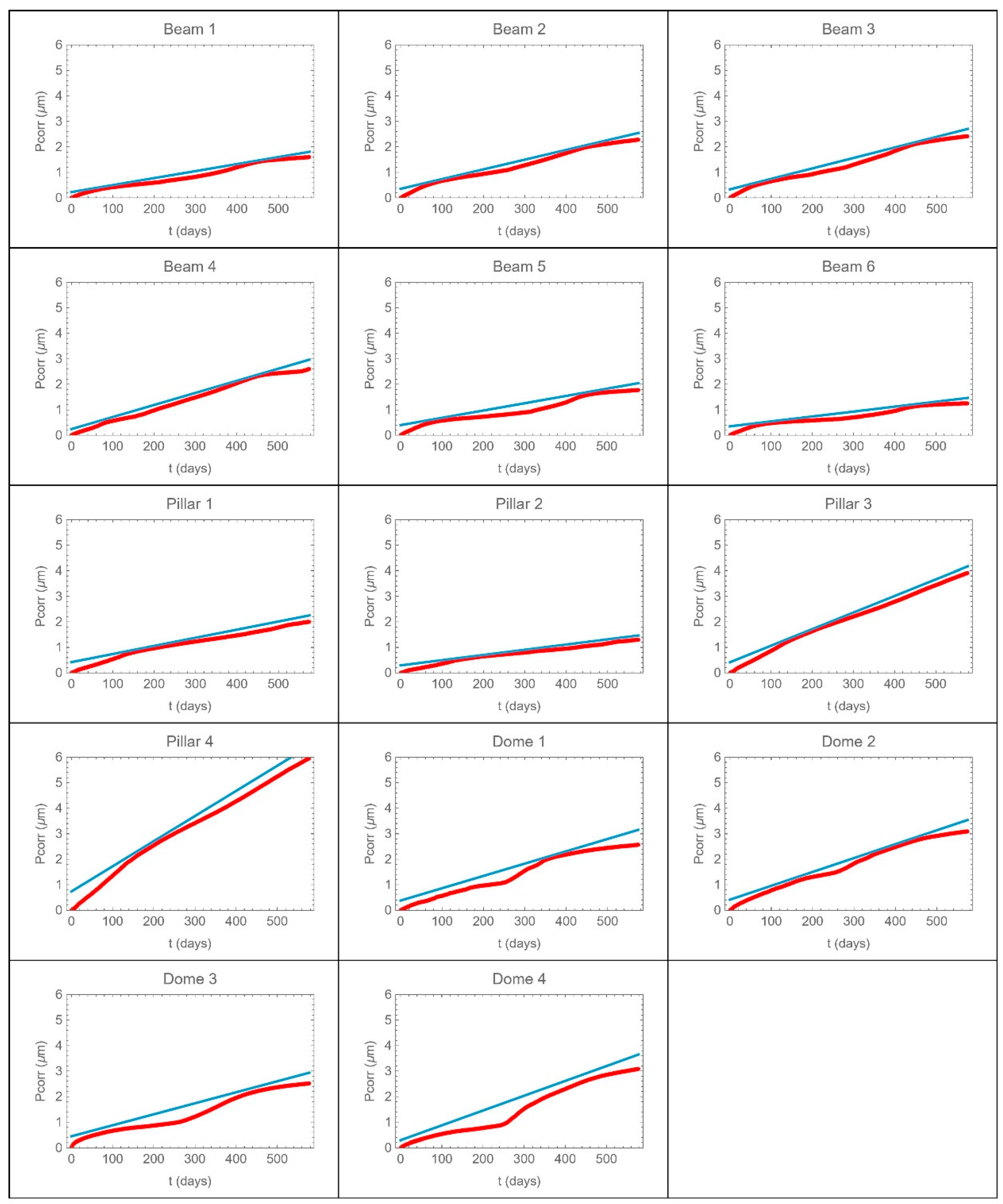
Figure 14,
Figure 15 and
Figure 16 present the calculated section loss for beams, columns and domes, respectively. Beams exhibited negligible section loss, remaining below approximately 2 µm during the monitoring period. This result is consistent with the low corrosion current density values recorded in these elements and confirms their predominantly passive behaviour. The low calculated penetration in beams also confirms that low-to-medium resistivity values, when not accompanied by measurable corrosion current density, should not be interpreted as evidence of active corrosion propagation.
Columns showed greater variability, with section losses generally ranging from approximately 1 to 4 µm, and with the highest values associated with the sensors located at lower elevations and exposed to longer periods of immersion. This confirms that the columns are the most vulnerable monitored elements, not because all column reinforcement is actively corroding, but because some locations within the column group experience exposure conditions that favour corrosion propagation. This result supports a differentiated durability assessment in which lower-elevation column zones are prioritised for complementary inspection, while other monitored elements may remain under routine surveillance.
Domes displayed intermediate section-loss values, around approximately 2 µm. These values are higher than those observed in the most stable beams but lower than those recorded in the most exposed column locations. The dome response suggests occasional activation events rather than sustained corrosion propagation. This behaviour is consistent with intermittent changes in moisture and temperature, although additional diagnostic evidence is required to confirm the precise depassivation mechanism. In particular, carbonation depth, chloride content and pH measurements would be required to determine whether the observed transients are associated with carbonation-induced depassivation, chloride-related processes, leaching effects or moisture-driven resistivity changes.
The small magnitude of the calculated section losses indicates that the monitored elements are not currently affected by a critical reduction in steel area. However, the purpose of the monitoring system is not limited to identifying current structural damage. Its main function is to provide early warning of changes in corrosion rate and to generate quantitative degradation trends that can be incorporated into durability assessment, residual-life evaluation and digital-twin-based maintenance tools.
4.2. Influence of Water Level
The relationship between water level and corrosion activity emerged as one of the most relevant findings of the monitoring campaign. Columns were instrumented at different heights, which allowed the effect of immersion time on corrosion progression to be analysed. Because the water level in the tank varies during operation, each column sensor experienced a different degree of submersion throughout the monitoring period. For example, the sensor located at the lowest elevation remained submerged for a substantially larger fraction of time than the sensors installed at higher elevations. This exposure gradient provides a useful in situ framework for evaluating the influence of water contact on corrosion propagation under real operating conditions, without relying exclusively on laboratory exposure classes. However, the resulting relationship should be regarded as an empirical field correlation for the monitored tank and not as a general law applicable to all reinforced-concrete elements under immersion.
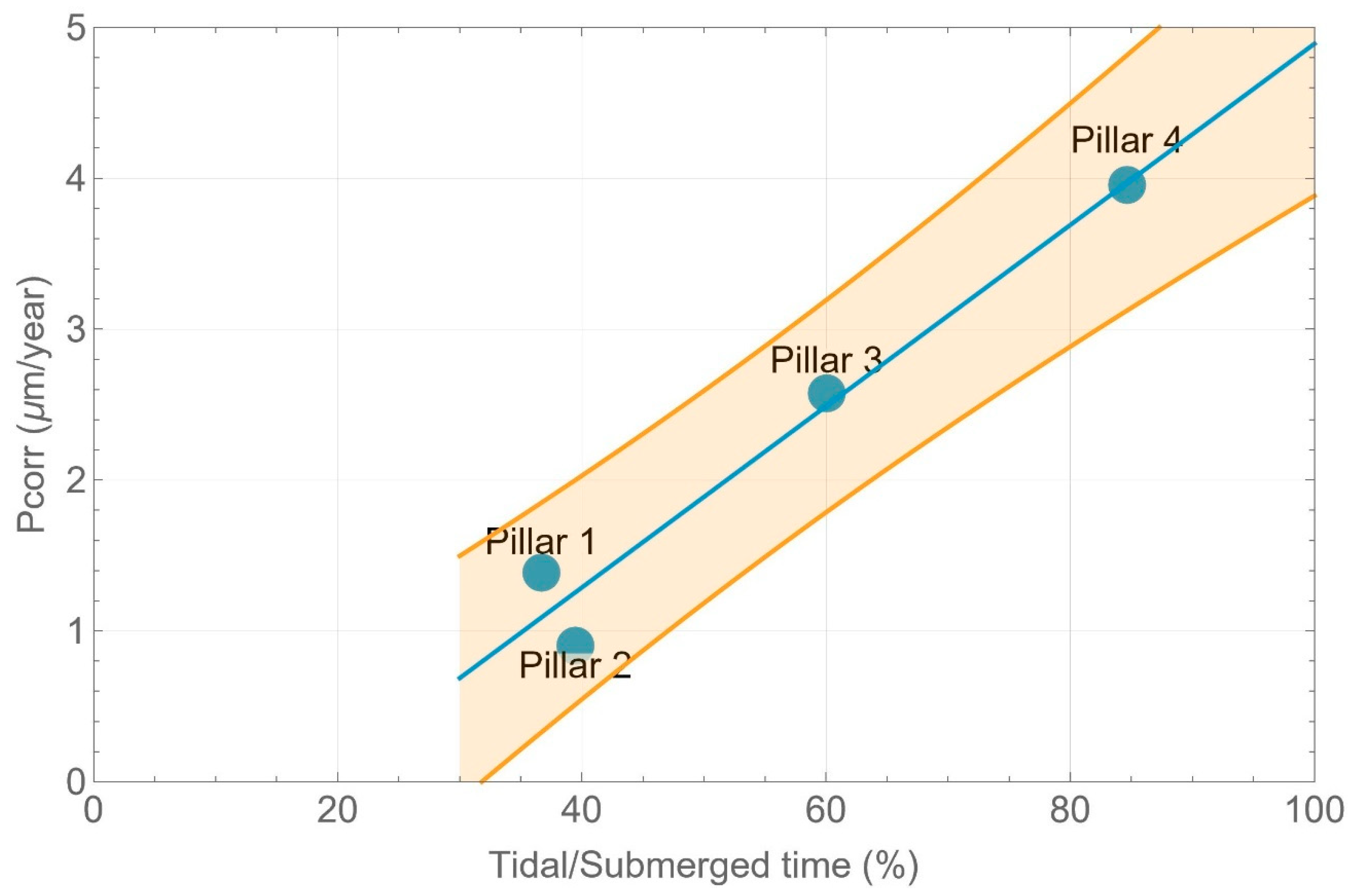
Figure 17 illustrates the relationship between submerged time and annual section loss in the monitored columns. A positive trend was observed: locations with longer submerged times exhibited higher section-loss rates. The relationship was described using a linear regression model, expressed as:
where
ΔPcorr represents the change in sectional loss (µm/year) and
ΔS the variation in submerged time (%). This linear relationship indicates that for every 10% increase in submerged time, sectional loss increases by approximately 0.6 µm/year. This regression was obtained from field monitoring data under the specific operational, material and environmental conditions of the El Goloso tank. It has not been independently validated by laboratory testing and should not be extrapolated beyond the measured range of submerged times without additional evidence.
According to this relationship, an increase of 10% in submerged time is associated with an increase of approximately 0.6 µm/year in reinforcement section loss. This result indicates that the operational water level is not merely a boundary condition of the structure, but a controlling durability variable that should be considered in maintenance planning. Nevertheless, submerged time is not the only variable controlling corrosion propagation. Moisture content, oxygen availability, concrete cover thickness, pore structure, temperature, concrete composition and local steel–concrete interface conditions may all modify the relationship between immersion and corrosion rate. Therefore, the regression should be used as a site-specific vulnerability-ranking tool rather than as a universal predictive model.
The regression should be interpreted as an empirical relationship valid for the monitored conditions and for the available range of submerged times. It should not be extrapolated outside the measured exposure range without further validation. In addition, the shaded region shown in
Figure 17 should be explicitly identified in the figure caption as the 90% confidence interval of the regression. If the available data points only cover submerged times between approximately 37% and 85%, the
x-axis should preferably start at 0% and the limited experimental range should be stated in the caption. This clarification is necessary to avoid misinterpretation of the graph. This graphical clarification is particularly important because the visual extrapolation of the regression outside the experimental range could suggest a level of predictive certainty that is not supported by the available monitoring data.
The practical implications of this result are significant. Elements located at lower elevations within the tank are inherently more vulnerable because they remain in contact with water for longer periods. Water saturation reduces concrete resistivity and facilitates ionic transport, thereby creating conditions more favourable to corrosion propagation once depassivation has occurred. However, the effect of immersion is not purely detrimental in all cases, because oxygen availability may also be reduced under permanent saturation. Therefore, the observed corrosion response should be interpreted as the result of coupled moisture, oxygen, resistivity and electrochemical conditions rather than water contact alone. This interpretation is consistent with the multiparameter nature of reinforcement corrosion in concrete, where high saturation may reduce resistivity but may also limit cathodic oxygen reduction depending on the exposure regime.
This finding supports the need for differentiated maintenance strategies within the same structure. Rather than applying a uniform inspection criterion to all elements, asset managers should prioritise locations where monitoring confirms a combination of low resistivity, frequent immersion and measurable corrosion current density. The monitoring data therefore provide a rational basis for risk-informed inspection planning and for defining critical zones within the tank. In practical terms, the lower column zones should be considered priority areas for follow-up inspection, material characterisation and verification of actual reinforcement condition, while elements showing passive electrochemical behaviour may remain under periodic monitoring.
4.3. Effect of Resistivity and Temperature on Corrosion Current Density
Concrete resistivity is widely used as an indicator of the ability of the concrete matrix to support ionic transport. In general, low resistivity is associated with higher moisture content and greater risk of corrosion propagation, while high resistivity tends to limit electrochemical activity. However, the relationship between resistivity and corrosion current density is not universal because it depends on concrete composition, pore structure, saturation degree, oxygen availability, depassivation mechanism and temperature [
44,
45,
46,
47,
48]. Therefore, resistivity should be interpreted as an exposure-sensitive transport parameter rather than as a direct corrosion-rate measurement. This distinction is essential for explaining cases in which relatively low resistivity coexists with negligible corrosion current density, as observed in the monitored beams.
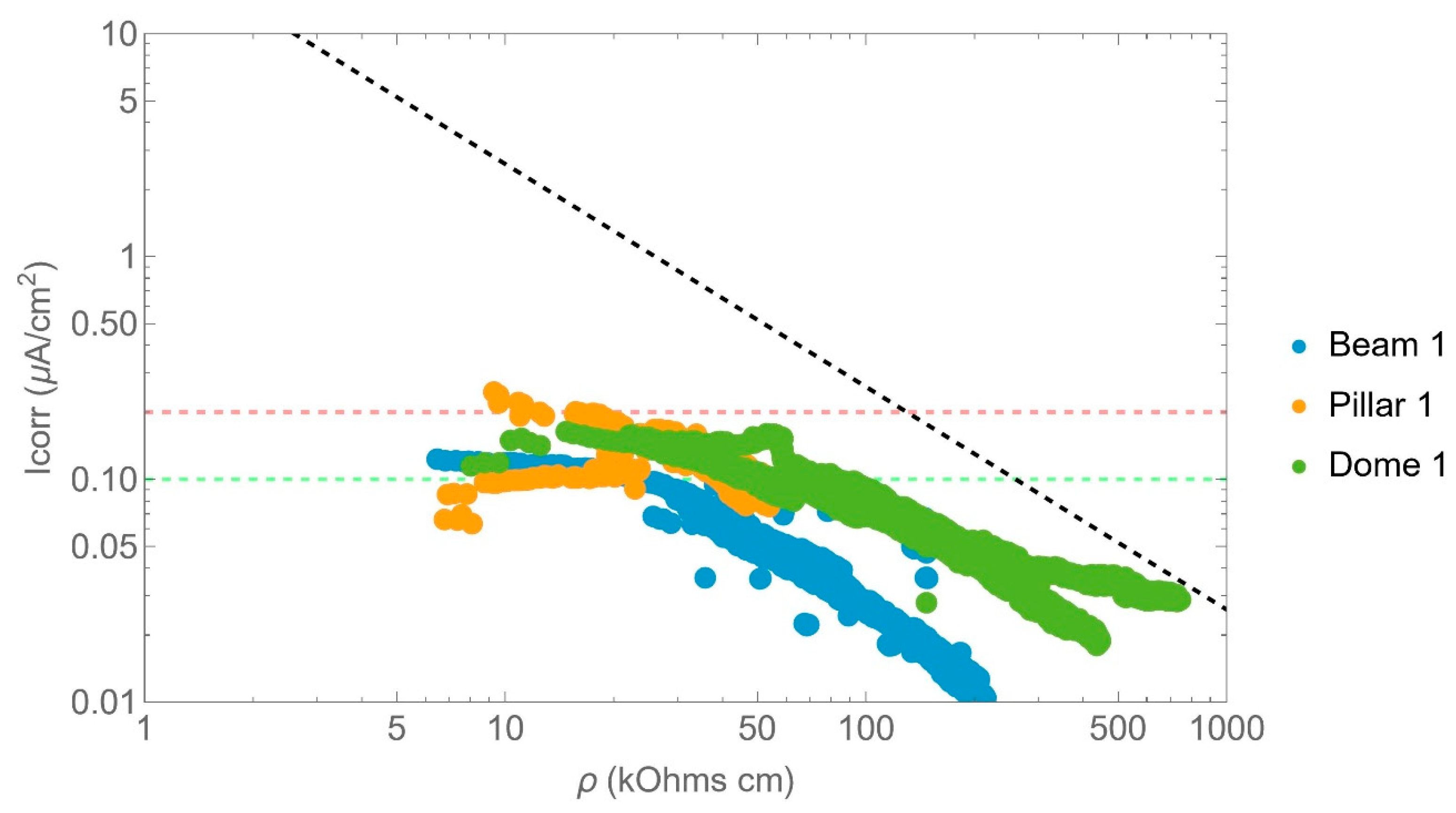
Figure 18 shows the relationship between concrete resistivity and corrosion current density for representative monitored elements. The results confirm the expected general trend: higher resistivity values tend to be associated with lower corrosion current densities. Nevertheless, the dispersion observed in the data indicates that resistivity alone cannot fully explain the corrosion response of the reinforcement. This dispersion is particularly relevant in field monitoring because resistivity is not an independent material constant. It varies with moisture content, temperature and pore solution chemistry. Therefore, resistivity should be interpreted as an exposure-sensitive transport parameter rather than as a direct indicator of corrosion rate. The simultaneous measurement of icorr is essential to distinguish between conditions that are favourable to corrosion and actual corrosion activity at the steel surface.
This behaviour is consistent with previous studies on concrete resistivity and durability assessment. Electrical resistivity has been widely used as a non-destructive indicator of transport properties and corrosion risk, but its value is affected by concrete composition, pore connectivity, saturation degree and environmental conditions [
30,
31,
32,
33,
34]. Sengul showed that concrete resistivity is influenced by temperature, humidity, binder type, aggregate content and water/cement ratio, which explains why field measurements may exhibit significant scatter even when a general inverse trend with corrosion current density is observed [
49,
50]. Similarly, Liu and Presuel-Moreno demonstrated that concrete resistivity is temperature dependent and that uncorrected temperature effects may lead to misleading durability interpretations; they proposed an Arrhenius-based procedure to normalise resistivity values to a reference temperature [
51].
In the present study, the resistivity values plotted in
Figure 18 correspond to field measurements obtained at the actual temperature of each sensor location. Therefore, part of the observed dispersion may be attributed to thermally induced changes in ionic mobility, in addition to variations in moisture content, pore solution chemistry and local exposure conditions. This is particularly relevant for the domes, where larger temperature fluctuations were recorded, and for the columns, where water contact modifies both saturation and oxygen availability.
From an electrochemical point of view, low resistivity favours ionic current flow through the concrete pore network and may facilitate corrosion propagation once the steel is depassivated. However, low resistivity is not, by itself, evidence of active corrosion. The monitored beams provide a clear example: despite low-to-medium resistivity values during part of the monitoring period, corrosion current densities remained below 0.1 µA/cm2 and corrosion potentials were predominantly within the passive range. This confirms that corrosion activity depends not only on the transport capacity of the concrete, but also on the passivation state of the steel, oxygen availability, moisture regime and local electrochemical conditions at the steel–concrete interface.
Consequently,
Figure 18 should be interpreted as a field-based correlation supporting the combined use of resistivity, temperature and icorr, rather than as a universal relationship between resistivity and corrosion rate. The results reinforce the need for multiparameter monitoring and suggest that future analyses should report both raw field resistivity and temperature-normalised resistivity, for example at 20 °C or 25 °C, to improve the separation between thermal and moisture-related effects.
Temperature was incorporated into the analysis because it affects both electrochemical kinetics and concrete resistivity [
42]. Higher temperatures generally accelerate corrosion reactions, while also increasing ionic mobility and reducing measured resistivity. This coupling complicates the interpretation of field data, particularly when seasonal variations are present. Consequently, temperature may influence icorr directly through corrosion kinetics and indirectly through its effect on the resistivity of the concrete pore solution. This dual influence justifies the use of a multivariable interpretation rather than separate single-parameter correlations.
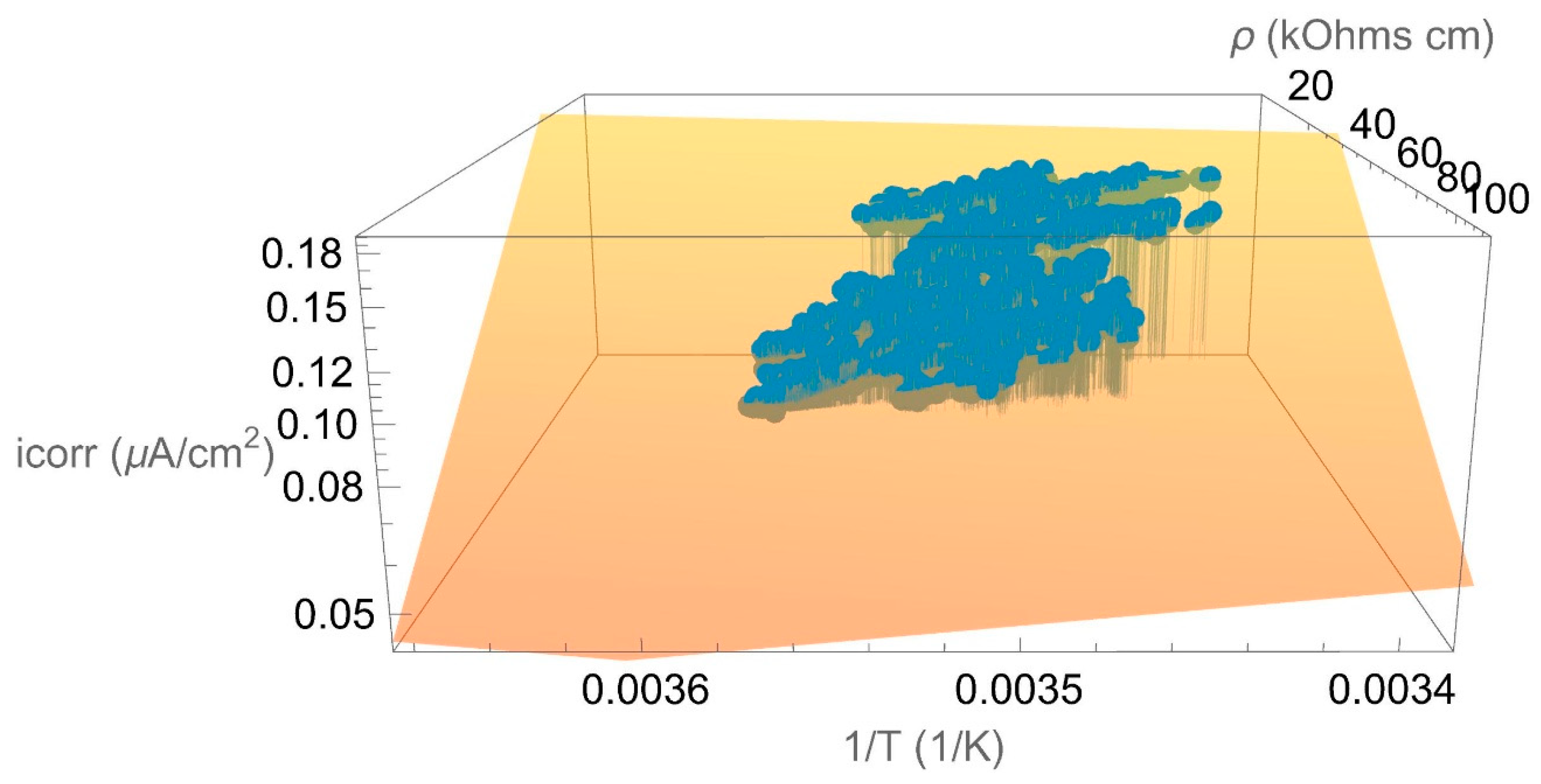
A multivariable regression model was developed for the column sensor that exhibited the clearest transition between active and passive conditions. The model relates corrosion current density to temperature and resistivity as follows:
where
iCORR is the corrosion current density (µA/cm
2),
T is temperature (in Kelvin), and
ρ is concrete resistivity (Ω·m). The exponential form was selected because corrosion current density is a strictly positive variable and because the effects of temperature and resistivity on corrosion kinetics are expected to act in a multiplicative rather than purely additive manner. By applying a logarithmic transformation to icorr, the model can be treated as a linear regression in the explanatory variables while preserving positive predicted values of corrosion current density.
Figure 19 shows the fitted surface obtained from this regression. The model indicates that corrosion current density increases with temperature and decreases with increasing resistivity. However, this equation should be interpreted as an empirical field relationship for the analysed sensor and not as a general predictive model for all elements or exposure conditions. Its applicability is restricted to the measured range of temperature, resistivity and corrosion current density. The equation should therefore not be considered a mechanistic corrosion law. It is a site-specific statistical model intended to describe the monitored response of one representative column sensor under the recorded field conditions. Model parameters should not be transferred to other structures, materials or exposure conditions without recalibration and validation.
A key methodological issue is that the resistivity values used in the analysis correspond to field measurements under the actual temperature conditions of the tank. Unless temperature normalisation is explicitly applied, the resistivity values should not be considered equivalent to values corrected to a reference temperature, such as 25 °C. Consequently, part of the observed resistivity variation may be thermally induced, in addition to changes caused by moisture content. This limitation is particularly relevant for elements such as domes, where temperature fluctuations were more pronounced. In the present version, the model uses raw field resistivity values; therefore, the interpretation of seasonal effects should be made with caution. Future analyses should include temperature-normalised resistivity values, for example at 20 °C or 25 °C, to better separate thermal effects from moisture-related variations.
The model therefore serves two purposes. First, it confirms that resistivity and temperature jointly influence the measured corrosion current density. Second, it demonstrates that single-parameter interpretation may be misleading in real structures. For example, an increase in icorr during warmer periods may result from direct acceleration of electrochemical kinetics, from thermally induced changes in resistivity, or from simultaneous changes in moisture condition. These effects cannot be fully separated unless temperature-compensated resistivity values or controlled calibration data are available. For this reason, the model should be used primarily as an interpretative tool for understanding coupled field behaviour, not as a deterministic forecasting equation.
Future analyses should therefore report both raw resistivity and temperature-normalised resistivity, when possible. This would allow the moisture-related component of resistivity variation to be distinguished more clearly from the thermal component and would improve the robustness of corrosion-rate interpretation under seasonal exposure conditions.
4.4. Predictive Maintenance and Crack Width Forecasting
Real-time monitoring provides information on the current corrosion condition of the structure, but its main value lies in the possibility of anticipating future deterioration [
5,
9,
52]. To this end, the section-loss trends derived from corrosion current density were extrapolated using linear regression and an upper 90% confidence interval. This conservative approach was adopted to reduce the risk of underestimating future degradation. However, the extrapolation should be understood as a scenario-based forecast under the assumption that future environmental and operational conditions remain comparable to those recorded during the monitoring period. It should not be interpreted as a deterministic prediction of corrosion propagation up to 2045.
Figure 20 shows the projected section-loss evolution. The predictions should be interpreted as scenario-based forecasts under the assumption that environmental and operational conditions remain comparable to those recorded during the monitoring period. They are not deterministic predictions of future damage and should be updated as new monitoring data become available. This qualification is essential because the monitoring period is relatively short compared with the forecast horizon, and corrosion propagation may be affected by future changes in water-level operation, temperature, moisture state, oxygen availability, surface cracking or local depassivation conditions.
Once section loss was projected, the expected surface crack width was estimated using an empirical relationship between corrosion level and crack opening. Crack width was selected as a serviceability-related durability indicator because it is directly relevant to inspection, maintenance and durability limit-state assessment. The model adopted relates crack width to corrosion level, tensile strength, compressive strength, cover depth and reinforcement diameter [
7,
53,
54,
55,
56]:
where w is the surface crack width,
is the tensile strength of concrete,
is the compressive concrete strength,
C is the cover depth,
is the original rebar diameter and
CL is the corrosion level expressed as a percentage of section loss. The empirical nature of this relationship should be explicitly recognised. Crack initiation and propagation depend on corrosion-product composition, confinement, concrete tensile properties, cover thickness, bar diameter, bond conditions and the possibility of corrosion products migrating along existing cracks or pores. Therefore, the calculated crack widths should be interpreted as serviceability-oriented indicators rather than as deterministic predictions of physical crack opening.
The use of this model requires explicit reporting of the adopted mechanical and geometrical parameters, including concrete compressive strength, tensile strength, cover depth and bar diameter. If these values are based on historical design assumptions rather than direct experimental measurements, this limitation must be clearly stated. In the present case, the compressive strength and related mechanical parameters are partly based on historical assumptions for a structure built in the 1960s. This introduces uncertainty into the crack-width estimates and reinforces the need for future material testing to validate the adopted input parameters.
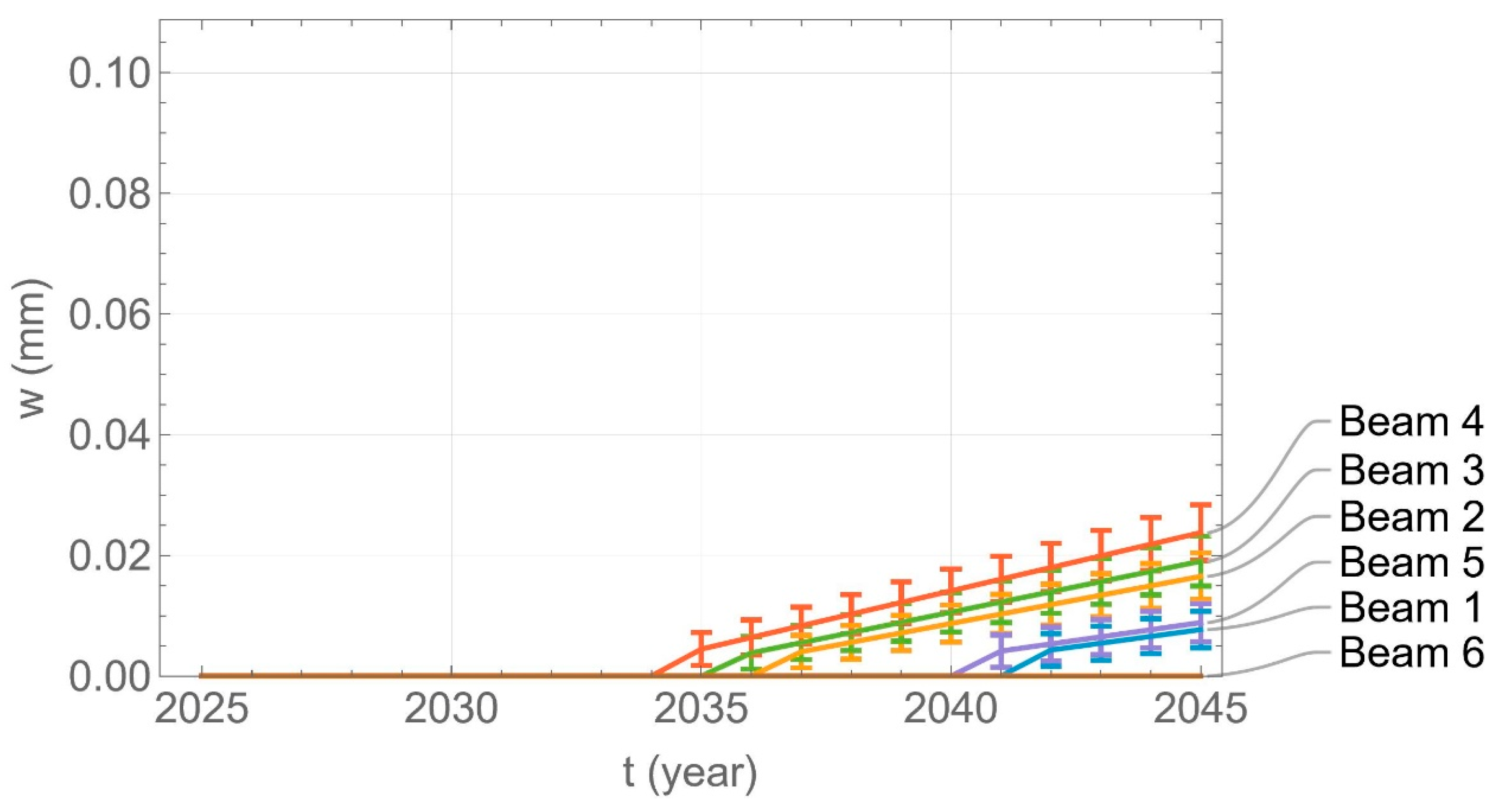
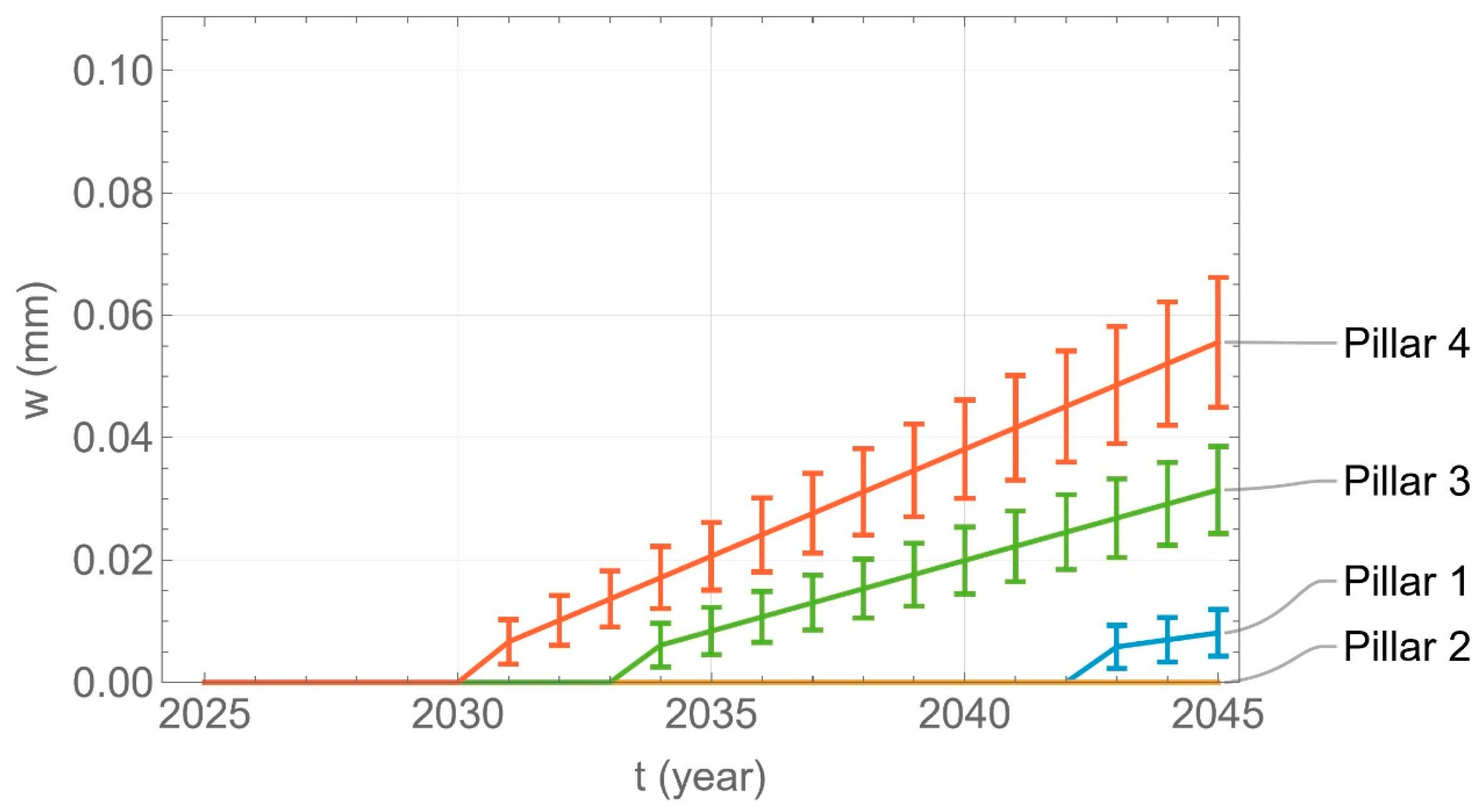
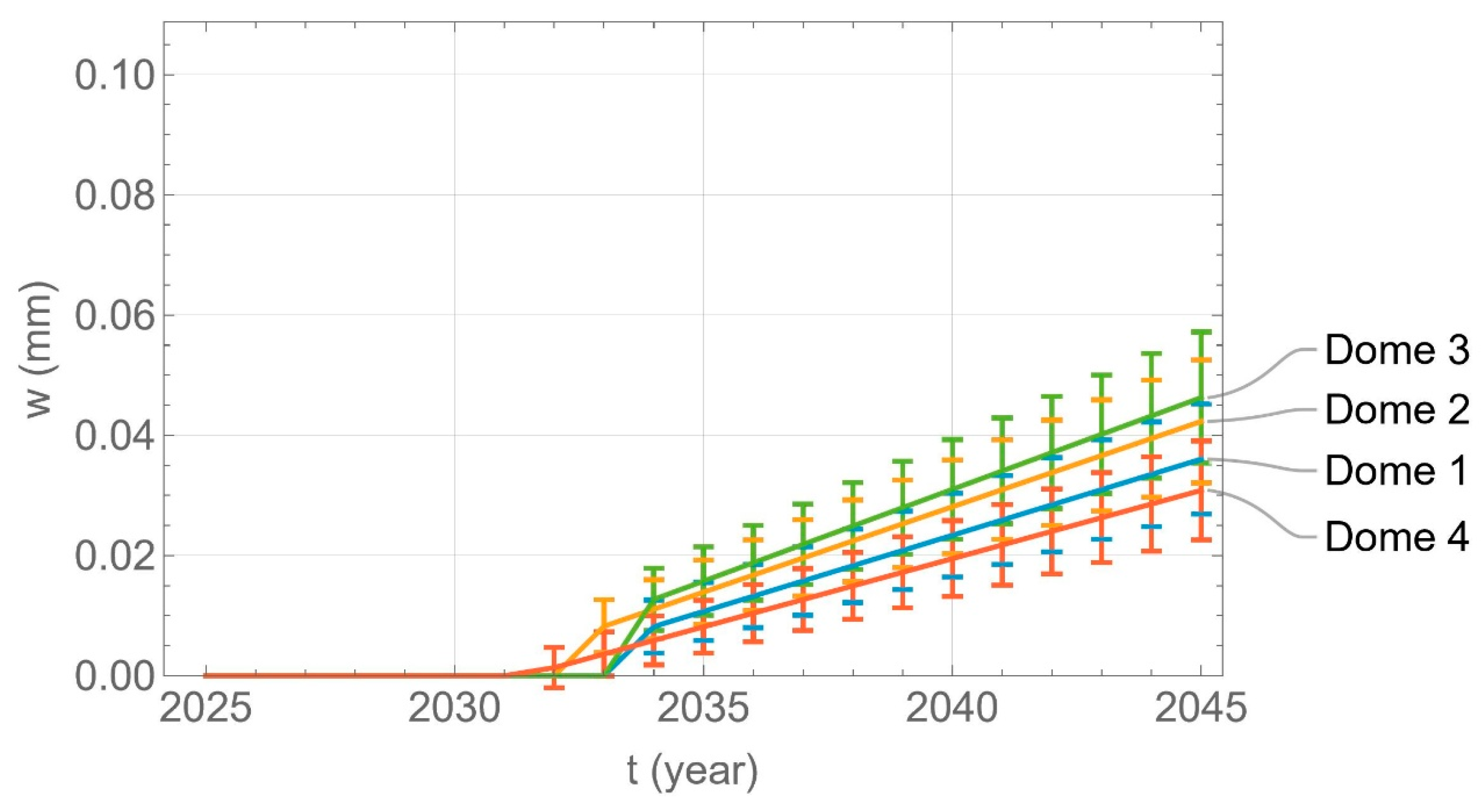
Figure 21,
Figure 22 and
Figure 23 present the predicted crack-width evolution up to 2045 for beams, columns and domes, respectively. Beams are expected to maintain crack widths below approximately 0.04 mm. Columns, which showed the highest corrosion activity, may reach crack openings of approximately 0.08 mm in the most unfavourable monitored case. Domes are projected to remain around approximately 0.06 mm. These values are very small and should be interpreted as projected serviceability indicators under the monitored exposure scenario. They should not be understood as guaranteed future crack widths, because corrosion-induced cracking is a nonlinear process that may either accelerate or stabilise depending on changes in corrosion rate, cracking state, oxygen availability and corrosion-product transport.
These predicted crack widths are below typical serviceability limits for reinforced concrete structures. However, their significance should not be interpreted only in terms of immediate structural safety. In durability assessment, the onset and progression of corrosion-induced cracking are relevant because cracks may accelerate transport processes, facilitate ingress of aggressive agents and modify the local exposure condition of the reinforcement. To avoid overstatement, it is preferable to state that the predicted values are well below crack-width limits commonly used in structural concrete design for serviceability assessment, while clarifying that no formal code-based structural verification is being performed in this study. In addition, the long-term evolution of crack width should not be assumed to remain linear. After crack initiation, corrosion products may migrate through the crack path towards the concrete surface, reducing the internal expansive pressure acting on the surrounding concrete and potentially leading to partial stabilisation of crack opening. Conversely, changes in moisture, oxygen availability or depassivation conditions may increase corrosion activity. Therefore, the forecasts up to 2045 should be updated periodically as new monitoring data become available.
The forecast therefore provides a decision-support indicator rather than a definitive service-life prediction. Its value lies in identifying which elements are likely to approach durability-related intervention thresholds earlier and in allowing maintenance actions to be scheduled before visible damage becomes significant. This adaptive interpretation is consistent with predictive maintenance, where monitoring data are continuously incorporated into updated assessments instead of relying on a single long-term extrapolation.
Real-time corrosion monitoring provides actionable information for durability-based asset management by detecting and quantifying corrosion activity before visible damage, such as cracking, rust staining or spalling, becomes apparent. In the El Goloso potable water tank, the monitoring results revealed differentiated durability risks within the same structure: beams remained predominantly passive, domes showed occasional activation events, and lower column locations subjected to longer submerged periods exhibited the highest corrosion vulnerability. This differentiation supports risk-informed maintenance planning, because inspection resources can be focused on the elements where monitoring identifies both favourable exposure conditions for corrosion and measurable electrochemical activity.
The main value of the monitoring approach lies in linking electrochemical measurements to engineering indicators. Corrosion current density can be converted into reinforcement section loss and then into predicted crack-width evolution, allowing asset managers to move from qualitative corrosion-risk classification to quantitative durability assessment. This supports the definition of intervention thresholds related to durability limit states and serviceability performance. Nevertheless, the intervention thresholds should be defined by combining monitoring data with structural relevance, inspection findings, material characterisation and operational requirements of the tank.
The observed relationship between submerged time and section loss indicates that operational water-level variations may influence corrosion risk in specific zones of the tank. Therefore, monitoring data can support risk-informed inspection planning by prioritising elements with low resistivity, frequent water contact and measurable corrosion current density, while elements with passive behaviour may remain under routine surveillance. This approach avoids applying a uniform maintenance criterion to the whole structure and instead supports differentiated management based on measured exposure and degradation indicators.
Crack-width forecasts up to 2045 should be interpreted as scenario-based predictions rather than fixed estimates of future damage. Their main function is to establish a dynamic baseline that can be updated as new monitoring data become available. This makes the monitoring system part of an adaptive maintenance framework, particularly useful for ageing water infrastructure with incomplete historical data, variable exposure conditions and limited accessibility. The forecasts should therefore be periodically recalibrated as the monitoring record becomes longer and as complementary inspection data are incorporated.
Overall, the El Goloso case study demonstrates that continuous corrosion monitoring can support predictive asset management when electrochemical data are connected to degradation indicators such as section loss and crack-width evolution. This approach improves maintenance prioritisation, reduces uncertainty and provides a quantitative basis for durability-based decision-making in critical reinforced concrete water infrastructure.
The monitoring strategy provides continuous and valuable information on the electrochemical condition of the reinforcement and on the evolution of corrosion-related durability indicators; however, its scope is limited by several factors that must be explicitly acknowledged. The 14 monitoring points should be interpreted as representative sentinel locations rather than as a complete spatial characterisation of the whole tank, and the electrochemical measurements alone cannot identify the specific depassivation mechanism without complementary material characterisation, such as carbonation depth, chloride profiles, pH assessment, water chemistry and localised inspection openings. In addition, the section-loss values derived from Faraday’s law are indirect estimates that should be validated through future inspections or extracted samples, while the field resistivity data are affected by temperature because no normalisation to a reference temperature was applied. Finally, the long-term forecasts of section loss and crack-width evolution up to 2045 should be regarded as scenario-based maintenance-support indicators, not deterministic predictions, and should be periodically updated as new monitoring and inspection data become available.




 ,
,