Article

Toward a Simple Design Approach for Soil Slope Reinforcement with Curing Agent


1
PowerChina Huadong Engineering Corporation Limited, Hangzhou 311122, China
2
College of Water Resources Science and Engineering, Taiyuan University of Technology, Taiyuan 030024, China
3
PowerChina Beijing Engineering Corporation Limited, Beijing 100024, China
4
State Key Laboratory of Water Cycle and Water Security, China Institute of Water Resources and Hydropower Research, Beijing 100038, China
*
Authors to whom correspondence should be addressed.
Appl. Sci. 2026, 16(12), 6005; https://doi.org/10.3390/app16126005 (registering DOI)
Submission received: 13 May 2026 / Revised: 8 June 2026 / Accepted: 10 June 2026 / Published: 13 June 2026
(This article belongs to the Section Civil Engineering)

Abstract

Landslides are the most common geological hazards, and chemical reinforcement is an effective method for enhancing the stability of soil slopes. Based on the coupled Eulerian–Lagrangian method, finite element analyses were conducted to develop a simple design approach for soil slope reinforcement using the curing agent. First, the effects of internal friction angle, cohesion, soil unit weight, slope height and angle on the slope stability were systematically quantified through 93 numerical cases. On this basis, an empirical formula was established for the factor of safety (FOS) of soil slope, and a method for determining the failure mode was proposed using a dimensionless parameter and two critical values related to slope angle. Subsequently, the reinforcement performance of the SH curing agent was investigated by varying the reinforcement position and length. The results indicate that the reinforcement of Case I-II-III and Case I-II provide the best performance, and the optimum reinforcement length was determined for different slope conditions. For slope angles ranging from 25° to 65°, the FOS after reinforcement was found to increase by 12.1% to 18.8% compared with that before reinforcement. Based on the FE results, empirical formulae for predicting the FOS of reinforced slope were further developed. Finally, a simple design approach was proposed for soil slope reinforcement with curing agent. The proposed method provides a convenient and effective reference for engineering practice in soil slope reinforcement with curing agents.

1. Introduction

Geological hazards refer to destructive geological events formed during the evolutionary development of the earth, which are influenced by natural conditions while also being associated with human activities. Statistical analysis of the China Geological Hazard Bulletin indicates that (1) between 2009 and 2018, geological hazards caused a total of 6230 deaths and missing persons, with direct economic losses of 43.78 billion RMB, corresponding to an annual average of 623 fatalities and 4.378 billion RMB in losses; (2) a total of 118,919 geological hazard events occurred during this period, including 84,098 landslides, 21,688 collapses, 9210 debris flows, 2849 ground subsidence events, 895 ground fissures and 179 settlements, accounting for 70.7%, 18.2%, 7.7%, 2.4%, 0.8% and 0.2% of the total, respectively. These data indicate that landslides are the most prevalent type of geological hazard, accounting for 70.7%, which is significantly higher than other hazard events. Consequently, the study of slope reinforcement methods is important to reduce the human and economic losses caused by geological hazards.
The study of soil slope reinforcement first requires the analysis of the stability and failure mode of the slope and then the choice of appropriate reinforcement methods according to the failure mode. Slope stability analysis is a classical and long-standing problem in geotechnical engineering [1,2]. For slope stability analysis, the computation of the factor of safety (FOS) and the determination of the critical slip surface are two important tasks [3]. Slope stability analysis methods include qualitative analysis [4,5], engineering analogy [6], limit equilibrium (LE) methods [7,8] and finite element (FE) methods [9,10]. The LE and FE methods are more popular, although the LE method requires a pre-assumed slip surface and involves complex calculations.
The strength reduction method (SRM) [9] is usually used in the FE analysis of slope stability, which does not require pre-assuming a slip surface and can analyze slopes with complex geometries and multiple layers [11]. The key to the calculation of FOS via SRM is the criteria for defining the slope failure, which include the displacement jump criterion (Criterion I) [12], plastic zone penetration criterion (Criterion II) [13], non-convergence in iterative computations (Criterion III) [9] and the energy jump criterion (Criterion IV) [14,15].
Slope failure modes have been categorized by Wyllie and Mah [16] into circular, planar, wedge and topple types. Klar et al. [17] classified failure modes as shallow, intermediate and deep, based on the position of the critical slip surface. Jiang and Yamagami [1] proposed the dimensionless parameter λ, demonstrating that the location of the critical slip surface depends solely on λ. The increase in λ deepens the slip surface. The parameter of λ establishes a bridge between soil properties and failure mode classification.
Different failure modes suggest different reinforcement strategies. Common soil slope reinforcement methods include biological, physical and chemical stabilization. Biological stabilization improves the cohesion and internal friction angle of soils through microbial activity, such as microbially induced calcium carbonate precipitation [18]. Physical stabilization enhances the slope stability via structural measures, such as retaining walls, embedded piles, geotextiles and cable nets. Chemical stabilization, similar to biological stabilization, alters soil properties by applying curing agents, enhancing slope stability. Chemical stabilization offers advantages such as high strength and minimal environmental impact and has been widely applied for soil slope reinforcement [19]. Chemical curing agents include inorganic and organic types. Common inorganic curing agents include cement, lime, fly ash and blast furnace slag, which may over-harden soils and adversely affect ecosystems. Organic curing agents, as environmentally friendly materials, have received increasing attention. For example, the STW stabilizer developed by Liu et al. [20] performs well on clayey slopes, and the SH stabilizer developed by Wang et al. [21] has been used on loess slopes.
The application of chemical curing agents in soil slope reinforcement has gained widespread attention. Kang and Kim [22] employed numerical analysis to compare the FOS of a slope before and after chemical stabilization, and the FOS increased from 1.175 to 1.352 after chemical stabilization. Bai et al. [23] combined experimental and numerical methods to study the reinforcing effect of polyurethane (PU) stabilizers on slopes. The results indicated that the stabilizer significantly enhanced the soil compressive strength, erosion resistance and vegetation recovery ability. Hassona and Hakeem [24] used GeoStudio SLOPE/W 2D numerical modeling to analyze the reinforcement effects of PU foam piles on soil slopes, comparing the FOS before and after reinforcement. They found a significant increase in FOS, showing improved slope stability after treatment. On the microscopic level, Phuong [25] demonstrated that bio-polymers, such as xanthan gum, not only improved soil erosion resistance but also enhanced the soil cohesion and durability, offering new ideas for the development of eco-friendly stabilizers. Meanwhile, traditional polymer stabilizers have been further validated for slope stabilization, showing significant improvements in shear strength through numerical modeling.
Previous studies have paid attention to only one or two topics, such as the stability, failure mode and soil slope reinforcement. In the present work, based on the coupled Eulerian–Lagrangian (CEL) method, the stability and the failure mode of soil slope were firstly studied, and subsequently the empirical formulae were developed for the FOS and the failure mode of the slope. Then, a soil slope reinforcement scheme with an SH curing agent was investigated and optimized by the CEL analysis based on the failure mode of the slope, while an empirical formula was proposed for the FOS of reinforcement soil slope. Finally, a simple design approach was established to reinforce the soil slope with the curing agent.

2. Finite Element Model

2.1. Coupled Eulerian–Lagrangian (CEL) Method

The CEL method is a large deformation finite element (LDFE) method that overcomes the disadvantages of the pure Lagrangian and Eulerian methods, which is suitable to analyze the stability of a high and steep slope. The CEL method is implemented in the software ABAQUS 6.14 and uses an explicit time integration scheme. The unknown solution in the next time step can be directly calculated by the solution of the previous time step without any iteration. Explicit integrations are conditionally stable. Numerical stability is guaranteed by introducing a critical time increment in every time step, i.e., Δtcritical = min(Le/cd), where Le is the characteristic element dimension, and cd is the dilatational wave speed of the material. The CEL method supports multiple materials (including voids) in a single element. The flow of Eulerian material among different meshes is tracked by computing the Eulerian volume fraction (EVF). If a material completely fills an element, the EVF is 1; if no material is present in an element, the EVF is 0. The CEL method only provides a linear element, i.e., EC3D8R element, which has a high computational cost.

2.2. Slope Stability Analysis by the Strength Reduction Method (SRM)

When performing slope stability analysis with the FE method, the SRM is commonly used to calculate the factor of safety (FOS). When modeling with the Mohr–Coulomb material model, the shear strength of the soil τf is expressed as
τ f = c + σ tan φ
where, c and φ are the cohesion and internal friction angle of the soil, respectively, and σ is the normal stress on the soil element.
To calculate the FOS of the slope using SRM, a series of simulations are performed with gradually reduced values of c and φ, calculated as
c m = 1 SRF c
φ m = arctan 1 SRF φ
where SRF is the strength reduction factor, and cm and φm are the reduced cohesion and internal friction angle of the soil.
To maintain slope stability, the initial SRF is usually set to a small value and then gradually increased until slope failure occurs. The critical SRF at which the failure occurs corresponds to the slope instability and is assumed to be the FOS of the slope.

2.3. FE Model and Verification

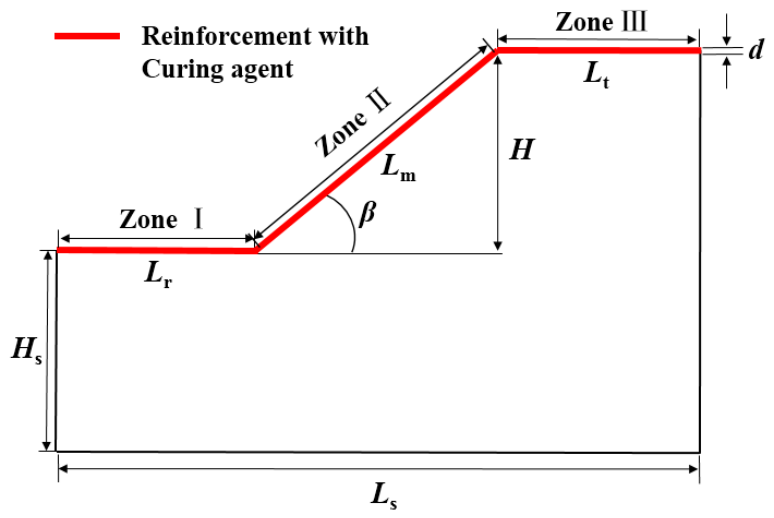
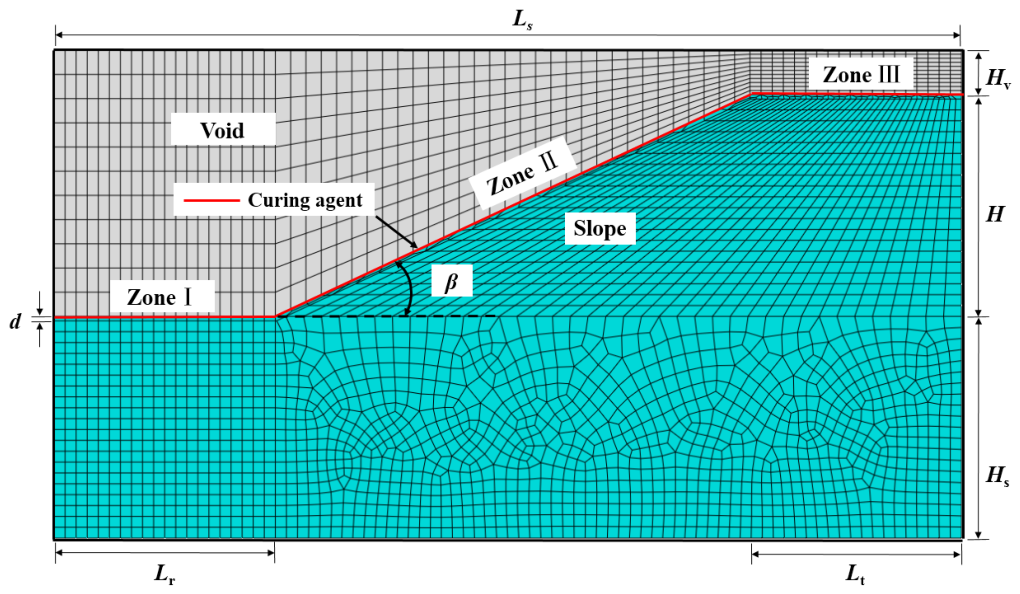
The problem analyzed in the present study is illustrated in Figure 1, where Ls, Lr, Lm, Lt, H, Hs and β represent the length of FE model, the distance from the slope toe to the left boundary, the slope length, the distance from the slope crest to the right boundary, the slope height, the distance from the slope toe to the bottom boundary and the slope angle, respectively. The slope is divided into three zones, i.e., Zone I, Zone II and Zone III. The curing agent is applied in the red-colored region with a thickness d, and d = 0 represents the slope without curing agent. Based on the setup in Figure 1, the CEL finite element model was established, as shown in Figure 2. When using the CEL method, a void layer of height Hv must be set to capture the soil deformation after the slope failure. The lengths of Lr, Lt and Hs should be sufficient to avoid boundary effects. The CEL model ignores the complexity of slope geometry and adopts the plane strain analysis, where a single element was used in the thickness direction. The slope is assumed to be homogeneous, and the external loadings and groundwater are neglected.
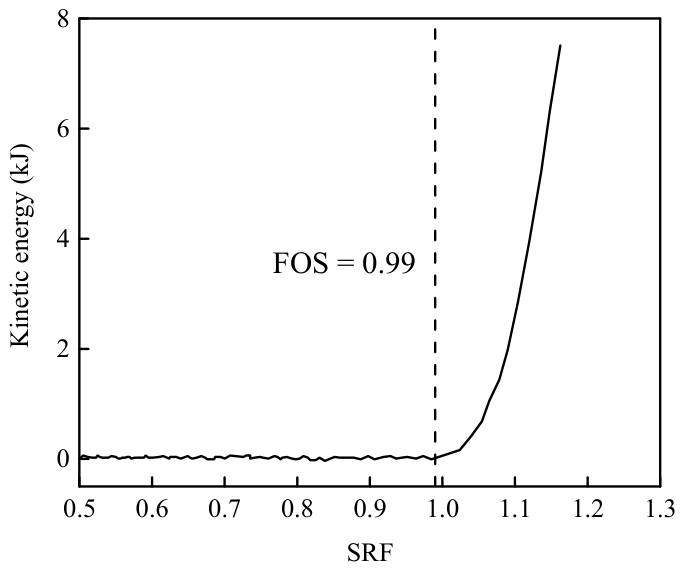
In the CEL analysis, the deformation of the soil adopts the Eulerian method, which cannot output the continuous displacement of each node, resulting in the displacement jump criterion being unsuitable for determining the FOS. The plastic zone penetration criterion involves a certain degree of subjectivity. The CEL method is an explicit dynamic analysis technique, which allows the output of energy curves, such as gravitational potential energy and kinetic energy. Calculations are performed using the parameters listed in Table 1 from Dawson et al. [9]. External loads are neglected in the analysis, and only the self-weight of the soil is considered. Figure 3 presents the kinetic energy of slope during the FE analysis, which shows that there exhibits a clear and unique abrupt change at the SRF of 0.99, i.e., FOS = 0.99. The kinetic energy of the FE model is zero when the slope is stable, while the kinetic energy increases suddenly when the slope failure happens. Therefore, the energy jump criterion is selected as the failure criterion in this study.
Two cases from Table 1 are used for validation. The FOSs calculated by the present work are 0.99 and 1.35, while those of Dawson et al. [9] and Chen et al. [10] are 1.00 and 1.30, with a relative error of 1% and 3.85%, respectively. These results demonstrate the validity of the CEL model developed in the present work and confirm the applicability of the energy jump criterion for determining the FOS.

3. Slope Stability Analysis

Before determining the slope reinforcement with a curing agent, it is necessary to identify the key factors affecting the stability and failure mode of slope. In this section, parameters influencing the slope stability are examined, based on the FOS of the slope, and the classification of the slope failure mode is discussed.

3.1. FOS of Soil Slope

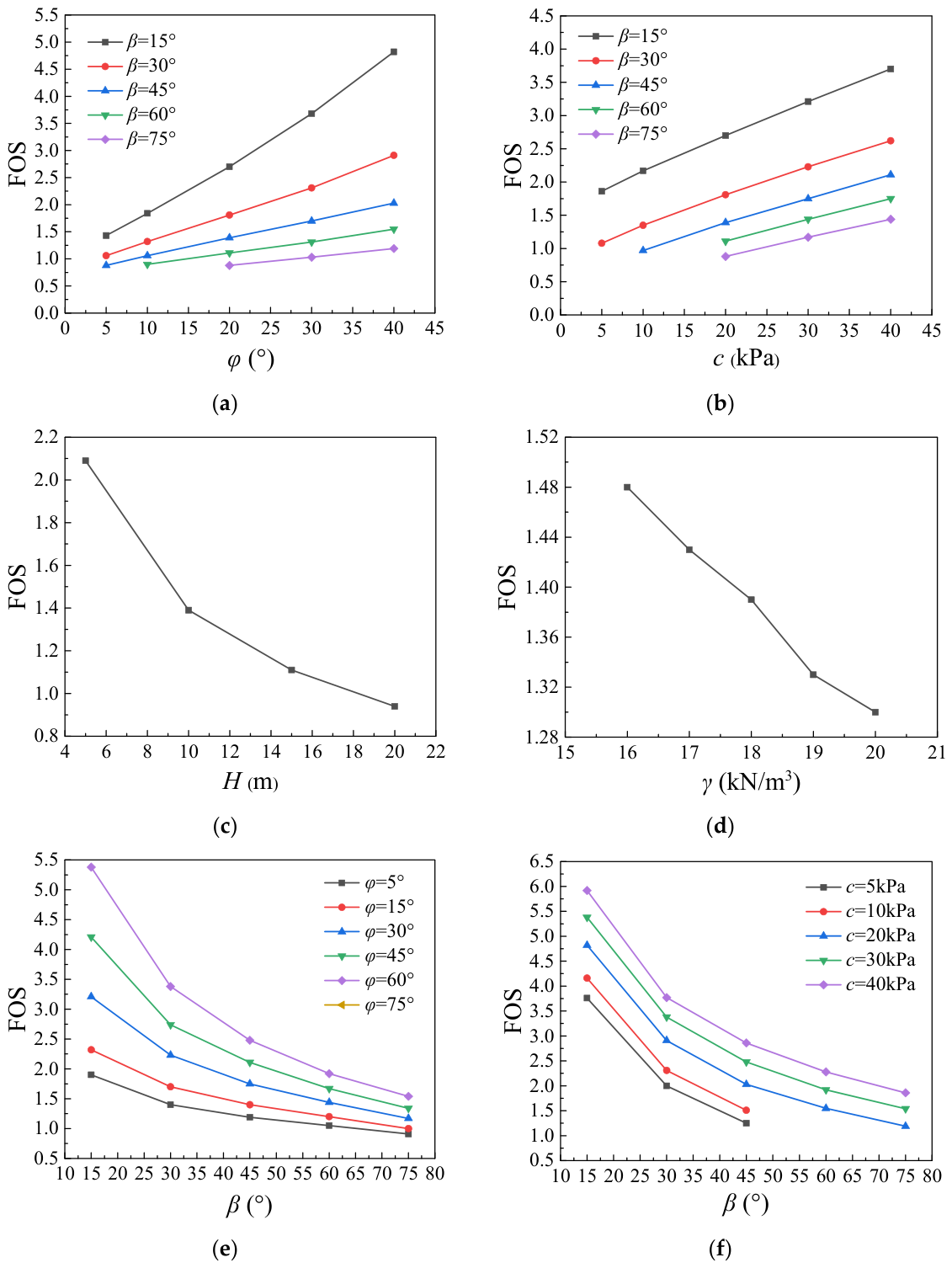
Table 2 lists the FE cases for analyzing the FOS of the soil slope. Cases 1–6 investigate the effects of internal friction angle φ, cohesion c, slope height H, soil unit weight γ and slope angle β on the slope stability, respectively, where φ = 5~40°, c = 5 kPa~40 kPa, H = 5 m~20 m, γ = 16 kN/m3~20 kN/m3 and β = 15~75°. Case 7 is used to verify the effectiveness of the proposed empirical formula for the FOS in Section 3.2.
The internal friction angle φ has a significant effect on the FOS, as shown in Figure 4a. The FOS increases rapidly with increasing φ, exhibiting a roughly linear trend. This effect is particularly pronounced at the small slope angle of β, with a maximum increase of 237.06%. As β increases, the influence of φ on the FOS gradually diminishes. The FOS also increases with increasing c, as shown in Figure 4b, following a linear trend, with a maximum increase of 142.59%. Unlike the internal friction angle φ, the effect of c on the FOS does not significantly decrease, as β increases. The slope height H negatively affects the FOS, as illustrated in Figure 4c. Within the selected values of H, the increase in H can reduce the FOS by up to 55.02%. The soil unit weight γ has a relatively small effect on the FOS, as shown in Figure 4d. The FOS decreases slightly with increasing γ, with a maximum reduction of 12.16% within the chosen parameters. The slope angle β has a significant influence on the FOS, as shown in Figure 4e,f. The FOS decreases with increasing β. The influence of φ on the FOS is affected by β, whereas the effect of c on the FOS is almost independent of β.

3.2. Empirical Formula for the FOS of Soil Slope

Based on the FE results in Section 3.1, an empirical formula for the FOS of soil slope will be developed. It was shown in Section 3.1 that the influence of φ on the FOS depends on the slope angle β, which decreases as β increases. Therefore, the dimensionless parameter φ/β is used to capture the relationship between φ and β. The empirical formula for the FOS of soil slope is expressed in the form of Equation (4).
FOS = a 1 c γ H b 1 φ β c 1 + d 1 φ β e 1 + g 1
where, a1, b1, c1, d1, e1 and g1 are the fitting coefficients of Equation (4). The FE results from Cases 1–6 in Table 2 were used to fit the empirical formula. To improve the fitting accuracy, the formula is divided into two segments according to the slope angle: one for β = 15°~60° and another for β = 60°~75°.
FOS = 7.21 c γ H 0.82 φ β 0.2 + 0.96 φ β 1.23 + 0.1       15 ° β < 60 °
FOS = 6.34 c γ H 0.87 φ β 0.21 + 1.58 φ β 2.98 + 0.21       60 ° β < 75 °
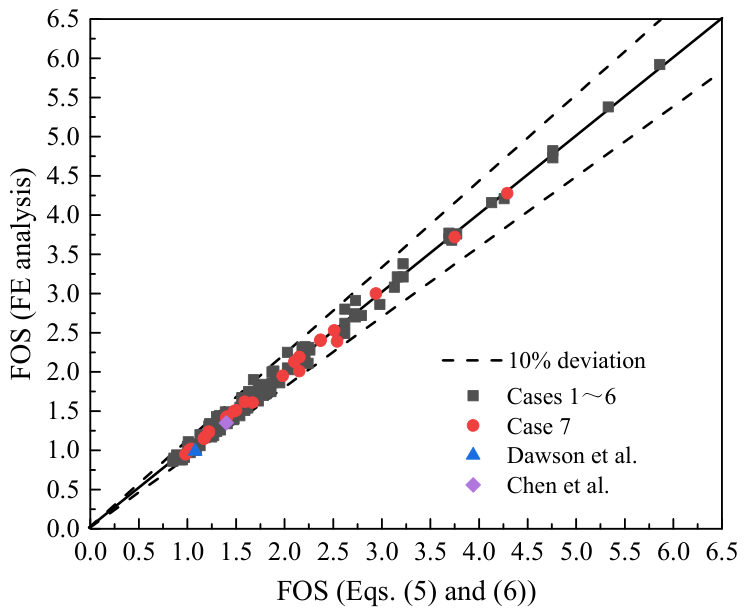
The coefficient of determination R2 of the fitted Equations (5) and (6) are 0.99 and 0.95, respectively. Figure 5 gives the comparison between the results of the CEL analysis and Equations (5) and (6). The 65 FOSs predicted by Equation (5) have a relative error of −11.58~6.60%, with an average relative error of 3.45% and 48 FOSs showing a relative error within 5%. For Equation (6), the 28 predicted FOSs have a relative error of −9.01~9.00% and an average relative error of 5.55%. In addition, Case 7 in Table 2 and the cases in Table 1 are used to validate the effectiveness of Equations (5) and (6), as seen in Figure 5. The average relative error was 4.21%. For the cases of Dawson et al. [9] and Chen et al. [10] in Table 1, the FOSs calculated by Equations (5) and (6) are 1.08 and 1.40, respectively, which are 8.0% and 7.7% larger than those of Dawson et al. [9] and Chen et al. [10], respectively. It should be noted that Equations (5) and (6) are developed under a two-dimensional FE analysis, which apply to the conditions of 5 kPa ≤ c ≤ 40 kPa, 5° ≤ φ ≤ 40°, 16 kN/m3γ ≤ 20 kN/m3 and 15° ≤ β ≤ 75°.

3.3. Failure Mode of Soil Slope

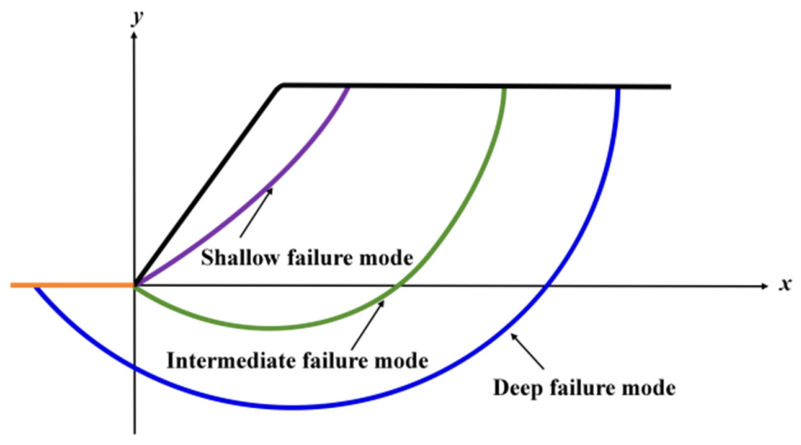
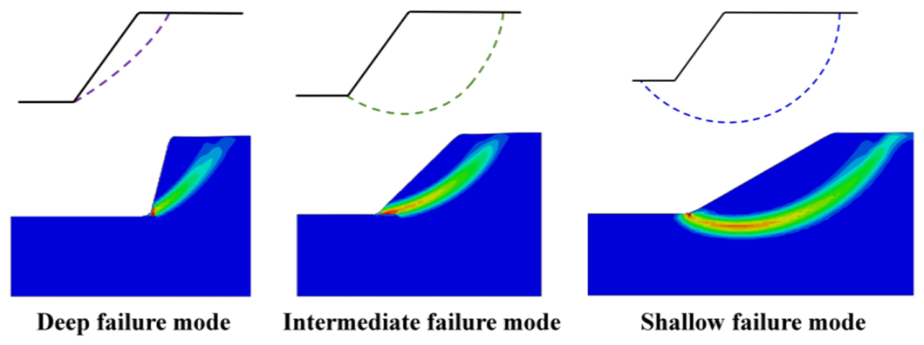
Identifying the slope failure mode can enable the determination of the location of the sliding surface, which is essential for designing an effective stabilization scheme. Klar et al. [17] classified the slope failure modes into three types, as shown in Figure 6. Shallow failure mode: the sliding surface extends from x = 0 to the slope crest, with the entire surface located above the x-axis (y > 0). Intermediate failure mode: the sliding surface extends from x = 0 to the slope crest, with part of the surface located below the x-axis. Deep failure mode: the sliding surface extends from x < 0 to the slope crest, with part of the surface located below the x-axis. Figure 7 illustrates the comparison of failure modes from the FE results and the definition of Klar et al. [17], which proves that the failure mode of the FE results generally agrees with that of Klar et al. [17]. Hence, the definition of the failure mode by Klar et al. [17] is adopted in the present work.
Jiang and Yamagami [1] proposed a dimensionless parameter λ determined by c, γ, H and φ:
λ c φ = c / γ H tan φ
For the homogeneous soil slope at a given slope angle, the sliding surface depends only on the parameter λ. The larger λ is, the deeper the slope sliding surface. Therefore, there should be critical values of λ to distinguish shallow, intermediate and deep failures. In the present study, λ1 and λ2 are defined as the critical values to separate shallow, intermediate and deep failures, as shown in Figure 8. If λ<λ1, the failure mode of soil slope is shallow; if λ1< λ <λ2, the failure mode of soil slope is intermediate; and if λ > λ2, the failure mode of soil slope is deep.
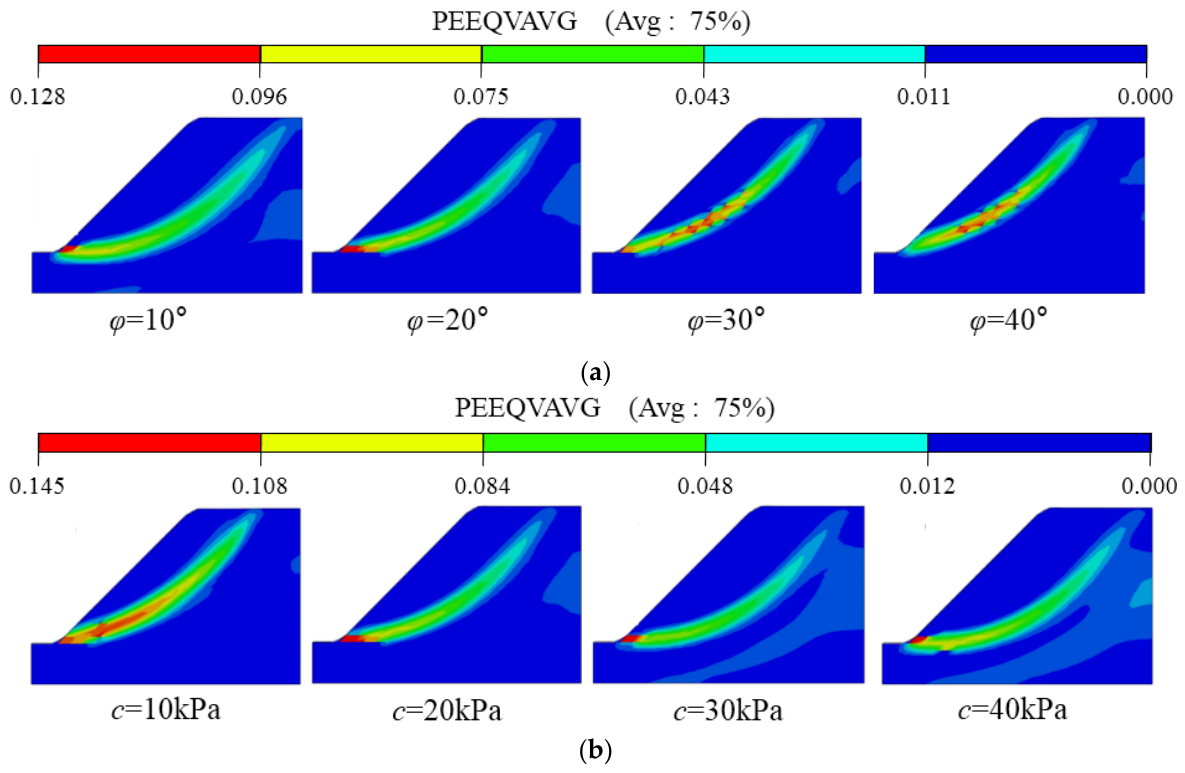
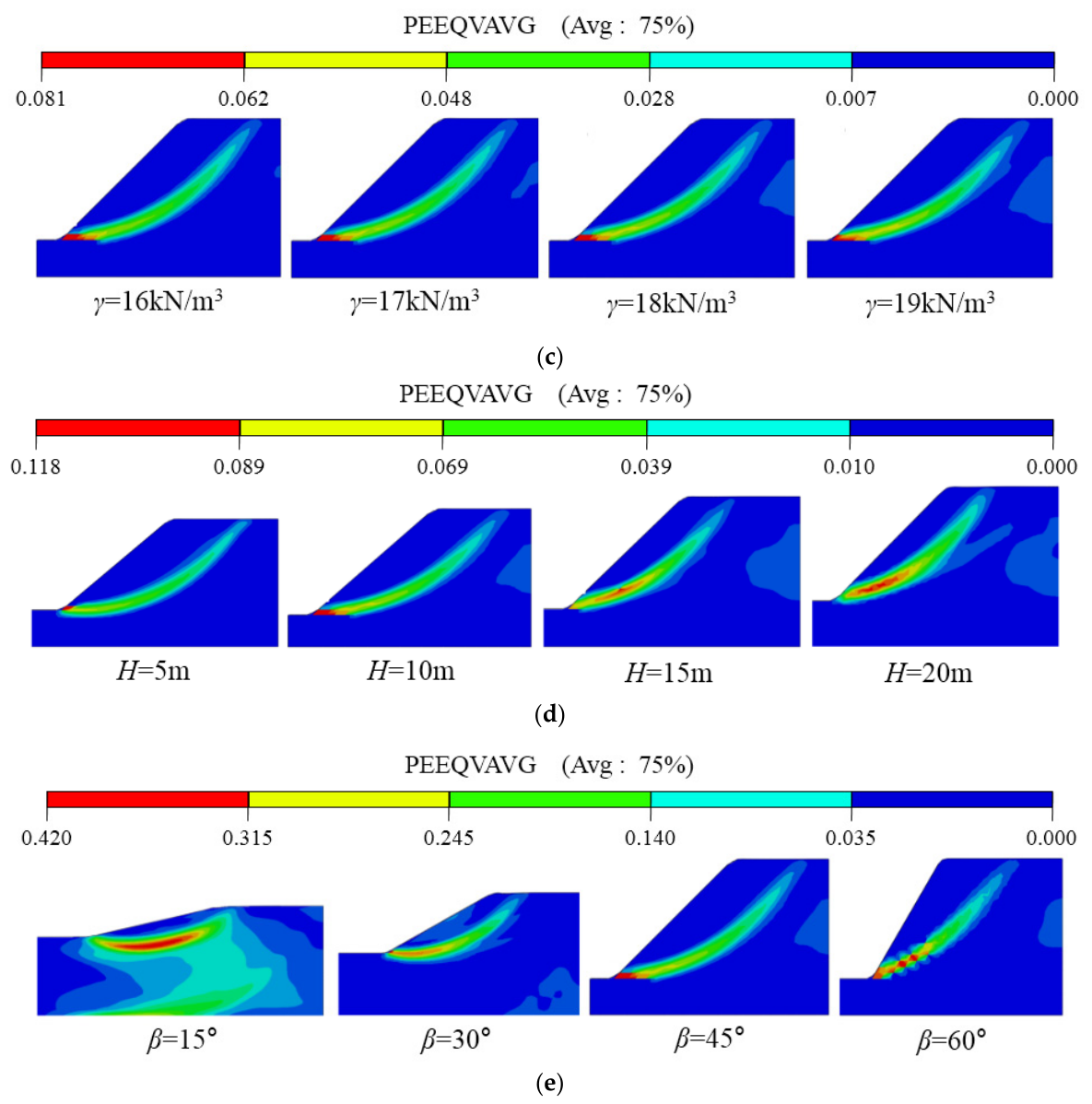
Table 3 gives the cases for analyzing the failure mode of soil slope, and the values of λ calculated by Equation (7) are also listed in Table 3. Figure 9 shows the slope failure mode corresponding to the cases listed in Table 3. As the internal friction angle φ increases, the sliding volume decreases, and the sliding surface becomes shallower, as shown in Figure 9a. When φ = 16° and 8°, the slope exhibits shallow–intermediate and intermediate–deep critical sliding surfaces, corresponding to λ1 = 0.39 and λ2 = 0.79. As the cohesion c increases, the sliding volume increases and the sliding surface deepens, as shown in Figure 9b. For c = 10 kPa and 20 kPa, the failure modes are shallow, while those of c = 30 kPa and 40 kPa are intermediate failure. The critical sliding surfaces appear at c = 25.5 kPa and 52 kPa, corresponding to λ1 = 0.39 and λ2 = 0.79. Within the typical parameter range, the soil unit weight γ has little effect on the sliding surface and the distribution of the plastic zone, as shown in Figure 9c. The values of λ at different γ show little variation (Table 3), and all cases correspond to shallow failures. As the slope height H increases, the sliding surface becomes shallower, and the plastic zone expands, as shown in Figure 9d. Slope angle β has a significant effect on the failure mode. As β increases, the shear-out location of the sliding mass moves closer to the slope toe, and the sliding surface becomes shallower, as shown in Figure 9e. Therefore, gentle slopes are safer but more prone to deep sliding with a wider failure zone, while shallow sliding occurs more frequently on steeper slopes, producing smaller sliding volumes after the failure.

3.4. Empirical Formula for the Failure Mode of Soil Slope

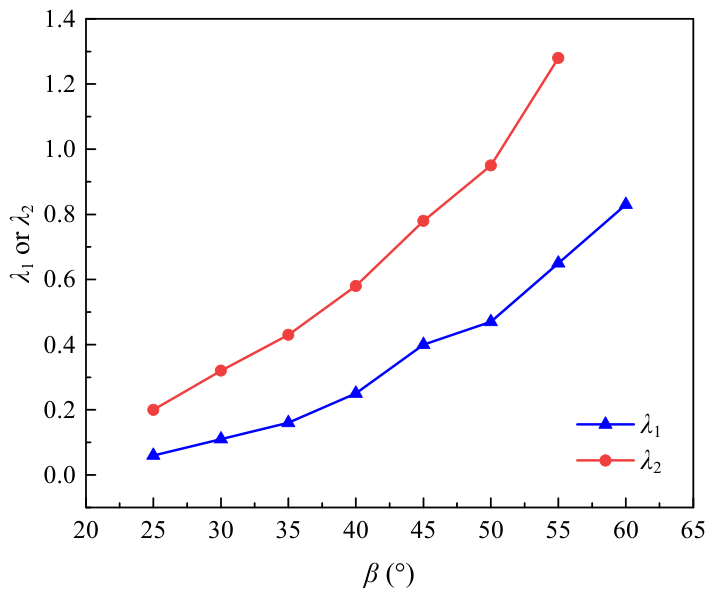
It is observed from Section 3.3 that the effects of the internal friction angle φ, cohesion c and soil unit weight γ on the position of the sliding surface are consistent with the patterns provided by λ. However, φ, c and γ have almost no effect on the critical values λ1 and λ2. For Cases 1–3 in Table 3, λ1 and λ2 are 0.39 and 0.79, respectively. When the slope height H is 5 m, 10 m, 15 m and 20 m, λ1 is 0.39, 0.39, 0.41 and 0.41, respectively, and λ1 is 0.79, 0.79, 0.77 and 0.78, respectively, indicating that the influence of H on λ1 and λ2 is minimal. However, the slope angle β has a significant effect on λ1 and λ2, as shown in Figure 10. It is found that λ1 and tanβ have a linear relationship, and so does λ2.
Based on the FE results from Table 3, the values of λ1 and λ2 are fitted as
λ 1 = 0.63 tan β 0.26       25 ° β 60 °
λ 2 = 1.11 tan β 0.36       25 ° β 60 °
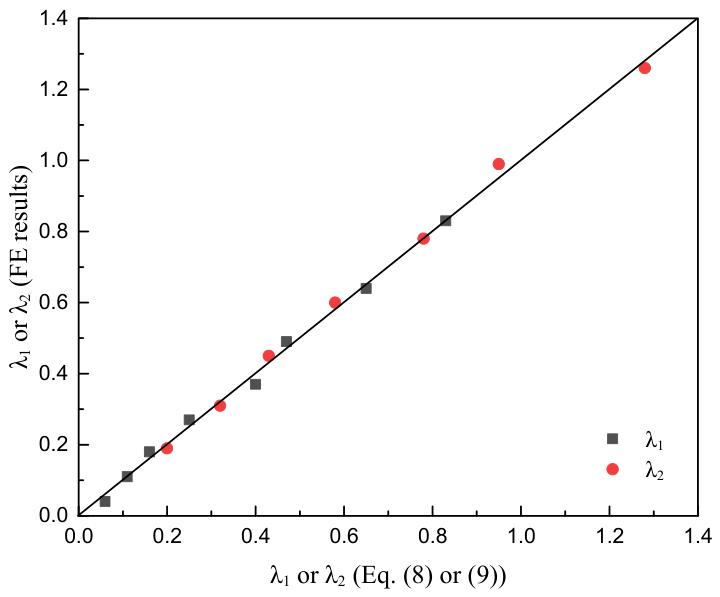
Figure 11 illustrates the FE results and the results calculated by Equations (8) and (9), showing good agreement. This section establishes a bridge between the dimensionless parameter λ and the failure mode classification method by Klar et al. [17] and proposes empirical formulae for the critical values of λ1 and λ2 to distinguish the slope failure mode. The values of λ, λ1 and λ2 are calculated by Equations (7)–(9), respectively. If λ < λ1, the failure mode of soil slope is shallow; if λ1< λ <λ2, the failure mode of soil slope is intermediate; and if λ > λ2, the failure mode of soil slope is deep. It should be noted that Equations (8) and (9) are developed under a two-dimensional FE analysis, which apply to the conditions of 8 kPa ≤ c ≤ 40 kPa, 10° ≤ φ ≤ 52°, 16 kN/m3γ ≤ 20 kN/m3 and 25° ≤ β ≤ 60°.

4. Slope Reinforcement with Curing Agent

4.1. Slope Reinforcement

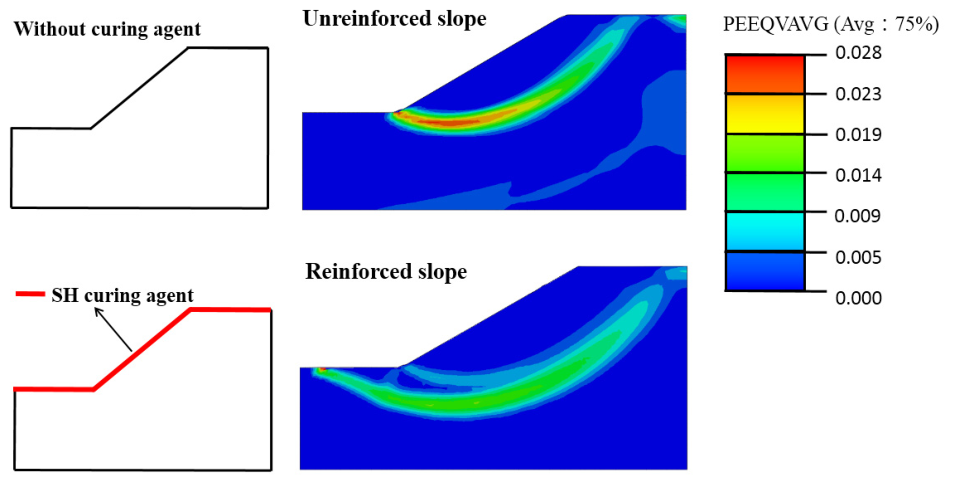
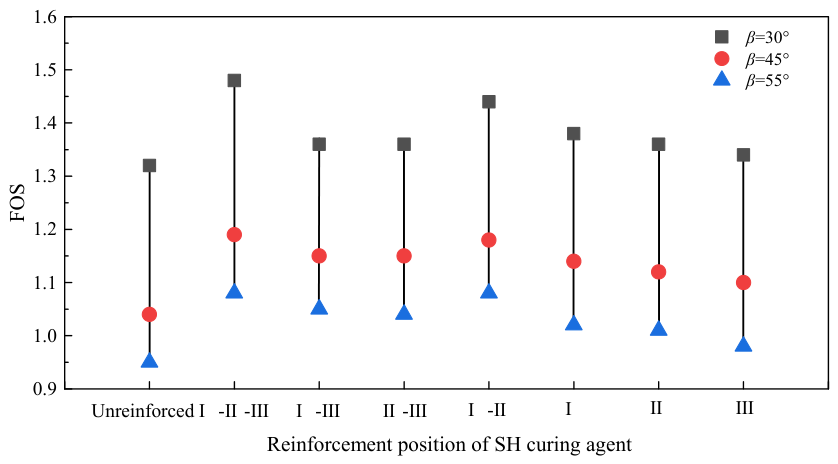
In slope reinforcement engineering, curing agents are typically applied to the slope surface, as Zone I, Zone II and Zone III in Figure 1. In the present work, the SH curing agent proposed by Wang et al. [21] is used for slope reinforcement. The slope is assumed to be a loess slope. The thickness of the reinforced layer is 0.2 m, which is solidified loess with a 10% SH curing agent. The FE model is illustrated in Figure 2, while the material properties of loess and solidified loess are obtained from laboratory tests, as listed in Table 4. Since the elastic modulus E and Poisson’s ratio v hardly affect the FOS of soil slope, the same values of E and v for loess and solidified loess are adopted in the FE calculation. Figure 12 illustrates the failure mode of slope before and after reinforcement of Zone I, Zone II and Zone III. The incorporation of the SH curing agent makes the failure band away from the slope toe, with a deeper failure mode. The FOSs of the unreinforced and reinforced slope are 1.32 and 1.48, respectively, which indicates that the incorporation of the SH curing agent improves the slope stability.

4.2. Reinforcement Strategy

The reinforcement strategy and optimization process are as follows. 1. Apply the SH curing agent with the thickness of 0.2 m on Zone I, Zone II and Zone III (Case I-II-III). 2. Combine any two of Zone I, Zone II and Zone III and apply the SH curing agent with the thickness of 0.2 m (Case I–III, Case II–III and Case I–II). 3. Apply the SH curing agent with the thickness of 0.2 m to Zone I, Zone II and Zone III separately (Case I, Case II and Case III). 4. Optimize the length of the reinforcement. Figure 13 presents the FOSs of the slopes at different reinforcement strategies, which shows that the reinforcements of Case I–II–III and Case I–II have the best performance. The FOSs of Case I–II–III and Case I-II at β = 30°, 45° and 55° are 1.48 and 1.44, 1.19 and 1.18, and 1.08 and 1.08, respectively. The differences between Case I–II–III and Case I–II at β = 30°, 45° and 55° are 2.6%, 0.8% and 0%, respectively. Hence, the reinforcement strategy of Case I-II is adopted in order to save reinforcement materials and construction time.
Considering that the reinforcement strategy of Case I-II still requires significant work, Case I-II is used as the control case to further investigate the effect of the length of the curing agent on the slope stability, aiming to determine the optimal length of reinforcement with the SH curing agent. Table 5 lists the FOSr of slope at different reinforcement lengths, where L1 is the reinforcement length extending leftward from the slope toe along the slope base, L2 is the reinforcement length extending upward from the slope toe along the slope surface, and FOSr is the FOS after reinforcement with the curing agent. Table 5 shows that L1 = 3Lr/8 and L2 = 3Lm/8 are the optimum reinforcement lengths at β = 30°. Combined with the analysis of the soil parameters and failure modes, it can be seen that, because the soil unit weight of the stabilized loess is higher than that of the loess, the load acting on the slope increases with the volume of stabilized loess, thereby increasing the overall unit weight and causing the slope to become more unstable. Therefore, an appropriate reduction in the reinforcement length of the curing agent may even improve the slope stability. However, if the reinforcement length is reduced further, the FOS of the slope will decrease.
The failure mode of the slope varies with different slope angles, which in turn leads to different optimum reinforcement lengths. When the slope angle β = 45°, the optimum reinforcement lengths of the curing agent are L1 = Lr/10 and L2 = Lm/10. When the slope angle β = 55°, the optimum reinforcement lengths are L1 = Lr/4 and L2 = Lm/4. On this basis, the optimum reinforcement lengths for slope angles ranging from β = 25° to 65° were further investigated, and the calculation results are presented in Table 6. The FOS after reinforcement (FOSr) is 12.1~18.8% higher than that before reinforcement.

4.3. Empirical Formula for the FOS of Reinforcement Soil Slope

In Section 3, the FOS of the soil slope before reinforcement can be predicted by Equations (5) and (6), while predicting the FOS after reinforcement, i.e., FOSr, is also of significant importance. In this section, 108 cases with optimum reinforcement are designed to investigate the effects of the friction angle φ, cohesion c, soil unit weight γ and slope angle β on the FOSr, as shown in Table 7 (Cases 1–3). Cases 1–3 cover the shallow, intermediate and deep failure modes with β = 25~60°.
Based on the FE results, the following empirical formula is proposed, which gives the relationship between the FOSr and FOS:
FOS r = a 2 c g γ g H b 2 φ g β c 2 FOS + d 2
where a2, b2, c2 and d2 are the fitting coefficients of Equation (10), and cg, φg and γg are the cohesion, internal friction angle and soil unit weight after reinforcement, respectively. Equation (10) is fitted by the FE results of Cases 1–3 in Table 7. To improve the fitting accuracy, the formula is divided into two segments according to the slope angle: one for β = 25~45° and another for β = 45~65°.
FOS r = 0.813 c g γ g H 1.795 φ g β 0.042 FOS + 0.0992       25 ° β 45 °
FOS r = 0.694 c g γ g H 2.375 φ g β 0.0118 FOS + 0.0235       45 < β < 65 °
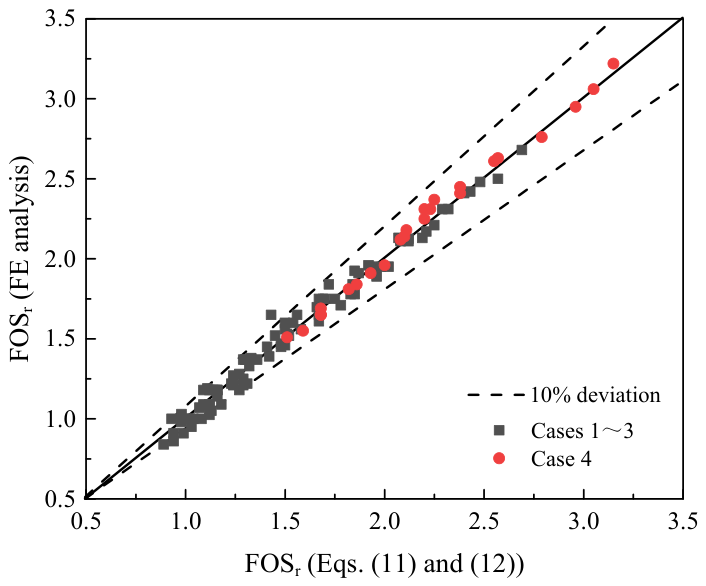
Figure 14 presents the comparison between the FE results and calculations by Equations (11) and (12). The FOSr is fitted with an R2 of 0.97 and 0.95 for Equations (11) and (12), respectively. The deviation and average deviation between Equation (11) and the FE results are −11.33~9.30% and 5.78%, respectively, while those between Equation (12) and the FE results are −6.25~7.62% and 3.36%, respectively. To verify the effectiveness of Equations (11) and (12), Case 4 in Table 7 is designed, which is also illustrated in Figure 13. The maximum deviation between Equation (11) and the FE results is 4.98%, while that between Equation (12) and FE results is 4.78%. It should be noted that Equations (11) and (12) are developed under a two-dimensional FE analysis, which apply to the SH curing agent and the thickness of the reinforced layer of 0.2 m.

5. Approach for Soil Slope Reinforcement with Curing Agent

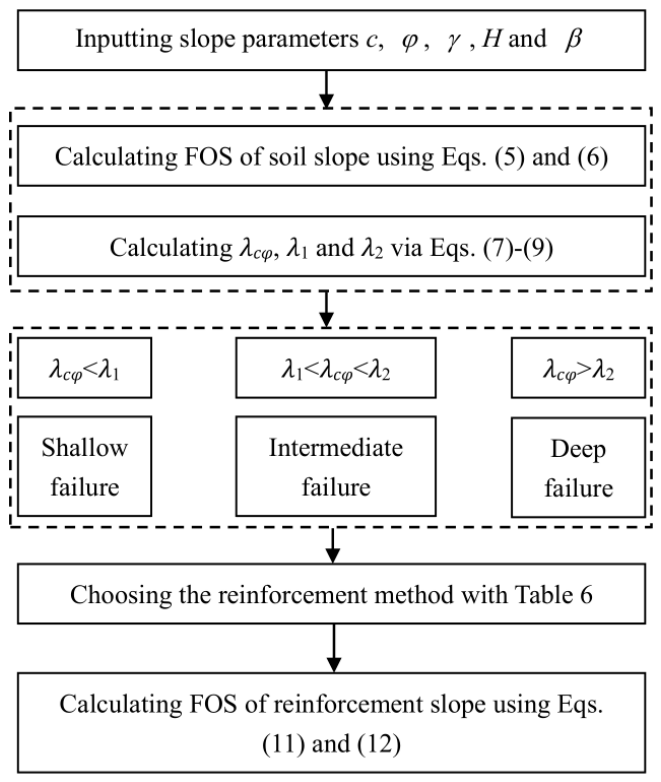
Based on the results of Section 3 and Section 4, a simple design approach is proposed for soil slope reinforcement with a curing agent, as shown in Figure 15. In the design approach, the determination of failure mode is also provided, which is important for soil slope. The design approach includes the following:
1. Inputting the parameters of soil slope, including the cohesion c, internal friction angle φ, soil unit weight γ, slope height H and slope angle β.
2. Calculating the FOS of the slope using Equations (5) and (6).
3. Calculating the λ, λ1 and λ2 of the slope via Equations (7)–(9), respectively: if λ<λ1, the failure mode of soil slope is shallow; if λ1< λ <λ2, the failure mode of soil slope is intermediate; and if λ > λ2, the failure mode of soil slope is deep.
4. Choosing the reinforcement method with Table 6.
5. Calculating the FOS of reinforcement soil slope using Equations (11) and (12).
Compared with the FE analysis, the proposed simple design approach enables a quick outcome of the reinforcement strategy, providing convenience for engineers in practice. However, the FE analysis, including the CEL analysis, can accurately simulate the failure mode of soil slope before and after reinforcement, which will produce a more precise reinforcement strategy.

6. Conclusions

Based on the CEL method, FE analysis was performed to establish a simple design approach for soil slope reinforcement with a curing agent. The effects of the internal friction angle φ, cohesion c, soil unit weight γ, slope height H and slope angle β on the slope stability was firstly quantified. Then, the empirical formula for FOS was proposed, and the method to determine the failure mode of soil slope was established. Based on the failure mode of soil slope, the optimum reinforcement strategy was proposed, and an empirical formula for the FOS of reinforcement soil slope was developed. The main conclusions are summarized as follows:
(1) Based on the CEL analysis, 93 cases were calculated to quantify the effects of the internal friction angle φ, cohesion c, soil unit weight γ, slope height H and slope angle β on the FOS of soil slope, and the empirical formula was proposed for the FOS of a soil slope, i.e., Equations (5) and (6). The failure modes of soil slope were classified into three types, including shallow, intermediate and deep failure, which can be determined by the dimensionless parameter λ and the proposed empirical formulae of λ1 and λ2 (Equations (8) and (9)). If λ < λ1, the failure mode of soil slope is shallow; if λ1< λ <λ2, the failure mode of soil slope is intermediate; and if λ > λ2, the failure mode of soil slope is deep.
(2) The slope reinforcement with SH curing agent was investigated by changing the reinforcement position and length. It was found that the reinforcement of Case I-II-III and Case I-II had the best performance. The effect of the reinforcement length on the slope stability was investigated, and the optimum length of reinforcement with an SH curing agent was determined (Table 6). For a slope angle β = 25° to 65°, the FOS after reinforcement was 12.1~18.8% larger than that before reinforcement. Based on the FE analysis on the FOS after reinforcement, an empirical formula was proposed for the FOS of reinforcement soil slope, i.e., Equations (11) and (12).
(3) A simple design approach was developed for soil slope reinforcement with a curing agent (Figure 15), which included the evaluation of the FOS and failure mode of soil slope before reinforcement, optimum reinforcement strategy and evaluation of the FOS after reinforcement. The proposed design approach is convenient for engineering practice in soil slope reinforcement with a curing agent.
It should be noted that the approach for soil slope reinforcement with a curing agent was developed under a two-dimensional FE analysis. In addition, the reinforcement thickness of 0.2 m and SH curing agent were adopted by the present work. In the future, the reinforcement thickness and properties of the curing agent should be considered to demonstrate the robustness of the proposed reinforcement strategy.

Author Contributions

W.W.: data analysis, writing—original draft. L.Z.: FE calculation. D.M.: data analysis. X.Z.: FE calculation. Z.L.: FE calculation, methodology. Y.D.: FE calculation, methodology. Y.Z. (Yanbing Zhao): methodology. Y.Z. (Yan Zhang): writing—review and editing. Y.T.: writing—review and editing. All authors have read and agreed to the published version of the manuscript.

Funding

This research was funded by the R&D Service for Specialized Information Models for the Entire Longhua Kou Water Diversion Project Line (Grant number WR120205A0042025), Key Technologies for Coordinated Multi-Valve Regulation in Long-Distance Water Diversion Projects (Grant number 254200510037) and the Key Research and Development Program of Henan Province (Grant number 251111210700).

Institutional Review Board Statement

Not applicable.

Informed Consent Statement

Not applicable.

Data Availability Statement

The original contributions presented in this study are included in the article. Further inquiries can be directed to the corresponding author.

Conflicts of Interest

Authors Wei Wang, Longfei Zhang and Dajun Mao were employed by the company PowerChina Huadong Engineering Corporation Limited. Author Xuxiong Zhang was employed by the company PowerChina Beijing Engineering Corporation Limited. The remaining authors declare that the research was conducted in the absence of any commercial or financial relationships that could be construed as a potential conflict of interest.

References

  1. Jiang, J.; Yamagami, T. Charts for estimating strength parameters from slips in homogeneous slopes. Comput. Geotech. 2006, 33, 294–304. [Google Scholar] [CrossRef]
  2. Sloan, S.W. Geotechnical stability analysis. Géotechnique 2013, 63, 531–571. [Google Scholar] [CrossRef]
  3. Zheng, H.; Tham, L.G.; Liu, D. A practical procedure for searching critical slip surfaces of slopes based on the strength reduction technique. Comput. Geotech. 2009, 36, 1–5. [Google Scholar] [CrossRef]
  4. Guo, D.; Hamada, M. Qualitative and quantitative analysis on landslide influential factors during Wenchuan earthquake: A case study in Wenchuan County. Eng. Geol. 2013, 152, 202–209. [Google Scholar] [CrossRef]
  5. Pinheiro, M.; Sanches, S.; Miranda, T.; Neves, A.; Tinoco, J.; Ferreira, A.; Gomes Correia, A. A new empirical system for rock slope stability analysis in exploitation stage. Int. J. Rock Mech. Min. Sci. 2015, 76, 182–191. [Google Scholar] [CrossRef]
  6. Gao, W. Stability analysis of rock slope based on an abstraction ant colony clustering algorithm. Environ. Earth Sci. 2015, 73, 7969–7982. [Google Scholar] [CrossRef]
  7. Cheng, Y.; Lansivaara, T.; Wei, W. Two-dimensional slope stability analysis by limit equilibrium and strength reduction methods. Comput. Geotech. 2007, 34, 137–150. [Google Scholar] [CrossRef]
  8. Wei, W.; Cheng, Y.; Li, L. Three-dimensional slope failure analysis by the strength reduction and limit equilibrium methods. Comput. Geotech. 2009, 36, 70–80. [Google Scholar] [CrossRef]
  9. Dawson, E.M.; Roth, W.H.; Drescher, A. Slope stability analysis by strength reduction. Géotechnique 1999, 49, 835–840. [Google Scholar] [CrossRef]
  10. Chen, X.; Zhang, L.; Chen, L.; Li, X.; Liu, D. Slope stability analysis based on the coupled Eulerian-Lagrangian finite element method. Bull. Eng. Geol. Environ. 2019, 78, 4451–4463. [Google Scholar] [CrossRef]
  11. Hua, C.; Yao, L.; Song, C.; Ni, Q. Variational method for determining slope instability based on the strength reduction method. Bull. Eng. Geol. Environ. 2022, 81, 395. [Google Scholar] [CrossRef]
  12. Griffiths, D.V.; Lane, P.A. Slope stability analysis by finite elements. Géotechnique 1999, 49, 387–403. [Google Scholar] [CrossRef]
  13. Matsui, T.; San, K.C. Finite element slope stability analysis by shear strength reduction technique. Soils Found. 1992, 32, 59–70. [Google Scholar] [CrossRef]
  14. Tu, Y.; Liu, X.; Zhong, Z.; Li, Y. New criteria for defining slope failure using the strength reduction method. Eng. Geol. 2016, 212, 63–71. [Google Scholar] [CrossRef]
  15. Huang, L.; Huang, S.; Lai, Z. On an energy-based criterion for defining slope failure considering spatially varying soil properties. Eng. Geol. 2020, 264, 105323. [Google Scholar] [CrossRef]
  16. Wyllie, D.C.; Mah, C.W. Rock Slope Engineering: Civil and Mining, 4th ed.; Spon Press: London, UK, 2004. [Google Scholar]
  17. Klar, A.; Aharonov, E.; Kalderon-Asael, B.; Katz, O. Analytical and observational relations between landslide volume and surface area. J. Geophys. Res. Earth Surf. 2011, 116, F02001. [Google Scholar] [CrossRef]
  18. Wang, X.; Tao, J.; Bao, R.; Tran, T.V.; Tucker-Kulesza, S. Surficial soil stabilization against water-induced erosion using polymer-modified microbially induced carbonate precipitation. J. Mater. Civ. Eng. 2018, 30, 04018267. [Google Scholar] [CrossRef]
  19. Asadoullahtabar, S.R.; Asgari, A.; Rezapour Tabari, M.M. Assessment, identifying, and presenting a plan for the stabilization of loessic soils exposed to scouring in the path of gas pipelines, case study: Maraveh-Tappeh city. Eng. Geol. 2024, 356, 107747. [Google Scholar] [CrossRef]
  20. Liu, J.; Shi, B.; Jiang, H.; Huang, H.; Wang, G.; Kamai, T. Research on the stabilization treatment of clay slope topsoil by organic polymer soil stabilizer. Eng. Geol. 2011, 117, 114–120. [Google Scholar] [CrossRef]
  21. Wang, Y.; Yang, Z.; Chen, W. Strength characteristics and mechanism of loess solidified with new polymer material SH. Chin. J. Rock Mech. Eng. 2005, 24, 2554–2559. [Google Scholar]
  22. Kang, D.H.; Kim, J. Development of Eco-Friendly Soil Improvement Agent for Enhanced Slope Stability and Erosion Control in Urban Areas. Buildings 2024, 14, 1021. [Google Scholar] [CrossRef]
  23. Bai, Y.; Zhang, L.; Wang, X. Soil stabilization using synthetic polymer for soil slope ecological protection. Eng. Geol. 2023, 152, 10–20. [Google Scholar] [CrossRef]
  24. Hassona, F.; Hakeem, B.M. Numerical modelling for stability of homogeneous clay and sand slopes improved by polyurethane foam piles in slope face. J. Umm A1-Qura Univ. Eng. Archit. 2024, 9, 45–60. [Google Scholar] [CrossRef]
  25. Phuong, A.T. Numerical modelling of slope stabilization with xanthan gum treated soil. J. Sci. Eng. 2023, 17, 38–44. [Google Scholar]
Figure 1. Setup of soil slope reinforcement with curing agent.
Applsci 16 06005 g001
Figure 2. FE model.
Figure 2. FE model.
Applsci 16 06005 g002
Figure 3. Kinetic energy of slope during the FE analysis.
Applsci 16 06005 g003
Figure 4. Influence of various parameters on the FOS of soil slope. (a) Influence of internal friction angle. (b) Influence of cohesion. (c) Influence of slope height. (d) Influence of soil unit weight. (e) Influence of slope angle with different φ. (f) Influence of slope angle with different c.
Applsci 16 06005 g004
Figure 5. Comparison between the results of CEL analysis and Equations (5) and (6) [9,10].
Applsci 16 06005 g005
Figure 6. Definition of soil slope failure mode by Klar et al. [17].
Applsci 16 06005 g006
Figure 7. Comparison of failure modes from FE results and definition of Klar et al. [17].
Applsci 16 06005 g007
Figure 8. Determination of failure mode by critical failure parameters.
Applsci 16 06005 g008
Figure 9. Failure modes of soil slope. (a) Influence of internal friction angle. (b) Influence of cohesion. (c) Influence of soil unit weight. (d) Influence of slope height. (e) Influence of slope angle.
Applsci 16 06005 g009aApplsci 16 06005 g009b
Figure 10. λ1 and λ2 at different slope angles.
Applsci 16 06005 g010
Figure 11. Comparison between FE results and calculations by Equations (8) and (9).
Applsci 16 06005 g011
Figure 12. Failure mode of slope before and after reinforcement (β = 30°, H = 10 m).
Applsci 16 06005 g012
Figure 13. FOSs of slope at different reinforcement strategies (H = 10 m).
Applsci 16 06005 g013
Figure 14. Comparison between FE results and calculations by Equations (11) and (12).
Applsci 16 06005 g014
Figure 15. Flowchart for the slope reinforcement with curing agent.
Applsci 16 06005 g015
Table 1. Parameters for the FE model.
CaseLs (m)Lr (m)Lt (m)H (m)Hs (m)Hv (m)d (m)φ (°)c (kPa)β (°)γ (kN/m3)FOS
Dawson et al. [9]2028103202012.3845201.00
Chen et al. [10]305202083560.00761.30
Table 2. FE cases for analyzing the FOS of soil slope.
Caseφ (°)c (kPa)H (m)γ (kN/m3)β (°)Number of Cases
15,10,20,30,4020101815,30,45,60,7522
2205,10,20,30,40101815,30,45,60,7520
320205,10,15,2018454
420201016,17,18,19,20455
55,10,20,30,4030101815,30,45,60,7525
6405,10,20,30,40101815,30,45,60,7521
710,3010,305,10,1516,2030,7528
Table 3. Cases for analyzing the failure mode of soil slope.
Caseφ (°)c (kPa)H (m)γ (kN/m3)β (°)λcφ
18,10,16,
20,30,40
201018450.79,0.63,0.39,
0.31,0.19,0.13
22010,20,25.5,
30,40,52
1018450.15,0.31,0.39,
0.46,0.61,0.79
320205,10,15,2018450.61,0.31,0.20,0.15
420201016,17,18,19,20450.34,0.32,0.31,0.29,0.27
52020101825,30,35,40,
45,50,55,60
0.31
Table 4. Material properties.
Materialc (kPa)φ (°)γ (kN/m3)E (MPa)v
loess15.6410.9114.53500.35
solidified loess197.9725.217.53500.35
Table 5. FOS of slope at different reinforcement lengths.
β (°)30303030454545455555555555
d (m)0.20.20.20.20.20.20.20.20.20.20.20.20.2
L1/Lr13/43/81/411/21/101/2011/21/41/81/10
L2/Lm13/43/81/411/21/101/2011/21/41/81/10
FOSr1.441.471.481.371.181.181.181.001.081.081.081.051.00
Table 6. Optimum reinforcement length for different slope angles.
β (°)L1/LrL2/LmFOSFOSr(FOSr–FOS)/FOS (%)
25111.451.6513.8
303/83/81.321.4812.1
353/43/41.211.3713.2
401/21/21.131.2813.3
451/101/101.041.1813.5
501/21/21.001.1212.0
551/41/40.951.0813.7
60110.891.0416.9
65110.851.0118.8
Table 7. FE cases for analyzing the FOSr of reinforcement soil slope.
Caseφ (°)c (kPa)γ (kN/m3)β (°)Number of Cases
110.91,15,20,2515.6414.525,30,35,40,45,
50,55,60,65
36
210.9115.64,30,35,4014.525,30,35,40,45,
50,55,60,65
36
310.9115.6414.5,15,17,1925,30,35,40,45,
50,55,60,65
36
430,3524,4521,2330,50,6024
Disclaimer/Publisher’s Note: The statements, opinions and data contained in all publications are solely those of the individual author(s) and contributor(s) and not of MDPI and/or the editor(s). MDPI and/or the editor(s) disclaim responsibility for any injury to people or property resulting from any ideas, methods, instructions or products referred to in the content.