Article

Assessment of Structural Conservation State of Wooden Panel Painting by Optical and Thermal Diagnostics


1
Department of Sciences of Antiquities, Sapienza University of Rome, Piazzale Aldo Moro, 5, 00185 Rome, Italy
2
Institute of Heritage Science of CNR, Via Cardinale Guglielmo Sanfelice, 8, 80134 Naples, Italy
3
Institute of Applied Sciences and Intelligent Systems “E. Caianiello” of CNR, Via Campi Flegrei 34, 80078 Pozzuoli, Italy
4
Department of Conservation of Cultural Heritage, Naples Academy of Fine Arts, Via Santa Maria di Costantinopoli 107, 80138 Naples, Italy
*
Author to whom correspondence should be addressed.
Appl. Sci. 2026, 16(12), 6002; https://doi.org/10.3390/app16126002 (registering DOI)
Submission received: 8 May 2026 / Revised: 7 June 2026 / Accepted: 9 June 2026 / Published: 13 June 2026
(This article belongs to the Special Issue Cultural Heritage: Restoration and Conservation)

Abstract

This study proposes a combination of optical and thermal methods to investigate the structural integrity of two 16th–17th centuries wooden panel paintings at the early stages of restoration. Well-established techniques, such as 3D scanning, technical photography, and active thermography, are combined with the less conventional shearography, which has recently gained increasing relevance in the diagnostics of cultural heritage materials. The proposed methodology enables the identification and spatial localization of different forms of degradation within the multilayered structure of the artworks, including physical-structural alterations, insect damage, localized hygroscopic degradation, nails, interlayer deterioration, and craquelure. This approach provides a comprehensive insight into the state of the panel painting structure and highlights potentially critical areas which were undetectable by visual inspection alone, demonstrating the ability to guide restoration interventions.

1. Introduction

Wooden panels were the primary support for paintings until the sixteenth century, valued for their durability and rigidity. Typically, multiple boards were glued together using animal or casein glue and reinforced with dowels, splines, crossbeams and frames, with differences introduced by craftsmanship and workshop practices [1]. The surface was prepared with multiple layers of animal glue and gesso, occasionally reinforced with canvas or linen, creating a smooth surface suitable for detailed painting [2].
As multilayered systems, they exhibit complex long-term behavior. Wood is hygroscopic and anisotropic, so it continuously exchanges moisture with the environment, expanding and contracting with different rates along the longitudinal, radial, and tangential directions. These movements can result in deformations due to fluctuating thermo-hygrometric conditions, depending also on the wood properties and on the interaction between joined boards and restraining elements. In addition, wood is vulnerable to biological degradation by insects, fungi, and bacteria, which compromises both the support and the pictorial layers. Finally, the multiple layers influence each other as follows: ground and paint can obstruct moisture exchange, but also potentially create stress imbalance, when only one side is painted. At the same time, subsurface damage and warping in the panel structure may affect the pictorial surface with cracking, delamination, and paint loss [3].
The unique characteristics of each wooden panel painting require tailored conservation strategies, making restoration a highly specialized practice, dependent on experience. Increasing efforts focus on bridging the gap between empirical knowledge and scientific validation, to provide conservators with tools and data that enable informed judgment. In this framework, non-destructive testing (NDT) techniques have found a wide range of applicability, advancing the understanding of the fundamental processes governing wooden panel behavior and supporting a comprehensive insight into the materials, structure and conservation state of artworks [2,3,4,5,6].
Focusing on the structural integrity of panel paintings, geometric documentation relies on 3D measurement techniques such as laser scanning, photogrammetry, laser micro profilometry and fringe projection, enabling precise surface mapping and long-term deformation monitoring [7,8,9]. Strain and deformation can be assessed using interferometric and optical methods, including ESPI, shearography, digital holography, digital image correlation (DIC) and stereoscopic marks tracking method [4,9,10,11]. To examine internal structures, popular methods include X-ray radiography, computed tomography and terahertz imaging [12,13], while infrared thermography detects subsurface defects, voids and detachments [14].
Despite their potential, each technique faces limitations and data interpretation ambiguities, due to the complexity of the samples. Therefore, current approaches increasingly rely on integrating multi-technique data to improve defect identification and compensate for individual methodological constraints. Recently, the integration of shearography (SH), active thermography (AT), and structured-light 3D scanning (SL3D scanning) for the structural analysis of wooden panel paintings has been demonstrated on the 15th-century panel painting “Consegna della regola Francescana” by Colantonio [9]. These techniques are non-contact and portable, making them particularly suitable for in situ investigations without risking damage or alteration of the artwork.
The present study examines two liturgical cabinet doors from the mid-16th and early 17th century, depicting Santo Stefano and San Giovanni Battista. They are painted in oil on wooden support and were recovered from the storage of the Museo e Real Bosco di Capodimonte. Although both cabinet panels and the previously analyzed Colantonio one belong to the southern Italian tradition of panel painting, they differ markedly in dimensions, structural configuration, board thickness, and the stratigraphy of preparation and pictorial layers, as well as in their conservation and exhibition histories. This variability offers a valuable opportunity to further assess the robustness and versatility of the proposed integrated methodology across diverse structural and conservation contexts.
The measurement campaign has been carried out during the early stages of restoration, carried out by the Academy of Fine Arts in Naples, with the aim of supporting more informed conservation strategies through the acquisition of detailed, non-invasive diagnostic data. In addition to SH, AT, and SL 3D scanning, raking light photography (RAK) has been incorporated to enhance the detection of surface irregularities and deformations. The integration of these complementary techniques allowed multi-scale and multi-modal characterization of the panels, improving defect identification reliability and contributing to a deeper understanding of their conservation state.

2. Materials and Methods

2.1. Shearography

Shearography is a full-field, real-time interferometric method responsive to displacement gradients [15], which has successful applications in the field of cultural heritage. Based essentially on the Michelson interferometer configuration, it employs a laser beam to illuminate surfaces experiencing static or dynamic displacement from external perturbations due to thermal loading or mechanical forces [16]. The process involves capturing speckle patterns from the object’s surface and creating fringe images through interference with a laterally shifted replica. A computerized acquisition system records these patterns before and after perturbation, allowing for the continuous tracking of surface responses over time [17]. The processed data generate phase maps from interference patterns, representing the derivatives of out-of-plane surface displacements in relation to different operational parameters and excitations. Although the primary focus is surface inspection, the SH technique can identify subsurface and bulk defects, making it effective for evaluating wooden panel paintings by detecing cracks, separations and structural deformations [9,18]. The artworks were studied during the restoration process. Dry cleaning and some consolidation of the parts at risk of loss in the lower part of the panel had been carried out on S. Stefano before the diagnostic campaign. The panels were segmented into four sections with lap region space to compensate for potential data loss. Our setup is based on the SE4 camera system (Isi-sys GmbH, Kassel, Germany) with a 5.1 MP CMOS sensor and a red laser diode array (class 1, λ = 660 nm). In the generation of shearing images, the physical separation between the two overlapping images produced by the camera is 2 mm, with an orientation of 45° that dictates the angle at witch the surface is viewed. Thermal loading is achieved via two halogen lamps (2 × 1000 W). Excitation is caused by thermal stimulation at a distance of approximately 0.5 m. The loading is controlled during the measurement to avoid stressing the surface of the artworks and to adhere to the conservation protocol.

2.2. Structured Light 3D Scanning

3D scanning, specifically structured-light 3D (SL3D), is a non-invasive and non-destructive method to accurately capture an object’s shape and color, facilitating quick 3D model generation for documentation, diagnostics and preservation of artworks [19,20,21]. The SL3D actively projects known structured patterns, typically stripes, onto an object. A camera captures the distorted structured patterns from another perspective, and the correspondence between the projector and camera is established by analyzing the distortion of the captured structured images. Once the system is calibrated, the 3D coordinates can be reconstructed using triangulation [22]. It detects distortions caused by the object’s features, such as curves and depressions, and the accompanying software analyzes them to generate 3D coordinates, resulting in a Point Cloud representation of the object’s surface. To capture intricate details like engravings and reliefs accurately, multiple scans are often required, with each item receiving an individualized assessment for a customized scanning approach. Texture, defined by the object’s color and surface characteristics, is captured using an additional camera, providing higher detail for the 3D model made up of vertices, edges, and faces. While integrating various textures adds realism, it may lead to some geometric details being compromised. The software, provided by the Artec Studio (Version 17), also facilitates the integration of photogrammetry textures that balance detail retention and geometric data loss. The Artec Eva (Artec 3D, Senningerberg, Luxembourg) operates distinctly from traditional structured light scanners due to its dual-camera setup and projector alignment, allowing for increased accuracy and capacity for simultaneous scans. This setup provides a fast capture speed of 16 FPS and a 3D resolution of 0.2 mm (about 0.01 in), alongside a high-resolution texture of 1.3 MP [23].

2.3. Active Thermography

Active thermography (AT) is a widely used, non-destructive, contactless infrared imaging technique [24]. Valued for its efficiency and ease of use, it has found several applications for in situ analysis of artworks. It involves heating the sample with an external source and recording the resulting thermal response with an infrared camera. In paintings, AT effectively reveals defects such as inclusions, cracks, detachments, nails, and other anomalies that affect thermo-physical properties [25,26,27,28,29,30]. In this study, AT investigations were performed by virtually subdividing the paintings into three partially overlapping inspection areas. An identical acquisition and processing protocol was applied to all regions. The experimental configuration employed a halogen lamp with adjustable power (up to 1 kW) to generate thermal excitation for 40 s, producing temperature increases in the range of 1 °C ≤ ΔT ≤ 6 °C. Thermal data were acquired using a FLIR X6580sc (FLIR Systems Inc., Wilsonville, OR, USA) infrared camera equipped with a cooled indium antimonide (InSb) detector operating in the mid-wave infrared (MWIR, 3.5–5 μm) spectral range. The system is characterized by a focal plane array (FPA) with a spatial resolution of 640 × 512 pixels, an instantaneous field of view (IFOV) of 0.3 mrad, and a noise-equivalent temperature difference (NETD) of approximately 20 mK at 25 °C. A 50 mm focal length lens was used, and image sequences were recorded at 10 Hz before, during, and after the heating phase, for a total acquisition time of approximately 90 s. Camera control and real-time temperature monitoring were performed using ResearchIR 4 software (FLIR Systems Inc., Wilsonville, OR, USA). For each inspection area, the maximum temperature variation ΔTmax was computed for each pixel according to Equation (1):
ΔTmax(i,j) = Tmax(i,j) − Tpre(i,j)
where Tpre is the temperature of the pixel at coordinates (i,j) in the frame acquired immediately before the onset of external heating, and Tmax is the temperature of the same pixel in the frame acquired immediately after the end of the heating phase. The resulting images were then used to generate a mosaic reconstruction of the entire paintings. Two-dimensional Thermal Recovery Maps (TRMs) were computed following an approach consistent with previous studies [31,32]. In this procedure, the maximum induced temperature increase, ΔTmax(i,j), was first evaluated for each pixel using Equation (1). Subsequently, the temperature evolution of each pixel during the recovery phase was analyzed by calculating the temperature variation ΔT relative to the pre-heating condition at each acquired thermogram according to the following:
ΔT(i,j,t) = T(i,j,t) − Tpre(i,j)
where T(i,j,t) is the temperature of the pixel at coordinates (i,j) at time t, with t = 0 corresponding to the instant immediately following the end of the heating phase. The thermal recovery time (TRT) was then numerically determined from the ΔT(i,j,t) curve of each pixel, without employing any analytical fitting procedure or theoretical cooling model. Specifically, TRT was defined as the first time instant at which ΔT(i,j,t) decreased to 60% of ΔTmax(i,j), corresponding to a recovery of 40% of the initial thermal rise. Accordingly, TRT was computed as follows:
TRT(i,j) = min{t: ΔT(i,j,t) ≤ 0.6·ΔTmax(i,j)}
The 40% recovery threshold was selected based on preliminary analyses of the experimental datasets, as it provided the highest contrast between anomalous regions (e.g., nails and detachments) and adjacent sound areas. Furthermore, sensitivity analyses performed by varying the recovery threshold between 35% and 45% yielded no significant changes in anomaly detection and localization, confirming the robustness of the adopted criterion. TRM computation was performed using custom-developed MATLAB scripts (R2019a), executed on a workstation equipped with an Intel i7-4770 CPU (3.40 GHz, 8 cores) and 32 GB of RAM, ensuring efficient data processing and management.

2.4. Technical Photography

Technical photography (TP) is among the initial diagnostic methods used to examine artifacts due to its versability, non-invasive approach, comprehensive analysis, and reliable results [33]. It refers to a set of images acquired using an altered digital camera (Nikon D800, Tokyo, Japan) sensitve to broad spectral range (roughly 360–1000 nm). By combining different light sources and filters, TP enables the production of various types of technical images that provide complementary information about the object. Common imaging modalities include visible light (VIS) for high-resolution imaging, ultraviolet fluorescence photography (UVF) to highlight restorations and degradation products, infrared photography (IR) to enable the visualization of underdrawings and raking light photography (RAK) to reveal deformations and irregularities of the surface [34,35]. Caution is required in the selection of light sources and exposure durations in presence of photosensitive materials. Moreover, outcomes can be affected by several elements, such as uneven lighting, calibration, varying instrument sensitivity and thermal exposure [36].
The TP images reported in this study have been acquired by the Academy of Fine Arts in Naples, as part of an imaging campaign of the artifacts prior to restoration, including VIS, UVF, IR and RAK images. The present work focuses on the integration of data obtained from RAK acquisitions with the results of the other imaging techniques, using VIS images as a reference. Multi-band imaging was performed with a Nikon D810 with a DSLR sensor with 36.8 MP modified for full spectrum acquisition. The camera was stabilized on a tripod, and the light sources (Ianiro Varibeam tungsten lamps PHILIPS (800 W), Amsterdam, The Netherlands) were positioned 1.5 m away from the subject at a 45° angle to the shooting plane, ensuring unirom irradiance. For raking light acquisitions, a single source was positioned at an angle of incidence nearly parallel to the object’s surface. Image acquisition and RAW data processing were carried out using Adobe Lightroom CC (v14).

2.5. The Artworks

The analyzed artworks are part of a set of three depicted doors representing respectively S. Giovanni Battista, S. Stefano and a Pietà, currently held in the storage of the Museo e Real Bosco di Capodimonte. The sole extant documentation is that recorded in the Quintavalle inventory of 1930, at which time the works were still in the picture gallery of the Museo Nazionale, formerly the Real Museo Borbonico and now the Museo Archeologico di Napoli, before being transferred in 1957 to the Reggia di Capodimonte, where the Museo Nazionale was established in the same year. In this study, the analysis is focused on the S. Giovanni Battista and the S. Stefano wood panel paintings, which were undergoing restoration. The examined artifacts consist of a planar frontal space intended for painting, composed of a wooden panel and a perimeter frame with stiles and rails, while on the reverse of both a molded frame in the form of a cornice has been applied, finished with a white layer of calcium sulphate dihydrate (gypsum) and protein glue. The singular structure of the two paintings, together with the presence of locks with metal escutcheons, reveals their function as doors of an unidentified liturgical cabinet. The wood was prepared for painting on the visible frontal face by applying several coats of glue and using a cushioning canvas at the joints between the wooden sections; subsequently a preparatory layer of gypsum and glue was applied, and the surface was then painted with oil-based colors [37,38]. From a structural point of view, both artifacts presented a particular constructive typology that prevented the visual inspection of the wooden support of the painting, as the reverse is concealed by a layer of white gesso and glue and by the application, also on the reverse, of an additional molded wooden frame in the form of a cornice [39].
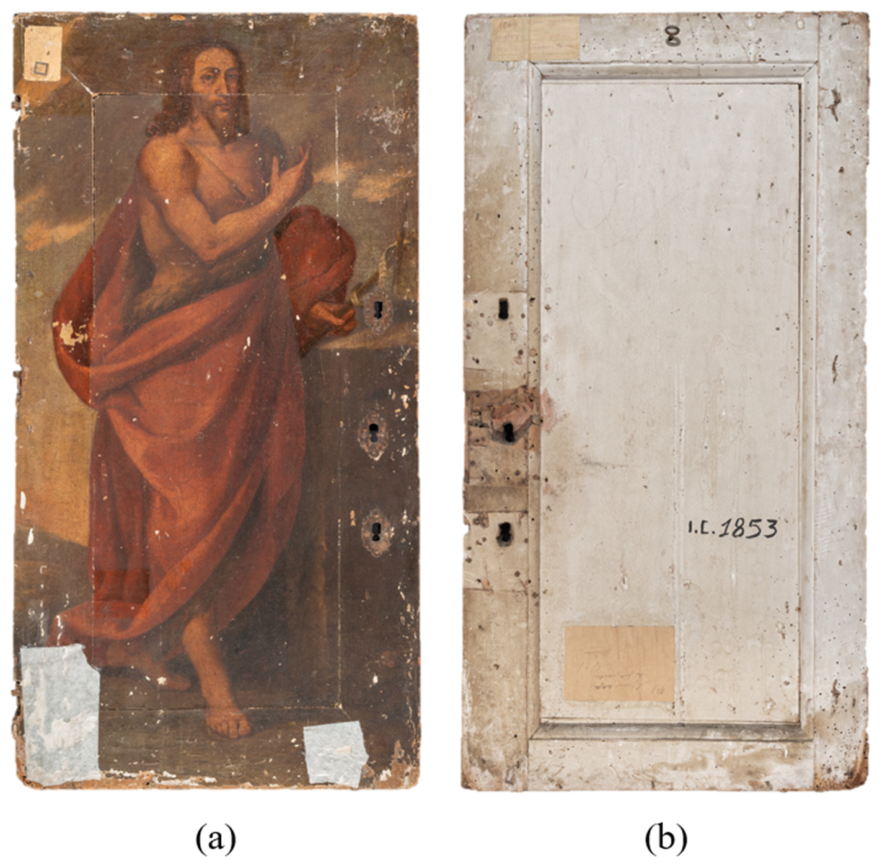
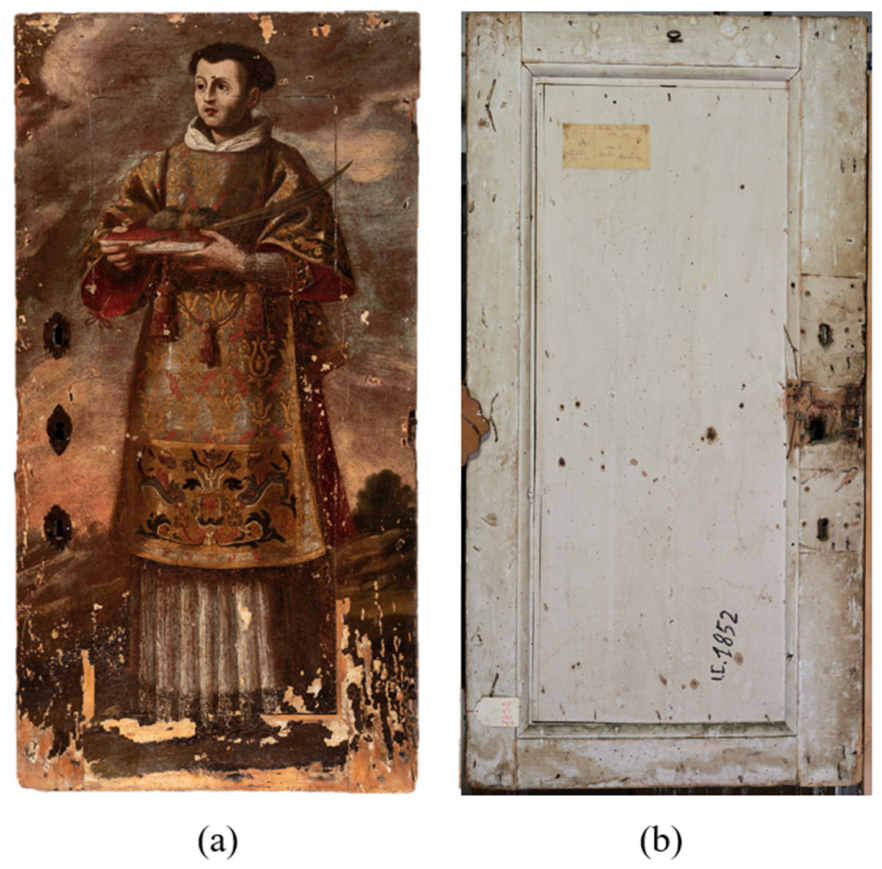
The paint layer is poor in oil binder and, similarly, the preparation, although technically comparable to that of altarpieces, is in these artifacts thin and deficient in binder; consequently, both paint and preparation are brittle and lacking in cohesion due to their strongly hygroscopic character. The current state of research has not made it possible to ascertain whether the three panels were executed by a single artist or by several artists, nor to attribute them to identified authors Their production is estimated to fall between the end of 16th and the early 17th century in Southern Italy; stylistic discrepancies are noted among the three works, while the similar construction of the supports suggests their original belonging to the same cabinet. Regarding the dimensions, the S. Giovanni Battista and S. Stefano are approximately the same size, measuring about 112 × 57 cm (Figure 1 and Figure 2). These types of artifacts are exceptionally rare, and they have distinct concern for both the preservation and their manufacture. Consequently, we have considered their singularity for the diagnostic methods employed to analyze this category of artwork.

3. Results and Discussion

The degradation phenomena observed in this study have been identified through systematic analysis of artifact layers, and the results have been evaluated in collaboration with the restorers. The investigation focused mainly on the Recto (front) of the artifacts, where there exists the fragile state of the color and preparation layers, a crucial aspect to investigate for the restorers, and the multi-technique approach was employed. In contrast, the Verso (back) of the artifact was not examined with a broad multi-analytical approach.

3.1. Identification of Physical-Structural Alterations

The two panels exhibit distinct structural deformations related to pre-execution processes, attributable to the choice and type of wood cutting technique, to inadequate seasoning practices, as well as post-execution damage caused by fluctuations in environmental thermo-hygrometric conditions. The log cutting technique is at the root of structural problems, particularly when the support includes radially cut boards containing the pith of the log (central core), which is known to result in greater susceptibility to wood splitting, or tangentially cut boards, which are subject to latitudinal shrinkage, known as “warping”.

3.1.1. S. Giovanni Battista: Warping

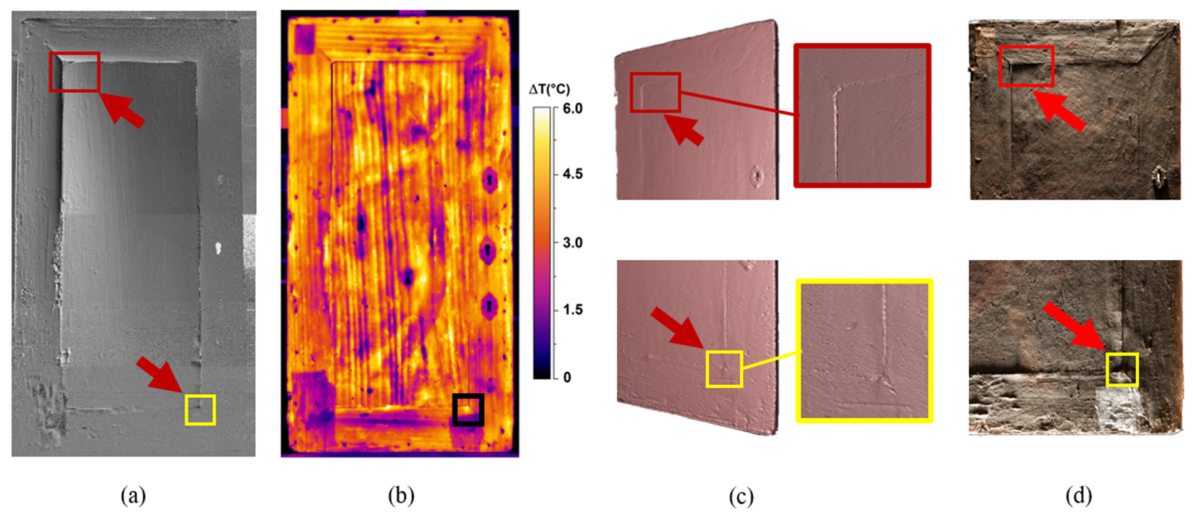
The S. Giovanni door exhibits warping in the central panel. The twisting around its axis causes the four corners to no longer lie on the same plane (Figure 3).
This phenomenon is visible in the shearographic result (Figure 3a), where the deformation map highlights movements in the upper left and lower right corners. The shearographic results are confirmed by both the 3D model (Figure 3c) and the RAK (Figure 3d). In the top left corner, the detail highlighted by SH is a deformation adjacent to the gap between the central panel and the frame. 3D confirms the presence of the gap, and the RAK adds the spatial information that this point is lower than the rest of the panel. In the bottom right corner, the finding is more homogeneous, and all the techniques highlight a raising of the angle in this area with consequent damage to the preparation and the pictorial film. The thermographic reconstruction (Figure 3b) reveals a markedly heterogeneous and irregular thermal response, which can be attributed to the wood grain pattern (clearly visible), nails, possible detachments, insect damage, and structural inhomogeneities. However, consistently with the shearographic findings, thermography clearly identifies a significant anomaly only in the lower corner, where an area characterized by an increased ΔT is observed (squared in black). This localized thermal gradient is likely associated with air accumulation within the deformed region.

3.1.2. S. Stefano: Bowing

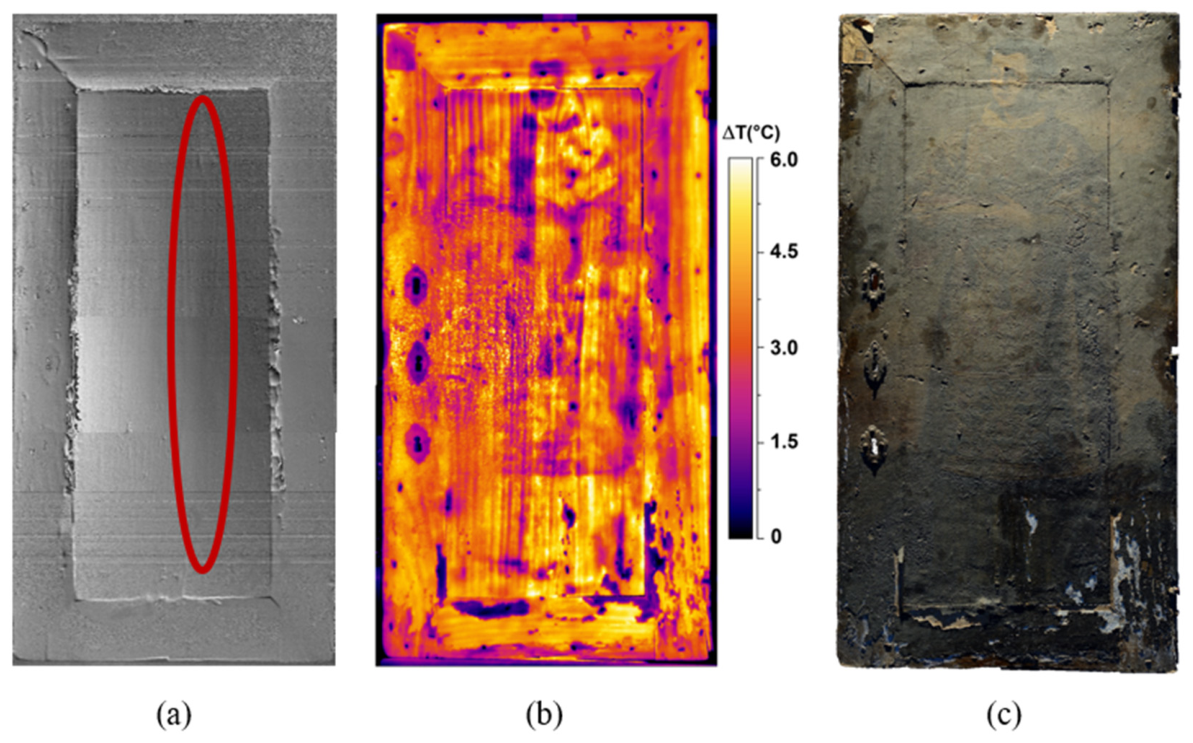
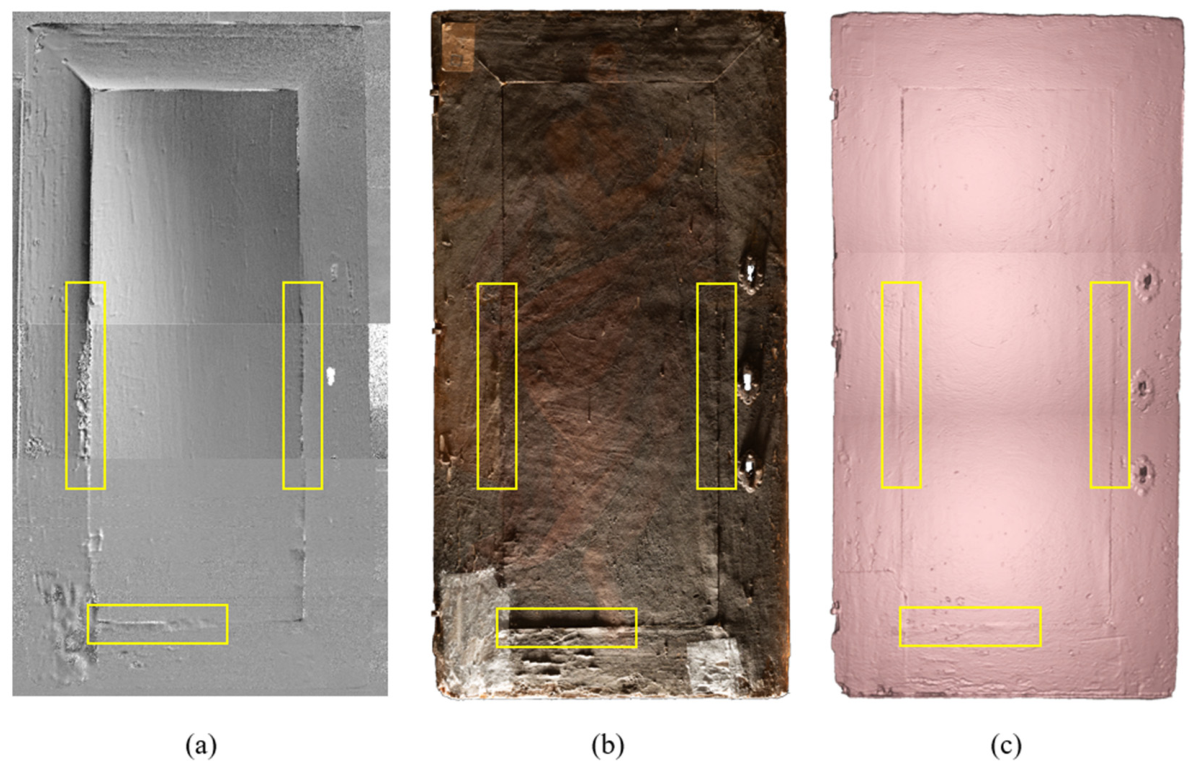
The S. Stefano door exhibits the following distinct characteristic that differentiates it from the S. Giovanni Battista door: the central panel is slightly bowed, resulting in a convex shape (Figure 4). This anomaly can be observed through SH (Figure 4a). Interestingly, the RAK, in Figure 4c, does not adequately capture this deformation, highlighting the limitations of this lighting method in revealing such subtle structural changes. The thermographic reconstruction shown in Figure 4b does not directly reveal this deformation as expected, given the intrinsic limitations of the technique in detecting geometrical distortions. However, it provides complementary diagnostic information, highlighting, as in the previous case, a markedly heterogeneous and irregular thermal response. This behavior can also be associated with the clearly visible wood grain pattern, areas of missing pictorial layer affecting the artwork, and similar features or defects observed in the previous case.
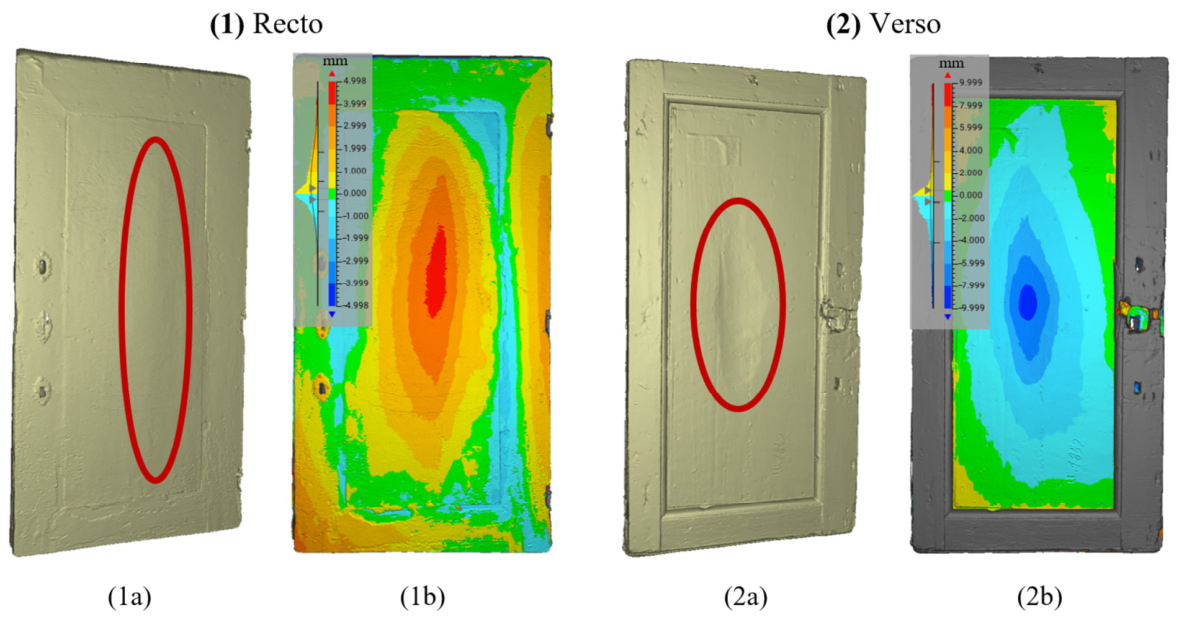
Profilometry was performed on the 3D model, which can be observed in Figure 5, and it quantified the planar distortion of 5 mm (about 0.2 in), in Figure 5(1b), on the Recto and 10 mm (about 0.39 in) on the Verso of the 3D model (Figure 5(2b)).

3.2. Identification of Xylophages’ Insect Damage

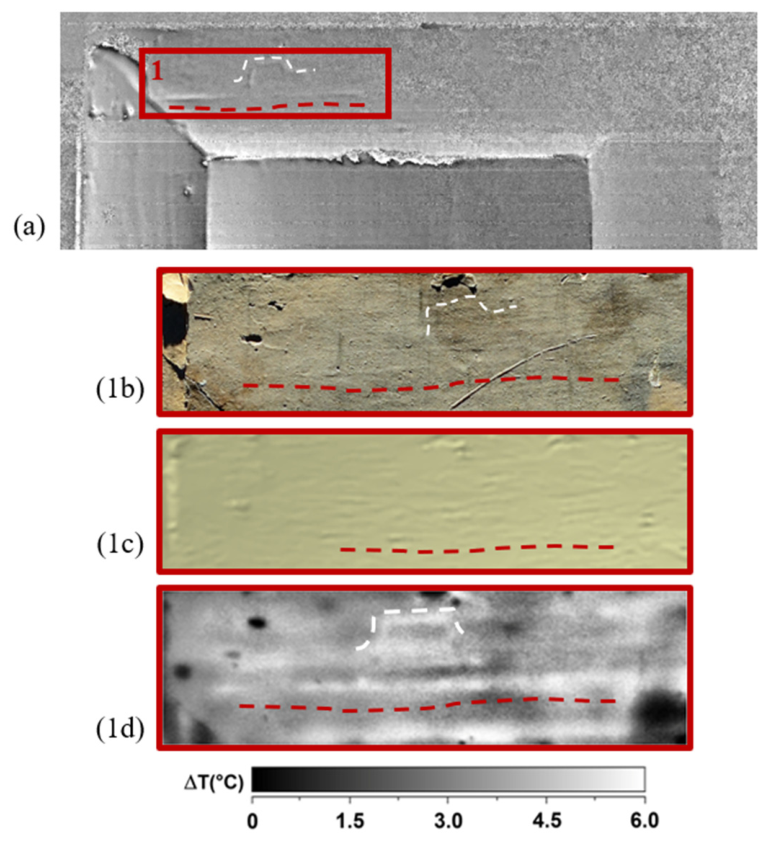
SH identified possible woodworm tunnels in the wood structure, beneath the pictorial and preparatory layer. The formation of slight depressions in the most superficial layers allowed the technique to identify them. In Figure 6, the red rectangle highlights the defects visible both with RAK (Figure 6(1b)) and with the 3D model (Figure 6(1c)). The white hatching highlights a woodworm tunnel identified primarily with SH and partly with other techniques.
Restorers classify this defect as a woodworm tunnel based on the typical pattern shown in Figure 6 [40,41]. Other defects compatible with woodworm tunnels were not included because of uncertainty in the cross-validation. Although it was not possible to identify multiple woodworm galleries, this is a tangible proof of the capabilities of this technique. The thermographic image (Figure 6(1d)) also reveals the same defects. These features are characterized by a higher ΔT, likely due to the presence of air within the void left by the woodworm. Acting as an insulating layer, this air slows down the heat diffusion induced during the heating phase of the measurement, resulting in a more pronounced thermal contrast.
This result validates a previous hypothesis based on the study by Butcha et al. [42], in which the researchers tested the application of SH on a laboratory-made panel painting mock-ups. Their sample consisted of a 6 mm thick oakwood panel, covered by layers of gesso and acrylic paint, and with two drilled holes (2 and 4 mm in diameter, 35 mm long). Their study suggested that SH could identify subsurface defects associated with woodworm activity. Our results provide the first confirmation of the method’s effectiveness in authentic artworks.

3.3. Localized Hygroscopic Degradation Phenomena

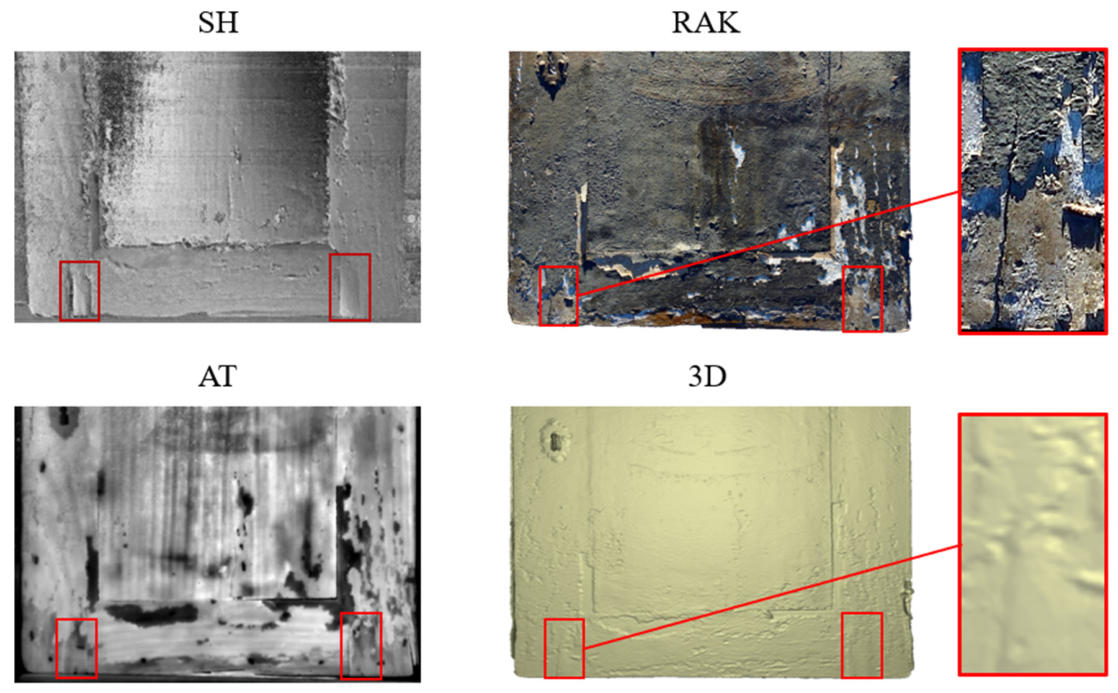
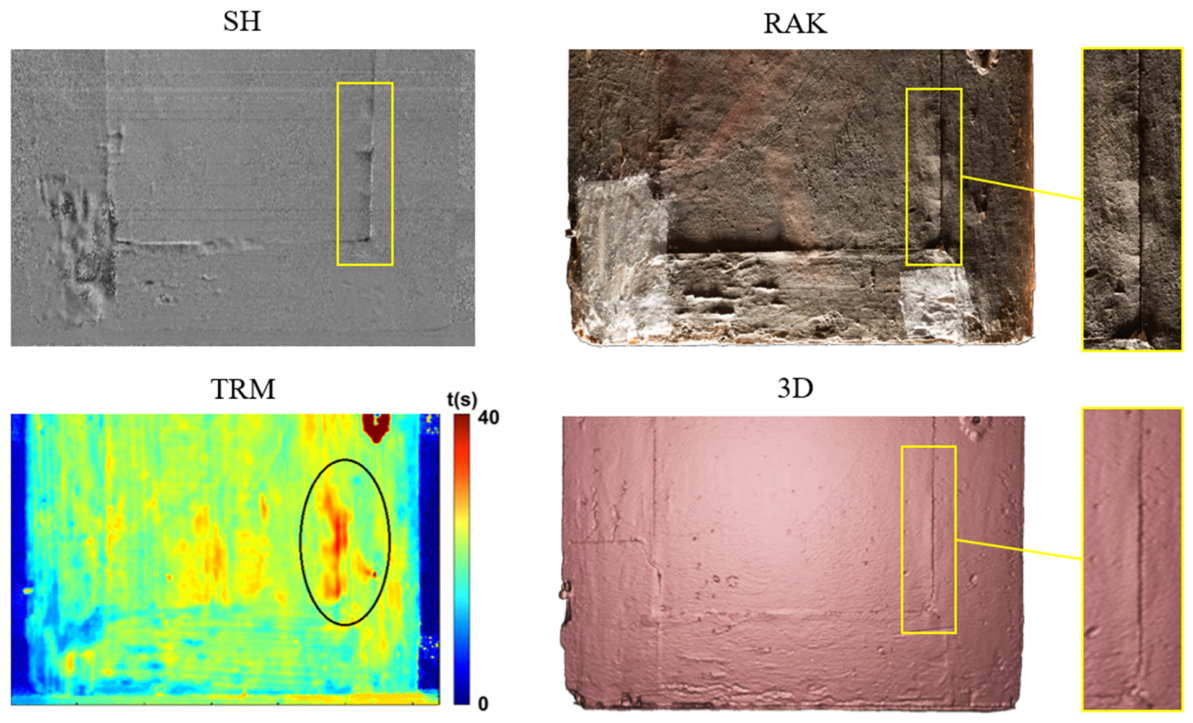
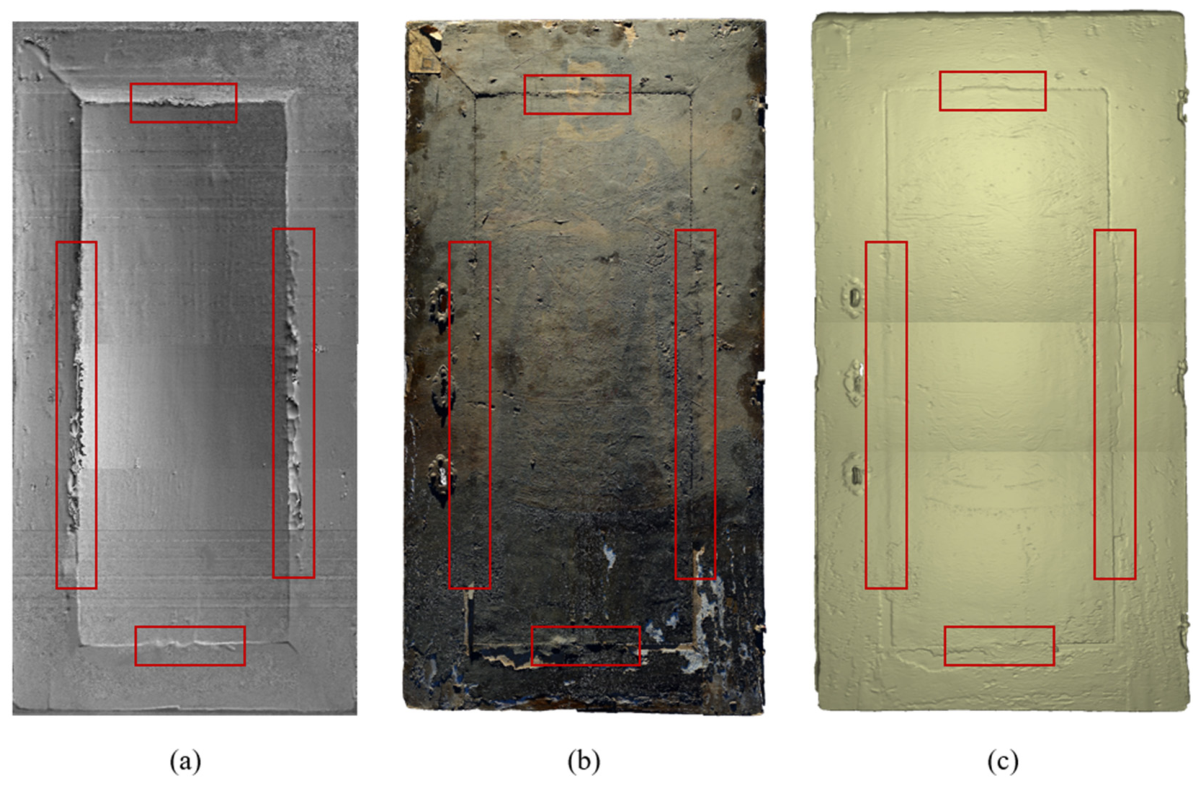
The S. Stefano door was affected on the lower part by rising water or environmental humidity. Due to its porous structure, end grain wood tends to allow humidity or water to rise along the grain. The rising humidity permeates the wood, passing from the wooden structure to the plaster and glue preparation. This phenomenon leads to the brittleness of support, causing the paint to be thin or the paint film to peel off. In Figure 7 SH captured this alteration in the wood structure, which is consistent with the 3D model. The RAK revealed this phenomenon on the left side, contrasting with the lack of information on the right side.
The thermographic image also shows that the entire lower portion of the panel is characterized by a lower ΔT, likely due to the higher thermal inertia of this area associated with rising damp. Moisture accumulation within the wood structure increases its heat capacity and alters its thermal response during the heating phase. However, the thermographic signal in this region is also influenced by the pronounced structural irregularities caused by areas of missing pictorial layer, which result in locally different emissivity values and consequently affect the thermal distribution observed across the panel.

3.4. Nails

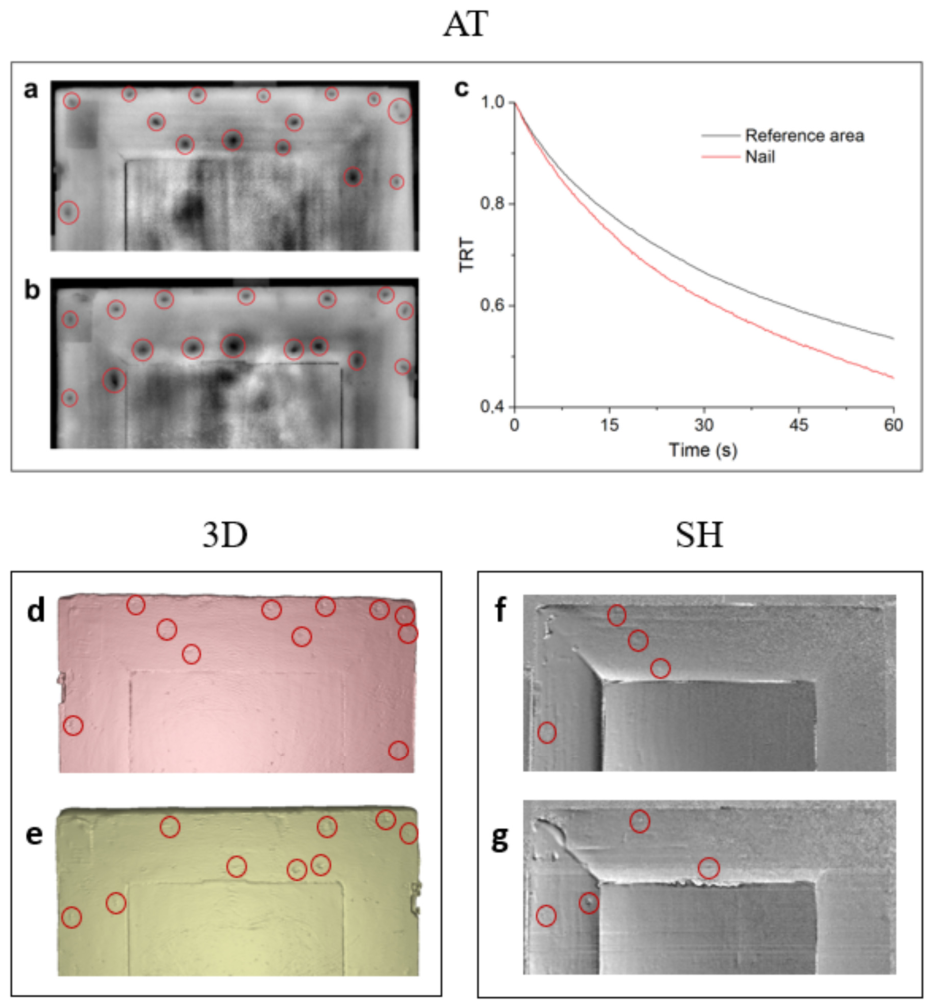
In the construction method for wooden panel paintings, the use of nails is quite popular, especially for a certain period. In Figure 8, both the nail maps of S. Giovanni Battista and the S. Stefano wooden panel are shown.
Figure 8a and Figure 8b show, as representative examples, the ΔT images of the upper regions of the panels depicting Saint John the Baptist and Saint Stephen, respectively. These images were calculated from thermal frames recorded 60 s after heating, with the detected nails highlighted by white circles. Their identification is based both on their circular morphology and, more importantly, on their distinct thermal response, which is related to their metallic nature. As illustrated in Figure 8c, which reports the normalized thermal recovery time (TRT) trend for a representative nail, these inclusions exhibit a faster thermal recovery. This behavior is consistent with the higher thermal conductivity of metal compared to the surrounding wooden substrate, resulting in a clearly distinguishable thermal contrast. Overall, approximately 43 nails were identified in the San Giovanni panel and about 47 in the San Stefano panel, with diameters ranging between 5 and 10 mm. In both cases, they are arranged predominantly in a double-frame configuration, mainly concentrated along the outer regions of the panels.
In both the S. Giovanni Battista and S. Stefano panels, it was not possible to identify the complete course of the nails by means of 3D model (Figure 8d,e) and SH (Figure 8f,g). Moreover, it results that SH identifies fewer nails than the 3D model.

3.5. Interlayer Alterations

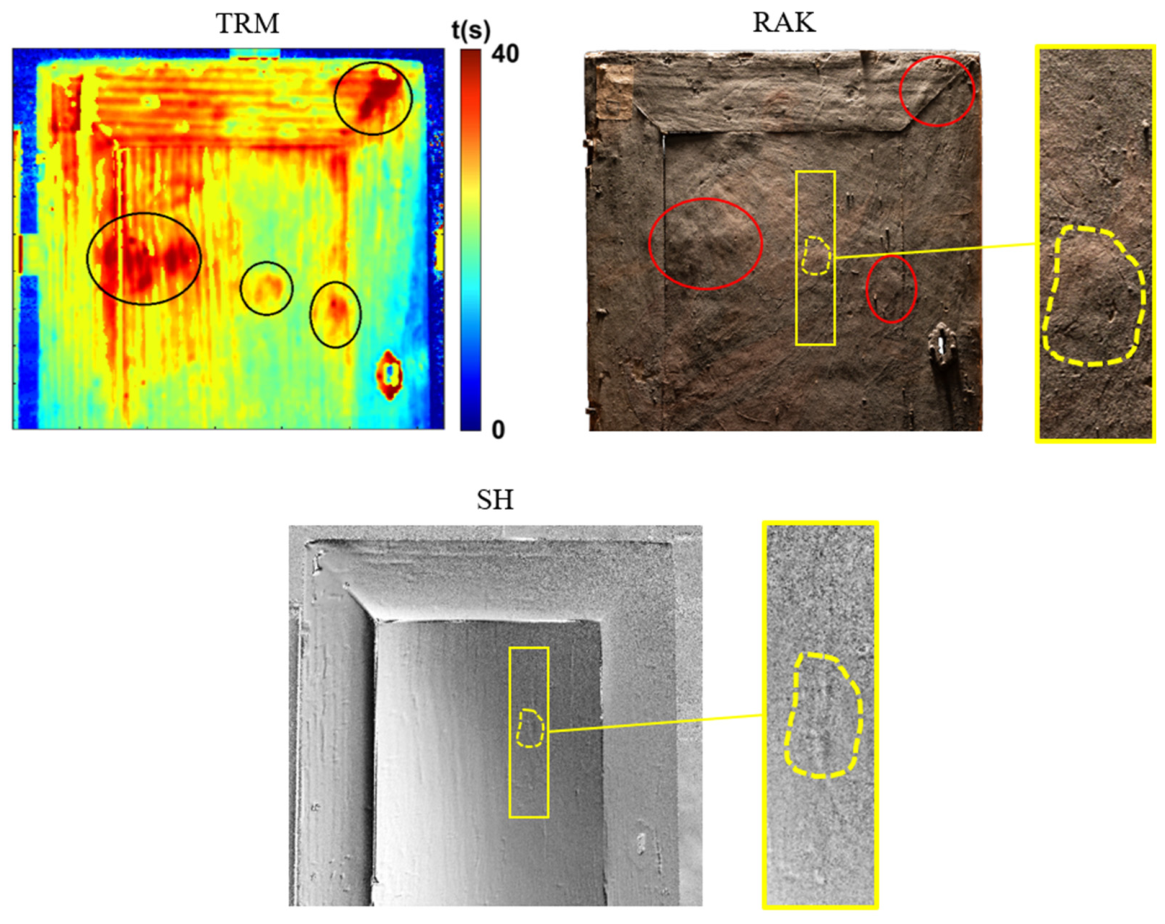
The detachment of both the paint layer and the preparation could result from either a shared origin (e.g., a lifting process that involves both layers) or a complete separation from the underlying support. Potential causes include panel warping, the presence of a knot, or the degradation of the paint layer over time. As depicted in Figure 9, the detachment of the paint layer and the preparation were observed through SH. This finding was corroborated by RAK but not supported by the 3D model. The Thermal Recovery Map (TRM), computed from the recorded thermal sequences, also highlights regions (circled in black) characterized by longer recovery times, likely associated with the presence of pictorial layers affected by detachment and at least partial loss of adhesion to the wooden support. In fact, subsurface structural heterogeneities with lower thermal conductivity or higher effective heat capacity than the surrounding material, such as air gaps, locally increase thermal inertia, thereby slowing heat dissipation and resulting in longer thermal recovery times [29,30]. These areas also show good agreement with the RAK images, where slight bulging or surface deformations appear to be visible in the same regions.
The lifting of the “incamottatura” [3] (canvas or parchment adhered with glue to the whole or part of the surface of the wood before the application of a gesso layer) represents a critical conservation issue in panel paintings, especially in ancient ones (13th–15th centuries). This process often leads to the formation of liftings or widespread cracks (craquelure), which can detach the preparatory layers and the paint from the underlaying support. In severe cases, this may result in permanent loss of the paint layer and formation of gaps in the artwork. In Figure 10 SH revealed these phenomena not by identifying the craquelure of the paint film but by detecting the air trapped under the lifted areas, facilitating their identification. The RAK aligns with the results of the SH compared to the 3D model, which does not highlight this alteration. The same region also exhibits a higher thermal recovery in the TRM (circled in black) with respect to the surrounding areas, further supporting the hypothesis of a possible air void beneath the detached layer.

3.6. Craquelure

Craquelure (or cracking) on painted panels is a network of fine cracks in the paint layer, caused by the aging of the binders and by movements of the wooden support due to changes in humidity and temperature.

3.6.1. Results on S. Giovanni Battista

This wooden panel painting exhibited conspicuous craquelure in the juncture of the central panel and the surrounding frame. In Figure 11, it is possible to notice this phenomenon highlighted with our methodology.
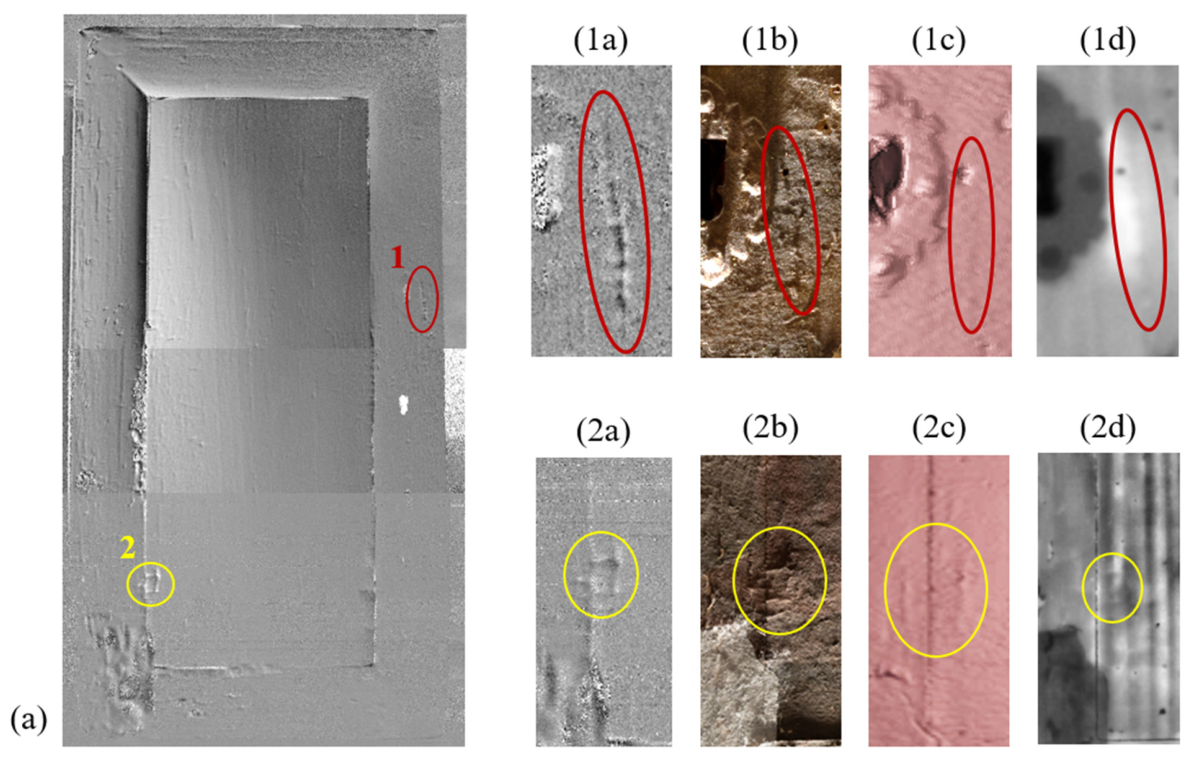
In Figure 12, it emphasizes areas affected by craquelure but not situated in weak spots, as in the previous case. SH identified distinct areas in the paint layer that exhibited signs of craquelure. The utilization of both RAK and the 3D model validated this result. Notably, this type of degradation can manifest differently on the shearography deformation-gradient map. This type of degradation may also occur in regions where the color has aged, due to loss of elasticity or desiccation, and can develop shortly after the material production due to the paint shrinkage.

3.6.2. Results on S. Stefano

In the S. Stefano, the craquelure is more uniform in the regions where it has developed, i.e., in the interstices between the central panel and the frame. The craquelure in this case is due to pictorial technique and degradation factors while in the S. Giovanni Battista the craquelure is due mainly to thermal fluctuations. In Figure 13, SH, RAK, and the 3D model revealed this peculiar alteration.

3.7. Discussion

The results demonstrate the effectiveness of an integrated diagnostic methodology for identifying and characterizing multiple degradation phenomena in wooden panel paintings.
The diagnostic campaign assessed the conservation state of both artworks. In the S. Giovanni Battista panel, we observed the warping of the central support, resulting in corners no longer lying on the same plane. This deformation is correlated with increased detachment of the paint layers. In addition, it is related to the detachment of the “incamottatura”, which causes additional preparation and color loss. The combined application of the diagnostic techniques also highlighted interlayer deformations and confirmed the presence of craquelure in correspondence of the junction between the central panel and the frame. The S. Stefano panel exhibits different structural features, characterized by a bowing deformation, quantitatively assessed through the 3D model. This painting also shows localized hygroscopic degradation phenomena that were not detected in the other panel. Furthermore, subsurface defects compatible with woodworm galleries have been identified. It should be noted that the presence of a gallery in a specific area does not imply that insect activity was confined to that location, nor that the other panel was free from xylophagous insect damage.
The information collected during the diagnostic campaign, organized by analytical techniques and defect class, is summarized in Table 1, highlighting their range of applicability and complimentary nature.
SH proved capable of providing information on all the examined degradation phenomena, although interpretation often required cross-validation. What is notable is the observation of subsurface anomalies compatible with woodworm galleries, representing, to the authors’ knowledge, the first observation of this type on a real artwork. However, further investigations involving different case studies and comparison with ground-truth data are necessary to assess the reliability of this interpretation.
SL3D, which provides a precise quantification of the surface geometry, has been effective in detecting and quantifying defects associated with surface deformations. AT provided valuable insights into the internal structure of the artworks, identifying features such as nails, voids, and areas affected by moisture through their distinct thermal responses. Finally, TP with VIS and RAK imaging complemented these methods, enhancing the visualization of surface irregularities, craquelure, and localized defects.
In some instances, specific techniques proved particularly suited to the investigation of certain classes of defects. Large-scale structural deformations and physical alterations were most effectively characterized through the combination of SH and SL3D, whereas nails were more readily detected by AT, because of their distinct thermal conductivity compared to the surrounding wood. However, in most cases the integration and cross-validation of multiple diagnostic approaches has been essential to reach conclusive results.
Compared with the previous study by Saltarelli et al. [9], the constructive characteristics of the investigated artworks contributed to a clearer understanding of both support deformations and preparation-layer defects. In fact, the smaller dimensions of the panels, the thinner ground and paint layer stratigraphy and the absence of decorative elements (gold leaf) hindering the measurements facilitated the acquisition and interpretation of structural data. Another important difference lies in the inclusion of technical photography, particularly RAK. Beyond providing valuable information that can be correlated with other techniques, it represents a familiar and accessible tool within standard conservation practice. Thus, it acts as an interpretative bridge between restorers and heritage scientists, facilitating communication. Indeed, this study benefited from a close collaboration between restorers and researchers; this interaction enabled a more in-depth interpretation of the results by combining conservation expertise with diagnostic analysis.

4. Conclusions

In this work, we integrated optical and thermal approaches to investigate various degradation phenomena affecting the structural integrity of wooden panel paintings. The combined application of shearography (SH), active thermography (AT), structured-light 3D scanning (SL3D), and technical photography (TP) enables the detection of defects with different spatial extent and position within the multilayered structure of the artwork. This includes the identification of localized features, such as nails, insect galleries, and hygroscopic degradation, as well as more distributed phenomena, including structural deformations, interlayer deterioration, and craquelure, providing comprehensive diagnostic information on the structural state of the artwork.
Specifically, we investigated two liturgical cabinet doors from the mid-16th and early 17th century, depicting Santo Stefano and San Giovanni Battista, painted in oil on wooden support. The artifacts, similar for typology and constructive features, present different conservation issues, providing a robust testbed for the proposed diagnostic procedure. Performing the analysis during the early stages of restoration and in close collaboration with conservators ensured continuous feedback and alignment with conservation needs.
The detected degradation phenomena were systematically examined by combining the information provided by the different diagnostic techniques, thereby highlighting their complementarity and mutual validation. The results were synthesized both at the level of the individual artworks and through a comparative summary table that outlines the contribution of each method to the identification of specific defect classes. As expected, no single method can provide an exhaustive characterization of the complex degradation mechanisms affecting wooden artworks. While certain techniques proved particularly effective for specific classes of defects, the complexity and uniqueness of each artwork prevent the establishment of a universal hierarchy of applicability among the investigated techniques. Rather, the diagnostic performance of each method depends on the structural characteristics, material composition, and conservation issues of the individual object.
The results demonstrate that the integration of complementary diagnostic approaches enables the identification of multiple degradation phenomena that would be difficult to detect reliably through visual inspection or a single technique alone. This comprehensive assessment of the structural condition of wooden panel paintings provides valuable information for conservation planning. Moreover, by combining non-invasive optical and thermal methods, the proposed approach represents a viable alternative or complement to radiographic investigations, which are often costly and require complex safety procedures.

Author Contributions

C.S.: investigation, formal analysis, data curation, visualization, writing—original draft; V.P.: conceptualization, investigation, resources, formal analysis, writing—review and editing; M.R.: conceptualization, investigation, formal analysis, data curation, resources, visualization, writing—original draft; U.P.: investigation, formal analysis, visualization; L.C.: investigation, resources; G.G.: conceptualization, writing—review and editing; P.F.: conceptualization, resources, writing—review and editing; T.C.: conceptualization, writing—original draft, writing—review and editing; M.P.: writing—original draft, writing—review and editing, funding acquisition, investigation, resources, conceptualization. All authors have read and agreed to the published version of the manuscript.

Funding

This work was carried out within the framework of the project “Artificial Intelligence to Support Infrared Imaging Techniques for Cultural Heritage Safeguard (ARTIST–CH)”, funded by CNR under the Joint Bilateral Agreement CNR/DFKI (Germany) Biennial Program 2025–2026 (CUP B83B25000010005).

Data Availability Statement

The research data are available to interested researchers upon request.

Acknowledgments

We would like to thank the director and staff of the Museo e Real Bosco di Capodimonte for enabling these investigations. Chiara Saltarelli acknowledges the national node of E-RIHS-ERIC at CNR-ISPC for funding the PhD fellowship, through MUR FOE E-RIHS.

Conflicts of Interest

The authors declare no conflicts of interest.

Abbreviations

The following abbreviations are used in this manuscript:
SHShearography
SL3DStructured light 3D
ATActive thermography
TPTechnical photography
VISVisible light
RAKRaking light photography
UVFUV fluorescence photography
IRInfrared photography

References

  1. Uzielli, L. Historical Overview of Panel-Making Techniques in Central Italy. In The Structural Conservation of Panel Paintings, Proceedings of the Symposium at the J. Paul Getty Museum; Getty Conservation Institute: Los Angeles, CA, USA, 1995; pp. 110–135. [Google Scholar]
  2. Gagliardi, C.; Riparbelli, L.; Mazzanti, P.; Fioravanti, M. A Critical Review of Methods and Techniques Used for Monitoring Deformations in Wooden Panel Paintings. Forests 2025, 16, 546. [Google Scholar] [CrossRef]
  3. Van duin, P.; Gompel, D.; Grevenstein-Kruse, A.; Groves, R.; Horie, V.; Kos, N.; New, B.; Young, C.; Seymour, K. The Conservation of Panel Paintings and Related Objects; NWO: Amsterdam, The Netherlands, 2014. [Google Scholar] [CrossRef]
  4. Dupré, J.C.; Jullien, D.; Uzielli, L.; Hesser, F.; Riparbelli, L.; Gauvin, C.; Mazzanti, P.; Gril, J.; Tournillon, G.; Amoroso, D.; et al. Experimental study of the hygromechanical behaviour of a historic painting on wooden panel: Devices and measurement techniques. J. Cult. Herit. 2020, 46, 165–175. [Google Scholar] [CrossRef]
  5. Varfi, G.T.; Farmaki, S.; Mastrotheodoros, G.P.; Exarchos, D.A.; Asvestas, A.; Anagnostopoulos, D.F.; Matikas, T.E. A Multidisciplinary Non-Invasive Approach for the Examination of a Wooden Panel Painting. Heritage 2025, 8, 271. [Google Scholar] [CrossRef]
  6. Piersigilli, P.; Citroni, R.; Mangini, F.; Frezza, F. Electromagnetic Diagnostic Techniques for the Conservation of Modern Oil Paintings: A Review. Information 2026, 17, 522. [Google Scholar] [CrossRef]
  7. Casas Pérez, M.C.; Moreno Chávez, G.; Castillo Rivera, F.; Sarocchi, D.; Mares, M.; Barrientos, B. Fringe Projection Method for 3D High-Resolution Reconstruction of Oil Painting Surfaces. Heritage 2023, 6, 3461–3474. [Google Scholar] [CrossRef]
  8. Mazzocato, S.; Daffara, C. Experiencing the Untouchable: A Method for Scientific Exploration and Haptic Fruition of Artworks Microsurface Based on Optical Scanning Profilometry. Sensors 2021, 21, 4311. [Google Scholar] [CrossRef]
  9. Saltarelli, C.; Di Meo, A.; Rippa, M.; Pagliarulo, V.; Cacace, T.; Paturzo, M. Multimodal Imaging for Wooden Panel Painting Analysis: Consegna della regola Francescana by Colantonio, a Case Study. Heritage 2025, 8, 118. [Google Scholar] [CrossRef]
  10. Ambrosini, D.; Paoletti, D. Holographic and speckle methods for the analysis of panel paintings. Developments since the early 1970s. Stud. Conserv. 2004, 49, 38–48. [Google Scholar] [CrossRef]
  11. Verschueren, N.; Dupré, J.C.; Ouahabi, M.E.; Jullien, D. Study of the mechanical behaviour of a 16th century wooden painted panel: Effect of the cradle on its shape. J. Cult. Herit. 2026, 79, 15–23. [Google Scholar] [CrossRef]
  12. Daffara, C.; Ambrosini, D.; Paoletti, D.; Pezzati, L. IR Reflectography, Pulse-Compression Thermography, MA-XRF, and Radiography: A Full-Thickness Study of a 16th-Century Panel Painting Copy of Raphael. J. Imaging 2022, 8, 150. [Google Scholar] [CrossRef]
  13. Lambert, F.E.M.; Ornik, J.; Staats, N.-A.; Jäckel, A.; Hernandez-Cardoso, G.G.; Taiber, J.; Stübling, E.-M.; Rudolph, B.; Mack, O.; Portsteffen, H.; et al. Layer separation mapping and consolidation evaluation of a fifteenth century panel painting using terahertz time-domain imaging. Sci. Rep. 2022, 12, 21038. [Google Scholar] [CrossRef] [PubMed]
  14. Dritsa, V.; Orazi, N.; Yao, Y.; Paoloni, S.; Koui, M.; Sfarra, S. Thermographic Imaging in Cultural Heritage: A Short Review. Sensors 2022, 22, 9076. [Google Scholar] [CrossRef] [PubMed]
  15. Steinchen, W.; Yang, L. Digital Shearography; SPIE Press: Bellingham, WA, USA, 2001. [Google Scholar]
  16. Pagliarulo, V.; Saltarelli, C.; Paturzo, M.; Papa, I.; Napolitano, F.; Russo, P. Real-Time Shearography Measurements of 3D Printed Auxetic Specimens During Flexural Tests. In Dynamic Response and Failure of Composite Materials. DRAF 2024. Lecture Notes in Mechanical Engineering; Springer: Cham, Switzerland, 2025; pp. 34–39. [Google Scholar] [CrossRef]
  17. Francis, D.; Tatam, R.P.; Groves, R.M. Shearography technology and applications: A review. Meas. Sci. Technol. 2010, 21, 102001. [Google Scholar] [CrossRef]
  18. Groves, R.M.; Pradarutti, B.; Kouloumpi, E.; Osten, W.; Notni, G. 2D and 3D Non-Destructive Evaluation of a Wooden Panel Painting Using Shearography and Terahertz Imaging. NDT E Int. 2009, 42, 543–549. [Google Scholar] [CrossRef]
  19. Novaković, P.; Jončić, N.; Zachar, J. 3D Scanning. In 3D Digital Recording of Archaeological, Architectural and Artistic Heritage; University Press: Ljubljana, Slovenia, 2017; pp. 23–32. [Google Scholar] [CrossRef]
  20. Acke, L.; de Vis, K.; Verwulgen, S.; Verlinden, J. Survey and literature study to provide insights on the application of 3D technologies in objects conservation and restoration. J. Cult. Herit. 2021, 49, 272–288. [Google Scholar] [CrossRef]
  21. Saltarelli, C.; Rippa, M.; Pagliarulo, V.; Vigorito, M.R.; Paturzo, M. The Heritage Building Information Modelling System for non-destructive optical techniques: The case study of the restoration of a Marble sculpture on the facade of the Gesù Nuovo Church in Naples. Acta IMECO 2025, 14, 1–8. [Google Scholar] [CrossRef]
  22. Zhang, S. High-speed 3D shape measurement with structured light methods: A review. Opt. Lasers Eng. 2018, 106, 119–131. [Google Scholar] [CrossRef]
  23. Artec 3D. Available online: https://www.artec3d.com/it/learning-center (accessed on 10 April 2026).
  24. Planinsic, G. Infrared thermal imaging: Fundamentals, research and applications. Eur. J. Phys. 2011, 32, 1431. [Google Scholar] [CrossRef]
  25. Di Meo, A.; Balbi, B.; Casciello, M.; Vigorito, M.R.; Mormile, P.; Rippa, M. Complementary infrared imaging methods for the structural and technical analysis of a panel painting: Adoration of the Magi by Marco Cardisco. Infrared Phys. Technol. 2025, 145, 105705. [Google Scholar] [CrossRef]
  26. Daffara, C.; Parisotto, S.; Mariotti, P.I.; Ambrosini, D. Dual mode imaging in mid infrared with thermal signal reconstruction for innovative diagnostics of the “Monocromo” by Leonardo da Vinci. Sci. Rep. 2021, 11, 22482. [Google Scholar] [CrossRef] [PubMed]
  27. Rippa, M.; Fenelli, P.; Di Meo, A.; Trojsi, G. Active thermography for the analysis and conservation of Roman lead pipes at the Baia archaeological park. J. Cult. Herit. 2025, 74, 257–264. [Google Scholar] [CrossRef]
  28. Ceccarelli, S.; Rippa, M.; Caruso, G.; Luvidi, L.; Paturzo, M.; Pagliarulo, V.; Fleischer, K.; Miliani, C.; Ranocchia, G. Pulsed thermographic analysis of Herculaneum papyri. Sci. Rep. 2025, 15, 34466. [Google Scholar] [CrossRef]
  29. Daffara, C.; Ambrosini, D. Smartphone-based diagnostics with coherent and infrared imaging for cultural heritage. J. Phys. Photonics 2024, 6, 045006. [Google Scholar] [CrossRef]
  30. Laureti, S.; Colantonio, C.; Burrascano, P.; Melis, M.; Calabrò, G.; Malekmohammadi, H.; Sfarra, S.; Ricci, M.; Pelosi, C. Development of integrated innovative techniques for paintings examination: The case studies of The Resurrection of Christ attributed to Andrea Mantegna and the Crucifixion of Viterbo attributed to Michelangelo’s workshop. J. Cult. Herit. 2019, 40, 1–16. [Google Scholar] [CrossRef]
  31. Rippa, M.; Vigorito, M.R.; Russo, M.R.; Mormile, P.; Trojsi, G. Active thermography for non-invasive inspection of wall painting: Novel approach based on thermal recovery maps. J. Nondestruct. Eval. 2023, 42, 63. [Google Scholar] [CrossRef]
  32. Rippa, M.; Pagliarulo, V.; Napolitano, F.; Valente, T.; Russo, P. Infrared imaging analysis of green composite materials during inline quasi-static flexural test: Monitoring by passive and active approaches. Materials 2023, 16, 3081. [Google Scholar] [CrossRef]
  33. Dorrell, P. Photography in Archaeology and Conservation; Cambridge University Press: Cambridge, UK, 1989. [Google Scholar]
  34. Vasco, G.; Aureli, H.; Fernández-Lizaranzu, I.; Moreno-Soto, J.; Križnar, A.; Parrilla-Giraldez, R.; Gómez-González, E.; Respaldiza Galisteo, M.A. Development of a Hyperspectral Imaging Protocol for Painting Applications at the University of Seville. Heritage 2024, 7, 5986–6007. [Google Scholar] [CrossRef]
  35. Lanteri, L.; Calandra, S.; Briani, F.; Germinario, C.; Izzo, F.; Pagano, S.; Pelosi, C.; Santo, A.P. 3D Photogrammetric Survey, Raking Light Photography and Mapping of Degradation Phenomena of the Early Renaissance Wall Paintings by Saturnino Gatti—Case Study of the St. Panfilo Church in Tornimparte (L’Aquila, Italy). Appl. Sci. 2023, 13, 5689. [Google Scholar] [CrossRef]
  36. Frey, F.; Heller, D.; Kushel, D.; Vitale, T.; Weaver, G. The AIC Guide to Digital Photography and Conservation Documentation, 2008th ed.; Warda, J., Ed.; American Institute for Conservation of Historic and Artistic Works: Washington, DC, USA, 2008. [Google Scholar]
  37. Maltese, C. Le Tecniche Artistiche; Mursia: Milano, Italy, 1983; pp. 327–333. [Google Scholar]
  38. Ciatti, M.; Frosinini, C. (Eds.) Restauri e Ricerche. Dipinti su Tela e Tavola. Atti Della Giornata di Studio (Firenze, 17 Dicembre 2002); Edifir: Firenze, Italy, 2003. [Google Scholar]
  39. Ciatti, M.; Castelli, C.; Santacesaria, A. Technique and Conservation of Wood Supports; Edifir: Firenze, Italy, 2003. [Google Scholar]
  40. Battisti, A.; Chiappini, E.; Liotta, G.; Reguzzi, M. Insetti e Restauro: Legno, Carta, Tessuti, Pellame e Altri Materiali; Edagricole–Tecniche Nuove: Milano, Italy, 2001; ISBN 978-88-206-4682-0. [Google Scholar]
  41. Liotta, G. Gli Insetti e i Danni Del Legno. Problemi di Restauro; Nardini: Firenze, Italy, 1994; ISBN 978-88-404-4006-4. [Google Scholar]
  42. Buchta, D.; Hein, N.; Pedrini, G.; Krekel, C.; Osten, W. Artwork Inspection by Shearography with Adapted Loading. Exp. Mech. 2015, 55, 1691–1704. [Google Scholar] [CrossRef]
Figure 1. Unknown 16th century, S. Giovanni Battista. (a) Recto and (b) Verso images, reproduced with permission from MiC—Museo e Real Bosco di Capodimonte.
Applsci 16 06002 g001
Figure 2. Unknown 16th century, S. Stefano. (a) Recto and (b) Verso images, reproduced with permission from MiC—Museo e Real Bosco di Capodimonte.
Applsci 16 06002 g002
Figure 3. S. Giovanni Battista Recto. Warping movement on the central panel highlighted by red arrows. (a) Shearography deformation-gradient map; (b) thermal reconstruction obtained from ΔTmax images using active thermography; (c) 3D model without texture of the top left corner and the bottom right corner; (d) raking light image of the top left corner and the bottom right corner.
Applsci 16 06002 g003
Figure 4. S. Stefano Recto. Severe cupping of the wooden panel highlighted with a red circle. (a) Shearography deformation-gradient map; (b) thermal reconstruction obtained from ΔTmax images using active thermography; (c) raking light image.
Applsci 16 06002 g004
Figure 5. S. Stefano Recto and Verso. Quantifying analysis through profilometry to evaluate the bow, curvature along the length of the board twisted corners. (1a,2a) 3D model without texture. The visible deformations are highlighted with a red circle; (1b,2b) 3D model with the profilometry in mm.
Applsci 16 06002 g005
Figure 6. S. Stefano Recto. Details of the woodworm galleries. The red frame locates two subsuface defects, whose profile is highlighted by red and white dashed lines. (a) Shearography deformation-gradient map of the upper part of the central panel; (1b) raking light image identifying depressions found with shearography; (1c) 3D model identifying one of the depressions found in the shearography and raking light image; (1d) ΔTmax image obtained using active thermography.
Applsci 16 06002 g006
Figure 7. S. Stefano Recto. The red frames highlight the areas with moister-induced deterioration. (SH) Shearography deformation-gradient map; (RAK) raking light image; (AT) ΔTmax image; (3D) 3D model without texture.
Applsci 16 06002 g007
Figure 8. The red circles highlight nails detected in the wooden panel paintings. (a) ΔT images of the upper Recto part of S. Giovanni Battista, (b) ΔT images of the upper Recto part of S. Stefano; (c) normalized thermal recovery time (TRT) trend for a representative nail and a nearby reference region. (d) 3D model without texture of the upper Recto part of S. Giovanni Battista; (e) 3D model without texture of the upper Recto part of S. Stefano; (f) Shearography deformation-gradient map of the upper Recto part of S. Giovanni Battista; (g) Shearography deformation-gradient map upper Recto part of S. Stefano.
Applsci 16 06002 g008
Figure 9. S. Giovanni Battista Recto. The red circles accentuatepossible interlayer detachment. The yellow rectangle noted the area of the detachments cycled with a yellow dashed line in the: (TRM) Thermal Recovery Map; (RAK) raking light image; (SH) shearography deformation-gradient map.
Applsci 16 06002 g009
Figure 10. S. Giovanni Battista Recto. The yellow rectangles and the black circle highlight the area of the “incamottatura” lifted in (SH) Shearography deformation-gradient map; (RAK) raking light image; (TRM) Thermal Recovery Map; (3D) 3D model without texture.
Applsci 16 06002 g010
Figure 11. S. Giovanni Battista Recto. The yellow rectangles accentuated craquelure of the paint layer in (a) Shearography deformation-gradient map; (b) raking light image; (c) 3D model without texture.
Applsci 16 06002 g011
Figure 12. S. Giovanni Battista Recto. Details of alterations of the paint layer. (a) Shearography deformation-gradient map of the wooden panel; (1) 1st zone craquelure detail; (2) 2nd zone craquelure; (1a,2a) Shearography deformation-gradient map for the 1st and the 2nd craquelure detail; (1b,2b) raking light image for the 1st and the 2nd craquelure detail; (1c,2c) 3D model without texture for the 1st and the 2nd craquelure detail; (1d,2d) ΔTmax image for the 1st and the 2nd craquelure detail.
Applsci 16 06002 g012
Figure 13. S. Stefano Recto. The red rectangles note the area of craquelure of the paint layer in (a) Shearography deformation-gradient map; (b) raking light image; (c) 3D model without texture.
Applsci 16 06002 g013
Table 1. Degradation processes identified and methods utilized to detect them.
DegradationSHSL3DATTP
Physical and structural
alterations
DetectedDetectedDetected (cross-validation necessary)Detected in one
artwork
Xylophages’ insect damageDetected (cross-validation necessary)Partially detectedDetected (cross-validation necessary)Detected (cross-validation necessary)
Hydroscopic
degradation
DetectedDetectedDetectedPartially detected
NailsDetected (cross-validation necessary)Partially detectedDetectedNot detected
Interlayer
alterations
Detected (cross-validation necessary)Partially detectedDetected (cross-validation necessary)Detected
CraquelureDetected (cross-validation necessaryDetectedPartially detectedDetected
Disclaimer/Publisher’s Note: The statements, opinions and data contained in all publications are solely those of the individual author(s) and contributor(s) and not of MDPI and/or the editor(s). MDPI and/or the editor(s) disclaim responsibility for any injury to people or property resulting from any ideas, methods, instructions or products referred to in the content.