Review

Digital Holographic Microscopy, Digital Holography and Speckle Interferometry for Non-Invasive Biomedical Analysis


by
María del Socorro Hernández-Montes
* and
Fernando Mendoza-Santoyo
Centro de Investigaciones en Óptica, A.C. Loma del Bosque 115, León 37150, GTO, Mexico
*
Author to whom correspondence should be addressed.
Appl. Sci. 2026, 16(12), 5991; https://doi.org/10.3390/app16125991 (registering DOI)
Submission received: 30 January 2026 / Revised: 5 June 2026 / Accepted: 7 June 2026 / Published: 13 June 2026

Abstract

This paper focuses on the significant potential of specific optical non-invasive methods, such as digital holographic microscopy, digital speckle pattern interferometry, and digital holographic interferometry, as scientific and technological tools for retrieving physical and biomechanical parameters embedded in the optical phase of laser-illuminated biomedical samples. These techniques take advantage of the laser speckle phenomena observed when non-specular surfaces are illuminated, enabling whole-field measurements and reconstruction of 3D images. Their versatility in implementation and application has led to advances in various fields of research and has broadened our understanding in both the basic and applied sciences. In clinical environments, the aforementioned quantitative optical studies are particularly valuable for understanding the behavior of biological samples, as they allow precise characterization of deformations, displacements, stress, strain, refractive index, and morphological features. Applications presented span from soft to hard tissues at both micro- and macro-scales, with results obtained from vocal cords, skin tissues, melanoma cells, and teeth. Furthermore, this overview provides a general perspective of some current speckle-based approaches and their growing relevance in biomedical research.

1. Introduction

Laser speckle is a characteristic phenomenon arising from the coherence of the light source and is better observed when illuminating a non-specular surface, such as a brick wall: the scattered light from this surface will look speckled due to the interference among the scattered light waves. The laser speckle was first observed and reported soon after the invention of the laser, in the early 1960s, and it was considered a nuisance, since it introduced noise in the otherwise smooth-looking images obtained with non-laser illumination. But soon, the speckle found its application in science and technology with the pioneering research work carried out by Emmett Leith and Juris Upatnieks [1,2], which made the first interference hologram that showed an interferometric pattern resulting from a moving object surface [3,4]. But it was the pioneering work of the inventor of holography Dennis Gabor that demonstrated that the hologram contains both the object’s amplitude and phase information [5,6]. The hologram was produced by overlapping two coherent beams on a very special photographic plate (called a holographic film or plate), one, called the object beam, coming from the scattered light waves from the sample under study, and the other one, called the reference beam, coming undisturbed from the laser source. This two-wave overlapping or interference carries essential information from the sample, viz., the amplitude and phase of the light waves scattered/transmitted by the optical rough sample [7,8]. It is important to point out here that Gabor’s invention was designed to improve the image resolution of an electron microscope.
As time progressed, there were significant advancements in technology, which resulted in the development of video cameras, electronic sensors, and digital cameras capable of discretely recording holographic information. These developments led to the emergence of the digital holography technique in the late 1960s. Qualitative and quantitative methods, such as digital speckle pattern interferometry (late 1960s) and, later, digital holographic interferometry (early 1980s), appeared and were employed to accurately recover the optical phase present in the interferometric pattern. Once the optical phase is computed, it is possible to determine the optical and physical parameters of the sample. Other optical non-invasive methods arose soon thereafter [9,10,11]. Most of these methods rely on the laser speckle phenomena, and they are all capable of rendering 3D images obtained from the real-time qualitative and quantitative data analysis from the samples [12,13,14]. With time and mainly due to their sensitivity and precision to study samples, all proved to be able to render qualitative and quantitative data in all three x, y, and z coordinates from displacements/deformations acquired from, e.g., solid and elastic materials; biological samples such as cells and tissues like the fragile tympanic membrane, vocal cords, skin, and bones, among many other object samples [15,16,17,18,19,20,21]. These methods have been gaining importance as alternative testing-sensor tools to study a sample’s biomechanical properties and its physical conditions by measuring vibrations, refractive index distribution, and elasticity, as well as for recovering the contour of its surface (shape), among other important variables. A defect at or near the surface of a sample subjected to any type of disturbance that alters its characteristics, such as sound waves, torsion, fracture, flaws, temperature changes, or an internal anomaly, can be expected to modulate the displacement/deformation/stress pattern and, as a result, may be detectable by further processing the obtained interferometric pattern [22,23].
As mentioned above, to determine the optical and physical parameters of the sample, it is necessary to recover the optical phase embedded in the interference pattern, which is seen as an intensity-modulated pattern, containing information that can be converted into relative phase values; i.e., the amplitude and phase information of the sample is recovered from the optical phase embedded in the interferometric patterns. To accomplish this, the interference pattern must be demodulated: there are traditional and modern methods of phase retrieval and phase demodulation, distinguished between temporal and spatial phase methods [24,25,26,27,28,29]. Phase shifting and Fourier transform methods are the most commonly used techniques for optical phase recovery. The first ones are both highly accurate and able to solve the so-called sign ambiguity by capturing a number of interference patterns, assuming that phase shifts between consecutive interferograms are all equal, an issue that may be difficult to achieve in practice. Some disadvantages include susceptibility to calibration errors and vibrations, which can lead to practical errors, a task that must be carefully looked after. Conversely, the Fourier transform method (FTM) has the benefit of requiring only one or two speckle patterns for phase recovery; the method requires the introduction of a spatial carrier frequency fringe pattern that can be easily achieved by tilting the reference beam in the optical setup.
As this article focuses on techniques based solely on the speckle effect, the FTM is addressed to recover the optical phase in this work. However, numerous other studies fully describe alternative methods.
Within this context, full-field-of-view optical methods are presented as valuable alternative tools for non-destructive, non-contact, or non-invasive measuring sensors, adequate and essential to aid in complementing the data gathered from the in-depth study of, viz., biomedical samples [30,31]. It is worth pointing out that there is a need for tools/sensors to assist in the early prevention of biomedical findings, e.g., changes in important properties of biological samples, such as the hardness or softness in tissues/cells, which is very important for both the patient and the physician to have a reassurance of the true state of the sample, eliminating the subjectivity of simply looking at the sample with a microscope. Non-invasive optical testing allows us to reveal internal or external changes undergone by the sample when inspecting its entire surface with an expanded laser beam (whose power does not damage the sample at all) and to do so in such a way that no additional interaction with its structure or composition is required. Studies have been conducted in biomedical science for at least four decades, and investigations of the mechanical properties of biological tissue by measuring its deformations in response to an external stimulus have been carried out [15,16]. Therefore, in biomedicine, non-invasive optical methods are needed to reliably characterize and evaluate the physiological state of the samples. The sample is analyzed to distinguish whether or not it has a failure or defect, with no physical damage incurred during the measurement procedure.
In what follows, we provide an overview of the procedures using three optical methods, namely, digital holography in microscopy (digital holographic microscopy, DHM), digital speckle pattern interferometry (DSPI), and digital holographic interferometry (DHI) for 1D and 3D measurements to recover data from biomedical samples (and indeed from other types of samples), specifically, parameters/variables such as displacements/deformation, strain, stress, refractive index, and shape. These parameters can be readily correlated with the characteristics of the sample, whether in a healthy or unhealthy state. From today’s widely available reported research, where one can find plenty of examples employing these non-invasive optical methods, we picked a handful that, to the best of our ability and judgement, we believe show the ample ability of application of these three methods. Below, we present results for the following biological samples: vocal cords, skin tissues, melanoma cells, and a tooth. Thus, we include soft/hard/micro/macro tissue samples. It is worth noting that the advances made by these established methods continue to contribute to the field of biomedicine and have significantly led to the creation of new techniques based on the speckle effect [32,33,34,35].

2. Aim

The goal of this article is to offer an overview of the working principles of three non-invasive optical methods based on the speckle effect, which is observed when the object is illuminated with a laser, and their interferometric foundations. Measurements are taken across the full field of view (FOV), allowing the entire surface area of the object under study to be evaluated, and this information is recorded in a single frame using a digital camera. To extract the useful data from the samples given in this manuscript, the optical phase distribution Δθ embedded in the fringe pattern must be recovered. The applications presented herein concentrate on the biomedical field and are evaluated using the biomechanical and optical properties found. These include micro-level samples, i.e., cells and microorganisms that are not visible to the naked human eye, while a macroscopic sample can be described with the naked eye without using a microscope. For completeness, current speckle methods are included, since they represent a revolutionary change in the manner by which we measure the biomedical and biological world. This review will be of interest to the biomedical community and beyond, as it portrays alternative methodologies for conducting innovative research in this important area.

3. DHM, DSPI, and DHI in Biomedicine

3.1. Digital Holography in Microscopy

The digital holographic microscopy (DHM) technique represents a significant development in the field of microscopy, since it improves upon traditional microscopy: it has the capacity to perform digital focusing, in addition to providing three-dimensional images of transparent and live samples.
DHM combines digital holography with microscopy using an interferometer to generate quantitative phase images for three-dimensional sample visualization [36,37,38]. Digital holography is founded on the phenomena of interference and diffraction, and it provides the capacity to focus on different planes of objects through numerical methods. Interference describes the holographic recording stage, whereas diffraction describes the numerical reconstruction stage, which represents the amplitude and phase of the object. This allows 2D and 3D measurements to be taken, and optical microscopy allows objects to be observed through magnification using a lens. Furthermore, DHM supplies both 2D and 3D sample data, as the amplitude and optical phase information embedded in the interferometric patterns can be retrieved. This technique can be used to analyze diverse biological specimens, such as bacteria, live cells, protozoa, organelles, and tracking human red cells, and supports applications including biometry, cancer detection, and sperm-motility evaluation. It can also be used to study inanimate objects that are too small to be seen with the naked eye.
DHM facilitates the extraction of information, namely the amplitude and phase, from the interference pattern of two superimposed fields. The reconstructed phase images represent the differences in the optical path length, which are attributable to both the morphology of the sample and changes in the refractive index. The complex wave field of the object beam can be obtained from the interference pattern by means of digital reconstruction methods [39,40].

3.1.1. DHM Setups

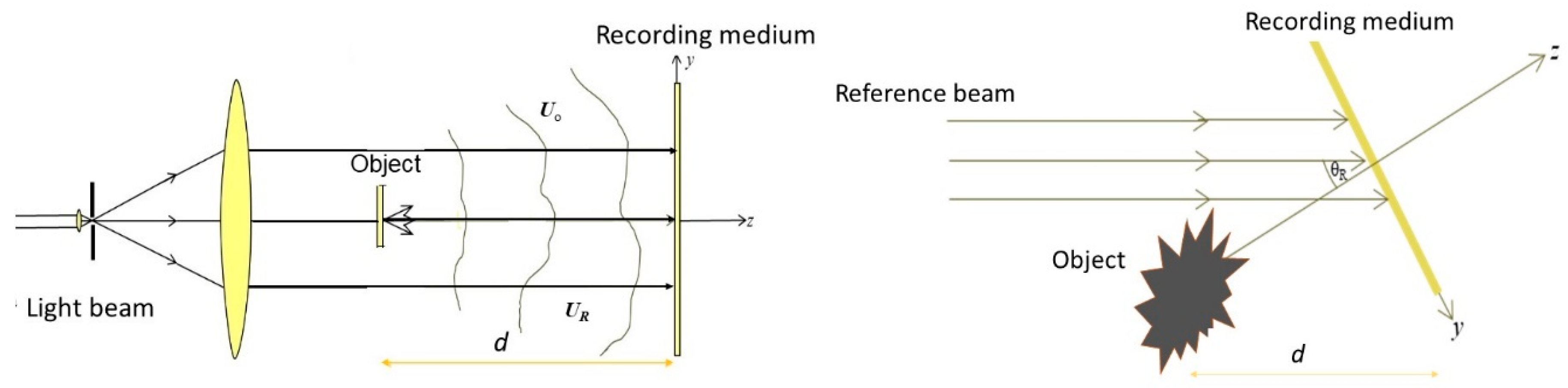
There are two main experimental configurations, called in-line and off-axis; see Figure 1, left and right, respectively.
For the off-axis DHM, the light is divided into two beams: the object beam, which travels through the specimen, and a separate reference beam that falls on the recording sensor at an angle; the reference beam is considered a carrier wave with a spatial frequency that depends on the angle of incidence with respect to the perpendicular to the sensor. The reference and object beams travel along different optical paths and interfere at the image plane of the object, i.e., on the sensor, at an angle between them (see, for instance, the combining cube, BS5 in Figure 2, used for this purpose) [41].
In the in-line DHM configuration, a coherent beam illuminates an object and is further scattered and diffracted on its way to the recording medium; this is called the object beam. The light that does not pass through the object is directed straight to the medium and is called the reference beam. Divergent or collimated light can be used to illuminate the object. For this particular configuration, the beam emerging from the sample and the undisturbed wavefields propagate along the same path (optical axis), thus the in-line term. The two beams interfere at the sensor’s plane, where the hologram is recorded in the form of an intensity pattern that contains the 3D information of the sample (embedded in the hologram as amplitude and phase) [42,43].
Figure 1. The left image shows the registration of an in-line hologram. Uo and UR are the object and reference beams respectively. Adaptation taken from C.M. Vest [44]. The right image shows the offline hologram registration. The reference beam strikes the recording medium at an angle θR relative to the object beam. Adapted from P.K. Rastogi [45]. d is the distance between the object and the sensor.
Applsci 16 05991 g001
The optical layouts of either a Michelson or a Mach–Zehnder interferometer are commonly used to establish a DHM. The two principal methods consider reflection and/or transmission of light; the latter approach is used to inspect translucent specimens, where variations to the classical DH configuration are introduced; viz., these commonly incorporate two microscope objectives with the same characteristics in the object and reference interferometer arms, allowing one to obtain a similar relationship between both wavefronts (reference and object beams). The microscope objective on the object beam arm also serves to image the sample. The hologram’s embedded amplitude and phase are thus recorded, allowing the sample’s 3D characterization.
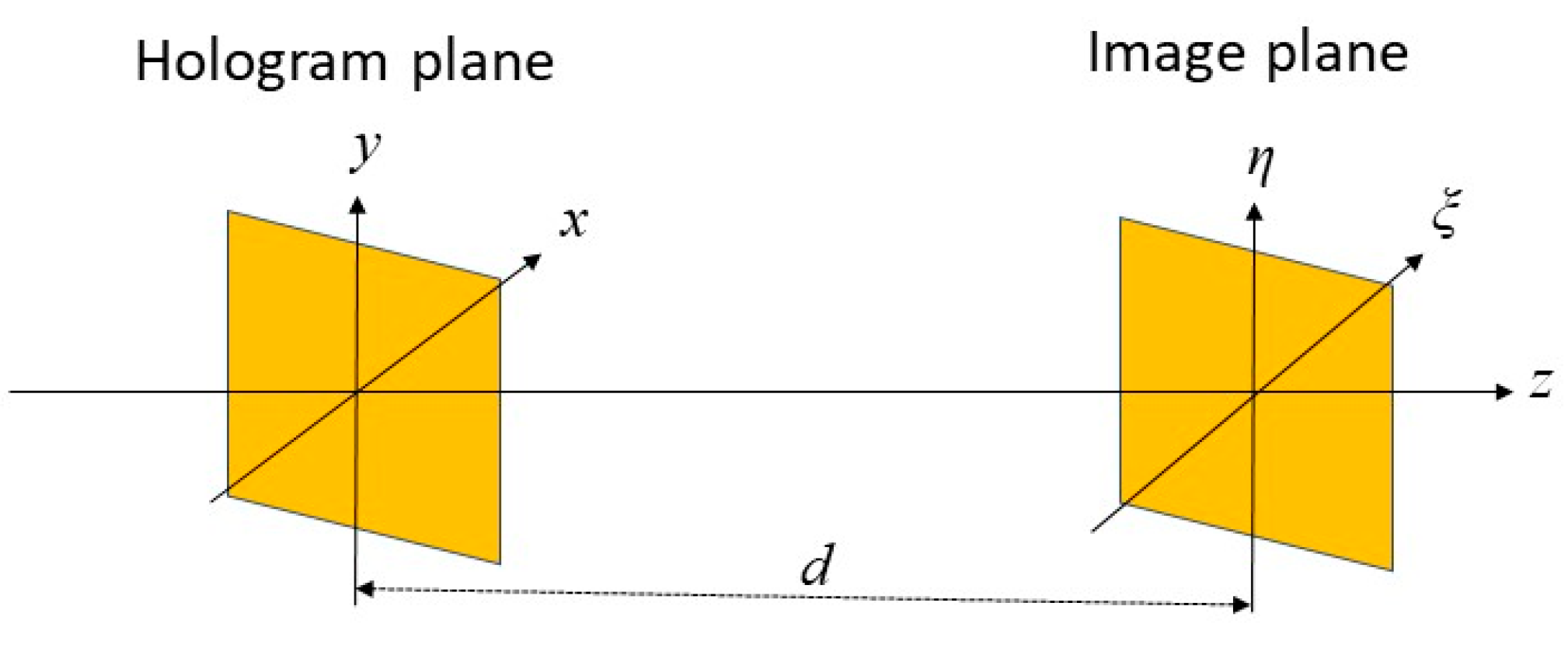
The holographic principle supporting these configurations has been employed in the context of lensless optical arrays or using a lens to focus the sample on the digital sensor [46]. Several research studies have reported these configurations, all of which can be consulted in the given references [46,47]. The process entails the illumination of the object to be reconstructed, which is situated on a plane at z = d = 0; the light scattered by the object interferes with the reference beam on the hologram plane, located at a distance d, which is equivalent to the distance at which a digital sensor, such as a CCD or CMOS camera, is positioned to record the hologram (h(x, y)) [47].
DHM also allows information from multiple wavelengths to be recorded simultaneously, which enables the range of absolute measurable height to be extended to dimensions greater than the wavelength range. The process entails the generation of a synthetic wavelength (Λ). This synthetic wavelength is greater than the original wavelengths that produced it, and its value is calculated to be similar to the height variations in the object under study [48,49].
The principle underlying optical phase unwrapping is that the wrapped phase is related to the height of the object under study and the wavelength (λ) used. That is to say, the greater the height of the object compared to λ, the more the phase is wrapped. Conversely, when the wavelength used is greater than or comparable to the height of the sample, the optical phase is recovered in an unwrapped form without the need for unwrapping algorithms. From an unwrapped phase map obtained with dual-wavelength optical phase unwrapping, the acquired phase profiles are associated with variations in the shape and height of the sample [50,51].
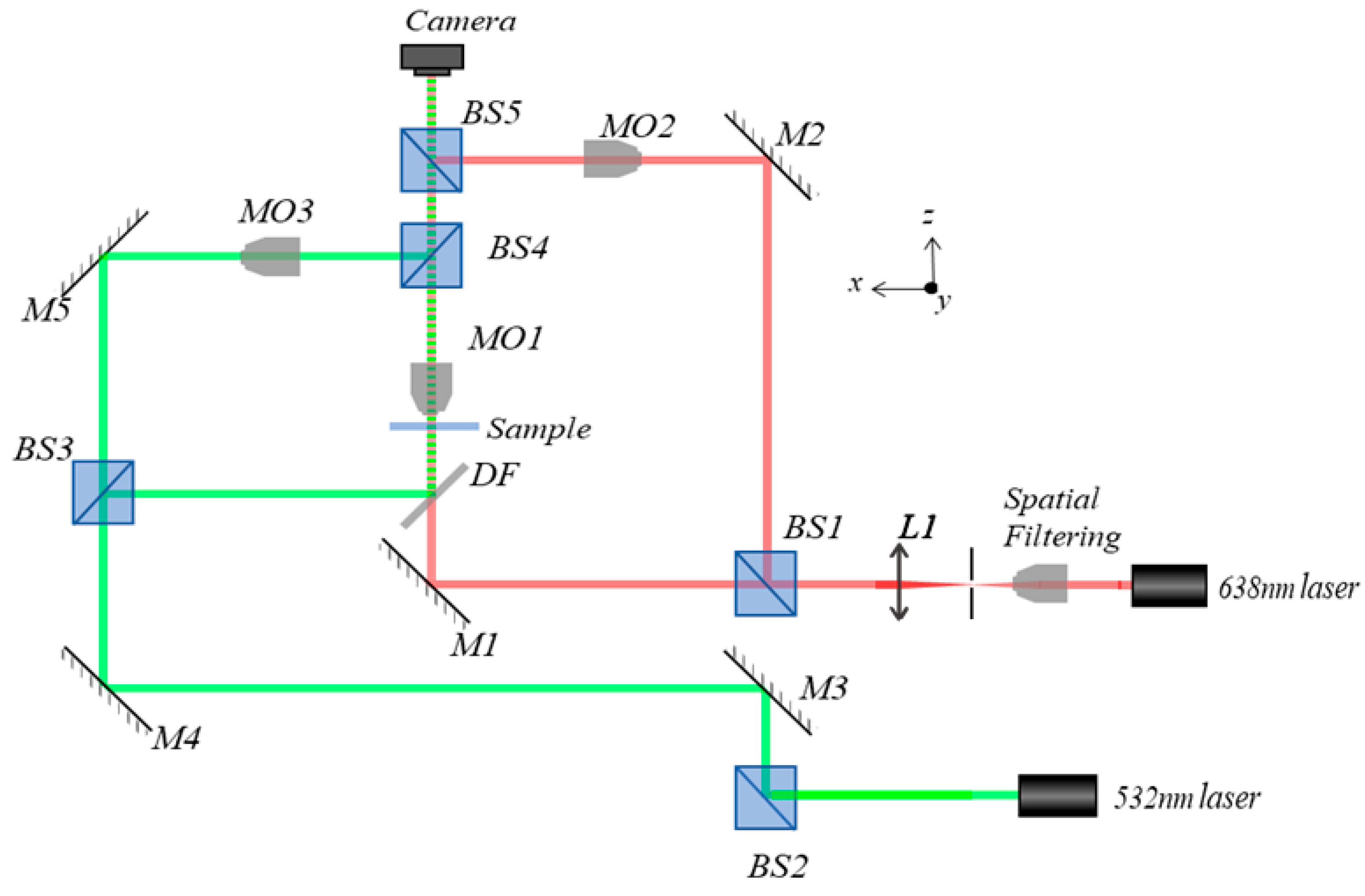
Figure 2 shows a Mach–Zehnder DHM optical layout for dual wavelengths in transmission configuration [52,53]. Two lasers are used in the optical array, one at a wavelength of 638 nm (red lines), while the other works at 532 nm (green lines). The red beam goes through a spatial filter and a lens (L1), after which it is split by the beam splitter (BS1) into the object and reference beams. The object beam is directed towards the sample via a mirror (M1) and a 60x microscope objective (MO1) with a numerical aperture (NA) of 0.85; MO1 also served the purpose of magnifying the sample. The reference beam is reflected by the mirror (M2), goes through the microscope objective (MO2), and is directed towards the CMOS camera sensor by the beam splitter (BS5). The green laser is guided by the BS2 beam splitter and the mirrors M3 and M4 to the BS3 beam splitter, thereby generating the object and reference beams. The object beam is directed towards the sample via a dichroic filter (DF), which reflects green light while transmitting red light. Subsequently, the green reference beam strikes a mirror (M5), and the reflected light passes through the microscope objective lens (MO3). Thereafter, it recombines with the object beam at the beam splitter (BS4) and is finally transmitted through the beam splitter (BS5) to the camera sensor. BS4 and BS5 permit the modulation of the angle of incidence between the backscattered light from the object and the reference beam. The MO1 and MO2 microscope objectives, as well as the MO3 with the MO1, are paired; i.e., they have the same magnification and numerical aperture. Accordingly, MO2 and MO3 compensate for the phase curvature produced by MO1 for the green and red beams. Thus, the holograms are generated and recorded by the camera.
Figure 2. Optical layout for two simultaneous wavelengths’ DHM [53].
Applsci 16 05991 g002
A recent report details a system that utilizes holographic multiplexing of six parallel wavefront channels for the optical imaging of objects with precision and expediency. The sample is illuminated with a partially coherent, linearly polarized light beam from a three-wavelength light source that simultaneously emits three distinct and precise wavelengths. For dynamic 3D profiling of thick objects, a 6PH module is required, which is placed at the exit of an inverted microscope to split the light into three wavelengths and divide the field of view into two, thereby creating three parallel interferometers [54,55].
Efforts have been made to develop compact and portable optical systems; the integration of DHM with laser speckle contrast imaging into a single system has also been reported [56]. To this end, new components have been designed and built, such as a portable digital holographic camera with an expanded field of view. For the same purpose, a multifunctional holographic optical element with improved resolution and field of view has been incorporated [57].

3.1.2. Digital Reconstruction of 3D Information

The DHM technique facilitates the capture and reconstruction of 3D information from an object that has been encoded in a two-dimensional digital interference pattern [58]. In order to extract this information and comply with Gabor’s original object reconstruction procedure, a digital reconstruction is made by numerically applying the reference wavefront R x , y numerically to the recorded hologram and propagating it to the image plane, thereby enabling the diffraction of the beam to reproduce the amplitude of the original object beam. The planes for numerical reconstruction are shown in Figure 3. This reconstruction can be performed numerically through the simulation of the optical diffraction process; i.e., in numerical reconstruction, the phase shift of the original wavefront is retrieved using scalar diffraction theory to propagate the reference beam beyond the hologram. This is achieved using different methods; of these, those that we believe are the most popular will be mentioned here next.
Fresnel Transform Reconstruction
This approach allows the wave field to be reconstructed in a plane behind the hologram, which is the plane of the real image [59,60,61]. The Fresnel approximation or Fresnel transformation equation can be described by:
E F ξ , η = i λ z e i 2 π λ z e i π λ z ξ 2 + η 2 · R x , y h ( x , y ) e i π λ z x 2 + y 2 e i 2 π λ z x ξ + y η d x d y
The numerical process involves the application of the Fourier transform of the product to the hologram intensity distribution, denoted h (x, y); the complex conjugate of the reference beam, R*(x, y); and the curvature term that results from the Fresnel approximation, an exponential quadratic phase, known as the chirp function. It can be described as:
E F ξ , η e i π d λ ( ξ 2 + η 2 ) F h x , y R * x , y e i π d λ x 2 + y 2   e 2 π i ( x ξ + y η )
The outcome of the numerical reconstruction is the reconstructed wave field intensity E F ξ , η , which is a complex number; from this, both the intensity I ξ , η and phase θ ξ , η can be determined by:
ξ , η = E F ξ , η 2   and   θ ξ , η = tan 1 I m   E F ξ , η R e   E F ξ , η
Reconstruction Using the Convolution Algorithm
The convolution approach is of significant interest, as it facilitates the calculation of three fast Fourier transforms, thereby achieving high reconstruction speeds [62,63,64]. The primary characteristic of this approach is that the size of the recording pixel is equivalent to the reconstruction pixel, which restricts its application to the reconstruction of small objects. Digital processing employs the convolution theorem.
Applsci 16 05991 i001
Using the three Fourier transforms, the convolution approach equation in the real image plane is:
E F ξ , η = F 1 F h R F G
Angular Spectrum Method
Like the previous approaches, the angular spectrum method obtains information about the wave field that yields the hologram. It relies on the expansion of diffracted wave fields using Fourier optics, where the minimum reconstruction distance requirement does not apply. This means that the distance between the object and the hologram can be quite small. This method consists of propagating a wave field from a plane commonly known as the “hologram plane” for z = 0 to the observation/image plane. This is achieved by decomposing the wave fields into a continuous spectrum of plane waves using a 2D spatial Fourier transform [65,66,67]. Each plane-wave component is then propagated in the Fourier domain to the image plane, where it is reconstructed via an inverse spatial Fourier transform.
E F ξ , η = F 1 F h ( x , y ) e i d 2 π / λ 1 λ f x 2 1 λ f y 2 2
f x   and   f y are the spatial frequencies.
Other Proposals
Advancements in the reconstruction of intensity and phase information contained in the holograms have precipitated the development of novel models and enhancements in processing methodologies and numerical techniques [68]; some representative results are mentioned next.
The simultaneous reconstruction of intensity and phase information in multiscale digital holography has been addressed using an improved deep learning model known as Mimo-Net, which extracts significant local features from large-scale holograms at a reduced scale. This configuration comprises three input branches, arranged in series within a single network structure, from global to local, with the purpose of feeding the main network. This distinctive network architecture constitutes an advanced deep learning model, enabling the reconstruction of intensity and phase information from digital holograms at three differentiated scales [69]. Also, the phase reconstruction is predicated on the combination of a digital-to-analog hologram with deep learning, where the UHC-Net residual network, in conjunction with the ConvNeXt network and the hierarchical aggregation HANC network module within the U-Net framework, facilitates high-precision and high-speed hologram reconstruction [70].
In order to address the issues inherent to DHM, such as its suboptimal transverse reconstruction accuracy and reconstruction efficiency, a range of methodologies have been put forward. A notable approach involves phase reconstruction through the utilization of super-resolution digital holographic microscopy, underpinned by compressed detection in models, to disseminate the hologram, in conjunction with deep learning. The ensuing scatter-sampled data is then integrated into a cascaded deep learning network for end-to-end training [71].
It is evident that the Fresnel, convolution, and angular spectrum methods require prior knowledge of the optical array distribution. Moreover, it is imperative to remove unwanted zero-order and twin images through an additional filtering operation. In addition, phase imaging requires compensation for phase aberration and a subsequent unwinding step to recover the object’s true thickness. In order to address these challenges, a holographic reconstruction network (HRNet) was developed for numerical reconstruction in DH. It has been demonstrated that raw holograms can be fed directly into the network as training input, thus allowing it to automatically learn the internal representations of the processing steps required for holographic reconstruction and establish a pixel-level connection between a raw hologram and its backpropagation [72,73].
Also, spatial light interference microscopy (SLIM) is a quantitative imaging technique that combines conventional phase contrast microscopy and a SLIM module [74]. This module includes a 4f lens system and a spatial light modulator; this last component is used for phase modulation required for phase recovery. SLIM has been applied in studies of cell growth, cancer diagnosis, and studies across the entire mouse brain. Thus, images of coronal and sagittal sections of the mouse brain at different spatial scales were obtained [75].

3.2. Digital Speckle Pattern Interferometry (DSPI) and Digital Holographic Interferometry (DHI)

3.2.1. Basic Theory of DSPI and DHI

The optical non-invasive methods addressed in this review are based on the speckle effect originating from the interference of light waves reflected from a microscopic-scale surface whose height variations are of the scale of an optical wavelength: one such pattern is observed as dark and bright randomly distributed spots in the upper right-hand corner of Figure 4. Although the speckle effect itself arises from the interference between numerous randomly phase-shifted object waves, a smooth reference beam (non-speckled and whose wavefront’s shape is well known, e.g., a plane or spherical shape wavefront) is needed to conduct measurements using the DSPI and DHI techniques.
Any change on the sample’s surface, for instance, its motion in any direction, results in a change in the speckle pattern. Thus, the principle of the methods relies on acquiring and processing speckle patterns; the overlap/interference of these patterns is made taking into consideration a sample in a so-called baseline state with a second at a different state, e.g., where the sample has undergone a disturbance, or due to an anomaly inside it, etc. The comparison between these two sample conditions gives information about the sample surface displacement/deformation [76,77] in the form of bi-dimensional fringe patterns (bright or dark bands/stripes) that denote the profile lines of the measured physical quantity. The patterns are computer-stored in the form of intensity images; these images are processed based on interferometry principles that provide measurements to be made on any type of surface, including—which is significant for our purposes—on samples with rough surfaces. The procedure is non-invasive and today represents a viable alternative to a robust approach to measure and test a variety of samples (not only biomedical); in addition, it is important to mention at this point that the studies may be conducted in environments that are not necessarily controlled [78,79,80].
The DSPI and DHI methods are addressed as follows:
The DSPI method allows the visualization of fringe patterns in near real time, allowing one to observe the way the sample vibrates/deforms, as well as to determine the frequencies of the stimulus to which the sample responds; these are found with this same technique. DSPI is used qualitatively for rapid observation of the sample response to a static or dynamic stimulus.
The DHI method aims to obtain the wrapped phase maps by applying the Fourier transform to the speckle patterns, followed by a filtering process in Fourier space. The wrapped phase maps can then be filtered in the spatial domain to finally unwrap the phase maps. In this way, DHI is used to quantify the changes of the sample compared to an initial state.
Basic Optical Configuration for DSPI and DHI
The essential and most typical optical hardware setups comprise a coherent laser beam; an out-of-plane interferometer (whose sensitivity is along the z-direction) for 1D measurements or an in-plane interferometer (whose sensitivity is along the x, or y –direction) for 2D measurements; a digital camera; and a computer [30]. Continuous wave (CW), pulsed, and tunable lasers are commonly used as the light source, with wavelengths that range from 320 to 1064 nm (UV to near-infrared light), though other wavelengths can be used with the appropriate camera detectors. Indeed, many types of coherent lasers can be used in interferometry, e.g., solid-state (e.g., Ruby), gas (e.g., HeNe, Ar-ion), diode-pumped, twin pulse Nd-YAG, etc. [81]. Most lasers employed are continuous wave (CW), though some may be chosen to be pulsed (these are normally chosen when a very rapid event is under observation). The laser power to be used for the experiments depends on the sample size, its capability to scatter/transmit light, and the recording exposure time set in the camera. The digital camera detectors can be monochrome or color, with the most commonly used to record the speckle patterns being the CCD (charged couple device) and CMOS (complementary metal-oxide semiconductor) [82,83].
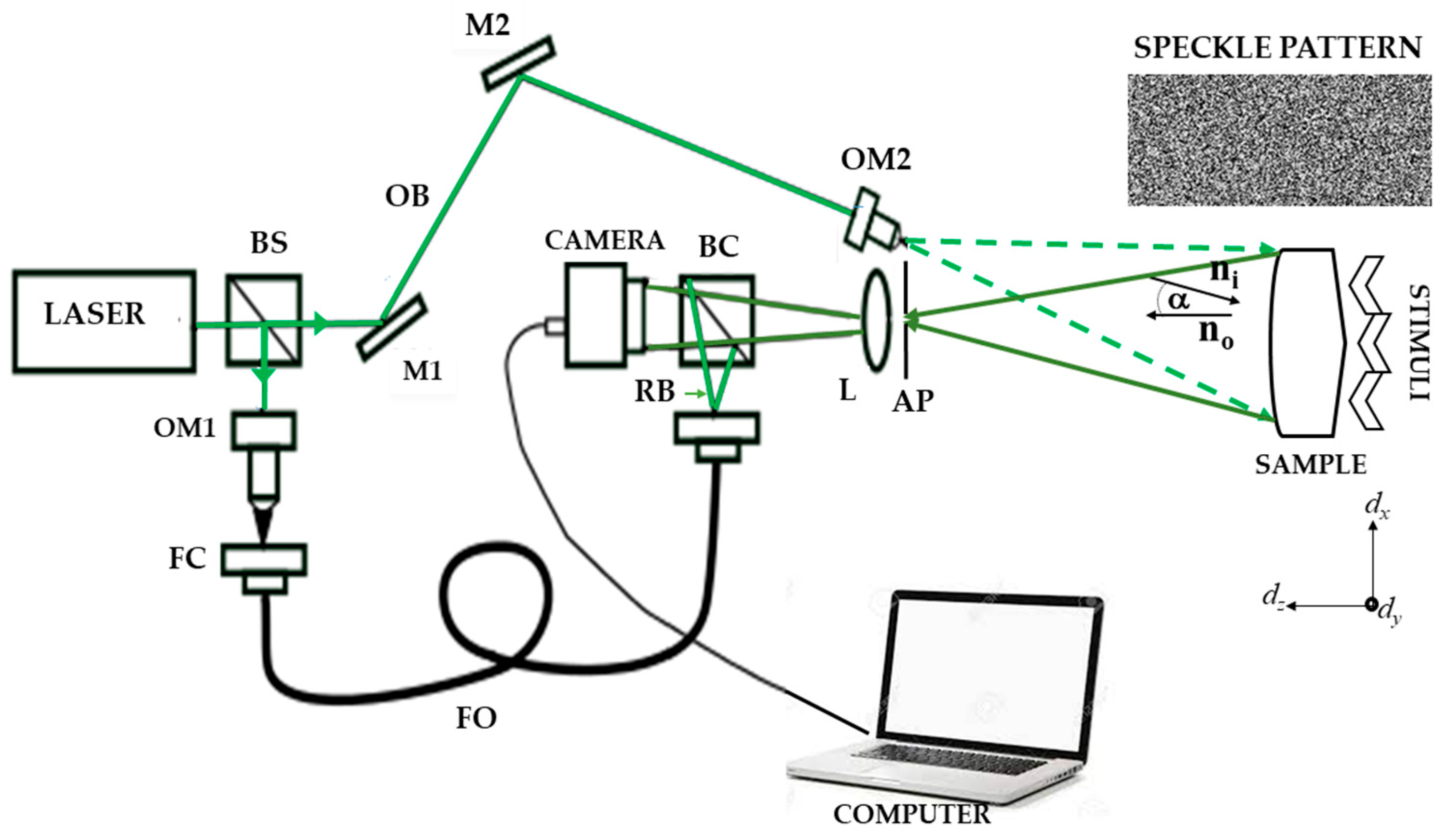
The basic interferometer layout schematically depicted in Figure 4 for out-of-plane measurements capable of working in either DSPI or DHI is designed in such a way that the laser beam is split in two beams by a cube beam splitter (BS): one that illuminates the surface of the sample of interest, called the object (sample) beam (OB), and the other called the reference beam (RB). The backscattered light from the former is collected by a lens that images the sample’s surface on the camera; the latter travels from the laser output undisturbed straight to the camera, where it interferes with the OB.
The RB is coupled with a microscope objective (OM1) and fiber coupling (FC) and conveyed by a single-mode optical fiber (FO) to the camera detector; the use of the FO simplifies the optical layout. The OB is guided by the mirrors (M1) and (M2) and expanded with a microscope objective (OM2) to illuminate the sample; the backscattered light is collected by a lens (L) that serves to form an image of the sample on the camera. The OB can also be guided by an FO. An aperture lens (AP-L) combination is used to increase the depth of field; it also aids in controlling the amount of backscattered light falling on the camera and controls the size of the speckles. To determine the focal length of the lens to be used in the experimental setup to image the sample, we first need to know the sample size; therefore, the sample image, i.e., the region of interest (ROI), should preferably cover the total number of pixels of the CCD sensor. The focal length of the lens is then calculated as a function of the sample size, the working distance (the distance from the sample to the imaging lens and from the lens to the camera), and ROI [17,30]. Finally, interference occurs when the RB and the sample backscattered light are combined by a cube beam combiner (BC): their overlapping falls on the camera detector and is made known as a speckle pattern shown in the upper right-hand corner of Figure 4 [22].
Mathematically, the former interferometric procedure may be set as follows. The intensity of the interference pattern I 1 x , y formed on the camera sensor is expressed as:
I 1 x , y = I o x , y + I r x , y + I M cos φ o r ( x , y )
where x and y denote the spatial coordinates of the camera pixels, where the sample image falls; I o x , y   is the intensity of the backscattered beam from the object; I r x , y is the intensity of the reference beam; I M = 2 I o I r is a term that modulates the interference pattern intensity; and φ o r describes the random intensity phase between the reference and object beams and is due to the interaction of the illuminating beam with the sample [84,85].
When the sample is about to undergo a change, which can be internal, such as a crack, physical wear, defect, internal anomaly, shrinkage, etc., or when the sample undergoes a deformation/displacement provoked by an external static or dynamic stimulus, the object beam (OB) changes its optical path and thus changes its phase, and the Equation (7) can be rewritten as:
I 2 x , y = I o x , y + I r x , y + I M cos φ o r x , y + θ
where θ is the phase difference of the reflected OB relative to the RB caused by the sample deformation; i.e., it is the variable to be recovered.
Optical Configurations for 3D Measurements
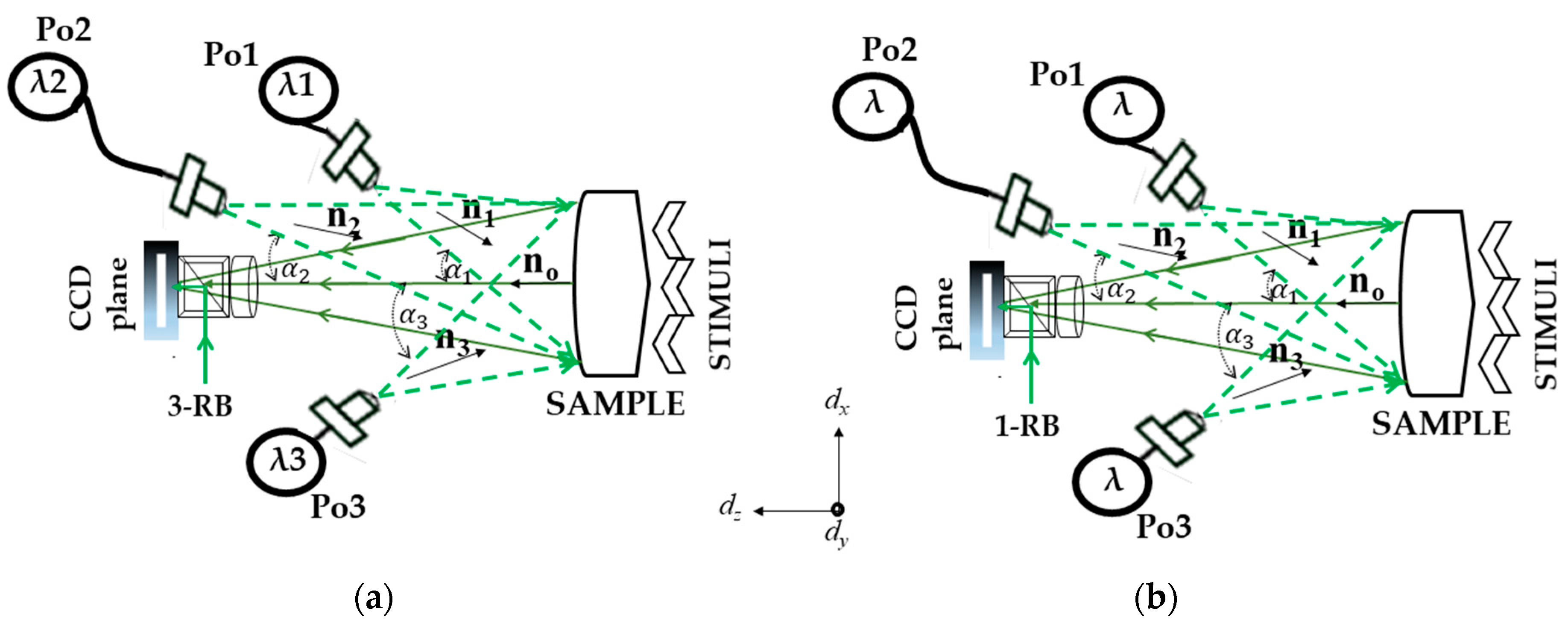
The 3D configuration comprises out-of-plane and in-plane layouts in one optical setup capable of depicting the complete deformation of the sample by determining the displacement fields in the x, y, and z directions. Also, these three fields can be combined to acquire tangential and normal surface sample displacements. Figure 5 shows the two schematics commonly employed in the experiments; however, other configurations have been employed, for example, three observation directions with three cameras, and so on [86,87,88]. For simplicity, Figure 5 shows the changes that need to be introduced in the layout of Figure 4 in order to perform measurements in 3D.
(a)
The setup in Figure 5a allows simultaneous measurement of the three displacement components; it uses three light sources at three different positions (Po1, Po2, and Po3), each with different wavelengths (λ1, λ2, and λ3). Two intensity images are recorded for two states of interest of the sample; i.e., three digital holograms are recorded in a single camera frame. Note that each of the three object beams matches with its corresponding reference beam [89].
The intensity at the camera detector is the result of the sum of the three individual intensity levels caused by the reference-object beam (R-O B) pairs.
I x , y = n = 1 3 I n ( x , y )
where n denotes each of the three wavelengths: λ1, λ2, and λ3 (n = 1,2,3).
(b)
The optical setup in Figure 5b uses only one light source with wavelength λ and three illumination object beams. The sample is sequentially illuminated from 3 object beam positions (Po1, Po2, and Po3), whereas the object beam is launched using an optical fiber situated in sequence at the three non-coplanar positions; alternatively, the beam can be divided into three by beam splitters, conveyed by optical fibers and directed to illuminate the sample by mirrors. As seen in Figure 5b, only one reference beam is required. Three holograms are recorded sequentially for two different states of the sample and then processed. Then, three intensity images are recorded I 1,2 , 3 x , y [90].
To determine the three displacement fields in the x, y, and z directions, at least three optical phase measurements are required. The no-coplanar position for each light source must be measured independently in order to recover the optical phase.
Digital Speckle Pattern Interferometry
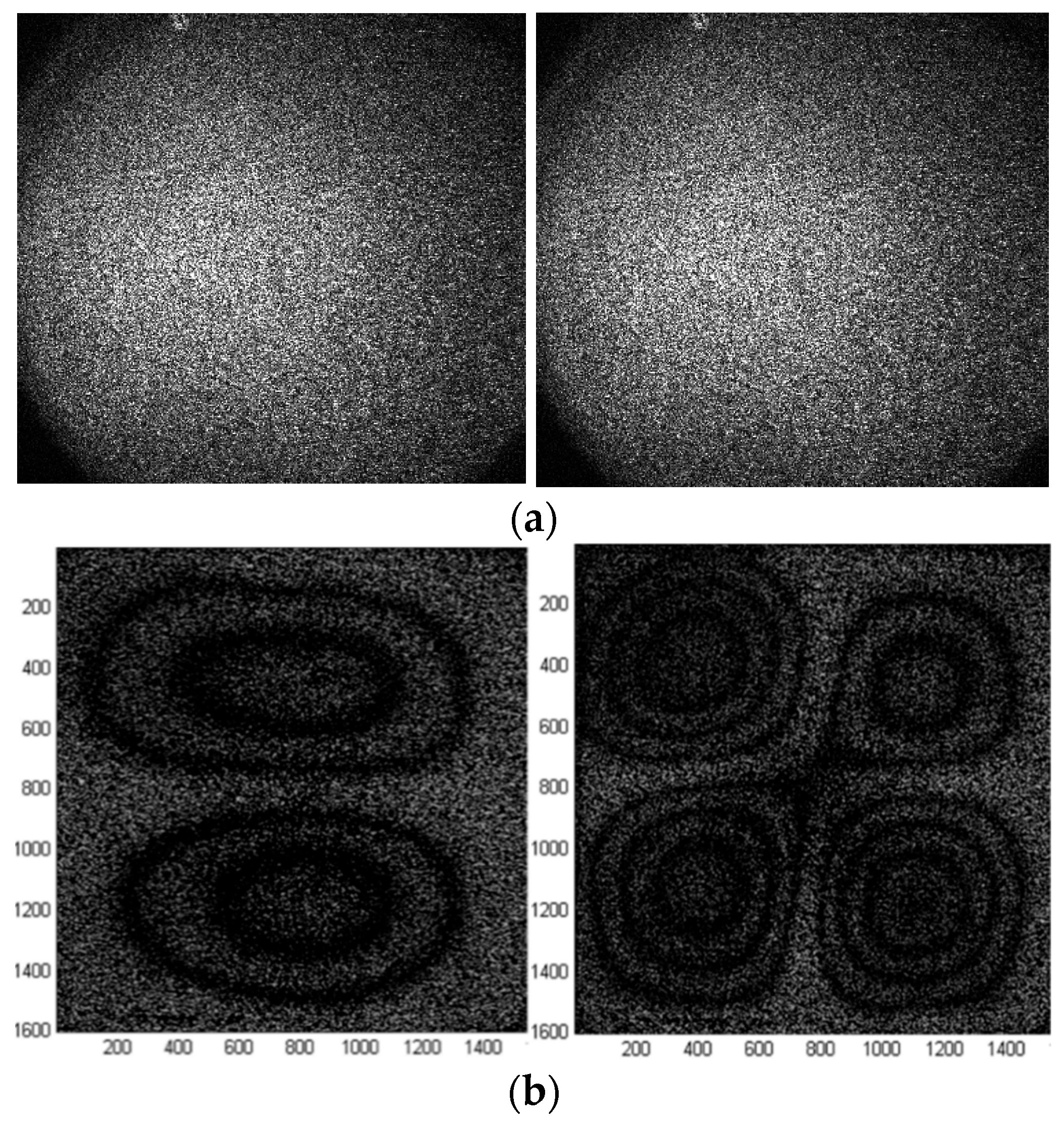
Digital speckle pattern interferometry (DSPI) is a nondestructive optical test that makes it possible to visualize and reveal the flaws or deformations of a sample subjected to static or dynamic deformations, e.g., a force making the sample vibrate: the DSPI method is able to visualize and determine the fundamental modal frequencies [30,31,91]. DSPI can be simply used for qualitative studies—i.e., the resulting interference patterns are displayed on the computer monitor in real time [92]—and are rapidly processed to generate a full field-of-view map of the sample surface displacements/deformations. Figure 4 is used to obtain the out-of-plane displacement measurements that occur perpendicular to the specimen surface, i.e., along the z-direction, and the layout is said to be sensitive to this direction. The sample can be either at rest or in motion, and a reference image is denoted as I 1 and stored in the computer memory, and then, while the sample undergoes a deformation, this reference image is continuously subtracted from subsequent images. The resulting subtracted intensities are displayed in real time and show the resultant fringe patterns (in the case of a vibrating sample, it is possible to observe the so-called resonant vibration patterns) [93,94]. The fringe pattern ( I f p ) , is formed by bright and dark areas such as those seen in Figure 6, where the fringe patterns correspond to variations in displacements/motions resulting from the correlation of two speckle patterns, e.g., I 1   a n d   I 2 , and described by:
I f p = I 2 I 1 = 2 I M sin φ or + Δ θ 2 sin Δ θ 2
where sin φ o r + Δ θ 2 is modulated by sin Δ θ 2 , which denotes the sample deformation/displacement, and Δ θ is the phase difference caused by the deformation.
There are several methods, traditional and modern, used to extract useful object data from the fringe patterns, particularly, as mentioned, the optical phase distribution Δ θ embedded in them. It is common practice to classify them in two groups: phase shifting methods, which involve several fringe patterns to extract Δ θ , and spatial phase methods, which involve a single fringe pattern to recover Δ θ , such as the Fourier transform method [25,27]. The last one is addressed in the following section.
Digital Holographic Interferometry
With the advent of the digital era, a robust method for non-invasive measurements and deformation testing, digital holographic interferometry (DHI), emerged to capture and process holograms (interference patterns) recorded in discrete form by a digital detector such as a CCD/CMOS camera [4,31]. DHI renders quantitative measurements with a high resolution, even in the nm range, and high sensitivity; viz., it is capable of measuring displacements on the order of ~λ/30. Being a full-field-of-view method, DHI requires fewer images to process for quantitative evaluation, a feature that significantly reduces the time required for processing, and it can handle high-resolution images [95,96]. DHI setups can be found in either Figure 4 or Figure 5.
As mentioned, the optical phase is the variable of interest that needs to be recovered from the spatial variation in intensity. For this purpose, in DHI, we customarily use the Fourier transform method to recover the optical phase. To achieve this, the optical setup requires an angular shift introduced in the reference beam. This angular shift introduces a carrier frequency such that in the interference field, the individual spectrum components are separated in the Fourier frequency domain. This angular shift also provides greater ease when modulating the phase of the interference pattern. The AP-L combination, shown in Figure 4, is also used to control the size and thus the spatial frequency of speckles produced by the sample surface; at this point, it is important to mention that the maximum spatial frequency recordable by the camera is given by f m a x = d s λ , where d is the aperture diameter, and s is the distance from the center of the lens to the camera detector plane. For instance, the maximum resolvable spatial frequency f m a x of the hologram has to fulfill the sampling theorem as set by the Nyquist criterion f m a x = 1 2 ( Δ ζ ) , with a maximum angle between the reference and object beams of φ m a x = 2 sin 1 λ 4 ( Δ ζ ) λ 2 ( Δ ζ ) , where Δ ζ is the pixel size of the camera sensor. If the camera used for recording the holograms has more and smaller pixels and has a higher dynamic range, the quality of the results can be improved. The intensity hologram, I H x , y recorded on the digital camera’s detector may be expressed as:
I H x , y = I d c x , y + 1 2 I M x , y e i θ + ϕ m + 1 2 I M ( x , y ) e i ( θ + ϕ m )
where I d c x , y = I o ( x , y ) + I r ( x , y ) , and refers to a constant intensity level produced by the scattered object and reference beam intensities; the second and third terms comprise the sought optical phase θ   that contains information on the sample wave which represents the surface deformation/displacement variables, which serves to calculate, for instance, the sample thickness/height/contour, and ϕ m is the angular shift introduced in the reference beam [25,97]. In order to retrieve θ , Equation (11) is processed with the Fourier transform method as follows: (a) when using the Fourier transform it yields three separate terms in the spatial frequency domain, that is, the Fourier spectrum contains the ± first orders that are symmetrically separated with respect to the zero frequency peak (zero-order intensity of spectrum, where the term I d c is located); (b) the zero-order and either the +first or –first order are filtered by applying a bandpass filter; and (c) the inverse Fourier transform is applied to the remaining non-filtered order, where this inverse transformation produces a complex intensity signal from which the optical phase can be determined as:
θ x , y = tan 1 i m a g i n a r y 1 2 I M ( x , y ) e i θ r e a l 1 2 I M ( x , y ) e i θ
If the sample height is greater than the wavelength being used, θ x , y will be represented in a phase map containing 2π discontinuities; this phase map is referred to as a wrapped phase map.
Recall that DHI is based on the digital correlation of two holograms acquired before and after the sample is subjected to any kind of disturbance (the second state is different from the first, or else if it is the same, no fringe pattern will be shown, and we will see a dark screen upon subtraction of two identical sample states) [31,98]. The relative optical phase difference Δ θ x , y must be calculated as:
Δ θ x , y = θ a x , y θ b x , y
where θ a x , y is the phase for the first state and θ b x , y for the second one: Δ θ x , y can be related to the 3D shape/displacement field ( d ) of the sample. For this purpose, the discontinuities of Δ θ x , y are eliminated, thus obtaining a smooth optical phase map named the unwrapped phase map [99].
As mentioned, DHI is used to measure d over the entire surface of the sample with high accuracy. It is even possible to measure displacements in each direction, x, y, and z, individually. Then, Δ θ is related to the displacement field d using the following equation.
Δ θ = s d = s ( d x i ^ + d y j ^ + d z k ^ ) ,       then ,       d = s 1 θ
The displacement d = d x i ^ + d y j ^ + d z k ^ refers to the object change from the reference to the modified state. The Cartesian components d x ,   and   d y are the in-plane displacements, while   d z   represents the out-of-plane sample displacement [30,100,101,102]. s is the sensitivity vector, which specifies the direction in which the sensitivity of the experimental configuration is considered most sensitive. s depends on the laser wavelength and the geometry of the recording setup, s = s x , s y , s z = 2 π λ n o n i where n o   a n d   n i are the unitary vectors along the observation and sample illumination directions, respectively; and λ is the wavelength of the laser beam. It is always possible to increase the sensitivity in one axis by reducing the sensitivity in the other axes.
For instance, based on the configuration shown in Figure 4, where the camera and illumination source are set in the x-z plane, and α is the mean angle between the illumination and observation direction, the sensitivity vector s is 2 π λ (sin   α , 0, 1 + cos   α ) [95,103,104].
The relation in Equation (8) may be expressed for the x-z plane as:
Δ θ = s d = 2 π λ ( d x sin α + d z 1 + cos α )
As mentioned, given that the angular shift α is small, d z mostly predominates so that d x is usually omitted; therefore, Δ θ can be expressed as:
Δ θ 2 π λ d z 1 + cos α
Furthermore, making α equal to 0, the out-plane displacement ( d z ) is:
d z = Δ θ λ 4 π
For 3D simultaneous measurements using Figure 5a, the 3D displacement components d = (dx, dy, and dz) are resolved as follows:
d = s n 1 θ n
θ n corresponds to the unwrapped phase difference; and s n to the three sensitivity vectors known from the setup, and are determined by s n = 2 π λ n o n n i .   θ n and s n are obtained for each wavelength (λ1, λ2, and λ3). For Figure 5b, where the measurements are performed sequentially, Equation (18) is also applied, with the difference being that only one λ is used to obtain the three displacement components.
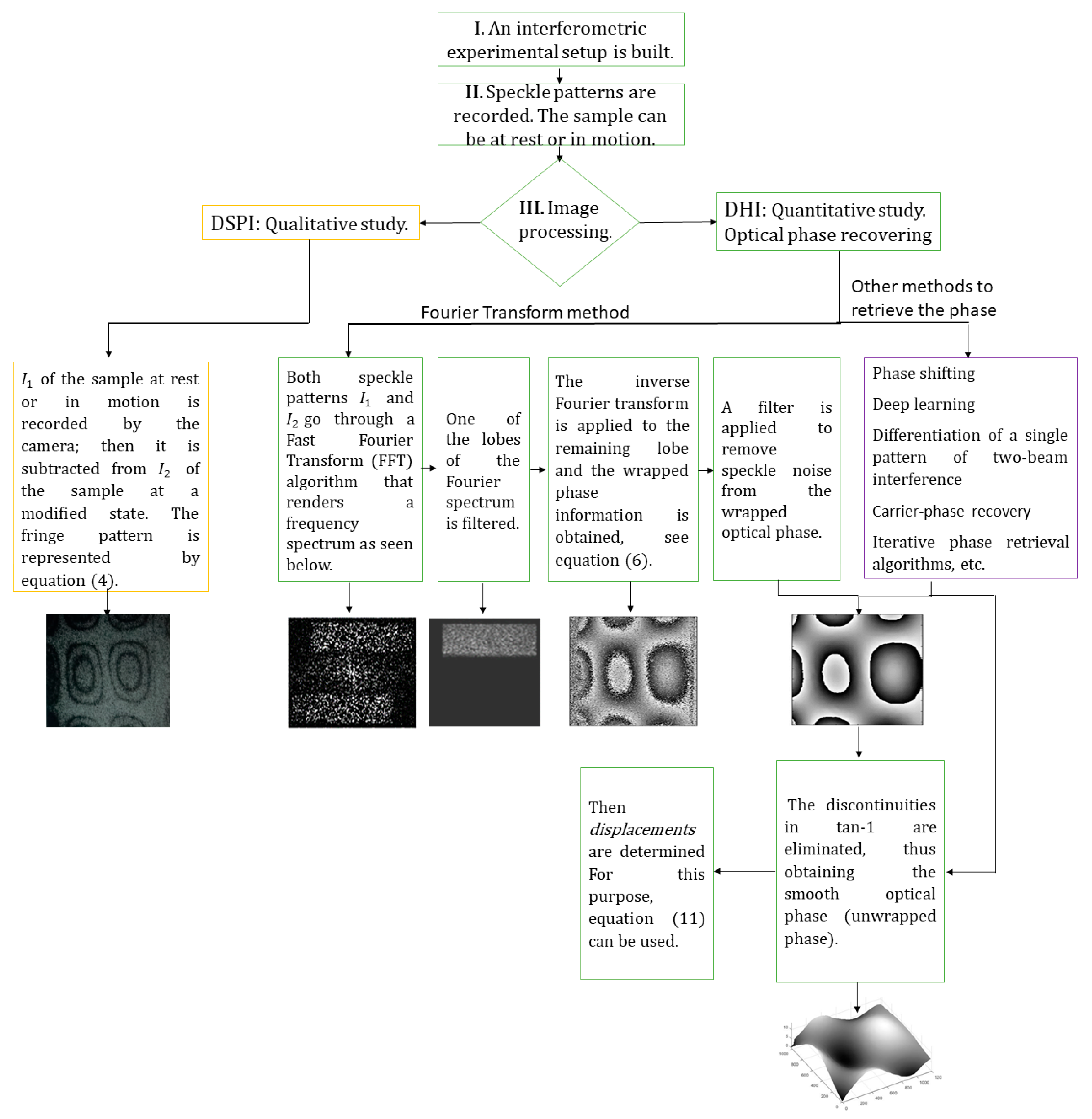
For comparison, Figure 7 shows a flow diagram displaying the measurement principle for both DSPI and DHI methods.
In order to help determine which technique is most feasible according to the sample under study, Table 1 presents the strengths and constraints for DHM, DSPI, and DHI.

4. Sample Parameters Determination

Once the sample surface displacements are retrieved from the speckle patterns, it is possible to determine other parameters that provide important sample data. Here, we provide a few important examples of how to find some of these parameters.

4.1. The Strain ε

Strain is a fractional change in length and represents the rate of object deformation under stress; to determine it, a robust and reliable procedure is required. By finding the strain, some important mechanical properties of the sample are determined, such as elasticity. To find these properties, it is necessary to quantify the stress and Young’s modulus [105].
As mentioned, d x ,   d y ,   a n d   d z can be determined using in-plane and out-of-plane setups or by using a 3D DHI setup where the three displacement components can be obtained [90,105].
For the calculation of the strain distribution ε , the spatial derivatives of displacements are needed:
ε = ε x x ε x y ε z x ε x y ε y y ε z y N A N A N A
ε = d x x 1 2 d y x + 1 2 d x y d z x 1 2 d y x + 1 2 d x y d y y d z y N A N A N A
where ε x y , ε x x , and ε y y are the in-plane strains, and ε z x and ε z y are the out-of-plane strains. NA means not applicable, since only six components may be determined directly [106,107].

4.2. The Elastic Modulus (E)

As long as the deformation is small, i.e., it does not alter the mechanical properties of the sample, the E of the sample can be found [106,107]. The strain ( ε ) and stress ( σ ) undergone by the material subjected to constant load are given by the following relation (Hooke’s law):
σ = E ε
This means that there is a linear relationship between stress and strain. Where   σ a = f , f are the superficial forces acting over the surface of the sample, and a is the area over which f acts. The Young’s modulus of the sample may be found by using the stress–strain slope, and its value may be found through the least squares method.
The elasticity can also be determined by using the strain tensor ( ε k l )   equation:
σ i j = C i j k l ε k l
where the coefficients C i j k l are constants of proportionality that are linked to Young’s and Poisson’s moduli. σ i j is the stress tensor, given as:
σ i j n j = g j
The component n j is direction cosines of the normal to the sample surface, and the component g j is superficial forces acting in normal and parallel directions on the surface of the specimen [108,109].

4.3. Determination of the Refractive Index–Thickness

The refractive index–thickness is an important optical property that can be found with DHI: this optical method has been mainly used for non-specular (rough) samples employing either a reflection array with light scattered from the sample or a transmission configuration where light passes through the sample. The second is especially used to acquire the refractive index and thickness data of a sample [110,111]. With DHI, two or more interferometric measurements can be performed with two or three wavelengths or with a surrounding medium of different refractive index, among other methods for simultaneous refractive index–thickness retrieval. As a result, more mathematical expressions are produced related to the number of interferometric measurements, allowing decoupling of the refractive index–thickness.
Working with transparent or semi-transparent objects, the optical path length changes in the interferometric setup concerning the sample thickness/height ( h ), generating a refractive index difference ( n ), which is related to the optical phase difference Δ θ , as follows:
Δ θ = 2 π h λ n                 then ,                   Δ n = θ λ 2 π h
With a priori knowledge of the refractive index or the thickness independently, the previous equation can be resolved, viz., by using many other techniques/methods such as atomic force microscopy, total internal reflection, microscope method, using two or more wavelengths, etc., all of which have been reported for selected applications [112,113,114].

4.4. The Shape (Contour, Morphology)

The shape of the sample is a variable that has to be found due to its importance in modeling, quantification of the displacements with exactitude, detection of scuffs, anomalies, rough surface variations, thickness, etc. If the Δ n refractive index is known, the thickness/height profile is obtained from:
h = θ λ 2 π Δ n
Thus, the image of the shape of the sample in 2D and 3D contour maps can be obtained through the processing of the optical phase maps by using Equation (25) for transparent or semi-transparent samples.
For the reflection mode, one solution is employing the following equation which requires the use of the two-point object illumination method; for this purpose, the experimental setup in Figure 4 can also be used [115,116,117].
h = θ λ 2 π α sin α
where α is the illumination angle, and α is the angular displacement between the initial and final position of the light source.

5. Biomedical Research

Biological samples, such as vocal cords, skin, melanoma cells, bacterium, and teeth, were selected to show the potential of the mentioned non-invasive optical methods as sensor devices to achieve measurements that are highly accurate and render reliable data. The study of vocal cords is presented to exemplify that the methods can also be used on moving tissues whose vibration pattern amplitude is crucial to produce the voice—research on skin tissues is cutting edge research due to the increased UV radiation present where aging and more than 90% of skin cancers are caused by sun exposure. We chose to distinguish at micro-scale between cells with and without melanoma, as there is a global need for new tools that provide new data for a better understanding of that pathology. The last example chosen on hard tissues contributes to the understanding of lesions and the effects of the treatments to which teeth are subjected: in this work, the application is to evaluate the lower molars. The first two studies and the last one show that these optical non-invasive methods can be used on samples with sizes in millimeters, or even centimeters, and with different shapes and thicknesses, and the third shows the state-of-the-art research when using these optical methods in samples with micrometer sizes. These applications are related to recurrent life problems that are today being investigated with optical methods in a non-invasive, non-destructive manner.

5.1. The Vocal Cords

A significant subject of study in the biomedical field is the human voice, which is created primarily by vibrations of the vocal cords (VCs) or vocal folds (VFs) located in the larynx, which is an important, but not the only, acoustic source in speech. Sound is created through the rhythmic opening and closing of the VCs. However, there are many issues related to how this is done and how it is interpreted [118]. VC vibrations are relevant in laryngological inspections and related medical procedures aimed at assessing and diagnosing the physiologic health of this important structure. Initially, speech production is a purely mechanical phenomenon that is directly dependent on the vibratory displacement of the VCs, such as their amplitude and frequency, and their symmetrical motion. Changes in the symmetry of their vibratory motion patterns, and amplitude thereof, on many occasions, are indicative of (or may lead to) diseases such as cancer or tissue changes, as occurs when VCs present nodules and polyps [119,120].
The sample was investigated with the optical configuration shown in Figure 4 and the DSPI test (Section 3 and Figure 7). For the experiments, a high-speed (CMOS) camera (NAC GX-1 with a detector size of 1280 × 1024 pixels and 10-bit dynamic range) was selected to record the intensity patterns at 2000 fps; a Nd:YVO4 laser (Manufactured by Coherent Corp. is headquartered in Saxonburg, PA, USA), operating at 1 W power at 532 nm, was used to inspect the sample motion. The sample was ex vivo porcine VCs that were subjected to continuous and constant airflow through the trachea [121].
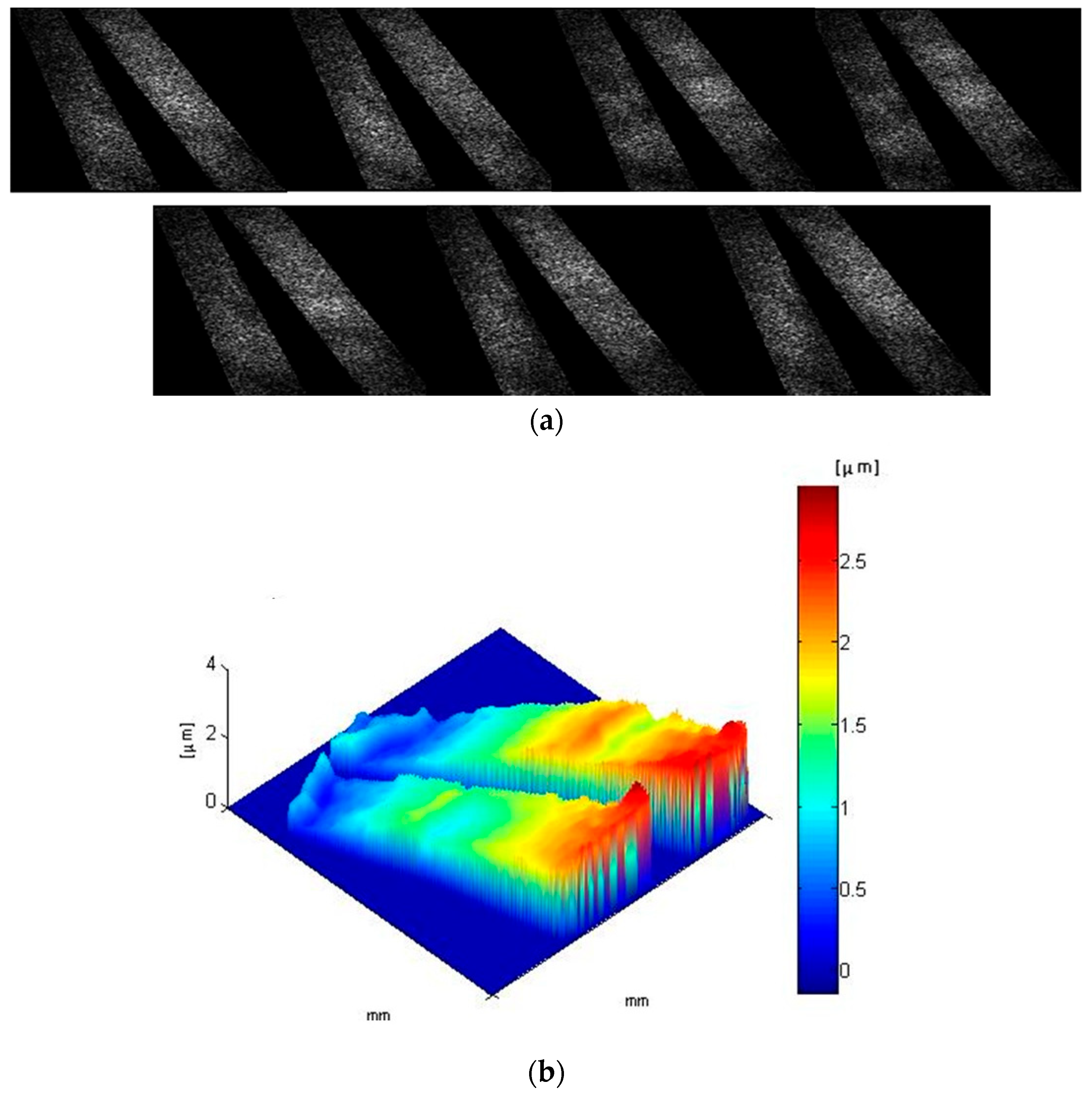
From the register of intensity patterns, a set of characteristic images of VF vibration patterns are generated by using Equation (4) to gain insight into their functionality; these studies may reveal, for example, the presence of vocal nodules, among other VC disorders. Figure 8 shows the resulting fringe patterns of the VCs. If the fringe patterns suffer variations in, for example, shape, continuity, or number of fringes, it is an indicator that the sample is suffering damage. It is likely that this damage is, for example, an internal tumor or that the tissue is losing or increasing its elasticity so that its movement decreases or increases; therefore, these resulting patterns and the information obtained from them truly help in a complementary approach to diagnose the state of the VCs.

5.2. Skin Tissue

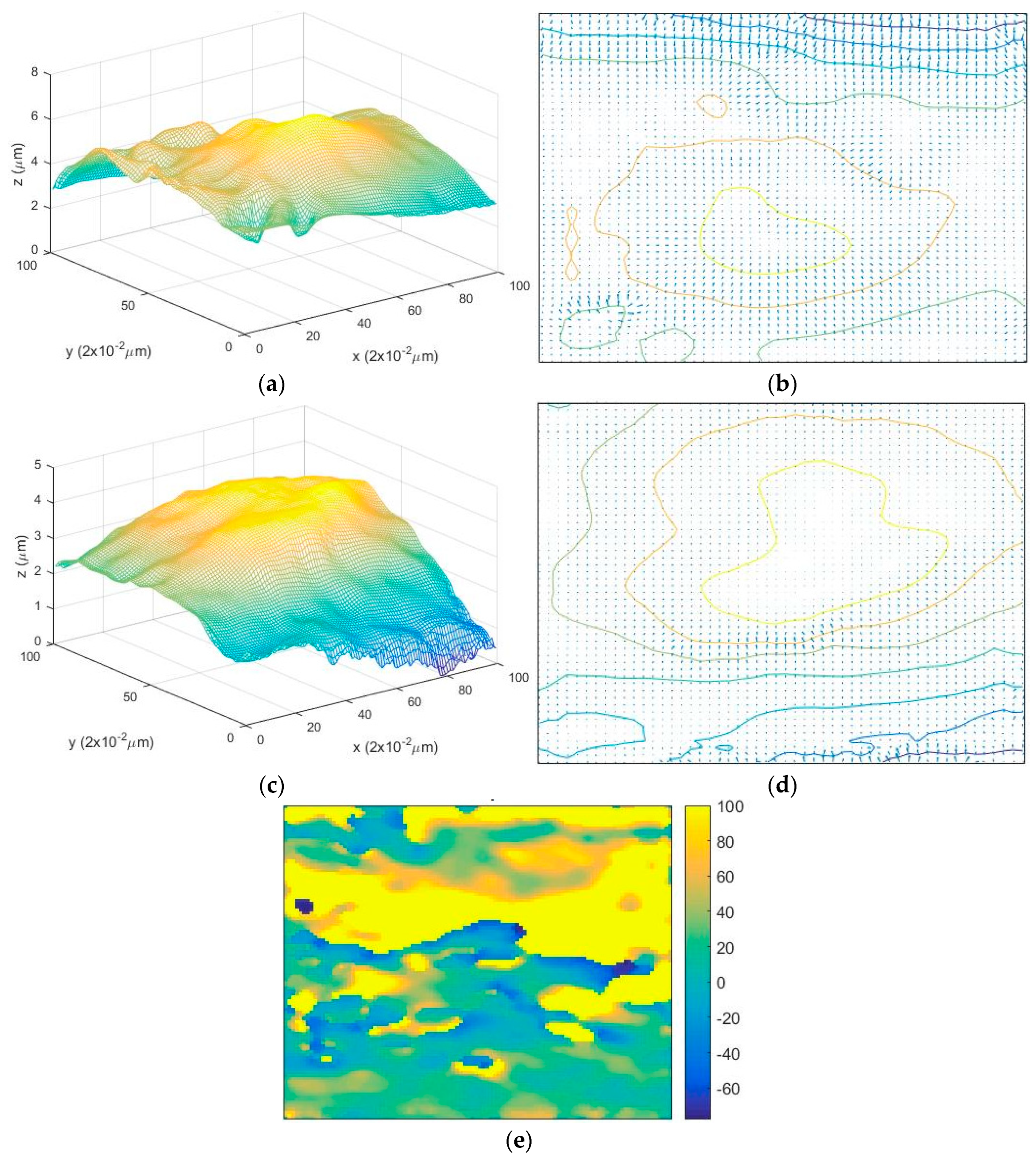
Another study to illustrate the usefulness of the DHI technique was carried out to determine the elasticity in soft tissue such as the skin; in this case, the skin was obtained from a mouse. It is well known that skin elasticity is one of the properties that is affected by UV rays, and therefore, it is important to quantify it in the form of displacements as a process to distinguish between healthy tissues and tissues with exposure or overexposure to UV radiation. For this research study, the out-plane interferometer shown in Figure 4 was used, and the sample was illuminated with a laser beam at λ = 532 nm. A sinusoidal acoustic excitation of 1.3 kHz perpendicular to the surface was applied to the tissue with a sound pressure of 93 dB SPL (0.893 Pa), sufficient to induce displacements of the surface; details of the DHI utilized are explained in Section 3.2.1 and Figure 4.
Figure 9 illustrates results from a skin tissue using DHI: the aim was to characterize it through the quantification of the displacements, where a maximum amplitude of ~7 μm was quantified, using Equation (17), for the skin sample without exposure to UV radiation (control sample) shown in Figure 9a; the corresponding strain field depicted with colors and vector maps and as contour maps in Figure 9b was calculated using Equation (20). In Figure 9c, the results showed that the displacements were reduced to a maximum amplitude of ~5 μm after 6 min of skin being UV irradiated at 8 mW/cm2; the corresponding strain field, depicted with colors and vector maps and as contour maps, is shown in Figure 9d. In Figure 9b,d, the strain fields are shown as vector maps indicating regions where the strain increases or decreases, represented by the orientation of the vector heads and the way the skin deforms, i.e., where there is a nominal change in length of the skin. The resulting elastic coefficient is shown in Figure 9e. These parameters were measured before and after the sample was aged in a UV irradiation chamber to find changes in them [108]. The decrease in displacement is indicative of the decrease in skin elasticity, which could be a sign of skin diseases caused by dehydration and aging, among other illnesses.

5.3. The Melanoma Cell, Onion Cell, and Bacterium

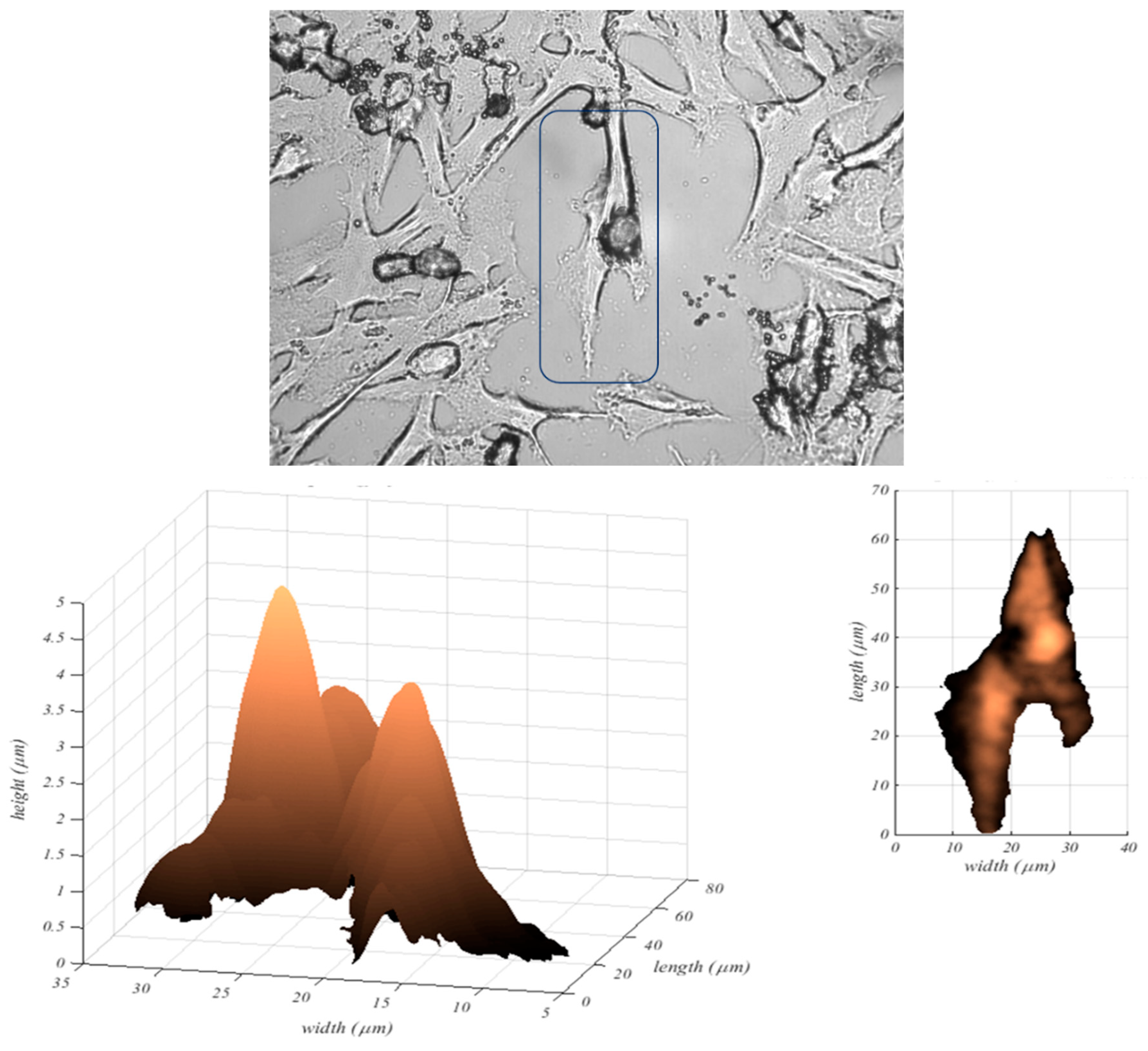
Here, we illustrate the capacity of DHI to determine the thickness/height and shape of the melanoma cell [122]. The importance of finding these parameters is that the effects caused by a disease provoke changes in cells, such as in their morphology (shape) [123]. Figure 10 shows the cell observed with an optical microscope and the results obtained with DHI, where the height of the melanoma cell has a maximum value of 4.6 μm on its nucleus, a length of 60 μm, and a width of 30 μm. A DHI transmission interferometer with a 532 nm laser was used. Details of the design of this interferometer can be found in [110,122]. The variation in the cell’s characteristics may indicate signs of a malignant disease that will result in different biomechanical/morphological properties compared to healthy cells; as a result, these properties may provide complementary information for the diagnosis of a disease such as cancer.
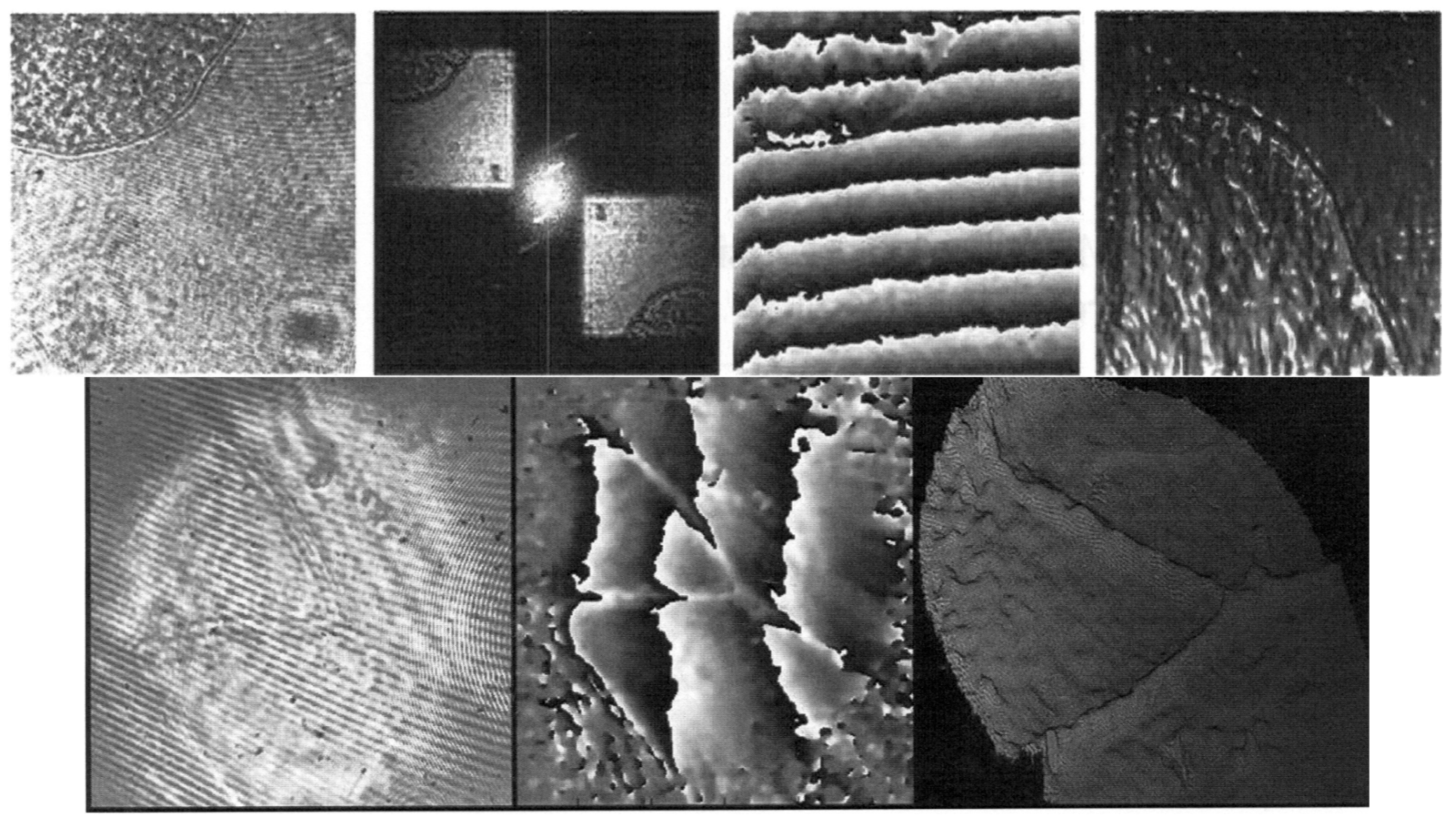
As illustrated in Figure 11, the experimental results were obtained by subjecting the samples (probiotic bacterium and onion epidermal cell) to coherent illumination and subsequently recording the intensity of the diffracted light field using a CCD camera (Excelitas Technologies in Kelheim, Bavaria, Germany). The recorded data were processed by a computer to recover the complex field scattered by the object, from which its quantitative properties were reconstructed.

5.4. Tooth Sample

The authors report on a three-color digital holography layout used to simultaneously obtain the three-dimensional displacement field on the surface of a tooth sample [125].
In Section 3.2, it was mentioned that with the techniques, it is also possible to measure displacements in each direction, x, y, and z, with a full field of view on the sample surface. To conduct measurements at the same time, viz., simultaneously, a three-color digital holography was recently developed that produces measurements of the 3D displacement field on the specimen surface. The samples were lower molars prepared to receive a specific monolithic ceramic reconstruction. During the experiments, the samples were subjected to mechanical loads ranging from 5 N to 120 N applied on a small part of the lingual cusp, where very small load levels, such as 0.1 N, were reached.
The method and optical setup use green, red, and blue lasers that simultaneously illuminate the sample surface from different illumination angles. Three-color digital holograms are digitally recorded with a color camera sensor, and then, the computation of the 3D displacement fields is possible with single-shot recordings [125,126]. The cumulative displacement is calculated from the set of displacement fields obtained from each loading step.
The results are displayed as wrapped phase maps calculated between two deformation states for each color observed. These phase maps are used to calculate the displacement fields for x, y, and z [125].

6. Aids and Trends of Non-Invasive Digital Speckle Methods

The methods presented in this review comprise laser sources, modern electronics, computers, and software that aid in producing extremely powerful sensing instruments, which are capable of measuring a variety of variables, not only qualitatively but also quantitatively, and they do so non-invasively. If we look at the biomedical fields, we find that auscultation is very common among physicians: they use palpation as a qualitative diagnosis method or an interactive means where the patient is subjected to clinical diagnostic studies [127].
With this in mind, new technologies and methods have been developed to detect changes in soft/hard tissues and cells, among others, taking advantage of all the benefits of the laser speckle phenomena in optical methods, like their non-invasive nature and the needlessness of mechanical/material interactions with the sample to be tested. These techniques aid in the full field-of-view characterization of the sample, where the response of the variations in the entire area is observed in real time.
In order to form the image of the sample, the setups shown in Figure 1 and Figure 2 can be implemented with or without the use of lenses; the latter generally uses digital focusing. They have the capability to be miniaturized, since it is possible to avoid the use of lenses and mirrors by using single-mode optical fibers to convey light throughout the setup; the size of elements such as cameras and lasers can be reduced as well, a clear technological tendency for both devices. Recent advancements in the field have given rise to versatile, flexible, and computational configurations that facilitate simultaneous imaging across two distinct fields of view, encompassing both small-and large-scale imaging modalities. Other configurations leverage multiple wavelengths, as illustrated in Figure 2, in order to extend the range of measurement. Furthermore, the integration of artificial intelligence and deep learning algorithms has led to significant reductions in the time required for optical phase recovery, a significant development in the field.
These methods allow samples to be studied in both static and dynamic modes, and these samples do not require markers or stains that could alter them and thus affect the results. Research can be conducted on both in vitro samples and live samples, enabling rapid imaging. Another feature is that non-invasive optical methodologies allow investigation through qualitative and quantitative biomechanical properties of the tissue, and the resulting data can provide signs of health or disease of the tissue, with the readily identified benefit that it is possible to differentiate special characteristics in them.
For the sake of completeness, other speckle methods have been developed and applied to study and recover optical and mechanical properties in the field of biomedical optics; Table 2 was created for this purpose. It presents a summary of other well-established proposals and concise descriptions of additional methods that have actually been used in biomedical applications. This table provides an overview of the advantages and limitations of these methods, as well as the parameters that can be obtained using them. The importance of incorporating these techniques lies in the fact that they are non-invasive measurements, a concept they share with the DHM, DSPI, and DHI methods, which are described in detail.

6.1. Current Speckle Methods

The latest developments in speckle methods represent a revolutionary change in the manner by which we measure and comprehend the physical and biological world, and this shift is not merely limited to the use of superior cameras or lasers. This indicates that by employing this method, the disciplines of optics, mechanics, and biology are integrated to propel scientific advancement. The construction of cost-effective sensors can be facilitated by miniaturizing the system, and with the additional advantage of artificial intelligence and deep learning, their utilization can be extended beyond the confines of a laboratory setting. This approach facilitates the acquisition of real-time, non-invasive data regarding the condition or function of tissue prior to and following a change. In this context, new areas of scientific research are continually being developed. Within the scope of this manuscript, it is imperative to highlight these recent works:

6.1.1. Speckle Contrast Optical Spectroscopy

Speckle contrast optical spectroscopy (SCOS), also called diffuse speckling contrast analysis (DSCA), records speckling patterns, which are interference patterns generated by coherent backscattered light from tissue. SCOS is a camera-based technique that uses long-coherence laser illumination at wavelengths that are sensitive to tissue scattering and absorption, thereby enabling measurements with a high signal-to-noise ratio (SNR). This has resulted in an improvement of more than an order of magnitude in SNR. Camera exposure times are typically longer than the decorrelation time of the speckle field, allowing a wider detection area with high pixel density to collect more photons and speckles. Recent advances in single-photon avalanche diode (SPAD) cameras have enabled exceptional sensitivity, temporal resolution, and high-speed imaging capabilities [147,148].
In the analysis of diffuse speckle contrast and to quantify the measured changes in the tissue, the spatial contrast of the speckle pattern (κ) is used, defined as the standard deviation of the speckle image intensity (σI(ρ,T)) divided by the mean speckle intensity (I). It is possible to quantify the statistical fluctuation of the speckle pattern as the variance of the measured intensity (σ2I), both in the spatial and temporal domains. This analysis has established itself as an innovative optical imaging technique for tracking dynamic biological processes such as blood flow and tissue perfusion.
Research has been conducted into the simultaneous measurement of microvascular blood volume and flow oscillations at multiple anatomical sites, as well as the monitoring of cerebral blood flow and tissue function. Consequently, these advances represent an accessible and accurate method for monitoring blood flow, with considerable potential to advance medicine and neuroscience [149,150,151,152].

6.1.2. Laser Speckle Rheology

Laser speckle rheology (LSR) is a non-contact optical technique that evaluates the viscoelastic properties of biological tissues and biomaterials without the need for external forces, physical contact with the sample, or exogenous particles. This approach is passive, based on the principles of interferometry, and allows for the study of biological samples without any damage or alteration. It works by analyzing the speckle pattern created when coherent laser light scatters upon interaction with particles in a sample, such as tissues, biological fluids, and others. In order to achieve this objective, the intensity of the resulting pattern must be recorded, and the fluctuations in these interference patterns over time—caused by particle motion—must be measured. The continuous thermal motion of endogenous scattering particles has been demonstrated to modify the optical phase shifts of the backscattered rays, thereby giving rise to time-varying speckle intensity fluctuations. These fluctuations have been shown to be highly sensitive to particle displacements. These fluctuations correlate with the viscoelastic and elasticity properties of the surrounding microenvironment. Thus, LSR enables the acquisition of high-resolution images of mechanical properties across a wide range of frequencies from kHz to MHz [153,154,155,156].
Studies have been reported on blood coagulation and thrombosis, tumor mechanics, and corneal biomechanics to determine the stiffness of bacterial biofilm implants [157,158,159,160,161,162,163].

6.1.3. Laser Speckle Contrast Imaging (LSCI)

Laser speckle contrast imaging (LSCI) is a high-resolution, non-contact, markerless, full-field optical technique used to map microvascular blood flow and perfusion in real time. Also known as laser speckle contrast analysis (LASCA) and sometimes referred to as laser speckle imaging (LSI), it is an imaging modality based on the analysis of the blurring effect of laser speckle patterns caused, for example, by the movement of red blood cells. It provides instantaneous full-field perfusion images.
The fundamental physical principle underpinning this process entails the illumination of tissue with expanded coherent laser light. The light is subsequently scattered by the tissue, a phenomenon that occurs, for instance, in capillaries. This scattering gives rise to a random speckle pattern on the CCD camera or CMOS sensors owing to the interference of the coherent light. When the scattered particles move over time, the interference caused by the coherent light will exhibit fluctuations that result in intensity variations detected by the photodetector. This change in intensity contains information about the movement of the scattered particles. In the event of the scatterers (e.g., red blood cells) being in motion, the speckle pattern will undergo a rapid alteration and become “blurred” during the camera’s exposure time. The spatial contrast (K) is calculated in each region of the image K = s t a n d a r   d e v i a t i o n a v e r a g e   i n t e n s i t y = σ I . The relation with velocity is K 2 τ c T , where T is exposure time, and τ c is the decorrelation time.
In biomedical applications, coherent light is typically in the red or near-infrared region to ensure greater penetration depth [164,165,166]. Its use is commonplace in neuroimaging, dermatology, and surgery, for example, to distinguish between superficial and deep burns; to assess blood flow in the retina, choroid, and optic nerve; to evaluate perfusion in the fingers for Raynaud’s disease and scleroderma; to monitor wound healing; and to assess perfusion of flaps, kidneys, and livers during surgery [167,168,169,170,171]. LSCI has become more advanced through the use of tools such as multi-exposure, AI, and vortex beam, to name a few [172,173,174,175].

6.1.4. Vortex Beam Dynamic Speckle Interference Microscopy (VSIM)

VSIM is an imaging technique that relates dynamic speckle illumination with orbital angular momentum vortex beams; it can also be combined with common-path phase-shift interferometry to obtain high-resolution quantitative phase images. Further, by manipulating the angular properties of perfect optical vortex beams, VSIM generates a refined speckle pattern, offering clear advantages over traditional coherent imaging systems. Thus, it enables high-resolution, non-invasive, and label-free phase retrieval, establishing VSIM as a reliable tool for biomedical imaging. This innovative method allows for the observation of not only movement but also rotational dynamics, thereby providing a comprehensive mechanical picture of living tissue. Additionally, it facilitates the quantification of translational and rotational dynamics in turbid/biological samples with nanometer-scale sensitivity [176,177,178,179]. In addition, it extends conventional laser speckle rheology by enhancing sensitivity to shear, vorticity, and torque. It has been applied to red blood cells (RBCs), A549 cells, blood flow mapping, vorticity in capillaries, measuring the rotation of mitochondria, and tumor mechanics [180,181,182].
Recent contributions include AI-based dynamic speckle and speckle interferometry on a photonic chip and 4D digital holographic microscopy, in addition to other proposals that are constantly evolving and promise advances and applications in biomedicine [183,184,185,186,187].

7. Conclusions

Speckle was first seen as a nuisance optical phenomenon, but it was soon identified as arising from an interferometric process. As years passed, it has been used in a wide variety of non-destructive, non-invasive, non-contact applications. In particular, of great importance is its use as a sensor in the field of biomedicine, where it finds uses in the characterization of crucial parameters in biological samples. Extraordinary advances in research using DHM, DSPI, and DHI in 1D and 3D are reported, where diverse technological developments have made these methods the standard for high-precision testing in biomedical research and other fields of science and engineering.
From the myriad of examples found in the literature, in this review, we pointed out research that shows the potential of the DHM, DSPI, and DHI techniques to retrieve biomechanical parameters of the sample under investigation, such as displacements/deformations, strain, refractive index, and contouring (shape/morphology). Of course, there are other important and knowledge-breaking studies using optical non-invasive methods, but we only picked what we considered the most representative in the field of DHM, DSPI, and DHI applied to the biomedical field and thus included soft/hard/micro/macro tissue samples.
These techniques are novel sensor instruments in biomedicine, and they serve to generate and gather important data on their physiology and visualization as 3D images in real time. Also, these techniques have proven their capability in providing full-field-of-view, non-invasive qualitative and quantitative data and analyses of samples.
It was shown that non-invasive optical methods are useful for the study of biological samples as a fundamental tool to generate new information and complementary studies that help in the diagnosis of the state of the samples.
Also, we presented the procedure to carry out research in the area of biomedicine and studies in representative samples: vocal cords, skin, cells, and teeth. These applications concern issues that are currently related to life problems and must be investigated with non-invasive optical methods to maintain their integrity. Medical research should help resolve many of the still-unanswered questions about the interrelationship between quantified parameters, such as displacements, stress, strain, shape, and others of the samples under study, with their physical and biomechanical condition, among others. A clear trend is the increasing influence and involvement of DHM, DSPI, and DHI to perform surface measurements while maintaining the integrity of the samples to be evaluated. This has permitted the innovative development of these methods with the aim of finding and providing solutions for sample characterization and increasing their knowledge thereof. In addition, it was shown that advances in these established methods have led to the creation of new methods based on the speckle effect.

Author Contributions

Conceptualization: M.d.S.H.-M.; writing—original draft preparation: M.d.S.H.-M. and F.M.-S.; writing—review and editing: F.M.-S. and M.d.S.H.-M. All authors have read and agreed to the published version of the manuscript.

Funding

This research received no external funding.

Institutional Review Board Statement

Not applicable.

Informed Consent Statement

Not applicable.

Data Availability Statement

The original contributions presented in the study are included in the article, further inquiries can be directed to the corresponding author.

Acknowledgments

The authors acknowledge their institution for support. We are also grateful for the research work done by our students Luis Silva Acosta and Natalith Palacios Ortega; their names are included in our publications.

Conflicts of Interest

The authors declare no conflicts of interest.

References

  1. Johnston, S.F. Holography. From Science to Subcultures. Opt. Photonics News 2004, 15, 36–41. [Google Scholar] [CrossRef]
  2. Arslan, M.; Sürmeli, K. Types of Holography in Artistic Practices. ARTic 2025, 8, 957–974. [Google Scholar] [CrossRef]
  3. Beléndez, A.; Sheridan, J.T.; Pascual, I. Celebrating holography anniversaries: A historical perspective. In Photosensitive Materials and Their Applications II; SPIE: Bellingham, WA, USA, 2022; Volume 12151, p. 1215102. [Google Scholar]
  4. Kumar, R.; Dwivedi, G. Emerging scientific and industrial applications of digital holography: An overview. Eng. Res. Express 2023, 5, 032005. [Google Scholar] [CrossRef]
  5. Johnston, S.F. From white elephant to Nobel Prize: Dennis’ Gabor wavefront reconstruction. Hist. Stud. Phys. Biol. 2005, 36, 35–70. [Google Scholar] [CrossRef][Green Version]
  6. Kostuk, R.K. Holography: Principles and Applications; Taylor & Francis: Oxford, UK, 2024. [Google Scholar]
  7. Doval, A.F. A systematic approach to TV holography. Meas. Sci. Technol. 2000, 11, R1–R36. [Google Scholar] [CrossRef]
  8. Haleem, A.; Javaid, M.; Singh, R.P.; Suman, R.; Rab, S. Holography and its applications for industry 4.0: An overview. Internet Things Cyber-Phys. Syst. 2022, 2, 42–48. [Google Scholar] [CrossRef]
  9. Burner, A.; Fleming, G.; Hoppe, J. Comparison of three optical methods for measuring model deformation. In 38th Aerospace Sciences Meeting and Exhibit; AIAA: Reston, VA, USA, 2000; p. 835. [Google Scholar]
  10. Rastogi, P.K. (Ed.) Optical Measurement Techniques and Applications; Artech House Inc.: Boston, MA, USA; London, UK, 1997. [Google Scholar]
  11. Kulya, M.S.; Odlyanitskiy, E.L.; Cassar, Q.; Mustafin, I.A.; Trukhin, V.N.; Polina, G.; Gavrilova, P.G.; Korolev, D.V.; Kononova, Y.A.; Balbekin, N.S.; et al. Fast Terahertz Spectroscopic Holographic Assessment of Optical Properties of Diabetic Blood Plasma. J. Infrared Millim. Terahertz Waves 2020, 41, 1041–1056. [Google Scholar] [CrossRef]
  12. Osten, W.; Pedrini, G. 55 years of holographic non-destructive testing and experimental stress analysis: Is there still progress to be expected? Light Adv. Manuf. 2022, 3, 121–136. [Google Scholar] [CrossRef]
  13. Kujawińska, M. Modern optical measurement station for micro-materials and micro-elements studies. Sens. Actuators A Phys. 2002, 99, 144–153. [Google Scholar] [CrossRef]
  14. Kujawińska, M.; Lee, B.; Kim, J.; Kim, T. Special Issue on Digital Holographic 3D Imaging: Capture, Display, and Evaluation. ETRI J. 2019, 41, 7–9. [Google Scholar] [CrossRef]
  15. Fercher, A.; Briers, J. Flow visualization by means of single-exposure speckle photography. Opt. Commun. 1981, 37, 326–330. [Google Scholar] [CrossRef]
  16. Hök, B.; Nilsson, K.; Bjelkhagen, H. Imaging of chest motion due to heart action by means of holographic interferometry. Med. Biol. Eng. Comput. 1978, 16, 363–368. [Google Scholar] [CrossRef] [PubMed]
  17. Hernández-Montes, M.d.S.; Furlong, C.; Rosowski, J.J.; Hulli, N.; Harrington, E.; Cheng, J.T.; Ravicz, M.E.; Santoyo, F.M. Optoelectronic holographic otoscope for measurement of nano-displacements in tympanic membranes. J. Biomed. Opt. 2009, 14, 034023. [Google Scholar] [CrossRef] [PubMed]
  18. Kemmler, M.; Fratz, M.; Giel, D.; Saum, N.; Brandenburg, A.; Hoffmann, C. Noninvasive time-dependent cytometry monitoring by digital holography. J. Biomed. Opt. 2007, 12, 064002. [Google Scholar] [CrossRef]
  19. Khaleghi, M.; Furlong, C.; Ravicz, M.; Cheng, J.T.; Rosowski, J. Three-dimensional vibrometry of the human eardrum with stroboscopic lensless digital holography. J. Biomed. Opt. 2015, 20, 051028. [Google Scholar] [CrossRef]
  20. UrliĆ, I.; Demoli, N.; Pavan, J.; Šutej, I.; BaŠiĆ, R.; Vranic, D.N. Measuring tooth vibrations induced during cavity preparation with time-averaged holography and its influence on near vision acuity in dentists. Dent. Mater. J. 2021, 40, 123–128. [Google Scholar] [CrossRef] [PubMed]
  21. Lu, W.; Furlong, C.; Rosowski, J.J.; Cheng, J.T.; Merchant, S.N. Characterization of Shape and Deformation of Tympanic Membranes by Dual-wavelength Lensless Digital Holography. In Mechanics of Biological System and Materials; Springer: New York, NY, USA, 2011; Volume 2, pp. 199–207. [Google Scholar]
  22. Tiziani, H.J.; Pedrini, G. From speckle pattern photography to digital holographic interferometry [Invited]. Appl. Opt. 2013, 52, 30–44. [Google Scholar] [CrossRef]
  23. Kumar, M.; Agarwal, R.; Bhutani, R.; Shakher, C. Measurement of strain distribution in cortical bone around miniscrew implants used for orthodontic anchorage using digital speckle pattern interferometry. Opt. Eng. 2016, 55, 054101. [Google Scholar] [CrossRef]
  24. Servin, M.; Quiroga, J.A.; Padilla, M. Fringe Pattern Analysis for Optical Metrology: Theory, Algorithms, and Applications; John Wiley & Sons: Hoboken, NJ, USA, 2014. [Google Scholar]
  25. Takeda, M.; Ina, H.; Kobayashi, S. Fourier-transform method of fringe-pattern analysis for computer-based topography and interferometry. J. Opt. Soc. Am. 1982, 72, 156–160. [Google Scholar] [CrossRef]
  26. Su, X.; Chen, W. Reliability-guided phase unwrapping algorithm: A review. Opt. Lasers Eng. 2004, 42, 245–261. [Google Scholar] [CrossRef]
  27. Yamaguchi, I.; Zhang, T. Phase-shifting digital holography. Opt. Lett. 1997, 22, 16. [Google Scholar] [CrossRef] [PubMed]
  28. Gdeisat, M.A.; Burton, D.R.; Lilley, F.; Arevalillo-Herráez, M.; Ammous, M.M. Aiding phase unwrapping by increasing the number of residues in two-dimensional wrapped-phase distributions. Appl. Opt. 2015, 54, 10073–10078. [Google Scholar] [CrossRef]
  29. Quan, C.; Niu, H.; Tay, C.J. An improved windowed Fourier transform for fringe demodulation. Opt. Laser Technol. 2010, 42, 126–131. [Google Scholar] [CrossRef]
  30. Mendoza-Santoyo, F.; De la Torre-Ibarra, M.; del Socorro Hernández-Montes, M.; Flores Moreno, J.M. Full Field Optical Metrology and Applications; series 2053–2563; IOP Publishing: Bristol, UK, 2022; ISBN 978-0-7503-3027-5. [Google Scholar]
  31. Hernández-Montes, M.D.S.; Mendoza-Santoyo, F.; Flores Moreno, M.; de la Torre-Ibarra, M.; Acosta, L.S.; Palacios-Ortega, N. Macro to nano specimen measurements using photons and electrons with digital holographic interferometry: A review. J. Eur. Opt. Soc.-Rapid Publ. 2020, 16, 16. [Google Scholar] [CrossRef]
  32. Grycuk, S.; Mrozek, P. Scoliosis Brace Finite Element Model and Preliminary Experimental Testing Using Electronic Speckle Pattern Interferometry. Appl. Sci. 2022, 12, 3876. [Google Scholar] [CrossRef]
  33. Komninou, M.A.; Seiler, T.G.; Enzmann, V. Corneal biomechanics and diagnostics: A review. Int. Ophthalmol. 2024, 44, 132. [Google Scholar] [CrossRef]
  34. Silva, V.B.; Andrade De Jesus, D.; Klein, S.; Van Walsum, T.; Cardoso, J.; Brea, L.S.; Vaz, P.G.; Macha, M.A.; Bhat, M.R. Signal-carrying speckle in optical coherence tomography: A methodological review on biomedical applications. J. Biomed. Opt. 2022, 27, 3. [Google Scholar] [CrossRef] [PubMed]
  35. O’Connor, T.; Javidi, B. COVID-19 screening with digital holographic microscopy using intra-patient probability functions of spatio-temporal bio-optical attributes. Biomed. Opt. Express 2022, 13, 5377–5389. [Google Scholar] [CrossRef]
  36. El-Schich, Z.; Kamlund, S.; Janicke, B.; Alm, K.; Wingren, A.G. Holography: The usefulness of digital holographic microscopy for clinical diagnostics. In Holographic Materials and Optical Systems; IntechOpen: London, UK, 2017; pp. 319–333. [Google Scholar]
  37. Fernández, M.V.; Gonçalves, E.; Rivera, J.L.V.; Ricardo, J.; Abreu, M.E.F.; Vaz, M.A.P. Development of Digital Holographic Microscopy by reflection for analysis of surface. Results Phys. 2018, 11, 182–187. [Google Scholar] [CrossRef]
  38. Smith, Y. What Is Digital Holographic Microscopy? News-Medical. 26 February 2019. Available online: https://www.news-medical.net/life-sciences/What-is-digital-holographic-microscopy.aspx (accessed on 19 January 2026).
  39. Chaudhari, H.; Kulkarni, R.; Kumar Sundaravadivelu, P.; Thummer, R.P.; Bhuyan, M.K. Digital hologram reconstruction algorithm based on the fractional Fourier transform in non-telecentric digital holographic microscopy. Opt. Lett. 2024, 49, 182–185. [Google Scholar] [CrossRef]
  40. Yu, X.; Hong, J.; Liu, C.; Kim, M.K. Review of digital holographic microscopy for three-dimensional profiling and tracking. Opt. Eng. 2014, 53, 112306. [Google Scholar] [CrossRef]
  41. Mihaylova, E.M. Imaging of Live Cells by Digital Holographic Microscopy. Photonics 2024, 11, 980. [Google Scholar] [CrossRef]
  42. Garcia-Sucerquia, J.; Xu, W.; Jericho, S.K.; Klages, P.; Jericho, M.H.; Kreuzer, H.J. Digital in-line holographic microscopy. Appl. Opt. 2006, 45, 836–850. [Google Scholar] [CrossRef]
  43. Huang, Z.; Cao, L. Quantitative phase imaging based on holography: Trends and new perspectives. Light Sci. Appl. 2024, 13, 145. [Google Scholar] [CrossRef] [PubMed]
  44. Charles, M.V. Holographic Interferometry; John Wiley & Sons: Hoboken, NJ, USA, 1979. [Google Scholar]
  45. Rastogi, P.K. (Ed.) Holographic Interferometry: Principles and Methods; Springer: Berlin/Heidelberg, Germany, 2013; Volume 68. [Google Scholar]
  46. Gao, P.; Yuan, C. Resolution enhancement of digital holographic microscopy via synthetic aperture: A review. Light Adv. Manuf. 2022, 3, 105–120. [Google Scholar] [CrossRef]
  47. Schnars, U.; Falldorf, C.; Watson, J.; Jüptner, W. Digital holography. In Digital Holography and Wavefront Sensing: Principles, Techniques and Applications; Springer: Berlin/Heidelberg, Germany, 2014; pp. 39–68. [Google Scholar]
  48. Nehmetallah, G.; Williams, L.; Nguyen, T. Latest advances in single and multiwavelength digital holography and holographic microscopy. In Augmented Reality and Its Application; IntechOpen: London, UK, 2020. [Google Scholar]
  49. Huang, C.H.; Tu, H.Y.; Cheng, C.J. Multi-wavelength varifocal common-path configuration for digital holographic microscopy. In Optical Measurement Systems for Industrial Inspection XIV; SPIE: Bellingham, WA, USA, 2025; Volume 13567, pp. 45–48. [Google Scholar]
  50. Warnasooriya, N.; Kim, M.K. Quantitative phase imaging using multi-wavelength optical phase unwrapping. In Advances in Lasers and Electro Optics; IntechOpen: London, UK, 2010. [Google Scholar][Green Version]
  51. Li, J.; Li, C.; Zhang, Q.; Wu, B.; Liu, T.; Lu, X.; Di, J.; Zhong, L. Multi-wavelength network: Predicted-illumination for phase unwrapping in quantitative phase imaging. Opt. Laser Technol. 2023, 167, 109781. [Google Scholar] [CrossRef]
  52. Funamizu, H.; Sugata, K.; Uozumi, J.; Aizu, Y. Two-wavelength digital holographic microscopy using speckle illuminations. Opt. Lasers Eng. 2020, 128, 105993. [Google Scholar] [CrossRef]
  53. Palacios-Ortega, N.; Hernández-Montes, M.D.S.; Santoyo, F.M.; Flores-Moreno, M.; de la Torre Ibarra, M.; Luis-Noriega, D.; Méndez-Sashida, P.G. Simultaneous dual-wavelength digital holographic microscopy as a tool for the analysis of keratoacanthoma skin samples. J. Phys. D Appl. Phys. 2023, 57, 025401. [Google Scholar] [CrossRef]
  54. Mirsky, S.K.; Shaked, N.T. Dynamic three-wavelength imaging and volumetry of flowing cells with doubled field of view by six-pack holography. Appl. Phys. B 2022, 128, 92. [Google Scholar] [CrossRef]
  55. Mirsky, S.K.; Shaked, N.T. Six-pack holography for dynamic profiling of thick and extended objects by simultaneous three-wavelength phase unwrapping with doubled field of view. Sci. Rep. 2023, 13, 19293. [Google Scholar] [CrossRef]
  56. Vijay, A.; Mohamed, N.; Kumar, P.; John, R. An integrated portable system for laser speckle contrast imaging and digital holographic microscopy. Opt. Commun. 2025, 575, 131240. [Google Scholar] [CrossRef]
  57. Kumar, R.; Dwivedi, G.; Singh, O. Portable digital holographic camera featuring enhanced field of view and reduced exposure time. Opt. Lasers Eng. 2021, 137, 106359. [Google Scholar] [CrossRef]
  58. Latychevskaia, T.; Fink, H.W. Practical algorithms for simulation and reconstruction of digital in-line holograms. Appl. Opt. 2015, 54, 2424–2434. [Google Scholar] [CrossRef]
  59. Cuche, E.; Marquet, P.; Dahlgren, P.; Depeursinge, C. Digital holographic microscopy, a new method for simultaneous amplitude-and quantitative phase-contrast imaging. In Interferometry in Speckle Light: Theory and Applications; Springer: Berlin/Heidelberg, Germany, 2000; pp. 213–218. [Google Scholar]
  60. Liebling, M.; Unser, M. Comparing algorithms for reconstructing digital off-axis fresnel holograms. In Three-Dimensional TV, Video, and Display IV; SPIE: Bellingham, WA, USA, 2005; Volume 6016, pp. 213–222. [Google Scholar]
  61. Prado, F.M.; Utiyama, K.A.; Toffoli, D.J.; Wetter, N.U.; da Silva, S.L. Computational algorithm from the Huygens-Fresnel’s diffraction integral for two-dimensional holographic reconstruction. Rev. Bras. Ensino Física 2021, 44, e20210193. [Google Scholar] [CrossRef]
  62. Li, J.C.; Tankam, P.; Peng, Z.J.; Picart, P. Digital holographic reconstruction of large objects using a convolution approach and adjustable magnification. Opt. Lett. 2009, 34, 572–574. [Google Scholar] [CrossRef]
  63. Tang, Z.; Hennelly, B.M. Real-time synthetic-aperture digital holographic microscopy. Opt. Laser Technol. 2025, 188, 112848. [Google Scholar] [CrossRef]
  64. Lédl, V.; Psota, P.; Doleček, R.; Vít, T. Digital holographic setups for phase object measurements in micro and macro scale. In EPJ Web of Conferences; EDP Sciences: Les Ulis, France, 2015; Volume 92, p. 01001. [Google Scholar]
  65. Wu, T.; Yang, Y.; Wang, H.; Chen, H.; Zhu, H.; Yu, J.; Wang, X. Investigation of an Improved Angular Spectrum Method Based on Holography. Photonics 2023, 11, 16. [Google Scholar] [CrossRef]
  66. Chen, C.; Chang, K.; Liu, C.; Wang, J.; Wang, Q. Fast hologram generation using intermediate angular-spectrum method for high-quality compact on-axis holographic display. Opt. Express 2019, 27, 29401–29414. [Google Scholar] [CrossRef]
  67. Etchepareborda, P.; Connolly, P.; Henneberger, J.; Crosier, J. Distortion Free Angular Spectrum Method for Digital Inline Holographic Microscopy. In Digital Holography and Three-Dimensional Imaging; Optica Publishing Group: Washington, DC, USA, 2022; p. Th2A-3. [Google Scholar]
  68. Kim, J.; Kim, Y.; Lee, H.S.; Seo, E.; Lee, S.J. Single-shot reconstruction of three-dimensional morphology of biological cells in digital holographic microscopy using a physics-driven neural network. Nat. Commun. 2025, 16, 4840. [Google Scholar] [CrossRef] [PubMed]
  69. Chen, B.; Li, Z.; Zhou, Y.; Zhang, Y.; Jia, J.; Wang, Y. Deep-learning multiscale digital holographic intensity and phase reconstruction. Appl. Sci. 2023, 13, 9806. [Google Scholar] [CrossRef]
  70. Wang, H.; Li, Q.; Wang, S.; Men, G. Multi-scale digital holographic reconstruction with deep learning. Appl. Opt. 2024, 64, B31–B37. [Google Scholar] [CrossRef]
  71. Lin, Z.; Jia, S.; Zhang, H.; Wen, B.; Han, M.; Wang, L. A super-resolution phase reconstruction method for digital holographic microscopy based on compressed sensing and deep learning. Opt. Laser Technol. 2026, 193, 114167. [Google Scholar] [CrossRef]
  72. Dar, A.U.; Singh, M.; Assad, A.; Macha, M.A.; Bhat, M.R. Applications of artificial intelligence and digital holography in biomedical microscopy. Int. J. Syst. Assur. Eng. Manag. 2025, 1–16. [Google Scholar] [CrossRef]
  73. Ren, Z.; Xu, Z.; Lam, E.Y. End-to-end deep learning framework for digital holographic reconstruction. Adv. Photonics 2019, 1, 016004. [Google Scholar] [CrossRef]
  74. Wang, Z.; Millet, L.; Mir, M.; Ding, H.; Unarunotai, S.; Rogers, J.; Gillette, M.U.; Popescu, G. Spatial light interference microscopy (SLIM). Opt. Express 2011, 19, 1016–1026. [Google Scholar] [CrossRef]
  75. Min, E.; Kandel, M.E.; Ko, C.J.; Popescu, G.; Jung, W.; Best-Popescu, C. Label-free, multi-scale imaging of ex-vivo mouse brain using spatial light interference microscopy. Sci. Rep. 2016, 6, 39667. [Google Scholar] [CrossRef]
  76. Osten, W.; Faridian, A.; Gao, P.; Körner, K.; Naik, D.; Pedrini, G.; Kumar, S.; Takeda, M.; Wilke, M. Recent advances in digital holography [Invited]. Appl. Opt. 2014, 53, G44–G63. [Google Scholar] [CrossRef] [PubMed]
  77. Soons, J.; Lava, P.; Debruyne, D.; Dirckx, J. Full-field optical deformation measurement in biomechanics: Digital speckle pattern interferometry and 3D digital image correlation applied to bird beaks. J. Mech. Behav. Biomed. Mater. 2012, 14, 186–191. [Google Scholar] [CrossRef]
  78. Kumarogi, P.K.; Hack, E. (Eds.) Optical Methods for Solid Mechanics: A Full-Field Approach; John Wiley & Sons: Hoboken, NJ, USA, 2013. [Google Scholar]
  79. Jonathan, E. Non-contact and non-destructive testing of silicon V-grooves: A non-medical application of optical coherence tomography (OCT). Opt. Lasers Eng. 2006, 44, 1117–1131. [Google Scholar] [CrossRef]
  80. Kumar, R.A.; Kumar, R.S.; Sreejyothi, S.; Raj, V.; Swapna, M.S.; Sankararaman, S. Development of prototype of electronic speckle interferometry based spirometer. Opt. Lasers Eng. 2021, 136, 106318. [Google Scholar] [CrossRef]
  81. Types of Lasers—Solid State Laser, Gas Laser, Liquid Laser & Semiconductor Laser. Available online: https://www.physics-and-radio-electronics.com (accessed on 4 November 2025).
  82. Toker, G.; Bulatov, V.; Kovalchuk, T.; Schechter, I. Underwater interaction of 1064 nm laser radiation with metal target. Int. J. Phys. Math. Sci. 2009, 3, 453–456. [Google Scholar]
  83. Helmers, H.; Schellenberg, M. CMOS vs. CCD sensors in speckle interferometry. Opt. Laser Technol. 2003, 35, 587–595. [Google Scholar] [CrossRef]
  84. Georges, M.P.; Thizy, C.; Languy, F.; Zhao, Y.; Vandenrijt, J.F. Digital holographic interferometry and speckle interferometry applied on objects with heterogeneous reflecting properties. Appl. Opt. 2019, 58, G318–G325. [Google Scholar] [CrossRef]
  85. Kreis, T. Handbook of Holographic Interferometry: Optical and Digital Methods; John Wiley & Sons: Hoboken, NJ, USA, 2006. [Google Scholar]
  86. Léon, O.; Donjat, D.; Olchewsky, F.; Desse, J.M.; Nicolas, F.; Champagnat, F. Three-dimensional density field of a screeching under-expanded jet in helical mode using multi-view digital holographic interferometry. J. Fluid Mech. 2022, 947, A36. [Google Scholar] [CrossRef]
  87. Xia, P.; Ri, S.; Inoue, T.; Awatsuji, Y.; Matoba, O. Three-dimensional dynamic measurement of unstable temperature fields by multi-view single-shot phase-shifting digital holography. Opt. Express 2022, 30, 37760–37768. [Google Scholar] [CrossRef]
  88. Pan, Y.; Wang, K. Dynamic measurement of 3D displacements using dual-camera lensless Fourier transform digital holography. Appl. Opt. 2023, 62, 5115–5125. [Google Scholar] [CrossRef]
  89. Alvarez, A.S.; Manuel, H.; Santoyo, F.M.; Anaya, T.S. Strain determination in bone sections with simultaneous 3D digital holographic interferometry. Opt. Lasers Eng. 2014, 57, 101–108. [Google Scholar] [CrossRef]
  90. Hernandez-Montes, M.D.S.; Santoyo, F.M.; Munoz, S.; Perez, C.; de la Torre, M.; Flores, M.; Alvarez, L. Surface strain-field determination of tympanic membrane using 3D-digital holographic interferometry. Opt. Lasers Eng. 2015, 71, 42–50. [Google Scholar] [CrossRef]
  91. Lv, C.; Wang, K.; Gu, G.; Pan, Y. Accurate full-edge detection and depth measurement of internal defects using digital speckle pattern interferometry. NDT E Int. 2019, 102, 1–8. [Google Scholar] [CrossRef]
  92. Dávila, A. Handbook of Speckle Interferometry; SPIE Press: Bellingham, WA, USA, 2022. [Google Scholar]
  93. Kumar, M.; Kumar, V.; Shakher, C. Measurement of temperature and temperature distribution in diffusion flames using digital speckle pattern interferometry. In Eleventh International Conference on Correlation Optics; SPIE: Bellingham, WA, USA, 2013; Volume 9066, pp. 290–296. [Google Scholar]
  94. Yan, K.; Chang, L.; Andrianakis, M.; Tornari, V.; Yu, Y. Deep learning-based wrapped phase denoising method for application in digital holographic speckle pattern interferometry. Appl. Sci. 2020, 10, 4044. [Google Scholar] [CrossRef]
  95. Pedrini, G.; Alekseenko, I.; Osten, W.; Gaspar, J.; Schmidt, M.E.; Paul, O. Measurement of nano/micro out-of-plane and in-plane displacements of micromechanical components by using digital holography and speckle interferometry. Opt. Eng. 2011, 50, 101504. [Google Scholar]
  96. Georges, M. Holographic interferometry: From history to modern applications. In Optical Holography; Elsevier: Amsterdam, The Netherlands, 2020; pp. 121–163. [Google Scholar]
  97. Kaufmann, G.H. Phase measurement in temporal speckle pattern interferometry using the Fourier transform method with and without a temporal carrier. Opt. Commun. 2003, 217, 141–149. [Google Scholar] [CrossRef]
  98. Lobera, J.; Andrés, N.; Arroyo, M.P. Digital speckle pattern interferometry as a holographic velocimetry technique. Meas. Sci. Technol. 2004, 15, 718. [Google Scholar] [CrossRef]
  99. Orakzai, M.S.; Amin, S.; Khan, Z.A.; Akram, F. Fast and highly accurate phase unwrapping algorithm for displacement retrieval using self-mixing interferometry sensor. Opt. Mater. 2022, 129, 112553. [Google Scholar] [CrossRef]
  100. Tankam, P.; Song, Q.; Karray, M.; Li, J.; Desse, J.M.; Picart, P. Real-time three-sensitivity measurements based on three-color digital Fresnel holographic interferometry. Opt. Lett. 2010, 35, 2055–2057. [Google Scholar] [CrossRef] [PubMed]
  101. Morimoto, Y.; Matui, T.; Fujigaki, M.; Matsui, A. Three-dimensional Displacement Analysis by Windowed Phase-shifting Digital Holographic Interferometry. Strain 2008, 44, 49–56. [Google Scholar] [CrossRef]
  102. Rastogi, P.K.; Pflug, L. Measurement of Large Out-of-plane Displacements Using Two Source Holographic Interferometry. J. Mod. Opt. 1994, 41, 589–594. [Google Scholar] [CrossRef]
  103. Sharpe, W.N. (Ed.) Springer Handbook of Experimental Solid Mechanics; Springer: New York, NY, USA, 2008. [Google Scholar]
  104. Fei, G.; Maiyu, Z.; Mei, Z.; Yufang, S.; Peng, L. Out of plane displacement measurement based on electronic speckle pattern interferometry. In 2012 International Conference on Computer Science and Information Processing (CSIP); IEEE: Piscataway, NJ, USA, 2012; pp. 1323–1326. [Google Scholar]
  105. Muñoz Solís, S.; Hernández-Montes, M.d.S.; Mendoza Santoyo, F. Measurement of Young’s modulus in an elastic material using 3D digital holographic interferometry. Appl. Opt. 2011, 50, 3383–3388. [Google Scholar] [CrossRef]
  106. Kumar, M.; Shakher, C. Experimental characterization of the hygroscopic properties of wood during convective drying using digital holographic interferometry. Appl. Opt. 2016, 55, 960–968. [Google Scholar] [CrossRef]
  107. Li, Z.; Zhong, P.; Chen, Y.; Tang, X.; Gao, Y.; Hu, H. Simultaneous measurement of three-dimensional deformation based on digital speckle pattern interferometry technology. Opt. Commun. 2021, 480, 126423. [Google Scholar] [CrossRef]
  108. Silva-Acosta, L.; Mendoza-Santoyo, F.; Hernández-Montes, M.d.S.; Muñoz-Soliz, S. Quantitative analysis of elasticity changes in UV radiated skin. In Speckle 2018: VII International Conference on Speckle Metrology; SPIE: Bellingham, WA, USA, 2018; Volume 10834, p. 108341N. [Google Scholar]
  109. Mojsiewicz-Pieńkowska, K.; Stachowska, E.; Krenczkowska, D.; Bazar, D.; Meijer, F. Evidence of Skin Barrier Damage by Cyclic Siloxanes (Silicones)—Using Digital Holographic Microscopy. Int. J. Mol. Sci. 2020, 21, 6375. [Google Scholar] [CrossRef]
  110. Anand, A.; Chhaniwal, V.K.; Patel, N.R.; Javidi, B. Automatic identification of malaria-infected RBC with digital holographic microscopy using correlation algorithms. IEEE Photonics J. 2012, 4, 1456–1464. [Google Scholar] [CrossRef]
  111. Trivedi, V.; Joglekar, M.; Mahajan, S.; Patel, N.; Chhaniwal, V.; Javidi, B.; Anand, A. Digital holographic imaging of refractive index distributions for defect detection. Opt. Laser Technol. 2019, 111, 439–446. [Google Scholar] [CrossRef]
  112. Chen, N.; Bhushan, B. Atomic force microscopy studies of conditioner thickness distribution and binding interactions on the hair surface. J. Microsc. 2006, 221, 203–215. [Google Scholar] [CrossRef]
  113. Kitagawa, K. Thin-film thickness profile measurement by three-wavelength interference color analysis. Appl. Opt. 2013, 52, 1998–2007. [Google Scholar] [CrossRef]
  114. Lombardo, M.; Lombardo, G.; Carbone, G.; De Santo, M.P.; Barberi, R.; Serrao, S. Biomechanics of the anterior human corneal tissue investigated with atomic force microscopy. Investig. Ophthalmol. Vis. Sci. 2012, 53, 1050–1057. [Google Scholar] [CrossRef] [PubMed]
  115. López, U.U.; Hernández-Montes, M.D.S.; Mendoza-Santoyo, F. Fully automated digital holographic interferometer for 360 deg contour and displacement measurements. Opt. Eng. 2016, 55, 121719. [Google Scholar] [CrossRef]
  116. Velásquez Prieto, D.; Garcia-Sucerquia, J. Three-dimensional surface contouring of macroscopic objects by means of phase-difference images. Appl. Opt. 2006, 45, 6381–6387. [Google Scholar] [CrossRef] [PubMed]
  117. Genovese, K.; Lamberti, L.; Pappalettere, C. A comprehensive ESPI based system for combined measurement of shape and deformation of electronic components. Opt. Lasers Eng. 2004, 42, 543–562. [Google Scholar] [CrossRef]
  118. Berry, D.A.; Montequin, D.W.; Tayama, N. High-speed digital imaging of the medial surface of the vocal folds. J. Acoust. Soc. Am. 2001, 110, 2539–2547. [Google Scholar] [CrossRef]
  119. Dunn, N.M.; Katial, R.K.; Hoyte, F.C. Vocal cord dysfunction: A review. Asthma Res. Pract. 2015, 1, 9. [Google Scholar] [CrossRef]
  120. Franco, R.A.; Andrus, J.G.; Sataloff, R.T. New technologies: High-speed video, videokymography, optical coherence tomography, and 3D holography. In Pediatric Voice Disorders; Plural Publishing: San Diego, CA, USA, 2008; pp. 31–50. [Google Scholar]
  121. del Socorro Hernández-Montes, M.; Muñoz, S.; De La Torre, M.; Flores, M.; Pérez, C.; Mendoza-Santoyo, F. Quantification of the vocal folds’ dynamic displacements. J. Phys. D Appl. Phys. 2016, 49, 175401. [Google Scholar] [CrossRef]
  122. Palacios-Ortega, N.; Santoyo, F.M.; Moreno, J.M.F.; del Socorro Hernández-Montes, M.; Manuel, H.; Plascencia, G. 3D morphology of melanoma cells using digital holographic interferometry. In Applied Optical Metrology III; SPIE: Bellingham, WA, USA, 2019; Volume 11102, pp. 132–137. [Google Scholar]
  123. Moon, I.; Javidi, B.; Yi, F.; Boss, D.; Marquet, P. Automated statistical quantification of three-dimensional morphology and mean corpuscular hemoglobin of multiple red blood cells. Opt. Express 2012, 20, 10295–10309. [Google Scholar] [CrossRef]
  124. Solís, S.M.; Hernández-Montes, M.D.S.; Santoyo, F.M. Identification of microorganisms using digital holographic microscopy. In Emerging Challenges for Experimental Mechanics in Energy and Environmental Applications, Proceedings of the 5th International Symposium on Experimental Mechanics and 9th Symposium on Optics in Industry (ISEM-SOI), 2015; Springer International Publishing: Cham, Switzerland, 2016; pp. 71–74. [Google Scholar]
  125. Xia, H.; Picart, P.; Montresor, S.; Guo, R.; Li, J.C.; Solieman, O.Y.; Durand, J.C.; Fages, M. Mechanical behavior of CAD/CAM occlusal ceramic reconstruction assessed by digital color holography. Dent. Mater. 2018, 34, 1222–1234. [Google Scholar] [CrossRef]
  126. Picart, P.; Fages, M.; Slangen, P.; Xia, H.; Montresor, S.; Guo, R.; Li, J.; Solieman, O.Y.; Durand, J.C. A review on optical methods to assess dental behavior under stress. Opt. Methods Insp. Charact. Imaging Biomater. IV 2019, 11060, 22–30. [Google Scholar]
  127. Beal, M.C. (Ed.) The Principles of Palpatory Diagnosis and Manipulative Technique; American Academy of Osteopathy: Indianapolis, IN, USA, 1989. [Google Scholar]
  128. Pan, B. Recent progress in digital image correlation. Exp. Mech. 2011, 51, 1223–1235.127. [Google Scholar] [CrossRef]
  129. Cheng, X.; Wang, S.; Wei, H.; Li, L.; Huo, Z.; Li, C.; Wang, Z. Digital image correlation by natural textures on biological skin. Opt. Lasers Eng. 2023, 165, 107547. [Google Scholar] [CrossRef]
  130. Grimaldo Ruiz, O.; Rodriguez Reinoso, M.; Ingrassia, E.; Vecchio, F.; Maniero, F.; Burgio, V.; Civera, M.; Bitan, I.; Lacidogna, G.; Surace, C. Design and mechanical characterization using digital image correlation of soft tissue-mimicking polymers. Polymers 2022, 14, 2639. [Google Scholar] [CrossRef] [PubMed]
  131. Chen, T.Y.F.; Dang, N.M.; Wang, Z.Y.; Chang, L.W.; Ku, W.Y.; Lo, Y.L.; Lin, M.T. Use of digital image correlation method to measure bio-tissue deformation. Coatings 2021, 11, 924. [Google Scholar] [CrossRef]
  132. Palanca, M.; Tozzi, G.; Cristofolini, L. The use of digital image correlation in the biomechanical area: A review. Int. Biomech. 2016, 3, 1–21. [Google Scholar] [CrossRef]
  133. Wu, R.; Wu, H.; Arola, D.; Zhang, D. Real-time three-dimensional digital image correlation for biomedical applications. J. Biomed. Opt. 2016, 21, 107003. [Google Scholar] [CrossRef] [PubMed]
  134. Wada, H.; Ando, M.; Takeuchi, M.; Sugawara, H.; Koike, T.; Kobayashi, T.; Hozawa, K.; Gemma, T.; Nara, M. Vibration measurement of the tympanic membrane of guinea pig temporal bones using time-averaged speckle pattern interferometry. J. Acoust. Soc. Am. 2002, 111, 2189–2199. [Google Scholar] [CrossRef] [PubMed]
  135. Gupta, P.C.; Singh, K. Time-average hologram interferometry of periodic, non-cosinusoidal vibrations. Appl. Phys. 1975, 6, 233–240. [Google Scholar] [CrossRef]
  136. Tonndorf, J.; Khanna, S.M. Tympanic-membrane vibrations in human cadaver ears studied by time-averaged holography. J. Acoust. Soc. Am. 1972, 52, 1221–1233. [Google Scholar] [CrossRef]
  137. Rosowski, J.J.; Cheng, J.T.; Ravicz, M.E.; Hulli, N.; Hernandez-Montes, M.; Harrington, E.; Furlong, C. Computer-assisted time-averaged holograms of the motion of the surface of the mammalian tympanic membrane with sound stimuli of 0.4–25 kHz. Hear. Res. 2009, 253, 83–96. [Google Scholar] [CrossRef]
  138. Acosta, J.L.S.; Santoyo, F.M.; Moreno, J.M.F.; Montes, M.D.S.H.; De la Torre Ibarra, M.H.; Frausto, G.; Hernández, E.E.L. Study of skin aging effects induced by near UV radiation using time average digital holographic interferometry. Opt. Lasers Eng. 2021, 137, 106345. [Google Scholar] [CrossRef]
  139. Fu, M.; Dornseiff, J.; Barth, V.; Scheer, E. Time-averaged interference fringe analysis: A quantitative study of nanomembrane vibration dynamics. Sens. Actuators A Phys. 2025, 383, 116172. [Google Scholar] [CrossRef]
  140. Warnasooriya, N.; Kim, M.K. Quantitative phase imaging using three-wavelength optical phase unwrapping. J. Mod. Opt. 2009, 56, 67–74. [Google Scholar] [CrossRef]
  141. Mahmoud, A.; El-Sharkawy, Y.H. Multi-wavelength interference phase imaging for automatic breast cancer detection and delineation using diffuse reflection imaging. Sci. Rep. 2024, 14, 415. [Google Scholar] [CrossRef]
  142. Karako, L.; Guo, R.; Barnea, I.; Shaked, N.T. Flipping interferometric module for simultaneous dual-wavelength unwrapping of quantitative phase maps of biological cells. Front. Phys. 2021, 9, 667023. [Google Scholar] [CrossRef]
  143. Shan, S.; Zhao, F.; Li, Z.; Luo, L.; Li, X. A Comprehensive Review of Optical Metrology and Perception Technologies. Sensors 2025, 25, 6811. [Google Scholar] [CrossRef]
  144. Balasubramani, V.; Kuś, A.; Tu, H.-Y.; Cheng, C.-J.; Baczewska, M.; Krauze, W.; Kujawińska, M. Holographic tomography: Techniques and biomedical applications [Invited]. Appl. Opt. 2021, 60, B65–B80. [Google Scholar] [CrossRef] [PubMed]
  145. Kuś, A. Real-time, multiplexed holographic tomography. Opt. Lasers Eng. 2022, 149, 106783. [Google Scholar] [CrossRef]
  146. Pirone, D.; Memmolo, P.; Merola, F.; Miccio, L.; Mugnano, M.; Capozzoli, A.; Curcio, C.; Liseno, A.; Ferraro, P. Rolling angle recovery of flowing cells in holographic tomography exploiting the phase similarity. Appl. Opt. 2020, 60, A277–A284. [Google Scholar] [CrossRef]
  147. Cheng, T.Y.; Kim, B.; Zimmermann, B.B.; Robinson, M.B.; Renna, M.; Carp, S.A.; Franceschini, M.A.; Boas, D.A.; Cheng, X. Choosing a camera and optimizing system parameters for speckle contrast optical spectroscopy. Sci. Rep. 2024, 14, 11915. [Google Scholar] [CrossRef]
  148. Nowacka-Pieszak, K.; Samaei, S.; Borycki, D. Interferometric speckle contrast optical spectroscopy (iSCOS) in continuous-wave parallel interferometric near-infrared spectroscopy (CW-πNIRS). Biocybern. Biomed. Eng. 2025, 45, 669–684. [Google Scholar] [CrossRef]
  149. Garrett, A.; Kim, B.; Gurel, N.Z.; Sie, E.J.; Wilson, B.K.; Marsili, F.; Forman, J.P.; Hamburg, N.M.; Boas, D.A.; Roblyer, D. Speckle contrast optical spectroscopy for cuffless blood pressure estimation based on microvascular blood flow and volume oscillations. Biomed. Opt. Express 2025, 16, 3004–3016. [Google Scholar] [CrossRef]
  150. Valdes, C.P.; Varma, H.M.; Kristoffersen, A.K.; Dragojevic, T.; Culver, J.P.; Durduran, T. Speckle contrast optical spectroscopy, a non-invasive, diffuse optical method for measuring microvascular blood flow in tissue. Biomed. Opt. Express 2014, 5, 2769–2784. [Google Scholar] [CrossRef] [PubMed]
  151. Wang, Q.; Bi, R.; Zheng, S.; Erdogan, A.T.; Qi, Y.; Li, C.; Hua, Y.; Pan, M.; Wang, Y.; Finlayson, N.; et al. Fiber-based ultra-high-speed diffuse speckle contrast analysis system for deep blood flow sensing using a large SPAD camera. Biosensors 2025, 15, 514. [Google Scholar] [CrossRef]
  152. Kim, B.; Zilpelwar, S.; Sie, E.J.; Marsili, F.; Zimmermann, B.; Boas, D.A.; Cheng, X. Measuring human cerebral blood flow and brain function with fiber-based speckle contrast optical spectroscopy system. Commun. Biol. 2023, 6, 844. [Google Scholar] [CrossRef] [PubMed]
  153. Mason, T.G.; Weitz, D.A. Optical measurements of frequency-dependent linear viscoelastic moduli of complex fluids. Phys. Rev. Lett. 1995, 74, 1250. [Google Scholar] [CrossRef]
  154. Hajjarian, Z.; Nadkarni, S.K. Correction of optical absorption and scattering variations in laser speckle rheology measurements. Opt. Express 2014, 22, 6349–6361. [Google Scholar] [CrossRef]
  155. Hajjarian, Z.; Nadkarni, S.K. Tutorial on laser speckle rheology: Technology, applications, and opportunities. J. Biomed. Opt. 2020, 25, 050801. [Google Scholar] [CrossRef]
  156. Ruiz-López, J.; Rodríguez-Aguila, A.B.; Yebra, A.; Pozo, A.M.; Tarifa-Bonilla, J.D.; del Mar Pérez, M. Laser speckle rheology for evaluating mechanical properties of biomaterials: A pilot study. In Fourth International Conference on Applications of Optics and Photonics; SPIE: Bellingham, WA, USA, 2019; Volume 11207, pp. 248–253. [Google Scholar]
  157. Tripathi, M.M.; Hajjarian, Z.; Van Cott, E.M.; Nadkarni, S.K. Assessing blood coagulation status with laser speckle rheology. Biomed. Opt. Express 2014, 5, 817–831. [Google Scholar] [CrossRef]
  158. Hajjarian, Z.; Tripathi, M.M.; Nadkarni, S.K. Optical Thromboelastography to evaluate whole blood coagulation. J. Biophotonics 2015, 8, 372–381. [Google Scholar] [CrossRef]
  159. Wang, J.; Hosoda, M.; Tshikudi, D.M.; Hajjarian, Z.; Nadkarni, S.K. Intraluminal laser speckle rheology using an omni-directional viewing catheter. Biomed. Opt. Express 2016, 8, 137–150. [Google Scholar] [CrossRef] [PubMed]
  160. Hajjarian, Z.; Brachtel, E.F.; Tshikudi, D.M.; Nadkarni, S.K. Mapping mechanical properties of the tumor microenvironment by laser speckle rheological microscopy. Cancer Res. 2021, 81, 4874–4885. [Google Scholar] [CrossRef] [PubMed]
  161. Wenzel, J.; Rüprich, N.; Sperlich, K.; Stachs, O.; Schünemann, M.; Leyh, C.; Kalies, S.; Heisterkamp, A. Non-invasive full rheological characterization via combined speckle and Brillouin microscopy. IEEE Access 2022, 10, 75527–75535. [Google Scholar] [CrossRef]
  162. Wang, T.; Goudoulas, T.; Moeini, A.; Geier, D.; Fattahi, E.; Becker, T. Optimized Laser Speckle Rheology Measurement Based on Speckle Pattern’s Gamma Correction and Neural Network. Opt. Laser Technol. 2025, 191, 113320. [Google Scholar] [CrossRef]
  163. Leartprapun, N.; Guastaldi, F.P.; Randolph, M.A.; Redmond, R.W.; Nadkarni, S.K. Assessing the micromechanical architecture of joint tissues with speckle rheological microscopy. Nat. Commun. 2026, 17, 3546. [Google Scholar] [CrossRef]
  164. Briers, J.D.; Webster, S. Laser speckle contrast analysis (LASCA): A nonscanning, full-field technique for monitoring capillary blood flow. J. Biomed. Opt. 1996, 1, 174–179. [Google Scholar] [CrossRef] [PubMed]
  165. Dunn, A.K.; Bolay, H.; Moskowitz, M.A.; Boas, D.A. Dynamic imaging of cerebral blood flow using laser speckle. J. Cereb. Blood Flow Metab. 2001, 21, 195–201. [Google Scholar] [CrossRef]
  166. Boas, D.A.; Dunn, A.K. Laser speckle contrast imaging in biomedical optics. J. Biomed. Opt. 2010, 15, 011109. [Google Scholar] [CrossRef]
  167. Senarathna, J.; Rege, A.; Li, N.; Thakor, N.V. Laser speckle contrast imaging: Theory, instrumentation and applications. IEEE Rev. Biomed. Eng. 2013, 6, 99–110. [Google Scholar] [CrossRef]
  168. Teaw, S.; Gupta, A.; Williams, A.; Wilson, F.P.; Sumpio, B.J.; Sumpio, B.E.; Hinchcliff, M. Hyperspectral imaging in systemic sclerosis-associated Raynaud phenomenon. Arthritis Res. Ther. 2023, 25, 10. [Google Scholar] [CrossRef] [PubMed]
  169. Fathi, F.; Mazdeyasna, S.; Singh, D.; Huang, C.; Mohtasebi, M.; Liu, X.; Haratbar, S.R.; Zhao, M.; Chen, L.; Ulku, A.C.; et al. Time-resolved laser speckle contrast imaging (TR-LSCI) of cerebral blood flow. IEEE Trans. Med. Imaging 2024, 44, 1206–1217. [Google Scholar] [CrossRef]
  170. Murray, A. Laboratory assessment of Raynaud’s phenomenon. In Raynaud’s Phenomenon: From Pathogenesis to Management; Springer Nature: Cham, Switzerland, 2024; pp. 255–295. [Google Scholar]
  171. Li, S.; Tang, R.; Krepulec, V.; Donovan, W.; Boas, D.; Cheng, X.; Tian, L. Physics-Informed Neural Network for Mapping Vascular and Tissue Dynamics Using Laser Speckle Contrast Imaging. bioRxiv 2026. [Google Scholar] [CrossRef]
  172. Ur-Rehman, A.; Noureen, S.; Cabrera, H.; Khaliq, H.S.; Mehmood, M.Q.; Zubair, M. AI-enabled smart LSCI system for early diagnosis of diabetic foot ulcers. In Biomedical Spectroscopy, Microscopy, and Imaging III; SPIE: Bellingham, WA, USA, 2024; Volume 13006, pp. 373–381. [Google Scholar]
  173. Hultman, M.; Larsson, M.; Strömberg, T.; Fredriksson, I. Speed-resolved perfusion imaging using multi-exposure laser speckle contrast imaging and machine learning. J. Biomed. Opt. 2023, 28, 036007. [Google Scholar] [CrossRef]
  174. Hren, R.; Brezar, S.K.; Marhl, U.; Sersa, G. Laser speckle contrast imaging of perfusion in oncological clinical applications: A literature review. Radiol. Oncol. 2024, 58, 326–334. [Google Scholar] [CrossRef]
  175. Sullender, C.T.; Richards, L.M.; He, F.; Luan, L.; Dunn, A.K. Dynamics of isoflurane-induced vasodilation and blood flow of cerebral vasculature revealed by multi-exposure speckle imaging. J. Neurosci. Methods 2022, 366, 109434. [Google Scholar] [CrossRef] [PubMed]
  176. Alimohammadi, S.; Kirkpatrick, S.J. Hilbert-initialized hybrid phase retrieval for optical vortex analysis in speckle imaging. In Dynamics and Fluctuations in Biomedical Photonics XXIII; SPIE: Bellingham, WA, USA, 2026; Volume 13850, pp. 12–24. [Google Scholar]
  177. Dennis, M.R.; O’holleran, K.; Padgett, M.J. Singular optics: Optical vortices and polarization singularities. In Progress in Optics; Elsevier: Amsterdam, The Netherlands, 2009; Volume 53, pp. 293–363. [Google Scholar]
  178. Ye, Z.; Hou, W.; Zhao, J.; Wang, H.B.; Xiong, J. Vortex speckles with customized symmetry and spatial correlations. Phys. Rev. Appl. 2022, 18, 064060. [Google Scholar] [CrossRef]
  179. Zou, H.; Zhong, S.; Lu, Y.; Zeng, K.; Ling, F.; Xu, L.; Liu, Y.; Chen, W.; Jiang, X. Vortex beam dynamic speckle interference microscopy. Opt. Lett. 2025, 50, 3676–3679. [Google Scholar] [CrossRef] [PubMed]
  180. Shi, C.; Zhou, N.; Zhou, R. Resolution enhancement of quantitative phase microscopy with vortex beam illumination. In Quantitative Phase Imaging XI; SPIE: Bellingham, WA, USA, 2025; Volume 13329, pp. 112–116. [Google Scholar]
  181. Gong, J.; Zhang, Y.; Zhang, H.; Li, Q.; Ren, G.; Lu, W.; Wang, J. Evaluation of blood coagulation by optical vortex tracking. Sensors 2022, 22, 4793. [Google Scholar] [CrossRef] [PubMed]
  182. Zhong, S.; Zou, H.; Hou, C.; Yang, F.; Zeng, K.; Liu, Y.; Huang, Y.; Jiang, X. High-resolution quantitative phase imaging via vortex beam speckle illumination. Biomed. Opt. Express 2025, 16, 2275–2282. [Google Scholar] [CrossRef] [PubMed]
  183. Lee, H.S.; Park, J.H.; Lee, S.J. Artificial intelligence-based speckle featurization and localization for ultrasound speckle tracking velocimetry. Ultrasonics 2024, 138, 107241. [Google Scholar] [CrossRef]
  184. Segal, N.; Kalyuzhner, Z.; Agdarov, S.; Beiderman, Y.; Beiderman, Y.; Zalevsky, Z. Remote decoding of inner speech in Broca’s area via AI-based speckle pattern analysis. In Dynamics and Fluctuations in Biomedical Photonics XXIII; SPIE: Bellingham, WA, USA, 2026; p. PC138500D. [Google Scholar]
  185. Zhang, Z.; Xiao, S.; Song, Q.; Xu, K. Scalable on-chip diffractive speckle spectrometer with high spectral channel density. Light Sci. Appl. 2025, 14, 130. [Google Scholar] [CrossRef]
  186. Lin, Z.; Yu, S.; Chen, Y.; Cai, W.; Lin, B.; Song, J.; Mitchell, M.; Hammood, M.; Jhoja, J.; Jaeger, N.A.F.; et al. High-performance, intelligent, on-chip speckle spectrometer using 2D silicon photonic disordered microring lattice. Optica 2023, 10, 497–504. [Google Scholar] [CrossRef]
  187. Rogalski, M.; Picazo-Bueno, J.A.; Winnik, J.; Zdańkowski, P.; Micó, V.; Trusiak, M. Accurate automatic object 4D tracking in digital in-line holographic microscopy based on computationally rendered dark fields. Sci. Rep. 2022, 12, 12909. [Google Scholar] [CrossRef]
Figure 3. Planes set up for numerical reconstruction. x , y   represents the hologram plane and ξ , η the plane of the image.
Applsci 16 05991 g003
Figure 4. Experimental optical layout depicting the hardware components. The green line denotes the trajectory of the laser beam, which, upon passing through the BS, delineates the paths of RB and OB. ni and no are the unitary vectors along the directions of illumination and observation, respectively, and α is the main angle of illumination. The layout of the components is set for an out-of-plane sensitivity interferometer, i.e., measurements along the z-direction (dz), perpendicular to the object surface.
Applsci 16 05991 g004
Figure 5. DHI depicts the basic components for the two most commonly used experimental optical designs for 3D measurements: (a) for simultaneous recording and (b) for sequential recording. Both configurations have three illumination directions and one observation direction, where n 1 ,   n 2 , n 3 , and no are the unitary vectors of illumination and observation, respectively; and α 1 , α 2 ,   a n d   α 3 are the main angles for the three illumination positions. Note that only one camera is needed.
Applsci 16 05991 g005
Figure 6. (a) The object is a rectangular metal plate with dimensions of 50 mm × 50 mm × 0.274 mm and constrained by a metal frame placed around its outer surface borders. The images show two speckle patterns recorded at two different object states. (b) Typical speckled fringe patterns resulting from applying Equation (4); i.e., these fringe patterns illustrate the results of the speckle pattern subtraction (in this case, the ones shown in (a)). The two fringe patterns show modes of oscillation of the metal plate using the DSPI test. The plate is subjected to a dynamic stimulus induced by a loudspeaker, which emits a sine wave of sound pressure, making the plate vibrate in response to this sound stimulus; the loudspeaker is placed on the opposite side of the observed surface, which is being illuminated by the light source, as illustrated in Figure 4. The left fringe pattern corresponds to a driving frequency at f = 998 Hz and the right one at f = 2750 Hz.
Applsci 16 05991 g006
Figure 7. Flow diagram showing the process of recording and processing the speckle patterns for DSPI and DHI. It also includes other known methods to retrieve the optical phase Δ θ .
Applsci 16 05991 g007
Figure 8. (a) A series of fringe patterns representing the opening of the VC vibrational abduction stage. The fringe patterns result from subtracting pairs of corresponding successive speckle patterns using Equation (10). These patterns show a surface with a small slope and indicate that the motion propagates from the leading edge toward the trailing edges of the VF, where the characteristic triangular shape that occurs during the opening of the VF vibrational stage (VF in abduction) is observed. (b) VC displacements along the z-direction; please refer to Equation (17) [121].
Applsci 16 05991 g008
Figure 9. Results for skin tissue with and without UV radiation obtained using the DHI technique [31]. (a) Shows the displacement field without UV radiation, (b) the corresponding deformation field, (c) the displacement field with UV radiation after 6 min, and (d) the deformation field of figure (c). In Figures (b,d), the deformation components are represented by colors, vectors, and contour maps. It is observed that the contour maps are not equal, since the difference in the coefficients of elasticity causes the specimen to have different vibrational behavior. (e) Shows the resulting elastic coefficients (in percentage %) between the skin tissue without radiation and the same tissue after 6 min of UV radiation, the yellow regions indicate where the elastic coefficients remain unchanged, and the blue regions indicate where there is an increase in stiffness [108].
Applsci 16 05991 g009
Figure 10. The top figure shows the sample of an A375 cell line, which corresponds to a malignant melanoma fixed on a coverslip viewed through an optical microscope with a 40X objective; the rectangle shows the cell of interest; the lower left figure represents the 3D cell shape, while the lower right one shows a detail of the 2D shape of a melanoma cell obtained when using a transmission configuration DHI [122].
Applsci 16 05991 g010
Figure 11. The top figures show results of the probiotic bacterium sample; the first top image represents the amplitude of the transmittance. Then, the Fourier spectrum is shown; the three top images show the unwrapped phase, while the top right figure shows the unwrapped phase. The lower left figure represents the quantitative phase imaging, the lower center figure shows the wrapped phase map, and the lower right one shows the corresponding unwrapped phase of the onion epidermal cell using a transmission configuration DHI [124].
Applsci 16 05991 g011
Table 1. Benefits and drawbacks of DHM, DSPI, and DHI in the characterization of biological samples.
MethodStrengthsConstraints
DHMIt is a tool for creating 3D images and tracking. The acquisition of real-time three-dimensional images of the sample’s behavior is a possibility.
An axial resolution of a few tens of nanometers is achieved.
Measurements can be taken without staining the sample.
The measurement of the cellular and intracellular refractive index is possible. Dynamic processes in microbiology can be observed.
There may be uncertainties regarding the image target in 3D mapping and tracking.
It is necessary to improve noise reduction and resolution.
DSPIHighly accurate, sensitive to small displacements. Quantitative measurements of deformations can be readily obtained. Real-time deformation measurement.
High-precision full-field deformation measurements on surfaces typically reach sensitivities on the order of the wavelength of light.
It enables measurements such as dynamic surface contouring, dynamic detection of defects in the external layer, and the recording of rapid displacement phenomena. This is useful to measure the mechanical properties and movements of biological tissue, to study cell mechanics, and to track alterations in the skin.
Some issues include sensitivity to external variables like temperature, humidity, and vibrations.
Due to the random nature of speckle patterns, it may be susceptible to noise and errors.
More advanced information gathering.
DHIIt is a non-contact optical method.
Enables both qualitative observation and quantitative measurement of deformation, as well as changes in the state of the sample between two specific points in time. Utilizing this method enables the identification of variations in the mode and amplitude of the motion.
Amplitude and phase information are retrieved, providing quantitative measurements of the object’s morphology, refractive index distribution, and time-dependent variations.
DHI can acquire 3D information from a sample in a non-destructive, full-field manner.
Real-time or near-real-time processing.
This technique allows biological samples to be examined without the need for staining and/or labeling.
It is sensitive to external vibrations, which can be mitigated by using strobe lighting, pulsed lasers, and/or high-speed cameras.
Sensitivity to minor movements can cause fringe patterns to merge, and the camera may not be able to resolve them when deformations are large. Incorporating additional light sources can resolve this issue.
Speckle noise is a constraint that reduces the visibility of the interference pattern and requires digital filtering to obtain clean phase maps.
Table 2. Other useful established non-invasive speckle methods for characterizing biological samples.
Method
Brief Description
Properties/Parameter RecoveredSample ApplicationsStrengthsConstraints
Digital image correlation (DIC)
DIC is a non-contacting optical full-field deformation measurement technique based on the correlation principle in which a series of digitally acquired images are taken from the surface of an object that is being deformed during a test. The series of images is compared to the reference image using digital image processing and numerical calculation. During the experimental test, speckle patterns and amplitude/intensity images are acquired and then processed to obtain 3D displacements, strain fields, amplitude of vibration, and shape [77,128,129,130,131,132,133].
3D displacements, strain, amplitude of vibration, and shapeSoft tissue, porcine ventricle, bovine aorta, bones, and mouse carotid, among others.It measures displacements with high precision and accuracy. Enables the investigation of both soft and hard biological tissues, regardless of their mechanical behavior, to study small or large deformations.To achieve a precise strain measurement, it is essential to carefully optimize the test surface preparation and the settings of hardware and software.
Time-averaged digital holography (TADH)
This technique is based on the laser speckle principle; a long exposure time is performed while the sample is in motion, and it is very useful for studying the movement or vibrations suffered by the sample. The fringe pattern obtained is of the Bessel type, whose values are proportional to the absolute value of the Bessel function.
During the experiment, intensity images/digital holograms are recorded to produce vibration fringe patterns [134,135,136,137,138,139].
Vibrations analysisTympanic membrane, skin, and biological membranes, among others.It can be used to quickly and accurately identify the natural vibration/movement of samples in real time.
It offers high sensitivity to movement, making it possible to determine deformation and vibrations in biological samples in a non-invasive way.
It is characterized by its high spatial and temporal resolution, which facilitates the visualization of complex modal displacements. A further advantage is that no staining or labelling of samples is required.
It is subject to noise speckle, which can reduce image quality.
It is susceptible to vibrational disturbances.
It complicates the interpretation of vibrational amplitudes in the images obtained.
Multi-wavelength interferometry (MWI)
For thicknesses or heights greater than several microns, a 2D topography approach using a single wavelength is not suitable, as phase unwrapping is restricted, particularly when there are sharp variations in edges. Nevertheless, MWI has been used to enhance the reconstruction of the phase of digital holograms by reducing 2π phase ambiguities and avoiding phase unwrapping. Using two, three, or more wavelengths increases the measurement range and involves generating a synthetic wavelength. This synthetic wavelength is larger than the original wavelengths that generated it and is calculated in a similar way to the height variations of the object under study. When the wavelength used is greater than or comparable to the height of the sample, the optical phase can be recovered unwrapped, eliminating the need for unwrapping algorithms. Phase unwrapping procedures are typically based on beat wavelength approaches. The acquired phase profiles can then be associated with the shape and height variations of the sample from an obtained unwrapped phase map [140,141,142,143].
Thickness, morphology
refractive index
Morphology of various living cells, including protozoa and sperm cells, as well as for detecting breast and colon cancers and skin conditions.This method is effective in eliminating the phase ambiguity of 2π, thus extending the measurable range. The common-path configuration has been shown to enhance both robustness and suitability for biological samples.
The integration of this technique with DHM results in the generation of 3D quantitative phase images, obviating the necessity for the use of markers. It facilitates the reconstruction of the 3D distribution of the refractive index of living cells and tissues, thereby enabling quantitative analysis of cellular structure and functional changes.
If two or three lasers are used and the same optical path is required for all of them, this makes the interferometric system expensive and complicated.
The system is complex due to the requirement of precise optical alignment. Furthermore, the system is sensitive to external disturbances such as vibrations. It could introduce more noise into the measurements, thereby reducing both sensitivity and accuracy when conducting analyses on uneven, dispersive biological samples.
Holographic tomography (HT)
HT is an advanced method of marker-free optical microscopic imaging used in biological studies. HT uses digital holographic microscopy to record the complex amplitudes of a biological sample as digital holograms and subsequently numerically reconstructs them.
In general, HT consists of three main modules: a digital holographic microscope, a module providing variable lighting directions, and a numerical module performing tomographic reconstruction [144,145,146].
Morphology
refractive index in 3D;
intra-cellular structure
Living cells’
single-tissue block.
It can be used for thick samples measured in a large FoV with high resolution.
Label-free quantitative three-dimensional imaging produces cells’ 3D RI maps.
Longer measurement time.
Sequential acquisition of the projections of the measured object.
Disclaimer/Publisher’s Note: The statements, opinions and data contained in all publications are solely those of the individual author(s) and contributor(s) and not of MDPI and/or the editor(s). MDPI and/or the editor(s) disclaim responsibility for any injury to people or property resulting from any ideas, methods, instructions or products referred to in the content.