Digital Holographic Microscopy, Digital Holography and Speckle Interferometry for Non-Invasive Biomedical Analysis


Abstract
1. Introduction
2. Aim
3. DHM, DSPI, and DHI in Biomedicine
3.1. Digital Holography in Microscopy
3.1.1. DHM Setups


3.1.2. Digital Reconstruction of 3D Information
Fresnel Transform Reconstruction
Reconstruction Using the Convolution Algorithm

Angular Spectrum Method
Other Proposals
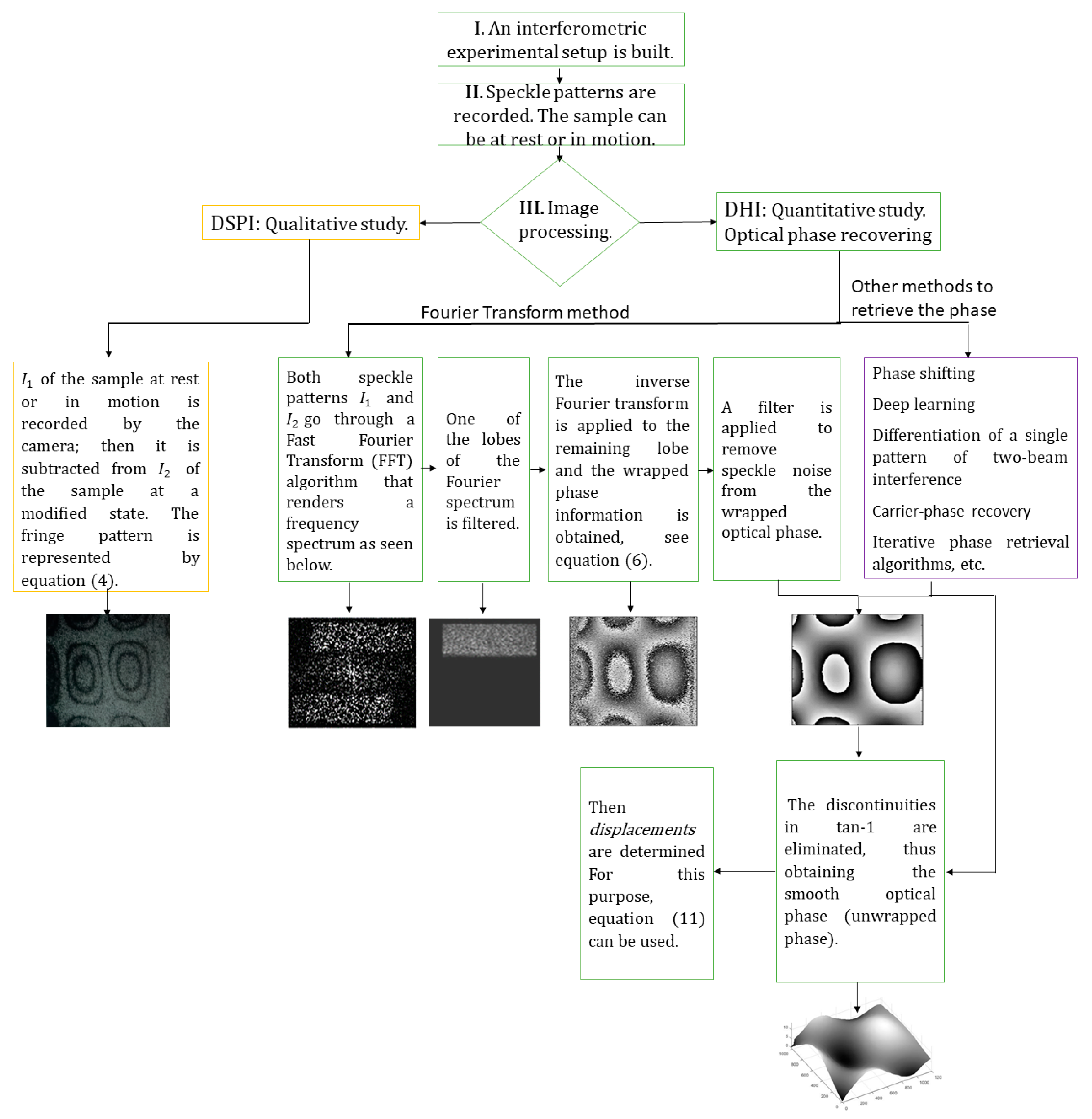
3.2. Digital Speckle Pattern Interferometry (DSPI) and Digital Holographic Interferometry (DHI)
3.2.1. Basic Theory of DSPI and DHI
Basic Optical Configuration for DSPI and DHI
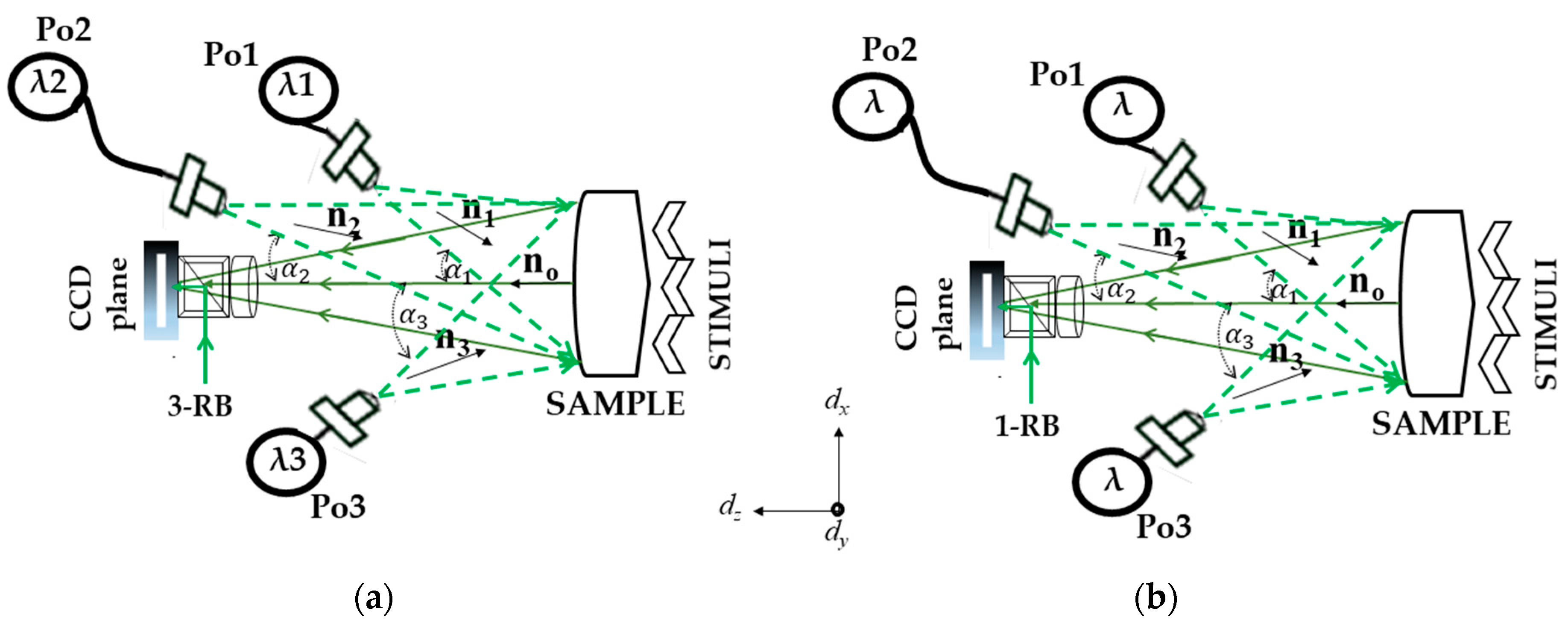
Optical Configurations for 3D Measurements
- (a)
- The setup in Figure 5a allows simultaneous measurement of the three displacement components; it uses three light sources at three different positions (Po1, Po2, and Po3), each with different wavelengths (λ1, λ2, and λ3). Two intensity images are recorded for two states of interest of the sample; i.e., three digital holograms are recorded in a single camera frame. Note that each of the three object beams matches with its corresponding reference beam [89].
- (b)
- The optical setup in Figure 5b uses only one light source with wavelength λ and three illumination object beams. The sample is sequentially illuminated from 3 object beam positions (Po1, Po2, and Po3), whereas the object beam is launched using an optical fiber situated in sequence at the three non-coplanar positions; alternatively, the beam can be divided into three by beam splitters, conveyed by optical fibers and directed to illuminate the sample by mirrors. As seen in Figure 5b, only one reference beam is required. Three holograms are recorded sequentially for two different states of the sample and then processed. Then, three intensity images are recorded [90].
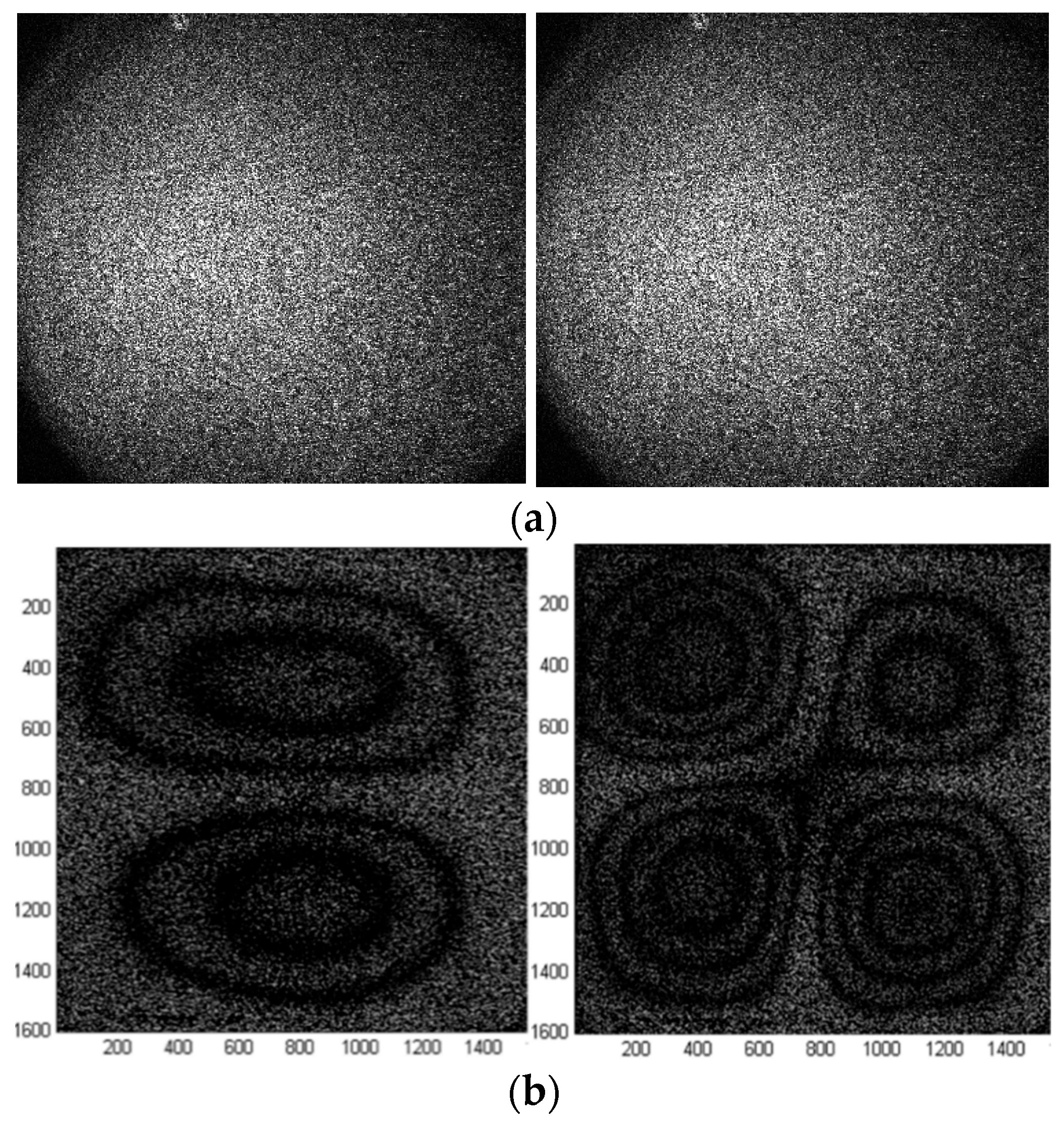
Digital Speckle Pattern Interferometry
Digital Holographic Interferometry
4. Sample Parameters Determination
4.1. The Strain
4.2. The Elastic Modulus (E)
4.3. Determination of the Refractive Index–Thickness
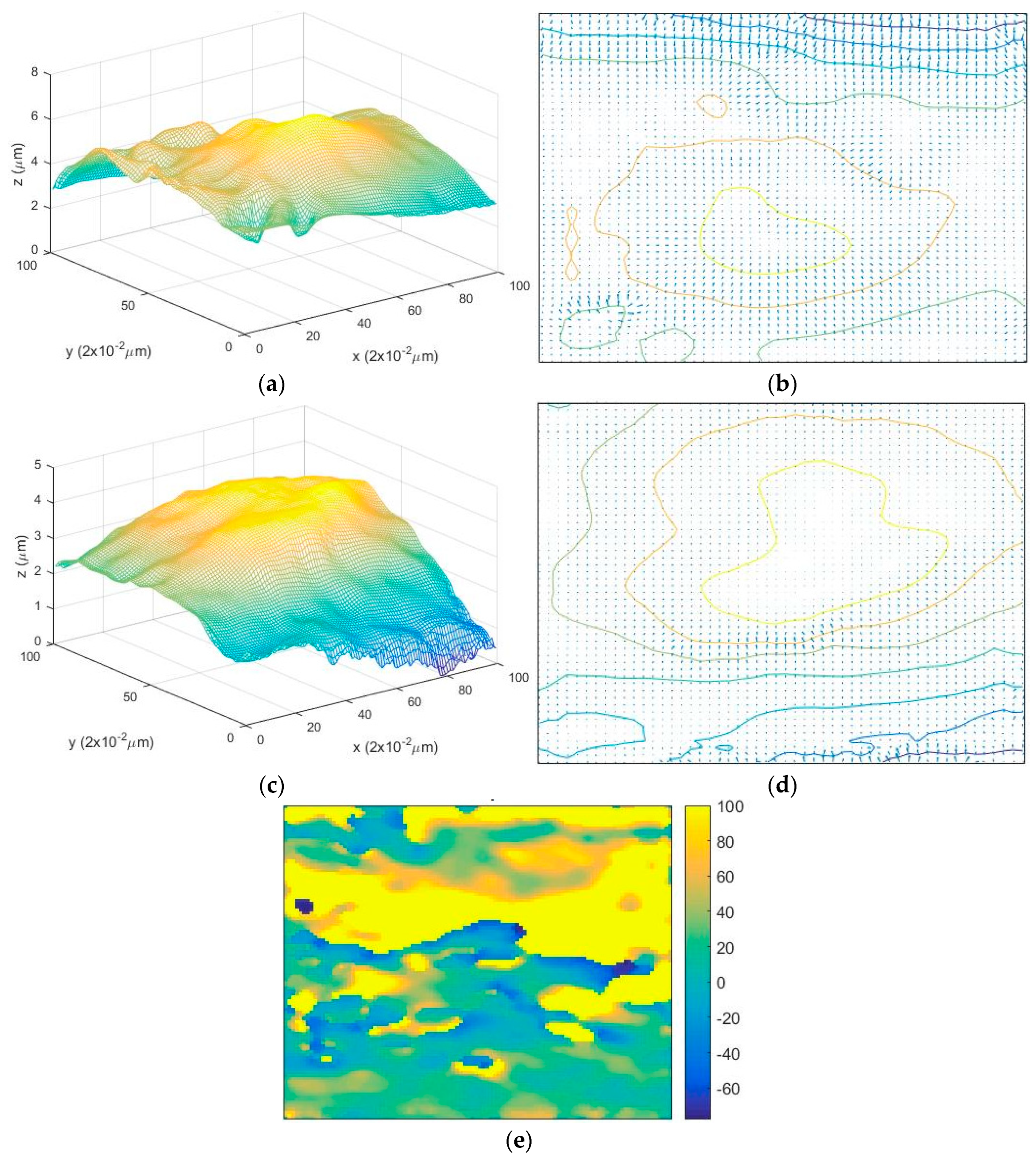
4.4. The Shape (Contour, Morphology)
5. Biomedical Research
5.1. The Vocal Cords
5.2. Skin Tissue
5.3. The Melanoma Cell, Onion Cell, and Bacterium
5.4. Tooth Sample
6. Aids and Trends of Non-Invasive Digital Speckle Methods
6.1. Current Speckle Methods
6.1.1. Speckle Contrast Optical Spectroscopy
6.1.2. Laser Speckle Rheology
6.1.3. Laser Speckle Contrast Imaging (LSCI)
6.1.4. Vortex Beam Dynamic Speckle Interference Microscopy (VSIM)
7. Conclusions
Author Contributions
Funding
Institutional Review Board Statement
Informed Consent Statement
Data Availability Statement
Acknowledgments
Conflicts of Interest
References
- Johnston, S.F. Holography. From Science to Subcultures. Opt. Photonics News 2004, 15, 36–41. [Google Scholar] [CrossRef]
- Arslan, M.; Sürmeli, K. Types of Holography in Artistic Practices. ARTic 2025, 8, 957–974. [Google Scholar] [CrossRef]
- Beléndez, A.; Sheridan, J.T.; Pascual, I. Celebrating holography anniversaries: A historical perspective. In Photosensitive Materials and Their Applications II; SPIE: Bellingham, WA, USA, 2022; Volume 12151, p. 1215102. [Google Scholar]
- Kumar, R.; Dwivedi, G. Emerging scientific and industrial applications of digital holography: An overview. Eng. Res. Express 2023, 5, 032005. [Google Scholar] [CrossRef]
- Johnston, S.F. From white elephant to Nobel Prize: Dennis’ Gabor wavefront reconstruction. Hist. Stud. Phys. Biol. 2005, 36, 35–70. [Google Scholar] [CrossRef][Green Version]
- Kostuk, R.K. Holography: Principles and Applications; Taylor & Francis: Oxford, UK, 2024. [Google Scholar]
- Doval, A.F. A systematic approach to TV holography. Meas. Sci. Technol. 2000, 11, R1–R36. [Google Scholar] [CrossRef]
- Haleem, A.; Javaid, M.; Singh, R.P.; Suman, R.; Rab, S. Holography and its applications for industry 4.0: An overview. Internet Things Cyber-Phys. Syst. 2022, 2, 42–48. [Google Scholar] [CrossRef]
- Burner, A.; Fleming, G.; Hoppe, J. Comparison of three optical methods for measuring model deformation. In 38th Aerospace Sciences Meeting and Exhibit; AIAA: Reston, VA, USA, 2000; p. 835. [Google Scholar]
- Rastogi, P.K. (Ed.) Optical Measurement Techniques and Applications; Artech House Inc.: Boston, MA, USA; London, UK, 1997. [Google Scholar]
- Kulya, M.S.; Odlyanitskiy, E.L.; Cassar, Q.; Mustafin, I.A.; Trukhin, V.N.; Polina, G.; Gavrilova, P.G.; Korolev, D.V.; Kononova, Y.A.; Balbekin, N.S.; et al. Fast Terahertz Spectroscopic Holographic Assessment of Optical Properties of Diabetic Blood Plasma. J. Infrared Millim. Terahertz Waves 2020, 41, 1041–1056. [Google Scholar] [CrossRef]
- Osten, W.; Pedrini, G. 55 years of holographic non-destructive testing and experimental stress analysis: Is there still progress to be expected? Light Adv. Manuf. 2022, 3, 121–136. [Google Scholar] [CrossRef]
- Kujawińska, M. Modern optical measurement station for micro-materials and micro-elements studies. Sens. Actuators A Phys. 2002, 99, 144–153. [Google Scholar] [CrossRef]
- Kujawińska, M.; Lee, B.; Kim, J.; Kim, T. Special Issue on Digital Holographic 3D Imaging: Capture, Display, and Evaluation. ETRI J. 2019, 41, 7–9. [Google Scholar] [CrossRef]
- Fercher, A.; Briers, J. Flow visualization by means of single-exposure speckle photography. Opt. Commun. 1981, 37, 326–330. [Google Scholar] [CrossRef]
- Hök, B.; Nilsson, K.; Bjelkhagen, H. Imaging of chest motion due to heart action by means of holographic interferometry. Med. Biol. Eng. Comput. 1978, 16, 363–368. [Google Scholar] [CrossRef] [PubMed]
- Hernández-Montes, M.d.S.; Furlong, C.; Rosowski, J.J.; Hulli, N.; Harrington, E.; Cheng, J.T.; Ravicz, M.E.; Santoyo, F.M. Optoelectronic holographic otoscope for measurement of nano-displacements in tympanic membranes. J. Biomed. Opt. 2009, 14, 034023. [Google Scholar] [CrossRef] [PubMed]
- Kemmler, M.; Fratz, M.; Giel, D.; Saum, N.; Brandenburg, A.; Hoffmann, C. Noninvasive time-dependent cytometry monitoring by digital holography. J. Biomed. Opt. 2007, 12, 064002. [Google Scholar] [CrossRef]
- Khaleghi, M.; Furlong, C.; Ravicz, M.; Cheng, J.T.; Rosowski, J. Three-dimensional vibrometry of the human eardrum with stroboscopic lensless digital holography. J. Biomed. Opt. 2015, 20, 051028. [Google Scholar] [CrossRef]
- UrliĆ, I.; Demoli, N.; Pavan, J.; Šutej, I.; BaŠiĆ, R.; Vranic, D.N. Measuring tooth vibrations induced during cavity preparation with time-averaged holography and its influence on near vision acuity in dentists. Dent. Mater. J. 2021, 40, 123–128. [Google Scholar] [CrossRef] [PubMed]
- Lu, W.; Furlong, C.; Rosowski, J.J.; Cheng, J.T.; Merchant, S.N. Characterization of Shape and Deformation of Tympanic Membranes by Dual-wavelength Lensless Digital Holography. In Mechanics of Biological System and Materials; Springer: New York, NY, USA, 2011; Volume 2, pp. 199–207. [Google Scholar]
- Tiziani, H.J.; Pedrini, G. From speckle pattern photography to digital holographic interferometry [Invited]. Appl. Opt. 2013, 52, 30–44. [Google Scholar] [CrossRef]
- Kumar, M.; Agarwal, R.; Bhutani, R.; Shakher, C. Measurement of strain distribution in cortical bone around miniscrew implants used for orthodontic anchorage using digital speckle pattern interferometry. Opt. Eng. 2016, 55, 054101. [Google Scholar] [CrossRef]
- Servin, M.; Quiroga, J.A.; Padilla, M. Fringe Pattern Analysis for Optical Metrology: Theory, Algorithms, and Applications; John Wiley & Sons: Hoboken, NJ, USA, 2014. [Google Scholar]
- Takeda, M.; Ina, H.; Kobayashi, S. Fourier-transform method of fringe-pattern analysis for computer-based topography and interferometry. J. Opt. Soc. Am. 1982, 72, 156–160. [Google Scholar] [CrossRef]
- Su, X.; Chen, W. Reliability-guided phase unwrapping algorithm: A review. Opt. Lasers Eng. 2004, 42, 245–261. [Google Scholar] [CrossRef]
- Yamaguchi, I.; Zhang, T. Phase-shifting digital holography. Opt. Lett. 1997, 22, 16. [Google Scholar] [CrossRef] [PubMed]
- Gdeisat, M.A.; Burton, D.R.; Lilley, F.; Arevalillo-Herráez, M.; Ammous, M.M. Aiding phase unwrapping by increasing the number of residues in two-dimensional wrapped-phase distributions. Appl. Opt. 2015, 54, 10073–10078. [Google Scholar] [CrossRef]
- Quan, C.; Niu, H.; Tay, C.J. An improved windowed Fourier transform for fringe demodulation. Opt. Laser Technol. 2010, 42, 126–131. [Google Scholar] [CrossRef]
- Mendoza-Santoyo, F.; De la Torre-Ibarra, M.; del Socorro Hernández-Montes, M.; Flores Moreno, J.M. Full Field Optical Metrology and Applications; series 2053–2563; IOP Publishing: Bristol, UK, 2022; ISBN 978-0-7503-3027-5. [Google Scholar]
- Hernández-Montes, M.D.S.; Mendoza-Santoyo, F.; Flores Moreno, M.; de la Torre-Ibarra, M.; Acosta, L.S.; Palacios-Ortega, N. Macro to nano specimen measurements using photons and electrons with digital holographic interferometry: A review. J. Eur. Opt. Soc.-Rapid Publ. 2020, 16, 16. [Google Scholar] [CrossRef]
- Grycuk, S.; Mrozek, P. Scoliosis Brace Finite Element Model and Preliminary Experimental Testing Using Electronic Speckle Pattern Interferometry. Appl. Sci. 2022, 12, 3876. [Google Scholar] [CrossRef]
- Komninou, M.A.; Seiler, T.G.; Enzmann, V. Corneal biomechanics and diagnostics: A review. Int. Ophthalmol. 2024, 44, 132. [Google Scholar] [CrossRef]
- Silva, V.B.; Andrade De Jesus, D.; Klein, S.; Van Walsum, T.; Cardoso, J.; Brea, L.S.; Vaz, P.G.; Macha, M.A.; Bhat, M.R. Signal-carrying speckle in optical coherence tomography: A methodological review on biomedical applications. J. Biomed. Opt. 2022, 27, 3. [Google Scholar] [CrossRef] [PubMed]
- O’Connor, T.; Javidi, B. COVID-19 screening with digital holographic microscopy using intra-patient probability functions of spatio-temporal bio-optical attributes. Biomed. Opt. Express 2022, 13, 5377–5389. [Google Scholar] [CrossRef]
- El-Schich, Z.; Kamlund, S.; Janicke, B.; Alm, K.; Wingren, A.G. Holography: The usefulness of digital holographic microscopy for clinical diagnostics. In Holographic Materials and Optical Systems; IntechOpen: London, UK, 2017; pp. 319–333. [Google Scholar]
- Fernández, M.V.; Gonçalves, E.; Rivera, J.L.V.; Ricardo, J.; Abreu, M.E.F.; Vaz, M.A.P. Development of Digital Holographic Microscopy by reflection for analysis of surface. Results Phys. 2018, 11, 182–187. [Google Scholar] [CrossRef]
- Smith, Y. What Is Digital Holographic Microscopy? News-Medical. 26 February 2019. Available online: https://www.news-medical.net/life-sciences/What-is-digital-holographic-microscopy.aspx (accessed on 19 January 2026).
- Chaudhari, H.; Kulkarni, R.; Kumar Sundaravadivelu, P.; Thummer, R.P.; Bhuyan, M.K. Digital hologram reconstruction algorithm based on the fractional Fourier transform in non-telecentric digital holographic microscopy. Opt. Lett. 2024, 49, 182–185. [Google Scholar] [CrossRef]
- Yu, X.; Hong, J.; Liu, C.; Kim, M.K. Review of digital holographic microscopy for three-dimensional profiling and tracking. Opt. Eng. 2014, 53, 112306. [Google Scholar] [CrossRef]
- Mihaylova, E.M. Imaging of Live Cells by Digital Holographic Microscopy. Photonics 2024, 11, 980. [Google Scholar] [CrossRef]
- Garcia-Sucerquia, J.; Xu, W.; Jericho, S.K.; Klages, P.; Jericho, M.H.; Kreuzer, H.J. Digital in-line holographic microscopy. Appl. Opt. 2006, 45, 836–850. [Google Scholar] [CrossRef]
- Huang, Z.; Cao, L. Quantitative phase imaging based on holography: Trends and new perspectives. Light Sci. Appl. 2024, 13, 145. [Google Scholar] [CrossRef] [PubMed]
- Charles, M.V. Holographic Interferometry; John Wiley & Sons: Hoboken, NJ, USA, 1979. [Google Scholar]
- Rastogi, P.K. (Ed.) Holographic Interferometry: Principles and Methods; Springer: Berlin/Heidelberg, Germany, 2013; Volume 68. [Google Scholar]
- Gao, P.; Yuan, C. Resolution enhancement of digital holographic microscopy via synthetic aperture: A review. Light Adv. Manuf. 2022, 3, 105–120. [Google Scholar] [CrossRef]
- Schnars, U.; Falldorf, C.; Watson, J.; Jüptner, W. Digital holography. In Digital Holography and Wavefront Sensing: Principles, Techniques and Applications; Springer: Berlin/Heidelberg, Germany, 2014; pp. 39–68. [Google Scholar]
- Nehmetallah, G.; Williams, L.; Nguyen, T. Latest advances in single and multiwavelength digital holography and holographic microscopy. In Augmented Reality and Its Application; IntechOpen: London, UK, 2020. [Google Scholar]
- Huang, C.H.; Tu, H.Y.; Cheng, C.J. Multi-wavelength varifocal common-path configuration for digital holographic microscopy. In Optical Measurement Systems for Industrial Inspection XIV; SPIE: Bellingham, WA, USA, 2025; Volume 13567, pp. 45–48. [Google Scholar]
- Warnasooriya, N.; Kim, M.K. Quantitative phase imaging using multi-wavelength optical phase unwrapping. In Advances in Lasers and Electro Optics; IntechOpen: London, UK, 2010. [Google Scholar][Green Version]
- Li, J.; Li, C.; Zhang, Q.; Wu, B.; Liu, T.; Lu, X.; Di, J.; Zhong, L. Multi-wavelength network: Predicted-illumination for phase unwrapping in quantitative phase imaging. Opt. Laser Technol. 2023, 167, 109781. [Google Scholar] [CrossRef]
- Funamizu, H.; Sugata, K.; Uozumi, J.; Aizu, Y. Two-wavelength digital holographic microscopy using speckle illuminations. Opt. Lasers Eng. 2020, 128, 105993. [Google Scholar] [CrossRef]
- Palacios-Ortega, N.; Hernández-Montes, M.D.S.; Santoyo, F.M.; Flores-Moreno, M.; de la Torre Ibarra, M.; Luis-Noriega, D.; Méndez-Sashida, P.G. Simultaneous dual-wavelength digital holographic microscopy as a tool for the analysis of keratoacanthoma skin samples. J. Phys. D Appl. Phys. 2023, 57, 025401. [Google Scholar] [CrossRef]
- Mirsky, S.K.; Shaked, N.T. Dynamic three-wavelength imaging and volumetry of flowing cells with doubled field of view by six-pack holography. Appl. Phys. B 2022, 128, 92. [Google Scholar] [CrossRef]
- Mirsky, S.K.; Shaked, N.T. Six-pack holography for dynamic profiling of thick and extended objects by simultaneous three-wavelength phase unwrapping with doubled field of view. Sci. Rep. 2023, 13, 19293. [Google Scholar] [CrossRef]
- Vijay, A.; Mohamed, N.; Kumar, P.; John, R. An integrated portable system for laser speckle contrast imaging and digital holographic microscopy. Opt. Commun. 2025, 575, 131240. [Google Scholar] [CrossRef]
- Kumar, R.; Dwivedi, G.; Singh, O. Portable digital holographic camera featuring enhanced field of view and reduced exposure time. Opt. Lasers Eng. 2021, 137, 106359. [Google Scholar] [CrossRef]
- Latychevskaia, T.; Fink, H.W. Practical algorithms for simulation and reconstruction of digital in-line holograms. Appl. Opt. 2015, 54, 2424–2434. [Google Scholar] [CrossRef]
- Cuche, E.; Marquet, P.; Dahlgren, P.; Depeursinge, C. Digital holographic microscopy, a new method for simultaneous amplitude-and quantitative phase-contrast imaging. In Interferometry in Speckle Light: Theory and Applications; Springer: Berlin/Heidelberg, Germany, 2000; pp. 213–218. [Google Scholar]
- Liebling, M.; Unser, M. Comparing algorithms for reconstructing digital off-axis fresnel holograms. In Three-Dimensional TV, Video, and Display IV; SPIE: Bellingham, WA, USA, 2005; Volume 6016, pp. 213–222. [Google Scholar]
- Prado, F.M.; Utiyama, K.A.; Toffoli, D.J.; Wetter, N.U.; da Silva, S.L. Computational algorithm from the Huygens-Fresnel’s diffraction integral for two-dimensional holographic reconstruction. Rev. Bras. Ensino Física 2021, 44, e20210193. [Google Scholar] [CrossRef]
- Li, J.C.; Tankam, P.; Peng, Z.J.; Picart, P. Digital holographic reconstruction of large objects using a convolution approach and adjustable magnification. Opt. Lett. 2009, 34, 572–574. [Google Scholar] [CrossRef]
- Tang, Z.; Hennelly, B.M. Real-time synthetic-aperture digital holographic microscopy. Opt. Laser Technol. 2025, 188, 112848. [Google Scholar] [CrossRef]
- Lédl, V.; Psota, P.; Doleček, R.; Vít, T. Digital holographic setups for phase object measurements in micro and macro scale. In EPJ Web of Conferences; EDP Sciences: Les Ulis, France, 2015; Volume 92, p. 01001. [Google Scholar]
- Wu, T.; Yang, Y.; Wang, H.; Chen, H.; Zhu, H.; Yu, J.; Wang, X. Investigation of an Improved Angular Spectrum Method Based on Holography. Photonics 2023, 11, 16. [Google Scholar] [CrossRef]
- Chen, C.; Chang, K.; Liu, C.; Wang, J.; Wang, Q. Fast hologram generation using intermediate angular-spectrum method for high-quality compact on-axis holographic display. Opt. Express 2019, 27, 29401–29414. [Google Scholar] [CrossRef]
- Etchepareborda, P.; Connolly, P.; Henneberger, J.; Crosier, J. Distortion Free Angular Spectrum Method for Digital Inline Holographic Microscopy. In Digital Holography and Three-Dimensional Imaging; Optica Publishing Group: Washington, DC, USA, 2022; p. Th2A-3. [Google Scholar]
- Kim, J.; Kim, Y.; Lee, H.S.; Seo, E.; Lee, S.J. Single-shot reconstruction of three-dimensional morphology of biological cells in digital holographic microscopy using a physics-driven neural network. Nat. Commun. 2025, 16, 4840. [Google Scholar] [CrossRef] [PubMed]
- Chen, B.; Li, Z.; Zhou, Y.; Zhang, Y.; Jia, J.; Wang, Y. Deep-learning multiscale digital holographic intensity and phase reconstruction. Appl. Sci. 2023, 13, 9806. [Google Scholar] [CrossRef]
- Wang, H.; Li, Q.; Wang, S.; Men, G. Multi-scale digital holographic reconstruction with deep learning. Appl. Opt. 2024, 64, B31–B37. [Google Scholar] [CrossRef]
- Lin, Z.; Jia, S.; Zhang, H.; Wen, B.; Han, M.; Wang, L. A super-resolution phase reconstruction method for digital holographic microscopy based on compressed sensing and deep learning. Opt. Laser Technol. 2026, 193, 114167. [Google Scholar] [CrossRef]
- Dar, A.U.; Singh, M.; Assad, A.; Macha, M.A.; Bhat, M.R. Applications of artificial intelligence and digital holography in biomedical microscopy. Int. J. Syst. Assur. Eng. Manag. 2025, 1–16. [Google Scholar] [CrossRef]
- Ren, Z.; Xu, Z.; Lam, E.Y. End-to-end deep learning framework for digital holographic reconstruction. Adv. Photonics 2019, 1, 016004. [Google Scholar] [CrossRef]
- Wang, Z.; Millet, L.; Mir, M.; Ding, H.; Unarunotai, S.; Rogers, J.; Gillette, M.U.; Popescu, G. Spatial light interference microscopy (SLIM). Opt. Express 2011, 19, 1016–1026. [Google Scholar] [CrossRef]
- Min, E.; Kandel, M.E.; Ko, C.J.; Popescu, G.; Jung, W.; Best-Popescu, C. Label-free, multi-scale imaging of ex-vivo mouse brain using spatial light interference microscopy. Sci. Rep. 2016, 6, 39667. [Google Scholar] [CrossRef]
- Osten, W.; Faridian, A.; Gao, P.; Körner, K.; Naik, D.; Pedrini, G.; Kumar, S.; Takeda, M.; Wilke, M. Recent advances in digital holography [Invited]. Appl. Opt. 2014, 53, G44–G63. [Google Scholar] [CrossRef] [PubMed]
- Soons, J.; Lava, P.; Debruyne, D.; Dirckx, J. Full-field optical deformation measurement in biomechanics: Digital speckle pattern interferometry and 3D digital image correlation applied to bird beaks. J. Mech. Behav. Biomed. Mater. 2012, 14, 186–191. [Google Scholar] [CrossRef]
- Kumarogi, P.K.; Hack, E. (Eds.) Optical Methods for Solid Mechanics: A Full-Field Approach; John Wiley & Sons: Hoboken, NJ, USA, 2013. [Google Scholar]
- Jonathan, E. Non-contact and non-destructive testing of silicon V-grooves: A non-medical application of optical coherence tomography (OCT). Opt. Lasers Eng. 2006, 44, 1117–1131. [Google Scholar] [CrossRef]
- Kumar, R.A.; Kumar, R.S.; Sreejyothi, S.; Raj, V.; Swapna, M.S.; Sankararaman, S. Development of prototype of electronic speckle interferometry based spirometer. Opt. Lasers Eng. 2021, 136, 106318. [Google Scholar] [CrossRef]
- Types of Lasers—Solid State Laser, Gas Laser, Liquid Laser & Semiconductor Laser. Available online: https://www.physics-and-radio-electronics.com (accessed on 4 November 2025).
- Toker, G.; Bulatov, V.; Kovalchuk, T.; Schechter, I. Underwater interaction of 1064 nm laser radiation with metal target. Int. J. Phys. Math. Sci. 2009, 3, 453–456. [Google Scholar]
- Helmers, H.; Schellenberg, M. CMOS vs. CCD sensors in speckle interferometry. Opt. Laser Technol. 2003, 35, 587–595. [Google Scholar] [CrossRef]
- Georges, M.P.; Thizy, C.; Languy, F.; Zhao, Y.; Vandenrijt, J.F. Digital holographic interferometry and speckle interferometry applied on objects with heterogeneous reflecting properties. Appl. Opt. 2019, 58, G318–G325. [Google Scholar] [CrossRef]
- Kreis, T. Handbook of Holographic Interferometry: Optical and Digital Methods; John Wiley & Sons: Hoboken, NJ, USA, 2006. [Google Scholar]
- Léon, O.; Donjat, D.; Olchewsky, F.; Desse, J.M.; Nicolas, F.; Champagnat, F. Three-dimensional density field of a screeching under-expanded jet in helical mode using multi-view digital holographic interferometry. J. Fluid Mech. 2022, 947, A36. [Google Scholar] [CrossRef]
- Xia, P.; Ri, S.; Inoue, T.; Awatsuji, Y.; Matoba, O. Three-dimensional dynamic measurement of unstable temperature fields by multi-view single-shot phase-shifting digital holography. Opt. Express 2022, 30, 37760–37768. [Google Scholar] [CrossRef]
- Pan, Y.; Wang, K. Dynamic measurement of 3D displacements using dual-camera lensless Fourier transform digital holography. Appl. Opt. 2023, 62, 5115–5125. [Google Scholar] [CrossRef]
- Alvarez, A.S.; Manuel, H.; Santoyo, F.M.; Anaya, T.S. Strain determination in bone sections with simultaneous 3D digital holographic interferometry. Opt. Lasers Eng. 2014, 57, 101–108. [Google Scholar] [CrossRef]
- Hernandez-Montes, M.D.S.; Santoyo, F.M.; Munoz, S.; Perez, C.; de la Torre, M.; Flores, M.; Alvarez, L. Surface strain-field determination of tympanic membrane using 3D-digital holographic interferometry. Opt. Lasers Eng. 2015, 71, 42–50. [Google Scholar] [CrossRef]
- Lv, C.; Wang, K.; Gu, G.; Pan, Y. Accurate full-edge detection and depth measurement of internal defects using digital speckle pattern interferometry. NDT E Int. 2019, 102, 1–8. [Google Scholar] [CrossRef]
- Dávila, A. Handbook of Speckle Interferometry; SPIE Press: Bellingham, WA, USA, 2022. [Google Scholar]
- Kumar, M.; Kumar, V.; Shakher, C. Measurement of temperature and temperature distribution in diffusion flames using digital speckle pattern interferometry. In Eleventh International Conference on Correlation Optics; SPIE: Bellingham, WA, USA, 2013; Volume 9066, pp. 290–296. [Google Scholar]
- Yan, K.; Chang, L.; Andrianakis, M.; Tornari, V.; Yu, Y. Deep learning-based wrapped phase denoising method for application in digital holographic speckle pattern interferometry. Appl. Sci. 2020, 10, 4044. [Google Scholar] [CrossRef]
- Pedrini, G.; Alekseenko, I.; Osten, W.; Gaspar, J.; Schmidt, M.E.; Paul, O. Measurement of nano/micro out-of-plane and in-plane displacements of micromechanical components by using digital holography and speckle interferometry. Opt. Eng. 2011, 50, 101504. [Google Scholar]
- Georges, M. Holographic interferometry: From history to modern applications. In Optical Holography; Elsevier: Amsterdam, The Netherlands, 2020; pp. 121–163. [Google Scholar]
- Kaufmann, G.H. Phase measurement in temporal speckle pattern interferometry using the Fourier transform method with and without a temporal carrier. Opt. Commun. 2003, 217, 141–149. [Google Scholar] [CrossRef]
- Lobera, J.; Andrés, N.; Arroyo, M.P. Digital speckle pattern interferometry as a holographic velocimetry technique. Meas. Sci. Technol. 2004, 15, 718. [Google Scholar] [CrossRef]
- Orakzai, M.S.; Amin, S.; Khan, Z.A.; Akram, F. Fast and highly accurate phase unwrapping algorithm for displacement retrieval using self-mixing interferometry sensor. Opt. Mater. 2022, 129, 112553. [Google Scholar] [CrossRef]
- Tankam, P.; Song, Q.; Karray, M.; Li, J.; Desse, J.M.; Picart, P. Real-time three-sensitivity measurements based on three-color digital Fresnel holographic interferometry. Opt. Lett. 2010, 35, 2055–2057. [Google Scholar] [CrossRef] [PubMed]
- Morimoto, Y.; Matui, T.; Fujigaki, M.; Matsui, A. Three-dimensional Displacement Analysis by Windowed Phase-shifting Digital Holographic Interferometry. Strain 2008, 44, 49–56. [Google Scholar] [CrossRef]
- Rastogi, P.K.; Pflug, L. Measurement of Large Out-of-plane Displacements Using Two Source Holographic Interferometry. J. Mod. Opt. 1994, 41, 589–594. [Google Scholar] [CrossRef]
- Sharpe, W.N. (Ed.) Springer Handbook of Experimental Solid Mechanics; Springer: New York, NY, USA, 2008. [Google Scholar]
- Fei, G.; Maiyu, Z.; Mei, Z.; Yufang, S.; Peng, L. Out of plane displacement measurement based on electronic speckle pattern interferometry. In 2012 International Conference on Computer Science and Information Processing (CSIP); IEEE: Piscataway, NJ, USA, 2012; pp. 1323–1326. [Google Scholar]
- Muñoz Solís, S.; Hernández-Montes, M.d.S.; Mendoza Santoyo, F. Measurement of Young’s modulus in an elastic material using 3D digital holographic interferometry. Appl. Opt. 2011, 50, 3383–3388. [Google Scholar] [CrossRef]
- Kumar, M.; Shakher, C. Experimental characterization of the hygroscopic properties of wood during convective drying using digital holographic interferometry. Appl. Opt. 2016, 55, 960–968. [Google Scholar] [CrossRef]
- Li, Z.; Zhong, P.; Chen, Y.; Tang, X.; Gao, Y.; Hu, H. Simultaneous measurement of three-dimensional deformation based on digital speckle pattern interferometry technology. Opt. Commun. 2021, 480, 126423. [Google Scholar] [CrossRef]
- Silva-Acosta, L.; Mendoza-Santoyo, F.; Hernández-Montes, M.d.S.; Muñoz-Soliz, S. Quantitative analysis of elasticity changes in UV radiated skin. In Speckle 2018: VII International Conference on Speckle Metrology; SPIE: Bellingham, WA, USA, 2018; Volume 10834, p. 108341N. [Google Scholar]
- Mojsiewicz-Pieńkowska, K.; Stachowska, E.; Krenczkowska, D.; Bazar, D.; Meijer, F. Evidence of Skin Barrier Damage by Cyclic Siloxanes (Silicones)—Using Digital Holographic Microscopy. Int. J. Mol. Sci. 2020, 21, 6375. [Google Scholar] [CrossRef]
- Anand, A.; Chhaniwal, V.K.; Patel, N.R.; Javidi, B. Automatic identification of malaria-infected RBC with digital holographic microscopy using correlation algorithms. IEEE Photonics J. 2012, 4, 1456–1464. [Google Scholar] [CrossRef]
- Trivedi, V.; Joglekar, M.; Mahajan, S.; Patel, N.; Chhaniwal, V.; Javidi, B.; Anand, A. Digital holographic imaging of refractive index distributions for defect detection. Opt. Laser Technol. 2019, 111, 439–446. [Google Scholar] [CrossRef]
- Chen, N.; Bhushan, B. Atomic force microscopy studies of conditioner thickness distribution and binding interactions on the hair surface. J. Microsc. 2006, 221, 203–215. [Google Scholar] [CrossRef]
- Kitagawa, K. Thin-film thickness profile measurement by three-wavelength interference color analysis. Appl. Opt. 2013, 52, 1998–2007. [Google Scholar] [CrossRef]
- Lombardo, M.; Lombardo, G.; Carbone, G.; De Santo, M.P.; Barberi, R.; Serrao, S. Biomechanics of the anterior human corneal tissue investigated with atomic force microscopy. Investig. Ophthalmol. Vis. Sci. 2012, 53, 1050–1057. [Google Scholar] [CrossRef] [PubMed]
- López, U.U.; Hernández-Montes, M.D.S.; Mendoza-Santoyo, F. Fully automated digital holographic interferometer for 360 deg contour and displacement measurements. Opt. Eng. 2016, 55, 121719. [Google Scholar] [CrossRef]
- Velásquez Prieto, D.; Garcia-Sucerquia, J. Three-dimensional surface contouring of macroscopic objects by means of phase-difference images. Appl. Opt. 2006, 45, 6381–6387. [Google Scholar] [CrossRef] [PubMed]
- Genovese, K.; Lamberti, L.; Pappalettere, C. A comprehensive ESPI based system for combined measurement of shape and deformation of electronic components. Opt. Lasers Eng. 2004, 42, 543–562. [Google Scholar] [CrossRef]
- Berry, D.A.; Montequin, D.W.; Tayama, N. High-speed digital imaging of the medial surface of the vocal folds. J. Acoust. Soc. Am. 2001, 110, 2539–2547. [Google Scholar] [CrossRef]
- Dunn, N.M.; Katial, R.K.; Hoyte, F.C. Vocal cord dysfunction: A review. Asthma Res. Pract. 2015, 1, 9. [Google Scholar] [CrossRef]
- Franco, R.A.; Andrus, J.G.; Sataloff, R.T. New technologies: High-speed video, videokymography, optical coherence tomography, and 3D holography. In Pediatric Voice Disorders; Plural Publishing: San Diego, CA, USA, 2008; pp. 31–50. [Google Scholar]
- del Socorro Hernández-Montes, M.; Muñoz, S.; De La Torre, M.; Flores, M.; Pérez, C.; Mendoza-Santoyo, F. Quantification of the vocal folds’ dynamic displacements. J. Phys. D Appl. Phys. 2016, 49, 175401. [Google Scholar] [CrossRef]
- Palacios-Ortega, N.; Santoyo, F.M.; Moreno, J.M.F.; del Socorro Hernández-Montes, M.; Manuel, H.; Plascencia, G. 3D morphology of melanoma cells using digital holographic interferometry. In Applied Optical Metrology III; SPIE: Bellingham, WA, USA, 2019; Volume 11102, pp. 132–137. [Google Scholar]
- Moon, I.; Javidi, B.; Yi, F.; Boss, D.; Marquet, P. Automated statistical quantification of three-dimensional morphology and mean corpuscular hemoglobin of multiple red blood cells. Opt. Express 2012, 20, 10295–10309. [Google Scholar] [CrossRef]
- Solís, S.M.; Hernández-Montes, M.D.S.; Santoyo, F.M. Identification of microorganisms using digital holographic microscopy. In Emerging Challenges for Experimental Mechanics in Energy and Environmental Applications, Proceedings of the 5th International Symposium on Experimental Mechanics and 9th Symposium on Optics in Industry (ISEM-SOI), 2015; Springer International Publishing: Cham, Switzerland, 2016; pp. 71–74. [Google Scholar]
- Xia, H.; Picart, P.; Montresor, S.; Guo, R.; Li, J.C.; Solieman, O.Y.; Durand, J.C.; Fages, M. Mechanical behavior of CAD/CAM occlusal ceramic reconstruction assessed by digital color holography. Dent. Mater. 2018, 34, 1222–1234. [Google Scholar] [CrossRef]
- Picart, P.; Fages, M.; Slangen, P.; Xia, H.; Montresor, S.; Guo, R.; Li, J.; Solieman, O.Y.; Durand, J.C. A review on optical methods to assess dental behavior under stress. Opt. Methods Insp. Charact. Imaging Biomater. IV 2019, 11060, 22–30. [Google Scholar]
- Beal, M.C. (Ed.) The Principles of Palpatory Diagnosis and Manipulative Technique; American Academy of Osteopathy: Indianapolis, IN, USA, 1989. [Google Scholar]
- Pan, B. Recent progress in digital image correlation. Exp. Mech. 2011, 51, 1223–1235.127. [Google Scholar] [CrossRef]
- Cheng, X.; Wang, S.; Wei, H.; Li, L.; Huo, Z.; Li, C.; Wang, Z. Digital image correlation by natural textures on biological skin. Opt. Lasers Eng. 2023, 165, 107547. [Google Scholar] [CrossRef]
- Grimaldo Ruiz, O.; Rodriguez Reinoso, M.; Ingrassia, E.; Vecchio, F.; Maniero, F.; Burgio, V.; Civera, M.; Bitan, I.; Lacidogna, G.; Surace, C. Design and mechanical characterization using digital image correlation of soft tissue-mimicking polymers. Polymers 2022, 14, 2639. [Google Scholar] [CrossRef] [PubMed]
- Chen, T.Y.F.; Dang, N.M.; Wang, Z.Y.; Chang, L.W.; Ku, W.Y.; Lo, Y.L.; Lin, M.T. Use of digital image correlation method to measure bio-tissue deformation. Coatings 2021, 11, 924. [Google Scholar] [CrossRef]
- Palanca, M.; Tozzi, G.; Cristofolini, L. The use of digital image correlation in the biomechanical area: A review. Int. Biomech. 2016, 3, 1–21. [Google Scholar] [CrossRef]
- Wu, R.; Wu, H.; Arola, D.; Zhang, D. Real-time three-dimensional digital image correlation for biomedical applications. J. Biomed. Opt. 2016, 21, 107003. [Google Scholar] [CrossRef] [PubMed]
- Wada, H.; Ando, M.; Takeuchi, M.; Sugawara, H.; Koike, T.; Kobayashi, T.; Hozawa, K.; Gemma, T.; Nara, M. Vibration measurement of the tympanic membrane of guinea pig temporal bones using time-averaged speckle pattern interferometry. J. Acoust. Soc. Am. 2002, 111, 2189–2199. [Google Scholar] [CrossRef] [PubMed]
- Gupta, P.C.; Singh, K. Time-average hologram interferometry of periodic, non-cosinusoidal vibrations. Appl. Phys. 1975, 6, 233–240. [Google Scholar] [CrossRef]
- Tonndorf, J.; Khanna, S.M. Tympanic-membrane vibrations in human cadaver ears studied by time-averaged holography. J. Acoust. Soc. Am. 1972, 52, 1221–1233. [Google Scholar] [CrossRef]
- Rosowski, J.J.; Cheng, J.T.; Ravicz, M.E.; Hulli, N.; Hernandez-Montes, M.; Harrington, E.; Furlong, C. Computer-assisted time-averaged holograms of the motion of the surface of the mammalian tympanic membrane with sound stimuli of 0.4–25 kHz. Hear. Res. 2009, 253, 83–96. [Google Scholar] [CrossRef]
- Acosta, J.L.S.; Santoyo, F.M.; Moreno, J.M.F.; Montes, M.D.S.H.; De la Torre Ibarra, M.H.; Frausto, G.; Hernández, E.E.L. Study of skin aging effects induced by near UV radiation using time average digital holographic interferometry. Opt. Lasers Eng. 2021, 137, 106345. [Google Scholar] [CrossRef]
- Fu, M.; Dornseiff, J.; Barth, V.; Scheer, E. Time-averaged interference fringe analysis: A quantitative study of nanomembrane vibration dynamics. Sens. Actuators A Phys. 2025, 383, 116172. [Google Scholar] [CrossRef]
- Warnasooriya, N.; Kim, M.K. Quantitative phase imaging using three-wavelength optical phase unwrapping. J. Mod. Opt. 2009, 56, 67–74. [Google Scholar] [CrossRef]
- Mahmoud, A.; El-Sharkawy, Y.H. Multi-wavelength interference phase imaging for automatic breast cancer detection and delineation using diffuse reflection imaging. Sci. Rep. 2024, 14, 415. [Google Scholar] [CrossRef]
- Karako, L.; Guo, R.; Barnea, I.; Shaked, N.T. Flipping interferometric module for simultaneous dual-wavelength unwrapping of quantitative phase maps of biological cells. Front. Phys. 2021, 9, 667023. [Google Scholar] [CrossRef]
- Shan, S.; Zhao, F.; Li, Z.; Luo, L.; Li, X. A Comprehensive Review of Optical Metrology and Perception Technologies. Sensors 2025, 25, 6811. [Google Scholar] [CrossRef]
- Balasubramani, V.; Kuś, A.; Tu, H.-Y.; Cheng, C.-J.; Baczewska, M.; Krauze, W.; Kujawińska, M. Holographic tomography: Techniques and biomedical applications [Invited]. Appl. Opt. 2021, 60, B65–B80. [Google Scholar] [CrossRef] [PubMed]
- Kuś, A. Real-time, multiplexed holographic tomography. Opt. Lasers Eng. 2022, 149, 106783. [Google Scholar] [CrossRef]
- Pirone, D.; Memmolo, P.; Merola, F.; Miccio, L.; Mugnano, M.; Capozzoli, A.; Curcio, C.; Liseno, A.; Ferraro, P. Rolling angle recovery of flowing cells in holographic tomography exploiting the phase similarity. Appl. Opt. 2020, 60, A277–A284. [Google Scholar] [CrossRef]
- Cheng, T.Y.; Kim, B.; Zimmermann, B.B.; Robinson, M.B.; Renna, M.; Carp, S.A.; Franceschini, M.A.; Boas, D.A.; Cheng, X. Choosing a camera and optimizing system parameters for speckle contrast optical spectroscopy. Sci. Rep. 2024, 14, 11915. [Google Scholar] [CrossRef]
- Nowacka-Pieszak, K.; Samaei, S.; Borycki, D. Interferometric speckle contrast optical spectroscopy (iSCOS) in continuous-wave parallel interferometric near-infrared spectroscopy (CW-πNIRS). Biocybern. Biomed. Eng. 2025, 45, 669–684. [Google Scholar] [CrossRef]
- Garrett, A.; Kim, B.; Gurel, N.Z.; Sie, E.J.; Wilson, B.K.; Marsili, F.; Forman, J.P.; Hamburg, N.M.; Boas, D.A.; Roblyer, D. Speckle contrast optical spectroscopy for cuffless blood pressure estimation based on microvascular blood flow and volume oscillations. Biomed. Opt. Express 2025, 16, 3004–3016. [Google Scholar] [CrossRef]
- Valdes, C.P.; Varma, H.M.; Kristoffersen, A.K.; Dragojevic, T.; Culver, J.P.; Durduran, T. Speckle contrast optical spectroscopy, a non-invasive, diffuse optical method for measuring microvascular blood flow in tissue. Biomed. Opt. Express 2014, 5, 2769–2784. [Google Scholar] [CrossRef] [PubMed]
- Wang, Q.; Bi, R.; Zheng, S.; Erdogan, A.T.; Qi, Y.; Li, C.; Hua, Y.; Pan, M.; Wang, Y.; Finlayson, N.; et al. Fiber-based ultra-high-speed diffuse speckle contrast analysis system for deep blood flow sensing using a large SPAD camera. Biosensors 2025, 15, 514. [Google Scholar] [CrossRef]
- Kim, B.; Zilpelwar, S.; Sie, E.J.; Marsili, F.; Zimmermann, B.; Boas, D.A.; Cheng, X. Measuring human cerebral blood flow and brain function with fiber-based speckle contrast optical spectroscopy system. Commun. Biol. 2023, 6, 844. [Google Scholar] [CrossRef] [PubMed]
- Mason, T.G.; Weitz, D.A. Optical measurements of frequency-dependent linear viscoelastic moduli of complex fluids. Phys. Rev. Lett. 1995, 74, 1250. [Google Scholar] [CrossRef]
- Hajjarian, Z.; Nadkarni, S.K. Correction of optical absorption and scattering variations in laser speckle rheology measurements. Opt. Express 2014, 22, 6349–6361. [Google Scholar] [CrossRef]
- Hajjarian, Z.; Nadkarni, S.K. Tutorial on laser speckle rheology: Technology, applications, and opportunities. J. Biomed. Opt. 2020, 25, 050801. [Google Scholar] [CrossRef]
- Ruiz-López, J.; Rodríguez-Aguila, A.B.; Yebra, A.; Pozo, A.M.; Tarifa-Bonilla, J.D.; del Mar Pérez, M. Laser speckle rheology for evaluating mechanical properties of biomaterials: A pilot study. In Fourth International Conference on Applications of Optics and Photonics; SPIE: Bellingham, WA, USA, 2019; Volume 11207, pp. 248–253. [Google Scholar]
- Tripathi, M.M.; Hajjarian, Z.; Van Cott, E.M.; Nadkarni, S.K. Assessing blood coagulation status with laser speckle rheology. Biomed. Opt. Express 2014, 5, 817–831. [Google Scholar] [CrossRef]
- Hajjarian, Z.; Tripathi, M.M.; Nadkarni, S.K. Optical Thromboelastography to evaluate whole blood coagulation. J. Biophotonics 2015, 8, 372–381. [Google Scholar] [CrossRef]
- Wang, J.; Hosoda, M.; Tshikudi, D.M.; Hajjarian, Z.; Nadkarni, S.K. Intraluminal laser speckle rheology using an omni-directional viewing catheter. Biomed. Opt. Express 2016, 8, 137–150. [Google Scholar] [CrossRef] [PubMed]
- Hajjarian, Z.; Brachtel, E.F.; Tshikudi, D.M.; Nadkarni, S.K. Mapping mechanical properties of the tumor microenvironment by laser speckle rheological microscopy. Cancer Res. 2021, 81, 4874–4885. [Google Scholar] [CrossRef] [PubMed]
- Wenzel, J.; Rüprich, N.; Sperlich, K.; Stachs, O.; Schünemann, M.; Leyh, C.; Kalies, S.; Heisterkamp, A. Non-invasive full rheological characterization via combined speckle and Brillouin microscopy. IEEE Access 2022, 10, 75527–75535. [Google Scholar] [CrossRef]
- Wang, T.; Goudoulas, T.; Moeini, A.; Geier, D.; Fattahi, E.; Becker, T. Optimized Laser Speckle Rheology Measurement Based on Speckle Pattern’s Gamma Correction and Neural Network. Opt. Laser Technol. 2025, 191, 113320. [Google Scholar] [CrossRef]
- Leartprapun, N.; Guastaldi, F.P.; Randolph, M.A.; Redmond, R.W.; Nadkarni, S.K. Assessing the micromechanical architecture of joint tissues with speckle rheological microscopy. Nat. Commun. 2026, 17, 3546. [Google Scholar] [CrossRef]
- Briers, J.D.; Webster, S. Laser speckle contrast analysis (LASCA): A nonscanning, full-field technique for monitoring capillary blood flow. J. Biomed. Opt. 1996, 1, 174–179. [Google Scholar] [CrossRef] [PubMed]
- Dunn, A.K.; Bolay, H.; Moskowitz, M.A.; Boas, D.A. Dynamic imaging of cerebral blood flow using laser speckle. J. Cereb. Blood Flow Metab. 2001, 21, 195–201. [Google Scholar] [CrossRef]
- Boas, D.A.; Dunn, A.K. Laser speckle contrast imaging in biomedical optics. J. Biomed. Opt. 2010, 15, 011109. [Google Scholar] [CrossRef]
- Senarathna, J.; Rege, A.; Li, N.; Thakor, N.V. Laser speckle contrast imaging: Theory, instrumentation and applications. IEEE Rev. Biomed. Eng. 2013, 6, 99–110. [Google Scholar] [CrossRef]
- Teaw, S.; Gupta, A.; Williams, A.; Wilson, F.P.; Sumpio, B.J.; Sumpio, B.E.; Hinchcliff, M. Hyperspectral imaging in systemic sclerosis-associated Raynaud phenomenon. Arthritis Res. Ther. 2023, 25, 10. [Google Scholar] [CrossRef] [PubMed]
- Fathi, F.; Mazdeyasna, S.; Singh, D.; Huang, C.; Mohtasebi, M.; Liu, X.; Haratbar, S.R.; Zhao, M.; Chen, L.; Ulku, A.C.; et al. Time-resolved laser speckle contrast imaging (TR-LSCI) of cerebral blood flow. IEEE Trans. Med. Imaging 2024, 44, 1206–1217. [Google Scholar] [CrossRef]
- Murray, A. Laboratory assessment of Raynaud’s phenomenon. In Raynaud’s Phenomenon: From Pathogenesis to Management; Springer Nature: Cham, Switzerland, 2024; pp. 255–295. [Google Scholar]
- Li, S.; Tang, R.; Krepulec, V.; Donovan, W.; Boas, D.; Cheng, X.; Tian, L. Physics-Informed Neural Network for Mapping Vascular and Tissue Dynamics Using Laser Speckle Contrast Imaging. bioRxiv 2026. [Google Scholar] [CrossRef]
- Ur-Rehman, A.; Noureen, S.; Cabrera, H.; Khaliq, H.S.; Mehmood, M.Q.; Zubair, M. AI-enabled smart LSCI system for early diagnosis of diabetic foot ulcers. In Biomedical Spectroscopy, Microscopy, and Imaging III; SPIE: Bellingham, WA, USA, 2024; Volume 13006, pp. 373–381. [Google Scholar]
- Hultman, M.; Larsson, M.; Strömberg, T.; Fredriksson, I. Speed-resolved perfusion imaging using multi-exposure laser speckle contrast imaging and machine learning. J. Biomed. Opt. 2023, 28, 036007. [Google Scholar] [CrossRef]
- Hren, R.; Brezar, S.K.; Marhl, U.; Sersa, G. Laser speckle contrast imaging of perfusion in oncological clinical applications: A literature review. Radiol. Oncol. 2024, 58, 326–334. [Google Scholar] [CrossRef]
- Sullender, C.T.; Richards, L.M.; He, F.; Luan, L.; Dunn, A.K. Dynamics of isoflurane-induced vasodilation and blood flow of cerebral vasculature revealed by multi-exposure speckle imaging. J. Neurosci. Methods 2022, 366, 109434. [Google Scholar] [CrossRef] [PubMed]
- Alimohammadi, S.; Kirkpatrick, S.J. Hilbert-initialized hybrid phase retrieval for optical vortex analysis in speckle imaging. In Dynamics and Fluctuations in Biomedical Photonics XXIII; SPIE: Bellingham, WA, USA, 2026; Volume 13850, pp. 12–24. [Google Scholar]
- Dennis, M.R.; O’holleran, K.; Padgett, M.J. Singular optics: Optical vortices and polarization singularities. In Progress in Optics; Elsevier: Amsterdam, The Netherlands, 2009; Volume 53, pp. 293–363. [Google Scholar]
- Ye, Z.; Hou, W.; Zhao, J.; Wang, H.B.; Xiong, J. Vortex speckles with customized symmetry and spatial correlations. Phys. Rev. Appl. 2022, 18, 064060. [Google Scholar] [CrossRef]
- Zou, H.; Zhong, S.; Lu, Y.; Zeng, K.; Ling, F.; Xu, L.; Liu, Y.; Chen, W.; Jiang, X. Vortex beam dynamic speckle interference microscopy. Opt. Lett. 2025, 50, 3676–3679. [Google Scholar] [CrossRef] [PubMed]
- Shi, C.; Zhou, N.; Zhou, R. Resolution enhancement of quantitative phase microscopy with vortex beam illumination. In Quantitative Phase Imaging XI; SPIE: Bellingham, WA, USA, 2025; Volume 13329, pp. 112–116. [Google Scholar]
- Gong, J.; Zhang, Y.; Zhang, H.; Li, Q.; Ren, G.; Lu, W.; Wang, J. Evaluation of blood coagulation by optical vortex tracking. Sensors 2022, 22, 4793. [Google Scholar] [CrossRef] [PubMed]
- Zhong, S.; Zou, H.; Hou, C.; Yang, F.; Zeng, K.; Liu, Y.; Huang, Y.; Jiang, X. High-resolution quantitative phase imaging via vortex beam speckle illumination. Biomed. Opt. Express 2025, 16, 2275–2282. [Google Scholar] [CrossRef] [PubMed]
- Lee, H.S.; Park, J.H.; Lee, S.J. Artificial intelligence-based speckle featurization and localization for ultrasound speckle tracking velocimetry. Ultrasonics 2024, 138, 107241. [Google Scholar] [CrossRef]
- Segal, N.; Kalyuzhner, Z.; Agdarov, S.; Beiderman, Y.; Beiderman, Y.; Zalevsky, Z. Remote decoding of inner speech in Broca’s area via AI-based speckle pattern analysis. In Dynamics and Fluctuations in Biomedical Photonics XXIII; SPIE: Bellingham, WA, USA, 2026; p. PC138500D. [Google Scholar]
- Zhang, Z.; Xiao, S.; Song, Q.; Xu, K. Scalable on-chip diffractive speckle spectrometer with high spectral channel density. Light Sci. Appl. 2025, 14, 130. [Google Scholar] [CrossRef]
- Lin, Z.; Yu, S.; Chen, Y.; Cai, W.; Lin, B.; Song, J.; Mitchell, M.; Hammood, M.; Jhoja, J.; Jaeger, N.A.F.; et al. High-performance, intelligent, on-chip speckle spectrometer using 2D silicon photonic disordered microring lattice. Optica 2023, 10, 497–504. [Google Scholar] [CrossRef]
- Rogalski, M.; Picazo-Bueno, J.A.; Winnik, J.; Zdańkowski, P.; Micó, V.; Trusiak, M. Accurate automatic object 4D tracking in digital in-line holographic microscopy based on computationally rendered dark fields. Sci. Rep. 2022, 12, 12909. [Google Scholar] [CrossRef]





| Method | Strengths | Constraints |
| DHM | It is a tool for creating 3D images and tracking. The acquisition of real-time three-dimensional images of the sample’s behavior is a possibility. An axial resolution of a few tens of nanometers is achieved. Measurements can be taken without staining the sample. The measurement of the cellular and intracellular refractive index is possible. Dynamic processes in microbiology can be observed. | There may be uncertainties regarding the image target in 3D mapping and tracking. It is necessary to improve noise reduction and resolution. |
| DSPI | Highly accurate, sensitive to small displacements. Quantitative measurements of deformations can be readily obtained. Real-time deformation measurement. High-precision full-field deformation measurements on surfaces typically reach sensitivities on the order of the wavelength of light. It enables measurements such as dynamic surface contouring, dynamic detection of defects in the external layer, and the recording of rapid displacement phenomena. This is useful to measure the mechanical properties and movements of biological tissue, to study cell mechanics, and to track alterations in the skin. | Some issues include sensitivity to external variables like temperature, humidity, and vibrations. Due to the random nature of speckle patterns, it may be susceptible to noise and errors. More advanced information gathering. |
| DHI | It is a non-contact optical method. Enables both qualitative observation and quantitative measurement of deformation, as well as changes in the state of the sample between two specific points in time. Utilizing this method enables the identification of variations in the mode and amplitude of the motion. Amplitude and phase information are retrieved, providing quantitative measurements of the object’s morphology, refractive index distribution, and time-dependent variations. DHI can acquire 3D information from a sample in a non-destructive, full-field manner. Real-time or near-real-time processing. This technique allows biological samples to be examined without the need for staining and/or labeling. | It is sensitive to external vibrations, which can be mitigated by using strobe lighting, pulsed lasers, and/or high-speed cameras. Sensitivity to minor movements can cause fringe patterns to merge, and the camera may not be able to resolve them when deformations are large. Incorporating additional light sources can resolve this issue. Speckle noise is a constraint that reduces the visibility of the interference pattern and requires digital filtering to obtain clean phase maps. |
| Method Brief Description | Properties/Parameter Recovered | Sample Applications | Strengths | Constraints |
| Digital image correlation (DIC) DIC is a non-contacting optical full-field deformation measurement technique based on the correlation principle in which a series of digitally acquired images are taken from the surface of an object that is being deformed during a test. The series of images is compared to the reference image using digital image processing and numerical calculation. During the experimental test, speckle patterns and amplitude/intensity images are acquired and then processed to obtain 3D displacements, strain fields, amplitude of vibration, and shape [77,128,129,130,131,132,133]. | 3D displacements, strain, amplitude of vibration, and shape | Soft tissue, porcine ventricle, bovine aorta, bones, and mouse carotid, among others. | It measures displacements with high precision and accuracy. Enables the investigation of both soft and hard biological tissues, regardless of their mechanical behavior, to study small or large deformations. | To achieve a precise strain measurement, it is essential to carefully optimize the test surface preparation and the settings of hardware and software. |
| Time-averaged digital holography (TADH) This technique is based on the laser speckle principle; a long exposure time is performed while the sample is in motion, and it is very useful for studying the movement or vibrations suffered by the sample. The fringe pattern obtained is of the Bessel type, whose values are proportional to the absolute value of the Bessel function. During the experiment, intensity images/digital holograms are recorded to produce vibration fringe patterns [134,135,136,137,138,139]. | Vibrations analysis | Tympanic membrane, skin, and biological membranes, among others. | It can be used to quickly and accurately identify the natural vibration/movement of samples in real time. It offers high sensitivity to movement, making it possible to determine deformation and vibrations in biological samples in a non-invasive way. It is characterized by its high spatial and temporal resolution, which facilitates the visualization of complex modal displacements. A further advantage is that no staining or labelling of samples is required. | It is subject to noise speckle, which can reduce image quality. It is susceptible to vibrational disturbances. It complicates the interpretation of vibrational amplitudes in the images obtained. |
| Multi-wavelength interferometry (MWI) For thicknesses or heights greater than several microns, a 2D topography approach using a single wavelength is not suitable, as phase unwrapping is restricted, particularly when there are sharp variations in edges. Nevertheless, MWI has been used to enhance the reconstruction of the phase of digital holograms by reducing 2π phase ambiguities and avoiding phase unwrapping. Using two, three, or more wavelengths increases the measurement range and involves generating a synthetic wavelength. This synthetic wavelength is larger than the original wavelengths that generated it and is calculated in a similar way to the height variations of the object under study. When the wavelength used is greater than or comparable to the height of the sample, the optical phase can be recovered unwrapped, eliminating the need for unwrapping algorithms. Phase unwrapping procedures are typically based on beat wavelength approaches. The acquired phase profiles can then be associated with the shape and height variations of the sample from an obtained unwrapped phase map [140,141,142,143]. | Thickness, morphology refractive index | Morphology of various living cells, including protozoa and sperm cells, as well as for detecting breast and colon cancers and skin conditions. | This method is effective in eliminating the phase ambiguity of 2π, thus extending the measurable range. The common-path configuration has been shown to enhance both robustness and suitability for biological samples. The integration of this technique with DHM results in the generation of 3D quantitative phase images, obviating the necessity for the use of markers. It facilitates the reconstruction of the 3D distribution of the refractive index of living cells and tissues, thereby enabling quantitative analysis of cellular structure and functional changes. | If two or three lasers are used and the same optical path is required for all of them, this makes the interferometric system expensive and complicated. The system is complex due to the requirement of precise optical alignment. Furthermore, the system is sensitive to external disturbances such as vibrations. It could introduce more noise into the measurements, thereby reducing both sensitivity and accuracy when conducting analyses on uneven, dispersive biological samples. |
| Holographic tomography (HT) HT is an advanced method of marker-free optical microscopic imaging used in biological studies. HT uses digital holographic microscopy to record the complex amplitudes of a biological sample as digital holograms and subsequently numerically reconstructs them. In general, HT consists of three main modules: a digital holographic microscope, a module providing variable lighting directions, and a numerical module performing tomographic reconstruction [144,145,146]. | Morphology refractive index in 3D; intra-cellular structure | Living cells’ single-tissue block. | It can be used for thick samples measured in a large FoV with high resolution. Label-free quantitative three-dimensional imaging produces cells’ 3D RI maps. | Longer measurement time. Sequential acquisition of the projections of the measured object. |
Disclaimer/Publisher’s Note: The statements, opinions and data contained in all publications are solely those of the individual author(s) and contributor(s) and not of MDPI and/or the editor(s). MDPI and/or the editor(s) disclaim responsibility for any injury to people or property resulting from any ideas, methods, instructions or products referred to in the content. |
© 2026 by the authors. Licensee MDPI, Basel, Switzerland. This article is an open access article distributed under the terms and conditions of the Creative Commons Attribution (CC BY) license.
Share and Cite
Hernández-Montes, M.d.S.; Mendoza-Santoyo, F. Digital Holographic Microscopy, Digital Holography and Speckle Interferometry for Non-Invasive Biomedical Analysis. Appl. Sci. 2026, 16, 5991. https://doi.org/10.3390/app16125991
Hernández-Montes MdS, Mendoza-Santoyo F. Digital Holographic Microscopy, Digital Holography and Speckle Interferometry for Non-Invasive Biomedical Analysis. Applied Sciences. 2026; 16(12):5991. https://doi.org/10.3390/app16125991
Chicago/Turabian StyleHernández-Montes, María del Socorro, and Fernando Mendoza-Santoyo. 2026. "Digital Holographic Microscopy, Digital Holography and Speckle Interferometry for Non-Invasive Biomedical Analysis" Applied Sciences 16, no. 12: 5991. https://doi.org/10.3390/app16125991
APA StyleHernández-Montes, M. d. S., & Mendoza-Santoyo, F. (2026). Digital Holographic Microscopy, Digital Holography and Speckle Interferometry for Non-Invasive Biomedical Analysis. Applied Sciences, 16(12), 5991. https://doi.org/10.3390/app16125991