Article

A Repair-Based Improved Whale Optimization Algorithm for Low-Carbon Economic Dispatch of an Islanded Renewable Microgrid


1
State Grid Hubei Electric Power Research Institute, Wuhan 430000, China
2
College of Water Resources and Architectural Engineering, Northwest A&F University, Yangling 712100, China
*
Author to whom correspondence should be addressed.
Appl. Sci. 2026, 16(12), 5952; https://doi.org/10.3390/app16125952 (registering DOI)
Submission received: 19 May 2026 / Revised: 8 June 2026 / Accepted: 10 June 2026 / Published: 12 June 2026

Abstract

Islanded renewable microgrids must balance power internally, so day-ahead dispatch is affected by wind and photovoltaic variability, battery state-of-charge (SOC) dynamics, demand-response (DR) participation, and emissions from dispatchable generation. This paper proposes a low-carbon economic dispatch model for an islanded photovoltaic–wind-turbine–battery-energy-storage–dispatchable-generator–demand-response (PV-WT-BESS-DG-DR) microgrid. The objective includes fuel, operation and maintenance, BESS degradation, renewable curtailment, load shedding, DR compensation, and carbon-emission costs. A repair-based constraint-handling strategy keeps the search space continuous while enforcing power balance, DG ramping, BESS operating and SOC limits, terminal SOC, and DR constraints. An improved whale optimization algorithm (WOA) is then developed with three modules: diversity enhancement, exploration–exploitation balancing, and local escape and refinement. The method is assessed through base-case dispatch, benchmark comparison, strategy comparison, ablation tests, and sensitivity analysis. In 30 independent runs, the proposed method achieves a mean cost of 2662.96 CNY/day, 4.07% lower than standard WOA, and reduces the standard deviation by 79.72%. Wilcoxon and Friedman tests confirm significant differences from the benchmark algorithms. Sensitivity tests show that higher BESS degradation coefficients and carbon prices increase the accounting cost but do not change the qualitative feasibility of the deterministic dispatch framework.

1. Nomenclature

Table 1 defines the main parameters, variables, algorithm symbols, and abbreviations used in the model. Additional explanatory text is also provided when each equation is introduced.

2. Introduction

2.1. Background and Motivation

Islanded microgrids support remote islands, rural communities, emergency facilities, and weak-grid areas. The microgrid concept was proposed to coordinate distributed energy resources as a controllable local system [1], and later studies emphasized its value for reliability, flexibility, and renewable-energy integration [2,3]. In islanded operation, the upstream grid cannot absorb renewable surplus or cover deficits during low-renewable periods. Dispatch must therefore coordinate photovoltaic (PV) generation, wind turbine (WT) generation, battery energy storage systems (BESS), dispatchable generation (DG), and demand response (DR) within a closed power-balance boundary. The main difficulty is the coupled effect of renewable variability, time-linked SOC dynamics, limited DR flexibility, DG ramping, and carbon-emission accounting.
Low-carbon economic dispatch for such systems must represent both operating cost and engineering feasibility. Excessive BESS cycling can increase degradation cost or violate terminal SOC requirements. Aggressive DR activation can reduce fuel consumption but raise user compensation. Explicit carbon pricing can also increase the reported accounting cost while improving emission-cost transparency. These coupled effects make islanded renewable microgrid dispatch a high-dimensional, nonlinear, and strongly constrained problem.

2.2. Literature Review

Microgrid economic dispatch. Microgrid economic dispatch has been studied with deterministic optimization, model predictive control, mixed-integer programming, and heuristic energy-management methods. Early studies optimized microgrid operation by coordinating distributed generation, storage, and load [4,5]. Later work considered demand-side bidding, critical-load continuity, rolling-horizon operation, and islanding-aware scheduling [6,7,8,9]. Reviews also show that reliable renewable microgrid operation requires coordinated scheduling of renewable generation, storage, dispatchable units, and flexible load [10,11]. Unit commitment and economic dispatch have been solved with genetic algorithms and mixed-integer linear programming [12]. However, many models still emphasize fuel or operating cost and do not jointly model renewable curtailment, emergency load shedding, DR compensation, BESS degradation, or carbon accounting in an islanded dispatch framework.
BESS and demand response. BESS provides inter-temporal flexibility by storing renewable energy and reducing DG output during peak-load periods. Storage selection and scheduling are central to renewable integration [13], especially for wind power with strong output fluctuations [14]. DR can reshape the load curve through voluntary shifting or curtailment, and its market mechanisms have been widely reviewed [15,16]. Recent microgrid studies have included storage and DR in hierarchical energy management and isolated renewable microgrid dispatch [17,18,19]. Newer work has examined hybrid-source energy management with DR in multi-objective microgrid settings [20]. Planning and aggregator studies further show that DR interacts with renewable uncertainty and market risk [21,22,23]. However, DR is not cost-free flexibility: compensation can offset fuel savings, and voluntary curtailment must be distinguished from involuntary load shedding.
Low-carbon dispatch and uncertainty. Low-carbon dispatch introduces emission accounting, carbon tax, or carbon trading cost into the objective. Multi-energy microgrid studies have considered integrated DR and carbon trading [24], and interconnected multi-energy microgrid studies have examined carbon accounting and profit allocation [25]. Renewable forecast errors and load deviations can also affect the feasibility of a day-ahead schedule. Robust, stochastic, and uncertainty-aware scheduling has therefore been studied for renewable generation and load uncertainty [26,27,28,29]. Recent smart-microgrid work further emphasizes coordinated energy hubs and dynamic DR under renewable uncertainty [30]. These studies indicate a key extension beyond the deterministic typical-day formulation used here.
Metaheuristic algorithms for microgrid scheduling. Population-based algorithms, including particle swarm optimization (PSO) [31], the grey wolf optimizer (GWO) [32], differential evolution (DE) [33], and the whale optimization algorithm (WOA) [34], are widely used because they can handle nonlinear and nonconvex dispatch problems without gradient information. Other metaheuristics, such as Harris hawk optimization, the salp swarm algorithm, the sine cosine algorithm, the arithmetic optimization algorithm, the marine predator algorithm, and the slime mold algorithm (SMA), provide related exploration–exploitation designs for engineering optimization [35,36,37,38,39,40]. Recent microgrid studies have also used improved WOA, whale-inspired algorithms, chaotic metaheuristics, and hybrid optimization designs [41,42,43,44]. However, many metaheuristic dispatch studies still emphasize best-case results and provide limited repeated-run statistics, significance testing, or ablation evidence. This makes it difficult to distinguish robust improvement from a favorable single run.
Table 2 summarizes representative studies and positions this work.

2.3. Research Gaps

Three gaps motivate this study. First, existing models do not always integrate renewable curtailment, load shedding, DR compensation, BESS degradation, and carbon cost in one islanded dispatch formulation. Second, many metaheuristic dispatch studies report only best-case results and lack repeated-run statistics. Third, improved algorithms often combine several strategies without ablation, significance analysis, or parameter-sensitivity evidence.

2.4. Contributions

This study makes four contributions.
1.
A low-carbon economic dispatch model is formulated for an islanded PV-WT-BESS-DG-DR microgrid, considering fuel cost, O&M cost, BESS degradation, renewable curtailment, load shedding, DR compensation, and carbon cost.
2.
A repair-based constraint-handling method is used to enforce power balance, DG ramping, BESS SOC limits, charging/discharging complementarity, and DR conservation while maintaining a continuous metaheuristic search space.
3.
A repair-based improved WOA is organized into three functional modules: diversity enhancement, exploration–exploitation balancing, and local escape and refinement, each linked to dispatch-specific difficulties.
4.
The method is validated using repeated-run benchmark comparison, nonparametric significance tests, strategy comparison, ablation study, and sensitivity analysis.

2.5. Paper Organization

The remainder of this paper is organized around model construction, algorithm design, deterministic validation, and sensitivity assessment. Section 3 formulates the islanded microgrid dispatch model and the repair-based constraint-handling process. Section 4 presents the improved WOA and links its three modules to dispatch-specific difficulties. Section 5 describes the case-study data and algorithm settings. Section 6 discusses base-case dispatch, benchmark comparison, statistical tests, strategy comparison, and ablation results. Section 7 presents sensitivity analysis. Section 8 discusses practical implications, and Section 9 concludes the paper.

3. System Description and Problem Formulation

3.1. Islanded Microgrid Structure

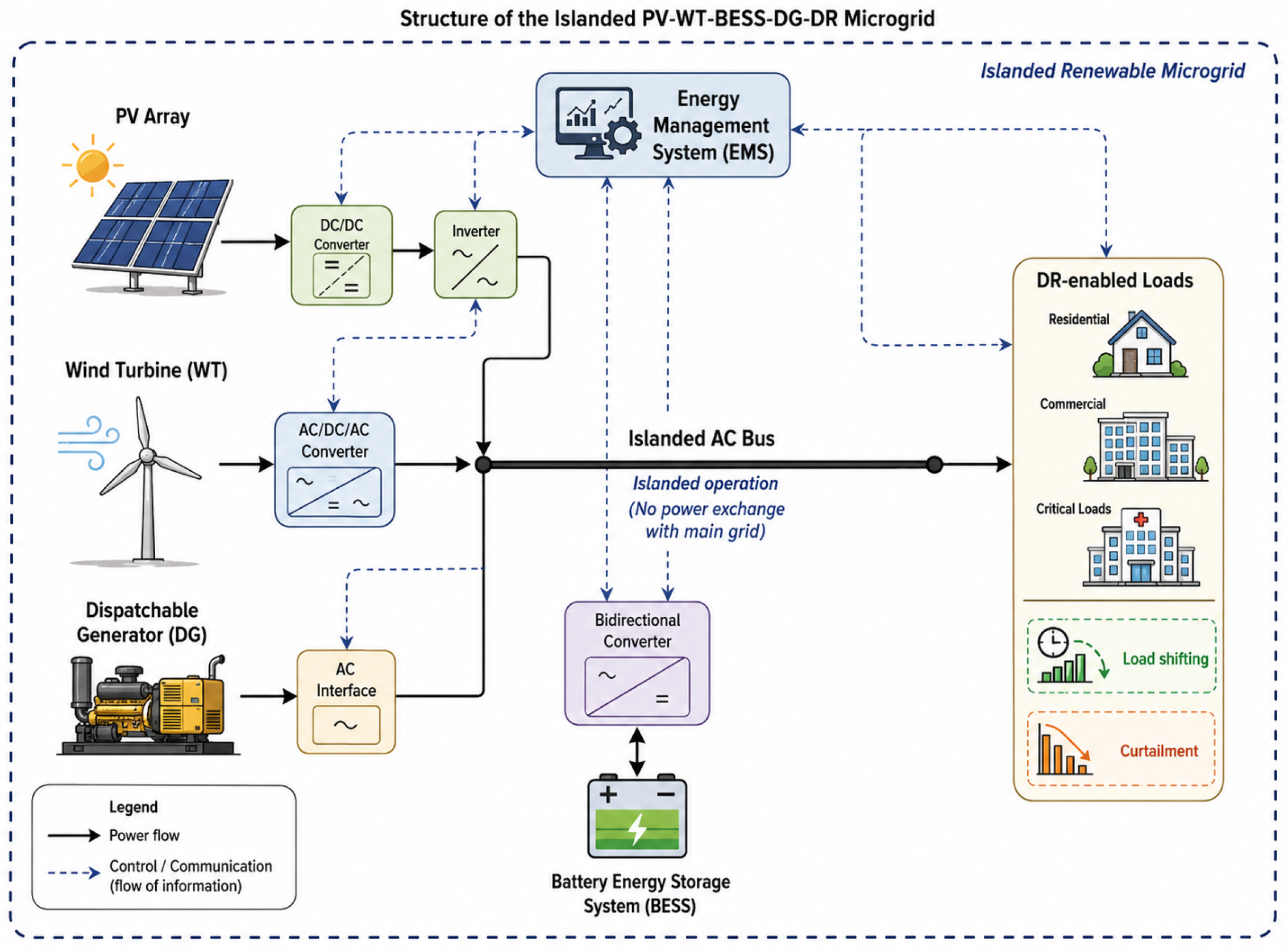
The studied microgrid includes PV units, WT units, BESS, a DG, and DR-enabled load. After parameter calibration, the DG can represent a diesel generator or a microturbine. The microgrid operates in islanded mode, with no power exchange with the main grid. Figure 1 shows the system structure, where an energy management system (EMS) coordinates all components through an islanded AC bus.

3.2. Objective Function

The daily dispatch objective is formulated as the sum of seven cost terms:
min F = C fuel + C om + C bat + C curt + C loss + C DR + C carbon .
The objective uses the following simplifying assumptions. First, dispatch is a deterministic day-ahead calculation for a representative 24 h profile; PV, WT, and load forecasts are treated as known inputs. Second, the cost terms are additive and separable over time; unit start-up cost, detailed network loss, and voltage constraints are not modeled. Third, DG fuel cost follows a static quadratic curve, and DG O&M cost is linear in output. Fourth, BESS degradation is approximated by a marginal throughput cost rather than a detailed electrochemical aging or rainflow-cycle model. Finally, carbon cost is calculated only from DG energy using a fixed emission factor and carbon price, and DR is represented by aggregate shifting and curtailment compensation.
The first term is the DG fuel cost. A quadratic fuel-cost curve is commonly used for dispatchable thermal units because incremental fuel consumption varies with output. Coefficient a captures the increasing marginal fuel cost at high output, b is the linear fuel-cost coefficient, and c is the fixed or no-load hourly cost:
C fuel = t = 1 T a P DG , t 2 + b P DG , t + c Δ t .
The O&M term accounts for the output-dependent maintenance cost of the DG:
C om = t = 1 T k DG om P DG , t Δ t .
The BESS degradation term uses a throughput-based marginal cost. It penalizes both charging and discharging energy because both contribute to cycling:
C bat = t = 1 T k bat ( P ch , t + P dis , t ) Δ t .
The renewable curtailment penalty discourages unnecessary PV and WT curtailment:
C curt = t = 1 T k PV , curt P PV , t curt + k WT , curt P WT , t curt Δ t ,
The load-shedding term assigns a high cost to involuntary emergency loss of load:
C loss = t = 1 T k loss P loss , t Δ t ,
The DR compensation term pays users for load shifting and voluntary curtailment:
C DR = t = 1 T k shift | P shift , t | + k cut P cut , t Δ t ,
The carbon-emission cost internalizes DG emissions according to the carbon price and emission factor:
C carbon = t = 1 T λ CO 2 γ DG P DG , t Δ t .
Here, P cut , t denotes voluntary curtailable load compensated through the DR mechanism, whereas P loss , t denotes involuntary emergency load shedding and is assigned a high penalty.

3.3. Constraints

The constraints define the feasible operating region of the islanded microgrid. Because there is no main–grid exchange, power balance is the central equality constraint. After repair, the balance error is
ϵ P , t = P PV , t use + P WT , t use + P DG , t + P dis , t + P loss , t P L , t DR P ch , t .
The balance error must remain within the numerical tolerance:
| ϵ P , t | ϵ P , ϵ P = 10 6 kW .
The value 10 6 kW is a numerical feasibility tolerance for algebraic repair, not a field measurement or metering accuracy. It is several orders of magnitude smaller than the kW-scale device ratings in Table 4 and prevents round-off residuals from being misclassified as physical imbalance. In practice, dispatch set-points would still be affected by device control accuracy, communication delay, and measurement uncertainty.
The PV and WT forecasts are decomposed into utilized power and curtailed power. These equations ensure that the model cannot use more renewable energy than the forecasted availability:
P PV , t use + P PV , t curt = P PV , t f ,
P WT , t use + P WT , t curt = P WT , t f .
The DR-adjusted load combines the original load, load shifting, and voluntary curtailable load:
P L , t DR = P L , t 0 + P shift , t P cut , t .
Load shifting is energy-conserving over the day: load is moved between hours rather than removed. Its hourly magnitude is limited by the maximum shiftable-load ratio:
t = 1 T P shift , t = 0 ,
ρ shift P L , t 0 P shift , t ρ shift P L , t 0 .
Voluntary curtailable load is non-negative and bounded by the curtailable-load ratio:
0 P cut , t λ cut P L , t 0 .
The DG output must remain within its minimum and maximum operating limits:
P DG min P DG , t P DG max ,
and the difference between consecutive DG outputs must satisfy the ramp-rate limits:
R down P DG , t P DG , t 1 R up .
The BESS charging and discharging powers are bounded by their rated power limits:
0 P ch , t u ch , t P ch max ,
0 P dis , t u dis , t P dis max ,
and simultaneous charging and discharging are prohibited:
u ch , t + u dis , t 1 .
In the continuous metaheuristic implementation, the binary variables u ch , t and u dis , t are not optimized explicitly. Charging/discharging complementarity is enforced by repair: if both charging and discharging are positive after decoding, the smaller value is set to zero, and the remaining value is clipped by the power and SOC limits.
The SOC dynamics update the stored energy after charging and discharging efficiencies are considered:
SOC t + 1 = SOC t + η ch P ch , t Δ t P dis , t Δ t / η dis E BESS .
The SOC bounds protect the BESS from overcharge and overdischarge:
SOC min SOC t SOC max .
The terminal SOC condition prevents the schedule from ending with an artificially depleted or overcharged BESS. It is handled with an engineering tolerance:
| SOC T SOC 0 | ϵ SOC , ϵ SOC = 0.02 .
Finally, renewable curtailment and involuntary load shedding are constrained to be non-negative because they represent physical quantities:
P PV , t curt 0 , P WT , t curt 0 , P loss , t 0 .

3.4. Constraint Repair Process

Each candidate vector is decoded into hourly DG output, net BESS power, shiftable-load adjustment, curtailable load, and renewable curtailment variables. The repair process clips bounds, corrects DG ramp violations, enforces BESS charging/discharging complementarity, updates SOC, restores shiftable-load conservation, reconstructs renewable utilization and curtailment, and restores power balance through DG adjustment, BESS adjustment, renewable curtailment, or high-penalty load shedding. Any residual violations are penalized in the objective.

4. Repair-Based Improved WOA

This section describes the optimization algorithm used to search the repaired continuous decision space.

4.1. Standard WOA

WOA mimics the encircling and bubble-net foraging behavior of humpback whales [34]. Let X i k be the position vector of individual i at iteration k, and let X * , k be the best solution found by that iteration. In this dispatch problem, each position vector is a continuous decision vector containing hourly DG output, BESS power, DR variables, and renewable curtailment variables. The encircling update is
D = | C X * , k X i k | ,
X i k + 1 = X * , k A D ,
where
A = 2 a WOA ( k ) r 1 a WOA ( k ) , C = 2 r 2 .
Here, r 1 and r 2 are random vectors in [ 0 , 1 ] . A controls the encircling step length, C perturbs attraction toward the best solution, and a WOA ( k ) decreases from 2 to 0 to shift the search from exploration to exploitation. The spiral update is
X i k + 1 = | X * , k X i k | e b sp l cos ( 2 π l ) + X * , k .
In the spiral equation, b sp (denoted as b in the original WOA formulation) controls the logarithmic-spiral shape, and l [ 1 , 1 ] determines the spiral movement around the current best solution. Standard WOA randomly chooses between encircling/search and spiral movement in each iteration.

4.2. Challenges of Islanded Microgrid Dispatch for WOA

In this implementation, the dispatch vector has dimension 6 T = 144 . SOC coupling narrows the feasible region, ramp constraints correlate adjacent hourly variables, DR conservation introduces equality constraints, and curtailment/load-shedding penalties create a rugged objective landscape. Standard WOA may therefore converge prematurely or produce unstable repeated-run results.

4.3. Proposed Repair-Based Improved WOA

The improved WOA is organized into three functional modules. Table 3 lists the modules and the dispatch difficulties they address.
The modules are integrated sequentially. Module 1 constructs and screens the initial population before the main iterations. Module 2 modifies the WOA control coefficient and position update at each iteration. Module 3 is applied after the basic WOA movement: Levy and Cauchy perturbations are used probabilistically during the iterations, and elite local refinement is applied after the global search. In the ablation study, the repair process, objective function, population size, and stopping criterion are fixed while selected modules are disabled to isolate their marginal contribution.

4.4. Module 1: Diversity Enhancement

Chaotic initialization improves coverage of the normalized decision space through the logistic map:
z n + 1 = 4 z n ( 1 z n ) ,
where z n ( 0 , 1 ) . The chaotic sequence is then mapped to the decision bounds.
The coefficient 4 is the fully chaotic parameter of the logistic map on ( 0 , 1 ) . It generates a non-repeating sequence with broad normalized-space coverage and is not tuned for this dispatch case.
X i , d = LB d + z i , d ( UB d LB d ) .
Here, LB d and UB d are the lower and upper bounds of the d-th decision variable. Elite opposition-based learning then tests whether the opposite point of an elite candidate gives a better repaired schedule:
X opp = LB + UB X elite .
The better solution between the elite candidate and its opposition candidate is retained. This step explains the lower initial best value relative to a purely random WOA population.

4.5. Module 2: Exploration–Exploitation Balancing

The nonlinear convergence factor is
a nl ( k ) = 2 1 k K 1.8 .
The adaptive inertia weight is
w ( k ) = w max ( w max w min ) k K .
The exponent 1.8 gives a moderately convex decay profile. Compared with the linear decrease in standard WOA, it preserves a larger search radius in the early and middle iterations and strengthens exploitation near the final iterations. The value is fixed in all experiments and is not re-tuned for individual benchmark runs.
The nonlinear a nl ( k ) replaces the linear WOA coefficient and slows the early decrease in the search radius. The adaptive inertia weight w ( k ) then blends the current position with the WOA-generated candidate:
X i k + 1 = ( 1 w ) X i k + w X WOA k + 1 .

4.6. Module 3: Local Escape and Refinement

Levy flight adds occasional long-distance perturbations to improve local escape:
X Levy k + 1 = X i k + 1 + α L Levy ( β ) ( UB LB ) .
Cauchy mutation around the elite solution is defined as
X Cauchy k + 1 = X * , k + α C tan [ π ( r 0.5 ) ] ( UB LB ) .
Here, α L and α C are scale factors, β is the Levy distribution parameter, r ( 0 , 1 ) , and ⊙ denotes element-wise multiplication. After the global iterations, elite local refinement samples candidate solutions according to
X local = X * + σ ( UB LB ) ϵ ,
where ϵ is a random perturbation vector and σ decreases across refinement rounds.

4.7. Pseudocode

Algorithm 1 shows the full algorithm. Compared with the original WOA, the added operations are chaotic initialization, elite opposition-based screening, nonlinear/adaptive position control, probabilistic Levy/Cauchy perturbation, mandatory decode–repair–evaluate steps after each candidate update, and final elite local refinement. The repair step is placed inside the loop because feasibility depends on time-coupled SOC and ramping constraints, not only on variable bounds.
Algorithm 1 Repair-based improved WOA for low-carbon economic dispatch.
Input: objective function, bounds, population size N, maximum iteration K.
Output: best repaired dispatch schedule.
1. Initialize population using chaotic mapping.
2. Decode, repair, and evaluate all candidates.
3. Apply elite opposition-based learning and retain the best N candidates.
4. For k = 1 to K:
    4.1 Update nonlinear convergence factor and adaptive inertia weight.
    4.2 Generate WOA encircling, random-search, or spiral candidates.
    4.3 Apply Levy or Cauchy mutation according to preset probabilities.
    4.4 Clip bounds, decode candidates, and run the repair process.
    4.5 Evaluate penalized objective values.
    4.6 Preserve the best candidate and update the convergence record.
5. Apply elite local refinement to the best candidate.
6. Return the repaired best dispatch schedule and cost.
The convergence record stores the best repaired objective value at the end of each iteration. Thus, the reported curves show best-so-far performance after repair, not the raw objective value of an unrepaired candidate.

4.8. Complexity Analysis

Let N be the population size, K the maximum number of iterations, D the decision dimension, and C f the cost of decoding and objective evaluation. Here, D = 6 T . Repair is not cost-free: it clips bounds, checks DG ramping, enforces BESS charging/discharging complementarity, updates SOC, restores DR conservation, reconstructs renewable curtailment, and checks power balance. These operations are linear in the scheduling horizon, so C rep = O ( T ) . Because D = 6 T , repair has the same order as decoding but increases the evaluation constant.
For standard WOA, the dominant complexity is O ( K N ( D + C f + C rep ) ) . The proposed method adds chaotic initialization O ( N D ) , elite opposition-based learning O ( N D ) at initialization, and probabilistic Levy and Cauchy perturbations during the iterations. If p L and p C are the application probabilities of Levy flight and Cauchy mutation, their expected additional perturbation cost is O ( K N ( p L + p C ) D ) . The elite local-refinement stage uses fixed refinement rounds and candidates, denoted by R p and M p , and contributes O ( R p M p ( D + C f + C rep ) ) . Thus, for fixed perturbation probabilities and local-refinement settings, the asymptotic order remains O ( K N ( D + C f + C rep ) ) , but the constant factor is higher than that of standard WOA. This explains the runtime increase in the numerical experiments.

5. Case Study and Simulation Settings

5.1. Data and Parameters

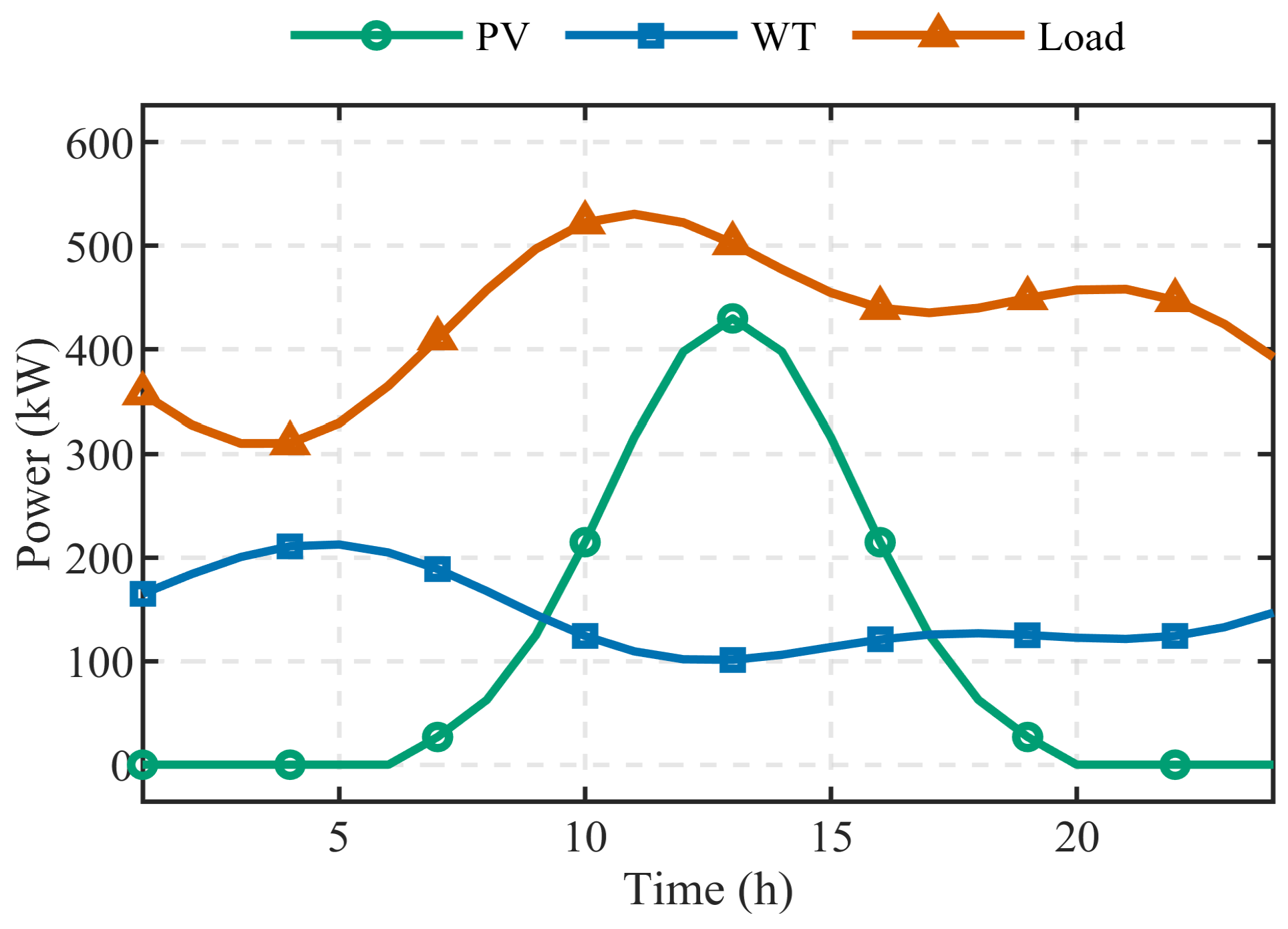
The scheduling horizon is 24 h, with a 1 h time interval. Figure 2 shows the forecast PV, WT, and load profiles.
Table 4 lists the main system parameters. In the quadratic fuel-cost formulation, a is reported in CNY/(kW2 h), b in CNY/kWh, and c in CNY/h.
The BESS degradation coefficient in Table 4 is a marginal throughput-based proxy in the dispatch objective, not a full life-cycle battery replacement cost. The base carbon price is a conservative China-oriented accounting parameter and does not represent the higher prices in the European carbon market. Because these coefficients can affect cost composition and dispatch preference, Section 6 adds sensitivity checks for both BESS degradation cost and carbon price.

5.2. Algorithm Settings

All benchmark algorithms use the same objective function, repair process, population size, iteration limit, and variable bounds. Table 5 lists the main algorithm parameters. To avoid bias from unequal tuning effort, differential evolution is excluded from the main benchmark set; the comparison focuses on PSO, GWO, standard WOA, and the proposed improved WOA under a consistent protocol. This benchmark set is intended to evaluate the proposed repair-based WOA variant against common canonical baselines, not to exhaust all recent metaheuristic variants. Advanced GWO variants, SMA variants, and hybrid optimization models may provide stronger competitors, but they also require their own tuning budgets and implementation choices. They are therefore discussed as an important extension rather than added as unsupported numerical results in the present revision.
K = 60 was selected as the common stopping criterion after preliminary convergence screening. With N = 25 , this gives each baseline algorithm 1500 primary population updates while keeping repeated-run statistics computationally light. The convergence behavior reported in Section 6.2 shows that the mean best-so-far curves largely stabilize within 60 iterations for the tested case. The same N and K are used so that the population evolution length is identical across algorithms; auxiliary evaluations in the proposed method are reflected in runtime and discussed in Section 6.2.

5.3. Evaluation Metrics

The metaheuristic comparison uses 30 independent runs of the deterministic dispatch case. Metrics include best, worst, mean, median, standard deviation, runtime, convergence behavior, Wilcoxon signed-rank test, and Friedman rank test. The strategy comparison reports cost and operational indicators, and the sensitivity analysis examines key technical and economic parameters.

6. Results

This section verifies dispatch behavior and then evaluates algorithmic performance and strategy-level implications.

6.1. Base-Case Dispatch

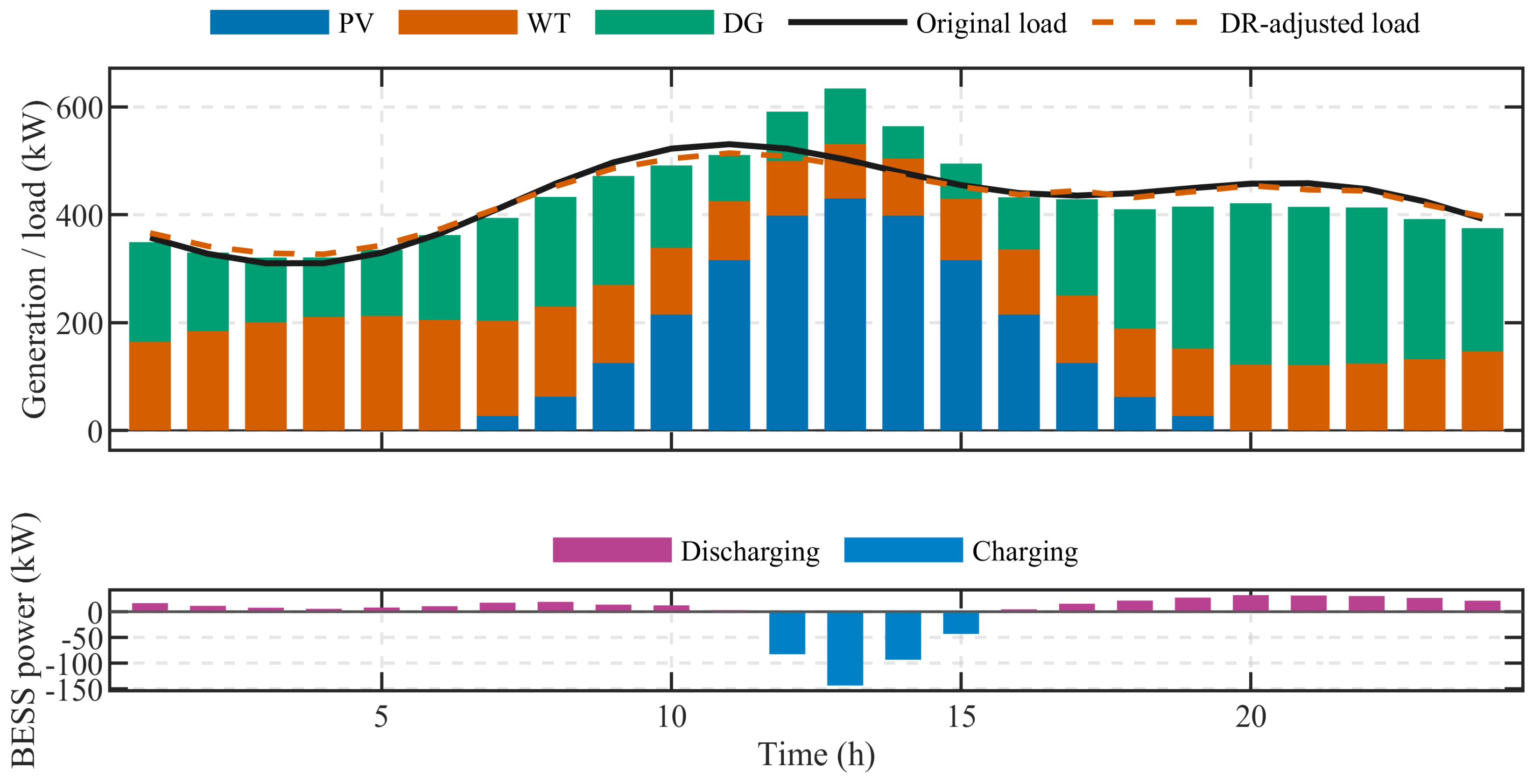
Figure 3 shows the base-case power dispatch. The upper panel presents PV, WT, DG, and the original and DR-adjusted load curves; the lower panel shows BESS power separately. Positive BESS power denotes discharging, and negative power denotes charging. The two-panel format avoids obscuring BESS behavior, which is smaller than the PV, WT, and DG outputs.
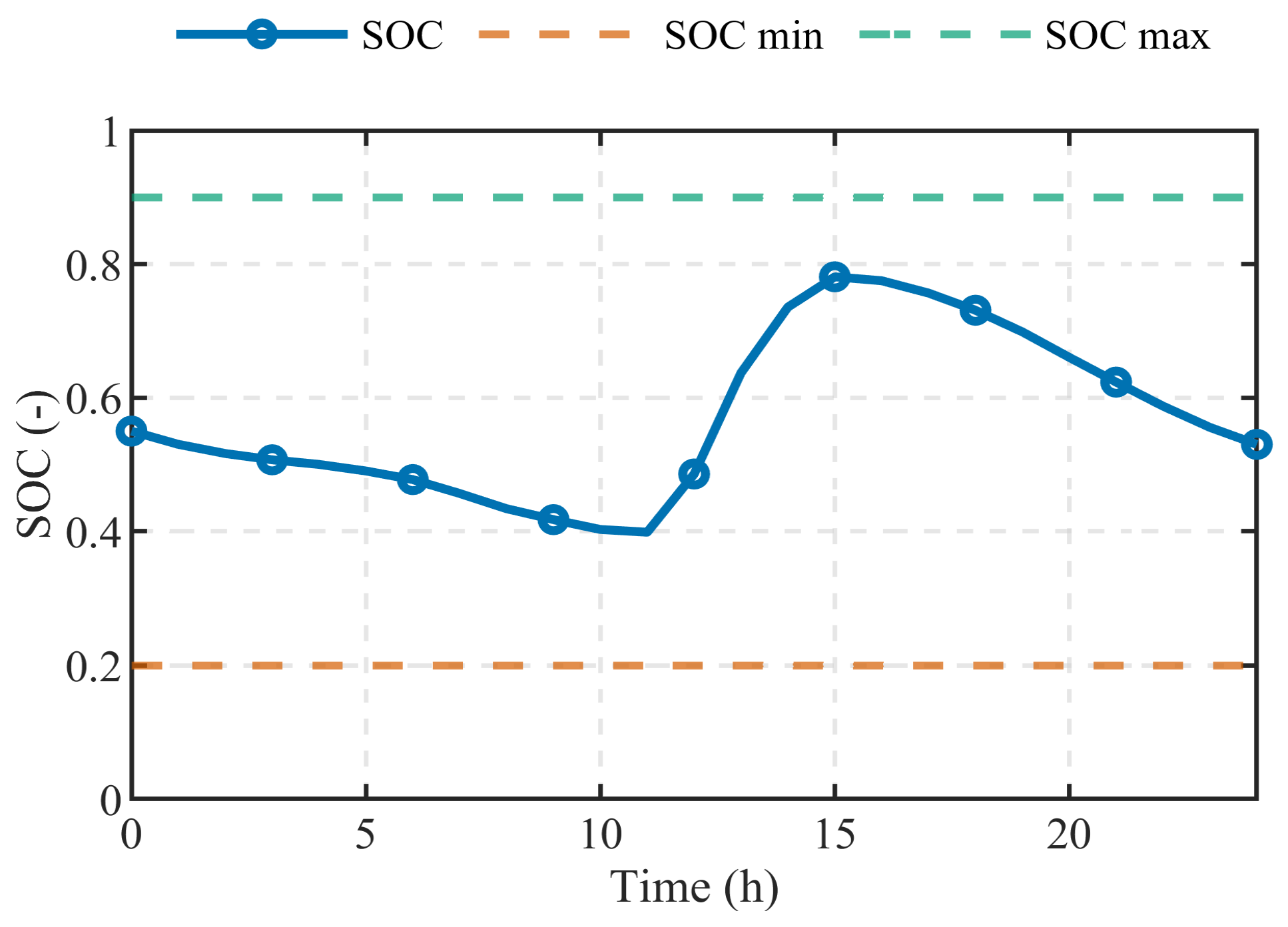
Figure 4 shows the SOC trajectory and operating limits. SOC remains within 0.20–0.90 and satisfies the terminal tolerance.
Table 6 reports the base-case cost breakdown. The total cost is 2666.50 CNY/day. Fuel cost is dominant, and load-shedding cost is zero. The maximum absolute power-balance residual after algebraic repair is 1.1369 × 10 13 kW. This is only a floating-point residual after enforcing the equality constraint, not a measure of physical accuracy or a guarantee against forecast errors.

6.2. Benchmark Algorithm Comparison

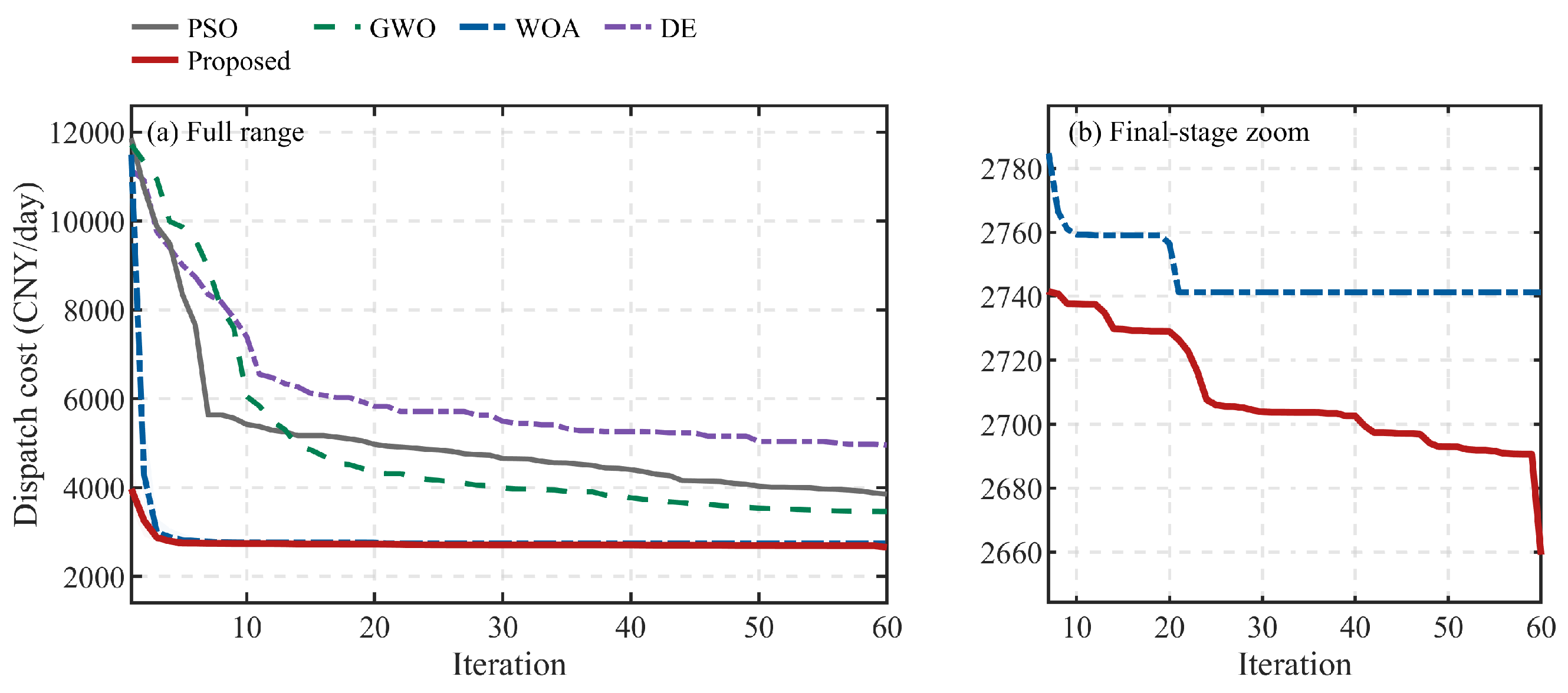
Figure 5 shows the mean best-so-far convergence curves. For each run, the best repaired objective value at the end of each iteration was recorded; the plotted curve is the arithmetic mean of the 30 best-so-far curves. Thus, Figure 5 is neither a single-run trajectory nor a curve calculated from all population members in one run. The proposed method starts from a lower initial best value because chaotic initialization and elite opposition-based screening evaluate a broader initial candidate set before the main WOA iteration. It then converges to a lower objective value than standard WOA and the other benchmarks.
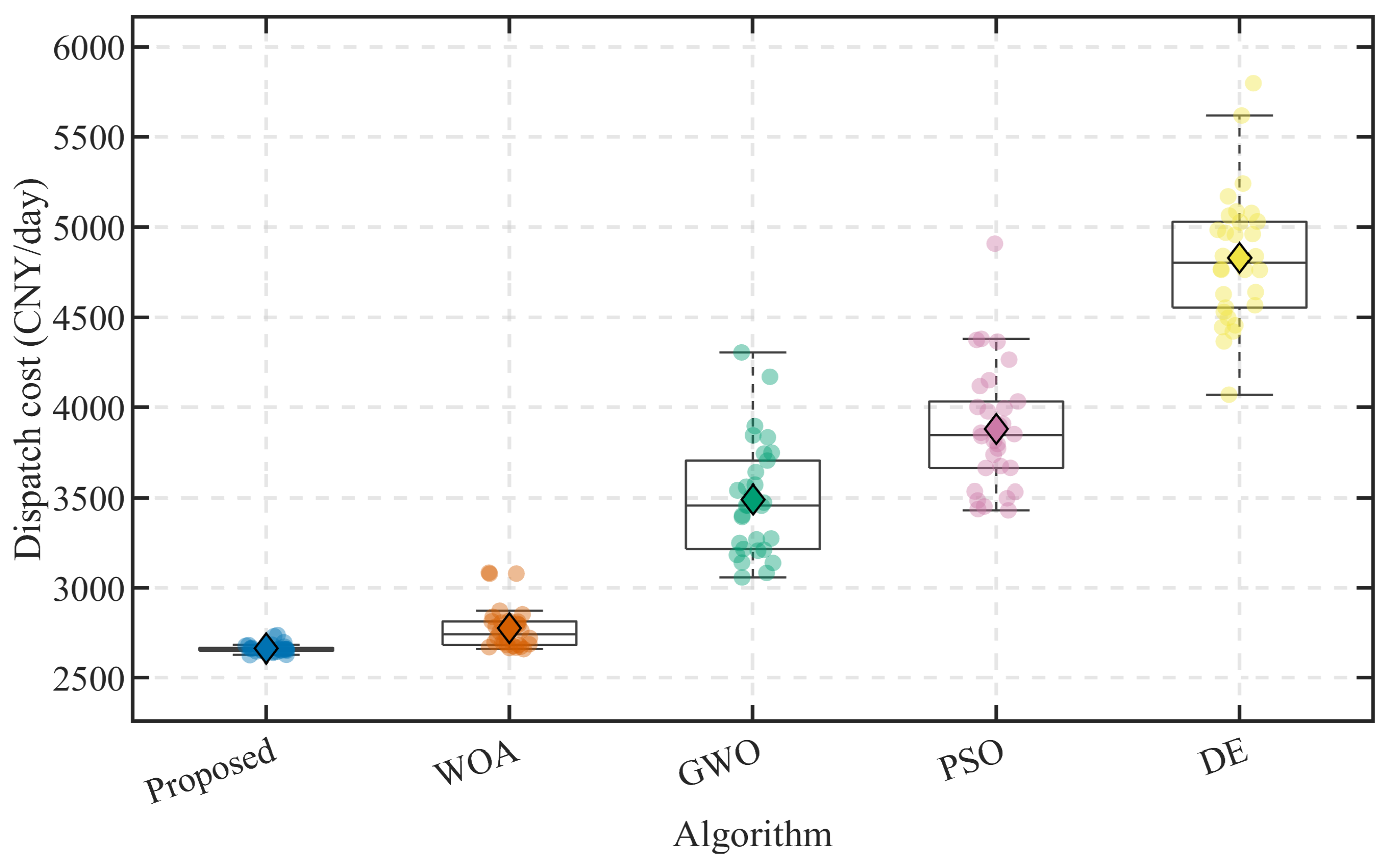
Figure 6 presents the final dispatch-cost distributions from 30 runs, using boxplots, jittered samples, and mean markers. Algorithms are ordered by mean dispatch cost.
The numerical statistics for the algorithm comparison are reported in Table 7.
Compared with WOA, the proposed method reduces mean cost by 4.07% and standard deviation by 79.72%. Average runtime increases by 62.25%, from 0.728 s to 1.182 s, mainly because elite opposition learning, probabilistic mutation, local elite search, and final polishing require auxiliary objective-function evaluations. The runtime remains acceptable for day-ahead scheduling because the optimization is performed offline and averages close to one second in the MATLAB R2024a implementation.
Because the proposed method uses more auxiliary evaluations than the baselines, an additional evaluation-budget check was conducted. The proposed method was reduced to 30 iterations, yielding an expected number of objective-function evaluations close to the 60-iteration baselines after accounting for initialization, opposition learning, local elite search, probabilistic mutation, and polishing. Proposed-30iter achieved a mean cost of 2711.8 CNY/day and a standard deviation of 91.72 CNY/day, whereas standard WOA with 60 iterations achieved 2799.7 CNY/day and 199.26 CNY/day under the same 30-run protocol. This indicates that the improvement is not only due to a larger iteration count, although the full version intentionally uses additional local-refinement evaluations to improve robustness.

6.3. Statistical Tests

Table 8 reports Wilcoxon signed-rank tests between the proposed method and each benchmark. For Proposed versus WOA, the two-sided p-value is 1.13 × 10 5 , and the median difference is −92.36 CNY/day. The Friedman test across the four algorithms gives p = 2.37 × 10 17 , and the proposed method obtains the best mean rank of 1.07.

6.4. Strategy Comparison

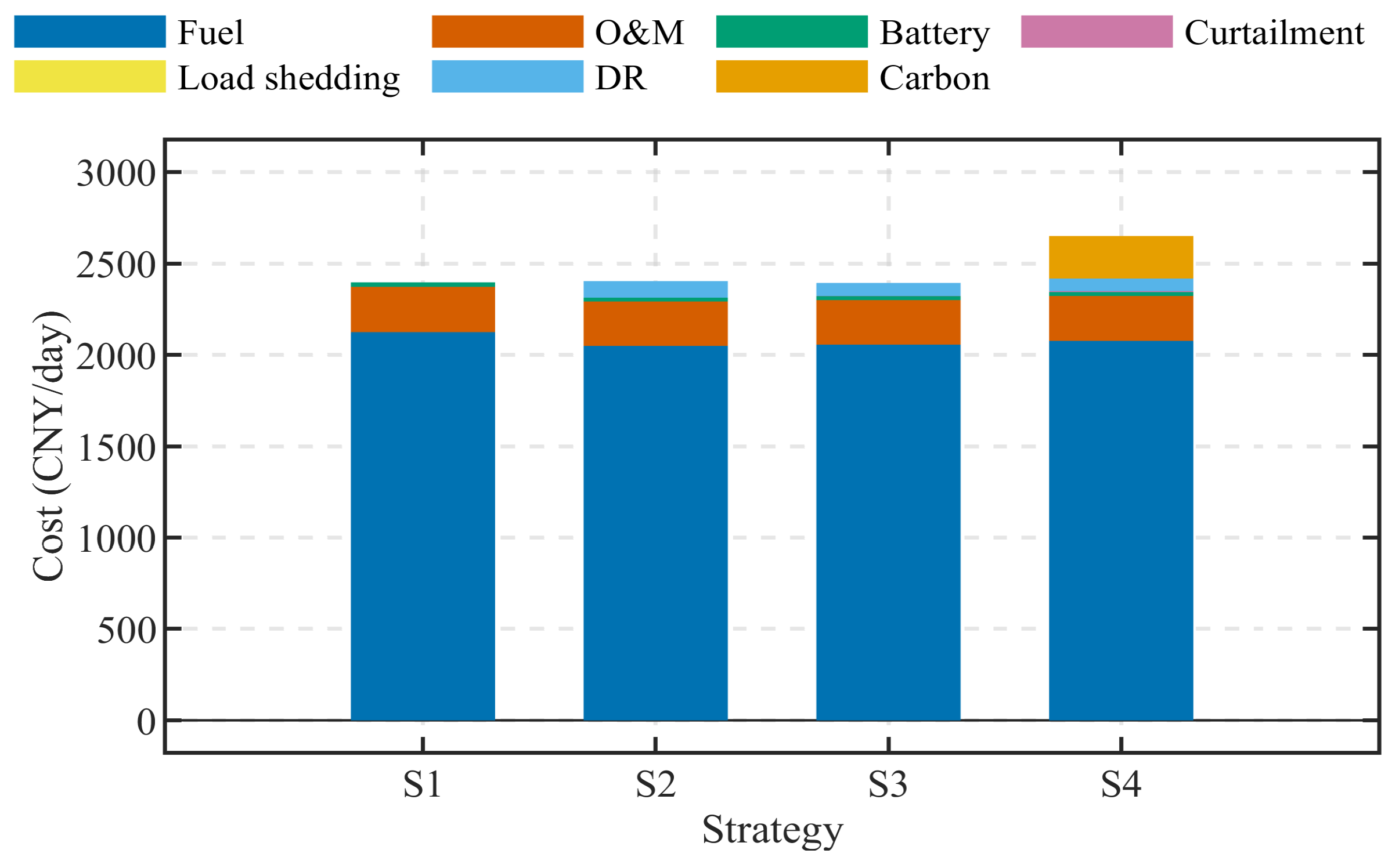
Figure 7 shows the cost breakdown under four strategies. S1 excludes DR and carbon cost; S2 includes only DR; S3 includes DR and curtailment penalty; and S4 includes DR, curtailment penalty, and carbon cost.
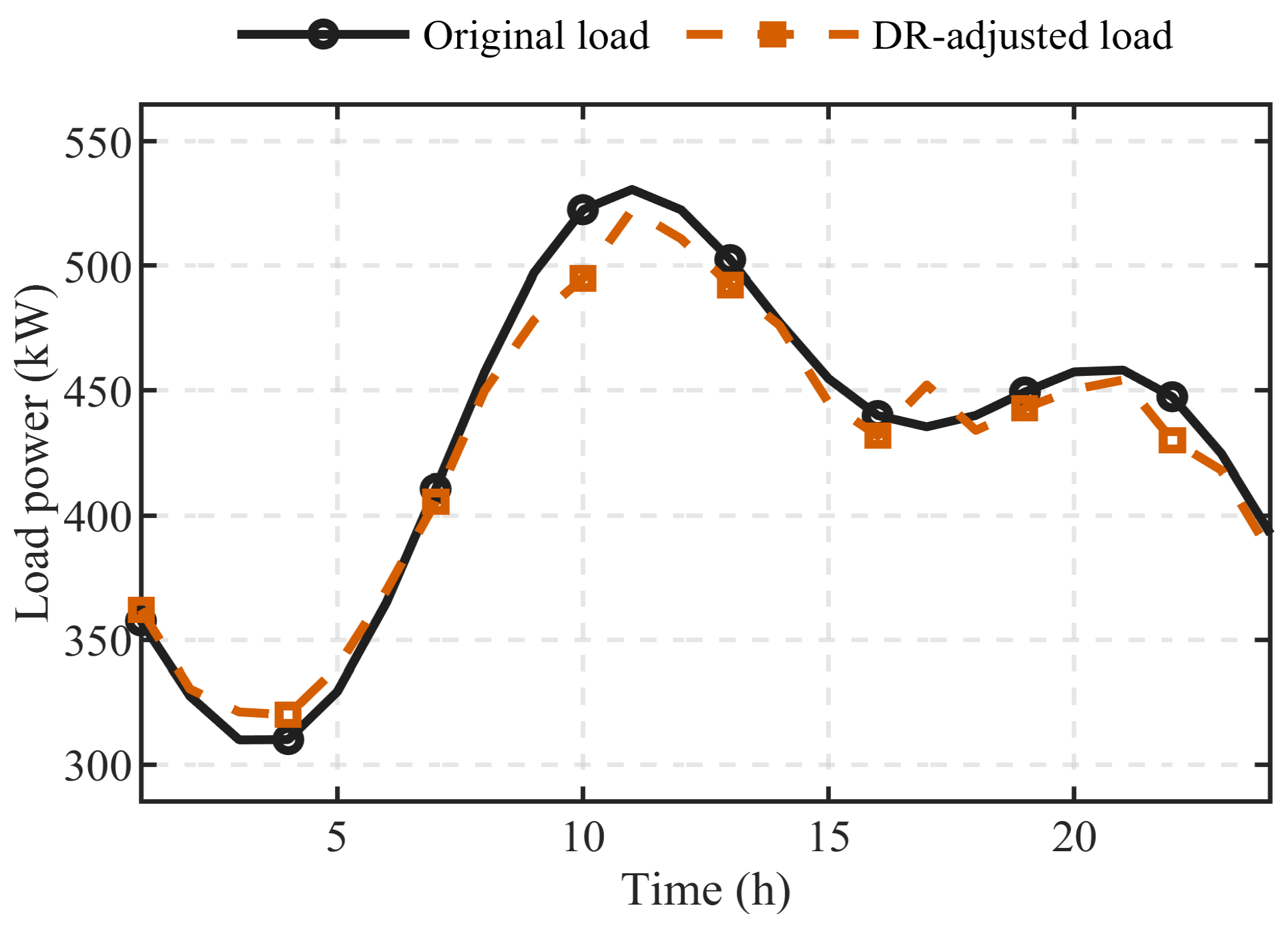
Figure 8 compares the original and DR-adjusted load profiles. No price signal is plotted because the model does not use a real tariff signal.
The corresponding numerical cost components are reported in Table 9.
Table 10 adds operational indicators so that the strategies are not judged only by total cost. Compared with S1, S2 reduces DG energy from 4142.80 to 4015.34 kWh and CO2 emissions from 2982.82 to 2891.04 kgCO2, but its total cost rises slightly because 91.29 CNY/day of DR compensation offsets part of the fuel saving. S3 has the lowest monetary cost and keeps renewable utilization at 99.91%, showing that the curtailment penalty changes the interaction between renewable utilization and DR scheduling. S4 has the highest total accounting cost because 234.07 CNY/day of carbon cost is internalized. This is not a dispatch failure; it reflects the broader cost boundary introduced by explicit carbon accounting. Strategy assessment should therefore consider monetary cost, renewable utilization, DG energy, and emissions together.

6.5. Ablation Study

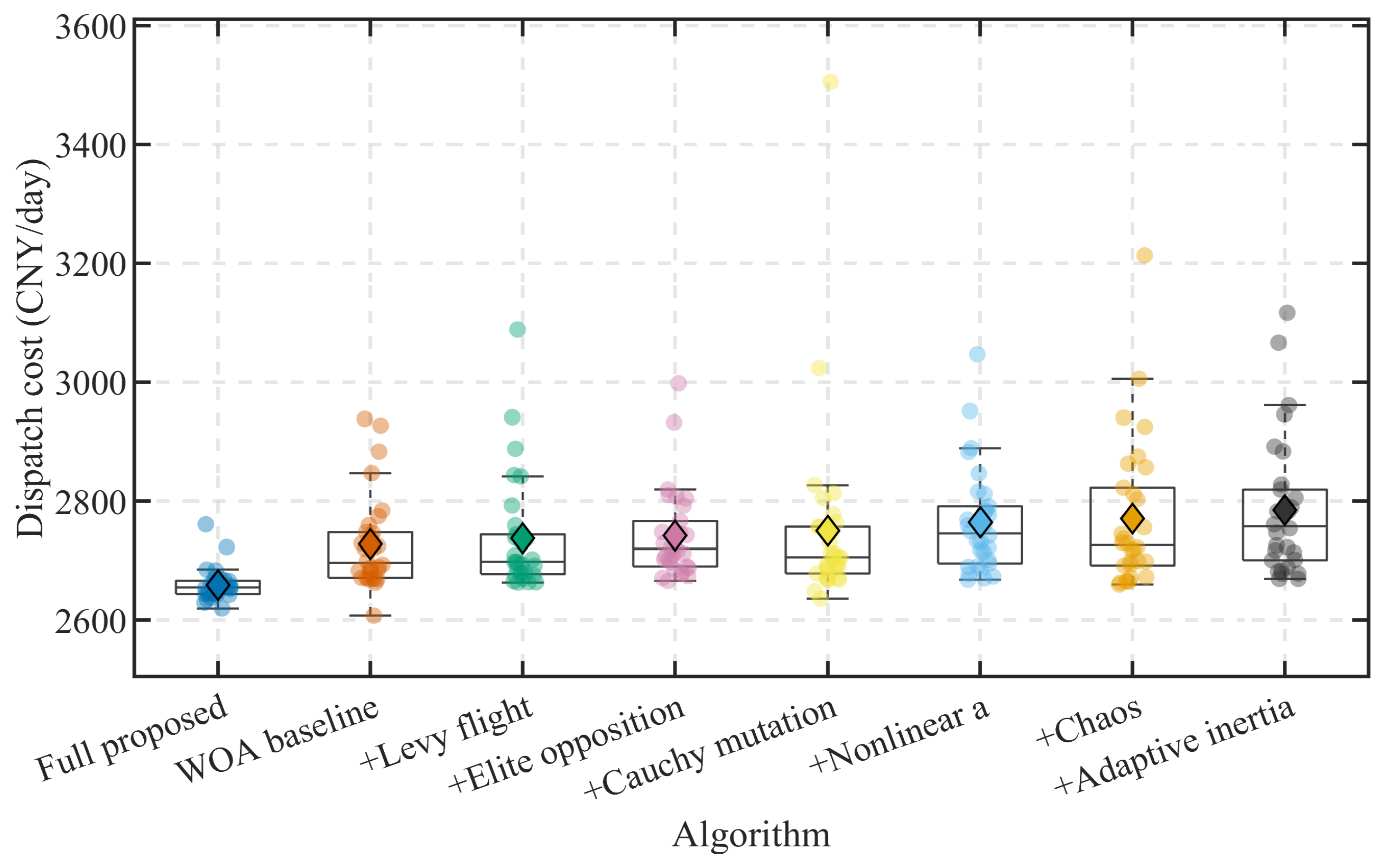
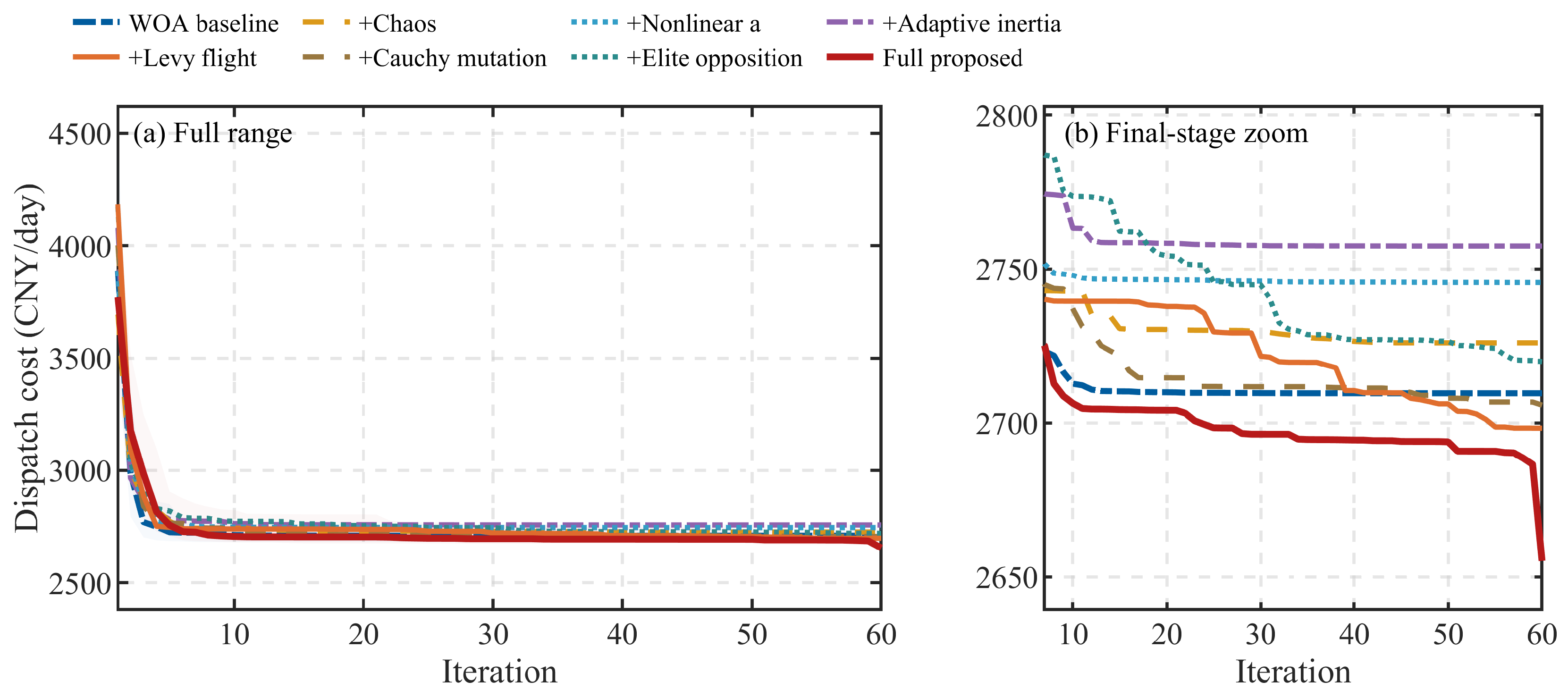
Figure 9 shows the ablation convergence curves, and Figure 10 shows the corresponding dispatch-cost distributions.
The ablation statistics are reported in Table 11.
The full version does not necessarily obtain the best single-run optimum; the WOA baseline has a lower best value in one run. Thus, the combined modules should not be interpreted as guaranteeing dominance in every individual run. Their purpose is to improve repeated-run stability. Under the tested settings, the full version achieves the best distributional performance in mean, median, standard deviation, and rank. Table 12 reports the Wilcoxon tests between the full version and each ablation variant.

7. Sensitivity Analysis

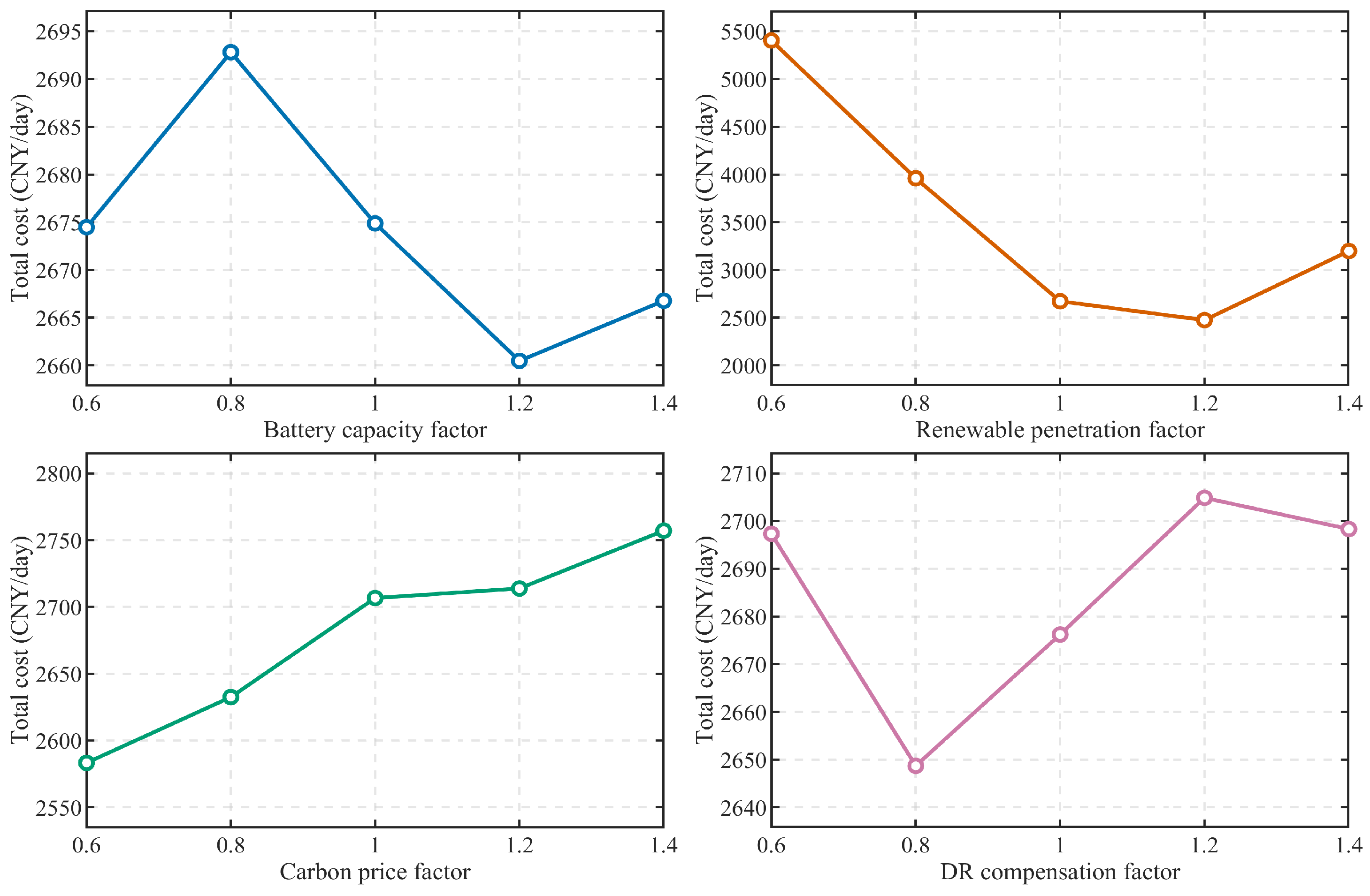
Figure 11 shows total-cost sensitivity to battery capacity, renewable penetration, carbon price, and DR compensation factors. Battery-capacity variation has a small cost effect in the tested range, suggesting that the base BESS capacity is sufficient for the deterministic typical day. Renewable penetration has a stronger effect: cost decreases as renewable availability increases, but excessive penetration can increase curtailment when additional flexibility is unavailable.
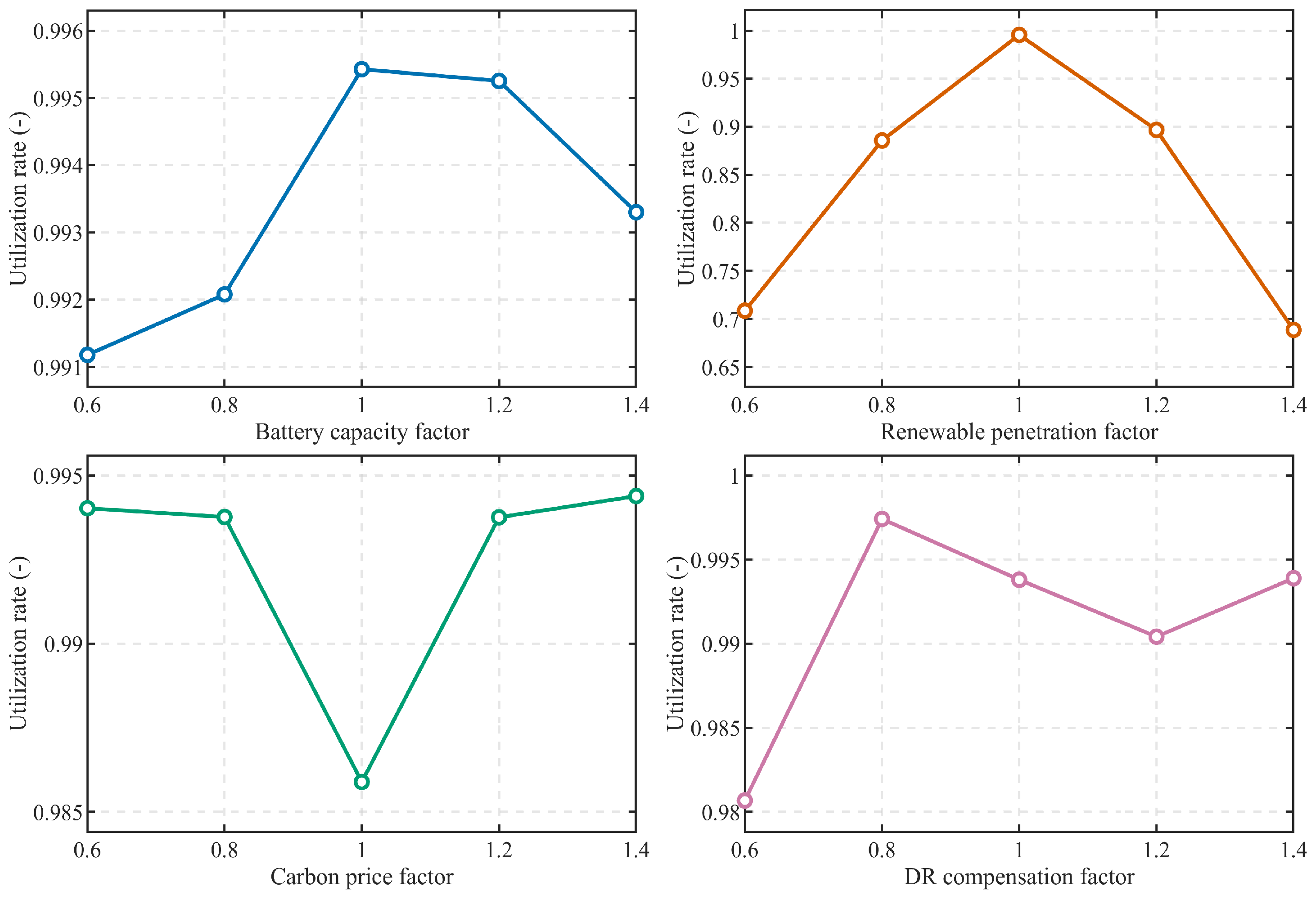
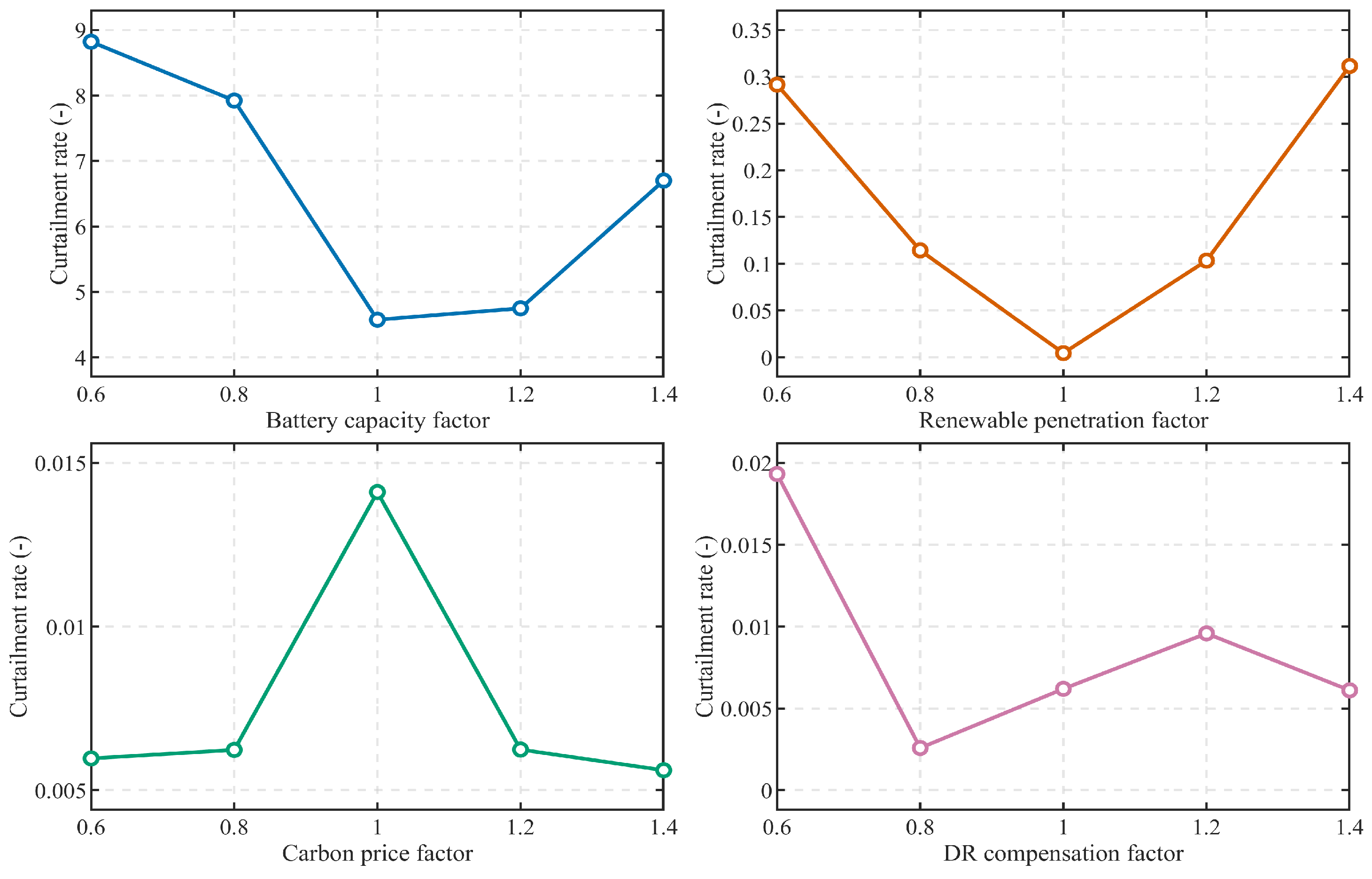
Figure 12 and Figure 13 show renewable-utilization and curtailment-rate sensitivity. Renewable penetration produces the largest curtailment variation. At the highest tested penetration level, renewable utilization decreases because local demand and BESS flexibility cannot absorb all renewable generation.
Table 13 further examines two economic parameters that are often questioned in low-carbon dispatch studies. Increasing the BESS degradation coefficient from 0.035 to 0.200 CNY/kWh raises the mean total cost from 2696.50 to 2779.70 CNY/day, while renewable utilization remains above 99% and DG energy changes only moderately. Increasing the carbon price from 0.08 to 0.64 CNY/kgCO2 substantially raises the accounting cost, as expected, while DG energy decreases slightly from 4113.6 to about 4064.8 kWh. Thus, the base carbon price and BESS degradation coefficient affect cost scale, but they do not reverse the qualitative interpretation under the tested deterministic setting.
Because carbon cost and DR compensation directly affect the economic interpretation, Table 14 further reports the sensitivity of total cost and renewable utilization to the carbon-price factor and DR-compensation factor. When the carbon-price factor changes from 0.6 to 1.4, the mean total cost changes from 2583.32 to 2757.03 CNY/day. This is mainly an accounting effect because carbon cost is proportional to DG energy, carbon price, and the emission factor. When the DR-compensation factor changes from 0.6 to 1.4, the total cost remains between 2648.71 and 2704.85 CNY/day, and renewable utilization remains between 98.07% and 99.74%. These results indicate that DR compensation affects the dispatch cost but does not create load shedding or make the deterministic schedule infeasible in the tested range.

8. Discussion

8.1. Comparison with Recent Worldwide Studies

The proposed model is related to recent international studies on microgrid energy management, but its focus is different. Multi-energy low-carbon studies show that carbon accounting and DR can change dispatch decisions in integrated energy systems [24,25]. Uncertainty-aware studies show that renewable and load forecast deviations should be considered in stochastic or robust scheduling [28,29,30]. Recent hybrid-source microgrid work also confirms the importance of coordinating storage and DR under multi-objective criteria [20]. Compared with these studies, this work focuses on a compact islanded PV-WT-BESS-DG-DR microgrid and emphasizes repair-based feasibility restoration within a continuous metaheuristic search.
The results should be interpreted as evidence of algorithmic reliability for this deterministic formulation, not as a universal cost benchmark across microgrid systems. Under the same case setting, the proposed method reduces repeated-run mean cost and standard deviation relative to standard WOA, and the ablation study shows that the complete module combination improves distributional stability. Recent reviews emphasize that advanced GWO variants, SMA-based algorithms, and hybrid metaheuristics are increasingly used in microgrid optimization [40,44]. A broader benchmark including these methods would further strengthen the comparative evidence, provided that each algorithm is tuned under a transparent and balanced protocol. Studies that include robust optimization, model predictive control, network constraints, or hardware validation address additional operational layers that are not included here. Thus, the contribution lies in low-carbon islanded dispatch modeling and repair-based metaheuristic implementation; broader metaheuristic benchmarking, real-time uncertainty management, and physical validation remain as future extensions.

8.2. Network Constraints and Real-Grid Applicability

The proposed dispatch model uses a single-bus energy-management representation. This is suitable for evaluating energy balance, storage operation, DG ramping, DR scheduling, and carbon-cost accounting, but it does not replace a network-constrained optimal power-flow model. In a real distribution microgrid, line-flow limits, bus-voltage limits, reactive-power support, transformer capacity, protection settings, and communication delays may restrict the direct implementation of the calculated schedule.
For a network-constrained extension, the dispatch should be embedded in AC or linearized distribution power-flow equations. A typical AC formulation would require active- and reactive-power balance at each bus:
P i = V i j V j G i j cos ( θ i θ j ) + B i j sin ( θ i θ j ) ,
Q i = V i j V j G i j sin ( θ i θ j ) B i j cos ( θ i θ j ) ,
with voltage and branch-flow limits:
V i min V i V i max , | S i j | S i j max .
These equations are not solved in the present study because the available case data describe aggregate source-load-storage profiles rather than a bus-branch network. Therefore, the proposed model should be viewed as an EMS-level scheduling layer. For deployment, its set points should be checked by AC power flow or embedded in an optimal-power-flow or model-predictive-control layer before being issued to field devices.

8.3. Uncertainty and Constraint-Handling Extensions

The current formulation is deterministic and uses representative 24 h forecasts. A stochastic extension could optimize expected operating cost across scenarios:
min ω π ω F ( x , ω ) ,
or include a risk term such as conditional value at risk:
min ω π ω F ( x , ω ) + η risk C CVaR .
Alternatively, a robust formulation could minimize the worst-case cost over an uncertainty set:
min x max ξ U F ( x , ξ ) .
These formulations would require scenario generation or uncertainty-set calibration for PV, WT, load, and equipment availability. They are beyond the deterministic scope of this paper but are important for real-time operation under forecast errors.
The repair-based constraint-handling strategy should also be interpreted relative to penalty and projection methods. Penalty-based methods keep infeasible candidates and rely on penalty coefficients, which may be sensitive to scaling when equality constraints, SOC coupling, and ramping limits coexist. Projection-based methods can restore feasibility by solving a distance-minimization subproblem, but a full projection onto the coupled microgrid feasible set may require an additional constrained optimization problem for each candidate. The proposed repair process is a constructive alternative that restores the main operational constraints directly. A systematic comparison among repair, penalty, and projection strategies remains a useful extension.

8.4. Engineering-Scale Consistency and Practical Relevance

The numerical case is an engineering-scale 24 h typical-day test case, not a hardware experiment. To clarify its practical relevance, Table 15 summarizes the main scale and operating indicators. The peak load, renewable capacity range, BESS size, and DG rating are consistent with a small islanded renewable microgrid, not a transmission-level system. The optimized schedule also satisfies the main engineering constraints: DG output stays within 60–450 kW, SOC remains within 0.20–0.90, and involuntary load shedding is zero in the base case.
This comparison does not replace field or hardware-in-the-loop validation. In a real controller, forecast errors, equipment response delays, communication constraints, measurement noise, and protection settings would affect the realized dispatch. The results therefore support the engineering-scale feasibility of the modeling and optimization framework, but operational deployment still requires real-time rolling optimization, measured-data validation, and hardware-in-the-loop or field experiments.

9. Conclusions

This study developed a low-carbon economic dispatch model and a repair-based improved WOA for an islanded PV-WT-BESS-DG-DR microgrid. The main findings are as follows.
1.
In the base case, the total cost is 2666.50 CNY/day, load shedding is zero, and the repaired schedule satisfies the power-balance equality with numerical precision.
2.
In 30 independent benchmark runs, the proposed method reduces the mean cost by 4.07% compared with WOA, from 2775.92 to 2662.96 CNY/day, and reduces the standard deviation by 79.72%, from 121.23 to 24.59 CNY/day.
3.
Statistical tests support the algorithm comparison. The Wilcoxon two-sided p-value for Proposed versus WOA is 1.13 × 10 5 , and the Friedman test across the four algorithms gives p = 2.37 × 10 17 .
4.
The strategy comparison shows that carbon-cost internalization increases the explicit total cost in S4. This reflects a broader low-carbon accounting boundary rather than an optimization failure.
5.
The ablation study shows that the full method improves distributional performance and repeated-run robustness, although it does not always achieve the best single-run optimum.
6.
Sensitivity checks show that changing the BESS degradation coefficient, carbon price, and DR compensation factor changes total accounting cost but does not reverse the qualitative feasibility of the deterministic dispatch framework.
The study has six main limitations. First, the model is day-ahead and does not include rolling real-time correction. Second, BESS degradation is represented by a simplified throughput-based cost. Third, stochastic or robust uncertainty modeling is not included. Fourth, network power-flow constraints, voltage limits, and line-capacity constraints are excluded. Fifth, the algorithm comparison uses common canonical baselines and does not include advanced GWO variants, SMA variants, or hybrid optimization models. Sixth, measured SCADA validation, real-time control, communication delay, hardware-in-the-loop testing, and field experiments are not considered.
Future work will address rolling optimization, detailed battery aging, stochastic or robust dispatch under renewable and load uncertainty, distribution-network-constrained dispatch, broader comparisons with advanced GWO/SMA/hybrid algorithms, systematic comparison among repair-, penalty-, and projection-based constraint handling, multi-microgrid energy sharing, measured-data validation, and hardware-in-the-loop or field validation.

Author Contributions

Conceptualization, H.X. and Q.T.; methodology, H.X. and D.T.; software, H.X.; validation, Y.K., L.Y. and F.Y.; formal analysis, H.X. and F.L.; investigation, D.T. and Y.K.; resources, D.T., L.Y. and F.Y.; data curation, H.X.; writing—original draft preparation, F.L.; writing—review and editing, H.X. and Q.T.; visualization, H.X.; supervision, F.L. and Q.T.; project administration, D.T. and Q.T.; funding acquisition, D.T. and Q.T. All authors have read and agreed to the published version of the manuscript.

Funding

This research was funded by the Science and Technology Project of State Grid Hubei Electric Power Co., Ltd., grant number B31532259621.

Institutional Review Board Statement

Not applicable.

Informed Consent Statement

Not applicable.

Data Availability Statement

The data and code supporting the findings of this study are available from the corresponding author upon reasonable request.

Acknowledgments

The authors thank State Grid Hubei Electric Power Research Institute and Northwest A&F University for their support.

Conflicts of Interest

Authors Haozhe Xiong, Daojun Tan, Yiqun Kang, Li You, and Fangbin Yan were employed by the State Grid Hubei Electric Power Research Institute. The remaining authors declare that the research was conducted in the absence of any commercial or financial relationships that could be construed as a potential conflict of interest.

Abbreviations

The following abbreviations are used in this manuscript:
BESSBattery energy storage system
DGDispatchable generator
DRDemand response
EMSEnergy management system
GWOGrey wolf optimizer
PVPhotovoltaic
SOCState of charge
WOAWhale optimization algorithm
WTWind turbine

References

  1. Lasseter, R.H. MicroGrids. In 2002 IEEE Power Engineering Society Winter Meeting; Conference Proceedings; IEEE: Piscataway, NJ, USA, 2002; Volume 1, pp. 305–308. [Google Scholar] [CrossRef]
  2. Hatziargyriou, N.; Asano, H.; Iravani, R.; Marnay, C. Microgrids. IEEE Power Energy Mag. 2007, 5, 78–94. [Google Scholar] [CrossRef]
  3. Olivares, D.E.; Mehrizi-Sani, A.; Etemadi, A.H.; Canizares, C.A.; Iravani, R.; Kazerani, M.; Hajimiragha, A.H.; Gomis-Bellmunt, O.; Saeedifard, M.; Palma-Behnke, R.; et al. Trends in Microgrid Control. IEEE Trans. Smart Grid 2014, 5, 1905–1919. [Google Scholar] [CrossRef]
  4. Chen, C.; Duan, S.; Cai, T.; Liu, B. Smart Energy Management System for Optimal Microgrid Economic Operation. IET Renew. Power Gener. 2011, 5, 258–267. [Google Scholar] [CrossRef]
  5. Kanchev, H.; Lu, D.; Colas, F.; Lazarov, V.; Francois, B. Energy Management and Operational Planning of a Microgrid With a PV-Based Active Generator for Smart Grid Applications. IEEE Trans. Ind. Electron. 2011, 58, 4583–4592. [Google Scholar] [CrossRef]
  6. Tsikalakis, A.G.; Hatziargyriou, N.D. Operation of Microgrids with Demand Side Bidding and Continuity of Supply for Critical Loads. Eur. Trans. Electr. Power 2011, 21, 1238–1254. [Google Scholar] [CrossRef]
  7. Parisio, A.; Rikos, E.; Glielmo, L. A Model Predictive Control Approach to Microgrid Operation Optimization. IEEE Trans. Control Syst. Technol. 2014, 22, 1813–1827. [Google Scholar] [CrossRef]
  8. Palma-Behnke, R.; Benavides, C.; Lanas, F.; Severino, B.; Reyes, L.; Llanos, J.; Saez, D. A Microgrid Energy Management System Based on the Rolling Horizon Strategy. IEEE Trans. Smart Grid 2013, 4, 996–1006. [Google Scholar] [CrossRef]
  9. Khodaei, A. Microgrid Optimal Scheduling With Multi-Period Islanding Constraints. IEEE Trans. Power Syst. 2014, 29, 1383–1392. [Google Scholar] [CrossRef]
  10. Garcia Vera, Y.E.; Dufo-Lopez, R.; Bernal-Agustin, J.L. Energy Management in Microgrids with Renewable Energy Sources: A Literature Review. Appl. Sci. 2019, 9, 3854. [Google Scholar] [CrossRef]
  11. Thirunavukkarasu, G.S.; Seyedmahmoudian, M.; Jamei, E.; Horan, B.; Mekhilef, S.; Stojcevski, A. Role of Optimization Techniques in Microgrid Energy Management Systems–A Review. Energy Strategy Rev. 2022, 43, 100899. [Google Scholar] [CrossRef]
  12. Nemati, M.; Braun, M.; Tenbohlen, S. Optimization of Unit Commitment and Economic Dispatch in Microgrids Based on Genetic Algorithm and Mixed Integer Linear Programming. Appl. Energy 2018, 210, 944–963. [Google Scholar] [CrossRef]
  13. Ibrahim, H.; Ilinca, A.; Perron, J. Energy Storage Systems–Characteristics and Comparisons. Renew. Sustain. Energy Rev. 2008, 12, 1221–1250. [Google Scholar] [CrossRef]
  14. Diaz-Gonzalez, F.; Sumper, A.; Gomis-Bellmunt, O.; Villafafila-Robles, R. A Review of Energy Storage Technologies for Wind Power Applications. Renew. Sustain. Energy Rev. 2012, 16, 2154–2171. [Google Scholar] [CrossRef]
  15. Albadi, M.H.; El-Saadany, E.F. A Summary of Demand Response in Electricity Markets. Electr. Power Syst. Res. 2008, 78, 1989–1996. [Google Scholar] [CrossRef]
  16. Siano, P. Demand Response and Smart Grids—A Survey. Renew. Sustain. Energy Rev. 2014, 30, 461–478. [Google Scholar] [CrossRef]
  17. Fan, S.; Ai, Q.; Piao, L. Hierarchical Energy Management of Microgrids including Storage and Demand Response. Energies 2018, 11, 1111. [Google Scholar] [CrossRef]
  18. Ghasemi, A.; Enayatzare, M. Optimal Energy Management of a Renewable-Based Isolated Microgrid with Pumped-Storage Unit and Demand Response. Renew. Energy 2018, 123, 460–474. [Google Scholar] [CrossRef]
  19. Nwulu, N.I.; Xia, X. Optimal Dispatch for a Microgrid Incorporating Renewables and Demand Response. Renew. Energy 2017, 101, 16–28. [Google Scholar] [CrossRef]
  20. Moosavi, M.; Olamaei, J.; Shourkaei, H.M. Optimizing Microgrid Performance: A Multi-Objective Strategy for Integrated Energy Management with Hybrid Sources and Demand Response. Sci. Rep. 2025, 15, 17827. [Google Scholar] [CrossRef]
  21. Hakimi, S.M.; Moghaddas-Tafreshi, S.M. Optimal Planning of a Smart Microgrid Including Demand Response and Intermittent Renewable Energy Resources. IEEE Trans. Smart Grid 2014, 5, 2889–2900. [Google Scholar] [CrossRef]
  22. Nguyen, D.T.; Le, L.B. Risk-Constrained Profit Maximization for Microgrid Aggregators With Demand Response. IEEE Trans. Smart Grid 2015, 6, 135–146. [Google Scholar] [CrossRef]
  23. Bahrami, S.; Sheikhi, A. From Demand Response in Smart Grid Toward Integrated Demand Response in Smart Energy Hub. IEEE Trans. Smart Grid 2016, 7, 650–658. [Google Scholar] [CrossRef]
  24. Long, Y.; Li, Y.; Wang, Y.; Cao, Y.; Jiang, L.; Zhou, Y.; Deng, Y.; Nakanishi, Y. Low-Carbon Economic Dispatch Considering Integrated Demand Response and Multistep Carbon Trading for Multi-Energy Microgrid. Sci. Rep. 2022, 12, 6218. [Google Scholar] [CrossRef] [PubMed]
  25. Zhang, S.; Hu, W.; Cao, X.; Du, J.; Bai, C.; Liu, W.; Chen, Z.; Li, Y.; Wang, H.; Yang, J. Low-Carbon Economic Dispatch Strategy for Interconnected Multi-Energy Microgrids Considering Carbon Emission Accounting and Profit Allocation. Sustain. Cities Soc. 2023, 99, 104987. [Google Scholar] [CrossRef]
  26. Xiang, Y.; Liu, J.; Liu, Y. Robust Energy Management of Microgrid With Uncertain Renewable Generation and Load. IEEE Trans. Smart Grid 2016, 7, 1034–1043. [Google Scholar] [CrossRef]
  27. Li, P.; Xu, D.; Zhou, Z.; Lee, W.J.; Zhao, B. Stochastic Optimal Operation of Microgrid Based on Chaotic Binary Particle Swarm Optimization. IEEE Trans. Smart Grid 2016, 7, 66–73. [Google Scholar] [CrossRef]
  28. Goh, H.H.; Shi, S.; Liang, X.; Zhang, D.; Dai, W.; Liu, H.; Wong, S.Y.; Kurniawan, T.A.; Goh, K.C.; Cham, C.L. Optimal Energy Scheduling of Grid-Connected Microgrids with Demand Side Response Considering Uncertainty. Appl. Energy 2022, 327, 120094. [Google Scholar] [CrossRef]
  29. Eghbali, N.; Hakimi, S.M.; Hasankhani, A.; Derakhshan, G.; Abdi, B. Stochastic Energy Management for a Renewable Energy Based Microgrid Considering Battery, Hydrogen Storage, and Demand Response. Sustain. Energy Grids Netw. 2022, 30, 100652. [Google Scholar] [CrossRef]
  30. Wang, G.; Cai, Z.; Ge, D.; Qu, J.; Yang, X.; Li, H. Integrated Multi-Objective Energy Management of a Smart Microgrid via Coordinated Smart Energy Hub and Dynamic Demand Response Under Renewable Uncertainty. Int. J. Energy Res. 2026, 50. [Google Scholar] [CrossRef]
  31. Kennedy, J.; Eberhart, R. Particle Swarm Optimization. In Proceedings of ICNN’95—International Conference on Neural Networks; IEEE: Piscataway, NJ, USA, 1995; Volume 4, pp. 1942–1948. [Google Scholar] [CrossRef]
  32. Mirjalili, S.; Mirjalili, S.M.; Lewis, A. Grey Wolf Optimizer. Adv. Eng. Softw. 2014, 69, 46–61. [Google Scholar] [CrossRef]
  33. Storn, R.; Price, K. Differential Evolution—A Simple and Efficient Heuristic for Global Optimization over Continuous Spaces. J. Glob. Optim. 1997, 11, 341–359. [Google Scholar] [CrossRef]
  34. Mirjalili, S.; Lewis, A. The Whale Optimization Algorithm. Adv. Eng. Softw. 2016, 95, 51–67. [Google Scholar] [CrossRef]
  35. Heidari, A.A.; Mirjalili, S.; Faris, H.; Aljarah, I.; Mafarja, M.; Chen, H. Harris Hawks Optimization: Algorithm and Applications. Future Gener. Comput. Syst. 2019, 97, 849–872. [Google Scholar] [CrossRef]
  36. Mirjalili, S.; Gandomi, A.H.; Mirjalili, S.Z.; Saremi, S.; Faris, H.; Mirjalili, S.M. Salp Swarm Algorithm: A Bio-Inspired Optimizer for Engineering Design Problems. Adv. Eng. Softw. 2017, 114, 163–191. [Google Scholar] [CrossRef]
  37. Mirjalili, S. SCA: A Sine Cosine Algorithm for Solving Optimization Problems. Knowl.-Based Syst. 2016, 96, 120–133. [Google Scholar] [CrossRef]
  38. Abualigah, L.; Diabat, A.; Mirjalili, S.; Abd Elaziz, M.; Gandomi, A.H. The Arithmetic Optimization Algorithm. Comput. Methods Appl. Mech. Eng. 2021, 376, 113609. [Google Scholar] [CrossRef]
  39. Faramarzi, A.; Heidarinejad, M.; Mirjalili, S.; Gandomi, A.H. Marine Predators Algorithm: A Nature-Inspired Metaheuristic. Expert Syst. Appl. 2020, 152, 113377. [Google Scholar] [CrossRef]
  40. Li, S.; Chen, H.; Wang, M.; Heidari, A.A.; Mirjalili, S. Slime Mould Algorithm: A New Method for Stochastic Optimization. Future Gener. Comput. Syst. 2020, 111, 300–323. [Google Scholar] [CrossRef]
  41. Liu, Y.; Yang, S.; Li, D.; Zhang, S. Improved Whale Optimization Algorithm for Solving Microgrid Operations Planning Problems. Symmetry 2023, 15, 36. [Google Scholar] [CrossRef]
  42. Zhong, X.; Sun, X.; Wu, Y. A Bi-Layer Optimization Method of the Grid-Connected Microgrid Based on the Multi-Strategy of the Beluga Whale Algorithm. Front. Energy Res. 2024, 12, 1336205. [Google Scholar] [CrossRef]
  43. Zhou, M.; Wang, Y.; Li, T.; Yang, T.; Luo, X. Economic Optimization Scheduling of Microgrid Group Based on Chaotic Mapping Optimization BOA Algorithm. Energy Inform. 2024, 7, 133. [Google Scholar] [CrossRef]
  44. Zubi, G.; Makridis, S.S. Advances in Microgrid Optimization: A Comprehensive Review of Traditional and Hybrid Algorithms. Sustainability 2026, 18, 647. [Google Scholar] [CrossRef]
Figure 1. Structure of the islanded PV-WT-BESS-DG-DR microgrid.
Applsci 16 05952 g001
Figure 2. Forecasted PV, WT, and load profiles.
Applsci 16 05952 g002
Figure 3. Base case dispatch power.
Applsci 16 05952 g003
Figure 4. Base-case SOC trajectory.
Applsci 16 05952 g004
Figure 5. Mean best-so-far convergence curves over 30 independent runs.
Applsci 16 05952 g005
Figure 6. Dispatch cost distributions over 30 independent runs.
Applsci 16 05952 g006
Figure 7. Strategy cost breakdown.
Applsci 16 05952 g007
Figure 8. Original and DR-adjusted load curves.
Applsci 16 05952 g008
Figure 9. Ablation convergence curves with interquartile bands.
Applsci 16 05952 g009
Figure 10. Ablation cost distributions.
Applsci 16 05952 g010
Figure 11. Total cost sensitivity under four parameter factors.
Applsci 16 05952 g011
Figure 12. Renewable utilization sensitivity.
Applsci 16 05952 g012
Figure 13. Curtailment-rate sensitivity.
Applsci 16 05952 g013
Table 1. Nomenclature.
SymbolDescriptionUnit
TNumber of scheduling periods-
Δ t Scheduling intervalh
tTime index-
PV/WTPhotovoltaic/wind-turbine generation-
BESS/DG/DRBattery energy storage system/dispatchable generator/-
demand response
EMS/SOCEnergy management system/state of charge-
WOA/GWO/SMAWhale optimization algorithm/grey wolf optimizer/-
slime mould algorithm
FTotal daily dispatch objective valueCNY/day
P PV , t f Forecasted PV power at time tkW
P WT , t f Forecasted wind power at time tkW
P PV , t use Utilized PV power at time tkW
P WT , t use Utilized wind power at time tkW
P PV , t curt Curtailed PV power at time tkW
P WT , t curt Curtailed wind power at time tkW
P DG , t Dispatchable generator output at time tkW
P ch , t BESS charging power at time tkW
P dis , t BESS discharging power at time tkW
SOC t Battery state of charge at time tp.u.
E BESS Rated BESS energy capacitykWh
P L , t 0 Original load demand at time tkW
P L , t DR Load demand after demand responsekW
P shift , t Shiftable-load adjustment at time tkW
P cut , t Voluntary curtailable load in DRkW
P loss , t Involuntary load sheddingkW
ϵ P , t Power-balance residual at time tkW
C fuel Fuel costCNY/day
C om Operation and maintenance costCNY/day
C bat BESS degradation costCNY/day
C curt Renewable curtailment penaltyCNY/day
C loss Load shedding penaltyCNY/day
C DR DR compensation costCNY/day
C carbon Carbon emission costCNY/day
λ CO 2 Carbon priceCNY/kgCO2
γ DG DG emission factorkgCO2/kWh
P DG min / P DG max Minimum/maximum DG outputkW
P DG , 0 Initial DG outputkW
R up / R down DG ramp-up/ramp-down limitskW/h
P ch max / P dis max Maximum BESS charging/discharging powerkW
η ch / η dis BESS charging/discharging efficiency-
SOC 0 / SOC T Initial/terminal BESS state of chargep.u.
SOC min / SOC max Minimum/maximum BESS state of chargep.u.
u ch , t / u dis , t BESS charging/discharging status indicators-
ρ shift Maximum shiftable-load ratio-
λ cut Maximum curtailable-load ratio-
a , b , c Quadratic DG fuel-cost coefficientsCNY/(kW2h), CNY/kWh, CNY/h
k DG om DG operation and maintenance coefficientCNY/kWh
k bat BESS throughput-based degradation coefficientCNY/kWh
k PV , curt / k WT , curt PV/WT curtailment penalty coefficientsCNY/kWh
k loss Involuntary load-shedding penalty coefficientCNY/kWh
k shift / k cut DR shifting/curtailment compensation coefficientsCNY/kWh
ϵ P / ϵ SOC Power-balance and terminal-SOC toleranceskW, p.u.
X i k Position vector of individual i at iteration k-
X * , k Best solution found by iteration k-
D Distance vector between an individual and the best solution in WOA-
r 1 , r 2 Random coefficient vectors in WOA-
A , C WOA coefficient vectors-
a WOA ( k ) WOA convergence coefficient-
a nl ( k ) Nonlinear convergence coefficient in the proposed method-
w ( k ) , w min , w max Adaptive inertia weight and its lower/upper limits-
b sp , l Spiral-shape constant and random spiral parameter-, -
N , K , D Population size, maximum iterations, and decision dimension-, -, -
LB/UBLower/upper decision bounds-
p L / p C Levy-flight and Cauchy-mutation probabilities-
α L / α C Levy-flight and Cauchy-mutation scale factors-
β , σ , ϵ Levy distribution parameter, local-refinement radius, and perturbation vector-, -, -
C f / C rep Objective-evaluation cost and repair-operation cost-
R p / M p Local-refinement rounds/candidates-, -
V i , θ i Voltage magnitude and phase angle at bus i in network-constrained operationp.u., rad
G i j / B i j Conductance/susceptance of the network admittance matrixp.u.
P i / Q i Active/reactive power injection at bus ikW, kvar
S i j Apparent power flow on line i j kVA
V i min / V i max Minimum/maximum allowable voltage magnitude at bus ip.u.
S i j max Apparent-power capacity limit of line i j kVA
U Uncertainty set for robust dispatch formulation-
ξ Uncertain operating vector, such as PV, WT, and load deviations-
ω , π ω Scenario index and scenario probability in stochastic dispatch-, -
C CVaR Conditional-value-at-risk term in risk-aware stochastic dispatchCNY/day
η risk Weight of the risk term in stochastic dispatch-
Table 2. Comparison with recent studies on microgrid dispatch.
ReferenceMicrogrid TypeComponentsCarbon CostDRUncertaintyAlgorithmRepeated-Run StatisticsAblationMain Limitation
Lasseter [1]Conceptual microgridDER-loadNoNoNoConceptual frameworkN/AN/AConceptual architecture rather than dispatch optimization
Olivares et al. [3]Microgrid control reviewDER-storage-loadDiscussedDiscussedDiscussedReviewN/AN/AControl-focused review rather than case dispatch
Chen et al. [4]Microgrid EMSDG-storage-loadNoLimitedLimitedOptimization-based EMSNoNoCarbon and repeated-run analysis not central
Khodaei [9]Islandable microgridDG-load-gridNoLimitedMulti-period islandingOptimization modelNoNoRenewable-DR-carbon coupling limited
Ghasemi and Enayatzare [18]Isolated renewable microgridRES-storage-DRNoYesLimitedOptimization-based EMSNoNoLow-carbon cost not modeled
Nwulu and Xia [19]Renewable microgridRES-DRNoYesNoOptimization dispatchNoNoNo ablation/statistical analysis
Long et al. [24]Multi-energy microgridMulti-energy-DRYesYesLimitedOptimization modelNoNoNot focused on islanded PV-WT-BESS-DG dispatch
Goh et al. [28]Grid-connected microgridRES-DR-gridNoYesYesScheduling optimizationNoNoGrid-connected rather than islanded operation
Liu et al. [41]Microgrid planningMicrogrid resourcesNoLimitedNoImproved WOALimitedNoAblation and significance analysis limited
Zhong et al. [42]Grid-connected microgridBi-layer microgridLimitedLimitedNoImproved whale algorithmLimitedNoGrid-connected focus
Moosavi et al. [20]Hybrid-source microgridRES-storage-DRLimitedYesLimitedMulti-objective energy managementLimitedNoNot focused on repair-based islanded dispatch
Wang et al. [30]Smart microgridEnergy hub-DR-RESNoYesYesMulti-objective schedulingLimitedNoNot focused on low-carbon PV-WT-BESS-DG repair process
This studyIslanded microgridPV-WT-BESS-DG-DRYesYesNot modeledRepair-based improved WOAYesYesDay-ahead model only; no stochastic/robust uncertainty model
Table 3. Functional modules of the proposed algorithm.
ModuleIncluded StrategiesDispatch Difficulty AddressedExpected Effect
Diversity enhancementChaotic initialization; elite opposition-based learningSOC coupling and DR equality constraints narrow the feasible search regionImprove initial coverage and reduce dependence on random initialization
Exploration–exploitation balancingNonlinear convergence factor; adaptive inertia weightDG ramp limits create correlated hourly variables and require stable trajectory searchMaintain exploration in early iterations and stabilize late-stage exploitation
Local escape and refinementLevy flight; Cauchy mutation; elite local refinementCurtailment and load-shedding penalties create a rugged objective landscapeEscape local basins and refine feasible dispatch schedules
Table 4. Main parameters of the islanded microgrid.
ParameterValueUnitSource/Remark
T24-config/case_params.m
Δ t 1hconfig/case_params.m
P DG min 60kWconfig/case_params.m
P DG max 450kWconfig/case_params.m
P DG , 0 170kWconfig/case_params.m
R up 120kW/hconfig/case_params.m
R down 120kW/hconfig/case_params.m
E BESS 900kWhconfig/case_params.m
P ch max 220kWconfig/case_params.m
P dis max 220kWconfig/case_params.m
SOC min 0.20p.u.config/case_params.m
SOC max 0.90p.u.config/case_params.m
SOC 0 0.55p.u.config/case_params.m
η ch / η dis 0.95/0.95-config/case_params.m
ρ shift 0.15-config/case_params.m
λ cut 0.10-config/case_params.m
a 4.5 × 10 4 CNY/(kW2 h)config/case_params.m
b0.42CNY/kWhconfig/case_params.m
c0CNY/hconfig/case_params.m
k DG om 0.06CNY/kWhconfig/case_params.m
k bat 0.035CNY/kWhconfig/case_params.m
k PV , curt / k WT , curt 0.18/0.18CNY/kWhPV and WT
k loss 12.0CNY/kWhEmergency variable
k shift 0.18CNY/kWhconfig/case_params.m
k cut 0.35CNY/kWhconfig/case_params.m
λ CO 2 0.08CNY/kgCO2config/case_params.m
γ DG 0.72kgCO2/kWhconfig/case_params.m
ϵ P 1 × 10 6 kWBalance tolerance
ϵ SOC 0.02p.u.Terminal SOC tolerance
Table 5. Algorithm parameter settings.
Population
AlgorithmSizeIterationsMain ParametersParameter Source
PSO2560w: 0.90 to 0.40; c 1 = 1.80 ; c 2 = 1.80 ;
v max ratio = 0.25
Config file
GWO2560 a GWO decreases linearly from 2 to 0GWO code
WOA2560 a WOA decreases linearly from 2 to 0; b sp = 1.00 ; p U ( 0 , 1 ) WOA code
Proposed2560 p L = 0.20 ; p C = 0.12 ; elite fraction = 0.24; opposition rate = 0.20; polish rounds = 12Config file
Table 6. Base-case cost breakdown.
Cost ComponentValue (CNY/Day)
Fuel cost2107.07
O&M cost247.33
BESS degradation24.71
Renewable curtailment penalty2.41
Load shedding penalty0.00
DR compensation47.54
Carbon emission cost237.43
Total cost2666.50
Table 7. Algorithm comparison over 30 independent runs.
AlgorithmBestWorstMeanMedianStdRuntime (s)Rank
PSO3430.364909.093880.413845.32344.250.8124
GWO3057.424304.753490.923457.38313.340.7893
WOA2659.313084.072775.922741.22121.230.7282
Proposed2625.802737.612662.962659.1324.591.1821
Table 8. Wilcoxon signed-rank tests for algorithm comparison.
BenchmarkMedian Difference: Proposed Minus BenchmarkTwo-Sided p-ValueSignificant at 0.05
PSO−1175.211.73 × 10−6Yes
GWO−806.191.73 × 10−6Yes
WOA−92.361.13 × 10−6Yes
Table 9. Strategy cost breakdown.
StrategyFuelO&MBatteryCurtailmentLoad SheddingDRCarbonTotal
S12122.93248.5724.890.000.000.000.002396.39
S22050.19240.9220.770.000.0091.290.002403.16
S32057.00241.5622.010.970.0071.320.002392.86
S42077.44243.8321.535.020.0069.05234.072650.93
Table 10. Operational indicators under different strategies.
StrategyTotal CostDG EnergyCO2 EmissionRenewable UtilizationCurtailment EnergyLoad SheddingPeak-Valley DifferenceDR Compensation
S12396.394142.802982.820.999970.180.00220.740.00
S22403.164015.342891.040.9946433.190.00185.6191.29
S32392.864026.002898.720.999135.370.00224.7371.32
S42650.934063.752925.900.9955027.880.00202.4769.05
Table 11. Ablation statistics over 30 independent runs.
SettingBestWorstMeanMedianStdRuntime (s)Rank
WOA baseline2607.572938.382727.852696.4479.170.8932
+Chaos2660.043213.202770.622726.01125.100.8327
+Nonlinear a2668.173047.012764.402745.5888.500.8406
+Adaptive inertia2669.493117.292784.622757.47115.260.8798
+Levy flight2663.393088.892737.922698.3096.641.9183
+Cauchy mutation2636.123505.562750.122705.76160.932.1725
+Elite opposition2665.992998.102742.302719.9175.732.2164
Full proposed2619.572761.022659.452655.1527.152.7501
Table 12. Statistical tests for ablation variants.
ComparisonMedian Difference: Full Minus Variantp-ValueSignificant at 0.05Interpretation
Full proposed vs. WOA baseline−43.284.07 × 10−5YesDifferent distributions
Full proposed vs. +Chaos−68.683.18 × 10−6YesDifferent distributions
Full proposed vs. +Nonlinear a−89.873.52 × 10−6YesDifferent distributions
Full proposed vs. +Adaptive inertia−90.601.73 × 10−6YesDifferent distributions
Full proposed vs. +Levy flight−42.246.98 × 10−6YesDifferent distributions
Full proposed vs. +Cauchy mutation−42.234.86 × 10−5YesDifferent distributions
Full proposed vs. +Elite opposition−56.431.02 × 10−5YesDifferent distributions
Table 13. Additional sensitivity to BESS degradation coefficient and carbon price.
ParameterValueFactorMean CostRenewable UtilizationCurtailment RateDG Energy
BESS degradation0.0351.002696.500.99010.00994124.5
BESS degradation0.0702.002689.700.99440.00564094.0
BESS degradation0.1404.002729.800.99580.00424089.8
BESS degradation0.2005.712779.700.99320.00684111.1
BESS degradation0.2808.002847.700.98850.01154110.5
Carbon price0.081.002668.700.99560.00444113.6
Carbon price0.162.002900.300.99590.00414104.7
Carbon price0.324.003357.400.99700.00304071.5
Carbon price0.486.003813.300.99690.00314060.3
Carbon price0.648.004296.500.99420.00584064.8
Table 14. Economic sensitivity to carbon price and DR compensation factors.
FactorCost Under Carbon-Price Factor (CNY/Day)Renewable UtilizationCost Under DR-Compensation Factor (CNY/Day)Renewable Utilization
0.62583.320.99402697.330.9807
0.82632.520.99382648.710.9974
1.02706.670.98592676.220.9938
1.22713.820.99382704.850.9904
1.42757.030.99442698.310.9939
Table 15. Engineering-scale consistency check of the base case.
IndicatorValueUnitInterpretation
Peak load530.66kWDistribution-level islanded microgrid scale
Peak PV forecast430.00kWHigh daytime renewable contribution
Peak WT forecast212.47kWComplementary renewable source
BESS rated energy900.00kWhShort-term intra-day flexibility
DG operating range60–450kWDispatchable backup source
Base-case SOC range0.3986–0.7810p.u.Within 0.20–0.90 operating limits
Base-case load shedding0.00kWhNo involuntary interruption in the deterministic case
Disclaimer/Publisher’s Note: The statements, opinions and data contained in all publications are solely those of the individual author(s) and contributor(s) and not of MDPI and/or the editor(s). MDPI and/or the editor(s) disclaim responsibility for any injury to people or property resulting from any ideas, methods, instructions or products referred to in the content.