Analysis of Influencing Factors and Application of Gas Drainage Effect in Longitudinal Drifts with Sequential Longhole Drilling



Abstract
1. Introduction
2. Model Establishment
2.1. Deformation Equation of Gas-Bearing Coal Mass
2.2. P-M Permeability Model
2.3. Matrix Gas Diffusion Equation
2.4. Fracture Gas Seepage Equation
2.5. Construction of Coal Seam Gas Drainage Numerical Model and Numerical Model of Boundary Conditions
2.5.1. Initial and Boundary Conditions
2.5.2. Basic Parameters
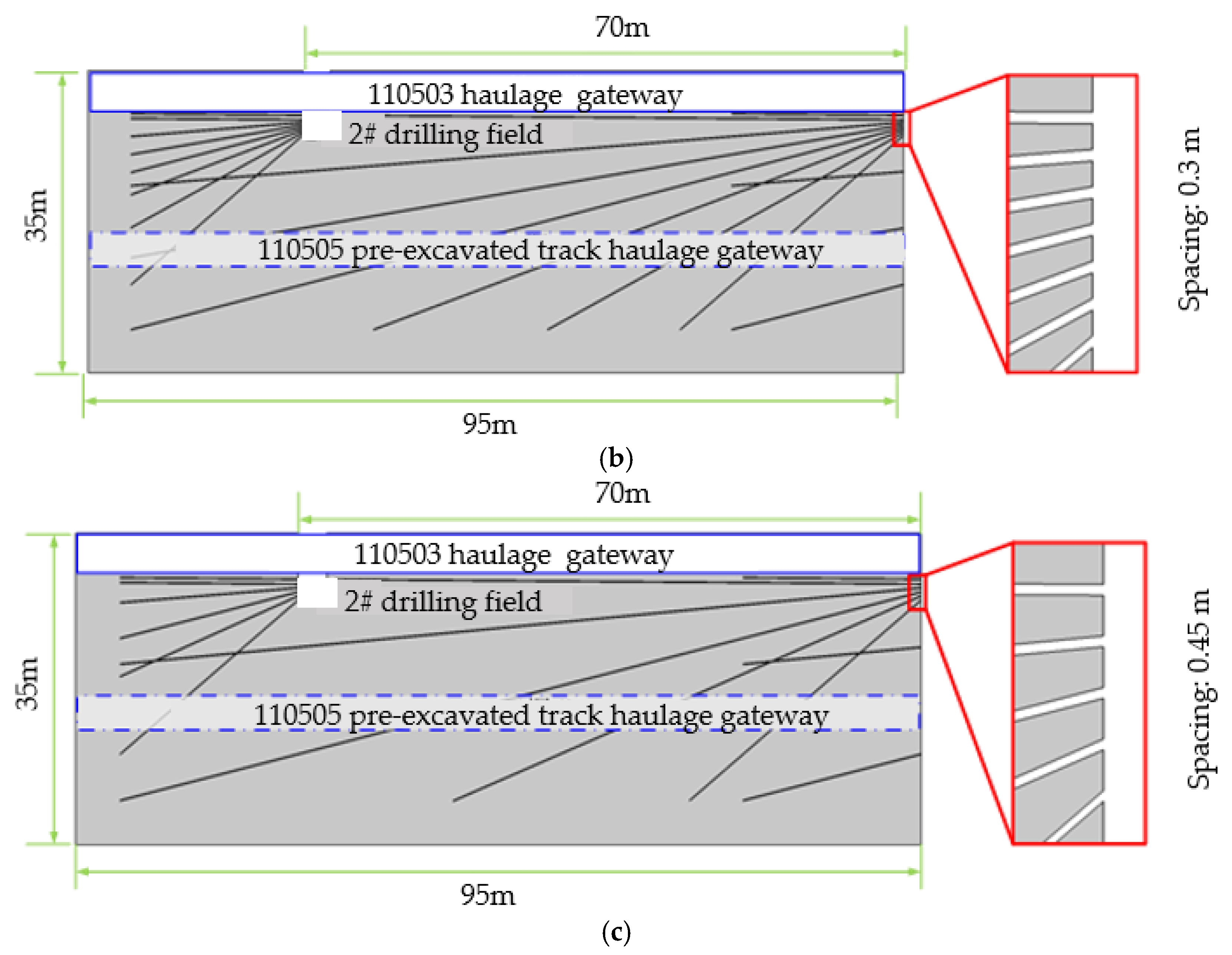
2.5.3. Simulation Design
3. Analysis of In-Seam Gas Drainage Effect
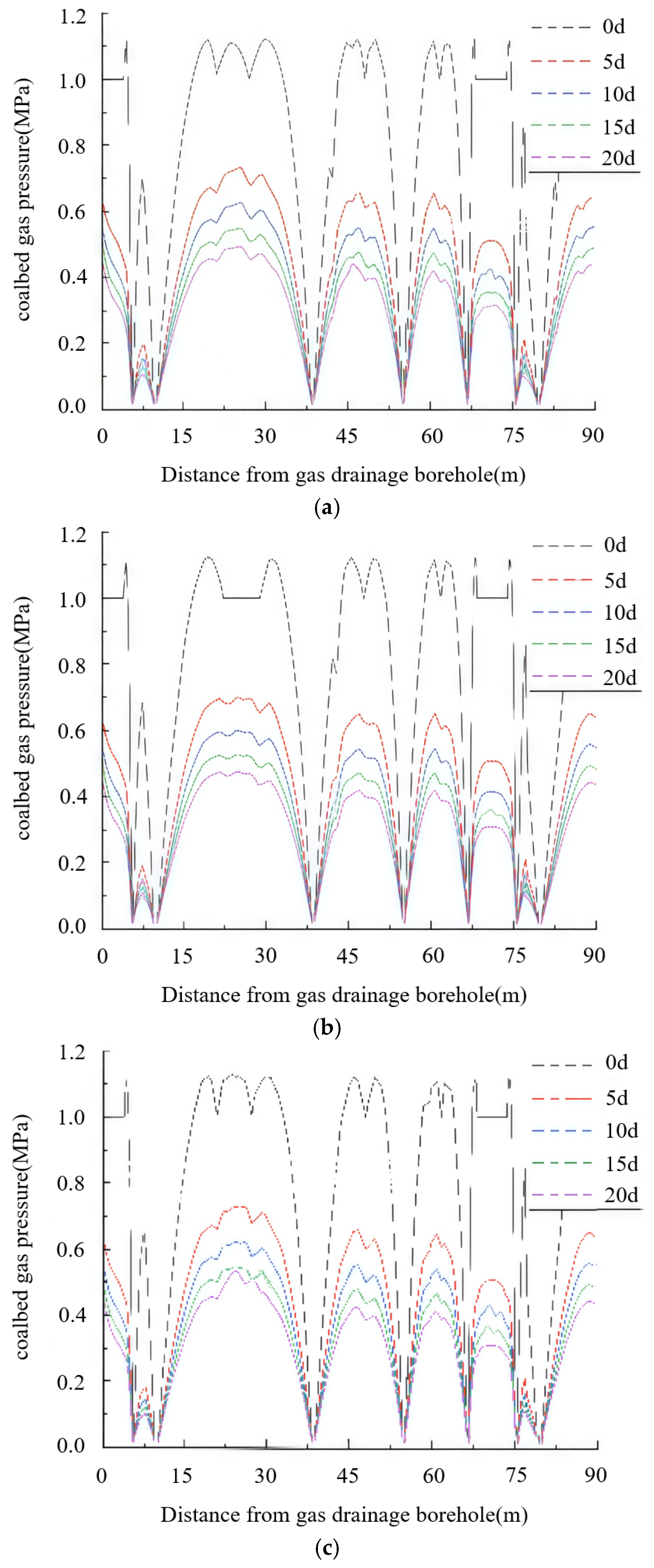
3.1. Influence of Borehole Spacing on Gas Drainage Performance
3.2. Influence of Borehole Aperture on Gas Drainage Performance
3.3. Discussion
- Core mechanism of action of layout parameters
- 2.
- Theoretical explanation of staged drainage characteristics
- 3.
- Parameter optimization priority determination
4. Engineering Application
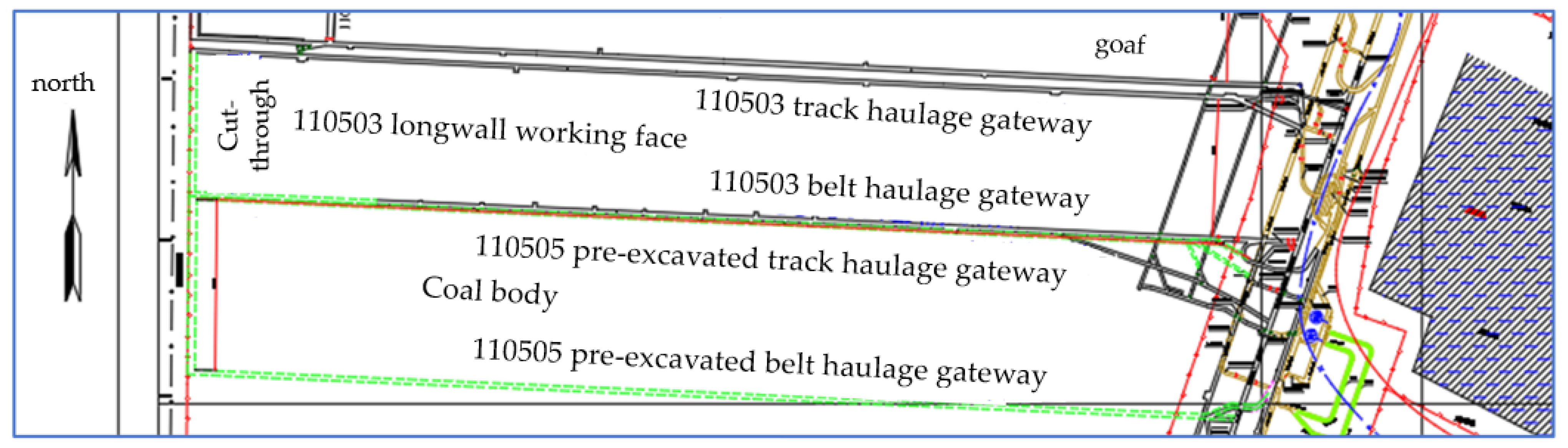
4.1. Basic Roadway Conditions
4.2. Borehole Layout Scheme
4.3. Gas Monitoring
4.4. Model Reliability Verification
4.4.1. Calculation Formula
4.4.2. Parameter Setting and Calculation Result
4.4.3. Error Analysis
4.4.4. Verification Conclusion
5. Conclusions
- (1)
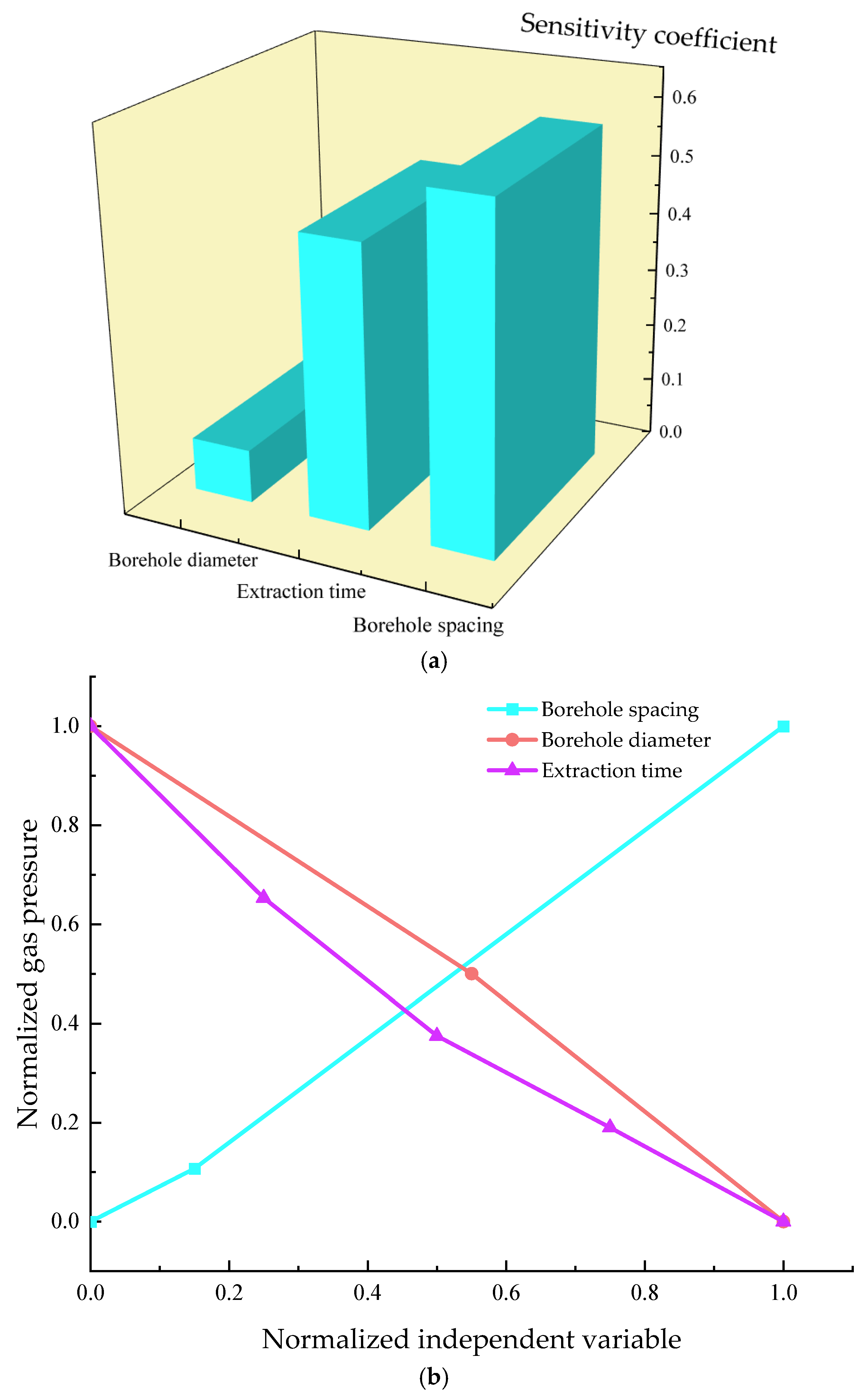
- Borehole spacing is the dominant parameter. Smaller spacing contributes to far better gas pressure reduction performance under the same conditions. With a fixed diameter and drainage time, smaller borehole spacing produces a larger drop in gas pressure and a wider area of pressure relief. Increasing the spacing will weaken the superposition effect and greatly slow the pressure reduction rate, which has a strong influence on overall drainage.
- (2)
- Within the scope of this research, borehole diameter had a negligible impact on gas pressure variation. When spacing and drainage duration remained unchanged, adjusting the borehole diameter resulted in only very small differences in gas pressure. No obvious change was observed in gas seepage velocity and the pressure relief range. Enlarging the borehole diameter alone is insufficient to improve gas control.
- (3)
- Drainage time exerts a strong regulating effect. A longer drainage time reduces gas pressure, with a typical staged decline. In the early stage of drainage, a high pressure gradient accelerates gas flow and causes a rapid pressure drop. In the later stage, the pressure difference gradually decreases, and the pressure reduction speed tends to be stable. Reasonably prolonging the drainage time, an approach second only to reducing the borehole spacing, can steadily reduce gas pressure to acceptable levels.
Author Contributions
Funding
Institutional Review Board Statement
Informed Consent Statement
Data Availability Statement
Acknowledgments
Conflicts of Interest
Nomenclature
| Abbreviations and Symbols | Notation |
| the shear modulus parameters of the rock mass, in MPa | |
| the displacement component along the horizontal i-direction | |
| Poisson’s ratio | |
| the component of the body force in the i-direction, in MPa | |
| the Biot effective stress coefficient corresponding to fractures | |
| the fracture gas pressure, in MPa | |
| the Biot effective stress coefficient corresponding to pores | |
| the matrix gas pressure, in MPa | |
| the initial intrinsic permeability within intact coal matrix masses, m2 | |
| the intrinsic permeability within intact coal matrix masses, m2 | |
| the fracture porosity of the coal mass, % | |
| the initial fracture porosity of the coal mass, % | |
| the axial constraint modulus, MPa | |
| the bulk modulus | |
| the Langmuir pressure constant, MPa | |
| the constant Langmuir volumetric strain at infinite pore pressure | |
| the molar volume of methane under standard conditions, m3/mol | |
| the coal density, kg/m3 | |
| the universal gas constant, 8.314 J·mol−1·K−1 | |
| the temperature, K | |
| the sorption time constant, s | |
| the coal matrix porosity | |
| the effective gas permeability, m2 | |
| the methane viscosity, Pa·s | |
| the gas content of coal seam, m3/t | |
| adsorption constants with units of m3/t | |
| adsorption constants with units of MPa−1 | |
| the absolute gas pressure in MPa | |
| the ash content in % | |
| the % moisture content | |
| the apparent density | |
| the pore volume of the coal in m3/m3 | |
| the simulated residual gas pressure, MPa | |
| the residual gas pressure obtained by formula inversion, MPa | |
| the baseline value | |
| variation in the parameter | |
| the initial gas pressure | |
| variation | |
| a more remarkable influence on gas pressure | |
| the original gas pressure | |
| the minimum pressure in simulation cases | |
| the maximum pressure in simulation cases | |
| the normalized gas pressure |
References
- National Bureau of Statistics of China. China Statistical Yearbook; China Statistics Press: Beijing, China, 2025.
- Xie, S.; Cui, J.; Chen, D.; Chen, P. Numerical Simulation Study on Gas Drainage by Interval Hydraulic Flushing in Coal Seam Working Face. Energy Explor. Exploit. 2021, 39, 1123–1142. [Google Scholar] [CrossRef]
- Wei, P.; Huang, C.; Li, X.; Peng, S.; Lu, Y. Numerical Simulation of Boreholes for Gas Extraction and Effective Range of Gas Extraction in Soft Coal Seams. Energy Sci. Eng. 2019, 7, 1632–1648. [Google Scholar] [CrossRef]
- Chen, Y.; Xu, J.; Peng, S.; Yan, F.; Fan, C. A Gas–Solid–Liquid Coupling Model of Coal Seams and the Optimization of Gas Drainage Boreholes. Energies 2018, 11, 560. [Google Scholar] [CrossRef]
- Kang, Y.; Geng, Z.; Liu, B.; Chen, J. Study on Gas Extraction Efficiency Using In-Seam Borehole Method Considering Influence of Plastic Zone Induced by Borehole Drilling. Geomech. Energy Environ. 2023, 33, 100426. [Google Scholar] [CrossRef]
- Chen, X.; Ma, X.; Hu, J.; Yang, T.; Zhou, A.; Bi, R.; Sun, J. Combined Effect of Multiple Slotting Spatial Parameters on Gas Extraction Efficiency: Numerical Analysis and Field Verification. Processes 2024, 12, 2482. [Google Scholar] [CrossRef]
- Zhang, S.; Wang, Z.; Zhao, Y.; Chen, D.; Qiu, Y.; Wei, J. Study on the Design of Gas Extraction Drilling Angle of Crossing Coal Layer Drilling in the Floor Rock Roadway Considering the Boreholes Superposition Effect. Fuel 2024, 378, 132981. [Google Scholar] [CrossRef]
- Chen, Y.; Chu, T.; Chen, X.; Chen, P.; Wang, H.; Jiang, B.; Cao, J. Comparative Analysis of the Gas Extraction Effects with Different Numbers and Spacings of Boreholes Drilled Along a Coal Seam. Energy Sci. Eng. 2025, 13, 944–954. [Google Scholar] [CrossRef]
- Su, Q.; Zhou, T.; Pei, P. Numerical Simulation of Gas Drainage via Cross-Measure Boreholes in Deep Inclined Coal Seams. Energies 2025, 18, 4266. [Google Scholar] [CrossRef]
- Wang, H.; An, H.; Yang, B. Study on the Control Effect of Borehole Gas Extraction in Coal Seams Based on the Stress–Seepage Coupling Field. Fire 2024, 7, 410. [Google Scholar] [CrossRef]
- Du, F.; Cui, W.; Wang, K. Study on Gas Migration Mechanism and Multi-Borehole Spacing Optimization in Coal under Negative Pressure Extraction. Processes 2023, 11, 259. [Google Scholar] [CrossRef]
- Hosseini, A.; Najafi, M.; Hossein Morshedy, A. A 3D Numerical Model for Improving Methane Drainage Efficiency in Underground Coal Mines Using the Cross-Measure Borehole Method. Int. J. Energy Res. 2024, 2024, 6921566. [Google Scholar] [CrossRef]
- Leśniak, G.; Brunner, D.J.; Topór, T.; Słota-Valim, M.; Cicha-Szot, R.; Jura, B.; Skiba, J.; Przystolik, A.; Lyddall, B.; Plonka, G. Application of Long-Reach Directional Drilling Boreholes for Gas Drainage of Adjacent Seams in Coal Mines with Severe Geological Conditions. Int. J. Coal Sci. Technol. 2022, 9, 88. [Google Scholar] [CrossRef]
- Zhang, C.; Xu, J.; Peng, S.; Li, Q.; Yan, F. Experimental Study of Drainage Radius Considering Borehole Interaction Based on 3D Monitoring of Gas Pressure in Coal. Fuel 2019, 239, 955–963. [Google Scholar] [CrossRef]
- Wang, H.; Wang, E.; Li, Z.; Liu, X.; Liu, X.; Wang, K. Analysis of the Difference of Gas Extraction Quantity from Coal Seam under the Influence of Permeability, Gas Pressure, and Buried Depth of Coal Seam: A Case Study. Processes 2023, 11, 3086. [Google Scholar] [CrossRef]
- Karacan, C.Ö.; Diamond, W.P.; Schatzel, S.J. Numerical Analysis of the Influence of In-Seam Horizontal Methane Drainage Boreholes on Longwall Face Emission Rates. Int. J. Coal Geol. 2007, 72, 15–32. [Google Scholar] [CrossRef]
- Aminossadati, S.M.; Amanzadeh, M.; Prochon, E.; Kok, J.; Adam, S. Step Change Approaches in Coal Technology and Fugitive Emissions Research. Int. J. Min. Sci. Technol. 2014, 24, 363–367. [Google Scholar] [CrossRef]
- Cheng, X.; Cheng, C.; Xiao, L.; Ma, X. Response Surface Analysis on Multiple Parameter Effects on Borehole Gas Extraction Efficiency. Processes 2024, 12, 1587. [Google Scholar] [CrossRef]
- Zheng, C.; Wu, H.; Jiang, B.; Xue, S.; Zhao, Y. Investigation on Interaction Effects of Multiple Factors on Clean Gas Extraction: Implementation of Response Surface Methodology. J. Geophys. Eng. 2023, 20, 1095–1108. [Google Scholar] [CrossRef]
- Yang, W.; Mengtang, X.; Dezhong, K.; Yuqi, S.; Fei, L. Optimization of Drilling Parameters for Coal Seam Gas Extraction Considering Fluid–Solid Coupling and Field Application. Energy Sci. Eng. 2024, 12, 657–669. [Google Scholar] [CrossRef]
- Hosseini, A.; Najafi, M.; Hossein Morshedy, A. Hybrid ANN–GWO Algorithm for Improving Methane Drainage Efficiency in Cross-Measure Borehole in Underground Coal Mines. Int. J. Energy Res. 2025, 2025, 1326901. [Google Scholar] [CrossRef]
- Yao, B.; Yao, S.; Wei, J.; Wen, Z.; Liu, Y.; Si, L. A New Method for Determining the Sealing Depth of Extraction Borehole Based on the Constant-Pressure Gas Injection and Its Applications. Rock Mech. Rock Eng. 2022, 55, 3703–3717. [Google Scholar] [CrossRef]
- Lou, Z.; Wang, K.; Yao, H.; Zhao, W.; Qin, H.; Wu, Z.; Wei, G. A Novel Dynamic Filling Material for Plugging Fractures around Underground Gas Extraction Boreholes: Experimental and Engineering Performances. Energy 2025, 314, 134202. [Google Scholar] [CrossRef]
- Wu, Z.; Liu, J. Numerical Simulation Study of Coal Seam Dual-Porosity Medium Fluid-Solid Coupling Model and Directional Long Borehole Gas Drainage. Pet. Sci. Technol. 2026, 44, 1632–1652. [Google Scholar] [CrossRef]
- Liu, Q.; Cheng, Y.; Zhou, H.; Guo, P.; An, F.; Chen, H. A Mathematical Model of Coupled Gas Flow and Coal Deformation with Gas Diffusion and Klinkenberg Effects. Rock Mech. Rock Eng. 2015, 48, 1163–1180. [Google Scholar] [CrossRef]
- Wang, Y.; Zhao, X.; Wang, P.; Chen, Y. Gas Evolution Principle during Gas Drainage from a Drill Hole along the Coal Seam and Reasonable Borehole Layout Spacing. ACS Omega 2023, 8, 44338–44349. [Google Scholar] [CrossRef]
- Liu, J.; Qin, Y.; Zhang, S.; He, C. Numerical Solution for Borehole Methane Flow in Coal Seam Based on a New Dual-Porosity Model. J. Nat. Gas Sci. Eng. 2019, 68, 102916. [Google Scholar] [CrossRef]
- Xu, H.; Qin, Y.; Yang, D.; Wang, G.; Huang, Q.; Wu, F. Quantification of Gas Transport Behavior During Coalbed Methane Extraction in A Coal Seam Considering a Dual-Porosity/Single-Permeability Model. Nat. Resour. Res. 2024, 33, 321–345. [Google Scholar] [CrossRef]
- Yan, X.; Qin, G.-Y.; Zhang, L.-M.; Zhang, K.; Yang, Y.-F.; Yao, J.; Wang, J.-L.; Dai, Q.-Y.; Wu, D.-W. A Dual-Porosity Flow-Net Model for Simulating Water-Flooding in Low-Permeability Fractured Reservoirs. Geoenergy Sci. Eng. 2024, 240, 213069. [Google Scholar] [CrossRef]
- Nian, F.; Ju, F.; Zheng, C.; Wu, H.; Cheng, X. Effects of Coal Permeability Anisotropy on Gas Extraction Performance. Processes 2023, 11, 1408. [Google Scholar] [CrossRef]
- Liu, W.; Han, D.; Guo, M.; Li, R.; Zhong, W. Evaluation of Adsorbed and Free Gas in the Coal Matrix during Desorption Processes: Insights from Experimental and Numerical Methods. Fuel 2024, 376, 132739. [Google Scholar] [CrossRef]
- Liu, Z.; Li, Y.; Cui, C.; Yan, Z. Numerical Simulation of Gas–Water Two-Phase Seepage During Coalbed Methane Development in ZhengZhuang Block: A Case Study of Well Z29. Processes 2025, 13, 3593. [Google Scholar] [CrossRef]
- He, Y.; Li, X.; Cai, J.; Chen, S.; Li, X. Study of Key Factors for Efficient Coalbed Methane Extraction: Pore Structure, Desorption Rate and Seepage Characteristics. Langmuir 2025, 41, 6020–6036. [Google Scholar] [CrossRef]
- Liu, T.; Lin, B.; Fu, X.; Zhao, Y.; Gao, Y.; Yang, W. Modeling Coupled Gas Flow and Geomechanics Process in Stimulated Coal Seam by Hydraulic Flushing. Int. J. Rock Mech. Min. Sci. 2021, 142, 104769. [Google Scholar] [CrossRef]
- Hu, S.; Wang, E.; Kong, X. Damage and Deformation Control Equation for Gas-Bearing Coal and Its Numerical Calculation Method. J. Nat. Gas Sci. Eng. 2015, 25, 166–179. [Google Scholar] [CrossRef]
- Kim, K.; Espinoza, D.N. Determination of the Biot Coefficient and Permeability of Tight Rocks through Analysis of Time-Dependent Partially Drained Response. Rock Mech. Rock Eng. 2025, 58, 14153–14175. [Google Scholar] [CrossRef]
- Liu, Q.; Cheng, Y.; Li, W.; Jin, K.; He, T.; Zhao, W. Mathematical Model of Coupled Gas Flow and Coal Deformation Process in Low-Permeability and First Mined Coal Seam. Chin. J. Rock Mech. Eng. 2015, 34, 2749–2758. [Google Scholar] [CrossRef]
- Zhang, L.; Lu, G.; Chang, C.; Wu, J.; Zhao, Y.; Liu, W. Numerical Simulation of a Coupled Gas Flow and Geomechanics Process in Fractured Coalbed Methane Reservoirs. Energy Sci. Eng. 2019, 7, 1095–1105. [Google Scholar] [CrossRef]
- Liang, Y.; Shi, B.; Yue, J.; Zhang, C.; Wang, C.; Han, Q. Gas Seepage Characteristics and Discharge Radius of Coal Seam Borehole. Energy 2025, 335, 138020. [Google Scholar] [CrossRef]
- Rong, T.; Yang, H.; Zhang, S.; Ren, X.; Wang, J.; Zhou, Y.; Yang, Y. Permeability Evolution of Deep Coal under the Coupling Damage of Mining-Adsorption. Environ. Earth Sci. 2025, 84, 63. [Google Scholar] [CrossRef]
- Sun, H.; Fan, C.; Yang, L.; Luo, M.; Xiao, B.; Wang, L.; Zhou, L. Modelling of Enhanced Gas Extraction in Low Permeability Coal Seam by Controllable Shock Wave Fracturing. Sci. Rep. 2024, 14, 24155. [Google Scholar] [CrossRef]
- Zhao, Y.; Lin, B.; Liu, T.; Li, Q.; Kong, J. Gas Flow Field Evolution around Hydraulic Slotted Borehole in Anisotropic Coal. J. Nat. Gas Sci. Eng. 2018, 58, 189–200. [Google Scholar] [CrossRef]
- Xu, C.; Qin, L.; Wang, K.; Sun, H.; Cao, M. Gas Seepage Laws Based on Dual Porosity and Dual Permeability: Numerical Simulation and Coalbed Methane Extraction Practice. Energy Sci. Eng. 2021, 9, 509–519. [Google Scholar] [CrossRef]
- Ge, Z.; Yan, G.; Kong, S.; Zong, B.; Liu, H.; Huang, J.; Guo, G. Optimization and Application of Drilling Parameters Based on Gas–Solid Coupling Simulation. Appl. Sci. 2025, 15, 6626. [Google Scholar] [CrossRef]






| Parameters | Values | Parameters | Values |
|---|---|---|---|
| Langmuir Volume Constant (m3/t) | 13.9138 | Poisson’s Ratio of Coal | 0.32 |
| Langmuir Pressure Constant (MPa) | 1.2582 | elastic modulus of coal (MPa) | 3.3 |
| Molar Volume of Gas under Standard Conditions (m3/mol) | 22.4 | apparent density of coal (t/m3) | 1.29 |
| Apparent Density of Coal Mine Gas under Standard Conditions (kg/m3) | 0.716 | elastic modulus of coal matrix (MPa) | 8.4 |
| Matrix Size (mm) | 10 | gas diffusion coefficient of coal matrix (m2/s) | 5.6 × 10⁻¹² |
| molar mass of methane (kg/kmol) | 16.0428 | limiting adsorption swelling strain of coal mass | 0.02295 |
| initial absolute permeability of coal seam (m2) | 4.936 × 10⁻¹⁷ | Klinkenberg factor (Pa) | 0.251 |
| initial fracture porosity of coal seam (%) | 5.5 | universal gas constant (J·mol−1·K−1) | 8.41351 |
| coal seam temperature (K) | 293.15 | dynamic viscosity of coal mine gas (Pa·s) | 1.08 × 10⁻⁶ |
| Drilling Site | Borehole No. | Rotation Angle/° | Horizontal Control Distance/m | Designed Borehole Length/m |
|---|---|---|---|---|
| First layer | X-4# | 4°50′ | 64 | 64.2 |
| X-5# | 3°00′ | 64 | 64.1 | |
| X-6# | 2°00′ | 64 | 64.0 | |
| X-7# | 1°16′ | 64 | 64.0 | |
| Second layer | 2-1# | 17°26′ | 90 | 94.4 |
| 2-2# | 11°00′ | 70 | 71.3 | |
| 2-3# | 7°36′ | 64 | 64.6 | |
| 2-4#~2-7# | 5°00′ | 64 | 64.2 | |
| Third layer | 3-1# | 31°30′ | 90 | 105.4 |
| 3-2# | 19°00′ | 70 | 74.0 | |
| 3-3# | 12°31′ | 64 | 65.5 | |
| 3-4#~3-7# | 8°11′ | 64 | 64.7 |
Disclaimer/Publisher’s Note: The statements, opinions and data contained in all publications are solely those of the individual author(s) and contributor(s) and not of MDPI and/or the editor(s). MDPI and/or the editor(s) disclaim responsibility for any injury to people or property resulting from any ideas, methods, instructions or products referred to in the content. |
© 2026 by the authors. Licensee MDPI, Basel, Switzerland. This article is an open access article distributed under the terms and conditions of the Creative Commons Attribution (CC BY) license.
Share and Cite
Wang, H.; Chen, R.; Kong, K.; Huang, P.; Zhang, C.; Sun, Q. Analysis of Influencing Factors and Application of Gas Drainage Effect in Longitudinal Drifts with Sequential Longhole Drilling. Appl. Sci. 2026, 16, 5893. https://doi.org/10.3390/app16125893
Wang H, Chen R, Kong K, Huang P, Zhang C, Sun Q. Analysis of Influencing Factors and Application of Gas Drainage Effect in Longitudinal Drifts with Sequential Longhole Drilling. Applied Sciences. 2026; 16(12):5893. https://doi.org/10.3390/app16125893
Chicago/Turabian StyleWang, Haibin, Ruirui Chen, Kai Kong, Peng Huang, Chengxiang Zhang, and Qiang Sun. 2026. "Analysis of Influencing Factors and Application of Gas Drainage Effect in Longitudinal Drifts with Sequential Longhole Drilling" Applied Sciences 16, no. 12: 5893. https://doi.org/10.3390/app16125893
APA StyleWang, H., Chen, R., Kong, K., Huang, P., Zhang, C., & Sun, Q. (2026). Analysis of Influencing Factors and Application of Gas Drainage Effect in Longitudinal Drifts with Sequential Longhole Drilling. Applied Sciences, 16(12), 5893. https://doi.org/10.3390/app16125893