Overview of E-Waste Mining from Urban Waste in the Developed East Asian Region and Major Achievements in Taiwan



Abstract
1. Introduction
2. Overview of Precious and Valuable Metals from E-Waste in Urban Waste
2.1. Precious Metals
- -
- Printed circuit boards (PCBs): Gold, silver, and copper, particularly in connectors and soldered components.
- -
- Mobile phones/smartphones: Gold, silver, and palladium.
- -
- Computer components: Gold, platinum, and palladium, particularly in central processing units (CPUs), processors, and random-access memory (RAM).
- -
- Connectors, interfaces, slots, and pins: Gold, silver, and palladium.
- -
- Hard drives: Palladium.
- -
- Television screens, such as cathode ray tube (CRT) and liquid crystal display (LCD) screens: Gold, silver, and palladium.
2.2. Valuable Base Metals
- -
- Copper: Copper has excellent electrical and thermal conductivity, making it essential for electric motors and wiring. It is also widely used in heat exchangers, such as those in air conditioners and refrigerators. It may be the most abundant base metal in WEEE, particularly in high-grade electronics, such as PCBs, and home appliances, such as air conditioners and refrigerators.
- -
- Aluminum: Aluminum is a lightweight metal, with a density of 2.7 g/cm3, and is highly resistant to corrosion. Thus, it is often found in electronic waste, such as casings, PCBs, and screens, including CRT and LCD screens, as well as in home appliances, such as air conditioners, refrigerators, and washing machines.
3. Overview of Urban Waste Management in Japan, Korea and Taiwan
3.1. Japan
- -
- Prioritization of reduction, reuse, and recycling (3Rs) over landfilling.
- -
- Mandatory sorting by residents and businesses.
- -
- Alignment with the sustainable development goals (SDGs), especially SDG 11, sustainable cities and communities, and SDG 12, responsible consumption and production.
- -
- Waste-to-energy treatment through incineration.
3.2. Korea
- -
- General waste: Residents must use designated standard garbage bags purchased at convenience stores and supermarkets.
- -
- Food waste: Residents must dispose of food waste in separate collection bins or use an electronic card or tag in areas where RFID-based systems are available.
- -
- Recyclables: Recyclable materials, such as plastics, cans/bottles, and paper, must be separated and cleaned or washed before disposal.
- -
- Large items: These include home appliances, furniture, and other bulky items, which must be taken to designated collection sites.
3.3. Taiwan
- -
- Difficulty in clearance or disposal.
- -
- Presence of hazardous or toxic substances.
- -
- Presence of components that are not readily decomposed in the environment.
- -
- Presence of components or substances that are economically valuable for reuse or recovery.
4. Legal Systems for Recycling E-Waste from Urban Waste in Japan, Korea and Taiwan
4.1. Japan
4.2. Korea
- -
- Large-sized home appliances: refrigerators, washing machines, air conditioners, televisions, and auto-vending machines.
- -
- Mid-sized home appliances: food-waste disposal units, electric ovens, microwaves, dish dryers, including dishwashers, and water purifiers.
- -
- Small-sized home appliances: video players, air cleaners, humidifiers, blenders, fans, audio equipment, water softeners, rice cookers, irons, bidets, heaters, and vacuum cleaners.
- -
- Telecommunication appliances: computers, copy machines, facsimile machines, and printers.
- -
- Mobile phones, including batteries and chargers.
- -
- Other electric items.
4.3. Taiwan
5. Major Achievement of Urban Waste Management and E-Waste Recycling in Taiwan
5.1. Status of Urban Waste Generation by Type
5.2. Status of E-Waste Collectoin from Regulated Recyclable Waste
- -
- The certified collection quantities of ICT products, including information products and mobile phones, demonstrated a stable increasing trend, rising from about 16,000 metric tons in 2016 to over 30,000 metric tons after 2021. In recent years, the decline in the amount of collected mobile phones may reflect the extended lifetime of ICT products and concerns about personal data security, which may reduce consumers’ willingness to recycle or dispose of these products through designated collection systems.
- -
- Regarding the certified collection quantities of home electrical appliances, an increasing trend was observed, from 50,323 metric tons in 2016 to 149,864 metric tons in 2023. This increase could have been stimulated by government subsidy programs aimed at replacing outdated, energy-inefficient air conditioners and refrigerators with new, highly efficient models in recent years. As explained above, their collection quantities showed a slight decline during the period 2023–2025, likely due to the maturity of the home appliance market in Taiwan.
- -
- The certified collection quantities of recyclable lighting equipment indicated an increasing trend, from 6097 metric tons in 2016 to 8496 metric tons in 2025. This could be attributed to the extensive use of long-lifetime light-emitting diode (LED) lighting products in Taiwan.
- -
- The certified collection quantities of batteries, including dry batteries and lead-acid batteries, showed a stable increase due to the mature market in Taiwan and the extensive use of rechargeable batteries in the market.

| E-Waste Item | All Treatment Enterprise | Subsidized Treatment Enterprise |
|---|---|---|
| Dry battery | 7 | 6 |
| Electrical appliance | 16 | 14 |
| Information technology (IT) product | 21 | 18 |
| Lighting equipment | 4 | 4 |
| Lead-acid battery b | 7 | 6 |
| Year | Dry Batteries | Lead-Acid Batteries | Lightings b | Home Electrical Appliances c | Information Products d | Mobile Phone (incl. Charger) |
|---|---|---|---|---|---|---|
| 2016 | 6208 | 11,063 | 6097 | 50,323 | 14,329 | 1878 |
| 2017 | 7162 | 12,705 | 6155 | 56,240 | 14,421 | 1949 |
| 2018 | 7792 | 18,132 | 7341 | 77,687 | 21,163 | 2432 |
| 2019 | 8262 | 18,076 | 7568 | 84,277 | 24,036 | 1705 |
| 2020 | 9340 | 18,962 | 6850 | 119,353 | 27,550 | 992 |
| 2021 | 11,383 | 18,435 | 7367 | 125,946 | 30,722 | 988 |
| 2022 | 10,945 | 19,898 | 9582 | 133,839 | 31,913 | 1373 |
| 2023 | 10,523 | 19,988 | 7930 | 149,864 | 31,318 | 1580 |
| 2024 | 10,467 | 22,073 | 7469 | 149,513 | 29,352 | 2330 |
| 2025 | 10,255 | 21,510 | 8496 | 136,611 | 28,310 | 2251 |
6. Case Studies for Recovery of Valuable Metals from E-Waste in Taiwan
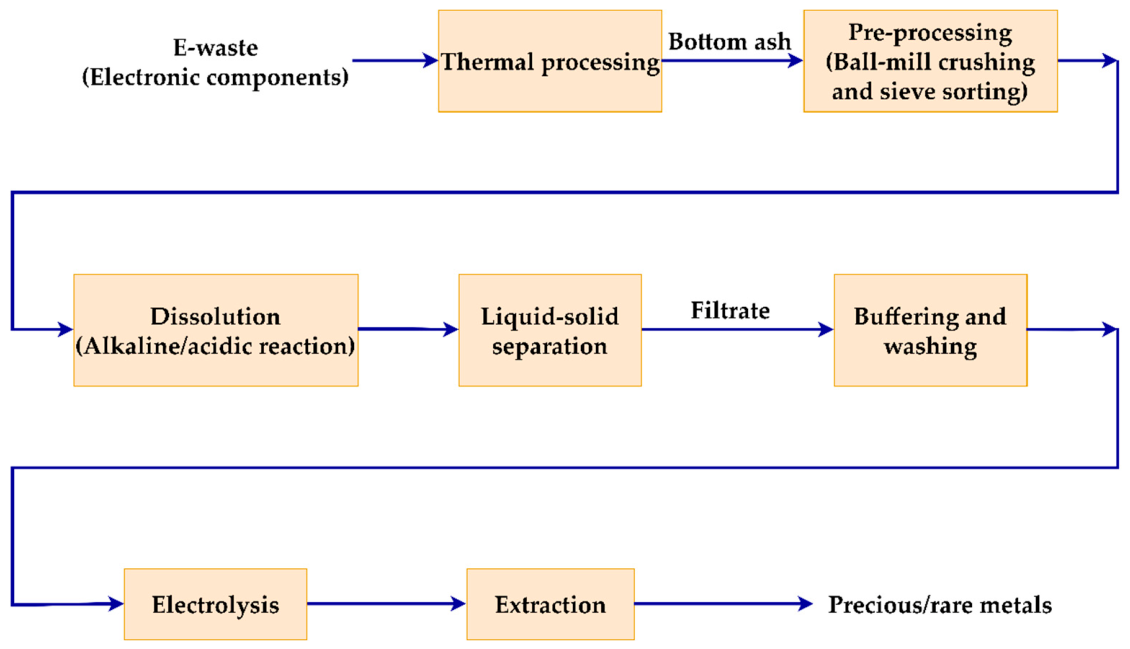
6.1. Case Study in Precious Metals: A Company
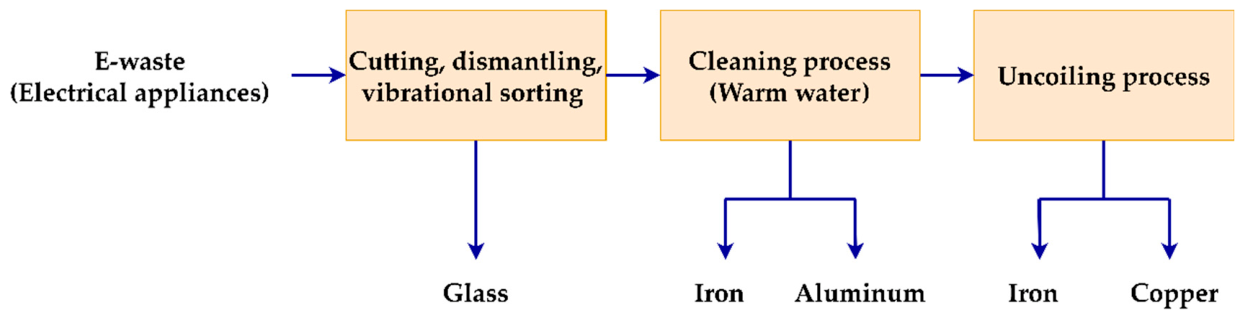
6.2. Case Study in Valuable Base Metals: B Company
7. Conclusions
Author Contributions
Funding
Institutional Review Board Statement
Informed Consent Statement
Data Availability Statement
Conflicts of Interest
References
- Ghiga, S.C.; Simion, I.M.; Filote, C.; Roșca, M.; Hlihor, R.-M.; Cozma, P.; Gavrilescu, M. Sources, composition and management strategies of waste electrical and electronic equipment: A review. Environ. Eng. Manag. J. 2023, 22, 509–526. [Google Scholar] [CrossRef]
- de Oliveira Neto, J.F.; Candido, L.A.; de Freitas Dourado, A.B.; Santos, S.M.; Florencio, L. Waste of electrical and electronic equipment management from the perspective of a circular economy: A review. Waste Manag. Res. 2023, 41, 760–780. [Google Scholar] [CrossRef] [PubMed]
- Electronic Waste (E-Waste). Available online: https://www.who.int/news-room/fact-sheets/detail/electronic-waste-(e-waste) (accessed on 30 May 2026).
- Zhang, L.; Xu, Z. A review of current progress of recycling technologies for metals from waste electrical and electronic equipment. J. Clean. Prod. 2016, 127, 19–36. [Google Scholar] [CrossRef]
- Wang, M.; Tan, Q.; Chiang, J.F.; Li, J. Recovery of rare and precious metals from urban mines—A review. Front. Environ. Sci. Eng. 2017, 11, 1. [Google Scholar] [CrossRef]
- Chauhan, G.; Jadhao, P.R.; Pant, K.K.; Nigam, K.D.P. Novel technologies and conventional processes for recovery of metals from waste electrical and electronic equipment: Challenges & opportunities—A review. J. Environ. Chem. Eng. 2018, 6, 1288–1304. [Google Scholar]
- Pimassoni, Y.S.; Lima, M.T.W.D.C.; Yamane, L.H.; Siman, R.R. The recovery of rare earth elements from waste electrical and electronic equipment: A review. Hydrometallurgy 2023, 222, 106156. [Google Scholar] [CrossRef]
- Torrubia, J.; Valero, A.; Valero, A.; Lejuez, A. Challenges and opportunities for the recovery of critical raw materials from electronic waste: The Spanish perspective. Sustainability 2023, 15, 1393. [Google Scholar] [CrossRef]
- Chicardi, E.; Lopez-Paneque, A.; García-Orta, V.H.G.; Sepúlveda-Ferrer, R.E.; Gallardo, J.M. Enrichment methods for metal recovery from waste from electrical and electronic equipment: A brief review. Metals 2025, 15, 140. [Google Scholar] [CrossRef]
- Jovanović, G.; Bugarčić, M.; Petronijević, N.; Stopic, S.R.; Friedrich, B.; Marković, B.; Stanković, S.; Sokić, M. A multifocal study investigation of pyrolyzed printed circuit board leaching. Metals 2022, 12, 2021. [Google Scholar] [CrossRef]
- Jain, M.; Kumar, D.; Chaudhary, J.; Kumar, S.; Sharma, S.; Verma, A.S. Review on E-waste management and its impact on the environment and society. Waste Manag. Bull. 2023, 1, 34–44. [Google Scholar] [CrossRef]
- Koutamanis, A.; van Reijn, B.; van Bueren, E. Urban mining and buildings: A review of possibilities and limitations. Resour. Conserv. Recycl. 2018, 138, 32–39. [Google Scholar] [CrossRef]
- Murthy, V.; Ramakrishna, S. A Review on Global E-waste management: Urban mining towards a sustainable future and circular economy. Sustainability 2022, 14, 647. [Google Scholar] [CrossRef]
- Xavier, L.H.; Ottoni, M.; Abreu, L.P.P. A comprehensive review of urban mining and the value recovery from e-waste materials. Resour. Conserv. Recycl. 2023, 190, 106840. [Google Scholar] [CrossRef]
- Erdiaw-Kwasie, M.D.; Abunyewah, M.; Baah, C. A systematic review of the factors—Barriers, drivers, and technologies—Affecting e-waste urban mining: On the circular economy future of developing countries. J. Clean. Prod. 2024, 436, 140645. [Google Scholar] [CrossRef]
- Heisel, F.; Ciobanu, A.; McGranahan, J. Industry and literature review of urban mining applications in the United States: Gaps and drivers for implementation towards a circular industrialized construction economy. J. Circ. Econ. 2024, 2, 1. [Google Scholar] [CrossRef]
- Ouro-Salim, Q. Urban mining of e-waste management globally: Literature review. Clean. Waste Syst. 2024, 9, 100162. [Google Scholar] [CrossRef]
- Firmansyah, M.L.; Rizki, I.N.; Ullah, N. Recent advances in urban mining technology: A focus on electronic waste recycling potential in Indonesia. Clean. Waste Syst. 2025, 10, 100239. [Google Scholar] [CrossRef]
- Moita Neto, J.M.; Leal, R.C.; Araújo, N.L.d.S.; da Silva, E.A. Challenges and opportunities for the development of urban mining in Brazil. Minerals 2025, 15, 593. [Google Scholar] [CrossRef]
- Leclerc, S.H.; Badami, M.G. Extended producer responsibility for E-waste management: Policy drivers and challenges. J. Clean. Prod. 2020, 251, 119657. [Google Scholar] [CrossRef]
- Compagnoni, M. Is Extended producer responsibility living up to expectations? a systematic literature review focusing on electronic waste. J. Clean. Prod. 2022, 367, 133101. [Google Scholar] [CrossRef]
- Sugimura, Y.; Murakami, S. Problems in Japan’s governance system related to end-of-life electrical and electronic equipment trade. Resour. Conserv. Recycl. 2016, 112, 93–106. [Google Scholar] [CrossRef]
- Yoshida, F.; Yoshida, H. WEEE management in Japan. In Waste Electrical and Electronic Equipment (WEEE) Handbook, 2nd ed.; Goodship, V., Stevels, A., Jaco Huisman, J., Eds.; Elsevier: Cambridge, MA, USA, 2019; pp. 573–589. [Google Scholar]
- Lee, J.C.; Song, H.T.; Yoo, J.M. Present status of the recycling of waste electrical and electronic equipment in Korea. Resour. Conserv. Recycl. 2007, 50, 380–397. [Google Scholar] [CrossRef]
- Jang, Y.C. Waste electrical and electronic equipment (WEEE) management in Korea: Generation, collection, and recycling systems. J. Mater. Cycles Waste Manag. 2010, 12, 283–294. [Google Scholar] [CrossRef]
- Park, J.; Ahn, C.; Lee, K.; Choi, W.; Song, H.T.; Choi, S.O.; Han, S.W. Analysis on public perception, user-satisfaction, and publicity for WEEE collecting system in South Korea: A case study for Door-to-Door Service. Resour. Conserv. Recycl. 2019, 144, 90–99. [Google Scholar] [CrossRef]
- Laws and Regulation Retrieving System (Ministry of Justice, Taiwan). Available online: https://law.moj.gov.tw/Eng/index.aspx (accessed on 13 April 2026).
- Lu, L.T.; Hsiao, T.Y.; Shang, N.C.; Yu, Y.H.; Ma, H.W. MSW management for waste minimization in Taiwan: The last two decades. Waste Manag. 2006, 26, 661–667. [Google Scholar] [CrossRef] [PubMed]
- Chao, Y.L. Time series analysis of the effects of refuse collection on recycling: Taiwan’s “Keep Trash Off the Ground” measure. Waste Manag. 2008, 28, 859–869. [Google Scholar] [CrossRef]
- Cheng, C.P.; Chang, T.C. The development and prospects of the waste electrical and electronic equipment recycling system in Taiwan. J. Mater. Cycles Waste Manag. 2018, 20, 667–677. [Google Scholar] [CrossRef]
- Tsai, W.T. Current practice and policy for transforming e-waste into urban mining: Case study in Taiwan. Int. J. Environ. Waste Manag. 2019, 23, 1. [Google Scholar] [CrossRef]
- Taiwan’s Pathway to Net-Zero Emissions in 2050. Available online: https://www.ndc.gov.tw/en/Content_List.aspx?n=B927D0EDB57A7A3A (accessed on 25 May 2026).
- Tsai, W.-T. Recycling waste electrical and electronic equipment (WEEE) and the management of its toxic substances in Taiwan—A case study. Toxics 2020, 8, 48. [Google Scholar] [CrossRef]
- Lee, S.C.; Na, S.I. E-waste recycling systems and sound circulative economies in East Asia: A comparative analysis of systems in Japan, South Korea, China and Taiwan. Sustainability 2010, 2, 1632–1644. [Google Scholar] [CrossRef]
- Andeobu, L.; Wibowo, S.; Grandhi, S. A systematic review of e-waste generation and environmental management of Asia Pacific Countries. Int. J. Environ. Res. Public Health 2021, 18, 9051. [Google Scholar] [CrossRef]
- Cayumil, R.; Khanna, R.; Rajarao, R.; Mukherjee, P.S.; Sahajwalla, V. Concentration of precious metals during their recovery from electronic waste. Waste Manag. 2016, 57, 121–130. [Google Scholar] [CrossRef]
- Prichard, H.M.; Wedin, F.; Sampson, J.; Jackson, M.T.; Fisher, P.C. Precious metals in urban waste. Water Environ. J. 2016, 30, 151–156. [Google Scholar] [CrossRef]
- TRADING ECONOMICS. Available online: https://tradingeconomics.com/commodities (accessed on 24 April 2026).
- Mohamed, D.; Fayad, A.; Mohamed, A.M.O.; Al Nahyan, M.T. The role of E-waste in sustainable mineral resource management. Waste 2025, 3, 27. [Google Scholar] [CrossRef]
- Qin, J.; Li, S.; Zhao, L.; Liu, B.; Zhang, Y. Precious metal recycling technology in electronic waste: Progress, challenges, and sustainable development path. Green Smart Min. Eng. 2025, 2, 459–482. [Google Scholar] [CrossRef]
- Iqbal, S.S.; Dagwar, P.P.; Dutta, D. Sustainable E-waste management: Global challenges, recovery techniques, and regulatory approaches. Next Sustain. 2026, 7, 100304. [Google Scholar] [CrossRef]
- Dhapola, P.S.; Acquesta, A.; Monetta, T. Recent advancements in sustainable approaches to recover precious metals from waste electrical and electronic equipment (WEEE). Chem. Phys. Impact 2025, 11, 100941. [Google Scholar] [CrossRef]
- Jin, L.; Shen, B.; Du, H.; Hao, D.; Wang, M.; Zhang, S.; Wang, Q. Sustainable and selective recovery of precious metals from e-waste: Catalyzing a circular economy. Chem. Eng. J. 2026, 529, 173153. [Google Scholar] [CrossRef]
- Chancerel, P.; Meskers, C.E.M.; Hagelüken, C.; Rotter, V.S. Assessment of precious metal flows during preprocessing of waste electrical and electronic equipment. J. Ind. Ecol. 2009, 13, 791–810. [Google Scholar] [CrossRef]
- Lu, Y.; Xu, Z. Precious metals recovery from waste printed circuit boards: A review for current status and perspective. Resour. Conserv. Recycl. 2016, 113, 28–39. [Google Scholar] [CrossRef]
- Gareth Charles, R.; Douglas, P.; Hallin, I.L.; Matthews, I.; Liversage, G. An investigation of trends in precious metal and copper content of RAM modules in WEEE: Implications for long term recycling potential. Waste Manag. 2017, 60, 505–520. [Google Scholar] [CrossRef]
- Hussain, J.; Sim, M.; Rosaiah, P.; Hussain, I. A review of sustainable cementation strategies for precious metal recovery: Efficiency, environmental impact and future prospects. J. Hazard. Mater. Adv. 2026, 22, 101120. [Google Scholar] [CrossRef]
- Salama, A.; Richard, G.; Medles, K.; Zeghloul, T.; Dascalescu, L. Distinct recovery of copper and aluminum from waste electric wires using a roll-type electrostatic separator. Waste Manag. 2018, 76, 207–216. [Google Scholar] [CrossRef]
- Ministry of Environment (MOEVA). Yearbook of Environmental Protection Statistics 2024; MOEVA: Taipei, Taiwan, 2025.
- Moshkal, M.; Akhapov, Y.; Ogihara, A. Sustainable waste management in Japan: Challenges, achievements, and future prospects: A review. Sustainability 2024, 16, 7347. [Google Scholar] [CrossRef]
- Morais, A.C.; Ishida, A. An overview of residential food waste recycling initiatives in Japan. Clean. Waste Syst. 2025, 10, 100232. [Google Scholar] [CrossRef]
- Yumitro, G.; Oktaviani, S.; Deniar, S.M. How South Korea’s waste management system becomes a model for the world: What Indonesia can learn from South Korea’s experience. Commun. Hum. Soc. Sci. 2024, 4, 22–28. [Google Scholar] [CrossRef]
- Lee, E.; Shurson, G.; Oh, S.H.; Jang, J.C. The management of food waste recycling for a sustainable future: A case study on South Korea. Sustainability 2024, 16, 854. [Google Scholar] [CrossRef]
- Thanos Bourtsalas, A.C.; Seo, Y.; Tanvir Alam, M.; Seo, Y.C. The status of waste management and waste to energy for district heating in South Korea. Waste Manag. 2019, 85, 304–316. [Google Scholar] [CrossRef] [PubMed]
- Jung, D.; Kim, J.; Hwang, Y.W.; Han, M.; Guillaume, B. Evaluating waste management performance in South Korea: Insights over 27 years. J. Mater. Cycles Waste Manag. 2025, 27, 1324–1338. [Google Scholar] [CrossRef]
- Rotter, V.S.; Chancerel, P.; Schill, W.P. Practicalities of individual producer responsibility under the WEEE directive: Experiences in Germany. Waste Manag. Res. 2011, 29, 931–944. [Google Scholar] [CrossRef] [PubMed]
- Ylä-Mella, J.; Poikela, K.; Lehtinen, U.; Keiski, R.L.; Pongrácz, E. Implementation of waste electrical and electronic equipment directive in Finland: Evaluation of the collection network and challenges of the effective WEEE management. Resour. Conserv. Recycl. 2014, 86, 38–46. [Google Scholar] [CrossRef]
- Schumacher, K.A.; Agbemabiese, L. Towards comprehensive e-waste legislation in the United States: Design considerations based on quantitative and qualitative assessments. Resour. Conserv. Recycl. 2019, 149, 605–621. [Google Scholar] [CrossRef]
- Andersen, T.; Jæger, B.; Mishra, A. Circularity in waste electrical and electronic equipment (WEEE) Directive. Comparison of a Manufacturer’s Danish and Norwegian Operations. Sustainability 2020, 12, 5236. [Google Scholar] [CrossRef]
- Sachs, N. Planning the funeral at the birth: Extended producer responsibility in the European Union and the United States. Harv. Environ. Law Rev. 2006, 30, 51–98. [Google Scholar]
- Arai, R.; Calisto Friant, M.; Vermeulen, W.J.V. The Japanese circular economy and sound material-cycle society policies: Discourse and policy analysis. Circ. Econ. Sustain. 2024, 4, 619–650. [Google Scholar] [CrossRef]
- Portugaise, M.K.; Jóhannsdóttir, L.; Murakami, S. Extended producer responsibility’s effect on producers’ electronic waste management practices in Japan and Canada: Drivers, barriers, and potential of the urban mine. Discov. Sustain. 2023, 4, 8. [Google Scholar] [CrossRef]
- Serpe, A.; Purchase, D.; Bisschop, L.; Chatterjee, D.; De Gioannis, G.; Garelick, H.; Kumar, A.; Peijnenburg, W.J.G.M.; Piro, V.M.I.; Cera, M.; et al. 2002–2022: 20 years of e-waste regulation in the European Union and the worldwide trends in legislation and innovation technologies for a circular economy. RSC Sustain. 2024, 3, 1039–1083. [Google Scholar] [CrossRef]
- Park, J.; Jung, I.; Choi, W.; Choi, S.O.; Han, S.W. Greenhouse gas emission offsetting by refrigerant recovery from WEEE: A case study on a WEEE recycling plant in Korea. Resour. Conserv. Recycl. 2019, 142, 167–176. [Google Scholar] [CrossRef]
- Park, J.; Park, K.V.; Yoo, S.; Choi, S.O.; Han, S.W. Development of the WEEE grouping system in South Korea using the hierarchical and non-hierarchical clustering algorithms. Resour. Conserv. Recycl. 2020, 161, 104884. [Google Scholar] [CrossRef]
- Rhee, S.W. Beneficial use practice of e-wastes in Republic of Korea. Procedia Environ. Sci. 2016, 31, 707–714. [Google Scholar] [CrossRef][Green Version]
- Yang, B.C.; Lee, C.H.; Suryawan, I.W.K. Consumers’ willingness to pay and importance-performance gaps for resilient e-waste management in Taiwan. J. Clean. Prod. 2024, 484, 144313. [Google Scholar] [CrossRef]
- Yang, B.C.; Lee, C.H.; Suryawan, I.W.K. Financial support in E-waste management within a circular economy with structural equation modeling analysis from Taiwan. Circ. Econ. Sustain. 2025, 5, 949–973. [Google Scholar] [CrossRef]
- Solid Waste Statistics (Ministry of Environment, Taiwan). Available online: https://www.moenv.gov.tw/en/information-service/statistics/solid-waste-statistics/1939.html (accessed on 20 April 2026).
- Asian Productivity Organization (APO). Overview and Case Studies on Resources Recycling in the R.O.C. 2013; Industrial Development Bureau (Ministry of Economic Affairs): Taipei, Taiwan, 2013.


| Country | Population (Million) | Population Density (People/km2) | GDP per Capita (US$/Capita in 2024) a | Urban Waste Generation (Million Metric Tons) | Urban Waste Generation per Capita (Metric Ton/Capita) |
|---|---|---|---|---|---|
| Japan | 123.8 | 327 | 32,534 | 409.53 | 3.41 |
| Korea | 51.7 | 515 | 36.152 | 230.38 | 3.82 |
| Taiwan | 23.4 | 647 | 34,040 | 117.64 | 5.04 |
| Country (Referenced Year) | Incineration (%) | Landfill (%) | Composting (%) | Recycling (%) | Others (%) |
|---|---|---|---|---|---|
| Japan (2021) | 79.5 | 0.8 | 0.3 | 19.4 | - |
| Korea (2022) | 24.0 | 10.2 | 2.7 | 57.2 | 5.9 |
| Taiwan (2024) | 36.2 | 2.5 | 2.0 | 57.2 | 2.1 |
| Country/Region | Legal Basis (Year/Year) 1 | Target E-Waste Items | Measures |
|---|---|---|---|
| Japan | Home Appliance Recycling Act (2001) | 4 items (i.e., air conditioners, televisions (LCD, Plasma), refrigerators/freezers, and washing machines/clothes dryers. |
|
| Small E-waste Recycling Act 2 (2013) | 28 categories of small E-waste (incl. phones, computers, digital cameras, handheld games, and power tools) | ||
| Korea | Act on the Resource Circulation of Electrical and Electronic Equipment and Vehicles (2008/2023) | Home appliances, office equipment and telecommunications devices, covering 27 specific products (i.e., television, refrigerator, washing machine, air conditioner, computer, audio, mobile phone, copier, fax machine, printer, automatic dispenser, electric water purifier, electric oven, microwave, bidet, air purifier, electric stove, electric cooker, water softener, humidifier, iron, fan, blender, vacuum machine, video cassette recorder.), and end-of-life vehicles (ELVs). |
|
| Taiwan | Waste Management Act 3 (1997/2017) |
|
|
| Item No. | Mandatory Recyclable E-Waste | Comment |
|---|---|---|
| 8 | Dry battery | Including non-rechargeable (disposable) battery and rechargeable battery |
| 9 | Car/motorcycle | |
| 11 | Lead-acid battery | |
| 12 | Electrical appliance | Including air conditioner, television, washing machine, refrigerator, freezer, fan |
| 13 | IT product | Including portable computer (notebook/tablet). Chassis, motherboard, monitor (LCD/non-LCD, hard disk, printer (ink-jet, laser, and dot-matrix), power adapter, keyboard |
| 14 | Lighting equipment | Including fluorescent light tube (straight type), circular fluorescent bulb, self-ballasted fluorescent bulb, compact fluorescent bulb, incandescent bulb (>2.6 cm I.D.), High intensity discharge (HID), cold cathode fluorescent lamp (CCFL), magnetic induction lamp (MIL), other mercury-containing lamp, light emitting diode (straight tube, ring tube, compact, and built-in ballast type) |
| Year | Total (Metric Ton) | General Garbage | Kitchen Garbage | Resource Garbage |
|---|---|---|---|---|
| 2016 | 7,461,342 | 3,133,582 | 575,932 | 3,751,828 |
| 2017 | 7,870,896 | 3,130,735 | 551,332 | 4,188,829 |
| 2018 | 9,740,671 b | 4,317,339 | 594,992 | 4,828,340 |
| 2019 | 9,812,418 | 4,290,856 | 498,045 | 5,023,517 |
| 2020 | 9,869,675 | 4,062,029 | 529,567 | 5,278,079 |
| 2021 | 10,049,062 c | 3,895,153 | 487,041 | 5,666,869 |
| 2022 | 11,238,654 | 4,799,426 | 488,876 | 5,950,352 |
| 2023 | 11,579,543 | 4,827,044 | 478,777 | 6,273,722 |
| 2024 | 11,763,891 | 4,752,036 | 505,308 | 6,506,546 |
| 2025 | 11,737,126 | 4,644,329 | 521,830 | 6,570,967 |
Disclaimer/Publisher’s Note: The statements, opinions and data contained in all publications are solely those of the individual author(s) and contributor(s) and not of MDPI and/or the editor(s). MDPI and/or the editor(s) disclaim responsibility for any injury to people or property resulting from any ideas, methods, instructions or products referred to in the content. |
© 2026 by the authors. Licensee MDPI, Basel, Switzerland. This article is an open access article distributed under the terms and conditions of the Creative Commons Attribution (CC BY) license.
Share and Cite
Tsai, C.-H.; Tsai, W.-T. Overview of E-Waste Mining from Urban Waste in the Developed East Asian Region and Major Achievements in Taiwan. Appl. Sci. 2026, 16, 5883. https://doi.org/10.3390/app16125883
Tsai C-H, Tsai W-T. Overview of E-Waste Mining from Urban Waste in the Developed East Asian Region and Major Achievements in Taiwan. Applied Sciences. 2026; 16(12):5883. https://doi.org/10.3390/app16125883
Chicago/Turabian StyleTsai, Chi-Hung, and Wen-Tien Tsai. 2026. "Overview of E-Waste Mining from Urban Waste in the Developed East Asian Region and Major Achievements in Taiwan" Applied Sciences 16, no. 12: 5883. https://doi.org/10.3390/app16125883
APA StyleTsai, C.-H., & Tsai, W.-T. (2026). Overview of E-Waste Mining from Urban Waste in the Developed East Asian Region and Major Achievements in Taiwan. Applied Sciences, 16(12), 5883. https://doi.org/10.3390/app16125883