


Abstract
To reduce the generation of waste electrical and electronic equipment (WEEE), or electronic waste (hereafter referred to as E-waste), within urban waste streams, extended producer responsibility (EPR) has evolved into an important framework for E-waste management and circular economy policies worldwide over the past thirty years. This policy has received increasing attention because of concerns regarding environmental pollution and resource depletion, as E-waste may contain heavy metals, such as mercury, cadmium, and lead, as well as valuable metals, including gold, silver, platinum, palladium, copper, and aluminum. In the developed East Asia region, Japan, South Korea (hereafter abbreviated as Korea), and Taiwan are renowned for their electronics industries and share similar socioeconomic and environmental characteristics, such as high population density, dependence on imported resources, and comparable levels of per capita national income. This review paper first provides the brief information on precious and valuable base metals derived from E-waste in urban waste. Furthermore, it presents a brief overview of the legal systems for urban waste management and compares urban mining from E-waste in Japan, Korea, and Taiwan. In this regard, the policies, regulations, and achievements related to urban waste management and E-waste recycling in East Asia, especially in Taiwan, are summarized and linked to increasing recycling rates for urban waste, including E-waste. Finally, the paper also examines two leading case studies in Taiwan, which focus on the recovery of precious metals from information and communication technology (ICT) products and valuable base metals from home electronic appliances, respectively.
1. Introduction
Over the past several decades, the substantial increase in the generation of urban and industrial waste has caused serious concerns regarding environmental pollution and resource depletion, especially with respect to so-called E-waste, or waste electrical and electronic equipment (WEEE) [1,2]. This situation has been closely associated with rapid population growth, economic development, and high-tech innovation. More notably, discarded waste not only poses increasing hazards to public health and the environment [3], but also contributes to the depletion of natural resources, including precious metals, such as gold, silver, platinum, and palladium, and other valuable metals, such as copper, iron, and aluminum [4,5,6,7,8,9]. E-waste may be defined as electrical or electronic equipment that has been discarded or is no longer used because of the loss of its original function [3]. In addition to traditional home appliances, information and communication technology (ICT) products, personal computer (PC) products, and a wide variety of related products containing printed circuit boards (PCBs) are commonly discarded as waste [10,11]. Therefore, urban mining for the recovery and recycling of valuable resources has become a prevailing international trend in recent years [12,13,14,15,16,17,18,19]. This trend has been driven by market demand for these materials within the circular economy, legislation requiring the recycling of mandatory recyclable waste, and the environmental burden associated with massive waste generation.
It is well known that the developed East Asia region, including Japan, Korea, and Taiwan, is one of the world’s primary hubs for advanced electronics manufacturing, including smartphones and semiconductors. The region has formed highly integrated production networks, allowing each economy to specialize in advanced technologies and specific industrial fields, including research and development (R&D), testing, assembling, and packaging. In the semiconductor industry, Taiwan dominates advanced chip manufacturing, while Korea is prominent in memory and logic chips. Japan holds dominant market shares in high-precision equipment and fine chemicals for high-tech industries. More importantly, various semiconductor applications have significantly expanded the use of a wide range of electronic products and electrical appliances in both developed and developing countries. To reduce WEEE generation in urban waste, the extended producer responsibility (EPR) principle has developed into an important governance framework for E-waste management around the world [20,21], particularly in East Asia. Over the past three decades, governments in this region have promulgated relevant regulations to recycle specified E-waste items from urban waste through joint cooperation between municipalities and manufacturers or importers. For example, Japan promulgated the “Home Appliance Recycling Act” in 2001 and the “Small E-waste Recycling Act” in 2013 [21,22]. By contrast, Korea first revised the EPR-based law, namely the “Act on the Promotion of Saving and Recycling of Resources” also abbreviated as the “Recycling Act”, in 2003 [23]. In 2008, the Korean government further enacted the “Act on the Resource Circulation of Electrical and Electronic Equipment and Vehicles” for E-waste and end-of-life vehicles [24,25,26]. In Taiwan, the government revised the basic law for waste management, the “Waste Management Act”, in 1997 [27].
Taiwan, one of the world’s leading hubs for manufacturing ICT and PC products, is facing serious environmental burdens from waste generation, especially E-waste generation. Therefore, integrated waste management is crucial for alleviating these impacts. Under these circumstances, the EPR principle was introduced in the early 1990s [20,21]. It is a promotional and regulatory policy that assigns responsibilities to producers or manufacturers throughout the product life cycle, including environmentally friendly product design and post-consumer waste management. The Taiwan government thus revised the basic law for waste management in March 1997, initiating the so-called Four-in-One Program to recycle mandatory recyclables, including large home appliances and ICT products, from urban waste [28,29,30,31]. Currently, the central competent authority in Taiwan, the Ministry of Environment (MOENV), has announced 14 major categories, comprising 38 items and 73 types, of waste articles and containers as regulated recyclables. In March 2022, the Taiwan government further declared the “Taiwan 2050 Net Zero Emission Pathway and Strategy Overview” [32], which includes 12 key strategies for transitioning to net-zero emissions in the future. Among them, the eighth key strategy is “Resource Circulation and Zero Waste”. As a result, the MOENV has developed cross-ministerial collaboration strategies to establish three major goals, four major promotion strategies, and 10 key actions, including E-waste such as electrical and electronic products, energy-storage batteries, and solar photovoltaic panels, for implementation.
Previous studies have addressed the regulatory promotion of E-waste recycling in Taiwan and its collection amounts during the period from 2001 to 2015 [31], and have also introduced a successful case of waste fluorescent lighting recycling for mercury recovery and the reduction of mercury release into the environment [33]. On the other hand, E-waste management in East Asia and the broader Asia-Pacific region has rapidly emerged as an important issue, particularly for Japan, Korea, and Taiwan, due to the region’s significant share of global E-waste generation, similar industrial structures, and comparable socioeconomic conditions, such as gross domestic product (GDP) per capita. However, urban mining from E-waste in this region has rarely been reviewed in the literature [34,35]. Furthermore, E-waste contains precious metals and valuable base metals [5,36,37], thus making it as a key resource for green supply chains. This paper aims to review the regulatory promotion and achievements related to urban waste management and E-waste recycling in the developed East Asia region, namely Japan, Korea, and Taiwan. The present study also analyzes the updated collection amounts of four types of E-waste, namely dry batteries, lighting, home electrical appliances, and ICT products, collected by implementing agencies and recycling enterprises in Taiwan over the past decade, from 2016 to 2025. Finally, the paper examines two leading case studies in Taiwan, which focus on recycling precious metals from ICT products and valuable base metals from home appliances, respectively.
2. Overview of Precious and Valuable Metals from E-Waste in Urban Waste
The ICT, high-tech, and other electronic and electrical product industries require significant amounts of specific metals, particularly precious metals and valuable base metals. From an economic perspective, E-waste has been regarded as an “urban mine” due to its high concentrations of precious and valuable metals compared with primary ores. In this regard, urban E-waste mining is a circular economy initiative that is well worth further development. Furthermore, prices of precious metals have shown a consistent increase in recent years [38]. This increase could be attributed to geopolitical tensions and inflation concerns. The gold price reached a record of about US$5000 per ounce in the first quarter of 2026, compared with about US$2000 per ounce in 2023, while the silver price exceeded its previous peak, reaching approximately US$100 per ounce, compared with around US$22 per ounce in 2023 [38]. The copper price also reached a historic high, surging to US$6 per pound in the first quarter of 2026 compared with about US$4 per pound in 2023 [38]. Metals recovered from urban mines can directly replace metals obtained from primary mineral resources. On the other hand, the primary metal production is an energy-intensive process, thus contributing to large emissions of the greenhouse gas carbon dioxide (CO2). Furthermore, metallurgical processes often generate industrial discharges, such as hazardous flue gas, acidic wastewater, and solid scraps or residues, during processing procedures, including mining and smelting, thereby posing environmental hazards.
If adequate pollution control measures are adopted, metal recycling from E-waste can provide substantial environmental and economic benefits, with much lower impacts than primary production from ores [39,40,41]. To emphasize the recovery of precious metals and valuable base metals from E-waste in urban waste, these metal groups are described below:
2.1. Precious Metals
By definition, precious metals generally refer to the rare metals with high economic value. They are available in very limited supplies but are widely applied in many industrial and jewelry fields due to their excellent properties, such as corrosion resistance, electrical conductivity, and catalytic activity. They generally include gold (Au), silver (Ag), palladium (Pd), and platinum (Pt). These metals are tens to hundreds of times more concentrated in E-waste than in natural ores [40,42,43]. According to previous surveys [44,45,46,47], WEEE sources containing precious metals can be briefly summarized as follows:
- -
- Printed circuit boards (PCBs): Gold, silver, and copper, particularly in connectors and soldered components.
- -
- Mobile phones/smartphones: Gold, silver, and palladium.
- -
- Computer components: Gold, platinum, and palladium, particularly in central processing units (CPUs), processors, and random-access memory (RAM).
- -
- Connectors, interfaces, slots, and pins: Gold, silver, and palladium.
- -
- Hard drives: Palladium.
- -
- Television screens, such as cathode ray tube (CRT) and liquid crystal display (LCD) screens: Gold, silver, and palladium.
2.2. Valuable Base Metals
Base metals generally include iron (Fe), lead (Pb), copper (Cu), nickel (Ni), aluminum (Al), and zinc (Zn), which are widely used in various industrial fields. Due to their economic value and environmental relevance, copper and aluminum are regarded as valuable base metals and are therefore discussed in the present study. Similar to the copper price discussed above, the aluminum price also experienced a sharp increase in recent years, increasing from an average of US$2250 per tonne in mid-2023 to over US$3500 per tonne in the first quarter of 2026 [38]. The sources of copper and aluminum found mainly in WEEE, particularly those originating from waste flexible electric wires [48], can be summarized below:
- -
- Copper: Copper has excellent electrical and thermal conductivity, making it essential for electric motors and wiring. It is also widely used in heat exchangers, such as those in air conditioners and refrigerators. It may be the most abundant base metal in WEEE, particularly in high-grade electronics, such as PCBs, and home appliances, such as air conditioners and refrigerators.
- -
- Aluminum: Aluminum is a lightweight metal, with a density of 2.7 g/cm3, and is highly resistant to corrosion. Thus, it is often found in electronic waste, such as casings, PCBs, and screens, including CRT and LCD screens, as well as in home appliances, such as air conditioners, refrigerators, and washing machines.
3. Overview of Urban Waste Management in Japan, Korea and Taiwan
In East Asia, Japan, Korea, and Taiwan share several social and economic similarities, such as high population density, dependence on imported energy, and comparable levels of per capita national income. Table 1 lists the economic and environmental indicators relevant to urban waste management in Japan, Korea, and Taiwan [49]. In response to waste-to-resource strategies aimed at reducing environmental burdens and greenhouse gas (GHG) emissions, the current percentages of urban waste treatment types in Japan, Korea, and Taiwan are briefly summarized in Table 2, which shows relatively high proportions of waste-to-energy treatment through incineration and waste-to-material recovery through recycling [49].
Table 1.
Economic and environmental indicators relevant to urban waste management in Japan, Korea, and Taiwan a.
Table 2.
Percentages of urban waste treatment type in Japan, Korea, and Taiwan a.
3.1. Japan
Urban, or municipal, waste management in Japan is governed by the “Act on Waste Management and Public Cleansing” (Act No. 137 of 1970), also known as the “Waste Management Act”. In order to establish a sound material-cycle society and alleviate environmental burdens [50], municipal waste in Japan is generally grouped into household waste and general business waste. These waste streams are strictly categorized into combustible waste, such as food waste, non-recyclable paper, clothing, and wood; non-combustible waste, such as metals, glass, ceramics, batteries, and aerosol cans; recyclable waste, such as plastic containers, glass bottles, metal cans, and paper/cartons; bulky waste, such as large furniture; and specially designated waste, such as batteries, lightbulbs, and electronics, with specific rules varying by municipality. Generally speaking, the core measures of urban waste management in Japan include the following [50]:
- -
- Prioritization of reduction, reuse, and recycling (3Rs) over landfilling.
- -
- Mandatory sorting by residents and businesses.
- -
- Alignment with the sustainable development goals (SDGs), especially SDG 11, sustainable cities and communities, and SDG 12, responsible consumption and production.
- -
- Waste-to-energy treatment through incineration.
As listed in Table 2, about 80% of urban waste treatment relies on advanced incineration systems in Japan. It should be noted that the significant decline in urban waste generation in Japan occurred after waste generation peaked at 54.83 million metric tons in 2000, followed by a consistent decrease to 40.95 million metric tons in 2021 [50]. This notable reduction was attributed to regulatory measures, including the 3Rs policy and mandatory sorting, and joint cooperation among residents and businesses, particularly in food waste recycling [51].
3.2. Korea
Due to limited space, high population density, and heavy urbanization, urban waste management in Korea has focused on on-site sorting, material recycling, and volume reduction, based on the Waste Management Act, which was first introduced in 1986 [52]. In order to prevent waste generation and recycle valuable materials from urban waste, the volume-based waste fee system (VBWF), based on the concept of polluter payment, was implemented in 1995 by the Korean government under the Waste Management Act Revision of 1995 [53]. In general, regulatory waste sorting requires waste to be divided into the following categories:
- -
- General waste: Residents must use designated standard garbage bags purchased at convenience stores and supermarkets.
- -
- Food waste: Residents must dispose of food waste in separate collection bins or use an electronic card or tag in areas where RFID-based systems are available.
- -
- Recyclables: Recyclable materials, such as plastics, cans/bottles, and paper, must be separated and cleaned or washed before disposal.
- -
- Large items: These include home appliances, furniture, and other bulky items, which must be taken to designated collection sites.
On the other hand, the Korean government has also adopted waste-to-energy (WTE) technologies using advanced incineration systems for municipal waste management, thereby providing an additional circular economy benefit through the supply of district heating and electricity [54]. More notably, the distribution of urban waste treatment methods has progressed markedly, shifting from incineration at 7.12%, landfill at 63.85%, and recycling at 29.04% in 1997 to incineration at 24.00%, landfill at 10.23%, and recycling at 65.77% in 2022 [55]. As shown in Table 2, Korea has demonstrated progress toward sustainable waste management, with combined recycling and incineration rates of over 80%.
3.3. Taiwan
According to the official definition, urban waste, also known as municipal solid waste or general waste, is basically divided into general garbage, kitchen garbage or food waste, and resource garbage in Taiwan. The mandatory, or regulated, recyclables are kitchen garbage and resource garbage because they may contribute to serious environmental pollution and/or serve as urban resources. These categories are closely related to extended producer responsibility (EPR) and the increasing environmental burdens associated with urban waste management [20,21]. In 1997, the Taiwan government initiated the so-called Four-in-One Recycling Program for the urban waste management system under the authorization of the newly revised law [28,29,30,31]. As a result, resource garbage refers to designated articles, such as paper, plastics, and E-waste, and containers officially announced by the central competent authority, the MOENV, due to the following characteristics:
- -
- Difficulty in clearance or disposal.
- -
- Presence of hazardous or toxic substances.
- -
- Presence of components that are not readily decomposed in the environment.
- -
- Presence of components or substances that are economically valuable for reuse or recovery.
Currently, resource garbage includes a total of 14 categories and 38 items, which are described in Section 4.3. Although some E-waste items, such as dry batteries, lead-acid batteries, and fluorescent light tubes, may contain hazardous substances such as lead, mercury, cadmium, and acid, other items, such as home appliances and ICT products, may contain valuable materials such as precious metals and base metals. The main achievements of urban waste management in Taiwan are further analyzed in the subsequent section.
4. Legal Systems for Recycling E-Waste from Urban Waste in Japan, Korea and Taiwan
Sustainable E-waste management through recycling and urban mining provides multiple benefits, including energy savings, reduced environmental pollution, and economic gains. In recent years, the recovery of valuable metal resources, including gold, silver, copper, and rare metals, from E-waste items has become an important resource security strategy around the world [43]. Therefore, many countries and regions have already implemented related policies through relevant regulations [56,57,58,59,60]. Among them, the WEEE Directive of the European Union (EU) is one of the most important regulatory frameworks. It was initially established in 2002 and entered into force on 13 February 2003 [56]. However, the East Asia has rapidly emerged as one of the most important regions for E-waste management, particularly Japan, Korea, and Taiwan. Table 3 summarizes the legal systems for E-waste management from urban waste in Japan, Korea, and Taiwan. It can be expected that more ICT products, home appliances, and chip-containing articles, including electric vehicles and lithium-based batteries, will be classified as mandatory recyclable items in the near future.
Table 3.
Overview of the legal systems for E-waste management from urban waste in Japan, Korea and Taiwan.
4.1. Japan
In 2000, the Basic Act for Establishing a Sound Material-Cycle Society was enacted to promote policies aimed at establishing a sound material-cycle society in Japan [61]. Thereafter, the main regulations for WEEE management, namely the Home Appliance Recycling Act and the Small E-waste Recycling Act, came into force in 2001 and 2013, respectively [62,63]. Four large home appliances, including air conditioners, refrigerators, televisions, and washing machines, are subject to regulation under the former Act. In this recycling system, manufacturers assume EPR obligations for product recycling and must meet specific recycling rate targets for each type of home appliance; retailers bear responsibility for collection and transfer to certified recyclers; and consumers pay the disposal cost in the form of collection and recycling fees. By contrast, the latter regulation focuses on the recycling of smaller electronics, which cover a variety of devices, such as mobile phones, PCs, digital cameras, and laptops. The main purposes of this Act are to promote the recovery of valuable metals, such as gold, silver, aluminum, and copper, and to foster a sound material-cycle society.
4.2. Korea
In Korea, mandatory recyclable E-waste items are designated under the Act on the Resource Circulation of Electrical and Electronic Equipment and Vehicles, which came into force on 1 January 2008. The Act aims to enforce EPR for E-waste and end-of-life vehicle recycling and to restrict the use of harmful substances, such as Pb, Hg, and Cd, in designated products. The designated WEEE in Korea can be categorized into the following groups [64,65]:
- -
- Large-sized home appliances: refrigerators, washing machines, air conditioners, televisions, and auto-vending machines.
- -
- Mid-sized home appliances: food-waste disposal units, electric ovens, microwaves, dish dryers, including dishwashers, and water purifiers.
- -
- Small-sized home appliances: video players, air cleaners, humidifiers, blenders, fans, audio equipment, water softeners, rice cookers, irons, bidets, heaters, and vacuum cleaners.
- -
- Telecommunication appliances: computers, copy machines, facsimile machines, and printers.
- -
- Mobile phones, including batteries and chargers.
- -
- Other electric items.
In fact, the Recycling Act, also known as the “Act on the Promotion of Saving and Recycling of Resources Enforcement Regulation”, was initially passed in 1992 and further revised in 2002 to incorporate the EPR system into waste resource circulation [66].
4.3. Taiwan
In Taiwan, many E-waste items, as listed in Table 4, have been listed as mandatory recyclables from urban waste under the authorization of the Waste Management Act because of their waste characteristics, including difficulty in clearance or disposal and the presence of toxic or valuable substances. These mandatory recyclables can be collected by the vendors, waste clearance teams of local governments, or registered waste recycling enterprises. Based on the fee rates set by the Resource Recycling Fund Management Board (RRFMB), responsible importers and manufacturers are required to pay recycling fees to an officially assigned bank. These fees can be used to subsidize registered waste recycling enterprises to improve the efficiency of E-waste recycling. In this system, subsidized treatment enterprises must obtain eligibility to receive recycling subsidies according to the “Management Regulations for Applications and Reviews for the Recycling Subsidies of Mandatory Recyclables” [27]. Regarding the management of registered waste recycling enterprises for mandatory E-waste items, they must comply with relevant regulations, including the “Methods and Facilities Standards for the Recycling, Storage, Clearance and Disposal of Home Electrical Appliances and Information Technology Products”, the “Methods and Facilities Standards for the Recycling, Storage, Clearance and Disposal of Lightings”, and the “Methods and Facilities Standards for the Recycling, Storage, Clearance and Disposal of Dry Batteries” [27]. It should be noted that lead-acid batteries are not listed as one of the mandatory recyclables due to their corrosive and toxic features. However, their recycling and disposal must still comply with the “Methods and Facilities Standards for the Recycling, Storage, Clearance and Disposal of Lead-Acid Batteries” [27]. Further information on E-waste management and financial support mechanisms in Taiwan has been reviewed in relevant references [34,35,67,68].
Table 4.
List of mandatory recyclable E-waste from urban waste in Taiwan a.
5. Major Achievement of Urban Waste Management and E-Waste Recycling in Taiwan
5.1. Status of Urban Waste Generation by Type
Table 5 lists the statistical data on urban waste generation over the past decade, from 2016 to 2025 [49,67], showing that recycled resource garbage has increased approximately twofold. This increase can be attributed to regulatory measures for collecting resource garbage from urban waste under the Four-in-One Recycling Program [28,29,30,31]. It should be noted that the significant increases in general garbage generation during the periods 2017–2018 and 2021–2022 were primarily due to changes in data collection, including the incorporation of waste generated by company and enterprise employees from 2018 onward and non-routine activities, such as temple fairs and large events, from 2022 onward, respectively. Therefore, the data for the period 2022–2025 may provide a more statistically reliable trend.
Table 5.
Amount of urban waste generated during 2016–2025 in Taiwan a.
5.2. Status of E-Waste Collectoin from Regulated Recyclable Waste
In Taiwan, E-waste collection is generally conducted through three routes: registered and non-registered recycling systems, collection crews of local implementing agencies, and vendors. However, collected E-waste must be sent to registered recycling or treatment facilities, as summarized in Table 6. It should be noted that the difference between the figures for all treatment enterprises and subsidized treatment enterprises in Table 6 is due to whether the treatment enterprises receive government subsidies. These legal facilities are required to follow regulations requiring the use of proper machines and necessary procedures to pre-process collected E-waste and prevent secondary environmental pollution, such as mercury release from waste lighting equipment and heavy metals from waste dry batteries. The recycled valuable materials or substances, including general metals, such as iron, copper, and aluminum, and precious metals, are sold to corresponding mills or further refined by the recycling enterprises themselves. Table 7 summarizes the amounts of mandatory recyclable E-waste items, including dry batteries, lighting, home electrical appliances, and IT products, collected by implementing agencies, including local government collection teams and recycling enterprises, in Taiwan over the past decade, from 2016 to 2025 [49,69]. Based on the data in Table 7, the main noteworthy features are summarized as follows:
- -
- The certified collection quantities of ICT products, including information products and mobile phones, demonstrated a stable increasing trend, rising from about 16,000 metric tons in 2016 to over 30,000 metric tons after 2021. In recent years, the decline in the amount of collected mobile phones may reflect the extended lifetime of ICT products and concerns about personal data security, which may reduce consumers’ willingness to recycle or dispose of these products through designated collection systems.
- -
- Regarding the certified collection quantities of home electrical appliances, an increasing trend was observed, from 50,323 metric tons in 2016 to 149,864 metric tons in 2023. This increase could have been stimulated by government subsidy programs aimed at replacing outdated, energy-inefficient air conditioners and refrigerators with new, highly efficient models in recent years. As explained above, their collection quantities showed a slight decline during the period 2023–2025, likely due to the maturity of the home appliance market in Taiwan.
- -
- The certified collection quantities of recyclable lighting equipment indicated an increasing trend, from 6097 metric tons in 2016 to 8496 metric tons in 2025. This could be attributed to the extensive use of long-lifetime light-emitting diode (LED) lighting products in Taiwan.
- -
- The certified collection quantities of batteries, including dry batteries and lead-acid batteries, showed a stable increase due to the mature market in Taiwan and the extensive use of rechargeable batteries in the market.
Table 6.
Statistics of urban E-waste treatment enterprises at the end of 2025 in Taiwan a.
Table 7.
Statistics on the amounts of mandatory recyclable E-waste collected by implementing agencies in Taiwan a.
6. Case Studies for Recovery of Valuable Metals from E-Waste in Taiwan
As mentioned above, E-waste is defined as electrical and electronic products discarded as waste. It may include all components, subassemblies, and consumables associated with these products at the time of disposal. In addition, Taiwan is world-renowned for its electronics manufacturing industry and has also established an E-waste recycling system. The following sections briefly summarize two case studies on the recovery of precious metals and other valuable metals from urban waste and industrial E-waste [70].
6.1. Case Study in Precious Metals: A Company
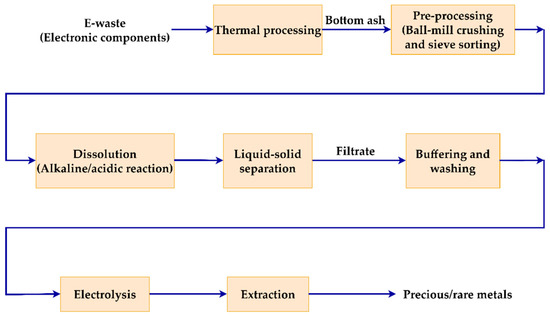
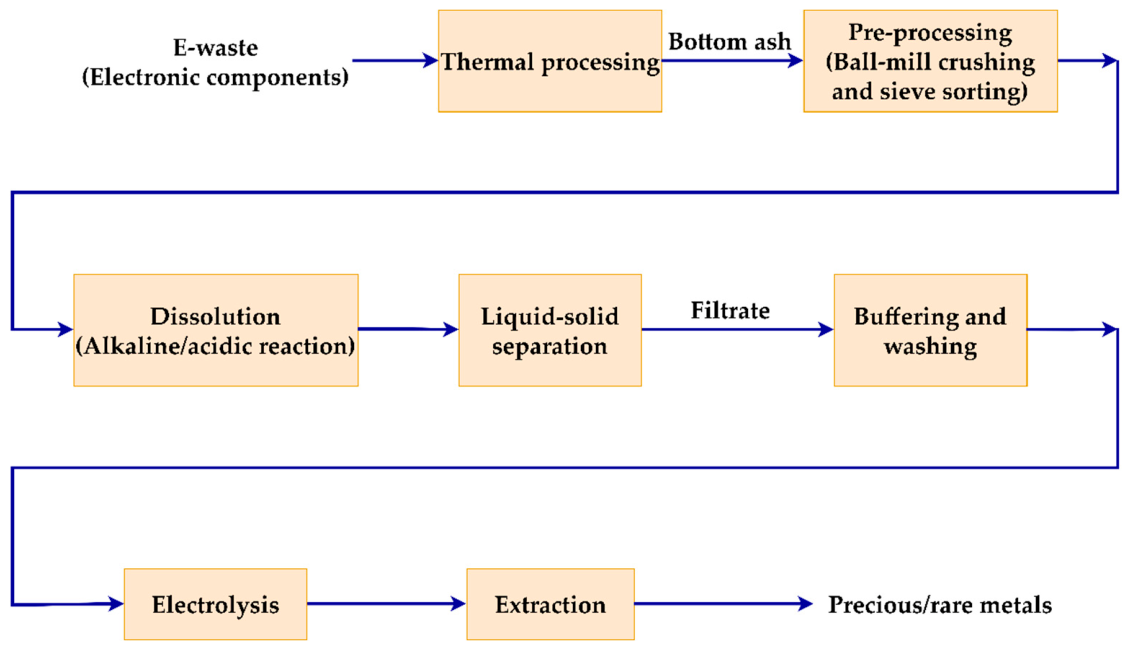
This company focuses on the recycling of precious metals, including gold and silver, and rare metals, such as indium. Figure 1 depicts a simplified flowchart for the recycling of valuable metals from E-waste and spent catalysts, integrating advanced processes such as vacuum induction melting, hot rolling, forging, powder metallurgy, electrolytic reduction, crystallization, and bonding technology. In brief, recycled E-waste and spent catalysts are dismantled to remove metal-containing components, which are then processed by ball-mill crushing, sorting, and pretreatment, such as mixing. In the next step, materials containing precious metals are dissolved using various alkaline or acidic solutions, such as cyanide chemicals, and then subjected to various refining processes, including such as electrolysis, reduction, liquid-solid separation, and liquid extraction, to generate gold bullion, silver bullion, platinum ingots, palladium ingots, and other valuable metal products, such as indium ingots. In terms of quality control, this company fully complies with International Organization for Standardization (ISO) standards for production and environmental management. In addition, it has established a precious metal refining system for recycling catalysts from the petrochemical and automotive industries. After refining, the recycled gold, silver, platinum, and palladium, with purities greater than 99.999 wt%, are used in LCD, LED, and a variety of ICT products. It should be noted that the company has special permits granted by the central competent authority (i.e., MOENV) for using cyanide chemicals to recycle solution from precious metal plating. After refining, the purity of Au, Ag, Pt and Pd can reach 99.999%, thus recycling in the use of LCD, LED and ICT industries.
Figure 1.
Simplified flowchart of precious metals recycled from E-waste in the case A.
6.2. Case Study in Valuable Base Metals: B Company
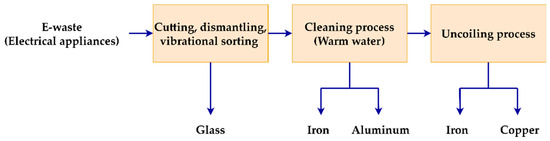
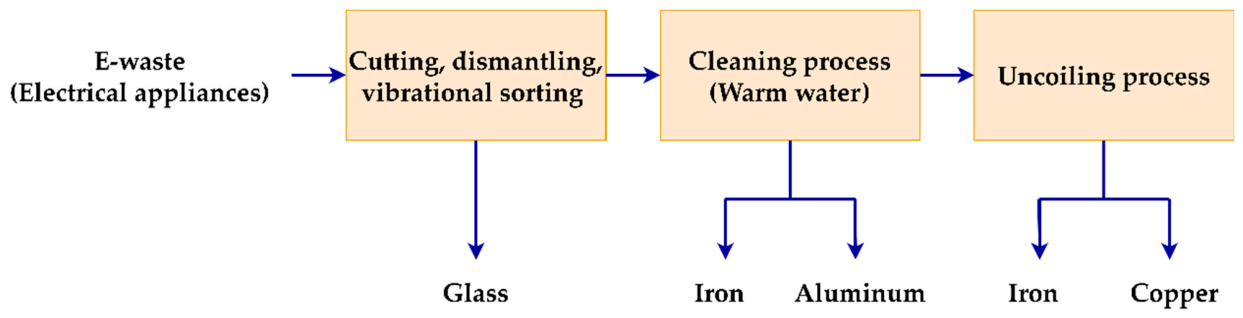
As the first E-waste recycling plant, Company B has fully recycled and reused valuable materials from electronic appliance components, including motors and compressors from refrigerators, washing machines, and television sets. Figure 2 shows a flowchart for recycling valuable metals from E-waste by the company. It should be noted that these E-waste recyclables also contain hazardous materials, such as lead, cadmium, refrigerants, lubricants, and mercury, which may pose environmental hazards when incinerated in the incinerators or disposed of in landfills. For example, in compressor recycling, residual lubricating oil is first removed, after which the compressor is subjected to an automated cleaning process, during which the target parts are washed with warm water to further remove traces of lubricating oil. Then, the coils of copper wire are separated through an uncoiling process. Other particles, including iron, copper, and aluminum, are filtered and sorted as recycled materials for further processing by metal-making mills. The prices of copper and aluminum have experienced a significant rise over the past two years, from 2023 to 2025 [38], indicating both the economic and environmental benefits of recycling waste electronic appliances.
Figure 2.
Simplified flowchart of valuable metals recycled from E-waste in the case B.
7. Conclusions
Over the past thirty years, extended producer responsibility (EPR) has developed into an important policy framework for urban waste reduction and E-waste management aimed at recovering valuable metals around the world. This circular economy policy not only alleviates environmental burdens associated with waste treatment and toxic substance release, but also conserves valuable resources, such as precious metals. In East Asia, particularly in Japan, Korea, and Taiwan, these economies share social, economic, and industrial similarities, including dependence on imported resources, high population density, and strong technological and semiconductor industries. Therefore, this overview paper thus highlighted urban waste management and E-waste mining for valuable metals, such as gold, silver, platinum, palladium, copper, and aluminum, in Japan, Korea, and Taiwan. It was found that the regulations governing urban waste reduction and recycling, including E-waste mining, in East Asia are based on the EPR principle, mandatory recycling requirements, such as sorting at source, and supportive policy measures, such as recycling fee rates. In Japan, urban waste reduction mainly relies on incineration, accounting for over 70%, and recycling, whereas Korea and Taiwan have emphasized the collection of recyclables from urban waste, with recycling rates exceeding 60%. To recover precious metals and other valuable metals from end-user E-waste, Japan and Korea have promulgated new regulations for designated home appliances and electrical products since the early 2000s. By contrast, the Taiwan government revised the existing regulation, namely the Waste Management Act, in 1997, establishing the so-called Four-in-One Recycling System, which integrates residents, local governments or cleaning teams, private recycling enterprises, and the Resource Recycling Management Fund, funded by the central government and responsible manufacturers and importers.
In addition, this review paper summarized the main achievements of urban waste management and E-waste recycling. Regarding mandatory E-waste, the government has announced five categories, namely lead-acid batteries, dry batteries, lighting equipment, home electrical appliances, and ICT products, as regulated recyclables, covering 25 items. Although the collection amounts of most E-waste recyclables indicated a positive trend over the past decade, from 2016 to 2025, some E-waste items, such as lighting equipment and home appliances, showed a decreasing trend due to mature domestic markets and the extensive use of long-lifetime products, such as LED lighting products. Based on the two case studies of precious metals, including gold and silver, rare metals, such as indium, and valuable metals, such as copper and aluminum, from waste mining, Taiwanese companies have been working to establish successful circular economy models under regulatory promotion and technology-oriented development. To support sustainability under Environmental, Social, and Governance (ESG) principles, Taiwan’s high-tech manufacturers are collaborating with circular economy enterprises to develop a comprehensive E-waste management system for a more sustainable future. Due to considerations surrounding business competition and intellectual property rights, this study encountered significant limitations in acquiring relevant data regarding E-waste generation volumes and processing methods across various countries and regions.
Author Contributions
Conceptualization, W.-T.T.; data curation and analysis, C.-H.T.; writing—original draft preparation, W.-T.T.; writing—review and editing, C.-H.T. and W.-T.T. All authors have read and agreed to the published version of the manuscript.
Funding
This research received no external funding.
Institutional Review Board Statement
Not applicable.
Informed Consent Statement
Not applicable.
Data Availability Statement
Data is contained within the article.
Conflicts of Interest
The authors declare no conflict of interest.
References
- Ghiga, S.C.; Simion, I.M.; Filote, C.; Roșca, M.; Hlihor, R.-M.; Cozma, P.; Gavrilescu, M. Sources, composition and management strategies of waste electrical and electronic equipment: A review. Environ. Eng. Manag. J. 2023, 22, 509–526. [Google Scholar] [CrossRef] [Scilit]
- de Oliveira Neto, J.F.; Candido, L.A.; de Freitas Dourado, A.B.; Santos, S.M.; Florencio, L. Waste of electrical and electronic equipment management from the perspective of a circular economy: A review. Waste Manag. Res. 2023, 41, 760–780. [Google Scholar] [CrossRef] [Scilit] [PubMed]
- Electronic Waste (E-Waste). Available online: https://www.who.int/news-room/fact-sheets/detail/electronic-waste-(e-waste) (accessed on 30 May 2026).
- Zhang, L.; Xu, Z. A review of current progress of recycling technologies for metals from waste electrical and electronic equipment. J. Clean. Prod. 2016, 127, 19–36. [Google Scholar] [CrossRef] [Scilit]
- Wang, M.; Tan, Q.; Chiang, J.F.; Li, J. Recovery of rare and precious metals from urban mines—A review. Front. Environ. Sci. Eng. 2017, 11, 1. [Google Scholar] [CrossRef] [Scilit]
- Chauhan, G.; Jadhao, P.R.; Pant, K.K.; Nigam, K.D.P. Novel technologies and conventional processes for recovery of metals from waste electrical and electronic equipment: Challenges & opportunities—A review. J. Environ. Chem. Eng. 2018, 6, 1288–1304. [Google Scholar]
- Pimassoni, Y.S.; Lima, M.T.W.D.C.; Yamane, L.H.; Siman, R.R. The recovery of rare earth elements from waste electrical and electronic equipment: A review. Hydrometallurgy 2023, 222, 106156. [Google Scholar] [CrossRef] [Scilit]
- Torrubia, J.; Valero, A.; Valero, A.; Lejuez, A. Challenges and opportunities for the recovery of critical raw materials from electronic waste: The Spanish perspective. Sustainability 2023, 15, 1393. [Google Scholar] [CrossRef] [Scilit]
- Chicardi, E.; Lopez-Paneque, A.; García-Orta, V.H.G.; Sepúlveda-Ferrer, R.E.; Gallardo, J.M. Enrichment methods for metal recovery from waste from electrical and electronic equipment: A brief review. Metals 2025, 15, 140. [Google Scholar] [CrossRef] [Scilit]
- Jovanović, G.; Bugarčić, M.; Petronijević, N.; Stopic, S.R.; Friedrich, B.; Marković, B.; Stanković, S.; Sokić, M. A multifocal study investigation of pyrolyzed printed circuit board leaching. Metals 2022, 12, 2021. [Google Scholar] [CrossRef] [Scilit]
- Jain, M.; Kumar, D.; Chaudhary, J.; Kumar, S.; Sharma, S.; Verma, A.S. Review on E-waste management and its impact on the environment and society. Waste Manag. Bull. 2023, 1, 34–44. [Google Scholar] [CrossRef] [Scilit]
- Koutamanis, A.; van Reijn, B.; van Bueren, E. Urban mining and buildings: A review of possibilities and limitations. Resour. Conserv. Recycl. 2018, 138, 32–39. [Google Scholar] [CrossRef] [Scilit]
- Murthy, V.; Ramakrishna, S. A Review on Global E-waste management: Urban mining towards a sustainable future and circular economy. Sustainability 2022, 14, 647. [Google Scholar] [CrossRef] [Scilit]
- Xavier, L.H.; Ottoni, M.; Abreu, L.P.P. A comprehensive review of urban mining and the value recovery from e-waste materials. Resour. Conserv. Recycl. 2023, 190, 106840. [Google Scholar] [CrossRef] [Scilit]
- Erdiaw-Kwasie, M.D.; Abunyewah, M.; Baah, C. A systematic review of the factors—Barriers, drivers, and technologies—Affecting e-waste urban mining: On the circular economy future of developing countries. J. Clean. Prod. 2024, 436, 140645. [Google Scholar] [CrossRef] [Scilit]
- Heisel, F.; Ciobanu, A.; McGranahan, J. Industry and literature review of urban mining applications in the United States: Gaps and drivers for implementation towards a circular industrialized construction economy. J. Circ. Econ. 2024, 2, 1. [Google Scholar] [CrossRef] [Scilit]
- Ouro-Salim, Q. Urban mining of e-waste management globally: Literature review. Clean. Waste Syst. 2024, 9, 100162. [Google Scholar] [CrossRef] [Scilit]
- Firmansyah, M.L.; Rizki, I.N.; Ullah, N. Recent advances in urban mining technology: A focus on electronic waste recycling potential in Indonesia. Clean. Waste Syst. 2025, 10, 100239. [Google Scholar] [CrossRef] [Scilit]
- Moita Neto, J.M.; Leal, R.C.; Araújo, N.L.d.S.; da Silva, E.A. Challenges and opportunities for the development of urban mining in Brazil. Minerals 2025, 15, 593. [Google Scholar] [CrossRef] [Scilit]
- Leclerc, S.H.; Badami, M.G. Extended producer responsibility for E-waste management: Policy drivers and challenges. J. Clean. Prod. 2020, 251, 119657. [Google Scholar] [CrossRef] [Scilit]
- Compagnoni, M. Is Extended producer responsibility living up to expectations? a systematic literature review focusing on electronic waste. J. Clean. Prod. 2022, 367, 133101. [Google Scholar] [CrossRef] [Scilit]
- Sugimura, Y.; Murakami, S. Problems in Japan’s governance system related to end-of-life electrical and electronic equipment trade. Resour. Conserv. Recycl. 2016, 112, 93–106. [Google Scholar] [CrossRef] [Scilit]
- Yoshida, F.; Yoshida, H. WEEE management in Japan. In Waste Electrical and Electronic Equipment (WEEE) Handbook, 2nd ed.; Goodship, V., Stevels, A., Jaco Huisman, J., Eds.; Elsevier: Cambridge, MA, USA, 2019; pp. 573–589. [Google Scholar]
- Lee, J.C.; Song, H.T.; Yoo, J.M. Present status of the recycling of waste electrical and electronic equipment in Korea. Resour. Conserv. Recycl. 2007, 50, 380–397. [Google Scholar] [CrossRef] [Scilit]
- Jang, Y.C. Waste electrical and electronic equipment (WEEE) management in Korea: Generation, collection, and recycling systems. J. Mater. Cycles Waste Manag. 2010, 12, 283–294. [Google Scholar] [CrossRef] [Scilit]
- Park, J.; Ahn, C.; Lee, K.; Choi, W.; Song, H.T.; Choi, S.O.; Han, S.W. Analysis on public perception, user-satisfaction, and publicity for WEEE collecting system in South Korea: A case study for Door-to-Door Service. Resour. Conserv. Recycl. 2019, 144, 90–99. [Google Scholar] [CrossRef] [Scilit]
- Laws and Regulation Retrieving System (Ministry of Justice, Taiwan). Available online: https://law.moj.gov.tw/Eng/index.aspx (accessed on 13 April 2026).
- Lu, L.T.; Hsiao, T.Y.; Shang, N.C.; Yu, Y.H.; Ma, H.W. MSW management for waste minimization in Taiwan: The last two decades. Waste Manag. 2006, 26, 661–667. [Google Scholar] [CrossRef] [Scilit] [PubMed]
- Chao, Y.L. Time series analysis of the effects of refuse collection on recycling: Taiwan’s “Keep Trash Off the Ground” measure. Waste Manag. 2008, 28, 859–869. [Google Scholar] [CrossRef] [Scilit]
- Cheng, C.P.; Chang, T.C. The development and prospects of the waste electrical and electronic equipment recycling system in Taiwan. J. Mater. Cycles Waste Manag. 2018, 20, 667–677. [Google Scholar] [CrossRef] [Scilit]
- Tsai, W.T. Current practice and policy for transforming e-waste into urban mining: Case study in Taiwan. Int. J. Environ. Waste Manag. 2019, 23, 1. [Google Scholar] [CrossRef] [Scilit]
- Taiwan’s Pathway to Net-Zero Emissions in 2050. Available online: https://www.ndc.gov.tw/en/Content_List.aspx?n=B927D0EDB57A7A3A (accessed on 25 May 2026).
- Tsai, W.-T. Recycling waste electrical and electronic equipment (WEEE) and the management of its toxic substances in Taiwan—A case study. Toxics 2020, 8, 48. [Google Scholar] [CrossRef] [Scilit]
- Lee, S.C.; Na, S.I. E-waste recycling systems and sound circulative economies in East Asia: A comparative analysis of systems in Japan, South Korea, China and Taiwan. Sustainability 2010, 2, 1632–1644. [Google Scholar] [CrossRef] [Scilit]
- Andeobu, L.; Wibowo, S.; Grandhi, S. A systematic review of e-waste generation and environmental management of Asia Pacific Countries. Int. J. Environ. Res. Public Health 2021, 18, 9051. [Google Scholar] [CrossRef] [Scilit]
- Cayumil, R.; Khanna, R.; Rajarao, R.; Mukherjee, P.S.; Sahajwalla, V. Concentration of precious metals during their recovery from electronic waste. Waste Manag. 2016, 57, 121–130. [Google Scholar] [CrossRef] [Scilit]
- Prichard, H.M.; Wedin, F.; Sampson, J.; Jackson, M.T.; Fisher, P.C. Precious metals in urban waste. Water Environ. J. 2016, 30, 151–156. [Google Scholar] [CrossRef] [Scilit]
- TRADING ECONOMICS. Available online: https://tradingeconomics.com/commodities (accessed on 24 April 2026).
- Mohamed, D.; Fayad, A.; Mohamed, A.M.O.; Al Nahyan, M.T. The role of E-waste in sustainable mineral resource management. Waste 2025, 3, 27. [Google Scholar] [CrossRef] [Scilit]
- Qin, J.; Li, S.; Zhao, L.; Liu, B.; Zhang, Y. Precious metal recycling technology in electronic waste: Progress, challenges, and sustainable development path. Green Smart Min. Eng. 2025, 2, 459–482. [Google Scholar] [CrossRef] [Scilit]
- Iqbal, S.S.; Dagwar, P.P.; Dutta, D. Sustainable E-waste management: Global challenges, recovery techniques, and regulatory approaches. Next Sustain. 2026, 7, 100304. [Google Scholar] [CrossRef] [Scilit]
- Dhapola, P.S.; Acquesta, A.; Monetta, T. Recent advancements in sustainable approaches to recover precious metals from waste electrical and electronic equipment (WEEE). Chem. Phys. Impact 2025, 11, 100941. [Google Scholar] [CrossRef] [Scilit]
- Jin, L.; Shen, B.; Du, H.; Hao, D.; Wang, M.; Zhang, S.; Wang, Q. Sustainable and selective recovery of precious metals from e-waste: Catalyzing a circular economy. Chem. Eng. J. 2026, 529, 173153. [Google Scholar] [CrossRef] [Scilit]
- Chancerel, P.; Meskers, C.E.M.; Hagelüken, C.; Rotter, V.S. Assessment of precious metal flows during preprocessing of waste electrical and electronic equipment. J. Ind. Ecol. 2009, 13, 791–810. [Google Scholar] [CrossRef] [Scilit]
- Lu, Y.; Xu, Z. Precious metals recovery from waste printed circuit boards: A review for current status and perspective. Resour. Conserv. Recycl. 2016, 113, 28–39. [Google Scholar] [CrossRef] [Scilit]
- Gareth Charles, R.; Douglas, P.; Hallin, I.L.; Matthews, I.; Liversage, G. An investigation of trends in precious metal and copper content of RAM modules in WEEE: Implications for long term recycling potential. Waste Manag. 2017, 60, 505–520. [Google Scholar] [CrossRef] [Scilit]
- Hussain, J.; Sim, M.; Rosaiah, P.; Hussain, I. A review of sustainable cementation strategies for precious metal recovery: Efficiency, environmental impact and future prospects. J. Hazard. Mater. Adv. 2026, 22, 101120. [Google Scholar] [CrossRef] [Scilit]
- Salama, A.; Richard, G.; Medles, K.; Zeghloul, T.; Dascalescu, L. Distinct recovery of copper and aluminum from waste electric wires using a roll-type electrostatic separator. Waste Manag. 2018, 76, 207–216. [Google Scholar] [CrossRef] [Scilit]
- Ministry of Environment (MOEVA). Yearbook of Environmental Protection Statistics 2024; MOEVA: Taipei, Taiwan, 2025.
- Moshkal, M.; Akhapov, Y.; Ogihara, A. Sustainable waste management in Japan: Challenges, achievements, and future prospects: A review. Sustainability 2024, 16, 7347. [Google Scholar] [CrossRef] [Scilit]
- Morais, A.C.; Ishida, A. An overview of residential food waste recycling initiatives in Japan. Clean. Waste Syst. 2025, 10, 100232. [Google Scholar] [CrossRef] [Scilit]
- Yumitro, G.; Oktaviani, S.; Deniar, S.M. How South Korea’s waste management system becomes a model for the world: What Indonesia can learn from South Korea’s experience. Commun. Hum. Soc. Sci. 2024, 4, 22–28. [Google Scholar] [CrossRef] [Scilit]
- Lee, E.; Shurson, G.; Oh, S.H.; Jang, J.C. The management of food waste recycling for a sustainable future: A case study on South Korea. Sustainability 2024, 16, 854. [Google Scholar] [CrossRef] [Scilit]
- Thanos Bourtsalas, A.C.; Seo, Y.; Tanvir Alam, M.; Seo, Y.C. The status of waste management and waste to energy for district heating in South Korea. Waste Manag. 2019, 85, 304–316. [Google Scholar] [CrossRef] [Scilit] [PubMed]
- Jung, D.; Kim, J.; Hwang, Y.W.; Han, M.; Guillaume, B. Evaluating waste management performance in South Korea: Insights over 27 years. J. Mater. Cycles Waste Manag. 2025, 27, 1324–1338. [Google Scholar] [CrossRef] [Scilit]
- Rotter, V.S.; Chancerel, P.; Schill, W.P. Practicalities of individual producer responsibility under the WEEE directive: Experiences in Germany. Waste Manag. Res. 2011, 29, 931–944. [Google Scholar] [CrossRef] [Scilit] [PubMed]
- Ylä-Mella, J.; Poikela, K.; Lehtinen, U.; Keiski, R.L.; Pongrácz, E. Implementation of waste electrical and electronic equipment directive in Finland: Evaluation of the collection network and challenges of the effective WEEE management. Resour. Conserv. Recycl. 2014, 86, 38–46. [Google Scholar] [CrossRef] [Scilit]
- Schumacher, K.A.; Agbemabiese, L. Towards comprehensive e-waste legislation in the United States: Design considerations based on quantitative and qualitative assessments. Resour. Conserv. Recycl. 2019, 149, 605–621. [Google Scholar] [CrossRef] [Scilit]
- Andersen, T.; Jæger, B.; Mishra, A. Circularity in waste electrical and electronic equipment (WEEE) Directive. Comparison of a Manufacturer’s Danish and Norwegian Operations. Sustainability 2020, 12, 5236. [Google Scholar] [CrossRef] [Scilit]
- Sachs, N. Planning the funeral at the birth: Extended producer responsibility in the European Union and the United States. Harv. Environ. Law Rev. 2006, 30, 51–98. [Google Scholar]
- Arai, R.; Calisto Friant, M.; Vermeulen, W.J.V. The Japanese circular economy and sound material-cycle society policies: Discourse and policy analysis. Circ. Econ. Sustain. 2024, 4, 619–650. [Google Scholar] [CrossRef] [Scilit]
- Portugaise, M.K.; Jóhannsdóttir, L.; Murakami, S. Extended producer responsibility’s effect on producers’ electronic waste management practices in Japan and Canada: Drivers, barriers, and potential of the urban mine. Discov. Sustain. 2023, 4, 8. [Google Scholar] [CrossRef] [Scilit]
- Serpe, A.; Purchase, D.; Bisschop, L.; Chatterjee, D.; De Gioannis, G.; Garelick, H.; Kumar, A.; Peijnenburg, W.J.G.M.; Piro, V.M.I.; Cera, M.; et al. 2002–2022: 20 years of e-waste regulation in the European Union and the worldwide trends in legislation and innovation technologies for a circular economy. RSC Sustain. 2024, 3, 1039–1083. [Google Scholar] [CrossRef] [Scilit]
- Park, J.; Jung, I.; Choi, W.; Choi, S.O.; Han, S.W. Greenhouse gas emission offsetting by refrigerant recovery from WEEE: A case study on a WEEE recycling plant in Korea. Resour. Conserv. Recycl. 2019, 142, 167–176. [Google Scholar] [CrossRef] [Scilit]
- Park, J.; Park, K.V.; Yoo, S.; Choi, S.O.; Han, S.W. Development of the WEEE grouping system in South Korea using the hierarchical and non-hierarchical clustering algorithms. Resour. Conserv. Recycl. 2020, 161, 104884. [Google Scholar] [CrossRef] [Scilit]
- Rhee, S.W. Beneficial use practice of e-wastes in Republic of Korea. Procedia Environ. Sci. 2016, 31, 707–714. [Google Scholar] [CrossRef] [Scilit]
- Yang, B.C.; Lee, C.H.; Suryawan, I.W.K. Consumers’ willingness to pay and importance-performance gaps for resilient e-waste management in Taiwan. J. Clean. Prod. 2024, 484, 144313. [Google Scholar] [CrossRef] [Scilit]
- Yang, B.C.; Lee, C.H.; Suryawan, I.W.K. Financial support in E-waste management within a circular economy with structural equation modeling analysis from Taiwan. Circ. Econ. Sustain. 2025, 5, 949–973. [Google Scholar] [CrossRef] [Scilit]
- Solid Waste Statistics (Ministry of Environment, Taiwan). Available online: https://www.moenv.gov.tw/en/information-service/statistics/solid-waste-statistics/1939.html (accessed on 20 April 2026).
- Asian Productivity Organization (APO). Overview and Case Studies on Resources Recycling in the R.O.C. 2013; Industrial Development Bureau (Ministry of Economic Affairs): Taipei, Taiwan, 2013.

Disclaimer/Publisher’s Note: The statements, opinions and data contained in all publications are solely those of the individual author(s) and contributor(s) and not of MDPI and/or the editor(s). MDPI and/or the editor(s) disclaim responsibility for any injury to people or property resulting from any ideas, methods, instructions or products referred to in the content. |
© 2026 by the authors. Licensee MDPI, Basel, Switzerland. This article is an open access article distributed under the terms and conditions of the Creative Commons Attribution (CC BY) license.