Review

Advances and Applications of Agricultural Spray Deposition Detection Technologies

1
School of Agricultural Engineering, Jiangsu University, Zhenjiang 212013, China
2
High-Tech Key Laboratory of Agricultural Equipment and Intelligence of Jiangsu Province, Jiangsu University, Zhenjiang 212013, China
*
Author to whom correspondence should be addressed.
These authors contributed equally to this work.
Appl. Sci. 2026, 16(12), 5848; https://doi.org/10.3390/app16125848 (registering DOI)
Submission received: 14 May 2026 / Revised: 6 June 2026 / Accepted: 7 June 2026 / Published: 10 June 2026
(This article belongs to the Section Agricultural Science and Technology)

Abstract

Pesticide application efficiency is fundamentally governed by the spatial distribution of droplet deposition. However, characterizing this dynamic process is challenging due to complex environmental and canopy variables. Consequently, conventional offline sampling methods lack the temporal and spatial resolution required for modern intelligent spraying systems. This review systematically examines recent progress in droplet deposition detection. We first revisit traditional methods like water-sensitive paper, addressing high-coverage quantification biases and fluorescence-based techniques. Next, we analyze real-time sensing technologies, including capacitive and optical sensors, highlighting their responsiveness and inherent physical constraints. Furthermore, deep learning approaches for droplet detection, overlap segmentation, and geometric-to-physical regression are discussed. While these methods substantially enhance feature extraction, they often struggle with cross-scenario generalization. Ultimately, current techniques face inherent trade-offs among real-time capability, quantification accuracy, and environmental adaptability, remaining insufficient for complex field conditions. To enable reliable closed-loop control in precision plant protection, future research must prioritize multi-modal sensor fusion, the integration of data-driven and physics-based models, and real-time deployment via edge computing.

1. Introduction

In the context of the ongoing transition toward precision agriculture, improving plant protection efficiency while reducing chemical inputs has become a central objective in agricultural research [1,2]. Achieving this goal relies on the integration of intelligent sensing technologies to enhance resource utilization and mitigate environmental impacts. In pest and disease control, spraying effectiveness is largely determined by the quality of droplet deposition on target surfaces [3,4,5]. The quality of this deposition is primarily characterized by several main parameters—specifically deposition amount, coverage, and droplet size distribution—which collectively influence the spatial distribution and biological efficacy of pesticides. Excessive deposition may lead to runoff and environmental contamination, whereas insufficient deposition results in reduced control efficacy. In addition, larger droplets increase the risk of ground loss, while finer droplets are more susceptible to drift. Therefore, accurate and real-time monitoring of droplet deposition characteristics is essential for optimizing application strategies, improving pesticide utilization efficiency, and reducing environmental risks [6,7,8].
The practical implementation of these detection technologies is transforming various agricultural scenarios, including broad-acre row crops, complex orchard canopies, and facility horticulture. By accurately monitoring droplet deposition, they solve pressing agricultural problems such as environmental pollution from excessive pesticide runoff and poor disease control from insufficient coverage. Economically, the implementation of these systems significantly reduces chemical input costs and labor expenses while safeguarding crop yields. Ultimately, these sensing technologies are indispensable for the advancement of precision agriculture; they enable a fundamental shift from experience-based, uniform spraying to data-driven, variable-rate applications, forming the critical feedback loop required for intelligent plant protection.
However, droplet deposition is a highly dynamic, multi-scale, and heterogeneous physical process governed by the coupled interactions of airflow, application parameters, and crop canopy structure [9,10]. These characteristics make rapid and in situ field measurement inherently challenging. As conventional methods such as water-sensitive paper and tracer-based techniques struggle to meet the demands of modern precision spraying, a range of real-time sensing technologies, including capacitive sensing, fluorescence spectroscopy, and high-speed imaging, have been developed [11]. The primary value of these approaches lies in their ability to provide quantitative inputs for closed-loop control systems. By continuously acquiring key parameters such as deposition amount, coverage, and droplet size distribution, spraying systems can dynamically adjust operational variables (e.g., flow rate, speed, and pressure) and support nozzle selection for drift reduction. This technological evolution not only reduces pesticide consumption and environmental impact while maintaining efficacy, but also promotes a fundamental shift in decision-making from experience-based to data-driven approaches [12,13,14].
A variety of droplet deposition detection methods have been reported, including water-sensitive paper, tracer-based techniques, capacitive sensing, optical sensors, and image analysis approaches. However, each method exhibits notable limitations in practical applications, and inconsistencies remain regarding their performance and applicability. Water-sensitive paper is widely used due to its simplicity and low cost, yet it is single-use, sensitive to ambient humidity, and prone to severe droplet overlap at high coverage levels, which complicates image segmentation. Cerruto et al. (2019) showed that even with mathematical correction of spreading factors, discrepancies between measured and simulated coverage can still reach 7–8%, suggesting an inherent limitation in its quantitative capability under high-coverage conditions [15]. Tracer-based methods enable quantitative measurement of deposition; however, they typically require laboratory-based post-processing, and fluorescence signals are susceptible to interference from ambient light, limiting their suitability for real-time field monitoring [16,17]. Capacitive sensors offer advantages in real-time response, reusability, and structural simplicity, but their output is strongly influenced by droplet size distribution, and their applicability under dynamic spraying conditions remains debated. Ou et al. (2024) demonstrated through theoretical and experimental analyses that a linear relationship between deposition and output voltage is only maintained when droplet size distribution remains stable; deviations in size distribution lead to a breakdown of this relationship [18]. This finding contrasts with earlier studies suggesting direct applicability of capacitive sensing for deposition measurement, highlighting fundamental constraints in field conditions. Optical sensors and image-based methods can directly capture droplet morphology and size, providing intuitive insight into droplet behavior. However, in near-field high-density spray regions, an inherent trade-off exists between depth of field and spatial resolution, making it difficult to simultaneously resolve droplets of different sizes within a single focal plane. In addition, the computational demand of image post-processing limits real-time applicability [19,20].
At present, droplet deposition detection technologies are undergoing a transition from laboratory research to field deployment. Different approaches exhibit varying performance in terms of sensitivity, real-time capability, cost, stability, and ease of implementation, while their applicability and performance boundaries remain subject to ongoing debate. A key challenge lies in integrating multi-source sensing information under complex field conditions, developing robust detection and calibration algorithms, and improving overall system reliability. Addressing these challenges is essential for enabling precise variable-rate application. Consequently, a critical overarching question drives this research: What are the fundamental bottlenecks preventing current droplet deposition detection technologies from transitioning from offline evaluation to real-time, in-field closed-loop control, and how can emerging approaches resolve the inherent trade-offs among quantification accuracy, real-time responsiveness, and environmental robustness? To address this main question. This review systematically examines the principles, performance characteristics, and applicability of existing droplet deposition detection methods, identifies common technical bottlenecks and areas of controversy, and outlines future research directions [21,22,23]. The aim is to provide a coherent technical framework to support theoretical development and facilitate the advancement of precision spraying toward more reliable, intelligent, and deployable solutions.
To ensure the rigor of this comparative analysis, the literature discussed herein was primarily retrieved from major scientific databases (e.g., Web of Science and Scopus), focusing on peer-reviewed articles and technical reports that address the engineering constraints of field-applicable agricultural sensing.

2. Conventional Droplet Deposition Detection Techniques

Traditional droplet deposition detection techniques have primarily relied on physical colorimetric responses or chemical extraction-based analyses. Over time, these approaches have served as benchmark methods for evaluating spraying performance and optimizing application parameters in plant protection machinery, playing a fundamental and irreplaceable role in agricultural engineering research. According to their underlying measurement principles, conventional detection methods can be broadly classified into water-sensitive paper-based techniques and tracer-based approaches [24,25,26].

2.1. Water-Sensitive Paper Method

Water-sensitive paper (WSP) is a specially treated substrate coated with bromophenol blue indicator, which appears yellow in its initial state [27]. When aqueous spray droplets impact the paper surface, the moisture induces a color change in the indicator through pH variation or physical wetting, resulting in blue or blue–purple circular or elliptical stains in the regions covered by droplets. After scanning or imaging the stained surface, image processing techniques are employed to extract key deposition parameters [28]. These typically include: coverage, defined as the ratio of the total stained area to the image area; droplet density, representing the number of droplets per unit area; individual droplet diameter, estimated from the stain area using a predefined spreading factor; and droplet size distribution metrics such as the volume median diameter (VMD) and number median diameter (NMD) [29,30]. The overall measurement process of the WSP-based method is illustrated in Figure 1.
Cunha et al. (2012) evaluated the performance of the Spray image II software against manual measurements and reported that the error in droplet density was approximately 6.7%, remaining below 10% even at a relatively high coverage level of 43% [32]. Building upon this need to accurately evaluate digital analysis tools under varying coverage conditions, Cerruto et al. (2019) expanded the reference methodology by using deposition measurements obtained from Petri dishes [15]. They observed a moderate-to-high linear correlation between WSP-derived coverage and actual deposition (R2 = 0.761) [15], and further demonstrated that by introducing a spreading factor (α = 1.59), the simulated droplet density showed close agreement with measured values (R2 = 0.9997). In a subsequent effort to benchmark these increasingly complex digital analysis capabilities against one another, Özlüoymak et al. (2020) compared the VAS software with previously established analysis tools [31]. Through this comparison, they found that coverage estimates were generally consistent with reference methods (similarity ranging from 69.4% to 97.1%) [31]. Moreover, by incorporating morphological algorithms, the VAS system was able to identify 3377 droplets under high-density spraying conditions at 6 km·h, significantly exceeding the 2512 droplets detected by comparison software, thereby reducing underestimation caused by droplet overlap. A comparison of the performance of WSP-based image analysis systems is summarized in Table 1.
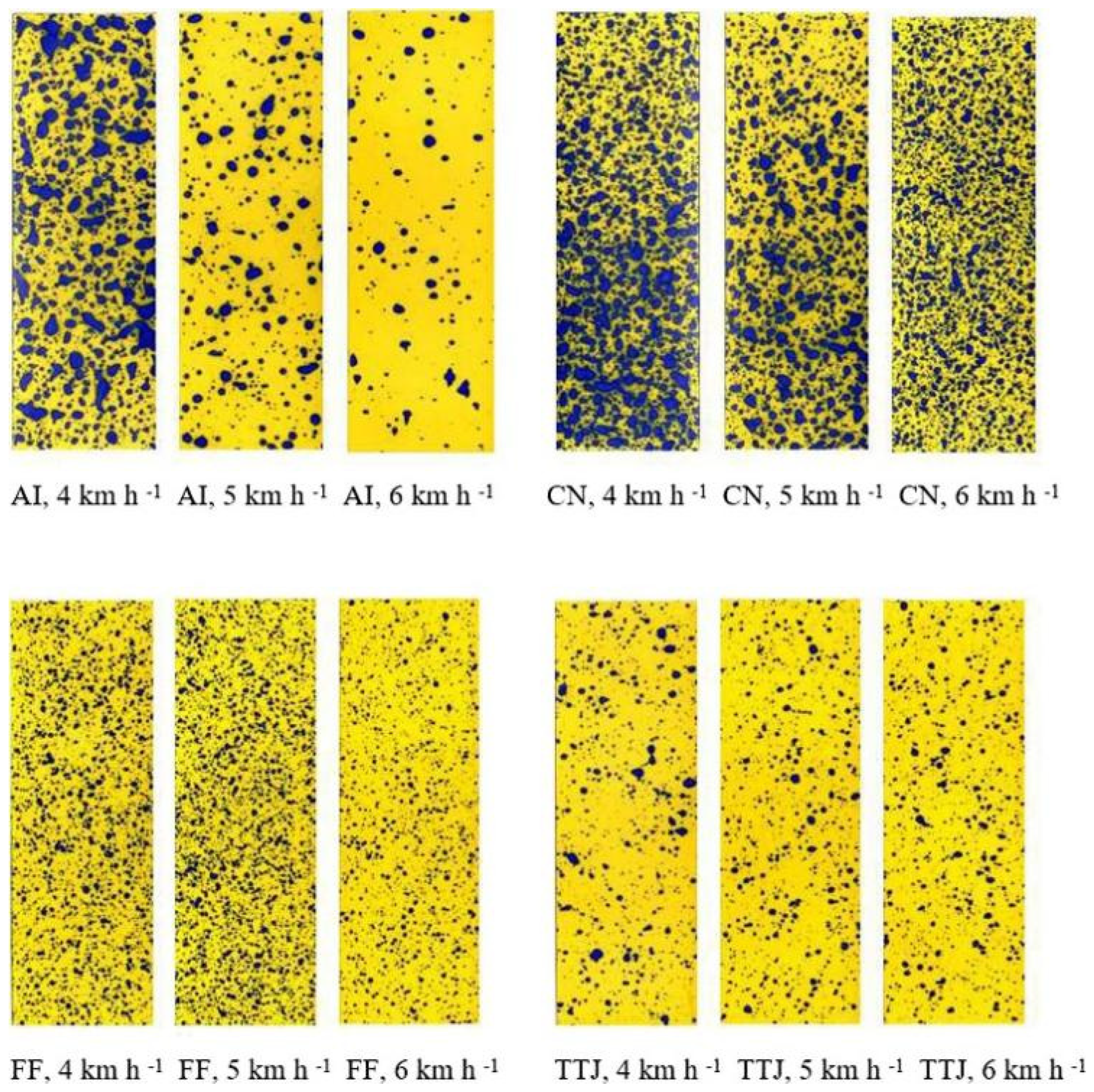
Water-sensitive paper is widely used due to its operational simplicity, low cost, and the ability to extract key parameters such as coverage and droplet density through image analysis, making it particularly suitable for small-scale evaluations and spray parameter optimization [32,33,34,35]. However, as a single-use material, it is inherently unsuitable for continuous monitoring. Its detection performance is also sensitive to ambient humidity, and under low-humidity conditions, droplets smaller than approximately 50 μm may not be reliably captured. More importantly, at high spray coverage levels, WSP faces substantial challenges associated with severe stain overlap, which complicates image segmentation and quantitative analysis [36,37]. In addition, the stain spreading factor is not constant in practice. The commonly used Syngenta empirical relationship (Ds = 0.938 × D1.143) often becomes inadequate under complex spraying conditions. Cerruto et al. reported that, under high-coverage scenarios, a correction factor of approximately 1.59 is required to achieve agreement with measured data [15]. Such reliance on fixed spreading factors to back-calculate original droplet size can introduce significant systematic bias, thereby limiting the applicability of WSP in precision spraying systems, particularly in the context of closed-loop control. The detection results obtained using the WSP method are illustrated in Figure 2.
Existing studies have indicated that the water-sensitive paper (WSP) method continues to play a fundamental role in droplet deposition assessment [38]. Its low cost and ease of use make it widely adopted for spray parameter optimization and comparative experiments [39,40,41]. Under low to moderate coverage conditions, it can provide relatively stable characterization of coverage and droplet density as relative indicators [42]. However, its quantitative capability is inherently dependent on droplet spreading models and empirical correction factors. At high coverage levels, measurement accuracy is increasingly affected by droplet overlap and non-uniform spreading behavior, which may introduce systematic bias. Consequently, the WSP method is more suitable for relative evaluation and offline analysis, while its applicability in high-precision quantification and real-time closed-loop control remains limited [43,44,45].

2.2. Tracer-Based Methods (Fluorescent/Dye Techniques)

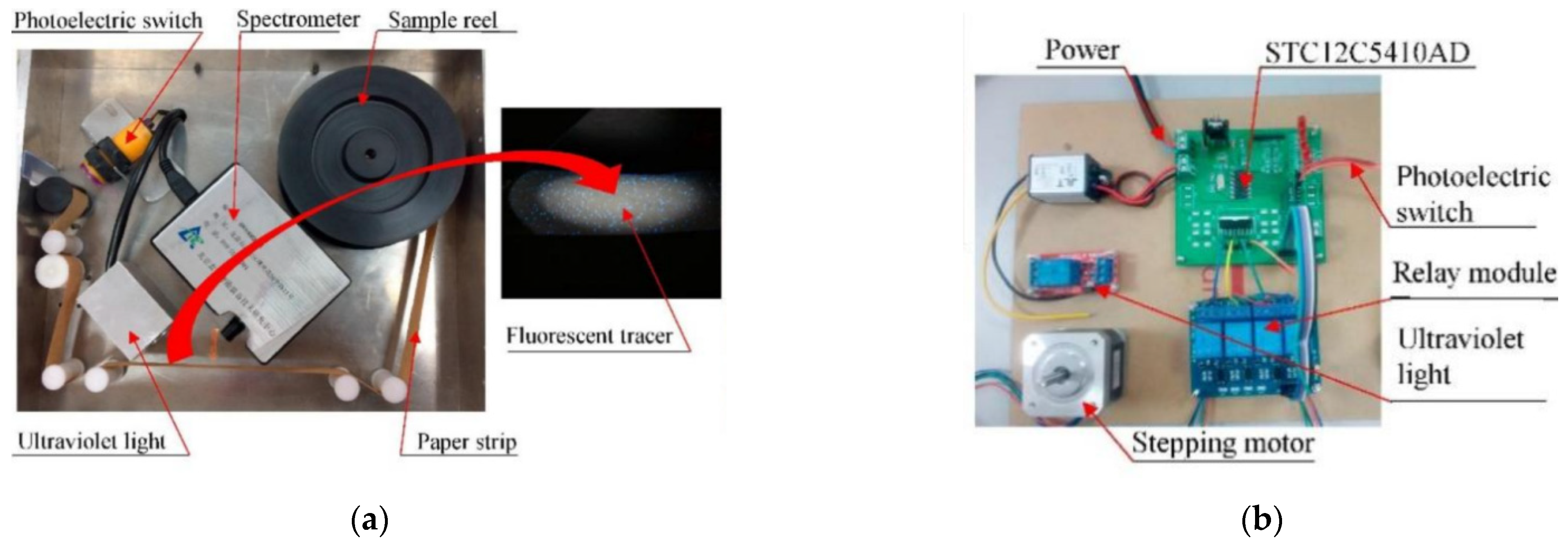
Tracer-based methods involve the addition of detectable chemical markers, such as fluorescent tracers or dyes, into the spray solution [46]. After application, samples are collected from target surfaces (e.g., leaves or artificial collectors), and the tracer content is quantified using spectroscopic analysis, fluorescence measurement, or colorimetric methods [47,48]. The deposition amount is then estimated based on the measured tracer concentration [49]. The underlying principle assumes that, under controlled conditions, the concentration of the tracer in the deposited material is linearly related to its initial concentration in the spray solution [50]. The components of a fluorescence scanning system (SDPMS) are illustrated in Figure 3.
Gao et al. (2019), using the actual deposition of pesticide as a reference, demonstrated that the water-soluble tracer Allura Red exhibited deposition behavior highly consistent with that of the pesticide, with ratios ranging from 0.98 to 1.21 [52]. The recovery rate of the UPLC (Ultra-Performance Liquid Chromatography: Fast, high-resolution chemical separation technique) analytical method ranged from 96.07% to 107.48%. Wen et al. (2019), taking deposition parameters derived from conventional water-sensitive paper (WSP) as a benchmark, reported a strong linear relationship between fluorescence intensity obtained from a spectral detection system (SDPMS) and both coverage and volumetric deposition estimated by WSP, with coefficients of determination (R2) of 0.91 and 0.89, respectively [51]. Similarly, Menger et al. (2020) validated a filter paper-based red fluorescent dye method against the widely used WSP approach, showing consistent performance in evaluating coverage and in capturing variations in spray speed and pressure [53]. In addition, this method effectively avoids the false-positive effects associated with humidity sensitivity in WSP, reduces sample drying time to less than 10 min, and lowers the cost per sample from USD 1.40 to approximately USD 0.42. A comparison of tracer-based methods and spectral/chromatographic analysis techniques for spray deposition measurement is presented in Table 2.
Tracer-based methods (fluorescent/dye techniques) offer several notable advantages for droplet deposition assessment. They enable quantitative analysis through calibration with standard curves, allowing for absolute measurement of deposition amounts. In addition, the results are largely independent of droplet morphology and spreading behavior, which provides higher accuracy and reliability compared with WSP-based approaches that rely on empirical spreading factors [54,55]. These methods are also applicable under field conditions. During UAV (Unmanned Aerial Vehicle: An aircraft operated without an onboard pilot) or ground-based spraying, spatial distribution of deposition can be obtained by placing collectors at designated locations, providing useful data for evaluating spray uniformity and optimizing application parameters [56,57,58,59,60]. Representative deposition results are shown in Figure 4.
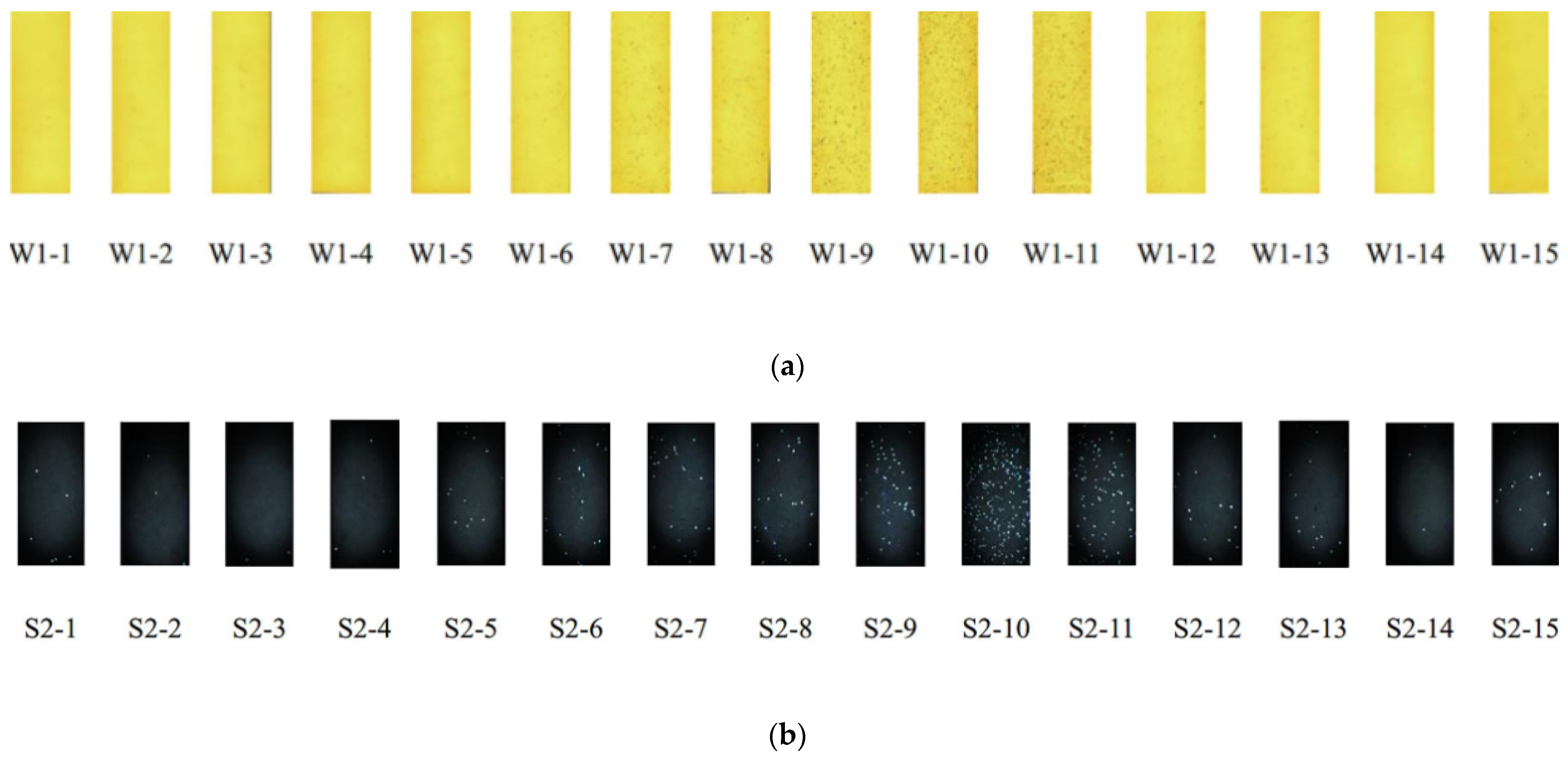
In addition, fluorescence-based detection offers high sensitivity, enabling very low limits of detection. This makes it particularly suitable for measuring trace-level deposition in low- and ultra-low-volume spraying scenarios, where conventional methods may fail to capture weak tracer signals [61]. Despite its clear advantages in quantitative accuracy, tracer-based methods present several inherent limitations that constrain their application in real-time field monitoring. The approach typically requires post-processing, including sample extraction, fluorescence measurement, or spectroscopic analysis under laboratory conditions. As a result, the procedure is time-consuming and cannot provide immediate feedback for spray operations. Moreover, fluorescence signals are highly sensitive to the ultraviolet component of sunlight, making field sampling susceptible to interference from ambient light. This often necessitates shading measures or nighttime operation, thereby increasing operational complexity and uncertainty [62,63]. In addition, the instrumentation required for high-sensitivity detection, such as spectrometers and fluorescence spectrophotometers, is relatively expensive, leading to higher maintenance costs and limiting large-scale deployment in routine field applications [64,65,66]. Representative images include WSP scans obtained using a portable scanner and fluorescence images of sampling strips captured with a CCD camera (Figure 5).
Tracer-based methods have become an important reference approach for droplet deposition assessment due to their relatively high quantitative accuracy and stability. By establishing calibration curves, these methods enable absolute quantification of deposition, while remaining largely insensitive to droplet morphology and spreading behavior. Existing studies indicate that, under controlled conditions, tracer-based techniques exhibit good repeatability and linear response characteristics. However, their application typically relies on offline sample processing and spectroscopic analysis, and is further constrained by susceptibility to ambient light interference and relatively high equipment costs. These factors limit their suitability for real-time field monitoring. Consequently, tracer-based methods are more appropriate for laboratory calibration and accuracy validation, whereas their use in online dynamic monitoring remains restricted [67,68,69,70].
Considering the characteristics of both water-sensitive paper and tracer-based approaches, these methods share common limitations in that they are offline, discrete, and single-use measurement techniques. As such, they are unable to meet the requirements of precision agriculture for real-time, continuous, and repeatable monitoring [71]. A comprehensive comparison of their performance is presented in Table 3.

3. Emerging Sensor-Based and Optical Detection Technologies

Conventional droplet deposition assessment methods, such as water-sensitive paper and tracer-based techniques, have been widely applied in both laboratory and field studies. However, their inherent limitations—namely offline operation, discrete sampling, and single-use nature—make them unsuitable for meeting the requirements of real-time feedback and closed-loop control in precision agriculture [72]. To address these limitations, recent research has focused on the development of novel detection approaches based on physical sensing and optical imaging. This section provides a systematic overview of two representative methods: capacitive sensors, and Optical Sensors and Image-Based Deposition Quantification Techniques, with emphasis on their working principles, advantages and limitations, as well as recent technological advances.

3.1. Capacitive Sensors

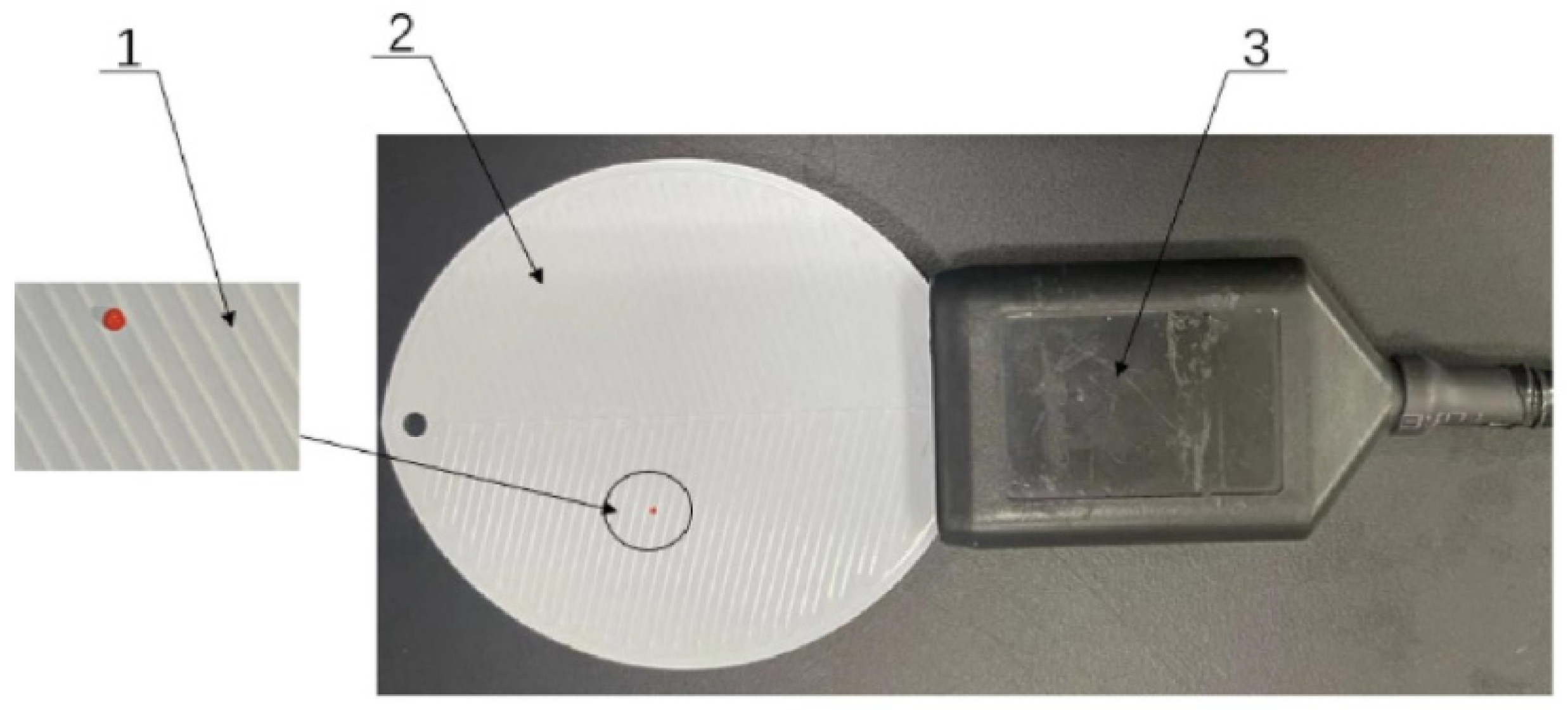
Capacitive sensors typically consist of a pair of parallel conductive electrodes (commonly made of copper) coated with an insulating layer that may be hydrophobic or hydrophilic [73]. When spray droplets deposit on the sensor surface, the liquid—characterized by a high dielectric constant (approximately 80 for water)—partially replaces the surrounding air, which has a much lower dielectric constant (approximately 1). This substitution alters the effective dielectric constant between the electrodes, leading to a measurable change in capacitance [74,75]. A schematic of a typical capacitive sensor is shown in Figure 6.
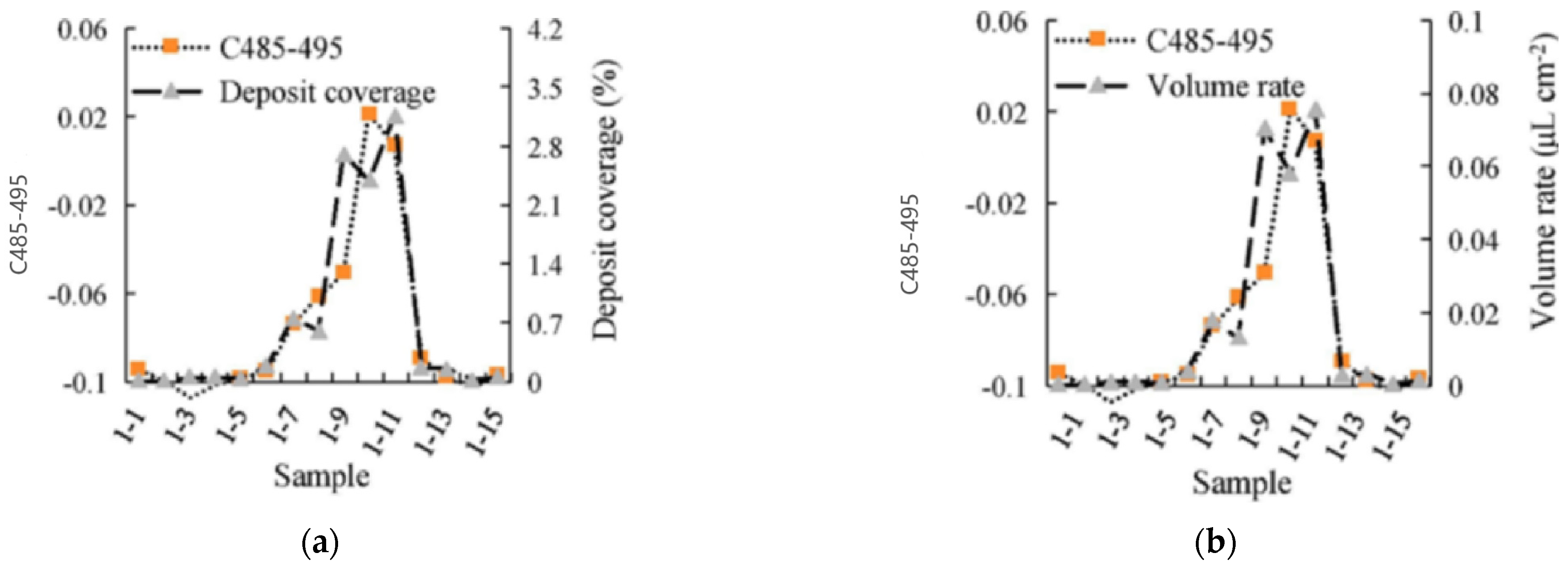
Capacitance variation can serve as a direct indicator of actual deposited mass, though its correlation accuracy is highly dependent on the specific chemical properties of the spray liquid. For example, quantifying deposited mass requires distinct linear models for non-ionized (R2 = 0.882) and ionized (R2 = 0.837) herbicide formulations [74]. Furthermore, advancing these sensors to high-frequency sampling rates (e.g., 625 Hz) enables highly sensitive real-time droplet characterization, effectively distinguishing between transient droplet impact signals and steady-state residence responses. In experimental validations, the system demonstrated robust linear correlations, with an average R2 of 0.9997 in controlled droplet tests and 0.96 in non-controlled spray tests, while being capable of detecting spray drift deposition levels as low as 0.02 μL·cm−2 [76,77]. Ou et al. (2024), through the development of a theoretical model supported by experimental validation, further demonstrated that the capacitance change measured by the sensor exhibited strong positive linear relationships with both droplet coverage and actual deposition, with R2 values exceeding 0.98 in lab conditions [18]. These findings provide both theoretical and experimental support for the application of capacitive sensing in real-time and quantitative assessment of spray deposition under field conditions [78,79,80]. A comparison of quantification performance in terms of deposition mass and coverage volume is presented in Table 4.
Capacitive sensors offer several notable advantages for droplet deposition monitoring. They exhibit rapid response, with output signals typically reacting to droplet deposition events on the millisecond scale, making them well suited for real-time monitoring and closed-loop control applications. In addition, the sensors are reusable; once the surface is dried, the system returns to its initial state without the need for consumable replacement, thereby reducing long-term operational costs. The sensor structure is relatively simple and can be fabricated using standard printed circuit board (PCB) processes, resulting in compact size and low power consumption, which facilitates integration into mobile platforms such as unmanned aerial vehicles and spraying machinery. Furthermore, the output is an electrical signal that is readily compatible with signal processing circuits, allowing direct interfacing with microcontrollers or wireless communication modules. This enables efficient data acquisition, processing, and transmission, supporting the development of intelligent spraying management systems [81,82,83].
Despite their advantages in real-time response and reusability, capacitive sensors exhibit several inherent limitations. Their output is strongly influenced by droplet size distribution. Experimental results reported by Ou et al. indicate that a strong linear relationship (R2 > 0.98) between capacitance change and deposition can only be maintained when the droplet size distribution remains stable, such as under fixed nozzle types and spray pressures [18]. Once the size distribution varies, the linear relationship deteriorates, and overlapping droplets may introduce nonlinear responses. Under high spray intensity, multiple droplets can coalesce on the same electrode region, forming non-spherical geometries such as liquid bridges or continuous films. In such cases, the capacitance change is no longer proportional to droplet volume, but instead exhibits a nonlinear saturation trend. This effect becomes particularly pronounced at high coverage levels (e.g., >50%), significantly limiting sensor performance under dense spray conditions. In addition, the sensor response is highly sensitive to droplet morphology and contact angle, which are heavily influenced by the specific biological targets. For example, variations in surface wettability across different crop types—such as the highly hydrophobic, waxy leaves found in orchard canopies compared to the highly textured surface areas of low-lying weeds (e.g., foxtail grass) or broadleaf crops—significantly alter droplet spreading behavior and height distribution, thereby affecting the effective dielectric model. Furthermore, to generate a complete view of the measurement’s usefulness in field applications, system calibration must also account for macroscopic environmental variables. Real-world deployments require evaluating vertical deposition profiles across varying plant heights (e.g., tall fruit trees versus ground-level vegetation) and mitigating the background dielectric noise introduced by different underlying soil types (e.g., moisture-retaining clay versus dry sandy soils). As a result, calibration is often required for different spray liquids or target surfaces, which constrains the generalizability of capacitive sensing across varying field conditions [84,85].
Capacitive sensors enable rapid detection of droplet deposition by measuring variations in the effective dielectric constant, offering clear advantages in terms of real-time response and reusability. Existing studies suggest that, under stable spraying conditions with relatively uniform droplet size distributions, the sensor output typically exhibits a strong linear relationship with coverage or deposition amount. However, the method is inherently sensitive to changes in the effective dielectric environment, and its measurements can be affected by factors such as droplet size distribution, droplet overlap, and variations in contact angle. These effects become more pronounced under high coverage or dynamic spraying conditions, where nonlinear deviations may arise. Consequently, capacitive sensing is more suitable for relative monitoring and real-time feedback under controlled conditions, while quantitative applications in complex field environments generally require integration with additional sensing modalities for calibration [86,87,88,89,90].

3.2. Optical Sensors and Image-Based Deposition Quantification Techniques

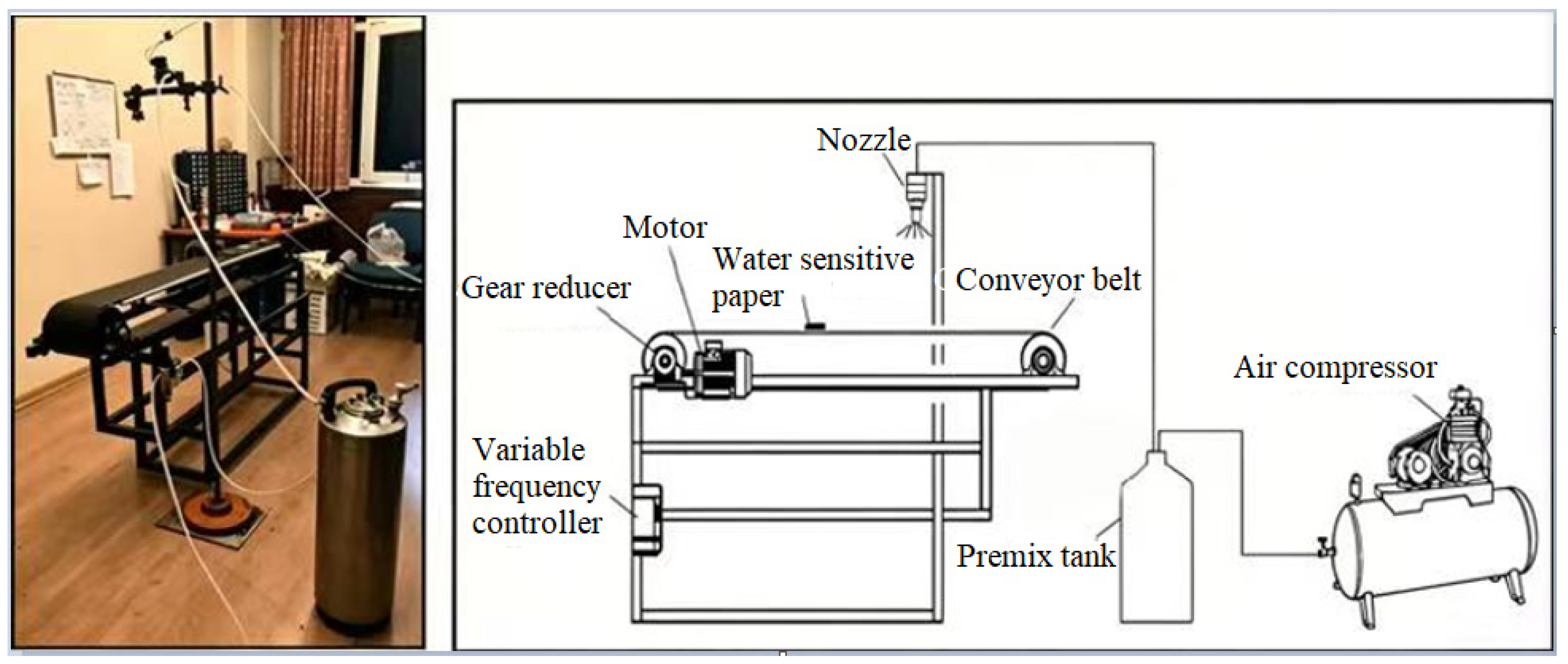
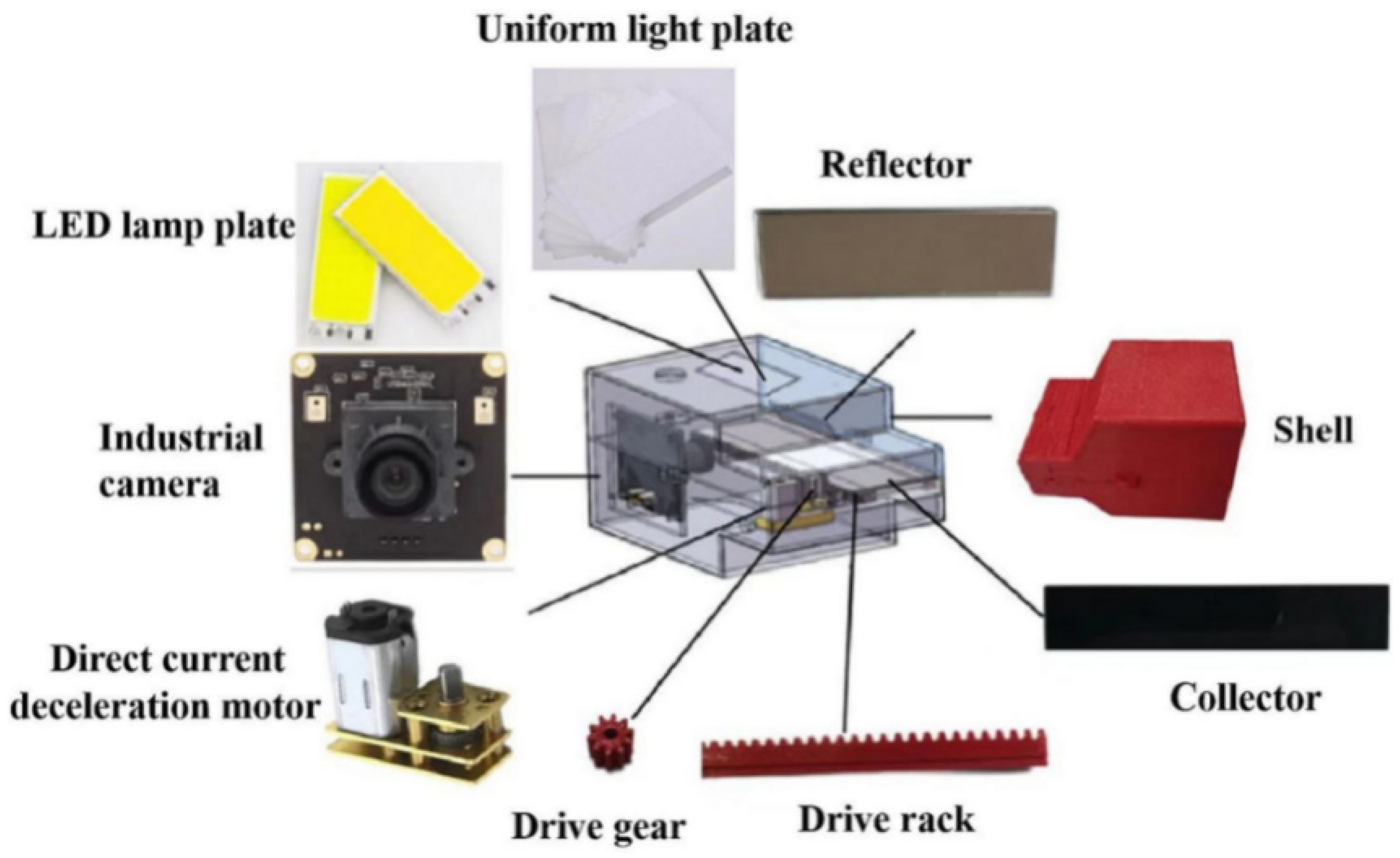
Deposition quantification methods based on optical sensing and image analysis rely on capturing two-dimensional images of target stains or airborne droplet shadows using optical hardware. These images are subsequently processed using computer vision algorithms for noise reduction and pixel-level segmentation of overlapping droplets. The extracted features are then converted into quantitative metrics—such as coverage, deposition density, and volume median diameter—through empirical spreading relationships or geometric modeling approaches. In this way, the physical characteristics of spray deposition are translated into agronomically relevant parameters [91,92]. A typical deposition sampling and detection system is illustrated in Figure 7.
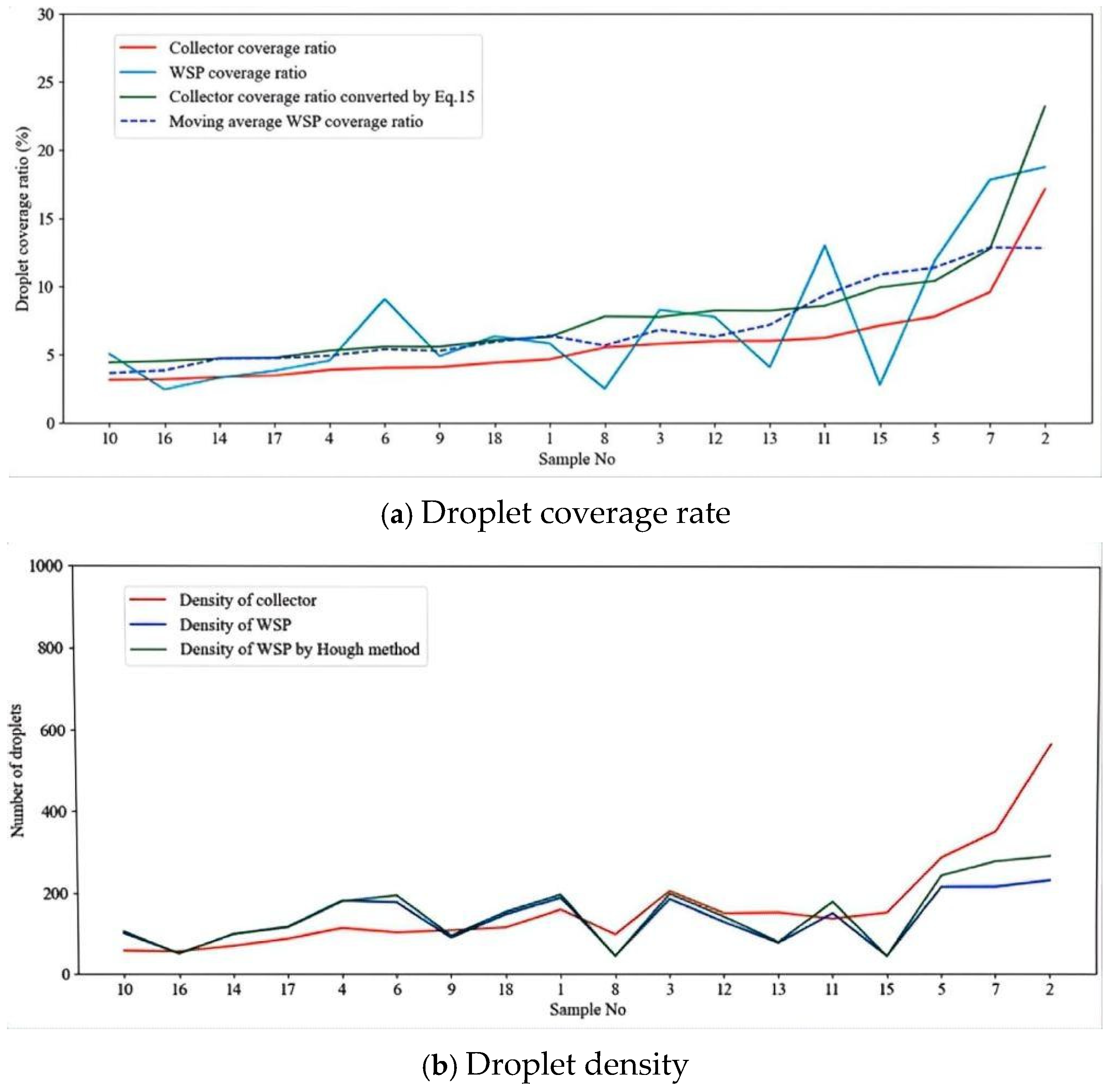
Zhu et al. (2011) evaluated the accuracy of the DepositScan portable scanning system using stain dimensions measured by a stereomicroscope as a reference [94]. Their results showed that, for droplets with diameters of 500 μm and above, the measurement error was 1.4% or less. Furthermore, when compared against standardized reference water-sensitive paper (provided by Syngenta), the deviation in total droplet counts was less than 5% utilizing their primary scanner [94]. Ferguson et al. (2016), using the mean results from five established image analysis software packages as a benchmark, reported that the SnapCard smartphone application produced coverage measurements that were statistically consistent with the reference (no significant difference in t-tests) [95]. Across different nozzle types and collector surfaces, the measurement error remained within one standard deviation of the mean. Liu et al. (2024) validated a portable in situ measurement device based on optical droplet edge imaging (ODEI), using both micropipette-based volume measurements and conventional water-sensitive paper as references [93]. The average deviation in droplet area-to-volume conversion was reported to be 3.22%. When compared with WSP measurements, the deviation in volume median diameter (VMD) was 15.34 μm, and the absolute deviation of the converted moving-average coverage was as low as 1.21%. A comparison of the performance of optical sensor and image-based portable systems for spray deposition measurement is presented in Table 5.
In optical sensing-based spray deposition studies, the shadow imaging method offers several distinct advantages. It enables simultaneous measurement of droplet size and velocity, by analyzing dual-frame or high-speed image sequences, the displacement of individual droplets between frames can be tracked to derive velocity vectors, providing key parameters for spray dynamics analysis. Shadow imaging is also well suited for high-density spray conditions. Unlike phase Doppler analysis (PDA) or laser diffraction techniques, it does not rely on single-particle scattering signals and can effectively handle dense droplet fields, thereby avoiding signal distortion caused by multiple scattering effects. In addition, the method allows direct visualization of true droplet morphology, including non-spherical structures such as elongated ligaments or fragmenting droplets, which is of particular value for investigating spray breakup processes and atomization mechanisms. Furthermore, shadow imaging does not require the addition of tracers, ensuring that the physicochemical properties of the spray liquid remain unchanged and that the measurements reflect the intrinsic deposition behavior. These characteristics make shadow imaging an important and complementary tool in spray characterization [96,97,98,99,100]. A comparison between results obtained using shadow imaging and those from the water-sensitive paper method is shown in Figure 8 and Figure 9.
Shadow imaging faces several key technical challenges in spray characterization. The trade-off between depth of field and spatial resolution represents the most fundamental limitation. High-resolution configurations (short focal length, shallow depth of field) allow clear detection of small droplets (<50 μm), but the depth of field is typically limited to a few hundred micrometers, meaning that only droplets within this narrow region are in focus while a large proportion remains blurred. In contrast, configurations with extended depth of field (long focal length, small aperture) provide a wider in-focus region, but at the cost of reduced resolution, where small droplets may not be detected or may be insufficiently resolved at the pixel level. Quantitative analysis has shown that at a spray distance of 100 mm, a high-resolution system with a depth of field of 900 μm captured only about one-seventh of the droplets. Although a large-depth-of-field system (6.25 mm) detected more droplets, it increased the minimum detectable size from 8.6 μm to 70.6 μm. In addition, droplet overlap and out-of-focus effects remain significant issues. In near-field high-density regions, multiple droplets may overlap in projection, making it difficult to distinguish individual droplets. Out-of-focus droplets exhibit blurred edges, and their projected areas may exceed the true geometric size, leading to overestimation of droplet diameter or misclassification as invalid targets. Furthermore, non-uniform illumination can affect measurement accuracy. Spatial variations in backlight intensity often result in lower brightness at the image periphery compared to the center, reducing the reliability of global threshold segmentation. As a result, image correction techniques such as band-pass filtering or local thresholding are often required. These challenges collectively limit the direct application of conventional shadow imaging methods in scenarios involving wide droplet size distributions and high spray densities [101,102,103,104,105,106].
To address the trade-off between depth of field and spatial resolution, An Image Feature Consolidation Technique (IFCT) has been proposed, which combines shadow images acquired under two different optical configurations to enable simultaneous detection of small droplets and larger droplets or unbroken ligaments. The results showed that, at a distance of 100 mm from the nozzle, the fused droplet size distribution covered a wide range from 8.6 μm to nearly millimeter scale [107]. In the volumetric distribution histogram, the contribution of small droplets became more pronounced, highlighting their dominant role in overall deposition. As the distance from the nozzle increased (100 mm → 140 mm → 300 mm), the average droplet size decreased, consistent with the cascade breakup process of sprays [108,109]. Error analysis indicated that the upper relative error of the number median diameter (D10) was approximately 1% (0.4 μm over 64.5 μm), which falls within an acceptable range. The key advantage of IFCT lies in its ability to overcome the limited measurable size range of single-view shadow imaging by exploiting the complementarity of two optical settings, without increasing hardware complexity, as it relies only on commercial cameras and lenses. This approach is therefore applicable to sprays with high density and broad droplet size distributions. Building on this concept, Liu et al. (2024) proposed a simplified and integrated method, referred to as optical droplet edge imaging (ODEI) [93]. The system employs a single camera combined with a dual-mirror configuration to simultaneously capture droplet images from both sides of the collector. Image binarization is performed using K-means clustering, followed by segmentation of overlapping droplets through the Hough circle transform. Experimental results showed that the volume median diameter (VMD) obtained by ODEI differed from water-sensitive paper measurements by 15.34 μm, while the deviation in converted coverage was 1.21%, demonstrating the feasibility of this approach for portable applications. However, the system remains at a prototype stage. The wettability characteristics of the acrylic collector differ from those of actual leaf surfaces, and the calibration range (0.6–3.0 μL) does not fully cover the smaller droplets (<100 μm) commonly encountered in agricultural spraying. In addition, its long-term stability and resistance to contamination under field conditions require further evaluation.
Detection methods based on optical sensing and image analysis enable direct acquisition of droplet geometry and size information, offering clear advantages in feature representation [110,111]. Existing studies indicate that, under controlled imaging conditions, these approaches can achieve relatively high accuracy in measuring droplet size distribution and coverage, while also providing valuable data for spray dynamics analysis [112,113]. However, their performance is constrained by the optical characteristics of the imaging system, particularly the trade-off between depth of field and spatial resolution, which makes it difficult for a single configuration to simultaneously capture fine droplets and maintain a broad sampling range [114,115,116]. In addition, under high-density spray conditions, droplet overlap and out-of-focus effects can further reduce measurement accuracy [117,118]. As a result, these methods are more suitable for applications involving droplet size distribution analysis and morphological characterization, whereas stable deployment in complex field environments generally requires multi-scale imaging strategies or algorithmic fusion approaches [119].
Considering both capacitive and optical sensing approaches, capacitive sensors are well suited for low-cost, real-time monitoring applications, particularly under stable spraying conditions. In contrast, optical sensors provide more comprehensive information on droplet size distribution and morphology [120]. Recent developments, such as the Image Feature Consolidation Technique (IFCT) and Optical Droplet Edge Imaging (ODEI), have begun to address the inherent trade-off between depth of field and spatial resolution. A comparative summary of the performance of emerging spray deposition detection technologies is presented in Table 6.

4. Detection Methods Based on Artificial Intelligence and Deep Learning

Conventional optical detection techniques, such as background subtraction and threshold-based image processing, often face significant challenges when applied to real spray flow fields, where variations in illumination, complex backgrounds, and severe droplet overlap can degrade performance. In recent years, advances in computational power and the availability of large-scale annotated datasets have driven a shift in agricultural spray monitoring from rule-based physical modeling toward data-driven approaches. In particular, the adoption of deep learning, especially convolutional neural networks (CNNs), has enabled more accurate droplet recognition and multi-target tracking in complex atomization environments.

4.1. Feature Extraction and Parameter Quantification

In deep learning-based droplet deposition detection, accurate extraction of high-dimensional features forms the foundation for subsequent parameter quantification. Unlike conventional image processing methods that rely on empirically defined thresholds, deep neural networks employ hierarchical convolutional operations to automatically learn and extract features such as texture, edges, and spatial distributions from raw images [121,122]. Acharya et al. (2022) adopted a Faster R-CNN framework with a ResNet-50 backbone to extract deep feature maps of droplets, achieving an overall detection accuracy of 90.8% on the test set [123]. Their approach enabled the extraction of key geometric descriptors, including centroid coordinates, perimeter, area, and eccentricity. For pixel-level parameter extraction, encoder–decoder architectures have demonstrated considerable potential. Yang et al. (2022) employed the Deeplab V3+ network, incorporating an atrous spatial pyramid pooling (ASPP) module to capture multi-scale features, achieving a precision of 0.970 and a mean average precision (mAP) of 0.953 on the test dataset [124].
This approach enabled accurate semantic segmentation of droplet boundaries under complex background conditions. Similarly, Vong et al. (2021) utilized a U-Net architecture to address segmentation tasks in heterogeneous agricultural environments, such as fields with dense crop residues [125]. Benefiting from its skip-connection mechanism for preserving spatial details, the model maintained high robustness across different tillage systems, achieving F1 scores up to 0.95 and stabilizing the coefficient of determination (R2) for object counting between 0.92 and 0.95. Following feature extraction, reliable parameter quantification requires effective handling of droplet overlap under high-density spraying conditions.
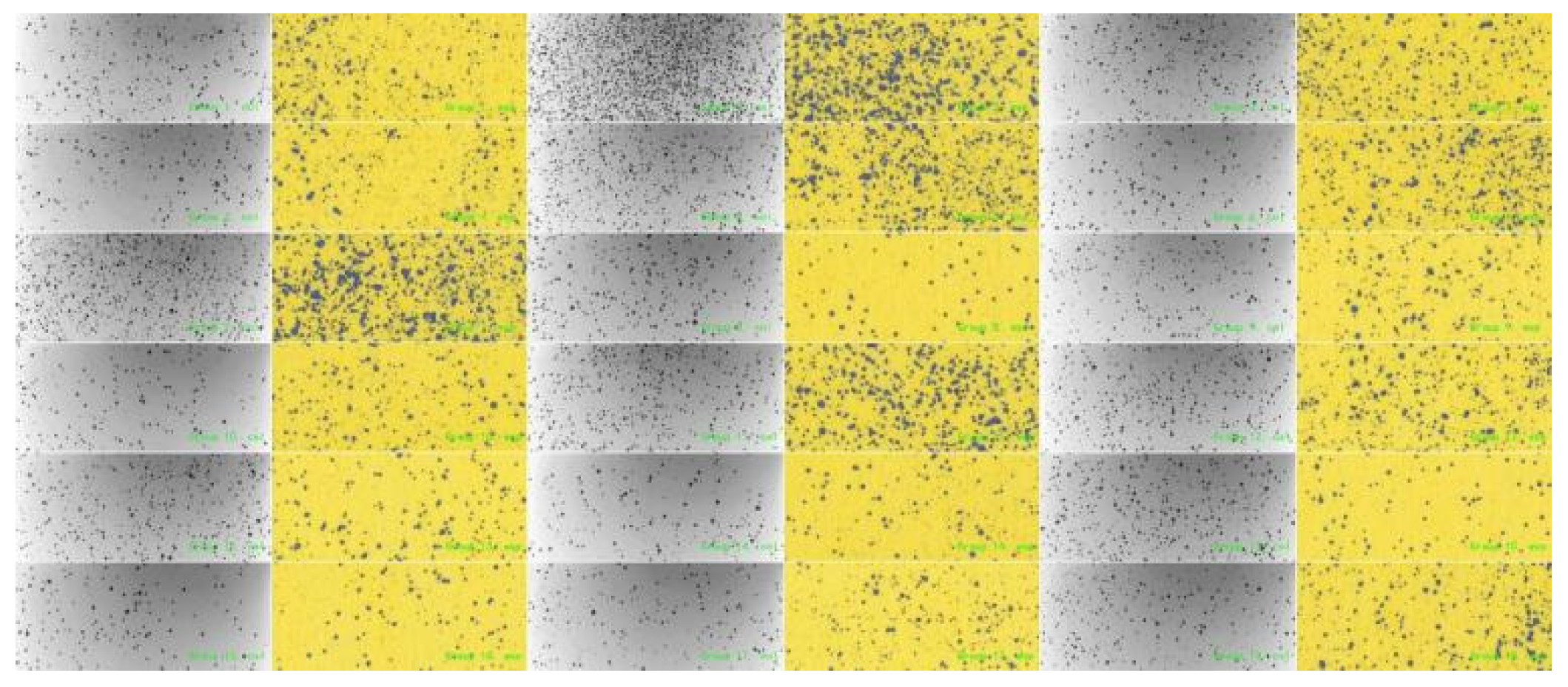
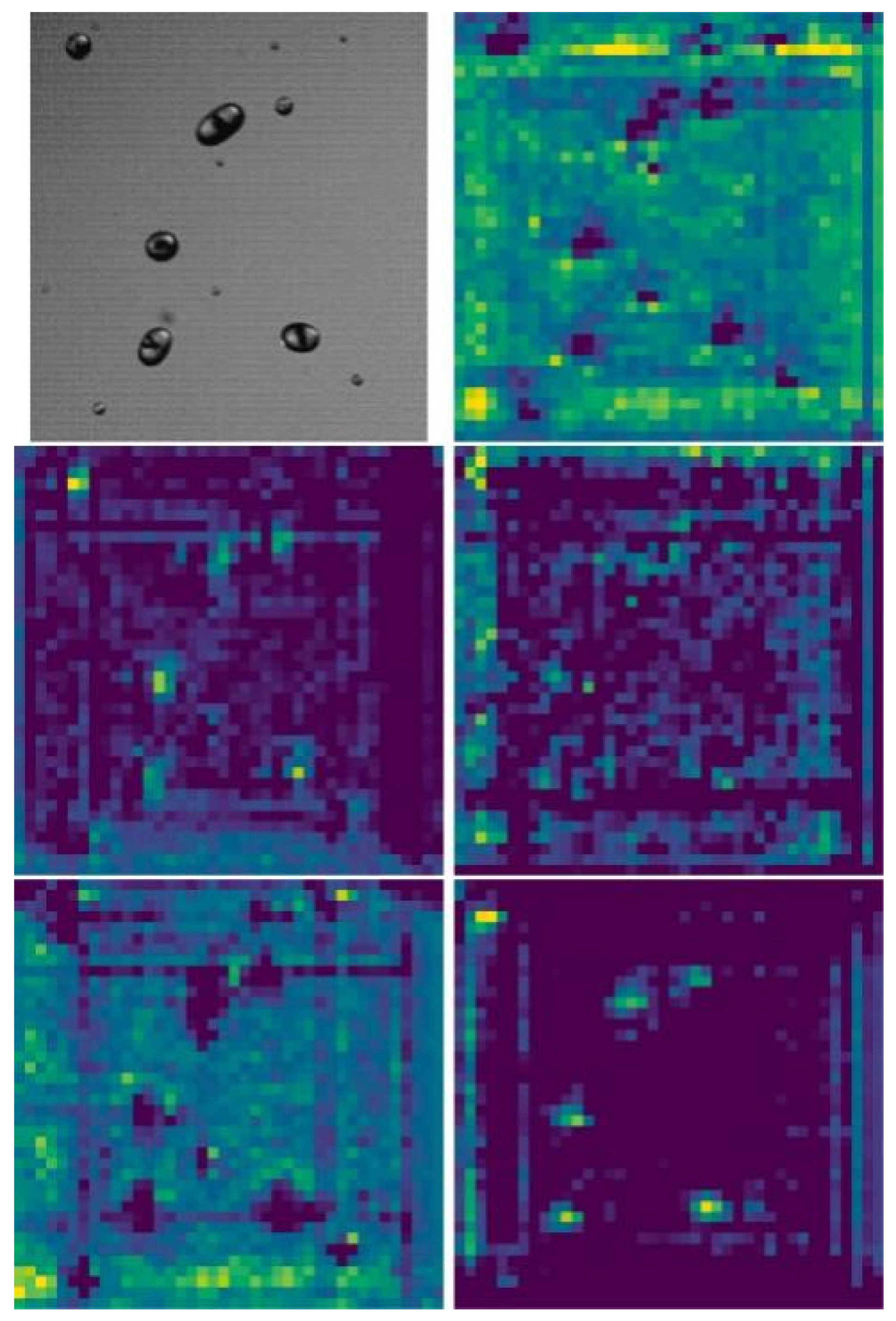
To address this challenge, Yang et al. (2022) developed a dedicated convolutional neural network to directly identify concave points along overlapping droplet contours [124]. With a threshold set at 0.6, the concave point detection accuracy reached 95%. Combined with a geometric matching algorithm, this approach enabled precise pixel-level separation of overlapping droplets. Building on these high-accuracy segmentation and feature reconstruction techniques, the quantification of macroscopic spray evaluation metrics has been substantially improved. Experimental results indicate that, compared with established tools such as DepositScan, the proposed method achieved an average relative error of 3.81% for droplet coverage and 3.17% for deposition density [126]. In addition, validation against a laser particle sizer (LPS) showed that the error in volume median diameter (VMD) estimation was limited to 5.48%. These approaches, which integrate advanced deep learning models with geometric feature matching, not only extend the accuracy limits of traditional analysis software but also provide reliable data support for targeted optimization of spray application parameters in precision agriculture. An example of feature maps obtained from the feature extraction module is shown in Figure 10.
Deep learning techniques, through the adoption of advanced network architectures and the integration of geometry-based feature matching strategies, have effectively addressed two key challenges in droplet deposition analysis, accurate high-dimensional feature extraction under complex field conditions and the separation of overlapping droplets [127,128,129,130]. This technological progression has substantially improved the quantification accuracy of key spray parameters, including coverage, deposition density, and droplet size, while extending beyond the performance limits of conventional image processing approaches [131,132,133]. As a result, these methods provide a robust and reliable foundation for data-driven decision-making and targeted optimization of spray applications in modern precision agriculture [134].

4.2. Deep Learning-Based Deposition Distribution Detection and Image Segmentation

For closed-loop control in precision spraying, automated quantification of droplet deposition distribution requires not only basic feature extraction but also high-accuracy image segmentation, particularly under conditions of high coverage where droplet overlap and background complexity are prominent [135]. The introduction of deep learning has provided systematic solutions to these challenges. A segmentation and recognition framework based on Deeplab V3+ has been developed to address droplet adhesion in UAV spraying scenarios. The method achieved strong performance in the initial segmentation stage, with a precision of 0.970, a recall of 0.938, and a mean average precision (mAP) of 0.953.
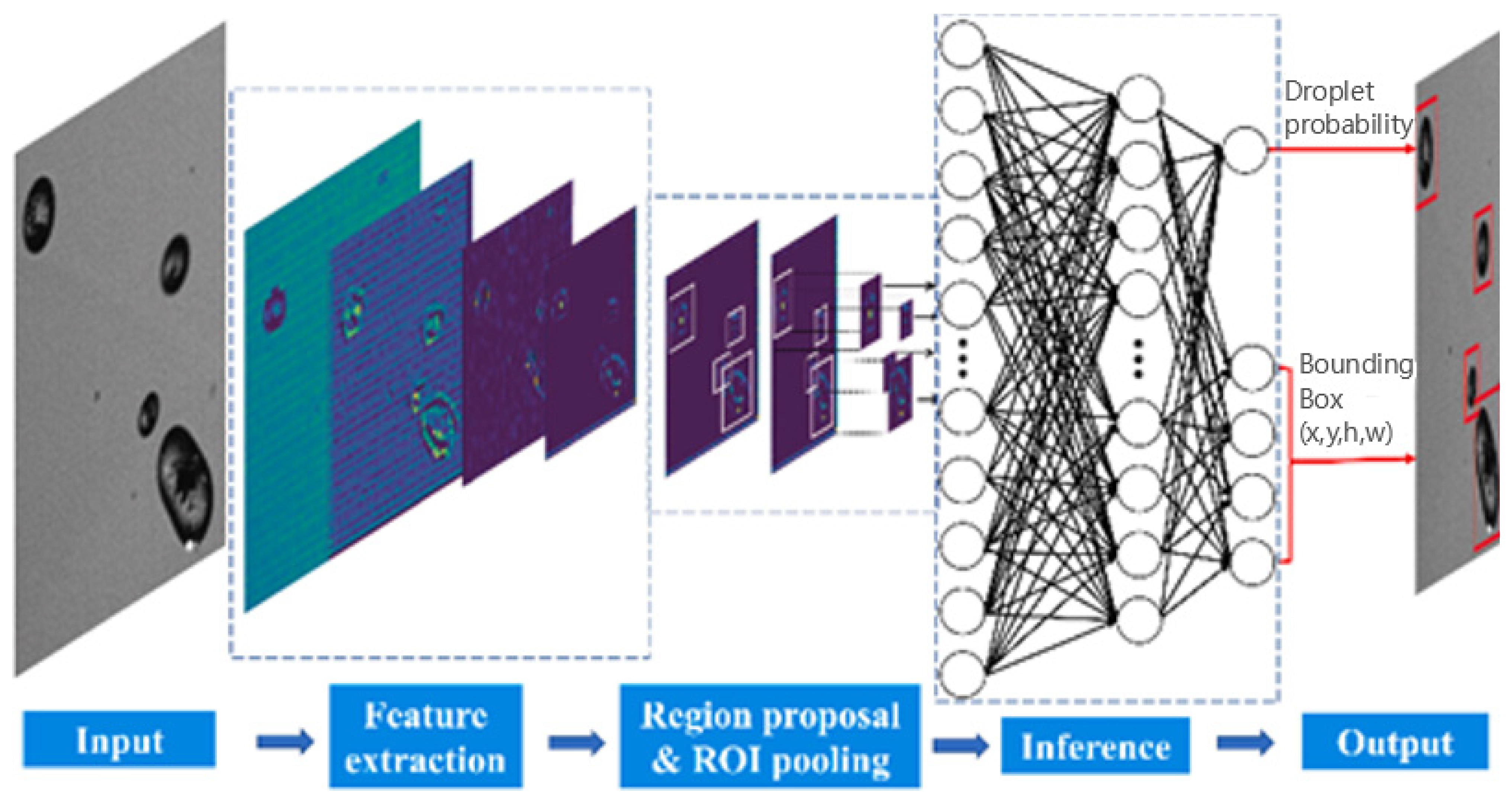
To further refine the separation of overlapping droplets, a convolutional neural network was employed to identify concave points along merged contours, followed by a concave-point matching algorithm for pixel-level separation. This approach reduced the error in droplet coverage estimation to 3.81% and deposition density to 3.17%, while the error in volume median diameter (VMD) was limited to 5.48%. In parallel, the integration of object detection and semantic segmentation has expanded the capability for dynamic deposition monitoring. Acharya et al. (2022) applied a Faster R-CNN framework with a ResNet-50 backbone to achieve automated droplet detection and motion tracking [123]. The model reached a mean average precision (mAP) of 0.908 at an intersection over union (IoU) threshold of 0.5, enabling real-time extraction of geometric features such as droplet centroid, perimeter, area, and eccentricity. This provides high temporal resolution data for analyzing the spatial distribution patterns of spray deposition. The overall deep learning workflow is illustrated in Figure 11.
In terms of robustness under complex field conditions, deep learning architectures have demonstrated clear advantages. Agricultural environments are often characterized by substantial interference from crop residues and heterogeneous surface textures; however, models based on encoder–decoder structures exhibit strong resistance to such noise. The robustness of the U-Net architecture in complex backgrounds was confirmed through the evaluation of target recognition performance under different tillage systems, including no-till and conventional practices. The model achieved an F1 score of approximately 0.95, while the coefficient of determination (R2) for the final quantitative results ranged from 0.92 to 0.95. This capability for background suppression and detail recovery enables deep learning-based segmentation methods to effectively reduce false positives caused by specular reflections and leaf vein patterns when analyzing non-uniform droplet distributions on crop surfaces [136]. Overall, deep learning frameworks that combine advanced separation strategies for overlapping droplets (e.g., concave point matching) with robust backbone networks (such as U-Net and Faster R-CNN) have emerged as a dominant approach for droplet deposition distribution analysis in precision spraying applications [137,138].
Deep learning-driven image analysis techniques, through the integration of advanced architectures such as multi-scale semantic segmentation (Deeplab V3+), dynamic object detection (Faster R-CNN), and robust feature reconstruction (U-Net), have effectively addressed longstanding challenges in droplet deposition analysis, including severe droplet overlap under high-density conditions and interference from complex field environments. This framework enables accurate and automated quantification of multi-dimensional geometric features and key deposition parameters, such as coverage, deposition density, and volume median diameter (VMD). It further provides a robust data foundation for closed-loop control, parameter optimization, and intelligent decision-making in modern precision spraying systems.

4.3. Deposition Prediction Based on Multimodal Fusion and Spatiotemporal Modeling

With the increasing demand for precision in pesticide application, conventional static image analysis is no longer sufficient to fully capture the dynamic behavior of spray deposition. In recent years, the integration of spatiotemporal sequence modeling with multi-source features—such as deep semantic representations, geometric descriptors, and field environmental context—has emerged as a promising direction for advancing droplet deposition prediction [139]. From the perspective of spatiotemporal modeling, the process from droplet ejection at the nozzle to deposition within the crop canopy is highly dynamic and complex [140]. A spatiotemporal tracking framework employing a combination of ResNet-50 and Faster R-CNN has been introduced into agricultural spray analysis.
This approach not only achieved accurate droplet detection under complex backgrounds (mAP = 0.908 at IoU = 0.5), but also enabled dynamic tracking of individual droplets across sequential video frames. By capturing droplet velocity, trajectory, and time-evolving geometric features, such models extend traditional post hoc static analysis toward dynamic prediction of physical deposition processes, thereby improving real-time controllability and drift risk assessment during spraying operations. In terms of multimodal and cross-domain feature fusion, reliance on RGB imagery alone is often insufficient in heterogeneous field environments. Integrating visual semantic features with additional sources of prior knowledge has proven effective in enhancing model performance. The influence of incorporating diverse environmental backgrounds, including different tillage systems such as conventional tillage, no-till, and cover cropping, was investigated. Furthermore, a U-Net-based framework demonstrated strong generalization and robustness when combining high-resolution UAV imagery with heterogeneous field textures. In cross-condition evaluations, the model achieved F1 scores up to 0.95, while the coefficient of determination (R2) for object counting remained consistently between 0.92 and 0.95. This fusion of deep visual features with environmental context effectively mitigates prediction bias caused by surface reflectance and crop residue interference.
At a finer scale, Yang et al. (2022) proposed a feature fusion strategy that combines deep semantic features with physically informed morphological priors [124]. In this approach, Deeplab V3+ with an ASPP module was first used to generate high-dimensional semantic segmentation masks (precision = 0.970, mAP = 0.953). These outputs were then integrated with geometric priors based on concave points to guide the separation of overlapping droplets. A dedicated convolutional network was used to directly infer the contour structure of overlapping regions, achieving a concave point detection accuracy of 95%. This cross-modal framework effectively compensates for pixel-level ambiguities in highly congested regions and improves overall prediction accuracy. As a result, the relative error in droplet coverage was reduced to 3.81%, the error in deposition density to 3.17%, and the prediction error for volume median diameter (VMD) was constrained to 5.48%. Overall, the combination of spatiotemporal tracking and multimodal feature fusion—including deep visual semantics, geometric morphology, and environmental context—has significantly advanced the capability of droplet deposition quantification. These developments provide a strong theoretical and algorithmic foundation for next-generation intelligent plant protection systems with real-time responsiveness, targeted precision, and closed-loop control [141].
By integrating spatiotemporal tracking models with multi-source, cross-modal features—including deep semantic representations, physical morphology, and heterogeneous agricultural backgrounds—next-generation deep learning frameworks address key limitations of conventional static and single-feature detection approaches [142]. This paradigm shift enables a transition from post hoc static evaluation to dynamic physical prediction, substantially improving both quantification accuracy and robustness under conditions of severe droplet overlap and complex field environments [143]. It also provides an advanced algorithmic foundation for the development of high-precision, real-time, and targeted intelligent plant protection systems with closed-loop control capabilities [144].

4.4. Model Lightweighting and Edge Deployment

Although deep learning has demonstrated high accuracy in droplet feature extraction and segmentation tasks, the substantial computational cost of mainstream architectures remains a major barrier to real-time field deployment. The Faster R-CNN model employed by Acharya et al. (2022), for instance, relies on a two-stage framework with a region proposal network (RPN), resulting in a large number of parameters and limited inference speed [123]. Similarly, the pixel-level segmentation approach based on Deeplab V3+ (Yang et al., 2022) and the U-Net architecture used by Vong et al. [124,125]. (2021) for complex background scenarios both depend heavily on deep encoder–decoder structures and high-capacity backbone networks, such as those in the ResNet family [125]. The associated computational demands, including high floating-point operations (FLOPs) and memory consumption, make these models difficult to deploy efficiently on resource-constrained platforms, such as agricultural UAVs and ground-based autonomous systems, where both processing capability and power availability are limited.
To overcome computational constraints and enable real-time closed-loop control in precision spraying, model lightweighting has emerged as a key direction of development. Current research is gradually shifting from computationally intensive two-stage frameworks toward more efficient one-stage detection architectures, such as those represented by the YOLOv8 family. By optimizing network depth, incorporating cross-stage partial networks (CSPNet), and employing lightweight feature fusion modules, these approaches can significantly reduce inference latency while maintaining high detection accuracy. To address challenges associated with small, densely distributed droplets and occlusions in complex field environments, transformer-based real-time object detection frameworks have recently been introduced into droplet analysis. Real-time detection transformer (RT-DETR) eliminates the need for non-maximum suppression (NMS), thereby reducing post-processing overhead, and leverages an efficient hybrid encoder to capture multi-scale contextual information [145]. This provides a balanced solution in terms of speed and accuracy for the real-time detection of densely overlapping droplets, offering a promising pathway for lightweight deployment in practical applications.
Following model compression and lightweight optimization, the shift in computation to the edge and its deployment on embedded platforms constitutes the final step toward real-time field monitoring [146]. Conventional workflows based on “data acquisition followed by offline analysis” or cloud–terminal transmission are constrained by limited bandwidth in rural environments and are unable to meet the millisecond-level response requirements of spray control [147]. To address these limitations, lightweight models such as optimized YOLOv8 or RT-DETR can be quantized and pruned, and subsequently deployed on compact embedded computing platforms (e.g., Raspberry Pi 4B or the more compact Raspberry Pi Zero 2W) [148,149]. In autonomous orchard operations, including targeted spraying and obstacle-aware weeding robots, such low-power edge devices can be directly integrated with optical imaging systems to perform on-device inference of droplet images in real time. The resulting deposition metrics, such as coverage and deviation signals, can then be transmitted via industrial communication protocols (e.g., CANopen) to control units, such as PID controllers or servo motors, enabling immediate actuation adjustments [150]. This edge deployment paradigm, combining low-latency on-device inference with real-time electromechanical control, provides a complete pathway for translating deep learning methods from laboratory-based analysis to practical, dynamic field applications.
Deep learning-based methods for spray deposition detection have substantially improved target recognition and segmentation performance in complex scenarios through automated feature learning. Existing studies indicate that these approaches outperform conventional image processing techniques, particularly in handling challenges such as severe droplet overlap and background interference. However, model performance remains highly dependent on the distribution and annotation quality of the training data, and limitations in cross-scenario generalization persist. In addition, deep learning methods primarily focus on extracting geometric features at the image level, while the estimation of physical quantities, such as deposition amount, often relies on empirical relationships or additional assumptions. Consequently, these methods are well suited for high-precision image analysis and feature extraction, but their application in direct quantitative estimation of physical parameters and stable engineering deployment typically requires integration with sensor data and physics-based models, as shown in Table 7 Comparison of Deep Learning Methods for Droplet Deposition Analysis.

5. Challenges and Future Perspectives

Although significant progress has been made in spray deposition detection technologies in recent years, existing studies have largely focused on improving the performance of individual methods. From the perspective of practical application, several fundamental issues remain insufficiently addressed. These limitations cannot be attributed solely to instrumentation accuracy or algorithmic capability; rather, they arise from the inherent complexity of the spray deposition process and the mismatch between what can be measured and how it is represented. Based on the current body of research, several representative gaps can be identified.

5.1. Limited Observability of Real-Time Deposition Quantification

Within existing technical frameworks, deposition is rarely measured as a directly observable physical quantity. Whether based on capacitance variation, optical imaging, or tracer analysis, current approaches fundamentally rely on the interpretation and inversion of indirect signals. Under controlled conditions, such methods can often achieve satisfactory correlations through calibration. However, in dynamic field environments, the coupling between spray characteristics and environmental factors makes these empirical relationships difficult to maintain. As a result, even when high accuracy is reported under laboratory conditions, the reliability of these methods in practical applications remains uncertain. From this perspective, current approaches are better characterized as high-precision estimations rather than true direct measurements. Achieving a stable representation of deposition with reduced dependence on empirical models remains an open challenge.

5.2. Measurement Uncertainty Induced by Droplet Size Distribution

Droplet size distribution not only governs spray deposition behavior but also directly influences the response characteristics of various sensing methods. In practical operations, however, droplet size distribution is inherently variable, affected by nozzle parameters, operating conditions, and environmental disturbances. Existing studies suggest that when the size distribution remains relatively stable, a consistent relationship can be established between sensor signals and deposition. Once the distribution changes, however, this relationship tends to deteriorate. As a consequence, measurement errors cannot be attributed to a single source but are intrinsically coupled with the spray state itself. Current approaches to this issue largely rely on recalibration or empirical correction, and a generally applicable solution has yet to be established.

5.3. Lack of a Unified Calibration Basis Across Application Scenarios

A review of the literature shows that most methods are validated under specific experimental conditions, such as fixed nozzle types, particular crop systems, or controlled indoor environments. While this approach is necessary during method development, it inevitably constrains the generalizability of the results. In practical agricultural settings, substantial variability exists in canopy structure, meteorological conditions, and equipment configurations. As a result, findings from different studies are often difficult to compare on a consistent basis. Even when identical metrics—such as coverage or deposition—are used, their physical interpretation may shift across conditions. Thus, the issue extends beyond whether accuracy is sufficient; it concerns whether results are comparable across scenarios. This aspect remains insufficiently addressed in current research.

5.4. Limited Data Foundations

In recent years, deep learning approaches have demonstrated clear advantages in droplet detection and segmentation; however, their development remains constrained by data availability and quality. Most existing studies rely on self-collected datasets, which are typically limited in scale and scenario diversity, and often differ in annotation protocols. This leads to two immediate consequences: first, rigorous comparison across studies becomes difficult; second, model stability under cross-scenario deployment is often insufficient. In complex field environments, background interference and distribution shifts frequently fall outside the range covered by training data, thereby affecting model performance. In the longer term, the absence of standardized data resources is likely to become a key factor limiting further progress in this area.

5.5. Latency and Error Accumulation in Closed-Loop Applications

A central objective of precision spraying is to enable dynamic control based on real-time information. In practice, however, the full pipeline from sensing to actuation involves multiple stages, including data acquisition, signal processing, model inference, and control execution.
While these components can often be optimized independently under experimental conditions, their interactions in integrated systems introduce both temporal delays and error accumulation. Under rapidly changing spray conditions, such delays may lead to lagged control responses, while errors can propagate and amplify through the feedback loop. Current studies have largely focused on improving the performance of individual modules, with comparatively limited attention given to system-level issues related to timeliness and stability.
To enable the practical implementation and field validation of multimodal sensor fusion and edge computing, several critical challenges must be systematically addressed.
At the hardware level, computational constraints and physical stability pose significant barriers to edge deployment. While lightweight architectures such as YOLOv8 and RT-DETR have been introduced to reduce inference latency on resource-constrained platforms (e.g., agricultural UAVs and ground-based autonomous systems), balancing detection accuracy for densely overlapping droplets with strict power limits remains a primary hurdle. Furthermore, deploying compact edge devices in harsh agricultural environments introduces formidable stability issues; field operations expose these systems to continuous mechanical vibrations, unstable power supplies, and severe thermal management challenges such as thermal throttling.
Beyond physical deployment, a fundamental limitation within the current body of literature is the pronounced gap in standardized validation protocols among the cited studies. Because most existing methodologies are evaluated under highly specific, non-standardized laboratory conditions or proprietary, small-scale field datasets with varying annotation formats, conducting rigorous cross-scenario comparisons remains exceptionally difficult. Consequently, the comparison metrics reported across different studies are rarely universal; they frequently employ different scales and are often obtained under completely non-equivalent experimental conditions (e.g., varying canopy structures, spray parameters, and environmental disturbances). This lack of a unified calibration basis and open-source benchmark datasets heavily restricts the interoperability and cross-domain generalization of reported tech-solutions. To address this critical gap, future research must prioritize the establishment of standardized experimental protocols. It is highly advisable for the research community to develop universal testing frameworks that define clear baseline parameters. Such standardized protocols should mandate the use of reference nozzle types, standardized spraying pressures, fixed application heights, and strictly reported environmental conditions (e.g., ambient temperature, humidity, and wind speed) during technology evaluation. Implementing these standardized benchmarks will not only facilitate rigorous cross-study comparisons but also provide a reliable foundation for accelerating the translation of emerging detection technologies into field-ready applications.
Compounding these methodological gaps is the inherent difficulty of data integration. Achieving robust multimodal fusion requires precise spatiotemporal alignment in highly heterogeneous field environments. The complex coupling between spray characteristics and dynamic environmental disturbances makes it difficult to maintain stable empirical models and establish a unified calibration basis across different agricultural scenarios.
Ultimately, the practical applicability of these integrated technologies is severely limited by total system latency and error accumulation within closed-loop control systems. While current literature predominantly highlights algorithmic inference speed, true end-to-end system latency extends far beyond the neural network’s processing time. The full pipeline—spanning optical image acquisition, data transmission, on-device inference, communication protocols (e.g., CANopen), and electromechanical actuation—inherently introduces cumulative temporal delays. Under rapidly changing field conditions requiring millisecond-level responsiveness, these largely unquantified processing delays can result in lagged control responses, causing measurement errors to propagate and amplify throughout the feedback loop, thereby undermining the overall stability and precision of intelligent plant protection systems.

5.6. Summary and Conclusions

In reviewing the current landscape of droplet deposition detection, this paper set out to address a critical gap and a central question: identifying the fundamental bottlenecks preventing the transition from offline evaluation to real-time, in-field closed-loop control. Based on the comprehensive evidence presented, this review yields a definitive conclusion: no single standalone technology—whether traditional water-sensitive paper, tracer analysis, capacitive sensing, or single-modal optical imaging—can adequately resolve the inherent trade-offs among quantification accuracy, real-time responsiveness, and environmental robustness in complex agricultural settings.
The existing information gap cannot be bridged by isolated, method-level improvements. Instead, transitioning to deployable intelligent plant protection strictly requires a paradigm shift toward multi-modal sensor fusion, effectively integrating physics-based modeling with data-driven semantic features. Furthermore, achieving true closed-loop precision spraying depends fundamentally on solving engineering deployment constraints at the edge. The field must move beyond merely optimizing algorithmic accuracy to systematically minimizing total end-to-end system latency and ensuring the physical stability of lightweight deep learning models (e.g., YOLOv8, RT-DETR) on resource-limited hardware. By clearly mapping these exact bottlenecks and definitive pathways, this review moves beyond a mere comparative tally of pros and cons, providing a cohesive theoretical framework and a targeted roadmap for future researchers to engineer highly reliable, variable-rate spraying systems.

Author Contributions

R.Y.: Formal Analysis, Investigation, Writing—Original Draft. J.W.: Formal Analysis, Investigation, Validation. Z.K.: Methodology, Investigation. M.O.: Conceptualization, Methodology, Supervision, Project Administration. All authors have read and agreed to the published version of the manuscript.

Funding

This research was funded by Frontier Technologies R&D Program of Jiangsu (BF2025313).

Institutional Review Board Statement

Not applicable.

Informed Consent Statement

Not applicable.

Data Availability Statement

No new data were created or analyzed in this study. Data sharing is not applicable to this article.

Acknowledgments

The author thanks the School of Agricultural Engineering of Jiangsu University for its facilities and support. During the preparation of this work the authors used Chatgpt 5.5 AI in order to translation. The content was reviewed and edited by the authors, who take full responsibility for the publication.

Conflicts of Interest

The authors declare no conflict of interest.

References

  1. Zhou, Q.; Xue, X.; Chen, C.; Cai, C.; Jiao, Y. Canopy deposition characteristics of different orchard pesticide dose models. Int. J. Agric. Biol. Eng. 2023, 16, 1–6. [Google Scholar] [CrossRef]
  2. Lykogianni, M.; Bempelou, E.; Karamaouna, F.; Aliferis, K.A. Do pesticides promote or hinder sustainability in agriculture The challenge of sustainable use of pesticides in modern agriculture. Sci. Total Environ. 2021, 795, 148625. [Google Scholar] [CrossRef]
  3. Dilaver, H.; Dilaver, K.F. The Role of Pesticide Technology in Agriculture 4.0: The Smart Farming Approach. Kafkas Üniv. Fen Bilim. Enst. Derg. 2024, 17, 15–29. [Google Scholar] [CrossRef]
  4. Qin, W.C.; Qiu, B.J.; Xue, X.Y.; Chen, C.; Xu, Z.F.; Zhou, Q.Q. Droplet deposition and control effect of insecticides sprayed with an unmanned aerial vehicle against plant hoppers. Crop Prot. 2016, 85, 79–88. [Google Scholar] [CrossRef]
  5. Gu, C.; Wang, X.; Wang, X.; Yang, F.; Zhai, C. Research progress on variable-rate spraying technology in orchards. Appl. Eng. Agric. 2020, 36, 927–942. [Google Scholar] [CrossRef]
  6. Dong, X.; Dong, L.; Gao, Z.; Wang, K.; Wang, X.; Wang, S.; Qiu, B.; Wang, X. Droplet Deposition Behavior on the Surface of Flexible Pepper Leaves. Agronomy 2025, 15, 708. [Google Scholar] [CrossRef]
  7. Appah, S.; Wang, P.; Ou, M.; Gong, C.; Jia, W. Review of electrostatic system parameters, charged droplets characteristics and substrate impact behavior from pesticides spraying. Int. J. Agric. Biol. Eng. 2019, 12, 1–9. [Google Scholar] [CrossRef]
  8. Guo, J.; Liu, Z.; Zhao, X.; Yuan, Y.; Wang, S. Electrostatic spray and non-electrostatic spray on droplet deposition quality on tomato leaf surface. Ciência Rural 2025, 55, e20240124. [Google Scholar] [CrossRef]
  9. Xi, T.; Li, C.; Qiu, W.; Wang, H.; Lv, X.; Han, C.; Ahmad, F. Droplet deposition behavior on a pear leaf surface under wind-induced vibration. Appl. Eng. Agric. 2020, 36, 913–926. [Google Scholar] [CrossRef]
  10. Liao, J.; Luo, X.; Wang, P.; Zhou, Z.; O’Donnell, C.C.; Zang, Y.; Hewitt, A.J. Analysis of the influence of different parameters on droplet characteristics and droplet size classification categories for air induction nozzle. Agronomy 2020, 10, 256. [Google Scholar] [CrossRef]
  11. Dai, S.; Wang, M.; Ou, M.; Zhou, H.; Jia, W.; Gao, R.; Wang, C.; Wang, G.; Li, Z.; Chen, H. Development and experiment of an online measuring system for spray deposition. Agriculture 2022, 12, 1195. [Google Scholar] [CrossRef]
  12. Shen, Y.; Zhu, H.; Liu, H.; Chen, Y.; Ozkan, E. Development of a laser-guided, embedded-computer-controlled, air-assisted precision sprayer. Trans. ASABE 2017, 60, 1827–1838. [Google Scholar] [CrossRef]
  13. Jiao, Y.; Zhou, Q.; Sun, T.; Cai, C.; Cui, L.; Sun, Z.; Jin, Y.; Kong, W.; Ding, S.; Xue, X. Experimental study on anti-drift shield curtain device for soybean (Glycine max)-maize (Zeal mays) strip intercropping weed sprayers. PLoS ONE 2025, 20, e0318683. [Google Scholar] [CrossRef]
  14. Pan, X.; Yang, S.; Gao, Y.; Wang, Z.; Zhai, C.; Qiu, W. Evaluation of spray drift from an electric boom sprayer: Impact of boom height and nozzle type. Agronomy 2025, 15, 160. [Google Scholar] [CrossRef]
  15. Cerruto, E.; Manetto, G.; Longo, D.; Failla, S.; Papa, R. A model to estimate the spray deposit by simulated water sensitive papers. Crop Prot. 2019, 124, 104861. [Google Scholar] [CrossRef]
  16. Wang, P.Y.; Li, H.H.; Hassan, M.M.; Guo, Z.M.; Zhang, Z.Z.; Chen, Q. Fabricating an acetylcholinesterase modulated UCNPs-Cu2+ fluorescence biosensor for ultrasensitive detection of organophosphorus pesticides-diazinon in food. J. Agric. Food Chem. 2019, 67, 4071–4079. [Google Scholar] [CrossRef]
  17. Bi, X.; Li, L.; Luo, L.; Liu, X.; Li, J.; You, T. A ratiometric fluorescence aptasensor based on photoinduced electron transfer from CdTe QDs to WS2 NTs for the sensitive detection of zearalenone in cereal crops. Food Chem. 2022, 385, 132657. [Google Scholar] [CrossRef]
  18. Ou, M.; Wang, M.; Zhang, J.; Gu, Y.; Jia, W.; Dai, S. Analysis and experiment research on droplet coverage and deposition measurement with capacitive sensor. Comput. Electron. Agric. 2024, 218, 108743. [Google Scholar] [CrossRef]
  19. Zhang, L.; Chen, M.; Duan, H.; Bu, Q.; Dong, X. Recent advances of optical sensors for point-of-care detection of phthalic acid esters. Front. Sustain. Food Syst. 2024, 8, 1474831. [Google Scholar] [CrossRef]
  20. Xu, Y.; Zhang, W.; Shi, J.; Li, Z.; Huang, X.; Zou, X.; Tan, W.; Zhang, X.; Hu, X.; Wang, X.; et al. Impedimetric aptasensor based on highly porous gold for sensitive detection of acetamiprid in fruits and vegetables. Food Chem. 2020, 322, 126762. [Google Scholar] [CrossRef] [PubMed]
  21. Gong, C.; Jia, F.; Kang, C. Deposition of water and emulsion hollow droplets on hydrophilic and hydrophobic surfaces. Agriculture 2024, 14, 960. [Google Scholar] [CrossRef]
  22. Yan, M.; Jia, F.; Gong, C.; Kang, C. The Effect of Pesticide Solutions on the Deposition of Bubble-Containing Droplets. Agronomy 2025, 15, 1172. [Google Scholar] [CrossRef]
  23. Tunio, M.H.; Gao, J.; Qureshi, W.A.; Sheikh, S.A.; Chen, J.; Chandio, F.A.; Lakhiar, I.A.; Solangi, K.A. Effects of droplet size and spray interval on root-to-shoot ratio, photosynthesis efficiency, and nutritional quality of aeroponically grown butterhead lettuce. Int. J. Agric. Biol. Eng. 2022, 15, 79–88. [Google Scholar] [CrossRef]
  24. Ahmad, F.; Zhang, S.; Qiu, B.; Ma, J.; Xin, H.; Qiu, W.; Ahmed, S.; Chandio, F.A.; Khaliq, A. Comparison of water sensitive paper and glass strip sampling approaches to access spray deposit by UAV sprayers. Agronomy 2022, 12, 1302. [Google Scholar] [CrossRef]
  25. Jun, S.; Xin, Z.; Hanping, M.; Xiaohong, W.; Xiaodong, Z.; Hongyan, G. Identification of pesticide residue level in lettuce based on hyperspectra and chlorophyll fluorescence spectra. Int. J. Agric. Biol. Eng. 2016, 9, 231–239. [Google Scholar] [CrossRef]
  26. Sharma, A.S.; Ali, S.; Sabarinathan, D.; Murugavelu, M.; Li, H.; Chen, Q. Recent progress on graphene quantum dots-based fluorescence sensors for food safety and quality assessment applications. Compr. Rev. Food Sci. Food Saf. 2021, 20, 5765–5801. [Google Scholar] [CrossRef]
  27. Cerruto, E.; Aglieco, C.; Failla, S.; Manetto, G. Parameters influencing deposit estimation when using water sensitive papers. J. Agric. Eng. 2013, 44, e9. [Google Scholar] [CrossRef]
  28. Failla, S.; Failla, S.; Longo, D.; Manetto, G. Simulation of water sensitive papers for spray analysis. Agric. Eng. Int. CIGR J. 2016, 18, 22–29. [Google Scholar]
  29. Cunha, J.P.A.R.; Farnese, A.C.; Olivet, J.J. Programas computacionais para análise de gotas pulverizadas em papéis hidrossensíveis. Planta Daninha 2013, 31, 715–720. [Google Scholar] [CrossRef]
  30. Fox, R.D.; Derksen, R.C.; Cooper, J.A.; Krause, C.R.; Ozkan, H.E. Visual and image system measurement of spray deposits using water–sensitive paper. Appl. Eng. Agric. 2003, 19, 549. [Google Scholar] [CrossRef]
  31. Özlüoymak, Ö.B.; Bolat, A. Development and assessment of a novel imaging software for optimizing the spray parameters on water-sensitive papers. Comput. Electron. Agric. 2020, 168, 105104. [Google Scholar] [CrossRef]
  32. Cunha, M.; Carvalho, C.; Marcal, A.R. Assessing the ability of image processing software to analyse spray quality on water-sensitive papers used as artificial targets. Biosyst. Eng. 2012, 111, 11–23. [Google Scholar] [CrossRef]
  33. Liu, J.; Liu, X.; Zhu, X.; Yuan, S. Droplet characterisation of a complete fluidic sprinkler with different nozzle dimensions. Biosyst. Eng. 2016, 148, 90–100. [Google Scholar] [CrossRef]
  34. Liao, J.; Hewitt, A.J.; Wang, P.; Luo, X.; Zang, Y.; Zhou, Z.; Lan, Y.; O’dOnnell, C. Development of droplet characteristics prediction models for air induction nozzles based on wind tunnel tests. Int. J. Agric. Biol. Eng. 2019, 12, 1–6. [Google Scholar] [CrossRef]
  35. De Moor, A.; Langenakens, J.; Vereecke, E.; Jaeken, P.; Lootens, P.; Vandecasteele, P. Image analysis of water sensitive paper as a tool for the evaluation of spray distribution of orchard sprayers. Asp. Appl. Biol. 2020, 57, 329–342. [Google Scholar]
  36. Degré, A.; Mostade, O.; Huyghebaert, B.; Tissot, S.; Debouche, C. Comparison by image processing of target supports of spray droplets. Trans. ASAE 2001, 44, 217. [Google Scholar] [CrossRef]
  37. Hoffmann, W.C.; Hewitt, A.J. Comparison of three imaging systems for water-sensitive papers. Appl. Eng. Agric. 2005, 21, 961–964. [Google Scholar] [CrossRef]
  38. Panneton, B. Image analysis of water–sensitive cards for spray coverage experiments. Appl. Eng. Agric. 2002, 18, 179. [Google Scholar] [CrossRef]
  39. Liu, Z.; Chen, J.; Guo, J.; Qiu, B. Numerical simulation and validation of droplet deposition on tomato leaf surface under air-assisted spraying. Agronomy 2024, 14, 1661. [Google Scholar] [CrossRef]
  40. Dai, S.; Zhang, J.; Jia, W.; Ou, M.; Zhou, H.; Dong, X.; Chen, H.; Wang, M.; Chen, Y.; Yang, S. Experimental study on the droplet size and charge-to-mass ratio of an air-assisted electrostatic nozzle. Agriculture 2022, 12, 889. [Google Scholar] [CrossRef]
  41. Wei, Z.; Li, R.; Xue, X.; Sun, Y.; Zhang, S.; Li, Q.; Chang, C.; Zhang, Z.; Sun, Y.; Dou, Q. Research status, methods and prospects of air-assisted spray technology. Agronomy 2023, 13, 1407. [Google Scholar] [CrossRef]
  42. Pascuzzi, S.; Cerruto, E.; Manetto, G. Foliar spray deposition in a “tendone” vineyard as affected by airflow rate, volume rate and vegetative development. Crop Prot. 2017, 91, 34–48. [Google Scholar] [CrossRef]
  43. Salyani, M.; Zhu, H.; Sweeb, R.; Pai, N. Assessment of spray distribution with water-sensitive paper. Agric. Eng. Int. CIGR J. 2013, 15, 101–111. [Google Scholar]
  44. Sánchez-Hermosilla, J.; Medina, R. Adaptive threshold for droplet spot analysis using water-sensitive paper. Appl. Eng. Agric. 2004, 20, 547–551. [Google Scholar] [CrossRef]
  45. Syngenta, T. Water-Sensitive Paper for Monitoring Spray Distributions; Syngenta Crop Protection AG: Basel, Switzerland, 2002; pp. 385–387. [Google Scholar]
  46. Gubiani, R.; Pergher, G.; Zucchiatti, N. Evaluation of Tracer dyes for spray deposit assessment in the vineyard. In Proceedings of the 2021 IEEE International Workshop on Metrology for Agriculture and Forestry (MetroAgriFor), Trento-Bolzano, Italy, 3–5 November 2021; pp. 460–465. [Google Scholar] [CrossRef]
  47. Guo, Y.; Ni, Y.; Kokot, S. Evaluation of chemical components and properties of the jujube fruit using near infrared spectroscopy and chemometrics. Spectrochim. Acta Part A Mol. Biomol. Spectrosc. 2016, 153, 79–86. [Google Scholar] [CrossRef]
  48. Palladini, L.A.; Raetano, C.G.; Velini, E.D. Choice of tracers for the evaluation of spray deposits. Sci. Agric. 2005, 62, 440–445. [Google Scholar] [CrossRef]
  49. Murray, R.A.; Cross, J.V.; Ridout, M.S. The measurement of multiple spray deposits by sequential application of metal chelate tracers. Ann. Appl. Biol. 2000, 137, 245–252. [Google Scholar] [CrossRef]
  50. Hewitt, A.J. Tracer and collector systems for field deposition research. Asp. Appl. Biol. 2010, 99, 283–289. [Google Scholar]
  51. Wen, Y.; Zhang, R.; Chen, L.; Huang, Y.; Yi, T.; Xu, G.; Li, L.; Hewitt, A.J. A new spray deposition pattern measurement system based on spectral analysis of a fluorescent tracer. Comput. Electron. Agric. 2019, 160, 14–22. [Google Scholar] [CrossRef]
  52. Gao, S.; Wang, G.; Zhou, Y.; Wang, M.; Yang, D.; Yuan, H.; Yan, X. Water-soluble food dye of Allura Red as a tracer to determine the spray deposition of pesticide on target crops. Pest Manag. Sci. 2019, 75, 2592–2597. [Google Scholar] [CrossRef] [PubMed]
  53. Menger, R.F.; Bontha, M.; Beveridge, J.R.; Borch, T.; Henry, C.S. Fluorescent dye paper-based method for assessment of pesticide coverage on leaves and trees: A citrus grove case study. J. Agric. Food Chem. 2020, 68, 14009–14014. [Google Scholar] [CrossRef]
  54. Sánchez-Hermosilla, J.; Medina, R.; Rodríguez, F.; Callejón, A. Use of food dyes as tracers to measure multiple spray deposits by ultraviolet-visible absorption spectrophotometry. Trans. ASABE 2008, 51, 1177–1186. [Google Scholar] [CrossRef]
  55. Pergher, G. Recovery rate of tracer dyes used for spray deposit assessment. Trans. ASAE 2001, 44, 787. [Google Scholar] [CrossRef]
  56. Shi, Q.; Mao, H.; Guan, X. Numerical simulation and experimental verification of the deposition concentration of an unmanned aerial vehicle. Appl. Eng. Agric. 2019, 35, 367–376. [Google Scholar] [CrossRef]
  57. Wang, J.; Lan, Y.; Zhang, H.; Zhang, Y.; Wen, S.; Yao, W.; Deng, J. Drift and deposition of pesticide applied by UAV on pineapple plants under different meteorological conditions. Int. J. Agric. Biol. Eng. 2018, 11, 5–12. [Google Scholar] [CrossRef]
  58. Wang, C.; He, X.; Wang, X.; Wang, Z.; Wang, S.; Li, L.; Bonds, J.; Herbst, A.; Mei, S. Distribution characteristics of pesticide application droplets deposition of unmanned aerial vehicle based on testing method of deposition quality balance. Trans. Chin. Soc. Agric. Eng. 2016, 32, 89–97. [Google Scholar]
  59. Schleier, J.J., III; Preftakes, C.; Peterson, R.K. The effect of fluorescent tracers on droplet spectrum, viscosity, and density of pesticide formulations. J. Environ. Sci. Health Part B 2010, 45, 621–625. [Google Scholar] [CrossRef]
  60. Fallico, B.; Chiappara, E.; Arena, E.; Ballistreri, G. Assessment of the exposure to Allura Red colour from the consumption of red juice-based and red soft drinks in Italy. Food Addit. Contam. Part A 2011, 28, 1501–1515. [Google Scholar] [CrossRef]
  61. Cai, S.S.; Stark, J.D. Evaluation of five fluorescent dyes and triethyl phosphate as atmospheric tracers of agricultural sprays. J. Environ. Sci. Health Part B 1997, 32, 969–983. [Google Scholar] [CrossRef]
  62. Rossouw, C.J.; Fourie, P.H.; Van Zyl, J.G.; Hoffman, J.E.; McLeod, A. Rainfastness of mancozeb on apple seedlings determined through deposition quantification of mancozeb residue and a fluorescent pigment. Crop Prot. 2018, 106, 93–102. [Google Scholar] [CrossRef]
  63. Qin, W.C.; Xue, X.Y.; Zhou, Q.Q.; Cai, C.; Wang, B.K.; Jin, Y.K. Use of RhB and BSF as fluorescent tracers for determining pesticide spray distribution. Anal. Methods 2018, 10, 4073–4078. [Google Scholar] [CrossRef]
  64. Aragon, A.; Blanco, L.E.; Funez, A.; Ruepert, C.; Liden, C.; Nise, G.; Wesseling, C. Assessment of dermal pesticide exposure with fluorescent tracer: A modification of a visual scoring system for developing countries. Ann. Occup. Hyg. 2006, 50, 75–83. [Google Scholar] [CrossRef]
  65. Gonzalez-de-Soto, M.; Emmi, L.; Perez-Ruiz, M.; Aguera, J.; Gonzalez-de-Santos, P. Autonomous systems for precise spraying—Evaluation of a robotised patch sprayer. Biosyst. Eng. 2016, 146, 165–182. [Google Scholar] [CrossRef]
  66. Lehotay, S.J.; Kok, A.D.; Hiemstra, M.; Bodegraven, P.V. Validation of a fast and easy method for the determination of residues from 229 pesticides in fruits and vegetables using gas and liquid chromatography and mass spectrometric detection. J. AOAC Int. 2005, 88, 595–614. [Google Scholar] [CrossRef]
  67. Hayden, J.; Ayers, G.; Grafius, E.; Hayden, N. Two water-soluble optically resolvable dyes for comparing pesticide spray distribution. J. Econ. Entomol. 1990, 83, 2411–2413. [Google Scholar] [CrossRef]
  68. Sharp, R.B. Spray deposit measurement by fluorescence. Pestic. Sci. 1974, 5, 197–209. [Google Scholar] [CrossRef]
  69. MacIntyre-Allen, J.K.; Tolman, J.H.; Scott-Dupree, C.D.; Harris, C.R. Confirmation by fluorescent tracer of coverage of onion leaves for control of onion thrips using selected nozles, surfactants and spray volumes. Crop Prot. 2007, 26, 1625–1633. [Google Scholar] [CrossRef]
  70. Jiang, M.; Chen, C.; He, J.; Zhang, H.; Xu, Z. Fluorescence assay for three organophosphorus pesticides in agricultural products based on Magnetic-Assisted fluorescence labeling aptamer probe. Food Chem. 2020, 307, 125534. [Google Scholar] [CrossRef]
  71. Taha, M.F.; Mao, H.; Zhang, Z.; Elmasry, G.; Awad, M.A.; Abdalla, A.; Mousa, S.; Elwakeel, A.E.; Elsherbiny, O. Emerging technologies for precision crop management towards agriculture 5.0: A comprehensive overview. Agriculture 2025, 15, 582. [Google Scholar] [CrossRef]
  72. Li, W.; Luo, Y.; Jiang, P.; Dong, X.; Tang, K.; Liang, Z.; Shi, Y. A sustainable crop protection through integrated technologies: UAV-based detection, real-time pesticide mixing, and adaptive spraying. Sci. Rep. 2025, 15, 35748. [Google Scholar] [CrossRef] [PubMed]
  73. Zhai, X.; Wang, X.; Zhang, J.; Yang, Z.; Sun, Y.; Li, Z.; Huang, X.; Holmes, M.; Gong, Y.; Povey, M.; et al. Extruded low density polyethylene-curcumin film: A hydrophobic ammonia sensor for intelligent food packaging. Food Packag. Shelf Life 2020, 26, 100595. [Google Scholar] [CrossRef]
  74. Wang, P.; Yu, W.; Ou, M.; Gong, C.; Jia, W. Monitoring of the pesticide droplet deposition with a novel capacitance sensor. Sensors 2019, 19, 537. [Google Scholar] [CrossRef]
  75. Lim, L.G.; Pao, W.K.; Hamid, N.H.; Tang, T.B. Design of helical capacitance sensor for holdup measurement in two-phase stratified flow: A sinusoidal function approach. Sensors 2016, 16, 1032. [Google Scholar] [CrossRef]
  76. Li, L.; Zhang, R.; Chen, L.; Yi, T.; Xu, G.; Xue, D.; Tang, Q.; Zhang, L.; Hewitt, A.J.; An, Y. Development of sensor system for real-time measurement of droplet deposition of agricultural sprayers. Int. J. Agric. Biol. Eng. 2021, 14, 19–26. [Google Scholar] [CrossRef]
  77. Palleja, T.; Tresanchez, M.; Llorens, J.; Saiz-Vela, A. Design and characterization of a real-time capacitive system to estimate pesticides spray deposition and drift. Comput. Electron. Agric. 2023, 207, 107720. [Google Scholar] [CrossRef]
  78. Guo, J.; Dong, X.; Qiu, B. Analysis of the factors affecting the deposition coverage of air-assisted electrostatic spray on tomato leaves. Agronomy 2024, 14, 1108. [Google Scholar] [CrossRef]
  79. Appah, S.; Jia, W.; Ou, M.; Wang, P.; Gong, C. Investigation of optimum applied voltage, liquid flow pressure, and spraying height for pesticide application by induction charging. Appl. Eng. Agric. 2019, 35, 795–804. [Google Scholar] [CrossRef]
  80. Yan, T.; Zhu, H.; Sun, L.; Wang, X.; Ling, P. Investigation of an experimental laser sensor-guided spray control system for greenhouse variable-rate applications. Trans. ASABE 2019, 62, 899–911. [Google Scholar] [CrossRef]
  81. Li, J.; Li, Z.; Ma, Y.; Cui, H.; Yang, Z.; Lu, H. Effects of leaf response velocity on spray deposition with an air-assisted orchard sprayer. Int. J. Agric. Biol. Eng. 2021, 14, 123–132. [Google Scholar] [CrossRef]
  82. Liu, H.; Zhu, H. Evaluation of a laser scanning sensor in detection of complex-shaped targets for variable-rate sprayer development. Trans. ASABE 2016, 59, 1181–1192. [Google Scholar] [CrossRef]
  83. Salyani, M.; Serdynski, J. Development of a sensor for spray deposition assessment. Trans. ASAE 1990, 33, 1464–1468. [Google Scholar] [CrossRef]
  84. Appah, S.; Jia, W.; Ou, M.; Wang, P.; Asante, E.A. Analysis of potential impaction and phytotoxicity of surfactant-plant surface interaction in pesticide application. Crop Prot. 2020, 127, 104961. [Google Scholar] [CrossRef]
  85. Foqué, D.; Dekeyser, D.; Langenakens, J.; Nuyttens, D. Evaluating the usability of a leaf wetness sensor as a spray tech monitoring tool. Int. Adv. Pestic. Appl. 2018, 137, 191–200. [Google Scholar]
  86. Kesterson, M.A.; Luck, J.D.; Sama, M.P. Development and preliminary evaluation of a spray deposition sensing system for improving pesticide application. Sensors 2015, 15, 31965–31972. [Google Scholar] [CrossRef] [PubMed]
  87. Longworth, L.; Post, S.; Jermy, M.; Hendrickson, H.; Steel, J.; Cannon, E.; Gleadow, J.; Brown, S. Evaluating capacitive wetness sensors for measuring deposition in electrostatically charged spraying operations. Comput. Electron. Agric. 2020, 179, 105829. [Google Scholar] [CrossRef]
  88. Mugele, R.A.; Evans, H.D. Droplet size distribution in sprays. Ind. Eng. Chem. 1951, 43, 1317–1324. [Google Scholar] [CrossRef]
  89. Sun, C.; Qiu, W.; Ding, W.; Gu, J. Design and experiment of a real-time droplet accumulating mass measurement system. Trans. ASABE 2017, 60, 615–624. [Google Scholar] [CrossRef]
  90. Zargar, Z.H.; Islam, T. A novel cross-capacitive sensor for noncontact microdroplet detection. IEEE Trans. Ind. Electron. 2018, 66, 4759–4766. [Google Scholar] [CrossRef]
  91. Nansen, C.; Ferguson, J.C.; Moore, J.; Groves, L.; Emery, R.; Garel, N.; Hewitt, A. Optimizing pesticide spray coverage using a novel web and smartphone tool, SnapCard. Agron. Sustain. Dev. 2015, 35, 1075–1085. [Google Scholar] [CrossRef]
  92. Li, H.; Cheng, S.; Zhang, Z.; Zhang, K.; Ali, T.S. Droplets image segmentation method based on machine learning and watershed. Converter 2021, 2021, 219–227. [Google Scholar]
  93. Liu, J.; Yu, S.; Liu, X.; Wang, Q.; Cui, H.; Zhu, Y.; Yuan, J. A novel optical shadow edge imaging method based fast in-situ measuring portable device for droplet deposition. Comput. Electron. Agric. 2024, 217, 108632. [Google Scholar] [CrossRef]
  94. Zhu, H.; Salyani, M.; Fox, R.D. A portable scanning system for evaluation of spray deposit distribution. Comput. Electron. Agric. 2011, 76, 38–43. [Google Scholar] [CrossRef]
  95. Ferguson, J.C.; Chechetto, R.G.; O’donnell, C.C.; Fritz, B.K.; Hoffmann, W.C.; Coleman, C.E.; Chauhan, B.S.; Adkins, S.W.; Kruger, G.R.; Hewitt, A.J. Assessing a novel smartphone application–SnapCard, compared to five imaging systems to quantify droplet deposition on artificial collectors. Comput. Electron. Agric. 2016, 128, 193–198. [Google Scholar] [CrossRef]
  96. Hassan, M.M.; Xu, Y.; Zareef, M.; Li, H.; Rong, Y.; Chen, Q. Recent advances of nanomaterial-based optical sensor for the detection of benzimidazole fungicides in food: A review. Crit. Rev. Food Sci. Nutr. 2023, 63, 2851–2872. [Google Scholar] [CrossRef]
  97. Carlton, J.B.; Bouse, L.F. Characterizing spray deposit on film by light transmission. Trans. ASAE 1981, 24, 277–0280. [Google Scholar] [CrossRef]
  98. Šidák, Z. Rectangular confidence regions for the means of multivariate normal distributions. J. Am. Stat. Assoc. 1967, 62, 626–633. [Google Scholar] [CrossRef]
  99. Adade, S.Y.-S.S.; Lin, H.; Nunekpeku, X.; Johnson, N.A.N.; Agyekum, A.A.; Zhao, S.; Teye, E.; Qianqian, S.; Kwadzokpui, B.A.; Ekumah, J.-N.; et al. Flexible paper-based AuNP sensor for rapid detection of diabenz (a, h) anthracene (DbA) and benzo (b) fluoranthene (BbF) in mussels coupled with deep learning algorithms. Food Control 2025, 168, 110966. [Google Scholar] [CrossRef]
  100. Liu, X.; Liu, X.; Cui, H.; Yuan, J. Research progress and trend analysis of crop canopy droplet deposition. Nongye Jixie Xuebao/Trans. Chin. Soc. Agric. Mach. 2021, 52, 1–20. [Google Scholar]
  101. Sun, Y.; Zhang, N.; Han, C.; Chen, Z.; Zhai, X.; Li, Z.; Zheng, K.; Zhu, J.; Wang, X.; Zou, X.; et al. Competitive immunosensor for sensitive and optical anti-interference detection of imidacloprid by surface-enhanced Raman scattering. Food Chem. 2021, 358, 129898. [Google Scholar] [CrossRef]
  102. Kashdan, J.T.; Shrimpton, J.S.; Whybrew, A. A digital image analysis technique for quantitative characterisation of high-speed sprays. Opt. Lasers Eng. 2007, 45, 106–115. [Google Scholar] [CrossRef]
  103. Linne, M. Imaging in the optically dense regions of a spray: A review of developing techniques. Prog. Energy Combust. Sci. 2013, 39, 403–440. [Google Scholar] [CrossRef]
  104. Legrand, M.; Nogueira, J.; Lecuona, A.; Hernando, A. Single camera volumetric shadowgraphy system for simultaneous droplet sizing and depth location, including empirical determination of the effective optical aperture. Exp. Therm. Fluid Sci. 2016, 76, 135–145. [Google Scholar] [CrossRef]
  105. Erinin, M.A.; Néel, B.; Mazzatenta, M.T.; Duncan, J.H.; Deike, L. Comparison between shadow imaging and in-line holography for measuring droplet size distributions. Exp. Fluids 2023, 64, 96. [Google Scholar] [CrossRef]
  106. Liu, J.; Yu, S.; Liu, X.; Lu, G.; Xin, Z.; Yuan, J. Super-resolution semantic segmentation of droplet deposition image for low-cost spraying measurement. Agriculture 2024, 14, 106. [Google Scholar] [CrossRef]
  107. Zhou, W.; Tropea, C.; Chen, B.; Zhang, Y.; Luo, X.; Cai, X. Spray drop measurements using depth from defocus. Meas. Sci. Technol. 2020, 31, 075901. [Google Scholar] [CrossRef]
  108. Woo, J.J.; Garaniya, V.; Abbassi, R. Improving droplet sizing methodology for spray dynamics investigation. Int. J. Spray Combust. Dyn. 2016, 8, 86–99. [Google Scholar] [CrossRef]
  109. Ade, S.S.; Kirar, P.K.; Chandrala, L.D.; Sahu, K.C. Droplet size distribution in a swirl airstream using in-line holography technique. J. Fluid Mech. 2023, 954, A39. [Google Scholar] [CrossRef]
  110. Privitera, S.; Cerruto, E.; Manetto, G.; Lupica, S.; Nuyttens, D.; Dekeyser, D.; Zwertvaegher, I.; Júnior, M.R.F.; Vargas, B.C. Comparison between liquid immersion, laser diffraction, PDPA, and shadowgraphy in assessing droplet size from agricultural nozzles. Agriculture 2024, 14, 1191. [Google Scholar] [CrossRef]
  111. Inthavong, K.; Yang, W.; Fung, M.C.; Tu, J.Y. External and near-nozzle spray characteristics of a continuous spray atomized from a nasal spray device. Aerosol Sci. Technol. 2012, 46, 165–177. [Google Scholar] [CrossRef]
  112. Fong, K.O.; Xue, X.; Osuna-Orozco, R.; Aliseda, A. Two-fluid coaxial atomization in a high-pressure environment. J. Fluid Mech. 2022, 946, A4. [Google Scholar] [CrossRef]
  113. Privitera, S.; Manetto, G.; Pascuzzi, S.; Pessina, D.; Cerruto, E. Drop size measurement techniques for agricultural sprays: A state-of-the-art review. Agronomy 2023, 13, 678. [Google Scholar] [CrossRef]
  114. Vulgarakis Minov, S.; Cointault, F.; Vangeyte, J.; Pieters, J.G.; Nuyttens, D. Spray droplet characterization from a single nozzle by high speed image analysis using an in-focus droplet criterion. Sensors 2016, 16, 218. [Google Scholar] [CrossRef] [PubMed]
  115. Nowak, J.L.; Mohammadi, M.; Malinowski, S.P. Applicability of the VisiSize D30 shadowgraph system for cloud microphysical measurements. Atmos. Meas. Tech. 2020, 14, 2615–2633. [Google Scholar] [CrossRef]
  116. Saylor, J.R.; Jones, B.K.; Bliven, L.F. A method for increasing depth of field during droplet imaging. Rev. Sci. Instrum. 2002, 73, 2422–2427. [Google Scholar] [CrossRef]
  117. Wang, Z.; He, F.; Zhang, H.; Hao, P.; Zhang, X.; Li, X. Three-dimensional measurement of the droplets out of focus in shadowgraphy systems via deep learning-based image-processing method. Phys. Fluids 2022, 34, 073301. [Google Scholar] [CrossRef]
  118. Chuang, P.Y.; Saw, E.W.; Small, J.D.; Shaw, R.A.; Sipperley, C.M.; Payne, G.A.; Bachalo, W.D. Airborne phase Doppler interferometry for cloud microphysical measurements. Aerosol Sci. Technol. 2008, 42, 685–703. [Google Scholar] [CrossRef]
  119. Zhang, X.; Zhang, H.; Bai, B. A new method for high-resolution particle measurement with a large field of view via dual-view shadowgraph imaging. Phys. Fluids 2023, 35, 083303. [Google Scholar] [CrossRef]
  120. Blaisot, J.B.; Yon, J. Droplet size and morphology characterization for dense sprays by image processing: Application to the Diesel spray. Exp. Fluids 2005, 39, 977–994. [Google Scholar] [CrossRef]
  121. LeCun, Y.; Bengio, Y.; Hinton, G. Deep learning. Nature 2015, 521, 436–444. [Google Scholar] [CrossRef] [PubMed]
  122. Kamilaris, A.; Prenafeta-Boldú, F.X. Deep learning in agriculture: A survey. Comput. Electron. Agric. 2018, 147, 70–90. [Google Scholar] [CrossRef]
  123. Acharya, P.; Burgers, T.; Nguyen, K.D. Ai-enabled droplet detection and tracking for agricultural spraying systems. Comput. Electron. Agric. 2022, 202, 107325. [Google Scholar] [CrossRef]
  124. Yang, W.; Li, X.; Li, M.; Hao, Z. Droplet deposition characteristics detection method based on deep learning. Comput. Electron. Agric. 2022, 198, 107038. [Google Scholar] [CrossRef]
  125. Vong, C.N.; Conway, L.S.; Zhou, J.; Kitchen, N.R.; Sudduth, K.A. Early corn stand count of different cropping systems using UAV-imagery and deep learning. Comput. Electron. Agric. 2021, 186, 106214. [Google Scholar] [CrossRef]
  126. Wang, L.; Yue, X.; Liu, Y.; Wang, J.; Wang, H. An intelligent vision based sensing approach for spraying droplets deposition detection. Sensors 2019, 19, 933. [Google Scholar] [CrossRef]
  127. Gelado, S.H.; Quilodrán-Casas, C.; Chagot, L. Enhancing Microdroplet Image Analysis with Deep Learning. Micromachines 2023, 14, 1964. [Google Scholar] [CrossRef] [PubMed]
  128. Simões, I.; Sousa, A.J.; Baltazar, A.; Santos, F. Spray quality assessment on water-sensitive paper comparing AI and classical computer vision methods. Agriculture 2025, 15, 261. [Google Scholar] [CrossRef]
  129. Wang, L.; Song, W.; Lan, Y.; Wang, H.; Yue, X.; Yin, X.; Luo, E.; Zhang, B.; Lu, Y.; Tang, Y. A smart droplet detection approach with vision sensing technique for agricultural aviation application. IEEE Sens. J. 2021, 21, 17508–17516. [Google Scholar] [CrossRef]
  130. Yan, W.; Li, L.; Song, J.; Hu, P.; Xu, G.; Wu, Q.; Zhang, R.; Chen, L. Deep Learning-Assisted Measurement of Liquid Sheet Structure in the Atomization of Hydraulic Nozzle Spraying. Agronomy 2025, 15, 409. [Google Scholar] [CrossRef]
  131. Bana, G.; Lamadie, F.; Charton, S.; Randriamanantena, T.; Lucor, D.; Sheibat-Othman, N. BYG-drop: A tool for enhanced droplet detection in liquid–liquid systems through machine learning and synthetic imaging. Front. Chem. Eng. 2024, 6, 1415453. [Google Scholar] [CrossRef]
  132. He, Y.; Wu, J.; Fu, H.; Sun, Z.; Fang, H.; Wang, W. Quantitative analysis of droplet size distribution in plant protection spray based on machine learning method. Water 2022, 14, 175. [Google Scholar] [CrossRef]
  133. Huynh, N.; Nguyen, K.D. Real-time droplet detection for agricultural spraying systems: A deep learning approach. Mach. Learn. Knowl. Extr. 2024, 6, 259–282. [Google Scholar] [CrossRef]
  134. Hu, H.; Kaizu, Y.; Huang, J.; Furuhashi, K.; Zhang, H.; Li, M.; Imou, K. Research on methods decreasing pesticide waste based on plant protection unmanned aerial vehicles: A review. Front. Plant Sci. 2022, 13, 811256. [Google Scholar] [CrossRef]
  135. Luo, W.; Li, Q.; Zhang, H.; Diao, Z.; Guo, Z.; Cai, Z.; Zhang, Y.; Li, J. Detection of early decay in dekopon fruit based on structured-illumination reflectance imaging combined with a comparison between traditional machine learning and deep learning models. Postharvest Biol. Technol. 2026, 233, 114044. [Google Scholar] [CrossRef]
  136. Wu, Y.; Chen, L.; Yang, N.; Sun, Z. Research progress of deep learning-based artificial intelligence technology in pest and disease detection and control. Agriculture 2025, 15, 2077. [Google Scholar] [CrossRef]
  137. Zhou, X.; Liu, Y.; Zhao, C.; Sun, J.; Shi, L.; Cong, S. Nondestructive detection of cadmium content in oilseed rape leaves under different silicon environments using deep transfer learning and Vis-NIR hyperspectral imaging. Food Chem. 2025, 479, 143799. [Google Scholar] [CrossRef]
  138. Zhao, J.; Fan, S.; Zhang, B.; Wang, A.; Zhang, L.; Zhu, Q. Research status and development trends of deep reinforcement learning in the intelligent transformation of agricultural machinery. Agriculture 2025, 15, 1223. [Google Scholar] [CrossRef]
  139. Yao, K.; Zhang, Y.; Sun, J.; Xu, Y.; Zhou, B.; Wang, K.; Zhang, B.; Du, X.; Li, Y. Nondestructive detection of heavy metal lead in eggs using hyperspectral imaging combined with deep learning-based feature extraction method. J. Food Compos. Anal. 2025, 146, 107994. [Google Scholar] [CrossRef]
  140. Wang, C.; He, X.; Wang, X.; Wang, Z.; Wang, S.; Li, L.; Bonds, J.; Herbst, A.; Wang, Z. Testing method and distribution characteristics of spatial pesticide spraying deposition quality balance for unmanned aerial vehicle. Int. J. Agric. Biol. Eng. 2018, 11, 18–26. [Google Scholar] [CrossRef]
  141. He, X.; Yang, F.; Qiu, B. Agricultural environment and intelligent plant protection equipment. Agronomy 2024, 14, 937. [Google Scholar] [CrossRef]
  142. Gao, X.; Gao, J.; Qureshi, W.A. Applications, trends, and challenges of precision weed control technologies based on deep learning and machine vision. Agronomy 2025, 15, 1954. [Google Scholar] [CrossRef]
  143. Zheng, K.; Yang, S.; Wang, Z.; Fu, H.; Wang, X.; Zou, W.; Zhai, C.; Chen, L. Real-Time Detection and Validation of a Target-Oriented Model for Spindle-Shaped Tree Trunks Leveraging Deep Learning. Agronomy 2026, 16, 210. [Google Scholar] [CrossRef]
  144. Feng, X.; Shi, T.; Wu, H.; Yang, M.; Luo, M.; Li, J.; Wang, C. Research Advances in Decision-Making Technologies for Precision Pesticide Application in Crops. Agronomy 2026, 16, 605. [Google Scholar] [CrossRef]
  145. Wang, J.; Gao, Z.; Zhang, Y.; Zhou, J.; Wu, J.; Li, P. Real-time detection and location of potted flowers based on a ZED camera and a YOLO V4-tiny deep learning algorithm. Horticulturae 2026, 8, 21. [Google Scholar] [CrossRef]
  146. Gong, R.; Zhang, H.; Li, G.; He, J. Edge computing-enabled smart agriculture: Technical architectures, practical evolution, and bottleneck breakthroughs. Sensors 2025, 25, 5302. [Google Scholar] [CrossRef]
  147. Yu, P.; Teng, F.; Zhu, W.; Shen, C.; Chen, Z.; Song, J. Cloud–edge–device collaborative computing in smart agriculture: Architectures, applications, and future perspectives. Front. Plant Sci. 2025, 16, 1668545. [Google Scholar] [CrossRef]
  148. Pagadala, A.; Poudel, S.; Rathi, J.U.; Sunoj, S.; Reid, J.F. Evaluation of YOLO-based weed detection models on commercial horseradish fields in Southern Illinois. Front. Agron. 2026, 8, 1777087. [Google Scholar] [CrossRef]
  149. Huang, Y.; Liu, Z.; Zhao, H.; Tang, C.; Liu, B.; Li, Z.; Wan, F.; Qian, W.; Qiao, X. YOLO-YSTs: An improved YOLOv10n-based method for real-time field pest detection. Agronomy 2025, 15, 575. [Google Scholar] [CrossRef]
  150. Yu, Y.; Xie, H.; Zhang, K.; Wang, Y.; Li, Y.; Zhou, J.; Xu, L. Design, development, integration, and field evaluation of a ridge-planting strawberry harvesting robot. Agriculture 2024, 14, 2126. [Google Scholar] [CrossRef]
Figure 1. Schematic of the spraying system on the conveyor belt used for evaluating water-sensitive paper (WSP). The general process involves placing WSP targets on the belt to simulate dynamic field application, capturing the droplets, and subsequently utilizing digital image processing to extract key deposition metrics such as coverage and droplet density [31].
Applsci 16 05848 g001
Figure 2. Images of scanned water-sensitive papers for three conveyor belt speeds and four spraying nozzles [31].
Applsci 16 05848 g002
Figure 3. Fluorescence scanner components of the SDPMS: (a) device structure; (b) hardware connection [51].
Applsci 16 05848 g003
Figure 4. Comparison of the deposition pattern results from the SDPMS and droplet deposition parameters of the WSP in test #1: (a) deposit coverage; (b) volume rate (which represents the absolute volumetric deposition per unit area, expressed in μL/cm2, derived from the conversion of WSP stain areas using a spreading model) [51].
Applsci 16 05848 g004
Figure 5. Images of the results of test #1: (a) WSP images scanned with a portable scanner; (b) fluorescence images of paper strips photographed with a CCD camera [51].
Applsci 16 05848 g005
Figure 6. The capacitive sensor; 1 is the electrode plate; 2 is the sensor surface; 3 is the converter; Red dot is the Fog droplet, [18].
Applsci 16 05848 g006
Figure 7. Composition of droplet in situ sampling device [93].
Applsci 16 05848 g007
Figure 8. Comparison of 18 sets acquisition images from the device and WSP [93].
Applsci 16 05848 g008
Figure 9. Comparison of droplet parameter obtained by this collector and WSP Note: To show the change trend, the sample groups are sorted according to the coverage rate measured by the device, Equation (15) is from Reference [93].
Applsci 16 05848 g009
Figure 10. Examples of feature maps obtained from the feature-extraction module [123].
Applsci 16 05848 g010
Figure 11. The deep-learning pipeline for droplet detection [123].
Applsci 16 05848 g011
Table 1. Performance Comparison of Spray Deposition Parameter Analysis Systems Based on Water-Sensitive Paper.
AuthorMethod TypeReal-Time CapabilityQuantitative AccuracySpatial ResolutionRobustnessRepresentative Performance
Emanuele CerrutoWSP + Image AnalysisOffline post-processingModerateModerateLowModerate correlation (R2 ≈ 0.7)
Ömer Barış Özlüy makVisual Analysis SystemOffline scanning and algorithm processingModerateHighModerateSimilarity of approximately 69.4–97.1%
Mario CunhaImage Processing SoftwareOffline digital scanningModerateHighModerateError typically <10%
Table 2. Performance Comparison of Spray Deposition Measurement Based on Tracer and Spectral/Chromatographic Analysis.
AuthorMethod TypeReal-Time CapabilityQuantitative AccuracySpatial ResolutionRobustnessRepresentative Performance
Yao WenSpectral ScanningDelayed responseModerateModerateModerateHigh correlation with WSP (R2 ≈ 0.89–0.93)
Saichao GaoTracer MethodOffline laboratory chemical extractionHighModerateModerateRecovery rate ≈ 96–107%; RSD < 5%; high linearity
R. F. MengerFluorescence + Image AnalysisNear-offlineModerateHighModerateEnables pixel-level detection; reduced false positives at low coverage
Table 3. Comparative Performance of Conventional Spray Deposition Detection Methods (Water-Sensitive Paper and Fluorescence Spectroscopy).
MethodReal-Time CapabilityCostMain Limitations
Water-Sensitive Paper MethodOffline (minute-level)LowOverlap effects; sensitive to humidity
Fluorescence SpectroscopyNear real-time (second-level)HighExpensive equipment; sensitive to ambient light interference
Table 4. Comparative Accuracy of Deposition Mass and Coverage Volume Quantification Based on Capacitive Sensing Technology.
AuthorMethod TypeReal-Time CapabilityQuantitative AccuracySpatial ResolutionRobustnessRepresentative Performance
Pei WangDeposition MassMillisecond-level dynamic responseModerateLowModerateRelatively strong linear correlation (R2 ≈ 0.83–0.88)
Longlong LiDeposition VolumeMillisecond-level dynamic responseModerateLowModerateR2 ≈ 0.90–0.97; error < 10% (under ideal conditions)
Tomas PallejaCoverageMillisecond-level dynamic responseModerateLowModerateR2 approaches 1 under ideal conditions
Mingxiong OuCoverage/Deposition AmountMillisecond-level dynamic responseModerateModerateModerateR2 ≈ 0.98; error ≈ 12%
Table 5. Performance Comparison of Portable Spray Deposition Measurement Systems Based on Optical Sensors and Image Analysis.
AuthorMethod TypeReal-Time CapabilityQuantitative CapabilitySpatial ResolutionRobustnessRepresentative Performance Metrics
Heping ZhuDepositScanDelayed responseModerateHighModerateCoverage R2 ≈ 0.99
Density R2 ≈ 0.94
J. Connor FergusonSnapCardSecond-level on-device smartphone inferenceModerateModerateLowCoverage underestimated by ~20%; variability in accuracy
Jian LiuODEISecond-level in situ edge processingModerateHighModerateCoverage error ≤ 5%
Table 6. Comparative Performance of Emerging Spray Deposition Detection Technologies (Capacitive Sensing and Optical Shadow Imaging).
MethodReal-Time CapabilityCostMain Limitations
Capacitive SensorMillisecond-levelModerateDeposition measurement affected by droplet size distribution
ODEISecondsLowCalibration range does not cover droplets < 100 μm
Table 7. Comparison of Deep Learning Methods for Droplet Deposition Analysis.
MethodApplication (Crop and Target)Performance (Precision and Reproducibility)
YOLOv8, RT-DETRCrop: Orchards
Target: Discrete droplets (>150 μm)
Precision: High bounding-box mAP
Reprod: High in stable lighting
U-NetCrop: Dense grass
Target: Overlapping stains (<150 μm)
Precision: High pixel accuracy (IoU)
Reprod: Exact morphological contours
Disclaimer/Publisher’s Note: The statements, opinions and data contained in all publications are solely those of the individual author(s) and contributor(s) and not of MDPI and/or the editor(s). MDPI and/or the editor(s) disclaim responsibility for any injury to people or property resulting from any ideas, methods, instructions or products referred to in the content.