Review

A Review of Bit–Rock Interaction Mechanics for Rotary Drilling and Its Application in Geotechnical Engineering

School of Architecture and Civil Engineering, Xi’an University of Science and Technology, Xi’an 710054, China
*
Author to whom correspondence should be addressed.
Appl. Sci. 2026, 16(12), 5744; https://doi.org/10.3390/app16125744
Submission received: 3 May 2026 / Revised: 29 May 2026 / Accepted: 5 June 2026 / Published: 7 June 2026

Abstract

Measurement while drilling (MWD) technology provides a novel methodology for the in situ determination of geomechanical properties by monitoring bit–rock interaction parameters during drilling, offering real-time lithological distribution identification without compromising efficiency. This paper reviews the application of MWD in geotechnical engineering, encompassing theoretical frameworks, technological evolution, engineering applications, challenges and new trends. The analysis reveals that most theoretical models of bit–rock interaction exhibit significant limitations in accurately predicting rock properties under field conditions. Advances in near-bit sensing and adaptive data processing are identified as critical drivers of methodological innovation. Key engineering applications—including formation identification, drilling optimization, and 3D geological visualization—are outlined, alongside actionable recommendations for development. Finally, five strategic research priorities are proposed for next-generation MWD systems: advancing bit–rock interaction theory, developing high-resolution near-bit sensors, enabling multi-source data fusion, supporting dynamic 3D model calibration, and facilitating continuous in situ stress measurement.

1. Introduction

Quantitative characterization of in situ geomechanical parameters serves as the scientific cornerstone for safe, efficient, and sustainable geological engineering practices, representing the fundamental mandate of geoscientists [1,2,3]. Drilling represents an indispensable component of geotechnical investigation, providing critical access for subsurface characterization through core sampling and enabling borehole-based geophysical measurements. The bit–rock interaction mechanics during rotary drilling, which resembles a torsional shear fragmentation process, are analogous to those governing the static cone penetration techniques in soil property characterization [4,5,6]. Geotechnical engineers therefore integrate advanced sensor arrays in measurement while drilling (MWD) systems to continuously acquire real-time drilling data, such as weight on bit (WOB), torque, and rate of penetration (ROP). Through analysis of rock–bit interaction mechanics, these data enable the inversion of geomechanical parameters without interrupting the drilling process [7,8,9,10]. The harsh rock fragmentation conditions and continuous drilling process monitoring impose rigorous requirements on data acquisition precision, processing efficiency, and theoretical accuracy. Consequently, three critical research frontiers persist in geomechanical parameter probing based on MWD: (1) high-precision drilling instrumentation, (2) adaptive algorithms for data purification, and (3) physics-constrained theoretical frameworks [11].
Numerous researchers maintain that the bit–rock interaction mechanics during drilling are well-defined, thereby utilizing MWD-derived data to establish drillability indices or models, including specific energy (SE), rate of penetration (ROP), and penetration per revolution, for the quantitative assessment of geomechanical parameters [9,12,13,14,15]. Correspondingly, those indices and models include empirical models [16,17,18,19], theoretical models [7,20,21,22,23], and deep learning models [24,25,26]. Theoretical models primarily simplify the bit–rock interaction process by establishing relationships between drilling parameters and rock properties through limit equilibrium and rock elastoplastic theory, as exemplified by Franca [8] and Che et al. [27]. Despite decades of theoretical development, a comprehensive and physically consistent model for bit–rock interaction remains elusive. Key unresolved issues include: (1) ambiguity regarding whether rock failure during drilling is governed by Mohr–Coulomb theory or tensile strength theory, (2) a lack of three-dimensional bit–rock interaction models that account for multi-cutter interactions, (3) insufficient consideration of in situ stress effects on the rock fragmentation process. Accordingly, some researchers advocate circumventing conventional rock properties’ characterization, instead evaluating formation drillability through operational drilling parameters, and establishing empirical correlations between drillability indices and rock mass classifications [18,28,29]. Most empirical and deep learning models circumvent theoretical ambiguities by directly establishing nonlinear correlations between drilling parameters and geomechanical properties; see Teale [12], Yasar et al. [17], Arnø et al. [30] and Hanse et al. [31]. However, empirical and deep learning models have yet to achieve widespread adoption due to limited engineering applicability. This constraint primarily stems from two fundamental limitations. First, surface-acquired drilling data inadequately represent bit–rock interaction parameters, with increasing signal contamination and noise interference at greater depths. Second, those models are developed with specific operational contexts, exhibiting limited regional generalizability. Consequently, developing geomechanical parameter identification models with robust engineering applicability requires both real-time acquisition of near-bit response parameters and breakthroughs in bit–rock interaction mechanisms to overcome existing data decoupling challenges.
Geotechnical engineering applications utilizing MWD technology for geomechanical information identification primarily encompass geohazardous formations localization (e.g., faults, fractured zones), drillability classification, and 3D geological visualization [24,32,33,34,35,36,37]. Although MWD technology possesses recognized potential for geomechanical information characterization, it has not achieved widespread implementation in geotechnical engineering applications. The primary reason for this is that this technology suffers from the “single-borehole bias” limitation and exhibits inferior spatial resolution compared to geophysical methods. Therefore, researchers have developed integrated approaches combining geophysical prospecting and MWD technology for synergistic detection of geomechanical information, achieving enhanced investigation accuracy through multi-method data fusion [38,39]. In addition, unlike petroleum wells (200–300 mm), geotechnical boreholes typically range from 50 to 140 mm in diameter. This spatial restriction impedes the integration of sensors near the drill bit, thereby hindering the direct monitoring of actual bit–rock interaction parameters. Finally, the intricate and obscured downhole environment impedes a comprehensive understanding of the bit–rock interaction mechanism, rendering the development of effective identification models for geomechanical parameters.
This paper systematically reviews the evolution of MWD technology in characterizing geomechanical parameters via bit–rock interaction mechanisms, encompassing bit classification, theoretical frameworks, technological evolution, engineering application, challenges and new trends. Following the introduction, Section 2 categorizes rotary drill bits based on geological conditions. Section 3 reviews the processes and mechanisms of bit–rock interaction, statistical correlations between drilling parameters, and prevailing models and indices for geomechanical parameter identification. Section 4 traces the development of geotechnical MWD technology, emphasizing persistent challenges. Section 5 explores engineering applications, including geohazardous formations localization, drillability classification, and 3D geological visualization. The final section synthesizes technical challenges and future work.

2. Rotary Drilling Bit Classification

Proper drill bit selection is fundamental for achieving optimal drilling performance, as the bit type dictates the rock fragmentation mechanism and significantly influences fragmentation size and bit wear condition [40,41]. In this section, we introduce the classification of rotary drilling bits by rock breaking mechanisms, as outlined in Table 1.
(1).
Rock Percussive: Percussive bits utilize a combination of impact and rotation to fragment rock: high-frequency impacts break the material, while rotation clears cuttings and maintains drilling continuity. This dual action significantly enhances penetration efficiency in hard formations. The most commonly type is the button bit, widely employed in mining, construction, and petroleum drilling.
(2).
Rock Crushing and Chipping: Rock crushing occurs through high-point loading from multiple teeth or buttons, making it suitable for medium–hard formations. The most common example is Roller Cone Bits (Tricone bits) with three rotating cones, which are widely used in oil and gas engineering.
(3).
Rock Boring: In rock boring, cutters are indented into rock by high thrust and then driven by rotation to fragment rocks. The present rotary boring machines are highly efficient in both soft and hard formations, as exemplified by tunnel boring machines (TBMs).
(4).
Rock Cutting: After forming a crushed zone by a compressive load to the rock, cutting processes are then dragged by shear force. Cutting bits made of brittle materials are prone to wear and failure in soft, low-abrasivity rocks [42]. Polycrystalline diamond bits are recently introduced to resist brittle failure and wear, including PDC bits and diamond core drill bits.
(5).
Combination: To enhance drilling efficiency, hybrid bits have been developed by combining different rock-breaking mechanisms, for example, a new type of hybrid bit that integrates PDC cutters with rolling elements [43].

Although this classification method would quickly categorize the type of bit, it fails to further subdivide the type of bit (such as rock crushing bits). Alternative systems, such as the International Association of Drilling Contractors (IADC) three-digit code, classify bits by design features, including tooth count, geometry, cutter layout, and material. This classification system is widely used because it provides full consideration of bit materials and structural and rock properties, especially UCS. Table 1 summarizes the typical rotary drill bits employed in practice. For MWD applications, commonly employed types include percussive, polycrystalline diamond compact (PDC), and coring bits. Percussive bits are mainly used for rock mass investigation in tunnels. Consequently, this study focuses on MWD systems equipped with PDC and coring bits.
Table 1. Classification of rotary drilling bits in geotechnical applications.
Rock Breakage MechanismsDrill Bits TypesRemarksImageRefs.
PercussionPercussive Drilling
  • Chisel-shaped tool or button studded tool.
  • Top hammers and down the hole hammers.
  • Used in both hard and soft rocks.
  • High drilling efficiency.
Applsci 16 05744 i001Franca [8] and Thuro [44]
CrushingRolling cutterRoller cone bit
(Tricone bit)
  • Used in oil and gas drilling engineering.
  • Advantages in terms of lower drilling cost and wide adaptation.
  • Major failure comprises bearing damage.
  • Limitation in drilling rocks with plastic behavior and at lower temperatures; low rotary speed (<2000 rec/min).
Applsci 16 05744 i002Franca [8], Pessier and Damschen [43], Huang and Li [45]
BoringDisk cutter
  • Used in tunnel-boring machines.
  • Efficiency depends on cutterhead wear conditions, cutter geometry and cutting pattern (angle and layout).
  • Advantage in using hard rocks and high efficiency of rock breakage.
Applsci 16 05744 i003Roxborough and Phillips [46], Cho et al. [47], Xia et al. [48]
Cutting, grinding, and crushingFixed cutter (drag bit)PDC bit
  • Widely used in oil and gas drilling engineering with higher efficiency.
  • Efficiency depends on polycrystalline structure, number of cutters, cutting pattern (geometry and layout) and processing conditions.
  • Fewer chips held down than in a roller-cone bit and much fewer than a diamond bit.
Applsci 16 05744 i004Feenstra [49]
Polycrystalline/diamond core drill bit
  • Introduced to drill hard and abrasive formations.
  • Rock fragmentations (less size) caused by grinding.
  • Efficiency depends on the polycrystalline structure number of cutters, cutting pattern (geometry and layout) and processing conditions (drilling parameters and flushing fluid).
Applsci 16 05744 i005Feenstra [50]
CombinationHybrid bit
  • Combined PDC bit and roller-cone bit.
  • Two to four times faster than a roller cone bit.
  • Lower torsional oscillations than PDC bits.
Applsci 16 05744 i006Pessier and Damschen [43], Niu et al. [51]

3. Bit–Rock Interaction Mechanism by Rotary Drilling

A sound understanding of bit–rock interaction mechanism during the drilling allows for fundamental guidelines to be proposed for the identification of rock properties and optimization of drilling efficiency. In the past few decades, bit–rock interaction mechanisms have been studied using different methods, including analytical theories, energy analysis, and experimental empirical methods, and some major developments were achieved. In this section, the bit–rock interaction process is first introduced. The effect of process parameters on drilling performance and rock strength identification models/indices are then reviewed.

3.1. Bit–Rock Interaction Process

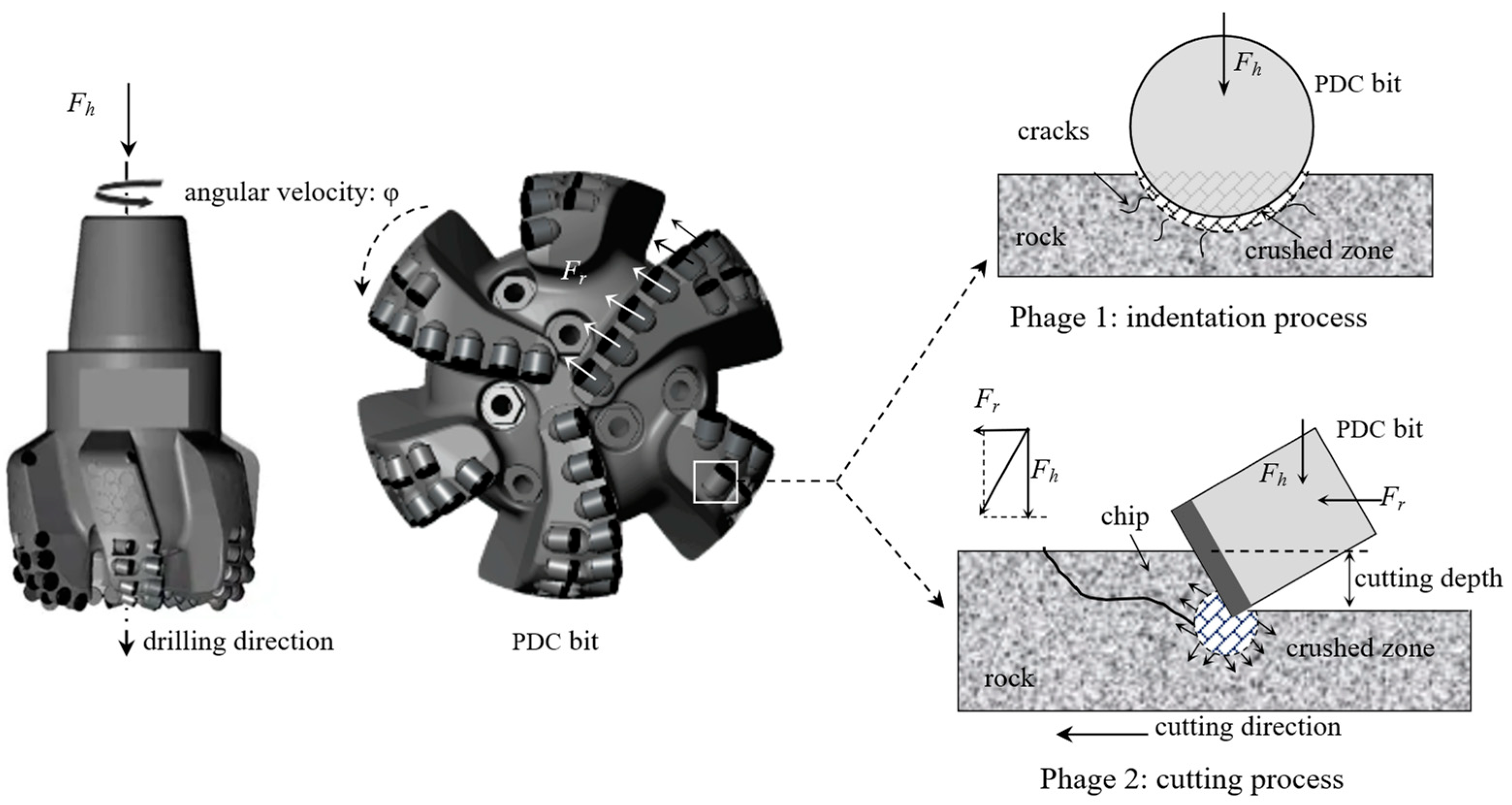
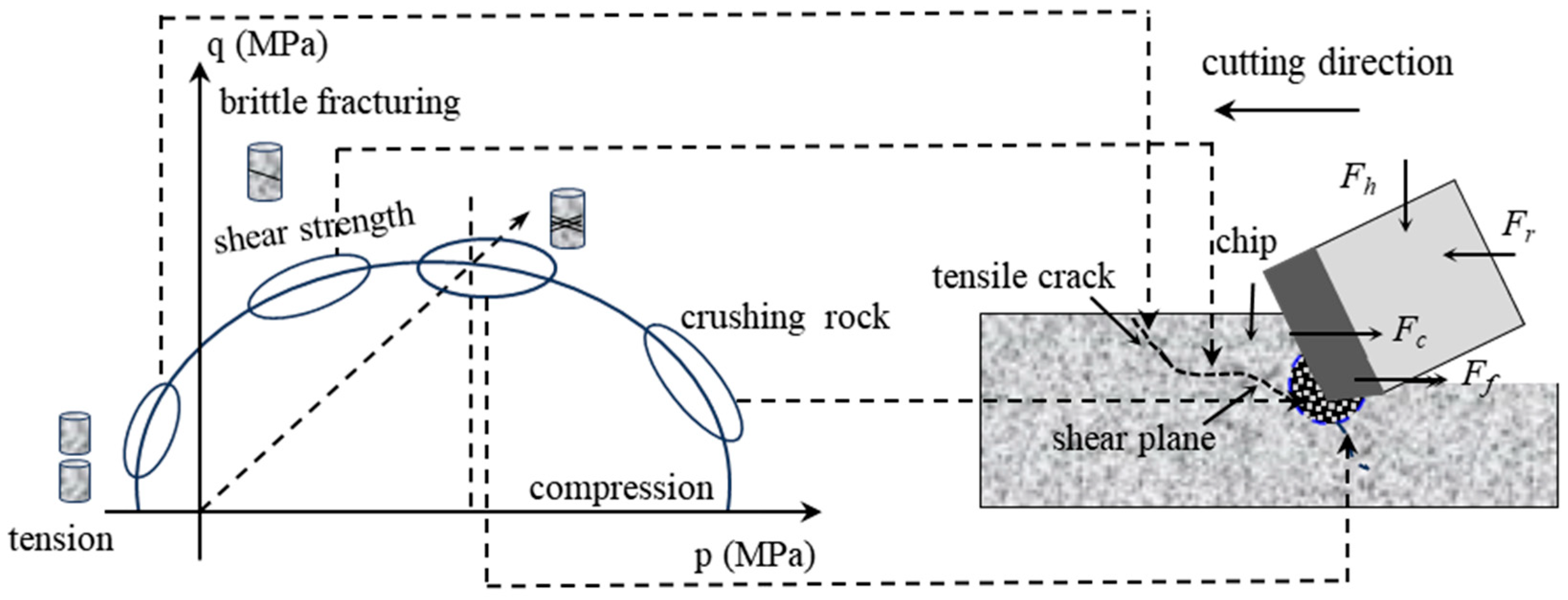
The rock fragmentation process by PDC bits is fundamentally an integrated outcome of the interaction between multiple PDC cutters and rocks under WOB and torque. This process is typically decomposed into two closely related, nearly simultaneous, yet mechanically distinct sub-processes—Phase 1 (indentation crushing) and Phase 2 (cutting)—as illustrated in Figure 1. These two sequential phases establish the fundamental envelope for efficient rock fragmentation by PDC cutters.
Phase 1: Indentation Crushing Process
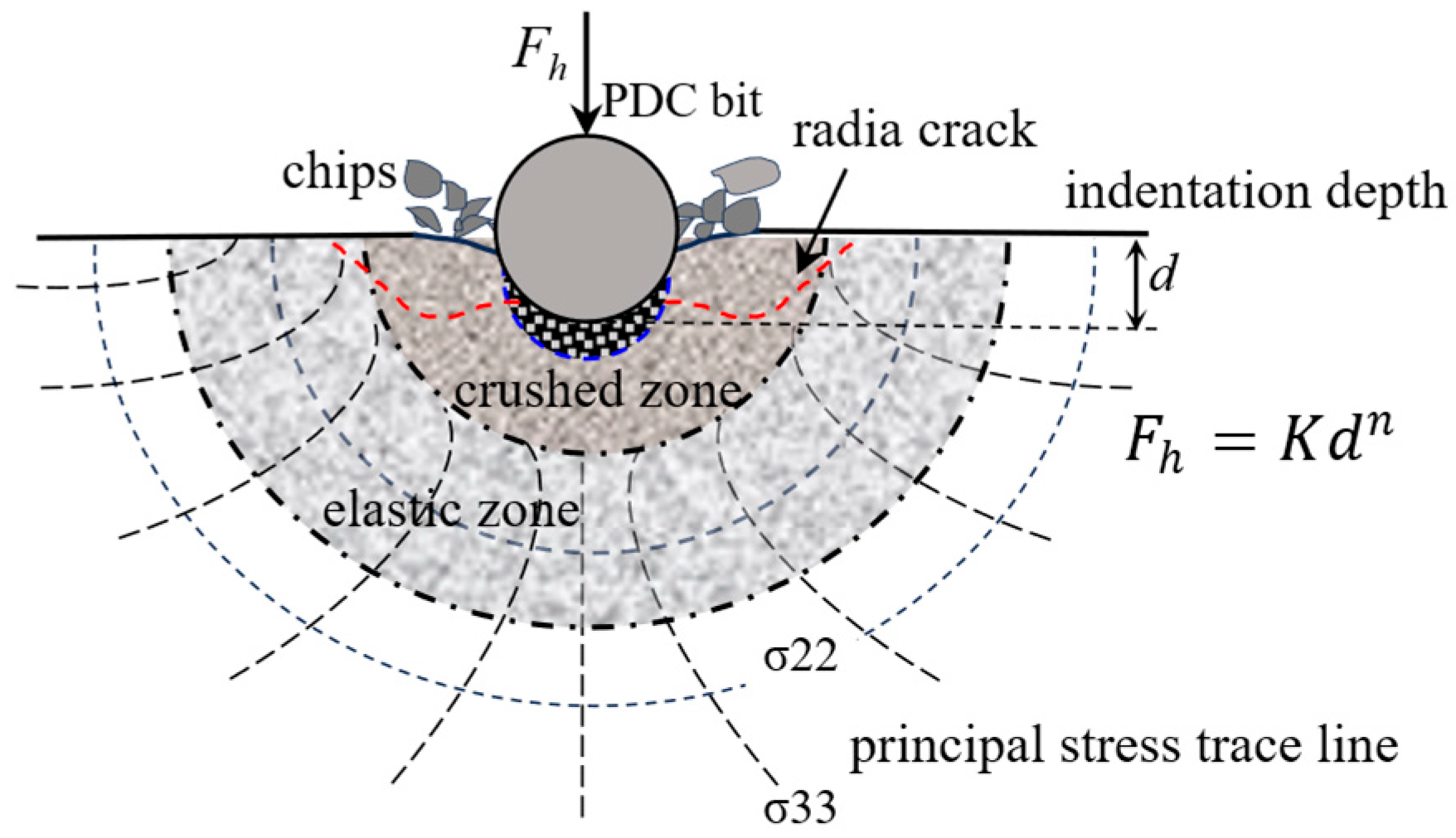
Under applied axial load, stresses beneath the cutter exceed the rock’s compressive strength, forming a compacted crush zone and initiating cracks around it, as shown in Figure 2. This penetration depth is governed by both the applied axial load and the rock compressive strength, commonly expressed by Equation (1) [52,53].
F h = k d n
where Fh is the applied axial load (N). k is an indentation coefficient, depending on the rock strength properties as well as cutter shape and size. n is a material constant and is calculated by the rock tensile behavior law. However, the exponent n remains undetermined, with proposed values of 1 or 2, indicating that further investigation is required [52,53].
Consequently, this penetration process establishes a free surface that is essential for efficient rock cutting. Insufficient axial load results in minimal penetration depth, reducing cutting efficiency. Conversely, excessive load increases penetration depth but simultaneously raises frictional forces at the cutter base, impairing cutting efficiency.
Phase 2: Rock Cutting Process
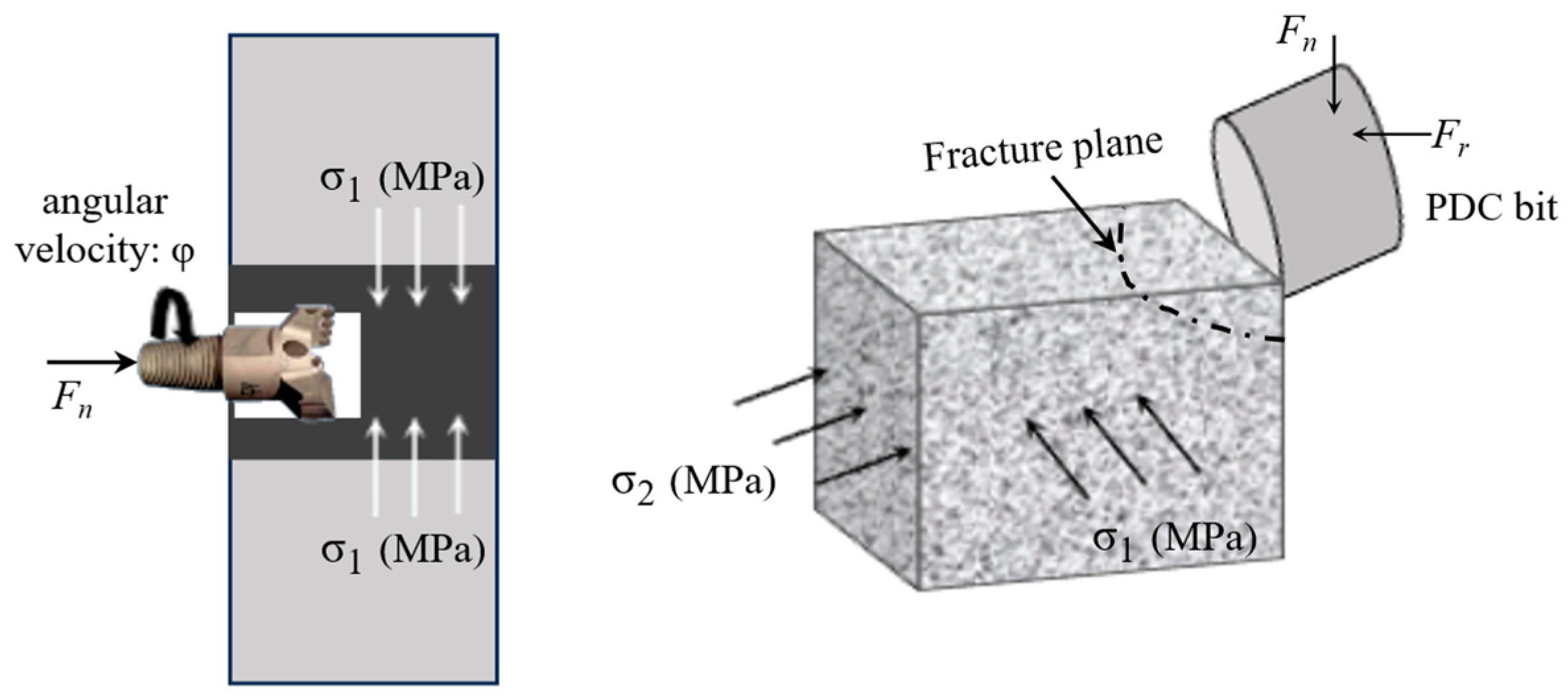
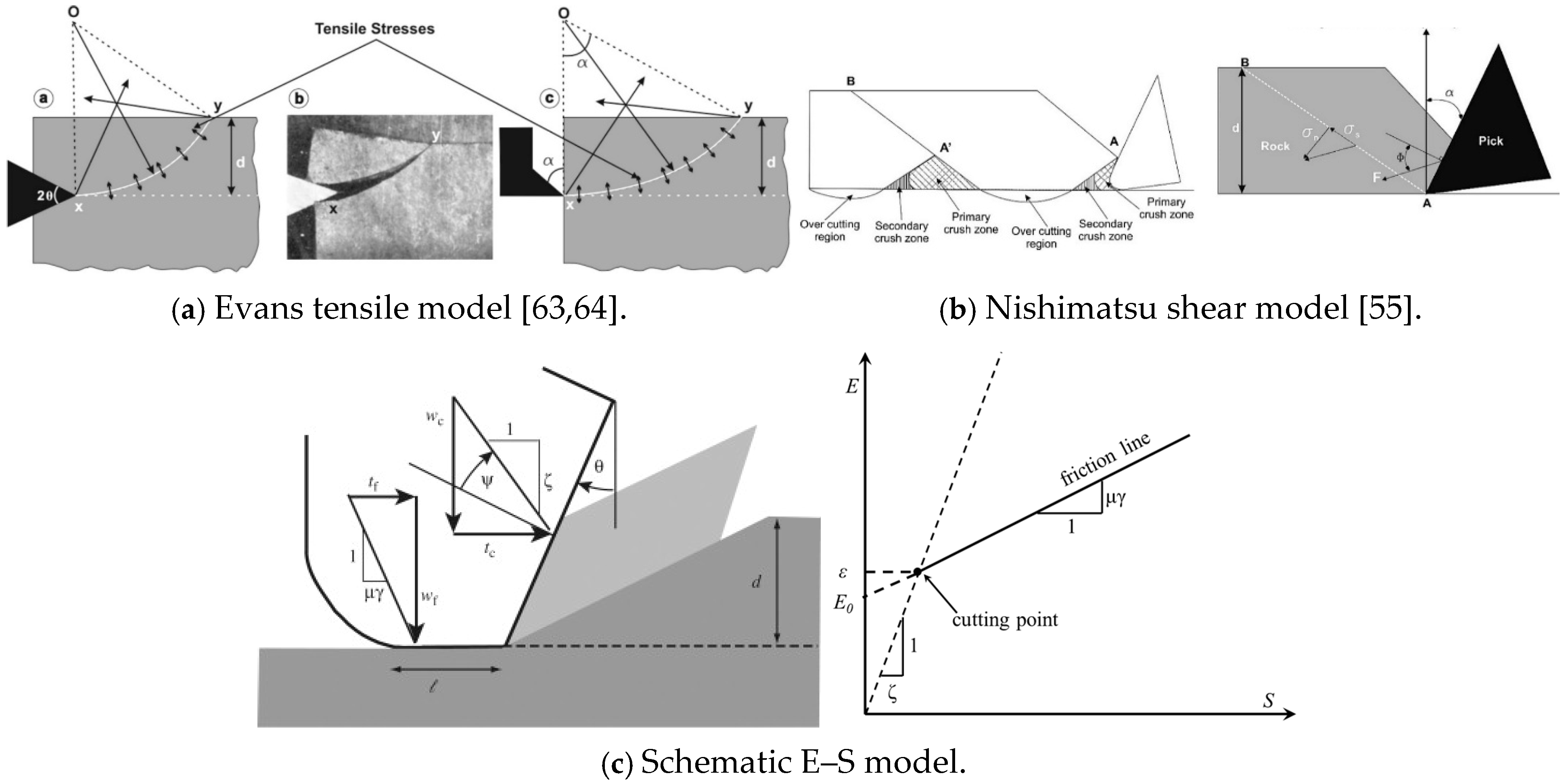
Under applied torque, the embedded PDC cutter shears through the rock substrate, subjecting the rock to intense shear stress. Meanwhile, tensile stresses along the fracture plane also drive crack propagation, as shown in Figure 3 and Equation (2) [54]. Therefore, the current research prioritizes two objectives: (1) characterizing stress distribution on fracture planes during cutting, and (2) determining whether crack propagation is primarily governed by shear or tensile stresses. For instance, Nishimatsu [55] suggested that crack propagation follows the Mohr–Coulomb criterion, introducing a shear stress distribution factor to characterize stress heterogeneity within the fracture plane. Subsequent numerical and experimental studies [56,57] corroborated Verhoef’s conclusions, demonstrating that fracture planes within chips are indeed subject to both shear and tensile stresses. However, the characterization of stress distributions remains inadequately resolved. Furthermore, recent experimental investigations have successfully utilized Digital Image Correlation (DIC) technology to capture the transient stress evolution on fracture planes during rock cutting [58]. These results consistently validate Verhoef’s findings presented in Figure 3 [54], demonstrating that crack propagation is predominantly governed by tensile failure mechanisms.
F r F c + F f = ε d + μ F h
where Fr is the applied horizontal load (N). Fh is the applied axial load (N). Fc is the component of applied horizontal force associated with rock cutting. Ff is the component of applied force associated with frictional contact. d is the cutting depth (m). μ is the friction coefficient. ε is the rock’s intrinsic specific energy (J).
Therefore, the rock cutting process involves simultaneous multi-mode failure mechanisms, encompassing compressive, shear, tensile, and ductile fracture. Internal crack initiation is co-induced by both shear and tensile stresses, whereas subsequent crack propagation is predominantly governed by tensile failure mechanisms.

3.2. Theoretical Considerations of Process Parameters on Drilling Performance

Drilling performance is governed by the interplay between controllable parameters—such as WOB, rotational speed, and flow rate—and the resulting performance indicators, including torque, Rate of Penetration (ROP), SE, and bit wear. This section reviews the effects of key process parameters on drilling performance, based on theoretical analysis and experimental evidence, highlighting the practical implications for real-time formation evaluation.
From the perspective of drilling optimization, clearly distinguishing between measured parameters (independent variables like WOB and RPM) and calculated parameters is of paramount importance. This classification allows for engineers to actively manipulate independent variables to achieve the desired calculated geomechanical indicators. As governed by the foundational equations presented in Table 2 (e.g., Teale’s SE model), the bit load (WOB) acts as the primary driving factor. Theoretically, an increase in WOB directly deepens the cutter’s penetration, causing a proportional rise in both reactive torque and ROP under unobstructed conditions. Consequently, when sufficient WOB is applied to surpass the rock’s threshold strength, the Specific Energy (SE) intensity stabilizes near the rock’s intrinsic uniaxial compressive strength, representing the optimal drilling efficiency.
(1)
Effects of Process Parameters on Torque
Field and laboratory studies indicate a positive correlation between WOB and torque [9,59]. As WOB increases, the depth of the cut remains largely unchanged (Equation (1)), while frictional resistance along the cutter–rock interface becomes the dominant contributor to torque [60]. This leads a progressively diminishing slope in the torque–WOB curve. Thus, a logarithmic relationship between WOB and torque is proposed, with a relatively weak coefficient.
Conversely, the rotational speed exhibits no significant correlation with torque magnitude under constant formation conditions [9,59]. This independence means that rotational speed primarily alters the rate of rock fragmentation, without directly contributing to increased torque or penetration depth.
(2)
Effects of Process Parameters on ROP and SE
ROP and SE are widely used to assess drilling performance [61,62]. Under unobstructed cutting and sufficient torque conditions, ROP exhibits a linearly proportional relationship with rotational speed. Although a nonlinear correlation between ROP and WOB is expected from Equation (1), the empirical data largely supports a linear model. This is because the exponent n ≈ 1 at low WOB and increases progressively with pressure in practice [5].
Accordingly, SE correlates linearly with WOB and rotational speed. However, greater interest lies in its correlation with rock strength, primarily given their shared dimensional units [35]. A key limitation of both ROP and SE is their strong dependence on operational parameters; reliable formation identification requires careful control of WOB and rotational speed, which constrains their standalone applicability [9,59]. Similarly, most drillability indices face the same challenge: how to effectively remove the influence of drilling parameters while still achieving reliable formation characterization.

3.3. Rock Fragmentation Models and Indices

Models and indices developed to describe rock–tool interaction mechanism primarily can be classified into four categories: theoretical models based on limit equilibrium methods [51,63,64,65], energy-based models [12], empirical–statistical models [17,66,67], and intelligent models [68,69]. Table 2 summarizes representative models from these four categories and compares their respective advantages and limitations.
Table 2. Comparison of representative rock breaking models and indices.
TypeRepresentative ModelReferences
Theoretical models F c = 2 n + 2 2 σ t d w sin θ 1 sin θ Evans [63,64], Roxborough [64], Goktan and Gunes [70]
F c = 2 n + 1 σ s d w cos ϕ α cos k 1 sin k α + ϕ n = 11.3 0.18 α , ϕ = 25.4 + 0.66 α Nishimatsu [55], Kalantari et al. [21,71]
E = ( 1 μ ζ ) ε + μ S E = F c A , S = F f A Detournay et al. [7,59] Franca [8],
Energy-based models S E = W O B A + 2 π A N T R O P Teale [12]
S E = W O B A + 2 π A N T R O P + α H c A R O P Armenta [72], Wei et al. [73]
M S E = W O B A + 2 π A N T R O P η Dupriest et al. [74]
Empirical-statistical models D R I = 77.16 e 0.0005 × σ c σ t 2 + 55.69 Yarali and Kahraman [67]
S E m = 9.0406 U C S 124.68 S E c = 9.6988 U C S 144.27 Yasar et al. [17]
K e w = R O P N W O B D 1 2 Wyering et al. [35]
Intelligent modelsAlgorithmInputOutput
Deep convolutional neural networkROP, N, T, WOBUCS, C, ϕHe et al. [68]
Long short-term memoryROP, N, T, WOBLithologies:Chen et al. [69]
Logistic Regression, Gradient Boosting on decision trees, Artificial Neural NetworksROP, N, T, WOB, SE, flow rate, APRLithologiesKlyuchnikov et al. [24]
Least-squares support-vector machine, multi-layer extreme learning machineDepth, ROP, WOB, T, N,UCSDavoodi et al. [75]
Fc component of applied force associated with rock cutting; Ff component of applied force associated with frictional contact; SE/MSE specific energy; SEc calculated specific energy; SEm measured specific energy; ε intrinsic specific energy; A area of the hole; D bit diameter; WOB thrust; T torque; N rotation speed; ROP rate; APR adjusted penetration rate APR = ROP/(WOB × T0.5); Kew the drill bit capability constant; C cohesion; ϕ internal friction angle; Hc hydraulic pressure; DRI drilling rate index; η bit efficiency factor (dimensionless); UCS/σc unconfined compressive strength (MPa); σt tensile strength; σs shear strength; d cutting depth; w cutting width; μ friction coefficient; ζ the ratio of the vertical to horizontal force acting on the cutting face; n stress distribution factor; α cutter rake angle.
As described in Section 3.1, theoretical models grounded in limit equilibrium theory remain ambiguous in defining the dominant failure mode during rock cutting—whether it occurs predominantly through shear, tensile, or a combined fracture mechanism (Figure 4). Current research builds upon either the Evans tensile model [63,64] or the Nishimatsu shear model [55] by incorporating additional influencing factors yet remains largely confined to simplified, two-dimensional, single-cutter configurations [27,70,76]. Another category of theoretical models is the E-S model proposed by Detournay et al. [7,60]. This model characterizes fundamental bit–rock interaction but simplifies fracture mechanics, directly linking drilling parameters to rock strength. Franca [77] subsequently developed an analogous bit–rock interaction model for rotary–percussive drilling, extending this theoretical framework to dynamic loading conditions. A notable limitation of prevailing theoretical models is their prediction of drilling parameters that represent only the minimum mechanical threshold for rock fragmentation, with these values being substantially lower than those empirically observed in field operations [23,78].
Energy-based models have primarily evolved within Teale’s original framework, with most subsequent studies focusing on incremental additions like hydraulic pressure effects rather than conceptual breakthroughs [72,73]. The shared dimensionality of SE and rock mass strength has led many researchers to establish relationships between them through both theoretical derivation and empirical statistics [17,79,80]. However, field observations reveal that rock fragmentation accounts for only a limited share of total energy consumption, with the majority dissipated through frictional losses [81].
Empirical models are inherently limited in transferability across varying geological settings and often oversimplify influencing factors. Nevertheless, they remain valuable in practice due to their operational simplicity and direct engineering guidance. To overcome the inherent limitations and poor spatial generalizability of empirical frameworks, intelligent algorithms—notably deep learning and multi-source data fusion—represent a paradigm shift. AI-driven comprehensive analysis leverages vast, non-linear drilling datasets to map complex bit–rock interactions without relying on simplified mathematical assumptions. This integration of machine learning highlights the core novelty of next-generation MWD systems, allowing for adaptive, high-precision formation identification across highly variable geological settings [24,67,68,74].
Therefore, establishing a robust, nonlinear correlation between drilling parameters and rock mass strength is critical for real-time geological reconnaissance by MWD. However, the practical adoption of existing models remains limited due to their inadequate adaptability to complex drilling conditions, and insufficient ability to establish correlations with formation characteristics. Three critical barriers impede advancement:
(1)
Unclear rock fragmentation mechanisms involving multi-cutter PDC bits and unidentified controlling factors of crack propagation.
(2)
The effective filtration of noise and invalid data under complex drilling conditions is required. For example, Yue et al. [5] introduced the criteria for differentiating individual operations from full DPM data, while Feng et al. [39] enhanced the discernibility of drilling information through equipment upgrades.
(3)
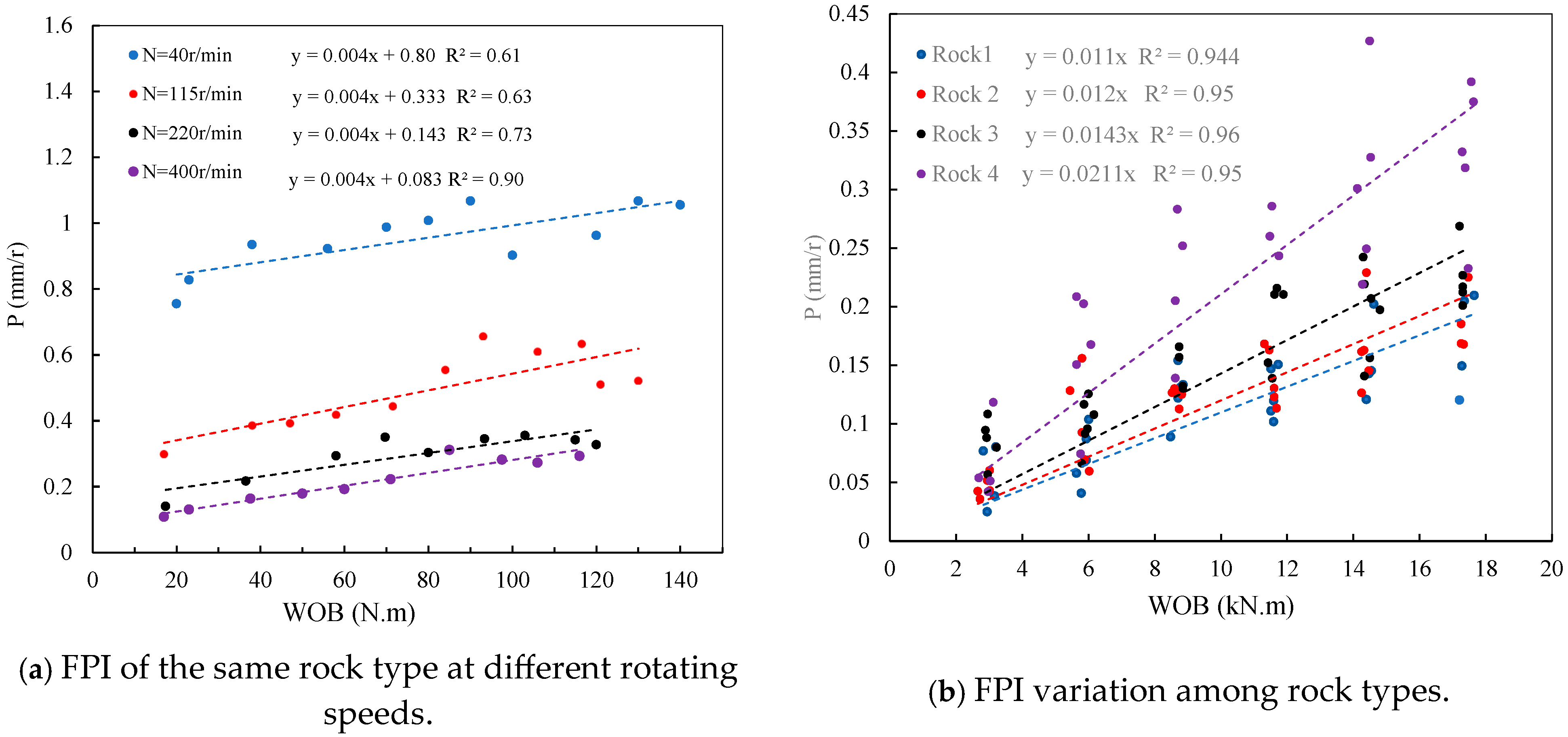
Interference from operational drilling parameters (e.g., thrust, rotation speed) in formation identification must be eliminated. For example, the FPI index [59,82] exemplifies this approach by establishing a relationship between rock strength and the WOB–penetration per revolution ratio (Figure 5).
To overcome these persistent bottlenecks and advance practical implementation, future research should prioritize two strategic prospects: (1) transitioning from simplified 2D single-cutter assumptions to 3D multi-cutter analytical interaction models that account for spatial cutter layout, and (2) deploying edge-computing algorithms on-site to dynamically filter operational noise and decouple drilling parameters from intrinsic rock properties in real-time.

4. Technique for Drilling Monitoring in Geotechnical Engineering

To obtain the detailed in situ geological information along the boreholes, core testing and geophysical methods are conventionally applied in mining and petroleum engineering [83,84]. Due to economic issues, poor drilling environments, and method limitation (need completed and stable holes), however, those methods delay and disturb drilling operations [38,85,86]. Since the 1980s, researchers have recognized there is a strong relationship between rock properties and the drill performance parameters, leading to the development of drill-monitoring systems that enable rapid geological assessment directly from drilling data. One representative example is measurement while drilling (MWD) which has been widely adopted for actual rock mass condition and geotechnical ground recognition [83,87]. This section first classifies drilling parameters on the basis of their measurement features, and then reviews major drill-monitoring technologies. Finally, drill performance data analysis steps and methods are reviewed.

4.1. Drilling Parameters’ Classification

Drilling parameters are typically categorized into measured parameters and parameters that are calculated (inferred) on the basis of their features [83,86,87,88,89,90].
Measured parameters are automatically measured by drill monitoring systems and can be separated into independent parameters and dependent parameters. Obviously, independent parameters are controlled by the drill operator during drilling. Dependent parameters are influenced both by independent parameters and geological information.
Calculated parameters are derived from measured parameters using empirical or theoretical relationships and reflect integrated responses to operating conditions and rock mass characteristics. A summary of these parameter types is provided in Table 3.

4.2. Review of Drilling Monitoring Technique

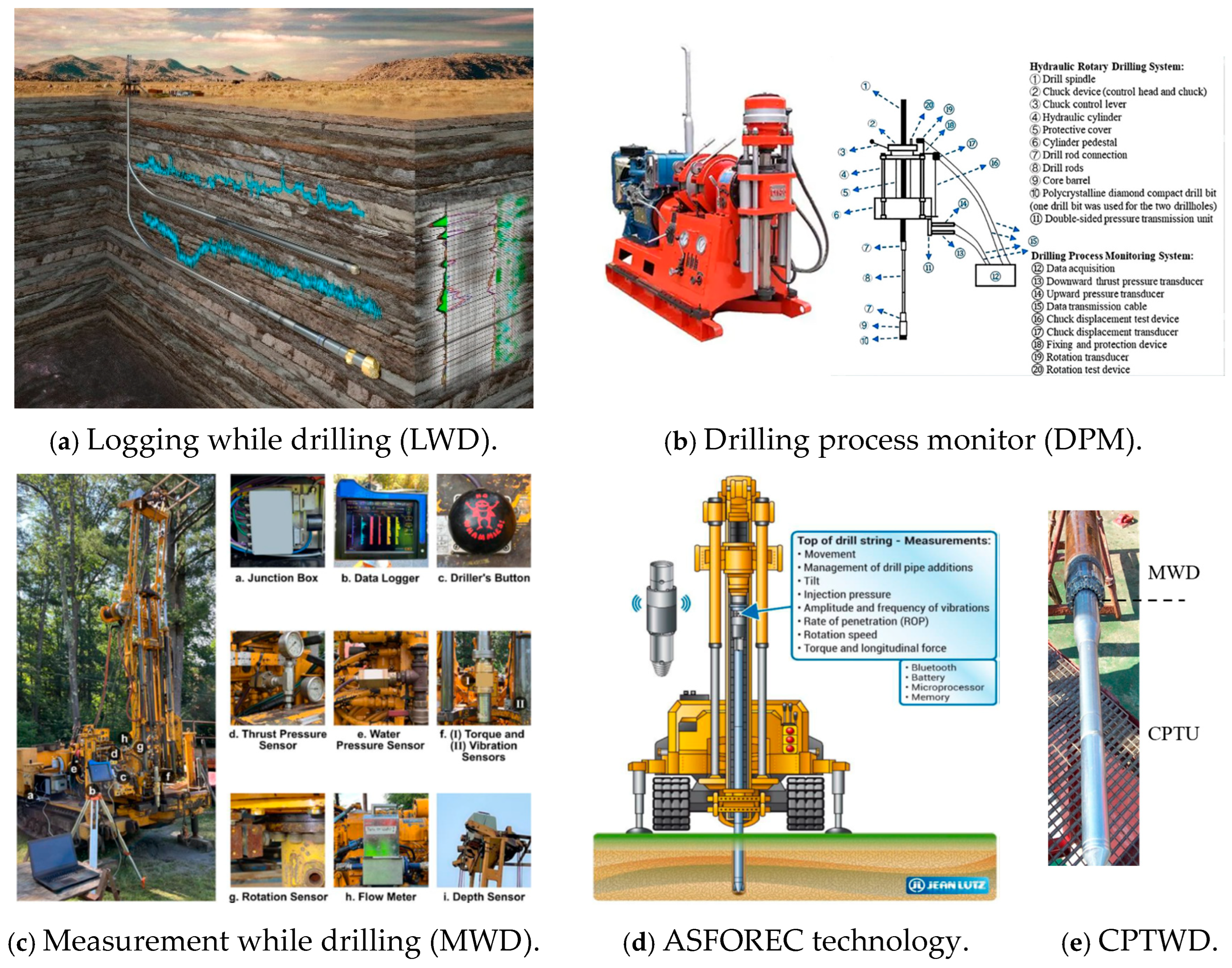
Following the successful deployment of logging monitoring systems in petroleum engineering, drilling monitoring techniques began to be adopted in tunneling and mining engineering during the 1970s, primarily for blast design optimization [83,91]. In the primary stage, however, drilling monitoring techniques still could not improve blast efficiency much due to challenges in the reliability of data recordings, analytical capabilities, and equipment durability. Over subsequent decades, significant research has enhanced the understanding of bit–rock interaction and its relationship with rock mass properties. In addition, owing to the high analysis capacity of computers, raw drilling data could be interpreted by software, allowing for geological information predicted in real-time [91]. some major drilling monitoring techniques (Table 4 and Figure 6) are now routinely used in practice, supporting geological interpretation, tunneling blast, geotechnical investigation, and oil probing [37,92,93].
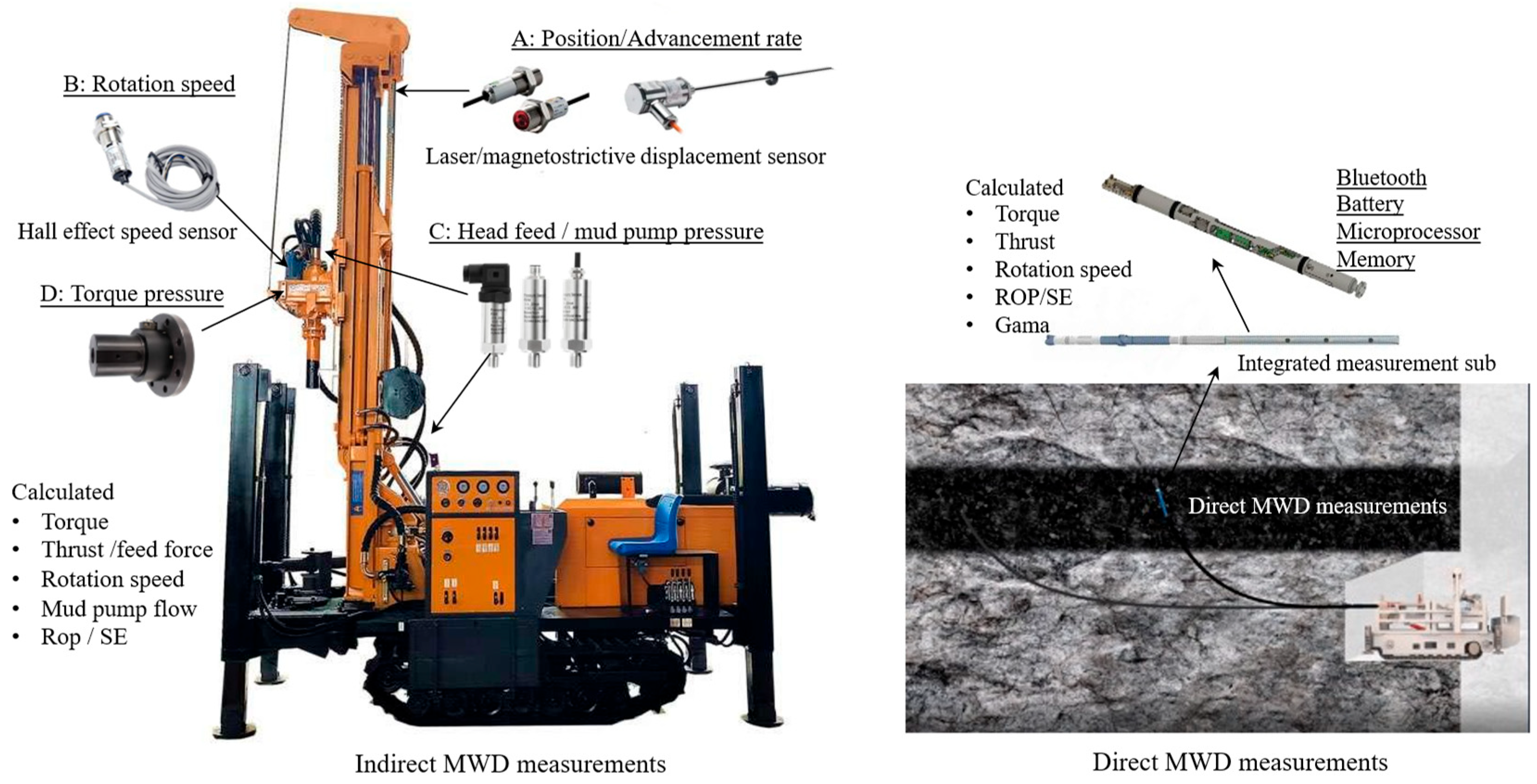
A typical drilling monitoring technique in geotechnical engineering, called indirect MWD measurements, contains three parts: (1) a sensor package for recording drilling parameters in real-time, (2) a surface data-processing unit for collecting, transmitting, and analyzing, and (3) conventional surface drilling [94]. Figure 7 shows the differences between direct and indirect MWD measurements.
In geotechnical engineering, the selection of a specific drilling monitoring method is primarily dictated by borehole spatial constraints and the required geomechanical parameters. For instance, while LWD provides comprehensive petrophysical properties in oil fields, indirect MWD measurements or DPM systems are often preferred for geotechnical investigations due to their compact setup, cost-effectiveness, and compatibility with standard 50–140 mm diameter boreholes. To clearly delineate these distinctions, Table 4 summarizes the comparative advantages, disadvantages, and specific applicability of each monitoring technology.
Table 4. Major drill monitoring systems in actual applications.
TechnologiesAdvantagesDisadvantagesGeotechnical Applicability
Cone Penetration Test While Drilling system (CPTWD) [6]
  • Combines the merits of cone penetration test and MWD.
  • Captures data where it is hard to withdraw sufficiently undisturbed samples.
  • Penetration depth and application are heavily restricted by hard rock formations.
  • Vulnerable to rod buckling.
Deep geotechnical surveys in soft soils or highly weathered rocks.
Measurement while drilling (MWD) [83]
  • Normally used in mining and excavation industry without hampering the production operations.
  • Projects a speedy, high-resolution picture when combined with geophysics.
  • Surface-acquired data suffers from energy dissipation and drill-string friction losses.
  • Exhibits single-borehole bias.
Excavation industry, mining, and tunneling rock mass condition recognition.
Drilling process monitor (DPM) [5]
  • Offers a cost-effective and accurate methodology for ground investigation, geotechnical design and verification.
  • This system can automatically, objectively and continuously measure and record drilling parameters, and then calculate ROP using the proposed criteria for parameters’ analysis.
  • Heavily dependent on rigorous data-cleaning algorithms to filter operational noise from raw surface signals.
Ground investigation, geotechnical design, and real-time verification.
Logging while drilling (LWD) [95]
  • Delivers comprehensive multi-parameter formation evaluation (e.g., resistivity, nuclear magnetic resonance, density porosities).
  • High equipment cost.
  • Strictly limited by tool miniaturization, making it difficult to deploy in typical 50–140 mm geotechnical boreholes.
Oil and gas well logging; large-diameter deep reservoir investigations.
ASFOREC
technology
Figure [96]
  • An ASFOREC sensor is installed in direct contact with the drill string.
  • The ASFOREC combines one wireless sensor and direct measure classical current parameter.
  • Sensor durability and data transmission stability under severe downhole high-frequency vibrations require further validation.
In situ technologies specifically adapted to standard geotechnical engineering rigs.
Despite decades of advancement, several critical challenges in MWD continue to constrain its wider application and require further investigation.
(1)
Drilling Data Cleaning
Extracting meaningful rock mass information in real-time from noisy, correlated, and often uninformative drilling data remains a major practical hurdle [97]. Effective data-cleaning methods are essential to translate raw measurements into actionable guidance for drilling. For example, Yue et al. [5] established data filtration criteria to derive pure drilling process data. Xiao et al. [98] integrated both data cleansing and noise elimination techniques for real-time drilling data. The application of AI-driven denoising and pattern-recognition techniques offers a promising path toward more robust real-time data interpretation [99,100].
(2)
Near-Bit MWD Technique
A large portion of the energy supplied at the surface is dissipated through drill-string friction rather than rock fragmentation [81,101], leading to significant errors when formation properties are inferred from surface-acquired data. Direct measurement at the bit—referred to as near-bit or direct MWD—can substantially improve accuracy [94,96]. However, its adoption in geotechnical engineering is limited by small borehole diameters (typically 75–150 mm), which create a critical design conflict between spatial constraints and drill pipe strength. Furthermore, conventional hydraulic rigs commonly used in geotechnical engineering lack built-in power and data-transmission capabilities near the bit.
(3)
MWD Technique with Integrated Geophysical Sensors
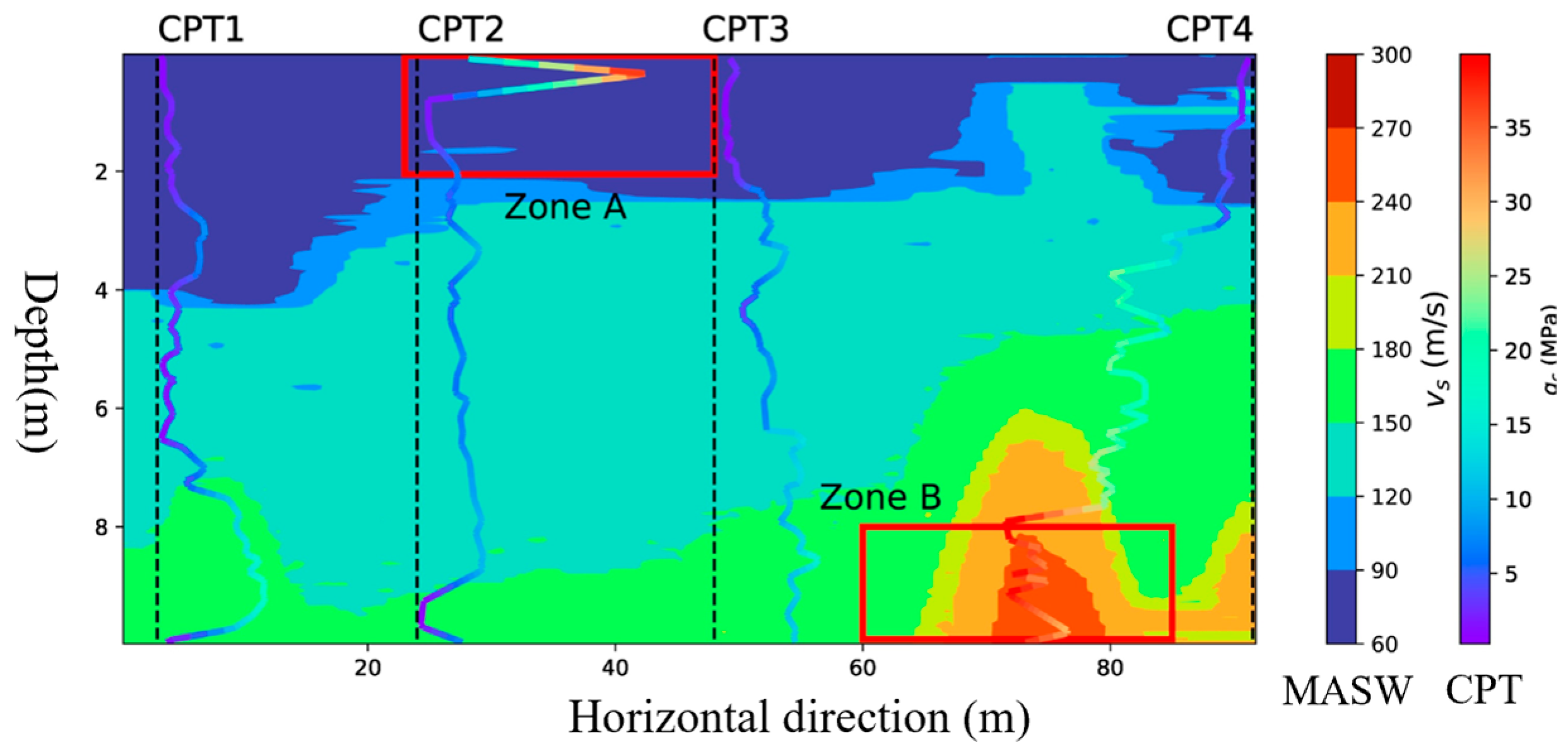
MWD responses derived from bit–rock interaction mainly reflects strength characteristics and provide limited lithological discrimination. Combining MWD with geophysical logging—such as gamma-ray, resistivity, or electromagnetic measurements—can deliver a more comprehensive formation evaluation. Nevertheless, integrating downhole geophysical sensors faces similar miniaturization and deployment challenges as near-bit MWD. In addition, integrating multi-source data for comprehensive formation parameter inversion remains a key research challenge, yet large-modality data technologies offer a viable breakthrough path. For example, Xie et al. [102] integrated core sampling and CPT (Cone Penetration Test) data for comprehensive formation inversion, as illustrated in Figure 8.

5. Application of Drilling Monitoring in Geotechnical Engineering

In geotechnical engineering, the integration of bit–rock interaction mechanisms with MWD enables comprehensive formation characterization, including stratum interface positioning, rock mass strength assessment, fracture characterization, and drillability classification. This approach provides critical insights for tunnel advance geological prediction [38], reservoir delineation [93], and slope stability assessments [5]. Beyond formation identification, the technology also supports the real-time optimization of drilling parameters and early warning of downhole risks, thereby enhancing both operational efficiency and safety. This section reviews the geotechnical engineering applications of MWD, along with their development trends and technical challenges.

5.1. Geological Information Identification

According to Section 3, formation identification via bit–rock interaction mechanisms essentially reflects changes in formation strength. Therefore, current approaches for detecting geological anomalies—such as faults, karst cavities, and fracture zones—still rely on interpreting strength profiles along the borehole. For instance, rock masses within fault zones generally show markedly lower strength, allowing such intervals to be delineated by applying a strength-threshold criterion during data processing [103]. Key engineering applications include tunnel advance prediction, slope slip surface identification, cavity detection, reservoir characterization, and blasting parameter optimization [5,40,84,104,105]. However, the geological information identification of this technology still faces the following theoretical and technical challenges:
(1)
The rock fragmentation model illustrated in Figure 3 is primarily derived from unconfined conditions. In deeper drilling environments, however, the identified rock strength represents a composite value influenced by significant in situ stresses, as shown in Figure 9 [106]. Sun et al. [83] and Lyv et al. [106] validated these findings through laboratory and field tests and recommended technology for rapid in situ stress determination.
(2)
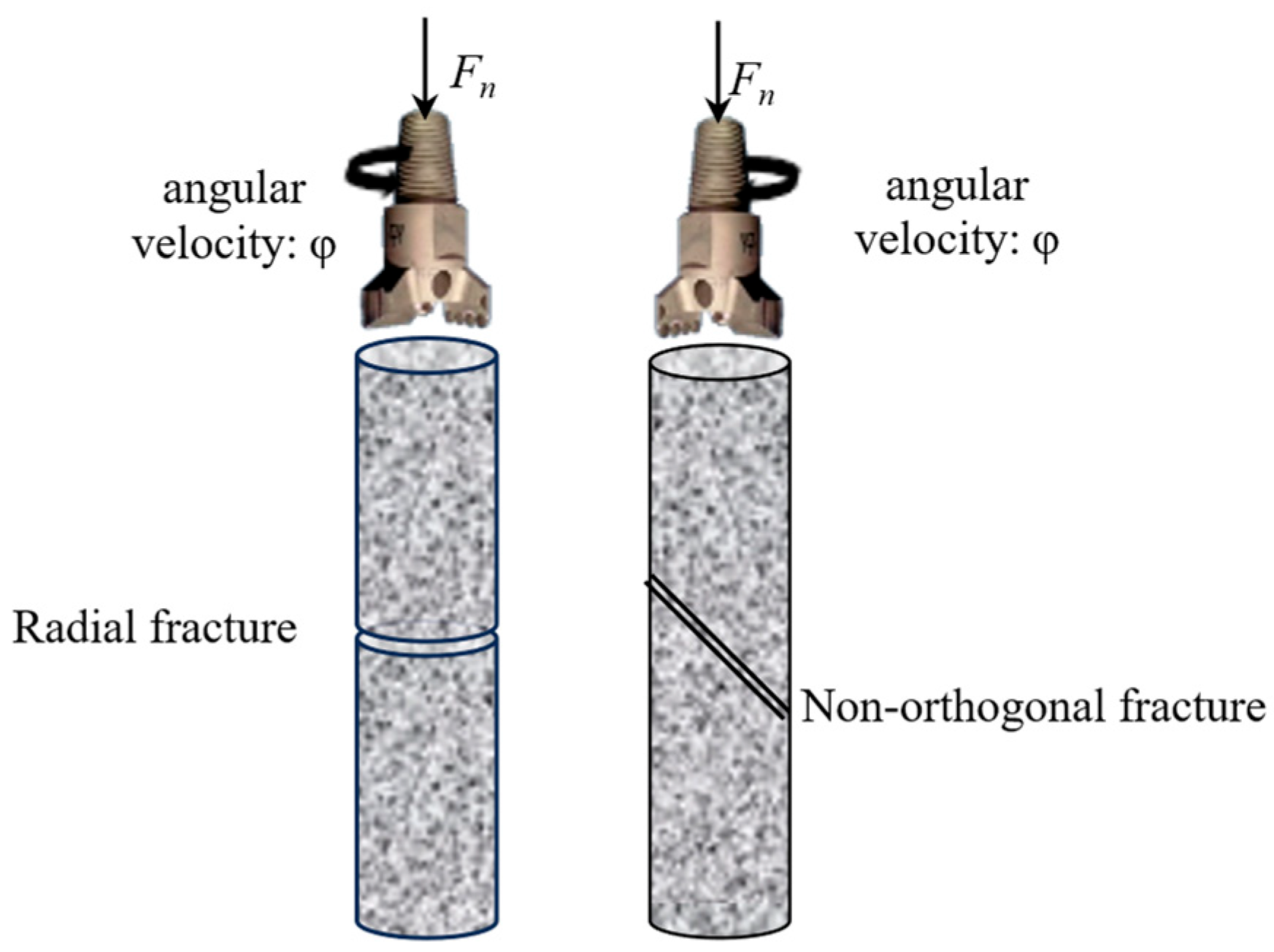
This technology could also assess rock structural planes along boreholes, though with notable accuracy limitations. Specifically, narrow fractures prove difficult to detect under complex downhole conditions, while the reliability of the identification of oblique structural planes intersecting the borehole at acute angles requires further verification [107], as shown in Figure 10 [107].

5.2. Drilling Parameter Optimization

The real-time acquisition of drilling and geomechanical parameters through MWD technology provides a critical data foundation for drilling process optimization. Conventional approaches primarily rely on established ROP and SE models to assess drilling states, with parameter adjustments based on ROP and SE variations [108]. However, drilling parameter optimization continues to face three fundamental challenges: accurate parameter measurement under complex drilling conditions, the reliable real-time transmission of data to the surface, and the effective resolution of the inherent conflicts in multi-objective optimization—particularly balancing operational safety against drilling efficiency.

5.3. Downhole Risk Identification and Warning

During drilling operations, downhole risks including stuck pipe, lost circulation, borehole collapse, and tool failure require continuous monitoring. Real-time drilling parameters provide a direct basis for risk assessment. For example, a progressive increase in torque and drag often signals an emerging stuck-pipe condition or formation instability.
Contemporary downhole risk prediction integrates multiple parameter categories (drilling, geological, and hydraulic) through deep learning architectures, moving beyond unitary drillability indices [109,110]. However, downhole risk identification and warning remain disproportionately focused on petroleum engineering, while geotechnical drilling is often characterized by lower project costs, shallower depths, and comparatively manageable risk profiles, and thus has received less attention.

6. Challenges and Future Work

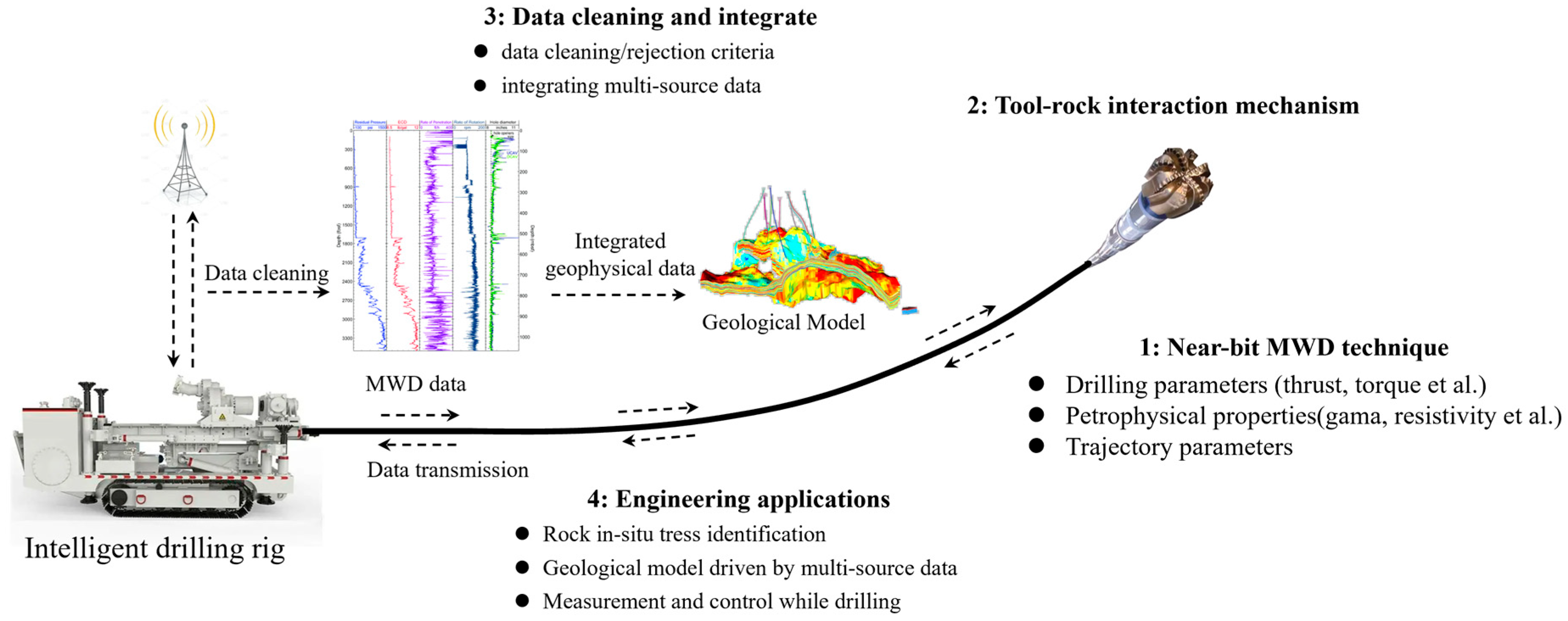
Traditional geotechnical investigation faces two fundamental limitations: relying on limited borehole data to represent entire sites (“point-to-area” limitation), and receiving lab results long after fieldwork (“post-construction understanding”). In contrast, MWD using bit–rock interaction mechanisms is changing geotechnical engineering from an experience-based practice to a data-driven science. This section synthesizes the prevailing challenges and future directions in this field, as shown in Figure 11.
(1)
Near-Bit MWD Technique
As highlighted in Section 3, accurate real-time drilling measurements require a near-bit MWD. However, geotechnical engineering faces two major barriers in implementation. First, integrating sensors into small-diameter drill rods (e.g., 63.5 mm) creates a design conflict between maintaining mud flow and structural strength in a limited space. Second, reliable data transmission from near-bit positions remains difficult. Although oilfield technologies, including mud pulse telemetry, wired drill pipes, and electromagnetic transmission, offer potential solutions, their high cost and compatibility with conventional geotechnical drilling operations require further assessment. Drawing from advanced practices in the oil and gas industry, a critical strategic priority is the miniaturization and adaptation of petroleum telemetry systems. Technologies such as mud pulse telemetry, wired drill pipes, and AI-driven downhole risk prediction architectures must be downscaled to accommodate the restricted diameters and distinct economic frameworks of geotechnical drilling. Integrating these petroleum-derived trends will fundamentally resolve the current data transmission bottlenecks.
(2)
Data Cleaning and Integration
Raw real-time drilling data contains inherent noise from vibrations and non-productive records from drilling operations, necessitating robust cleaning algorithms and rejection criteria to extract geomechanical parameters. Another challenge is the integration of multi-source data, including geomechanical parameters and geophysical measurements like resistivity, to achieve more accurate geological information identification.
(3)
Bit–Rock Interaction Mechanism
The bit–rock interaction mechanism is fundamental to real-time geomechanical parameter identification. Progress in this area requires clarifying this interaction process, establishing clear failure criteria under drilling conditions, and developing geomechanical indices that remain independent of varying drilling parameters.
(4)
Engineering Applications
In addition to the applications reviewed in Section 5, several challenging areas warrant further development.
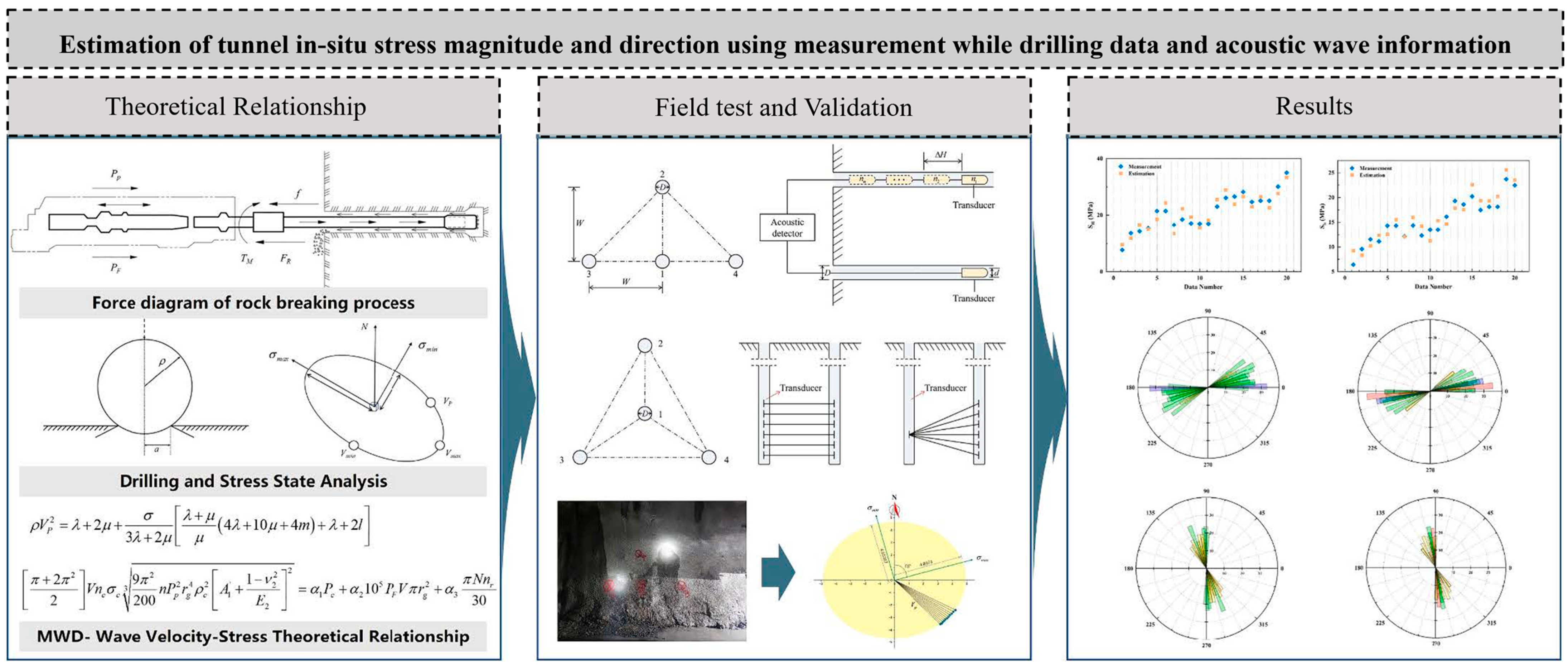
Rock In Situ Stress Identification: Rock strength interpreted from MWD data represents a composite response to in situ formation pressure. By integrating lithology (e.g., gamma-ray logging) constraints with estimated uniaxial compressive strength, the magnitude of in situ stress can be inferred—analogous to a triaxial-compression interpretation. This integrated approach holds substantial promise for proactive rock burst risk assessment in tunnel applications (Figure 12) [94].
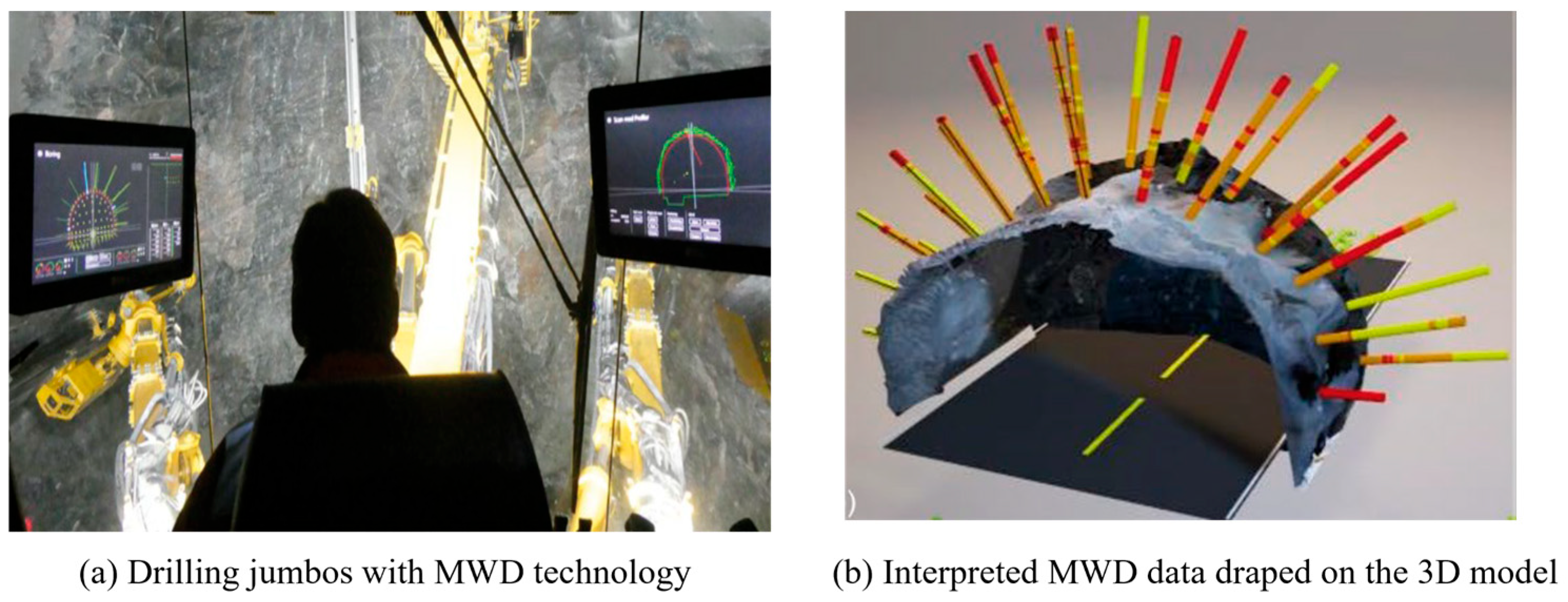
3D Geological Model Driven by Multi-Source MWD Data: Dynamically updating 3D geological models represents an advanced application of MWD-based formation identification, providing critical guidance for subsequent engineering construction. For instance, updating the 3D geological model of tunnel offers vital technical support for Increasing digitalization in all operations (Figure 13) [38]. Accurate model updating, however, relies not only MWD-derived geomechanical parameters but also the integration of multiple geophysical data streams. This multi-source collaborative approach enables comprehensive model refinement and enhancement.
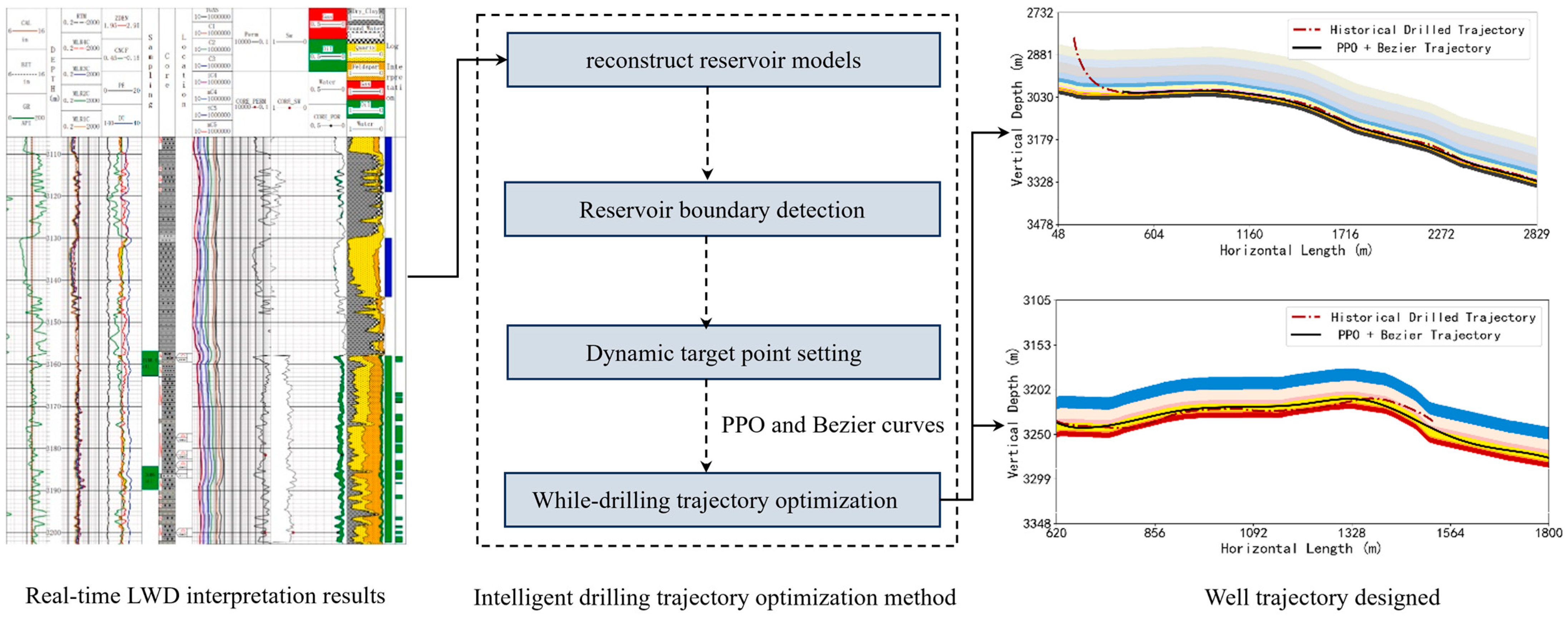
Measurement and Control While Drilling: Measurement and control while drilling is an established technology in petroleum and mining engineering. It uses real-time data to detect geological hazards ahead of the drill bit, allowing engineers to adjust drilling parameters and avoid risks, as shown in Figure 14 [111]. For example, the identification of fault zones can trigger pre-grouting measures to stabilize the rock before advancing, improving safety and efficiency. However, the development of this technology in geotechnical engineering is constrained by factors such as borehole depth, drilling processes, and investment cost.

7. Conclusions

This review synthesizes the current understanding of rotary bit–rock interaction mechanics and its application through measurement while drilling (MWD) technology in geotechnical engineering. While MWD offers a promising, non-intrusive method for real-time geomechanical characterization, significant challenges remain. Theoretical models of bit–rock interaction often rely on simplified assumptions, limiting their predictive accuracy under complex field conditions. Specifically, energy-based Mechanical Specific Energy (MSE) models and phenomenological E-S frameworks currently remain the most mature for rock strength inversion, though they are fundamentally bounded by frictional loss simplifications. Technologically, the transition towards near-bit sensing and multi-source data integration is essential yet constrained by small-diameter boreholes and data transmission hurdles in geotechnical applications. Among these, the strict spatial restriction of standard geotechnical boreholes (50–140 mm) represents the most critical sensing limitation, directly impeding the placement of near-bit instrumented subs. Practically, MWD has demonstrated utility in formation identification and drilling optimization, but its robustness across diverse geological settings requires further validation. To ensure reliable validation, rigorous data-cleaning and the mathematical decoupling of controlled operational inputs from raw datasets are essential prerequisites before executing any engineering interpretation. Currently, delineating stratum interfaces (e.g., fault zones and karst cavities) and driving dynamic 3D geological models represent the most commercially mature applications. Future progress hinges on advancing fundamental rock fragmentation theories, developing miniaturized near-bit sensors, employing intelligent data fusion techniques, and enabling dynamic geological model updates. Ultimately, overcoming these theoretical, technological, and application barriers is crucial for MWD to fully realize its potential in transitioning geotechnical engineering towards a more data-driven and predictive discipline.

Author Contributions

S.F. and F.Q. conceptualized the review topic and determined the structural framework of the manuscript. S.F., J.R. and Y.L. performed the comprehensive literature search, screening, and data extraction regarding bit–rock interaction mechanics and its geotechnical applications. S.F. drafted the original manuscript and designed the summary figures and tables. F.Q. supervised the project, acquired the funding, and critically revised the manuscript for important intellectual content. J.R. and Y.L. contributed to the literature analysis and reviewed the manuscript. All authors have read and agreed to the published version of the manuscript.

Funding

This work has been supported by the National Natural Science Foundation of China (52309143), China Postdoctoral Science Foundation (2022MD723827), and the Xi’an Association for Science and Technology Youth Talent Support Program (959202413072).

Institutional Review Board Statement

Not applicable.

Informed Consent Statement

Not applicable.

Data Availability Statement

The data presented in this study are available on request from the corresponding author.

Conflicts of Interest

The authors declare no conflicts of interest.

References

  1. Deisman, N.; Ivars, D.M.; Darcel, C.; Chalaturnyk, R.J. Empirical and numerical approaches for geomechanical characterization of coal seam reservoirs. Int. J. Coal Geol. 2010, 82, 204–212. [Google Scholar] [CrossRef]
  2. Villamor Lora, R.; Ghazanfari, E.; Asanza Izquierdo, E. Geomechanical characterization of Marcellus shale. Rock. Mech. Rock. Eng. 2016, 49, 3403–3424. [Google Scholar] [CrossRef]
  3. Li, H.; Chen, W.; Tan, X.; Tan, X. Back analysis of geomechanical parameters for rock mass under complex geological conditions using a novel algorithm. Tunn. Undergr. Space Technol. 2023, 136, 105099. [Google Scholar] [CrossRef]
  4. Carrubba, P. Skin friction on large-diameter piles socketed into rock. Can. Geotech. J. 1997, 34, 230–240. [Google Scholar] [CrossRef]
  5. Yue, Z.; Lee, C.; Law, K.; Tham, L. Automatic monitoring of rotary-percussive drilling for ground characterization—Illustrated by a case example in Hong Kong. Int. J. Rock. Mech. Min. Sci. 2004, 41, 573–612. [Google Scholar] [CrossRef]
  6. Sacchetto, M.; Trevisan, A.; Elmgren, K.; Melander, K. CPTWD (Cone Penetration Test While Drilling) a new method for deep geotechnical surveys. In Geotechnical and Geophysical Site Characterization; Millpress: Roiterdam, The Netherlands, 2004; p. 787. [Google Scholar]
  7. Detournay, E.; Richard, T.; Shepherd, M. Drilling response of drag bits: Theory and experiment. Int. J. Rock. Mech. Min. Sci. 2008, 45, 1347–1360. [Google Scholar] [CrossRef]
  8. Franca, L.F. Drilling action of roller-cone bits: Modeling and experimental validation. J. Energy Resour. Technol. 2010, 132, 043101. [Google Scholar] [CrossRef]
  9. Feng, S.; Wang, Y.; Zhang, G.; Zhao, Y.; Wang, S.; Cao, R.; Xiao, E. Estimation of optimal drilling efficiency and rock strength by using controllable drilling parameters in rotary non-percussive drilling. J. Petrol. Sci. Eng. 2020, 193, 107376. [Google Scholar]
  10. Wang, X.; Zhang, M.; Yue, Z. In-situ digital profiling of soil to rock strength from drilling process monitoring of 200 m deep drillhole in loess ground. Int. J. Rock. Mech. Min. Sci. 2021, 142, 104739. [Google Scholar] [CrossRef]
  11. Maurer, W. The “perfect-cleaning” theory of rotary drilling. J. Pet. Technol. 1962, 14, 1270–1274. [Google Scholar] [CrossRef]
  12. Teale, R. The concept of specific energy in rock drilling. Int. J. Rock. Mech. Min. Sci. 1965, 2, 57–73. [Google Scholar] [CrossRef]
  13. Zeng, J.; Wang, Y.; Cao, R.; Zhao, Y. Drilling process monitoring-based study on granite drilling specific energy. Water Resour. Hydropower Eng. 2017, 48, 112–117. [Google Scholar]
  14. Howarth, D.; Adamson, W.; Berndt, J. Correlation of model tunnel boring and drilling machine performances with rock properties. Int. J. Rock. Mech. Min. Sci. 1986, 23, 171–175. [Google Scholar] [CrossRef]
  15. Kahraman, S. Rotary and percussive drilling prediction using regression analysis. Int. J. Rock. Mech. Min. Sci. 1999, 36, 981–989. [Google Scholar] [CrossRef]
  16. Scoble, M.; Peck, J.; Hendricks, C. Correlation between rotary drill performance parameters and borehole geophysical logging. Min. Sci. Technol. 1989, 8, 301–312. [Google Scholar] [CrossRef]
  17. Yasar, E.; Ranjith, P.; Viete, D. An experimental investigation into the drilling and physico-mechanical properties of a rock-like brittle material. J. Pet. Sci. Eng. 2011, 76, 185–193. [Google Scholar] [CrossRef]
  18. Ataei, M.; KaKaie, R.; Ghavidel, M.; Saeidi, O. Drilling rate prediction of an open pit mine using the rock mass drillability index. Int. J. Rock. Mech. Min. Sci. 2015, 73, 130–138. [Google Scholar] [CrossRef]
  19. Kahraman, S.; Rostami, J.; Naeimipour, A. Review of ground characterization by using instrumented drills for underground mining and construction. Rock. Mech. Rock. Eng. 2016, 49, 585–602. [Google Scholar] [CrossRef]
  20. Li, Z.; Itakura, K. An analytical drilling model of drag bits for evaluation of rock strength. Soils Found. 2012, 52, 216–227. [Google Scholar] [CrossRef]
  21. Kalantari, S.; Baghbanan, A.; Hashemalhosseini, H. An analytical model for estimating rock strength parameters from small-scale drilling data. J. Rock. Mech. Geotech. Eng. 2019, 11, 135–145. [Google Scholar] [CrossRef]
  22. He, M.; Wang, H.; Ma, C.; Zhang, Z.; Li, N. Evaluating the anisotropy of drilling mechanical characteristics of rock in the process of digital drilling. Rock. Mech. Rock. Eng. 2023, 56, 3659–3677. [Google Scholar] [CrossRef]
  23. Cao, R.; Feng, S.; Xu, F. Theoretical consideration of rock-cutting mechanisms and three-dimensional peak cutting force model of conical picks. Rock. Mech. Rock. Eng. 2025, 58, 9633–9648. [Google Scholar] [CrossRef]
  24. Klyuchnikov, N.; Zaytsev, A.; Gruzdev, A.; Ovchinnikov, G.; Antipova, K.; Ismailova, L.; Muravleva, E.; Burnaev, E.; Semenikhin, A.; Cherepanov, A.; et al. Data-driven model for the identification of the rock type at a drilling bit. J. Pet. Sci. Eng. 2019, 178, 506–516. [Google Scholar] [CrossRef]
  25. Khan, A.; Li, Y.; Shoaib, M.; Sajjad, U.; Rui, F. Utilizing machine learning and digital twin technology for rock parameter estimation from drilling data. J. Intell. Constr. 2025, 3, 9180088. [Google Scholar] [CrossRef]
  26. Zhao, R.; Shi, S.; Li, S.; Guo, W.; Zhang, T.; Li, X.; Lu, J. Deep learning for intelligent prediction of rock strength by adopting measurement while drilling data. Int. J. Geomech. 2023, 23, 04023028. [Google Scholar] [CrossRef]
  27. Che, D.; Zhu, W.L.; Ehmann, K.F. Chipping and crushing mechanisms in orthogonal rock cutting. Int. J. Mech. Sci. 2016, 119, 224–236. [Google Scholar] [CrossRef]
  28. He, M.; Li, N.; Zhang, Z.; Yao, X.; Chen, Y.; Zhu, C. An empirical method for determining the mechanical properties of jointed rock mass using drilling energy. Int. J. Rock. Mech. Min. Sci. 2019, 116, 64–74. [Google Scholar] [CrossRef]
  29. Eldert, J.; Schunnesson, H.; Johansson, D.; Saiang, D. Application of measurement while drilling technology to predict rock mass quality and rock support for tunnelling. Rock. Mech. Rock. Eng. 2020, 53, 1349–1358. [Google Scholar] [CrossRef]
  30. Arnø, M.L.; Godhavn, J.M.; Aamo, O.M. At-bit estimation of rock density from real-time drilling data using deep learning with online calibration. J. Pet. Sci. Eng. 2021, 206, 109006. [Google Scholar] [CrossRef]
  31. Hansen, T.F.; Erharter, G.H.; Liu, Z.; Torresen, J. A comparative study on machine learning approaches for rock mass classification using drilling data. Appl. Comput. Geosci. 2024, 24, 100199. [Google Scholar] [CrossRef]
  32. Schunnesson, H. Rock characterisation using percussive drilling. Int. J. Rock. Mech. Min. Sci. 1998, 35, 711–725. [Google Scholar] [CrossRef]
  33. Thuro, K.; Plinninger, R. Hard rock tunnel boring, cutting, drilling and blasting: Rock parameters for excavatability. In Proceedings of the 10th ISRM Congress, Sandton, South Africa, 8–12 September 2003. ISRM-10CONGRESS-2003-2212. [Google Scholar]
  34. Yarali, O.; Soyer, E. Assessment of relationships between drilling rate index and mechanical properties of rocks. Tunn. Undergr. Space Technol. 2013, 33, 46–53. [Google Scholar] [CrossRef]
  35. Wyering, L.; Villeneuve, M.; Kennedy, B.; Gravley, D.; Siratovich, P. Using drilling and geological parameters to estimate rock strength in hydrothermally altered rock–A comparison of mechanical specific energy, R/NW/D chart and Alteration Strength Index. Geothermics 2017, 69, 119–131. [Google Scholar] [CrossRef]
  36. Sun, J.; Zhang, R.; Chen, M.; Li, Q.; Sun, Y.; Ren, L.; Zhang, W. Real-time updating method of local geological model based on logging while drilling process. Arab. J. Geosci. 2021, 14, 746. [Google Scholar] [CrossRef]
  37. Chiu, K.; Hansen, T.F.; Wetlesen, T. Norwegian tunnel excavation: Increasing digitalisation in all operations. Geomech. Tunnel. 2022, 15, 182–189. [Google Scholar] [CrossRef]
  38. Khorzoughi, M.B.; Hall, R.; Apel, D. Rock fracture density characterization using measurement while drilling (MWD) techniques. Int. J. Min. Sci. Technol. 2018, 28, 859–864. [Google Scholar] [CrossRef]
  39. Feng, S.; Zhao, Y.; Wang, Y.; Wang, S.; Cao, R. A comprehensive approach to karst identification and groutability evaluation—A case study of the Dehou reservoir, SW China. Eng. Geol. 2020, 269, 105529. [Google Scholar]
  40. Yılmaz, S.; Demircioglu, C.; Akin, S. Application of artificial neural networks to optimum bit selection. Comput. Geosci. 2002, 28, 261–269. [Google Scholar] [CrossRef]
  41. Bilgesu, H.; Al-Rashidi, A.; Aminian, K.; Ameri, S. A new approach for drill bit selection. In Proceedings of the SPE Eastern Regional Meeting, Morgantown, WV, USA, 17–19 October 2000; p. SPE-65618-MS. [Google Scholar]
  42. Hood, M.; Alehossein, H. A development in rock cutting technology. Int. J. Rock. Mech. Min. Sci. 2000, 37, 297–305. [Google Scholar] [CrossRef]
  43. Pessier, R.; Damschen, M. Hybrid bits offer distinct advantages in selected roller-cone and PDC-bit applications. SPE Drill. Complet. 2011, 26, 96–103. [Google Scholar] [CrossRef]
  44. Thuro, K. Drillability prediction: Geological influences in hard rock drill and blast tunnelling. Geol. Rundsch. 1997, 86, 426–438. [Google Scholar] [CrossRef]
  45. Huang, Z.; Li, G. Failure analysis of roller cone bit bearing based on mechanics and microstructure. J. Fail. Anal. Prev. 2018, 18, 342–349. [Google Scholar] [CrossRef]
  46. Roxborough, F.F.; Phillips, H.R. Rock excavation by disc cutter. Int. J. Rock. Mech. Min. Sci. Geomech. Abstr. 1975, 12, 361–366. [Google Scholar] [CrossRef]
  47. Cho, J.W.; Jeon, S.; Jeong, H.Y.; Chang, S.H. Evaluation of cutting efficiency during TBM disc cutter excavation within a Korean granitic rock using linear-cutting-machine testing and photogrammetric measurement. Tunn. Undergr. Space Technol. 2013, 35, 37–54. [Google Scholar] [CrossRef]
  48. Xia, Y.M.; Ouyang, T.; Zhang, X.M.; Luo, D.Z. Mechanical model of breaking rock and force characteristic of disc cutter. J. Cent. South Univ. 2012, 19, 1846–1852. [Google Scholar] [CrossRef]
  49. Feenstra, R. Status of polycrystalline-diamond-compact bits: Part 2-Applications. J. Pet. Technol. 1988, 40, 817–821. [Google Scholar] [CrossRef]
  50. Feenstra, R. Status of polycrystalline-diamond-compact bits: Part I development. J. Pet. Technol. 1988, 40, 675–684. [Google Scholar] [CrossRef]
  51. Niu, S.; Zheng, H.; Yang, Y.; Chen, L. Experimental study on the rock-breaking mechanism of disc-like hybrid bit. J. Pet. Sci. Eng. 2018, 161, 541–550. [Google Scholar] [CrossRef]
  52. Chiaia, B.; Borri-Brunetto, M.; Carpinteri, A. Mathematical modelling of the mechanics of core drilling in geomaterials. Mach. Sci. Technol. 2013, 17, 1–25. [Google Scholar] [CrossRef]
  53. Liu, Q.; Liu, J.; Pan, Y.; Kong, X.; Hong, K. A case study of TBM performance prediction using a Chinese rock mass classification system–Hydropower Classification (HC) method. Tunn. Undergr. Space Technol. 2017, 65, 140–154. [Google Scholar] [CrossRef]
  54. Verhoef, P.; Ockeloen, J.; Kesteren, W. The significance of rock ductility for mechanical rock cutting. Rock. Mech. Tools Tech. 1996, 1, 709–716. [Google Scholar]
  55. Nishimatsu, Y. The mechanics of rock cutting. Int. J. Rock. Mech. Min. Sci. Geomech. Abstr. 1972, 9, 261–270. [Google Scholar] [CrossRef]
  56. Hoseinie, S.; Aghababaei, H.; Pourrahimian, Y. Development of a new classification system for assessing rock mass drillability index (RDi). Int. J. Rock. Mech. Min. Sci. 2008, 45, 1–10. [Google Scholar] [CrossRef]
  57. Li, X.; Wang, S.; Ge, S.; Malekian, R.; Li, Z. Numerical simulation of rock fragmentation during cutting by conical picks under confining pressure. Comptes Rendus Mécanique 2017, 345, 890–902. [Google Scholar] [CrossRef]
  58. Du, B.; Feng, S.; Liang, Y.; Ren, J.; Miao, Y.; Hu, J.; Yue, D. Bit-Rock Interaction Mechanisms and Cracks Propagation in Rock Cutting. Pet. Sci. Technol. 2026, 1–24. [Google Scholar] [CrossRef]
  59. Feng, S.; Wang, S. Experimental study of rock-bit interaction mechanism for rock drillability assessment in rotary drilling. J. China Coal Soc. 2022, 47, 1395–1404. [Google Scholar]
  60. Detournay, E.; Defourny, P. A phenomenological model for the drilling action of drag bits. Int. J. Rock. Mech. Min. Sci. Geomech. Abstr. 1992, 29, 13–23. [Google Scholar] [CrossRef]
  61. Hareland, G.; Rampersad, P.R. Drag-bit model including wear. In Proceedings of the SPE Latin America/Caribbean Petroleum Engineering Conference, Buenos Aires, Argentina, 27–29 April 1994. SPE-26957-MS. [Google Scholar]
  62. Motahhari, H.R.; Hareland, G.; James, J. Improved drilling efficiency technique using integrated PDM and PDC bit parameters. J. Can. Pet. Technol. 2010, 49, 45–52. [Google Scholar] [CrossRef]
  63. Evans, I. The force required to cut coal with blunt wedges. Int. J. Rock. Mech. Min. Sci. Geomech. Abstr. 1965, 2, 1–2. [Google Scholar] [CrossRef]
  64. Evans, I. A theory of the cutting force for point-attack picks. Int. J. Min. Eng. 1984, 2, 63–71. [Google Scholar] [CrossRef]
  65. Roxborough, F.F. Cutting rock with picks. Min. Eng. 1973, 132, 445–454. [Google Scholar]
  66. Bilgin, N.; Demircin, M.; Copur, H.; Balci, C.; Tuncdemir, H.; Akcin, N. Dominant rock properties affecting the performance of conical picks and the comparison of some experimental and theoretical results. Int. J. Rock. Mech. Min. Sci. 2006, 43, 139–156. [Google Scholar] [CrossRef]
  67. Yarali, O.; Kahraman, S. The drillability assessment of rocks using the different brittleness values. Tunn. Undergr. Space Technol. 2011, 26, 406–414. [Google Scholar] [CrossRef]
  68. He, M.; Zhang, Z.; Ren, J.; Huan, J.; Li, G.; Chen, Y.; Li, N. Deep convolutional neural network for fast determination of the rock strength parameters using drilling data. Int. J. Rock. Mech. Min. Sci. 2019, 123, 104084. [Google Scholar] [CrossRef]
  69. Chen, J.; Gui, Z.; Rui, Y.; Zhao, X.; Pan, X.; Wang, Q.; Pu, Y.; Li, Z.; Liu, M. A dual attention-based deep learning model for lithology identification while drilling. J. Rock. Mech. Geotech. Eng. 2025, 18, 1177–1192. [Google Scholar] [CrossRef]
  70. Goktan, R.; Gunes, N. A semi-empirical approach to cutting force prediction for point-attach picks. J. S. Afr. Inst. Min. Metall. 2005, 105, 257–263. [Google Scholar]
  71. Kalantari, S.; Hashemolhosseini, H.; Baghbanan, A. Estimating rock strength parameters using drilling data. Int. J. Rock. Mech. Min. Sci. 2018, 104, 45–52. [Google Scholar] [CrossRef]
  72. Armenta, M. Identifying inefficient drilling conditions using drilling-specific energy. In Proceedings of the SPE Annual Technical Conference and Exhibition, Denver, CO, USA, 21–24 September 2008. SPE-116667-MS. [Google Scholar]
  73. Wei, M.; Li, G.; Shi, H.; Shi, S. Theories and applications of pulsed-jet drilling with mechanical specific energy. SPE J. 2016, 21, 303–310. [Google Scholar] [CrossRef]
  74. Dupriest, F.E.; Witt, J.W.; Remmert, S.M. Maximizing ROP with real-time analysis of digital data and MSE. In Proceedings of the International Petroleum Technology Conference, Doha, Qatar, 21–23 November 2005. IPTC-10607-MS. [Google Scholar]
  75. Davoodi, S.; Mehrad, M.; Wood, D.A.; Rukavishnikov, V.S.; Bajolvand, M. Predicting uniaxial compressive strength from drilling variables aided by hybrid machine learning. Int. J. Rock. Mech. Min. Sci. 2023, 170, 105546. [Google Scholar] [CrossRef]
  76. Ouyang, Y.; Yang, Q.; Chen, X.; Xu, Y. An analytical model for rock cutting with a chisel pick of the cutter suction dredger. J. Mar. Sci. Eng. 2020, 8, 806. [Google Scholar] [CrossRef]
  77. Franca, L.F. A bit-rock interaction model for rotary-percussive drilling. Int. J. Rock. Mech. Min. Sci. 2011, 48, 827–835. [Google Scholar] [CrossRef]
  78. Yasar, S.; Yilmaz, A.O. Drag pick cutting tests: A comparison between experimental and theoretical results. J. Rock. Mech. Geotech. Eng. 2018, 10, 893–906. [Google Scholar] [CrossRef]
  79. Mellor, M. Normalization of specific energy values. Int. J. Rock. Mech. Min. Sci. 1972, 9, 661–663. [Google Scholar] [CrossRef]
  80. Munoz, H.; Taheri, A.; Chanda, E. Rock drilling performance evaluation by an energy dissipation based rock brittleness index. Rock. Mech. Rock. Eng. 2016, 49, 3343–3355. [Google Scholar] [CrossRef]
  81. Simon, R. Energy balance in rock drilling. SPE J. 1963, 3, 298–306. [Google Scholar] [CrossRef]
  82. Sun, Y.; Chen, Z.; Xu, F.; Zhao, Y.; Cao, R.; Li, D. New digital drilling process monitoring: Instrumentation, validation and calibration. J. Rock. Mech. Geotech. Eng. 2025, 17, 31–54. [Google Scholar] [CrossRef]
  83. Rai, P.; Schunesson, H.; Lindqvist, P.A.; Kumar, U. An overview on measurement-while-drilling technique and its scope in excavation industry. J. Inst. Eng. India Ser. D. 2015, 96, 57–66. [Google Scholar] [CrossRef]
  84. Li, S.; Liu, B.; Xu, X.; Nie, L.; Liu, Z.; Song, J.; Sun, H.; Chen, L.; Fan, K. An overview of ahead geological prospecting in tunneling. Tunn. Undergr. Space Technol. 2017, 63, 69–94. [Google Scholar] [CrossRef]
  85. Schunnesson, H. RQD predictions based on drill performance parameters. Tunn. Undergr. Space Technol. 1996, 11, 345–351. [Google Scholar] [CrossRef]
  86. Babaei, K.M. Use of Measurement While Drilling Techniques for Improved Rock Mass Characterization in Open-Pit Mines. Master’s Thesis, University of British Columbia, Vancouver, BC, Canada, 2013. [Google Scholar]
  87. Navarro, J.; Sanchidrián, J.; Segarra, P.; Castedo, R.; Costamagna, E.; López, L. Detection of potential overbreak zones in tunnel blasting from MWD data. Tunn. Undergr. Space Technol. 2018, 82, 504–516. [Google Scholar] [CrossRef]
  88. Scoble, M.; Peck, J. A technique for ground characterization using automated production drill monitoring. Int. J. Surf. Min. Reclam. Environ. 1987, 1, 41–54. [Google Scholar] [CrossRef]
  89. Khorzoughi, M.B.; Hall, R. Processing of measurement while drilling data for rock mass characterization. Int. J. Min. Sci. Technol. 2016, 26, 989–994. [Google Scholar] [CrossRef]
  90. Jantunen, E. A summary of methods applied to tool condition monitoring in drilling. Int. J. Mach. Tools Manuf. 2002, 42, 997–1010. [Google Scholar] [CrossRef]
  91. Segui, J.; Higgins, M. Blast design using measurement while drilling parameters. Fragblast 2002, 6, 287–299. [Google Scholar] [CrossRef]
  92. Leung, R.; Scheding, S. Automated coal seam detection using a modulated specific energy measure in a monitor-while-drilling context. Int. J. Rock. Mech. Min. Sci. 2015, 75, 196–209. [Google Scholar] [CrossRef]
  93. Zhao, R.; Yao, R.; Zhang, T.; Shi, S. Estimation of tunnel in-situ stress magnitude and direction using measurement while drilling data and acoustic wave information. Tunn. Undergr. Space Technol. 2024, 152, 105905. [Google Scholar] [CrossRef]
  94. Caplane, C.; Rispal, M.; Souza, G.; Peronne, M.; Reiffsteck, P. Comparison of direct and indirect MWD measurements. In Proceedings of the 7th International Conference on Geotechnical and Geophysical Site Characterization, Barcelona, Spain, 18–21 June 2024. [Google Scholar]
  95. Reijonen, J. Nuclear tools for oilfield logging-while-drilling applications. AIP Conf. Proc. 2011, 1336, 433–436. [Google Scholar]
  96. Peronne, M.; Reiffsteck, P.; Jacquard, C.; Rispal, M. New measuring while drilling technology ASFOREC. In Proceedings of the 6th International Conference on Geotechnical and Geophysical Site Characterization, Budapest, Hungary, 26–29 September 2021. [Google Scholar]
  97. Liu, H.; Yin, K. Analysis and interpretation of monitored rotary blasthole drill data. Int. J. Surf. Min. Reclam. Environ. 2001, 15, 177–203. [Google Scholar] [CrossRef]
  98. Xiao, H.; Cao, R.; Wang, Y.; Zhao, Y.; Sun, Y. Research on processing methods for monitoring drilling data. J. Hydraul. Eng. 2024, 55, 1379–1390. [Google Scholar]
  99. Castiñeira, D.; Toronyi, R.; Saleri, N. Machine learning and natural language processing for automated analysis of drilling and completion data. In Proceedings of the SPE Kingdom of Saudi Arabia Annual Technical Symposium and Exhibition, Dammam, Saudi Arabia, 23–26 April 2018. SPE-192280-MS. [Google Scholar]
  100. Goldstein, D.M.; Aldrich, C.; O’Connor, L. A review of orebody knowledge enhancement using machine learning on open-pit mine measure-while-drilling data. Mach. Learn. Knowl. Extr. 2024, 6, 1343–1360. [Google Scholar] [CrossRef]
  101. Poletto, F. Energy balance of a drill-bit seismic source, part 1: Rotary energy and radiation properties. Geophysics 2005, 70, T13–T28. [Google Scholar] [CrossRef]
  102. Xie, J.; Huang, J.; Lu, J.; Burton, G.J.; Zeng, C.; Wang, Y. Development of two-dimensional ground models by combining geotechnical and geophysical data. Eng. Geol. 2022, 300, 106579. [Google Scholar] [CrossRef]
  103. Xue, X.; Zhang, K.; Xiao, F.; Ma, B.; Jiang, T. Prediction of fractured zones in deep roadway of coal mine excavated via TBM based on Measurement While Drilling method. Bull. Eng. Geol. Environ. 2023, 82, 330. [Google Scholar] [CrossRef]
  104. Lee, H.; Lee, H.P. Formation lithology predictions based on measurement while drilling (MWD) using gradient boosting algorithms. Geoenergy Sci. Eng. 2023, 227, 211917. [Google Scholar] [CrossRef]
  105. Wang, J.; Fang, Q.; Wang, G.; Li, D.; Chen, J.; Zheng, G. Attention-guided cascaded network for predicting tunnel surrounding rock properties using measurement-while-drilling data. Autom. Constr. 2025, 177, 106310. [Google Scholar] [CrossRef]
  106. Lyv, X.; Cao, L.; Li, X.; Meng, L.; Li, X. Surrounding rock stress distribution characterization via drilling friction resistance while rotary sounding. Chin. J. Rock. Mech. Eng. 2023, 42, 2385–2399. [Google Scholar]
  107. Thuro, K.; Spaun, G. Drillability in hard rock drill and blast tunnelling. Felsbau 1996, 14, 1–11. [Google Scholar]
  108. Ramba, V.; Selvaraju, S.; Subbiah, S.; Palanisamy, M.; Srivastava, A. Optimization of drilling parameters using improved play-back methodology. J. Pet. Sci. Eng. 2021, 206, 108991. [Google Scholar] [CrossRef]
  109. Chamkalani, A.; Zendehboudi, S.; Amani, M.; Chamkalani, R.; James, L.; Dusseault, M. Pattern recognition insight into drilling optimization of shaly formations. J. Pet. Sci. Eng. 2017, 156, 322–339. [Google Scholar] [CrossRef]
  110. Hu, W.; Xia, W.; Li, Y.; Jiang, J.; Li, G.; Chen, Y. An intelligent identification method of safety risk while drilling in gas drilling. Pet. Explor. Dev. 2022, 49, 428–437. [Google Scholar] [CrossRef]
  111. Wang, H.; Chen, D.; Ye, Z. Intelligent drilling trajectory optimization method based on azimuth logging while drilling data. Geoenergy Sci. Eng. 2025, 227, 214334. [Google Scholar] [CrossRef]
Figure 1. Bit–rock interaction process by PDC bits.
Applsci 16 05744 g001
Figure 2. Rock elastoplastic state and crack propagation during the indentation crushing process [52,53].
Applsci 16 05744 g002
Figure 3. Failure during rock cutting involves the entire failure envelope [54].
Applsci 16 05744 g003
Figure 4. Theoretical models based on the limited equilibrium method [7,55,60,63,64].
Applsci 16 05744 g004
Figure 5. Real-time rock-type discrimination via FPI index during drilling [59,82].
Applsci 16 05744 g005
Figure 6. Major drill monitoring systems in actual applications.
Applsci 16 05744 g006
Figure 7. Differences between direct and indirect MWD measurements.
Applsci 16 05744 g007
Figure 8. CPT and multi-channel analysis surface wave (MASW)-integrated results [102].
Applsci 16 05744 g008
Figure 9. Impact of in situ stress on drilling processes [106].
Applsci 16 05744 g009
Figure 10. Impact of rock joint orientation on drilling processes [107].
Applsci 16 05744 g010
Figure 11. Prevailing challenges and future directions in geotechnical investigation by MWD.
Applsci 16 05744 g011
Figure 12. Example of MWD data in rock in situ stress identification [94].
Applsci 16 05744 g012
Figure 13. Example of 3D geological model updates by multi-source MWD data [38].
Applsci 16 05744 g013
Figure 14. Intelligent drilling trajectory optimization based on logging while drilling data [111].
Applsci 16 05744 g014
Table 3. Classification of drilling parameters.
ClassificationParametersUnitDefinition
Measured parametersIndependent parametersTime Year-M-D-mm:ssAll monitored time data is marked in time-series for interpretation of other parameters.
DisplacementmThe depth of the borehole.
Bit design-Depends on operator selection.
Rotary speedRev/minRevolution speed, a primary controlled operational variable.
WOBNFeed force (hydraulic pressure inside the cylinders) axially acts on the drill bit.
Power inputKjPower (generated by motor) used in drilling process.
Currentampere
Water flowL/minWater flow rate and pressure on the drill rod for flushing fragments.
Water pressureKpa
Dependent parametersRotary torqueN.mRotation force, depending on thrust, bit design, and rock properties.
ROPm/minRate of penetration of the drill bit; this can be affected by thrust, rotary speed, rock properties, and water flow.
VibrationsNm/sVibration of the drill rig (such as vertical and horizontal acceleration); feature in drill wear and breakage.
Air pressure KpaRemoval of the cutting from the drill hole.
Sound -A way to define the condition of the drill tool.
Calculated parameters (inferred parameters)Specific Energy (SE)N.m/m3The energy required to remove a unit volume of rock.
Blastability Index (BI)-How easy or difficult it will be to fragment the rock.
Comminution Index (CI)-The crushability or grindability of the rock mass.
Disclaimer/Publisher’s Note: The statements, opinions and data contained in all publications are solely those of the individual author(s) and contributor(s) and not of MDPI and/or the editor(s). MDPI and/or the editor(s) disclaim responsibility for any injury to people or property resulting from any ideas, methods, instructions or products referred to in the content.