1. Introduction
In recent years, the rapid development of additive manufacturing technology has provided a novel option for the high-precision fabrication of complex components. Additive manufacturing integrates design and manufacturing, enabling rapid and complex shaping of parts while achieving favorable mechanical properties [
1,
2,
3]. As the fundamental raw material for additive manufacturing, the sphericity, flowability, and particle size distribution of spherical powders significantly influence the microstructure and mechanical properties of the formed specimens. Therefore, producing metal powders with ideal characteristics is crucial for the advancement of additive manufacturing [
4,
5,
6].
The atomization process in VIGA for metal powder production involves complex influencing factors [
7,
8,
9]. Supersonic gas flow atomizes molten metal into fine droplets, which spheroidize and solidify under surface tension. During this process, the kinetic energy of the atomizing medium converts into the surface energy of fragmented metal droplets [
10]. The fragmentation of molten metal constitutes a coupled multiphase flow process, encompassing both primary and secondary atomization, which is challenging to characterize through conventional experimental methods [
11,
12,
13]. Furthermore, rational nozzle design and optimized atomization parameters are essential to ensure process stability, high yield, and high-quality powder production. Computational Fluid Dynamics (CFD) provides an effective approach to address complex flow problems and has gained significant attention in this field [
14,
15,
16]. Researchers worldwide have employed CFD to simulate gas atomization processes.
Zhao T et al. [
17] combined numerical simulation to analyze the effect of atomization pressure on powder preparation, finding that higher gas pressure yields finer powders. Wang P et al. [
18] investigated the influence of gas temperature on the atomization process, with results indicating that elevated temperatures facilitate primary atomization and the formation of spherical powders. Thompson et al. employed the discrete phase model (DPM) to investigate the effect of atomization pressure on powder particle size. The study revealed that as gas pressure increases, the particle size exhibits a continuously decreasing trend. Zeoli and Gu [
19] investigated the effects of high-pressure gas on melt fragmentation and particle size distribution. The results revealed that the gas flow field comprises multiple vibration waves, and higher atomization gas pressure enhances gas-melt surface energy conversion efficiency, thereby achieving more efficient fragmentation. Aydin et al. [
20] investigated the effects of atomization pressure on pressure states at the melt delivery tube exit and gas flow separation in close-coupled atomization. Simulations at 1.0–2.7 MPa demonstrated that gas pressure dominantly influences flow separation, and CFD models accurately predict pressure conditions critical to nozzle stability. Mi [
21] conducted numerical simulations of the flow field in a close-coupled nozzle. The results demonstrated the formation of open and closed vortex structures within the reflux zone, with the shock wave standoff distance increasing as atomization pressure rose. Comparisons between experimental and numerical results revealed a quantitative discrepancy in axial pressure values, though the overall pressure trends remained consistent. Li [
22] conducted simulations of the pressure-swirl gas atomization process, describing the primary fragmentation of the swirling conical molten metal sheet, explaining secondary disintegration of droplets and atomization dynamics (including in-flight drag and droplet solidification), while also investigating the solidification behavior of droplets during the spray process. Kim et al. [
23] optimized the nozzle design based on gas atomization numerical simulations, improving gas flow behavior at the nozzle exit region and thereby increasing fine powder yield. Shi et al. [
24] employed the discrete phase model (DPM) to investigate the effect of atomization pressure on the particle size of iron-based amorphous alloy powders under confined vortex conditions, with numerical results closely aligned with experimental data. Kalpana et al. [
25] simulated the atomization process using an Eulerian-Eulerian two-phase numerical framework to investigate the effect of gas pressure on droplet size distribution. The results demonstrated that atomization rate increases with rising gas pressure, while deformation characteristics and breakup mechanisms remain unchanged. Droplet size and cumulative volume distribution indicate enhanced atomization effectiveness at higher pressures. Under low-pressure conditions, the cumulative volume derived from numerical simulations aligns closely with experimental trends. Despite the significant progress made in understanding gas atomization mechanisms and optimizing the process through both experimental and simulation approaches, current research still exhibits certain limitations. Firstly, gas atomization for powder production is a transient and highly complex process involving the strong coupling of multiple physical fields, including supersonic gas flow, molten metal disintegration, secondary droplet breakup, and cooling solidification. Traditional experimental methods struggle to perform in situ, real-time observation and quantitative characterization of the internal flow field structure within the atomization chamber, particularly near the close-coupled nozzle, as well as the initial molten metal breakup morphology and the dynamics of secondary droplet fragmentation. Secondly, the influence mechanism of process parameters on the powder size distribution is intricate. Relying solely on a trial-and-error approach through pure experimental investigation is not only costly and time-consuming but also fails to fully reveal the underlying physical principles. To overcome these limitations, Computational Fluid Dynamics (CFD) numerical simulation provides a powerful alternative and complementary tool. By developing a multi-scale coupled model capable of accurately describing gas–liquid two-phase flow, interface evolution, and particle dynamics, it is possible to gain deep insights into the transient evolution of the atomization flow field, the molten metal breakup mechanisms, and the final powder formation process. Consequently, this enables the virtual screening and optimization of process parameters, significantly reducing both research and development costs and timelines.
To reduce experimental costs and support process optimization, this study simulates the primary and secondary atomization stages in VIGA for nickel-based superalloys. The focus is on elucidating how atomization pressure governs flow field structures and powder size distribution, thereby providing theoretical guidance for gas atomization experiments.
2. Numerical Model and Methodology
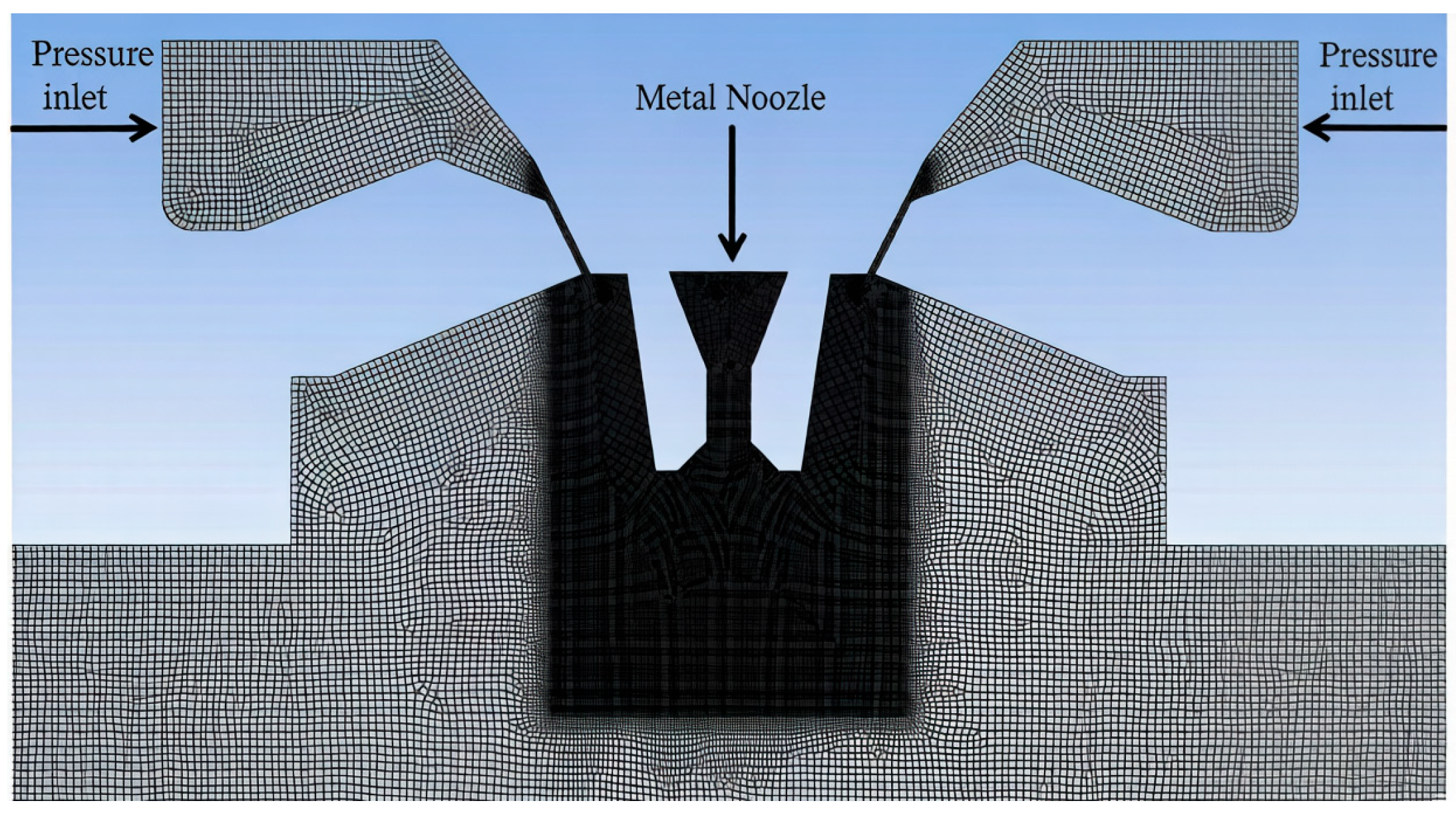
This model utilizes the Geometry module in ANSYS 2024R1 to construct a 2D model and assign boundary names. The upper boundary of the atomization chamber is defined as a Wall, with boundary conditions set to a no-slip adiabatic wall. The gas inlet is configured as a Pressure Inlet boundary, while the lower boundary of the atomization chamber is designated as a Pressure Outlet, with the outlet pressure fixed at the standard atmospheric pressure of 101.3 kPa.
As shown in
Figure 1, the atomization zone in the computational model primarily encompasses the central region below the diverter tube. Consequently, a square subdomain centered at the tube’s bottom was refined with high-resolution meshing, while adaptive meshing was applied to dynamically adjust cell sizes in non-critical regions. The mesh structure (
Figure 1) combines tetrahedral and hexahedral elements at transitional interfaces. Local grid refinement via unstructured meshing was implemented at the nozzle outlet to enhance computational accuracy.
To ensure the accuracy of the numerical simulation results and their independence from the mesh size, a mesh sensitivity analysis was conducted. Two mesh models with element sizes of 0.2 mm and 0.1 mm were constructed. Using the atomization pressure condition of 3.5 MPa as an example, the gas velocity at a specific point along the axis below the nozzle after the calculation reached a steady state was compared for the different meshes. The results show that for the key parameter, the change from the medium (0.2 mm) to the fine (0.1 mm) mesh was less than 2%. Considering the optimal balance between computational accuracy and efficiency achieved by the 0.2 mm mesh, it was ultimately selected for all simulation cases to ensure the results are unaffected by mesh size, i.e., they exhibit mesh independence.
The grid check and unit settings were configured in the General Task Page. The solver type was set to Pressure-Based, with the flow field defined as Steady and the velocity formulation as Absolute.
In fluid simulations, dynamic equations are commonly employed, with the continuity equation and momentum equation being the most widely used. Due to the high velocity of airflow after passing through the nozzle, turbulent phenomena occur in the atomization chamber.
For primary atomization, the VOF multiphase model was utilized. For steady-state VOF problems, ANSYS Fluent automatically enables the Pseudo-Transient Method and the Coupled Pressure-Velocity Coupling Scheme to enhance stability and accelerate convergence. Secondary atomization was simulated using the Discrete Phase Model (DPM), with the transient solver adopting a Pressure-Based Implicit Algorithm. The external temperature was set to 300 K. The governing equations were spatially discretized using the Finite Volume Method (FVM), with all equations solved via the Second-Order Upwind Scheme during computation. In the Monitors settings, the absolute convergence criterion was set to 1 × 10
−6 to improve computational convergence. Initialization was performed using the Hybrid Initialization method. In fluid dynamics simulations, governing equations are employed, with the continuity equation and momentum equation being the most extensively utilized. As the gas flow attains high velocities after passing through the nozzle, turbulence occurs within the atomization chamber. To achieve precise simulation of the gas flow field, the k-epsilon (k-ε) turbulence model was adopted in this numerical study [
26].
The airflow movement in the vacuum air atomization flow field follows the law of conservation of mass, and its continuity equation expression is as follows [
27]:
The ρ represents density, the t represents the time and the u represents velocity components in the i and j directions.
In the flow field of vacuum gas atomization, gas motion adheres to the law of momentum conservation. The momentum equation is expressed as follows [
28]:
The μ represents dynamic viscosity, τ denotes the Reynolds stress value, Sᵢ signifies the generalized source term in the momentum equation. All other symbols align with the definitions provided in the preceding descriptions.
The k-epsilon (k-ε) turbulence model was proposed by Launder and Spalding [
29] and is widely applied in various computational fluid dynamics (CFD) simulations.
The Gk represents the turbulent kinetic energy production term due to mean velocity gradients; Gb represents the turbulent kinetic energy production term due to buoyancy; Ym represents the contribution of fluctuating expansion in compressible turbulence to the overall dissipation rate; Sk and Sε are user-defined source terms; σk is the turbulent Prandtl number for turbulent kinetic energy k; σε is the turbulent Prandtl number for dissipation rate ε; C1ε, C2ε, and C3ε are empirical constants set to 1.44, 1.92, and 1.90, respectively; other symbols retain the same definitions as above.
The standard k-ε turbulence model was employed in this study to simulate the turbulent gas flow field. This model was selected over other available options (e.g., k-ω, RSM) primarily due to its proven robustness, computational efficiency, and well-documented performance in simulating high-Reynolds-number, fully turbulent industrial flows, which are characteristic of the gas atomization process under investigation. The k-ε model provides a reasonable balance between accuracy and computational cost for capturing the mean flow characteristics and turbulent kinetic energy distribution that are essential for analyzing primary droplet breakup in the present context.
The composition range of the experimental alloys is listed in
Table 1. The gas properties were defined as a compressible ideal gas [
30]. Relevant thermodynamic parameters are listed in
Table 2. The material used in the simulation was a novel nickel-based superalloy designed in this study, with its melt properties (e.g., viscosity, surface tension) calculated using thermodynamic software JMatPro 13, as detailed in
Table 3. The boundary conditions applied in the present model are illustrated in
Table 4.
The boundary conditions were selected to physically represent the gas atomization setup. A velocity inlet condition was applied at the gas nozzle, with the velocity magnitude calculated from the known gas mass flow rate and nozzle geometry to match the experimental operating conditions. A pressure outlet condition was set at the domain exit to simulate the ambient atmosphere into which the spray disperses. All solid walls were treated as no-slip and adiabatic, reflecting the assumption of negligible heat transfer to the containment structure during the short atomization process. These choices ensure that the computational domain accurately captures the key flow features and driving forces of the actual atomization chamber.
The gas atomization experiments were conducted using a HREMIGA100/30VIR close-coupled gas atomization powder production equipment. The atomization gas was high-purity Argon (Ar), with a purity exceeding 99.995%. The melting temperature, monitored by a calibrated B-type thermocouple with an accuracy of ±5 °C, was controlled within the range of 1300–1350 °C. The atomization pressure was precisely regulated at 3.5 MPa via a dedicated pressure control system.
The chemical composition of the as-prepared powders was verified to fall within the target specifications listed in
Table 1. Particle size analysis of the powders was performed using a Micro-Plus laser diffraction particle size analyzer. This instrument provides a measurement range of 0.1–1000 μm, with a reported repeatability (size) of better than 1% for standard reference materials. The morphological characteristics, including surface topography and sphericity, were examined using a Hitachi S-3400 scanning electron microscope (SEM) operated at an acceleration voltage of 15 kV, offering a resolution of 3.0 nm. Based on this experimental setup, the effects of key process parameters, namely atomization pressure and superheat temperature, on the resulting particle size distribution were systematically investigated.
3. Results and Discussion
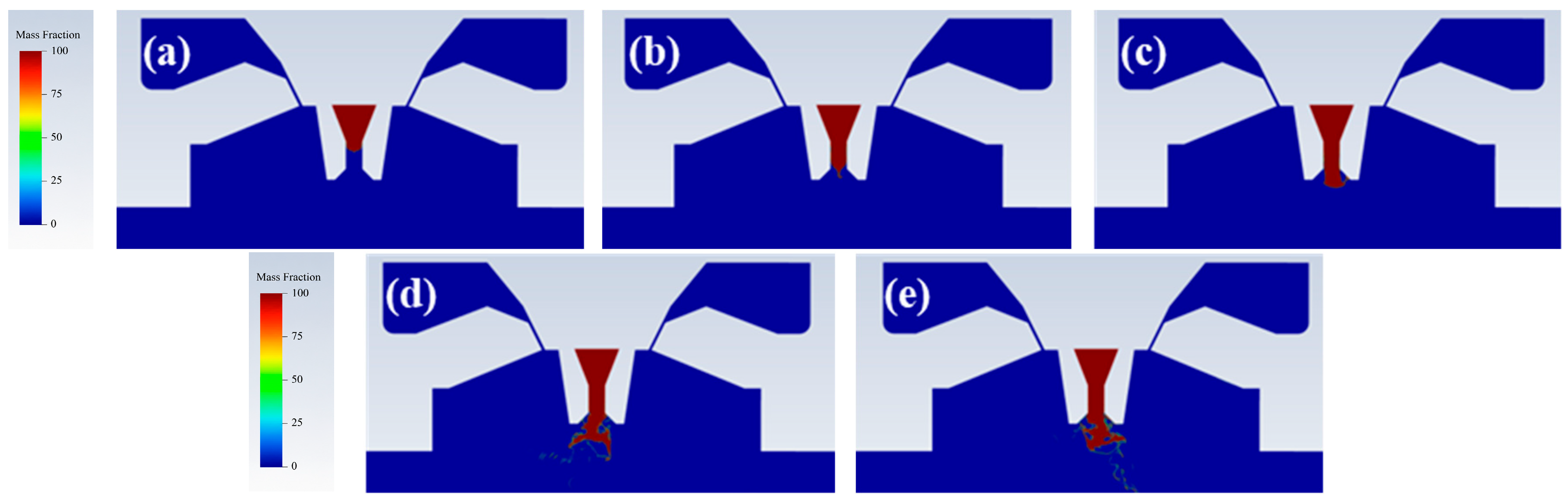
As shown in
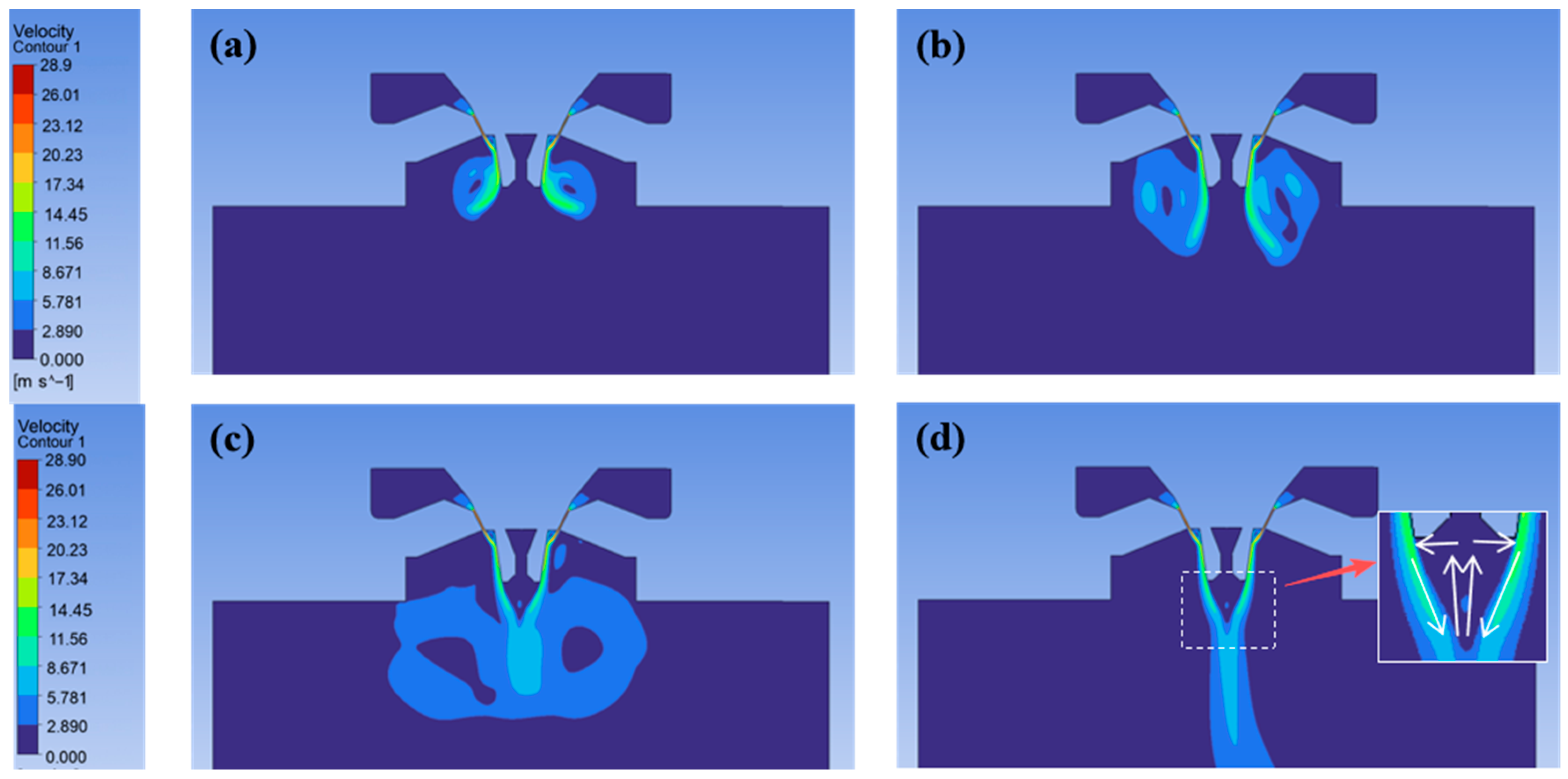
Figure 2, the flow patterns of high-temperature melt at different stages of primary atomization were analyzed through computational fluid dynamics. During the continuous stripping and fragmentation of the melt, a periodic breakup phenomenon emerges, driven by the dynamic exchange of momentum and thermal energy between the supersonic gas flow and the melt. When the melt enters the recirculation zone, it alters the internal structure of this zone, causing the Mach disk below the recirculation zone to disappear. Consequently, the recirculation zone transitions from a “closed-vortex” to an “open-vortex” state, resulting in an umbrella-shaped melt morphology.
As shown in
Figure 2a,b, the molten metal, under the influence of suction pressure and gravity, flows downward along the guide tube. After 4 ms, the molten metal is acted upon by the upward force of the gas in the recirculation zone, preventing it from continuing to flow downward and forming a liquid column. The molten metal extends from near the central axis toward the edges on both sides of the recirculation zone, beginning to form an umbrella-shaped liquid film. As shown in
Figure 3c–e, the metal melt continues to flow to both sides until it reaches the edge of the gas recirculation zone. At this point, the melt is subjected to forces from two directions: the outward air pressure of the recirculation zone and the downward force of the high-speed airflow along the nozzle. Due to the stripping effect of the high-speed airflow, the liquid film at the outermost part begins to break up. From the continuous melt at the bottom of the guide tube, large strip-shaped or ribbon-like droplets separate out. These droplets, under the influence of surface tension, begin to form larger metal droplets. Among them, large droplets that meet the breakup conditions will continue to undergo secondary fragmentation under the action of the gas.
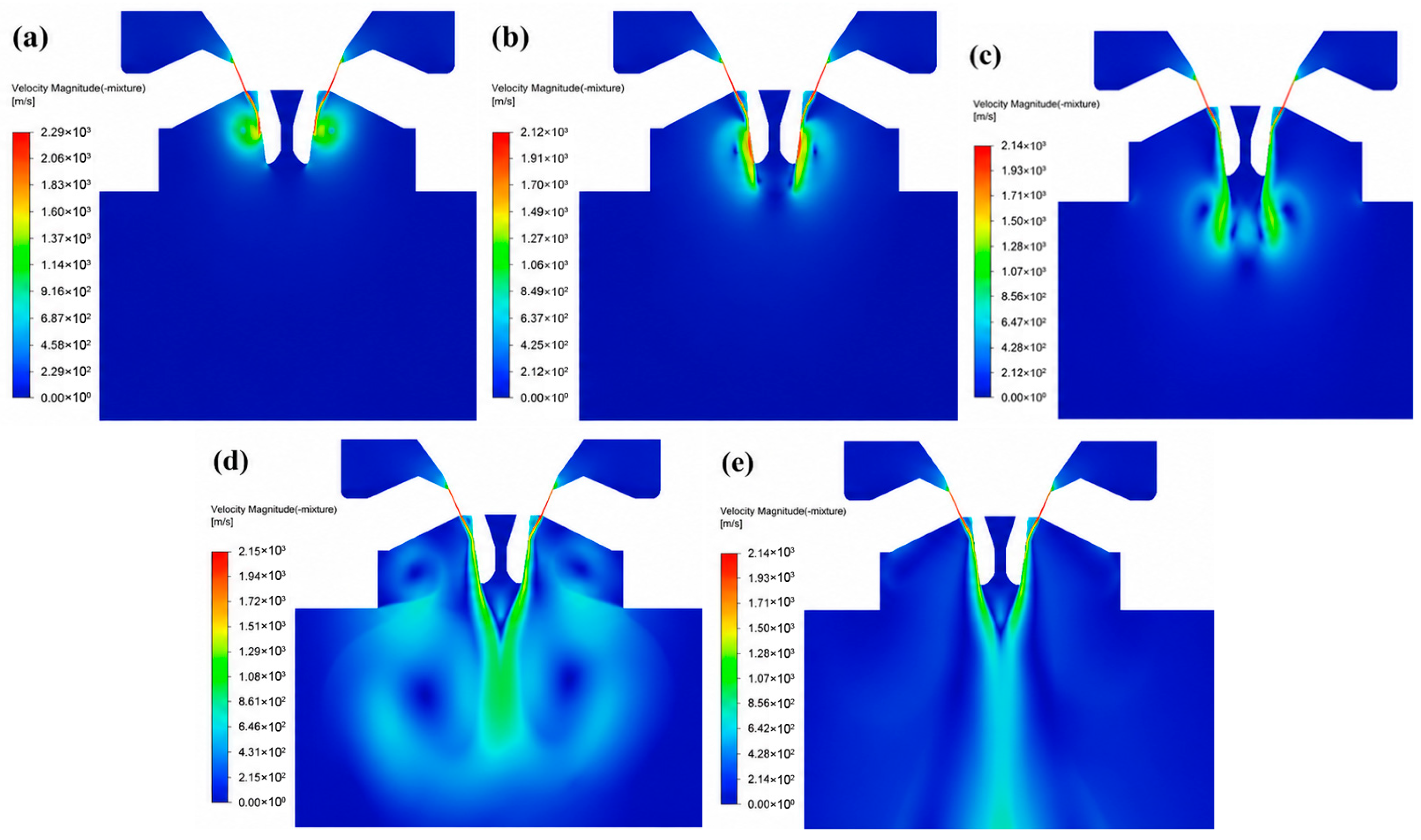
The velocity distribution of the single-phase gas flow field within the atomization region is shown. When atomizing gas enters the atomization chamber through the nozzle under high pressure, expansion waves form at the nozzle exit due to the pressure differential. Following gas expansion, the velocity increases and pressure decreases, thereby forming a supersonic flow.
Due to the difficulty in observing larger droplets generated by primary atomization during their secondary fragmentation process, to further illustrate the secondary atomization process in gas atomization preparation of nickel-based alloy powder, the Fluent module was utilized to configure the k-epsilon viscous model and discrete phase model (DPM) for secondary atomization simulation. The melt parameters from the primary atomization were maintained in the calculation. Within the DPM, the injection source was set with the break-up form specified as TAB break-up. The injection type was Group-injection, positioned below the delivery tube outlet, using three injection streams. The injected particle source parameters corresponded to the melt parameters from primary atomization. The particle diameter distribution followed a nonlinear (Rosin-Rammler) distribution, with a maximum diameter of 1 mm, minimum diameter of 0.5 mm, and mean diameter of 0.75 mm.
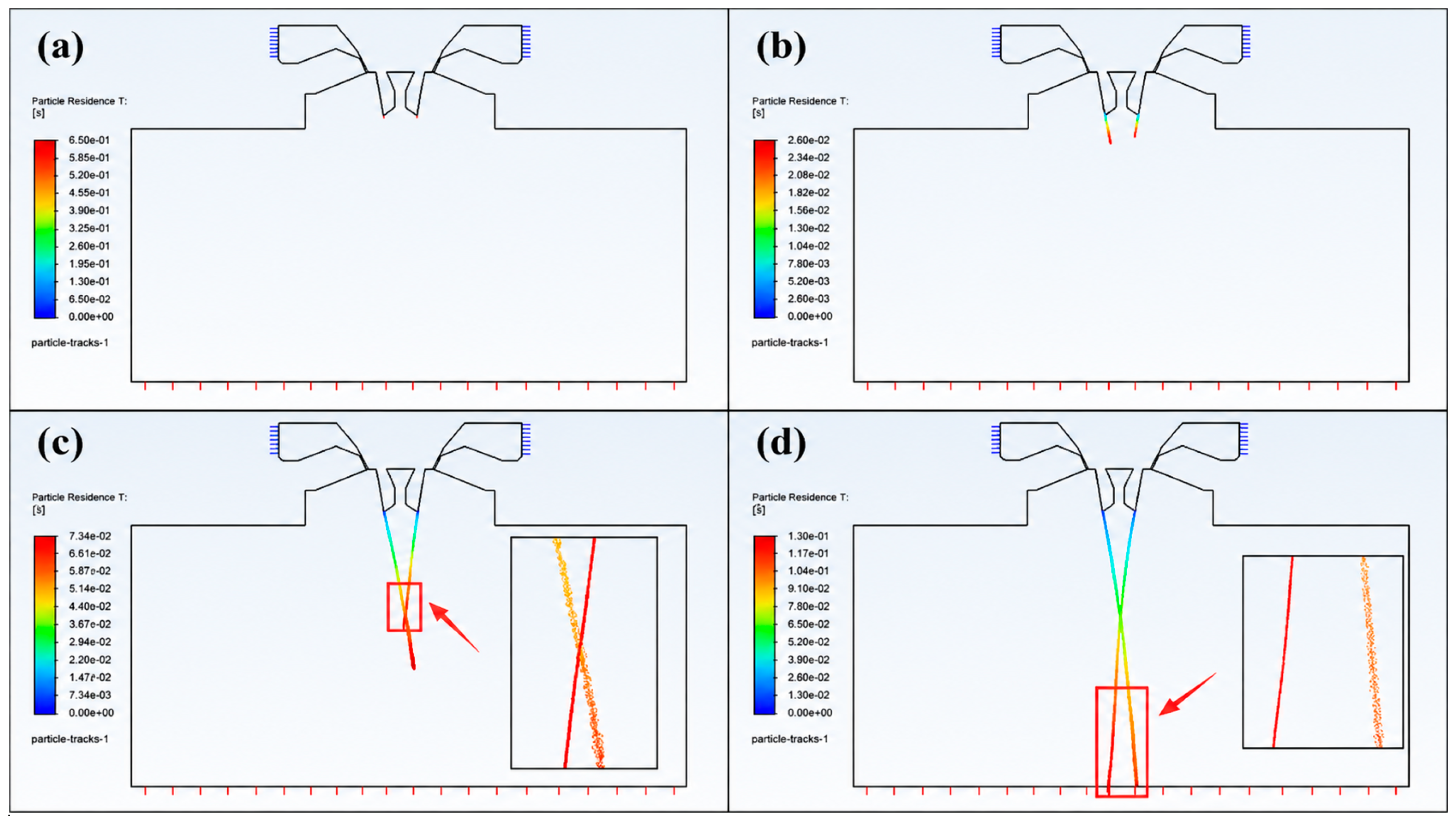
In the result processing section of Fluent software, the particle tracing option can be employed to display the flow trajectories of metal droplets during secondary atomization.
Figure 4 and
Figure 5 shows particle trajectory diagrams and flow field velocity contour maps of the secondary atomization process under different atomization pressures. The calculation statistically analyzed the fragmentation of powder particles over a period of 1.5 ms. The initial droplets, along with the powder particles, were propelled by the gas flow to the edge of the recirculation zone. Under the action of the turbulent layer, they underwent impact fragmentation and transformed into smaller droplets. These droplets were then driven by the turbulent layer to converge at the bottom of the recirculation zone before being carried downward by the gas flow, forming a symmetrical distribution.
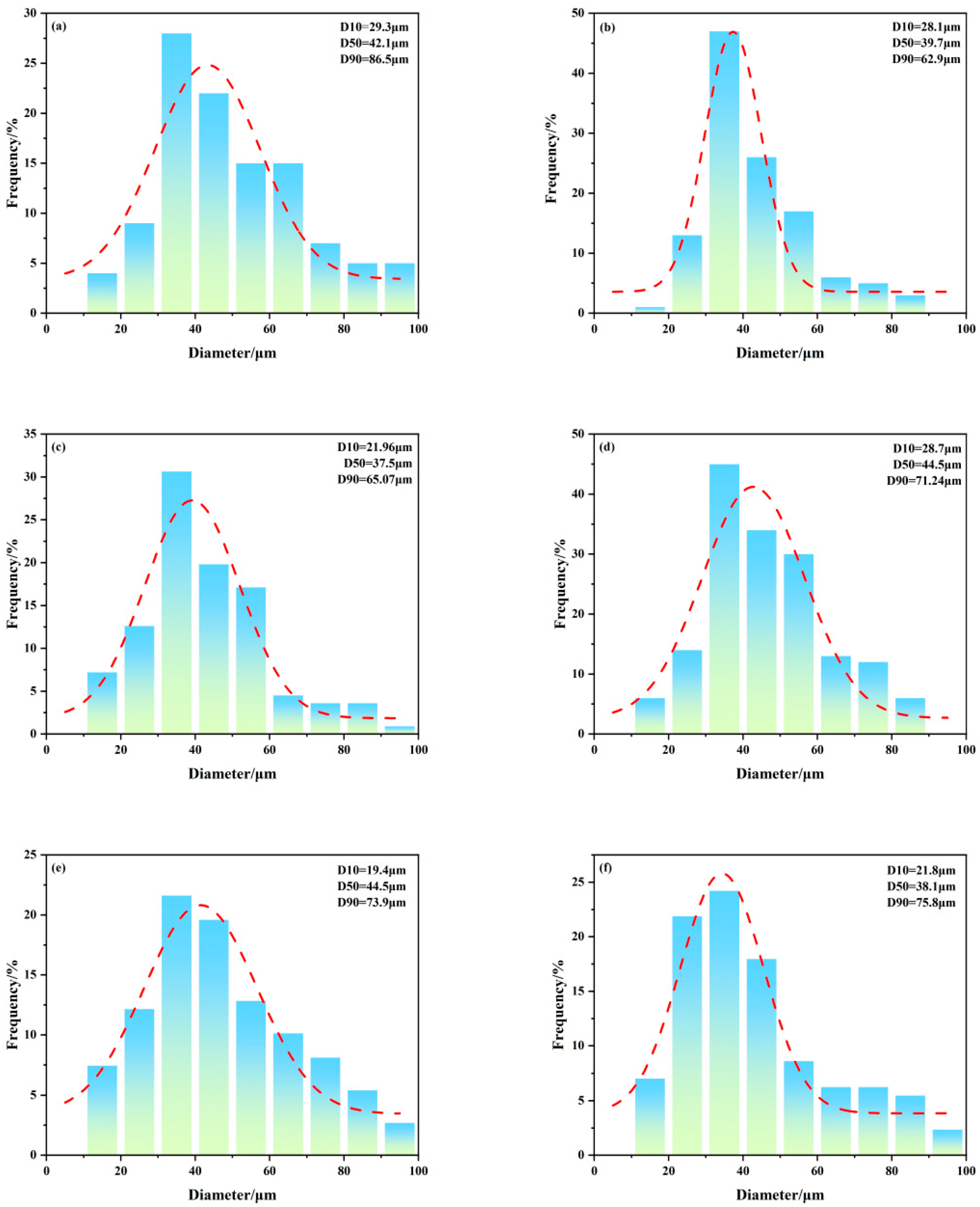
In Fluent’s Results (Reports) section, discrete phase sampling can be performed by configuring the outlet boundary (Out) of the computational domain to statistically analyze escaped particles. This yields the final powder distribution state after secondary atomization. Using Origin 2022 software to process the exported data, a histogram is generated. Nonlinear analysis is then applied to calculate the average particle size ranges and cumulative frequencies across different particle size intervals. Through this data processing, the secondary atomization particle size statistical histogram and cumulative particle size distribution curve are obtained, as shown in
Figure 6. The results indicate that the simulated powder particle size distribution ranges from 0 to 100 μm, with particles concentrated near 40 μm, exhibiting an approximately Gaussian (normal) distribution pattern. The cumulative frequency percentage was fitted to calculate the particle size distribution (PSD).
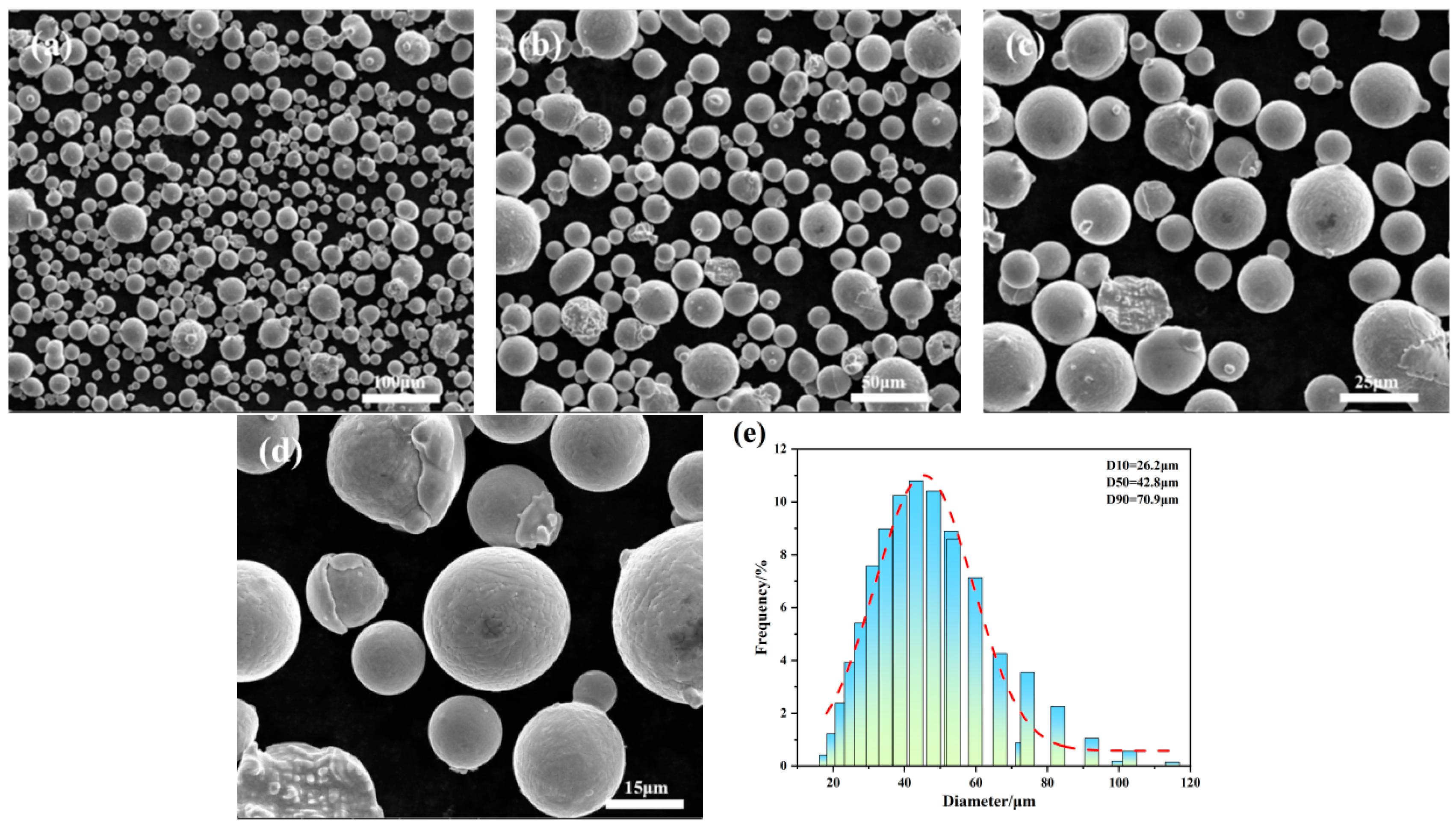
Figure 6 displays the SEM morphology of gas-atomized powders. As observed, the nickel-based superalloy powders exhibit smooth surfaces and high sphericity. However, a certain amount of satellite particles is present on the powder surfaces. During atomization, powder particles carried by the gas flow may collide with incompletely cooled molten droplets in the recirculation zone, adhering to their surfaces to form satellite particles. Closer inspection of
Figure 7 reveals that larger particles with poorer sphericity show pronounced adhesion to smaller particles. This phenomenon occurs because smaller droplets solidify rapidly due to their high surface-area-to-volume ratio and cooling rate. Larger droplets remain molten for longer periods due to slower solidification. When these solidified small particles contact the molten large droplets, surface tension drives the liquid metal to envelop the solid particles. During subsequent cooling and descent, the adhered particles solidify into the observed satellite structures.
Experimental measurements show the powder particle size distribution and cumulative curve as depicted in
Figure 7. From the graph, the powder distribution exhibits Gaussian normal distribution characteristics. The particle size range spans 0–120 μm, with the cumulative 10% particle size value at 26.2 μm and the 90% value at 70.9 μm. The median particle size D50 is 42.8 μm. The powder particle size distribution under different process parameters is shown in
Table 5.
Although an increase in atomization pressure refines the powder, the yield improvement diminishes or even declines once the pressure exceeds a critical value. When the atomization pressure surpasses 4.5 MPa, the particle size change becomes insignificant, and high pressure leads to increased satellite formation and reduced sphericity. Furthermore, excessively high pressure intensifies the suction force of the jet gas, which in turn increases the metal flow rate and reduces atomization efficiency. Simulation results indicate that 3.5 MPa likely approaches the optimal pressure value, effectively avoiding both insufficient fragmentation at low pressure and the negative effects associated with high pressure. While elevated temperature reduces melt viscosity and surface tension—promoting droplet fragmentation—temperature and pressure exhibit interactive effects. Under high pressure, increased temperature may conversely reduce the yield of fine powder. The combination of 1573 K temperature and 3.5 MPa pressure achieves optimal synergy: it ensures thorough melt fragmentation while preventing particle coarsening caused by prolonged solidification time due to excessive temperature, thereby enhancing the yield of fine powder.
Statistical data on powder particle sizes from gas atomization simulations and VIGA powder production experiments are compared in
Table 6. The results indicate D50 values of 39.7 μm (simulation) and 42.8 μm (experiment), revealing a deviation of 7.80% (a difference of 2.9 μm). Overall, simulation results fall within a 20% error margin compared to experimental data. The simulated D50 (39.7 μm) is approximately 7.8% lower than the experimental value (42.8 μm). This discrepancy can be attributed, in part, to the limitation of the current numerical model. The DPM-TAB approach models droplet breakup but does not include mechanisms for droplet collision and coalescence. In reality, downstream of the primary breakup zone, droplets may interact, collide, and merge, leading to a slightly larger median diameter than predicted by a pure breakup model.
Regarding the discrepancies between simulation and experimental results, the DPM breakup model assumes only droplet fragmentation without considering collision-coalescence between droplets, leading to smaller simulated values than experimental outcomes. In actual metal melt atomization, high-speed gas flow causes aggregation of unsolidified droplets and collision-adhesion between solidified powder and molten droplets. This results in large particles and satellite particles in experiments, explaining why experimental values exceed simulations.
4. Conclusions
This study systematically reveals the influence mechanisms of atomization pressure on the primary atomization flow field structure, secondary breakup dynamics, and powder size distribution (PSD) in the VIGA powder preparation process through a multi-scale coupled VOF-DPM-TAB model combined with gas atomization experiments of nickel-based superalloys.
(1) With increasing atomization pressure, the thickness of the ribbon-like liquid sheet in the primary atomization process and the area of fragmented droplets gradually decrease. Velocity field contours show a reflux zone exhibiting an “inverted triangular” shape, with the gas flow structure primarily composed of the reflux zone, shock layer, stagnation point, Mach disk, and high-speed gas flow beneath the reflux zone.
(2) During secondary atomization simulation, nickel-based superalloy droplets on both sides flow along the turbulent layer under gas action, converging and intersecting below the reflux zone. Over time, they detach downward toward the outlet, exhibiting an overall symmetrically intersecting distribution.
(3) The D50 values of powders obtained from gas atomization simulation and experiments are 39.7 μm and 42.8 μm, respectively, indicating close agreement between experimental and simulated results. Experiments reveal the presence of satellite spherical and ellipsoidal powders in the produced powder, along with collision and coalescence phenomena between powder particles.




 and
and