1. Introduction
Coal mining in western and northwestern China is commonly constrained by the coexistence of abundant coal resources and scarce water resources. Large-scale and high-intensity extraction in these ecologically fragile regions can disturb overlying strata, induce groundwater loss, and aggravate the contradiction between coal production and water resource conservation [
1,
2]. Coal mine underground reservoirs have therefore been developed as an important technology for water-preserved coal mining, in which the goaf formed by longwall extraction is used as an underground storage space for mine water [
3,
4]. This technology provides a practical route for retaining, storing, and reusing mine water underground, thereby reducing surface discharge and supporting ecological protection in arid and semi-arid mining areas. In the Shendong mining area and other major coal-producing regions, underground reservoir technology has gradually evolved from a conceptual water-conservation approach into an engineering system involving goaf storage spaces, coal pillar dams, artificial dams, seepage-control measures, and operational water-level management [
4,
5]. Recent reviews have further emphasised that the long-term safety of underground reservoirs is governed not only by the storage capacity of goafs, but also by the stability and tightness of dam structures that retain the stored water [
6].
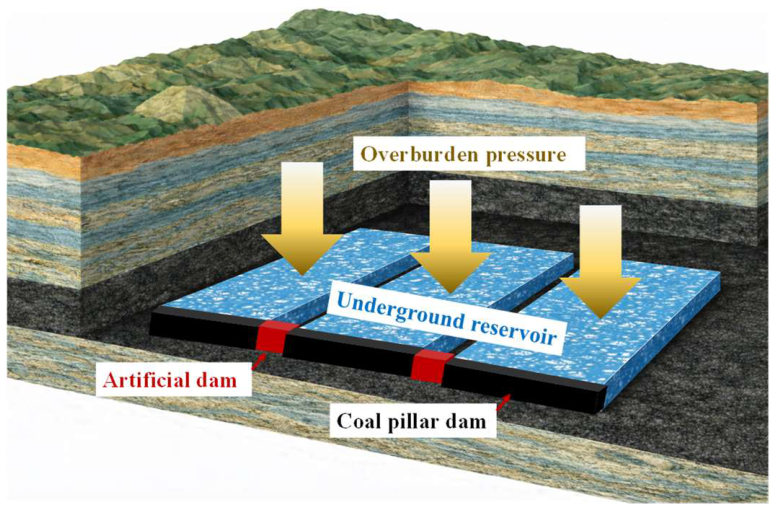
The dam system of a coal mine underground reservoir generally consists of coal pillar dams and artificial dam structures. Coal pillar dams are reserved coal or rock masses that separate adjacent goaf reservoirs or working areas, while artificial dams are constructed concrete or cementitious retaining structures used to block water flow pathways between coal pillars, roadways, and storage spaces. A recent study by Xu et al. [
7] systematically illustrated the typical underground reservoir dam system and classified artificial dams into representative flat slab, gravity, and arch-type structures;
Figure 1 provides a useful schematic reference for the structural composition and dam-type idealisation adopted in the present work. Existing studies on coal pillar dams have mainly focused on tightness, fracture development, seepage stability, long-term permeability evolution, and optimum width design. For example, Zhang et al. [
8] evaluated the long-term tightness of coal pillar dams under different reservoir connections and operating conditions, while Wang et al. [
9] investigated the damage and failure evolution of coal pillar dams affected by water immersion. Other studies have examined fracture propagation and deformation evolution under combined mining and hydraulic conditions, highlighting that seepage channels may form when fractures penetrate the dam body or its surrounding strata [
10,
11]. These studies have established an important basis for understanding coal pillar dam stability, but the mechanical response of artificial dam structures, especially under coupled hydraulic and dynamic actions, remains less well-understood.
During reservoir operation, dam structures are subjected to complex service environments involving lateral water pressure, overburden pressure, mining-induced stress redistribution, wetting–drying cycles, seepage erosion, water immersion, and cyclic loading. These factors can affect dam stability through changes in strength, stiffness, permeability, damage accumulation, and local stress concentration. Laboratory and numerical studies have shown that water immersion can degrade coal or concrete-like dam materials and reduce tightness performance [
8,
9], while creep-seepage coupling may alter the permeability and deformation characteristics of coal pillar dams over time [
12]. For artificial dams, hydro-mechanical damage modelling has been used to examine localised failure and stability under water pressure [
13], and physical and numerical simulations have been conducted to determine ultimate water levels and deformation-failure patterns [
14]. More recently, storage–drainage cycles and cyclic loading–unloading have been shown to affect the mechanical performance and stability evolution of artificial dams, indicating that reservoir operation should be treated as a time-dependent and cyclic loading process rather than a single static condition [
15,
16]. Despite these advances, most existing studies still emphasise static water-retaining performance, seepage safety, or material degradation, whereas the dynamic response of different artificial dam forms remains insufficiently explored.
This issue becomes increasingly important as coal mining extends to greater depths. With increasing burial depth, underground reservoir dams may experience higher in situ stresses, stronger mining-induced stress redistribution, larger water pressure, and more frequent dynamic disturbances. Adjacent working face extraction can impose additional stress concentration and deformation on reservoir dams, while roof breaking, fault slip, mine tremors, and regional earthquakes may generate dynamic loads that are superimposed on the existing static stress and hydraulic pressure fields. Yao et al. [
17] experimentally investigated coal pillar dam damage under dynamic loading and water absorption conditions, demonstrating that dynamic disturbance can markedly affect damage and failure behaviour. Xu et al. [
18] further studied the critical instability and dynamic loading laws of artificial dams, showing that displacement, velocity, and stress distributions are strongly affected by dynamic load intensity and source distance. These studies indicate that dynamic effects cannot be ignored in the safety assessment of deep underground reservoir dams. However, the majority of available dynamic studies have focused on either coal pillar dams or a single artificial dam configuration, and systematic comparisons between alternative artificial dam forms under coupled water-pressure and seismic loading are still limited.
The structural form of an artificial dam can strongly influence its deformation mode, stress distribution, and failure tendency. Flat slab dams are structurally simple but may be more susceptible to bending deformation and edge cracking under lateral hydraulic loading. Gravity-type dams can improve global stiffness through increased base thickness, whereas arch-type dams may redistribute lateral loads through arch-action and abutment restraint. Previous work has considered groove depth, dam size, hydro-mechanical damage, non-uniform biaxial loading, water-level capacity, and structural type effects in artificial dams [
7,
13,
14,
19,
20,
21]. Cao [
21] investigated the aseismic performance of different artificial dam structures, and Xu et al. [
7] further showed that dam type, hydraulic pressure, and top restraint jointly control displacement, stress concentration, and cracking patterns under static loading. Nevertheless, important gaps remain. First, the influence of dam type has rarely been assessed under a unified dynamic framework that simultaneously considers water pressure and seismic intensity. Second, the distinction between total displacement dominated by static hydraulic loading and dynamic displacement increment induced by seismic excitation has not been clearly quantified. Third, the mechanism by which structural stiffness and modal characteristics control the coexistence of small displacement demand and noticeable acceleration response remains insufficiently discussed.
To address these gaps, this study develops a simplified two-dimensional frame-based dynamic model to compare the behaviour of flat slab, gravity, and arch-equivalent artificial dams under coupled water-pressure and seismic loading. Two water pressure levels, 0.1 MPa and 1.0 MPa, and two seismic intensity levels, PGA = 0.1 g and PGA = 0.5 g, are considered. Four representative acceleration histories with different frequency characteristics are applied to evaluate the sensitivity of dam response to input motion. The arch dam is represented by a vertical rectangular side section with an equivalent arch-action lateral restraint, allowing the plan-view arch effect to be incorporated without incorrectly imposing arch curvature in the vertical side section. The analysis first evaluates effective modal frequencies under different water-pressure conditions and then compares peak total displacement, peak dynamic increment, peak absolute acceleration, tensile stress demand, and normalised response ratios among the three dam types. Through this approach, the study aims to clarify how water pressure, seismic intensity, and structural form jointly govern the dynamic response of underground reservoir artificial dams, and to provide a mechanistic basis for dam-type selection and safety evaluation in deep coal mine underground reservoirs.
2. Methodology
2.1. Model Idealisation and Structural Configurations
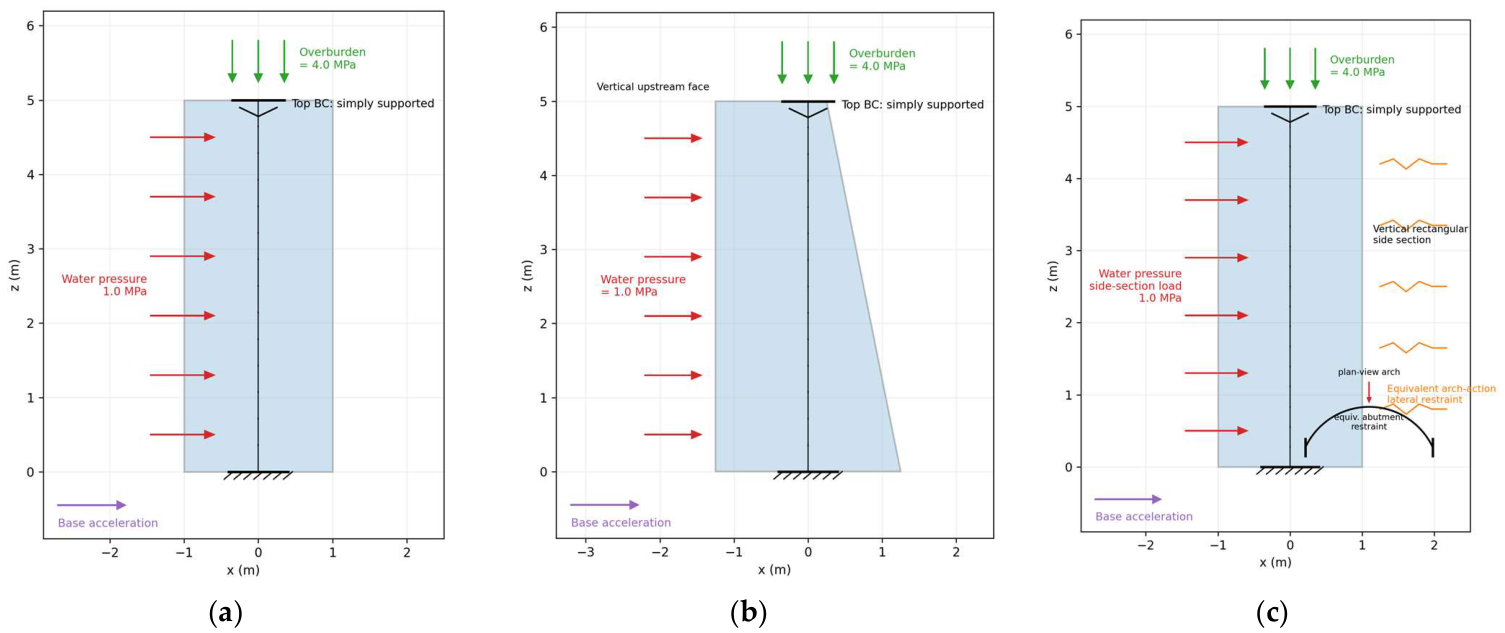
A simplified two-dimensional dynamic analysis framework was developed to compare the response of three representative dam structural forms under coupled water-pressure and seismic loading. The intention of the model is to provide a consistent comparative framework rather than a full three-dimensional simulation of a dam-rock-water system. The three investigated configurations are a flat slab dam, a gravity-type dam and an arch-type dam, as shown in
Figure 2. The flat slab dam represents a vertical wall-like structure with uniform thickness. The gravity dam represents a section with increasing thickness towards the base. For the arch dam, the vertical side section is kept rectangular, while the plan-view arch effect is introduced through an equivalent lateral restraint and enhanced flexural stiffness. This avoids representing the arch as a curved vertical section, which would be physically inconsistent with the actual plan-view nature of arch action.
All models have a height of 5.0 m and an out-of-plane width of 6.0 m. The flat slab and arch dam use a constant thickness of 2.0 m, whereas the gravity dam thickness varies linearly from 2.5 m at the base to 1.5 m at the top. The sectional area and second moment of area are calculated as
For the gravity dam, the thickness at height
is defined as
For the equivalent arch dam, the initial flexural stiffness is increased using an arch-stiffness factor, and additional lateral springs are distributed along the height to represent abutment restraint:
where
is the tributary height associated with node
. The bottom node is fully fixed, while the top node is restrained in horizontal translation but remains free in vertical translation and rotation. This top boundary condition approximates the lateral confinement from surrounding rock or structural cover without imposing a fully fixed upper boundary.
The equivalent arch-stiffness parameters should be interpreted as modelling parameters rather than calibrated material or structural constants. Because project-specific field measurements or three-dimensional arch dam calibration data are unavailable, the arch-stiffness factor and distributed lateral spring stiffness were selected to represent a moderate level of arch-action restraint within the simplified two-dimensional framework. The purpose of these parameters is to incorporate, in an approximate manner, the additional lateral load-transfer capacity and abutment restraint associated with arch action, while maintaining the same side-section geometry used for comparison with the flat slab dam. Therefore, the arch-equivalent model is used to evaluate relative response trends rather than to reproduce the exact behaviour of a specific arch dam. To examine the influence of these assumptions, a parameter-sensitivity analysis was conducted by varying the arch-stiffness factor and lateral spring stiffness.
The material is assumed to be reinforced concrete with an elastic modulus of 30 GPa, density of 2500 kg/m
3, Poisson’s ratio of 0.20 and damping ratio of 5%. The tensile and compressive strengths are taken as 2.5 MPa and 30 MPa, respectively (
Table 1). A simplified stiffness degradation model is used to represent tensile cracking and compressive softening. The tensile stress demand is estimated from the maximum element end moment, and the compressive stress demand is obtained by adding the overburden pressure to the bending-induced compressive stress:
When , the effective flexural stiffness is reduced using an equivalent cracked-stiffness ratio, while compressive softening is activated when , with the stiffness gradually reduced to a prescribed minimum value. It should be emphasised that this degradation rule is an equivalent engineering approximation rather than a full cyclic reinforced-concrete constitutive model. The method is intended to capture the first-order influence of tensile overstress and compressive stress demand on global flexural stiffness within the simplified frame-based framework. It does not explicitly model crack initiation and propagation, crack opening–closure, reinforcement yielding, bond-slip, stiffness recovery during unloading, or hysteretic energy dissipation under cyclic loading. Therefore, the calculated cracked elements and tensile stress exceedance should be interpreted as damage tendency indicators rather than as direct predictions of physical crack patterns. To assess the influence of this assumption, a parameter-sensitivity analysis was conducted by varying the cracked-stiffness ratio and the compressive softening threshold.
2.2. Dam Element Formulation and Global Assembly
Each dam is discretised using two-dimensional Euler–Bernoulli frame elements. Each node has three degrees of freedom, namely, horizontal displacement, vertical displacement and rotation, written as
. The element local stiffness matrix is
The consistent element mass matrix is
The local matrices are transformed into the global coordinate system using the element transformation matrix
, and the global stiffness and mass matrices are assembled as
The lateral water pressure is converted into a uniform distributed line load using the out-of-plane width:
The equivalent nodal load vector is obtained from the consistent load formulation. The vertical overburden pressure is not applied as an explicit nodal force in the dynamic equation; instead, it is included in the stress evaluation to account for the compressive stress state caused by overlying strata or structural cover. The adopted overburden pressure is 4.0 MPa.
2.3. Loading Programme, Static Analysis and Modal Analysis
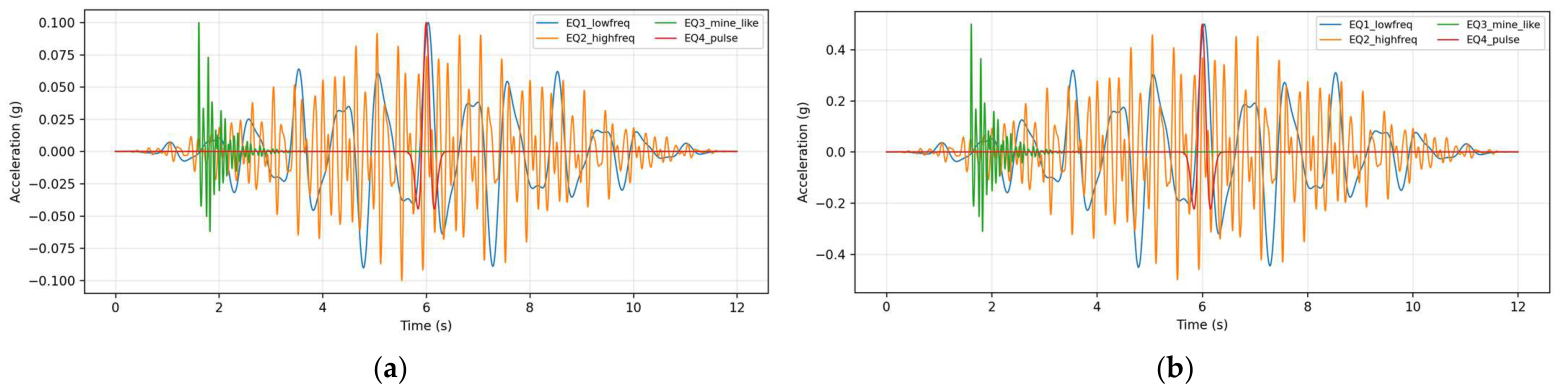
Two lateral water-pressure levels are considered: 0.1 MPa and 1.0 MPa. The former represents a moderate pressure condition, whereas the latter represents a high confined-water-pressure condition. Four horizontal acceleration histories are used as input motions. They represent a low-frequency excitation, a high-frequency excitation, a mine-seismic-like decaying burst and a pulse-like excitation (
Figure 3). Each acceleration history was scaled to two target PGA levels, 0.1 g and 0.5 g, using the following amplitude-scaling relationship:
Here, is the original acceleration history, is the scaled acceleration history, PGA is the target acceleration level expressed in units of g, and g is gravitational acceleration.
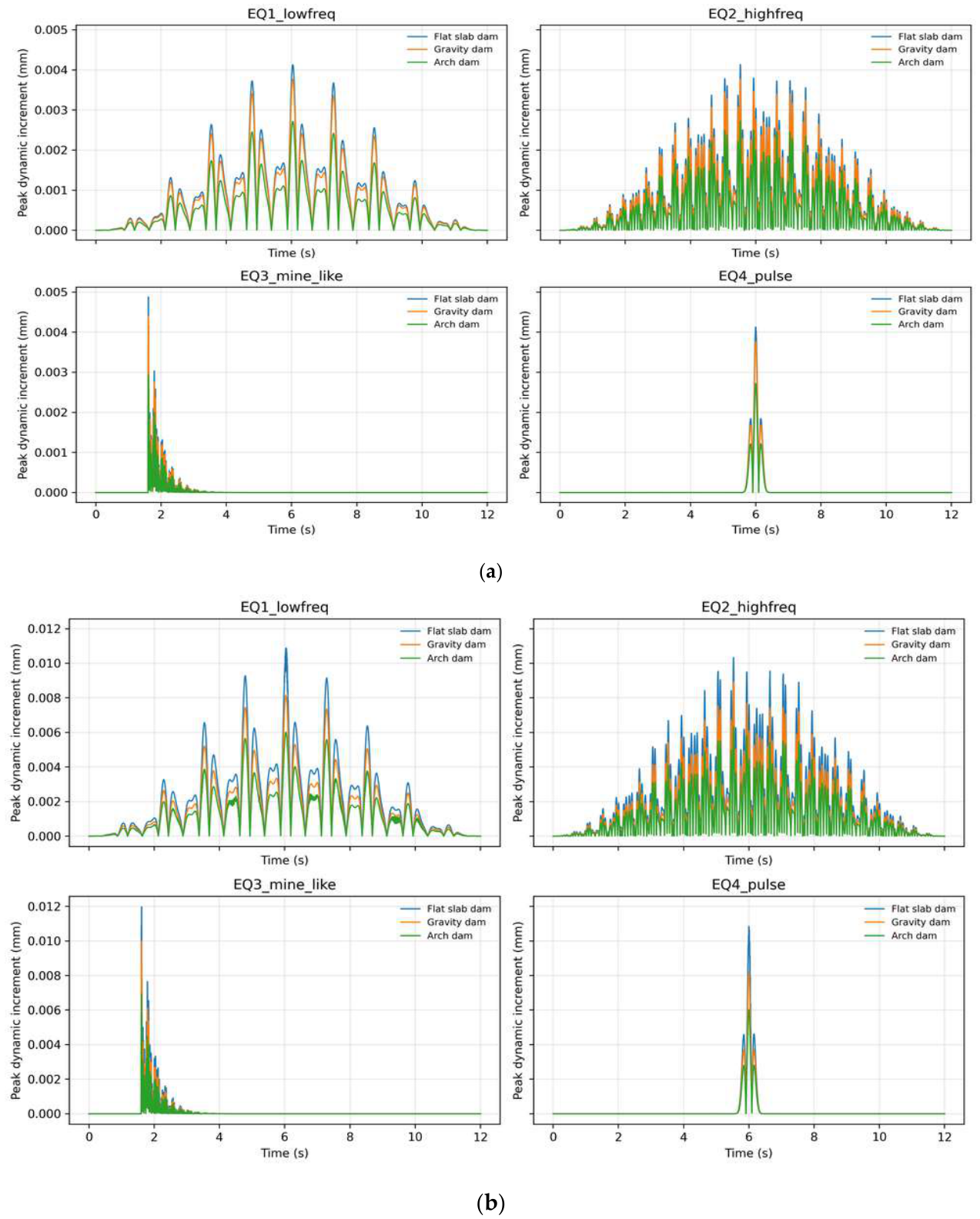
To make the input definition more transparent, the spectral and duration characteristics of the four motions were quantified using dominant frequency, mean frequency, Arias intensity, and significant duration D5–95. The four motions were designed to cover contrasting excitation characteristics, including low-frequency, high-frequency, short-duration mine-seismic-like, and pulse-like inputs. The dominant frequencies of EQ1, EQ2, EQ3, and EQ4 were approximately 1.17 Hz, 5.00 Hz, 12.00 Hz, and 2.50 Hz, respectively, confirming the intended differences in frequency content among the four excitation types. In addition, the significant duration D5–95, calculated from cumulative Arias intensity, was used to distinguish relatively long-duration harmonic-type inputs from short-duration burst and pulse-type motions. This classification was adopted to ensure that the dynamic analysis considered different frequency contents, duration characteristics, and transient loading patterns within a controlled PGA-scaling framework, while maintaining a simplified and comparative seismic input definition.
For each water-pressure condition, nonlinear static analysis is first performed to obtain the initial displacement field and the corresponding degraded stiffness state. The reduced static equilibrium equation is
After each static solution, element end forces are recovered, stress demands are evaluated using Equation (5), and the effective flexural stiffness is updated. The iteration is terminated when the relative change in displacement satisfies
Modal analysis is subsequently performed using the updated stiffness matrix so that the effective frequencies reflect the stiffness degradation induced by water pressure. The undamped eigenvalue problem is
Rayleigh damping is adopted in the dynamic analysis:
The coefficients
and
are determined from the first two effective modal frequencies and a target damping ratio of 5%:
The analysis programme consists of 48 dynamic cases, combining two water pressure levels, two PGA levels, three dam types and four input motions. The cases are summarised in
Table 2.
2.4. Nonlinear Dynamic Analysis and Response Indices
The dynamic response is computed using the Newmark average acceleration method with
and
. The equation of motion for the relative response under horizontal base acceleration is
where
is the influence vector associated with horizontal base excitation. The influence vector assigns unit participation to horizontal translational degrees of freedom and zero participation to all other degrees of freedom. At each time step, the Newmark effective stiffness matrix is
The dynamic analysis is carried out using a time step of 0.002 s and a total duration of 12.0 s. During the dynamic analysis, the effective element stiffness is updated based on the combined static and dynamic displacement field, allowing tensile overstress and stiffness degradation to influence the subsequent dynamic response.
The total lateral displacement is defined as the sum of the nonlinear static displacement and the dynamic displacement increment:
The peak total displacement and peak dynamic increment are evaluated as
The absolute acceleration is obtained by adding the ground acceleration to the relative structural acceleration:
Two displacement-based dynamic amplification factors are used to distinguish the total displacement response from the pure dynamic increment:
Peak tensile stress, peak compressive stress and maximum bending moment are extracted from the element end-force results over the full time history. In addition to absolute response quantities, the gravity and arch dam responses are normalised by the corresponding flat slab response under the same loading condition:
This normalisation provides a direct measure of the relative performance of the gravity and arch-type configurations compared with the flat slab dam. A value smaller than unity indicates response reduction relative to the flat slab, whereas a value larger than unity indicates response amplification. The interpretation of the results is therefore based on both the absolute response values and the normalised response ratios.
2.5. Modal Verification and Interpretation
To further examine the dynamic characteristics of the simplified framework, an approximate modal-frequency verification was performed using equivalent Euler–Bernoulli beam theory. The first-order natural frequencies of equivalent cantilever and fixed-pinned beam systems were calculated and compared with the numerical modal results obtained from the frame-element model. The comparison showed generally consistent frequency levels under the adopted stiffness assumptions and boundary conditions.
It should be noted that the calculated modal frequencies are relatively high compared with those of conventional large-scale dam–foundation–reservoir systems. This is mainly because the present model represents a relatively small and stiff underground artificial dam system with a characteristic height of approximately 5 m, strong top and bottom constraints, and simplified equivalent beam idealisation. In addition, the current framework does not explicitly consider fluid–structure interaction, hydrodynamic added mass, surrounding rock flexibility, or interface deformation, all of which would reduce the effective system stiffness and modal frequencies in real engineering conditions. Therefore, the present modal analysis is primarily intended to support comparative dynamic assessment among different dam types within a consistent simplified framework, rather than to reproduce the exact modal characteristics of field-scale underground reservoir systems.
To evaluate the influence of the simplified stiffness degradation rule, a parameter-sensitivity analysis was performed for the cracked-stiffness ratio and the compressive softening threshold. The cracked-stiffness ratio was varied as rt = 0.25, 0.35, and 0.50, while the compressive softening threshold was varied as 0.5 fc, 0.6 fc, and 0.7 fc. The baseline values used in the main analysis were rt = 0.35 and 0.6 fc. The sensitivity analysis was not intended to calibrate a detailed cyclic damage model, but to examine whether the main comparative trends among dam types were robust against reasonable changes in the equivalent stiffness degradation parameters.
4. Discussion
4.1. Interpretation of the Water-Pressure and Seismic Effects
The results demonstrate that water pressure and seismic intensity control different aspects of the dam response. The peak total displacement is mainly governed by the static water-pressure level, whereas the seismic intensity primarily controls the dynamic displacement increment and the absolute acceleration response. This distinction is important because the total response contains both the static deformation caused by water pressure and the incremental deformation induced by earthquake excitation. The relationship can be expressed as:
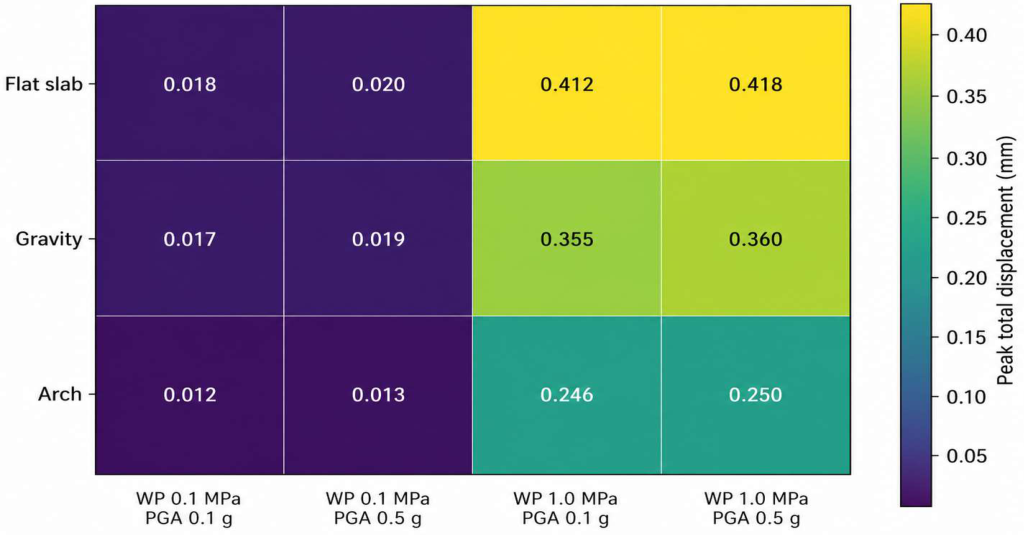
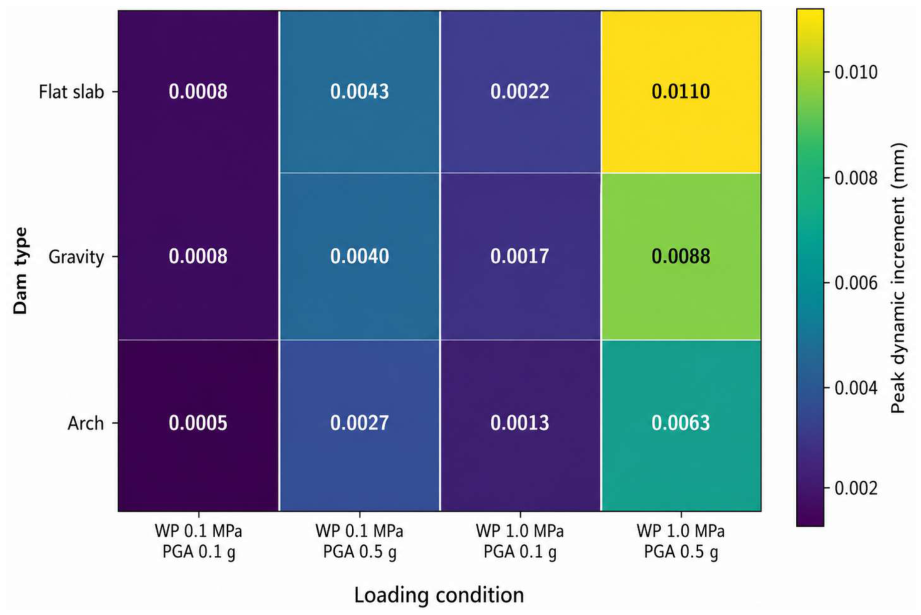
When the water pressure is increased from 0.1 MPa to 1.0 MPa, the static component becomes dominant, and the resulting peak total displacement increases substantially. By comparison, increasing PGA from 0.1 g to 0.5 g has only a minor effect on total displacement under high water pressure because the dynamic increment remains small relative to the static displacement. However, the same PGA increase produces a clear increase in the dynamic increment. This explains why
Figure 5 is mainly controlled by the water pressure level, whereas
Figure 6 exhibits a much stronger dependence on PGA.
The high-water-pressure case also activates the stiffness degradation mechanism in the simplified model. Once the tensile stress exceeds the concrete tensile strength, the element flexural stiffness is reduced, which further increases the displacement response. Therefore, the large increase in total displacement under 1.0 MPa is not merely a linear consequence of the larger lateral load; it is also affected by stress-induced stiffness degradation. This mechanism is especially relevant for interpreting the strong contrast between the 0.1 MPa and 1.0 MPa displacement matrices.
4.2. Role of Equivalent Arch-Action Restraint
The arch dam was represented by a vertical rectangular side section with equivalent arch-action lateral restraint. This modelling strategy was adopted because the physical arch curvature of a real arch dam occurs in plan view rather than in the vertical side section. The equivalent lateral springs and increased flexural stiffness were therefore introduced to represent the additional restraint provided by abutments and arch action without introducing an artificial curved vertical centreline.
It should be emphasised that the equivalent arch-action parameters were not calibrated against a specific engineering case. They were introduced to provide a controlled representation of the additional lateral restraint and stiffness enhancement expected from arch action within the simplified frame-based model. The sensitivity analysis showed that increasing the arch-stiffness factor or lateral spring stiffness reduced the displacement response and increased the effective modal frequency of the arch-equivalent dam, as expected. However, within the tested parameter range, the relative displacement-reduction trend of the arch-equivalent dam compared with the flat slab dam remained unchanged. Therefore, the conclusions regarding the arch-type response should be interpreted as comparative trends under an equivalent arch-action representation, rather than as calibrated predictions for a particular arch dam.
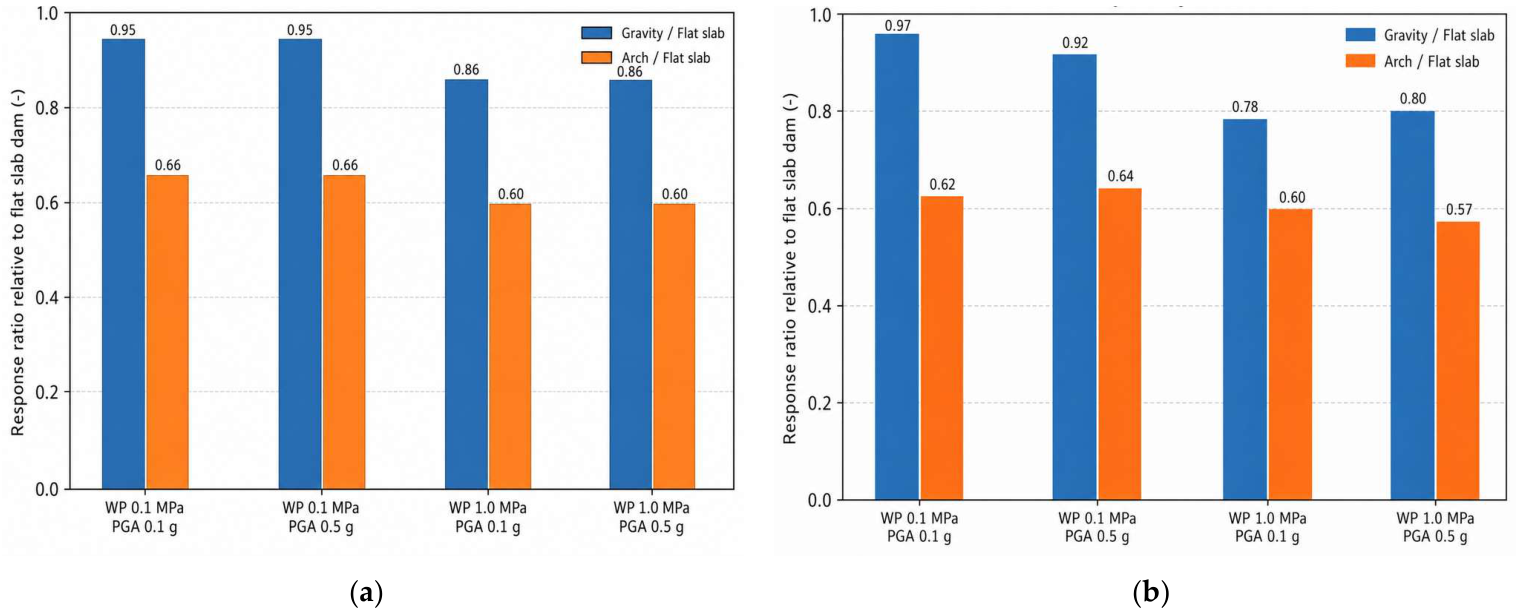
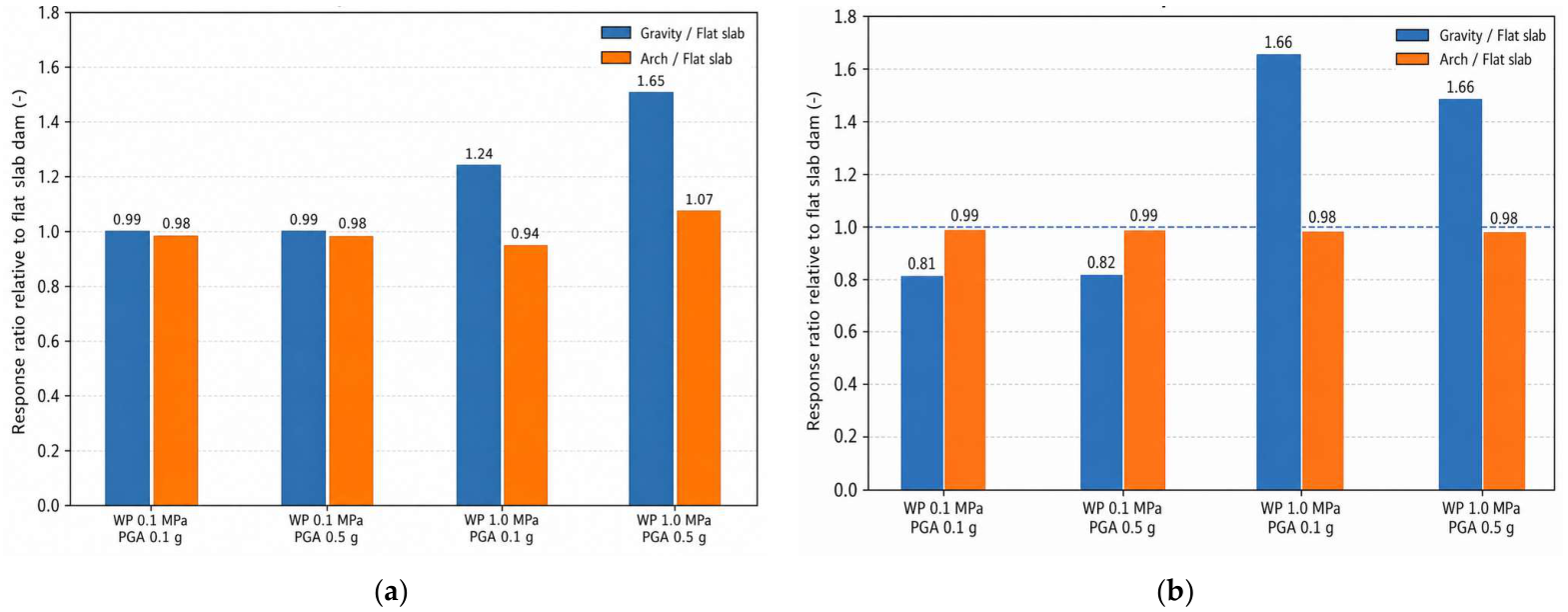
The normalised displacement results in
Figure 7 show that this equivalent arch-action restraint is effective in reducing both total displacement and dynamic displacement increment. The arch dam consistently has the smallest displacement response across all water-pressure and PGA combinations. Relative to the flat slab dam, the arch dam reduces peak total displacement to approximately 60–66% and reduces peak dynamic increment to approximately 57–64%. This reduction is larger than that achieved by the gravity dam, indicating that lateral restraint is more efficient than sectional thickening alone for controlling lateral displacement in the present simplified framework.
At the same time, the arch dam should not be interpreted as universally superior in all response indices. Although its displacement response is the smallest, its peak acceleration and tensile stress are not always the lowest. This highlights the importance of evaluating multiple response measures when comparing structural forms under coupled static and dynamic loading.
4.3. Coexistence of Small Displacement and Noticeable Acceleration
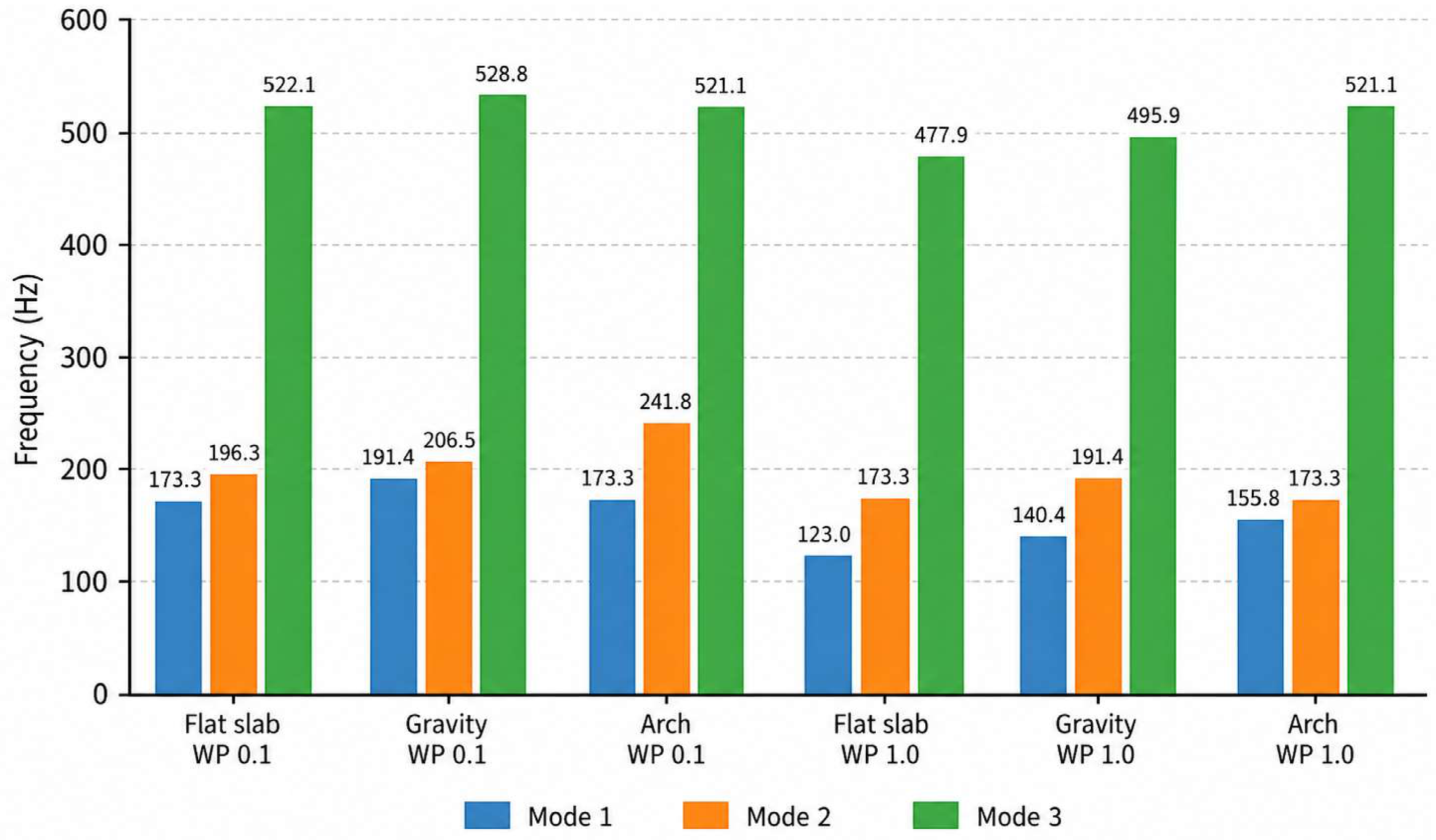
One of the most important observations is that the displacement demand remains small, while the absolute acceleration response can be noticeably amplified, particularly under high water-pressure and strong seismic excitation. This response pattern can be explained by the modal characteristics of the models. The first-mode frequencies are in the range of approximately 123–191 Hz after static stiffness updating, which is much higher than the dominant frequency content of the imposed input motions. The system therefore behaves as a stiff short-height structure, and significant displacement resonance is not expected.
A useful interpretation is obtained by considering the frequency ratio between the structural frequency and the dominant input frequency:
where
is the first natural frequency of the dam model and
is a characteristic frequency of the input motion. When
is much larger than unity, displacement amplification is limited because the input frequency is far from the displacement-resonant range of the structure. However, the constrained structural system can still exhibit noticeable absolute acceleration because the inertia response is directly associated with the imposed base acceleration and the high stiffness of the system.
This interpretation is consistent with
Figure 3 and
Figure 8. The high modal frequencies explain why the dynamic displacement increments are small, while the acceleration ratios can exceed unity under the most severe high-pressure cases. The gravity dam exhibits the largest acceleration amplification under 1.0 MPa and PGA = 0.5 g, suggesting that the interaction between sectional stiffness distribution, stress-induced stiffness degradation and inertial response can lead to acceleration demand that is not directly reflected by the displacement response.
4.4. Tensile Overstress and Stiffness Degradation Under High Water Pressure
The tensile stress results indicate that high water pressure can push the structural response beyond the nominal tensile capacity of concrete in the simplified model. Under 1.0 MPa water pressure, peak tensile stresses reach approximately 4.1–4.3 MPa for the flat slab and arch dams and exceed 7.0 MPa for the gravity dam. Since the adopted tensile strength is 2.5 MPa, these values imply tensile overstress and trigger the stiffness degradation mechanism.
The stress-based stiffness reduction can be summarised as:
where
is the degraded flexural stiffness,
is the initial flexural stiffness,
is the cracking-related stiffness ratio,
is the tensile stress demand and
is the tensile strength. In the present model, the stiffness degradation is a simplified representation of tensile damage rather than a full crack propagation model.
The gravity dam develops the highest tensile stress under high water pressure in the present frame-based idealisation. To examine the influence of the beam idealisation on the tensile stress demand of the gravity dam, a simplified two-dimensional plane-stress benchmark was additionally conducted using the same gravity section, water pressure and boundary condition. The comparison showed that the beam-based tensile stress demand and the plane-stress maximum principal tensile stress were of the same order of magnitude, although local stress distributions differed between the two models. This confirms that the frame model can be used as a comparative stress-demand indicator, but it should not be interpreted as a detailed prediction of local tensile stress in the gravity section. A real gravity dam resists lateral loading through a more complex two-dimensional or three-dimensional stress redistribution mechanism involving self-weight, base compression, contact conditions and foundation interaction. These mechanisms are not fully represented by the vertical frame-element idealisation used here. Therefore, the result should be described as a high tensile stress demand within the present simplified framework, rather than as evidence that gravity dams are generally the most vulnerable structural form.
Finally, in a real three-dimensional arch dam, arch action would be expected to transfer part of the lateral water pressure into compressive thrust along the arch direction, thereby reducing bending demand compared with a flat slab dam. In the present simplified framework, however, the arch effect is represented by equivalent lateral restraint applied to a two-dimensional vertical section rather than by an explicit three-dimensional arch geometry. Consequently, the model captures the displacement-reducing effect of arch restraint, but the bending moment and tensile stress calculated from the vertical frame elements remain affected by local restraint reactions. The tensile stress of the arch-equivalent dam should therefore be interpreted as a simplified stress-demand indicator within the equivalent model, not as a direct representation of the true three-dimensional stress field of an arch dam.
4.5. Mechanistic Synthesis
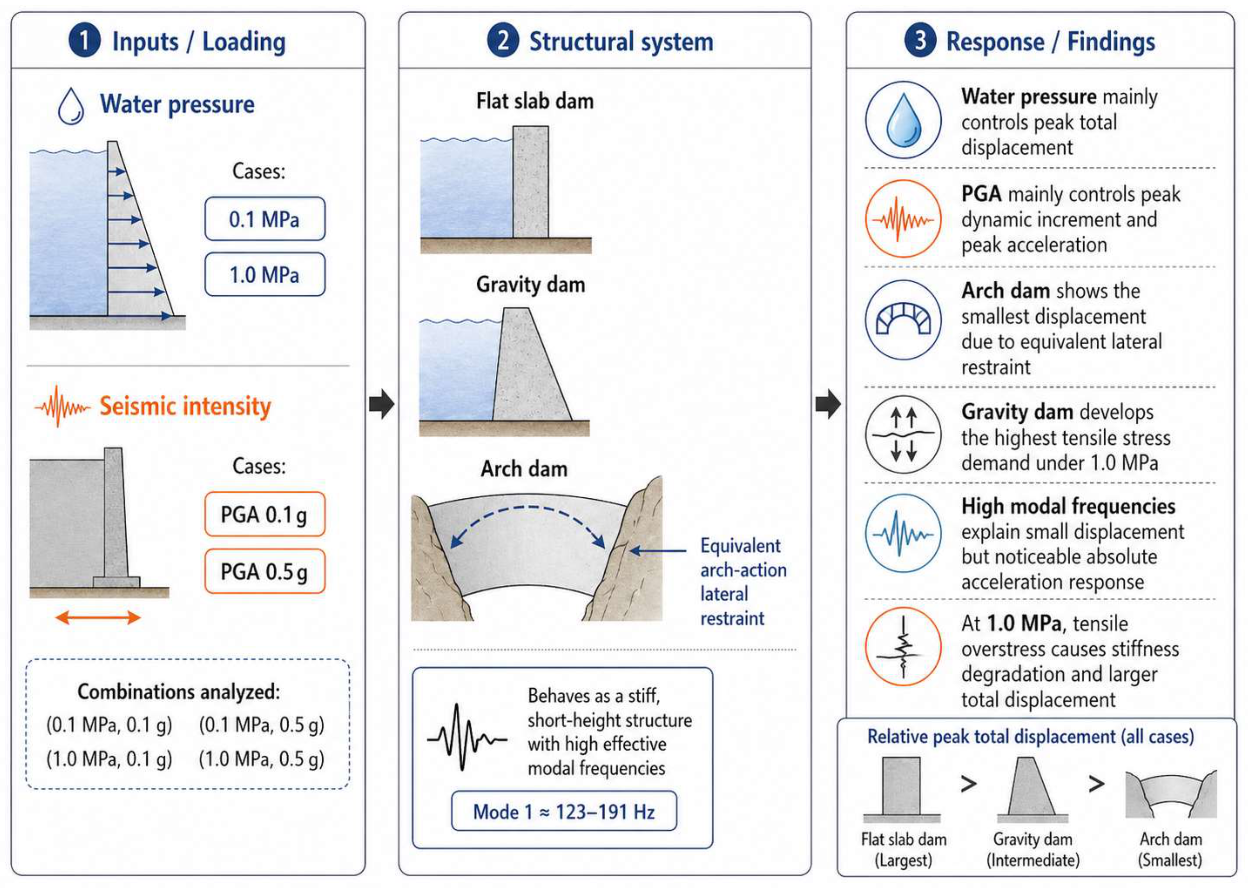
The governing mechanisms are summarised in
Figure 10. Water pressure mainly controls peak total displacement because it determines the initial static deformation and, under high pressure, can induce stiffness degradation. PGA mainly controls the dynamic displacement increment and peak absolute acceleration because these responses are directly associated with the imposed base acceleration. The arch-type dam exhibits the smallest displacement because of the equivalent lateral restraint, whereas the gravity-type dam develops higher tensile stress demand under high water pressure in the present simplified frame model. Finally, the high effective modal frequencies explain why the system can exhibit small displacement demand while still showing noticeable absolute acceleration response.
The comparative results further suggest that the structural advantage of the arch-equivalent dam becomes more pronounced under relatively high water-pressure conditions. Under the lower water-pressure case (0.5 MPa), the displacement and stress differences among the three dam types remain relatively limited. However, when the water pressure increases to 1.0–1.5 MPa, the arch-equivalent configuration shows a clearer reduction in global lateral displacement compared with the flat slab dam because of the additional restraint and load-redistribution effect associated with arch action. Therefore, within the simplified framework adopted in this study, the arch-type configuration appears more suitable for relatively high hydraulic loading conditions. Nevertheless, local edge stress concentration and boundary restraint effects should still be carefully considered in practical design.
The mechanistic interpretation also clarifies the role and scope of the simplified model. The model is most useful for comparing relative response trends and identifying dominant control mechanisms. It should not be regarded as a substitute for a full three-dimensional dam–foundation–water interaction model. Nevertheless, it provides a transparent framework for explaining how water pressure, seismic intensity and structural form jointly affect displacement, acceleration and tensile stress demand.
4.6. Limitations
This study provides a simplified comparative framework for evaluating the dynamic response of different dam structural forms under coupled water-pressure and seismic loading; however, several limitations should be acknowledged. First, the model is a two-dimensional frame-based idealisation and does not fully reproduce the three-dimensional behaviour of real dam–rock–water systems. In particular, the arch dam was represented using an equivalent lateral restraint rather than an explicit three-dimensional arch geometry, and the effects of realistic abutment deformation, surrounding rock interaction and dam–foundation contact were not explicitly simulated. For the gravity-type section, the Euler–Bernoulli beam idealisation cannot fully capture two-dimensional stress redistribution within the trapezoidal section. The calculated tensile stress should therefore be regarded as a conservative stress-demand indicator for comparative purposes, rather than as an exact local stress prediction. The implications of these simplifications should be explicitly recognised. By neglecting fluid–structure interaction and hydrodynamic pressure, the present model does not account for the added-mass effect of stored water or for the frequency-dependent dynamic water pressure acting on the dam surface during seismic excitation. This may lead to an underestimation of hydrodynamic demand and may also affect the effective modal properties of the coupled system. Similarly, the surrounding rock mass and dam–rock interface are represented only through idealised boundary restraints. As a result, rock-mass flexibility, interface deformation, local opening or sliding, and radiation damping are not explicitly considered. These factors would generally reduce the effective stiffness of the dam–rock system, alter stress transfer near the abutment and boundary regions, and potentially lower the modal frequencies compared with those obtained from the simplified frame model. Similar soil/rock–structure interaction effects have also been reported in previous seismic analyses of underground structures, where the interaction between the surrounding medium and the structure was shown to significantly influence the dynamic response and stress redistribution [
22]. Therefore, the numerical values reported in this study should be interpreted as response indicators within a comparative simplified framework, rather than as direct predictions of absolute field-scale seismic response.
Second, the seismic inputs were idealised acceleration histories designed to represent different frequency characteristics, rather than site-specific earthquake or mine-seismic records. This assumption should be interpreted with caution because seismic signals in underground or shallow underground environments may differ from free-field surface motions due to wave scattering, local amplification, soil–structure interaction, and the presence of underground cavities or structural systems. As discussed by Zucca et al. [
23], shallow underground structures can influence the recorded seismic signal, indicating that underground seismic input may not be equivalent to the corresponding free-field ground motion. Therefore, the input motions used in this study should be regarded as representative excitation signals for comparative analysis rather than as site-specific underground seismic records. Third, the stiffness degradation model uses an equivalent reduction in flexural stiffness after tensile overstress. This approach captures only the first-order influence of cracking-related stiffness loss on global response, but it does not adequately represent the full cyclic nonlinear behaviour of reinforced concrete dams. In particular, crack initiation and propagation, crack opening–closure, stiffness recovery during unloading, reinforcement contribution, bond-slip, hysteretic energy dissipation, contact opening–closure, and progressive damage accumulation are not explicitly simulated. Therefore, the cracked elements and tensile overstress results should be interpreted as simplified damage tendency indicators rather than as direct predictions of cyclic crack evolution. Future work should extend the present framework to three-dimensional dam–rock–water interaction models that incorporate hydrodynamic pressure, fluid–structure interaction, rock-mass deformation, dam–rock interface behaviour, recorded earthquake or mine-seismic motions, and more advanced concrete damage or fracture models to validate the response mechanisms identified in this study.