1. Introduction
Transverse discrepancies are among the commonly encountered problems in orthodontic practice. These discrepancies may manifest clinically as unilateral or bilateral posterior crossbite, dental crowding, and insufficient arch perimeter [
1,
2]. Rapid maxillary expansion (RME) appliances have long been used in the treatment of transverse maxillary deficiency. These appliances achieve transverse maxillary expansion primarily through separation of the midpalatal suture [
1,
3]. Conventional RME appliances are most commonly used in children and adolescents; however, their effectiveness may be limited in postpubertal and adult patients because of increased interdigitation of the midpalatal suture [
1,
4]. Increased maturation of the midpalatal suture enhances resistance to expansion forces, which may lead to undesirable dental and periodontal side effects [
2,
5,
6]. With the introduction of miniscrews in orthodontics, MARPE was developed to enable the direct transfer of expansion forces to the basal bone. These appliances aim to increase the skeletal component of expansion while reducing dental side effects [
7,
8,
9,
10,
11]. Currently, various MARPE protocols have been described, differing in terms of anchorage site, number and dimensions of miniscrews, expansion screw position and design, and activation regimen. These variations are important because the mechanical behavior of bone-borne expanders is not determined by anchorage type alone. Previous biomechanical studies have shown that miniscrew-related factors and expander configuration may affect stress distribution, displacement patterns, and expansion force levels [
9,
12,
13]. Clinical and CBCT-based studies have further suggested that activation protocol and expander design may influence sutural response and the relative skeletal and dentoalveolar components of expansion [
14,
15].
MARPE appliances are generally classified as tooth–bone-borne or purely bone-borne appliances. Although tooth–bone-borne appliances may reduce dental side effects compared with purely tooth-borne expanders, they may not completely eliminate the effects associated with dental anchorage, particularly in postpubertal and adult patients. Therefore, purely bone-borne appliances are increasingly preferred in postpubertal and adult individuals [
16]. However, purely bone-borne appliances may be designed in different configurations depending on the number, length and positioning of miniscrews, as well as the design of the expansion screw used [
17,
18]. In the literature, several studies have reported the clinical use of bone-borne systems incorporating Hyrax-type expansion screws, as well as systems with hexagonal or other screw configurations. The biomechanical behavior of these appliances may vary according to expansion screw design, appliance configuration, and activation regimen [
12,
13,
19,
20,
21]. However, direct CBCT-based comparisons of digitally designed Superscrew- and Hyrax-type bone-borne MARPE appliances remain limited. This comparison is clinically relevant because the dentoskeletal response to bone-borne expansion may be influenced not only by skeletal anchorage, but also by expander design, miniscrew-related factors, force delivery characteristics, and activation regimen [
9,
13,
14,
15]. Previous biomechanical and clinical studies have shown that differences in mini-implant anchorage and expander design can affect expansion forces, stress distribution, dentoalveolar inclination, and expansion patterns [
9,
13,
15]. In addition, activation protocols may influence skeletal changes and treatment efficiency during mini-screw-assisted palatal expansion [
12,
14]. Therefore, evaluating these appliance systems with three-dimensional CBCT data may help clarify whether commonly used digitally designed bone-borne MARPE approaches produce comparable transverse outcomes or require different clinical expectations.
As these design differences have been translated into clinical practice, digital planning and manufacturing technologies have gained increasing prominence in MARPE therapy. Compared with conventional laboratory-based fabrication, digital workflows allow patient-specific appliance planning based on palatal anatomy, available bone volume, and the intended position of the expansion screw [
20,
22,
23]. In purely bone-borne MARPE appliances, this planning process is particularly relevant because the location and insertion path of miniscrews determine how the appliance is anchored to the palate and how closely the manufactured design can be adapted to individual anatomical conditions [
17,
18,
23]. CAD/CAM-manufactured insertion guides have been described to facilitate the transfer of the virtual plan to the clinical setting and to support more controlled placement of miniscrew-borne MARPE appliances [
23]. From a biomechanical perspective, this is important because miniscrew-related factors, anchorage configuration, and expander design have been shown to affect stress distribution, expansion forces, dentoalveolar inclination, and expansion patterns [
9,
13,
15]. Therefore, digital customization may be considered not only as a fabrication method, but also as a planning approach related to biomechanically relevant aspects of appliance positioning and force delivery.
Accurate and reliable assessment of dentoskeletal changes following expansion is clinically important. Studies based on two-dimensional cephalometric radiographs or dental models may be limited in their ability to evaluate dentoskeletal changes accurately because of superimposition and distortion of anatomical structures [
24]. CBCT enables three-dimensional analysis by minimizing the superimposition of adjacent anatomical structures. Therefore, it allows a more detailed evaluation of the skeletal and dental effects of RME appliances [
25]. Although previous studies have evaluated skeletal and dentoalveolar changes after MARPE, direct three-dimensional comparisons of digitally designed bone-borne MARPE protocols using Superscrew- and Hyrax-type expansion screws remain limited. In particular, it remains unclear whether these two protocol combinations, which differ in expansion screw design and activation regimen, are associated with different CBCT-based dentoskeletal outcomes. Therefore, the aim of this retrospective study was to three-dimensionally evaluate and compare the dentoskeletal outcomes of two digitally designed bone-borne MARPE protocols with different expansion screw designs and activation regimens using CBCT data obtained before expansion (T0) and after active expansion (T1). The H1 hypothesis was that the two MARPE protocols would produce different dentoskeletal outcomes.
2. Materials and Methods
The study was conducted after approval was obtained from the Kırıkkale University Non-Interventional Research Ethics Committee (Date: 15 October 2025; Decision No: 2025.06.06). The archive records of the Department of Orthodontics, Faculty of Dentistry, Kırıkkale University, were retrospectively reviewed, and pre- and post-treatment imaging data of 27 patients (15 females, 12 males) who were treated between 2023 and 2025 and met the inclusion criteria were evaluated.
Patients were included if they were 14–19 years of age, had transverse maxillary deficiency diagnosed based on clinical examination and posteroanterior cephalometric evaluation, showed confirmed opening of the midpalatal suture after expansion, and were classified as stage C or D according to midpalatal suture maturation. Individuals with previous orthodontic treatment, a history of craniofacial trauma, systemic disease or craniofacial syndrome, marked skeletal asymmetry or hemimandibular hyperplasia, and those who underwent RME in combination with facemask therapy were excluded from the study.
Because this was a retrospective archive-based study, an a priori sample size calculation was not performed. All eligible patients who met the inclusion criteria and had complete pre- and post-expansion CBCT records were included. A post hoc power analysis was performed using G*Power software (version 3.1.9.2; Franz Faul, Universität Kiel, Germany) for descriptive purposes. Based on the observed effect size of d = 1.18, an alpha error probability of 0.05, and sample sizes of n1 = 15 and n2 = 12, the calculated statistical power was 90%. However, this result was interpreted cautiously because the effect size was derived from the present sample.
Patient CBCT images were obtained from archive records acquired as part of routine clinical practice. All CBCT scans were performed using a DENTRI 3D unit (HDX WILL Corp., Seoul, Republic of Korea) with the following parameters: 100 kVp, 6 mA, a 16 × 10 cm field of view (FOV), 12.5 s exposure time, pitch of 1, and CTDIvol of 2.5. The included individuals were divided into two groups according to the type of MARPE appliance used. Because of the retrospective design, appliance selection was based on the clinical protocol and clinician preference at the time of treatment rather than on a predefined randomization process. Available pretreatment records were reviewed to confirm that all patients met the same eligibility criteria. However, the possibility that unrecorded anatomical, skeletal, or operator-related factors influenced the choice of appliance could not be excluded. Therefore, although the groups were comparable in the available T0 measurements, this does not necessarily indicate complete comparability of all baseline clinical conditions.
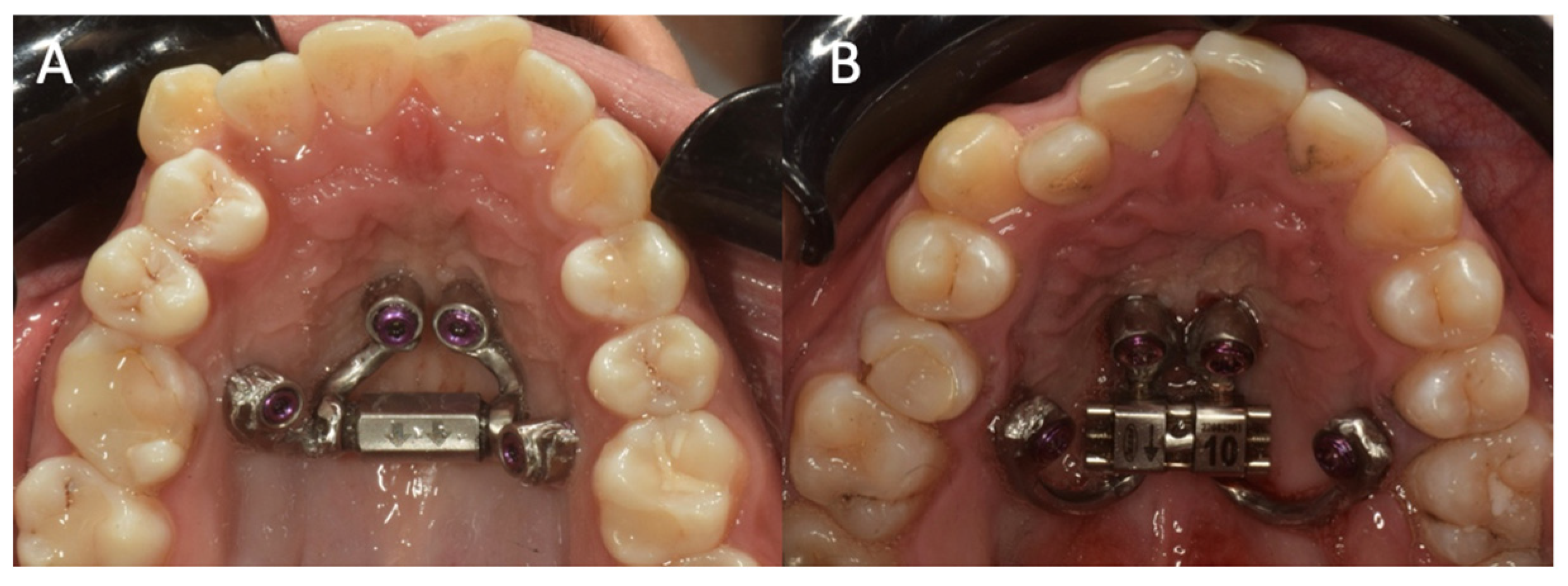
The first group consisted of 15 individuals (9 females, 6 males) treated with a Superscrew-type MARPE appliance (Great Lakes Orthodontics, Tonawanda, NY, USA), whereas the second group included 12 individuals (6 females, 6 males) treated with a Hyrax-type MARPE appliance (Leone S.p.A., Sesto Fiorentino, Florence, Italy). Representative examples of the Superscrew- and Hyrax-type digitally designed bone-borne MARPE appliances are shown in
Figure 1.
Purely bone-borne appliances were used in all individuals, and four miniscrews were placed around the midpalatal suture for anchorage. Miniscrew lengths were determined according to measurements performed on CBCT images, taking individual anatomical variations into account. The appliances were digitally planned and manufactured according to patient-specific designs (Tasarımmed Tıbbi Mamuller San. Tic. A.Ş., İstanbul, Türkiye). In both groups, 10 mm expansion screws were used. The activation protocol was 1/6 turn per day (~0.17 mm/day) in the Superscrew group and 1/4 turn once per day (~0.20 mm/day) in the Hyrax group. Accordingly, the two groups differed not only in expansion screw design but also in activation regimen. Therefore, the comparison should be interpreted as an evaluation of two MARPE protocol combinations rather than as an isolated comparison of expansion screw design alone. To evaluate dentoskeletal changes following expansion, measurement analyses were performed on CBCT images. The CBCT images were acquired with a voxel size of 200 µm and analyzed using OnDemand3D software (version 1.0, Build 1.0.0.4490; Cybermed Inc., Seoul, Republic of Korea) after completion of the reconstruction procedures. All measurements were performed by the same examiner (İ.Ö.K.). To assess intra-examiner reliability, measurements from seven randomly selected patients in each group were repeated after a two-week interval. Agreement between the two measurement sets was evaluated using intraclass correlation coefficient (ICC) analysis. The ICC values indicated high intra-examiner reliability (ICC = 0.948–0.993). Although the repeated measurements included the complete measurement procedure, landmark identification error and reorientation-related error were not evaluated as separate components.
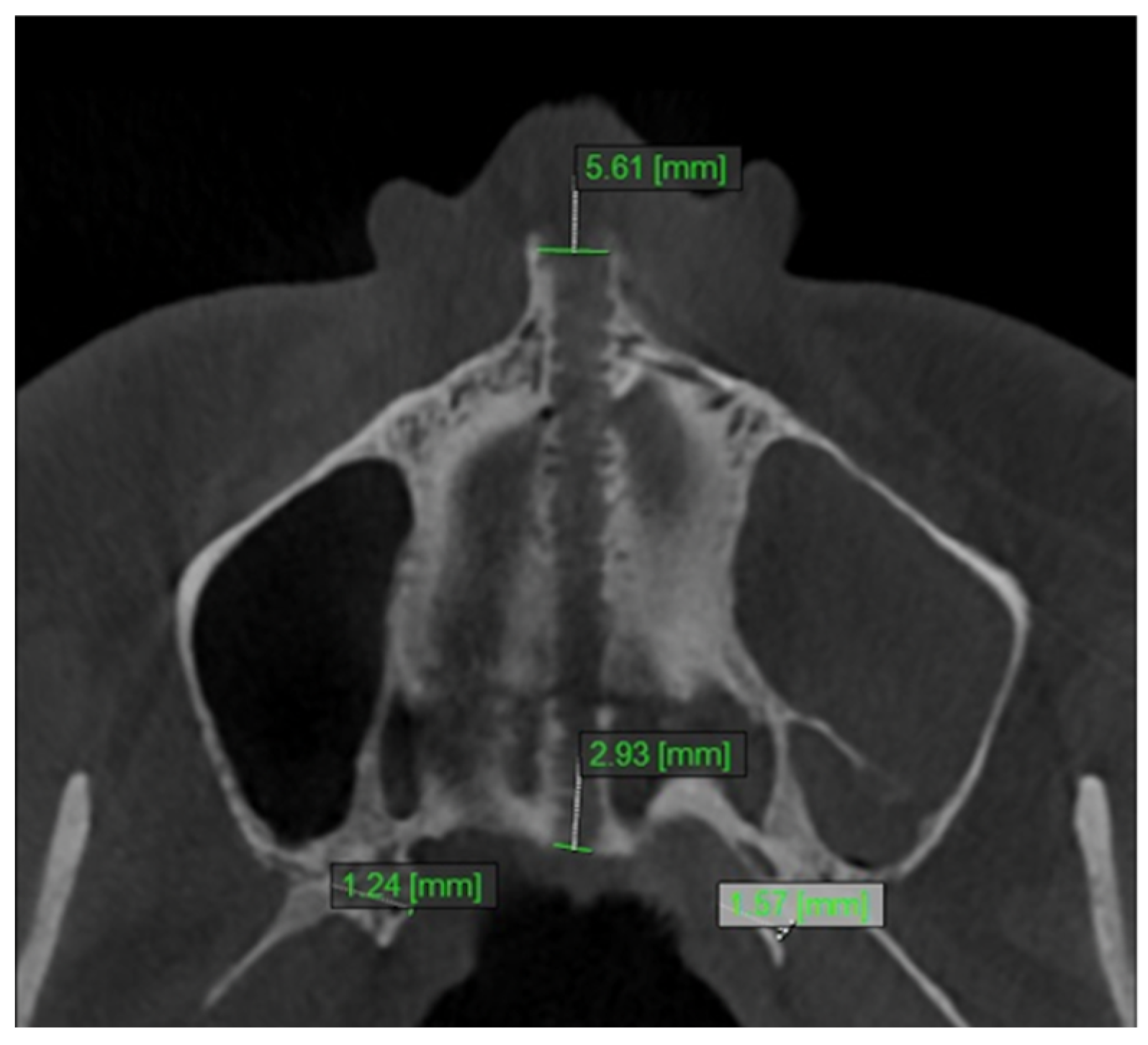
Before the measurements were performed, all CBCT images were reoriented in a standardized manner to minimize differences in head position between scans. Sagittal alignment was performed using the palatal plane as the primary reference, and the anterior nasal spine (ANS) and posterior nasal spine (PNS) were positioned on the same plane. After standardized orientation, linear measurements were performed on axial and coronal sections. The amount of opening in the anterior [ANS(R)–ANS(L)] and posterior [PNS(R)–PNS(L)] regions of the midpalatal suture, as well as the amount of opening at the pterygopalatine suture level, was measured directly on axial sections. No separate threshold-based segmentation protocol was applied for sutural measurements. A representative axial CBCT image illustrating the sutural measurements at the ANS, PNS, and pterygopalatine regions is shown in
Figure 2.
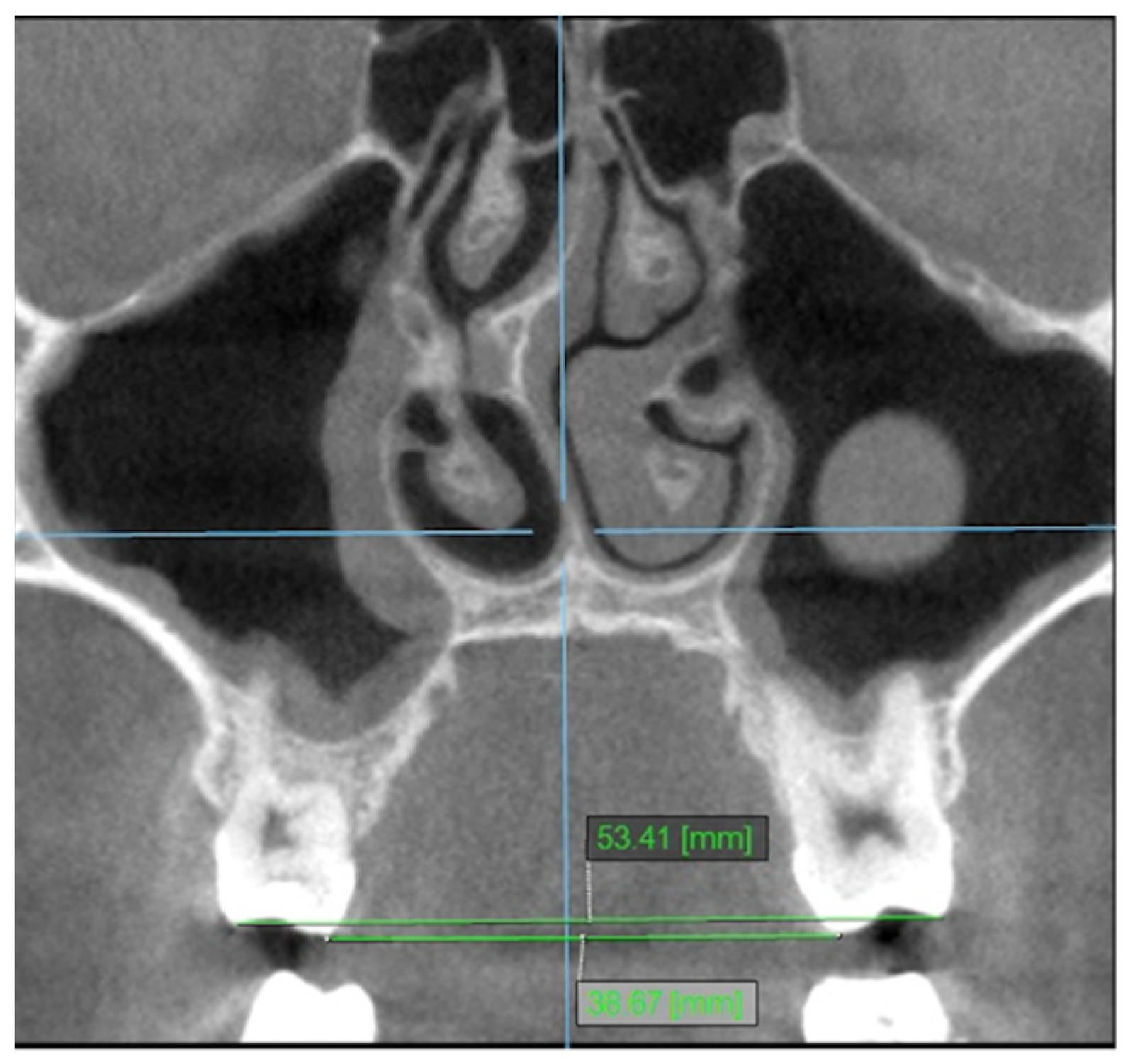
On coronal sections, intermolar distance was determined separately by measuring the distances between the right and left buccal cusp tips and between the right and left palatal cusp tips of the maxillary first molars. A representative coronal CBCT image illustrating buccal and palatal cusp-referenced intermolar distance measurements is shown in
Figure 3.
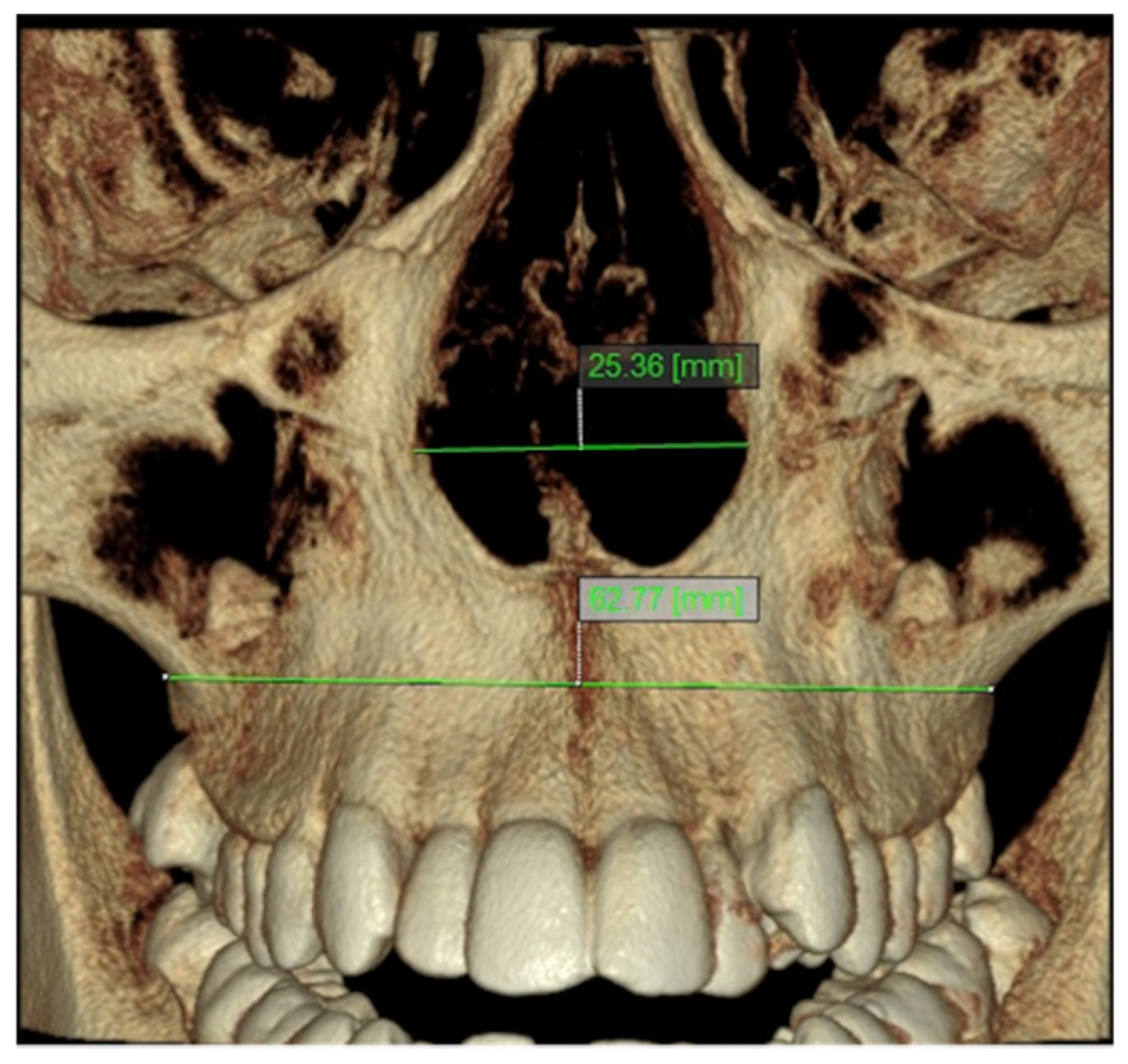
Changes in nasal width [Lateral Nasal Wall (R)–Lateral Nasal Wall (L)] and maxillary width [Jg(R)–Jg(L)] were analyzed using three-dimensional reconstruction/modeling data generated within the software. Three-dimensional reconstructions generated by the software were used for visualization and for nasal and maxillary width measurements within the standardized orientation protocol. No independent threshold-based segmentation or separate volumetric surface model was created. Measurements were performed using predefined anatomical landmarks in the software-generated reconstruction environment. Because no separate segmentation workflow was applied, threshold standardization and surface-model reproducibility were not evaluated independently. The same orientation and measurement protocol was applied to all T0 and T1 CBCT records by the same examiner. A representative three-dimensional CBCT image illustrating nasal width and maxillary width measurements is shown in
Figure 4.
All statistical analyses were performed using IBM SPSS Statistics software, version 20.0 (IBM Corp., Armonk, NY, USA), and the level of statistical significance was set at p < 0.05. Continuous variables were presented as means, standard deviations, medians, minimum and maximum values, whereas categorical variables were summarized as frequencies and percentages. The normality of continuous data was assessed using the Shapiro–Wilk test. Changes between T0 and T1 measurements were analyzed using the paired-samples t-test for normally distributed variables and the Wilcoxon signed-rank test for non-normally distributed variables. For between-group comparisons, the independent-samples t-test was used for normally distributed variables, whereas the Mann–Whitney U test was applied for non-normally distributed variables. Differences in changes from T0 to T1 between groups were evaluated using the independent-samples t-test or Mann–Whitney U test according to the distribution of the change values. Effect sizes were calculated for intergroup comparisons to support interpretation of the magnitude of the observed differences. For independent-samples t-tests, Hedges’ g was reported because of the relatively small sample size, whereas r effect sizes were reported for Mann–Whitney U tests. In addition, because multiple intergroup comparisons were performed for the change variables, Benjamini–Hochberg false discovery rate (FDR) correction was applied.
3. Results
A total of 27 individuals were included in the study. Of these, 55.6% were female (
n = 15) and 44.4% were male (
n = 12). Regarding appliance type, Superscrew-type MARPE was used in 55.6% of the sample (
n = 15), whereas Hyrax-type MARPE was used in 44.4% (
n = 12). Evaluation of midpalatal suture maturation stages showed that 55.6% of the individuals were classified as stage C (
n = 15), and 44.4% as stage D (
n = 12) (
Table 1). The ages of the 27 individuals included in the study ranged from 14.00 to 18.42 years, with a mean age of 16.35 ± 1.37 years.
Midpalatal and pterygopalatine suture opening changes are presented in
Table 2. All sutural opening measurements were reported as the T1–T0 difference (Δ), assuming no opening at T0. The mean midpalatal suture opening was 4.87 ± 0.96 mm at the ANS level and 2.69 ± 0.80 mm at the PNS level. The PNS/ANS ratio was calculated as %55.22 ± 10.4. The amount of pterygopalatine suture opening was 1.30 ± 0.25 mm on the right side and 1.36 ± 0.28 mm on the left side (
Table 2).
Comparisons according to appliance type revealed no statistically significant differences between the groups in midpalatal suture width increase at the ANS level (Δ), midpalatal suture width increase at the PNS level (Δ), PNS/ANS ratio, or right and left pterygopalatine suture width increases (Δ) (
p > 0.05) (
Table 2).
Similarly, comparisons according to midpalatal suture maturation stage showed no statistically significant differences between stage C and stage D groups in midpalatal suture width increase at the ANS level (Δ), midpalatal suture width increase at the PNS level (Δ), PNS/ANS ratio, or right and left pterygopalatine suture width increases (Δ) (
p > 0.05) (
Table 2).
When the distribution of T0 measurements was evaluated according to appliance type, no statistically significant differences were found between the groups in nasal width, maxillary width, or intermolar distances (
p > 0.05) (
Table 3).
Changes in nasal width, maxillary width, and intermolar distances are presented in
Table 4. Comparisons according to appliance type revealed no statistically significant differences between the groups in changes in nasal width, maxillary width, or buccal intermolar distance. A borderline intergroup difference was observed for palatal cusp-referenced intermolar distance change in the unadjusted analysis, with a greater increase in the Superscrew-type group than in the Hyrax-type group (6.08 ± 2.48 mm vs. 4.29 ± 1.97 mm; unadjusted
p = 0.047; r = 0.38). However, this finding did not remain statistically significant after Benjamini–Hochberg correction for multiple comparisons (FDR-adjusted
p = 0.188) (
Table 4).
Within-group comparisons between T0 and T1 revealed statistically significant increases in all measurements, including nasal width, maxillary width, and buccal and palatal intermolar distances, in both appliance groups (Superscrew-type MARPE group:
p = 0.001; Hyrax-type MARPE group:
p = 0.002) (
Table 5).
4. Discussion
In this retrospective CBCT study, the dentoskeletal outcomes of two digitally designed bone-borne MARPE appliances using different expansion screw designs and activation regimens were compared. Overall, both groups showed transverse skeletal and dentoalveolar changes after expansion. No statistically significant intergroup differences were observed in midpalatal suture opening at the ANS and PNS levels, the PNS/ANS ratio, pterygopalatine suture separation, nasal width change, or transverse maxillary width change. However, because the two groups differed in both expansion screw design and activation regimen, these findings should not be interpreted as evidence of equivalence between the two systems or as evidence that expansion screw design has no independent effect on skeletal outcomes. The borderline unadjusted difference in palatal cusp-referenced intermolar distance did not remain statistically significant after correction for multiple comparisons. Therefore, this finding should be interpreted cautiously as an exploratory dental-width outcome rather than as definitive evidence of a protocol-related difference.
In RME treatment, separation of the midpalatal suture may occur in both the anterior and posterior regions, and the opening pattern may vary depending on the design of the appliance used [
12,
26]. Studies evaluating tooth-borne RME appliances have reported a V-shaped opening pattern, characterized by greater separation in the anterior region of the midpalatal suture and progressively reduced opening toward the posterior region [
27,
28,
29]. Lione et al. reported midpalatal suture openings of 3.01 mm and 1.15 mm at the ANS and PNS levels, respectively, in 17 patients treated with tooth-borne RME, and stated that the opening at the PNS level corresponded to approximately 40% of that observed at the ANS level [
28].
In contrast, studies on MARPE have shown that posterior opening may be more pronounced [
30]. Ponna et al., in their study using a purely bone-borne Quad-expander appliance, reported increases of 5.34 ± 1.54 mm and 3.27 ± 0.92 mm at the ANS and PNS levels, respectively, with a PNS/ANS ratio of approximately 61% [
12]. Cantarella et al., in a study using the Maxillary Skeletal Expander (MSE), demonstrated that opening at the PNS level reached approximately 90% of the opening observed at the ANS level, indicating a more parallel expansion pattern [
26]. In the present study, the opening was 4.87 ± 0.96 mm at the ANS level and 2.69 ± 0.80 mm at the PNS level, with a PNS/ANS ratio of approximately 55%. This ratio is higher than that reported for tooth-borne RME appliances, but lower than that observed in MSE studies reporting nearly parallel posterior opening. The lower PNS/ANS ratio observed in the present study compared with MSE studies reporting nearly parallel posterior opening may be related to differences in expander position and appliance geometry rather than miniscrew number alone. MSE-type appliances have been described as being positioned in the posterior palate between the zygomatic buttress bones, with the jackscrew body incorporating four slots for palatal miniscrews [
26,
31,
32]. This posterior positioning may help overcome posterior circummaxillary resistance and contribute to a more parallel midpalatal suture opening pattern [
31]. Therefore, although the appliances evaluated in the present study were also four-miniscrew-supported bone-borne systems, differences in expansion screw position, miniscrew insertion pattern, bicortical engagement, and activation regimen may have resulted in a relatively more anteriorly dominant opening pattern. This may explain why the PNS/ANS ratio in the present study was closer to that reported for other bone-borne expanders than to MSE studies showing nearly parallel posterior expansion [
12,
26,
31].
In the present study, pterygopalatine suture opening was measured as 1.30 ± 0.25 mm on the right side and 1.36 ± 0.28 mm on the left side. The presence of bilateral separation at the pterygopalatine suture level suggests that posterior maxillary resistance may have been partially reduced, thereby contributing to posterior expansion. This finding can be interpreted in light of the results of Colak et al., who reported increased PNS-level opening in cases with pterygopalatine suture disarticulation, and Cho et al., who demonstrated a positive association between medial pterygopalatine suture width and midpalatal suture opening at the PNS level [
31,
33]. Nevertheless, no statistically significant differences were detected between the two groups in ANS- and PNS-level opening, the PNS/ANS ratio, or pterygopalatine suture separation. This finding may indicate broadly similar sutural responses within the limits of the present sample; however, it should not be interpreted as evidence of equivalence between the two appliance systems.
Expansion forces applied by RME appliances widen the maxillary arch and open the midpalatal suture. Owing to the close anatomical relationship between the maxilla and the nasal cavity, this skeletal separation may also lead to an increase in nasal cavity width [
34,
35]. Previous studies have reported favorable changes in airway parameters following both conventional RME and MARPE treatment [
36,
37]. Sezen Erhamza and Özdiler observed significant increases in nasal volume parameters in individuals treated with conventional RME appliances, while Celenk-Koca et al. reported greater skeletal expansion, particularly in the posterior nasal cavity region, with MARPE compared with conventional RME [
38,
39]. In the present study, statistically significant increases in nasal width were observed in both appliance groups, with no significant difference between groups. This finding may be related to the similar anchorage configuration of the two systems and suggests that the effect on the nasal cavity was primarily associated with bone-borne skeletal expansion.
Although RME treatment has been reported to be an effective approach for the correction of transverse maxillary deficiency, the skeletal effect achieved may vary depending on the activation protocol and the manner in which expansion forces are transferred to the skeletal structures [
14,
20]. Although skeletal maxillary expansion is primarily intended through separation of the midpalatal suture, the relative contributions of skeletal maxillary expansion and dentoalveolar changes may differ among MARPE appliances [
15,
19]. The amount of basal maxillary width increase achieved with MARPE appliances has been reported with varying values in the literature. In a systematic review and meta-analysis, Kapetanović et al. reported mean increases of 6.55 mm in intermolar width and 2.33 mm in skeletal maxillary width, indicating that skeletal expansion accounted for approximately 35.6% of the intermolar width increase [
22]. Similarly, Choi et al., in their study on young adults treated with MARPE, reported a mean increase of 1.92 mm in the distance between the jugal points; this skeletal expansion corresponded to 43.34% of the total 4.43 mm increase observed in intermolar width [
8]. These findings indicate that intermolar expansion cannot be interpreted as a direct surrogate for skeletal maxillary expansion. In the present study, the absence of a significant intergroup difference in maxillary width, despite differences in activation regimen and screw system, may suggest that both approaches produced broadly similar basal skeletal expansion.
It has been reported that increases in intermolar width result from the combined contribution of skeletal and dental components, and that the relative proportions of these components may vary across studies. Park et al. reported that, of a total intermolar expansion of 5.4 mm, 37.0% corresponded to skeletal expansion measured as the distance between the jugal points, 22.2% to alveolar expansion at the cementoenamel junction level, and 40.7% to dental expansion at the cusp-tip level [
3]. In the present study, increases in both maxillary width and intermolar width were observed in both appliance groups. These findings further emphasize that dental-arch width changes should be interpreted together with skeletal measurements when evaluating MARPE outcomes.
In the literature, intermolar distance has been measured using different reference points, particularly the buccal and palatal cusp tips, and these reference points may differently influence how posterior tooth tipping is reflected in the measurements [
40,
41]. In the present study, intermolar width was evaluated using both buccal and palatal cusp references, and between-group differences in intermolar distance were analyzed based on these two measurements.
Adkins et al. reported that, in patients with bilateral crossbite treated with RME, occlusal contacts between the palatal cusps of the maxillary molars and the lingual cusps of the mandibular molars may be associated with increased buccal tipping of the maxillary molars [
42]. The authors also suggested that such occlusal contacts may generate buccally directed forces on the maxillary teeth at a certain stage of treatment. Similarly, in the presence of these occlusal contacts, buccal cusp-referenced intermolar distance measurements may reflect dental crown tipping more prominently in the measured width [
41]. In the present study, no significant difference was observed between the groups in buccal cusp-referenced intermolar distance measurements. For palatal cusp-referenced intermolar distance, the unadjusted analysis showed a borderline intergroup difference; however, this finding did not remain statistically significant after correction for multiple comparisons. Therefore, this isolated result should be interpreted cautiously and may represent a type I error rather than a reliable protocol-related difference. Although the unadjusted increase in palatal cusp-referenced intermolar distance was greater in the Superscrew group, the clinical significance of this finding remains uncertain. This isolated finding should also be interpreted in the context of the absence of significant intergroup differences in sutural opening, nasal width, and maxillary width. Therefore, it may reflect differences in how transverse changes were expressed at the posterior dental level rather than a generalized skeletal advantage of one appliance system. In MARPE studies, dentoalveolar response may be evaluated using parameters such as molar inclination, root position, alveolar bone changes, and periodontal findings in addition to intermolar width measurements [
3,
15,
19,
43]. In the present study, however, intermolar distance was the only dental parameter assessed; therefore, this finding should be interpreted as a linear transverse width change rather than as direct evidence of posterior tooth tipping, root movement, alveolar bending, or periodontal response. Because occlusal stability and long-term retention were not evaluated, the potential clinical implications of this isolated finding require further investigation.
Nevertheless, several limitations should be considered when interpreting the findings of the present study. Because of the retrospective design, patients were not randomly allocated to the appliance groups, and appliance selection was based on the clinical protocol and clinician preference at the time of treatment. Therefore, potential treatment selection bias and the influence of unmeasured clinical factors cannot be excluded. Although the groups were comparable in the available T0 measurements, this does not necessarily indicate complete comparability of all baseline clinical conditions. Unmeasured factors such as palatal morphology, transverse discrepancy severity, skeletal pattern, operator-specific preference, or perceived clinical difficulty may have influenced appliance selection and treatment outcomes. The relatively small sample size may also limit the robustness and generalizability of the findings. Although a post hoc power analysis was performed, it was based on the observed effect size and should therefore be interpreted cautiously. Although intra-examiner reliability values were high, landmark identification error and reorientation-related error were not evaluated separately. Therefore, small differences in CBCT-based linear measurements should be interpreted cautiously, particularly for variables sensitive to scan orientation and landmark positioning. In addition, no independent threshold-based segmentation or separate volumetric surface-modeling protocol was applied. Therefore, the reproducibility of reconstruction-based measurements and surface-model generation could not be evaluated separately.
Another central limitation is that expansion screw design and activation regimen differed simultaneously between the two groups. Since activation rate may influence force delivery, sutural response, stress distribution, and dentoalveolar changes, the relative contribution of screw design and activation regimen to the observed outcomes could not be distinguished. This limits the mechanistic interpretation of the findings. Therefore, the results should be interpreted as preliminary, hypothesis-generating outcomes of two clinical MARPE approaches rather than as evidence of the isolated effect of expansion screw design or activation regimen. Because the study included only Hyrax- and Superscrew-type MARPE systems, the findings may not be directly generalizable to other anchorage configurations or alternative appliance designs.
The scope of dentoalveolar evaluation was also limited to intermolar distance measurements. Dental tipping, root inclination, alveolar bone thickness, periodontal effects, occlusal stability, and long-term retention were not directly assessed. The measurements were limited to data obtained between T0 and T1; therefore, long-term stability and relapse could not be evaluated. Multiple intergroup comparisons were performed for the change variables. Although Benjamini–Hochberg correction was applied to the
Table 4 comparisons, the corrected analysis should still be interpreted cautiously because of the small sample size and exploratory nature of the study. Finally, detailed baseline clinical parameters, such as transverse discrepancy severity, posterior crossbite magnitude, periodontal condition, occlusal relationships, skeletal pattern, and palatal morphology, were not consistently available in the retrospective dataset. Therefore, although all patients met the same eligibility criteria, the clinical characterization of the sample was limited, which may reduce the reproducibility and generalizability of the study population.