Article

Research on a Dead-Time-Compensated DC-Link Current Estimation Algorithm for PMSM

1
School of Electrical and Electronic Engineering, Hubei University of Technology, Wuhan 430070, China
2
Hezhi Digital Energy Technology Co., Ltd., Wuhan 430070, China
*
Author to whom correspondence should be addressed.
Appl. Sci. 2026, 16(10), 5087; https://doi.org/10.3390/app16105087
Submission received: 26 March 2026 / Revised: 7 May 2026 / Accepted: 11 May 2026 / Published: 20 May 2026
(This article belongs to the Section Electrical, Electronics and Communications Engineering)

Abstract

The DC-link current in PMSM drive systems is a critical variable for indicating DC-side power level and enabling efficiency optimization. However, existing sensorless current estimation methods are significantly affected by dead-time effects, resulting in limited estimation accuracy. To address this issue, a quantitative analysis of the impact of dead time on three-phase current reconstruction is conducted, and a mathematical model describing the relationship between estimation error and key influencing factors is established. Based on this, a unified framework integrating dead-time voltage compensation with DC-link current estimation is proposed. By real-time identification of stator current polarity, the dead-time-induced voltage error is accurately calculated, and a feedforward voltage compensation is implemented in the αβ stationary reference frame to effectively mitigate voltage deviation and waveform distortion. The reference voltage is subsequently incorporated into the DC-link current reconstruction process, enabling high-accuracy current estimation. The effectiveness of the proposed method is validated through both simulation and prototype experiments, demonstrating that the algorithm can accurately estimate the DC-link current of PMSM drive systems under various operating conditions, with an estimation error of approximately ±2%.

1. Introduction

With the progressive global transition toward new energy, the penetration rate of new energy vehicles (NEVs) has steadily increased, and the NEV industry has continuously expanded its share in the incremental automotive market. The rapid expansion of the NEV industry has not only accelerated technological innovation and iteration, but also intensified market competition, leading to substantial cost pressures on NEV-related enterprises [1,2].
The DC-link current is a critical variable required by the traction motor controller in pure electric vehicles, being closely associated with the normal operation and controllable performance of the drive system; it is typically measured using Hall-effect current sensors and transmitted to the controller. However, Hall-effect current sensors are relatively costly, and their measurement accuracy cannot be guaranteed under sensor faults; moreover, environmental factors may further degrade their measurement reliability. Therefore, to meet the requirements of cost-effectiveness, accuracy, and stability in real-time monitoring of this critical variable, the development of DC-link current estimation methods for electric vehicle motor drive systems is of considerable significance.
Currently, the mainstream DC-link current estimation approaches include the power-conservation-based conversion method between the AC and DC sides and the branch current estimation method based on PWM duty cycles. Reference [3] presents a power-conservation-based estimation method that explicitly considers the effects of the digital control process and inverter nonlinearities on DC-link current estimation. Reference [4] proposes a DC-link current reconstruction method based on an NPC three-level dual-PWM converter, which enhances the robustness of the power-conservation-based estimation against inverter load disturbances; the relative error is reported to be within 5% under different modulation indices and power factors. Reference [5] proposes a DC-link current reconstruction method for a dual three-phase permanent magnet synchronous generator based on DTP-PMSG space-vector PWM, providing useful insights for related applications. Reference [6] proposes modeling the inverter switching losses using an equivalent resistance to compensate for the DC-link current estimation error, providing useful insights for both current reconstruction methods and power-based estimation approaches. Reference [7] combines the INVE caused by the dead time, the turn-on and turn-off delay time of the switching device, and the voltage drop of the switching device and diode, establishing an accurate INVE model. This approach provides a useful framework for analyzing the impact of inverter nonlinearities on DC-link current estimation. Under high-speed operating conditions, current sampling errors [8,9] as well as delays introduced by the digital implementation of control variables [10,11] should be taken into account in DC-link current estimation.
This paper proposes a DC-link current estimation method for a PMSM drive system incorporating dead-time compensation. First, an estimation model based on DC-link current reconstruction is established, and the impact of dead time on the estimation results is quantitatively analyzed. Simulation studies are then conducted to determine appropriate compensation points and magnitudes, thereby mitigating dead-time effects and improving estimation accuracy. Finally, the accuracy and practical feasibility of the proposed method are validated through experimental tests. The target specification requires accurate DC-link current estimation under full-torque conditions across the entire speed range, with a maximum estimation error within ±3%.

2. DC-Link Current Estimation for PMSM Drive Systems

2.1. Permanent Magnet Synchronous Motor Drive System and the Relationship with Inverter Current

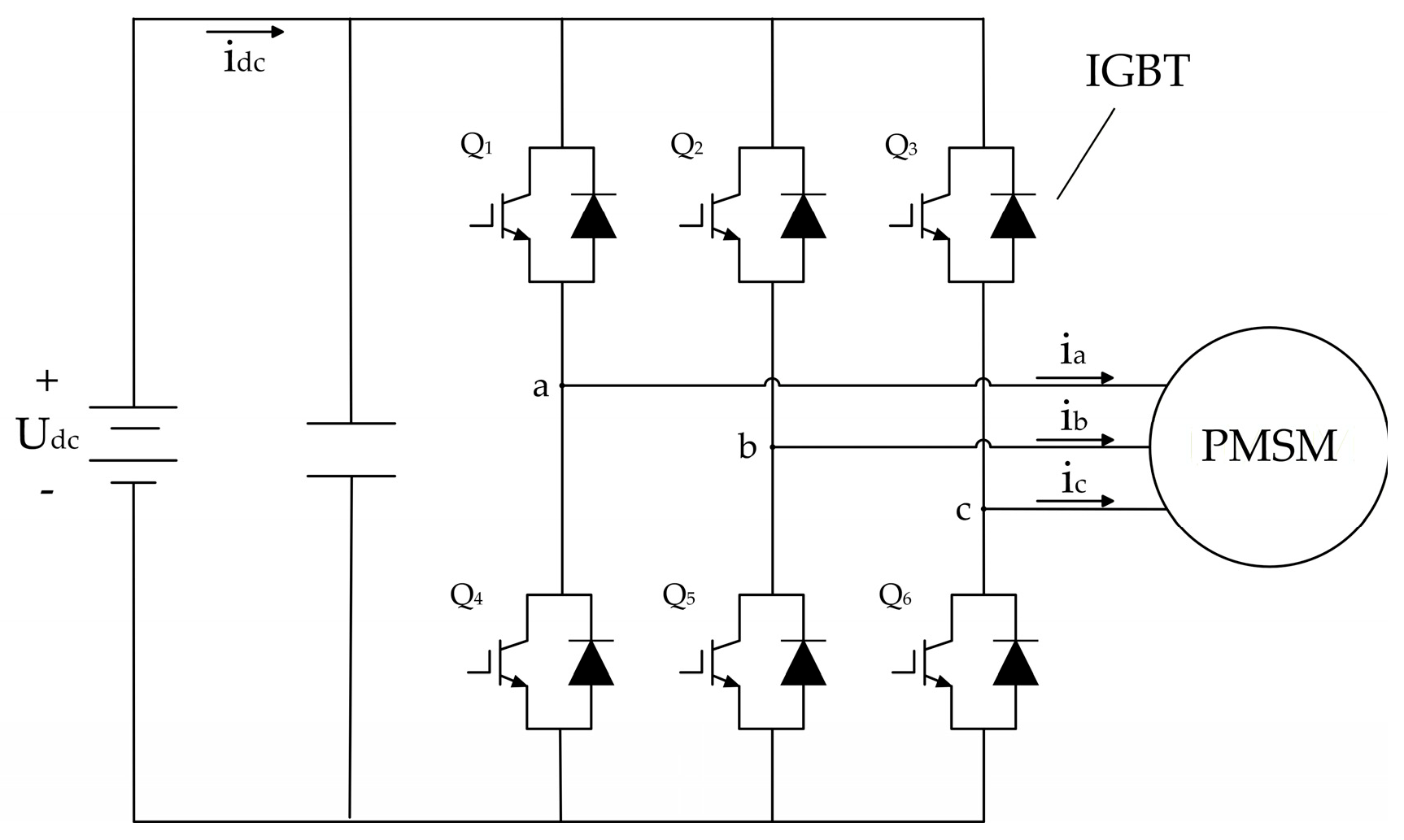
A typical topology of a permanent magnet synchronous motor (PMSM) drive based on a voltage-source inverter (VSI) is shown in Figure 1. In this topology, Udc denotes the DC power supply for the inverter, Q1–Q6 are the IGBT switching devices, ia, ib and ic are the three-phase inverter output currents, and idc is the DC-link current to be estimated.
In the typical control strategy for three-phase PMSMs, namely space vector pulse-width modulation (SVPWM), the control problem of the three scalar inverter outputs is transformed into the regulation of a space vector whose trajectory is a circle around a fixed center. The switching devices of the three-phase voltage-source inverter are denoted as Q1–Q6, and their switching states are defined as binary variables, 1 and 0. When Q1, Q2, and Q3 are set to 1, the upper switches of the inverter legs are turned on; to prevent shoot-through within the same leg, the corresponding lower switches are turned off, resulting in Q4, Q5, and Q6 being 0. Conversely, when Q1, Q2, and Q3 are 0, the upper switches are off, and the corresponding lower switches are turned on, i.e., set to 1.
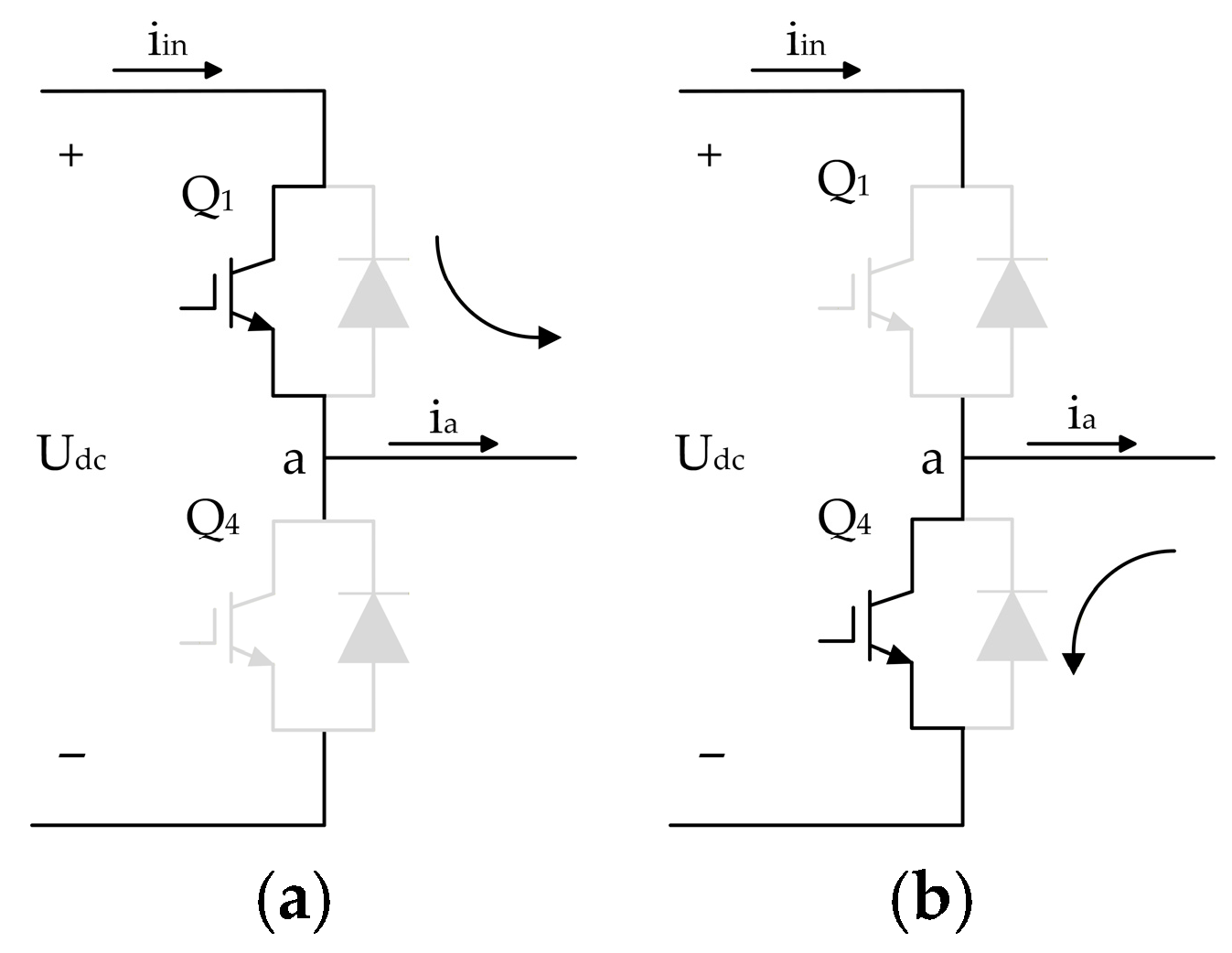
Meanwhile, since the upper and lower switches of each inverter leg cannot conduct simultaneously, the switching state of the upper device in each phase leg determines the relationship between the inverter input current and the three-phase currents; phase a is taken as an example. Under ideal steady-state conditions, when the upper switch of a given inverter leg is conducting, the corresponding lower switch is off, and the inverter input current is drawn from the DC-link into that phase leg. In this case, the DC-link current equals the phase current; for the phase-a leg, when Q1 = 1, iin = ia, as illustrated in Figure 2a. Conversely, when the upper switch is off and the lower switch is conducting, no current is drawn from the DC-link through that phase, yielding iin = 0 for Q1 = 0, as shown in Figure 2b.
Accordingly, the relationship between the inverter input current and the phase currents of each inverter leg can be expressed as:
i i n = Q 3 x i 3 x
Here, x denotes the phase index, taking values a, b, or c, and Q3x represents the switching state of the upper device in phase x, where 1 indicates the on-state and 0 indicates the off-state.
Extending the relationship between the inverter input current and the phase currents to the three-phase case, and neglecting the capacitor current, the DC-link current can be expressed as a function of the three-phase currents as:
I d c = Q 3 x i 3 x
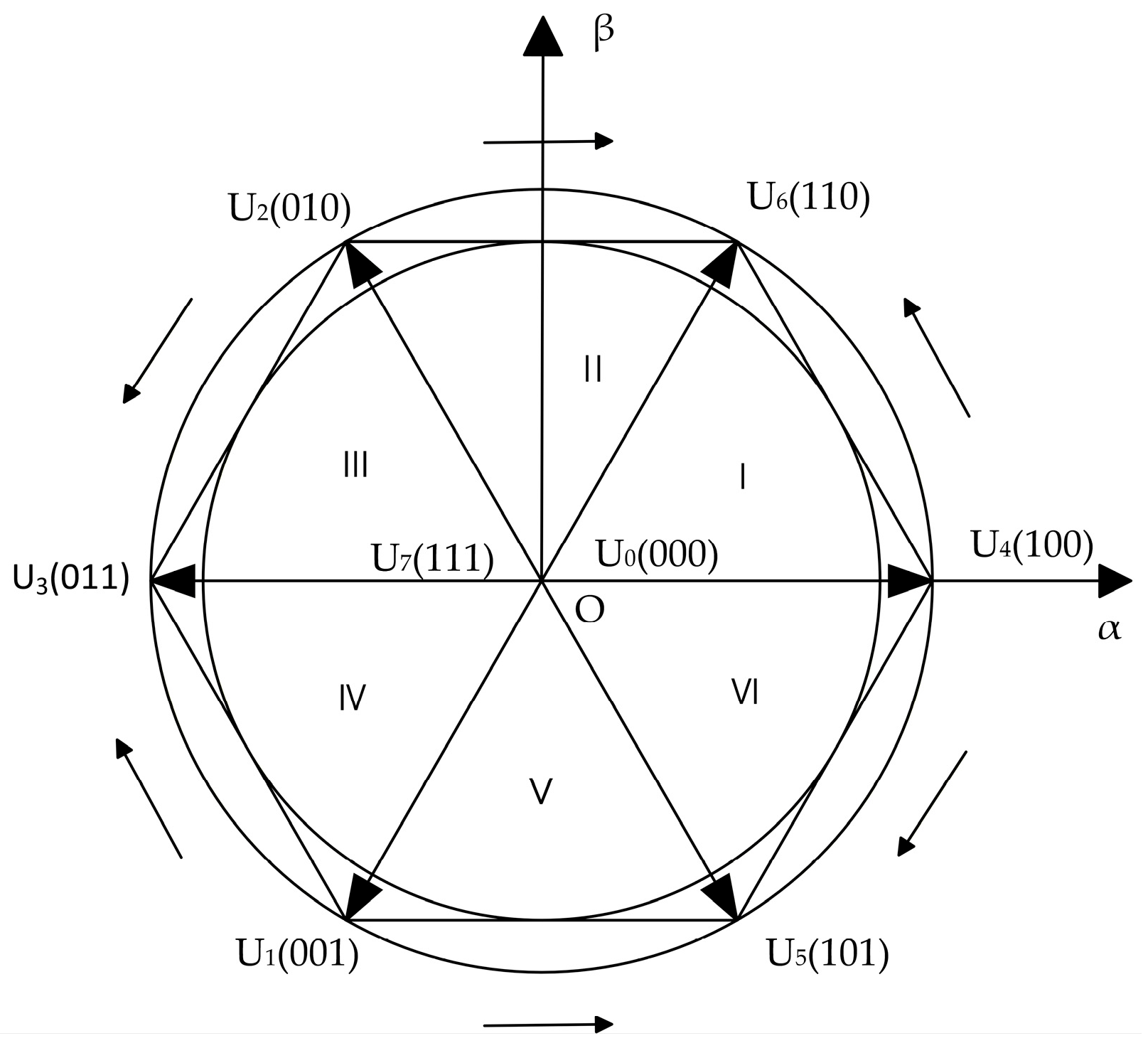
In summary, the inverter has eight possible switching state combinations, including six active (non-zero) vectors U1(001), U2(010), U3(011), U4(100), U5(101), and U6(110), as well as two zero vectors U7(111) and U0(000). By mapping the eight basic space voltage vector combinations onto the complex plane and applying the principle that only one switching state changes during each switching transition, the voltage space vector diagram is constructed and divided into six sectors, as illustrated in Figure 3.
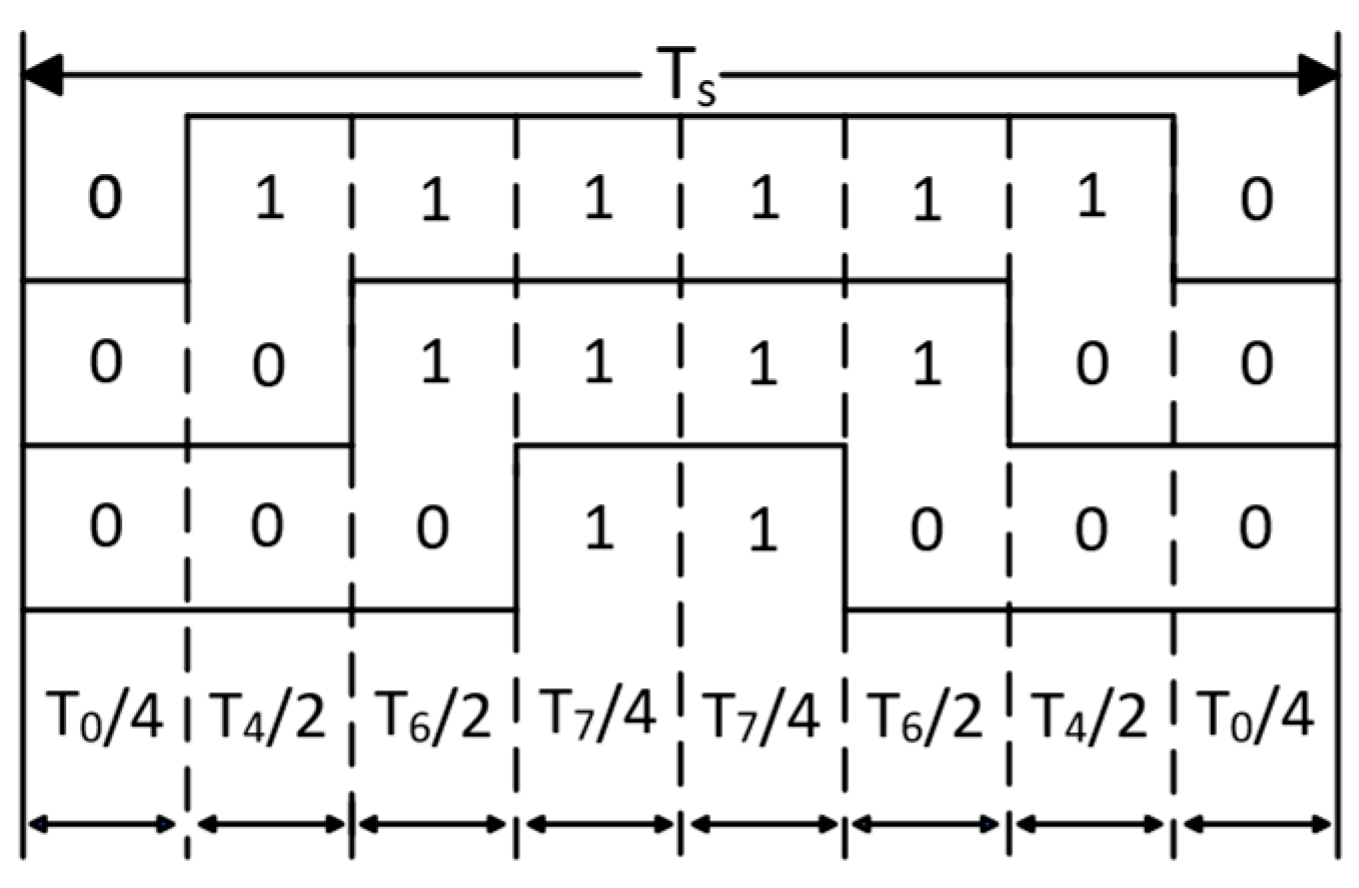
The SVPWM algorithm combines the basic voltage vectors within one switching period Ts such that their average value equals the reference voltage vector, following the average-value equivalence principle. When the reference voltage space vector Uout rotates into a given sector, the two adjacent active vectors in that sector, together with the zero vector, can be combined by assigning appropriate time durations to each vector to synthesize the desired voltage space vector. Taking Sector I as an example, the sequence of basic voltage vectors is U0-U4-U6-U7-U6-U4-U0, and the corresponding switching sequence is Q1, Q2, Q3, Q6, Q5, and Q4 being turned on in order; the three-phase switching waveforms are illustrated in Figure 4.
In this case, each column index corresponds to a specific active or zero voltage vector. T4, T6, T0, and T7 denote the dwell times of vectors U4, U6, U0, and U7, respectively. Here, T0 and T7 represent the zero-vector durations, and the time allocation satisfies T4 + T6 + T0 (T7) = Ts.
Based on the topology shown in Figure 1, the relationship between the DC-link current and the three-phase currents, and Kirchhoff’s current law, together with the condition ia + ib + ic = 0, the DC-link current corresponding to each basic voltage space vector can be derived, as listed in Table 1.
In summary, under SVPWM control, the DC-link current of the PMSM inverter within each switching period Ts can be determined.

2.2. Three-Phase Current Reconstruction Method

Based on the relationship between the basic voltage space vectors and the DC-link current listed in Table 1, the instantaneous DC-link current under ideal conditions can, in principle, be obtained. However, in practical implementations, it is difficult to determine in real time the dwell times of each basic voltage space vector and the corresponding three-phase currents under SVPWM control; moreover, factors such as dead time introduce significant estimation errors.
The DC-link current estimation method proposed in this paper is derived from the SVPWM process and performs the estimation over a single switching period based on the average-value equivalence principle. Within one switching period, the DC-link currents corresponding to the basic voltage space vectors are weighted according to their respective dwell times.
The DC-link current can be expressed as
I dc n T = 3 x T 3 x n T i 3 x n T T
Here, n represents the switching period index and is a positive integer; 3x denotes the three-phase index, taking values a, b, or c; T is the switching period; i3x(nT) is the three-phase current in each switching period; T3x(nT) is the action time of the corresponding three-phase current in each switching period, and T3x must satisfy Ta + Tb + Tc ≤ Ts.
Within one switching period, Ts, only two current values participate in the synthesis of the DC bus current; taking Sector I as an example, the DC bus current can be expressed as.
I dc = T 4 i a + T 6 i c T s
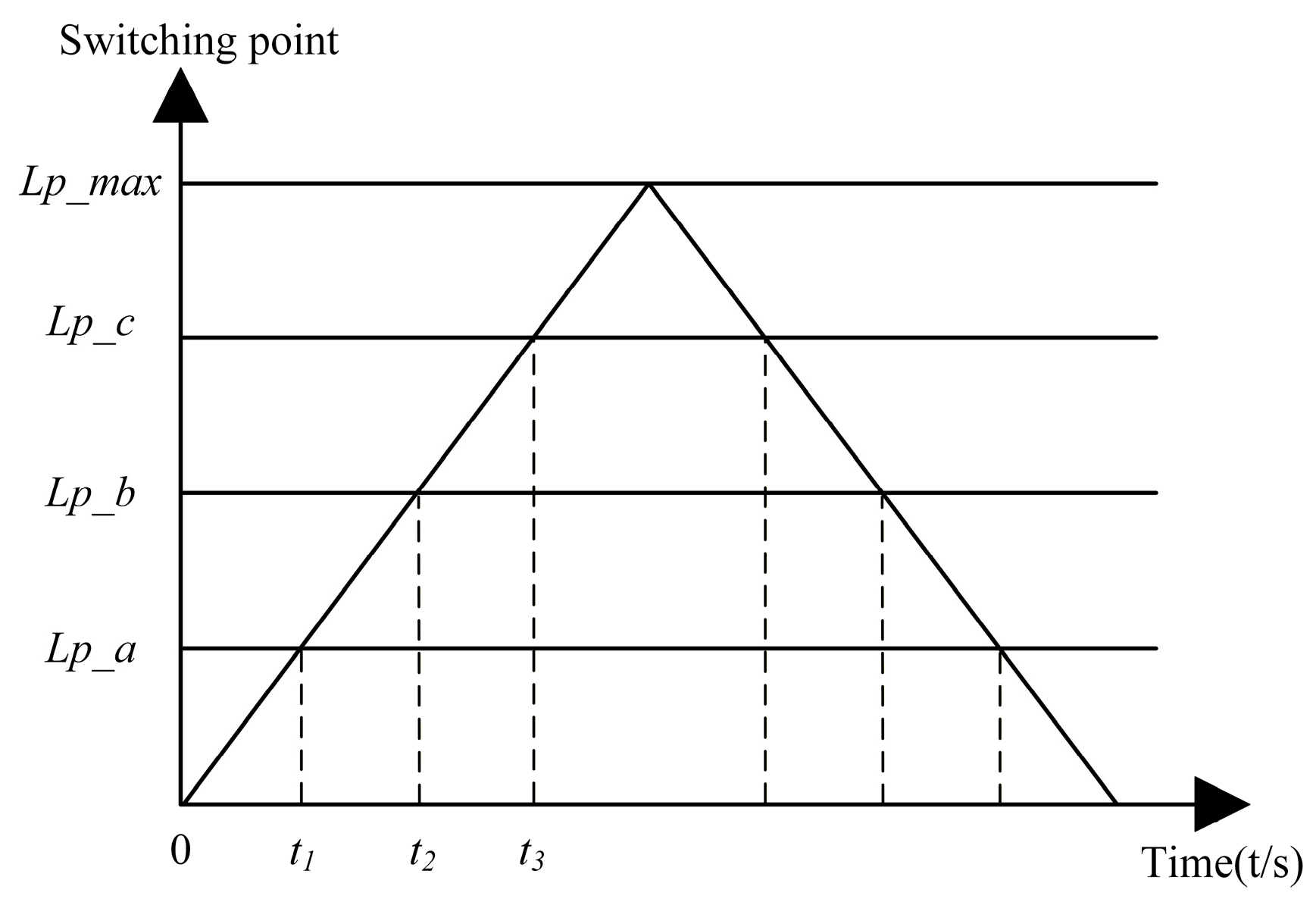
In order to extend the estimation formula to all sectors and facilitate the sampling of the required variables in practical applications, the relationship between the switching reference values and their corresponding switching instants in the SVPWM process is introduced; taking Sector I as an example, this relationship is shown in Figure 5.
According to the correspondence between Figure 4 and Figure 5, after converting the dwell time into switching time, Equation (4) can be expressed as.
I d c = 2 t 3 t 2 i c + 2 t 2 t 1 i a T s
By adding the term t2ib−t2ib to the numerator, it can be obtained that.
I d c = 2 t 2 i a + i b + i c 2 t 1 i a + t 2 i b + t 3 i c T s
Furthermore, since the sum of the three-phase currents is zero, it can be known that.
I d c = 2 t 1 i a + t 2 i b + t 3 i c T s
From the proportional relationships illustrated in the figure, 2 t 1 T s = L p _ a L p _ max , 2 t 2 T s = L p _ b L p _ max , and 2 t 3 T s = L p _ c L p _ max can be derived; here, t1, t2, and t3 denote the three switching instants obtained sequentially during the carrier rising interval, L p _ max represents the carrier peak value, and L p _ a , L p _ b , and L p _ c correspond to the switching amplitudes of the three phases. Substituting these proportional relationships into Equation (7) yields
I d c = L p _ a i a + L p _ b i b + L p _ c i c L p _ max
Applying the same procedure to the remaining five sectors also yields Equation (8); the only difference lies in the magnitude ordering of the three-phase switching-point amplitudes across sectors, leading to a unified DC-bus current estimation formula. Consequently, the DC-bus current is expressed as a function of the three-phase switching-point amplitudes and phase currents that are readily available in practical applications, which significantly reduces the computational complexity of the estimation.
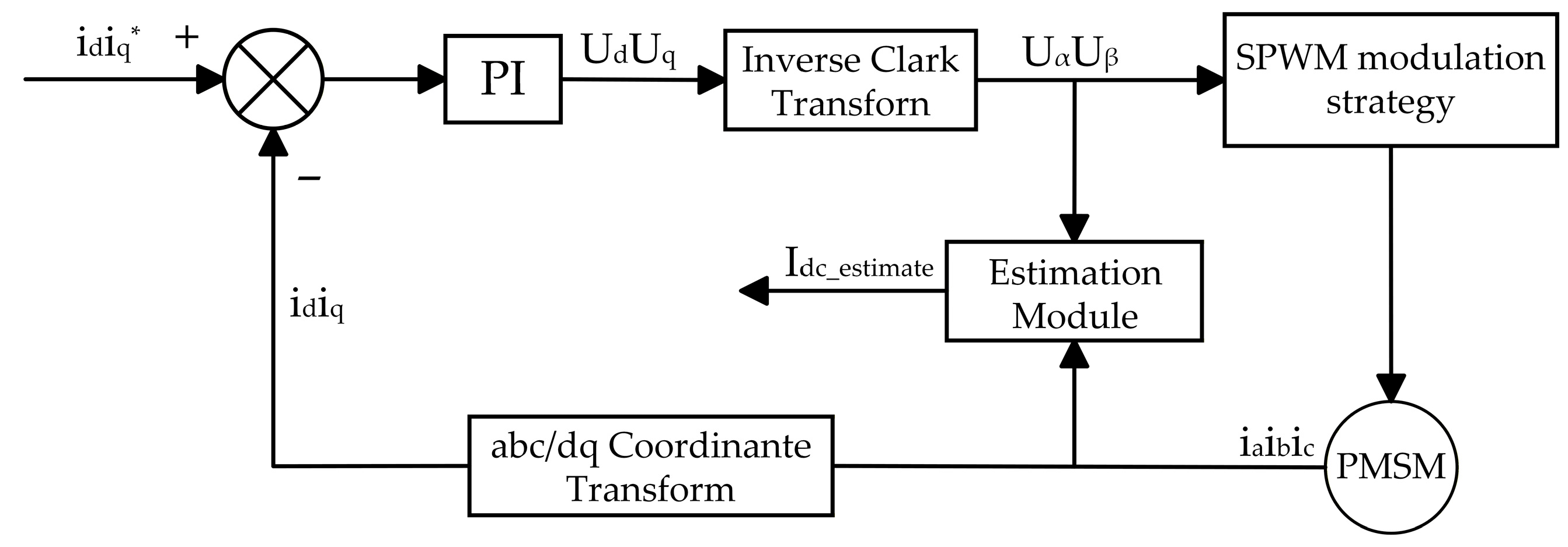
The estimation module is completed under the PMSM FOC scheme, as illustrated in Figure 6.

3. The Effect of Dead Time on the Estimation Results

In practical SVPWM implementations, the finite and asymmetric switching transitions of power devices necessitate the insertion of dead time in PWM gating signals to prevent shoot-through faults within each inverter leg. During the dead-time interval, both upper and lower switches are turned off, and the load current freewheels through the antiparallel diodes, rendering the phase voltage temporarily uncontrolled by the PWM command. Consequently, dead time introduces a deviation between the actual and ideal PWM waveforms, resulting in inverter output voltage distortion and deviation from the reference voltage [12]. To mitigate the adverse effects of inverter dead time, prior studies have extensively investigated the relationship between dead-time effects and the resulting harmonic distortions [13] and have proposed a variety of compensation strategies. These include direct compensation of inverter output phase voltages [14], disturbance observer-based approaches [15,16], model predictive control techniques [17], as well as methods based on adaptive notch filtering [18,19], neural network-based compensation [20,21], and parameter identification using recursive least squares algorithms [22]. Since the switching-state amplitudes in Equation (8) are obtained from the αβ-frame voltages, which are directly influenced by dead time, its impact on estimation accuracy must be explicitly considered in DC-link current estimation.
This paper presents a quantitative analysis of the impact of dead-time effects on estimation performance and develops a mathematical model describing the relationship between estimation error and key influencing factors. Since the αβ-frame and dq-frame voltages are related through a constant transformation, and the dq-axis voltages are DC quantities, they are more convenient for observation and analysis compared to the AC quantities in the αβ frame. Therefore, in simulations evaluating the effect of dead time on estimation accuracy, the dq-axis voltages serve as intuitive indicators of the induced distortion, while variations in current estimation error are taken as the primary evaluation metric.

3.1. Analysis of the Effect of Dead Time on the Estimation Results

First, because the transformation between the αβ-axis and dq-axis voltages involves constant coefficients, and the dq-axis voltages are DC quantities, they are easier to observe than the AC αβ-axis voltages; therefore, in analyzing the impact of dead time on the estimation error, the dq-axis voltages provide a more intuitive physical indicator, while the variation in the current estimation error is also a primary experimental concern.
After inserting dead time into the PWM gate signals, taking phase-a as an example, when the phase-a current is positive, the conduction-time error of phase-a is Δ T = T a T a + = T d , and the corresponding voltage deviation is
U a _ l o s s + = T a T a + T s U d c
When the phase-a current is negative, the conduction-time error of phase-a is Δ T = T a T a = T d , and the corresponding voltage deviation is
U a _ l o s s = T a T a T s U d c
where Ta denotes the ideal conduction time of the phase-a current; T a + and T a represent the actual conduction times of phase-a; and Td is the error interval consisting of the device dead time, turn-on delay, and turn-off delay [23,24].
By rearrangement, it follows that
U a _ l o s s = Δ T T s U d c = T d T s U d c sgn i a = U d sgn i a
where U d = T d T s U d c ; sgn() denotes the sign coefficient associated with the current direction [25].
By the same reasoning, it follows that
U b _ l o s s = U d sgn i b U c _ l o s s = U d sgn i c
By applying a coordinate transformation to the voltage drops in the three-phase system, the impact of dead time on the dq-axis voltages can be expressed as
U d _ l o s s U q _ l o s s = 2 3 cos θ cos θ 120 ° cos θ + 120 ° sin θ sin θ 120 ° sin θ + 120 ° U a _ l o s s U b _ l o s s U c _ l o s s
At the same time, the voltage drops in the three-phase system can be transformed to yield the αβ-axis voltage drop
U α _ l o s s U β _ l o s s = 2 3 1 1 2 1 2 0 3 2 3 2 U a _ l o s s U b _ l o s s U c _ l o s s
By substituting Equations (11) and (12) into Equation (14), it follows that
U α _ l o s s = 1 3 2 sgn i a sgn i b sgn i c U d U β _ l o s s = 1 3 sgn i b sgn i c U d
From Equation (3), the current estimation is determined by the action durations of the basic space voltage vectors combined with the three-phase currents. In SVPWM applications, these action durations are algebraic functions of the αβ-axis voltages and are thus directly influenced. In general, within each sector, the action times of the basic space voltage vectors consist of the following three time functions or their opposites:
X = 3 T s U d c U β Y = 3 T s U d c 3 2 U α + 1 2 U β Z = 3 T s U d c 3 2 U α + 1 2 U β
The detailed action times for each sector are presented in Table 2.
By substituting Equation (15) into Equation (16), the variations in the action times can be obtained
Δ X = T d sgn b sgn c Δ Y = T d sgn a sgn c Δ Z = T d sgn b sgn a
Neglecting the influence of dead time on the three-phase currents, Equation (3) indicates that the DC-bus current estimation error can be expressed as
Δ I d c = 3 x Δ T 3 x n T i 3 x n T T
Equation (17) shows that, within a single switching period, the variation in the action durations of the basic space voltage vectors is proportional to the dead time. The numerator of the estimation error consists of the sum of the products of the action-time variations in the two non-zero basic space voltage vectors in the sector during each switching period and their corresponding currents; hence, the estimation error is likewise proportional to the dead time and can be expressed as
Δ I d c = T d m i 1 + n i 2 T s
Here, i1 and i2 denote the currents associated with the two non-zero basic space voltage vectors in the sector during Ts, while m and n are the constant coefficients, determined from Equation (17), corresponding to the action-time variations in the voltage vectors linked to i1 and i2, respectively.
The phase of the three-phase currents, which dictates sector determination or the reference voltage vector, depends on the stator resistive–inductive voltage drops and the back EMF; thus, even with fixed motor structural parameters, a phase difference that varies with the operating conditions exists. However, because the three-phase currents are 120° out of phase and sum to zero, their sign variations cycle through only six possible combinations. Using these six three-phase current sign combinations and the action-time variation formulas in Equation (17), the values of the three action-time variations for each current sign combination are calculated, as summarized in Table 3.
To further analyze the relationship between estimation error and three-phase currents, Table 1, Table 2 and Table 3 allow determination of the active voltage vectors in each sector and their corresponding currents. Given that the sum of the three-phase currents is zero, the sector-wise current estimation errors under different three-phase current sign combinations can be derived, as presented in the following table. Here, in accordance with Equation (19), the common factor Td/Ts is omitted.
It can be seen from Table 4 that the absolute value of the estimation error in any sector under any current-direction combination can be expressed as a multiple of a single-phase current at a given moment, that is.
Δ I d c = T d T s 2 i 3 x
Here, 3x denotes the phase label, which can be a, b or c.
Although a phase difference exists between the three-phase currents and the reference voltage, making it challenging to derive an exact time-dependent formula for the estimation error, it is evident that the amplitude of the current estimation error is proportional to the dead time, the stator current magnitude, and the switching frequency.

3.2. Simulation-Based Experimental Verification of Influencing Factors

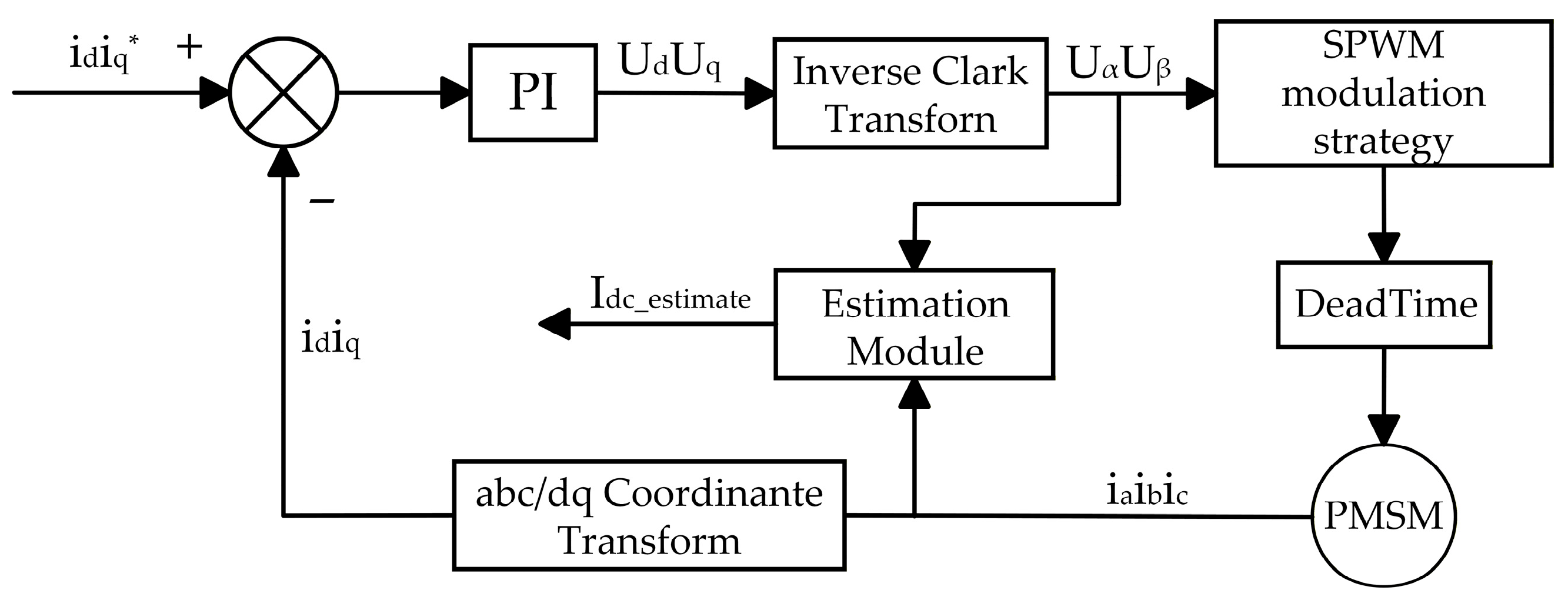
To validate the factors affecting the current estimation error, a Matlab R2024a/Simulink-based simulation is carried out by establishing a PMSM control model under a field-oriented control (FOC) framework, as illustrated in Figure 7. In this model, the dead-time module is implemented by introducing a predefined delay to the switching signals generated by the SVPWM scheme.
This simulation is conducted under vector control with a dq-axis current PI inner loop operating in the field-weakening region. The simulation parameters are set as follows: motor parameters: Rs = 0.02 Ω, Ld = 9.8 mH, Lq = 21.9 mH, Ψf = 0.1 Wb, P = 4. The switching frequency is 5 kHz; simulation time = 0.6 s.
Based on the above analysis, the amplitude of the estimated current error is governed by the dead time, the stator current magnitude, and the switching frequency. Since the switching frequency is fixed under FOC, it is not considered here; the simulations therefore focus solely on the effects of dead time and stator current magnitude.
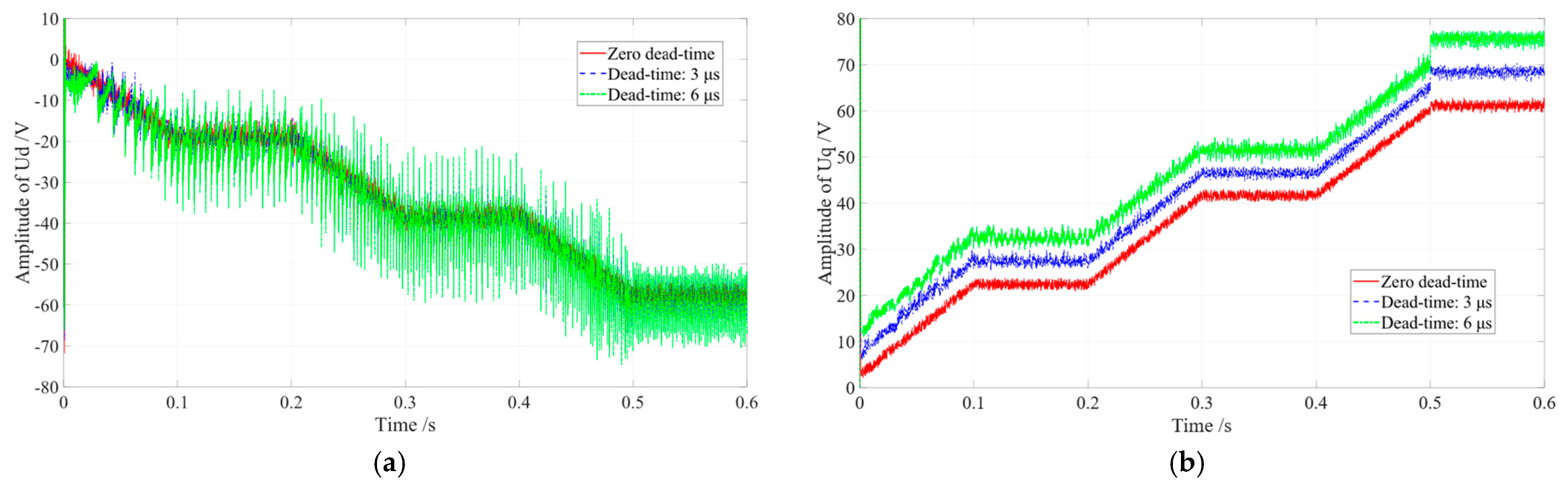
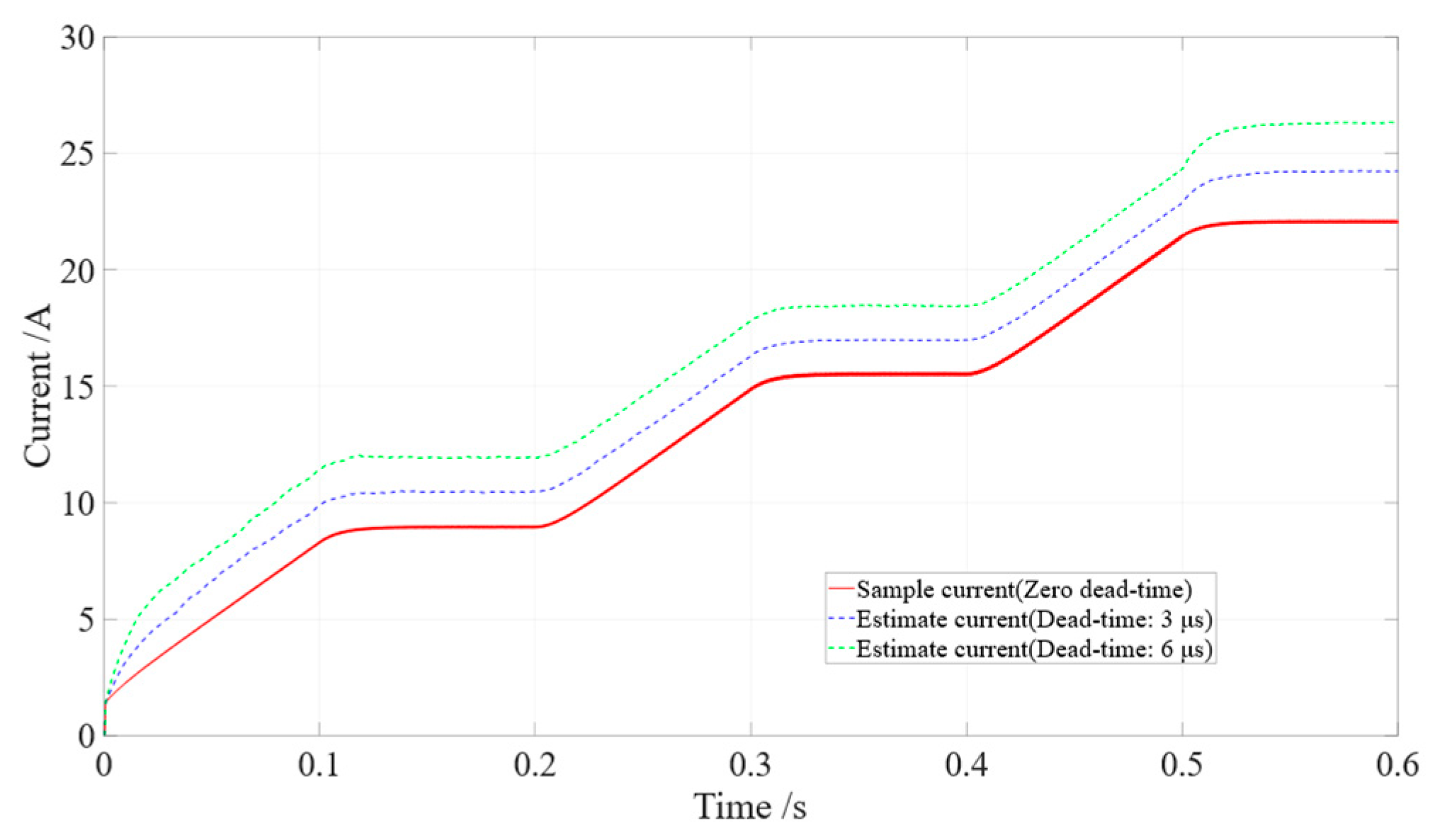
To examine the influence of dead time, different dead-time delays were introduced to the PWM signals on the basis of the original three-phase current reconstruction method. A fixed torque was applied to keep the stator current constant and minimize other effects, with simulations carried out at low-, medium-, and high-speed ranges. The experimental conditions were as follows: rotational speeds of 500, 1000, and 1500 r/min, each maintained for 0.2 s, with a total simulation time of 0.6 s; torque fixed at 80 N·m. Under these conditions, the dq-axis voltages and estimated currents were compared for dead times of 0 s, 3 µs, and 6 µs. The simulation results are shown in Figure 8:
In the experimental model under field-weakening operation, the voltage error caused by dead time exhibits distinct axial characteristics in the synchronous rotating reference frame. The q-axis, aligned with the back EMF and electromagnetic energy flow, demodulates the fundamental component of the dead-time error into a DC offset via the Park transformation, producing a notable q-axis voltage bias proportional to the dead time. Conversely, the d-axis, being the orthogonal field-weakening axis, primarily experiences voltage errors as reduced modulation depth and high-frequency harmonics, with a near-zero average but significantly increased ripple. The experimental plots clearly show that, with the introduction of dead time, the d-axis voltage exhibits pronounced high-order harmonics, while the q-axis voltage bias increases approximately proportionally with the doubling of dead time. This change inevitably causes an increase in the estimated current error.
Figure 9 shows that when the dead time is 6 µs, the estimation error is twice that observed at 3 µs, confirming that the estimation error is proportional to the dead time.
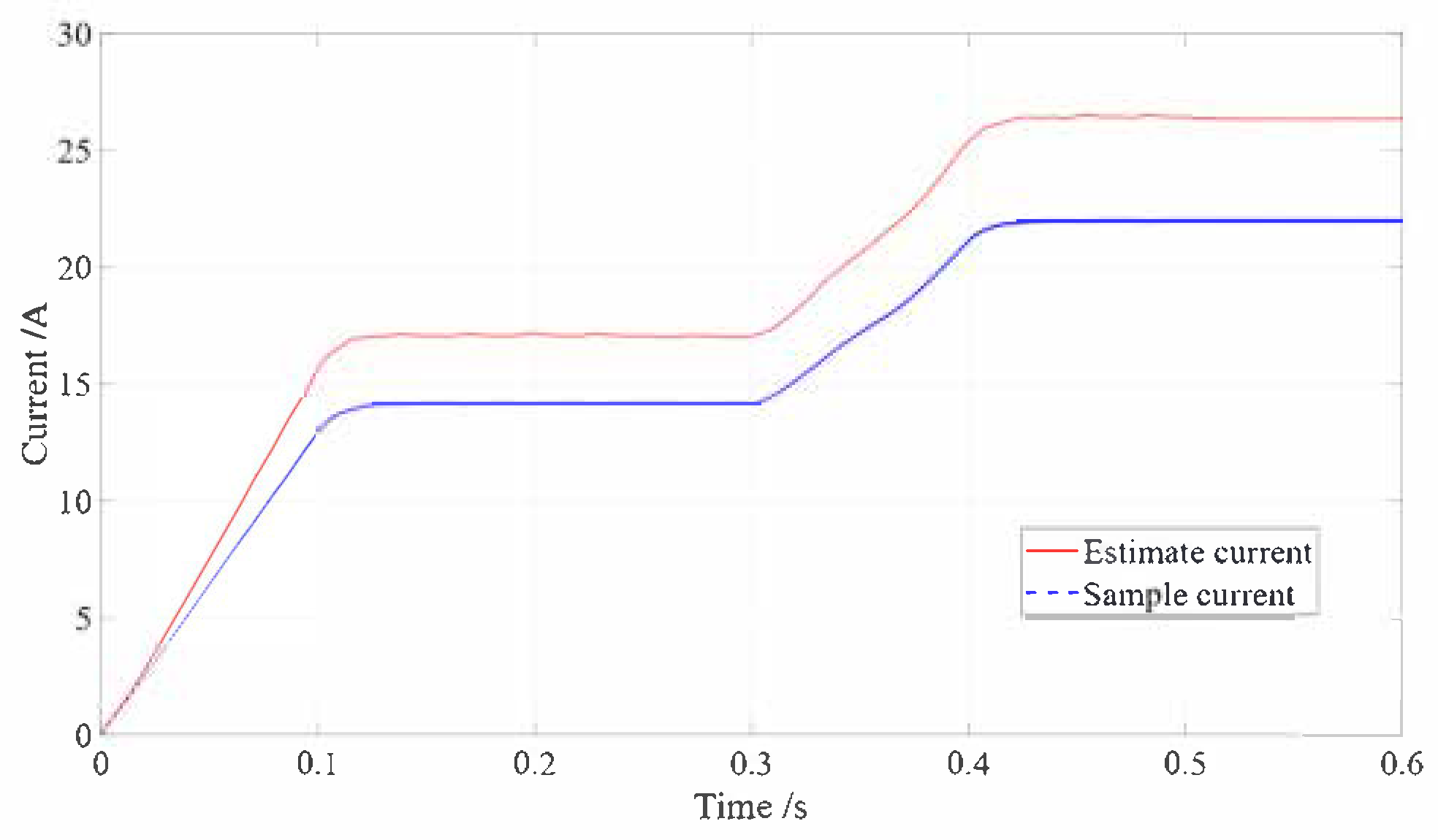
To study the influence of stator current magnitude, a fixed dead-time delay was applied to the PWM signals using the original three-phase current reconstruction method, while maintaining a constant rotational speed to reduce other effects. Simulations were performed under different torque conditions. The experimental setup was as follows: rotational speed fixed at 1500 r/min; torque set at 50 N·m and 80 N·m, each lasting 0.3 s; total simulation time 0.6 s; dead time fixed at 3 µs. The simulation results are presented in Figure 10.
Under these conditions, as the torque increases, the stator current magnitude rises accordingly, resulting in a corresponding increase in the estimated current error for the same dead time, in agreement with the theoretical analysis.

4. Dead-Time-Compensated DC Bus Current Estimation Algorithm for Permanent Magnet Synchronous Motors

Based on the above analysis of dead-time effects and simulation results, it is evident that the error in the estimated current induced by dead time depends on the dead time, the stator current magnitude, and the switching frequency. Because the estimation points correspond to the dq-axis (αβ-axis) voltages of the ideal PWM signals, the dead time introduced in the switching signals causes the actual PWM to deviate from the ideal, leading to discrepancies between the three-phase switching point magnitudes used for current estimation and those actually applied.

4.1. Method for Dead-Time Compensation

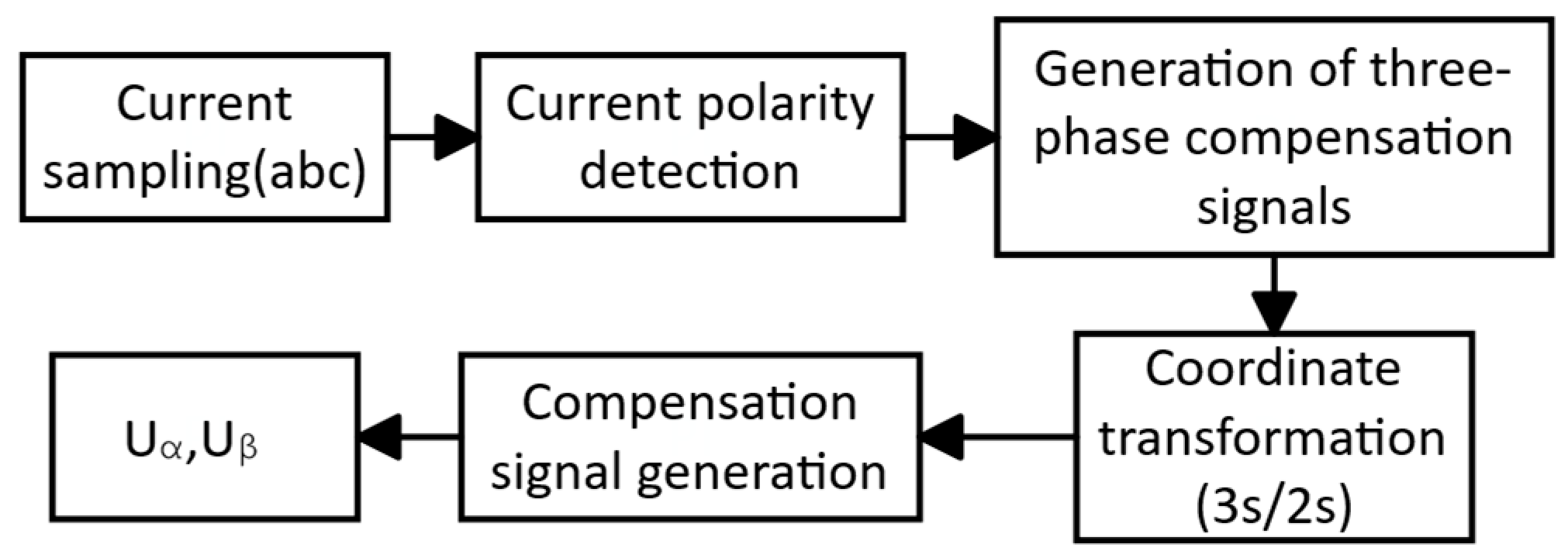
Based on the analysis in Section 2 regarding the impact of dead time on three-phase voltages, the compensation method is defined as follows: by detecting the direction of the motor’s three-phase feedback currents, the error voltage square wave is transformed into the αβ-axis frame and superimposed onto the αβ-axis voltages used for generating the PWM signals. This preemptively compensates for the PWM deviation caused by dead time, ensuring that the actual PWM signals align with the ideal PWM signals.
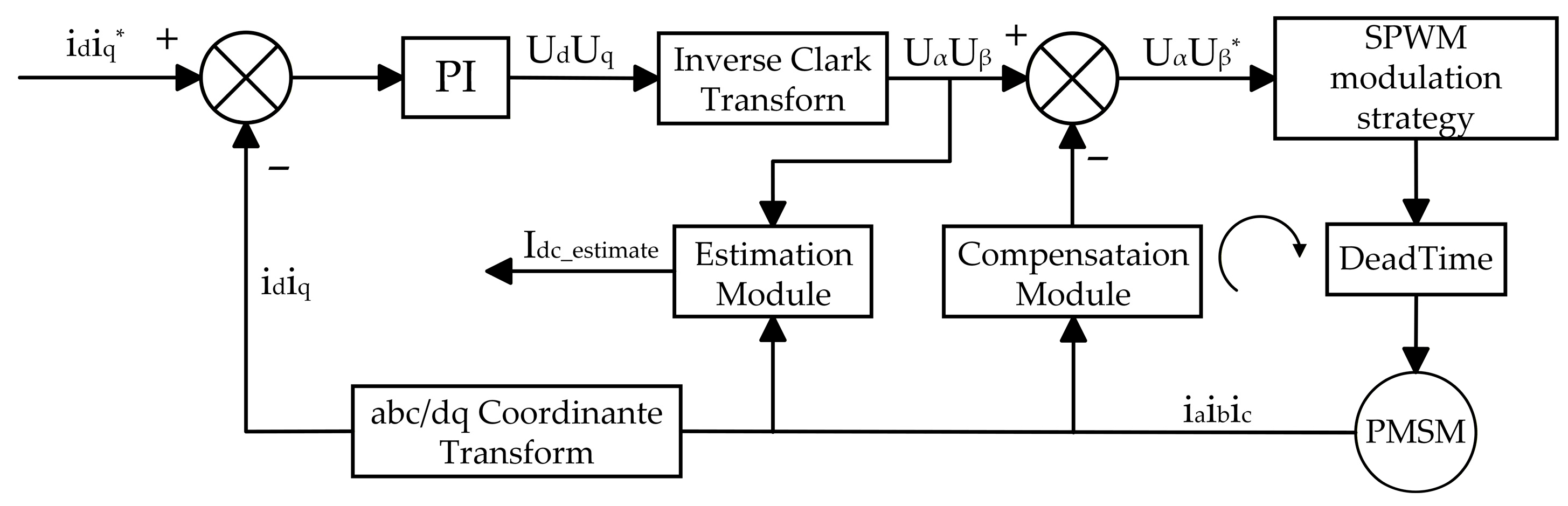
This paper employs a feedforward compensation approach on the αβ-axis voltages, pre-compensating the output voltage distortions to eliminate the amplitude discrepancies between the estimated and actual three-phase switching points caused by dead time. This method selects Uα and Uβ as the compensation points, and the compensation is applied to the αβ-axis voltages based on Equation (15). The signs of the three-phase currents are determined by comparing the currents with predefined thresholds. The flow diagram illustrating the compensation method is presented in Figure 11.

4.2. Determination of the Sampling Points for Estimation Parameters

In the control structure of Figure 7, the PI controller’s reference voltage vector produces an ideal PWM signal that, after including the dead time, is applied to the motor. This results in a discrepancy between the three-phase switching point magnitudes used for estimation and the magnitudes actually realized. After applying compensation to the αβ-axis voltages, two forms exist: the PI output control voltage UαUβ+ and the compensated control voltage UαUβ*. Comparing UαUβ+ and UαUβ*, the latter is a pre-compensated version of the PI output reference voltage UαUβ+, designed to eliminate inverter output voltage errors caused by dead time, ensuring that the inverter output follows the reference voltage vector. Therefore, the reference voltage vector UαUβ+, representing the actual value of the compensated inverter output voltage, should serve as the data source for the three-phase switching point magnitudes used in current estimation.
The method combining dead-time compensation with the DC bus current three-phase reconstruction not only eliminates distortions in the motor’s feedback three-phase currents caused by dead-time effects during estimation but also mitigates the impact of dead time on the dq-axis voltage magnitude deviation.
Based on the FOC structure in Figure 7, the control structure after integrating the compensation module is illustrated in the figure below.

4.3. Simulation Experiment for Verifying the DC Bus Current Estimation Algorithm

To validate the proposed method, a simulation was carried out in Matlab/Simulink, and the control structure is depicted in Figure 12.
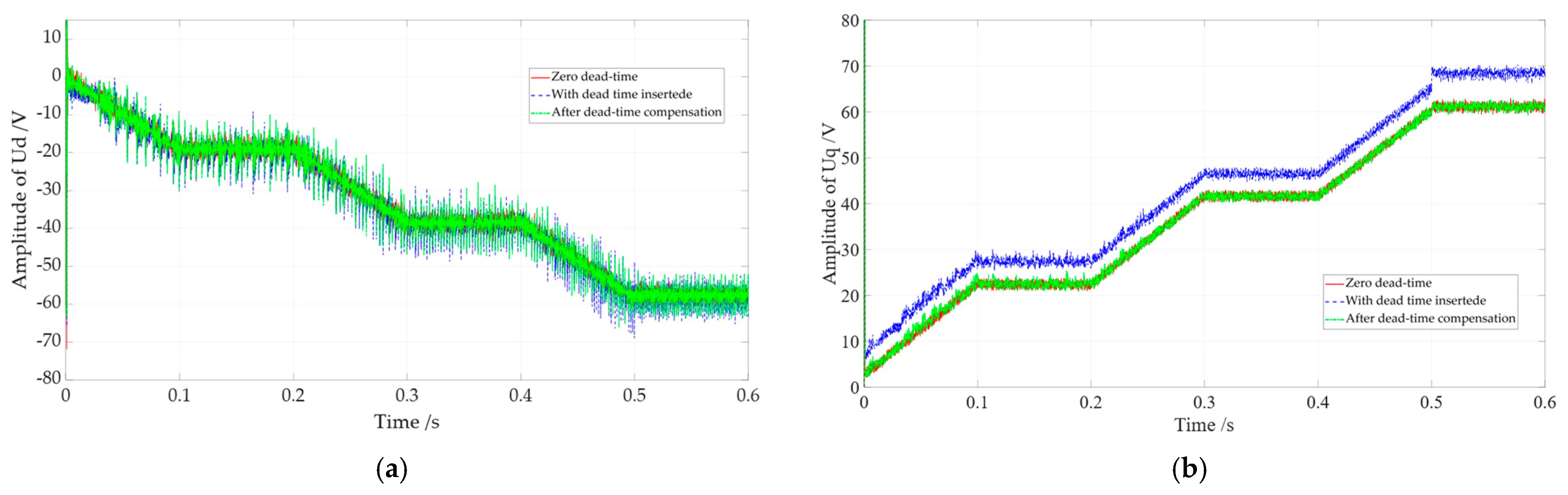
This simulation is conducted under vector control with a dq-axis current PI inner loop operating in the field-weakening region. The simulation parameters are set as follows: motor parameters: Rs = 0.02 Ω, Ld = 9.8 mH, Lq = 21.9 mH, Ψf = 0.1 Wb, P = 4; dead time = 3 µs; simulation duration = 0.6 s. The simulation results are presented in Figure 13.
In this study, the FOC operates under field-weakening conditions. The d-axis voltage errors primarily manifest as high-order harmonics, whereas the q-axis voltage shows a significant amplitude bias due to dead-time effects. After applying the compensation, the Uq amplitude is restored to its ideal level, confirming the effectiveness of the compensation method.
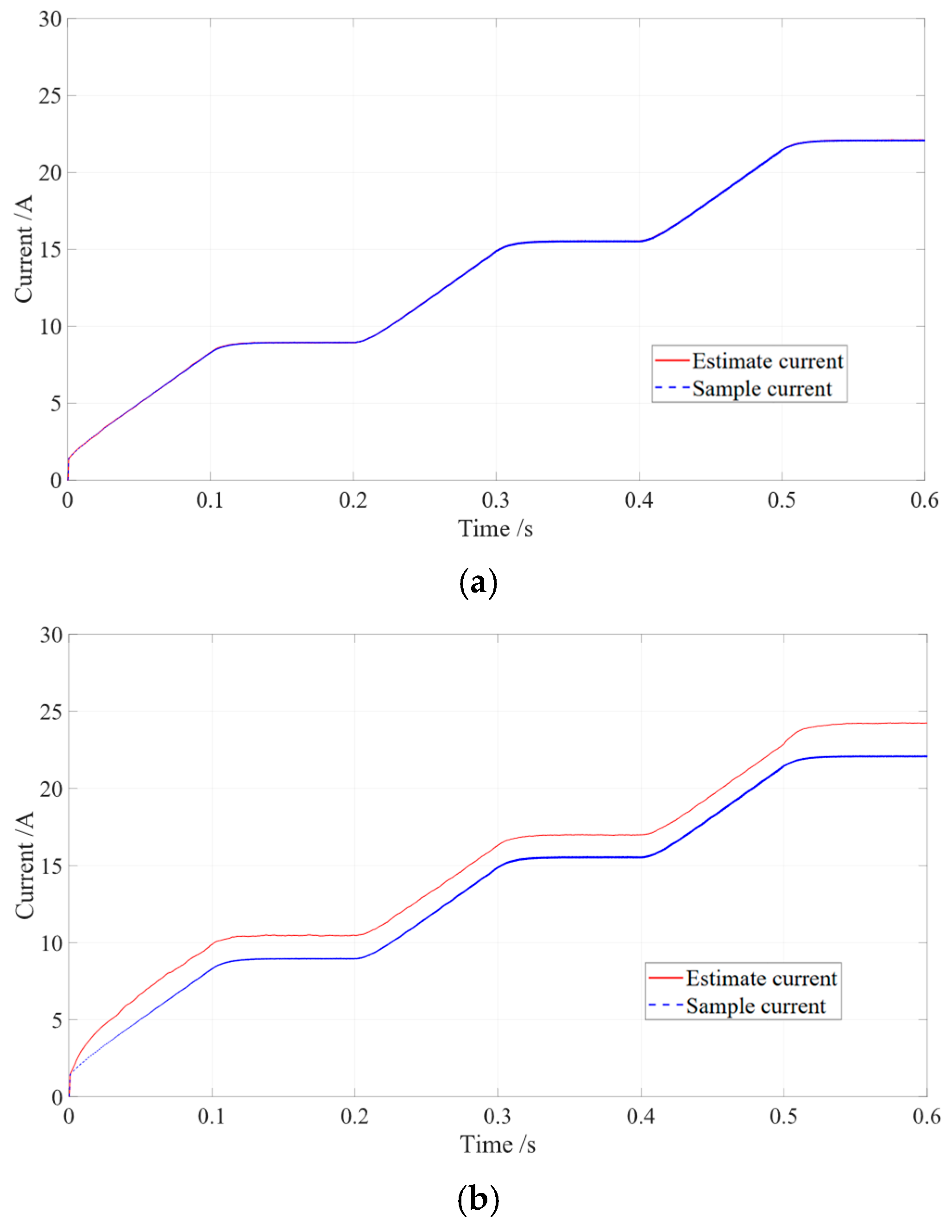
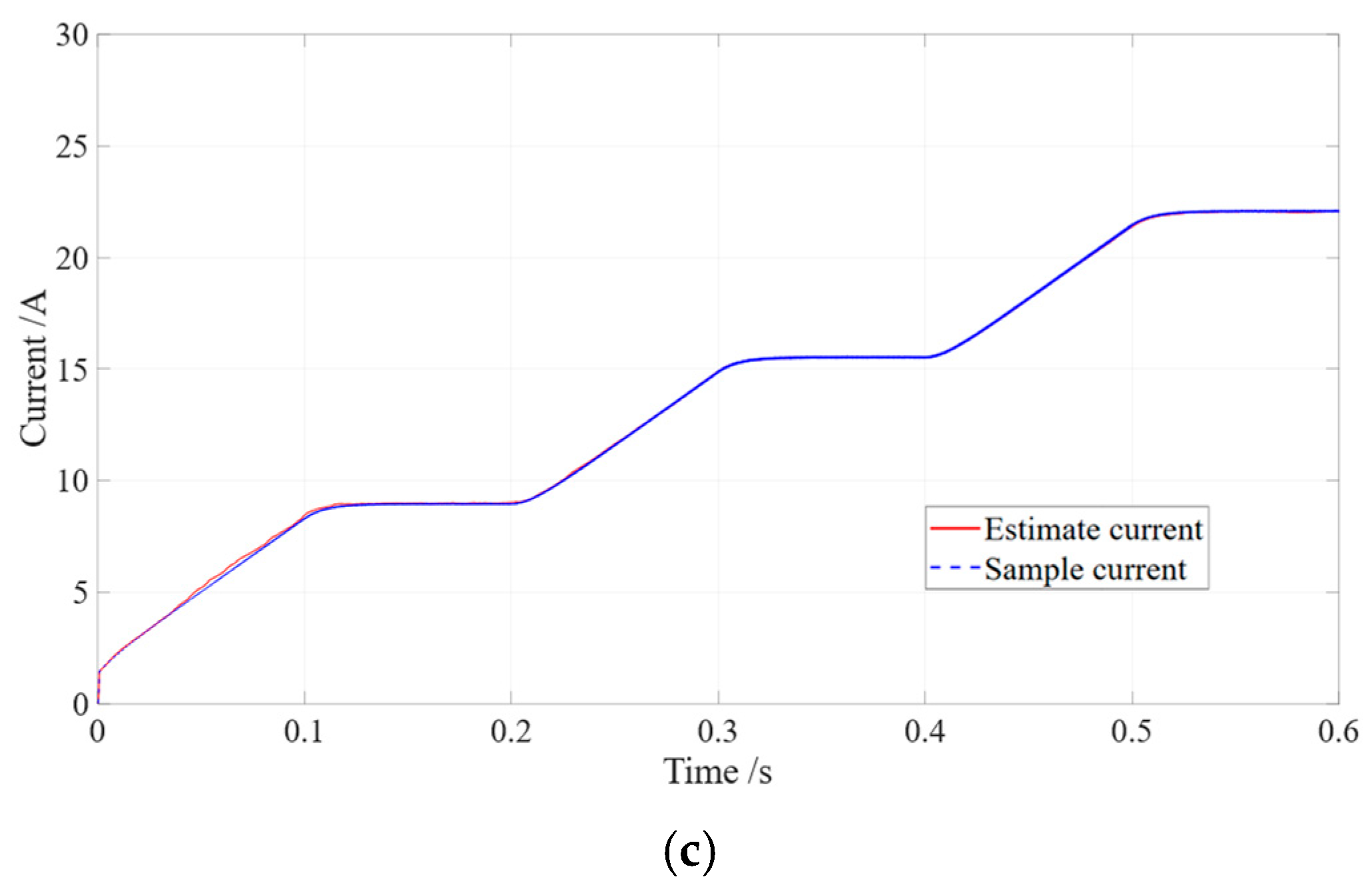
Figure 14a–c clearly show that, in the absence of dead time, the DC bus current estimated using only the three-phase current reconstruction method is relatively accurate. The dead-time effect markedly affects the estimation error, which changes in synchrony with the q-axis voltage error, highlighting the correlation between them under the influence of dead time.
Simulation results demonstrate that the proposed compensation method effectively reduces the influence of dead-time effects on estimation errors, resulting in a notable improvement in estimation accuracy.

5. Experimental Validations of the Dead-Time-Compensated DC Bus Current Estimation Algorithm for Permanent Magnet Synchronous Motors

5.1. Description of the Experimental Platform

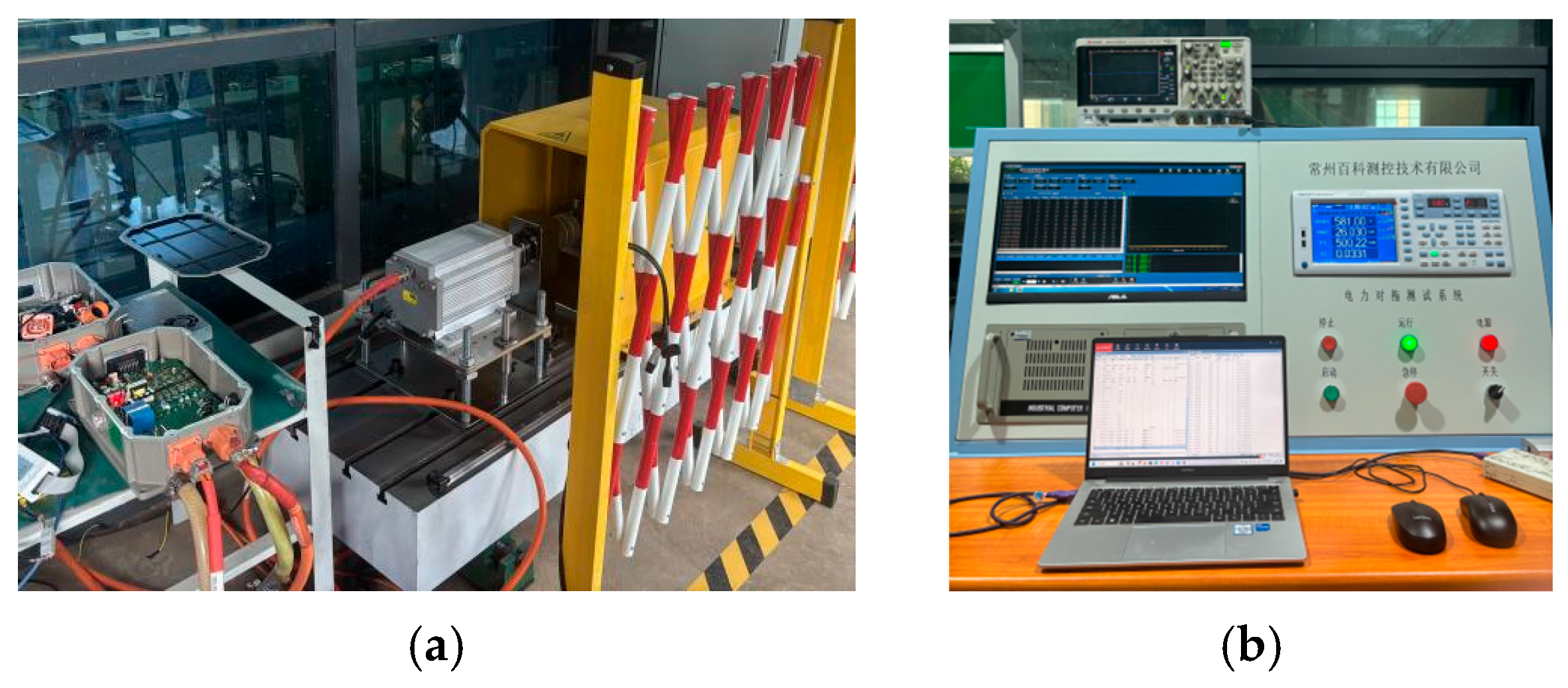
To validate the effectiveness of the proposed method, an IPMSM experimental platform was constructed. The experimental platform employs an S32K144 microcontroller from NXP of the Netherlands, which, together with the power drive module, current and voltage sensing circuits, and encoder interface circuits, constitutes a complete motor control system. The primary motor parameters are listed in Table 5. The switching frequency is 5 kHz, and the load is supplied by the test bench. The motor is started under no-load conditions via a start command from the host computer to reach the target speed, and the experimental platform is shown in Figure 15.

5.2. Experimental Setup and Result Analysis

To evaluate the estimation performance of the proposed method over different speed and torque ranges, comparative experiments are conducted under a dead-time condition of 3 µs, with the conventional three-phase current reconstruction method [26] serving as the reference method. The experiments are designed by gradually increasing the load torque to the rated torque under low-, medium-, and high-speed operating conditions. The experimental conditions were set as follows:
  • For the low-speed range, the motor target speed is 500 r/min. Once the speed stabilizes, the load is gradually increased from 0 N·m to the rated torque of 80 N·m;
  • For the medium-speed range, the motor target speed is 1000 r/min. Once the speed stabilizes, the load is incrementally raised from 0 N·m to the rated torque of 80 N·m;
  • For the high-speed range, the motor target speed is the rated speed of 1800 r/min. Once the speed stabilizes, the load is gradually increased from 0 N·m to the rated torque of 80 N·m.
In addition, an extra comparative test using the proposed method with a reduced dead time of 1.5 µs is introduced to further verify the robustness of the proposed algorithm.
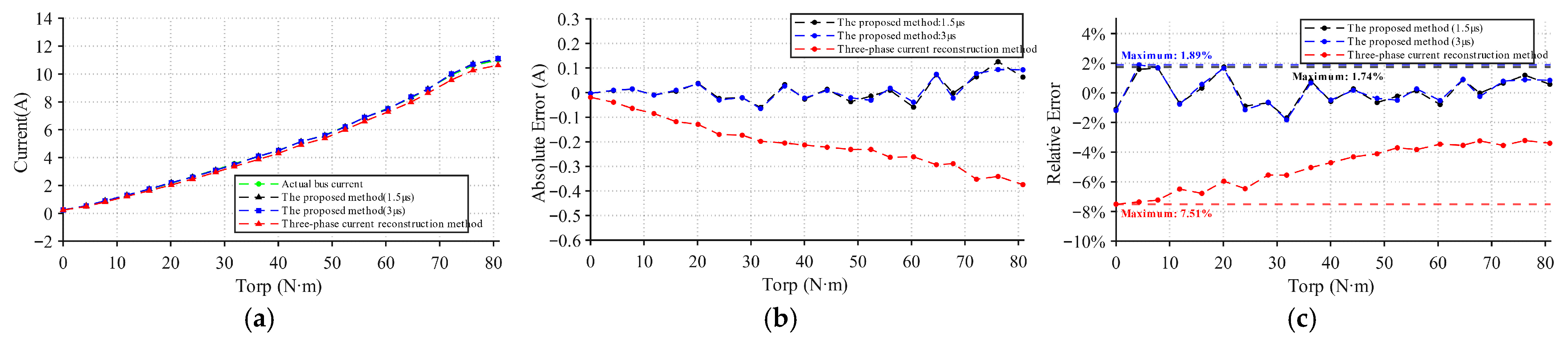
Figure 16 presents the experimental results of the DC bus current estimated using the proposed method, with the motor running at 500 r/min and the commanded torque gradually increasing from 0 N·m to the rated torque of 80 N·m. Figure 16a compares the measured current, the DC bus current estimated by the proposed method, and the current estimated using the traditional three-phase current reconstruction method. Figure 16b shows the absolute error between the current estimated by the proposed method and that obtained via the three-phase current reconstruction method under various torque conditions. Figure 16c presents the relative error between the current estimated by the proposed method and that from the three-phase current reconstruction method under various torque conditions, effectively comparing their estimation accuracy. The experimental results demonstrate that under low-speed full-torque conditions, the maximum estimation error is below ±1.89%, satisfying the specification that the full-torque maximum error should be less than ±3%. Compared to the traditional estimation method, which has a maximum error of 7.51%, the proposed method achieves significantly higher estimation accuracy.
The experimental results clearly show that as the commanded torque rises, the absolute error in the three-phase current reconstruction method increases, highlighting the effect of dead time on the estimation results, which is further amplified by the growing stator current amplitude.
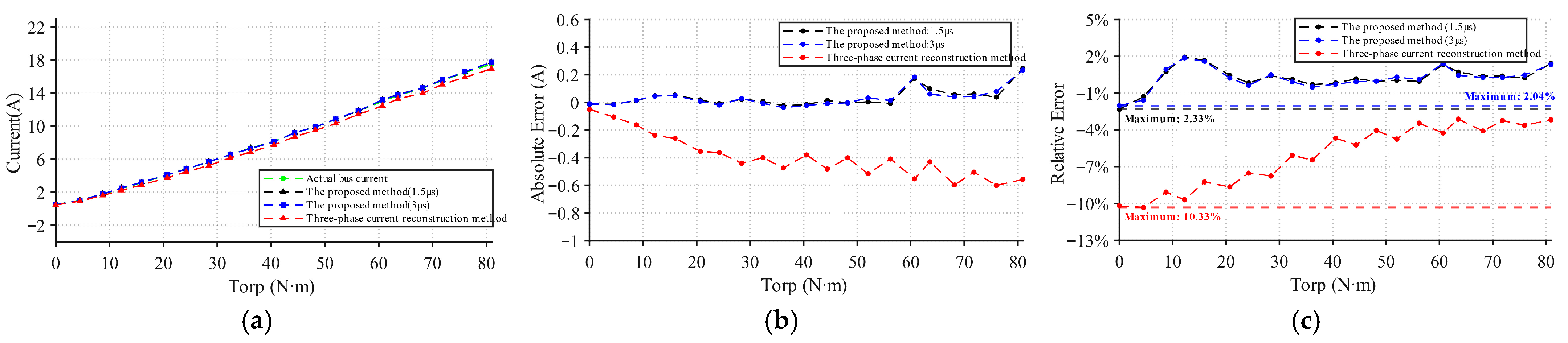
Figure 17 presents a comparison of the measured current, the DC bus current estimated by the proposed method, and the current estimated using the three-phase current reconstruction method, with the motor operating at 1000 r/min and the load increasing from 0 N·m to the rated torque of 80 N·m. The comparison of estimation results in the medium-speed range indicates that the proposed algorithm achieves superior estimation accuracy compared to the three-phase current reconstruction method. In this range, the maximum estimation error of the proposed method is below ±2.04%, satisfying the full-torque specification of a maximum error under ±3%.
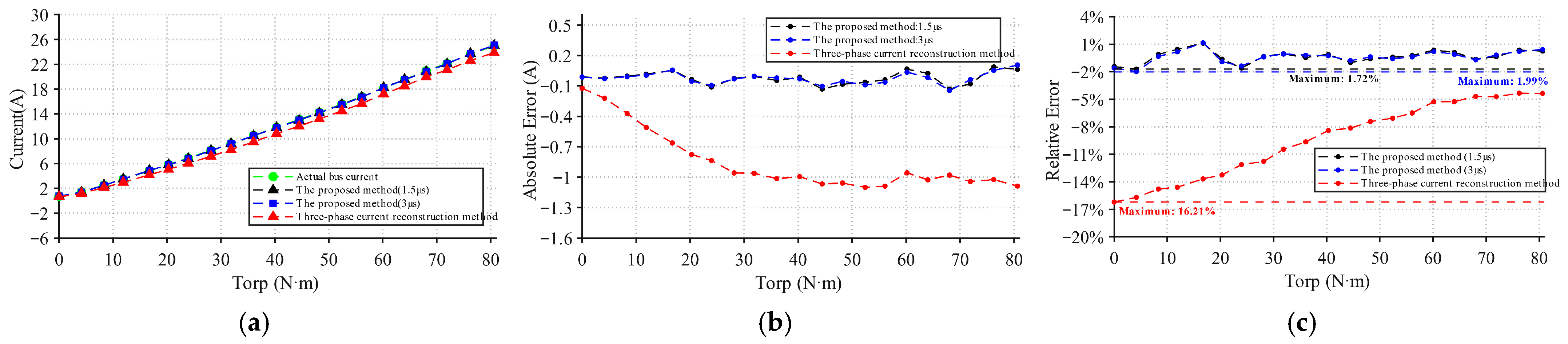
Figure 18 presents a comparison between the measured current, the DC bus current estimated by the proposed method, and that estimated using the conventional DC bus current estimation method, with the motor running at 1800 r/min and the load increasing from 0 N·m to the rated torque of 80 N·m. The results demonstrate that, under high-speed full-torque conditions, the maximum estimation error is below ±1.99%, satisfying the specification of a full-torque maximum error under ±3%. The observed maximum estimation error of 16.21% in the high-speed range, relative to the low- and medium-speed results, corroborates the influence of dead time on estimation accuracy and confirms the effectiveness of the proposed compensation strategy.
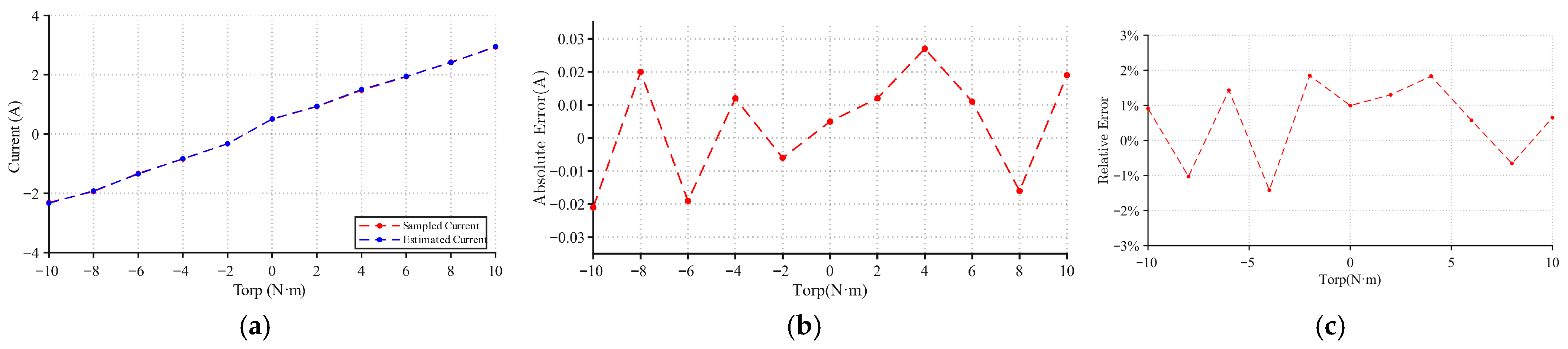
To further verify the effectiveness of the proposed method under low-current conditions and near the current zero-crossing region, experiments are conducted with the motor speed fixed at 1000 r/min, the torque varying from −10 N·m to 10 N·m, and the dead time set to 3 µs. The corresponding experimental results are presented in Figure 19.
The experimental results demonstrate that, even under low-current operating conditions, the maximum estimation error remains within ±2%, confirming that the proposed method maintains high estimation accuracy and strong robustness.
In conclusion, the proposed estimation algorithm accurately estimates the DC bus current across low-, medium-, and high-speed operating conditions, maintaining a maximum relative error below ±3%, thereby satisfying the project specifications. Compared to the three-phase current reconstruction method, the proposed algorithm exhibits superior accuracy and stability across a broad range of speeds and torque conditions. Compared with the method reported in Reference [3], which presents a maximum relative error of 5% in the low-speed region and 10% in the high-speed region, the proposed method demonstrates superior estimation performance. Furthermore, compared with the method in Reference [4], which achieves a maximum relative error of 4.763% under different modulation indices and power factor conditions, the proposed approach shows better stability and enhanced robustness.

6. Conclusions

This paper addresses the need for real-time DC bus current monitoring of PMSMs in new energy vehicle controllers. Using the three-phase current reconstruction method under a space vector PWM control strategy, the effect of dead time on the estimation method is analyzed through a combination of quantitative analysis and simulation experiments. A compensation strategy for DC bus current estimation is then developed, and a DC bus current estimation method for PMSM drive systems is proposed. The accuracy and practicality of the proposed estimation method were validated through bench experiments. Results show that the proposed DC bus current estimation method for PMSM drive systems can accurately estimate the DC bus current across a broad range of speeds and torque conditions. The maximum relative error between the estimated and actual measured values is below ±2.04%, satisfying the project requirement of a maximum estimation error within ±3%.

Author Contributions

Conceptualization, J.H.; methodology, X.C.; software, X.C.; validation, X.C.; formal analysis, X.C.; investigation, X.C.; resources, J.H.; data curation, X.C.; writing—original draft preparation, X.C.; writing—review and editing, J.Z.; visualization, X.C.; supervision, J.Z. and J.H.; project administration, J.Z. and J.H.; funding acquisition, none. All authors have read and agreed to the published version of the manuscript.

Funding

This research received no external funding.

Institutional Review Board Statement

Not applicable.

Informed Consent Statement

Not applicable.

Data Availability Statement

The original contributions proposed in this study are included within the manuscript. For further inquiries, please contact the corresponding author.

Conflicts of Interest

Author Jie Hong was employed by the company Hezhi Digital Energy Technology Co., Ltd. The remaining authors declare that the research was conducted in the absence of any commercial or financial relationships that could be construed as a potential conflict of interest.

References

  1. Wei, Y.; Jiang, T.; Huang, S. Research on the Market Penetration of New Energy Vehicles in China and Future Prospects. Repair Maint. 2026, 01, 129–130. [Google Scholar]
  2. Zhao, D.; Ma, J. Development Status, Challenges, and Future of China’s Electric Vehicle Industry. J. Chang. Univ. (Soc. Sci. Ed.) 2020, 22, 51–56. [Google Scholar]
  3. Yuan, B.; Wang, S. A DC-Link Current Estimation Method for VSI-Fed IPMSM Drive System Considering Dead-Time Effect. In Proceedings of the 2023 26th International Conference on Electrical Machines and Systems (ICEMS), Zhuhai, China, 5–8 November 2023; pp. 1133–1138. [Google Scholar]
  4. Wu, W.; Wei, X.; Wang, W. DC-link current reconstruction of the NPC three-level dual-PWM converter. Electr. Power Autom. Equip. 2019, 39, 130–135. [Google Scholar]
  5. Zhao, W.; Hao, L. DC-Link Voltage Regulation Control of a Dual Three-Phase Permanent Magnet Synchronous Generator Without Current Sensors. Proc. CSEE 2023, 43, 3995–4005. [Google Scholar]
  6. Takae, K.; Akatsu, K. Torque Estimation for Permanent Magnet Synchronous Motors Using DC-Link Current Control Method. In Proceedings of the 2025 Energy Conversion Congress & Expo Europe (ECCE Europe), Birmingham, UK, 31 August–4 September 2025; pp. 1–4. [Google Scholar]
  7. Chen, Z.; Shi, T.; Cao, Y.; Li, C. An Accurate Inverter Nonlinearity Compensation Method for IPMSM Torque Estimation Based on Numerical Fitting. IEEE J. Emerg. Sel. Top. Power Electron. 2023, 11, 2126–2138. [Google Scholar] [CrossRef]
  8. Jo, S.I.; Lee, W.J. Compensation method of average current sampling error under the operating condition of low sampling-to-fundamental frequency ratio. J. Power Electron. 2023, 23, 649–655. [Google Scholar] [CrossRef]
  9. ONos, V.; Anuchin, A.S.; Nos, A.O. A Survey on Time Delay Compensation Methods for Digitally Controlled PWM Drives at Low-Carrier Ratio Operation. In Proceedings of the 2025 IEEE XVII International Scientific and Technical Conference on Actual Problems of Electronic Instrument Engineering (APEIE), Novosibirsk, Russia, 14–16 November 2025; pp. 1–5. [Google Scholar]
  10. Xu, W.; Huang, W. Robust Predictive Deadbeat Control for Three-Phase Buck PWM Rectifier. In Proceedings of the 2025 IEEE 16th International Symposium on Power Electronics for Distributed Generation Systems (PEDG), Nanjing, China, 22–25 June 2025; pp. 982–987. [Google Scholar]
  11. Kozielski, K.; Mudiyanselage, G.A.; Pradhan, R.; Pietrini, G.; Solanki, A.; Nayak, P.; Narimani, M.; Emadi, A. Digital Closed Loop Control of a Three Port Series Resonant Converter for Electric Vehicles. In Proceedings of the 2024 IEEE Applied Power Electronics Conference and Exposition (APEC), Long Beach, CA, USA, 25–29 February 2024; pp. 807–814. [Google Scholar]
  12. Wang, C.; Xiao, L.; Zheng, X.; Lv, L.; Xu, Z.; Jiang, X. Analysis, Measurement, and Compensation of the System Time Delay in a Three-Phase Voltage Source Rectifier. IEEE Trans. Power Electron. 2016, 31, 6031–6043. [Google Scholar] [CrossRef]
  13. Cheng, J.; Chen, D.; Chen, G. Modeling and Compensation for Dead-Time Effect in High Power IGBT/IGCT Converters with SHE-PWM Modulation. Energies 2020, 13, 4348. [Google Scholar] [CrossRef]
  14. Dafang, W.; Bowen, Y.; Cheng, Z.; Chuanwei, Z.; Ji, Q. A Feedback-Type Phase Voltage Compensation Strategy Based on Phase Current Reconstruction for ACIM Drives. IEEE Trans. Power Electron. 2014, 29, 5031–5043. [Google Scholar] [CrossRef]
  15. Chen, H.; Zhang, R.; Zhu, S.; Gao, J.; Zhou, R. Model Reference Adaptive Observer for Permanent Magnet Synchronous Motors Based on Improved Linear Dead-Time Compensation. Electronics 2023, 12, 4907. [Google Scholar] [CrossRef]
  16. Chen, M.; Chen, S.; Wu, Q. Sliding mode disturbance observer-based adaptive control for uncertain MIMO nonlinear systems with dead-zone. Control. Signal Process 2016, 31, 1003–1018. [Google Scholar] [CrossRef]
  17. Tian, K.; Jin, X.; Zhang, C.; Niu, S.; Gao, S. Method of Dead-time Compensation in Three-level Inverter Based on Motor Model Predictive Control. Electr. Drive 2016, 46, 16–21. [Google Scholar]
  18. Ibrir, S.; Xie, W.F.; Su, C.-Y. Adaptive tracking of a class of uncertain nonlinear systems subject to unknown dead-zone input nonlinearities: The symmetric and the non-symmetric cases. In Proceedings of the 2006 American Control Conference, Minneapolis, MN, USA, 14–16 June 2006; p. 6. [Google Scholar]
  19. Jiang, H.; Ling, Z.; Zhou, F.; Sun, M.; Liu, H.; Xu, L.; Yao, Y.; Ouyang, X.; Yang, H. Adaptive Dead Zone Compensation Control Method for Electro-Hydrostatic Actuators Under Low-Speed Conditions. Chin. J. Mech. Eng. 2024, 37, 168. [Google Scholar]
  20. Zhao, Z.; Ahn, C.K.; Li, H.-X. Dead Zone Compensation and Adaptive Vibration Control of Uncertain Spatial Flexible Riser Systems. IEEE/ASME Trans. Mechatron. 2020, 25, 1398–1408. [Google Scholar] [CrossRef]
  21. Wang, H.; Ai, Z. Command Filter-Based Adaptive Fuzzy Fixed-Time Tracking Control for Stochastic Nonlinear Systems with Input Saturation and Dead Zone. Int. J. Fuzzy Syst. 2025, 27, 1345–1356. [Google Scholar] [CrossRef]
  22. Wang, M.; Xiao, B. Neural network adaptive robust control based on dead time compensation. In Proceedings of the International Conference on Automatic Control and Artificial Intelligence (ACAI 2012), Xiamen, China, 3–5 March 2012; pp. 1390–1393. [Google Scholar]
  23. Urasaki, N.; Senjyu, T.; Uezato, K.; Funabashi, T. An adaptive dead-time compensation strategy for voltage source inverter fed motor drives. IEEE Trans. Power Electron. 2005, 20, 1150–1160. [Google Scholar] [CrossRef]
  24. Wang, W.; Guo, W.; Gan, W.; Huang, H. Based on SVPWM Dead-time Compensation of Asynchronous Motor Control Method. J. New Ind. 2018, 8, 28–34. [Google Scholar]
  25. Xin-Jun, L.; Yun-Lian, L.; Tie-Bin, W. Dead-time Compensation Strategy Based on SVPWM. In Proceedings of the 2017 International Conference on Computer Systems, Electronics and Control (ICCSEC), Dalian, China, 25–27 December 2017; pp. 1751–1755. [Google Scholar]
  26. Peng, W.; Qiao, M.; Jiang, C.; Zhang, Z. Optimal design of DC-link capacitor of three-phase voltage source inverter powered by DC supply. J. Nav. Univ. Eng. 2020, 32, 60–66. [Google Scholar]
Figure 1. Topology of the PMSM drive system.
Applsci 16 05087 g001
Figure 2. Current relationships of phase-a under different switching states. (a) Relationship between the DC-link current and the phase current under the switching state Q1 = 1; (b) Relationship between the DC-link current and the phase current under the switching state Q1 = 0.
Applsci 16 05087 g002
Figure 3. Basic Space Voltage Vector Diagram.
Applsci 16 05087 g003
Figure 4. Switching Sequence Waveforms in Sector I.
Applsci 16 05087 g004
Figure 5. Relationship between switching reference values and corresponding switching instants.
Applsci 16 05087 g005
Figure 6. Control block diagram with an embedded estimation module.
Applsci 16 05087 g006
Figure 7. Control structure with dead-time compensation.
Applsci 16 05087 g007
Figure 8. Comparative experimental results of the effect of dead time on the dq-axis voltage. (a) Comparative experimental results of the effect of dead time on the d-axis voltage; (b) comparative experimental results of the effect of dead time on the q-axis voltage.
Applsci 16 05087 g008
Figure 9. Comparative experimental results of the effect of dead time on the estimated current.
Applsci 16 05087 g009
Figure 10. Comparison of experimental results illustrating the impact of stator current magnitude on current estimation.
Applsci 16 05087 g010
Figure 11. Flowchart of the proposed compensation method.
Applsci 16 05087 g011
Figure 12. Control structure incorporating the compensation module.
Applsci 16 05087 g012
Figure 13. Effectiveness of dead-time compensation on the dq-axis voltages. (a) Effectiveness of dead-time compensation on the d-axis voltages; (b) effectiveness of dead-time compensation on the q-axis voltages.
Applsci 16 05087 g013
Figure 14. Comparison of compensation effects on the estimated current. (a) Estimation performance without dead time; (b) estimation performance with dead time applied; (c) estimation performance after compensation is applied.
Applsci 16 05087 g014aApplsci 16 05087 g014b
Figure 15. Photograph of the experimental platform. (a) Motor and drive system; (b) measurement and control platform.
Applsci 16 05087 g015
Figure 16. Comparison of current estimation algorithms under full-torque operation in the low-speed region. (a) Comparison of currents; (b) comparison of absolute errors; (c) comparison of relative errors.
Applsci 16 05087 g016
Figure 17. Comparison of current estimation algorithms under full-torque operation in the medium-speed region. (a) Comparison of currents; (b) comparison of absolute errors; (c) comparison of relative errors.
Applsci 16 05087 g017
Figure 18. Comparison of current estimation algorithms under full-torque operation in the high-speed region. (a) Comparison of currents; (b) comparison of absolute errors; (c) comparison of relative errors.
Applsci 16 05087 g018
Figure 19. Estimation results under low-current (zero-crossing) conditions. (a) Comparison of currents; (b) comparison of absolute errors; (c) comparison of relative errors.
Applsci 16 05087 g019
Table 1. DC bus current associated with each basic voltage space vector.
Basic Space Voltage VectorInverter DC Bus Current
U0(000)0
U1(001)ic
U2(010)ib
U3(011)ia
U4(100)ia
U5(101)ib
U6(110)ic
U7(111)0
Table 2. Voltage vector dwell times in each sector.
NIIIIIIIVVVI
T4ZYZXXY
T6YXXZYZ
T0(T7)(TsT4T6)/2
Table 3. Variations in the three dwell times for different current polarity combinations.
sgn(a), sgn(b), sgn(c)XYZ
−1, −1, 1−2Td−2Td0
1, −1, 1−2Td0−2Td
1, −1, −102Td−2Td
1, 1, −12Td2Td0
−1, 1, −12Td02Td
−1, 1, 10−2Td2Td
Table 4. Current estimation errors in each sector under different current polarity combinations.
sgn(a), sgn(b), sgn(c)IIIIIIIVVVI
−1, −1, 12ic2ia2ia2ic2ia2ia
1, −1, 1−2ia−2ic−2ic−2ib−2ic−2ib
1, −1, −12ib2ib2ib2ia2ib2ic
1, 1, −1−2ic−2ia−2ia−2ic−2ia−2ia
−1, 1, −12ia2ic2ic2ib2ic2ib
−1, 1, 1−2ib−2ib−2ib−2ia−2ib−2ic
Table 5. Motor specifications.
No.ParameterValue
1Rated voltage (V)610
2Rated power (kW)15
3Rotor flux linkage (Wb)0.1
4Moment of inertia (kg·m2)0.0002
5Stator resistance (Ω)0.02
6q-axis inductance (mH)21.9
7d-axis inductance (mH)9.8
8Number of pole pairs4
9Rated speed (r/min)1800
10Rated torque (N·m)80
11Dead time (µs)3
Disclaimer/Publisher’s Note: The statements, opinions and data contained in all publications are solely those of the individual author(s) and contributor(s) and not of MDPI and/or the editor(s). MDPI and/or the editor(s) disclaim responsibility for any injury to people or property resulting from any ideas, methods, instructions or products referred to in the content.