Article

Observation of the Localized Interfacial Evolution Preceding Marangoni Convection

State Key Laboratory of Chemical Engineering and Low–Carbon Technology, School of Chemical Engineering and Technology, Tianjin University, Tianjin 300350, China
*
Author to whom correspondence should be addressed.
Appl. Sci. 2026, 16(10), 5079; https://doi.org/10.3390/app16105079
Submission received: 30 April 2026 / Revised: 14 May 2026 / Accepted: 16 May 2026 / Published: 20 May 2026

Abstract

Mass transfer–induced Marangoni convection in volatile binary liquids is commonly associated with the amplification of interfacial concentration disturbances, yet the localized evolution preceding the first visible convective cell remains difficult to quantify experimentally. Here, ethanol–water desorption in a confined quasi–two–dimensional cell with a 2 mm liquid thickness was investigated using quantitative Schlieren imaging. The apparent transient concentration field and interfacial concentration profiles were reconstructed to resolve the earliest observable stage of Marangoni onset. The early behavior depended strongly on the initial ethanol mass fraction. Low–concentration cases mainly exhibited Rayleigh plume structures, high–concentration cases developed Marangoni cellular structures too rapidly for reliable early–stage tracking, whereas intermediate–concentration cases provided a resolvable window before Marangoni cell formation. For an initial ethanol mass fraction of 8 wt.%, a localized interfacial onset site appeared before the first visible Marangoni convective cell. This event initiated two counter–propagating spreading fronts, enriched the swept interfacial region, and was followed shortly by visible Marangoni cellular structures within the redistributed region. The apparent surface tension gradient field exhibited a transient evolution, with an initial increase, followed by a decrease during spreading, and a subsequent increase upon front interaction. These results provide experimental reference data for the pre–cellular interfacial redistribution sequence associated with perturbation–driven Marangoni onset in confined ethanol–water desorption systems.

1. Introduction

Marangoni convection, defined as interfacial flow driven by surface tension gradients, is a fundamental transport phenomenon in multiphase systems. In heat–transfer systems, Pearson first explained cellular convection in terms of surface tension effects [1]. Sternling and Scriven subsequently extended this concept to mass transfer systems and showed that concentration gradients generated by interfacial mass transfer can also destabilize an interface and induce Marangoni convection [2]. Since then, solutal Marangoni convection has been widely studied in gas–liquid and liquid–liquid mass transfer processes, including volatile binary–liquid layers, droplets, and confined microfluidic or Hele–Shaw geometries [3,4,5,6,7,8]. In ethanol–water systems, selective evaporation or desorption of ethanol can generate interfacial concentration gradients because ethanol is more volatile and has a lower surface tension than water. Such concentration gradients may produce local surface tension gradients and eventually lead to interfacial convection [4,5,6,7,8].
The onset of Marangoni convection is generally understood as the growth of small interfacial or concentration disturbances imposed on a diffusion–dominated base state. In the classical framework of Sternling and Scriven [2], the instability arises when interfacial disturbances are amplified by the coupling between concentration transport and surface tension–driven flow. For stationary solutal Marangoni instability, a local increase in interfacial solute concentration can reduce the local interfacial tension, generate Marangoni shear stress, and induce an interfacial flow that further modifies the concentration field. If this feedback is strong enough, the disturbance grows into visible interfacial convection. Recent reviews of stationary solutal Marangoni instability have further shown that the nonlinear evolution of such systems can involve roll cells, relaxation oscillations, and relaxation–oscillation waves, often with different hierarchy levels and repeated amplification–decay cycles [9,10,11]. These studies demonstrate that the formation of visible cellular patterns is not a simple instantaneous transition from a uniform interface but rather the result of disturbance growth, interfacial reorganization, and subsequent pattern development.
Numerical studies also highlight the importance of interfacial perturbations in initiating mass transfer–induced convection. In lattice Boltzmann simulations of gas–liquid Marangoni convection, fixed perturbation and self–renewable interface models have been introduced to trigger and describe interfacial Marangoni structures [12]. Later LBM–based simulations of solutal interfacial convection in gas–liquid systems also incorporated interfacial perturbation models to simulate Rayleigh and Marangoni convection during mass transfer [13]. In ethanol–water systems, Lopez de la Cruz et al. [6] investigated Marangoni instability triggered by selective evaporation inside a Hele–Shaw cell by combining experiments, quasi–two–dimensional simulations, and linear stability analysis. Their work clarified the growth of convective cells after instability onset and provided a theoretical basis for understanding Marangoni instability in confined ethanol–water systems. However, in most theoretical and numerical studies, the initial disturbance is either prescribed, treated as random, or implicitly present through numerical noise. Direct experimental characterization of how such a localized disturbance first becomes resolvable at a real interface remains limited.
Optical visualization techniques have played an important role in studying interfacial convection during mass transfer. Schlieren and shadowgraph methods provide nonintrusive visualization of refractive–index gradients induced by concentration variations [14,15]. Quantitative Schlieren techniques have further enabled the reconstruction of concentration–gradient or concentration fields near gas–liquid interfaces. Liu et al. [16] used quantitative Schlieren imaging to study mass transfer near a gas–liquid interface and related local concentration gradients to Marangoni convection. Later studies applied quantitative Schlieren imaging to Rayleigh convection analysis in gas–liquid absorption systems [17]. In liquid–liquid and droplet systems, experimental and numerical studies have revealed complex interfacial structures such as cellular patterns, hierarchical roll cells, relaxation oscillations, Rayleigh–Marangoni coupled convection, and droplet–scale Marangoni flows [9,10,11,18,19,20]. These studies have greatly advanced the understanding of interfacial pattern formation and mass transfer enhancement.
Nevertheless, most experimental studies have focused on flow structures after convection has become visible, such as roll cells, plumes, waves, or developed cellular patterns. The earliest experimentally resolvable stage, during which a localized interfacial disturbance first appears and reorganizes the concentration field before the first visible Marangoni cell, remains insufficiently quantified. This stage is especially important because it links the small disturbances assumed in theoretical and numerical models with the visible cellular structures observed in experiments. For confined ethanol–water desorption systems, it is still unclear how a localized interfacial concentration redistribution first appears, how it spreads along the interface, and how the associated surface tension gradient field evolves before visible cellular convection is established.
Against this background, the present study investigates the early interfacial evolution during ethanol–water desorption in a confined quasi–two–dimensional gas–liquid cell with a liquid thickness of 2 mm. Quantitative Schlieren imaging was used to reconstruct the transient quasi–two–dimensional concentration field and to extract interfacial concentration profiles. Rather than focusing only on fully developed convective cells, this work aims to resolve the localized onset site of interfacial concentration redistribution, hereafter referred to as the transition point, and to characterize its lateral spreading and associated apparent surface tension gradient evolution before the first visible Marangoni cellular structures appear. By comparing different initial ethanol mass fractions, the study identifies the intermediate–concentration regime in which this pre–cellular interfacial evolution can be experimentally resolved. The results provide experimental reference data for perturbation–driven Marangoni onset in confined ethanol–water desorption systems.

2. Materials and Methods

2.1. Experimental Configuration

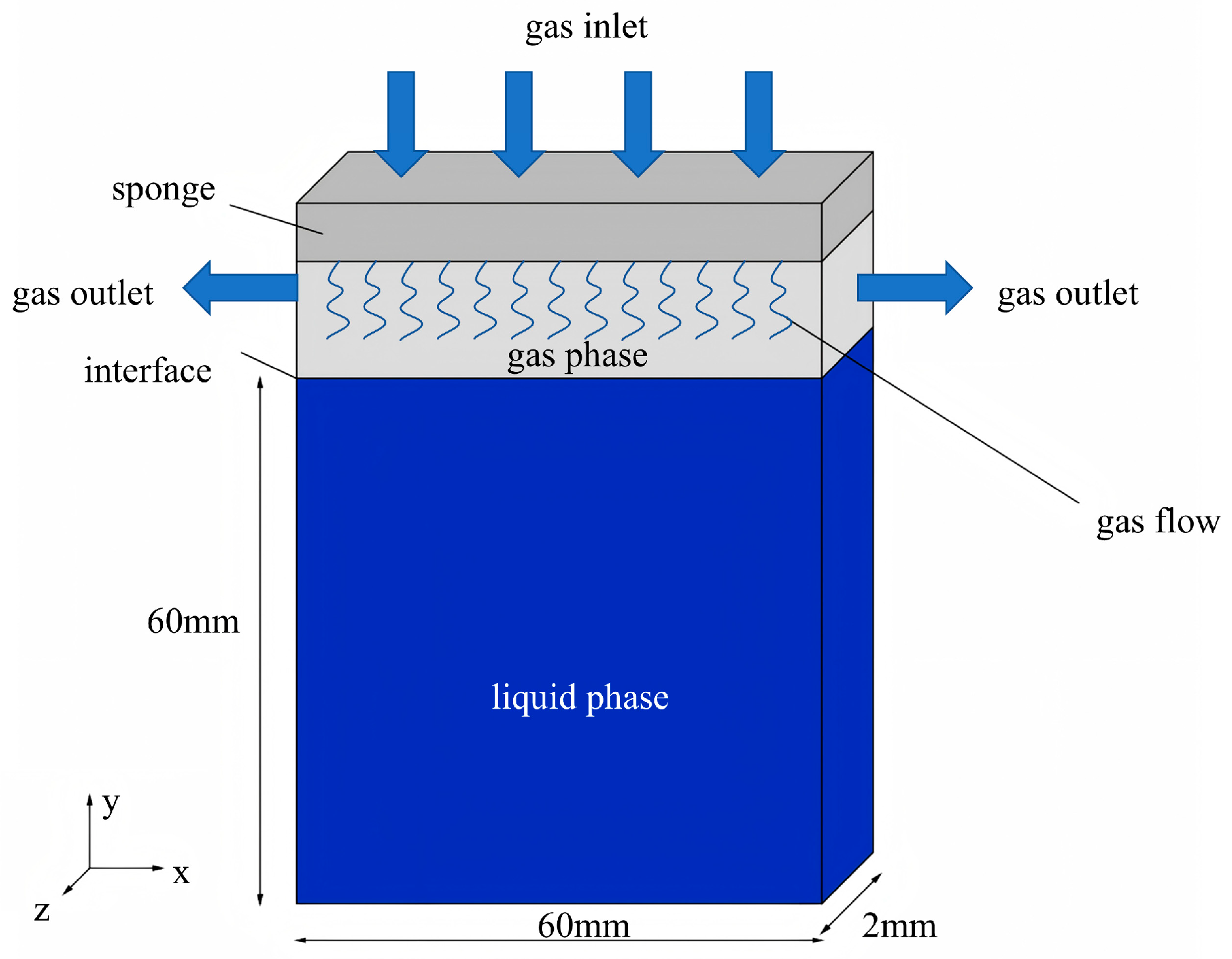
Ethanol (purity ≥99.7%, Guangfu Technology Development Company, Tianjin, China), deionized water (conductivity ≤1 μS/cm, Tianjin Yongqingyuan Water Purification Center, Tianjin, China), and nitrogen gas (purity ≥99.99%, Tianjin Liufang Gas Co., Ltd., Tianjin, China) were used in the experiments. This study employed a quasi–two–dimensional gas–liquid mass transfer apparatus shown in Figure 1, whose walls are made of optical glass and in which the liquid bulk had a thickness of 2 mm and both the inner height and width of the apparatus are 60 mm. Dilute ethanol–water solutions with varying initial ethanol mass fractions were introduced into the apparatus. Nitrogen gas was input into the apparatus uniformly and purged the gas–liquid interface at a fixed flow rate of 600 mL/min to enable observation of the concentration changes near the interface induced by ethanol desorption. Under this gas flow rate, no significant deformation of the liquid interface occurred. The nitrogen was presaturated with water vapor to eliminate the influence of water evaporation. All experiments were conducted at 25 °C and atmospheric pressure. The optical ray was oriented perpendicular to the X–Y plane.

2.2. Schlieren System and Image Acquisition

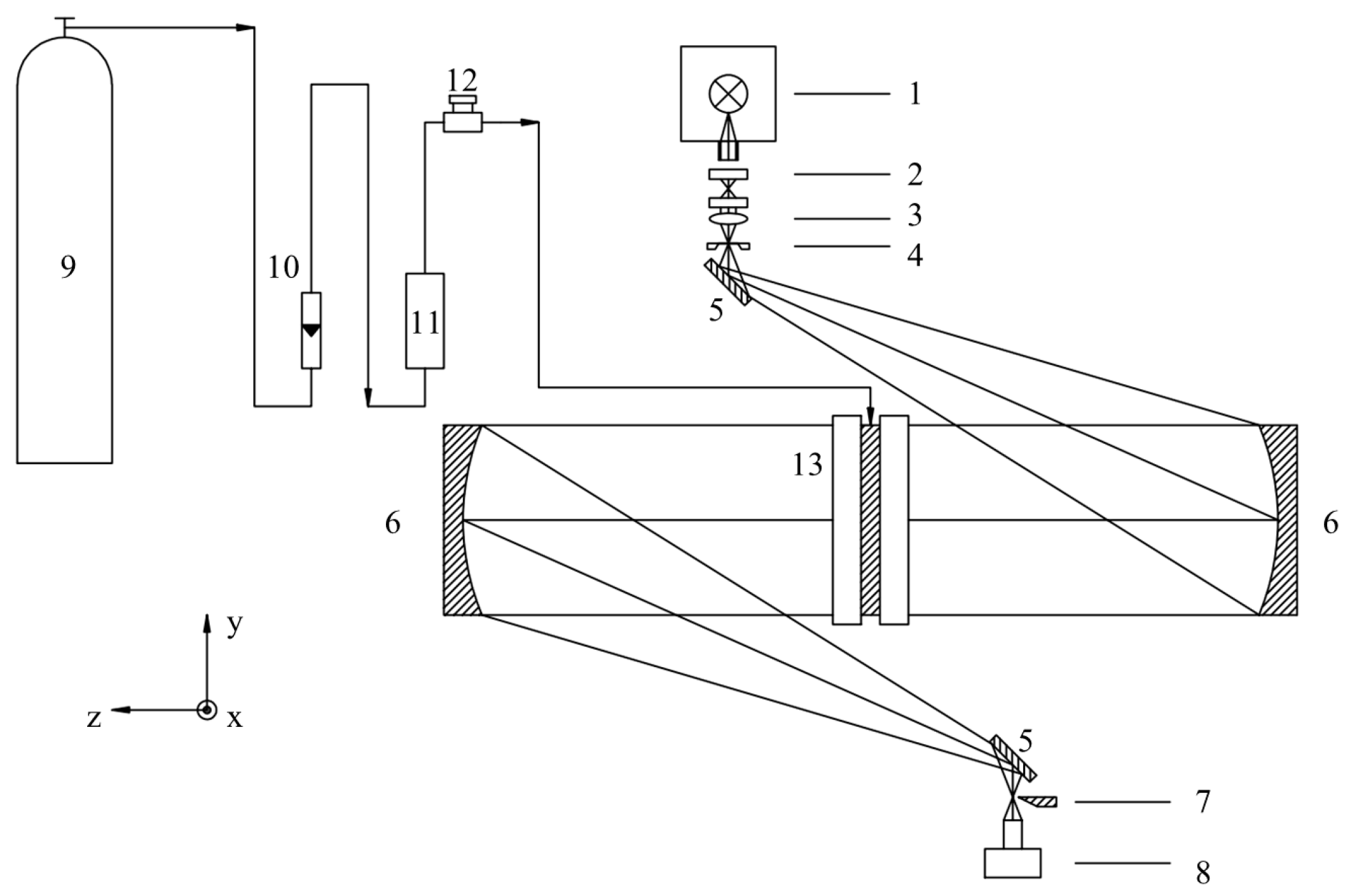
A schlieren system (WKWY–Φ200 mm, Sichuan Physcience Optics and Fine Mechanics Co., Ltd., Mianyang, China; Figure 2) was employed to visualize the refractive index gradients induced by concentration variations within the liquid phase. A collimated light beam was directed through the gas–liquid mass transfer apparatus, and a blade was used to convert beam deflections into grayscale contrast. The camera axis was oriented perpendicular to the liquid layer to capture the evolution of the interfacial structure.
The imaging conditions were as follows: frame rate = 70 fps, exposure time = 100 μs, image resolution = 4032 × 3072 pixels, and bit depth = 10. Spatial calibration yielded a scale of 0.05618 mm/pixel. A reference image acquired prior to gas injection was utilized as the background image. Background subtraction was applied to eliminate stationary variations in brightness, and a Gaussian filter with σ = 1.5 pixels and a 3 × 3 kernel was employed during preprocessing and interfacial data extraction to reduce high–frequency noise. The key parameters and descriptions of the Schlieren equipment are summarized in Table 1.

2.3. Quantitative Schlieren Analysis

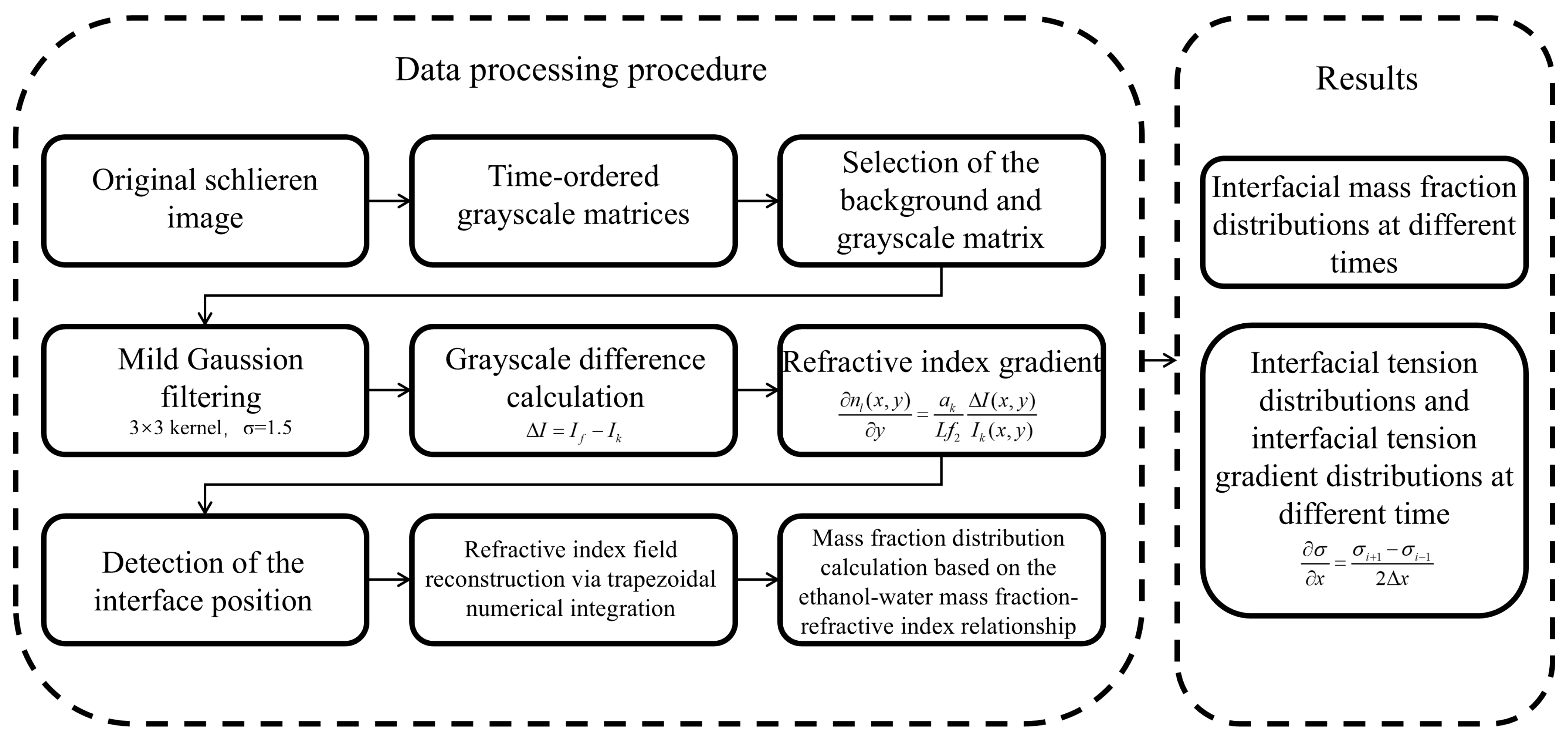
In this study, data obtained from schlieren image processing were analyzed, and the detailed processing procedure is shown in Figure 3. Image processing and data analysis were performed using MATLAB R2022b (MathWorks, Natick, MA, USA).
The quantitative data of the concentration field followed the same logic as that used in previous quantitative Schlieren studies of interfacial mass transfer [17]. Because the liquid thickness was uniform, the measured light deflection within the liquid layer was mainly associated with refractive–index gradients induced by mass–transfer–related concentration variations. According to the Schlieren optical relation, the grayscale difference between the flow image and the background image is proportional to the deflection angle. Thus, the local refractive–index gradient can be written as
n l ( x , y ) y = a k L f 2 Δ I ( x , y ) I k ( x , y ) ,
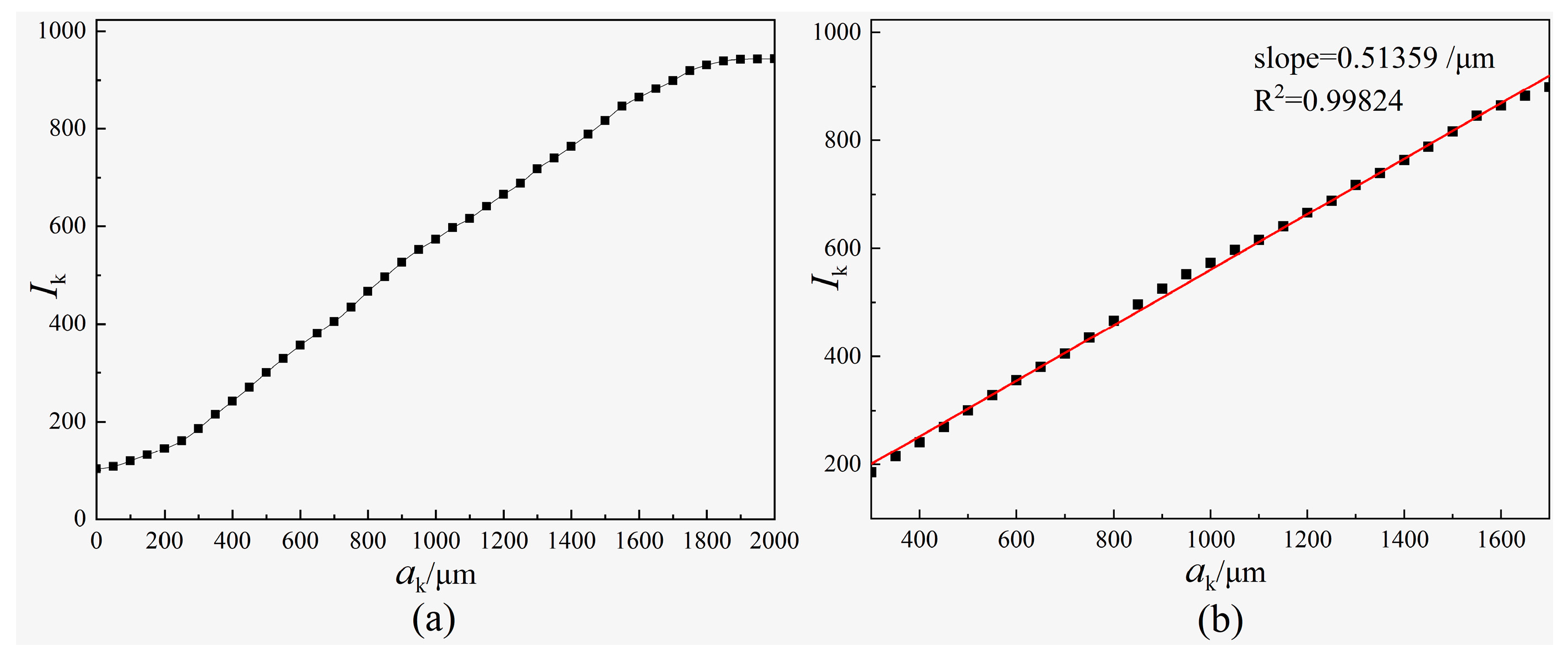
where a k is the effective width of the unblocked light source image, f 2 is the focal length of the second focusing element, I k ( x , y ) is the background grayscale, and ( Δ I = I f I k ) is the grayscale difference between the flow image and the background image. The calibration results for the quantitative Schlieren system are shown in Figure 4.
In the present experiments, the blade–edge position was set to a 50% cutoff. Under this configuration, the grayscale variation range associated with the structures generated by the subsequent convective development fell within the linear regime of the calibration curve, enabling the change in grayscale intensity to accurately reflect the variation in the relative cutoff at the knife–edge and, consequently, facilitating the calculation of the refractive index gradient. The lower region of the liquid phase, which remained unaffected by mass transfer, was selected as the reference datum.
The aforementioned expression was integrated vertically from this reference to obtain the refractive index field:
n l ( x , y ) = n 0 + a k L f 2 y 0 y Δ I ( x , η ) I k ( x , η ) d η ,
where n 0 is the known refractive index at a reference location, y 0 , that is outside the region influenced by mass transfer.
The refractive index was then converted into ethanol mass fraction using the calibration relation fitted from literature data in the range of 0–20 wt.% ethanol–water solution [21]:
n = 0.06826 w + 1.3323 ,
where w is the ethanol mass fraction in wt.%. Accordingly, the local ethanol concentration field was obtained as
w ( x , y , t ) = n l ( x , y , t ) 1.3323 0.06826 .
The field of w ( x , y , t ) was interpreted as a quasi–two–dimensional projected ethanol–concentration field. Because the optical signal represents a path–integrated response across the 2 mm gap, the resulting field should not be interpreted as a fully three–dimensional local concentration map.
The corresponding interfacial surface tension σ was estimated from a surface tension concentration relationship for ethanol–water solutions [22,23]. Based on the interfacial value extracted from the Schlieren–derived apparent ethanol mass fraction, an apparent surface tension gradient indicator was estimated using the empirical ethanol–water surface–tension relation and a central–difference scheme along the interface.
σ = 2.8976 w 3 + 1.6526 w 2 0.3721 w + 0.07215
σ x = σ i + 1 σ i 1 2 Δ x
Here, w in Equation (5) denotes the interfacial value extracted from the Schlieren–derived apparent ethanol mass–fraction field. Therefore, the gradient calculated from Equation (6) should be interpreted as an apparent surface–tension gradient indicator.
For uncertainty propagation, if the empirical surface–tension relation in Equation (5) is written as σ = f ( w ) , the local apparent gradient can also be expressed as
G σ = σ x = f ( w ) w x
Thus, the uncertainty of G σ is propagated from both f w and w / x . To first order,
δ G σ w x δ f ( w ) 2 + f ( w ) δ w x 2 1 / 2
Here, δ f ( w ) represents the uncertainty of the differentiated empirical surface–tension correlation, while δ ( w / x ) includes the uncertainty of the Schlieren–derived apparent interfacial mass fraction and the noise amplification introduced by central differencing. Therefore, the calculated gradient is used as an apparent indicator of interfacial non–uniformity and front interaction, rather than as an absolute local Marangoni stress or a universal critical threshold.
Previous work by Lopez de la Cruz et al. [6] on the evaporation/desorption of ethanol–water solutions showed that, even when an unrealistically large temperature difference of 10 K was assumed, the ratio of the solutal Marangoni number to the thermal Marangoni number remained on the order of 103–104. This comparison suggests that the solutal Marangoni effect is expected to be the dominant mechanism for interfacial instability in ethanol–water systems.
Nevertheless, this comparison does not imply that thermal effects are completely absent from the optical measurement. The Schlieren signal depends on the refractive–index field, and the refractive index of ethanol–water solutions may depend on both composition and temperature. Therefore, local evaporative cooling during ethanol desorption may contribute to the measured optical response. In the present work, the Schlieren–derived concentration field and the corresponding surface–tension–gradient field are therefore interpreted as apparent quantities. They are used to characterize the spatiotemporal evolution of localized interfacial redistribution rather than to determine an absolute purely solutal concentration field or a universal critical Marangoni stress.

2.4. Extraction of Interfacial Variables

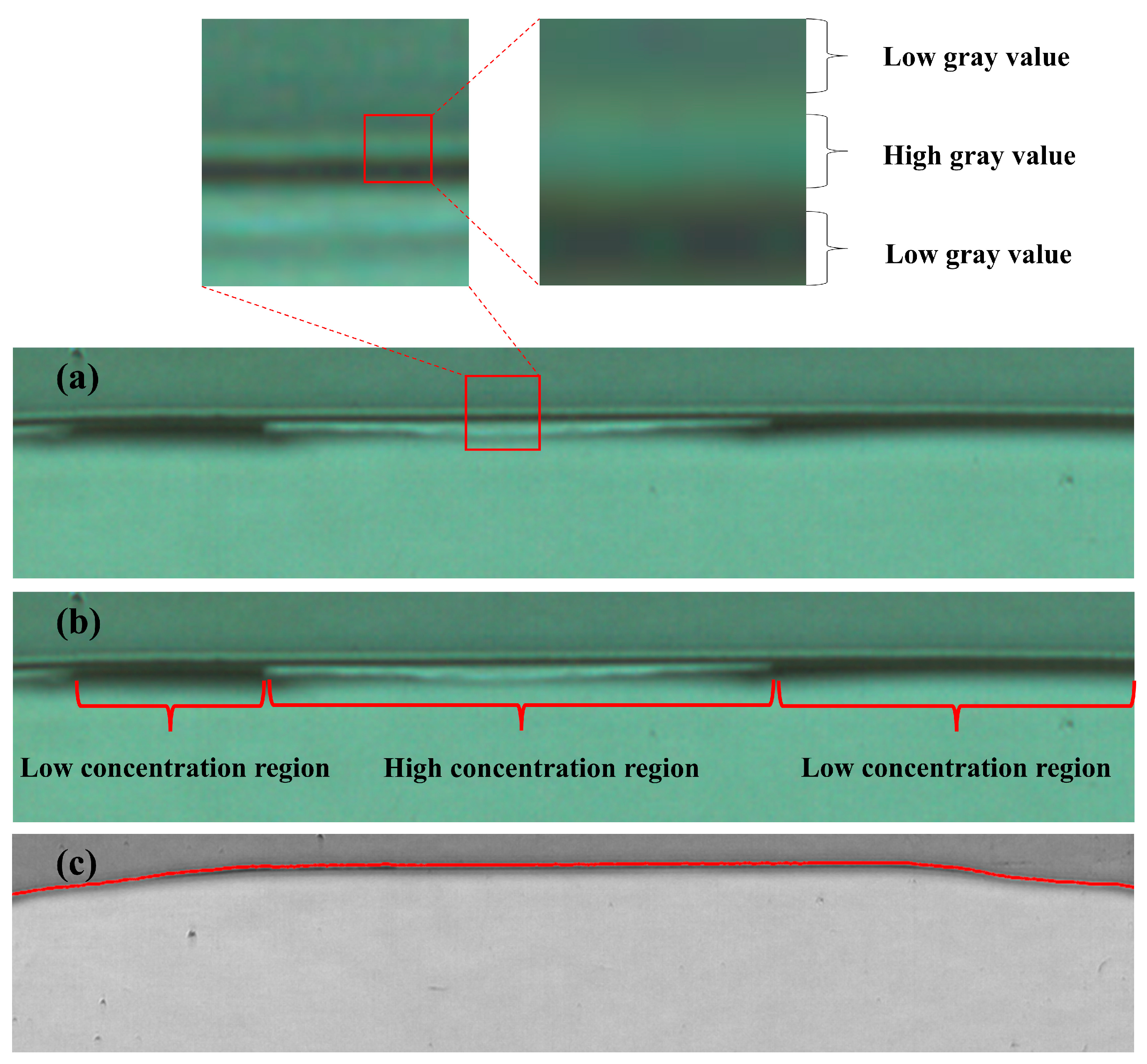
In the Schlieren images acquired in this study, the gray–value distribution near the gas–liquid interface exhibits a distinct low–high–low pattern in the direction normal to the interface, as shown in Figure 5a. This structure was treated as a stable optical marker of the interfacial region rather than as the exact geometrical gas–liquid interface. It is associated with the refractive–index discontinuity and local optical response near the gas–liquid boundary, including refraction/reflection at the interfacial meniscus and light redistribution in the Schlieren system.
In the locally enlarged view in Figure 5a, the intermediate high–gray–value layer, namely the bright layer, was experimentally verified to maintain a nearly constant gray value. Figure 5b presents an image taken 0.5 s after the appearance of the concentration transition point, showing that the low–high–low pattern near the interface persists in regions with different concentrations. Therefore, the high–gray–value layer was used only to determine a fixed apparent interfacial reference line for extracting interfacial profiles.
During data processing, the apparent interfacial reference line was determined once from the initial Schlieren image before the localized interfacial redistribution appeared. A search window containing the interfacial optical marker was predefined according to the initial interface position. Within this window, the local gray–value peak in each column was identified, corresponding to the high–gray–value region shown in Figure 5a. By connecting the detected peak positions in all columns and applying the MAD–based outlier correction described below, a fixed apparent interfacial reference line was obtained, as shown in Figure 5c. This reference line was then kept fixed and used for all subsequent interfacial profile extractions.
To mitigate the influence of isolated noise, a robust local median absolute deviation (MAD) criterion is applied as a post–processing step to the detected interface line. For each column j, the detected interface height is compared with the local median height computed within an 11–column neighborhood window centered on that column. If the deviation of a given point’s height from the local median exceeds three times the MAD, that point is flagged as an outlier and subsequently corrected; these anomalous points are replaced by the average height of the nearest valid peak positions on either side. Here, h j denotes the interface height detected at column j (i.e., the peak position obtained from the local grayscale maximum), and h ˜ i represents the median of the interface heights across all columns within the 11–column neighborhood window centered at column i. The extracted interface line is shown in Figure 5c and was employed for all subsequent interfacial calculations in this experimental set.
MAD = median | h j h ˜ i |

3. Results and Discussion

3.1. Concentration–Dependent Flow Regimes

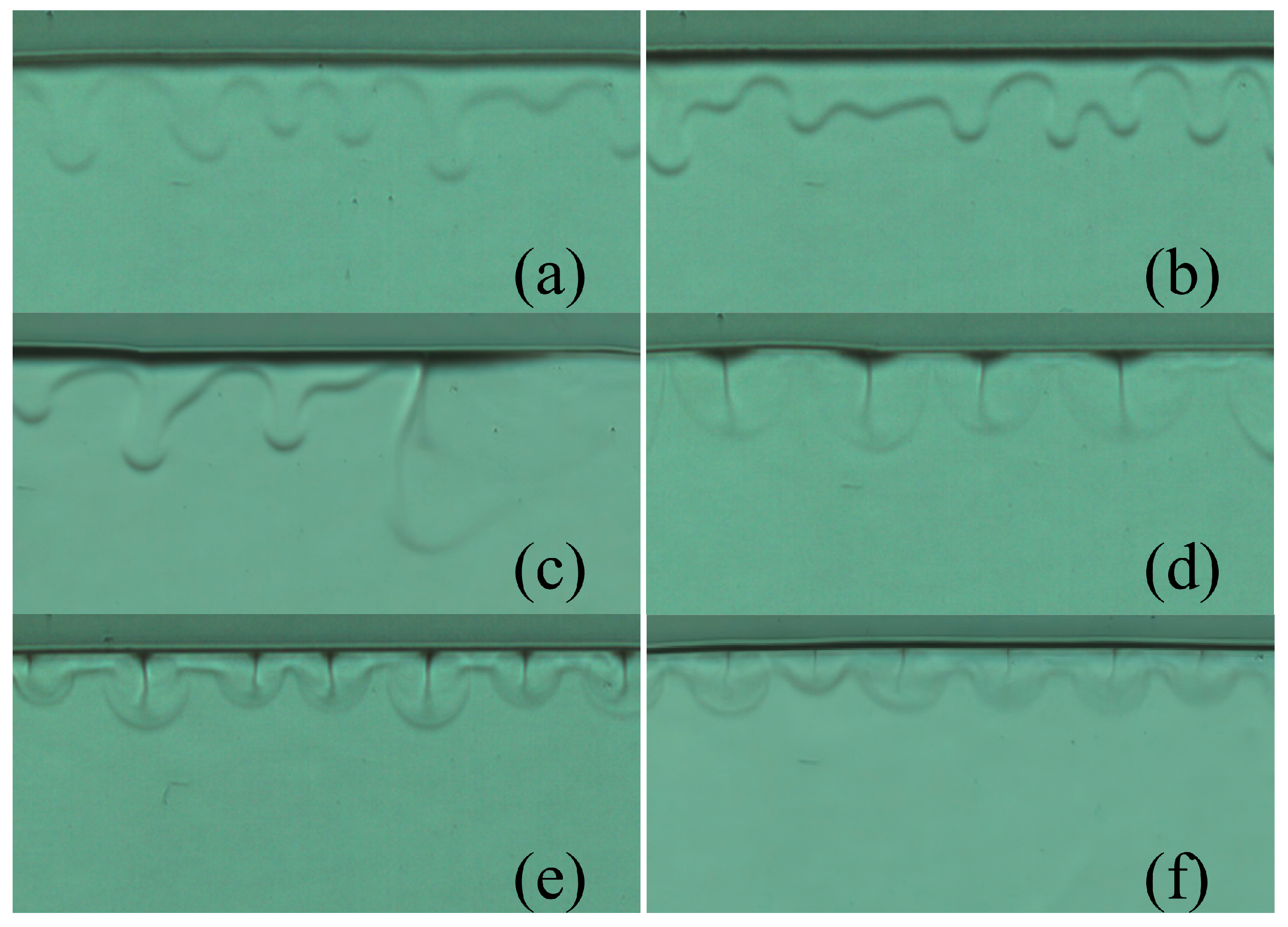
The convective behavior observed during the desorption process of ethanol–water solutions exhibited a strong dependence on the initial ethanol concentration. Representative snapshots of the concentration field and corresponding schlieren images revealed three distinct patterns.
The initial ethanol mass fractions listed in Table 2 were selected to cover the main concentration–dependent regimes observed in the present ethanol–water desorption system. The 2 wt.% and 5 wt.% cases represent the low–concentration Rayleigh–dominated regime, in which visible Rayleigh plume–like structures developed, and no localized interfacial transition point was resolved before plume formation. The 6–16 wt.% range represents the intermediate–concentration regime, where localized interfacial transition points could be resolved before the formation of visible Marangoni cellular structures. Among them, the 6 wt.% case corresponds to a transitional coexistence condition, where Rayleigh plume structures and an incomplete Marangoni–type interfacial cell appeared in the same experiment, while the 7 wt.% and 16 wt.% cases were selected to represent the lower and upper parts of the resolvable transition–point regime. For initial ethanol mass fractions higher than 16 wt.%, the interfacial evolution became too rapid for the Schlieren system to reliably capture the complete pre–cellular stage. Therefore, the 20 wt.% case was included as a representative high–concentration condition, where Marangoni cellular structures developed almost immediately. These concentrations were thus selected to identify the transition from Rayleigh–dominated behavior to a resolvable transition–point regime and finally to a rapid Marangoni–cell regime.
It can be observed that, with increasing initial ethanol mass fraction in the aqueous ethanol solution, the convective pattern evolves, in terms of flow structure, from the Rayleigh–dominated regime to a Rayleigh–Marangoni coexistence regime, and finally to the Marangoni–dominated regime as the ethanol content is further increased. Within the Rayleigh–dominated regime, the onset time of Rayleigh plume convection decreases with increasing ethanol mass fraction. At an ethanol concentration of 2 wt.%, 120 s is required for the Rayleigh convective structure to develop, whereas at 5 wt.%, only 68 s is needed. When the initial ethanol mass fraction reaches 6 wt.%, a coexistence of the two flow modes appears. It should be noted, however, that the Marangoni convective cell formed at this condition is not fully developed. As shown in Figure 6c, the left side of the image exhibits Rayleigh convection, whereas the right side shows only half of a Marangoni convective cell. As illustrated in Figure 6d–f, a classical Marangoni convection structure is characterized by a high–surface–tension region at the center of the convection cell, which continuously draws interfacial liquid from the surrounding lower–surface–tension regions toward the cell center. In contrast, in Figure 6c, the high–surface tension region, namely the ethanol–depleted region (black band), extends relatively uniformly along the interface on the left side of the image, without a distinct high–surface tension point pulling liquid symmetrically from both sides. Instead, under a unidirectional surface tension gradient, the liquid on the right side is drawn toward this region, eventually forming a half–cell convective structure.

3.2. Localized Interfacial Onset Before Visible Cell Formation

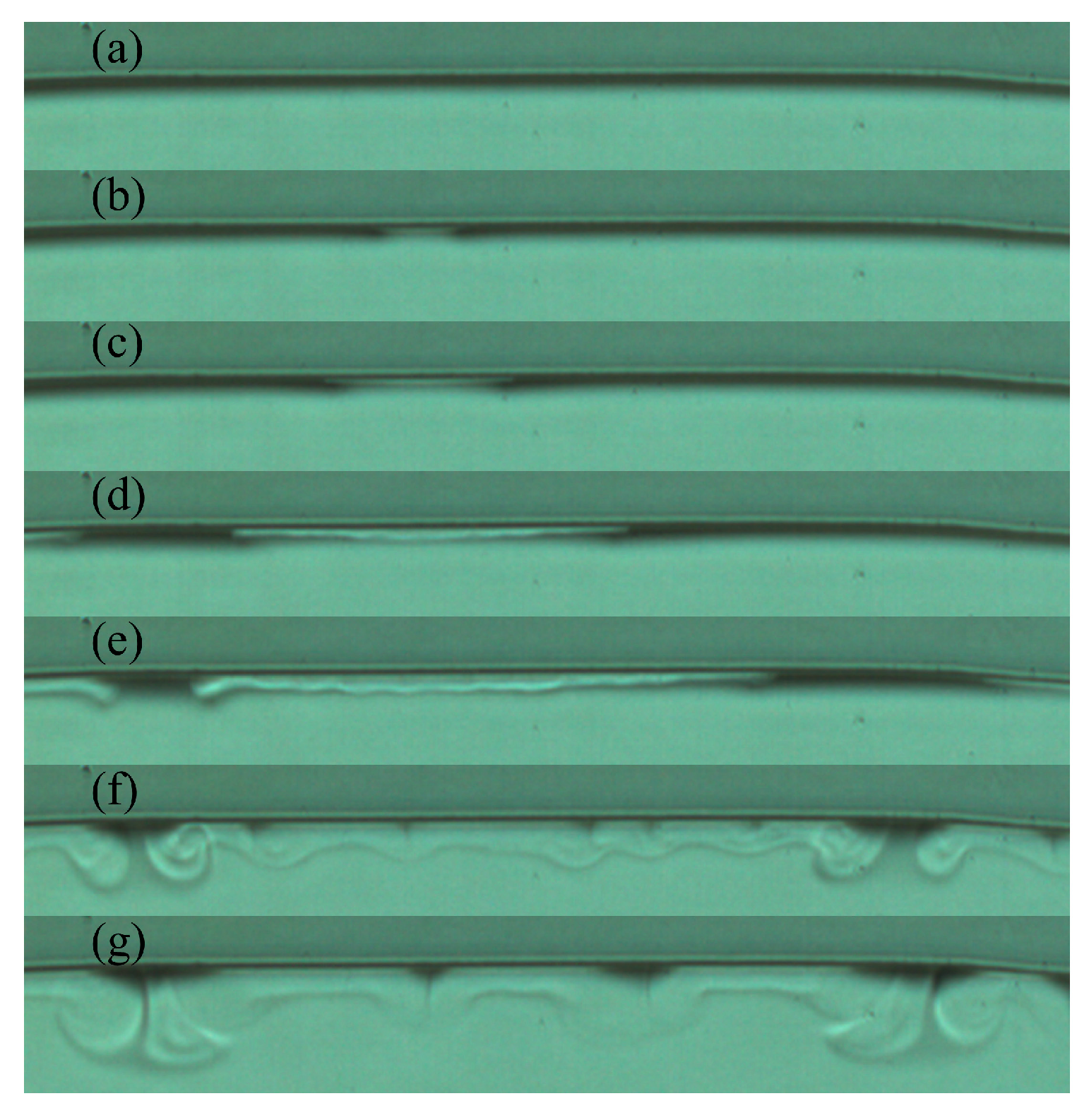
In this study, the localized onset site at which interfacial concentration redistribution first becomes experimentally resolvable is referred to as the transition point. A representative time sequence is presented in Figure 7. The sequence encompasses several characteristic stages: (i) Before the appearance of the transition point, the interface remained relatively uniform, as indicated by the black–layer structure at the interface in the schlieren image shown in Figure 7a; (ii) The emergence of a light region localized in the center, as shown in Figure 7b, that means there are concentration increasing area in the middle area; (iii) It rapidly spread along the interface, leading to the formation of a high–concentration interfacial region, as shown in Figure 7c,d; (iv) The spreading fronts spread along the interface in opposite directions and eventually met, as shown in Figure 7e,f; (v) the appearance of the discernible cellular pattern, as shown in Figure 7g. This sequence was repeatedly observed in resolvable cases at intermediate concentrations.
Experimental observations showed that, within the ethanol mass fraction range of 6 wt.% to 16 wt.%, the interfacial transition point could consistently be observed near the interface prior to the onset of Marangoni convection. Based on whether this interfacial transition point could be observed, the concentration range was divided into three regimes.
At lower initial mass fractions (≤5 wt.%), there was no Marangoni convection along the interface. Before the onset of Rayleigh convection, desorption at the interface was relatively uniform, and the schlieren images showed a gradual decrease in gray value near the interface. Once the critical Rayleigh number was reached, plume convection was initiated under the action of the density gradient.
At intermediate initial mass fractions (ranging from 6 wt.% to 16 wt.%), interfacial concentration transition points were detected at the interface, and these cases consistently preceded the formation of visible cellular convection. Experimental verification performed at different intermediate mass fractions showed that the transition points were typically observed within 10 s after gas introduction, which is much shorter than the onset time of Rayleigh plume convection. Because the transition points in the intermediate–concentration regime appeared much earlier than the visible Rayleigh plume structures, the subsequent analysis focuses on the early interfacial redistribution stage before fully developed bulk plume motion. This treatment does not imply that buoyancy–related effects are absent in the coexistence regime; rather, it indicates that the earliest resolvable transition–point evolution is not directly governed by an already developed Rayleigh plume. Once the transition point appeared, it rapidly propagated along the interface, forming a relatively uniform high–concentration region on the interface, as shown in Figure 7. As the initial ethanol mass fraction was further increased within the intermediate concentration range, the transition point phenomenon gradually became less controllable. For the 16 wt.% ethanol–water system, although interfacial transition points could still be observed, their onset and early evolution had become difficult to resolve precisely within the available temporal resolution. Therefore, in the subsequent experiments, an 8 wt.% ethanol–water solution was mainly adopted as the representative operating condition to ensure controllable observation of the transition point. Under this condition, the generation of the transition point depended on desorption enhanced by gas purging, thereby ensuring experimental operability.
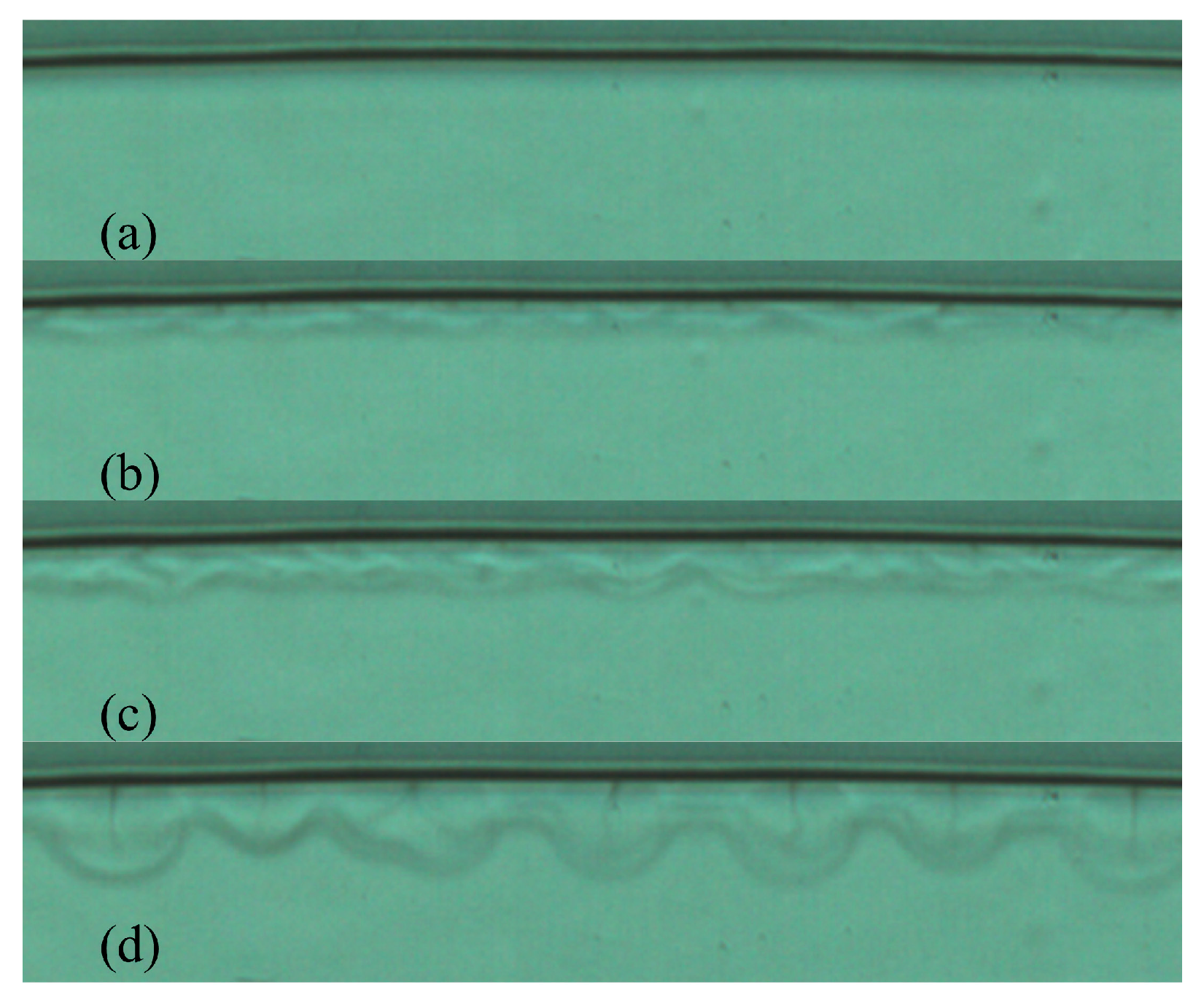
At higher initial mass fractions (exemplified by 20 wt.%), as the ethanol mass fraction increased, the onset time of interfacial convection decreased continuously. Owing to the extremely short interfacial desorption time and shallow penetration depth, the limited observation scale of the schlieren system prevented the identification of any transition point structure at the interface, as shown in Figure 8. This concentration range was therefore classified as an unobservable regime.

3.3. Statistical Occurrence of the Localized Onset Site

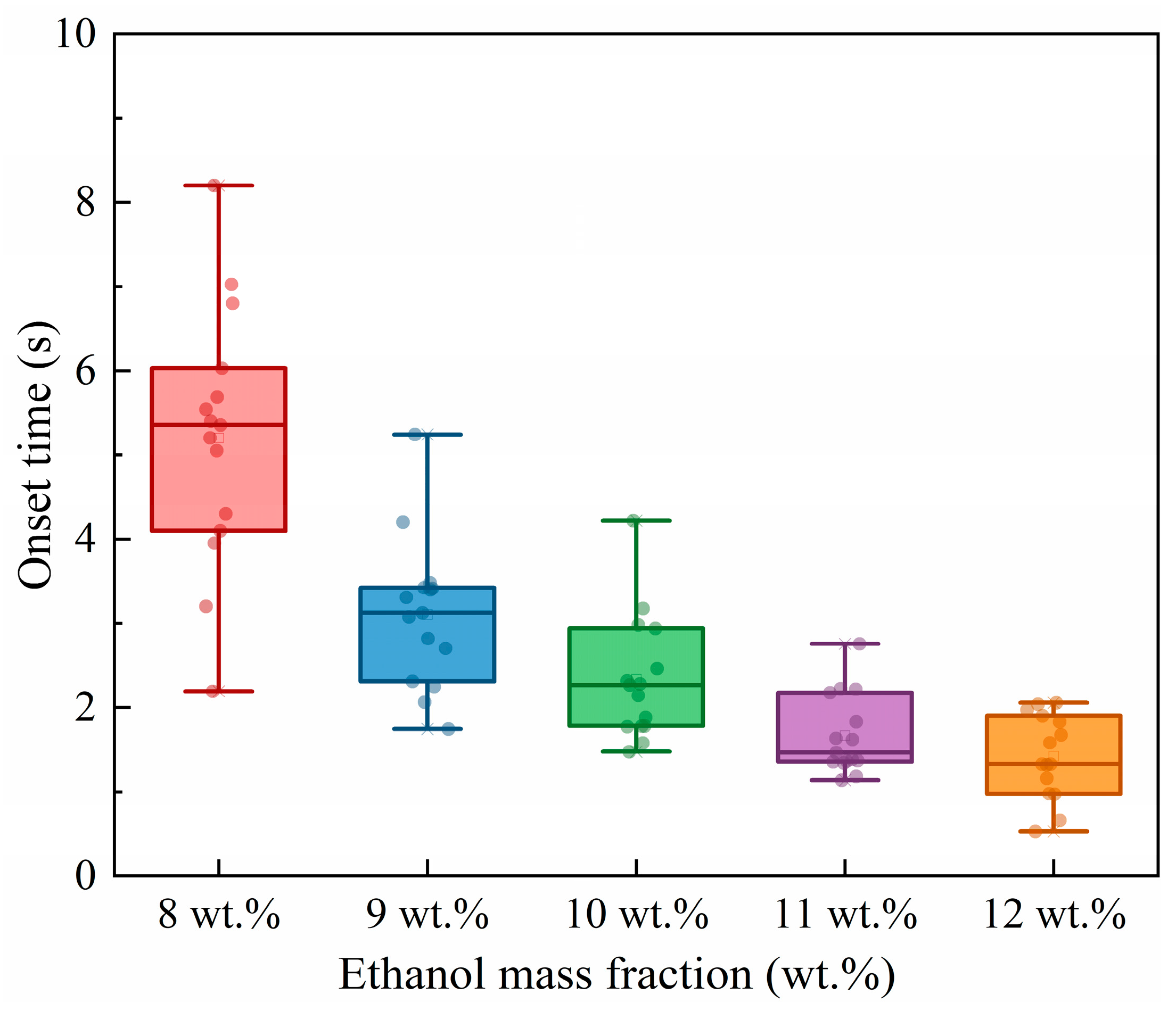
To further examine the effect of concentration on the onset of the transition point, ethanol–water solutions with initial ethanol mass fractions of 8, 9, 10, 11, and 12 wt.% were investigated statistically. For each concentration, 15 repeated experiments were performed, and the onset time of the transition point was measured with respect to the start of gas injection. Figure 9 presents the resulting distributions in the form of box plots, in which the individual onset times obtained from repeated runs are summarized for each concentration. It can be seen that the 8 wt.% system exhibits a relatively large temporal scatter, indicating that the occurrence of the transition point is more dispersed under this condition. In contrast, the median onset time decreases progressively as the initial ethanol concentration increases from 8 to 12 wt.%, suggesting that the interface becomes increasingly susceptible to localized transition at higher ethanol concentrations. This trend also helps explain why, at 16 wt.%, the onset of the transition point in some experiments became too early to be captured accurately within the temporal resolution of the present setup. This concentration–dependent trend suggests that the appearance of the transition point is not a purely random event. During ethanol desorption, the interfacial concentration boundary layer develops progressively under the imposed gas flow. A higher initial ethanol mass fraction provides a stronger desorption driving force, so the interface reaches a state susceptible to localized disturbance amplification at an earlier time. This leads to a shorter median onset time and a reduced temporal scatter at higher ethanol concentrations. Meanwhile, the exact location and onset time of the first transition point still vary among repeated experiments, indicating that small interfacial perturbations or weak experimental non–uniformities may determine where and when the localized redistribution first becomes resolvable. Therefore, the transition point is interpreted here as a perturbation–triggered localized interfacial redistribution event occurring during the deterministic development of the concentration boundary layer. In addition, the number of transition points observed experimentally was examined for different initial ethanol mass fractions. Repeated experiments showed that the number of transition points ranged from 1 to 3 in the 8 wt.% ethanol–water solution, from 1 to 5 in the 9 wt.% solution, from 3 to 8 in the 10 wt.% solution, from 3 to 12 in the 11 wt.% solution, and from 4 to 13 in the 12 wt.% solution. This trend further indicates that the system becomes increasingly prone to interfacial transition as the concentration increases. The easier the system is to generate such transition points, the more reproducible the observed onset times become. In contrast, in the 8 wt.% system, the number of transition points is relatively small and in some cases there is only a single transition point that appears; under such conditions, the observed critical onset time shows a much larger fluctuation, as illustrated in Figure 9.

3.4. Interfacial Concentration Redistribution Associated with the Transition Point

To elucidate the concentration evolution underlying the image sequence, interfacial concentration profiles were extracted at several key time points. As shown in Figure 7a, the early interfacial profile was initially relatively smooth. At a slightly later time, a localized enrichment of ethanol emerged along the interface, which subsequently developed into a high–concentration region. This event did not manifest as a uniform increase along the interface but rather as a localized interfacial reorganization.
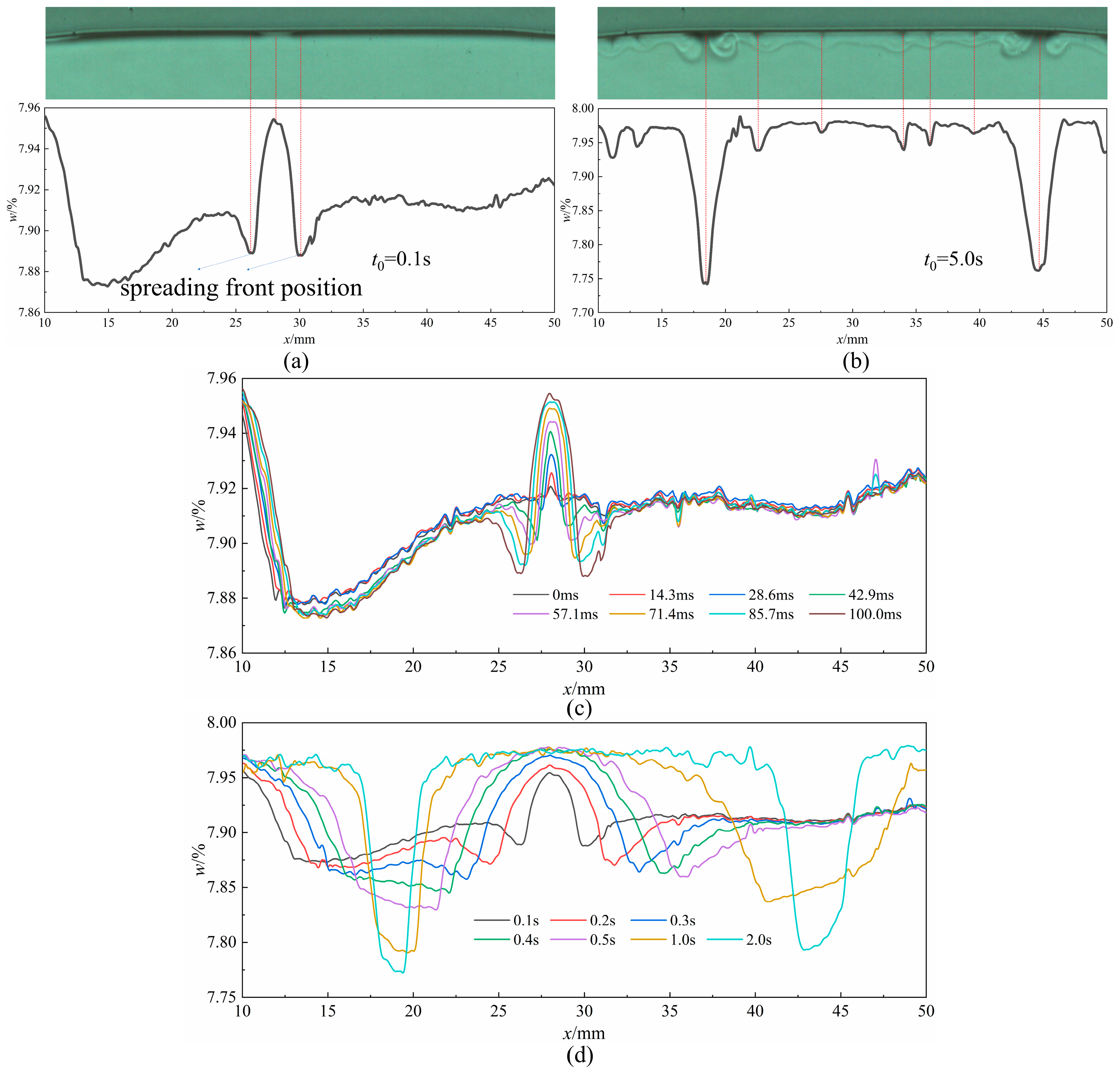
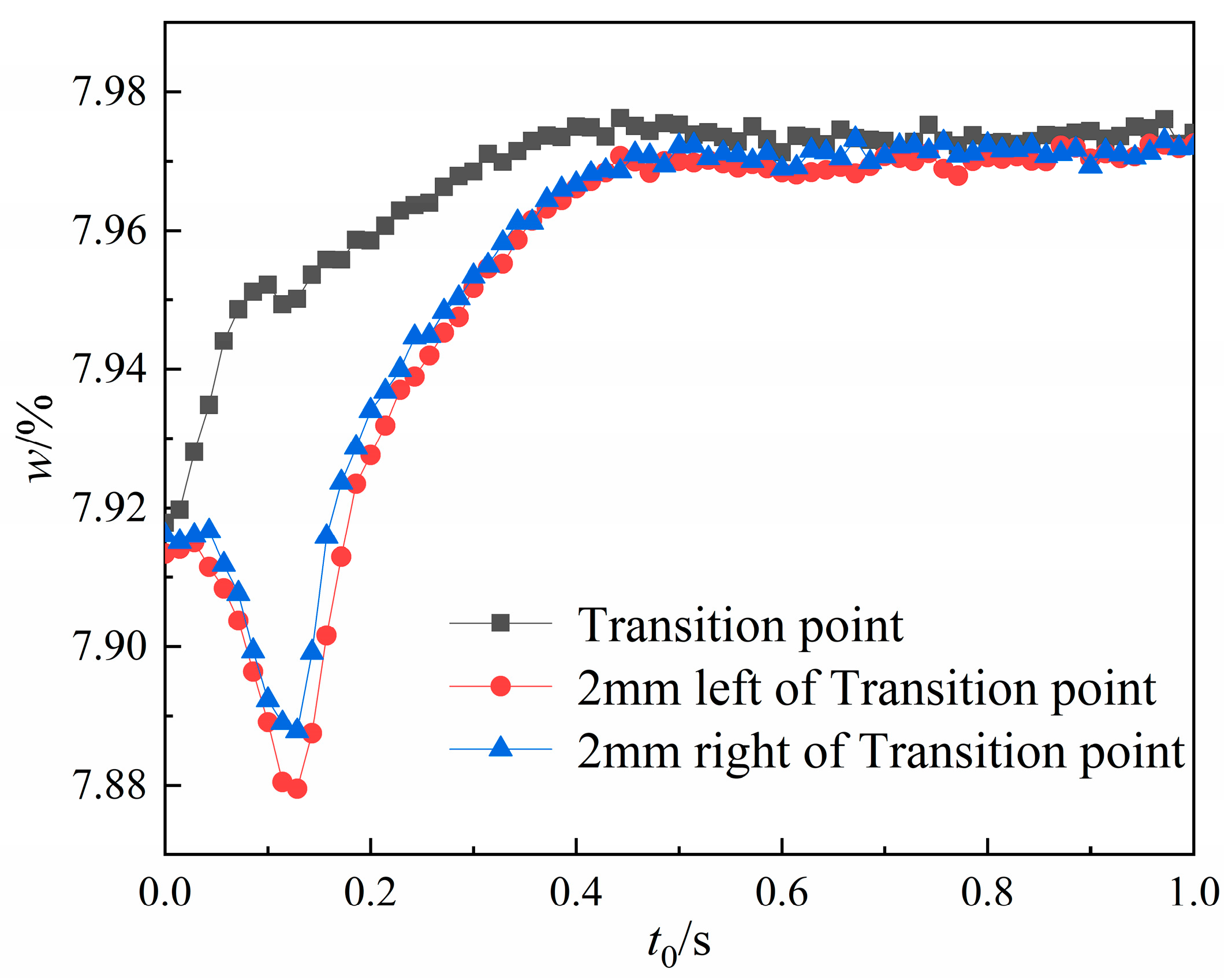
Figure 10a presents the interfacial concentration profile at t0 = 0.1 s following the emergence of the central concentration transition points, alongside the corresponding schlieren image. A pronounced deviation from the surrounding interfacial concentration values is evident, with the concentration peaking at the transition points site and decaying toward both sides; local concentration minima appear at the two spreading front positions. The spreading front position as shown in Figure 10a was defined as the local concentration minimum in the vicinity of the transition point described previously. Figure 10d presents the interfacial mass fraction from t0 = 0.1 s to t0 = 2.0 s following the emergence of the central interfacial concentration transition point. Figure 11 shows the temporal evolution of the interfacial mass fraction at the transition point itself, as well as at positions located 2 mm to the left and right along the interface. It can be observed that the mass fraction at the transition point increases to approximately 7.975 wt.% around t0 = 0.4 s and remains nearly constant thereafter. The mass fraction within the region swept by the spreading front also rises gradually over time, approaching the same mass fraction level. By t0 = 2.0 s, a relatively stable mass fraction plateau has formed within the spread region. In contrast, the local mass fraction at the spreading front declines continuously with time. After the spreading fronts from opposite sides met, the interface was divided into a high–concentration region formed after spreading and a low–concentration region located near the front meeting point. The concentration in the low–concentration region near the fronts decreased rapidly with time. Figure 10b displays the interfacial mass fraction distribution at t0 = 5.0 s, at which point Marangoni cellular convective structures have emerged within the previously formed high–concentration region, with lower interfacial concentrations observed at the cell centers. The mass fraction analysis indicates that the transition point represents a locally triggered event that rapidly modifies the interfacial concentration distribution through the advancement of the spreading fronts, with Marangoni convection cells forming shortly thereafter.

3.5. Quantitative Tracking of Spreading Front Propagation

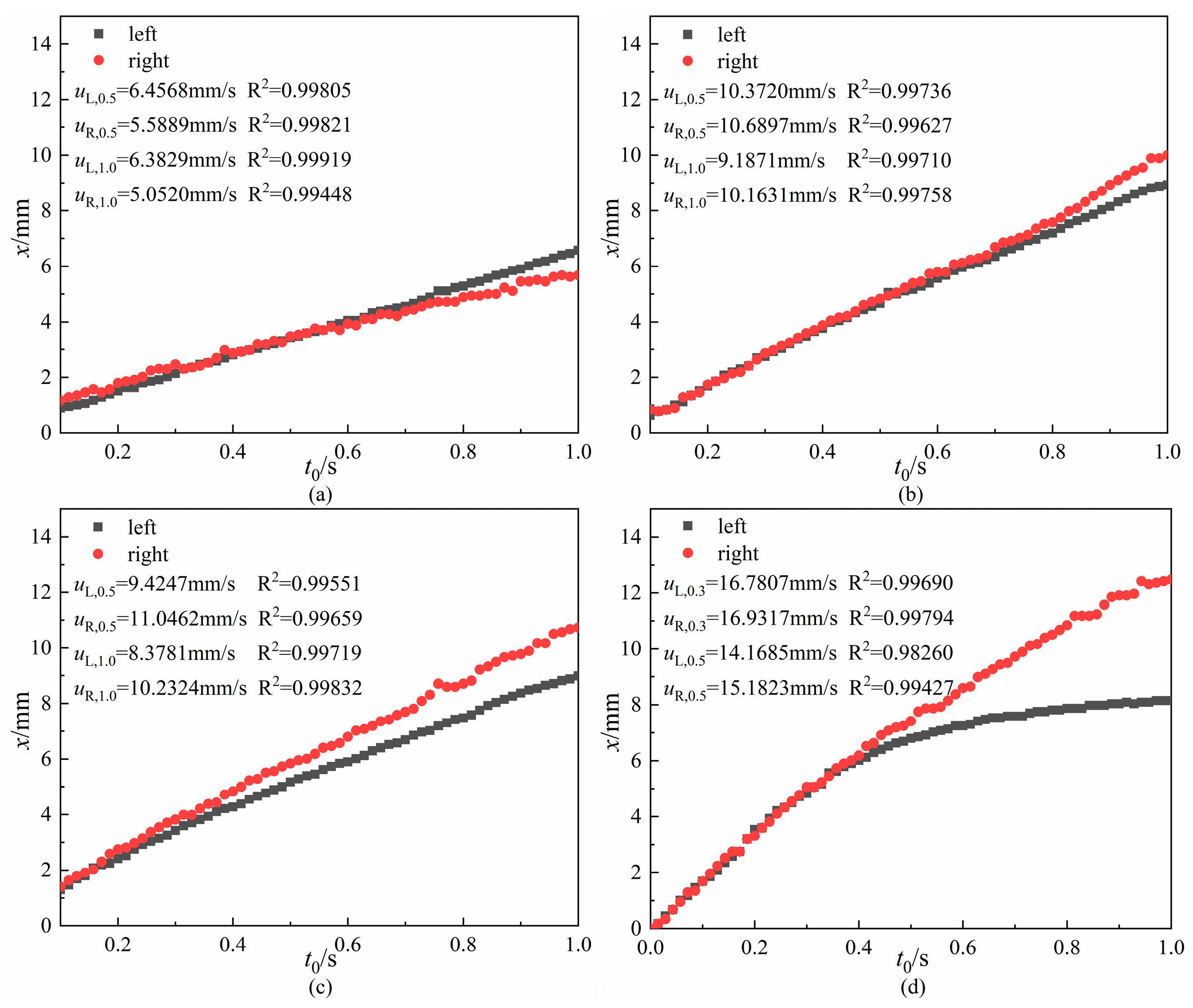
As shown in Figure 10a, the spreading front position was operationally defined as the location of the local concentration minimum along the interface. It should be noted that the spreading front defined here represents a Schlieren–derived apparent interfacial redistribution front, rather than a directly measured velocity front. No simultaneous velocity–field measurement was performed in the present study. Therefore, the front–tracking analysis is used to characterize the kinematics of interfacial concentration redistribution preceding visible Marangoni cell formation. This analysis serves to facilitate the subsequent interpretation of the apparent surface tension gradient evolution. An 8 wt.% aqueous ethanol solution was selected as the main system for investigation. Four representative onset times of transition point formation, namely 3.2 s, 4.1 s, 4.3 s, and 8.2 s, were chosen for analysis. Because shorter onset times corresponded to shallower interfacial penetration depths, the spreading front position in the first three cases was recorded starting from t0 = 0.1 s after the formation of the transition point to avoid coordinate misinterpretation. As shown in Figure 12, the spreading proceeded at an approximately constant velocity during the early stage, whereas the velocity gradually decreased at later times owing to the approach to one of the spreading front positions originating either from the walls or from other transition points.
As can be observed from Figure 12, the spreading fronts corresponding to different trigger times exhibit markedly different spreading velocities. Within the first 0.5 s after triggering, the average initial spreading velocity was about 6 mm/s for the system triggered at 3.2 s, about 10 mm/s for the systems triggered at 4.1 s and 4.3 s, and about 15 mm/s for the system triggered at 8.2 s. These results suggest that the interfacial spreading velocity increases with trigger time.
The spreading fronts propagated in both the leftward and rightward directions, with similar velocities at the initial stage. As the fronts spread, however, the resistances encountered on the two sides became different, leading to varying degrees of velocity decay. A pronounced decrease in the propagation velocity was observed as the two counter–propagating spreading fronts approached each other, as shown in Figure 12d. In the 8.2 s case, the leftward spreading front was affected at an earlier stage by another front spreading in the opposite direction, causing its velocity to decrease rapidly after 0.4 s. In contrast, the rightward front was not subjected to this effect and continued to propagate forward at an approximately constant velocity, resulting in a significant difference between the spreading velocities of the two fronts. This behavior indicates that the isolated–front analysis represents the elementary spreading process, whereas multi–site cases correspond to the simultaneous occurrence and early interaction of several such elementary events. At higher transition–point densities, neighboring fronts interact earlier, the free–propagation distance of each front becomes shorter, and the interfacial region is divided into multiple redistribution domains. Consequently, the pre–cellular stage still follows the sequence of localized onset, lateral spreading, front interaction, and subsequent cell formation, but this sequence becomes faster and more spatially fragmented.

3.6. Apparent Surface Tension Gradient Evolution

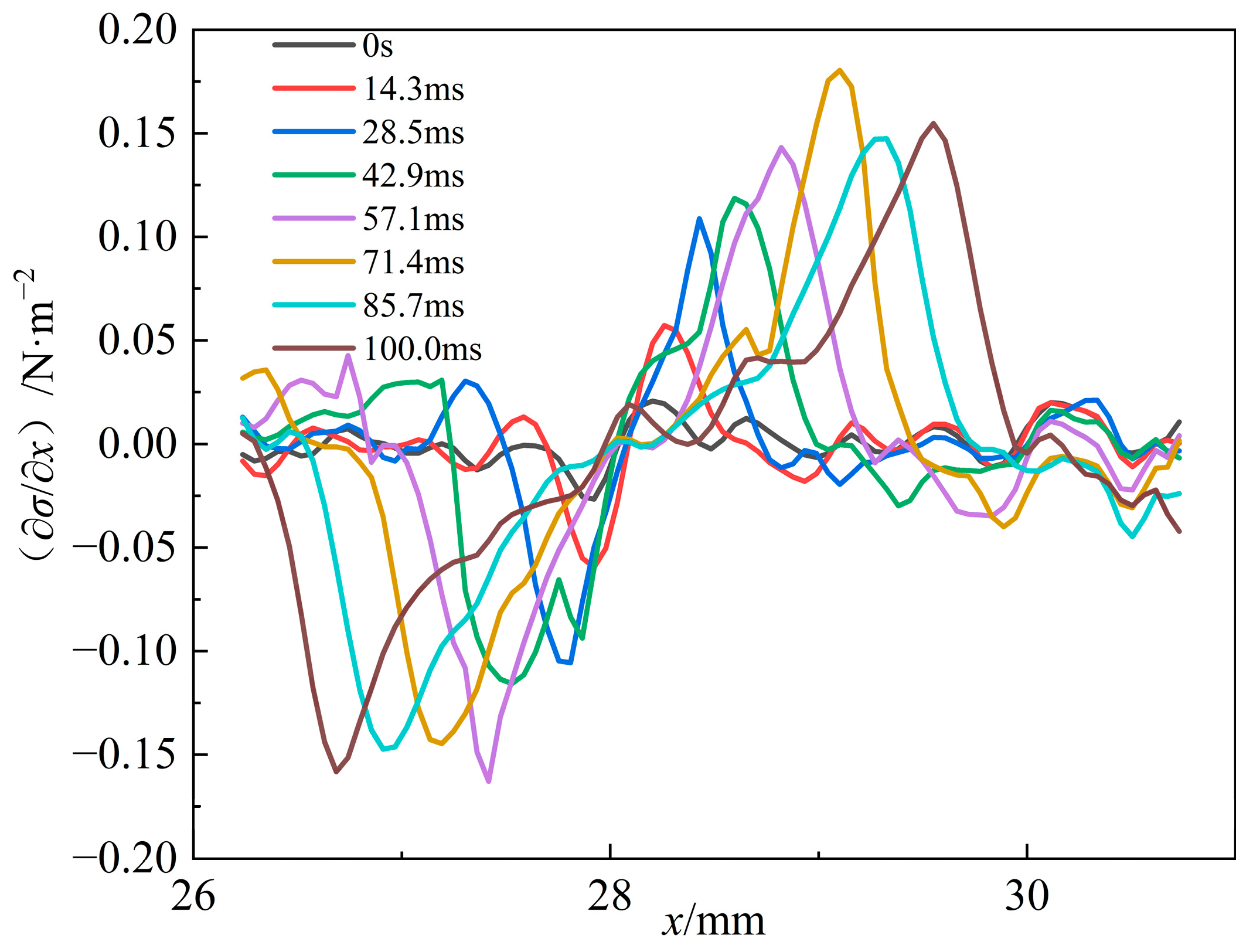
Taking the 8 wt.% ethanol–water solution as an example, at the early stage of the transition point, the peak apparent interfacial tension gradient on both sides of the transition point grew rapidly. As shown in Figure 13, the interfacial tension gradient increased rapidly to approximately 0.15 N·m−2 within 0.1 s and then stabilized.
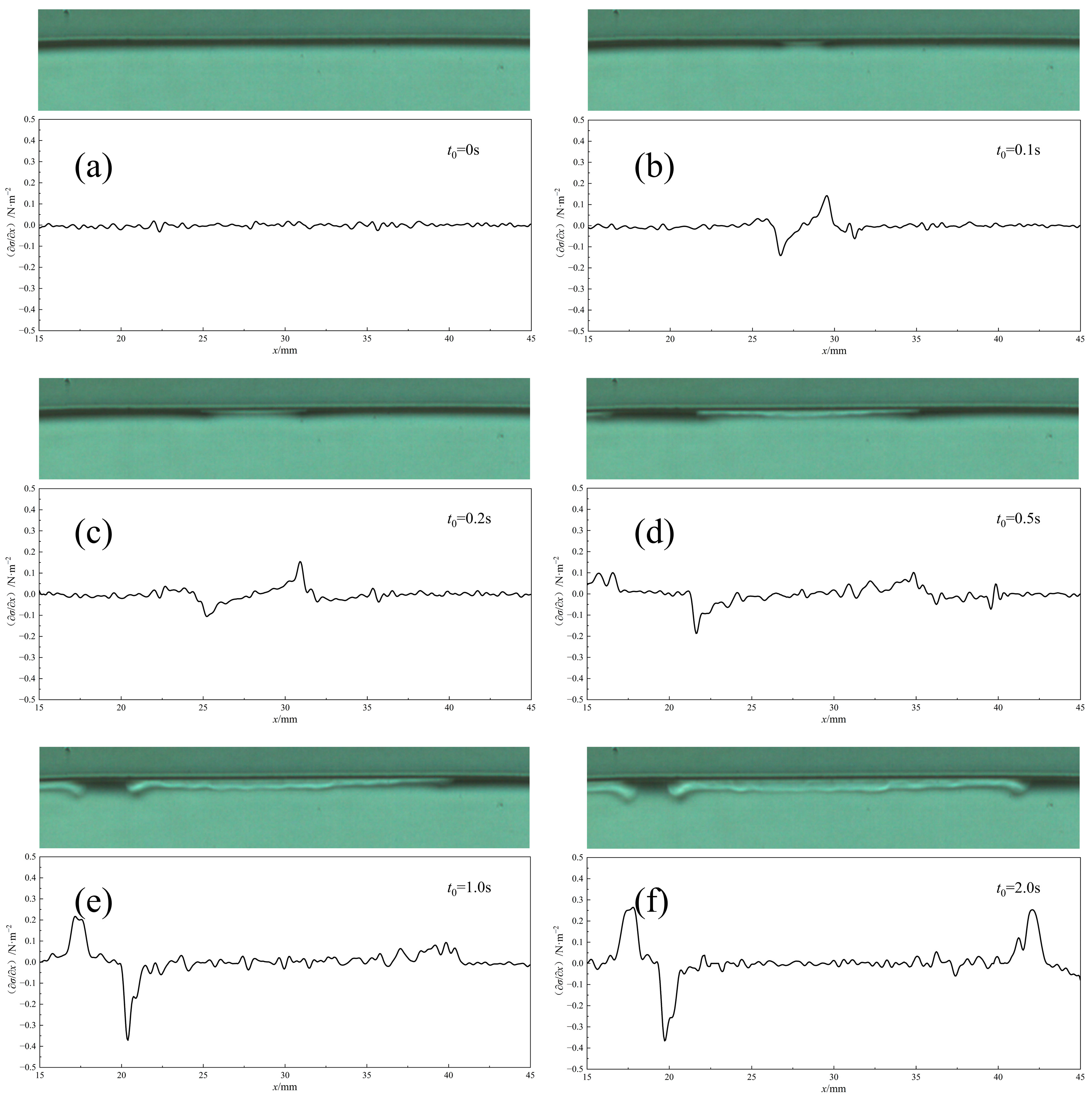
In Figure 14, it can be observed that the peak interfacial tension gradient was concentrated near the spreading front and moved along the interface to both sides together with the front. This spatial correlation between the apparent gradient peak and the moving redistribution front provides indirect evidence that the front motion is associated with surface–tension–gradient–related interfacial redistribution. It can be seen that after reaching the peak during the initial stage, the gradient gradually decayed as the front spread. At 0.5 s, the peak on the right side had already decreased to around 0.1 N·m−2, as shown in Figure 14d. However, when one spreading front gradually approached an opposing spreading front, they began to interact with each other. In Figure 14d, the left spreading front had already started to interact, causing the interfacial tension gradient to increase. The left peak in Figure 14d is clearly enhanced compared with the left peak in Figure 14c. Combined with the data in Figure 12d, it can be seen that at 0.5 s, the spreading velocity on the left side had started to decrease significantly. Therefore, it can be understood that once two oppositely propagating spreading fronts begin to interact, the spreading velocity decreases and the gradient near the spreading front increases. As shown in Figure 14e,f, the left peak gradient increased significantly to around 0.4 N·m−2, and gradually formed a gradient structure resembling that of a Marangoni convective cell together with the gradient from the opposing front. According to Figure 7g presented earlier, a Marangoni cellular structure subsequently developed at this location. This sequence suggests that the initial localized event and the later Marangoni cellular pattern correspond to different stages of the interfacial redistribution process. At the initial stage, the localized event appears as a relatively ethanol–rich region with lower apparent surface tension, which promotes lateral redistribution and forms a temporarily redistributed, relatively ethanol–rich interfacial region. This redistributed region is not a final stable state. During the subsequent desorption process, ethanol continues to be removed from the interface, and local ethanol–depleted spots can develop within the redistributed region owing to continued ethanol removal and local interfacial non–uniformity. These depleted spots correspond to local high–surface–tension regions and can subsequently draw liquid from the surrounding lower–surface–tension regions, leading to the formation of visible Marangoni cellular structures.
In addition, high–surface–tension centers can also develop near the interaction regions of oppositely propagating spreading fronts. As the fronts approach each other, the local spreading velocity decreases, and the apparent surface–tension–gradient peaks are enhanced, as shown in Figure 14. The front–interaction region therefore provides another favorable location for the formation of ethanol–depleted, high–surface–tension centers. Together, these two pathways indicate that the visible Marangoni cellular pattern develops after the initial lateral redistribution, when local ethanol–depleted regions are generated either inside the redistributed interfacial region or near front–interaction zones.
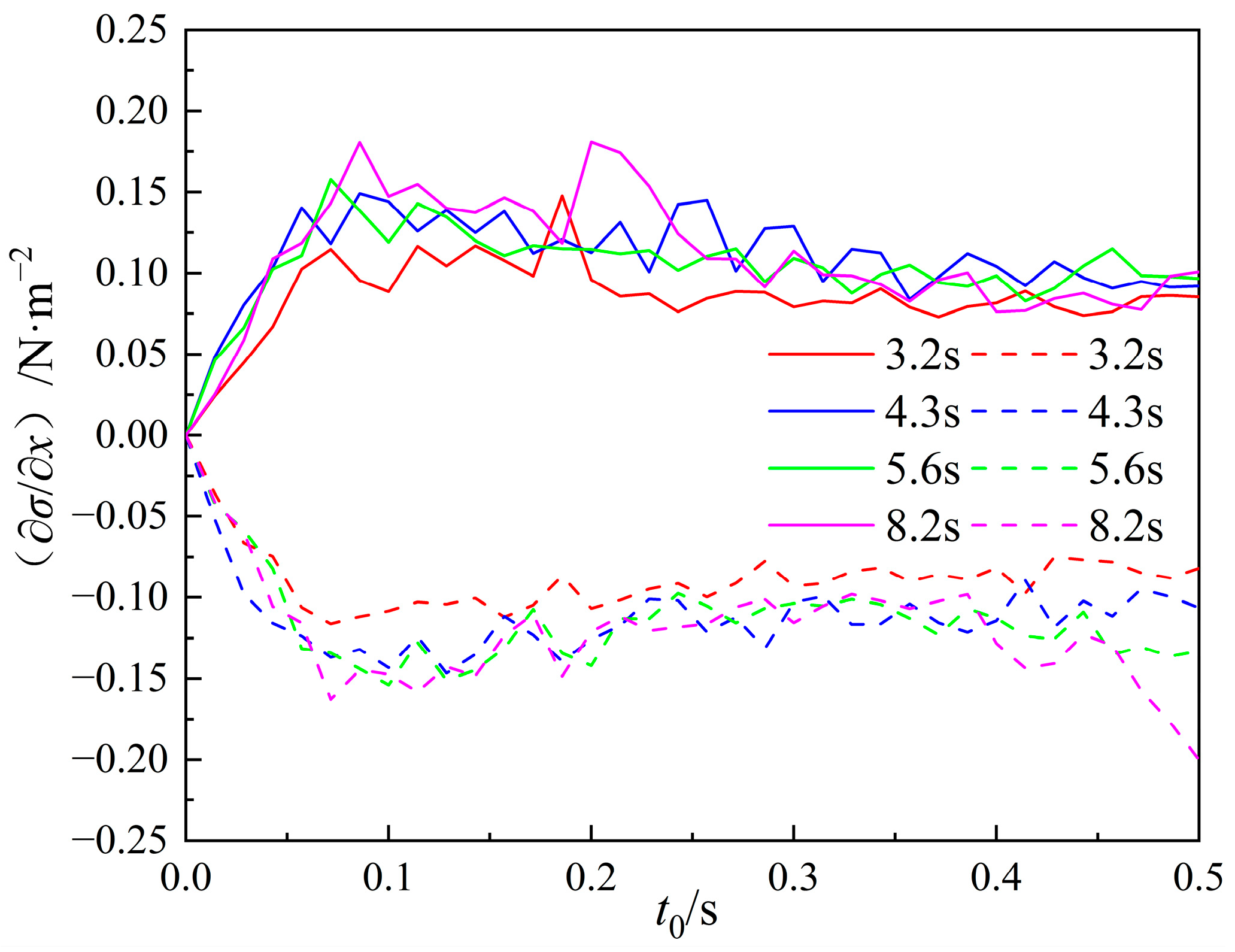
As shown in Figure 15, the evolution of the interfacial tension gradient for the 8 wt.% ethanol–water solution under different onset times followed essentially the same trend: a rapid increase at the initial stage, followed by a gradual decrease as the front spread, until encountering an opposing spreading front. The peak gradients formed at transition points with different onset times showed slight differences; those with shorter onset times were slightly lower, but the overall difference was small.
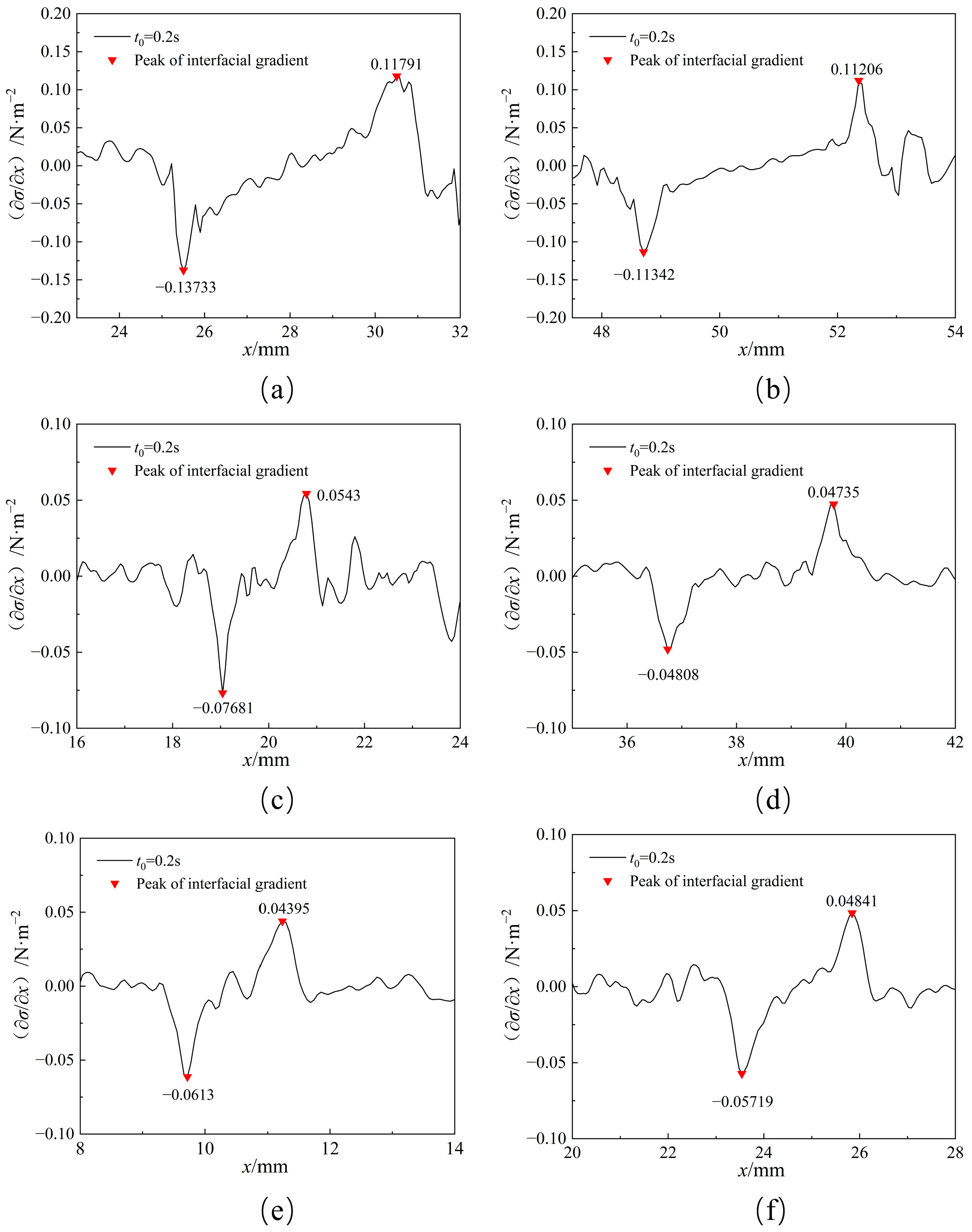
Figure 16 shows the peak interfacial tension gradients at t0 = 0.2 s for six different initial concentrations. t0 = 0.2 s was chosen because all systems had reached their peak at this time and had not yet experienced obvious decay. It can be observed that as the initial ethanol mass fraction in the ethanol–water solution increased, the peak interfacial tension gradient tended to decrease. For the 8 wt.% ethanol–water system, the peak gradient was above 0.1 N·m−2, whereas for the 14 wt.% system, the peak gradient fluctuated around 0.04 N·m−2, representing a considerable decrease compared with the lower–concentration case.

3.7. Limitations

Several limitations should be noted. First, the quantitative Schlieren signal represents a path–integrated optical response across the 2 mm liquid gap. Therefore, the reconstructed concentration field should be interpreted as an apparent quasi–two–dimensional distribution rather than a fully local three–dimensional field. Second, possible thermal contributions should be considered. Because the refractive index of ethanol–water solutions depends on both composition and temperature, evaporative cooling during ethanol desorption may contribute to the Schlieren signal. Since the temperature field was not independently measured in the present experiments, the concentration and thermal contributions to the refractive–index field cannot be fully separated. Accordingly, the reconstructed concentration field and the derived surface tension gradient field are interpreted as apparent quantities. This limitation mainly affects the absolute values of the reconstructed concentration and gradient. Third, the surface tension gradient field was derived from the reconstructed concentration field using empirical concentration–surface tension relations; consequently, the calculated gradients should be regarded as apparent indicators rather than absolute local critical gradients. In addition, the identification of the transition point and spreading front depends on image processing, interface extraction, and spatial differentiation procedures. Although identical optical settings and processing methods were applied to all cases, filtering, interface–location uncertainty, and gradient calculation may influence the absolute gradient values. Accordingly, this study does not aim to determine a universal critical surface tension gradient threshold for Marangoni onset. Instead, it provides experimentally resolved information on the timing, location, lateral spreading, and apparent surface tension gradient evolution of a localized interfacial onset event. These results can serve as reference data for future simulations of perturbation–driven Marangoni onset in confined ethanol–water desorption systems. The transferability of the present results should also be considered. The present study provides reference data for the pre–cellular interfacial redistribution sequence in a confined ethanol–water desorption system. Therefore, dimensional quantities such as the transition–point onset time, spreading velocity, transition–point density, and apparent surface–tension–gradient magnitude should be interpreted in the context of the present 2 mm quasi–two–dimensional geometry. The qualitative sequence of localized interfacial onset, lateral redistribution, front interaction, and subsequent visible cell formation may provide a mechanistic reference for other gas–liquid mass–transfer systems. However, quantitative transfer to unconfined layers, falling films, or packing–sheet geometries would require additional similarity analysis to preserve the relative importance of surface–tension–driven instability, buoyancy–driven instability, molecular diffusion, geometric confinement, gas–side mass transfer, and gravity–capillarity effects. For flowing–film systems, the base film flow and gas–liquid shear should also be considered. In addition, because no simultaneous velocity–field measurement was performed, the spreading front identified in this work should be interpreted as an apparent interfacial redistribution front extracted from the Schlieren–derived concentration profile, rather than as a directly measured velocity front. A more complete decoupling of Rayleigh and Marangoni contributions would require independent variation in the liquid–layer height and the interfacial desorption rate. Reducing the liquid–layer height would suppress the buoyancy–driven Rayleigh contribution, whereas reducing the gas–flow rate would slow ethanol removal and weaken the buildup of lateral surface–tension gradients. Comparing the onset of the localized transition point and the later plume structure under these conditions would help distinguish surface–parallel Marangoni–related redistribution from bulk Rayleigh plume development. Further work combining quantitative Schlieren imaging with velocity–field measurements, temperature–field measurements or fully coupled numerical simulations is needed to clarify the three–dimensional concentration field, interfacial flow field and force balance during the transition from localized interfacial redistribution to visible cellular convection.

4. Conclusions

This study experimentally investigated the early–stage development of mass transfer–induced interfacial convection in ethanol–water systems using quantitative Schlieren imaging. Particular attention was given to the initial stage preceding the formation of visible Marangoni cellular structures.
The results showed that the early interfacial flow behavior strongly depended on the initial ethanol concentration. At low concentrations, the flow was dominated by Rayleigh–type plume convection. At high concentrations, Marangoni cellular structures developed rapidly, making the earliest stage difficult to resolve. At intermediate concentrations, a distinguishable pre–cellular stage was observed, providing a suitable window for resolving the onset process.
Within this intermediate regime, a localized interfacial onset site was identified, defined as the earliest experimentally resolvable position at which interfacial concentration redistribution became detectable. Following its appearance, two counter–propagating spreading fronts developed along the interface. The region swept by these fronts exhibited an overall increase in ethanol concentration, and visible Marangoni cellular structures subsequently emerged within the redistributed interfacial region, including near the front–meeting location.
Statistical analysis of repeated experiments further showed that the onset time of the localized interfacial event decreased with increasing initial ethanol concentration, while the dispersion of the onset time also reduced. These results suggest that higher initial concentration conditions promote a more rapid and more reproducible onset behavior.
Quantitative analysis based on Schlieren–derived concentration fields revealed that the apparent surface tension gradient field was spatially correlated with the spreading process. The highest apparent gradients were located near the spreading fronts and front–meeting regions, indicating that rapid interfacial redistribution coincided with regions of strong local solutal surface tension gradients. The apparent surface–tension–gradient indicator increased rapidly at the beginning of the localized interfacial onset event, decreased gradually during front spreading, and increased again when oppositely propagating fronts interacted. The enhanced–gradient regions were subsequently associated with the formation of high–surface–tension centers of visible Marangoni cells.
It should be noted that the reconstructed concentration field and the derived surface tension gradient field represent apparent quasi–two–dimensional quantities due to the path–integrated nature of the Schlieren measurement. Therefore, the present study does not aim to determine an absolute critical surface tension gradient threshold. Instead, it provides experimentally resolved information on the timing, spatial localization, lateral spreading, and apparent surface tension gradient evolution of a localized interfacial onset event.
Overall, the present results offer experimental insights into the pre–cellular stage of solutal Marangoni convection and provide reference data for future numerical simulations in which initial interfacial perturbations are often prescribed or implicitly introduced. Further work combining velocity–field measurements and fully coupled numerical simulations would be valuable for clarifying the underlying force balance and three–dimensional structure of the onset process.
The main advantage of the present study is that quantitative Schlieren imaging enables non–intrusive visualization and reconstruction of the localized interfacial redistribution stage before the first visible Marangoni cell appears. Compared with observations based only on fully developed cellular structures, this approach provides information on the timing, location, lateral spreading, and apparent surface–tension–gradient evolution of the pre–cellular stage. In particular, the apparent surface–tension–gradient field provides a quantitative indicator for identifying regions of strong interfacial non–uniformity, tracking spreading–front interaction, and linking the early localized interfacial redistribution with the subsequent development of Marangoni cellular structures. These results can serve as reference data for validating numerical simulations and stability analyses of perturbation–driven Marangoni onset in confined ethanol–water desorption systems. From a practical perspective, the observed sequence and the associated apparent–gradient evolution may help identify operating conditions under which interfacial concentration disturbances are likely to be amplified before visible convection develops in gas–liquid mass–transfer operations, such as evaporation, absorption/desorption, falling films, and packing–surface flows. Direct quantitative application to other geometries, however, requires appropriate similarity analysis.

Author Contributions

Conceptualization, Z.Y. and A.Z.; methodology, Z.Y.; software, Z.Y.; validation, Z.Y. and A.Z.; formal analysis, Z.Y.; investigation, Z.Y.; resources, A.Z.; data curation, Z.Y.; writing—original draft preparation, Z.Y.; writing—review and editing, A.Z.; visualization, Z.Y.; supervision, A.Z.; project administration, A.Z.; funding acquisition, A.Z. All authors have read and agreed to the published version of the manuscript.

Funding

This research was funded by the Coal–Major Project of China (2025ZD1701505–1).

Institutional Review Board Statement

Not applicable.

Informed Consent Statement

Not applicable.

Data Availability Statement

The data used in this article are given in detail in the article for the reader’s reference. Further inquiries can be directed to the corresponding author.

Conflicts of Interest

The authors declare no conflicts of interest.

References

  1. Pearson, J.R.A. On Convection Cells Induced by Surface Tension. J. Fluid Mech. 1958, 4, 489–500. [Google Scholar] [CrossRef]
  2. Sternling, C.V.; Scriven, L.E. Interfacial Turbulence: Hydrodynamic Instability and the Marangoni Effect. AIChE J. 1959, 5, 514–523. [Google Scholar] [CrossRef]
  3. Linde, H.; Pfaff, S.; Zirkel, C. Strömungsuntersuchungen zur hydrodynamischen Instabilität flüssig–gasförmiger Phasengrenzen mit Hilfe der Kapillarspaltmethode. Z. Phys. Chem. 1964, 225, 72–100. [Google Scholar] [CrossRef]
  4. Machrafi, H.; Rednikov, A.; Colinet, P.; Dauby, P.C. Bénard Instabilities in a Binary–Liquid Layer Evaporating into an Inert Gas. J. Colloid Interface Sci. 2010, 349, 331–353. [Google Scholar] [CrossRef]
  5. Zhang, J.; Oron, A.; Behringer, R.P. Novel Pattern Forming States for Marangoni Convection in Volatile Binary Liquids. Phys. Fluids 2011, 23, 072102. [Google Scholar] [CrossRef]
  6. Lopez de la Cruz, R.A.; Diddens, C.; Zhang, X.; Lohse, D. Marangoni Instability Triggered by Selective Evaporation of a Binary Liquid inside a Hele–Shaw Cell. J. Fluid Mech. 2021, 923, A16. [Google Scholar] [CrossRef]
  7. Butzhammer, L.; Köhler, W. Thermocapillary and Thermosolutal Marangoni Convection of Ethanol and Ethanol–Water Mixtures in a Microfluidic Device. Microfluid. Nanofluidics 2017, 21, 155. [Google Scholar] [CrossRef]
  8. Cecere, A.; Buffone, C.; Savino, R. Self–Induced Marangoni Flow in Evaporating Alcoholic Solutions. Int. J. Heat Mass Transf. 2014, 78, 852–859. [Google Scholar] [CrossRef][Green Version]
  9. Schwarzenberger, K.; Eckert, K.; Odenbach, S. Relaxation Oscillations between Marangoni Cells and Double Diffusive Fingers in a Reactive Liquid–Liquid System. Chem. Eng. Sci. 2012, 68, 530–540. [Google Scholar] [CrossRef]
  10. Köllner, T.; Schwarzenberger, K.; Eckert, K.; Boeck, T. Multiscale Structures in Solutal Marangoni Convection: Three–Dimensional Simulations and Supporting Experiments. Phys. Fluids 2013, 25, 092109. [Google Scholar] [CrossRef]
  11. Schwarzenberger, K.; Köllner, T.; Linde, H.; Boeck, T.; Odenbach, S.; Eckert, K. Pattern Formation and Mass Transfer under Stationary Solutal Marangoni Instability. Adv. Colloid Interface Sci. 2014, 206, 344–371. [Google Scholar] [CrossRef] [PubMed]
  12. Chen, S.; Yuan, X.; Fu, B.; Zhang, H.; Yu, K. Simulation of interfacial Marangoni convection in gas–liquid mass transfer by lattice Boltzmann method. Front. Chem. Sci. Eng. 2011, 5, 448–454. [Google Scholar] [CrossRef]
  13. Chen, S.; Fu, B.; Yuan, X.; Zhang, H.; Chen, W.; Yu, K. Lattice Boltzmann Method for Simulation of Solutal Interfacial Convection in Gas–Liquid System. Ind. Eng. Chem. Res. 2012, 51, 10955–10967. [Google Scholar] [CrossRef]
  14. Settles, G.S. Schlieren and Shadowgraph Techniques: Visualizing Phenomena in Transparent Media; Springer: Berlin/Heidelberg, Germany, 2001. [Google Scholar]
  15. Okhotsimskii, A.; Hozawa, M. Schlieren Visualization of Natural Convection in Binary Gas–Liquid Systems. Chem. Eng. Sci. 1998, 53, 2547–2573. [Google Scholar] [CrossRef]
  16. Liu, C.; Zeng, A.W.; Yuan, X.G.; Yu, G. Experimental Study on Mass Transfer near Gas–Liquid Interface through Quantitative Schlieren Method. Chem. Eng. Res. Des. 2008, 86, 201–207. [Google Scholar] [CrossRef]
  17. Chen, M.; Zhao, S.; Zeng, A.W.; Yu, H.L. Quantitative Analysis of Rayleigh Convection in Interfacial Mass Transfer Process. CIESC J. 2016, 67, 4566–4573. [Google Scholar] [CrossRef]
  18. Chen, J.; Liu, X.; Chen, Y.; Chen, Q. Analysis of Coupling Relationship between Marangoni and Rayleigh–Bénard Effects in Rayleigh–Bénard–Marangoni Convection during Mass Transfer between Two Planar Liquid Layers. Int. Commun. Heat Mass Transf. 2025, 168, 109427. [Google Scholar] [CrossRef]
  19. Mao, Q.; Yang, Q.-J.; Liu, Y.; Cao, W. Experimental and Numerical Study of Droplet Formation with Marangoni Instability. Chem. Eng. Sci. 2023, 268, 118369. [Google Scholar] [CrossRef]
  20. Zhang, Y.; Cao, H.; Liu, X.; Chen, Y. An Investigation of the Marangoni–Rayleigh–Bénard Convection Characteristics during Mass Transfer within Compound Droplets. Chem. Eng. J. 2026, 534, 175145. [Google Scholar] [CrossRef]
  21. Scott, T.A. Refractive Index of Ethanol–Water Mixtures and Density and Refractive Index of Ethanol–Water–Ethyl Ether Mixtures. J. Phys. Chem. 1946, 50, 406–412. [Google Scholar] [CrossRef]
  22. Khattab, I.S.; Bandarkar, F.; Fakhree, M.A.A.; Jouyban, A. Density, Viscosity, and Surface Tension of Water+ethanol Mixtures from 293 to 323K. Korean J. Chem. Eng. 2012, 29, 812–817. [Google Scholar] [CrossRef]
  23. Pratt, K.C.; Wakeham, W.A. The Mutual Diffusion Coefficient of Ethanol–Water Mixtures: Determination by a Rapid, New Method. Proc. R. Soc. London. Ser. A Math. Phys. Sci. 1974, 336, 393–406. [Google Scholar] [CrossRef]
Figure 1. Schematic of the quasi–two–dimensional gas–liquid mass transfer cell.
Applsci 16 05079 g001
Figure 2. Schematic of the Schlieren setup. 1—light source; 2—spike filter; 3—lens; 4—slit; 5—flat mirror; 6—concave mirror; 7—blade; 8—CMOS camera; 9—nitrogen tank; 10—rotameter; 11—presaturator; 12—PID temperature; 13—gas–liquid mass transfer apparatus. In the schematic, arrows denote the gas flow direction, whereas the optical path is shown by lines without arrows.
Applsci 16 05079 g002
Figure 3. Data processing workflow.
Applsci 16 05079 g003
Figure 4. (a) Calibration curve for the quantitative Schlieren system; (b) calibration curve obtained for knife–edge cutoff ratios ranging from 17.5% to 82.5%.
Applsci 16 05079 g004
Figure 5. Illustration of the interface–detection method. (a) Enlarged view of the interface region after triggering of the localized event. The characteristic low–high–low grayscale structure remains clearly visible along the vertical direction. (b) Different concentration divisions of the interface. (c) Extracted interfacial line obtained from the column–wise local grayscale maxima after outlier correction.
Applsci 16 05079 g005
Figure 6. Representative convective patterns according to different initial ethanol concentrations. (a) 2 wt.%, 180 s, (b) 5 wt.%, 120 s, (c) 6 wt.%, 120 s, (d) 7 wt.%, 30 s, (e) 16 wt.%, 30 s, (f) 20 wt.%, 30 s.
Applsci 16 05079 g006
Figure 7. Early–stage development of an interfacial concentration transition point: (a) t0 = 0 s, (b) t0 = 0.1 s, (c) t0 = 0.2 s, (d) t0 = 0.5 s, (e) t0 = 1.0 s, (f) t0 = 2.0 s and (g) t0 = 10.0 s. Here, t0 is referenced to the onset of the transition point (t0 = 0 s).
Applsci 16 05079 g007
Figure 8. Interfacial convection during the desorption of a 20 wt.% ethanol–water solution. Time is referenced to the onset of gas injection: (a) 0 s, (b) 5.0 s, (c) 10.0 s, and (d) 20.0 s.
Applsci 16 05079 g008
Figure 9. Onset time of the transition point at different ethanol mass fractions. Each box plot represents 15 repeated experiments. The box indicates the interquartile range (Q1–Q3), the central line denotes the median, and the whiskers extend to the minimum and maximum values. Individual data points are shown with horizontal jitter.
Applsci 16 05079 g009
Figure 10. (a) Interfacial mass fraction profile and corresponding schlieren image at t0 = 0.1 s. (b) Interfacial mass fraction profile and corresponding schlieren image at t0 = 5.0 s (c) The variation in interfacial mass fraction profiles within t0 = 0.1 s. (d) The variation in interfacial mass fraction profiles for t0 between 0.1 s and 2.0 s. In panels (a,b), the red dashed lines indicate the correspondence between the actual interfacial positions in the schlieren images and the key points on the calculated interfacial mass–fraction profiles; in panel (a), the blue arrows denote the spreading front positions.
Applsci 16 05079 g010
Figure 11. Temporal evolution of the mass fraction at the transition point with respect to t0, together with the concentration evolution at points located 2 mm to the left and right of the transition point.
Applsci 16 05079 g011
Figure 12. Displacement of the interfacial spreading front as a function of the transition point reference time t0 for the 8 wt.% ethanol–water solution. The onset times of the transition points relative to the initiation of gas intake are (a) 3.2 s, (b) 4.1 s, (c) 4.3 s, and (d) 8.2 s. The spreading front velocities were determined by linear regression of the front position versus time. Here, uL and uR represent the propagation velocities of the left and right spreading fronts, respectively. The subscripts indicate the time interval used for the fitting. For example, uL,0.5 and uR,0.5 are obtained from linear fits over 0.1–0.5 s after the onset event, while uL,1.0 and uR,1.0 correspond to the interval of 0.1–1.0 s.
Applsci 16 05079 g012
Figure 13. Variation in the apparent interfacial tension gradient in the vicinity of the transition point within the first 0.1 s in 8 wt.%.
Applsci 16 05079 g013
Figure 14. Interfacial tension gradient distribution and corresponding schlieren images at various times relative to the transition point reference time t0: (a) 0 s, (b) 0.1 s, (c) 0.2 s, (d) 0.5 s, (e) 1.0 s, (f) 2.0 s.
Applsci 16 05079 g014
Figure 15. Temporal variation in the peak interfacial tension gradient near the spreading front in 8 wt.% ethanol–water systems with transition points generated at different times.
Applsci 16 05079 g015
Figure 16. Interfacial tension gradient distribution near the spreading front at t0 = 0.2 s, the ethanol mass fraction (a) 8 wt.%, (b) 9 wt.%, (c) 10 wt.%, (d) 11 wt.%, (e) 12 wt.%, (f) 14 wt.%.
Applsci 16 05079 g016
Table 1. Schlieren equipment data and description.
ComponentKey ParametersNotes
Parabolic mirrorsEFL = 2000 mm
Diameter = 200 mm
λ/8
Generate collimated light
Focus schlieren image
Small plane mirrorsReflectivity ≥ 90%
λ/10
Turn light path
LED light source255 WProvide illumination
CameraResolution 4032 × 3072
10 bit
70 fps
Capture flow field images
Knife edgeAdjustment accuracy = 0.01 mmCut off light rays
Eliminate stray light
Table 2. Convective structures under different initial mass fractions.
Initial Mass FractionConvection PatternsOnset Time of Rayleigh Convection Transition Point
t0
2 wt.%, Figure 6aRayleigh120 s/
5 wt.%, Figure 6bRayleigh68 s/
6 wt.%, Figure 6cRayleigh + Marangoni54 s7 s
7 wt.%, Figure 6dMarangoni/5 s
16 wt.%, Figure 6eMarangoni/<1 s
20 wt.%, Figure 6fMarangoni//
Disclaimer/Publisher’s Note: The statements, opinions and data contained in all publications are solely those of the individual author(s) and contributor(s) and not of MDPI and/or the editor(s). MDPI and/or the editor(s) disclaim responsibility for any injury to people or property resulting from any ideas, methods, instructions or products referred to in the content.