Article

Urinary Catheterization Training for Nursing Students Using Traditional Instruction, Simulation, and Augmented Reality: A Randomized Controlled Trial

by
Daniela Dunca
1,2,
Cristian Valentin Toma
1,2,3,*,
Didina-Catalina Barbalata
1,2,4,*,
Romina-Marina Sima
1,5,
Nina Rosu
1,2,
George Andrei Popescu
1,6,
Ovidiu-Catalin Nechita
1,3,
Daniel Liviu Badescu
1,3 and
Viorel Jinga
1,3
1
Carol Davila University of Medicine and Pharmacy, 020021 Bucharest, Romania
2
Medical Simulation Center, Carol Davila University of Medicine and Pharmacy, 020983 Bucharest, Romania
3
Department of Urology, “Prof. Dr. Theodor Burghele” Clinical Hospital, 010011 Bucharest, Romania
4
Department of Pathology, Colentina Clinical Hospital, 020125 Bucharest, Romania
5
The “Bucur” Maternity, “Saint John” Hospital, 040292 Bucharest, Romania
6
Department of Hepato-Bilio-Pancreatic Surgery, Emergency University Hospital, 050098 Bucharest, Romania
*
Authors to whom correspondence should be addressed.
Appl. Sci. 2026, 16(10), 5068; https://doi.org/10.3390/app16105068
Submission received: 27 March 2026 / Revised: 4 May 2026 / Accepted: 15 May 2026 / Published: 19 May 2026

Abstract

(1) Background: Augmented reality (AR) simulation may accelerate psychomotor skill acquisition in clinical education, but comparative evidence is scarce. This three-arm randomized controlled trial compared AR simulation, basic task-trainer simulation, and lecture-based instruction for urinary catheterization training. We hypothesized that AR would be associated with higher performance compared to the other two methods. (2) Methods: Primary outcomes included male and female catheterization skills assessed with checklists. Secondary outcomes included knowledge and confidence. One-way ANOVA with Tukey’s HSD post hoc tests constituted the primary analysis; Kruskal–Wallis tests and Bayesian ANOVA provided convergent evidence. (3) Results: A total of 176 trainees were assigned to AR simulation, basic simulator, or lecture-only control groups (N = 60, 58, and 58, respectively). AR simulation was associated with higher skill scores than both basic simulation and the control for male catheterization (p < 0.001, η2 = 0.574) and female catheterization (p < 0.001, η2 = 0.535), with large effect sizes (Cohen’s d = 3.11, AR vs. control). Knowledge showed no group difference (p = 0.11). Confidence moderately favored AR (d = 0.69 vs. Control). Bayesian analysis supported a high probability of AR outperforming Control. (4) Conclusions: AR simulation training was associated with superior catheterization skills compared to both basic simulation and lecture-based instruction, with large effect sizes observed across both frequentist and Bayesian analyses. Knowledge was consistent across groups, suggesting a possible ceiling effect.

1. Introduction

Urinary catheterization (UC) represents an essential medical procedure used for emptying the bladder, for diagnostic and therapeutic purposes [1]. Despite its prevalence in clinical practice, inadequate use or placement of urinary catheters is frequent, leading to significant complications such as traumatic injury or infection [2]. Catheter-associated urinary tract infections (CAUTIs) are among the most preventable healthcare-acquired infections (HAIs), yet they account for approximately 75% of hospital-acquired urinary tract infections and over 30% of all HAIs, imposing substantial patient morbidity and healthcare costs [3,4].
Conventional UC instruction combines lectures [5], multimedia materials [6], and bedside practice [5,7] under the “see one, do one, teach one” paradigm [8]. However, this approach is subject to a number of challenges: discrepancies between theoretical instruction and clinical performance [9], limited bedside training possibilities due to the growing number of students, and inconsistent training experiences [10]. These factors contribute to anxiety, frustration, and low confidence among novice practitioners [11]. Studies of traditionally trained personnel have documented gaps between guideline recommendations and actual practice, particularly in sterile technique and infection control [12].
In order to overcome these challenges, medical institutions have incorporated simulation-based training methodologies and novel technologies to support the learning process [13]. A broad consensus in the literature supports the idea that simulation ensures a safe environment in which trainees can practice, make errors, and develop clinical and decision-making skills without risk to patients [13,14,15].
Low-fidelity simulators are effective in earlier training stages for procedural understanding and confidence building [16], while high-fidelity simulators with haptic feedback promote broader psychomotor development [17]. Furthermore, augmented reality (AR), virtual reality (VR), and mixed reality (MR) have generated debate. AR overlays digital guidance onto the physical environment, allowing trainees to interact with real equipment while receiving holographic prompts; VR replaces the physical environment entirely with a computer-generated simulation. Reviews support such technologies for critical thinking [18], yet comparative evidence remains inconsistent; VR-based catheterization training has shown skills benefits in some trials [19,20], whereas an MR intervention produced marginal improvements and trainees reported difficulty with the technology [21].
Most AR and VR simulation research in UC training relies on non-randomized, single-arm, or small-sample designs [5,10,13,20,22,23], and a 2024 meta-analysis found inconclusive results for immersive versus non-immersive VR in clinical education [14]. A 2025 meta-analysis showed that AR, compared to conventional teaching techniques, leads to enhanced accuracy and speed in performing tasks, but has no impact on knowledge acquisition [24]. The main mechanism behind the beneficial effects of AR on skill acquisition is based on the spatial contiguity principle that refers to simultaneous integration of virtual elements with physical elements [25]. Thus, AR diminishes the cognitive load associated with the split-attention effect which occurs when the pieces of information needed to understand a concept are presented spatially or temporarily apart [26]. Additionally, AR directs attention through visual cues, helping novices to focus on relevant information, further reducing the cognitive load [27]. Reducing the load on the working memory, the individual is able to redirect cognitive resources on task performance [28].
Although studies provide valuable insights regarding different teaching methods used in UC training [11,19,20,21,29], the current literature lacks a reliable comparison between traditional lecture-based teaching, task-trainer simulation, and AR-based training within a rigorous randomized controlled trial (RCT) design. Thus, this gap leaves clinical educators without evidence-based guidance for selecting among these modalities.
Our study addresses this gap through a prospective three-arm RCT at the Faculty of Midwifery and Nursing, Carol Davila University of Medicine and Pharmacy, Bucharest, Romania. The training protocol was adapted from the European Association of Urology Nurses (EAUN) 2024 Guidelines for indwelling catheterization [30]. Given the fact that AR simulation attempts to overcome the practical challenges of basic simulation, ensuring an increased level of realism through digital overlays, we hypothesized that AR would be at least as effective as basic simulation and more effective than lectures in training urinary catheterization skills.

2. Materials and Methods

The study was conducted at the Faculty of Midwifery and Nursing, Carol Davila University of Medicine and Pharmacy, Bucharest, Romania. The eligibility criteria required participants to be enrolled in the first year of study at the Faculty of Midwifery and Nursing, to express interest and availability to attend a urinary catheterization training module on the pre-scheduled dates, and to have no previous experience in performing urinary catheterization. Students with previous catheterization experience or who could not attend the workshop were excluded. All provided informed consent prior to enrollment.
The sample size was determined using G*Power 3.1 [31] for one-way ANOVA, assuming a large effect size (f = 0.40), based on prior simulation-based education literature reporting large group differences in procedural skills outcomes, significance at p < 0.05, and a power of 80%. This calculation yielded a minimum of 156 participants, 52 per group.
Our parallel three-arm randomized controlled trial compared the effectiveness of AR simulation, basic task-trainer training, and lecture-based control for teaching UC skills to healthcare trainees. Eligible participants were divided into one of the three study groups (group A = AR simulation; group B = basic simulation; group C = control) using a computer-generated random sequence provided by an investigator not involved in the workshop’s delivery. Because the nature of each intervention is physically distinguishable, the blinding of participants and instructors was not feasible. All participants first attended a lecture adapted according to the European Association of Urology Nurses 2024 Guidelines for indwelling catheterization [30], covering indications, contraindications, aseptic technique, catheter types (e.g., Foley, Nelaton), procedural steps for male and female patients, and key complications. A video demonstration followed the lecture.
Subsequently, the group protocols diverged. Groups A and B received a modality-specific demonstration of catheterization on their corresponding simulator; Group C proceeded directly to independent practice using a task-trainer, without feedback from the instructors. After the demonstrations, the trainees in Group A practiced UC, receiving feedback or guidance from the instructor, using the Augmented Reality Limbs & Things Catheterization Trainer, which provided augmented overlays mapped onto the physical task-trainer, allowing trainees to visualize the key anatomical landmarks and procedural steps for catheterization. Adverse events (e.g., eye strain, headaches, dizziness) were monitored throughout training through spontaneous participant reporting. Similarly, participants in group B practiced UC under guidance using basic task-trainers. All participants were given a fixed duration of 20 min for practice.
Participants were evaluated at two time points: before training and after simulation training. At both assessments, participants completed questionnaires evaluating knowledge and perceived confidence in UC. The knowledge assessment included twenty single-choice questions covering the concepts addressed in the lecture. The test was developed by the study investigators based on the EAUN 2024 Guidelines [30]. The confidence assessment comprised six items addressing confidence in performing the procedure, maintaining asepsis, and managing complications, each rated on a five-point Likert scale. Items were averaged to produce a composite confidence score, with a range of 1–5.
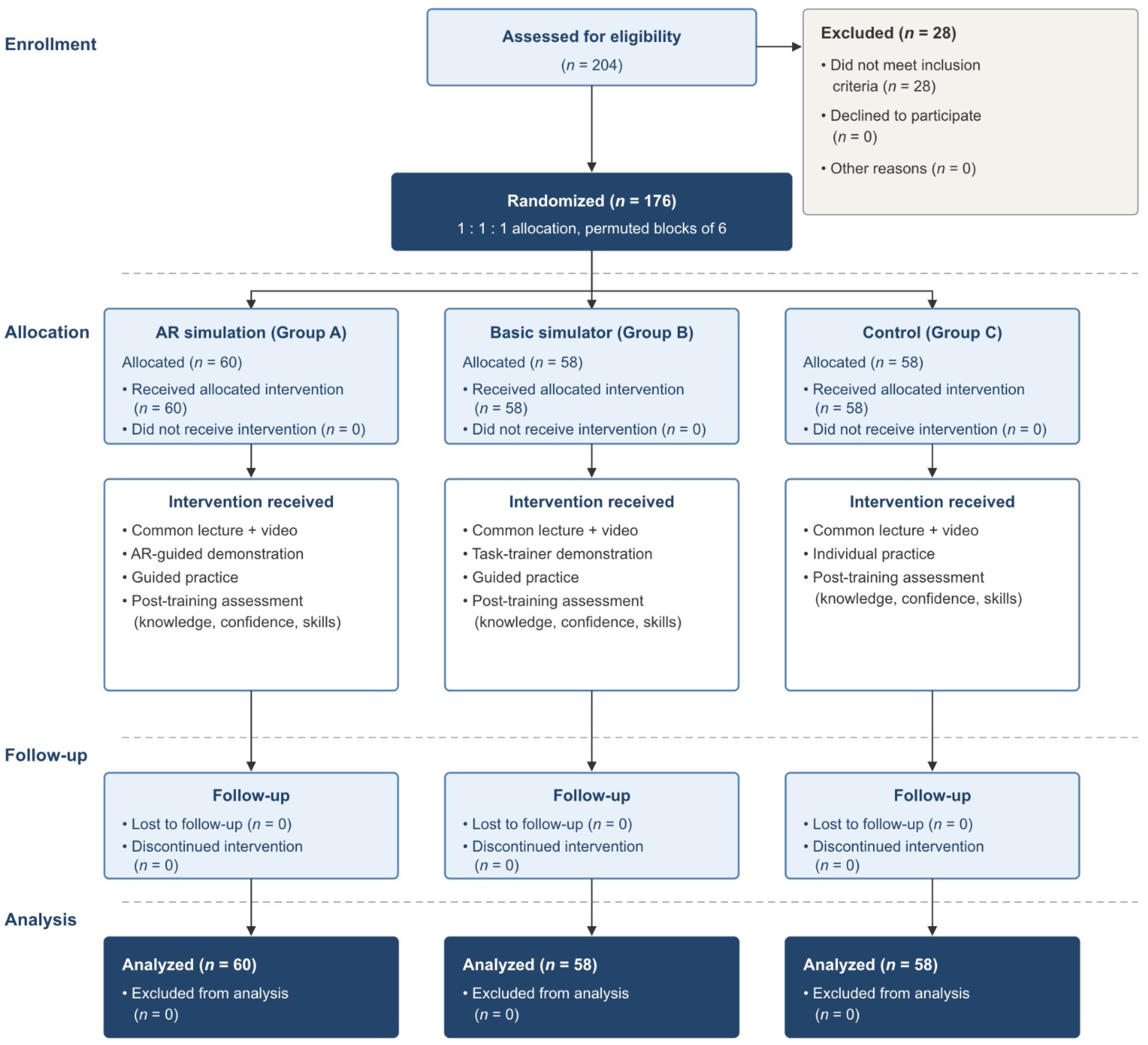
Practical assessment was conducted on the physical pelvic task-trainer. Trainees’ performance was assessed by an evaluator blinded to group allocation, using two standardized checklists: one for catheterization of the male patient and one for the female patient. Each procedural step was rated as correct (1) or incorrect (0), resulting in total scores of 0–24 for male catheterization and 0–23 for female catheterization. Assessment questionnaires and checklists were developed specifically for this study through an internal consensus involving four faculty members with expertise in urology and nursing. Before implementation, the faculty reviewed and refined the assessment tools, to ensure content validity, clarity and alignment with the EAUN 2024 procedural guidelines for indwelling catheterization [30]. Formal psychometric validation of the instruments was not performed. The CONSORT 2025 [32] flow diagram is provided in Figure 1.

Statistical Analysis

Baseline characteristics were compared across groups using one-way analysis of variance using the gtsummary library [33]. The primary outcome was catheterization skills in male and female patients, and the secondary outcomes were knowledge and confidence. Skill scores were analyzed using one-way ANOVA with Tukey’s HSD post hoc tests for pairwise comparisons. Effect sizes are reported as Cohen’s d with 95% confidence intervals as determined using the effectsize library [34]. Following established conventions [35], we interpreted |d| < 0.2 as negligible, 0.2–0.5 as small, 0.5–0.8 as medium, and above 0.8 as large. Additionally, we applied the Kruskal–Wallis test followed by Dunn’s test with Bonferroni correction [36]. All tests were two-sided with α = 0.05.
For knowledge and confidence, multilevel ANOVA was applied using the ez library [37]. Significant results were followed up with pairwise contrasts using estimated marginal means, via the emmeans package [38], with Bonferroni correction for multiple comparisons. This analysis tests whether AR training produces greater improvement from baseline, not merely higher endpoint scores. Skills outcomes were excluded from this analysis because all participants scored zero at baseline, resulting in no variance at the pre-intervention time point. To complement frequentist methods, a Bayesian hierarchical one-way ANOVA was conducted using the brms package [39]. All analyses were performed using R version 4.5.2.

3. Results

A total of 176 healthcare trainees were enrolled and randomized to three training groups: AR Simulation, Basic Simulator, and Control. All 176 randomized participants completed the study, as the entire protocol (lecture, randomization, practice, and assessment) was conducted consecutively within a single scheduled clinical skills workshop, eliminating the risk of loss to follow-up. No protocol violations or adverse events (e.g., eye strain, headaches, dizziness) were reported. All eligible consenting trainees were randomized, and none were excluded post-randomization.
Baseline characteristics are summarized in Table 1. Groups were balanced at baseline. Knowledge scores did not differ significantly across groups (p = 0.66), nor did confidence scores (p = 0.97). Baseline skills were zero for all participants and are omitted from the table.

3.1. Primary Outcomes: Skills Performance

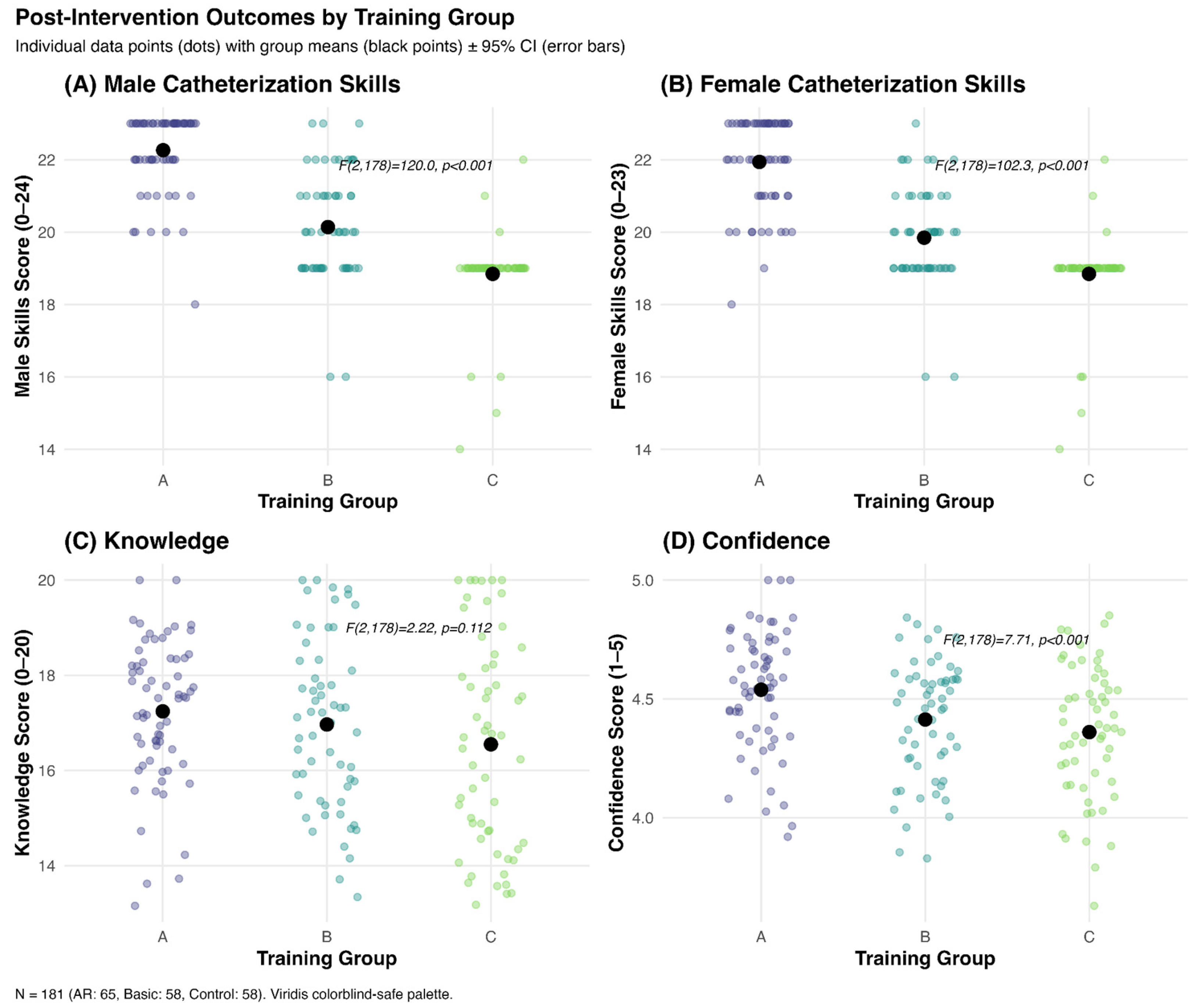
Post-intervention male catheterization skills (Figure 2) differed significantly across training groups (p < 0.001, η2 = 0.574), indicating a very large effect. The mean ± SD scores were AR 22.26 ± 1.08, Basic 20.14 ± 1.49, and Control 18.84 ± 1.12. Tukey’s HSD post hoc tests confirmed significant differences for all pairwise contrasts, p < 0.001. The effect sizes were large: AR vs. Control, d = 3.11; 95% CI: [2.58, 3.63]. AR vs. Basic, d = 1.65; 95% CI: [1.23, 2.05]. Basic vs. Control, d = 0.98; 95% CI: [0.59, 1.36]. Non-parametric analysis confirmed these findings: Kruskal–Wallis χ2 = 114.28, p < 0.001, with all Dunn’s post hoc p-values < 0.001.
Similarly, post-intervention female catheterization skills (Figure 2) showed a large group effect, p < 0.001, η2 = 0.535. The mean ± SD scores were AR 21.94 ± 1.25, Basic 19.84 ± 1.31, and Control 18.84 ± 1.12. All pairwise comparisons were statistically significant, p < 0.001, with very large effect sizes. AR vs. Control, d = 2.60; 95% CI: [2.11, 3.08]. AR vs. Basic, d = 1.64; 95% CI: [1.23, 2.05]. Basic vs. Control, d = 0.82; 95% CI: [0.44, 1.20]. Non-parametric tests confirmed Kruskal–Wallis χ2(2) = 108.79, p < 0.001.
Skills outcomes were excluded from the mixed ANOVA because all participants scored zero at baseline, resulting in no pre-intervention variance; one-way ANOVA on post-intervention scores, combined with randomization, directly tests differential training effectiveness.
Post hoc contrasts showed that AR participants improved significantly more than Control participants.

3.2. Secondary Outcomes: Knowledge and Confidence

Post-intervention knowledge scores did not significantly differ across groups; p = 0.11, η2 = 0.024. The mean scores exceeded 80% of the maximum across all groups: AR 17.24 ± 1.48, Basic 16.97 ± 1.78, and Control 16.55 ± 2.18 out of 20 points.
Post-intervention confidence showed statistically significant group differences; p < 0.001, η2 = 0.080. The mean ± SD scores were AR 4.54 ± 0.25, Basic 4.41 ± 0.25, and Control 4.36 ± 0.28. A post hoc Tukey test indicated that AR participants reported significantly higher confidence than Control participants (p = 0.001) and then Basic participants (p = 0.022), whereas the Basic and Control groups did not differ significantly (p = 0.517). The effect sizes were medium: AR vs. Control, d = 0.67; AR vs. Basic, d = 0.50.
Table 2 and Table 3 display the descriptive statistics, ANOVA results, and pairwise effect sizes related to the reported skills, knowledge, and confidence across the three study groups.
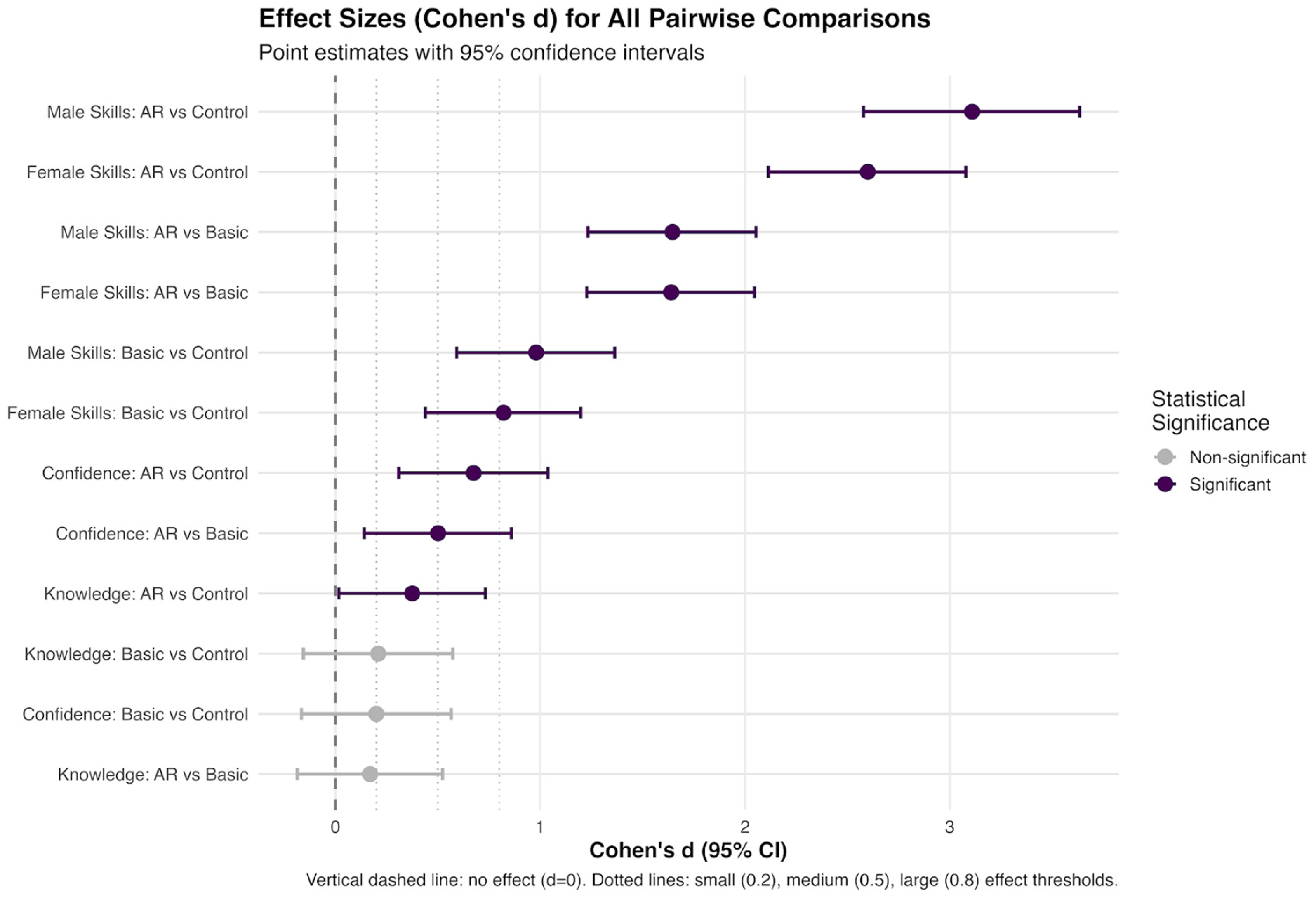
Figure 3 displays Cohen’s d for all pairwise comparisons across the four outcomes. Skills results (male and female) consistently showed large effects: AR vs. Control (d = 2.60–3.11), AR vs. Basic (d = 1.64–1.65), and Basic vs. Control (d = 0.82–0.98). Knowledge showed negligible to small effects (|d| < 0.4), while confidence showed small to medium effects (|d| = 0.2–0.7).
Bayesian hierarchical ANOVA confirmed the frequentist findings. The posterior probabilities for directional skills hypotheses were P(AR > Control|Data) = 1.0000, P(AR > Basic|Data) = 1.0000, and P(Basic > Control|Data) = 1.0000, indicating near-certainty (>99.99%) for AR’s superiority over both comparison conditions. The 95% credible interval for the AR versus Control difference was [−3.85, −2.98] points, excluding zero and closely aligning with the frequentist confidence intervals.

4. Discussion

In our trainees, the AR simulation training led to better catheterization skills compared to basic simulation and lecture-based control, with large and very large effects for male and female catheterization. Thus, both AR and basic simulation modalities confer measurable advantages over lecture-based instruction, with AR providing additional benefits beyond task-trainer practice. Because all participants entered without prior catheterization experience and groups were randomized, post-intervention differences directly reflect training effectiveness in skill development.
The secondary outcomes complement the primary findings. Knowledge did not differ between arms, consistent with a ceiling effect: all groups exceeded 80% correct after the shared lecture, suggesting that theoretical instruction was sufficient for declarative knowledge regardless of subsequent training modality. This dissociation between knowledge and skills aligns with the established distinction between declarative and procedural learning, whereby hands-on practice, and not theoretical instruction, drives psychomotor skill acquisition.
The confidence scores favored the AR group over both comparison conditions (medium effect sizes), consistent with Bandura’s self-efficacy theory [40], in which mastery experiences strengthen perceived capability. This advantage aligns with findings by Brigo et al. in catheterization training [11].
These findings should be interpreted within an evolving evidence base on simulation-based catheterization training. Video-based instruction has been shown to improve UC skills compared to traditional lectures [41], and scenario-based simulation training incorporating task-trainers yields significant gains in both knowledge and procedural skills over low-fidelity approaches [29]. Simulation training has also been linked to increased confidence in performing urinary catheterization, beyond that achieved by lecture-based instruction [12]. Together with the current results, these findings suggest that each step in technological enhancement provides incremental benefits for psychomotor skill acquisition. Notably, few UC training studies have reported standardized effect sizes alongside significance tests; the present results contribute quantitative benchmarks to this literature [13,14].
Fully VR approaches provide an immersive environment for training catheterization that enables skills development [19,20] but lack proprioceptive feedback from physical equipment. This study explores the impact of combining AR guidance with real catheterization equipment. The results suggest that this pairing enables effective acquisition of UC skills. Schoeb et al. [21] demonstrated that training catheter placement with mixed reality (MR) guidance produces learning outcomes comparable to instructor-led training while allowing independent, standardized practice, an advantage shared by AR simulation.
From a motor-learning perspective, one plausible mechanism would be that pairing visual guidance with tactile feedback from the equipment could reduce cognitive load while maintaining the necessary sensorimotor experience, supporting procedural memory formation. This mechanism would also account for the graded pattern of effect sizes: the magnitude of the AR advantage over basic simulation (d = 1.65) was larger than the basic simulation advantage over lecture-only control (d = 0.98), suggesting that real-time procedural feedback and spatial guidance provide incremental benefit beyond hands-on practice alone. Because cognitive load, gaze, and sensorimotor variables were not measured in the present trial, this remains a hypothesis. The large effect sizes observed in our cohort exceed those typically reported in AR medical education trials. This difference could be attributed to the novelty of the AR simulator, which provides visual step-by-step guidance, and the immediate assessment post-training. The results reflect the present cohort and study context and should be interpreted accordingly. Future studies analyzing different populations or training setups might obtain different results.
The post-intervention competency rates for male catheterization reached 90.8% in the AR group, supporting the potential of AR-enhanced simulation to improve competency rates in clinical skills curricula. Basic simulation also produced meaningful gains over lecture-based instruction, underscoring the value of hands-on practice at any fidelity level.
The AR group’s advantage could reflect technology novelty, namely, the Hawthorne effect, rather than an instructional mechanism. However, the magnitude of the observed differences argues against a novelty-only explanation: d = 3.11 for AR versus control on male catheterization exceeds what would be expected from typical engagement or attentional effects, which in educational meta-analyses typically produce small to medium effects [42]. The AR advantage was specific to procedural skills rather than diffuse across all outcomes; knowledge did not differ between groups, suggesting a mechanism tied to motor skill acquisition rather than generalized motivation.
While AR simulation demonstrated superiority in skill acquisition, institutional implementation must consider these benefits against capital costs. AR systems represent a significant investment, and the competency-rate difference between AR and basic simulation (90.8% vs. 39.7%) must be evaluated against institutional budgets and training volumes. Future research should examine cost-effectiveness directly, comparing upfront technology costs against potential reductions in remediation time and CAUTI-related downstream expenses.
The strengths of this study include the three-arm RCT design, allowing the direct comparison of AR simulation, basic simulation, and lecture-based control within a single trial with zero attrition. Performance was assessed by a blinded evaluator. The results align with deliberate practice theory [43] that active, feedback-rich AR training supports the conditions optimal for the efficient acquisition of procedural skills. Long-term skill retention, cross-institutional generalizability, and transfer to real-patient outcomes require further investigation.

Limitations

Several limitations should be considered when interpreting these findings. First, the blinding of participants and instructors was unfeasible due to the intervention’s nature. However, evaluators were blinded to group allocation and rated performance using checklists with pre-specified criteria, minimizing assessment bias.
Second, technological novelty may have partly influenced AR participants’ performance, and this effect cannot be fully separated from the instructional mechanism. Additionally, outcomes are specific to the AR system used; different AR platforms may yield different outcomes. Furthermore, differences in instructional guidance between the groups could introduce confounding factors when comparing the effectiveness of guided AR and basic simulation training with the unguided control. Consequently, the observed effects may reflect not only differences in instructional modalities but also by the presence or absence of guidance. Although the inclusion of guidance for the AR and basic simulation groups reflects their pedagogical design, this support may have independently influenced the outcomes.
Third, outcomes were measured using simulated task-trainer performance rather than real-patient catheterization. Although simulation-based assessment is a widely accepted proxy for clinical competence in skills education research, it does not directly measure transfer to patient care.
Fourth, assessment was conducted at a single post-intervention time point, without evaluating long-term retention. Therefore, it remains unknown whether group differences persist over time or whether the rates of skill decay differ across modalities. Moreover, assessment instruments were developed through faculty consensus. While this supports content validity, the absence of formal validation limits the strengths of the results, hindering the generalizability of the observed outcomes.

5. Conclusions

AR simulation training was associated with significantly higher urinary catheterization skills compared to both basic simulation and lecture-based instruction, with statistically significant differences across pairwise comparisons showing statistical significance and large observed effect sizes. Randomization reduced the potential of pre-existing group differences exerting influence on the observed post-intervention advantage. The secondary findings were consistent: knowledge scores were similar across groups, suggesting a possible ceiling effect across, while confidence modestly favored AR training. Convergent frequentist and Bayesian evidence supports the robustness of the primary skills finding. However, these outcomes should be interpreted with caution, considering the particularities of the cohort, the potential impact of the novelty of the interventions, the differences across instructional guidance across groups and the lack of long-term assessment.
These results support integrating AR-enhanced simulation into clinical skills curricula and highlight that basic simulation produces meaningful gains over lecture-based instruction. Future research should examine long-term retention at 1, 3, and 6 months; replicate these findings across institutions with varying resources and curricula; assess transfer to real-patient catheterization outcomes; and identify the contributions of real-time feedback, spatial guidance, and embodied interaction to AR’s benefits. Together, these findings provide quantitative benchmarks to the catheterization training literature, which has relied primarily on significance testing rather than standardized effect size reporting.

Author Contributions

Conceptualization, D.D., C.V.T. and V.J.; methodology, D.D., C.V.T., N.R. and R.-M.S.; validation, G.A.P., O.-C.N. and D.L.B.; formal analysis, D.-C.B., R.-M.S. and G.A.P.; investigation, D.D., N.R., O.-C.N. and D.L.B.; resources, D.D., C.V.T., R.-M.S., O.-C.N. and D.L.B.; data curation, D.-C.B., N.R. and G.A.P.; writing—original draft preparation, D.D., D.-C.B., O.-C.N. and D.L.B.; writing—review and editing, C.V.T., R.-M.S., G.A.P. and V.J.; visualization, D.-C.B. and N.R.; supervision, C.V.T. and V.J.; project administration D.D., C.V.T. and V.J. All authors have read and agreed to the published version of the manuscript.

Funding

This research received no external funding.

Institutional Review Board Statement

The study was conducted in accordance with the Declaration of Helsinki and approved by the Institutional Ethics Committee of CAROL DAVILA UNIVERSITY OF MEDICINE AND PHARMACY (protocol code 17465) on 28 June 2024.

Informed Consent Statement

Informed consent was obtained from all subjects involved in the study.

Data Availability Statement

The raw data supporting the conclusions of this article will be made available by the authors on request from the corresponding author due to ethical reasons.

Acknowledgments

Publication of this paper was supported by the University of Medicine and Pharmacy Carol Davila, through the institutional program Publish not Perish.

Conflicts of Interest

The authors declare no conflicts of interest.

References

  1. Waheed, S.; Kapadia, N.N.; Ansari, A.S.; Masud, S. Clinical Audit on Indications and Technique of Male Urethral Catheterization in Emergency Department of a Tertiary Care Hospital. Ann. Med. Surg. 2022, 81, 104389. [Google Scholar] [CrossRef]
  2. Aguilera-Manrique, G.; Gutiérrez-Puertas, L.; Gutiérrez-Puertas, V.; Ortiz-Rodríguez, B.; Márquez-Hernández, V.V. Evaluation of Urinary Catheterization Competency and Self-Efficacy in Nursing Students Using the Flipped Classroom Approach. Int. J. Environ. Res. Public Health 2022, 19, 15144. [Google Scholar] [CrossRef]
  3. Patel, P.K.; Advani, S.D.; Kofman, A.D.; Lo, E.; Maragakis, L.L.; Pegues, D.A.; Pettis, A.M.; Saint, S.; Trautner, B.; Yokoe, D.S.; et al. Strategies to Prevent Catheter-Associated Urinary Tract Infections in Acute-Care Hospitals: 2022 Update. Infect. Control Hosp. Epidemiol. 2023, 44, 1209–1231. [Google Scholar] [CrossRef] [PubMed]
  4. Flores-Mireles, A.L.; Walker, J.N.; Caparon, M.; Hultgren, S.J. Urinary Tract Infections: Epidemiology, Mechanisms of Infection and Treatment Options. Nat. Rev. Microbiol. 2015, 13, 269–284. [Google Scholar] [CrossRef] [PubMed]
  5. Bristol, T.; Hagler, D.; McMillian-Bohler, J.; Wermers, R.; Hatch, D.; Oermann, M.H. Nurse Educators’ Use of Lecture and Active Learning. Teach. Learn. Nurs. 2019, 14, 94–96. [Google Scholar] [CrossRef]
  6. Ongor, M.; Uslusoy, E.C. The Effect of Multimedia-Based Education in e-Learning on Nursing Students’ Academic Success and Motivation: A Randomised Controlled Study. Nurse Educ. Pract. 2023, 71, 103686. [Google Scholar] [CrossRef] [PubMed]
  7. Bøe, S.V.; Debesay, J. The Learning Environment of Student Nurses During Clinical Placement: A Qualitative Case Study of a Student-Dense Ward. SAGE Open Nurs. 2021, 7, 23779608211052357. [Google Scholar] [CrossRef]
  8. Vozenilek, J.; Huff, J.S.; Reznek, M.; Gordon, J.A. See One, Do One, Teach One: Advanced Technology in Medical Education. Acad. Emerg. Med. 2004, 11, 1149–1154. [Google Scholar] [CrossRef]
  9. Panda, S.; Dash, M.; John, J.; Rath, K.; Debata, A.; Swain, D.; Mohanty, K.; Eustace-Cook, J. Challenges Faced by Student Nurses and Midwives in Clinical Learning Environment—A Systematic Review and Meta-Synthesis. Nurse Educ. Today 2021, 101, 104875. [Google Scholar] [CrossRef]
  10. Daneshfar, M.; Moonaghi, H.K. The Impact of Clinical Simulation on Bridging the Theory–Practice Gap in Nursing Education: A Systematic Review. BMC Med. Educ. 2025, 25, 1216. [Google Scholar] [CrossRef]
  11. Brigo, M.J.K.; Garbelini, M.C.D.L.; Coelho, I.C.M.M. Confidence Degree and Skill Development in Undergraduate Medical Students Using Male Urogenital Training Simulators. Rev. Colégio Bras. Cir. 2024, 51, e20243593. [Google Scholar] [CrossRef]
  12. Al-Sayaghi, K.M.; Alqalah, T.A.H.; Alkubati, S.A.; Alshoabi, S.A.; Alsabri, M.; Alrubaiee, G.G.; Almoliky, M.A.; Saleh, K.A.; Al-Sayaghi, A.K.; Elshatarat, R.A.; et al. Healthcare Workers’ Compliance with the Catheter Associated Urinary Tract Infection Prevention Guidelines: An Observational Study in Yemen. Antimicrob. Resist. Infect. Control 2023, 12, 144. [Google Scholar] [CrossRef]
  13. Herrera-Aliaga, E.; Estrada, L.D. Trends and Innovations of Simulation for Twenty First Century Medical Education. Front. Public Health 2022, 10, 619769. [Google Scholar] [CrossRef] [PubMed]
  14. Elendu, C.; Amaechi, D.C.; Okatta, A.U.; Amaechi, E.C.; Elendu, T.C.; Ezeh, C.P.; Elendu, I.D. The Impact of Simulation-Based Training in Medical Education: A Review. Medicine 2024, 103, e38813. [Google Scholar] [CrossRef]
  15. Koukourikos, K.; Tsaloglidou, A.; Kourkouta, L.; Papathanasiou, I.V.; Iliadis, C.; Fratzana, A.; Panagiotou, A. Simulation in Clinical Nursing Education. Acta Inform. Medica 2021, 29, 15–20. [Google Scholar] [CrossRef]
  16. Santana, B.D.S.; Magro, M.C.D.S. Effectiveness of Simulation Fidelity Levels on Theoretical-Practical Knowledge and Gains in Drug Administration to Critically Ill Patients: A Randomized Clinical Trial. Nurse Educ. Pract. 2025, 84, 104335. [Google Scholar] [CrossRef] [PubMed]
  17. Marjanovic, N.; Luciano, C.; Niederberger, C. CathSym: Device and Method to Bring Haptic Feedback to Urinary Catheterization Training. In Proceedings of the 2021 43rd Annual International Conference of the IEEE Engineering in Medicine & Biology Society (EMBC), Virtual, 1–5 November 2021; pp. 4908–4911. [Google Scholar] [CrossRef]
  18. Stenseth, H.V.; Steindal, S.A.; Solberg, M.T.; Ølnes, M.A.; Mohallem, A.; Sørensen, A.L.; Strandell-Laine, C.; Olaussen, C.; Aure, C.F.; Riegel, F.; et al. Simulation-Based Learning Supported by Technology to Enhance Critical Thinking in Nursing Students: Protocol for a Scoping Review. JMIR Res. Protoc. 2022, 11, e36725. [Google Scholar] [CrossRef]
  19. Chang, C.-L. Effect of Immersive Virtual Reality on Post-Baccalaureate Nursing Students’ In-Dwelling Urinary Catheter Skill and Learning Satisfaction. Healthcare 2022, 10, 1473. [Google Scholar] [CrossRef] [PubMed]
  20. Yoon, H. Effects of Immersive Straight Catheterization Virtual Reality Simulation on Skills, Confidence, and Flow State in Nursing Students. Comput. Inform. Nurs. CIN 2024, 42, 872–878. [Google Scholar] [CrossRef]
  21. Schoeb, D.S.; Schwarz, J.; Hein, S.; Schlager, D.; Pohlmann, P.F.; Frankenschmidt, A.; Gratzke, C.; Miernik, A. Mixed Reality for Teaching Catheter Placement to Medical Students: A Randomized Single-Blinded, Prospective Trial. BMC Med. Educ. 2020, 20, 510. [Google Scholar] [CrossRef]
  22. Kulbay, A.; Joelsson-Alm, E.; Tammelin, A. The Impact of Guidelines on Sterility Precautions during Indwelling Urethral Catheterization at Two Acute-Care Hospitals in Sweden—A Descriptive Survey. BMC Nurs. 2021, 20, 99. [Google Scholar] [CrossRef]
  23. Nikolic, S.; Mocnik, M.; Bevc, S. Hybrid Simulation Experience-Hybrid Simulator Model vs. Manikin in Bladder Catheterization Procedure: A Pilot Study. J. Health Educ. Res. Dev. 2017, 5, 235. [Google Scholar] [CrossRef]
  24. Zhang, R.; Jin, X.; Liu, M.; Tong, H.Y. The Effectiveness of Augmented Reality/Mixed Reality in Medical Education: A Meta-Analysis. BMC Med. Educ. 2025, 25, 1586. [Google Scholar] [CrossRef]
  25. Krüger, J.M.; Bodemer, D. Application and Investigation of Multimedia Design Principles in Augmented Reality Learning Environments. Information 2022, 13, 74. [Google Scholar] [CrossRef]
  26. Schroeder, N.L.; Cenkci, A.T. Spatial Contiguity and Spatial Split-Attention Effects in Multimedia Learning Environments: A Meta-Analysis. Educ. Psychol. Rev. 2018, 30, 679–701. [Google Scholar] [CrossRef]
  27. Gonnermann-Müller, J.; Leins, N.; Gronau, N.; Kosch, T. Value by Design: Reducing Cognitive Load by Using Visual Guidance in Augmented Reality—An Eye-Tracking Study. In Proceedings of the ICIS 2024 Proceedings, Bangkok, Thailand, 15–18 December 2024. [Google Scholar]
  28. Jeffri, N.F.S.; Awang Rambli, D.R. A Review of Augmented Reality Systems and Their Effects on Mental Workload and Task Performance. Heliyon 2021, 7, e06277. [Google Scholar] [CrossRef]
  29. Özden, D.; Alan, N.; Ayik, C.; Çarga, S.; Gürol Arslan, G. Effectiveness of Scenario-Based Simulation Training in Urinary Catheterization on Nursing Students’ Knowledge, Skills, Self-Confidence and Satisfaction: A Randomized Controlled Study. Nurse Educ. Pract. 2025, 89, 104607. [Google Scholar] [CrossRef] [PubMed]
  30. Geng, V.; Lurvink, H.; Pearce, I. Evidence-Based Guidelines for Best Practice in Urological Health Care: Indwelling Catheterisation in Adults—Urethral and Suprapubic; European Association of Urology Nurses: Arnhem, The Netherlands, 2024; ISBN 978-94-92671-24-0. [Google Scholar]
  31. Faul, F.; Erdfelder, E.; Lang, A.-G.; Buchner, A. G*Power 3: A Flexible Statistical Power Analysis Program for the Social, Behavioral, and Biomedical Sciences. Behav. Res. Methods 2007, 39, 175–191. [Google Scholar] [CrossRef]
  32. Hopewell, S.; Chan, A.-W.; Collins, G.S.; Hróbjartsson, A.; Moher, D.; Schulz, K.F.; Tunn, R.; Aggarwal, R.; Berkwits, M.; Berlin, J.A.; et al. CONSORT 2025 Statement: Updated Guideline for Reporting Randomized Trials. Nat. Med. 2025, 31, 1776–1783. [Google Scholar] [CrossRef]
  33. Sjoberg, D.D.; Whiting, K.; Curry, M.; Lavery, J.A.; Larmarange, J. Reproducible summary tables with the gtsummary package. R J. 2021, 13, 570–580. [Google Scholar] [CrossRef]
  34. Ben-Shachar, M.S.; Lüdecke, D.; Makowski, D. effectsize: Estimation of Effect Size Indices and Standardized Parameters. J. Open Source Softw. 2020, 5, 2815. [Google Scholar] [CrossRef]
  35. Sawilowsky, S.S. New Effect Size Rules of Thumb. J. Mod. Appl. Stat. Methods 2009, 8, 597–599. [Google Scholar] [CrossRef]
  36. Ogle, D.H.; Doll, J.C.; Wheeler, A.P.; Dinno, A. FSA: Simple Fisheries Stock Assessment Methods 2015, R Package Version 0.10.1. Available online: https://cran.r-project.org/web/packages/FSA (accessed on 26 February 2026).
  37. Lawrence, M.A. Ez: Easy Analysis and Visualization of Factorial Experiments 2024. Available online: https://CRAN.R-project.org/package=ez (accessed on 26 February 2026).
  38. Lenth, R.V.; Piaskowski, J. Emmeans: Estimated Marginal Means. 2024. Available online: https://CRAN.R-project.org/package=emmeans (accessed on 26 February 2026).
  39. Bürkner, P. brms: An R Package for Bayesian Multilevel Models Using Stan. J. Stat. Softw. 2017, 80, 1–28. [Google Scholar] [CrossRef]
  40. Bandura, A. Self-Efficacy: Toward a Unifying Theory of Behavioral Change. Psychol. Rev. 1977, 84, 191–215. [Google Scholar] [CrossRef] [PubMed]
  41. Kaya, A.; Durgun, H. Empowering Nursing Students: How Video-Based Teaching Enhances Urinary Catheterization Skills—A Randomized Controlled Study. Int. Neurourol. J. 2025, 29, 103–109. [Google Scholar] [CrossRef]
  42. Hattie, J. Visible Learning: A Synthesis of Over 800 Meta-Analyses Relating to Achievement; Routledge: London, UK, 2008; ISBN 978-0-203-88733-2. [Google Scholar]
  43. Ericsson, K.A.; Krampe, R.T.; Tesch-Römer, C. The Role of Deliberate Practice in the Acquisition of Expert Performance. Psychol. Rev. 1993, 100, 363–406. [Google Scholar] [CrossRef]
Figure 1. CONSORT flow diagram.
Applsci 16 05068 g001
Figure 2. Post-intervention outcomes by training group. Individual data points (colored dots) with group means (black points) and 95% confidence intervals (error bars). (A) Male catheterization skills, (B) female catheterization skills, (C) knowledge, and (D) confidence. AR simulation shows superiority for skills outcomes (panels (A,B)); knowledge and confidence show smaller group differences (panels (C,D)).
Applsci 16 05068 g002
Figure 3. Forest plot of effect sizes (Cohen’s d) for all pairwise comparisons. Point estimates with 95% confidence intervals. Vertical dashed line at zero indicates no effect. Dotted reference lines mark small (0.2), medium (0.5), and large (0.8) effect thresholds. Skills outcomes show very large effects, while knowledge and confidence show smaller effects.
Applsci 16 05068 g003
Table 1. Baseline characteristics by training group. Values are means (SDs). Groups were compared using one-way ANOVA to verify randomization balance.
CharacteristicOverall
(N = 176)
AR
(N = 60)
Basic
(N = 58)
Control
(N = 58)
p-Value
Knowledge
(0–20)
16.61 ± 2.0416.78 ± 1.6116.60 ± 2.2116.44 ± 2.290.66
Confidence
(1–5)
3.91 ± 0.313.92 ± 0.293.91 ± 0.333.91 ± 0.33>0.9
Table 2. Descriptive statistics and ANOVA results.
OutcomesAR (N = 60)
Mean ± SD
Basic (N = 58)
Mean ± SD
Control
(N = 58)
Mean ± SD
Fpη2
Male Skills22.26 ± 1.0820.14 ± 1.4918.84 ± 1.12120.00<0.0010.574
Female Skills21.94 ± 1.2519.84 ± 1.3118.84 ± 1.12102.32<0.0010.535
Knowledge17.24 ± 1.4816.97 ± 1.7816.55 ± 2.182.22=0.110.024
Confidence4.54 ± 0.254.41 ± 0.254.36 ± 0.287.71<0.0010.080
Table 3. Pairwise effect sizes (Cohen’s d with 95% CI).
OutcomesAR vs. ControlAR vs. BasicBasic vs. Control
Male Skills3.11 [2.58, 3.63]1.65 [1.23, 2.05]0.98 [0.59, 1.36]
Female Skills2.60 [2.11, 3.08]1.64 [1.23, 2.05]0.82 [0.44, 1.20]
Knowledge0.38 [0.02, 0.73]0.17 [−0.19, 0.52]0.21 [−0.16, 0.57]
Confidence0.67 [0.31, 1.04]0.50 [0.14, 0.86]0.20 [−0.17, 0.56]
Disclaimer/Publisher’s Note: The statements, opinions and data contained in all publications are solely those of the individual author(s) and contributor(s) and not of MDPI and/or the editor(s). MDPI and/or the editor(s) disclaim responsibility for any injury to people or property resulting from any ideas, methods, instructions or products referred to in the content.