1. Introduction
The nutation face gear transmission is a novel transmission with high power density. It combines the high contact ratio of face gear transmission with the large reduction ratio of nutation transmission. Unlike a conventional face gear pair, this system uses a face gear to replace the spur cylindrical gear and forms a conjugate face-to-face gear pair. Power transmission and speed reduction are achieved through nutation motion. In this transmission system, up to 10% of the gear teeth can be in mesh simultaneously [
1]. This significantly improves the overall stiffness and load-carrying capacity. As a result, it exhibits promising applications in high-speed and heavy-load scenarios with strict space and weight constraints, such as helicopter main gearboxes and industrial robot joint reducers [
2]. Compared with traditional transmission systems, the nutation face gear can achieve efficient high-power transmission in a compact space [
3]. It also exhibits good transmission performance, such as smooth operation and low vibration and noise [
4].
For face gear transmission systems, Heath et al. [
5,
6] examined the service performance and durability of face gear drives under demanding operating conditions. In addition, research on concentric face gear structures [
7], eccentric face gear structures [
8], meshing stability [
9,
10], and vibration suppression [
11,
12,
13] has also been progressively expanded. These studies have provided an important methodological basis for the dynamic and modal analysis of nutation face gear transmission systems. The nutation face gear transmission was first proposed by Lemanski [
14], the core principle of this transmission lies in utilizing the tooth number difference between the nutation face gear and the fixed and output face gears to achieve power transmission and speed reduction through the angular displacement difference generated by the nutation motion [
15]. This unique kinematic mechanism enables the intermediate nutation face gear to undergo nutation motion while transmitting torque [
16]. The system experiences non-negligible gyroscopic effects, centrifugal forces, and inertial excitations [
17]. Saribay and Bill [
18] investigated the kinematics and meshing efficiency of the nutation face gear transmission system. Jasem and Krauinsh [
19] investigated aspects such as the geometric structure and load-carrying capacity of the nutation face gear transmission system. Mathur et al. [
20] investigated the assembly methods, geometric structure, and dynamic characteristics of the nutation face gear transmission system. They proposed a weight minimization design approach [
21] and conducted dynamic testing for validation based on these studies, demonstrating the superiority of the transmission system [
22]. Wu et al. [
23] investigated the reliability of contact fatigue strength in the nutation face gear transmission. Li [
24] investigated the dynamic characteristics of a nutation face gear transmission system designed for metallurgical rolling mills. Regarding stiffness aspects, previous researchers have performed detailed and comprehensive calculations of the tooth stiffness [
25,
26] for the nutation face gear.
Although existing studies have made progress in the geometric design, contact analysis, and stiffness evaluation of face gear transmission systems, the natural dynamic characteristics of dual-path nutation face gear systems remain insufficiently understood. In existing dynamic models, some studies considered only the radial and torsional degrees of freedom, while neglecting the axial degree of freedom in the z-direction. The presence of nutation motion endows the transmission system with distinct spatial meshing characteristics. The normal meshing force is decomposed into radial, axial and tangential components, where the axial force directly contributes to the relative deformation along the line of action. Therefore, neglecting the axial degree of freedom may lead to an incomplete description of the mesh deformation, mode shapes and the variation of natural frequencies with stiffness. For dual-path power-split nutation face gear transmission systems, there is still a lack of in-depth understanding of the distribution of natural frequencies, the evolution of mode shapes, and the influence of key stiffness parameters on the modal behavior. Therefore, a systematic investigation of the natural characteristics of such systems is required.
In this study, a 22-DOF bending–torsional–axial coupled dynamic model is established for a dual-branch nutation face gear transmission system. The model considers the translational and torsional vibrations of the face gears in the radial and axial directions, as well as the torsional deformation characteristics of the input shaft. This study incorporates axial, bending, and torsional motions into a unified framework to characterize the modal coupling characteristics induced by spatial meshing and nutation motion. Based on this model, the corresponding undamped free vibration equations are derived, and the natural frequencies and mode shapes of the transmission system are systematically calculated. In addition, a simplified model without axial DOFs is introduced. Its natural frequencies and mode shapes are compared with those of the original model to clarify the influence of axial vibration on the modal characteristics. A 5% increase in the mass parameters of the face gears is adopted to preliminarily evaluate the sensitivity of the lower-order natural frequencies to mass variation. This study further reveals the modal distribution characteristics under multi-stiffness coupling, the repeated frequency phenomenon caused by structural symmetry, and the influence mechanisms of key stiffness parameters on the lower-order modal characteristics. These results help identify the dominant stiffness parameters affecting the dynamic behavior of the system and provide theoretical guidance for resonance avoidance, stiffness matching and load-sharing optimization in dual-path nutation face gear transmission systems.
2. Modeling and Parameterization
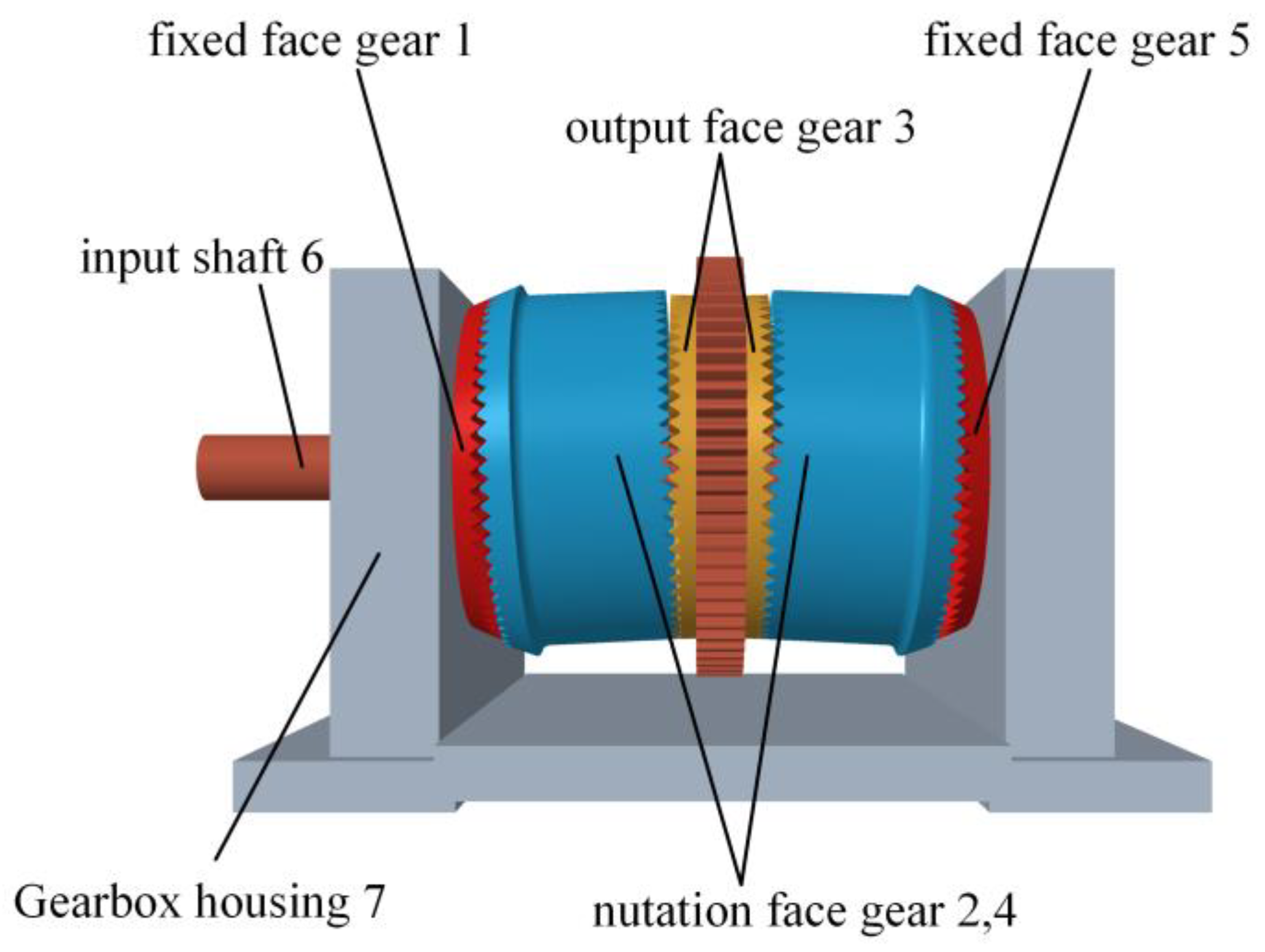
Figure 1 shows the 3D model of the nutation face gear transmission system. The system consists of the fixed face gears 1 (5), nutation face gears 2 (4), output face gear 3, input shaft 6 and gearbox housing 7 as the main components. The fixed face gears and the output face gear are external face gears, whereas the nutation face gears are composed of two internal face gears. The face gears arranged symmetrically in the left and right branches have identical gear parameters. Torque is applied at the left end of the input shaft, and power enters the transmission system through the input shaft. The two nutation face gears are simultaneously driven by the input shaft and undergo nutation motion, dividing the power into left and right transmission paths.
Considering the complex structure of the nutation face gear transmission system, this study applies reasonable simplifications and assumptions based on lumped parameter theory. This approach reduces the difficulty of dynamic modeling and enhances computational efficiency:
(1) The input shaft is modeled using the lumped parameter approach. It is represented by two lumped shaft segments connected by a massless torsional spring. Only torsional vibration of the shaft segments is considered.
(2) The nutation face gear consists of two internal face gears rigidly connected back-to-back, and the two nutation face gears have identical geometric parameters and structural dimensions.
(3) Using the lumped parameter method, each gear is modeled as a lumped mass node located at its centroid, possessing corresponding concentrated rotational inertia. The bearing supports are characterized by springs.
(4) The friction between tooth surfaces during the meshing process is neglected. Furthermore, external loads and damping effects are not considered.
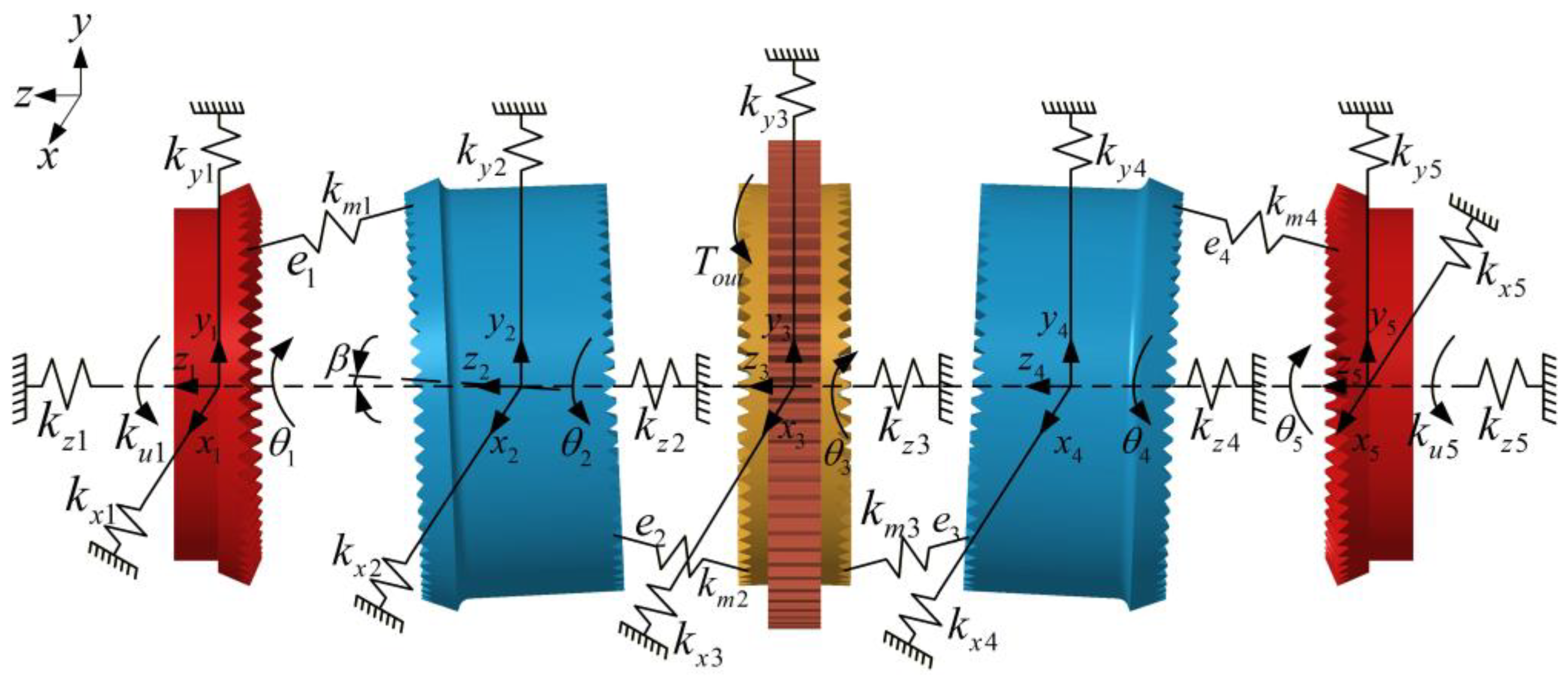
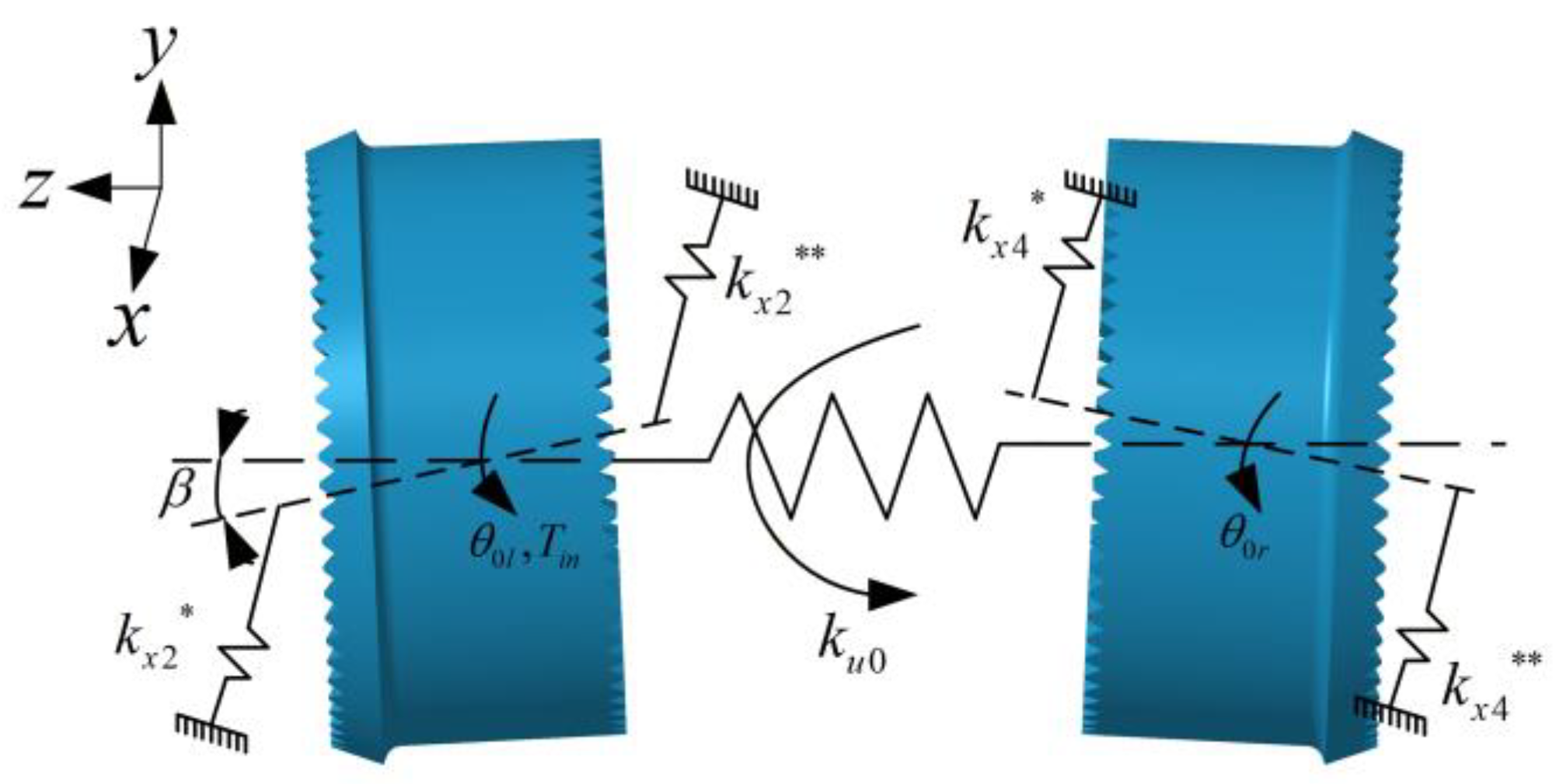
Under the above-mentioned assumptions, the bending–torsional–axial coupled dynamics model of the nutation face gear transmission system and the pure torsional dynamics model of the input shaft are established respectively, as shown in
Figure 2 and
Figure 3.
In the nutation face gear transmission system, the force conditions on the gears are complex, with the meshing force directions varying among different gear pairs. A global coordinate system is established for the system, with corresponding local coordinate systems for each face gear are consistent with the global coordinate system, and all satisfy the right-hand rule. The translational vibration displacements of fixed face gear 1, nutation face gear 2, output face gear 3, nutation face gear 4 and fixed face gear 5 along the x-axis directions are defined as respectively. Let and represent the translational vibration displacements of the respective face gears along the y and z axes directions. The torsional vibration angular displacements of face gears about the z-axis are defined as respectively.
Let , , and denote the gear pairs formed by fixed face gear 1 and nutation face gear 2, nutation face gear 2 and output face gear 3, output face gear 3 and nutation face gear 4, and nutation face gear 4 and fixed face gear 5, respectively. Let , , and denote the meshing stiffnesses of gear pairs , , and , respectively. Meanwhile, , , and represent the unloaded transmission errors of the corresponding gear pairs. Let and denote the torsional stiffnesses of fixed gear 1 and fixed face gear 5 about the z-axis, respectively. Let , , , and denote the translational support stiffnesses of fixed face gear 1, nutation face gear 2, output face gear 3, nutation face gear 4, and fixed face gear 5 along the three coordinate axes, respectively. Let denote the load torque applied to the output face gear, and represent the nutation angle.
Considering only the torsional vibration deformation of the lumped parameter shaft segments, a pure torsional dynamic model of the input shaft is developed, as illustrated in
Figure 3.
represent the nutation angle. Let
and
denote the torsional vibration angular displacements of the left and right segments of the input shaft, respectively.
and
denote the support stiffnesses of the bearings connecting nutation face gear 2 to the left segment of the input shaft. Similarly,
and
denote the support stiffnesses of the bearings connecting nutation face gear 4 to the right segment of the input shaft.
denotes the torsional stiffness connecting the left and right segments of the input shaft.
2.1. Differential Equations of Motion
The transmission system has a total of 22-degree-of-freedom. This section is based on the main vibration characteristics of the dual-path nutation face gear transmission system. Each of the five face gears is assigned four DOF, including three translational displacements in the radial and axial directions and one torsional rotation about the rotational axis. In addition, the input shaft is divided into left and right lumped torsional segments, whose torsional deformations introduce two extra DOF. This formulation enables the model to capture the radial vibration, axial vibration, torsional vibration, mesh coupling between adjacent gear pairs, support stiffness effects, and input shaft torsional coupling in the dual-path nutation face gear transmission system.
The model involves several simplifications and therefore has limitations. The face gears are represented by lumped mass nodes, and the bearing supports are represented by linear springs. The input shaft is considered mainly in terms of its torsional deformation, while its bending flexibility is not included. In addition, damping, friction and external dynamic excitation effects are neglected in this study. Therefore, the proposed model is mainly applicable to preliminary natural characteristic analysis and stiffness sensitivity evaluation. More comprehensive nonlinear dynamic analyses considering damping, friction, and time-varying meshing stiffness will be carried out in future work.
The generalized displacement vector is given as follows:
where
denotes the linear displacement corresponding to the torsional vibration of the face gears.
denotes the linear displacement corresponding to the torsional vibration of the left segment of the input shaft.
denotes the linear displacement corresponding to the torsional vibration of the right segment of the input shaft.
The linear displacements associated with the torsional vibrations of the gears and the input shaft are calculated using the following expressions:
where
denotes the rotation radius about the rotational axis at the midpoint of the face gear tooth width.
and
denote the rotation radii of the left and the right segments of the input shaft, respectively.
denotes the torsional angular displacement of the face gears.
and
denote the torsional angular displacements of the left and the right segments of the input shaft, respectively.
During the meshing process, the relative displacement between the gears in gear pairs
,
,
and
is given by:
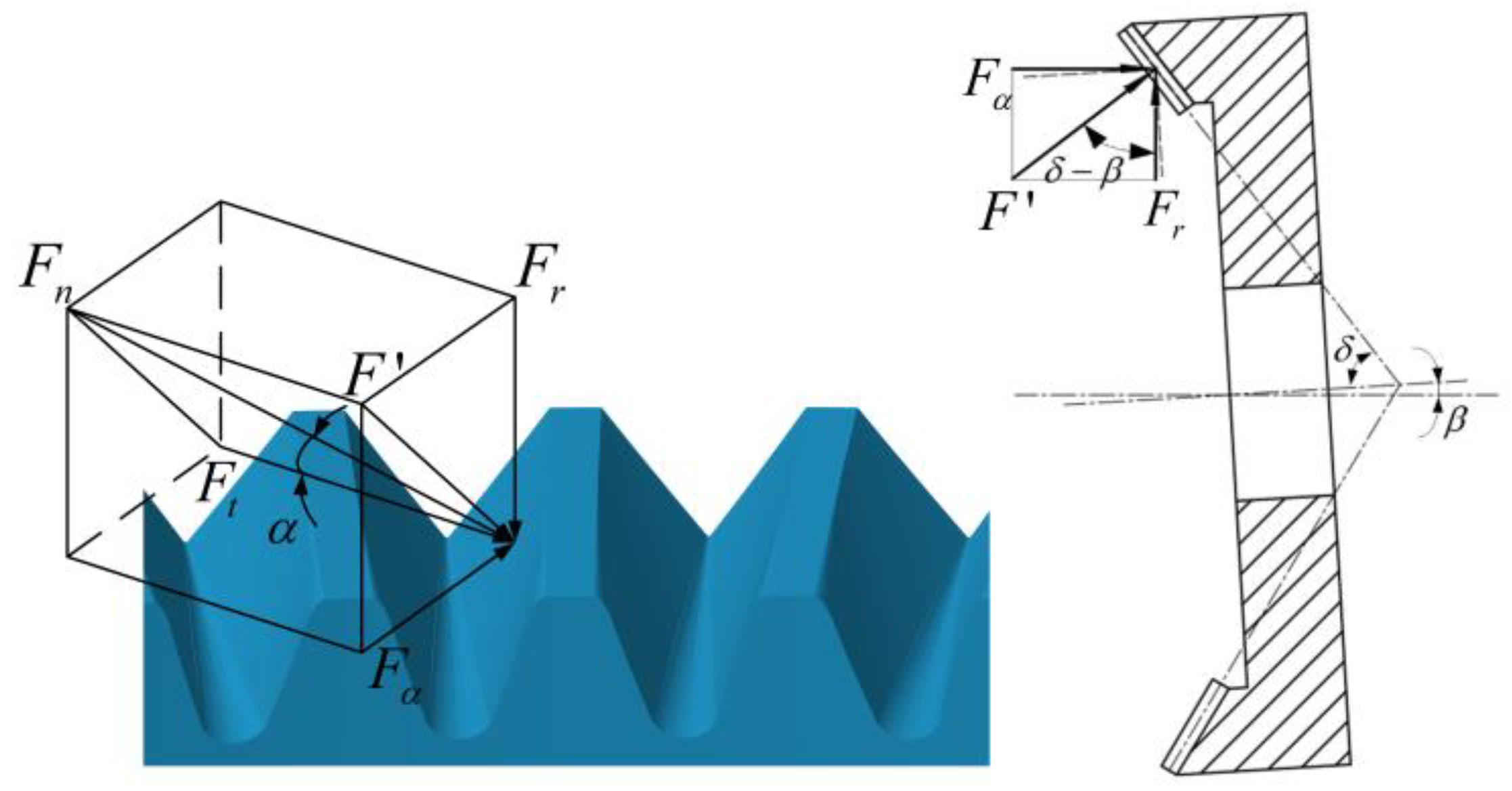
The meshing force acting on the nutation face gear teeth can be decomposed as illustrated in
Figure 4.
As an internal face gear, the nutation face gear displays a force distribution pattern comparable to that of a straight bevel gear. The normal meshing force
, is defined at the contact point of the nutation face gear tooth. It is decomposed into the axial force
, tangential force
and radial force
at the pitch circle along the axial, circumferential, and radial directions, respectively. As shown in the figure, the meshing force acting on the nutation face gear tooth can be resolved into components along the radial, axial, and circumferential directions, which are expressed as follows:
where
denotes the supplementary angle of the helix angle of the internal face gear.
denotes the pitch circle pressure angle of the face gear.
denotes the nutation angle of the face gear.
Under the action of the meshing force, compression along the line of action is taken as positive. The displacement of fixed face gear 1 along the line of action,
can be expressed as follows:
The projection of the translational vibration displacements of nutation face gear 2 in each local coordinate direction onto the line of action, denoted as
, is expressed as follows:
where
denotes the pressure angle of fixed face gear 1.
denotes the helix angle of fixed face gear 1.
The projected displacements of the translational vibrations for each gear along the line of action are denoted as follows:
where
denotes the pressure angle of output face gear 3.
denotes the helix angle of output face gear 3.
denotes the pressure angle of fixed face gear 5.
denotes the helix angle of fixed face gear 5.
Based on the analysis of relative displacements between the gear teeth in the above gear pairs, the expressions for the dynamic meshing forces are derived as follows:
Considering the meshing stiffness, no-load transmission error, and other factors, the following equations of motion are derived based on Newton’s second law.
The differential equations of motion for the input shaft are as follows:
where
denotes the perpendicular distance from the bearing support point to the axis of the input shaft.
denotes the lumped moment of inertia of the left segment of the input shaft.
denotes the lumped moment of inertia of the right segment of the input shaft.
The differential equations of motion for the fixed face gear 1 are as follows:
The differential equations of motion for the nutation face gear 2 are as follows:
The differential equations of motion for the output face gear 3 are as follows:
The differential equations of motion for the nutation face gear 4 are as follows:
The differential equations of motion for the fixed face gear 5 are as follows:
where
denotes the lumped mass of each face gear,
denotes the lumped moment of inertia of each face gear.
By combining Equations (14)–(19), the dynamic equations of the nutation face gear transmission system are derived and expressed in matrix form as follows:
where
denotes the generalized displacement vector.
denotes the mass matrix, which includes the equivalent masses of all components.
denotes the stiffness matrix, which includes the support stiffness, meshing stiffness, and torsional stiffness.
denotes the load vector, which includes the input torque and the output torque.
2.2. System Parameters
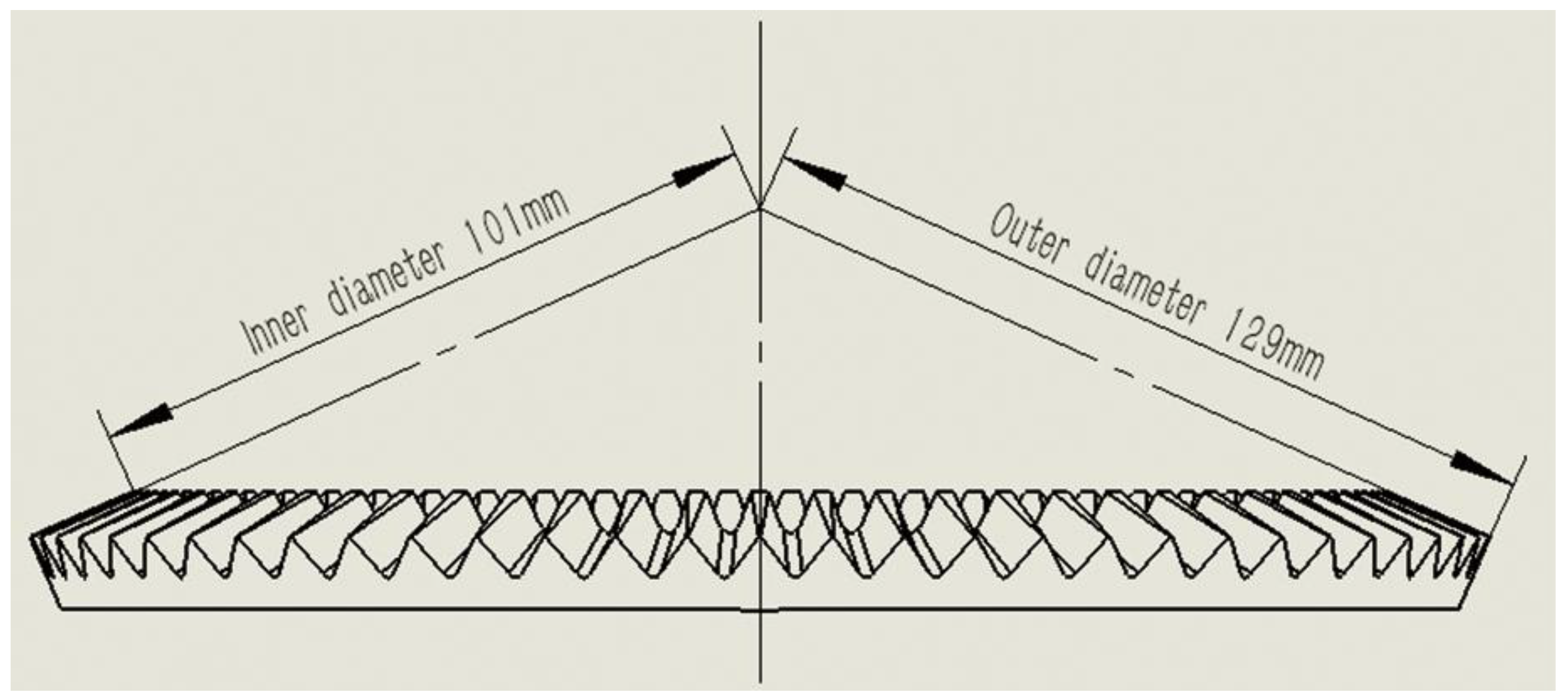
The schematic diagram of the main geometric parameters of the face gear is shown in
Figure 5.
In practical engineering applications, gear shafts are usually designed with a stepped structure to facilitate the assembly, disassembly, and positioning of components mounted on the shaft. Using the equivalent diameter method, the stepped shaft is simplified as a uniform shaft. Specifically, the stepped shaft with varying diameters, together with the gears mounted on it, is represented as an equal diameter shaft with an equivalent diameter of
. The equivalent diameter is calculated as follows:
where
is the length of the
i-th segment of the stepped shaft, and
is the diameter of the
i-th segment. The gears mounted on the shaft are also treated as equivalent shaft segments in the calculation. For the face gear,
is taken as the radius at the midpoint of the tooth width, and
denotes the distance between the supports of the two gears.
The equivalent diameters of the left and right segments of the input shaft in the nutation face gear transmission system are 45 mm and 60 mm, the input torque
is 1300 N·m, and the input speed is 3000 r/min. The gear parameters are listed in
Table 1.
The nutation face gear transmission system consists of seven mass elements, including five face gears and the left and right segments of the input shaft.
The mass of the face gear
is given by:
where
denotes the diameter at the meshing point of the face gear,
denotes the equivalent diameter,
denotes the density,
denotes the tooth width.
The mass moment of inertia of the face gear
is given by:
The mass of the input shaft
is given by:
where
denotes the equivalent diameter of the input shaft,
denotes the inner diameter of the shaft,
the shaft length.
The mass moment of inertia of the input shaft
is given by:
The masses and mass moments of inertia of the face gears and input shaft segments are summarized in
Table 2.
2.3. Stiffness Parameters
In gear dynamic models based on the lumped parameter method, bearing supports are commonly represented by equivalent spring-damper elements. Since the present study focuses on the undamped natural characteristics of the dual-path nutation face gear transmission system, the damping terms of the bearing supports are not included in the current model. Only the equivalent support stiffnesses are retained and assembled into the system stiffness matrix. The support stiffnesses are used to represent the constraint effects of the bearings and adjacent supporting components on the translational vibration of each face gear.
For the face gear, the midpoint position along the tooth height is selected as its equivalent position on the shaft.
The support stiffness of the fixed face gear was obtained from finite element static loading analysis.
The distance from the output face gear to its bearing is denoted as
. The radial equivalent support stiffness
of the output face gear is obtained by treating the bending stiffness of the corresponding shaft segment and the radial support stiffness of the bearing as two stiffness elements connected in series. The calculation formula is given as follows:
where
denotes the bending stiffness of the shaft segment and
denotes the radial stiffness of the bearing.
Similarly, the distances from the nutation face gear to bearing 1 and bearing 2 are denoted as
and
. Its radial equivalent support stiffness
is given by:
The axial equivalent support stiffness of the face gear is provided by the axial stiffness of its shaft and the axial stiffness of the bearing connected in series. Since the axial stiffness of the shaft is much greater than that of the bearing, the axial equivalent support stiffness of the face gear can be approximated by the axial stiffness of the bearing. Due to space limitations, the detailed calculation is not presented here.
In this model, the axial support stiffnesses, radial support stiffnesses, and torsional stiffnesses are all introduced as equivalent stiffness parameters. The calculated equivalent stiffness values used in the modal analysis are listed in
Table 3. Considering that these stiffness parameters may be affected by the bearing arrangement, component geometry, and assembly conditions, their influence on the natural frequencies of the system is further investigated through stiffness sensitivity analysis.
The line of action of the nutation face gear teeth is a spatial curve, a feature that shows strong similarity to that of spiral bevel gears [
25]. Based on this similarity, the meshing stiffness calculation method for straight bevel gears is adopted. The single-tooth meshing stiffness formula for the face gear is then derived as follows:
where
represents the normal force acting on a single contact point, and
denotes the total deformation at the contact location.
As shown in
Figure 4, the cross-section of the tooth along its height is approximated as a trapezoid. The deformation at the contact point is determined by calculating the deformation of the tooth section simplified to a trapezoidal cross-section [
25].
The single-tooth meshing stiffness is used to characterize the mechanical properties of the gear pair during the single-tooth contact state. During the meshing process, the single-tooth stiffness of the driving and driven gears in each gear pair are connected in series to obtain the single-tooth meshing stiffness, which is expressed as follows:
In face gear transmissions, the contact ratio is greater than one, enabling multiple tooth pairs within a gear pair to be in contact simultaneously. These multiple tooth pairs are connected in parallel to form the overall meshing stiffness
of the gear pair, which is expressed as follows:
where
denotes the number of tooth pairs in simultaneous mesh.
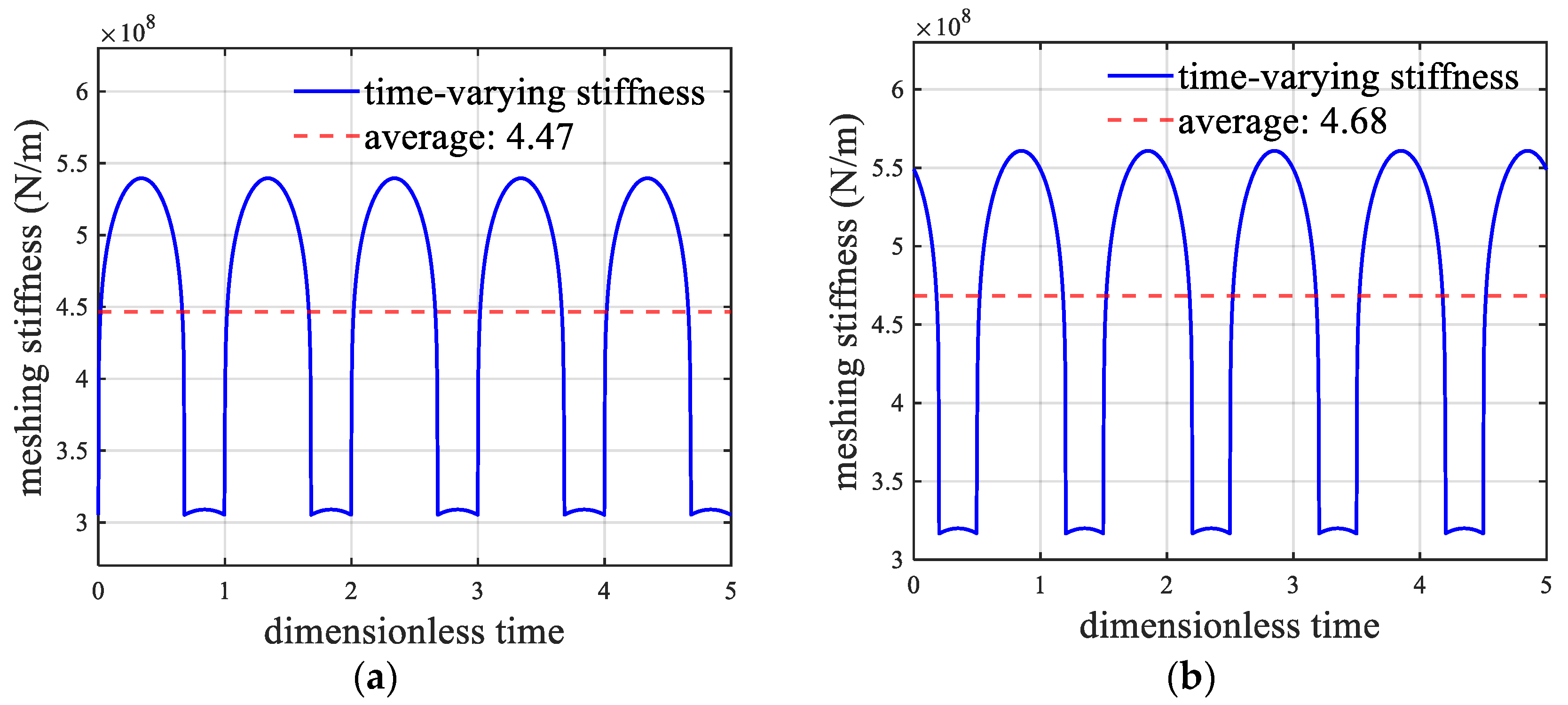
Using the method, the meshing stiffnesses of the two gear pairs—the fixed face gear-nutation face gear pair and the nutation face gear-output face gear pair—are calculated separately.
Figure 6 illustrates the time-varying meshing stiffness curves for the two gear pairs, with the red dashed lines indicating the mean meshing stiffness. Clear periodic fluctuations in stiffness are observed for both gear pairs over time.
3. Modal Analysis of the Dual-Path Nutation Face Gear System
Natural characteristic analysis is the basis of dynamic analysis of gear transmission systems. The natural characteristics of a gear transmission system mainly consist of two aspects: natural frequencies and mode shapes. By solving the eigenvalues and eigenvectors of the undamped free vibration equations, the natural frequencies and corresponding mode shapes of the nutation face gear transmission system can be obtained.
Assuming that the harmonic solution of Equation (20) takes the following form:
where
denotes the
n-th natural frequency of the system, obtained as the square root of the eigenvalue.
denotes the modal vector (eigenvector) corresponding to the natural frequency, also called the mode shape.
Substituting Equation (31) into Equation (20) yields:
Since the meshing stiffness calculated previously is time-varying, Equation (32) is essentially a differential equation with variable coefficients. However, solving the eigenvalue problem requires the system coefficient matrices to be constant. To obtain the natural frequencies and mode shapes of the system, the periodic fluctuations in stiffness are neglected. Therefore, the time-varying meshing stiffness is replaced by its average value over one meshing period. By neglecting external forces and simplifying Equation (32), the natural characteristic problem of the system is transformed into a standard eigenvalue-eigenvector problem of the corresponding matrices:
where
denotes the average stiffness matrix of the system,
denotes the
i-th eigenvalue of the matrix.
denotes the
i-th natural frequency, and
denotes the corresponding mode shape.
The eigenvalues and eigenvectors can be obtained by solving the characteristic equation.
3.1. Natural Characteristics Analysis
The first 22 natural frequencies of the system are obtained using the above method and are summarized in
Table 4.
As shown in
Table 4, no zero-frequency rigid body modes are observed in the eigenvalue solution, indicating that the boundary constraints of the established model are reasonable and complete. It should be noted that, due to the structural and parametric symmetry of the left and right branches in the transmission system, repeated natural frequencies occur in the 7th and 8th modes as well as the 12th and 13th modes.
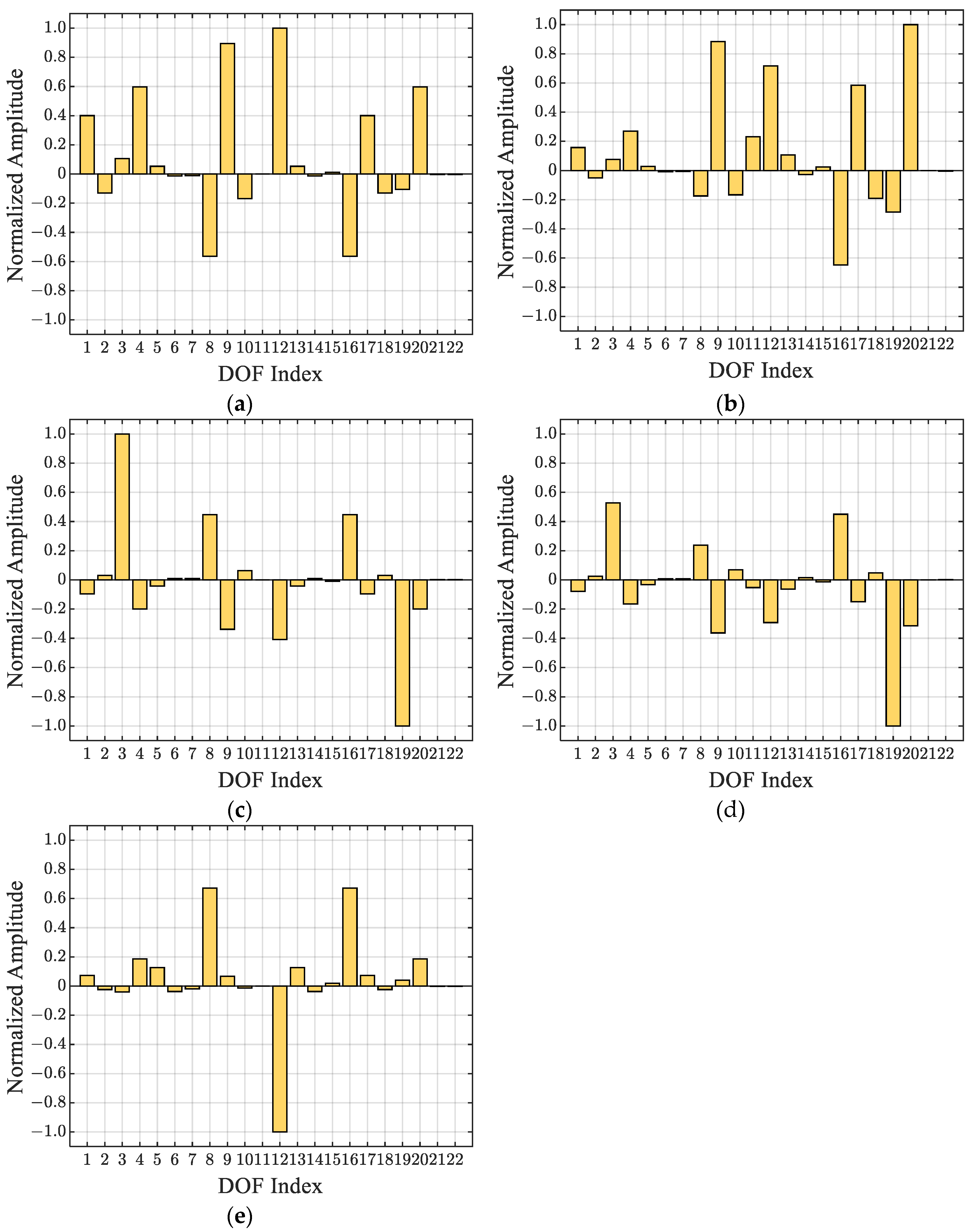
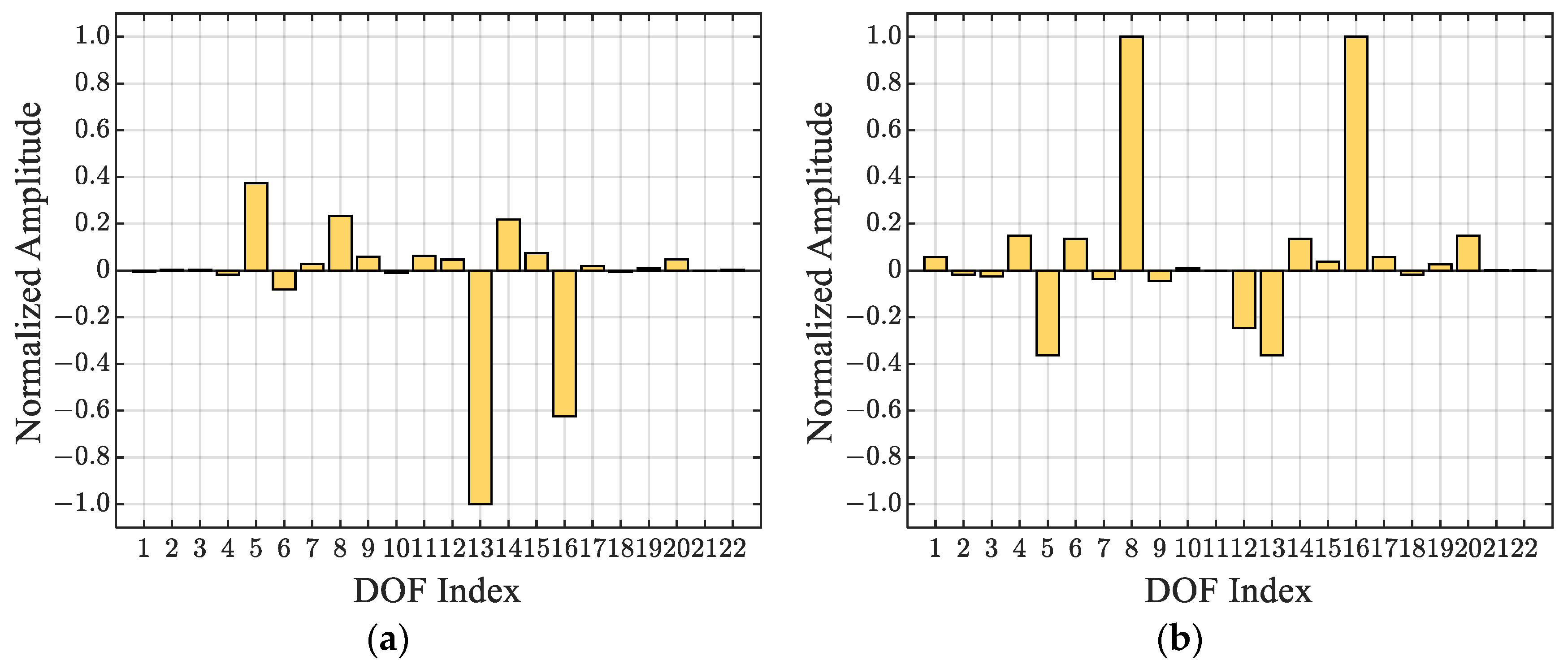
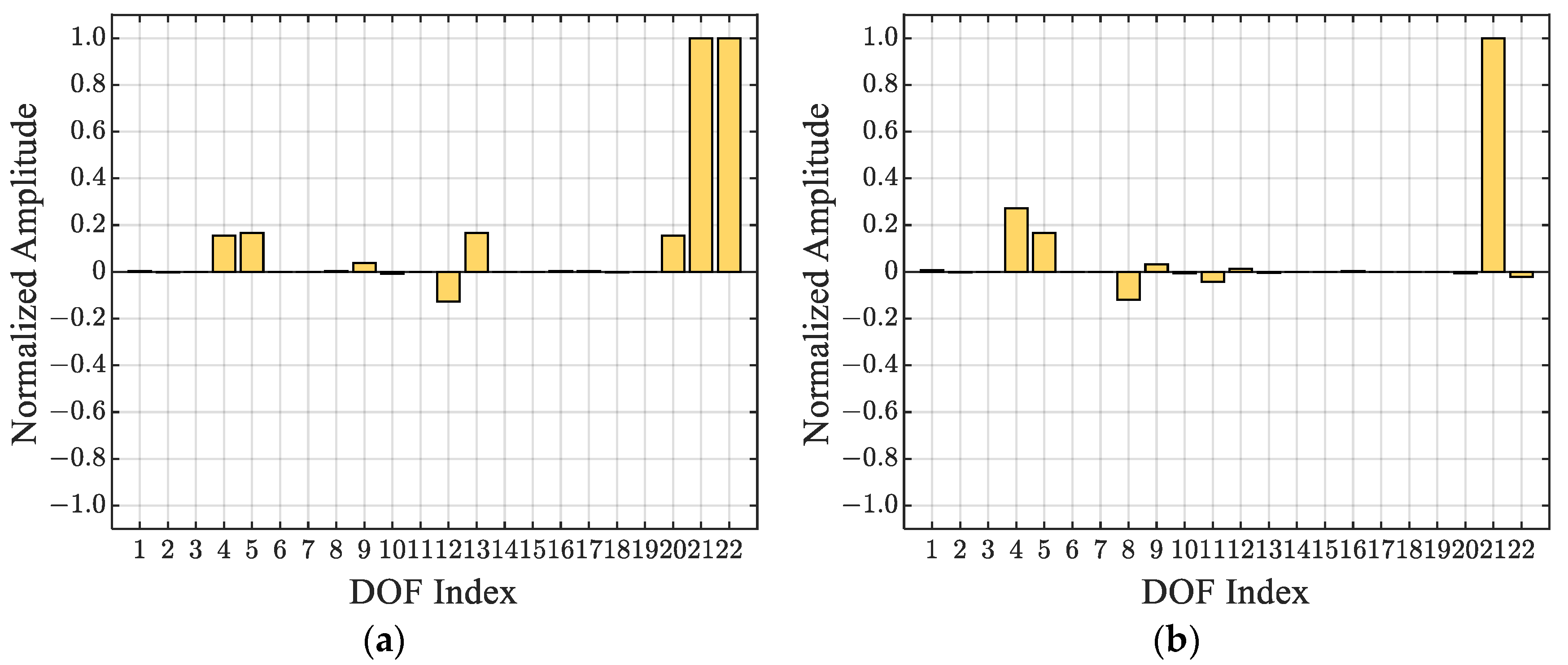
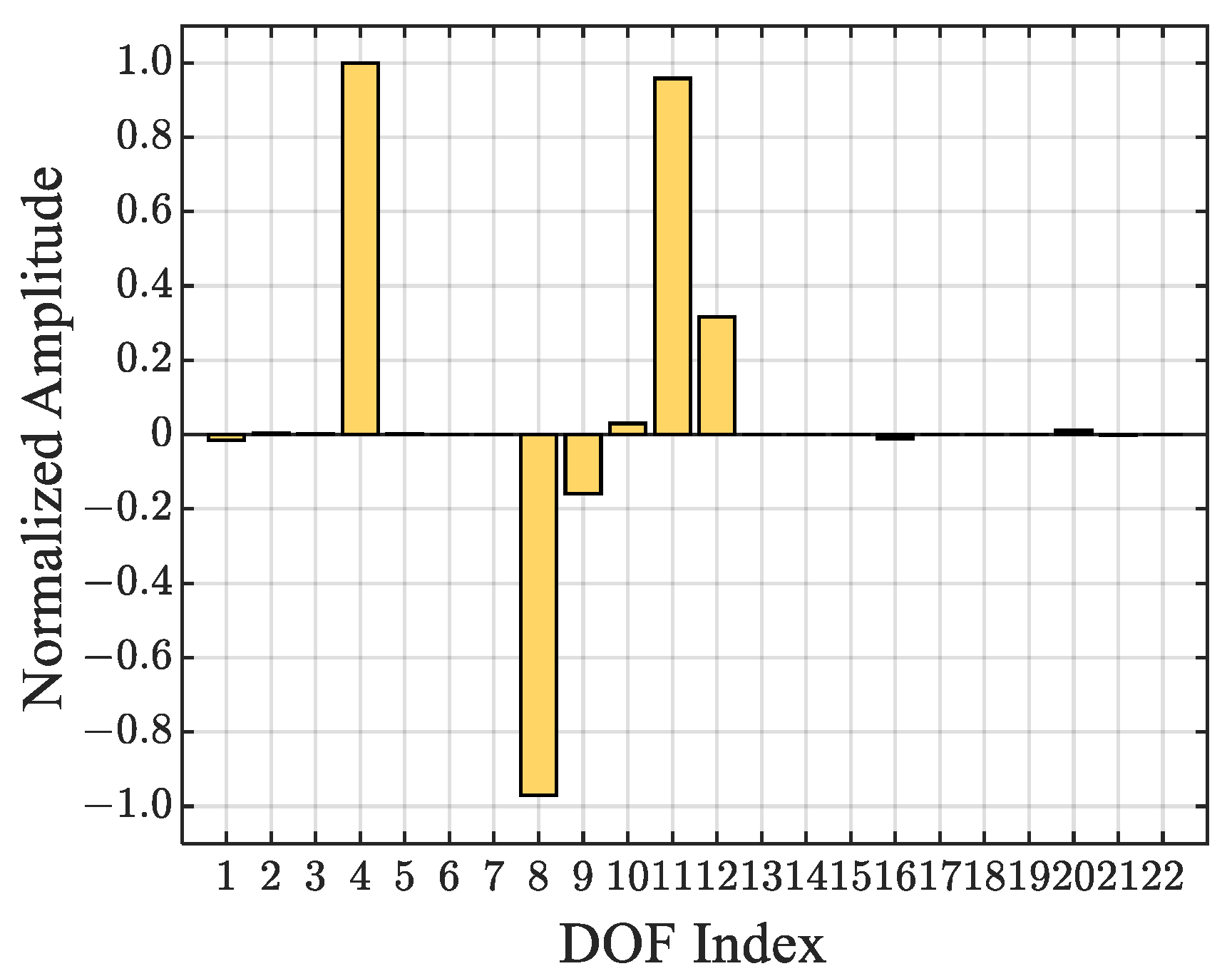
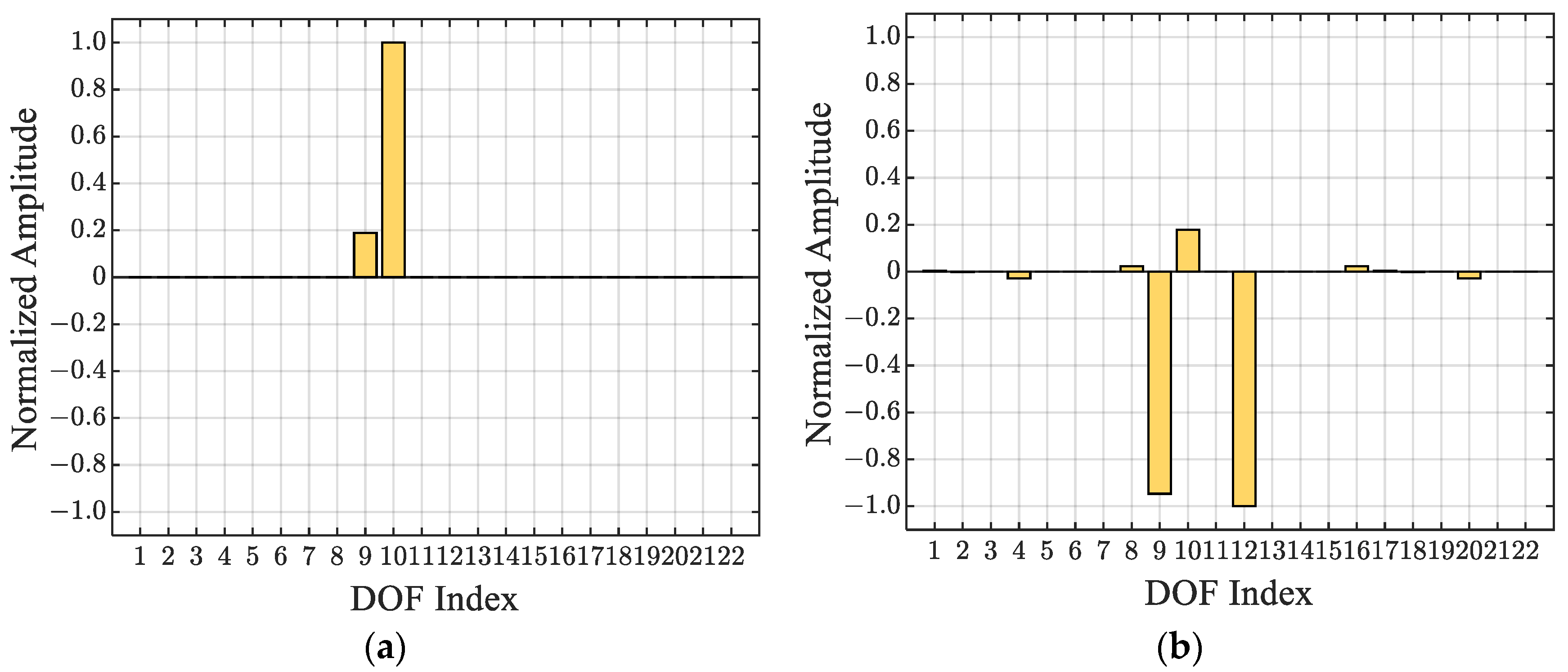
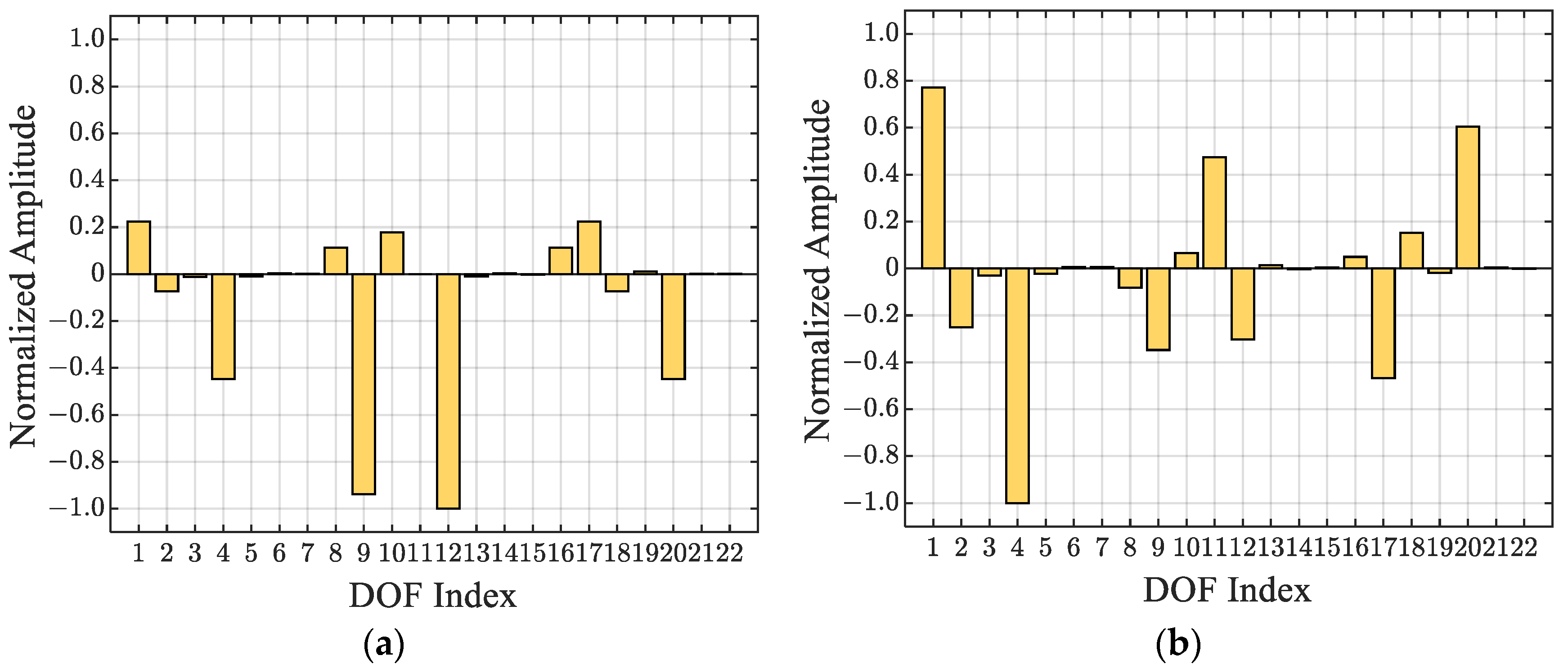
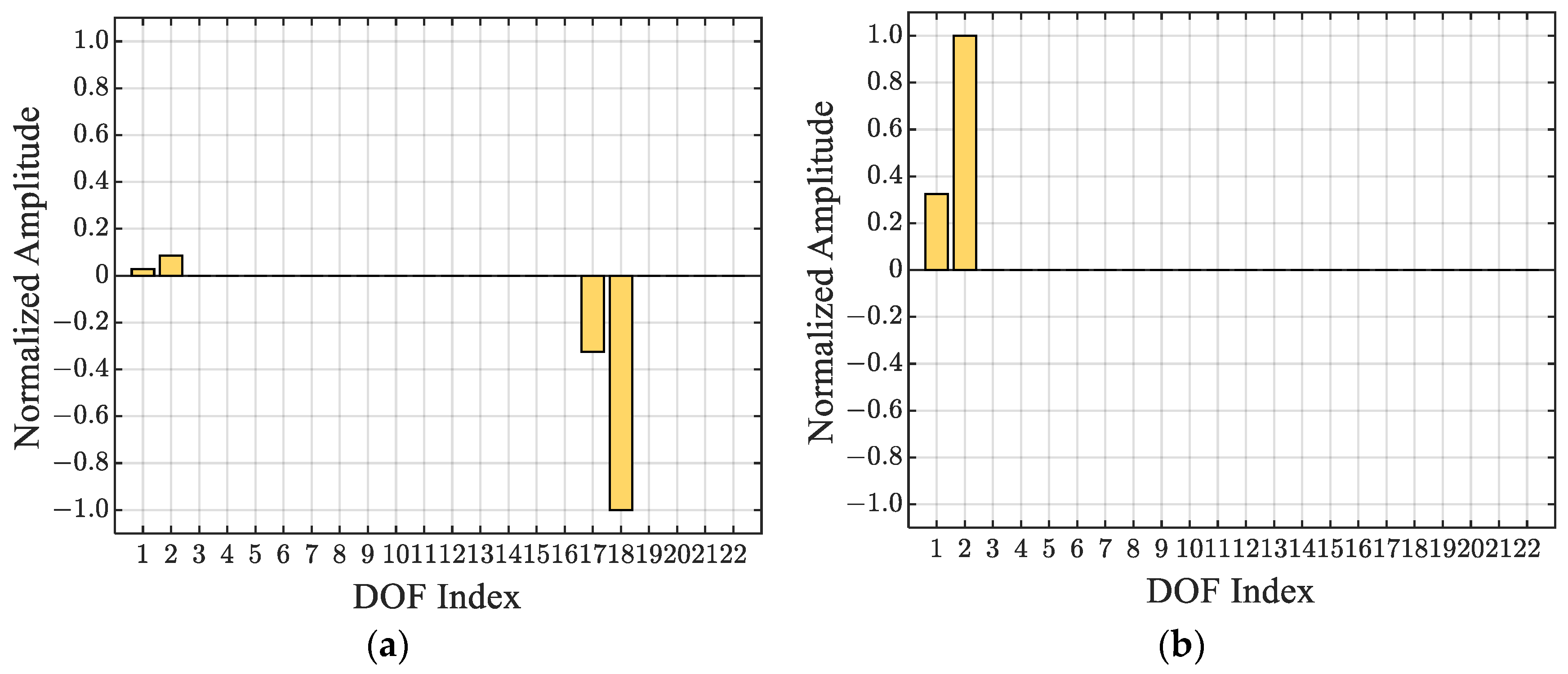
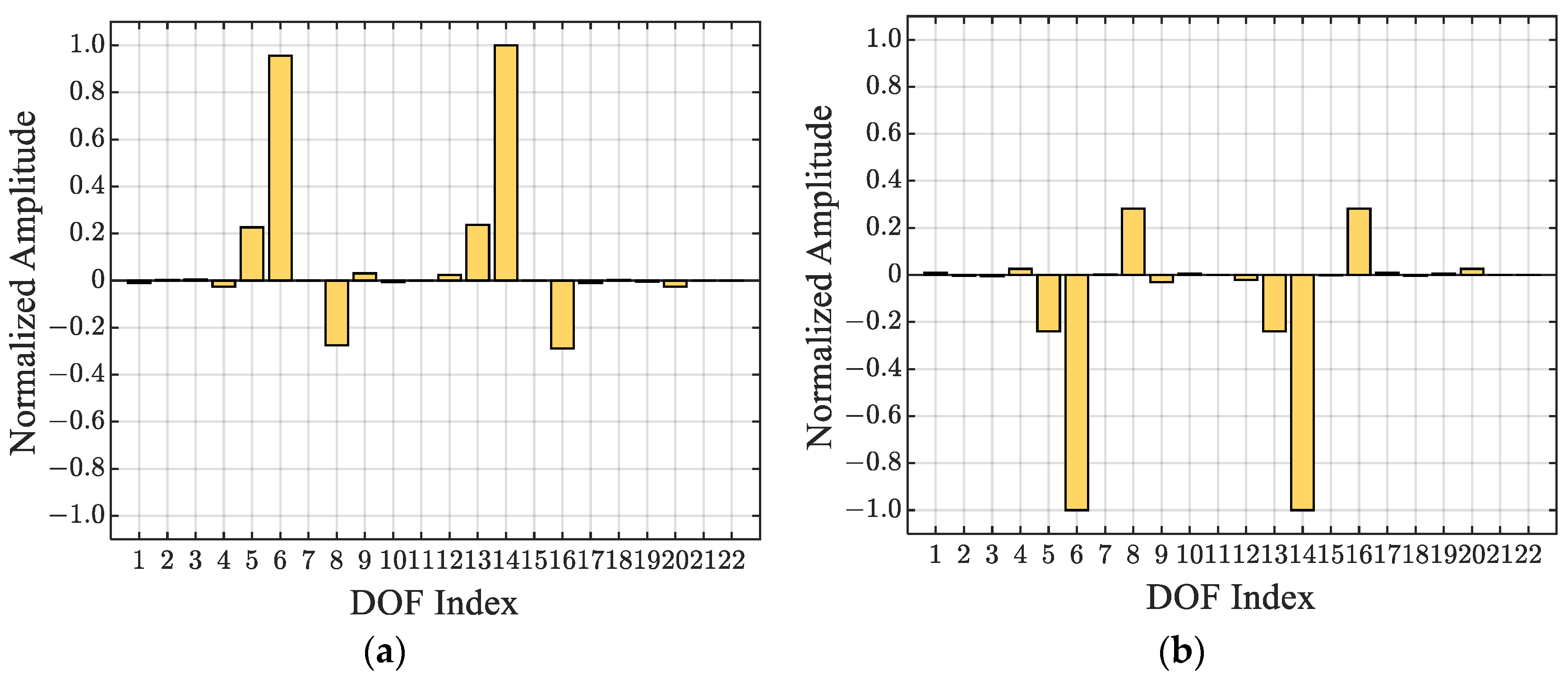
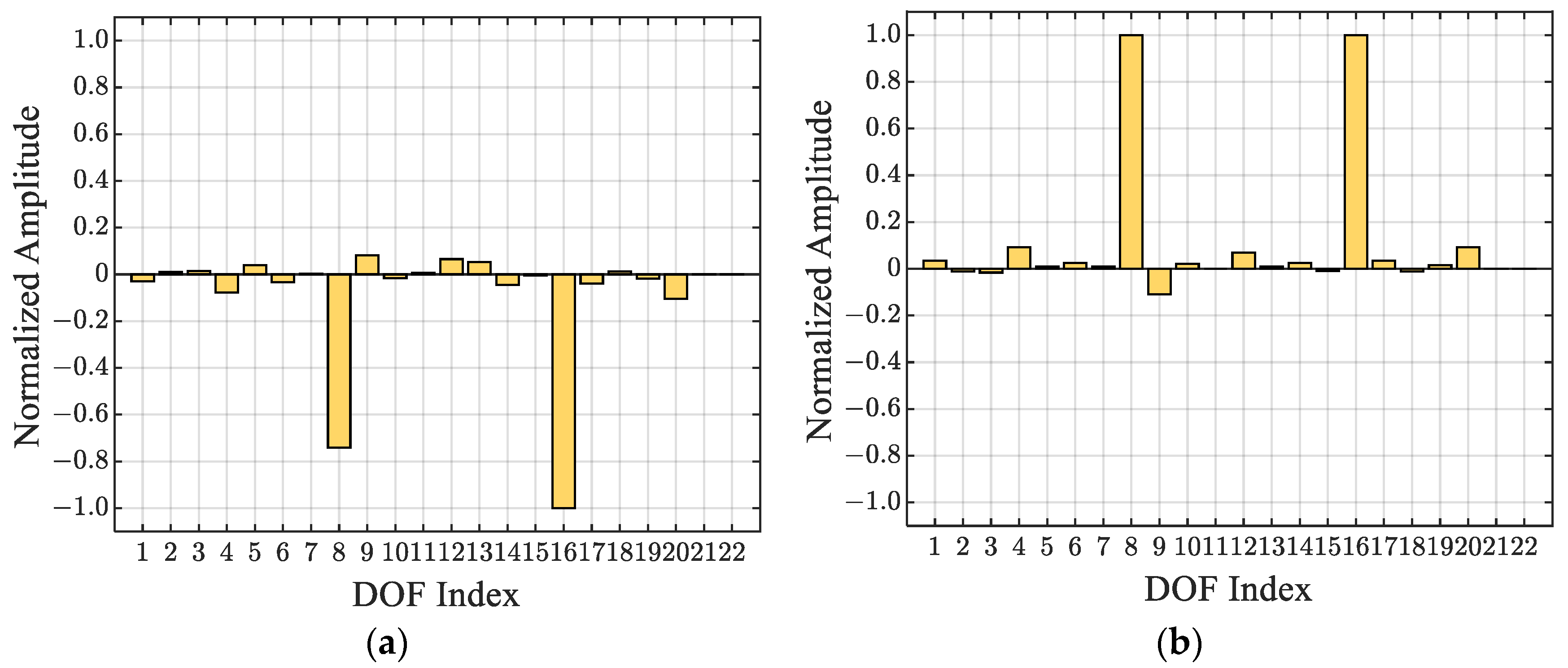
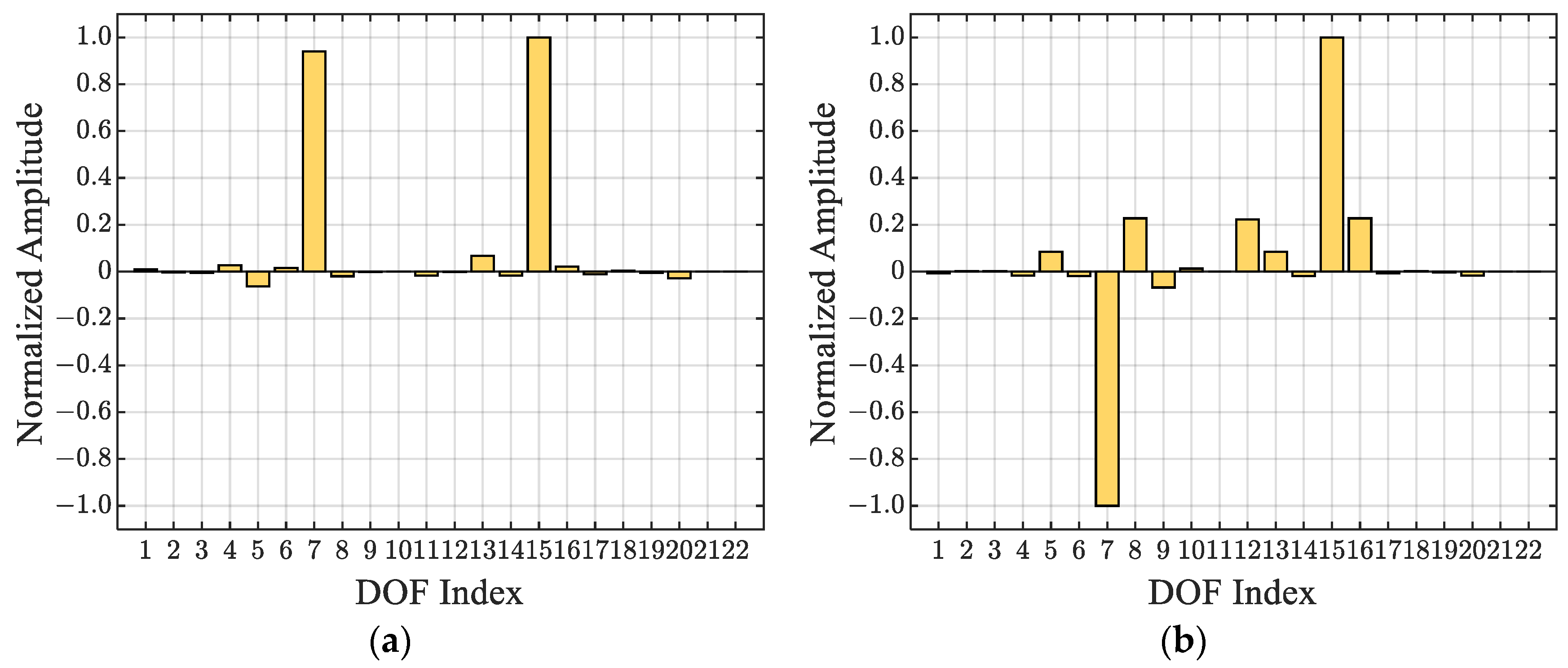
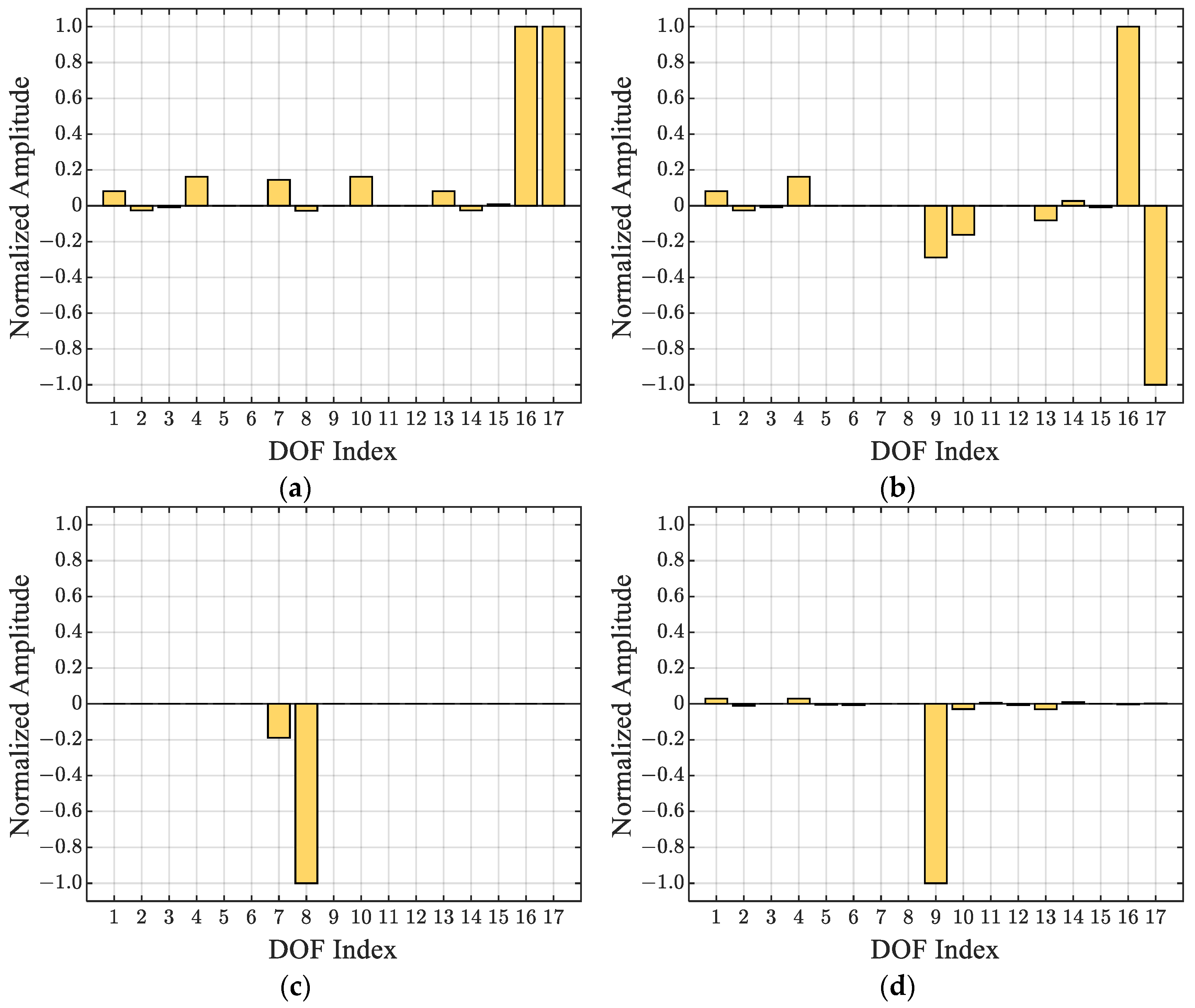
The mode shapes corresponding to the 1st to 22nd natural frequencies of the system are illustrated in
Figure 7,
Figure 8,
Figure 9,
Figure 10,
Figure 11,
Figure 12,
Figure 13,
Figure 14,
Figure 15 and
Figure 16. In the figure, the vertical axis represents the normalized modal amplitude, while the horizontal axis corresponds to the vibration displacement components of the nutation face gear transmission system, corresponding to its 22-DOF.
As shown in
Figure 7, the mode shapes corresponding to the first two natural frequencies are presented. In both the first and second modes, the torsional vibration of the input shaft dominates, with significantly larger amplitudes than those of the other gear components, while the face gears exhibit negligible vibration. This indicates that the first two modes are dominated by torsional vibration of the input shaft.
Figure 8 presents the third mode shape of the system. In this mode, the fixed face gear 1 and the nutation face gear 2 in the left branch undergo coupled vibrations, indicating that the local stiffness properties of this branch predominantly determine the lower-order vibrational characteristics of the system.
Figure 9 presents the fourth and fifth mode shapes of the system. In these two modes, vibrations are predominantly in the output face gear. Corresponding to the fourth natural frequency, the output face gear primarily undergoes translational vibration. At the fifth natural frequency, it exhibits coupled translational–torsional vibrations.
Figure 10 presents the sixth and seventh mode shapes of the system. In these modes, the system exhibits globally coupled vibrations, with all gears undergoing small-amplitude vibrations. These modes are predominantly translational, with torsional motion as a secondary component, and no single component assumes a dominant role.
The above mode shape results indicate that the lower-order modes exhibit clear modal localization characteristics. The first two modes are mainly localized in the torsional subsystem of the input shaft, whereas the vibration amplitudes of the face gears are relatively small. The third mode is associated with the local coupled vibration of the left transmission branch. The fourth and fifth modes are mainly governed by the output face gear, while the sixth and seventh modes show a more global coupled vibration pattern involving multiple gears. Therefore, the lower-order modal characteristics of the system are not uniformly distributed across all components but are closely associated with the dominant vibration regions of different modes. This provides a physical basis for interpreting the different sensitivities of natural frequencies to stiffness parameters in the following section.
Figure 11 presents the eighth and ninth mode shapes of the system. In these modes, the fixed face gear predominantly undergoes translational vibrations, indicating that the system behavior in this frequency range is primarily governed by the support stiffness.
Figure 12 presents the 10th–14th mode shapes of the system. In these modes, the system exhibits pronounced coupled translational–torsional vibration characteristics, where the vibrations of the output face gear and the nutation gear are particularly prominent.
Figure 13 shows that the 15th and 16th mode shapes of the system. The mode shapes are primarily characterized by the localized translational vibration of the nutation gear.
Figure 14 presents the 17th and 18th mode shapes of the system. In these modes, the system exhibits a collective vibration pattern involving all gears, resembling the characteristics of the sixth and seventh modes.
Figure 15 presents the 19th and 20th mode shapes of the system. In these modes, the system exhibits torsional vibration of the nutation gear, indicating that the modal behavior in this frequency range is predominantly governed by its moment of inertia.
Figure 16 presents the 21st and 22nd mode shapes of the system. In these high-frequency modes, the vibration is predominantly concentrated in the nutation face gear. Specifically, the 21st mode is the translational vibration of the nutation face gears, while the 22nd mode exhibits coupled translational-torsional vibration.
3.2. Influence of Axial DOFs on Modal Characteristics
In this subsection, the axial DOFs of the face gears are removed while the remaining DOFs are retained, to further clarify the influence of axial DOFs on the modal characteristics of the dual-path nutation face gear transmission system. The modal characteristics obtained from the simplified model are then compared with those of the original model.
As shown in
Table 5, the first six natural frequencies exhibit relatively pronounced variations, with the maximum change reaching approximately 79.32%. The first two natural frequencies show relatively small variations, indicating that the input-shaft-dominated torsional modes are less affected by the axial DOFs. In contrast, the third to sixth natural frequencies change significantly, suggesting that modes with higher face-gear participation are more sensitive to the removal of axial DOFs. This result demonstrates that the axial DOFs play an important role in the modal characteristics of the dual-path nutation face gear transmission system.
Figure 17 shows the mode shapes of the simplified model without axial DOFs. It can be observed that the first two modes are still dominated by the torsional vibration of the input shaft, showing only minor changes compared with those of the original model. In contrast, the vibration distributions associated with the face gear related DOF change significantly in the third and fourth modes, indicating that the inclusion of axial DOFs can alter the modal characteristics of some face gear dominated modes. Combined with the variations in the first six natural frequencies listed in
Table 5, these results demonstrate that neglecting axial DOFs not only causes shifts in natural frequencies but also has a pronounced influence on the lower-order mode shapes of the system.
3.3. Influence of Parameter Uncertainty on Natural Frequencies
Since this subsection mainly focuses on the influence of mass parameter variation on the natural frequencies of the system, and mode shapes comparison is not the primary focus here, additional mode shapes comparisons are not presented to avoid redundancy.
To further investigate the influence of parameter uncertainty on the modal characteristics of the system, a 5% mass increased case is introduced based on the original model, and the first six natural frequencies are recalculated. The mass parameters directly determine the inertial characteristics of the system. When the stiffness matrix remains unchanged, an increase in mass generally leads to a decrease in natural frequencies. However, for a multi-DOF coupled transmission system, different modes may exhibit different sensitivities to mass variation because of the coupling effects among mesh stiffness, support stiffness, and torsional stiffness.
Table 6 compares the first six natural frequencies of the system before and after the 5% mass increase in the lumped masses of the face gears. It can be observed that the variation in mass parameters causes different degrees of frequency shifts in the first six modes. The first two frequencies remain almost unchanged, indicating that the lower-order modes dominated by the torsional vibration of the input shaft are insensitive to variations in gear mass. In contrast, the third to sixth frequencies decrease to different extents, with the maximum reduction reaching 2.62%. This is because the increase in mass enhances the equivalent inertia of the system while the stiffness parameters remain unchanged, thereby reducing the natural frequencies of the associated modes.
These results indicate that the influence of mass variation on the lower-order natural frequencies of the system is generally limited. However, an observable effect can still be identified, especially for modes with relatively high face-gear participation. Therefore, in future work, finite element modeling or experimental identification will be introduced to improve the accuracy of the mass and moment-of-inertia parameters, thereby enhancing the reliability of the predicted modal characteristics.
4. Influence of Stiffness Parameters on System Frequencies
In gear transmission systems, severe dynamic responses are likely to occur when the excitation frequency approaches the lower-order natural frequencies. Higher-order modes usually require much higher excitation energy and contribute less to the overall dynamic response. Therefore, modal truncation is commonly adopted in dynamic analysis, where only the low-order modes closely associated with the global vibration of the system are retained to effectively characterize the dominant dynamic behavior [
27].
As discussed in
Section 3, the first six modes of the dual-path nutation face gear transmission system cover the main low-frequency modal types of the system, including input-shaft-dominated torsional modes, branch-local coupled modes, output face gear dominated modes, and global coupled modes. Therefore, the first six modes are selected in this section to analyze the influence of different stiffness parameters on the natural frequencies of the system.
Since each lower-order mode has a different dominant vibration component, the influence of a given stiffness parameter on the natural frequencies is mode dependent. Specifically, a stiffness parameter has a more significant effect when it directly constrains the dominant deformation region of the corresponding mode. In contrast, if the associated component has only limited modal participation, the effect of this stiffness parameter on the corresponding natural frequency becomes less pronounced. Therefore, the following analysis focuses not only on the variation trends of the natural frequencies but also on the relationships among stiffness parameters, dominant vibration components, and modal localization.
By identifying the stiffness parameters that govern the low-order modal behavior, the obtained results can provide a basis for stiffness matching, resonance avoidance, and dynamic optimization of the dual-path nutation face gear transmission system.
4.1. Influence of Torsional Stiffness on System Natural Frequencies
Torsional stiffness primarily influences the dynamic characteristics by altering the energy distribution in the rotational degrees of freedom of the system. The system incorporates three distinct torsional stiffness parameters: representing the torsional stiffness of the fixed face gear in the left branch; representing the torsional stiffness of the fixed face gear in the right branch; and denoting the torsional stiffness of the coupling shaft segment between the two nutation face gears on the input shaft.
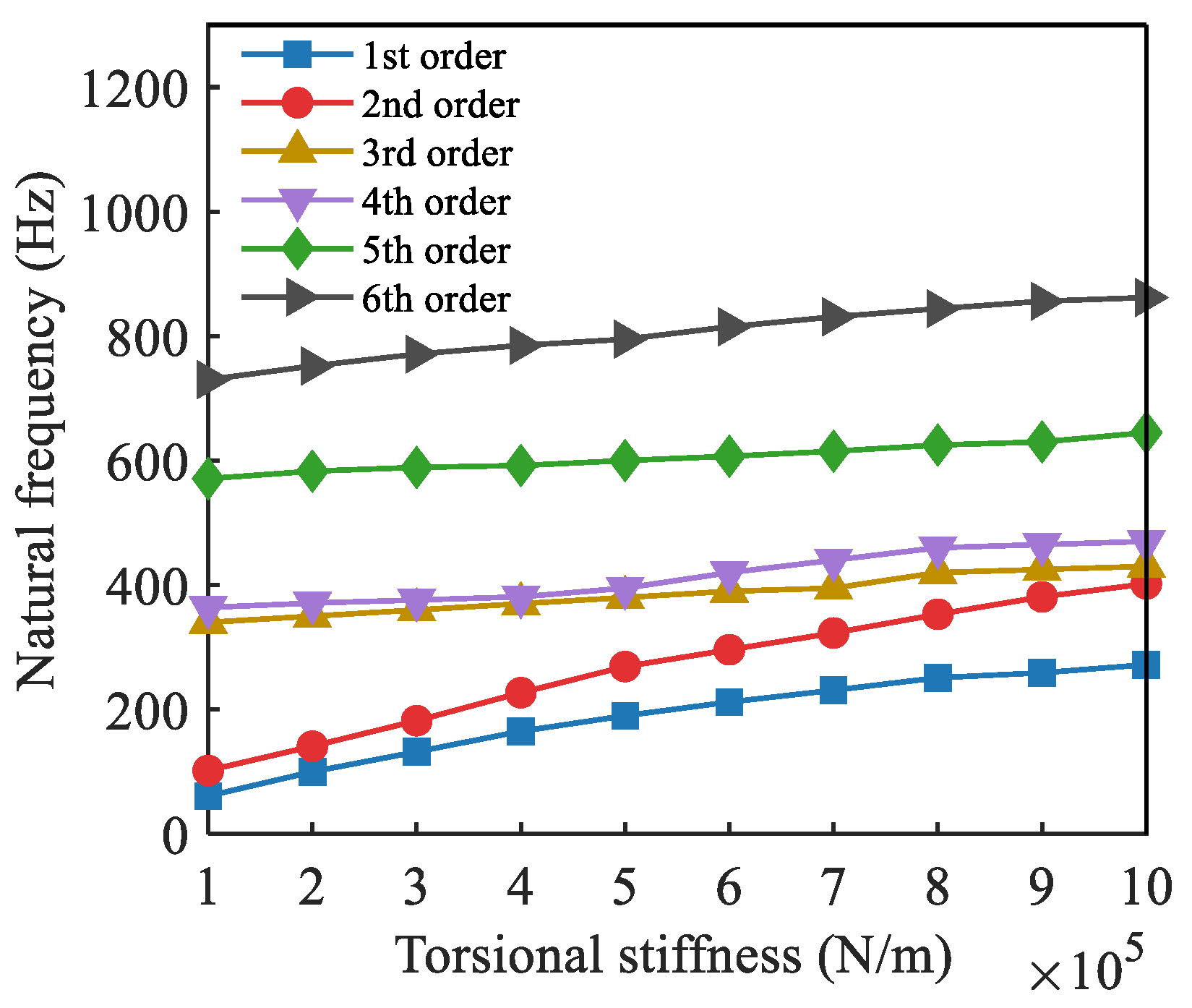
Figure 18 illustrates the evolution of the system’s natural frequencies as a function of the torsional stiffness of the coupling shaft segment between the two nutation face gears.
As observed from
Figure 18, the first six natural frequencies exhibit a consistent upward trend with the increase of torsional stiffness. The first and second natural frequencies are the most strongly affected. This result is not merely a general consequence of increasing stiffness but is closely related to the modal localization characteristics identified in
Section 3. The first two modes are mainly localized in the input shaft, and their modal deformation is primarily associated with input shaft torsion. Therefore, increasing the input shaft torsional stiffness directly enhances the effective stiffness of the dominant modal component, leading to a pronounced increase in the corresponding natural frequencies. This stiffness adjustment can help shift the lower-order modes away from potential low-frequency resonance regions.
In contrast, the fourth to sixth modes involve greater participation of the face gears and are mainly associated with translational or coupled translational–torsional vibrations. For these modes, the participation of input-shaft torsional deformation is relatively limited. Consequently, the input-shaft torsional stiffness has only a marginal influence on their natural frequencies, and these modes exhibit lower sensitivity to this parameter.
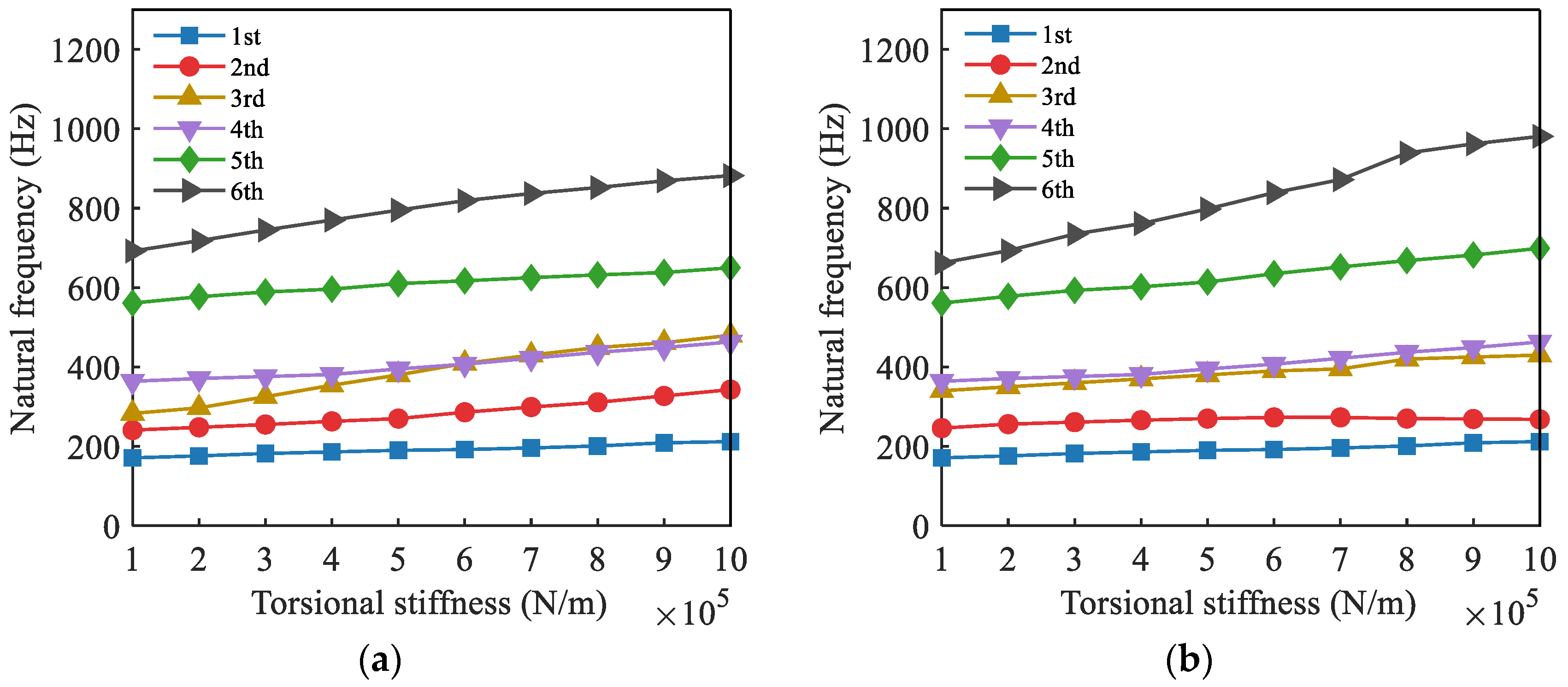
Figure 19 illustrates the impact of the torsional stiffness of the left and right fixed face gears on the natural frequencies. The results indicate that these stiffness parameters predominantly affect the modal frequencies associated with the gears local vibration characteristics. Moreover, variations in the torsional stiffness of the two fixed face gears produce similar effects on the system’s natural frequencies.
As the torsional stiffness of the left branch fixed face gear increases, a pronounced rise is observed in the natural frequencies of modes associated with local vibrations of the left branch—specifically the third mode, which is characterized by localized coupling within this branch. The 6th frequency also rises with the increasing torsional stiffness of the fixed face gear in the right branch. However, as the 6th mode is characterized by the coordinated vibration of multiple gears, this impact remains relatively limited. This observation further confirms that variations in local stiffness primarily govern the modal frequencies associated with local vibration characteristics.
4.2. Influence of Support Stiffness on System Natural Frequencies
The support stiffness directly dictates the constraint capability of the system in the translational directions. Its influence is therefore mainly reflected in modes with significant translational vibration of the face gears. According to the above modal analysis, the translational vibration response of the system is more pronounced in the y-direction. Therefore, the support stiffness in the y-direction is selected as the representative parameter to investigate its influence on the natural frequencies of the system.
For the shaft-torsion dominated first and second modes, the participation of face gear translational vibration is relatively limited. As a result, these two modes are expected to show low sensitivity to support stiffness. In contrast, modes involving output face gear or branch-local face gear vibration have more pronounced translational components, and their natural frequencies are more likely to be affected by changes in support stiffness. The effects of the support stiffnesses in the x and z directions will be further studied in future work.
Figure 20 illustrates the impact of the support stiffness of the two nutation face gears along the
y-axis on the system’s natural frequencies. The natural frequencies of the system exhibit a consistent evolutionary trend in response to the support stiffness of the two nutation face gears. Specifically, the 1st and 2nd frequencies show only a marginal increase as the support stiffness rises. Given that these two modes are dominated by the torsional vibration of the input shaft with minimal gear participation, they are characterized by low sensitivity to variations in the support stiffness. The 4th and 5th frequencies exhibit a sharp increase when the support stiffness approaches approximately 5×10
8 N/m. These two modes are dominated by the vibration of the output face gear. Increasing the support stiffness of the nutation face gear directly strengthens the boundary constraints in the respective vibration directions, thereby leading to a pronounced rise in the associated natural frequencies. The 3rd and 6th frequencies exhibit a gradual upward trend with the increase in support stiffness. This indicates that in both the cooperative vibration mode of the fixed face gear and the generalized vibration modes of the face gears, an increase in local stiffness contributes positively to the global system stiffness. However, due to the constraints imposed by other stiffness components, the sensitivity of these modes to local stiffness variations remains relatively low.
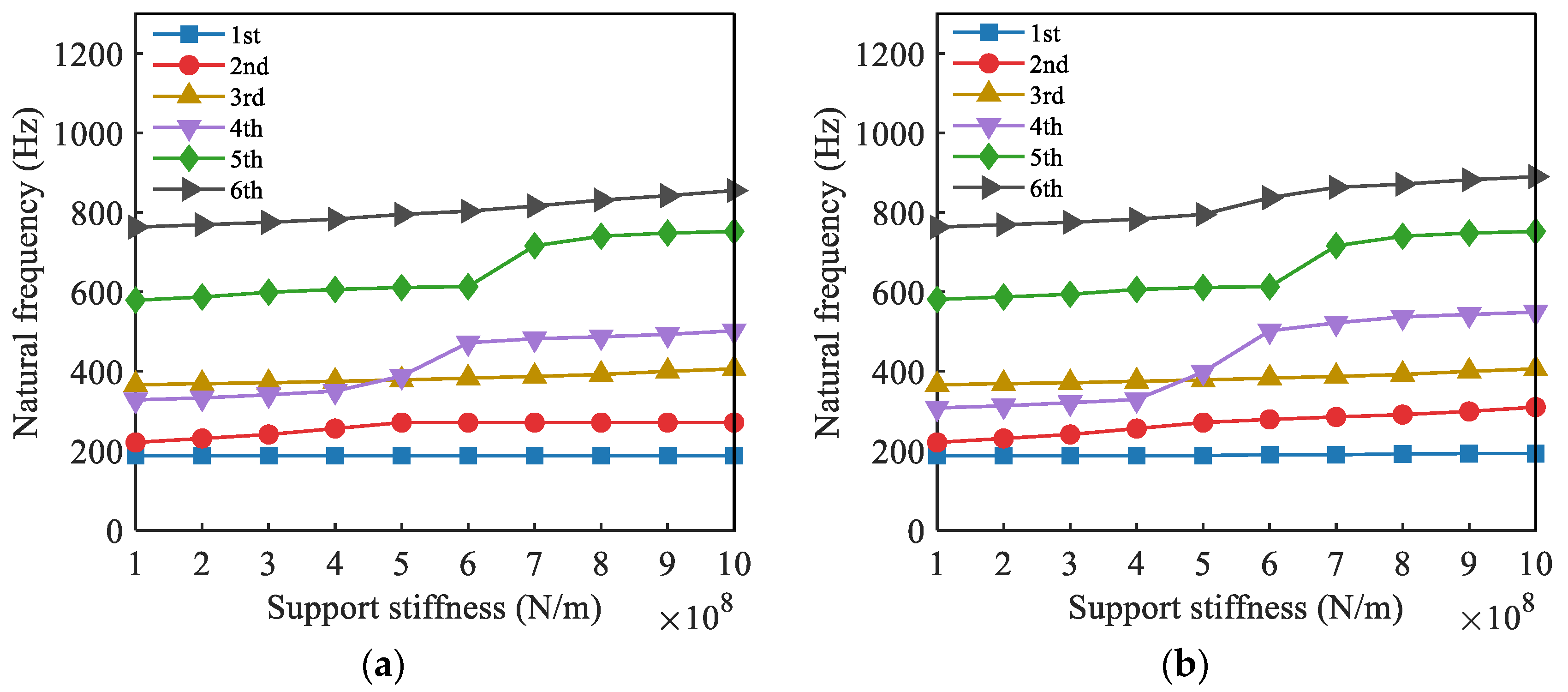
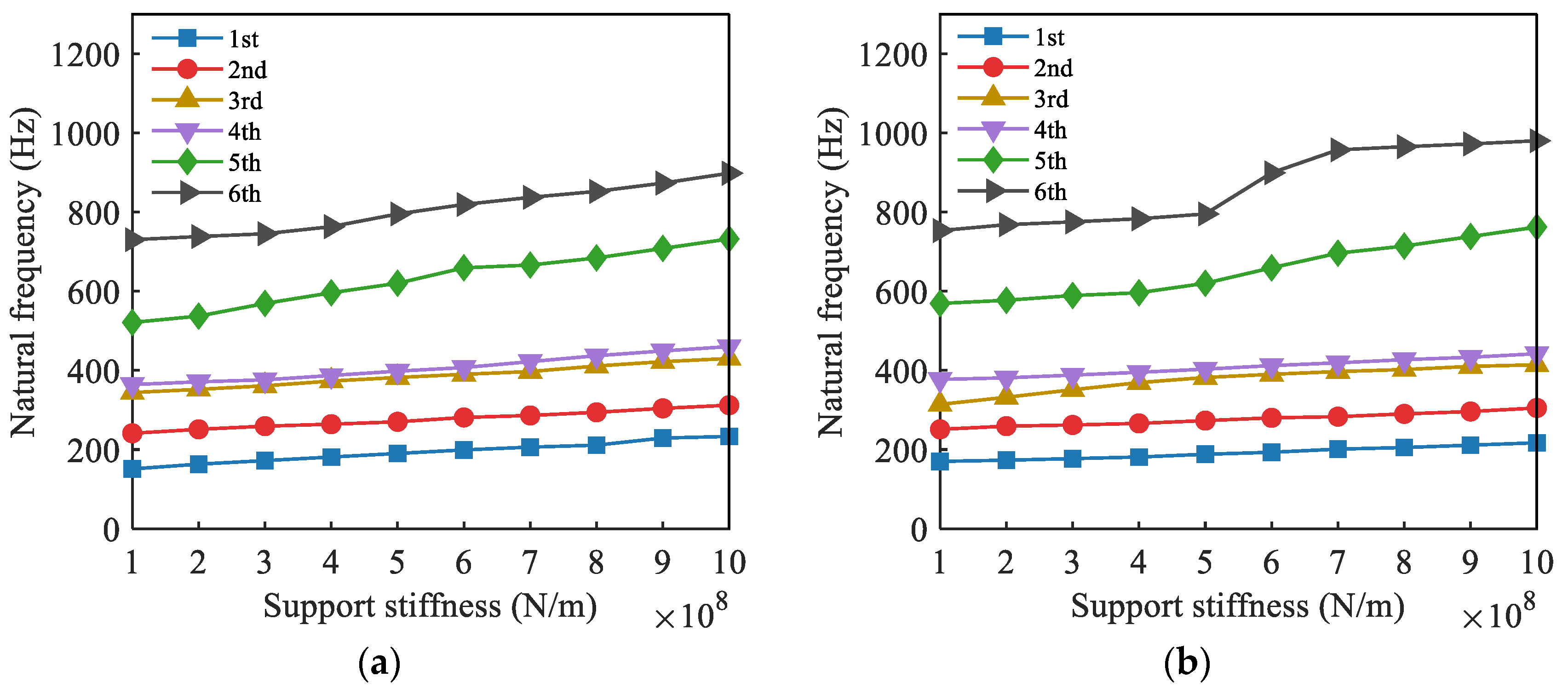
Figure 21 illustrates the impact of the fixed face gear support stiffness along the
y-axis on the system’s natural frequencies. The frequency curves for the 1st, 2nd, and 4th modes exhibit a gradual upward trend, indicating a notable degree of insensitivity to this specific stiffness parameter. Since these modes are dominated by the vibrations of the input shaft and the output face gear, the radial support stiffness of the fixed face gear exerts only a marginal constraint on the global modal energy distribution of the system. The system is characterized by complex stiffness coupling. As the mode adjacent to the 6th mode, the 5th frequency is influenced by this inter-modal coupling and consequently exhibits an increasing trend. As illustrated in
Figure 21b, the 3rd frequency exhibits an initial increase followed by an asymptotic approach toward a plateau, primarily due to the constraints imposed by other stiffness parameters. The 6th mode corresponds to the generalized vibration mode of the face gears. Enhancing the support stiffness increases the equivalent stiffness of the associated local vibration mode. Consequently, the natural frequency evolves from a gradual increase to a sharp rise, eventually reaching a plateau as the stiffness continues to escalate.
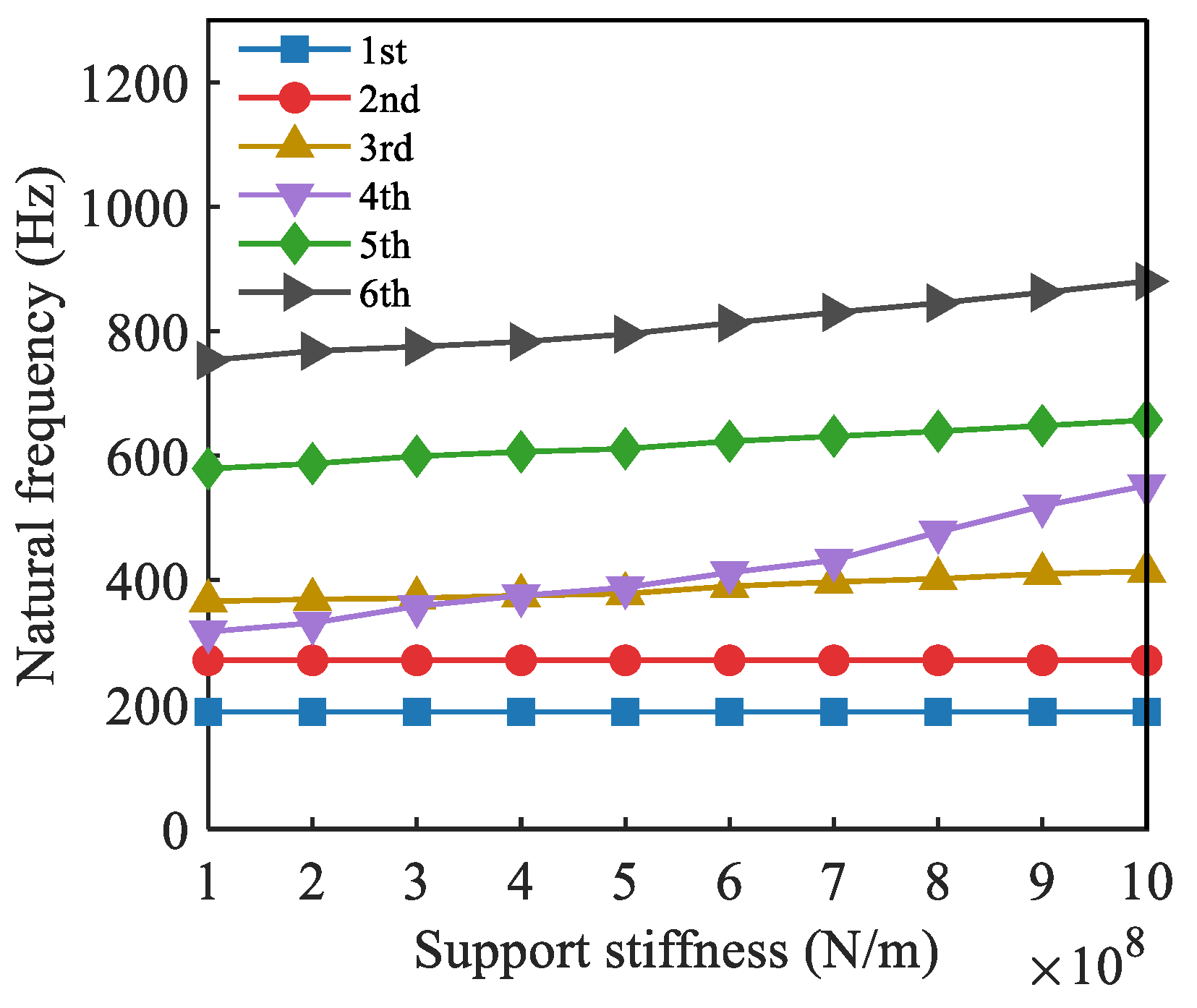
Figure 22 illustrates the impact of the output face gear support stiffness along the
y-axis on the system’s natural frequencies. As indicated by the preceding modal analysis, the 4th frequency is primarily governed by the translational vibration of the output face gear. With the increase in supporting stiffness, the constraint in this direction is enhanced, resulting in an elevated natural frequency. The 5th and 6th natural frequency curves exhibit a moderate upward trend. In the system, the translational vibration of the output face gear along the y-axis is relatively minor; it exerts only a modulating effect on the natural frequencies rather than governing the overall system dynamics. The 1st and 2nd frequencies remain nearly constant, whereas the 3rd frequency exhibits only a marginal increase, indicating a negligible sensitivity to the stiffness at the output end. This further validates the preceding modal analysis, where the 1st and 2nd modes are governed by the torsional vibration of the input shaft, while the 3rd mode manifests as a local vibration of the left branch and remains largely immune to variations at the output end.
5. Discussion
Although the proposed 22-DOF lumped parameter dynamic model can describe the bending–torsional–axial coupled modal characteristics of the dual-path nutation face gear transmission system, several limitations should be noted. The present model is mainly intended for preliminary theoretical analysis of the natural characteristics and modal coupling relationships of the system. Because neither a physical prototype nor a modal testing platform for the dual-path nutation face gear transmission system has yet been established, direct experimental validation has not been performed at this stage. In addition, publicly available experimental modal data for transmission systems with the same configuration remain limited, making a rigorous quantitative benchmark comparison difficult. Therefore, the natural frequencies and mode shapes obtained in this study should be interpreted as theoretical modal characteristics derived under the adopted linearized assumptions and equivalent lumped parameter conditions, rather than as fully experimentally validated engineering predictions.
The time-varying meshing stiffness is replaced by its average value when solving the eigenvalue problem. This treatment transforms the system into a linear time-invariant system and enables the natural frequencies and mode shapes to be obtained from the standard eigenvalue problem. If the time-varying meshing stiffness is retained instead of its average value, the governing equation becomes time-periodic, and the conventional eigenvalue problem based on constant mass and stiffness matrices is no longer directly applicable. In that case, methods such as Floquet theory or direct time-domain integration are required to investigate parametric excitation, modulation effects, and dynamic stability. Therefore, the natural frequencies obtained in this study should be interpreted as equivalent natural frequencies under average mesh-stiffness conditions. This approximation is suitable for preliminary identification of the basic modal characteristics of the linearized system, but it cannot capture stiffness fluctuation induced vibration or possible parametric instability.
The comparison with the simplified model without axial DOFs in
Section 3.2 shows that axial DOFs can significantly affect the natural frequencies and mode shapes of the system, especially for modes with relatively high face gear participation. This result supports the need to consider axial vibration in the proposed model. In
Section 3.3, only a preliminary analysis of the influence of mass parameter variation on the lower-order natural frequencies is conducted. The obtained frequency changes reflect only the basic sensitivity of the modal characteristics to mass variation, rather than a complete uncertainty analysis. In addition, damping, friction and external dynamic excitations are not fully considered in the present model. These factors may affect the response amplitude, and nonlinear response characteristics of the actual transmission system. Therefore, the proposed model is mainly applicable to linear modal analysis rather than to nonlinear dynamic response prediction under actual operating conditions.
Despite these limitations, the model can still provide useful theoretical guidance at the early design stage. The predicted natural frequencies and mode shapes help identify the dominant modal characteristics of the system, evaluate the influence of key stiffness parameters, and support resonance avoidance, stiffness matching, and load-sharing optimization of the dual-path nutation face gear transmission system. However, in the absence of experimental validation, caution is required when directly applying the present model to accurate engineering prediction, final structural optimization, or vibration control design. Future work will focus on prototype development, experimental modal testing, finite element analysis and model updating to further evaluate and improve the accuracy and engineering applicability of the proposed model.
6. Conclusions
In this study, a 22-DOF bending–torsional–axial coupled dynamic model of a dual-path nutation face gear transmission system was established using the lumped parameter method. The coupled dynamic equations of the transmission system and the input shaft were derived based on Newton’s second law. On this basis, the natural characteristics of the system were analyzed, and the modal distribution patterns of the system together with the effects of stiffness parameters on its natural frequencies were systematically investigated. Based on the above simulation analysis, the main conclusions are summarized as follows:
The natural frequencies of the system range from 188 to 2900 Hz. No zero natural frequencies are observed, indicating that the established system has no rigid body modes. Due to the structural and parametric symmetry of the left and right branches, repeated natural frequencies occur in the 7th and 8th modes, as well as in the 12th and 13th modes.
The vibration modes exhibit distinct frequency-dependent characteristics. The lower-order modes are dominated by the torsional vibration of the input shaft. In the middle-frequency range, the modal behaviors become more complex, involving local branch interactions or coupled translational–torsional motion of the output face gear. In the higher-frequency range, the vibration responses become dominated by the nutation face gear and exhibit coupled translational–torsional characteristics.
Stiffness parameters affect the natural frequencies to different extents. The torsional stiffness of the input shaft has a dominant influence on the lower-order frequencies and can be regarded as an important parameter for low-frequency dynamic tuning. Due to symmetry of the system, the modal sensitivity to stiffness variations in the left and right face gears is nearly identical. The support stiffness primarily affects local modes and exhibits an evident saturation tendency beyond a certain range.
From an engineering perspective, the lower-order natural frequencies, particularly the first two modes dominated by the torsional vibration of the input shaft, should be carefully considered for resonance avoidance and stiffness matching. The results further suggest that the torsional stiffness of the input shaft is a key parameter for low-frequency dynamic tuning. However, when the support stiffness reaches a relatively high level, further increases produce only minor changes in the natural frequencies.
Future work will focus on further extending the present model by incorporating damping, friction, time-varying meshing stiffness, and nonlinear dynamic excitations, while also deepening the analysis of modal characteristics. In addition, finite-element analysis and experimental modal testing will be carried out to further evaluate the accuracy and engineering applicability of the proposed model.