Article

Aronia melanocarpa Fruit Extract Ameliorates Loperamide-Induced Constipation in Mice: Integrated Serum Pharmaco-Chemistry, Network Pharmacology, and Molecular Docking


1
College of Pharmacy, Jiamusi University, Jiamusi 154007, China
2
College of Pharmaceutical Science, Soochow University, Ren’Ai Road 199, Suzhou 215123, China
*
Authors to whom correspondence should be addressed.
These authors contributed equally to this work.
Appl. Sci. 2026, 16(10), 5025; https://doi.org/10.3390/app16105025
Submission received: 15 April 2026 / Revised: 7 May 2026 / Accepted: 13 May 2026 / Published: 18 May 2026
(This article belongs to the Special Issue Medicinal Plants: From Health Benefits to Chemical Composition)

Abstract

Aronia melanocarpa (black chokeberry) is a polyphenol-rich fruit recognized as a novel food ingredient; however, its efficacy against constipation and its underlying mechanisms remains poorly understood. In this study, we evaluated the therapeutic effects of the ethanol extract of A. melanocarpa fruit (AMFE) on loperamide-induced constipation in mice and investigated its mechanisms using serum pharmaco-chemistry, network pharmacology, and molecular docking analyses. AMFE treatment increased the intestinal transit rate and fecal water content in a dose-dependent manner, alleviated colonic histopathological damage, and restored the serum levels of gastrointestinal neurotransmitters (5-HT, MTL, SP, GAS, and VIP), inflammatory cytokines (IL-1β, IL-6, and TNF-α), and colonic oxidative stress markers (GSH and MDA). Using UHPLC-Q-TOF-MS, 31 compounds were identified in AMFE, of which 22 were detected in serum, including 14 prototype compounds and eight metabolites. Network pharmacology analysis revealed 472 common targets shared between AMFE and constipation, with AKT1, STAT3, JUN, GAPDH, IL-6, and TP53 as core targets. KEGG enrichment analysis highlighted the PI3K/AKT signaling pathway as a key regulatory axis. Molecular docking confirmed strong binding affinities between key active compounds (catechin, kaempferol, caffeic acid, naringenin, and isorhamnetin). Please see the core end of the document for further details on the references and targets, particularly isorhamnetin with GAPDH. Collectively, AMFE alleviated constipation through multi-component, multi-target, and multi-pathway mechanisms, providing a scientific basis for the development of A. melanocarpa as a functional food and therapeutic candidate for constipation.

1. Introduction

Aronia melanocarpa (Michx.) Elliott, commonly known as black chokeberry, is a perennial deciduous shrub in the Rosaceae family, genus Aronia. It is also known as black aronia, wild chokeberry, and Youthberry, and is native to North America and eastern Canada [1]. In 2018, A. melanocarpa fruit (AMF) was designated as a new food ingredient by the National Health Commission of China [2]. In recent years, plants and their extracts have been increasingly recommended as natural forms of nutritional supplements or as ingredients in functional foods [3].
AMF is rich in a variety of bioactive compounds, including polysaccharides, polyphenols, flavonoids, anthocyanins, and proanthocyanidins, and has pharmacological effects such as antioxidant, anti-inflammatory, antibacterial, anticancer, antihypertensive, antidiabetic, and immunomodulatory properties [4,5,6,7,8,9]. The polyphenol content in AMF can reach 2.5% to 3.5%, which is five times that of blueberries, making it highly valuable for application and economic benefit [10,11].
Constipation is a common clinical gastrointestinal disorder that is mainly divided into two types according to its causes: organic constipation (OC) and functional constipation (FC) [12]. FC is the most prevalent type of fecal incontinence observed in clinical practice [13]. Studies have shown that weakened antioxidant capacity and increased oxidative stress in the body can easily lead to constipation. The measurement of oxidative stress biomarkers such as SOD, GSH, MDA reflects, to a certain extent, the body’s antioxidant capacity and the degree of oxidative stress damage, and has long been a focal point in research exploring the mechanisms underlying the relationship between oxidative stress and constipation [14]. Oxidative stress may induce HMGB1 translocation in enteric neurons, which has been reported to contribute to colonic neuropathy in preclinical animal models. Inhibition of the APE1/Ref-1 redox signaling pathway has been demonstrated in experimental studies to suppress HMGB1 translocation and thereby alleviate intestinal dysfunction and enteric neuronal damage. These mechanistic observations remain largely limited to preclinical models; further validation is needed to confirm their translational relevance to human constipation [15,16]. Currently, several classes of medications are used for the management of constipation, including osmotic, stimulant, and secretory laxatives. Osmotic laxatives such as polyethylene glycol 4000 and bulking agents such as calcium polycarbophil and wheat bran are recommended as first-line therapies and are considered effective and safe for long-term use in clinical guidelines [17]. However, some stimulant laxatives (e.g., bisacodyl) may provide only short-term relief, and inappropriate long-term use has been associated with potential adverse effects including abdominal discomfort, diarrhea, and bloating [18,19,20]. In contrast, natural products with antioxidant properties for the treatment of constipation have been widely studied owing to their safety and minimal side effects [21]. AMF has a higher antioxidant capacity than other fruits; the polyphenols and polysaccharides in AMF have been reported to be associated with reduced oxidative stress and inflammation, which may contribute to intestinal health, partly through upregulating endothelial nitric oxide synthase, alleviating oxidative stress, and inhibiting inflammatory gene expression [22,23,24].
However, the efficacy and underlying mechanism of A. melanocarpa fruit extract (AMFE) against constipation remain unclear. To address this knowledge gap, the present study aimed to evaluate the ameliorative effects of AMFE on loperamide-induced constipation in mice and explore its potential mechanisms. These findings provide a scientific basis for developing A. melanocarpa as a functional food ingredient for intestinal health.

2. Materials and Methods

2.1. Materials and Reagents

Methanol (chromatographic grade) was purchased from Merck (Darmstadt, Germany). Formic acid (chromatographic grade) was purchased from Shanghai Yonghua Chemical Reagent Co., Ltd. (Shanghai, China). 5-HT Elisa kit, SP Elisa kit, MTL Elisa kit, VIP Elisa kit, GAS Elisa kit, IL-1β Elisa kit, IL-6 Elisa kit, and TNF-α Elisa kit were purchased from Xiamen Lunchangshuo Biotechnology Co., Ltd. (Xiamen, China). GSH kit and MDA kit were purchased from Beijing Solarbio Science & Technology Co., Ltd. (Beijing, China). All reagents used in the experiment were of analytical grade. A. melanocarpa was purchased in June 2024 from Fujin County, Jiamusi City, Heilongjiang Province, China.

2.2. Extraction of Ethanol Extract from the A. melanocarpa Fruit

First, after drying and grinding the AMF, a reflux extraction is carried out using 75% ethanol at a liquid-to-material ratio of 5:1 for 1.5 h; this process is repeated twice. After the reflux is completed, the mixture is centrifuged at 4000× g for 15 min to collect the supernatant. Insoluble particles are filtered out, ethanol is removed, and extract is concentrated and freeze-dried to obtain the ethanol extract (AMFE).

2.3. Investigation of the Activity of Alcohol Extracts from the AMFE in Treating Loperamide-Induced Constipation

2.3.1. Animals and Housing Conditions

Sixty male SPF-grade Balb/c mice, each weighing 20–22 g, were purchased from Hangzhou Qizhen Laboratory Animal Technology Co., Ltd. (Hangzhou, China), with the quality certificate SCXK (Zhe) 2022-0005. The mice were housed in an SPF-grade animal facility at the Experimental Animal Center of Soochow University (Approval No. SUDA20251211A012). The rearing environment was maintained at a temperature of 25–27 °C and a humidity of 40–70%, with a 10 h light/14 h dark cycle. The mice had free access to food and water, and the drinking water provided by the Experimental Animal Center of Soochow University was sterile purified water. The mice were acclimated to the environment for one week before the start of the experiment. All procedures were performed in accordance with the “Regulations for the Administration of Affairs Concerning Experimental Animals.”

2.3.2. Animal Grouping

After acclimation, mice were randomly divided into six groups using a random number table method: blank control group (Control), model group (Model), positive control group (Positive Control, PC), low-dose AMFE group (75 mg/kg), medium-dose AMFE group (150 mg/kg), and high-dose AMFE group (300 mg/kg).

2.3.3. Animal Modeling and Administration

All experimental procedures were approved by the Animal Ethics Committee of Soochow University and conducted in accordance with the “Guide for the Care and Use of Laboratory Animals” by the US National Research Council. After 7 days of acclimatization, the control group received 0.9% saline daily. The other mice were given 10 mg/kg loperamide daily for 7 consecutive days to induce constipation. After successful modeling, the model group received saline; the positive control group received 3 g/kg polyethylene glycol 4000 [20]; the AMFE groups received 75, 150, and 300 mg/kg, respectively. All treatments were administered once daily for 7 days.

2.3.4. Determination of Fecal Water Content

After successful modeling, feces from mice on days 1, 3, and 7 were collected. For each group, 6 mice were randomly selected and placed in clean cages with 1 h food–water deprivation before fecal collection [25]. Fresh feces were collected, the physical appearance observed, and the feces weighed immediately, then dried in a drying oven to constant weight. Fecal water content was calculated using the following formula:
Fecal water content (%) = (1 − weight after drying/weight before drying) × 100

2.3.5. Determination of Intestinal Propulsion Rate

The day after the last administration, intestinal propulsion rate was measured. On the day of assessment, mice were fasted but had free access to water. Measurement was performed by oral administration of a black carbon suspension, as described below.
Preparation of 10% (w/v) black carbon suspension: 10 g Arabic gum was mixed with 80 mL water and boiled until the solution became clear. Then 5 g activated carbon was added and stirred, followed by three cycles of boiling. The prepared black carbon suspension was cooled to room temperature for later use.
Three mice were randomly selected from each group [26]. After 25 min following the administration of the black carbon suspension, the mice were euthanized by cervical dislocation. The abdomen was opened along the midline, and the colon from the ileocecal region to the anus was harvested. The distance traversed by the black carbon in the colon and the total length of the colon were measured. The intestinal propulsion rate was calculated using the following formula:
Intestinal propulsion rate (%) = (carbon length in colon/total colon length) × 100

2.3.6. Determination of Organ Index

After 12 h of fasting, the body weight of mice in each group was recorded. Mice were euthanized by cervical dislocation and dissected to collect the heart, liver, spleen, lungs, and kidneys. The organs were rinsed with 0.9% saline, blotted dry with filter paper to remove excess saline and blood, and weighed. Organ index was calculated as follows:
Organ index (%) = organ weight/fasting body weight × 100

2.3.7. Determination of Gastrointestinal Regulatory Peptides and Neurotransmitters

At the end of the second week of treatment, all mice were fasted overnight and blood was collected by enucleation. After standing at room temperature for 2 h, blood was centrifuged at 4 °C, 3500× g for 10 min, and the upper serum layer was collected. All collected serum samples were aliquoted and stored at −80 °C for later analysis.
Motilin (MTL), gastrin (GAS), Substance P (SP), vasoactive intestinal peptide (VIP), and 5-hydroxytryptamine (5-HT) were measured in accordance with the instructions of enzyme-linked immunosorbent assay (ELISA:) kits.
All blood samples were collected under isoflurane anesthesia. ELISA kits were from Xiamen Lunchangshuo Biotechnology (Xiamen, China). All samples were measured in triplicate.

2.3.8. Determination of Serum Immune Factor Indices

Serum was collected as described in Section 2.3.7. Immune factors including tumor necrosis factor-α (TNF-α), interleukin-6 (IL-6), interleukin-1β (IL-1β), and interleukin were measured using ELISA kits.

2.3.9. Determination of Colonic GSH-Px and MDA

At the end of the second week of treatment, all mice were fasted overnight and euthanized by cervical dislocation. Colon tissue was collected and homogenized in saline to make a 10% tissue homogenate. Levels of MDA, and GSH-Px in colon tissue were determined according to the instructions of the respective assay kits.

2.3.10. Histopathological Observation Results

Mouse colon tissue was fixed in 4% paraformaldehyde, embedded in paraffin, sectioned, and stained with hematoxylin and eosin (HE) for histological assessment. Images were taken under an optical microscope.

2.4. Serum Pharmacology Analysis

2.4.1. AMFE and Preparation of Serum Samples

A small amount of the freeze-dried ethanol extract is dissolved, diluted fivefold, and filtered through a 0.22 µm microporous membrane for UHPLC-Q-TOF/MS analysis.
After acclimating mice of uniform body weight for one week, they were divided into a control group and a 300 mg/kg AMFE group, which showed the strongest dose-dependent efficacy and the highest plasma concentration of active components, with 6 mice in each group. The mice were fasted for 12 h before the last administration, but allowed free access to water. Forty minutes after dosing, blood was collected from the orbital sinus to obtain serum (this time point was determined through a preliminary drug-time curve experiment as the Tmax, when the concentration of polyphenolic components in the blood peaks and the maximum amount of absorbed components can be reliably captured), which was then left to stand for 30 min. The supernatant was collected according to Section 2.3.7. Then, 300 μL of blank serum and medicated serum were each mixed with 900 μL of methanol to precipitate proteins. After vortexing, the mixture was centrifuged for 10 min, and the supernatant was collected and evaporated to dryness with nitrogen. The residue was reconstituted with 300 μL of methanol and centrifuged again for 10 min. The final supernatant was collected for subsequent sample analysis.

2.4.2. UHPLC-Q-TOF/MS Analysis

Using the Agilent 1290 ultrahigh-performance liquid chromatograph and the Agilent Q/TOF 6540 quadrupole time-of-flight mass spectrometer (Agilent, Santa Clara, CA, USA), the HPLC conditions were as follows: CS-C18 column (250 mm × 4.6 mm, 5 µm), column temperature at 30 °C, flow rate of 1 mL/min, injection volume of 20 µL, mobile phase consisting of 0.1% formic acid in water (A) and methanol (B). The gradient program was: 0–5 min, 5% B; 5–80 min, 5 → 50% B; 80–90 min, 50 → 60% B; 90–95 min, 60 → 95% B. The mass spectrometry conditions were: electrospray ionization (ESI), negative ion mode, scan range m/z 100–3200; ion source temperature at 300 °C, spray voltage 3500 V, collision energy 30 eV, acquisition time 95 min. Drying gas flow rate was 8 L/min, drying gas temperature 325 °C, and nebulizer pressure 35 psi.

2.4.3. Data Acquisition and Identification of Blood-Transiting Components

Databases used: PubChem, ChemSpider and MassBank.
Identification criteria: Exact mass error < 5 ppm; Characteristic MS/MS fragment ions matching reference or literature data; Comparison with reported constituents of A. melanocarpa.

2.5. Investigation of the Mechanism by Which Alcohol Extracts of AMFE Treat Constipation

2.5.1. Collection and Screening of Small Molecule Active Components from A. melanocarpa Fruit and Their Related Targets

The active components obtained via UPLC-MS/MS were screened using Pubchem (https://pubmed.ncbi.nlm.nih.gov/ (accessed on 8 January 2026)) and SwissADME (www.swissadme.ch (accessed on 8 January 2026)), with the criteria of Druglikeness (DL) ≥ 3 “yes” responses and GI absorption (GI) = High. The targets for the active components were collected using the GeneCards (http://www.genecards.org/ (accessed on 10 January 2026)) database.

2.5.2. Prediction of Constipation-Related Targets

In the human gene database (GeneCards), the term “Constipation” was searched to identify disease-related genes, and LAC values were filtered.

2.5.3. Venn Analysis of Small Molecules from A. melanocarpa Fruit and Constipation Targets

Using the Venny 2.1 website, the AMFE active ingredients and the constipation targets were entered into the analysis table to obtain intersecting targets and generate a Venn diagram of the targets.

2.5.4. Construction and Analysis of the Protein–Protein Interaction Network of Intersecting Targets

Intersecting targets between the active components and immunosuppression were identified using the Venny platform. The network of the resulting intersecting targets was built utilizing the String (https://string-db.org/ (accessed on 12 January 2026)) database to predict protein–protein interactions among the targets, thereby constructing a PPI network.

2.5.5. Gene Enrichment Analysis

AMFE and constipation protein targets filtered by degree > 100 were uploaded to the David website for GO enrichment analysis and KEGG metabolic pathway enrichment analysis.

2.5.6. Construction and Analysis of an Active Component–Target–Metabolic Pathway–Constipation Network

The top 20 signaling pathways identified through KEGG analysis, along with AMFE active components and intersecting constipation targets, were imported into Cytoscape 3.9.1 to create a visual network analysis of active components, targets, metabolic pathways, and disease.

2.5.7. Molecular Docking Validation

The .SDF format files for the core ligand components were found on the Pubchem website. The top six core targets in the PPI network by degree (AKT1:PDB ID: 3CQW, STAT3:PDB ID: 6TLC, JUN:PDB ID: 1A02, GAPDH:PDB ID: 1U8F, IL6:PDB ID: 1IL6, TP53:PDB ID: 2OCJ) were selected, and their crystal structures were downloaded from the RCSB PDB database. PyMOL 2.5 was used to remove crystallized water, ligands, and heteroatoms. The receptor .PDB format files were obtained from PDB. CBDock2 was used to predict binding modes, binding affinities, and potential mechanisms of action, and PyMOL was used to visualize the results.

2.6. Statistical Analysis

Data were processed using GraphPad Prism 8.4.2 and are presented as mean ± SD (standard deviation). Statistical comparisons were performed using one-way ANOVA for multiple groups and t-test for comparisons between two groups. ns: p > 0.05, * p < 0.05, ** p < 0.01, *** p < 0.001, **** p < 0.0001.

3. Results and Discussion

3.1. Analysis of Physical Indicators in Constipated Mice

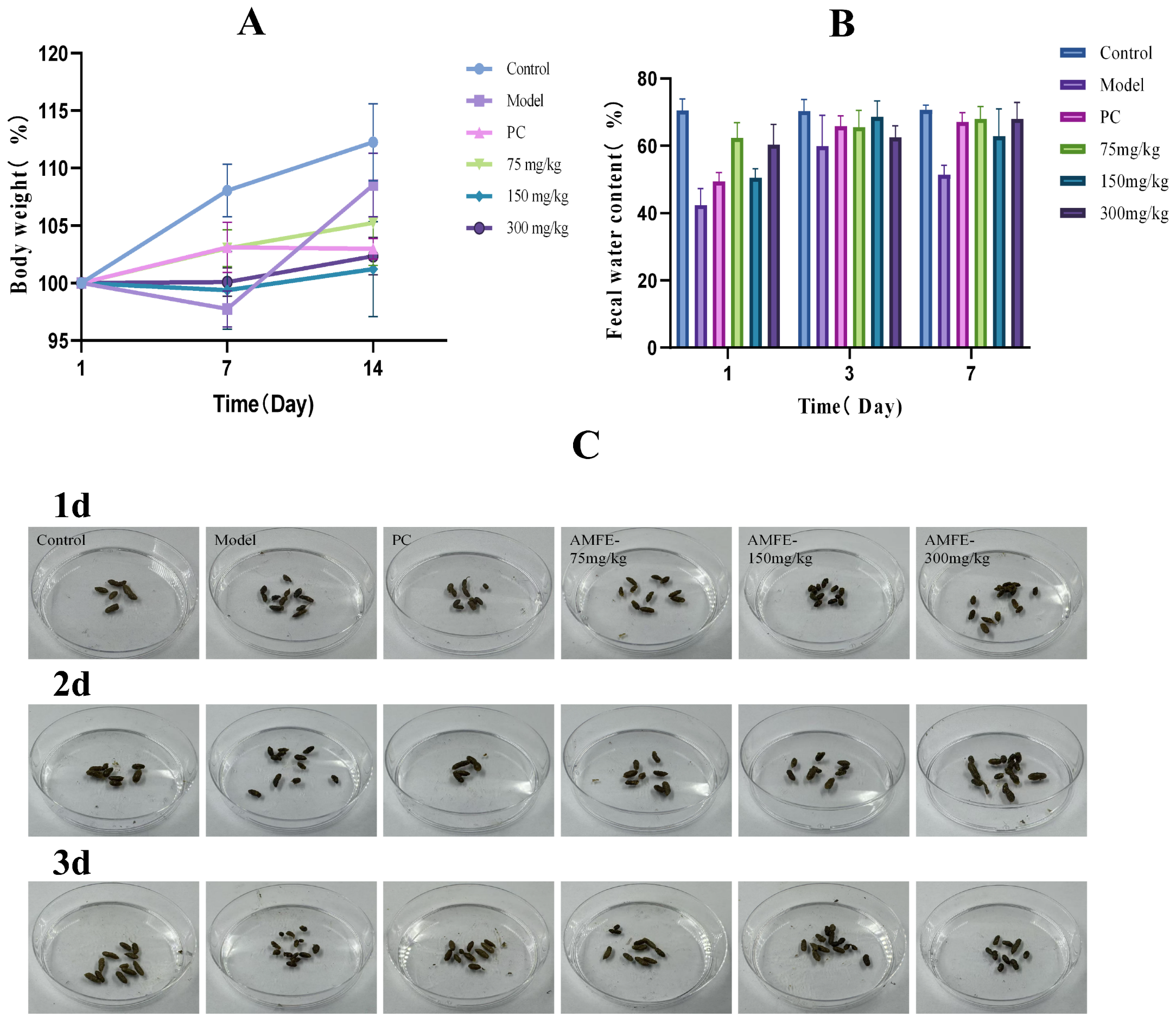
In this study, a mouse constipation model was established by continuous intragastric administration of 10 mg/kg loperamide for 7 days, with interventions using 3 g/kg polyethylene glycol and different doses of AMFE (75, 150, and 300 mg/kg). Body weight is a comprehensive indicator that reflects the health status of animals and serves as a key parameter for assessing the severity of constipation. As shown in Figure 1B, compared to the control group, mice in the loperamide model group exhibited a significant slowdown in weight gain, with some showing a downward trend. After interventions began on day 7, the model group showed an abnormal increase in body weight, whereas all treatment groups experienced a more stable weight gain. It was speculated that the abnormal weight gain in the model group was due to fecal accumulation caused by constipation. After drug intervention, promoting intestinal peristalsis can effectively improve constipation-induced abnormalities in body weight and aid in the overall functional recovery of the organism.
Stool characteristics and water content are core indicators for determining the success of constipation model establishment, indirectly reflecting the severity of constipation in mice. As shown in Figure 1C and Table 1, observation of mouse feces at different time points revealed: mice in the control group had smooth defecation, with feces that were oval-shaped, brown-yellow in color, moist in texture, and with a smooth surface; mice in the model group had difficulty defecating, with feces that were black, small, ball-shaped, dry, hard, and rough in texture; in the positive drug group, after treatment, stool characteristics gradually returned to the levels seen in the control group. In the AMFE 75 mg/kg group, defecation was smooth, and some feces returned to being oval-shaped, brown-yellow, and smooth-surfaced, although the texture remained somewhat dry and hard; in the AMFE 150 mg/kg group, most feces returned to normal—oval-shaped, brown-yellow, moist, and smooth; in the AMFE 300 mg/kg group, defecation was smooth, with oval-shaped, black, moist, and smooth feces. The above results show that AMFE can significantly improve constipation-related defecation disorders and abnormal stool characteristics in mice. The black color of the feces in the high-dose group is related to the high anthocyanin and other pigment content in AMFE.
The water content of feces is an important indicator for assessing constipation in mice. As shown in Figure 1B, the fecal water content in the model group was significantly lower than that in the normal group. Except for the 75 mg/kg AMFE group, the water content in the other treatment groups increased over time and approached normal levels, indicating that the constipation model was successfully established in this study.
Body weight can directly reflect the overall state of all experimental animals and can be used to roughly assess their physical condition. Clinically, the body weight of patients with constipation is one of the most important parameters of their health status [27]. Typically, constipated animals generally exhibit weight loss; however, the results obtained in this experiment were the opposite [28]. It is speculated that mice in the model group experienced abnormal weight gain due to intestinal fecal accumulation caused by constipation. In the other treatment groups, interventions effectively promoted intestinal peristalsis and reversed constipation-induced abnormal changes in body weight, thereby facilitating the recovery of other physiological functions.
Fecal characteristics and water content are core indicators for determining the successful establishment of constipation models. Loperamide significantly decreases fecal water content and increases fecal hardness by inhibiting intestinal motility and the secretion and absorption of water and electrolytes [29]. In this study, feces from mice in the model group were black, spherical, dry, hard, and rough, with significantly lower water content than those from the normal group. These results are consistent with the changes in fecal parameters observed by Wu et al. under the same loperamide dosage and administration regimen [29], and also align with findings that fiber intervention in loperamide-induced constipation models restores fecal water content [30]. This study found that at an AMFE dose of 75 mg/kg, some feces returned to an ovoid, brown-yellow, smooth-surfaced form, though still relatively dry and hard. In the 150 mg/kg group, most feces returned to normal (ovoid, brown-yellow, moist, and smooth). In the 300 mg/kg group, defecation was smooth and all feces were black, moist, and smooth ovoids. The above-mentioned dose-dependent improvement trend indicates that AMFE can effectively ameliorate defecation disorders and abnormal fecal characteristics in constipated mice. Studies have found that the intestinal absorption of A. melanocarpa anthocyanins consumed in the diet is limited, possibly because a larger proportion is excreted in prototype form with feces [31]. Since AMFE itself is rich in a large amount of anthocyanin pigments, these unabsorbed pigments are excreted in the feces after high-dose gavage, giving the feces a black appearance. This phenomenon on the one hand indicates that the polyphenolic substances in AMFE reach the colon, providing a material basis for its intestinal health benefits; on the other hand, it also confirms the safety of high-dose AMFE intervention.
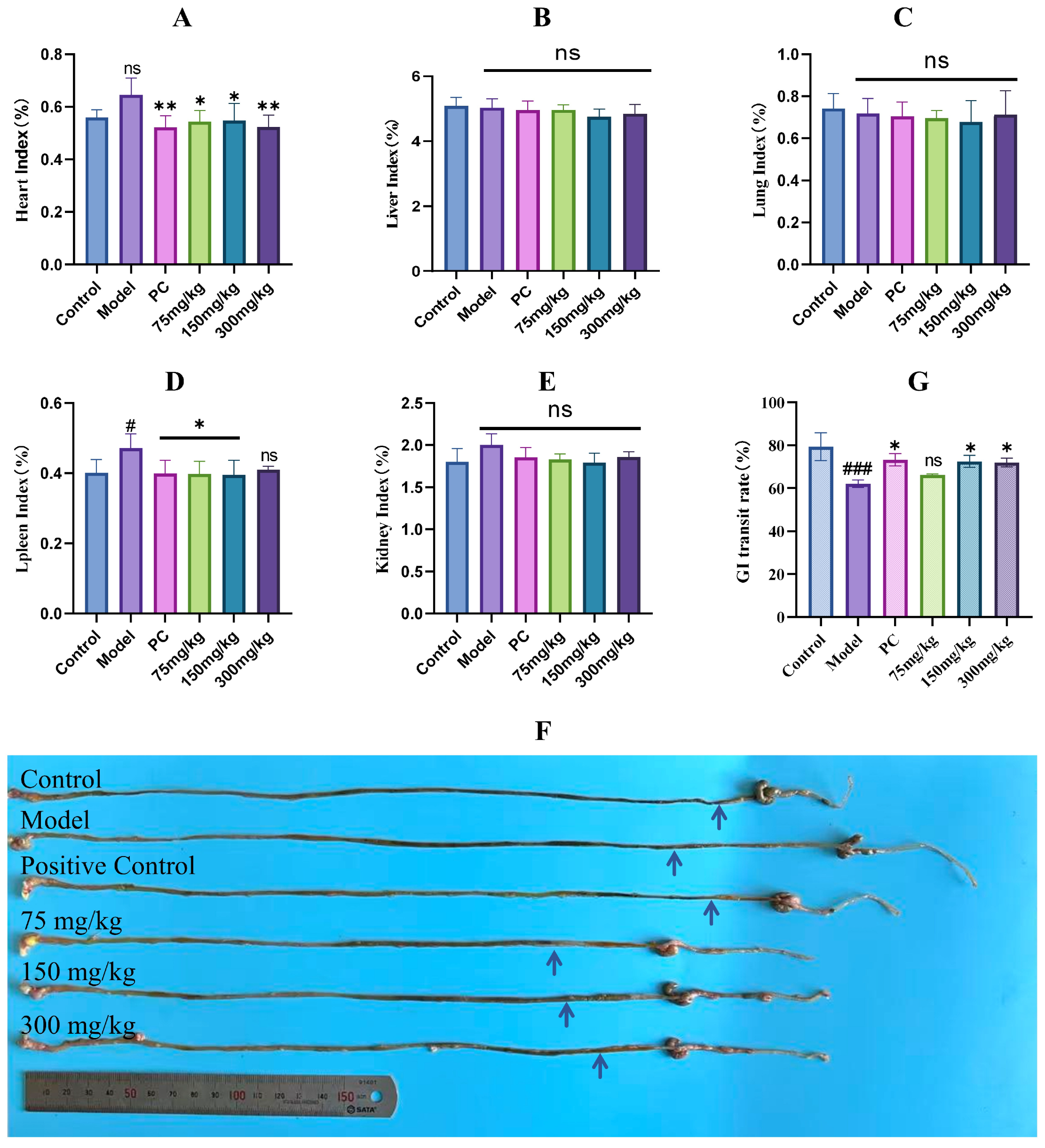
The organ indices can reflect the health and growth status of animal organs. Organ-to-body weight ratios were used to evaluate the systemic safety of AMFE and reflect the systemic inflammation and stress injury caused by constipation; specifically, the spleen index reflects the level of intestinal immune inflammation, while the heart index reflects the overall stress status [32,33]. As shown in Figure 2A–E, the cardiac and splenic organ indices of mice in the constipation model group were significantly higher than those in the blank and treatment groups, whereas there were no differences in the liver, lung, or kidney indices among the groups. This suggests that constipation-induced inflammation leads to myocardial injury and splenomegaly, and AMFE can alleviate such damage.
The intestinal transit rate is used to assess intestinal peristalsis and the degree of constipation. Figure 2F,G show that the intestinal transit rate in the model group was significantly lower than that in the blank group (p < 0.001); the PC and 150 and 300 mg/kg AMFE groups had significantly higher transit rates than the model group (p < 0.05), whereas there was no difference in the 75 mg/kg group. Fecal accumulation in the intestines of the model group confirmed the abnormal body weight caused by constipation. AMFE can dose-dependently improve intestinal peristalsis and relieve constipation.

3.2. Biochemical Index Analysis of Constipated Mice

In recent years, research has confirmed that the loperamide-induced animal constipation model offers advantages, such as ease of manipulation and stable formation. Constipation can lead to disruptions in gastrointestinal regulatory peptide and neurotransmitter levels, promote the production of proinflammatory factors, and exacerbate oxidative stress responses in the body. Therefore, in this experiment, we used ELISA to detect the expression levels of related factors.
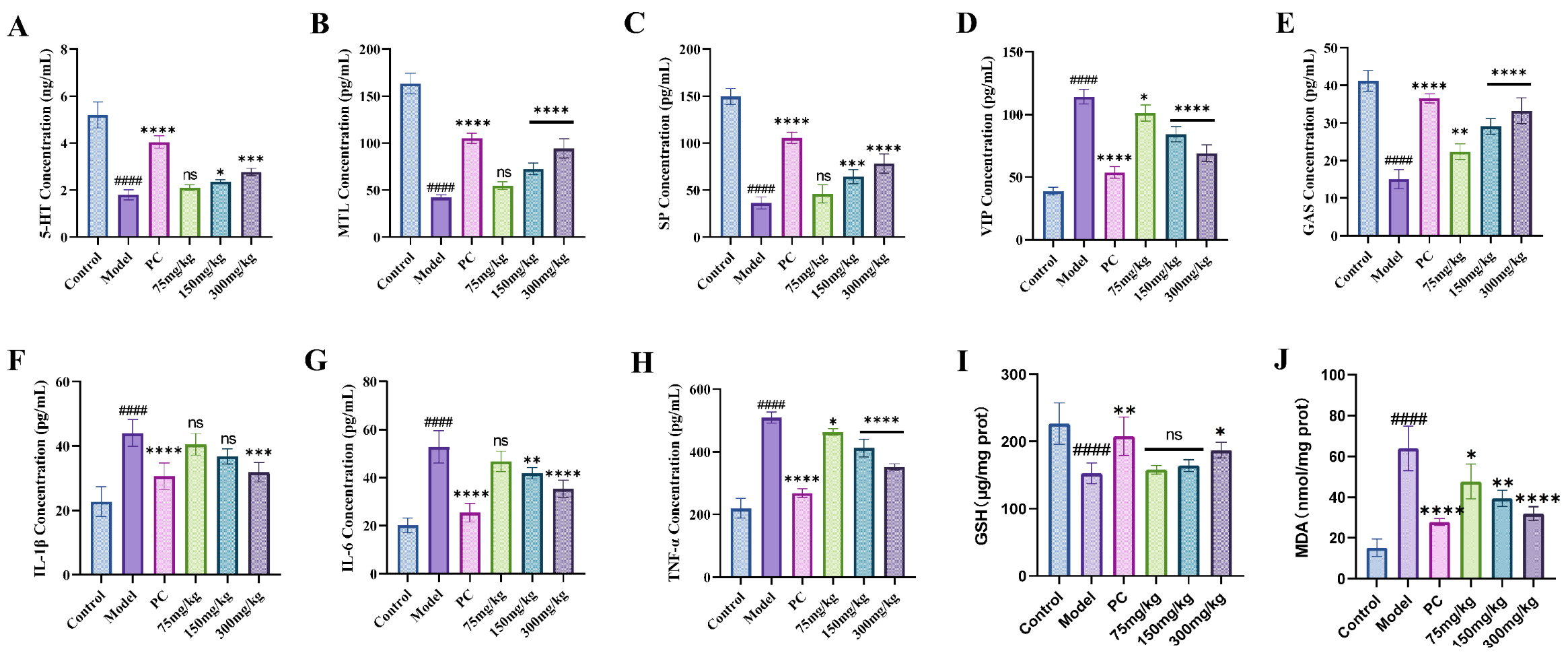
The levels of gastrointestinal regulatory peptides and neurotransmitters are shown in Figure 3A–E. Compared to the normal group, the serum levels of 5-HT (Figure 3A), MTL (Figure 3B), SP (Figure 3C), and GAS (Figure 3E) in the model group of mice were significantly decreased (p < 0.0001), whereas the content of VIP (Figure 3D) was significantly increased (p < 0.0001). Compared to the model group, the treatment groups showed increased levels of MTL, GAS, SP, and 5-HT and decreased levels of VIP in mouse serum with increasing concentrations, demonstrating a dose-dependent effect. These results indicate that constipation causes changes in the levels of gastrointestinal regulatory peptides and related neurotransmitters, whereas administration of AMFE exhibits a dose-dependent therapeutic effect.
As shown in Figure 3E–G, compared to the normal group, levels of IL-1β, IL-6, and TNF-α were significantly increased in the model group (p < 0.0001). After intragastric administration of different concentrations of AMFE for one week, the levels of IL-1β, IL-6, and TNF-α decreased in a dose-dependent manner. This result suggests that AMFE can repair loperamide-induced inflammation, inhibit the production of pro-inflammatory factors, and indirectly enhance the immune capacity of mice, thereby treating constipation.
The results of AMFE on GSH and MDA levels in constipation mice are shown in Figure 3H,I. As shown in the figures, compared with the normal group, GSH levels were significantly reduced and MDA levels were significantly increased in the model group (p < 0.0001). After one week of intragastric administration of different concentrations of AMFE, MDA levels decreased and GSH levels increased in a dose-dependent manner. These results indicate that AMFE has good antioxidant capacity and can repair oxidative damage caused by constipation in mice.
Gastrointestinal motility is jointly regulated by the enteric nervous system, gastrointestinal hormones, smooth muscle cells, and the intestinal microenvironment. Existing studies indicate that both excitatory and inhibitory neural pathways are present in the enteric nervous system; together, by regulating gastrointestinal smooth muscle contraction, relaxation, and secretory activity, they maintain normal intestinal propulsive function [34,35]. Among the indicators measured in this study, MTL, GAS, SP, and 5-HT are generally associated with enhanced gastrointestinal motility, regulation of secretion, and improvement of intestinal propulsive function, whereas VIP is more involved in inhibitory neural regulation and smooth muscle relaxation in the gut [34,35,36,37,38,39]. Specifically, MTL can promote gastrointestinal movement and is involved in the regulation of migrating motor complexes [36]; GAS is mainly secreted by G cells in the gastric antrum and duodenum and can stimulate the secretion of gastric acid and digestive juices, as well as participate in the regulation of gastrointestinal motility [40]; as a tachykinin neuropeptide, SP can facilitate intestinal smooth muscle contraction and intestinal propulsion through neuromuscular transmission [37]; 5-HT is an important signaling molecule in the gut, and through the enteric nervous system and different 5-HT receptor subtypes, participates in the regulation of peristaltic reflexes, secretion, and sensory transmission [38,39]. VIP, for its part, primarily acts as an inhibitory neurotransmitter involved in intestinal smooth muscle relaxation and regulation of secretion [25,32]. Therefore, the improvements in MTL, GAS, SP, 5-HT, and VIP levels observed after AMFE intervention in this study suggest that it may promote the restoration of intestinal propulsive function and thereby alleviate loperamide-induced constipation symptoms by modulating the balance of neuroendocrine-related factors in the gastrointestinal tract.
In addition to neuroendocrine regulation, oxidative stress, inflammatory responses, and intestinal mucosal barrier damage are also important pathological mechanisms in the occurrence and progression of constipation. Previous studies have shown that loperamide-induced constipation models can be accompanied by increased intestinal oxidative stress, manifested as elevated MDA levels and decreased antioxidant indicators such as GSH [25]. Excessive ROS can induce lipid peroxidation and damage to cell membranes, proteins, and DNA, thereby exacerbating structural and functional abnormalities in the intestinal mucosa [41]. Meanwhile, inflammatory factors such as IL-1β, IL-6, and TNF-α can affect epithelial tight junctions and intestinal barrier integrity, leading to increased intestinal permeability [42,43]. Results from this study show that AMFE can decrease MDA and inflammatory factor levels while increasing antioxidant indicators such as GSH, indicating that it has a certain alleviating effect on constipation-related oxidative stress and inflammatory responses. Since AMFE may contain phenolic and other antioxidant active components, its beneficial effects may be related to scavenging free radicals, inhibiting lipid peroxidation, and reducing inflammatory responses [44]. However, based on current results, this study cannot directly demonstrate that AMFE has direct regulatory effects on enteric neurons, interstitial cells of Cajal, or specific neurotransmitter synthesis pathways; thus, the relevant mechanisms require further validation through tissue localization, receptor expression, and signaling pathway experiments.

3.3. Effects of AMFE on Colonic Tissue Morphology in Constipated Mice

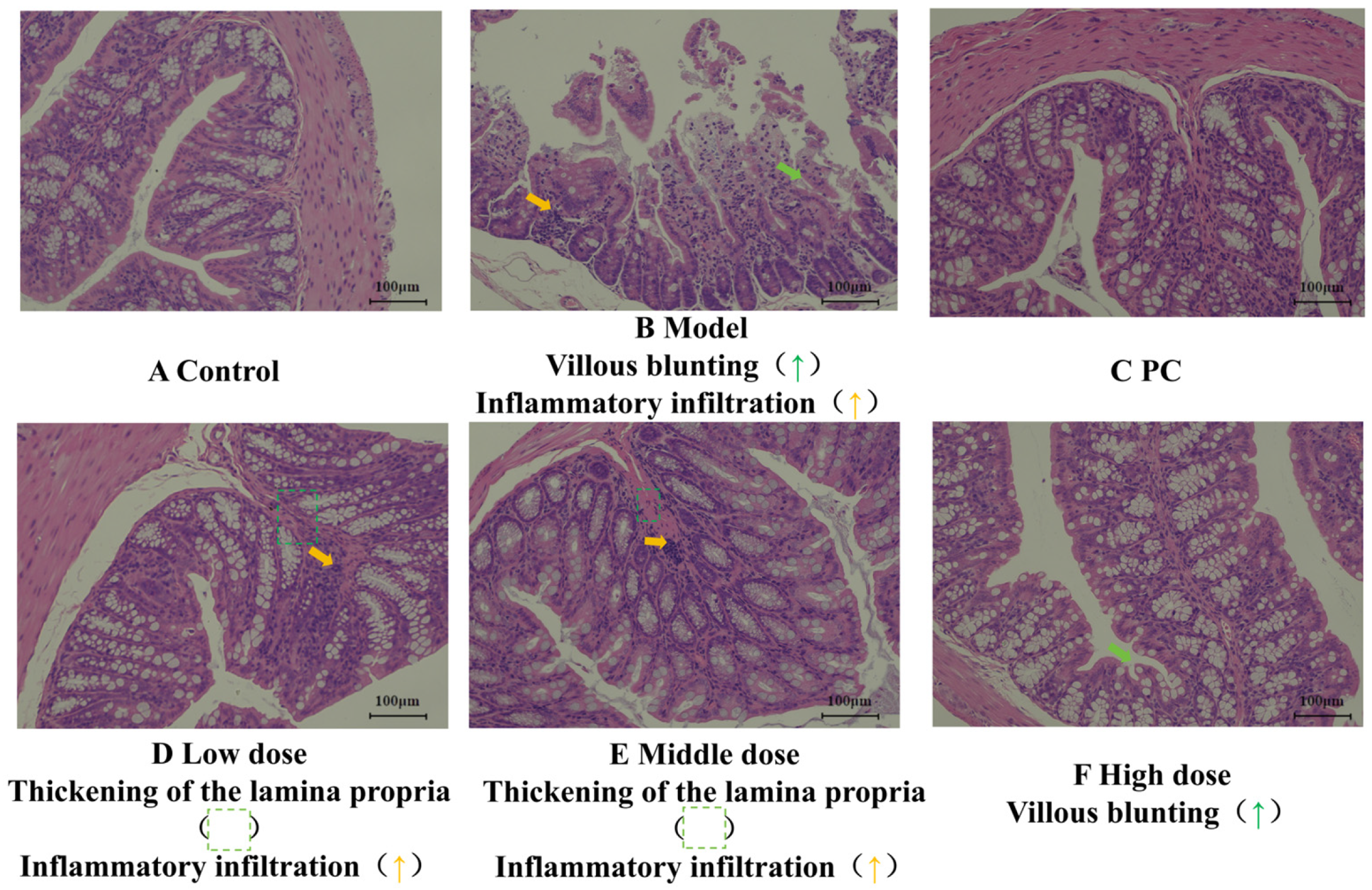
Morphological observations of colonic tissues in each group of mice are shown in Figure 4. In the normal group, the intestinal villi were neatly arranged, goblet cells were abundant, and the crypt structure was regular. In the model group, the intestinal villi underwent severe atrophy and damage, the number of goblet cells was reduced, and the crypts were disordered, accompanied by a large amount of inflammatory infiltration. The positive control and all AMFE dosage groups improved pathological damage to the colon to varying degrees in a dose-dependent manner: the low-dose group alleviated villi atrophy and increased the number of goblet cells; in the medium-dose group, the villi were arranged more densely, and the number of goblet cells further increased; in the high-dose group, the arrangement of villi basically returned to normal, with only a small amount of inflammatory infiltration observed. These results confirm that AMFE can effectively repair intestinal damage caused by constipation and protect the intestinal barrier.
Dietary fiber and polysaccharides may also contribute to relief of constipation by improving intestinal barrier function. Studies have shown that dietary fiber can affect gut function by increasing the water content of intestinal contents, improving stool volume and consistency, and modulating the gut microbiota and its metabolites [45]. Fermentable dietary fibers produce short-chain fatty acids that can regulate epithelial energy metabolism, mucosal immunity, and tight junction homeostasis; whereas a lack of dietary fiber may weaken the intestinal mucus barrier and increase susceptibility to pathogens [46,47]. Histopathological results of this study showed that, after loperamide modeling, mouse colons exhibited mucosal architectural disruption, epithelial injury, and morphological abnormalities, while AMFE intervention resulted in marked restoration of colonic tissue structure and attenuation of pathological damage. The above results suggest that AMFE has a protective effect against constipation-related intestinal injury, potentially through mechanisms involving antioxidation, anti-inflammation, regulation of neuroendocrine factors, and maintenance of the intestinal mucosal barrier.

3.4. Serum Medicinal Chemistry Analysis

3.4.1. AMFE Chemical Composition Analysis

UHPLC-Q-TOF/MS technology combines the outstanding separation capability of chromatography with the precise analytical power of mass spectrometry, displaying high sensitivity, good reproducibility, simplicity, and speed. Consequently, it has been widely applied in the analysis and identification of traditional Chinese medicine components. AMFE was identified using UHPLC-Q-TOF/MS. By searching the compound’s fragmentation patterns, molecular ion peaks, and secondary fragment ions, and by comparing them with the established chemical component database, qualitative identification of the compounds was performed. A total of 31 compounds were identified from AMFE (Table S1). There are 13 types of flavonoids, 11 types of anthocyanins/proanthocyanidins, and seven types of phenolic acids.

3.4.2. Identification of Blood-Transmitted Components

The prepared medicated serum and blank serum were tested according to the method described in Section 2.4.2. Based on the data analysis method described earlier, combined with database information and relevant literature, serum samples from mice administered AMFE were analyzed. Twenty-two blood-transmitted components were identified, including 14 prototype compounds and eight metabolites. The identification results are shown in Table 2.

3.5. Network Pharmacology Analysis Results

3.5.1. Prediction of Potential Targets for Active Ingredients

Because traditional Chinese medicine exhibits a multi-component synergistic therapeutic effect, network pharmacology was used to investigate the potential pharmacological mechanisms underlying the therapeutic effects of AMFE in treating constipation. After screening out compounds without associated targets and duplicate targets using drug-likeness (DL) and oral bioavailability (OB), a total of five active ingredients and 1471 potential targets of the active ingredients were obtained.

3.5.2. Disease Target Prediction

The obtained genes were filtered using a LAC value (>), ultimately yielding 2269 disease targets.

3.5.3. Intersection Targets and Network Construction

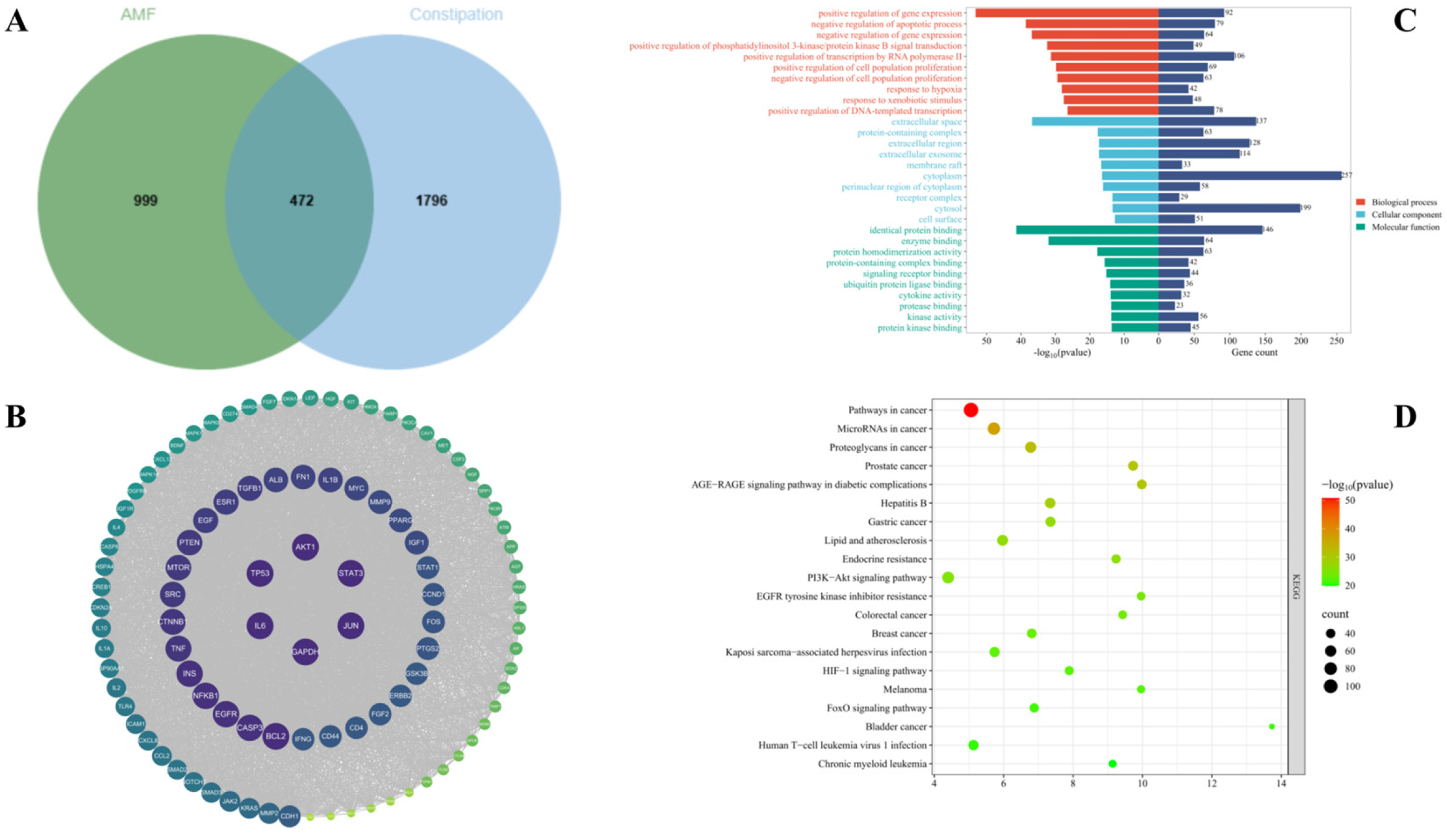
The relevant data were imported into the Venny 2.1 online tool for intersection analysis. The results showed that there were 472 common targets between AMFE and constipation. These shared targets are considered key targets in the process of AMFE intervening in constipation and provide an important screening basis for subsequent in-depth molecular mechanism verification and experimental studies. The visualization of the Venny 2.1 analysis results is shown in Figure 5A.
After importing the common targets into the STRING database, a protein–protein interaction visualization was obtained, where the size and color reflect changes in degree; the larger and darker the node, the higher the degree. As shown in Figure 5B, the targets with the highest degree are AKT1, STAT3, JUN, GAPDH, IL-6, and TP53. IL-6 is an important cytokine in immune responses; it not only directly drives the expression of inflammatory genes but also indirectly promotes cell death and participates in inflammatory immune responses and disease progression [48]. Combined with the results from Chapter 3, which demonstrated that AMFE can effectively reduce IL-6 levels in mice, it can be more favorably determined that IL-6 is a key target through which AMFE exerts its therapeutic effect on constipation.

3.5.4. GO and KEGG Enrichment Analysis Results

A total of 472 targets were uploaded to the David database for GO enrichment analysis, which explored the functional distribution of constipation targets from the aspects of Biological Process (BP), Cellular Component (CC), and Molecular Function (MF).
GO enrichment analysis was conducted for BP, CC, and MF. As shown in Figure 5C, GO-BP analysis indicated that the mechanisms by which AMFE acts against constipation are related to pathways such as positive regulation of gene expression, negative regulation of apoptotic processes, and negative regulation of gene expression. According to the GO-CC analysis, the genes corresponding to these active ingredients are generally located in structures such as the extracellular space, protein-containing complex, extracellular region, extracellular exosome, and cytoplasm. The GO-MF analysis showed that the molecular functions required for AMFE to combat constipation are related to identical protein binding, enzyme binding, and protease binding.
KEGG enrichment analysis was performed using the DAVID database, and the top 20 KEGG metabolic pathways are shown in Figure 5D. According to the table, the main pathways include CRC, PI3K-Akt signaling pathway, FoxO signaling pathway, gastric cancer, and EGFR tyrosine kinase inhibitor resistance.

3.5.5. Construction and Analysis of the Active Ingredient–Target–Metabolic Pathway–Constipation Network

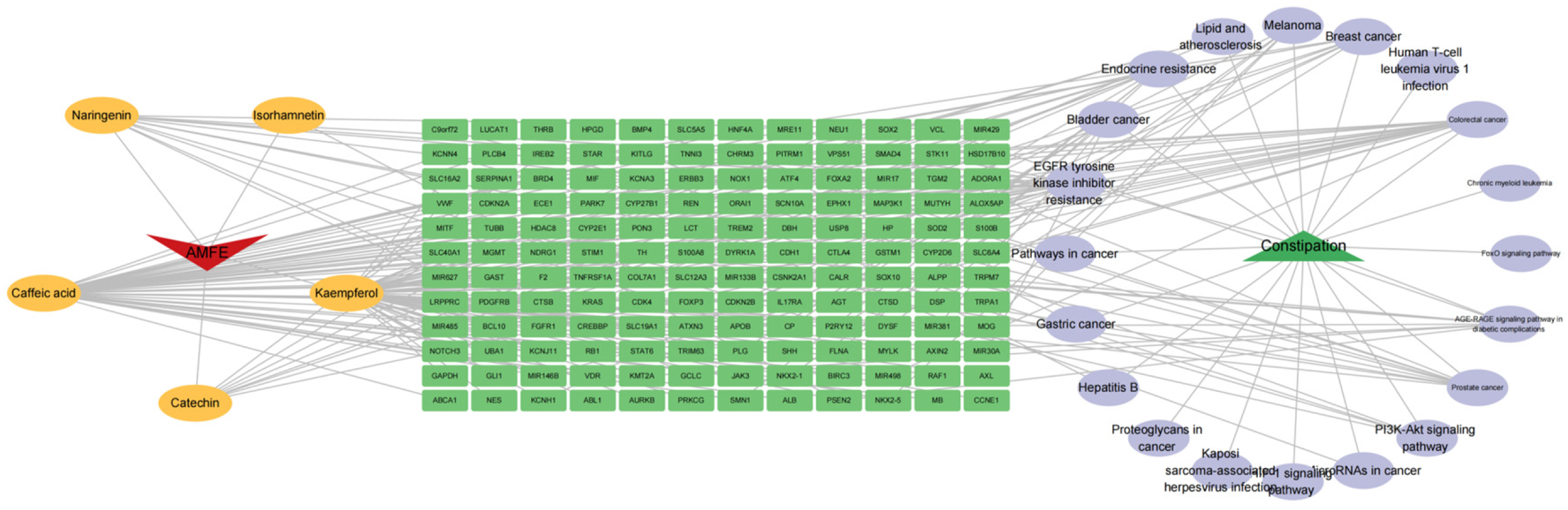
The active ingredients, intersecting targets, constipation, and the 10 metabolic pathways identified in KEGG were imported into Cytoscape 3.9.1, resulting in the AMFE–active ingredient–target–constipation–metabolic pathway network visualization in Figure 6. From the network, it can be seen that constipation is most closely associated with the active ingredient catechin, which has the highest degree value, followed by kaempferol, caffeic acid, naringenin, and isorhamnetin. Therefore, these ingredients are speculated to be key effective components in the treatment of constipation. The active ingredients of drugs mainly act on targets such as AKT1, STAT3, JUN, GAPDH, IL-6, and TP53 through pathways including CRC, PI3K-Akt signaling pathway, FoxO signaling pathway, gastric cancer, and EGFR tyrosine kinase inhibitor resistance.

3.6. Molecular Docking

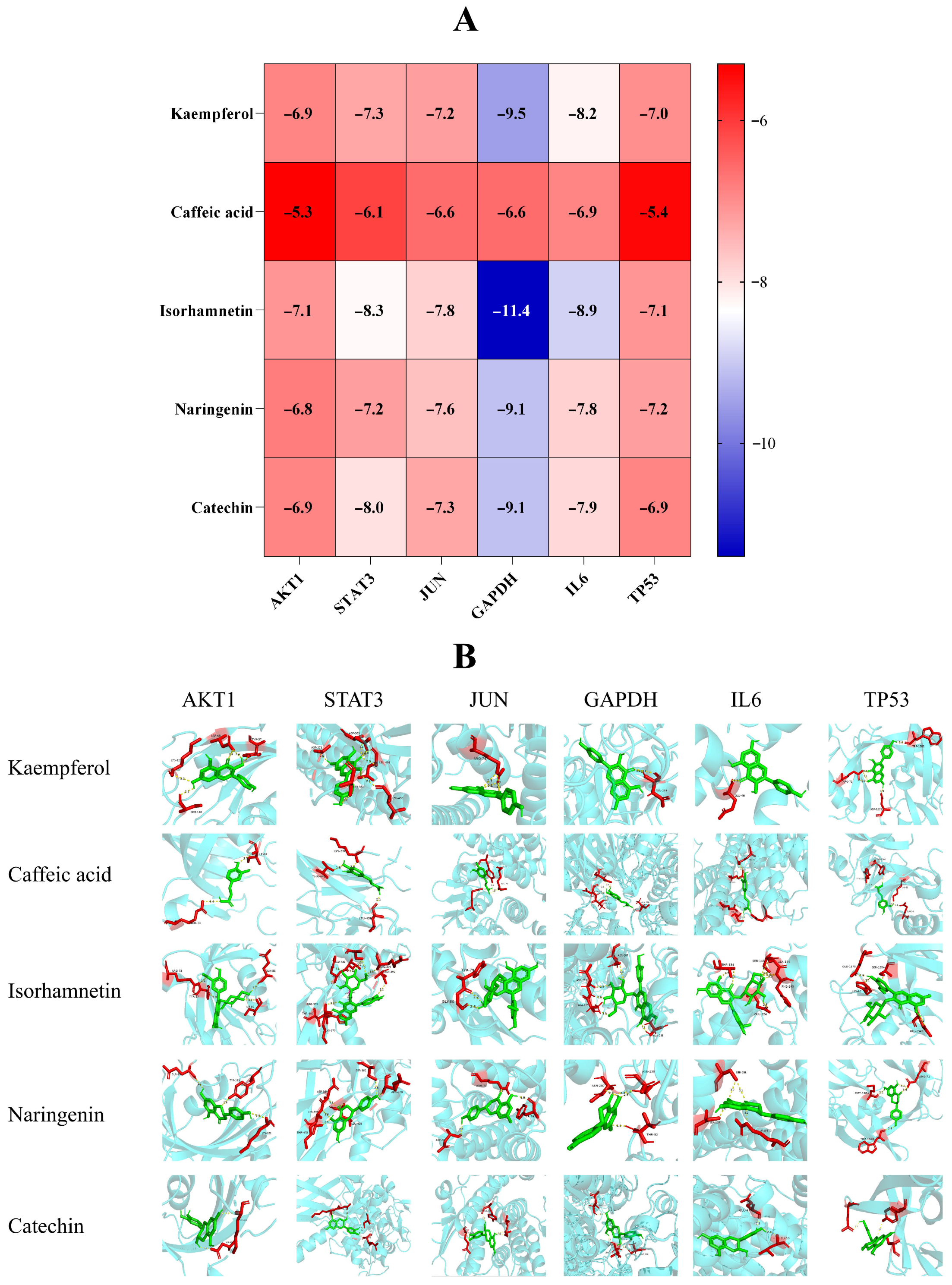
Studies have shown that a binding energy between molecules less than 0 indicates that ligand molecules can spontaneously bind to receptor proteins. If the intermolecular binding energy is less than −5.0 kJ·mol−1, it indicates that they can bind freely, and the smaller the binding energy, the more stable the docking. A heatmap was generated to visualize the changes in the binding energy, as shown in Figure 7A.
Molecular docking can predict the binding mode and strength between molecules, as well as simulate the ideal docking results between two or more molecules. The main factors affecting the stability of molecular complexes are hydrophobic interactions and the strength of bonding forces. Therefore, in this experiment, water molecules were removed to exclude the influence of hydrophobic interactions on the molecular docking results, while hydrogen was added to generate docking energy for optimal molecular docking outcomes. The molecular docking results are shown in Figure 7B. Kaempferol, Caffeic acid, Isorhamnetin, Naringenin, and Catechin were docked with AKT1, STAT3, JUN, GAPDH, IL-6, and TP53, respectively. Among them, Isorhamnetin had the lowest binding energy with GAPDH (−11.4 kJ·mol−1), indicating that this ligand has strong binding activity with the receptor, followed by Kaempferol, Naringenin, and Catechin with GAPDH, with binding energies of −9.5 kJ·mol−1, −9.1 kJ·mo−1, and −9.1 kJ·mol−1, Isorhamnetin is the main component in AMFE. These results show that these compounds can tightly bind to constipation-related targets to treat constipation, further validating the experimental results of network pharmacology.

4. Conclusions

In this study, 31 small-molecule compounds were identified from the ethanol extract of A. melanocarpa fruit (AMFE) using UHPLC-Q-TOF-MS, mainly including phenolic acids, flavonoids, and anthocyanins/proanthocyanidins. Animal experiments showed that AMFE significantly increased intestinal transit rate and fecal water content in loperamide-induced constipated mice, alleviated colonic histopathological injury, and dose-dependently regulated serum gastrointestinal neurotransmitters, inflammatory cytokines, and colonic oxidative stress markers. Serum pharmacochemistry identified 22 absorbed components, providing the preliminary material basis for its anti-constipation effects. Network pharmacology and molecular docking were used as predictive in silico tools to suggest potential core targets (AKT1, STAT3, JUN, GAPDH, IL-6, TP53) and related signaling pathways including PI3K/AKT. These predictive results suggest that AMFE may act through multi-component and multi-target mechanisms, which warrant further experimental validation, thus providing a theoretical basis for the development of A. melanocarpa fruit as a functional food and therapeutic agent for constipation.

Featured Application

In summary, this study evaluated the effects of AMFE in treating constipation, providing a new compound for constipation treatment and clarifying the application value of AMF as a novel food resource. Given its natural edibility, people can safely and gently regulate their intestinal function and relieve constipation symptoms through the daily consumption of A. melanocarpa fruits or related products (such as juice and dried fruit). This study offers a natural and sustainable dietary regulation plan for individuals with constipation and provides a theoretical basis for the development of AMF in health foods and pharmaceuticals.

Supplementary Materials

The following supporting information can be downloaded at https://www.mdpi.com/article/10.3390/app16105025/s1, Table S1: Identification of chemical constituents from Aronia melanocarpa in Negative mode.

Author Contributions

Conceptualization, J.L., L.W. and D.L.; methodology, J.L.; validation, J.L. and X.W.; formal analysis, J.X.; investigation, X.D.; resources, D.L.; data curation, J.L.; writing—original draft preparation, J.L.; writing—review and editing, D.L. and L.W.; visualization, L.H.; project administration, D.L.; funding acquisition, D.L. All authors have read and agreed to the published version of the manuscript.

Funding

This work was supported by the Priority Academic Program Development of the Jiangsu Higher Education Institute (PAPD).

Institutional Review Board Statement

The study was conducted in accordance with the Guide for the Care and Use of Laboratory Animals by the US National Research Council, and approved by the Animal Ethics Committee of Soochow University (protocol code SUDA20251211A02 and date of approval: 11 December 2025).

Informed Consent Statement

Not applicable.

Data Availability Statement

The original contributions presented in this study are included in the article. Further inquiries can be directed to the corresponding authors.

Conflicts of Interest

The authors declare that the research was conducted in the absence of any commercial or financial relationships that could be construed as a potential conflict of interest.

References

  1. Kuru, Y.A.; Kılınç, G.E. Aronia melanocarpa as a Multifunctional Superberry: From Antioxidant Potential to Therapeutic and Nanotechnological Applications. Curr. Nutr. Rep. 2026, 15, 9. [Google Scholar] [CrossRef]
  2. Sidor, A.; Gramza-Michaowska, A. Black Chokeberry Aronia melanocarpa L.—A Qualitative Composition, Phenolic Profile and Antioxidant Potential. Molecules 2019, 24, 3710. [Google Scholar] [CrossRef] [PubMed]
  3. Arvinte, O.M.; Senila, L.; Becze, A.; Amariei, S. Rowanberry—A Source of Bioactive Compounds and Their Biopharmaceutical Properties. Plants 2023, 12, 3225. [Google Scholar] [CrossRef] [PubMed]
  4. Li, L.; Li, J.; Xu, H.; Zhu, F.; Li, Z.; Lu, H.; Zhang, J.; Yang, Z.; Liu, Y. The Protective Effect of Anthocyanins Extracted from Aronia melanocarpa Berry in Renal Ischemia-Reperfusion Injury in Mice. Mediat. Inflamm. 2021, 2021, 7372893. [Google Scholar] [CrossRef] [PubMed]
  5. Yu, S.Y.; Kim, M.B.; Park, Y.K.; Bae, M.; Kang, H.; Hu, S.; Pham, T.X.; Carpenter, R.; Lee, J.; Lee, O.H.; et al. Anthocyanin-Rich Aronia Berry Extract Mitigates High-Fat and High-Sucrose Diet-Induced Adipose Tissue Inflammation by Inhibiting Nuclear Factor-κB Activation. J. Med. Food 2021, 24, 586–594. [Google Scholar] [CrossRef]
  6. Gao, N.; Wang, Y.; Jiao, X.; Chou, S.; Li, E.; Li, B. Preparative Purification of Polyphenols from Aronia melanocarpa (Chokeberry) with Cellular Antioxidant and Antiproliferative Activity. Molecules 2018, 23, 139. [Google Scholar] [CrossRef]
  7. Lipińska, P.; Jóźwik, A. Hepatoprotective, Hypoglycemic, and Hypolipidemic Effect of Chokeberry Pomace on Polish Merino Lambs. Anim. Biotechnol. 2018, 29, 136–141. [Google Scholar] [CrossRef]
  8. Efenberger-Szmechtyk, M.; Nowak, A.; Czyżowska, A.; Śniadowska, M.; Otlewska, A.; Żyżelewicz, D. Antibacterial mechanisms of Aronia melanocarpa (Michx.), Chaenomeles superba Lindl. and Cornus mas L. leaf extracts. Food Chem. 2021, 350, 129218. [Google Scholar] [CrossRef]
  9. Wieloch, D.; Konopacka, D. Black Chokeberry Extracts (Aronia melanocarpa) as an Ingredient of Functional Food-Potential, Challenges and Directions of Development. Molecules 2025, 30, 4237. [Google Scholar] [CrossRef]
  10. Rtsep, R.; Maante-Kuljus, M.; Karp, K.; Kaldme, H.; Pldma, P.; Koort, A.; Mainla, L.; Moor, U. Polyphenol composition and antioxidant activity of wine raw materials and pomace from hybrid grapes, aronia, and Japanese quince ia melanocarpa) and Japanese quince (Chaenomeles japonica). Agric. Food Sci. 2024, 33, 237–246. [Google Scholar] [CrossRef]
  11. Negreanu-Pirjol, B.S.; Oprea, O.C.; Negreanu-Pirjol, T.; Roncea, F.N.; Prelipcean, A.M.; Craciunescu, O.; Iosageanu, A.; Artem, V.; Ranca, A.; Motelica, L.; et al. Health Benefits of Antioxidant Bioactive Compounds in the Fruits and Leaves of Lonicera caerulea L. and Aronia melanocarpa (Michx.) Elliot. Antioxidants 2023, 12, 951. [Google Scholar] [CrossRef] [PubMed]
  12. Moslemi, M. Reviewing the recent advances in application of pectin for technical and health promotion purposes: From laboratory to market. Carbohydr. Polym. 2021, 254, 117324. [Google Scholar] [CrossRef]
  13. Suares, N.C.; Ford, A.C. Prevalence of, and risk factors for, chronic idiopathic constipation in the community: Systematic review and meta-analysis. Am. J. Gastroenterol. 2011, 106, 1582–1591; quiz 1581, 1592. [Google Scholar] [CrossRef]
  14. Rani, V.; Deep, G.; Singh, R.K.; Palle, K.; Yadav, U.C.S. Oxidative stress and metabolic disorders: Pathogenesis and therapeutic strategies. Life Sci. 2016, 148, 183–193. [Google Scholar] [CrossRef] [PubMed]
  15. Stavely, R.; Sahakian, L.; Filippone, R.T.; Stojanovska, V.; Bornstein, J.C.; Sakkal, S.; Nurgali, K. Oxidative Stress-Induced HMGB1 Translocation in Myenteric Neurons Contributes to Neuropathy in Colitis. Biomolecules 2022, 12, 1831. [Google Scholar] [CrossRef]
  16. Sahakian, L.; Filippone, R.T.; Stavely, R.; Robinson, A.M.; Yan, X.S.; Abalo, R.; Eri, R.; Bornstein, J.C.; Kelley, M.R.; Nurgali, K. Inhibition of APE1/Ref-1 Redox Signaling Alleviates Intestinal Dysfunction and Damage to Myenteric Neurons in a Mouse Model of Spontaneous Chronic Colitis. Inflamm. Bowel Dis. 2021, 27, 388–406. [Google Scholar] [CrossRef]
  17. Nijenhuis, C.M.; ter Horst, P.G.; van Rein, N.; Wilffert, B.; de Jong-van den Berg, L.T. Disturbed development of the enteric nervous system after in utero exposure of selective serotonin re-uptake inhibitors and tricyclic antidepressants. Part 2: Testing the hypotheses. Br. J. Clin. Pharmacol. 2012, 73, 126–134. [Google Scholar] [CrossRef]
  18. Miner, P.; DeLuca, R.; La Portilla, M.; Padila, E.; Koltun, W.; Wiltz, O.; Shailubhai, K.; Jacob, G.; Griffin, P.; Barrow, L. Plecanatide, a Novel Uroguanylin Analog: A 12-Week, Randomized, Double-Blind, Placebo-Controlled, Dose-Ranging Trial to Evaluate Efficacy and Safety in Patients with Irritable Bowel Syndrome with Constipation (IBS-C). Am. J. Gastroenterol. 2014, 109, S541. [Google Scholar] [CrossRef]
  19. Chang, L.; Lembo, A.; Sultan, S. American Gastroenterological Association Institute Technical Review on the pharmacological management of irritable bowel syndrome. Gastroenterology 2014, 147, 1149–1172.e2. [Google Scholar] [CrossRef]
  20. Paré, P.; Fedorak, R.N. Systematic review of stimulant and nonstimulant laxatives for the treatment of functional constipation. Can. J. Gastroenterol. Hepatol. 2014, 28, 549–557. [Google Scholar] [CrossRef]
  21. Yao, Z.; Fu, S.; Ren, B.; Ma, L.; Sun, D. Based on Network Pharmacology and Gut Microbiota Analysis to Investigate the Mechanism of the Laxative Effect of Pterostilbene on Loperamide-Induced Slow Transit Constipation in Mice. Front. Pharmacol. 2022, 13, 913420. [Google Scholar] [CrossRef]
  22. Niewinna, K.; Owczarek, K.; Senkowska, Z.; Lewandowska, U. Polyphenols, Polysaccharides, and Their Complexes from Aronia melanocarpa in the Chemoprevention of Colorectal Cancer. Molecules 2025, 31, 10. [Google Scholar] [CrossRef]
  23. Ren, Y.; Frank, T.; Meyer, G.; Lei, J.; Grebenc, J.R.; Slaughter, R.; Gao, Y.G.; Kinghorn, A.D. Potential Benefits of Black Chokeberry (Aronia melanocarpa) Fruits and Their Constituents in Improving Human Health. Molecules 2022, 27, 7823. [Google Scholar] [CrossRef]
  24. Kasprzak-Drozd, K.; Oniszczuk, T.; Soja, J.; Gancarz, M.; Wojtunik-Kulesza, K.; Markut-Miotła, E.; Oniszczuk, A. The Efficacy of Black Chokeberry Fruits against Cardiovascular Diseases. Int. J. Mol. Sci. 2021, 22, 6541. [Google Scholar] [CrossRef] [PubMed]
  25. Jabri, M.A.; Wannes, D.; Hajji, N.; Sakly, M.; Marzouki, L.; Sebai, H. Role of laxative and antioxidant properties of Malva sylvestris leaves in constipation treatment. Biomed. Pharmacother. 2017, 89, 29–35. [Google Scholar] [CrossRef] [PubMed]
  26. Wang, X.; Zhou, J.; Sun, Z.; Jia, R.; Huang, D.; Tang, D.; Xia, T.; Xiao, F. Poly-γ-glutamic acid alleviates slow transit constipation by regulating aquaporin and gut microbes. Sci. Rep. 2025, 15, 8244. [Google Scholar] [CrossRef]
  27. Shahramian, I.; Kalvandi, G.; Javaherizadeh, H.; Khalili, M.; Noori, N.M.; Delaramnasab, M.; Bazi, A. The effects of prebiotic supplementation on weight gain, diarrhoea, constipation, fever and respiratory tract infections in the first year of life. J. Paediatr. Child. Health 2018, 54, 875–880. [Google Scholar] [CrossRef]
  28. Kim, J.E.; Yun, W.B.; Sung, J.E.; Lee, H.A.; Choi, J.Y.; Choi, Y.S.; Jung, Y.S.; Kim, K.S.; Hwang, D.Y. Characterization the response of Korl:ICR mice to loperamide induced constipation. Lab. Anim. Res. 2016, 32, 231–240. [Google Scholar] [CrossRef]
  29. Wu, J.; Xin, Q.; Wang, S.; Zhang, X.; Jiang, C. Aqueous extracts of Elsholtzia ciliata and Hovenia dulcis ameliorate loperamide-induced constipation in mice by promoting intestinal peristalsis and barrier function and the abundance of intestinal beneficial bacteria. Front. Microbiol. 2025, 16, 1531232. [Google Scholar] [CrossRef] [PubMed]
  30. Liu, S.; Yang, Q.; Du, L.; Yang, Y.; Wu, Z. L-β-Galactoglucan alleviates loperamide-induced constipation in mice and regulates gut microbiota and metabolism. Int. J. Biol. Macromol. 2026, 357, 151532. [Google Scholar] [CrossRef]
  31. He, J.; Magnuson, B.A.; Giusti, M.M. Analysis of anthocyanins in rat intestinal contents--impact of anthocyanin chemical structure on fecal excretion. J. Agric. Food Chem. 2005, 53, 2859–2866. [Google Scholar] [CrossRef]
  32. Qu, C.; Yang, G.H.; Zheng, R.B.; Yu, X.T.; Peng, S.Z.; Xie, J.H.; Chen, J.N.; Wang, X.F.; Su, Z.R.; Zhang, X.J. The immune-regulating effect of Xiao’er Qixingcha in constipated mice induced by high-heat and high-protein diet. BMC Complement. Altern. Med. 2017, 17, 185. [Google Scholar] [CrossRef] [PubMed]
  33. Odukanmi, A.; Ajala, O.A.; Olaleye, S.B. Short-term acute constipation and not short-term acute diarrhea altered cardiovascular variables in male Wistar rats. Niger. J. Physiol. Sci. 2022, 37, 43–48. [Google Scholar] [CrossRef] [PubMed]
  34. Furness, J.B. The enteric nervous system and neurogastroenterology. Nat. Rev. Gastroenterol. Hepatol. 2012, 9, 286–294. [Google Scholar] [CrossRef]
  35. Sanders, K.M.; Ward, S.M.; Koh, S.D. Interstitial cells: Regulators of smooth muscle function. Physiol. Rev. 2014, 94, 859–907. [Google Scholar] [CrossRef]
  36. Sanger, G.J.; Wang, Y.; Hobson, A.; Broad, J. Motilin: Towards a new understanding of the gastrointestinal neuropharmacology and therapeutic use of motilin receptor agonists. Br. J. Pharmacol. 2013, 170, 1323–1332. [Google Scholar] [CrossRef]
  37. Holzer, P.; Holzer-Petsche, U. Tachykinins in the gut. Part I. Expression, release and motor function. Pharmacol. Ther. 1997, 73, 173–217. [Google Scholar] [CrossRef]
  38. Gershon, M.D.; Tack, J. The serotonin signaling system: From basic understanding to drug development for functional GI disorders. Gastroenterology 2007, 132, 397–414. [Google Scholar] [CrossRef]
  39. Mawe, G.M.; Hoffman, J.M. Serotonin signalling in the gut--functions, dysfunctions and therapeutic targets. Nat. Rev. Gastroenterol. Hepatol. 2013, 10, 473–486. [Google Scholar] [CrossRef] [PubMed]
  40. Schubert, M.L.; Peura, D.A. Control of gastric acid secretion in health and disease. Gastroenterology 2008, 134, 1842–1860. [Google Scholar] [CrossRef]
  41. Lobo, V.; Patil, A.; Phatak, A.; Chandra, N. Free radicals, antioxidants and functional foods: Impact on human health. Pharmacogn. Rev. 2010, 4, 118–126. [Google Scholar] [CrossRef]
  42. Al-Sadi, R.; Boivin, M.; Ma, T. Mechanism of cytokine modulation of epithelial tight junction barrier. Front. Biosci. (Landmark Ed.) 2009, 14, 2765–2778. [Google Scholar] [CrossRef] [PubMed]
  43. Chelakkot, C.; Ghim, J.; Ryu, S.H. Mechanisms regulating intestinal barrier integrity and its pathological implications. Exp. Mol. Med. 2018, 50, 1–9. [Google Scholar] [CrossRef] [PubMed]
  44. Pandey, K.B.; Rizvi, S.I. Plant polyphenols as dietary antioxidants in human health and disease. Oxid. Med. Cell. Longev. 2009, 2, 270–278. [Google Scholar] [CrossRef]
  45. Makki, K.; Deehan, E.C.; Walter, J.; Bäckhed, F. The Impact of Dietary Fiber on Gut Microbiota in Host Health and Disease. Cell Host Microbe 2018, 23, 705–715. [Google Scholar] [CrossRef] [PubMed]
  46. Desai, M.S.; Seekatz, A.M.; Koropatkin, N.M.; Kamada, N.; Hickey, C.A.; Wolter, M.; Pudlo, N.A.; Kitamoto, S.; Terrapon, N.; Muller, A.; et al. A Dietary Fiber-Deprived Gut Microbiota Degrades the Colonic Mucus Barrier and Enhances Pathogen Susceptibility. Cell 2016, 167, 1339–1353.e21. [Google Scholar] [CrossRef]
  47. Venegas, D.P.; Fuente, M.K.D.L.; Landskron, G.; González, M.J.; Hermoso, M.A. Short Chain Fatty Acids (SCFAs)-Mediated Gut Epithelial and Immune Regulation and Its Relevance for Inflammatory Bowel Diseases. Front. Immunol. 2019, 10, 277. [Google Scholar]
  48. Zheng, Y.; Li, Y.; Ran, X.; Wang, D.; Zheng, X.; Zhang, M.; Yu, B.; Sun, Y.; Wu, J. Mettl14 mediates the inflammatory response of macrophages in atherosclerosis through the NF-κB/IL-6 signaling pathway. Cell Mol. Life Sci. 2022, 79, 311. [Google Scholar] [CrossRef]
Figure 1. Effects of AMFE on Body Weight, Fecal Water Content, and Fecal Characteristics in Loperamide-Induced Constipation Mice. (A): Changes in body weight of mice. (B): Fecal water content in mice. (C): Physical characteristics of mouse feces.
Applsci 16 05025 g001
Figure 2. Effect of AMFE on Organ Index and Intestinal Propulsion Function in Loperamide-Induced Constipated Mice. (AE): Organ indices of the heart, liver, lungs, spleen, and kidneys. (F): Anatomical diagram of the intestine. (G): Statistical results of intestinal propulsion rate (Model-Control: # p < 0.05; ### p < 0.001; ns p > 0.05. Model-Treatment group: * p < 0.05; ** p < 0.01; ns p > 0.05). Note: The arrows indicate the locations reached by melena.
Applsci 16 05025 g002
Figure 3. Effects of AMFE on Organ Index and Intestinal Transit Function in Loperamide-Induced Constipated Mice. (AE): Serum levels of gastrointestinal hormones 5-HT, MTL, SP, VIP, and GAS. (F,G,H): Serum levels of inflammatory factors IL-1β, IL-6, and TNF-α. (I,J): Colonic tissue oxidative stress markers GSH and MDA (Model-Control: #### p < 0.0001, ns p > 0.05. Model-Treatment group: * p < 0.05; ** p < 0.01; *** p < 0.001; **** p < 0.0001, ns p > 0.05).
Applsci 16 05025 g003
Figure 4. The effect of AMFE on colonic tissue in loperamide-induced constipated mice.
Applsci 16 05025 g004
Figure 5. Screening of Potential Targets for AMFE Intervention in Constipation and Functional Enrichment Analysis. (A): Venn diagram of AMF active ingredient targets and constipation-related targets. (B): PPI network core targets diagram of the intersected targets. (C): Bar chart of GO functional enrichment analysis. (D): Bubble chart of KEGG pathway enrichment analysis. Note: In Figure 5A, the dark green area represents the overlapping targets between AMF and constipation (drug-disease common targets);In Figure 5C, the dark blue bars represent the number of genes enriched in each GO term (Gene count).We have also added these explanations to the figure legend to avoid ambiguity. All corrections have been completed. Please confirm.
Applsci 16 05025 g005
Figure 6. AMFE–Active Ingredient–Target–Metabolic Pathway–Constipation Network Visualization. Note: Red inverted triangle: AMFE (the main intervention); Yellow ellipses: key active compounds of AMFE; Green rectangles: drug-disease common target genes; Purple ellipses: enriched KEGG signaling pathways; Green triangle: the disease constipation; Gray lines: interactions between different components.
Applsci 16 05025 g006
Figure 7. Molecular docking validation of core active components of AMFE with key targets. (A) Heatmap of binding energies. (B) Molecular docking conformations. Key binding amino acids and interaction types: Isorhamnetin–GAPDH (Asp124, Gly125, Thr126; hydrogen bonds + hydrophobic interactions); Kaempferol–GAPDH (Asp124, Gly125; hydrogen bonds); Naringenin–GAPDH (Thr126, Asn127; hydrogen bonds); Catechin–GAPDH (Asp124, Gly125; hydrogen bonds); Caffeic acid–IL-6 (Glu110, Lys113; hydrogen bonds). Light blue (cyan): the 3D structure of the target protein (backbone, shown in cartoon form) Green: the small molecule (active component of AMFE) docked to the protein Red: key amino acid residues of the protein that interact with the small molecule Yellow dashed lines (if present): hydrogen bonds between the small molecule and the proteinWe have also added these explanations to the figure legend to avoid ambiguity.
Applsci 16 05025 g007
Table 1. Fecal Characteristics of constipated mice on Day 1, 3, and 7 after modeling.
IndexFeeding
Time/day
Fecal Characteristics
GroupingControlModelPC75 mg/kg150 mg/kg300 mg/kg
Defecation1unobstructedstrainingrelatively easystrainingstrainingstraining
3unobstructedstrainingeasyrelatively easyrelatively easyrelatively easy
7unobstructedstrainingunobstructedunobstructedunobstructedunobstructed
Fecal size1normalstool volume smallstool volume smallstool volume smallstool volume smallstool volume small
3normalstool volume smallnormalstool volume smallstool volume smallpartially normal
7normalstool volume smallnormalpartially normalmostly normalnormal
Shape1oval-shapedsphericalsphericalsphericalsphericalspherical
3oval-shapedsphericaloval-shapedsphericalsphericalpartially spherical
7oval-shapedsphericaloval-shapedoval-shapedoval-shapedoval-shaped
Color1brownish-yellowblackblackblackblackblack
3brownish-yellowblackblackblackblackblack
7brownish-yellowblackpartially brownish-yellowpartially brownish-yellowpartially brownish-yellowblack
Surface
glossiness
1glossyroughroughroughroughrough
3glossyroughglossyroughrelatively roughslight luster
7glossyroughglossyglossyglossyglossy
Texture1moist and softdry and harddry and harddry and harddry and harddry and hard
3moist and softdry and hardmoist and softrelatively dry and hardslightly dry and hardslightly dry and hard
7moist and softdry and hardmoist and softslightly dry and hardmoist and softmoist and soft
Table 2. Results of identification of transitional components in blood.
NO.Retention Time/minFormula[M + H]TypeCompounds
12.376C15H10O6284.9309Parent compoundKaempferol
22.875C9H8O4179.0611Caffeic acid
33.059C15H14O6217.0358Catechin
43.442C16H18O9353.0627Neochlorogenic acid
53.508C16H18O9353.0641Chlorogenic acid
63.841C16H12O7316.9555Isorhamnetin
76.057C15H12O5271.9196Naringenin
810.554C20H19O9401.9348Pelargonidin-3-O-arabinoside
912.070C20H19O9401.9346Pelargonidin-3-O-xyloside
1012.356C15H10O8316.9546Myricetin
1122.867C20H18O10417.9063Kaempferol-3-O-arabinoside
1222.667C20H18O10417.9086Kaempferol-3-O-xyloside
1369.588C20H19O9461.8953Malvidin-3-O-arabinoside
1469.904C23H25O12461.8941Malvidin-3-O-xyloside
152.442C7H11O5174.9613MetaboliteDehydroxyquinic acid
162.859C9H7O2146.0694Dehydroxy-p-coumaric acid
172.909C19H9O4195.8161Methyl caffeate
183.175C9H7O5195.8163Deethylsinapic acid
194.758C16H11O7316.954Methylquercetin
2056.203C21H21O9316.9554Digalloylglucose
2168.309C26H28O7627.4254Dihydroxypelargonidin-3-O-xyloside + glucuronidated
2268.360C26H28O7627.4258Dihydroxypelargonidin-3-O-arabinoside + glucuronidated
Disclaimer/Publisher’s Note: The statements, opinions and data contained in all publications are solely those of the individual author(s) and contributor(s) and not of MDPI and/or the editor(s). MDPI and/or the editor(s) disclaim responsibility for any injury to people or property resulting from any ideas, methods, instructions or products referred to in the content.