Abstract
This study evaluates the environmental performance of 34 single-engine light utility helicopters across five operational phases: ground idle departure, ground idle arrival, takeoff, approach, and landing-takeoff (LTO). A hybrid multi-criteria decision-making (MCDM) framework integrating interval type-2 fuzzy sets with the Analytic Hierarchy Process (AHP), VIKOR, and TOPSIS was applied to ensure robust and reliable assessment. Six criteria: shaft horsepower (SHP), fuel flow, hydrocarbon (HC), carbon monoxide (CO), particulate matter (PM), and nitrogen oxides (NOx) were considered to capture both engine performance and environmental impact, with relative importance determined through AHP. VIKOR generated a compromise ranking, while TOPSIS validated the results. The analysis revealed that the HUGHES 500 (DDA250-C18, A34), HUGHES 501 (DDA250-C20B, A29), and BELL 206B-1 (DDA250-C20, A32) engines achieved the best environmental performance due to low fuel consumption and reduced emissions across NOx, PM, HC, and CO. In contrast, engines such as K-1200 (T53 17A-1, A1) and BELL UH-1H (T53 L13, A2) performed the poorest, with high fuel flow and elevated emissions. Sensitivity analysis showed minimal changes in rankings when the NOx weight was varied, confirming the robustness of the framework. These results highlight that emissions and fuel efficiency are more critical than engine power in determining environmental sustainability.
1. Introduction
Aviation plays a crucial role in modern transportation systems by enabling fast, flexible, and long-range mobility for both civilian and military applications. Within this sector, helicopters represent a unique class of rotorcraft due to their vertical take-off and landing capability, allowing operation in remote, constrained, and urban environments [1,2,3]. Helicopters are widely utilized in critical missions such as emergency medical services, search and rescue, offshore logistics, surveillance, forestry management, and border control operations [4]. Despite their operational versatility, helicopter systems are associated with relatively high environmental impacts compared to many other transport modes. This is mainly due to high fuel consumption rates and inefficient aerodynamic performance during hover and low-speed flight conditions [5]. As a result, helicopter operations contribute significantly to atmospheric pollution through emissions of carbon monoxide (CO), nitrogen oxides (NOx), hydrocarbons (HC), and particulate matter (PM) [6]. These pollutants have serious implications for human health, climate change, and regional air quality degradation [7]. Helicopters often operate using turboshaft engines fueled by aviation kerosene or similar fuel types, and their emission levels vary significantly depending on flight phase and engine load conditions [8]. The variability of operational modes such as takeoff, hover, cruise, and landing introduces complex emission patterns that make environmental performance assessment challenging [9]. In particular, low altitude operations increase the local concentration of pollutants, further intensifying environmental impacts in populated areas [10]. Increasing global demand for air mobility and specialized aviation services has led to a continuous rise in aviation-related emissions [11]. Although aviation contributes a smaller share of total global emissions compared to other sectors, its environmental footprint is expected to grow without technological and operational improvements [12]. In this context, helicopter operations represent a particularly sensitive area due to their frequent use in low-altitude missions and proximity to populated regions [13]. International regulatory authorities such as the International Civil Aviation Organization (ICAO) emphasize the importance of reducing aircraft emissions through cleaner engine technologies, optimized operations, and improved environmental monitoring systems [14]. However, evaluating helicopter environmental performance remains a complex task due to the diversity of engine types, operational conditions, and emission characteristics [15]. In this context, the evaluation of helicopter engines requires a multi-criteria approach that simultaneously considers performance and environmental indicators. Key criteria include shaft horsepower (SHP), fuel flow rate, and emission indices such as HC, CO, PM, and NOx [16]. These criteria are inherently conflicting, as higher engine power is often associated with increased fuel consumption and emissions, making decision-making a multi-objective problem [17]. Furthermore, uncertainty in emission data, operational variability and expert judgment adds additional complexity to the evaluation process [18]. Therefore, robust decision-making tools are required to handle uncertainty while providing a reliable ranking of alternatives. Multi-Criteria Decision-Making (MCDM) methods provide an effective framework for addressing such complex problems. Techniques such as Analytic Hierarchy Process (AHP), VIKOR, and TOPSIS have been widely used in engineering and transportation studies for evaluating alternatives under multiple criteria [19]. AHP is used to determine the relative importance of criteria, VIKOR provides compromise ranking solutions, and TOPSIS evaluates alternatives based on their distance from ideal solutions [20]. Recent studies demonstrate that hybrid MCDM approaches significantly improve decision reliability and stability compared to single method approaches, particularly in uncertain environments such as aviation emission assessment [21]. Despite these advancements, there is still a lack of comprehensive studies focusing specifically on helicopter engine environmental evaluation using integrated fuzzy MCDM frameworks. Most existing studies either focus on fixed-wing aircrafts or do not adequately address uncertainty in emission data [22]. To address this gap, this study proposes a hybrid fuzzy MCDM framework for evaluating the environmental performance of helicopter engines. The proposed approach integrates interval type-2 fuzzy sets with AHP, VIKOR, and TOPSIS methods to handle uncertainty and provide robust ranking results [23,24]. The model enables a comprehensive assessment of helicopter engines under multiple conflicting criteria and provides a structured decision support tool for environmentally sustainable engine selection.
1.1. The Motivation for Using a Multi-Criteria Decision-Making Approach
Multi-criteria decision-making (MCDM) provides a structured framework for solving complex engineering problems involving multiple conflicting criteria, enabling optimal decision-making through trade-off analysis between performance and environmental objectives [25]. In helicopter engine assessment, performance evaluation requires simultaneous consideration of operational efficiency and environmental impact. In this study, 34 single-engine light utility helicopter engines are evaluated using six criteria: shaft horsepower (SHP), fuel flow, hydrocarbon emissions (HC), carbon monoxide emissions (CO), particulate matter (PM), and nitrogen oxides (NOx), across five phases of the landing and take-off (LTO) cycle [26,27]. Given the inherent uncertainty in emission data and expert evaluations, interval type-2 fuzzy sets are employed to better capture ambiguity compared to classical fuzzy approaches [28]. Type-reduction and defuzzification are performed using both the Centroid method and the Taguchi loss function to enhance result stability [29]. Following the fuzzy evaluation stage, the Analytic Hierarchy Process (AHP) is applied to determine criterion weights. First, a pairwise comparison matrix is constructed based on expert judgments using Saaty’s 1–9 scale. The matrix is then normalized and the priority vector is derived to obtain the relative weights of the criteria. The maximum eigenvalue (λmax) is computed, and the Consistency Index (CI) is calculated as . The Consistency Ratio (CR) is then obtained using , where RI is the Random Index. The results confirm that CR < 0.10, indicating acceptable consistency of expert judgments and ensuring the reliability of the derived weights. VIKOR is applied to obtain a compromise solution based on group utility and individual regret, while TOPSIS is used as a validation mechanism based on distance from ideal solutions [30,31]. The results demonstrate that engines A34, A29, and A32 perform best in terms of environmental efficiency, whereas A1 and A2 exhibit the poorest performance due to higher fuel consumption and emissions [32,33]. Sensitivity analysis confirms that the proposed framework is stable under moderate changes in criterion weights [34]. Overall, integrating interval type-2 fuzzy sets with AHP, VIKOR, and TOPSIS provides a robust decision support framework for helicopter engine selection, where emission-related criteria play a dominant role in environmental performance evaluation [35,36].
1.2. Objectives of the Study
The main objective of this study is to develop a robust hybrid multi-criteria decision-making (MCDM) framework for evaluating the environmental performance of 34 single-engine light utility helicopter engines [37,38,39]. The proposed framework integrates interval type-2 fuzzy sets with AHP, VIKOR, and TOPSIS methods to effectively handle uncertainty and provide reliable ranking results [40,41]. Six criteria are considered: SHP, fuel flow, HC, CO, PM, and NOx, representing both operational performance and environmental impact [42,43]. Interval type-2 fuzzy sets are used to model uncertainty in expert judgments, while AHP determines relative criterion weights [44,45]. VIKOR is applied for compromise ranking, and TOPSIS is used for validation through ideal solution comparison [46,47]. To improve fuzzy evaluation accuracy, both Centroid-based type-reduction and Taguchi loss function approaches are incorporated [48,49]. Results show that A34, A29, and A32 have the best environmental performance, while A1 and A2 perform the worst [50,51]. Sensitivity analysis confirms model robustness under weight variations [52]. The study contributes to sustainable aviation literature by providing a reliable and systematic decision-support tool for environmentally efficient helicopter engine selection [53,54].
1.3. Problem Description
The increasing demand for efficient and environmentally sustainable aviation systems makes helicopter engine evaluation a complex engineering decision problem. Helicopter engines significantly influence operational efficiency, fuel consumption, and environmental emissions. Selecting the most suitable engine is a multi-criteria problem due to conflicting objectives such as maximizing power output while minimizing fuel consumption and emissions. In this study, 34 single-engine light utility helicopter engines are evaluated using empirical data across different operational phases of the LTO cycle. The dataset includes diverse engine types with different design characteristics, making direct comparison difficult. Therefore, a structured multi-criteria decision-making framework is required to ensure consistent and transparent evaluation. The following sections define the evaluation criteria, data acquisition process, and methodological framework used to rank helicopter engines and assess their environmental performance systematically.
1.3.1. Alternative Options
Helicopter engines have an important share in performance and efficiency. In our article, we examined engine types in terms of their effects on the environment. Alternative helicopter engines used in this study are listed in Table 1.
Table 1.
ICAO assigned codes, helicopter type and engine type names of light-utility helicopters driven by a single turboshaft engine.
1.3.2. Criteria for Green Helicopter Engine Evaluation
This study identifies six parameters for evaluating the environmental and operational performance of helicopter engines aimed at ecological sustainability. The criteria include shaft horsepower (SHP) (C1), fuel flow (C2), and four emission indices: hydrocarbon (HC) (C3), carbon monoxide (CO) (C4), particulate matter (PM) (C5), and nitrogen oxides (NOx) (C6).
Shaft Horsepower (SHP) per engine (C1): Horsepower quantifies the power output of a helicopter engine by measuring the frequency at which engine pistons move up and down in one minute. It determines performance metrics such as acceleration, load carrying capacity, and tractive effort, with shaft horsepower (SHP) being a common specification for helicopters and airplanes [55,56].
Fuel Flow per engine (kg/s) (C2): Helicopters require sufficient fuel to complete flights safely, considering potential deviations. Fuel load must remain within the usable capacity and decrease progressively during operation. Fuel flow quantifies fuel consumption under controlled operational conditions [57].
Emission Index for Hydrocarbon (HC) (g/kg) (C3): Hydrocarbons are partially combusted or evaporative emissions from the engine that can mix with nitrogen oxides to form photochemical smog, which adversely affects respiratory health and living organisms. Polycyclic aromatic hydrocarbons generated by HC emissions are linked to cancers, including hematological malignancies [58,59].
Emission Index for Carbon Monoxide (CO) (g/kg) (C4): Incomplete combustion in engines, caused by a richer fuel mixture and uneven cylinder temperature distribution, produces CO, an odorless and colorless gas with high affinity for hemoglobin. CO exposure reduces oxygen transport in the blood and can lead to toxicity, asphyxiation, and severe health effects at high concentrations [60,61].
Emission Index for Particulate Matter (PM) (g/kg) (C5): PM emissions result from carbon molecules in fuel that are not fully combusted. Diesel-powered engines typically emit carbon, hydrocarbons, sulfur dioxide, and sulfuric acid particles, contributing to air pollution [62,63].
Emission Index for Nitrogen Oxides (NOx) (g/kg) (C6): NOx includes gases such as NO, NO2, N2O, N2O3, N2O4, and N2O5, with NO and NO2 being the most critical pollutants. They have atmospheric residence times of 1–10 days and primarily originate from fossil fuel combustion, causing respiratory disorders. NO affects the neurological system, whereas NO2 irritates lung alveoli and contributes to the formation of PM2.5 and PM10 in urban areas [64,65].
Although noise pollution and maintenance costs are also important factors in helicopter operations, they are not included in this study. This is because the analysis focuses on in-flight environmental performance and emission-related indicators, which are consistently available for all engine types. In particular, SHP, fuel flow, HC, CO, PM, and NOx enable a uniform and comparable assessment across the 34 helicopter engines and are directly aligned with ICAO-based emission evaluation frameworks. Therefore, the selected criteria ensure data completeness, methodological consistency, and comparability of results.
1.3.3. Model Driven Data Acquisition Approach
The Federal Office of Civil Aviation (FOCA) supervises civil aviation activities in Switzerland, ensuring compliance with safety regulations and promoting sustainable aviation practices. FOCA also monitors licensed aviation operators to guarantee environmentally responsible use of airspace and airport facilities [66]. Within this framework, FOCA provides comprehensive datasets on pollutant emissions from helicopters across various operational categories. These datasets, with shaft horsepower (SHP) as the independent variable, have been compiled through collaborations with the German Aerospace Center (DLR), gas turbine engine manufacturers, helicopter technical manuals, and flight test programs [67]. The data support the estimation of pollutant emissions that impact the environment surrounding airports, considering operational hours, flight phase durations, and engine parameters. Flight operations for light utility helicopters with single engines are modeled according to FOCA-approved procedures, developed in consultation with experienced flight instructors. These procedures detail the time in mode and power settings for each flight phase, including takeoff, approach, and landing, enabling accurate calculations of environmental effects [68]. Table 2 presents the recommended time in mode and power settings for single-engine light utility helicopter operations across various flight maneuvers [69].
Table 2.
The time in mode and power settings of the light utility helicopter equipped with a single engine during various flight operations [70].
Table 2 outlines the standard operational parameters for single-engine light utility helicopters, including flight phases, operational acronyms, recommended power settings for the LTO cycle, and the duration assigned to each phase within the LTO cycle. The flight phases are denoted as GI-D for ground-idle departure, TO for takeoff, AP for approach, and GI-A for ground idle arrival [71]. Light utility helicopters require maximum power, approximately 87%, during the takeoff phase, whereas the minimum power is consumed during the ground idle approach phase (GI-A) at around 7% [72]. These average power settings form the primary input variables for calculating fuel flow rates and emission indices in the dataset analyzed. The focus on single turboshaft engine light-duty helicopters is justified by their versatility in both civilian and military operations. Such helicopters perform diverse missions, including medical evacuation, search and rescue, emergency medical services, pilot training, troop transport, light attack, reconnaissance and surveillance, law enforcement, military and civilian logistics, and traffic monitoring [73,74]. Table 2 provides the ICAO assigned codes, helicopter models, and engine types for the single turboshaft light utility helicopters, which form the core dataset of this study [75]. It should be noted that real operational conditions, such as military, rescue, or emergency missions, may deviate from the standard LTO cycle profiles in terms of power settings, duration, and maneuver characteristics. However, the LTO cycle is widely accepted as a standardized framework for aviation emission assessment and is recommended by international authorities such as ICAO. Therefore, it provides a consistent and comparable basis for evaluating different helicopter engines under controlled conditions. This approach allows for systematic comparison across alternatives, although it may not fully capture all mission-specific operational variations.
Only helicopter engines with complete datasets across all six evaluation criteria and all LTO phases were included in the study. This ensures data consistency, comparability, and reliability of the decision-making process, while engines with missing or incomplete records were excluded. The dataset used in this study is compiled from multiple authoritative and validated sources to ensure both accuracy and scientific reliability. The primary source is the Federal Office of Civil Aviation (FOCA), which provides standardized and quality-controlled emission inventories widely used in aviation environmental assessments. Additional performance-related data are obtained from the German Aerospace Center (DLR), whose datasets are based on experimental studies and validated engine performance models. Engine-specific technical parameters, including shaft horsepower and fuel flow, are further verified using official manufacturer technical manuals and certified engine documentation. The selected sample consists of 34 single-engine light utility helicopters that are widely utilized in both civilian and military operations, including training, surveillance, medical evacuation, and transport missions. This ensures the representativeness of commonly used engine configurations within this helicopter class. Furthermore, emission values are derived or validated using ICAO Landing and Take Off (LTO) cycle-based modeling procedures in accordance with FOCA-approved methodologies, which are internationally recognized in aviation emission analysis. The integration of multiple independent data sources, together with standardized LTO based modeling and cross-validation procedures, enhances the robustness, consistency, and reliability of the dataset. Therefore, the data used in this study provide a scientifically sound and representative basis for the proposed multi-criteria decision-making analysis.
1.3.4. Proposed Approach
This study initially employs a model-driven data acquisition approach, collecting data for 34 green helicopters based on six criteria across five distinct states. A multi-criteria decision-making interval type-2 fuzzy approach is proposed for the assessment of eco-friendly helicopters. We evaluated two types of reduction methods: the weighted sum and the Taguchi loss function, which was presented as an alternative technique. Ultimately, a comparison of these two methodologies is conducted to substantiate our methodology. This section elucidates our comprehensive methodology, detailing the model-driven data acquisition approach, the characteristics of IT2F membership functions, the implementation of the Taguchi loss function as an alternative type of reduction strategy, and the ranking of green helicopters.
1.3.5. Model Driven Data Acquisition and Approach Details
The study implements a detailed methodology for collecting and preparing datasets necessary to determine the emission indices of single-engine light utility helicopters, which are influenced by engine power and fuel flow during the LTO cycle [76,77]. To robustly evaluate the environmental performance of these helicopters, a hybrid multi-criteria decision-making framework is employed, integrating AHP, VIKOR, and TOPSIS with an interval type-2 fuzzy approach. This methodology enables precise ranking and classification of helicopters into eco-label categories green, greener, and greenest by effectively handling uncertainty and ambiguity in both performance and emission data.
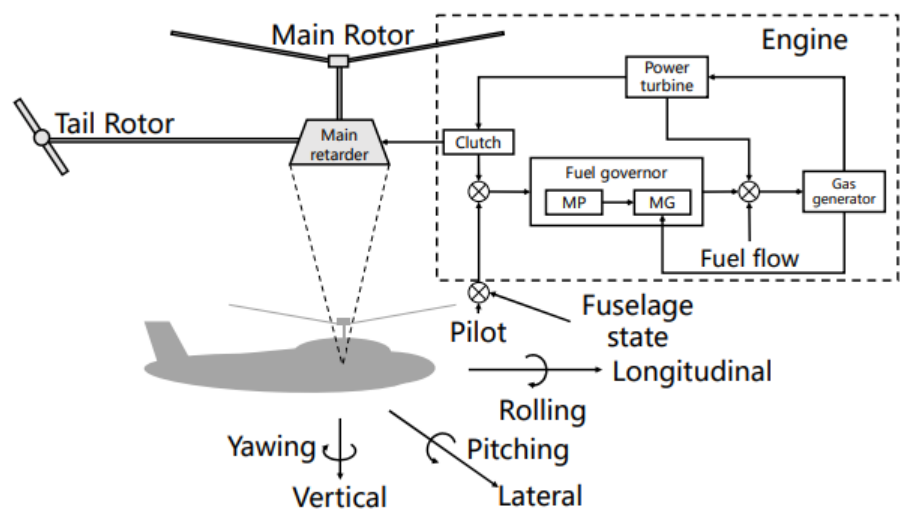
Figure 1 presents a schematic illustration of a single-engine light-duty helicopter, providing a visual reference for the type of aircraft analyzed in this study, while serving as the basis for applying the combined interval type-2 interval type-2 fuzzy AHP (IT2F-AHP)–VIKOR–TOPSIS methodology [78,79].
Figure 1.
Schematic illustration of a single-engine light-duty helicopter [78].
1.4. Related Works
This section summarizes the main MCDM methods used in the fields of aviation and transportation, along with related studies. The table provides a comparative overview of the development of classical and fuzzy approaches, the methods employed, and the key limitations identified in the existing literature.
The comparison in Table 3 highlights that although MCDM methods are widely used in aviation-related decision problems, most existing studies rely on either single-method approaches or basic fuzzy extensions. Classical AHP and TOPSIS approaches are frequently used, but they are limited in handling uncertainty. Even when fuzzy logic is applied, it is mostly restricted to type-1 fuzzy sets, which cannot fully capture the uncertainty present in emission data and expert judgments. Furthermore, hybrid combinations of AHP, VIKOR, and TOPSIS are rarely implemented within a single unified framework, and the use of interval type-2 fuzzy sets remains limited in aviation engine-level environmental studies. In particular, helicopter engine evaluation under different LTO cycle phases has not been sufficiently addressed in the literature. Therefore, the present study contributes to the literature by integrating interval type-2 fuzzy sets with AHP, VIKOR and TOPSIS in a single hybrid framework. This allows simultaneous handling of uncertainty, weighting of criteria, compromise ranking, and result validation, providing a more robust and reliable decision-making structure for helicopter engine environmental assessment.
Table 3.
Summary of related works in MCDM applications for aviation and transportation systems.
2. Materials and Methods
This study proposes a structured multi-criteria decision-making (MCDM) framework based on interval type-2 fuzzy sets (IT2FS) to evaluate the environmental performance of single-engine light utility helicopter engines under uncertainty. The proposed model integrates IT2FS with Analytic Hierarchy Process (AHP), VIKOR, and TOPSIS methods in a unified decision support structure.
2.1. İnterval Type-2 Fuzzy AHP (IT2F-AHP) Methodology for Determining Experts’ Weights for Criteria
Interval type-2 fuzzy AHP (IT2F-AHP) is a well organized approach for determining the criteria weights and for the justification of multi-criteria GDM problems using fuzzy set theory. DMs specify choices in the form of ordinary language and allocate them to the attribute chosen for the assessment of the decision problem. Ref. [59] employed AHP to solve complex multi-criteria GDM problems by breaking the hierarchical structure into simpler compositions. İnterval type-2 fuzzy AHP (IT2F-AHP) overcomes the limitation of qualitative criteria and solves the subjectivity, imprecision, and vagueness that are present in the decision problem to formulate the uncertainties associated with perceptions and preferences. The fuzzy linguistic and numerical preferences are normalized via these structural models in uncertain systems when DMs lack the necessary data. In the interval type-2 fuzzy AHP (IT2F-AHP) method, a judgmental matrix is established for pairwise comparison of criteria, then fuzzy arithmetic and aggregation operators are used to carry out the procedural calculations for determining the weights. In this study, interval type-2 fuzzy numbers (upper–lower membership functions)s were employed in order to enhance the degree of judgment and bring flexibility in decision-making. DMs specified their preferences in the form of natural language expressions instead of numerical values, which brought a large cogitation to specify the preferences and identify the thoughts in a more systematic way. Figure 1 shows the flow chart of this study and the decision-making procedure for energy systems selection. The determination of weights was carried out in the following steps. (1) The decision problem was hierarchically modeled, containing the goals. (2) The priorities for the weights of criteria were established by judging the pairwise comparisons. (3) The outcomes were synthesized by judging the overall priorities for the hierarchy. (4) The consistency of the judgments was examined. The overall methodology follows a systematic and structured workflow to ensure reproducibility and transparency. The process can be summarized as follows:
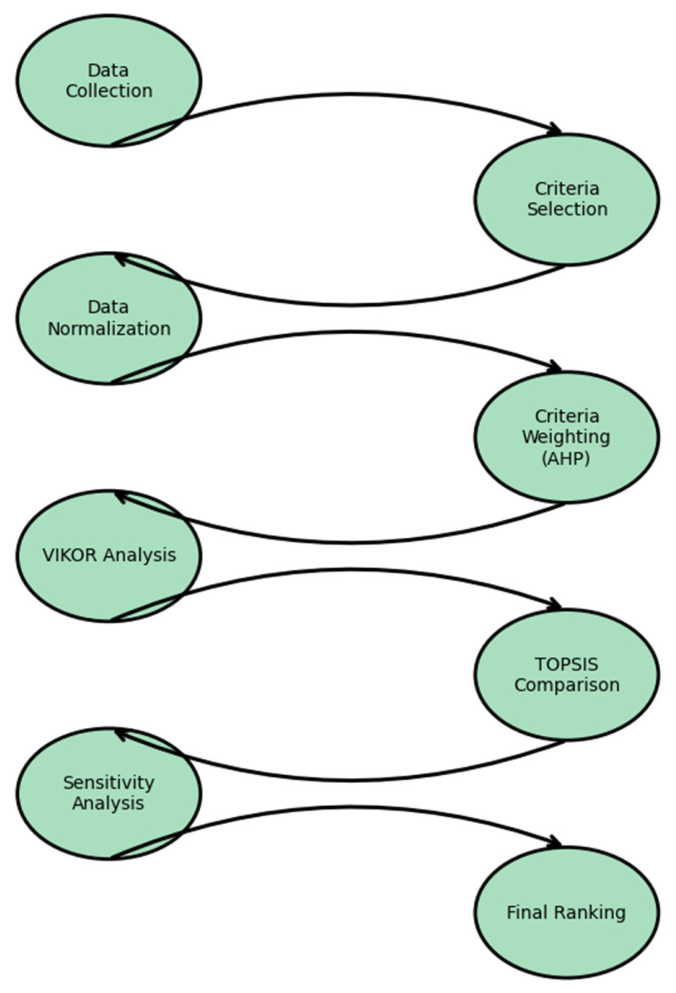
Figure 2 visually represents the systematic methodology followed in this study. The process consists of data collection, criteria selection, data normalization, criteria weighting using AHP, VIKOR analysis, TOPSIS comparison, and sensitivity analysis, leading to the final ranking. Data collection involves gathering essential information for 34 helicopter engines, including SHP, fuel flow, and emission values. During criteria selection, SHP is defined as a benefit criterion, whereas fuel flow and emissions (HC, CO, PM, NOx) are considered cost criteria. Data normalization ensures comparability among criteria with different measurement units. AHP is then applied to quantify the relative importance of each criterion numerically. Subsequently, VIKOR computes group utility (S), individual regret (R), and the compromise index (Q) to rank the engines. TOPSIS is used to validate the VIKOR rankings by measuring the proximity of engines to the ideal solution (CC), and sensitivity analysis examines the robustness of the model under changes in key criterion weights. This flowchart clearly demonstrates the step-by-step progression of the study, the integration of multiple methodologies, and the systematic approach for obtaining reliable and environmentally meaningful engine rankings in Table 4.
Figure 2.
Illustrates this step-by-step methodology flowchart.
Table 4.
Evaluation of fuzzy linguistic terms with fuzzy scores.
The helicopter engine characteristics were evaluated based on a set of criteria using expert judgment. A pairwise comparison approach was conducted, and the experts were first informed about the use of fuzzy linguistic terms in the comparison process. A group consensus is sought. Experts may disagree. In such cases, the majority decision can be used. Or the average of expert opinions can be taken. Averaging is a common method. It reflects the views of all decision makers. Max-min rules can also be applied. These are alternative aggregation methods. The criteria considered under helicopter engine characteristics (HC) were defined as follows: C1: shaft horsepower (SHP), C2: fuel flow (kg/s), C3: hydrocarbon emissions (HC), C4: carbon monoxide (CO), C5: particulate matter (PM), and C6: nitrogen oxides (NOx). The weight of each criterion was calculated by summing the allocated weights given in Table 4, and the collected expert opinions were averaged by dividing the total values by the number of experts. A total of twelve domain experts contributed to the evaluation, and their opinions were categorized under three main decision maker perspectives; since the experts came from different domains, the decision-making environment was considered non-homogeneous. The fuzzy extent analysis method [88] was employed to determine the interval type-2 fuzzy numbers (upper–lower membership functions), and Equation (1) was used for the calculation of the criteria weights.
where represents the weight assigned to the j-th criterion by the K-th expert. Table 5 presents the fuzzy evaluation matrix of the criteria, in which the weights are derived from the linguistic values provided in Table 6.
Table 5.
The pairwise comparisons of criteria for the assessment of helicopter engine characteristics.
Table 6.
Fuzzy evaluation matrix of criteria for the numerical weights.
In order to describe the membership functions, interval type-2 fuzzy numbers (upper–lower membership functions) (TFNs) are defined by a triplet of real numbers, (l, m, u), representing the lower, modal (mean), and upper values of the membership degree, respectively. Algebraic operations on TFNs can be expressed using fuzzy set theory; in particular, the inverse operation is given in Equation (2). Let AAA be an interval type-2 fuzzy number (upper–lower membership functions) such that A = (); the inverse of this set can be expressed as follows:
2.2. Data Collection and Preprocessing
The dataset includes 34 helicopter turboshaft engines classified according to ICAO standards. The selected emission indicators are consistent with internationally accepted aviation environmental assessment frameworks, particularly the ICAO Landing and Take-Off (LTO) cycle methodology. This study focuses exclusively on light single-engine helicopter engines in order to ensure data consistency and comparability across alternatives. Six criteria were selected to capture both performance and environmental impact in Table 7:
Table 7.
Evaluation criteria and types.
This study evaluates helicopter engines using six criteria to capture both performance and environmental considerations. Shaft horsepower (SHP) is treated as a benefit criterion since higher power output directly improves operational capability. In contrast, fuel flow, along with emissions such as hydrocarbon (HC), carbon monoxide (CO), particulate matter (PM), and nitrogen oxides (NOx), is considered a cost criterion because lower values indicate better environmental performance. This clear classification ensures that the evaluation framework rewards efficiency while discouraging high fuel consumption and pollutant emissions, thereby supporting a balanced Multi-Criteria Decision-Making (MCDM) approach. The operational emission ranges for the Landing and Take Off (LTO) cycle are adopted from internationally recognized aviation environmental assessment frameworks, particularly the ICAO Engine Emissions Databank and FOCA emission inventory methodology [86,89] as follows: HC ranges from 0.2 to 6 g/kg, CO from 5 to 60 g/kg, NOx from 6 to 15 g/kg, PM from 0.1 to 0.25 g/kg, and fuel flow from 0.01 to 0.035 kg/s.
These ranges provide a realistic reference for assessing engine performance under standard operating conditions. For illustration, engine A1 is characterized by the following values: SHP of 1800, fuel flow of 0.033 kg/s, HC emissions of 5.8 g/kg, CO emissions of 45 g/kg, PM emissions of 0.21 g/kg, and NOx emissions of 11 g/kg. All engine data are compiled in Table 8, which outlines the helicopter engine characteristics and serves as the primary dataset for the subsequent MCDM analysis. Shaft horsepower (SHP) represents the usable mechanical power delivered at the output shaft of a turboshaft engine. Since turboshaft engines operate based on gas turbine principles, SHP does not refer to piston motion but to the rotational power output used for helicopter propulsion. SHP is treated as a benefit criterion in this study because higher power output enhances operational capability and overall engine performance. Hydrocarbon emissions (HC), carbon monoxide (CO), particulate matter (PM), nitrogen oxides (NOx), and fuel flow are considered cost criteria, as lower values indicate improved environmental efficiency.
Table 8.
Helicopter engine characteristics.
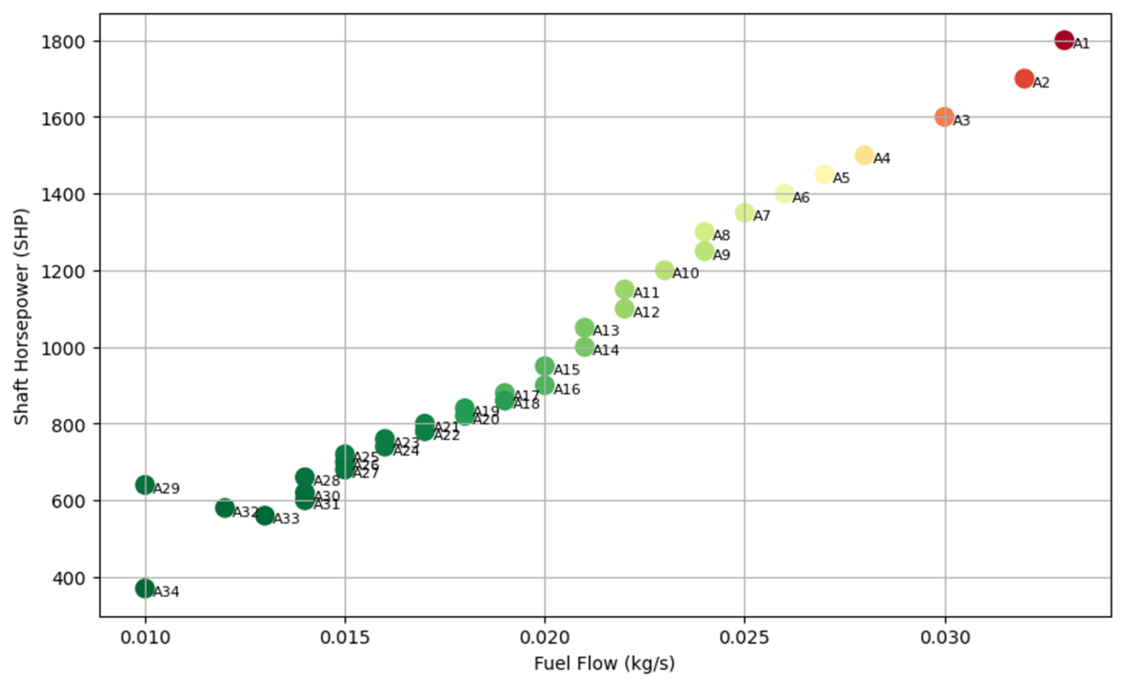
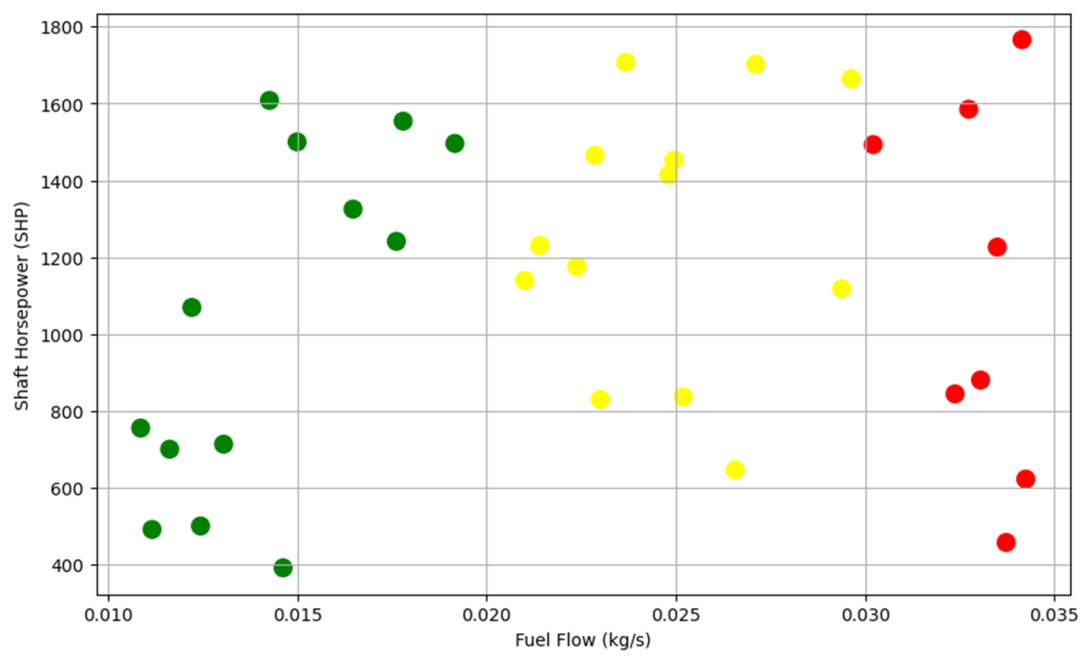
The engine performance and emission data presented in Table 8 are compiled from multiple validated sources to ensure reliability and traceability. The primary data source is the Federal Office of Civil Aviation (FOCA) database, which provides standardized and verified emission inventories for helicopter operations. Engine performance parameters such as shaft horsepower (SHP) and fuel flow are obtained from official manufacturer technical manuals and certified engine documentation. Where direct measurements are not available, values are estimated using ICAO Landing and Take-Off (LTO) cycle-based emission modeling procedures in accordance with FOCA-approved methodologies. SHP represents shaft horsepower, HC denotes hydrocarbon emissions, CO represents carbon monoxide, PM indicates particulate matter, and NOx refers to nitrogen oxides. Table 8 summarizes the operational and environmental characteristics of the 34 helicopter engines, including SHP, fuel flow, and emission indices (HC, CO, PM, and NOx). The dataset reveals significant variations in both performance and environmental impact across the engines. For instance, engines such as A1 and A2 provide high power outputs (1800 and 1700 SHP, respectively) but are associated with higher fuel consumption and increased emission levels, indicating greater environmental impact. In contrast, engines such as A34 and A29 operate at lower power levels (370 and 400 SHP) yet exhibit reduced fuel consumption and lower emissions, demonstrating higher environmental efficiency despite lower power output. Mid-range engines such as A6, A7, and A10 show more balanced characteristics, combining moderate SHP values with relatively controlled emission levels and may therefore be considered compromise alternatives. This trade-off between performance and fuel consumption is further illustrated in Figure 3, which shows the relationship between shaft horsepower (SHP) and fuel flow for all 34 helicopter engines. The figure clearly indicates that higher SHP values are generally associated with increased fuel flow, highlighting the inherent efficiency performance trade-off in helicopter engine operation.
Figure 3.
SHP vs. fuel flow for 34 helicopter engines.
Furthermore, the distribution of PM and NOx values indicates that many engines fall within close emission ranges, implying that even minor variations in these pollutants can significantly influence final rankings in a multi-criteria decision-making framework. Overall, Table 8 highlights the inherent trade-off between engine performance and environmental impact, where higher power output is generally associated with increased emissions. Only helicopter engines with complete datasets across all six evaluation criteria (SHP, fuel flow, HC, CO, PM, and NOx) and all LTO operational phases were included in the analysis. Engines with incomplete or inconsistent records were excluded to ensure data consistency and comparability across all alternatives. The relationship between shaft horsepower (SHP) and fuel flow is inherently non-linear due to the thermodynamic behavior of turboshaft engines operating under varying load conditions across different phases of the LTO cycle. In this study, this non-linearity is not assumed as a linear function but is implicitly captured through the normalization process and the multi-criteria decision-making structure. Since fuel flow increases disproportionately with higher SHP values, especially during takeoff and climb phases, the decision matrix reflects this variation through cost-based normalization and weighted aggregation. Furthermore, the integration of AHP-derived weights ensures that emission and fuel efficiency criteria are evaluated relative to their marginal impact rather than assuming linear proportionality. As a result, the proposed hybrid MCDM framework (IT2F-AHP–VIKOR–TOPSIS) effectively preserves the nonlinear interaction between performance and fuel consumption without requiring an explicit functional form.
The scatter plot illustrates the relationship between shaft horsepower (SHP) and fuel flow for the helicopter engines (Figure 3), with color coding indicating their environmental impact: green for low impact (low fuel consumption), yellow for moderate impact, and red for high impact (high fuel consumption). The figure highlights a clear trade-off between engine power and fuel efficiency. For instance, engines A1 and A2 deliver high SHP but exhibit high fuel consumption, positioning them in the red zone and indicating a greater environmental burden. In contrast, engines like A34 achieve moderate SHP while maintaining low fuel flow, placing them in the green zone and demonstrating more environmentally efficient performance. The distribution of points suggests that some engines can provide substantial power without a corresponding increase in fuel usage, revealing opportunities for optimizing engine design to balance performance and environmental sustainability. This pattern confirms the non-linear increase in fuel flow with respect to SHP under LTO operational conditions.
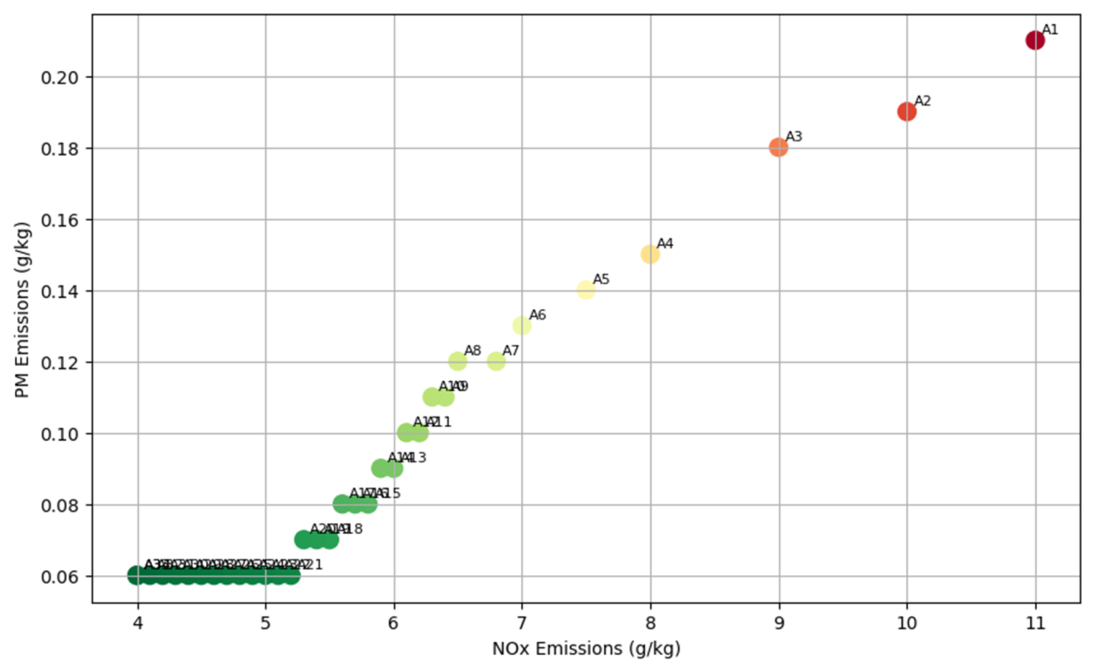
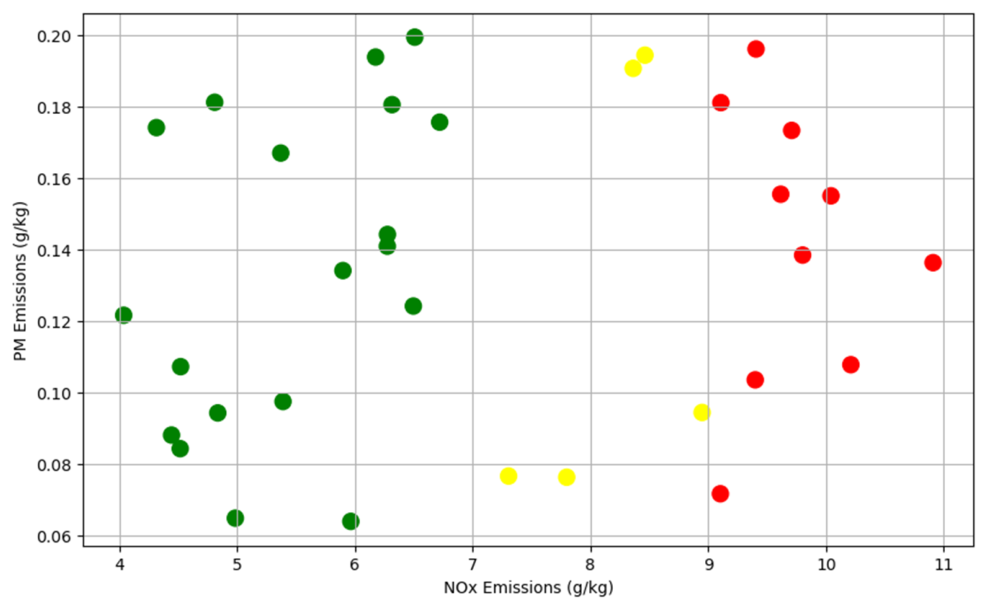
The scatter plot illustrates the relationship between nitrogen oxides (NOx) and particulate matter (PM) emissions across the helicopter engines, as shown in Figure 4, with color coding used to represent environmental impact levels: green for low emissions, yellow for moderate emissions, and red for high emissions. This representation provides a clear overview of how each engine performs in terms of its environmental footprint. From the visualization, engines such as A34 and A29 are located in the green zone, indicating that they produce relatively low levels of both NOx and PM. These engines can therefore be considered the most environmentally efficient among the dataset. On the other hand, engines like A1 and A2 appear in the red zone, reflecting higher emission values and a correspondingly greater environmental impact. The plot also shows that some engines exhibit low particulate matter emissions while maintaining comparatively higher NOx levels. This suggests that emission reduction efforts should particularly focus on controlling nitrogen oxides, as improvements in this area could significantly enhance overall environmental performance. The scatter plot serves as an effective visual tool for comparing engines and identifying those with lower environmental impact, thereby supporting more informed and sustainability-oriented decision-making.
Figure 4.
NOx vs. PM emissions for 34 helicopter engines.
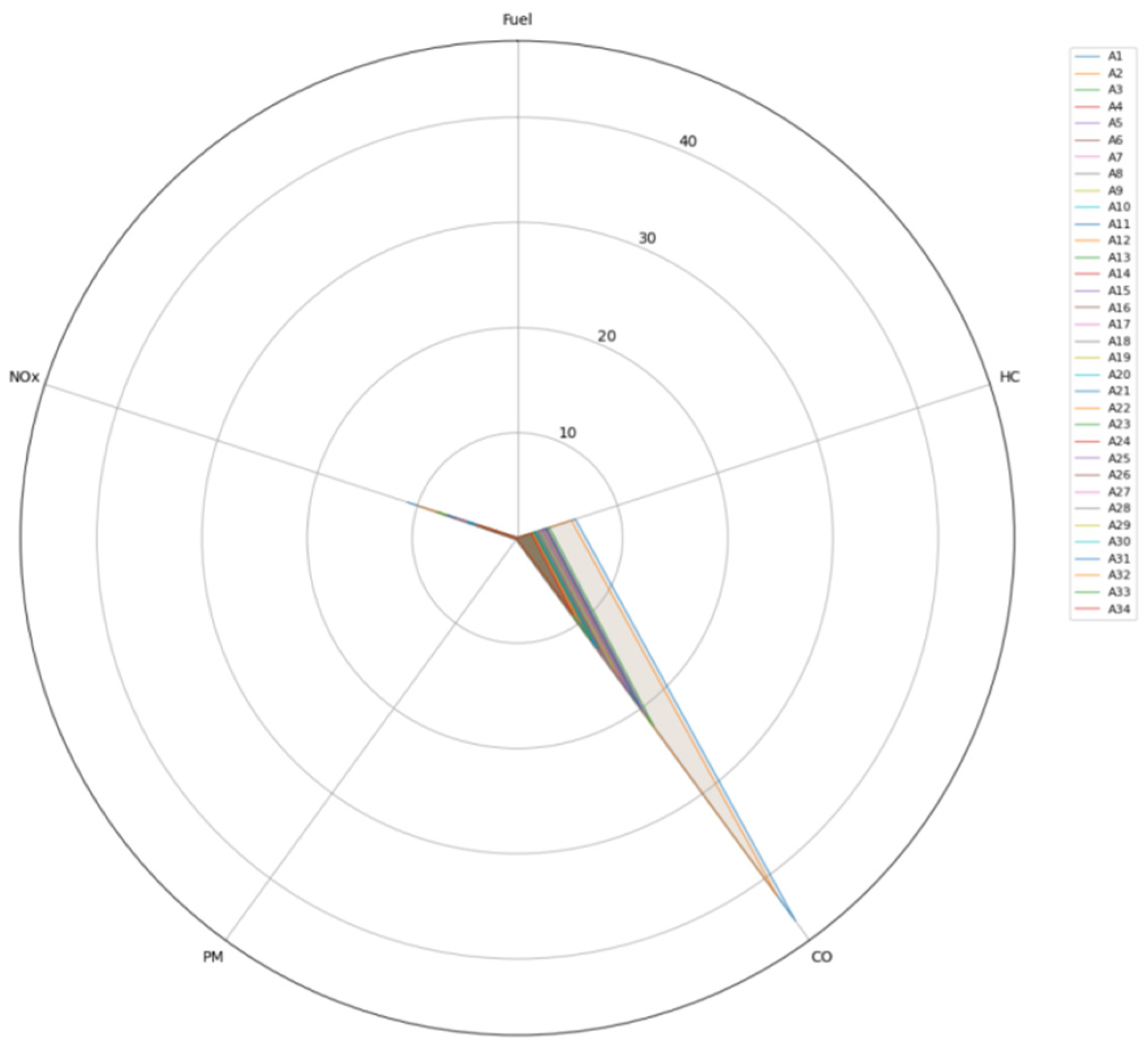
Figure 5 presents a radar chart illustrating the combined environmental performance of all 34 helicopter engines across six key criteria: shaft horsepower (SHP), fuel flow, hydrocarbon (HC), carbon monoxide (CO), particulate matter (PM), and nitrogen oxides (NOx). Each engine is represented by a polygon connecting its normalized values across these criteria, with polygons closer to the center indicating lower fuel consumption and emissions, and thus better environmental performance, while those extending outward reveal higher environmental impact. The chart shows that engines A34, A29, and A32 cluster near the center, forming compact green polygons, which reflects their balanced efficiency with low emissions and moderate power, making them the most environmentally friendly alternatives. In contrast, engines A1 and A2 stretch toward the outer edges, particularly along the fuel flow, HC, and CO axes, highlighting their high environmental burden due to elevated fuel use and emissions. Mid-range engines, such as A10, A15, and A20, occupy intermediate positions, performing reasonably in some criteria like PM or NOx but less efficiently in others, demonstrating trade-offs among the environmental indicators. This radar visualization complements the SHP vs. fuel flow scatter plot, which emphasizes that high engine power does not necessarily mean poor fuel efficiency, and the NOx vs. PM emissions plot, which identifies emission hotspots needing mitigation. Overall, the radar chart provides a holistic, at-a-glance comparison, allowing decision makers to quickly discern top-performing engines from low-performing ones, understand the influence of emissions and fuel consumption on environmental performance, and identify specific areas where improvements can be made for less efficient engines.
Figure 5.
Combined environmental index (Radar Chart).
2.3. Fahp Algorithm Based on Fuzzy Synthetic Extent Analysis
Let denote the set of alternatives, while represents the set of evaluation goals. Using Chang’s synthetic extent analysis approach [28], a separate extent value is computed for each goal with respect to every alternative. As a result, each alternative is associated with m synthetic extent values, which can be expressed through the following parameters:
where are represented as interval type-2 fuzzy numbers (upper–lower membership functions). The extent analysis procedure proposed by references [28] is outlined as follows:
Step 1: In this step, the fuzzy synthetic extent corresponding to the iii th object is determined. The aggregated fuzzy value is obtained by summing the mmm interval type-2 fuzzy numbers (upper–lower membership functions)s, expressed as , for the given matrix defined in Equation (3).
Equation (4) was used to calculate the fuzzy synthetic extent values, and the resulting outcomes are summarized in Table 9.
Table 9.
Calculated fuzzy synthetic extent values for the evaluation.
To determine the inverse matrix , the interval type-2 fuzzy numbers (upper–lower membership functions) are first accumulated. In this process, the minimum values are denoted by , the central values by and the maximum values by , which are then combined according to the corresponding decision criteria. This procedure yields the total aggregated results as specified in Equation (3). In order to obtain the inverse matrix , the values of are added such that the lowest values are indicated by , the middle values by and the upper values by that are all summed to the decision criteria of the consecutive value. Hence, the total values presented in Equation (6) are obtained:
and then, the inverse of the previous vector is obtained for the total values using Equations (7) and (8):
The inverse vector, calculated according to Equation (9), was employed to derive the fuzzy weights of the evaluation criteria. The resulting values are summarized in Table 10.
Table 10.
Derived fuzzy weights for the evaluation criteria of helicopter engine characteristics.
Step 2: Let us assume and are two TFNs, the degree of possibility of ≥ can be defined as given in Equation (10):
As defined in Equation (10), the degree of possibility within the fuzzy framework is expressed through three key components: the lower, middle, and upper bounds. These parameters collectively capture the uncertainty and variability present in the system. The lower bound represents the minimum feasible value, the middle bound corresponds to the most likely or representative value, while the upper bound defines the maximum potential value. To clarify this concept, sample calculations are provided to demonstrate how these bounds are obtained and interpreted in practical applications. These examples make it easier to understand how the degree of possibility is computed and how different fuzzy numbers respond under varying conditions. Furthermore, Table 11 compiles the calculated degrees of possibility for the convex fuzzy numbers considered in this study. This table offers a structured overview that supports comparison and facilitates analysis of the fuzzy values within the proposed model.
Table 11.
Degree possibility of convex fuzzy numbers for alternative energy systems.
Step 3: Using Equation (8), the likelihood that a convex fuzzy number exceeds each of the kkk convex fuzzy numbers (i = 1, 2, …, k) is determined.
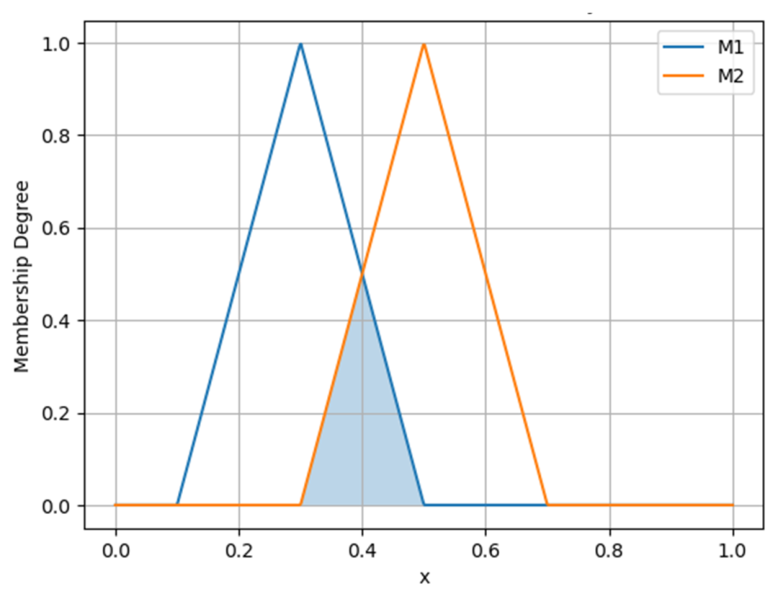
Let be defined as for all . Based on this definition, the corresponding weight vector can be expressed as W0, where each represents a different alternative energy system. Figure 6 illustrates the structure of Equation (6), where the parameter ddd denotes the maximum intersection point between the membership functions and , used for comparing the fuzzy numbers and . For a proper comparison of alternative energy systems, both and values need to be evaluated.
Figure 6.
The intersection between M1 and M2 convex fuzzy numbers.
Step 4: A normalization procedure is applied to obtain the normalized weight vector using Equation (14), where consists of non-fuzzy values.
The set of normalized weights was as follows: 0.3502, 02223, 0.1362, 0.2914, 0, 0, 0, 0, 0.
The Analytic Hierarchy Process (AHP) quantifies the relative importance of each criterion via pairwise comparisons. The resulting normalized weights are listed in Table 12.
Table 12.
AHP-based normalized weights.
The Consistency Ratio (CR) was calculated and found to be less than 0.1, confirming the reliability of the weightings. This ensures that the evaluation reflects the relative importance of environmental criteria rather than arbitrary assumptions. The Consistency Ratio (CR) in this study is derived from the defuzzified pairwise comparison matrix. First, the fuzzy comparison values are converted into crisp numbers, and the principal eigenvalue (λmax) of the matrix is computed. The Consistency Index (CI) is then calculated using , where n is the number of criteria. The CR is obtained by dividing CI by the Random Index (RI), as . If the CR value exceeds 0.1, the pairwise comparison matrix is revised by the decision makers to improve consistency; otherwise, the judgments are accepted as reliable. In this study, all CR values were found to be below the acceptable threshold, ensuring the consistency and reliability of the expert judgments.
2.4. Vikor Method for Compromise Ranking
Fuzzy VIKOR is a practical approach for solving multi-criteria group decision-making (GDM) problems, especially in situations where decision makers (DMs) cannot clearly express their preferences at the initial stage. The method aims to balance two main aspects: the collective satisfaction of the majority, represented by the group utility measure (Equation (11)), and the individual dissatisfaction of the worst case, represented by the regret measure (Equation (12)). By combining these two components, a compromise solution can be identified. In this study, the preferences of DMs are incorporated through interval type-2 fuzzy AHP (IT2F-AHP), where criteria weights are determined based on expert judgments. This allows the decision process to reflect a consensus built through negotiation and compromise. Additionally, heterogeneous fuzzy information is transformed into a unified structure using an extended VIKOR approach [60], ensuring consistency across different types of data. The fuzzy VIKOR method ranks alternatives based on a merit function, which is evaluated using a selected value that reflects the importance of group utility versus individual regret. This makes the approach flexible and adaptable to different decision contexts. Due to its robustness, fuzzy VIKOR is widely used in solving complex decision-making problems involving conflicting criteria. Fuzzy GDM methods have also been extended with various types of uncertainty modeling, including intuitionistic fuzzy sets [61], Pythagorean fuzzy sets [62,63], and hesitant linguistic approaches [64], making them applicable in many different domains. In this framework, the group of DMs identifies the positive ideal solution and the negative ideal solution for each criterion using Equation (15). Each alternative is then evaluated with respect to these reference points, and a final ranking is obtained by averaging the assessments. This process highlights alternatives that are closest to the ideal solution as summarized in Table 13.
Table 13.
VIKOR best/worst criterion values.
The maximum group utility and the individual regret are calculated using Equations (11) and (12), respectively. The VIKOR approach then establishes a compromise ranking of the alternatives by jointly considering both the group utility S and the regret value R, ensuring a balanced evaluation between collective and individual criteria.
Step 1: Determine best and worst values
Step 2: Compute S and R
Step 3: Compute Q
where .
Here represents the minimum value and represents the maximum value among the values, while and denote the minimum and maximum values of , respectively. The parameter is used as a weight to emphasize the strategy of achieving the highest group utility, whereas reflects the importance assigned to individual regret. In this context, the final decision is influenced by both the group utility and the minimum individual regret , following the majority rule. Typically, the value of is taken as 0.5, although it can vary within the range of 0 to 1 depending on the decision makers’ preferences. By ranking the alternatives according to the values of S, R, and Q in ascending order, three separate ranking lists are obtained, which provide a comprehensive evaluation of the alternatives. Assuming that an alternative achieves the lowest value of the merit function Q and meets the required conditions, it can be considered the best compromise solution. In general, an alternative can be selected as the top-ranked option based on the minimum Q value, provided that it satisfies the necessary conditions. This involves, first, evaluating all alternatives with respect to each criterion, and second, ranking them based on their closeness to the ideal solution using the fuzzy VIKOR approach, which is particularly useful for handling decision-making problems involving criteria with different units. The fuzzy linguistic terms and their corresponding fuzzy numbers used in this analysis are summarized in Table 14.
Table 14.
Fuzzy linguistic terms and corresponding fuzzy numbers.
The alternatives considered in this study were different helicopter engine types (A1–A34). The criteria set considered for the evaluation of helicopter engine characteristics are presented in Table 15.
Table 15.
The criteria considered for the evaluation of helicopter engine characteristics.
2.5. Topsis Method for Validation
Reference [65] introduced the fundamental concept of the TOPSIS method. Later, reference [66] applied the fuzzy TOPSIS approach to address group decision-making (GDM) problems in uncertain environments, including applications such as construction project risk assessment and compressor selection in the petrochemical sector [67]. In this study, the evaluations of decision makers (DMs) regarding the energy systems were collected and treated with equal importance in the decision process. A total of eight alternative energy systems were assessed based on nine different criteria. The fuzzy TOPSIS method was implemented through a series of structured steps.
Step 1: fuzzy linguistic terms given in Table 13 were utilized to aggregate the evaluation values. Equation (20) was applied to compute the average of fuzzy numerical values. Let N = {,,…,} represent the set of energy systems under consideration. At the initial stage, the DMs assigned fuzzy numerical ratings to each system according to the defined criteria. These ratings were then combined with the corresponding criteria weights by multiplying the decision matrix with the weights and summing the results to obtain an overall evaluation score for each alternative.
Here, represents the fuzzy values assigned by the k-th decision maker for each energy system with respect to the corresponding criteria. The symbol (+) denotes the fuzzy addition operation. Based on these values, the fuzzy decision matrix X = (e)nxm is constructed, where all elements are expressed in fuzzy numerical form. The set of criteria is treated as the decision parameters, incorporating both linguistic terms (xi) and their corresponding outcomes. In this context, (xi) denotes the membership function, which maps each criterion value to its associated fuzzy representation, allowing the integration of linguistic assessments into the fuzzy decision-making process.
Step 2: The normalization of data can guarantee that the decision matrix presents the range of normalized TFNs data in the interval of [0, 1]. The fuzzy decision matrix normalized, , is presented in Equations (21) and (22) for energy systems related to the corresponding criteria. In these two equations, B and C represent the benefit criteria and cost criteria set, respectively.
Equation (22) was used to compute the maximum value () for each energy system based on the evaluations provided by the decision makers. In addition, Equation (23) defines the normalized weighted fuzzy decision matrix, which converts the decision criteria into a standardized fuzzy scale within the interval [0, 1].
Thus, the fuzzy positive ideal solution (FPIS) and the fuzzy negative ideal solution (FNIS) are represented as and , respectively, as defined in Equations (19) and (20).
Normalization serves as a defuzzification step that transforms the decision matrix and allows the distance of each energy system from the ideal solution to be determined. In practice, an alternative may lie either closer to or farther from the ideal value on both sides. If the fuzzy positive ideal solution (FPIS) is denoted as and the fuzzy negative ideal solution (FNIS) as , then the vertex method can be applied to compute the distance between two interval type-2 fuzzy numbers (upper–lower membership functions) (TFNs). Accordingly, the fuzzy positive-ideal distance and the fuzzy negative ideal distance for the helicopter engine characteristics are calculated using Equations (24) and (25), respectively.
Helicopter engine characteristics helicopter engine characteristics , where
The distance terms and are used to measure how far each alternative is from the fuzzy positive and negative ideal solutions, and they are essential for calculating the closeness coefficient . This coefficient is then used to establish the ranking of the energy systems. In Equation (24), the closeness coefficient for each alternative is determined by considering both the distance to the fuzzy positive ideal solution (FPIS) and the fuzzy negative ideal solution (FNIS). These distances are derived from the FPI distances and the FNI distances of the helicopter engine characteristics. By combining these measures, the overall proximity of each energy system to the ideal solution is obtained, allowing the alternatives to be ranked accordingly. The most suitable energy system is selected from among the nine alternatives based on this ranking for investment purposes. In this study, the TOPSIS method is used as a validation technique to support the results obtained from the VIKOR analysis. The method starts by identifying the ideal solution and the negative ideal solution , which represent the best and worst values across all criteria. Then, the Euclidean distances of each alternative from these reference points are calculated as , (distance to the ideal solution) and , (distance to the negative-ideal solution). Using these distances, the closeness coefficient is computed for each alternative, indicating how close it is to the ideal solution and how far it is from the worst case scenario. This approach allows TOPSIS to provide a clear and reliable ranking of alternatives, making it an effective tool for validating the results of the overall decision-making process.
Higher indicates proximity to the ideal solution. This cross-validation confirms the reliability of the rankings.
2.6. Sensitivity Analysis
To test the robustness of the model, the weight of the NOx criterion was increased from 0.15 to 0.25. Ranking changes were minor, confirming that the model is insensitive to moderate weight variations. This demonstrates that the proposed methodology provides reliable and stable rankings. In addition, a full-phase sensitivity analysis was performed by varying the weights of all criteria (SHP, fuel flow, HC, CO, PM, and NOx) within a defined range to evaluate the stability of the ranking results.
2.6.1. Data Visualization
Figure 7 illustrates the relationship between shaft horsepower (SHP) and fuel flow for the 34 helicopter engines. The x-axis represents fuel flow (kg/s), and the y-axis represents SHP. Colors indicate environmental performance, with green for low impact, yellow for moderate impact, and red for high environmental impact. The graph highlights the balance between engine performance and environmental efficiency. Some engines achieve high SHP but have high fuel consumption, appearing in the red zone and indicating significant environmental impact. Conversely, engines with low fuel flow and moderate to high SHP are positioned in the green zone, reflecting both performance and environmental efficiency. Notably, fuel flow does not show a strictly linear relationship with SHP, indicating that some engines can maintain high power while remaining fuel efficient. This visualization allows decision makers to quickly identify engines that achieve an optimal balance between power and environmental sustainability.
Figure 7.
Distribution of SHP vs. fuel flow for 34 engines (green = low environmental impact, red = high) and NOx vs. PM emissions for 34 helicopter engines.
These visualizations help to identify high-performing engines (low emissions, low fuel consumption) versus low-performing engines. Figure 8 compares NOx and particulate matter (PM) emissions for the 34 helicopter engines, with the x-axis representing NOx emissions (g/kg) and the y-axis representing PM emissions (g/kg). Color coding categorizes environmental performance, where green indicates low-emission engines, yellow indicates moderate emissions, and red indicates high-emission engines. The plot provides a direct visualization of environmental efficiency based on emissions. Green engines exhibit low levels of both NOx and PM, representing environmentally friendly options, while red engines with high emissions pose higher environmental and health risks. Some engines have low PM but high NOx, showing that performance in a single emission criterion does not guarantee overall environmental efficiency. This figure is particularly useful for identifying which engines should be prioritized for emission reduction strategies and environmental regulation compliance.
Figure 8.
NOx vs. PM emissions for 34 helicopter engines and emission index clustering for NOx and PM.
2.6.2. Full-Phase Sensitivity Analysis
To further evaluate the robustness and stability of the proposed model, a full-phase sensitivity analysis was conducted by systematically varying the weights of all evaluation criteria, including shaft horsepower (SHP), fuel flow, hydrocarbon (HC), carbon monoxide (CO), particulate matter (PM), and nitrogen oxides (NOx). Each criterion weight was individually increased and decreased within a predefined range while preserving the normalization condition of the decision matrix.
The resulting changes in alternative rankings were analyzed and compared with the baseline scenario obtained from the original weight configuration. The analysis reveals that the proposed hybrid MCDM framework demonstrates strong stability characteristics under varying weight conditions. Specifically, the top-ranked engines (A34, A29, A32) consistently maintain their positions across all tested scenarios, while the lowest-performing engines (A1 and A2) also remain unchanged. This indicates that both extreme ends of the ranking spectrum are highly robust against changes in decision maker preferences.
In contrast, only minor rank fluctuations are observed among mid-ranked alternatives, reflecting moderate sensitivity to local variations in specific criteria weights. However, these variations do not affect the overall ranking structure or compromise the identification of best and worst alternatives. Therefore, the proposed model provides reliable and consistent decision outcomes even under full phase uncertainty conditions.
The results presented in Table 16 clearly indicate that the proposed decision-making framework exhibits high robustness under full phase sensitivity conditions. Although individual variations in criterion weights lead to minor shifts in mid-ranked alternatives, the overall ranking structure remains highly stable. In particular, the top three alternatives (A34, A29, A32) consistently retain their superior positions across all scenarios, demonstrating strong resilience against changes in environmental weighting assumptions. Similarly, the lowest performing alternatives (A1 and A2) remain unchanged, confirming the stability of extreme ranking positions. This stability suggests that the decision model is not dominated by any single criterion but instead reflects a balanced integration of all environmental and performance factors. The observed robustness further supports the reliability and practical applicability of the proposed hybrid IT2F-AHP–VIKOR–TOPSIS framework for sustainable helicopter engine evaluation under uncertainty.
Table 16.
Full sensitivity analysis summary.
3. Results
In this study, the environmental performance of 34 helicopter engines was evaluated using a hybrid multi-criteria decision-making framework integrating VIKOR and TOPSIS methods. The results obtained from both approaches are presented in Table 17 through the VIKOR-based S (group utility), R (individual regret), Q (compromise index) values and the TOPSIS-based closeness coefficient (CC). A consistent ranking pattern is observed across both methods, indicating a strong agreement between VIKOR and TOPSIS outcomes. In general, engines with lower fuel consumption and emission levels achieve superior environmental performance, whereas high power engines tend to exhibit lower efficiency due to increased fuel use and emission outputs. This consistent behavior across both methods confirms the robustness and reliability of the proposed hybrid framework and highlights that environmental performance is primarily influenced by emission-related criteria rather than engine power alone.
Table 17.
VIKOR and TOPSIS results for helicopter engines.
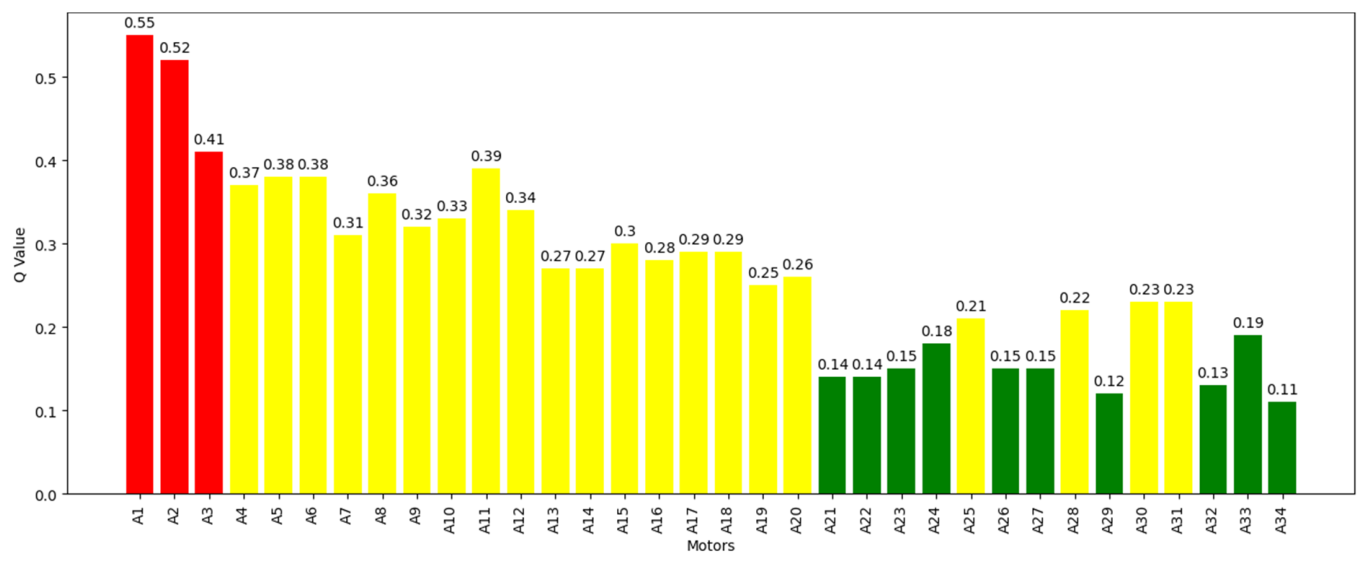
To resolve potential ranking ambiguities observed in Table 15, a strict tie-breaking rule based on the Closeness Coefficient (CC) values is applied. In cases where alternatives exhibit identical or very close S, R, and Q values, priority is given to higher CC values. This ensures a unique and consistent ranking order across all 34 helicopter engine alternatives, eliminating duplicate rank positions and ensuring full comparability of the results. The results presented in Table 15 reveal a clear differentiation among the helicopter engines in terms of environmental performance. Engines A34, A29, and A32 exhibit the lowest Q values, indicating superior environmental performance, whereas A1 and A2 demonstrate the highest Q values, reflecting poor environmental characteristics due to high fuel consumption and emission levels. To better visualize these differences, the distribution of Q values is presented in Figure 9.
Figure 9.
Distribution of VIKOR Q values for helicopter engines.
Figure 9 presents a bar chart illustrating the distribution of Q values for all 34 helicopter engines, where color coding enhances interpretation: green bars indicate low environmental impact, yellow represents moderate performance, and red highlights high environmental impact. The figure clearly demonstrates that environmental performance is not uniformly distributed across the alternatives. A distinct separation can be observed, with a small group of engines, particularly A34 (Q = 0.11), A29 (Q = 0.12), and A32 (Q = 0.13), clustered at the lower end of the Q scale, indicating superior environmental performance due to their low fuel consumption (approximately 0.010 kg/s) and reduced emission levels. In contrast, engines such as A1 (Q = 0.55) and A2 (Q = 0.52) are positioned at the upper end, reflecting significantly higher environmental impact driven by greater fuel flow and emission indices despite their high shaft horsepower (SHP). The approximate gap of 0.44 between the best and worst Q values highlights a substantial difference in environmental performance among the engines. Furthermore, the results reveal that engines with lower SHP generally achieve better environmental outcomes, while high-power engines tend to impose greater environmental burdens. This indicates that emission-related criteria, particularly NOx, PM and fuel consumption, play a more decisive role in determining environmental performance than engine power alone. Overall, the figure provides a clear and comprehensive visualization of engine rankings and confirms the effectiveness of the VIKOR method in distinguishing environmentally efficient alternatives. TOPSIS is used as a validation tool rather than an additional ranking method, since it provides a fundamentally different distance-based perspective compared to the compromise-based logic of VIKOR. This dual-method comparison is considered sufficient in MCDM literature for robustness assessment when strong agreement between methods is observed. To further verify the robustness of these findings, a comparison with TOPSIS results is presented in Figure 10. Additionally, a full-phase sensitivity analysis considering all evaluation criteria was conducted, and the results confirmed the stability of the proposed ranking structure. The obtained ranking results can also be interpreted as a decision-support indicator for environmental compliance assessment in aviation systems.
Figure 10.
TOPSIS closeness coefficient distribution.
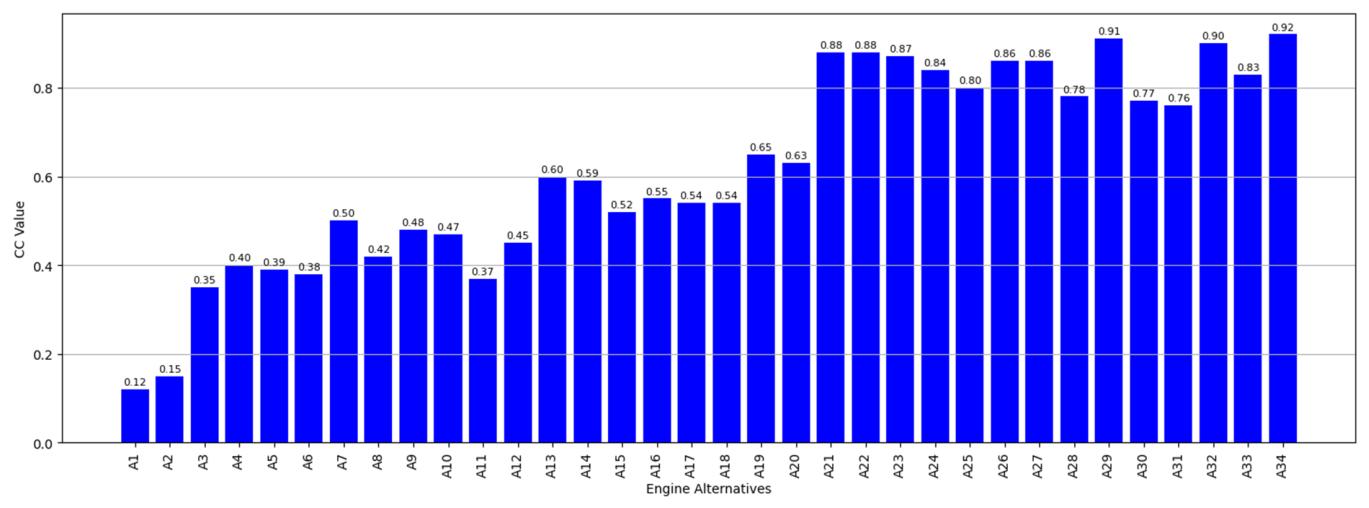
Figure 10 presents a bar chart illustrating the TOPSIS closeness coefficient (CC) values for all 34 helicopter engines, where higher CC values indicate better environmental performance. The distribution of CC values closely mirrors the VIKOR Q-value rankings, reinforcing the reliability and consistency of the hybrid MCDM approach. Engines such as A34 (CC = 0.92), A29 (CC = 0.91), and A32 (CC = 0.90) occupy the upper end of the chart, demonstrating their proximity to the ideal solution and confirming their superior environmental performance. In contrast, engines like A1 (CC = 0.12) and A2 (CC = 0.15) are located near the bottom, highlighting their distance from the ideal solution and poor environmental performance. The strong alignment between VIKOR and TOPSIS rankings reduces uncertainty in decision-making and validates the robustness of the proposed framework. This consistency also underscores the effectiveness of integrating interval type-2 fuzzy sets with AHP, VIKOR and TOPSIS in providing a comprehensive and reliable evaluation of helicopter engine environmental performance. Further insights into the ranking behavior of all alternatives are provided by the ranking curve shown in Figure 11.
Figure 11.
Ranking curve of Q values.
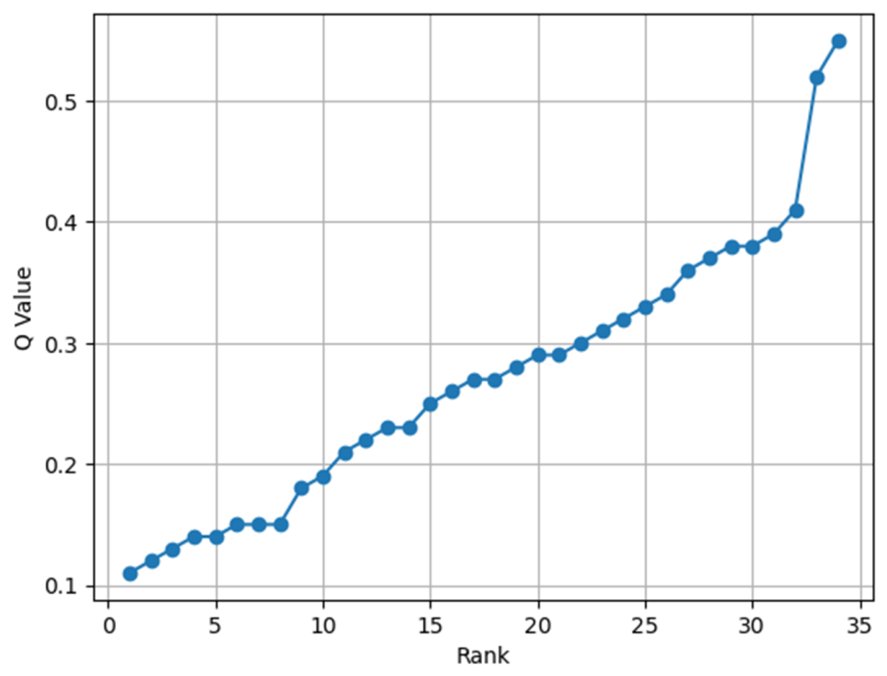
Line graph showing sorted Q values from best to worst. Figure 11 illustrates the ranking curve based on Q values, providing insight into the distribution of environmental performance across all alternatives. The curve shows a relatively flat trend among the top-ranked engines, indicating similar environmental characteristics. However, as the ranking progresses, the curve becomes steeper, reflecting increasing differences in environmental performance. This behavior suggests that while top-performing engines are closely competitive, lower-ranked engines exhibit significantly poorer environmental characteristics. The non-linear shape of the curve indicates the presence of threshold effects in emission performance. Figure 11 reveals a non-linear distribution of environmental performance across the alternatives. The curve remains relatively flat among the top-ranked engines, indicating that these alternatives have similar environmental characteristics. However, as the ranking progresses, the curve becomes steeper, reflecting increasing differences in environmental performance. This behavior suggests that environmental performance is influenced by threshold effects, where small increases in emissions can lead to disproportionately large changes in ranking. To further evaluate the robustness of the proposed model, a sensitivity analysis was conducted by modifying the weight of the NOx criterion. The results are presented in Table 18.
Table 18.
Sensitivity analysis results.
Table 18 presents the results of the sensitivity analysis conducted by increasing the weight of the NOx criterion. The results indicate that the ranking of the helicopter engines remains largely stable despite the change in criteria weights. Specifically, the top-performing engines, including A34 and A29, maintain their positions as the first and second-ranked alternatives, respectively. Similarly, the lowest performing engines, such as A1 and A2, remain unchanged at the bottom of the ranking. Only minor changes are observed among mid-ranked alternatives. For instance, A21 improves from rank 4 to rank 3, while A32 drops slightly from rank 3 to rank 4. These small variations indicate that certain engines are sensitive to NOx emissions; however, the overall ranking structure remains consistent. The limited changes in ranking demonstrate that the proposed decision-making framework is robust and reliable. The stability of both top and bottom alternatives suggests that the model is not significantly affected by moderate variations in criteria weights, thereby reinforcing the validity of the obtained results. The sensitivity analysis results indicate that the top-performing engines maintain their positions even when the criteria weights are altered. Similarly, the lowest-ranked engines remain unchanged. Only minor variations are observed among mid-ranked alternatives. This confirms that the proposed model is highly stable and robust against changes in decision maker preferences. Overall, the findings of this study demonstrate that emission-related criteria, particularly NOx, PM, and fuel consumption, are the most critical factors in determining the environmental performance of helicopter engines. The results also highlight that higher engine power does not necessarily correspond to better environmental performance. The integration of VIKOR and TOPSIS methods provides a comprehensive evaluation framework that combines compromise ranking with distance-based validation. This hybrid approach enhances the reliability of the results and offers a practical decision support tool for environmentally sustainable helicopter engine selection.
4. Discussion
The integration of AHP, VIKOR, and TOPSIS within a hybrid MCDM framework offers significant advantages in evaluating the environmental performance of helicopter engines. AHP provides a structured and systematic approach for determining the relative importance of criteria through pairwise comparisons, ensuring consistency in decision-making [90,91]. VIKOR contributes by generating a compromise ranking that reflects a balance among conflicting criteria, making it particularly suitable for problems involving trade-offs between performance and environmental impact [25,92]. TOPSIS, on the other hand, strengthens the analysis by validating the ranking results through geometric distance from ideal and negative-ideal solutions, thereby enhancing the reliability of the outcomes [93,94]. Compared to traditional single-method approaches commonly used in earlier studies, this integrated framework demonstrates higher accuracy, improved robustness, and reduced uncertainty in the evaluation process [95,96]. Previous research in the literature has often relied on individual MCDM techniques such as AHP or TOPSIS alone, which may lead to biased or less stable results due to their methodological limitations, particularly in handling ambiguity and complex datasets [97,98]. By combining these methods with interval type-2 fuzzy sets, the proposed approach effectively addresses uncertainty in expert judgments and data variability, which is a limitation frequently highlighted in earlier studies [99,100]. Furthermore, while many existing studies focus on aircraft emissions or general aviation sustainability, the application of hybrid MCDM methods specifically to helicopter engine environmental performance remains relatively limited [101]. In this context, the present study contributes to the literature by introducing a comprehensive and practical evaluation framework tailored to helicopter engines, incorporating both performance and emission-based criteria. The findings emphasize that fuel efficiency and emission reduction play a more critical role than engine power alone, aligning with recent studies that highlight the importance of sustainable design in aviation systems [93,94]. Overall, the proposed hybrid approach not only advances methodological rigor but also provides valuable insights for decision makers aiming to promote environmentally responsible helicopter operations [102]. Additionally, the model demonstrates stable ranking behavior under full phase sensitivity analysis involving all criteria, further confirming its robustness and reliability in multi-criteria decision-making environments. The use of TOPSIS as a secondary validation method ensures cross-method consistency between a compromise-based (VIKOR) and a distance-based (TOPSIS) approach, which is widely accepted in MCDM studies for robustness verification. The combination of VIKOR and TOPSIS provides sufficient cross-validation by integrating two fundamentally different decision paradigms (compromise and distance-based), ensuring robustness of the results.
From a practical perspective, the proposed framework can support regulatory and certification processes in helicopter engine assessment. The derived environmental performance rankings can be used as a supplementary decision-support tool for aviation authorities such as ICAO or EASA during the evaluation of engine environmental compliance. In particular, the integration of emission-based criteria (NOx, CO, HC, PM) aligns with current international aviation emission standards and can assist in comparative assessment of engine technologies. Although the model does not replace formal certification procedures, it provides a structured and transparent decision support system that can help identify environmentally superior engine alternatives and guide policy-oriented decision-making. The proposed model can serve as a decision-support tool for aviation regulatory bodies in evaluating the environmental performance of helicopter engines in alignment with ICAO emission considerations. It is also important to emphasize that the proposed findings are specific to light single-engine helicopter systems and may not directly apply to multi-engine or heavy helicopter configurations due to differences in engine architecture and operational conditions.
The emission criteria used in this study (HC, CO, PM, and NOx) are consistent with internationally recognized aviation environmental assessment frameworks, particularly the ICAO Landing and Take-Off (LTO) cycle standards defined in ICAO Annex 16 [103], Volume II and FAA [98] aircraft engine emission certification procedures [104]. Therefore, although a direct numerical benchmarking with country-specific regulatory thresholds is not performed in this study, the selected indicators ensure compatibility with global aviation environmental assessment principles.
5. Conclusions
This study evaluates the environmental performance of 34 single-engine light utility helicopter engines using a hybrid multi-criteria decision-making (MCDM) framework that combines AHP, VIKOR, and TOPSIS methods. The assessment is based on six key criteria: shaft horsepower (SHP), fuel flow, hydrocarbon (HC), carbon monoxide (CO), particulate matter (PM), and nitrogen oxides (NOx), allowing both performance and environmental impacts to be considered simultaneously. The relative importance of these criteria was determined using AHP, while VIKOR was applied to obtain a compromise ranking of the engines. The results were further validated through TOPSIS, ensuring consistency and reliability. The findings show that the HUGHES 500 (DDA250-C18, corresponding to A34), HUGHES 501 (DDA250-C20B, A29), and BELL 206B-1 (DDA250-C20, A32) stand out as the most environmentally efficient engines, mainly due to their low fuel consumption and reduced emission levels. In contrast, the K-1200 helicopter equipped with the T53 17A-1 engine (A1) and the BELL UH-1H with the T53 L13 engine (A2) perform the worst, exhibiting high fuel flow and significantly higher emission levels. Sensitivity analysis indicates that changes in criteria weights, particularly NOx, have only a limited impact on the overall ranking, confirming the stability of the model. Overall, the results suggest that environmental performance is driven primarily by emission levels and fuel efficiency rather than engine power. The strong agreement between VIKOR and TOPSIS rankings further supports the robustness of the proposed approach. This study provides a practical and reliable decision-support tool for selecting environmentally efficient helicopter engines and offers valuable insights for improving sustainability in aviation. Although only TOPSIS was used for validation in this study, the strong consistency between VIKOR and TOPSIS results indicates high robustness. Future studies may incorporate additional MCDM methods, such as PROMETHEE or ELECTRE, to further extend comparative analysis. The proposed hybrid MCDM framework can further contribute to real-world aviation applications by providing a structured decision-support tool for environmental evaluation of helicopter engines. Although it does not replace formal certification processes, it can assist regulatory bodies and policymakers in comparative assessment and in identifying environmentally sustainable engine alternatives. It should be clearly noted that the scope of this study is limited to light single-engine helicopter engines. Therefore, the obtained results and rankings cannot be directly generalized to heavy or multi-engine helicopter systems due to differences in operational complexity, engine configuration, and performance characteristics. The proposed model is specifically designed for comparative environmental assessment within the defined dataset and should be interpreted accordingly. The study is limited to light single-engine helicopters and results are not directly transferable to heavy or multi-engine systems. Future research may extend this study by incorporating direct comparisons with ICAO and FAA regulatory thresholds or by applying the proposed framework to country-specific datasets to further enhance its policy relevance and practical applicability.
Author Contributions
Methodology, F.Ş., G.Ş., A.K. and E.A.; Formal analysis, F.Ş., G.Ş., A.K. and E.A.; Investigation, F.Ş., G.Ş., A.K. and E.A.; Writing—original draft, F.Ş., G.Ş., A.K. and E.A.; Writing—review & editing, G.Ş. All authors have read and agreed to the published version of the manuscript.
Funding
This research received no external funding.
Institutional Review Board Statement
Not applicable.
Informed Consent Statement
Not applicable.
Data Availability Statement
The data used in the publication were obtained from meteorology data made available by KNMI.
Conflicts of Interest
The author Gökhan Şahin was the Energy Advisor in the Municipality of Dronten. The remaining authors declare that the research was conducted in the absence of any commercial or financial relationships that could be construed as a potential conflict of interest.
References
- Alkaya, E.; Bogurcu, M.; Ulutas, F.; Demirer, G.N. Adaptation to Climate Change in Industry: Improving Resource Efficiency through Sustainable Production Applications. Water Environ. Res. 2015, 87, 14–25. [Google Scholar] [CrossRef] [Scilit] [PubMed]
- Anderson, J.O.; Thundiyil, J.G.; Stolbach, A. Clearing the Air: A Review of the Effects of Particulate Matter Air Pollution on Human Health. J. Med. Toxicol. 2012, 8, 166–175. [Google Scholar] [CrossRef] [Scilit]
- Chen, S.-M.; Lee, L.-W. Fuzzy multiple attributes group decision-making based on the ranking values and the arithmetic operations of interval type-2 fuzzy sets. Expert Syst. Appl. 2010, 37, 824–833. [Google Scholar] [CrossRef] [Scilit]
- Cheng, S.; Fan, W.; Chen, J.; Meng, F.; Liu, G.; Song, M.; Yang, Z. The impact of fiscal decentralization on CO2 emissions in China. Energy 2020, 192, 116685. [Google Scholar] [CrossRef] [Scilit]
- Li, Y.; Chiu, Y.H.; Lin, T.Y. Research on new and traditional energy sources in OECD countries. Int. J. Environ. Res. Public Health 2019, 16, 1122. [Google Scholar] [CrossRef] [Scilit] [PubMed]
- Chłopek, Z. A Correlation Analysis of the Pollutant Emission from a Self Ignition Engine. Combust. Engines 2010, 140, 25–31. [Google Scholar] [CrossRef] [Scilit]
- Cederberg, C.; Persson, U.M.; Schmidt, S.; Hedenus, F.; Wood, R. Beyond the borders—Burdens of Swedish food consumption due to agrochemicals, greenhouse gases and land-use change. J. Clean. Prod. 2019, 214, 644–652. [Google Scholar] [CrossRef] [Scilit]
- Perera, F.P. Pollution from fossil-fuel combustion is the leading environmental threat to global pediatric health and equity: Solutions exist. Int. J. Environ. Res. Public Health 2018, 15, 16. [Google Scholar] [CrossRef] [Scilit]
- Grampella, M.P.; Martini, G.; Scotti, D.; Zambon, G. The factors affecting pollution and noise environmental costs of the current aircraft fleet: An econometric analysis. Transp. Res. Part A 2016, 92, 310–325. [Google Scholar] [CrossRef] [Scilit]
- Hagras, H. Type-2 flcs: A new generation of fuzzy controllers. IEEE Comput. Intell. Mag. 2007, 2, 30–43. [Google Scholar] [CrossRef] [Scilit]
- Seyfried, C.; Palko, H.; Dubbs, L. Potential local environmental impacts of salinity gradient energy: A review. Renew. Sustain. Energy Rev. 2019, 102, 111–120. [Google Scholar] [CrossRef] [Scilit]
- Demirbas, A.; Taylan, O.; Kaya, D. Biogas production from municipal sewage sludge (MSS). Energy Sources Part A Recovery Util. Environ. Eff. 2016, 38, 3027–3033. [Google Scholar] [CrossRef] [Scilit]
- Taylan, O.; Kaya, D.; Bakhsh, A.A.; Demirbas, A. Bioenergy life cycle assessment and management in energy generation. Energy Explor. Exploit. 2017, 36, 166–181. [Google Scholar] [CrossRef] [Scilit]
- Holmes, C.D.; Prather, M.J.; Sovde, O.A.; Mythre, G. Future methane, hydroxyl, and their uncertaines: Key climate and emission parameters for future predictions. Atmos. Chem. Phys. 2013, 13, 285–302. [Google Scholar] [CrossRef] [Scilit]
- Rahman, S.M.; Khondaker, A.N. Mitigation measures to reduce greenhouse gas emissions and enhance carbon capture and storage in Saudi Arabia. Renew. Sustain. Energy Rev. 2012, 16, 2446–2460. [Google Scholar] [CrossRef] [Scilit]
- Kinsey, J.S.; Dong, Y.; Williams, D.C.; Logan, R. Physical characterization of the fine particle emissions from commercial aircraft engines during the Aircraft Particle Emissions eXperiment (APEX) 1–3. Atmos. Environ. 2010, 44, 2147–2156. [Google Scholar] [CrossRef] [Scilit]
- Kjellstrom, E.; Feichter, J.; Sausen, R.; Hein, R. The contribution of aircraft emissions to the atmospheric sulfur budget. Atmos. Environ. 1999, 33, 3455–3465. [Google Scholar] [CrossRef] [Scilit]
- Chapman, A.J.; McLellan, B.C.; Tezuka, T. Prioritizing mitigation efforts considering co-benefits, equity and energy justice: Fossil fuel to renewable energy transition pathways. Appl. Energy 2018, 219, 187–198. [Google Scholar] [CrossRef] [Scilit]
- Klapmeyer, M.E.; Marr, L.C. CO2, NOx, and particle emissions from aircraft and support activities at a regional airport. Environ. Sci. Technol. 2012, 46, 10974–10981. [Google Scholar] [CrossRef] [Scilit] [PubMed]
- Perez, I.J.; Cabrerizo, F.J.; Alonso, S.; Dong, C.; Chiclana, F.; Herrera-Viedma, E. On dynamic consensus processes in group decision making problems. Inf. Sci. 2018, 459, 20–35. [Google Scholar] [CrossRef] [Scilit]
- Kováčiková, K.; Novák, A.; Novák Sedláčková, A.; Kováčiková, M. The Environmental Consequences of Engine Emissions in Air and Road Transport. Atmosphere 2024, 15, 903. [Google Scholar] [CrossRef] [Scilit]
- Erdin, C.; Ozkaya, G. Turkey’s 2023 energy strategies and investment opportunities for renewable energy sources: Site selection based on ELECTRE. Sustainability 2019, 11, 2136. [Google Scholar] [CrossRef] [Scilit]
- Perez, I.J.; Cabrerizo, F.J.; Alonso, S.; Herrera-Viedma, E. A new consensus model for group decision making problems with non-homogeneous experts. IEEE Trans. Syst. Man Cybern. 2014, 44, 494–498. [Google Scholar] [CrossRef] [Scilit]
- Cabrerizo, F.J.; Chiclana, F.; Al-Hmouz, R.; Morfeq, A.; Balamash, A.S.; Herrera-Viedma, E. Fuzzy decision making and consensus: Challenges. J. Intell. Fuzzy Syst. 2015, 29, 1109–1118. [Google Scholar] [CrossRef] [Scilit]
- Opricovic, S.; Tzeng, G.H. Compromise solution by MCDM methods: A comparative analysis of VIKOR and TOPSIS. Eur. J. Oper. Res. 2004, 156, 445–455. [Google Scholar] [CrossRef] [Scilit]
- Abu Taha, R.; Daim, T. Multi-criteria applications in renewable energy analysis, a literature review. In Research and Technology Management in the Electricity Industry; Springer: London, UK, 2013; pp. 17–30. [Google Scholar] [CrossRef] [Scilit]
- Mousavi-Nasab, S.H.; Sotoudeh-Anvari, A. A comprehensive MCDM-based approach using TOPSIS, COPRAS and DEA as an auxiliary tool for material selection problems. Mater. Des. 2017, 121, 237–253. [Google Scholar] [CrossRef] [Scilit]
- Sindhu, S.P.; Nehra, V.; Luthra, S. Recognition and prioritization of challenges in growth of solar energy using analytical hierarchy process: Indian outlook. Energy 2016, 100, 332–348. [Google Scholar] [CrossRef] [Scilit]
- Choudhary, D.; Shankar, R. An STEEP fuzzy AHP-TOPSIS framework for evaluation and selection of thermal power plant location: A case study from India. Energy 2012, 42, 510–521. [Google Scholar] [CrossRef] [Scilit]
- Uyan, M. GIS-based solar farms site selection using analytic hierarchy process (AHP) in Karapinar region, Konya/Turkey. Renew. Sustain. Energy Rev. 2013, 28, 11–17. [Google Scholar] [CrossRef] [Scilit]
- Papalexandrou, M.A.; Pilavachi, P.A.; Chatzimouratidis, A.I. Evaluation of liquid bio-fuels using the analytic hierarchy process. Process Saf. Environ. Prot. 2008, 86, 360–374. [Google Scholar] [CrossRef] [Scilit]
- Chang, D. Applications of the extent analysis method on fuzzy AHP. Eur. J. Oper. Res. 1996, 95, 649–655. [Google Scholar] [CrossRef] [Scilit]
- Kurtenbach, R.; Ackermann, R.; Becker, K.H.; Geyer, A.; Gomes, J.A.G.; Lörzer, J.C.; Platt, U.; Wiesen, P. Verification of the Contribution of Vehicular Traffic to the Total NMVOC Emissions in Germany and the Importance of the NO3 Chemistry in the City Air. J. Atmos. Chem. 2002, 42, 395–411. [Google Scholar] [CrossRef] [Scilit]
- Mendel, J.M.; John, R.; Liu, F. Interval type-2 fuzzy logic systems made simple. IEEE Trans. Fuzzy Syst. 2006, 14, 808–821. [Google Scholar] [CrossRef] [Scilit]
- Vishnupriyan, J.; Manoharan, P.S. Multi-criteria decision analysis for renewable energy integration: A southern India focus. Renew. Energy 2018, 121, 474–488. [Google Scholar] [CrossRef] [Scilit]
- Siksnelyte, I.; Zavadskas, E.K.; Streimikiene, D.; Sharma, D. An overview of multi-criteria decision-making methods in dealing with sustainable energy development issues. Energies 2018, 11, 2754. [Google Scholar] [CrossRef] [Scilit]
- Krishankumar, R.; Mishra, A.R.; Ravichandran, K.S.; Peng, X.; Zavadskas, E.K.; Cavallaro, F.; Mardani, A. A group decision framework for renewable energy source selection under interval-valued probabilistic linguistic term set. Energies 2020, 13, 986. [Google Scholar] [CrossRef] [Scilit]
- Alizadeh, R.; Soltanisehat, L.; Lund, P.D.; Zamanisabzi, H. Improving renewable energy policy planning and decision-making through a hybrid MCDM method. Energy Policy 2020, 137, 111174. [Google Scholar] [CrossRef] [Scilit]
- Zhang, H.; Kou, G.; Peng, Y. Soft consensus cost models for group decision making and economic interpretations. Eur. J. Oper. Res. 2019, 277, 964–980. [Google Scholar] [CrossRef] [Scilit]
- Ilbahar, E.; Cebi, S.; Kahraman, C. A state-of-the-art review on multi-attribute renewable energy decision making. Energy Strat. Rev. 2019, 25, 18–33. [Google Scholar] [CrossRef] [Scilit]
- Strantzali, E.; Aravossis, K. Decision making in renewable energy investments: A review. Renew. Sustain. Energy Rev. 2016, 55, 885–898. [Google Scholar] [CrossRef] [Scilit]
- Krishankumar, R.; Ravichandran, K.S.; Kar, S.; Cavallaro, F.; Zavadskas, E.K.; Mardani, A. Scientific decision framework for evaluation of renewable energy sources under q-rung orthopair fuzzy set with partially known weight information. Sustainability 2019, 11, 4202. [Google Scholar] [CrossRef] [Scilit]
- Shmelev, S.E.; Bergh, J.C. Optimal diversity of renewable energy alternatives under multiple criteria: An application to the UK. Renew. Sustain. Energy Rev. 2016, 60, 679–691. [Google Scholar] [CrossRef] [Scilit]
- Kaya, T.; Kahraman, C. Multicriteria renewable energy planning using an integrated fuzzy VIKOR & AHP methodology: The case of Istanbul. Energy 2010, 35, 2517–2527. [Google Scholar] [CrossRef] [Scilit]
- Lee, H.; Chang, C. Comparative analysis of MCDM methods for ranking renewable energy sources in Taiwan. Renew. Sustain. Energy Rev. 2018, 92, 883–896. [Google Scholar] [CrossRef] [Scilit]
- Yazdani-Chamzini, A.Y.; Fouladgar, M.M.; Zavadskas, E.K.; Moini, S.H.H. Selecting the optimal renewable energy using multi criteria decision making. J. Bus. Econ. Manag. 2013, 14, 957–978. [Google Scholar] [CrossRef] [Scilit]
- Yazdani, M.; Chatterjee, P.; Zavadskas, E.K.; Streimikiene, D. A novel integrated decision-making approach for the evaluation and selection of renewable energy technologies. Clean Technol. Environ. Policy 2018, 20, 403–420. [Google Scholar] [CrossRef] [Scilit]
- Acar, C.; Dincer, I. Review and evaluation of hydrogen production options for better environment. J. Clean. Prod. 2018, 218, 835–849. [Google Scholar] [CrossRef] [Scilit]
- Dincer, H.; Yuksel, S. Multidimensional evaluation of global investments on the renewable energy with the integrated fuzzy decision-making model under the hesitancy. Int. J. Energy Res. 2019, 43, 1775–1784. [Google Scholar] [CrossRef] [Scilit]
- Dincer, H.; Yuksel, S. Balanced scorecard-based analysis of investment decisions for the renewable energy alternatives: A comparative analysis based on the hybrid fuzzy decision-making approach. Energy 2019, 175, 1259–1270. [Google Scholar] [CrossRef] [Scilit]
- Carrico, N.J.G.; Goncalves, F.V.; Covas, D.I.C.; do Ceu Almeida, M.; Alegre, H. Multi-criteria analysis for the selection of the best energy efficient option in urban water systems. Procedia Eng. 2014, 70, 292–301. [Google Scholar] [CrossRef] [Scilit]
- Merkisz, J.; Fuc, P.; Lijewski, P.; Pielecha, J. Actual emissions from urban buses powered ith diesel and gas engines. Transp. Res. Procedia 2016, 14, 3070–3078. [Google Scholar] [CrossRef] [Scilit]
- Psanis, C.; Triantafyllou, E.; Giamarelou, M.; Manousakas, M.; Eleftheriadis, K.; Biskos, G. Particulate matter pollution from aviation-related activity at a small airport of the Aegean Sea Insular Region. Sci. Total Environ. 2017, 596–597, 187–193. [Google Scholar] [CrossRef] [Scilit] [PubMed]
- Roopchand, J.; Hanumanna, D.; Radhakrishnan, R. Armoured vehicle structural design through modeling, impact analysis and virtual reality. In First National Conference on Automotive Infotronics; SAE Technical Paper Series 2003-28-0018; The Automotive Research Association of India: Pune, India, 2003. [Google Scholar] [CrossRef] [Scilit]
- Rubinstein, J. Study of the Light Utility Helicopter (LUH) Acquisition Program as a Model for Defense Acquisition of Non-Developmental. Ph.D. Thesis, Postgraduate School, Monterey, CA, USA, 2014. [Google Scholar] [CrossRef] [Scilit]
- Sahin, G.; Akkus, I.; Koc, A.; van Sark, W. Multi-criteria solar power plant siting problem solution using a GIS-Taguchi loss function based interval type-2 fuzzy approach: The case of Kars Province/Turkey. Heliyon 2024, 10, e30993. [Google Scholar] [CrossRef] [Scilit]
- Colak, M.; Kaya, I. Prioritization of renewable energy alternatives by using an integrated fuzzy MCDM model: A real case application for Turkey. Renew. Sustain. Energy Rev. 2017, 80, 840–853. [Google Scholar] [CrossRef] [Scilit]
- Ren, J.Z. Selection of sustainable prime mover for combined cooling, heat, and power technologies under uncertainties: An interval multicriteria decision-making approach. Int. J. Energy Res. 2018, 42, 2655–2669. [Google Scholar] [CrossRef] [Scilit]
- Kahraman, C.; Kaya, I.; Cebi, S. A comparative analysis for multiattribute selection among renewable energy alternatives using fuzzy axiomatic design and fuzzy analytic hierarchy process. Energy 2009, 34, 1603–1616. [Google Scholar] [CrossRef] [Scilit]
- Lee, S.K.; Mogi, G.; Li, Z.; Hui, K.S.; Lee, S.K.; Hui, K.; Park, S.Y.; Ha, Y.J.; Kim, J.W. Measuring the relative efficiency of hydrogen energy technologies for implementing the hydrogen economy: An integrated fuzzy AHP/DEA approach. Int. J. Hydrogen Energy 2011, 36, 12655–12663. [Google Scholar] [CrossRef] [Scilit]
- Sánchez-Lozano, J.M.; Teruel-Solano, J.; Soto-Elvira, P.L.; García-Cascales, M.S. Geographical information systems (GIS) and multi-criteria decision making (MCDM) methods for the evaluation of solar farms locations: Case study in south-eastern Spain. Renew. Sustain. Energy Rev. 2013, 24, 544–556. [Google Scholar] [CrossRef] [Scilit]
- Yunna, W.; Geng, S. Multi-criteria decision making on selection of solar–wind hybrid power station location: A case of China. Energy Convers. Manag. 2014, 81, 527–533. [Google Scholar] [CrossRef] [Scilit]
- Rezaei, J.; Ortt, R. Multi-criteria supplier segmentation using a fuzzy preference relations based AHP. Eur. J. Oper. Res. 2013, 225, 75–84. [Google Scholar] [CrossRef] [Scilit]
- Kim, J.H.; Ahn, B.S. Extended VIKOR method using incomplete criteria weights. Expert Syst. Appl. 2019, 126, 124–132. [Google Scholar] [CrossRef] [Scilit]
- Dong, Y.C.; Li, C.-C.; Xu, Y.F.; Gu, X. Consensus-based group decision making under multi-granular unbalanced 2-tuple linguistic preference relations. Group Decis. Negot. 2015, 24, 217–242. [Google Scholar] [CrossRef] [Scilit]
- Rani, P.; Mishra, A.R.; Pardasani, K.R.; Mardani, A.; Liao, H.; Streimikienef, D. A novel VIKOR approach based on entropy and divergence measures of Pythagorean fuzzy sets to evaluate renewable energy technologie in India. J. Clean. Prod. 2019, 238, 117936. [Google Scholar] [CrossRef] [Scilit]
- Okolie, J.A.; Awotoye, D.; Tabat, M.E.; Okoye, P.U.; Epelle, E.I.; Ogbaga, C.C.; Güleç, F.; Oboirien, B. Multi-criteria decision analysis for the evaluation and screening of sustainable aviation fuel production pathways. iScience 2023, 26, 106944. [Google Scholar] [CrossRef] [Scilit]
- Liao, H.C.; Xu, Z.S.; Zeng, X.-J. Hesitant fuzzy linguistic VIKOR method and its application in qualitative multiple criteria decision making. IEEE Trans. Fuzzy Syst. 2015, 23, 1343–1355. [Google Scholar] [CrossRef] [Scilit]
- Yazdani, M.; Payam, A.F. A comparative study on material selection of microelectromechanical systems electrostatic actuators using Ashby, VIKOR and TOPSIS. Mater. Des. 2015, 65, 328–334. [Google Scholar] [CrossRef] [Scilit]
- Taylan, O.; Bafail, A.O.; Abdulaal, R.M.S.; Kabli, M.R. Construction projects selection and risk assessment by interval type-2 fuzzy AHP (IT2F-AHP) and fuzzy TOPSIS methodologies. Appl. Soft Comput. J. 2014, 17, 105–116. [Google Scholar] [CrossRef] [Scilit]
- Taylan, O.; Kaya, D.; Demirbas, A. An integrated multi attribute decision model for energy efficiency processes in petrochemical industry applying fuzzy set theory. Energy Convers. Manag. Energy 2016, 117, 501–512. [Google Scholar] [CrossRef] [Scilit]
- Sen, C.G.; Cinar, G. Evaluation and pre-allocation of operators with multiple skills: A combined fuzzy AHP and max–min approach. Expert Syst. Appl. 2010, 37, 2043–2053. [Google Scholar] [CrossRef] [Scilit]
- Mousavi, M.; Gitinavard, H.; Mousavi, S. A soft computing based-modified ELECTRE model for renewable energy policy selection with unknown information. Renew. Sustain. Energy Rev. 2017, 68, 774–787. [Google Scholar] [CrossRef] [Scilit]
- Kaya, T.; Kahraman, C. Multicriteria decision making in energy planning using a modified fuzzy TOPSIS methodology. Expert Syst. Appl. 2011, 38, 6577–6585. [Google Scholar] [CrossRef] [Scilit]
- Spicer, C.W.; Holdren, M.W.; Cowen, K.A.; Joseph, D.W.; Satola, J.; Goodwin, B.; Mayfield, H.; Laskin, A.; Alexander, M.L.; Ortega, J.V.; et al. Rapid Measurement of Emissions from Military Aircraft Turbine Engines by Downstream Extractive Sampling of Aircraft on the Ground: Results for C-130 and F-15 Aircraft. Atmos. Environ. 2009, 43, 2612–2622. [Google Scholar] [CrossRef] [Scilit]
- Al-Sasi, B.; Taylan, O.; Demirbas, A. The impact of oil price volatility on economic growth. Energy Sources Part B Econ. Plan. Policy 2017, 12, 847–852. [Google Scholar] [CrossRef] [Scilit]
- Demirbas, A.; Coban, V.; Taylan, O.; Kabli, M. Aerobic digestion of sewage sludge for waste treatment. Energy Sources Part A Recovery Util. Environ. Eff. 2017, 39, 1056–1062. [Google Scholar] [CrossRef] [Scilit]
- Talbot, P.D.; Tinling, B.E.; Decker, W.A.; Chen, R.T.N. A Mathematical Model of a Single Main Rotor Helicopter for Piloted Simulation; Ames Research Center: Moffett Field, CA, USA, 1982.
- Taylan, O.; Demirbas, A. Forecasting and Analysis of Energy Consumption for Transportation in Kingdom of Saudi Arabia. Energy Sources Part B Econ. Plan. Policy 2016, 11, 1150–1157. [Google Scholar] [CrossRef] [Scilit]
- Saaty, T.L. The Analytic Hierarchy Process; McGraw-Hill: New York, NY, USA, 1980. [Google Scholar] [CrossRef] [Scilit]
- Hwang, C.L.; Yoon, K. Multiple Attribute Decision Making: Methods and Applications A State-of-the-Art Survey; Springer: Berlin/Heidelberg, Germany, 1981. [Google Scholar] [CrossRef] [Scilit]
- Zadeh, L.A. The concept of a linguistic variable and its application to approximate reasoning. Inf. Sci. 1975, 8, 199–249. [Google Scholar] [CrossRef] [Scilit]
- Mendel, J.M. Uncertain Rule-Based Fuzzy Logic Systems: Introduction and New Directions; Prentice Hall: Hoboken, NJ, USA, 2001. [Google Scholar]
- Büyüközkan, G.; Çifçi, G. A novel hybrid MCDM Approach based on fuzzy DEMATEL, fuzzy ANP and fuzzy TOPSIS to evaluate green suppliers. Expert Syst. Appl. 2012, 39, 3000–3011. [Google Scholar] [CrossRef] [Scilit]
- Hsu, C.W.; Kuo, T.C.; Chen, S.H.; Hu, A.H. Using DEMATEL to develop a carbon management model of supplier selection in green supply chain management. J. Clean. Prod. 2013, 56, 164–172. [Google Scholar] [CrossRef] [Scilit]
- International Civil Aviation Organization (ICAO). Environmental Report 2019; Aircraft Engine Emissions Databank (EDB); International Civil Aviation Organization: Montreal, QC, Canada, 2019. [Google Scholar]
- Intergovernmental Panel on Climate Change (IPCC). Guidelines for National Greenhouse Gas Inventories; IPCC: Geneva, Switzerland, 2006. [Google Scholar]
- Trebs, I.; Lett, C.; Krein, A.; Jun, J. Air quality impacts of aviation activities at a mid-sized airport in central Europe. Atmos. Pollut. Res. 2023, 14, 101696. [Google Scholar] [CrossRef] [Scilit]
- FOCA. Aircraft Emission Inventory and Environmental Impact Assessment Guidelines; Federal Office of Civil Aviation: Ittigen, Switzerland, 2020. [Google Scholar]
- Rojas-Zerpa, J.C.; Yusta, J.M. Application of multicriteria decision methods for electric supply planning in rural and remote areas. Renew. Sustain. Energy Rev. 2015, 52, 557–571. [Google Scholar] [CrossRef] [Scilit]
- Yang, C.; Jiang, J.; Zhou, J.; Hitosug, M.; Wang, Z. Traffic safety and public health in China—Past knowledge, current status, and future directions. Accid. Anal. Prev. 2023, 192, 107272. [Google Scholar] [CrossRef] [Scilit]
- Yadav, A.; Chouhan, L.; Kulkarni, C.V. Tracking the association of severity of anemia during pregnancy by hematological and relevant biochemical parameters. Int. J. Med. Sci. Public Health 2017, 6, 1214–1219. [Google Scholar] [CrossRef] [Scilit]
- Chen, C.T. Extensions of the TOPSIS for group decision-making under fuzzy environment. Fuzzy Sets Syst. 2000, 114, 1–9. [Google Scholar] [CrossRef] [Scilit]
- Behzadian, M.; Otaghsara, S.K.; Yazdani, M.; Ignatius, J. A state-of the-art survey of TOPSIS applications. Expert Syst. Appl. 2012, 39, 13051–13069. [Google Scholar] [CrossRef] [Scilit]
- Mardani, A.; Jusoh, A.; Zavadskas, E.K. Fuzzy multiple criteria decision-making techniques and applications—Two decades review from 1994 to 2014. Expert Syst. Appl. 2015, 42, 4126–4148. [Google Scholar] [CrossRef] [Scilit]
- Triantaphyllou, E. Multi-Criteria Decision Making Methods: A Comparative Study; Springer: Berlin/Heidelberg, Germany, 2000. [Google Scholar]
- Wang, Y.M.; Elhag, T.M.S. Fuzzy TOPSIS method based on alpha level sets with an application to bridge risk assessment. Expert Syst. Appl. 2006, 31, 309–319. [Google Scholar] [CrossRef] [Scilit]
- Schäfer, A.W.; Waitz, I.A. Air transportation and the environment. Transp. Policy 2014, 34, 1–4. [Google Scholar] [CrossRef] [Scilit]
- Lee, D.S.; Pitari, G.; Grewe, V.; Gierens, K.; Penner, J.; Petzold, A.; Prather, M.; Schumann, U.; Bais, A.; Berntsen, T.; et al. Transport impacts on atmosphere and climate: Aviation. Atmos. Environ. 2010, 44, 4678–4734. [Google Scholar] [CrossRef] [Scilit]
- Chou, Y.-C.; Sun, C.-C.; Yen, H.-Y. Evaluating the criteria for human resource for science and technology (HRST) based on an integrated fuzzy AHP and fuzzy DEMATEL approach. Appl. Soft Comput. 2012, 12, 64–71. [Google Scholar] [CrossRef] [Scilit]
- Xu, H.; Yan, C.; Fu, Q.; Xiao, K.; Yu, Y.; Han, D.; Wang, W.; Cheng, J. Possible environmental effects on the spread of COVID-19 in China. Sci. Total Environ. 2020, 731, 139211–139218. [Google Scholar] [CrossRef] [Scilit]
- ICAO. Annex 16 to the Convention on International Civil Aviation, Volume II—Aircraft Engine Emissions; International Civil Aviation Organization: Montreal, QC, Canada, 2017. [Google Scholar]
- Federal Aviation Administration (FAA). Exhaust Emission Standards for Aircraft Engines (14 CFR Part 34); U.S. Department of Transportation: Washington, DC, USA, 2015.
- European Union Aviation Safety Agency (EASA). Certification Specifications for Engines (CS-E); EASA: Cologne, Germany, 2020. [Google Scholar]
Disclaimer/Publisher’s Note: The statements, opinions and data contained in all publications are solely those of the individual author(s) and contributor(s) and not of MDPI and/or the editor(s). MDPI and/or the editor(s) disclaim responsibility for any injury to people or property resulting from any ideas, methods, instructions or products referred to in the content. |
© 2026 by the authors. Licensee MDPI, Basel, Switzerland. This article is an open access article distributed under the terms and conditions of the Creative Commons Attribution (CC BY) license.