Article

Topographic Effects on Peak Ground Acceleration: A Case Study for Baguio City

by
Rhommel N. Grutas
*,
Maeben Mariah V. Angay
and
Mark Aldrin A. Valencia
Department of Science and Technology, Philippine Institute of Volcanology and Seismology, C.P. Garcia Ave., Diliman, Quezon City 1101, Philippines
*
Author to whom correspondence should be addressed.
Appl. Sci. 2026, 16(10), 4895; https://doi.org/10.3390/app16104895
Submission received: 27 March 2026 / Revised: 30 April 2026 / Accepted: 7 May 2026 / Published: 14 May 2026

Abstract

Baguio City, a highly populated city in the mountainous portion of the Cordillera, is vulnerable to earthquake hazards due to its proximity to earthquake generators. For this reason, identifying its threats by generating seismic hazard assessments such as peak ground acceleration (PGA) is one of the important necessities to be considered in order to mitigate damages and reduce casualties. Further, the effects of topography, aside from the site conditions, play an important role in the amplification of ground motions. In this study, a peak ground acceleration (PGA) is generated with the influence of topographic effects. Data gathered from geophysical surveys were utilized as inputs in generating the site amplification for Baguio City. The amplification values are then incorporated into the composite peak ground acceleration (PGA) generated by simulating each individual fault source surrounding Baguio City, thereby generating the final PGA for Baguio City. Results revealed that 39% of Baguio City may experience a ground acceleration value of 0.71 g to 0.8 g. Specific places, such as the Pinsao Proper area, may experience higher acceleration.

1. Introduction

Baguio City in northern Luzon is among the top-20 Highly Urbanized Cities (HUCs) in the Philippines and serves as the regional center of the Cordillera Administrative Region (CAR). The city has one of the largest populations in the CAR with more than 368 thousand people [1], with a population growth rate from 2020 to 2024 of 0.14%. Moreover, the city is a popular tourist destination owing to its cool climate, and there was a record of over 1.7 million tourist arrivals in 2018 alone. The high population count and growth rate, along with the high tourist influx in the city, call for more housing and structures for commercial and industrial purposes. This increase in demand for civil structures over a constrained area means several structures will have to be built on slopes and uneven terrains.
The built-up structures in Baguio City are at risk from earthquake hazards. The city is considered seismically active due to its proximity to several earthquake generators and its geographic location relative to the Philippine Fault Zone (PFZ). These sources include a number of segments of the PF that traverse the province of Benguet on its eastern boundary and other parts of the PF that are found directly south of Benguet. It is also important to note that the northern tip of the Digdig Fault, the source fault for the infamous magnitude (M) 7.8 1990 Luzon Earthquake, is only about 30 km east. Nearby active faults were identified, and the magnitudes of maximum credible earthquake for each segment were computed using the empirical relationships of the input source parameters presented by Wells and Coppersmith [2]. This type of estimation is used in other case studies for the assessment of seismic hazards [3], such as in areas close to active faults such as those described by Ghassemi [4] and Sboras et al. [5]. The Tubao Fault in the northwest and the Tebbo Fault in the southeast of Baguio City are capable of generating Mw 6.6 and Mw 7.0 earthquakes, respectively. The Ambuklao Fault, located in the northeast portion of Benguet province, can generate a Mw 6.5 earthquake. Several segments of the Philippine Fault, namely, the Pugo Fault (Mw 6.8) and the San Manuel Fault (Mw 6.9), are found directly south of Benguet. The Hapap Fault (Mw 7.3), a north-trending segment of the Philippine Fault, is located to the east of the same province. The presence of the Gabaldon Fault, a segment of the Philippine Fault that ruptured during the 1645 Ms 7.9 earthquake [6], must also be considered. Moreover, the Manila Trench, located 300 km offshore west of Luzon Island, is believed to be capable of generating a Mw 8.4 earthquake, based on the works of Salcedo [7]. It should be kept in mind that Baguio City was considered the most severely affected area during the 16 July 1990 Luzon Earthquake, where the highest number of casualties (38% of the total) and the highest count of damaged buildings and houses were found [8] despite being approximately 100 km away from the epicenter.
Seismic hazard assessments are vital in areas where the existence of potential earthquake generators is evident. These are crucial considerations in the design of engineering structures and are also a factor in the deliberation for provisions in the structural code [9]. According to Reiter [10], one is defined as “the potential for dangerous, earthquake-related natural phenomena such as ground shaking, fault rupture, or soil liquefaction”, or, rather, “a property of an earthquake that can cause damage and loss” [11]. Generally, two approaches are known for seismic hazard assessments: deterministic and probabilistic. In the probabilistic seismic hazard assessment (PSHA), characterizing all the potential earthquake events and their probability of occurrence is an important consideration in the computation of the ground motion, where the unit of time is an important factor [12]. Alternatively, in the deterministic seismic hazard assessment (DSHA), the maximum credible earthquakes (MCE) generated from a specific earthquake generator [13] are often used in the calculation. This idea makes it viable for the assessment of critical structures that are most likely to experience maximum credible earthquake scenarios over other short-lived structures. Ground attenuation equations, also known as ground motion prediction equations (GMPEs), are used to compute the ground motion of an area. Factors such as the source magnitude and site-to-source distance of a particular earthquake source (e.g., Trifunac [14], Fukushima and Tanaka [15], Toro et al. [16], Kanno [17], Atkinson and Boore [18]), and site-dependent amplifications (e.g., Vilanova et al. [19], Forte et al. [20], Abrahamson et al. [21], Campbell and Bozorgnia [22], Chiou and Youngs [23]) are among the input parameters to be considered.
Several studies related to ground motion characterizations have been published in the Philippines. For Baguio City, data from these studies are a generalized representation, and site-specific investigations are not achieved. In the study by Acharyah [24], a qualitative analysis of seismic risks in the Philippines was produced using probabilistic seismic hazard assessment (PSHA), where it was concluded that the parts of the Philippines that were most vulnerable to casualties related to earthquakes and tsunamis are the coastal areas, especially in the southern Philippines. According to the seismic zonation map, Baguio City has peak ground acceleration values of approximately 0.2 g. Another probabilistic seismic hazard analysis was also made by Su [25], where he incorporated geologic and geotectonic data aside from earthquake catalogues in order to use complex seismic sources. Following the work by Su [25], in addition to simulating strong ground motions as well as assessing the isoseismal maps, a new proposal for a seismic zonation map of the Philippines was initiated by Villaraza [26]. This further developed a new version of peak ground acceleration for the Philippines. The study was performed to address the uncertainties in the seismic hazard assessments produced by Acharyah [24] and Su [25], i.e., that the former hypothetically used line sources with a 25 km depth as earthquake generators, while the latter used data from an earthquake catalogue with a very short range. They also compared the structural provisions on seismic design to those in Japan, where they concluded that the policy for seismic design in the Philippines is considerably lower.
Additionally, a specific study was conducted by Ohmachi and Nakamura [27] following the 16 July 1990 earthquake, where they used microtremors as target data to identify the local site effects and determine the damage. Based on their observations, most of the damages were located on hilltops and steep slopes. This led them to postulate that the effect of topography on ground motion may affect the stability of the structures, especially on steep slopes. The peak ground acceleration and the predominant frequency generalized for Baguio City in the study are approximately 2.5–5.5 g and 2–4 Hz, respectively, while site amplification is around 3–7.
Lastly, a recent study for the risk-targeted seismic hazard model for the Philippines by Grutas et al. [28] using a combination of PSHA and DSHA was done. PGA results in this study yielded values of 0.5 g for Baguio City. It is evident from all these studies that site amplification factors related to irregular topographies are not well-incorporated. Additionally, site-specific investigations are also needed to create a higher-resolution output for peak ground acceleration values for Baguio City.

2. Methodology

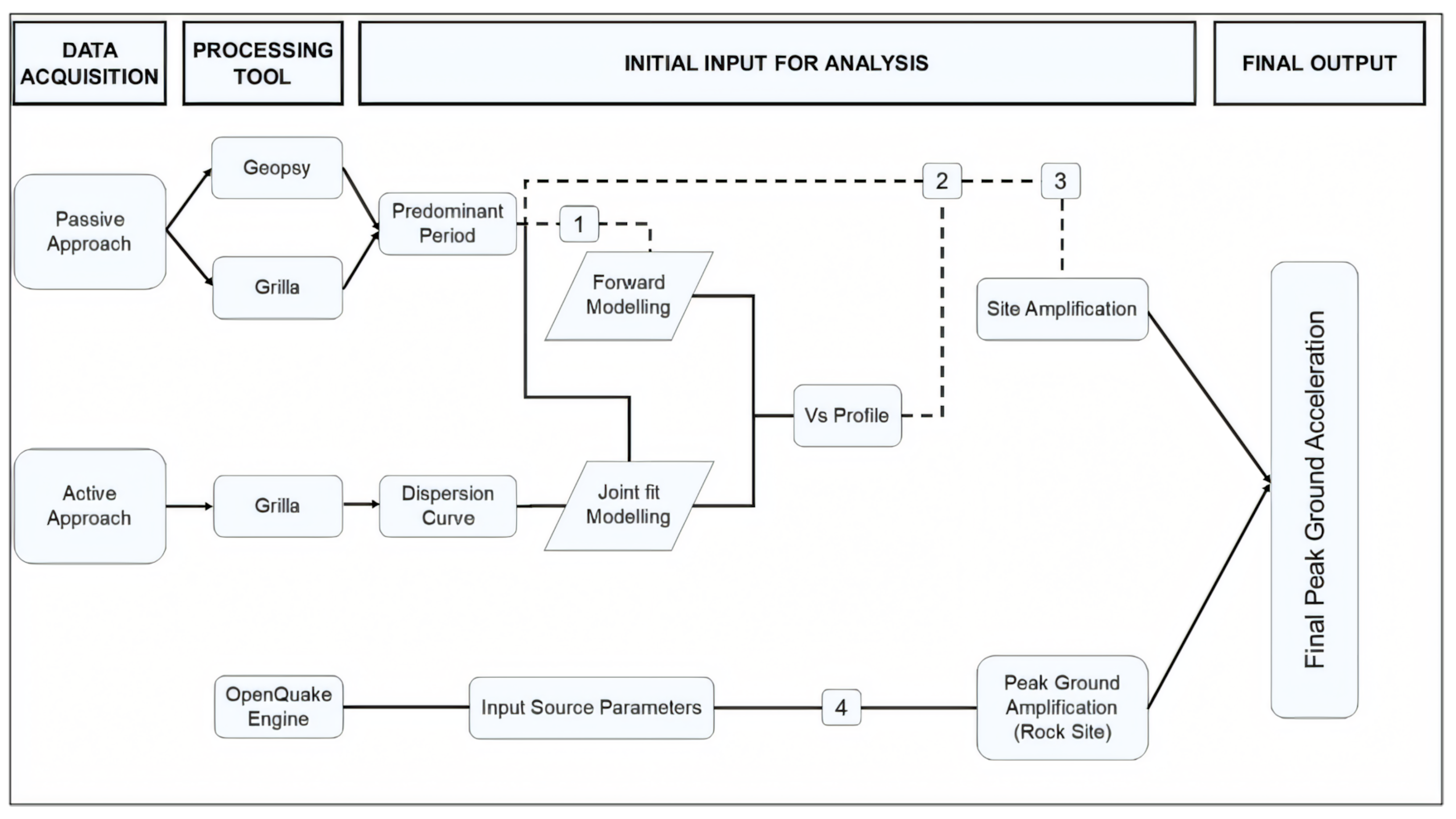
Peak ground acceleration is among the important input provisions in the design of seismic resilient structures [29]. The influence of irregular topography in the determination of peak ground acceleration is the essence of this study. Baguio City was the chosen study area owing to its topography being rugged and uneven in nature. Also, with the city’s urbanization and population rapidly growing, the need to address seismic hazards is important. A comprehensive flowchart of the processes, including inputs and outputs in generating the peak ground acceleration, is shown in Figure 1.
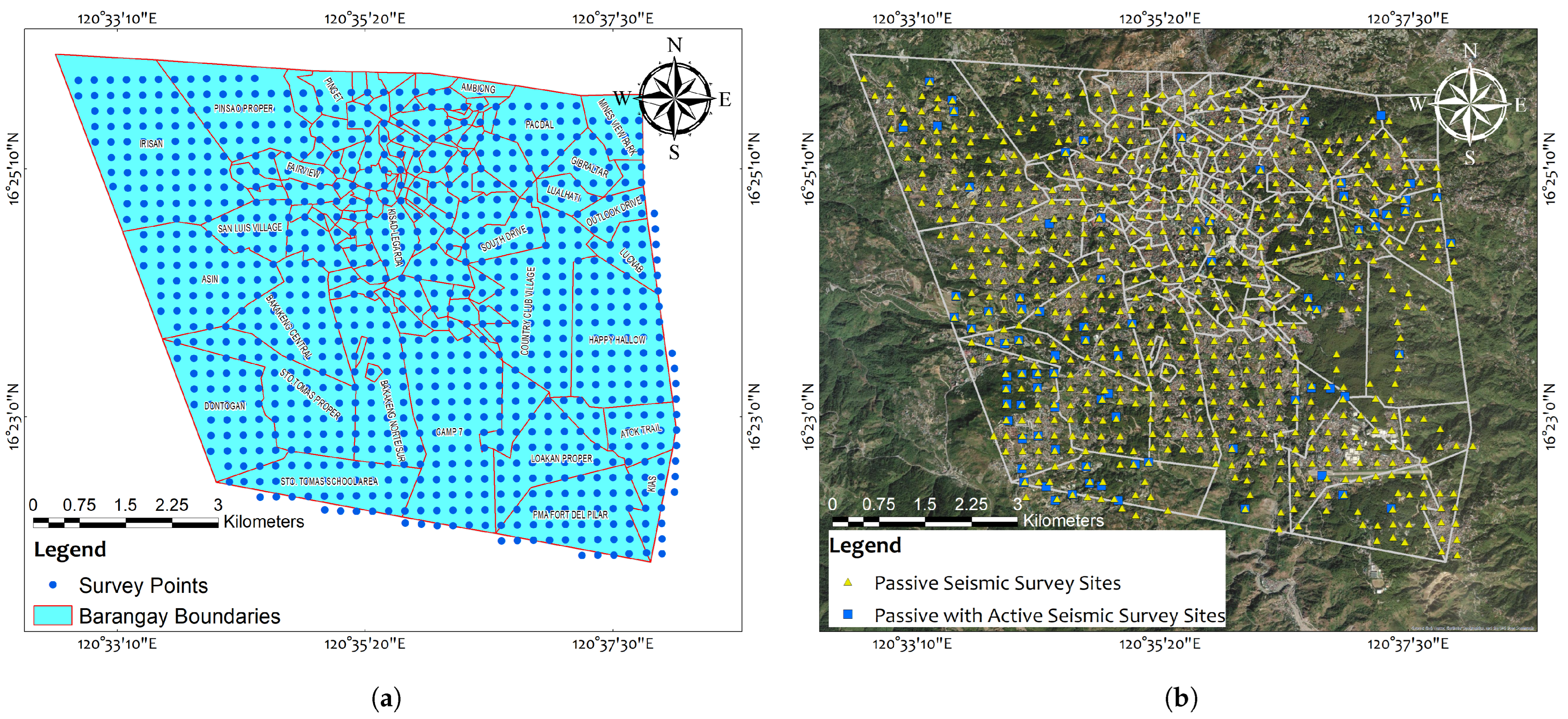
Geophysical fieldwork was conducted all over Baguio City to collect data to represent the site conditions needed for the input parameters. Nine hundred and twenty-five (925) survey sites were initially plotted as a grid with a 250 m distance between each point (Figure 2). However, in areas where geophysical surveys cannot be attained due to total accessibility constraints, survey points are omitted. To preserve the precision of the grid in cases where accessibility is at stake, an offset of around 100 m is considered. Two types of survey approaches were conducted: passive and active. The passive approach, or three-component microtremor survey, requires the instrument to record microtremors that are present everywhere but are too subtle to be felt by humans in order to obtain the natural subsoil resonance frequencies. The natural frequency is estimated using the Nakamura Method [31]. The minimum time of recording for the passive approach is set to twenty (20) minutes with a 128 Hz sampling rate. The active approach or Simple Multi-Channel Analysis of Surface Waves involves artificial noise generated by striking a hammer on a steel plate located on a 5 m interval space away from the instrument up to 55 m. The approach is used to generate phase velocity dispersion curves that are used to obtain the average shear-wave velocity (Vs30) of a certain site. All types of measurements used were acquired using a three-component accelerometer called Tromino® (made by MoHo s.r.l., Venice, Italy). A Tromino® tromograph is an all-in-one handy instrument known for its dynamic capabilities in terms of characterizing subsoils, structures, and more. Additionally, data were processed through software called Grilla (Release 2021 Rel. 9.7.1) Micromed [32,33].
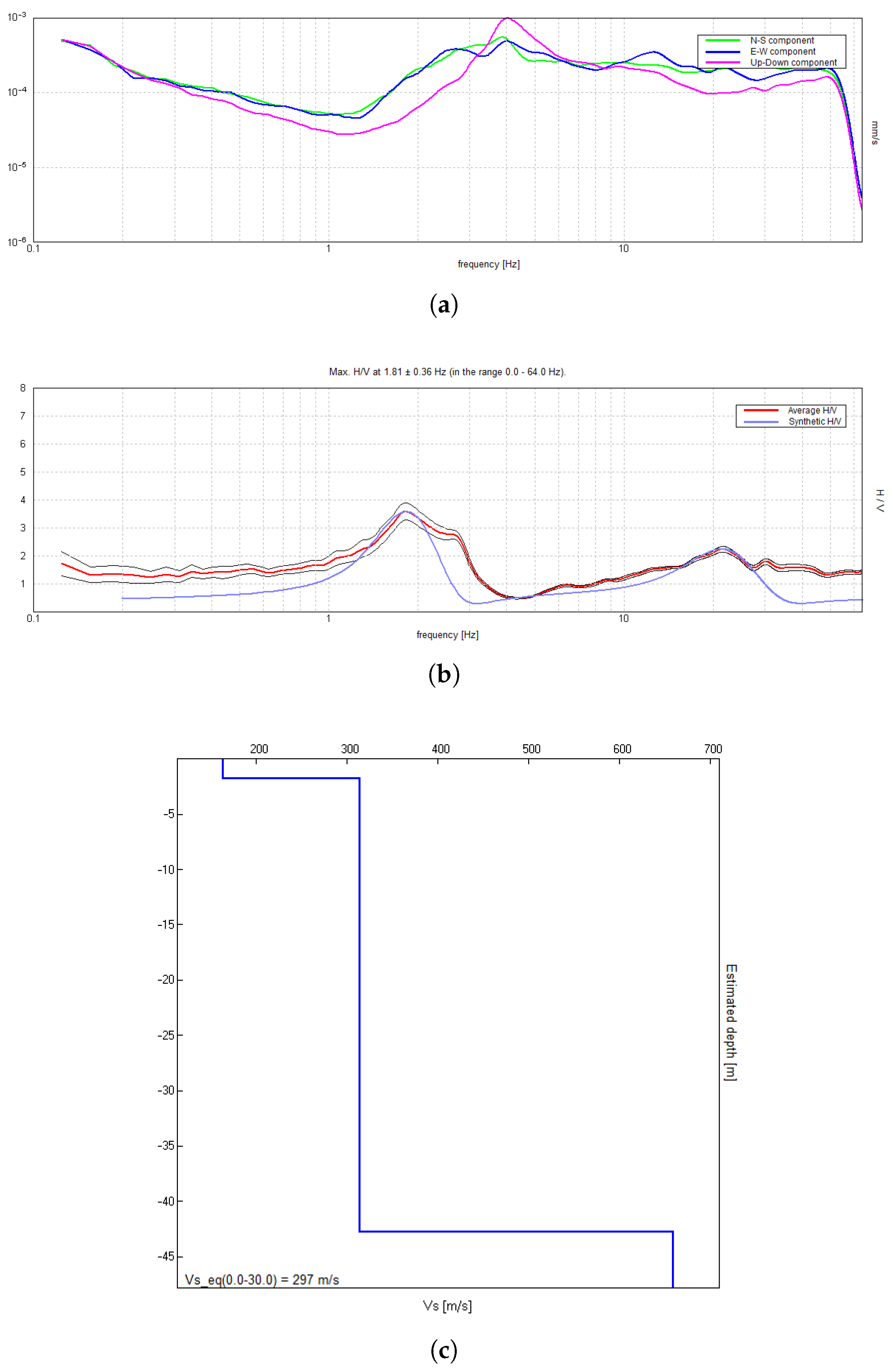
In this study, the shear-wave velocity data was the primary data used in the representation of the site conditions for Baguio City derived from actual geophysical surveys. A total of seven-hundred and fourteen (714) Vs30 values across Baguio City were obtained. These were derived from joint-fitting the phase-velocity dispersion curves from a simple multi-channel analysis of surface waves and H/V spectra from a three-component microtremor survey [34] and the forward modeling of H/V spectra using existing borehole data, as in reference [35]. Note that the use of forward modeling is only applicable to areas where an active survey approach is not available. An example of the data acquired from a survey site is shown in Figure 3.
For the site amplification data of Baguio City, the site amplification coefficient was estimated by considering the site-dependent and topographic amplification factor for each site. The site-dependent amplification coefficients from Vs30 values at each site were calculated using formulations from Borcherdt [30].
On the other hand, the topographic amplification coefficients were identified through the site’s topographic location and slope angle. The 3D numerical simulations using the spectral element method program (SPECFEM [36,37]) were used to find the correlation between the slope angle and the subsequent topographic amplification.
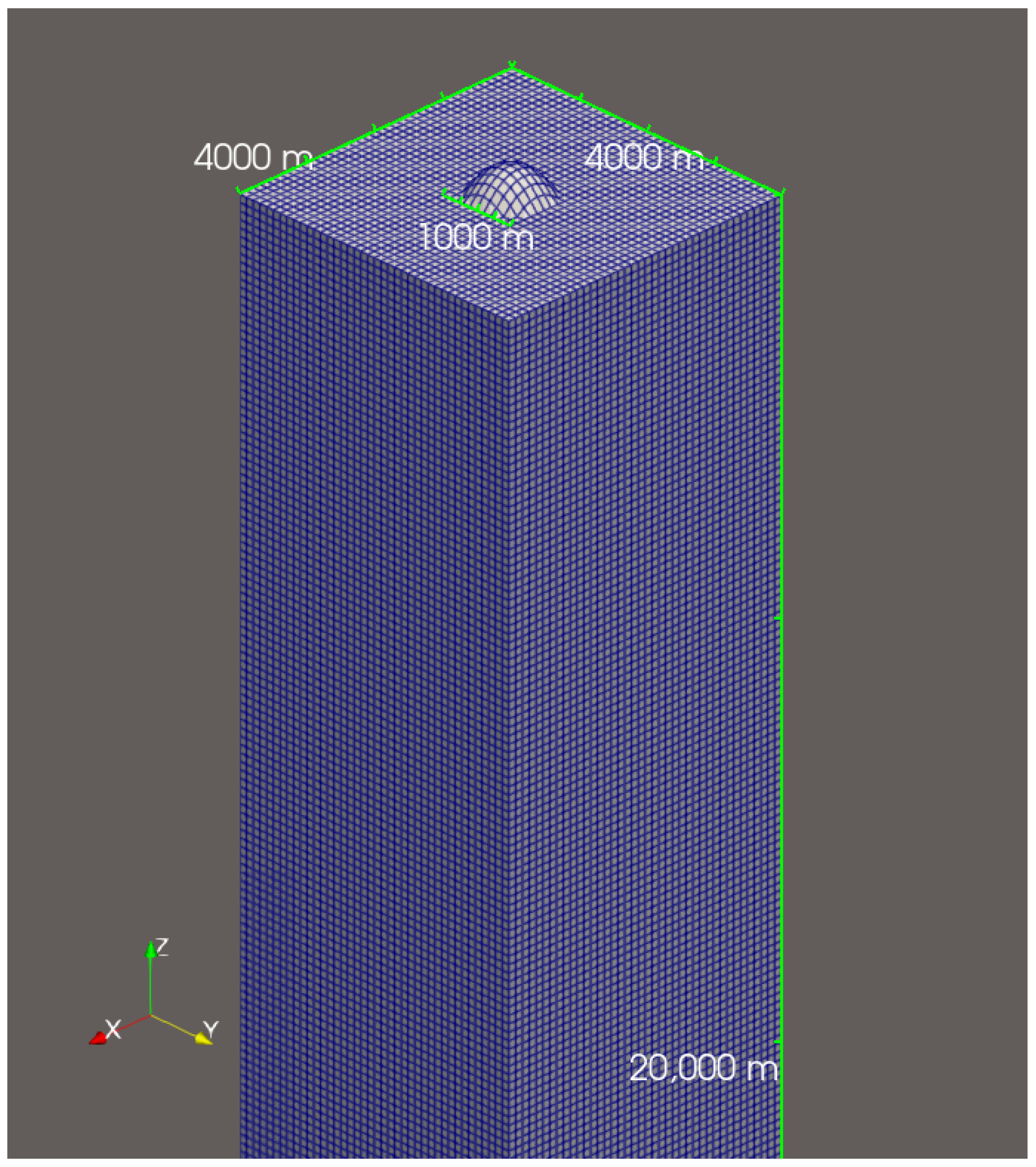
The SPECFEM3D simulations for determining the slope amplification coefficient were done using a consumer-grade desktop computer that utilizes an i7-13700F for the CPU and 16 GB of memory. The simulations also took advantage of SPECFEM’s CUDA routines for faster simulation times using an RTX 3060 GPU with 8GB VRAM [38]. All of the meshes used for the SPECFEM3D simulations all have the parameters shown in Table 1. The topographical feature used for the simulations is a parabolic hill with a circular base of radius 500 m. The height is then varied depending on the desired slope angle. The velocity model used is a homogenous material based on an inferred rock site value of 780 m/s for the shear wave velocity. One of the meshes is displayed in Figure 4. This set-up was inspired by a similar set-up by Zhang et al. [39] that used a 2-dimensional finite difference method to determine the amplification factor on a sloped model geometry.
The source used is an upward-moving force originating at a depth of 9 km located directly under the topographic feature. The source is placed at this depth to make sure the wavefront is as straight as possible when it reaches the surface. This study assumes a far-field source, in which the incident wave would come in directly below the surface. A Ricker wavelet is used as the slip function. From Zhang et al. [39], it was seen that peak amplification increases at higher frequencies. When different Ricker source frequencies were used in the topographical feature shown in Figure 4, it was observed that frequencies smaller than 1 Hz will have an almost constant amplification effect at any slope angle, while higher frequencies show significantly stronger amplification. The results acquired for the 1.0 Hz Ricker wavelet are used in this paper. By default, the source depth is relative to the surface, and, since the source is underneath the feature, the vertical position of the source would change depending on the height of the feature. To ensure a constant position, the simulation was configured to use absolute vertical positioning. However, this also configures other objects, such as the stations, to also have absolute vertical positioning.
The topographic amplification coefficient is derived through SPECFEM3D by extracting the peak acceleration over the surface of the mesh through a built-in tool. It should be noted that peak ground acceleration extracted from this method is derived from the magnitude of the acceleration. Determining the PGA through stations could be performed; however, the vertical position of each station has to be manually adjusted for each mesh, as they require absolute positioning, as mentioned.
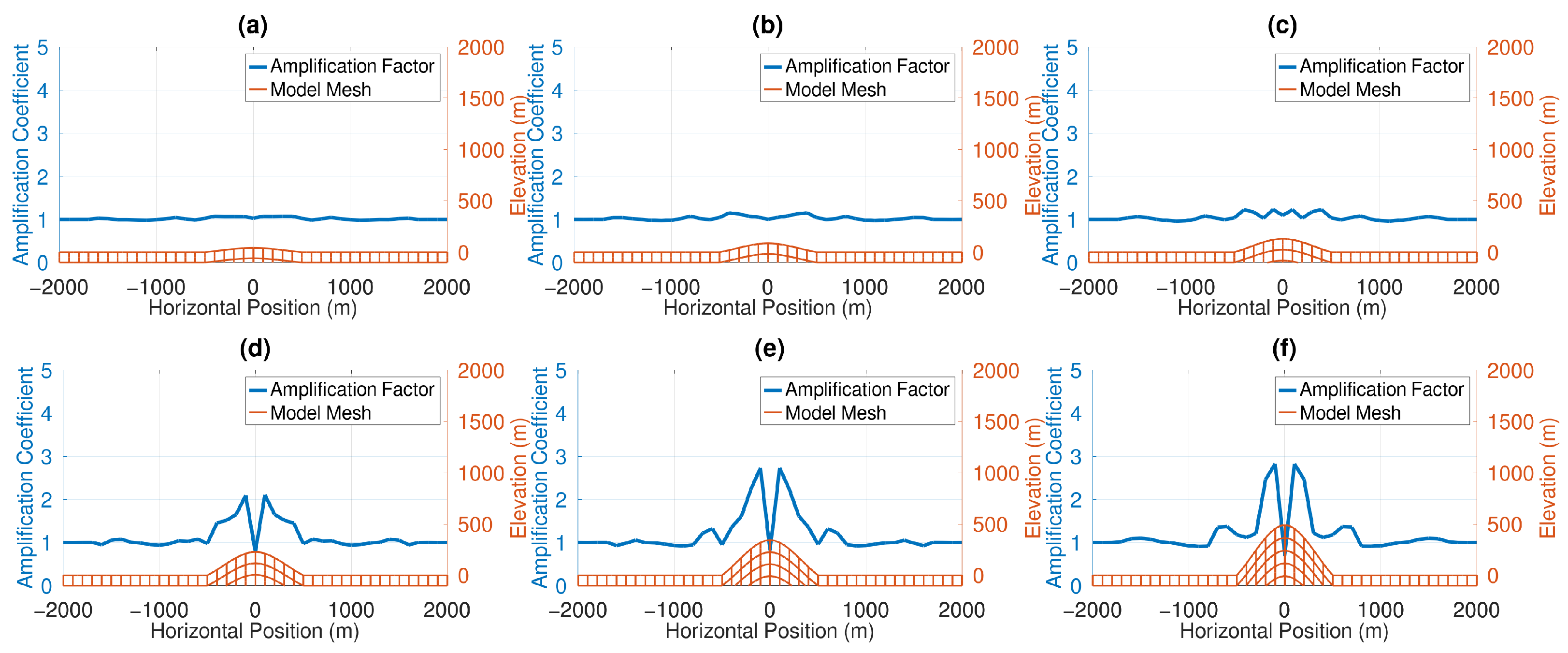
The coefficients were derived by taking the peak ground acceleration across the surface of the topographic model and the flat model and then dividing them from each other (Figure 5). By taking the mean amplification factor across the width of the topographic feature—in this case, a parabolic hill—the correlation could be determined (Table 2).
A slope map of Baguio City was generated from NASA SRTM 1 arc second grid data [40]. A topographic amplification function, interpolated with a 7-degree polynomial function from Table 2, where flat ground (slope angle of 0 ) has an amplification factor of 1, is applied on the slope map to get the topographic amplification across Baguio City. However, it should be noted that this method does not take into account the complex topographical make-up of the region and thus is not a full account of the effects of topography. This would require directly conducting a SPECFEM simulation on the area, as was done in Lee et al. [41] and Legesse and Mammo [42], although this would require a fine hexahedral mesh that can resolve periods less than one second and accurately model the topography to fully determine the extent of amplification.
The Borcherdt site amplification and SPECFEM topographic amplification coefficient values were then multiplied at each point using the ’Raster Calculator’ algorithm in ArcMap 10.8 to get the combined site amplification map.
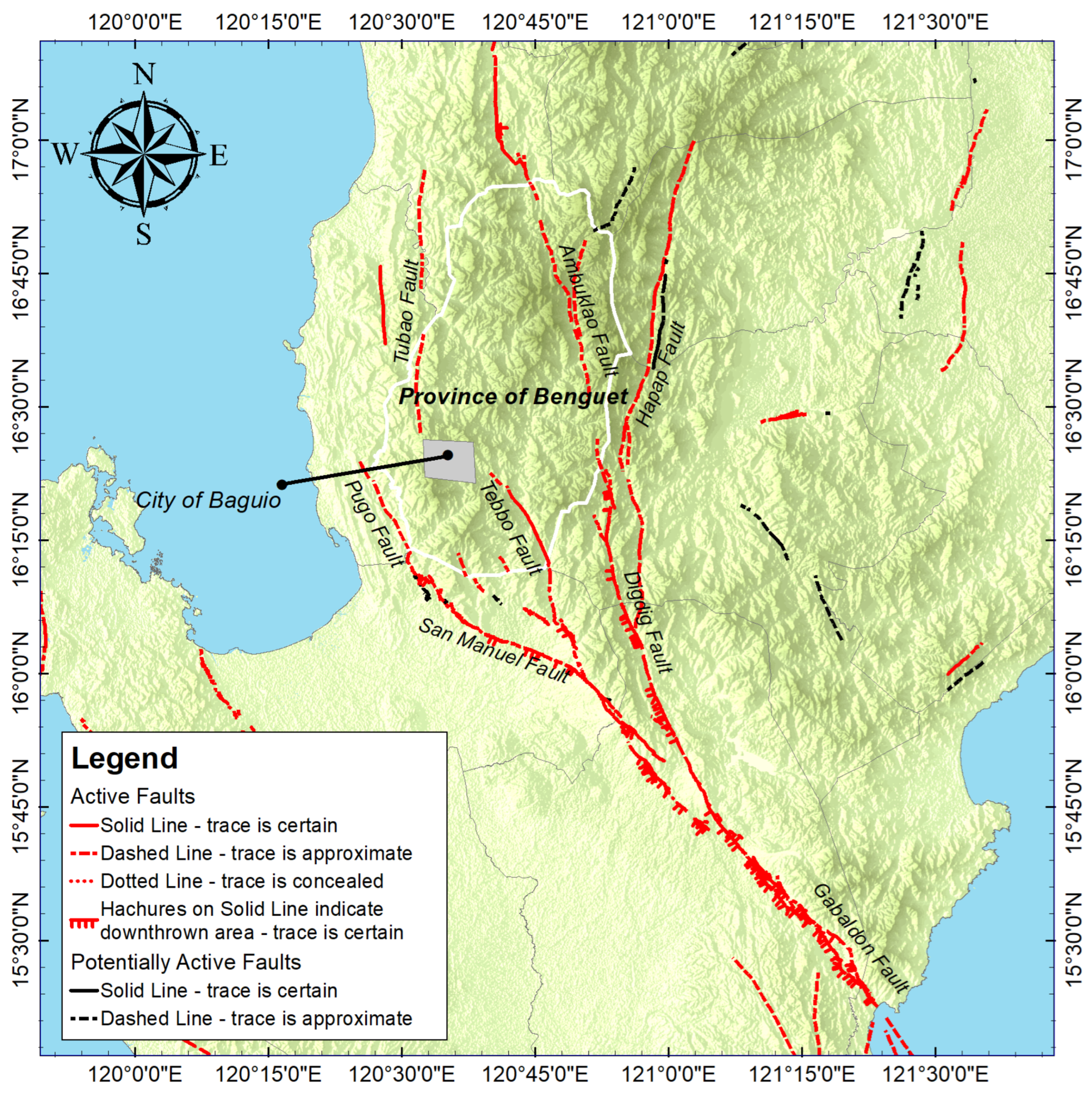
The initial peak ground acceleration is computed through OpenQuake (OQ) Engine version 3.11.5 [43], open-source software used to compute seismic hazard analysis developed by the Global Earthquake Model (GEM) Foundation. For this type of seismic hazard assessment, a deterministic approach is used. In OpenQuake Engine, deterministic seismic hazard analysis is represented through scenario-case calculation [44]. In the characterization of seismic sources, earthquake generators used are only limited to major active shallow sources surrounding Baguio City (Figure 6).
Since the maximum magnitude of seismic sources [13] is used in deterministic seismic hazard analysis, which is the case in this study, historical earthquakes, such as the 16 July 1990 Luzon Earthquake [45], are also included in the input source parameters. The fault magnitude of non-historic earthquake events is derived using the empirical relations in [2]—see Table 3. For the site condition, an inferred rock-site velocity value of 780 m/s was chosen in reference to the assumptions in Seismic Hazard Analysis for the Design Earthquake of the Philippines [46]. Attenuation equations, or the ground motion prediction equations (GMPEs) by Abrahamson et al. [21], Campbell and Bozorgnia [22], Chiou and Youngs [23], are applied in the calculation with respective weights of 0.333, 0.334, and 0.333. Using the aforementioned input parameters, a rock-site-based PGA is generated for each fault source.
Figure 6. Active and potentially active fault map showing the geographic location of the earthquake generators used in the calculation of peak ground acceleration. Updated active fault data as of October 2021 [47].
Applsci 16 04895 g006
The output of the OpenQuake (OQ) simulations is independently derived based on each fault source. To create a composite peak ground acceleration map, it is necessary to combine the values based on the maximum acceleration a certain area may experience. This can be executed through the ’Mosaic to New Raster’ algorithm in ArcMap 10.8, where the values in each pixel are produced by selecting the highest acceleration values from all layers, each representing a certain fault source, thereby generating the composite peak ground acceleration based on the rock site. The initial peak ground acceleration is then combined with the site amplification values by multiplying the values (e.g., Boyke et al. [48]) using the ’Raster Calculator’ algorithm in ArcMap 10.8, thereby generating the final peak ground acceleration.

3. Results

The results of the study are represented as microzonation maps using ArcMap 10.8 since the number of points is large enough to be presented in a table. The majority of the computations were made using the following software: (1) Grilla (Release 2021 Rel. 9.7.1), for the calculation of the predominant period, joint-fitting, and forward modeling of the Vs30 values; (2) Geopsy (ver. 2.9.1), for the calculation of the predominant period in cross-checking with the results of Grilla software; (3) OpenQuake Engine (version 3.11.5), for the computation of the peak ground acceleration; and (4) ArcMap (version 10.8), for the interpolation and layout of the data. Site amplification is computed using the ’Raster Calculator’ algorithm from ArcMap.
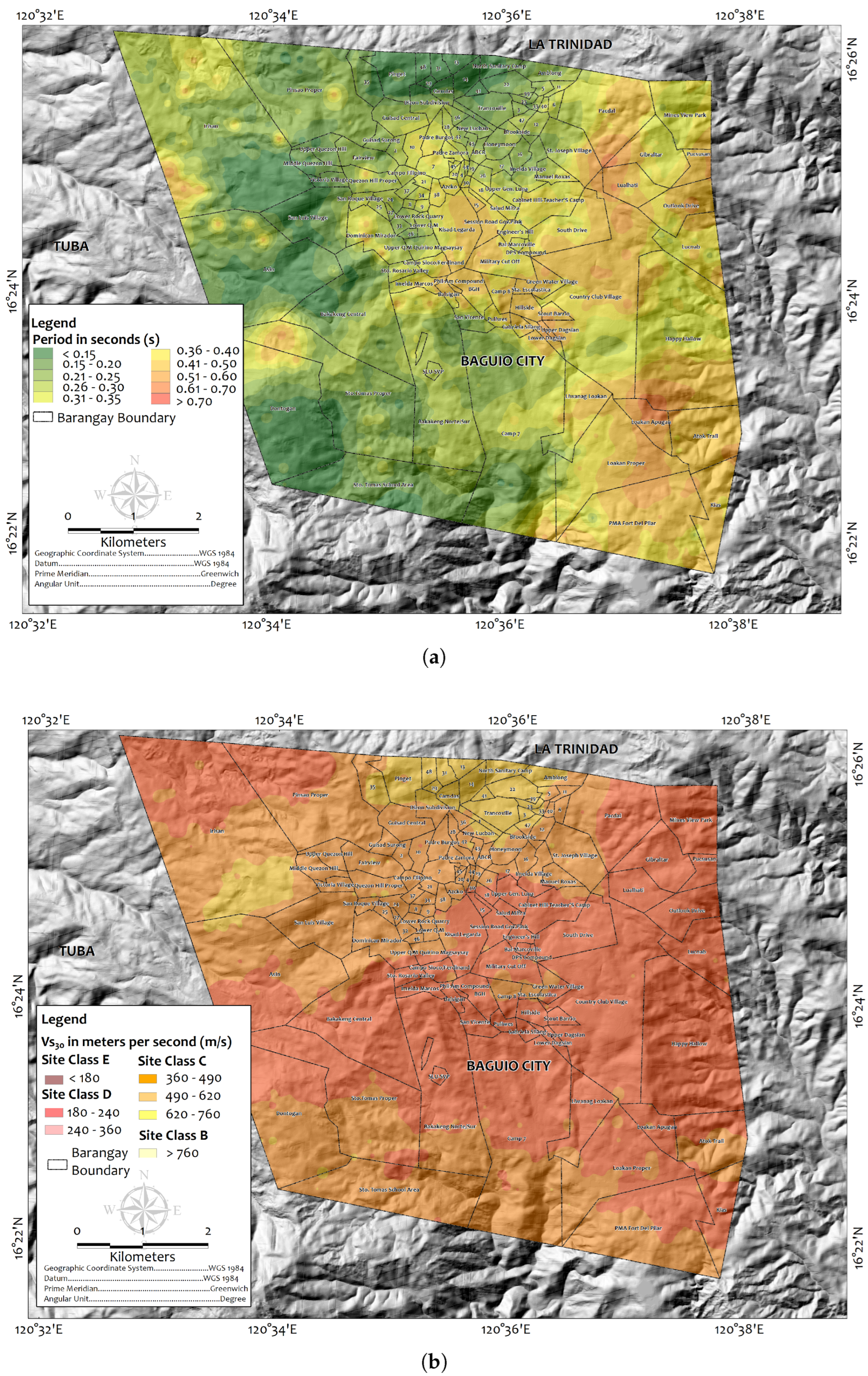
The output values are converted to shapefiles and eventually interpolated using inverse-distance weighing to produce the maps, as shown in Figure 7. The predominant period ( f 0 ) map shows higher values observed in the eastern portion of Baguio City visible in an orange shade. Meanwhile, the western portion manifested a green shade indicative of lower predominant period ( f 0 ) values. The predominant period ( f 0 ) represents the vulnerability of the structures against the resonance effect, a phenomenon that happens when the period of the ground matches the natural period of the building, and the latter experiences the largest oscillation possible, causing it to sustain heavy damage, which may lead to collapse [49]. As mentioned earlier, the predominant period ( f 0 ) is one of the requisites in the joint-fitting and forward modeling to derive the final Vs30 values (Figure 7). For the Vs30 results, the prevalence of Site Classes C and D [50] is noticeable. The shear-wave velocity values are indicative of how rigid or soft the underlying sediments are, such that a lower shear-wave velocity value signifies relatively soft subsurface layers and vice versa. A table for Vs30 Site Classification for seismic site response is defined in the National Structural Code of the Philippines—NSCP [51]. In comparison with the predominant period ( f 0 ) values, it is observed that areas with higher shear-wave velocity values exhibit shorter predominant periods. This is evident in the lower part of Irisan and in the upper middle portion of Baguio City. In areas where predominant period values are <0.4 s, both Vs30 and period can be used as site parameters due to their “equivalent predictive capabilities”, as they exhibit the best correlation in that range [52].
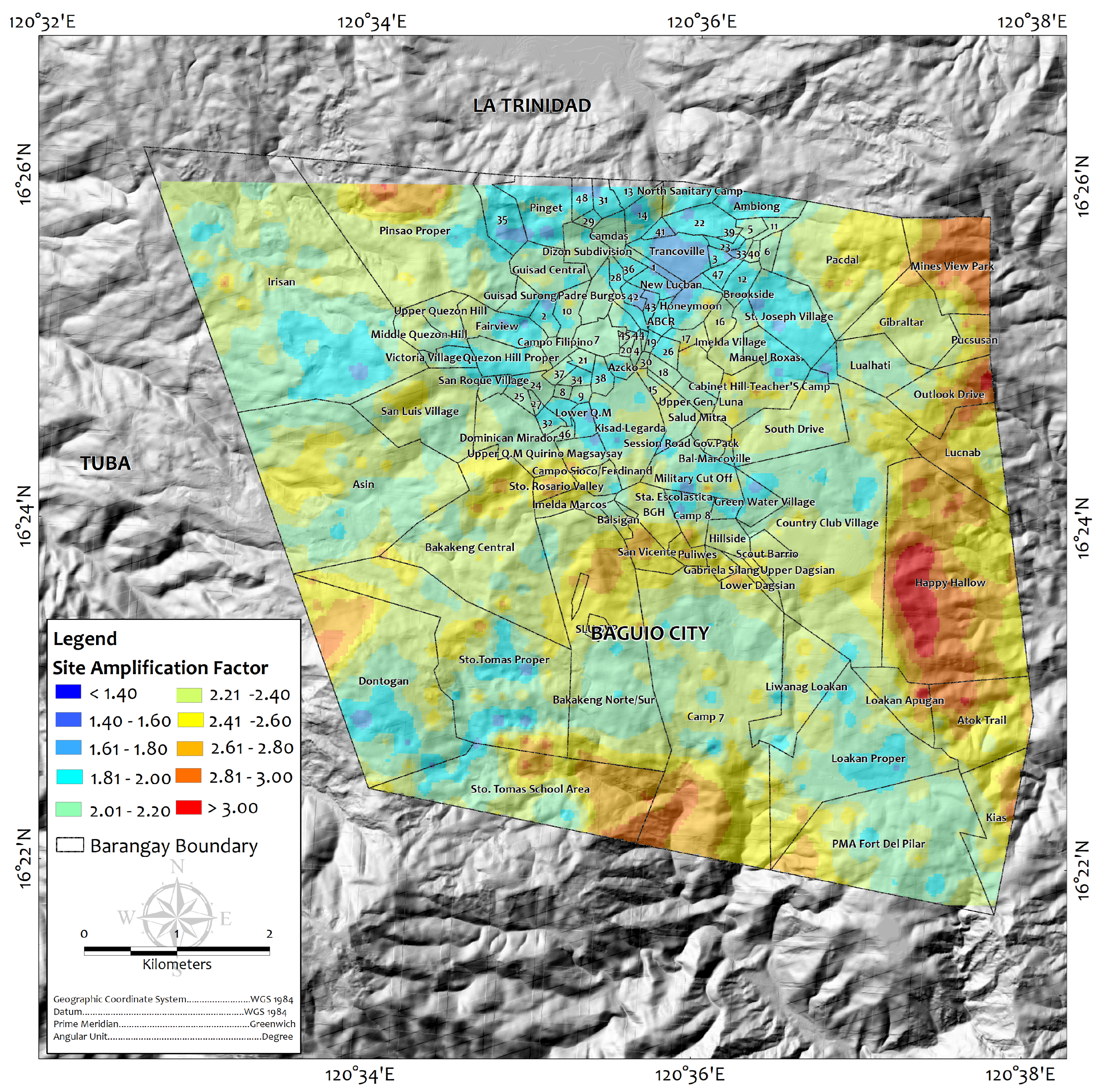
The site amplification map of Baguio City, as shown in Figure 8, is dominated by values represented in the shades of blue and green ranging from 1.4 to 2.4, with the Trancoville area having the least amount of amplification. Higher site amplification values are observed in the eastern portion of Baguio City. It can also be noted that areas that have steep slopes such as Happy Hallow have the highest site amplification values, reaching over 3.0. This can be attributed to the presence of soil layers and their underlying conditions [53], as well as the high slope angles in these areas.
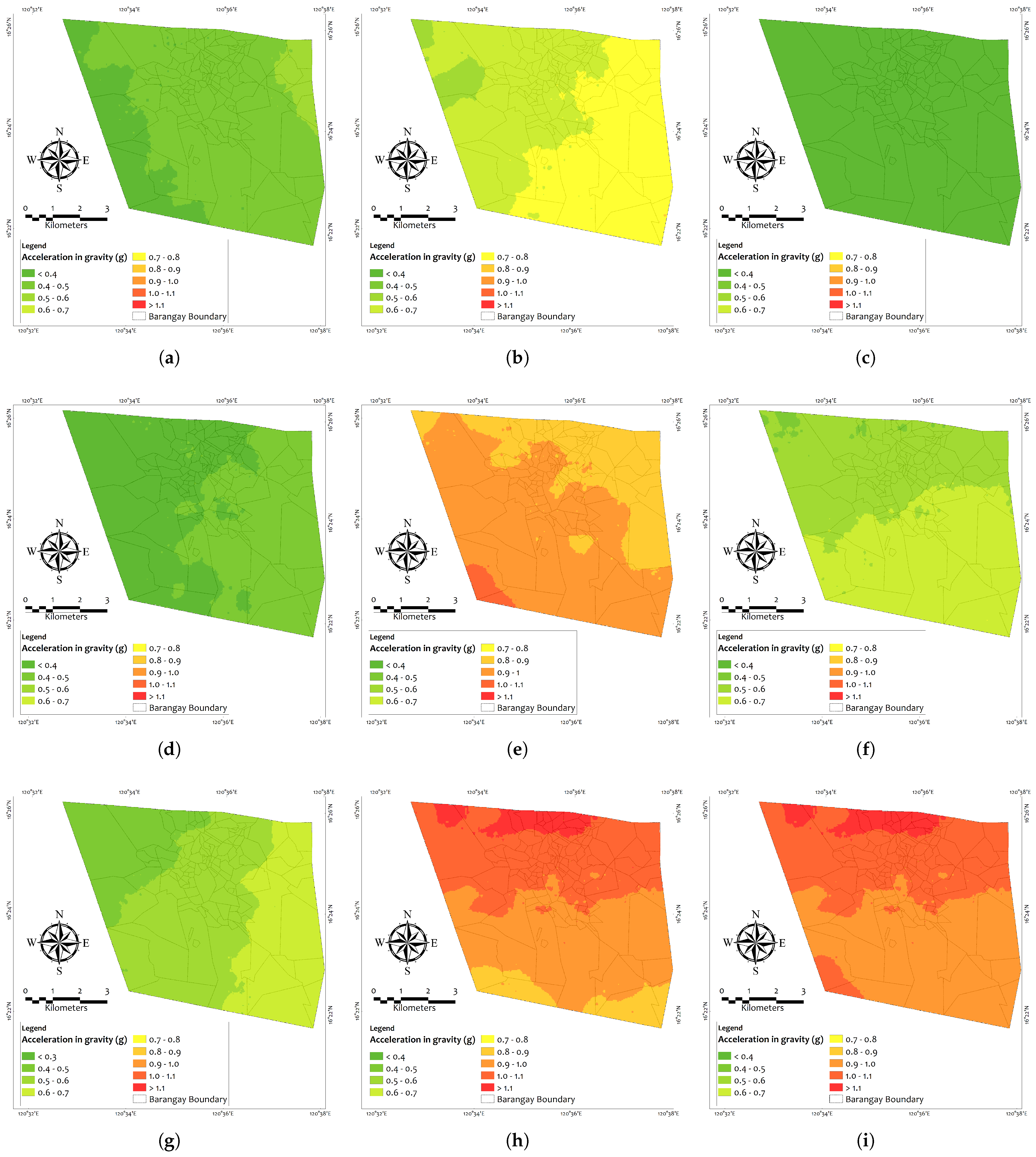
Figure 9 shows initial peak ground acceleration values in g units (1 g = 9.81 m/s2) derived from each of the fault sources generated in the OpenQuake (OQ) Engine. These simulations are based on the inferred rock site value of 780 m/s, which means that topographic effects are not yet incorporated. It can be observed that the maximum peak ground acceleration values are according to the geographical positioning of the origin of each fault source and decrease with distance. Gabaldon fault provides the lowest peak ground acceleration values, ranging from around 0.056 g to 0.06 g. Tubao Fault, on the other hand, contributes the highest peak ground acceleration values to Baguio City, ranging from around 0.25 g to 4.0 g. Figure 9i illustrates the composite PGA derived from all fault sources used in the simulation. The upper left portion of Baguio City provides the highest PGA values, which can be attributed to Tubao Fault. Furthermore, a noticeable fault source that also contributes to higher peak ground acceleration values is the Pugo Fault located on the southwestern portion of Baguio City, clearly evident through the changes in contour (Figure 9).
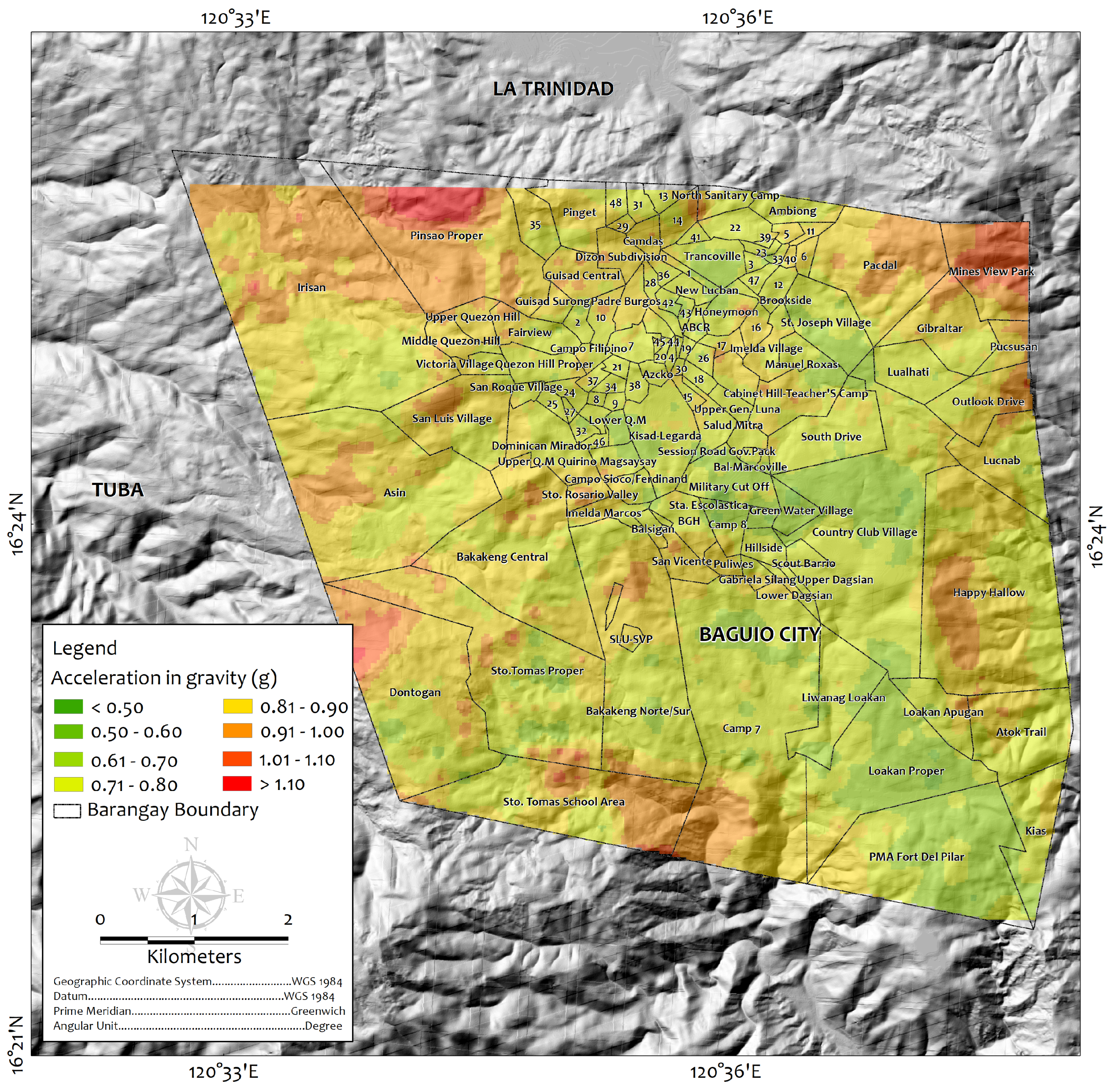
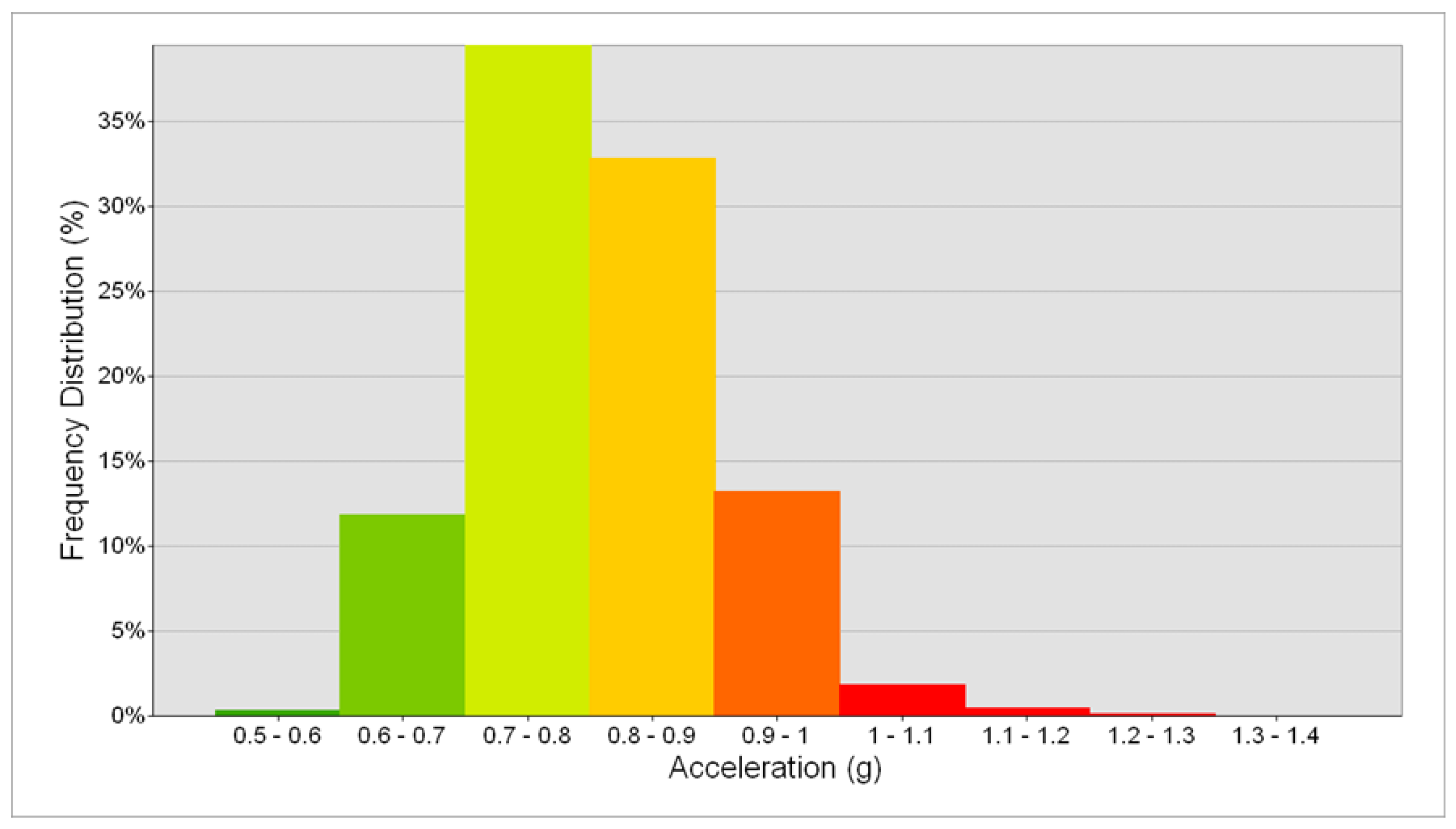
As mentioned, these peak ground acceleration values are the results of the direct influence of varying fault sources surrounding Baguio City without the incorporation of the site and topographic effects, subsequently creating plain contours. However, with the integration of site amplification values, an improved PGA is produced by considering the factors such as site conditions as well as topographic amplification, which consequently increased the peak ground acceleration values. A noticeably high PGA value is observed ranging from 1.0 g to 1.3 g in the Pinsao Proper area (Figure 10). Parts of Dontogan and Minesview Park are observed with similarly high peak ground acceleration values of over 1.0 g. The majority of Baguio City is dominated by shades of green characterized by a range of PGA values from 0.5 up to 0.7 g. A histogram of Figure 10, illustrated in Figure 11, signifies the relative frequency distribution (in percentage, %) of PGA values. Approximately 38% of the land area of Baguio City, with a population density of 6370 p/km2 according to the 2020 Census [54], may experience a ground acceleration ranging from 0.71 g to 0.80 g, while around 14% of the area may experience 0.51 g to 0.7 g. Starting from 0.71 g, the relative frequency distribution decreases as the PGA value increases.

4. Conclusions

For the 16 July 1990 Luzon Earthquake, in the Philippines, the topographic effects had been long identified. However, the mathematical computation of this event has not yet been performed. Thirty-five years after the incident, this paper concludes the realization of the significance of topography in assessing earthquake hazards. Owing to the relatively irregular and uneven morphology, it is therefore important that topographical effects in Baguio City should be seriously considered in seismic hazard assessments, particularly due to its large population and its proximity to several earthquake generators. In this study, a peak ground acceleration map of Baguio City is produced considering all the factors that may influence the ground response. A near-surface shear velocity model of Baguio City was made from the surveying efforts of the PSSIT team, from which a site amplification was determined with Borcherdt [30]. Then, the Borcherdt site amplification was combined with the topographic amplification factor determined from the SPECFEM simulations. The computed amplification map was then applied to a composite PGA map from the OpenQuake simulations to obtain the final result.
From this, the following conclusions can be made:
  • The initial independent PGA results showed that the Tubao Fault has the greatest effect among the other fault sources due to its proximity to Baguio City. The Tubao Fault, along with the Pugo Fault, make up the composite PGA result due to their high PGA values. It should also be noted that the Digdig Fault, where the 16 July 1990 earthquake originated from, has the third-largest initial independent PGA results, with peak acceleration values reaching over 0.7–0.8 g in some areas. This makes these three faults the greatest sources of earthquake hazards for the area.
  • The Pinsao Proper area, with its high site amplification factor, has one of the highest PGA values in Figure 10. This makes it one of the most vulnerable areas in the event of a potential earthquake originating from the Tubao Fault.
  • Comparing Figure 9i and Figure 10, it can be seen that, while distance to the source is a factor in earthquake risk, the site amplification and topography of the area can greatly affect the peak acceleration felt. An example of this is the relatively low PGA values in some barangays in the northern part of Baguio City compared to somewhere like the Happy Hallow Area with a high degree of amplification.
  • Based on the final PGA and the frequency distribution histogram, the majority of the total land area with a population density of 6370 p/km2 may experience 0.7 g to 0.8 g of ground shaking. The areas with the highest risk are those that have relatively high site amplification, particularly those that have a combination of low surface shear velocity values and steep slopes.
  • The researchers are aware of the limitations of this study and that, until further developments, this data is considered reliable. It should be noted that the current application of the topographic amplification does not fully describe the effect of topography on the peak acceleration experienced in the area. For a future study, directly using SPECFEM for the simulation of earthquakes with the fault sources discussed in Table 3 could be done to further assess the effects of the topography on the PGA value of the region.
  • Lastly, as was done in the past and present versions of codes, it is suggested to include in the codes a recommendation for the effects of topography that special attention be given when designing structures in heavily populated ridges in seismically active areas.

Author Contributions

Conceptualization, R.N.G., M.M.V.A. and M.A.A.V.; methodology, R.N.G. and M.M.V.A.; software: M.A.A.V.; validation; R.N.G. and M.A.A.V.; formal analysis: R.N.G., M.M.V.A. and M.A.A.V.; investigation, R.N.G., M.M.V.A. and M.A.A.V.; writing—original draft preparation, R.N.G.; writing—review and editing, R.N.G., M.M.V.A. and M.A.A.V. All authors have read and agreed to the published version of the manuscript.

Funding

This research was funded by the Republic of the Philippines—Department of Science and Technology (DOST), and the Philippine Council for Industry, Energy and Emerging Technology (DOST-PCIEERD) Grants-in-Aid (GIA) with grant number: 2020-05-A2-1752.

Institutional Review Board Statement

Not applicable.

Informed Consent Statement

Not applicable.

Data Availability Statement

The data presented in this study are available on request from the corresponding author. The data are not publicly available due to institutional policy.

Acknowledgments

The authors would like to acknowledge the Renato U. Solidum Jr. from DOST and Teresito C. Bacolcol from DOST-PHIVOLCS for their unending support for disaster-resilience studies in the country; DOST-PCIEERD, led by Enrico C. Paringit together with Carluz Bautista and Chrisitan Alec Managa, for their continued support in the implementation required to complete this study; Local Government Units of Baguio City, led by Benjamin Magalong with the full coordination of City Planning and Development led by Donna Rillera-Tabangin, as well as James Cosep and Jerome, for lending their vehicle and kind assistance in data acquisition; DOST CAR led by Nancy A. Bantog for her professional support; Winchelle Ian G. Sevilla, Chief of PHIVOLCS Seismological Observation and Earthquake Prediction Division, for rendering further technical support and assistance; PHIVOLCS Baguio Station through James Christian D. Gurat for the support and assistance throughout the data acquisition until the completion of the study; and PSSIT team members, Jenth P. Dales, Bryan Miguel R. Manalansan, Pamela Rose C. Reyes, Angelica G. Olaes, and Jonel B. Tarun.

Conflicts of Interest

The authors declare no conflicts of interest.

References

  1. PSA. Highlights of Cordillera Administrative Region Population 2024 Census of Population (2024 POPCEN); Press Release; Philippine Statistics Authority: Metro Manila, Philippines, 2025; Reference No. 2025-272.
  2. Wells, D.L.; Coppersmith, K.J. New empirical relationships among magnitude, rupture length, rupture width, rupture area, and surface displacement. Bull. Seismol. Soc. Am. 1994, 84, 974–1002. [Google Scholar] [CrossRef]
  3. Bommer, J.J.; Verdon, J.P. The maximum magnitude of natural and induced earthquakes. Geomech. Geophys. Geo-Energy Geo-Resour. 2024, 10, 172. [Google Scholar] [CrossRef]
  4. Ghassemi, M.R. Surface ruptures of the Iranian earthquakes 1900–2014: Insights for earthquake fault rupture hazards and empirical relationships. Earth-Sci. Rev. 2016, 156, 1–13. [Google Scholar] [CrossRef]
  5. Sboras, S.; Mouzakiotis, E.; Chousianitis, K.; Karastathis, V.; Evangelidis, C.P.; Lazos, I.; Papageorgiou, A.; Liakopoulos, S.; Iordanidou, K. Where does the active North Aegean Sea shear stop? Geodynamic and seismotectonic implications from recent strike-slip earthquake occurrences and GPS-based geodetic analysis in Euboea, Phthiotis and Boeotia, Central Greece. Tectonophysics 2025, 914, 230917. [Google Scholar] [CrossRef]
  6. Tsutsumi, H.; Perez, J.S. Large-scale active fault map of the Philippine fault based on aerial photograph interpretation. Act. Fault Res. 2013, 2013, 29–37. [Google Scholar] [CrossRef]
  7. Salcedo, J.C. Earthquake source parameters for subduction zone events causing tsunamis in and around the Philippines. Bull. Int. Inst. Seismol. Earthq. Eng. 2011, 45, 49–54. [Google Scholar]
  8. Armillas, I.; Petrovski, J.; Coburn, A.W.; Corpuz, A.; Lewis, D. Technical Report on Luzon Earthquake of 16 July 1990; Technical report; UN. Centre for Human Settlements: Nairobi, Kenya, 1990. [Google Scholar]
  9. Wang, Z. Seismic Hazard Assessment: Issues and Alternatives. Pure Appl. Geophys. 2010, 168, 11–25. [Google Scholar] [CrossRef]
  10. Reiter, L. Earthquake Hazard Analysis; Columbia University Press: New York, NY, USA, 1991. [Google Scholar]
  11. McGuire, R.K. Seismic Hazard and Risk Analysis; Second monograph series; Earthquake Engineering Research Institute: Oakland, CA, USA, 2004. [Google Scholar]
  12. Bommer, J.J. Deterministic vs. probabilistic seismic hazard assessment: An exaggerated and obstructive dichotomy. J. Earthq. Eng. 2002, 6, 43–73. [Google Scholar] [CrossRef]
  13. Krinitzsky, E.L. Deterministic versus probabilistic seismic hazard analysis for critical structures. Eng. Geol. 1995, 40, 1–7. [Google Scholar] [CrossRef]
  14. Trifunac, M.D. Preliminary analysis of the peaks of strong earthquake ground motion—Dependence of peaks on earthquake magnitude, epicentral distance, and recording site conditions. Bull. Seismol. Soc. Am. 1976, 66, 189–219. [Google Scholar]
  15. Fukushima, Y.; Tanaka, T. A new attenuation relation for peak horizontal acceleration of strong earthquake ground motion in Japan. Bull. Seismol. Soc. Am. 1990, 80, 757–783. Available online: https://pubs.geoscienceworld.org/ssa/bssa/article-abstract/80/4/757/102395/A-new-attenuation-relation-for-peak-horizontal (accessed on 27 March 2026).
  16. Toro, G.R.; Abrahamson, N.A.; Schneider, J.F. Model of Strong Ground Motions from Earthquakes in Central and Eastern North America: Best Estimates and Uncertainties. Seismol. Res. Lett. 1997, 68, 41–57. [Google Scholar] [CrossRef]
  17. Kanno, T. A New Attenuation Relation for Strong Ground Motion in Japan Based on Recorded Data. Bull. Seismol. Soc. Am. 2006, 96, 879–897. [Google Scholar] [CrossRef]
  18. Atkinson, G.M.; Boore, D.M. Modifications to Existing Ground-Motion Prediction Equations in Light of New Data. Bull. Seismol. Soc. Am. 2011, 101, 1121–1135. [Google Scholar] [CrossRef]
  19. Vilanova, S.P.; Narciso, J.; Carvalho, J.P.; Lopes, I.; Quinta-Ferreira, M.; Pinto, C.C.; Moura, R.; Borges, J.; Nemser, E.S. Developing a Geologically Based VS30 Site-Condition Model for Portugal: Methodology and Assessment of the Performance of Proxies. Bull. Seismol. Soc. Am. 2018, 108, 322–337. [Google Scholar] [CrossRef]
  20. Forte, G.; Chioccarelli, E.; De Falco, M.; Cito, P.; Santo, A.; Iervolino, I. Seismic soil classification of Italy based on surface geology and shear-wave velocity measurements. Soil Dyn. Earthq. Eng. 2019, 122, 79–93. [Google Scholar] [CrossRef]
  21. Abrahamson, N.A.; Silva, W.J.; Kamai, R. Summary of the ASK14 Ground Motion Relation for Active Crustal Regions. Earthq. Spectra 2014, 30, 1025–1055. [Google Scholar] [CrossRef]
  22. Campbell, K.; Bozorgnia, Y. Campbell-Bozorgnia NGA-West2 Horizontal Ground Motion Model for Active Tectonic Domains. Earthq. Spectra 2014, 30, 1087–1115. [Google Scholar] [CrossRef]
  23. Chiou, B.S.J.; Youngs, R.R. Update of the Chiou and Youngs NGA Model for the Average Horizontal Component of Peak Ground Motion and Response Spectra. Earthq. Spectra 2014, 30, 1117–1153. [Google Scholar] [CrossRef]
  24. Acharyah, H.K. Seismic and tsunamic risk in the Philippines. In Proceedings of the 7th World Conf. on Earthquake Engineering, Istanbul, Turkey, 8–13 September 1980; Volume 1, pp. 391–394. [Google Scholar]
  25. Su, S.S. Seismic hazard analysis for the Philippines. Nat. Hazards 1988, 1, 27–44. [Google Scholar] [CrossRef]
  26. Villaraza, C.M. A Study on the seismic zoning of the Philippines. In Proceedings of the 4th International Conference on Seismic Zonation, Standford, CA, USA, 25–29 August 1991; Volume 3, pp. 511–518. [Google Scholar]
  27. Ohmachi, T.; Nakamura, Y. Local site effects detected by microtremor measurements on the damage due to the 1990 Philippine earthquake. In Proceedings of the Tenth World Conference on Earthquake Engineering, Madrid, Spain, 19–24 July 1992; pp. 997–1002. [Google Scholar]
  28. Grutas, R.; Camayang, J.P.; Duka, J.A.; Magandi, M.A.; Nachor, J.E.; Tupas, J.A.G.; Agoncillo, G.A.C. Risk-targeted seismic hazard model for the Philippines. Earthq. Res. Adv. 2026, 6, 100402. [Google Scholar] [CrossRef]
  29. Elizabeth Philip, S.; Helen Santhi, M. Peak Ground Acceleration Analysis using Past Earthquake Data. J. Phys. Conf. Ser. 2020, 1716, 012013. [Google Scholar] [CrossRef]
  30. Borcherdt, R.D. Estimates of Site-Dependent Response Spectra for Design (Methodology and Justification). Earthq. Spectra 1994, 10, 617–653. [Google Scholar] [CrossRef]
  31. Nakamura, Y. A method for dynamic characteristics estimation of subsurface using microtremor on the ground surface. Railw. Tech. Res. Inst. Q. Rep. 1989, 30, 25–33. [Google Scholar]
  32. Micromed. An introduction to the Phase Velocity Spectra Module in Grilla; Micromed: Treviso, Italy, 2008. [Google Scholar]
  33. Micromed. Grilla ver. 2.2, Spectral and HVSR Analysis—User’s Manual; Micromed: Treviso, Italy, 2006. [Google Scholar]
  34. Castellaro, S. The complementarity of H/V and dispersion curves. Geophysics 2016, 81, T323–T338. [Google Scholar] [CrossRef]
  35. Castellaro, S.; Mulargia, F. VS30 Estimates Using Constrained H/V Measurements. Bull. Seismol. Soc. Am. 2009, 99, 761–773. [Google Scholar] [CrossRef]
  36. Tromp, J.; Komatitsch, D.; Liu, Q. Spectral-element and adjoint methods in seismology. Commun. Comput. Phys. 2008, 3, 1–32. [Google Scholar] [CrossRef]
  37. Peter, D.; Komatitsch, D.; Luo, Y.; Martin, R.; Le Goff, N.; Casarotti, E.; Le Loher, P.; Magnoni, F.; Liu, Q.; Blitz, C.; et al. Forward and adjoint simulations of seismic wave propagation on fully unstructured hexahedral meshes: SPECFEM3D Version 2.0 ‘Sesame’. Geophys. J. Int. 2011, 186, 721–739. [Google Scholar] [CrossRef]
  38. Komatitsch, D. Fluid–solid coupling on a cluster of GPU graphics cards for seismic wave propagation. Comptes Rendus MéCanique 2010, 339, 125–135. [Google Scholar] [CrossRef]
  39. Zhang, Z.; Fleurisson, J.A.; Pellet, F. The effects of slope topography on acceleration amplification and interaction between slope topography and seismic input motion. Soil Dyn. Earthq. Eng. 2018, 113, 420–431. [Google Scholar] [CrossRef]
  40. NASA JPL. NASA Shuttle Radar Topography Mission Global 1 arc Second, 2013. Available online: https://www.earthdata.nasa.gov/data/catalog/lpcloud-srtmgl1-003 (accessed on 28 April 2026).
  41. Lee, S.J.; Komatitsch, D.; Huang, B.S.; Tromp, J. Effects of Topography on Seismic-Wave Propagation: An Example from Northern Taiwan. Bull. Seismol. Soc. Am. 2009, 99, 314–325. [Google Scholar] [CrossRef]
  42. Legesse, A.; Mammo, T. Topographic amplification of seismic ground motion at the broad rift zone of SW Ethiopia. All Earth 2023, 36, 1–9. [Google Scholar] [CrossRef]
  43. Pagani, M.; Monelli, D.; Weatherill, G.; Danciu, L.; Crowley, H.; Silva, V.; Henshaw, P.; Butler, L.; Nastasi, M.; Panzeri, L.; et al. OpenQuake Engine: An Open Hazard (and Risk) Software for the Global Earthquake Model. Seismol. Res. Lett. 2014, 85, 692–702. [Google Scholar] [CrossRef]
  44. GEM Foundation. The OpenQuake Engine. 2019. Available online: https://github.com/gem/oq-engine/#openquake-engine (accessed on 27 March 2026).
  45. Punongbayan, R.S.; Rimando, R.E.; Daligdig, J.A.; Besana, G.M.; Daag, A.S.; Takashi, N.; Hiroyuki, T. The 16 July 1990 Luzon Earthquake Ground Rupture. In The July 16 Luzon Earthquake: A Technical Monograph; Inter-Agency Committee for Documenting and Establishing Database on the July 1990 Earthquake, Philippine Institute of Volcanology and Seismology: Quezon City, Philippines, 2001; Chapter 7. [Google Scholar]
  46. PHIVOLCS. Seismic Hazard Atlas for the Design Earthquake of the Philippines; Press Release; Department of Science and Technology Phivolcs, Philippine Institute of Volcanogy and Seismology: Metro Manila, Philippines, 2024.
  47. DOST-PHIVOLCS. Spectral Acceleration Maps of the Philippines. 2021. Available online: https://www.phivolcs.dost.gov.ph/earthquake-models/ (accessed on 27 March 2026).
  48. Boyke, C.; Refani, A.N.; Nagao, T. Site-Specific Earthquake Ground Motions for Seismic Design of Port Facilities in Indonesia. Appl. Sci. 2022, 12, 1963. [Google Scholar] [CrossRef]
  49. Bhandary, N.P.; Paudyal, Y.R.; Okamura, M. Resonance effect on shaking of tall buildings in Kathmandu Valley during the 2015 Gorkha earthquake in Nepal. Environ. Earth Sci. 2021, 80, 459. [Google Scholar] [CrossRef]
  50. NEHRP. Recommended Provisions for Seismic Regulations for New Buildings: Part I—Provisions. FEMA 222A, Federal Emergency Management Agency; National Institute of Standards and Technology: Gaithersburg, MD, USA, 1994.
  51. ASEP; Garciano, L.O. National Structural Code of the Philippines, 2015. Volume 1, Buildings, Towers, and Other Vertical Structures; Association of Structural Engineers of the Philippines: Metro Manila, Philippines, 2016; Volume 1. [Google Scholar]
  52. Zhao, J.X.; Xu, H. A Comparison ofVS30and Site Period as Site-Effect Parameters in Response Spectral Ground-Motion Prediction Equations. Bull. Seismol. Soc. Am. 2013, 103, 1–18. [Google Scholar] [CrossRef]
  53. Paudyal, Y.R.; Yatabe, R.; Bhandary, N.P.; Dahal, R.K. A study of local amplification effect of soil layers on ground motion in the Kathmandu Valley using microtremor analysis. Earthq. Eng. Eng. Vib. 2012, 11, 257–268. [Google Scholar] [CrossRef]
  54. PhilATLAS. Baguio City. 2026. Available online: https://www.philatlas.com/luzon/car/baguio.html (accessed on 27 March 2026).
Figure 1. Data processing flowchart showing the inputs and outputs in the generation of peak ground acceleration. Dashed lines indicate additional processes, calculations, and input data to produce the final output, such as (1) existing borehole data available in the area, (2) estimation of site-dependent amplification factor by Borcherdt [30], (3) topographic amplification derived from SPECFEM simulation, and (4) ground motion prediction equations (GMPEs) by Abrahamson et al. [21], Campbell and Bozorgnia [22], Chiou and Youngs [23].
Applsci 16 04895 g001
Figure 2. Maps of Baguio City showing: (a) pre-determined survey sites plotted in a 250 m grid spacing in reference to the Baguio City political boundary and (b) actual sites surveyed during the data acquisition phases. Note that the general alignment of the actual surveyed points is altered due to the offsets made, and some sites are fully omitted.
Applsci 16 04895 g002
Figure 3. Data acquired using the Tromino®, further processed using the Grilla software, from one of the survey sites. (a) Dispersion curve obtained from Simple Multi-Channel Analysis of Surface Waves (active approach). (b) H/V spectral graph obtained from the three-component microtremor survey (passive approach). The black lines in the graph represent the uncertainty of the observed H/V curve. (c) Shear velocity–depth curve computed through the Grilla software [32,33].
Applsci 16 04895 g003
Figure 4. Visualization of one of the meshes used for the simulations. The shape of the hill is a circular paraboloid, and the lowest vertical position is located at −20,000 m.
Applsci 16 04895 g004
Figure 5. Amplification coefficient plots across the surface of a parabolic hill in varying slope angles. From (af), respectively, the slope angles are 5 deg, 10 deg, 15 deg, 25 deg, 35 deg, 45 deg.
Applsci 16 04895 g005
Figure 7. (a) Predominant period ( f 0 ) map of Baguio City interpolated from the results of the three-component microtremor survey and processed using the Horizontal-to-Vertical Spectral Ratio [31]. (b) Vs30 model map interpolated from the results of the joint-fitting of dispersion curves to existing H/V spectra and forward modeling using existing borehole data as references.
Applsci 16 04895 g007
Figure 8. Site amplification map of Baguio City derived by combining by way of multiplication the values of site-dependent Vs30 amplification factors using Borcherdt [30] and topographic amplification factor from SPECFEM simulations.
Applsci 16 04895 g008
Figure 9. Independent peak ground acceleration based on rock site. (a) Ambuklao Fault, (b) Digdig Fault, (c) Gabaldon Fault, (d) Hapap Fault, (e) Pugo Fault, (f) San Manuel Fault, (g) Tebbo Fault, (h) Tubao Fault, (i) composite peak ground acceleration derived by combining all sources based on maximum values.
Applsci 16 04895 g009
Figure 10. The final peak ground acceleration of Baguio City. Site amplification values, derived by combining the site-dependent and topographic amplification factors, have been incorporated.
Applsci 16 04895 g010
Figure 11. Histogram of the Baguio City peak ground acceleration corresponding to the map in Figure 10. Frequency distribution in percentage (%) represents the y axis and the PGA values correspond to the x axis.
Applsci 16 04895 g011
Table 1. Quantities used for the SPECFEM3D simulations.
Mesh ParametersNumber of elements in the X axis40
Number of elements in the Y axis40
Number of elements in the Z axis200
Size in X axis4 km
Size in Y axis4 km
Maximum depth20 km
Velocity ModelDensity2000 kg/m3
P-wave velocity1300 m/s
S-wave velocity780 m/s
Solver ParametersNumber of Processes used10
Number of timesteps30,000
Period between timesteps0.004 s
Table 2. Topographic amplification in terms of the slope angle based on SPECFEM simulations.
Slope AngleTopographic Amplification Coefficient
1.0 Hz Dominant Frequency
5 1.05634
10 1.079815
15 1.131282
20 1.284377
25 1.469061
30 1.605783
35 1.686756
40 1.690998
45 1.66211
Table 3. Earthquake generators with corresponding magnitudes used in the ground motion prediction equations (GMPEs). Magnitudes marked with asterisks (*) were computed using the empirical relationships between the input source parameters presented by Wells and Coppersmith [2], whereas magnitudes marked [1] and [2] are from measured magnitudes from historical seismic events: [1] Punongbayan et al. [45]; [2] Tsutsumi and Perez [6].
Source FaultMagnitude
Digdig FaultMs 7.8 [1]
Tebbo FaultMw 7.0 *
Tubao FaultMw 6.6 *
Pugo FaultMw 6.8 *
Hapap FaultMw 7.3 *
Ambuklao FaultMw 6.5 *
San Manuel FaultMw 6.9 *
Gabaldon FaultMw 7.9 [2]
Disclaimer/Publisher’s Note: The statements, opinions and data contained in all publications are solely those of the individual author(s) and contributor(s) and not of MDPI and/or the editor(s). MDPI and/or the editor(s) disclaim responsibility for any injury to people or property resulting from any ideas, methods, instructions or products referred to in the content.