1. Introduction
The development of ultrathin magnetic heterostructures with tunable magnetic properties has driven major advances in spintronics, particularly in emerging applications such as spin-transfer torque magnetic random-access memory (STT-MRAM), spin–orbit torque (SOT) devices, and terahertz-range spin-torque oscillators [
1,
2,
3,
4]. Among the most promising material systems for these applications are amorphous rare earth–transition metal (RE–TM) ferrimagnetic alloys, which combine high thermal stability, low Gilbert damping, and fast magnetization dynamics [
2]. These alloys consist of two antiferromagnetically coupled magnetic sublattices, one associated with the transition metal (TM) and the other with the rare earth (RE) elements, resulting in a magnetic compensation temperature at which the opposing sublattice moments cancel. A key feature of amorphous RE–TM ferrimagnets such as FeCoGd is that this compensation point, along with properties such as saturation magnetization (
), anisotropy (
), coercivity (
), and magnetic squareness (
), can be systematically tuned through stoichiometry, thickness, temperature and interface engineering [
2,
5,
6,
7,
8,
9,
10,
11]. These tunable magnetic characteristics make ultrathin FeCoGd films ideal platforms for exploring high-frequency ferrimagnetic dynamics, including sub-terahertz precessional modes driven by spin-transfer torque [
2,
3,
4].
While prior work has extensively explored the temperature and composition dependence of magnetic compensation and spin dynamics in FeCoGd and similar amorphous alloys [
5,
8,
9,
12], fewer studies have addressed how atomically sharp interfaces in ultrathin films can be used to tailor these magnetic properties via proximity-driven modulation. Particularly promising in this context are heterostructures that incorporate two-dimensional transition metal dichalcogenides (TMDs) such as WSe
2, which are known to exhibit strong spin–orbit coupling, broken inversion symmetry, and gate-tunable spin and valley degrees of freedom [
13,
14,
15,
16,
17]. When placed in contact with magnetic films, TMDs can act as spin–orbit proximity layers, enabling interfacial tuning of spin texture, anisotropy, and magnetization dynamics [
13,
14,
15,
16,
18]. Recent studies have demonstrated that TMD/ferromagnet and TMD/ferrimagnet interfaces can support nontrivial interfacial spin–orbit fields, interfacial modifications to spin–momentum locking, such as spin canting or tilting induced by proximity coupling to the TMD layer, and anisotropic magnetoresistance signatures, all pointing to strong interface-induced modulation of magnetic and spin transport phenomena [
13,
14,
15,
16,
18,
19]. These effects have also gained interest in the context of antiferromagnetic and compensated spin systems [
20], where interface and symmetry effects can influence spin transport without net magnetization. In addition, edge- and defect-induced magnetic moments have been reported in certain TMD systems, particularly in nanostructured geometries where edge states constitute a significant fraction of the material. In macroscopic thin-film heterostructures, however, such edge contributions are expected to be minimal compared to the interfacial area between the magnetic layer and the 2D substrate [
21].
Despite the growing interest in proximity-driven phenomena in TMD-based heterostructures, the temperature-dependent magnetic behavior of amorphous RE–TM ferrimagnets such as FeCoGd interfaced with WSe
2 remains largely unexplored. We therefore focus on WSe
2, a tungsten-based TMD with strong intrinsic spin–orbit coupling and broken inversion symmetry, making it an attractive platform for enhancing interfacial spin–orbit proximity effects in adjacent magnetic layers. Moreover, comparing monolayer and bilayer WSe
2 provides a controlled means to vary inversion symmetry and interlayer screening while maintaining nearly identical interfacial chemistry. Precise thin-film synthesis helps preserve interface integrity and minimize unintended intermixing, which is critical when investigating proximity-driven effects in ultrathin heterostructures. Similar considerations regarding controlled magnetic thin-film growth and interface-sensitive thickness effects have been emphasized in prior studies [
22].
We investigate the thickness and temperature-dependent magnetic properties of ultrathin Fe
73Co
8Gd
19 films grown on Si, WSe
2 bilayer, and WSe
2 monolayer substrates. Using structural analyses such as X-Ray Diffraction (XRD), X-Ray Reflectivity (XRR) and Raman Spectroscopy, and compositional analysis such as Energy-Dispersive Spectroscopy (EDS), along with detailed magnetic characterization through Vibrating Sample Magnetometer (VSM), we extracted the evolution of
,
and
in the temperature range of 10–300 K. We show that both film thickness and the atomic-scale structure of the WSe
2 substrate play critical roles in the systematic modulation of coercivity, saturation magnetization, and reversal coherence, establishing TMD/FiM systems as a promising platform for thermally tunable and interface-engineered spintronic device applications [
2,
6,
13,
16,
19,
23].
2. Experimental Details
WSe
2 was synthesized on Si/SiO
2 substrates using a water-assisted CVD method under atmospheric pressure [
24,
25]. High-purity WSe
2 powder (99.9%, (Thermo Fisher (Ward Hill, MA, USA)) was loaded into a ceramic boat and uniformly distributed over approximately 1 inch of the boat’s length. The ceramic boat containing the WSe
2 powder was placed at the center of a 1-inch-diameter quartz tube, which was then inserted into a high-temperature furnace. Si substrates with 285 nm SiO
2 were pre-cleaned with acetone, isopropanol, and deionized water. During growth, substrates were positioned downstream at 700–750 °C, while the precursor zone was maintained at 1025 °C. The furnace temperature was ramped to 1025 °C under a constant N
2 flow (200 sccm). Upon reaching temperature, water vapor was introduced by diverting N
2 through a bubbler containing 2 mL of deionized water at 23 °C to promote W-rich domain growth. After several minutes, the gas was switched to Ar + 5% H
2 (200 sccm) to enhance crystalline quality. By varying the growth time, monolayer and bilayer WSe
2 samples were synthesized. The furnace was then allowed to cool naturally to room temperature. The spatial coverage and uniformity of the WSe
2 samples were verified by stitching optical microscope images into a mosaic map of the sample surface. For “monolayer” substrates, wafers were selected in which monolayer regions covered the majority of the observed area and bilayer/multilayer regions were minimal. For “bilayer” substrates, wafers were selected where bilayer regions dominated and higher-order layers were sparse. Multilayer-rich wafers were excluded to avoid additional interfacial complexity. Each selected substrate type (monolayer, bilayer, or bare Si) was then used for Fe
73Co
8Gd
19 deposition to enable a systematic comparison of magnetic properties as a function of WSe
2 layer number. The measured TMD coverage for the WSe
2 monolayer and bilayer substrates was 84.9% and 84.2%, respectively.
Prior to alloy deposition, the DC magnetron sputtering rates for Fe, Co, and Gd targets were calibrated at a working Ar pressure of 7.3 mTorr. Single-element Fe, Co, and Gd films were sputtered at room temperature onto Si substrates over a 20–100 W power range at a fixed deposition time. Film thicknesses, measured by XRR, were divided by the deposition time to obtain deposition rates for each power setting, and linear fits to these data yielded power–rate curves for each source. With Fe power fixed at 100 W, the calibration curves indicated optimal Co and Gd powers of 8 W and 24 W, respectively, to deliver an average Fe:Co:Gd flux ratio of 73:8:19. The resulting alloy composition was verified by scanning electron microscopy (SEM) coupled with energy-dispersive spectroscopy (EDS). Using the calibrated Fe73Co8Gd19 deposition rate, alloy thin films were deposited at room temperature on Si, Si/WSe2 bilayer, and Si/WSe2 monolayer substrates by DC magnetron sputtering. The base pressure prior to deposition was maintained below 1.9 × Torr, and the working pressure during sputtering was 7.3 mTorr. Film thickness was controlled by varying the sputtering time, yielding nominal values of 4, 8, 16, and 32 nm. All films were capped with a 5 nm Ta layer to minimize surface oxidation and contamination.
Chemical composition was confirmed by SEM-EDS, verifying the intended Fe73Co8Gd19 atomic composition on the 32 nm set of samples. Structural characterizations were carried out by XRD to verify the amorphous nature of the FeCoGd films, and by XRR to determine thickness, density, and interface roughness. Raman spectroscopy was used to assess the integrity of the WSe2 substrates after deposition, performed with a confocal Raman spectrometer (LabRAM HR Evolution, Horiba Scientific (Irvine, CA, USA)) in backscattering geometry using a 532 nm excitation laser. Magnetic characterization was performed using a Quantum Design VSM. In-plane magnetization hysteresis (M–H) loops were measured at 10, 20, 25, 30, 40, 50, 100, 150, 200, 250, and 300 K. From each loop, coercivity (), saturation magnetization (), and magnetic squareness () were extracted to characterize the magnetic response as a function of temperature, thickness, and substrate.
4. Discussion
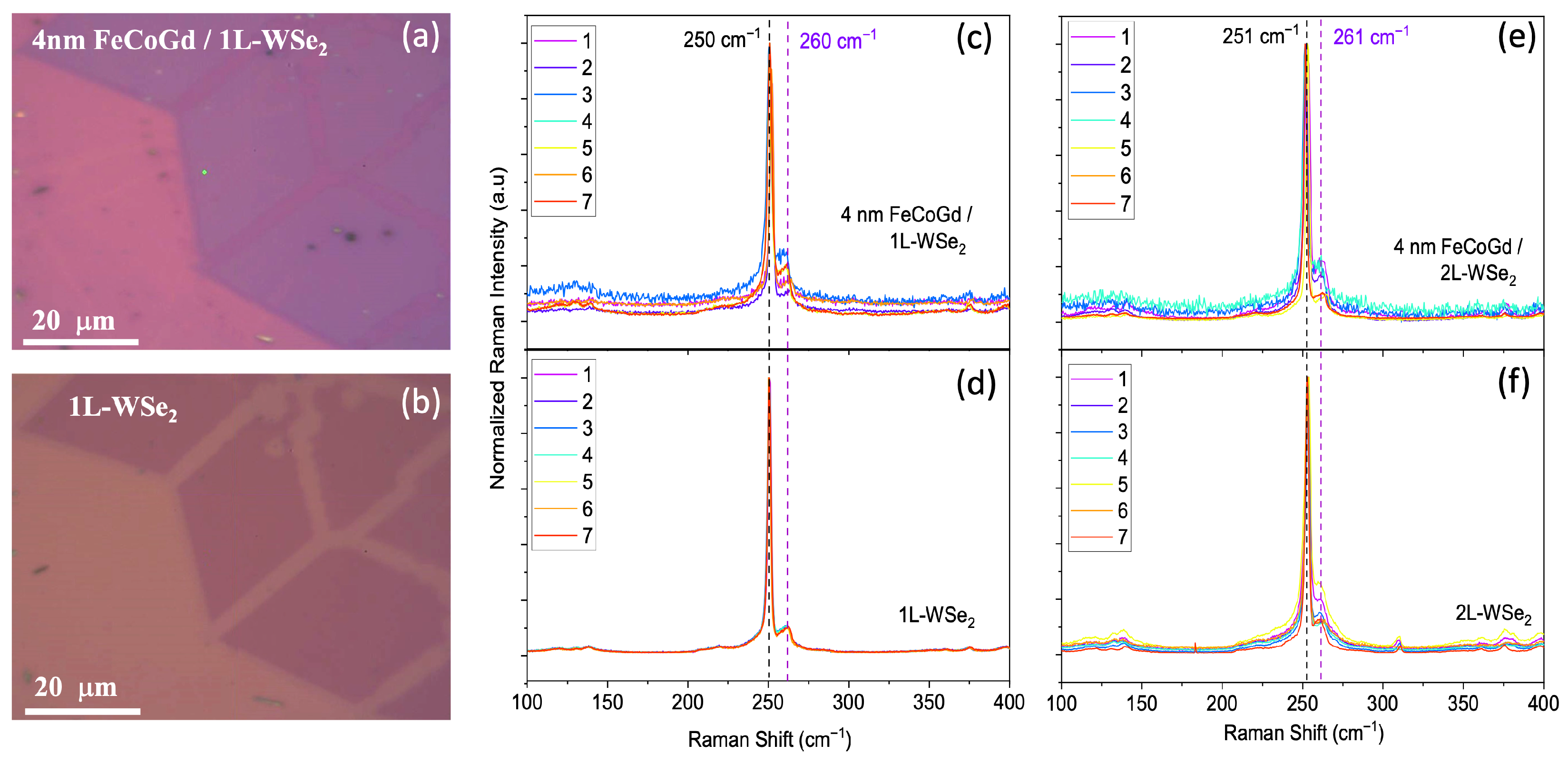
The Raman spectroscopy measurements confirm that the WSe
2 substrates retain their morphology and vibrational integrity after FeCoGd deposition, validating the compatibility of the sputtering process with 2D substrates. The persistence of the Raman-active modes near 250 cm
−1, along with the distinct monolayer and bilayer WSe
2 regions observed optically, demonstrates that the interfacial structure remains well-defined, a critical requirement for achieving reproducible proximity effects [
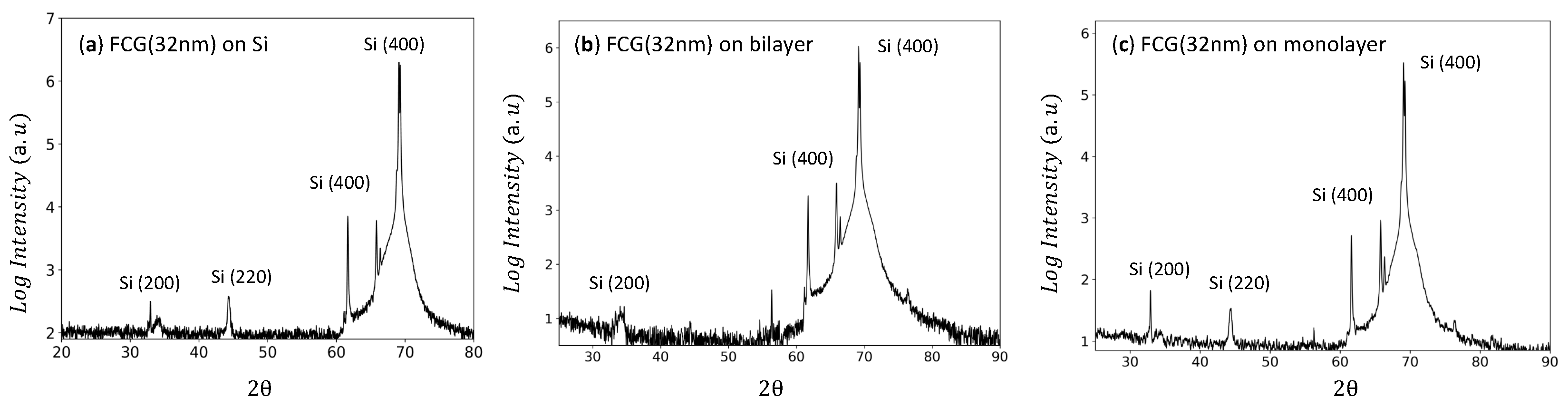
7]. The absence of diffraction peaks in the XRD data corroborates the amorphous nature of the FeCoGd films, consistent with prior reports on RE–TM alloys, and rules out crystallinity as a factor influencing magnetic response or tunability [
2,
5]. Together with XRR confirming smooth interfaces (roughness below 1.7 nm) and EDS verifying consistent elemental composition across all samples, these findings establish a structurally and chemically controlled platform for exploring proximity-driven magnetic behavior [
6]. The elemental composition showed no substrate dependence, reinforcing that the magnetic variations discussed in later sections arise from intrinsic thickness effects [
6,
7,
8,
19].
We note, however, that while XRD, XRR, Raman spectroscopy, and EDS confirm amorphous growth, interface continuity, and overall compositional consistency, these techniques do not directly resolve atomic-scale chemical sharpness or nanoscale intermixing at the interface. Substrate-dependent magnetic variations could, in principle, also arise from conventional mechanisms such as interfacial strain, local density variations, or the formation of magnetically reduced interfacial layers. Nevertheless, prior studies have demonstrated robust interface-driven spin–orbit phenomena in metal/TMD heterostructures, including graphene, WSe
2 and WS
2-based systems [
13,
15,
16,
18], and these studies strongly suggest modification of magnetic properties arising from the interface with such two-dimensional layers. The preservation of WSe
2 post-deposition, confirmed by Raman scattering, indicates that the observed magnetic modulation is associated with the interface rather than structural degradation. Additional nanoscale structural characterization (e.g., cross-sectional TEM/STEM or depth-sensitive spectroscopy) that would further confirm the interfacial origin of the observed effects will be the subject of future reports.
Edge- and defect-induced magnetic moments in TMD materials have been discussed in the literature, particularly for nanoribbons and highly confined geometries [
21]. In the present samples, magnetic measurements probe macroscopic areas, and any edge-localized magnetism confined to atomically narrow flake perimeters represents a negligible fraction of the total interfacial area. Given typical lateral flake dimensions on the order of tens of microns, the areal contribution of edge regions is several orders of magnitude smaller than that of the continuous Fe
73Co
8Gd
19 layer. Therefore, edge-related magnetism is unlikely to dominate the observed substrate-dependent trends.
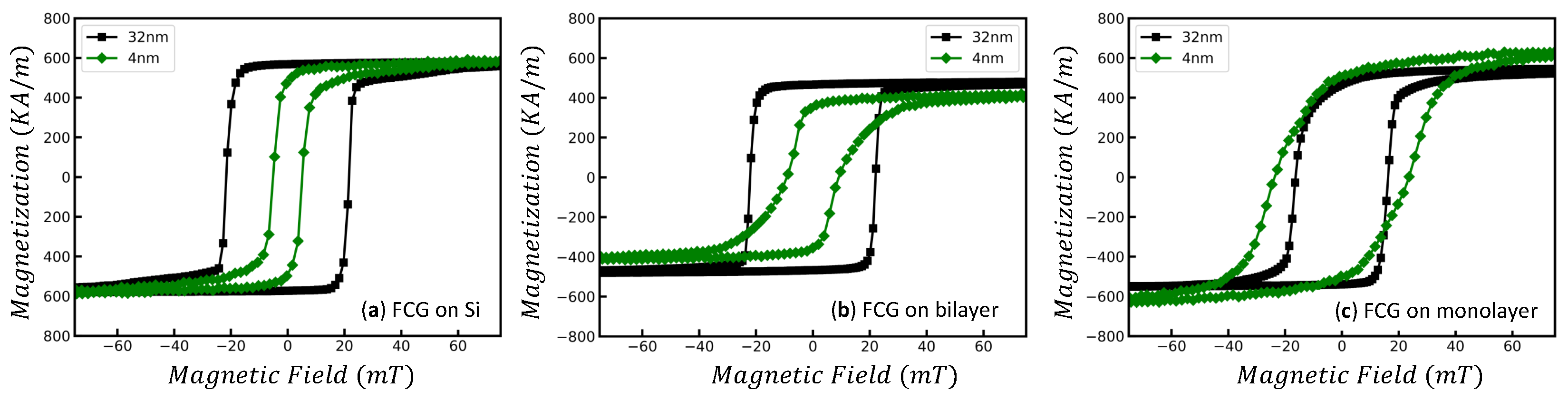
At room temperature, the magnetic response of FCG films shows a clear dependence on both film thickness and substrate. Coercivity (
) increases modestly with thickness across all substrates, consistent with enhanced magnetic hardness from larger switching volumes and domain-wall pinning [
27]. The WSe
2 monolayer system stands out in the ultrathin limit, where the 4 nm film exhibits reduced squareness (∼0.35). By contrast, 4 nm ultrathin films grown on WSe
2 bilayer substrates consistently exhibit lower
. Because the measured WSe
2 coverage is comparable for the monolayer and bilayer substrates (84.9% and 84.2%, respectively), the systematic differences in magnetic behavior between these two cases are unlikely to arise from the uncovered Si/SiO
2 regions. The combination of suppressed
and reduced squareness at 4 nm may arise from interfacial spin disorder that disrupts moment alignment near the TMD interface. Additionally, enhanced surface or interfacial anisotropy in the ultrathin limit may cant spins out of plane or promote non-uniform reversal, both of which suppress in-plane magnetization and squareness [
5,
7,
8]. These variations suggest that proximity-induced spin suppression is most pronounced in ultrathin films, but weakens as the FCG layer becomes thicker, reflecting the reduced reach of interfacial effects [
7,
8,
13]. Overall, the room-temperature trends indicate that while thickness governs magnetic hardness, TMD-based substrates provide an additional degree of freedom for tailoring net moment and reversal sharpness [
6,
13,
19].
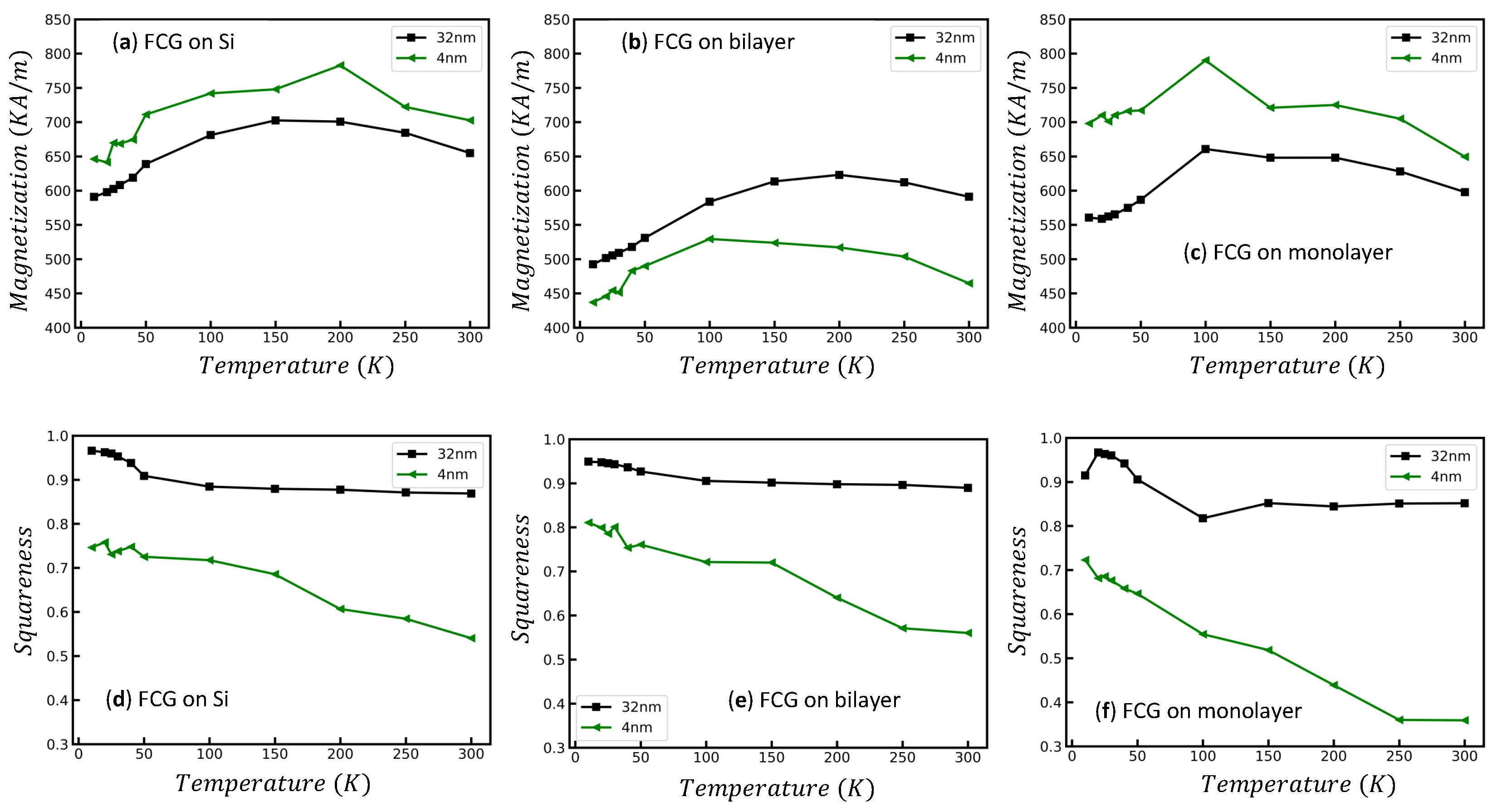
Building on this baseline, cooling the films reveals how reduced thermal activation further amplifies interfacial effects and magnetic hardness. Temperature-dependent trends in saturation magnetization (
) further emphasize the role of interfacial modulation. All samples exhibit a broad
maximum between 100 K and 200 K. This maximum reflects the temperature-dependent imbalance between the FeCo (TM) and Gd (RE) magnetic sublattices. Within the measured 10–300 K range, the FeCo sublattice moment increases and then remains relatively high, while the Gd sublattice is strongly thermally quenched and continues decreasing up to ∼100 K. Between 100–200 K, FeCo remains large and Gd remains minimal, producing the largest difference between their magnetizations and thus a broad maximum in the net
. Beyond ∼200 K, the FeCo moment begins to thermally decrease while the Gd moment partially recovers, reducing the TM–RE sublattice difference and causing the observed decline in
(T) [
5,
9,
10]. The 4 nm WSe
2 monolayer sample displays the highest
(∼790 kA/m at 100 K). This enhancement may result from improved spin alignment or local ordering at the monolayer interface, which promotes enhanced saturation magnetization in the ultrathin limit [
8]. The increased simultaneous observation of
and
in 4 nm films on monolayer suggests that interfacial coupling with WSe
2 monolayer effectively suppresses thermal spin disorder, thereby enhancing magnetic rigidity and stabilizing the magnetic moment against thermal fluctuations at low temperatures. This behavior may offer advantages for systems requiring robust magnetic response at reduced dimensions, such as thermally stable switching layers in ferrimagnetic spintronic architectures [
6,
7,
13]. These findings demonstrate that ultrathin films on monolayer can preserve or even enhance magnetic performance under conditions where saturation magnetization is typically suppressed in amorphous ferrimagnets [
6].
In contrast to the 4 nm films on monolayer WSe
2, the 4 nm film on bilayer WSe
2 shows a pronounced suppression of
across all temperatures. In the ultrathin limit (∼4 nm), the saturation magnetization becomes highly sensitive to small changes in effective magnetic thickness and interfacial magnetic structure. XRR measurements indicate roughness values of approximately 0.47 nm on Si and ∼0.18–0.19 nm on monolayer and bilayer WSe
2 substrates, corresponding to a non-negligible fraction of the nominal thickness. Since the roughness values for monolayer and bilayer WSe
2 are comparable, roughness alone cannot explain the reduced
on bilayer WSe
2. The suppression is therefore more consistent with a substrate-dependent magnetically modified interfacial region whose relative contribution is maximized in the ultrathin limit and diminishes as thickness increases. By comparison, the monolayer WSe
2 substrate is associated with higher magnetization in ultrathin films, suggesting that the nature of the interface plays an important role in determining the saturation magnetization. Possible explanations reported in prior studies include reduced interlayer screening and stronger spin–orbit proximity effects in monolayer TMD interfaces, which can influence magnetic ordering in adjacent layers [
7,
8,
13,
15]. The
suppression of films on bilayer may be advantageous for ultra dense, low-power spintronic platforms. Lower
reduces stray (dipolar) fields and inter-element cross-talk in closely spaced devices [
7,
28]. In spin–orbit torque (SOT) switched structures, the critical switching current roughly scales with
t, where
t is the magnetic layer thickness, hence reducing
may help lower the write current without changing geometry [
7,
28]. For spin–torque oscillators (STOs), a lower
can also reduce the demagnetizing field and is compatible with high frequency ferrimagnetic dynamics [
4]. Notably, the WSe
2 bilayer/Fe
73Co
8Gd
19 heterostructures exhibit the lowest saturation magnetization across the entire temperature range among all samples, with the 4 nm film maintaining a soft magnetic character (
< 10 mT) from 10 K to 300 K. Whereas ultrathin films on monolayer, with high
Ms and large
Hc, are well-suited for thermally stable switching-layer applications, films on bilayer provide complementary advantages for dynamic spintronic devices, where their lower
Ms and softer magnetic response support low-power operation and high-frequency ferrimagnetic dynamics [
3,
4,
7,
28].
The 32 nm films maintain a high squareness of hysteresis loops with
> 0.80 across all substrates, whereas the 4 nm monolayer sample drops from ∼0.72 at 10 K to ∼0.35 at 300 K, indicating less coherent reversal at elevated temperature in the ultrathin limit. This behavior is consistent with thermally activated multi-domain reversal and interface-sensitive switching reported for ultrathin RE–TM films [
27,
29]. This decline may also reflect partial thermal unpinning of spins at the FiM/TMD interface, which reduces reversal coherence as domain-wall motion becomes less constrained [
27,
29]. Similar, but less pronounced, trends in films on WSe
2 bilayer and on Si show that the thickness of the magnetic layer mainly determines how uniformly the magnetization switches direction, while the TMD interface further adjusts this behavior. These interface effects become more noticeable as thickness decreases [
6,
7]. The robustness of the 32 nm loops underscores the stabilizing effect of thickness, while the differences between substrates emphasize the critical role of interface engineering in tailoring thermal stability and reversal dynamics in ferrimagnetic heterostructures [
6,
13,
19]. Taken together, the increase in
at low T and the drop in
for 4 nm films indicate a pinning-dominated but less coherent reversal in the ultrathin limit [
27]. While domain-wall pinning and disorder effects contribute to coercivity in amorphous films, the systematic thickness- and substrate-dependent scaling observed here suggests an additional interfacial contribution in the ultrathin limit. This is consistent with a stronger interface/proximity influence at small thickness and partial decoupling as thickness increases [
6,
7,
8,
15,
19].
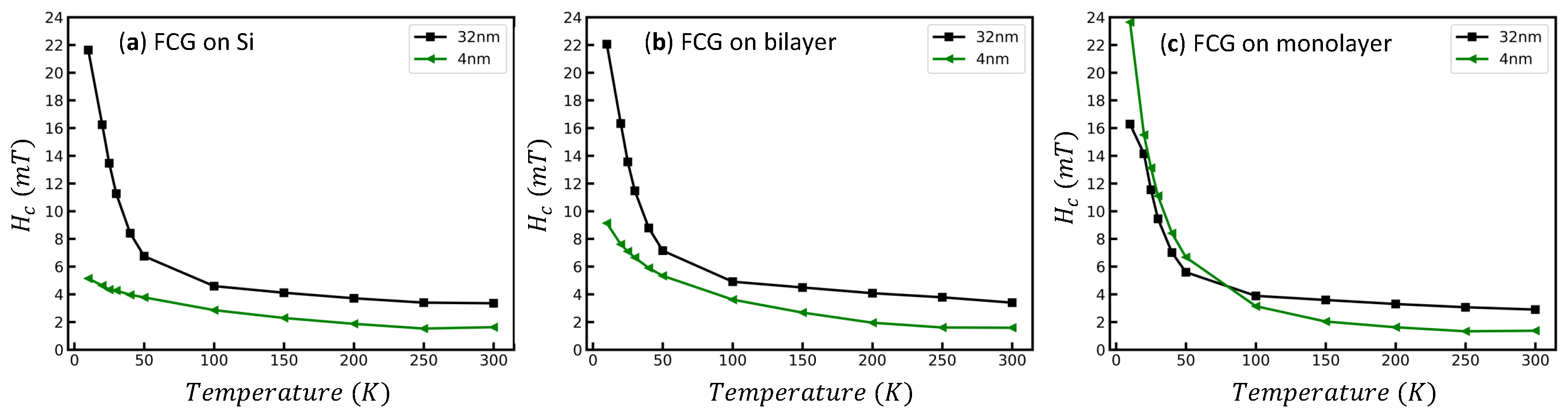
The temperature-dependent coercivity (
) of TMD/Fe
73Co
8Gd
19 heterostructures increases sharply below 50 K across all substrates, reflecting a substantial enhancement of magnetic hardness at low temperatures. This trend indicates a transition from thermally assisted to pinned magnetization reversal, consistent with prior reports in ultrathin ferrimagnets where enhanced interfacial anisotropy and spin pinning, driven by suppressed thermal activation, contribute to domain-wall immobilization [
6,
7,
27,
29]. The effect is especially pronounced in 4 nm films on WSe
2 monolayer, where
exceeds 23 mT, surpassing even the 32 nm counterpart, suggesting that interfacial effects may become increasingly significant in the ultrathin limit when thermal fluctuations are reduced [
7,
8,
15]. The pronounced contrast between films grown on monolayer- and bilayer-WSe
2 substrates underscores the sensitivity of proximity-driven effects to the atomic-scale structure of the 2D TMD substrate [
8].
Notably, in the FeCoGd on WSe
2 monolayer system, a clear crossover occurs near 75 K, where the coercivity of the 4 nm film surpasses that of the 32 nm counterpart. Above this temperature, coercivity increases with thickness, consistent with bulk-like domain-wall pinning [
27], whereas below 75 K, the rapid hardening of the ultrathin film indicates that interfacial anisotropy and exchange coupling become the dominant contributions to magnetization reversal [
6,
7,
8]. This crossover therefore marks a transition from volume- to interface-dominated behavior, consistent with a substrate-dependent interfacial magnetic contribution at the WSe
2/FeCoGd boundary [
13,
15,
16].
Collectively, these findings demonstrate that the magnetic response of TMD/Fe
73Co
8Gd
19 heterostructures arises from the coupled effects of temperature, thickness, and interfacial proximity. WSe
2 substrates provide an effective means to tune coercivity, saturation magnetization, and reversal coherence, underscoring the central role of interface-driven modulation in ultrathin ferrimagnets. This tunability highlights the importance of precise interface engineering in TMD/ferrimagnetic alloys and points to their broader potential in next-generation spintronic technologies. Additionally, the observed temperature-dependent degradation in reversal coherence may hinder reliable switching in spintronic devices such as SOT–MRAM and FiM oscillators, where high squareness is essential for thermal stability, energy-efficient operation, and robust data retention [
3,
4,
13,
19].




 ,
,