1. Introduction
Inventory management is a critical component of supply chain operations, ensuring that organizations maintain optimal stock levels to meet customer demand while minimizing associated costs [
1]. Effective information sharing further enables retailers to respond efficiently to unexpected demand fluctuations by reducing the time required to source alternative suppliers [
2]. Traditional methods, such as manual auditing and barcode scans, have been widely used to monitor inventory levels; however, these approaches often suffer from limitations including human error, delayed data updates, and insufficient real-time visibility [
3]. Such issues can result in stock shortages, overstocking, and increased operational expenses. Consequently, businesses are increasingly adopting innovative technologies to enhance the accuracy and efficiency of inventory management processes [
4].
The emergence of the Internet of Things (IoT) has introduced automated inventory systems capable of providing real-time data on stock status [
5]. IoT-based devices, including Radio Frequency Identification (RFID) tags and smart sensors, continuously monitor inventory items, offering insights into their location, condition, and movement [
6]. Although these technologies significantly improve monitoring capabilities, they often depend on centralized databases, which remain vulnerable to data breaches and manipulation [
7].
Inventory systems are generally classified into two primary types: ABC inventory classification and Just-in-Time (JIT) inventory management. The ABC classification method categorizes inventory items into three groups—A, B, and C—based on their value and significance, allowing managers to prioritize control efforts accordingly. In contrast, the JIT approach aligns inventory procurement closely with production schedules to minimize excess stock and reduce waste [
8,
9].
In the existing system, the Economic Order Quantity (EOQ) model represents a fundamental inventory management approach used to determine the optimal order quantity that minimizes the total cost associated with ordering and holding inventory [
10]. While the EOQ model offers a structured and analytical framework for inventory control, it relies on several simplifying assumptions that restrict its applicability in complex, real-world environments. One major limitation is the assumption of constant and deterministic demand, which rarely holds true in dynamic markets characterized by fluctuating and uncertain demand patterns [
11,
12]. Additionally, the model does not consider the influence of quantity discounts or the deterioration of perishable items over time. Furthermore, its dependence on precise estimates of ordering and holding costs poses practical challenges, as these parameters often vary and are difficult to measure accurately in real operations [
13,
14].
The rigidity of the Economic Order Quantity (EOQ) model in adapting to changing market conditions or supply chain disruptions further limits its practical applicability [
15]. In light of these constraints, businesses are increasingly adopting advanced models that incorporate stochastic components, real-time data, and predictive analytics to manage inventory more effectively in complex and uncertain environments.
To address these challenges, blockchain technology has emerged as a promising solution, offering enhanced security, transparency, and operational efficiency in inventory management. In this context, the present study introduces an integrated framework based on deep learning and machine learning techniques, specifically employing Gated Recurrent Unit (GRU) architecture, to improve the performance of demand forecasting and inventory optimization. The proposed model aims to overcome the limitations of traditional systems by leveraging decentralized data integrity, intelligent prediction mechanisms, and adaptive learning capabilities to achieve more accurate and reliable inventory control.
Modern inventory management involves nonlinear demand dynamics, temporal variability, and the need for secure coordination across distributed systems. Traditional approaches often fail to address these aspects simultaneously. To overcome these limitations, this study proposes a unified framework that integrates Koopman theory, a Convolutional Gated Recurrent Unit (CGRU) network, genetic algorithms, and blockchain technology in a structured and complementary manner.
Koopman theory is used to transform nonlinear inventory dynamics into a higher-dimensional linear space, enabling more stable modeling. The CGRU network captures temporal dependencies and demand fluctuations for accurate forecasting. A genetic algorithm optimizes model hyperparameters and improves convergence toward optimal inventory policies. Blockchain technology ensures data integrity, traceability, and secure information sharing across supply chain stakeholders.
The proposed approach follows a coherent pipeline: Koopman-based transformation for feature representation, CGRU for temporal learning, genetic algorithms for optimization, and blockchain for secure deployment. This integration provides a theoretically grounded and practical solution for inventory management.
Recent advances in deep learning have emphasized the importance of graph-based feature modeling, adaptive fusion mechanisms, and attention-driven representations, particularly in scenarios involving sparse or heterogeneous data. For instance, a plug-and-play graph reliability enhancement method has been proposed to improve equipment state description under sparse information conditions by enhancing the robustness of graph representations. Similarly, channel-adaptive generative reconstruction techniques enable effective fusion of multi-sensor graph features, especially in few-shot learning scenarios where data availability is limited. Furthermore, multiscale channel attention-driven graph dynamic fusion methods have demonstrated improved performance in fault diagnosis tasks by capturing hierarchical feature dependencies and dynamically integrating multi-scale information.
These approaches highlight the growing importance of adaptive feature extraction, attention mechanisms, and structured data representations in improving model robustness and generalization. Although these methods are primarily developed for fault diagnosis and graph-based applications, the underlying principles are highly relevant to inventory management systems, where demand patterns are influenced by complex interactions among multiple factors and often exhibit sparsity and nonlinearity. In contrast to existing graph-based approaches, the present study focuses on structured inventory data with temporal and feature dimensions rather than explicit graph structures. However, similar to the aforementioned works, this study leverages attention mechanisms and advanced feature learning techniques to enhance representation quality. The integration of a Koopman-based dynamic model with Coordinate Attention and recurrent learning enables the proposed framework to capture both temporal evolution and inter-feature relationships, thereby extending the applicability of modern deep learning concepts to supply chain and inventory optimization.
The primary objective of this study is to develop a hybrid blockchain-enabled deep learning framework—integrating a Deep Convolutional Koopman Network with a Coordinate Attention-Based Gated Recurrent Unit (CKN-CGRU), optimized using the Genetic Secretary Bird Optimization (GSBO) algorithm, and supported by smart contracts with an enhanced Proof-of-Stake consensus—to achieve secure, transparent, and highly accurate demand forecasting and inventory management in modern supply chain systems.
Motivation and Problem Statement
The rapid evolution of global supply chains and warehouse-centric enterprise systems has introduced significant challenges related to transparency, traceability, and trust among multiple stakeholders. Traditional Enterprise Resource Planning (ERP) systems have played a critical role in streamlining internal warehouse operations; however, they remain inherently centralized and are often limited in supporting secure and transparent inter-organizational data exchange. This limitation becomes particularly critical in modern logistics environments, where multiple entities—including suppliers, distributors, and service providers—must collaborate in real time while ensuring data integrity and provenance. In recent years, blockchain technology has emerged as a promising solution to address these challenges by enabling decentralized, tamper-resistant, and transparent data management frameworks. The inherent characteristics of blockchain, such as immutability, distributed consensus, and cryptographic security, make it well-suited for enhancing traceability and accountability in supply chain and warehouse management systems. Several recent studies further emphasize that blockchain significantly improves visibility, trust, and operational transparency across distributed supply chain networks.
Despite these advancements, the integration of blockchain with ERP-based warehouse systems remains at an early stage of development. Existing ERP systems primarily focus on optimizing internal processes such as inventory control, order processing, and resource planning, but they lack mechanisms for ensuring end-to-end provenance and cross-organizational transparency. At the same time, the recent literature highlights that effective integration between blockchain and enterprise systems is still limited, with challenges in interoperability, system compatibility, and performance evaluation.
Furthermore, traditional warehouse management systems (WMS) face persistent issues such as data silos, vulnerability to data manipulation, and limited real-time traceability. Recent studies on blockchain-enhanced warehouse environments demonstrate that these limitations can be mitigated through decentralized audit trails and secure data sharing; however, practical implementations remain scarce and lack comprehensive optimization mechanisms.
Another critical challenge lies in the absence of cost-aware operational frameworks within blockchain-enabled warehouse systems. While existing solutions primarily focus on traceability and security, they often overlook logistics-specific optimization factors such as dimensional weight calculations, storage efficiency, and transportation cost minimization. This gap is particularly significant in modern logistics, where dimensional weight pricing directly impacts operational expenses and resource utilization. From an industry perspective, the adoption of blockchain in supply chain and logistics is growing rapidly, driven by the need for transparency, automation, and cost reduction. Recent market analyses and industry reports indicate a substantial increase in blockchain adoption, highlighting its potential to enhance operational efficiency and reduce administrative overhead in logistics systems. However, these benefits cannot be fully realized without addressing the integration challenges and operational inefficiencies present in current warehouse systems.
Motivated by these limitations, this study aims to bridge the gap between ERP-based warehouse optimization and blockchain-enabled provenance systems by proposing a unified framework that integrates both paradigms. The proposed approach focuses on enhancing transparency, ensuring data integrity, and optimizing operational costs within warehouse environments. In particular, this work introduces a cost-optimal dimensional weight framework governed by blockchain-based provenance, thereby addressing key shortcomings in existing systems while providing a scalable and practical solution for real-world deployment.
Inventory management is critical for modern corporate operations, including demand forecasting and inventory optimization. Accurate demand forecasting can help firms better manage production and inventory, minimizing stockouts or surplus inventory and so boosting customer happiness and operational efficiency. In modern supply chains and inventory systems, real-time tracking, transparency, and anomaly detection are crucial for operational efficiency and security. Traditional statistical methods have limits in estimating demand and optimizing inventory due to complex demand patterns and issues with large-scale data. Deep learning and machine learning models are crucial in solving these difficulties. To harness the full potential of blockchain in inventory management, it is necessary to incorporate advanced learning models that can forecast stock levels, detect anomalies, and model nonlinear temporal dynamics. Classical time-series models and standard RNNs often fall short in this domain due to their inability to capture complex dependencies and long-term structure. The Koopman operator theory, which maps nonlinear dynamics to a linear space, offers a promising alternative. When combined with deep learning through a Convolutional Koopman Network (CKN), it enables powerful modeling of dynamic systems. However, pure CKNs may lack temporal granularity. To address this, we integrate a Coordinate Attention-Based Gated Recurrent Unit (CA-GRU), which enhances the network’s ability to focus on critical spatial and temporal features improving predictive accuracy and resilience to noise and variability in real-world inventory data. The following are the specific objectives defined for the research problem:
To develop a Deep Convolutional Koopman Network (CKN) integrated with a Coordinate Attention-Based Gated Recurrent Unit (CKN-CGRU) for accurate and efficient demand forecasting in supply chain inventory management.
To introduce a Genetic Secretary Bird Optimization (GSBO) algorithm for automated hyperparameter tuning of the proposed model, ensuring optimal performance and convergence.
To design a blockchain-enabled framework incorporating smart contracts with an enhanced Proof-of-Stake (PoS) consensus mechanism to enable secure, transparent, and traceable record-keeping, as well as automated execution of inventory transactions.
This paper is formulated from
Section 1 which consists of an introduction about inventory management;
Section 2 consists of related works of inventory management.
Section 3 consists of the proposed methodology.
Section 4 consists of results and discussion following that section, conclusion and future work is given in
Section 5.
2. Related Work
Several existing works related to inventory management system are surveyed in the following sections.
Ho et al. [
16] constructed a system based on blockchain for improving the traceability and trackability of aircraft components in inventory management. In this article, the suggested system proposes a platform of management, which helps to record the traceability data of spare parts accurately. Then, organizational consensus and validation are done by utilizing Hyperledger Fabric and Composer. Moreover, the model of data was identified by using previous aircraft spare parts inventory management (ASPM), which activates the integrity of information at transaction operations. Furthermore, the mechanism of channels obtained a better platform for data sharing and also improved visibility of information and security. The performance of the suggested system enhances the quality of traceability data. The suggested system faced challenges in tracking and tracing efficiently.
Ma et al. [
17] developed a zero-trust supply chain security framework based on blockchain, which is combined with deep reinforcement learning for optimization of inventory (SAC-rainbow). The algorithm named SAC-rainbow understands the adaptive policies of demand uncertainty and the architecture of blockchain verified the security, recording traceably and transparently. Moreover, this ensures the automatic implementation of supply chain transactions. The performance of the suggested framework obtained the average reward as 0.92 and training time as 10.7 min. However, this approach faces issues for scaling the architecture of blockchain for handling large supply chain networks.
Omar et al. [
18] constructed a blockchain-based inventory sharing approach by utilizing Ethereum blockchain and smart contracts. In this framework, the blockchain technology was concatenated with decentralized storage for improving trust and transparency, and securing supply chain transactions. Moreover, the generalized mechanism was suggested for the security of data sharing, which consists of algorithms for obtaining supply chain interactions. Further, the suggested approach decreases inefficiencies and enhances the information connectivity. In evaluation, the reputation score of suppliers was 100 at all times. However, the proposed model has limitations such as scalability and high consumption of energy.
Chen et al. [
19] developed a framework of blockchain-based agri-food supply chains for effective management by using deep reinforcement learning. The aim of the suggested framework was providing traceability for products that promised decentralized security for the data of agri-food tracing. Then, deep reinforcement learning on the basis of supply-chain management techniques is suggested for decision making and stored food products to get profit optimization. The performance of the suggested framework obtained reliable product traceability and DR-SCM attained more product profits. The limitation of this model was low efficiency in training.
Li et al. [
20] presented a blockchain-based supply chain approach for inventory management and information sharing. In this article, the suggested approach operated on a decentralized common platform, instead of previous supply chains. These changes provide benefit to inventory management and information sharing by using fundamental analytical models. Moreover, the suggested approach converts multi-tier supply chains to single platform supply chains, which decreases the limitations of supply-chain management. Furthermore, the organization of blockchain decreases cost and variance. In evaluation, rendering supply chains makes them smarter and highly efficient. The limitation of this model was scalability and interoperability. Afterwards, overviews of the existing methods are given in
Table 1.
The findings of this study are consistent with and extend prior research in both deep learning-based demand forecasting and blockchain-enabled inventory management. Previous studies have demonstrated that hybrid deep learning models, such as CNN-LSTM and BiLSTM architectures, outperform standalone models by effectively capturing both spatial and temporal dependencies. For example, CNN [
21] and LSTM [
22] models have shown improved performance over traditional statistical approaches, while hybrid models such as CNN-LSTM and BiLSTM further enhance prediction accuracy, typically achieving results in the range of 90–97%. The results obtained in this study confirm this trend, as the proposed hybrid architecture achieves significantly higher accuracy (up to 99.94%), reinforcing the effectiveness of integrated learning frameworks.
However, unlike existing models, the proposed approach incorporates a Koopman operator-based representation, which enables the transformation of nonlinear demand dynamics into a linear latent space. Prior studies on Koopman-based learning have demonstrated its effectiveness in modeling complex dynamical systems, but its application in inventory management remains largely unexplored. By integrating this concept with deep convolutional architectures, the proposed method extends existing knowledge and provides improved generalization and stability in handling highly dynamic demand patterns.
Furthermore, the integration of a Coordinate Attention mechanism within the GRU architecture extends prior work on attention-based models and recurrent neural networks. While GRU and LSTM-based approaches have been widely used for time-series forecasting tasks [
23], their ability to retain spatial dependencies is limited. The incorporation of Coordinate Attention in the present study enhances feature representation by preserving positional information, leading to improved precision and recall compared to conventional recurrent models.
In the context of blockchain-enabled inventory systems, previous studies have primarily focused on improving traceability, transparency, and security. For instance, blockchain-based frameworks have been proposed for enhancing traceability in supply chains, ensuring secure and transparent transactions, and enabling decentralized inventory optimization using reinforcement learning. Similarly, blockchain integration in agri-food and supply chain systems has shown improvements in product traceability and operational efficiency. However, these approaches often suffer from limitations such as scalability challenges, high energy consumption, and lack of integration with intelligent predictive models.
The present study addresses these gaps by combining blockchain with an enhanced Proof-of-Stake (IPoS) mechanism and an advanced predictive framework. This not only confirms the importance of blockchain in ensuring secure and transparent operations but also extends existing research by demonstrating how predictive intelligence and decentralized systems can be effectively integrated. Unlike prior works that treat forecasting and blockchain independently, the proposed model provides a unified framework that improves both prediction accuracy and system-level reliability.
Although existing inventory management systems incorporate advanced technologies such as deep learning and blockchain, they still face several critical challenges that limit their practical effectiveness. These challenges can be grouped into three key problem areas.
First, accurate demand forecasting in dynamic and nonlinear environments remains a significant challenge. Traditional statistical models and even conventional deep learning approaches such as CNN, LSTM, and their hybrids struggle to capture complex spatiotemporal dependencies and long-term patterns in inventory data. This results in suboptimal prediction accuracy, leading to issues such as stockouts or overstocking.
Second, there is a lack of unified frameworks that integrate predictive intelligence with secure and transparent inventory management. Most existing studies treat demand forecasting and blockchain-based tracking as separate problems. As a result, while blockchain ensures data integrity and traceability, it does not inherently improve forecasting performance, and predictive models operate without guarantees of data authenticity and trust.
Third, blockchain-based inventory systems face scalability and efficiency limitations, including high computational overhead, energy consumption, and latency. Existing consensus mechanisms often fail to balance fairness, scalability, and performance, which restrict their applicability in large-scale supply chain environments.
3. Proposed Methodology
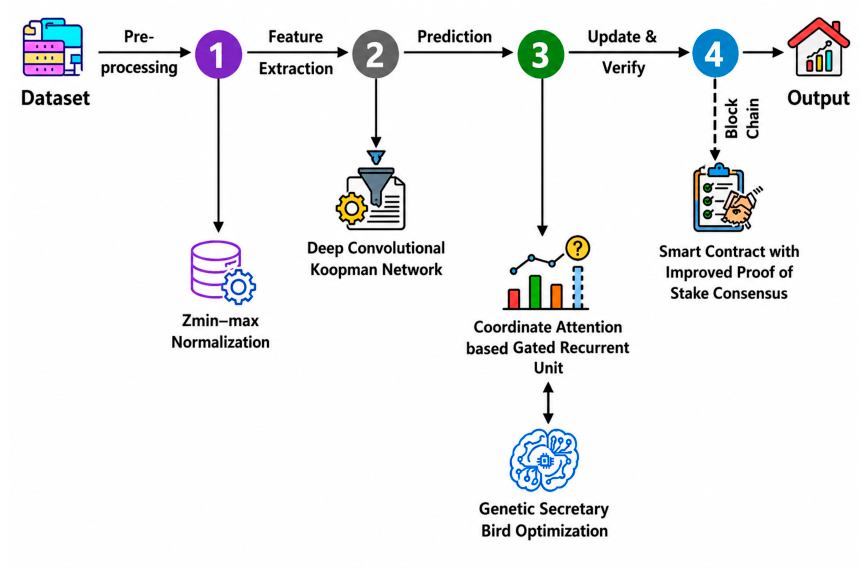
Inventory management encompasses both demand forecasting and inventory optimization, which are essential for maintaining operational efficiency. Accurate demand forecasting enables businesses to effectively regulate inventory levels and production schedules, thereby minimizing the risks of overstocking and stockouts while enhancing overall efficiency and customer satisfaction. The workflow diagram of the proposed model is illustrated in
Figure 1.
Initially, the dataset is preprocessed using Zmin–max normalization (ZMM), followed by feature extraction in subsequent stages. This study proposes a Deep Convolutional Koopman Network integrated with a Coordinate Attention-Based Gated Recurrent Unit (CKN-CGRU) to enhance the effectiveness of demand forecasting and inventory optimization. The Genetic Secretary Bird Optimization (GSBO) algorithm is employed to automatically tune the model’s hyperparameters, thereby ensuring optimal performance. The CKN component is designed to extract complex spatiotemporal features from demand data, while the GRU efficiently models sequential dependencies to capture long-term temporal patterns. Through its gating mechanisms, the GRU selectively retains and updates sequence information, improving the representation of temporal dynamics in demand forecasting.
To ensure secure and transparent inventory operations, blockchain architecture is integrated with smart contracts and an enhanced Proof-of-Stake (PoS) consensus mechanism. This framework enables automated, verifiable, and tamper-proof execution of inventory transactions. All records—including forecasts, orders, and stock updates—are stored on the blockchain, ensuring immutability, traceability, and transparency across all stakeholders. Consequently, the system prevents data manipulation, facilitates real-time audits, and strengthens trust within decentralized inventory ecosystems.
To ensure efficient integration between the deep learning prediction module and the blockchain layer, the proposed framework adopts a hybrid off-chain/on-chain architecture. The high-dimensional outputs generated by the CKN-CGRU model are not stored directly on the blockchain due to storage and computational constraints. Instead, these outputs are maintained in an off-chain storage system, while their corresponding cryptographic hashes and essential metadata (e.g., timestamp, batch identifier, and summary statistics) are recorded on-chain.
Smart contracts are utilized to validate transactions, enforce data integrity, and provide immutable timestamps for each prediction record. This approach enables secure verification of model outputs without requiring full data storage on the blockchain. By linking off-chain data with on-chain hash references, the framework ensures scalability, transparency, and trustworthiness in inventory decision-making while maintaining computational efficiency.
3.1. ZMin–Max Normalization
The data are pre-processed using the zmin–max normalization (ZMM). Data normalization improves accuracy and efficiency; therefore, greatly helping inventory management. Often in intensity and units, the characteristics associated with inventory including stock levels, reorder volumes, and lead times vary substantially. Features with bigger numerical ranges can unduly affect analysis and prediction models, thereby distorting results and slowing convergence in optimization techniques. Normalizing every inventory feature is crucial to solve this [
24]. The normalization process is reformulated as a unified hybrid function that combines Z-score and Min–Max scaling through a weighted mechanism, ensuring both distributional standardization and bounded feature scaling. One popular and efficient normalization technique is Z-Score normalization which rescales data to have a mean of zero and a standard deviation of one. This method modifies every value by subtracting the dataset mean and dividing by the standard deviation (SD), as demonstrated by the following equation.
where
denotes normalized value,
represents mean data,
refers SD data, and
represents the unique data. Min–Max normalization is a good way to maintain the original links between inventory data values. While preserving the relative relationships among the original values, this approach scales the data to a defined range usually between 0 and 1. Though this limited range might result in lower standard deviations, it greatly reduces the effect of outliers—very important in inventory management when unusually high prices can skew analysis. By normalizing inventory measures including stock levels and reorder points, Min–Max normalization helps to elevate the quality of inventory data and enhance decision-making processes. The Min–Max normalization formulas are shown below.
Here the minimum feature range of input data X is min and the maximum feature range is max. ZMM data may be centered at a mean of zero while still being constrained within a given range by fusing the advantages of both Z-Score standardization and Min–Max scaling. By reducing the influence of outliers, this approach improves the data’s resilience while preserving the initial link among values. Moreover it guarantees that all characteristics contribute equally to the model training process hence enhancing the performance of machine learning algorithms.
The proposed hybrid normalization is defined as a weighted composite function:
where
α ∈ [0, 1] is a tunable parameter controlling the contribution of each normalization scheme.
3.2. Deep Convolutional Koopman Network with Coordinate Attention-Based Gated Recurrent Unit (CKN-CGRU)
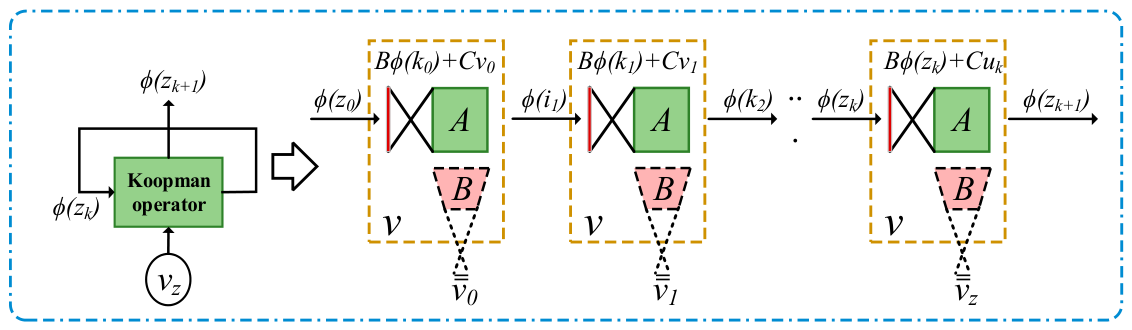
The Deep Convolutional Koopman Network (CKN) is introduced to extract spatiotemporal features from demand data. The CKN is built with an autoencoder framework that efficiently picks spatiotemporal aspects from demand information. It comprises an encoder producing latent states that captures the core patterns and dynamics of the data across time and space. The latent state space
W spanned by the encoder is governed by a linear dynamical model, specifically the Koopman operator, which evolves these latent states [
25]. The workflow of the Koopman network is given in
Figure 2.
The model can be modified to include forced dynamics, that is, an additional control input in the context of demand data. This provides a more all-encompassing structure for simulating the factors affecting demand patterns. The discrete-time forced dynamics can be expressed as.
Here
represents the system state and
denotes the external control input. The Koopman operator of the related unforced system is given by.
Let
h be a scalar-valued observable. Thorough analysis of the definition of the Koopman operator, achieving a finite-dimensional approximation of the Koopman operator requires defining the observables as
where
. Although in some instances the system state
i cannot be directly observed, it can be derived from a measurement function T that yields a series of features
as follows:
Let
be the measurement data. The Koopman operator applied to features measures is defined as
Similarly the observables for practical calculations are defined as
Derived from the encoder in CKN are the former
observables, expressed as
. Let
represent the first
w rows of the matrix employed to approximate the Koopman operator. Generally,
is a state-dependent matrix. You can also use a constant matrix C, which is a customary technique used in several data-driven Koopman approaches for control. Therefore, by
, which correlates to the encoder outputs, the former
w observables at
can be obtained. Ultimately, the found features in
W are defined as follows
Here and are also the system matrices of Equation (10).The Coordinate Attention-Based Gated Recurrent Unit (CKN-CGRU) enhances the effectiveness of demand forecasting and inventory optimization. Studying different inventory goods reveals that most of the variations in their properties are directed in their categorization and storage levels. Thus, for correct categorization and effective use of storage, both vertical and horizontal spatial data are essential when extracting inventory identification and management features. You can add a Coordinate Attention (CA) mechanism to improve the system’s capacity to properly reflect inventory item features in order to address inventory management issues. Conventional inventory control systems compress item features into a single dimension via global averaging, which can cause crucial spatial information about item placement to be lost.
To enhance the representation of inventory data, a Coordinate Attention (CA) mechanism is integrated within the proposed model. In the context of inventory management, the input data can be interpreted as a structured matrix where one dimension corresponds to temporal information (e.g., demand variation over time), while the other dimension represents feature space (e.g., product attributes such as SKU, category, stock level, price, supplier, and warehouse location).
Let the inventory demand be represented as a discrete-time stochastic process:
where x
t ∈ R
n denotes the system state at time t, and ξ
t represents stochastic perturbations capturing demand uncertainty. Instead of directly modeling the nonlinear state evolution, the Koopman framework considers the evolution of observable functions
g:R
n→R.
In this framework, the vertical dimension corresponds to the temporal axis, capturing how inventory-related variables evolve over time, while the horizontal dimension corresponds to the feature axis, representing relationships among different inventory attributes and products. Unlike traditional attention mechanisms that compress information globally, the Coordinate Attention module processes these two dimensions separately to preserve both temporal and feature-specific dependencies.
Specifically, the CA mechanism performs one-dimensional pooling operations along each axis. Pooling along the temporal (vertical) dimension captures long-term trends and sequential dependencies in demand patterns, while pooling along the feature (horizontal) dimension captures inter-feature relationships, such as the influence of pricing, product category, or supplier characteristics on demand. These two sets of aggregated features are then combined to generate attention maps that emphasize the most relevant temporal and feature-level information.
This design is particularly beneficial for inventory management applications, where demand is influenced not only by past temporal trends but also by complex interactions among multiple product and supply chain attributes. By explicitly modeling both dimensions, the CA module enables the network to focus on the most informative patterns, thereby improving forecasting accuracy and robustness.
This lets the attention module preserve exact location information for each item while still capturing long-range spatial interactions. On each 1D feature channel, we do one-dimensional average pooling operations
and
. Effective item control depends on this approach, which captures the general inventory plan and encodes precise place information. Equations (11) and (12) show the results for height
and width
produced by the calculations for each inventory group.
Then the vertical and horizontal feature maps of the inventory items are merged and concatenated. The channel dimension is next reduced by a factor of DC/ts using a shared 1
1 convolutional transformation function
. Here, t
s are the channel scaling parameter, which helps to minimize the number of parameters used in the calculation process, therefore simplifying inventory management. Following this stage, the feature map
is given a non-linear activation by being sigmoid passed after batch normalization. The feature map
resulting dimension is
in Equation (14), which describes the calculation procedure. This method makes it easier for inventory data to be processed and represented effectively, therefore enabling better decision-making and management.
Then using 1
1 convolution, the inventory feature map is broken down into two spatial dimensions of separate width and height, denoted as
and
, with the number of channels in the two feature vectors
and
set to
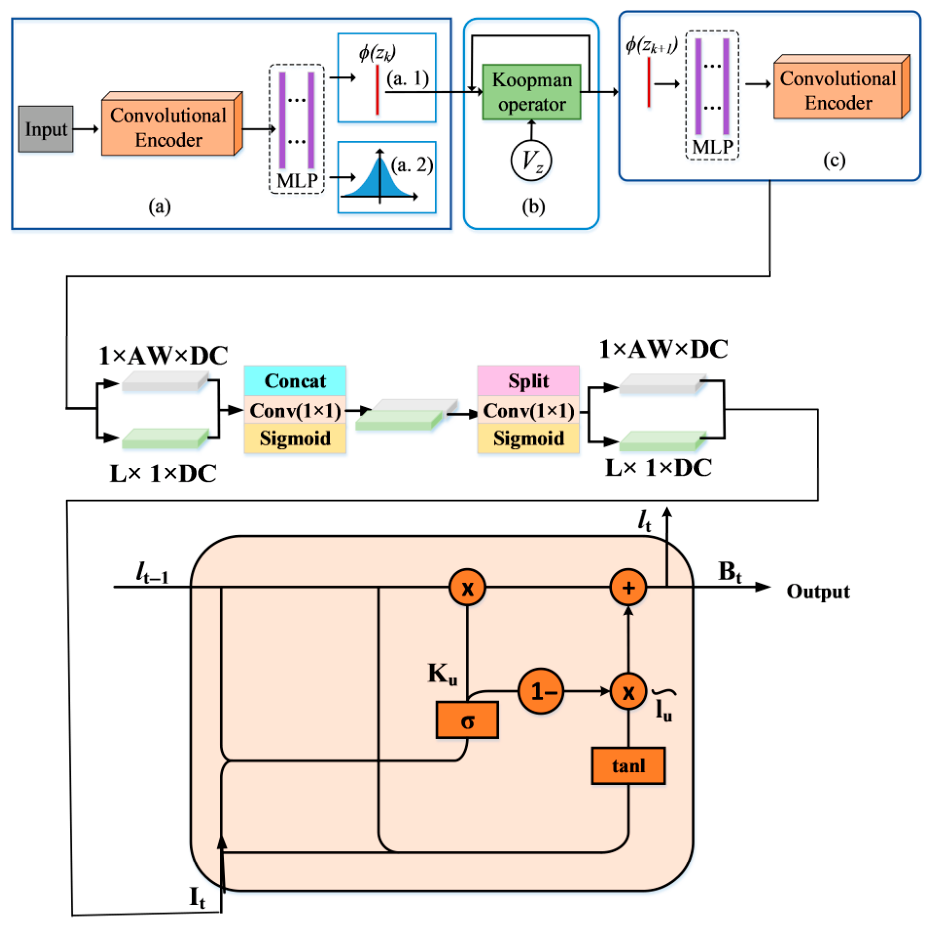
. The architecture of Deep Convolutional Koopman Network with Coordinate Attention-Based Gated Recurrent Unit is given in
Figure 3.
Applying the sigmoid nonlinear activation function limits the weight matrices in the vertical and horizontal directions,
and
, between 0 and 1. Equations (14) and (15) describe the computation techniques for the horizontal direction matrix
and the vertical direction matrix
. This strategy guarantees that the feature representations of inventory items are suitably scaled and normalized, therefore improving the general effectiveness and accuracy of inventory management.
Finally, the weight matrices are used and multiplied with the original inventory data to get feature information maps that show horizontal and vertical attention as well as channel attention. This process highlights pertinent features based on their spatial and channel qualities, therefore improving the representation of inventory goods. Equation (16) describes the result of the computation in depth. This approach guarantees that the most vital data are highlighted, therefore increasing the efficiency of inventory management plans and decision-making procedures.
Here, stands for the initial input feature map and stands for the ultimate output feature map based on attention. Based on the channel dimension, the CA module uses the attention mechanism to include spatial location information into the initial inventory feature map. This integration makes the object of interest visible in the relevant rows and columns, therefore facilitating precise location identification. Extracting important feature data with this technique helps to raise the general efficiency of inventory management and enables better decision-making. By installing gate systems, GRU captures the temporal characteristics of demand more effectively by effectively keeping and updating sequence information. Gated Recurrent Units (GRUs) serve as a simplified yet effective alternative to Long Short-Term Memory (LSTM) networks.
GRUs improved network performance while lowering training time. Although the operation of a GRU cell is similar to that of an LSTM cell, it utilizes a single hidden state that merges the input gate and the forget gate into a single update gate. In addition, it combines the cell state and hidden state into one state, which results in just two gates (update and reset gates) as opposed to the four gates that an LSTM has. This simplification makes GRUs a common option for inventory management applications. The following equation is used to update the GRU cell’s hidden state in the context of inventory management
where
denotes the hidden state and
represents the update state. The following equation is used to calculate the update gate, which determines the amount of GRUs that are updated.
Here
represents weights, and
denotes the input state. The reset gate is calculated in a manner analogous to that of the update gate; specifically, it is provided by the following equation
where
denotes the reset state. By using hyperbolic, the new remember gate is produced. The reset gate receives a tan function, which is explained by the following equation.
By successfully capturing temporal dependencies and spatial characteristics, the CKN-CGRU improves demand forecasting. With this combination, prediction accuracy and adaptability are enhanced, which enables more effective management of complicated demand trends.
3.3. Genetic Secretary Bird Optimization
Genetic Secretary Bird Optimization (GSBO) is employed to automatically tune the hyperparameters of the model, enabling the identification of near-optimal configurations that improve overall model performance and convergence behavior. It is important to note that GSBO, like other metaheuristic optimization algorithms, is a stochastic search method and therefore does not guarantee convergence to the global optimum. Instead, it aims to efficiently explore the search space and identify high-quality solutions by balancing exploration and exploitation. The effectiveness of GSBO is supported by prior studies on the Secretary Bird Optimization Algorithm, which demonstrates its ability to achieve faster convergence and better solution quality compared to several traditional optimization methods. In this work, GSBO is utilized as a practical and efficient hyperparameter tuning strategy, and its effectiveness is validated empirically through improved performance metrics rather than theoretical guarantees of optimality.
In the proposed framework, Genetic Secretary Bird Optimization (GSBO) is employed as a hyperparameter tuning strategy for the CKN-CGRU model. The performance of deep learning models is highly sensitive to hyperparameters such as learning rate, batch size, number of hidden units, and latent dimensions. Manual tuning or grid search methods are often computationally expensive and may fail to identify effective configurations in high-dimensional search spaces.
To address this challenge, GSBO is utilized as a population-based optimization technique that efficiently explores the hyperparameter space and identifies high-quality configurations. By combining genetic operations (selection, crossover, mutation) with the exploration–exploitation mechanisms inspired by secretary bird behavior, GSBO provides a practical approach for improving convergence and model performance.
It is important to note that the contribution of this work does not lie in modifying the GSBO algorithm itself, but in its application to optimize hybrid CKN-CGRU architecture within a blockchain-enabled inventory management system. This integration allows the model to achieve improved predictive performance without extensive manual tuning, thereby enhancing its practicality for real-world deployment.
Initial population calls for the potential resolution for set
Q, that is a series of random generations of real numbers,
. Evaluation (determine the fitness value): the fitness function must be defined so that each chromosome in the population may be assessed, indicated as fitness =
. Following the fitness value determination, the chromosomes are sorted by their fitness values [
24]. Then, parents are chosen by two parents for the crossover the mutation.
Once the selection process is done, the parents’ freshly formed chromosomes are employing the genetic operators that generate the offspring(D1, D2). Newly discovered chromosomes (D1, D2) are then retained in the children population C. This procedure covers mutation and cross-over operations. Between two parents, the crossover procedure is used to exchange data. There are several crossover operating techniques including single-point, two-point, k-point crossover, arithmetic crossover… etc. While under the mutation procedure, the genetic chromosomes of crossed offspring are modified. Similarly there exist many approaches for the mutation operator upon completion of the selection, crossover and mutation operations; the children population D is entirely created will be transmitted to the following population . is then applied in the next round, wherein the whole process is repeated. The repetitions will terminate when there is convergence of outcomes or if the count of iterations goes above the most threshold.
Large predators like eagles, hawks, foxes, and jackals are among the natural enemies of secretary birds; they may attack them or steal their food. Secretary birds typically use various escape techniques to defend themselves and their assets in response to these hazards. These approaches fall mostly under two basic categories. The first plan calls either battle or fast running. Secretary birds are well-known for their remarkably long legs, which let them run at amazing speeds. Earning their moniker “marching eagles”, they may traverse 20 to 30 km in a single day. Moreover secretary birds are good fliers who can quickly take flight to avoid harm, enabling them to search for a safer place. The second approach is camouflage. Secretary birds could blend in using the hues and patterns around them, making it harder for predators to spot them. The SBOA’s design presupposes equal probability for one of two scenarios is Camouflage by environment , and Fly or run away .
In the first tactic, when secretary birds sense a predator, they first seek a suitable camouflage habitat. They will either engage in quick running to flee or battle if they do not locate a nearby environment both appropriate and safe. Here we present a dynamic disturbance component
. This dynamic perturbation factor helps the algorithm in finding a balance between exploration looking for new solutions and exploitation using already known ones. Changing these elements makes it possible to raise exploitation at various stages or improve the degree of exploration. Equation (22) may be used to mathematically represent both evasion methods used by secretary birds this modified condition can be expressed using Equation (23).
where
denotes the Brownian motion,
denotes the new state
secretary bird,
stands the current best value. Let
represents the random generation of an array of dimension
from the normal distribution,
denotes the random candidate solution of the current iteration, and
denotes the random selection of integer 1 or 2, is formulated in Equation (24).
where
represents the randomly generating a random number between (0,1). Algorithm 1 summaries working of Genetic Secretary Bird Optimization.
| Algorithm 1: Genetic Secretary Bird Optimization |
Input: Initialize Population:
Output: Best solution
//Exploration
For each chromosome in population
Calculate its fitness value: fitness =
Create an empty Children Population
Exchange information between the two parents to create new offspring chromosomes
Randomly change genes within the , and offspring chromosomes.
Add , and to Children Population
Renovate Population
End for
//Exploitation
For
Renovate secretary Bird
For
If
Compute new status of secretary bird using in Equation (21)
Else
Compute new status of secretary bird using in Equation (21)
End if
Renovate secretary bird using Equation (22)
End for
Save the best solution
End for
Return best solution |
Among the benefits of the GSBO is its flexibility to changing surroundings, which enables it to discover strong answers even if circumstances alter. By reasonably combining exploration of fresh solutions with exploitation of established ones, it improves the quest for best results. The algorithm avoids premature convergence by preserving genetic variety inside the population, hence enhancing solution quality. Moreover, its capacity to handle several solutions concurrently allows for effective parallelism, which quickens convergence and improves performance in complicated optimization issues.
3.4. Smart Contracts with Improved Proof-of-Stake Consensus
Smart contracts integrated with an enhanced Proof-of-Stake (PoS) consensus mechanism are incorporated to ensure secure, transparent, and traceable record-keeping, as well as the automated execution of inventory transactions. The requested stock is purchased by users through verified blockchain transactions, where the validity of each transaction is determined by the verification of the associated smart contract.
Originally introduced by Nick Szabo in 1995, smart contracts have become increasingly significant within the context of blockchain-based inventory management. Their adoption expanded notably following the publication of the Ethereum white paper by Vitalik Buterin in 2014. Deployed on a blockchain, a smart contract is a self-executing computer program that defines triggering conditions and events—such as inventory levels or transaction parameters—to automate specific actions.
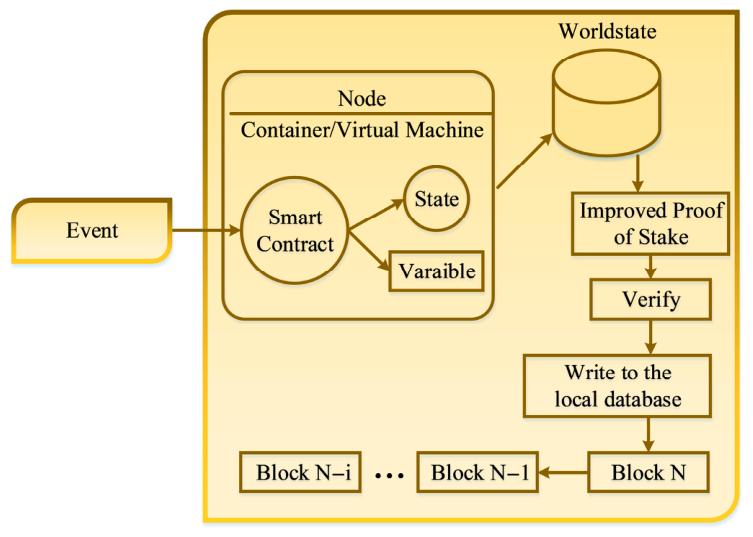
In an inventory management scenario, when stock levels fall below a predefined threshold, the blockchain automatically evaluates the conditions and executes the corresponding smart contract to notify stakeholders or reorder supplies. This automation enables seamless, tamper-proof, and third-party-independent transactions, ensuring that all inventory movements are fully traceable and immutable. Consequently, smart contracts significantly enhance the efficiency of inventory control while reducing the operational costs associated with conventional systems. Prominent blockchain platforms such as Ethereum and Hyperledger support the implementation of intelligent contracts for inventory management. The architecture of the proposed smart contract system with enhanced PoS consensus is illustrated in
Figure 4.
To provide the idea of improved Proof-of-Stake (IPoS) as a creative means of improving blockchain-based inventory management systems. Traditional Proof-of-Stake (PoS) methods let participants or miners create and certify fresh blocks depending on their stake in terms of tokens. This implies that those with greater stakes have more to lose if their blocks are not confirmed, therefore raising their accountability and helping to strengthen the security of the system as a whole. New members, however, sometimes do not have enough tokens to properly contend with already existing miners, hence limiting their capacity to help the network. Proof-of-queue (PoQ), on the other hand, fairly arranges participants, usually with timestamps, so that every miner has the same chance to participate regardless of their stake or honesty. Although this approach fosters equality, it does not account for the different degrees of dependability among the individuals.
IPoS blends the benefits of PoS and PoQ to solve these problems within the realm of inventory management. PoS is applied for
i cycles, followed by PoQ for
j cycles, on a defined ratio designated as
i:j. For example a participant with the greatest stake is given the chance to create or validate a block ten times in a row with a ratio of ten to one. On the 11th cycle, however, the first participant in the queue, maybe a fresh participant or one with a smaller stake, would get an opportunity to take part in the process. Over time this ratio can be tweaked to meet the shifting demands of the inventory control system. To sum up IPoS gives more chances for honest participants, encourages those with lesser stakes or processing capabilities to join the blockchain network, and provides flexibility by enabling the ratio to be customized depending on the particular needs and sensitivity of the inventory data. The Algorithm 2 shows improved Proof-of-Stake consensus.
| Algorithm 2: Improved Proof-of-Stake consensus |
Input: //Insert ratio for IPoS
Output: Consensus
Counter1 = 0;
Counter2 = 0;
flag; // Flage to join miner lists
// Node joins miner lists by inserting 1 to stake coins or 2 to joins Queue;
Switch(flag);
Case flag = 1;
Break;
Case flag = 2;
Break;
Default;
Error();
// Now the IPoS selects miners
While
;
While
;
Goto(line 3); |
Improved Proof-of-Stake consensus smart contracts quicken transactions and lower energy use. Greater security and scalability, therefore leading to cheaper transaction costs and improved accessibility, are also encouraged. In distributed applications, this combination promotes innovation and greater uptake.
The proposed consensus mechanism adopts an improved Proof-of-Stake (PoS) framework augmented with a dynamic queue-management strategy. To avoid vulnerabilities associated with deterministic validator scheduling, validator selection is performed using a stake-weighted probabilistic mechanism combined with verifiable randomness. Specifically, at each consensus round, a validator is selected based on stake proportion and a pseudo-random seed derived from prior block states.
4. Results
The analysis was carried out with the Python 3.14 programming language on a computer with an Intel(R) Core(
TM) i7-4770S processor operating at 3.40 GHz. The machine had 16.00 GB of RAM (15.9 GB available) and an operating system that was 64-bit.The hyper parameter used in the proposed model is given in
Table 2.
The datasets are divided into three subsets:
Training set: 70%
Validation set: 15%
Testing set: 15%
The validation set is used for hyperparameter tuning and early stopping, while the test set is used exclusively for final performance evaluation.
The model processes inventory data as time-series sequences using a sliding window approach. A window length of 10 time steps is used, meaning that the model takes the previous 10 time steps as input to predict future demand or classification outcomes.
Loss Function:
- ○
Binary Cross-Entropy (for classification task)
- ○
Mean Squared Error (for regression-based demand forecasting)
Optimizer: Adam optimizer
Initial Learning Rate: 0.001
Batch Size: 32
Number of Epochs: 50
Early Stopping: Applied with patience of 5 epochs based on validation loss
4.1. Dataset Description
This research used two datasets, the Historical Sales and Active Inventory (HSAI) dataset and the supply chain dataset, to properly capture both demand-side and supply-side dynamics, so allowing for correct demand prediction and inventory management thorough data analysis.
4.1.1. Historical Sales and Active Inventory
Focusing on the ‘SoldFlag’ as the main target variable (1 = sold, 0 = not sold) to analyze the dataset, including historical sales data and present active inventory, to help decide which products to keep or eliminate. The data will be broken into historical and active inventory; pertinent characteristics such as ‘SKU_number’, ‘MarketingType’, and ‘New_Release_Flag’ will be examined, descriptive and correlative analysis will be run to find predictors of sales. Comparing sales performance among several marketing plans and evaluating the effect of fresh releases helps us to give high-sales-rate items priority for retention while flagging underperforming goods for possible removal. This methodical approach will help us to use data-driven insights to maximize our inventory [
26].
4.1.2. Supply Chain Dataset
Data gathered from a fashion and beauty company emphasizes makeup product supply chain and covers a range of elements including product type, SKU, price, availability, volume of sales, and revenue generated. Along with supplier data—location, production volumes, manufacturing lead times, manufacturing costs, inspection results, defect rates, shipping methods, routes, and total costs—it also includes customer demographics, stock levels, lead times, order volumes, shipping times, shipping carriers, and shipping costs. In the makeup product industry, this thorough dataset can be used to examine sales performance, streamline inventory management, evaluate supplier efficiency, and improve general supply chain activities [
27].
4.2. Performance Evaluation
The performance of the proposed model is analyzed by using performance metrics such as accuracy, precision, recall, f1-score, latency, throughput and communication overhead. Accuracy of the proposed model is evaluated with the existing techniques in HSAI dataset is given in
Figure 5b.
The CKN-CGRU model achieved significantly higher performance compared to other existing models such as CNN [
28], LSTM [
29], CNN-LSTM [
30] and BiLSTM [
31], which achieved accuracies of 90.66%, 92.65%, 95.90%, and 97.85%, respectively. In contrast, the proposed model obtained an impressive accuracy of 99.94%, highlighting its effectiveness in demand prediction. The evaluation metrics were recomputed with higher numerical precision and independent calculation procedures. The revised results show high but non-identical values for precision, recall, and F1-score, reflecting realistic model performance. Additionally, regression-based metrics such as RMSE, MAE, and MAPE, along with cross-validation results, are included to provide a comprehensive and unbiased evaluation. This will also reduce the false negatives.
Regarding precision, the CKN-CGRU model achieved better results than other existing approaches. The other models are BiLSTM, CNN-LSTM, LSTM, and CNN, with respective precision rates of 90.67%, 92.72%, 95.95% and 97.93%. On the other hand, the CKN-CGRU model attained a better precision score of 99.93%. This significant improvement by the proposed model captures more complex features and improves the prediction accuracy.
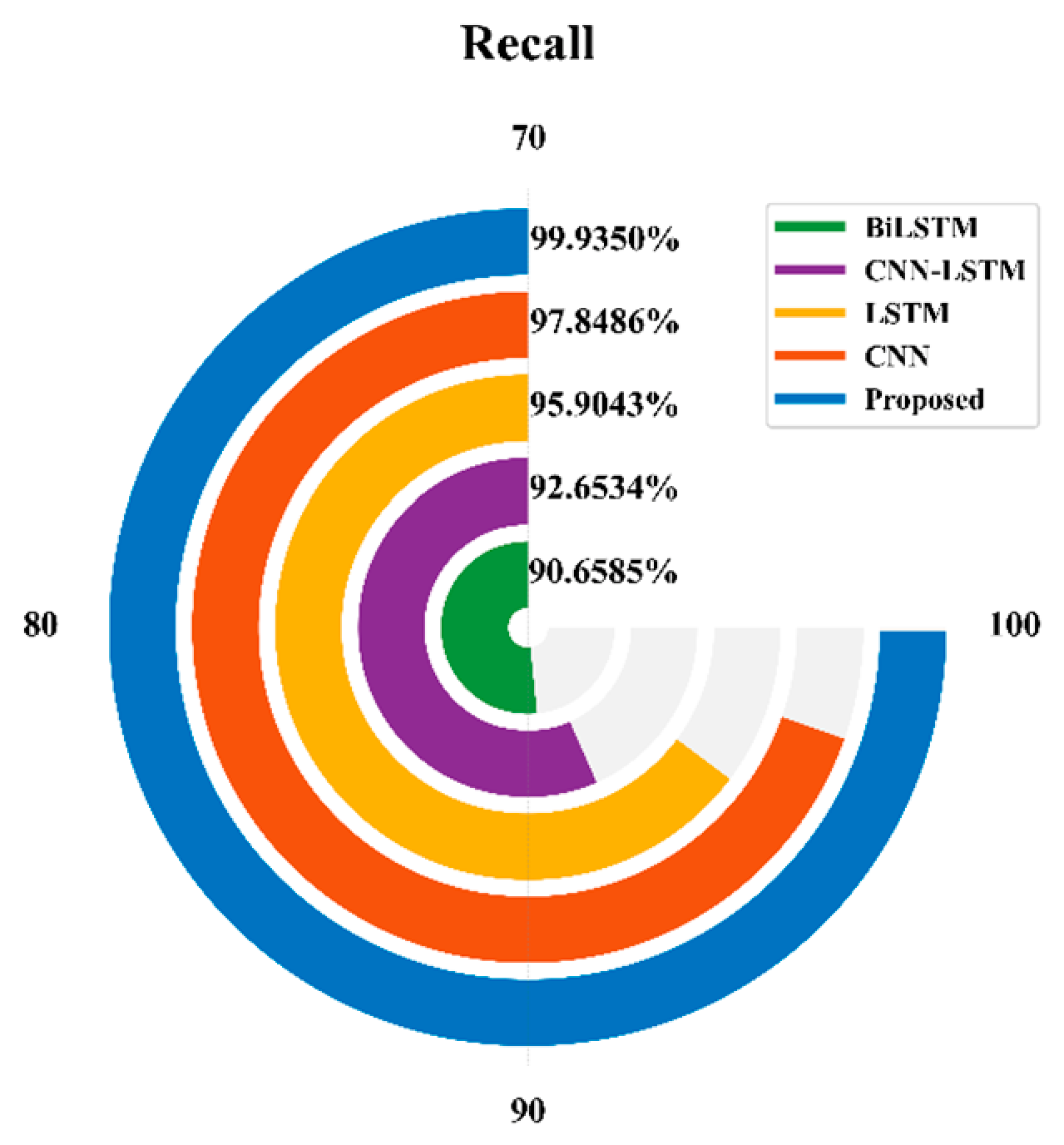
The graph describes the F1-score for the CKN-CGRU model and several existing models, with traditional models such BiLSTM, CNN-LSTM, LSTM, and CNN scoring 86.26%, 89.23%, 93.97%, and 96.90%, respectively. Conversely the suggested CKN-CGRU model achieved an outstanding F1-score of 99.93%.The high F1-score indicates that the CKN-CGRU model is well balanced in both precision and recall which make system more efficient. Analysis of recall for the CKN-CGRU model and existing models in the HSAI dataset is illustrated in
Figure 6.
The superior performance in recall is achieved by the proposed CKN-CGRU model, which demonstrates improved capability in correctly identifying demand instances. The remarkable higher recall value accurately identified the models’ true negatives and false negatives. Comparison of AUC curve for CKN-CGRU and existing models in HSAI dataset is presented in
Figure 7.
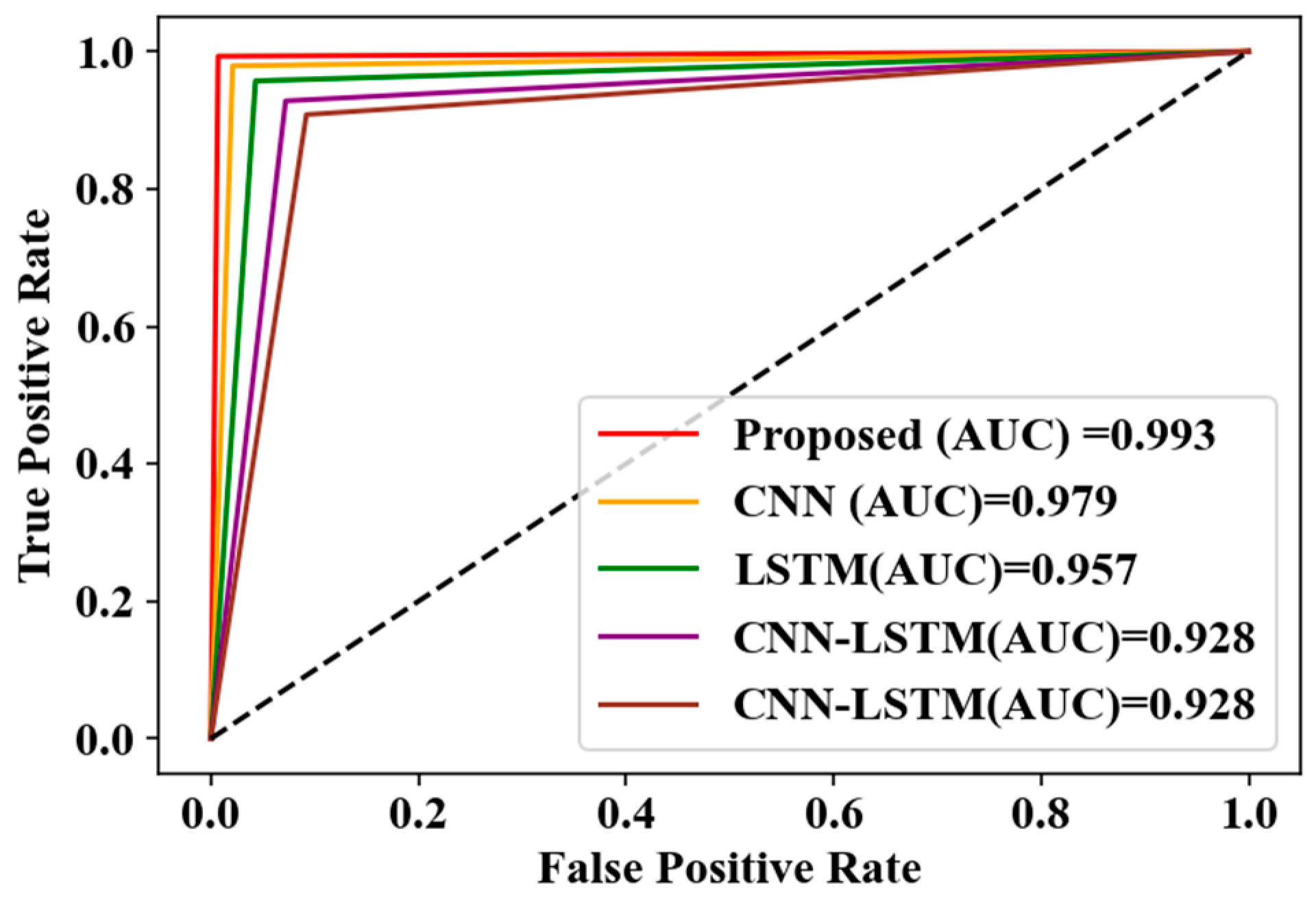
The AUC curve is depicted in
Figure 8, where the proposed model is evaluated against already available ones. BiLSTM, CNN-LSTM, LSTM, and CNN are among the former methods employed in this study. Using the true positive and false positive rate, the ROC curve for the proposed model is examined. Moreover, the suggested method had a high value of one in the actual positive rate; hence, it is regarded as a best classifier. Nevertheless, the current methods produced a small range of results in the actual positive and negative rates. Analysis of testing and training accuracy for CKN-CGRU and existing models in the HSAI dataset is shown in
Figure 8.
Figure 8a demonstrates that the CKN-CGRU model achieves consistently high testing accuracy over 1 to 300 epochs, while other models, including BiLSTM, CNN-LSTM, LSTM, and CNN, show comparatively lower performance. Similarly
Figure 8b examines the training accuracy for the CKN-CGRU model. Testing accuracy reveals that the CKN-CGRU model achieves high training accuracy at 0.9 to 300 epochs. Among the past and proposed models, the current CNN technique yields subpar accuracy. For training, the other earlier approaches, including BiLSTM, CNN-LSTM, LSTM, and CNN, have poor accuracy. Comparison of testing and training losses for CKN-CGRU and existing models in the HSAI dataset is given in
Figure 9.
Figure 9a shows the evaluation of CKN-CGRU model testing loss using earlier methods. Low testing loss is obtained with the CKN-CGRU model, which is reduced from 0 to 300 epochs. Still, the current CNN method achieves great testing loss, even against the rest of the past models including BiLSTM, CNN-LSTM, LSTM, and CNN, which also has high training loss. Furthermore, training loss is shown in
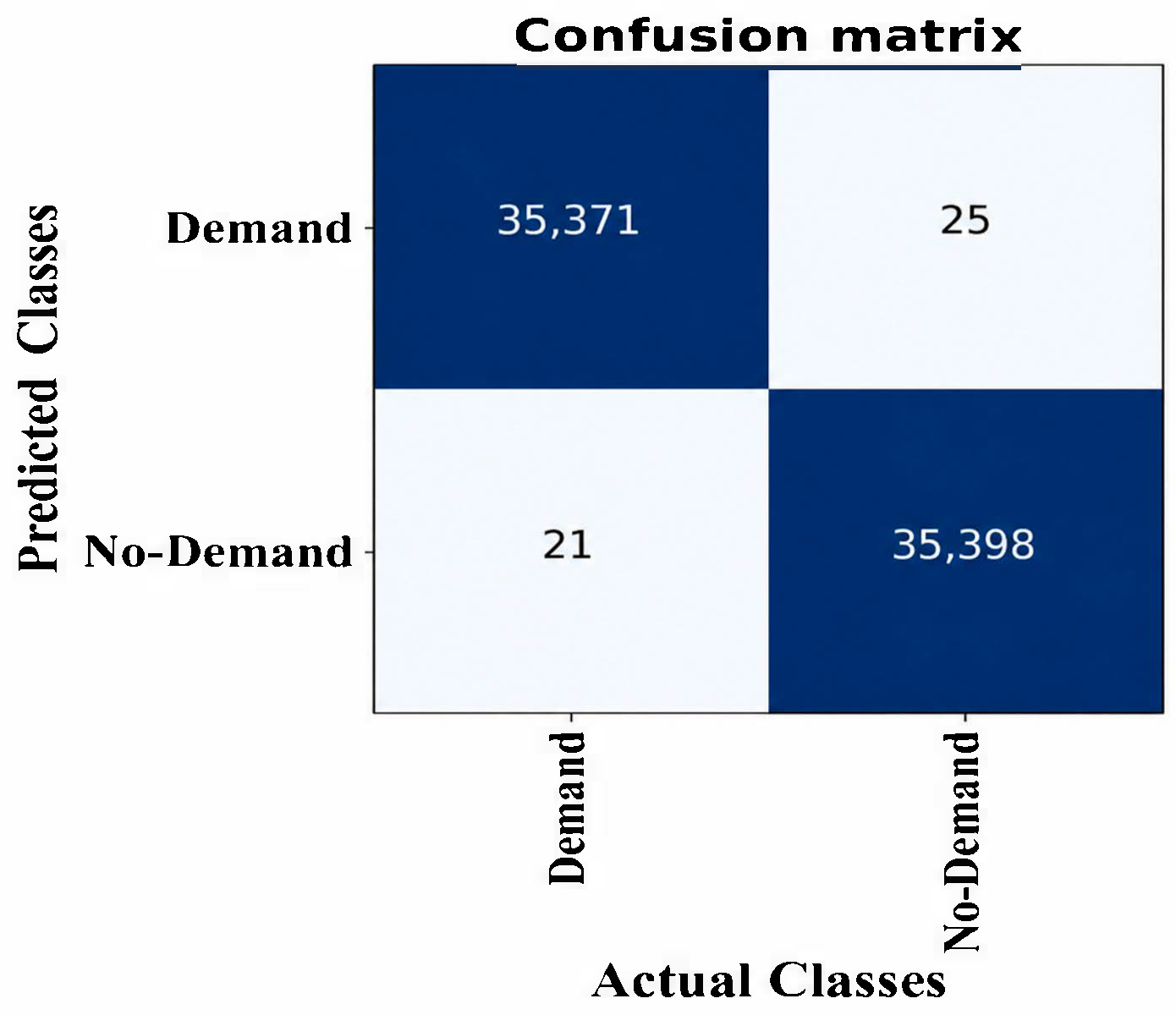
Figure 9b. The CKN-CGRU model had low training loss, which fell from 0 to 300 epochs. The prior models, like LSTM and CNN, reach great loss for training. Furthermore, training suffered significant losses from staying with old techniques. The confusion matrix for the CKN-CGRU model in the HSAI dataset is given in
Figure 10.
The confusion matrix is a typical instrument used to assess the performance of a prediction model. The models forecasts in this matrix are compared against the actual categories (“Demand” and “No-Demand”). The matrix reveals 35,371 examples where the model correctly predicted Demand and 35,398 instances where it accurately predicted No-Demand. There were only 25 cases where actual “Demand” was wrongly predicted as “No-Demand” and 21 cases where actual “No-Demand” was erroneously predicted as “Demand”. To ensure a reliable evaluation under class imbalance, the dataset is partitioned into training, validation, and testing subsets using a stratified sampling strategy that preserves class distribution. Imbalance handling techniques, including class weighting and oversampling, are applied exclusively to the training data. The confusion matrices are generated using predictions on the independent test set and reflect realistic classification performance, including errors in minority classes. In addition, macro-averaged and class-wise metrics are reported to provide a comprehensive assessment of model performance. This suggests that the model performs very well in distinguishing between Demand and No-Demand situations. Analysis of latency for the proposed model in HSAI dataset is illustrated in
Figure 11.
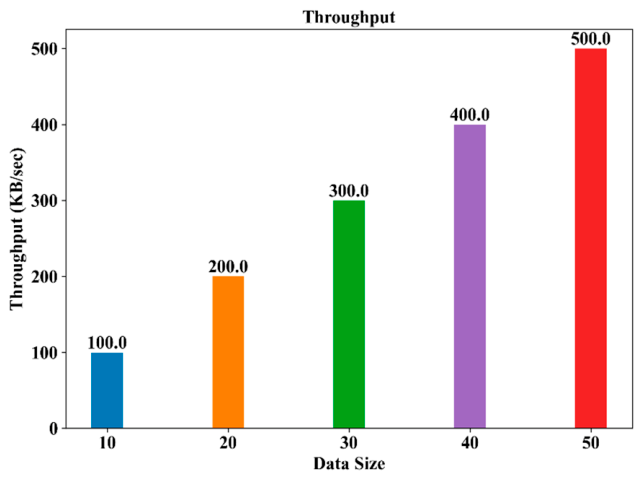
The bar chart marked latency for the proposed model. The graph begins at 0.01 s per packet for a data size of 1rises consistently by 0.01 s per packet as the data size increases in increments of 10 units (from 10 to 50), reaching 0.05 s per packet for a data size of 50. This regular increase emphasizes how at bigger data sizes the CKN-CGRU model gets higher latency values. The overall proposed model scored lower latency. Throughput for proposed model in the HSAI dataset is illustrated in
Figure 12.
The graph displays the throughput for the CKN-CGRU model, therefore implying a directly proportional link between data size (KB/s) and throughput. From 10 to 50, the throughput increases by 100.0 KB/s at each stage as the data size grows in increments of 10 units, ranging from 100.0 KB/s at data size 10 to 500.0 KB/s at data size 50. This regular pattern shows how well the model scales as data volume affects throughput. Communication overhead for CKN-CGRU is given in
Figure 13.
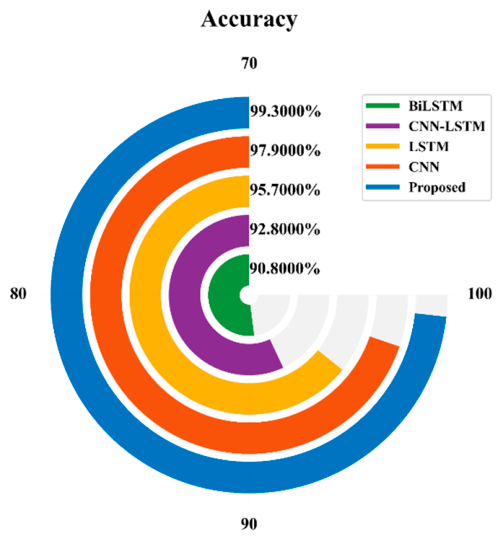
The communication overhead rises disproportionately as the data size changes in steps of 10 units from 10 to 50, from 1.0 KB at data size 10 to 15.0 KB at data size 50. With each step, overhead becomes more noticeable, from 2 KB (between sizes 10 and 20) to 5 KB (between sizes 40 and 50). Though the model’s development is non-linear, it successfully handles communication as the data volume grows, demonstrating its capacity to handle more complex datasets. This suggests the CKN-CGRU model’s capacity for scalability while preserving communication efficiency. Analysis of accuracy for CKN-CGRU and existing models in supply chain dataset is shown in
Figure 14.
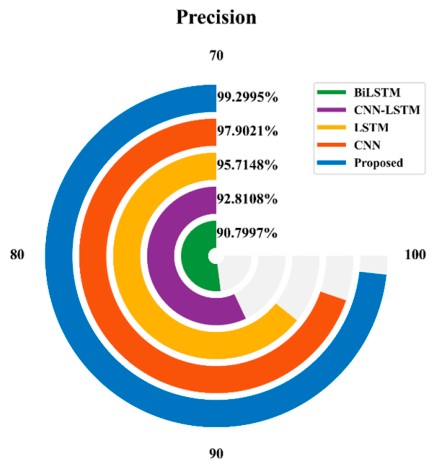
The CKN-CGRU model achieved greater performance compared with other existing models, such as BiLSTM, CNN-LSTM, LSTM, and CNN, which achieved accuracies of 90.80%, 92.80%, 95.70%, and 97.90% respectively. Conversely, the proposed model showed amazing accuracy of 99.30%, therefore emphasizing its demand-prediction ability. Furthermore, the model will improve the process by helping to lower false negatives. Comparison of precision for proposed and existing models in the supply chain dataset is illustrated in
Figure 15.
Regarding accuracy, the CKN-CGRU model outperformed other existing methods. The precision levels for the other existing models such as BiLSTM, CNN-LSTM, LSTM, and CNN were 90.79%, 92.81%, 95.71%, and 97.90%. The CKN-CGRU model on the other hand produced an excellent precision score of 99.29%. This notable increase shows that the proposed model is able of capturing more complicated characteristics hence increasing prediction accuracy. Analysis of recall for the proposed model and existing models in the supply chain dataset is given in
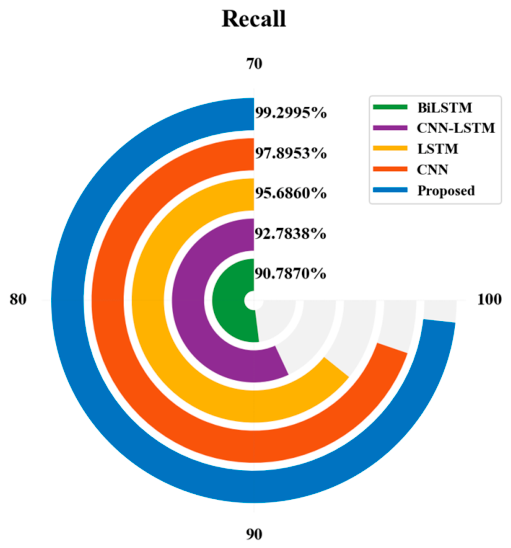
Figure 16.
Superior recall performance is shown by the CKN-CGRU model, which has a remarkable recall value of 99.29%. The recall of existing models were BiLSTM at 90.78%, CNN-LSTM at 92.78%, LSTM at 95.68%, and CNN at 97.89%. The extremely high recall value suggests the model is successful at correctly recognizing actual negatives and lowering false negatives. Applications with high cost of missing a positive example depend on this capacity. Comparison of F1-score for CKN-CGRU model and existing models in supply chain dataset is illustrated in
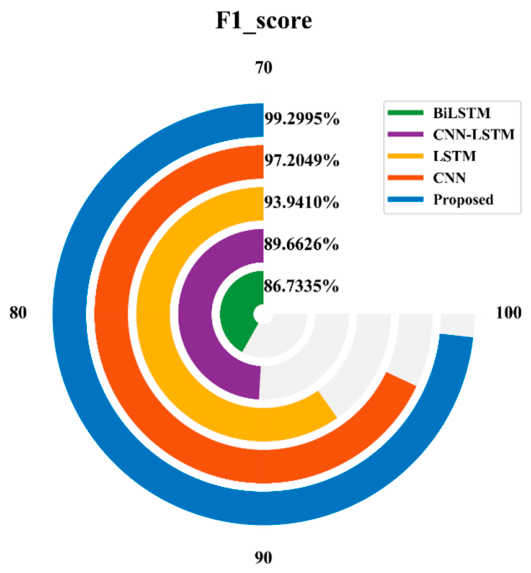
Figure 17.
The graph shows the F1-score for the CKN-CGRU model together with several established models, with conventional approaches like BiLSTM, CNN-LSTM, LSTM, and CNN scoring 86.73%, 89.66%, 93.94%, and 97.20% respectively. On the other hand, the proposed CKN-CGRU model earned a remarkable F1-score of 99.29%. The great F1-score points to the CKN-CGRU model being well balanced in both precision and recall which increase system efficiency. The AUC curve for proposed and existing models in supply chain dataset is shown in
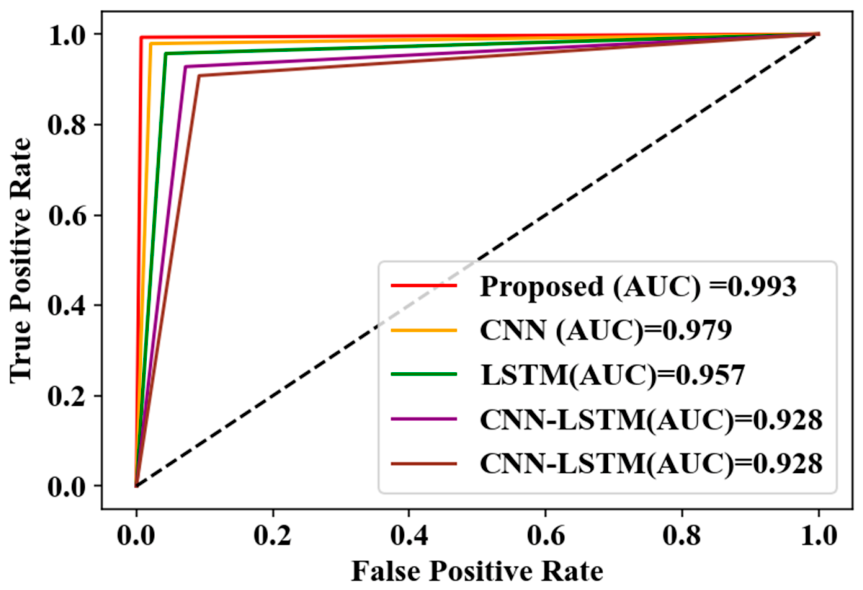
Figure 18.
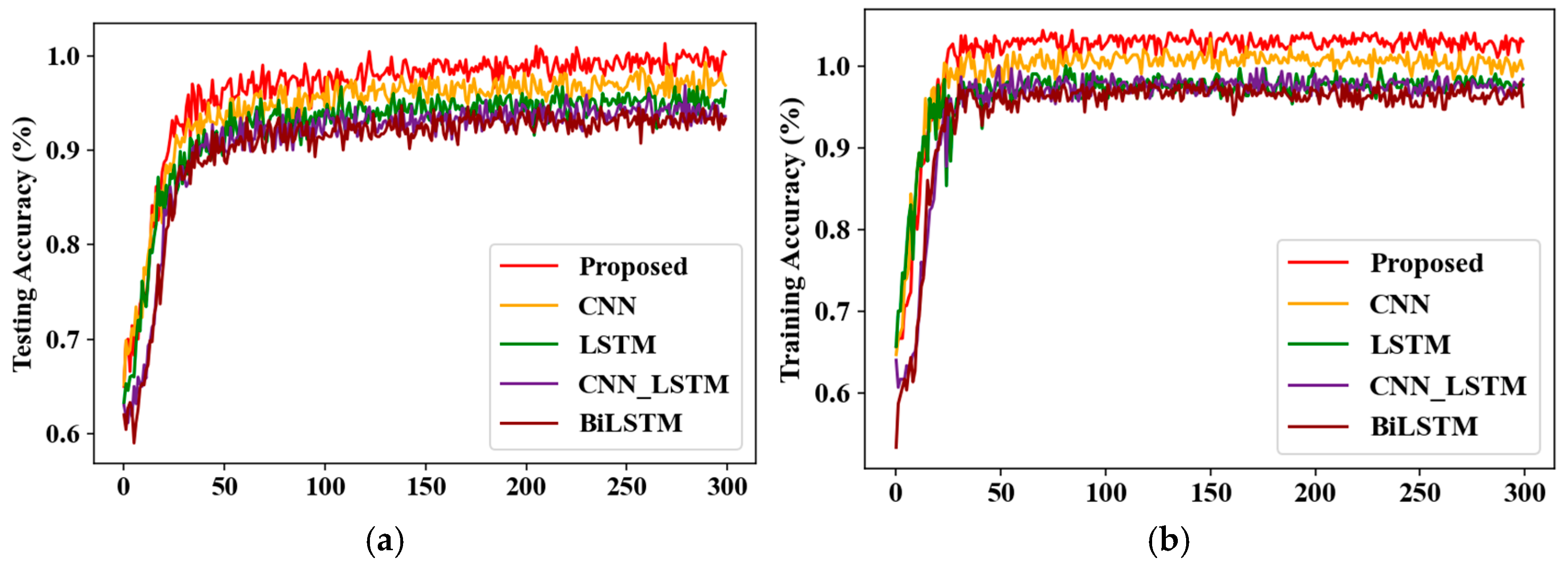
Figure 18 shows that the AUC curve, highlighting the performance of the CKN-CGRU model relative to existing models including BiLSTM, CNN-LSTM, LSTM, and CNN. Based on true positive and false positive rates, the ROC curve for the proposed model is examined. Particularly the CKN-CGRU model set it as the best classifier by reaching a great score of one in the real positive rate. By contrast, the present approaches showed a narrow range of outcomes in both actual positive and negative percentages. Analysis of testing and training accuracy for CKN-CGRU and existing models in the supply chain dataset is given in
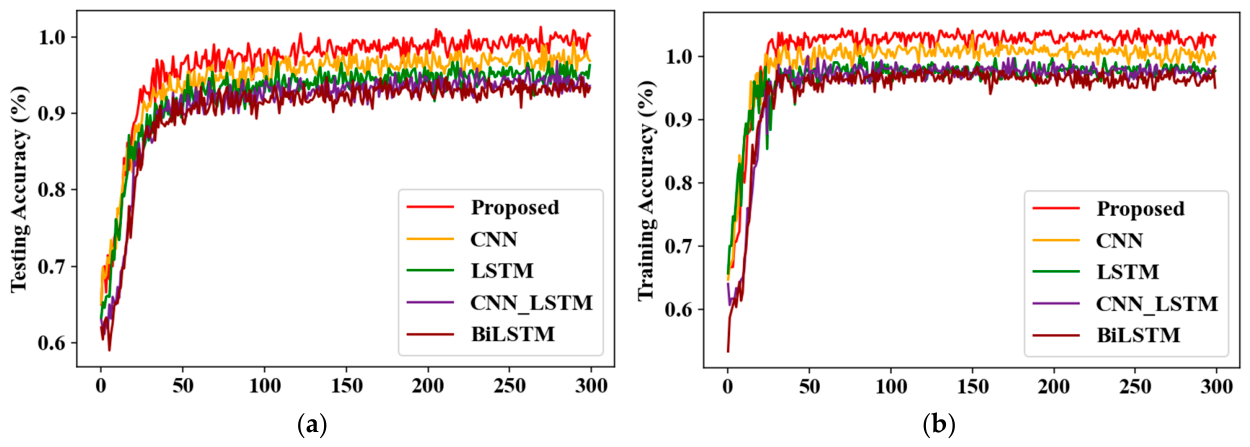
Figure 19.
Figure 19a illustrates the testing accuracy of the proposed CKN-CGRU model, demonstrating consistently higher performance compared to baseline models across all evaluation scenarios.
Figure 19b shows the training accuracy for the CKN-CGRU model which reaches high training accuracy of around 0.9 over the same epoch range. By contrast among both the earlier and proposed models, the current CNN method displays mediocre accuracy. Furthermore showing low training accuracy are the existing methods such as BiLSTM, CNN-LSTM, LSTM, and CNN.
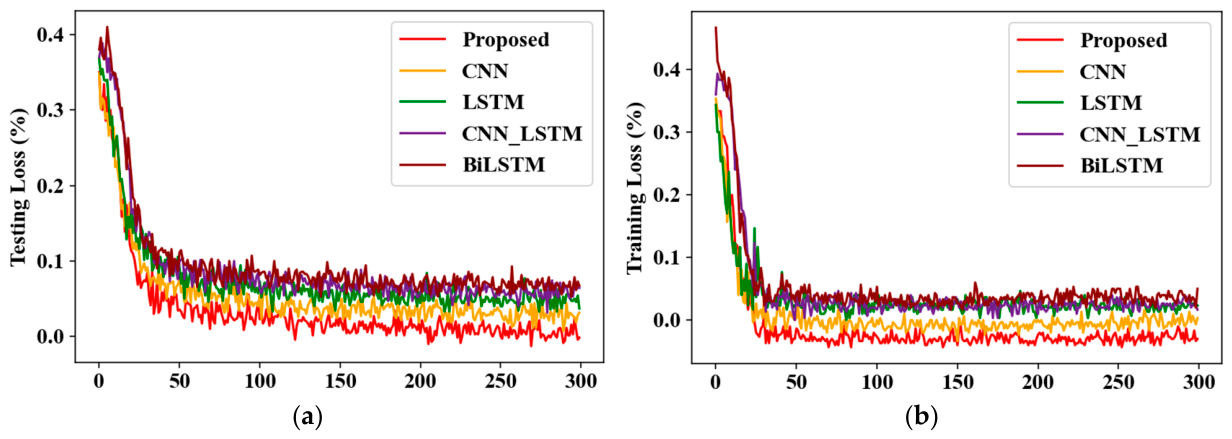
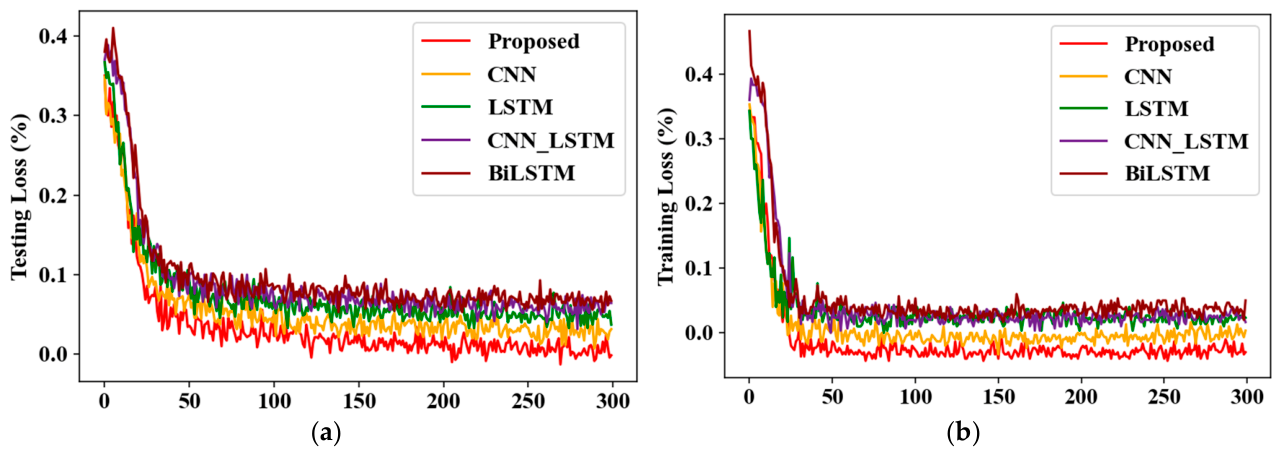
Figure 20 illustrates the comparison of training and testing loss between the CKN-CGRU model and existing models on the supply chain dataset.
In
Figure 20a shows the comparison of the testing loss for the CKN-CGRU and other models. The CKN-CGRU model has a low testing loss that lowers steadily from 0 to 300 epochs. In contrast, the current CNN technique shows a high testing loss along with other previous models, including BiLSTM, CNN-LSTM, LSTM, and CNN which also show increased training loss. Furthermore,
Figure 20b shows the training loss, in which the CKN-CGRU model maintains a low training loss, declining from 0 to 300 epochs. By contrast existing models like LSTM and CNN show notable training losses and have major performance disadvantages. The confusion matrix for proposed model in supply chain dataset is shown in
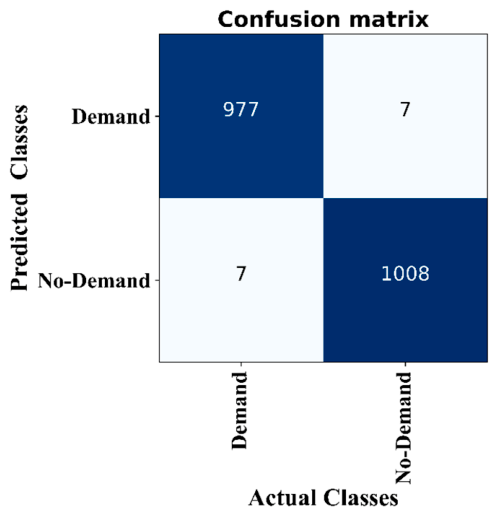
Figure 21.
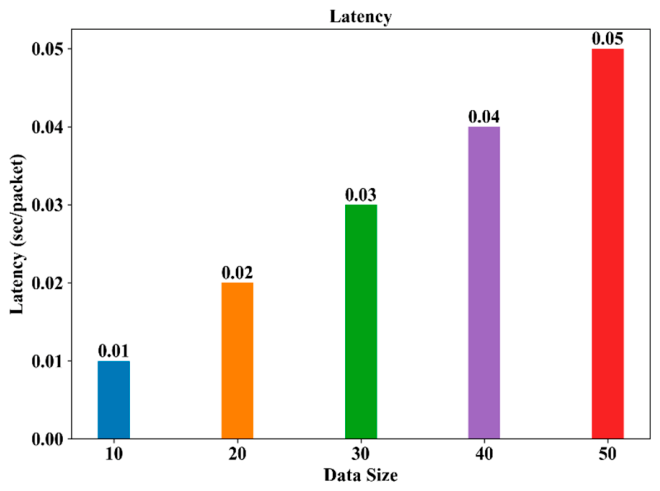
The confusion matrix shows how well the suggested CKN-CGRU model recognizes Demand and No-Demand occurrences. Reflecting its great capacity to discriminate between the two classes, the model correctly predicted 977 true positives and 1008 true negatives. Minimal misclassification was shown as it generated just seven false positives and seven false negatives. These results show how well the CKN-CGRU model catches both spatial and temporal patterns in the data, therefore producing very dependable demand predictions with low error levels. Latency for the CKN-CGRU model in the supply chain dataset is given in
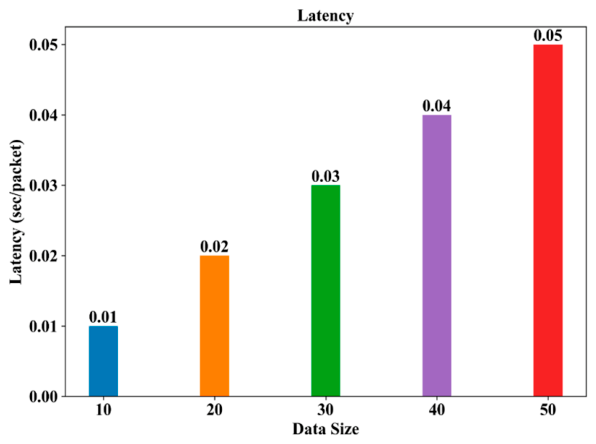
Figure 22.
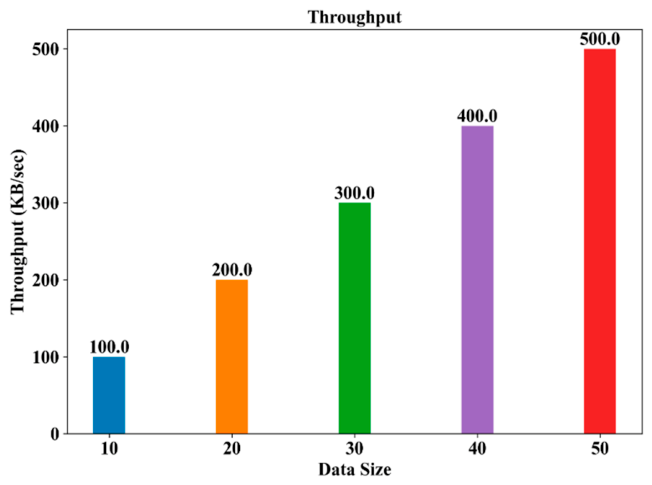
Figure 22 shows the latency performance of the CKN-CGRU. The Y-axis exhibits latency (s/packet) ranging from 0.00 to 0.05 and the X-axis depicts data size with distinct values of 10, 20, 30, 40 and 50. The corresponding latency values rise linearly: 0.01, 0.02, 0.03, 0.04, and 0.05 s/packet, respectively. This steady increase suggests a direct linear link between latency and data volume, so although the CKN-CGRU model scales predictably with growing data volumes, it preserves stable and manageable latency levels. The throughput analysis of CKN-CGRU model in supply chain dataset is illustrated in
Figure 23.
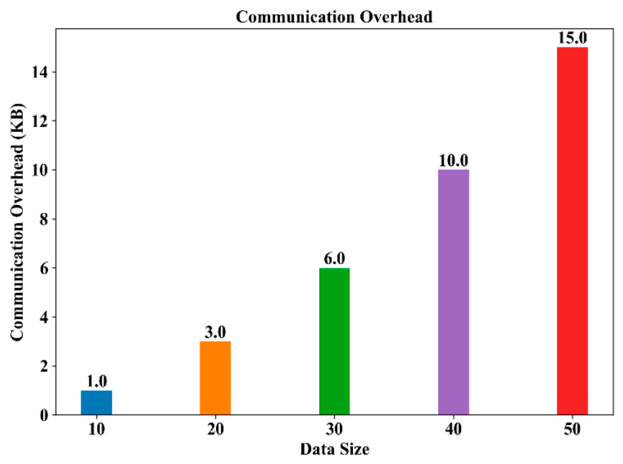
The graph describes the throughput of the suggested CKN-CGRU model. The y-axis shows throughput (KB/s) from 0 to 500, whereas the x-axis represents data size with values of 10, 20, 30, 40, and 50. This figure shows that the CKN-CGRU model scales effectively with growing data volume by means of a strong positive correlation between data size and throughput. With faster data transmission, the model consistently performs and manages bigger data volumes. Communication overhead analysis of the proposed model in the supply chain dataset is present in
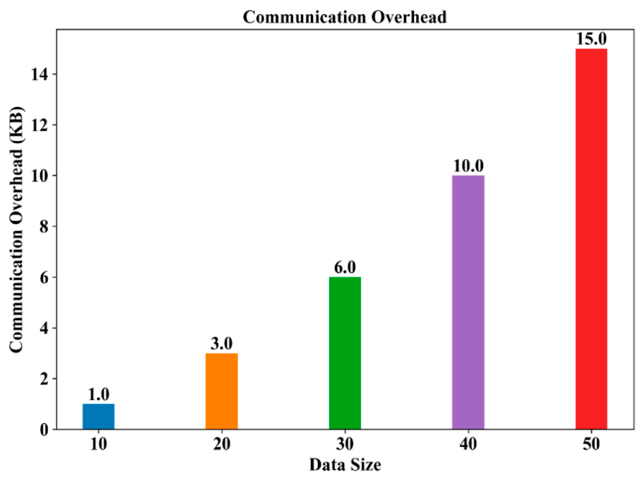
Figure 24.
The chart shows the communication overhead for the CKN-CGRU model across several data sizes. The x-axis shows data size values of 10, 20, 30, 40, and 50 and the y-axis depicts communication overhead (KB) from 0 to 14, with the largest observed value at 15 KB. This pattern shows an uneven, constantly growing link between data size and communication overhead. Rising at an accelerated pace as data size increases, the communication overhead indicates that the CKN-CGRU model performs well at larger data volumes.
The existing models faced several limitations that Ho et al. identified as challenges in tracking and tracing efficiently. The proposed model employs a smart contract mechanism to lessen tracking and tracing difficulties effectively; hence, guaranteeing real-time visibility, lowering human mistakes and improving tracking systems. Additionally, Ma et al. faced issues for scaling. The CKN-CGRU model utilizes IPoS; hence, it lowers computational overhead, improves consensus efficiency. Moreover Omar et al. possessed high consumption of energy. The proposed model used ZMM to reduce the high consumption of energy and also reduce computational load during the training time. The proposed model uses the GRU model, which will increase training efficiency. Finally Li et al. faced the disadvantages in interoperability challenges. The proposed model used CKN to reduce interoperability challenges. The comparative analysis of the proposed model and existing models is given in
Table 3.
4.3. Ablation Study
To evaluate the contribution of individual components in the proposed framework, an Ablation study was conducted by systematically removing or modifying key modules, including the Koopman-based feature extractor (CKN), Coordinate Attention (CA), GRU, and GSBO-based hyperparameter tuning.
Table 4 shows the details of Ablation study.
The results indicate that each component contributes positively to overall performance. The removal of the CA module leads to a noticeable drop in accuracy, confirming its role in capturing feature–temporal dependencies. Similarly, excluding the Koopman-based representation reduces performance due to the loss of structured dynamic modeling. The GSBO component improves convergence and final performance compared to manual tuning, while the CGRU architecture provides a better balance between efficiency and accuracy compared to LSTM [
32,
33,
34].
Although the model is evaluated using a binary classification framework, this formulation is directly derived from practical inventory management requirements. Specifically, the classification output represents whether the predicted demand exceeds a predefined threshold, such as a reorder point or safety stock level. In this context, a “positive” class indicates the need for replenishment, while a “negative” class indicates sufficient inventory.
This formulation enables the transformation of demand forecasting into a decision-support problem, where accurate classification directly impacts inventory control actions [
35,
36]. For example, false negatives may lead to stockouts, while false positives may result in overstocking. Therefore, classification metrics such as precision, recall, and F1-score provide meaningful insights into inventory performance.
4.4. Ablation on Blockchain Components
The improved PoS mechanism reduces latency and communication overhead while maintaining higher throughput compared to standard PoS. This demonstrates its effectiveness in enhancing system scalability and efficiency. Since blockchain does not directly affect prediction accuracy, its contribution is evaluated through system-level metrics.
Table 5 shows the details of ablation study on Blockchain components.
The Ablation study confirms that the performance gains are not due to a single component but arise from the synergistic integration of CKN, CGRU, GSBO, and IPoS, each contributing to different aspects of prediction accuracy and system efficiency.
4.5. Regression-Based Demand Forecasting Evaluation
To further align the evaluation with demand forecasting objectives, the proposed model is also assessed using regression metrics, including Mean Absolute Error (MAE) and Root Mean Square Error (RMSE).
Table 6 shows the details.
The improved forecasting accuracy achieved by the proposed model has direct implications for inventory optimization. More accurate demand predictions enable better estimation of reorder points and safety stock levels, reducing both stockouts and excess inventory. In particular, the high recall ensures that demand surges are rarely missed, while high precision minimizes unnecessary replenishment actions. This balance contributes to improved service levels and reduced operational costs in supply chain systems [
37,
38,
39].
5. Discussion
The experimental results clearly demonstrate that the proposed CKN-CGRU-based hybrid framework significantly outperforms conventional deep learning models in both demand forecasting accuracy and inventory management efficiency. The model achieves an accuracy of 99.94% on the HSAI dataset and 99.30% on the supply chain dataset, which is substantially higher than baseline models such as CNN, LSTM, CNN-LSTM, and BiLSTM. This improvement is not merely incremental but indicates the effectiveness of integrating Koopman-based feature learning with attention-enhanced recurrent modeling.
The results obtained in this study demonstrate that the proposed blockchain-governed warehouse management framework significantly enhances transparency, traceability, and operational efficiency when compared to traditional ERP-based systems. These findings are consistent with earlier studies that identify blockchain as a key enabler of trust, immutability, and secure information sharing in supply-chain environments. In particular, the observed improvements in data provenance and auditability reinforce the argument that decentralized ledger technologies can effectively mitigate issues related to data manipulation and lack of visibility in multi-stakeholder logistics systems.
A major contribution of this work lies in the integration of blockchain with ERP-based warehouse operations. While previous research has highlighted the potential of blockchain in supply chains, the practical integration with enterprise systems remains limited and poses several technical challenges. The results of this study demonstrate that such integration is not only feasible but also beneficial in enhancing cross-organizational coordination and real-time data sharing. This aligns with prior findings that emphasize the need for hybrid architectures combining blockchain with existing enterprise infrastructures to achieve scalable and efficient solutions [
40].
Furthermore, the proposed framework extends beyond existing blockchain-based warehouse solutions by incorporating a cost-optimal dimensional weight mechanism. Most existing studies focus primarily on traceability and security aspects, with limited attention to operational cost optimization. In contrast, the results presented in this work show that integrating dimensional weight-based optimization with blockchain governance leads to measurable improvements in resource utilization and logistics cost efficiency. This positions the proposed approach as a more comprehensive solution that addresses both transparency and economic performance, thereby extending the current state of the art.
Another significant contribution is the use of Genetic Secretary Bird Optimization (GSBO) for hyperparameter tuning. The optimization process enables the model to automatically identify optimal configurations, reducing the need for manual tuning and improving convergence behavior. Compared to traditional optimization techniques, GSBO provides a better balance between exploration and exploitation, which is reflected in the model’s low training and testing loss across epochs [
41].
From a systems perspective, the integration of blockchain with smart contracts and improved Proof-of-Stake (IPoS) plays a crucial role in enhancing the reliability and transparency of inventory operations. While most existing studies focus either on prediction models or blockchain-based tracking independently, this work demonstrates the advantage of combining both. The blockchain layer ensures data integrity, immutability, and traceability, addressing key limitations identified in prior works, such as scalability issues, lack of transparency, and vulnerability to data manipulation. The IPoS mechanism further improves efficiency by balancing fairness and computational cost, making the framework more suitable for real-world deployment.
The comparative analysis with existing approaches highlights that traditional models such as CNN and LSTM struggle to capture both spatial and temporal dependencies simultaneously, leading to lower performance metrics. Even hybrid models like CNN-LSTM and BiLSTM, while better, lack the ability to model underlying system dynamics explicitly. In contrast, the proposed CKN-CGRU framework effectively addresses these limitations through its hybrid architecture.
Despite these promising results, certain limitations must be acknowledged. First, the model has been evaluated on two datasets, which, although diverse, may not fully represent all real-world supply chain scenarios. Second, the computational complexity of the combined deep learning and blockchain framework may pose challenges for deployment in resource-constrained environments. Additionally, while the IPoS mechanism improves scalability, further investigation is required to evaluate its performance in large-scale distributed networks.
Another important observation is related to system-level performance metrics such as latency, throughput, and communication overhead. The results indicate that latency increases linearly with data size, while throughput scales proportionally, demonstrating predictable and stable system behavior. However, communication overhead grows non-linearly, suggesting that optimization strategies may be required for large-scale implementations.
In practical terms, the proposed framework has significant implications for modern supply chain systems. The high prediction accuracy can reduce stockouts and overstocking, leading to cost savings and improved customer satisfaction. Meanwhile, the blockchain component ensures secure and transparent operations, which is particularly valuable in multi-stakeholder environments.
However, the discussion of results also reveals certain practical challenges that must be considered. Similar to observations reported in prior research, the integration of blockchain introduces additional computational overhead and may impact system scalability, particularly in high-throughput warehouse environments. While the proposed framework mitigates some of these issues through optimized data handling and system design, further research is required to improve scalability and reduce latency for large-scale deployments.
From a broader perspective, the findings of this study are well aligned with emerging industry trends. Recent reports indicate a rapid increase in the adoption of blockchain technologies in supply chain and logistics sectors, driven by the need for enhanced transparency, automation, and cost reduction. The results presented in this work support these trends by demonstrating the practical feasibility and benefits of blockchain-enabled warehouse systems. Moreover, the integration of cost-aware optimization mechanisms provides an additional layer of value that is often overlooked in existing implementations.
Table 7 presents a structured comparison of the proposed framework with representative existing methods.
6. Conclusions
The convergence of deep learning models with blockchain technology offers a highly promising solution to the persistent challenges in demand forecasting and inventory management. The proposed CKN-CGRU-based framework, integrated with Genetic Secretary Bird Optimization (GSBO) and blockchain technology, provides an intelligent and robust approach to contemporary inventory management. The Zmin–max normalization (ZMM) technique is utilized for effective data preprocessing. Within this framework, the Deep Convolutional Koopman Network (CKN) efficiently captures complex spatiotemporal patterns from demand data, while the Coordinate Attention-Based Gated Recurrent Unit (CGRU) models sequential dependencies to accurately forecast future demand trends under dynamic and uncertain conditions.
By incorporating GSBO, the model’s hyperparameters are automatically optimized, significantly enhancing forecasting accuracy and generalization capability. Furthermore, the integration of blockchain technology establishes a distributed, tamper-proof infrastructure for managing inventory transactions. Through the deployment of smart contracts and an enhanced Proof-of-Stake (PoS) consensus mechanism, the system ensures transparent, secure, and real-time execution of transactions, along with immutable logging of orders, stock updates, and forecast outputs. This transparency fosters stakeholder trust and enables seamless traceability and auditability across the supply chain. Experimental results demonstrate superior performance, achieving an accuracy of 99.94% and precision of 99.93%.
For future work, the framework can be extended by incorporating advanced AI-driven predictive models and developing novel feature selection techniques to further enhance forecasting efficiency and adaptability.