1. Introduction
Cyber–physical systems (CPSs) in manufacturing connect physical production processes with digital data acquisition, monitoring, analysis, and feedback mechanisms, enabling improved process visibility, faster response to deviations, and more informed operational decision-making [
1,
2,
3,
4,
5]. In this study, the term CPS is used in the manufacturing sense of a cyber–physical manufacturing system (CPMS), in which shop-floor operations, material flow, maintenance activities, and performance indicators are linked to a cyber layer that supports monitoring and feedback-based optimization. Following the NIST view that CPSs involve interacting digital, physical, and human components engineered through integrated logic and physics [
1,
2], the present work deliberately positions the implemented system as a human-supervised CPS rather than as a fully autonomous closed-loop controller.
This distinction is important because insulation-material production is shaped by interacting with physical and organizational constraints. Operational performance depends not only on machine efficiency and throughput, but also on reliable material handling, changeover stability, internal logistics, energy consumption, defect reduction and worker safety. Manual loading, inefficient transport, frequent stoppages and delayed reaction to deviations can significantly reduce competitiveness and increase production costs. At the same time, insulation manufacturing is increasingly exposed to sustainability and resource-efficiency expectations [
6,
7,
8,
9,
10,
11,
12,
13,
14,
15,
16,
17,
18], as well as to smart-manufacturing, digital-monitoring and Industry 4.0 expectations [
19,
20,
21,
22,
23,
24,
25,
26,
27,
28,
29,
30,
31,
32].
The baseline production system examined in this study was constrained by manual crusher loading, long setup and changeover activities, inefficient pallet transport, frequent breakdowns, material scrap and limited performance visibility. These constraints jointly reduced productivity, increased production costs, and weakened process reliability. The case therefore represented a suitable industrial setting for examining how a conservative CPS-oriented improvement framework could support practical optimization in a real insulation-material manufacturing environment.
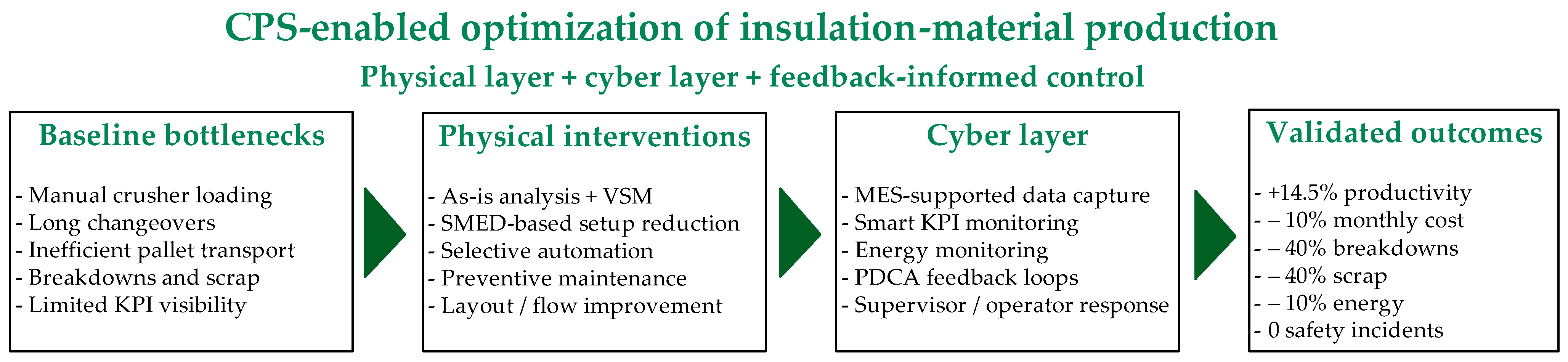
Figure 1 summarizes the logic of the industrial case by linking baseline bottlenecks, physical interventions, cyber-layer support and validated plant-level outcomes before the detailed methodological description.
Four literature streams are relevant. First, lean manufacturing and sustainability studies show that lean, Six Sigma, and sustainability are increasingly treated as integrated systems rather than as independent managerial approaches [
6,
7,
8,
9,
25,
26,
33]. Second, SMED and setup-reduction research confirms that changeover improvement is most effective when combined with standardization, organizational clarity, and structured implementation [
34,
35,
36,
37]. Third, digital monitoring, predictive maintenance, digital-twin and IIoT research position manufacturing as a data-rich environment in which sensing, feedback, diagnosis, scheduling, and intervention are increasingly coupled [
19,
20,
21,
22,
23,
24,
27,
28,
29,
30,
31,
32]. Fourth, insulation-material and mineral wool studies address circularity, reuse and recycling, but often focus on material pathways rather than factory-level operational optimization [
10,
11,
12,
13,
14,
15,
16,
17,
18].
The artificial intelligence literature also indicates a pathway for future development. Recent work on super-resolution reconstruction, graph-based transfer learning for rotating machinery fault diagnosis, fire-door defect inspection, and semi-supervised AHU fault detection illustrates how AI can support advanced diagnosis, inspection, and predictive maintenance [
38,
39,
40,
41]. However, these AI approaches were not implemented in the present plant. They are cited to position future extensions and to clarify that the present contribution is an industrial CPS-oriented monitoring and improvement framework, not an AI diagnostic algorithm.
Despite the breadth of the literature, four gaps remain relevant. First, many lean-sustainability studies are conceptual, review-based, or broad framework integrations rather than tightly bounded industrial interventions with explicit before-and-after KPI validation. Second, many smart-manufacturing studies validate only one dominant mechanism at a time, such as SMED, bottleneck detection, energy monitoring, digital-twin monitoring, or predictive maintenance, rather than a single plant-level intervention that combines lean methods, selective automation, maintenance, and cyber-supported KPI monitoring. Third, the insulation-material literature is stronger in circularity and product-system sustainability than in factory-level production optimization. Fourth, few studies report a unified KPI set spanning productivity, cost, reliability, scrap, energy, and safety in insulation-material production within a CPS-oriented environment.
The novelty of this work is therefore not the proposal of a new autonomous CPS algorithm. Rather, it lies in the conservative industrial validation of a human-supervised CPS-oriented diagnosis–intervene–monitor–feedback framework in a real insulation-material production line, using a coherent KPI architecture and an OEE-based consistency check.
The study addresses the following research question: How, and to what extent, can a human-supervised CPS that combines bottleneck analysis, lean methods, selective automation, preventive maintenance, and KPI monitoring improve productivity, cost efficiency, reliability, quality, energy performance, and worker safety in insulation-material production?
The working hypotheses are:
H1: The framework reduces non-value-added time in critical operations;
H2: The framework improves production output and cost efficiency;
H3: The framework improves operational stability and quality;
H4: The framework improves sustainability-related performance.
In this study, the CPS layer considered an enabling architecture that supports all four hypotheses through enhanced visibility, improved feedback quality, and greater intervention effectiveness.
Table 1 positions the present manuscript against the representative CPPS, lean, digital-monitoring, AI and industrial case study literature.
2. Materials and Methods
The study was designed as a single-site industrial intervention case study with a before–after evaluation framework implemented in a human-supervised cyber–physical manufacturing system. The methodological logic combines process diagnostics, lean intervention, selective automation, and KPI-based validation in a real insulation-material production environment. Because the intervention was implemented on a single operating production system, a fully controlled experimental design with replicated treatment and control lines was not feasible. The analysis therefore focuses on absolute and relative changes in key performance indicators before and after the intervention, triangulated across multiple operational data sources.
The physical layer comprised material preparation, crusher loading, setup/changeover operations, pallet transport, machine operation, maintenance activities, and downstream production flow. The cyber layer comprised MES-supported production data collection, smart monitoring of machine and energy performance, KPI visualization, and feedback routines connecting measured plant performance to operational and managerial responses. The architecture did not represent a fully autonomous closed-loop control system; it functioned as a human-supervised CPS environment in which digital visibility supported adaptive decision-making, faster response to deviations and iterative process optimization.
Table 2 expands the production-line setting and explains the confidentiality boundary that limits disclosure of vendor-specific details.
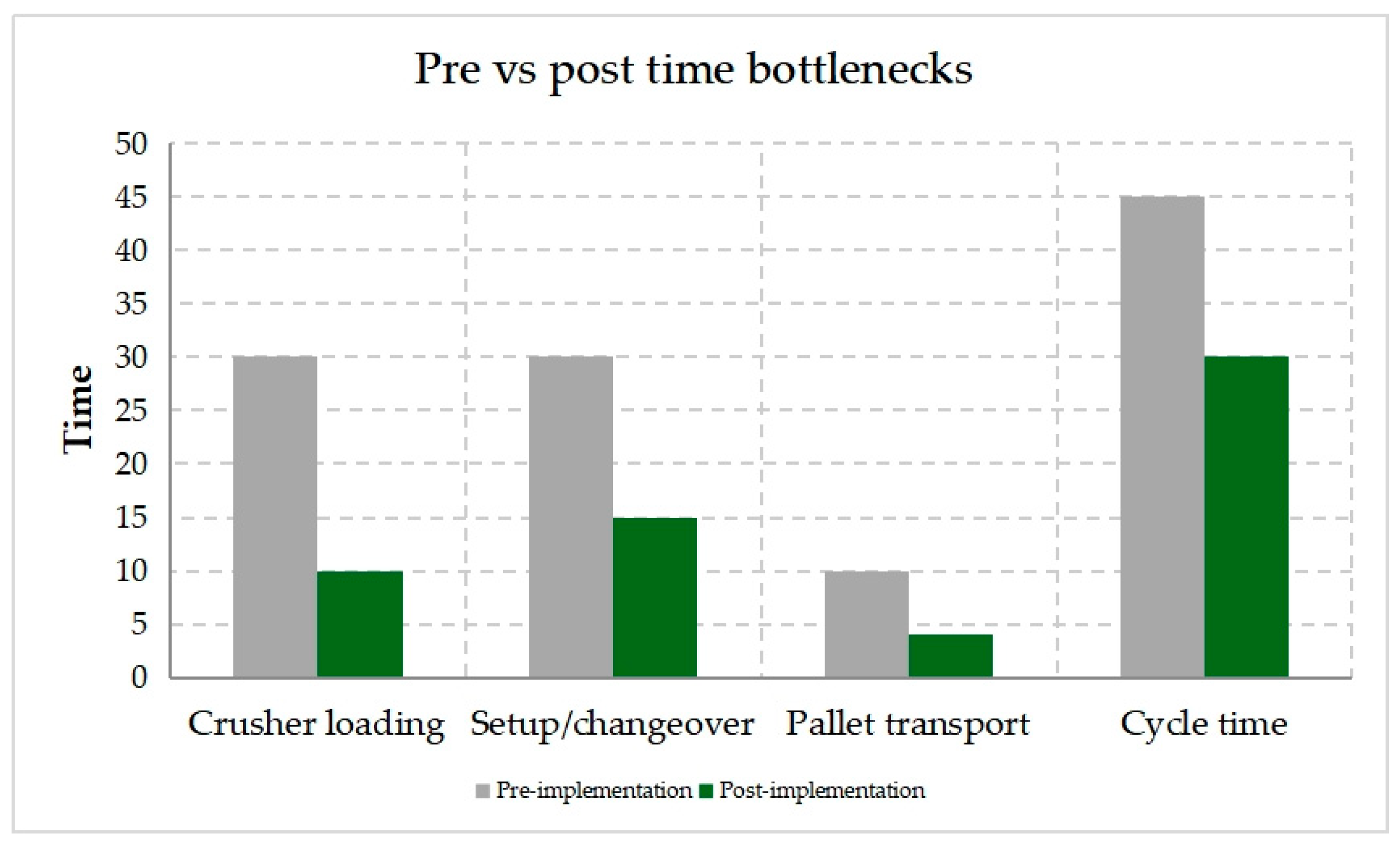
The as-is data reported a crusher loading time of 30 min/pallet, monthly production costs of EUR 200,000, breakdown frequency of 5 breakdowns/month, downtime/time losses of 10 h/month, daily productivity of 7864 kg/day, scrap of 5%, cycle time of 45 min/unit, and an average waiting time of 10 min between operations. Worker movement of approximately 5 km/shift also indicated suboptimal layout and internal material flow. These baseline values were used to identify the dominant bottlenecks and to prioritize the intervention package.
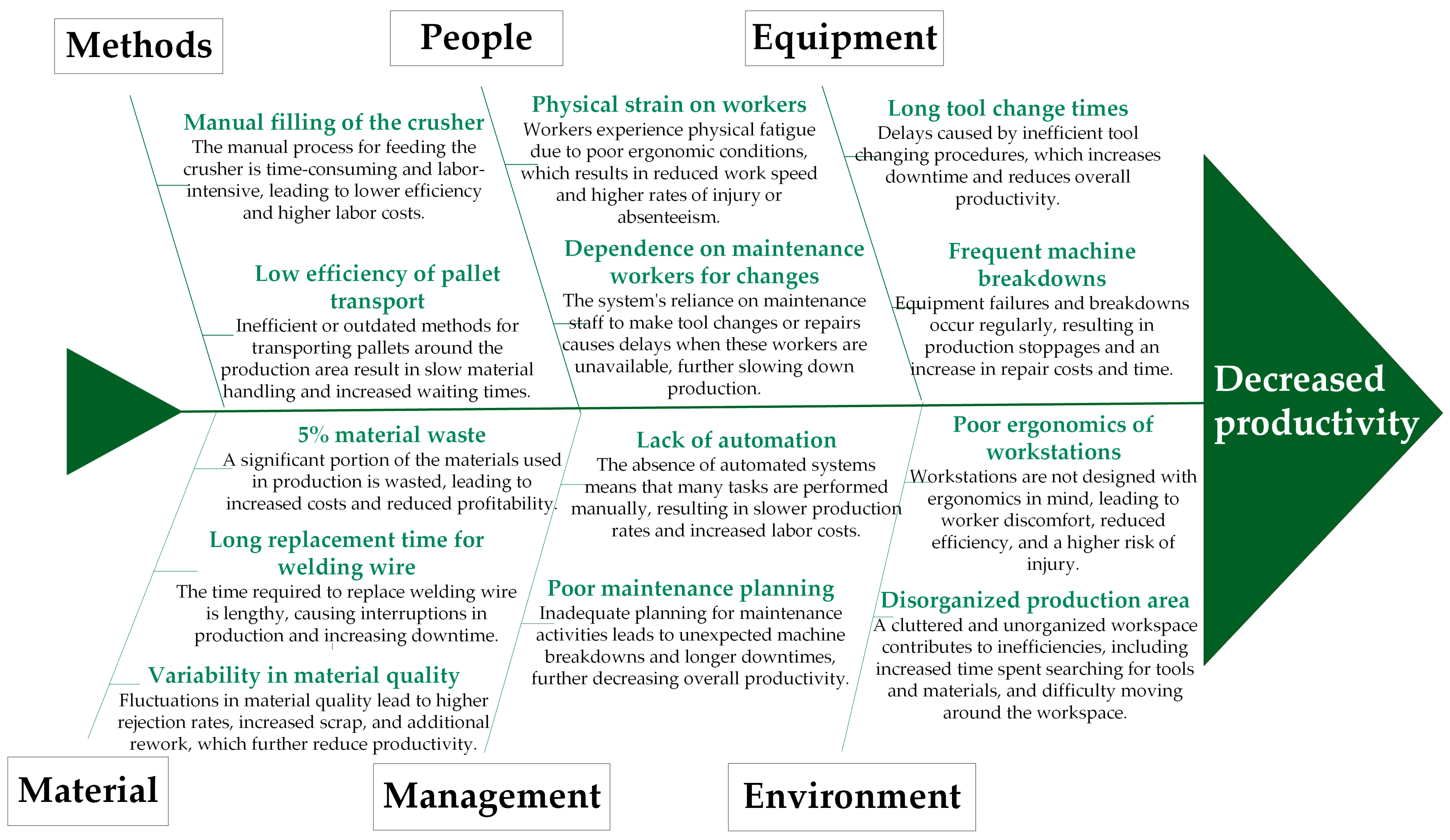
The baseline diagnosis used a combination of time studies, direct process observation, spaghetti diagrams, value stream mapping (VSM), 5 Whys analysis, fishbone analysis, MES-supported operational records, and a review of existing plant KPIs. Spaghetti diagrams were used to visualize worker and material movement. Time studies and production records quantified critical operation durations. VSM represented material and information flows and identified waiting times, transport losses, and cycle inefficiencies. Root-cause techniques were then applied to distinguish dominant losses from downstream symptoms.
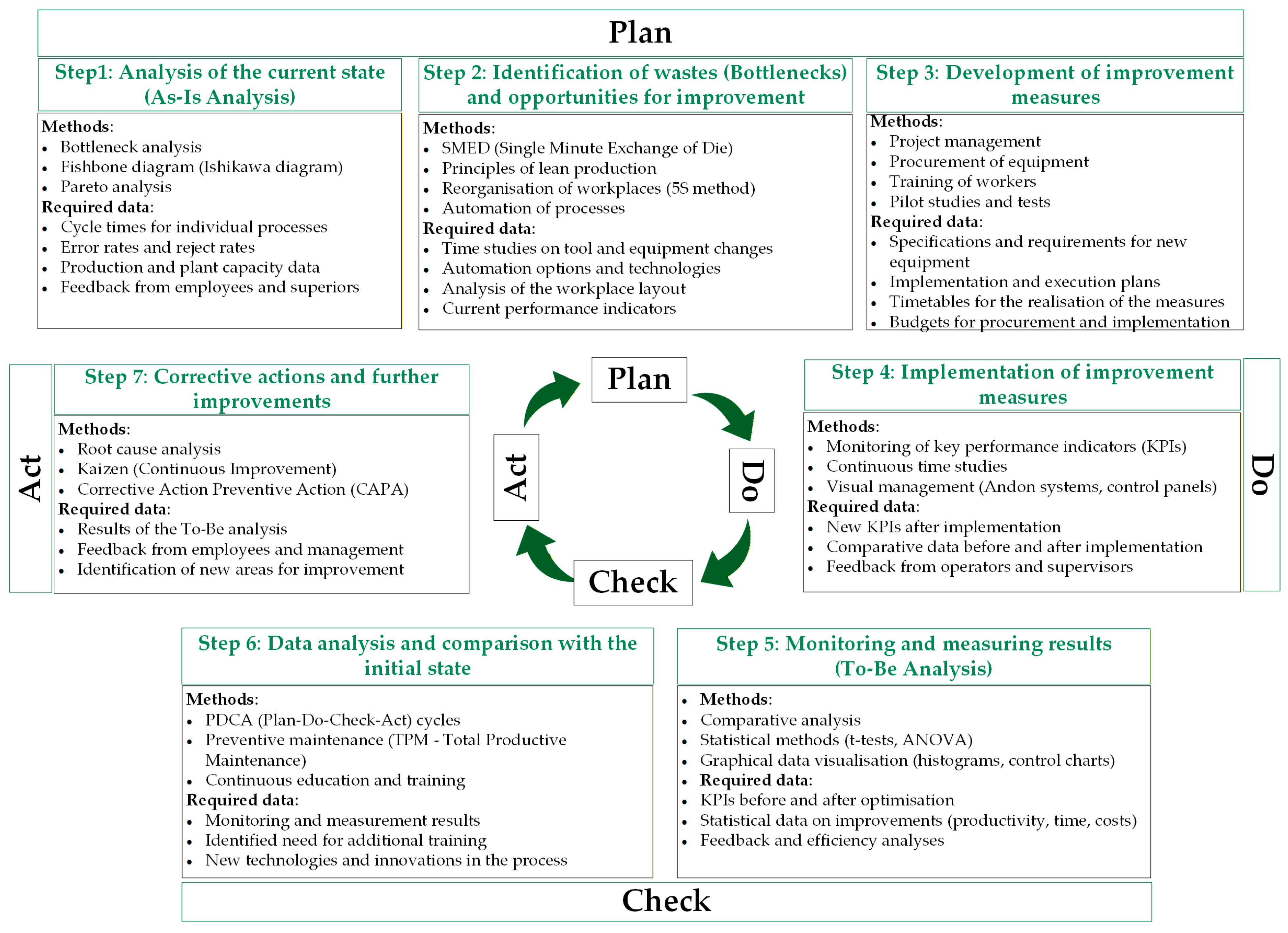
Figure 2 presents the PDCA-based improvement workflow used to move from baseline diagnosis to monitored post-implementation stabilization.
The intervention followed a PDCA-based human-supervised CPS-oriented improvement logic and can be summarized in seven stages: (1) baseline diagnosis of the production system, (2) identification and prioritization of bottlenecks, (3) selection of lean and technical interventions, (4) phased implementation, (5) post-implementation KPI monitoring, (6) before–after comparison, and (7) corrective action and continuous improvement. Within this framework, lean methods and selective automation acted primarily on the physical layer, whereas KPI monitoring, digital data acquisition, and supervisory feedback acted on the cyber layer. The interaction of these layers enabled repeated adjustment of interventions based on observed production system behavior.
Figure 3 summarizes the root-cause structure that guided intervention prioritization.
Table 3 clarifies the implementation sequence and separates the main intervention blocks, responding to the concern that multiple measures were introduced together.
The measures were intentionally implemented as a phased package rather than as isolated experiments. This design improves industrial feasibility but limits the ability to attribute each final KPI change to a single measure. The strongest directly attributable local effects were crusher-loading automation for loading time, SMED-oriented measures for setup/changeover time and transport automation for pallet movement. Broader effects on output, cost, downtime, scrap, energy and safety are interpreted as system-level outcomes of the combined intervention.
Table 4 defines the KPI set used to evaluate the intervention and links each metric to its evidence source and hypothesis role.
Data were collected at daily, monthly and annual aggregation levels using repeated time studies, production records, maintenance logs, MES-supported operational data, and smart monitoring of plant performance and energy use. The resulting cyber layer provided ongoing visibility into process behavior and enabled feedback-informed intervention decisions. The CPS’s role was therefore expressed through improved visibility, faster response, and sustained KPI improvement rather than through an independent cyber performance metric.
The evidence base combined repeated operation-level time studies, daily production logs, monthly maintenance, and cost records, quality records, annual energy records, and consolidated plant KPI tables. Operation-level bottleneck indicators were retained when supported by repeated time studies and implementation validation. Plant-level indicators were retained when consistent with consolidated production, maintenance, quality, cost, and energy records. No statistical outlier filtering such as a 3σ or IQR rule was applied to undisclosed raw series; instead, inconsistent implementation-stage values were excluded and the final conservative KPI set was used as the source of truth.
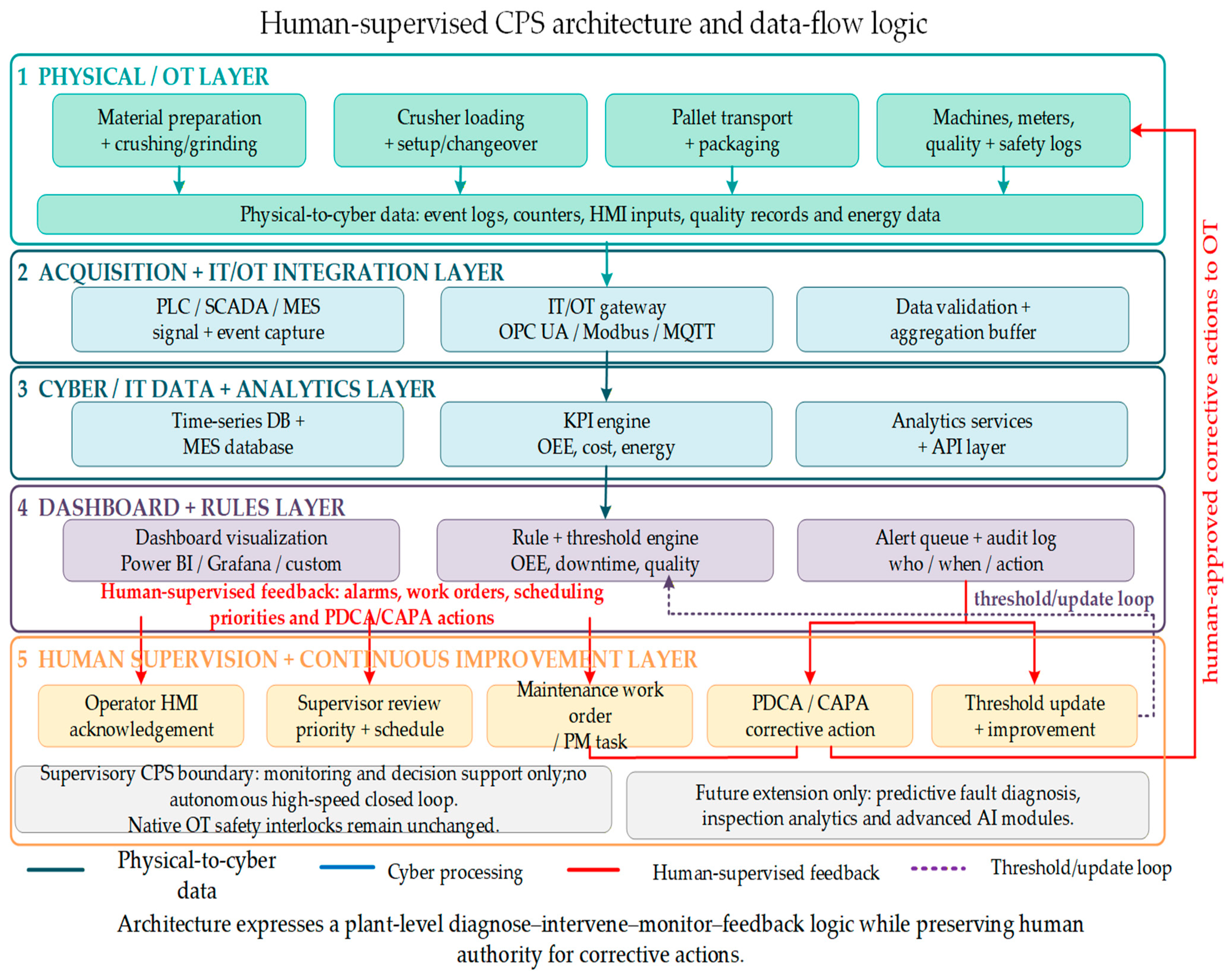
Figure 4 provides a detailed CPS/IT-OT data-flow architecture for the implemented human-supervised manufacturing framework. It separates physical/OT signals, edge and plant-interface functions, cyber-layer aggregation and visualization, supervisory rules, and human-supervised feedback so that the physical-to-cyber and cyber-to-physical information paths are explicit.
Physical/OT data from crusher loading, setup/changeover, pallet conveyance, machine operation, and quality/safety logs flow upward via common industrial communication protocol classes (OPC UA, Modbus TCP and MQTT) through an acquisition and IT/OT integration layer (PLC/SCADA/MES signal capture, data validation, and aggregation buffer) to the cyber/IT data and analytics layer. There, KPIs (OEE, cost, and energy) are computed using a time-series historian and MES database, with analytics services and an API layer. A dashboard and rules layer provides visualization through the plant-standard dashboard interface, a threshold engine (OEE, downtime, or quality), and an alert queue with an audit log.
Human-supervised feedback—alarms, work orders, scheduling priorities, and PDCA/CAPA actions—flows back to operators, supervisors, and maintenance staff under human authority. A threshold update loop supports continuous improvement. The architecture expresses a plant-level diagnose–intervene–monitor–feedback logic and explicitly operates as a supervisory CPS; no autonomous high-speed closed-loop control is implemented, and native OT safety interfaces remain unchanged.
Industrial communication between physical/OT equipment and the cyber layer relied on common industrial communication protocol classes, including OPC UA, Modbus TCP, and MQTT. Time-series process data were stored in a dedicated process historian, while aggregated KPI data and MES records were maintained in a relational database. KPI dashboards were implemented using a plant-standard business intelligence interface, providing shift/daily visual indicators without exposing proprietary vendor identities or software versions.
Table 5 expands the earlier conceptual CPS table by adding technical specification classes, data sources, sampling/aggregation level, latency interpretation, and human authority boundaries.
Vendor-specific manufacturer names, sensor models, server identifiers, software versions, and proprietary plant-interface details are anonymized under the industrial confidentiality boundary. For reproducibility, the manuscript reports the functional IT/OT architecture, data-source categories, aggregation levels, and decision logic. The system should not be interpreted as a sub-second autonomous control system; rather, near-real-time is used in the operational supervisory context of minutes-to-shift visibility for deviations and KPI updates. No version-dependent software routines were used in the reported calculations.
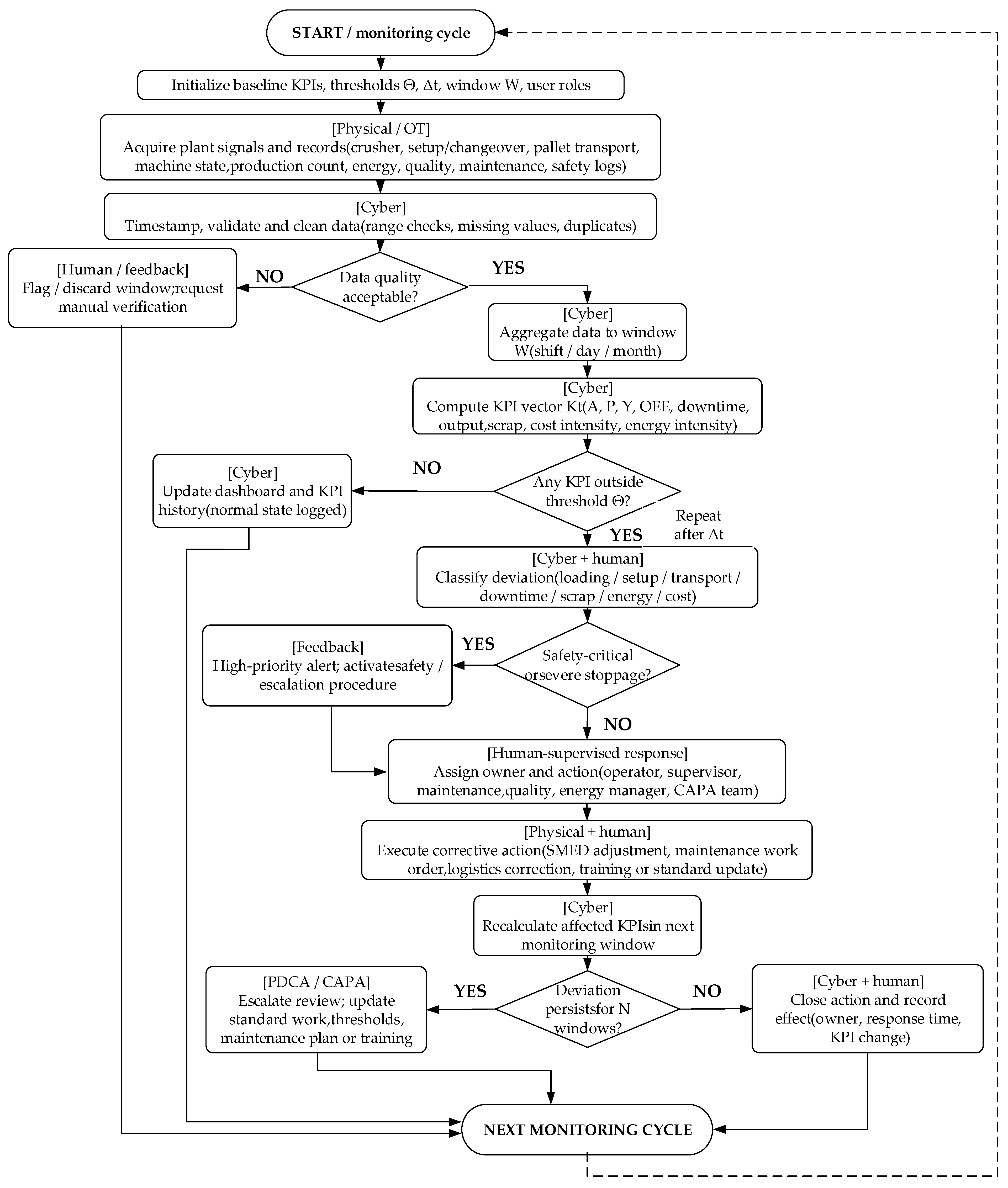
To clarify how the cyber layer operated in the implemented human-supervised CPS environment, the KPI monitoring and feedback routine is shown as a graphical algorithmic flowchart in
Figure 5. The figure illustrates the data pathway from physical/OT signals to cyber-layer KPI computation and from KPI deviations back to supervisory action. It is intentionally presented as a human-supervised decision-support procedure rather than as a fully autonomous closed-loop controller, because the implemented system generated dashboard updates, alerts, work-order/CAPA actions, and PDCA feedback, while final operational authority remained with operators, supervisors, and maintenance personnel. The figure provides the algorithmic representation of the KPI monitoring and supervisory feedback logic and clarifies the pathway from KPI deviation to human-supervised corrective action.
The flowchart describes the complete monitoring cycle: data acquisition from the physical/OT layer, validation, and KPI computation in the cyber layer, threshold-based deviation detection with safety-critical escalation, human-supervised assignment and execution of corrective actions, persistence checking, and PDCA/CAPA escalation. The loop repeats after the defined monitoring interval and preserves human authority for all operational decisions.
Table 6 links the research question and hypotheses to the validation strategy used in
Section 3.
To support the formal evaluation of these hypotheses, the OEE-based model and the algorithmic feedback logic introduced earlier in
Section 2 use a set of mathematical symbols and variables. For clarity, all symbols are listed in
Table 7.
To formalize the production logic and provide an internal consistency check between plant KPIs, the study introduced an OEE-based surrogate model following established OEE formulations in the manufacturing literature [
42,
43]. The model was not used to replace the plant KPI system or to claim high-frequency autonomous control; it was used to verify whether reported productivity changes were numerically coherent with measured OEE values.
In Equations (1) and (2), A represents availability, P is performance and Y is quality yield. Availability was anchored in validated downtime/availability records, while quality yield was anchored in the reported scrap rate. The performance factor was treated as the implied residual OEE component required to reconcile realized output with theoretical line capacity under stabilized operating conditions. Output-normalized cost and energy indicators were derived from annual plant records by normalizing annual cost and annual energy use by annual output.
Table 8 clarifies aggregation levels and statistical interpretation, avoiding any implication that descriptive industrial data were analyzed as a fully controlled replicated experiment.
Because the submitted manuscript package contains consolidated plant-level KPI values rather than the full raw monthly dataset, the results are interpreted as descriptive and practically meaningful before–after differences. Classical inferential tests, confidence intervals, coefficient-of-variation values and time-series diagnostics were therefore not reported, because the raw monthly observations required for such analyses were not available for disclosure. The study reports aggregated values and triangulates time studies, MES records, maintenance logs and energy-monitoring outputs; no paired t-tests, repeated-measures ANOVA, Wilcoxon signed-rank tests, Durbin–Watson tests, time-series decomposition or CV calculations were performed on unpublished raw monthly observations.
Additional evidence-source mapping, CAPEX assumptions and calculation notes are provided in
Appendix A.
4. Discussion
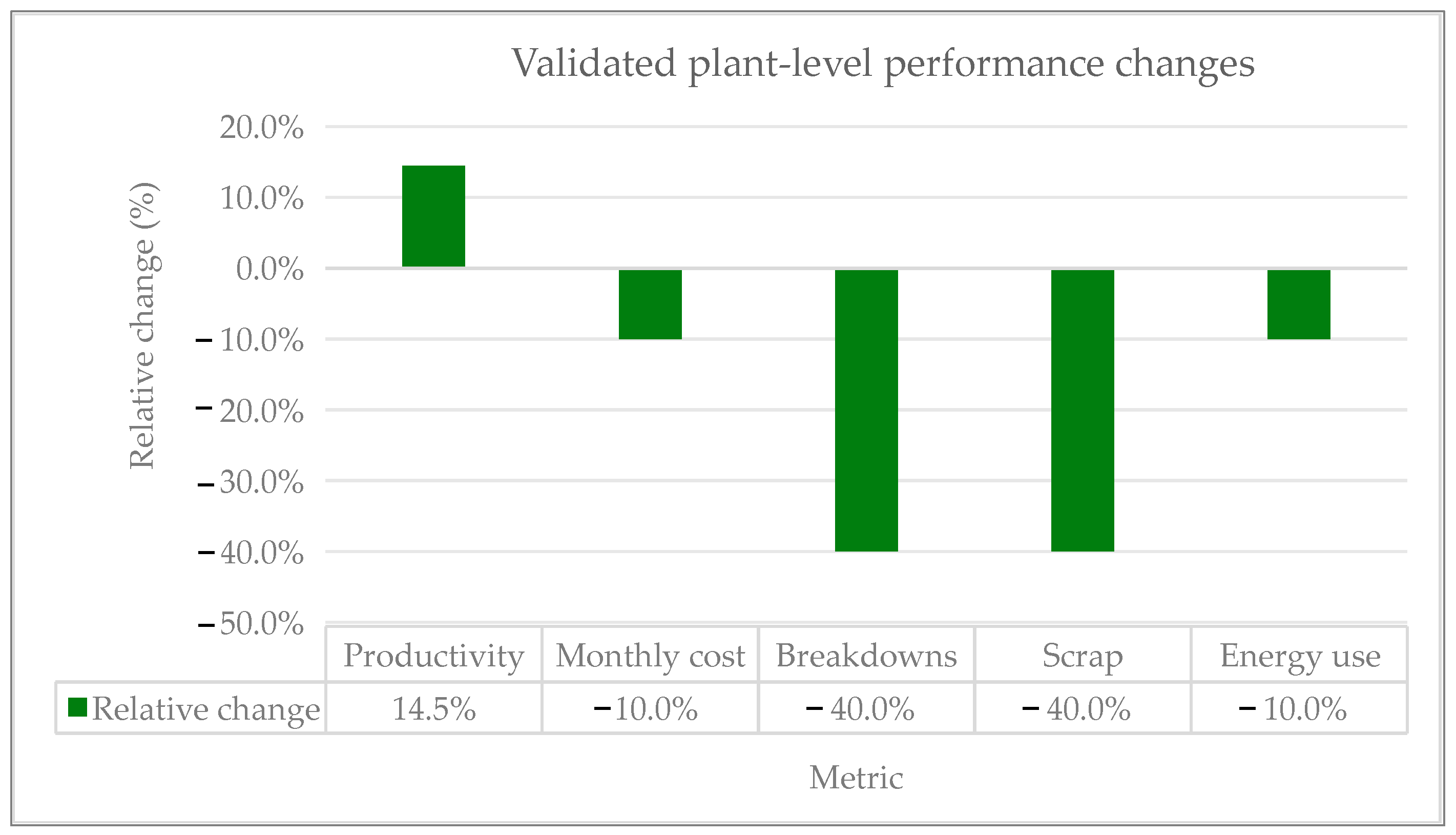
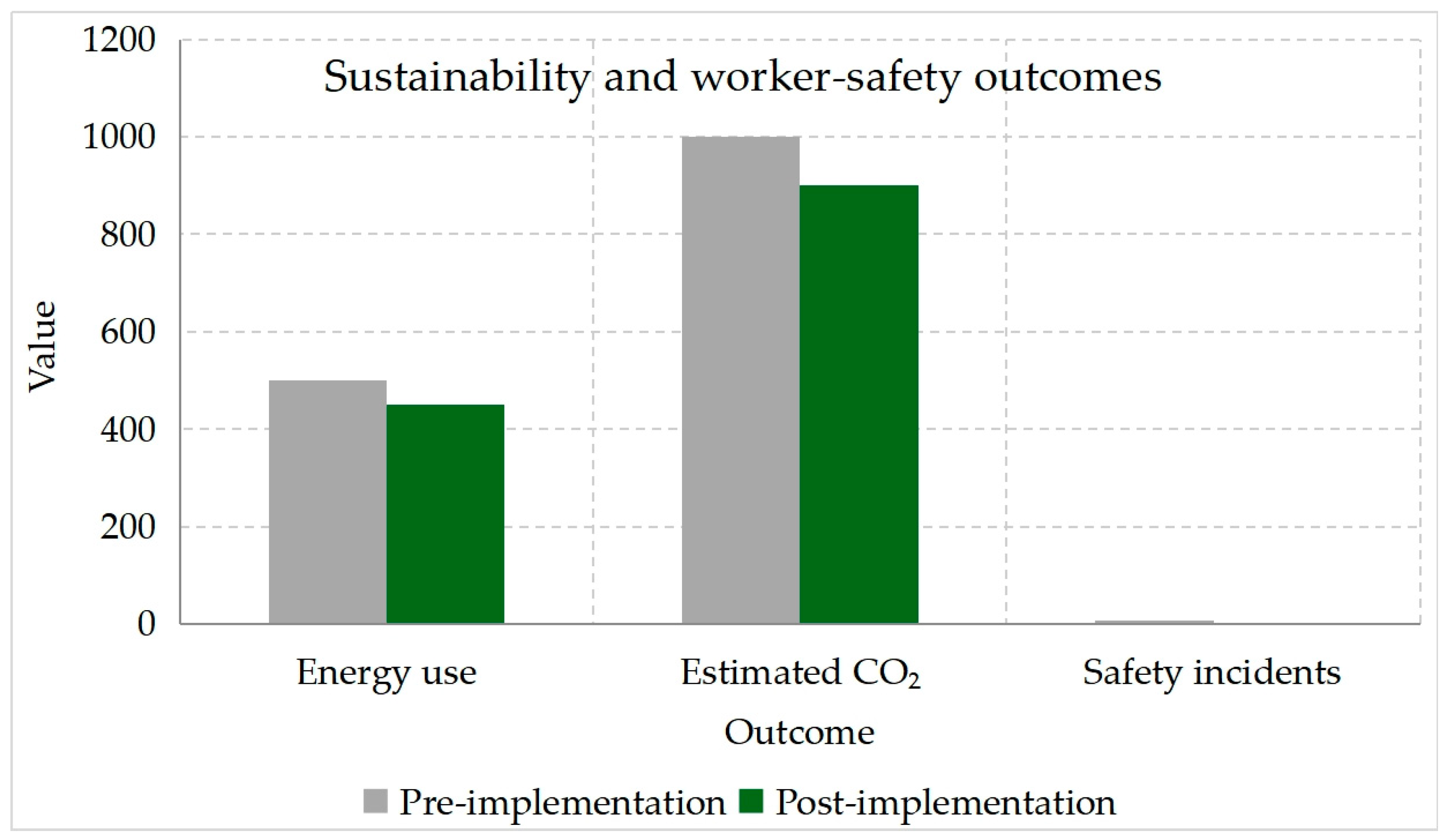
The results support all four hypothesis groups. Non-value-added time was reduced in the most critical operations, throughput increased, production costs declined, breakdown frequency and scrap fell, and energy and safety indicators improved in parallel. This pattern suggests that the intervention did not merely shift losses from one part of the system to another; instead, the production system became faster, more stable, less wasteful and safer.
A key explanatory point is that the intervention was built around measured bottlenecks rather than technology-first implementation. Crusher loading, setup/changeover, pallet transport, breakdowns, and scrap were identified as dominant sources of loss before the capital and organizational measures were selected. The CPS layer did not replace this logic; it strengthened it by improving performance visibility, deviation response, and PDCA-based decision quality.
Compared with SMED-centered studies, the present case reports a setup improvement but extends the evidence base to loading, logistics, breakdowns, scrap, energy, and safety. Compared with energy-monitoring and digital-twin studies, it is less technologically ambitious but stronger as a conservative before–after industrial KPI validation. Compared with insulation circularity studies, its contribution lies at the factory-operation level rather than at the product-system or recycling-pathway levels.
The CPS’s claim is deliberately limited. The implemented architecture should be interpreted as a human-supervised CPS, not as a fully autonomous digital twin, device twin or closed-loop controller in the strict control-engineering sense. The cyber layer primarily provided data acquisition, aggregation, visualization, deviation classification and feedback support, while final intervention authority remained with operators, supervisors and maintenance personnel. This position aligns with CPS frameworks that include digital, physical and human components [
1,
2,
3,
4,
5], and it clearly distinguishes the present case from more digitally ambitious architectures that implement autonomous scheduling, high-fidelity model synchronization or device-twin control [
30,
32].
The intervention also has managerial implications. First, the most effective improvements targeted measured bottlenecks rather than fashionable technologies. Second, a mixed package combining lean methods, selective automation, maintenance and KPI monitoring appears more robust than isolated tool deployment. Third, improvement projects should use KPI architectures that include throughput, cost, reliability, quality, energy and safety rather than only output and cost [
6,
7,
8,
9,
25,
26,
33,
44].
Table 11 extends the economic discussion by adding a conservative sensitivity check for hidden implementation costs such as software, dashboard refinement, training and maintenance.
For transfer to comparable process industries, the case suggests the following sequence: quantify physical bottlenecks using time studies, VSM and maintenance records; define a conservative KPI architecture before intervention; prioritize actions that jointly reduce waiting, manual handling and unplanned stoppages; connect the affected operations to a cyber layer for KPI visibility; validate the intervention with a consolidated pre/post evidence set; and use model-based consistency checks to test whether throughput, OEE, cost and energy figures remain coherent. The same logic could support maintenance and inspection-related applications, for example, by linking defect-classification methods for fire-door inspection or semi-supervised fault detection for air-handling units to future CPS monitoring and CAPA workflows [
40,
41].
Several limitations should be acknowledged. First, the study is based on a single industrial case, which limits statistical generalizability and supports analytical transferability rather than broad statistical inference. Second, the current manuscript package contains consolidated plant-level observations rather than the full raw monthly dataset; therefore, the before–after differences are interpreted primarily as descriptive and practically meaningful, not as statistically tested effects. Third, the cyber layer was evaluated primarily through its contribution to plant-level performance improvement rather than dedicated cyber–physical metrics such as latency, event-detection accuracy, model fidelity or automated response quality. Fourth, a full discounted lifecycle appraisal, including software, training, maintenance and cybersecurity costs, was outside the scope of the present study. Fifth, AI-assisted predictive maintenance and defect-classification modules were discussed as future extensions but were not implemented.
5. Conclusions
This paper presented a data-driven industrial case study of insulation-material production optimization within a human-supervised cyber–physical manufacturing system. The intervention combined bottleneck analysis, lean methods, selective automation, preventive maintenance, and KPI monitoring to address losses related to crusher loading, setup/changeovers, pallet transport, breakdowns, scrap, and energy use. Across the validated KPI set, the plant improved simultaneously in operational, economic, sustainability, and worker-safety dimensions.
The most important validated outcomes were the crusher loading reduction from 30 to 10 min/pallet, validated setup/changeover reduction from 30 to 15 min, pallet transport reduction from 10 to 4 min, productivity increase from 7864 to 9000 kg/day (+14.5%), monthly production cost reduction from EUR 200,000 to EUR 180,000 (−10%), breakdown-frequency reduction from 5 to 3 events/month (−40%), scrap reduction from 5% to 3% (−40%), annual energy reduction from 500 to 450 MWh (−10%) and a reduction in reported safety incidents decreasing to zero during the 12-month post-implementation observation period.
The main contribution lies in demonstrating that insulation-material production can be optimized when lean interventions, selective automation and KPI-based monitoring are integrated through a feedback-supported, human-supervised CPS architecture. The study does not present a CPS as an abstract digital label, a fully autonomous closed-loop controller or a full digital twin; it presents a practically implemented manufacturing environment in which cyber and physical components jointly supported measurable improvement while final corrective action authority remained with humans.
In addition to the intervention framework itself, the paper contributes a compact OEE-based model that cross-checks throughput consistency and reveals stronger unit-level gains in cost and energy efficiency than are visible from the absolute before–after totals alone.
Future work should extend the framework through longer observation windows, multi-site replication, fuller inferential statistics based on shareable monthly data, explicit lifecycle cost appraisal, dedicated cyber–physical performance metrics, AI-assisted predictive maintenance modules and more rigorous carbon-accounting methodology.