Indolocarbazole-Based Hosts for Efficient Red Phosphorescent OLEDs

 ,
, 
Abstract
1. Introduction
2. Materials and Methods
2.1. General Information
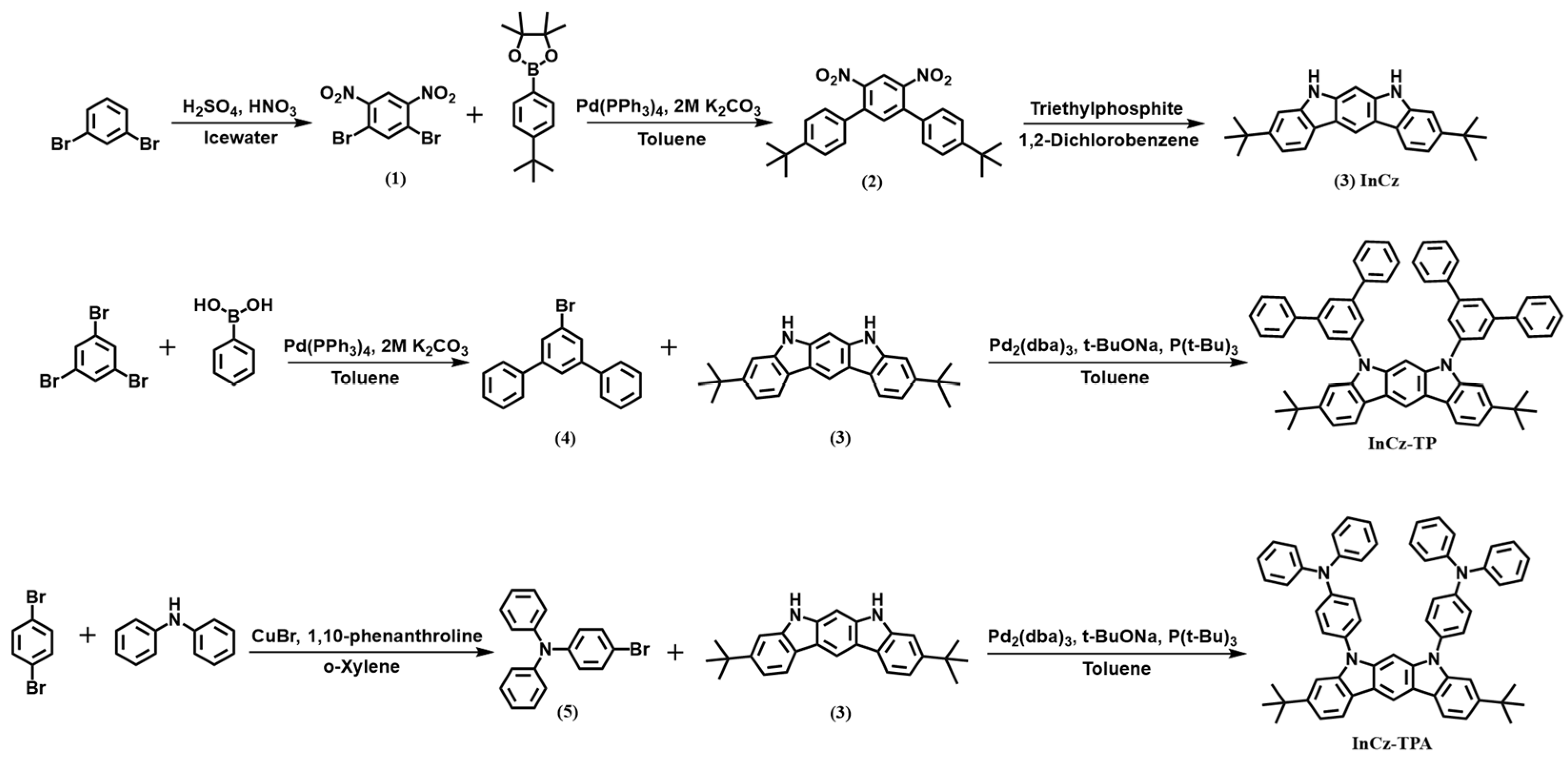
2.2. Synthesis
2.2.1. Synthesis of 1,5-Dibromo-2,4-dinitrobenzene (1)
2.2.2. Synthesis of 4,4″-Di-tert-butyl-4′,6′-dinitro-1,1′:3′,1″-terphenyl (2)
2.2.3. Synthesis of 3,9-Di-tert-butyl-5,7-dihydroindolo[2,3-b]carbazole (InCz) (3)
2.2.4. Synthesis of 5′-Bromo-1,1′:3′,1″-terphenyl (4)
2.2.5. Synthesis of 4-Bromo-N,N-diphenylaniline (5)
2.2.6. Synthesis of 5,7-Di([1,1′:3′,1″-terphenyl]-5′-yl)-3,9-di-tert-butyl-5,7-dihydroindolo[2,3-b]carbazole (InCz-TP)
2.2.7. Synthesis of 4,4′-(3,9-Di-tert-butylindolo[2,3-b]carbazole-5,7-diyl)bis(N,N-diphenylaniline) (InCz-TPA)
3. Results and Discussion
3.1. Molecular Design, Synthesis and Characterization
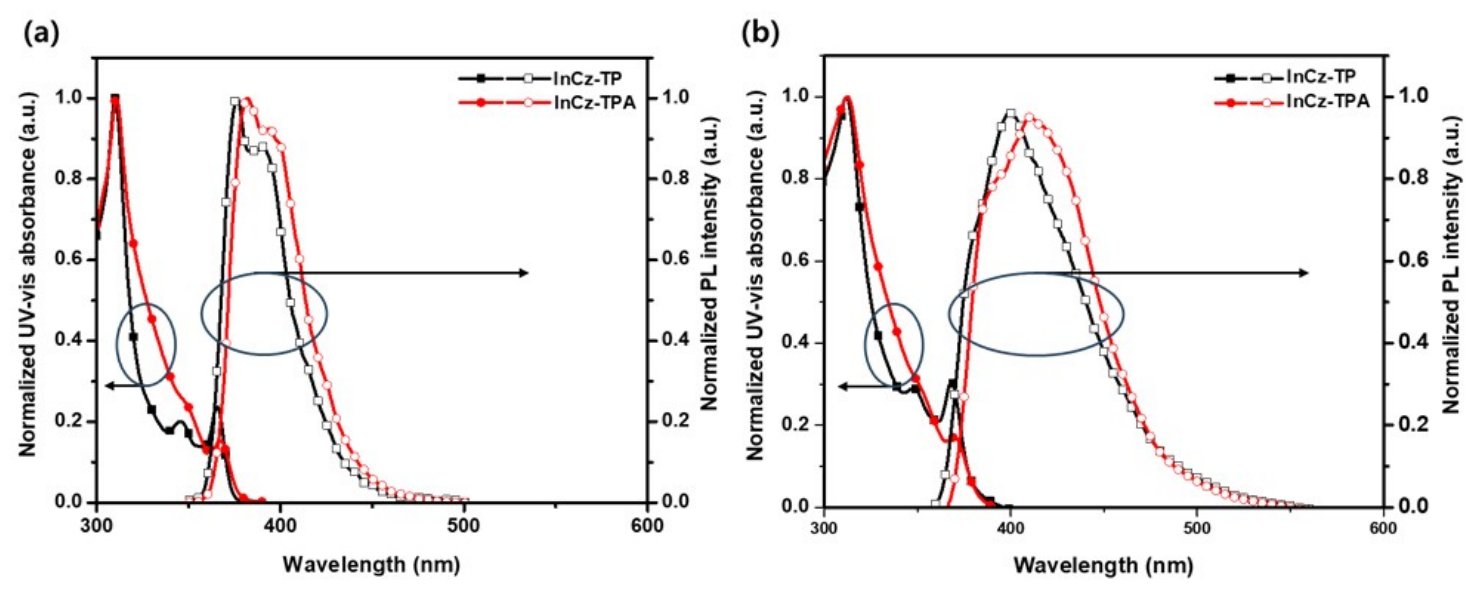
3.2. Photophysical Properties
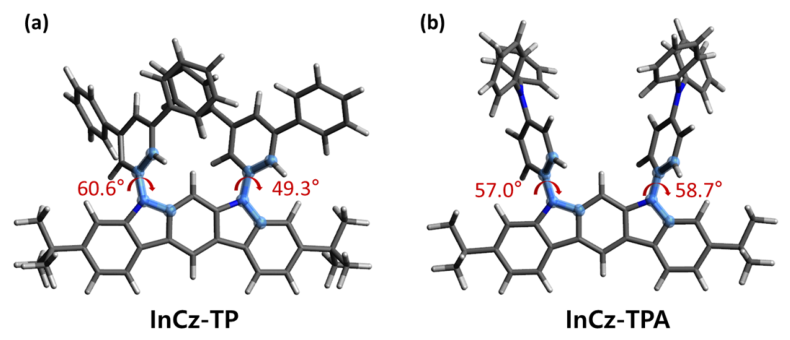
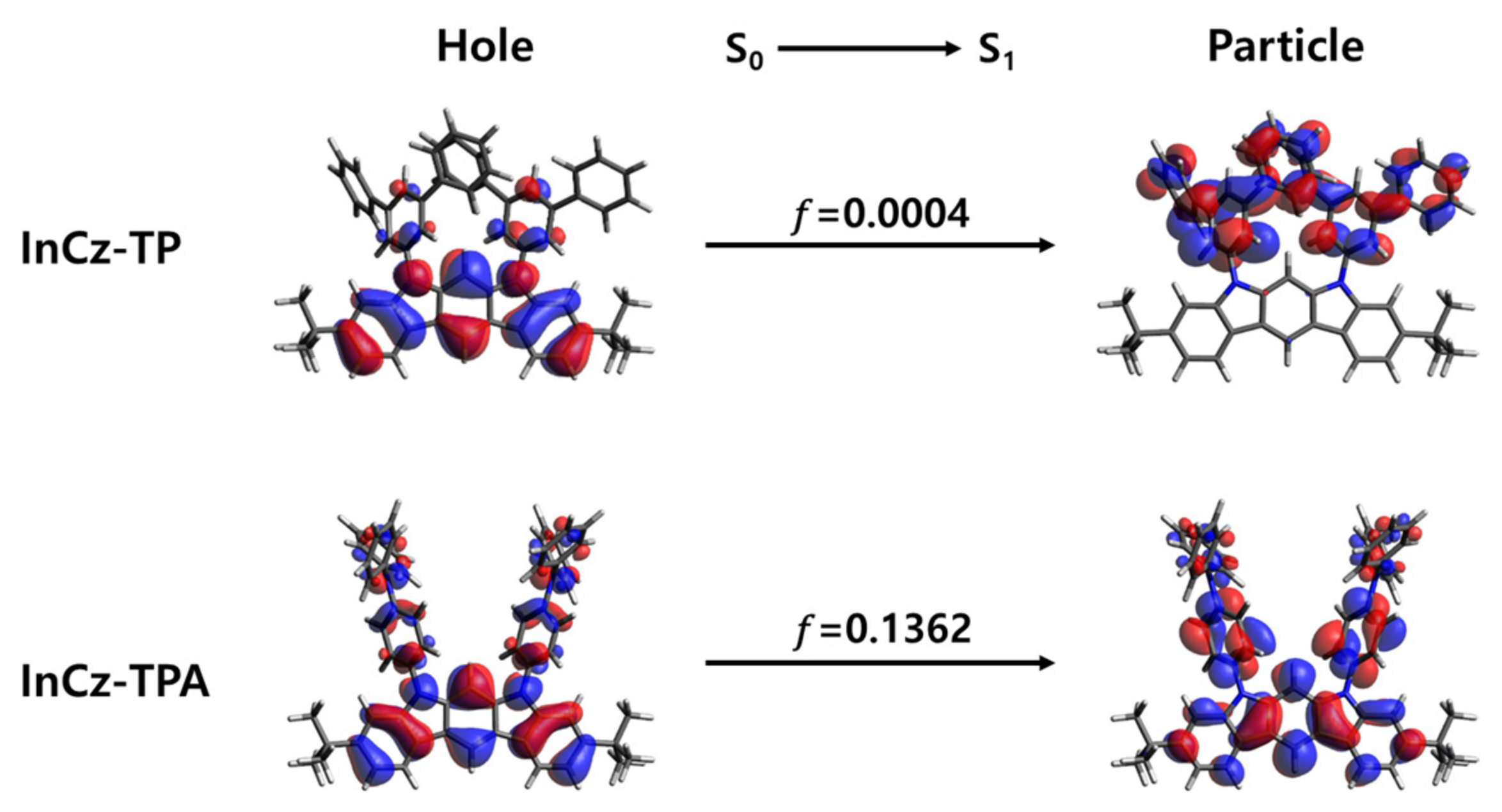
3.3. Theoretical Calculation
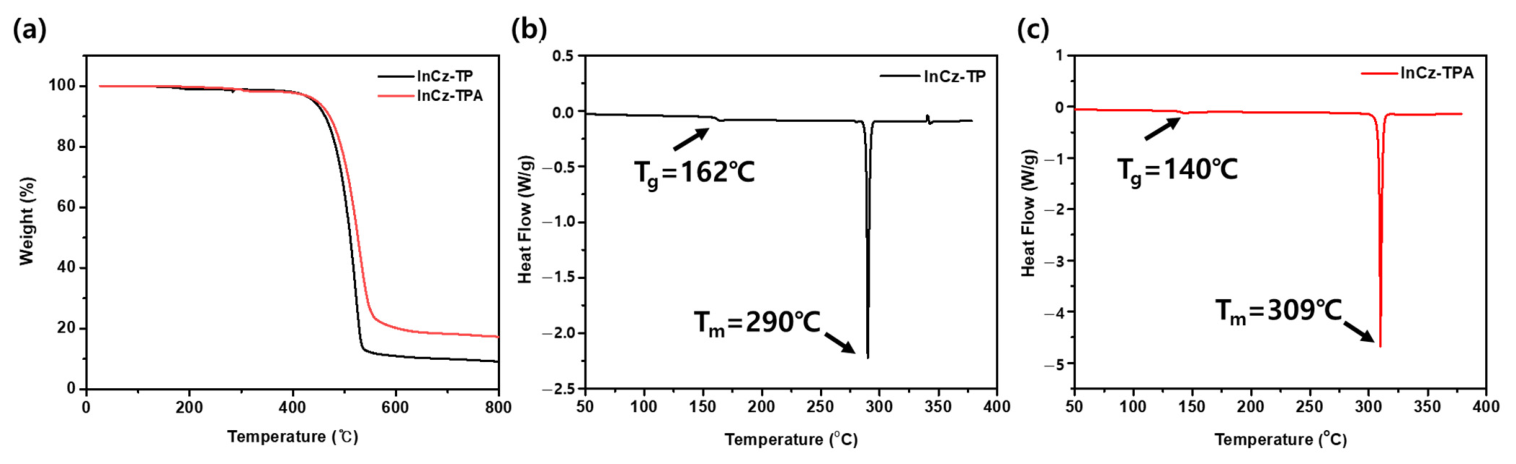
3.4. Thermal Properties
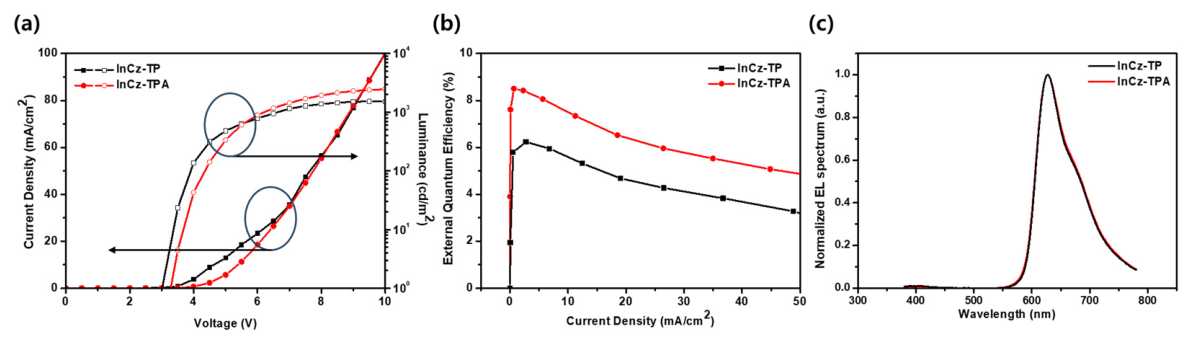
3.5. Electroluminescence Properties
4. Conclusions
Supplementary Materials
Author Contributions
Funding
Institutional Review Board Statement
Informed Consent Statement
Data Availability Statement
Conflicts of Interest
References
- Wei, Q.; Fei, N.; Islam, A.; Lei, T.; Hong, L.; Peng, R.; Fan, X.; Chen, L.; Gao, P.; Ge, Z. Small-Molecule Emitters with High Quantum Efficiency: Mechanisms, Structures, and Applications in OLED Devices. Adv. Opt. Mater. 2018, 6, 1800512. [Google Scholar] [CrossRef]
- Kang, S.W.; Baek, D.-H.; Ju, B.-K.; Park, Y.W. Green Phosphorescent Organic Light-Emitting Diode Exhibiting Highest External Quantum Efficiency with Ultra-Thin Undoped Emission Layer. Sci. Rep. 2021, 11, 8436. [Google Scholar] [CrossRef]
- Diesing, S.; Zhang, L.; Zysman-Colman, E.; Samuel, I.D.W. A Figure of Merit for Efficiency Roll-Off in TADF-Based Organic LEDs. Nature 2024, 627, 747–753. [Google Scholar] [CrossRef]
- van der Zee, B.; Li, Y.; Wetzelaer, G.-J.A.H.; Blom, P.W.M. Triplet-Polaron-Annihilation-Induced Degradation of Organic Light-Emitting Diodes Based on Thermally Activated Delayed Fluorescence. Phys. Rev. Appl. 2022, 18, 064002. [Google Scholar] [CrossRef]
- Baldo, M.A.; O’Brien, D.F.; You, Y.; Shoustikov, A.; Sibley, S.; Thompson, M.E.; Forrest, S.R. Highly Efficient Phosphorescent Emission from Organic Electroluminescent Devices. Nature 1998, 395, 151–154. [Google Scholar] [CrossRef]
- Uoyama, H.; Goushi, K.; Shizu, K.; Nomura, H.; Adachi, C. Highly Efficient Organic Light-Emitting Diodes from Delayed Fluorescence. Nature 2012, 492, 234–238. [Google Scholar] [CrossRef]
- Kwon, N.Y.; Park, S.H.; Koh, C.W.; Park, J.Y.; Kang, M.J.; Baek, H.I.; Youn, J.; Park, S.; Han, C.W.; Cho, M.J.; et al. Rational Molecular Design Strategy for Host Materials in Thermally Activated Delayed Fluorescence-OLEDs Suitable for Solution Processing. ACS Appl. Mater. Interfaces 2023, 15, 28277–28287. [Google Scholar] [CrossRef]
- Yuan, W.; Huang, T.; Zhou, J.; Tang, M.-C.; Zhang, D.; Duan, L. High-Efficiency and Long-Lifetime Deep-Blue Phosphorescent OLEDs Using Deuterated Exciplex-Forming Host. Nat. Commun. 2025, 16, 4446. [Google Scholar] [CrossRef]
- Gnanasekaran, P.; Chen, Y.-T.; Tseng, Y.-T.; Su, K.-Y.; Lin, Y.-T.; Yiu, T.C.; Chang, C.-H.; Chang, Y.J. Perceiving the Influence of Phenyl-Carbazole Isomers on Sulfone/Thioxanthone-Based D–A–D Hosts: Realizing Efficient Red-Phosphorescent OLEDs. J. Mater. Chem. C 2024, 12, 2203–2215. [Google Scholar] [CrossRef]
- Meng, Z.; Zhu, Y.; Li, H.; Zhang, X.; Shang, Y.; Kuang, C.; Meng, H. Highly Efficient and Stable Pure-Red Phosphorescent Organic Light-Emitting Diodes Based on Heptacyclic Bipolar Hosts Featuring an Armor-Like Structure. J. Mater. Chem. C 2024, 12, 9993–9998. [Google Scholar] [CrossRef]
- Yang, S.; Guan, D.; Yang, M.; Tian, J.; Chu, W.; Sun, Z. Synthesis and Characterization of Novel Butterfly-Shaped Aryl-Substituted Indolo[2,3-a]carbazole Derivatives. Tetrahedron Lett. 2015, 56, 2223–2227. [Google Scholar] [CrossRef]
- Braveentha, R.; Bae, I.-J.; Raagulan, K.; Kim, S.; Kim, S.; Kim, M.; Chai, K.Y. Dibenzothiophene-Indolocarbazole-Based Bipolar Material: Host for Green Phosphorescent OLEDs and Non-Doped Fluorescent Emitter. Dye. Pigm. 2019, 162, 466–474. [Google Scholar] [CrossRef]
- Huh, D.H.; Kim, G.W.; Kim, G.H.; Kulshreshtha, C.; Kwon, J.H. High Hole Mobility Hole Transport Material for Organic Light-Emitting Devices. Synth. Met. 2013, 180, 79–84. [Google Scholar] [CrossRef]
- Zheng, X.; Cao, F.; Wang, C.; Tsuboi, T.; Zhu, Y.; Ai, Q.; Deng, C.; Wang, D.; Su, L.; Liu, Z.; et al. Expanding the hole delocalization range in excited molecules for stable organic light-emitting diodes employing thermally activated delayed fluorescence. J. Mater. Chem. C 2020, 8, 10021–10030. [Google Scholar] [CrossRef]
- Lee, H.J.; Lee, H.L.; Han, S.H.; Lee, J.Y. Novel secondary acceptor based molecular design for superb lifetime in thermally activated delayed fluorescent organic light-emitting diodes through high bond energy and fast up-conversion. Chem. Eng. J. 2022, 427, 130988. [Google Scholar] [CrossRef]
- Yang, H.; Li, Y.; Zhao, Y.; Yu, S.; Ma, H.; Qian, L.; Wang, R.; Yu, T.; Su, W. Four New Bipolar Indolo[3,2-b]carbazole Derivatives for Blue OLEDs. Dye. Pigm 2021, 187, 109096. [Google Scholar] [CrossRef]
- Kumar, K.; Thakur, D.; Karmakar, A.; Patra, S.; Kumar, A.; Banik, S.; Ghosh, S. Indolo[3,2-a]carbazoles as Engineered Materials for Optoelectronic Applications: Synthesis, Structural Insights, and Computational Screening. J. Org. Chem. 2024, 89, 7394–7407. [Google Scholar] [CrossRef]
- Kautny, P.; Wu, Z.; Eichelter, J.; Horkel, E.; Stöger, B.; Chen, J.; Ma, D.; Fröhlich, J.; Lumpi, D. Indolo[3,2,1-jk]carbazole based planarized CBP derivatives as host materials for PhOLEDs with low efficiency roll-off. Org. Electron. 2016, 34, 237–245. [Google Scholar] [CrossRef]
- Oner, S.; Bryce, M.R. A review of fused-ring carbazole derivatives as emitter and/or host materials in organic light emitting diode (OLED) applications. Mater. Chem. Front. 2023, 7, 4304–4338. [Google Scholar] [CrossRef]
- Shin, E.; Sung, B.; Joo, C.W.; Kim, D.; Kim, J.; Lee, J.; Kim, Y.H. Novel indolocarbazole-based bipolar host materials for fabri-cating green phosphorescent organic light-emitting diodes with high efficiency and low roll-off. Dye. Pigm. 2024, 226, 112147. [Google Scholar] [CrossRef]
- Zhang, Y.; Chen, F.; Zheng, J.; Song, Z.; Wang, Y.; Mao, Y.; Tang, J.; Guo, J.; Wang, X. Aggregate Emission Behaviors and Reversible Mechanofluorochromic Properties of α-Cyanostilbene Functionalized Indolo[3,2-b]carbazole Derivatives. CrystEngComm 2022, 24, 7405–7411. [Google Scholar] [CrossRef]
- Wang, J.; Zhang, J.; Jiang, C.; Yao, C.; Xi, X. Effective Design Strategy for Aggregation-Induced Emission and Thermally Activated Delayed Fluorescence Emitters Achieving 18% External Quantum Efficiency Pure-Blue OLEDs with Extremely Low Roll-Off. ACS Appl. Mater. Interfaces 2021, 13, 57713–57724. [Google Scholar] [CrossRef]
- Park, S.; Kwon, H.; Park, S.; Oh, S.; Lee, K.; Lee, H.; Kang, S.; Park, D.; Park, J. New Bipolar Host Materials Based on Indolocarbazole for Red Phosphorescent OLEDs. Materials 2024, 17, 4347. [Google Scholar] [CrossRef]
- Kim, Y.; Ham, Y.; Le, T.N.; Yang, H.; Lee, J.; Suh, M.C. Boosting Hole Mobility: Indenofluorene-Arylamine Copolymers and Their Impact on Solution-Processed OLED Performance. ACS Appl. Mater. Interfaces 2024, 16, 31372–31383. [Google Scholar] [CrossRef]
- Kumar, K.; Kesavan, K.K.; Kumar, S.; Chen, F.R.; Karmakar, A.; Jayakumar, J.; Goswami, R.; Banik, S.; Jou, J.H.; Ghosh, S. Computational Evaluation with Experimental Validation: Arylamine-Based Functional Hole-Transport Materials for Energy-Efficient Solution-Processed OLEDs. J. Phys. Chem. C 2023, 127, 18560–18573. [Google Scholar] [CrossRef]
- Neese, F.; Wennmohs, F.; Becker, U.; Riplinger, C. The ORCA Quantum Chemistry Program Package. J. Chem. Phys. 2020, 152, 224108. [Google Scholar] [CrossRef]
- Li, W.J.; Liu, D.D.; Shen, F.Z.; Ma, D.G.; Wang, Z.M.; Feng, T.; Xu, Y.X.; Yang, B.; Ma, Y.G. A Twisting Donor–Acceptor Molecule with an Intercrossed Excited State for Highly Efficient, Deep-Blue Electroluminescence. Adv. Funct. Mater. 2012, 22, 2797–2803. [Google Scholar] [CrossRef]
- Gorse, A.D.; Pesquer, M. Intramolecular Charge Transfer Excited State Relaxation Processes in Para-Substituted N,N-Dimethylaniline: A Theoretical Study Including Solvent Effects. J. Phys. Chem. 1995, 99, 4039–4049. [Google Scholar] [CrossRef]
- Lim, H.; Cheon, H.J.; Woo, S.-J.; Kwon, S.-K.; Kim, Y.-H.; Kim, J.-J. Highly Efficient Deep-Blue OLEDs using a TADF Emitter with a Narrow Emission Spectrum and High Horizontal Emitting Dipole Ratio. Adv. Mater. 2020, 32, 2004083. [Google Scholar] [CrossRef]
- Braveenth, R.; Lee, H.; Park, J.D.; Yang, K.J.; Hwang, S.J.; Naveen, K.R.; Lampande, R.; Kwon, J.H. Achieving Narrow FWHM and High EQE over 38% in Blue OLEDs Using Rigid Heteroatom-Based Deep Blue TADF Sensitized Host. Adv. Funct. Mater. 2021, 31, 2105805. [Google Scholar] [CrossRef]
- Wang, Y.; Yun, J.H.; Wang, L.; Lee, J.Y. High Triplet Energy Hosts for Blue Organic Light-Emitting Diodes. Adv. Funct. Mater. 2021, 31, 2008332. [Google Scholar] [CrossRef]
- Zhang, Y.; Zhang, D.; Huang, T.; Zhang, Q.; Zhao, C.; Duan, L. High-Efficiency Deep-Red Phosphorescent Organic Light-Emitting Diodes with External Quantum Efficiencies of over 30% via Synergistic Energy Transfer. Sci. Adv. 2022, 8, eabp9203. [Google Scholar]
- Kwon, H.; Kang, S.; Park, S.; Oh, S.; Kim, S.-T.; Lee, K.; Lee, H.; Park, J. Selenium-Containing Multi-Resonance Thermally Activated Delayed Fluorescence Host Material for Green and Red Phosphorescent OLEDs. Materials 2025, 18, 2040. [Google Scholar] [CrossRef] [PubMed]



| Solution a | Film b | PLQY a (%) | τF a (ns) | krad a (107 s−1) | knr a (107 s−1) | |||||
|---|---|---|---|---|---|---|---|---|---|---|
| λabs (nm) | λPL (nm) | FWHM (nm) | λabs (nm) | λPL (nm) | FWHM (nm) | |||||
| InCz-TP | 310,366 | 376,388 | 38 | 312,369 | 400 | 69 | 36 | 4.07 | 8.86 | 15.7 |
| InCz-TPA | 311,367 | 382,394 | 41 | 312,370 | 412 | 72 | 40 | 3.68 | 10.9 | 16.3 |
| Voltage a (V) | CEmax (cd/A) | PEmax (lm/W) | EQEmax (%) | CIE a (x, y) | ELmax b (nm) | |
|---|---|---|---|---|---|---|
| InCz-TP | 4.63 | 4.59 | 3.81 | 6.23 | (0.678, 0.317) | 628 |
| InCz-TPA | 5.39 | 6.23 | 4.95 | 8.50 | (0.680, 0.318) | 628 |
Disclaimer/Publisher’s Note: The statements, opinions and data contained in all publications are solely those of the individual author(s) and contributor(s) and not of MDPI and/or the editor(s). MDPI and/or the editor(s) disclaim responsibility for any injury to people or property resulting from any ideas, methods, instructions or products referred to in the content. |
© 2026 by the authors. Licensee MDPI, Basel, Switzerland. This article is an open access article distributed under the terms and conditions of the Creative Commons Attribution (CC BY) license.
Share and Cite
Godi, M.; Lee, C.; Lee, C.; Park, S.; Oh, S.; Lee, K.; Lee, H.; Park, J. Indolocarbazole-Based Hosts for Efficient Red Phosphorescent OLEDs. Appl. Sci. 2026, 16, 4713. https://doi.org/10.3390/app16104713
Godi M, Lee C, Lee C, Park S, Oh S, Lee K, Lee H, Park J. Indolocarbazole-Based Hosts for Efficient Red Phosphorescent OLEDs. Applied Sciences. 2026; 16(10):4713. https://doi.org/10.3390/app16104713
Chicago/Turabian StyleGodi, Mahendra, Changjun Lee, Changmin Lee, Sangwook Park, Saeyoung Oh, Kiho Lee, Hayoon Lee, and Jongwook Park. 2026. "Indolocarbazole-Based Hosts for Efficient Red Phosphorescent OLEDs" Applied Sciences 16, no. 10: 4713. https://doi.org/10.3390/app16104713
APA StyleGodi, M., Lee, C., Lee, C., Park, S., Oh, S., Lee, K., Lee, H., & Park, J. (2026). Indolocarbazole-Based Hosts for Efficient Red Phosphorescent OLEDs. Applied Sciences, 16(10), 4713. https://doi.org/10.3390/app16104713