Consolidation Behavior and Undrained Shear Strength of Soft Soil Reinforced with a Crushed Waste Glass Granular Column

 , ,
, ,
Abstract
1. Introduction
2. Materials
2.1. Kaolin Clay
2.2. Crushed Waste Glass
3. Methodology
3.1. Sample Preparation
3.2. Unconfined Compression Test
3.3. One-Dimensional Consolidation Test
4. Results and Discussion
4.1. Unconfined Compressive Strength and Undrained Shear Strength
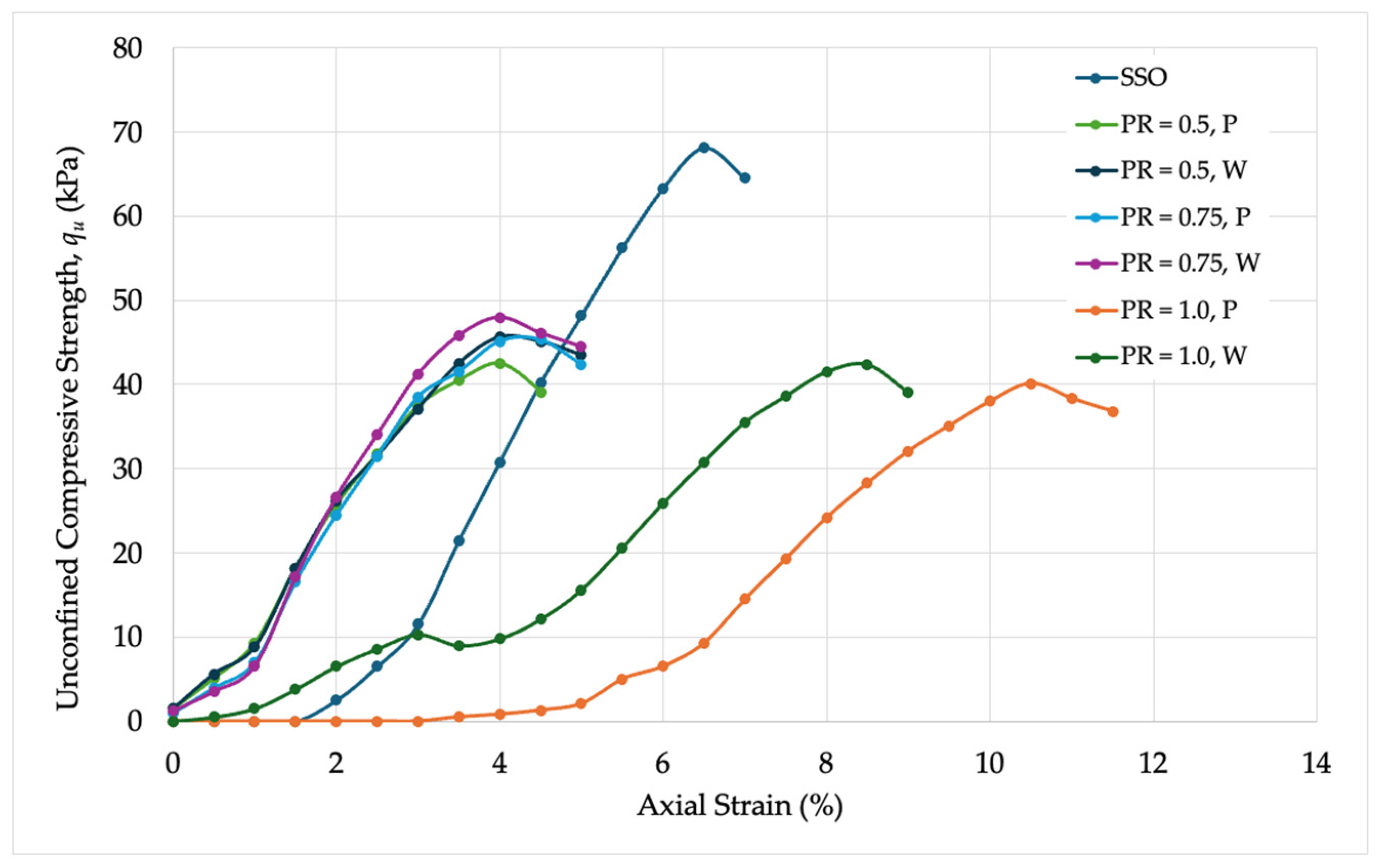
4.1.1. Stress–Strain Behavior of Reinforced Specimens
4.1.2. Undrained Shear Strength
4.1.3. Influence of Column Configuration and Gradation
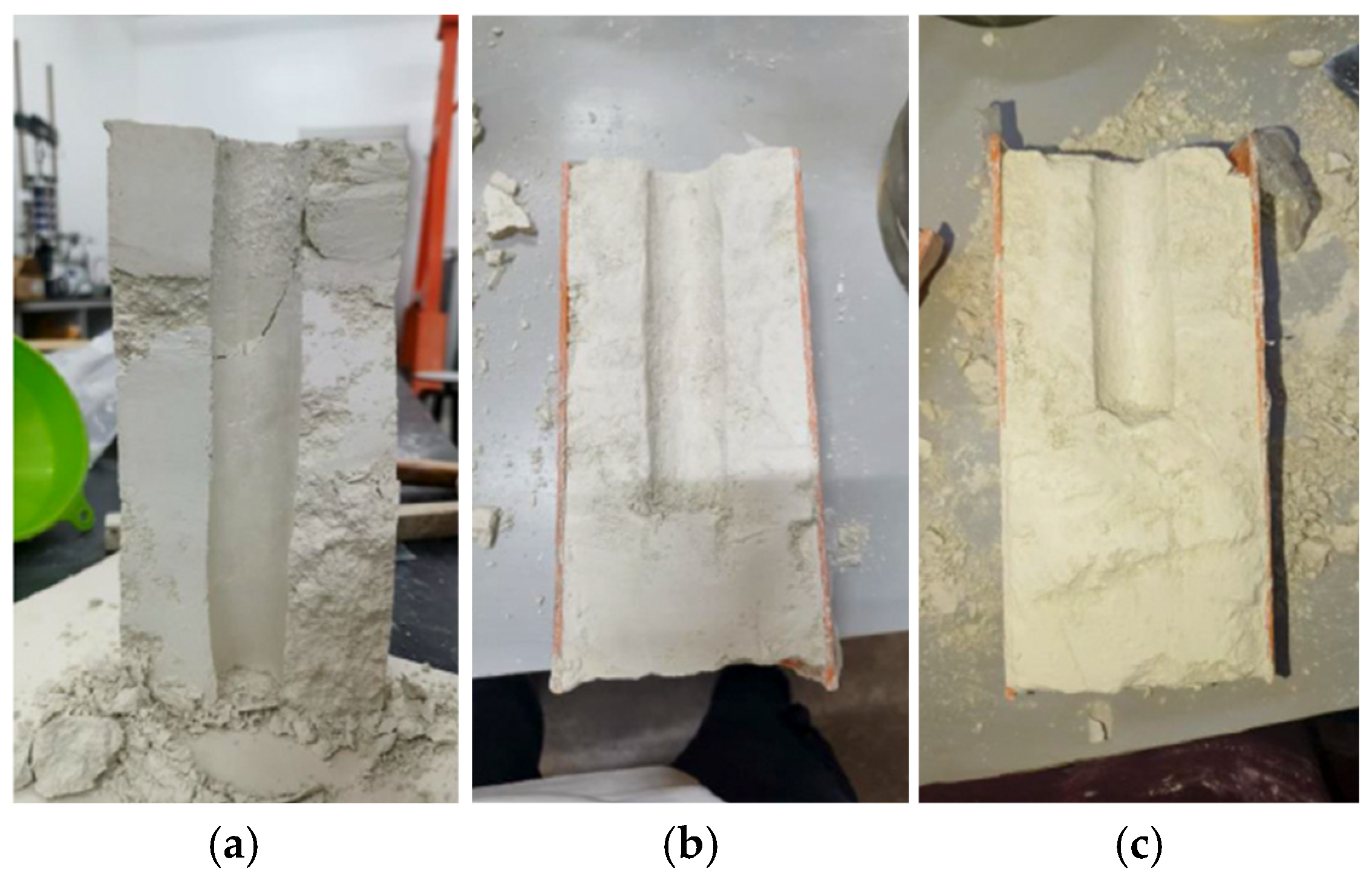
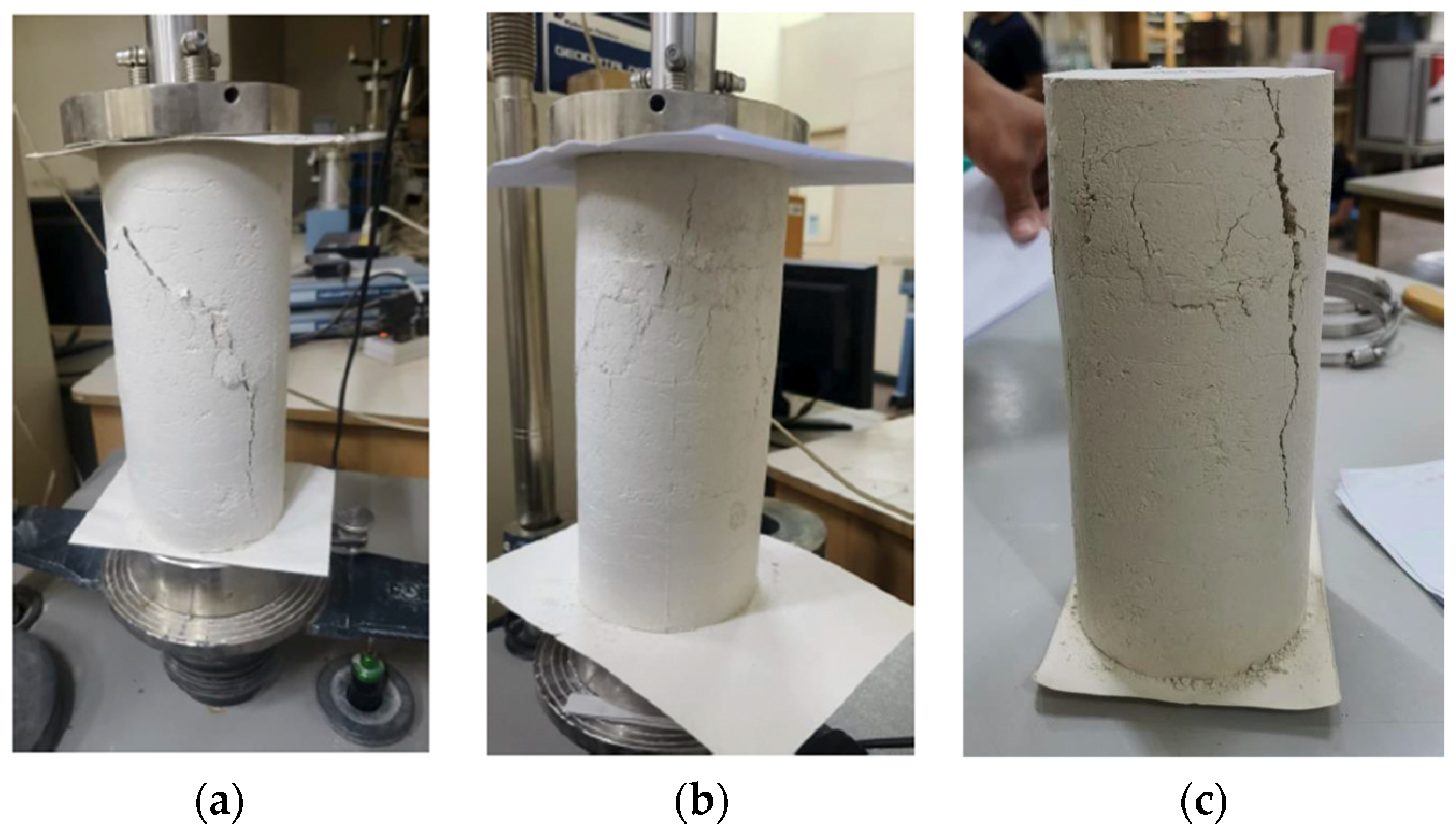
4.1.4. Deformation and Failure Mechanisms
4.1.5. Statistical Analysis and Empirical Prediction Model
4.2. Consolidation Behavior
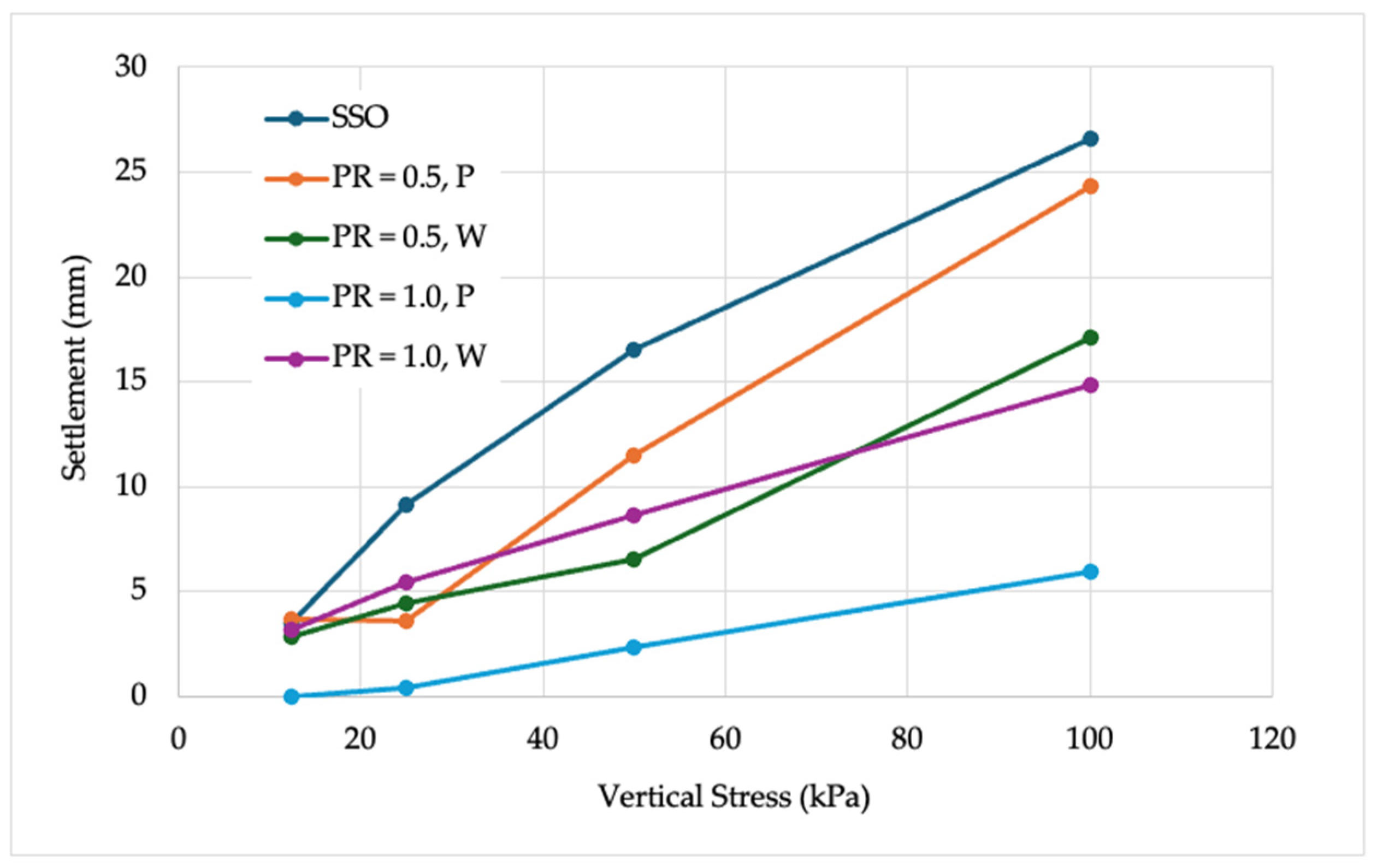
4.2.1. Total Settlement
4.2.2. Compressibility Parameters
4.2.3. Coefficient of Consolidation
4.2.4. Coefficient of Volume Compressibility
4.3. Permeability of the Reinforced Soft Soil
5. Conclusions
- The reinforced specimens exhibited reduced settlement and lower compressibility compared with the unreinforced soil, demonstrating the effectiveness of the CWG column in improving the stiffness of the composite soil system. In contrast, the inclusion of CWG columns did not improve the undrained shear strength of the specimens under unconfined undrained loading conditions. This behavior was attributed to a reduction in cohesive soil volume and to limited mobilization of frictional resistance within the CWG column, due to the absence of lateral confinement.
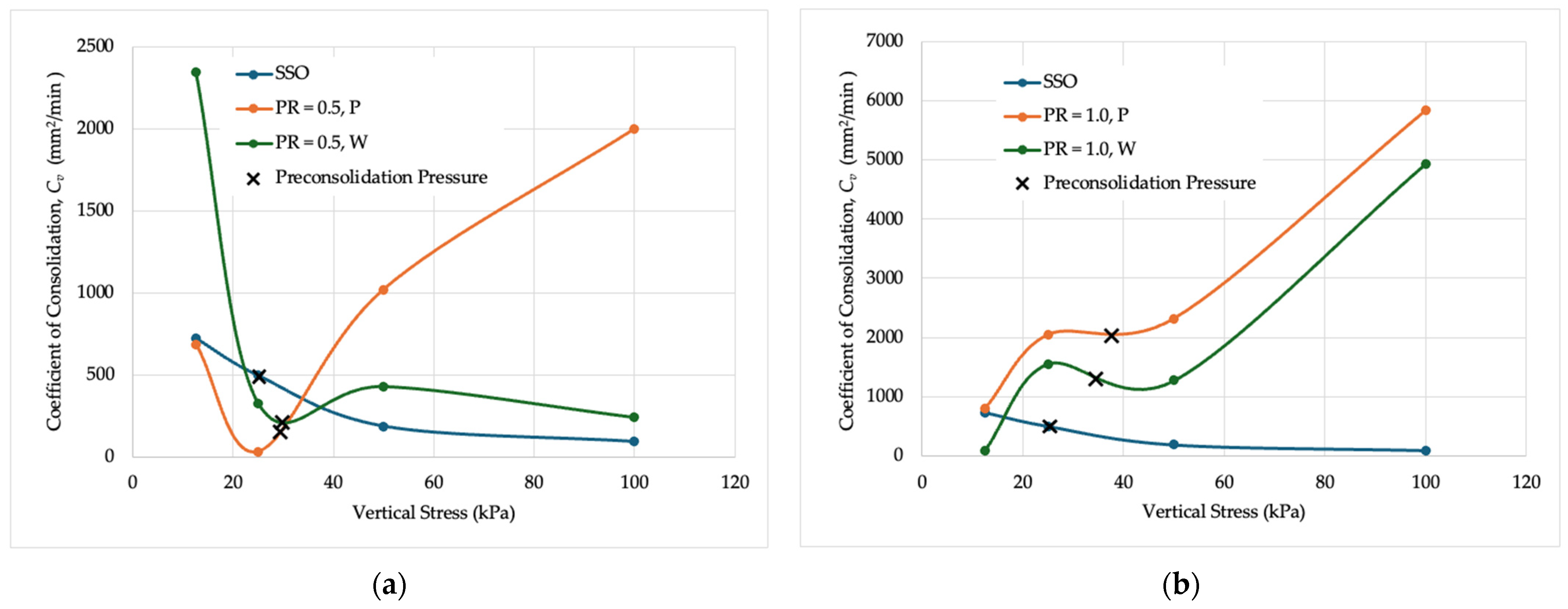
- The coefficient of consolidation of reinforced specimens increased when the applied vertical stress exceeded the preconsolidation pressure, indicating the faster dissipation of excess pore water pressure.
- The hydraulic conductivity of the reinforced specimens was greater compared with the unreinforced soil, confirming that the CWG column enhances the drainage capacity of the composite soil. Specimens reinforced with an end-bearing well-graded CWG column exhibited the highest permeability, indicating the most efficient drainage through the granular column. Although poorly graded CWG columns generally contain larger void spaces, they did not exhibit the highest permeability because the potential clogging from the migration of fine clay particles into the column during consolidation can reduce permeability.
- Penetration ratio (PR) had a more pronounced influence than CWG gradation, particularly in controlling settlement reduction, preconsolidation pressure, and consolidation behavior. Considering the combined results for settlement reduction, consolidation response, drainage efficiency, and resistance to potential clogging, the end-bearing well-graded CWG column (PR = 1.0, W) provided the most balanced overall performance.
6. Limitations of the Study and Recommendations for Future Work
Author Contributions
Funding
Institutional Review Board Statement
Informed Consent Statement
Data Availability Statement
Conflicts of Interest
Abbreviations
| CWG | Crushed waste glass |
| PR | Penetration ratio |
| L/d ratio | Length-to-diameter ratio |
| W | Well-graded |
| P | Poorly graded |
| SSO | Soft soil only |
| ASTM | American Society for Testing and Materials |
| ANOVA | Analysis of variance |
| UCS | Unconfined compressive strength |
| Su | Undrained shear strength |
| Cc | Compression index |
| Cr | Recompression index |
| σ′c | Preconsolidation pressure |
| Cv | Coefficient of consolidation |
| mv | Coefficient of volume compressibility |
| k | Hydraulic conductivity |
References
- Isnaniati; Mochtar, I.B. Increasing the Bearing Capacity of Shallow Foundations on Soft Soil After the Installation of Micro-Piles. J. Civ. Eng. Forum 2023, 9, 227–238. [Google Scholar] [CrossRef]
- Brandl, H. Long-Term Settlement (Creeping) of Soft Soils, and Ground Improvement. In Proceedings of the 3rd GeoMEast International Congress and Exhibition, Sustainable Civil Infrastructures: Beyond The Horizon, Cairo, Egypt, 10–14 November 2019. [Google Scholar]
- Tai, P.; Zhou, C. Effects of Clogging on Settlement Predictions of Ground Improved with Stone Columns. KSCE J. Civ. Eng. 2019, 23, 3889–3896. [Google Scholar] [CrossRef]
- Castro, J.; Sagaseta, C. Deformation and consolidation around encased stone columns. Geotext. Geomembr. 2011, 29, 268–276. [Google Scholar] [CrossRef]
- Jamal, M.; Patel, H.V.; Senapati, A. Construction, Analysis and Behaviour of Stone Column: A Review. Int. J. Res. Advent Technol. 2014, 2, 151–155. [Google Scholar]
- Guetif, Z.; Bouassida, M.; Debats, J.M. Improved soft clay characteristics due to stone column installation. Comput. Geotech. 2007, 34, 104–111. [Google Scholar] [CrossRef]
- Bareither, C.A.; Benson, C.H.; Edil, T.B. Reproducibility of Direct Shear Tests Conducted on Granular Backfill Materials. Geotech. Test. J. 2008, 31, 84–94. [Google Scholar] [CrossRef]
- Najjar, S.S.; Sadek, S.; Maakaroun, T. Effect of sand columns on the undrained load response of soft clays. J. Geotech. Geoenvironmental Eng. 2010, 136, 1263–1277. [Google Scholar] [CrossRef]
- Noor Muneerah PG Haji Jeludin, D.K.; Sivakumar, V.; O’Kelly, B.C.; MacKinnon, P.A. Experimental Observations of Settlement of Footings Supported on Soft Clay Reinforced with Granular Columns: Laboratory Model Study. J. Geotech. Geoenvironmental Eng. 2016, 142, 04015063. [Google Scholar] [CrossRef]
- Bendixen, M.; Iversen, L.L.; Best, J.; Franks, D.M.; Hackney, C.R.; Latrubesse, E.M.; Tusting, L.S. Sand, gravel, and UN Sustainable Development Goals: Conflicts, synergies, and pathways forward. One Earth 2021, 4, 1095–1111. [Google Scholar] [CrossRef]
- Tamayo, P.A.A. Characterizing the Effects of Quarrying Industry in Northern Philippines: A Mixed-methods Study. J. Adv. Res. Dyn. Control Syst. 2020, 12, 746–752. [Google Scholar] [CrossRef]
- Zukri, A.; Nazir, R. Sustainable materials used as stone column filler: A short review. IOP Conf. Ser. Mater. Sci. Eng. 2018, 342, 12001. [Google Scholar] [CrossRef]
- Kazmi, D.; Serati, M.; Williams, D.J.; Qasim, S.; Cheng, Y.P. The potential use of crushed waste glass as a sustainable alternative to natural and manufactured sand in geotechnical applications. J. Clean. Prod. 2021, 284, 124762. [Google Scholar] [CrossRef]
- Kazmi, D.; Williams, D.J.; Serati, M. Kaolin Clay Reinforced with a Granular Column Containing Crushed Waste Glass or Traditional Construction Sands. Int. J. Geomech. 2022, 22, 4022030. [Google Scholar] [CrossRef]
- Kazmi, D.; Serati, M.; Williams, D.J.; Olaya, S.Q.; Qasim, S.; Cheng, Y.P.; Grizi, A.; Javadi, A.A. Shear Strength and Consolidation Behaviour of Kaolin Clay Reinforced with a Granular Column Backfilled with Crushed Waste Glass. Geotech. Geol. Eng. 2024, 42, 3615–3632. [Google Scholar] [CrossRef]
- Priebe, H.J. The design of vibro replacement. Ground Eng. 1995, 28, 31–37. [Google Scholar]
- Barron, R.A. Consolidation of fine-grained soils by drain wells. Trans. Am. Soc. Civ. Eng. 1948, 113, 718–742. [Google Scholar] [CrossRef]
- Bore, T.; Wagner, N.; Cai, C.; Scheuermann, A. Broadband electromagnetic analysis of compacted kaolin. Meas. Sci. Technol. 2016, 28, 14016. [Google Scholar] [CrossRef]
- Mishra, P.N.; Scheuermann, A.; Bore, T.; Li, L. Salinity effects on soil shrinkage characteristic curves of fine-grained geomaterials. J. Rock Mech. Geotech. Eng. 2019, 11, 181–191. [Google Scholar] [CrossRef]
- Bore, T.; Mishra, P.N.; Wagner, N.; Schwing, M.; Honorio, T.; Revil, A.; Scheuermann, A. Coupled hydraulic, mechanical and dielectric investigations on kaolin. Eng. Geol. 2021, 294, 106352. [Google Scholar] [CrossRef]
- Wong, S.T.Y.; Ong, D. Characterization of reconstituted Malaysian kaolinite silts with varying clay contents. Jpn. Geotech. Soc. Spec. Publ. 2016, 2, 478–483. [Google Scholar] [CrossRef]
- Wong, S.T.Y.; Ong, D.E.L.; Robinson, R.G. Behaviour of MH silts with varying plasticity indices. Geotech. Res. 2017, 4, 118–135. [Google Scholar] [CrossRef]
- Kaolin (Malaysia) Sdn. Bhd. Technical Data Sheet: Kaolin KM20 (Rev. 4); Kaolin (Malaysia) Sdn. Bhd.: Ipoh, Malaysia, 2025. [Google Scholar]
- ASTM D698; Standard Test Methods for Laboratory Compaction Characteristics of Soil Using Standard Effort (12,400 ft-lbf/ft3 (600 kN-m/m3)). ASTM International: West Conshohocken, PA, USA, 2021.
- IS 15284 (2003); Design and Construction for Ground Improvement—Guidelines, Part 1: Stone Columns. Bureau of Indian Standards: New Delhi, India, 2003; pp. 1–28.
- Ambily, A.P.; Gandhi, S.R. Behavior of stone columns based on experimental and FEM analysis. J. Geotech. Geoenvironmental Eng. 2007, 133, 405–415. [Google Scholar] [CrossRef]
- ASTM D2166; Standard Test Method for Unconfined Compressive Strength of Cohesive Soil. ASTM International: West Conshohocken, PA, USA, 2024.
- Hamidi, A.; Azini, E.; Masoudi, B. Impact of gradation on the shear strength-dilation behavior of well graded sand-gravel mixtures. Sci. Iran. 2012, 19, 393–402. [Google Scholar] [CrossRef]
- ASTM D4253; Standard Test Methods for Maximum Index Density and Unit Weight of Soils Using a Vibratory Table. ASTM International: West Conshohocken, PA, USA, 2016.
- ASTM D4254; Standard Test Methods for Minimum Index Density and Unit Weight of Soils and Calculation of Relative Density. ASTM International: West Conshohocken, PA, USA, 2016.
- ASTM D2434; Standard Test Methods for Laboratory Measurement of Hydraulic Conductivity of Coarse-Grained Soils. ASTM International: West Conshohocken, PA, USA, 2026.
- Terzaghi, K.; Peck, R.B. Soil Mechanics in Engineering Practice, 2nd ed.; Wiley: New York, NY, USA, 1967. [Google Scholar]
- Das, B.M. Principles of Geotechnical Engineering, 9th ed.; Cengage Learning: Boston, MA, USA, 2018. [Google Scholar]
- ASTM D2435; Standard Test Methods for One-Dimensional Consolidation Properties of Soils Using Incremental Loading. ASTM International: West Conshohocken, PA, USA, 2025.
- Gaber, M.; Kasa, A.; Abdul-Rahman, N.; Alsharef, J. Simulation of stone column ground improvement (Comparison between axisymmetric and plane strain). Am. J. Eng. Appl. Sci. 2018, 11, 129–137. [Google Scholar] [CrossRef]
- Wang, L.B.; Frost, J.D. Dissipated strain energy method for determining preconsolidation pressure. Can. Geotech. J. 2004, 41, 760–768. [Google Scholar] [CrossRef]
- Terzaghi, K. Theoretical Soil Mechanics; Wiley: New York, NY, USA, 1943. [Google Scholar]
- Mitchell, J.K.; Soga, K. Fundamentals of Soil Behavior, 3rd ed.; John Wiley & Sons: Hoboken, NY, USA, 2005. [Google Scholar]
- Hasan, M.; Ali, I.; Hyodo, M. Strength of Soft Clay Reinforced with 10 mm Single Crushed Coconut Shell (CCS) Column. Int. J. GEOMATE 2019, 17, 353–359. [Google Scholar] [CrossRef]
- Jayarajan, J.; Karpurapu, R. Settlement analysis of geosynthetic encased granular column treated soft clay deposits. Int. J. Geotech. Eng. 2020, 14, 473–489. [Google Scholar] [CrossRef]
- Naseer, S.; Sarfraz Faiz, M.; Iqbal, S.; Jamil, S.M. Laboratory and numerical based analysis of floating sand columns in clayey soil. Int. J. Geo-Eng. 2019, 10, 10. [Google Scholar] [CrossRef]
- Wu, Y.; Zhu, Y.; Liu, J.; Ren, J.; Zhang, L.; Wu, Z. An Experimental Study on the Bearing Characteristics of Stone Columns in Stratified Transparent Soil. Buildings 2025, 15, 913. [Google Scholar] [CrossRef]
- Indraratna, B.; Basack, S.; Rujikiatkamjorn, C. Numerical Solution of Stone Column–Improved Soft Soil Considering Arching, Clogging, and Smear Effects. J. Geotech. Geoenvironmental Eng. 2013, 139, 377–394. [Google Scholar] [CrossRef]
- Grizi, A.; Al-Ani, W.; Wanatowski, D. Numerical Analysis of the Settlement Behavior of Soft Soil Improved with Stone Columns. Appl. Sci. 2022, 12, 5293. [Google Scholar] [CrossRef]
- Ng, K.S.; Tan, S.A. Design and analyses of floating stone columns. Soils Found. 2014, 54, 478–487. [Google Scholar] [CrossRef]
- Al-Kazzaz, Z.A.; Al-Obaydi, M.A. Effect of Spacing between Stone Columns on the Behavior of Soft Soil. In Proceedings of the Second International Conference on Geotechnical Engineering, Akre-Duhok, Iraq, 8 November 2021. [Google Scholar] [CrossRef]
- Zhai, Q.; Zhu, Y.; Rahardjo, H.; Satyanaga, A.; Dai, G.; Gong, W.; Zhao, X. Mathematical model for the determination of the pre-consolidation pressure using the graphical method. Arab. J. Geosci. 2023, 16, 69. [Google Scholar] [CrossRef]
- Hafez, M.A.; Amiri, S.T.; Dehghanbanadaki, A.; Motamedi, S.; Rashid, A.S.A.; Golpazir, I. Tensile capacity enhancement of piles in Kaolin clay using recycled crushed glass: Physical modelling and numerical analysis. Multiscale Multidiscip. Model. Exp. Des. 2024, 8, 328. [Google Scholar] [CrossRef]
- Jain, A.; Puri, N. 1-Dimensional Consolidation Characteristics of Clay Stabilized with Major Industrial Wastes of Haryana. In Proceedings of the Indian Geotechnical Conference, Roorkee, India, 22–24 December 2013. [Google Scholar]
- Adajar, M.A.Q.; Zarco, M.A.H. Estimating hydrocompression settlement of mine tailings. Philipp. Eng. J. 2013, 34, 11–30. [Google Scholar]
- Castro, J.; Sagaseta, C. Consolidation around stone columns. Influence of column deformation. Int. J. Numer. Anal. Methods Geomech. 2009, 33, 851–877. [Google Scholar] [CrossRef]
- Basack, S.; Nimbalkar, S. Load-Settlement Characteristics of Stone Column Reinforced Soft Marine Clay Deposit: Combined Field and Numerical Studies. Sustainability 2023, 15, 7457. [Google Scholar] [CrossRef]
- Sun, J.; Lu, M.; Xu, B.; Shan, J. Consolidation of high replacement ratio stone column-reinforced ground: Analytical solutions incorporating clogging effect. J. Rock Mech. Geotech. Eng. 2024, 16, 3311–3326. [Google Scholar] [CrossRef]
- Tai, P.; Indraratna, B.; Rujikiatkamjorn, C. Experimental simulation and mathematical modelling of clogging in stone column. Can. Geotech. J. 2017, 55, 427–436. [Google Scholar] [CrossRef]
- Black, J.; Sivakumar, V.; McKinley, J.D. Performance of clay samples reinforced with vertical granular columns. Can. Geotech. J. 2007, 44, 89–95. [Google Scholar] [CrossRef]
- Hughes, J.; Withers, N. Reinforcing of soft cohesive soils with stone columns. Int. J. Rock Mech. Min. Sci. Geomech. Abstr. 1974, 11, A234. [Google Scholar] [CrossRef]
- U.S. Army Corps of Engineers (USACE). Filter Experiments and Design Criteria; Technical Memorandum 3-360; U.S. Army Waterways Experiment Station: Vicksburg, MS, USA, 1953. [Google Scholar]
- Indraratna, B.; Raut, A.K.; Khabbaz, H. Constriction-based retention criterion for granular filter design. J. Geotech. Geoenvironmental Eng. 2007, 133, 266–276. [Google Scholar] [CrossRef]





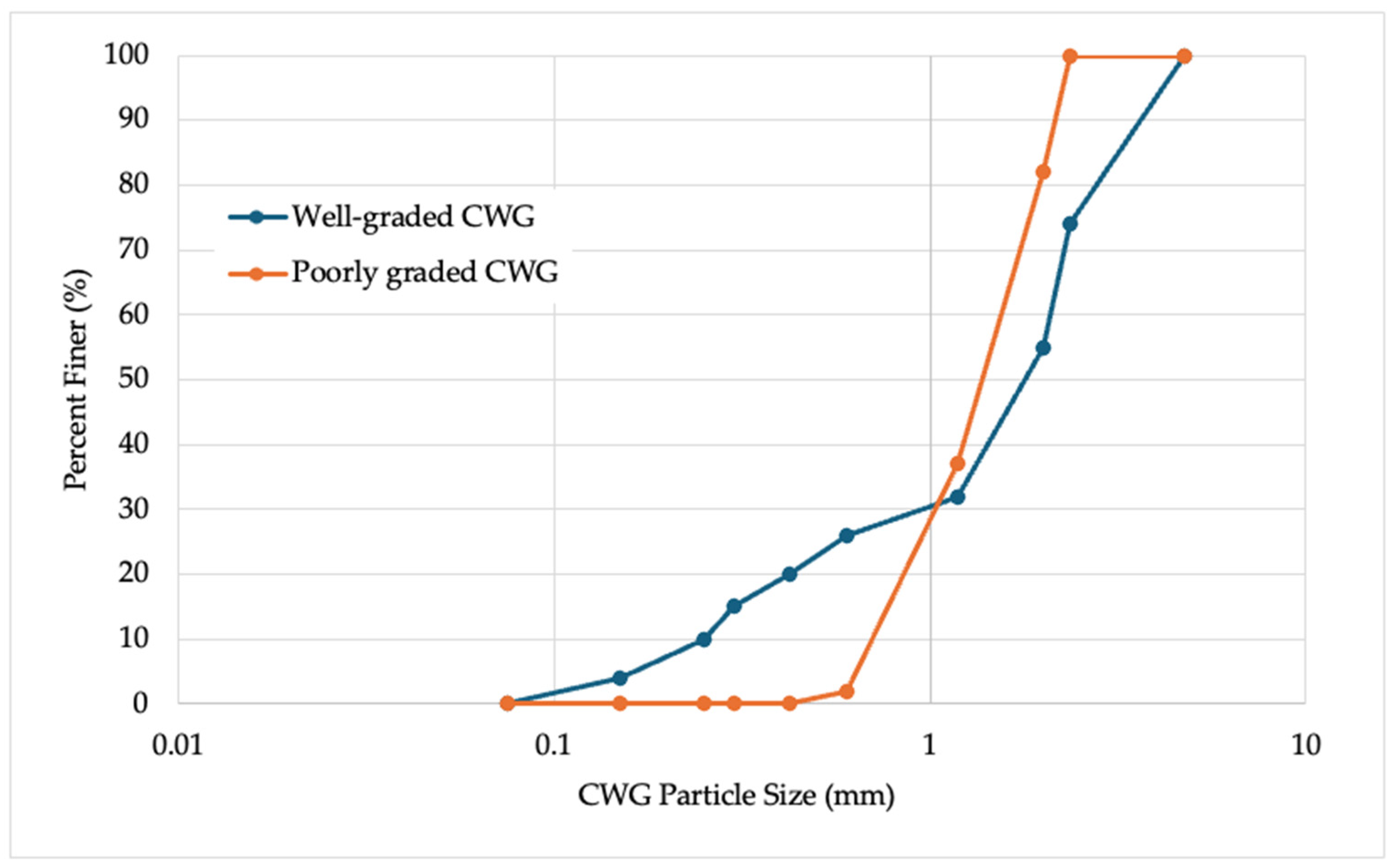
| Sieve No. | Diameter (mm) | % Passing of CWG | |
|---|---|---|---|
| Well-Graded Distribution | Poorly Graded Distribution | ||
| 4 | 4.750 | 100 | 100 |
| 8 | 2.360 | 74 | 100 |
| 10 | 2.000 | 55 | 82 |
| 16 | 1.180 | 32 | 37 |
| 30 | 0.600 | 26 | 2 |
| 40 | 0.425 | 20 | 0 |
| 50 | 0.300 | 15 | 0 |
| 60 | 0.250 | 10 | 0 |
| 100 | 0.150 | 4 | 0 |
| 200 | 0.075 | 0 | 0 |
| CWG Gradation | Effective Size, D10 (mm) | Coefficient of Uniformity | Coefficient of Curvature |
|---|---|---|---|
| Well-graded | 0.2250 | 9.3099 | 2.0655 |
| Poorly graded | 0.7326 | 2.1829 | 0.9664 |
| Dry Unit Weight | Well-Graded Distribution | Poorly Graded Distribution |
|---|---|---|
| Minimum Dry Unit Weight, γdmin (kN/m3) | 14.14 | 12.54 |
| Maximum Dry Unit Weight, γdmax (kN/m3) | 17.28 | 14.81 |
| CWG Gradation | Hydraulic Conductivity, k (cm/s) | Degree of Permeability |
|---|---|---|
| Well-graded distribution | 1.71 × 10⁻² | Medium |
| Poorly graded distribution | 4.34 × 10⁻² | Medium |
| Test | Soft Soil Diameter, D (mm) | Soft Soil Height, H (mm) | CWG Column Diameter (mm) | Penetration Ratio (PR) | Distance from the Hard Stratum (mm) | Length-to- Diameter Ratio |
|---|---|---|---|---|---|---|
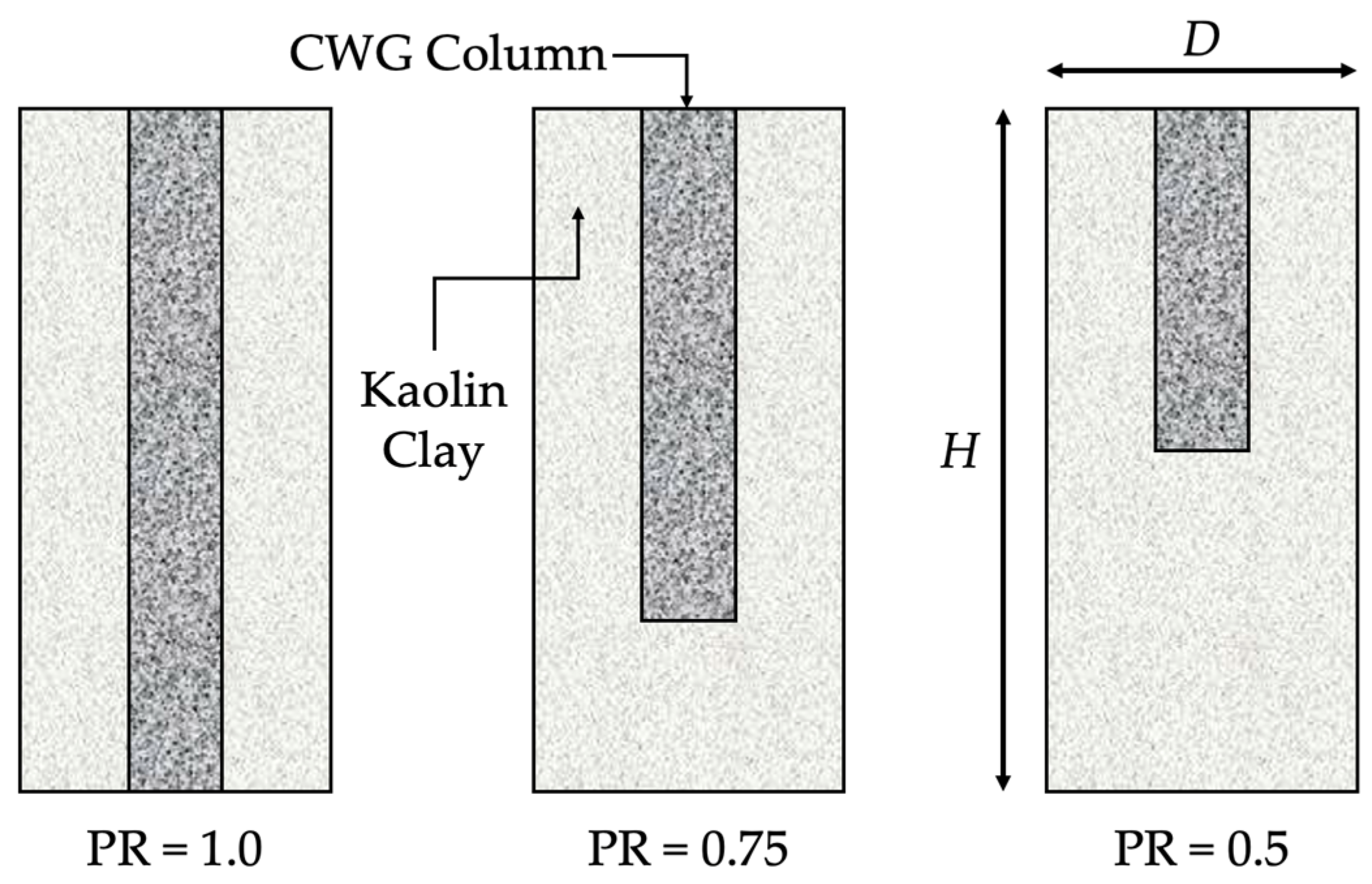
| Unconfined Compression Test | 100 | 219.5 | 33 | 1.0 | 0 | 6.65 |
| 0.75 | 54.88 | 4.99 | ||||
| 0.5 | 109.75 | 3.33 | ||||
| One-dimensional Consolidation Test | 151.7 | 178 | 50 | 1.0 | 0 | 3.54 |
| 0.5 | 88.5 | 1.77 |
| Specimen | Description | Unconfined Compressive Strength, qu (kPa) | Undrained Shear Strength, Su (kPa) |
|---|---|---|---|
| SSO | Specimen with no reinforcement | 67.854 | 33.927 |
| PR = 1.0, W | Specimen reinforced with an end-bearing well-graded CWG column | 38.572 | 19.286 |
| PR = 1.0, P | Specimen reinforced with an end-bearing poorly graded CWG column | 35.303 | 17.652 |
| PR = 0.75, W | Specimen reinforced with a long floating well-graded CWG column | 47.575 | 23.787 |
| PR = 0.75, P | Specimen reinforced with a long floating poorly graded CWG column | 45.304 | 22.652 |
| PR = 0.5, W | Specimen reinforced with a short floating well-graded CWG column | 46.639 | 23.320 |
| PR = 0.5, P | Specimen reinforced with a short floating poorly graded CWG column | 44.017 | 22.008 |
| Rank | Specimen Description | Average Undrained Shear Strength |
|---|---|---|
| 1 (highest) | Specimen with no reinforcement | 33.927 kPa |
| 2 | Specimen reinforced with a floating CWG column | 22.942 kPa |
| 3 (lowest) | Specimen reinforced with an end-bearing CWG column | 18.469 kPa |
| Specimen | Description | Trial | Compression Index, Cc | Recompression Index, Cr | Preconsolidation Pressure, σ′c |
|---|---|---|---|---|---|
| SSO | Specimen with no reinforcement | 1 | 0.23046 | 0.07774 | 28.207 kPa |
| 2 | 0.23092 | 0.04163 | 22.219 kPa | ||
| PR = 0.5, P | Specimen reinforced with a floating poorly graded CWG column | 1 | 0.28888 | 0.03496 | 29.417 kPa |
| 2 | 0.29256 | 0.03519 | 29.404 kPa | ||
| PR = 0.5, W | Specimen reinforced with a floating well-graded CWG column | 1 | 0.19067 | 0.03289 | 29.882 kPa |
| 2 | 0.14674 | 0.02277 | 29.538 kPa | ||
| PR = 1.0, P | Specimen reinforced with an end-bearing poorly graded CWG column | 1 | 0.07199 | 0.02507 | 39.230 kPa |
| 2 | 0.11822 | 0.02852 | 35.876 kPa | ||
| PR = 1.0, W | Specimen reinforced with an end-bearing well-graded CWG column | 1 | 0.13547 | 0.05566 | 34.552 kPa |
| 2 | 0.07981 | 0.02921 | 34.511 kPa |
| Vertical Stress, σ (kPa) | Coefficient of Volume Compressibility, mv (1/kPa) | ||||
|---|---|---|---|---|---|
| SSO | PR = 0.5, P | PR = 0.5, W | PR = 1.0, P | PR = 1.0, W | |
| 12.5 | 1.54 × 10⁻³ | 1.085 × 10⁻⁵ | 1.289 × 10⁻³ | 2.260 × 10⁻⁶ | 1.441 × 10⁻³ |
| 25 | 4.16 × 10⁻³ | 2.983 × 10⁻⁵ | 2.008 × 10⁻³ | 1.944 × 10⁻⁴ | 2.483 × 10⁻³ |
| 50 | 4.01 × 10⁻³ | 1.868 × 10⁻³ | 1.533 × 10⁻³ | 5.145 × 10⁻⁴ | 2.038 × 10⁻³ |
| 100 | 3.59 × 10⁻³ | 2.511 × 10⁻³ | 2.101 × 10⁻³ | 6.808 × 10⁻⁴ | 1.854 × 10⁻³ |
| Specimen | Description | Hydraulic Conductivity, k |
|---|---|---|
| SSO | Specimen with no reinforcement | 5.34 × 10⁻⁶ cm/s |
| PR = 0.5, P | Specimen reinforced with a floating poorly graded CWG column | 8.18 × 10⁻⁵ cm/s |
| PR = 0.5, W | Specimen reinforced with a floating well-graded CWG column | 8.14 × 10⁻⁶ cm/s |
| PR = 1.0, P | Specimen reinforced with an end-bearing poorly graded CWG column | 6.48 × 10⁻⁵ cm/s |
| PR = 1.0, W | Specimen reinforced with an end-bearing well-graded CWG column | 1.49 × 10⁻⁴ cm/s |
Disclaimer/Publisher’s Note: The statements, opinions and data contained in all publications are solely those of the individual author(s) and contributor(s) and not of MDPI and/or the editor(s). MDPI and/or the editor(s) disclaim responsibility for any injury to people or property resulting from any ideas, methods, instructions or products referred to in the content. |
© 2026 by the authors. Licensee MDPI, Basel, Switzerland. This article is an open access article distributed under the terms and conditions of the Creative Commons Attribution (CC BY) license.
Share and Cite
Adajar, M.A.; Frianeza, C.; Salazar, K.C.; Yap, E.; Espinar, D.; Lim, D.L. Consolidation Behavior and Undrained Shear Strength of Soft Soil Reinforced with a Crushed Waste Glass Granular Column. Appl. Sci. 2026, 16, 4698. https://doi.org/10.3390/app16104698
Adajar MA, Frianeza C, Salazar KC, Yap E, Espinar D, Lim DL. Consolidation Behavior and Undrained Shear Strength of Soft Soil Reinforced with a Crushed Waste Glass Granular Column. Applied Sciences. 2026; 16(10):4698. https://doi.org/10.3390/app16104698
Chicago/Turabian StyleAdajar, Mary Ann, Cielo Frianeza, Kara Colleen Salazar, Eugene Yap, Darrel Espinar, and Deryck Lezter Lim. 2026. "Consolidation Behavior and Undrained Shear Strength of Soft Soil Reinforced with a Crushed Waste Glass Granular Column" Applied Sciences 16, no. 10: 4698. https://doi.org/10.3390/app16104698
APA StyleAdajar, M. A., Frianeza, C., Salazar, K. C., Yap, E., Espinar, D., & Lim, D. L. (2026). Consolidation Behavior and Undrained Shear Strength of Soft Soil Reinforced with a Crushed Waste Glass Granular Column. Applied Sciences, 16(10), 4698. https://doi.org/10.3390/app16104698