Article

Ozone Decomposition on MO/Al2O3-CaO (M = Ni, Co, Cu) Catalysts

by
Katya I. Milenova
1,
Ivalina Avramova
2,* and
Katerina Aleksieva
1
1
Institute of Catalysis, Bulgarian Academy of Sciences, Akad. G. Bontchev Str., Bl. 11, 1113 Sofia, Bulgaria
2
Institute of General and Inorganic Chemistry, Bulgarian Academy of Sciences, Akad. G. Bontchev Str., Bl. 11, 1113 Sofia, Bulgaria
*
Author to whom correspondence should be addressed.
Appl. Sci. 2026, 16(10), 4686; https://doi.org/10.3390/app16104686
Submission received: 24 March 2026 / Revised: 30 April 2026 / Accepted: 5 May 2026 / Published: 9 May 2026
(This article belongs to the Special Issue Development of Catalytic Systems for Green Chemistry)

Abstract

The NiO/Al2O3-CaO, CuO/Al2O3-CaO and CoO/Al2O3-CaO catalytic systems were investigated for the decomposition of ozone. Each of the three different Al2O3-CaO carriers was obtained after treatment of the initial precursor at 1100 °C for 2, 4 and 6 h, respectively, to examine the effect of annealing on support calcination. AAS, XRD, XPS, EPR, SEM and BET were applied for sample characterization. The carrier comprises a mixture of corundum α-Al2O3, θ-Al2O3 and Ca3Al2O3. The XRD spectra of the active phases of the catalysts show the existence of Co3O4, NiO, Ni2O3 and CuO. The SEM micrographs reveal spherical particles for the NiO/Al2O3–CaO sample. In contrast, the CoO/Al2O3–CaO sample exhibits a morphology composed of wool-like fibers and perpendicularly oriented plate-like structures. The CuO/Al2O3–CaO sample consists not only of fibrous structures but also of distinct, separated aggregates. The obtained catalysts have highly developed specific surface areas. Their catalytic activity depends on the calcination conditions of the support, and the best results are observed after 2h treatment for all of the investigated samples due to the smaller crystallite size and higher specific surface area. The activity of the investigated catalysts for the ozone decomposition reaction follows the order NiO/Al2O3-CaO > CoO/Al2O3-CaO > CuO/Al2O3-CaO.

1. Introduction

While the ozone layer in the stratosphere protects life from the influence of ultraviolet light, ozone that resides in the ground atmosphere is a serious pollutant with a strong negative impact on the health of human beings. When the ozone concentration in air exceeds 1 × 10⁻⁷ (volume ratio), people start to feel uncomfortable. A further increase in ozone concentration can be carcinogenic and even lead to death [1,2]. Hydrocarbons and nitrogen oxides in different exhaust emissions, together with sunlight energy, will generate a certain concentration of ozone near the surface of the Earth [3]. Another important source of ground ozone in high concentrations is high-temperature, high-discharge mechanical systems, such as air conditioners, photocopiers, and aircraft cabins [1]. Ozone is relatively unstable and can easily decompose into O2 molecules. Three approaches are used for ozone decomposition: thermal decomposition, catalytic decomposition and photocatalytic decomposition. The catalytic decomposition of O3 has gained significant attention owing to its mild operating conditions, high efficiency, and environmentally friendly, safe, and cost-effective nature [4], catalytic decomposition is a highly promising approach due to its ability to decompose ozone at room temperature [5].
Alumina, as a support material for active species, mainly metals and metal oxides, has been successfully applied for the ozonation of organic pollutants as well as for ozone decomposition [6,7,8,9,10,11,12] owing to its low cost, high specific surface area, and excellent thermal stability [13]. Penta-coordinated Al3+ species are an inherent feature of Al2O3 and are generally considered to serve as anchoring sites for active metals, which is beneficial for improving metal dispersion and sintering resistance [14]. The decomposition of gas-phase ozone on alumina films exhibits a loss of reactivity with increasing ozone exposure [15]. While alumina is typically regarded as a nonreactive support, surface hydroxyl groups on alumina play a crucial role in promoting ozone decomposition when paired with active metal sites [16]. Recent studies have shown that the exceptional surface properties of alumina (Al2O3) can greatly improve catalyst performance, driving significant progress in the development of metal/metal oxide-supported catalysts [17].
At temperatures above 1100 °C, metastable alumina phases (γ, η, θ, δ, and κ) irreversibly transform into α-Al2O3 (corundum), the most thermodynamically stable phase [18]. Some authors have reported that certain additives can lower the phase transition temperature of α-Al2O3 to 1000 °C [19]. Among the various forms of alumina, α-alumina is the most stable, exhibiting high rigidity, excellent dielectric properties, reactivity, and favorable thermal characteristics. These properties make it an outstanding material for a wide range of industrial applications [20]. The α-Al2O3 is intrinsically non-porous, making it unsuitable for catalytic applications, except when used as a support material [21].
Transition metal oxides exhibit significant potential for applications in catalysis and adsorption due to their redox activity, variable valence states and high stability. In particular, their outstanding oxidation–reduction properties arise from the ability of transition metal ions to readily gain and lose electrons within their d orbitals. Based on the catalytic decomposition mechanism of O3, the process clearly involves redox reactions; therefore, transition metal oxides demonstrate excellent performance in O3 decomposition [4].
Supported transition metal oxide catalysts, such as NiO, CuO, Co3O4, Fe2O3 and Mn2O3, are widely used by researchers as low-cost alternatives to Pd and Pt catalysts [22,23,24,25,26,27,28,29,30]. Among these non-noble metal oxides, Co3O4 has shown good catalytic activity [31]. NiO and CuO are another important inorganic material with wide application in industrial catalysis [22,31]. Copper oxide prepared through the combustion method [32] and nickel oxide synthesized through impregnation on a support [32,33] show porous structures and cracks [34] detected using SEM. It is a well-known fact that calcination temperature can influence the characteristics of active metal and the porosity and surface area of the catalysts [22]. The influence of calcination temperature on the catalytic activities of the catalyst has been studied in [22,35]. The catalytic activity test indicates that the samples calcined at lower temperatures exhibit the best performance [35].
Developing ozone decomposition catalysts that combine high activity with resistance to deactivation is essential. It is crucial to obtain an α-Al2O3 precursor characterized by a controlled composition, improved mechanical strength, and well-developed specific surface area. The most commonly used support in the ozone decomposition reaction is γ-Al2O3 [36,37]. The aim of this work is to investigate the effect of support calcination (for 2, 4 and 6 h) on the structure and catalytic performance of NiO/Al2O3-CaO, CuO/Al2O3-CaO and CoO/Al2O3-CaO catalysts on Al2O3-CaO carriers, prepared through the deposition method, in decomposing ozone at ambient temperature.

2. Materials and Methods

2.1. Synthesis of the Samples

Three series of samples were prepared using Al2O3–CaO supports synthesized from a precursor subjected to thermal treatment at 1100 °C for 2, 4, and 6 h, respectively. The Al2O3–CaO support was produced following the procedure reported in a Bulgarian Patent [35]. The synthesis was based on the co-precipitation of aluminum hydroxide in the presence of CaCO3 used as a sintering additive. Al(OH)3 was precipitated in a CaCO3 aqueous suspension through the controlled, simultaneous dosing of aluminum salt and ammonia solution under constant pH (8). After filtration and washing, the precipitate was mixed with graphite, plasticized, and finally calcined at 1100 °C.
A key advantage of the method lies in minimizing the number of processing steps required, from the synthesis of aluminum hydroxide to the formation of a final support with controllable composition.
The active phases (NiO, CuO, and CoO) were introduced onto the Al2O3–CaO support via the impregnation method. Three catalyst series were prepared as follows: NiO/Al2O3–CaO was obtained by impregnating 5 g of support with 2.4 g Ni(NO3)2·6H2O dissolved in 10 mL of distilled water. CoO/Al2O3–CaO was synthesized in an analogous manner using 2.4 g Co(NO3)2·6H2O and 5 g of support in 10 mL of distilled water. The CuO/Al2O3–CaO system was prepared using 5 g of support, 10 mL of distilled water, and 1.5 g Cu(NO3)2·3H2O. Electromechanical stirring (1000 rpm) was applied to the prepared solutions at 100 °C for 60 min. Metal precursor amounts were calculated to ensure a final loading of 10 wt % with respect to the Al2O3–CaO support. The obtained materials were then dried at 70 °C for 12 h, mechanically ground, and calcined in air at 400 °C for 2 h.
A balance between high dispersion and mechanical strength is targeted, which necessitates the use of elevated processing temperatures.
The addition of CaO promotes sintering and facilitates the formation of aluminates with high mechanical strength. Among the commonly used sintering additives, Ca and Mg are the most prevalent, with Ca being preferred due to the lower temperature required for the formation of calcium aluminate [38,39].
At 1100 °C, the resulting Al2O3–CaO support exhibits sufficiently high mechanical strength (480 kg/cm2), a well-developed specific surface area (43 m2/g), and an increased total pore volume (0.34 cm3/g); however, the necessary spinel structure is formed and remains stable during high-temperature reactions. The support is annealed for 2 h, which is sufficient to achieve proper structural development and a highly active state characterized by a more dispersed phase. Prolonged annealing (4–6 h) leads to a structure closer to that of a well-defined spinel, accompanied by a decrease in catalytic activity.

2.2. Atomic Absorption Spectroscopy (AAS)

The elemental composition of the catalysts was analyzed through flame atomic absorption spectroscopy (FAAS) using a SOLAAR M5 instrument. Calibration was performed with certified reference solutions (Titrisol, Merck, Germany) containing 1000 ppm of the respective metals.

2.3. X-Ray Diffraction (XRD) Analysis

The phase composition was analyzed through X-ray diffraction using a TUR M62 instrument (HZG-4 goniometer, CoKα radiation). Scans were recorded in the 10–100° (2θ) range employing a step size of 0.02° and 1 s counting time per step in θ–2θ mode. The resulting patterns were matched against the JCPDS database ICDD, 1998, sets [1,2,3,4,5,6,7,8,9,10,11,12,13,14,15,16,17,18,19,20,21,22,23,24,25,26,27,28,29,30,31,32,33,34,35,36,37,38,39,40,41,42,43,44] for phase identification.
The particle size was estimated using the Scherrer equation:
D = к·λ/β·cosθ
where
  • D is the crystalline size;
  • θ is the Bragg angle;
  • β is the full width at half maximum (FWHM) of the diffraction peak;
  • к is the shape factor (typically taken as 0.94);
  • λ is the wavelength of the X-rays (1.78892 Å for Cokα).

2.4. Infrared Spectroscopy (IR) Analysis

Infrared spectra were obtained with a Thermo Scientific Nicolet 6700 FT-IR spectrometer operated with OMNIC™ software (https://www.thermofisher.cn/order/catalog/product/INQSOF018, accessed on 4 May 2026). Measurements were carried out in the 400–4000 cm−1 range at a spectral resolution of 0.9643 cm−1.

2.5. Adsorption—Texture Analysis

The specific surface area was evaluated using the single-point BET approach based on nitrogen adsorption measurements carried out at 77.4 K with a conventional volumetric system (30% N2/70% He). Prior to the analysis, the samples were degassed at 423 K for 30 min under a residual pressure below 1.333 × 10⁻² Pa. The ABET values were derived from the BET equation assuming monolayer nitrogen adsorption.

2.6. X-Ray Photoelectron Spectroscopy (XPS)

The X-ray photoelectron spectroscopy (XPS) studies were performed in a VG Escalab MII electron spectrometer, VG Scientific, London, UK, using MgKα radiation with an energy of 1253.6 eV under a base pressure of 10−7 Pa and a total instrumental resolution of 1 eV. The binding energies (BE) were determined utilizing the C 1s line (from an adventitious carbon) as a reference, with an energy of 285.0 eV. The accuracy of the measured binding energy was 0.2 eV. The C1s, O1s, Al2p, Ni2p, Co2p and Cu2p photoelectron lines were recorded and corrected through the subtraction of a Shirley-type background and quantified using the peak area and Scofield’s photoionization cross-sections.

2.7. Scanning Electron Microscope (SEM)

Scanning electron microscopy (SEM) was employed to investigate the sample morphology using a JEOL JSM-5510 instrument [JEOL Ltd. in Tokyo, Japan] operated at an accelerating voltage of 10 kV.

2.8. Electron Paramagnetic Resonance (EPR)

The EPR spectra were recorded as a first derivative of the absorption signal on a JEOL JES-FA 100 EPR spectrometer, JEOL Ltd. (Tokyo, Japan). It was equipped with a standard TE011 cylindrical resonator and operated in X-band. The study was performed at room temperature. The samples were placed in quartz tubes and were fixed in the cavity center.

2.9. Catalytic Activity Tests

Catalyst particles with sizes of 0.5–0.6 mm were used, selected according to the reactor inner diameter (6.0 mm), with a gas flow rate of 8 L h−1. Ozone was produced from oxygen (99.7%) dried over silica gel using a silent discharge ozone generator operating at 15–20 kV across the electrodes. The inlet ozone concentration in the oxygen stream was 23,000 ppm (45.86 mg/m3). Ozone levels were monitored with an OZONE ANALYZER BMT 964 (BMT MESSTECHNIK GMBH, Stahnsdorf, Germany) with an accuracy of ±3 ppm. All experiments were conducted at room temperature (20 °C), controlled within ±0.2 °C.

3. Results and Discussion

3.1. Catalyst Characterization

The specific surface area (ABET), mean size of crystallinities and compositions of the samples calcinated for 2, 4 and 6 h are represented in Table 1. The obtained catalyst content is around 10 wt % of the active phases—NiO or CoO or CuO. It illustrates slight differences in the specific surface areas of investigated samples. Average crystallite sizes are within the range of 33–43 nm. For nearly all catalysts with supported active phases, an increase in the mean crystallite size is observed with increasing annealing time within each series. This trend corresponds to slight variations in the specific surface area of the studied samples, which decreases modestly as the annealing time of the supports increases within the respective series.
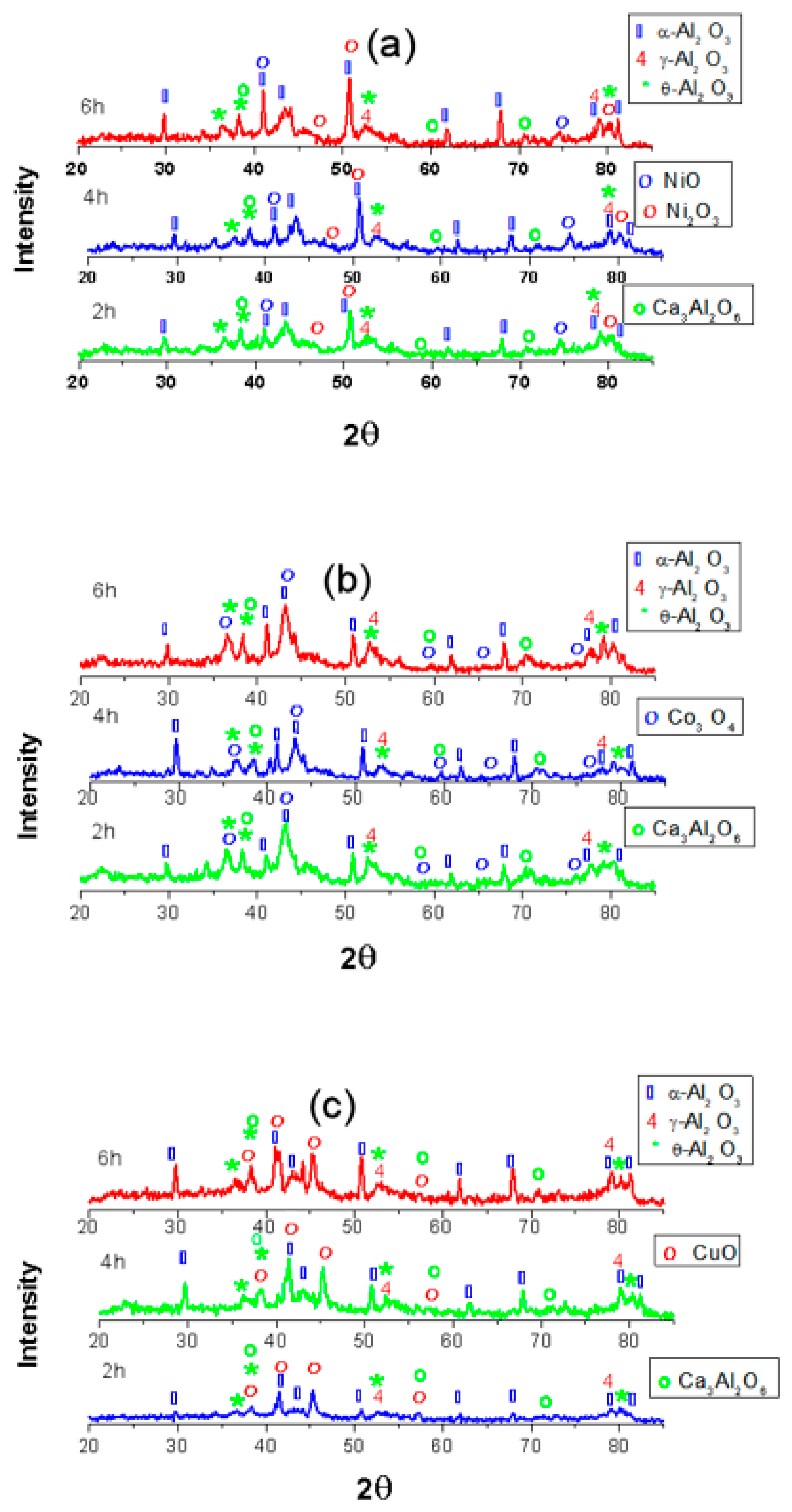
The XRD spectra of the three catalytic series are represented in Figure 1a–c. The first catalyst set NiO/Al2O3-CaO is calcined for 2, 4 and 6 h. The carrier is composed of a mixture of corundum α-Al2O3 (PDF-10-0173) with a high degree of crystallinity and θ-Al2O3 (PDF-35-0121) with a low degree of crystallinity. There is a line in the carrier showing mixed phase Ca3Al2O6 (PDF-38-1429). Two polymorphic forms of nickel oxide are observed in Figure 1a—NiO (PDF-47-1049) and Ni2O3 (PDF-14-0481) [40]. For the NiO/Al2O3-CaO catalytic set it was observed that a longer thermal treatment of NiO/Al2O3-CaO downgraded the X-ray amorphous part, and the line intensity increased [41].
Figure 1b represents the XRD results for the CoO/Al2O3-CaO sample set. The spectra show the existence of α-Al2O3, θ-Al2O3, Ca3Al2O6 and a phase of Co3O4 (PDF-42-1467). Compared to the catalysts of the other two series, the line of θ-Al2O3 (θ ~36.4) has a lower intensity, and Co3O4 has high crystallinity. CoO/Al2O3-CaO calcined for 4 h has the highest crystallinity compared to the 2 h and 6 h calcined ones. Figure 1c exhibits the presence of α-Al2O3, θ-Al2O3, Ca3Al2O6 and CuO (PDF-45-0937) [42,43]. One can see that the peaks of CuO/Al2O3-CaO samples annealed for 4 and 6 h have the highest degree of crystallinity.
Since the study of catalytic activity for ozone decomposition of the investigated catalysts showed that those with support calcined for 2 h exhibit the highest catalytic activity, our research was directed towards them.
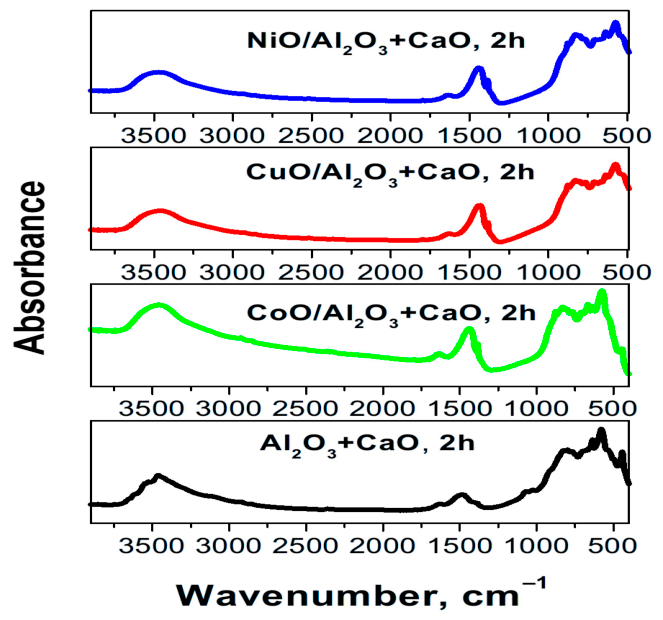
IR spectra of investigated samples are shown in Figure 2. The absorption bands at 2800–3750 cm−1, and 3400 cm−1 [44,45,46] point out the existence of water. The peaks at 1447 cm−1 and 1490 cm−1 are indications of O–H bending vibrations [47,48]. The bands in the range of 400–575 cm−1, 550 to 635 cm−1 and 965 cm−1 are characteristic of the metal oxygen stretching mode and more precisely the Al-O-Al bond in Al2O3 [47,49,50]. The authors in [51], by examining Ca3Al2O6 phosphors with the FTIR method, report that the spectra around 780–820 cm−1 are connected with the vibrations of Al-O and Ca-O bonds. The observed peak at 607 cm−1 confirms the formation of metal oxide bonds, showing the configuration of NiO [52], of Co2O3 at 658 cm−1 [53], and of CuO at 457, 648, 707, and 784 cm−1 [54,55]. Some spectra of oxides become overlapped with each other.
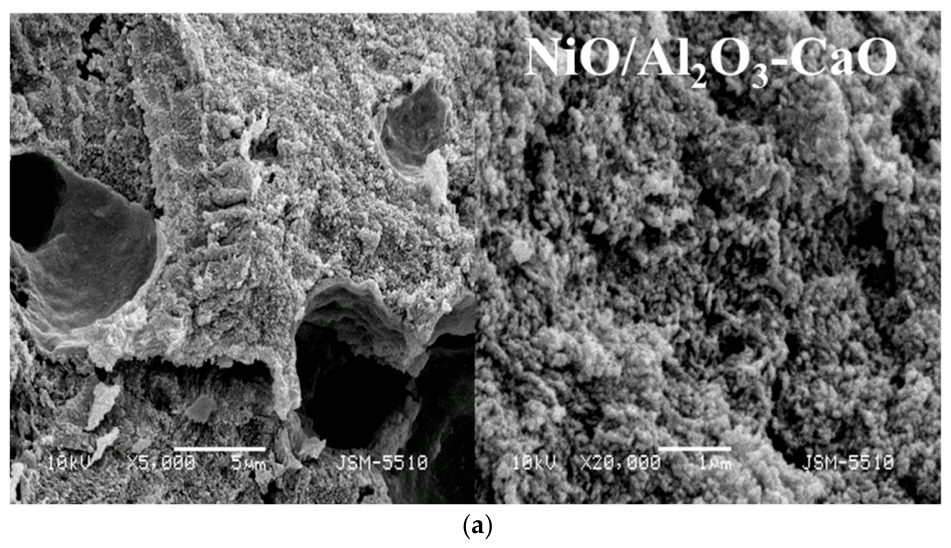
SEM pictures at 5000-times magnification of NiO/Al2O3-CaO calcinated for 2 h show a porous structure; see Figure 3a. The pores are in the volume of the sample, with sizes in the range of 6–10 µm. At a higher magnification of ×20, 000, we can observe the morphology of the particles of the studied sample. The SEM picture of NiO fibers published in [32] by Qiu et al. shows a large number of pores and a similar morphology of particles to that observed in the case of our samples. After detailed examination of the NiO/Al2O3-CaO samples with SEM, we established that, at some places, the morphology is different due to the fact that our material is not homogenous.
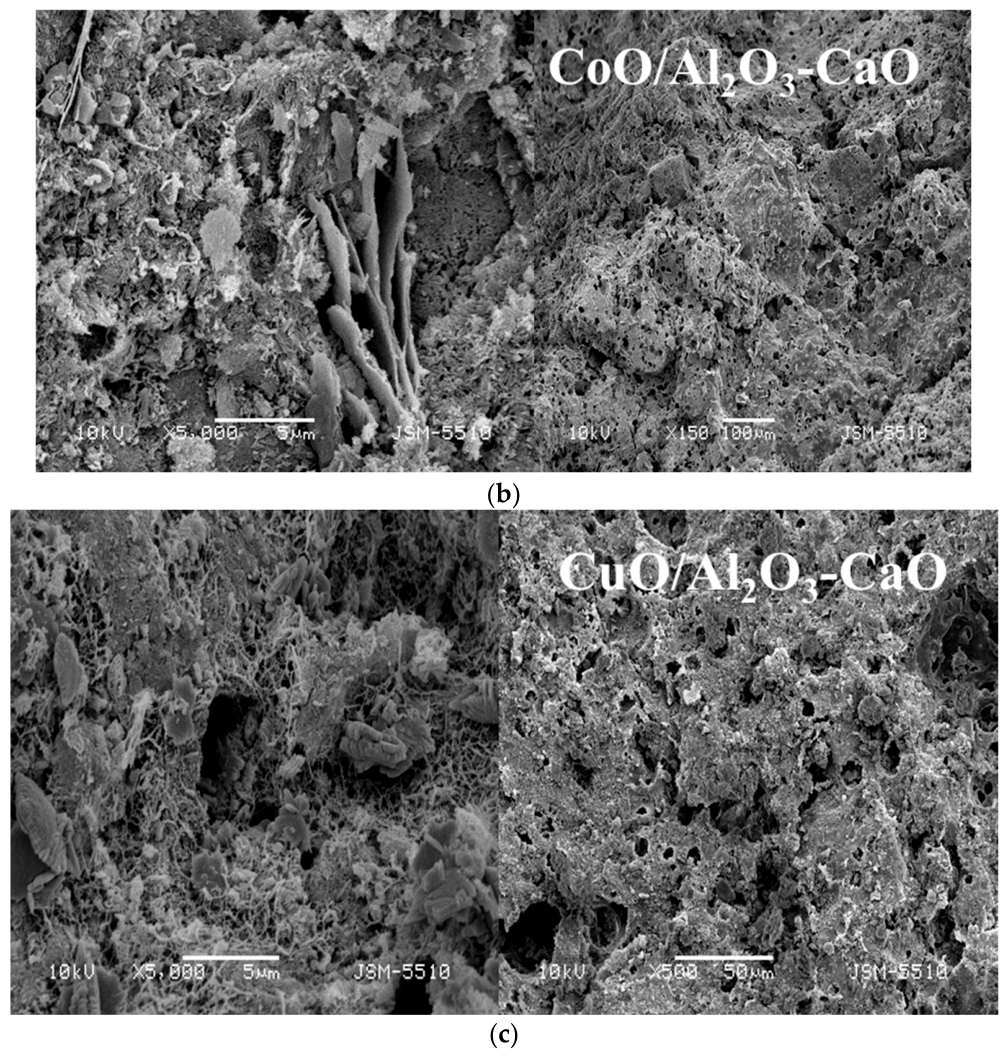
The morphology of the CoO/Al2O3-CaO sample whose support was calcinated for 2 h, investigated using SEM (Figure 3b), reveals that the CoO/Al2O3-CaO particles have sizes of 10–15 µm. It is visible that there are very little and very large sticks at ×5000 magnification. The observed particles have different sizes and are also in the form of fibers and flakes. There are enormous differences in the form and size of the particles of the NiO/Al2O3-CaO sample, where the particles are in the form of balls, while, for the CoO/Al2O3-CaO sample, the particles are wool-like fibers and perpendicular scales. The size of the fibers is about 10 ÷ 15 µm, the thickness of the flakes is of the same order. Gou also observed that samples mainly adopt a sheet-like morphology (typical for Co) [28]. An image at ×150-times magnification was also made to show the porous structure of the material.
Figure 3c presents an SEM image of the third series of samples—CuO/Al2O3-CaO calcinated for 2 h. At ×5000-times magnification, it was observed that there was a higher concentration of fibers compared to CoO/Al2O3-CaO, but they were thicker and formed a net; such a net structure for CuO was also observed [56]. This is one of the reasons for the higher catalytic activity of the CoO/Al2O3-CaO catalyst compared to the CuO/Al2O3-CaO sample. The morphology of the catalysts can influence their catalytic performance [28,57]. The fibers have a higher density for the sample with active CuO. For CoO/Al2O3-CaO, the number of fibers is higher, which leads to better results. The other SEM image at x 500 magnification clearly shows the holes and pores in the net. The SEM images that contain voids and pores and show significant porosity could be attributed to the release of large amounts of gases during the calcination process depending upon the decomposition of copper nitrate [56]. The image also shows that the CuO/Al2O3–CaO sample consists not only of fibers, but also of separate aggregates. Other authors, studying the morphology of the CuO/Al2O3 catalyst, have observed agglomerates [58].
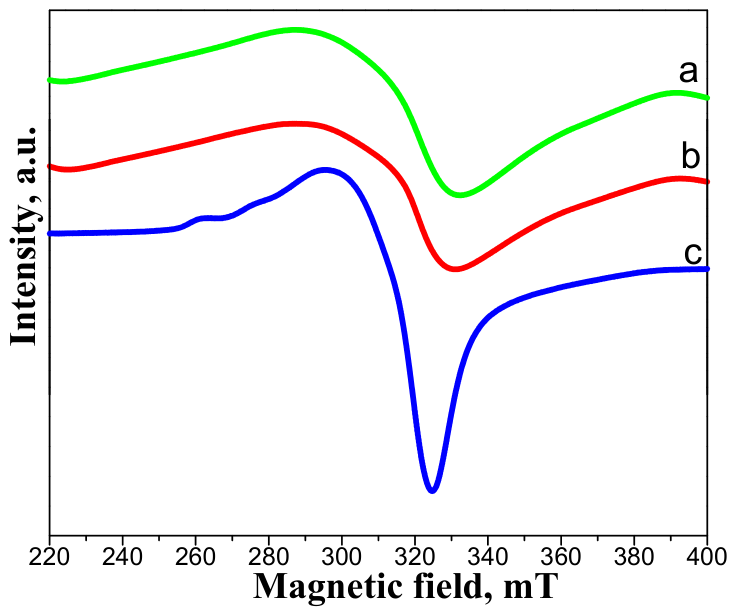
The EPR spectra of CuO/Al2O3-CaO, NiO/Al2O3-CaO and CoO/Al2O3-CaO obtained after support calcination at 1100 °C for 2h are presented in Figure 4. For sample NiO/Al2O3-CaO, a broad singlet line with a g-factor of 2.06 was detected, characteristic for Ni (II) in an octahedral coordination [59]. Another broad line—typical of Co (II) in tetragonal surroundings—with a g = 2.25 was recorded for CoO/Al2O3-CaO. One possible reason for the registration of such broad lines is the dipole–dipole interaction between the particles because of high nickel and cobalt loading (10%). The line width is also connected with the particle size—a larger line width corresponds to a larger particle size [60]. For sample CuO/Al2O3-CaO, an EPR spectrum with the following parameters was detected: gII = 2.29 и g = 2.08, AII = 15 mT. This is characteristic for copper (II) complexes [61].
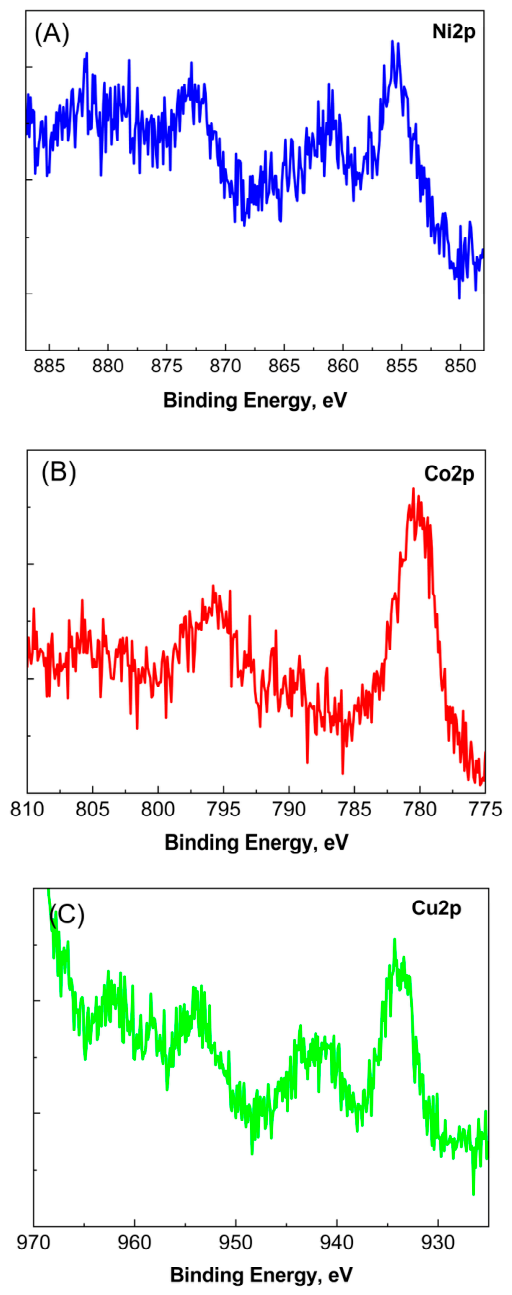
The surface chemical composition and valence states of the elements that are the building blocks of the prepared catalysts have been investigated. The Ni2p, Cu2p and Co2p photoelectron lines are presented in Figure 5. The binding energy evaluated for the Ni2p line is centered at 855.6 eV, which is typical for the presence of Ni(OH)2. Additionally, Ni3+ and O defects exist on the surface. The well-distinguished satellite at around 861 eV confirmed this statement [62]. The Cu 2p peak of the CuO/Al2O3-CaO catalyst appears at 933.7 eV and accompanies the satellite of CuO [8]. The Co 2p3/2 photoelectron line has a binding energy at 780.3 eV and a not-well-pronounced satellite at higher binding energies, suggesting the existence of Co2+ states simultaneously with the existence of low-spin Co3+ species.

3.2. Catalysis Experiments

Table 2 summarizes the reported results for ozone conversion over transition metals supported on γ-Al2O3. Dan et al. [36] and Lu et al. [37] used commercial γ-Al2O3 powder as the support for the catalytic compositions, whereas the authors in [7] synthesized the γ-Al2O3 support.
General findings from the scientific literature [7,36,37] indicate that nickel oxide catalysts supported on γ-Al2O3 exhibit a very high catalytic activity. In the present study, however, α-Al2O3, prepared in advance, is employed as the support material. This support plays a versatile role: in addition to its widespread use in high-temperature reactions, it demonstrates high effectiveness upon deposition of an active phase, particularly in ozone decomposition.
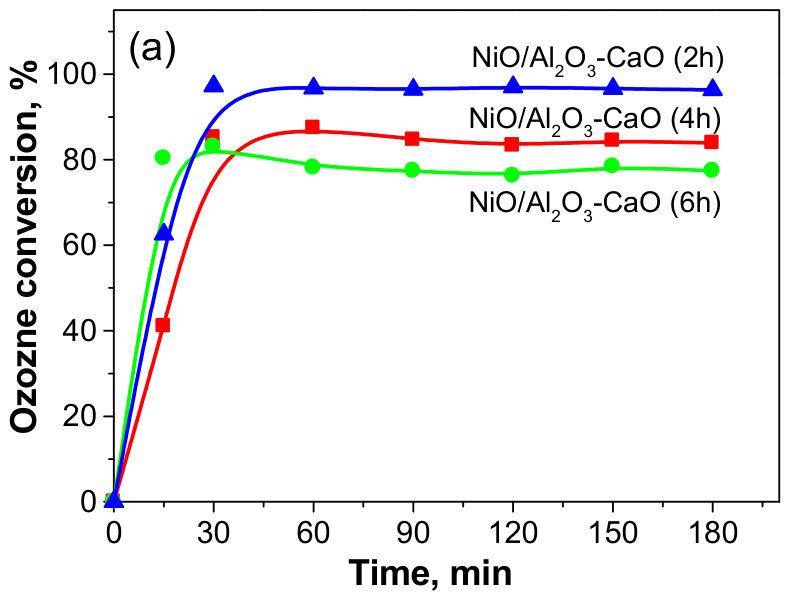
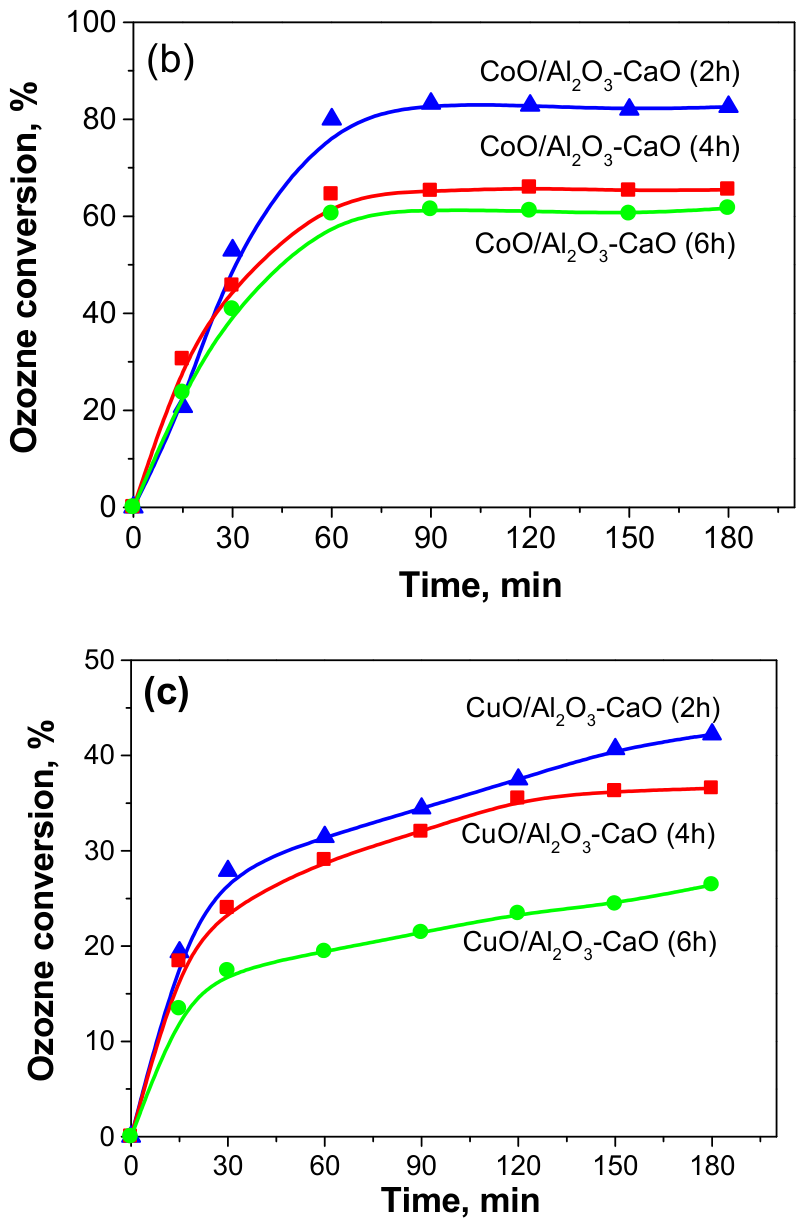
The results for the ozone decomposition with the time at room temperature are shown in Figure 6a–c. The catalytic reaction is performed for the three series for 3 h duration. Figure 6a presents the samples with active-phase NiO with different carriers and times for calcination at 1100 °C of 2, 4 and 6 h. After 30 min, the catalysts of NiO/Al2O3-CaO calcined for 4 and 6 h show an activity higher than 83%, while the 2 h calcined one shows an enormous 97%. After 180 min, no deactivation was observed in the catalytic application of the samples. NiO deposited on alumina as a catalyst for the ozonation of oxalic acid was examined at two different temperatures of calcination, and a high activity was observed for the catalyst calcined at lower temperatures in comparison with the other one [63]. The authors suggested a mechanism for ozone decomposition on the catalyst containing Ni, where surface-bound OH2+ groups, and not neutral hydroxyls, were responsible for catalytic activity [64]. One other proposed mechanism reveals that the high catalytic activity towards ozone decomposition depends on active sites capable of changing their oxidation state. Transition metal oxides are such an example, where several oxidation states are possible; in the case of NiO/Al2O3, Ni2+ ions change their oxidation state into Ni4+ [7]. Figure 6b shows the second series of catalysts with the active component CoO. In the synthesis process, the same three carriers, calcined for 2, 4 and 6 h, were used. After half an hour of ozone decomposition, the CoO/Al2O3-CaO systems with calcined supports and longer times (4 and 6 h) showed similar activity, at 46 and 41%. The highest conversion was shown in the samples calcined for 2 h—53%. The authors prepared cobalt-vacant Co3O4, a catalyst suitable for the conversion of ozone in humid air. Co2+ vacancies easily become hydroxyl groups, which, along with Co3+, decompose ozone and avoid catalyst deactivation due to surface hydroxyl consumption during ozone decomposition [65]. The CuO/Cu2O heterojunctioned catalyst is fabricated by heating Cu2O at a high temperature, which raises its humidity resistance and ozone decomposition. The humidity resistance of the catalyst was improved by the heating treatment. The heterojunction encourages the electron transfer in the catalytic process and creates more defects and oxygen vacancies in the CuO/Cu2O interfaces [66].
Li et al. summarize in their review that there is still a lack of conclusive evidence to clarify the detailed O3 decomposition mechanism and the properties of intermediate species on transition metal oxide catalysts [4].
In [67], a crystalline–amorphous hybrid NiO was reported as an active and humidity-resistant catalyst for O3 decomposition. The last Figure 6c presents the activity for CuO/Al2O3-CaO samples. The calcination time shows a similar influence for NiO and CoO. A shorter time for calcination—2 h—leads to better results for the decomposition of ozone for 30 min, and it is 30%. For the 4 and 6 h thermal treatment conversions, 27 and 17% were observed, respectively. The authors report that Cu(II), as opposed to Co(II), did not reveal catalytic activity [63,68]. One possible reason for the poor activity of CuO-containing catalysts is that the heterostructure is partially or mostly in the copper bulk phase because ozone-catalyzed decomposition is a surface chemical process [5].
Catalyst supports significantly influence catalytic activity by affecting the concentration of adsorption sites, catalyst reducibility, crystallite size, and the dispersion of active metal species. In addition, they can enhance the surface area and improve the overall stability of the catalyst. The incorporation of calcium oxide into the NiO/Al2O3 catalyst system has been reported to enhance both catalyst stability and performance. Furthermore, γ-Al2O3 exhibits a pseudo-spinel structure with lattice parameters similar to those of NiAl2O4, which leads to peak overlap and complicates the clear distinction between these phases [69].
The activity of catalysts in terms of ozone decomposition has the following order: γ-Al2O3/NiO > γ-Al2O3/MnO > γ-Al2O3/CoO > γ-Al2O3/Fe2O3 > γ-Al2O3/CuO [37]. The authors explain the better activity of 10%-supported γ-Al2O3/NiO through the formation of an NiAl2O4 spinel on the catalyst surface, which helps a large amount of chemisorbed oxygen form on the catalyst surface. They found that the mechanism of ozone decomposition for the three catalysts is different.
In [36], it was reported that the catalytic efficiency for the ozone decomposition of NiO-based catalysts is significantly higher than that of corresponding MnO2-based catalysts. Specifically, the catalytic efficiency is approximately 70% for MnO2/Al2O3, whereas it reaches about 99% for NiO/Al2O3; however, after 30 min, the efficiency decreases to 97%. This enhanced performance is primarily attributed to the role of the alumina support in increasing the catalyst–gas contact area, as well as to the formation of a NiAl2O4 spinel phase.
If we summarize the catalytic activity for ozone decomposition of the investigated catalysts, we can conclude that the calcination duration time of the supports at high temperature has a negative influence. The physicochemical properties and O3 decomposition performance of transition metal oxides can be tailored by tuning their morphology, crystalline phase, particle size, dimensionality, and composition [4]. The lowest activity for ozone decomposition is stated for the catalyst with the longest calcination times, probably due to the sintering of the support, a decrease in the specific surface area and an increase in the crystallite size. The 2 h treated samples perform best. Al2O3 catalysts calcined at lower temperatures have a correspondingly higher activity than those calcined at higher temperatures [22].
On the other hand, the system can be compared with their active phases, and the observed activity is as follows: CuO/Al2O3-CaO < CoO/Al2O3-CaO < NiO/Al2O3-CaO. The reason for this better performance might be the formation of an active metal phase on the Al2O3 support [22].

4. Conclusions

Al2O3-CaO carriers were used for catalyst preparation, and the synthesized catalysts were tested for the decomposition reaction of ozone. The carriers were calcined for different periods—2, 4 and 6 h. On as synthesized support, using impregnation, active phases with 10 wt % NiO, CoO and CuO were deposited. The specific surface area was in the range of 61÷ 67 m2/g. XRD analysis showed the existence of α-Al2O3, θ-Al2O3, Ca3Al2O3, Co3O4, NiO, Ni2O3 and CuO. For almost all catalysts with supported active phases, the mean crystallite size increased progressively as the annealing time was extended within each series. Scanning microscope images showed the existence of pores for the three catalytic systems with sizes of 10 ÷15 µm. The morphology of the particles for these systems was different. For NiO/Al2O3-CaO, balls were observed, while for CoO/Al2O3-CaO the particles had small and big sizes, forming fibers and flakes. CuO/Al2O3-CaO had a higher concentration of fibers compared to CoO/Al2O3-CaO, which were thicker and formed a net, which most probably led to the higher activity of the CoO/Al2O3-CaO catalyst. The EPR had registered wide singlet lines typical for Ni(II), Co(II), and Cu(II). XPS confirmed the results from XRD and EPR. The catalysts showed significant activity, with the highest performance observed for the nickel oxide series after 30 minutes of catalyst operation.
The NiO/Al2O3-CaO system calcined for 2 h reached 97% ozone decomposition activity, while the ones calcined for 4 and 6 h showed 85% and 83% activity, respectively. There is a tendency for lowering the activity with longer calcination times. The catalytic performance of the catalysts with the shortest annealing time was most likely influenced by multiple factors, such as specific surface area, crystallite size, and dispersion. The catalysts can be applied successfully in industry for ozone decomposition.

Author Contributions

K.I.M. and I.A.: Writing—review and editing, Writing—original draft, Visualization, Supervision, Resources, Methodology, Investigation, Conceptualization. K.A.: Methodology, Investigation. All authors have read and agreed to the published version of the manuscript.

Funding

This research received no external funding.

Institutional Review Board Statement

Not applicable.

Informed Consent Statement

Not applicable.

Data Availability Statement

The raw data supporting the conclusions of this article will be made available by the authors on request.

Acknowledgments

The authors would like to thank Nikoleta Kasabova from University of Chemical Technology and Metallurgy, Kliment Ohridski, 1756, Sofia, Bulgaria. Infrastructure INFRAMAT, part of the Bulgarian National Roadmap for Research Infrastructures, supported by the Bulgarian Ministry of Education and Science, was used in this investigation.

Conflicts of Interest

The authors declare no conflicts of interest.

References

  1. Subrahmanyam, C.; Bulushev, D.A.; Kiwi-Minsker, L. Dynamic behaviour of activated carbon catalysts during ozone decomposition at room temperature. Appl. Catal. B Environ. 2005, 61, 98–106. [Google Scholar] [CrossRef] [Scilit]
  2. Gu, Y.L.; Liu, S.W.; Xu, X.L. Preparation and properties of binarymetal oxide ozone decomposition catalyst. Ind. Catal. 2002, 10, 39–42. [Google Scholar]
  3. Hoke, J.B.; Heck, R.M.; Poles, T.C. PremAir® Catalyst System—A New Approach to Cleaning the Air; 1999-01-3677; SAE: Warrendale, PA, USA, 1999. [Google Scholar]
  4. Li, X.; Ma, J.; He, H. Recent advances in catalytic decomposition of ozone. J. Environ. Sci. 2020, 94, 14–31. [Google Scholar] [CrossRef] [Scilit]
  5. Ma, G.; Guan, J.; Zhu, Q.; Jiang, Y.; Han, N.; Chen, Y. A Review of Ozone Decomposition by a Copper-Based Catalyst. Catalysts 2024, 14, 264. [Google Scholar] [CrossRef] [Scilit]
  6. Kasprzyk-Hordern, B.; Raczyk-Stanislawiak, U.; Swietlik, J.; Nawrocki, J. Catalytic ozonation of natural organic matter on alumina. Appl. Catal. B Environ. 2006, 62, 345–358. [Google Scholar] [CrossRef] [Scilit]
  7. Stoyanova, M.; Konova, P.; Nikolov, P.; Naydenov, A.; Christoskova, S.; Mehandjiev, D. Alumina-supported nickel oxide for ozone decomposition and catalytic ozonation of CO and VOCs. Chem. Eng. J. 2006, 122, 41–46. [Google Scholar] [CrossRef] [Scilit]
  8. Bi, X.; Wang, P.; Jiang, H. Catalytic activity of CuOn–La2O3/γ-Al2O3 for microwave assisted ClO2 catalytic oxidation of phenol wastewater. J. Hazard. Mater. 2008, 154, 543–549. [Google Scholar] [CrossRef] [Scilit] [PubMed]
  9. Peng, J.; Lai, L.; Jiang, X.; Jiang, W.; Lai, B. Catalytic ozonation of succinic acid in aqueous solution using the catalyst of Ni/Al2O3 prepared by electroless plating-calcination method. Sep. Purif. Technol. 2018, 195, 138–148. [Google Scholar] [CrossRef] [Scilit]
  10. Bokarev, D.A.; Paramoshin, I.V.; Baeva, G.N.; Bragina, G.O.; Stakheev, Y.A. Ozone-Enhanced Selective Catalytic Reduction of NOx by Ammonia: A Comparative Study of Fe-Beta and V2O5–WO3/Al2O3 Catalysts. Kinet. Catal. 2024, 65, 746–753. [Google Scholar] [CrossRef] [Scilit]
  11. Hu, R.; Li, J.-Y.; Yu, Q.; Yang, S.-Q.; Ci, X.; Qu, B.; Yang, L.; Liu, Z.-Q.; Liu, H.; Yang, J.; et al. Catalytic ozonation of reverse osmosis concentrate from coking wastewater reuse by surface oxidation over Mn-Ce/γ-Al2O3: Effluent organic matter transformation and its catalytic mechanism. J. Hazard. Mater. 2024, 471, 134363. [Google Scholar] [CrossRef] [Scilit]
  12. Hu, Y.; Wang, P.; Yu, Y.; Li, M.; Xi, H.; Fu, L.; Wu, C. Aluminum-based ozone catalysts prepared by mixing method: Characteristics, performance and carbon emissions. Chemosphere 2024, 349, 140842. [Google Scholar] [CrossRef] [Scilit]
  13. Zhao, X.; Zhou, X.; Xia, Y.; Xu, Z.; Song, M.; Wang, Z.; Guo, Q.; Jiang, Z. Realizing the high loading amount of active Cu on Al2O3 to boost its CO catalytic oxidation. J. Colloid Interface Sci. 2024, 673, 669–678. [Google Scholar] [CrossRef] [Scilit] [PubMed]
  14. Zhao, X.; Zhou, X.; Xing, W.; Yuan, Z.; Wang, K.; Zhang, Q.; Shan, Y.; Liu, J.; Ju, L.; Jiang, Z.; et al. Cu3Pt1 alloys confined by penta-coordinate Al3+ on Al2O3 realize CO oxidation at room temperature. Mol. Catal. 2025, 570, 114664. [Google Scholar] [CrossRef] [Scilit]
  15. Sullivan, R.C.; Thornberry, T.; Abbatt, J.P.D. Ozone decomposition kinetics on alumina: Effects of ozone partial pressure, relative humidity and repeated oxidation cycles. Atmos. Chem. Phys. 2004, 4, 1301–1310. [Google Scholar] [CrossRef] [Scilit]
  16. Shao, X.; Li, X.; Ma, J.; Zhang, R.; He, H. Terminal Hydroxyl Groups on Al2O3 Supports Influence the Valence State and Dispersity of Ag Nanoparticles: Implications for Ozone Decomposition. ACS Omega 2021, 6, 10715–10722. [Google Scholar] [CrossRef] [Scilit]
  17. Feng, R.; Li, H.; Li, Z.; Zhang, J.; Kang, Q. Synergistic catalytic ozonation of humic acid in water over activated alumina modified with cerium and manganese oxides. Sci. Rep. 2025, 15, 36680. [Google Scholar] [CrossRef] [Scilit] [PubMed]
  18. Lennox, J.; Pepper, R.; Martens, W.; Gray, V.; Alarco, J.; MacLeod, J.; Couperthwaite, S. Connection between alumina doping methodology and performance: A review. Ceram. Int. 2026. [Google Scholar] [CrossRef] [Scilit]
  19. Xie, Y.; Kocaefe, D.; Kocaefe, Y.; Cheng, J.; Liu, W. The Effect of Novel Synthetic Methods and Parameters Control on Morphology of Nano-alumina Particles. Nanoscale Res. Lett. 2016, 11, 259. [Google Scholar] [CrossRef] [Scilit] [PubMed]
  20. Bin Mokaizh, A.A.; Al Haiqi, O.; Shariffuddin, J.H.B.H. Investigating the effects of calcination time on A-alumina synthesis from aluminum waste can. Phys. Chem. Earth Parts A/B/C 2021, 122, 102979. [Google Scholar] [CrossRef] [Scilit]
  21. Carstens, S.; Meyer, R.; Enke, D. Towards Macroporous α-Al2O3-Routes, Possibilities and Limitations. Materials 2020, 13, 1787. [Google Scholar] [CrossRef] [Scilit]
  22. Zhang, G.; Wang, S.; Zhao, S.; Fu, L.; Chen, G.; Yang, F. Oxidative degradation of azo dye by hydrogen peroxide electrogenerated in situ on anthraquinonemonosulphonate/polypyrrole composite cathode with heterogeneous CuO/γ-Al2O3 catalyst. Appl. Catal. B Environ. 2011, 106, 370–378. [Google Scholar] [CrossRef] [Scilit]
  23. Pocostales, P.; Alvarez, P.; Beltran, F.J. Catalytic ozonation promoted by alumina-based catalysts for the removal of some pharmaceutical compounds from water. Chem. Eng. J. 2011, 168, 1289–1295. [Google Scholar] [CrossRef] [Scilit]
  24. Rosal, R.; Gonzalo, M.S.; Rodrнguez, A.; Perdigуn-Melуn, J.A.; Garcнa-Calvo, E. Catalytic ozonation of atrazine and linuron on MnOx/Al2O3 and MnOx/SBA-15 in a fixed bed reactor. Chem. Eng. J. 2010, 165, 806–812. [Google Scholar] [CrossRef] [Scilit]
  25. Tong, S.-P.; Shi, R.; Zhang, H.; Ma, C. Kinetics of Fe3O4–CoO/Al2O3 catalytic ozonation of the herbicide 2-(2,4-dichlorophenoxy) propionic acid. J. Hazard. Mater. 2011, 185, 162–167. [Google Scholar] [CrossRef] [Scilit]
  26. Rezaei, E.; Soltan, J.; Chen, N.; Lin, J. Effect of noble metals on activity of MnOx/c-alumina catalyst in catalytic ozonation of toluene. Chem. Eng. J. 2013, 214, 219–228. [Google Scholar] [CrossRef] [Scilit]
  27. Li, J.; Yan, R.; Xiao, B.; Liang, D.T.; Du, L. Development of Nano-NiO/Al2O3 Catalyst to be Used for Tar Removal in Biomass Gasification. Environ. Sci. Technol. 2008, 42, 6224–6229. [Google Scholar] [CrossRef] [Scilit]
  28. Gou, Y.; Liang, X.; Chen, B. Porous Ni–Co bimetal oxides nanosheets and catalytic properties for CO oxidation. J. Alloys Compd. 2013, 574, 181–187. [Google Scholar] [CrossRef] [Scilit]
  29. Li, H.; Liao, J.; Zhang, X.; Liao, W.; Wen, L.; Yang, J.; Wang, H.; Wang, R. Controlled synthesis of nanostructured Co film catalysts with high performance for hydrogen generation from sodium borohydride solution. J. Power Sources 2013, 239, 277–283. [Google Scholar] [CrossRef] [Scilit]
  30. Su, M.; Zhang, H.; Zhang, P. Tuning ozone decomposition intermediates on δ-MnO2 to improve its moisture-resistance in ozone catalytic oxidation of toluene. Appl. Catal. B-Environ. Energy 2025, 378, 125526. [Google Scholar] [CrossRef] [Scilit]
  31. Li, N.; Lu, W.; Pei, K.; Yao, Y.; Chen, W. Formation of high-valent cobalt-oxo phthalocyanine species in a cellulose matrix for eliminating organic pollutants. Appl. Catal. B Environ. 2015, 163, 105–112. [Google Scholar] [CrossRef] [Scilit]
  32. Qiu, Y.; Yu, J.; Zhou, X.; Tan, C.; Yin, J. Synthesis of Porous NiO and ZnO Submicro- and Nanofibers from Electrospun Polymer Fiber Templates Nanoscale. Res. Lett. 2009, 4, 173–177. [Google Scholar] [CrossRef] [Scilit]
  33. Qian, N.; Zhang, L.; Ma, W.; Zhao, X.; Han, L.; Lu, W. Core–Shell Al2O3-Supported Ni for High-Performance Catalytic Reforming of Toluene as a Model Compound of Tar Arab. J. Sci. Eng. 2014, 39, 6671–6678. [Google Scholar] [CrossRef] [Scilit]
  34. Nikolić, V.; Kamberović, Ž.; Anđić, Z.; Korać, M.; Sokić, M.; Maksimović, V. Influences of synthesis methods and modifier addition on the properties of Ni-based catalysts supported on reticulated ceramic foams. Int. J. Miner. Metall. Mater. 2014, 21, 806–812. [Google Scholar] [CrossRef] [Scilit]
  35. Dimitar, S.; Nikoleta, K.; Tsvetana, Z.; Lyubomir, A.; Dichka, M.; Vi-oleta, Y.; Iliya, I.; Georgiev, H.; Stoyan, L.; Violeta, P.; et al. Method for Obtaining an Alpha Alumina Support. Process for Catalysts for Carbon Reforming. BG Patent 46635 A, 15 February 1990. [Google Scholar]
  36. Dan, C.; Popovici, E.J.; Imre, F.; Indrea, E.; Marginean, P.; Silaghi-Dumitrescu, I. Studies on Some Ozone Decomposition Catalysts Based on Nickel Oxide. Stud. Univ. Babes-Bolyai Chem. 2007, 52, 91–95. Available online: https://hero.epa.gov/reference/7829813/ (accessed on 4 May 2026).
  37. Lu, J.; Wang, S.; Zhao, K.; Wang, T.; Ni, C.; Wang, M.; Wang, S. Study on catalytic performance of supported transition metal oxide catalyst for ozone decomposition. J. Fuel Chem. Technol. 2021, 49, 1014–1021. [Google Scholar] [CrossRef] [Scilit]
  38. Shashikala, B.S.; Premkumar, H.B.; Darshan, G.P.; Lavanya, D.R.; Sharma, S.C.; Nagabhushana, H. Intense red-emitting core-active shell SiO2@CaAl2O4:Eu3+surface sensitive fluorescent probe for dactylography applications. Mater. Chem. Phys. 2023, 297, 127358. [Google Scholar] [CrossRef] [Scilit]
  39. Singh, V.K.; Sinha, R.K. Low temperature synthesis of spinel (MgAl2O4). Mater. Lett. 1997, 31, 281–285. [Google Scholar] [CrossRef] [Scilit]
  40. Pouretedal, H.R.; Momenzadeh, F. Synthesis, characterization and study of photocatalytic activity of nanocomposites of oxides and sulfides of Ni(II) and Ni(III). Bulg. Chem. Commun. 2015, 47, 59–65. [Google Scholar]
  41. Neto, W.S.M.; Lustosa, M.L.S.; Neto, L.D.S.; Santos, M.B.; Cruz, F.T.; Fiuza Junior, R.A.; Pontes, K.V.; Mascarenhas, A.J.S. Combustion synthesis of NiO-CaO-Al2O3 catalysts for biomass gasification of eucalyptus wood for sustainable H2 production. In Proceedings of the Conference 23° Congresso Brasileiro de Catálise (CBCat) 2025, Natal, Brazil, 21–26 September 2025. [Google Scholar]
  42. Zeng, X.; Zhukova, M.; Faniel, S.; Proost, J.; Flandre, D. Structural and Opto-electronic characterization of CuO thin films prepared by DC reactive magnetron sputtering. J. Mater. Sci. Mater. Electron. 2020, 31, 4563–4573. [Google Scholar] [CrossRef] [Scilit]
  43. Khan, S.; Shah, S.S.; Janjua, N.K.; Yurtcan, A.B.; Nazir, M.T.; Katubi, K.M.; Alsaiari, N.S. Alumina supported copper oxide nanoparticles (CuO/Al2O3) as high-performance electrocatalysts for hydrazine oxidation reaction. Chemosphere 2023, 315, 137659. [Google Scholar] [CrossRef] [Scilit]
  44. Al-Kurdhan, J.M.H.; Wang, H. The Synthesis of Glycerol Carbonate from Glycerol and Carbon Dioxide over Supported CuO-Based Nanoparticle Catalyst. Molecules 2023, 28, 4164. [Google Scholar] [CrossRef] [Scilit]
  45. Kungulova, E.N.; Bibko, A.A.; Shendrik, R.Y.; Moskvichev, E.N.; Lychagin, D.V.; Tishin, P.A. Water Redistribution in Vein Quartz Under Progressive Deformation (During Plastic Deformation): μFTIR and EBSD Study (Western Transbaikalia, Russia). Minerals 2024, 14, 1289. [Google Scholar] [CrossRef] [Scilit]
  46. Sumethra, R.; Anuradha, N.; Ravichandran, K.; Shalini, R.; Varshini, M.; Jenipher, C.; Ayyanar, M.; Jayakumari, T. Ni blended NiO nanomaterial synthesis using three different plant extracts for effective dye waste water remediation and biomedical application. Mater. Sci. Eng. B 2025, 313, 117958. [Google Scholar] [CrossRef] [Scilit]
  47. Ates, S.; Baran, E.; Yazıcı, B. Fabrication of Al2O3 nanopores/SnO2 and its application in photocatalytic degradation under UV irradiation. Mater. Chem. Phys. 2018, 214, 17–27. [Google Scholar] [CrossRef] [Scilit]
  48. Ullah, R.; Naeemullah; Tuzen, M. Photocatalytic removal of organic dyes by titanium doped alumina nanocomposites: Using multivariate factorial and kinetics models. J. Mol. Struct. 2023, 1285, 135509. [Google Scholar] [CrossRef] [Scilit]
  49. Salai Subha Nila, A.; Radha, K.P. Synthesis and XRD, FTIR Studies of Alumina Nanoparticle using Co-precipitation Method. Int. J. Res. Appl. Sci. Eng. Technol. 2018, 6, 2493–2496. [Google Scholar] [CrossRef] [Scilit]
  50. Akarsu, E.; Arpac, E. Thermally and photocatalytically active multifunctional porous coatings for high temperature applications. J. Hazard. Mater. 2019, 365, 331–339. [Google Scholar] [CrossRef] [Scilit]
  51. Shee, N.K.; Kim, H.-J. Integration of Sn(IV)porphyrin on mesoporous alumina support and visible light catalytic photodegradation of methylene blue. Mater. Today Commun. 2024, 39, 109033. [Google Scholar] [CrossRef] [Scilit]
  52. Parauha, Y.R.; Dhoble, S.J. Thermoluminescence study and evaluation of trapping parameter of rare earth activated Ca3Al2O6: RE (RE: Eu2+, Ce3+) phosphors. J. Mol. Struct. 2020, 1211, 127993. [Google Scholar] [CrossRef] [Scilit]
  53. Hussain, M.M.; Rahman, M.M.; Asiri, A.M. Ultrasensitive and selective 4-aminophenol chemical sensor development based on nickel oxide nanoparticles decorated carbon nanotube nanocomposites for green environment. J. Environ. Sci. 2017, 53, 27–38. [Google Scholar] [CrossRef] [Scilit]
  54. Fawy, K.F.; Jabbour, K.; Ashiq, M.F.; Bano, N.; Abid, A.G.; Manzoor, S.; Nisa, M.U.; Ibrahim, M.; Ashiq, M.N. Surface embellishment accelerates the oxygen evolution reaction and removal of organic pollutant using solvothermally designed Co2O3/CuO nanocomposite. Surf. Interfaces 2023, 40, 103019. [Google Scholar] [CrossRef] [Scilit]
  55. Sukumar, S.; Rudrasenan, A.; Nambiar, D.P. Green-Synthesized Rice-Shaped Copper Oxide Nanoparticles Using Caesalpinia bonducella Seed Extract and Their Applications. ACS Omega 2020, 5, 1040–1051. [Google Scholar] [CrossRef] [Scilit] [PubMed]
  56. Abd-Elkader, O.H.; Deraz, N.M. Synthesis and Characterization of New Copper based Nanocomposite. Int. J. Electrochem. Sci. 2013, 8, 8614–8622. [Google Scholar] [CrossRef] [Scilit]
  57. Liao, J.; Li, H. Preparation of CuO Microspheres Consisting of Nanosheets and their Catalytic Activity in Degradation of Methylene Blue with Hydrogen Peroxide. Adv. Mater. Res. 2013, 838–841, 2310–2313. [Google Scholar] [CrossRef] [Scilit]
  58. Kosa, S.A. The Use of a Nanoscale Copper Catalyst in the Catalytic Decomposition of Water Polluted with Organic Dyes. J. Nanomater. 2013, 2013, 562830. [Google Scholar] [CrossRef] [Scilit]
  59. Nikolova, D.; Edreva-Kardjieva, R.; Serwicka, E.M.; Dula, R.; Grozeva, T. State of the components of (K)(Ni)W/γ-Al2O3 catalysts as oxideprecursors and after water-gas shift reaction in the presence of Sulphur. Appl. Catal. A-Gen. 2014, 480, 108–119. [Google Scholar] [CrossRef] [Scilit]
  60. Shopska, M.; Caballero, A.; Platero, F.; Todorova, S.; Tenchev, K.; Fabian, M.; Aleksieva, K.; Kolev, H.; Kadinov, G. Research on properties and catalytic behaviour in CO hydrogenation at atmospheric and high pressure of bimetallic systems (10%Co+ 0.5%Pd)/TiO2 (Al2O3). React. Kinet. Mech. Catal. 2022, 135, 589–618. [Google Scholar] [CrossRef] [Scilit]
  61. Chandra, S.; Bargujar, S.; Nirwal, R.; Yadav, N. Synthesis, spectral characterization and biological evaluation of copper (II) and nickel (II) complexes with thiosemicarbazones derived from a bidentate Schiff base. Spectrochim. Acta A Mol. Biomol. Spectrosc. 2013, 106, 91–98. [Google Scholar] [CrossRef] [Scilit] [PubMed]
  62. Nesbittá, H.W.; Legrandá, D.; Bancroft, G.M. Interpretation of Ni2p XPS spectra of Ni conductors and Ni insulators. Phys. Chem. Miner. 2000, 27, 357–366. [Google Scholar] [CrossRef] [Scilit]
  63. Nawrocki, J.; Hordern, B.K. The efficiency and mechanisms of catalytic ozonation. Appl. Catal. B Environ. 2010, 99, 27–42. [Google Scholar] [CrossRef] [Scilit]
  64. Zhao, L.; Sun, Z.; Ma, J. Novel relationship between hydroxyl radical initiation and surface group of ceramic honeycomb supported metals for the catalytic ozonation of nitrobenzene in aqueous solution. Environ. Sci. Technol. 2009, 43, 4157–4163. [Google Scholar] [CrossRef] [Scilit]
  65. Li, H.; Zhang, P.; Jia, J.; Wang, X.; Rong, S. A cobalt-vacant Co3O4 as a stable catalyst for room-temperature decomposition of ozone in humid air. Appl. Catal. B Environ. 2024, 340, 123222. [Google Scholar] [CrossRef] [Scilit]
  66. Wang, J.; Cai, T.; Li, J.; Yang, J.; Zhu, M. Crystalline-amorphous hybrid NiO on nickel foam for robust ozone decomposition under high humidity. Sep. Purif. Technol. 2026, 389, 136878. [Google Scholar] [CrossRef] [Scilit]
  67. Ma, G.; Tang, W.; Wang, A.; Zhang, L.; Guan, J.; Han, N.; Chen, Y. Heterojunctioned CuO/Cu2O catalyst for highly efficient ozone removal. J. Environ. Sci. 2023, 125, 340–348. [Google Scholar] [CrossRef] [Scilit] [PubMed]
  68. Carbajo, M.; Rivas, F.J.; Beltran, F.J.; Alvares, P.; Medina, F. Effects of Different Catalysts on the Ozonation of Pyruvic Acid in Water. Ozone Sci. Eng. 2006, 28, 229–235. [Google Scholar] [CrossRef] [Scilit]
  69. Nobakht, A.R.; Rezaei, M.; Alavi, S.M.; Akbari, E.; Varbar, M.; Hafezi-Bakhtiari, J. CO2 methanation over NiO catalysts supported on CaO–Al2O3: Effect of CaO: Al2O3 molar ratio and nickel loading. Int. J. Hydrogen Energy 2023, 48, 38664–38675. [Google Scholar] [CrossRef] [Scilit]
Figure 1. X-ray diffraction patterns of the investigated (a) NiO/Al2O3-CaO, (b) CoO/Al2O3-CaO and (c) CuO/Al2O3-CaO catalysts after support calcination at 2, 4 and 6 h.
Applsci 16 04686 g001
Figure 2. Infrared spectra of investigated catalysts.
Applsci 16 04686 g002
Figure 3. (a) SEM pictures of NiO/Al2O3-CaO obtained after support calcination at 1100 °C for 2 h; (b) SEM picture of CoO/Al2O3-CaO obtained after support calcination at 1100 °C for 2 h; (c) SEM picture of CuO/Al2O3-CaO obtained after support calcination at 1100 °C for 2 h.
Applsci 16 04686 g003aApplsci 16 04686 g003b
Figure 4. EPR spectra of (a) NiO/Al2O3-CaO, (b) CoO/Al2O3-CaO and (c) CuO/Al2O3-CaO obtained after support calcination at 1100 °C for 2 h.
Applsci 16 04686 g004
Figure 5. XPS: (A) Ni2p, (B) Co2p and (C) Cu2p photoelectron line.
Applsci 16 04686 g005
Figure 6. Ozone decomposition of samples: (a) NiO/Al2O3-CaO, (b) CoO/Al2O3-CaO and (c) CuO/Al2O3-CaO calcinated at 2, 4 and 6 h.
Applsci 16 04686 g006aApplsci 16 04686 g006b
Table 1. Sample composition, specific surface area (ABET) and mean size of crystallinities of catalysts obtained after support calcination at 1100 °C for 2, 4 and 6 h.
SampleContent MO
(NiO, CoO, CuO), wt %
Mean Size of Crystallinities, nmABET, m2/g
NiO/Al2O3-CaO, 2 h9.93361
NiO/Al2O3-CaO, 4 h9.83759
NiO/Al2O3-CaO, 6 h9.74157
CoO/Al2O3-CaO, 2 h9.93664
CoO/Al2O3-CaO, 4 h9.84262
CoO/Al2O3-CaO, 6 h9.74060
CuO/Al2O3-CaO, 2 h9.93467
CuO/Al2O3-CaO, 4 h9.84065
CuO/Al2O3-CaO, 6 h9.74364
Table 2. Ozone (O3) decomposition over γ-Al2O3-supported catalysts after 30 min.
CatalystO3 Conversion (%)The Inlet Concentration of O3, mg/m3Gas Flow Rate, l/hReference
NiOx/Al2O310012,000–14,0004.4Stoyanova et al. [7],
NiO/γ-Al2O397-15Dan et al. [36]
NiO/γ-Al2O310029.5200Lu et al. [37]
CoO/γ-Al2O39529.5200Lu et al. [37]
CuO/γ-Al2O34229.5200Lu et al. [37]
Disclaimer/Publisher’s Note: The statements, opinions and data contained in all publications are solely those of the individual author(s) and contributor(s) and not of MDPI and/or the editor(s). MDPI and/or the editor(s) disclaim responsibility for any injury to people or property resulting from any ideas, methods, instructions or products referred to in the content.