Article

A Novel Gene Expression Programming Algorithm for Forecasting Carbon Dioxide Emissions in G7 Countries


by
Kasım Zor
1,*,
Ali Can Ozdemir
2 and
Iclal Cetin Tas
3
1
Department of Artificial Intelligence and Machine Learning, Çukurova University, Adana 01330, Türkiye
2
Department of Mining Engineering, Çukurova University, Adana 01330, Türkiye
3
Department of Computer Engineering, Başkent University, Ankara 06790, Türkiye
*
Author to whom correspondence should be addressed.
Appl. Sci. 2026, 16(10), 4676; https://doi.org/10.3390/app16104676
Submission received: 7 April 2026 / Revised: 1 May 2026 / Accepted: 1 May 2026 / Published: 8 May 2026

Abstract

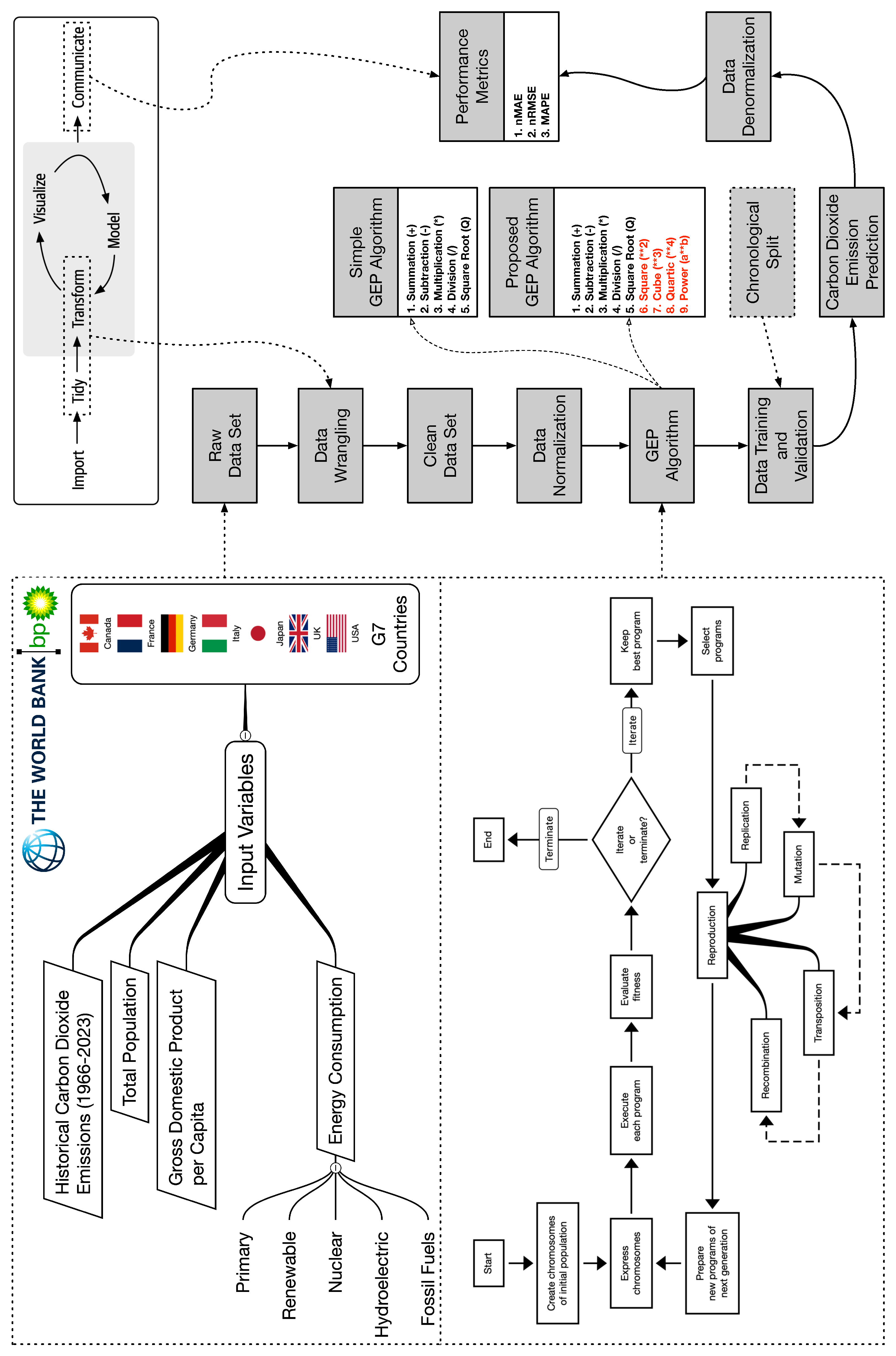
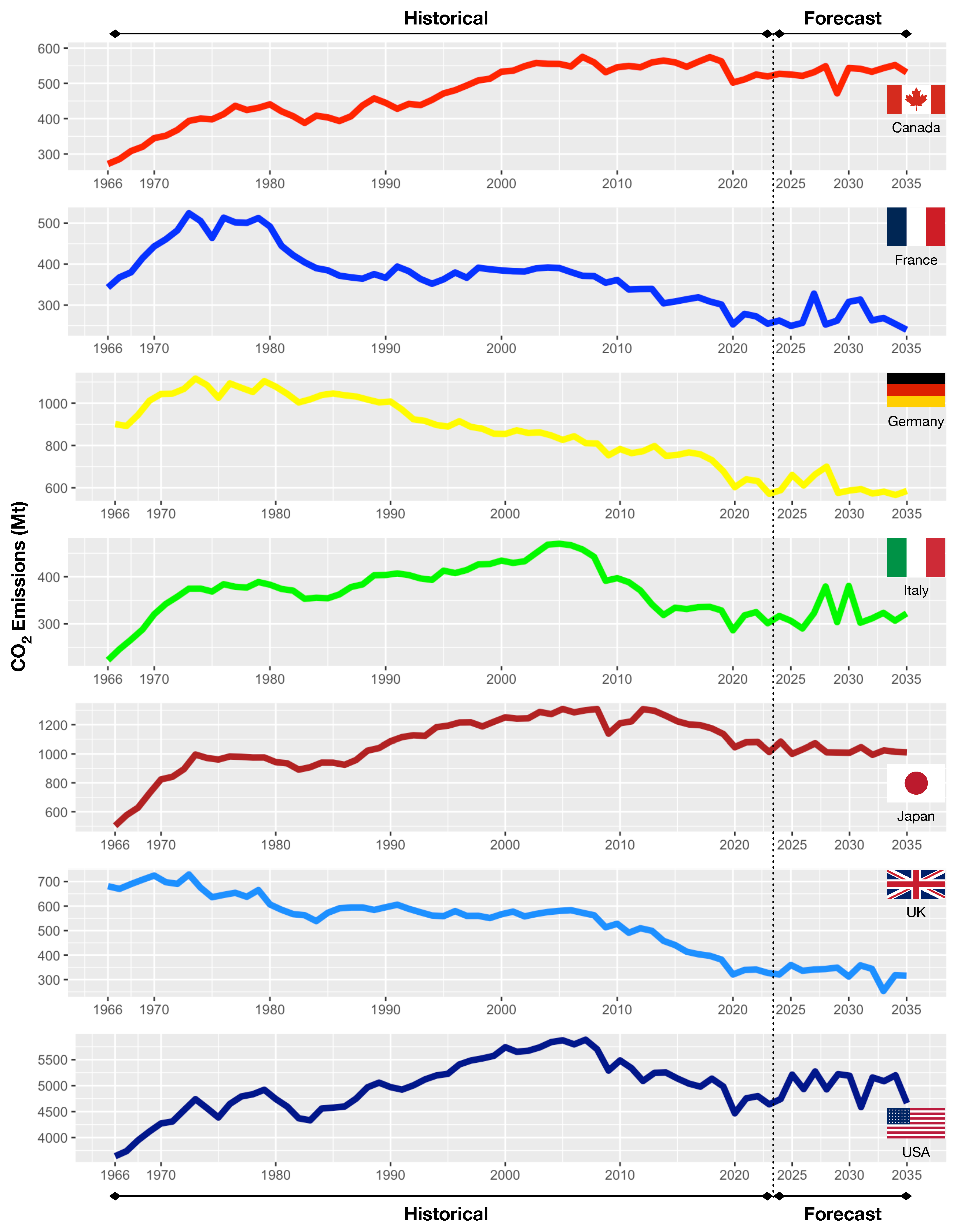
The increase in the carbon dioxide (CO2) emissions, nearly a quarter of those originating from the G7 countries, threatens not only the sustainability of the Earth but also the lives of future generations of humanity. Shedding light on future projections of the CO2 emissions is vital in achieving the target of carbon neutrality, and machine learning-based algorithms are frequently applied to forecast the CO2 emissions in the literature. However, the majority of these algorithms create model equations that are abstruse and irreproducible. In the current study, a novel gene expression programming (GEP) algorithm is proposed to produce genuine and easily understandable mathematical models for forecasting the CO2 emissions of the G7 countries. The proposed algorithm is comprehensively compared with both the simple GEP and the previous studies in terms of several error metrics and computational time. Consequently, the obtained results unveiled that the proposed algorithm surpassed the simple GEP by the improvements of 26% in nMAE, 24% in nRMSE, and 27% in MAPE, respectively. Notably, the proposed algorithm maintains essentially the same computational efficiency as the simple GEP (a 0.2% difference in duration) despite its richer function set. In addition to those, the estimated model equations belonging to the year of 2035 were meticulously presented to guide the researchers in the field for the sake of applicability and reproducibility.
Keywords: carbon dioxide (CO2) emissions; forecast; gene expression programming (GEP); G7 countries; prediction carbon dioxide (CO2) emissions; forecast; gene expression programming (GEP); G7 countries; prediction