Synergy of Carbon Sequestration and Solid Waste Resource Utilization: A Review on Carbonation Behavior of Fly Ash Concrete


Abstract
1. Introduction

| Carbon Sequestration Method | Carbon Sequestration Efficiency | Performance Impact | References |
|---|---|---|---|
| Utilizing the internal pore space of porous coarse aggregates as carbon dioxide () sequestration carriers and realizing fixation by virtue of cations in alkaline slurry | 20 kg/ | No adverse effect on strength development and pH value | [12] |
| Synergistic carbon sequestration method based on blast furnace slag and CaO | 69.32 kg/ | Increases the specific surface area, pore volume and pore size of samples | [32] |
| Synergistic carbon sequestration method based on biochar-enabled core–shell aggregates (BCSA) (concrete with high BCSA dosage) | 247.1 kg/ | Density of 1778 kg/ and compressive strength of 35.8 MPa (maintaining the structural performance of concrete) | [33] |
| Replacing partial cement with waste rice straw biochar (WRSB) in recycled concrete followed by curing | 24.66 kg/ | Compressive strength of 37.74 MPa; frost–thaw strength loss rate of only 8.68%; sulfate resistance coefficient up to 90.7% | [34] |
| Preparing recycled cement, recycled aggregates and recycled concrete using construction and demolition wastes for carbon sequestration | An estimated annual sequestration of 140–308 million tons if ordinary Portland cement is completely replaced | [35] | |
| Foamed concrete was prepared via chemical foaming using cement, solid waste-based materials and 30% hydrogen peroxide, followed by curing for carbon sequestration | 66.35 kg/ | The pore structure was optimized; under the optimal mix proportion conditions, the specific surface area, pore volume and average pore diameter reached 25.412 /g, 0.144 /g and 12.840 nm, respectively | [36] |
2. Factors Influencing the Carbonation of Fly Ash Concrete
2.1. Fly Ash Content
2.2. Water-to-Binder Ratio
2.3. Carbon Dioxide Concentration
2.4. Curing Conditions
2.5. Stress State
2.6. Effects of Various Factors on Mechanical Performance of Carbonated Concrete
3. Mechanism of Fly Ash Concrete Carbonation
3.1. Hydration Mechanism of Fly Ash Concrete
3.2. Carbonation Mechanism and Products of Fly Ash Concrete
3.2.1. Carbonation of Calcium Hydroxide
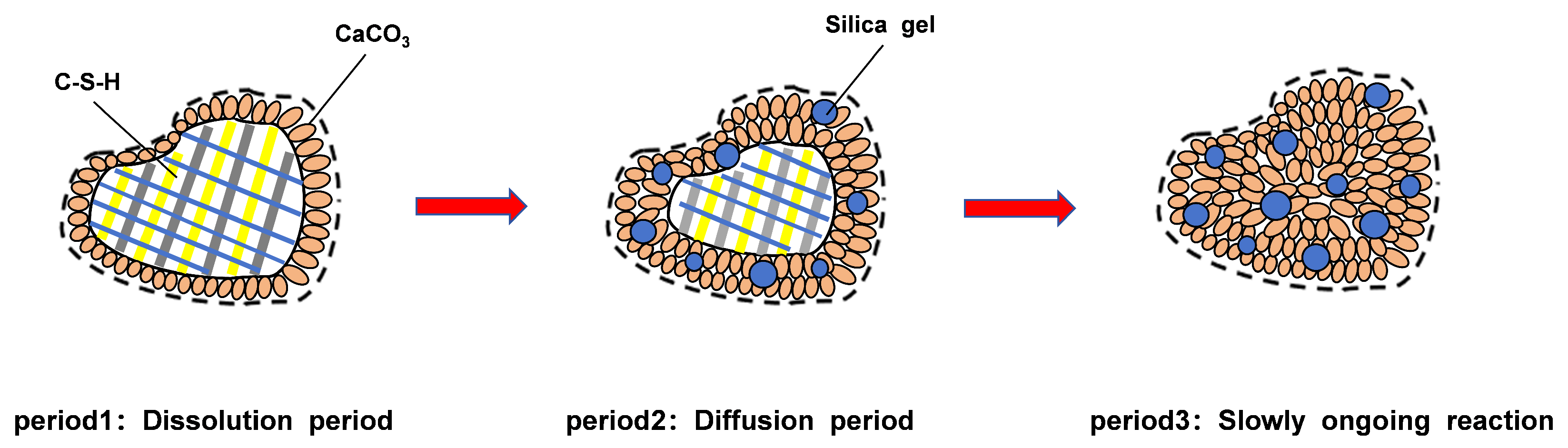
3.2.2. Carbonation of Calcium Silicate Hydrate
4. Properties of Fly Ash Concrete After Carbonation
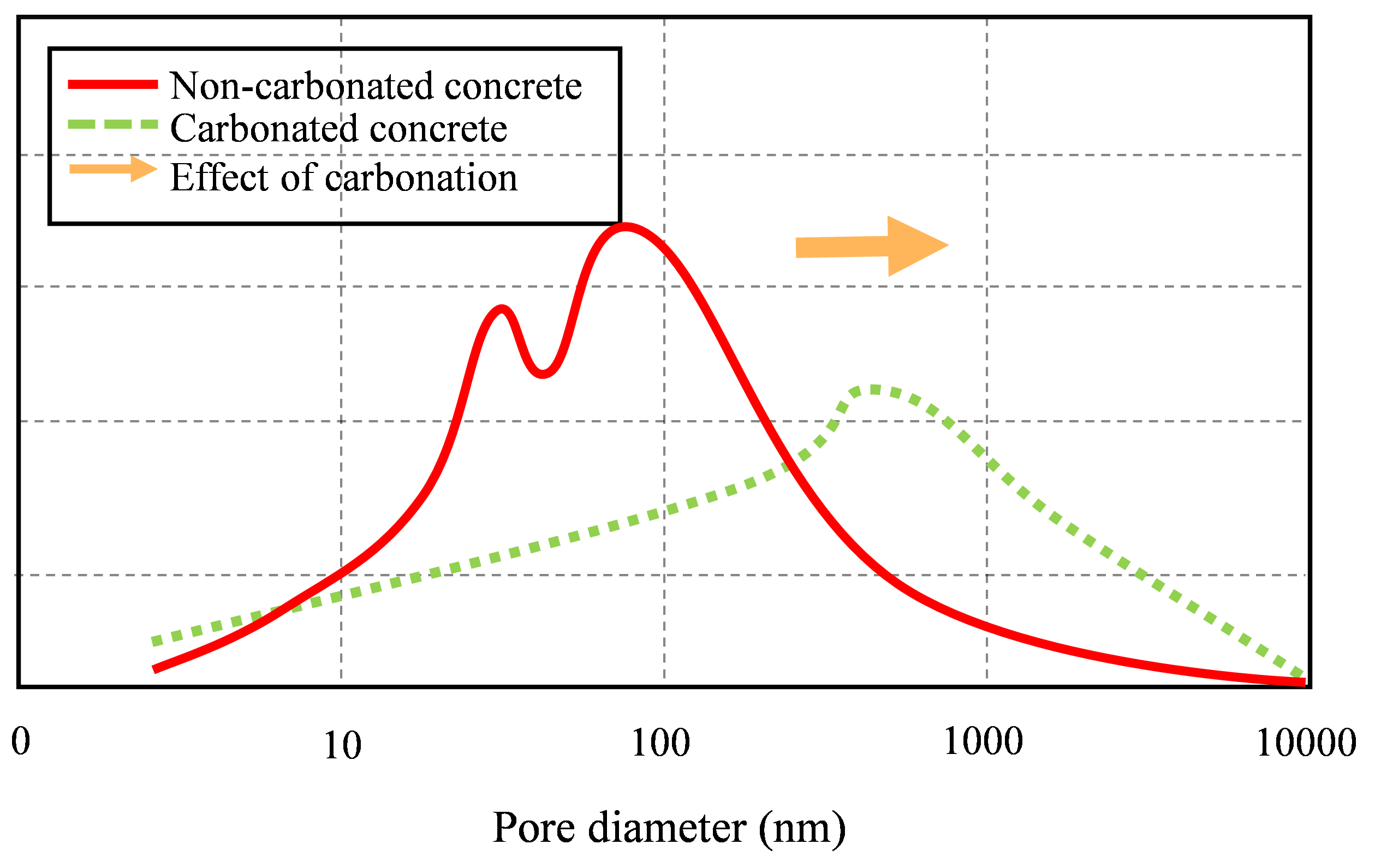
4.1. Influence of Pores
4.2. Influence of Carbonation on the Mechanical Properties of Fly Ash Concrete
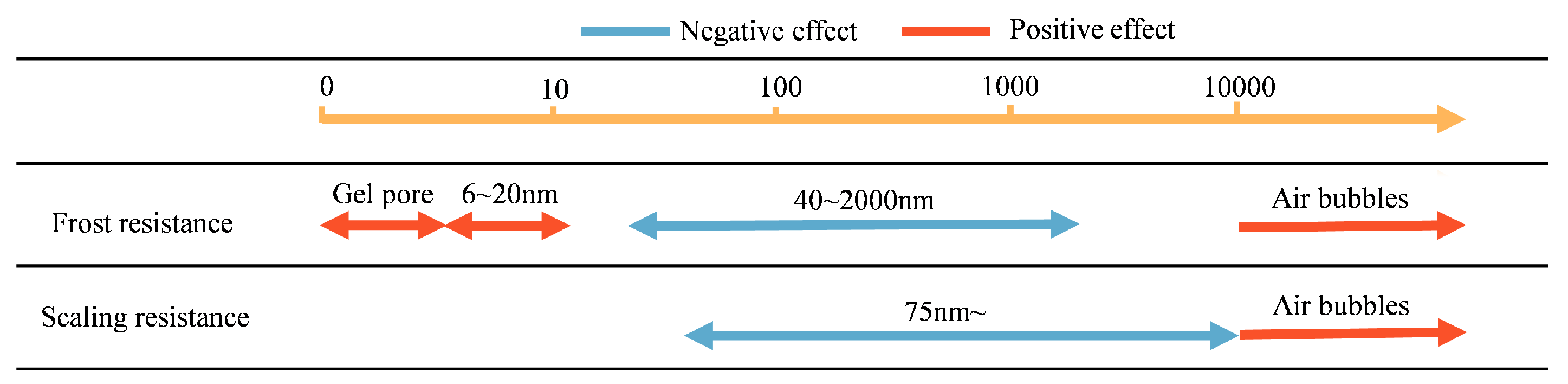
4.3. Effect of Fly Ash Concrete Carbonation on Durability
5. Applications and Innovative Breakthroughs in Carbonation of Fly Ash Concrete
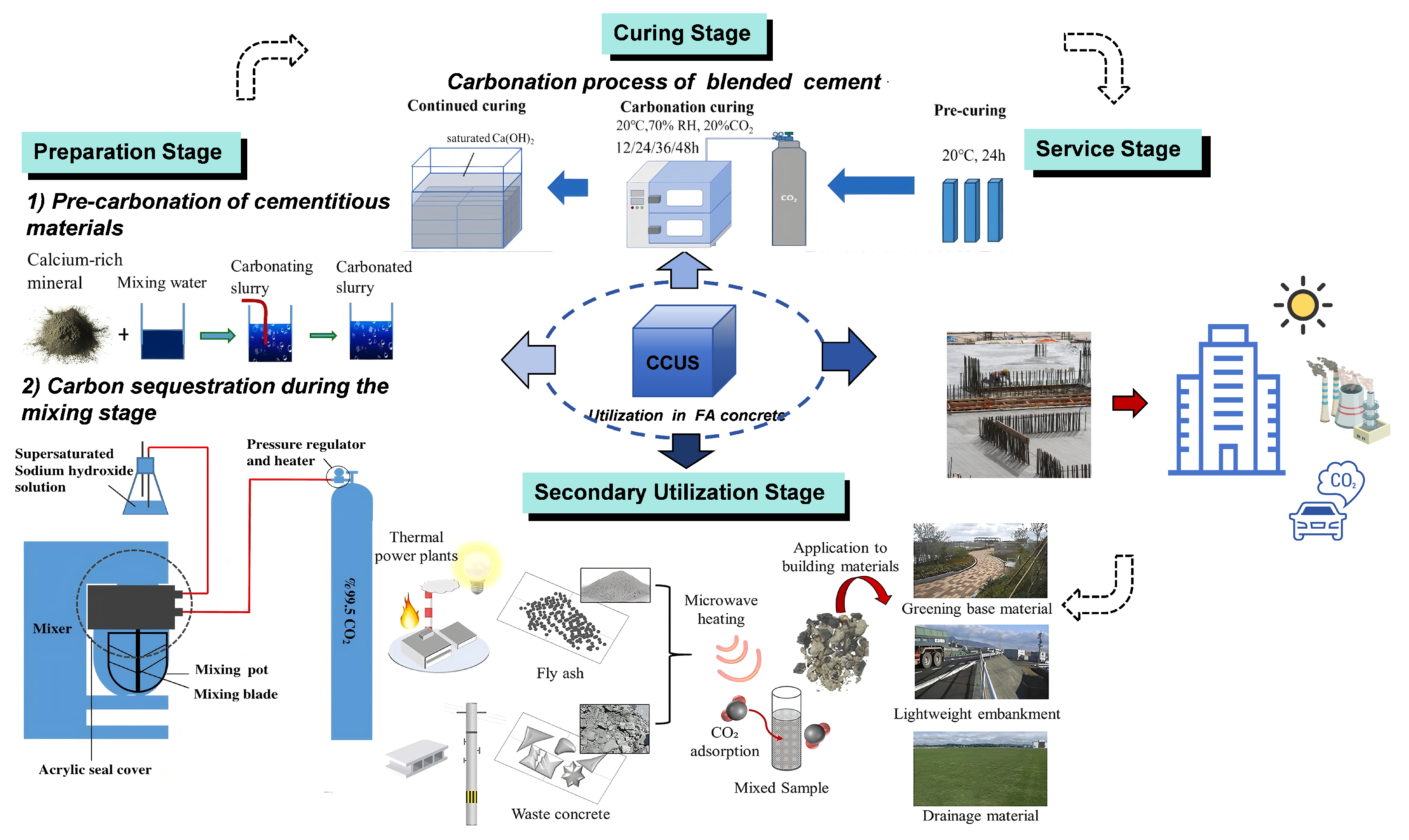
5.1. Single-Stage Carbon Sequestration
5.1.1. Carbon Sequestration in the Preparation Stage
5.1.2. Carbon Sequestration During the Curing Stage
5.1.3. Carbon Sequestration During the Service Stage
5.1.4. Carbon Sequestration During the Secondary Utilization Stage
5.2. Progressive-Stage Carbon Sequestration
6. Future Prospects
- Currently, comprehensive assessments of the total life-cycle carbon emissions, carbon sequestration, and emission rates associated with FAC are still lacking, and related research can be regarded as a promising direction for future studies.
- Further exploration should be conducted into the synergistic carbon sequestration mechanisms of FA combined with other solid waste materials (e.g., recycled concrete aggregates, steel slag). Carbon sequestration technologies for multi-solid waste composite systems should be developed to expand the channels for solid waste resource utilization and the capacity for sequestration.
- The carbon sequestration potential of cementitious materials should be thoroughly exploited to break the technical dependence on traditional cement-based materials. By leveraging the carbonation reaction and the physicochemical properties of solid waste materials, the development of novel cement-free cementitious systems should be pursued.
- Current research primarily focuses on improving carbon sequestration efficiency, while the discussion on how carbonation reactions enhance the structural performance and durability of concrete remains insufficient. Therefore, future studies need to delve into the micro-characteristics and action mechanisms of carbonation behavior, clarify the enhancement pathways of carbonation on key properties of concrete (e.g., strength, impermeability, corrosion resistance), and provide theoretical support for the long-term service reliability of carbon-sequestered concrete.
- Efforts should be made to reduce the carbon emission intensity of auxiliary processes such as capture, transportation and injection so as to realize the low-carbon industrialization of the entire carbon sequestration process. Meanwhile, systematic collaboration between carbon sequestration technologies and related industries should be strengthened to promote the industrial development of the capture–transportation–sequestration industrial chain.
- Future design of concrete carbon sequestration technologies should deeply integrate the dual orientations of “low-carbonization” and “resource utilization”. While keeping pace with industry development trends, a three-dimensional balance among carbon sequestration efficacy, structural performance and economic cost should be achieved.
- Strengthen industry policy guidance, establish a carbon sequestration efficacy evaluation index system and carbon emission accounting methods, and standardize the carbon sequestration process parameters, equipment technical requirements and engineering application procedures.
Author Contributions
Funding
Institutional Review Board Statement
Informed Consent Statement
Data Availability Statement
Acknowledgments
Conflicts of Interest
References
- Andrew, R.M. Global CO2 emissions from cement production, 1928–2018. Earth Syst. Sci. Data 2019, 11, 1675–1710. [Google Scholar] [CrossRef]
- Marcott, S.A.; Shakun, J.D.; Clark, P.U.; Mix, A.C. A Reconstruction of Regional and Global Temperature for the Past 11,300 Years. Science 2013, 339, 1198–1201. [Google Scholar] [CrossRef]
- Liu, Z.; Sun, C.; Qu, J. Coupling Effects of Stress and Carbonation on Concrete Durability: A Review. Materials 2024, 17, 5438. [Google Scholar] [CrossRef]
- Chen, G.; Lv, Y.; Zhang, Y.; Yang, M. Carbonation depth predictions in concrete structures under changing climate condition in China. Eng. Fail. Anal. 2021, 119, 104990. [Google Scholar] [CrossRef]
- Na, S.H.; Hama, Y.; Taniguchi, M.; Katsura, O.; Sagawa, T.; Zakaria, M. Experimental Investigation on Reaction Rate and Self-healing Ability in Fly Ash Blended Cement Mixtures. J. Adv. Concr. Technol. 2012, 10, 240–253. [Google Scholar] [CrossRef]
- Hamed, E.A.E.; Khan, S.A.; Yousaf, A.; Koç, M. A Comprehensive Review of Carbon Capture, Storage, and Reduction Strategies Within the Built Environment. Materials 2025, 18, 5646. [Google Scholar] [CrossRef] [PubMed]
- Meng, D.; Unluer, C.; Yang, E.H.; Qian, S. Carbon sequestration and utilization in cement-based materials and potential impacts on durability of structural concrete. Constr. Build. Mater. 2022, 361, 129610. [Google Scholar] [CrossRef]
- Kim, W.K.; Lee, J.; Park, J.; Moon, J. Carbon sequestration in cementitious systems through CO2-rich hydration and chemically enforced CO2 mineralization. J. CO2 Util. 2024, 84, 102834. [Google Scholar] [CrossRef]
- Rostami, V.; Shao, Y.; Boyd, A.J. Durability of concrete pipes subjected to combined steam and carbonation curing. Constr. Build. Mater. 2011, 25, 3345–3355. [Google Scholar] [CrossRef]
- Wang, J.; Xu, H.; Xu, D.; Du, P.; Zhou, Z.; Yuan, L.; Cheng, X. Accelerated carbonation of hardened cement pastes: Influence of porosity. Constr. Build. Mater. 2019, 225, 159–169. [Google Scholar] [CrossRef]
- Liu, J.; Yao, S.; Ba, M.; He, Z.; Li, Y. Effects of carbonation on micro structures of hardened cement paste. J. Wuhan Univ. Technol.-Mater. Sci. Ed. 2016, 31, 146–150. [Google Scholar] [CrossRef]
- Mi, R.; Yu, T.; Poon, C.S. Feasibility of utilising porous aggregates for carbon sequestration in concrete. Environ. Res. 2023, 228, 115924. [Google Scholar] [CrossRef] [PubMed]
- Zhao, J.; Li, Y.Q.; Yang, J.J.; Cao, X.Q.; Wang, J.X.; Wang, G.; Sun, L.L.; Huang, Q.M.; Cheng, W.M.; Lyu, Z.W. Preparation of slag-based foam concrete and its carbon dioxide sequestration performance. Int. J. Greenh. Gas Control 2024, 135, 104156. [Google Scholar] [CrossRef]
- Zou, S.; Chen, X.; Sham, M.L.; Lu, J.X.; Poon, C.S. Carbon sequestration in aggregate and concrete by encapsulated biochar and carbonation: Experiment and simulation. Cem. Concr. Compos. 2025, 159, 105990. [Google Scholar] [CrossRef]
- Ying, X.; Zhao, X.; Ye, M.; Wang, C.; Zhan, B.; Zhao, J.; He, Z.; Nie, X. Waste rice straw biochar recycled concrete: Carbon sequestration, durability and microstructure. J. Clean. Prod. 2025, 512, 145690. [Google Scholar] [CrossRef]
- Luo, J.; Huang, R.; Wang, J.; Zhang, Y. Carbon Sequestration by Preparing Recycled Cement, Recycled Aggregates, and Recycled Concrete from Construction and Demolition (C&D) Wastes. Materials 2024, 17, 5020. [Google Scholar] [CrossRef]
- Wei, Y.; Cao, X.; Wang, G.; Zhang, M.; Lv, Z. Study on Carbon Fixation Ratio and Properties of Foamed Concrete. Materials 2023, 16, 3441. [Google Scholar] [CrossRef]
- Dipankar, D.; Kumar, R.P. A Review of Coal Fly Ash Utilization to Save the Environment. Water Air Soil Pollut. 2023, 234, 128. [Google Scholar] [CrossRef]
- Xing, F.; Zheng, X.; Wu, D.; Zhong, H.; Dong, B.; Chen, B.; Fang, G. Study on synergistic solidification method for municipal solid waste incineration fly ash: Core chemical stabilization and shell physical encapsulation. Case Stud. Constr. Mater. 2025, 22, e04651. [Google Scholar] [CrossRef]
- Ibeto, C.N.; Obiefuna, C.J.; Ugwu, K.E. Environmental effects of concretes produced from partial replacement of cement and sand with coal ash. Int. J. Environ. Sci. Technol. 2020, 17, 2967–2976. [Google Scholar] [CrossRef]
- Hou, H.; Su, L.; Guo, D.; Xu, H. Resource utilization of solid waste for the collaborative reduction of pollution and carbon emissions: Case study of fly ash. J. Clean. Prod. 2023, 383, 135449. [Google Scholar] [CrossRef]
- Filazi, A.; Demir, I.; Sevim, O. Enhancement on mechanical and durability performances of binary cementitious systems by optimizing particle size distribution of fly ash. Arch. Civ. Mech. Eng. 2020, 20, 58. [Google Scholar] [CrossRef]
- Rahhal, V.; Talero, R. Influence of two different fly ashes on the hydration of portland cements. J. Therm. Anal. Calorim. 2004, 78, 191–205. [Google Scholar] [CrossRef]
- Alptekin, F.M.; Zanoletti, A.; Depero, L.E.; Bontempi, E. Accelerated carbonation of municipal waste fly ash for carbon sequestration: A review. Environ. Chem. Lett. 2025, 23, 1661–1687. [Google Scholar] [CrossRef]
- Wu, J.F.; Qi, F.Y.; Zhang, J.; Chen, Z.W.; Wang, H.L.; Liu, Q.F. Modeling of effect of fly ash amount on microstructure and chloride diffusivity of blended fly ash-cement systems. Constr. Build. Mater. 2024, 443, 137711. [Google Scholar] [CrossRef]
- Yio, M.; Wong, H.; Buenfeld, N. 3D pore structure and mass transport properties of blended cementitious materials. Cem. Concr. Res. 2019, 117, 23–37. [Google Scholar] [CrossRef]
- Yu, Z.; Ye, G. The pore structure of cement paste blended with fly ash. Constr. Build. Mater. 2013, 45, 30–35. [Google Scholar] [CrossRef]
- Zhang, Y.M.; Sun, W.; Yan, H.D. Hydration of high-volume fly ash cement pastes. Cem. Concr. Compos. 2000, 22, 445–452. [Google Scholar] [CrossRef]
- Lye, C.Q. Carbonation resistance of fly ash concrete. Mag. Concr. Res. 2015, 67, 1150–1178. [Google Scholar] [CrossRef]
- Linderoth, O.; Johansson, P.; Wadsö, L. Development of pore structure, moisture sorption and transport properties in fly ash blended cement-based materials. Constr. Build. Mater. 2020, 261, 120007. [Google Scholar] [CrossRef]
- Aruna, G.; Rao, A.K.; Kadrekar, K.S. Studies on drying shrinkage and water permeability of fine fly ash high performance concrete. Mater. Today Proc. 2021, 46, 930–933. [Google Scholar] [CrossRef]
- Shen, L.; Li, Q.; Ge, W.; Xu, S. The mechanical property and frost resistance of roller compacted concrete by mixing silica fume and limestone powder: Experimental study. Constr. Build. Mater. 2020, 239, 117882. [Google Scholar] [CrossRef]
- Khunthongkeaw, J.; Tangtermsirikul, S.; Leelawat, T. A study on carbonation depth prediction for fly ash concrete. Constr. Build. Mater. 2005, 20, 744–753. [Google Scholar] [CrossRef]
- Mao, J.; Zhou, A.; Liang, Y.; Liu, T. Innovative dual-benefit recycling and sustainable management of municipal solid waste incineration fly ash via ultra-high performance concrete. Sci. Total Environ. 2024, 957, 177852. [Google Scholar] [CrossRef]
- Liu, F.; He, Y.; Liu, J.; Zhang, F.; Hao, X.; Liu, C. Performance Research of Ultra-High Performance Concrete Incorporating Municipal Solid Waste Incineration Fly Ash. Materials 2025, 18, 4623. [Google Scholar] [CrossRef]
- Song, B.; Li, Y.; Zhang, W. Effects of Harmless Municipal Solid Waste Incineration Fly Ash on the Macroscopic Properties and Microstructure of Recycled Aggregate Concrete. Materials 2025, 18, 1866. [Google Scholar] [CrossRef] [PubMed]
- Wee, J.H. A review on carbon dioxide capture and storage technology using coal fly ash. Appl. Energy 2013, 106, 143–151. [Google Scholar] [CrossRef]
- Revathy, T.D.R.; Ramachandran, A.; Palanivelu, K. Carbon capture and storage using coal fly ash with flue gas. Clean Technol. Environ. Policy 2021, 24, 1053–1071. [Google Scholar] [CrossRef]
- Jiang, L.; Cheng, L.; Zhang, Y.; Liu, G.; Sun, J. A Review on CO2 Sequestration via Mineralization of Coal Fly Ash. Energies 2023, 16, 6241. [Google Scholar] [CrossRef]
- Dindi, A.; Quang, D.V.; Vega, L.F.; Nashef, E.; Abu-Zahra, M.R. Applications of fly ash for CO2 capture, utilization, and storage. J. CO2 Util. 2019, 29, 82–102. [Google Scholar] [CrossRef]
- Siriruang, C.; Toochinda, P.; Julnipitawong, P.; Tangtermsirikul, S. CO2 capture using fly ash from coal fired power plant and applications of CO2-captured fly ash as a mineral admixture for concrete. J. Environ. Manag. 2016, 170, 70–78. [Google Scholar] [CrossRef]
- Padmalal, A.; Kulkarni, K.S.; Rawat, P.; Sugandhini, H.K. Efficacy of Accelerated Carbonation Curing and Its Influence on the Strength Development of Concrete. Buildings 2024, 14, 2573. [Google Scholar] [CrossRef]
- Sun, C.; Wang, L.; Lin, X.; Lu, S.; Huang, Q.; Yan, J. Low-carbon stabilization/solidification of municipal solid waste incineration fly ash. Waste Dispos. Sustain. Energy 2022, 4, 69–74. [Google Scholar] [CrossRef]
- Wang, W.; Lu, C.; Li, Y.; Yuan, G.; Li, Q. Effects of stress and high temperature on the carbonation resistance of fly ash concrete. Constr. Build. Mater. 2017, 138, 486–495. [Google Scholar] [CrossRef]
- Yong, W.X. Embodied CO2-based optimal design of concrete with fly ash considering stress and carbonation. J. Sustain. Cem.-Based Mater. 2023, 12, 71–82. [Google Scholar] [CrossRef]
- Wang, J.Y.; Zhu, Q.X.; Yuan, Q.; Cao, H.L.; Wang, J.; Wang, D.H. Study on the Effect of Ultraviolet Radiation on Carbonation of Fly Ash Concrete. Water Resour. Power 2022, 40, 163–166+174. (In Chinese) [Google Scholar] [CrossRef]
- Zhao, Q.; He, X.; Zhang, J.; Jiang, J. Long-age wet curing effect on performance of carbonation resistance of fly ash concrete. Constr. Build. Mater. 2016, 127, 577–587. [Google Scholar] [CrossRef]
- Lu, C.F.; Wang, W.; Li, Q.T.; Hao, M.; Xu, Y. Effects of micro-environmental climate on the carbonation depth and the pH value in fly ash concrete. J. Clean. Prod. 2018, 181, 309–317. [Google Scholar] [CrossRef]
- Zhang, J.S.; Cheng, M.; Zhu, J.H. Carbonation Depth Model and Prediction of Hybrid Fiber Fly Ash Concrete. Adv. Civ. Eng. 2020, 2020, 9863963. [Google Scholar] [CrossRef]
- Zhao, S.; Sun, W. Effect of silica fume and fly ash on pore structures of blended pastes at low water to binder ratios. Adv. Cem. Res. 2015, 27, 506–514. [Google Scholar] [CrossRef]
- Miao, L.; Wen, M.; Jiao, C.; He, S.; Guan, X. Concrete microstructure characterized by multi-measurement techniques considering fly ash contents and concrete sample sizes. Case Stud. Constr. Mater. 2024, 20, e03315. [Google Scholar] [CrossRef]
- Cui, D.; Banthia, N.; Wang, Q.; Sun, W. Investigation on porosity of partly carbonated paste specimens blended with fly ash through dual CT scans. Constr. Build. Mater. 2019, 196, 692–702. [Google Scholar] [CrossRef]
- Ding, Z.; Quy, N.X.; Kim, J.; Hama, Y. Evaluations of frost and scaling resistance of fly ash concrete in terms of changes in water absorption and pore structure under the accelerated carbonation conditions. Constr. Build. Mater. 2022, 345, 128273. [Google Scholar] [CrossRef]
- Lothenbach, B.; Scrivener, K.; Hooton, R. Supplementary cementitious materials. Cem. Concr. Res. 2011, 41, 1244–1256. [Google Scholar] [CrossRef]
- Wu, B.; Ye, G. Development of porosity of cement paste blended with supplementary cementitious materials after carbonation. Constr. Build. Mater. 2017, 145, 52–61. [Google Scholar] [CrossRef]
- Morandeau, A.; Thiéry, M.; Dangla, P. Impact of accelerated carbonation on OPC cement paste blended with fly ash. Cem. Concr. Res. 2015, 67, 226–236. [Google Scholar] [CrossRef]
- Wang, X.L. Study on Mechanical and Shrinkage Properties of Fly Ash Cenosphere Reactive Powde Concrete. Bull. Chin. Ceram. Soc. 2019, 20, 3373–3377. (In Chinese) [Google Scholar] [CrossRef]
- Liu, Z.; Heede, P.V.D.; Zhang, C.; Shi, X.; Wang, L.; Li, J.; Yao, Y.; Lothenbach, B.; De Belie, N. Carbonation of blast furnace slag concrete at different CO2 concentrations: Carbonation rate, phase assemblage, microstructure and thermodynamic modelling. Cem. Concr. Res. 2023, 169, 107161. [Google Scholar] [CrossRef]
- Kellouche, Y.; Boukhatem, B.; Ghrici, M.; Tagnit-Hamou, A. Exploring the major factors affecting fly-ash concrete carbonation using artificial neural network. Neural Comput. Appl. 2019, 31, 969–988. [Google Scholar] [CrossRef]
- Hussain, S.; Bhunia, D.; Singh, S. Comparative study of accelerated carbonation of plain cement and fly-ash concrete. J. Build. Eng. 2017, 10, 26–31. [Google Scholar] [CrossRef]
- den Heede Philip, V.; Mieke, D.S.; Nele, D.B. Accelerated and natural carbonation of concrete with high volumes of fly ash: Chemical, mineralogical and microstructural effects. R. Soc. Open Sci. 2019, 6, 181665. [Google Scholar] [CrossRef]
- den Heede, P.V.; Thiel, C.; Belie, N.D. Natural and accelerated carbonation behaviour of high-volume fly ash (HVFA) mortar: Effects on internal moisture, microstructure and carbonated phase proportioning. Cem. Concr. Compos. 2020, 113, 103713. [Google Scholar] [CrossRef]
- Cui, H.; Tang, W.; Liu, W.; Dong, Z.; Xing, F. Experimental study on effects of CO2 concentrations on concrete carbonation and diffusion mechanisms. Constr. Build. Mater. 2015, 93, 522–527. [Google Scholar] [CrossRef]
- Houst, Y.F.; Wittmann, F.H. Depth profiles of carbonates formed during natural carbonation. Cem. Concr. Res. 2002, 32, 1923–1930. [Google Scholar] [CrossRef]
- Sanjuán, M.A.; Andrade, C.; Cheyrezy, M. Concrete carbonation tests in natural and accelerated conditions. Adv. Cem. Res. 2003, 15, 171–180. [Google Scholar] [CrossRef]
- Razeghi, H.R.; Safaee, F.; Geranghadr, A.; Ghadir, P.; Javadi, A.A. Investigating accelerated carbonation for alkali activated slag stabilized sandy soil. Geotech. Geol. Eng. 2023, 42, 575–592. [Google Scholar] [CrossRef]
- Jia, Y.; Aruhan, B.; Yan, P. Natural and accelerated carbonation of concrete containing fly ash and GGBS after different initial curing period. Mag. Concr. Res. 2012, 64, 143–150. [Google Scholar] [CrossRef]
- Zhang, D.; Cai, X.; Shao, Y. Carbonation Curing of Precast Fly Ash Concrete. J. Mater. Civ. Eng. 2016, 28, 04016127. [Google Scholar] [CrossRef]
- Cui, Z.L.; Zhang, X.H.; Tang, B. Effects of Different Curing Environments on the Strength and Carbonation Properties of Fly Ash Concrete. Bull. Chin. Ceram. Soc. 2019, 38, 65–69+76. (In Chinese) [Google Scholar] [CrossRef]
- Luo, G.; Liu, B.J.; He, Y.T. Effects of Curing Conditions on the Carbonation Properties of Mineral Admixture Concrete. J. Railw. Sci. Eng. 2017, 14, 1391–1397. (In Chinese) [Google Scholar] [CrossRef]
- Liu, C.; Zhang, M. Effect of curing temperature on hydration, microstructure and ionic diffusivity of fly ash blended cement paste: A modelling study. Constr. Build. Mater. 2021, 297, 123834. [Google Scholar] [CrossRef]
- Narmluk, M.; Nawa, T. Effect of fly ash on the kinetics of Portland cement hydration at different curing temperatures. Cem. Concr. Res. 2011, 41, 579–589. [Google Scholar] [CrossRef]
- Zhang, G.; Wei, Q.; Ding, Q.; Wang, A.; Liu, K. Effect of curing temperature and fly ash content on the hydration and microstructure of fly ash–cement pastes. J. Sustain. Cem.-Based Mater. 2018, 7, 372–383. [Google Scholar] [CrossRef]
- Li, H.; Peng, Y.; Xu, M.; Wang, Y.; Ding, J.; Ma, B.; Jin, L.; Lu, S.; Yan, J. Use of municipal solid waste incineration fly ash as a supplementary cementitious material: CO2 mineralization coupled with mechanochemical pretreatment. Environ. Res. 2023, 242, 117799. [Google Scholar] [CrossRef]
- Wang, J.; Ng, P.L.; Su, H.; Chen, J.; Du, J. Effect of concrete stress states on carbonation depth of concrete. J. Civ. Eng. Manag. 2019, 25, 518–530. [Google Scholar] [CrossRef]
- Meng, T.; Yu, Y.; Wang, Z. Effect of nano-CaCO3 slurry on the mechanical properties and micro-structure of concrete with and without fly ash. Compos. Part B 2017, 117, 124–129. [Google Scholar] [CrossRef]
- Mao, M.; Zhang, D.; Yang, Q.; Zhang, W. Study of Durability of Concrete with Fly Ash as Fine Aggregate under Alternative Interactions of Freeze-Thaw and Carbonation. Adv. Civ. Eng. 2019, 2019, 4693893. [Google Scholar] [CrossRef]
- Yao, Z.; Luo, L.; Qin, Y.; Bi, Y.; Liu, F.; Yang, Y. Influence of Accelerated Carbonation on the Performance of Recycled Concrete Containing Fly Ash, Recycled Coarse Aggregate, and Fine Aggregate. Materials 2024, 17, 5191. [Google Scholar] [CrossRef]
- Shen, Q. Influence of CSH carbonation on the porosity of cement paste. Mag. Concr. Res. 2016, 68, 504–514. [Google Scholar] [CrossRef]
- Yu, Z.; Ma, J.; Ye, G.; van Breugel, K.; Shen, X. Effect of Fly Ash on the Pore Structure of Cement Paste under a Curing Period of 3 Years. Constr. Build. Mater. 2017, 144, 493–501. [Google Scholar] [CrossRef]
- Bernal, S.A.; Provis, J.L.; Brice, D.G.; Kilcullen, A.; Duxson, P.; van Deventer, J.S. Accelerated carbonation testing of alkali-activated binders significantly underestimates service life: The role of pore solution chemistry. Cem. Concr. Res. 2012, 42, 1317–1326. [Google Scholar] [CrossRef]
- Thiery, M.; Villain, G.; Dangla, P.; Platret, G. Investigation of the carbonation front shape on cementitious materials: Effects of the chemical kinetics. Cem. Concr. Res. 2007, 37, 1047–1058. [Google Scholar] [CrossRef]
- Rathnarajan, S.; Dhanya, B.; Pillai, R.G.; Gettu, R.; Santhanam, M. Carbonation model for concretes with fly ash, slag, and limestone calcined clay-using accelerated and five-year natural exposure data. Cem. Concr. Compos. 2022, 126, 104329. [Google Scholar] [CrossRef]
- Black, L.; Garbev, K.; Gee, I. Surface carbonation of synthetic C-S-H samples: A comparison between fresh and aged C-S-H using X-ray photoelectron spectroscopy. Cem. Concr. Res. 2008, 38, 745–750. [Google Scholar] [CrossRef]
- Lu, B.; Huo, Z.; Xu, Q.; Hou, G.; Wang, X.; Liu, J.; Hu, X. Characteristics of CSH under carbonation and its effects on the hydration and microstructure of cement paste. Constr. Build. Mater. 2023, 364, 129952. [Google Scholar] [CrossRef]
- Uno, T.; Saeki, N.; Maruyama, I.; Suda, Y.; Teramoto, A.; Kitagaki, R.; Ohkubo, T. Understanding the Carbonation Phenomenon of C-S-H through Layer Structure Changes and Water Exchange. J. Phys. Chem. C 2024, 128, 11802–11816. [Google Scholar] [CrossRef]
- Liu, X.; Feng, P.; Cai, Y.; Yu, X.; Yu, C.; Ran, Q. Carbonation behavior of calcium silicate hydrate (C-S-H): Its potential for CO2 capture. Chem. Eng. J. 2022, 431, 134243. [Google Scholar] [CrossRef]
- Chang, J.; Fang, Y. Quantitative analysis of accelerated carbonation products of the synthetic calcium silicate hydrate(C–S–H) by QXRD and TG/MS. J. Therm. Anal. Calorim. 2015, 119, 57–62. [Google Scholar] [CrossRef]
- Sun, S.; Liu, M.; Jin, X.; Xue, C.; Zhao, J.; Luo, Y.H. Tailoring the nanoscale morphology of calcium silicate hydrate for low-cost direct air carbon capture and storage. J. Colloid Interface Sci. 2025, 702, 138858. [Google Scholar] [CrossRef] [PubMed]
- Zeng, Q.; Li, K.; Fen-chong, T.; Dangla, P. Pore structure characterization of cement pastes blended with high-volume fly-ash. Cem. Concr. Res. 2012, 42, 194–204. [Google Scholar] [CrossRef]
- Visser, J. Influence of the carbon dioxide concentration on the resistance to carbonation of concrete. Constr. Build. Mater. 2014, 67, 8–13. [Google Scholar] [CrossRef]
- Branch, J.; Epps, R.; Kosson, D. The impact of carbonation on bulk and ITZ porosity in microconcrete materials with fly ash replacement. Cem. Concr. Res. 2018, 103, 170–178. [Google Scholar] [CrossRef]
- Lammertijn, S.; Belie, N.D. Porosity, gas permeability, carbonation and their interaction in high-volume fly ash concrete. Mag. Concr. Res. 2008, 60, 535–545. [Google Scholar] [CrossRef]
- Liu, E.; Kashwani, G.; Li, L. Transformation of industrial solid wastes into carbon-infused infrastructure materials. J. Clean. Prod. 2020, 260, 120890. [Google Scholar] [CrossRef]
- Saavedra, W.G.V.; Guerrero, A.M.A.; de Gutiérrez, R.M. Alkali-activated concretes based on high unburned carbon content fly ash: Carbonation and corrosion performance. Eur. J. Environ. Civ. Eng. 2020, 26, 3292–3312. [Google Scholar] [CrossRef]
- Assaggaf, R.A.; Adekunle, S.K.; Ahmad, S.; Maslehuddin, M.; Al-Amoudi, O.S.B.; Ali, S.I. Mechanical properties, durability characteristics and shrinkage of plain cement and fly ash concretes subjected to accelerated carbonation curing. J. S. Afr. Inst. Civ. Eng. 2019, 61, 73–81. [Google Scholar] [CrossRef]
- Liu, J.; Xu, Z.; Ji, Y. Effect of Strengthening Mechanism of Alkali Curing on Mechanical Properties of Fly Ash Lightweight Aggregates and Its Concrete. Materials 2024, 18, 89. [Google Scholar] [CrossRef] [PubMed]
- da Silva, S.R.; de Oliveira Andrade, J.J. Investigation of mechanical properties and carbonation of concretes with construction and demolition waste and fly ash. Constr. Build. Mater. 2017, 153, 704–715. [Google Scholar] [CrossRef]
- Silva, P.J.; Sukumar, B.; Hemamathi, A.; Shankar, P.R.; Aakash, B.; Chaithanya, J.; Shanmugam, P.B. Enhancing concrete performance and sustainability through carbonation curing: Effects of fly ash incorporation and mechanical properties evaluation. IOP Conf. Ser. Earth Environ. Sci. 2024, 1409, 012028. [Google Scholar] [CrossRef]
- Quy, N.X.; Kim, J.; Hama, Y. Effect of 10-Year Outdoor Exposure and Curing Conditions on the Pore Structure Characteristics of Hardened Cement Mortar. J. Adv. Concr. Technol. 2018, 16, 461–475. [Google Scholar] [CrossRef]
- Quy, N.X.; Noguchi, T.; Na, S.; Kim, J.; Hama, Y. Distribution Map of Frost Resistance for Cement-Based Materials Based on Pore Structure Change. Materials 2020, 13, 2509. [Google Scholar] [CrossRef]
- Dvorkin, L. Design estimation of concrete frost resistance. Constr. Build. Mater. 2019, 211, 779–784. [Google Scholar] [CrossRef]
- Zhang, D.; Shao, Y. Surface scaling of CO2-cured concrete exposed to freeze-thaw cycles. J. CO2 Util. 2018, 27, 137–144. [Google Scholar] [CrossRef]
- Younsi, A.; Turcry, P.; Aït-Mokhtar, A.; Staquet, S. Accelerated carbonation of concrete with high content of mineral additions: Effect of interactions between hydration and drying. Cem. Concr. Res. 2013, 43, 25–33. [Google Scholar] [CrossRef]
- Liu, R.; Durham, S.A.; Rens, K.L.; Ramaswami, A. Optimization of Cementitious Material Content for Sustainable Concrete Mixtures. J. Mater. Civ. Eng. 2012, 24, 745–753. [Google Scholar] [CrossRef]
- van Tonder, P.; Low, M.S. The effect of CO2 loading on the properties of normal concrete vs fly ash concrete. J. Eng. Des. Technol. 2021, 19, 1472–1487. [Google Scholar] [CrossRef]
- Qian, X.; Wang, J.; Fang, Y.; Wang, L. Carbon dioxide as an admixture for better performance of OPC-based concrete. J. CO2 Util. 2018, 25, 31–38. [Google Scholar] [CrossRef]
- He, Z.; Li, Z.; Shao, Y. Effect of Carbonation Mixing on CO2 Uptake and Strength Gain in Concrete. J. Mater. Civ. Eng. 2017, 29, 04017176. [Google Scholar] [CrossRef]
- Miyata, T.; Yamamoto, S.; Kashimura, K.; Oikawa, T.; Kurooka, K.; Kagawa, K.; Nakamoto, K. Microwave sintering of fly ash-recycled concrete sludge cake-mixed powder for carbon fixation. Constr. Build. Mater. 2025, 475, 141040. [Google Scholar] [CrossRef]
- Uwanuakwa, I.D. Deep Learning Modelling and Generalisation of Carbonation Depth in Fly Ash Blended Concrete. Arab. J. Sci. Eng. 2020, 46, 4731–4746. [Google Scholar] [CrossRef]
- Wei, Z.; Wang, B.; Falzone, G.; Plante, E.C.L.; Okoronkwo, M.U.; She, Z.; Oey, T.; Balonis, M.; Neithalath, N.; Pilon, L.; et al. Clinkering-free cementation by fly ash carbonation. J. CO2 Util. 2018, 23, 117–127. [Google Scholar] [CrossRef]
- Ying, X.; Zhao, X.; He, Z.; Wang, C.; Ren, Y.; Ma, L.; Chen, J.; Ye, M.; Zhao, J. Valorization of waste rice straw biochar and fly ash in recycled concrete: Synergistic enhancement of carbon sequestration and mechanical performance. J. Build. Eng. 2026, 118, 115069. [Google Scholar] [CrossRef]
- Mishra, G.; Danoglidis, P.A.; Shah, S.P.; Konsta-Gdoutos, M.S. Carbon capture and storage potential of biochar-enriched cementitious systems. Cem. Concr. Compos. 2023, 140, 105078. [Google Scholar] [CrossRef]
- Jaworska, B.; Stańczak, D.; Kobyłka, R.; Gołofit, T.; Zhang, D.; Kuziak, J. The Influence of Fly Ash Carbonation on the Protective Properties of Concrete Cover Towards Reinforcement. Materials 2025, 18, 2181. [Google Scholar] [CrossRef]
- Monkman, S.; MacDonald, M. On carbon dioxide utilization as a means to improve the sustainability of ready-mixed concrete. J. Clean. Prod. 2017, 167, 365–375. [Google Scholar] [CrossRef]
- Wang, Y.; He, F.; Wang, J.; Hu, Q. Comparison of Effects of Sodium Bicarbonate and Sodium Carbonate on the Hydration and Properties of Portland Cement Paste. Materials 2019, 12, 1033. [Google Scholar] [CrossRef] [PubMed]
- Adem, J.K.; Choi, J.; Yang, B.; Kim, G. Effects of NaHCO3 addition and CO2 mixing on the hydration and carbonation characteristics of OPC pastes. J. Build. Eng. 2026, 118, 114939. [Google Scholar] [CrossRef]
- Liu, S.; Shen, Y.; Wang, Y.; He, H.; Luo, S.; Huang, C. Synergistic use of sodium bicarbonate and aluminum sulfate to enhance the hydration and hardening properties of Portland cement paste. Constr. Build. Mater. 2021, 299, 124248. [Google Scholar] [CrossRef]
- Park, S.M.; Seo, J.H.; Lee, H.K. Binder chemistry of sodium carbonate-activated CFBC fly ash. Mater. Struct. 2018, 51, 59. [Google Scholar] [CrossRef]
- Li, Z.; He, Z.; Chen, X. The Performance of Carbonation-Cured Concrete. Materials 2019, 12, 3729. [Google Scholar] [CrossRef]
- Belayneh, G.B.; Kim, N.; Seo, J.; Kim, H.; Park, S.; Son, H.; Park, S. Effect of fly ash on hydration and carbonation of carbonation-cured Portland cements. J. CO2 Util. 2024, 88, 102943. [Google Scholar] [CrossRef]
- Isabel, G.; Carmen, A.; Pedro, M.; A, S.M. Sequestration of CO2 by concrete carbonation. Environ. Sci. Technol. 2010, 44, 3181–3186. [Google Scholar] [CrossRef]
- Thomas, M.D.; Matthews, J.D. Carbonation of fly ash concrete. Mag. Concr. Res. 1992, 44, 217–228. [Google Scholar] [CrossRef]
- Carević, V.; Ignjatović, I.; Dragaš, J. Model for practical carbonation depth prediction for high volume fly ash concrete and recycled aggregate concrete. Constr. Build. Mater. 2019, 213, 194–208. [Google Scholar] [CrossRef]
- Zhan, B.J.; Poon, C.S.; Shi, C.J. Materials characteristics affecting CO2 curing of concrete blocks containing recycled aggregates. Cem. Concr. Compos. 2016, 67, 50–59. [Google Scholar] [CrossRef]


| Test Procedure * | Carbonation Conditions | Fly Ash Content (%) | w/b | Compressive Strength After Normal Curing (MPa) | Compressive Strength After Carbonation (MPa) | Carbon Sequestration Efficiency (kg/) | Reference |
|---|---|---|---|---|---|---|---|
| (1) Demolding → Standard curing for 28 d → Carbonation curing for 26 d (2) Demolding → Standard curing for 28 d | Temperature: (20 ± 3) Relative humidity: (75 ± 5)% concentration: (70 ± 5)% | 10 | 0.4 | 38.46 | 43.99 | 4.2 | [78] |
| (1) Demolding → Standard curing for 28 d → Carbonation curing for 26 d (2) Demolding → Standard curing for 28 d | Temperature: (20 ± 3) Relative humidity: (75 ± 5)% concentration: (70 ± 5)% | 20 | 0.4 | 39.9 | 44.5 | 5.2 | [78] |
| (1) Pre-curing for 8 h (20 , 60% RH) → Carbonation curing for 12 h → Standard curing for 148 h (2) Standard curing for 7 d | Temperature: 20 Relative humidity: 70% concentration: 20% | 30 (High-calcium) | 0.35 | 52.22 | 49.72 | – | [76] |
| (1) Pre-curing for 8 h (20 , 60% RH) Carbonation curing for 12 h → Standard curing for 148 h (2) Standard curing for 7 d | Temperature: 20 Relative humidity: 70% concentration: 20% | 30 (Low-calcium) | 0.35 | 32.25 | 34.33 | – | [76] |
| (1) Pre-curing for 8 h (20 , 60% RH) Carbonation curing for 12 h → Standard curing for 148 h (2) Standard curing for 7 d | Temperature: 20 Relative humidity: 70% concentration: 20% | 10 (Low-calcium) | 0.35 | 49.04 | 49.06 | – | [76] |
| (1) Demolding → Carbonation curing for 3 d (2) Demolding → Water curing for 3 d | Temperature: 35 Relative humidity: 70% concentration: 10% | 10 | 0.45 | 12.33 | 25.84 | 21.86 | [42] |
| (1) Demolding → Carbonation curing for 3 d (2) Demolding → Water curing for 3 d | Temperature: 35 Relative humidity: 70% concentration: 10% | 20 | 0.45 | 18.67 | 24.17 | 10.01 | [42] |
| (1) Demolding → Carbonation curing for 3 d (2) Demolding → Water curing for 3 d | Temperature: 35 Relative humidity: 70% concentration: 10% | 30 | 0.45 | 16.29 | 22.09 | 20.55 | [42] |
| (1) Water curing for 28 d → Drying for 24 h → Carbonation curing for 28 d (2) Water curing for 28 d | Temperature: 30–35 Relative humidity: 60–70% concentration: 5% | 30 | 0.35 | 35.6 | 36.16 | – | [60] |
| (1) Water curing for 28 d → Drying for 24 h → Carbonation curing for 28 d (2) Water curing for 28 d | Temperature: 30–35 Relative humidity: 60–70% concentration: 5% | 30 | 0.5 | 25.23 | 28.15 | – | [60] |
| (1) Water curing for 28 d → Drying for 24 h → Carbonation curing for 28 d (2) Water curing for 28 d | Temperature: 30–35 Relative humidity: 60–70% concentration: 5% | 30 | 0.65 | 19.97 | 24.14 | – | [60] |
| Research Content | Carbonation Conditions | Carbonation Degree | Main Products | References |
|---|---|---|---|---|
| Accelerated carbonation test of synthetic calcium C-S-H | 20 , atmospheric pressure (101 kPa), concentration of 99%, flow rate of 2 L/min (through C-S-H solution in the reactor), solution stirred at 500 rpm | 100% | 68.4% calcite, 31.6% silica gel | [85] |
| Accelerated carbonation test | 21 ± 1 , concentration of 50% ± 5%, relative humidity (RH) of 53% (14 days) | Calcite, aragonite, vaterite, amorphous calcium carbonate , silica gel | [82] | |
| Accelerated carbonation test of synthetic calcium C-S-H | 0.2 MPa, concentration of 99.5%, duration of 2 h, RH ≥ 95% | 71.5–78% | 33.98% calcite, 17.13% aragonite, 18.74% vaterite, 30.15% amorphous phase | [88] |
| Accelerated carbonation test of synthetic calcium C-S-H | Temperature of 20 ± 0.3 , RH of 75% ± 0.5%, concentration of 3% ± 0.2%; C-S-H powder vacuum-dried at 45 to constant weight before carbonation | 60% | Calcite, vaterite, a small amount of aragonite (classified by high and low calcium-silicon ratio (Ca/Si)) | [87] |
| Accelerated carbonation test of synthetic calcium C-S-H | Ambient temperature (no additional temperature control, approx. 25 ), concentration of 3 vol%, RH of 40% and 75%, carbonation duration of 1 day and 7 days | 75% | Calcite | [89] |
Disclaimer/Publisher’s Note: The statements, opinions and data contained in all publications are solely those of the individual author(s) and contributor(s) and not of MDPI and/or the editor(s). MDPI and/or the editor(s) disclaim responsibility for any injury to people or property resulting from any ideas, methods, instructions or products referred to in the content. |
© 2026 by the authors. Licensee MDPI, Basel, Switzerland. This article is an open access article distributed under the terms and conditions of the Creative Commons Attribution (CC BY) license.
Share and Cite
Wang, Y.; Ding, Z.; Zheng, D.; Pang, Z. Synergy of Carbon Sequestration and Solid Waste Resource Utilization: A Review on Carbonation Behavior of Fly Ash Concrete. Appl. Sci. 2026, 16, 4660. https://doi.org/10.3390/app16104660
Wang Y, Ding Z, Zheng D, Pang Z. Synergy of Carbon Sequestration and Solid Waste Resource Utilization: A Review on Carbonation Behavior of Fly Ash Concrete. Applied Sciences. 2026; 16(10):4660. https://doi.org/10.3390/app16104660
Chicago/Turabian StyleWang, Yubo, Zhenzhao Ding, Dandan Zheng, and Zhiwei Pang. 2026. "Synergy of Carbon Sequestration and Solid Waste Resource Utilization: A Review on Carbonation Behavior of Fly Ash Concrete" Applied Sciences 16, no. 10: 4660. https://doi.org/10.3390/app16104660
APA StyleWang, Y., Ding, Z., Zheng, D., & Pang, Z. (2026). Synergy of Carbon Sequestration and Solid Waste Resource Utilization: A Review on Carbonation Behavior of Fly Ash Concrete. Applied Sciences, 16(10), 4660. https://doi.org/10.3390/app16104660