1. Introduction
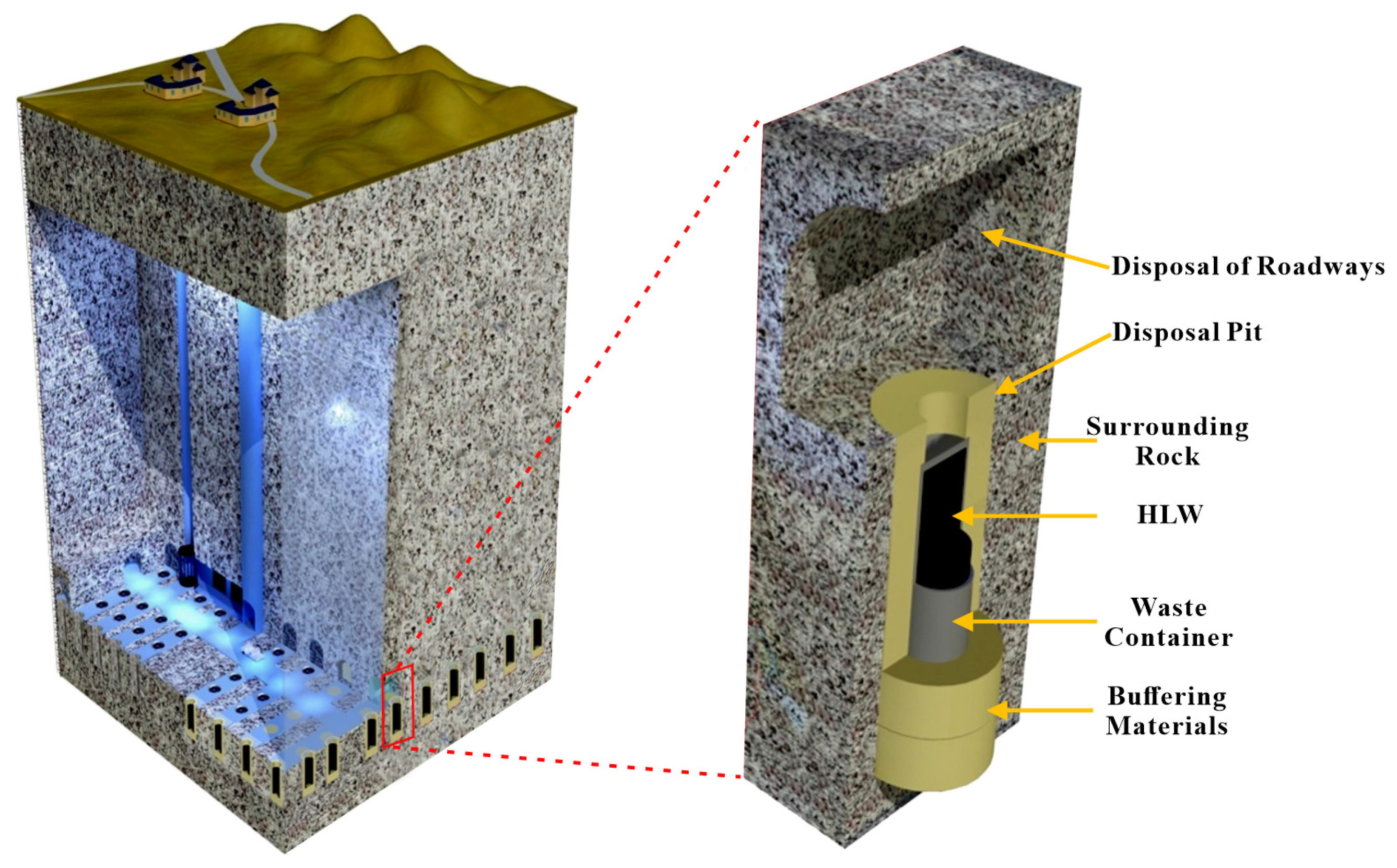
Deep geological disposal is widely recognized as the most robust and technically mature strategy for the long-term isolation of high-level radioactive waste (HLW), aiming to effectively impede radionuclide migration over tens to hundreds of thousands of years through a multi-barrier system (
Figure 1) [
1,
2]. Within this system, the near-field environment where engineered barriers interact most intensively with the surrounding host rock plays a pivotal role in sustaining safety functions over geological timescales [
3,
4]. The long-term evolution of physical, chemical, and mechanical conditions in the near-field thus remains one of the most critical considerations in repository safety assessment.
In crystalline host rocks (e.g., granite), the existence of natural fractures introduces significant uncertainties for ensuring the repository’s long-term safety. Although intact granite possesses very low matrix permeability, interconnected fracture networks serve as preferential pathways for groundwater flow and solute transport, and are widely regarded as the primary potential conduits for radionuclide migration in the near-field [
5,
6,
7,
8,
9,
10]. The hydraulic connectivity and evolving transmissivity of these fractures are therefore key factors in controlling repository safety. Internationally, a central challenge in HLW disposal research has shifted from establishing the existence of fractures to determining whether their hydraulic transmissivity can be persistently reduced or maintained at suitably low levels under dynamic near-field conditions. Natural self-sealing via mineral precipitation—particularly by carbonate minerals—has become recognized as a valuable supplement to multi-barrier system performance [
11,
12,
13,
14]. Carbonate mineral precipitation is frequently observed in fractures of crystalline rocks, and has demonstrated substantial potential to reduce fracture aperture and transmissivity.
Near-field carbonate self-sealing is influenced by multiple factors, including excavation-induced disturbances [
15,
16], heat from radioactive waste decay [
17], groundwater resaturates the rocks, and sustained water–rock interactions [
18,
19]. These drive a complex, coupled process of thermal, hydraulic, mechanical, and chemical (THMC) evolution [
20], resulting in time-dependent boundary conditions, such as fluctuating temperatures, shifting hydraulic regimes, and changing water chemistry (e.g., pH, ionic strength, Ca
2+ and inorganic carbon activities) [
21,
22]. Experimental and field evidence highlights that carbonate precipitation can markedly reduce fracture transmissivity. For instance, Wogelius et al. [
23] found through X-ray CT analysis that in the rock mass adjacent to fractures in the Toki Granite in Japan, secondary calcite accounts for approximately 19.2% of the core volume, primarily in the form of pore fillings, reflecting the significant remodeling of the matrix pore structure by fluid–rock interactions. These results indicate that carbonate precipitation occurs primarily in the damaged zones adjacent to fractures and within the matrix pore system, rather than being confined solely to the open spaces within the fractures. This substantial mineral infilling blocked most pores and led to a significant reduction in fracture conductivity. Under THMC-coupled conditions, carbonate minerals within fractures undergo repeated cycles of precipitation and dissolution, associated with micro- and nanoscale structural reorganization that progressively reduces pore connectivity and flow [
23,
24,
25,
26]. These phenomena underscore the potential of carbonate self-sealing as a process-based barrier that can enhance long-term repository safety.
Nevertheless, two significant gaps persist in the current understanding. First, under time-dependent THMC influences, carbonate systems often approach a dynamic equilibrium characterized by alternating precipitation and dissolution, rather than simple monotonic mineral accumulation. This dynamic behavior suggests that fracture transmissivity may locally recover during certain stages, challenging the assumption of irreversible sealing. Second, carbonate nucleation and growth within confined fracture spaces frequently follow non-classical pathways [
27], resulting in heterogeneous micro- to nanoscale structures whose interfacial bonding strength, mechanical integrity, and resistance to redissolution cannot be reliably inferred from bulk precipitation volumes or short-term permeability data alone [
28,
29]. Consequently, evaluations based solely on mineral volume or short-term hydraulic tests are inadequate for assessing the long-term safety functions of carbonate self-sealing.
Although considerable progress has been made in the study of carbonate reaction kinetics [
30,
31,
32], reactive transport models [
33,
34,
35], and engineered sealing materials [
36,
37,
38], crucial gaps remain in the integration of multi-scale mechanisms and THMC parameterization. Existing studies and related reviews have primarily focused on individual aspects of the problem, such as fracture permeability evolution, single-mineral precipitation kinetics, or reactive transport modeling, whereas a unified framework that integrates cross-scale processes under THMC-coupled near-field conditions is still lacking [
33,
34,
35,
39]. In particular, the connection between micro-/nanoscale nucleation and structural evolution and the macroscopic hydraulic response of fractures remains poorly constrained [
39]. Many reactive transport and THMC models still employ empirical parameters weakly linked to fracture-scale structural continuity, interfacial properties, and transmissivity evolution [
40,
41]. Furthermore, safety assessments have mainly focused on short-term sealing efficiency or static indicators, such as mineral infilling volume and permeability reduction, with limited attention to long-term functional persistence within a unified framework linking mechanisms, structure, performance, and safety evaluation. A critical scientific question, therefore, is not merely whether carbonate minerals can seal fractures and reduce permeability, but how the cycling of precipitation and dissolution under varying temperature, water chemistry, flow, and stress conditions drives the evolution of sealing structures toward dense, stable, and long-lasting configurations. Equally important is the identification of micro- and nanoscale structural signatures indicative of sustained sealing efficiency, and the translation of these insights into quantifiable metrics for evaluating long-term safety.
In response to these challenges, this study adopts a narrative, mechanism-oriented review approach and focuses on carbonate mineral self-sealing in the near-field fractures of granitic host rocks relevant to HLW geological disposal. Under THMC-coupled conditions, our objectives are to: (1) elucidate the heterogeneous micro- and nanoscale precipitation features governed by non-classical nucleation within confined fractures; (2) reveal the key mechanisms by which dynamic precipitation–dissolution equilibria persistently suppress fracture transmissivity; (3) establish a comprehensive framework for long-term hydraulic, mechanical, and chemical performance evaluation and prediction; and (4) propose strategies for integrating natural self-sealing with engineered barrier systems. Compared with previous studies that mainly address isolated reaction, transport, or sealing processes, the novelty of this review lies in two aspects: first, it establishes a mechanistic framework for precipitation–dissolution dynamic cycling of carbonate minerals under THMC coupling; second, it develops a structure–function mapping that links micro-/nanoscale structural evolution to fracture connectivity and transmissivity. This shifts the evaluation paradigm from traditional metrics based on mineral infilling volume toward a function-oriented assessment centered on the long-term suppression of fracture transmissivity. The findings aim to provide a mechanistic foundation for near-field fracture control, long-term repository safety assessment, and engineering optimization in HLW disposal.
2. Near-Field Environment Characteristics of HLW Geological Disposal and Engineering Requirements for Carbonate Self-Sealing
2.1. Near-Field Environmental Characteristics
The near-field environment of a HLW geological repository encompasses the key interaction zone, including waste canisters, buffer and backfill materials, and adjacent granitic host rock (
Figure 1) [
4]. Unlike conventional deep underground engineering environments, the HLW near-field is defined by extreme, long-lasting conditions, which fundamentally influence fracture-scale reactive transport and the stability of carbonate mineral phases within fractures. Foremost among these conditions is the prolonged heat release from radioactive decay, leading to sustained elevated temperatures and persistent thermal gradients in the host rock for hundreds to thousands of years. This thermal field accelerates water–rock reaction kinetics, alters mineral solubility, and affects fluid density and viscosity, thereby reshaping local groundwater flow and solute pathways [
1]. Thermal effects also drive expansion and stress redistribution, potentially modifying fracture apertures and coupling thermal and mechanical responses.
Meanwhile, hydration, swelling, and ion exchange process in buffer material, together with ongoing water–rock reactions, drive the chemical evolution of near-field groundwater, often leading to increased alkalinity, fluctuating ionic strength, and persistent chemical gradients [
9,
42,
43,
44]. These hydro-chemical and thermal conditions jointly determine carbonate mineral saturation states and reactivity within fractures.
Within granitic host rocks, ongoing water–rock interactions involving minerals such as quartz, feldspar, and mica provide continuous sources of Ca
2+, Mg
2+, and inorganic carbon to fracture fluids, establishing the prerequisite conditions for ongoing carbonate precipitation and re-precipitation [
45,
46]. Coupled THMC processes, generate dynamic, non-equilibrium conditions in which carbonate mineral precipitation alternates with dissolution. Fluctuations in temperature, pH, ionic strength, and hydrodynamics induce spatially heterogeneous saturation states, driving nucleation, growth, recrystallization, and re-dissolution [
47]. Thus, carbonate self-sealing is best understood as a long-term, dynamic healing process, continually regulated by evolving boundary conditions, rather than as a single, irreversible event.
Importantly, the near-field does not simply act as a static external influence on fracture sealing; it forms a dynamically coupled system. Fracture geometry controls fluid flow and reactant supply, determining where and how precipitation and dissolution occur. In turn, mineral accumulation and micro- to nanoscale structural reorganization modify fracture transmissivity and local geochemistry, creating feedback loops among structure, transport, and reaction. Consequently, static or short-term assessments of fracture sealing are inadequate for long-term safety analysis.
Additional complexity arises from the geochemical disturbances associated with waste degradation. Corrosion products (e.g., Fe
2+, NO
3−) and CO
2 release may alter near-field water chemistry, potentially lowering pH and destabilizing carbonate phases [
48]. Local CO
2 accumulation or degassing can trigger cycles of supersaturation, dissolution, and recrystallization, increasing the path dependence and uncertainty in sealing evolution. Thermal effects also influence both reaction kinetics and mechanical stability: simulation studies (e.g., Jiang et al. [
49]) show that late-stage thermal relaxation can reopen previously closed microfractures, forming new flow channels and dynamically altering fracture conductivity. These factors must be explicitly considered in long-term assessments.
2.2. Granite Fracture Characteristics and Implications for Carbonate Self-Sealing
Granitic host rocks, while low in matrix permeability, are typically intersected by networks of natural fractures that dominate near-field hydraulic connectivity and solute transport [
50]. The main safety issue is not the existence of fractures, but whether their transmissivity can be predictably reduced and stabilized over long timescales under coupled THMC conditions. Fracture behavior is governed by geometry (aperture, roughness, tortuosity), network connectivity, and initial infill materials [
45]. Multiple generations of tectonic, unloading, and thermally induced fractures create pronounced heterogeneity, allowing preferential flow channels to shift or reappear over time due to mechanical or chemical processes.
Field observations, such as those from the F34-1 fracture zone at the Beishan Underground Research Laboratory (URL), a representative site for HLW disposal in China, reveal vertically continuous fractures (0.2–1.5 mm apertures) with multiple infill generations (mainly calcite and clay). X-ray diffraction (XRD) analyses indicate marked spatial heterogeneity and preserved structural relics, underscoring that sealing occurs via repeated mineral precipitation, dissolution, and structural reorganization, not simple accumulation [
45]. Thus, long-term evolution cannot be explained by static geometry alone.
From a safety perspective, the goal is not to eliminate fracture voids, but to ensure that effective hydraulic connectivity is continuously reduced to prevent radionuclide transport. Carbonate self-sealing is a key natural process in this effort, and its performance should be measured not by total mineral volume, but by the magnitude and persistence of transmissivity reduction and resistance to re-opening. Heterogeneous fracture geometries promote localized flow and reactant delivery, influencing both where carbonate precipitation is most effective and where structural weaknesses may emerge due to dissolution or mechanical perturbation.
2.3. Status of Carbonate Self-Sealing Technologies and Scientific Challenges
Fracture control strategies in deep underground engineering include grouting, buffer-induced mechanical closure, and natural self-sealing via mineral precipitation [
46,
51,
52,
53,
54]. Grouting can reduce permeability initially, but its chemical and mechanical stability over long-term near-field conditions remains unverified [
36,
55]. Buffer swelling provides sustained mechanical support but is influenced by groundwater resaturation and evolving geochemistry [
56,
57,
58]. In contrast, carbonate self-sealing is favored for its environmental adaptability and potential long-term durability.
Current understanding of carbonate self-sealing remains limited. Most studies focus on macroscopic permeability or mineral infilling, with less attention to micro- and nanoscale precipitation mechanisms, heterogeneous structure generation, or dynamic transmissivity control [
12,
59,
60]. Under evolving THMC environments, carbonate behavior is often non-equilibrium and dynamic; however, available experimental studies are still dominated by relatively short-term tests, commonly ranging from hours to several weeks, whereas long-term experiments extending beyond several months or explicitly considering fully coupled THMC conditions remain scarce [
12,
59,
60,
61,
62]. Flow-through CO
2–water–rock experiments have provided important constraints on porosity and permeability evolution, but they are generally conducted over days to weeks [
63]. By contrast, natural analogue evidence indicates that carbonate precipitation, structural densification, and permeability reduction may evolve over much longer timescales [
23,
64,
65]. This comparison supports the view that short-term experiments alone are insufficient for evaluating long-term sealing functions, and highlights the need to combine short-term experimental observations with long-term process understanding and model-based extrapolation.
Microbially induced carbonate precipitation (MICP) achieves in situ CaCO3 deposition by utilizing microbial activity, offering adaptive and long-term capability in reducing permeability. However, its stability under near-field conditions—high temperature and ionic strength—requires further verification [
54]. Results from tests in KURT (Republic of Korea) and Äspö Hard Rock Laboratory (HRL) (Sweden) show that early-stage grouting reduces permeability, but material degradation can restore flow within a few years [
44,
57]. Therefore, sealing based solely on conventional materials may not sustain safety functions over the required timescales, indicating the need for synergy between engineered and natural (e.g., carbonate) sealing.
Fulfilling engineering requirements for HLW repositories demands a mechanistic understanding of carbonate self-sealing that can be effectively parameterized. Scientific focus should extend beyond simple precipitation or permeability reduction to identifying boundary conditions and dynamic evolutions that drive seals toward density and stability. Additionally, it is essential to determine which micro- and nanoscale structural features reliably indicate long-term stability, and to translate these mechanistic insights into quantifiable metrics and criteria for safety evaluation.
2.4. Engineering Requirements and Research Implications
The key engineering requirement for carbonate self-sealing of near-field fractures is not only effective sealing, but also long-term predictability and stability of the sealing structure under extreme near-field conditions over tens of thousands of years. Addressing this requires a shift from descriptive, macroscopic studies to systematic investigation of mechanisms and establishment of quantitative criteria. Research should elucidate how precipitation–dissolution cycling regulates pore continuity, interfacial cohesion, and transmissivity evolution, and identify both degradation pathways and their mitigation.
Carbonate precipitation in confined fractures is sensitive to factors such as temperature, pH, ionic strength, and flow, frequently producing micro- to nanoscale heterogeneity. These microstructures, through scaling effects, can significantly alter pore connectivity and fracture transmissivity, improving the long-term barrier function. Without mechanistic insight, parameterization of long-term simulations remains unreliable, and safety evaluations lack robust scientific foundations.
Thus, the following sections comprehensively address: (1) the chemistry and nucleation theory of carbonate precipitation, (2) controlling factors and mechanisms for dynamic precipitation–dissolution under THMC conditions, and (3) the construction of performance evaluation systems for long-term hydraulic, mechanical, and chemical stability.
3. Theoretical Basis and Micro- to Nanoscale Characteristics of Carbonate Self-Sealing in the Near-Field
The engineering objective of carbonate self-sealing in granitic fractures within the near-field of HLW geological repositories extends beyond achieving rapid, short-term permeability reduction. Rather, the focus lies in ensuring that self-sealing structures exhibit predictable and persistent safety functions as temperature, flow conditions, water chemistry, and stress evolve over the long term. The pronounced time-dependency of near-field conditions results in complex, dynamically coupled precipitation–dissolution behavior; thus, emphasizing precipitation accumulation alone is insufficient for evaluating long-term self-sealing effectiveness. The sustained stability and functional performance of self-sealing structures rely on mechanisms that govern local supersaturation, nucleation pathways and precursor phase evolution, interface-controlled and spatially selective precipitation, and the adaptability and continuity of the resulting micro- to nanoscale structures.
Following an engineering-demand approach, this section reviews the fundamental chemical and thermodynamic principles of carbonate mineral precipitation, discusses the applicability of classical and non-classical nucleation theories under confined fracture and THMC-coupled conditions, and elucidates how micro- to nanoscale structures influence fracture pore connectivity and transmissivity via scale amplification.
3.1. Fundamental Chemical and Thermodynamic Principles of Carbonate Mineral Precipitation
Carbonate minerals are prominent secondary phases formed during groundwater–rock interactions. Their precipitation and dissolution are governed by the activities of Ca
2+, Mg
2+, and CO
32−/HCO
3− in solution, in addition to temperature, pH, and ionic strength. Traditionally, carbonate precipitation has been viewed as a process through which a solution advances toward thermodynamic equilibrium, with the precipitation tendency quantified by parameters such as the saturation index (
SI) [
48,
66,
67]. However, in HLW near-field environments, continuously evolving temperature fields, water chemistry, and hydrodynamics can drive mineral reactions far from equilibrium. Consequently, equilibrium thermodynamics alone cannot fully explain the spatial and temporal selectivity or the structural heterogeneity of carbonate precipitation observed in fractures.
- (1)
Speciation and ion pairing in carbonate systems
In evaluating carbonate precipitation for engineering applications and numerical models, the speciation of inorganic carbon and assessment of ion activities are fundamental. In the CaCO
3 system, aqueous inorganic carbon can be present as CO
2(aq)/H
2CO
3, HCO
3−, and CO
32−, whose relative concentrations strongly depend on pH and temperature. Ca
2+ forms ion pairs with HCO
3− and CO
32− (e.g., CaHCO
3+ and CaCO
3), influencing ion activities and effective saturation states. Established equilibrium constants and their temperature dependencies [
68] provide the basis for parameterization under varying thermal regimes within the near field.
- (2)
Saturation index (SI): criteria for precipitation and dissolution
The coupling of precipitation and dissolution for carbonate minerals is characterized by the saturation index (
SI):
where
IAP is the ion activity product and
Ksp is the solubility product.
SI > 0 signifies supersaturation and a thermodynamic drive for precipitation;
SI < 0 indicates undersaturation and a tendency toward dissolution; and
SI ≈ 0 denotes near-equilibrium. This framework, used by geochemical modeling tools such as PHREEQC, enables quantitative analysis of local or along-path supersaturation and direct linkage to reactive transport models.
- (3)
Temperature, pH, and stage-dependent near-field evolution
Near-field temperatures vary over time due to decay heat, while both the solubility product (
Ksp) and key equilibrium constants for carbonate minerals show significant temperature dependences. If temperature effects are ignored, calculations of
SI can be significantly skewed. Different carbonate polymorphs (e.g., calcite, aragonite, vaterite) have unique equilibrium constants that shift across the heating, high-temperature, and cooling stages of repository evolution. Therefore,
SI should be recalculated as conditions change and interpreted jointly with kinetic considerations to accurately reflect precipitation–dissolution cycling [
68].
Fracture systems are often highly confined, with local solute transport controlled primarily by diffusion and small-scale convection. This facilitates rapid formation and fluctuation of local supersaturation, resulting in dynamically evolving microenvironment [
69,
70]. Thus, understanding self-sealing requires both thermodynamic and kinetic perspectives: thermodynamics defines phase stability and reaction direction, whereas kinetics determines the spatial and temporal attributes of precipitation and restructuring. Long-term self-sealing effectiveness depends not only on instantaneous saturation, but on the predictability and continuity of the entire chain from supersaturation, nucleation, and growth to restructuring and dissolution. Advancing from simply predicting whether precipitation will occur to evaluating sustained transmissivity suppression requires identifying key mechanistic variables that are experimentally observable and suitable for inclusion in reactive transport and performance models.
Given the unique characteristics of confined fracture spaces and THMC coupling, this section identifies three essential categories of mechanistic variables for the carbonate precipitation process:
(1) Spatial and temporal distribution of local supersaturation: Characterized by pH, carbonate species concentrations, Ca2+/Mg2+ activities, ionic strength, and corresponding gradients along flow pathways or within fracture fluids. This variable dictates the location, duration, and competitive interplay between precipitation and transport.
(2) Structural indicators of nucleation pathways: Encompass features such as precursor phase evidence, crystal morphologies and size distributions, nanocluster or aggregate presence, and polymorphic evolution patterns. These indicators distinguish classical from non-classical nucleation mechanisms and inform the adaptability and stability of resulting structures.
(3) Continuity and connectivity of precipitates: Focus on surface coverage of fracture walls, infill continuity, residual pore structure, and their size distributions. These factors are directly tied to the formation of effective hydraulic barriers and are critical for quantifying long-term suppression of fracture transmissivity.
Systematic identification and parameterization of these variables are central to reliably predicting the long-term performance of carbonate mineral self-sealing processes in the near-field.
3.2. Classical Nucleation Theory: Assumptions and Applicability
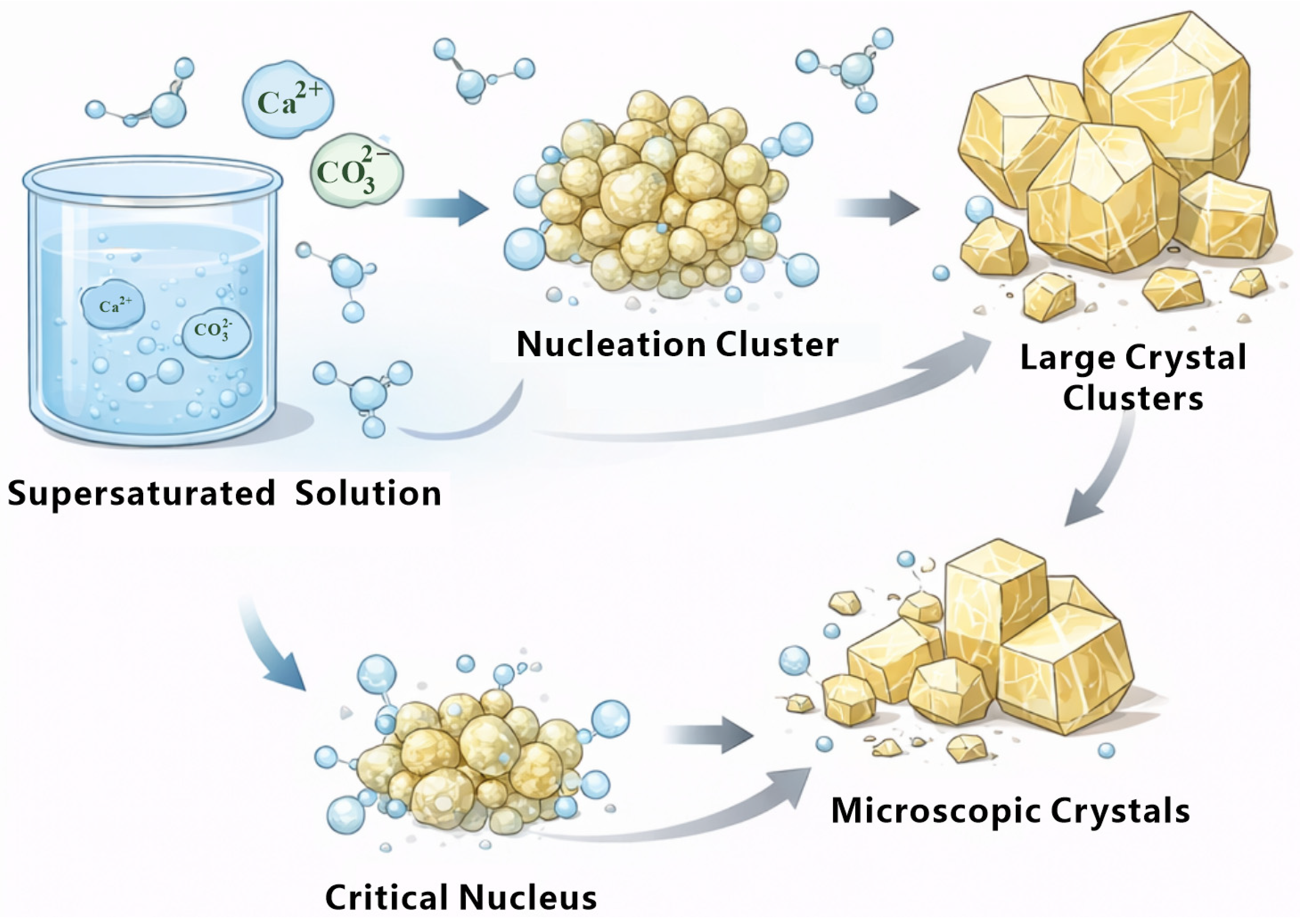
Classical nucleation theory (CNT) is a foundational framework for describing crystal nucleation and growth in supersaturated solutions [
71]. It posits that crystal nucleation involves the stepwise aggregation of ions or molecules in solution, ultimately resulting in a critical nucleus with a well-defined lattice structure. The nucleation rate largely depends on the solution supersaturation degree and the interfacial free energy between the new and parent phases (
Figure 2) [
72,
73,
74]. Subsequent crystal growth is conceptualized as a continuous attachment of ions, producing relatively regular crystal structures [
75].
At the macroscopic or near-equilibrium scale, CNT effectively captures overall trends in carbonate mineral precipitation and is widely applied in reactive transport modeling [
73]. However, when addressing micro- and nanoscale processes, particularly under complex conditions of elevated temperature, high ionic strength, and pronounced hydro-chemical gradients typical in near-field environments, several core assumptions are challenged [
76,
77]. Chief among these is the capillarity approximation, which treats nanoscale nuclei as miniature bulk solids with fixed, macroscopic interfacial tension. Additionally, CNT treats nucleation predominantly as a thermodynamic process, often neglecting kinetic factors such as ion dehydration/restructuring due to their complexity [
78]. These simplifications yield discrepancies between theory and experiment, especially in confined, chemically diverse systems.
Increasing experimental and in situ evidence indicates that early-stage CaCO
3 precipitation does not always proceed through a direct single-step pathway from solvated ions to a crystalline critical nucleus. Under high ionic strength, confined-space, and non-equilibrium conditions, carbonate precipitation may involve prenucleation clusters, amorphous calcium carbonate, dense liquid-like precursors, and two-step nucleation processes [
78,
79,
80,
81,
82]. For example, stable nanoscale prenucleation clusters have been experimentally observed in calcium carbonate systems, indicating the existence of intermediate species that cannot be fully explained by the conventional CNT framework [
82]. In addition, in situ AFM and TEM observations have demonstrated that carbonate minerals may crystallize through particle attachment, cluster aggregation, and subsequent structural reorganization rather than solely through monomer-by-monomer ion attachment [
28,
62]. Hence, in the challenging environment of an HLW repository, CNT is most useful as an approximation for overall trends, but is insufficient for capturing the complexity of micro- to nanoscale precipitation mechanisms. Clear definition and awareness of the boundaries of CNT applicability are essential for robust mechanistic modeling and parameter selection.
3.3. Non-Classical Nucleation Theory and Its Significance in Confined Fractures
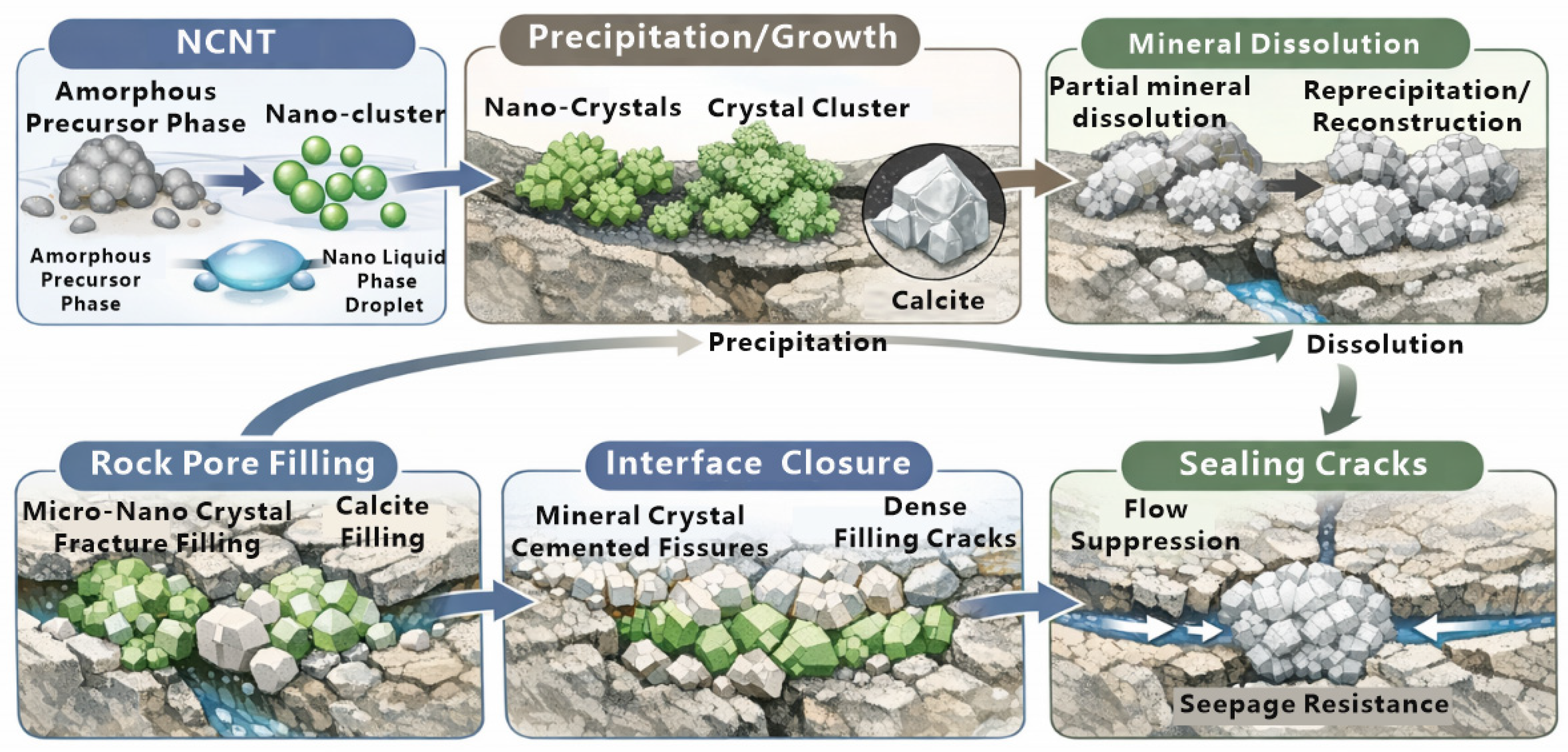
Non-classical nucleation theory (NCNT) has emerged to address multi-stage phenomena observed experimentally but not explainable by CNT [
78]. Unlike CNT, NCNT suggests crystal formation can involve several steps, including formation, aggregation, rearrangement, and phase transformation of ionic clusters, precursor phases, or amorphous nanoparticles [
82,
83,
84].
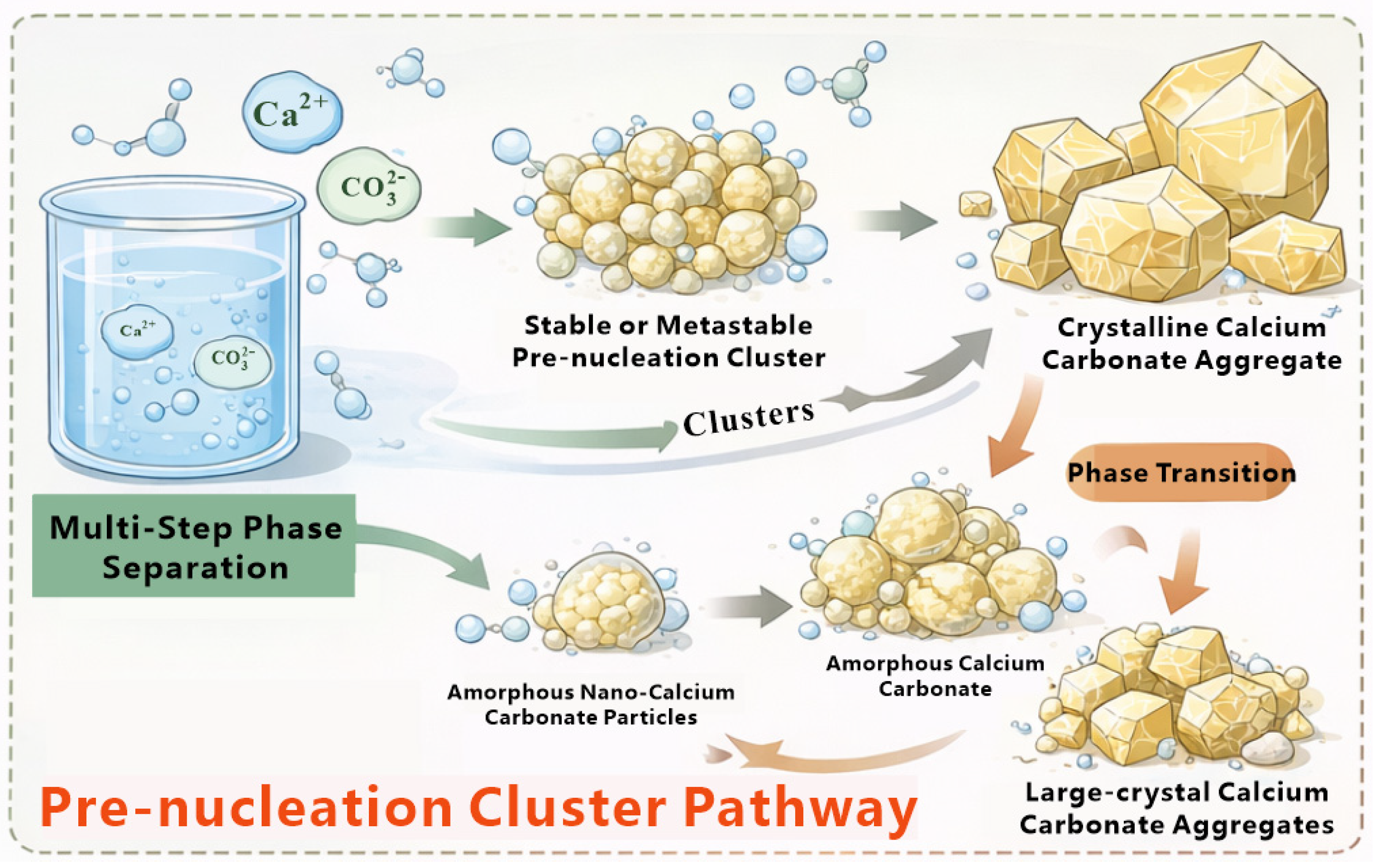
As illustrated in
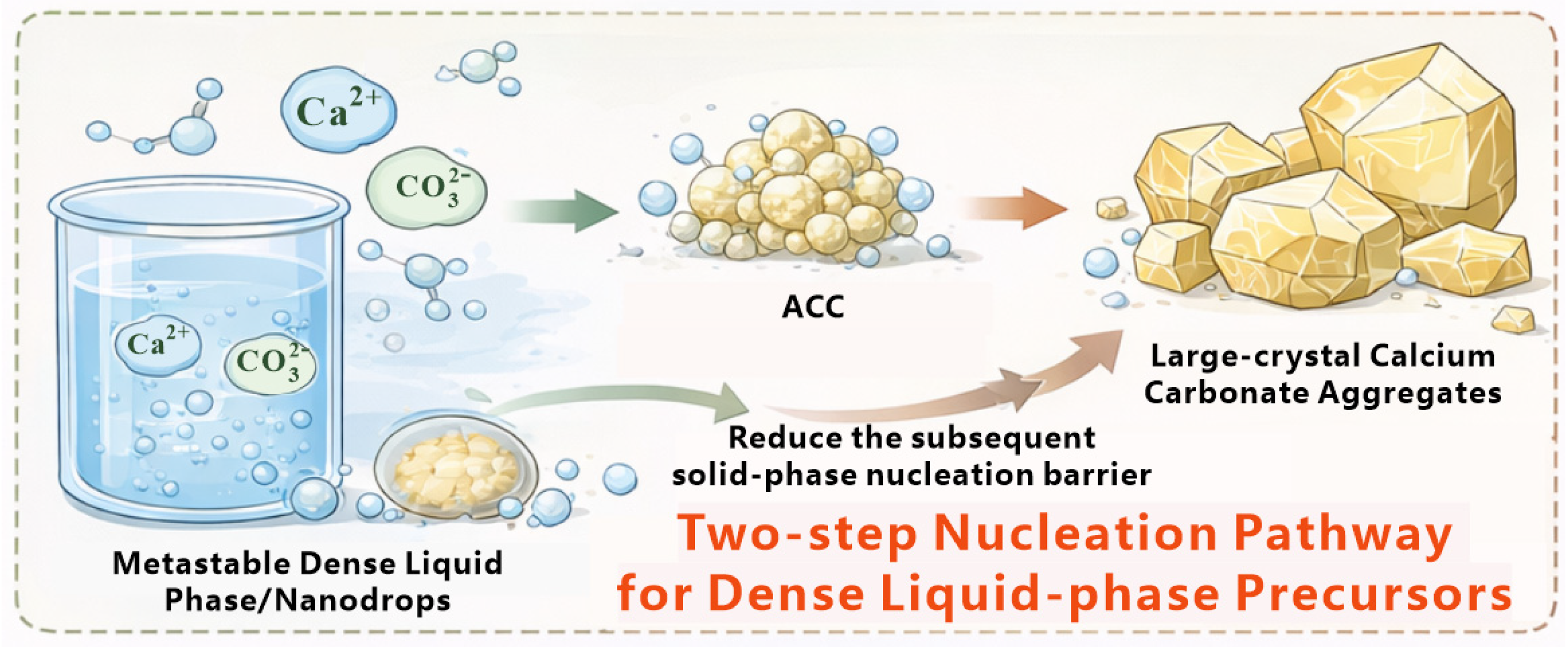
Figure 3, NCNT describes pathways characteristic of carbonate systems, including (a) stable or metastable ion complexes and pre-nucleation clusters, where transitions are driven by kinetic state changes rather than size alone; and (b) two-step nucleation involving dense liquid precursors or nanodroplets, followed by transformation into crystalline phases [
78] (
Figure 4). This framework explains why nanoscale precursors appear under moderate supersaturation as stable intermediates or post-critical states, not classical nuclei.
In carbonate mineral systems, abundant evidence reveals that amorphous calcium carbonate and similar precursors possess high reactivity and may rapidly transition to more stable crystalline forms under temperature, pH, or ionic perturbations [
81,
85]. Especially in geometrically confined fractures, NCNT predicts highly selective precipitation along surfaces, owing to pronounced interfacial effects.
From an engineering safety perspective in HLW disposal, NCNT provides a more realistic and nuanced basis for understanding micro- to nanoscale precipitation, shedding light on structural heterogeneity and the time-dependent evolution of fracture self-sealing.
3.4. Micro- to Nanoscale Precipitation: Structural Characteristics and Fracture Response
Rock fractures possess high surface-area-to-volume ratios, meaning that nucleation is governed by the spatial selectivity of initial solid-phase formation. Heterogeneous nucleation on fracture surfaces can markedly lower nucleation barriers by modifying local geometry and wetting conditions, making precipitation more likely at interfaces and areas with abrupt roughness changes. As a result, the mineralogical composition, surface charge, and microtopography of fracture walls are not passive background factors, but critical determinants of where precipitation initiates, how coverage develops, and the morphology of resulting pore space connectivity [
86]. At the micro- to nanoscale, carbonate precipitation is strongly influenced by scale and interfacial effects (
Figure 5); nucleation sites, crystal orientations, and the spatial heterogeneity of precipitates are governed by wall composition, surface electrical properties, and microscopic roughness [
87]. This structural heterogeneity has dual engineering implications: dense local precipitates can reliably reduce transmissivity and seal fractures, while discontinuous infilling or weakly connected zones—especially under shear or thermal cycling—may lead to permeability recovery and renewed preferential flow, undermining long-term sealing effectiveness.
Micro- to nanoscale precipitates typically exhibit high specific surface areas and lower thermodynamic stability. As near-field environmental conditions (e.g., temperature, water chemistry, and fluid dynamics) fluctuate, these precipitates are susceptible to cycles of dissolution, recrystallization, and re-precipitation [
88]. Thus, carbonate mineral precipitation in fractures should be regarded not as a single static event, but as a dynamic, self-organizing, and self-regulating process closely coupled to its surrounding environment. Long-term safety functions can only be maintained if structural characteristics, such as density, continuity, and interfacial bonding, remain robust through repeated precipitation–dissolution cycles, providing a scientific basis for functional evaluation.
Regarding structure–function relationships, the pore structure and connectivity of precipitates (e.g., pore throat size, network indices, and continuity) determine hydraulic performance, including transmissivity reduction, permeability recovery rates, and the stability duration. The quality of cementation and continuity at the precipitate–host rock interface (e.g., roughness interlocking, crystal bridging, and distribution of weak links) primarily influences resistance to mechanical disturbances such as shear or thermal cycling. Meanwhile, the thermodynamic and kinetic stability of the precipitate phases and microstructures (e.g., content of precursors, propensity for recrystallization, and dissolution sensitivity) governs chemical durability, affecting dissolution rates, phase transformations, and secondary pore generation. Mapping these structural attributes to functional outcomes enables the direct translation of microscopic observations into safety-relevant performance criteria, avoiding the pitfall of relying solely on mineral quantity or short-term permeability changes as surrogates for long-term effectiveness.
Overall, while CNT is valuable for macroscopic or equilibrium conditions, it is limited at the micro-/nanoscale and under non-equilibrium near-field environments. NCNT better accounts for precursors, multi-path nucleation, and spatial selectivity, making it particularly suitable for confined fracture studies (
Table 1). Critically, both frameworks should incorporate the dynamic interplay of precipitation and dissolution to fully address the long-term evolution of carbonate-based self-sealing in fractures.
3.5. Quantitative Linkage Between Saturation State, Reaction Kinetics, and Fracture Transmissivity Evolution
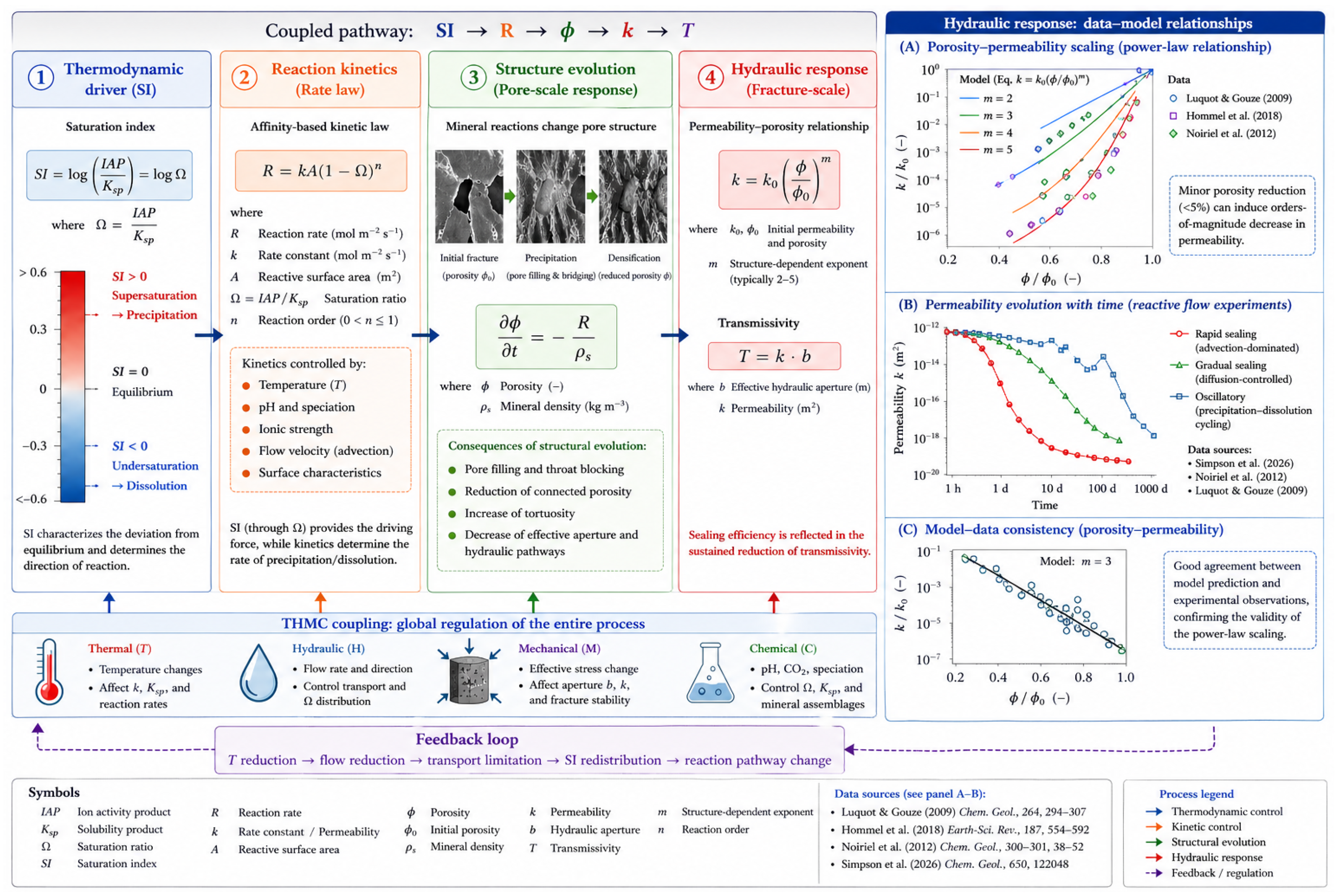
To advance from a qualitative mechanistic understanding toward a quantitatively predictive framework, it is essential to explicitly integrate thermodynamic, kinetic, structural, and hydraulic processes governing carbonate self-sealing. Building upon the theoretical foundations outlined above, this study establishes a data–model integrated framework that links saturation state, reaction kinetics, pore structure evolution, and fracture transmissivity within a unified formulation (
Figure 6).
The thermodynamic driving force for precipitation and dissolution is quantified by the saturation index (
SI), which reflects the deviation of the aqueous system from equilibrium. SI is defined based on the ratio between the ion activity product and the solubility product of the mineral phase [
48,
61,
62]. A positive SI indicates supersaturation and a tendency toward precipitation, whereas a negative SI corresponds to undersaturation and dissolution. However, SI alone does not determine the rate at which these processes occur. Instead, it provides the driving force that must be coupled with kinetic laws to describe the temporal evolution of mineral reactions [
47,
89,
90].
To explicitly connect saturation state with reaction rates, carbonate precipitation–dissolution kinetics are commonly described using affinity-based rate laws, in which the reaction rate depends on the degree of supersaturation. A widely adopted formulation expresses the rate as:
where
is the reaction rate,
is the rate constant,
is the reactive surface area,
represents the saturation ratio, and
is an empirical exponent reflecting reaction order. Through the relation
, this formulation establishes a direct and explicit linkage between saturation state and reaction kinetics [
31,
32,
89,
90]. Under supersaturated conditions (
), precipitation dominates, whereas dissolution prevails when
.
The impact of these reactions on fracture structure is primarily mediated through changes in porosity. Mineral precipitation reduces pore volume by occupying void space, while dissolution increases porosity through mineral removal. This process can be described by a mass balance relationship linking reaction rate to porosity evolution:
where
is porosity and
is the mineral density. This expression provides a direct pathway from reaction kinetics to structural evolution at the pore scale [
33,
39,
91].
To translate pore-scale structural changes into macroscopic hydraulic properties, porosity–permeability relationships are required. For evolving porous and fractured media, permeability is often expressed using a power-law scaling relationship:
where
and
are the initial permeability and porosity, respectively, and
is a structure-dependent exponent that reflects pore connectivity and geometry. This relationship captures the nonlinear amplification effect whereby small reductions in porosity may result in orders-of-magnitude decreases in permeability, particularly in fracture-dominated systems [
6,
39,
91].
At the fracture scale, hydraulic performance is more appropriately described by transmissivity
, which incorporates both permeability and fracture aperture. Transmissivity can be expressed as:
where
is the effective hydraulic aperture. Since both permeability and aperture may evolve during precipitation–dissolution cycling, transmissivity provides a more direct metric for evaluating fracture sealing efficiency and long-term flow suppression [
33,
34].
Taken together, these relationships establish a continuous mechanistic chain linking geochemical conditions to hydraulic behavior:
This formulation demonstrates that fracture transmissivity evolution is ultimately governed by thermodynamic disequilibrium through its control on reaction kinetics and subsequent structural modification. Importantly, this chain also operates within a feedback loop: as permeability and transmissivity decrease, fluid flow and solute transport are altered, which in turn modifies local saturation states and reaction rates. Such feedback is particularly pronounced under THMC-coupled conditions, where thermal, hydrodynamic, and mechanical perturbations continuously reshape the spatial distribution of supersaturation and reactive interfaces [
34,
49,
61,
91,
92].
By explicitly integrating saturation index, kinetic rate laws, and permeability evolution into a unified framework, this approach provides a physically interpretable and quantitatively tractable basis for modeling carbonate self-sealing processes. It enables the transition from descriptive understanding to predictive capability, which is essential for long-term safety assessment and engineering design of high-level radioactive waste repositories.
4. Dynamic Precipitation–Dissolution Coupling Mechanisms of Carbonate Minerals Under Near-Field THMC Conditions
4.1. Fundamental Characteristics of Dynamic Precipitation–Dissolution Coupling
In the near-field environment of HLW geological disposal, the formation and evolution of carbonate minerals in granitic fractures do not constitute a simple, one-way precipitation process, but involve a dynamic interplay—across spatial and temporal scales—of precipitation and dissolution, driven by variations in temperature, flow conditions, water chemistry, and in situ stress. This constant feedback shapes the regulation and long-term stability of fracture pore structure and transmissivity.
Unlike conventional engineered seals, carbonate self-sealing in the near-field is deeply intertwined with ongoing water–rock interactions. Its efficacy arises from the synergy of reaction-transport mechanisms and structural feedbacks. Treating precipitation and dissolution as a unified, dynamically linked process is essential for robustly understanding the long-term performance of fracture self-sealing. This dynamic coupling endows sealing structures with both environmental adaptability and self-regulation, making it an important safeguard for near-field barrier integrity.
4.2. Regulation of Precipitation–Dissolution Coupling by Near-Field THMC Conditions
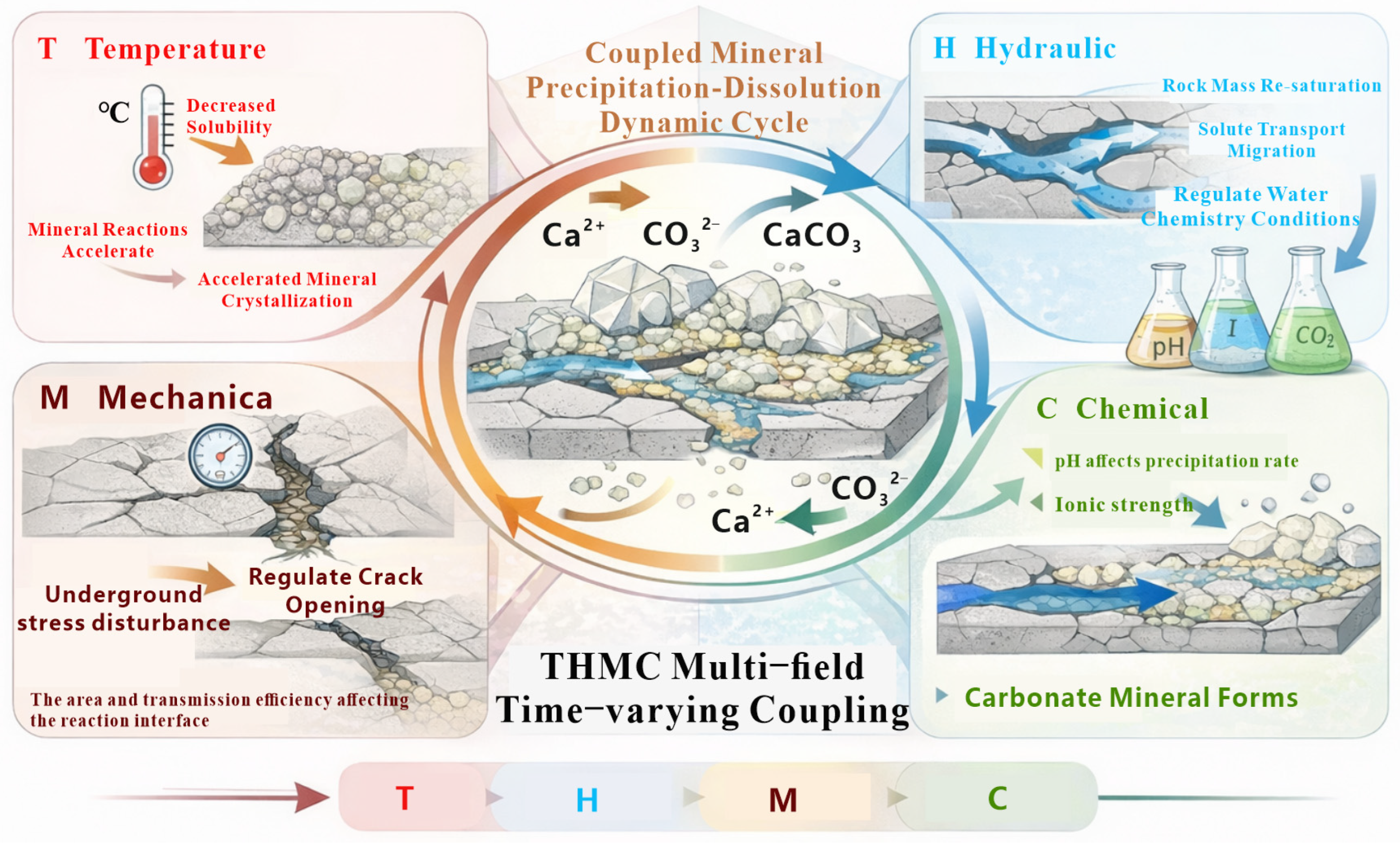
THMC coupling in the near-field critically regulates the precipitation–dissolution processes of carbonate minerals, with each field influencing reaction kinetics, transport, and interfacial properties in a synergistic manner (
Figure 7) [
49].
Temperature is a defining driver in the near-field environment, directly influencing carbonate mineral solubility and equilibrium, and accelerating reaction kinetics to regulate the pace of precipitation–dissolution cycles [
93]. As the system cools during the thermal decay stage, lower temperatures favor the transformation of precipitates into more stable crystalline forms. Simultaneously, temperature-driven fluid density gradients promote localized convection and diffusion, enabling the migration of reaction zones and the progressive optimization of seal structure [
48,
79,
94,
95,
96].
Hydrodynamic conditions primarily determine the spatial distribution of precipitation and dissolution. Low flow velocities or stagnant fluid zones favor local supersaturation and stable precipitate formation, while appropriate flow is necessary for material transport and continuous renewal of reactive interfaces. This interaction forms a feedback loop: as precipitates reduce pore space, flow fields are redistributed, further concentrating subsequent precipitation in optimal regions and steadily improving sealing effectiveness [
97,
98].
Hydro chemical parameters, particularly pH, ionic strength, and the activity ratio of Ca
2+/CO
32−, play a critical role in directing precipitation–dissolution processes [
99]. Changes in near-field water chemistry foster cycles of precipitation, dissolution, and reprecipitation near equilibrium boundaries, facilitating mineral phase optimization and enhancing the density and continuity of the sealing layer.
Mechanical factors regulate precipitation–dissolution coupling by altering fracture aperture, contact conditions, and stress distributions, which in turn affect reactive interface area and transport efficiency. Stress release can create additional space for precipitation while also strengthening interfacial bonding and mechanical interlocking between precipitates and the host rock, thereby improving the overall stability and durability of the sealing structure.
4.3. Synergistic Reaction–Transport Control and Spatial Patterning of Precipitation–Dissolution
The spatial patterning of the precipitation–dissolution coupling emerges from the synergy of reaction and transport. In fractures, solute movement is governed by diffusion and advection, producing localized reaction zones and structured spatial distributions [
100,
101]. Pore-scale modeling has demonstrated that transient, localized supersaturation triggers patchy or banded precipitation, which enhances the spatial continuity of seals over time [
102]. Real-time atomic force microscopy (AFM) imaging further shows that dissolution targets regions of high surface area, creating structural refinement and secondary densification even with minimal net mineral change [
103].
The ability of precipitation–dissolution coupling to spatially organize the pore structure is fundamental to both transmissivity suppression and barrier persistence. Key mechanisms for hotspot formation and sealing include:
- (1)
Flow–reaction competition (Damköhler number effect):
The relative rates of local consumption of precipitation precursor species (e.g., Ca
2+, HCO
3−) and their replenishment rate by advection or diffusion determine whether precipitation becomes spatially concentrated [
104,
105,
106]. This relationship is captured by the first Damköhler number (
Da), which is defined as:
where
k is the reaction rate constant,
C is the reactant concentration,
L is the characteristic length, and
u is the flow velocity. In practical fracture systems,
L may correspond to the fracture aperture, pore-throat length, or the characteristic length of a low-velocity reaction zone, while
u reflects the local seepage velocity controlled by hydraulic gradient and fracture geometry. Based on typical parameters reported for reactive transport in fractured rocks,
L commonly ranges from 10
−5 to 10
−2 m,
u from 10
−8 to 10
−5 m·s
−1, and the apparent carbonate precipitation/dissolution rate constant generally falls within approximately 10
−7–10
−4 s
−1, depending on saturation state, temperature, pH, and reactive surface area [
34,
39,
102]. Under these conditions,
Da may span several orders of magnitude, indicating that the balance between reaction and transport is highly sensitive to local fracture geometry and flow velocity. When
Da ≫ 1, reaction rates exceed solute replenishment rates, favoring localized precipitation in stagnant or low-flow zones and promoting heterogeneous sealing. In contrast, when
Da ≪ 1, advective transport dominates, and carbonate precipitation tends to be dispersed along the flow path rather than concentrated at specific sealing hotspots. Therefore,
Da provides an operational criterion for identifying where carbonate precipitation is most likely to form effective sealing structures in real near-field fracture systems.
- (2)
Thin-film diffusion boundary layer effect:
Near fracture walls or precipitate surfaces, thin reaction boundary layers limit mass exchange with the bulk fluid, enabling accumulation of reaction products or precursor ions and creating microenvironments with distinct chemistry [
107]. In these zones, minor variations in pH or Ca
2+/CO
32− ratios can cause saturation indices to rapidly shift above threshold, triggering localized and rapid CaCO
3 precipitation [
108].
- (3)
Ion exchange and competitive reactions:
In fracture containing bentonite or other reactive minerals, ion exchange between solid and fluid phases involving Ca
2+, Mg
2+, and Na
+ dynamically alters free ion activities. Na
+–Ca
2+ exchange can substantially increase Ca
2+ activity and drive higher CaCO
3 saturation, while K
+ or NH
4+ involvement may shift the balance between HCO
3− and CO
32−, affecting precipitation potential [
32,
57].
- (4)
Coupling with redox processes:
In systems hosting redox-sensitive ions such as Fe
2+ and Mn
2+, the oxidation/reduction of metal oxides is accompanied by pH shifts and buffering effects within the carbonate system, indirectly affecting CaCO
3 supersaturation. For example, oxidation of Fe
2+ to Fe
2+ with subsequent Fe(OH)
3 precipitation consumes H
+ and raises pH, moving CaCO
3 from undersaturated to supersaturated conditions [
100].
Multiple reactive-transport modeling studies have shown that precipitation during fracture sealing commonly concentrates in zones of rapid flow deceleration or flow stagnation. For instance, micro-CT-constrained models by Noiriel et al. [
39] reveal that roughness transitions create low-velocity zones where precipitation fronts form, propagating downstream and resulting in asymmetric sealing structures. Deng and Spycher [
34] further demonstrated that feedback between wall boundary conditions and pore morphology can cause reactive hotspots to migrate along fractures, yielding heterogeneous precipitation banding.
Dissolution processes also exhibit strong spatial selectivity. Regions with high specific surface area, abundant lattice defects, or weak interfacial bonding at the micro- to nanoscale are preferentially dissolved, forming secondary pores or weakly connected zones within the precipitates. Such selective dissolution can erode the continuity of the seal over time; even minimal mineral loss may significantly affect hydraulic performance.
The engineering significance of precipitation–dissolution coupling lies not simply in whether these reactions occur, but in how their spatial organization impacts continuity of the pore structure. Recognizing this provides a crucial foundation for long-term assessment of fracture sealing based on structure–function relationships. The spatial heterogeneity observed is not coincidental, but a predictable outcome governed by the interplay among flow, reaction, and interface feedbacks. Understanding and mapping these spatiotemporal structural evolution pathways is essential for predicting fracture flow capacity degradation over time.
4.4. Dynamic Optimization of Fracture Sealing Driven by Precipitation–Dissolution Cycling
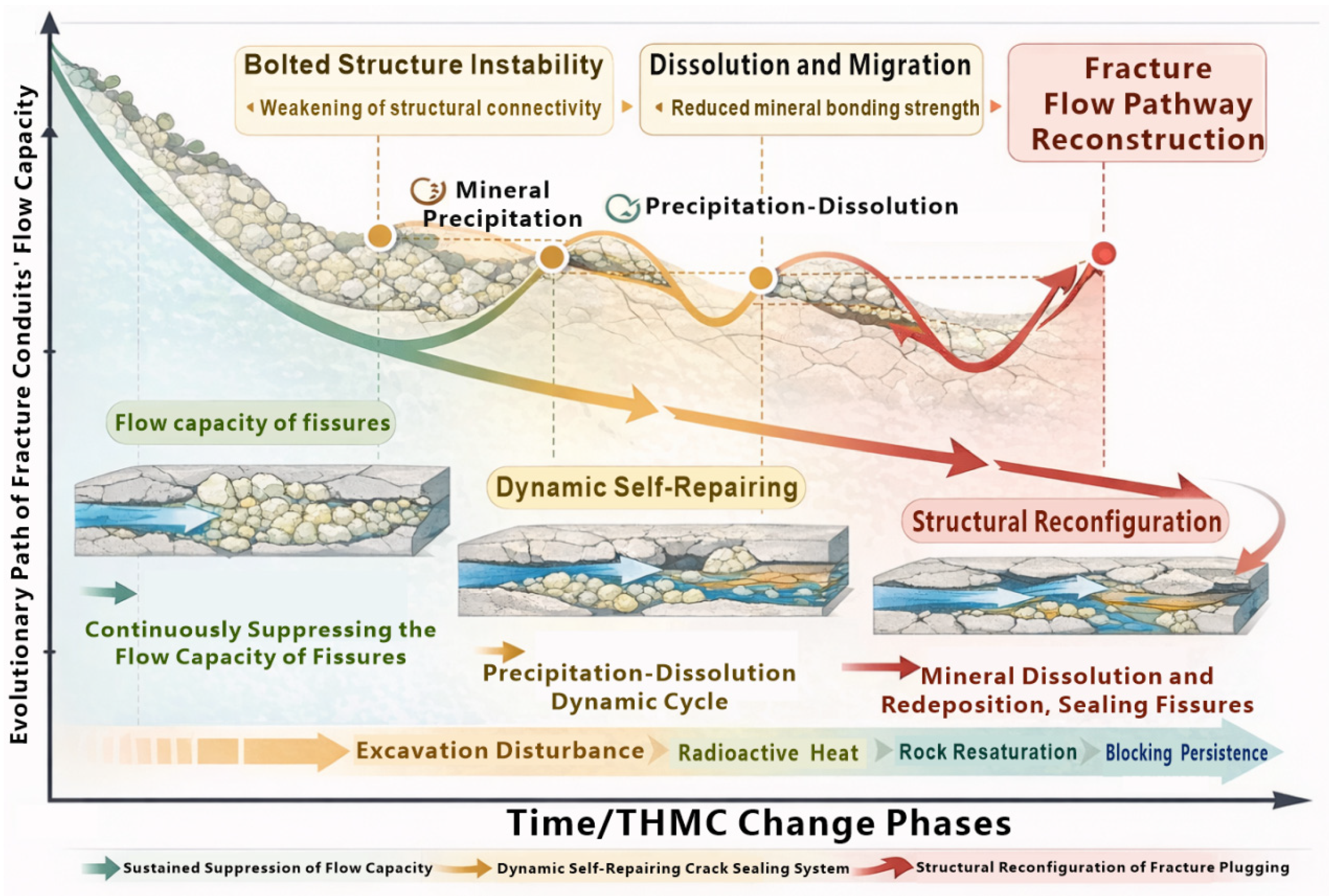
Carbonate precipitation–dissolution cycling may optimize fracture sealing only under favorable THMC conditions, and should not be regarded as a universally self-optimizing process. Over the course of repository evolution, carbonate minerals in granitic fractures undergo repeated precipitation–dissolution cycles. This does not simply weaken or strengthen the seal, but reorganizes the structure through dynamic feedback and adaptation (
Figure 8). Such cycling may optimize sealing efficiency by reinforcing continuity and density where needed, or, under external perturbations, induce partial degradation.
However, under unfavorable THMC conditions, precipitation–dissolution cycling may instead promote functional degradation. For example, pH fluctuations, CO
2-rich fluids, elevated flow velocity, or mechanical perturbations may accelerate selective dissolution at critical connecting points within the sealing structure [
109,
110]. Once these structurally sensitive zones are dissolved or mechanically weakened, previously isolated pores may reconnect, preferential flow pathways may be re-established, and fracture transmissivity may partially recover [
13,
14]. Therefore, the role of precipitation–dissolution cycling should not be interpreted as universally self-optimizing. It represents a path-dependent evolution process that may lead either to sealing enhancement or to permeability recovery, depending on the balance among saturation state, flow–reaction competition, interfacial stability, and mechanical disturbance.
During precipitation-dominated stages, conversion of metastable precursors into more stable crystalline phases and enhanced interfacial bonding may suppress transmissivity. As boundary conditions shift, however, dissolution may selectively erode weakly cemented zones, while released ions may either reprecipitate locally and further densify the sealing structure or migrate downstream and contribute to heterogeneous precipitation elsewhere [
111]. This dual effect indicates that the long-term evolution of carbonate sealing should be evaluated in terms of functional trajectories rather than mineral accumulation alone. A favorable trajectory is characterized by sustained pore-throat blockage, improved interfacial continuity, and long-term transmissivity suppression, whereas an unfavorable trajectory is marked by selective dissolution, interface weakening, channel reconnection, and staged transmissivity rebound [
112,
113].
From a safety perspective, the central question is therefore not simply whether precipitation–dissolution cycling occurs, but under which THMC conditions it maintains sealing continuity and low transmissivity over time. Identifying the favorable THMC window for self-sealing optimization, as well as the boundary conditions that trigger functional degradation, is essential for evaluating long-term sealing performance. In this sense, carbonate self-sealing should be regarded as a conditional and path-dependent process rather than an inherently irreversible or universally self-optimizing mechanism.
In summary, carbonate precipitation–dissolution dynamics in near-field granitic fractures represent a complex THMC-coupled system governed by reaction–transport feedback, interfacial stability, and structural path dependence. Accurate characterization of both optimization and degradation pathways is indispensable for predicting long-term transmissivity, supporting safety assessments, and guiding engineering strategies for HLW geological disposal.
5. Long-Term Stability and Safety Function Evaluation of Near-Field Carbonate Mineral Self-Sealing Layers
This section elevates the assessment of long-term stability in carbonate-sealed fractures from a static structural perspective to a dynamic, function-oriented evaluation centered on flow capacity control. It systematically constructs a multi-dimensional evaluation framework across hydraulic, mechanical, and chemical domains (
Table 2). By incorporating concepts of precipitation–dissolution coupling and instability pathways, it clarifies that sealing failure is better characterized by progressive functional degradation than by abrupt structural collapse. This approach provides a parameterizable basis for advanced modeling and engineering design.
5.1. Basic Principles of Long-Term Stability Evaluation
In the near-field of HLW geological disposal, the long-term stability of carbonate mineral self-sealing in fractures is fundamentally defined by its ability to reliably suppress groundwater flow and radionuclide migration amid continuously evolving THMC conditions. Therefore, evaluation methods should prioritize dynamic system processes and responses, providing a comprehensive characterization of the sustained effect liveness of self-sealing mechanisms.
Specifically, the long-term performance of carbonate self-sealing structures in granitic fractures is governed by ongoing precipitation–dissolution cycles [
114], optimization of microstructural continuity, and synergistic influences of coupled THMC fields [
63,
115]. Notably, even if the total volume of precipitated minerals remains static, enhancements in microstructural connectivity and interfacial bonding can significantly improve sealing efficacy [
91].
In this study, sustained preservation of safety functions is adopted as the core evaluation principle, emphasizing the capacity of self-sealing systems to dynamically maintain fracture transmissivity and solute fluxes within safe thresholds over extended timescales and evolving boundary conditions. This approach provides a theoretical foundation for developing a scientific, multidimensional, and parameterizable indicator system for long-term performance assessment.
5.2. Hydraulic Stability: Sustained Control of Fracture Transmissivity
Hydraulic function is the most direct and critical indicator of fracture sealing performance. Hydraulic stability is determined not by instantaneous permeability reduction, but by the degree to which effective transmissivity can be durably suppressed.
Under precipitation–dissolution cycling, fracture transmissivity typically follows a pronounced nonlinear trajectory. While initial precipitation can rapidly reduce local transmissivity, evolving environmental conditions may trigger dissolution or structural reorganization, resulting in staged recoveries of transmissivity [
116,
117,
118]. Notably, when precipitation within fractures is spatially heterogeneous, even a substantial overall mineral infill can leave localized structural discontinuities that re-open preferential flow pathways [
64,
65,
102].
Therefore, hydraulic stability evaluation should focus on long-term trends in transmissivity and the durability of suppression, while also analyzing the controllability of flow pathways to thoroughly assess stability following precipitation–dissolution cycles. It is equally important to consider how transmissivity evolves in response to coordinated changes in near-field THMC boundary conditions. Beyond traditional single-parameter permeability metrics, the use of multiple descriptors, such as time-integrated suppression magnitude, relative stability indices, and functional thresholds, is recommended to provide a more robust and scientifically grounded assessment of the long-term hydraulic reliability of self-sealing structures.
5.3. Mechanical Stability: Long-Term Coordination Between Sealing Structures and the Host-Rock Interface
Beyond hydraulic function, the long-term stability of near-field fracture self-sealing relies heavily on maintaining structural integrity through sustained, coordinated interaction with the surrounding host rock under thermo-mechanical conditions. Mechanical is governed not only by the inherent strength of the precipitated sealant, but more critically by the quality of interlocking and bonding at the interface between the sealing structure and the fracture walls. In the near-field, ongoing stress adjustment, thermal cycling, and host-rock micro-deformation create favorable conditions for continuous optimization of interface bonding. During precipitation–dissolution cycles, re-precipitation and crystal-bridging actively enhance interfacial cementation, thus improving the mechanical coupling between sealant and host rock. Even under environmental disturbances, interfacial continuity may be preserved and strengthened by structural self-adjustment.
Mechanical stability assessments should prioritize interfacial coordination, emphasizing trends in bond strength optimization under thermo-mechanical cycling, the reinforcing effects of micro-deformation on structural continuity, and the interplay between mechanical and hydraulic functions. Improvements in residual interfacial bonding capacity and shear resistance are particularly useful indicators for evaluating the long-term mechanical reliability of self-sealing structures.
Previous studies have reported that mineral precipitation can improve the mechanical integrity of fracture interfaces, while separate experimental investigations on rock–grout systems suggest that interfacial shear strength typically falls within the MPa scale [
36]. However, direct measurements of shear strength for calcite-sealed granite interfaces, especially under thermo-mechanical perturbations, remain scarce. In addition, cyclic thermal and shear loading may induce interfacial weakening and debonding, leading to significant strength degradation. These limitations indicate a critical gap in current research: the lack of systematic quantification of the shear behavior of calcite-sealed fracture interfaces under coupled thermo–hydro–mechanical–chemical (THMC) conditions.
Therefore, mechanical stability evaluation should be grounded in interfacial functionality rather than the strength of individual materials. Emphasizing trends in interfacial bonding capacity under thermo-mechanical cycling, assessing the impact of fracture micro-opening or shear displacement on seal continuity, and determining whether mechanical disturbances may trigger both structural damage and hydraulic degradation are crucial. Using residual interfacial bonding capacity or shear resistance as long-term evaluation indicators can more effectively identify potential risks of functional instability.
5.4. Chemical Stability: Optimization of Precipitate Phases and Environmental Adaptability
Chemical stability is a distinct advantage of near-field carbonate self-sealing compared to engineered materials. This stems from the ability to dynamically regulate precipitation–dissolution processes through hydro chemical conditions, enabling strong environmental adaptability and phase optimization [
89]. Carbonate precipitation commonly follows a progression from precursor phases to stable, highly crystalline polymorphs. Variations in solubility, reactivity, and structural stability among these phases provide multiple adaptive mechanisms for self-sealing structures [
119]. As stable crystalline phases gradually become predominant, precipitates gain greater tolerance to hydro chemical fluctuations and enhanced capacity for sustained long-term function.
Evaluation of chemical stability should not be limited to whether minerals are present, but should instead focus on the evolutionary pathways of precipitate phases and their sensitivity to dissolution. Evaluation criteria such as dissolution rates, phase transformation rates, and the propensity for secondary pore formation help quantitatively link microscopic chemical processes to macroscopic functional outcomes. During near-field fracture sealing in radioactive waste disposal, even initially effective seals depend on their resistance to variations in water chemistry. For example, Pokrovsky et al. [
32] found that amorphous calcite dissolves rapidly at pH < 7.5, while crystalline calcite is nearly two orders of magnitude more stable. Abrupt changes in CO
2 concentration can upset the carbonate buffering system, shifting the saturation index (SI) from positive (precipitation) to negative (dissolution) and causing interfacial weakening [
48]. Thus, special attention should be paid to local acidification from CO
2 accumulation, microbial activity, and container corrosion.
5.5. Evolutionary Modes and Functional Optimization Pathways
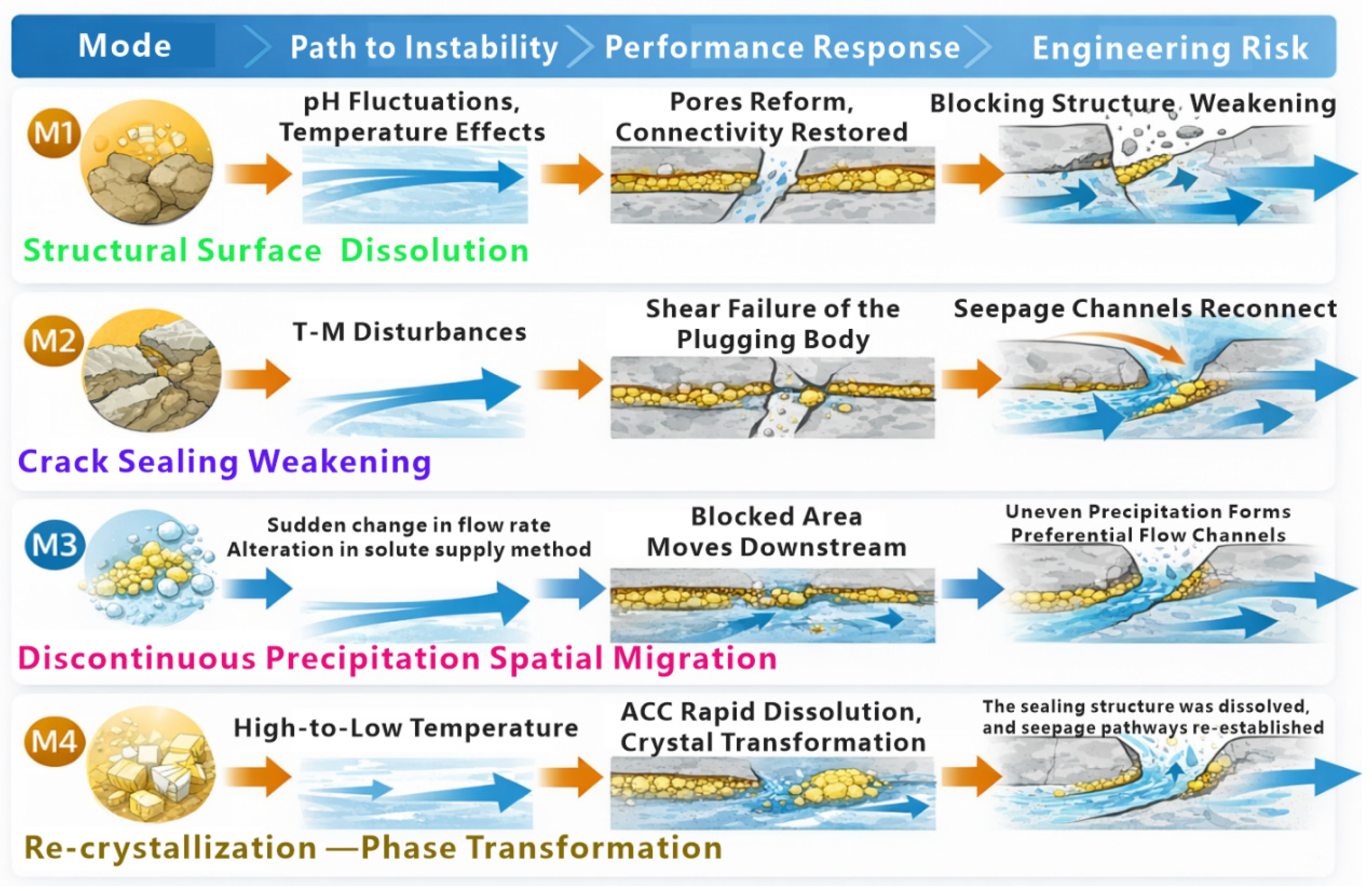
Within the complex interplay of precipitation–dissolution and near-field THMC coupling, the instability of carbonate fracture sealing typically manifests as a gradual decline in safety function rather than abrupt structural failure. This degradation is primarily seen as a progressive reduction in the sealing structure’s ability to suppress fracture transmissivity, potentially leading to the reformation of preferential flow pathways. Unlike conventional, static assessments that equate instability with the loss of sealants or decreased precipitation volume, the time-dependent nature of the near-field environment keeps sealing structures in a state of dynamic equilibrium, continually responding to boundary changes. During precipitation-dominated stages, localized dense infillings can effectively reduce transmissivity; however, evolving temperature, water chemistry, and flow conditions may trigger dissolution and structural reorganization, selectively disrupt previously continuous structures and introduce stage-wise risks of transmissivity recovery. The core issue is not whether dissolution occurs, but whether dissolution and mechanical disturbances target critical connecting units that maintain pore continuity and interfacial constraints.
Mechanistically, three principal instability modes in carbonate fracture sealing have been identified, often interlinked and evolving in sequence (
Figure 9):
(1) Continuity weakening via structurally selective dissolution:
Dissolution preferentially affects microstructural units and contact zones with high surface area, abundant defects, or weak cementation. Even minor total mineral loss can generate secondary pores and weakly connected zones within the precipitate, restoring connectivity and causing nonlinear transmissivity rebounds.
(2) Local opening and increased slip sensitivity from interfacial bonding degradation:
Under thermo-mechanical cycling or stress adjustments, weakened interfaces during dissolution–reprecipitation cycles reduce the mechanical coupling between the sealing body and host rock. This increases the likelihood that fracture opening or shear displacement will create through-going pathways, amplify mechanical disturbances and lead to hydraulic degradation.
(3) Reconstruction of preferential channels via heterogeneous precipitation:
When precipitation occurs patchily or in discontinuous bands, spatial continuity is lacking and unsealed zones remain. These areas are susceptible to further dissolution and flow redistribution, leading to the development of stable preferential flow paths and causing the macroscopic transmissivity to rebound after initial suppression.
These instability modes are mutually reinforcing through feedback loops involving structural heterogeneity, transport redistribution, selective dissolution, and transmissivity rebound, demonstrating strong process coupling.
Path dependence is a hallmark of these instability modes. The likelihood, sequence, and rate of degradation are shaped not only by current conditions but also by the full evolutionary history of boundary changes. Identical mineral infilling can result in very different structural outcomes depending on variations in temperature decline, chemical shifts, or changes in flow supply. Some evolutionary trajectories encourage densification and interfacial strengthening for durable transmissivity suppression, while others enable accumulation of weaknesses, leading to transmissivity recovery as the dominant response. Therefore, engineering focus should shift from merely identifying end-state instability to pinpointing the triggers and pivotal links underlying instability, and translating them into measurable functional criteria. This enables safety assessments to directly constrain when degradation initiates, its rate of progression, and potential reversibility.
For safety assessments, instability identification should focus on detecting early indicators of functional degradation. This involves establishing clear correspondences between each instability mode and observable metrics, such as transmissivity rebound rates, interfacial performance degradation, and stages of accelerated dissolution, to build a criterion-based system for risk classification and scenario analysis. In this framework, transmissivity rebound is recognized as a composite signal of both structural continuity and interfacial constraint loss, while interfacial bonding degradation and selective dissolution are seen as key nodes in the functional degradation pathway, not just mineralogical or mechanical events. By systematically linking instability modes, degradation processes, and observable indicators, assessments of long-term carbonate sealing can move from empirical or experience-based approaches to a parameterized, traceable, and safety–function-oriented framework.
5.6. Model-Based Representation and Parameterization Strategies
Translating insights on long-term stability into engineering-scale safety assessments requires the use of advanced reaction–transport–THMC coupled models. While the nonlinear and scale-dependent effects of dynamic precipitation–dissolution cycles present challenges for parameterization, they also provide opportunities to develop high-precision, predictive models [
118].
Existing modeling approaches for carbonate precipitation–dissolution in fractured media can be broadly divided into continuum-scale reactive transport models, pore-scale models, and multiscale bridging models. Continuum-scale reactive transport models are advantageous for describing solute migration, mineral reaction kinetics, and long-term geochemical evolution at laboratory to engineering scales. They are computationally efficient and can incorporate Darcy flow, saturation-dependent reaction kinetics, and porosity–permeability relationships. However, these models usually represent fracture evolution through equivalent parameters, such as mineral volume fraction, porosity, or permeability, and therefore have limited ability to explicitly capture pore-throat blockage, local channel reconnection, and changes in structural connectivity [
90].
In contrast, pore-scale models, including micro-CT-based simulations, pore-network models, and lattice Boltzmann or level-set approaches, can directly resolve local precipitation–dissolution fronts, evolving pore geometry, and changes in pore connectivity. These methods are particularly useful for identifying how heterogeneous carbonate precipitation modifies flow pathways and produces nonlinear permeability changes. Nevertheless, their high computational cost, dependence on high-resolution structural data, and limited representative volume make direct application to repository-scale prediction difficult [
35,
39,
90].
Therefore, neither continuum-scale nor pore-scale models alone are sufficient for long-term performance assessment of carbonate self-sealing in near-field granite fractures. A more feasible strategy is to develop multiscale bridging models, in which pore-scale structural information is upscaled into continuum-scale parameters. For example, pore-throat blockage ratio, connected-flow-path interruption probability, reactive surface area evolution, and fracture aperture distribution can be used as intermediate structural variables linking microscopic precipitation–dissolution processes to macroscopic transmissivity evolution [
39,
90].
Traditional models are computationally efficient but struggle to capture the path-dependent structural optimization and functional enhancement seen in fracture sealing. For effective long-term near-field evaluation, structural parameters should serve as a bridge to systematically link microscopic precipitation–dissolution processes with macroscopic suppression of fracture transmissivity. Scenario and sensitivity analyses can help clarify dominant controlling factors, enabling more robust model-based representation of the maintenance and improvement of safety functions along different evolutionary trajectories.
Based on this comparison, the key limitation of current modeling frameworks lies not simply in the absence of reaction kinetics, but in the weak representation of structure–function relationships. Most continuum-scale reactive transport models describe carbonate precipitation through equivalent permeability, porosity, or mineral volume fraction, which makes it difficult to represent nonlinear functional degradation caused by selective dissolution, pore-throat reconnection, or interfacial weakening. To address this limitation, fracture–pore dual-structure network models and multiscale parameterization strategies should be incorporated. In such models, microscopic changes in pore throats and fracture apertures can be mapped onto transport resistance distributions, while structure–function relationships can be quantified using parameters such as pore-throat blockage ratio, node blocking rate, connected-flow-chain interruption probability, and reactive surface area evolution [
39,
63,
90]. Deng and Spycher [
34], for example, demonstrated that coupling hydro chemical evolution, fracture structure, and transmissivity response provides a useful route for linking reactive transport processes with fracture-scale hydraulic performance. Such cross-scale modeling enables macroscopic safety margins to be constrained by microscopic mechanistic behavior, rather than relying solely on empirical permeability fitting.
Uncertainty analysis should also be incorporated into model-based performance evaluation. In carbonate self-sealing systems, uncertainties arise from multiple sources, including reaction rate constants, reactive surface area, initial fracture aperture distribution, pore-throat connectivity, mineral phase transformation, groundwater chemistry, flow boundary conditions, and thermal–mechanical perturbations. These uncertainties may propagate through the coupled chain of saturation state, reaction kinetics, pore-structure evolution, and transmissivity response, leading to a range of possible sealing trajectories rather than a single deterministic prediction. Therefore, sensitivity analysis can be used to identify dominant controlling parameters, while Monte Carlo simulation or Latin hypercube sampling can be applied to quantify the uncertainty range of permeability and transmissivity evolution. Bayesian updating may further integrate experimental observations, monitoring data, and model predictions to progressively reduce parameter uncertainty [
120]. In addition, scenario-based uncertainty analysis should be used to compare favorable sealing trajectories with degradation pathways, such as selective dissolution, interfacial weakening, and preferential channel reconstruction. Incorporating these uncertainty analysis techniques can improve the robustness and credibility of long-term safety assessment for carbonate self-sealing in near-field granite fractures. This approach offers vital support for engineering design, safety margin optimization, and the independent development of technical systems for HLW geological disposal.
6. Synergistic Optimization, Comparison, and Engineering Implications of Natural Mineral Self-Sealing and Engineered Sealing
6.1. Engineering Value of Natural Mineral Self-Sealing
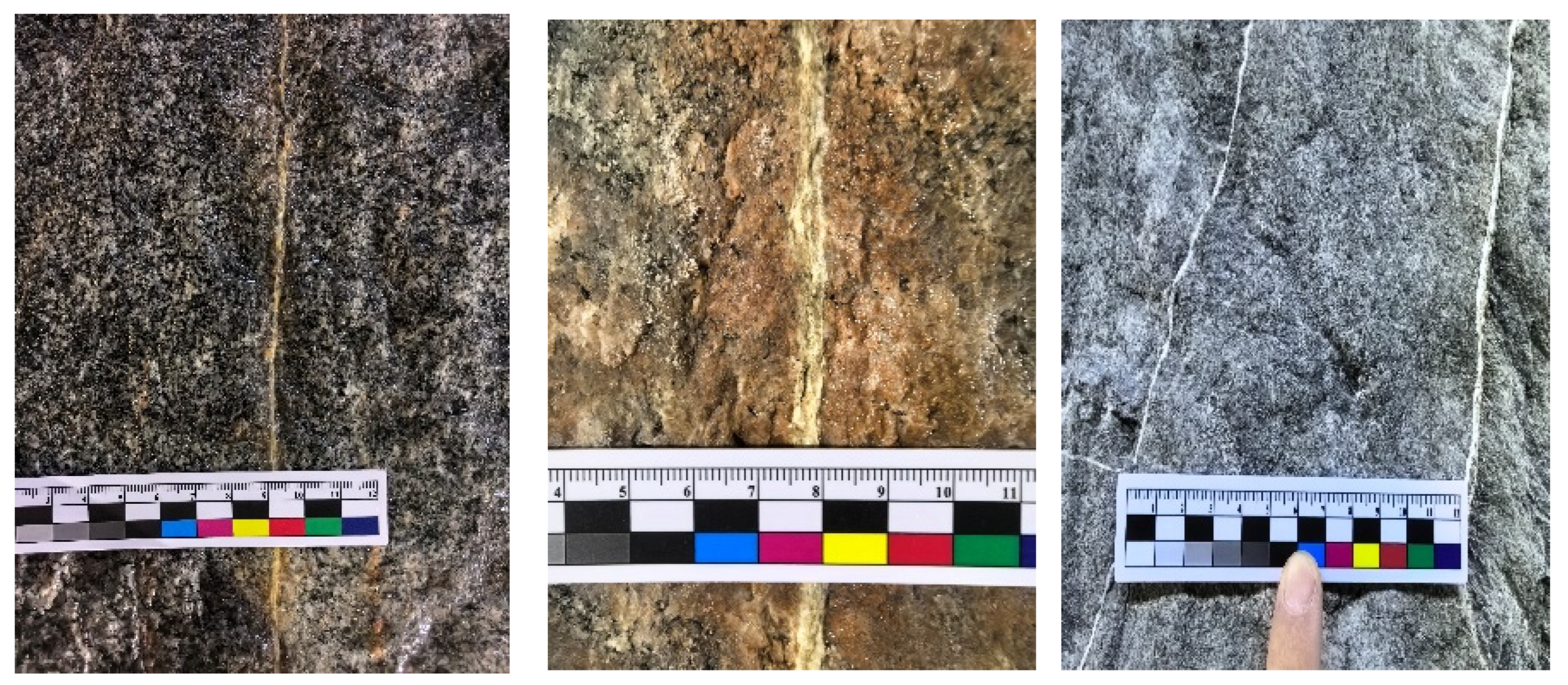
Within the multi-barrier system of HLW geological disposal, natural mineral self-sealing and engineered sealing collectively underpin near-field safety functions. Naturally formed carbonate infillings in granitic fractures (
Figure 10) arise from long-term groundwater–rock interactions; these processes are spontaneously optimized by environmental conditions, exhibiting excellent adaptability and sustained long-term effectiveness [
121,
122].
The primary engineering advantage of natural mineral self-sealing is its high compatibility with the host rock, allowing dynamic co-evolution with geochemical and structural site conditions over geological timescales [
122]. This confers substantial long-term reliability, process predictability, and spatial order, making it a scientifically robust basis for inclusion in repository safety cases and engineering optimization.
6.2. Advantages and Synergistic Potential of Engineered Sealing Technologies
Engineered sealing via grouting or advanced composite barriers offers distinct advantages such as strong controllability during construction and rapid establishment of low-permeability barriers. For example, use of low-pH cementitious materials enables quick permeability reduction and reliable early-stage safety performance [
123].
The properties of engineered materials can be further tailored to match near-field thermal, chemical, and mechanical evolutions, enhancing effectiveness and durability. Critically, engineered measures can also optimize the environment for subsequent natural carbonate self-sealing, fostering a synergistic, staged enhancement of sealing effectiveness that leverages both design and natural process adaptability. Thus, integration of both approaches is necessary to meet the stringent long-term safety requirements of HLW disposal.
6.3. Monitoring Indicators for Near-Field Sealing Environment
To operationalize synergistic strategies, it is essential to establish practical, monitorable, and quantifiable indicators for both natural and engineered precipitation:
(1) Hydro chemical level: Routine monitoring of pH, Ca2+, Mg2+, major anions, and temperature, combined with PHREEQC-modeled saturation indices (SI), allows real-time assessment of supersaturation states.
(2) Interfacial microenvironment: Use of microelectrodes, micro-sampling, or in situ sensors to detect local concentration gradients and SI spikes near fracture walls, identifying active reaction boundary layers.
(3) Precursor/nucleation detection: In situ optical imaging, ultrasonic scattering, or comparable techniques provide early warnings via detection of particle formation and wall coverage inflection, signaling shifts to dominant precipitation stages.
These monitoring data should be integrated into reactive transport models, closing the loop from observation to evaluation and adaptive engineering response.
6.4. Synergistic Relationship of Natural and Engineered Sealing
Mechanistic analyses and long-term stability evaluations demonstrate that natural mineral self-sealing and engineered sealing are not simply parallel approaches, but are highly complementary and capable of synergistic optimization. Engineered sealing effectively reduces fracture permeability during the early operational phase of a repository, laying the groundwork for near-field environmental optimization and subsequent long-term self-sealing processes. In contrast, natural mineral self-sealing progressively refines fracture structures over extended timescales, supporting continued enhancement and sustained maintenance of sealing effectiveness.
Natural sealing processes offer inherent adaptability and self-healing capacity, while engineered measures provide immediate water control and short-term reliability. This distinction highlights their complementarity in both temporal scope and operational mechanisms. For example, engineered technologies, such as low-pH grouting, silica sol, or polymer systems, can rapidly lower fracture permeability during construction and early operations, minimizing water ingress [
123]. Subsequently, natural or induced carbonate precipitation supports ongoing structural sealing during long-term thermo–hydro–chemical evolution, enabling continuous re-precipitation, reorganization, and optimization [
54].
From the perspective of dynamic precipitation–dissolution coupling, scientifically designed engineered barriers can significantly promote the ordered precipitation of carbonate minerals within fractures by precisely regulating local hydro chemical conditions, thereby strongly enhancing the effectiveness of natural self-sealing. This strategy combining engineered guidance with natural processes provides a promising pathway for advancing fracture sealing technologies. Therefore, repository design should fully leverage the positive regulatory impact of engineered measures on mineral geochemical processes, and integrate natural self-sealing into a comprehensive, long-term safety optimization framework to maximize the synergistic benefits of both approaches.
6.5. Scientific Implications for Repository Engineering Design and Technology Selection
Incorporating the synergistic optimization of natural mineral self-sealing and engineered sealing into repository engineering design supports a shift in fracture closure strategies from a focus on short-term control toward long-term performance enhancement (
Table 3). In regions with extensive fracturing or complex hydrodynamics, engineered sealing should be prioritized for immediate barrier formation, while materials and construction methods are optimized to facilitate the orderly development of natural mineral self-sealing.
For long-term safety assessments, it is essential to scientifically quantify and accurately characterize the contribution of natural mineral sealing to the evolution of fracture permeability, recognizing it as a key element of near-field natural barrier performance. This approach not only enhances the overall effectiveness of engineering interventions, but also strengthens the scientific integrity and credibility of safety arguments for the repository.
From a technological perspective, future fracture sealing methods should place greater emphasis on compatibility with the geochemical environment of the near field. By guiding beneficial mineral precipitation through engineering interventions, a high degree of synergy between engineered and natural processes can be achieved—fostering innovation and advancing geological disposal technologies.
By integrating micro- to nanoscale carbonate precipitation–dissolution mechanisms, long-term stability assessment, and engineering practices, advanced fracture sealing systems tailored for HLW waste disposal can be developed. Natural mineral sealing should be valued not merely as a background process, but as a strategically leveraged safety function within repository design.
These natural precipitation processes should be actively incorporated as controllable, synergistic, and measurable elements in sealing system design. In future repository projects, the introduction of a hydrochemistry–reaction–structure integrated feedback logic, through engineered precipitation windows, monitoring array deployment, and inversion model construction, can build a truly synergistic system. In this framework, natural processes reinforce engineered barriers, and engineered measures in turn activate and regulate natural mineral sealing, providing robust mechanistic support for long-term transmissivity control and enhanced safety margins.
7. Conclusions
7.1. Key Research Findings
This study addresses the core scientific and engineering challenges associated with carbonate mineral self-sealing in granitic fractures within the near-field of HLW geological disposal. Leveraging recent advances in the understanding of mineral processes at the micro- and nanoscale, we establish a comprehensive theoretical framework that integrates dynamic precipitation–dissolution coupling, structural evolution and optimization, safety function enhancement, and engineering synergy. The key findings are as follows:
(1) Dynamic self-sealing mechanism: Carbonate mineral self-sealing in granitic fractures is a highly dynamic, continuously optimized process. Under the influence of evolving near-field THMC conditions, cycles of precipitation and dissolution actively restructure sealing architectures, scientifically suppressing and optimizing fracture transmissivity. This mechanism advances beyond traditional static concepts, deepening scientific insight into the durability of fracture self-sealing in geological environments.
(2) Nucleation pathways and micro- to nanoscale structures: By comparing classical and non-classical nucleation theories, this study underscores the diversity of micro mechanisms governing precipitation. The formation and amplification of multilevel structures and precursor phases within confined fracture spaces strengthen pore continuity, interfacial bonds, and long-term transmissivity control, serving as an essential link between fundamental nucleation processes and macroscopic safety performance.
(3) Synergy of natural and engineered sealing: In practical engineering, natural and artificial sealing are highly complementary. Engineered methods enable rapid, early-stage permeability control, while natural mineral precipitation delivers progressive, long-term structural optimization. Harnessing the synergy between these approaches is vital for sustained improvement of near-field barrier performance.
(4) Implications for safety assessment and repository design: Incorporating dynamically coupled natural mineral processes into a multi-field safety evaluation paradigm enhances both the reliability of engineering interventions and the scientific foundation of safety arguments. This provides robust support for the rational design and safety margin optimization of fracture control strategies in radioactive waste repositories.
7.2. Future Research Prospects
Research into the dynamic coupling of micro- to nanoscale carbonate mineral precipitation and dissolution provides valuable new insights into fracture self-sealing behavior in granite. This study establishes a robust foundation for systematically optimizing near-field safety functions in HLW geological disposal. As advances continue in multi-field-coupled experimental techniques, in situ characterization, and numerical simulation, integrating natural mineral self-sealing processes into near-field barrier systems and repository design evaluations is now both scientifically feasible and of significant engineering value.
Looking ahead, it is essential to further deepen fundamental mechanistic research, refine safety–function-oriented evaluation frameworks, enhance engineering-scale validation and technological innovation, and guide the strategic shift in fracture self-sealing technologies from experience-based approaches to mechanism-driven methodologies. This transformation will provide crucial support for the long-term safe operation of the Beishan URL and future repositories in China, while also serving as an important technical reference for international research and best practices in HLW geological disposal. Ultimately, such advances will contribute to overarching goals of nuclear safety and sustainable development.



 ,
,