1. Introduction
The digital transformation’s disruptive impact is reshaping the Architecture, Engineering, Construction and Operations (AECO) industry and is profoundly altering the way information is generated, managed, and exchanged across the entire building lifecycle [
1]. The transition from document-based to data-centric processes has resulted in a shift in focus from the mere production of project deliverables to the creation of structured, interoperable information ecosystems that enable intelligent decision-making. In this evolving context, Building Information Modeling (BIM) has emerged as the cornerstone of this transformation, serving as both a digital representation of a facility and a shared knowledge environment that integrates geometric, semantic, and operational data [
2]. The integration of disparate data into a unified model is a key assumption of BIM, a methodology that has the potential to dismantle the long-standing silos that have traditionally separated the disciplines of design [
3], construction, and facility management, while also incorporating extended visualization approaches [
4]. Notwithstanding these advances, the practical implementation of BIM across the full lifecycle of built assets remains fragmented. While the design and construction phases have benefited from widespread adoption and well-established methodologies, the operational phase, where the majority of costs and resource consumption occur, has lagged behind in terms of digital maturity [
5]. The field of Facility Management (FM) continues to rely heavily on a variety of data sources, with a significant proportion of this data being of a heterogeneous nature [
6]. Building documentation, for instance, is often poorly integrated with upstream project information, and this could cause high impacting costs during maintenance [
7]. This fragmentation hinders the realization of a truly lifecycle BIM, in which the information generated during design, construction and operation can seamlessly support asset operation, maintenance, and strategic planning [
8]. To address these challenges, research and industry initiatives are increasingly emphasizing the importance of open standards and interoperable data models [
9]. These models are capable of ensuring continuity and accessibility over decades of asset use. The adoption of neutral, vendor-independent formats such as Industry Foundation Classes (IFCs) provides a critical foundation for transparent data exchange across platforms and disciplines [
10]. When combined with open-source tools and standardized information management frameworks, these standards enable a widespread and sustainable approach to digital construction, enhancing independence from proprietary ecosystems [
11]. Within this paradigm, the integration of BIM with Computerized Maintenance Management Systems (CMMSs) has emerged as a central objective for achieving data-driven operations [
12], with BIM-based Facility Management (FM) environments having the potential to transform static design data into dynamic asset intelligence [
13], thereby facilitating predictive maintenance, performance monitoring, and informed decision-making throughout the lifecycle of an asset [
14]. Nevertheless, persistent interoperability barriers—originating from mismatched data structures, proprietary software dependencies, and inconsistent information requirements—continue to limit the effectiveness of current workflows [
15]. In order to bridge this gap, it is necessary to employ not only technical solutions but also methodological frameworks capable of enriching BIM models with structured FM-oriented data that can be directly used by CMMS platforms [
16].
1.1. The Challenge of Lifecycle Data Management in the Built Environment
The lifecycle information management represents a key challenge for the AECO sector, due to the inherent complexity given by the different knowledge realms that comprise the integrated building design [
17]. Despite significant advances in digital design and construction [
18], the operational phase, which accounts for the majority of costs, maintenance activities, and performance monitoring, remains unaddressed by the lack of detailed research and persistent challenges concerning BIM with the number of statements related to each weak data strategy [
19], and also for the lack of structured and interoperable representation enriched with semantic capabilities [
20]. This mismatch can be attributed to a combination of historical and technological factors, such as the multiplicity of professional specializations in architectural design and considering the complexity in harmonizing different technical realms. Project information has conventionally been generated with short-term objectives in mind, focusing more on design coordination and construction delivery rather than long-term facility management and asset value improvement. Consequently, information gathered during earlier project phases often becomes obsolete, hardly accessible or not interoperable during the building site transition towards the operational phase. FM professionals are faced with fragmented and heterogeneous information environments [
21]. A significant proportion of the information that FM professionals need is currently distributed across several non-integrated sources, including paper archives, legacy spreadsheets, proprietary software and stand-alone databases. Despite the availability of digital formats, these are frequently unstructured or inconsistent, thus lacking the metadata and contextual relationships that are prerequisites for supporting maintenance planning or performance analytics. This fragmentation has the effect of undermining the reliability of asset ledgers, favoring preventive maintenance programs over reactive fix-when-broken strategies. These strategies, in turn, increase operational costs and resource consumption [
22].
The consequences of these inefficiencies are not confined to the technical domain. The presence of incomplete information has been demonstrated to impede effective decision-making processes at both the tactical and strategic levels. In the absence of reliable data, facility managers encounter significant challenges in evaluating asset conditions, planning replacements, and forecasting lifecycle costs. Moreover, the absence of standardized mechanisms for the exchange of information has been identified as a key factor hindering collaboration among stakeholders, thereby complicating the transfer of knowledge between design teams, contractors, and maintenance personnel. This phenomenon, often termed the ‘digital disconnect’ at handover, is characterized by the discrepancy in information between the site phase and the Asset Information Management (AIM) settings. The issue is further complicated by the preferred use of proprietary software ecosystems in current data exchange practices. Whilst these platforms offer advanced modeling and management tools, they also present risks, including data lock-in and long-term obsolescence. Building owners and operators may find themselves dependent on a particular vendor’s technology stack, which limits their ability to evolve, migrate or integrate data as systems and organizational needs change. It is evident that facility assets need systems that can ensure decades of data storage and use, keeping the opportunity to update them as the building’s maintenance and upgrades require. Consequently, the absence of open, persistent and interoperable data structures poses a considerable threat to the reliability of asset management data. Another challenge is the lack of clearly defined information requirements throughout the lifecycle. Despite the introduction of structured approaches to information management, such as ISO 19650 [
23], these are often disattended because of the lack of upgraded tools and related digital capabilities from the professionals involved. A significant number of organizations continue to face difficulties in capturing appropriate data during the design phase and its related availability during the operational lifecycle of the building. This inconsistency can result in either information overload or data scarcity, both of which compromise the value of the digital model as a long-term decision-support tool.
To address these challenges, it is necessary to define a paradigm shift from ad hoc data handovers to semantically structured, standards-based, developed information exchanges. The emerging concept of lifecycle data continuity emphasizes that information should not merely be transferred between project stages but should evolve as a consistent, traceable, and verifiable resource throughout an asset’s existence. In this vision, the digital model becomes a dynamic repository of both static and operational data, forming the foundation for predictive maintenance, sustainability monitoring, and performance optimization. In order to achieve such continuity, it is essential that the AECO industry broadly adopts open, machine-readable formats that support interoperability and long-term accessibility. The Industry Information Class (IFC) interoperability protocol, developed by buildingSMART International, signifies a pivotal advancement in this domain, offering a vendor-neutral framework for the representation of geometric, semantic, and relational information. However, despite its wide acceptance, IFC is not always used to its full potential during the building lifecycle. In many workflows, the exported IFC model remains a snapshot of the design adopted solutions rather than an evolving representation of the built asset enriched with FM-relevant data. It is therefore crucial to bridge the gap between the design-oriented BIM model and the operational Asset Information Management (AIM). In this perspective, lifecycle BIM improvements can provide an important foundation for future Digital Twin developments. However, a full Digital Twin requires continuously updated data flows, bidirectional synchronization, and integration with dynamic information sources, which remain beyond the scope of the present study. These developments established BIM not only as a design phase game changer, but as an holistic process-driven methodology for collaboration, information exchange and decision support across the entire project lifecycle.
A fundamental concept that underpins this evolution is the Level of Detail (LOD) and its evolution represented by the Level of Information (LOIN). These frameworks define the degree of detail of information and the whole reliability of model elements throughout the project lifecycle. The levels, ranging from LOD 100, representing conceptual geometry, to LOD 500—corresponding to the as-built condition—establish a shared understanding among stakeholders of the expected information content of the model at each stage. In the context of facility management, the achievement of a LOD 500 model is of significant importance as it represents the physical characteristics of building components and their operational metadata, including identification codes, maintenance history, and performance parameters. This precise, organized representation of information is paramount to establishing a connection between BIM and CMMS, thereby facilitating the creation of DT to replicate the actual behavior of assets. Notwithstanding the sophistication of contemporary BIM technologies, the practical implementation of these higher dimensions remains inconsistent across the industry. A significant number of projects still terminate the BIM process at handover, resulting in models that are rich in geometry but poor in operational data. The absence of standardized methods for embedding facility management information, coupled with the lack of seamless interoperability between BIM platforms and FM software, continues to constrain the potential of 6D and 7D BIM. In order to bridge this divide, the need for the adoption of open and neutral data formats that ensure data exchange throughout the building’s lifecycle remains essential. This is because we should consider the evolution of BIM as a multidimensional data-centric methodology for establishing the conceptual foundation for addressing present-day interoperability challenges. The subsequent section will examine the pivotal role of open standards like IFC in establishing a common, vendor-independent framework that supports the stream of information from design and construction to operation and maintenance.
1.2. The Role of Open Standards in Achieving Lifecycle BIM
The adoption of open standards is a pivotal factor in the transition from stand-alone digital building models to integrated lifecycle information systems. As BIM processes evolve, the need for consistent software-independent data exchange becomes progressively imperative to guarantee that information remains accurate and accessible throughout the lifecycle of a building. Interoperability, once regarded as a technical challenge, has evolved into a strategic need that affects the long-term sustainability and resilience of asset management. It is evident that proprietary software environments, despite their potency, frequently engender self-contained ecosystems that actually limit data portability, resulting in a state of vendor lock-in. On the other hand, open standards present a sustainable alternative by establishing common, non-proprietary data structures that enable communication between different systems and disciplines. Within this paradigm, the IFC schema, developed and maintained by buildingSMART International, serves as the cornerstone of interoperability in the built environment. The IFC data model is characterized by its object-oriented nature, encompassing both the geometry and semantics of building elements, in addition to their relationships and properties. In contrast to proprietary file formats, which are confined to a specific vendor-available environment, IFC is characterized by its neutrality and the free/open use of its documents and specifications. This feature ensures the long-term accessibility of data, irrespective of the software employed for its creation or management. This feature renders IFC the most widely adopted open standard for exchanging BIM data across the AECO industry. The strength of IFC lies in its capacity to represent buildings not as static geometries but as networks of intelligent, interrelated objects. Each object, including walls, doors, and mechanical equipment, possesses a set of attributes that delineate its physical, functional, and relational characteristics. This object-oriented architecture facilitates a semantically rich representation of the built environment, thereby supporting both visualization and analytical operations. Nonetheless, whilst the IFC schema does indeed provide a robust foundation for interoperability, it does not cover all the specialized information that is required for facility operation and maintenance. For instance, attributes related to asset condition, maintenance frequency, or performance monitoring are often specific to FM workflows and are not explicitly defined in the standard schema. In order to address these limitations, IFC offers an extensibility mechanism that allows users to create custom Property Sets (Psets) and attach them to existing entities. This flexibility is a key enabler for extending BIM beyond design and construction, as it allows domain experts to enrich models with information tailored to their operational needs while remaining fully compliant with the standard. When these extensions adhere to consistent naming conventions and reference structures, they can facilitate a high degree of interoperability across different platforms and software tools. Consequently, IFC can function as the basis for the creation of AIMs that are both standardized and adaptable to specific management contexts.
Another essential initiative that complements IFC is the Construction Operations Building Information Exchange (COBie), a structured data schema designed to capture and transfer asset information at project handover. COBie offers a simplified, tabular representation of essential facility data. This data can be imported into CMMS applications without requiring complex BIM software. While COBie has proven effective in standardizing basic asset data exchange, particularly in government-mandated projects in the United Kingdom and the United States, its spreadsheet-based structure can limit its integration with fully digital workflows. The combination of IFC’s rich object model with COBie’s structured tabular data offers a practical approach to achieving both depth and simplicity in information exchange. However, maintaining data alignment between the two remains challenging, and could be solved by using bridge-methodologies as described in [
24]. Beyond the technical interoperability that is the primary concern, open standards also support organizational and strategic objectives. The promotion of transparency in data ownership, the reduction in dependency on specific vendors, and the fostering of collaboration among multidisciplinary teams are all key tenets of the proposed framework. By ensuring that information is preserved in open, machine-readable formats, organizations can maintain digital continuity even as software tools evolve. This continuity is pivotal in actualizing the concept of BIM lifecycle, where data produced during the design and construction phases continues to earn value during operation, maintenance, and eventual decommissioning. The expansion of an ecosystem of open-source tools serves to further reinforce this transformation. It has been demonstrated that open standards can be implemented effectively in flexible and scalable workflows, as evidenced by the IfcOpenShell and Blender BIM frameworks. These tools empower practitioners to manipulate, enrich, and visualize IFC models programmatically, thereby eliminating the reliance on commercial middleware and expanding access to advanced digital processes. As these technologies continue to evolve, they generate novel prospects for integrating BIM with FM systems in a manner that is transparent, reproducible, and cost-effective.
In summary, open standards such as IFC form the technical and conceptual basis for achieving true lifecycle BIM. The provision of a common language facilitates the exchange and reuse of information among all stakeholders, thereby ensuring the coherence and significance of data throughout the asset lifecycle. The following section of this paper presents the research framework developed to operationalize these principles. The methodology outlined in this paper is a practical one, which introduces a method of enriching IFC models with FM-oriented information. This, in turn, enables direct and automated integration with an open-source CMMS platform. This study contributes to this ongoing effort by developing and validating an open-standard framework that programmatically enriches IFC models with FM-specific information using open-source technologies. The proposed approach establishes a transparent, repeatable workflow for lifecycle data integration by embedding structured Property Sets directly into IFC entities and enabling automated import into a CMMS. This approach contributes to the overarching objective of establishing a genuinely interoperable digital ecosystem for the domains of building operation and management.
1.3. BIM for Facility Management: Benefits and Challenges
The innovative application of BIM in FM boosts a paradigm shift, transforming the focus from a static, as-built record to a dynamic digital twin that evolves with the facility [
25]. The potential benefits are manifold and well-documented in the literature [
26]. Primary advantages include:
- −
Enhanced space management: By providing accurate room and area data, BIM models enable facility managers to optimize space utilization, reduce vacancies, and lower real estate expenditures.
- −
Efficient maintenance: The greatest obstacle in establishing a preventative maintenance program is often the laborious process of populating a CMMS with asset data. BIM models can automate this process, saving months of work by providing accurate information about building equipment and systems.
- −
BIM supports effective energy use by facilitating energy simulations that allow for the comparison of different design options and operational strategies, helping to lower costs and reduce environmental impact.
- −
BIM model simplifies the planning of economical renovations and retrofits. An accurate understanding of current conditions reduces project complexity, minimizes costly surprises during construction, and significantly decreases the number of change orders.
- −
Improved lifecycle management, as BIM enables owners to analyze the long-term trade-offs between initial capital costs and ongoing operational expenses, supporting more strategic investment decisions.
Despite these clear benefits, significant challenges remain. A primary hurdle is the frequent mismatch between the information contained in design and construction models and the specific data needed for operations [
27]. Models are often created without the facility manager’s input, resulting in an information gap at project handover.
1.4. Information Handover Standards: PIM, AIM, and COBie
To ensure that information generated during design and construction remains usable throughout a building’s operational life, international standards such as the British PAS 1192 series, now superseded by the ISO 19650 framework, define a structured information management process. These standards distinguish between the Project Information Model (PIM), developed during the design and construction phases, and the Asset Information Model (AIM), which supports the management and operation of the built asset. The AIM represents the digital repository of all data, documentation, and metadata required for the effective running, maintenance, and renewal of a facility. The transition from PIM to AIM is not merely a data transfer activity; it constitutes the information handover process that ensures the continuity, reliability, and traceability of asset information. The AIM must be created in alignment with the Organizational Information Requirements (OIRs) defined by the asset owner or operator. The OIRs specify what information is required, why it is needed, and how it will be maintained throughout the asset lifecycle. Consequently, the PIM should be developed with these requirements in mind, ensuring that all necessary data is captured, structured, and formatted for seamless transition to operational use.
Typical categories of information included within an AIM, based on PAS 1192-3 [
28] and ISO 19650, are summarized in
Table 1. These categories encompass both graphical and non-graphical data that collectively enable efficient facility management and decision-making.
To facilitate the consistent exchange of such structured information between project stakeholders and Facility Management (FM) platforms, the standard was introduced. COBie provides a tabular, machine-readable schema—technically defined as a Model View Definition (MVD) of the IFC standard—known as the Basic FM Handover View. Its purpose is to capture essential asset information (e.g., equipment lists, room data, and maintenance manuals) at key project milestones, enabling straightforward import into Computerized Maintenance Management Systems (CMMS) without the need for complex BIM authoring software. A key benefit of the COBie format is its compatibility with widely used spreadsheet software. Nonetheless, this same characteristic can become a constraint when deeper integration with native BIM models is required. It effectively captures static data but lacks the semantic richness and bidirectional connectivity required for dynamic, model-based FM operations. Maintaining alignment between COBie spreadsheets and the 3D BIM environment remains a persistent challenge, especially when updates occur late in the project or after handover. To overcome these limitations, emerging research and industry practice advocate for direct data embedding within open-standard BIM formats, such as Industry Foundation Classes (IFCs). By integrating FM-relevant information directly into the IFC model—through the use of custom or standardized Property Sets (Psets)—it becomes possible to retain semantic structure, geometry, and relationships within a single interoperable dataset. This approach enhances traceability, reduces manual data entry, and ensures that asset information remains synchronized with its geometric representation.
In summary, OIR-driven information management and open-standard exchange formats such as IFC and COBie together provide the conceptual foundation for lifecycle BIM. The scope of the presented methodology stands in the enrichment of IFC models with structured FM data to create an interoperable Asset Information Model ready for direct integration into an open-source CMMS environment.
1.5. The IFC Schema as a Vehicle for Interoperability
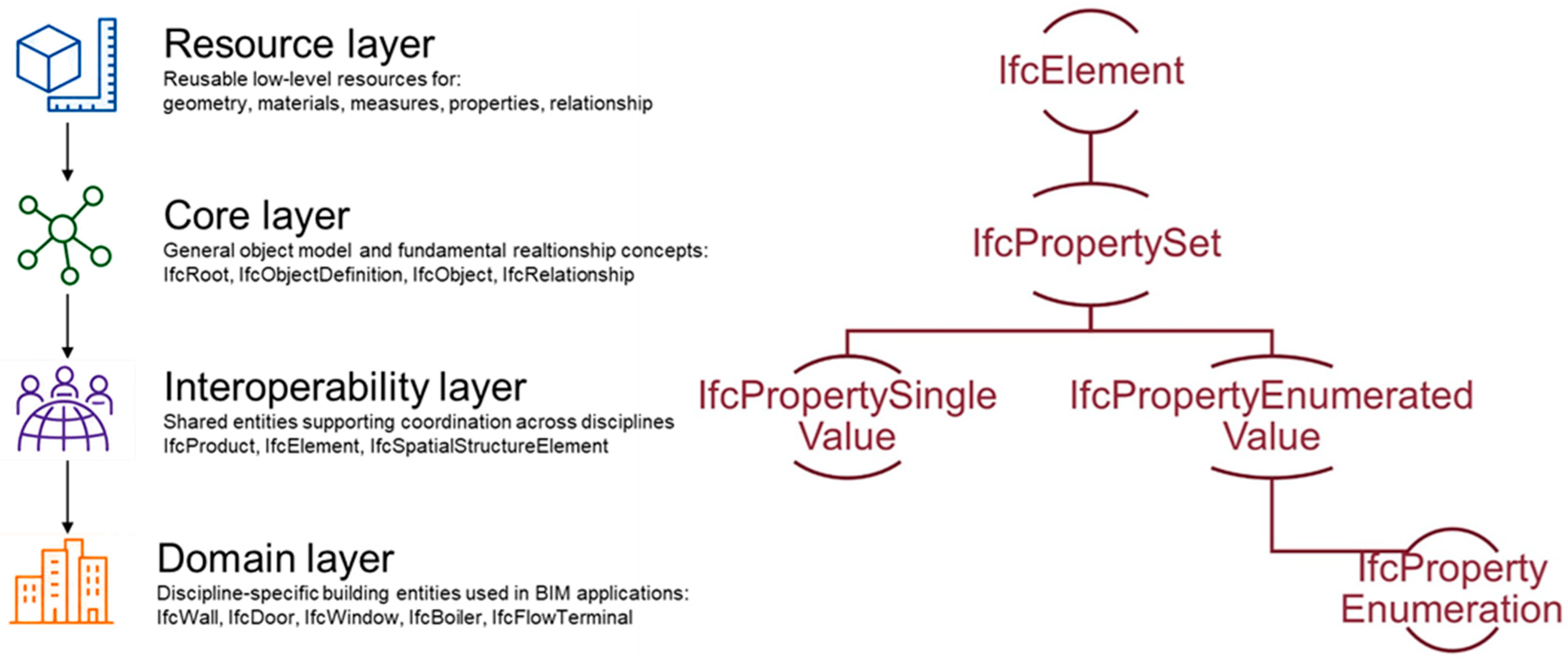
The IFC schema is the technical foundation of the OpenBIM approach. It is an object-oriented data model, meaning it represents a building not as a collection of lines and arcs, but as a set of intelligent objects (e.g., IfcWall, IfcDoor, and IfcBoiler) with defined properties and relationships. The schema is organized into a hierarchical, four-layer structure: the Resource Layer (defining basic attributes like geometry, material, and quantity), the Core Layer (defining the kernel and control extensions), the Interop Layer (defining shared elements between disciplines), and the Domain Layer (containing discipline-specific objects for architecture, HVAC, etc.). This layered architecture, depicted in
Figure 1, allows for a rich and detailed representation of a building.
A key feature of IFC is its extensibility. While the schema provides a vast library of predefined objects and properties, it cannot cover every possible use case. To address this, IFC allows for the creation of custom Property Sets (IfcPropertySet). These are containers that can be attached to any object to add user-defined attributes. This mechanism is fundamental to the framework proposed in this research, as it provides the technical means to embed specialized FM data directly into the standard IFC model. Despite its power, IFC has known limitations. The complexity of the full schema can lead to inconsistent implementations in software, and the process of defining MVDs to create reliable data exchange subsets can be laborious. Furthermore, certain objects created in proprietary software may be exported as generic proxies (IfcBuildingElementProxy), losing some of their semantic richness. This research leverages the strengths of IFC’s extensibility while bypassing some of the complexities of formal MVD creation by using a direct, script-based enrichment approach.
1.6. BIM Maturity and Lifecycle Integration
The adoption of BIM within an organization or project typically follows a path of increasing maturity, often described in three stages.
- −
Stage 1 (Object-based modeling) involves the use of 3D parametric software within single disciplines to produce coordinated documentation and visualizations. Data exchange between disciplines at this stage is often file-based and non-standardized.
- −
Stage 2 (Model-based collaboration) sees different disciplines actively exchanging their models to improve coordination. This stage is characterized by the use of federated models for clash detection and design review, often using a mix of proprietary and open formats.
- −
Stage 3 (Network-based integration) represents the highest level of maturity, involving the collaborative creation and maintenance of an integrated model across all lifecycle phases, typically managed through a model server or a sophisticated Common Data Environment (CDE). This stage enables a seamless, “phase-less” flow of information, leading to what can be termed “concurrent construction” and, ultimately, a fully integrated digital twin for operations.
The framework proposed in this paper is a tool designed to facilitate the transition to Stage 3 maturity, specifically for the handover to the operational phase. By providing a repeatable, automated method for embedding structured FM data into an open-standard model, it creates a reliable information pipeline that can feed the integrated databases and systems characteristic of a Stage 3 workflow, thereby closing a critical loop in the building lifecycle.
Current research on BIM–CMMS and BIM–FM interoperability can be broadly interpreted along different technical routes, including conceptual BIM–FM frameworks, IFC-based enrichment and interoperability approaches, and more recent digital-twin-oriented developments. A persistent gap remains in the availability of lightweight, reproducible, and vendor-neutral workflows that directly enrich IFC models according to organizational information requirements and use them to populate an open-source CMMS without proprietary middleware. This specific methodological gap is the focus of the present study.
The research problem addressed in this paper is the persistent interoperability gap between BIM and CMMS environments during the operational phase of the building lifecycle. The study aims to develop and validate an open-standard workflow that enriches IFC models with FM-oriented data and enables their direct integration into an open-source CMMS. To achieve this, the research has been organized into four tasks: defining FM information requirements; developing as-built BIM models; programmatically enriching IFC models; and validating and integrating them within OpenMAINT 2.4.
The scientific novelty of the study lies in the isolated use of existing open-source tools, but especially in their integration into a unified and reproducible workflow that directly enriches IFC models with FM-oriented data and enables automated population of an open-source CMMS through a vendor-neutral, post-export process.
2. Methodology
The methodology developed in this research follows a structured, standards-compliant process designed to develop, implement, and validate an open-standard framework for enriching IFC models with FM-specific data. The ultimate goal is to achieve direct, automated integration with a Computerized Maintenance Management System (CMMS) while preserving full interoperability within the BIM environment. The research adopts a design science approach, combining theoretical grounding in openBIM principles with practical experimentation through a real-world case study. The case study focuses on two existing residential buildings located in Bologna, Italy, and managed by the real estate company “Risanamento” (hereafter referred to as Risanamento). This cooperative provided the operational context, data structure, and performance requirements that shaped the development of the framework. Specifically, the study aimed to demonstrate how an open, vendor-neutral process could transform conventional BIM data into a structured, interoperable AIM capable of supporting FM operations over the long term.
The overall methodology consists of four main stages:
Definition of information requirements based on Risanamento’s OIR;
Development of as-built BIM Models compliant with ISO 19650 and UNI 11337 [
29] standards;
Programmatic enrichment of IFC models with FM-oriented Property Sets using a Python 3.14 based tool leveraging the IfcOpenShell library;
Validation and integration of the enriched models into the open-source CMMS platform openMAINT.
Each step was carefully aligned with international standards to ensure repeatability, transparency, and long-term data accessibility.
2.1. Case Study Context and OIR-Based Information Requirements
A defining feature of this research is its foundation on real organizational needs rather than purely theoretical assumptions. The client organization, Risanamento, manages a large social housing portfolio comprising more than 2200 residential units distributed across multiple districts of Bologna, Italy. The cooperative, founded in 1884, maintains an active strategy for asset renewal and digital transition through the adoption of BIM and open-standard methodologies. The research focused on two representative residential buildings, each comprising four above-ground levels and one basement, with a total area of approximately 6000 m2 per building. The case study included 84 individual apartments, shared technical systems, and common areas such as stairwells, courtyards, and service rooms. These facilities were chosen because they represent typical conditions within Risanamento’s housing stock—aging buildings with partial or paper-based documentation and fragmented maintenance records. The study was conducted within the framework of Risanamento’s OIR, formally aligned with ISO 19650 and UNI 11337 standards. The OIR defines the digitalization strategy and the mandatory information structure to support lifecycle data management. These requirements provided the baseline constraints and objectives for the proposed framework.
Key OIR provisions are directly shaped by this methodology, including these breakdown structures:
- −
Hierarchical: Territorial Zones; Buildings; Real Estate Units;
- −
Disciplinary: Architectural, Structural, and MEP (Mechanical, Electrical, and Plumbing) models;
- −
State-based: As-is; Demolitions, and New Constructions for project models.
This structure ensures that both BIM and IFC models maintain clear spatial logic, disciplinary segregation, and lifecycle traceability, facilitating consistency across design, construction, and operational datasets. Concerning the consistency of the model, it should be constantly provided with a Shared Coordinate System to warrant model alignment and cross-disciplinary federation, while the OIR requires the use of the WGS 84 georeferencing system. Each building must include a defined Building Survey Point (absolute origin) and a Functional Unit Base Point (relative origin), ensuring that all sub-models share a common reference framework for spatial coordination and data federation. This practice allows accurate model integration into territorial GIS systems and supports location-based asset management.
From Element Placement and Naming Conventions, it should be considered that OIR prescribes precise rules for the vertical placement of elements relative to reference levels—for instance, floor slabs must be positioned at the elevation of their top surface (extrados). Moreover, a mandatory naming convention is enforced to ensure unambiguous identification of every digital asset. Each model and its constituent elements must follow a standardized schema composed of multiple fields separated by hyphens, e.g., BuildingCode–UnitCode–Level–FileType–Discipline–AlphanumericCode.
This codification method ensures that every object is uniquely identifiable and traceable throughout the asset’s digital lifecycle.
This rigorous, standards-based information environment provided an ideal testing ground for the proposed framework. The objective was not merely to transfer design data into an FM system but to do so in a way that was systematic, interoperable, and fully compliant with an industry-grade, real-world asset management strategy. The adherence to the OIR thus ensured that the developed solution addressed authentic operational challenges, bridging the gap between theoretical BIM–FM integration concepts and practical implementation in a complex organizational context.
The operational workflow implemented in this study followed a structured sequence designed to ensure full traceability and schema compliance:
Digitization of legacy documentation: Original paper-based architectural and engineering drawings were scanned and converted into 2D CAD formats using AutoCAD.
Development of as-built BIM models: Discipline-specific models (Architecture, Structure, and MEP) were created in Autodesk Revit, each developed at LOD 500, representing the as-is conditions verified on site.
Federation and quality control: The models were coordinated and validated through clash detection in Navisworks Manage, ensuring full geometric consistency.
IFC export and structuring: The federated Revit models were exported into IFC4 format according to Risanamento’s OIRs, establishing the baseline for open-standard data exchange.
Programmatic data enrichment: A custom Python application developed with the IfcOpenShell library was used to inject FM-specific Property Sets (Psets)—including Condition, Criticality, Installation_Date, and Last_Check_Date—directly into selected IFC entities (e.g., IfcDoor, IfcBoiler, IfcWindow).
Validation: Enriched IFC files were tested using the buildingSMART IFC Validation Service to ensure compliance with IFC4 schema and normative rules.
Integration into CMMS: The validated files were imported into OpenMAINT, where a JSON-based import template automatically mapped Pset attributes to the CMMS asset database, generating hierarchical building, floor, and asset records.
This structured sequence ensured a consistent, standards-compliant workflow from data acquisition to operational deployment, enabling full traceability of information and seamless interoperability between BIM and FM environments.
2.2. As-Built BIM Development
The development of the as-built Building Information Modeling (BIM) model began with the digitization of legacy paper-based documentation of the existing buildings. Original architectural and engineering drawings were scanned at high resolution and used as underlays in AutoCAD to generate accurate 2D vector-based plans, creating a reliable digital baseline for subsequent modeling. This step ensured geometric consistency and served as the first milestone in transforming analog documentation into an interoperable digital environment. Following the digitization, discipline-specific BIM models were created in Autodesk Revit, fully aligned with Risanamento’s OIR and the ISO 19650 framework. Separate models were developed for the architectural, structural, and MEP (mechanical, electrical, and plumbing) disciplines, all referenced to the shared WGS 84 coordinate system to guarantee spatial alignment and federability. On-site inspections were conducted to verify dimensional accuracy, capture undocumented elements, and collect photographic evidence for model validation. The as-built models were developed to Level of Development (LOD) 500, ensuring they reflected the actual physical and functional conditions of the buildings.
A crucial component of this phase was the creation of project-specific BIM families, representing real-world building elements and equipment. Four primary approaches were used to ensure both geometric and semantic accuracy:
Direct use of manufacturer-supplied BIM or IFC objects downloaded from official repositories;
Custom requests to manufacturers for specific product models or updated parametric content;
Conversion of generic 3D CAD files (e.g., STEP, DWG, and OBJ) into fully parametric Revit families, incorporating dimensional and material parameters;
In-house modeling from scratch, based on site measurements, technical datasheets, and user manuals.
Each family included essential metadata such as product codes, material composition, service intervals, and manufacturer information, thereby improving the model’s long-term usability for Facility Management (FM) applications. This ensured that digital objects functioned not merely as geometric proxies but as semantically rich representations of their physical counterparts. Once the architectural, structural, and MEP models were completed, they were federated in Autodesk Navisworks Manage for interdisciplinary coordination and validation. A structured clash matrix was established to systematically assess interactions among models—Architecture vs. Structure, Structure vs. MEP, and Architecture vs. MEP. The process differentiated between hard clashes, representing direct physical interferences, and soft clashes, involving inadequate clearances or tolerance violations. Multiple coordination cycles were conducted until all significant conflicts were resolved, producing a fully coordinated, clash-free federated model. The resulting federated model served as the authoritative as-built digital representation of the facilities and constituted the foundation for subsequent data enrichment and FM integration. All verified IFC files and discipline-specific models were archived within the project’s CDE, managed through BIMserver, ensuring consistent version control, accessibility, and traceability across the asset’s lifecycle.
2.3. The IFC-Based FM Data Enrichment Framework
This phase represents the core technical innovation of the research. The novelty of the proposed approach lies in the development of a standalone, Python-based, post-export enrichment workflow that operates directly on IFC files, embeds FM-oriented Property Sets in a schema-compliant manner and supports their direct mapping into an open-source CMMS environment without relying on proprietary middleware or software-dependent export routines. The primary goal was to programmatically embed FM-oriented information, as required by the client’s OIR and the target CMMS platform (OpenMAINT), directly into the IFC files. To achieve this, a standalone Python application was developed. Its functionality is powered by the IfcOpenShell library, an open-source toolkit for parsing, editing, and writing IFC data structures. The choice of a Python-based, open-source approach was deliberate, ensuring a solution that is flexible, scalable, and vendor-neutral, consistent with the principles of openBIM and long-term data interoperability.
The core of the enrichment process lies in the definition and injection of a custom Property Set (Pset) that stores the operational information needed for Facility Management activities. This Pset, named ConstantElementProperties, was designed as a structured container to host all relevant FM attributes required by Risanamento’s OIR and by OpenMAINT’s database schema. Following the IFC4 specification, each property was structured as an IfcPropertySingleValue within an IfcPropertySet, adhering to the standard Name–Type–Value triplet format. This ensures full compliance with the IFC schema and guarantees interoperability across software platforms.
Table 2 summarizes the main attributes included in the ConstantElementProperties Pset.
To improve the reproducibility of the enrichment process, the source and assignment logic of each FM attribute were explicitly defined before running the Python tool. The script does not generate arbitrary values; instead, it writes into the selected IFC entities a set of values prepared in advance from the Organizational Information Requirements, available maintenance records, inspection-based information, BIM family metadata, manufacturer documentation, and CMMS coding rules. Depending on the nature of the attribute, values can therefore be manually entered, rule-based according to asset type or operational relevance, or derived from existing records. Table X summarizes the source and assignment logic adopted for each attribute included in the ConstantElementProperties Property Set (
Table 3).
Missing or unavailable FM attribute values were handled through a predefined placeholder strategy in order to preserve the completeness and consistency of the OIR-based data structure during IFC enrichment and CMMS import. Specifically, missing textual attributes were encoded as “N/A”, while missing numerical attributes were encoded using the sentinel value “999”. These placeholders were not intended to represent actual asset conditions or measured values, but only to explicitly mark unavailable information and avoid empty fields during the automated mapping process. During CMMS interpretation and subsequent data checking, these placeholder values can therefore be filtered or replaced once more accurate information becomes available.
The selection of these attributes was guided by two complementary goals:
- −
To capture essential operational data necessary for predictive and preventive maintenance;
- −
to enable direct one-to-one mapping between the enriched IFC file and the OpenMAINT database, facilitating automated asset registration through a JSON import template.
The Python application performs the enrichment process automatically through a structured workflow, ensuring data consistency and schema compliance at every step:
- −
define FM Data Requirements: Based on Risanamento’s OIR and the OpenMAINT data model, the required FM attributes (e.g., Condition, Criticality, Installation_Date, Last_Check_Date) were predefined and encoded as Python variables;
- −
identify Target Entities: The user selects the source IFC file through the application’s interface. The script parses the file and identifies all instances of relevant IFC entities, such as IfcDoor, IfcWindow, IfcBoiler, and IfcFlowTerminal;
- −
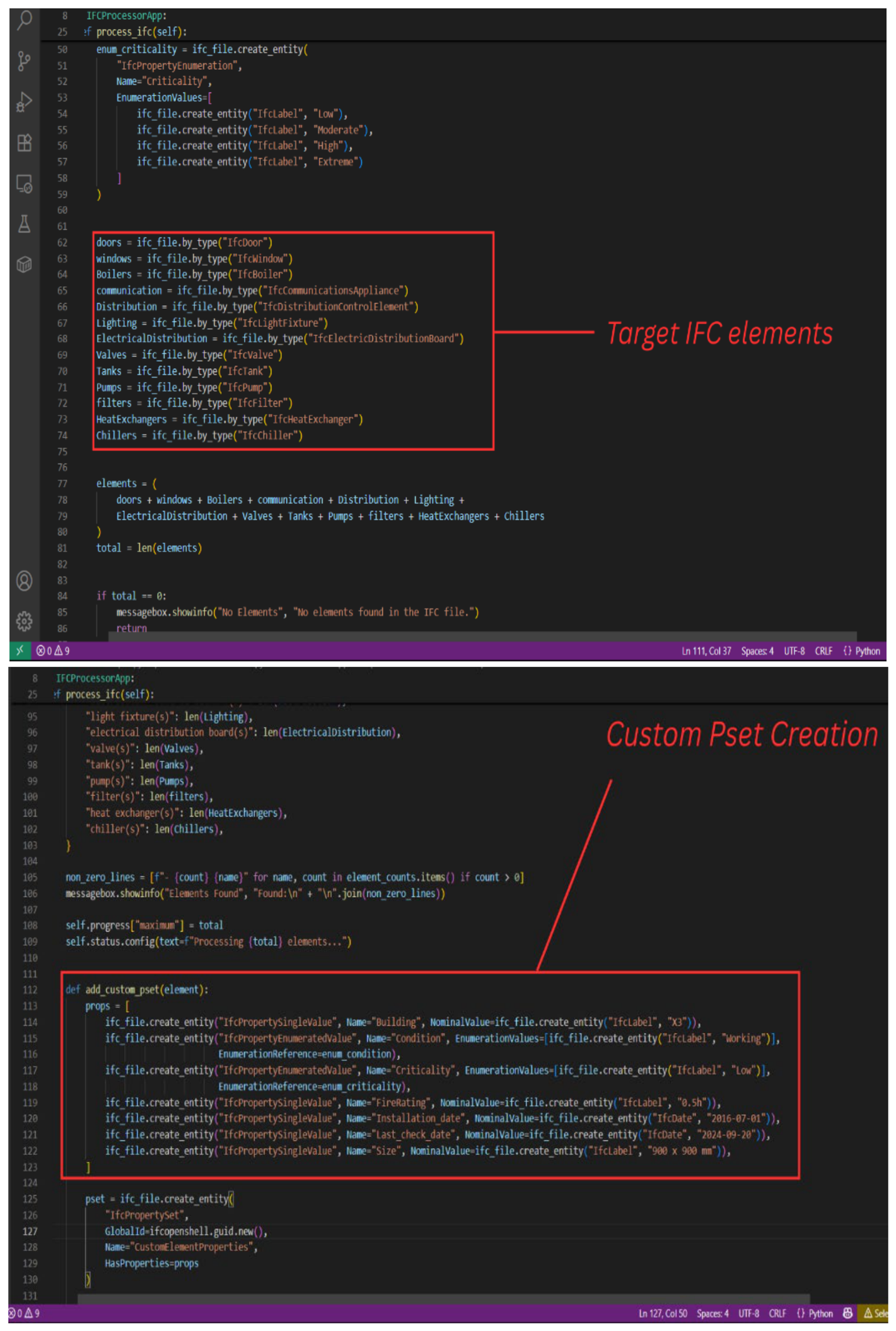
attach Custom Pset: For each target element found, the script creates an instance of the ConstantElementProperties Pset, populates it with the predefined FM attributes, and attaches it directly to the IFC entity. This operation is handled through the IfcOpenShell API functions ifcopenshell.api.run(“pset.add_pset”, …) and ifcopenshell.api.run(“pset.edit_pset”, …);
- −
generate Enriched Output: Once all target elements are processed, the script saves a new enriched IFC file. This output retains the original structure and geometry of the model while embedding the FM-specific metadata. The result is a data-rich Asset Information Model (AIM) that bridges the design and operational phases without relying on proprietary middleware.
To improve the reproducibility of the proposed framework, the internal logic of the Python-based enrichment tool is summarized in Algorithm 1. The procedure starts by loading the source IFC model and defining the target IFCs according to the FM information requirements. The script then retrieves all relevant instances (e.g., IfcDoor, IfcWindow, IfcBoiler, and IfcFlowTerminal) and checks whether the custom Property Set ConstantElementProperties is already assigned to each element. If the Property Set is absent, it is created and attached to the entity; otherwise, the existing set is retrieved and updated. The predefined FM attributes—such as Condition, Criticality, Installation_Date, Last_Check_Date, Maintenance_Frequency, Manufacturer, and Model_ID—are then written as IfcPropertySingleValue entries through the IfcOpenShell API. After processing all target elements, the script exports a new enriched IFC file while preserving the original geometry and relational structure of the model. In parallel, a log file is generated to record processed entities and assigned attributes, thus supporting traceability and quality control (Algrotithm 1).
| Algorithm 1. Simplified pseudocode of the IFC enrichment workflow |
Input: source_ifc_file, target_entity_types, fm_attributes_dictionary
Output: enriched_ifc_file, processing_log
1: model ← open IFC file(source_ifc_file)
2: log ← initialize empty log
3: for each entity_type in target_entity_types do
4: elements ← get all instances of entity_type from model
5: for each element in elements do
6: if ConstantElementProperties is not assigned to element then
7: pset ← create and attach ConstantElementProperties
8: else
9: pset ← retrieve existing ConstantElementProperties
10: end if
11: for each (property_name, property_value) in fm_attributes_dictionary do
12: write property_name and property_value into pset
13: end for
14: append processed element ID and assigned properties to log
15: end for
16: end for
17: save enriched IFC model as new output file
18: export processing log |
The Python application also generates a log file listing all processed elements and the attached property values. This log supports traceability, quality control, and potential error diagnostics during the enrichment phase.
The enriched IFC files produced through this process are fully compliant with the IFC4 schema and can be opened, queried, or visualized using multiple BIM viewers—including BlenderBIM, BIMvision, and Navisworks—confirming the platform-independent nature of the workflow. The embedded ConstantElementProperties Pset acts as a semantic bridge between the BIM environment and the CMMS platform, allowing the OpenMAINT import engine to automatically populate asset cards, maintenance schedules, and spatial hierarchies. By embedding FM intelligence directly into the IFC model, the proposed framework eliminates the need for manual data re-entry, reduces information loss during project handover, and ensures that operational data remains both machine-readable and human-interpretable throughout the asset lifecycle, as reported in
Figure 2.
2.4. Validation and CMMS Integration Workflow
The validation and integration phase was designed to ensure that the enriched IFC models produced through the data-enrichment framework maintained full schema compliance, semantic integrity, and interoperability across different software environments. This step verified that the programmatic injection of FM-oriented data did not alter the model’s structure and that the information could be effectively imported and managed within a Computerized Maintenance Management System (CMMS), in this case, OpenMAINT.
2.4.1. Schema Compliance Validation
The enriched IFC files were first validated using the official buildingSMART IFC Validation Service, a web-based platform that verifies adherence to the IFC standard (ISO 16739-1:2018). This validation process checks the model against four main criteria:
STEP Syntax Check—Ensures that the file conforms to the ISO 10303-21 syntax for STEP Physical Files.
IFC Schema Verification—Confirms that all entities, attributes, and relationships comply with the IFC4 EXPRESS schema definitions.
Normative IFC Rules—Validates the correct use of inverse attributes, cardinalities, and type constraints as defined by buildingSMART implementer agreements.
Industry Practice Review—Provides non-normative guidance on model quality and good practices.
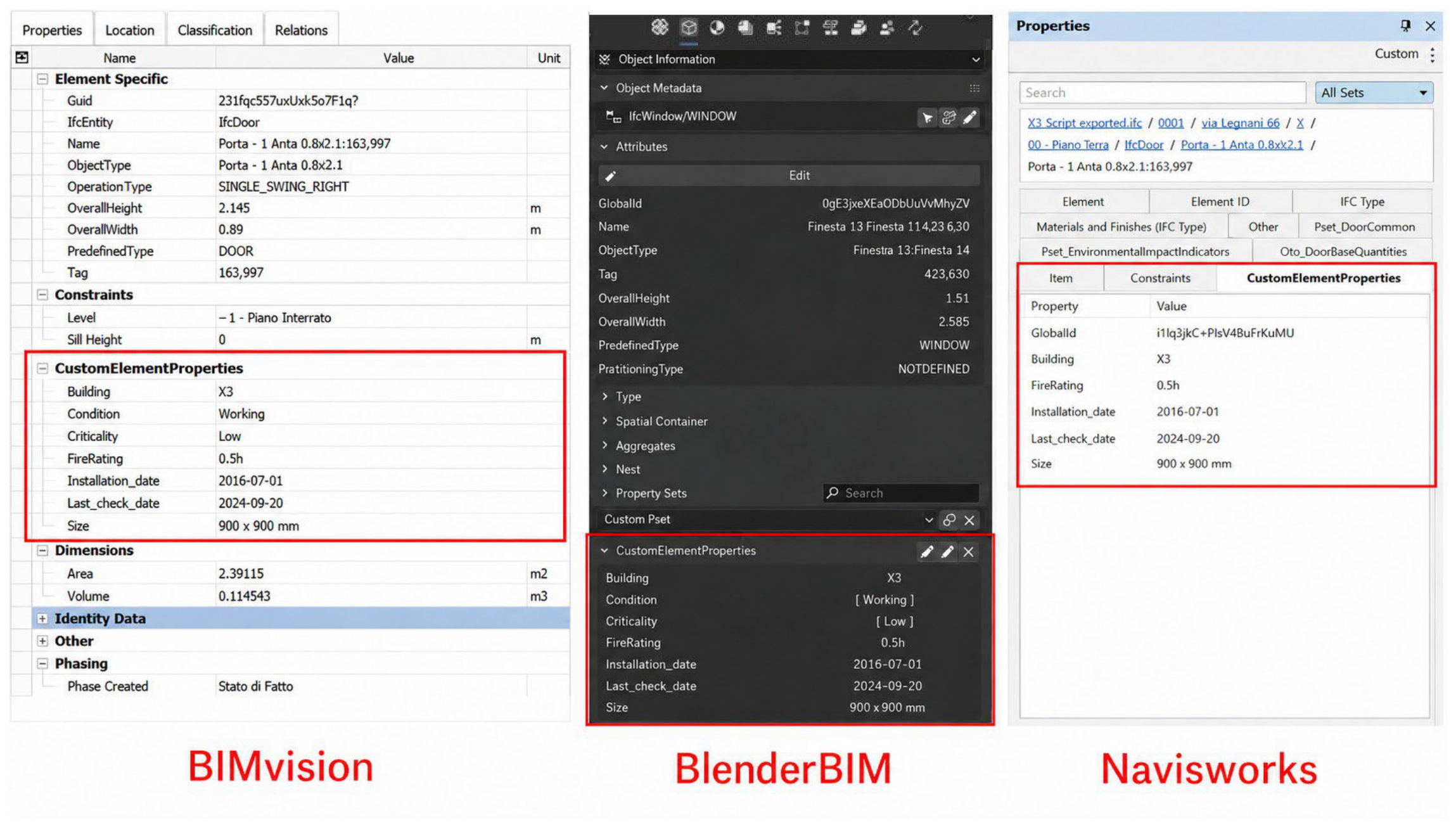
All enriched models successfully passed the normative checks, demonstrating 100% compliance with the IFC4 schema. The validation confirmed that the inclusion of the custom ConstantElementProperties Pset did not compromise the structural or semantic integrity of the model. In addition to formal validation, a cross-platform interoperability test was conducted using three independent IFC viewers—BlenderBIM, BIMvision, and Autodesk Navisworks. Each tool was able to correctly read and display the embedded Property Sets and their values, confirming the consistency of the enrichment across different software implementations.
Figure 3 illustrates the visualization of the Pset attributes in multiple platforms, showing identical results in all cases.
2.4.2. OpenMAINT Integration and Data Mapping
After validation, the enriched IFC files were imported into OpenMAINT, an open-source CMMS developed on the CMDBuild framework. This platform was selected for its native support of open standards and flexibility in defining import templates. A custom JSON-based import template was created to establish direct mapping between the properties in the ConstantElementProperties Pset and the corresponding fields in the OpenMAINT database. The mapping rules included:
- −
IfcGlobalId to Unique asset identifier in the CMMS database;
- −
Condition to Current operational state field;
- −
Criticality to Priority index for maintenance scheduling;
- −
Installation_Date/Last_Check_Date to Maintenance and inspection log entries;
- −
Model_ID to Asset reference code;
- −
Maintenance_Frequency to Preventive maintenance interval field.
It is important to distinguish between the total number of IFC elements processed during the enrichment phase and the subset of elements considered maintainable assets for CMMS registration. The Python tool parsed and checked all relevant IFC entities in the exported models; however, only objects corresponding to assets requiring inspection, preventive maintenance, replacement tracking, or operational monitoring were mapped to OpenMAINT asset cards. The filtering was performed through a predefined rule-based selection of IFC entity classes and asset categories derived from the OIR and the CMMS asset taxonomy. Non-maintainable geometric or spatial elements, such as walls, slabs, spaces, openings, annotations, and purely reference objects, were excluded from CMMS registration, although they remained part of the enriched IFC model.
Table 4 summarizes the selection logic adopted for maintainable asset registration.
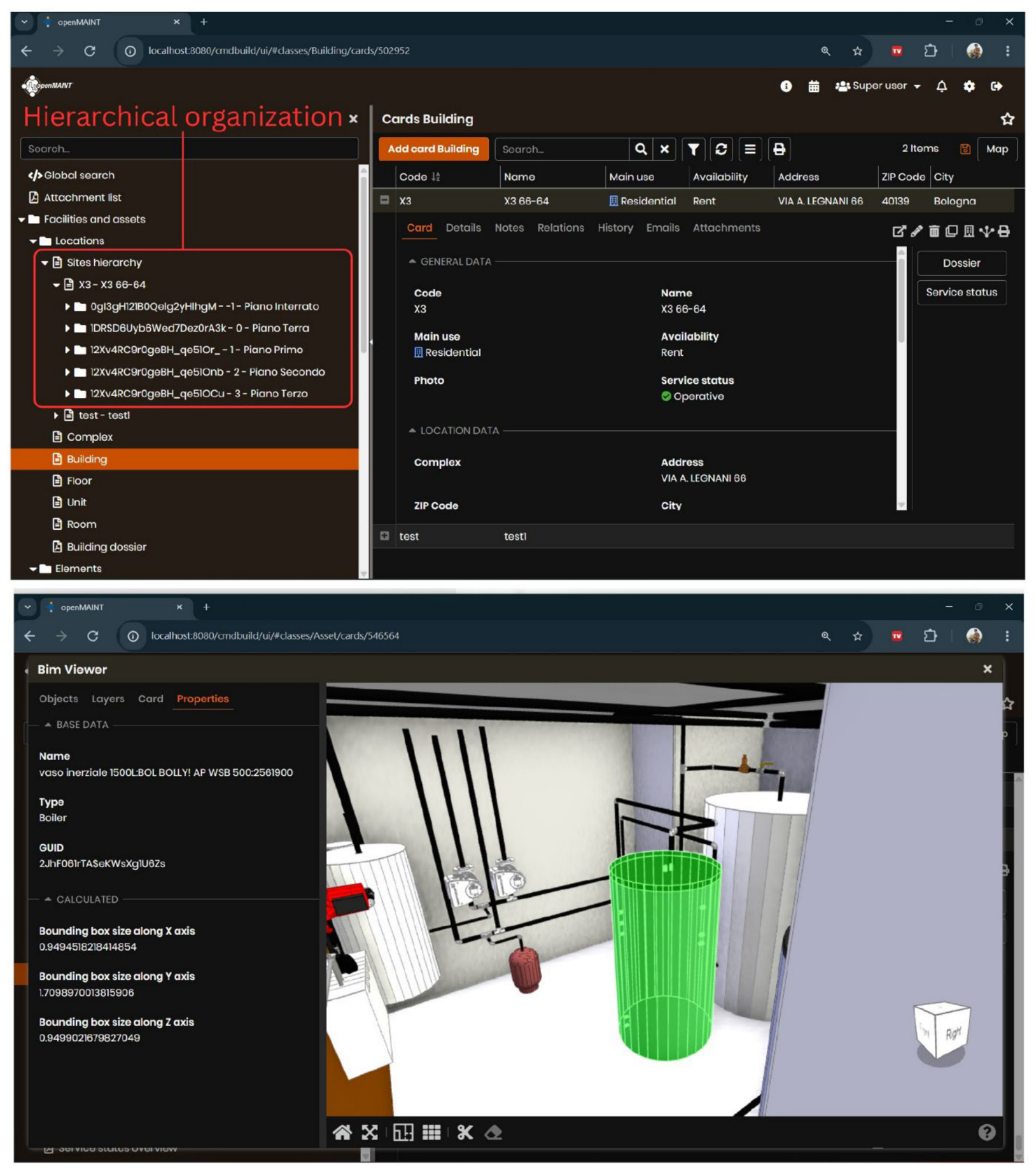
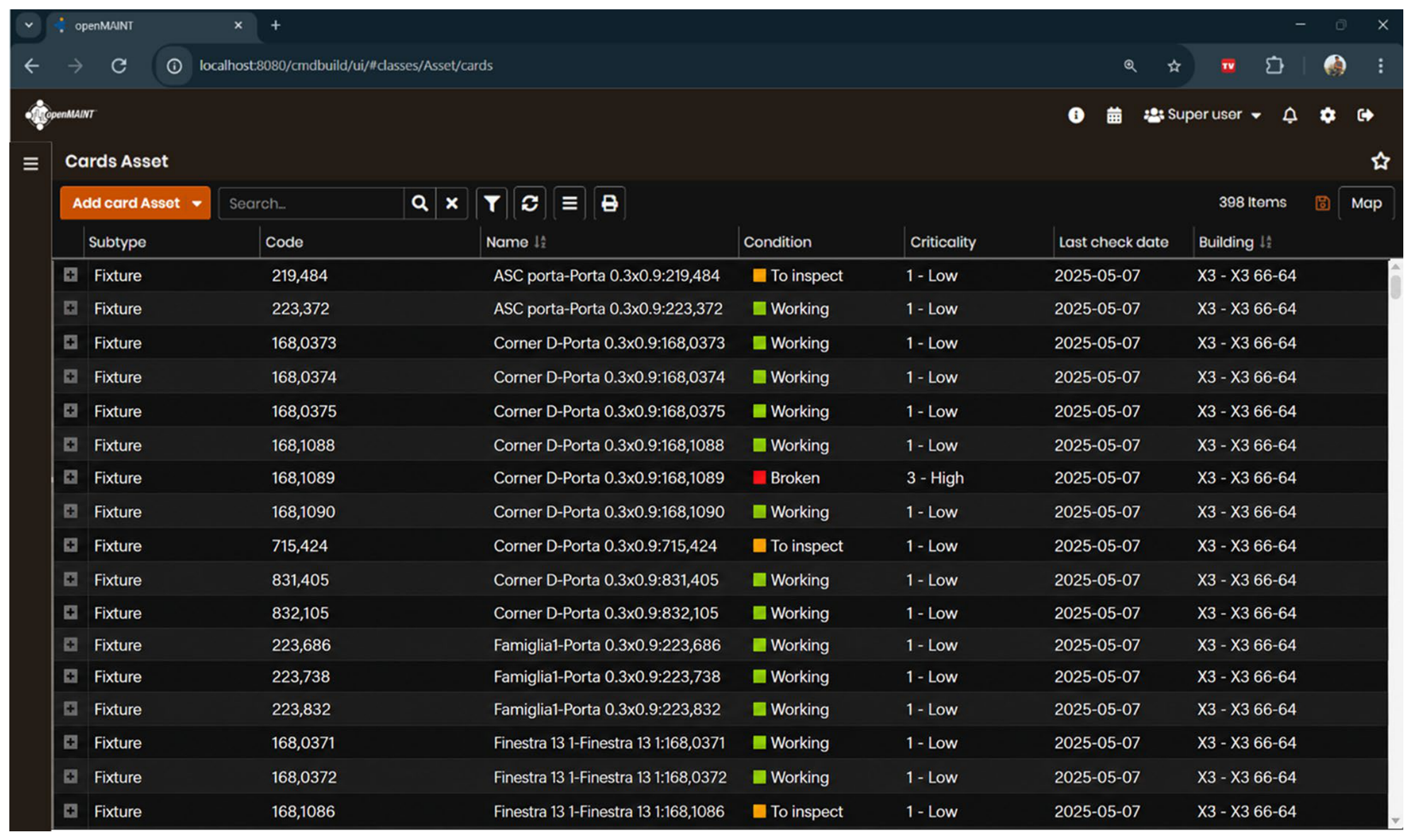
This template enabled the automated creation of building and asset cards within OpenMAINT. The import process reconstructed the spatial hierarchy (IfcProject > IfcBuilding > IfcBuildingStorey > IfcElement) and generated structured asset records linked to their corresponding BIM entities through the Global Unique Identifier (GUID). Once imported, the data became immediately available within the CMMS environment for operations such as maintenance planning, work-order management, and performance monitoring, as in
Figure 4.
The integrated workflow, comprising IFC enrichment, schema validation, and CMMS import, was assessed based on three criteria:
Technical Compliance: All enriched IFC files achieved full conformity with IFC4 schema rules, as verified by buildingSMART’s validation tool.
Functional Interoperability: The custom Pset data were successfully imported into OpenMAINT and correctly mapped to CMMS database fields without loss or alteration of information.
Process Efficiency: The automated import pipeline reduced manual data-entry efforts by approximately 85% compared to conventional COBie-based handover workflows, significantly minimizing transcription errors and redundancy.
The combined validation confirmed the robustness, transparency, and repeatability of the proposed framework. By embedding FM data directly into open-standard IFC models, the workflow provides a sustainable and vendor-independent pathway for digital asset management.
3. Results
The implementation of the proposed framework within the Risanamento case study produced significant technical and operational results, demonstrating the framework’s feasibility, robustness, and interoperability across the BIM–FM workflow. The results confirm that the integration of open standards, IFC data enrichment, and open-source CMMS platforms can effectively bridge the long-standing disconnect between design-oriented BIM environments and operational FM systems. The outcomes were analyzed according to three perspectives: (1) quantitative performance, (2) technical validation and interoperability, and (3) operational effectiveness within FM workflows.
The framework was deployed across two residential buildings, encompassing twelve discipline-specific BIM models (six per building). The enrichment and integration process yielded quantifiable benefits in terms of data quality, automation, and efficiency.
Table 5 summarizes the principal quantitative results of the implementation.
The data confirm that the Python-based enrichment tool performs efficiently even on medium-scale models, producing lightweight output files while maintaining full schema integrity. The marginal increase in file size (<3%) demonstrates that the inclusion of FM-oriented metadata does not compromise model manageability. Each execution generated a structured log file recording the number of elements processed and any anomalies detected. No processing errors or missing entities were observed, indicating stable performance and reliable data handling.
The reported reduction in manual data-entry effort, approximately 85%, was estimated by comparing the working hours required for asset data population and subsequent updates using the standard workflow previously adopted by the organization with those required when applying the proposed IFC-based enrichment and OpenMAINT import workflow. Therefore, this value should be interpreted as a case-study-based operational estimate rather than as a generalized benchmark against all possible COBie-based handover procedures.
The results confirm that the proposed open-standard BIM–FM integration workflow is technically sound, semantically consistent, and operationally effective. The framework performs the following:
- −
Maintains full IFC4 schema compliance verified through formal validation;
- −
Achieves automated and accurate asset registration within an open-source CMMS;
- −
Reduces manual intervention and error rates associated with data handover;
- −
Demonstrates scalability and robustness across multiple buildings and datasets.
The adoption of a programmatic, IFC-based data enrichment process enables the transition from static, design-oriented BIM models to dynamic, data-rich AIM capable of supporting lifecycle Facility Management.
3.1. Framework Validation and Interoperability
The validation of the proposed framework was designed to assess its technical robustness, interoperability across software environments, and compliance with open-standard requirements. This evaluation focused on confirming that the enrichment and integration process maintained the integrity of the IFC model, ensured compatibility across platforms, and effectively linked the enriched data with the CMMS database.
The first level of validation consisted of a formal compliance check using the buildingSMART IFC Validation Service, the authoritative online platform for verifying adherence to the IFC4 schema (ISO 16739-1:2018). Each enriched model was tested for:
- −
STEP syntax integrity, ensuring that the output complied with the ISO 10303-21 standard for physical file formatting;
- −
Entity and attribute compliance, verifying that all classes and relationships conformed to the EXPRESS schema definitions;
- −
Normative rule enforcement, confirming that inverse attributes, type constraints, and cardinalities were respected;
- −
Structural consistency, verifying that no geometry loss, GUID duplication, or orphaned references occurred during the enrichment process.
All enriched IFC files successfully passed every validation step, confirming 100% compliance with the IFC4 schema. This demonstrated that the programmatic injection of FM-related Property Sets via IfcOpenShell did not alter the semantic or geometric structure of the models.
3.1.1. Cross-Platform Verification
To further verify interoperability, the enriched IFC files were opened and inspected in three independent, IFC-compliant software environments:
- −
BIMvision (proprietary viewer with advanced property inspection tools);
- −
BlenderBIM (open-source IFC authoring and editing environment);
- −
Autodesk Navisworks Manage (commercial coordination software).
In each platform, the custom Property Set (ConstantElementProperties) and its attributes, Condition, Criticality, Installation_Date, Last_Check_Date, etc., were correctly displayed and associated with the intended building elements. Property values were identical across all viewers, demonstrating semantic consistency and platform-independent readability. This visual and semantic verification provided clear evidence that the enriched models remained fully interoperable, with no dependency on the software used for enrichment or authoring. The correct display of the same custom data across different tools validates the reliability of the IfcPropertySet extension mechanism as implemented in the framework.
3.1.2. Integration Validation with OpenMAINT
The second level of validation was conducted within the OpenMAINT CMMS platform, which served as the target environment for operational data management. A custom JSON-based import template established direct field mapping between the attributes in the ConstantElementProperties Pset and the corresponding database fields in OpenMAINT. This integration was validated by importing the enriched IFC models into the CMMS, triggering the automatic generation of asset records and the hierarchical reconstruction of the building structure (IfcProject > IfcBuilding > IfcBuildingStorey > IfcElement). Each asset retained its original IfcGlobalId, which ensured a one-to-one correspondence between the BIM element and its CMMS entry.
During the import process, the following were observed:
- −
All 428 maintainable assets were successfully registered without manual intervention;
- −
Every mapped field was populated accurately, with no missing or misaligned attributes;
- −
The data hierarchy in the CMMS exactly mirrored the spatial and functional organization of the IFC model.
To further verify semantic consistency after import, a sample-based field check was performed on representative assets registered in OpenMAINT. For each sample asset, the values embedded in the ConstantElementProperties Property Set were compared with the corresponding CMMS fields populated after import. The check confirmed that the main FM attributes were transferred without loss, misalignment, or type inconsistency.
Table 6 reports representative examples of the semantic mapping verification.
The visual inspection in OpenMAINT confirmed that the imported assets preserved their metadata and maintained full traceability to the original IFC entities. The framework’s performance demonstrated lossless data transfer and seamless semantic interoperability between the BIM and FM domains.
3.1.3. Interoperability Assessment
The validation outcomes collectively demonstrate that the framework ensures three complementary forms of interoperability:
- −
Syntactic interoperability—achieved through complete IFC4 schema compliance verified by buildingSMART;
- −
Semantic interoperability—confirmed by the correct interpretation of custom property data across independent IFC viewers;
- −
Functional interoperability—established through the automated, error-free population of the CMMS database from the enriched IFC model.
These results validate the core premise of the research: open standards and open-source tools can achieve an end-to-end information flow—from design models to operational databases—without reliance on proprietary middleware or manual data transfer.
3.2. Automated and Structured CMMS Population
Following the successful validation of the enriched IFC models, the next step of the research focused on the automatic import and population of asset data within the open-source CMMS platform OpenMAINT. This phase represented the operational implementation of the framework, testing its capability to transfer semantically rich BIM information into a facility management environment without manual intervention.
3.2.1. Automated Import Process
A custom JSON-based import template was developed in OpenMAINT to translate IFC data into structured CMMS records. This template defined a one-to-one mapping between the attributes in the ConstantElementProperties Property Set and the corresponding fields in the OpenMAINT database. The mapping ensured that every enriched element in the IFC file automatically generated a corresponding record in the CMMS, with attributes correctly placed within the designated fields. The mapping structure was defined in
Table 7.
Upon import, the OpenMAINT engine automatically parsed the hierarchical structure of the IFC model (IfcProject → IfcBuilding → IfcBuildingStorey → IfcElement), reconstructing the same organizational hierarchy within the CMMS database. This resulted in a complete and logically structured asset inventory, in which each record was spatially and functionally linked to its location within the building.
3.2.2. Hierarchical Structure and Asset Card Generation
The import process generated a multi-level facility structure composed of:
Building level, representing each real estate unit;
Floor level, corresponding to IFC storeys;
Asset level, encompassing all maintainable elements enriched with the ConstantElementProperties Pset.
A total of 428 asset cards were automatically created, including equipment such as doors, windows, boilers, and mechanical fixtures. Each asset record contained operational data inherited from the IFC attributes—such as Condition, Criticality, Maintenance Frequency, and Last Check Date—which were displayed in the OpenMAINT interface immediately upon import.
The system automatically linked every CMMS asset record with its geometric counterpart in the BIM model through the Global Unique Identifier (GUID), ensuring traceability and bidirectional reference. This linkage eliminated redundancy and guaranteed that any CMMS record could be visually located within the 3D model environment.
3.2.3. Visual Integration and Spatial Linkage
The integration between the enriched IFC model and OpenMAINT’s 3D viewer demonstrated the functional potential of the framework. Selecting an asset in the CMMS list triggered its instant visualization in the spatially referenced 3D model. Likewise, choosing an element directly within the 3D viewer highlighted the associated record in the CMMS database.
This bi-directional visual connection proved invaluable for daily facility operations, enabling:
- −
Immediate asset localization, particularly in dense mechanical or electrical rooms;
- −
Visual maintenance planning, allowing work orders to be associated directly with model elements;
- −
Enhanced situational awareness, as facility managers could analyze system dependencies and spatial relationships intuitively.
3.2.4. Evaluation of Automation and Data Integrity
The automated import workflow was evaluated based on accuracy, completeness, and processing time. All maintainable assets defined in the IFC file were successfully imported with 100% data integrity—no missing, duplicated, or corrupted entries were reported. The entire process, from initiating the import to database population, required less than three minutes per building, marking a drastic reduction compared to traditional manual data entry.
In addition, validation of the generated records confirmed that the imported hierarchy accurately mirrored the IFC model structure, maintaining identical naming conventions and spatial relationships. This alignment ensures that the digital twin created within OpenMAINT remains semantically consistent with the source BIM environment.
3.2.5. Operational Benefits
The automated population of the CMMS database demonstrated tangible benefits for facility management activities. Compared to the cooperative’s legacy workflows, which relied on manual spreadsheet imports and non-standardized data entry, the new method achieved:
- −
Substantial time savings in asset onboarding;
- −
Higher data reliability, as the process eliminated typographical errors and inconsistencies;
- −
Enhanced user accessibility, with a unified environment linking geometry, metadata, and maintenance history;
- −
Improved long-term maintainability, as the open-standard approach allows for continuous model updates without vendor dependency.
Overall, the integration of enriched IFC models into OpenMAINT confirmed the effectiveness and repeatability of the proposed open-standard workflow (
Figure 5). The process transformed static BIM data into an operationally actionable digital twin, establishing a continuous information flow between design, construction, and facility operation phases.
The next section presents the final interpretation of these findings and their implications for lifecycle BIM adoption, open-standard governance, and future digital twin development.
3.3. CMMS–BIM Integration for Real-Time Facility Management
The final stage of the framework implementation focused on achieving a functional integration between the Computerized Maintenance Management System (CMMS) and the enriched BIM model, enabling real-time visual interaction with facility data. This phase validated not only the technical linkage between datasets but also the practical usability of the integrated environment for Facility Management operations.
3.3.1. Visual Linkage Between CMMS and BIM
Within OpenMAINT, the imported IFC model was visualized using the platform’s integrated 3D viewer, which establishes a direct connection between the geometric entities of the BIM model and their corresponding database records. Each maintainable asset imported from the enriched IFC file retained its IfcGlobalId, used as the key reference in both systems. This mechanism enabled full bi-directional navigation:
- −
Selecting an element within the 3D model automatically highlights the corresponding asset card in the CMMS interface;
- −
Conversely, clicking on an asset record within the CMMS immediately locates and isolates the related component in the 3D view.
This capability allows facility managers to move seamlessly between spatial and tabular data representations, bridging the traditional divide between geometry and information.
3.3.2. Functional Advantages for Facility Operations
Visual integration proved particularly valuable for everyday FM tasks, improving both efficiency and situational awareness. The combined BIM–CMMS interface supports several operational functions.
Maintenance technicians benefit from the system’s ability to precisely locate assets within complex mechanical rooms, significantly reducing search time and minimizing the likelihood of identification errors. Moreover, work orders generated in OpenMAINT can be directly associated with the corresponding components in the 3D model, enabling immediate visual confirmation of task locations and the systems involved, which enhances clarity throughout maintenance workflows. The integrated 3D environment also supports facility managers in analyzing spatial dependencies between assets—such as the proximity of mechanical, electrical, and hydraulic systems—thereby informing decisions related to maintenance sequencing, risk mitigation and retrofit planning. In addition, the three-dimensional representation offers an intuitive learning environment for personnel who may be less familiar with traditional 2D technical drawings, ultimately improving knowledge transfer, communication and coordination across operational teams.
The combination of structured asset data, hierarchical organization, and real-time spatial feedback transforms the CMMS from a static database into an interactive digital twin that reflects both the geometry and operational state of the facility.
3.3.3. Assessment of Visual Integration
From a technical standpoint, the visual integration achieved complete synchronization between the BIM model and the CMMS database. All 428 assets enriched and imported during the previous phase were visually accessible, correctly located, and cross-referenced within the OpenMAINT interface. The 3D viewer exhibited smooth performance with models of moderate size (≈75–80 MB per file), confirming the framework’s scalability for multi-building portfolios. No inconsistencies or broken links were observed during the tests. Each visual query accurately retrieved the corresponding database record, confirming the integrity of the IFC–CMMS linkage through the preserved GUID structure. Performance monitoring revealed that the visualization and query operations remained efficient even when multiple assets were displayed simultaneously. This indicates that the open-source architecture of OpenMAINT, combined with the lean structure of the enriched IFC files, provides a technically robust and responsive environment for operational use.
3.3.4. Operational Impact
The integrated environment has direct implications for the efficiency and reliability of facility operations:
- −
Reduced maintenance response time: Technicians can visually locate assets and related systems within seconds, streamlining troubleshooting and reducing downtime.
- −
Improved data reliability: As all asset data originates from the validated IFC source, the risk of inconsistencies between geometric and tabular information is eliminated.
- −
Support for lifecycle management: The 3D-linked database supports long-term asset monitoring, facilitating preventive maintenance planning, energy performance analysis, and future renovations.
- −
User empowerment: By relying solely on open standards and open-source technologies, the system provides a sustainable, low-cost alternative for long-term digital asset governance.
Overall, the integrated BIM–CMMS environment transforms facility management from a reactive, data-fragmented process into a proactive, information-driven practice. By ensuring continuous alignment between geometric and operational data, the framework establishes a reliable foundation for lifecycle asset management and the progressive implementation of intelligent digital twin solutions.
4. Discussions
The results of this research confirm that interoperability across the BIM–FM continuum can be effectively achieved using open-standard methodologies. Beyond the technical demonstration of the framework’s functionality, the findings highlight a broader transformation in how information is structured, exchanged, and maintained across the building lifecycle. Historically, the operational phase has represented a critical discontinuity in the digital flow of information, as the BIM models developed for design and construction rarely evolve into usable resources for facility management. The proposed framework directly addresses this limitation by transforming conventional, design-oriented BIM models into structured AIM capable of sustaining long-term asset management. In this perspective, the IFC standard emerges not merely as a data exchange format but as a carrier of domain knowledge, encapsulating geometry, semantics, and operational metadata within a single, interoperable model. By programmatically enriching IFC entities with FM-specific Property Sets, the framework demonstrates that open standards can natively support the requirements of lifecycle information management without resorting to proprietary extensions or middleware. This approach is consistent with the principles of ISO 19650, UNI 11337, and buildingSMART’s openBIM vision, which collectively promote transparency, traceability, and long-term accessibility of information. The proposed workflow embodies these principles by linking governance (OIR), modeling (IFC) and operations (CMMS) into a unified and standards-compliant data ecosystem. In doing so, it promotes a shift from software-dependent modeling practices toward data-centric governance, where information becomes a durable organizational asset rather than a by-product of design. The study demonstrates that open standards can support not only data exchange but also digital continuity, enabling a seamless flow of validated information from design intent to daily operations. This continuity represents a key milestone toward the practical realization of digital twin environments in real-world facility contexts.
4.1. Interpretation of Findings
The implementation of the framework revealed that the IFC schema’s extensibility can be effectively leveraged to embed operational metadata while maintaining full compliance with international standards. This capability validates the hypothesis that open standards alone can sustain the transition from design to operation, provided that information is structured according to well-defined organizational requirements. The automatic population of OpenMAINT’s database from enriched IFC files constituted the core functional advancement. By automating asset registration, the framework reduced information transfer time by approximately 85% and eliminated transcription errors, transforming the traditional, fragmented handover into a machine-readable and auditable process. The resulting dataset ensures that all information transferred from the BIM environment remains traceable to its geometric source, strengthening accountability and transparency. The integration of spatial (geometric) and semantic (informational) dimensions creates a digital twin foundation, where each modeled element is simultaneously a physical reference and a carrier of operational knowledge. This dual representation enables advanced FM functions, such as predictive maintenance, asset condition tracking, and space optimization, traditionally impossible with static or document-based systems. The outcomes, therefore, confirm that interoperability is not merely a technical goal but a strategic enabler of data governance, empowering organizations to maintain information integrity across phases and disciplines. Nevertheless, the present validation remains primarily focused on technical feasibility, standards compliance and operational interoperability. The study does not yet provide a formal benchmark against alternative BIM–FM transfer approaches, nor does it include a dedicated error, stability, or sensitivity analysis under varying information conditions. Although no failed imports, missing entities or script execution errors were observed in the reported case-study applications, broader comparative and robustness-oriented testing will be necessary to further strengthen the scientific validation of the proposed workflow.
4.2. Contribution to Knowledge and Industry Practice
While BIM–FM integration is an established research topic, the novelty of this study lies in the specific implementation strategy adopted. Rather than proposing a purely theoretical framework or relying on intermediate handover formats such as COBie or on software-dependent export routines, this research develops a standalone, software-agnostic, post-export workflow that directly enriches IFC entities with FM-oriented Property Sets and enables their automated mapping into an open-source CMMS environment. The contribution, therefore, lies not in the isolated use of existing tools, but in their integration into a unified, reproducible, and vendor-neutral open-standard workflow for lifecycle BIM–FM interoperability.
The contribution of this study can be summarized in two main innovations. First, it establishes an end-to-end open-source BIM–CMMS workflow that operates on IFC files in a post-export and software-agnostic manner, without relying on proprietary middleware for data enrichment and CMMS population. Second, it introduces an OIR-driven FM data structuring and mapping mechanism, in which custom IFC Property Sets are defined in a schema-compliant manner according to organizational information requirements and directly translated into asset records within an open-source CMMS environment.
Because the present study does not include a controlled benchmark under identical experimental conditions, the following comparison should be interpreted as a qualitative positioning of representative BIM–FM integration strategies rather than as a formal performance ranking (
Table 8).
This approach offers three distinct advantages that contribute to both knowledge and industry practice:
Software Agnosticism: The Python script operates on the IFC file post-export, making it independent of the original BIM authoring software (e.g., Revit, ArchiCAD, etc.). This ensures the workflow is applicable across a wide range of project environments and toolchains.
Scalability and Customization: The script-based nature of the tool means it can be easily customized to include different Psets, attributes, or target elements. This allows it to be adapted to diverse project types (e.g., hospitals, offices, and infrastructure) and varying organizational needs, making it a highly scalable solution.
Democratization of BIM Lifecycle: By exclusively using open standards and open-source libraries, the framework champions a non-proprietary approach to digital construction. This significantly lowers the barrier to entry for small- and medium-sized enterprises (SMEs), asset owners, and facility managers who may not have the resources to invest in expensive, closed software ecosystems, thereby democratizing access to advanced lifecycle BIM workflows.
4.3. Organizational and Technical Implications
The research holds substantial implications for both organizational strategy and technical implementation. At the organizational level, grounding the workflow in the OIR ensures that information management is purpose-driven rather than technology-driven. This approach aligns with ISO 19650’s emphasis on defining information needs at the outset, ensuring that every dataset serves a defined operational purpose. From a technical perspective, the research underscores the potential of openBIM for long-term data resilience. By eliminating proprietary dependencies, the framework preserves data accessibility and interoperability even as software ecosystems evolve. The reliance on IfcOpenShell and OpenMAINT also fosters skill development and self-sufficiency within organizations, enabling them to manage their own digital ecosystems rather than outsource data control. In practical terms, this framework represents a scalable foundation for portfolio-level asset management. The consistent structure of enriched IFC files allows multiple buildings to be integrated into a single federated CMMS, supporting regional or corporate-level oversight. This scalability is particularly beneficial for public housing entities, universities, or infrastructure operators seeking cost-effective digital transformation strategies. The same workflow could also be extended to more complex facilities, such as hospitals, laboratories, or industrial buildings, by expanding the target IFCs, FM attributes, and validation rules in accordance with more heterogeneous equipment portfolios and stricter regulatory data requirements. Its application to projects of different scales and geographical contexts would primarily depend on the redefinition of organizational information requirements, asset taxonomies, naming conventions, and regulatory attribute sets. Moreover, the combination of structured property data and 3D-linked interfaces marks a step toward evidence-based decision-making in facility management. Managers can now rely on data derived directly from validated BIM sources to inform maintenance planning, budgeting, and resource allocation. Despite the successful validation, and while the research achieved all its primary objectives, some limitations must be acknowledged as directions for future improvement. These limitations are technical and also methodological. In particular, the current study does not include a formal quantitative benchmark against alternative BIM–FM transfer approaches, and the comparison with related solutions should therefore be interpreted as a qualitative positioning of the proposed workflow rather than as a performance-based superiority claim. Three main limitations deserve further technical clarification. First, the current workflow supports only a unidirectional flow of information from BIM to CMMS. This limitation mainly derives from the absence of a transactional synchronization layer capable of writing operational updates, such as maintenance completion, inspection outcomes, or asset replacement, back into the master IFC/AIM environment. In practical terms, this means that the CMMS and the BIM model may progressively diverge over time, reducing the long-term consistency of the digital asset representation. A concrete future development path would therefore involve API-based synchronization or IFC transaction mechanisms capable of managing controlled round-trip updates between the FM database and the BIM environment.
Second, the use of the custom ConstantElementProperties Pset, while effective for the present implementation, reflects the current lack of fully mature and broadly adopted FM-oriented standardized exchange structures for this specific workflow. The practical implication is that, although the method is interoperable at the schema level, wider cross-organizational adoption may still require project-specific mapping efforts. For this reason, future work should focus on progressively aligning the current attribute structure with emerging buildingSMART FM handover initiatives and future standardized FM Property Sets, so that the enrichment logic can evolve from a case-specific implementation into a more broadly reusable exchange model.
Third, the framework currently operates on static operational data and does not yet integrate live data streams from IoT sensors or BMS. This limitation is primarily due to the need for additional data pipelines, semantic alignment mechanisms, and secure interoperability layers capable of linking real-time observations to IFC-based asset entities. In practical applications, this prevents the current workflow from supporting continuous monitoring, condition-based maintenance, and predictive analytics in a fully dynamic manner. A specific research direction is therefore the development of ontology-based integration schemes and secure middleware connectors able to associate sensor data, BMS events, and CMMS records with the corresponding BIM elements in a persistent and machine-readable way.
Despite these limitations, the framework establishes a robust foundation for continued development toward smart, connected asset ecosystems governed entirely by open standards.
5. Conclusions and Future Work
This research successfully designed, developed, and validated a scalable, open-standard framework for integrating BIM with FM systems. Through the programmatic enrichment of IFC models with custom, FM-specific Property Sets using a Python-based application, this work has demonstrated a practical and accessible method for bridging the persistent information gap between the construction and operational phases of a building’s lifecycle. The validation, conducted through a real-world case study and integration with the OpenMAINT CMMS, confirmed that this approach causes the automated and reliable population of a complete asset inventory. The resulting system provides facility managers with a powerful, spatially aware tool for intelligent building operations, directly fulfilling the need for structured, lifecycle-oriented data as mandated by modern information management standards like ISO 19650.
Building upon this robust foundation, future research must address several key areas to advance the framework toward a comprehensive digital twin solution. A primary objective is the development of bi-directional synchronization, which would transform the AIM into a truly dynamic asset by creating a mechanism for data from the CMMS (e.g., maintenance records and status changes) to be written back to the master IFC model, ensuring it remains a living and up-to-date representation of the physical asset. Furthermore, the integration of real-time data from IoT sensors represents the next frontier; extending the framework to link IFC elements with live data streams would enable predictive maintenance algorithms and advanced performance analytics, shifting FM from a reactive to a proactive model. Concurrently, continued engagement with standards bodies like buildingSMART is essential to formalize FM-specific Psets. This action would cause greater industry-wide interoperability, streamline data exchange processes, and ensure the long-term viability and adoption of the proposed methods. Finally, expanding the attribute library through direct collaboration with a wider range of industry professionals will ensure the framework evolves to meet the complex and varied demands of modern facility management. By pursuing these advancements, this approach can evolve from a powerful integration tool into the backbone of an intelligent, interoperable, and truly lifecycle-oriented digital asset management platform.