1. Introduction
With the large-scale integration of renewable energy sources such as wind power, the synchronous inertia of modern power systems has continued to decline, leading to pronounced low-inertia behavior in the grid and increasing the pressure on frequency regulation [
1]. Under such conditions, once the system is subjected to an active power imbalance disturbance, the frequency tends to drop more rapidly and more deeply, making frequency security issues increasingly prominent. Meanwhile, the continuous improvement of grid connection standards and frequency regulation guidelines is driving wind turbines to evolve from passive grid-connected units toward active providers of frequency support [
2]. Therefore, the participation of wind power in frequency regulation has become an inevitable trend, and how to fully exploit its fast response capability while achieving coordinated support with thermal power units has become a key issue that urgently requires further investigation [
3].
To address the above issues, extensive research has been carried out by scholars both in China and abroad on the participation of wind turbines in frequency regulation, leading to the development of various frequency support strategies. Existing methods mainly include fast frequency support strategies based on virtual inertia emulation, enhanced primary frequency regulation strategies based on droop control, and active frequency regulation strategies achieved through power reserve or the release of rotor kinetic energy. References [
4,
5,
6] employ virtual inertia control, which adjusts the output power of the converter based on the detected rate of change in frequency (RoCoF) to emulate the inertia response characteristics of synchronous machines. References [
7,
8,
9,
10] adopt droop control. By introducing a droop coefficient, they emulate the primary frequency regulation characteristics of synchronous machines, and the droop coefficient is flexibly tuned according to operating conditions. References [
11,
12,
13] employ integrated inertia control. By introducing a droop coefficient and a virtual inertia coefficient, they emulate the inertia response and primary frequency regulation characteristics of synchronous machines. Furthermore, they participate in frequency regulation by releasing rotor kinetic energy. The droop coefficient and virtual inertia coefficient are adjusted using fuzzy control. These methods effectively enhance the fast frequency support capability of wind turbines. However, they mainly focus on the wind turbine side and do not fully address the coordination between fast wind turbine support and sustained thermal-unit regulation.
On this basis, related studies have gradually expanded to multi-source coordinated structures, such as wind–storage, wind–thermal, wind–thermal–storage, and hybrid support involving multiple types of wind turbines [
14,
15,
16]. Among these approaches, wind–thermal coordinated frequency regulation has become an important direction in current primary frequency regulation research, as it can simultaneously exploit the complementary advantages of the fast response of wind turbines and the sustained regulation capability of thermal power units.
In the area of wind–thermal coordinated frequency regulation, existing studies have mainly focused on optimizing the action sequence of generating units and the coordination of regulation transitions through methods such as artificial dead band and hierarchical support, thereby improving the coordination between wind turbine support and thermal unit takeover [
17,
18,
19]. Reference [
17] applies hierarchical settings to wind turbines with different converter types, effectively balancing frequency regulation performance under both step power-imbalance scenarios and fluctuation scenarios. References [
18,
19] adjust the participation time of units in frequency regulation by setting frequency regulation deadbands, thereby enhancing the frequency regulation capability of units under various scenarios. Furthermore, relevant studies have shown that key frequency regulation parameters significantly affect the dynamic frequency characteristics and frequency fluctuation characteristics of the system, indicating that threshold or dead-band settings constitute an important foundation for the performance of coordinated frequency regulation [
20,
21,
22]. In addition, some studies have begun to pay attention to the power recovery process after wind turbines release rotor kinetic energy, and have attempted to mitigate adverse disturbances during the recovery stage from the perspectives of available kinetic energy assessment and adaptive compensation [
23,
24]. Overall, existing research has achieved certain progress in coordinated structures, parameter configuration, and energy recovery. However, several issues remain insufficiently addressed. First, the division of regulation responsibilities between wind and thermal resources across different time scales has not been fully clarified. Second, coordinated threshold–output regulation under energy-constrained conditions still requires further investigation. Third, a unified parameter optimization mechanism for complex operating scenarios is still lacking.
More specifically, most existing wind–thermal coordinated frequency regulation methods are still designed using a unified time-domain input. As a result, the fast and slow dynamic components embedded in frequency disturbances are not clearly separated, and the regulation responsibilities of wind turbines and thermal units remain indistinct. At the same time, related studies often approximate the frequency regulation capability of wind turbines as constant, without fully reflecting the real-time variations in their available regulating power caused by wind speed, operating point, and residual rotor kinetic energy [
25]. Under such circumstances, on the one hand, repeated compensation by wind turbines and thermal units for the same frequency deviation may easily occur, thereby weakening the effectiveness of coordinated regulation; on the other hand, wind turbines with relatively limited regulation capability may release excessive kinetic energy under static threshold settings, which may further lead to over-deceleration, increased mechanical stress, and a higher risk of secondary frequency drop. In addition, although multi-stage thresholds serve as nonlinear control elements, their effects on low-frequency oscillation characteristics and stability margins still lack rigorous frequency-domain analysis. Therefore, how to achieve a reasonable division of labor between wind and thermal units under dynamic energy constraints while simultaneously taking into account system stability, recovery smoothness, multi-index coordination, and cross-condition adaptability remains a key issue that urgently needs to be addressed.
Compared with existing wind turbine frequency support methods based mainly on virtual inertia, droop control, fixed dead-band tuning, or hierarchical coordination, the proposed method places more emphasis on the cross-time-scale allocation of regulation tasks between wind turbines and thermal units. Existing methods usually enhance the support capability of wind turbines or adjust their participation thresholds, but the residual imbalance after wind turbine fast support is rarely used to reconstruct the input of the thermal-unit regulation channel. In addition, the available support capability of wind turbines is often simplified as a fixed quantity, while the dynamic relationship among residual kinetic energy, threshold adjustment, releasable power limitation, and frequency-domain stability margin has not been sufficiently considered. Therefore, this paper develops a unified framework that integrates multi-band frequency decomposition, residual-based cross-band feedback, dynamic energy-constrained wind turbine support, and multi-objective parameter optimization.
To address the above issues, this study proposes a wind–thermal coordinated frequency regulation method based on multi-band collaboration and dynamic energy constraints. The main contributions of this paper are summarized as follows:
(1) A cross-time-scale coordinated frequency regulation mechanism with residual-based control is proposed. By decomposing the frequency deviation into high- and low-frequency components, a coordinated framework is constructed in which wind turbines provide fast support for high-frequency disturbances, while thermal power units regulate low-frequency imbalances. Furthermore, a cross-band coupling feedback mechanism is introduced to reconstruct the control input of thermal units from the original low-frequency deviation to the residual imbalance after wind turbine support, thereby fundamentally mitigating repeated compensation and improving takeover smoothness.
(2) A dynamic threshold–power-constrained fast support strategy for wind turbines is developed. By explicitly incorporating the available regulating power and residual rotor kinetic energy into the control law, the proposed method jointly determines the participation timing and output magnitude of wind turbine support through adaptive segmented thresholds and releasable power limits. In addition, the describing function method is employed to reveal the amplitude-dependent equivalent gain characteristics of the nonlinear control structure, and the corresponding frequency-domain stability mechanism is clarified.
(3) A unified multi-objective optimization framework for wind–thermal coordinated frequency regulation is established. By jointly considering the frequency nadir, secondary frequency drop, thermal regulation burden, and wind power utilization, the proposed method enables adaptive parameter configuration under varying wind speeds, disturbance levels, and wind–thermal capacity ratios, thereby enhancing cross-condition adaptability and practical applicability.
The remainder of this paper is organized as follows.
Section 2 presents the system model, problem formulation, and the proposed wind–thermal coordinated frequency regulation method.
Section 3 provides the simulation results and comparative analysis.
Section 4 discusses the advantages, practical implementation, limitations, and future research directions of the proposed strategy.
Section 5 concludes the paper.
2. Materials and Methods
2.1. System Frequency Response Model
To characterize the dynamic behavior of the system during wind–thermal coordinated frequency regulation, an aggregated system frequency response model is established. Let the rated system frequency be
f0, and the actual system frequency be
f(
t); then, the frequency deviation is given by (1).
When an active power imbalance occurs in the system, the frequency dynamics can be expressed by the simplified power balance relationship given in (2).
where
is the equivalent inertia constant of the system,
is the load damping coefficient,
and
denote the frequency regulation power provided by the thermal power unit and the wind turbine, respectively, and
represents the equivalent disturbance power. Equation (2) indicates that the system frequency response is essentially determined by the dynamic balance between the disturbance power and the combined frequency regulation power.
Taking the Laplace transform of (2) yields the frequency-domain representation in (3).
Equation (3) provides the basis for the subsequent modeling and analysis of wind–thermal coordinated frequency regulation.
2.2. Basic Frequency Regulation Models of Wind Turbines and Thermal Power Units
Without considering the improvement mechanisms such as frequency decomposition, cross-band coupling feedback, and dynamic thresholds, both the wind turbine and the thermal power unit take the original frequency deviation signal as a unified input, thus forming a parallel regulation structure. For the wind turbine, the reference value of frequency regulation power is given by (4).
where
is the transfer function of the wind turbine actuation link,
is the fast active power regulation gain,
is the virtual inertia gain, and
is the differential filtering time constant. For the thermal power unit, considering its primary droop regulation and steady-state recovery capability, the basic frequency regulation model is given by (5).
where
is the transfer function of the governor and actuator,
is the thermal unit droop coefficient, and
is the integral recovery coefficient. Δ
f(
s) is the representation of the frequency deviation in the Laplace domain. By substituting (4) and (5) into (3), the closed-loop model of wind–thermal coordinated frequency regulation under the conventional unified-input condition is obtained as (6).
where Δ
P0w(s) and Δ
P0t(s) denote the output power of the wind turbine and the thermal unit in the Laplace domain, respectively, and Δ
Pd(s) denotes the equivalent disturbance power in the Laplace domain.
Heq and
D retain the same physical definitions as given in (1). This model can describe the parallel regulation relationship between the wind turbine and the thermal power unit in response to the same frequency deviation signal; however, it does not yet reflect the differences between the two types of resources in terms of time scales and physical constraints.
2.3. Problem Formulation
Although the unified-input parallel regulation structure described by (6) can improve the system frequency support capability to a certain extent, two critical issues still remain under high wind power penetration scenarios.
(1) The unified-input structure leads to regulation coupling and repeated compensation. Since both wind turbines and thermal power units respond simultaneously to the same frequency deviation signal, the thermal unit continues to regulate the original frequency deviation even after the wind turbine has already provided fast support in the initial stage of the disturbance. As a result, the compensated power component cannot be clearly identified, which gives rise to regulation overlap and weakens the coordinated effect of the two types of resources.
(2) The frequency regulation capability of wind turbines is constrained by available power and residual kinetic energy, while fixed thresholds cannot adapt well to changing operating conditions. Under relatively large active power imbalances, wind turbines with limited regulation capability may release excessive rotor kinetic energy, leading to a drop in rotor speed and a stronger power rebound during the support withdrawal stage, which may further trigger a secondary frequency drop (SFD).
Based on the above issues, this paper focuses on the design of a wind–thermal coordinated frequency regulation mechanism under dynamic energy constraints. The objective is to achieve a coordinated division of labor between the fast support of wind turbines and the smooth takeover of thermal power units by reconstructing the way the frequency deviation signal acts on different regulation resources, while suppressing repeated compensation and secondary frequency drop. The subsequent study is carried out from two aspects: the system-level coordinated mechanism and the device-level constrained control strategy.
2.4. Cross-Time-Scale Wind–Thermal Coordinated Frequency Regulation Strategy
Under the unified driving of a single frequency deviation signal, wind turbines and thermal power units cannot effectively distinguish the regulation demands associated with different time scales, which easily leads to response overlap and repeated compensation. To address this issue, this paper proposes a cross-time-scale coordinated frequency regulation mechanism based on feedback correction using the fast support information of wind turbines. By decomposing the frequency deviation and introducing the feedback correction of wind turbine fast support into the low-frequency regulation channel of thermal power units, the thermal units are enabled to act on the residual low-frequency imbalance after the initial support provided by wind turbines. Accordingly, the traditional parallel regulation structure under a unified input is reconstructed into a coordinated regulation process of “fast support by wind turbines and smooth takeover by thermal power units,” thereby achieving a clearer separation of control responsibilities and coordinated optimization between wind and thermal units.
2.4.1. Coordinated Frequency Response Model with Operating Boundaries
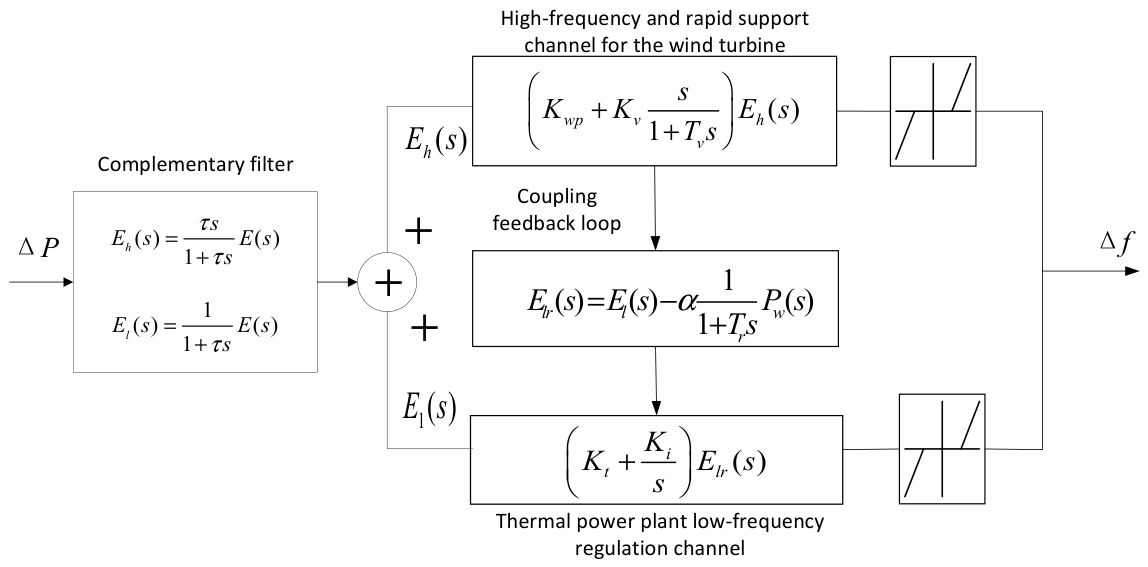
To describe the proposed wind–thermal coordinated frequency regulation mechanism, a coordinated frequency response model considering the available wind power support constraint and cross-band coupling feedback is established, as shown in
Figure 1.
As shown in
Figure 1, a wind–thermal coordinated frequency regulation model is developed by incorporating the available wind power support constraint and the cross-band coupling feedback mechanism. Based on the frequency deviation definition presented in
Section 2.1, and referring to the complementary filtering method in [
26], the original frequency deviation is first decomposed into high-frequency and low-frequency components through a pair of complementary filters, so that wind turbines can respond to the fast-varying component while thermal power units undertake the sustained low-frequency regulation. The corresponding frequency-domain expressions are given by
where
,
, and
denote the Laplace-domain representations of the original frequency deviation, the high-frequency component, and the low-frequency component, respectively, and τ is the time-scale separation parameter.
- (1)
High-Frequency Fast Support Channel of Wind Turbines
For the high-frequency fast component, a fast frequency support channel is constructed for the wind turbine. The reference frequency regulation power is defined as
where
is the fast active power regulation gain of the wind turbine,
is the virtual inertia gain, and
is the differential filtering time constant. Considering the actuation dynamics and operating constraints, the actual output of the wind turbine is expressed as
where
is the transfer function of the wind turbine actuation link, and
denotes the saturation operator that takes into account the available wind power and safe operating limits. In this way, the high-frequency fast support channel of the wind turbine establishes the mapping from the high-frequency component of the frequency deviation to the actual support power output.
- (2)
Low-Frequency Regulation Channel of Thermal Power Units
To avoid a direct combination of variables with different physical dimensions, the wind turbine support power is first converted into an equivalent frequency-deviation feedback signal before being introduced into the low-frequency regulation channel. According to the aggregated system frequency response relationship, this equivalent feedback signal is expressed as
where
is the power-to-frequency conversion coefficient, and
is the feedback filter time constant. Therefore, the residual low-frequency deviation is defined as
In this formulation, both terms in the residual signal are frequency-related quantities. Thus, the dimensional consistency of the residual low-frequency deviation is ensured. Based on the residual low-frequency deviation, the regulation law of the thermal power unit is defined as
where
is the thermal unit droop coefficient, and
is the integral recovery coefficient. To preserve the integrity of the thermal regulation chain, the actual frequency regulation output of the thermal power unit can be further written as
- (3)
Overall Closed-Loop System Model
At the system level, the frequency dynamics can be described by the simplified power balance relationship as
where
is the equivalent inertia constant of the system,
is the load damping coefficient, and
is the Laplace-domain representation of the disturbance power.
Accordingly, the closed-loop expression of the system frequency deviation can be written as
The key feature of the above model is that the thermal power unit no longer acts directly on the original low-frequency deviation, but instead responds to the residual low-frequency imbalance after the fast support provided by the wind turbine. As a result, the coordinated regulation mechanism of “fast support by wind turbines and smooth takeover by thermal power units” is achieved.
2.4.2. Fast Wind Support and Smooth Thermal Takeover
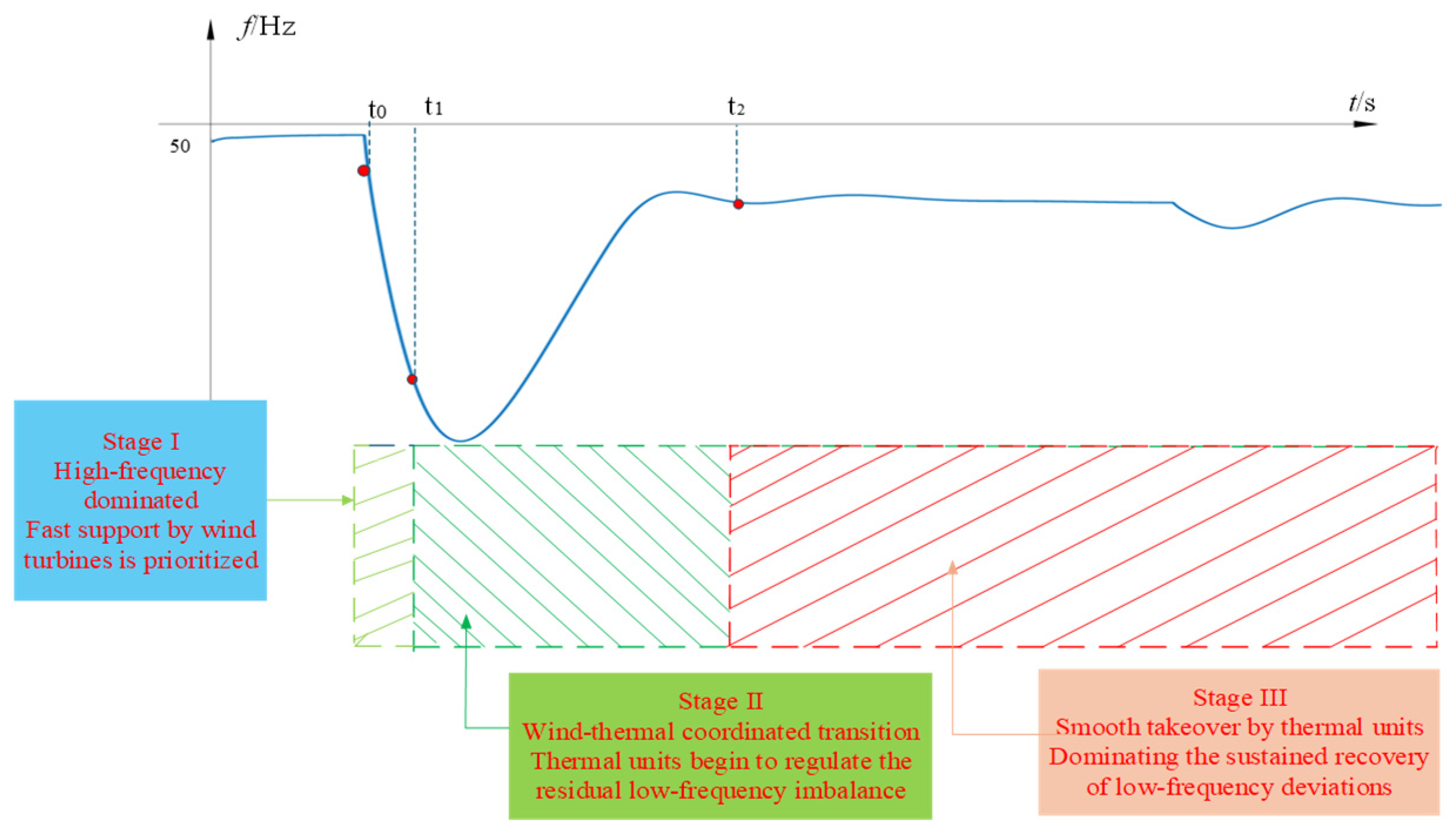
The coordinated response process between wind turbine fast support and thermal unit smooth takeover can be divided into three stages, as shown in
Figure 2.
Stage I (fast support stage): The high-frequency component is dominant, and the fast frequency regulation channel of the wind turbine responds first, providing the main support to suppress the initial frequency drop.
Stage II (coordinated transition stage): The low-frequency component gradually becomes dominant, and the thermal power unit participates in regulation based on the residual low-frequency deviation. On the basis of the initial support provided by the wind turbine, it compensates for the remaining imbalance, thereby avoiding repeated compensation.
Stage III (smooth takeover stage): The wind turbine support is gradually withdrawn, while the thermal power unit takes over the main regulation task and achieves sustained recovery of the system frequency.
From a mechanistic perspective, the proposed method reconstructs the regulation target of the thermal power unit from the original low-frequency deviation into the residual low-frequency imbalance after wind turbine support through cross-band coupling feedback. As a result, the wind–thermal coordinated frequency regulation process is transformed from a parallel response under a unified input into a dynamic coordinated process of “fast support–smooth takeover.”
2.4.3. Analysis of the Influence of Key Control Parameters on Coordinated Frequency Response Characteristics
The key control parameters in the proposed method include the high–low frequency separation parameter , the wind turbine fast regulation parameters and , the cross-band coupling parameters and , as well as the thermal unit regulation parameters and . These parameters jointly determine the distribution of disturbance regulation tasks between wind turbines and thermal units, as well as the overall coordinated frequency regulation characteristics. Among them, determines the allocation ratio of the frequency deviation signal between the high-frequency fast support channel and the low-frequency regulation channel. A smaller helps strengthen the fast support capability of wind turbines in the initial stage of a disturbance, but it also increases the thermal regulation burden; a larger allows more low-frequency tasks to be assigned to thermal units, which is beneficial for enhancing the smoothness of thermal regulation takeover.
The wind turbine parameters and mainly affect the intensity of fast support. Increasing these parameters can improve the frequency nadir and the rate of frequency change, but may also induce power fluctuations during the recovery stage. The cross-band coupling parameters and determine the extent to which the wind turbine fast support information modifies the thermal regulation input. Specifically, if is too small, repeated compensation cannot be effectively suppressed; if it is too large, the takeover capability of thermal units may be weakened. If is too small, high-frequency components may leak into the thermal regulation channel, whereas an excessively large will reduce the timeliness of feedback correction. The thermal regulation parameters and determine the sustained regulation characteristics. Increasing these parameters helps enhance the steady-state recovery capability, but may also lead to enlarged regulation amplitudes and oscillations during the recovery stage.
In summary, parameter tuning should strike a balance among fast support capability, smooth takeover performance, and overall system stability. By reconstructing the thermal regulation target through the residual low-frequency deviation, the proposed method achieves coordinated task allocation between wind turbines and thermal units, thereby providing a parameter foundation for the subsequent multi-objective optimization.
2.5. Dynamic Segmented Thresholds and Energy-Constrained Wind Turbine Control
Traditional fixed dead-band frequency regulation strategies are difficult to adapt to variations in wind turbine operating conditions under complex scenarios, and may easily lead to excessive release of rotor kinetic energy under low wind speed conditions, thereby causing rotor speed reduction and secondary frequency drop (SFD). At the same time, as a nonlinear element, an improperly configured dead band may also induce low-frequency oscillations. To address the above issues, this study proposes a coordinated control strategy of dynamic segmented thresholds and power constraints based on available kinetic energy awareness. Through a dual mechanism of “adaptive threshold adjustment + releasable power upper-limit constraint,” the proposed method coordinates both the triggering timing and the output magnitude of wind turbine participation in frequency regulation. Different from conventional methods that merely delay participation by widening the dead band, this paper explicitly incorporates the residual available kinetic energy of the wind turbine into the generation process of the frequency regulation power command, so that it not only determines when to participate but also constrains the maximum output power after participation, thereby achieving frequency regulation control under explicit energy constraints. Furthermore, the frequency-domain stability of this nonlinear control structure is analyzed based on the describing function method and the Nyquist criterion.
2.5.1. Dynamic Multi-Segment Threshold Mapping Mechanism Incorporating Available Kinetic Energy
To achieve adaptive frequency regulation response of wind turbines based on their operating conditions, the available frequency regulation energy is first quantified. Let the actual rotor speed of the wind turbine at any instant be
, and let the minimum safe rotor speed specified by the system be
. Then, the effective rotational kinetic energy available for frequency regulation can be expressed as follows [
25]:
where
is the equivalent rotational inertia of the wind turbine rotor. On this basis, a three-segment frequency regulation output structure is constructed, consisting of an absolute dead zone, a transition zone, and a full-response zone. The piecewise relationship between the wind turbine frequency regulation reference power and the frequency deviation is given by
where
is the boundary of the absolute dead zone, within which the wind turbine remains inactive to suppress minor disturbances;
is the activation point of the full-power response; and
K1 and
are the droop control gains for the transition zone and the full-response zone, respectively.
By introducing a transition zone between the dead zone and the full-response zone, this structure enables the wind turbine output to evolve smoothly from zero to a high-gain response, thereby avoiding the power jump problem associated with conventional single-threshold strategies. To further adapt to changes in the available kinetic energy of the wind turbine, an adaptive mapping relationship between the absolute dead-zone boundary and the available kinetic energy is established as
where
is the basic dead-band width specified by the grid code, and
and
are adjustment coefficients. When the available kinetic energy of the wind turbine decreases, the dead-zone boundary correspondingly increases, so that the wind turbine delays its participation in frequency regulation, thereby suppressing excessive support under low-energy conditions. On this basis, an explicit upper limit constraint on releasable power based on the residual available kinetic energy is further introduced as
where
is the mapping coefficient from kinetic energy to the upper limit of releasable power. This constraint ensures that even when the frequency deviation is large under low-energy conditions, the output of the wind turbine remains restricted within a safe operating range.
Finally, the wind turbine frequency regulation command is jointly determined by the segmented output and the upper power limit, i.e.,
where
denotes the saturation function. Through the coordinated mechanism of “dynamic thresholds + explicit power constraint,” this control strategy simultaneously determines the triggering timing of wind turbine participation in frequency regulation and its maximum output magnitude, thereby achieving frequency support control under explicit energy constraints.
2.5.2. Describing Function Modeling of Multi-Segment Nonlinear Thresholds
The proposed multi-segment threshold–power-constrained control strategy exhibits pronounced nonlinear characteristics, making it difficult for conventional linearization methods to accurately capture its influence on closed-loop stability. Thus, the describing function (DF) method is adopted to perform an equivalent frequency-domain analysis [
27].
This nonlinear element simultaneously contains two types of characteristics, namely segmented thresholds and amplitude limitation, and can therefore be regarded as a composite nonlinear structure. Let the input be a sinusoidal signal with amplitude (A). Since this nonlinearity is odd-symmetric, memoryless, and static, its describing function is purely real and can be represented by the fundamental component as
For ease of analysis, the multi-segment threshold nonlinearity is equivalently decomposed into the superposition of several standard dead-zone nonlinearities. Let a unit-slope dead-zone function with width be defined; its describing function can then be expressed as
Accordingly, the equivalent describing function of the multi-segment threshold structure can be written as
Furthermore, when the explicit upper power limit is taken into account, the output of the nonlinear element becomes saturated under large-amplitude input conditions, causing the equivalent gain to increase more gradually as the input amplitude grows.
It can therefore be seen that the equivalent gain of this composite nonlinear structure exhibits a variation pattern of “zero response–progressive increase–constrained flattening” with respect to the input amplitude. When the input is small, the system remains unresponsive; as the amplitude exceeds each threshold segment, the equivalent gain increases continuously; under high-amplitude input conditions, however, the growth of the gain is suppressed due to the action of the power constraint. This characteristic effectively avoids the oscillation risk caused by abrupt gain variation in conventional single-threshold strategies.
2.5.3. Analysis of Equivalent Gain Characteristics and Their Impact on Stability
Based on the describing function analysis, the equivalent gain of the proposed multi-segment threshold–power-constrained structure exhibits a variation pattern of “zero response–progressive increase–constrained flattening” with respect to the input amplitude.
This characteristic indicates that, in the small-disturbance region, the equivalent gain remains low, which helps suppress unnecessary responses; in the medium-disturbance region, the gain increases gradually, thereby enabling smooth support; and in the high-amplitude region, the growth of the gain is restrained due to the effect of the power constraint. These equivalent gain characteristics provide the basis for the subsequent closed-loop stability analysis based on the Nyquist criterion.
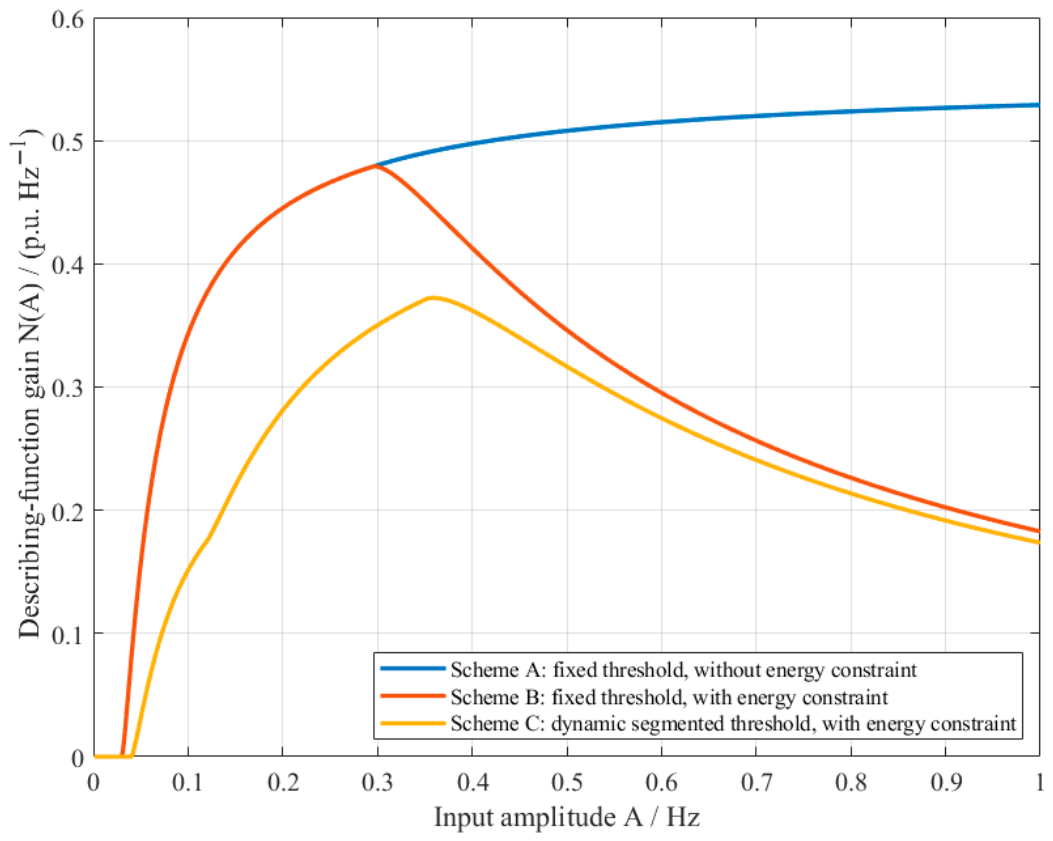
To further quantify the amplitude-dependent characteristics of the nonlinear threshold and power-constrained control structure, the describing-function gain
N(
A) was calculated under different threshold and energy-constrained strategies. The results are shown in
Figure 3.
As shown in
Figure 3, Scheme A exhibits a rapid increase in equivalent gain once the input amplitude exceeds the fixed dead-zone boundary. Scheme B behaves similarly to Scheme A in the low- and medium-amplitude regions because the power constraint is not activated in these regions. When the input amplitude becomes larger, the equivalent gain of Scheme B decreases due to the saturation effect. Compared with Schemes A and B, Scheme C shows a smoother gain transition and a lower equivalent gain in the medium- and large-amplitude regions. This confirms that the proposed dynamic segmented threshold and energy-constrained strategy can suppress abrupt gain variation and avoid excessive gain amplification under large disturbances.
2.6. Stability Analysis and Multi-Objective Performance Indices
Based on the foregoing control structure and nonlinear characteristic analysis, this section further investigates the impact of the proposed method on system stability and performance indices from a system-level perspective.
2.6.1. Describing-Function-Based Closed-Loop Stability Analysis
To analyze the influence of the nonlinear segmented threshold–power-constrained link on closed-loop stability, the describing function equivalent model is embedded into the system. Let the linear part in the wind–thermal coordinated frequency regulation system be denoted by the open-loop transfer function (G(s)). In the describing function analysis, the input to the nonlinear link is assumed to be a sinusoidal signal with amplitude (A), i.e.,
Then, the nonlinear loop can be equivalently characterized by the describing function (N(A)). According to the describing function method, the oscillation condition of the nonlinear closed-loop system can be expressed as
Since the proposed segmented-threshold nonlinearity is approximately symmetric about the origin and does not contain an explicit memory link, its describing function can be approximated as a purely real function, i.e.,
Accordingly, the effect of the proposed nonlinear control structure on stability can be interpreted as the variation in the equivalent open-loop gain caused by changes in the input amplitude through the describing function (N(A)). Compared with the conventional fixed dead-zone strategy, the proposed segmented threshold–power-constrained strategy exhibits two notable characteristics in terms of equivalent gain variation: first, in the low-amplitude interval, the dead zone suppresses the system response, resulting in a small equivalent gain; second, in the high-amplitude interval, the increase in equivalent gain is restrained by the upper power limit. Therefore, as the input amplitude varies, the equivalent open-loop gain (N(A)G(s)) of the system can remain within a relatively moderate range over different disturbance intervals, thereby mitigating the instability risk caused by abrupt changes in nonlinear gain.
In other words, by dynamically regulating the equivalent gain of the nonlinear link through segmented thresholding and power limitation, the proposed control strategy helps maintain the equivalent open-loop gain within a moderate range, thereby reducing the risk of local oscillations and improving the closed-loop stability margin.
2.6.2. Analysis of Frequency-Domain Stability Margins Based on the Nyquist Criterion
Based on the above describing-function equivalence, the Nyquist criterion can be further employed to analyze the influence of dynamic thresholds and explicit power constraints on the frequency-domain stability margins. For the equivalent open-loop transfer function , its effect is equivalent to radially scaling the Nyquist curve in the complex plane without changing the phase characteristics of the linear part. Whether the closed-loop system is exposed to local oscillation risk depends on the relative position between the Nyquist curve and the critical point.
Based on the calculated describing-function gain, the equivalent open-loop transfer function
N(
A)
G(
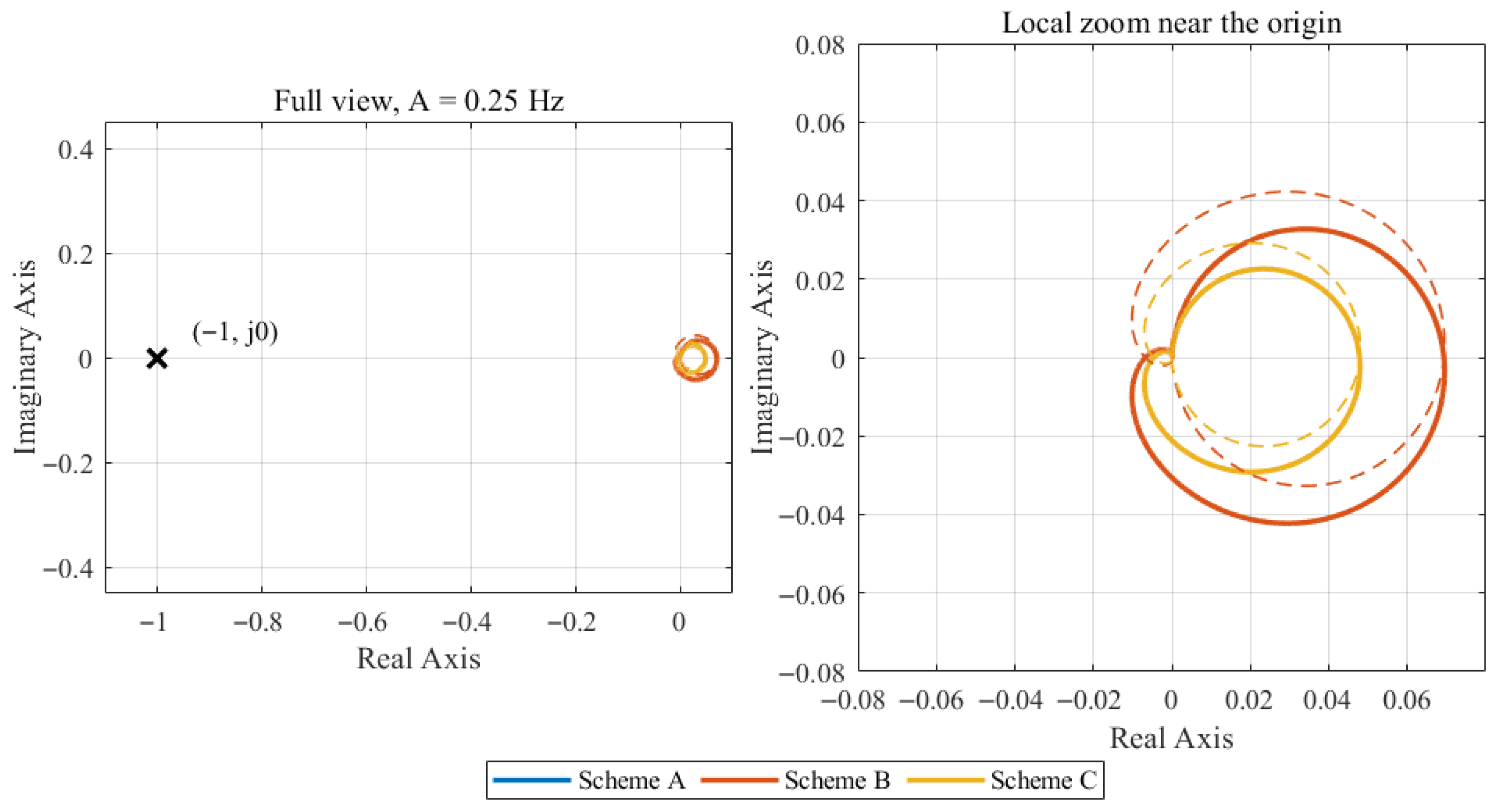
jω) was further constructed for Nyquist analysis. A representative input amplitude of A = 0.25 Hz was selected according to the amplitude range observed in the time-domain frequency response. The corresponding Nyquist plots are shown in
Figure 4.
As shown in
Figure 4, the Nyquist curves of all three schemes do not encircle the critical point (−1, j
0), indicating that the closed-loop system remains stable under the selected parameters. In the local zoom plot, Scheme C exhibits a smaller equivalent loop trajectory than Schemes A and B, which is consistent with its lower describing-function gain at A = 0.25 Hz. This indicates that the proposed strategy does not introduce additional stability risk and helps suppress excessive loop gain amplification.
To further quantify the stability characteristics, the gain margin and the minimum distance from the Nyquist curve to the critical point are calculated and summarized in
Table 1.
As shown in
Table 1, Scheme C has a lower equivalent gain N(A
0) and a higher gain margin than Schemes A and B. The minimum distance to the critical point is also slightly increased. These results indicate that the proposed strategy maintains a slightly improved frequency-domain stability margin while reducing recovery-stage oscillation risk.
Compared with the fixed-threshold strategy, the proposed method improves the frequency-domain stability through the following two mechanisms.
(1) Dynamic threshold mechanism: When the available kinetic energy is low, the participation boundary of the wind turbine is adaptively widened, so that the equivalent gain corresponding to small-amplitude disturbances is reduced. In this case, the critical-point mapping moves away from the origin along the negative real axis, thereby increasing the distance between the Nyquist curve and the critical point.
(2) Explicit power-constrained mechanism: During large disturbances, the output amplitude of the wind turbine is limited, making the growth of the equivalent gain with respect to the input amplitude more gradual. This avoids an excessive approach of the Nyquist curve to the critical point under high-gain conditions, thereby suppressing the loop amplification effect.
Hence, over different disturbance intervals, the proposed strategy can effectively regulate the equivalent open-loop gain, so that the system avoids intersecting the critical point and thus achieves improved gain margin and phase margin in the closed-loop sense. From the frequency-domain perspective, this method preserves the rapid support capability in the initial stage of a disturbance while suppressing the excessive gain amplification that may occur during the recovery stage, thereby further enhancing the frequency-domain stability of the system.
In summary, the dynamic segmented thresholds and explicit power constraints jointly regulate the equivalent gain distribution of the nonlinear loop, enabling the closed-loop system to obtain better stability margins over the entire disturbance range and providing a stability foundation for the subsequent multi-objective optimization.
2.6.3. Multi-Objective Performance Analysis
In addition to stability, the proposed wind–thermal coordinated frequency regulation strategy should also achieve a balance among frequency security, recovery smoothness, thermal regulation burden, and wind power support efficiency. Accordingly, the following four indices are selected in this paper to evaluate the strategy performance.
- (1)
Frequency nadir
The system frequency nadir is used to measure the frequency security in the initial stage of a disturbance, and can be defined as
For under-frequency scenarios, a larger indicates a higher frequency minimum, implying a stronger initial suppression capability against the disturbance.
- (2)
Secondary frequency drop
The secondary frequency drop is used to evaluate the smoothness of the recovery stage. Let
denote the time instant of the first recovery peak, and
the subsequent time instant at which the secondary valley occurs. Then, the SFD can be defined as
A smaller SFD indicates a smoother transition between the withdrawal of wind turbine support and the subsequent takeover by thermal power units, as well as a weaker additional rebound during the recovery stage.
- (3)
Thermal regulation burden
The thermal regulation burden can be characterized by the equivalent number of regulation actions, denoted by
, that is, the cumulative number of significant output adjustments of thermal power units within a given analysis window. Its discrete form can be written as
where
is the indicator function, and
is the threshold used to determine whether a significant thermal regulation action has occurred. A smaller
indicates fewer frequent adjustments of the thermal power unit and a smoother subsequent recovery process.
- (4)
Wind power utilization
Wind power utilization is used to measure the degree to which the available support capability of the wind turbine is exploited, and can be defined as
where
denotes the upper limit of the available support power of the wind turbine under the current operating condition. A larger
indicates that the available frequency regulation capability of the wind turbine is utilized more effectively within the safe operating boundary.
The above indices characterize the performance of the proposed strategy from different perspectives. Specifically, the multi-band coordinated mechanism mainly improves the frequency nadir and suppresses SFD; the dynamic segmented thresholds and explicit power constraints help prevent excessive participation of wind turbines, thereby reducing SFD and the thermal regulation burden; and the cross-band coupling feedback mechanism weakens repeated compensation through transition control, further reducing the number of thermal regulation actions. Based on the above analysis, the proposed method establishes a coordinated trade-off among multiple performance indices, and its multi-objective optimization form can be expressed as
where the objective is to achieve an overall improvement by appropriately configuring the control parameters, specifically by increasing
and
, while reducing SFD and
.
The proposed strategy therefore provides a balanced enhancement in frequency security, recovery smoothness, thermal regulation burden, and wind power utilization.
3. Results
3.1. Simulation System, Software Environment, and Parameter Settings
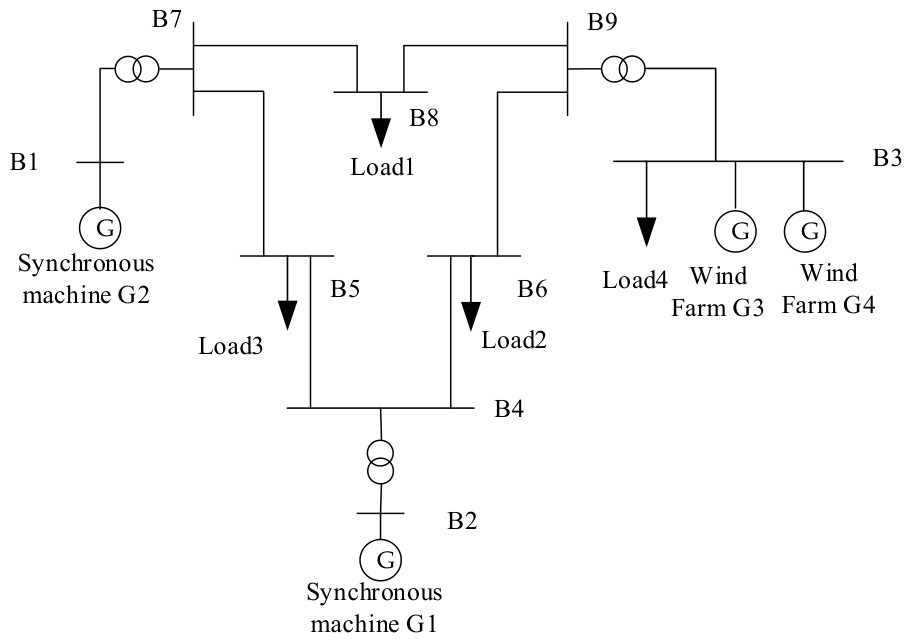
To verify the effectiveness of the proposed wind–thermal coordinated frequency regulation strategy, a unified simulation platform is constructed based on a modified IEEE 3-machine 9-bus system. This benchmark system is adopted because it contains the essential dynamic elements required for wind–thermal coordinated frequency regulation, including synchronous thermal units, doubly fed induction generator wind turbines, load disturbances, and network coupling. Although its scale is limited, it provides a compact and reproducible platform for validating the interaction between wind turbine fast support and thermal-unit sustained regulation.
The system consists of synchronous thermal power units, doubly fed induction generator wind turbines, loads, and the grid network. Among them, the wind turbines are used to provide fast frequency support in the initial stage of a disturbance, while the thermal power units are responsible for subsequent sustained power compensation. To ensure a fair comparison among different methods, all case studies are carried out under the same system structure, identical initial operating conditions, and the same disturbance input conditions, with only the controller structure and corresponding control parameters being adjusted. The modified IEEE 3-machine 9-bus system is selected as the testbed because it provides a clear and standard environment to verify the fundamental effectiveness and logic of the proposed multi-band coordination mechanism. While the current scale is sufficient for proof-of-concept validation, the adaptation of this methodology to more complex, larger-scale networks will be further explored in our subsequent studies.
The simulations were conducted in MATLAB/Simulink R2024a (The MathWorks, Inc., Natick, MA, USA). All simulation cases were performed under the same software environment, solver settings, and sampling configuration to ensure the comparability of the results.
The wind turbine and thermal unit models used in this study were implemented using transfer-function-based dynamic frequency response models rather than detailed hardware-level electromagnetic transient models. The wind turbine model includes the active power support link, virtual inertia link, actuator dynamics, available power limitation, and rotor-speed safety constraint. The thermal unit model includes the governor–turbine dynamic link, droop regulation, and integral recovery link. These model structures are consistent with the mathematical formulations established in
Section 2.
Before comparing different strategies, the baseline response under the conventional coordinated control strategy was examined. The obtained frequency nadir, recovery trend, wind turbine fast support process, and thermal-unit sustained regulation process were consistent with the expected characteristics of primary frequency response. Therefore, the adopted model is considered sufficient for mechanism verification and comparative analysis under identical simulation conditions.
The adopted system structure is shown in
Figure 5. To make the parameter settings more transparent and reproducible, the main parameters used in the nominal simulation case are summarized in
Table 2. These parameters were selected according to a hierarchical principle. The system-level parameters, such as
and
, were determined by the benchmark system configuration. The actuator-related time constants and coefficients associated with the wind turbine and thermal-unit dynamic links were selected according to typical dynamic response characteristics of wind turbine and thermal-unit models. The basic control gains, including
,
,
, and
, were initialized based on conventional virtual inertia and droop-control settings and then adjusted through preliminary simulations to ensure a stable primary frequency response. The coordination-related parameters, including
,
, and
, were selected as nominal values for the comparative simulations and are further examined and refined through the multi-objective optimization procedure described in
Section 3.5. Therefore, the parameter settings in
Table 2 are obtained by combining benchmark-system settings, conventional control experience, preliminary tuning, and optimization-based analysis.
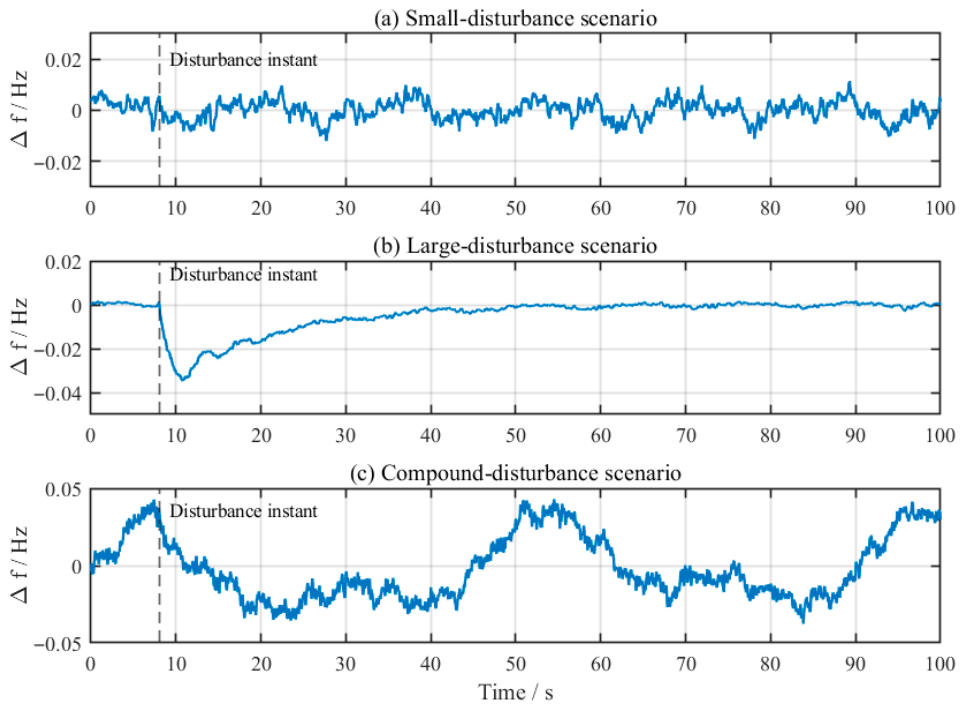
To comprehensively validate the proposed method, three typical disturbance scenarios are considered in this paper, including a small-amplitude frequency fluctuation scenario, a step power-imbalance disturbance scenario, and a composite-disturbance scenario. Specifically, the small-amplitude fluctuation scenario is used to analyze the frequency variation under normal operating conditions, the step power-imbalance disturbance scenario is employed to examine the frequency nadir and recovery process after an active power imbalance, and the composite-disturbance scenario is used to evaluate the regulation performance under the coexistence of fast and slow frequency components.
3.2. Construction of Multi-Band Disturbance Scenarios and Analysis of Frequency Deviation Characteristics
To illustrate the design motivation of the proposed cross-time-scale coordinated frequency regulation strategy, three typical disturbance scenarios are constructed in this paper: a small-amplitude frequency fluctuation scenario under normal operating conditions, a step power-imbalance disturbance scenario, and a composite-disturbance scenario with superimposed fast and slow components. These scenarios are used to characterize the frequency deviation features of the system under normal fluctuations, sudden active power imbalance, and complex dynamic coupling conditions, respectively.
Figure 6 shows the evolution of the system frequency deviation under these typical disturbance scenarios.
It can be observed from
Figure 6 that, in the small-amplitude fluctuation scenario, the frequency deviation mainly appears as continuous small-amplitude fluctuations around the zero point. In the step power-imbalance disturbance scenario, the frequency deviation drops rapidly at the initial stage of the disturbance and then gradually recovers. In the composite-disturbance scenario, both high-frequency fluctuations and low-frequency slowly varying components are simultaneously present. These results indicate that the system frequency deviation is not a single-time-scale response, but contains both fast dynamic components and slowly evolving components.
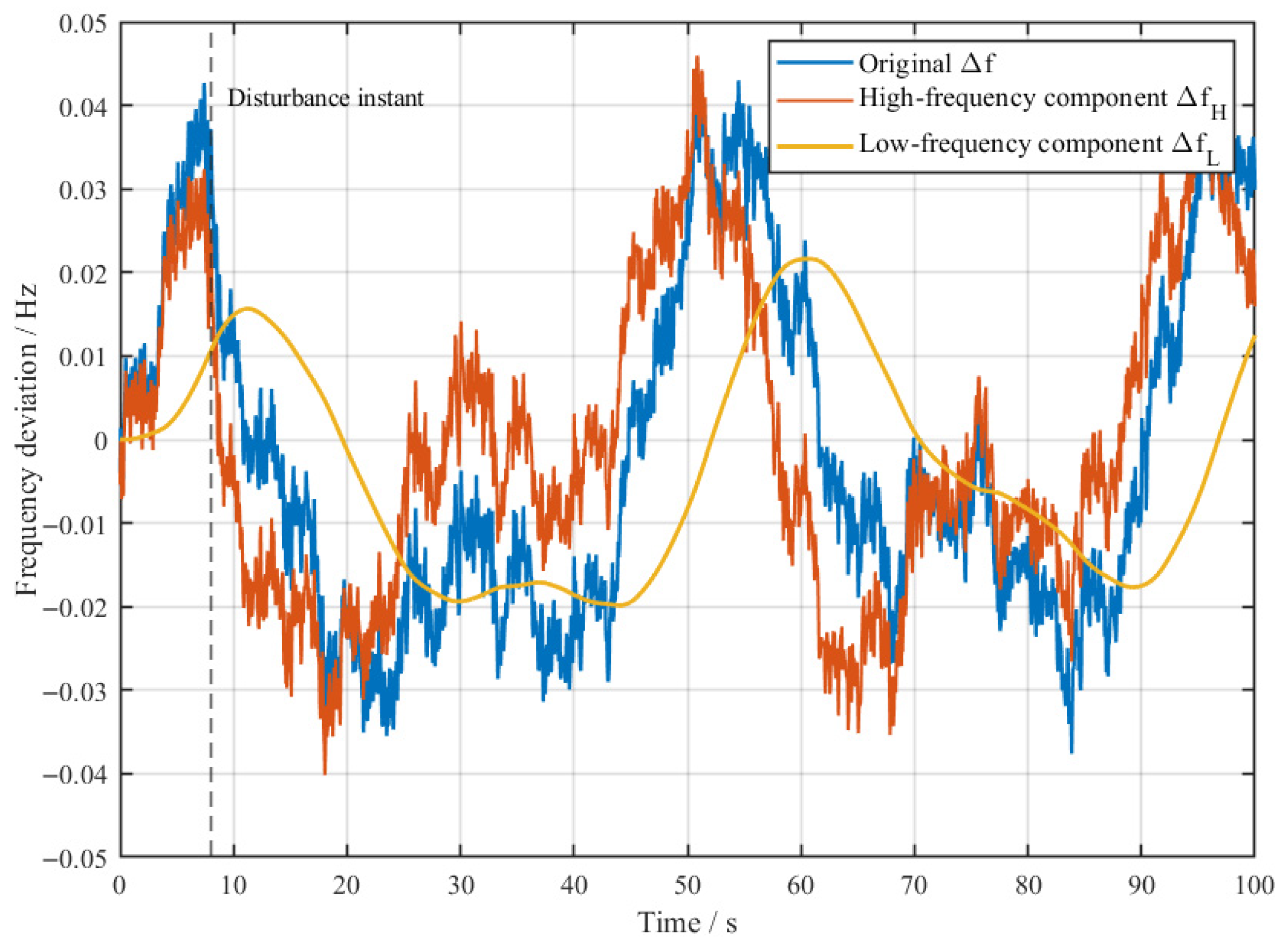
Figure 7 further presents the original frequency deviation and its high- and low-frequency components under the composite-disturbance scenario.
It can be seen from
Figure 7 that the original frequency deviation can be decomposed into a rapidly varying high-frequency component and a slowly varying low-frequency component. The high-frequency component mainly corresponds to the rapid fluctuation characteristics in the initial stage of the disturbance, whereas the low-frequency component reflects the slower recovery process. These results confirm that the frequency deviation contains both fast and slow dynamic components, which supports the use of multi-band decomposition in the proposed coordinated regulation strategy.
3.3. Validation of the Effectiveness of Dynamic Segmented Thresholds and Energy Constraints
Although wind turbines possess fast power response capability and can provide rapid frequency support in the initial stage of a disturbance, their support capability is still constrained by both the available wind power support capacity and the residual rotor kinetic energy. If a fixed participation threshold is adopted without considering energy boundaries, the wind turbine may release support power rapidly under high-amplitude input conditions, but this can also easily lead to excessive release of rotor kinetic energy, significant rotor speed reduction, and an intensified power rebound after the withdrawal of support.
To maintain the frequency support performance in the initial disturbance stage while ensuring the operational safety of wind turbines, this paper introduces a dynamic segmented threshold and energy-constrained strategy into the fast support channel of wind turbines, so that both the triggering boundary and output intensity of wind turbine participation in frequency support can be adaptively adjusted according to the available wind power support capacity and residual kinetic energy state. To clearly identify the incremental contribution of each component, a progressive scheme design is adopted. The comparison between Scheme A and Scheme B is used to isolate the effect of energy constraints; the comparison between Scheme B and Scheme C is used to identify the additional contribution of dynamic segmented thresholds; and the comparison between Scheme A and Scheme C is used to demonstrate the overall advantage of the joint design.
To verify the effectiveness of the proposed strategy, the following three comparison schemes are considered:
① Scheme A: fixed thresholds without energy constraints;
② Scheme B: fixed thresholds with available wind power support constraints;
③ Scheme C: joint strategy of dynamic segmented thresholds and energy constraints.
These three schemes are selected because they form a progressive comparison chain from conventional fixed-threshold control to energy-constrained control and finally to the complete dynamic threshold–energy-constrained strategy. Therefore, the comparison can separately identify the effect of the energy constraint, the additional effect of dynamic segmented thresholds, and the overall benefit of their joint design.
Among them, Scheme A is used to characterize the response characteristics of wind turbine fast support under a conventional fixed participation boundary; Scheme B is used to verify the protective effect of introducing only energy constraints on the operating boundary of wind turbines; and Scheme C is used to verify whether the proposed method can further improve the participation timing and frequency support efficiency of wind turbines while constraining their support intensity.
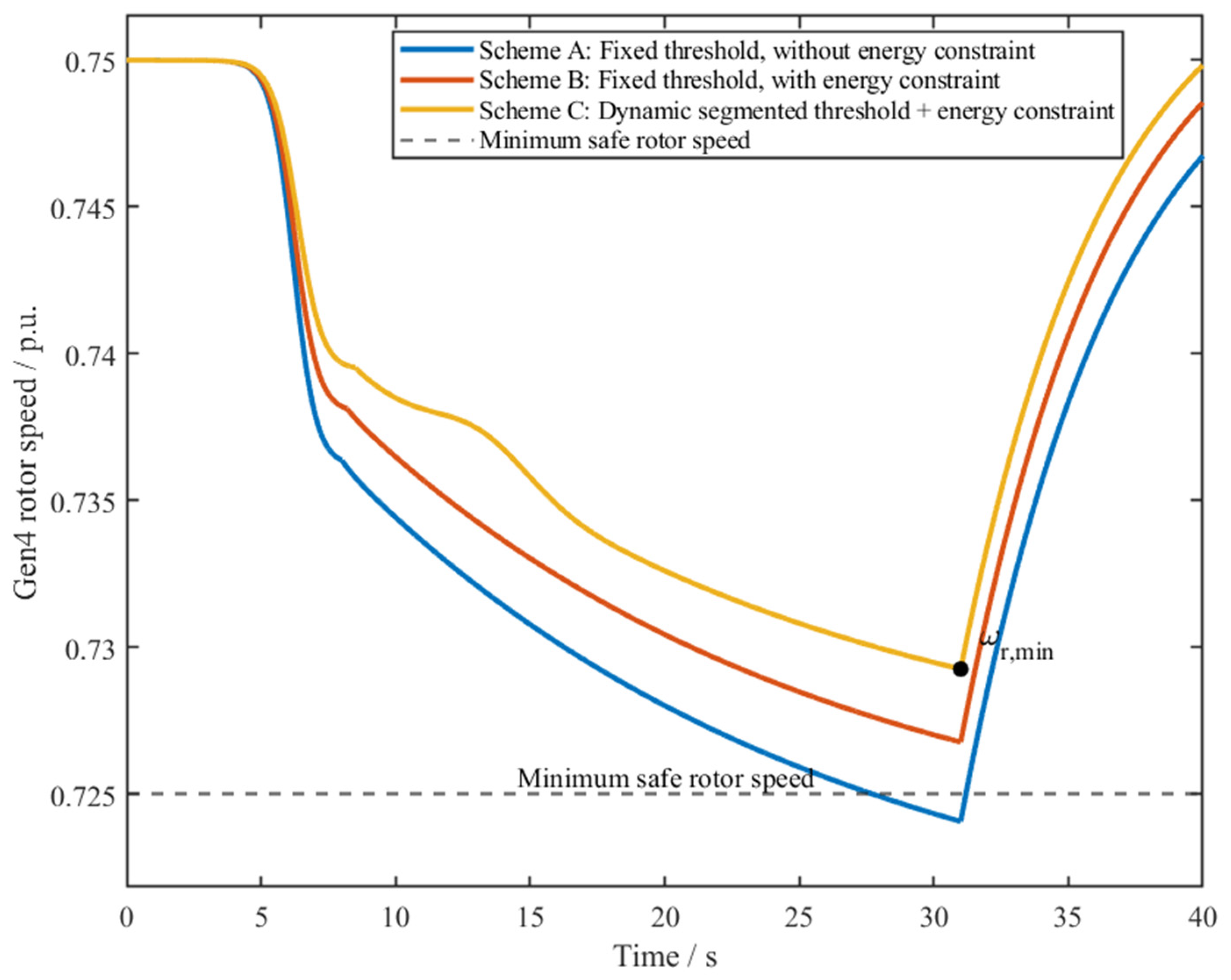
Figure 8 shows the rotor speed trajectories of wind turbines under different threshold and energy-constraint strategies.
The results show that the rotor speed drop in Scheme A is the most pronounced, and its minimum rotor speed is the lowest, indicating that under fixed thresholds and without energy constraints, the wind turbine releases more rotor kinetic energy during the fast support stage and therefore faces a higher risk of over-deceleration. After the available wind power support constraint is introduced, Scheme B exhibits a higher minimum rotor speed, indicating that the energy constraint can suppress excessive wind turbine support to a certain extent. In contrast, the rotor speed decline in Scheme C is more gradual, its minimum rotor speed is significantly higher than those of Scheme A and Scheme B, and it always remains above the safety boundary. This demonstrates that the joint strategy of dynamic segmented thresholds and energy constraints can further alleviate the over-deceleration of wind turbines.
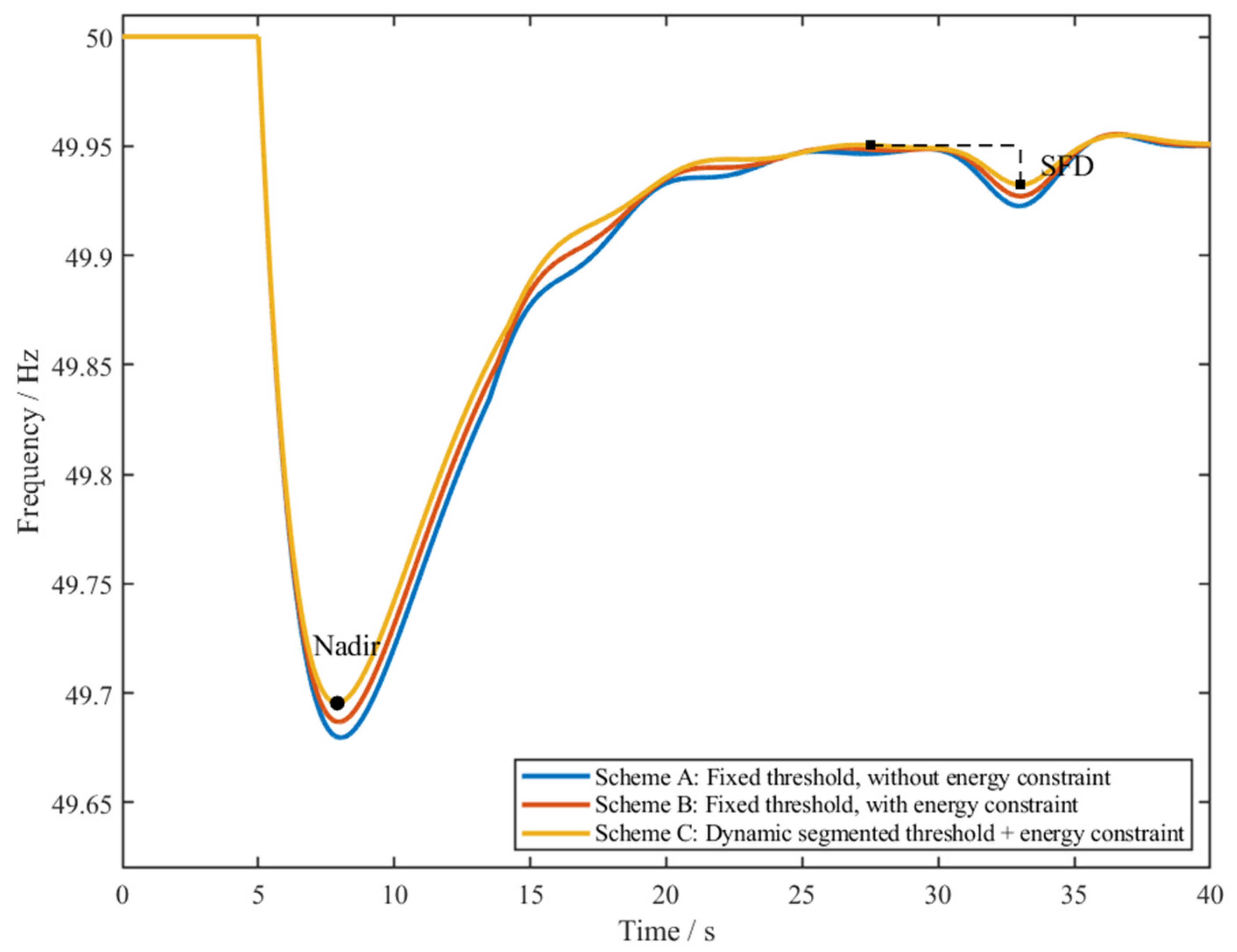
Figure 9 presents the system frequency response curves under different threshold and energy-constraint strategies.
It can be observed that, in the initial stage of the disturbance, the frequency nadir of Scheme C is higher than those of Scheme A and Scheme B, indicating that the dynamic segmented thresholds enable the wind turbine to participate more effectively in rapid frequency support when its support capability is relatively strong. Meanwhile, the frequency trajectory of Scheme C is smoother during the recovery stage, and the magnitude of the secondary frequency drop is smaller, indicating that no significant power rebound is introduced during the withdrawal of wind turbine support. Combined with
Figure 9, it can be concluded that the proposed dynamic segmented threshold and energy-constrained strategy improves the operational safety of wind turbines while maintaining satisfactory frequency support performance.
To further quantitatively compare the impacts of different schemes on system frequency support performance and wind turbine operating status, indices including the frequency nadir, frequency recovery time, maximum wind turbine output power, minimum wind turbine rotor speed, and wind power utilization are calculated. The results are listed in
Table 3.
As shown in
Table 3, although Scheme A can provide a certain degree of frequency support in the initial disturbance stage, it yields the lowest minimum rotor speed and the highest output peak, indicating that this scheme is the most unfavorable to wind turbine operational safety. By comparison, after the introduction of energy constraints in Scheme B, the minimum rotor speed of the wind turbine increases from 0.7218 to 0.7249, while the maximum output power decreases from 0.152 to 0.146, indicating that the energy constraint can effectively suppress excessive wind turbine support. Furthermore, Scheme C improves the frequency nadir to 49.668 Hz, which is 0.017 Hz and 0.009 Hz higher than those of Scheme A and Scheme B, respectively. The recovery time is shortened to 16.3 s, which is 2.5 s and 1.3 s shorter than those of Scheme A and Scheme B, respectively. Meanwhile, wind power utilization increases to 91.3%, representing improvements of 12.9 and 6.6 percentage points over Scheme A and Scheme B, respectively. These results indicate that the joint design of dynamic segmented thresholds and energy constraints can achieve a better balance between wind turbine operational safety and frequency support performance.
Overall, the comparison among Schemes A–C verifies that the joint design of dynamic segmented thresholds and energy constraints improves wind turbine operating safety while maintaining effective frequency support.
Consistency Verification Between Theoretical Analysis and Time-Domain Response
The preceding analysis based on the describing function method and the Nyquist criterion has shown that dynamic segmented thresholds enable the equivalent gain of the nonlinear element to vary smoothly with the input amplitude, while the explicit power constraint suppresses any further increase in the equivalent gain under high-amplitude input conditions, thereby reducing the risk of local oscillations and improving the closed-loop stability margin. To verify the above theoretical trend, under the same operating conditions as those in
Section 3.3, this paper further compares the effects of different threshold and power-constrained strategies on time-domain indices during the recovery stage, and selects the secondary frequency drop and recovery time as the corresponding validation indices.
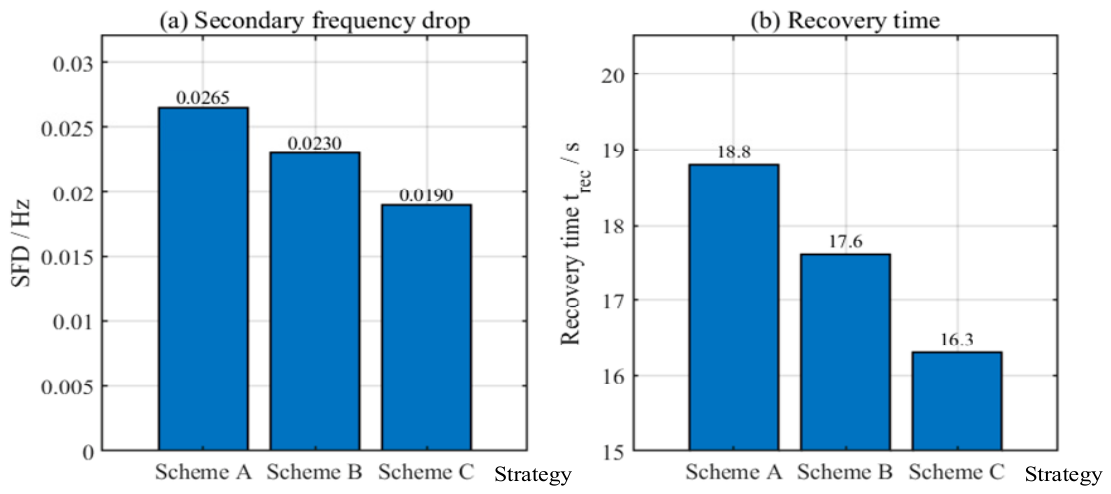
Figure 10 presents the comparison results of the main time-domain indices during the recovery stage under different threshold and constraint strategies.
It can be observed that Scheme C yields the smallest secondary frequency drop and recovery time, both of which are lower than the corresponding results of Scheme A and Scheme B. This indicates that the joint strategy of dynamic segmented thresholds and constraints can mitigate the additional oscillations after the withdrawal of wind turbine support and improve the smoothness of system recovery. This result is consistent with the theoretical trend derived earlier, namely that the flattening of the equivalent gain is beneficial to improving closed-loop stability.
These time-domain results are consistent with the theoretical trend obtained from the describing-function analysis, indicating that the proposed threshold and constraint strategy can improve recovery-stage smoothness.
3.4. Comparison of Different Coordinated Frequency Regulation Strategies
To further identify the incremental effects of frequency deviation decomposition, cross-band coupling feedback, and dynamic thresholds and energy constraints within the complete coordinated frequency regulation framework, four comparison strategies are established on the unified wind–thermal coordinated frequency regulation simulation platform, and comparative analysis is conducted under the same system parameters, identical initial operating conditions, and the same disturbance input conditions. Specifically, Strategy 1 is the conventional coordinated frequency regulation strategy, in which both wind turbines and thermal power units respond directly to the original frequency deviation signal. Strategy 2 adopts only frequency deviation decomposition, in which wind turbines support the high-frequency fast component and thermal power units regulate the low-frequency slow component, but without considering cross-band coupling feedback. Strategy 3 further introduces cross-band coupling feedback on the basis of frequency deviation decomposition. Strategy 4 is the complete coordinated frequency regulation strategy, which further incorporates dynamic segmented thresholds and energy constraints based on Strategy 3. This progressive comparison is used to evaluate the contribution of each module to the overall frequency regulation performance.
To further evaluate the performance advantages of the proposed method relative to existing studies, two representative literature-based methods are selected as external comparison baselines. First, the multi-segment droop control and parameter tuning strategy proposed by Gao et al. [
7] is chosen as a representative of segmented frequency regulation control methods. Second, the delayed inertia coordinated support strategy proposed by Zhang et al. [
5] is selected as a representative of advanced virtual inertia/coordinated frequency support methods. Both baseline methods are reproduced under the same simulation platform, identical initial operating conditions, and the same disturbance conditions as those used in this paper.
The selected benchmark schemes are considered sufficient for demonstrating the contribution of the proposed method for two reasons. First, the internal progressive strategies, namely Strategies 1–4, are designed by adding the key modules of the proposed framework step by step. Therefore, they can directly reveal the individual contributions of frequency decomposition, cross-band coupling feedback, and dynamic energy-constrained control. Second, the two literature-based baseline methods represent two typical technical routes in existing wind turbine frequency support studies, namely segmented droop-based frequency regulation and virtual-inertia/coordinated support. These methods cover the main control mechanisms most closely related to the proposed strategy. Under the same system model, initial operating condition, and disturbance input, the combination of internal ablation comparisons and external literature-based baselines provides a sufficient and fair basis for evaluating the effectiveness and incremental contribution of the proposed method.
Considering that these external literature-based methods differ from the proposed strategy in terms of internal control structure and device-level output formulation, this paper first conducts a horizontal comparison at the system frequency response level. Further analysis of wind turbine output, thermal unit output, and the incremental effects of each module is still mainly carried out through the internal progressive comparison of Strategies 1–4.
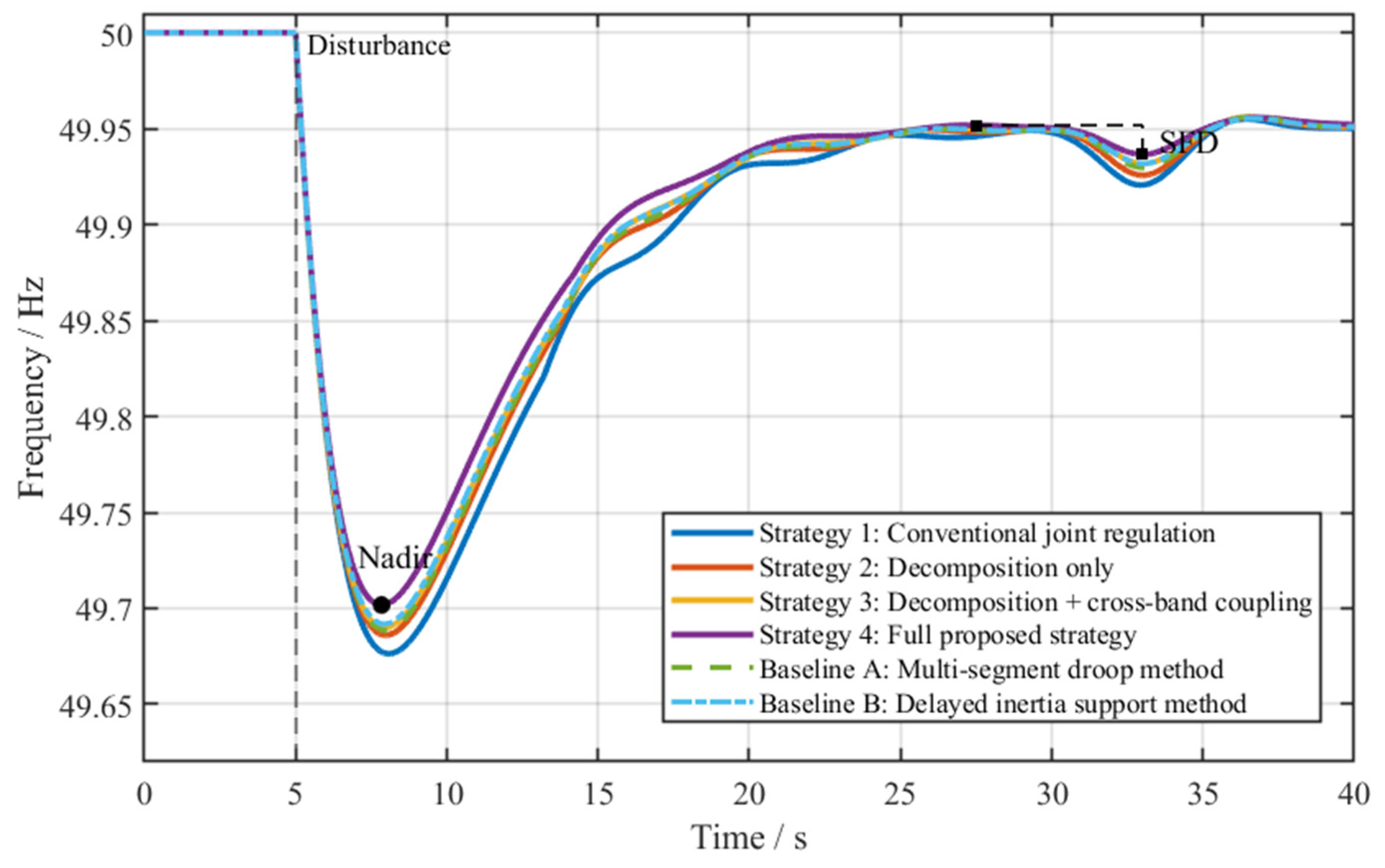
Figure 11 shows the system frequency response curves under different coordinated frequency regulation strategies and literature-based baseline methods.
It can be observed that, in Strategy 1, both the wind turbines and thermal power units respond directly to the unified frequency deviation signal. Although this strategy can provide a certain degree of frequency support in the initial stage of the disturbance, the lack of a clear time-scale division of labor causes the thermal power units to intervene significantly during the fast support stage of the wind turbines, resulting in a relatively large secondary frequency drop during the recovery stage. Strategy 2 achieves a preliminary division of labor between wind turbines and thermal power units through frequency deviation decomposition, and both the frequency nadir and the recovery process are improved compared with those of Strategy 1, indicating that cross-time-scale decomposition alone can alleviate regulation overlap to a certain extent. Furthermore, when cross-band coupling feedback is introduced in Strategy 3 on the basis of Strategy 2, the oscillation amplitude and secondary frequency drop during the recovery stage are further reduced. This indicates that the coupling feedback can correct the subsequent regulation target of the thermal power units according to the residual low-frequency imbalance after the initial wind turbine support, thereby effectively weakening repeated compensation. By comparison, Strategy 4 achieves the highest frequency nadir, the smoothest recovery process, and the smallest secondary frequency drop. This demonstrates that, after further incorporating dynamic thresholds and energy constraints on the basis of frequency deviation decomposition and cross-band coupling feedback, both the system frequency support capability and recovery smoothness are further enhanced.
It can also be seen from
Figure 11 that both literature-based baseline methods improve the frequency nadir and mitigate the additional drop during the recovery stage to a certain extent compared with the conventional coordinated frequency regulation strategy, indicating that advanced virtual inertia control and segmented droop frequency regulation strategies are both effective in providing frequency support. However, compared with these two external baselines, Strategy 4 exhibits a higher frequency nadir in the initial stage of the disturbance, a smaller secondary frequency drop in the recovery stage, and a smoother overall frequency trajectory. This result indicates that the proposed method does not rely solely on a single mechanism such as inertia enhancement or segmented frequency regulation. Instead, it realizes the coordinated optimization of rapid support in the disturbance onset stage and smooth takeover during the recovery stage through the collaborative design of frequency deviation decomposition, cross-band coupling feedback, and dynamic thresholds with energy constraints.
Overall,
Figure 11 shows a progressive improvement from Strategy 1 to Strategy 4. Among all compared strategies, Strategy 4 provides the highest frequency nadir, the smallest secondary frequency drop, and the smoothest recovery trajectory.
Having established the system-level frequency response, the output characteristics on the wind turbine side are further analyzed through the internal progressive comparison of Strategies 1–4.
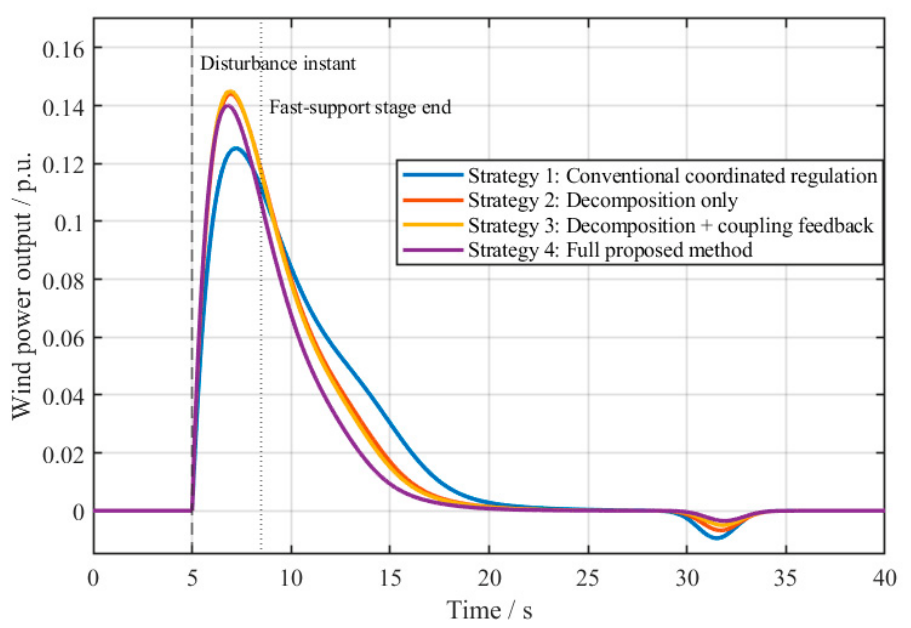
Figure 12 shows the wind turbine output power curves under different coordinated frequency regulation strategies.
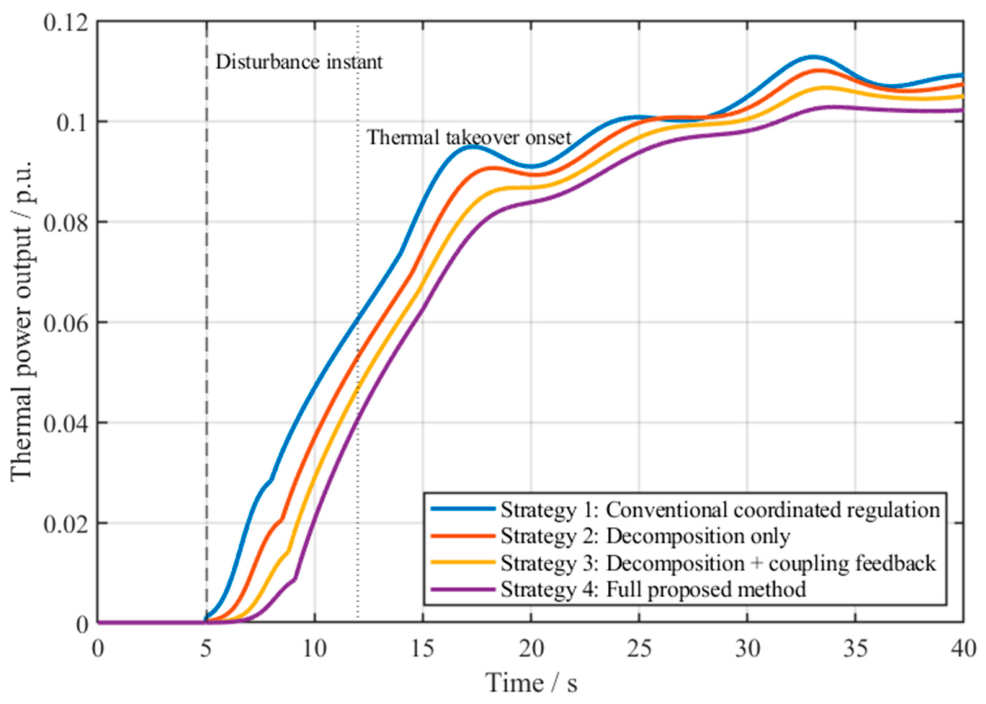
It can be seen that, in Strategy 1, the wind turbine support process overlaps significantly with the thermal regulation process, the wind turbine output lasts for a relatively long period, and the power drops rapidly after the support ends, which may easily cause a renewed system power imbalance during the recovery stage. In Strategy 2, the wind turbine output is more concentrated in the initial stage of the disturbance, indicating that frequency deviation decomposition can strengthen the fast support characteristic of wind turbines, although a certain rebound still exists during the withdrawal stage. Compared with Strategy 2, Strategy 3 shows little difference in the wind turbine support intensity during the initial disturbance stage, but the withdrawal process becomes smoother, indicating that although cross-band coupling feedback mainly acts on the reconstruction of the thermal regulation target, it also helps mitigate the system power rebound after the end of wind turbine fast support. By contrast, in Strategy 4, the wind turbine can provide more targeted fast output in the initial disturbance stage and withdraw more smoothly in the subsequent stage, indicating that dynamic thresholds and energy constraints help further improve the participation timing and withdrawal process of wind turbine support. These results show that Strategy 4 produces a more targeted and smoother wind turbine support process.
Figure 13 shows the thermal power output curves under different coordinated frequency regulation strategies.
It can be observed that, in Strategy 1, the thermal power unit exhibits a relatively large regulation amplitude already in the initial stage of the disturbance, and its output fluctuates noticeably during the recovery stage, indicating a strong tendency toward excessive intervention. In Strategy 2, the variation in thermal output becomes smoother than that in Strategy 1, but a certain degree of repeated compensation still exists after the wind turbine support ends. In Strategy 3, the thermal output variation becomes further smoother than that in Strategy 2, and the regulation process lags more reasonably behind the fast support stage of the wind turbine. This indicates that cross-band coupling feedback can effectively correct the input target of the low-frequency regulation channel of the thermal unit, enabling the thermal power unit to mainly compensate for the residual low-frequency imbalance after the initial wind turbine support. In Strategy 4, the thermal output becomes even smoother, and the extent of deep regulation is further reduced, indicating that after introducing dynamic thresholds and energy constraints on the wind turbine side, the wind–thermal transition process is further optimized. These results show that Strategy 4 reduces excessive thermal regulation and improves the smoothness of the thermal output.
To quantitatively compare the overall performance of different strategies, indices including the frequency nadir, maximum rate of change in frequency, secondary frequency drop, recovery time, cumulative thermal regulation effort, and wind power utilization are further calculated. The results are listed in
Table 4.
As shown in
Table 4, Strategy 4 achieves the best overall performance among the four internal comparison strategies. Compared with Strategy 1, the frequency nadir increases from 49.676 Hz to 49.700 Hz, the maximum rate of change in frequency is reduced from −0.118 to −0.104, the secondary frequency drop decreases from 0.028 to 0.015, and the recovery time is shortened from 20.7 s to 16.6 s. In addition, the cumulative thermal regulation effort decreases from 3.18 to 2.74, while wind power utilization increases from 79.6% to 93.0%. These quantitative results confirm the effectiveness of the complete coordinated strategy.
3.5. Multi-Objective Optimization and Cross-Condition Adaptability Analysis
To further verify the applicability and stability of the proposed complete coordinated frequency regulation strategy under different operating conditions, this paper conducts a multi-objective optimization and cross-condition adaptability analysis after completing the validation of the control mechanism and comparative strategy performance. Unlike conventional parameter tuning methods that focus only on a single frequency-related index, this study simultaneously considers the frequency nadir, secondary frequency drop, equivalent thermal regulation action count, and wind power utilization. Under different wind speeds, different load disturbance magnitudes, and different wind–thermal capacity ratios, the coordinated frequency regulation parameters are evaluated in a unified manner, so as to examine the overall performance and operating-condition adaptability of the proposed method.
To make the optimization framework clearer and more reproducible, the improved dhole optimization algorithm (IDOA) is adopted in this study to optimize the key control parameters of the proposed wind–thermal coordinated frequency regulation strategy. In the IDOA-based optimization process, each individual represents a candidate parameter combination of the controller. The decision variable vector is defined as
where τ is the high–low frequency separation parameter, α\alphaα is the cross-band coupling coefficient, Tr is the feedback filter time constant, Kwp and Kv are the wind turbine fast active power regulation gain and virtual inertia gain, respectively, and Kt and Ki are the thermal-unit droop coefficient and integral recovery coefficient, respectively. These variables are selected because they directly determine the task allocation between wind turbine fast support and thermal-unit sustained regulation. The search ranges of these parameters are set according to the nominal parameter values in
Table 2 and the stable operating boundaries obtained from preliminary simulations.
In the multi-objective optimization process, the frequency nadir, secondary frequency drop, equivalent thermal regulation action count, and wind power utilization are selected as the main evaluation indices. Among them, and SFD are used to characterize system frequency security and recovery smoothness, is used to measure the regulation frequency of the thermal unit during the recovery stage, and is used to characterize the utilization efficiency of the fast support capability of the wind turbine. To facilitate comprehensive multi-index evaluation, all objective quantities are first normalized.
Since the frequency nadir and wind power utilization are benefit-type indices, while the secondary frequency drop and equivalent thermal regulation action count are cost-type indices, the benefit-type indices are converted into cost-type terms after normalization. Therefore, a weighted-sum method is adopted rather than a Pareto-front approach, and the composite fitness function used in IDOA is constructed as follows:
where
,
,
, and
denote the normalized frequency nadir, secondary frequency drop, equivalent thermal regulation action count, and wind power utilization, respectively, and
,
,
and
are the corresponding weighting coefficients. In the absence of specific engineering preferences, equal weights are adopted in this paper, i.e.,
. The minimization of the composite fitness function
is taken as the optimization objective.
The IDOA implementation procedure can be summarized as follows. First, an initial population of candidate parameter vectors is generated within the predefined search ranges. Second, for each candidate parameter vector, the time-domain simulation is performed under the same disturbance scenario, and the four performance indices are calculated. Third, the normalized indices are substituted into Equation (31) to obtain the fitness value of each individual. Then, the population is iteratively updated according to the IDOA search mechanism until the maximum number of iterations is reached or the fitness improvement becomes sufficiently small. Finally, the parameter vector with the minimum fitness value is selected as the optimized parameter set. On this basis, the high–low frequency separation parameter, wind turbine fast support parameters, thermal-unit sustained regulation parameters, and cross-band coupling feedback parameters are jointly optimized and further verified under different operating conditions.
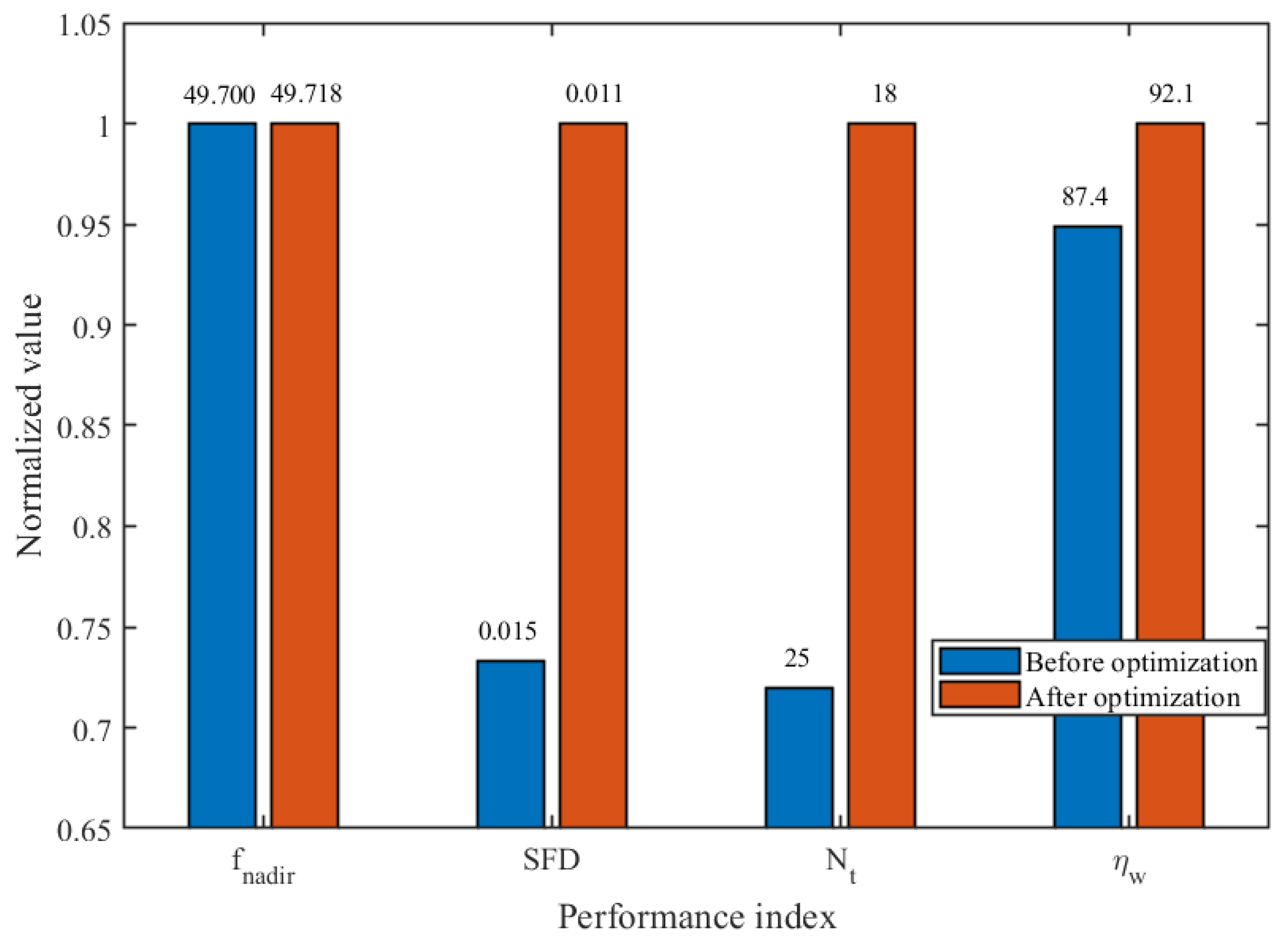
Figure 14 presents the comparison of the main performance indices before and after optimization under the nominal operating condition.
It can be observed that, after parameter optimization, the system frequency nadir is further improved, the secondary frequency drop is significantly reduced, the equivalent thermal regulation action count decreases, and wind power utilization increases. These results indicate that the proposed multi-objective optimization does not merely improve a single frequency-related index, but instead achieves a better balance among frequency security, recovery smoothness, and wind–thermal resource coordination. From the perspective of the composite objective function, the optimized parameter set exhibits a lower overall cost under the unified evaluation criterion, and can therefore be regarded as the optimal parameter combination for the current nominal operating condition.
On the basis of the validation under the nominal operating condition, further combinations of different wind speeds, load disturbance magnitudes, and wind–thermal capacity ratios are considered to construct multiple typical operating scenarios. To further examine robustness and sensitivity, three representative operating factors are varied, including wind speed, load disturbance magnitude, and wind–thermal capacity ratio. The wind speed scenarios include low, medium, and high wind speed conditions, which are used to characterize variations in the available wind power support capability. The load disturbance scenarios include small, medium, and large disturbances, which are used to represent changes in the degree of system imbalance. The wind–thermal capacity ratio scenarios are used to reflect the influence of renewable energy penetration on coordinated frequency regulation performance. The definitions of the relevant scenarios are listed in
Table 5, and the main performance results before and after optimization are presented in
Table 6.
As shown in
Table 6, under all operating conditions, the optimized parameter set achieves better overall performance than the initial parameter set, indicating that the proposed multi-objective optimization method exhibits good stability and consistency. Specifically, when the wind speed is relatively high, the available wind power support capability is greater, and the optimized parameters can make fuller use of the fast support potential of wind turbines, resulting in a more pronounced improvement in the frequency nadir. When the wind speed is relatively low, although the support capability of wind turbines is limited, the dynamic threshold and energy-constrained mechanism can suppress excessive wind turbine participation, thereby enabling thermal power units to undertake the subsequent regulation task more smoothly during the recovery stage.
From the perspective of disturbance magnitude variation, as the disturbance level increases, the frequency nadir decreases and the secondary frequency drop becomes more severe under all scenarios. Nevertheless, the optimized strategy consistently outperforms the initial parameter set across different disturbance levels. In particular, under higher disturbance levels, the optimized coupling feedback parameters can effectively reduce the repeated compensation of thermal power units after the withdrawal of wind turbine fast support, thereby reducing the oscillation amplitude during the recovery stage and the equivalent thermal regulation action count.
From the perspective of the wind–thermal capacity ratio, when the proportion of wind power increases, wind turbines can undertake a larger share of the fast support task in the initial stage of the disturbance, while the regulation burden on thermal power units during the recovery stage is correspondingly alleviated. Under conditions with a higher proportion of thermal power, the optimized control parameters can still maintain satisfactory coordination between wind turbines and thermal power units by properly allocating the tasks of fast support and sustained compensation. Further statistical analysis shows that, across all nine scenarios, the optimized parameter set consistently improves the frequency nadir, reduces the secondary frequency drop, lowers the equivalent thermal regulation action count, and enhances wind power utilization, demonstrating the good cross-condition adaptability and consistent optimization effectiveness of the proposed method.
Overall, the results in
Table 6 show that the optimized parameter set improves all selected performance indices across the nine operating scenarios, verifying the cross-condition adaptability of the proposed optimization strategy.
4. Discussion
4.1. Mechanistic Interpretation and Advantages of the Proposed Strategy
The results show that the proposed strategy improves wind–thermal coordinated frequency regulation through the combined effects of time-scale decomposition, residual-based feedback correction, and energy-constrained wind turbine support. Compared with the conventional unified-input strategy, the multi-band decomposition separates the fast and slow components of the frequency deviation, allowing wind turbines to respond mainly to the high-frequency component and thermal units to undertake sustained low-frequency regulation. This division of tasks reduces the response overlap between the two types of resources.
The residual-based cross-band feedback further improves the coordination process. Instead of responding directly to the original low-frequency deviation, the thermal unit acts on the residual imbalance after wind turbine fast support. Therefore, the thermal unit compensates mainly for the remaining power deficit rather than repeating the compensation already provided by the wind turbine. This explains the smoother thermal output, smaller secondary frequency drop, and lower thermal regulation burden observed in the comparative results.
In addition, the dynamic segmented thresholds and releasable power constraints improve the wind turbine support process by considering the available regulating capability and residual rotor kinetic energy. Compared with fixed-threshold control, this mechanism avoids excessive kinetic energy release under limited-energy conditions and reduces power rebound during the withdrawal stage. As a result, the complete strategy achieves a smoother transition from wind turbine fast support to thermal unit takeover.
However, the improved coordination is achieved at the cost of additional parameter tuning and signal processing. The performance of the proposed strategy depends on the selection of the frequency separation parameter, cross-band coupling coefficient, dynamic threshold coefficients, and power constraint coefficient. Therefore, improper parameter settings may weaken the coordination effect, reduce the effectiveness of residual compensation, or delay the thermal-unit takeover process.
4.2. Practical Implementation
From an engineering perspective, the proposed strategy can be implemented within a hierarchical wind–thermal frequency regulation framework. At the wind farm level, the frequency deviation, rotor speed, available wind power, and operating state of wind turbines can be used to calculate the high-frequency support command, dynamic thresholds, and releasable power limits. At the thermal unit side, the governor or primary frequency regulation controller can use the residual low-frequency deviation as its input, so that the thermal unit responds to the remaining imbalance after wind turbine support.
The key parameters, including the frequency separation parameter, cross-band coupling coefficient, dynamic threshold coefficients, and power constraint coefficient, can be obtained through offline multi-objective optimization under typical operating conditions. In practical applications, these parameters may be updated by look-up tables or adaptive adjustment according to wind speed, disturbance level, and wind–thermal capacity ratio. Therefore, the proposed method can provide a practical parameter-design reference for coordinated primary frequency regulation in wind–thermal power systems.
Before field deployment, the controller parameters should be further verified through offline simulation, real-time simulation, and staged field tests to ensure compatibility with existing wind farm active power controllers and thermal-unit governor systems.
4.3. Limitations and Future Work
Although the proposed method shows good performance in the modified IEEE 3-machine 9-bus wind–thermal system, several limitations remain. First, the present study mainly verifies the control mechanism in a benchmark system. When the method is extended to large-scale or multi-area power systems, more complex network topologies, inter-area oscillations, generator locations, and communication delays should be considered. In addition, the frequency decomposition parameters and coupling coefficients may need to be adapted according to regional frequency response characteristics.
Second, energy storage systems and wind power reserve strategies based on active power curtailment are not included in the present model. This study focuses on improving wind–thermal coordination without adding extra storage devices or explicitly reserving curtailed wind power. Although storage systems and deloading-based reserve control can provide fast and flexible frequency support, their integration would introduce additional issues, including storage capacity configuration, state-of-charge constraints, reserve allocation, wind power curtailment cost, degradation cost, and coordinated dispatch. Therefore, wind–thermal–storage coordination and reserve-constrained wind power control should be further investigated.
Third, under-frequency load shedding is not considered in the present simulation model, because this paper focuses on the primary frequency regulation process before emergency protection actions are activated. Under-frequency load shedding is an emergency protection measure used to prevent unacceptable frequency decline under extreme disturbances, whereas the proposed strategy is intended to improve the frequency nadir and recovery smoothness before such protection actions are triggered. In practical systems, the proposed strategy should not be regarded as a replacement for load-shedding protection; instead, it should be coordinated with under-frequency load shedding schemes to reduce the probability and amount of load curtailment.
Finally, the wind turbine and thermal unit models used in this study are based on standard dynamic frequency response models. Although these models are sufficient for comparing different control strategies under the same simulation conditions, further validation using detailed electromagnetic transient models, real-time digital simulation, hardware-in-the-loop platforms, or field data is still required before engineering deployment. Future work will therefore focus on large-scale system validation, wind–thermal–storage coordination, protection-control coordination, and robustness analysis under communication delays, measurement noise, and parameter uncertainties.