Article

Study on Performance Optimization and Feasibility of No.9 Turnout with 1520 mm Gauge in China


1
Postgraduate Department, China Academy of Railway Sciences, Beijing 100081, China
2
State Key Laboratory for Track Technology of High-speed Railway, China Academy of Railway Sciences Co., Ltd., Beijing 100081, China
3
Railway Engineering Research Institute, China Academy of Railway Sciences Co., Ltd., Beijing 100081, China
4
CARS (Beijing) Railway Equipment Technology Co., Ltd., Beijing 102202, China
*
Author to whom correspondence should be addressed.
Appl. Sci. 2026, 16(1), 513; https://doi.org/10.3390/app16010513
Submission received: 5 December 2025 / Revised: 28 December 2025 / Accepted: 29 December 2025 / Published: 4 January 2026

Abstract

To address the issues of poor geometric dimension retention, short component lifespan, and heavy maintenance workload of the 1520 mm gauge 50 kg/m rail No.9 turnout, a new design was proposed for the 1520 mm gauge 60 kg/m rail No.9 turnout. Based on the new design’s plane alignment, structural features, and other requirements, dynamic models of the vehicle–turnout system, the turnout conversion model, and the continuous welded rail turnout (CWR turnout) model were established. The focus was on analyzing the dynamic response of the vehicle when passing through the 1520 mm gauge 60 kg/m rail No.9 turnout, as well as its switching performance. The feasibility of applying CWR technology to this turnout was also explored. The results indicate that the dynamic indicators of the vehicle passing through the 1520 mm gauge 60 kg/m rail No.9 turnout meet the regulatory requirements; the maximum switching force at the traction point is 1.807 kN, which is less than the rated power of the switch machine; and the rail strength and track stability of the CWR turnout model all meet the design specifications.

1. Introduction

International railway intermodal transportation, as an efficient and environmentally friendly mode of transportation, has received positive response from many countries. However, due to the differing track gauge adopted by various countries and regions worldwide, such as the standard gauge (1435 mm), 1520 mm gauge (Gauge is defined as the minimum distance between the working edges of the two rails within the range of 16 mm from the top surface of the rails. In this paper, the term “1520 mm gauge” indicates that the gauge of the turnout is 1520 mm), and a range of other gauge types, cross-border rail transport faces considerable challenges. Among these, 1520 mm railway turnout technology is crucial for ensuring smooth and safe transitions of trains between tracks with different gauges [1,2,3,4].
Due to the earlier development of the 1520 mm gauge 50 kg/m rail No.9 turnout, which was limited by the technological capabilities of its time, the performance of these turnouts no longer meets the current demands of railway operations. This discrepancy has become particularly evident with the increase in freight traffic and the changes in the port station’s primary vehicle types, revealing several critical issues. These include poor geometric dimension (gauge, track cross level, track profile, and track alignment of turnout) retention, short lifespan of components, and high maintenance requirements. There is an urgent need to upgrade and retrofit the existing 50 kg/m rail turnout systems to reduce the costs associated with track maintenance. Therefore, this study focuses on the upgrade of the 50 kg/m rail No.9 broad-gauge turnout to a 60 kg/m rail No.9 broad-gauge turnout, which is of considerable technical and practical significance [5,6,7,8].
In the current research on broad-gauge railway, Liu P [9] introduced the selection of design parameters and structural characteristics of the No.8.5 broad-gauge simple turnout with 1676 mm gauge and 60 kg/m rails, and checked the safety parameters of the turnout, as well as the intervals of each part of the frog and guard rail. Liu D et al. [10], considering the characteristics of the Moscow–Kazan high-speed railway, such as high-speed, broad-gauge, cold environment, and mixed passenger–freight operation, developed a No.25 turnout plane alignment scheme based on the requirements of driving safety and comfort, as well as the low-dynamic design of turnouts. Wang S et al. [11] addressed the issue of short service life and extremely frequent replacement of wing rails and point rails in the wheel load transition zone of fixed frogs in Chinese railways, which is caused by the small total bearing area. They conducted research on the reasonable selection of check intervals for fixed frogs and the design of widened point rails. Grigonis, V et al. [12] developed a sustainable model to enhance the interoperability between 1435 mm standard-gauge and 1520 mm broad-gauge railway systems, facilitating the development of efficient and sustainable railway networks. Wang P et al. [13] designed a broad-gauge high-speed turnout, which mainly includes the plane alignment, the machining profile of the top surface of the straight stock rail, the vertical lifting structure of the wing rail, and the design of uniform track stiffness in the turnout area. Luo Z [14], aiming at the special case of crossings between broad-gauge and standard-gauge railway tracks, designed a fixed obtuse frog for No.9 crossing of broad-gauge and standard-gauge railway tracks, considering operational needs and vehicle passing safety. Through modeling and analysis, Qi W et al. [15] obtained that gauge variation mainly affects the displacement and stress of sleepers and ballast, with little impact on rails. Huang B [16], Feng D [17], and others studied the differences in main railway technical standards between China and Russia, such as plane curve radius, transition curve length, straight segment length between curves, track gauge, maximum gradient, gradient segment length, and vertical curve settings, using a comparative analysis method.
In the current research on turnout [18,19,20,21,22,23,24], Hamarat M et al. [25,26,27,28] adopted the FEM-MBS coupled numerical modeling method to conduct research on the dynamic behavior of railway turnout systems under impact loads, analyzing the effects of parameters such as train speed, modulus of elasticity of sleeper materials, rail pad stiffness, and unsprung mass on the distribution of sleeper bending moments. Dindar S [29,30,31,32], Kaewunruen S et al. [33,34,35,36,37] adopted the fuzzy Bayesian network (FBN) modeling method integrated with Buckley’s confidence interval approach to conduct research on the probability of train derailments at railway turnouts caused by extreme weather patterns, and the constructed WRDBN model can effectively quantify the probabilistic relationship between weather patterns and derailment accidents. Sresakoolchai J et al. [38] constructed an intelligent automation model based on machine learning pattern recognition to achieve the detection and prediction of turnout support deterioration, with an accuracy exceeding 98%, which can provide support for relevant parties in formulating maintenance plans. Ngamkhanong C et al. [39] conducted the world’s first investigation into the vibration characteristics of full-scale fiber-reinforced foamed urethane (FFU) composite beams and combined it with finite element modeling, providing fundamental data for the design optimization, performance benchmarking, and vibration-based condition monitoring of FFU sleepers or bearers in railway switches and crossings.
From the above literature, it can be seen that current research mostly focuses on the preliminary design of broad-gauge turnouts and the dynamic and reliability analysis of standard-gauge turnouts, while there is a lack of relevant research on the structural optimization and performance analysis of No.9 turnouts with a 1520 mm gauge. For broad-gauge turnouts, it is evident that key components such as frogs and switch rails necessitate redesign with respect to their size and shape. Furthermore, there is a paucity of mature technologies and experience in turnout conversion mechanisms, locking devices, and adaptability to different types of vehicles. Consequently, this paper conducts the first performance optimization and feasibility study on the No.9 turnout with 1520 mm gauge.
This paper conducts a theoretical simulation study on the upgraded No.9 turnout with 1520 mm gauge and 60 kg/m rails. A vehicle–turnout system dynamics model is established based on its planar alignment and turnout structure to analyze the safety and stability of vehicles when passing through the turnout. A switch rail conversion model is built according to the newly designed equipment, so as to analyze the conversion performance of the turnout, such as the switching force and conversion deviation of rail heel. Research is carried out on the newly developed broad-gauge CWR turnout, and the strength and stability of the CWR are checked. The above theoretical research provides a theoretical reference for the design and application of the 1520 mm gauge 60 kg/m rail No.9 turnout.
This study primarily adopts a systematic research methodology integrating theoretical design, numerical simulation, and experimental verification. Specifically, the turnout plane alignment is first optimized from a theoretical perspective, followed by the verification of the feasibility of the optimized scheme through a combination of numerical simulation and experimental tests. Compared with other existing methods, this approach enables a more systematic and comprehensive evaluation of the feasibility of the turnout optimization scheme.
In this study, the performance optimization of the No.9 turnout with 1520 mm gauge is mainly elaborated in Section 2.1 and Section 3.1, which, respectively, address the optimization of the plane alignment and switching device of the turnout. The remaining content of Section 2 and Section 3 primarily focuses on the structural response of the optimized design, corresponding to the feasibility study of this turnout. Finally, Section 4 conducts research on the continuity of the overall optimized turnout structure, which also constitutes a part of the feasibility study.

2. Dynamic Response Analysis of Vehicle–Turnout System

2.1. Optimization of Plane Alignment

The optimized design scheme in this paper involves developing a new type of No.9 turnout with 1520 mm gauge and 60 kg/m rails to replace the existing No.9 turnout with 50 kg/m rails. This aims to improve turnout performance, reduce the full-life-cycle cost of the turnout, and particularly decrease the on-site maintenance workload. Based on the existing main type of product in the form of the No.9 turnout with 50 kg/m rails, the passing condition and plane alignment for the new turnout were initially proposed: The radius remains R250 m, the front part actual length (Q value) of the stock rail remains unchanged, and the gauge is widened by 15 mm. The initial cut distance is maintained at −5 mm, and the heel cut distance is 8.6 mm, consistent with that of CZ267. To ensure that the gauge change rate at the point of switch rail is controlled within 6‰, the gauge at the point of switch rail is set to 1530 mm (with a widening of 10 mm), resulting in a gauge change rate of 3.76‰, which meets the requirement. From the point of switch rail to the section where the straight switch rail has a complete rail head profile, the gauge of the branch track is widened to 1535 mm, while the gauge of the main track remains unchanged at 1520 mm.
In the optimal design of turnout alignment, the gauge widening scheme proposed in this study differs significantly from that of existing turnouts. Through structural parameter optimization, the gauge change rate at the front end of the turnout stock rail is reduced from the existing 5.67‰ to 3.76‰. Subsequently, the gauge of the straight track remains at the standard value of 1520 mm, while the gauge of the branch track is widened to 1535 mm. This design adjustment aims to reduce the wheel–rail lateral force and impact when trains pass through the turnout. However, since the gauge widening parameters directly affect the dynamic characteristics of the vehicle–track system, and existing studies have not yet revealed the law of vehicle dynamic response under the new gauge parameters; it is urgent to conduct a dynamic performance evaluation to provide theoretical support for the turnout alignment design.

2.2. Subsection

2.2.1. Vehicle Model

Based on the theory of multi-body dynamics, a vehicle dynamics model is established with a vehicle structure having a nominal axle load of 23 t as the prototype. In the establishment of the model, the main structural components of the vehicle are simplified as rigid bodies, including components such as wheel sets, bogies, and the car body. Since the main motion form of the wheel sets is rolling, all rigid bodies (except for the four wheels set rigid bodies, which do not consider pitching motion) have five degrees of freedom: lateral movement, rolling, heaving, pitching, and yawing. Therefore, the entire vehicle model has a total of seven rigid bodies with 31 degrees of freedom. A schematic diagram of the vehicle dynamics model is shown in Figure 1, and its main parameters are listed in Table 1. Vehicle parameters exert a significant influence on the dynamic response of the turnout. Different parameters such as vehicle axle load, vehicle wheelbase, and vehicle fixed wheelbase will lead to different wheel–rail interaction behaviors. Consequently, the calculated results of indicators including wheel–rail forces, derailment coefficients, wheel load reduction rates, and carbody acceleration will also vary. Therefore, the adoption of matched vehicle parameters is crucial for ensuring the reliability of the dynamics analysis results.

2.2.2. Turnout Model

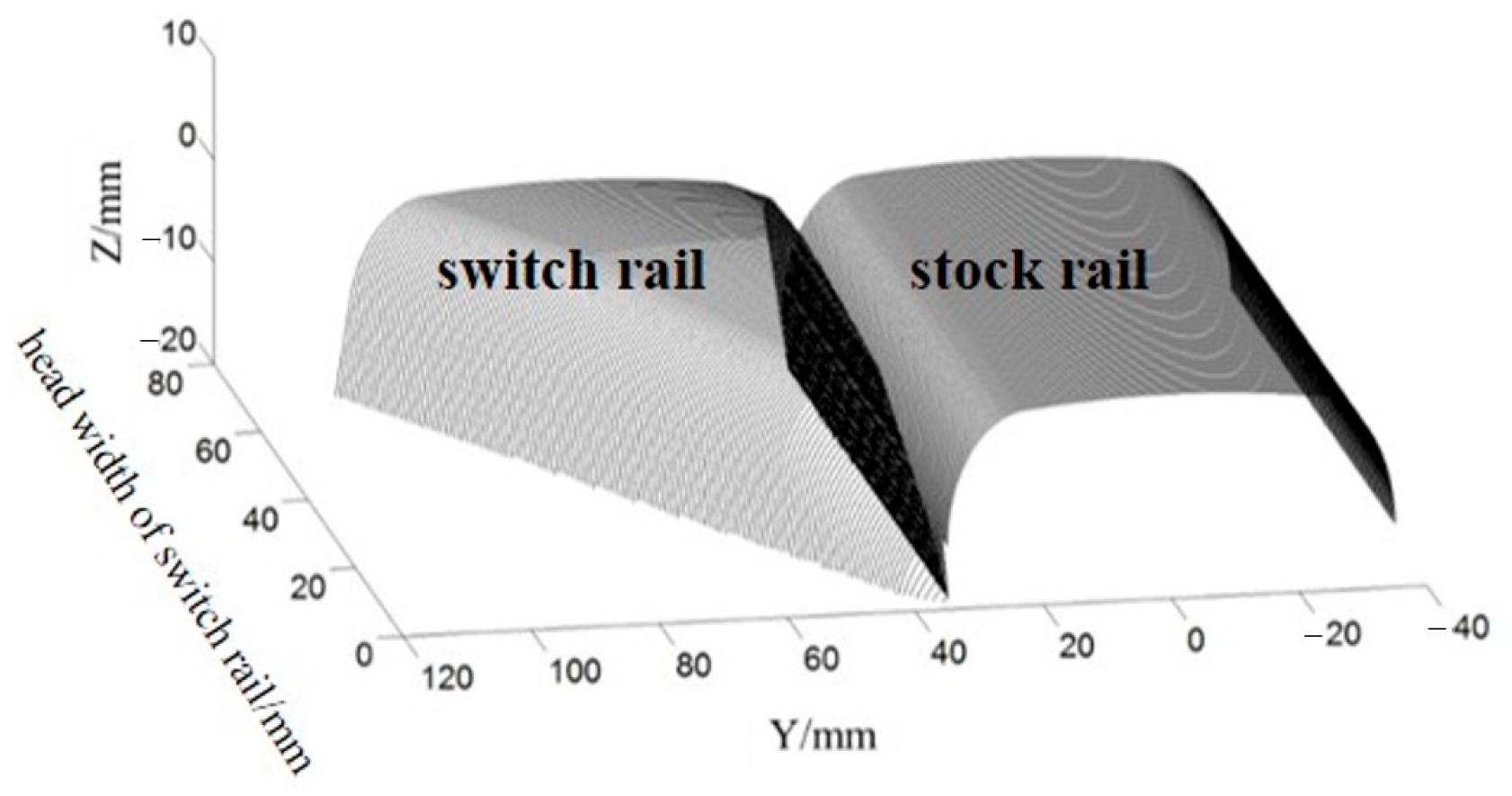
The profiles of the switch rail and point rail in the turnout area gradually change along the longitudinal direction. Since only the key sections are provided in the design drawings, this paper discretizes the profiles of each key section of the turnout. Then, combined with the variation law of the top width of the turnout rail, the rail section profile at any position of the turnout can be obtained through mathematical fitting and interpolation along the longitudinal direction of the line. Figure 2 shows the combined profile of the switch rail/stock rail at any position in the switch section of the No.9 turnout with 60 kg/m rails and a 1520 mm gauge obtained through fitting and interpolation.

2.2.3. Wheel–Rail Contact Model

The wheel–rail contact model mainly involves the calculation of dynamic wheel–rail contact geometric relationships and the analysis of wheel–rail rolling contact behavior. The calculation of dynamic wheel–rail contact geometric relationships is solved based on the principle of the classical track line method, while considering the particularity of the turnout rail profile. The analysis of wheel–rail rolling contact behavior is solved based on the half-Hertz contact theory, mainly including the solution of wheel–rail normal force and wheel–rail creep force, so as to realize the coupling interaction between the vehicle system and the turnout system.
Given that this paper focuses on the influence of the optimized turnout alignment on the vehicle dynamic response, with key consideration of indicators such as wheel–rail forces and car body acceleration during vehicle passage through the turnout, the half-Hertzian contact model has a limited impact on these calculation results while enabling higher computational efficiency. Therefore, this model was adopted for calculations.

2.3. Dynamic Calculation Results

Based on the vehicle–turnout coupled dynamics model, aiming at the newly designed turnout alignment, the evaluation indicators such as wheel–rail dynamic interaction, running safety, and stability when the vehicle passes through the No.9 simple turnout with 1520 mm gauge and 60 kg/m rails in the straight and lateral directions at 120 km/h and 30 km/h, respectively, are calculated and analyzed [40,41,42].

2.3.1. Straight Passage Through the Turnout

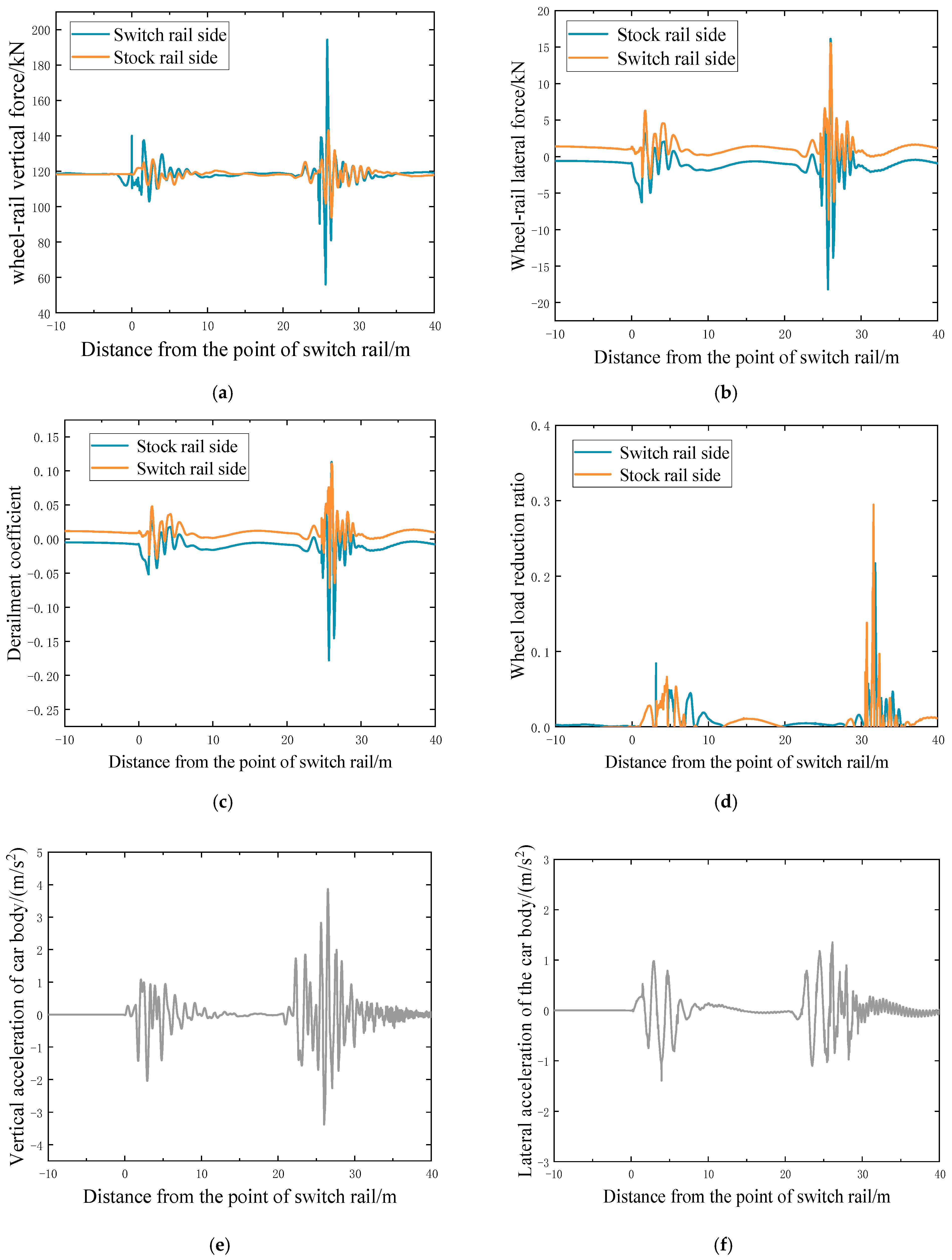
When the vehicle passes straight through the No.9 simple turnout with 1520 mm gauge and 60 kg/m rails, the distributions of wheel–rail vertical force are shown in Figure 3a, and the distribution of wheel–rail lateral force is shown in Figure 3b. According to the calculation results, the maximum values of wheel–rail vertical force on the stock rail side in the switch zone and frog zone are 126.66 kN and 143.10 kN, respectively, and the maximum values of wheel–rail vertical force on the switch rail side are 139.96 kN and 194.29 kN, respectively. The maximum values of wheel–rail lateral force on the stock rail side in the switch zone and frog zone are 6.26 kN and 18.19 kN, respectively, and the maximum values of wheel–rail lateral force on the switch rail side are 6.29 kN and 15.56 kN, respectively.
The derailment coefficient of the vehicle, derived from the interaction force between the wheel and rail on the switch rail side and stock rail side, is shown in Figure 3c, and the wheel load reduction rate is shown in Figure 3d. According to the results in Figure 3c, the distribution of the derailment coefficient of this wheel set along the mileage is similar to the variation trend of the wheel–rail lateral force. The maximum derailment coefficient on the stock rail side is 0.18, and that on the switch rail side is 0.11, both of which are less than the safety limit of 1.0, meeting the requirements of driving safety. According to the calculation results in Figure 3d, the wheel load reduction rate of the guiding wheel set is similar to the variation trend of the wheel–rail vertical force. The wheel–rail interaction in the frog zone is relatively intense. The maximum wheel load reduction rate on the stock rail side is 0.30, and that on the switch rail side is 0.22, neither of which exceeds the safety limit of 0.80.
When the vehicle straight passes through the No.9 turnout with 1520 mm gauge, the vertical vibration acceleration and lateral vibration acceleration of the car body are shown in Figure 3e and Figure 3f, respectively. According to the calculation results, the maximum vertical vibration acceleration of the car body is 3.86 m/s2, which does not exceed the safety limit of 5 m/s2, and the maximum lateral vibration acceleration of the car body is 1.40 m/s2, which is less than the safety limit of 3 m/s2. Both meet the requirements for riding stability.

2.3.2. Lateral Passage Through the Turnout

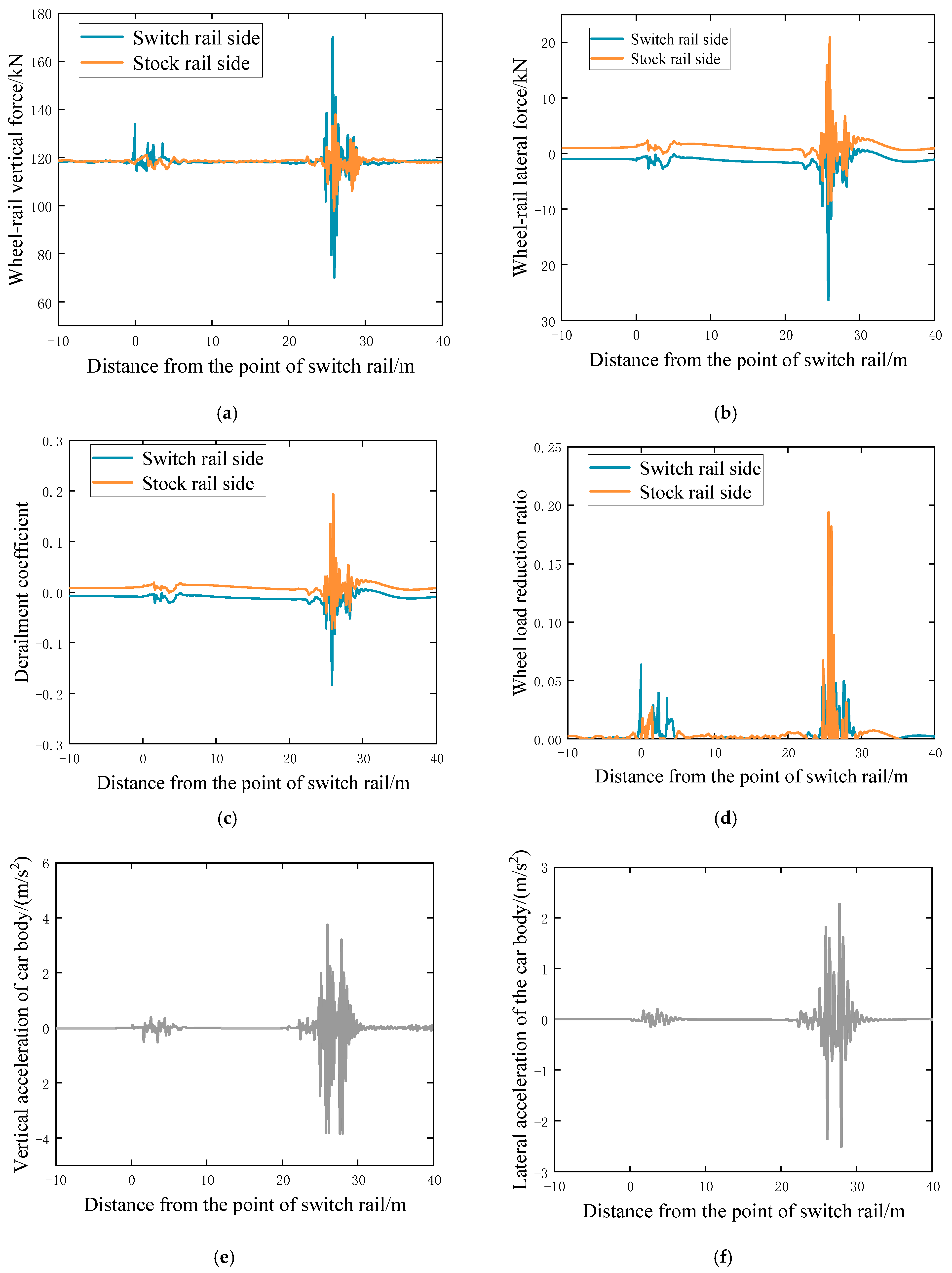
When the vehicle passes laterally through the No.9 simple turnout with 1520 mm gauge and 60 kg/m rails, the distributions of wheel–rail vertical force on the stock rail side and switch rail side of the front wheel set of the front bogie are shown in Figure 4a, and the distribution of wheel–rail lateral force is shown in Figure 4b. According to the calculation results, when the vehicle passes laterally through the turnout at 30 km/h, the maximum values of wheel–rail vertical force on the stock rail side in the switch zone and frog zone are 121.02 kN and 137.87 kN, respectively, and the maximum values of wheel–rail vertical force on the switch rail side are 133.89 kN and 169.98 kN, respectively. The maximum values of wheel–rail lateral force on the stock rail side in the switch zone and frog zone are 2.34 kN and 20.93 kN, respectively, and the maximum values of wheel–rail lateral force on the switch rail side are 2.72 kN and 26.33 kN, respectively.
The derailment coefficient when the vehicle passes laterally through the turnout is shown in Figure 4c, and the wheel load reduction rate is shown in Figure 4d. According to the calculation results in Figure 4c, the maximum derailment coefficient on the stock rail side is 0.20, and that on the switch rail side is 0.18, both of which are less than the safety limit of 1.2, meeting the requirements for driving safety. According to the calculation results in Figure 4d, the maximum wheel load reduction rate on the stock rail side is 0.20, and that on the switch rail side is 0.13, neither of which exceeds the safety limit of 0.80.
When the vehicle passes laterally through the No.9 turnout with 1520 mm gauge, the vertical vibration acceleration and lateral vibration acceleration of the car body are shown in Figure 4e and Figure 4f, respectively. According to the calculation results, the maximum vertical vibration acceleration of the car body is 3.81 m/s2, which does not exceed the safety limit of 5 m/s2, and the maximum lateral vibration acceleration of the car body is 2.52 m/s2, which is less than the safety limit of 3 m/s2. Both meet the requirements for riding stability.

2.3.3. The Impact of Overspeed

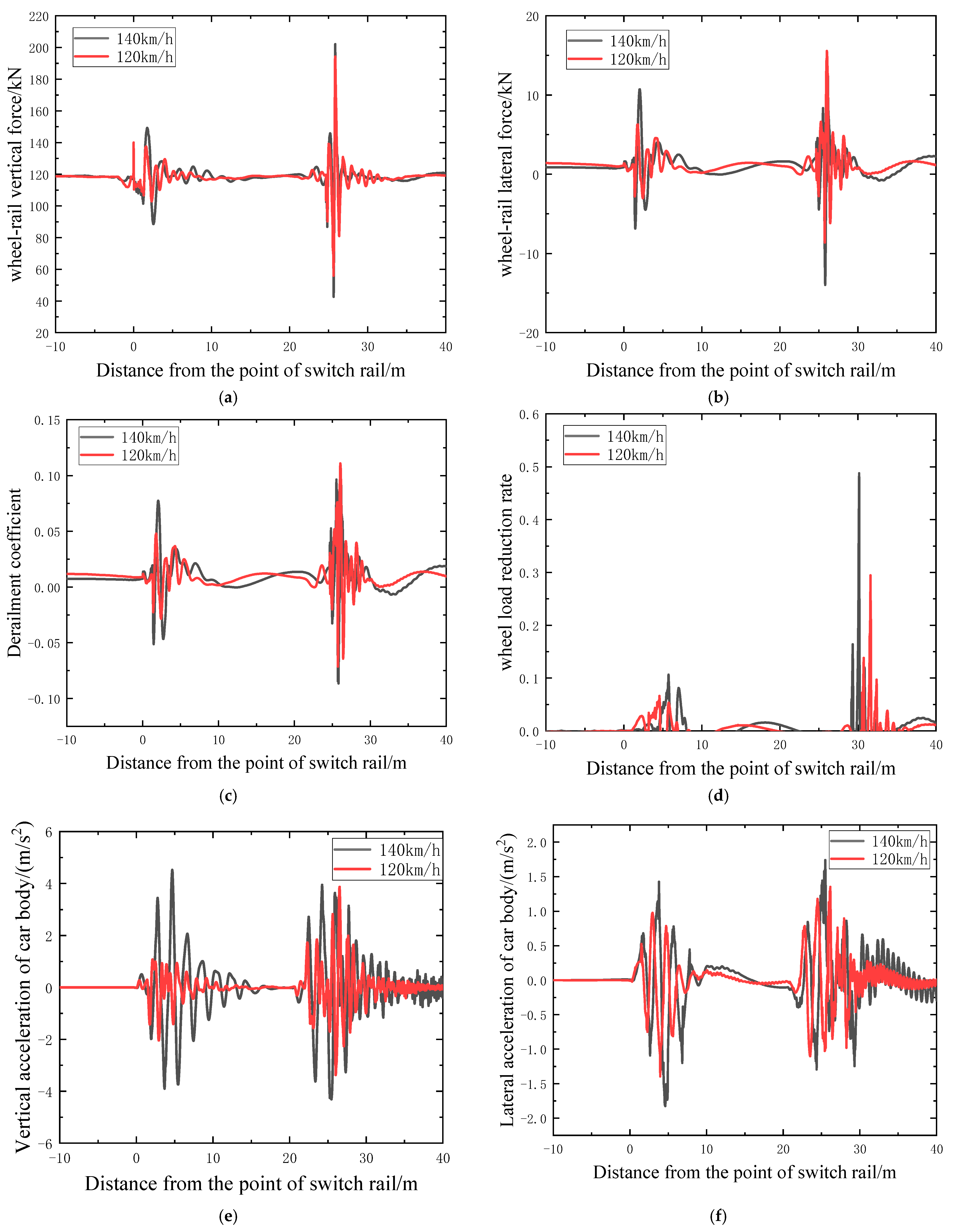
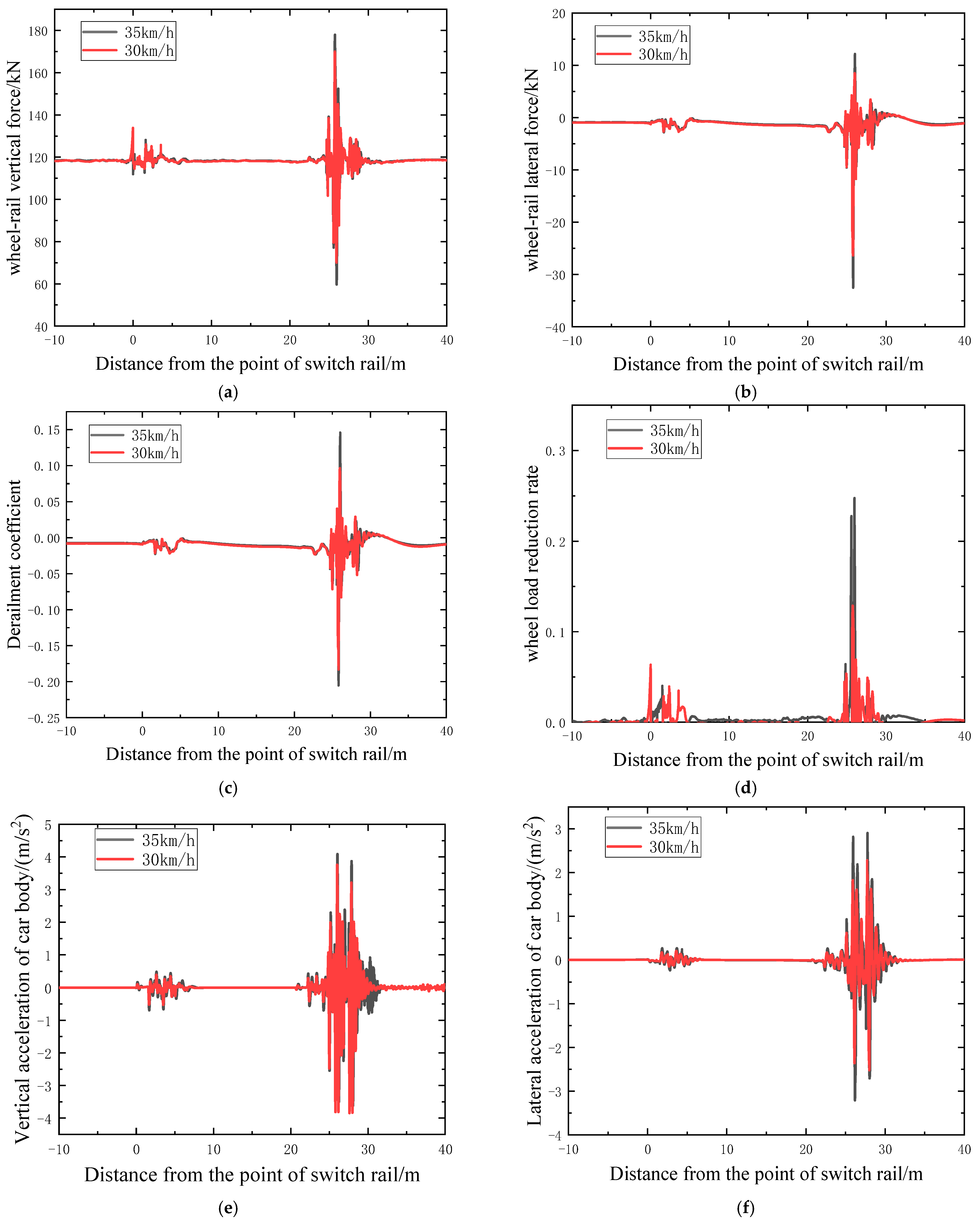
Considering safety redundancy, the speed for straight-through turnout passage has been increased to 140 km/h, and the speed for lateral turnout passage has been increased to 35 km/h (overspeed conditions). The dynamic responses of the vehicle–turnout system under overspeed conditions are calculated, respectively. Figure 5 shows the dynamic response results when the vehicle passes through the turnout straight at 140 km/h. It can be seen from the figure that the dynamic response at 140 km/h is greater than that at 120 km/h. Among them, the maximum wheel–rail vertical force is 202.1 kN, which is an increase of 4.02% compared with the design speed condition. The maximum lateral force is 14.0 kN, showing little difference from that under the design speed condition. The maximum derailment coefficient is 0.11 for both conditions. The maximum wheel load reduction rate is 0.49, which is an increase of 68.97% compared with the value under the design speed. The vertical and lateral vibration accelerations of the vehicle body increase slightly. All the calculated indicators above meet the requirements of relevant specifications.
Figure 6 presents the dynamic response results when the vehicle passes through the turnout laterally at 35 km/h. It can be observed from the figure that the dynamic response at 35 km/h is greater than that at 30 km/h. Among the indicators, the maximum wheel–rail vertical force is 177.97 kN, which is an increase of 4.69% compared with the design speed condition. The maximum lateral force is 32.51 kN, rising by 23.47% from the design speed condition. The maximum derailment coefficient increases by 50%. The maximum wheel load reduction rate is 0.25, which is 92.31% higher than the value under the design speed. The vertical vibration acceleration of the vehicle body increases slightly, while the lateral vibration acceleration of the vehicle body rises by 26.98%. All the calculated indicators above comply with the requirements of relevant specifications.

3. Switch Rail Conversion Analysis

3.1. Conversion Design

The switch is equipped with one traction point and adopts a linked internal locking conversion mode with a stroke of 160 mm. To improve the overall performance of conversion, two connecting rods are arranged at the rear side of the traction point, with longitudinal distances of 1366 mm and 3666 mm from the traction point, respectively. The stock rail is fastened using elastic clips, and no wheel-facing guard rail is installed at the starting end of the turnout. The No.9 turnout with a 1520 mm gauge adopts a 9.475 m flexible bendable switch rail, whose point is the housing point of the switch and whose heel end is equipped with a large clearance limiting stopper. The under-rail foundation of the turnout uses concrete sleepers, which are arranged perpendicular to the direction of the straight stock rail. A torsion sleeper is installed at the end of the curved stock rail, and the subsequent turnout sleepers are arranged perpendicular to the working edge of the curved stock rail.
To verify the conversion efficiency of the combined action of one traction point and two connecting rods, a full-time conversion model of the switch rail is established to systematically analyze key technical indicators during the switch rail conversion process, such as the peak switching force, conversion deviation of rail heel, and minimum flangeway width, providing theoretical basis and technical support for the reliability design of the turnout.

3.2. Model Establishment and Verification

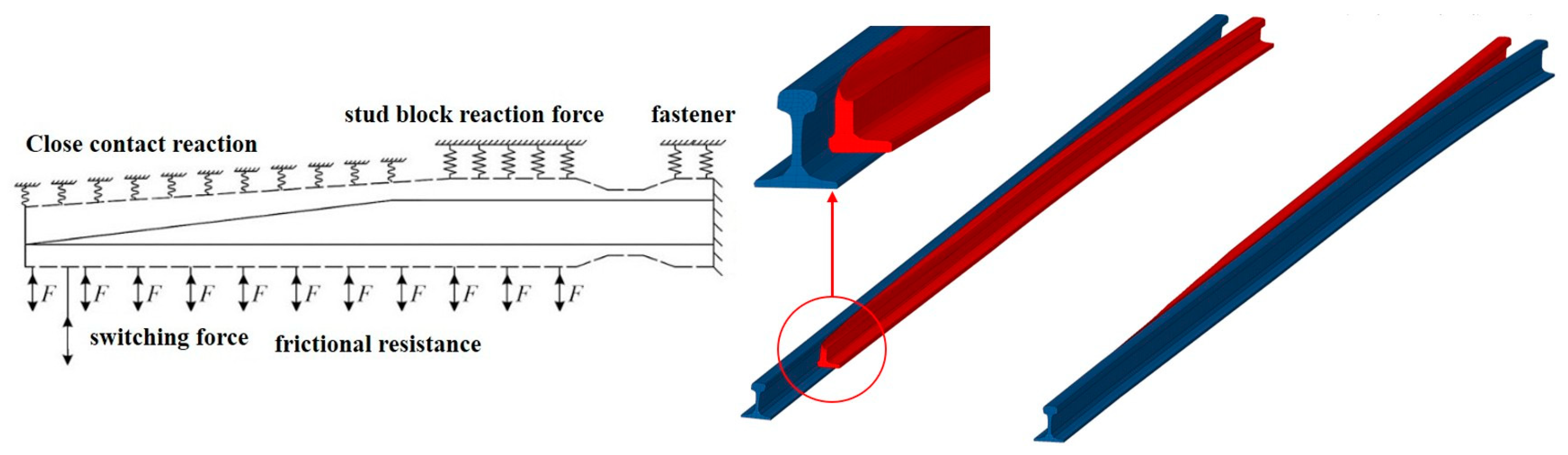
Based on the finite element theory, a turnout conversion analysis model is established. In the model, special structural shapes and key details are considered, such as the cross-sectional characteristics of the switch rail and point rail, traction point position, and stroke of switch. Linear and nonlinear factors during the conversion process are also taken into account, including friction force, close contact reaction force, and fastener resistance. In the model, the close contact action in the close contact section, the action of stud block reaction force, and fastener support are simulated using nonlinear spring elements. The switch rail and point rail are simulated using variable cross-section beam elements. The calculation model for conversion is shown in Figure 7.
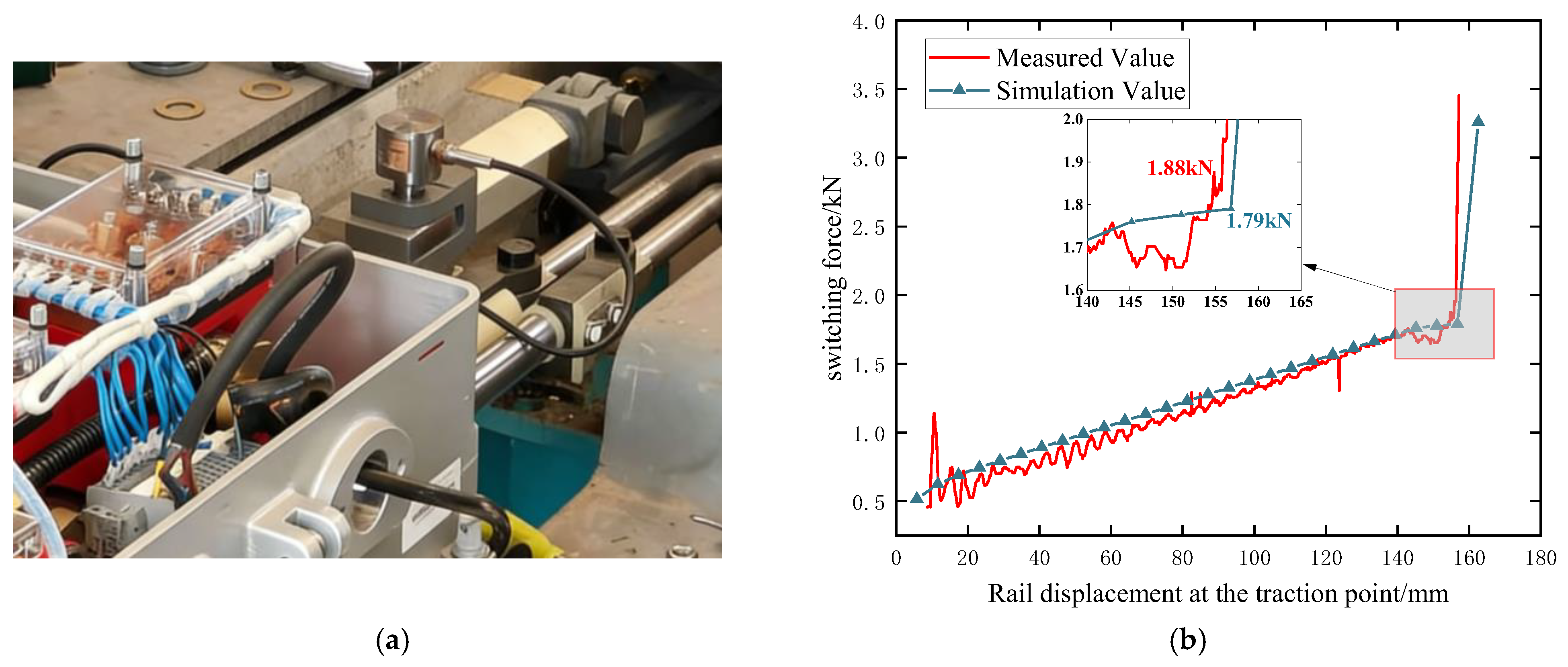
This paper conducts a switch rail conversion test study on the No.9 turnout with 1520 mm gauge to verify the validity of the aforementioned model. Figure 8a shows the load cell installed on the traction rod; the test primarily measures the switching force by pulling the switch rail. Figure 8b presents a comparative analysis of the measured and simulated values of switching force. As seen from the figure, the variation trends of the simulated and measured values with switch rail displacement are in good agreement, which are characterized as follows: the switching force increases linearly with displacement when the switch rail displacement is less than 160 mm, and rises sharply in a short time after the displacement exceeds 160 mm. When the switch rail displacement reaches 160 mm, the simulated switching force is 1.79 kN, while the measured value is 1.88 kN, with a deviation of 5.03% between them, which meets the accuracy requirements for numerical simulation.
The switching force is calculated using the finite element model established earlier, and the calculation results are shown in Figure 8b. It can be seen from the figure that the variation in the switching force is divided into two stages: In the first stage, the switching force increases linearly from 0.5 kN to 1.79 kN. This stage corresponds to the conversion of the switch rail from the open state to the closed state, where the switching force is mainly composed of the bending resistance and frictional resistance of the switch rail. In the second stage, the switching force increases rapidly from 1.79 kN and stabilizes at 3.26 kN. This is because after the switch rail is converted in place, it further shifts transversely under the action of inertia, and the switch rail comes into rigid contact with the stock rail, resulting in a large locking force. Therefore, the maximum switching force required for switch rail conversion is 1.79 kN, which is less than the rated switching force of the switch machine, ensuring the normal conversion of the switch rail.

3.3. Conversion Calculation Results

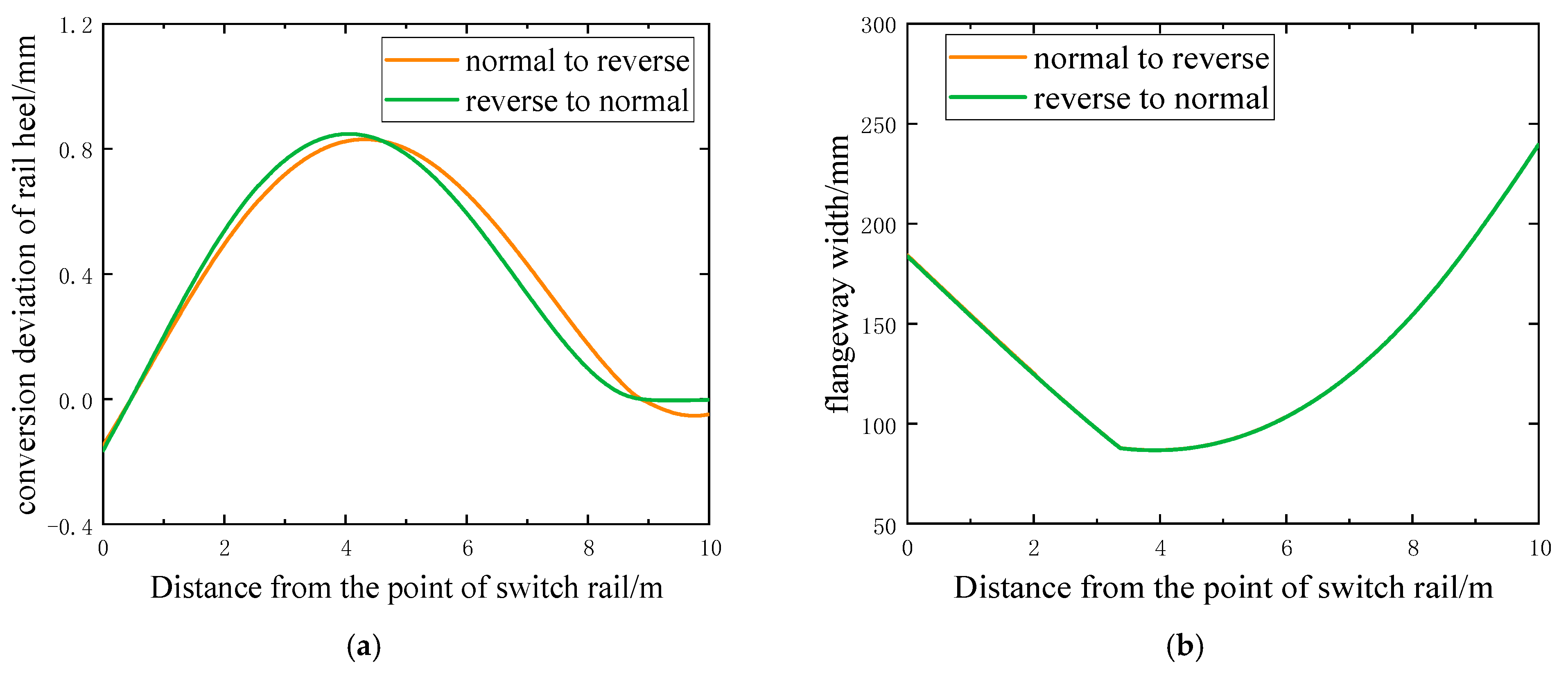
Based on the provided drawings of the No.9 turnout with 1520 mm gauge and 60 kg/m rails, as well as the theoretical lengths of the pull rods and connecting rods, the finite element analysis method is adopted to calculate the conversion deviation of rail heel, and flangeway width of the switch rail during the processes of conversion from the normal position to the reverse position and from the reverse position to the normal position, respectively, as shown in Figure 9.

3.3.1. Conversion Deviation of Rail Heel

The conversion deviation of rail heel during the conversion of the switch rail from the normal position to the reverse position and from the reverse position to the normal position is shown in Figure 9a. It can be seen from the figure that the distribution patterns of the conversion deviation of rail heel during the two conversion processes are similar, showing a trend where the conversion deviation of rail heel first increases and then decreases. During the conversion from the normal position to the reverse position, the maximum deviation between the position of the switch rail after switching and the designed position is 0.83 mm at a distance of 4.36 m from the point of switch rail. During the conversion from the reverse position to the normal position, the maximum deviation between the position of the switch rail after switching and the designed position is 0.85 mm at a distance of 4.14 m from the point switch rail.

3.3.2. Minimum Flangeway Width

The flangeway width during the switch rail from the normal position to the reverse position and from the reverse position to the normal position is shown in Figure 9b. It can be seen from the figure that the flangeway widths in both conversion processes are nearly identical, exhibiting a trend where the flangeway width first decreases and then increases as the distance from the point of switch rail increases. During the normal-to-reverse conversion, the minimum flangeway width is 86.75 mm at a distance of 3.86 m from the point of switch rail. During the reverse-to-normal conversion, the minimum flangeway width is 86.73 mm at the same distance of 3.86 m from the point of switch rail. Since the gauge of the turnout’s diverging track is widened by 15 mm on the basis of 1520 mm, the corresponding minimum limit of the flangeway width should also be increased from 65 mm to 80 mm. Therefore, the minimum flangeway width meets the requirements.

4. Calculation of CWR Turnout

In the railway port transportation system, wide-gauge CWR (continuous welded rail) turnouts, as key facilities for realizing gauge conversion and ensuring safe train operation, are widely used in border transshipment stations and hub nodes. However, restricted by the extreme climatic conditions in port areas, rails are prone to stress concentration under temperature loads, potentially leading to issues such as sleeper displacement and fastener loosening. In view of this, a mechanical model of CWR turnout–subgrade is established in this paper. The model fully considers the influence of extreme temperature fluctuations and systematically explores the technical feasibility of wide-gauge CWR turnouts by simulating the longitudinal force transmission law of rails under different temperature conditions.

4.1. Model Establishment

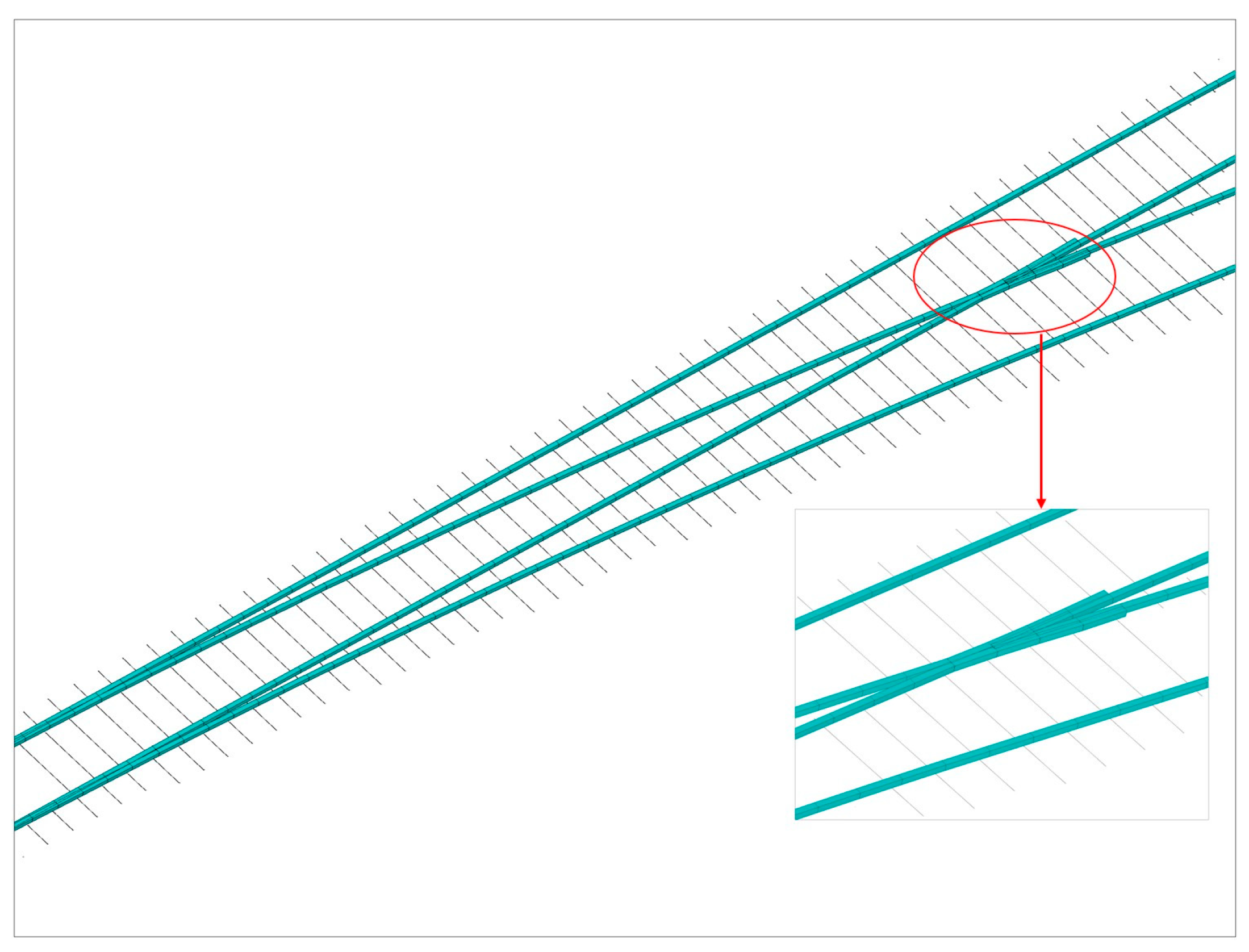
Since this model focuses on studying the longitudinal thermal force and displacement of rails, rails and sleepers are simulated using beam elements, while combin39 spring elements are adopted to simulate the nonlinear resistance characteristics of fasteners, ballast bed, and limiting stoppers. In the process of longitudinal force transmission in rails, since lateral, vertical displacements, and torsion of sleepers are not considered, the lateral and vertical displacements as well as the torsion angles of the beam element nodes are constrained. The ballast bed is connected to the ground, and the nodes at the bottom of the ballast bed spring elements are fully constrained. In addition, attention should be paid to the absence of fastener constraints at a certain distance from the point rail and switch rails. Considering the existence of boundary effects, both ends of the model are extended by 60 m to eliminate such effects and improve the accuracy of calculation results. Combined with the above preparations, the general view and detailed views of the established finite element model are shown in Figure 10.

4.2. Longitudinal Thermal Forces and Displacements in CWR Turnouts

The calculation conditions are determined based on the extreme climatic data from the port stations of Urumqi, Hohhot, and Harbin, using the local historical maximum and minimum rail temperatures as benchmarks. The design rail-locking temperature is set at 20.6 °C. Considering the extreme temperature differences in these regions, the maximum rail temperature of 64.2 °C (corresponding to a temperature rise of 43.6 °C) and the minimum rail temperature of −33 °C (corresponding to a temperature drop of 53.6 °C) are selected to calculate the longitudinal thermal forces and displacements of each rail under these two conditions, ensuring the results are applicable to port stations across diverse climatic regions in China.

4.2.1. Temperature Rise Condition

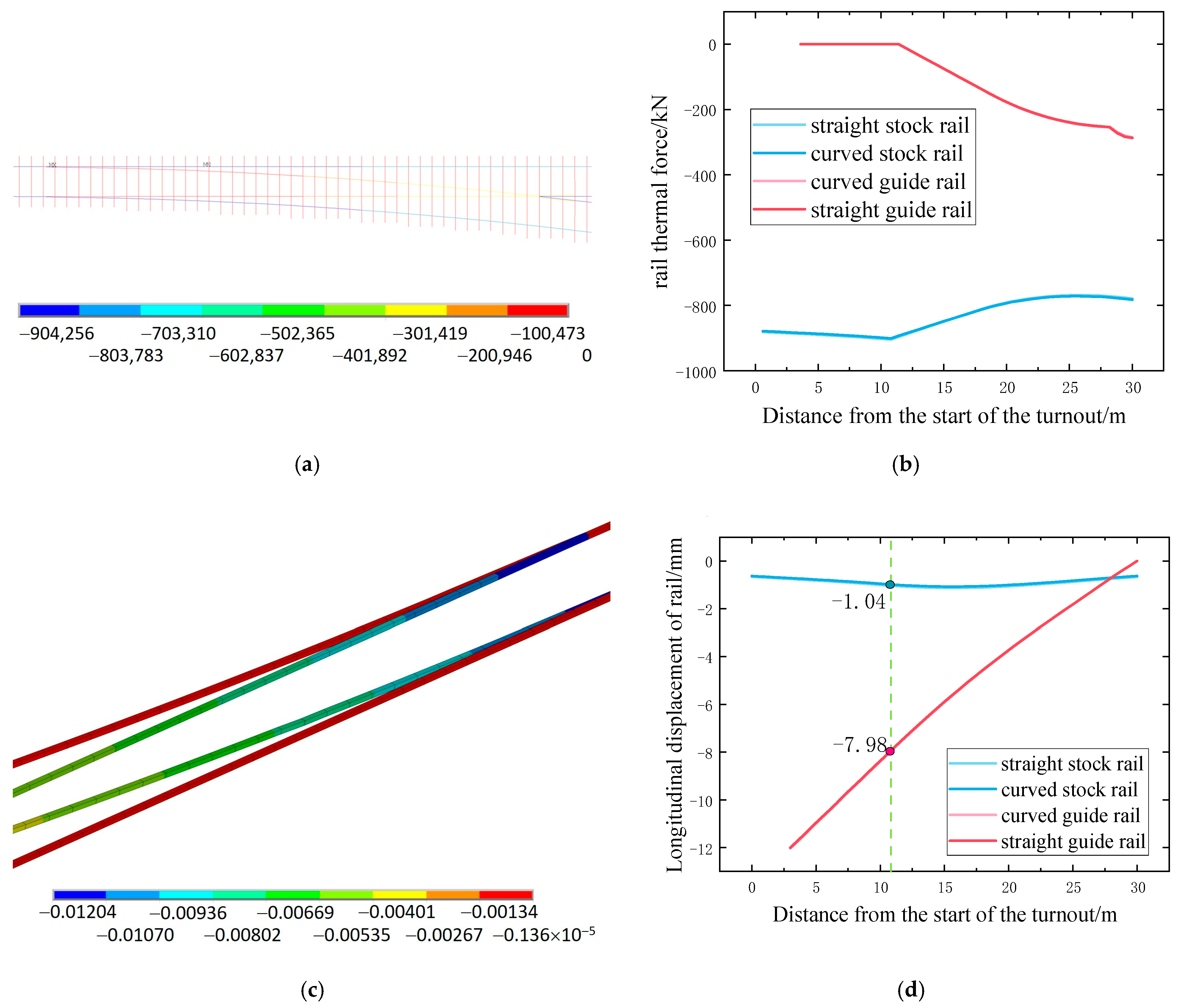
The distribution of thermal forces on each rail of the No.9 CWR turnout under the temperature rise condition is shown in Figure 11a,b. In Figure 11b, on the vertical axis, positive values denote tensile forces, and negative values denote compressive forces, consistent with all thermal force diagrams in this chapter. As indicated in the figure, there is a significant difference in the thermal forces acting on the stock rails and guide rails in the CWR turnout, while high consistency is observed between the straight and curved stock rails, as well as between the straight and curved guide rails. During temperature rise in the turnout area, calculations show that the thermal force in the fixed zone is 837.5 kN. Displacements occurring at the limiting stoppers and turnout sleepers lead to additional thermal forces in the stock rails, resulting in a maximum thermal force of 904.3 kN (an increase of 7.98%) in the stock rails, with this maximum value appearing near the limiting stoppers. The front section of the guide rails is affected by the limiting stoppers, and the thermal forces acting on the entire guide rails are lower than those on the stock rails. The maximum thermal force of the guide rails (287.1 kN) occurs at the heel ends of the guide rails.
The longitudinal displacements of rails within the No.9 CWR turnout during temperature rise in the turnout area are presented in Figure 11c,d. As shown in the figure, there is a significant difference in the displacement patterns between the stock rails and guide rails in the CWR turnout, while high consistency is observed between the straight and curved stock rails as well as between the straight and curved guide rails. This is similar to the distribution pattern of thermal forces acting on the rails in the turnout area under this working condition. Taking the interaction between the straight stock rail and the curved guide rail as an example for analysis, the longitudinal expansion displacement of the stock rail shows little variation, with a maximum expansion displacement of 1.13 mm and a displacement of 1.04 mm at the limiting stopper. The displacement of the guide rail gradually decreases from the starting end to the terminal end of the turnout, and the directions of expansion displacements at both ends of the guide rail are along the negative x-axis. The expansion displacement at the end of the guide rail is 0.21 mm, the displacement at the point of switch rail is 12.04 mm, and the displacement of the guide rail at the limiting stopper is 7.98 mm. The relative displacement between the curved guide rail and the straight stock rail at the limiting stopper is approximately 6.94 mm, which does not exceed the reserved gap of 15 mm for the limiting stopper.

4.2.2. Temperature Drop Condition

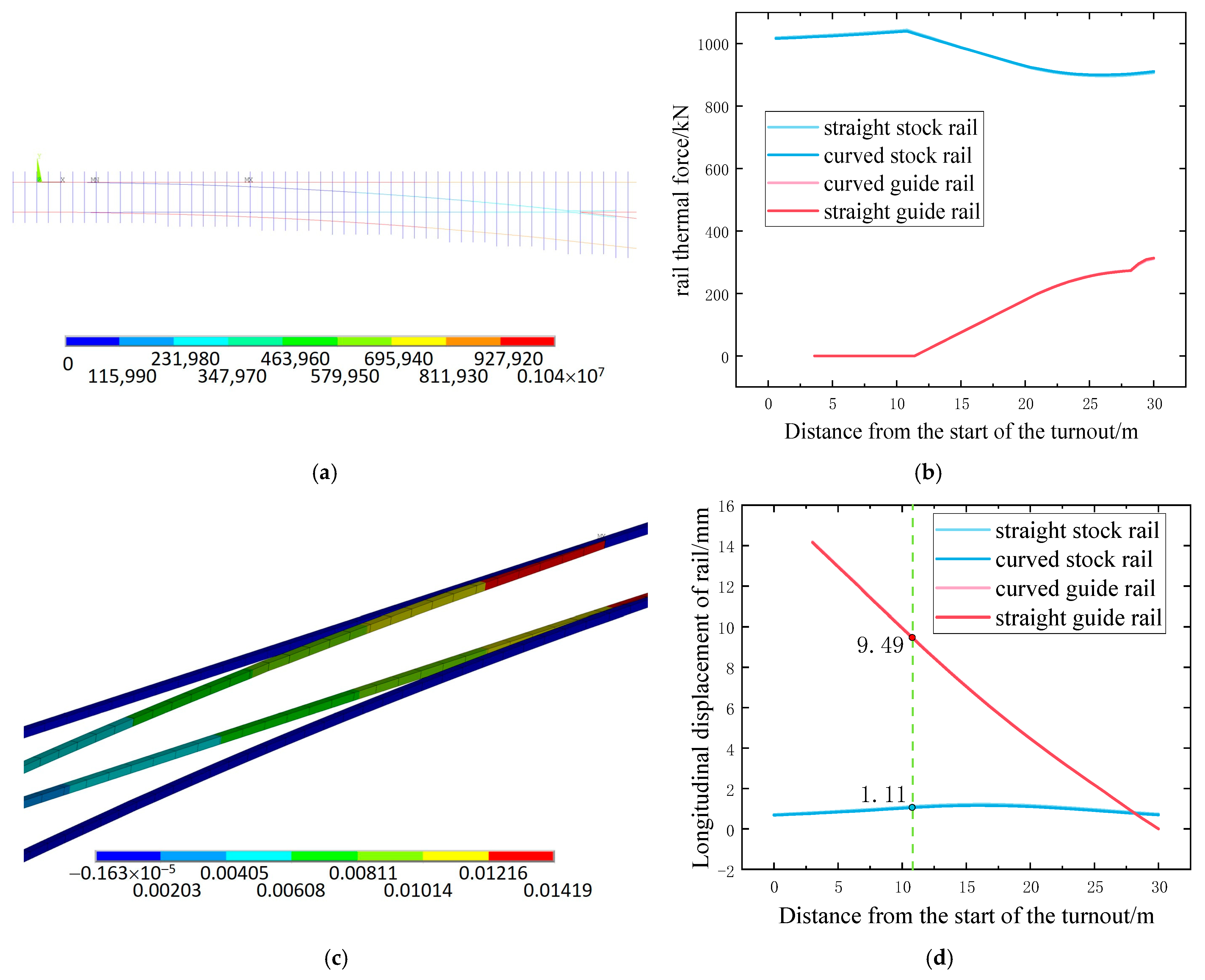
The distribution law of thermal forces acting on each rail within the No.9 turnout under the temperature drop condition is shown in Figure 12a,b. As seen from Figure 12b, during the temperature drop in the turnout area, displacements occurring at the limiting stoppers and turnout sleepers lead to additional thermal forces in the stock rails, resulting in a maximum thermal force of 1043.7 kN in the stock rails, with this maximum value appearing near the limiting stoppers. The maximum thermal force of the guide rails (313.3 kN) occurs at the heel ends of the wing rails.
The longitudinal displacements of each rail within the No.9 CWR turnout during a temperature drop are shown in Figure 12c,d. Taking the interaction between the straight stock rail and the curved guide rail as an example, the maximum contraction displacement of the stock rail is 1.22 mm, with a displacement of 1.11 mm at the limiting stopper. The displacement of the guide rail gradually decreases from the turnout’s starting end to its terminal end, with a displacement of 14.19 mm at the point of the curved switch rail and 9.49 mm at the limiting stopper. The relative displacement between the guide rail and the stock rail at the limiting stopper is approximately 8.38 mm, which does not exceed the reserved gap of 15 mm for the limiting stopper.

4.3. Verification Calculation of CWR Turnout

In addition to bearing its own thermal force, the stock rail of the CWR turnout also withstands additional thermal force transmitted from the switch rail to the stock rail through force-transmitting components. Moreover, significant displacement deformation occurs at the point of the switch rail. To ensure the feasibility of the CWR turnout, it is necessary to conduct verification calculations on some items and indicators. This paper mainly checks the rail strength and track stability of the CWR turnout [43].

4.3.1. Verification Calculation of Rail Strength

When rail temperature rises, the stock rail not only bears the thermal force caused by the temperature change in its own rail, but also bears the additional thermal pressure transmitted from the rear end of the turnout to the stock rail through force-transmitting components; similarly, when rail temperature drops, the stock rail will also bear a large thermal tension. Therefore, it is necessary to check the strength of the stock rail in the turnout area. In the above two working conditions, during the temperature drop, the maximum thermal force of the stock rail is 1043.7 kN; during the temperature rise, the maximum thermal force of the stock rail is 904.3 kN, and both maximum values are located at the stock rail at the starting of the turnout. In this checking calculation, the most unfavorable value is adopted, that is, maxP = 1043.7 kN.
The verification calculation formula for rail strength is as follows:
σ d + σ t + σ c + σ f [ σ ]
In the formula, the elements are defined as follows:
σd—Rail bending stress, where σ d = M d W 1 × f ;
σt—Rail temperature stress in the fixed zone of the continuously welded rail track;
σc—Additional braking stress, with a value of 10 MPa;
σf—Additional thermal stress of the rail;
[σ]—Allowable stress of the rail, where [σ] = σs/K and K is taken as 1.3.
Based on the calculation results of this model, the temperature force and additional thermal force in the fixed zone of the rail are extracted, so the calculation can be performed according to Formula (2). Herein, maxP refers to the axial force of the rail, and A is the cross-sectional area of the rail.
σ t + σ f = m a x P A = 1043700   N 77.45 × 10 4   m 2 × 10 6 = 134.76   MPa
For the 60 kg/m rail, E = 210 GPa, I = 3217 cm4, and the axle load is 25 t. The maximum static bending moment of the rail is calculated to be 27.1 kN∙m. The eccentricity coefficient is taken as β = 0.002Δh, and the speed coefficient is α = 0.006v (where v ≤ 120 km/h). Considering the scenario where the train passes through the turnout along the main line, the dynamic bending moment of the rail is calculated according to Formula (3).
M d = M 0 ( 1 + α + β ) = 46.61   kN m
Based on the section modulus of the rail base (or head) with respect to the horizontal neutral axis, the dynamic bending stress at the rail base (σd1) is calculated as 147.13 MPa, and the dynamic bending stress at the rail head (σd2) is 171.66 MPa. The larger value is adopted for the verification calculation.
σ d + σ t + σ c + σ f = 171.66 + 10 + 134.76 = 316.42   MPa
For U75V rails, σs is taken as 472 MPa; thus,
[ σ ] = σ s K = 472 1.3 = 363.08   MPa > 316.42   MPa
Thus, the verification calculation of rail strength meets the requirements.

4.3.2. Verification Calculation of Track Stability for CWR Turnout

Based on the principle of stationary potential energy, the calculated temperature pressure (Pw) of the two rails can be computed using the following unified stability calculation formula:
P w = 2 β E I y π 2 ( f + f o e ) l 2 + 4 Q l 2 π 3 ( f + f o e + 4 l 2 π 3 R )
l 2 = ω + ω + ( 4 Q π 3 ω t f ) 2 f β E I y π 2 4 Q π 3 ω t f
1 R = 1 R + 1 R o p
ω = 2 β E I y π 2 ( t + 4 π 3 R )
In the formula, the elements are defined as follows:
β —Track frame stiffness coefficient;
l —Half-wavelength of track bending deformation (cm);
f —Sagitta of track bending deformation, taken as 0.2 cm;
f o e —Initial elastic bending sagitta of the track (cm);
Q—Equivalent lateral resistance of the ballast bed (N/cm);
t—Relative curvature of the initial elastic bending of the track.
According to Equations (6)~(9), it is obtained that ω = 4.69 × 10 5 , l 2 = 1.22 × 10 5   cm 2 , P w = 3.96 × 10 6   N .
The allowable temperature pressure of the two rails is as follows:
[ P ] = P w K = 3.96 × 10 6 1.3 = 3.05 × 10 6   N = 3050   kN
The allowable temperature rise, considering the influence of the additional longitudinal force of the stock rail in the CWR turnout, is calculated as follows:
[ Δ T u ] = [ P ] 2 E α F = 79.4  
When calculating the allowable temperature rise for stability, the change in the locked rail temperature of the continuously welded rail after long-term operation should be considered, and the allowable temperature rise should be corrected:
[ Δ T u ] = Δ T 8   = 71.4  
The calculation conditions of this CWR turnout satisfy the requirement that the maximum rail temperature rise amplitude Δ T is less than or equal to the allowable temperature rise [ Δ T u ] .

5. Discussion

Regarding the design scheme of the new-type No.9 turnout with 1520 mm gauge and 60 kg/m rail, this paper has determined the adoption of a plane alignment of single circular curve with radius R250 m through dynamic simulation and conversion calculation, verifying the feasibility of this type of turnout combined with seamless design. Currently, compared with the previous version, the optimized turnout exhibits better structural stability, superior service performance, lower maintenance costs, and a marked increase in cumulative passing tonnage. In conclusion, the research on the No.9 turnout with 1520 mm gauge is of great significance for cross-border railway transportation. Nevertheless, further research should be conducted on this turnout in subsequent studies to explore its service performance under more complex working conditions, such as the dynamic impacts of different vehicle types passing through the turnout, so as to make further efforts to enhance the reliability and practicality of the No.9 turnout with 1520 mm gauge and 60 kg/m rail.

6. Conclusions

To fill the research gap in No.9 broad-gauge turnouts, this paper optimizes the planar alignment of the No.9 turnout with 1520 mm gauge, and conducts dynamic analysis, conversion tests, and seamless integration research; this study initially verifies its feasibility, and ultimately draws the following main conclusions:
Based on the vehicle–turnout dynamic coupling analysis model, the dynamic responses of vehicles passing through the No.9 turnout with a 1520 mm gauge and 60 kg/m rail were analyzed. The maximum vertical wheel–rail forces when passing through the turnout is 194.29 kN, and the maximum wheel load reduction rate is 0.3. It can be seen from the results that all dynamic indicators can meet the requirements of driving safety and stability specified in the specifications.
During the conversion process of the switch rail of the new No.9 turnout with a 1520 mm gauge and 60 kg/m rail, the maximum switching force at the traction point is 1.807 kN, which is less than the rated switching force of the switch machine, ensuring the normal switching of the switch rail. During the switching of the switch rail, the maximum conversion deviation of rail heel is 0.85 mm. The minimum width of the flangeway when the switch rail is in the open state is 86.73 mm, which is greater than the safety limit of 80 mm.
According to the statistical data of air temperatures at port stations across China, the maximum temperature force of the stock rail in the turnout area under the extreme temperature drop condition is 1043.7 kN; under the extreme temperature rise condition, the maximum temperature force of the stock rail in the turnout area is 904.3 kN. The verification calculation of this wide-gauge CWR turnout shows that its rail strength and track stability all meet the design requirements.

Author Contributions

Conceptualization, Z.L.; methodology, Z.L.; software, Z.L.; validation, Z.L., P.W., Y.G. and Q.Y.; investigation, C.L. and H.R.; resources, S.W.; writing—original draft preparation, Z.L.; writing—review and editing, Z.L. and P.W.; supervision, S.W. All authors have read and agreed to the published version of the manuscript.

Funding

The research described in this paper was financially supported by the National Natural Science Foundation of China Project (522082449) and the foundation program of China Academy of Railway Sciences (2024YJ334).

Institutional Review Board Statement

Not applicable.

Informed Consent Statement

Not applicable.

Data Availability Statement

The original contributions presented in this study are included in the article. Further inquiries can be directed to the corresponding author.

Conflicts of Interest

Authors S.W., P.W., Y.G., Q.Y., C.L. and H.R. are employed by the companies China Academy of Railway Sciences Co., Ltd. and CARS (Beijing) Railay Equipment Technology Co., Ltd. The remaining authors declare that the research was conducted in the absence of any commercial or financial relationships that could be construed as a potential conflict of interest.

Abbreviations

The following abbreviations are used in this manuscript:
CWRContinuous welded rail

References

  1. Pålsson, B.A.; Nielsen, J.C.O. Track gauge optimisation of railway switches using a genetic algorithm. Veh. Syst. Dyn. 2012, 50, 365–387. [Google Scholar] [CrossRef]
  2. Droździel, P.; Bukova, B.; Brumerčíková, E. Prospects of international freight transport in the East-West direction. Transp. Probl. 2015, 10, 5–13. [Google Scholar] [CrossRef]
  3. Doński Lesiuk, J. The Importance of the 1520 mm Gauge Rail Transport System for Trans Eurasian International Trade in the Exchange of Goods. Comp. Econ. Res. Cent. East. Eur. 2022, 25, 7–22. [Google Scholar] [CrossRef]
  4. Hudenko, J.; Andins, M.; Pocs, R. Eu Transport Policy on the 1520mm Rail Area. In European Proceedings of Social and Behavioural Sciences; Future Academy: Verona, Italy, 2018. [Google Scholar]
  5. Xiang, K.; Li, T.; Shen, B.; Zheng, Z.; Yan, Z.; Ma, Q.; Xu, J.; Wang, P.; Qian, Y. Dynamic wheel-rail interaction of a train crossing a turnout under traction/braking behaviour and research on rail wear of the turnout. Proc. Inst. Mech. Eng. Part F J. Rail Rapid Transit 2025, 239, 85–95. [Google Scholar] [CrossRef]
  6. Chen, J.; Wang, P.; Xu, J.; Chen, R. Simulation of vehicle-turnout coupled dynamics considering the flexibility of wheelsets and turnouts. Veh. Syst. Dyn. 2023, 61, 739–764. [Google Scholar] [CrossRef]
  7. Xu, J.; Ma, Q.; Wang, X.; Chen, J.; Chen, R.; Wang, P.; Wei, X. Investigation on the motion conditions and dynamic interaction of vehicle and turnout due to differential wheelset misalignment. Veh. Syst. Dyn. 2022, 60, 2587–2607. [Google Scholar] [CrossRef]
  8. Wei, Z.; Boogaard, A.; Núñez, A.; Li, Z.; Dollevoet, R. An integrated approach for characterizing the dynamic behavior of the wheel–rail interaction at crossings. IEEE Trans. Instrum. Meas. 2018, 67, 2332–2344. [Google Scholar] [CrossRef]
  9. Liu, P. Research and Development of No.8.5 Broad Gauge Simple Turnout with 60 kg/m Rails and Gauge of 1676 mm. Railw. Constr. Technol. 2023, 49–51+63. [Google Scholar] [CrossRef]
  10. Liu, D.Y.; Pang, L.; Yao, L. The track design summary of high-speed railway from Moscow to Kazan. Shanxi Archit. 2020, 46, 126–127+184. [Google Scholar]
  11. Wang, S.G.; Ge, J.; Si, D.L.; Wang, M. Study on Guard Check Gauge of Fixed Frog and Design on Widening Nose Rail. China Railw. Sci. 2014, 35, 7–12. [Google Scholar]
  12. Grigonis, V.; Kaušylas, M.; Palevičius, V. Advancing Sustainable Interoperability Between Standard and Broad-Gauge Railway Systems. Sustainability 2025, 17, 8336. [Google Scholar] [CrossRef]
  13. Wang, P.; Xu, J.M.; Liu, D.Y.; Pang, L.; Yao, L. Key Technologies of 400 km/h Broad Gauge Turnout Design for High Speed Railway. High Speed Railw. Technol. 2019, 10, 14–22. [Google Scholar]
  14. Luo, Z. Design of One-ninth Fixed Obtuse Crossing between Wide Gauge and Standard Gauge. Railw. Constr. Technol. 2012, 78–80+99. [Google Scholar] [CrossRef]
  15. Qi, W.; Cao, Y.; Zhao, Z.H.; Mo, H.Y. Research on the Influence of Track Gauge on Stress Characteristics of Track Structure. Railw. Eng. 2020, 60, 131–134. [Google Scholar]
  16. Huang, B.Q. A Comparative Study of Main Technical Standards of Railway Line Between China and Russia. Railw. Tech. Stand. 2024, 6, 15–20. [Google Scholar]
  17. Feng, D.Q. Comparative Analysis on Railway Design Standards between China and Russia. Railw. Stand. Des. 2012, 28–31. [Google Scholar] [CrossRef]
  18. Xin, L.; Markine, V.; Shevtsov, I. Analysis of the effect of repair welding/grinding on the performance of railway crossings using field measurements and finite element modeling. Proc. Inst. Mech. Eng. Part F J. Rail Rapid Transit 2018, 232, 798–815. [Google Scholar] [CrossRef]
  19. Wang, G.; Xu, T.; Tang, T.; Yuan, T.; Wang, H. A Bayesian network model for prediction of weather-related failures in railway turnout systems. Expert Syst. Appl. 2017, 69, 247–256. [Google Scholar] [CrossRef]
  20. Wan, C.; Markine, V.; Shevtsov, I. Improvement of vehicle–turnout interaction by optimising the shape of crossing nose. Veh. Syst. Dyn. 2014, 52, 1517–1540. [Google Scholar] [CrossRef]
  21. Burgelman, N.; Sichani, M.S.; Enblom, R.; Berg, M.; Li, Z.; Dollevoet, R. Influence of wheel–rail contact modelling on vehicle dynamic simulation. Veh. Syst. Dyn. 2015, 53, 1190–1203. [Google Scholar] [CrossRef]
  22. Hamarat, M.Z.; Kaewunruen, S.; Papaelias, M. Contact Conditions over Turnout Crossing Noses. IOP Conf. Ser. Mater. Sci. Eng. 2019, 471, 062027. [Google Scholar] [CrossRef]
  23. Skrypnyk, R.; Nielsen, J.C.; Ekh, M.; Pålsson, B.A. Metamodelling of wheel–rail normal contact in railway crossings with elasto-plastic material behaviour. Eng. Comput. 2019, 35, 139–155. [Google Scholar] [CrossRef]
  24. Manalo, A.; Aravinthan, T.; Karunasena, W.; Stevens, N. Analysis of a typical railway turnout sleeper system using grillage beam analogy. Finite Elem. Anal. Des. 2012, 48, 1376–1391. [Google Scholar] [CrossRef]
  25. Hamarat, M.; Kaewunruen, S.; Papaelias, M.; Silvast, M. New insights from multibody dynamic analyses of a turnout system under impact loads. Appl. Sci. 2019, 9, 4080. [Google Scholar] [CrossRef]
  26. Wei, Z.; Núñez, A.; Li, Z.; Dollevoet, R. Evaluating degradation at railway crossings using axle box acceleration measurements. Sensors 2017, 17, 2236. [Google Scholar] [CrossRef]
  27. Kassa, E.; Nielsen, J.C. Dynamic interaction between train and railway turnout: Full-scale field test and validation of simulation models. Veh. Syst. Dyn. 2008, 46, 521–534. [Google Scholar] [CrossRef]
  28. Grossoni, I.; Iwnicki, S.; Bezin, Y.; Gong, C. Dynamics of a vehicle–track coupling system at a rail joint. Proc. Inst. Mech. Eng. Part F J. Rail Rapid Transit 2015, 229, 364–374. [Google Scholar] [CrossRef]
  29. Dindar, S.; Kaewunruen, S.; An, M.; Sussman, J.M. Bayesian Network-based probability analysis of train derailments caused by various extreme weather patterns on railway turnouts. Saf. Sci. 2018, 110, 20–30. [Google Scholar] [CrossRef]
  30. Dindar, S.; Kaewunruen, S.; An, M.; Osman, M.H. Natural hazard risks on railway turnout systems. Procedia Eng. 2016, 161, 1254–1259. [Google Scholar] [CrossRef]
  31. Dindar, S.; Kaewunruen, S.; An, M. Identification of appropriate risk analysis techniques for railway turnout systems. J. Risk Res. 2016, 21, 974–995. [Google Scholar] [CrossRef]
  32. Dindar, S.; Kaewunruen, S.; An, M. Rail accident analysis using large-scale investigations of train derailments on switches and crossings: Comparing the performances of a novel stochastic mathematical prediction and various assumptions. Eng. Fail. Anal. 2019, 103, 203–216. [Google Scholar] [CrossRef]
  33. Janeliukstis, R.; Kaewunruen, S. A Novel Separation Technique of Flexural Loading-Induced Acoustic Emission Sources in Railway Prestressed Concrete Sleepers. IEEE Access 2019, 7, 51426–51440. [Google Scholar] [CrossRef]
  34. Kaewunruen, S. Monitoring in-service performance of fibre-reinforced foamed urethane sleepers/bearers in railway urban turnout systems. Struct. Monit. Maint. 2014, 1, 131–157. [Google Scholar] [CrossRef]
  35. Kaewunruen, S.; You, R.; Ishida, M. Composites for timber-replacement bearers in railway switches and crossings. Infrastructures 2017, 2, 13. [Google Scholar] [CrossRef]
  36. Kaewunruen, S.; Sussman, J.M.; Matsumoto, A. Grand challenges in transportation and transit systems. Front. Built Environ. 2016, 2, 4. [Google Scholar] [CrossRef]
  37. Kaewunruen, S.; Remennikov, A.M.; Murray, M.H. Introducing a new limit states design concept to railway concrete sleepers: An Australian experience. Front. Mat. 2014, 1, 8. [Google Scholar] [CrossRef]
  38. Sresakoolchai, J.; Hamarat, M.; Kaewunruen, S. Automated machine learning recognition to diagnose flood resilience of railway switches and crossings. Sci. Rep. 2023, 13, 2106. [Google Scholar] [CrossRef]
  39. Sengsri, P.; Ngamkhanong, C.; de Melo, A.L.O.; Kaewunruen, S. Experimental and numerical investigations into dynamic modal parameters of fiber-reinforced foamed urethane composite beams in railway switches and crossings. Vibration 2020, 3, 174–188. [Google Scholar] [CrossRef]
  40. GB/T 5599-2019; Specification for Dynamic Performance Assessment and Testing Verification of Rolling Stock. Standardization Administration of the People’s Republic of China: Beijing, China, 2019.
  41. Zhai, W.M. Vehicle-Track Coupling Dynamics; Science Press: Beijing, China, 2019. [Google Scholar]
  42. UIC OR 518-2009; Testing and Approval of Railway Vehicles from the Point of View of Their Dynamic Behaviour-Safety—Track Fatigue—Running Behaviour. UIC: Paris, France, 2009.
  43. TB 10015-2012; Code for Design of Railway Continuous Welded Rail. China Railway Corporation: Beijing, China, 2012.
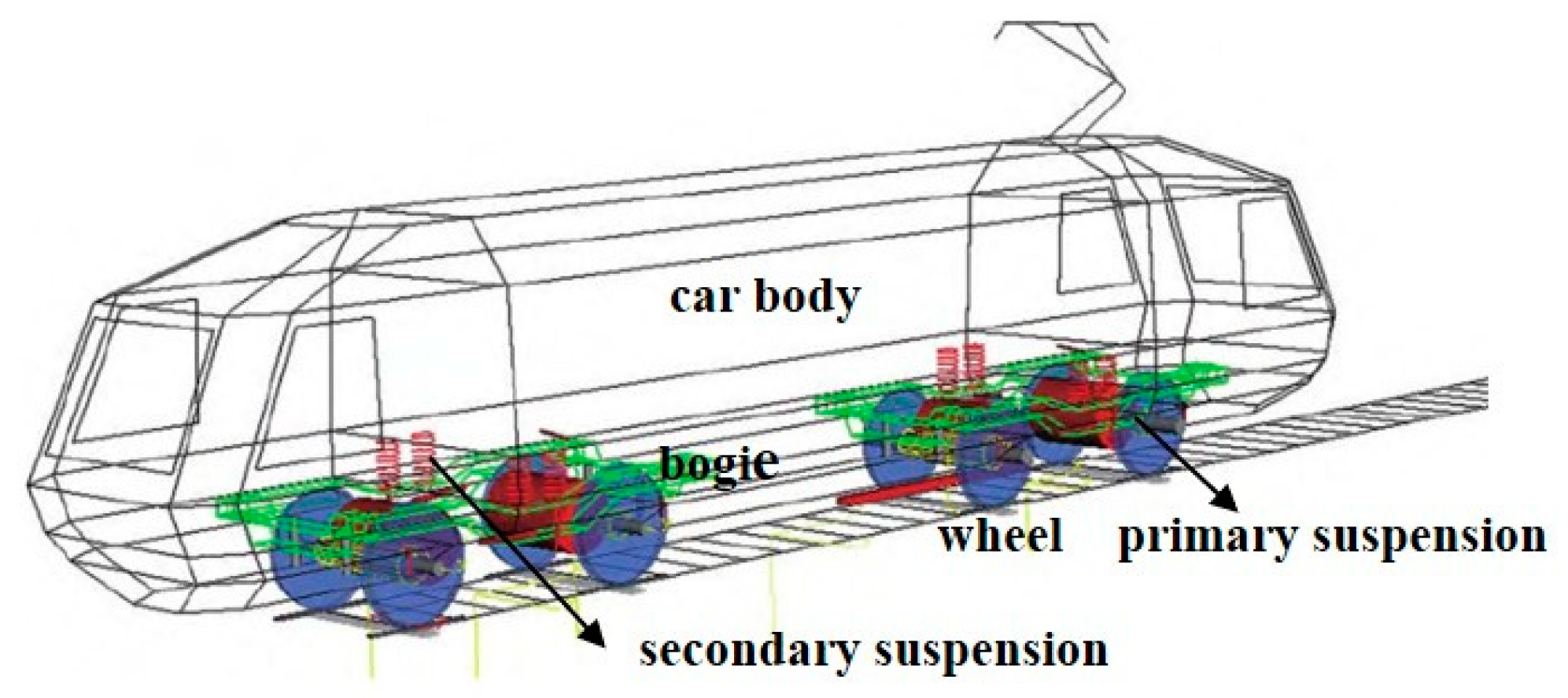
Figure 1. Vehicle dynamics model.
Applsci 16 00513 g001
Figure 2. Switch model of 1520 mm gauge 60 kg/m simple turnout.
Applsci 16 00513 g002
Figure 3. Dynamic response of straight passage through turnout: (a) wheel–rail vertical force; (b) wheel–rail lateral force; (c) derailment coefficient; (d) wheel load reduction ratio; (e) vertical vibration acceleration of car body; (f) lateral vibration acceleration of car body.
Applsci 16 00513 g003
Figure 4. Dynamic response of lateral passage through turnout: (a) wheel–rail vertical force; (b) wheel–rail lateral force; (c) derailment coefficient; (d) wheel load reduction ratio; (e) vertical vibration acceleration of car body; (f) lateral vibration acceleration of car body.
Applsci 16 00513 g004
Figure 5. Dynamic response of straight passage through turnout at different speeds: (a) wheel–rail vertical force; (b) wheel–rail lateral force; (c) derailment coefficient; (d) wheel load reduction ratio; (e) vertical vibration acceleration of car body; (f) lateral vibration acceleration of car body.
Applsci 16 00513 g005
Figure 6. Dynamic response of lateral passage through turnout at different speeds: (a) wheel–rail vertical force; (b) wheel–rail lateral force; (c) derailment coefficient; (d) wheel load reduction ratio; (e) vertical vibration acceleration of car body; (f) lateral vibration acceleration of car body.
Applsci 16 00513 g006
Figure 7. Calculation model of switch rail conversion.
Applsci 16 00513 g007
Figure 8. Verification of the switch rail conversion model: (a) installation of force transducers; (b) comparison between measured and simulated values of switching force.
Applsci 16 00513 g008
Figure 9. Switching response of the switch rail: (a) conversion deviation of switch rail heel; (b) flangeway width.
Applsci 16 00513 g009
Figure 10. General view of finite element model for CWR turnout.
Applsci 16 00513 g010
Figure 11. Rail thermal force and displacement in turnout area under temperature rise condition: (a) schematic diagram of rail thermal force; (b) line chart of rail thermal force; (c) schematic diagram of longitudinal expansion displacement of rail; (d) line chart of longitudinal expansion displacement of rail.
Applsci 16 00513 g011
Figure 12. Rail thermal force and displacement in turnout area under temperature drop condition: (a) schematic diagram of rail thermal force; (b) line chart of rail thermal force; (c) schematic diagram of longitudinal contraction displacement of rail; (d) line chart of longitudinal contraction displacement of rail.
Applsci 16 00513 g012
Table 1. Main parameters of the vehicle model.
ParametersValues
axle load23 t
load70 t
self-weight≤25.8 t
weight per linear meter3.56 t/m
vehicle wheelbase14,640 mm
vehicle fixed-distance8650 mm
bogie fixed wheelbase1850 mm
Disclaimer/Publisher’s Note: The statements, opinions and data contained in all publications are solely those of the individual author(s) and contributor(s) and not of MDPI and/or the editor(s). MDPI and/or the editor(s) disclaim responsibility for any injury to people or property resulting from any ideas, methods, instructions or products referred to in the content.