


Abstract
This study investigated the effects of alternative sweeteners, allulose (AL), stevia (ST), and xylose (XY), on the physicochemical, antioxidant, textural, and sensory properties of Yanggaeng fortified with Cissus quadrangularis (CQ) powder. Replacing sucrose (SU) with alternative sweeteners significantly affected the proximate composition and overall quality of Yanggaeng. Formulations containing AL, ST, or XY exhibited higher moisture retention and lower carbohydrate content than those containing SU. Colorimetric analysis revealed that Yanggaeng prepared with alternative sweeteners developed a darker coloration and greater browning intensity, likely due to enhanced Maillard reactions during heating. Among the sweeteners tested, AL showed the highest total phenolic content and relatively high antioxidant activity, suggesting potential functional advantages beyond sweetness. Textural analysis indicated that ST enhanced gel strength and elasticity even under high-moisture conditions, whereas AL produced a softer texture, which may be desirable for products requiring reduced firmness. Although consumer preference scores did not differ significantly across most sensory attributes, both ST and AL achieved acceptable overall profiles, with sweetness ratings comparable to those of SU. These findings suggest that CQ-enriched Yanggaeng sweetened with alternative sweeteners can be developed as a promising low-sugar dessert option without compromising quality or consumer acceptability.
1. Introduction
Yanggaeng, a traditional Korean confectionery classified as Hangwa, is prepared by simmering red bean paste with agar and sugar [1]. Its physicochemical properties depend strongly on ingredient ratio and processing conditions [2]. High sugar concentration contributes to sweetness, whereas heating and gelling determine viscosity and chewy texture. The unique texture and sweet flavor of Yanggaeng enhances its consumer appeal across diverse age groups [3]. Recently, modern formulations incorporating natural colorants and functional ingredients have been developed, reflecting a shift in consumer preferences and a contemporary reinterpretation of traditional Korean desserts [4,5].
However, the elevated sugar content in Yanggaeng may raise dietary concerns, particularly when consumed in excess. Although sugar plays an essential role in enhancing both sweetness and texture, excessive sugar intake can disrupt glycemic control and adversely affect metabolic health [6]. Dietary monosaccharides are converted into triglycerides in the liver and stored in the white adipose tissue, increasing the risk of obesity and metabolic syndrome [7]. In addition, high sugar intake stimulates insulin secretion from the pancreas, imposes metabolic stress, and impairs glucose homeostasis [8]. Chronic consumption of simple sugars has been associated with an increased risk of metabolic disorders, such as obesity and type 2 diabetes, and may further contribute to hypertension and cardiovascular diseases [9]. Moreover, oral bacteria metabolize sugar into acids, which promote dental caries and enamel demineralization [10]. In response to these health concerns, there is growing interest in formulations designed to preserve the taste and quality of traditional products [11,12].
Growing interest in dietary patterns that emphasize reduced sugar intake has increased the interest in alternative sweeteners as potential substitutes for sucrose. These sweeteners provide comparable sweetness but contribute fewer calories and elicit a lower glycemic response, which supports their application in the reformulation of sugar-reduced food products [13]. Representative examples include allulose, stevia, and xylose, which exhibit distinct functional properties during food processing. Allulose is a low-calorie sweetener with sweetness similar to that of sucrose, and has been reported to possess antioxidant properties and promote fat metabolism [14]. Stevia, a natural sweetener approximately 200–300 times sweeter than sucrose, contains virtually no calories, and has been extensively studied for its potential role in improving glycemic control [15]. Xylose exhibits antibacterial and anticariogenic effects, and may promote the growth of beneficial intestinal microbiota [16]. Numerous studies have investigated the application of alternative sweeteners across diverse food categories and reported improvements in specific quality characteristics when incorporated into desserts such as cookies, ice cream, and cakes [17,18,19]. Collectively, findings from the literature indicate that alternative sweeteners can function not only as sucrose substitutes but also contribute to the enhanced physicochemical and sensory qualities of dessert formulations [20,21,22].
Product development efforts aimed at reducing sugar intake increasingly incorporate physiologically active ingredients into food formulations. Cissus quadrangularis (CQ), a plant-derived material known for antioxidant and anti-inflammatory activity, has demonstrated beneficial effects in promoting body fat reduction and regulating metabolic processes [23,24,25]. In our previous study, we assessed the physicochemical and sensory characteristics of Yanggaeng supplemented with 0%, 2%, 4%, and 6% CQ powder. Among the tested concentrations, the 2% CQ group exhibited enhanced antioxidant activity and received preference ratings comparable to those of the control group, indicating its potential use in reduced-sugar dessert formulations [26]. The incorporation of CQ powder has shown promise as a functional additive that enhances quality attributes in traditional confectionery applications [27].
Based on previous findings regarding CQ supplementation, the present study evaluated the quality characteristics and consumer acceptability of Yanggaeng formulated with 2% CQ powder and sweetened using alternative sweeteners, specifically allulose, stevia, and xylose, as sugar replacements. The influence of combining functional ingredients with sugar substitution was analyzed in terms of compositional features and physicochemical properties. The results of this evaluation are anticipated to provide valuable insights for the development of low-sugar dessert products that align with modern dietary preferences and promote innovation in traditional desserts.
2. Materials and Methods
2.1. Materials
Cissus quadrangularis powder was obtained from Nuon Co. (Bucheon, Republic of Korea). The main base for preparing Yanggaeng was white bean paste (Phaseolus vulgaris L.), composed of 61.7% white beans supplemented with white sugar, salt, and starch (Daedoo Food, Seoul, Republic of Korea). Additional sweetening agents included refined sugar (Cheiljedang, Seoul, Republic of Korea), allulose (Samyang, Ulsan, Republic of Korea), stevia (ALTist, Seoul, Republic of Korea), and xylose (Kjoon Food, Bucheon, Republic of Korea). Agar powder (Thehadam, Goseong, Republic of Korea) was used as a gelling agent.
2.2. Recipe of Yanggaeng Samples
The formulation of Yanggaeng followed a modified procedure based on a previous study [26]; the details are presented in Table 1. All samples contained 10 g of CQ powder per formulation. Agar powder was pre-soaked in distilled water for 10 min and subsequently heated to 80 °C for 2 min to ensure complete dissolution. Sugar replacement levels were adjusted to match sweetness intensity: the sugar (SU) group retained the original sugar content, while the allulose (AL), stevia (ST), and xylose (XY) groups used 100 g of allulose, 50 g of stevia, and 100 g of xylose, respectively. Because of the varying sweetness intensities of the alternative sweeteners, the addition ratios were adjusted to match the sweetness of the sugar. Stevia, which is 200–300 times sweeter than sugar [28], requires only 50 g to achieve an equivalent sweetness to similar quantities of sugar, allulose, and xylose. After combining the CQ powder, agar, and the chosen sweetener, the mixture was heated with continuous stirring for 10 min until thickening and foaming. The final mixtures were poured into molds and refrigerated at 4 °C until further analysis.
Table 1.
Formulation of Yanggaeng formulated with Cissus powder and alternative sweeteners.
2.3. Proximate Composition
Proximate analyses were performed according to the guidelines of the Association of Official Analytical Chemists (AOAC) guidelines [29]. The moisture content was measured by oven drying at 105 °C. The crude protein was analyzed using the Kjeldahl method [30] using a nitrogen-to-protein conversion factor of 6.25. Lipid content was obtained through Soxhlet extraction, and ash content was determined by combustion at 550 °C. The carbohydrate content was derived from a difference of 100%.
2.4. pH, Brix, and Water Holding Capacity
A 3 g sample was extracted with 30 mL of distilled water and centrifuged at 2000× g for 10 min to collect the supernatant. The pH values were recorded using a pH meter (Orion Star A211; Thermo Fisher Scientific Korea Co., Ltd., Seoul, Republic of Korea), and Brix levels were measured using a digital refractometer (Hanna Instruments, Woonsocket, RI, USA). Water holding capacity (WHC) was evaluated using a modified version of the Lee method [31]. Briefly, the sample (0.5 g) was centrifuged at 2000× g for 15 min in a 1.5 mL microtube, and the WHC was calculated using the following Equation (1):
WHC = {sample weight − (dry weight − tube weight)/sample weight} × 100
2.5. Color Measurement
Surface color properties (L*, a*, b*) were assessed using a colorimeter (LC100, Tintometer Limited, Amesbury, England, UK). The instrument was zero-calibrated using a manufacturer-provided standard white plate prior to measurement. Measurements were conducted under a D65 illuminant with a 10° standard observer in the CIE (Commission Internationale de l’Éclairage) L*a*b* color space. Color was measured at three different locations on the surface of each Yanggaeng sample, and the mean values were used for analysis. The browning index (BI) was calculated using Equations (2) and (3) according to Bal et al. [32]:
BI = (z − 0.31)/0.17 × 100,
z = (a* + 1.75L*)/5.645L* + a* − 3.012b*
2.6. Antioxidant Activity
Ethanolic extracts of Yanggaeng samples were prepared to evaluate antioxidant activity using three assays: 2,2-diphenyl-1-picrylhydrazyl (DPPH) and 2,2′-azino-bis(3-ethylbenzothiazoline-6-sulfonic acid) (ABTS) radical scavenging activity, and ferric reducing antioxidant power (FRAP). The procedures followed the established protocols cited in the literature [31,33,34]. Total phenolic content (TPC) was quantified using the Folin–Ciocalteu method with gallic acid as the reference standard. The results were expressed as mg GAE/g. To account for potential color interference, appropriate sample blanks were included in all colorimetric assays and background absorbance was corrected accordingly.
2.7. Texture Analysis
Texture characteristics were examined using a TA-XT2 texture analyzer (Stable Micro Systems Co., Haslemere, UK) according to the method described by Baek et al. [35]. Yanggaeng cubes (25 × 25 × 25 mm3) were compressed with a 20 mm cylindrical probe (TA-11ss). These parameters included hardness, cohesiveness, springiness, gumminess, and chewiness. The pre-test speed was set to 5 mm/s, with a test distance of 6 mm and a duration of 5 s. Each sample was tested five times, and the results were averaged.
2.8. Consumer Preferences
Standardized samples (1 × 1 × 1 cm3) were coded with random three-digit numbers to ensure blinding. A panel of 50 participants (students and staff from Dankook University) evaluated the samples using a 9-point hedonic scale ranging from “extremely dislike” (1) to “extremely like” (9). The evaluated attributes were defined as follows: color (visual appeal and attractiveness of the sample appearance), aroma (overall intensity and pleasantness of odor), sweetness (perceived intensity and appropriateness of sweetness), taste (overall flavor acceptability), texture (mouthfeel, including firmness and chewiness), overall acceptance (overall liking considering all sensory attributes), and purchase intent (willingness to purchase the product if commercially available). Sensory evaluation was conducted using a 9-point hedonic scale, where 1 = extremely dislike and 9 = extremely like. Panelists were instructed to evaluate each attribute independently and to assign higher scores to samples they preferred more for each attribute. This study was approved by the institutional review board of Kunsan National University (IRB No. 1040117-202509-HR-022-02).
2.9. Statistical Analysis
All experimental data were statistically analyzed using one-way analysis of variance (ANOVA), followed by Duncan’s multiple range test for post hoc comparisons. Statistical significance was set at p < 0.05. SPSS software (v26.0; IBM Corp., Armonk, NY, USA) was used for all analyses.
3. Results
3.1. Proximate Composition of Yanggaeng
Table 2 shows the approximate composition of Yanggaeng formulated with CQ powder and different alternative sweeteners. The moisture content was significantly higher in all alternative sweetener groups than in the SU group (p < 0.05). The highest moisture content was observed in the ST group (57.87%, p < 0.05), followed by the AL (53.83%, p < 0.05) and XY (53.69%, p < 0.05) groups, whereas the SU group exhibited the lowest moisture content (50.03%). The crude ash content was significantly lower in the XY group (0.14%, p < 0.05) than in the other groups, ranging from 0.25% to 0.27%. Carbohydrate content was significantly higher in the SU group (48.06%, p < 0.05). A marked reduction was observed in the ST group (38.15%, p < 0.05), whereas the AL (42.56%) and XY (43.00%) groups showed no statistically significant differences compared to SU. No significant differences were observed among the groups in terms of crude fat and crude protein contents, despite minor numerical variations.
Table 2.
Proximate composition of Yanggaeng formulated with Cissus powder and alternative sweeteners.
The increased moisture content observed in the alternative sweetener groups may be associated with differences in water retention behavior compared with the SU group. Although no significant differences in WHC were observed among the groups, the hygroscopic properties and molecular structures of alternative sweeteners may contribute to greater WHC within the Yanggaeng gel matrix [36]. The ST group, which had the highest moisture content, may also have exhibited greater softness and moistness. In addition to a higher moisture content, the ST group showed a statistically significant reduction in carbohydrate content compared with the SU group. The reduced carbohydrate content of ST is likely attributed to the limited digestibility of steviol glycosides, which are not hydrolyzed in the small intestine [37]. Although AL and XY had lower carbohydrate levels, these differences were not statistically significant. The significantly lower crude ash content in the XY group may reflect differences in mineral retention or solubility within the gel system [38]. In contrast, the crude protein and fat contents were unaffected by sweetener type, indicating that the substitution of sucrose with alternative sweeteners had no measurable impact on the protein or lipid composition of Yanggaeng. Overall, the ST formulation exhibited the most notable changes in proximate composition, supporting its application in Yanggaeng, with enhanced moisture retention and reduced carbohydrate levels, without adversely affecting protein or fat levels.
3.2. pH, Brix and WHC of Yanggaeng
Table 3 presents the pH, Brix value, and WHC of Yanggaeng formulated with CQ powder and various alternative sweeteners. The pH values ranged from 6.43 to 6.50, with XY (6.50, p < 0.05) showing a significantly higher value than ST (6.43, p < 0.05), whereas the SU and AL groups did not differ significantly. The Brix values differed significantly among the formulations (p < 0.05), with the highest value observed for XY (3.50), followed by SU (3.10), AL (2.80), and ST (2.57). The WHC did not differ significantly across the groups; however, higher values were observed in XY (31.37%) and AL (31.13%) than in SU (28.60%) and ST (26.46%).
Table 3.
Changes in pH, Brix and WHC of Yanggaeng formulated with Cissus powder and alternative sweeteners.
The significant difference in pH between ST and XY likely reflects the compositional differences among the sweeteners. The lower pH in the ST group may be attributed to the presence of carboxylic acids in Stevia rebaudiana leaves. These organic acids dissociate in aqueous solutions, thereby lowering the pH [39]. Previous studies identified carboxylic acid groups as the major constituents of stevia extracts [40,41], suggesting a plausible source of increased acidity in the stevia-added formulation [42]. The variation in Brix values among sweeteners may be explained by differences in solubility and the extent to which each sweetener contributes to the total solids within the gel matrix [43]. XY, a highly soluble monosaccharide with a relatively low sweetness intensity [44], was likely used in larger amounts, resulting in the highest Brix value. In contrast, ST, a high-intensity sweetener added at low concentrations, contributed minimally to soluble solids, leading to the lowest Brix value. Although no significant differences were found in WHC, XY and AL showed slightly higher values than SU and ST. Interestingly, the observed trend in WHC did not align with the moisture content data presented in Table 2. The inconsistency between WHC and moisture content highlights the distinction between moisture content and WHC, which reflects the capacity to retain water under mechanical forces, such as centrifugation [45]. Overall, the sweetener type influenced both pH and Brix values, whereas WHC exhibited numerical differences without statistical significance. The unique physicochemical behavior of ST, likely due to its hygroscopic nature and low inclusion level of steviol glycosides, may have influenced the interactions between the stevia components and Yanggaeng gel matrix, contributing to the observed differences in pH, Brix, and WHC.
3.3. Color Values of Yanggaeng
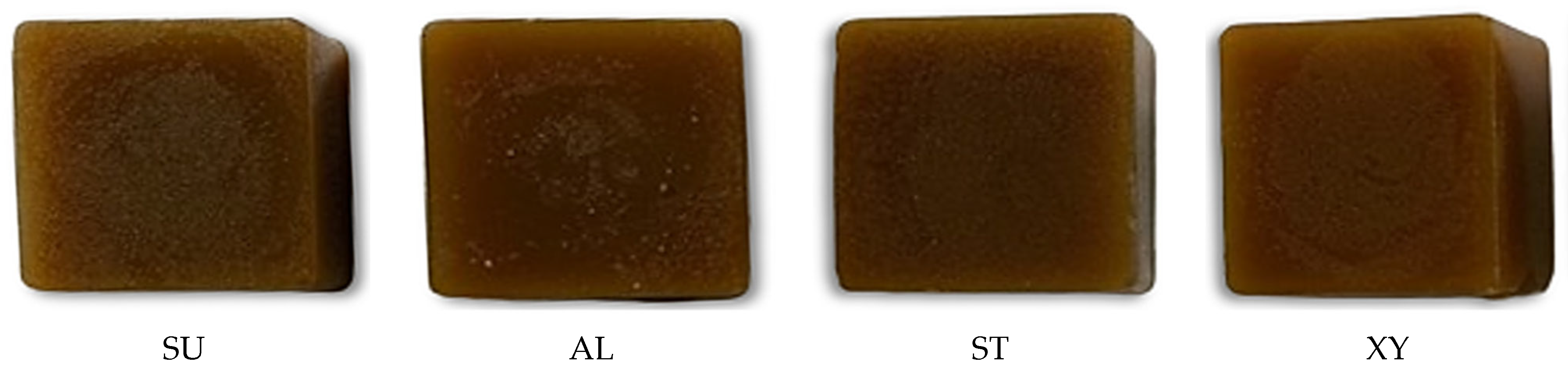
Figure 1 and Table 4 present the appearance and color parameters of Yanggaeng formulated with CQ powder and various alternative sweeteners. Figure 1 provides representative photographs of Yanggaeng samples formulated with different sweeteners to visually illustrate the color differences quantified in Table 4. The L* value, indicating lightness, was the highest in the SU group (26.50), followed by the ST (25.90), XY (23.00), and AL (22.30) groups. Statistically significant differences were observed between SU and AL and XY (p < 0.05), whereas SU and ST showed no significant differences. These differences in lightness were also visually evident in Figure 1, where the SU sample appeared brighter and less browned than the AL and XY samples. The a* value, which reflects redness, was highest in ST (6.07) and lowest in SU (4.70), with a statistically significant difference between the two groups (p < 0.05). The AL (5.37) and XY (5.57) groups showed intermediate values that were not significantly different from those of the other groups. The b* value, indicating yellowness, ranged from 13.50 to 14.67, with no significant differences between the groups. The BI value was significantly higher in XY (118.11) than in all other groups (p < 0.05), followed by ST (111.04), AL (97.45), and SU (82.85), which had the lowest BI values (p < 0.05). The significantly higher BI value observed in the XY group was consistent with the darker surface appearance shown in Figure 1, indicating enhanced non-enzymatic browning.
Figure 1.
External appearance of Yanggaeng with Cissus powder and alternative sweeteners. Abbreviations: SU; Yanggaeng formulated with sugar, AL; Yanggaeng formulated with allulose, ST; Yanggaeng formulated with stevia, XY; Yanggaeng formulated with xylose.
Table 4.
Color parameters of Yanggaeng formulated with Cissus powder and alternative sweeteners.
The highest L* value in the SU group suggests that sucrose contributes to a brighter appearance, likely because of its minimal involvement in Maillard reactions [46]. In contrast, the lower L* values observed in the AL and XY groups may be attributed to their classification as reducing sugars, which can more readily engage in browning reactions via reactive carbonyl groups [47]. Reducing sugars are known to accelerate Maillard reactions, particularly in formulations containing protein-rich ingredients such as soybeans, which are commonly used in Yanggaeng [48]. The highest a* value in the ST group may have resulted from chemical interactions between stevia compounds and proteins, enhancing the red coloration [49]. The low a* value in SU supports the notion that sucrose has limited browning potential. Previous studies have suggested that stevioside may degrade under heat and acidic conditions, potentially influencing pigment formation or stability [50,51,52]. No significant differences were detected in b* values across sweetener groups, indicating that sweetener type had minimal effect on yellowness under the conditions tested. An inverse relationship was observed between L* and BI values, with lower L* values corresponding to higher BI values. A similar trend was reported in a previous study, in which reduced L* and elevated BI values were observed in strawberry jams containing reducing sugars during storage, reflecting the progression of non-enzymatic browning in gelled systems containing sugars [53]. In summary, the sweetener type affects the visual properties of Yanggaeng by modulating browning intensity during thermal processing, particularly through differences in Maillard reactivity and pigment interactions.
3.4. Antioxidative Properties of Yanggaeng
Table 5 shows the antioxidant properties of Yanggaeng formulated with CQ powder and various alternative sweeteners. The TPC was significantly higher in the AL group (43.03) than in the other groups (p < 0.05). ST (36.85) and XY (33.32) followed in descending order, whereas the lowest values were observed in the SU group (30.91). No statistically significant differences in DPPH radical scavenging activity were found among the groups, although AL showed the highest inhibition rate (35.80), followed by SU (32.49), XY (31.45), and ST (31.05). The ABTS radical scavenging activity also showed no significant differences, with ST exhibiting the highest value (26.05), followed by AL (25.27), SU (24.59), and XY (24.53). FRAP was the highest in SU (115.77), followed by ST (94.83), AL (89.57), and XY (86.56). Significant differences were observed between SU and all the other groups (p < 0.05), with the lowest FRAP values recorded in XY.
Table 5.
Antioxidant properties of Yanggaeng formulated with Cissus powder and alternative sweeteners.
Among the sweetener treatment groups, the highest TPC was observed in the AL group. This result suggests a greater contribution of allulose than the other sweeteners to the phenolic composition of Yanggaeng. As polyphenols are generally considered to support antioxidant capacity [54], the elevated TPC in the AL group may indicate additional functional benefits beyond sweeteners. The moderately higher TPC values in the ST and XY groups relative to SU further support the possibility that alternative sweeteners can influence the polyphenol content. Although the differences in the DPPH and ABTS radical scavenging activities were not statistically significant, AL showed numerically higher values, reflecting a pattern consistent with the TPC results. The correlation between the TPC and radical scavenging results suggests a potential contribution of polyphenols to the overall antioxidant capacity, even in the absence of statistical significance. In contrast, the FRAP values were higher in the SU group than in the other groups. The elevated value in the SU group may reflect the influence of sucrose on the reaction conditions of the FRAP assay or the characteristics of the sample matrix rather than an actual increase in antioxidant capacity [55]. The discrepancy between FRAP and other antioxidant assays highlights the importance of employing multiple methods to comprehensively evaluate the antioxidant properties. Overall, among the sweeteners tested, allulose resulted in the highest TPC and consistently higher antioxidant activity across the selected assays, suggesting its potential functional role in enhancing the antioxidant properties of Yanggaeng formulations. These differences among antioxidant indices likely reflect formulation-dependent effects of sweetener type and the distinct reaction mechanisms of each assay.
3.5. Textural Properties of Yanggaeng
Table 6 presents the textural properties of Yanggaeng formulated with Cissus powder and various alternative sweeteners. The highest hardness value was recorded in the SU group (1393.34), which was significantly greater than those in the AL (856.00) and XY (1095.45) groups (p < 0.05). ST (1309.92) also exhibited a high hardness value, with no significant difference compared with SU. Adhesiveness was significantly highest in XY (−14.70) and lowest in ST (−70.91) and AL (−56.66) (p < 0.05). The SU group (−34.93) showed no statistically significant difference from any of the other groups. Resilience values ranged from 4.72 to 9.20, with the highest value observed in XY and the lowest in SU, although the differences among groups were not statistically significant. Similarly, cohesion ranged from 0.23 to 0.30, without significant variation across the treatments. Springiness was significantly lower in XY (81.15) than in AL (97.40) and ST (96.72) (p < 0.05). The SU group (87.43) showed an intermediate value with no significant difference from the other groups. Gumminess was the highest in ST (390.64), followed by SU (319.69), and XY (314.71). The lowest gumminess was observed in AL (217.35), which was significantly different from that in ST (p < 0.05). A similar trend was observed for chewiness, with ST exhibiting the highest chewiness value (377.23), followed by SU (279.60), XY (256.18), and AL (211.76). Chewiness in ST was significantly higher than that in AL (p < 0.05).
Table 6.
Textural properties of Yanggaeng formulated with Cissus powder and alternative sweeteners.
The hardness of the ST group was comparable to that of the SU group, indicating similar gel strength between the ST and SU formulations. Despite exhibiting the highest moisture content among all treatments (Table 2), ST maintained high levels of hardness, gumminess, and chewiness, reflecting a dense and elastic texture. In contrast, although AL also had high moisture content, lower values of hardness, gumminess, and chewiness suggested that the AL formulation had a softer and less cohesive texture. These differences may be related to the moisture-binding characteristics and gel-forming behavior of AL, which may be advantageous for products requiring a reduced firmness profile [56,57]. No significant differences were observed in resilience and cohesion among the groups, indicating comparable elasticity and cohesiveness regardless of the sweetener type. Overall, the choice of sweetener influenced the physical structure and texture of Yanggaeng. AL contributes to a softer and less dense product, whereas ST supports the formation of a firmer and more elastic texture under high-moisture conditions. These variations in textural properties suggest that sweetener selection can be used to tailor the structural properties of sugar-reduced Yanggaeng formulations.
3.6. Consumers’ Preferences of Yanggaeng
Table 7 presents the consumer preference scores for Yanggaeng formulated with Cissus powder and various alternative sweeteners. Among the evaluated attributes, only the sweetness score showed a statistically significant difference between the groups (p < 0.05). The highest sweetness score was recorded for the SU group (6.62), which was significantly higher than that of the XY group (5.34). AL (5.83) and ST (5.66) showed intermediate scores, with no significant differences compared to SU or XY. No significant differences were observed between the groups in terms of color, scent, flavor, taste, chewiness, overall acceptance, or purchase intention. Although SU scored numerically higher for most attributes, the differences were not statistically significant.
Table 7.
Consumer preference of Yanggaeng formulated with Cissus powder and alternative sweeteners.
The significant difference in sweetness perception among the sweetener groups suggests that AL and ST achieved sweetness intensities comparable to that of SU. The comparable sweetness levels observed in the AL and ST formulations support their potential use as sucrose substitutes in sugar-reduced Yanggaeng formulations. In the chewiness category, ST received the highest score, which is consistent with the instrumental textural results reported in Table 6. Greater elasticity and firmness measured for ST were reflected in the sensory evaluations. Color preference scores were also the highest in SU and ST. Instrumental color measurements showed similar L* values between SU and ST, and ST showed the highest a* value, indicating a stronger red tone. The red tone may have influenced the visual appeal of the ST formulation during the consumer evaluation. No significant differences were found in overall acceptance or purchase intention. The evaluation was conducted without blinding, which may have affected responses related to purchase intention. Previous studies have reported that consumers with health-related dietary concerns, especially women and obese individuals, tend to prefer products with reduced sugar content and are more willing to purchase foods perceived as offering health benefits [58,59,60,61]. If information regarding the functional benefits of alternative sweeteners had been provided, consumer preference for reduced-sugar Yanggaeng might have increased. This potential shift in preference aligns with current market trends that favor functional and low-sugar food products. Maintaining consumer acceptability when sucrose is replaced requires careful control of sweetness intensity and thoughtful formulation adjustments. Considering the relatively low sweetness rating of XY, combining multiple sweeteners may help enhance the sensory quality and overall consumer preference.
4. Conclusions
This study investigated the physicochemical, antioxidant, textural, and sensory properties of Yanggaeng formulated with CQ powder and alternative sweeteners, including allulose, stevia, and xylose. Both ST and AL maintained sweetness and texture comparable to those of the SU control while enhancing moisture retention and reducing carbohydrate content. AL exhibited the highest TPC and relatively high antioxidant activity across the selected assays, indicating potential health-promoting properties beyond sweetness.
Textural analysis showed that ST enhanced gel strength and elasticity even under high-moisture conditions, whereas AL produced a softer texture, which may be desirable for applications requiring reduced firmness. Although consumer preference scores did not differ significantly across most attributes, both ST and AL achieved acceptable sensory profiles, with sweetness scores comparable to those of SU. These findings indicate that CQ-enriched Yanggaeng sweetened with alternative sweeteners can be developed as a viable low-sugar dessert option without compromising quality or consumer acceptability.
Collectively, these results support the use of functional ingredients and alternative sweeteners in reformulating traditional confectioneries. The strategic combination of sweetener types and functional additives such as CQ powder may facilitate the development of health-oriented dessert products that align with current consumer preferences and support diversification within the traditional food market.
Author Contributions
M.C.; Methodology, validation, formal analysis, investigation, writing—original draft, writing—review and editing, visualization. J.L.; Methodology, validation, formal analysis, data curation, writing—original draft, writing—review and editing, visualization, project administration. H.J.; Methodology, validation, formal analysis, writing—original draft preparation, writing—review and editing. M.D.; Investigation, writing—original draft, writing—review and editing. H.-J.L.; Validation, formal analysis, data curation, writing—original draft, writing—review and editing, supervision, project administration, funding acquisition. J.-H.H.; Validation, formal analysis, data curation, writing—original draft, writing—review and editing, supervision, project administration. All authors have read and agreed to the published version of the manuscript.
Funding
This work was supported by a research grant from Hankyong National University in the year of 2025.
Institutional Review Board Statement
Institutional Review Board Statement: The study was conducted in accordance with the Declaration of Helsinki and approved by the Institutional Review Board of Kunsan National University (protocol code 1040117-202509-HR-022-02 approved on 28 November 2025).
Informed Consent Statement
Informed consent was obtained from all subjects involved in the study.
Data Availability Statement
The original contributions presented in this study are included in the article. Further inquiries can be directed to the corresponding authors.
Conflicts of Interest
The authors declare no conflicts of interest.
References
- Hwang, E.-S.; Lee, Y.-J. Quality Characteristics and Antioxidant Activities of Yanggaeng with Aronia Juice. J. Korean Soc. Food Sci. Nutr. 2013, 42, 1220–1226. [Google Scholar] [CrossRef] [Scilit]
- Huang, P.-H.; Chiu, C.-S.; Lu, W.-C.; Li, P.-H. Effect of Compositions on Physicochemical Properties and Rheological Behavior of Gelatinized Adzuki-Bean Cake (Yokan). LWT 2022, 168, 113870. [Google Scholar] [CrossRef] [Scilit]
- Amelly; Lee, J.; Jang, H.; Kang, D.; Kim, I.; Ha, J.-H. Physicochemical Properties of Yanggaeng with Added Tempeh Powder. Prev. Nutr. Food Sci. 2023, 28, 514–519. [Google Scholar] [CrossRef] [Scilit]
- Lee, J.-J.; Jeong, E.; Park, Y.-J. Quality Characteristics and Antioxidant Activity of Yanggaeng Added with Watermelon Radish Flesh Powder. Korean J. Food Nutr. 2021, 34, 631–640. [Google Scholar] [CrossRef]
- Park, S.; Yang, S.; Kim, I. Physicochemical Properties and Antioxidant Activities of Yanggaeng Added with Different Grape Varieties. Appl. Sci. 2025, 15, 7291. [Google Scholar] [CrossRef] [Scilit]
- Huang, Y.; Chen, Z.; Chen, B.; Li, J.; Yuan, X.; Li, J.; Wang, W.; Dai, T.; Chen, H.; Wang, Y.; et al. Dietary Sugar Consumption and Health: Umbrella Review. BMJ 2023, 381, e071609. [Google Scholar] [CrossRef] [Scilit]
- Tappy, L. Metabolism of Sugars: A Window to the Regulation of Glucose and Lipid Homeostasis by Splanchnic Organs. Clin. Nutr. 2021, 40, 1691–1698. [Google Scholar] [CrossRef] [Scilit]
- Teysseire, F.; Bordier, V.; Beglinger, C.; Wölnerhanssen, B.K.; Meyer-Gerspach, A.C. Metabolic Effects of Selected Conventional and Alternative Sweeteners: A Narrative Review. Nutrients 2024, 16, 622. [Google Scholar] [CrossRef] [Scilit]
- Gillespie, K.M.; Kemps, E.; White, M.J.; Bartlett, S.E. The Impact of Free Sugar on Human Health—A Narrative Review. Nutrients 2023, 15, 889. [Google Scholar] [CrossRef] [Scilit]
- Moynihan, P.J.; Kelly, S.A.M. Effect on Caries of Restricting Sugars Intake. J. Dent. Res. 2014, 93, 8–18. [Google Scholar] [CrossRef] [Scilit]
- Yan, R.R.; Chan, C.B.; Yu Louie, J.C. Current WHO Recommendation to Reduce Free Sugar Intake from All Sources to below 10% of Daily Energy Intake for Supporting Overall Health Is Not Well Supported by Available Evidence. Am. J. Clin. Nutr. 2022, 116, 15–39. [Google Scholar] [CrossRef] [Scilit]
- Witek, K.; Wydra, K.; Filip, M. A High-Sugar Diet Consumption, Metabolism and Health Impacts with a Focus on the Development of Substance Use Disorder: A Narrative Review. Nutrients 2022, 14, 2940. [Google Scholar] [CrossRef] [Scilit] [PubMed]
- Gallagher, A.M.; Ashwell, M.; Halford, J.C.G.; Hardman, C.A.; Maloney, N.G.; Raben, A. Low-Calorie Sweeteners in the Human Diet: Scientific Evidence, Recommendations, Challenges and Future Needs. A Symposium Report from the FENS 2019 Conference. J. Nutr. Sci. 2021, 10, e7. [Google Scholar] [CrossRef] [Scilit]
- Xia, Y.; Cheng, Q.; Mu, W.; Hu, X.; Sun, Z.; Qiu, Y.; Liu, X.; Wang, Z. Research Advances of D-Allulose: An Overview of Physiological Functions, Enzymatic Biotransformation Technologies, and Production Processes. Foods 2021, 10, 2186. [Google Scholar] [CrossRef] [Scilit]
- Peteliuk, V.; Rybchuk, L.; Bayliak, M.; Storey, K.B.; Lushchak, O. Natural Sweetener Stevia rebaudiana: Functionalities, Health Benefits and Potential Risks. EXCLI J. 2021, 20, 1412–1430. [Google Scholar] [CrossRef] [Scilit]
- Chen, Y.; Xie, Y.; Zhong, R.; Liu, L.; Lin, C.; Xiao, L.; Chen, L.; Zhang, H.; Beckers, Y.; Everaert, N. Effects of Xylo-Oligosaccharides on Growth and Gut Microbiota as Potential Replacements for Antibiotic in Weaning Piglets. Front. Microbiol. 2021, 12, 641172. [Google Scholar] [CrossRef] [Scilit]
- Heermann, M.L.; Brown, J.; Getty, K.J.K.; Yucel, U. Assessing Functionality of Alternative Sweeteners in Rolled “Sugar” Cookies. Processes 2022, 10, 868. [Google Scholar] [CrossRef] [Scilit]
- Mayangsari, A.S.; Wahyuni, L.S.; Purwadi; Evanuarini, H. Characteristic Ice Cream Using Stevia (Stevia rebaudiana) Leaf Powder as Natural Sweetener. Curr. Res. Nutr. Food Sci. J. 2019, 7, 600–606. [Google Scholar] [CrossRef] [Scilit]
- Dana, H.; Sonia, A. Substituting Sugar in Pastry and Bakery Products with Functional Ingredients. Appl. Sci. 2024, 14, 8563. [Google Scholar] [CrossRef] [Scilit]
- Pai Kotebagilu, N.; Umralkar, S.; Shivanna, L.M.; Dasappa, I.; Urooj, A. Impact of Stevia rebaudiana Substitution on Physico-Chemical Characteristics, Sensory Profile and Microstructure in Selected Indian Desserts. J. Food Sci. Technol. 2022, 59, 2992–3001. [Google Scholar] [CrossRef] [Scilit]
- Lee, J.-J.; Park, S.; Jang, H.; Kim, Y.-W.; Lee, J.; Lee, J.; Ha, J.-H. Physicochemical and Sensory Evaluation of Yanggaeng Formulated with Corni fructus Powder and Alternative Sweeteners. Appl. Sci. 2025, 15, 1286. [Google Scholar] [CrossRef] [Scilit]
- Mora, M.; Wijaya, F.; Jiang, G.; Gibney, P.; Dando, R. Sensory Profiling of Natural Sweeteners and Sucrose–Sweetener Binary Mixtures. J. Food Sci. 2023, 88, 2984–2995. [Google Scholar] [CrossRef] [Scilit]
- Lakthan, T.; Limpachayaporn, P.; Rayanil, K.; Charoenpanich, P.; Phuangbubpha, P.; Charoenpanich, A. Lupenone-Rich Fraction Derived from Cissus quadrangularis L. Suppresses Lipid Accumulation in 3T3-L1 Adipocytes. Life 2023, 13, 1724. [Google Scholar] [CrossRef] [Scilit]
- Banu, J.; Varela, E.; Bahadur, A.N.; Soomro, R.; Kazi, N.; Fernandes, G. Inhibition of Bone Loss by Cissus quadrangularis in Mice: A Preliminary Report. J. Osteoporos. 2012, 2012, 101206. [Google Scholar] [CrossRef] [Scilit]
- Kim, J.-W.; Jeong, J.-S.; Kim, J.-H.; Chung, E.-H.; Kim, C.-Y.; Lee, D.-R.; Choi, B.-K.; Lim, J.-H.; Ko, J.-W.; Kim, T.-W. Anti-Hyperglycemic Effects of Cissus quadrangularis Extract via Regulation of Gluconeogenesis in Type 2 Diabetic Db/Db Mice. Front. Pharmacol. 2024, 15, 1415670. [Google Scholar] [CrossRef] [Scilit]
- Jang, H.; Lee, J.; Won, S.; Kim, Y.; Doo, M.; Kim, I.; Ha, J.-H. Physicochemical Properties, Antioxidant Capacities, and Sensory Evaluation of Yanggaeng Treated with Cissus quadrangularis. Appl. Sci. 2023, 13, 11092. [Google Scholar] [CrossRef] [Scilit]
- Lee, J.-J.; Lee, J.; Choi, J.-S.; Ha, J.-H. Effects of Cissus quadrangularis L. Powder on Proximate Composition, Physicochemical and Textural Properties of Tteokgalbi. Food Sci. Anim. Resour. 2024, 44, 684–698. [Google Scholar] [CrossRef] [Scilit]
- Ajami, M.; Seyfi, M.; Abdollah Pouri Hosseini, F.; Naseri, P.; Velayati, A.; Mahmoudnia, F.; Zahedirad, M.; Hajifaraji, M. Effects of Stevia on Glycemic and Lipid Profile of Type 2 Diabetic Patients: A Randomized Controlled Trial. Avicenna J. Phytomedicine 2020, 10, 118–127. [Google Scholar]
- Horwitz, W. (Ed.) Official Methods of Analysis of AOAC International. In Agricultural Chemicals, Contaminants, Drugs; Oxford University Press: Oxford, UK, 2010; Volume I. [Google Scholar]
- Nur-E-Alam, M.; Akter, N.; Chakma, S.; Fatema, K.; Azad, A.K.; Jaman Chowdhury, M.; Abu Sayid Mia, M. Alkali Enzymatic Extraction of Keratin Protein from Chicken Feather Waste in Bangladesh. Iran. J. Energy Environ. 2019, 10, 235–241. [Google Scholar] [CrossRef] [Scilit]
- Jang, H.; Lee, J.; Kim, M.; Kim, I.; Ha, J.-H. Physicochemical Characteristics and Sensory Attributes of Yanggaeng Treated with Corni fructus Powder: A Pilot Study. Appl. Sci. 2023, 13, 2839. [Google Scholar] [CrossRef] [Scilit]
- Bal, L.M.; Kar, A.; Satya, S.; Naik, S.N. Kinetics of Colour Change of Bamboo Shoot Slices during Microwave Drying. Int. J. Food Sci. Technol. 2011, 46, 827–833. [Google Scholar] [CrossRef] [Scilit]
- Kim, Y.-S.; Lee, J.-J.; Kim, I.; Yu, D.; Ha, J.-H. Physicochemical and Storage Characteristics of Pork Tteokgalbi Treated with Watermelon Radish Powder. Appl. Sci. 2022, 12, 8687. [Google Scholar] [CrossRef] [Scilit]
- Saeed, N.; Khan, M.R.; Shabbir, M. Antioxidant Activity, Total Phenolic and Total Flavonoid Contents of Whole Plant Extracts Torilis leptophylla L. BMC Complement. Altern. Med. 2012, 12, 221. [Google Scholar] [CrossRef] [Scilit]
- Seong, B.J.; Kim, S.I.; Jee, M.G.; Kim, S.D.; Kwon, A.R.; Kim, H.H.; Lee, K.S. Quality Characteristics of Fresh-Cut Dioscorea bulbifera Treated under Various Blanching Conditions Prior to Vacuum-Packaging during Storage. Food Sci. Preserv. 2017, 24, 565–575. [Google Scholar] [CrossRef] [Scilit]
- Struck, S.; Jaros, D.; Brennan, C.S.; Rohm, H. Sugar Replacement in Sweetened Bakery Goods. Int. J. Food Sci. Technol. 2014, 49, 1963–1976. [Google Scholar] [CrossRef] [Scilit]
- Purkayastha, S.; Kwok, D. Metabolic Fate in Adult and Pediatric Population of Steviol Glycosides Produced from Stevia Leaf Extract by Different Production Technologies. Regul. Toxicol. Pharmacol. 2020, 116, 104727. [Google Scholar] [CrossRef] [Scilit]
- Wen, Y.; Kim, H.W.; Park, H.J. Effect of Xylose on Rheological, Printing, Color, Texture, and Microstructure Characteristics of 3D-Printable Colorant-Containing Meat Analogs Based on Mung Bean Protein. Food Res. Int. 2022, 160, 111704. [Google Scholar] [CrossRef] [Scilit]
- Gaweł-Bęben, K.; Bujak, T.; Nizioł-Łukaszewska, Z.; Antosiewicz, B.; Jakubczyk, A.; Karaś, M.; Rybczyńska, K. Stevia rebaudiana Bert. Leaf Extracts as a Multifunctional Source of Natural Antioxidants. Molecules 2015, 20, 5468–5486. [Google Scholar] [CrossRef] [Scilit]
- Chughtai, M.F.J.; Pasha, I.; Butt, M.S.; Asghar, M. Biochemical and Nutritional Attributes of Stevia rebaudiana Grown in Pakistan. Prog. Nutr. 2019, 21, 210–222. [Google Scholar] [CrossRef] [Scilit]
- Mlambo, R.; Wang, J.; Chen, C. Stevia rebaudiana, a Versatile Food Ingredient: The Chemical Composition and Medicinal Properties. J. Nanomater. 2022, 2022, 3573005. [Google Scholar] [CrossRef] [Scilit]
- Bilgiç, İ.; Seyrekoğlu, F. The Use of Stevia (Stevia rebaudiana) as a Sweetener in Fruit Yogurts Produced with Apple Powder and the Determination of Quality Parameters. J. Food Meas. Charact. 2025, 19, 6310–6330. [Google Scholar] [CrossRef] [Scilit]
- Bayarri, S.; Durán, L.; Costell, E. Influence of Sweeteners on the Viscoelasticity of Hydrocolloids Gelled Systems. Food Hydrocoll. 2004, 18, 611–619. [Google Scholar] [CrossRef] [Scilit]
- Park, H.-W.; Kim, M.-J.; Seo, S.; Yoo, S.; Hong, J.-H. Relative Sweetness and Sweetness Quality of Xylobiose. Food Sci. Biotechnol. 2017, 26, 689–696. [Google Scholar] [CrossRef] [Scilit]
- Brischke, C.; Wegener, F.L. Impact of Water Holding Capacity and Moisture Content of Soil Substrates on the Moisture Content of Wood in Terrestrial Microcosms. Forests 2019, 10, 485. [Google Scholar] [CrossRef] [Scilit]
- van der Sman, R.G.M.; Renzetti, S. Understanding Functionality of Sucrose in Biscuits for Reformulation Purposes. Crit. Rev. Food Sci. Nutr. 2019, 59, 2225–2239. [Google Scholar] [CrossRef] [Scilit]
- Qi, Y.; Wang, W.; Yang, T.; Ding, W.; Xu, B. Maillard Reaction in Flour Product Processing: Mechanism, Impact on Quality, and Mitigation Strategies of Harmful Products. Foods 2025, 14, 2721. [Google Scholar] [CrossRef] [Scilit]
- El Hosry, L.; Elias, V.; Chamoun, V.; Halawi, M.; Cayot, P.; Nehme, A.; Bou-Maroun, E. Maillard Reaction: Mechanism, Influencing Parameters, Advantages, Disadvantages, and Food Industrial Applications: A Review. Foods 2025, 14, 1881. [Google Scholar] [CrossRef] [Scilit]
- Abou-Arab, A.; Azza, A.; Ferial, M. Physico-Chemical Assessment of Natural Sweeteners Steviosides Produced from Stevia rebaudiana Bertoni Plant. Afr. J. Food Sci. 2010, 4, 269–281. [Google Scholar] [CrossRef] [Scilit]
- Musa, A.; Miao, M.; Gasmalla, M.A.A.; Zhang, T.; Eibaid, A.; Aboshora, W.; Jiang, B. Stability of Stevioside and Glucosyl-Stevioside under Acidic Conditions and Its Degradation Products. J. Food Nutr. Res. 2014, 2, 198–203. [Google Scholar] [CrossRef] [Scilit]
- Typek, R.; Dawidowicz, A.L.; Stankevič, M. Stability of Stevioside in Food Processing Conditions: Unexpected Recombination of Stevioside Hydrolysis Products in ESI Source. Food Chem. 2020, 331, 127262. [Google Scholar] [CrossRef] [Scilit]
- Nguyen, T.T.H.; Kim, S.-B.; Kim, N.M.; Kang, C.; Chung, B.; Park, J.-S.; Kim, D. Production of Steviol from Steviol Glucosides Using β-Glycosidase from Sulfolobus solfataricus. Enzym. Microb. Technol. 2016, 93–94, 157–165. [Google Scholar] [CrossRef] [Scilit]
- Prisacaru, A.E.; Ghinea, C.; Albu, E.; Pădureţ, S. Storage Impact on the Physicochemical and Microbiological Stability of Apricot, Cherry, Raspberry, and Strawberry Jams. Foods 2025, 14, 1695. [Google Scholar] [CrossRef] [Scilit]
- Rana, A.; Samtiya, M.; Dhewa, T.; Mishra, V.; Aluko, R.E. Health Benefits of Polyphenols: A Concise Review. J. Food Biochem. 2022, 46, e14264. [Google Scholar] [CrossRef] [Scilit] [PubMed]
- Xiao, M.; Wang, T.; Tang, C.; He, M.; Li, Y.; Li, X. Effects of Drying Methods on Morphological Characteristics, Metabolite Content, and Antioxidant Capacity of Cordyceps Sinensis. Foods 2024, 13, 1639. [Google Scholar] [CrossRef] [Scilit]
- Poçan, P.; Çıkrıkcı Erünsal, S. Exploring the Effect of Sucrose and D-Allulose Addition on the Gelling Ability and Physical Properties of Agar–Agar Vegan Gels. Eur. Food Res. Technol. 2024, 250, 2245–2254. [Google Scholar] [CrossRef] [Scilit]
- Torres, M.D.; Raymundo, A.; Sousa, I. Effect of Sucrose, Stevia and Xylitol on Rheological Properties of Gels from Blends of Chestnut and Rice Flours. Carbohydr. Polym. 2013, 98, 249–256. [Google Scholar] [CrossRef] [Scilit]
- Kim, E.J.; Ellison, B.; McFadden, B.; Prescott, M.P. Consumers’ Decisions to Access or Avoid Added Sugars Information on the Updated Nutrition Facts Label. PLoS ONE 2021, 16, e0249355. [Google Scholar] [CrossRef] [Scilit]
- Alsubhi, M.; Blake, M.; Nguyen, T.; Majmudar, I.; Moodie, M.; Ananthapavan, J. Consumer Willingness to Pay for Healthier Food Products: A Systematic Review. Obes. Rev. 2023, 24, e13525. [Google Scholar] [CrossRef] [Scilit] [PubMed]
- Gümüş, A.B.; Açık, M.; Durmaz, S.E. Health Star Rating of Nonalcoholic, Packaged, and Ready-to-Drink Beverages in Türkiye: A Decision Tree Model Study. Prev. Nutr. Food Sci. 2024, 29, 199–209. [Google Scholar] [CrossRef] [Scilit]
- Kim, H.; Baek, S.; Lim, J. Application of Honey from Hedera rhombea as a Sugar Substitute to Design Functional Cookies for Controlling Carbohydrate Digestion. Prev. Nutr. Food Sci. 2025, 30, 391–398. [Google Scholar] [CrossRef] [Scilit] [PubMed]

Disclaimer/Publisher’s Note: The statements, opinions and data contained in all publications are solely those of the individual author(s) and contributor(s) and not of MDPI and/or the editor(s). MDPI and/or the editor(s) disclaim responsibility for any injury to people or property resulting from any ideas, methods, instructions or products referred to in the content. |
© 2025 by the authors. Licensee MDPI, Basel, Switzerland. This article is an open access article distributed under the terms and conditions of the Creative Commons Attribution (CC BY) license.