Article

A Hybrid Framework of Gradient-Boosted Dendritic Units and Fully Connected Networks for Short-Term Photovoltaic Power Forecasting

1
Huizhou Power Supply Bureau, Guangdong Power Grid Corporation, Huizhou 516000, China
2
School of Automation, Central South University, Changsha 410083, China
*
Author to whom correspondence should be addressed.
Appl. Sci. 2026, 16(1), 406; https://doi.org/10.3390/app16010406 (registering DOI)
Submission received: 17 November 2025 / Revised: 24 December 2025 / Accepted: 29 December 2025 / Published: 30 December 2025
(This article belongs to the Special Issue AI Technologies Applied to Energy Systems and Smart Grids)

Abstract

To ensure reliable and accurate short-term photovoltaic power generation prediction, this study introduces an integrated forecasting framework that combines the gradient boosting paradigm with a dendritic neural structure, termed Gradient Boosting Multi-Bias Dendritic Units Integrated in a Fully Connected Neural Network (GBMDF). The proposed GBMDF algorithm minimizes prediction deviations by progressively capturing the nonlinear mappings between residual predictions and environmental variables through an iterative error-correction process. Compared with traditional data-driven learning algorithms, GBMDF can comprehensively utilize multiple meteorological inputs while maintaining strong interpretability and analytical transparency. Furthermore, leveraging the flexibility of the GBMDF, the prediction accuracy of existing models is improved through a proposed compensation enhancement technique. Under this mechanism, GBMDF is trained to offset the residual differences in alternative predictors by examining the correlations between the error patterns of alternative predictors and weather attributes. This enhancement method features a simple concept and effective practical performance. Validation experiments confirm that GBMDF not only achieves higher accuracy in photovoltaic output prediction but also improves the overall efficiency of other forecasting methods.

1. Introduction

Given the finite nature of global fossil fuel reserves and the considerable environmental consequences associated with their utilization, renewable energy technologies have attracted substantial worldwide attention. Among these, photovoltaic (PV) power generation has been particularly favored in national policy frameworks due to its environmental cleanliness, operational simplicity, and high energy conversion efficiency [1]. Over the past two decades, the global installed PV capacity has exhibited the most rapid growth among renewable energy sources [2]. Nevertheless, the inherent dependence of solar irradiance on meteorological conditions results in pronounced fluctuations in PV output, which may adversely affect the stability of power grid operations [3]. Hybrid energy storage systems (HESS), by coordinating the characteristics of different types of energy storage units and integrating the precise regulation of the state of charge (SOC) of batteries, can mitigate such fluctuations to a certain extent [4,5,6]. Consequently, accurate forecasting of PV panel power generation is essential to enhance the effective utilization of solar energy and mitigate its potential disruptive impacts on the grid [7].
Photovoltaic power generation forecasting methods can be broadly categorized into three main approaches: physical modeling [8], time-series statistical analysis [9] and artificial intelligence (AI) techniques [10]. Among these, AI-based methods have gained widespread adoption owing to their strong self-learning and self-organizing capabilities, as well as their theoretical ability to approximate arbitrary nonlinear functions. Comparative performance analyses consistently demonstrate that AI approaches outperform other forecasting paradigms in terms of predictive accuracy and adaptability [3].
Although AI-based networks generally surpass traditional forecasting methods, variations in network architectures can lead to substantial performance differences for specific application scenarios. At present, mainstream intelligent predictors encompass backpropagation neural network (BPNN) models [11], support vector machines (SVM) [12], and more advanced architectures such as convolutional neural networks (CNN) [13] and long short-term memory (LSTM) networks [14]. While these models exhibit strong generalization capabilities, their predictive performance is often constrained by the pronounced stochasticity inherent in photovoltaic power output and by the reliance on complex, empirically determined hyperparameter configurations.
To address these challenges, researchers have increasingly turned to hybrid prediction models that combine multiple algorithms. Such models can be broadly classified into several types. One category comprises metaheuristic algorithm-based hybrids, which employ computational intelligence techniques to optimize model hyperparameters [15,16,17,18,19]. While these methods can improve the accuracy of PV power forecasts, they often require a careful balance between achieving optimal performance and managing the associated computational resources, particularly in multi-objective optimization scenarios. Another category involves signal decomposition-based hybrids in which PV power output is decomposed into multiple frequency components, each modeled separately to capture a wider range of PV curve variation patterns [20,21,22,23,24]. However, independently modeling each decomposed component increases the complexity and duration of the modeling process. Moreover, effective decomposition requires specialized signal processing expertise to determine appropriate parameter settings. Meanwhile, improved networks based on dendritic neural networks are gradually gaining attention from researchers [25,26]. A comparison between different prediction models is shown in Table 1.
Despite the advancements achieved by existing photovoltaic forecasting models, they often confront the dilemma of balancing predictive accuracy and model interpretability. Traditional deep neural networks are typically “black-box” models, making it challenging to unveil the mapping relationship between meteorological inputs and power outputs. In this study, a short-term PV power forecasting framework based on a dendritic network (DN) was developed [33]. Empirical analyses demonstrated that the DN exhibits remarkable predictive precision and robust generalization performance. Distinctively, by substituting the conventional neuron activation function with a Hadamard product operation, the DN functions as a transparent, white-box model. This structural innovation explicitly reveals the non-linear interactions between meteorological inputs and PV power output, providing superior interpretability compared to traditional black-box models. Building upon this foundation, the Gradient-Boosted Multi-Bias Dendritic Framework (GBMDF) is introduced, wherein a gradient boosting mechanism is integrated to iteratively refine the prediction residuals of the DN. This cohesive integration effectively reduces prediction bias and enhances model robustness against volatile weather conditions. Consequently, the proposed framework demonstrates a quantifiable improvement in capturing complex power generation patterns, offering a high-precision solution for nonlinear energy forecasting scenarios. By harmonizing predictive accuracy with structural transparency, this approach addresses the critical needs of energy sector stakeholders who require both reliable data for operational safety and interpretable logic for strategic decision-making.
The contributions of this paper are as follows:
  • An integrated prediction framework (GBMDF) that combines the gradient boosting paradigm and dendritic neural structure is proposed. It gradually captures the nonlinear mapping between residual prediction and environmental variables through iterative error-correction optimization, while comprehensively utilizing multi-source meteorological inputs and maintaining strong interpretability and analytical transparency.
  • Based on the flexibility of the GBMDF, the residual differences are offset by exploring the association between the error patterns of alternative predictors and weather attributes. This method is conceptually simple and demonstrates strong practical effectiveness.
  • A short-term photovoltaic power prediction infrastructure based on dendritic networks was constructed, replacing the traditional neuron activation function with the Hadamard product operation, so that the model has both transparent white-box characteristics. At the same time, through the synergistic integration of the gradient boosting mechanism and the deep fully connected layer, the prediction accuracy and model robustness were improved, and the applicability of the gradient boosting paradigm in nonlinear energy prediction scenarios was expanded.

2. Theory and Methods

This section introduces an integrated short-span photovoltaic generation forecasting technique founded upon a gradient-boosted dendritic-type network. Within this scheme, the dendritic-structured network operates as the central forecasting engine, while a gradient boosting mechanism is adopted to further enhance the system’s predictive capability. Additionally, a conceptual framework is presented for refining the accuracy and interpretability of pre-existing forecast approaches.
The rationale behind designing a gradient-boosted dendritic arrangement stems from the limitations of conventional gradient boosting, which mostly relies on decision-tree-based learners. While effective, such tree-based learners often result in complex ensembles that are difficult to interpret, functioning as “black-box” models. Employing a dendritic network as the underlying learner offers a compelling alternative. A dendritic network is considered a “white-box” model; its structure, which utilizes Hadamard products for feature interaction, provides an inherently strong non-linear modeling capability while maintaining a transparent mapping from inputs to outputs. Consequently, incorporating a powerful and interpretable DN into the gradient boosting architecture allows for achieving high forecasting accuracy while offering clearer insights into the predictive process.
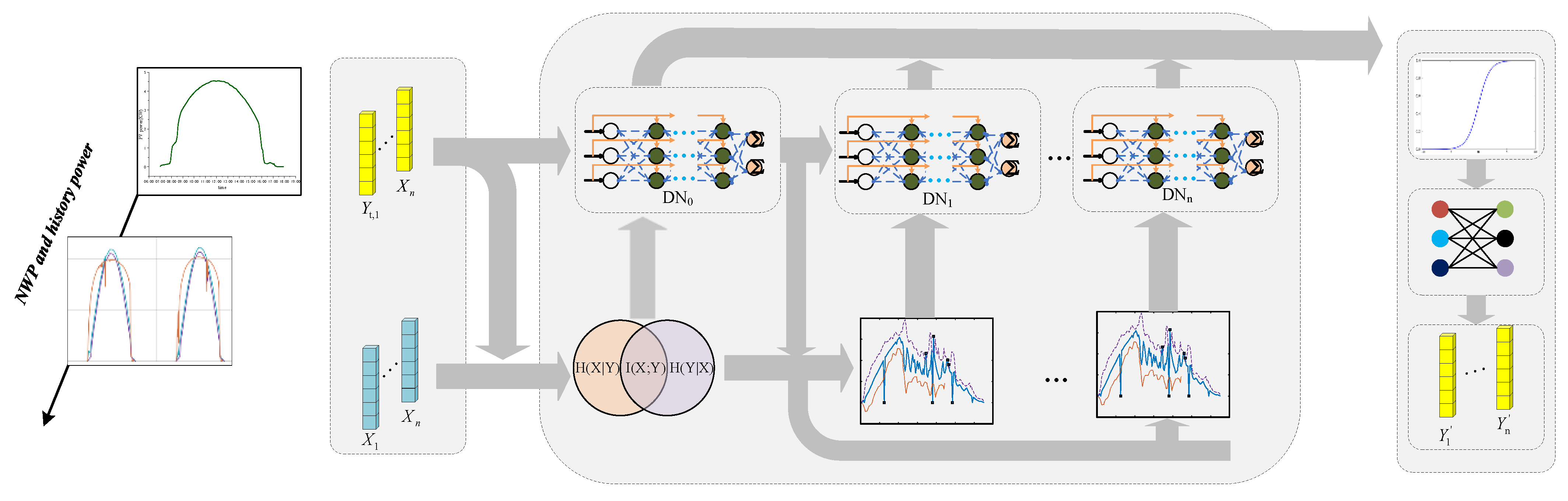
Building upon the strong learning capabilities of dendritic networks, a Gradient Boosting Multi-Bias Dendritic Units Integrated in a Fully Connected Neural Network (GBMDF) is proposed for short-term photovoltaic power prediction. The overall framework of GBMDF is shown in Figure 1.

2.1. Dendrite Network

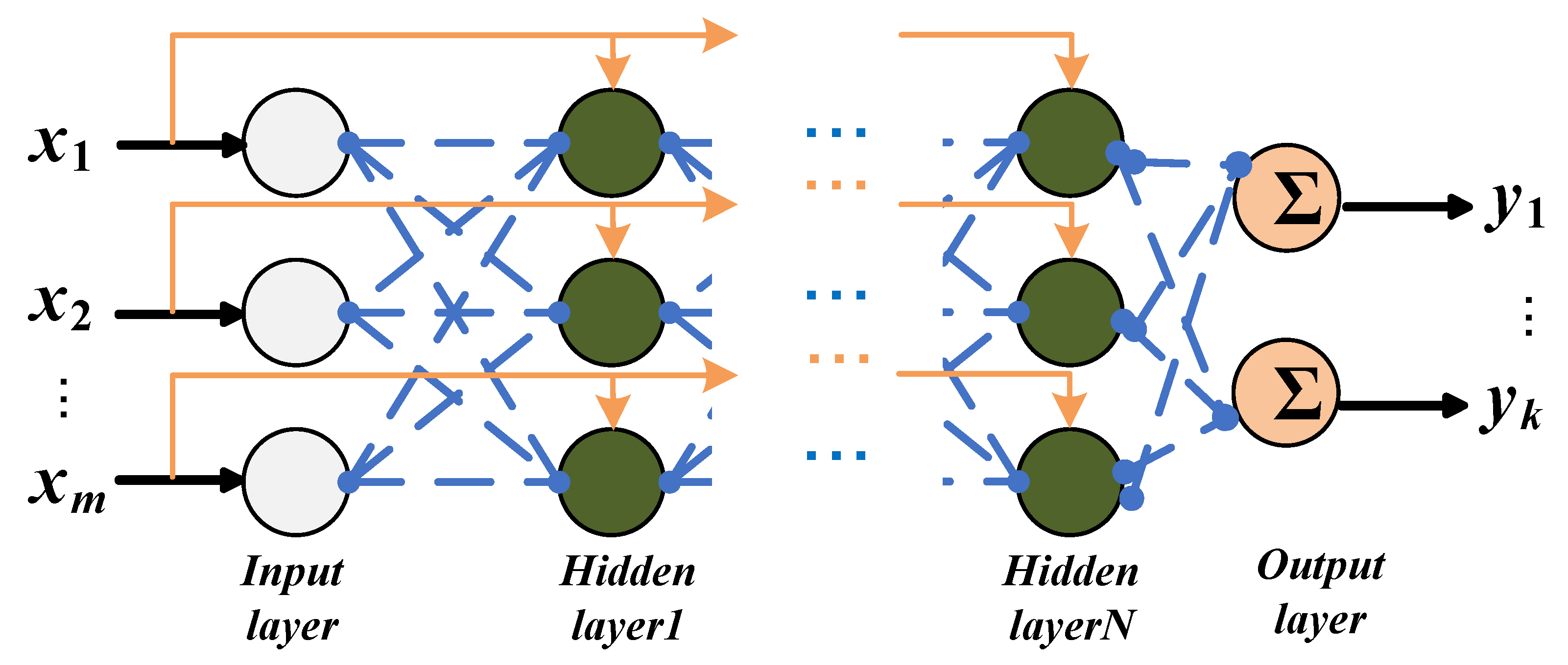
In practical PV power forecasting applications, the input vector x in Figure 2 does not merely represent abstract numerical quantities—it corresponds to a series of environmental and operational parameters that directly influence solar power generation. Specifically, the elements of x typically include solar irradiance, ambient temperature, module surface temperature, wind speed, relative humidity, atmospheric pressure, and in some cases, time-related indices such as hour of the day or day of the year. Each component of x thus reflects a measurable physical variable collected from local meteorological stations or on-site PV monitoring systems. Through these inputs, the dendritic network can capture the real-time environmental dynamics that govern photovoltaic conversion efficiency.
This architecture diverges notably from a conventional multi-layer perceptron model. In a standard MLP configuration, each element of the input vector is fed separately into individual neurons, processed through the neuron’s activation operation, and subsequently transmitted forward to the following layer of the system, as illustrated in Expression (1).
y = f ( Σ w x + b )
Within the given expression, f denotes a large-scale mapping function realized through multiple stacked network layers; w represents the set of weight parameters embedded in the architecture; and b corresponds to the bias term associated with the network’s output, introduced to enable the system to accommodate inputs of varying magnitudes. To enhance the neural network’s capability to approximate actual functional relationships, nonlinear activation operators are typically inserted within the intermediate hidden layers, thereby rendering f a nonlinear transformation.
It is evident that, within conventional neural network architectures, each individual input x operates independently from the others. In contrast, a salient characteristic of dendritic-based networks lies in the hidden layers’ capacity to realize nonlinear transformations and information propagation via the Hadamard product between the input vector and its corresponding weight parameters. The detailed computational formulation of this mechanism is presented in Equation (2).
A l = W l , A l 1 X
In this expression, A l denotes the output of the l t h hidden layer, X refers to the input vector of the network, and W l represents the weight matrix connecting the ( l 1 ) t h layer to the l t h layer. The operator signifies the Hadamard product. Such an arrangement constitutes a representative single-layer dendritic configuration. One notable advantage of this dendritic architecture is that it functions as a white-box model; owing to the absence of nonlinear activation functions, its underlying mechanism remains interpretable, and the predictive precision of the network can be explicitly controlled.
The dendrite-inspired neural structure processes these physical variables in a biologically motivated manner. Instead of using traditional activation functions, it performs Hadamard product-based nonlinear interactions between each meteorological feature and its adaptive weight, simulating the localized integration behavior of biological dendrites. For instance, changes in solar irradiance interact multiplicatively with module temperature to reveal their coupled impact on power output, a relationship often nonlinear and weather-dependent. This makes the dendritic architecture particularly suitable for representing physical correlations such as irradiance–temperature compensation effects or wind-induced cooling impacts on panel efficiency. Consequently, the DN not only provides strong predictive power but also yields interpretable patterns that correspond to observable PV system behavior.
The backpropagation procedure employed in a dendritic network is fundamentally analogous to that of a conventional neural network, utilizing an error-driven backpropagation learning paradigm. In contrast, the corresponding forward-propagation process is depicted in Equation (3).
{ A l = W l , l 1 A l 1 X A l = W l , l 1 A L 1
The specific operation of error back propagation of DN hidden layer is as shown in Formulas (4)–(6):
d A l = Y ^ Y
{ d Z l = d A l d Z l = d A l X
d A l 1 = ( W l , l 1 ) T d Z l
The weight matrix of DN updated by the Formulas (7) and (8).
d W l , l 1 = 1 m d Z l ( A l 1 ) T
W l , t = W l , t 1 α d W l
In the above formulas, Y ^ and Y are the predicted output power and actual power value of DN, respectively. m represents the number of samples in a batch and α represent the learning rate.
The DN is capable of uncovering the underlying logical relationships among the selected variables, thereby enabling the extraction of more comprehensive information even from limited historical datasets. As a result, under conditions of data scarcity, it can deliver superior training performance compared with conventional forecasting approaches.

2.2. Gradient Boosting

In the context of photovoltaic power forecasting, gradient boosting can be understood as a stepwise learning mechanism that repeatedly aligns model predictions with actual measured PV outputs under real meteorological variations. Each weak learner—implemented here as a dendritic network—focuses on correcting the residual errors left by its predecessor [34]. For example, if the initial dendritic network underestimates power during cloudy transitions or overestimates output under high temperature, the next learner specifically models these physical discrepancies, gradually improving overall predictive precision. The gradient boosting framework can be mathematically formulated as shown in Equation (9):
f ^ m ( x ) = f ^ m 1 ( x ) + η γ m g ( x )
In this expression, f ^ m ( x ) and f ^ m 1 ( x ) represent the model outputs obtained at the m t h and ( m 1 ) t h boosting iterations, respectively. The function g ( x ) denotes the base learner, which, in this study, is predominantly realized through a decision tree structure. The parameters η and γ m signify the learning rate and the shrinkage factor, respectively; together, they play a crucial role in constraining model complexity and preventing overfitting by moderating the influence of each successive learner’s contribution to the ensemble prediction.
A crucial operation in the gradient boosting algorithm lies in approximating the negative gradient of the loss function using a base learner. For regression-oriented problems—such as PV power generation forecasting—the loss function is typically defined as one-half of the mean squared error (MSE), as formulated in Equation (10):
Ξ ( y , y ^ ) = 1 2 ( y y ^ ) 2
For a predictive model f ^ m 1 ( x ) , the aggregate loss across all samples can be expressed as Π , shown in Equation (11):
Π = i = 1 n   Ξ ( y i , y ^ m 1 , i )
The gradient of the loss function with respect to the model output at the ( m 1 ) t h iteration is given in Expression (12):
Π f ^ m 1 ( x ) = Ξ ( y i , f ^ m 1 ( x i ) ) f ^ m 1 ( x ) = f ^ m 1 ( x i ) y i
Accordingly, the negative gradient is represented as Equation (13):
Π f ^ m 1 ( x ) = y i f ^ m 1 ( x i )
Here, y i f ^ m 1 ( x i ) corresponds to the residual error of the model at the current iteration, quantifying the deviation between the actual and predicted outputs. Therefore, within a gradient boosting framework tailored for regression applications such as PV power forecasting, each base learner g ( x ) introduced at a new iteration is specifically trained to approximate the residuals generated by the preceding model, thereby progressively refining overall prediction accuracy.

2.3. Overall Architecture for PV Power Forecast

PV power output is influenced by diurnal periodicity, seasonal variability, and meteorological parameters such as irradiance, ambient temperature, and wind velocity. These factors result in multi-source heterogeneity, nonlinearity, and instability, which are often compounded by noise and abrupt fluctuations. To address these complexities, a forecasting model named GBMDF (Gradient-Boosted Multi-Bias Dendritic Unit Integrated within Fully Connected Neural Networks) was developed. This architecture integrates gradient boosting with a dendritic neural network to improve the characterization of the coupling mechanisms between PV output and environmental factors. Compared to single-model or conventional ensemble frameworks, this integrated approach is designed to handle heterogeneous features and capture nonlinear dependencies, providing support for the operational scheduling of renewable energy systems.
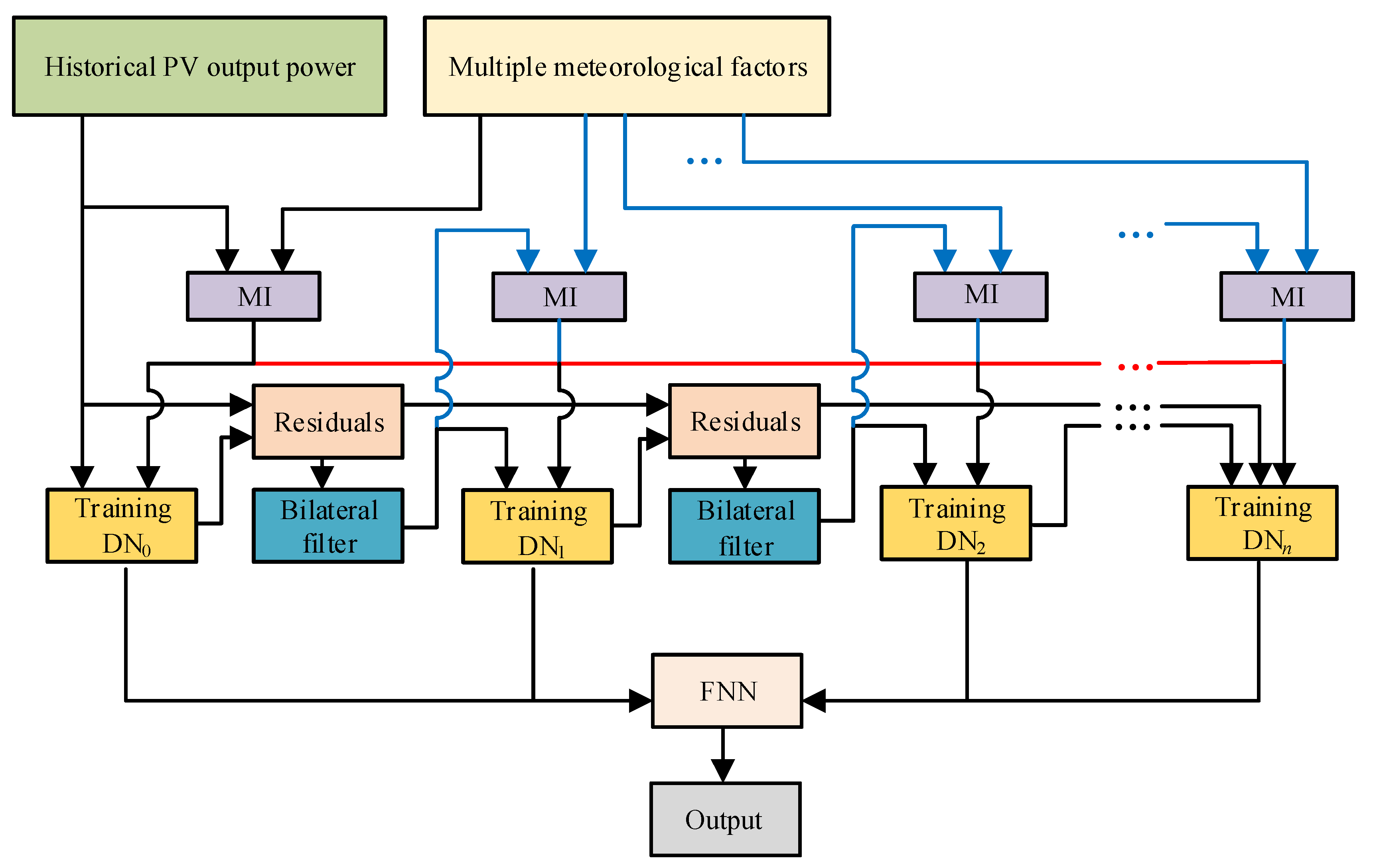
The training process begins by integrating historical PV data with meteorological variables. Mutual Information (MI) analysis is employed to select features with a substantial influence on PV power, thereby reducing the risk of weakly correlated variables inducing overfitting. Within the GBMDF, the dendritic topology processes these selected inputs by emulating the nonlinear integrative behavior of biological neurons, while the gradient boosting component iteratively refines residual errors to mitigate systematic bias. Due to the feature extraction capabilities of the dendritic network, the outputs from each DN layer are concatenated and passed through a fully connected layer to produce the final forecasted power values. The detailed network architecture is illustrated in Figure 3.
To prevent the gradient explosion phenomenon that may arise during the iterative optimization process, the learning rate and shrinkage coefficient are carefully bounded within the range of 0 to 1. Under this constraint, the adaptive learning rate for the i-th training epoch is dynamically adjusted according to Equation (14):
a = ( 1 i 1 e p o c h ) η
In this formulation, epoch denotes the total number of training iterations, while 0 < η < 1 represents a constant base learning rate. This adaptive scheduling strategy ensures that the model commences training with a relatively large step size—facilitating rapid convergence in the early stages—and gradually reduces the learning rate as the training progresses, thereby stabilizing parameter updates and effectively suppressing gradient explosion or oscillation in the later optimization phases.

2.4. Experimental Data

The PV power dataset employed in this investigation was obtained from the Desert Knowledge Australia Solar Centre (DKASC) [35], which systematically records the operational performance of a 6.05 kW PV array located in Alice Springs, Northern Territory, Australia. For experimental validation, data spanning the full year of 2022 were employed to ensure representativeness under varying irradiance and meteorological conditions. The technical configuration and installation parameters of the selected PV system are comprehensively summarized in Table 2 In addition, historical meteorological measurements—including solar irradiance, ambient temperature, wind speed, humidity, and atmospheric pressure—were collected from the Alice Springs meteorological station. The accompanying numerical weather prediction (NWP) data were derived from short-term forecasting models trained on historical observations, providing predictive features that reflect the evolving dynamics of the local weather environment.
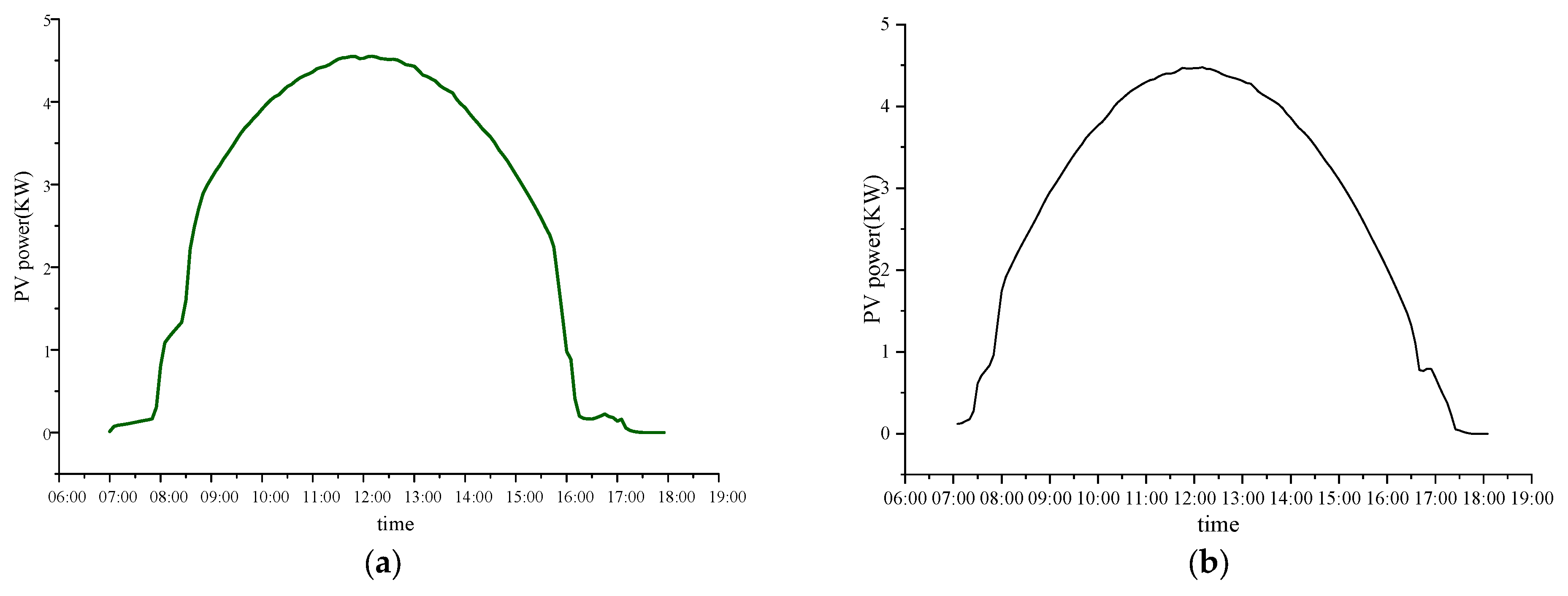
Given that the research objective centers on forecasting photovoltaic output, and considering that PV modules generate electricity solely during daylight hours, the present investigation restricts its analysis to observations recorded between 07:00 and 18:00 local time. These temporal bounds are established according to the site-specific sunrise and sunset periods corresponding to the data acquisition location. Figure 4 shows the photovoltaic power curve for two specific days.
To quantitatively assess the predictive effectiveness of the proposed PV power forecasting model, three widely recognized statistical performance indicators are employed: Mean Absolute Error (MAE), Root Mean Square Error (RMSE), and Mean Absolute Percentage Error (MAPE). These evaluation metrics provide complementary insights into model accuracy and robustness—MAE reflects the average magnitude of prediction deviations, RMSE emphasizes larger errors through quadratic penalization, and MAPE expresses error magnitude as a relative percentage of actual values, facilitating interpretability across different scales. The mathematical formulations of these indicators are presented in Equations (15)–(17):
MAE   = 1 n i = 1 n   | P actual   ( i ) P predict   ( i ) |
RMSE   = 1 n i = 1 n   ( P actual   ( i ) P predict   ( i ) ) 2
MAPE   = 1 n i = 1 n   | P actual   ( i ) P predict   ( i ) P actual   ( i ) | × 100 %
where P a c t u a l and P p r e d i c t denote the measured and estimated PV power outputs, respectively, and n corresponds to the total number of sampling instances within the PV power generation interval under analysis.

3. Results

This section first outlines the benchmark models utilized for comparative experimental analysis. Following this, a detailed case study is conducted to examine the PV power forecasting performance achieved through different algorithmic methodologies. Finally, empirical verification is carried out to evaluate the effectiveness of the GBMDF in improving the predictive precision of other forecasting models.

3.1. Feature Analysis

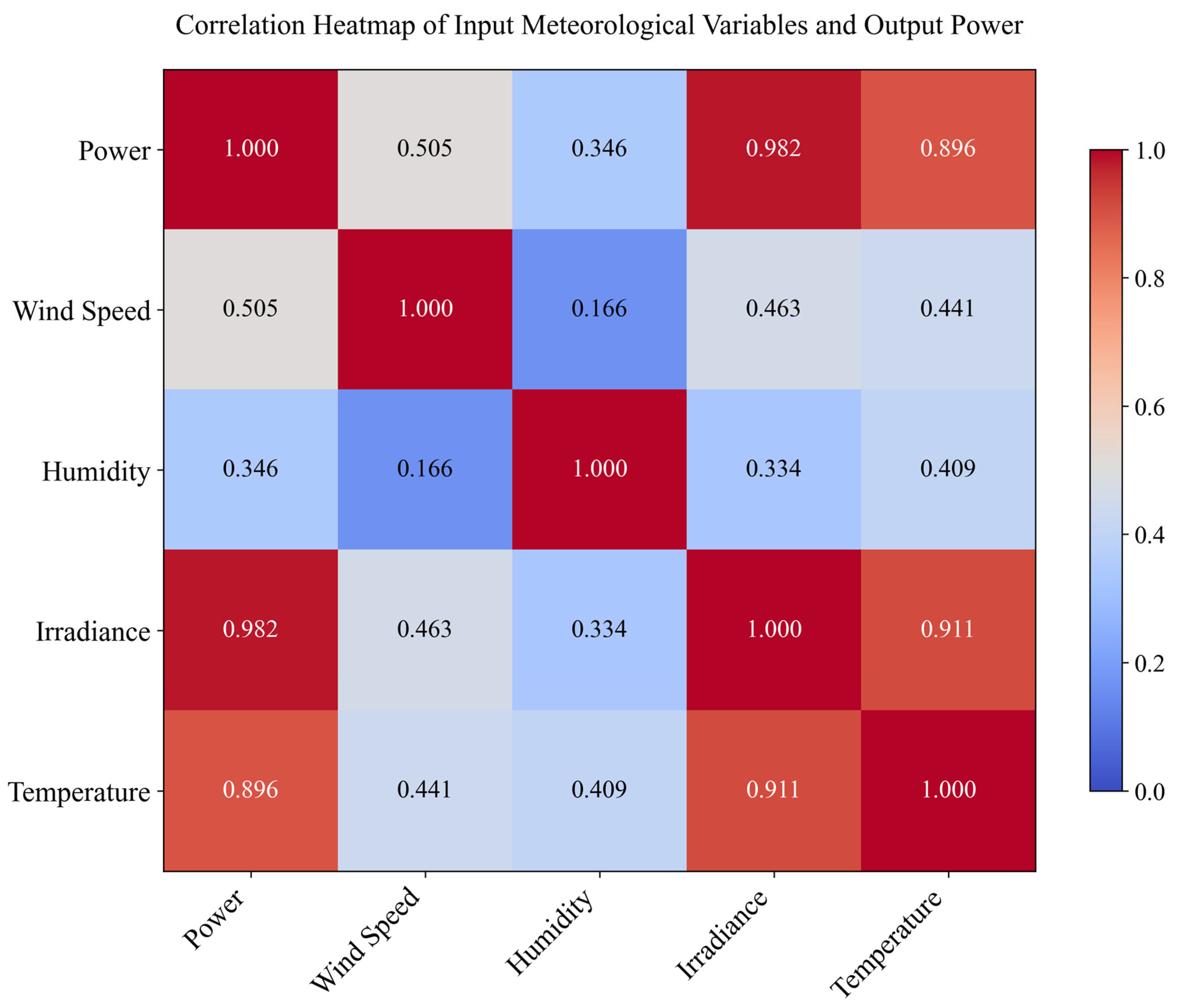
To explore the physical relationships between meteorological inputs and PV power generation, a comprehensive correlation analysis was conducted among all candidate features and the measured PV output. As illustrated in Figure 5.
The analysis results reveal that solar irradiance exhibits the most pronounced and positive correlation with PV power output, thereby reaffirming its critical importance as the primary determinant in the solar-to-electric energy conversion process. This strong dependence highlights that irradiance intensity directly dictates the photon flux available for photoelectric transformation, thus serving as the dominant input feature in the forecasting model. In contrast, the module surface temperature demonstrates a nonlinear relationship: it maintains a moderate positive correlation with power generation under low-irradiance conditions yet transitions to a negative correlation as irradiance increases. This behavior reflects the well-documented thermal degradation effect, where elevated panel temperatures reduce semiconductor efficiency and hinder charge carrier mobility. Meanwhile, ambient temperature presents a relatively weak but steady correlation with PV output, suggesting its secondary role as a supporting environmental factor influencing the overall energy conversion efficiency. Additionally, wind speed and relative humidity show minor yet meaningful correlations, signifying their indirect regulatory effects—wind speed contributes to panel cooling, mitigating thermal losses, whereas humidity subtly alters solar radiation transmission through atmospheric scattering and absorption. Collectively, these observed correlations align closely with established photovoltaic physics, confirming both the validity of the selected meteorological input features and the physical interpretability of the model’s forecasting framework.

3.2. Experiment

The PV power output dataset adopted for experimentation originates from the Desert Knowledge Australia Solar Centre [25], which continuously monitors the energy generation of a 6.05 kW photovoltaic installation situated in Alice Springs. For this study, a full year’s data periods were selected to validate the model’s performance across diverse conditions. The hyperparameter configuration of the proposed GBMDF model, as summarized in Table 3, was meticulously determined through a comprehensive trade-off analysis. Specifically, the parameter selection balances the scale of the available dataset with the specific requirements of the training platform and the constraints of available hardware resources. This ensures that the model achieves optimal predictive accuracy while maintaining feasible computational efficiency within the given experimental environment.
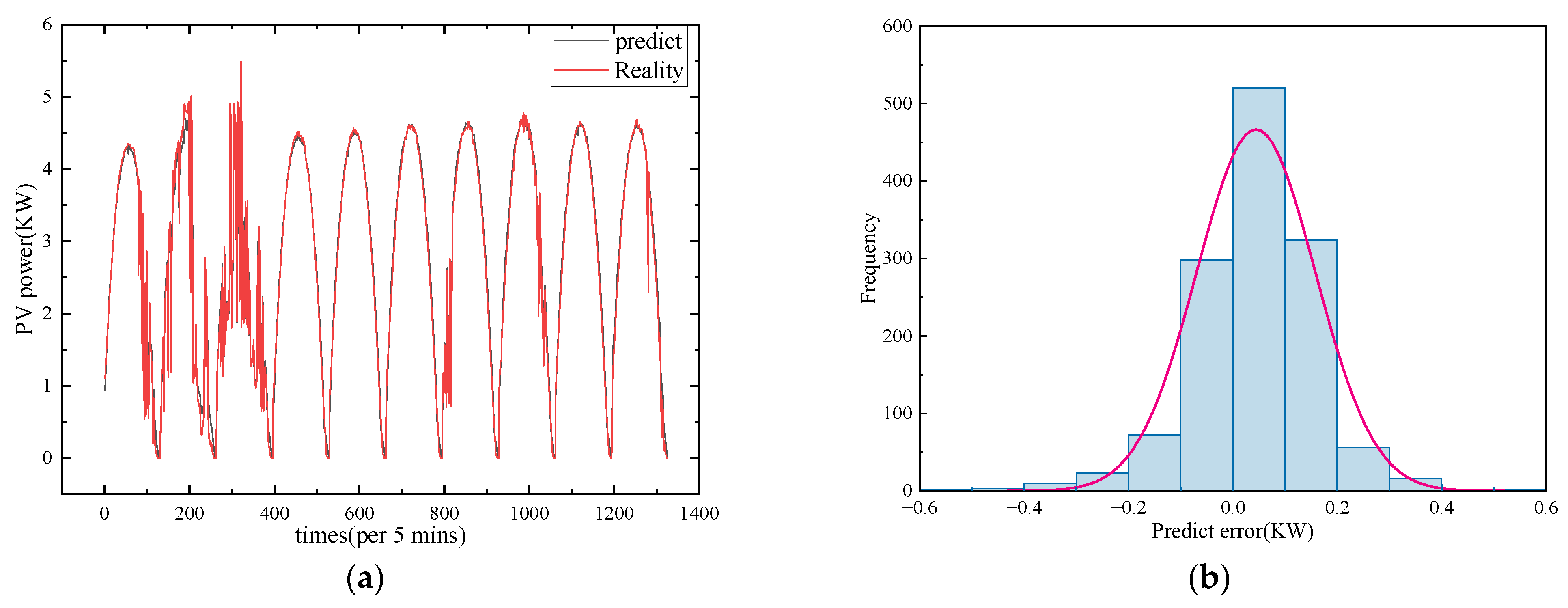
Figure 6a shows the prediction results and actual photovoltaic power values of the GBMDF over ten days after 256 training iterations, while Figure 6b shows the prediction error histogram and the fitted normal distribution curve. From Figure 6, we can see that the GBMDF performs exceptionally well in short-term photovoltaic power prediction. The approximately normal error distribution indicates that the model’s prediction error is random and lacks systematic bias, which is an important indicator of the model’s robustness.
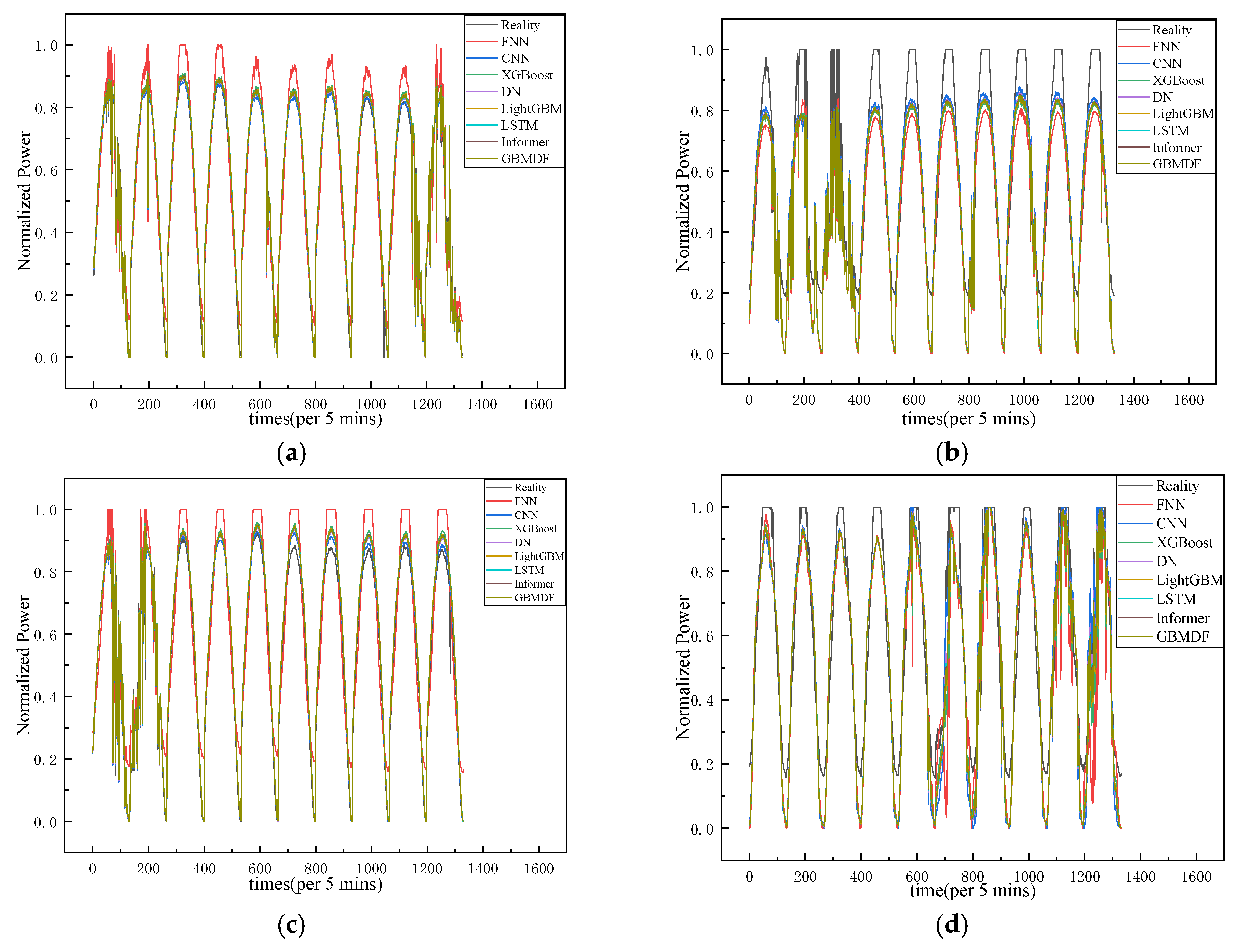
To further evaluate the predictive performance of the GBMDF architecture, we conducted a comparative analysis with several classical models using identical datasets and validation protocols. Figure 7 illustrates the prediction curves for FNN, CNN, XGBoost, DN, LightGBM, LSTM, Informer, and GBMDF, alongside the normalized actual PV power curve. All candidate models underwent hyperparameter optimization tailored to the specific data characteristics and available computational capacity, ensuring a robust and fair comparison under consistent experimental conditions.
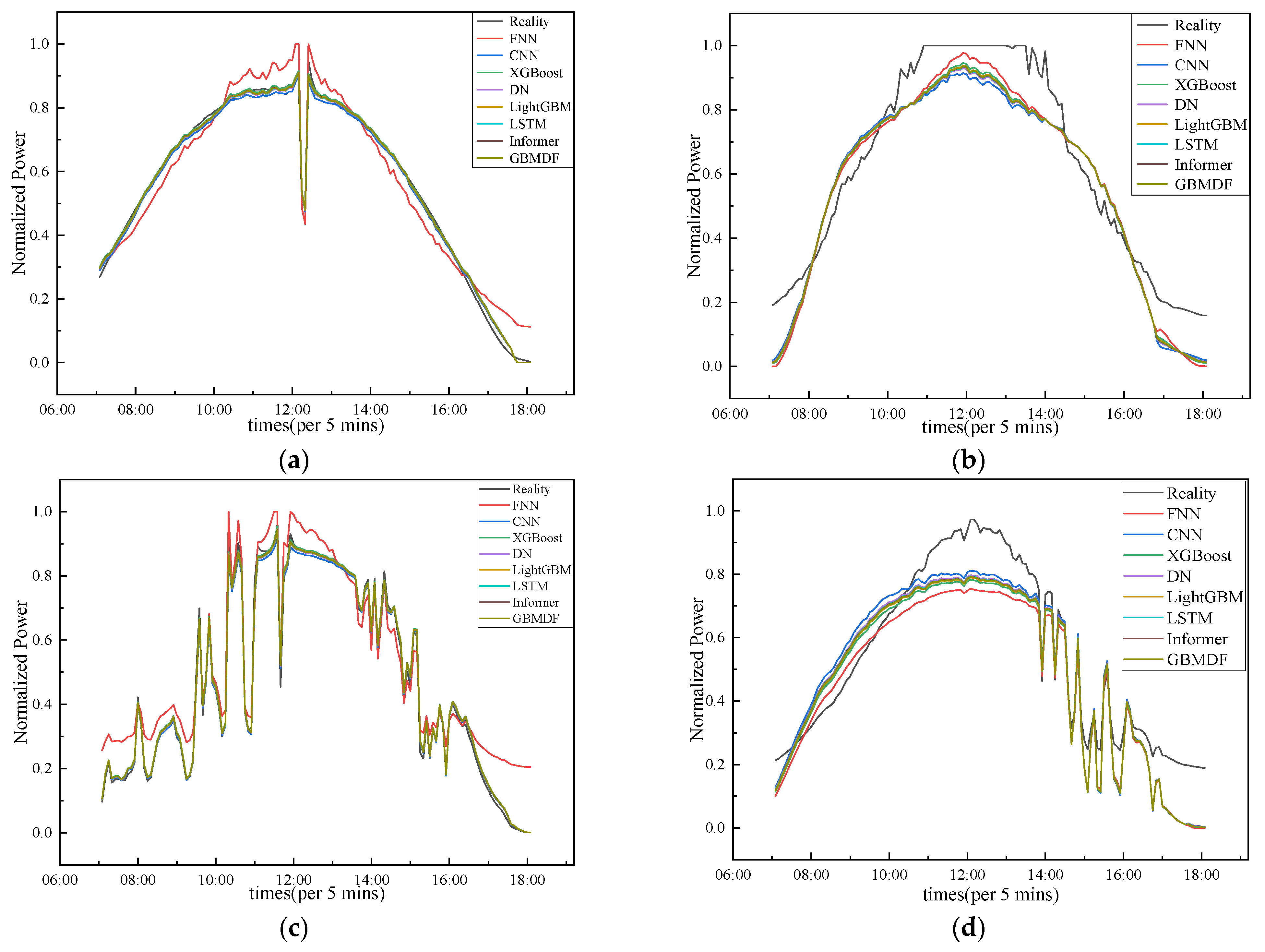
As illustrated in Figure 7 and Figure 8, the FNN exhibits the most frequent occurrences of the “clipping” (output saturation) phenomenon. The predictive performance of the DN and LSTM is comparable, while XGBoost and CNN show similar results, albeit slightly inferior to LightGBM. Notably, GBMDF and Informer demonstrate superior predictive capabilities, significantly outperforming the other baseline models. A comparison of specific evaluation metrics is shown in Table 4.
In summary, dendritic-structured network models demonstrate superiority over conventional neural architectures and exhibit significant potential to compete with state-of-the-art Transformer-based models. Experimental findings indicate that GBMDF performs exceptionally well in photovoltaic power forecasting, with an overall predictive capability that is promising to surpass established benchmarks such as Informer.

3.3. Model Evaluation

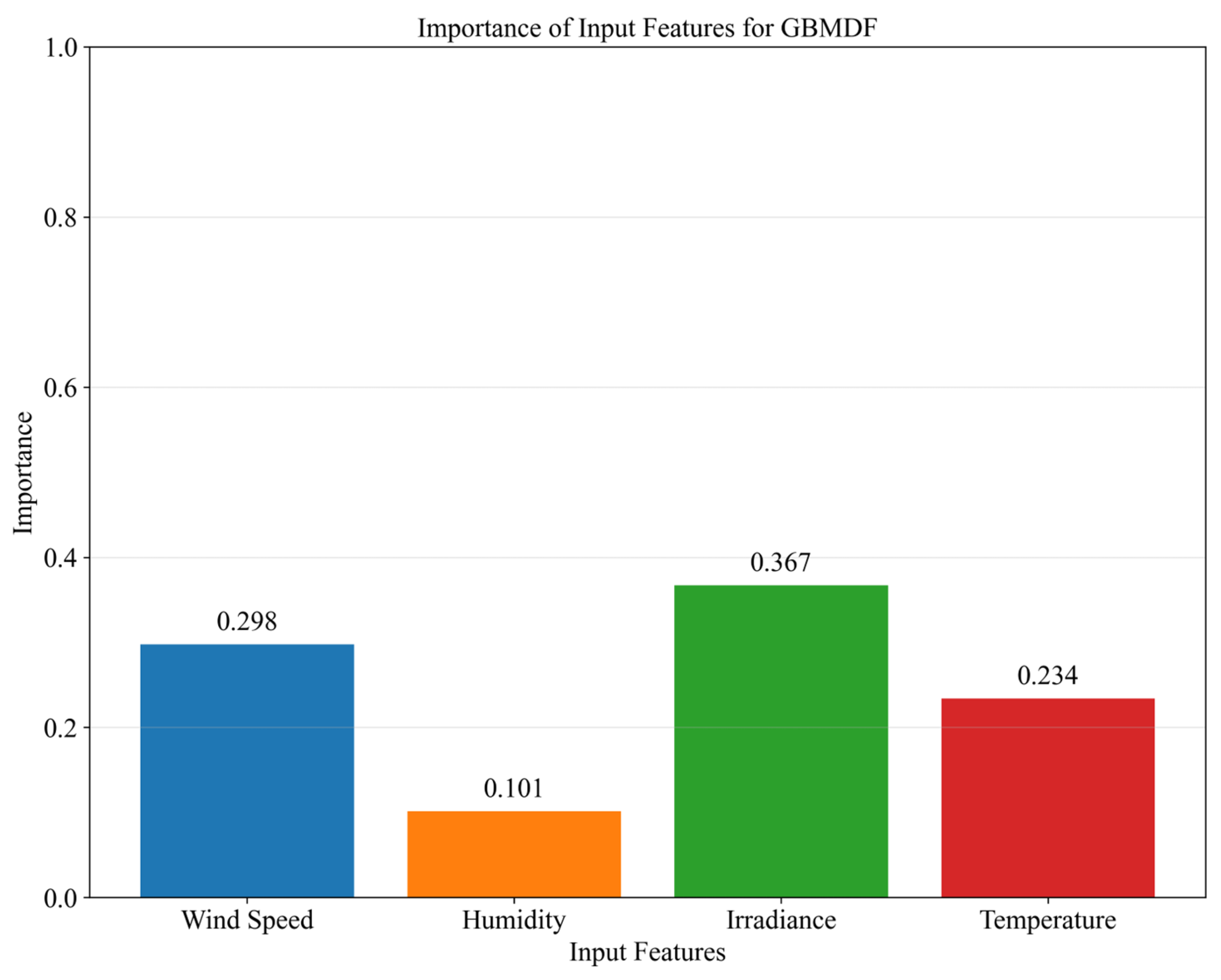
Since dendritic neural networks are white-box models, Figure 9 shows the importance bar charts of each input feature after GBMDF training to further enhance the interpretability of the GFMDF model and to test its data understanding ability.
As shown in Figure 9, the features contributing to the output label, ranked from largest to smallest, are irradiance, wind speed, temperature, and humidity. This indicates that the model correctly identifies solar irradiance as the most important feature for predicting photovoltaic power, while humidity is the feature contributing the least to the output. This result aligns with the actual physical mechanism of photovoltaic power generation, demonstrating that the model has successfully grasped the key to the problem.
A noteworthy and seemingly counter-intuitive observation arises when comparing the correlation analysis (Figure 5) with the model’s feature importance scores (Figure 9). While Temperature exhibits a strong linear correlation with Power (r = 0.896), its importance score (0.234) is ranked lower than that of Wind Speed (0.298), which has a more moderate correlation (r = 0.505). We posit that this discrepancy does not indicate a flaw in the model but rather highlights the sophisticated way in which the GBMDF model handles multicollinearity among input features.
The key to understanding this result lies in the strong correlation observed between Temperature and Irradiance (r = 0.911), as shown in Figure 5. This high degree of correlation suggests significant informational redundancy. The GBMDF model, particularly its gradient boosting component, builds its predictive power sequentially by optimizing for information gain. The model first and foremost utilizes Irradiance, the single most dominant predictor.
Subsequently, when evaluating the remaining features, the model assesses the unique, non-redundant information each one provides. Since a large portion of the variance in Temperature is already explained by Irradiance, the additional predictive value offered by Temperature is diminished. In contrast, Wind Speed provides information about a distinct physical phenomenon—the cooling effect on the PV panels—which is not captured by Irradiance. This unique information helps the model to refine its predictions, especially under conditions where temperature might deviate from its typical relationship with radiation.
Therefore, the model assigns a higher importance score to Wind Speed not because its direct correlation is stronger, but because its marginal contribution to the model’s predictive accuracy is greater after the primary effect of Irradiance has been accounted for. This behavior demonstrates the model’s ability to look beyond simple linear relationships and effectively leverage features that provide complementary, rather than redundant, information. We have revised the manuscript to include this more detailed explanation to clarify this crucial point.

4. Discussion

The proposed network (GBMDF) strengthens short-term PV power forecasting by fusing dendritic networks (DN) with a gradient boosting mechanism and fully connected neural architectures. By incorporating a residual learning mechanism, the model exploits the adaptive representation capacity of dendritic units to capture intricate environmental influences, while the fully connected layers enhance nonlinear mapping. Experimental results confirm that this configuration effectively utilizes multivariate meteorological data, achieving reductions of 8.40% in MAE, 10.84% in MAPE, and 8.95% in RMSE compared to the standalone DN model. Furthermore, GBMDF outperforms traditional baseline methods and demonstrates competitive potential relative to Transformer-based architectures in dynamic forecasting scenarios.
Beyond numerical accuracy, the practical deployment of GBMDF offers distinct advantages to power industry stakeholders. For grid dispatchers, the model’s superior ultra-short-term precision facilitates more accurate scheduling of spinning reserves, thereby reducing operational costs associated with PV-induced grid instability. For PV plant operators, the “white-box” transparency of the dendritic units serves as a diagnostic tool; unlike conventional black-box models, GBMDF allows managers to correlate specific meteorological fluctuations with power deviations. This interpretability supports informed energy storage management and mitigates financial penalties resulting from forecasting imbalances in electricity markets.
In summary, GBMDF provides a high-precision and interpretable solution for short-term PV prediction, bridging the gap between advanced AI theory and real-world industrial requirements. Future research will explore the application of this framework to broader energy domains, with a particular focus on further mining its computational potential to enhance efficiency for large-scale deployments.

5. Conclusions

This study developed and validated the GBMDF, which synergistically integrates dendritic neural structures with a gradient boosting mechanism to enhance short-term photovoltaic power forecasting. Experimental evidence demonstrates that the proposed model achieves quantifiable improvements in predictive accuracy, specifically reducing the MAE, MAPE, and RMSE by 8.40%, 10.84%, and 8.95%, respectively, compared to the standalone dendritic model. By maintaining the “white-box” interpretability inherent in dendritic units while achieving high-precision performance, the framework provides a practical tool for stakeholders such as grid dispatchers and PV plant operators to optimize energy scheduling and reduce financial risks associated with power volatility. While the current study prioritizes accuracy and structural transparency, future research will focus on further exploring and mining the computational potential of the GBMDF architecture to enhance its efficiency for real-time and large-scale industrial deployments.

Author Contributions

Conceptualization, K.C. and X.W.; Software, K.Z.; Validation, C.N.; Formal analysis, Y.Y. and X.S.; Data curation, Y.L. and X.S.; Writing—original draft, X.S.; Writing—review & editing, Y.C. All authors have read and agreed to the published version of the manuscript.

Funding

This paper was supported by the technical development of the science and technology project “Research on Cluster Dispatching and Control Technology of Photovoltaic-Storage Systems Based on Distributed Energy Storage Technology and Edge Computing” from Huizhou Power Supply Bureau of Guangdong Power Grid Co., Ltd., with the project number 031300KC24070015.

Institutional Review Board Statement

Not applicable.

Informed Consent Statement

Not applicable.

Data Availability Statement

The original contributions presented in the study are included in the article, further inquiries can be directed to the corresponding author.

Acknowledgments

Thanks to all the authors for their contributions to this article.

Conflicts of Interest

Authors Kunlun Cai, Xiucheng Wu, Kangliang Zheng, Chufei Nie, Yuantong Yang, Yiqing Li were employed by the company Huizhou Power Supply Bureau, Guangdong Power Grid Corporation. The remaining authors declare that the research was conducted in the absence of any commercial or financial relationships that could be construed as a potential conflict of interest.

References

  1. Khare, V.; Nema, S.; Baredar, P. Solar–wind hybrid renewable energy system: A review. Renew. Sustain. Energy Rev. 2016, 58, 23–33. [Google Scholar] [CrossRef]
  2. IEA. World Energy Outlook 2021; IEA: Paris, France, 2021; Available online: https://www.iea.org/reports/world-energy-outlook-2021 (accessed on 1 November 2025).
  3. Sobri, S.; Koohi-Kamali, S.; Rahim, N.A. Solar photovoltaic generation forecasting methods: A review. Energy Convers. Manag. 2018, 156, 459–497. [Google Scholar] [CrossRef]
  4. Song, D.; Yousaf, A.; Noor, J.; Cao, Y.; Dong, M.; Yang, J.; Rizk-Allah, R.M.; Elkholy, M.H.; Talaat, M. Ann-based model predictive control for hybrid energy storage systems in dc microgrid. Prot. Control Mod. Power Syst. 2025, 10, 1–15. [Google Scholar] [CrossRef]
  5. Liao, Y.; Zhang, X.; Chen, L.; Li, F.; Wang, C.; Cao, Y.; Hu, Y. Shared-Receiver Battery Equalizer Based on Inductive Power Transfer and Bidirectional DC-DC Converter. IEEE Trans. Power Electron. 2025, 41, 3879–3893. [Google Scholar] [CrossRef]
  6. Wang, C.; Li, M.; Cao, Y. A novel neural network model with cascaded structure for state-of-charge estimation in lithium-ion batteries. CSEE J. Power Energy Syst. 2024, 99, 1–12. [Google Scholar]
  7. De la Nieta, A.A.S.; Paterakis, N.G.; Gibescu, M. Participation of photovoltaic power producers in short-term electricity markets based on rescheduling and risk-hedging mapping. Appl. Energy 2020, 266, 114741. [Google Scholar] [CrossRef]
  8. Dolara, A.; Leva, S.; Manzolini, G. Comparison of different physical models for PV power output prediction. Sol. Energy 2015, 119, 83–99. [Google Scholar] [CrossRef]
  9. Kardakos, E.G.; Alexiadis, M.C.; Vagropoulos, S.I.; Simoglou, C.K.; Biskas, P.N.; Bakirtzis, A.G. Application of time series and artificial neural network models in short-term forecasting of PV power generation. In Proceedings of the 2013 48th International Universities’ Power Engineering Conference (UPEC), Dublin, Ireland, 2–5 September 2013; IEEE: New York, NY, USA, 2013; pp. 1–6. [Google Scholar]
  10. Lin, P.; Peng, Z.; Lai, Y.; Cheng, S.; Chen, Z.; Wu, L. Short-term power prediction for photovoltaic power plants using a hybrid improved Kmeans-GRA-Elman model based on multivariate meteorological factors and historical power datasets. Energy Convers. Manag. 2018, 177, 704–717. [Google Scholar] [CrossRef]
  11. Liu, J.; Fang, W.; Zhang, X.; Yang, C. An improved photovoltaic power forecasting model with the assistance of aerosol index data. IEEE Trans. Sustain. Energy 2015, 6, 434–442. [Google Scholar] [CrossRef]
  12. Jang, H.S.; Bae, K.Y.; Park, H.S.; Sung, D.K. Solar power prediction based on satellite images and support vector machine. IEEE Trans. Sustain. Energy 2016, 7, 1255–1263. [Google Scholar] [CrossRef]
  13. Huang, C.J.; Kuo, P.H. Multiple-input deep convolutional neural network model for short-term photovoltaic power forecasting. IEEE Access 2019, 7, 74822–74834. [Google Scholar] [CrossRef]
  14. Gundu, V.; Simon, S.P. Short term solar power and temperature forecast using recurrent neural networks. Neural Process. Lett. 2021, 53, 4407–4418. [Google Scholar] [CrossRef]
  15. Ding, S.; Li, R.; Tao, Z. A novel adaptive discrete grey model with time-varying parameters for long-term photovoltaic power generation forecasting. Energy Convers. Manag. 2021, 227, 113644. [Google Scholar] [CrossRef]
  16. Zhou, Y.; Zhou, N.; Gong, L.; Jiang, M. Prediction of photovoltaic power output based on similar day analysis, genetic algorithm and extreme learning machine. Energy 2020, 204, 117894. [Google Scholar] [CrossRef]
  17. Ma, Y.; Lv, Q.; Zhang, R.; Zhang, Y.; Zhu, H.; Yin, W. Short-term photovoltaic power forecasting method based on irradiance correction and error forecasting. Energy Rep. 2021, 7, 5495–5509. [Google Scholar] [CrossRef]
  18. Lin, G.Q.; Li, L.L.; Tseng, M.L.; Liu, H.M.; Yuan, D.D.; Tan, R.R. An improved moth-flame optimization algorithm for support vector machine prediction of photovoltaic power generation. J. Clean. Prod. 2020, 253, 119966. [Google Scholar] [CrossRef]
  19. Pan, M.; Li, C.; Gao, R.; Huang, Y.; You, H.; Gu, T.; Qin, F. Photovoltaic power forecasting based on a support vector machine with improved ant colony optimization. J. Clean. Prod. 2020, 277, 123948. [Google Scholar] [CrossRef]
  20. Zhang, T.; Lv, C.; Ma, F.; Zhao, K.; Wang, H.; O’Hare, G.M. A photovoltaic power forecasting model based on dendritic neuron networks with the aid of wavelet transform. Neurocomputing 2020, 397, 438–446. [Google Scholar] [CrossRef]
  21. Li, P.; Zhou, K.; Lu, X.; Yang, S. A hybrid deep learning model for short-term PV power forecasting. Appl. Energy 2020, 259, 114216. [Google Scholar] [CrossRef]
  22. Behera, M.K.; Nayak, N. A comparative study on short-term PV power forecasting using decomposition based optimized extreme learning machine algorithm. Eng. Sci. Technol. Int. J. 2020, 23, 156–167. [Google Scholar] [CrossRef]
  23. Niu, D.; Wang, K.; Sun, L.; Wu, J.; Xu, X. Short-term photovoltaic power generation forecasting based on random forest feature selection and CEEMD: A case study. Appl. Soft Comput. 2020, 93, 106389. [Google Scholar] [CrossRef]
  24. Li, Q.; Zhang, X.; Ma, T.; Jiao, C.; Wang, H.; Hu, W. A multi-step ahead photovoltaic power prediction model based on similar day, enhanced colliding bodies optimization, variational mode decomposition, and deep extreme learning machine. Energy 2021, 224, 120094. [Google Scholar] [CrossRef]
  25. Wang, C.; Li, M.; Cao, Y.; Lu, T. Gradient boosting dendritic network for ultra-short-term PV power prediction. Front. Energy 2024, 18, 785–798. [Google Scholar] [CrossRef]
  26. Lu, T.; Wang, C.; Cao, Y.; Chen, H. Photovoltaic power prediction under insufficient historical data based on dendrite network and coupled information analysis. Energy Rep. 2023, 9, 1490–1500. [Google Scholar] [CrossRef]
  27. Liu, L.; Lu, Y.; Li, S. Photovoltaic power forecasting based on SVM optimized by improved ABC. In Proceedings of the IOP Conference Series: Earth and Environmental Science, Sanya, China, 10–12 January 2020; IOP Publishing: Bristol, UK, 2020; Volume 474, p. 052036. [Google Scholar]
  28. Zhao, M.; Li, S.; Chen, H.; Ling, M.; Chang, H. Distributed solar photovoltaic power prediction algorithm based on deep neural network. J. Eng. Res. 2024, 13, 3352–3359. [Google Scholar] [CrossRef]
  29. Qiu, R.; Su, Z. Research on Photovoltaic Power Generation Forecasting Based on a Combined CNN-LSTM Neural Network Model. Acad. J. Comput. Inf. Sci. 2024, 7, 33–41. [Google Scholar] [CrossRef]
  30. Saraswat, R.; Jhanwar, D.; Gupta, M. Enhanced Solar Power Forecasting Using XG Boost and PCA-Based Sky Image Analysis. Trait. Signal 2024, 41, 503. [Google Scholar] [CrossRef]
  31. Noh, S.H. Predicting Future Promising Technologies Using LSTM. Informatics 2022, 9, 77. [Google Scholar] [CrossRef]
  32. Yang, Y.; Lee, S.H.; Choi, Y.S.; Lee, K.M. LightGBM Medium-Term Photovoltaic Power Prediction Integrating Meteorological Features and Historical Data. Energies 2025, 18, 5526. [Google Scholar] [CrossRef]
  33. Liu, G.; Wang, J. Dendrite net: A white-box module for classification, regression, and system identification. IEEE Trans. Cybern. 2021, 52, 13774–13787. [Google Scholar] [CrossRef]
  34. Friedman, J.H. Greedy function approximation: A gradient boosting machine. Ann. Stat. 2001, 29, 1189–1232. [Google Scholar] [CrossRef]
  35. Desert Knowledge Australia Solar Center. Available online: https://dkasolarcentre.com.au/ (accessed on 24 October 2025).
Figure 1. The architecture of the proposed GBMDF.
Applsci 16 00406 g001
Figure 2. The structure of dendritic network.
Applsci 16 00406 g002
Figure 3. Detailed structure of GBMDF.
Applsci 16 00406 g003
Figure 4. Photovoltaic power generation data for a certain day: (a) one day in April 2022; (b) one day in October 2022.
Applsci 16 00406 g004
Figure 5. Feature correlation analysis heatmap.
Applsci 16 00406 g005
Figure 6. (a) Plot of predicted and actual output power of GBMDF over ten days; (b) Prediction error histogram and normal distribution fitting curve.
Applsci 16 00406 g006
Figure 7. Normalized prediction results for different neural network structures and the normalized actual photovoltaic output power curves: (a) Mid-January 2022; (b) Mid-April 2022; (c) Mid-July 2022; (d) Mid-October 2022.
Applsci 16 00406 g007
Figure 8. (ad) the second day in Figure 7a–d, respectively.
Applsci 16 00406 g008
Figure 9. Feature importance distribution of the GBMDF model.
Applsci 16 00406 g009
Table 1. Comparison of basic prediction models in photovoltaic power prediction tasks.
Networks/PaperData ScaleAdvantageLimitationRobustness
SVM/Liu, L. et al. (2020) [27]Small not prone to overfitting.Not friendly to large-scale data.better
BPNN/Zhao, M. et al. (2024) [28] Small or mediumeasy to implement.unable to handle spatiotemporal features.Poor
CNN/Qiu, R., & Su, Z. (2024) [29]LargeSpatial feature extraction and weight sharing.Ignore long-term timing.medium
XGBoost/Saraswat, R et al. (2024) [30]Medium to very largeHigh prediction accuracy; Good at handling missing values.Requires manual feature engineering.Good
LSTM/Noh, S. H. (2022) [31]LargeCapturing long-term temporal dependencies.Weak ability to capture spatial features.Moderate preference
LightGBM/Yang, Y et al. (2025) [32]Large to very largeExtremely fast training speed and lower memory consumption.Prone to overfitting on small datasets.Good, but sensitive on small data
Table 2. PV plants parameters.
NameParameters
Array Rating6.05 kW
Panel Rating275 W
Number of Panels22
Panel TypeQ.PLUS BFR-G4.1 275
Array Area36.74 m2
Array Tilt/AzimuthTilt = 20, Azi = 0 (Solar North)
Table 3. Parameters for training.
NameParameters
epoch256
η 0.05
Layer number8
batch2
bias1
ve0.8
Table 4. Comparison results of different model.
ModelMAPE (%)MAERMSE
FNN10.43710.15530.2542
CNN7.83230.07970.1618
XGBoost8.94210.85430.1723
DN7.25240.08210.1688
LightGBM6.94270.08430.1572
LSTM7.13420.08170.1621
Informer6.10420.07810.1371
GBMDF6.64290.07320.1537
Disclaimer/Publisher’s Note: The statements, opinions and data contained in all publications are solely those of the individual author(s) and contributor(s) and not of MDPI and/or the editor(s). MDPI and/or the editor(s) disclaim responsibility for any injury to people or property resulting from any ideas, methods, instructions or products referred to in the content.