Article

The Decomposition Mechanism of C4F7N–Ag Gas Mixture Under High Temperature Arc

1
China Electric Power Research Institute, Beijing 100192, China
2
State Key Laboratory of Advanced Power Transmission Technology, State Grid Smart Grid Research Institute Co., Ltd., Beijing 102209, China
3
School of Emergency Management and Safety Engineering, China University of Mining and Technology Beijing, Beijing 100083, China
*
Authors to whom correspondence should be addressed.
Appl. Sci. 2026, 16(1), 356; https://doi.org/10.3390/app16010356 (registering DOI)
Submission received: 3 December 2025 / Revised: 17 December 2025 / Accepted: 23 December 2025 / Published: 29 December 2025

Abstract

The global phase-out of sulfur hexafluoride (SF6), an insulating gas with high global warming potential (GWP), has driven the search for eco-friendly alternatives in high-voltage equipment. Perfluoroisobutyronitrile (C4F7N) emerges as a promising candidate due to its low GWP and high dielectric strength. However, its chemical stability under circuit breaker conditions, especially when interacting with vaporized contact materials such as silver, remains a key concern. This study investigates the decomposition mechanisms of C4F7N in the presence of silver vapor using quantum chemical calculations at the B3LYP/LanL2DZ level. A reaction network comprising 35 pathways and 12 transition states were identified. All structures were confirmed as valid stationary points via frequency analysis and intrinsic reaction coordinate (IRC) calculations. Three primary reaction pathways between C4F7N and Ag were delineated, leading to secondary reactions that generate low-weight molecules and Ag-containing species such as AgF and AgCN. Key energy barriers and temperature-dependent equilibrium constants (Keq) were determined to evaluate pathway feasibility. This work provides fundamental insights into the high-temperature interfacial chemistry of C4F7N with Ag, offering essential data for assessing its material compatibility and long-term reliability as a sustainable insulation medium in power systems.

1. Introduction

Currently, electricity is predominantly employed as the primary carrier for clean energy transmission [1,2,3,4]. Technologies such as ultra-high voltage (UHV) transmission, which serve as the main method for power delivery, have been rapidly developed in recent years [5,6,7]. However, during the interruption process of UHV circuit breakers, an arc with extremely high energy is generated, which must be extinguished rapidly and stably [8]. Otherwise, explosions, fires, and other accidents can be easily triggered, posing a serious threat to personnel and equipment safety. Data from recent years indicate that the probability of switchgear fires ranges from approximately 0.4% to 2.5%, with about one-third of these fire incidents being associated with arcs generated during the interruption process [8,9]. Traditionally, SF6 has been widely used as an insulating gas in circuit breakers for arc quenching [10,11,12,13]. However, due to its high global warming potential (GWP), it is now being phased out under regulatory and market pressures (GWP = 23,900) [14,15,16]. In recent years, new arc-quenching gases represented by C4F7N have gradually attracted attention owing to their relatively low GWP and high dielectric strength (GWP = 2100) [14,17,18,19]. The dielectric withstand strength of pure C4F7N is roughly twice as high as that of SF6 [20]. In practical applications, insulating gases such as C4F7N are not only required to remain in prolonged contact with circuit breaker contacts but are also exposed to molten and vaporized metals under high-temperature arc conditions [15,17,21]. Therefore, the compatibility of C4F7N with contact materials, primarily represented by copper, silver, and tungsten, has become a key research focus [11,21,22,23].
The decomposition process of the gas is significantly influenced by the material of the metal contacts [24]. During the breaking process of a circuit breaker, the high-temperature arc generated often vaporizes the contact material, producing a substantial amount of metal vapor [25]. This metal vapor, in turn, affects the decomposition pathways of the insulating gas. Extensive research has previously been conducted on the interactions between metal contact vapor and fluorine-containing arc-extinguishing agents. Fu et al. investigated the detailed decomposition pathways of C4F7N when exposed to copper vapor at high temperatures [17]. Based on the assumption of thermodynamic equilibrium, 31 reaction pathways were designed, and the dominant reactions within different temperature ranges were identified by calculating the reaction equilibrium constants. Liu et al. explored the decomposition pathways of C4F7N/CO2 mixtures under the influence of polytetrafluoroethylene (PTFE) vapor [26]. A total of 51 reaction pathways were obtained through structural optimization, vibrational frequency calculations, and intrinsic reaction coordinate (IRC) analysis. It was concluded that products from the high-temperature decomposition of PTFE, such as CF and F radicals, significantly influence the decomposition routes of C4F7N molecules. Xiao et al. conducted a detailed study on the decomposition pathways of C5F10O in environments containing trace amounts of water [27]. The results indicated that OH• and H• radicals generated from H2O markedly promote the degradation of C5F10O molecules. Furthermore, CF2O and HF produced during decomposition pose significant hazards to personnel and equipment. Fu et al. also studied the primary decomposition pathways of C5F10O in the presence of copper vapor [28]. Like the decomposition of C4F7N under copper vapor, the presence of copper was found to significantly alter the decomposition routes of C5F10O. The interaction between C4F7N and Cu has been widely studied. Ag was a popular contact material, since it has the lowest resistance, but the interaction between C4F7N and the Ag atom has never been studied. Although a considerable number of studies have been published in this field, there remains a lack of research on the high-temperature interaction between silver and C4F7N, as well as its impact on the decomposition pathways of C4F7N.
This study employs the B3LYP/6-311G (d, p) and B3LYP/LanL2DZ methods (only for the Ag atom) [29], combined with transition state theory, to systematically investigate the influence of silver vapor on the decomposition of C4F7N. A total of 35 reactions were identified in the decomposition process of the C4F7N-Ag hybrid system. By analyzing the various reaction pathways and their corresponding energy barriers, the dominant reactions within different temperature intervals were screened. The corrosion mechanism of C4F7N on silver contacts was revealed at the atomic and molecular level, providing theoretical support for optimizing contact material design and prolonging the service life of electrical equipment.

2. Materials and Methods

In this study, all quantum chemical calculations were performed using the Gaussian 16 software package. B3LYP/6-311G (d, p) is suitable for most atoms, but it is not suitable for DFT calculations of transition metals. Therefore, B3LYP/LanL2DZ, a calculation method suitable for transition metals, is introduced for Ag atoms. Due to the pseudopotential basis set of B3LYP/LanL2DZ, in order to accurately calculate the energy of the system, B3LYP/6-311G (d, p) is used for other non-transition metal elements. The density functional theory (DFT) has been employed at the B3LYP/LanL2DZ level for the Ag atom and B3LYP/6-311G (d, p) for others to calculate the molecular structure, harmonic frequencies, and energy information of the reactions, products, and transition states (TS). The reactants, products, and intermediates correspond to stationary points on the potential energy surface (PES) and are characterized by real harmonic vibrational frequencies. Frequency analysis was performed on the calculated TS to confirm that each TS has a single imaginary frequency. The intrinsic reaction coordinate (IRC) method was employed to verify the completeness of the structures before and after the reaction. For those reactions without a TS, relax-scan calculations are carried out to determine PES by optimizing the molecular geometry with a selected single constant bond. All radical intermediates were calculated using the UB3LYP functional with a doublet spin state. Spin contamination was not considered in this work.
Subsequently, the temperature-dependent reaction rate was calculated as shown in Equation (1) [30].
K e q = exp Δ G 0 T R T
where Δ G 0 T is the standard reaction Gibbs energy change, R is the molar gas constant and T is the temperature. K e q can be used to estimate the reaction degree that is closely associated with the reaction rate. The reaction with a higher value of K e q should be the dominant one. The Δ G 0 T can be calculated by the following Equation (2) [31].
Δ G 0 T = Δ H m T T Δ S m T
where Δ H m T is the standard reaction enthalpy change and Δ S m T is the standard reaction entropy change. Combining Equations (1) and (2), the K e q can be calculated by the following Equation (3).
l n K e q T = Δ H m T R T + Δ S m T R
All the thermodynamic data involved in this paper were calculated with Shermo_2.6.1 software [32], using the Gaussian output file.

3. Results

3.1. The Decomposition Pathway of C4F7N Under Ag Vaper

The decomposition pathway of C4F7N with Ag vaper is very important for understanding electrode corrosion. The arc will generate extremely high temperatures during the breakdown process. Thus, the reaction within the arc is usually described by thermal equilibrium assumptions. Based on that, 35 reactions have been designed to describe the decomposition pathway of C4F7N with Ag vapor. Due to the quick temperature drop, it is less likely to decompose to the basic atom, so the decomposition pathway ends with simple products. The recombination processes of the cations and anions have also been ignored. All the reactions were shown in Figure 1, and the decomposition reactions are also listed in Table 1.
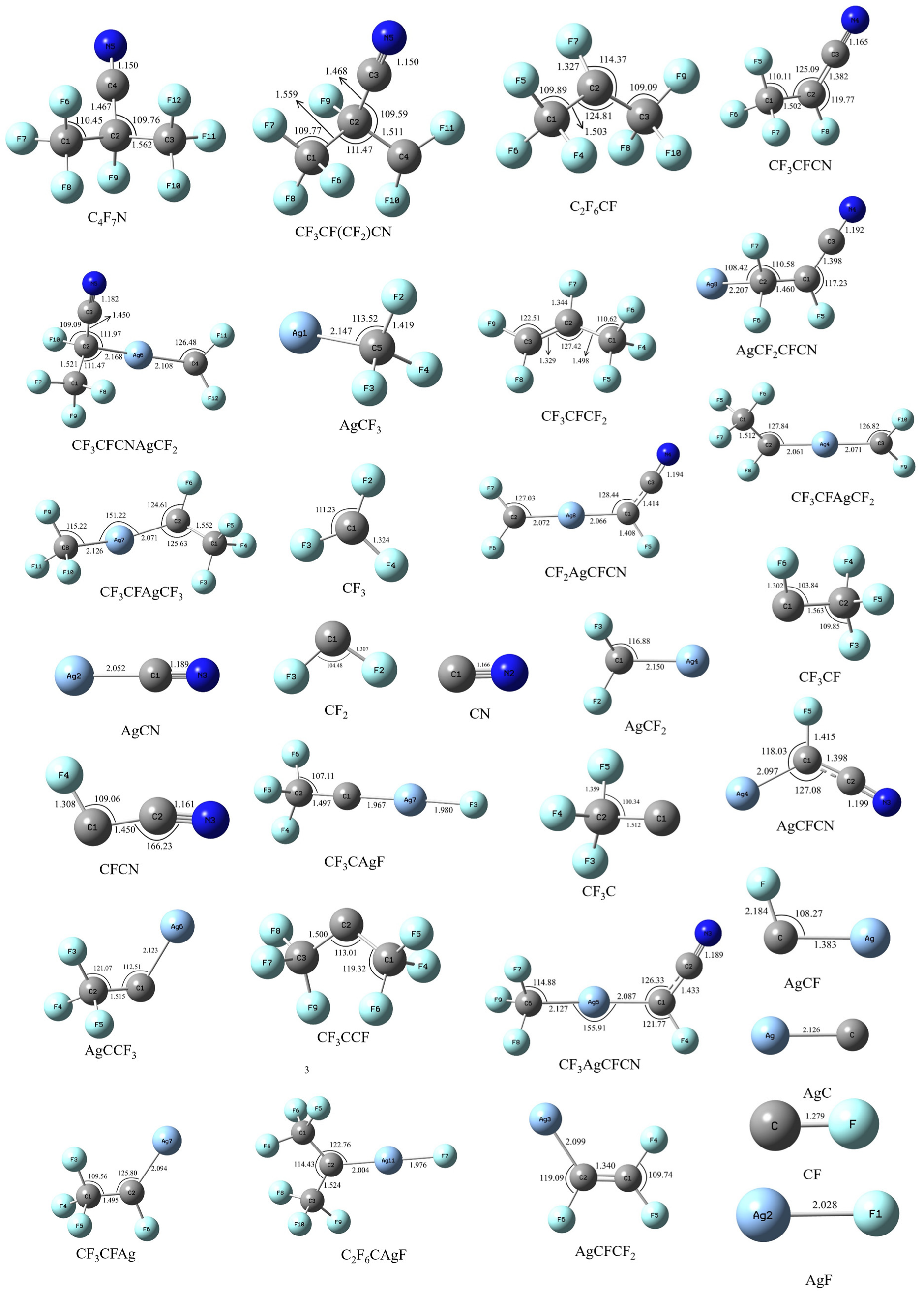
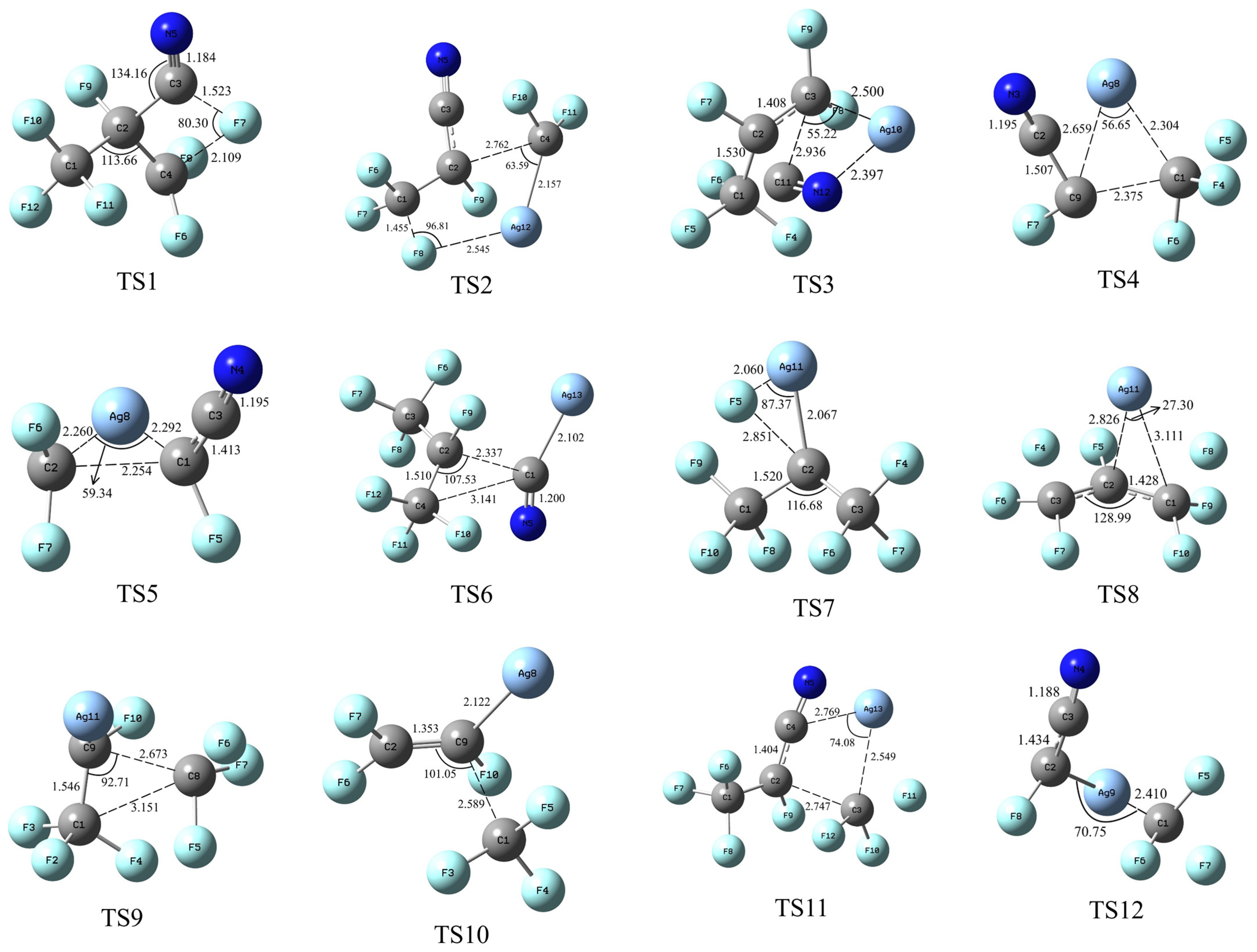
All the structures involved in Figure 1 were optimized under the B3LYP/LanL2DZ level. Their structure was shown in Figure 2. The B3LYP method was widely used in Gaussian calculation as a low cost and high accuracy method. The molecular structure of C4F7N optimized under the B3LYP/LanL2DZ level can match the structure that has been reported [14] and the structure of CCCBDB. These results show that the B3LYP/LanL2DZ level is a reasonable level in this situation. The structure of the reactants and products has been tested as the stable points on the potential energy surface, with full real frequencies. Transition states are verified by their single imaginary frequencies. Their frequencies were listed in Table 2.

3.2. Decomposition Mechanisms of C4F7N

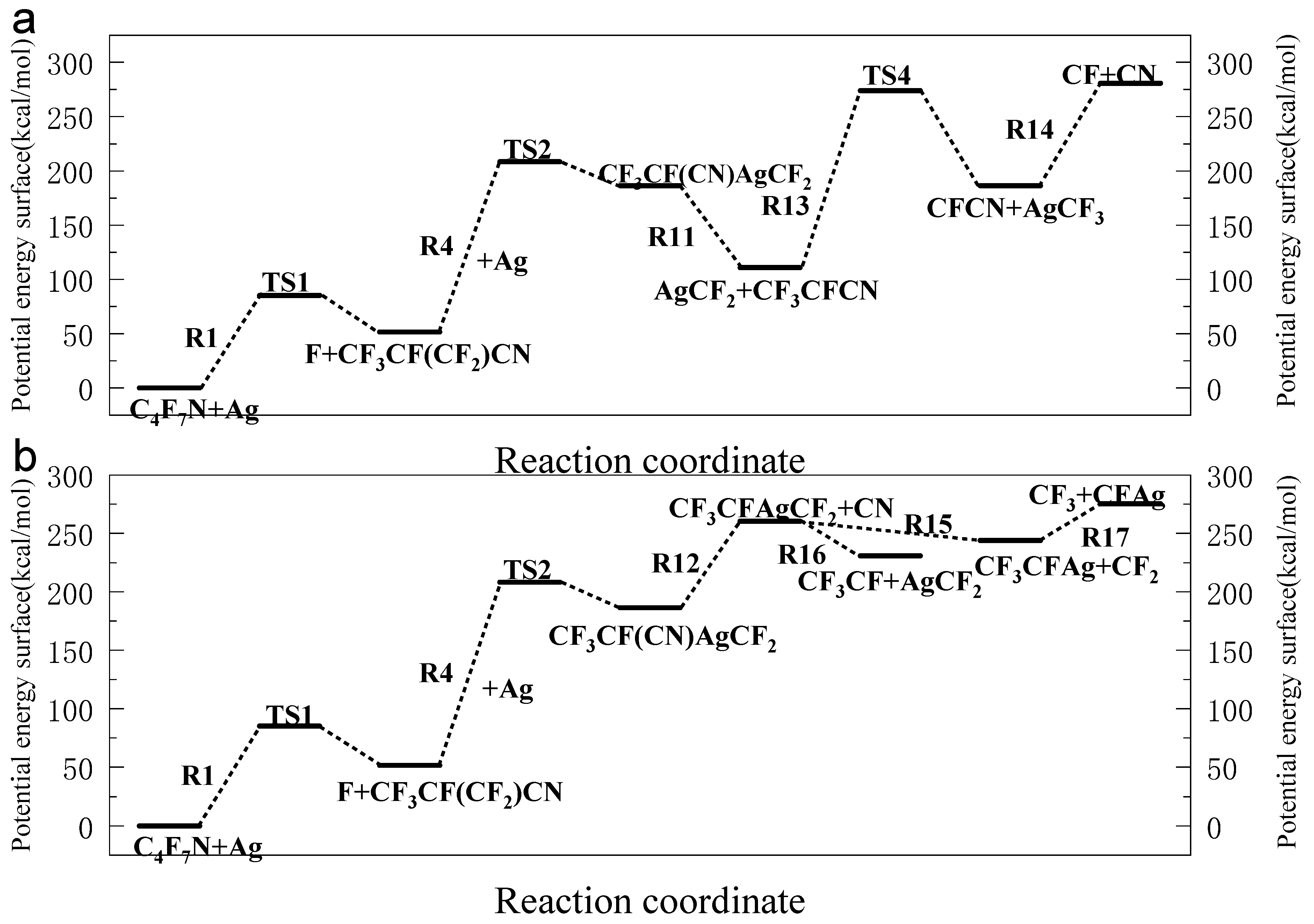
As shown in Figure 1, the C4F7N has three main decomposition pathways under Ag vapor, which is reaction 1, 2, 3. As for reaction 1 (Figure 3), the Ag atom attacks the same C as reaction 2. Different from reaction 2, the F atom on C3 shifts to the Ag atom. Then, the Ag–C bound broke, and became F and CF3CF(CF2)CN. Different reaction pathways lead to different energy barriers. Reaction 1 has a barrier of 85.30 kcal/mol. In reaction 4, the Ag atom attacks the same carbon atom as in reaction 6. Different from reaction 6, the C–C bond between C2 and C3 breaks, and the Ag atom bridges the two carbon atoms to generate CF3CF(CN)AgCF2, with an energy barrier of 156.87 kcal/mol. In reaction 11, the CF3 group on one side absorbs energy, leading to the breaking of a C–C bond. An F atom from the methyl group shifts to the C atom on the other side, forming CF3CFCN and CF2. In reaction 12, a CN group detaches, generating CF3CFAgCF2, with an energy barrier of 74.13 kcal/mol. As shown in Figure 3, CF3CFCN, which is a decomposition product from reaction 11, undergoes further decomposition. In reaction 13, the Ag–C bond in CF3CFCN breaks, converting it into CFCN and AgCF3, with an energy barrier of −26.38 kcal/mol. In reaction 14, the product CFCN continues to decompose via C–C bond breaking, generating CN and CF, with an energy barrier of 94.47 kcal/mol. CF3CFAgCF2 primarily has two decomposition pathways, which are reaction 16 and reaction 15, as shown in Figure 3. In reaction 16, the Ag–C bond absorbs energy and then breaks, generating CF3CF and AgCF2, with an energy barrier of −29.70 kcal/mol. In reaction 15, the other Ag–C bond absorbs energy and then breaks, generating CF3CFAg and CF, with an energy barrier of −16.55 kcal/mol. As shown in Figure 3, CF3CFAg can continue to decompose. In this reaction, the group absorbs energy, and the C–C bond breaks, generating CF3 and CFAg, with an energy barrier of 31.51 kcal/mol. Reaction 17 is the decomposition of CF3CFAg. It passes over the 31.51 kcal/mol barrier and becomes CF3 and AgCF.
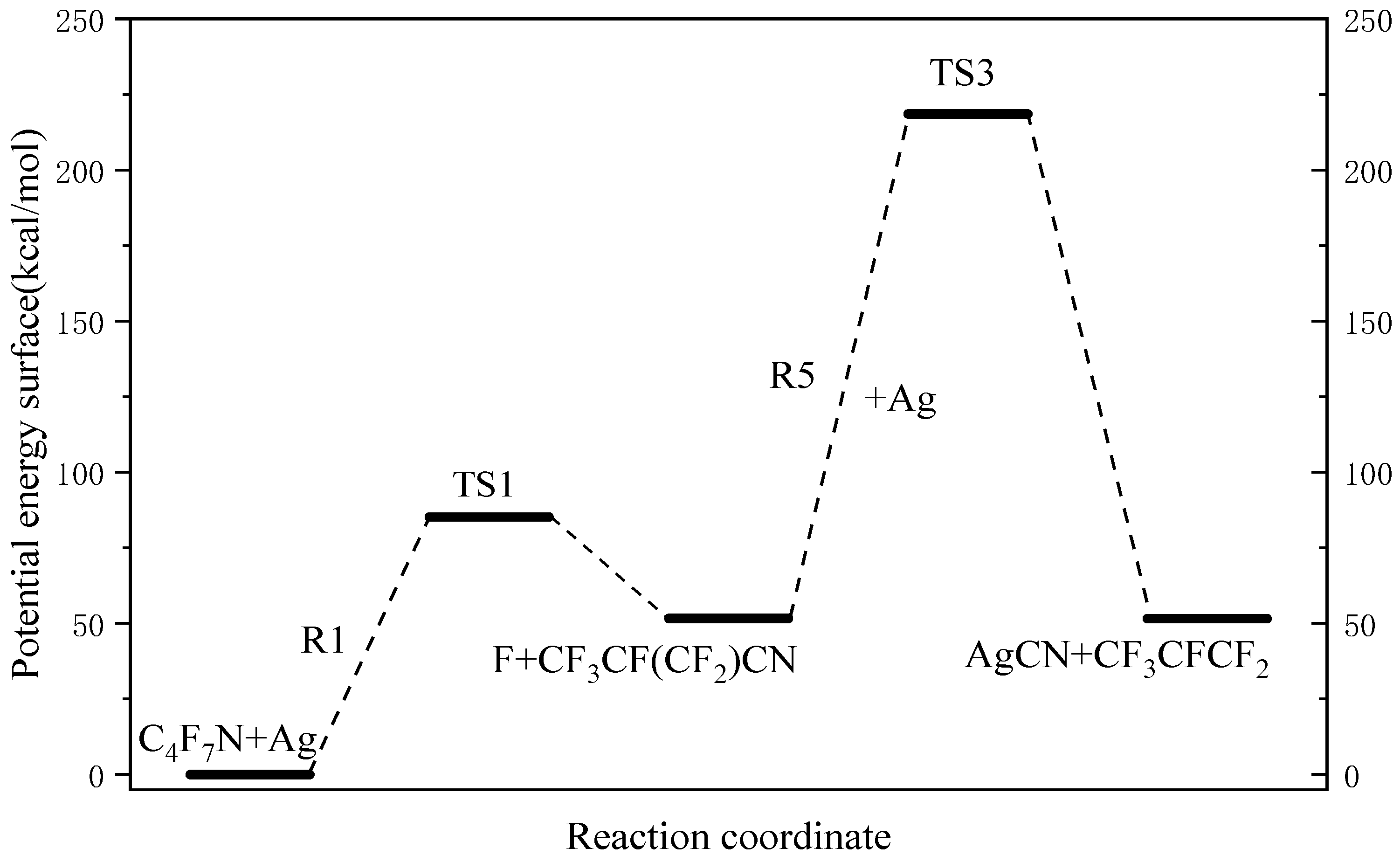
The pathway of reaction 1 has already been described in Figure 4. In reaction 5, the Ag atom attacks the CN group, a C–C bond transforms into a C = C bond, forming CF3CFCF2 and AgCN, with the energy barrier as 167.14 kcal/mol.
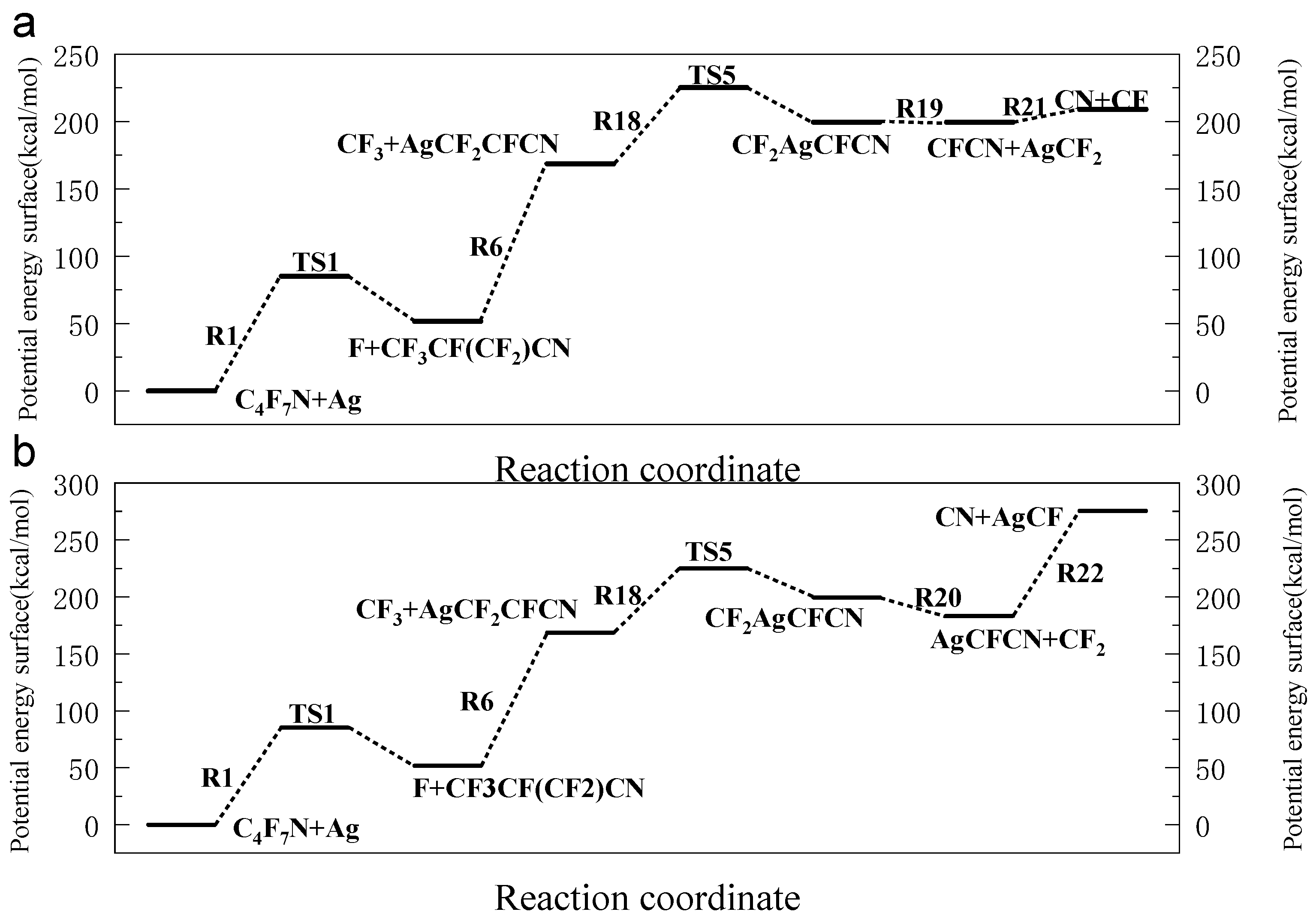
In reaction 6, the Ag atom attacks C atom, forming an Ag–C bond. The CF3 group on one side will absorb energy and the C–C bond will be broken, generating CF3 and AgCF2CFCN. The decomposition pathways of AgCF2CFCN are shown in Figure 5. In reaction 18, AgCF2CFCN isomerizes into one of its isomers, with an energy barrier of 56.57 kcal/mol. The AgCF2CFCN obtained from reaction 18 continues to decompose. In reaction 19, the Ag–C bond in AgCF2CFCN breaks by absorbing energy, generating CFCN and CF2Ag, with the energy barrier as −0.008 kcal/mol. In reaction 20, another Ag–C bond absorbs energy and then breaks, generating AgCFCN and CF2, with an energy barrier of −16.39 kcal/mol. The decomposition products of AgCF2CFCN, namely CFCN and AgCF2, can further decompose. In reaction 21, the C–C bond in CFCN breaks, generating CN and CF. In reaction 22, the C–Ag bond in AgCFCN breaks, generating CN and AgCF, with energy barriers of 94.47 kcal/mol and 92.32 kcal/mol, respectively.
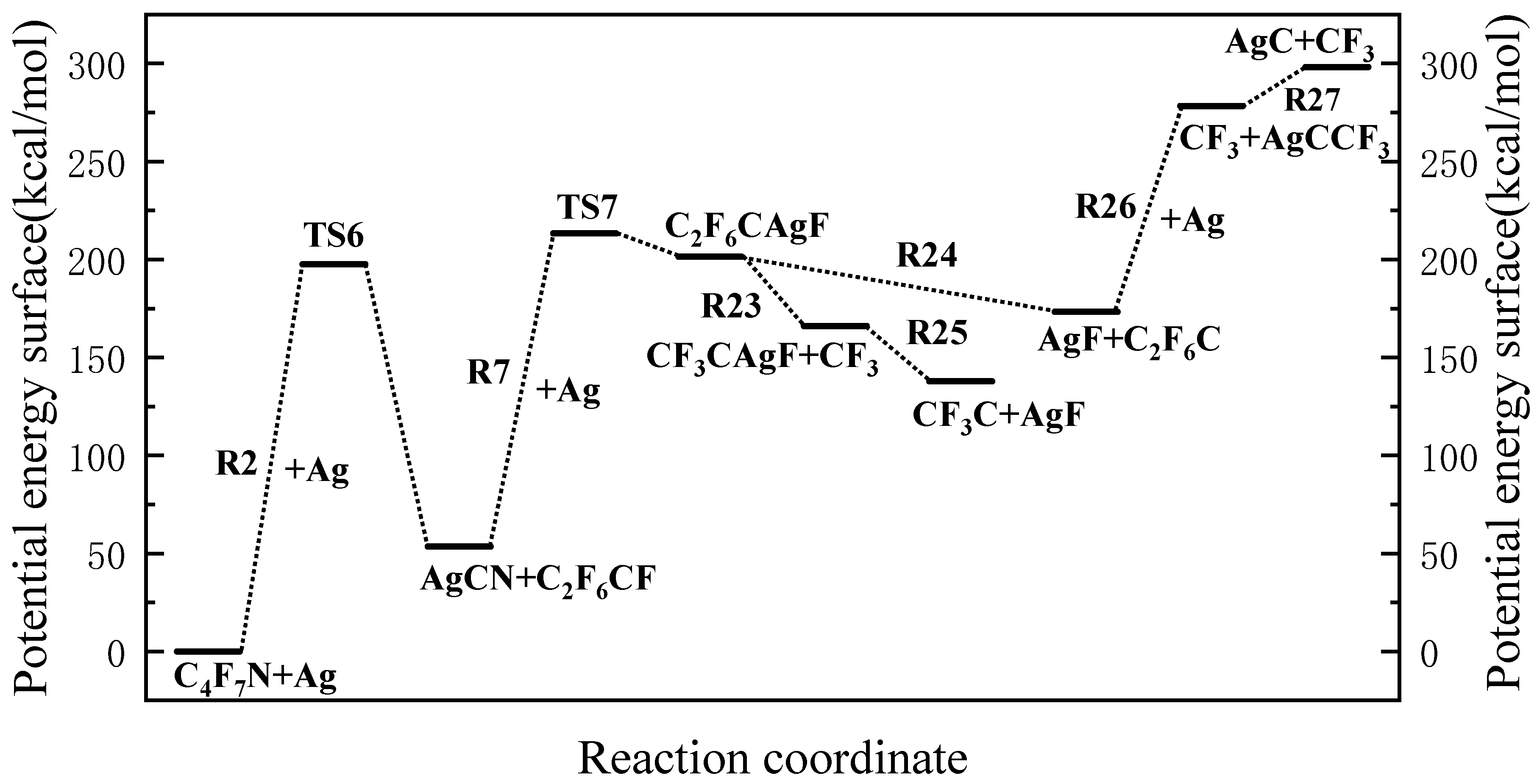
As in reaction 2, the Ag atom attacks the CN group. Passing the transform state 6 (TS6), it reaches the product C2F6CF and AgCN, with an energy barrier of 197.75 kcal/mol. The decomposition pathway of C2F6CF is presented in Figure 6. As illustrated by reaction 7, the Ag atom attacks the C2 atom, leading to the shifting of the F5 atom from C2 to Ag. This process proceeds through TS3, which is characterized by a single imaginary frequency of −119.38 cm−1. The electron cloud distribution around the C2 atom changes significantly, leading to a decrease in the C1–C2–C3 bond angle from 124.81° to 114.43°. The attack by Ag and the departure of the F atom reduce the electron density in the C1–C2 bond, resulting in bond elongation from 1.503 Å to 1.524 Å. This process proceeds through transition state 3 (TS3), which is characterized by a single imaginary frequency of −119.38 cm−1. The energy barrier for reaction 7 is 159.98 kcal/mol.
C2F6CAgF, formed from C2F6CF and Ag, undergoes further decomposition via reactions 23 and 24. Reaction 23 is a process without a transition state. One of the CF3 groups absorbs energy, causing the C–C bond to weaken, elongate, and eventually break, yielding CF3CAgF. This reaction requires overcoming an energy barrier of 18.59 kcal/mol. In reaction 25, CF3CAgF is unstable. The Ag–C1 bond breaks to form AgF and a CF3C radical. After the departure of the bulky AgF group, the valence electron configuration of the C2 atom changes and interatomic repulsion around it decreases. This leads to a decrease in the F6–C2–C1 bond angle from 107.11° to 100.34°. Reaction 25 releases 28.20 kcal/mol of energy.
Unlike reaction 23, reaction 24 involves the cleavage of the Ag–C2 bond, producing C2F6C and AgF. The detachment of the AgF radical causes the central C2 atom to change from a sp3 hybridized, tetra-coordinated environment to a tri-coordinated radical state with a lone electron pair. The lone pair occupies more space and exerts greater repulsion than bonding electron pairs, resulting in a decrease of the C3–C2–C1 bond angle from 114.43° to 113.01°. This process releases 87.51 kcal/mol of energy.
In reaction 26, an Ag atom attacks C2, leading to the cleavage of the C1–C2 bond. The CF3 group detaches, while Ag forms a new bond with C2. In the newly formed AgCCF3 radical, the bonding situation of the C2 atom, which is directly bonded to C3, is fundamentally altered, leading to an adjustment in its valence electron configuration. The transmission of this electronic effect causes a relaxation in the bonding geometry around the C3 atom, increasing the F7–C3–C2 bond angle from 119.36° to 121.07°. This process requires overcoming an energy barrier of 105.19 kcal/mol, yielding AgCCF3 and a CF3 radical. In the barrierless reaction 27, a CF3 group absorbs energy, followed by cleavage of the C1–C2 bond. The products are AgC and CF3. This reaction has an energy requirement of 19.88 kcal/mol.
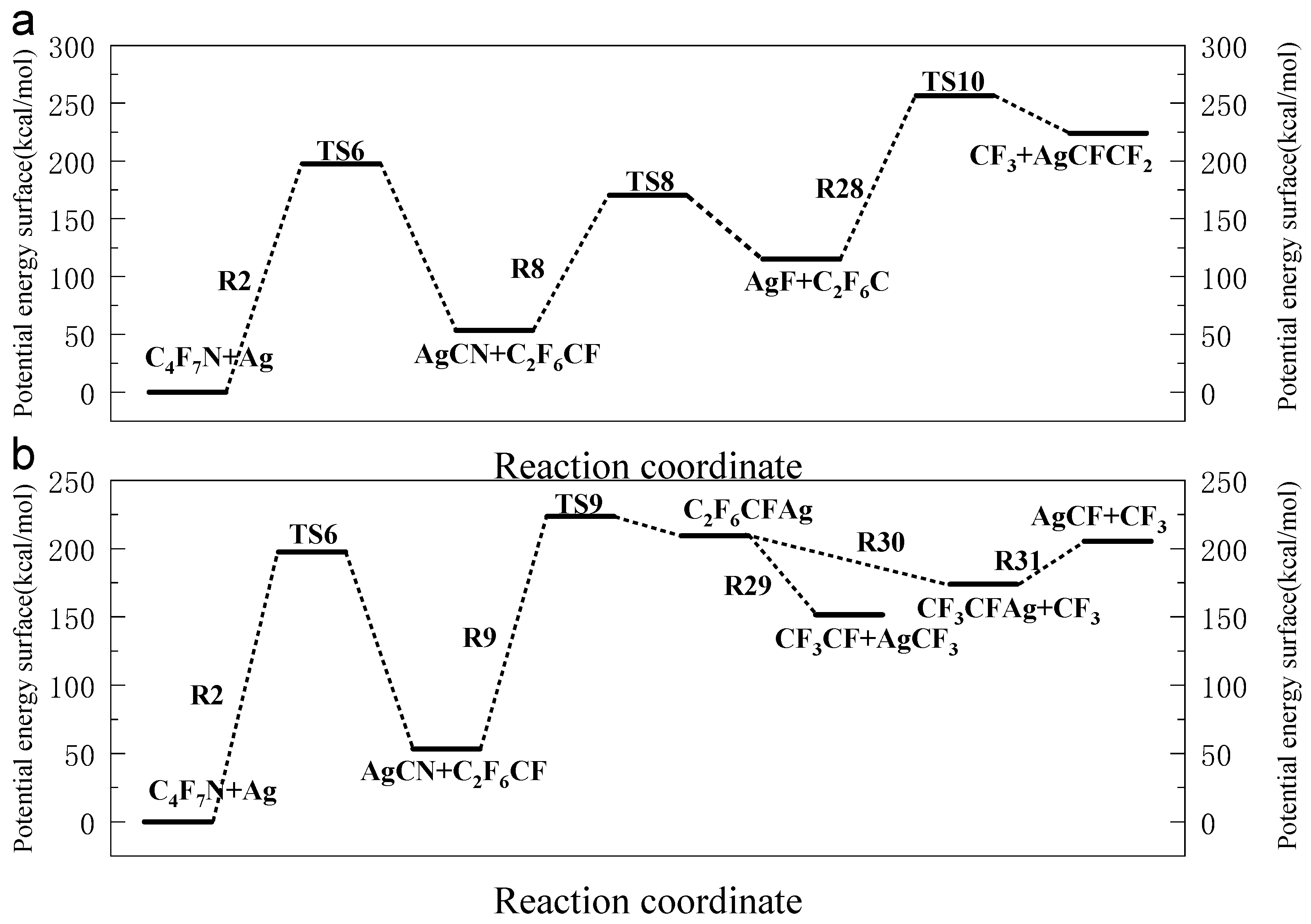
Reaction 2 has already been described in Figure 7. In reaction 8, the Ag atom attacks an F atom on one of the CF3 groups. The departing F atom combines with the Ag atom to form AgF. After the loss of the F atom, the C1–C2–C3 bond angle in the resulting C3F6 increases from 124.81° to 127.42°. The C2–C3 bond transforms from a carbon–carbon single bond to a carbon–carbon double bond. This process proceeds through transition state 8 (TS8), which is characterized by a single imaginary frequency of −118.86 cm−1. The energy barrier for reaction 8 is 116.93 kcal/mol. As for reaction 9, the Ag atom attacks the same carbon atom as in reaction 7. Unlike reaction 7, the CF3 group on C2 transfers to the Ag atom. This process proceeds through transition state 9 (TS9), which is characterized by a single imaginary frequency of −188.37 cm−1. The energy barrier for reaction 9 is 170.22 kcal/mol. Thus, among the decomposition pathways of C2F6CF, reaction 8 proceeds most readily, followed by reaction 7, while reaction 9 is the least accessible.
The reaction between CF3CFCF2 and Ag, denoted as reaction 28, proceeds through a specific mechanism involving the attack of a silver atom. The Ag atom targets the carbon atom (C1) in the terminal CF3 group of the CF3CFCF2 molecule. As the Ag atom approaches and attacks C1, a new Ag–C1 bond begins to form. This bond formation weakens the existing C1–C2 bond, leading to its cleavage and the detachment of a CF3 radical. Subsequently, the Ag atom forms a bond with the C2 atom, resulting in a new Ag–C2 bond. The formation of the Ag–C2 bond alters the electronic environment around the C2 atom. The electronegativity of C2 decreases, and the bond order of the C2–F7 bond is reduced. This change is reflected in the elongation of the C2–F7 bond length from 1.244 Å to 1.413 Å. This entire process proceeds through a transition state10 (TS10), which is characterized by a single imaginary frequency of −85.53 cm−1. The process ultimately yields AgCFCF2 and a CF3 radical. The energy barrier for reaction 28 is calculated to be 141.92 kcal/mol.
CF3CFAgCF3, a key decomposition product formed from the reaction between C2F6CF and Ag, undergoes further decomposition via reactions 29 and 30. Reaction 29 is a barrierless process. It involves the cleavage of the Ag–C2 bond, yielding CF3CF and AgCF3. The departure of the groups reduces the steric hindrance around the C3 atom and induces electron cloud reorganization. This leads to a decrease in the F9–C3–Ag bond angle from 115.22° to 113.52°. The process releases 57.79 kcal/mol of energy.
In contrast, reaction 30 proceeds via a different pathway. The CF3 group attached to Ag absorbs energy, leading to the breakage of the Ag–C3 bond. The Ag atom departs with a single electron, forming an Ag radical, and simultaneously generating a CF3CF radical. Subsequently, the Ag radical combines with the CF3CF radical to form a new Ag–C bond, producing CF3CFAg as the final product. This reaction releases 35.45 kcal/mol of energy.
In reaction 31, the CF3 group within the CF3CFAg species absorbs energy, resulting in the cleavage of a C–C bond. The products are AgCF and a CF3 radical. The F–C–Ag bond angle in the AgCF product decreases from 123.17° to 108.27° as the molecule relaxes into a more stable, lower energy state. The energy barrier for reaction 31 is 31.51 kcal/mol.
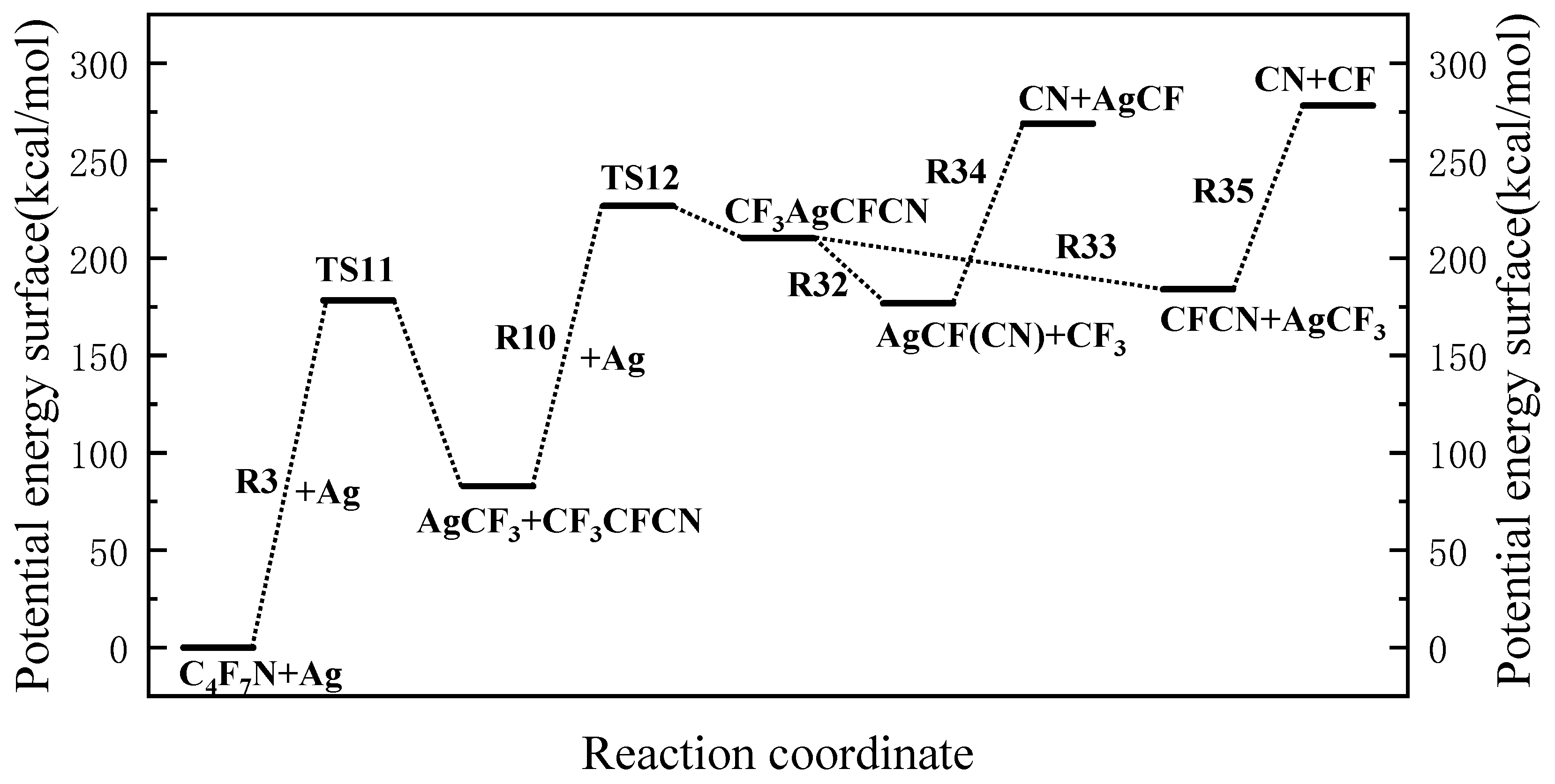
As shown in Figure 8, reaction 3 is a reaction with transform state (TS11). The CF3 group on one side will absorb energy and the C–C bond will be broken. The CH3 group will catch an Ag atom and become AgCF3, and the rest becomes CF3CFCN. The anergy barrier of reaction 3 is 178.44 kcal/mol. As an important decomposition product of C4F7N, CF3CFCN can further react with silver vapor via reaction 10. In this reaction, an Ag atom attacks the C2 atom. Since the C2 atom is bonded to the strongly electron-withdrawing CF3 group on one side and the polar CN group on the other, it carries a partial positive charge. This makes it more susceptible to nucleophilic attack by the electron-rich Ag atom. As the Ag atom approaches C2 and forms a bond with it, the original C1–C2 bond breaks. The CF3 group ultimately becomes attached to the molecular framework via the Ag atom, forming the CF3AgCFCN. In the new structure, the bonding electron pair arrangement around the C1 atom changes, resulting in an increase of the F5–C1–C2 bond angle from 110.11° to 114.88°. This process proceeds through transition state 12 (TS12), which is characterized by a single imaginary frequency of −200.35 cm−1. The energy barrier for reaction 10 is 144.07 kcal/mol.
CF3AgCFCN undergoes further decomposition via reactions 32 and 33. In reaction 32, the Ag–C3 bond breaks, leading to the detachment of a CF3 radical and leaving behind AgCF(CN). In the reactant, the C1 atom is bonded to F4, Ag, and the CN group, with an F4–C1–Ag bond angle of 121.77°. The enhanced inductive effect of the strong electron-withdrawing CN group causes electron density redistribution around C1. To reduce electron pair repulsion and achieve a more stable energy state, the F4–C1–Ag bond angle decreases to 118.03°. The overall reaction releases 33.57 kcal/mol of energy. AgCF(CN) subsequently decomposes via reaction 34. The C1–C2 bond absorbs sufficient energy and breaks, producing AgCF and a CN radical. The energy barrier for reaction 34 is 92.32 kcal/mol.
In reaction 33, the Ag–C1 bond undergoes ionization and subsequent cleavage, yielding AgCF3 and CFCN. In the AgCF3 molecule, the relatively large atomic volume of Ag and its distinct electronic effects induce a fine-tuning of the electron cloud distribution around the C3 atom. Electronic perturbation and structural relaxation act synergistically, causing contraction of the F7–C3–Ag bond angle from 114.88° to 113.52°. This reaction releases 26.38 kcal/mol of energy. In reaction 35, when the CFCN molecule acquires sufficient energy, the internal C–C bond begins to vibrate and gradually elongates. This leads to homolytic cleavage of the shared bonding electron pair. The two bonding electrons separate, with each carbon atom retaining one electron. Ultimately, the C–C bond breaks completely, generating CN and CF radicals. This process has an energy barrier of 94.47 kcal/mol.
The biggest energy barrier in this section is reaction 2 (197.74 kcal/mol). Compared to the similar reaction in other work, the energy barrier is over 4000 kcal/mol. So, the Ag atom is clearly dropping the energy barrier of the decomposition of C4F7N.

3.3. Main Degradation Pathways of C4F7N

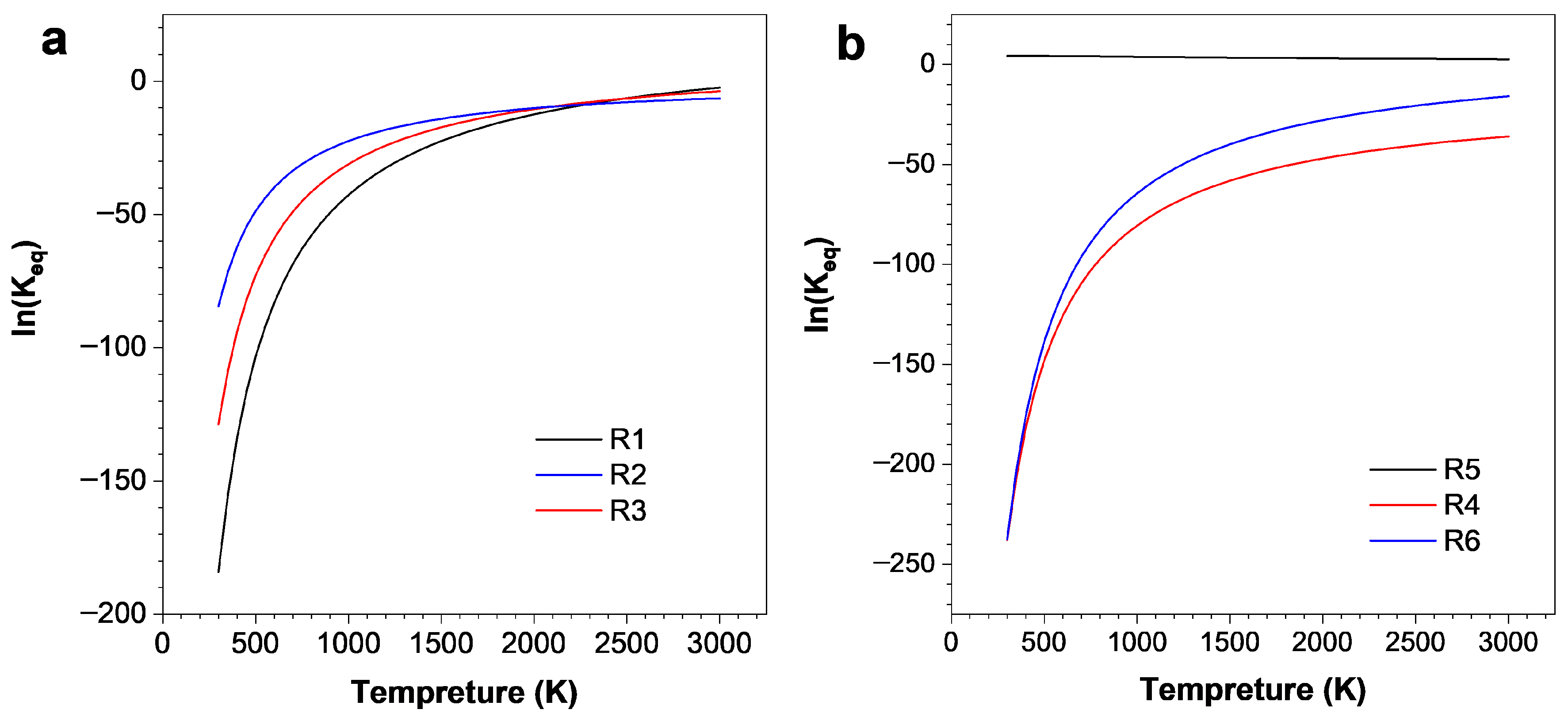
As shown in Figure 9a, the reaction equilibrium constant (Keq) increases with the growth of temperature. At 300 K, the ln(Keq) of R1, R2, R3 equal to −184, −84 and −128. These data show that almost all of the decomposition cannot occur at a temperature under 300 K. However, when the temperature rises to 3000 K, the ln(Keq) of R1, R2, and R3 rises to −2.4, −6.4, and −3.7, respectively. Since the R1 has the highest Keq, the R1 will be the first main decomposition pathway. As shown in Figure 9b, the situation will be different when the R4, R5, and R6 come after R1. The ln(Keq) of R4 and R6 rise while the temperature rises, but is always below 0. The ln(Keq) of R5 shows another situation. It is always above 0, but drops slightly while the temperature rises. So, the most likely decomposition of C4F7N under Ag vapor is R1 → R5.
At 3000 K, the influence of chemical reaction kinetics on the reaction may dominate. We investigated the main reactions under kinetically dominant reaction conditions by comparing the activation energies of the reactions. The activation energy barriers for R1, R2, and R3 are 85.21 kcal/mol, 197.55 kcal/mol, and 178.26 kcal/mol, respectively. R1 remains the main decomposition route for C4F7N. The activation energy barriers for R4, R5, and R6 are 156.64 kcal/mol, 166.91 kcal/mol, and 117.01 kcal/mol, respectively. Therefore, R6 and the subsequent R18, R19, and R21 become the main reaction pathways dominated by kinetics.

4. Conclusions

Using density functional theory calculation at the B3LYP/LanL2DZ level, 35 possible decomposition pathways and 12 transition states were identified and analyzed. The structures of all reactants, products, intermediates, and transition states were validated through frequency analysis and intrinsic reaction coordinate (IRC) calculations. The potential energy surfaces (PES) were examined in detail to determine energy barriers and reaction mechanisms.
(1)
Key findings indicate that C4F7N undergoes three primary initial decomposition routes in the presence of Ag vapor, leading to the formation of various intermediate species such as C4F6N, C2F6CF, and C3F4N. Subsequent reactions involve bond cleavage, fluorine transfer, and the formation of Ag-containing compounds such as AgF, AgCN, and AgCF3.
(2)
The reaction equilibrium constants (Keq) were calculated, revealing temperature-dependent behavior, with ln(Keq) values between 300 K to 3000 K. The most possible decomposition pathway of C4F7N under Ag vapor is R1 → R5.
This paper presents a detailed investigation of the decomposition pathways of C4F7N in an Ag vapor environment, thereby laying the groundwork for subsequent research on the compatibility between insulating gases and electrical contacts.

Author Contributions

Writing—original draft preparation, T.L.; formal analysis, Y.D.; writing—review and editing, C.Z.; supervision, X.K. All authors have read and agreed to the published version of the manuscript.

Funding

This research was funded by the State Grid Corporation of China Science and Technology Foundation (Grant No. 5500-202358700A-3-3-JC).

Institutional Review Board Statement

Not applicable.

Informed Consent Statement

Not applicable.

Data Availability Statement

The original contributions presented in the study are included in the article, further inquiries can be directed to the corresponding author.

Acknowledgments

This research was support by China University of Mining and Technology Beijing and China Electric Power Research Institute.

Conflicts of Interest

Authors Tan Liu, Yi Ding and Congrui Zhang were employed by the company State Grid Smart Grid Research Institute Co., Ltd. The remaining author declare that the research was conducted in the absence of any commercial or financial relationships that could be construed as a potential conflict of interest.

References

  1. Wang, H.; Zhang, Y.; Lin, W.; Wei, W. Transregional electricity transmission and carbon emissions: Evidence from ultra-high voltage transmission projects in China. Energy Econ. 2023, 123, 106751. [Google Scholar] [CrossRef]
  2. Chen, Z.; Deng, Y.; Kong, J.; Fu, W.; Liu, C.; Jin, T.; Jiao, L. Toward the High-Voltage Stability of Layered Oxide Cathodes for Sodium-Ion Batteries: Challenges, Progress, and Perspectives. Adv. Mater. 2024, 36, 2402008. [Google Scholar] [CrossRef] [PubMed]
  3. Guo, T.; Zhou, D.; Pang, L.; Sun, S.; Zhou, T.; Su, J. Perspectives on Working Voltage of Aqueous Supercapacitors. Small 2022, 18, 2106360. [Google Scholar] [CrossRef] [PubMed]
  4. Huang, J.; Yuan, K.; Chen, Y. Wide Voltage Aqueous Asymmetric Supercapacitors: Advances, Strategies, and Challenges. Adv. Funct. Mater. 2022, 32, 2108107. [Google Scholar] [CrossRef]
  5. Lim, J.M.; Jang, Y.S.; Nguyen, H.V.T.; Kim, J.S.; Yoon, Y.; Park, B.J.; Seo, D.H.; Lee, K.-K.; Han, Z.; Ostrikov, K.; et al. Advances in high-voltage supercapacitors for energy storage systems: Materials and electrolyte tailoring to implementation. Nanoscale Adv. 2023, 5, 615–626. [Google Scholar] [CrossRef]
  6. Peng, X.; Liu, Z.; Jiang, D. A review of multiphase energy conversion in wind power generation. Renew. Sustain. Energy Rev. 2021, 147, 111172. [Google Scholar] [CrossRef]
  7. Sun, H.; Guo, Q.; Qi, J.; Ajjarapu, V.; Bravo, R.; Chow, J.; Li, Z.; Moghe, R.; Nasr-Azadani, E.; Tamrakar, U.; et al. Review of Challenges and Research Opportunities for Voltage Control in Smart Grids. IEEE Trans. Power Syst. 2019, 34, 2790–2801. [Google Scholar] [CrossRef]
  8. Jiaqing, Z.; Yubiao, H.; Xinjie, Q.; Taiyun, Z. A Review on Fire Research of Electric Power Grids of China: State-Of-The-Art and New Insights. Fire Technol. 2024, 60, 1027–1076. [Google Scholar] [CrossRef]
  9. Lu, J.; Chen, B.-H.; Liang, P.; Sun, Y.; Fang, Z.; Huang, S. Experimental Evaluation of Protecting High-Voltage Electrical Transformers Using Water Mist with and without Additives. Fire Technol. 2019, 55, 1671–1690. [Google Scholar] [CrossRef]
  10. Ray, E.A.; Moore, F.L.; Elkins, J.W.; Rosenlof, K.H.; Laube, J.C.; Röckmann, T.; Marsh, D.R.; Andrews, A.E. Quantification of the SF6 lifetime based on mesospheric loss measured in the stratospheric polar vortex. J. Geophys. Res. Atmos. 2017, 122, 4626–4638. [Google Scholar] [CrossRef]
  11. Zhang, B.; Chen, L.; Li, X.; Guo, Z.; Pu, Y.; Tang, N. Evaluating the dielectric strength of promising SF6 alternatives by DFT calculations and DC breakdown tests. IEEE Trans. Dielectr. Electr. Insul. 2020, 27, 1187–1194. [Google Scholar] [CrossRef]
  12. Zhang, H.; Shang, Y.; Chen, Q.; Han, B. Theoretical studies on dielectric breakdown strength increasing mechanism of SF6 and its potential alternative gases. Chem. Res. Chin. Univ. 2015, 31, 123–129. [Google Scholar] [CrossRef]
  13. Koch, M.; Franck, C.M. High voltage insulation properties of HFO1234ze. IEEE Trans. Dielectr. Electr. Insul. 2015, 22, 3260–3268. [Google Scholar] [CrossRef]
  14. Li, Y.; Zhang, X.; Xiao, S.; Chen, Q.; Tang, J.; Chen, D.; Wang, D. Decomposition Properties of C4F7N/N2 Gas Mixture: An Environmentally Friendly Gas to Replace SF6. Ind. Eng. Chem. Res. 2018, 57, 5173–5182. [Google Scholar] [CrossRef]
  15. Wu, H.; Xia, Y.; Zhang, C.; Xie, S.; Wu, S.; Cui, H. Adsorptions of C5F10O decomposed compounds on the Cu-decorated NiS2 monolayer: A first-principles theory. Mol. Phys. 2023, 121, e2163715. [Google Scholar] [CrossRef]
  16. Rabie, M.; Franck, C.M. Computational screening of new high voltage insulation gases with low global warming potential. IEEE Trans. Dielectr. Electr. Insul. 2015, 22, 296–302. [Google Scholar] [CrossRef]
  17. Fu, Y.; Wang, X.; Yang, A.; Rong, M.; Zhu, F. The decomposition mechanism of C4F7N-Cu gas mixtures. AIP Adv. 2019, 9, 115216. [Google Scholar] [CrossRef]
  18. Zhong, L.; Wang, J.; Xu, J.; Wang, X.; Rong, M. Effects of Buffer Gases on Plasma Properties and Arc Decaying Characteristics of C4F7N–N2 and C4F7N–CO2 Arc Plasmas. Plasma Chem. Plasma Process. 2019, 39, 1379–1396. [Google Scholar] [CrossRef]
  19. Fu, Y.; Chen, C.; Wang, C.; Yang, L.; Zhang, Z.; Wang, T.; Luo, B. The variation of C4F7N, C5F10O, and their decomposition components in breakdown under different pressures. AIP Adv. 2021, 11, 065010. [Google Scholar] [CrossRef]
  20. Li, Y.; Zhang, X.; Chen, Q.; Zhang, J.; Chen, D.; Cui, Z.; Xiao, S.; Tang, J. Study on the thermal interaction mechanism between C4F7N-N2 and copper, aluminum. Corros. Sci. 2019, 153, 32–46. [Google Scholar] [CrossRef]
  21. Zeng, F.; Feng, X.; Lei, Z.; Xia, Y.; Wu, S.; Zhang, S.; Yao, Q.; Tang, J. Thermal Decomposition Mechanism of Environmental-Friendly Insulating Gas C5F10O on Cu (1 1 1) Surface. Plasma Chem. Plasma Process. 2021, 41, 1455–1469. [Google Scholar] [CrossRef]
  22. Engelbrecht, J.T.; Pietrzak, P.; Franck, C.M. Cu/W Electrode Ablation and Its Influence on Free-Burning Arcs in SF6 Alternatives. IEEE Trans. Plasma Sci. 2022, 50, 3715–3724. [Google Scholar] [CrossRef]
  23. Li, Y.; Zhang, X.; Xiao, S.; Zhang, J.; Chen, D.; Cui, Z. Insight into the compatibility between C4F7N and silver: Experiment and theory. J. Phys. Chem. Solids 2019, 126, 105–111. [Google Scholar] [CrossRef]
  24. Chen, L.; Zhang, B.; Li, X.; Yang, T. Decomposition pathway of C4F7N gas considering the participation of ions. J. Appl. Phys. 2020, 128, 143303. [Google Scholar] [CrossRef]
  25. Pietrzak, P.; Perret, M.; Boening, M.; Glomb, S.; Kurte, R.; Franck, C.M. Wear of the Arcing Contacts and Gas Under Free Burning Arc in SF6 Alternatives. IEEE Trans. Power Deliv. 2023, 38, 2133–2140. [Google Scholar] [CrossRef]
  26. Liu, S.; Li, X.; Wang, W.; Geng, Z.; Lin, Y. The Decomposition Pathways of C4F7N/CO2 Mixtures in the Presence of Organic Insulator Vapors. IEEE Access 2025, 13, 9335–9342. [Google Scholar] [CrossRef]
  27. Xiao, S.; Li, Y.; Zhang, X.; Tian, S.; Deng, Z.; Tang, J. Effects of micro-water on decomposition of the environment-friendly insulating medium C5F10O. AIP Adv. 2017, 7, 065017. [Google Scholar] [CrossRef]
  28. Fu, Y.; Yang, L.; Li, X.; He, M. Theoretical study of the decomposition mechanism of C5F10O in the presence of Cu vapor. AIP Adv. 2020, 10, 115010. [Google Scholar] [CrossRef]
  29. Tao, Y.; Dai-Jun, L.; Jian-Jun, C. Molecular structure and properties of sulfur dioxide under the external electric field. Acta Phys. Sin. 2016, 65, 053101. [Google Scholar] [CrossRef]
  30. Zhong, L.; Deng, Y.; Liu, J.; Wang, F.; Chen, S.; Sun, Q.; Duan, X.; Huang, H. Theoretical study by density functional theory calculations of decomposition processes and primary products of C5F10O with moisture content. J. Phys. D Appl. Phys. 2020, 53, 485204. [Google Scholar] [CrossRef]
  31. She, C.; Zeng, F.; Dai, L.; Zhang, S.; Li, L.; Tang, J. Theoretical Analysis on the Self-Recovery Ability of C5F10O: An Environmental-Friendly Substitute for SF6. IEEE Trans. Plasma Sci. 2022, 50, 4620–4627. [Google Scholar]
  32. Lu, T.; Chen, Q. Shermo: A general code for calculating molecular thermochemistry properties. Comput. Theor. Chem. 2021, 1200, 113249. [Google Scholar] [CrossRef]
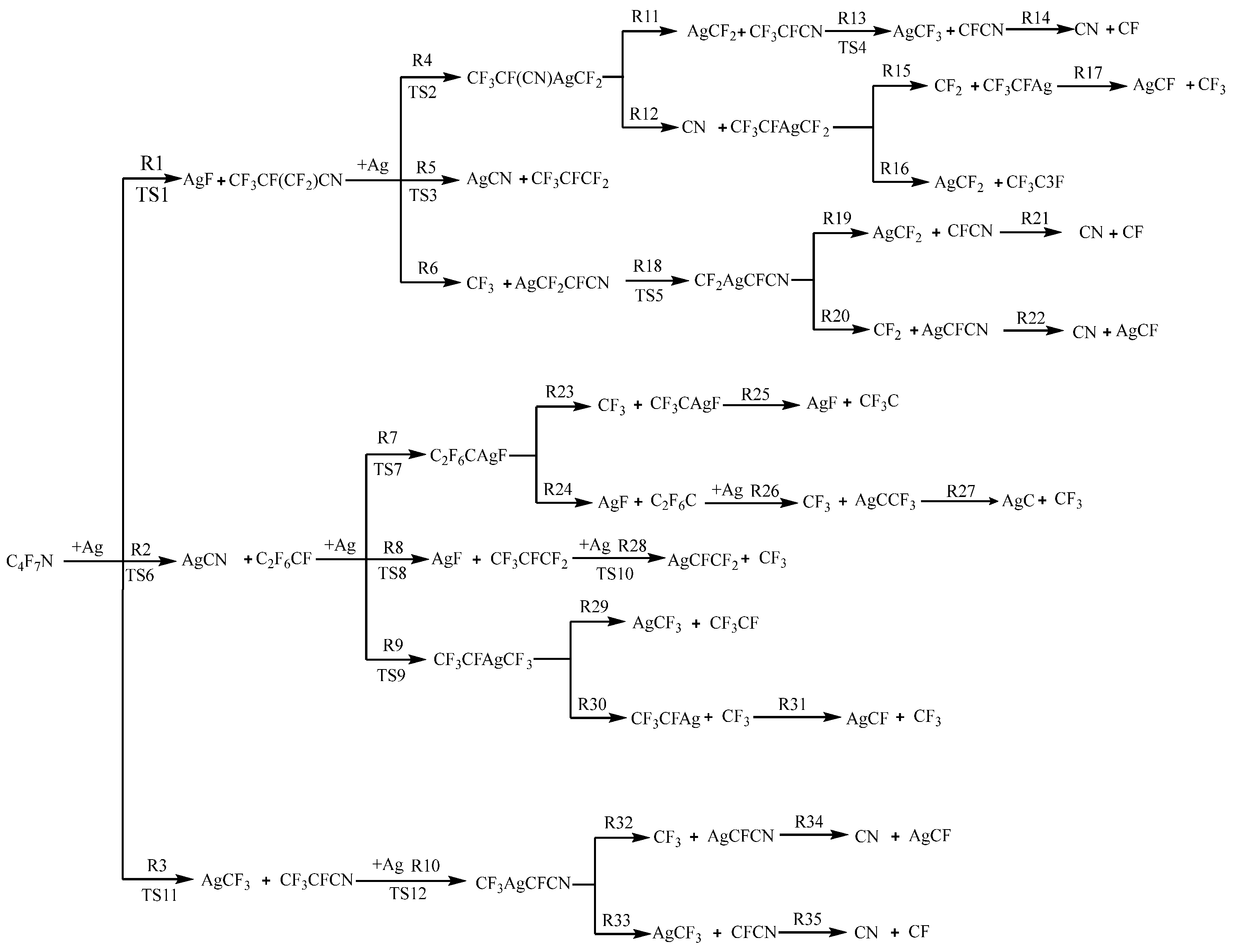
Figure 1. The composition pathway of C4F7N under Ag vapor.
Applsci 16 00356 g001
Figure 2. All the molecular and transition state structures involved in this paper. (Solid line in this figure was molecular bound, the dash bound was showing the distance between two atoms, the curve shows the angle between three atoms).
Applsci 16 00356 g002aApplsci 16 00356 g002b
Figure 3. Potential surface of reaction (a) 1, 4, 11, 13, 14 (b) 1, 4, 12, 16, 15, 17. (The solid line represents relative to the energy of C4F7N+Ag, dashed line represents the reaction pathway).
Applsci 16 00356 g003
Figure 4. Potential surface of reactions 1 and 5. (The solid line represents relative to the energy of C4F7N+Ag, dashed line represents the reaction pathway).
Applsci 16 00356 g004
Figure 5. Potential surface of reactions (a) 1, 6, 18, 19, 21 and (b) 1, 6, 18, 20, 22. (The solid line represents relative to the energy of C4F7N+Ag, dashed line represents the reaction pathway).
Applsci 16 00356 g005
Figure 6. Potential surface of reactions 2, 7, 23, 24, 25, 26 and 27. (The solid line represents relative to the energy of C4F7N+Ag, dashed line represents the reaction pathway).
Applsci 16 00356 g006
Figure 7. Potential surface of reactions (a) 2, 8, 28 (b) 2, 9, 29, 30, 31. (The solid line represents relative to the energy of C4F7N+Ag, dashed line represents the reaction pathway).
Applsci 16 00356 g007
Figure 8. Potential surface of reactions 3, 10, 32, 33, 34 and 35. (The solid line represents relative to the energy of C4F7N+Ag, dashed line represents the reaction pathway).
Applsci 16 00356 g008
Figure 9. The reaction equilibrium constant of (a) R1, R2, and R3, and (b) R4, R5, and R6.
Applsci 16 00356 g009
Table 1. C4F7N decomposition reaction under Ag vapor.
No.Reaction Formula
1C4F7N + Ag → TS1 → C4F6N + AgF
2C4F7N + Ag → TS6 → C2F6CF + CNAg
3C4F7N + Ag → TS11 → C3F4N + CF3Ag
4CF3CF(CF2)CN + Ag → TS2 → CF3CF(CN)AgCF2
5CF3CF(CF2)CN + Ag → TS3 → CF3CFCF2 + AgCN
6CF3CF(CF2)CN + Ag → AgCF2CFCN + CF3
7C2F6CF + Ag → TS7→ C2F6CAgF
8C2F6CF + Ag → TS8→ CF3CFCF2 + AgF
9C2F6CF + Ag → TS9→ CF3CFAgCF3
10CF3CFCN + Ag → TS12 → CF3AgCFCN
11CF3CF(CN)AgCF2 → CF3CFCN + AgCF2
12CF3CF(CN)AgCF2 → CF3CFAgCF2 + CN
13CF3CFCN → TS4 → AgCF3 + CFCN
14CFCN → CN + CF
15CF3CFAgCF2 → CF2 + CF3CFAg
16CF3CFAgCF2 → CF2Ag + CF3CF
17CF3CFAg → AgCF + CF3
18AgCF2CFCN → TS5 → CF2AgCFCN
19CF2AgCFCN → CF2Ag + CFCN
20CF2AgCFCN → CF2 + AgCFCN
21CFCN → CF + CN
22AgCFCN → AgCF + CN
23C2F6CAgF → CF3CAgF + CF3
24C2F6CAgF → C2F6C + AgF
25CF3CAgF → CF3C + AgF
26C2F6C + Ag → CF3 + AgCCF3
27AgCCF3 → AgC + CF3
28CF3CFCF2 + Ag → TS10 → AgCFCF2 + CF3
29CF3CFAgCF3 → CF3CF + AgCF3
30CF3CFAgCF3 → CF3CFAg + CF3
31CF3CFAg → CF3 + CFAg
32CF3AgCFCN → CF3 + AgCFCN
33CF3AgCFCN → AgCF3 + CFCN
34AgCFCN → AgCF + CN
35CFCN → CN + CF
Table 2. Vibration of all transition states (TS).
NumberVibrations (cm−1)
TS 1−548.95, 47.50, 60.76, 133.44, 156.36, 181.94, 228.76, 257.09, 274.48, 307.59, 346.69, 357.02, 390.07, 489.13, 533.11, 552.02, 585.62, 620.21, 675.90, 693.48, 758.47, 882.20, 1030.27, 1150.39, 1190.26, 1226.80, 1282.71, 1449.66, 1460.18, 2015.55
TS 2−149.54, 9.67, 48.69, 77.54, 96.29, 104.87, 128.51, 139.15, 177.14, 194.3, 214.9, 231.14, 322.66, 368.45, 398.65, 449.71, 495.48, 515.79, 576.74, 596.33, 616.18, 708.94, 913.77, 969.33, 1054.41, 1066.83, 1097.09, 1123.91, 1275.48, 2226.98
TS 3−470.19, 36.09, 65.24, 79.33, 100.95, 113.69, 126.81, 149.45, 206.78, 248.78, 250.14, 280.25, 300.87, 318.29, 339.46, 369.43, 443.47, 485.61, 538.49, 583.16, 643.75, 683.8, 913.17, 1055.14, 1081.64, 1086, 1153.07, 1270.25, 1476.16, 2011.15
TS 4−193.30, 31.71, 54.65, 102.60, 112.19, 155.26, 188.40, 199.06, 247.28, 274.78, 428.16, 438.70, 446.15, 572.39, 610.57, 779.05, 788.95, 950.89, 1016.76, 1056.82, 2086.17
TS 5−335.28, 47.58, 85.64, 103.81, 110.3, 140, 182.74, 225.22, 285.59, 379.06, 454.58, 542.93, 601.58, 945.92, 978.76, 1040.92, 1124.19, 2079.92
TS 6−254.52, 13.73, 35.27, 52.55, 66.09, 80.75, 94.27, 147.1, 153.73, 196.17, 236.73, 260.55, 276.62, 306.95, 323.09, 361.62, 411.29, 450.37, 478.99, 496.75, 564.67, 615.53, 624.53, 701.58, 903.79, 994.2, 1021.73, 1078.58, 1102.31, 1133.6, 1247.65, 1315.63, 2028.06
TS 7−119.38, 18.13, 51.72, 55.78, 91.79, 106.53, 156.69, 221.86, 237.41, 277.08, 308.88, 417.89, 455.03, 469.69, 474.79, 481.61, 601.36, 617.41, 656.25, 824.02, 867.63, 994.62, 1039.04, 1040.74, 1116.84, 1134.79, 1252.2
TS 8−118.86, 34.58, 46.37, 69.7, 90.7, 141.49, 167.99, 256.21, 295.74, 317.43, 322.26, 336.7, 385.16, 400.45, 426.37, 441.71, 546.14, 559.7, 639.02, 654.98, 789.26, 967.77, 1093.7, 1119.09, 1182.09, 1392.01, 1482.94
TS 9−188.37, 32.44, 58.1, 66.33, 95.73, 122.14, 151.59, 160.52, 211.81, 217.38, 239.35, 390.01, 399.31, 439.46, 446.49, 511.46, 527.05, 614.9, 633.71, 822.82, 898.17, 970.82, 1019.64, 1036.46, 1099.25, 1107.88, 1181.86
TS 10−85.53, 10.4, 44.76, 52.11, 73.32, 86.36, 99.77, 105.02, 217.35, 263.76, 289.87, 438.05, 441.69, 462.11, 483.6, 589.73, 592.5, 844.99, 911.91, 1044.88, 1056.75, 1107.96, 1183.78, 1634.44
TS 11−177.98. 18.43, 26.94, 44.33, 60.4, 69.82, 82.63, 111.08, 150.77, 165.04, 172.83, 195.05, 242.96, 357.2, 372.27, 400.86, 415.57, 420.85, 463.04, 523.12, 540.79, 571.28, 614.91, 694.43, 731.5, 914.94, 983.44, 999.66, 1047.02, 1111.46, 1248.34, 1314.41, 2144.78
TS 12−200.35, 25.3, 70.25, 105.38, 124.02, 151.93, 154.01, 210.53, 276.59, 322.8, 428.89, 440.4, 496.16, 611.35, 615.36, 905.43, 958.29, 995.49, 1018.62, 1099.84, 2181.24
Disclaimer/Publisher’s Note: The statements, opinions and data contained in all publications are solely those of the individual author(s) and contributor(s) and not of MDPI and/or the editor(s). MDPI and/or the editor(s) disclaim responsibility for any injury to people or property resulting from any ideas, methods, instructions or products referred to in the content.