Article

A Methodology for Beam Deformation Reconstruction Utilizing CEEMDAN-HT-GMM-Ko

1
School of Naval Architecture, Ocean and Energy Power Engineering, Wuhan University of Technology, Wuhan 430063, China
2
State Key Laboratory of Maritime Technology and Safety, Wuhan University of Technology, Wuhan 430063, China
3
School of Transportation and Logistics Engineering, Wuhan University of Technology, Wuhan 430063, China
*
Author to whom correspondence should be addressed.
Appl. Sci. 2026, 16(1), 349; https://doi.org/10.3390/app16010349 (registering DOI)
Submission received: 15 November 2025 / Revised: 20 December 2025 / Accepted: 23 December 2025 / Published: 29 December 2025

Abstract

In order to improve the accuracy of the deformation reconstruction method based on the Ko displacement theory, a beam deformation reconstruction method based on CEEMDAN-HT-GMM-KO is proposed in this study. The method uses the CEEMDAN method to decompose the original signal and the GMM method to identify the noise so as to complete the noise reduction of the original data. A three-dimensional (3D) laser scanner was used to verify the results of strain information reconstruction before and after noise reduction. The results show that the average relative error of strain information reconstruction results after noise reduction is 4.54%. This method can eliminate the noise in the strain information and verify the accuracy of the deformation reconstruction method based on the Ko displacement theory in the overhanging beam under the condition of pre-deformation, providing a new method for the health monitoring of large steel structures.

1. Introduction

The deformation characteristics of beam structures, as fundamental load-bearing components in civil engineering systems such as bridges, buildings, factories, and track structures, directly reflect the structural stress state, overall stiffness, and potential damage, serving as a crucial basis for structural safety assessment and health monitoring. In the context of structural health monitoring (SHM), accurately and stably obtaining beam deformation is of irreplaceable value for fatigue analysis, load-bearing capacity assessment, damage location, and long-term health status monitoring. However, the complex engineering site environment, influenced by factors such as temperature changes, traffic loads, wind loads, material non-uniformity, and instrument noise, often results in strong non-stationarity, nonlinearity, and a low signal-to-noise ratio in the vibration and deformation signals of beam structures, which poses higher requirements for the accuracy and robustness of deformation reconstruction.

1.1. Importance and Challenges of Deformation Reconstruction

Currently, displacement measurement techniques in SHM mainly include direct measurement methods such as laser rangefinders, displacement meters, GNSS systems, and video measurement techniques, as well as indirect calculation methods based on acceleration, strain, or modal information. Although direct measurement methods are highly accurate, they are costly, difficult to install, and highly dependent on the environment, making them difficult to be widely used in long-span or tall structures. Therefore, indirect methods based on strain signal inversion for deformation have become the focus of research.
Currently, there are mainly three methods for structural deformation reconstruction based on strain: the modal method, the inverse finite element method, and the Ko displacement theory method.
The modal method was first proposed by Haugse and Foss in 1995 [1]. The principle of the modal method is that, through finite element analysis, the strain mode and displacement mode of the structure can be obtained, and then the strain–displacement transformation matrix of the structure can be derived. Based on the measured strain information of the structure, the displacement value can be estimated, thereby obtaining the predicted result of the structural deformation. Ma Tao et al. [2] proposed a modal superposition deformation reconstruction method based on surface strain measurements of thin shell structures and verified the feasibility and effectiveness of this method through experiments and simulations. Hong-II Kim et al. [3] proposed a real-time shape estimation technology for wind turbine blades using embedded FBG strain sensors based on the modal method. Freydin Maxim et al. [4] proved that the modal method is feasible for strain-based aeroelastic shape sensing (including static and dynamic), even when the strain measurements are sparse, and the modes used for strain–displacement transformation are not the exact constitutive modes of the aeroelastic system. Using the modal method for structural deformation reconstruction does not require the installation of a large number of sensors on the structure, but it requires precise modeling of the structure to ensure the accuracy of the modal analysis results in order to obtain accurate deformation reconstruction results. The more accurate the structural model, the more accurate the modal analysis results, and the more accurate the structural deformation reconstruction results.
The inverse finite element method was first proposed by Tessler of the NASA Langley Research Center in 2003 [5,6,7,8,9,10]. This method uses the least squares method to minimize the difference between the actual measured and estimated strains. This method has been successfully applied in many fields. Liu Mingyao et al. [11] proposed a deformation reconstruction algorithm and sensor placement optimization scheme based on the inverse finite element method, which can effectively monitor the deformation of battery compartments. Ding Guoping et al. [12,13,14] confirmed the effectiveness of the inverse finite element method in the deformation reconstruction of propellers. Yan Jie [15], Zhang Ke [16], Zhen Fu [17], and others verified the effectiveness of the inverse finite element method in the reconstruction of aircraft structures. Mingyao Liu et al. [18,19] verified the accuracy of the inverse finite element method in the deformation reconstruction of heavy machine tool frames. The inverse finite element method has been continuously improved and optimized during its application. Xiaohan Li et al. [20] proposed an improved adaptive multi-objective particle swarm optimization (IAMOPSO) algorithm for the inverse finite element method to optimize sensor placement, making the deformation reconstruction results of the inverse finite element method more accurate. Feifei Zhao et al. [21] proposed a dual-objective optimization model for sensor distribution based on the inverse finite element method and used the multi-objective particle swarm optimization (MOPSO) algorithm to optimize robustness and accuracy. Tengteng Li et al. [22] attempted to combine the traditional structural deformation reconstruction strategy with the vibration-based damage identification method, and for the first time, the inverse finite element method (iffem) was combined with the pseudo-excitation method (PE), proposing a new structural health monitoring (SHM) framework that combines the advantages of both the inverse finite element method and the pseudo-excitation method, increasing the accuracy of online measurement and enhancing the system’s resistance to noise interference. The inverse finite element method can reconstruct the deformation of a structure without material properties and structural load information, but it is computationally complex, and the sensor placement is rather cumbersome [23].
Kirby of the US Naval Laboratory proposed the piecewise linear method to reconstruct the deformation of beams in 1997 [24]. Ko of NASA’s Dryden Research Center proposed the Ko theory based on the piecewise linear method in 2007 and verified the feasibility of this method on wing structures [25,26]. Jutte et al. [26] found that the torsional deformation results were significantly affected by the bending deformation error. Pak [27] calculated the acceleration and velocity of the structure using the displacement reconstructed by the improved Ko displacement theory. Marco Esposito et al. [28] successfully applied the Ko theory to the bending and torsional deformation of composite wing boxes. Guoping Ding et al. [23] used the Ko displacement theory to reconstruct the deformation of CFRP plates and verified the feasibility of the Ko theory for the deformation reconstruction of CFRP plates. Hu Mingyue et al. [29] combined distributed fiber Bragg grating strain measurement technology with the reconstruction algorithm based on the improved Ko displacement theory to achieve full-field displacement reconstruction and demonstration based on measured strain data. Xia Li et al. [30] proposed a deformation prediction scheme based on equal-strength beams on the basis of the Ko displacement theory. The Ko displacement theory can reconstruct the deformation of a structure without material properties and structural load information, and the calculation is simple.
Both the modal method and the inverse finite element method can reconstruct deformation through strain. However, these methods generally have the following limitations:
(1)
The modal method relies on accurate modal parameters, but the actual structure’s modal parameters change with temperature, load, and damage, leading to a decrease in the accuracy of the calculation based on static modes under environmental disturbances. In addition, noise can significantly affect modal identification;
(2)
The inverse finite element method is sensitive to structural parameters. Any material degradation, bolt loosening, or other factors can cause model deviations, increasing the error in deformation calculation and making it difficult to update in real time.
Especially in the Ko displacement theory, deformation is obtained by inverting strain. Since the strain signal itself has a small amplitude and is easily disturbed by noise, even a small amount of noise can be amplified during integration, interpolation, or curvature calculation, causing drift in the deformation curve, local anomalies, and overall trend deviations. Therefore, traditional noise reduction methods such as wavelet thresholding, low-pass filtering, and empirical smoothing are no longer sufficient to meet engineering requirements, as these methods often cannot simultaneously ensure that the low-frequency trend is not weakened and that high-frequency noise is effectively suppressed. In summary, the core challenges of deformation reconstruction lie in the low signal-to-noise ratio, non-stationarity, the difficulty in balancing low-frequency trends and high-frequency noise, and the insufficient simplicity of modal superposition. Therefore, developing a signal denoising method that is adaptive, stable, and has high resolution is crucial for achieving high-precision deformation reconstruction.

1.2. Limitations of Traditional Empirical Mode Decomposition Methods

In response to the characteristics of non-stationary and non-linear structural signals, Empirical Mode Decomposition (EMD) and its improved methods have been widely applied in dynamic signal analysis. EMD can decompose complex signals into a series of Intrinsic Mode Functions (IMFs), but it shows significant limitations: the end-point effect distorts the IMFs near the edges, there is severe mode aliasing, the decomposition results are unstable and have poor repeatability, and it is highly sensitive to noise.
The subsequent EEMD method alleviates mode aliasing by adding white noise, but it still has problems such as residual noise, high computational cost, and insufficient decomposition. As a further improved method, CEEMDAN introduces adaptive noise and corrects the residuals in each decomposition, making each IMF more independent in the frequency band, thereby effectively suppressing the end-point effect and mode aliasing and improving the stability of the decomposition.
A large number of studies have shown that CEEMDAN has high robustness and high resolution. For example, in the field of mechanical structures, CEEMDAN significantly improves the feature extraction effect in a noisy environment for rolling bearing fault diagnosis [31,32,33]; in rotating machinery, gyroscopes, and motor systems, CEEMDAN effectively reduces vibration noise and improves recognition accuracy [34,35,36,37,38,39]; and in civil engineering, CEEMDAN has been used for noise reduction in seismic records and displacement data, achieving good results [40,41].
These achievements indicate that CEEMDAN has high decomposition accuracy, good stability, and high energy concentration, making it an effective tool for processing structural response signals. However, existing research mainly focuses on vibration analysis, fault diagnosis, and signal prediction, and the application of CEEMDAN in beam deformation reconstruction is still very limited, especially lacking a systematic IMF selection method to distinguish noise from effective structural modes.

1.3. Shortcomings of Existing CEEMDAN Vibration Signal Methods

Although CEEMDAN can stably decompose signals, there is still a key issue: how to automatically identify the effective modes related to deformation from the IMFs. In existing CEEMDAN applications, most rely on manual judgment to determine whether an IMF is noise. This approach has the following disadvantages: lack of consistency, influenced by the researcher’s experience; difficulty in adapting to different operating conditions and noise levels; difficulty in applying to automated SHM systems; prone to mistakenly deleting low-frequency trend IMFs, thereby destroying deformation trend information; and inability to achieve generalization across different time periods and structures. Therefore, although CEEMDAN has greatly improved the decomposition quality, without an effective IMF selection rule, its application in deformation reconstruction cannot fully leverage its advantages. This constitutes the key research gap that this paper aims to fill: how to combine CEEMDAN decomposition with advanced modal identification mechanisms to achieve adaptive and highly robust deformation reconstruction.
To address the above issues, this paper proposes a beam deformation reconstruction denoising method based on CEEMDAN–Hilbert transform (HT)–Gaussian mixture model (GMM). The method flow is as follows:
Use CEEMDAN to decompose the original strain signal to obtain IMF components at different time scales, solving the problem of mode aliasing. For each IMF component, perform the Hilbert transformation, then integrate the Hilbert transformation along the time axis to obtain the Hilbert marginal spectrum and standardize it. Use the GMM clustering method to cluster the standardized Hilbert marginal spectrum into two parts, one containing high-frequency components and the other containing the main signal features and signal trends. Based on this method, filter out the effective information of the signal and remove the high-frequency noise information of the signal. Reconstruct the effective IMFs to obtain the denoised strain response signal. Finally, use the Ko displacement theory to reconstruct the beam deformation.

2. Theory

2.1. Noise Reduction Method Based on CEEMDAN-HT-GMM

2.1.1. CEEMDAN

CEEMDAN is the addition of adaptive noise signals to the raw data during the EMD decomposition process. The specific steps of CEEMDAN are as follows:
(1)
Add Gaussian white noise signal, ω0n(t), to the original signal, x(t), and to the new signal, x1(t):
x 1 ( t ) = x ( t ) + ω 0 n ( t )
where ω0 is the weighting coefficient.
(2)
x1(t) is decomposed by EMD method to obtain a set of L IMF components, IMF1i(t), and the average value is obtained to obtain the first IMF component, IMF1(t), of CEEMDAN, as shown in the following equation:
I M F 1 ( t ) = 1 L i = 1 L I M F 1 i ( t )
The residual component Res1(t) of the first IMF can be obtained.
R   e   s 1 ( t ) = x ( t ) I M F 1 ( t )
(3)
Decompose the residual component of adding Gaussian white noise:
I M F 2 ( t ) = 1 L i 1 L E 1 Re s 1 ( t ) + ω 1 E 1 ( n ( t ) )
where E (•) represents the EMD decomposition of (•), and ω1 is the weighting coefficient.
(4)
Therefore, on the kth residual component, Resk(t) is
R   e   s k ( t ) = R   e   s ( k 1 ) ( t ) I M F k ( t )
The kth IMFk(t) is
I M F k ( t ) = 1 L 1 L E 1 [ Re s k ( t ) + ω k E k ( n ( t ) ) ]
(5)
Decomposition step by step until it cannot be decomposed, and the final signal, x(t), is decomposed into
x ( t ) = 1 L 1 L I M F k ( t ) + Re s k ( t )

2.1.2. Hilbert Transform

The Hilbert transform is performed on the IMF component to obtain the instantaneous frequency and instantaneous amplitude of each IMF component, whose Hilbert transform is
H i ( t ) = 1 π + h i ( t ) t τ d τ
The analytic function can be expressed as
z i ( t ) = a i ( t ) e j θ i ( t )
where ai(t) is the instantaneous amplitude, and θi(t) is the phase.
The instantaneous frequency is denoted as
f i ( t ) = 1 2 π d θ i ( t ) d t

2.1.3. Gaussian Mixture Model Clustering

Gaussian mixture model clustering is used to calculate the probability of the sample by using the linear combination of several Gaussian distribution processes and selecting the largest response to the sample as the corresponding classification of the sample. Gaussian mixture model refers to the linear combination of multiple Gaussian distribution processes. The probability distribution form of the Gaussian mixture model is
P ( y | θ ) = k = 1 K α k ϕ ( y | θ k )
where αk is the coefficient, αk ≥ 0, and k = 1 K α k = 1 ; ϕ ( y | θ k ) is the Gaussian distribution density of the kth component model, and θ k = ( μ k , σ k 2 ) ϕ ( y | θ k ) = 1 2 π σ k exp ( ( y μ k ) 2 2 σ k 2 ) .

2.2. Deformation Reconstruction Method Based on Ko Displacement Theory

In the author’s published article [42], the deformation reconstruction equations for cantilever beams, simply supported beams, and overhanging beams were derived under the pre-deformation state. Specifically, Equations (12)–(16) represent the deformation reconstruction equations for the cantilever beam, simply supported beam, and overhanging beam, respectively. Figure 1 illustrates the deformation of these three types of beams under additional stress applied after initial deformation.
Deformation reconstruction equation of cantilever beam:
y i = ( Δ l ) 2 6 c 3 i 1 ε 0 + 6 j = 1 i 1 i j ε j + ε i + i Δ l tan θ 0 + y 0
where i = 1, 2, 3, …, n.
Deformation reconstruction equation of simply supported beam:
y i B = y i 1 n y n
where i = 1, 2, 3, …, n.
Deformation reconstruction equation of overhanging beam.
In segment O1O2, according to Formula (31), the following can be obtained: the deformation reconstruction equation is:
y i B = y i 1 n y n
where there is the boundary condition of y0 = yn = 0.
In the O1A segment, according to Formula (28), the following can be obtained: the deformation reconstruction equation is:
y i 1 = ( Δ l ) 2 6 c 3 i 1 ε 01 + 6 j = 1 i 1 i j ε j 1 + ε i 1 + i Δ l tan θ 01 + y 01
where there are boundary conditions of y01 = y0 = 0 and tan θ01 = tan θ0.
In the O2B segment, according to Formula (28), the following can be obtained: the deformation reconstruction equation is:
y i 2 = ( Δ l ) 2 6 c 3 i 1 ε 02 + 6 j = 1 i 1 i j ε j 2 + ε i 2 + i Δ l tan θ 02 + y 02
where there are boundary conditions of y02 = yn = 0 and tanθ02 = tanθn.
The deformation of O1A segment, O1O2 segment, and O2B segment together constitutes the deformation of the entire overhanging beam.

3. Beam Deformation Reconstruction Method Based on CEEMDAN-HT-GMM-Ko

3.1. Obtain the IMF Component of Strain Signal

The original strain signal was decomposed by the CEEMDAN method, and IMF components with different frequencies were obtained.

3.2. Obtain the Hilbert Marginal Spectrum and Its Area of the IMF Component

Hilbert marginal spectrum is defined as the integral of the Hilbert spectrum on the time axis. The Hilbert spectrum can accurately describe the change law of signal amplitude with time and frequency, and the Hilbert marginal spectrum can reflect the change law of signal amplitude with frequency. The Hilbert marginal spectrum is calculated by the following formula:
H i ( m ) = + H i ( t ) d t
In this study, the Hilbert transform is performed for each IMF component, and then the Hilbert transform is integrated on the time axis to obtain the Hilbert marginal spectrum. Because the Hilbert marginal spectrum can truly reflect the change law of signal amplitude with frequency, the strain caused by noise can be better distinguished.
The Hilbert marginal spectrum is standardized:
H i ( m ) ¯ = H i ( m ) max ( [ H 1 ( m ) , H 2 ( m ) , , H i ( m ) , , H n ( m ) ] )
where Hi(m) is normalized H i ( m ) ¯ .
By calculating the area of each Hilbert marginal spectrum, the energy of each marginal spectrum can be obtained more intuitively, so that the strain caused by noise can be better separated out. The integral method is used to calculate the area, Ai, of the Hilbert marginal spectrum, that is, the area surrounded by the normalized Hilbert marginal spectrum and the horizontal axis (frequency axis); the calculation formula is
A i = f 1 f n H i i ( m ) ¯ d f
where f1 and fn are the start and end frequencies of the ith Hilbert marginal spectrum component Hi(m), respectively, and Hii(m) is the amplitude of the ith Hilbert marginal spectrum corresponding to Hi(m).

3.3. GMM Is Used to Classify the Area of Hilbert Marginal Spectrum

The area of the Hilbert marginal spectrum is divided into two categories by a Gaussian mixture model, one of which is the strain caused by noise.
The Algorithm 1 of Gaussian mixture clustering is as follows [43].
Algorithm 1. The algorithm of Gaussian mixture clustering
Input: Sample set D = {A1, A2, …, An};
The number of Gaussian mixtures k, k = 2
The process:
1: Initialize the model parameters of the Gaussian mixture distribution {( α i , μ i , i )|i = 1, 2}
2: repeat
3:     for j = 1, 2, …, n do
4:         Calculate the posterior probability of equation (18) xj generated by each of the mixed components, i.e., γ j i = p ( z j = i | x j ) (i = 1, 2)
5:     end for
6:     for i = 1, 2 do
7:         Calculate the new mean vector: μ i = j = 1 n γ j i x j j = 1 n γ j i
8:         Calculate the new covariance matrix: i = j = 1 n γ j i ( x j μ i ) ( x j μ i ) T j = 1 n γ j i
9:         Calculate the new mixing coefficient: α i = j = 1 n γ j i m
10:     end for
11:     Update model parameter {( α i , μ i , i )|i = 1, 2} to {( α i , μ i , i )|i = 1, 2}
12: until the stop condition is met
13: C i = ϕ (i = 1,2)
14: for j = 1, 2, …, n do
15:     Determine the cluster marking λj of xj;
16:     Divide xj into the corresponding cluster: C λ j = C λ j { x j }
17: end for
Output: Cluster partition C = { C 1 , C 2 }

3.4. Obtain the Strain Information After Noise Reduction and Reconstruct the Deformation

Each type of IMF component classified by the GMM method is merged again to obtain the strain information after noise reduction. The strain information after noise reduction is substituted into the formula in Section 2.2 to calculate the deformation of the strain measuring point.
When monitoring the health of the structure, the measurement results are usually affected by the measurement environment, and there are other noises mixed in the measurement results, which will affect the health monitoring effect. When the structure is reconstructed according to the strain, the strain contains noise, which will greatly increase the error of the structure deformation reconstruction. Therefore, in order to reduce the deformation reconstruction error of the structure, it is necessary to reduce the noise of the structure. In order to effectively remove noise from monitoring results, a new method of noise removal based on CEEMDAN is proposed in this paper. The strain monitoring signal is decomposed into a dynamic strain IMF component and a static strain IMF component, and the dynamic strain IMF component is combined to obtain the reconstructed strain result. On this basis, based on the Ko displacement theory, the structural deformation reconstruction of the Three Gorges ship lift chamber is carried out. At the same time, the results of deformation reconstruction are compared with those of a 3D laser scanner.

4. Three Gorges Ship Lift Chamber

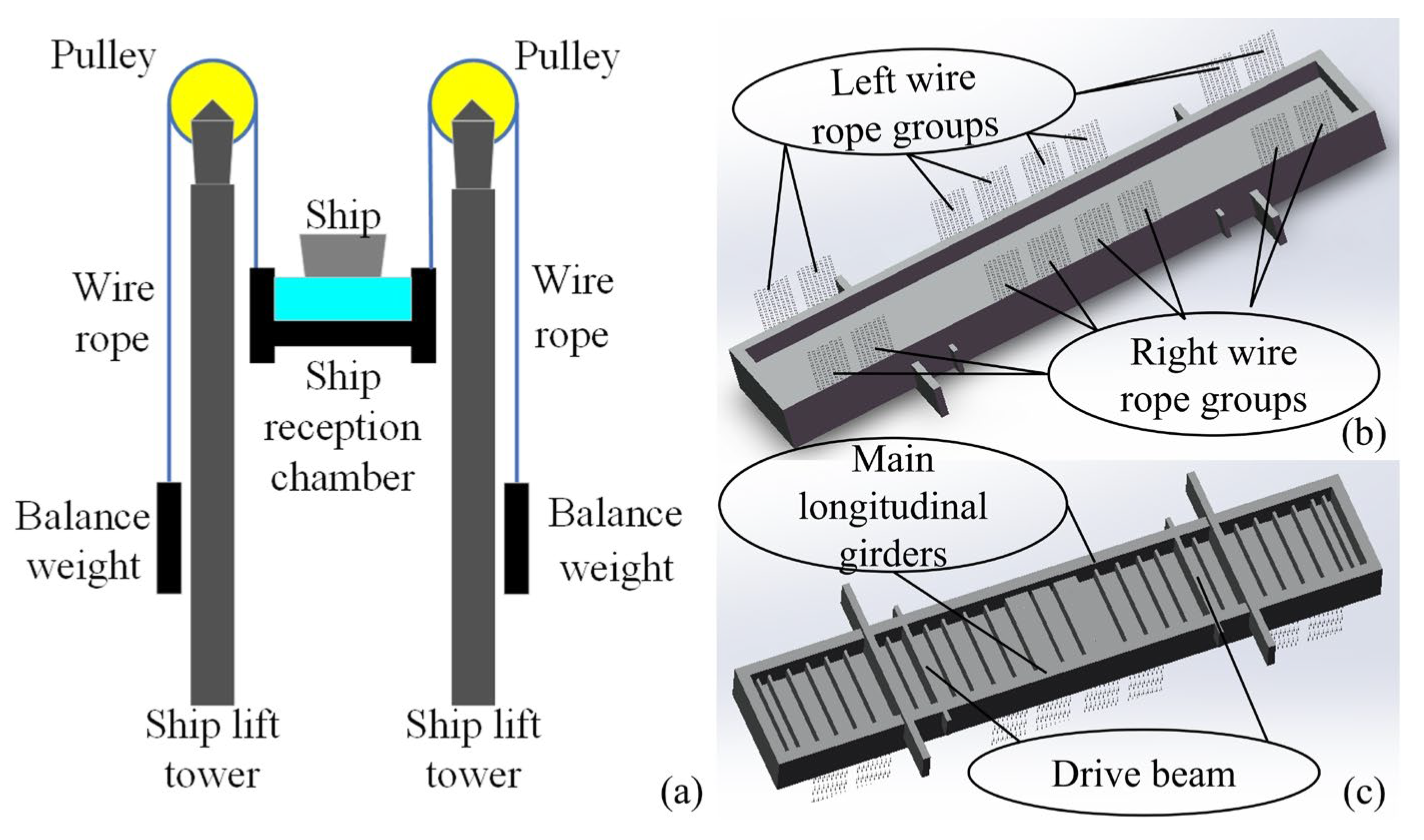
The Three Gorges ship lift is the largest ship lift in the world, with many functions and a complex structure. The Three Gorges ship lift belongs to the balance weight type full balance vertical ship lift, and its main structure is composed of a ship chamber, pulley, wire rope, balance weight, tower column, gear, rack, and other parts, among which, the balance weight mass and the load of the ship chamber water mass are the same. Its structure diagram is shown in Figure 2a. When it works, the balance weight is the same as the weight of the ship chamber when loading the ship chamber water, so only the gearing force of the rack and pinion can drive the ship chamber to achieve up and down. The structure of the ship chamber is mainly composed of the main longitudinal beam, the drive beam, and the safety beam, which constitute the main components of the ship lift chamber. The ship chamber structure is shown in Figure 2b,c.
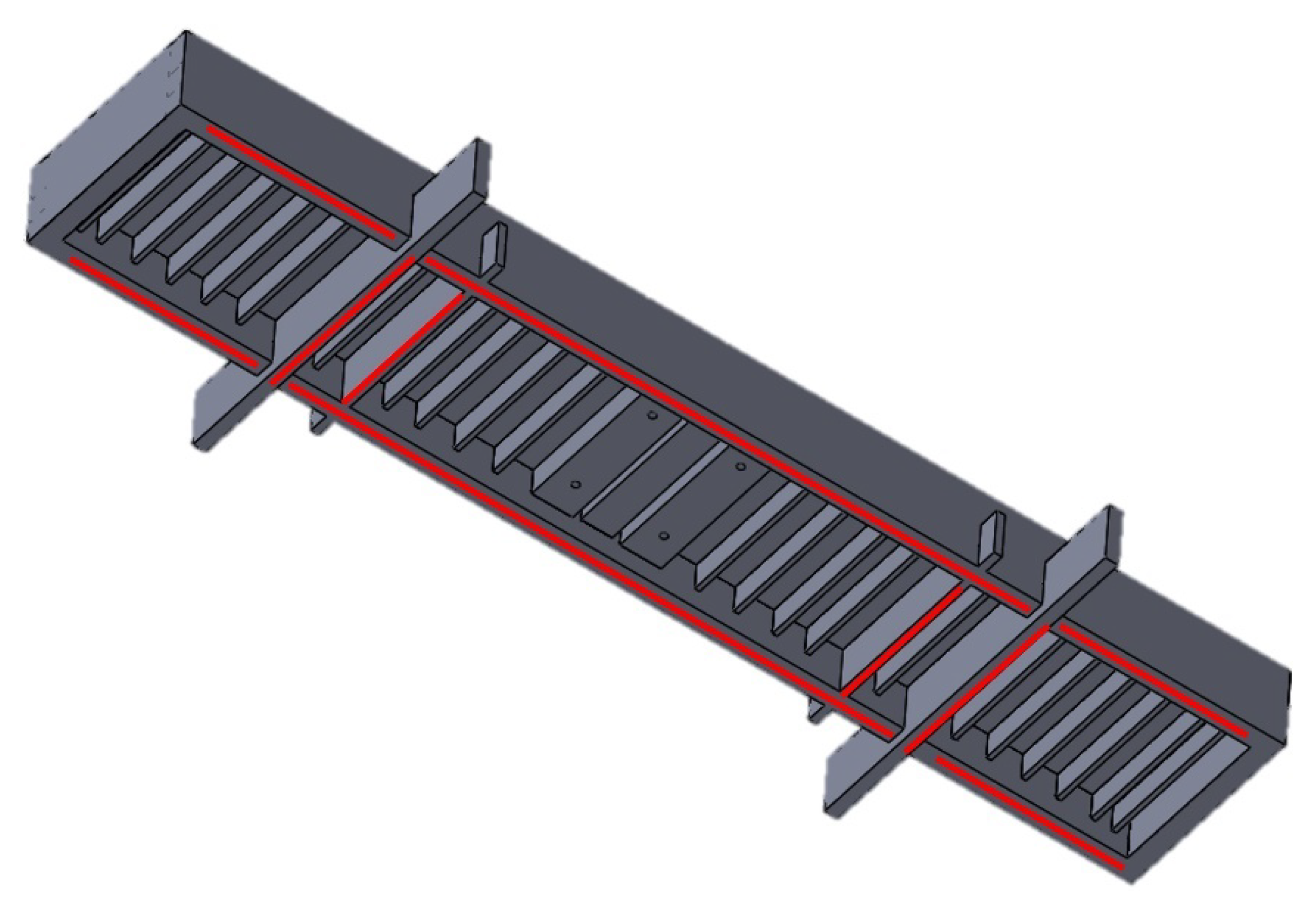
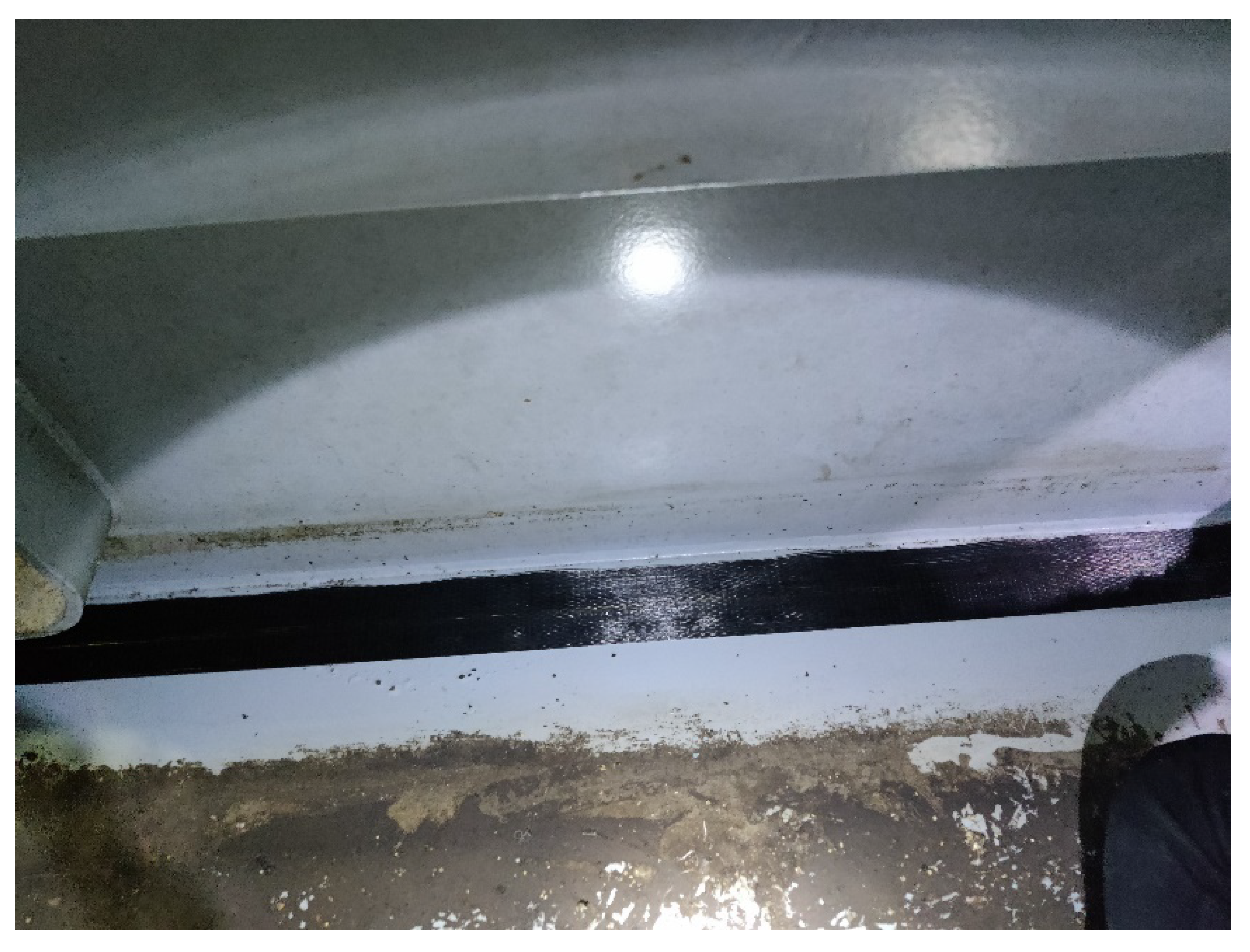
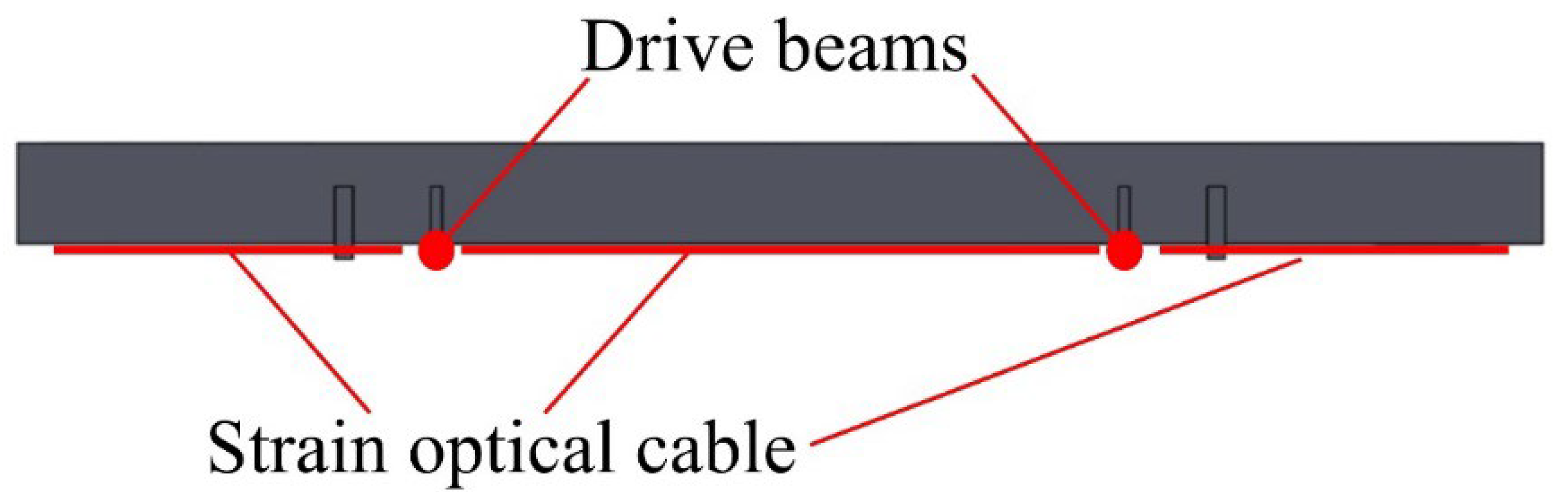
In this study, the FBG sensor is arranged at the bottom of the ship chamber, and the specific position is at the bottom of the main longitudinal beam, the safety beam, and the drive beam. The route arranged by the grating fiber sensor is shown in Figure 3, where the red line represents the specific route arranged by the sensor, and is shown in Figure 4 after installation. The optical fiber sensing cable can measure the strain of the installation position in real time. After the strain measurement is completed, the ship chamber structure at the installation position of the sensor is reconstructed, and the theoretical deformation reconstruction results are obtained. After that, the ship chamber is measured by a 3D laser scanner, and the measured results of deformation are obtained. The results of deformation reconstruction of the ship chamber structure of the Three Gorges ship lift are compared with those of a 3D laser scanner to verify the accuracy of the method.

5. Verification

In this part, the strain data will be pre-processed to obtain the strain information after noise reduction, the strain information after noise reduction will be used for deformation reconstruction of the ship chamber structure, and a 3D laser scanner will be used to verify the deformation reconstruction results.

5.1. Data Acquisition

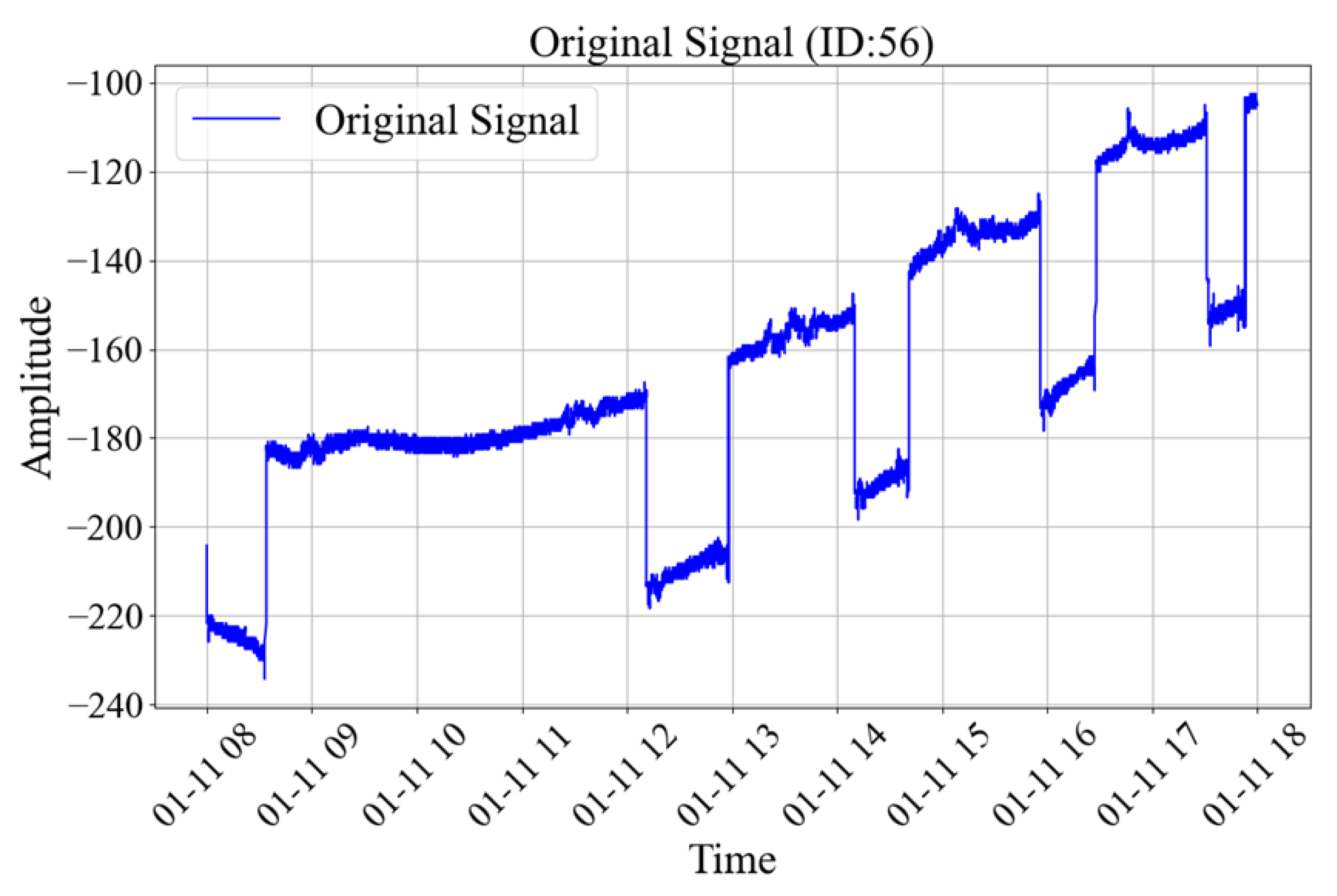
The grating array sensor system, laid in the early stage, is used to collect the strain information of the ship compartment of the Three Gorges ship lift. Compared with the general strain gauge, the grating array sensor has many advantages, such as anti-corrosion, anti-electromagnetic interference, etc. It is especially suitable for structural monitoring in the environment of oil pollution concentration and complex internal lines. The grating array sensor cable model is FBG-DSS-0100, which can accurately measure the strain in the range of ±2500 με. In order to ensure that the measurement time of the grating fiber sensor corresponds to the measurement time of the 3D laser scanner, the measurement time of the fiber grating strain is selected from 8:00 to 18:00 on 11 January 2024. Take the strain at position ID: 56 as an example and draw its strain graph, as shown in Figure 5 below.
It can be seen from Figure 5 that the vibration amplitude of the strain is large, and the deformation accuracy is greatly affected when the Ko displacement theory is used for deformation reconstruction. Therefore, it is necessary to carry out noise reduction processing to improve the accuracy of deformation reconstruction.

5.2. Data Processing

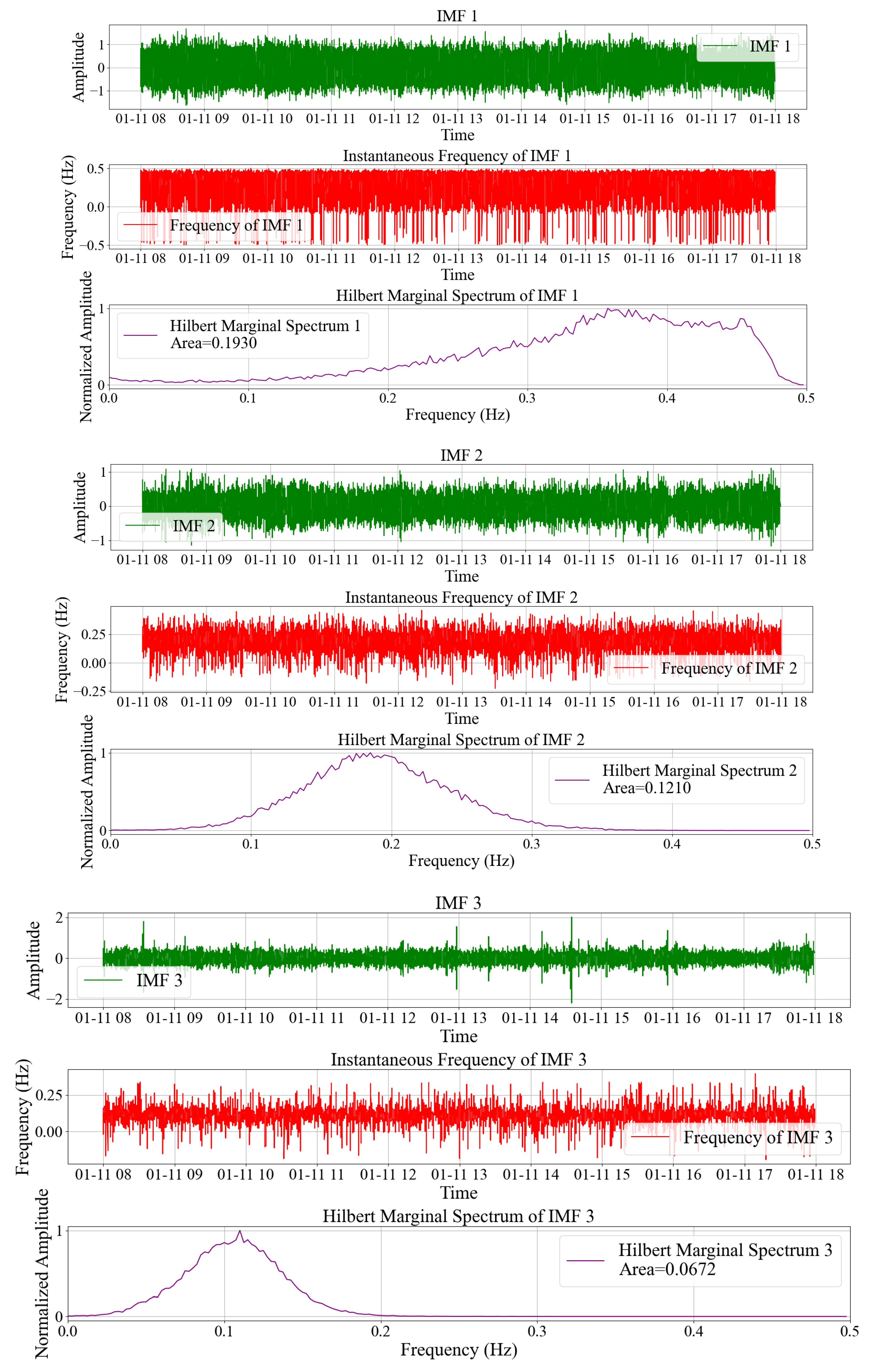
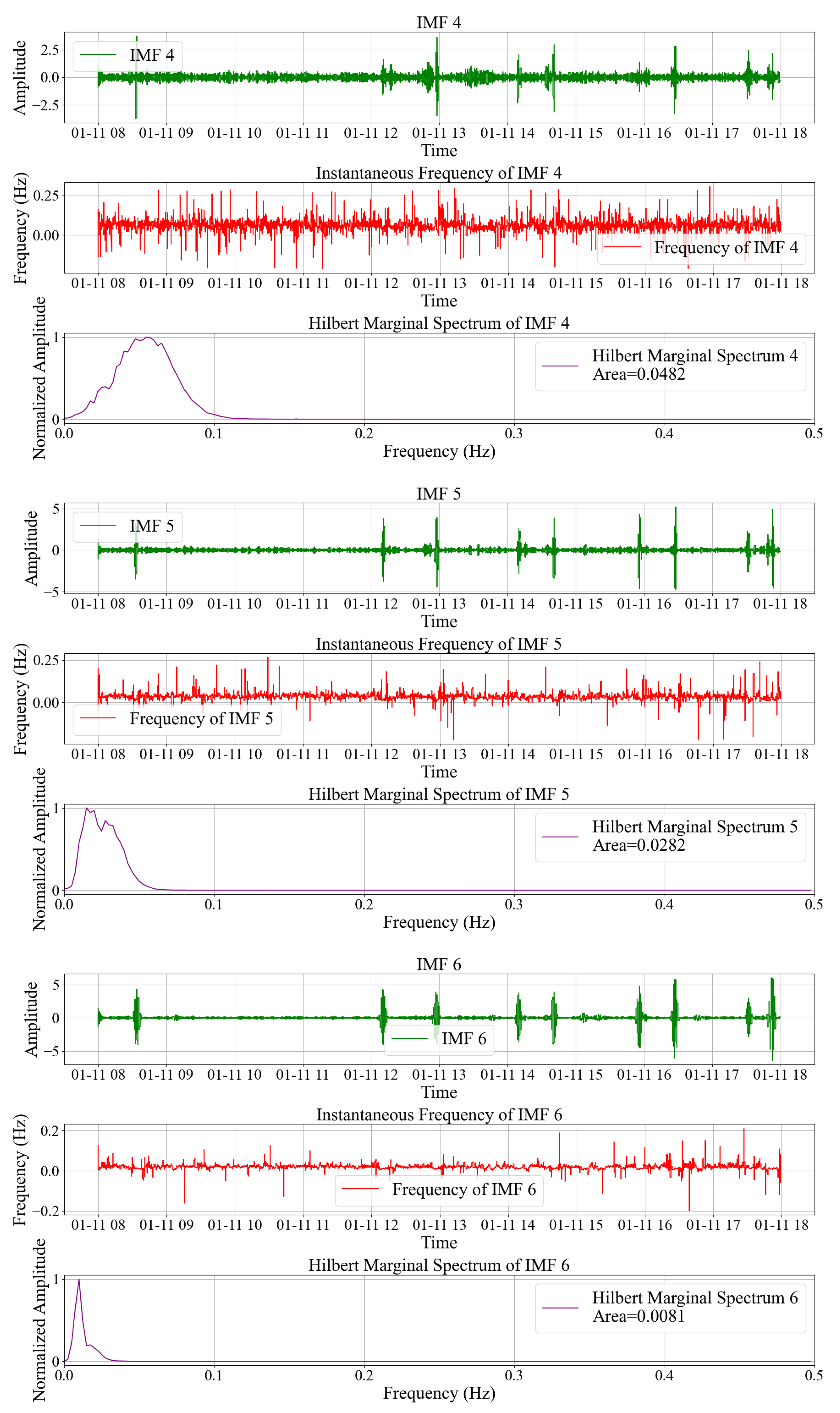
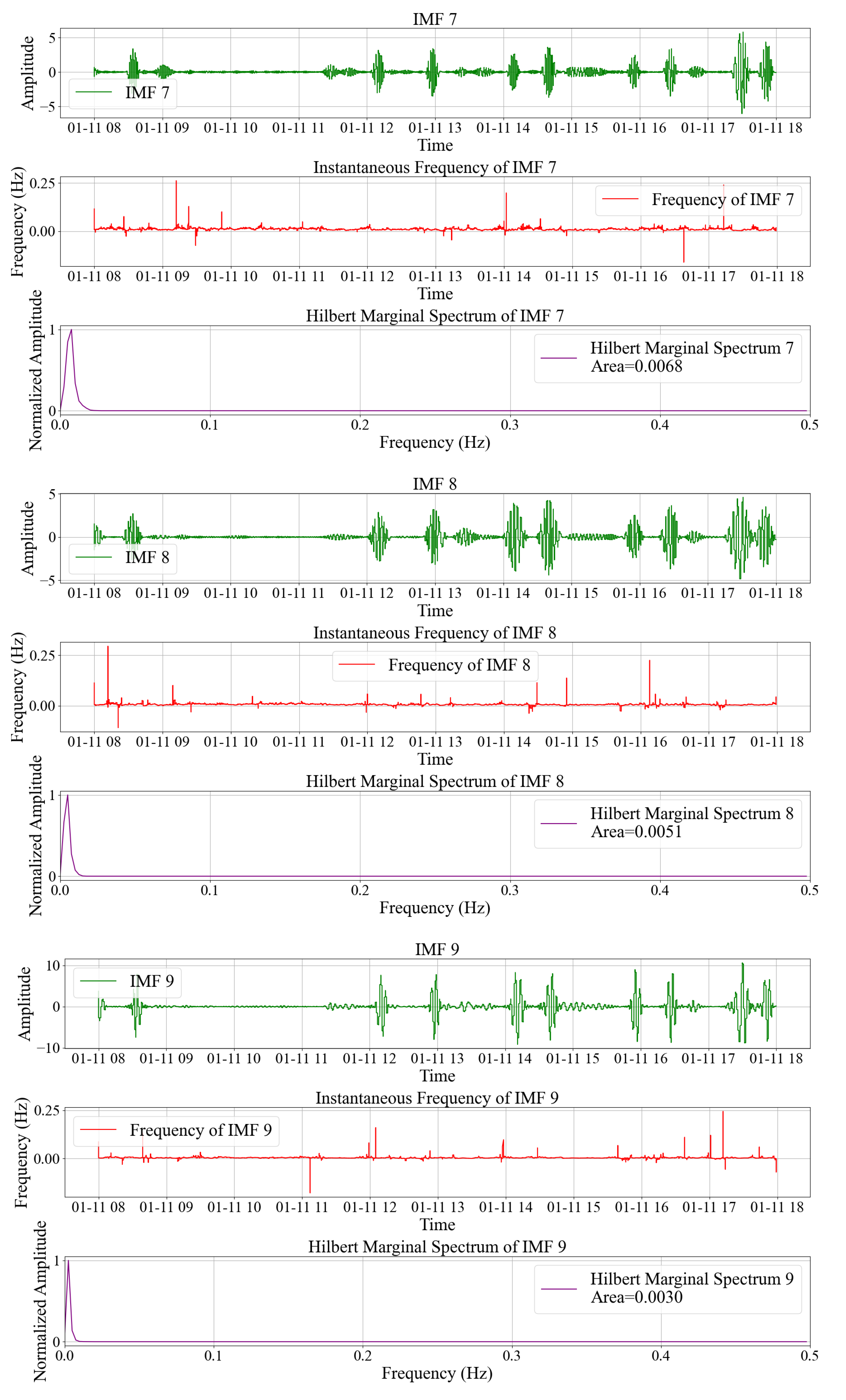
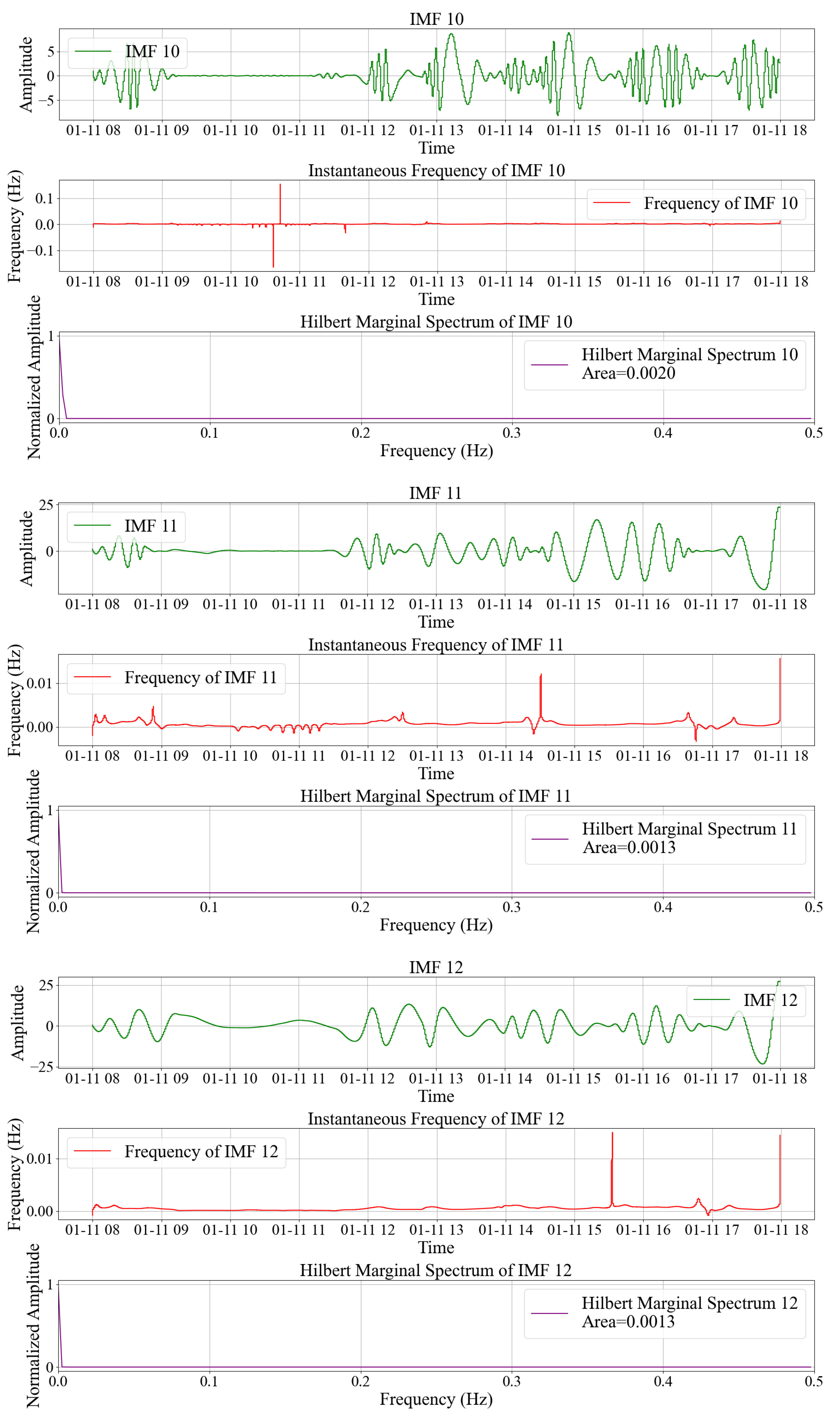
Firstly, the grating fiber strain measurement data are decomposed by EMD, EEMD, and CEEMDAN. After the decomposition, the IMF components of the signal can be obtained, and the frequencies of these IMF components are arranged in order from high to low. The Hilbert marginal spectrum of IMF components of different orders can be obtained by applying the Hilbert transform to the obtained IMF components. In order to unify the standard, the Hilbert marginal spectrum of each order is normalized, and the normalized Hilbert marginal spectrum is obtained. Further, the area of the Hilbert marginal spectrum after each order of normalization is calculated, and finally, GMM is used to classify the area of the Hilbert marginal spectrum. IMF can be separated according to the frequency, and IMF components with higher frequency and IMF components with lower frequency can be obtained. The data signal after removing the high-frequency noise can be obtained by merging the IMF component with a lower frequency again.
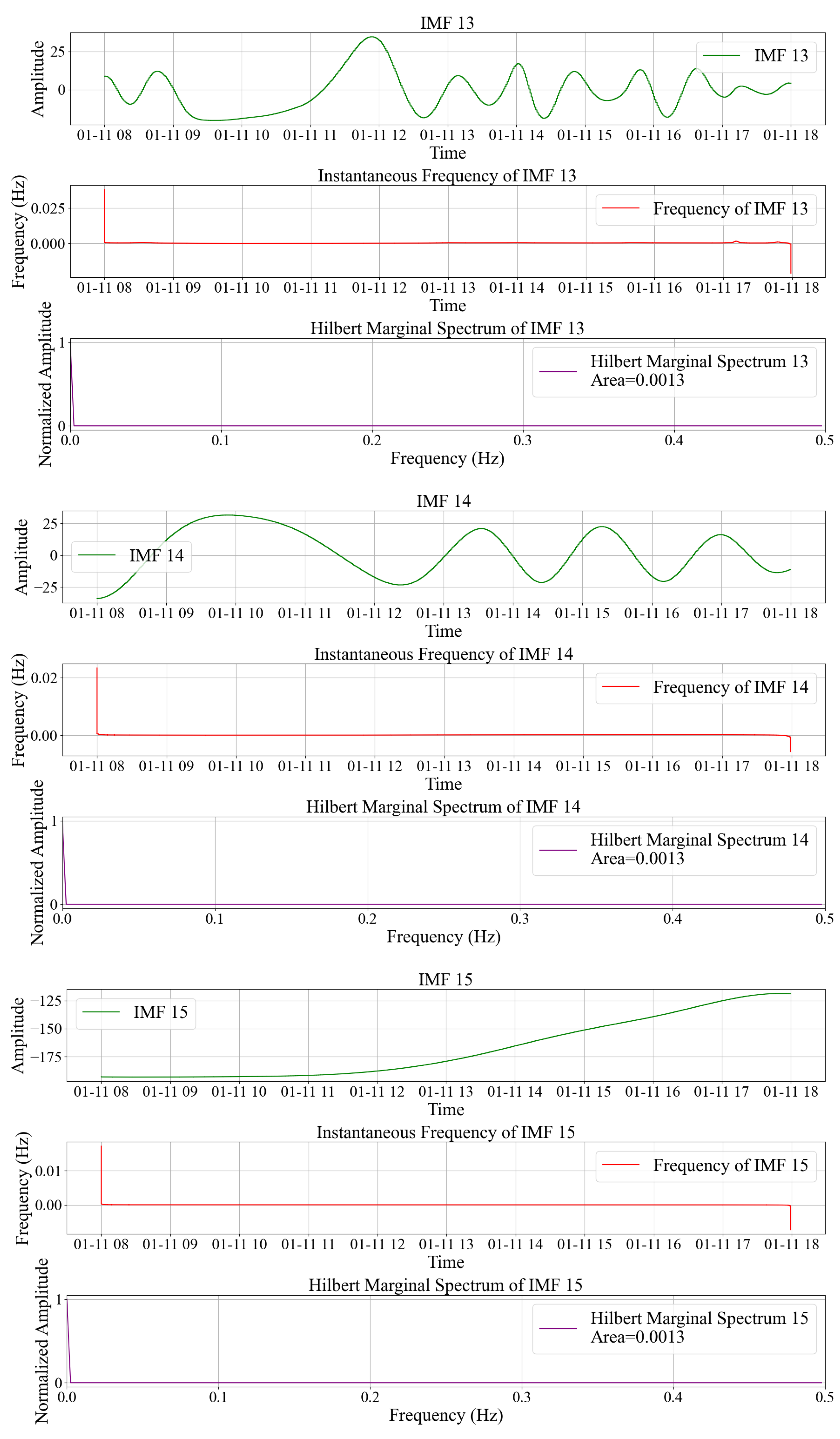
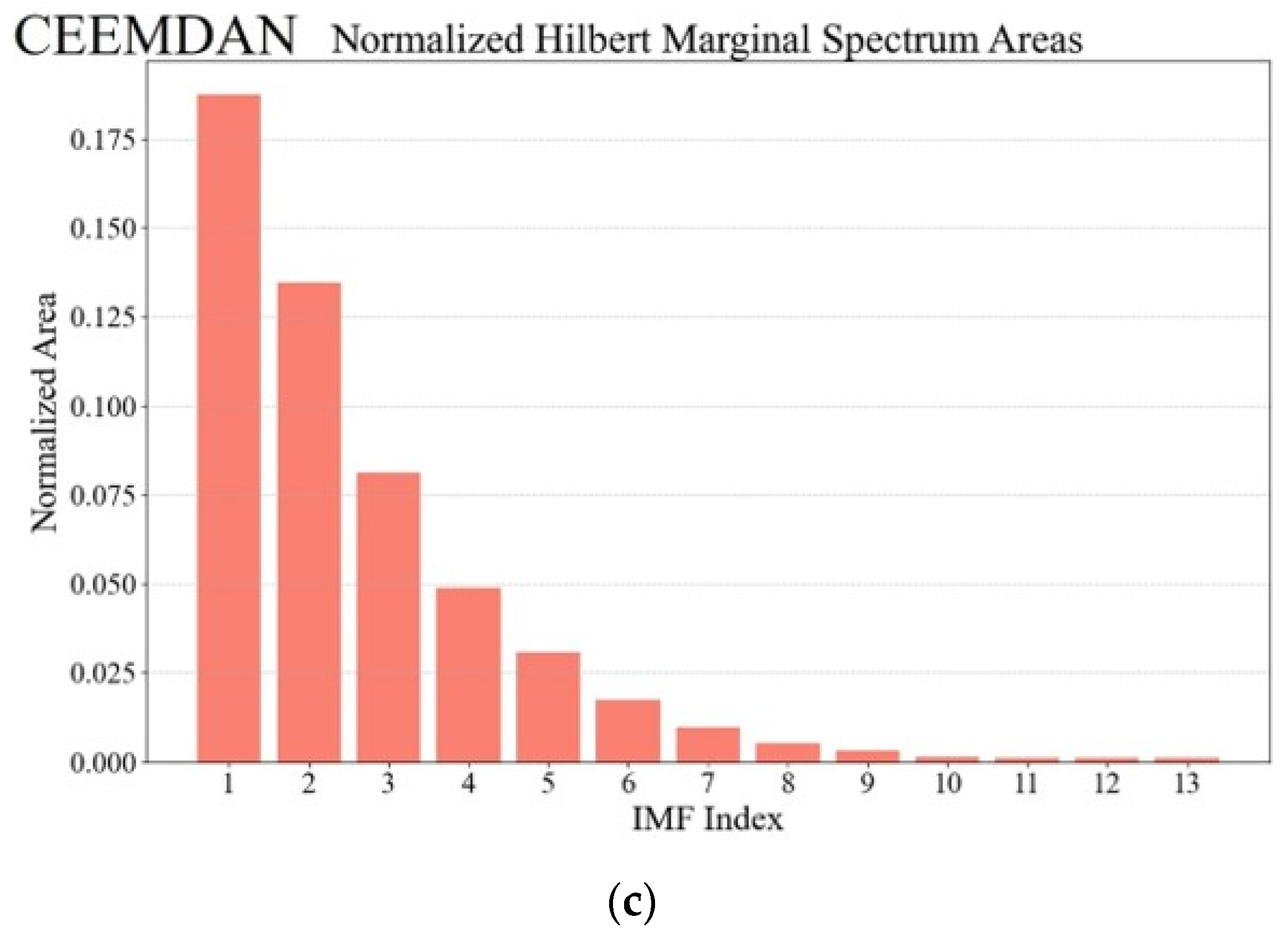
Taking the strain at position ID: 56 as an example, the IMF graph after CEEMDAN decomposition and the normalized Hilbert marginal spectrum area are shown in Figure 6 below.
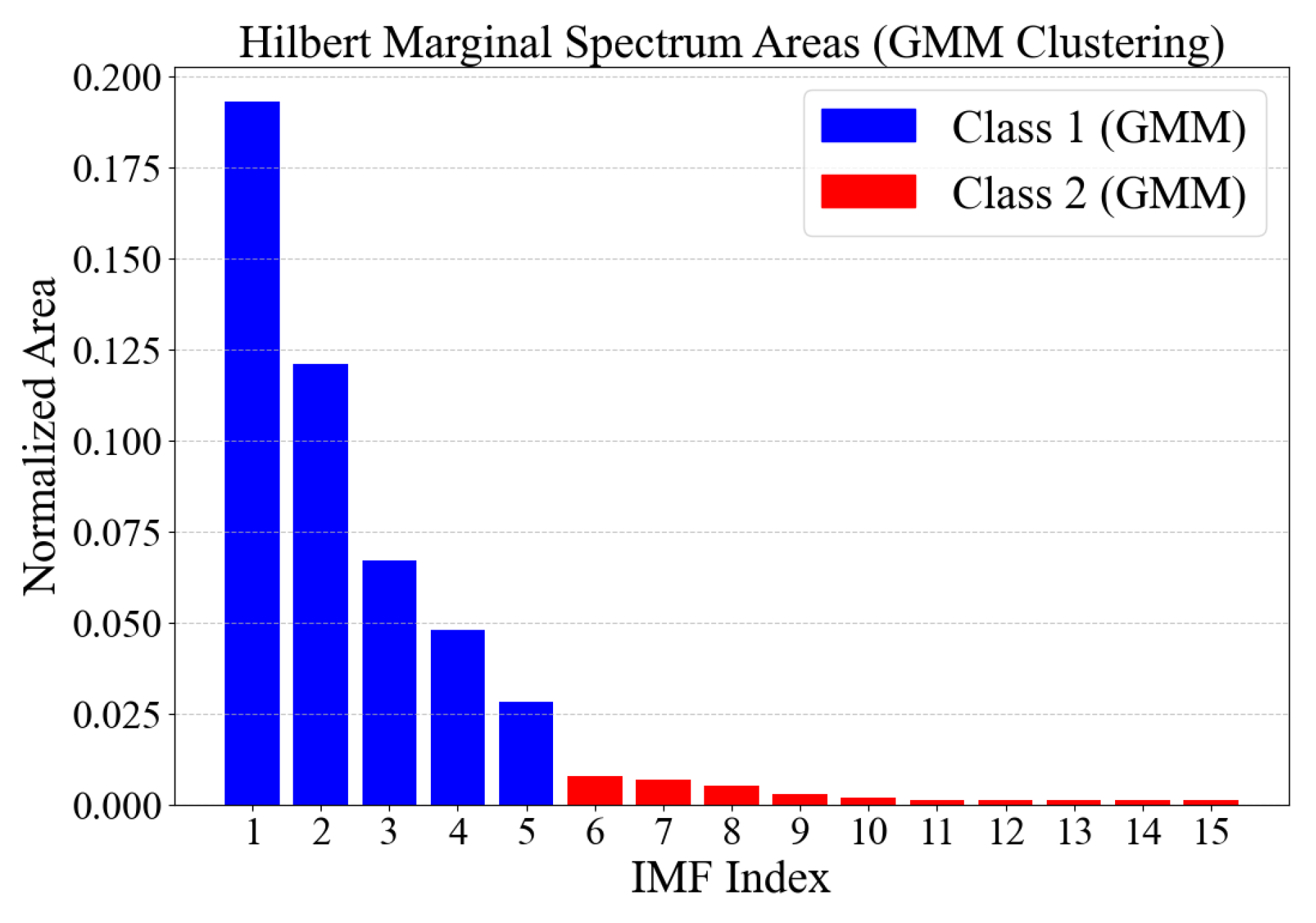
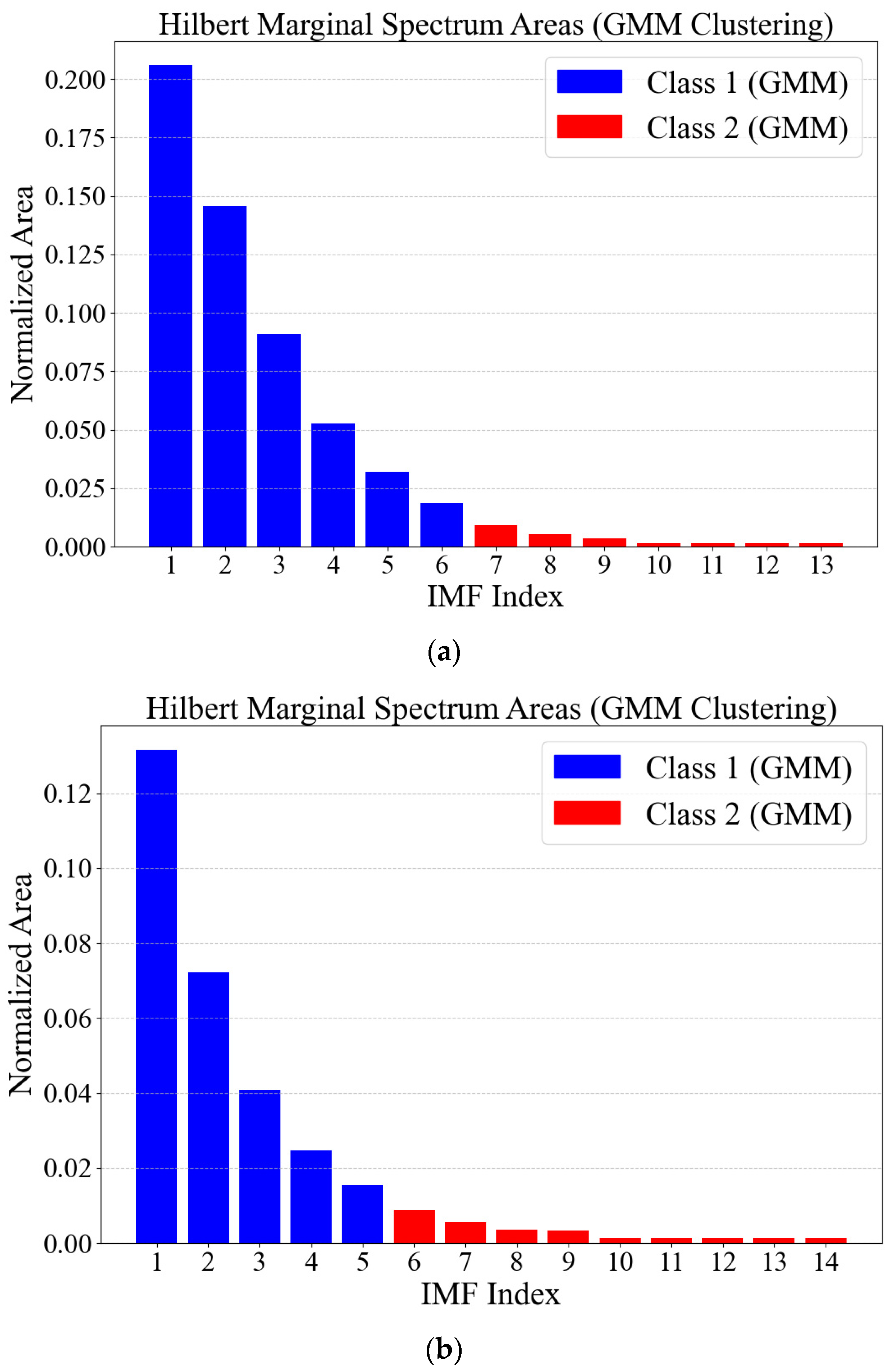
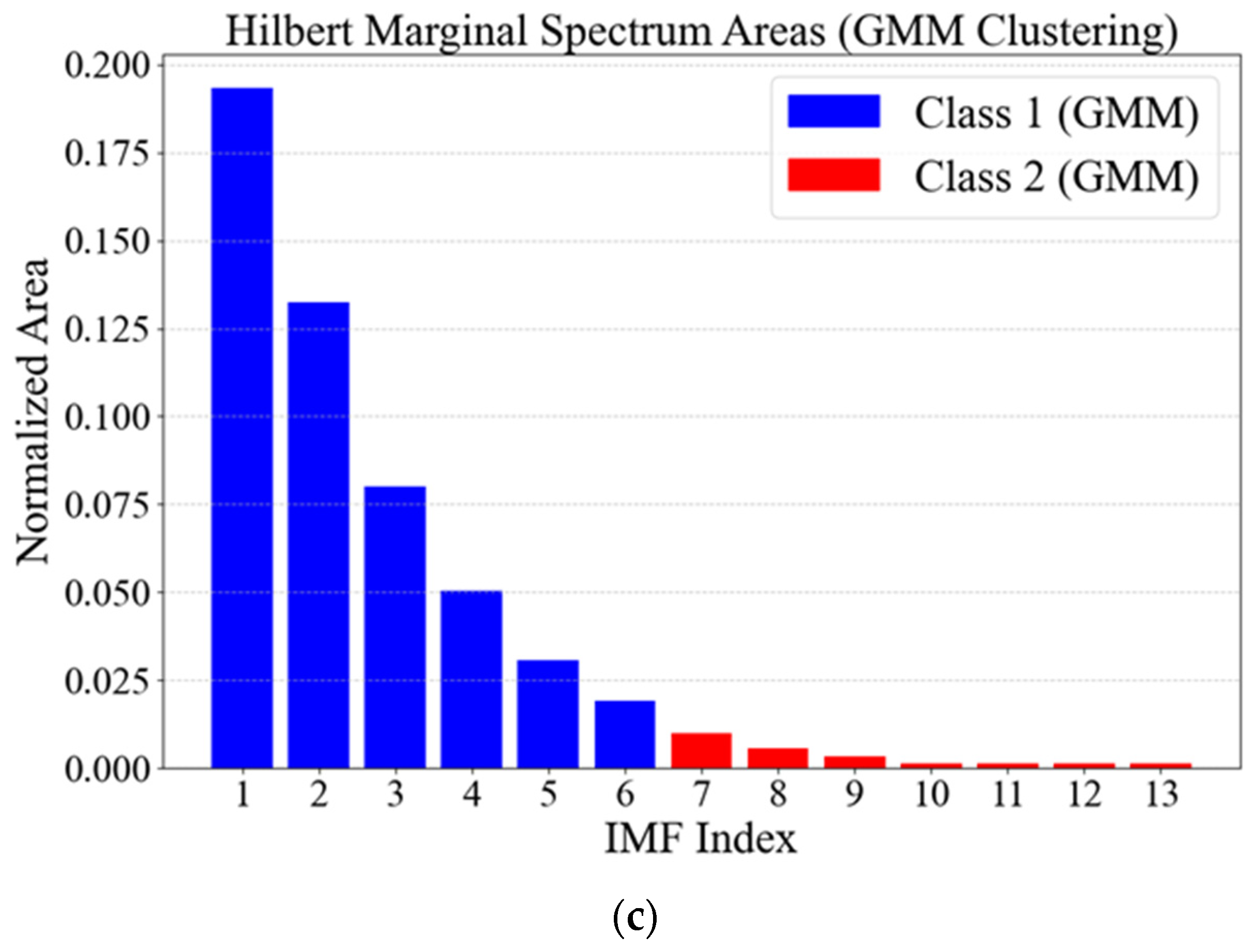
The GMM method is used to classify the normalized Hilbert marginal spectral area, and two types of IMF components are obtained: one is the noise, and the other is the strain after noise reduction. The classification results are shown in Figure 7 below.
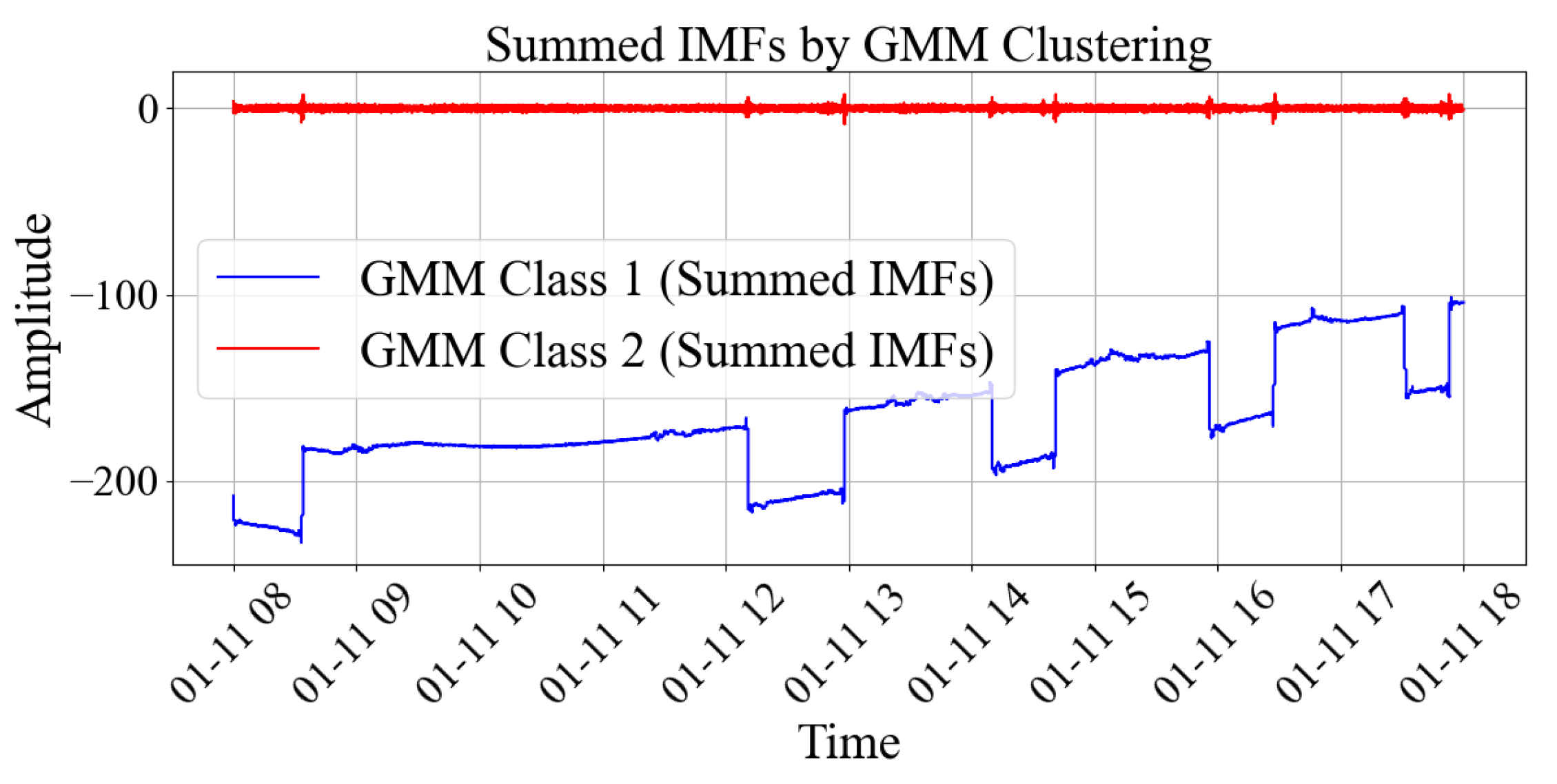
As can be seen from the figure, the GMM method divides the IMF components into two categories according to the different component frequencies. The two types of IMF are combined and reconstructed, respectively, and the signal after noise and noise removal can be obtained, as shown in the Figure 8 below.
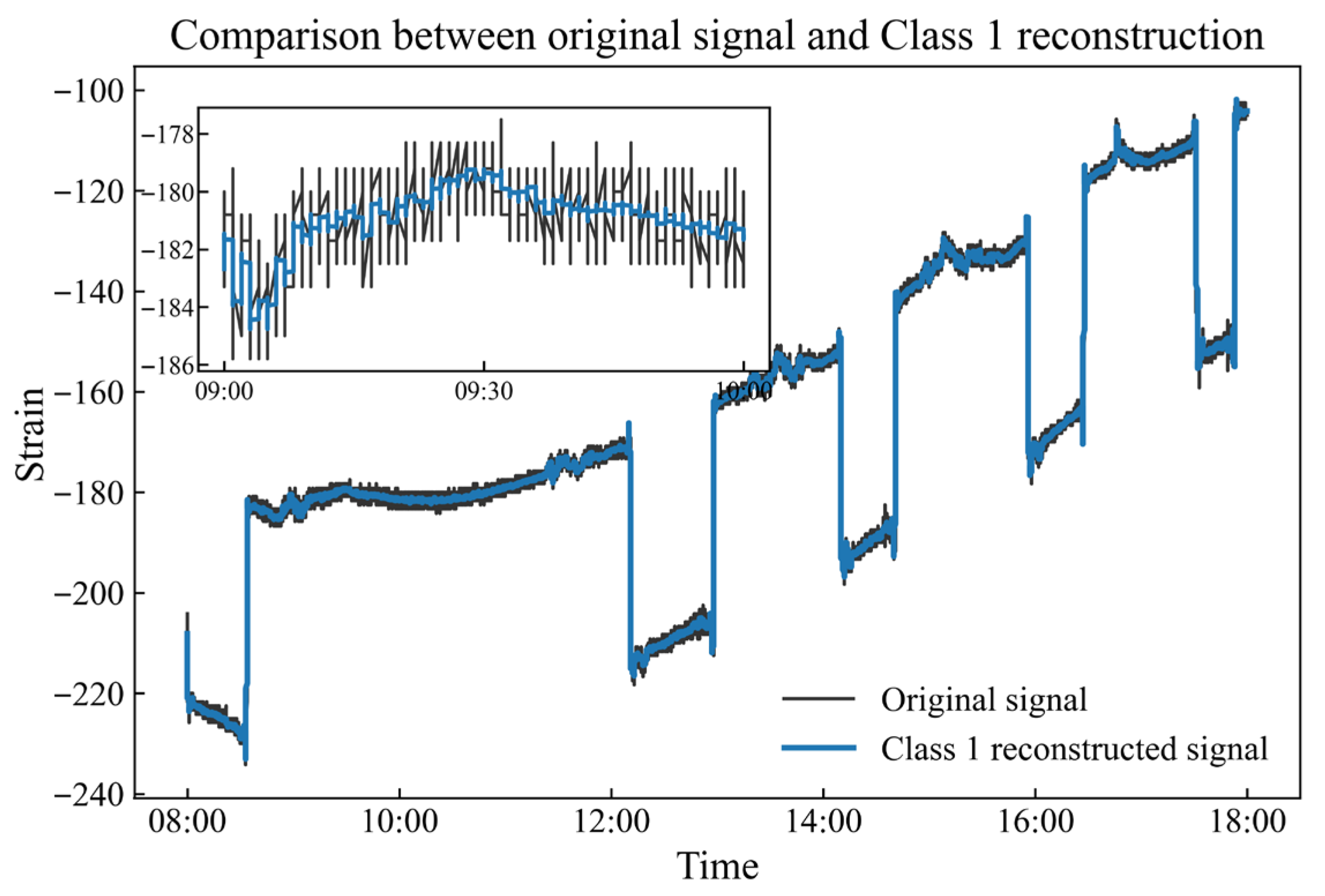
According to the correlation formula, the correlation coefficient between the signal after noise reduction and the signal before noise reduction is calculated, and the correlation coefficient is 0.9908. It can be seen that the signal after noise reduction has a great correlation with the original signal. The contrast between the signal after noise reduction and the original signal is shown in Figure 9 below. The strain signal after noise reduction has fewer burrs and a more stable strain.

5.3. Comparison of EMD, EEMD, and CEEMDAN Methods

The strain measurement data of the grating fiber were decomposed by EMD, EEMD, and CEEMDAN, respectively. After decomposition, the IMF components of the signal were obtained and arranged in descending order of frequency. The Hilbert transform was performed on the obtained IMFs to obtain the Hilbert marginal spectra of different orders of IMFs. To unify the standard, the Hilbert marginal spectra of each order were normalized to obtain the normalized Hilbert marginal spectra. Then, the area of each normalized Hilbert marginal spectrum was calculated. Finally, the areas of the Hilbert marginal spectra were classified by GMM, and the IMFs could be separated according to frequency from high to low, thus obtaining the IMFs with high frequency and those with low frequency. The IMFs with low frequency were recombined to obtain the data signal after removing the high-frequency noise.
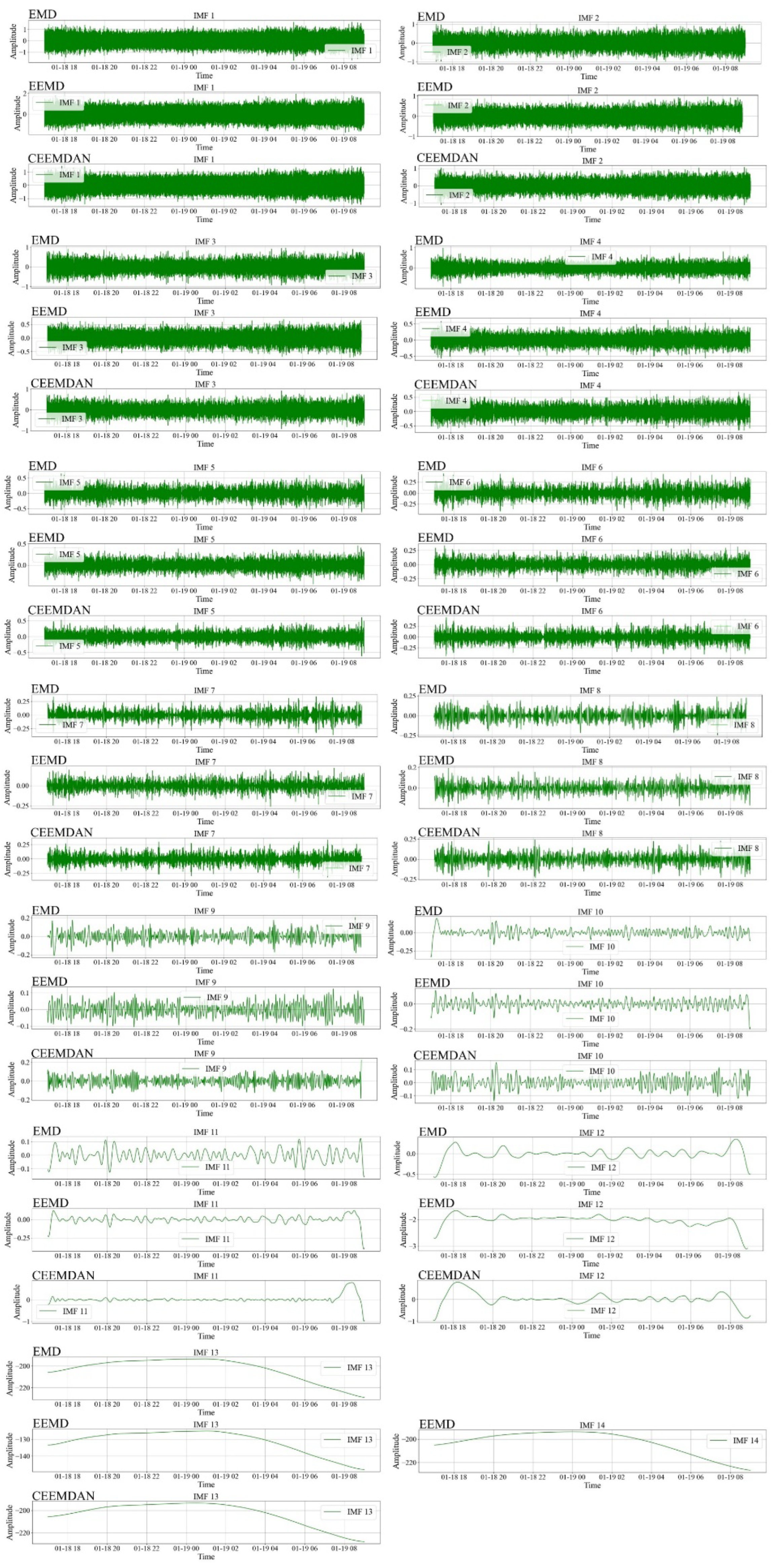
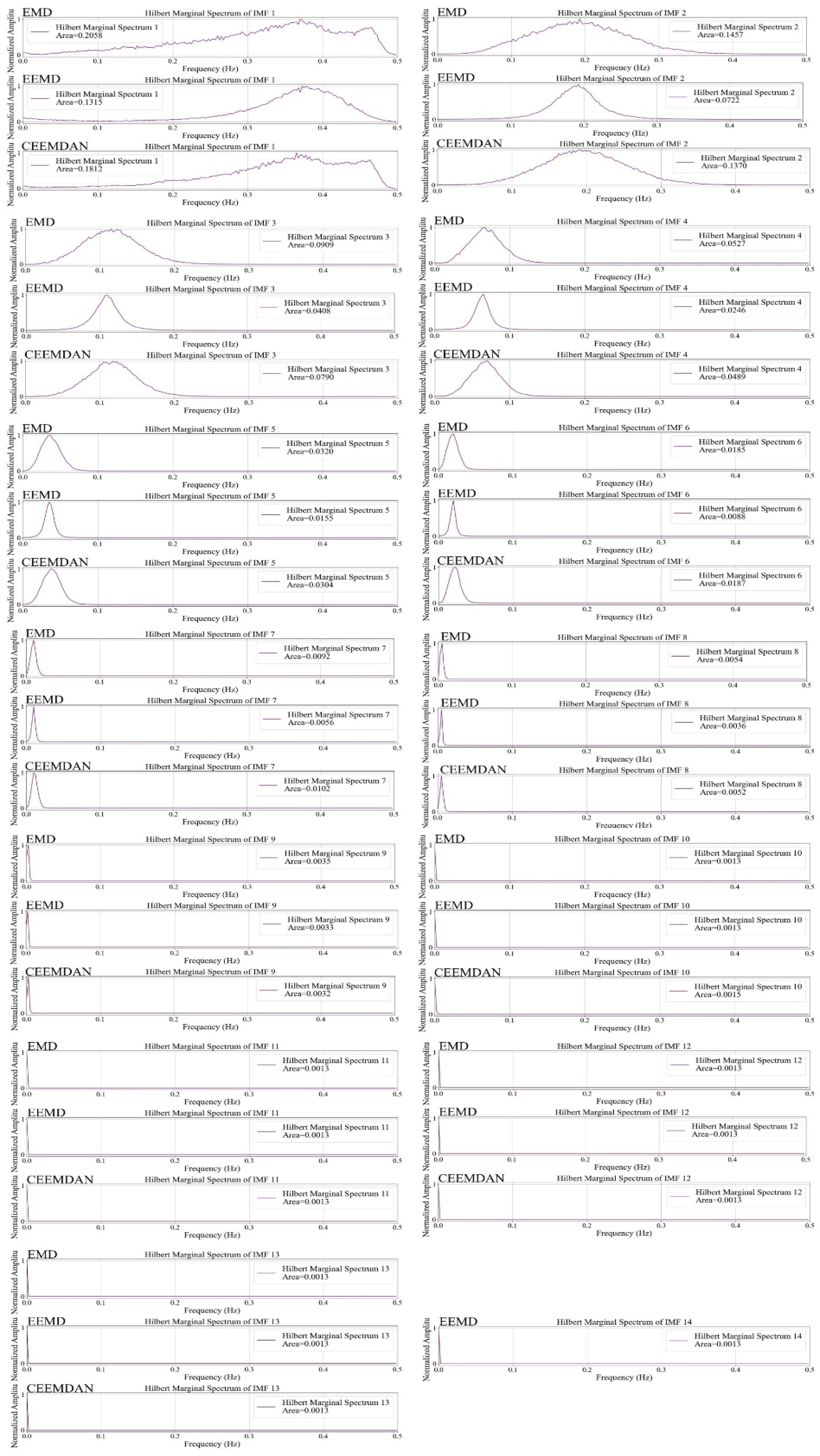
Taking the strain at position ID: 56 as an example, the IMF graphs after decomposition by EMD, EEMD, and CEEMDAN, as well as the normalized Hilbert marginal spectrum areas, are shown in Figure 10 and Figure 11.
It can be seen from Figure 10 that 13 IMFs were obtained by EMD, 14 IMFs by EEMD, and 13 IMFs by CEEMDAN. Among them, the last IMF can be regarded as the residual, representing the overall trend of the signal.
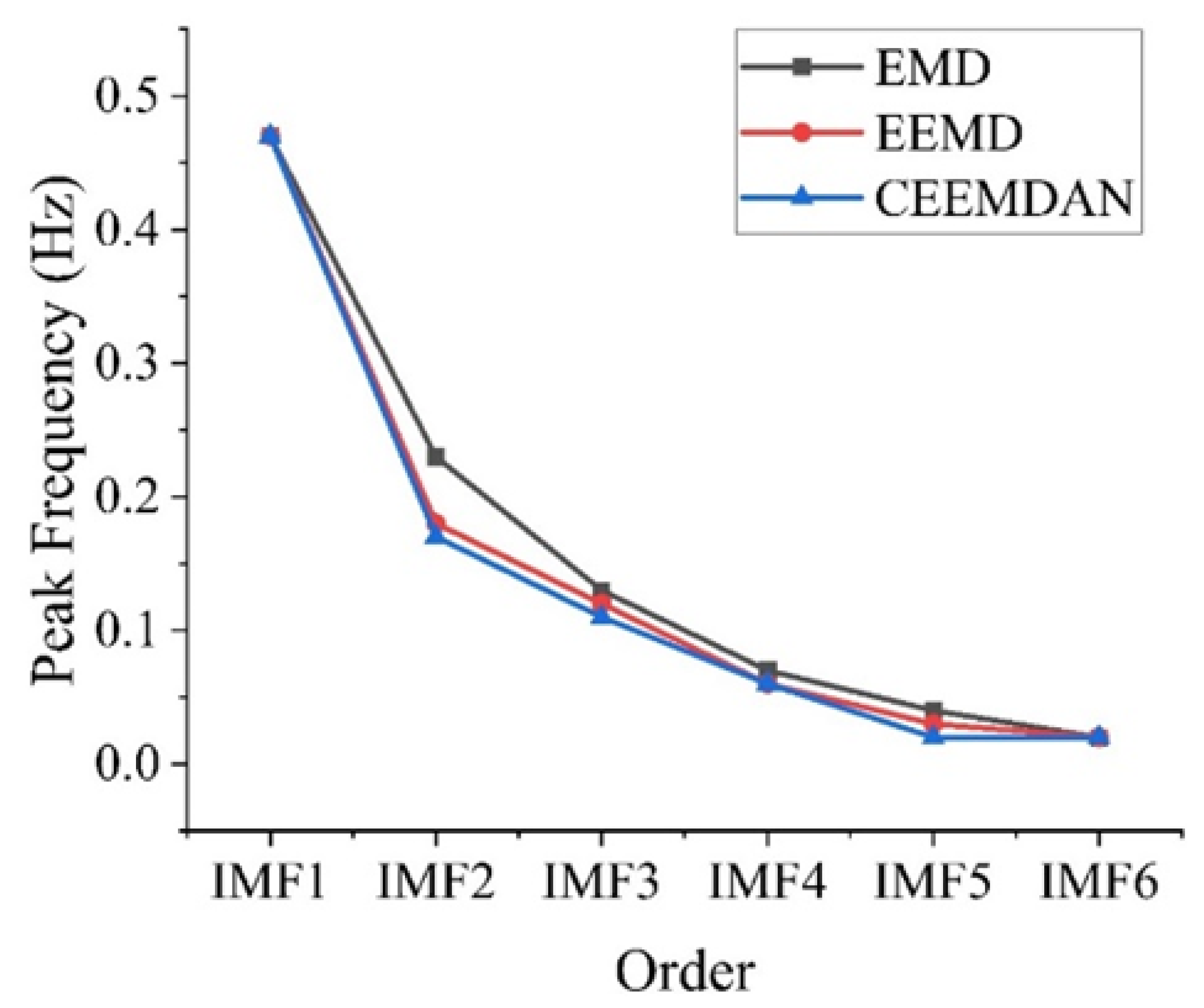
The Fourier transform was performed on the IMFs obtained by EMD, EEMD, and CEEMDAN, respectively, to obtain the peak frequency of each IMF. The analysis results show that the peak frequencies of the IMFs obtained by the three methods mainly differ in the higher-order IMFs, as shown in Figure 12.
From Figure 12, it can be seen that the frequencies of the higher-order IMFs obtained by EMD, EEMD, and CEEMDAN methods decrease successively. This indicates that compared with the EMD method, the CEEMDAN and EEMD methods can effectively separate the low-frequency components in the signal, reduce mode aliasing, and avoid the influence of high-frequency noise on the IMF decomposition.
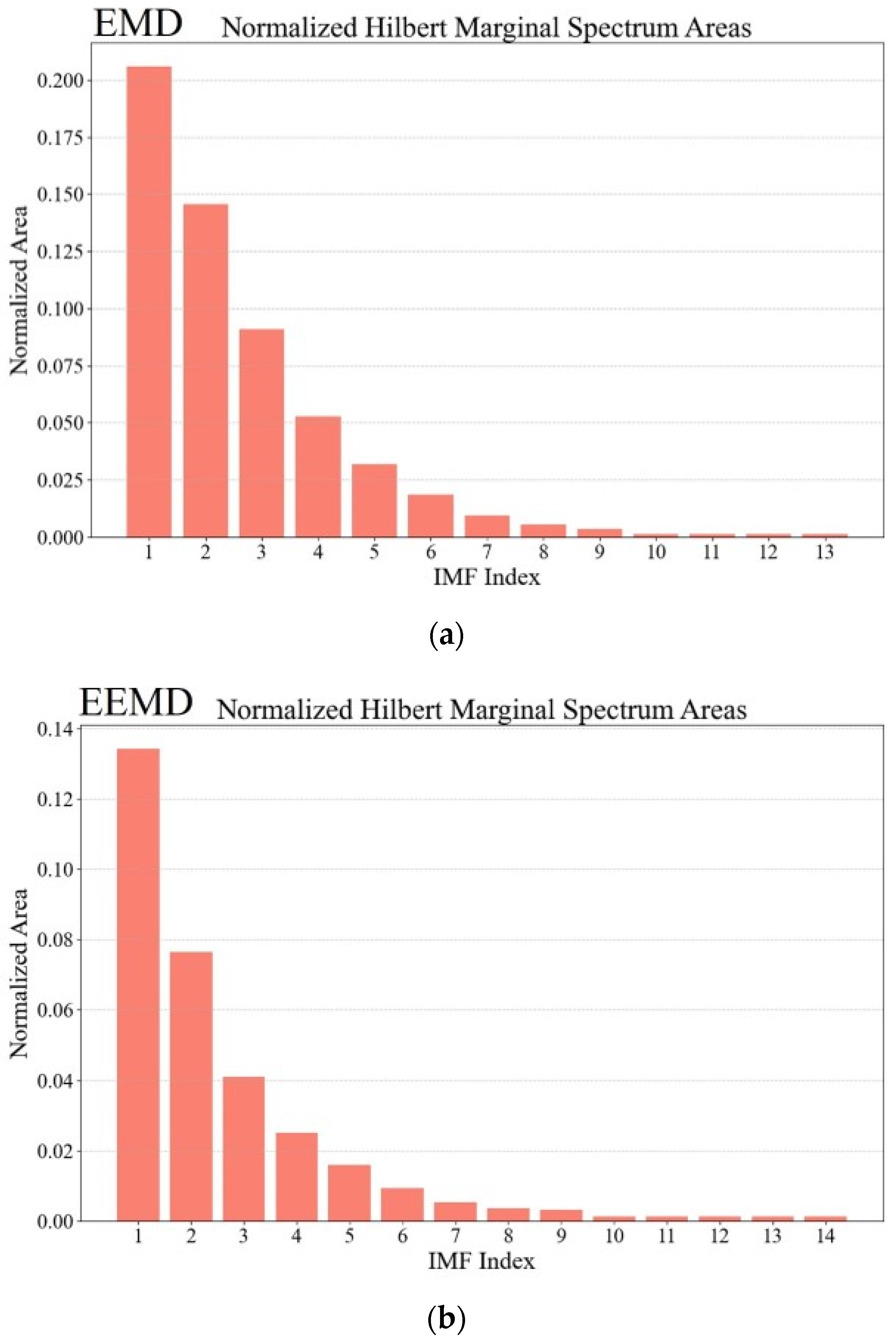
The Hilbert marginal spectra after normalization are integrated to obtain the area enclosed by the marginal spectra and the horizontal axis, and then clustering is performed. The IMFs and marginal spectra obtained by EMD, EEMD, and CEEMDAN methods are, respectively, shown in Figure 13 and Figure 14. The normalized marginal spectrum diagrams obtained by EMD, EEMD, and CEEMDAN methods are shown in Figure 13a, Figure 13b, and Figure 13c, respectively. The normalized marginal spectral areas obtained by EMD, EEMD, and CEEMDAN methods are shown in Table 1.
Using the GMM method, the areas of the obtained marginal spectra were clustered, respectively. The clustering results are shown in Figure 14a–c.

5.4. Result Evaluation

The decomposition results of EMD, EEMD, and CEEMDAN are evaluated using the Mean Squared Error (MSE). The calculation formula for the Mean Squared Error is
M S E = 1 N i = 1 N x i x ¯ x i
Among them, xi represents the marginal spectral area of the i-th IMF, x ¯ is the mean of the IMF, and N is the total number of IMFs.
The average relative errors obtained after decomposition by EMD, EEMD, and CEEMDAN methods are 13.04%, 10.37%, and 7.57%, respectively. By comparison, the average relative error of the IMF decomposition results obtained by CEEMDAN is the smallest, indicating that the decomposition results obtained by the CEEMDAN method are more accurate. Therefore, the CEEMDAN method is selected for the initial decomposition of the data.

5.5. Deformation Reconstruction Based on Ko Displacement Theory

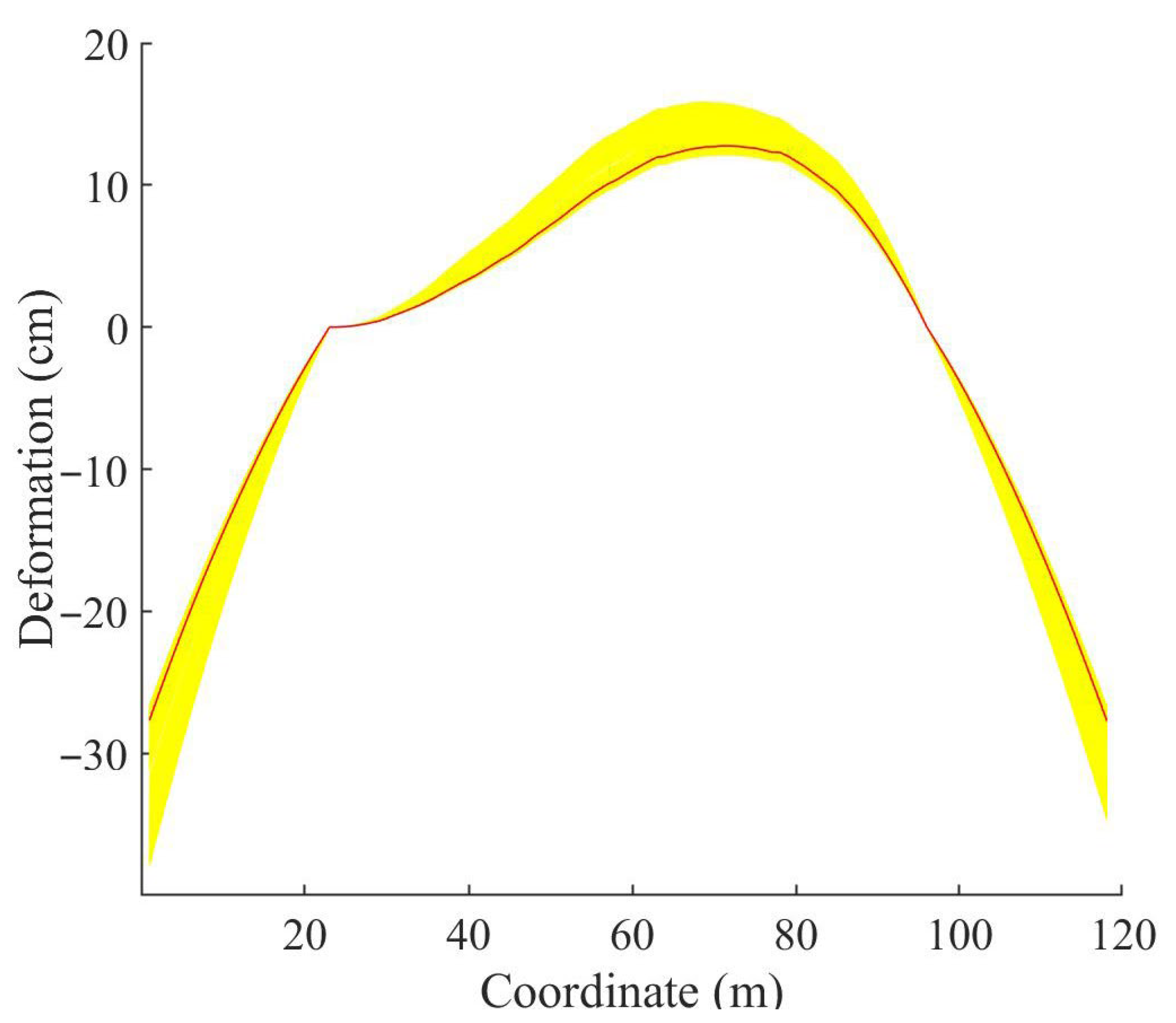
Taking the Three Gorges ship lift chamber drive beam as the dividing line, the Three Gorges ship lift chamber can be regarded as an overhanging beam structure, as shown in Figure 15. It is reconstructed according to the deformation reconstruction formula (34) of the Ko displacement theory. Under pre-deformation conditions, the accuracy of the deformation reconstruction equation of overhanging beam based on the Ko displacement theory has been verified in reference [43]. The original strain signal and the strain signal after noise reduction were, respectively, used to reconstruct the main longitudinal beam on the north side of the ship. The deformation curve after deformation reconstruction of the main longitudinal beam on the north side is shown in Figure 16, where the horizontal axis represents the coordinates, the unit is m, and the vertical axis represents the deformation reconstruction result at the corresponding coordinates, the unit is cm.
In the figure above, the red line represents the deformation of the north main stringer in a certain second, and the yellow area is the area where all the deformation curves accumulate. As can be seen from the figure, the deformation of the Three Gorges ship lift during operation is large, but the variation range of the deformation is small. The deformation of the main longitudinal beam on the north side of the Three Gorges ship lift is an arc, with the middle part arching upward and the two ends hanging down. Selection on the north of the main girder uniform coordinates for 8/21/34/47/60/73/86/99/112 of the nine points. The north main longitudinal beam is regarded as the overhanging beam, and the fulcrum of the overhanging beam is taken as the zero point of deformation at the drive beam. The results of deformation reconstruction are shown in Table 2.

5.6. Measurement by 3D Laser Scanner

The structure of the Three Gorges ship lift is large, and the general measuring tools can not directly and conveniently measure it. A 3D laser scanner can measure the Three Gorges ship lift without contact and over long distances and directly obtain the three-dimensional point cloud data on the surface of the Three Gorges ship lift. The 3D laser scanner sampling frequency is high, and the Three Gorges ship lift, for rapid measurement, compared with other traditional measurement methods, is safer and greatly saves manpower and material costs.
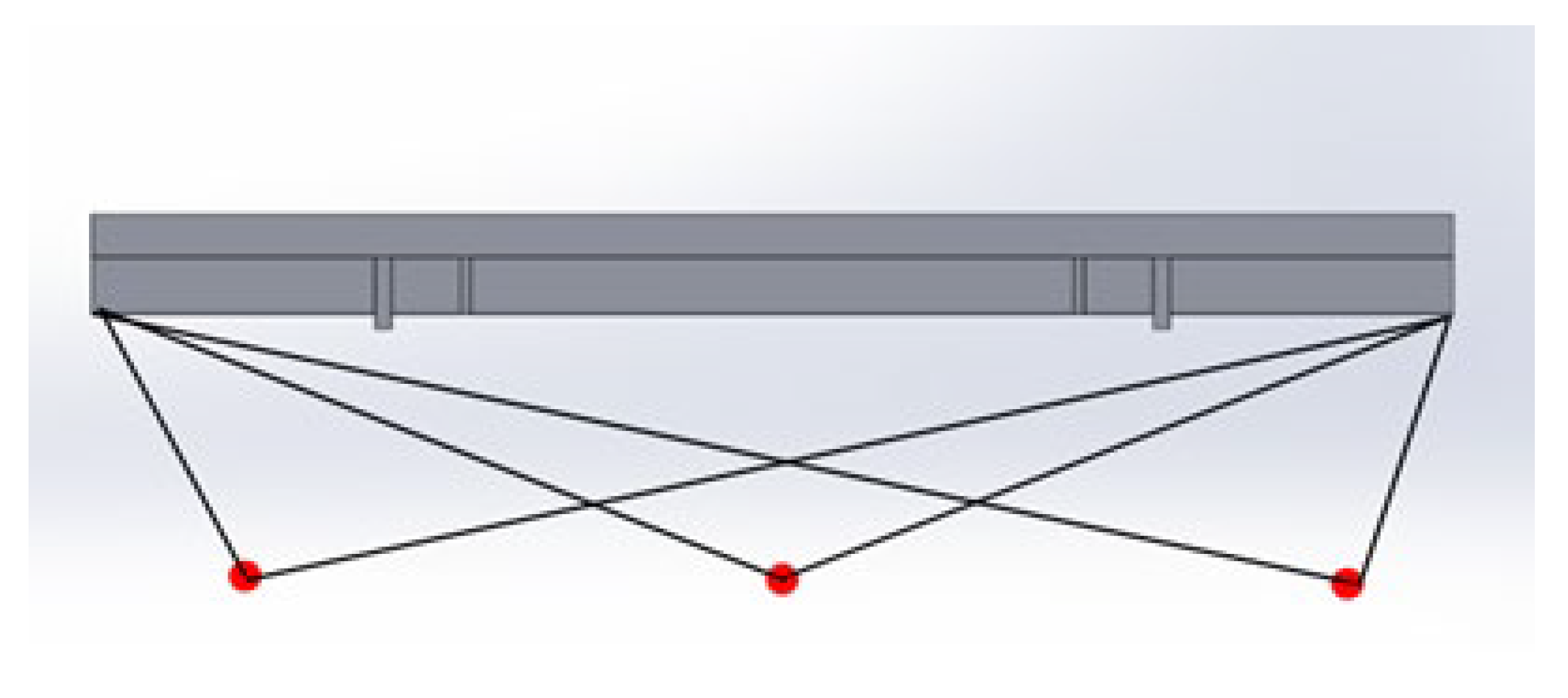
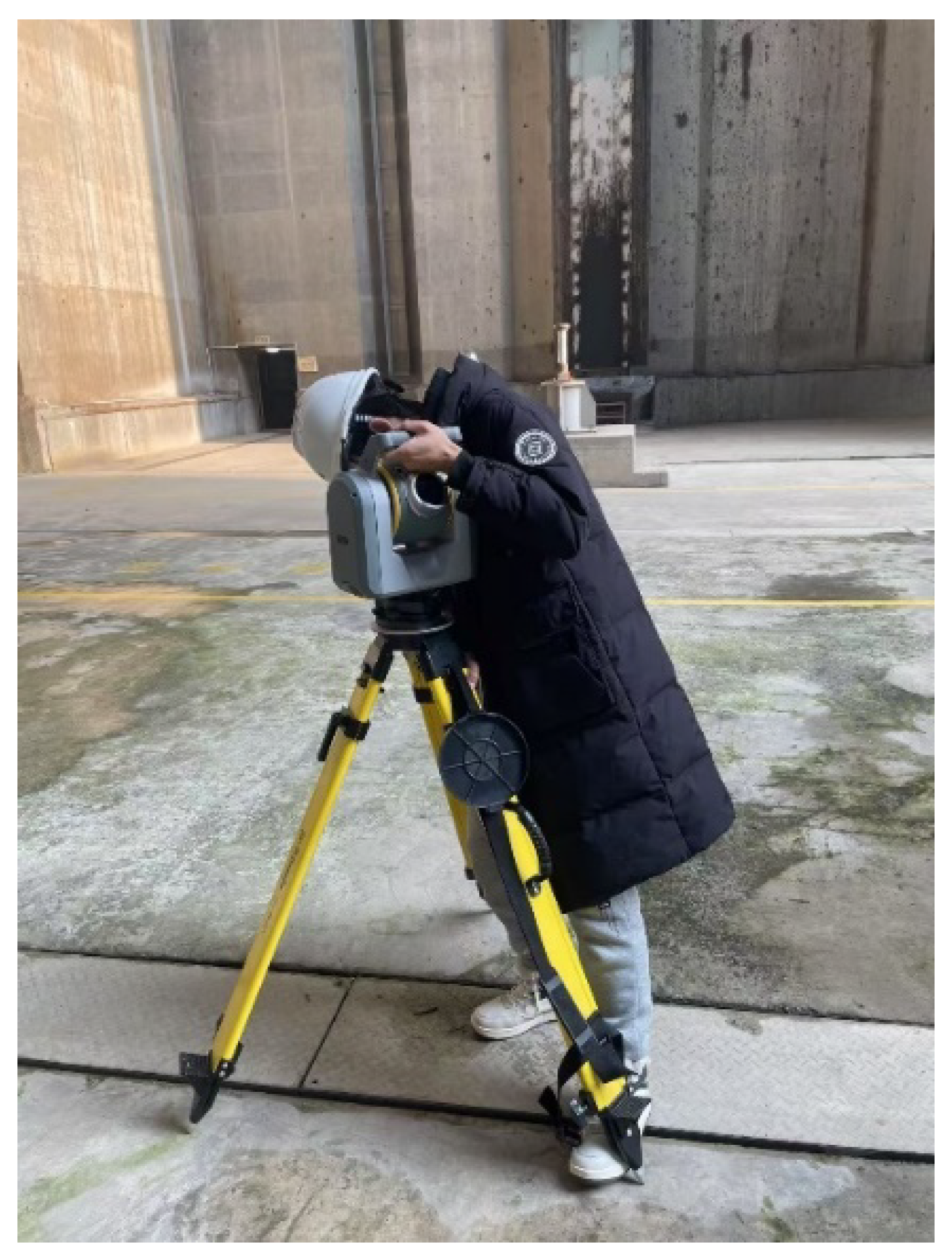
The 3D laser scanner is used to scan the Three Gorges ship lift, and the scanning position is at the bottom of the Three Gorges ship lift. When the Three Gorges ship lift rises to the highest point, the 3D laser scanner is set up at the bottom of the Three Gorges ship lift for bottom scanning. The fiber Bragg grating sensor cable is arranged at the bottom of the Three Gorges ship lift, and its bottom measurement can be a good verification of its bottom deformation. In order to make the measurement results of the three Gorges ship lift more accurate, the three locations of the bottom of the three Gorges ship lift are scanned, and the scanning images of the three locations are registered and spliced to make the three-dimensional information of the scan more accurate and improve the scanning accuracy. The scanning position diagram is shown in Figure 17 and Figure 18, with Figure 18 showing the real photo of the field scanning.
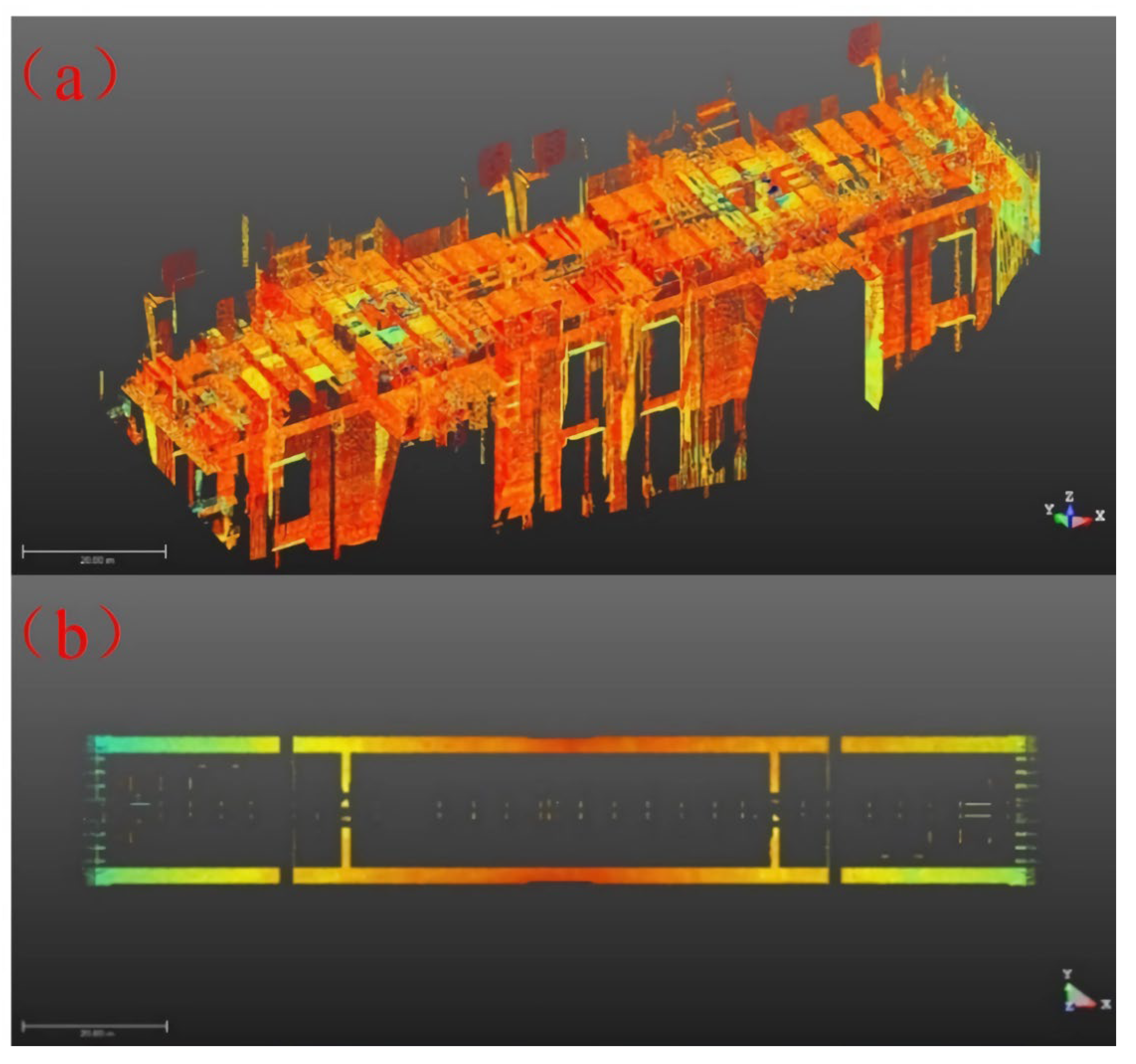
After the bottom of the Three Gorges ship lift is scanned, it is imported into the computer, and the point cloud processing software Trimble RealWorks of the instrument is used to splice the point cloud, obtain the complete point cloud map of the bottom of the Three Gorges ship lift, and extract the coordinate information of the bottom. Similarly, the main longitudinal beam on the north side is regarded as an overhanging beam, and the driving beam is taken as the fulcrum and the deformation zero point. The scanning cloud image of the Three Gorges ship lift is shown in Figure 19a. The processed ship chamber point cloud data are shown in Figure 19b.
After processing the point cloud at the bottom of the ship chamber of the Three Gorges ship lift, the obtained point cloud coordinate results are shown in Table 3.

5.7. Evaluation

The theoretical calculation value obtained from the reconstruction based on the Ko displacement theory was compared with the measured value obtained from 3D laser scanning. Three evaluation methods, absolute error (AE), relative error (RE), and average relative error (ARE), were used to evaluate the deformation reconstruction results. The calculation formulas of absolute error (AE), relative error (RE), and average relative error are as follows:
A E = R S R K ,
R E = R S R K R S × 100 %
A R E = n R E n
where AE represents the absolute error, RS represents the scanning result of a 3D laser scanner, RK represents the theoretical calculation result based on the Ko displacement theory, RE represents the relative error, and ARE represents the average relative error.
The relative error and absolute error of each selected point are calculated, and the results are shown in Table 4 below.

6. Discussion

In order to verify the accuracy of deformation reconstruction based on the CEEMDAN decomposition and Ko displacement theory, firstly, strain results were denoised based on CEEMDAN, Hilbert transform, and Gaussian mixture model classification, so as to pre-process strain data to improve the deformation reconstruction accuracy of Ko displacement theory.
After the strain data are decomposed by the CEEMDAN method, they can be divided into several IMF components according to the frequency, and the noise in the strain data can be separated according to the frequency. During the operation of the Three Gorges ship lift, there are many external factors that affect the change of strain. Moreover, the grating fiber optic cable is very sensitive to the external environment, so the slight changes in the external environment can affect the strain measurement of the fiber grating sensor. During the working process of the Three Gorges ship lift, it is affected by its own motor operating vibration, water filling and drainage system vibration, wind noise, and other factors, and these vibrations or noise can affect the strain sensing cable arranged at the bottom of the Three Gorges ship lift chamber, which has a certain impact on strain monitoring. Therefore, in order to improve the accuracy of deformation reconstruction of the Three Gorges ship lift chamber, it is necessary to reduce the noise of the strain data monitored by the Three Gorges ship lift.
After CEEMDAN decomposition of the strain data, in order to obtain the noise component more accurately, the Hilbert transform is carried out on each order of IMF to obtain the Hilbert marginal spectrum of each IMF component. The Hilbert marginal spectrum area of each IMF component is calculated, and the Hilbert marginal spectrum area is further classified by a Gaussian mixture model. The IMF components belonging to high frequency and low frequency are obtained. After the high-frequency IMF component is removed, the remaining low-frequency IMF components are combined and reconstructed to obtain the reconstructed strain data. By substituting the reconstructed strain data into the deformation reconstruction formula based on the Ko displacement theory, the theoretical deformation at the corresponding position of the ship lift of the Three Gorges ship lift is calculated. Finally, a 3D laser scanner is used to conduct three-dimensional scanning of the ship lift of the Three Gorges, and the point cloud information of the ship lift is obtained. The point cloud information is registered, splice processing is performed, and the accurate three-dimensional model of the ship lift is obtained. The longitudinal value of the ship lift corresponding to the installation position of the grating fiber sensor is further obtained. The corresponding deformation value of the Three Gorges ship lift chamber can be obtained. The deformation value of the ship lift calculated theoretically is compared with the deformation value of the ship lift scanned by a 3D laser scanner, and the result of the comparison between the deformation value of the ship lift and 3D scanning data is obtained. The result shows that the average relative error between the theoretical calculation value and the measured value is 4.54% after the strain noise reduction. It verifies the effectiveness of the noise reduction method in this study and also verifies the validity of the deformation reconstruction equation based on the Ko displacement theory under the condition of pre-deformation.

7. Conclusions

In this paper, a deformation reconstruction method of beam structures based on CEEMDAN-HT-GMM-Ko is proposed, which can remove the noise data in the process of strain collection and greatly improve the deformation reconstruction results based on the Ko displacement theory.
First, CEEMDAN is used to decompose the collected strain information into several IMF components and the original signal into IMF components with different frequencies. In order to select the IMF components with noise components, the Hilbert transform is further performed on the IMF components to obtain the Hilbert marginal spectrum of the IMF components. To obtain the Hilbert marginal spectrum area of each IMF component. The IMF component is classified according to the size of the area, thus obtaining the noise component with a higher frequency. The remaining IMF with the high-frequency component removed was merged and reconstructed to reconstruct the strain information after noise removal. The strain information after noise removal is substituted into the deformation reconstruction method based on the Ko displacement theory, and the deformation reconstruction result is obtained. The 3D laser scanner is used to scan the Three Gorges ship lift, and the deformation reconstruction results after strain denoising are compared. The results show that the average relative error between the theoretical and measured values after strain denoising is 4.54%.
The sensor used in this study is a grating optical fiber sensor, which has high precision, can capture the subtle changes of strain very sensitively, and also plays an important role in improving the accuracy of deformation reconstruction.

Author Contributions

Conceptualization, X.Z.; methodology, S.X.; software, S.X.; validation, S.X.; formal analysis, S.X.; investigation, S.X.; resources, S.X.; data curation, S.X.; writing—original draft preparation, S.X.; writing—review and editing, S.X.; visualization, S.X.; supervision, S.X.; project administration, X.Z.; funding acquisition, X.Z. All authors have read and agreed to the published version of the manuscript.

Funding

This research received no external funding.

Institutional Review Board Statement

Not applicable.

Informed Consent Statement

Not applicable.

Data Availability Statement

The raw data supporting the conclusions of this article will be made available by the authors on request.

Conflicts of Interest

The authors declare no conflict of interest.

References

  1. Foss, G.C.; Haugse, E.D. Using modal test results to develop strain to displacement transformations. In Proceedings of the 13th International Conference on Modal Analysis, Nashvile, TN, USA, 13–16 February 1995; pp. 112–128. [Google Scholar]
  2. Ma, T.; Ding, K.; Shu, A.; Liu, Y. Study on deformation field reconstruction method of liquid storage tank based on Brillouin distributed fiber. Press. Vessel. Technol. 2021, 38, 11–19. [Google Scholar]
  3. Kim, H.-I.I.; Han, J.-H.; Bang, H.-J. Real-time deformed shape estimation of a wind turbine blade using distributed fiber Bragg grating sensors. Wind Energy 2014, 17, 1455–1467. [Google Scholar] [CrossRef]
  4. Freydin, M.; Rattner, M.K.; Raveh, D.E.; Kressel, I.; Davidi, R.; Tur, M. Fiber-Optics-Based Aeroelastic Shape Sensing. AIAA J. 2019, 57, 5094–5103. [Google Scholar] [CrossRef]
  5. Tessler, A.; Dong, S. On a hierarchy of conforming Timoshenko beam elements. Comput. Struct. 1981, 14, 335–344. [Google Scholar] [CrossRef]
  6. Tesssler, A.; Spangler, J.L. A Variational Principle for Reconstruction of Elastic Deformations in Shear Deformable Plates and Shells; NASA Formal Series Reports: Engineering; NASA: Washington, DC, USA, 2003. [Google Scholar]
  7. Tesssler, A.; Spangler, J.L. Inverse FEM for full-field reconstruction of elastic deformations in shear deformable plates and shells. In Proceedings of the 2nd European Workshop on Structural Health Monitoring, Munich, Germany, 7–9 July 2004. [Google Scholar]
  8. Tesssler, A.; Spangler, J.L. A least-squares variational method for full-field reconstruction of elastic deformations in shear-deformable plates and shells. Comput. Methods Appl. Mech. Eng. 2005, 194, 327–339. [Google Scholar] [CrossRef]
  9. Shkarayev, S.; Krashantisa, R.; Tessler, A. An inverse interpolation method utilizing in-flight strain measurements for determining loads and structural response of aerospace vehicles. In Proceedings of the 3rd International Workshop on Structural Health Monitoring, Stanford, CA, USA, 12–14 September 2001. [Google Scholar]
  10. Shkarayev, S.; Ramsn, A.; Tessler, A. Computational experimental validation enabling a viable in-flight structural health monitoring technology. In Proceedings of the 1st European Workshop on Structural Health Monitoring, Cachan, Paris, France, 10–12 July 2002. [Google Scholar]
  11. Liu, M.; Wang, F.; Zhou, F. Optimization study of battery silo deformation monitoring deployment points. J. Wuhan Univ. Technol. 2020, 42, 60–65. [Google Scholar]
  12. Ding, G.; Zhang, Y.; Yan, X.; Lu, Z. Research on propeller deformation reconstruction based on FBG sensing network. Dig. Manuf. Sci. 2020, 18, 164–168. [Google Scholar]
  13. Ding, G.; Yan, X.; Gao, X.; Zhang, Y.; Jiang, S. Reconstruction of propeller deformation based on FBG sensor network. Ocean Eng. 2022, 249, 110884. [Google Scholar] [CrossRef]
  14. Ding, G.; Wang, F.; Gao, X.; Jiang, S. Research on Deformation Reconstruction Based on Structural Curvature of CFRP Propeller With Fiber Bragg Grating Sensor Network. Photonic Sens. 2022, 12, 220412. [Google Scholar] [CrossRef]
  15. Yan, J.; Li, W.; Jiang, M.; Zhang, L.; Zhang, F.; Sui, Q. Fiber grating sensor-based morphology sensing and 3D reconstruction of slab-like structures. Chin. J. Lasers 2020, 47, 231–240. [Google Scholar]
  16. Zhang, K.; Yuan, S.; Ren, Y.; Xu, Y. Deformation reconstruction of deformed airfoil fishbone based on inverse finite element method. Acta Aeronaut Astronaut. Sin. 2020, 41, 250–260. [Google Scholar]
  17. Fu, Z.; Zhao, Y.; Bao, H.; Zhao, F. Dynamic Deformation Reconstruction of Variable Section WING with Fiber Bragg Grating Sensors. Sensors 2019, 19, 3350. [Google Scholar] [CrossRef] [PubMed]
  18. Liu, M.; Zhang, X.; Song, H.; Zhou, S.; Zhou, Z.; Zhou, W. Inverse Finite Element Method for Reconstruction of Deformation in the Gantry Structure of Heavy-Duty Machine Tool Using FBG Sensors. Sensors 2018, 18, 2173. [Google Scholar] [CrossRef]
  19. Liu, M.; Zhou, F.; Song, H.; Yang, X.; Wang, J. Deformation Reconstruction for a Heavy-Duty Machine Column Through the Inverse Finite Element Method. IEEE Sens. J. 2020, 20, 9218–9225. [Google Scholar] [CrossRef]
  20. Li, X.; Niu, S.; Bao, H.; Hu, N. Improved Adaptive Multi-Objective Particle Swarm Optimization of Sensor Layout for Shape Sensing with Inverse Finite Element Method. Sensors 2022, 22, 5203. [Google Scholar] [CrossRef]
  21. Zhao, F.; Bao, H.; Xue, S.; Xu, Q. Multi-Objective Particle Swarm Optimization of Sensor Distribution Scheme with Consideration of the Accuracy and the Robustness for Deformation Reconstruction. Sensors 2019, 19, 1306. [Google Scholar] [CrossRef] [PubMed]
  22. Li, T.; Cao, M.; Li, J.; Yang, L.; Xu, H.; Wu, Z. Structural Damage Identification Based on Integrated Utilization of Inverse Finite Element Method and Pseudo-Excitation Approach. Sensors 2021, 21, 606. [Google Scholar] [CrossRef]
  23. Ding, G.; Yue, S.; Zhang, S.; Song, W. Strain—Deformation reconstruction of CFRP laminates based on Ko displacement theory. Nondestruct. Test. Evaluation 2021, 36, 145–157. [Google Scholar] [CrossRef]
  24. Kirby, G.C.; Lim, T.W.; Wiber, R.; Bosse, A.; Povich, C.; Fisher, S. Strain-based shape estimation algorithms for a cantilever beam. In Proceedings of the SPIE, San Diego, CA, USA, 3–5 March 1997; Volume 43, pp. 788–798. [Google Scholar]
  25. Ko, W.L.; Fleischer, V.T. Extension of Ko Straight-Beam Displacement Theory to Deformed Shape Predictions of Slender Curved Structures; NASA: Silicon Valley, CA, USA, 2011. [Google Scholar]
  26. Jutte, C.V.; Ko, W.L.; Stephens, C.A.; Bakalyar, J.A.; Richards, W.L.; Parke, A.R. Deformed Shape Calculation of a Full-Scale Wing Using Fiber Optic strain DATA From a Ground Loads Test; NASA: Silicon Valley, CA, USA, 2011. [Google Scholar]
  27. Pak, C.-G.; Truax, R.A. Acceleration and Velocity Sensing from Measured Strain; AIAA Infotech @ Aerospace: San Diego, CA, USA, 2016; p. 1229. [Google Scholar]
  28. Esposito, M.; Gherlone, M. Composite wing box deformed-shape reconstruction based on measured strains: Optimization and comparison of existing approaches. Aerosp. Sci. Technol. 2020, 99, 105758. [Google Scholar] [CrossRef]
  29. Hu, M.; Wu, S.; Dong, E. Real-time reconstruction of displacement fields of typical thermal protection structures based on measured strains. J. Southeast Univ. 2021, 51, 664–671. [Google Scholar] [CrossRef]
  30. Xia, L.; Wang, D. A study on deformation estimation combining OFDR and Ko displacement theory. Opt. Commun. Technol. 2021, 45, 53–55. [Google Scholar]
  31. Xiao, L.; Liu, Z.; Zhang, Y.; Zheng, Y.; Cheng, C. Degradation assessment of bearings with trend-reconstruct-based features selection and gated recurrent unit network. Measurement 2020, 165, 108064. [Google Scholar] [CrossRef]
  32. Abdelkader, R.; Kaddour, A.; Bendiabdellah, A.; Derouiche, Z. Rolling Bearing Fault Diagnosis based on an Im-proved Denoising Method Using the Complete Ensemble Empirical Mode Decomposition and the Optimized Thresholding Operation. IEEE Sens. J. 2018, 18, 7166–7172. [Google Scholar] [CrossRef]
  33. Zhao, K.; Xiao, J.; Li, C.; Xu, Z.; Yue, M. Fault diagnosis of rolling bearing using CNN and PCA fractal-based feature extraction. Measurement 2023, 223, 113754. [Google Scholar] [CrossRef]
  34. Wang, L.; Shao, Y. Fault feature extraction of rotating machinery using a reweighted complete ensemble empirical mode decomposition with adaptive noise and demodulation analysis. Mech. Syst. Signal Process. 2020, 138, 106545. [Google Scholar] [CrossRef]
  35. Lu, N.; Li, M.; Zhang, G.; Li, R.; Zhou, T.; Su, C. Fault feature extraction method for rotating machinery based on a CEEMDAN-LPP algorithm and synthetic maximum index. Measurement 2022, 189, 110636. [Google Scholar] [CrossRef]
  36. Hu, Y.; Ouyang, Y.; Wang, Z.; Yu, H.; Liu, L. Vibration signal denoising method based on CEEMDAN and its application in brake disc unbalance detection. Mech. Syst. Signal Process. 2023, 187, 109972. [Google Scholar] [CrossRef]
  37. Zhao, S.; Ma, L.; Xu, L.; Liu, M.; Chen, X. A Study of Fault Signal Noise Reduction Based on Improved CEEMDAN-SVD. Appl. Sci. 2023, 13, 10713. [Google Scholar] [CrossRef]
  38. Zhang, S.; Liu, H.; Hu, M.; Jiang, A.; Zhang, L.; Xu, F.; Hao, G. An Adaptive CEEMDAN Thresholding Denoising Method Optimized by Nonlocal Means Algorithm. IEEE Trans. Instrum. Meas. 2020, 29, 6891–6903. [Google Scholar] [CrossRef]
  39. Dang, S.; Li, L.; Wang, Q.; Wang, K.; Cheng, P. Fiber optic gyro noise reduction based on hybrid CEEMDAN-LWT method. Measurement 2020, 161, 107865. [Google Scholar] [CrossRef]
  40. Zhang, H.; Hou, J.; Li, T.; Wen, G.; Jia, D.; Liu, T. Polarization characteristic parameters measurement of Y-waveguide multi-function integrated optic circuit based on noise reduction processing. Opt. Commun. 2024, 561, 130540. [Google Scholar] [CrossRef]
  41. Zhang, S.; Li, Y. Seismic exploration desert noise suppression based on complete ensemble empirical mode decomposition with adaptive noise. J. Appl. Geophys. 2020, 180, 104055. [Google Scholar] [CrossRef]
  42. Xing, S.; Zhou, X.; Huang, Q.; Zhou, Z.; Wang, L. Beam deformation reconstruction based on Ko displacement theory. Measurement 2024, 238, 115324. [Google Scholar] [CrossRef]
  43. Zhou, Z. Machine Learning; Tsinghua University Press: Beijing, China, 2016; pp. 206–211. [Google Scholar]
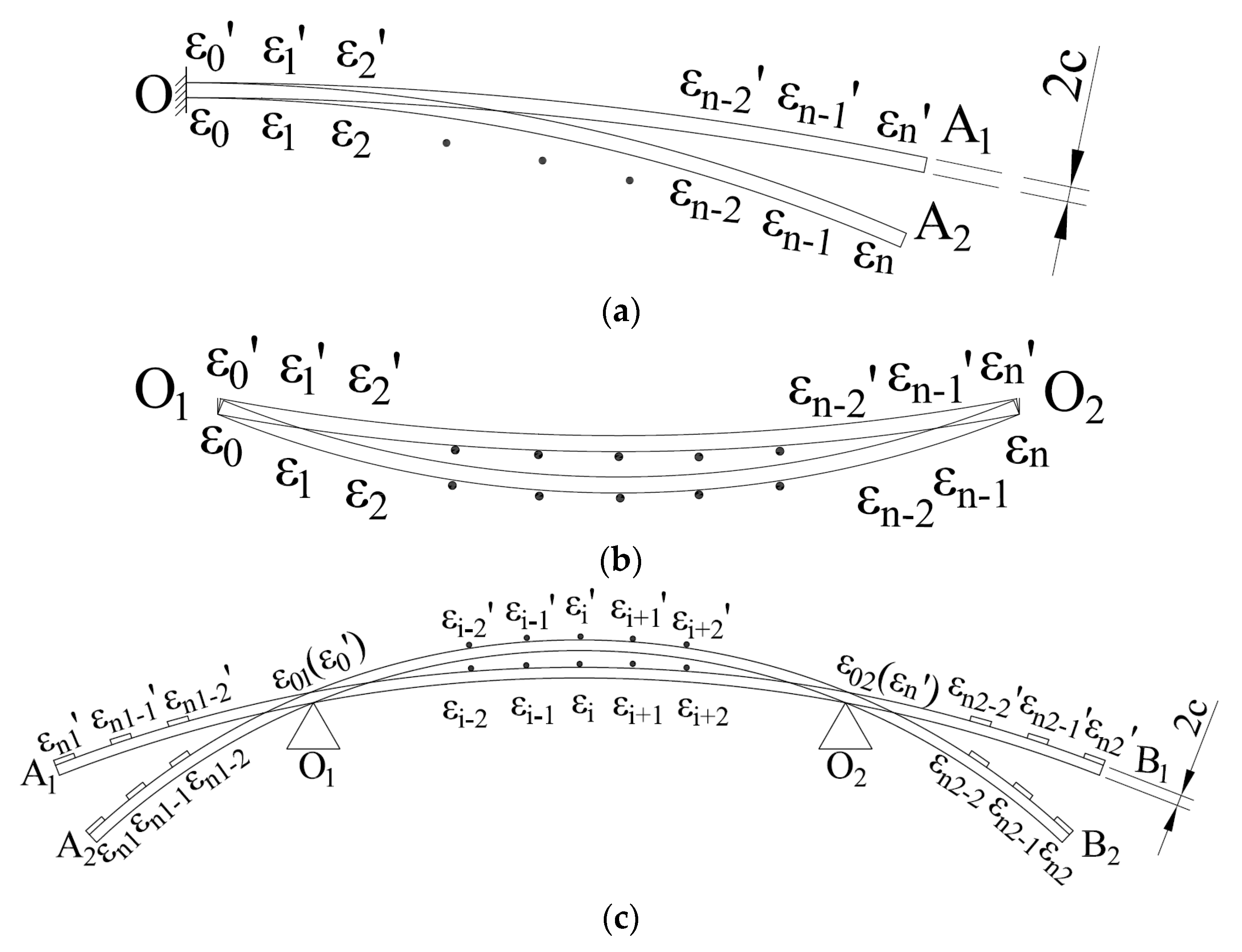
Figure 1. Schematic diagram of beam before and after deformation: (a) cantilever beam; (b) simply supported beam; (c) overhanging beam.
Applsci 16 00349 g001
Figure 2. (a) Structure diagram of the Three Gorges ship lift. (b) Top view of the Three Gorges ship lift chamber structure. (c) Upward view of the Three Gorges ship lift chamber structure.
Applsci 16 00349 g002
Figure 3. Strain optical cable layout diagram.
Applsci 16 00349 g003
Figure 4. Real picture of the installation site.
Applsci 16 00349 g004
Figure 5. Strain variation diagram of measuring point ID: 56.
Applsci 16 00349 g005
Figure 6. Strain decomposition diagram of ID56 at the measuring point.
Applsci 16 00349 g006aApplsci 16 00349 g006bApplsci 16 00349 g006cApplsci 16 00349 g006dApplsci 16 00349 g006e
Figure 7. IMF classification chart.
Applsci 16 00349 g007
Figure 8. Strain diagram after noise and noise reduction.
Applsci 16 00349 g008
Figure 9. Comparison of strain information before and after noise reduction.
Applsci 16 00349 g009
Figure 10. IMF.
Figure 10. IMF.
Applsci 16 00349 g010
Figure 11. Marginal spectra.
Applsci 16 00349 g011
Figure 12. Comparison of peak frequencies of higher-order IMFs.
Applsci 16 00349 g012
Figure 13. Normalized Hilbert marginal spectrum area diagram (a) EMD (b) EEMD (c) CEEMDAN.
Applsci 16 00349 g013aApplsci 16 00349 g013b
Figure 14. Clustering results of marginal spectral area (a) EMD (b) EEMD (c) CEEMDAN.
Applsci 16 00349 g014aApplsci 16 00349 g014b
Figure 15. Side view of the ship compartment of the Three Gorges ship lift.
Applsci 16 00349 g015
Figure 16. Deformation curve of the main longitudinal beam on the north side.
Applsci 16 00349 g016
Figure 17. Schematic diagram of scanning position.
Applsci 16 00349 g017
Figure 18. Real picture of the scanning site.
Applsci 16 00349 g018
Figure 19. (a) Overall cloud image of the Three Gorges ship lift. (b) Bottom cloud image of the Three Gorges ship lift.
Applsci 16 00349 g019
Table 1. The normalized marginal spectral areas obtained by EMD, EEMD, and CEEMDAN methods.
EMDOrder1234567
Area0.20580.14570.09090.05270.03200.01850.0092
Order8910111213
Area0.00540.00350.00130.00130.00130.0013
EEMDOrder1234567
Area0.13150.07720.04080.02460.01550.00880.0056
Order891011121314
Area0.00360.00330.00130.00130.00130.00130.0013
CEEMDANOrder1234567
Area0.18120.13700.07900.04890.03040.01870.0102
Order8910111213
Area0.00520.00320.00150.00130.00130.0013
Table 2. Deformation reconstruction data at selected points.
Coordinate Points 8 21 34 47 60 73 86 99 112
Deformation (cm)−18.7957−2.88381.34805.610110.784312.77979.6740−1.8800−17.4621
Table 3. This table shows the deformation value of the measured point.
Coordinate Points (m) 8 21 34 47 60 73 86 99 112
Deformation value (cm)−17.80−2.721.295.3710.3412.319.26−1.79−16.69
Table 4. Comparison table of deformation reconstruction value and measured value of selected points.
Coordinate Points (m) 8 21 34 47 60 73 86 99 112
Absolute error (cm)0.99570.16380.0580.24010.44430.46970.41400.090.7721
Relative error5.30%5.68%4.30%4.28%4.12%3.68%4.30%4.79%4.42%
The mean relative error is 4.54%.
Disclaimer/Publisher’s Note: The statements, opinions and data contained in all publications are solely those of the individual author(s) and contributor(s) and not of MDPI and/or the editor(s). MDPI and/or the editor(s) disclaim responsibility for any injury to people or property resulting from any ideas, methods, instructions or products referred to in the content.