Article

Improved Attendance Tracking System for Coffee Farm Workers Applying Computer Vision

1
Department of Data Informatics, National Korea Maritime and Ocean University, Busan 49112, Republic of Korea
2
Department of Interdisciplinary Major of Ocean Renewable Energy Engineering, National Korea Maritime and Ocean University, Busan 49112, Republic of Korea
3
Division of Business Administration, Pukyong National University, Busan 48547, Republic of Korea
4
Division of Maritime AI & Cyber Security, National Korea Maritime and Ocean University, Busan 49112, Republic of Korea
5
Department of Data Science, National Korea Maritime and Ocean University, Busan 49112, Republic of Korea
6
Department of Convergence Study on the Ocean Science and Technology, Ocean Science and Technology School (OST School: KMOU & KIOST), Busan 49112, Republic of Korea
7
Ocean Renewable Energy (BK 21 Four Research Group) of Interdisciplinary Major of Ocean Renewable Energy Engineering, National Korea Maritime and Ocean University, Busan 49112, Republic of Korea
8
School of Computer Science and Engineering, Yeungnam University, Gyeongsan 38541, Republic of Korea
*
Authors to whom correspondence should be addressed.
These authors contributed equally to this work.
Appl. Sci. 2026, 16(1), 319; https://doi.org/10.3390/app16010319 (registering DOI)
Submission received: 5 November 2025 / Revised: 13 December 2025 / Accepted: 18 December 2025 / Published: 28 December 2025
(This article belongs to the Special Issue Future Information & Communication Engineering 2025)

Abstract

Agricultural mechanization and advanced technology have developed significantly in the coffee industry. However, there are still requirements for human laborers to operate, monitor crop health care, and manage production. The integration of advanced technology can significantly enhance the production efficiency and management practices of agricultural enterprises. This paper aims to address these gaps by proposing and implementing a computer vision-based attendance tracking system on mobile platforms that are suitable for the requirements and limitations of agricultural enterprises. First, the face detection process involves interpreting and locating facial structure. Next, the model transforms a photographic image of a human face into digital data based on the unique features and facial structure. We utilize the InsightFace model with the buffalo_l variant, as well as ArcFace with a ResNet backbone, as a facial recognition algorithm. After capturing a facial image, the system conducts a matching process against the existing database to verify identity. Finally, we implement a mobile application prototype on both iOS and Android platforms, ensuring accessibility for farm workers. As a result, our system achieved 95.2% accuracy on the query set, with an average processing time of <200 ms per image (including face detection, embedding extraction, and database matching). The system performs real-time attendance monitoring, automatically recording the entry and exit times of farm workers using facial recognition technology, and enables quick registration of new workers. Our work is expected to enhance transparency and fairness in the human management process, focusing on the coffee farm use case.

1. Introduction

Coffee is an important agricultural crop that contributes to economic development and creates jobs in many countries. Coffee cultivation is primarily carried out in small-scale farming, mainly using family labor in production, management and harvesting [1]. Nowadays, agricultural mechanization and advanced technology have developed significantly with modern equipment such as weeding robots, fruit-picking machines, automatic irrigation systems, etc. [2]. These technologies primarily play a supporting role and cannot fully replace human labor. In many situations, the agricultural sector still requires a certain amount of labor to operate and monitor crop health care and production management [3]. Attendance and work assignment are two important tasks to track farm workers’ working time, record total working hours, support salary calculation, and work performance management [4,5]. Current labor attendance management in agricultural settings mainly relies on manual methods, including paper-based sign-in sheets, verbal confirmation by supervisors and physical presence verification. While these traditional approaches are simple to implement, they present several significant limitations. Supervisor assessments can be subjective and biased, while manual time tracking and paper logs are prone to human error and lack real-time insights. Paper-based systems lack real-time insights, making it difficult to synchronize information across dispersed farm locations. These problems can lead to difficulties in controlling and synchronizing information, which in turn affects work efficiency and the ability to manage human resources effectively.
In the agricultural sector, tracking attendance in large farm areas is challenging due to geographical dispersion and heterogeneity. Particularly during the season, farms often need a large number of temporary workers to perform tasks such as harvesting and tending crops, requiring an effective management system to ensure that workers are properly recorded and paid. Monitoring all workers becomes complicated when they work in many different locations. Previous works have developed various advanced attendance-tracking technologies, such as biometric systems [6], radio-frequency identification (RFID) [7,8], facial recognition [9,10], etc. Although technologies such as biometrics or RFID have been developed, they may not work effectively in outdoor environments or have limited connectivity. Therefore, it is necessary to apply technological solutions that are suitable for geographical conditions and the characteristics of agriculture. Information management systems related to working time and work assignments need to be improved, perhaps by utilizing mobile applications or online platforms, to make it easier for workers to record their work progress. Finally, the platform needs to be user-friendly and capable of quickly training workers on work procedures and safety requirements. Ease of use will help workers grasp information faster, thereby improving work efficiency and ensuring safety during production. Additionally, the deployment and practical use of these applications can be hindered by financial limitations, insufficient technical expertise, and cost limitations [11,12]. Many agricultural enterprises, especially small-scale farms, cannot afford expensive equipment and software [13].
This paper aims to address these gaps by proposing a cost-effective facial recognition framework for improving labor attendance accuracy and reducing administrative burden in agricultural enterprises. Our system is meticulously designed to operate smoothly on a cost-effective architecture. It includes real-time facial data streaming and historical tracking reporting through a compact mobile application that is suitable for low-end phone configurations. The system also integrates cloud computing to reduce data storage and processing costs, helping small farms to access and deploy without large investments in infrastructure. The use case focuses on the coffee farm to enhance transparency and fairness in the management process. The research objectives can be defined as below:
Objective 1. To improve attendance verification accuracy compared to traditional manual tracking methods by applying facial recognition technology.
Objective 2. To reduce administrative time overhead in labor management through automated attendance recording and work assignment integration.
Objective 3. To evaluate the effectiveness of the proposed framework against baseline manual methods and existing approaches in terms of accuracy, processing time, and deployment cost.
The rest of the paper is organized as follows. Section 2 provides an overview of AI-based facial recognition attendance systems, with a focus on agricultural enterprises. Section 3 describes the proposed framework and experimental setting. Section 4 presents the implementation results and assesses the framework’s performance. Finally, Section 5 discusses the conclusions and prospective efforts to improve the results.

2. Research Background

2.1. Farm Workers Attendance Monitoring System

Coffee agriculture has changed significantly due to the fourth industrial revolution and advanced technology developments [14]. The previous work focused on optimizing resource use, minimizing environmental impact, improving crop health, effective planning and supply chain management. Also, there have been trends of developing and utilizing modern mechanical systems, such as weeding robots, fruit-picking machines, automatic irrigation systems, remote sensing, etc., in smart coffee farms [2]. Advanced technologies can support farming operations but cannot fully replace human labor. Farmers still play a key role in this context, making important contributions through their experienced cultivation techniques to improve agricultural quality and productivity. Coffee is a specialized crop, often grown on large farms and in extensive areas. Family labor must manage and care for coffee plants over a large expanse. Human Resource Management (HRM) on farms and production areas is facing many challenges. During the harvest season, more workers are needed, so farm owners often have to hire additional seasonal labor. HRM and work assignments on coffee farms are often not prioritized, which can lead to high costs and losses for farm owners. Ineffective management of labor costs can result in waste, while unstable labor conditions make it challenging to maintain quality work.
By leveraging advanced information technology in human resource management, organizations can improve their operational efficiency [15]. Generally, Human Resource Management System (HRMS) is designed to efficiently manage human resources and related processes throughout the entire employee lifecycle in the organization [16]. Therefore, HRMS can cover all functions to optimize the enterprise’s human resource management process. HRMS optimizes the process by tracking personal information, contracts and employee records. It supports organizational management by tracking structures, recruitment, training and payroll management. HRMS also aids recruitment, training planning, and employee feedback, ensuring effective human resource planning. In this paper, we focus on human resource management in an agriculture enterprise, especially coffee farms, with the target human resource being farm workers. Therefore, we will prioritize the development of the attendance monitoring module. This module can support salary calculation and help to assign work effectively. This is the most basic and important need for users, helping them easily apply it to their daily work practices. The implementation of the attendance module will contribute to improving the efficiency of human resource management, thereby improving labor productivity in agriculture.
Farm owners used to rely on manual logbooks to monitor and manage farm workers attendance. This will involve manually validating and recording working time of farm workers, which requires significant time and effort. This process can lead to errors, such as wrong information or data manipulation. Artificial Intelligence-based (AI) attendance monitoring solutions, such as fingerprint recognition [17,18], iris recognition [12,19], speech recognition [20,21,22], facial recognition [23,24,25,26,27,28,29], etc., have emerged to overcome the limitations of traditional methods. Attendance monitoring solutions based on facial recognition have been researched and developed recently.
Espinosa et al. (2020) present the application of facial recognition technology to address operational challenges at Archempress Fruit Corporation [28]. The authors investigate the application of facial recognition for detecting, tracking and identifying faces to automate timekeeping and payroll processes. Núñez et al. (2024) developed facial recognition-based attendance tracking for organizations using artificial neural networks (ANNs) [29]. The proposed facial recognition system model based on ANN architecture can feature from input data using a defective backpropagation approach. The results demonstrate high precision in classifying and identifying individuals. Danh et al. (2024) developed a mobile application based on facial recognition technology for attendance monitoring [30]. The application automatically records employees’ working hours using real-time facial recognition and location analysis. The results show that the system uses the Resnet34 model for facial recognition, achieving 92% accuracy with fast processing time (1–3 s). However, this study has some limitations. First, although the application is aimed at SMEs, the study does not address the cost and accessibility of cloud infrastructure. This study stands out by integrating compact alternative recognition algorithms that offer fast and accurate recognition capabilities in real-world conditions for agricultural workers. Also, the attendance monitoring dashboard has been developed. This study targets the coffee industry group explicitly, considering factors such as working conditions and variability in work operations.
In the context of smart agriculture, there is previous work that explores AI-based attendance applications. Johannah and Tephillah (2023) present an intelligent attendance monitoring system for large farms by applying deep learning facial recognition technology [31]. The proposed system is built on the Raspberry Pi platform, utilizing a webcam to capture images and perform facial recognition using models such as Mobile FaceNet and the Haar cascade classifier. The system can perform live monitoring and improve recognition accuracy from 1% to 5% across different datasets. However, these limitations can be addressed in future research. First, the quality of the collected data can be affected by lighting and environmental conditions, which can lead to inaccurate facial recognition. The system also relies on hardware, which can be difficult for farmers with limited technological infrastructure. Also, the designed architecture for the coffee farm workers’ attendance tracking system is presented [32]. A design for a system to track the attendance of coffee farm workers is also presented. However, this work only proposes a general system design without going into practical implementation experiments. In this study, we will conduct testing and implementation steps for the system, ensuring that it not only functions in theory but also meets the specific needs of workers in outdoor working environments. We will consider factors such as the accuracy of the recognition technology and the ability to handle real-world conditions to create a compelling and practical solution for attendance tracking.
Although previous works have explored the application of facial recognition technology in attendance monitoring and payroll management, research gaps remain in this field, particularly in the agricultural context. Current research primarily focuses on developing facial recognition attendance systems for controlled indoor environments such as offices and classrooms, where lighting conditions are stable and network connectivity is reliable. These solutions often require substantial investments in physical infrastructure to support the processing of complex computer vision algorithms, creating financial barriers for stakeholders and increasing the complexity of system deployment and maintenance. In agricultural settings, the transition from manual to automated attendance tracking presents unique challenges, including outdoor environmental variability, limited technical infrastructure, and cost constraints faced by small-scale farming operations. Most current work focuses solely on the theoretical aspect or application model, without providing specific and detailed development processes for end users. This paper aims to address these gaps by proposing and implementing a CV-based attendance tracking system on mobile platforms that are suitable for the requirements and limitations of agricultural enterprises.

2.2. Face Recognition Technology Functions of the Attendance Tracking System

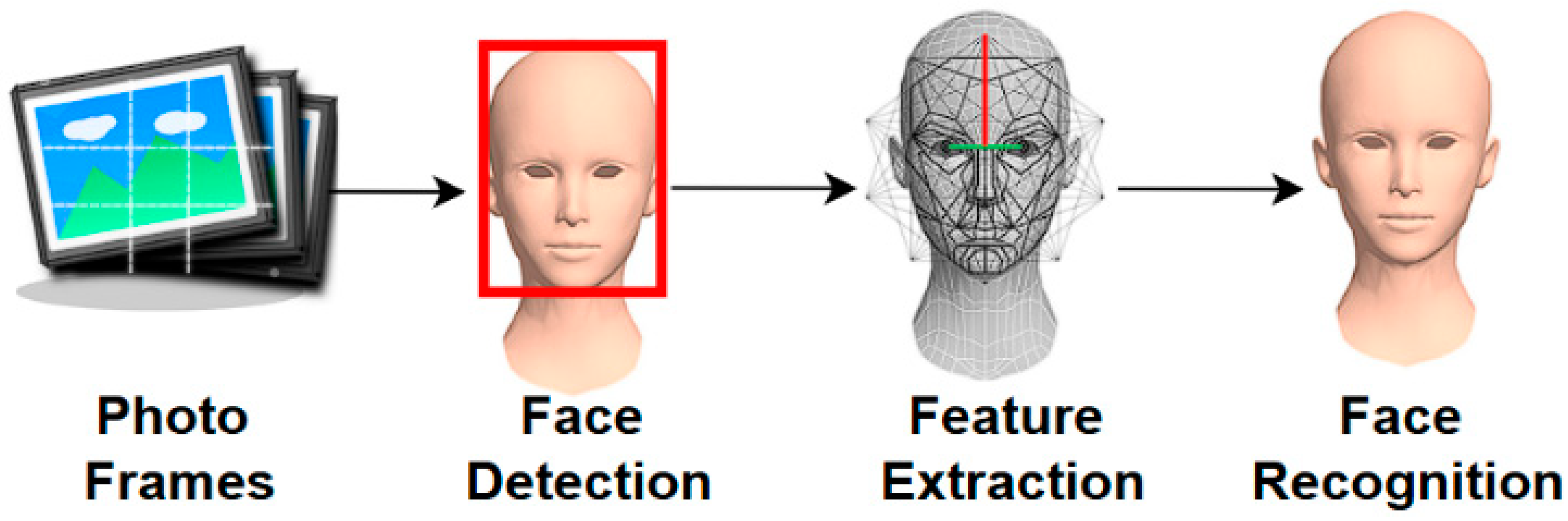
Face recognition is an important research topic in computer vision within human biometrics. General principles of face recognition use machine learning or deep learning algorithms to identify and authenticate a person’s identity based on facial features [33]. The face recognition process is shown in Figure 1.
The process begins with detecting and locating faces from photo frames extracted from image or video sources [34]. Face detection involves validating and locating faces by comparing facial alignment with those recorded in the database [35]. Next, facial features are extracted, including the distance between the eyes, the width of the nose, and the shape of the chin. Finally, face recognition algorithms are applied to compare extracted features to the saved vectors in the database. If the similarity between these vectors exceeds a certain threshold, the face is authenticated. There are many face recognition algorithms being developed and utilized in previous works, such as Support Vector Machine (SVM) [36,37,38], Principal Component Analysis (PCA) [39,40], Kernel methods [41], Linear Discriminant Analysis (LDA) [42], Trace Transforms [43,44], etc.
Facial recognition-based attendance systems have been developed and have many important. These solutions can resolve the current issues related to manual attendance methods, such as time-consuming, failure or wrong attendance information, human errors [41,45]. Espinosa et al. (2020) present the application of facial recognition technology to address operational challenges at Archempress Fruit Corporation [28]. Núñez et al. (2024) developed facial recognition-based attendance tracking for organizations using ANNs [29]. The results demonstrate high precision in classifying and identifying individuals. Danh et al. (2024) developed a mobile application based on facial recognition technology for attendance monitoring [30]. The application automatically records employees’ working hours using real-time facial recognition and location analysis. Johannah and Tephillah (2023) present an intelligent attendance monitoring system for large farms by applying deep learning-based facial recognition technology [31]. Munlin (2022) improved the precision of attendance systems by combining eigenface and local binary patterns histograms (LBPH) techniques [46]. The proposed LBPH extension algorithm can outperform with an accuracy of 100%. Kakarla et al. (2020) developed a smartphone application for attendance monitoring [47]. The authors utilized the CNN algorithm for face detection, Microsoft Azure’s Face API for face recognition. The proposed system can significantly improve precision in facial recognition. Sultan et al. (2020) presented a real-time attendance system utilizing a facial recognition methodology [48]. These authors develop a pre-trained model that integrates the Dlib library to facilitate the recognition of student faces in captured images. Vaidya et al. (2022) developed a streamlined attendance system as a web-based solution [49]. The proposed application allows users to access it via any browser, regardless of the device used. The server program employs the Open-Source Computer Vision (OpenCV) library for facial recognition. Mohamed et al. (2022) experimented with multiple models to enhance the facial recognition abilities of the attendance system [50]. As a result, the improved model achieved a maximum accuracy of 0.993.
Current research primarily focuses on developing facial recognition attendance systems in educational settings, particularly classroom management, without considering the requirements and limitations in other contexts. Previous solutions often require high investments in physical infrastructure to support the processing of massive and complex computer vision algorithms. This can create a financial burden for stakeholders and increase the complexity of system deployment and maintenance. As a result, many farm owners, especially those with limited resources, are overlooked when adopting this advanced technology. Therefore, developing a cost-effective mobile application that can operate effectively on standard mobile devices will be crucial in making facial recognition time attendance technology more accessible and widely available.

3. Research Model and Experiment Setup

3.1. Research Model Design

This paper aims to address gaps by proposing a cost-effective facial recognition framework to improve labor attendance accuracy and reduce administrative overhead in agricultural enterprises. The key contributions of this study are: (1) a comparative analysis of manual attendance methods versus automated facial recognition approaches in agricultural contexts, (2) a cost-optimized hardware-software configuration suitable for small-scale farm deployment, and (3) an empirical evaluation demonstrating the effectiveness of the proposed framework in improving attendance verification accuracy compared to baseline manual methods. The framework is designed to operate on standard mobile devices, making facial recognition-based attendance technology more accessible to farm owners with limited resources.
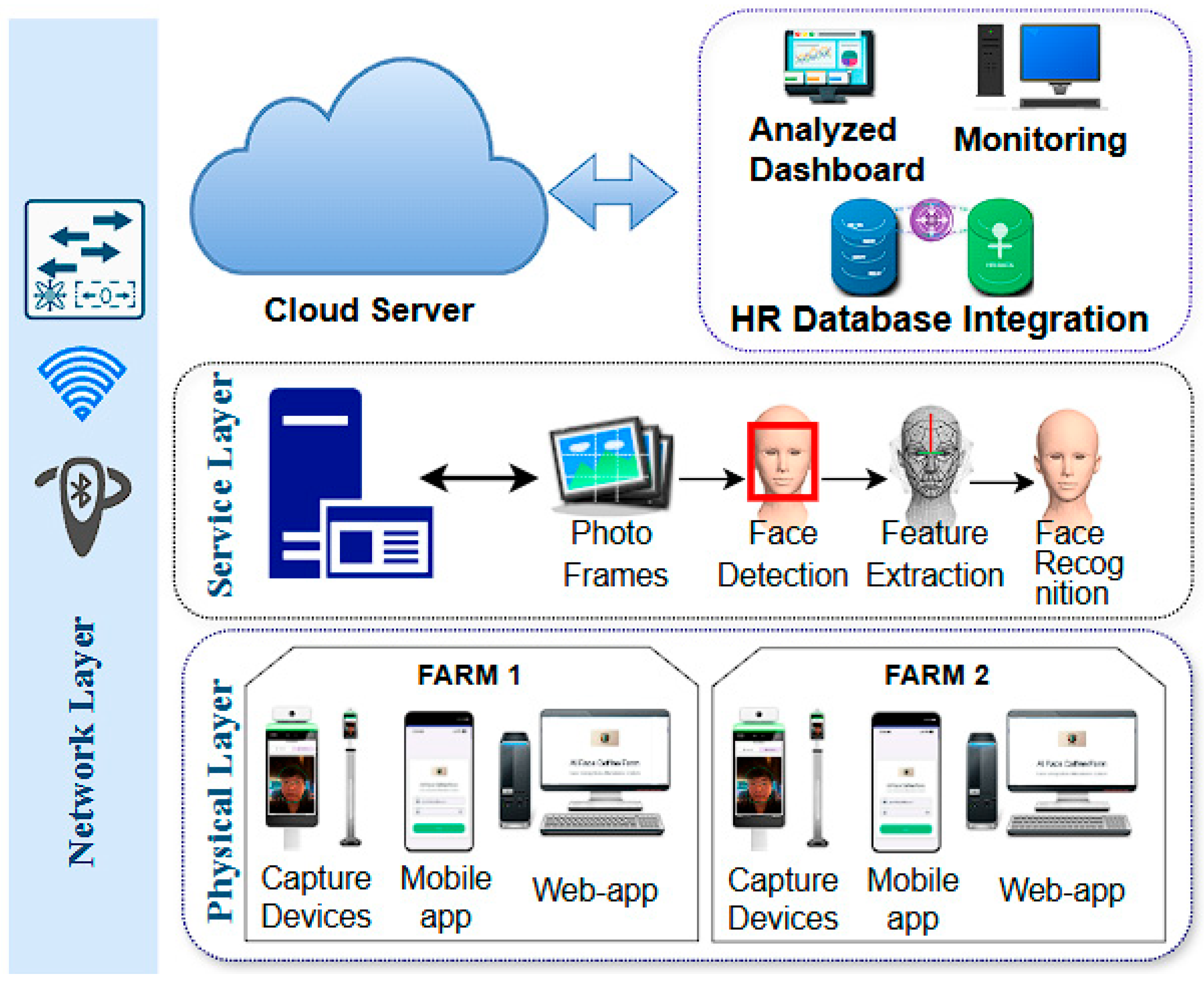
The architecture of our attendance tracking system includes four main layers, as shown in Figure 2. The physical layer uses cameras and mobile or web applications to collect real-time data from various farm locations. The service layer includes the central server, which is responsible for training and processing the facial recognition model. The central server will receive the input as an image or video stream from the capture devices. The process begins with a pre-processing step, where the images are normalized to improve accuracy. Then, a facial recognition algorithm is used to identify faces in the image. Facial features are extracted and compared with vectors stored in the database. If the vectors match, the identity of the worker is confirmed. Finally, the recognition results are sent to the user interface via API, facilitating job tracking and management.
The application layer focuses on aggregating and analyzing data to provide a summary report on the current work of farmers. The system integrates with the human resource database to aggregate the information needed for payroll calculation, ensuring accuracy and transparency. Based on the results of attendance and facial recognition, the system can also effectively monitor and assign work to each farmer. All this data will be updated to the cloud server, enabling convenient and secure storage and management of information, which in turn improves efficiency in human resource management and agricultural operations.
Ultimately, the Network Layer ensures network connectivity throughout the entire system. It ensures efficient communication between data collection devices and the server. Additionally, this layer focuses on security, ensuring that data is transmitted securely and protecting sensitive worker information from potential threats. The network layer enables the system to be extended to different farms as needed, meeting the needs of future development and operational expansion.
The sequence diagram illustrates the interaction process between system components, as depicted in Figure 3. First, the farm workers perform start attendance checks through the application by taking a photograph of their faces. Next, the system will compare the extracted features with the faces stored in the database. If the face is recognized, the system will record the attendance information and update the record. Conversely, if the face does not match, the system will notify that the new worker has not been registered and proceed to register the new face in the database. All attendance information will be updated in the human resource management system, enabling effective management of workers’ data.
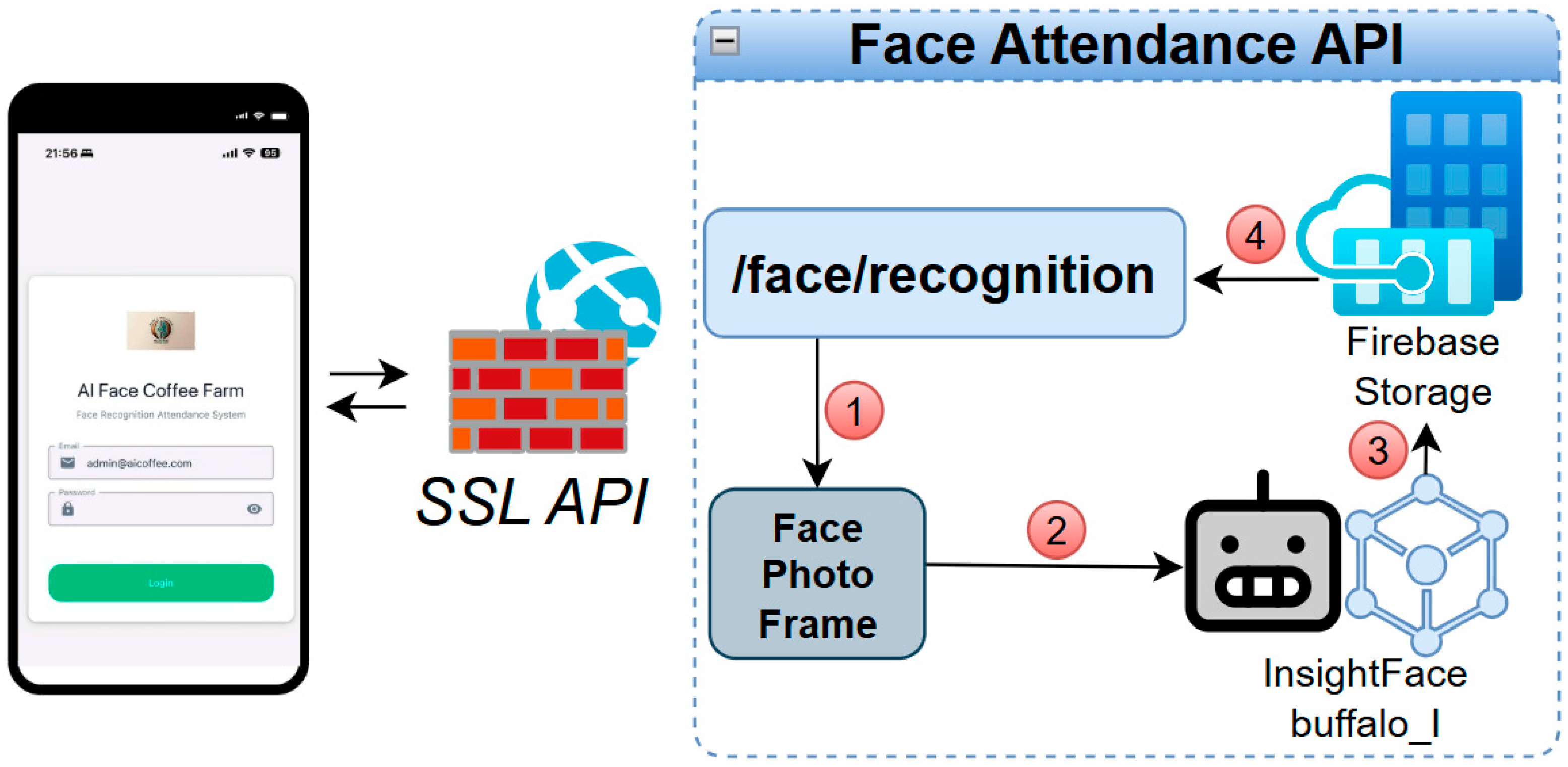
Figure 4 illustrates the microservices architecture for our attendance tracking mobile application. The proposed architecture divides the application into four main, independent services that perform specific functions, allowing for flexibility in development and expansion. On the front end, the application is developed using React Native, allowing users to log in and select the attendance button.
The back end consists of multiple microservices: Service 1 handles user authentication, Service 2 performs facial recognition, Service 3 stores and manages images, and Service 4 manages user information. All requests from the front-end are managed through an API Gateway, which coordinates requests to the appropriate services. The application can acquire video or photo streams to initiate the attendance tracking procedure. The video frames are encoded in Base64 and transmitted to the API Gateway endpoint. The photo frame is sent to the recognition service, which is conducted centrally on the server to minimize the application’s footprint and ensure efficient image processing. Service 2 performs facial recognition on the input photo frames. First, the face detection process involves interpreting and locating facial structure. Next, the model transforms a photographic image of a human face into digital data based on the unique features and traits of the individual’s facial structure. Facial characteristics will be analyzed using algorithms and formulas, producing unique facial data for each individual. The next phase involves comparing the new facial database with the existing one. If the similarity between these vectors is higher than a certain threshold, the face is authenticated. We utilize the InsightFace model with the buffalo_l variant and ArcFace loss function in the ResNet backbone, as a facial recognition algorithm. This model has an input size of 640 × 640 pixels and produces embedding features with a length of 512, which enables accurate and efficient face recognition. In Service 3, the Firebase has been established to facilitate the storage of facial information. The identification process is completed when the captured face is accurately matched with an image in the database. On the other hand, the system will alert staff to new user enrollment or to modify existing data. The proposed front-end and back-end architecture allows for extending functionality or supporting additional features. APIs can be optimized to handle multiple concurrent requests without sacrificing performance.

3.2. Face Recognition Procedure

Face recognition is the process of detecting and validating individual faces within an image. It typically comprises three primary stages: face detection, feature extraction and face matching.

3.2.1. Face Detection

Face detection involves identifying the presence of a human face in an input image. This paper utilizes Multi-task Cascaded Convolutional Networks (MTCNN) for determining face location and alignment. MTCNN architecture comprises three sequential CNNs that perform face detection, including P-Net, R-Net, and O-Net [51]. The P-Net generates numerous candidate regions, which the R-Net further refines, and ultimately, the O-Net provides precise localization of facial landmarks. The MTCNN library was utilized to enhance the image, thereby improving the model’s recognition accuracy through several processes: standardizing the image, normalizing pixel distribution, generating images with skew angles, displacing the image horizontally/vertically, and inverting the image. The detected face results are stored in the Firebase database for management.

3.2.2. Face Recognition

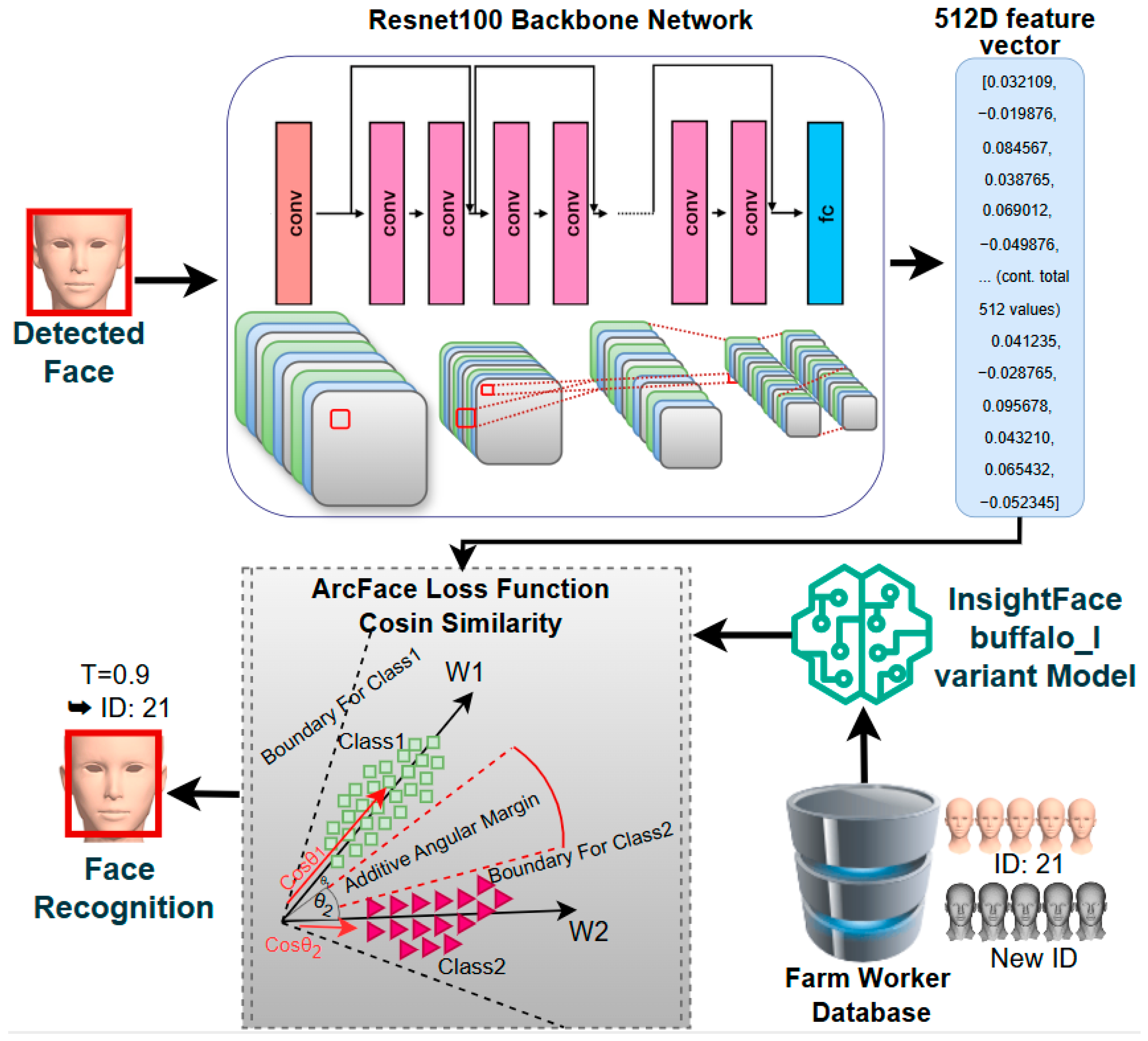
The face recognition process in this paper uses the InsightFace (v0.7.3) model, specifically the buffalo_L variant, as shown in Figure 5. First, the detected and aligned face image is fed into the ResNet100 backbone network. ResNet100 is a 100-layer deep neural network architecture optimized for feature extraction.
Here, the face is converted into a 512-dimensional feature vector, representing the facial features in a digital form. The InsightFace model is trained using the ArcFace loss function, which causes vectors representing the same person to cluster together and vectors representing different people to be pushed apart in the multidimensional space, thereby creating powerful features that can generalize even across different viewpoints. Finally, the recognition process compares the extracted vectors with vectors in the database through cosine similarity.
A complete facial recognition workflow is presented in Pseudocode below (See Appendix A). The workflow in Table A1 starts with preprocessing the input image, converting it to RGB color space, and then into a real number array. Next, the MTCNN model detects and aligns faces using landmarks, ensuring consistency in the extraction of features. The InsightFace model, equipped with the ResNet-100 backbone, is utilized for feature extraction, converting the image into a 512-dimensional feature vector. Finally, the input face feature vector is then compared to all vectors in the database using cosine similarity, determining the identity of the input face.

3.3. Designed Functions

The main functions of the system are described in Table 1 below. The system performs real-time attendance monitoring, automatically recording the entry and exit times of farm workers using facial recognition technology, and enables quick registration of new workers. Attendance data is continuously updated and provided to management for easy monitoring and review. The system also integrates GPS geolocation tracking, ensuring that workers check in/out only from authorized locations or farms. Additionally, the system collects and stores attendance history, enabling users to search and filter existing records, thereby facilitating more efficient data management. The system also enables the generation of detailed attendance reports, including absenteeism rates and working hours, which can be exported to various formats for seamless payroll processing. Finally, secure authentication methods are used to verify employee identities, ensuring that only authorized personnel have access to attendance data.
In our research, facial data storage and protection are important issues when deploying facial recognition technology for farm workers. First, all workers will be informed about the purpose of data collection and how their data will be used in our system. Next, in our system, we do not store the original facial images in the database; only the extracted 512-dimensional embeddings are kept. The recognition process compares the extracted vectors with those in the database using cosine similarity. These embeddings are irreversible representations, meaning that the original facial images cannot be reconstructed from the stored vectors, thereby enhancing privacy protection. In addition, facial data is stored locally on the farm server to minimize the risk of unauthorized access and ensure data sovereignty. Access to the biometric database is restricted through role-based authentication and all data transmission between devices is encrypted.

3.4. Research Environment

We built an experimental prototype on a low-cost infrastructure using open-source software and cloud services, significantly reducing initial investment costs. We use a local computer to process raw images, extract image features, develop the recognition program, and create mobile application (see Table 2). This computer serves as the primary server of the system, managing all resource records and query data. A cloud server is also configured as a secondary server for backup and scalability.
This configuration represents a practical balance between computational capability and cost-effectiveness for agricultural applications. The NVIDIA GeForce RTX 3080 TI GPU provides sufficient parallel processing power for real-time facial embedding extraction, while the 128 GB RAM allows efficient handling of batch image processing and database operations. The use of Ubuntu LTS ensures system stability and compatibility with open-source machine learning libraries. The total hardware cost is estimated at approximately $2400 USD, which is significantly lower than commercial facial recognition solutions for similar functionality.
We use Python 3.10 for developing the face recognition module with InsightFace and deep learning frameworks. The mobile attendance application is built using React Native with Expo framework, enabling cross-platform deployment on both iOS and Android devices. Firebase provides backend services, including Firestore for storing attendance records and user data, and Firebase Storage for managing facial images during the enrollment process.

4. Implementation Results and Discussion

4.1. Face Dataset and Recognition Pipeline

In this paper, we develop a custom facial dataset that includes images of our teammates and friends for training and testing, supporting our research prototype. In this work, the research dataset comprises 1000 face images of different individuals recorded under various conditions, including lighting, scale, emotion, and background, across diverse lighting scenarios and perspectives, to adapt to different conditions in the farm environment. To improve the model’s generalizability and address the data scarcity, the images were enhanced using transformation methods. Geometric transformation methods include rotating the image with random angles (±15 degrees), shifting horizontally and vertically (up to 10% of the image width/height), flipping the image horizontally to create symmetrical versions of the face, and changing the zoom ratio (from 0.9 to 1.1 times). In addition, color and image quality transformation techniques are also applied, including adjusting brightness and contrast (±20%), changing the white balance, adding random Gaussian noise, and simulating various lighting conditions. The faces were then labelled by bounding boxes to create the training dataset. Finally, the face images are processed using the InsightFace framework with the Buffalo_L model package, which employs a ResNet-100 backbone pretrained with ArcFace loss, to extract 512-dimensional facial embeddings [52,53]. These embeddings are stored in the database for recognition. During inference, cosine similarity is computed between the query embedding and stored embeddings, with a threshold of 0.8 to determine a match.
In this work, we employ the pretrained Buffalo_L model from InsightFace rather than training a face recognition model from scratch. This decision is motivated by several factors. First, training a robust face recognition model requires a large dataset of faces. It is impractical for our research prototype, which currently has only 1000 images. Our dataset is used for evaluation purposes, not for training the recognition model. Next, transfer learning allows us to leverage state-of-the-art performance without the computational cost and time required for training deep networks from scratch. In the context of building a cost-effective facial recognition attendance system for coffee farms, using a pretrained model significantly reduces development time and infrastructure requirements. Deploying a lightweight and accurate solution is essential. The pretrained Buffalo_L model can be deployed on edge devices or low-cost hardware without requiring expensive GPU clusters for training, making it suitable for rural agricultural settings where internet connectivity and computational resources may be constrained. The Buffalo_L model demonstrates accuracy on standard face recognition benchmarks, achieving 99.6% on the Labeled Faces in the Wild (LFW) dataset [54]. These benchmarks evaluate recognition performance under variations in pose, age, and lighting conditions similar to those encountered in the farm environment.
The evaluation protocol is structured as follows: our dataset consists of 1000 face images, which are divided into two sets. The enrollment set comprises 700 images used to create a facial embedding database, with multiple images for each individual to account for variations in pose and lighting. The query set consists of 300 images that serve as test queries to evaluate recognition accuracy. Recognition accuracy is determined by calculating the percentage of query images that are correctly matched to their corresponding identities in the enrollment database. A match is deemed correct if the cosine similarity between the query embedding and the top-matched enrollment embedding exceeds the threshold of 0.8, and if the matched identity corresponds to the ground-truth identity of the query image.
a c c u r a c y = C o r r e c t   m a t c h e s T o t a l   q u e r i e s × 100 %
Our system achieved 95.2% accuracy on the query set, with an average processing time of <200 ms per image (including face detection, embedding extraction, and database matching). The reported processing time of <200 ms represents the end-to-end latency for a single image. The processing time was measured by averaging 100 consecutive inference runs to account for variability. GPU warm-up was performed before measurements to ensure stable performance.
Previous work has explored AI-based attendance applications. The intelligent attendance monitoring system for large farms (2023) is built on the Raspberry Pi platform, utilizing a webcam to capture images and perform facial recognition using models [31]. The best-performing model has an accuracy of 99.28%. However, faces in complex backgrounds cannot be effectively recognized because they are being captured using a web camera with a resolution of 1920 × 1080. In comparison, our approach utilizes the Buffalo_L model from InsightFace, which demonstrates superior accuracy on standard face recognition benchmarks. Furthermore, the Buffalo_L model with ResNet-100 backbone extracts more robust 512-dimensional embeddings compared to lightweight models typically deployed on Raspberry Pi, enabling better generalization to complex real-world scenarios.

4.2. Attendance Tracking Mobile Phone Application for Coffee Farm Workers

The deployment as a mobile application for our attendance system facilitates mobility and attendance tracking in different farm locations. The interface of the attendance tracking application is designed to be user-friendly and intuitive, helping farm workers access the necessary information. This helps improve efficiency in personnel management and encourages farmers to actively participate in the technological process actively, thereby improving productivity and safety at work. Figure 6 presents the primary interface of the application. The login screen includes input fields for username and password and a “Login” button to access the system.
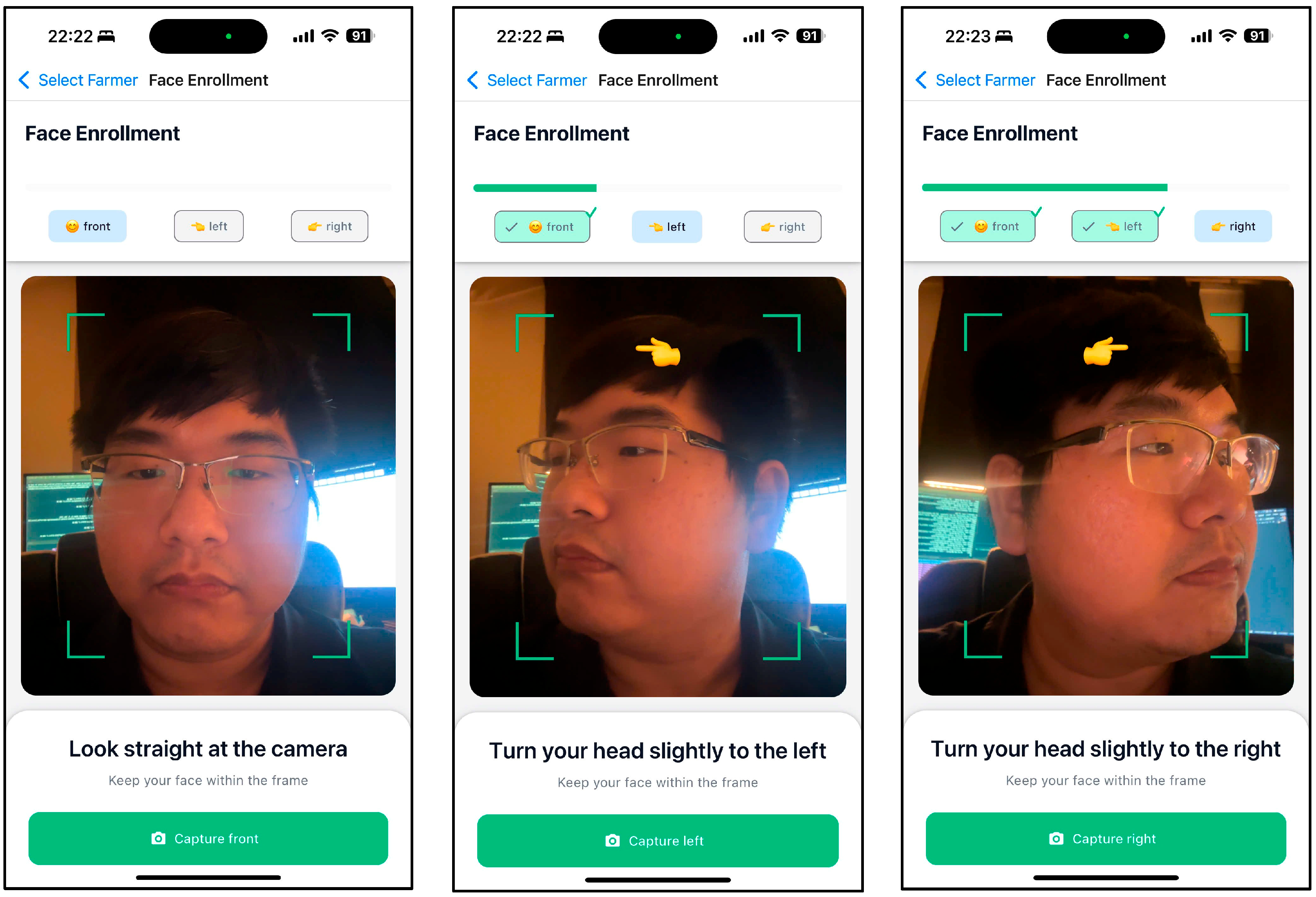
The new face registration function for workers is designed to ensure optimal image quality for recognition. When users start the registration process, they will see an interface asking them to take photos from three angles: front, left, and right (See Figure 7). The interface allows users to review each photo they have taken. If any photo does not meet the requirements, users can easily select “Retake All” to retake all angles or tap on a specific image to retake that angle. After the photo is taken, a message stating “Success” will appear when the registration process is successfully completed, and a “Complete Enrollment” button will appear to end the process. This function helps capture facial images consistently and provides real-time feedback.
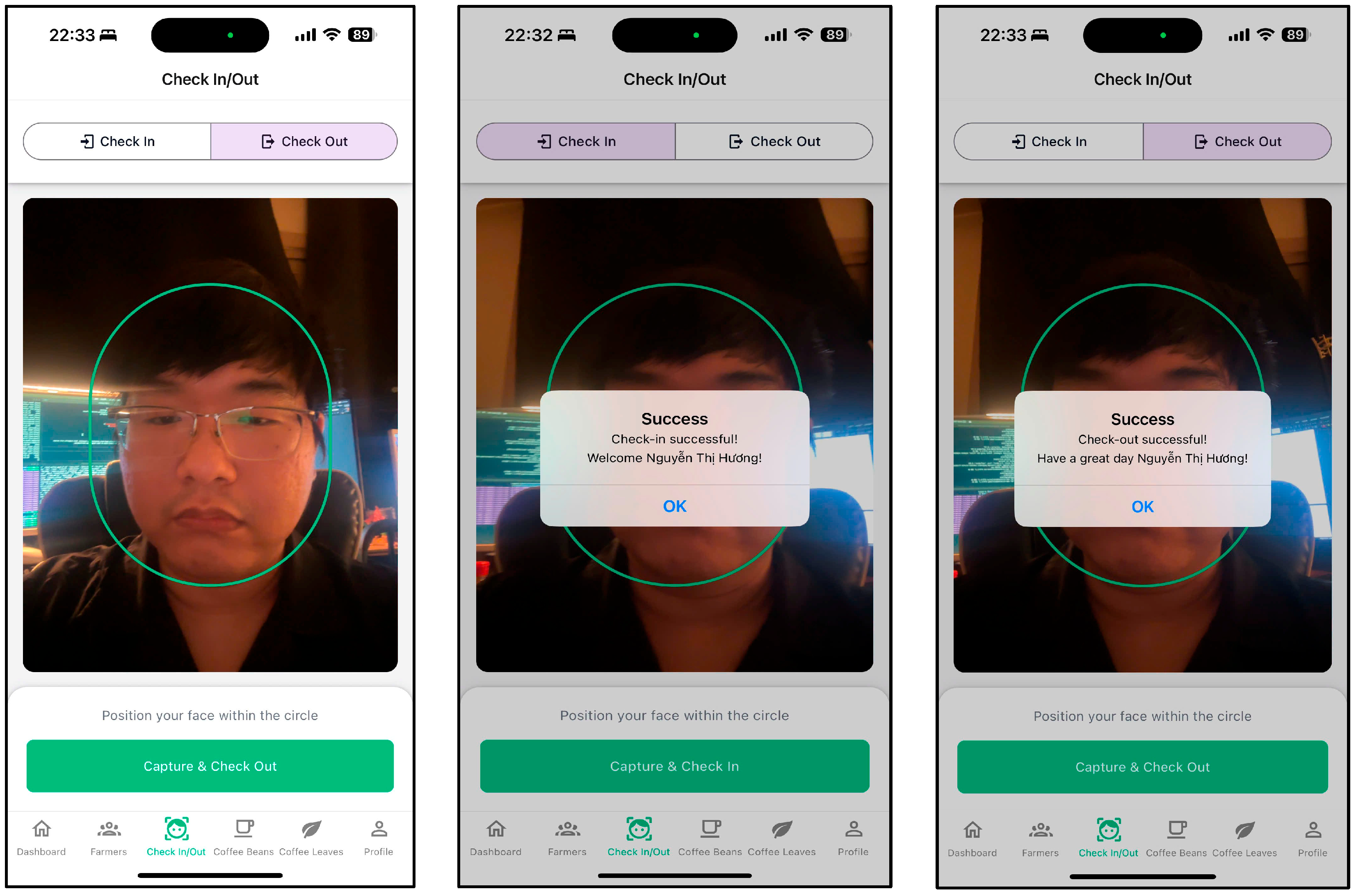
The farm worker attendance check-in/out function based on facial recognition technology is designed simply and effectively, as shown in Figure 8. When workers want to roll call, they need to open the interface and place their faces in the circle on the screen. The system will automatically recognize and confirm their identity. When the recognition is successful, a “Success” message appears, along with a personalized greeting such as “Welcome [Farm Worker Name]” to confirm that the worker has successfully checked in. Similarly, when workers roll call out, the process is the same, with a “Success” message and wishes such as “Have a great day!” to create a friendly feeling. This function saves workers’ time and ensures the accuracy and safety of the roll call process, helping managers easily monitor the activities of each worker on the farm. In addition, since the primary target audience of this application is farmers, we have designed interfaces and functions to be easy to use, suitable for users with varying technological skills. The application provides straightforward instructions and immediate feedback, enabling farmers to become accustomed to attendance tracking and face registration with minimal difficulty.
Figure 9 presents a comprehensive dashboard displaying key data points, including total farmers, active participants and individuals currently engaged in work. This centralized platform enables farm managers to monitor workforce activity efficiently. It provides detailed attendance metrics, including check-in and check-out times, attendance records, working hours, late entries, early exits, breaks, and absences. The attendance log, illustrated in Figure 9, offers direct insight into individual employee behavior. Moreover, this functionality is crucial in enforcing adherence to labor regulations regarding attendance tracking. By making records transparent and easily accessible, the system strengthens accountability and regulatory compliance in human resource management within an agricultural context.
The attendance history functionality comprehensively records the presence and daily activities of farm workers. Farm owners or authorized staff may review attendance logs for individual employees or entire teams through an intuitive interface, ensuring transparency and accuracy. Users can identify a specific worker via a dropdown menu or search option, streamlining navigation. Additionally, the system enables filtering attendance data by precise date ranges (week, month, or custom period), allowing for targeted analysis. Additionally, the mobile application can integrate with existing HR management systems, automating record-keeping and ensuring the integrity of all attendance data. This integration minimizes manual entry and strengthens data security and continuity for farm operations.

4.3. Evaluation Comparison

Due to the lack of available baseline performance data on manual methods used for recording worker attendance in agriculture from previous research, we conducted field observations at a coffee farm in Lam Dong Province, Vietnam, to measure the time required for manual attendance recording. The traditional attendance process involved a supervisor manually recording their presence in a paper-based roster. Each worker was required to sign the attendance sheet. Field observations revealed that this manual process required approximately 10 to 30 s per worker. Next, in Table 3, we provide a comparison of traditional manual methods and the proposed framework.
Experimental results demonstrate that the proposed framework achieved 95.2% recognition accuracy under outdoor farm conditions, with an average attendance check time of less than 200 milliseconds per worker. The proposed framework, therefore, reduces attendance check time by more than 99% while simultaneously eliminating vulnerability to identity fraud through biometric verification. While manual record-keeping can be prone to human errors (for example, incorrectly recorded hours worked), these are eliminated in the proposed system due to the automation of record-keeping. Also, the manual method lacks the ability to synchronize attendance data in real-time or automatically generate reports, so it requires the supervisor to manually collect all attendance records and submit them to farm management. In contrast, the proposed system has the capability to sync attendance data in real-time and automatically generate reports using cloud-based data storage. This allows farm management to access up-to-date attendance information from anywhere. The proposed system also supports both iOS and Android platforms, providing convenience for multiple users and accommodating the diverse mobile phone platform preferences of farm employees.
Finally, our cost-saving configuration represents a practical balance between computational capability and cost-effectiveness for agricultural applications. The total hardware cost is estimated at approximately $2400 USD, which is significantly lower than commercial facial recognition solutions for similar functionality.

5. Conclusions

Although many AI applications in smart agriculture are available for crop management and livestock monitoring, research on improving labor attendance accuracy specifically designed for farm environments remains limited. Currently, most labor attendance is conducted manually, which is subject to human error, does not provide real-time data synchronization and allows for the potential of time fraud.
The purpose of this paper is to propose a cost-effective facial recognition framework that improves attendance verification accuracy and reduces the administrative burden for farmers in agricultural enterprises. This framework utilizes the InsightFace model with the Buffalo_L variant and ArcFace with a ResNet 100 backbone, and is optimized for operation on standard mobile devices, considering the limited technological resources available to small-scale farming operations. Results from experimental trials demonstrated that the proposed framework achieved 95.2% recognition accuracy outdoors in a farm environment, with an average processing time of under 200 milliseconds for each verification trial.
Due to the framework proposed by the authors, the attendance check time was reduced by 99% (from 10–30 s to around 1 s per worker) compared to the traditional manual roll-call method. When compared to traditional manual attendance tracking systems, the proposed framework offers increased verification reliability and eliminates common fraud mechanisms using biometric identification. In addition, based on hardware costs of approximately $2400, the proposed framework represents a cost-effective solution compared to commercial alternatives, thereby increasing the feasibility of the proposed framework for adoption by medium-sized agricultural operations.
The main contributions of this study are: (1) implementing a facial recognition-based attendance framework in agricultural contexts, (2) providing a cost-optimized configuration balancing recognition accuracy with deployment feasibility, and (3) empirical evidence supporting the practical applicability of the proposed framework for farm labor management.
Limitations of the present study include the absence of long-term field deployment of the proposed framework, which could potentially expose additional issues or problems not identified in laboratory-controlled experiments. Future studies will implement pilot testing of the proposed framework on operational coffee farms to evaluate its effectiveness under prolonged real-world conditions, gather user feedback, and assess the impacts of the proposed framework on administrative efficiency and payroll accuracy.

Author Contributions

Conceptualization, H.-D.T.; Formal analysis, N.-B.-V.L.; Funding acquisition, D.L.; Investigation, H.-D.T., Y.L., D.L. and J.-H.H.; Methodology, H.-D.T., Y.L., N.-B.-V.L., D.L. and J.-H.H.; Project administration, D.L. and J.-H.H.; Resources, H.-D.T. and N.-B.-V.L.; Software, H.-D.T., Y.L. and N.-B.-V.L.; Supervision, J.-H.H.; Validation, H.-D.T., D.L. and J.-H.H.; Visualization, Y.L. and J.-H.H.; Writing—original draft, H.-D.T., Y.L., N.-B.-V.L., D.L. and J.-H.H.; Writing—review and editing, Y.L., D.L. and J.-H.H. All authors have read and agreed to the published version of the manuscript.

Funding

This research received no external funding.

Institutional Review Board Statement

Not applicable.

Informed Consent Statement

Written informed consent has been obtained from the patients to publish this paper.

Data Availability Statement

Please contact the corresponding author for data requests. The coding environment employed is Visual Studio, encompassing Python programming capabilities alongside Node.js and React Native. The database management system in use is Firebase. Developing mobile applications uses Expo as a framework for building React Native applications. We have published the resources of the paper on GitHub [55]. Ref. [55] Hong Danh Thai, YuanYuan Liu, Ngoc-Bao-Van Le, Daesung Lee, Jun-Ho Huh, “Improved-Attendance-Tracking-System-for-Coffee-Farm-Workers-Applying-Computer-Vision,” [Online]. Available: https://github.com/thaihongdanhh/Improved-Attendance-Tracking-System-for-Coffee-Farm-Workers-Applying-Computer-Vision/tree/main (accessed on 10 October 2025).
Acknowledgments

This Research Paper is an extended version of a proceeding titled “Improved Attendance Tracking System for Coffee Farm Workers [32],” presented at The 58th Korea Institute of Information and Communication Engineering (KIICE) Fall Conference, October 2025. The extended version is attached. We would like to express our sincere gratitude to the anonymous session chair and the three reviewers of the academic conference for their valuable comments and constructive feedback.

Conflicts of Interest

The authors declare no conflict of interest.

Appendix A

A complete facial recognition workflow is presented in Pseudocode below. The workflow starts with preprocessing the input image, converting it to RGB color space, and then into a real number array. Next, the MTCNN model detects and aligns faces using landmarks, ensuring consistency in the extraction of features. The InsightFace model, equipped with the ResNet-100 backbone, is utilized for feature extraction, converting the image into a 512-dimensional feature vector. Finally, the input face feature vector is then compared to all vectors in the database using cosine similarity, determining the identity of the input face.
Table A1. Face Recognition Pseudocode.
Input:
Input image needs to be recognized input_image
Farm worker database contains pre-registered feature vectors and labels farmworker_database

Output:
Label of the person being identified or new record woker_identity
Confidence of the identification result confidence_score

1. PREPROCESS INPUT IMAGE
        img_pixels = image.img_to_array(input_image)
        img_pixels = np.expand_dims(img_pixels, axis = 0)
        img_pixels = normalize_pixels(img_pixels)

2. FACE DETECTION AND ALIGNMENT
        mtcnn_detector = MTCNN()
        detections = mtcnn_detector.detect_faces(img_pixels)
        IF len(detections) == 0 THEN
               RETURN “No face detected”, 0.0
        main_face = detections[0]
        FOR detection IN detections:
               IF detection[‘confidence’] > main_face[‘confidence’] THEN
                       main_face = detection
        bbox = main_face[‘box’]             # [x, y, width, height]
        landmarks = main_face[‘keypoints’] # {‘left_eye’: (x,y), ‘right_eye’: (x,y), …}
        aligned_face = align_face_using_landmarks(img_pixels, landmarks, image_size = 112)

3. EXTRACT FACE EMBEDDING
        aligned_face = aligned_face.astype(np.float32)
        aligned_face = (aligned_face − 127.5)/128.0   # Normalization cho InsightFace
        aligned_face = np.expand_dims(aligned_face, axis = 0)
        face_embedding = insightface_model.predict(aligned_face)
        face_embedding = face_embedding/np.linalg.norm(face_embedding)
        face_embedding = np.squeeze(face_embedding)

4. FACE MATCHING WITH DATABASE
        best_similarity = −1.0
        best_match_label = “ unknown”

        FOR EACH (stored_embedding, label) IN database:
               similarity = np.dot(face_embedding, stored_embedding)/(
               np.linalg.norm(face_embedding) * np.linalg.norm(stored_embedding)
        )
        IF similarity > best_similarity THEN
               best_similarity = similarity
               best_match_label = label


5. VERIFICATION WITH THRESHOLD
        threshold = 0.8
        IF best_similarity >= threshold THEN
               identity = best_match_label
               confidence_score = best_similarity
        ELSE
               identity = “unknown”
               confidence_score = best_similarity

6. RETURN RESULT
        RETURN identity, confidence_score list_label.append(folder)

References

  1. Vegro, C.L.R.; de Almeida, L.F. Global coffee market: Socio-economic and cultural dynamics. In Coffee Consumption and Industry Strategies in Brazil; Woodhead Publishing: Cambridge, UK, 2020; pp. 3–19. [Google Scholar]
  2. Reddy, R. Innovations in agricultural machinery: Assessing the impact of advanced technologies on farm efficiency. J. Artif. Intell. Big Data 2022, 2, 64–83. [Google Scholar] [CrossRef]
  3. Karas, J.; Skýpalová, R.; Tomšík, P. Human capital in agriculture: Barriers to industry 4.0. Ad Alta J. Interdiscip. Res. 2022, 12, 298–301. [Google Scholar]
  4. Fernando, M.P.A.S.; Silva, K.N.N. An Analysis of the Application of Human Resource Management (HRM) Practices in Agricultural Farms: Perception of Farm Employees. Proc. Int. Conf. Bus. Manag. 2021, 18, 1–21. [Google Scholar] [CrossRef]
  5. Qorri, D.; Szabó, E.P.; Felföldi, J.; Kovács, K. The role of human resource management in agricultural labor-saving technologies: An integrative review and science mapping. Agriculture 2024, 14, 1144. [Google Scholar] [CrossRef]
  6. Garg, V.; Singhal, A.; Tiwari, P. A Study on Transformation in Technological Based Biometrics Attendance System: Human Resource Management Practice. In Proceedings of the 2018 8th International Conference on Cloud Computing, Data Science & Engineering (Confluence), Noida, India, 11–12 January 2018; pp. 809–813. [Google Scholar] [CrossRef]
  7. Lim, J.C.; Kasim, N.; Zainal, R.; Musa, S.M.S. Radio frequency identification (RFID) implementation for human tracking in safety management at construction site. Res. Manag. Technol. Bus. 2022, 3, 431–444. [Google Scholar]
  8. Sunny, Y.F.M.; Krishnan, N.F.M.; Taib, S.M.; Savita, K.S. Attendance System using Radio-Frequency Identification (RFID) Technology and Cloud-Based Services in Higher Education. In Proceedings of the 2024 8th International Conference on Computing, Communication, Control and Automation (ICCUBEA), Pune, India, 23–24 August 2024; pp. 1–6. [Google Scholar] [CrossRef]
  9. Nguyen-Tat, B.-T.; Bui, M.-Q.; Ngo, V.M. Automating attendance management in human resources: A design science approach using computer vision and facial recognition. Int. J. Inf. Manag. Data Insights 2024, 4, 100253. [Google Scholar] [CrossRef]
  10. Painuly, K.; Bisht, Y.; Vaidya, H.; Kapruwan, A.; Gupta, R. Efficient Real-Time Face Recognition-Based Attendance System with Deep Learning Algorithms. In Proceedings of the 2024 International Conference on Intelligent and Innovative Technologies in Computing, Electrical and Electronics (IITCEE), Bangalore, India, 24–25 January 2024; pp. 1–5. [Google Scholar] [CrossRef]
  11. Ingalagi, S.S.; Mutkekar, R.R.; Kulkarni, P.M. Artificial Intelligence (AI) adaptation: Analysis of determinants among Small to Medium-sized Enterprises (SME’s). IOP Conf. Ser. Mater. Sci. Eng. 2021, 1049, 012017. [Google Scholar] [CrossRef]
  12. Hansen, E.B.; Bogh, S. Artificial intelligence and internet of things in small and medium-sized enterprises: A survey. J. Manuf. Syst. 2021, 58, 362–372. [Google Scholar] [CrossRef]
  13. Dhillon, R.; Moncur, Q. Small-scale farming: A review of challenges and potential opportunities offered by technological advancements. Sustainability 2023, 15, 15478. [Google Scholar] [CrossRef]
  14. Dayıoğlu, M.A.; Turker, U. Digital transformation for sustainable future-agriculture 4.0: A review. J. Agric. Sci. 2021, 27, 373–399. [Google Scholar] [CrossRef]
  15. Seifedine, K.; Mohamad, S. Wireless attendance management system based on iris recognition. Sci. Res. Essays 2010, 5, 1428–1435. [Google Scholar]
  16. Boon, C.; Den Hartog, D.N.; Lepak, D.P. A systematic review of human resource management systems and their measurement. J. Manag. 2019, 45, 2498–2537. [Google Scholar] [CrossRef]
  17. Uddin, M.S.; Allayear, S.M.; Das, N.C.; Talukder, F.A. A location based time and attendance system. Int. J. Comput. Theory Eng. 2014, 6, 36. [Google Scholar] [CrossRef]
  18. Boateng, M.S.; Ofori, K. Impact Assessment of Biometric Fingerprint Application for Timekeeping at KNUST Library. J. Appl. Thought 2015, 4, 255–273. [Google Scholar]
  19. Nayak, A.; Satpathy, I.; Mishra, B.S.; Patnaik, B.C.M.; Das, B. Biometric A Helping Hand in Talent Management: A Modern Time Tracking Tool. In Proceedings of the 2022 International Conference on Advancements in Smart, Secure and Intelligent Computing (ASSIC), Bhubaneswar, India, 19–20 November 2022; pp. 1–7. [Google Scholar] [CrossRef]
  20. Oyebola, B.O.; Olabisi, K.O.; Adewale, O.S. Fingerprint for personal identification: A developed system for students attendance information management. Am. J. Embed. Syst. Appl. 2018, 6, 1–10. [Google Scholar] [CrossRef]
  21. Okeke, H.S.; Afuye, T.; Abdulhamid, I.G. Implementation of an Intelligent Attendance System. In Proceedings of the 3rd International Conference, The Federal Polytechnic Ilaro, Ilaro, Nigeria, 16–17 August 2022; pp. 67–73. [Google Scholar]
  22. Hoo, S.C.; Ibrahim, H. Biometric-based attendance tracking system for education sectors: A literature survey on hardware requirements. J. Sens. 2019, 2019, 7410478. [Google Scholar] [CrossRef]
  23. Al-Waisy, A.S.; Qahwaji, R.; Ispon, S.; Al-Fahdawi, S.; Nagem, T.A.M. A multi-biometric iris recognition system based on a deep learning approach. Pattern Anal. Appl. 2018, 21, 783–802. [Google Scholar] [CrossRef]
  24. Nguyen, T.H.; Dao, C.T.; Phan, N.M.T.; Nguyen, T.N.C.; Phan, T.T.; Pham, H.N. Automatic Attendance System Based on Face Recognition Using HOG Features and Cosine Distance. In Future Data and Security Engineering. Big Data, Security and Privacy, Smart City and Industry 4.0 Applications; Dang, T.K., Küng, J., Takizawa, M., Chung, T.M., Eds.; FDSE 2020; Communications in Computer and Information Science; Springer: Singapore, 2020; Volume 1306. [Google Scholar] [CrossRef]
  25. Tran, T. Automatic Attendance System in the Workplace Based on Face Recognition in Real-Time Using the Principal Component Analysis Method and Eigenface Technique. Bachelor’s Thesis, LAB University of Applied Sciences, Lahti, Finland, 2022. [Google Scholar]
  26. Pham, T.N.; Nguyen, V.H.; Huh, J.H. COVID-19 monitoring system: In-browser face mask detection application using deep learning. Multimed. Tools Appl. 2024, 83, 61943–61970. [Google Scholar] [CrossRef]
  27. S, R.; A, K.; R, A.; Kannan, C.K. Automatic Attendance Monitoring System Using LBPH and HAAR Algorithm. In Proceedings of the 2023 9th International Conference on Advanced Computing and Communication Systems (ICACCS), Coimbatore, India, 17–18 March 2023; pp. 1604–1608. [Google Scholar] [CrossRef]
  28. Espinosa, S.K.K.; Paray, M.; Tanquiamco, D.; Jandayan, C.; Pamela, G.D. Analysis and Design of Employee Attendance Monitoring Using Face Recognition System for Archempress Fruit Corporation; SSRN: New York, NY, USA, 2020. [Google Scholar]
  29. Núñez, A.; Jácome, J.; Vaca, K.; Balseca, B.; Jara, R. Feasibility Enterprise Time and Attendance System Using Artificial Vision Based on Neural Networks with Python and Raspberry Pi. ESPOCH Congr. Ecuadorian J. STEAM 2024, 3, 72–84. [Google Scholar] [CrossRef]
  30. Thai, H.-D.; Seo, Y.-S.; Huh, J.-H. Enhanced Efficiency in SMEs Attendance Monitoring: Low Cost Artificial Intelligence Facial Recognition Mobile Application. IEEE Access 2024, 12, 184257–184274. [Google Scholar] [CrossRef]
  31. Johannah, J.J.; Tephillah, S. Intelligent Farmhouse Attendance Monitoring System Using Deep Learning. In Proceedings of the 2023 International Conference on Advances in Computing, Communication and Applied Informatics (ACCAI), Chennai, India, 25–26 May 2023; pp. 1–7. [Google Scholar] [CrossRef]
  32. Thai, H.D.; Liu, Y.; Le, N.-B.-V.; Lee, D.; Huh, J.-H. Improved-Attendance-Tracking-System-for-Coffee-Farm-Workers-Applying-Computer-Vision. In Proceedings of the 58th Korea Institute of Information and Communication Engineering (KIICE) Fall Conference, Busan, Republic of Korea, 23–25 October 2025; pp. 1–3. [Google Scholar]
  33. Odewole, T.; Kadel, R. Smart Attendance System in an Enterprise-Based Access Point Environment. In Proceedings of the 2020 30th International Telecommunication Networks and Applications Conference (ITNAC), Melbourne, VIC, Australia, 25–27 November 2020; pp. 1–6. [Google Scholar] [CrossRef]
  34. Fadel, N.E. Facial Recognition Algorithms: A Systematic Literature Review. J. Imaging 2025, 11, 58. [Google Scholar] [CrossRef]
  35. Hsu, R.-L.; Abdel-Mottaleb, M.; Jain, A. Face detection in color images. IEEE Trans. Pattern Anal. Mach. Intell. 2002, 24, 696–706. [Google Scholar] [CrossRef]
  36. Jain, A.K.; Stan, Z.L. Handbook of Face Recognition; Springer: London, UK, 2011; Volume 1. [Google Scholar] [CrossRef]
  37. Zhao, W.; Chellappa, R.; Phillips, P.J.; Rosenfeld, A. Face recognition: A literature survey. ACM Comput. Surv. 2003, 35, 399–458. [Google Scholar] [CrossRef]
  38. Zhao, L.; Song, Y.; Zhu, Y.; Zhang, C.; Zheng, Y. Face recognition based on multi-class SVM. In Proceedings of the 2009 Chinese Control and Decision Conference, Guilin, China, 17–19 June 2009; pp. 5871–5873. [Google Scholar] [CrossRef]
  39. Gottumukkal, R.; Asari, V.K. An improved face recognition technique based on modular PCA approach. Pattern Recognit. Lett. 2004, 25, 429–436. [Google Scholar] [CrossRef]
  40. Kim, S.-K.; Park, Y.J.; Toh, K.-A.; Lee, S. SVM-based feature extraction for face recognition. Pattern Recognit. Lett. 2010, 43, 2871–2881. [Google Scholar] [CrossRef]
  41. Aljaafreh, A.; Lahloub, W.S.; Al-Awadat, M.S.; Al-Awawdeh, O.M. Real-Time Student Attendance System Using Face Recognition. In Intelligent Systems and Applications; Arai, K., Ed.; IntelliSys 2022; Lecture Notes in Networks and Systems; Springer: Cham, Switzerland, 2022; pp. 685–689. [Google Scholar] [CrossRef]
  42. Perlibakas, V. Distance measures for PCA-based face recognition. Pattern Recognit. Lett. 2004, 25, 711–724. [Google Scholar] [CrossRef]
  43. Yang, M.-H. Face recognition using kernel methods. In Advances in Neural Information Processing Systems; MIT Press: Cambridge, MA, USA, 2001; Volume 14, pp. 1–8. [Google Scholar]
  44. Kurutach, W.; Fooprateepsiri, R.; Phoomvuthisarn, S. A highly robust approach face recognition using hausdorff-trace transformation. In Neural Information Processing. Models and Applications; Wong, K.W., Mendis, B.S.U., Bouzerdoum, A., Eds.; ICONIP 2010; Lecture Notes in Computer Science; Springer: Berlin/Heidelberg, Germany, 2010; Volume 6444, pp. 549–556. [Google Scholar] [CrossRef]
  45. Meena, K.; Swaminathan, J.N.; Rajendiran, T.; Sureshkumar, S.; Mohamed Imtiaz, N. An Automated Attendance System Through Multiple Face Detection and Recognition Methods. In Innovative Data Communication Technologies and Application; Raj, J.S., Kamel, K., Lafata, P., Eds.; Lecture Notes on Data Engineering and Communications Technologies; Springer: Singapore, 2022; Volume 96, pp. 225–234. [Google Scholar] [CrossRef]
  46. Munlin, M. Time Attendance Using FELE Face Identification Algorithms. In Proceedings of the 2022 9th International Conference on Electrical and Electronics Engineering (ICEEE), Alanya, Turkey, 29–31 March 2022; pp. 325–329. [Google Scholar] [CrossRef]
  47. Kakarla, S.; Gangula, P.; Rahul, M.S.; Singh, C.S.C.; Sarma, T.H. Smart Attendance Management System Based on Face Recognition Using CNN. In Proceedings of the 2020 IEEE-HYDCON, Hyderabad, India, 11–12 September 2020; pp. 1–5. [Google Scholar] [CrossRef]
  48. Sultan, H.; Zafar, M.H.; Anwer, S.; Waris, A.; Ijaz, H.; Sarwar, M. Real Time Face Recognition Based Attendance System For University Classroom. In Proceedings of the 2022 2nd International Conference on Artificial Intelligence (ICAI), Islamabad, Pakistan, 30–31 March 2022; pp. 165–168. [Google Scholar] [CrossRef]
  49. Vaidya, A.; Tyagi, V.; Sharma, S. FRAMS: Facial Recognition Attendance Management System. In Advances in Computing and Data Sciences; Singh, M., Tyagi, V., Gupta, P.K., Flusser, J., Ören, T., Eds.; ICACDS 2022; Communications in Computer and Information Science; Springer: Cham, Switzerland, 2022; Volume 1613, pp. 388–398. [Google Scholar] [CrossRef]
  50. Mohamed, R.; Jafni, J.U.; Rum, S.N.M. Real-Time Face Recognition System in Smart Classroom using Haar Cascade and Local Binary Pattern Model. In Proceedings of the 2022 International Conference on Advanced Creative Networks and Intelligent Systems (ICACNIS), Bandung, Indonesia, 23 November 2022; pp. 1–6. [Google Scholar] [CrossRef]
  51. Zhang, K.; Zhang, Z.; Li, Z.; Qiao, Y. Joint Face Detection and Alignment Using Multitask Cascaded Convolutional Networks. IEEE Signal Process. Lett. 2016, 23, 1499–1503. [Google Scholar] [CrossRef]
  52. Deng, J.; Guo, J.; Xue, N.; Zafeiriou, S. Arcface: Additive angular margin loss for deep face recognition. In Proceedings of the IEEE/CVF Conference on Computer Vision and Pattern Recognition, Long Beach, CA, USA, 15–20 June 2019; pp. 4690–4699. [Google Scholar]
  53. Meng, Q.; Zhao, S.; Huang, Z.; Zhou, F. Magface: A universal representation for face recognition and quality assessment. In Proceedings of the IEEE/CVF Conference on Computer Vision and Pattern Recognition, Nashville, TN, USA, 20–25 June 2021; pp. 14225–14234. [Google Scholar]
  54. Kumar, V.; Yadav, A.; Rai, A.; Narwaria, M. Robust Face Recognition via Adaptive Thresholding and Multiple InsightFace Architectures on Customized Datasets. In Proceedings of the 2025 International Conference on Intelligent Computing and Knowledge Extraction (ICICKE), Bengaluru, India, 6–7 June 2025; pp. 1–6. [Google Scholar] [CrossRef]
  55. Thai, H.D.; Liu, Y.; Le, N.-B.-V.; Lee, D.; Huh, J.-H. Improved-Attendance-Tracking-System-for-Coffee-Farm-Workers-Applying-Computer-Vision. Available online: https://github.com/thaihongdanhh/Improved-Attendance-Tracking-System-for-Coffee-Farm-Workers-Applying-Computer-Vision/tree/main (accessed on 10 October 2025).
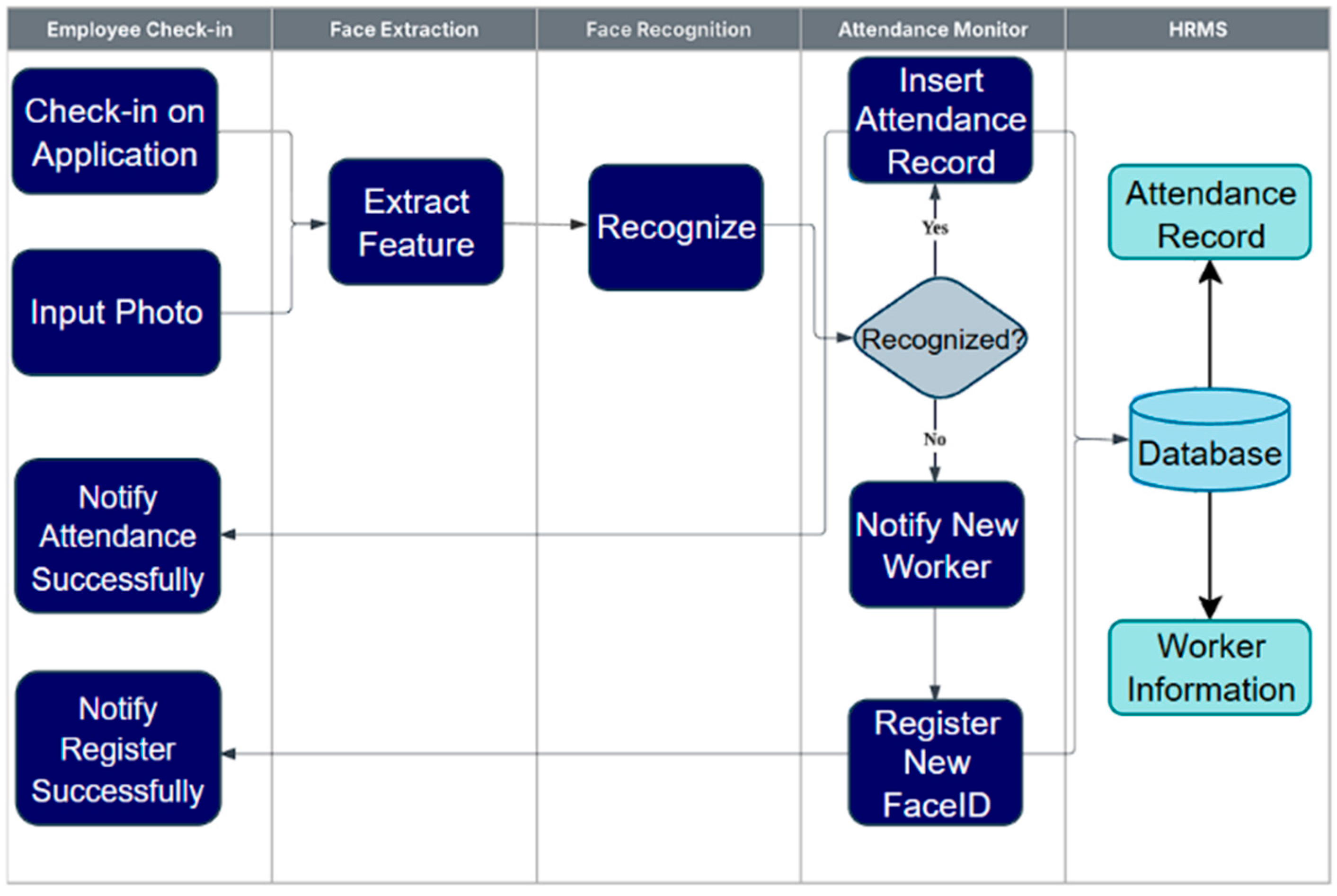
Figure 1. General face recognition process.
Applsci 16 00319 g001
Figure 2. Architecture of an attendance tracking system for coffee farm workers.
Applsci 16 00319 g002
Figure 3. System sequence diagram.
Applsci 16 00319 g003
Figure 4. Microservices architecture. Note: (1) photo frame input capture, (2) face detection and feature extraction using the InsightFace buffalo_l model, (3) facial embedding storage in Firebase Storage, and (4) face recognition matching against stored embeddings via API endpoint.
Applsci 16 00319 g004
Figure 5. Face Recognition Pipeline.
Applsci 16 00319 g005
Figure 6. Attendance tracking mobile application main interface.
Applsci 16 00319 g006
Figure 7. New farm worker multi-angle enrollment.
Applsci 16 00319 g007
Figure 8. Farm worker attendance check-in/out.
Applsci 16 00319 g008
Figure 9. Attendance Dashboard.
Applsci 16 00319 g009
Table 1. Functions of Coffee Farm Attendance Tracking System.
FunctionDescription
Real-Time Attendance Monitoring
  • Automatically record farm workers’ check-in and check-out times using facial recognition.
  • Registration of new farm workers,
  • Provide real-time data updates to management for access and tracking attendance records.
Geolocation Tracking
  • Track GPS to ensure farm workers check in from authorized farms.
Attendance History
  • Collect and store attendance data securely in a database.
  • Find and filter existing records.
Report Generation
  • Generate attendance reports.
  • Export reports for payroll processing and record-keeping.
User Authentication
  • Utilize secure authentication methods to verify employee identities, enabling seamless registration and updates.
Table 2. Hardware Environment Setup.
ProcessorAMD® Ryzen 7 5800 × 8-core processor × 16
Operating SystemUbuntu 20.04.5 LTS
RAM128 GB RAM
GPUNVIDIA GeForce RTX 3080 Ti 12 GB
GPU AcceleratorCUDA Version 12.5
Table 3. Performance Comparison.
MetricManual MethodProposed
Attendance check time (per worker)10–30 s<1 s
Identity fraud
vulnerability
High (manually recording/visual only)Eliminated (biometric)
Real-time data
synchronization
Not availableAvailable
Report GenerationNot availableAvailable
Disclaimer/Publisher’s Note: The statements, opinions and data contained in all publications are solely those of the individual author(s) and contributor(s) and not of MDPI and/or the editor(s). MDPI and/or the editor(s) disclaim responsibility for any injury to people or property resulting from any ideas, methods, instructions or products referred to in the content.