Machine Learning Methods for Predicting Cancer Complications Using Smartphone Sensor Data: A Prospective Study

 , ,
, ,  , , , , , , ,
  ,
,  and
and
Abstract
1. Introduction
2. Methods
2.1. Study Population and Procedures
2.2. Demographic and Clinical Information
2.3. Passively Generated Data
2.4. Complications
2.5. Symptoms
2.6. Dataset Structure and Analytical Tasks
2.7. Statistical Analysis
3. Results
3.1. Clinical and Demographic Data of the Patients
3.2. Identification of Complications
- Decision Tree (DT): The DT model was developed with the threshold of 20 minimum number of observations in a node and set the maximum depth of the tree to 30, as altering them did not yield improved results.
- Extreme Gradient Boosting (XgBoost): The XgBoost model employed cross-validation with five folds and learning rate of 0.4. The maximum depth of tree was set to one.
- K-Nearest Neighbor (KNN): The KNN model was constructed using seven nearest neighbors.
- Support Vector Machine (SVM): The SVM model was created using a linear function and featured 46 support vectors.
- Ensemble: The Ensemble model was created by combining all the obtained models results and predicted complications when at least one of all the models predicted it.
3.3. Identification of New or Worsening Symptoms
4. Discussion
5. Conclusions
Supplementary Materials
Author Contributions
Funding
Institutional Review Board Statement
Informed Consent Statement
Data Availability Statement
Conflicts of Interest
References
- Ferlay, J.; Colombet, M.; Soerjomataram, I.; Parkin, D.M.; Piñeros, M.; Znaor, A.; Bray, F. Cancer statistics for the year 2020: An overview. Int. J. Cancer 2021, 149, 778–789. [Google Scholar] [CrossRef]
- Henry, D.H.; Viswanathan, H.N.; Elkin, E.P.; Traina, S.; Wade, S.; Cella, D. Symptoms and treatment burden associated with cancer treatment: Results from a cross-sectional national survey in the U.S. Support. Care Cancer 2008, 16, 791–801. [Google Scholar] [CrossRef]
- Epstein, J.B.; Thariat, J.; Bensadoun, R.; Barasch, a.; Murphu, B.A.; Kolnick, L.; Popplewell, L.; Maghami, E. Oral complications of cancer and cancer therapy. CA A Cancer J. Clin. 2012, 62, 400–422. [Google Scholar] [CrossRef]
- Yeh, E.; Bickford, C. Cardiovascular Complications of Cancer Therapy. J. Am. Coll. Cardiol. 2009, 53, 2231–2247. [Google Scholar] [CrossRef]
- Graus, F.; Rogers, L.; Posner, J. Cerebrovascular Complications in Patients with Cancer. Medicine 1985, 64, 16–35. [Google Scholar] [CrossRef]
- Altun, İ.; Sonkaya, A. The Most Common Side Effects Experienced by Patients Were Receiving First Cycle of Chemotherapy. Iran. J. Public. Health 2018, 47, 1218–1219. [Google Scholar]
- Dennert, G.; Horneber, M. Selenium for alleviating the side effects of chemotherapy, radiotherapy and surgery in cancer patients. Cochrane Database Syst. Rev. 2006, 3, Art. No., CD005037. [Google Scholar] [CrossRef]
- Löbrich, M.; Kiefer, J. Assessing the likelihood of severe side effects in radiotherapy. Int. J. Cancer 2006, 118, 2652–2656. [Google Scholar] [CrossRef]
- Jairam, V.; Lee, V.; Park, H.S.; Thomas, C.R.; Melnick, E.R.; Gross, C.P.; Presley, C.J.; Adelson, K.B.; Yu, J.B. Treatment-Related Complications of Systemic Therapy and Radiotherapy. JAMA Oncol. 2019, 5, 1028–1035. [Google Scholar] [CrossRef] [PubMed] [PubMed Central]
- McGregor, B.A.; Vidal, G.A.; Shah, S.A.; Mitchell, J.D.; Hendifar, A.E. Remote Oncology Care: Review of Current Technology and Future Directions. Cureus 2020, 12, e10156. [Google Scholar] [CrossRef] [PubMed] [PubMed Central]
- Wells, M. Key components of successful digital remote monitoring in oncology. Nat. Med. 2022, 28, 1128–1129. [Google Scholar] [CrossRef]
- Fouad, H.; Hassanein, A.S.M.; Soliman, A.M.; Al-Feel, H. Analyzing patient health information based on IoT sensor with AI for improving patient assistance in the future direction. Measurement 2020, 159, 107757. [Google Scholar] [CrossRef]
- Spanò, E.; Di Pascoli, S.; Iannaccone, G. Low-Power Wearable ECG Monitoring System for Multiple-Patient Remote Monitoring. IEEE Sens. J. 2016, 16, 5452–5462. [Google Scholar] [CrossRef]
- Morales-Botello, M.L.; Gachet, D.; de Buenaga, M.; Aparicio, F.; Busto, M.J.; Ascanio, J.R. Chronic patient remote monitoring through the application of big data and internet of things. Health Inform. J. 2021, 27, 1–18. [Google Scholar] [CrossRef]
- Mohammed, J.; Lung, C.H.; Ocneanu, A.; Thakral, A.; Jones, C.; Adler, A. Internet of Things: Remote Patient Monitoring Using Web Services and Cloud Computing. In Proceedings of the 2014 IEEE International Conference on Internet of Things (iThings), and IEEE Green Computing and Communications (GreenCom) and IEEE Cyber, Physical and Social Computing (CPSCom), Taipei, Taiwan, 1–3 September 2014; pp. 256–263. [Google Scholar] [CrossRef]
- Kofoed, S.; Breen, S.; Gough, K.; Aranda, S. Benefits of remote real-time side-effect monitoring systems for patients receiving cancer treatment. Oncol. Rev. 2012, 6, e7. [Google Scholar] [CrossRef]
- Majumder, S.; Deen, M.J. Smartphone Sensors for Health Monitoring and Diagnosis. Sensors 2019, 19, 2164. [Google Scholar] [CrossRef]
- Papachristou, N.; Puschmann, D.; Barnaghi, P.; Cooper, B.; Hu, X.; Maguire, R.; Apostolidis, K.; Conley, Y.P.; Hammer, M.; Katsaragakis, S.; et al. Learning from data to predict future symptoms of oncology patients. PLoS ONE 2018, 13, e0208808. [Google Scholar] [CrossRef]
- Kooten, R.T.; Bahadoer, R.R.; Buurkes de Vries, B.; Wouters, M.W.J.M.; Tollenaar, R.A.E.M.; Hartgrink, H.H.; Putter, H.; Dikken, J.L. Conventional Regression Analysis and Machine Learning in Prediction of Anastomotic Leakage and Pulmonary Complications after Esophagogastric Cancer Surgery. J. Surg. Oncol. 2022, 126, 490–501. [Google Scholar] [CrossRef]
- Massaad, E.; Bridge, C.P.; Kiapour, A.; Fourman, M.S.; Duvall, J.B.; Connolly, I.D.; Hadzipasic, M.; Shankar, G.M.; Andriole, K.P.; Rosenthal, M.; et al. Evaluating frailty, mortality, and complications associated with metastatic spine tumor surgery using machine learning–derived body composition analysis. J. Neurosurg. Spine 2022, 37, 263–273. [Google Scholar] [CrossRef]
- Yeh, C.H.; Chiang, Y.C.; Chien, L.C.; Lin, L.; Yang, C.-P.; Chuang, H.-L. Symptom clustering in older Taiwanese children with cancer. Oncol. Nurs. Forum 2008, 35, 273–281. [Google Scholar] [CrossRef]
- Baggott, C.; Cooper, B.A.; Marina, N.; Matthay, K.K.; Miaskowski, C. Symptom cluster analyses based on symptom occurrence and severity ratings among pediatric oncology patients during myelosuppressive chemotherapy. Cancer Nurs. 2012, 35, 19–28. [Google Scholar] [CrossRef]
- Hockenberry, M.J.; Hooke, M.C.; McCarthy, K.; Gregurich, M.A. Sickness Behavior Clustering in Children with Cancer. J. Pediatr. Oncol. Nurs. 2011, 28, 263–272. [Google Scholar] [CrossRef]
- Hockenberry, M.J.; Hooke, M.C.; Gregurich, M.; McCarthy, K.S.; Sambuco, G.; Krull, K.R. Symptom clusters in children and adolescents receiving cisplatin, doxorubicin, or ifosfamide. Oncol. Nurs. Forum 2010, 37, E16–E27. [Google Scholar] [CrossRef]
- Neijenhuijs, K.I.; Peeters, C.F.W.; van Weert, H.; Cuijpers, P.; Leeuw, I.C.-de. Symptom clusters among cancer survivors: What can machine learning techniques tell us? BMC Med. Res. Methodol. 2021, 21, 166. [Google Scholar] [CrossRef]
- Absolom, K.; Warrington, L.; Hudson, E.; Hewison, J.; Morris, C.; Holch, P.; Carter, R.; Gibson, A.; Holmes, M.; Clayton, B.; et al. Phase III randomized controlled trial of eRAPID: eHealth intervention during chemotherapy. J. Clin. Oncol. 2021, 39, 734–747. [Google Scholar] [CrossRef]
- Bufano, P.; Laurino, M.; Said, S.; Tognetti, A.; Menicucci, D. Digital phenotyping for monitoring mental disorders: Systematic review. J. Med. Internet Res. 2023, 25, e46778. [Google Scholar] [CrossRef]
- Ingwersen, E.W.; Stam, W.T.; Meijs, B.J.V.; Roor, J.; Besselink, M.G.; Koerkamp, B.G.; de Hingh, I.H.J.T.; van Santvoort, H.C.; Stommel, M.W.J.; Daams, F. Machine learning versus logistic regression for the prediction of complications after pancreatoduodenectomy. Surgery 2023, 174, 435–440. [Google Scholar] [CrossRef]
- Arvind, V.; Kim, J.S.; Oermann, E.K.; Kaji, D.; Cho., S.K. Predicting Surgical Complications in Adult Patients Undergoing Anterior Cervical Discectomy and Fusion Using Machine Learning. Neurospine 2018, 15, 329–337. [Google Scholar] [CrossRef]
- Shimaa, M.; Ezz, M.; Hashem, S.; Elaken, W.; Salama, R.; ElMakhzangy, H.; ElHefnawi, M. Performance of machine learning approaches on prediction of esophageal varices for Egyptian chronic hepatitis C patients. Inform. Med. Unlocked 2019, 17, 100267. [Google Scholar] [CrossRef]
- Nudel, J.; Bishara, A.M.; de Geus, S.W.L.; Patil, P.; Srinivasan, J.; Hess, D.T.; Woodson, J. Development and validation of machine learning models to predict gastrointestinal leak and venous thromboembolism after weight loss surgery: An analysis of the MBSAQIP database. Surg. Endosc. 2021, 35, 182–191. [Google Scholar] [CrossRef]
- Zhou, X.; Wang, H.; Xu, C.; Peng, L.; Xu, F.; Lian, L.; Deng, G.; Ji, S.; Hu, M.; Zhu, H.; et al. Application of kNN and SVM to predict the prognosis of advanced schistosomiasis. Parasitol. Res. 2022, 121, 2457–2460. [Google Scholar] [CrossRef]
- Watson, L.; Qi, S.; DeIure, A.; Link, C.; Chmielewski, L.; Hildebrand, A.; Rawson, K.; Ruether, D. Using Autoregressive Integrated Moving Average (ARIMA) Modelling to Forecast Symptom Complexity in an Ambulatory Oncology Clinic: Harnessing Predictive Analytics and Patient-Reported Outcomes. Int. J. Environ. Res. Public Health 2021, 18, 8365. [Google Scholar] [CrossRef]
- Medina, D.C.; Findley, S.E.; Guindo, B.; Doumbia, S. Forecasting non-stationary diarrhea, acute respiratory infection, and malaria time-series in Niono, Mali. PLoS ONE 2007, 2, e1181. [Google Scholar] [CrossRef]
- Saturi, S.; Sravani, M.; Hruthika, S.C.; Sambaraju, M.; Prudvendra, R.; Kiran, S. Development of Prediction and Forecasting Model for Dengue Disease Based on the Environmental Conditions Using LSTM. In Data Engineering and Intelligent Computing; Lecture Notes in Networks and Systems; Bhateja, V., Khin Wee, L., Lin, J.C.W., Satapathy, S.C., Rajesh, T.M., Eds.; Springer: Singapore, 2022; Volume 446. [Google Scholar] [CrossRef]
- Sharma, N.; Om, H. Usage of Probabilistic and General Regression Neural Network for Early Detection and Prevention of Oral Cancer. Sci. World J. 2015, 2015, 234191. [Google Scholar] [CrossRef]
- Bunevičius, A.; Tamašauskas, Š.; Tamašauskas, A.; Deltuva, V. Evaluation of health-related quality of life in Lithuanian brain tumor patients using the EORTC brain cancer module. Medicina 2012, 48, 588–594. [Google Scholar] [CrossRef]
- Regulation (EU) 2016/679 of the European Parliament and of the Council of 27 April 2016 on the protection of natural persons with regard to the processing of personal data and on the free movement of such data, and repealing Directive 95/46/EC (General Data Protection Regulation). Off. J. Eur. Union 2016, 4, 1–88.
- Robert, J.; Hijmans van Etten, J. The Distance for Longitude/Latitude Data Uses Geographic Lib by C.F.F. Karney. Available online: https://rdrr.io/cran/raster/man/pointDistance.html (accessed on 3 September 2023).
- Panda, N.; Solsky, I.; Huang, E.J.; Lipsitz, S.; Pradarelli, J.C.; Delisle, M.; Cusack, J.C.; Gadd, M.A.; Lubitz, C.C.; Mullen, J.T.; et al. Using Smartphones to Capture Novel Recovery Metrics After Cancer Surgery. JAMA Surg. 2020, 155, 123–129. [Google Scholar] [CrossRef]
- Aaronson, N.K.; Ahmedzai, S.; Bergamn, B.; Bullinger, M.; Cull, A.; Duez, N.J.; Filiberti, A.; Flechtner, H.; Fleishman, S.B.; de Haes, J.C.J.M. The European Organization for Research and Treatment of Cancer QLQ-C30: A quality-of-life instrument for use in international clinical trials in oncology. J. Natl. Cancer Inst. 1993, 85, 365–376. [Google Scholar] [CrossRef]
- Buneviciene, I.; Mekary, R.A.; Smith, T.R.; Onnela, J.-P.; Bunevicius, A. Can mHealth interventions improve quality of life of cancer patients? A systematic review and meta-analysis. Crit. Rev. Oncol. Hematol. 2021, 157, 103123. [Google Scholar] [CrossRef]
- Melcher, J.; Hays, R.; Torous, J. Digital phenotyping for mental health of college students: A clinical review. BMJ Ment. Health 2020, 23, 161–166. [Google Scholar] [CrossRef]
- De Angel, V.; Lewis, S.; White, K.; Oetzmann, C.; Leightley, D.; Oprea, E.; Lavelle, G.; Matcham, F.; Pace, A.; Mohr, D.C.; et al. Digital health tools for the passive monitoring of depression: A systematic review of methods. npj Digit. Med. 2022, 5, 3. [Google Scholar] [CrossRef]
- Rivera, D.R.; Gallicchio, L.; Brown, J.; Liu, B.; Kyriacou, D.N.; Shelburne, N. Trends in Adult Cancer-Related Emergency Department Utilization: An Analysis of Data from the Nationwide Emergency Department Sample. JAMA Oncol. 2017, 3, e172450. [Google Scholar] [CrossRef]
- Vercell, V.; Gasteiger, N.; Yorke, J.; Dowding, D. Patient-facing cancer mobile apps that enable patient reported outcome data to be collected: A systematic review of content, functionality, quality, and ability to integrate with electronic health records. Int. J. Med. Inform. 2023, 170, 104931. [Google Scholar] [CrossRef]
- Charbonneau, D.H.; Hightower, S.; Katz, A.; Zhang, K.; Abrams, J.; Senfit, N.; Beebe-Dimmer, J.L.; Heath, E.; Eaton, T.; Thompson, H.S. Smartphone apps for cancer: A content analysis of the digital health marketplace. Digit. Health 2020, Volume 6. [Google Scholar] [CrossRef]
- Wright, A.A.; Raman, N.; Staples, P.; Schonholz, S.; Cronin, A.; Carlson, K.; Keating, N.L.; Onnela, J.-P. The HOPE Pilot Study: Harnessing Patient-Reported Outcomes and Biometric Data to Enhance Cancer Care. JCO Clin. Cancer Inform. 2018, 2, 1–12. [Google Scholar] [CrossRef]
- Panda, N.; Solsky, I.; Hawrusik, B.; Liu, G.; Reeder, H.; Lipsitz, S.; Desai, E.V.; Lowery, K.W.; Miller, K.; Gadd, M.A.; et al. Smartphone Global Positioning System (GPS) Data Enhances Recovery Assessment After Breast Cancer Surgery. Ann. Surg. Oncol. 2021, 28, 985–994. [Google Scholar] [CrossRef]



| Variable | Sensor Used to Create the Variable | Description |
|---|---|---|
| Activity duration ratio | Accelerometer | The ratio of physical activity duration per day. The calculation follows these steps: (1) The variance of accelerometer coordinates is being calculated for each minute: v(d, m) = vx(d, m) + vy(d, m) + vz(d, m), where vx—the variance of x coordinate values, vy—the variance of y coordinate values, vz—the variance of z coordinate values, d—day, and m—minute. (2) Periods of unchanging phone status are identified: if the variance of coordinates is less than a threshold of 0.0001 g2, it is assumed that the phone state does not change for that minute [40]. (3) All periods of steady phone states are summed up. |
| Exertional activity duration ratio | Accelerometer | The ratio of exertional physical activity duration per day. If the variance of coordinates is more than a threshold of 0.15 g2, it is assumed the phone state is changing for that minute and the exertional activity is identified [40]. All those minutes per day are summed up. |
| Active period | Accelerometer | Active period per day. To identify active period, firstly, the passive period is identified. The nearest periods of unchanged states are combined: since the patient can be active during the passive period, the adjacent periods of the unchanged states are combined, which are not less than the minimum permissible length of the period of the unchanged state and between which the active period does not exceed the maximum permissible period of activity. After testing, the optimal MPL is set to 60 min and the MPP is 2 min. The rest period of the day is denoted to active period. |
| Speed | GPS | The average speed per day (km/h). |
| Walking/jogging speed | GPS | The average speed (km/h) for movement classified as walking/jogging (<10 km/h). |
| Movement duration ratio | GPS | The ratio of movement duration per day (walking/jogging). |
| Time spent at home ratio | GPS | The ratio of time spent at the most frequently visited place, supposedly home. The identification of home follows these steps: (1) the most frequent values of coordinates in the time range of 2 a.m. and 5 a.m. are found; (2) these coordinates are assigned to “home” coordinates; (3) 10 m radius is attributed to the same place. |
| Distance to home | GPS | The average distance to home per day (km). The distance to the coordinates, which were assigned to home, is calculated using pointDistance function (raster library, RStudio). |
| Places of interest (POI) | GPS | The number of places of interest (POI) per day. POI is described as the place in which a patient spends not less than 30 min. The location is evaluated from coordinates. 100 m radius is attributed to the same place. |
| Screen time ratio | Power State | The ratio of smartphone screen on duration per day. |
| Complications | Symptoms | ||||||
|---|---|---|---|---|---|---|---|
| Clinical and demographic parameter | Characteristic | Yes n = 28 (25.9%) | No n = 80 (74.1%) | χ2 p-value | Yes n = 71 (65.7%) | No n = 37 (34.3%) | χ2 p-value |
| Age | 18–25 | 2 (7.1) | 2 (2.5) | 4.891 0.179 | 2 (2.8) | 2 (5.4) | 3.295 0.348 |
| 26–40 | 2 (7.1) | 11 (13.7) | 12 (16.9) | 2 (5.4) | |||
| 41–64 | 18 (64.3) | 37 (46.3) | 34 (47.9) | 21 (56.8) | |||
| ≥65 | 6 (21.5) | 30 (37.5) | 23 (32.4) | 12 (32.4) | |||
| Sex | Male | 11 (39.3) | 32 (40.0) | 0.000 1.000 | 20 (28.2) | 23 (62.2) | 10.353 0.001 |
| Female | 17 (60.7) | 48 (60.0) | 51 (71.8) | 14 (37.8) | |||
| Education | With Academic degree | 14 (50.0) | 52 (65.0) | 1.383 0.239 | 49 (69.0) | 18 (48.6) | 3.462 0.062 |
| Without Academic degree | 14 (50.0) | 28 (35.0) | 22 (31.0) | 19 (51.4) | |||
| Marital status | Single | 3 (10.7) | 7 (8.8) | 0.532 0.911 | 5 (7.0) | 5 (13.5) | 3.146 0.369 |
| Married | 19 (67.9) | 59 (73.8) | 50 (70.4) | 28 (75.7) | |||
| Divorced | 2 (7.1) | 6 (7.5) | 6 (8.5) | 2 (5.4) | |||
| Widowed | 4 (14.3) | 8 (10.0) | 10 (14.1) | 2 (5.4) | |||
| Living area | Urban | 20 (71.4) | 57 (71.3) | 0.000 1.000 | 47 (66.2) | 30 (81.1) | 1.956 0.161 |
| Rural | 8 (28.6) | 23 (28.7) | 24 (33.8) | 7 (18.9) | |||
| Occupation and employment status | Employed | 15 (53.6) | 45 (56.3) | 3.585 0.309 | 44 (62.0) | 18 (48.6) | 6.895 0.075 |
| Unemployed | 1 (3.6) | 5 (6.2) | 4 (5.6) | 1 (2.7) | |||
| Retired | 7 (25.0) | 25 (31.3) | 20 (28.2) | 11 (29.7) | |||
| Other | 5 (17.8) | 5 (6.2) | 3 (4.2) | 7 (18.9) | |||
| Smartphone operating system | Android | 26 (92.9) | 74 (92.5) | 0.375 0.828 | 65 (91.5) | 34 (91.9) | 2.223 0.328 |
| iOS | 2 (7.1) | 5 (6.3) | 6 (8.5) | 2 (5.4) | |||
| Other | 0 (0) | 1 (1.2) | 0 (0) | 1 (2.7) | |||
| Cancer type | Breast | 2 (7.1) | 12 (15.0) | 19.684 0.019 | 12 (16.9) | 3 (8.1) | 26.525 0.001 |
| Cervix | 6 (21.5) | 14 (17.5) | 17 (23.9) | 3 (8.1) | |||
| Prostate | 2 (7.1) | 17 (21.3) | 7 (9.9) | 12 (32.4) | |||
| Digestive tract | 6 (21.5) | 5 (6.2) | 6 (8.5) | 4 (10.8) | |||
| Lungs | 2 (7.1) | 2 (2.5) | 1 (1.4) | 3 (8.1) | |||
| Uterus | 2 (7.1) | 12 (15.0) | 14 (19.7) | 0 (0) | |||
| Hematological | 1 (3.6) | 5 (6.2) | 4 (5.6) | 2 (5.4) | |||
| Mouth | 4 (14.3) | 1 (1.3) | 2 (2.8) | 3 (8.1) | |||
| Other | 3 (10.7) | 12 (15.0) | 8 (11.3) | 7 (19.0) | |||
| History of systemic treatment | Yes | 14 (50.0) | 32 (40.0) | 0.488 0.484 | 29 (40.8) | 17 (45.9) | 0.092 0.761 |
| No | 14 (50.0) | 48 (60.0) | 42 (59.2) | 20 (54.1) | |||
| Current systemic treatment | Yes | 23 (82.1) | 50 (62.5) | 2.811 0.093 | 45 (63.4) | 28 (75.7) | 1.164 0.280 |
| No | 5 (17.9) | 30 (37.5) | 26 (36.6) | 9 (24.3) | |||
| Current radiotherapy | Yes | 15 (53.6) | 47 (58.8) | 0.064 0.799 | 45 (63.4) | 17 (49.9) | 2.352 0.125 |
| No | 13 (46.4) | 33 (41.2) | 26 (36.6) | 20 (54.1) | |||
| ECOG | 0 | 25 (89.3) | 69 (86.2) | 3.631 0.162 | 61 (85.9) | 34 (91.9) | 1.076 0.583 |
| 1 | 2 (7.1) | 11 (13.8) | 9 (12.7) | 3 (8.1) | |||
| 2 | 1 (3.6) | 0 (0) | 1 (1.4) | 0 (0) | |||
| Metric | Accuracy | Specificity | Sensitivity |
|---|---|---|---|
| DT | 76% | 83% | 67% |
| XgBoost | 71% | 100% | 33% |
| KNN | 62% | 92% | 22% |
| SVM | 66% | 92% | 33% |
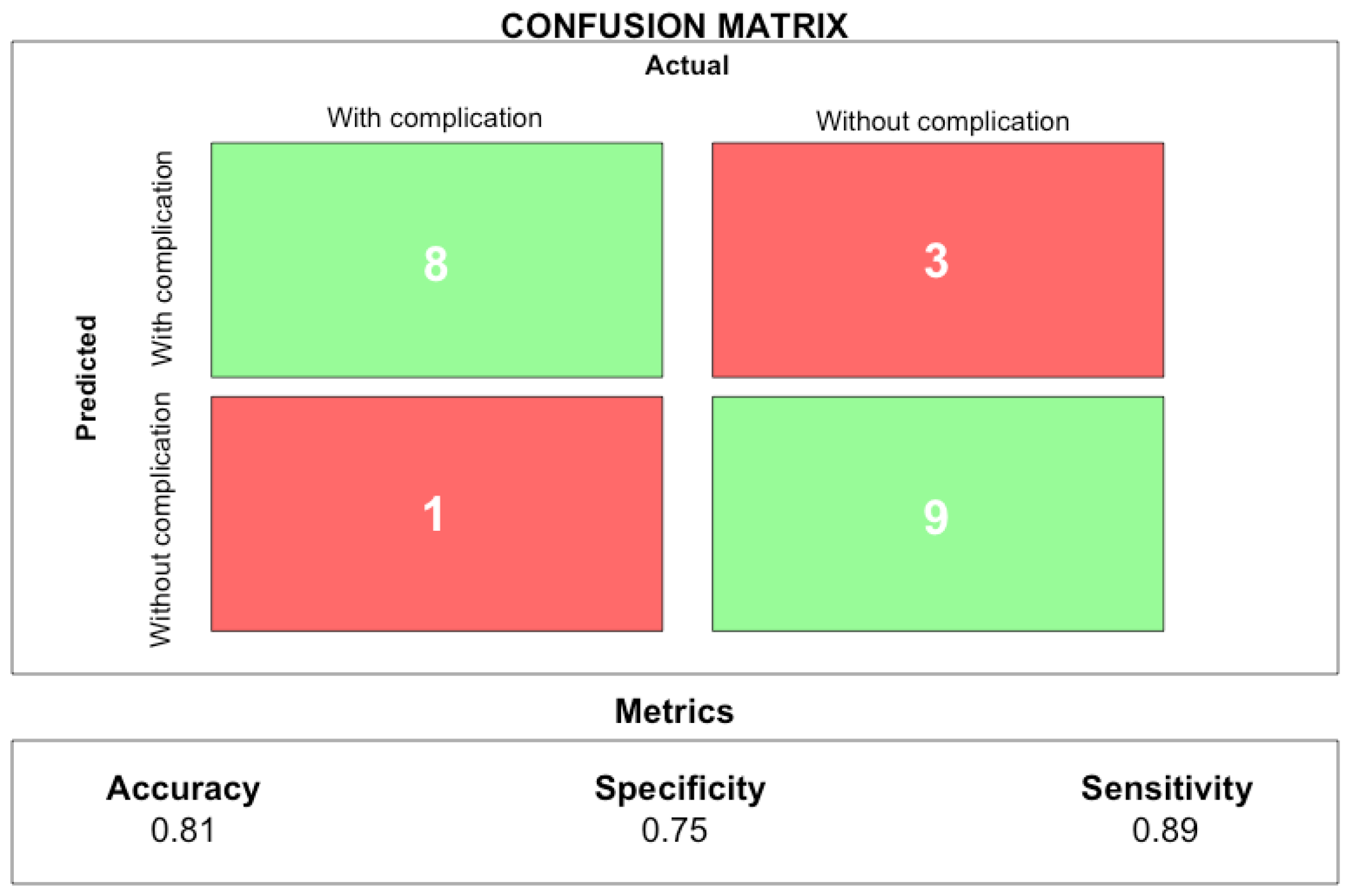
| Ensemble | 81% | 75% | 89% |
| Variable | Number of Patients with Decreased (Increased) Activity and Sociability (%) | Decreased or Increased |
|---|---|---|
| Depression | ||
| Screen time ratio | 7 out of 23 (30.43%) | Increased |
| Movement duration ratio | 12 out of 23 (52.17%) | Decreased |
| Distance from home | 17 out of 23 (73.91%) | Decreased |
| Fatigue | ||
| Screen time ratio | 24 out of 41 (58.53%) | Decreased |
| Time spent at home ratio | 20 out of 41 (48.78%) | Increased |
| Distance from home | 18 out of 41 (43.90%) | Decreased |
| Average speed of movement | 18 out of 41 (43.90%) | Decreased |
| Vomiting | ||
| Activity frequency | 3 out of 8 (37.50%) | Decreased |
| Screen time ratio | 5 out of 8 (62.50%) | Decreased |
| Time spent at home ratio | 3 out of 8 (37.50%) | Increased |
| Variable | Model | MAE (95% CI) |
|---|---|---|
| Depression | ||
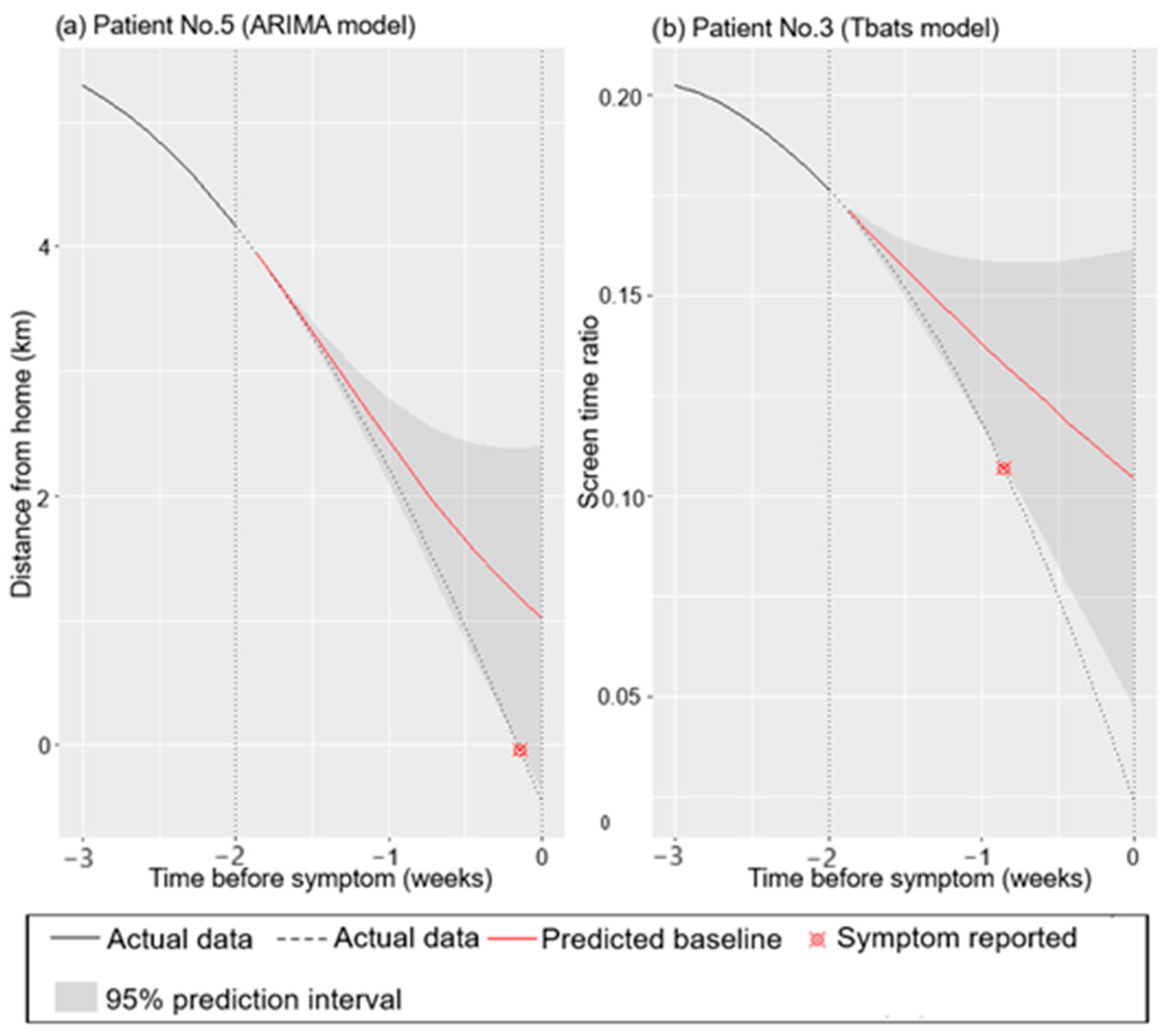
| Screen time ratio | Tbats | 0.32 (0.01–2.05) |
| Movement duration ratio | LSTM | 0.21 (0.01–0.94) |
| Distance from home | ARIMA | 9.30 (0.15–11.85) |
| Fatigue | ||
| Screen time ratio | Tbats | 0.47 (0.02–1.71) |
| Time spent at home ratio | LSTM | 0.05 (0.01–0.10) |
| Distance from home | GRNN | 15.41(4.43–29.67) |
| Average speed of movement | Tbats | 0.03 (0.01–0.16) |
| Vomiting | ||
| Activity frequency | Holt | 0.03 (0.01–0.16) |
| Screen time ratio | ARIMA | 0.32 (0.02–1.03) |
| Time spent at home ratio | ARIMA | 0.06 (0.01–011) |
| Variable | Days Before Determining (Mean ± SD) | The Number of Patients with Symptoms Detected Earlier (%) |
|---|---|---|
| Depression | ||
| Screen time ratio | 9 ± 4.47 | 10 out of 23 (38.47%) |
| Distance from home | 8 ± 6.11 | 7 out of 23 (26.93%) |
| Fatigue | ||
| Screen time ratio | 7 ± 4.92 | 12 out of 41 (29.28%) |
| Distance from home | 9 ± 2.91 | 11 out of 41 (26.83%) |
| Average speed of movement | 7 ± 4.70 | 12 out of 41 (29.28%) |
| Vomiting | ||
| Screen time ratio | 9 ± 4.04 | 3 out of 8 (33.33%) |
Disclaimer/Publisher’s Note: The statements, opinions and data contained in all publications are solely those of the individual author(s) and contributor(s) and not of MDPI and/or the editor(s). MDPI and/or the editor(s) disclaim responsibility for any injury to people or property resulting from any ideas, methods, instructions or products referred to in the content. |
© 2025 by the authors. Licensee MDPI, Basel, Switzerland. This article is an open access article distributed under the terms and conditions of the Creative Commons Attribution (CC BY) license.
Share and Cite
Dargė, G.; Kasputytė, G.; Savickas, P.; Bunevičius, A.; Bunevičienė, I.; Korobeinikova, E.; Vaitiekus, D.; Inčiūra, A.; Jaruševičius, L.; Bunevičius, R.; et al. Machine Learning Methods for Predicting Cancer Complications Using Smartphone Sensor Data: A Prospective Study. Appl. Sci. 2026, 16, 249. https://doi.org/10.3390/app16010249
Dargė G, Kasputytė G, Savickas P, Bunevičius A, Bunevičienė I, Korobeinikova E, Vaitiekus D, Inčiūra A, Jaruševičius L, Bunevičius R, et al. Machine Learning Methods for Predicting Cancer Complications Using Smartphone Sensor Data: A Prospective Study. Applied Sciences. 2026; 16(1):249. https://doi.org/10.3390/app16010249
Chicago/Turabian StyleDargė, Gabrielė, Gabrielė Kasputytė, Paulius Savickas, Adomas Bunevičius, Inesa Bunevičienė, Erika Korobeinikova, Domas Vaitiekus, Arturas Inčiūra, Laimonas Jaruševičius, Romas Bunevičius, and et al. 2026. "Machine Learning Methods for Predicting Cancer Complications Using Smartphone Sensor Data: A Prospective Study" Applied Sciences 16, no. 1: 249. https://doi.org/10.3390/app16010249
APA StyleDargė, G., Kasputytė, G., Savickas, P., Bunevičius, A., Bunevičienė, I., Korobeinikova, E., Vaitiekus, D., Inčiūra, A., Jaruševičius, L., Bunevičius, R., Krikštolaitis, R., Krilavičius, T., & Juozaitytė, E. (2026). Machine Learning Methods for Predicting Cancer Complications Using Smartphone Sensor Data: A Prospective Study. Applied Sciences, 16(1), 249. https://doi.org/10.3390/app16010249