Organic Pollutant Degradation Through Photocatalysis: Progress, Challenges, and Sustainable Solutions (Mini Review)


Abstract
1. Introduction
1.1. Organic Pollutant Types
1.2. Methods Used in Organic Pollutant Removal
1.2.1. Physical Treatment Methods
1.2.2. Chemical Treatment Methods
1.2.3. Advanced Oxidation Processes (AOPs)

| Reference | Method Used | Target Pollutant | Experimental Conditions | Removal Efficiency |
|---|---|---|---|---|
| [48] | Ozone Oxidation | 17α-ethinylestradiol | pH: 8 Pol. Con: 60–300 μg/L | 90% |
| [49] | Ozone Oxidation | Reactive Black 5 | Pol. Con: 5.26 mg/L Duration: 5 min | 75% |
| [50] | Catalytic Ozonation (with Iron Filings) | Biologically Treated Textile Wastewater | pH: 7.37–7.84 Pol. Con: 142 mg/L | 51% |
| [51] | Ozonation and Adsorption | Reactive Red Textile Dye | Pol. Con: 150 mg/L | 37% |
- Direct EO: in which hydroxyl radicals generated at the anode attack pollutants adsorbed onto the electrode surface, leading to their degradation.
- Indirect EO: where electrogenerated oxidants (e.g., O3, H2O2, Cl2) diffuse into the bulk solution to degrade contaminants.
- High energy demands (ozone, EO).
- Secondary waste generation (Fenton sludge, chlorinated byproducts).
- Operational limitations (pH dependency, reagent consumption, catalyst deactivation).
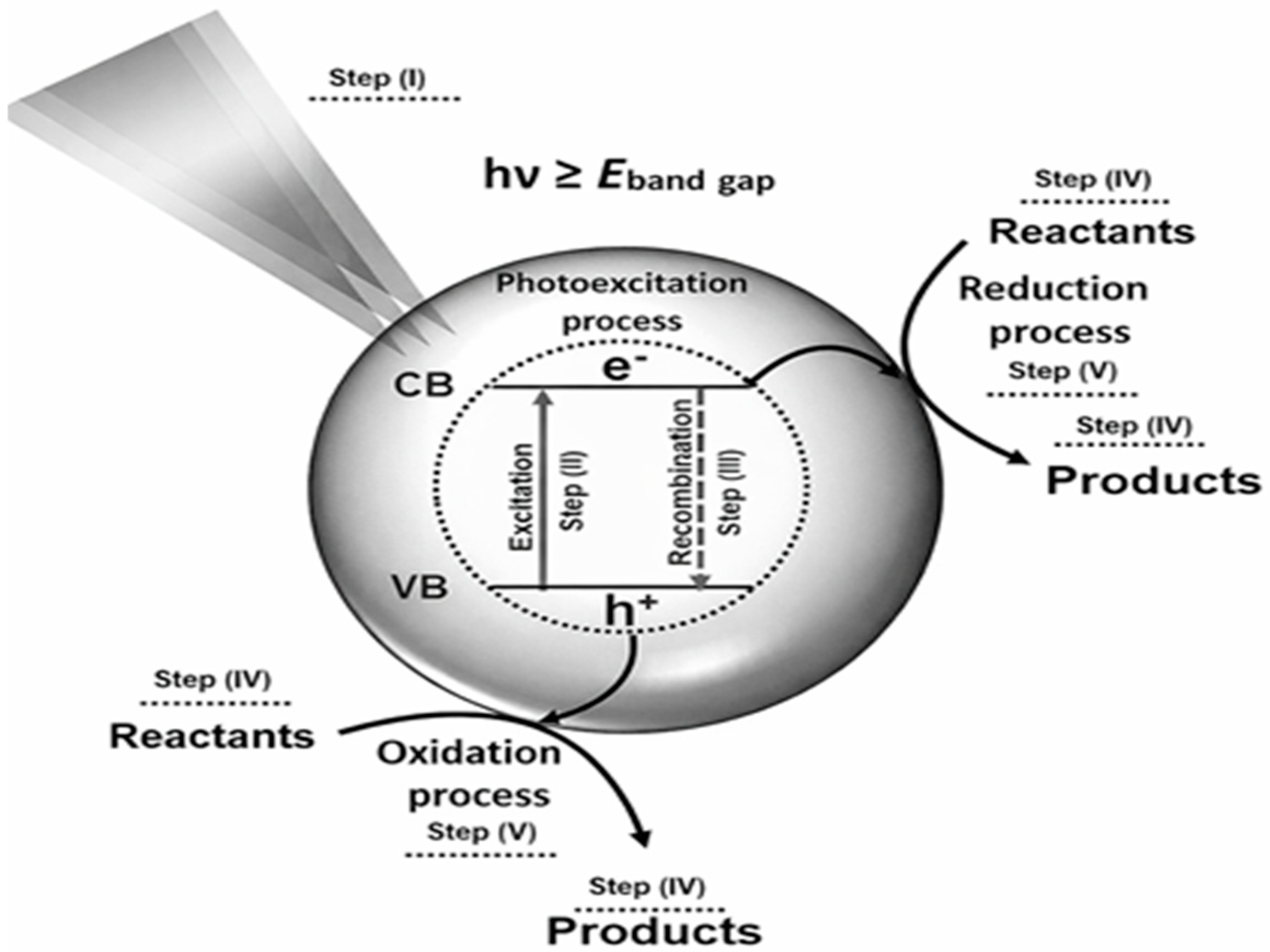
2. Photocatalytic Systems
- Absorption of incident photons by the semiconductor.
- Excitation of charge carriers, with electrons promoted from the valence band to the conduction band.
- Migration of photogenerated electrons and holes to the semiconductor surface.
- Competition between recombination and surface reactions, where fast recombination reduces efficiency.
- Redox reactions at the surface, wherein holes drive oxidation processes (e.g., •OH generation) and electrons facilitate reduction reactions (e.g., O2•− formation).
2.1. Parameters Affecting Photocatalytic Systems
- Light Intensity: Higher light intensity increases the photon flux reaching the catalyst surface, resulting in greater electron–hole pair generation and enhanced ROS production. Consequently, pollutant degradation rates rise with irradiance. However, beyond an optimal threshold, excessive excitation can accelerate electron–hole recombination, leading to reduced quantum efficiency. Thus, optimization is required to balance ROS generation and recombination dynamics.
- Light Wavelength: The wavelength of the light determines whether photons can overcome the band gap energy of the catalyst. Conventional semiconductors such as TiO2 are primarily UV-active, limiting their utilization under natural sunlight, where UV accounts for only ~5% of the spectrum. Visible-light-responsive photocatalysts (e.g., doped TiO2, g-C3N4, carbon-modified systems) are therefore essential to harness solar energy effectively and achieve practical large-scale applications.
- At low pH (acidic medium), photocatalyst surfaces generally acquire a positive charge, which enhances electrostatic attraction with anionic (negatively charged) pollutants such as azo dyes, leading to higher adsorption and improved degradation.
- At high pH (alkaline medium), surfaces tend to become negatively charged, favoring adsorption of cationic (positively charged) pollutants. In such cases, degradation is enhanced for compounds like methylene blue or rhodamine B.
- Light attenuation: High pollutant levels absorb and scatter incident photons, preventing adequate light penetration to the catalyst surface.
- Active site saturation: Excess pollutants compete for limited adsorption sites, restricting pollutant–catalyst interactions.
- ROS scavenging: Elevated pollutant concentrations increase the likelihood of ROS quenching before they can fully mineralize contaminants, reducing the net oxidation efficiency.
2.2. Characteristics of Photocatalyst
3. Recent Advances in Photocatalytic Systems
3.1. Material Modification by Metal and Nonmetallic Doping
- Metal Doping: Transition metals such as Cu, Ag, and Pd have been widely used to improve redox properties and electron transfer efficiency. For example, Ag nanoparticles can act as electron sinks, suppressing recombination and enabling surface plasmon resonance (SPR) effects that enhance visible-light absorption [95]. Cu and Pd doping, on the other hand, can create additional trapping sites, improving charge separation and facilitating pollutant reduction reactions.
- Non-Metal Doping: Elements such as N, S, and C are frequently introduced to narrow the band gap and shift photocatalytic activity toward the visible region. Nitrogen doping, for instance, replaces lattice oxygen and introduces impurity levels close to the valence band, enhancing light absorption under solar irradiation.
3.2. Carbon Nanotubes (CNTs)
3.3. Graphene Oxide (GO)
3.4. Carbon Quantum Dots (CQDs)
4. Conclusions
Author Contributions
Funding
Institutional Review Board Statement
Data Availability Statement
Conflicts of Interest
References
- Nazir, A.; Huo, P.; Wang, H.; Weiqiang, Z.; Wan, Y. A review on plasmonic-based heterojunction photocatalysts for degradation of organic pollutants in wastewater. J. Mater. Sci. 2023, 58, 6474–6515. [Google Scholar] [CrossRef] [Scilit]
- Lu, F.; Astruc, D. Nanocatalysts and other nanomaterials for water remediation from organic pollutants. Coord. Chem. Rev. 2020, 408, 213180. [Google Scholar] [CrossRef] [Scilit]
- Van Thuan, D.; Ngo, H.L.; Thi, H.P.; Chu, T.T.H. Photodegradation of hazardous organic pollutants using titanium oxides-based photocatalytic: A review. Environ. Res. 2023, 229, 116000. [Google Scholar] [CrossRef] [Scilit] [PubMed]
- Chen, D.; Cheng, Y.; Zhou, N.; Chen, P.; Wang, Y.; Li, K.; Huo, S.; Cheng, P.; Peng, P.; Zhang, R.; et al. Photocatalytic degradation of organic pollutants using TiO2-based photocatalysts: A review. J. Clean. Prod. 2020, 268, 121725. [Google Scholar] [CrossRef] [Scilit]
- Cycoń, M.; Mrozik, A.; Piotrowska-Seget, Z. Antibiotics in the soil environment—Degradation and their impact on microbial activity and diversity. Front. Microbiol. 2019, 10, 338. [Google Scholar] [CrossRef] [Scilit]
- Gao, Y.; Wang, Q.; Ji, G.; Li, A. Degradation of antibiotic pollutants by persulfate activated with various carbon materials. Chem. Eng. J. 2022, 429, 132387. [Google Scholar] [CrossRef] [Scilit]
- Qin, K.; Zhao, Q.; Yu, H.; Xia, X.; Li, J.; He, S.; Wei, L.; An, T. A review of bismuth-based photocatalysts for antibiotic degradation: Insight into the photocatalytic degradation performance, pathways, and relevant mechanisms. Environ. Res. 2021, 199, 111360. [Google Scholar] [CrossRef] [Scilit]
- Li, S.; Wu, Y.; Zheng, H.; Li, H.; Zheng, Y.; Nan, J.; Ma, J.; Nagarajan, D.; Chang, J.-S. Antibiotics degradation by advanced oxidation process (AOPs): Recent advances in ecotoxicity and antibiotic-resistance genes induction of degradation products. Chemosphere 2023, 311, 136977. [Google Scholar] [CrossRef] [Scilit]
- de Farias, M.B.; Prediger, P.; Vieira, M.G.A. Conventional and green-synthesized nanomaterials applied for the adsorption and/or degradation of phenol: A recent overview. J. Clean. Prod. 2022, 367, 132980. [Google Scholar] [CrossRef] [Scilit]
- Dai, Y.; Zhang, N.; Xing, C.; Cui, Q.; Sun, Q. The adsorption, regeneration and engineering applications of biochar for removal organic pollutants: A review. Chemosphere 2019, 223, 12–27. [Google Scholar] [CrossRef] [Scilit]
- Sanakousar, F.M.; Vidyasagar, C.C.; Jiménez-Pérez, V.M.; Prakash, K. Recent progress on visible-light-driven metal and non-metal doped ZnO nanostructures for photocatalytic degradation of organic pollutants. Mater. Sci. Semicond. Process. 2022, 140, 106390. [Google Scholar] [CrossRef] [Scilit]
- Ahmed, S.N.; Haider, W. Heterogeneous photocatalysis and its potential applications in water and wastewater treatment: A review. Nanotechnology 2018, 29, 342001. [Google Scholar] [CrossRef] [Scilit]
- Shahid, M.K.; Kashif, A.; Fuwad, A.; Choi, Y. Current advances in treatment technologies for removal of emerging contaminants from water–A critical review. Coord. Chem. Rev. 2021, 442, 213993. [Google Scholar] [CrossRef] [Scilit]
- Rashid, R.; Shafiq, I.; Akhter, P.; Iqbal, M.J.; Hussain, M. A state-of-the-art review on wastewater treatment techniques: The effectiveness of adsorption method. Environ. Sci. Pollut. Res. 2021, 28, 9050–9066. [Google Scholar] [CrossRef] [Scilit]
- Hanafi, M.F.; Sapawe, N. A review on the water problem associate with organic pollutants derived from phenol, methyl orange, and remazol brilliant blue dyes. Mater. Today Proc. 2020, 31, A141–A150. [Google Scholar] [CrossRef] [Scilit]
- Khan, M.D.; Singh, A.; Khan, M.Z.; Tabraiz, S.; Sheikh, J. Current perspectives, recent advancements, and efficiencies of various dye-containing wastewater treatment technologies. J. Water Process Eng. 2023, 53, 103579. [Google Scholar] [CrossRef] [Scilit]
- Babaei, S.; Sabour, M.R.; Moftakhari Anasori Movahed, S. Combined landfill leachate treatment methods: An overview. Environ. Sci. Pollut. Res. 2021, 28, 59594–59607. [Google Scholar] [CrossRef] [Scilit] [PubMed]
- Guillossou, R.; Le Roux, J.; Mailler, R.; Pereira-Derome, C.S.; Varrault, G.; Bressy, A.; Vulliet, E.; Morlay, C.; Nauleau, F.; Rocher, V.; et al. Influence of dissolved organic matter on the removal of 12 organic micropollutants from wastewater effluent by powdered activated carbon adsorption. Water Res. 2020, 172, 115487. [Google Scholar] [CrossRef] [Scilit]
- Ighalo, J.O.; Yap, P.-S.; Iwuozor, K.O.; Aniagor, C.O.; Liu, T.; Dulta, K.; Iwuchukwu, F.U.; Rangabhashiyam, S. Adsorption of persistent organic pollutants (POPs) from the aqueous environment by nano-adsorbents: A review. Environ. Res. 2022, 212, 113123. [Google Scholar] [CrossRef] [Scilit]
- Ahmed, S.M.; Taha, M.R.; Taha, O.M.E. Kinetics and isotherms of dichlorodiphenyltrichloroethane (DDT) adsorption using soil–zeolite mixture. Nanotechnol. Environ. Eng. 2018, 3, 4. [Google Scholar] [CrossRef] [Scilit]
- Tang, L.; Yu, J.; Pang, Y.; Zeng, G.; Deng, Y.; Wang, J.; Ren, X.; Ye, S.; Peng, B.; Feng, H. Sustainable efficient adsorbent: Alkali-acid modified magnetic biochar derived from sewage sludge for aqueous organic contaminant removal. Chem. Eng. J. 2018, 336, 160–169. [Google Scholar] [CrossRef] [Scilit]
- Jiang, N.; Erdős, M.; Moultos, O.A.; Shang, R.; Vlugt, T.J.; Heijman, S.G.; Rietveld, L.C. The adsorption mechanisms of organic micropollutants on high-silica zeolites causing S-shaped adsorption isotherms: An experimental and Monte Carlo simulation study. Chem. Eng. J. 2020, 389, 123968. [Google Scholar] [CrossRef] [Scilit]
- Yao, Y.; Mi, N.; Zhu, Y.; Yin, L.; Zhang, Y.; Li, S. Efficient removal of sulfamerazine (SMR) by ozonation in acetic acid solution after enrichment SMR from water using granular activated carbon. RSC Adv. 2019, 9, 9145–9152. [Google Scholar] [CrossRef] [Scilit]
- Nazia, S.; Sahu, N.; Jegatheesan, V.; Bhargava, S.K.; Sridhar, S. Integration of ultrafiltration membrane process with chemical coagulation for proficient treatment of old industrial landfill leachate. Chem. Eng. J. 2021, 412, 128598. [Google Scholar] [CrossRef] [Scilit]
- Anis, S.F.; Hashaikeh, R.; Hilal, N. Reverse osmosis pretreatment technologies and future trends: A comprehensive review. Desalination 2019, 452, 159–195. [Google Scholar] [CrossRef] [Scilit]
- Goswami, L.; Kumar, R.V.; Pakshirajan, K.; Pugazhenthi, G. A novel integrated biodegradation—Microfiltration system for sustainable wastewater treatment and energy recovery. J. Hazard. Mater. 2019, 365, 707–715. [Google Scholar] [CrossRef] [Scilit] [PubMed]
- Dong, L.X.; Huang, X.C.; Wang, Z.; Yang, Z.; Wang, X.M.; Tang, C.Y. A thin-film nanocomposite nanofiltration membrane prepared on a support with in situ embedded zeolite nanoparticles. Sep. Purif. Technol. 2016, 166, 230–239. [Google Scholar] [CrossRef] [Scilit]
- Sun, J.; Liu, S.; Kang, J.; Chen, Z.; Cai, L.; Guo, Y.; Shen, J.; Wang, Z. Fabrication of cementitious microfiltration membrane and its catalytic ozonation for the removal of small molecule organic pollutants. Membranes 2021, 11, 532. [Google Scholar] [CrossRef] [Scilit] [PubMed]
- Gao, J.; Oloibiri, V.; Chys, M.; Audenaert, W.; Decostere, B.; He, Y.; Van Langenhove, H.; Demeestere, K.; Van Hulle, S.W.H. The present status of landfill leachate treatment and its development trend from a technological point of view. Rev. Environ. Sci. Bio/Technol 2015, 14, 93–122. [Google Scholar] [CrossRef] [Scilit]
- Guimarães, N.R.; Dörr, F.; Marques, R.D.O.; Pinto, E.; Ferreira Filho, S.S. Removal efficiency of dissolved organic matter from secondary effluent by coagulation-flocculation processes. J. Environ. Sci. Health 2020, 56, 161–170. [Google Scholar] [CrossRef] [Scilit]
- Khan, R.; Inam, M.A.; Akram, M.; Uddin, A.; Khan, S.; Yeom, I.T. Effect of dissolved organic matter on agglomeration and removal of CuO nanoparticles by coagulation. Processes 2019, 7, 455. [Google Scholar] [CrossRef] [Scilit]
- Zhao, S.; Huang, G.; Fu, H.; Wang, Y. Enhanced coagulation/flocculation by combining diatomite with synthetic polymers for oily wastewater treatment. Sep. Sci. Technol. 2014, 49, 999–1007. [Google Scholar] [CrossRef] [Scilit]
- Wei, J.; Jiang, F.; Ye, C.; Zhang, Y.; Xu, Z.; Chu, W. Enhanced removal of thioethers from stormwater pipe overflows by coagulation and oxidation treatment: Removal performance, reaction kinetics, and ecotoxicity. J. Hazard. Mater. 2025, 495, 138845. [Google Scholar] [CrossRef] [Scilit] [PubMed]
- Gheidene, A.C.; Zehhaf, A.; Messekine, S.; Soufal, F.Z.; Laoui, T. Advanced leachate treatment at Mascara landfill (Algeria): A hybrid pilot approach with activated sludge and ferric chloride. Desalination Water Treat. 2024, 319, 100544. [Google Scholar] [CrossRef] [Scilit]
- Aftab, B.; Hur, J. Unraveling complex removal behavior of landfill leachate upon the treatments of Fenton oxidation and MIEX® via two-dimensional correlation size exclusion chromatography (2D-CoSEC). J. Hazard. Mater. 2019, 362, 36–44. [Google Scholar] [CrossRef] [Scilit] [PubMed]
- Kaith, B.S. Removal of hazardous metal ions from polluted water using biomaterial-based ion-exchangers: A review. Mater. Today Proc. 2022, 53, 174–178. [Google Scholar]
- Kurniawan, T.A.; Yap, P.S.; Chen, Z. Techniques for pollutant removal, nutrient recovery, and energy production from landfill leachates: A review. Environ. Chem. Lett. 2025, 23, 517–577. [Google Scholar] [CrossRef] [Scilit]
- Li, X.; Liu, Y.; Zhang, C.; Wen, T.; Zhuang, L.; Wang, X.; Song, G.; Chen, D.; Ai, Y.; Hayat, T.; et al. Porous Fe2O3 microcubes derived from metal organic frameworks for efficient elimination of organic pollutants and heavy metal ions. Chem. Eng. J. 2018, 336, 241–252. [Google Scholar] [CrossRef] [Scilit]
- Wang, T.; Pan, X.; Ben, W.; Wang, J.; Hou, P.; Qiang, Z. Adsorptive removal of antibiotics from water using magnetic ion exchange resin. J. Environ. Sci. 2017, 52, 111–117. [Google Scholar] [CrossRef] [Scilit]
- Virolainen, S.; Repo, E.; Sainio, T. Recovering rare earth elements from phosphogypsum using a resin-in-leach process: Selection of resin, leaching agent, and eluent. Hydrometallurgy 2019, 189, 105125. [Google Scholar] [CrossRef] [Scilit]
- Rayaroth, M.P.; Aravindakumar, C.T.; Shah, N.S.; Boczkaj, G. Advanced oxidation processes (AOPs) based wastewater treatment-unexpected nitration side reactions-a serious environmental issue: A review. Chem. Eng. J. 2022, 430, 133002. [Google Scholar] [CrossRef] [Scilit]
- Dhamorikar, R.S.; Lade, V.G.; Kewalramani, P.V.; Bindwal, A.B. Review on integrated advanced oxidation processes for water and wastewater treatment. J. Ind. Eng. Chem. 2024, 138, 104–122. [Google Scholar] [CrossRef] [Scilit]
- Covinich, L.G.; Bengoechea, D.I.; Fenoglio, R.J.; Area, M.C. Advanced oxidation processes for wastewater treatment in the pulp and paper industry: A review. Am. J. Environ. Eng. 2014, 4, 56–70. [Google Scholar] [CrossRef] [Scilit]
- Macwan, D.P.; Dave, P.N.; Chaturvedi, S. A review on nano-TiO 2 sol–gel type syntheses and its applications. J. Mater. Sci. 2011, 46, 3669–3686. [Google Scholar] [CrossRef] [Scilit]
- Rekhate, C.V.; Srivastava, J.K. Recent advances in ozone-based advanced oxidation processes for treatment of wastewater-A review. Chem. Eng. J. Adv. 2020, 3, 100031. [Google Scholar] [CrossRef] [Scilit]
- Agustina, T.E.; Ang, H.M.; Vareek, V.K. A review of synergistic effect of photocatalysis and ozonation on wastewater treatment. J. Photochem. Photobiol. C Photochem. Rev. 2005, 6, 264–273. [Google Scholar] [CrossRef] [Scilit]
- Ma, D.; Yi, H.; Lai, C.; Liu, X.; Huo, X.; An, Z.; Li, L.; Fu, Y.; Li, B.; Zhang, M.; et al. Critical review of advanced oxidation processes in organic wastewater treatment. Chemosphere 2021, 275, 130104. [Google Scholar] [CrossRef] [Scilit] [PubMed]
- Lee, Y.; Von Gunten, U. Oxidative transformation of micropollutants during municipal wastewater treatment: Comparison of kinetic aspects of selective (chlorine, chlorine dioxide, ferrateVI, and ozone) and non-selective oxidants (hydroxyl radical). Water Res. 2010, 44, 555–566. [Google Scholar] [CrossRef] [Scilit]
- Wantoputri, N.I.; Helmy, Q.; Notodarmojo, S. Textile Wastewater Post Treatment Using Ozonation. J. Presipitasi Media Komun. Pengemb. Tek. Lingkung. 2021, 18, 56–63. [Google Scholar] [CrossRef] [Scilit]
- Wu, J.; Ma, L.; Chen, Y.; Cheng, Y.; Liu, Y.; Zha, X. Catalytic ozonation of organic pollutants from bio-treated dyeing and finishing wastewater using recycled waste iron shavings as a catalyst: Removal and pathways. Water Res. 2016, 92, 140–148. [Google Scholar] [CrossRef] [Scilit]
- Konsowa, A.H.; Ossman, M.E.; Chen, Y.; Crittenden, J.C. Decolorization of industrial wastewater by ozonation followed by adsorption on activated carbon. J. Hazard. Mater. 2010, 176, 181–185. [Google Scholar] [CrossRef] [Scilit]
- Chavan, R.; Bhat, N.; Parit, S.; Narasimharao, K.; Devan, R.S.; Patil, R.B.; Karade, V.C.; Pawar, N.V.; Kim, J.H.; Jadhav, J.P.; et al. Development of magnetically recyclable nanocatalyst for enhanced Fenton and photo-Fenton degradation of MB and Cr (VI) photo-reduction. Mater. Chem. Phys. 2023, 293, 126964. [Google Scholar] [CrossRef] [Scilit]
- Zhan, S.; Zhang, H.; Mi, X.; Zhao, Y.; Hu, C.; Lyu, L. Efficient Fenton-like process for pollutant removal in electron-rich/poor reaction sites induced by surface oxygen vacancy over cobalt–zinc oxides. Environ. Sci. Technol. 2020, 54, 8333–8343. [Google Scholar] [CrossRef] [Scilit]
- Ribeiro, J.P.; Sarinho, L.; Nunes, M.I. Application of life cycle assessment to Fenton processes in wastewater treatment–A review. J. Water Process Eng. 2024, 57, 104692. [Google Scholar] [CrossRef] [Scilit]
- Grisales, C.M.; Salazar, L.M.; Garcia, D.P. Treatment of synthetic dye baths by Fenton processes: Evaluation of their environmental footprint through life cycle assessment. Environ. Sci. Pollut. Res. 2019, 26, 4300–4311. [Google Scholar] [CrossRef] [Scilit]
- Sözen, S.; Olmez-Hanci, T.; Hooshmand, M.; Orhon, D. Fenton oxidation for effective removal of color and organic matter from denim cotton wastewater without biological treatment. Environ. Chem. Lett. 2020, 18, 207–213. [Google Scholar] [CrossRef] [Scilit]
- Ebrahiem, E.E.; Al-Maghrabi, M.N.; Mobarki, A.R. Removal of organic pollutants from industrial wastewater by applying photo-Fenton oxidation technology. Arab. J. Chem. 2017, 10, S1674–S1679. [Google Scholar] [CrossRef] [Scilit]
- Öztürk, E.; Ateş, A.E.; Selcuk, H.; Ateş, S. Treatment of real pharmaceutical industry wastewater by photo-Fenton oxidation using the response surface methodology, evaluation of diclofenac degradation and toxicity. Eng. Sci. Technol. Int. J. 2025, 64, 102004. [Google Scholar] [CrossRef] [Scilit]
- Sukeesan, S.; Boontanon, N.; Boontanon, S.K. Improved electrical driving current of electrochemical treatment of Per-and Polyfluoroalkyl Substances (PFAS) in water using Boron-Doped Diamond anode. Environ. Technol. Innov. 2021, 23, 101655. [Google Scholar] [CrossRef] [Scilit]
- Dhawle, R.; Frontistis, Z.; Mantzavinos, D. Electrochemical oxidation of anastrozole over a BDD electrode: Role of operating parameters and water matrix. Processes 2022, 10, 2391. [Google Scholar] [CrossRef] [Scilit]
- Afonso, C.; Sousa, C.Y.; Farinon, D.M.; Lopes, A.; Fernandes, A. Electrochemical Oxidation of pollutants in Textile Wastewaters using BDD and Ti-Based anode materials. Textiles 2024, 4, 521–529. [Google Scholar] [CrossRef] [Scilit]
- Kanakaraju, D.; Glass, B.D.; Oelgemöller, M. Advanced oxidation process-mediated removal of pharmaceuticals from water: A review. J. Environ. Manag. 2018, 219, 189–207. [Google Scholar] [CrossRef] [Scilit]
- Gusain, R.; Gupta, K.; Joshi, P.; Khatri, O.P. Adsorptive removal and photocatalytic degradation of organic pollutants using metal oxides and their composites: A comprehensive review. Adv. Colloid Interface Sci. 2019, 272, 102009. [Google Scholar] [CrossRef] [Scilit] [PubMed]
- Guo, W.; Guo, T.; Zhang, Y.; Yin, L.; Dai, Y. Progress on simultaneous photocatalytic degradation of pollutants and production of clean energy: A review. Chemosphere 2023, 339, 139486. [Google Scholar] [CrossRef] [Scilit] [PubMed]
- Lin, Z.; Xu, J.; Gu, H.; Huang, J.; Lin, J.; Shao, J.; Wang, D.; Li, H. A review on research progress in photocatalytic degradation of organic pollutants by Bi2MoO6. J. Environ. Chem. Eng. 2023, 11, 110911. [Google Scholar] [CrossRef] [Scilit]
- Mehrjouei, M.; Müller, S.; Möller, D. A review on photocatalytic ozonation used for the treatment of water and wastewater. Chem. Eng. J. 2015, 263, 209–219. [Google Scholar] [CrossRef] [Scilit]
- Wang, J.; Zhuan, R. Degradation of antibiotics by advanced oxidation processes: An overview. Sci. Total Environ. 2020, 701, 135023. [Google Scholar] [CrossRef] [Scilit]
- Rafiq, A.; Ikram, M.; Ali, S.; Niaz, F.; Khan, M.; Khan, Q.; Maqbool, M. Photocatalytic degradation of dyes using semiconductor photocatalysts to clean industrial water pollution. J. Ind. Eng. Chem. 2021, 97, 111–128. [Google Scholar] [CrossRef] [Scilit]
- Hassaan, M.A.; El-Nemr, M.A.; Elkatory, M.R.; Ragab, S.; Niculescu, V.C.; El Nemr, A. Principles of photocatalysts and their different applications: A review. Top. Curr. Chem. 2023, 381, 31. [Google Scholar] [CrossRef] [Scilit]
- Krishnan, S.; Rawindran, H.; Sinnathambi, C.M.; Lim, J.W. Comparison of various advanced oxidation processes used in remediation of industrial wastewater laden with recalcitrant pollutants. IOP Conf. Ser. Mater. Sci. Eng. 2017, 206, 012089. [Google Scholar] [CrossRef] [Scilit]
- Kakavandi, B.; Bahari, N.; Kalantary, R.R.; Fard, E.D. Enhanced sono-photocatalysis of tetracycline antibiotic using TiO2 decorated on magnetic activated carbon (MAC@ T) coupled with US and UV: A new hybrid system. Ultrason. Sonochem. 2019, 55, 75–85. [Google Scholar] [CrossRef] [Scilit]
- Tiwari, A.; Shukla, A.; Tiwari, D.; Lee, S.M. Au-nanoparticle/nanopillars TiO2 meso-porous thin films in the degradation of tetracycline using UV-A light. J. Ind. Eng. Chem. 2019, 69, 141–152. [Google Scholar] [CrossRef] [Scilit]
- Gautam, S.; Agrawal, H.; Thakur, M.; Akbari, A.; Sharda, H.; Kaur, R.; Amini, M. Metal oxides and metal organic frameworks for the photocatalytic degradation: A review. J. Environ. Chem. Eng. 2020, 8, 103726. [Google Scholar] [CrossRef] [Scilit]
- Elgarahy, A.M.; Elwakeel, K.Z.; Akhdhar, A.; Hamza, M.F. Recent advances in greenly synthesized nanoengineered materials for water/wastewater remediation: An overview. Nanotechnol. Environ. Eng. 2021, 6, 9. [Google Scholar] [CrossRef] [Scilit]
- Lee, K.M.; Lai, C.W.; Ngai, K.S.; Juan, J.C. Recent developments of zinc oxide based photocatalyst in water treatment technology: A review. Water Res. 2016, 88, 428–448. [Google Scholar] [CrossRef] [Scilit]
- Gancheva, M.; Markova-Velichkova, M.; Atanasova, G.; Kovacheva, D.; Uzunov, I.; Cukeva, R. Design and photocatalytic activity of nanosized zinc oxides. Appl. Surf. Sci. 2016, 368, 258–266. [Google Scholar] [CrossRef] [Scilit]
- Bhapkar, A.R.; Bhame, S. A review on ZnO and its modifications for photocatalytic degradation of prominent textile effluents: Synthesis, mechanisms, and future directions. J. Environ. Chem. Eng. 2024, 12, 112553. [Google Scholar] [CrossRef] [Scilit]
- Rajput, R.B.; Jamble, S.N.; Kale, R.B. A review on TiO2/SnO2 heterostructures as a photocatalyst for the degradation of dyes and organic pollutants. J. Environ. Manag. 2022, 307, 114533. [Google Scholar] [CrossRef] [Scilit] [PubMed]
- Shinde, D.R.; Tambade, P.S.; Chaskar, M.G.; Gadave, K.M. Photocatalytic degradation of dyes in water by analytical reagent grades ZnO, TiO 2 and SnO 2: A comparative study. Drink. Water Eng. Sci. 2017, 10, 109–117. [Google Scholar] [CrossRef] [Scilit]
- Roy, H.; Rahman, T.U.; Khan, M.A.J.R.; Al-Mamun, M.R.; Islam, S.Z.; Khaleque, M.A.; Hossain, I.; Khan, Z.H.; Islam, S.; Marwani, H.M.; et al. Toxic dye removal, remediation, and mechanism with doped SnO2-based nanocomposite photocatalysts: A critical review. J. Water Process Eng. 2023, 54, 104069. [Google Scholar] [CrossRef] [Scilit]
- Klein, A.; Körber, C.; Wachau, A.; Säuberlich, F.; Gassenbauer, Y.; Harvey, S.P.; Proffit, D.E.; Mason, T.O. Transparent conducting oxides for photovoltaics: Manipulation of fermi level, work function and energy band alignment. Materials 2010, 3, 4892–4914. [Google Scholar] [CrossRef] [Scilit]
- Pant, H.R.; Park, C.H.; Pant, B.; Tijing, L.D.; Kim, H.Y.; Kim, C.S. Synthesis, characterization, and photocatalytic properties of ZnO nano-flower containing TiO2 NPs. Ceram. Int. 2012, 38, 2943e2950. [Google Scholar] [CrossRef] [Scilit]
- Hassan, S.M.; Ahmed, A.I.; Mannaa, M.A. Structural, photocatalytic, biological and catalytic properties of SnO2/TiO2 nanoparticles. Ceram. Int. 2018, 44, 6201–6211. [Google Scholar] [CrossRef] [Scilit]
- Patwa, R.; Rohilla, S.; Goel, N. Structural and spectroscopy analysis of nanocomposites of metal oxide ZnO/CuO/Ag by coprecipitation: Potential application in photocatalysis. Ceram. Int. 2025, 51, 14047–14059. [Google Scholar] [CrossRef] [Scilit]
- Huang, C.W.; Wu, M.C. Photocatalytic degradation of methylene blue by UV-assistant TiO2 and natural sericite composites. J. Chem. Technol. Biotechnol. 2020, 95, 2715–2722. [Google Scholar] [CrossRef] [Scilit]
- Prakruthi, K.; Ujwal, M.P.; Yashas, S.R.; Mahesh, B.; Kumara Swamy, N.; Shivaraju, H.P. Recent advances in photocatalytic remediation of emerging organic pollutants using semiconducting metal oxides: An overview. Environ. Sci. Pollut. Res. 2022, 29, 4930–4957. [Google Scholar] [CrossRef] [Scilit]
- Wang, B.; Li, P.; Hao, H.; He, H.; Cai, H.; Shang, F.; An, B.; Li, X.; Yang, S. The construction of phosphorus-doped g-C3N4/Rh-Doped SrTiO3 with type-II band alignment for efficient photocatalytic hydrogen evolution. Nanomaterials 2022, 12, 4428. [Google Scholar] [CrossRef] [Scilit]
- Li, Y.; Ma, J.; Xu, L.; Liu, T.; Xiao, T.; Chen, D.; Song, Z.; Qiu, J.; Zhang, Y. Enhancement of charge separation and NIR light harvesting through construction of 2D–2D Bi4O5I2/BiOBr:Yb3+, Er3+ Z-scheme heterojunctions for improved full-spectrum photocatalytic performance. Adv. Sci. 2023, 10, 2207514. [Google Scholar] [CrossRef] [Scilit]
- Sasikumar, K.; Rajamanikandan, R.; Ju, H. Construction of Z-Scheme ZIF67/NiMoO4 heterojunction for enhanced photocatalytic degradation of antibiotic pollutants. Materials 2024, 17, 6225. [Google Scholar] [CrossRef] [Scilit]
- Ali, H.; Masar, M.; Guler, A.C.; Urbanek, M.; Machovsky, M.; Kuritka, I. Heterojunction-based photocatalytic nitrogen fixation: Principles and current progress. Nanoscale Adv. 2021, 3, 6358–6372. [Google Scholar] [CrossRef] [Scilit]
- Wang, W.; Wu, Y.; Chen, L.; Xu, C.; Liu, C.; Li, C. Fabrication of Z-type TiN@(A, R) TiO2 plasmonic photocatalyst with enhanced photocatalytic activity. Nanomaterials 2023, 13, 1984. [Google Scholar] [CrossRef] [Scilit]
- Wang, C.; Mirzaei, A.; Wang, Y.; Chaker, M.; Zhang, Q.; Ma, D. Construction of Ultrathin BiVO4-Au-Cu2O Nanosheets with Multiple Charge Transfer Paths for Effective Visible-Light-Driven Photocatalytic Degradation of Tetracycline. Small Methods 2025, 9, 2301804. [Google Scholar] [CrossRef] [Scilit]
- Sewnet, A.; Abebe, M.; Asaithambi, P.; Alemayehu, E. Visible-Light-Driven g-C3N4/TiO2 Based Heterojunction Nanocomposites for Photocatalytic Degradation of Organic Dyes in Wastewater: A Review. Environ. Health Insights 2022. [Google Scholar]
- Dostanić, J.; Lončarević, D.; Hadnađev-Kostić, M.; Vulić, T. Recent Advances in the Strategies for Developing and Modifying Photocatalytic Materials for Wastewater Treatment. Processes 2024, 12, 1914. [Google Scholar] [CrossRef] [Scilit]
- Dong, S.; Feng, J.; Fan, M.; Pi, Y.; Hu, L.; Han, X.; Liu, M.; Sun, J.; Sun, J. Recent developments in heterogeneous photocatalytic water treatment using visible light-responsive photocatalysts: A review. Rsc Adv. 2015, 5, 14610–14630. [Google Scholar] [CrossRef] [Scilit]
- Riaz, N.; Bustam, M.A.; Chong, F.K.; Man, Z.B.; Khan, M.S.; Shariff, A.M. Photocatalytic Degradation of DIPA Using Bimetallic Cu-Ni/TiO2 Photocatalyst under Visible Light Irradiation. Sci. World J. 2014, 2014, 342020. [Google Scholar] [CrossRef] [Scilit] [PubMed]
- Aminullah, S.; Hassan, S.; Imran, Z.; Afzal, S.; Rehman, W.; Alanazi, M.M.; Rasheed, L. Solar light driven boost photocatalytic activity and tailoring bandgap of Zn-Mn3O4/TiO2 hetero-structures for degradation of organic dyes. J. Alloys Compd. 2025, 1027, 180436. [Google Scholar] [CrossRef] [Scilit]
- Nguyen, C.H.; Fu, C.C.; Juang, R.S. Degradation of methylene blue and methyl orange by palladium-doped TiO2 photocatalysis for water reuse: Efficiency and degradation pathways. J. Clean. Prod. 2018, 202, 413–427. [Google Scholar] [CrossRef] [Scilit]
- Khalid, N.R.; Majid, A.; Tahir, M.B.; Niaz, N.A.; Khalid, S. Carbonaceous-TiO2 nanomaterials for photocatalytic degradation of pollutants: A review. Ceram. Int. 2017, 43, 14552–14571. [Google Scholar] [CrossRef] [Scilit]
- Hossen, M.A.; Ikreedeegh, R.R.; Abd Aziz, A.; Zerga, A.Y.; Tahir, M. Carbon-based nanomaterials (CNMs) modified TiO2 nanotubes (TNTs) photo-driven catalysts for sustainable energy and environmental applications: A comprehensive review. J. Environ. Chem. Eng. 2024, 114088. [Google Scholar] [CrossRef] [Scilit]
- Sharma, H.K.; Singh, B.P.; Sharma, S.K. CNT-TiO2 nanocomposite thin films enhanced photocatalytic degradation of methylene blue. Hybrid Adv. 2024, 5, 100152. [Google Scholar] [CrossRef] [Scilit]
- Mohamed, M.M.; Ghanem, M.A.; Khairy, M.; Naguib, E.; Alotaibi, N.H. Zinc oxide incorporated carbon nanotubes or graphene oxide nanohybrids for enhanced sonophotocatalytic degradation of methylene blue dye. Appl. Surf. Sci. 2019, 487, 539–549. [Google Scholar] [CrossRef] [Scilit]
- Huang, Y.; Li, R.; Chen, D.; Hu, X.; Chen, P.; Chen, Z.; Li, D. Synthesis and characterization of CNT/TiO2/ZnO composites with high photocatalytic performance. Catalysts 2018, 8, 151. [Google Scholar] [CrossRef] [Scilit]
- Al-Zahrani, S.A.; Khedr, A.M.; Alturki, A.M.; El-Yazeed, W.S.A. Integration of 2D graphene oxide/zinc oxide nanohybrid for enhancement adsorption and photodegradation of organic pollutants. J. Mol. Liq. 2024, 395, 123956. [Google Scholar] [CrossRef] [Scilit]
- Fu, Z.; Zhang, S.; Fu, Z. Preparation of multicycle GO/TiO2 composite photocatalyst and study on degradation of methylene blue synthetic wastewater. Appl. Sci. 2019, 9, 3282. [Google Scholar] [CrossRef] [Scilit]
- Saroyan, H.; Kyzas, G.Z.; Deliyanni, E.A. Effective dye degradation by graphene oxide supported manganese oxide. Processes 2019, 7, 40. [Google Scholar] [CrossRef] [Scilit]
- Mei, A.; Xu, Z.; Wang, X.; Liu, Y.; Chen, J.; Fan, J.; Shi, Q. Photocatalytic materials modified with carbon quantum dots for the degradation of organic pollutants under visible light: A review. Environ. Res. 2022, 214, 114160. [Google Scholar] [CrossRef] [Scilit] [PubMed]
- Syed, N.; Huang, J.; Feng, Y. CQDs as emerging trends for future prospect in enhancement of photocatalytic activity. Carbon Lett. 2022, 32, 81–97. [Google Scholar] [CrossRef] [Scilit]
- Yu, W.; Chamkouri, H.; Chen, L. Recent advancement on quantum dot-coupled heterojunction structures in catalysis: A review. Chemosphere 2024, 357, 141944. [Google Scholar] [CrossRef] [Scilit]
- Chen, P.; Wang, W.; Dong, N.; Zhang, J.; Yang, T.; Tan, F.; Tan, S.; Wang, X.; Qiao, X.; Wong, P.K. Facile in-situ fabrication of ZnO2/CQD composites with promoted visible-light photocatalytic activities for organic degradation and bacterial inactivation. Appl. Surf. Sci. 2022, 604, 154629. [Google Scholar] [CrossRef] [Scilit]
- Alshammari, G.M.; Al-Ayed, M.S.; Abdelhalim, M.A.; Al-Harbi, L.N.; Qasem, A.A.; Yahya, M.A. Development of luminescence carbon quantum dots for metal ions detection and photocatalytic degradation of organic dyes from aqueous media. Environ. Res. 2023, 226, 115661. [Google Scholar] [CrossRef] [Scilit] [PubMed]
- Abd Rani, U.; Ng, L.Y.; Ng, C.Y.; Mahmoudi, E.; Ng, Y.S.; Mohammad, A.W. Sustainable production of nitrogen-doped carbon quantum dots for photocatalytic degradation of methylene blue and malachite green. J. Water Process Eng. 2021, 40, 101816. [Google Scholar] [CrossRef] [Scilit]

| Reference | Adsorbent Used | Experimental Conditions | Pollutant | Removal Efficiency | Results |
|---|---|---|---|---|---|
| [20] | Zeolite | Pol. Con: 5–50 mg/L Adsorbent: 0.1–1.2 g pH: 3 | Dichlorodiphenyl trichloroethane (DDT) | 30% | As pH increased, adsorption efficiency decreased; the highest efficiency was observed at pH 3 (acidic conditions). Increased zeolite amount improved adsorption. |
| [21] | Sewage Sludge | Pol. Con: 50–800 mg/L Adsorbent: 20 mg pH: 7 | Tetracycline | 286.913 mg/g | High performance due to strong π–π interactions and penetration into porous structure. |
| [22] | Y-Type Silica Zeolites | Pol. Con: 0–50 µmol/L Adsorbent: 30 mg | Trichloroethylene | 1600 µmol/g | Low adsorption affinity at low concentrations; capacity increased rapidly at higher concentrations due to π–π interactions between TCP molecules. |
| [23] | Activated Carbon | Pol. Con: 100–150 mg/L Adsorbent: 0.01–0.06 g, pH: 2.1 | Sulfamerazine | 165.67 mg/g | Maximum adsorption was observed at pH 2.1 and with 0.6 g/L of activated carbon. |
| Reference | Membrane Type Used | Target Pollutant | Experimental Conditions | Removal Efficiency | Results |
|---|---|---|---|---|---|
| [26] | Ceramic Membrane | Raw wastewater from the dairy industry, pulp & paper industry, and biomass gasification plant | Temperature: 30 °C Stirring Speed: 120 rpm Pol. Con: Dairy: 2234 mg/L Pulp & Paper: 937 mg/L Biomass: 2157 mg/L Pressure: 34–172 kPa | Dairy: 56.3% Pulp&Paper: 47.3% Biomass: 64.8% | The low-cost ceramic microfiltration membrane effectively removed bacterial biomass after biodegradation, significantly improving COD removal in wastewater. |
| [27] | Zeolite-incorporated Thin Film Nanocomposite (TFN-1500) Nanofiltration Membrane | MgSO4, NaCl, 21 different pharmaceutical compounds | Temperature: 25 °C Pressure: 150 psi pH: 7.1 NaCl, MgSO4: 2000 mg/L Pharmaceuticals: 20 µg/L | MgSO4: 93.4% NaCl: 27.7% Pharmaceuticals (PhACs): >90% | The TFN-I nanocomposite nanofiltration membrane developed in this study showed high permeability and good pollutant removal due to the zeolite nanoparticle incorporation. |
| [28] | Cement-based Microfiltration Membrane | Nitrobenzene, BP-4, p-CP(p-chlorophenol), p-CNB, p-CBA, p-CA | Pol. Con: 0.064 mM Duration: 30 min pH: 6.7 Pressure: 1.12–12.48 MPa | 99% | The cement-free, low-cost microfiltration membrane showed excellent pollutant retention thanks to its porous structure, achieving high removal when combined with ozone and maintaining performance upon reuse. |
| Reference | Coagulant Used | Pollutant | Experimental Conditions | Removal Efficiency | Results |
|---|---|---|---|---|---|
| [30] | Ferric Chloride (FeCl3) | Dissolved Organic Carbon in Wastewater | pH: 5.4–7.6 Pol. Con: 13.6 mg/L Zeta Pot: +6.9 to −14 mV | 45% | Highest efficiency was achieved at pH 5.5. |
| [31] | PACl (Polyaluminum Chloride) | CuO Nanoparticles | pH: 3–8 Pol. Con: 10 mg/L Coag: 200 rpm, 2 min Floc.: 20 rpm, 20 min Settling: 30 min Zeta Pot: 32.1 to 0.9 mV | >95% | Hydrophobic organics hinder particle aggregation, requiring higher doses, while hydrophilic substances allow high removal with lower coagulant doses. |
| [32] | PACl+ Diatomite | Oily Wastewater | pH: 7–10 Coag: 200 rpm, 2 min Floc: 50 rpm, 20 min Settling: 60 min | 73.6% | Diatomite addition enabled high efficiency at low coagulant dosages. pH had no significant effect on removal efficiency. |
| [33] | PACl/PAM (Polyacrylamide) + NaClO | Dimethyl Disulfide Dimethyl Trisulfide Diethyl Disulfide Diethyl Trisulfide | pH: 5.8–8.2 Pol. Con: 100 mg/L | 98% | The combination of PACl/PAM and NaClO showed high removal efficiency (98%) for thioethers and effectively reduced turbidity. |
| Reference | Resin Used | Pollutant | Experimental Conditions | Removal Capacity | Results |
|---|---|---|---|---|---|
| [38] | Porous Fe2O3 Microcubes | Cr(VI) | pH: 5 Temp: 298–328 K Duration: 24 h Pol Con: 10–80 mg/L | 175.5 mg/g | This study shows that low-cost, high surface area porous Fe2O3 microcubes (P-Fe2O3) are effective adsorbents for both heavy metals and organic pollutants. |
| [39] | Magnetic Ion Exchange Resin | Sulfamethoxazole Tetracycline Amoxicillin | pH: 3–11 Temp: 25 °C Duration: 30 min Pol. Con: 20–5000 g/L | 789. µg/mL 443.2 µg/mL 155.2 µg/mL | With high adsorption capacity and reusability, MIEX resin is a promising adsorbent for removing antibiotics from water. |
| [40] | Cation Exchange Resin | Ca, Fe, Sr | pH: 3 Temp: 21 °C Duration: 24 h | – | Neodymium (Nd) forms a stable complex with the resin through multiple phosphonate groups, enabling strong binding. |
| Reference | Method Used | Pollutant | Experimental Conditions | Removal Efficiency | Results |
|---|---|---|---|---|---|
| [55] | Fenton Process | Reactive Orange 16 | Pol. Con: 100 mg/L | 97% | The Fenton process is technically simple and has low environmental costs, making it an effective alternative for textile wastewater treatment in developing economies. |
| [56] | Fenton Process | Textile Dyes | Pol. Con: 1250 mg/L pH: 3 Duration: 0–30 min | 90% | Fenton oxidation achieved complete color removal and reduced COD to 110–130 mg/L, outperforming biological treatment for textile wastewater. |
| [57] | Photo-Fenton | Cosmetic Wastewater | pH: 3 Duration: 40 min Pol. Con: 6968 mg/L | 95% | COD values before and after oxidation showed complete removal of organic compounds during dye removal from cosmetic wastewater. |
| [58] | Photo-Fenton | Diclofenac | pH: 2.87 Duration: 101 min Pol. Con: 9350 mg/L | 99% | Complete degradation of diclofenac suggests that other pharmaceuticals with similar structures can also be removed using photo-Fenton oxidation. |
| Reference | Electrodes Used | Pollutant | Experimental Conditions | Removal Efficiency | Results |
|---|---|---|---|---|---|
| [59] | Boron-Doped Diamond (anode) and Titanium (cathode) Electrodes | Perfluorooctanoic Acid (PFOA) Perfluorohexane Sulfonate (PFHxS) Perfluorooctanesulfonate (PFOS) | pH: 7 Duration: 2.5 h Electrolyte: 10 mM Na2SO4 + 2 mM NaCl | PFOA: 94.0% PFHxS: 88.1% PFOS: 89.1% | The EO system developed with BDD and Ti electrodes provided high PFAS removal efficiency and low energy consumption, making it an effective treatment method. |
| [60] | Boron-Doped Diamond Electrode | Anastrozole | pH: 3–10 Pol. Con: 0.5–2 mg/L Duration: 90 min Electrolyte: 0.1 M Na2SO4 & 0.1 M NaCl | 82.4% | Electrochemical oxidation of ANZ is promising due to its operation without added chemicals and wide operating conditions, making it more feasible in the long term. |
| [61] | BDD, Ti/RuO2-TiO2, Ti/IrO2-Ta2O5, Ti/IrO2-RuO2, Ti/RuO2/IrO2-Pt | Textile Wastewater | pH: 9.6 Duration: 8 h Pol. Con: 1480 mg/L | BDD: 100% Ti/RuO2-TiO2: 61% | Compared to BDD, the tested Ti/MMO anodes showed lower organic load removal and mineralization rates during electrochemical oxidation of textile wastewater. |
| Reference | Photocatalyst | Pollutant | Experimental Conditions | Results |
|---|---|---|---|---|
| [82] | ZnO–TiO2 nanoparticles | Methylene Blue | Duration: 180 min UV-A Light TiO2 dose: 0.5–1.5 g/L | At 0.8 g/L TiO2 dosage, 70% degradation of methylene blue was achieved. |
| [83] | SnO2/TiO2 nanoparticles | Methylene Blue Rhodamine B | Duration: 30–120 min UV-A Light | SnO2/TiO2 showed strong photocatalytic activity by completely degrading both dyes (100% removal for Rhodamine B and Methylene Blue). |
| [84] | ZnO/CuO | Methyl Orange | Duration: 180 min | The nanocomposite with a 3:1 ZnO/CuO ratio provided the best synergy and light absorption, achieving complete degradation of MO under UV. |
| [85] | TiO2 | Methylene Blue | Duration: 120 min UV-A Light | 98% of methylene blue was removed under UV-A light. |
| Reference | Photocatalyst | Pollutant | Experimental Conditions | Removal Efficiency | Results |
|---|---|---|---|---|---|
| [96] | Cu-Ni/TiO2 | DIPA | Visible Light Band Gap: 2.2–2.8 eV | 86.82% | Compared to pure TiO2, the band gap decreased with Cu-Ni addition, resulting in significantly higher photocatalytic activity under visible light. |
| [97] | MnO-Zn/TiO2 | Methylene Blue | Visible Light Band Gap: 2.66 eV Duration: 75 min | 96% | Zn doping significantly improved efficiency and reduced the band gap. |
| [98] | 0.25–1%Pd-TiO2 | Methylene Blue | Visible Light Duration: 120 min | 99.94% | The highest efficiency was achieved with 0.5% Pd content. |
| Reference | Photocatalyst | Pollutant | Experimental Conditions | Removal Efficiency | Results |
|---|---|---|---|---|---|
| [101] | CNT-TiO2 | Methylene Blue | Visible Light | 83% | CNT-enhanced TiO2 activity under visible light, achieving moderate to high degradation efficiency. |
| [102] | ZnO-CNT | Methylene Blue | Visible Light | 99% | The presence of CNT reduced the band gap, resulting in very high degradation efficiency. |
| [103] | CNT/TiO2/ZnO | Rhodamine B | UV-A(3.0–3.2 eV) | 90% | The ternary composite exhibited enhanced photocatalytic performance under UV by preventing electron-hole recombination. |
| Reference | Photocatalyst | Pollutant | Experimental Conditions | Removal Efficiency | Results |
|---|---|---|---|---|---|
| [104] | ZnO/GO | Methylene Blue | Visible Light Band Gap: 2.5 eV | 98.4% | The addition of GO reduced ZnO’s band gap, enhanced activity under visible light, facilitated electron-hole separation, and accelerated degradation. |
| [105] | GO/TiO2 | Methylene Blue | Visible Light | 100% | GO enhanced the visible light activity of TiO2, resulting in 100% removal efficiency. |
| [106] | GO/MnO2 | Reactive Black 5 | Visible Light Band Gap: 2.48 eV | 70% | GO improved MnO2 performance by reducing charge carrier recombination, increasing radical generation, and enhancing photocatalytic activity. |
| Reference | Photocatalyst | Pollutant | Experimental Conditions | Removal Efficiency | Results |
|---|---|---|---|---|---|
| [110] | ZnO2/CQD | Tetracycline | Visible Light Band Gap: 2.93 eV | 80% | Combination of CQDs with ZnO2 enhanced antibiotic degradation, achieving good efficiency under visible light. |
| [111] | CQD from Fish Scale Waste | Methylene Blue Reactive Red 120 | Visible Light Band Gap: 2.95 eV Duration: 120 min | 96.5% 97.8% | CQDs derived from biomass waste are both environmentally friendly and highly efficient in degradation. |
| [112] | Nitrogen-doped CQD | Methylene Blue Malachite Green | UV-A Duration:120–180 min | 97% 98% | N-doping increased radical generation in CQDs, resulting in high degradation efficiency for both dyes. |
Disclaimer/Publisher’s Note: The statements, opinions and data contained in all publications are solely those of the individual author(s) and contributor(s) and not of MDPI and/or the editor(s). MDPI and/or the editor(s) disclaim responsibility for any injury to people or property resulting from any ideas, methods, instructions or products referred to in the content. |
© 2025 by the authors. Licensee MDPI, Basel, Switzerland. This article is an open access article distributed under the terms and conditions of the Creative Commons Attribution (CC BY) license.
Share and Cite
Sak, G.; Taşar, Ş.; Dursun, G. Organic Pollutant Degradation Through Photocatalysis: Progress, Challenges, and Sustainable Solutions (Mini Review). Appl. Sci. 2026, 16, 204. https://doi.org/10.3390/app16010204
Sak G, Taşar Ş, Dursun G. Organic Pollutant Degradation Through Photocatalysis: Progress, Challenges, and Sustainable Solutions (Mini Review). Applied Sciences. 2026; 16(1):204. https://doi.org/10.3390/app16010204
Chicago/Turabian StyleSak, Gamze, Şeyda Taşar, and Gülbeyi Dursun. 2026. "Organic Pollutant Degradation Through Photocatalysis: Progress, Challenges, and Sustainable Solutions (Mini Review)" Applied Sciences 16, no. 1: 204. https://doi.org/10.3390/app16010204
APA StyleSak, G., Taşar, Ş., & Dursun, G. (2026). Organic Pollutant Degradation Through Photocatalysis: Progress, Challenges, and Sustainable Solutions (Mini Review). Applied Sciences, 16(1), 204. https://doi.org/10.3390/app16010204